
WAREHOUSING
Anthony Sadalla
Aji Ndey Jeng
Nicolas Odima Odongo
Kofi
WAREHOUSING AT GLANCE
The warehousing concept takes us way back to the creation of granaries to
store food, which was stored for drought and famine and this food was
available for purchase in the conditions of emergency, famine, drought
In early days man used to store excess food and keeping animals for emergency
surplus. As the civilisation developed, local warehouses were introduced
WAREHOUSING AT GLANCE cont..
During the Middle Ages improvement in human knowledge gave rise to
warehousing to handle the storage of shipped items. The first known major
commercial warehouse was built in Venice, a centre of major trade routes.
Warehousing systems have seen a continuous growth throughout the history,
they have been moving forward from local storehouses during the middle ages
to multi-million dollar facilities.
WAREHOUSING
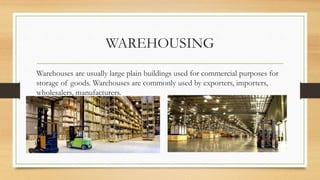
Warehouses are usually large plain buildings used for commercial purposes for
storage of goods. Warehouses are commonly used by exporters, importers,
wholesalers, manufacturers.
WAREHOUSING DEFINITION
Warehousing refers to the activities involving storage of goods on a large scale in a
systematic and orderly manner and making them available when they needed.
Warehousing is more than just a place where inventory is stored. Proper management
of warehousing functions is an important ingredient in a firmโ€™s overall logistics efforts.
Warehousing incorporates many different aspects of logistics operation. Warehousing
is typically viewed as a place to hold or store inventory. However, in contemporary
logistical system, warehousing functionality can be properly viewed as inventory
mixing.
TYPES OF WAREHOUSING
๏ƒ˜ Private Warehouses:
The private warehouses are owned and operated by big manufacturers and merchants to fulfil
their own storage needs. A big manufacturer or wholesaler may have a network of his own
warehouses in different parts of the country
๏ƒ˜ Public Warehouses
A public warehouse is a specialised business establishment that provides storage facilities to the
general public for a certain charge.
It may be owned and operated by an individual or a cooperative society. It has to work under a
license from the government in accordance with the prescribed rules and regulations.
TYPES OF WAREHOUSING cont..
๏ƒ˜ Government Warehouses
These warehouses are owned, managed and controlled by central or state governments or
public corporations or local authorities.
Both government and private enterprises may use these warehouses to store their goods
๏ƒ˜ Bonded Warehouses
Bonded warehouses are licensed by the government to accept imported goods for storage until
the payment of custom duty. They are located near the ports. These warehouses are either
operated by the government or work under the control of custom authorities
TYPES OF WAREHOUSING cont..
๏ƒ˜Co-operative Warehouses
These warehouses are owned, managed and controlled by co-
operative societies. They provide warehousing facilities at the most
economical rates to the members of their society.
OTHER TYPES
๏ƒ˜Cold Storage
๏ƒ˜Export and Import
๏ƒ˜Climate-Controlled (Environment with constant temperature)
๏ƒ˜Field Warehouses( Tenant and Owner)
๏ƒ˜Agricultural Warehouses
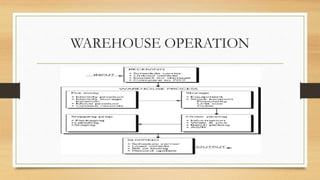
WAREHOUSE OPERATION
FUNCTIONS OF WAREHOUSING
The following function are performed to some degree in all warehousing
operations
๏ƒ˜Receiving: this involves accepting material, unloading it from inbound
transportation mode, verifying quantity and condition of materials and
documentation
๏ƒ˜Put-away: involve removing goods from receiving dock, transporting them
to a storage area, move them to a specific location, recording the movement,
identifying where the material has been placed
FUNCTIONS OF WAREHOUSING contโ€ฆ
๏ƒ˜Storage: this is retention of products for future use or shipment.
๏ƒ˜Replenishment: this occurs when material is relocated from storage to a
temporary resupply area from which orders are directly filled
๏ƒ˜Order selection: involves picking the required quantity of specific products
for movement to a packing area
๏ƒ˜Checking: this means verifying and documenting order selection in terms
of product number and quantity.
FUNCTIONS OF WAREHOUSING contโ€ฆ
๏ƒ˜Packing and marking: refers to placing one or more items of an order into
appropriate container and labelling that container with customer shipping
destination data as well as other handling information that may be required.
๏ƒ˜Staging and consolidation: physical moving of materials from the packing
zone to a shipping area based on a prescribed set of instructions related to a
particular outbound vehicle or delivery route.
FUNCTIONS OF WAREHOUSING contโ€ฆ
๏ƒ˜Shipping: involves loading an outbound vehicle with material from the
staging area and completing the documentation associated with the
movement.
๏ƒ˜Clerical/office administration: refers to all the tasks associated with
keeping track of items as they move into, through, and out of the warehouse.
FUNCTIONS OF WAREHOUSING contโ€ฆ
With the exception of storage and clerical, all of these activities involve
movement in some way.
At one extreme a goods flow directly from the receiving area to the shipping
dock a process known as CROSS-DOCKING
STRATEGIC ROLE OF WAREHOUSING
IN LOGISTICS
๏ƒ˜Provide local inventory
๏ƒ˜Perform value-added services for the customers
๏ƒ˜Operate near vital suppliers, serving as an inbound materials control center
๏ƒ˜Act as a consolidation point for orders
๏ƒ˜Protect against variable manufacturing lead times
๏ƒ˜Perform quality inspection
๏ƒ˜Handle reverse logistics (product returns)
๏ƒ˜Consolidate outbound orders for more economical transportation
NEEDS FOR WAREHOUSING
๏ƒ˜Seasonal Production: Agricultural commodities are harvested during
certain seasons and yet their use or consumption takes place through out the
year hence need for proper storage or warehousing
๏ƒ˜Seasonal Demand: some products are demanded seasonally eg. Umbrella
for rain and winter clothes. As production takes place throughout the year,
there is need to store the products to need the demand
NEEDS FOR WAREHOUSING cont..
๏ƒ˜Large-scale Production: this is to meet the existing and future demand.
We all know manufacturers produces goods on huge quantity to enjoy the
large scale production benefits. Hence So the finished products, which are
produced on a large scale, need to be stored properly till they are cleared by
sales.
๏ƒ˜Quick Supply: highly demanded products are produced in different places
hence there is need to store them near the place of consumption to reduce
the delay in delivery
NEEDS FOR WAREHOUSING cont..
๏ƒ˜Continuous Production: Continuous production of goods in factories
requires adequate supply of raw materials. So there is a need to keep
sufficient quantity of stock of raw material in the warehouse to ensure
continuous production.
๏ƒ˜Price Stabilization: To maintain a reasonable level of the price of the
goods in the market there is a need to keep sufficient stock in the
warehouses. Scarcity in supply of goods may increase their price in the
market. Again, excess production and supply may also lead to fall in prices of
the product.
WAREHOUSING MANAGEMENT
SYSTEM (WMS)
WMS
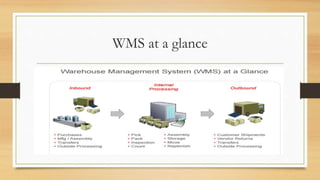
A warehouse management system (WMS) is a software application that helps
control and manage the day-to-day operations in a warehouse. WMS software
guides inventory receiving and put-away, optimizes picking and shipping of
orders and advises on inventory replenishment. A warehouse management
system can be a standalone application or part of an Enterprise Resource
Planning (ERP) system.
FEATURES OF WMS
๏ƒ˜Multiple Picking Options
๏ƒ˜Counting
๏ƒ˜Lot/Serial Number Tracking
๏ƒ˜Customisation and integration
๏ƒ˜Interactive or Batch movement confirmations
FEATURES OF WMS cont..
๏ƒ˜User-defined rules based processing
๏ƒ˜ System-directed put away and picking
๏ƒ˜Zone Management
๏ƒ˜Move-path sequencing
๏ƒ˜Proximity determination
WMS at a glance
WMS contโ€ฆ
A warehouse management system can reduce the likelihood of errors that
could occur when a product is shipped. The system can also help a company
fulfil orders more rapidly and instantaneously trace ordered products
within the warehouse.
WMS programs enable centralized management of tasks such as tracking
inventory levels and stock locations
TYPES OF WMS
๏ƒ˜Standalone System
A standalone warehouse management system is your typical on premises type system which is
deployed on the native hardware and network of the business.
There is need to integrate Standalone system with the rest of your business management
software (ERP). They offer lowest long term cost option
This type of WMS has some limitation
๏ƒ˜ Duplication of data entry
๏ƒ˜ Delay in information and silos
๏ƒ˜ Lack of integrated WMS option.
ERP Modules
๏ƒ˜Enterprise Resource Planning (ERP) is a business management software that
integrates key areas and automates business processes across all departments of an
organization like purchases, sales, marketing, human resources, services, inventory,
financial management.
Improves the flow of information across the organization. When ERP software is
implemented in the organization, all the departments can access updated and shared
information. In addition to this, the entity is also able to analyze the profitability,
performance, and liquidity at any point in time.
ERP Modules contโ€ฆ
ERP software has many of the same capabilities as WMS software such as
tracking the process of inventory items โ€“ picked, packed, and shipped. Itโ€™s
important to know that ERP software is an all-in-one solution! Itโ€™s not
recommended to integrate other systems with ERP software.
Often times, it becomes counter-productive to have multiple software
applications from different vendors managing your operations.
Having multiple applications will decrease productivity and efficiency
through duplicate entries
BENEFITS OF AN INTEGRATED WMS
AND ERP SYSTEM
๏ƒ˜Gain business-wide traceability, employee accountability and real-time speed
and responsiveness.
๏ƒ˜Easy transition from pen and paper to a digital WMS environment that
eliminates re-keying of data and the unavoidable human entry error that
accompanies it. This is done through the help of barcode and scan guns
CLOUD BASED WMS
Considering an upgrade from your spreadsheet program or paper-based
warehouse organization system, then Cloud Based WMS is the best option.
A cloud warehouse management system is a web-based software as a service
(SaaS) model utilizing enterprise cloud technology.
BENEFITS OF CLOUD BASED WMS
๏ƒ˜Lower ownership costs
๏ƒ˜Better flexibility,
๏ƒ˜Disaster recovery,
๏ƒ˜Scalability
๏ƒ˜Ease of use
BENEFITS OF CLOUD BASED WMS cont..
๏ƒ˜Software fit and functionality โ€“ above all else!
๏ƒ˜Purchase agreement (perpetual or subscription licensing)
๏ƒ˜Backup & redundancy
๏ƒ˜Customization
๏ƒ˜Your philosophy on IT and internal IT footprint
๏ƒ˜Software update control
๏ƒ˜Data access and ownership
๏ƒ˜Total cost of ownership
BENEFITS OF A COMPREHENSIVE WMS
๏ƒ˜Reduced fulfilment time
๏ƒ˜Increased inventory accuracy
๏ƒ˜Improved customer service
๏ƒ˜Greater space utilization
๏ƒ˜Increased warehouse productivity
๏ƒ˜Reduced labor cost
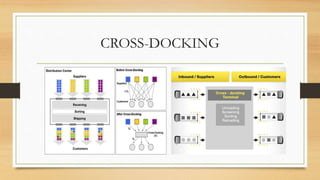
CROSS-DOCKING
If youโ€™re looking to optimize your product distribution and fulfilment services,
you may want to consider a company that offers cross-docking services.
Cross docking is a process that routes incoming shipments to the location
closest to the outbound shipping dock, thereby reducing warehouse
handling
Cross docking not only reduces material handling but also reduces the need to
store the products in the warehouse.
CROSS-DOCKING
WHEN IS CROSS-DOCKING USED?
๏ƒ˜When handling time sensitive and perishable inventory
๏ƒ˜When there is Hub and spoke process: Provide a central site for products
to be sorted and similar products combined to be delivered to multiple
destinations in the most productive and fastest method
WHEN IS CROSS-DOCKING USED?
Contโ€ฆ
๏ƒ˜When there is consolidation arrangements: Combine numerous smaller
product loads into one method of transport to save on transportation costs.
๏ƒ˜ when the demand for any given inventory item is stable and shows strong
consistency
๏ƒ˜When there is deconsolidation arrangements: Break down large product
loads into smaller loads for transportation to create an easier delivery process
to the customer.
ADVANTAGES OF CROSS-DOCKING
๏ƒ˜Enhanced Efficiency
๏ƒ˜Reduced Cost
๏ƒ˜Reduced Shipping Times
๏ƒ˜Decreased Risk of Damaged Product
๏ƒ˜Reduces material handling.
๏ƒ˜Elimination of processes such as โ€˜pick-locationโ€™ and โ€˜order pickingโ€™
๏ƒ˜Increases customer satisfaction
ADVANTAGES OF CROSS-DOCKING
contโ€ฆ
๏ƒ˜Reduces need to store products in warehouse.
๏ƒ˜No need for large warehouse areas
๏ƒ˜Reduced labour costs (no packaging and storing).
๏ƒ˜Products are moved more quickly through a cross dock.
๏ƒ˜Easier to screen product quality.
DISADVANTAGES OF CROSS-DOCKING
๏ƒ˜Much management attention, time and planning is necessary to make it work
effectively.
๏ƒ˜Setting up the cross docking terminal structures would take quite a bit of
time and capital to start with.
๏ƒ˜Some suppliers would not be able to deliver customer ready products to the
cross docking terminal.
DISADVANTAGES OF CROSS-DOCKING
contโ€ฆ
๏ƒ˜A sufficient number of transport carriers are necessary for the cross docking
terminal to run smoothly, therefore is mainly dependent on trucking.
๏ƒ˜A high volume of product is necessary to be cost effective.
๏ƒ˜The organisation has to have a comfortable reliance that their suppliers will
deliver the right product in its right amount to the cross docking terminal on
time which doesnโ€™t leave too much room for error.
PRODUCTS SUITABLE FOR CROSS
DOCKING
๏ƒ˜Perishable items that require immediate shipment
๏ƒ˜High-quality items that do not require quality inspections during goods receipt
๏ƒ˜Products that are pre-tagged (bar coded, RFID), pre-ticketed, and ready for sale at
the customer
๏ƒ˜Promotional items and items that are being launched
๏ƒ˜Pre-picked, pre-packaged customer orders from another production plant or
warehouse
4 COMMON WAREHOUSING PROBLEMS
and possible solution
๏ƒ˜Inefficiency productivity:
To increase productivity, it is important to ensure that your staff are motivated.
constantly developing and invest regularly in training that helps to increase productivity
and efficiency.
๏ƒ˜Capacity
Having enough storage space is vital to an effective warehousing operation. Correctly
organising your warehouse can maximise the amount of goods that can be stored.
consider outsourcing your overflow warehousing until space can become available.
4 COMMON WAREHOUSING PROBLEMS
and possible solution cont..
๏ƒ˜Stock Control
Tracking each of your productโ€™s whereabouts in your warehouse is a mammoth
task, and losing track can have costly consequences for your business. You
should also implement an effective FIFO system, to ensure perishable goods
do not go to waste
๏ƒ˜Damaged Goods
To protect the quality of the stock, care is paramount. Storing goods in
inappropriate places could lead to them getting damaged
CHARACTERISTICS OF IDEAL
WAREHOUSES
๏ƒ˜Sufficient storage space
๏ƒ˜Use of mechanical appliances
๏ƒ˜Disaster and emergency management.
๏ƒ˜The warehouse should be designed to fit the need of the product.
๏ƒ˜Enough parking spaces.
๏ƒ˜ Market proximity
CHARACTERISTICS OF IDEAL
WAREHOUSES contโ€ฆ
๏ƒ˜should have cold storage facilities.
๏ƒ˜Proper arrangement should be there to protect the goods from sunlight, rain,
wind, dust, moisture and pests.
๏ƒ˜ Safety: fitted with latest fire-fighting equipments to avoid loss of goods
due to fire.
๏ƒ˜Proper Management
ECONOMIC BENEFITS OF
WAREHOUSING
Basically, there are two main benefits of warehousing
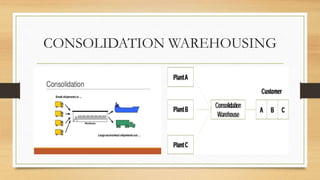
๏ƒ˜Consolidation warehousing: In this concept, manufacturers move away
from multiple warehouses for downstream storage and combine their
inventories with that of other manufacturers in huge warehouses that take
the place of internal distribution centers or third party logistics providers.
The concept calls for multiple manufacturers to combine their output into just
a few consolidation warehouses instead of placing product in corporate
distribution centers or individual public warehouses
CONSOLIDATION WAREHOUSING
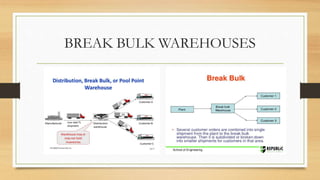
BREAK BULK WAREHOUSES
The warehouse in this case serves the purpose of receiving bulk shipments
through economical long distance transportation from plant and breaking
of these into small shipments for local delivery to various customers. This
enables small shipments in place of long distance small shipments.
BREAK BULK WAREHOUSES
BENEFITS OF WAREHOUSING
๏ƒ˜ Protection and Preservation of goods: It provides protection to the
stocks, ensures their safety and prevents wastage. It minimises losses from
breakage, deterioration in quality, spoilage.
๏ƒ˜ Regular flow of goods: Warehousing ensures regular supply of seasonal
commodities throughout the year.
๏ƒ˜Continuity in production: Warehouse enables the manufacturers to carry
on production continuously without bothering about the storage of raw
materials.
BENEFITS OF WAREHOUSING cont..
๏ƒ˜Convenient location: Warehouses are generally located at convenient places
near road, rail or waterways to facilitate movement of goods. Convenient
location reduces the cost of transportation.
๏ƒ˜Easy handling: Heavy and bulky goods can be loaded and unloaded by
using modern machines, which reduces cost of handling such goods due to
modern warehouse filled with mechanical appliances to handle the goods
๏ƒ˜Creation of employment: Warehouses create employment opportunities
both for killed and unskilled workers in every part of the country
BENEFITS OF WAREHOUSING cont..
๏ƒ˜Reduces risk of loss: Goods in warehouses are well guarded and
preserved. The warehouses can economically employ security staff to avoid
theft, use insecticides for preservation and provide cold storage facility for
perishable items.
๏ƒ˜Facilitates sale of goods:
LIMITATIONS
๏ƒ˜Increased master data maintenance.
๏ƒ˜Additional process step for receipt and picking.
๏ƒ˜Requires expert knowledge to configure for maximum benefit.
๏ƒ˜More complex to resolve problems caused by incorrect processing.
๏ƒ˜Generally WM provide better automation of processes, particularly with RF,
but requires more maintain and process discipline.
REFERENCE
Donald W. Doubler et al,. (1996) purchasing and supply management: text and cases, McGraw
Hill International edition
Donald J. Bowersox. Et al,. supply chain logistics management; McGraw Hill International
edition
Kent N. Gourdin (2006) Global logistics Management: A competitive Advantage for the 21st
Century Blackwell Publishing 550 Swanston Street Carlton, Victoria 3053 Australia
http://cannonhill.net/the-difference-between-cross-docking-and-traditional-warehousing/
http://www.aalhysterforklifts.com.au/index.php/about/blog-
post/advantages_and_disadvantages_of_cross_docking
WITH PLEASURE
โ€œThe teacher who is indeed wise does not bid you to enter the house of
his wisdom but rather leads you to the threshold of your mind.โ€
Khalil Gibran

Warehousing

  • 1.
    WAREHOUSING Anthony Sadalla Aji NdeyJeng Nicolas Odima Odongo Kofi
  • 2.
    WAREHOUSING AT GLANCE Thewarehousing concept takes us way back to the creation of granaries to store food, which was stored for drought and famine and this food was available for purchase in the conditions of emergency, famine, drought In early days man used to store excess food and keeping animals for emergency surplus. As the civilisation developed, local warehouses were introduced
  • 3.
    WAREHOUSING AT GLANCEcont.. During the Middle Ages improvement in human knowledge gave rise to warehousing to handle the storage of shipped items. The first known major commercial warehouse was built in Venice, a centre of major trade routes. Warehousing systems have seen a continuous growth throughout the history, they have been moving forward from local storehouses during the middle ages to multi-million dollar facilities.
  • 4.
    WAREHOUSING Warehouses are usuallylarge plain buildings used for commercial purposes for storage of goods. Warehouses are commonly used by exporters, importers, wholesalers, manufacturers.
  • 5.
    WAREHOUSING DEFINITION Warehousing refersto the activities involving storage of goods on a large scale in a systematic and orderly manner and making them available when they needed. Warehousing is more than just a place where inventory is stored. Proper management of warehousing functions is an important ingredient in a firmโ€™s overall logistics efforts. Warehousing incorporates many different aspects of logistics operation. Warehousing is typically viewed as a place to hold or store inventory. However, in contemporary logistical system, warehousing functionality can be properly viewed as inventory mixing.
  • 6.
    TYPES OF WAREHOUSING ๏ƒ˜Private Warehouses: The private warehouses are owned and operated by big manufacturers and merchants to fulfil their own storage needs. A big manufacturer or wholesaler may have a network of his own warehouses in different parts of the country ๏ƒ˜ Public Warehouses A public warehouse is a specialised business establishment that provides storage facilities to the general public for a certain charge. It may be owned and operated by an individual or a cooperative society. It has to work under a license from the government in accordance with the prescribed rules and regulations.
  • 7.
    TYPES OF WAREHOUSINGcont.. ๏ƒ˜ Government Warehouses These warehouses are owned, managed and controlled by central or state governments or public corporations or local authorities. Both government and private enterprises may use these warehouses to store their goods ๏ƒ˜ Bonded Warehouses Bonded warehouses are licensed by the government to accept imported goods for storage until the payment of custom duty. They are located near the ports. These warehouses are either operated by the government or work under the control of custom authorities
  • 8.
    TYPES OF WAREHOUSINGcont.. ๏ƒ˜Co-operative Warehouses These warehouses are owned, managed and controlled by co- operative societies. They provide warehousing facilities at the most economical rates to the members of their society.
  • 9.
    OTHER TYPES ๏ƒ˜Cold Storage ๏ƒ˜Exportand Import ๏ƒ˜Climate-Controlled (Environment with constant temperature) ๏ƒ˜Field Warehouses( Tenant and Owner) ๏ƒ˜Agricultural Warehouses
  • 10.
  • 11.
    FUNCTIONS OF WAREHOUSING Thefollowing function are performed to some degree in all warehousing operations ๏ƒ˜Receiving: this involves accepting material, unloading it from inbound transportation mode, verifying quantity and condition of materials and documentation ๏ƒ˜Put-away: involve removing goods from receiving dock, transporting them to a storage area, move them to a specific location, recording the movement, identifying where the material has been placed
  • 12.
    FUNCTIONS OF WAREHOUSINGcontโ€ฆ ๏ƒ˜Storage: this is retention of products for future use or shipment. ๏ƒ˜Replenishment: this occurs when material is relocated from storage to a temporary resupply area from which orders are directly filled ๏ƒ˜Order selection: involves picking the required quantity of specific products for movement to a packing area ๏ƒ˜Checking: this means verifying and documenting order selection in terms of product number and quantity.
  • 13.
    FUNCTIONS OF WAREHOUSINGcontโ€ฆ ๏ƒ˜Packing and marking: refers to placing one or more items of an order into appropriate container and labelling that container with customer shipping destination data as well as other handling information that may be required. ๏ƒ˜Staging and consolidation: physical moving of materials from the packing zone to a shipping area based on a prescribed set of instructions related to a particular outbound vehicle or delivery route.
  • 14.
    FUNCTIONS OF WAREHOUSINGcontโ€ฆ ๏ƒ˜Shipping: involves loading an outbound vehicle with material from the staging area and completing the documentation associated with the movement. ๏ƒ˜Clerical/office administration: refers to all the tasks associated with keeping track of items as they move into, through, and out of the warehouse.
  • 15.
    FUNCTIONS OF WAREHOUSINGcontโ€ฆ With the exception of storage and clerical, all of these activities involve movement in some way. At one extreme a goods flow directly from the receiving area to the shipping dock a process known as CROSS-DOCKING
  • 16.
    STRATEGIC ROLE OFWAREHOUSING IN LOGISTICS ๏ƒ˜Provide local inventory ๏ƒ˜Perform value-added services for the customers ๏ƒ˜Operate near vital suppliers, serving as an inbound materials control center ๏ƒ˜Act as a consolidation point for orders ๏ƒ˜Protect against variable manufacturing lead times ๏ƒ˜Perform quality inspection ๏ƒ˜Handle reverse logistics (product returns) ๏ƒ˜Consolidate outbound orders for more economical transportation
  • 17.
    NEEDS FOR WAREHOUSING ๏ƒ˜SeasonalProduction: Agricultural commodities are harvested during certain seasons and yet their use or consumption takes place through out the year hence need for proper storage or warehousing ๏ƒ˜Seasonal Demand: some products are demanded seasonally eg. Umbrella for rain and winter clothes. As production takes place throughout the year, there is need to store the products to need the demand
  • 18.
    NEEDS FOR WAREHOUSINGcont.. ๏ƒ˜Large-scale Production: this is to meet the existing and future demand. We all know manufacturers produces goods on huge quantity to enjoy the large scale production benefits. Hence So the finished products, which are produced on a large scale, need to be stored properly till they are cleared by sales. ๏ƒ˜Quick Supply: highly demanded products are produced in different places hence there is need to store them near the place of consumption to reduce the delay in delivery
  • 19.
    NEEDS FOR WAREHOUSINGcont.. ๏ƒ˜Continuous Production: Continuous production of goods in factories requires adequate supply of raw materials. So there is a need to keep sufficient quantity of stock of raw material in the warehouse to ensure continuous production. ๏ƒ˜Price Stabilization: To maintain a reasonable level of the price of the goods in the market there is a need to keep sufficient stock in the warehouses. Scarcity in supply of goods may increase their price in the market. Again, excess production and supply may also lead to fall in prices of the product.
  • 20.
  • 21.
    WMS A warehouse managementsystem (WMS) is a software application that helps control and manage the day-to-day operations in a warehouse. WMS software guides inventory receiving and put-away, optimizes picking and shipping of orders and advises on inventory replenishment. A warehouse management system can be a standalone application or part of an Enterprise Resource Planning (ERP) system.
  • 22.
    FEATURES OF WMS ๏ƒ˜MultiplePicking Options ๏ƒ˜Counting ๏ƒ˜Lot/Serial Number Tracking ๏ƒ˜Customisation and integration ๏ƒ˜Interactive or Batch movement confirmations
  • 23.
    FEATURES OF WMScont.. ๏ƒ˜User-defined rules based processing ๏ƒ˜ System-directed put away and picking ๏ƒ˜Zone Management ๏ƒ˜Move-path sequencing ๏ƒ˜Proximity determination
  • 24.
    WMS at aglance
  • 25.
    WMS contโ€ฆ A warehousemanagement system can reduce the likelihood of errors that could occur when a product is shipped. The system can also help a company fulfil orders more rapidly and instantaneously trace ordered products within the warehouse. WMS programs enable centralized management of tasks such as tracking inventory levels and stock locations
  • 26.
    TYPES OF WMS ๏ƒ˜StandaloneSystem A standalone warehouse management system is your typical on premises type system which is deployed on the native hardware and network of the business. There is need to integrate Standalone system with the rest of your business management software (ERP). They offer lowest long term cost option This type of WMS has some limitation ๏ƒ˜ Duplication of data entry ๏ƒ˜ Delay in information and silos ๏ƒ˜ Lack of integrated WMS option.
  • 27.
    ERP Modules ๏ƒ˜Enterprise ResourcePlanning (ERP) is a business management software that integrates key areas and automates business processes across all departments of an organization like purchases, sales, marketing, human resources, services, inventory, financial management. Improves the flow of information across the organization. When ERP software is implemented in the organization, all the departments can access updated and shared information. In addition to this, the entity is also able to analyze the profitability, performance, and liquidity at any point in time.
  • 28.
    ERP Modules contโ€ฆ ERPsoftware has many of the same capabilities as WMS software such as tracking the process of inventory items โ€“ picked, packed, and shipped. Itโ€™s important to know that ERP software is an all-in-one solution! Itโ€™s not recommended to integrate other systems with ERP software. Often times, it becomes counter-productive to have multiple software applications from different vendors managing your operations. Having multiple applications will decrease productivity and efficiency through duplicate entries
  • 29.
    BENEFITS OF ANINTEGRATED WMS AND ERP SYSTEM ๏ƒ˜Gain business-wide traceability, employee accountability and real-time speed and responsiveness. ๏ƒ˜Easy transition from pen and paper to a digital WMS environment that eliminates re-keying of data and the unavoidable human entry error that accompanies it. This is done through the help of barcode and scan guns
  • 30.
    CLOUD BASED WMS Consideringan upgrade from your spreadsheet program or paper-based warehouse organization system, then Cloud Based WMS is the best option. A cloud warehouse management system is a web-based software as a service (SaaS) model utilizing enterprise cloud technology.
  • 31.
    BENEFITS OF CLOUDBASED WMS ๏ƒ˜Lower ownership costs ๏ƒ˜Better flexibility, ๏ƒ˜Disaster recovery, ๏ƒ˜Scalability ๏ƒ˜Ease of use
  • 32.
    BENEFITS OF CLOUDBASED WMS cont.. ๏ƒ˜Software fit and functionality โ€“ above all else! ๏ƒ˜Purchase agreement (perpetual or subscription licensing) ๏ƒ˜Backup & redundancy ๏ƒ˜Customization ๏ƒ˜Your philosophy on IT and internal IT footprint ๏ƒ˜Software update control ๏ƒ˜Data access and ownership ๏ƒ˜Total cost of ownership
  • 33.
    BENEFITS OF ACOMPREHENSIVE WMS ๏ƒ˜Reduced fulfilment time ๏ƒ˜Increased inventory accuracy ๏ƒ˜Improved customer service ๏ƒ˜Greater space utilization ๏ƒ˜Increased warehouse productivity ๏ƒ˜Reduced labor cost
  • 34.
    CROSS-DOCKING If youโ€™re lookingto optimize your product distribution and fulfilment services, you may want to consider a company that offers cross-docking services. Cross docking is a process that routes incoming shipments to the location closest to the outbound shipping dock, thereby reducing warehouse handling Cross docking not only reduces material handling but also reduces the need to store the products in the warehouse.
  • 35.
  • 36.
    WHEN IS CROSS-DOCKINGUSED? ๏ƒ˜When handling time sensitive and perishable inventory ๏ƒ˜When there is Hub and spoke process: Provide a central site for products to be sorted and similar products combined to be delivered to multiple destinations in the most productive and fastest method
  • 37.
    WHEN IS CROSS-DOCKINGUSED? Contโ€ฆ ๏ƒ˜When there is consolidation arrangements: Combine numerous smaller product loads into one method of transport to save on transportation costs. ๏ƒ˜ when the demand for any given inventory item is stable and shows strong consistency ๏ƒ˜When there is deconsolidation arrangements: Break down large product loads into smaller loads for transportation to create an easier delivery process to the customer.
  • 38.
    ADVANTAGES OF CROSS-DOCKING ๏ƒ˜EnhancedEfficiency ๏ƒ˜Reduced Cost ๏ƒ˜Reduced Shipping Times ๏ƒ˜Decreased Risk of Damaged Product ๏ƒ˜Reduces material handling. ๏ƒ˜Elimination of processes such as โ€˜pick-locationโ€™ and โ€˜order pickingโ€™ ๏ƒ˜Increases customer satisfaction
  • 39.
    ADVANTAGES OF CROSS-DOCKING contโ€ฆ ๏ƒ˜Reducesneed to store products in warehouse. ๏ƒ˜No need for large warehouse areas ๏ƒ˜Reduced labour costs (no packaging and storing). ๏ƒ˜Products are moved more quickly through a cross dock. ๏ƒ˜Easier to screen product quality.
  • 40.
    DISADVANTAGES OF CROSS-DOCKING ๏ƒ˜Muchmanagement attention, time and planning is necessary to make it work effectively. ๏ƒ˜Setting up the cross docking terminal structures would take quite a bit of time and capital to start with. ๏ƒ˜Some suppliers would not be able to deliver customer ready products to the cross docking terminal.
  • 41.
    DISADVANTAGES OF CROSS-DOCKING contโ€ฆ ๏ƒ˜Asufficient number of transport carriers are necessary for the cross docking terminal to run smoothly, therefore is mainly dependent on trucking. ๏ƒ˜A high volume of product is necessary to be cost effective. ๏ƒ˜The organisation has to have a comfortable reliance that their suppliers will deliver the right product in its right amount to the cross docking terminal on time which doesnโ€™t leave too much room for error.
  • 42.
    PRODUCTS SUITABLE FORCROSS DOCKING ๏ƒ˜Perishable items that require immediate shipment ๏ƒ˜High-quality items that do not require quality inspections during goods receipt ๏ƒ˜Products that are pre-tagged (bar coded, RFID), pre-ticketed, and ready for sale at the customer ๏ƒ˜Promotional items and items that are being launched ๏ƒ˜Pre-picked, pre-packaged customer orders from another production plant or warehouse
  • 43.
    4 COMMON WAREHOUSINGPROBLEMS and possible solution ๏ƒ˜Inefficiency productivity: To increase productivity, it is important to ensure that your staff are motivated. constantly developing and invest regularly in training that helps to increase productivity and efficiency. ๏ƒ˜Capacity Having enough storage space is vital to an effective warehousing operation. Correctly organising your warehouse can maximise the amount of goods that can be stored. consider outsourcing your overflow warehousing until space can become available.
  • 44.
    4 COMMON WAREHOUSINGPROBLEMS and possible solution cont.. ๏ƒ˜Stock Control Tracking each of your productโ€™s whereabouts in your warehouse is a mammoth task, and losing track can have costly consequences for your business. You should also implement an effective FIFO system, to ensure perishable goods do not go to waste ๏ƒ˜Damaged Goods To protect the quality of the stock, care is paramount. Storing goods in inappropriate places could lead to them getting damaged
  • 45.
    CHARACTERISTICS OF IDEAL WAREHOUSES ๏ƒ˜Sufficientstorage space ๏ƒ˜Use of mechanical appliances ๏ƒ˜Disaster and emergency management. ๏ƒ˜The warehouse should be designed to fit the need of the product. ๏ƒ˜Enough parking spaces. ๏ƒ˜ Market proximity
  • 46.
    CHARACTERISTICS OF IDEAL WAREHOUSEScontโ€ฆ ๏ƒ˜should have cold storage facilities. ๏ƒ˜Proper arrangement should be there to protect the goods from sunlight, rain, wind, dust, moisture and pests. ๏ƒ˜ Safety: fitted with latest fire-fighting equipments to avoid loss of goods due to fire. ๏ƒ˜Proper Management
  • 47.
    ECONOMIC BENEFITS OF WAREHOUSING Basically,there are two main benefits of warehousing ๏ƒ˜Consolidation warehousing: In this concept, manufacturers move away from multiple warehouses for downstream storage and combine their inventories with that of other manufacturers in huge warehouses that take the place of internal distribution centers or third party logistics providers. The concept calls for multiple manufacturers to combine their output into just a few consolidation warehouses instead of placing product in corporate distribution centers or individual public warehouses
  • 48.
  • 49.
    BREAK BULK WAREHOUSES Thewarehouse in this case serves the purpose of receiving bulk shipments through economical long distance transportation from plant and breaking of these into small shipments for local delivery to various customers. This enables small shipments in place of long distance small shipments.
  • 50.
  • 51.
    BENEFITS OF WAREHOUSING ๏ƒ˜Protection and Preservation of goods: It provides protection to the stocks, ensures their safety and prevents wastage. It minimises losses from breakage, deterioration in quality, spoilage. ๏ƒ˜ Regular flow of goods: Warehousing ensures regular supply of seasonal commodities throughout the year. ๏ƒ˜Continuity in production: Warehouse enables the manufacturers to carry on production continuously without bothering about the storage of raw materials.
  • 52.
    BENEFITS OF WAREHOUSINGcont.. ๏ƒ˜Convenient location: Warehouses are generally located at convenient places near road, rail or waterways to facilitate movement of goods. Convenient location reduces the cost of transportation. ๏ƒ˜Easy handling: Heavy and bulky goods can be loaded and unloaded by using modern machines, which reduces cost of handling such goods due to modern warehouse filled with mechanical appliances to handle the goods ๏ƒ˜Creation of employment: Warehouses create employment opportunities both for killed and unskilled workers in every part of the country
  • 53.
    BENEFITS OF WAREHOUSINGcont.. ๏ƒ˜Reduces risk of loss: Goods in warehouses are well guarded and preserved. The warehouses can economically employ security staff to avoid theft, use insecticides for preservation and provide cold storage facility for perishable items. ๏ƒ˜Facilitates sale of goods:
  • 54.
    LIMITATIONS ๏ƒ˜Increased master datamaintenance. ๏ƒ˜Additional process step for receipt and picking. ๏ƒ˜Requires expert knowledge to configure for maximum benefit. ๏ƒ˜More complex to resolve problems caused by incorrect processing. ๏ƒ˜Generally WM provide better automation of processes, particularly with RF, but requires more maintain and process discipline.
  • 55.
    REFERENCE Donald W. Doubleret al,. (1996) purchasing and supply management: text and cases, McGraw Hill International edition Donald J. Bowersox. Et al,. supply chain logistics management; McGraw Hill International edition Kent N. Gourdin (2006) Global logistics Management: A competitive Advantage for the 21st Century Blackwell Publishing 550 Swanston Street Carlton, Victoria 3053 Australia http://cannonhill.net/the-difference-between-cross-docking-and-traditional-warehousing/ http://www.aalhysterforklifts.com.au/index.php/about/blog- post/advantages_and_disadvantages_of_cross_docking
  • 56.
    WITH PLEASURE โ€œThe teacherwho is indeed wise does not bid you to enter the house of his wisdom but rather leads you to the threshold of your mind.โ€ Khalil Gibran