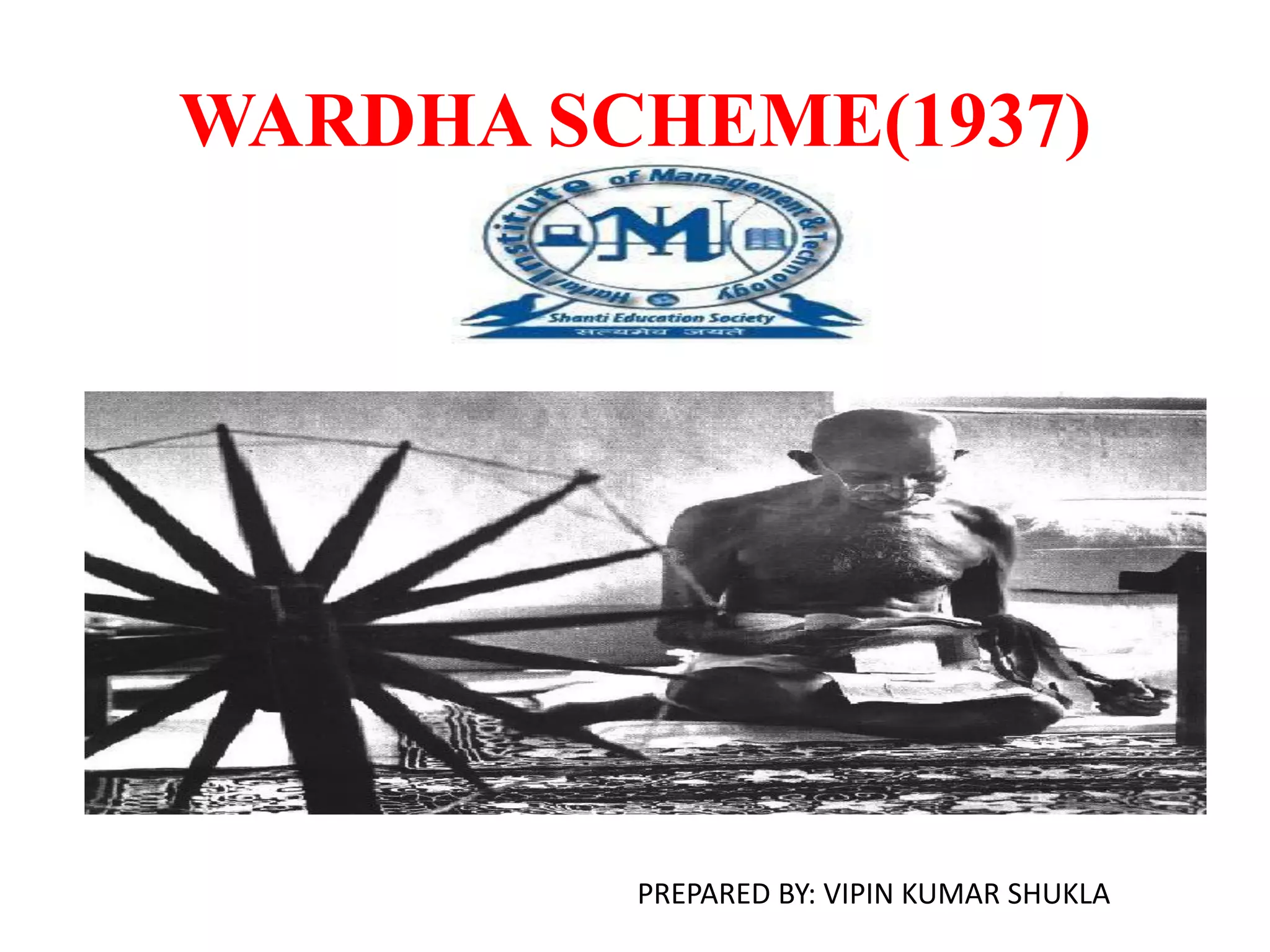

WARDHA SCHEME(1937)
PREPARED BY: VIPIN KUMAR SHUKLA
INTRODUCTION:
• It is also called as Basic education or Wardha scheme of
education.
• Education is defined as the learning process which
develop Individual and Society.
• Education bring different types of eligibility and capacity.
• By the education we can enhance social and society
relations between the Individual.
• The education which cannot meet all these developments
are not called as Good education.
Contd….
• So, acc to him complete development of Body,
Intelligence and Soul are called as education.
• British education cannot meet all those points which
is required, So, Mahatma Gandhi took initiative step
towards education.
• According to Mahatma Gandhi education is a process
which leads to the development or overall
development in an student or Individual called as
Education.
Contd….
• Only literacy development is not an educational
development.
• He believes in all round development. i.e.
• Physical Development.
• Mental Development.
• Social Development.
• Economical Development.
• Political Development.
• Spiritual Development.
Contd…
• According to Ghandiji the children who belongs to the
age group of (7-14 year) of age the education is must for
them and that education is compulsory and free.
• Complete education should be based on skills of students.
• The selection of monuments should be chosen by the
student eligibility and their own interest.
• The monuments made by the students should be sale and
whatever the money come that money should be utilized
in the school.
Contd….
• The language or medium of instructions should be
mother tongue.
• This scheme was presented in the presence of Dr.
Jakir Husain.
FEATURES OF BASIC EDUATION
SCHEME:
• Education or medium of Instruction should be the mother
tongue.
• Self- Independent education was given to the student.
• All round development.
• Caste based system removed.
• To make the student close to school and society.
• Also looked according to Internal Finance point of view.
DRAWBACKS OF WARDHA
SCHEME:
• It is an Incomplete movement.
• Here nothing is doing for higher level of education.
• Wastage of Raw materials.
• Here only mother tongue is the means of instruction.
• It is suitable for poor children not for richer one.
HISTORY OF WARDHA SCHEME:
• On July 31st , 1937) Ghandiji had published an article in
the Harijan.
• Based upon that article on all India National educational
Conference was held on 22oct and 23 Oct 1937).
• This conference is called Wardha educational Conference.
• The president of this conference was Ghandiji itself.
Resolution of Wardha scheme(1937)
• Free and Compulsory education to be provided for (7
year) at a nation wide scale.
• Medium of Instruction should be the mother tongue.
• The system would generate the remuneration of teachers.
• Out of this (7 year) period the education should be around
some forms of manual and productive work and for this
purpose handicraft must be chosen which should be
based on the environment of child.
Wardha scheme  converted

Wardha scheme converted

  • 1.
  • 2.
    INTRODUCTION: • It isalso called as Basic education or Wardha scheme of education. • Education is defined as the learning process which develop Individual and Society. • Education bring different types of eligibility and capacity. • By the education we can enhance social and society relations between the Individual. • The education which cannot meet all these developments are not called as Good education.
  • 3.
    Contd…. • So, accto him complete development of Body, Intelligence and Soul are called as education. • British education cannot meet all those points which is required, So, Mahatma Gandhi took initiative step towards education. • According to Mahatma Gandhi education is a process which leads to the development or overall development in an student or Individual called as Education.
  • 4.
    Contd…. • Only literacydevelopment is not an educational development. • He believes in all round development. i.e. • Physical Development. • Mental Development. • Social Development. • Economical Development. • Political Development. • Spiritual Development.
  • 5.
    Contd… • According toGhandiji the children who belongs to the age group of (7-14 year) of age the education is must for them and that education is compulsory and free. • Complete education should be based on skills of students. • The selection of monuments should be chosen by the student eligibility and their own interest. • The monuments made by the students should be sale and whatever the money come that money should be utilized in the school.
  • 6.
    Contd…. • The languageor medium of instructions should be mother tongue. • This scheme was presented in the presence of Dr. Jakir Husain.
  • 7.
    FEATURES OF BASICEDUATION SCHEME: • Education or medium of Instruction should be the mother tongue. • Self- Independent education was given to the student. • All round development. • Caste based system removed. • To make the student close to school and society. • Also looked according to Internal Finance point of view.
  • 8.
    DRAWBACKS OF WARDHA SCHEME: •It is an Incomplete movement. • Here nothing is doing for higher level of education. • Wastage of Raw materials. • Here only mother tongue is the means of instruction. • It is suitable for poor children not for richer one.
  • 9.
    HISTORY OF WARDHASCHEME: • On July 31st , 1937) Ghandiji had published an article in the Harijan. • Based upon that article on all India National educational Conference was held on 22oct and 23 Oct 1937). • This conference is called Wardha educational Conference. • The president of this conference was Ghandiji itself.
  • 10.
    Resolution of Wardhascheme(1937) • Free and Compulsory education to be provided for (7 year) at a nation wide scale. • Medium of Instruction should be the mother tongue. • The system would generate the remuneration of teachers. • Out of this (7 year) period the education should be around some forms of manual and productive work and for this purpose handicraft must be chosen which should be based on the environment of child.