A Survey of WAP Security Architecture Neil Daswani [email_address]
Overview Security Basics Wireless Security WTLS & SSL WAP Security Models WIM, WMLScript, Access Control Summary References
Security Basics Security Goals Authentication Confidentiality Integrity Authorization Non-Repudiation
Security Basics Cryptography Symmetric: 3DES, RC4, etc. Asymmetric: RSA, ECC Key Exchange Digital Signature Certificates PKI
Wireless Security Link Layer Security GSM CDMA CDPD Application Layer Security WAP: WTLS, WML, WMLScript, & SSL iMode: N/A SMS: N/A
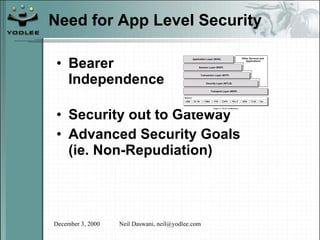
Need for App Level Security Bearer  Independence Security out to Gateway Advanced Security Goals  (ie. Non-Repudiation)
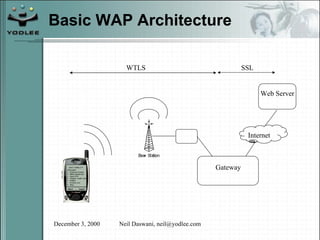
Basic WAP Architecture Internet Gateway Web Server WTLS SSL
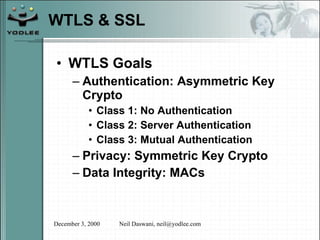
WTLS & SSL WTLS Goals Authentication: Asymmetric Key Crypto Class 1: No Authentication Class 2: Server Authentication Class 3: Mutual Authentication Privacy: Symmetric Key Crypto Data Integrity: MACs
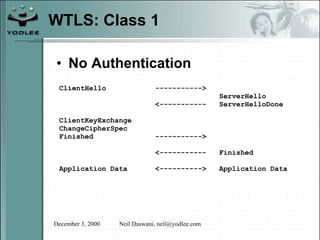
WTLS: Class 1 No Authentication ClientHello -----------> ServerHello <-----------  ServerHelloDone ClientKeyExchange ChangeCipherSpec Finished -----------> <----------- Finished Application Data <----------> Application Data
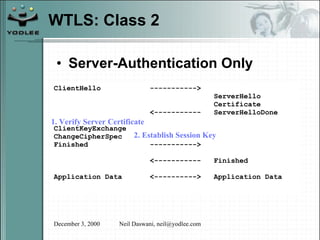
WTLS: Class 2 Server-Authentication Only ClientHello -----------> ServerHello Certificate <-----------  ServerHelloDone ClientKeyExchange ChangeCipherSpec Finished -----------> <----------- Finished Application Data <----------> Application Data 1. Verify Server Certificate 2. Establish Session Key
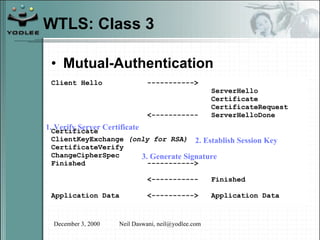
Mutual-Authentication WTLS: Class 3 Client Hello -----------> ServerHello Certificate CertificateRequest <----------- ServerHelloDone Certificate ClientKeyExchange  (only for RSA) CertificateVerify ChangeCipherSpec Finished -----------> <----------- Finished Application Data <----------> Application Data 1. Verify Server Certificate 2. Establish Session Key 3. Generate Signature
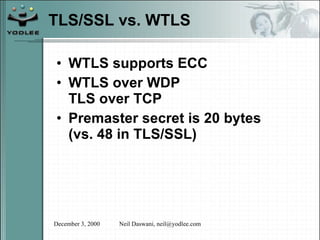
TLS/SSL vs. WTLS WTLS supports ECC WTLS over WDP TLS over TCP Premaster secret is 20 bytes  (vs. 48 in TLS/SSL)
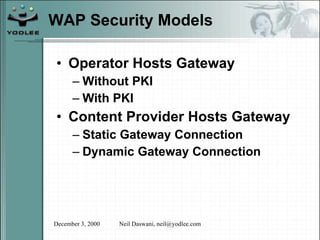
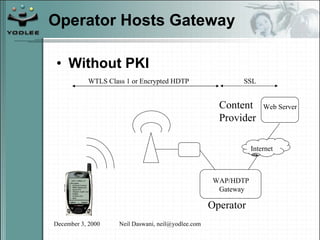
WAP Security Models Operator Hosts Gateway Without PKI With PKI Content Provider Hosts Gateway Static Gateway Connection Dynamic Gateway Connection
Operator Hosts Gateway Without PKI Operator Content Provider Internet WAP/HDTP Gateway Web Server WTLS Class 1 or Encrypted HDTP SSL
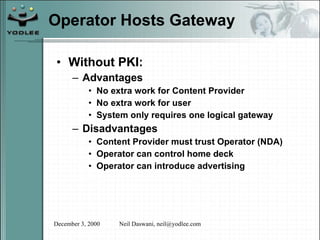
Operator Hosts Gateway Without PKI: Advantages No extra work for Content Provider No extra work for user System only requires one logical gateway Disadvantages Content Provider must trust Operator (NDA) Operator can control home deck Operator can introduce advertising
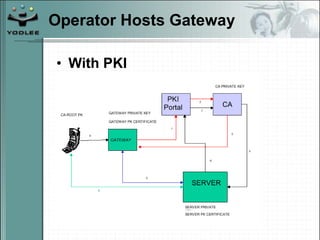
Operator Hosts Gateway With PKI
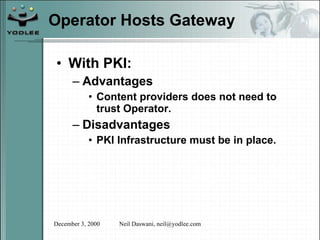
Operator Hosts Gateway With PKI: Advantages Content providers does not need to trust Operator. Disadvantages PKI Infrastructure must be in place.
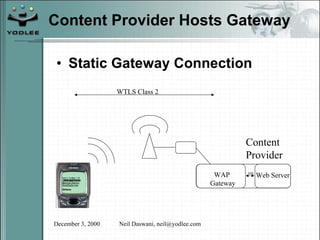
Content Provider Hosts Gateway Static Gateway Connection WAP Gateway Web Server WTLS Class 2 SSL Content Provider
Content Provider Hosts Gateway Static Gateway Connection Advantages Content Provider does not need to trust Operator Content Provider can control home deck OTA can be used to configure mobile terminal Disadvantages Mobile terminal may have limited number of gateway config sets (i.e., Nokia 7110 has 10) Mobile Terminal needs to be configured. OTA via WAP Push / SMS may not work with gateway / mobile terminal combination Content Provider may have to pre-configure mobile terminals
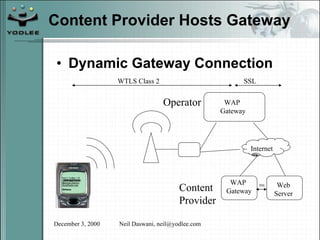
Content Provider Hosts Gateway Dynamic Gateway Connection Internet WAP Gateway WTLS Class 2 SSL Operator Web Server SSL Content Provider WAP Gateway
Content Provider Hosts Gateway Dynamic Gateway Connection Advantages Content Provider does not need to trust Operator. Content Provider does not need to worry about mobile terminal config Disadvantages Operator needs to trust Content Provider. Not deployed yet.
Restricting Gateway Access Consider the following attack: Eve runs a “modified” WAP gateway Eve fools a user into using her gateway Now, Eve can eavesdrop on all of the users requests and responses! To prevent this, check the gateway IP address in the HTTP request.
WIM: WAP Identity Module WIM must be tamper-resistant  Stores Keys & Master Secrets Computes crypto operations “ unwrapping master secret” client signature in WTLS Handshake key exchange (ECC WTLS Handshake) Also: Generates Keys Stores Certificates (or their URLs) CA & Root Certs User Certs Can be implemented with SIM
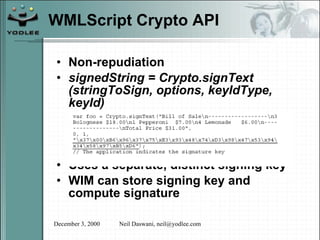
WMLScript Crypto API Non-repudiation signedString = Crypto.signText (stringToSign, options, keyIdType, keyId) Uses a separate, distinct signing key WIM can store signing key and compute signature
WML Access Control WML Deck-Level Access Control <wml> <head> <access domain=“worldfaq.com” path = “/stats”> </head> <card> … </card> </wml> WMLScript Access Control use access domain domain_name | path path_name | domain domain_name path path_name; use access domain “worldfaq.com” path “/stats”
Summary Gateway position & configuration allows for different trust models Security at multiple levels Link Layer (depends on bearer) App Layer Authentication,  Confidentiality, and  Integrity: WTLS Authorization: App-dependent, or WML <access> and WMLScript use access pragma Non-Repudiation: WML signText
References C. Arehart, N. Chidambaram, S. Guruprasad, et. al.  Professional WAP.  Wrox Press, 2000.  ISBN 1-861004-0-44 D. Margrave, GSM Security and Encryption WAP-100, Wireless Application Protocol Architecture Specification  WAP-191, Wireless Markup Language Specification  WAP-193, WMLScript Language Specification  WAP-199, Wireless Transport Layer Security Specification  WAP-198, Wireless Identity Module  WAP-161, WMLScript Crypto API Library  WAP-187, WAP Transport Layer E2E Security Specification WAP-217, WAP Public Key Infrastructure Definition

Wap Security Arch Presentation

  • 1.
    A Survey ofWAP Security Architecture Neil Daswani [email_address]
  • 2.
    Overview Security BasicsWireless Security WTLS & SSL WAP Security Models WIM, WMLScript, Access Control Summary References
  • 3.
    Security Basics SecurityGoals Authentication Confidentiality Integrity Authorization Non-Repudiation
  • 4.
    Security Basics CryptographySymmetric: 3DES, RC4, etc. Asymmetric: RSA, ECC Key Exchange Digital Signature Certificates PKI
  • 5.
    Wireless Security LinkLayer Security GSM CDMA CDPD Application Layer Security WAP: WTLS, WML, WMLScript, & SSL iMode: N/A SMS: N/A
  • 6.
    Need for AppLevel Security Bearer Independence Security out to Gateway Advanced Security Goals (ie. Non-Repudiation)
  • 7.
    Basic WAP ArchitectureInternet Gateway Web Server WTLS SSL
  • 8.
    WTLS & SSLWTLS Goals Authentication: Asymmetric Key Crypto Class 1: No Authentication Class 2: Server Authentication Class 3: Mutual Authentication Privacy: Symmetric Key Crypto Data Integrity: MACs
  • 9.
    WTLS: Class 1No Authentication ClientHello -----------> ServerHello <----------- ServerHelloDone ClientKeyExchange ChangeCipherSpec Finished -----------> <----------- Finished Application Data <----------> Application Data
  • 10.
    WTLS: Class 2Server-Authentication Only ClientHello -----------> ServerHello Certificate <----------- ServerHelloDone ClientKeyExchange ChangeCipherSpec Finished -----------> <----------- Finished Application Data <----------> Application Data 1. Verify Server Certificate 2. Establish Session Key
  • 11.
    Mutual-Authentication WTLS: Class3 Client Hello -----------> ServerHello Certificate CertificateRequest <----------- ServerHelloDone Certificate ClientKeyExchange (only for RSA) CertificateVerify ChangeCipherSpec Finished -----------> <----------- Finished Application Data <----------> Application Data 1. Verify Server Certificate 2. Establish Session Key 3. Generate Signature
  • 12.
    TLS/SSL vs. WTLSWTLS supports ECC WTLS over WDP TLS over TCP Premaster secret is 20 bytes (vs. 48 in TLS/SSL)
  • 13.
    WAP Security ModelsOperator Hosts Gateway Without PKI With PKI Content Provider Hosts Gateway Static Gateway Connection Dynamic Gateway Connection
  • 14.
    Operator Hosts GatewayWithout PKI Operator Content Provider Internet WAP/HDTP Gateway Web Server WTLS Class 1 or Encrypted HDTP SSL
  • 15.
    Operator Hosts GatewayWithout PKI: Advantages No extra work for Content Provider No extra work for user System only requires one logical gateway Disadvantages Content Provider must trust Operator (NDA) Operator can control home deck Operator can introduce advertising
  • 16.
  • 17.
    Operator Hosts GatewayWith PKI: Advantages Content providers does not need to trust Operator. Disadvantages PKI Infrastructure must be in place.
  • 18.
    Content Provider HostsGateway Static Gateway Connection WAP Gateway Web Server WTLS Class 2 SSL Content Provider
  • 19.
    Content Provider HostsGateway Static Gateway Connection Advantages Content Provider does not need to trust Operator Content Provider can control home deck OTA can be used to configure mobile terminal Disadvantages Mobile terminal may have limited number of gateway config sets (i.e., Nokia 7110 has 10) Mobile Terminal needs to be configured. OTA via WAP Push / SMS may not work with gateway / mobile terminal combination Content Provider may have to pre-configure mobile terminals
  • 20.
    Content Provider HostsGateway Dynamic Gateway Connection Internet WAP Gateway WTLS Class 2 SSL Operator Web Server SSL Content Provider WAP Gateway
  • 21.
    Content Provider HostsGateway Dynamic Gateway Connection Advantages Content Provider does not need to trust Operator. Content Provider does not need to worry about mobile terminal config Disadvantages Operator needs to trust Content Provider. Not deployed yet.
  • 22.
    Restricting Gateway AccessConsider the following attack: Eve runs a “modified” WAP gateway Eve fools a user into using her gateway Now, Eve can eavesdrop on all of the users requests and responses! To prevent this, check the gateway IP address in the HTTP request.
  • 23.
    WIM: WAP IdentityModule WIM must be tamper-resistant Stores Keys & Master Secrets Computes crypto operations “ unwrapping master secret” client signature in WTLS Handshake key exchange (ECC WTLS Handshake) Also: Generates Keys Stores Certificates (or their URLs) CA & Root Certs User Certs Can be implemented with SIM
  • 24.
    WMLScript Crypto APINon-repudiation signedString = Crypto.signText (stringToSign, options, keyIdType, keyId) Uses a separate, distinct signing key WIM can store signing key and compute signature
  • 25.
    WML Access ControlWML Deck-Level Access Control <wml> <head> <access domain=“worldfaq.com” path = “/stats”> </head> <card> … </card> </wml> WMLScript Access Control use access domain domain_name | path path_name | domain domain_name path path_name; use access domain “worldfaq.com” path “/stats”
  • 26.
    Summary Gateway position& configuration allows for different trust models Security at multiple levels Link Layer (depends on bearer) App Layer Authentication, Confidentiality, and Integrity: WTLS Authorization: App-dependent, or WML <access> and WMLScript use access pragma Non-Repudiation: WML signText
  • 27.
    References C. Arehart,N. Chidambaram, S. Guruprasad, et. al. Professional WAP. Wrox Press, 2000. ISBN 1-861004-0-44 D. Margrave, GSM Security and Encryption WAP-100, Wireless Application Protocol Architecture Specification WAP-191, Wireless Markup Language Specification WAP-193, WMLScript Language Specification WAP-199, Wireless Transport Layer Security Specification WAP-198, Wireless Identity Module WAP-161, WMLScript Crypto API Library WAP-187, WAP Transport Layer E2E Security Specification WAP-217, WAP Public Key Infrastructure Definition