PLANTS
               FOR EVERY
                REASON


This booklet has been made available with the Proposition 204 grant educational funds
obtained by the North San Juan Fire Protection District in Nevada County, California


                                                                                        1
PLANTS FOR EVERY REASON

Your property is yours- but you might consider sharing it with wildflowers, butterflies,
birds and other wildlife by creating habitat such as the plants in this booklet. Our parks
and forests are great places to visit and observe wildlife but fish, insects, birds, animals
and plants need our help in providing habitat on private lands.

This booklet will discuss the following plants :

       Plants for creating habitat
       Deer resistant plants
       Native plants
       Fire resistant plants
       Poisonous plants


Information compiled and produced by Lesa Osterholm.
              January 2004


References and resources:
“Fire Wise is Fire Safe”, Fire Safe Council of Nevada County
Contact: 530-470-9193 or www.firesafecouncilnevco.com

“Deer Resistant Plants for the Sierra Foothills (Zone 7)”
“Western Nevada County Gardening Guide”
UC Cooperative Extension Nevada County Master Gardeners
Contact: 530-273-4563 or www.ceplacer.ucdavis.edu

“Toxic Plants In Your Hay And Pasture”
Mary A. Scott, D.V.M., UC Davis Veterinary Hospital, California
www.vetmed.ucdavis.edu

Nevada County Resource Conservation District/
USDA Natural Resource Conservation Service
Contact: 530-272-3417
www.nrcs.usda.gov for poisonous plant and resource conservation information


                                                                                               2
PLANTS FOR CREATING HABITAT
                      Be part of the habitat solution.

               BUTTERFLIES AND BENEFICIAL INSECTS


Butterflies add flashes of color and enhance the beauty of your landscaping.
To provide for season long butterfly visits, choose a mix of nectar-rich species with
blooming times that run from spring to fall. Butterflies require food in liquid form such as
nectar from flowers and juices from extra-ripe fruits. Both annuals and perennials will
work. Below is a list of some plants that do well in our area:

ANNUALS                                              PERENNIALS
Cosmos                                Aster/ Michaelmas Daisy   Coffeeberry
Lantana                               Bee balm                  Lavender
Lunaria                               Black-eyed Susan          Phlox
Marigold                              Butterfly Bush            Purple Coneflower
Petunia                               Cape Plumbago             Yarrow
Verbena                               Catnip
Zinnia                                Coreopsis

Hummingbirds are attracted to red and yellow plants although they frequently visit nectar
producing flowers like many on the list above.


Having the right insects in your garden or property can keep pests and weeds to a
minimum. Beneficial insects such as ladybugs, assassin bugs and praying mantises prey
on insects that can harm your plants.


                          QUAIL AND PHEASANT

                   A wide variety of fruit, berries and seeds from wild plants provide
                   food for the Valley or California quail. Wild grass seeds as well as
                   planted grains are important sources of food.
                   Legumes such as vetches, clovers and lupine are very desirable.
Scotch Broom also provides food for quail; however, it is an undesirable, very invasive
plant and very flammable.

After creating defensible space on your property by thinning and trimming trees and
brush, save a few brush piles for quail and other birds and animals. These piles serve as
great habitat and food for many species.


                                                                                            3
BIRDS

Birds are usually plentiful with the following plants in our area:

Blue Elderberry
California Fushia
Coffeeberry
Pines
Toyon
Western Serviceberry
Willows
Wood’s Rose

Brush piles or dead and hollow trees are valuable for wildlife. Dead trees provide homes
to over 400 species of birds, mammals and amphibians. Fish, plants and fungi also
benefit from dead and dying trees. Brush and dead trees can provide food, shelter and
nesting sites for wildlife and will decompose naturally.

Butterflies, birds, bees and all wildlife are very vulnerable to many pesticides and other
chemicals. Probably the best single thing a gardener can do for wildlife is to minimize
chemical use. If you do use chemicals, always follow the directions and try not to apply
when fruit or nuts are present on the plants.


CATTLE/ SHEEP and SIMILAR LIVESTOCK


Cattle and sheep prefer a 50:50 mix of palatable forage grasses and legumes such as
clovers and vetches. Annual Ryegrass, Blando Brome and Clovers grow well in our range
soils and elevations to 3500 feet. This dryland mix is commonly referred to as the
“Grass Valley Mix.”

                            HORSES
                            Horses need a 75:25 ratio mix of palatable forage grasses to
                            legumes. Horses can get serious digestive upsets if they
                            consume too much legumes such as clover. Horses are very
                            selective eaters and prefer ryegrass, orchard grasses, oats,
                            timothy, alfalfa and clovers.

Contact the Nevada County Resource Conservation District, the local UC Ag Extension
Office or local seed suppliers for more information.


                                                                                             4
DEER RESISTANT PLANTS
                                        (not deer proof)


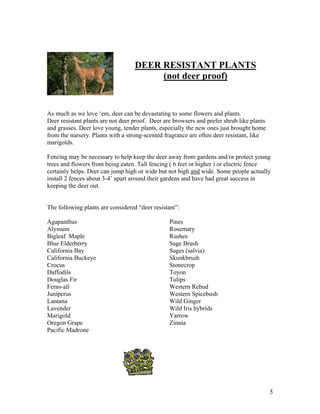
As much as we love ‘em, deer can be devastating to some flowers and plants.
Deer resistant plants are not deer proof. Deer are browsers and prefer shrub like plants
and grasses. Deer love young, tender plants, especially the new ones just brought home
from the nursery. Plants with a strong-scented fragrance are often deer resistant, like
marigolds.

Fencing may be necessary to help keep the deer away from gardens and/or protect young
trees and flowers from being eaten. Tall fencing ( 6 feet or higher ) or electric fence
certainly helps. Deer can jump high or wide but not high and wide. Some people actually
install 2 fences about 3-4’ apart around their gardens and have had great success in
keeping the deer out.


The following plants are considered “deer resistant”:

Agapanthus                                       Pines
Alyssum                                          Rosemary
Bigleaf Maple                                    Rushes
Blue Elderberry                                  Sage Brush
California Bay                                   Sages (salvia)
California Buckeye                               Skunkbrush
Crocus                                           Stonecrop
Daffodils                                        Toyon
Douglas Fir                                      Tulips
Ferns-all                                        Western Rebud
Juniperus                                        Western Spicebush
Lantana                                          Wild Ginger
Lavender                                         Wild Iris hybrids
Marigold                                         Yarrow
Oregon Grape                                     Zinnia
Pacific Madrone


                                                                                           5
NATIVE PLANTS of CALIFORNIA
Native plants are better suited to our local soil and growing conditions and make your job
much easier in establishing them on your property. They usually require less work to
thrive. Native plants are not necessarily deer resistant or fire resistant plants.

Well established, mature native plants need less water and usually do not like too much
summer watering. Young, native plants must have supplemental water in order to
establish themselves and thrive. It may take several years before a native plant can last
without supplemental water.

More and more, California native plants are disappearing from the wild. To help preserve
them, you can purchase seeds or plants from nurseries that specialize in native plants.
The Nevada County Resource Conservation District usually has a native plant give- away
every spring, and the Nevada County Master Gardener’s Spring and Fall Fests offer
native plants for sale.

Remember that it’s against the law to pick flowers or dig up plants on public lands.
A picked flower can’t set seeds to replace itself and a dug up plant most likely won’t
survive, so the plants are lost to everyone. Take pictures instead and preserve them!

All plants listed are suitable for Sunset Western Garden Guide Zone 7, or USDA Zone 8,
with lows of 10-20 degrees Fahrenheit.

                        Native annuals for sun and dry conditions:
                                    California Poppy
                                           Chia
                                          Lupine
                                     Monkey Flower
                                      Purple Tansy
                                        Tidy Tipps
                                       Wind Poppy

                       Native perennials for sun and dry conditions:
                                      Blanket Flower
                                         Blue Flax
                                       Coyote Mint
                                       Delphinium
                                    Evening Primrose
                                        Horsemint
                                          Lupine
                                       Matija Poppy
                                     Monkey Flower
                                     Purple Milkweed
                                           Sage
                                   St. Catherines Lace


                                                                                            6
Native shrubs for sun and dry conditions:
                California Barberries
               California Coffeeberry
                  California Lilac
                    Flannel Bush
                 Hollyleaf Cherry
       Lemonade Berry, Sugar, Squaw Bush
                  Monkey Flower
                       Toyon
                 Western Redbud

      Native trees for sun and dry conditions:
                      Blue Oak
                California Black Oak
                 California Buckeye
                  Interior Live Oak
                      Madrone

     Native bulbs for sun and dry conditions:
                     Brodiaea
                      Onion
                    Soap Plant

Native perennial grasses for sun and dry conditions:
                   Blue Wildrye
                 California Melica
                 Creeping Wildrye
                  Fremont Camas
           Mariposa Tulips, Globe Tulips
                   Nodding Stipa
                   Pine Bluegrass
                    Purple Stipa
                     Stonecrop

   Native annuals that will tolerate watering:
                 Arroya Lupine
           Baby Blue Eyes, Five Spot
                    Birds Eye
        California Bells, Chinese Lantern
               Douglas’ Coreopsis
               Farewell to Spring

 Native perennials that will tolerate watering:
  Butterfly Weed          Monkey Flower
  Jeffrey’s Shooting Star Golden Eyed Grass
  Jimson Weed             California Blue Eyed Grass
  Marsh Marigold          Hummingbird Sage
  Sea Thrift              Lupine
  Wooly Yarrow            Iris, Violets


                                                       7
Native shrubs that will tolerate watering:
                      Buttonwillow
                 California Mock Orange
                California Snowdrop Bush
                        Ceanothus
                     Douglas Spiraea
                        Gooseberry
                        Manzanita
                     Mt. Cream Bush
                         Ninebark
                   Pallid Service Berry
                      Tree Anemone
                  Western Chokeberry

         Native trees that will tolerate watering:
                     Blue Elderberry
                        Box Elder
                       Foothill Ash
                     Fremont Popular
                      Red Elderberry
                    Western Sycamore

Native bulbs and bulb-like plants that will tolerate water:
                  Bloomers Tiger Lily
                        Brodiaea
                         Camas
              Chocolate Lily, Yellow Bells
                 Munz Iris, Bowl-Tubed
                         Onion

         Native grasses that will tolerate water:
                   Creeping Wildrye
                         Deergrass
                          Rush
                          Sedge
                  Slender Wheatgrass
                    Tufted Hairgrass


                                                              8
FIRE RESISTANT PLANTS
No plants are completely flame retardant. Avoid plants that have resinous, oily and waxy
plant parts. Even the best fire resistant plants can become a fire hazard if not maintained.
Any plant can burn during extreme fire conditions. However, there are plants that are
harder to ignite, burn slower, produce less heat when burning and/or produce a shorter
flame length.

Remember to create defensible space around your home and other structures.
Defensible space is the area that lies between your house and an oncoming wildfire where
the vegetation has been modified to reduce the threat of fire. This space provides an
opportunity for firefighters and the homeowner to safely defend a structure.
This can be done by planting fire resistant, low growing plants, keeping them trimmed or
pruned and keeping the area irrigated or “green”. The law requires a minimum of 30 feet
around each structure and the area is greater if the home is on a slope.


Plants to AVOID: (these are not “fire-resistant”)
Algerian Ivy
Bamboo
Berry vines, especially blackberry
Coyote Bush
Fountain Grass
Hopseed Bush
Juniper
Maiden Grass
Mountain Misery, Bear Clover
Muhly Grass
Pampas Grass
Scotch and Spanish Broom


Regardless of the type of grass and brush, keep it mowed, grazed or maintained annually.
If you have trees within the defensible space, isolate the tree from other trees, remove any
branches that are dead and within 10 feet of the roof or chimney. Remove all “ladder
fuels” from underneath the tree. Ladder fuels are vegetation with vertical continuity that
allows fire to burn from ground level up into the branches and crowns of trees.
Ladder fuels are potentially very hazardous but are easy to mitigate.
Be aware if you have plants from the above list.

Refer to the Native Plant list which contains Firewise plants for Nevada County.


                                                                                           9
POISONOUS PLANTS

There are some plants that are poisonous to humans
and some species of animals, but not to others.
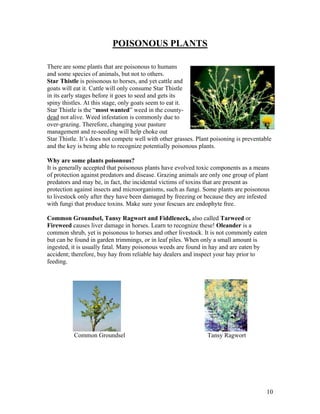
Star Thistle is poisonous to horses, and yet cattle and
goats will eat it. Cattle will only consume Star Thistle
in its early stages before it goes to seed and gets its
spiny thistles. At this stage, only goats seem to eat it.
Star Thistle is the “most wanted” weed in the county-
dead not alive. Weed infestation is commonly due to
over-grazing. Therefore, changing your pasture
management and re-seeding will help choke out
Star Thistle. It’s does not compete well with other grasses. Plant poisoning is preventable
and the key is being able to recognize potentially poisonous plants.

Why are some plants poisonous?
It is generally accepted that poisonous plants have evolved toxic components as a means
of protection against predators and disease. Grazing animals are only one group of plant
predators and may be, in fact, the incidental victims of toxins that are present as
protection against insects and microorganisms, such as fungi. Some plants are poisonous
to livestock only after they have been damaged by freezing or because they are infested
with fungi that produce toxins. Make sure your fescues are endophyte free.

Common Groundsel, Tansy Ragwort and Fiddleneck, also called Tarweed or
Fireweed causes liver damage in horses. Learn to recognize these! Oleander is a
common shrub, yet is poisonous to horses and other livestock. It is not commonly eaten
but can be found in garden trimmings, or in leaf piles. When only a small amount is
ingested, it is usually fatal. Many poisonous weeds are found in hay and are eaten by
accident; therefore, buy hay from reliable hay dealers and inspect your hay prior to
feeding.


          Common Groundsel                                       Tansy Ragwort


                                                                                         10
Ponderosa Pine
The needles of Ponderosa Pine
can cause abortion in cattle
when grazing. Induced
abortions generally occur in
late fall to early spring, during
the last trimester of
pregnancy. Cattle generally
graze pine needles during
storms with increased snow,
wind, cold and when hungry.
The toxin that causes abortion
is isocupressic acid. The
Ponderosa Pine is a hardy tree
that is used extensively as
timber. Both its dry and green
needles can cause abortion in cows. Pine needles can be made available to cattle from
slash remaining after logging operations, windfalls, or dried fallen needles. Discarded
Christmas trees have been known to cause abortions in cows. Lodgepole Pine, Common
Juniper and Monterey Cypress also contain isocupressic acid and may also cause
abortions when eaten by cattle.

Plants that cause mechanical injury:
                         Some plants are hazardous to your animals in other ways.
                         These type of plants can do mechanical injury to your animals
                         usually by cutting their gums and cheeks by sharp barbed seed
                         heads. Star Thistle, Foxtails, Wild Barley, Wild Oats and Yellow
                         Bristle Grass fit into this category. These grasses or weeds
                         become embedded in skin and mucous membranes and cause pain,
                         ulcers and infections. When this happens, animals usually stop
                         eating, lose weight and become unthrifty looking. You can
                         prevent imjury by providing high quality forage, managing your
                         pastures to prevent weeds and paying attention to your animal’s
                         health.
Cockleburs can cause mechanical damage to animals.

There are many more poisonous plants in our area. Learn to identify them.
An animal won’t usually eat them unless it is extremely hungry. Just because it looks like
there is vegetation in your pasture, it doesn’t mean it is desirable or beneficial
to the animal, and your animal could be very hungry. Contact the UC Ag Extension, Ag
Commissioner’s office or the Resource Conservation District for more information.

Visit the USDA poisonous plant website for pictures and more information
www.pprl.usu.edu/


                                                                                       11
Printed on recycled paper


                            12

Plants for Every Reason - Nevada County, California

  • 1.
    PLANTS FOR EVERY REASON This booklet has been made available with the Proposition 204 grant educational funds obtained by the North San Juan Fire Protection District in Nevada County, California 1
  • 2.
    PLANTS FOR EVERYREASON Your property is yours- but you might consider sharing it with wildflowers, butterflies, birds and other wildlife by creating habitat such as the plants in this booklet. Our parks and forests are great places to visit and observe wildlife but fish, insects, birds, animals and plants need our help in providing habitat on private lands. This booklet will discuss the following plants : Plants for creating habitat Deer resistant plants Native plants Fire resistant plants Poisonous plants Information compiled and produced by Lesa Osterholm. January 2004 References and resources: “Fire Wise is Fire Safe”, Fire Safe Council of Nevada County Contact: 530-470-9193 or www.firesafecouncilnevco.com “Deer Resistant Plants for the Sierra Foothills (Zone 7)” “Western Nevada County Gardening Guide” UC Cooperative Extension Nevada County Master Gardeners Contact: 530-273-4563 or www.ceplacer.ucdavis.edu “Toxic Plants In Your Hay And Pasture” Mary A. Scott, D.V.M., UC Davis Veterinary Hospital, California www.vetmed.ucdavis.edu Nevada County Resource Conservation District/ USDA Natural Resource Conservation Service Contact: 530-272-3417 www.nrcs.usda.gov for poisonous plant and resource conservation information 2
  • 3.
    PLANTS FOR CREATINGHABITAT Be part of the habitat solution. BUTTERFLIES AND BENEFICIAL INSECTS Butterflies add flashes of color and enhance the beauty of your landscaping. To provide for season long butterfly visits, choose a mix of nectar-rich species with blooming times that run from spring to fall. Butterflies require food in liquid form such as nectar from flowers and juices from extra-ripe fruits. Both annuals and perennials will work. Below is a list of some plants that do well in our area: ANNUALS PERENNIALS Cosmos Aster/ Michaelmas Daisy Coffeeberry Lantana Bee balm Lavender Lunaria Black-eyed Susan Phlox Marigold Butterfly Bush Purple Coneflower Petunia Cape Plumbago Yarrow Verbena Catnip Zinnia Coreopsis Hummingbirds are attracted to red and yellow plants although they frequently visit nectar producing flowers like many on the list above. Having the right insects in your garden or property can keep pests and weeds to a minimum. Beneficial insects such as ladybugs, assassin bugs and praying mantises prey on insects that can harm your plants. QUAIL AND PHEASANT A wide variety of fruit, berries and seeds from wild plants provide food for the Valley or California quail. Wild grass seeds as well as planted grains are important sources of food. Legumes such as vetches, clovers and lupine are very desirable. Scotch Broom also provides food for quail; however, it is an undesirable, very invasive plant and very flammable. After creating defensible space on your property by thinning and trimming trees and brush, save a few brush piles for quail and other birds and animals. These piles serve as great habitat and food for many species. 3
  • 4.
    BIRDS Birds are usuallyplentiful with the following plants in our area: Blue Elderberry California Fushia Coffeeberry Pines Toyon Western Serviceberry Willows Wood’s Rose Brush piles or dead and hollow trees are valuable for wildlife. Dead trees provide homes to over 400 species of birds, mammals and amphibians. Fish, plants and fungi also benefit from dead and dying trees. Brush and dead trees can provide food, shelter and nesting sites for wildlife and will decompose naturally. Butterflies, birds, bees and all wildlife are very vulnerable to many pesticides and other chemicals. Probably the best single thing a gardener can do for wildlife is to minimize chemical use. If you do use chemicals, always follow the directions and try not to apply when fruit or nuts are present on the plants. CATTLE/ SHEEP and SIMILAR LIVESTOCK Cattle and sheep prefer a 50:50 mix of palatable forage grasses and legumes such as clovers and vetches. Annual Ryegrass, Blando Brome and Clovers grow well in our range soils and elevations to 3500 feet. This dryland mix is commonly referred to as the “Grass Valley Mix.” HORSES Horses need a 75:25 ratio mix of palatable forage grasses to legumes. Horses can get serious digestive upsets if they consume too much legumes such as clover. Horses are very selective eaters and prefer ryegrass, orchard grasses, oats, timothy, alfalfa and clovers. Contact the Nevada County Resource Conservation District, the local UC Ag Extension Office or local seed suppliers for more information. 4
  • 5.
    DEER RESISTANT PLANTS (not deer proof) As much as we love ‘em, deer can be devastating to some flowers and plants. Deer resistant plants are not deer proof. Deer are browsers and prefer shrub like plants and grasses. Deer love young, tender plants, especially the new ones just brought home from the nursery. Plants with a strong-scented fragrance are often deer resistant, like marigolds. Fencing may be necessary to help keep the deer away from gardens and/or protect young trees and flowers from being eaten. Tall fencing ( 6 feet or higher ) or electric fence certainly helps. Deer can jump high or wide but not high and wide. Some people actually install 2 fences about 3-4’ apart around their gardens and have had great success in keeping the deer out. The following plants are considered “deer resistant”: Agapanthus Pines Alyssum Rosemary Bigleaf Maple Rushes Blue Elderberry Sage Brush California Bay Sages (salvia) California Buckeye Skunkbrush Crocus Stonecrop Daffodils Toyon Douglas Fir Tulips Ferns-all Western Rebud Juniperus Western Spicebush Lantana Wild Ginger Lavender Wild Iris hybrids Marigold Yarrow Oregon Grape Zinnia Pacific Madrone 5
  • 6.
    NATIVE PLANTS ofCALIFORNIA Native plants are better suited to our local soil and growing conditions and make your job much easier in establishing them on your property. They usually require less work to thrive. Native plants are not necessarily deer resistant or fire resistant plants. Well established, mature native plants need less water and usually do not like too much summer watering. Young, native plants must have supplemental water in order to establish themselves and thrive. It may take several years before a native plant can last without supplemental water. More and more, California native plants are disappearing from the wild. To help preserve them, you can purchase seeds or plants from nurseries that specialize in native plants. The Nevada County Resource Conservation District usually has a native plant give- away every spring, and the Nevada County Master Gardener’s Spring and Fall Fests offer native plants for sale. Remember that it’s against the law to pick flowers or dig up plants on public lands. A picked flower can’t set seeds to replace itself and a dug up plant most likely won’t survive, so the plants are lost to everyone. Take pictures instead and preserve them! All plants listed are suitable for Sunset Western Garden Guide Zone 7, or USDA Zone 8, with lows of 10-20 degrees Fahrenheit. Native annuals for sun and dry conditions: California Poppy Chia Lupine Monkey Flower Purple Tansy Tidy Tipps Wind Poppy Native perennials for sun and dry conditions: Blanket Flower Blue Flax Coyote Mint Delphinium Evening Primrose Horsemint Lupine Matija Poppy Monkey Flower Purple Milkweed Sage St. Catherines Lace 6
  • 7.
    Native shrubs forsun and dry conditions: California Barberries California Coffeeberry California Lilac Flannel Bush Hollyleaf Cherry Lemonade Berry, Sugar, Squaw Bush Monkey Flower Toyon Western Redbud Native trees for sun and dry conditions: Blue Oak California Black Oak California Buckeye Interior Live Oak Madrone Native bulbs for sun and dry conditions: Brodiaea Onion Soap Plant Native perennial grasses for sun and dry conditions: Blue Wildrye California Melica Creeping Wildrye Fremont Camas Mariposa Tulips, Globe Tulips Nodding Stipa Pine Bluegrass Purple Stipa Stonecrop Native annuals that will tolerate watering: Arroya Lupine Baby Blue Eyes, Five Spot Birds Eye California Bells, Chinese Lantern Douglas’ Coreopsis Farewell to Spring Native perennials that will tolerate watering: Butterfly Weed Monkey Flower Jeffrey’s Shooting Star Golden Eyed Grass Jimson Weed California Blue Eyed Grass Marsh Marigold Hummingbird Sage Sea Thrift Lupine Wooly Yarrow Iris, Violets 7
  • 8.
    Native shrubs thatwill tolerate watering: Buttonwillow California Mock Orange California Snowdrop Bush Ceanothus Douglas Spiraea Gooseberry Manzanita Mt. Cream Bush Ninebark Pallid Service Berry Tree Anemone Western Chokeberry Native trees that will tolerate watering: Blue Elderberry Box Elder Foothill Ash Fremont Popular Red Elderberry Western Sycamore Native bulbs and bulb-like plants that will tolerate water: Bloomers Tiger Lily Brodiaea Camas Chocolate Lily, Yellow Bells Munz Iris, Bowl-Tubed Onion Native grasses that will tolerate water: Creeping Wildrye Deergrass Rush Sedge Slender Wheatgrass Tufted Hairgrass 8
  • 9.
    FIRE RESISTANT PLANTS Noplants are completely flame retardant. Avoid plants that have resinous, oily and waxy plant parts. Even the best fire resistant plants can become a fire hazard if not maintained. Any plant can burn during extreme fire conditions. However, there are plants that are harder to ignite, burn slower, produce less heat when burning and/or produce a shorter flame length. Remember to create defensible space around your home and other structures. Defensible space is the area that lies between your house and an oncoming wildfire where the vegetation has been modified to reduce the threat of fire. This space provides an opportunity for firefighters and the homeowner to safely defend a structure. This can be done by planting fire resistant, low growing plants, keeping them trimmed or pruned and keeping the area irrigated or “green”. The law requires a minimum of 30 feet around each structure and the area is greater if the home is on a slope. Plants to AVOID: (these are not “fire-resistant”) Algerian Ivy Bamboo Berry vines, especially blackberry Coyote Bush Fountain Grass Hopseed Bush Juniper Maiden Grass Mountain Misery, Bear Clover Muhly Grass Pampas Grass Scotch and Spanish Broom Regardless of the type of grass and brush, keep it mowed, grazed or maintained annually. If you have trees within the defensible space, isolate the tree from other trees, remove any branches that are dead and within 10 feet of the roof or chimney. Remove all “ladder fuels” from underneath the tree. Ladder fuels are vegetation with vertical continuity that allows fire to burn from ground level up into the branches and crowns of trees. Ladder fuels are potentially very hazardous but are easy to mitigate. Be aware if you have plants from the above list. Refer to the Native Plant list which contains Firewise plants for Nevada County. 9
  • 10.
    POISONOUS PLANTS There aresome plants that are poisonous to humans and some species of animals, but not to others. Star Thistle is poisonous to horses, and yet cattle and goats will eat it. Cattle will only consume Star Thistle in its early stages before it goes to seed and gets its spiny thistles. At this stage, only goats seem to eat it. Star Thistle is the “most wanted” weed in the county- dead not alive. Weed infestation is commonly due to over-grazing. Therefore, changing your pasture management and re-seeding will help choke out Star Thistle. It’s does not compete well with other grasses. Plant poisoning is preventable and the key is being able to recognize potentially poisonous plants. Why are some plants poisonous? It is generally accepted that poisonous plants have evolved toxic components as a means of protection against predators and disease. Grazing animals are only one group of plant predators and may be, in fact, the incidental victims of toxins that are present as protection against insects and microorganisms, such as fungi. Some plants are poisonous to livestock only after they have been damaged by freezing or because they are infested with fungi that produce toxins. Make sure your fescues are endophyte free. Common Groundsel, Tansy Ragwort and Fiddleneck, also called Tarweed or Fireweed causes liver damage in horses. Learn to recognize these! Oleander is a common shrub, yet is poisonous to horses and other livestock. It is not commonly eaten but can be found in garden trimmings, or in leaf piles. When only a small amount is ingested, it is usually fatal. Many poisonous weeds are found in hay and are eaten by accident; therefore, buy hay from reliable hay dealers and inspect your hay prior to feeding. Common Groundsel Tansy Ragwort 10
  • 11.
    Ponderosa Pine The needlesof Ponderosa Pine can cause abortion in cattle when grazing. Induced abortions generally occur in late fall to early spring, during the last trimester of pregnancy. Cattle generally graze pine needles during storms with increased snow, wind, cold and when hungry. The toxin that causes abortion is isocupressic acid. The Ponderosa Pine is a hardy tree that is used extensively as timber. Both its dry and green needles can cause abortion in cows. Pine needles can be made available to cattle from slash remaining after logging operations, windfalls, or dried fallen needles. Discarded Christmas trees have been known to cause abortions in cows. Lodgepole Pine, Common Juniper and Monterey Cypress also contain isocupressic acid and may also cause abortions when eaten by cattle. Plants that cause mechanical injury: Some plants are hazardous to your animals in other ways. These type of plants can do mechanical injury to your animals usually by cutting their gums and cheeks by sharp barbed seed heads. Star Thistle, Foxtails, Wild Barley, Wild Oats and Yellow Bristle Grass fit into this category. These grasses or weeds become embedded in skin and mucous membranes and cause pain, ulcers and infections. When this happens, animals usually stop eating, lose weight and become unthrifty looking. You can prevent imjury by providing high quality forage, managing your pastures to prevent weeds and paying attention to your animal’s health. Cockleburs can cause mechanical damage to animals. There are many more poisonous plants in our area. Learn to identify them. An animal won’t usually eat them unless it is extremely hungry. Just because it looks like there is vegetation in your pasture, it doesn’t mean it is desirable or beneficial to the animal, and your animal could be very hungry. Contact the UC Ag Extension, Ag Commissioner’s office or the Resource Conservation District for more information. Visit the USDA poisonous plant website for pictures and more information www.pprl.usu.edu/ 11
  • 12.