Introduction
Definition:
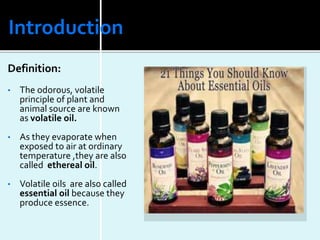
• The odorous, volatile
principle of plant and
animal source are known
as volatile oil.
• As they evaporate when
exposed to air at ordinary
temperature ,they are also
called ethereal oil.
• Volatile oils are also called
essential oil because they
produce essence.
• Lighter than water
• Optically active
• High refractive index
• Specific rotation
• Possess distinct odours
• Commonly found in the species
Labiatae,Rutaceae,piperaceae,zingiberaceae,umbelliferae,myrtaceae,la
uraceae
• They are present in entire plant or in any part of the plant
• Donot leave stains like fixed oils
• Insoluble with water and soluble in organic solvents like
ether,alcohol,chlorofrm,ethanoletc
• They should be stored in a cool,dry place in tightly stoperred,preferablly
full(not half emptied),amber glass container.
Volatile oils generally composed of two portions:
 Hydrocarbon – terpene derived from acetate
mavelonic acid pathway and are called
eleoptenes.(Liquids)
 Oxidized hydrocarbon derived from shikimic acid
phenylpropanoid pathway are called
steareoptenes.(solids) Steareoptenes are water
soluble but more alcohol soluble.
 The odour and taste of vol. oils is due to the
oxygenated part
 Note:When eleoptenes and stereoptenes combine,
result in vol. oils.
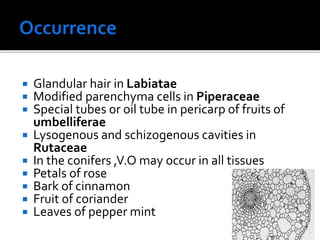
 Glandular hair in Labiatae
 Modified parenchyma cells in Piperaceae
 Special tubes or oil tube in pericarp of fruits of
umbelliferae
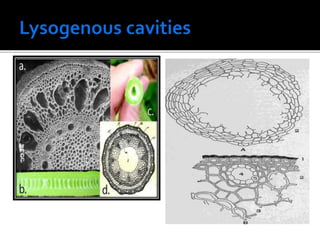
 Lysogenous and schizogenous cavities in
Rutaceae
 In the conifers ,V.O may occur in all tissues
 Petals of rose
 Bark of cinnamon
 Fruit of coriander
 Leaves of pepper mint
 Plants
1. Citronella oil, being a volatile oil, is an insect repellent obtained from
plants thus preventing the destruction of the flowers and leaves.
2. Insect attractant volatile oils help in the cross fertilization of different
species of plants.
 Humans
1. As a flavoring agent.
2. Used in perfume industries and in cosmetics
3. As starting material for synthesis of other compounds
4. Used as a therapeutic agent
THERAPEUTIC ACTIVITIES
a. As a counter irritant
b. Eucalyptus oil administered as an inhalant.
c. Improves local circulation
d. As carminative,shows anti-spasmodic.
e. Thymol is used in mouth washes and gargles
f. Local an anesthetic
g. Reduce secretion of lungs in cough and asthma.
h. Antiseptic,anti bacterial, anti fungal
i. Anti helminthes
j. Also used in aroma
therapy(eg.lavander,rosemary)
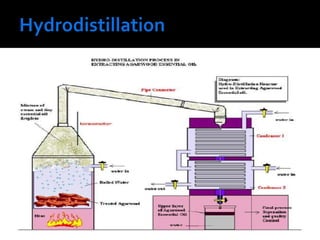
1. Distillation by water
It is applied to plants which are not injured upon boiling.Turpentine oil is
obtained by this method. Crude turpentine is introduced into the
distillation chamber along with water and subjected to heat below 40 C .
A mixture of oil and water is obtained as a distillate which is collected in a
Florentine flask.The distillate is separated into two layers oil being
withdrawn through the upper outlet of the condenser and water from
the lower outlet or vice versa in case of clove as clove oil is heavier than
water.
2. Water and steam distillation
For substances which are usually injured by direct heat for example clove,
cinnamon. Dried drug ground and covered with layer of water. Steam is
passes through mixture, steam is generated by another chamber and
piped into container having drug.The vapour contain vol oils are
introduced in condensing chamber cooled and collected.
3. Destructive distillation without air (vaccum)
Members of pinacaea are used.Tough materials such as barks,seeds and
roots may be comminuted to facilitate extraction. Broken pieces of
wood are placed in chamber and heated with water without air in a
vaccum.The decomposition of wood occurs and volatile oils generated
are collected through the condenser.
4. Ecuelle Method
Ecuelle method is used for the extraction of citrus oils where oils cells in
rind are ruptured mechanically using pointed projections by twisting raw
material over them in clockwise direction either mechanically or
manually.
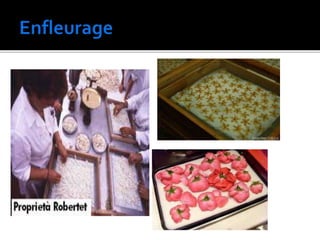
5. Enfleurage
Enfleurage method is used for extraction of delicate perfumes. In this
method, layer of fat is spread over a glass plate and flower petal are
placed over fat layer which absorbs v.o .The exchausted petals are
replaced by fresh petals.This process continues till the fatty layer is
saturated volatile principle which are then extracted with lipid solvent.
6. Solvent extraction
It is used in perfume industry and is an expensive method. In this
technique parts containing volatile oils are extracted directly by one of
the organic solvent as they are crushed and mixed in the solvent and are
separated by distillation.eg.oil of rose
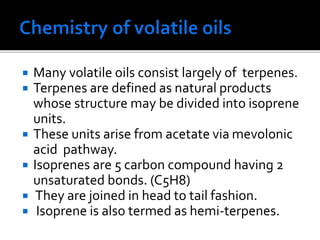
 Many volatile oils consist largely of terpenes.
 Terpenes are defined as natural products
whose structure may be divided into isoprene
units.
 These units arise from acetate via mevolonic
acid pathway.
 Isoprenes are 5 carbon compound having 2
unsaturated bonds. (C5H8)
 They are joined in head to tail fashion.
 Isoprene is also termed as hemi-terpenes.
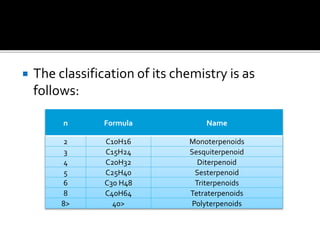
 The classification of its chemistry is as
follows:
n Formula Name
2 C10H16 Monoterpenoids
3 C15H24 Sesquiterpenoid
4 C20H32 Diterpenoid
5 C25H40 Sesterpenoid
6 C30 H48 Triterpenoids
8 C40H64 Tetraterpenoids
8> 40> Polyterpenoids
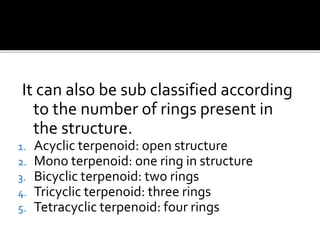
It can also be sub classified according
to the number of rings present in
the structure.
1. Acyclic terpenoid: open structure
2. Mono terpenoid: one ring in structure
3. Bicyclic terpenoid: two rings
4. Tricyclic terpenoid: three rings
5. Tetracyclic terpenoid: four rings
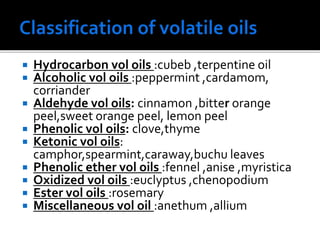
 Hydrocarbon vol oils :cubeb ,terpentine oil
 Alcoholic vol oils :peppermint ,cardamom,
corriander
 Aldehyde vol oils: cinnamon ,bitter orange
peel,sweet orange peel, lemon peel
 Phenolic vol oils: clove,thyme
 Ketonic vol oils:
camphor,spearmint,caraway,buchu leaves
 Phenolic ether vol oils :fennel ,anise ,myristica
 Oxidized vol oils :euclyptus ,chenopodium
 Ester vol oils :rosemary
 Miscellaneous vol oil :anethum ,allium
Volatile Oils

Volatile Oils

  • 2.
    Introduction Definition: • The odorous,volatile principle of plant and animal source are known as volatile oil. • As they evaporate when exposed to air at ordinary temperature ,they are also called ethereal oil. • Volatile oils are also called essential oil because they produce essence.
  • 3.
    • Lighter thanwater • Optically active • High refractive index • Specific rotation • Possess distinct odours • Commonly found in the species Labiatae,Rutaceae,piperaceae,zingiberaceae,umbelliferae,myrtaceae,la uraceae • They are present in entire plant or in any part of the plant • Donot leave stains like fixed oils • Insoluble with water and soluble in organic solvents like ether,alcohol,chlorofrm,ethanoletc • They should be stored in a cool,dry place in tightly stoperred,preferablly full(not half emptied),amber glass container.
  • 4.
    Volatile oils generallycomposed of two portions:  Hydrocarbon – terpene derived from acetate mavelonic acid pathway and are called eleoptenes.(Liquids)  Oxidized hydrocarbon derived from shikimic acid phenylpropanoid pathway are called steareoptenes.(solids) Steareoptenes are water soluble but more alcohol soluble.  The odour and taste of vol. oils is due to the oxygenated part  Note:When eleoptenes and stereoptenes combine, result in vol. oils.
  • 5.
     Glandular hairin Labiatae  Modified parenchyma cells in Piperaceae  Special tubes or oil tube in pericarp of fruits of umbelliferae  Lysogenous and schizogenous cavities in Rutaceae  In the conifers ,V.O may occur in all tissues  Petals of rose  Bark of cinnamon  Fruit of coriander  Leaves of pepper mint
  • 7.
     Plants 1. Citronellaoil, being a volatile oil, is an insect repellent obtained from plants thus preventing the destruction of the flowers and leaves. 2. Insect attractant volatile oils help in the cross fertilization of different species of plants.  Humans 1. As a flavoring agent. 2. Used in perfume industries and in cosmetics 3. As starting material for synthesis of other compounds 4. Used as a therapeutic agent
  • 8.
    THERAPEUTIC ACTIVITIES a. Asa counter irritant b. Eucalyptus oil administered as an inhalant. c. Improves local circulation d. As carminative,shows anti-spasmodic. e. Thymol is used in mouth washes and gargles f. Local an anesthetic g. Reduce secretion of lungs in cough and asthma. h. Antiseptic,anti bacterial, anti fungal i. Anti helminthes j. Also used in aroma therapy(eg.lavander,rosemary)
  • 9.
    1. Distillation bywater It is applied to plants which are not injured upon boiling.Turpentine oil is obtained by this method. Crude turpentine is introduced into the distillation chamber along with water and subjected to heat below 40 C . A mixture of oil and water is obtained as a distillate which is collected in a Florentine flask.The distillate is separated into two layers oil being withdrawn through the upper outlet of the condenser and water from the lower outlet or vice versa in case of clove as clove oil is heavier than water. 2. Water and steam distillation For substances which are usually injured by direct heat for example clove, cinnamon. Dried drug ground and covered with layer of water. Steam is passes through mixture, steam is generated by another chamber and piped into container having drug.The vapour contain vol oils are introduced in condensing chamber cooled and collected.
  • 11.
    3. Destructive distillationwithout air (vaccum) Members of pinacaea are used.Tough materials such as barks,seeds and roots may be comminuted to facilitate extraction. Broken pieces of wood are placed in chamber and heated with water without air in a vaccum.The decomposition of wood occurs and volatile oils generated are collected through the condenser. 4. Ecuelle Method Ecuelle method is used for the extraction of citrus oils where oils cells in rind are ruptured mechanically using pointed projections by twisting raw material over them in clockwise direction either mechanically or manually.
  • 12.
    5. Enfleurage Enfleurage methodis used for extraction of delicate perfumes. In this method, layer of fat is spread over a glass plate and flower petal are placed over fat layer which absorbs v.o .The exchausted petals are replaced by fresh petals.This process continues till the fatty layer is saturated volatile principle which are then extracted with lipid solvent. 6. Solvent extraction It is used in perfume industry and is an expensive method. In this technique parts containing volatile oils are extracted directly by one of the organic solvent as they are crushed and mixed in the solvent and are separated by distillation.eg.oil of rose
  • 14.
     Many volatileoils consist largely of terpenes.  Terpenes are defined as natural products whose structure may be divided into isoprene units.  These units arise from acetate via mevolonic acid pathway.  Isoprenes are 5 carbon compound having 2 unsaturated bonds. (C5H8)  They are joined in head to tail fashion.  Isoprene is also termed as hemi-terpenes.
  • 15.
     The classificationof its chemistry is as follows: n Formula Name 2 C10H16 Monoterpenoids 3 C15H24 Sesquiterpenoid 4 C20H32 Diterpenoid 5 C25H40 Sesterpenoid 6 C30 H48 Triterpenoids 8 C40H64 Tetraterpenoids 8> 40> Polyterpenoids
  • 16.
    It can alsobe sub classified according to the number of rings present in the structure. 1. Acyclic terpenoid: open structure 2. Mono terpenoid: one ring in structure 3. Bicyclic terpenoid: two rings 4. Tricyclic terpenoid: three rings 5. Tetracyclic terpenoid: four rings
  • 17.
     Hydrocarbon voloils :cubeb ,terpentine oil  Alcoholic vol oils :peppermint ,cardamom, corriander  Aldehyde vol oils: cinnamon ,bitter orange peel,sweet orange peel, lemon peel  Phenolic vol oils: clove,thyme  Ketonic vol oils: camphor,spearmint,caraway,buchu leaves  Phenolic ether vol oils :fennel ,anise ,myristica  Oxidized vol oils :euclyptus ,chenopodium  Ester vol oils :rosemary  Miscellaneous vol oil :anethum ,allium