GROW APPROACH
Coaching is a way to support others in their professional and personal development. It can help them
navigate challenges, identify areas for improvement, and achieve their goals.
The GROW coaching model can be an effective tool for coaches working with clients in any coaching
relationship.The structure is designed to guide you through asking questions that will lead to greater
insight on the part of your client and stronger relationships with them as a result.
Ultimately, it helps coaches meet their clients where they are and support their growth rather
than assuming they know best or expecting them to follow along based on past experiences.
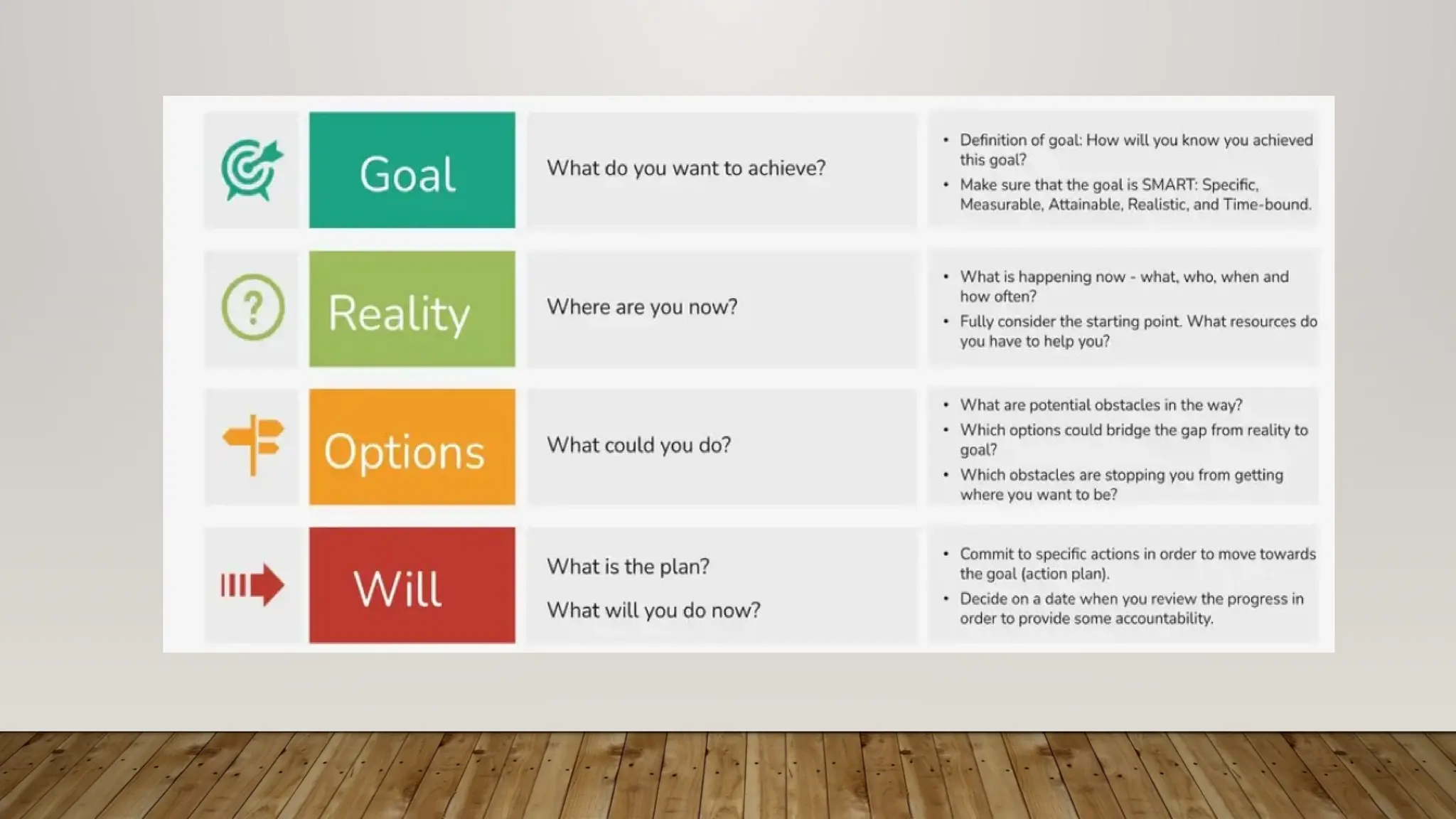
The acronym stands for Goals, Reality, Options, andWill.
THE IMPACT OFTHE GROW COACHING MODEL
1.GROW coaching skills unlock potential and increase performance by increasing self-confidence
and motivation.Asking effective questions in a carefully structured way promotes deeper awareness and
greater responsibility which leads to practical steps to accomplish goals and overcome obstacles.
2.The GROW Model has been seen to yield higher productivity, improved communication,
better interpersonal relationships and a better-quality working environment.
3.The GROW Model is a simple yet powerful framework for structuring your coaching or
mentoring conversations.
4.The GROW model can be effective regardless of your leadership style. It provides a realistic and
straightforward way of getting things done.
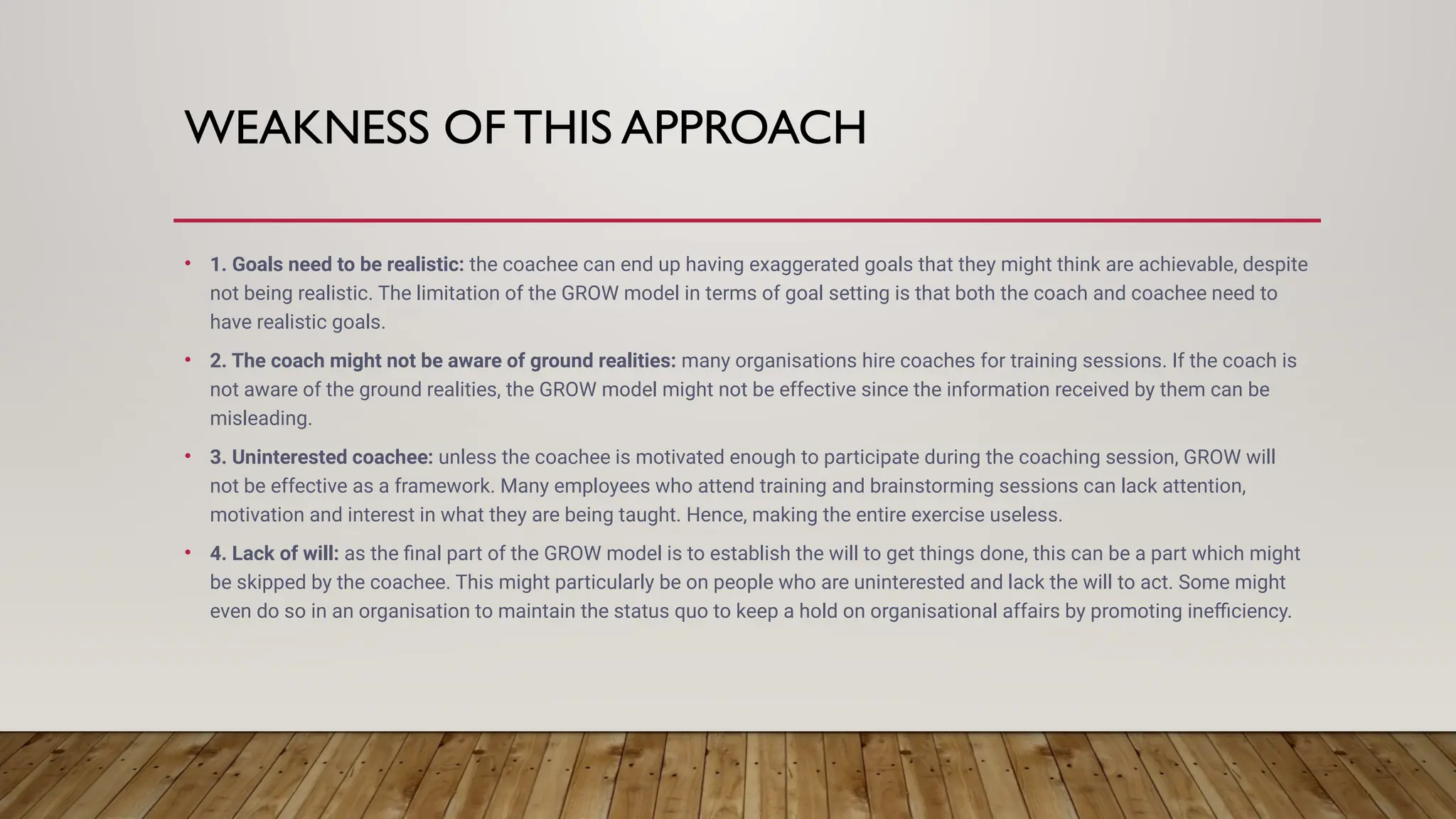
WEAKNESS OFTHIS APPROACH
• 1. Goals need to be realistic: the coachee can end up having exaggerated goals that they might think are achievable, despite
not being realistic. The limitation of the GROW model in terms of goal setting is that both the coach and coachee need to
have realistic goals.
• 2. The coach might not be aware of ground realities: many organisations hire coaches for training sessions. If the coach is
not aware of the ground realities, the GROW model might not be effective since the information received by them can be
misleading.
• 3. Uninterested coachee: unless the coachee is motivated enough to participate during the coaching session, GROW will
not be effective as a framework. Many employees who attend training and brainstorming sessions can lack attention,
motivation and interest in what they are being taught. Hence, making the entire exercise useless.
• 4. Lack of will: as the final part of the GROW model is to establish the will to get things done, this can be a part which might
be skipped by the coachee. This might particularly be on people who are uninterested and lack the will to act. Some might
even do so in an organisation to maintain the status quo to keep a hold on organisational affairs by promoting inefficiency.
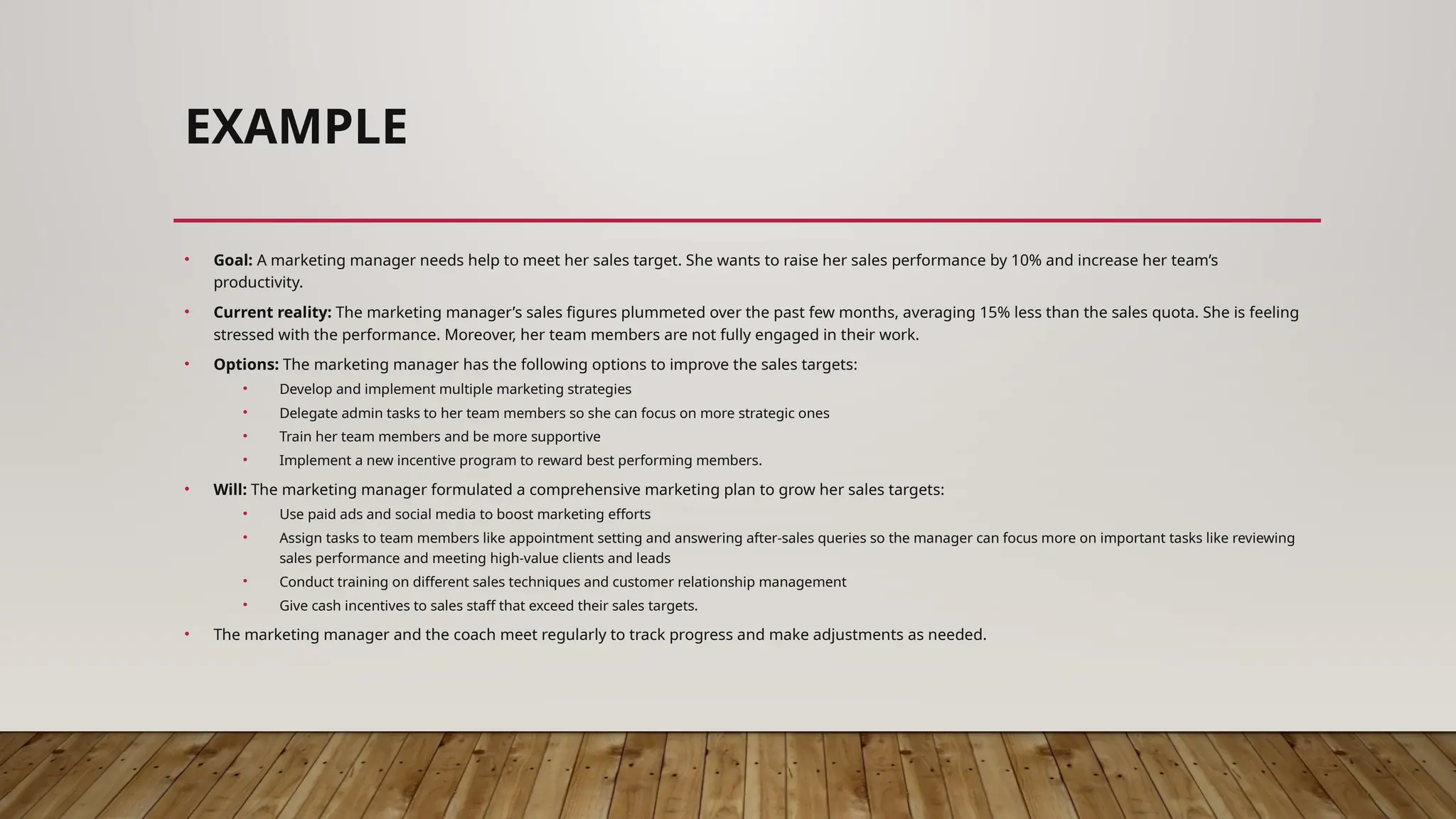
EXAMPLE
• Goal: A marketing manager needs help to meet her sales target. She wants to raise her sales performance by 10% and increase her team’s
productivity.
• Current reality: The marketing manager’s sales figures plummeted over the past few months, averaging 15% less than the sales quota. She is feeling
stressed with the performance. Moreover, her team members are not fully engaged in their work.
• Options: The marketing manager has the following options to improve the sales targets:
• Develop and implement multiple marketing strategies
• Delegate admin tasks to her team members so she can focus on more strategic ones
• Train her team members and be more supportive
• Implement a new incentive program to reward best performing members.
• Will: The marketing manager formulated a comprehensive marketing plan to grow her sales targets:
• Use paid ads and social media to boost marketing efforts
• Assign tasks to team members like appointment setting and answering after-sales queries so the manager can focus more on important tasks like reviewing
sales performance and meeting high-value clients and leads
• Conduct training on different sales techniques and customer relationship management
• Give cash incentives to sales staff that exceed their sales targets.
• The marketing manager and the coach meet regularly to track progress and make adjustments as needed.
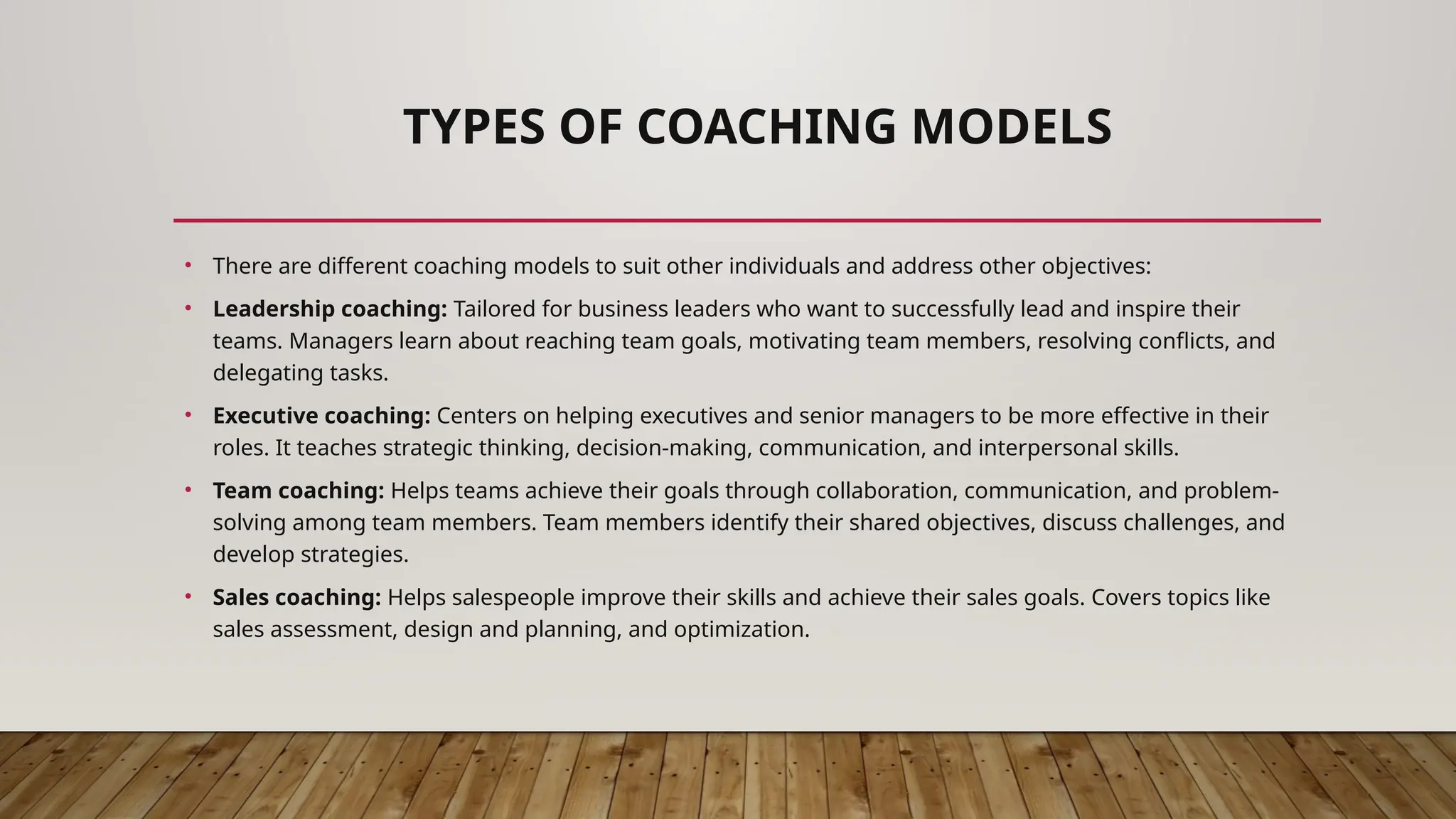
TYPES OF COACHING MODELS
• There are different coaching models to suit other individuals and address other objectives:
• Leadership coaching: Tailored for business leaders who want to successfully lead and inspire their
teams. Managers learn about reaching team goals, motivating team members, resolving conflicts, and
delegating tasks.
• Executive coaching: Centers on helping executives and senior managers to be more effective in their
roles. It teaches strategic thinking, decision-making, communication, and interpersonal skills.
• Team coaching: Helps teams achieve their goals through collaboration, communication, and problem-
solving among team members. Team members identify their shared objectives, discuss challenges, and
develop strategies.
• Sales coaching: Helps salespeople improve their skills and achieve their sales goals. Covers topics like
sales assessment, design and planning, and optimization.
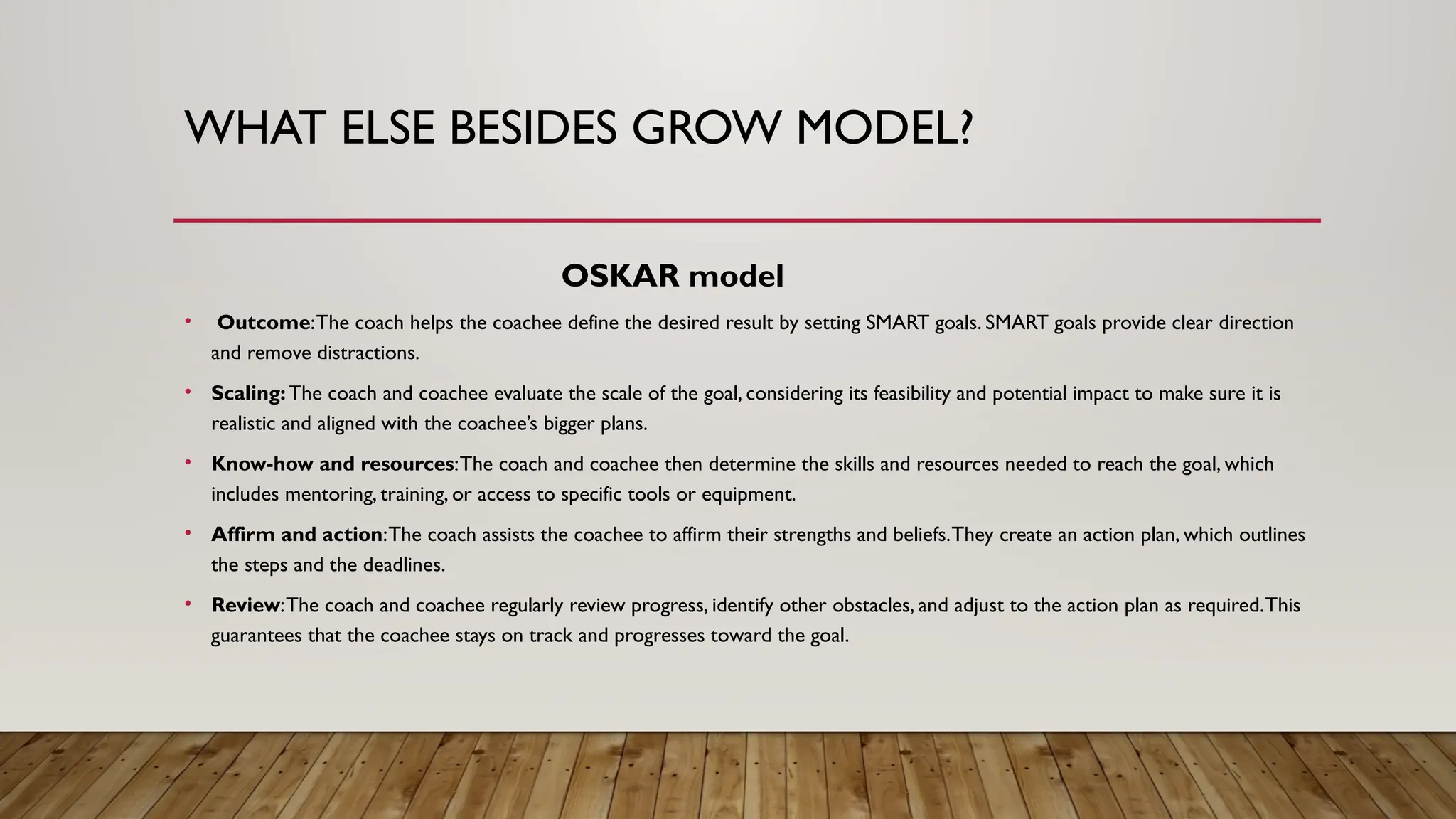
WHAT ELSE BESIDES GROW MODEL?
OSKAR model
• Outcome:The coach helps the coachee define the desired result by setting SMART goals. SMART goals provide clear direction
and remove distractions.
• Scaling: The coach and coachee evaluate the scale of the goal, considering its feasibility and potential impact to make sure it is
realistic and aligned with the coachee’s bigger plans.
• Know-how and resources:The coach and coachee then determine the skills and resources needed to reach the goal, which
includes mentoring, training, or access to specific tools or equipment.
• Affirm and action:The coach assists the coachee to affirm their strengths and beliefs.They create an action plan, which outlines
the steps and the deadlines.
• Review:The coach and coachee regularly review progress, identify other obstacles, and adjust to the action plan as required.This
guarantees that the coachee stays on track and progresses toward the goal.
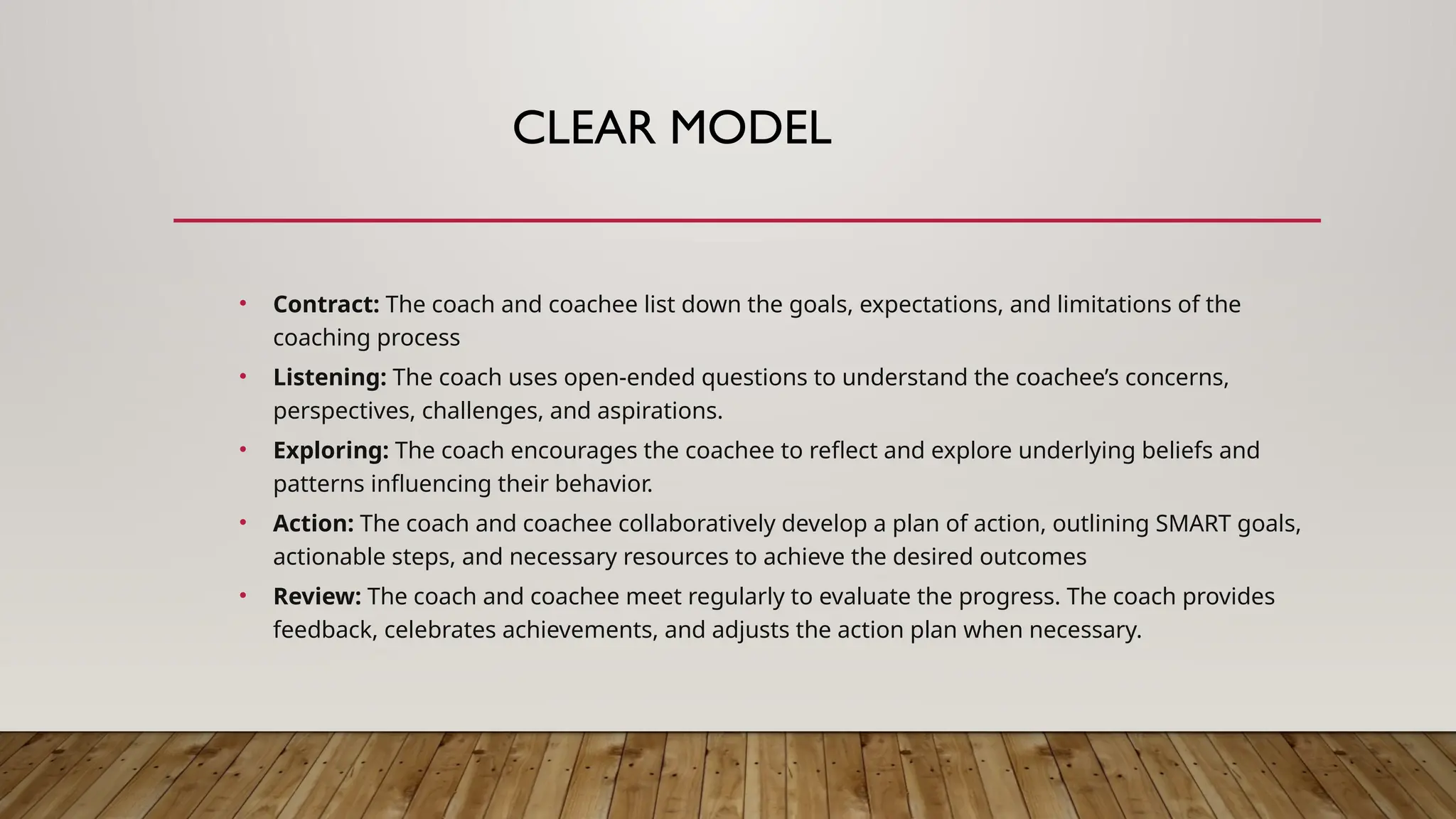
CLEAR MODEL
• Contract: The coach and coachee list down the goals, expectations, and limitations of the
coaching process
• Listening: The coach uses open-ended questions to understand the coachee’s concerns,
perspectives, challenges, and aspirations.
• Exploring: The coach encourages the coachee to reflect and explore underlying beliefs and
patterns influencing their behavior.
• Action: The coach and coachee collaboratively develop a plan of action, outlining SMART goals,
actionable steps, and necessary resources to achieve the desired outcomes
• Review: The coach and coachee meet regularly to evaluate the progress. The coach provides
feedback, celebrates achievements, and adjusts the action plan when necessary.
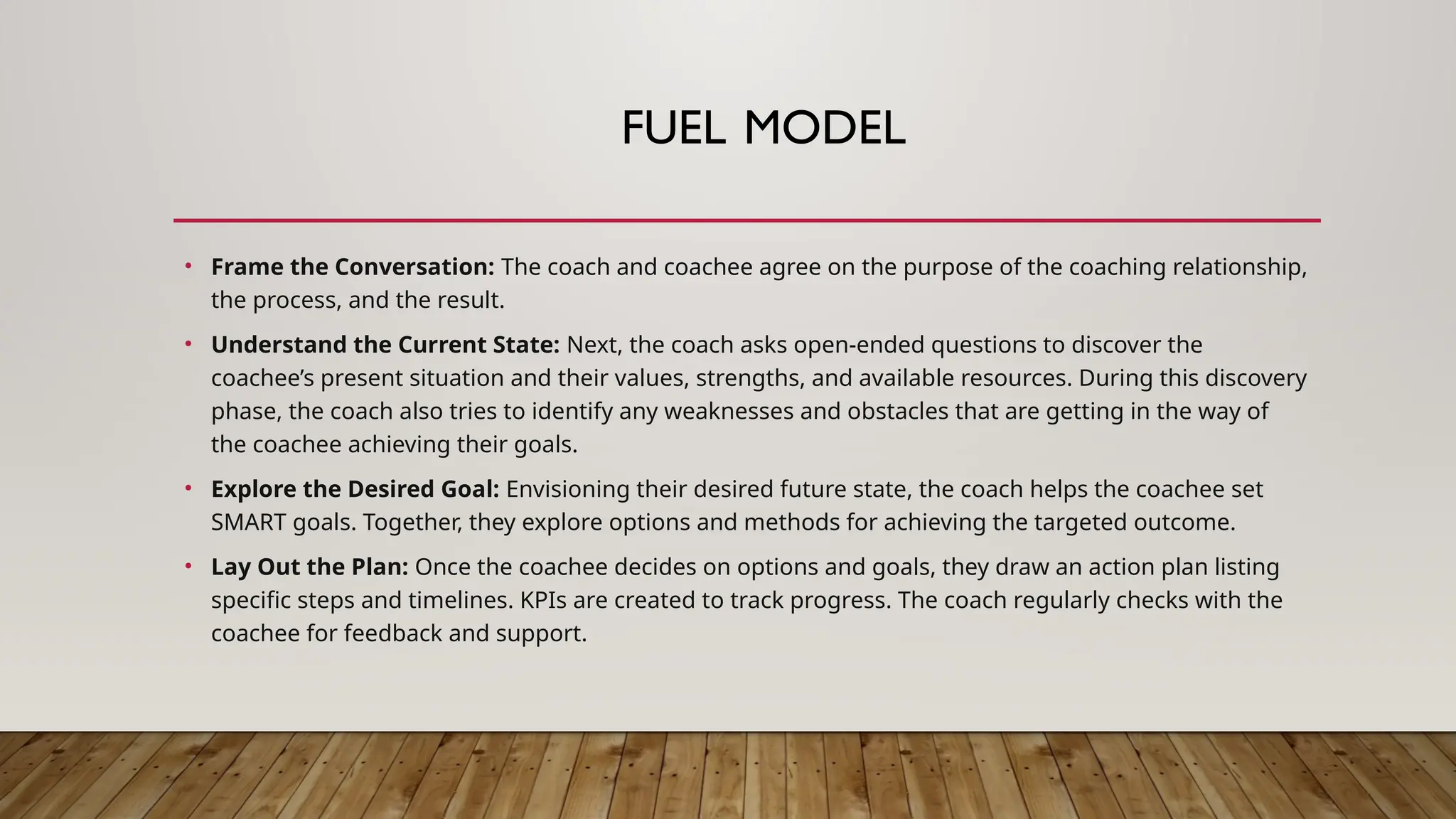
FUEL MODEL
• Frame the Conversation: The coach and coachee agree on the purpose of the coaching relationship,
the process, and the result.
• Understand the Current State: Next, the coach asks open-ended questions to discover the
coachee’s present situation and their values, strengths, and available resources. During this discovery
phase, the coach also tries to identify any weaknesses and obstacles that are getting in the way of
the coachee achieving their goals.
• Explore the Desired Goal: Envisioning their desired future state, the coach helps the coachee set
SMART goals. Together, they explore options and methods for achieving the targeted outcome.
• Lay Out the Plan: Once the coachee decides on options and goals, they draw an action plan listing
specific steps and timelines. KPIs are created to track progress. The coach regularly checks with the
coachee for feedback and support.
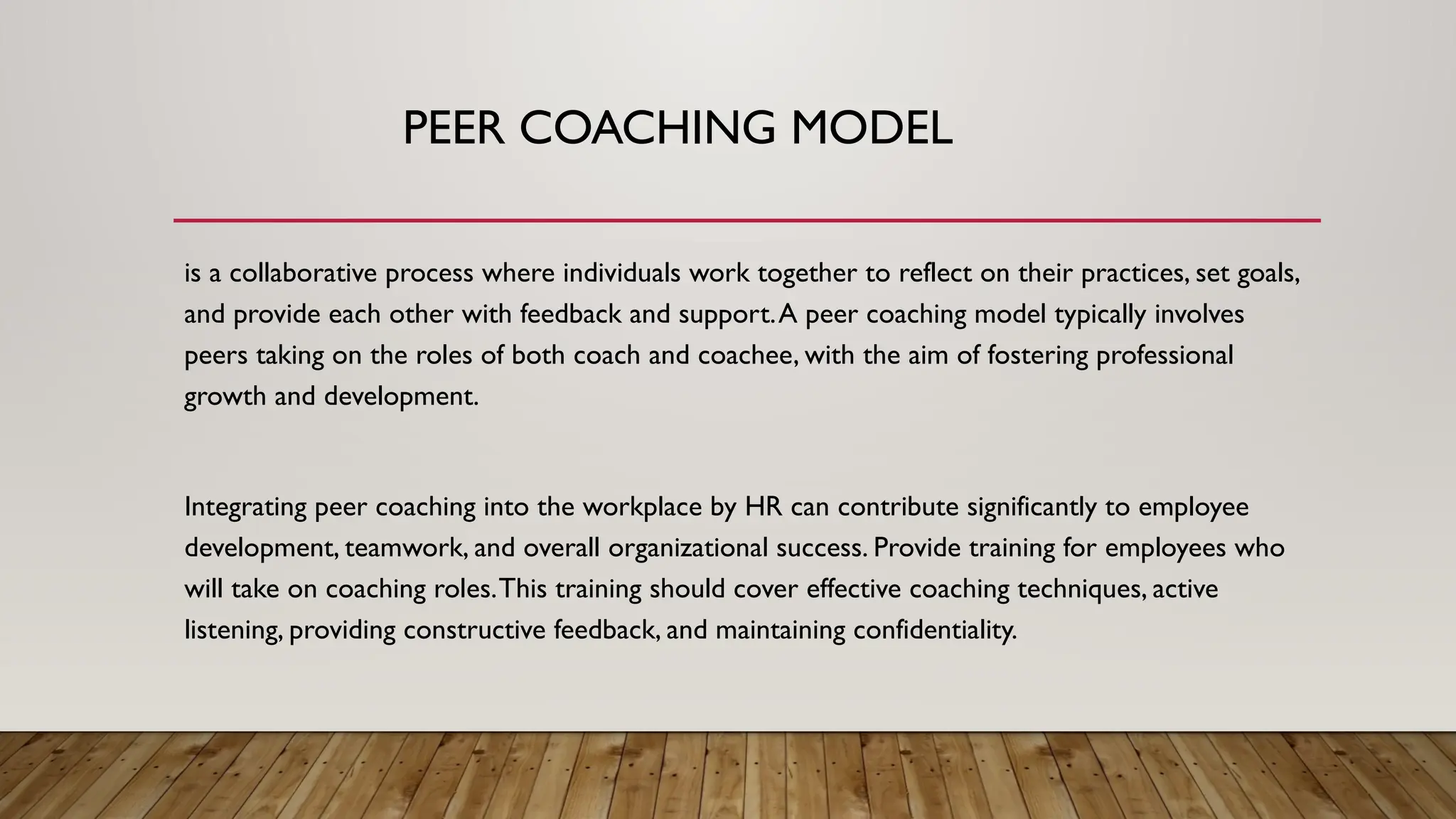
PEER COACHING MODEL
is a collaborative process where individuals work together to reflect on their practices, set goals,
and provide each other with feedback and support.A peer coaching model typically involves
peers taking on the roles of both coach and coachee, with the aim of fostering professional
growth and development.
Integrating peer coaching into the workplace by HR can contribute significantly to employee
development, teamwork, and overall organizational success. Provide training for employees who
will take on coaching roles.This training should cover effective coaching techniques, active
listening, providing constructive feedback, and maintaining confidentiality.
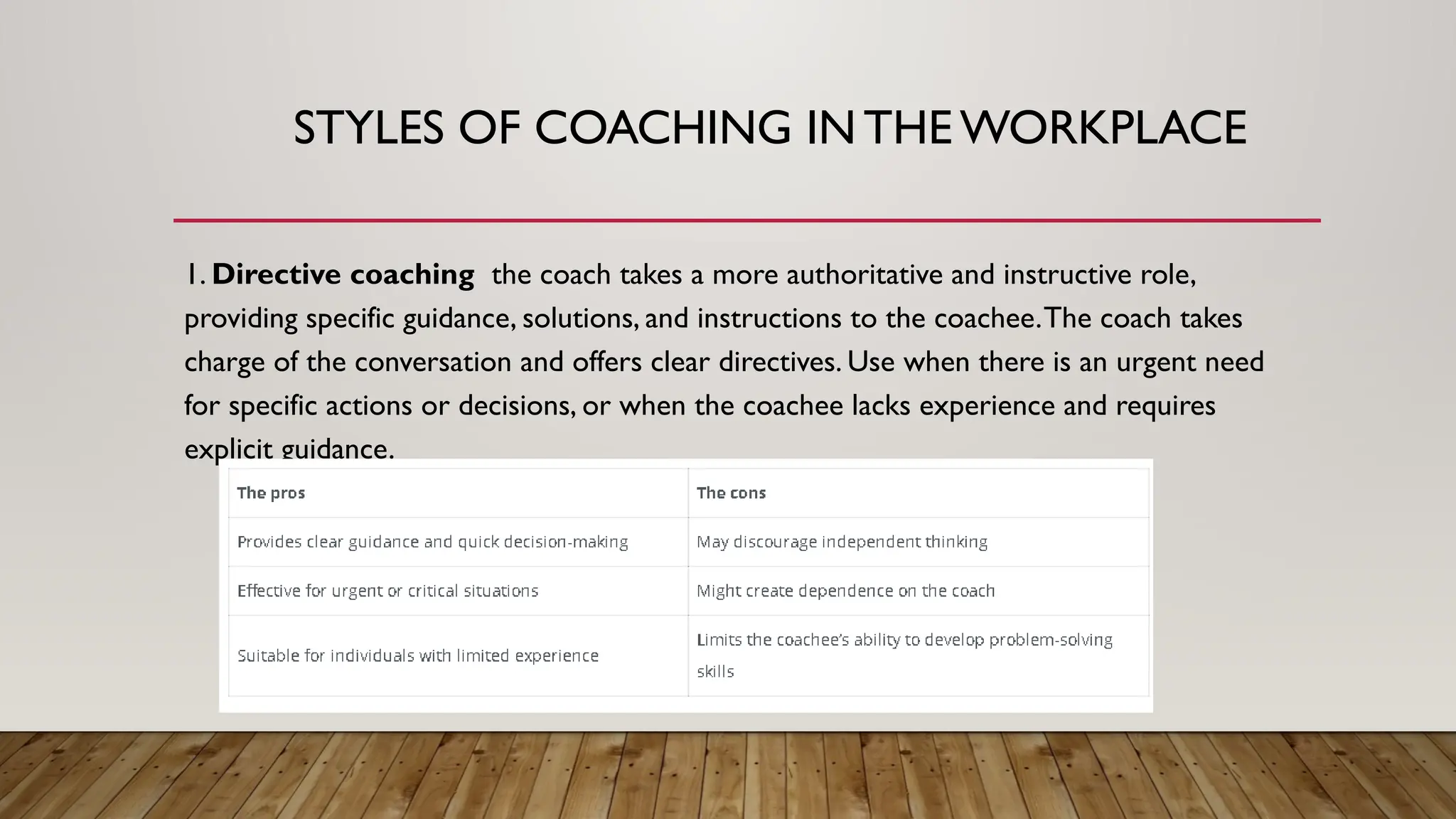
STYLES OF COACHING INTHE WORKPLACE
1. Directive coaching the coach takes a more authoritative and instructive role,
providing specific guidance, solutions, and instructions to the coachee.The coach takes
charge of the conversation and offers clear directives. Use when there is an urgent need
for specific actions or decisions, or when the coachee lacks experience and requires
explicit guidance.
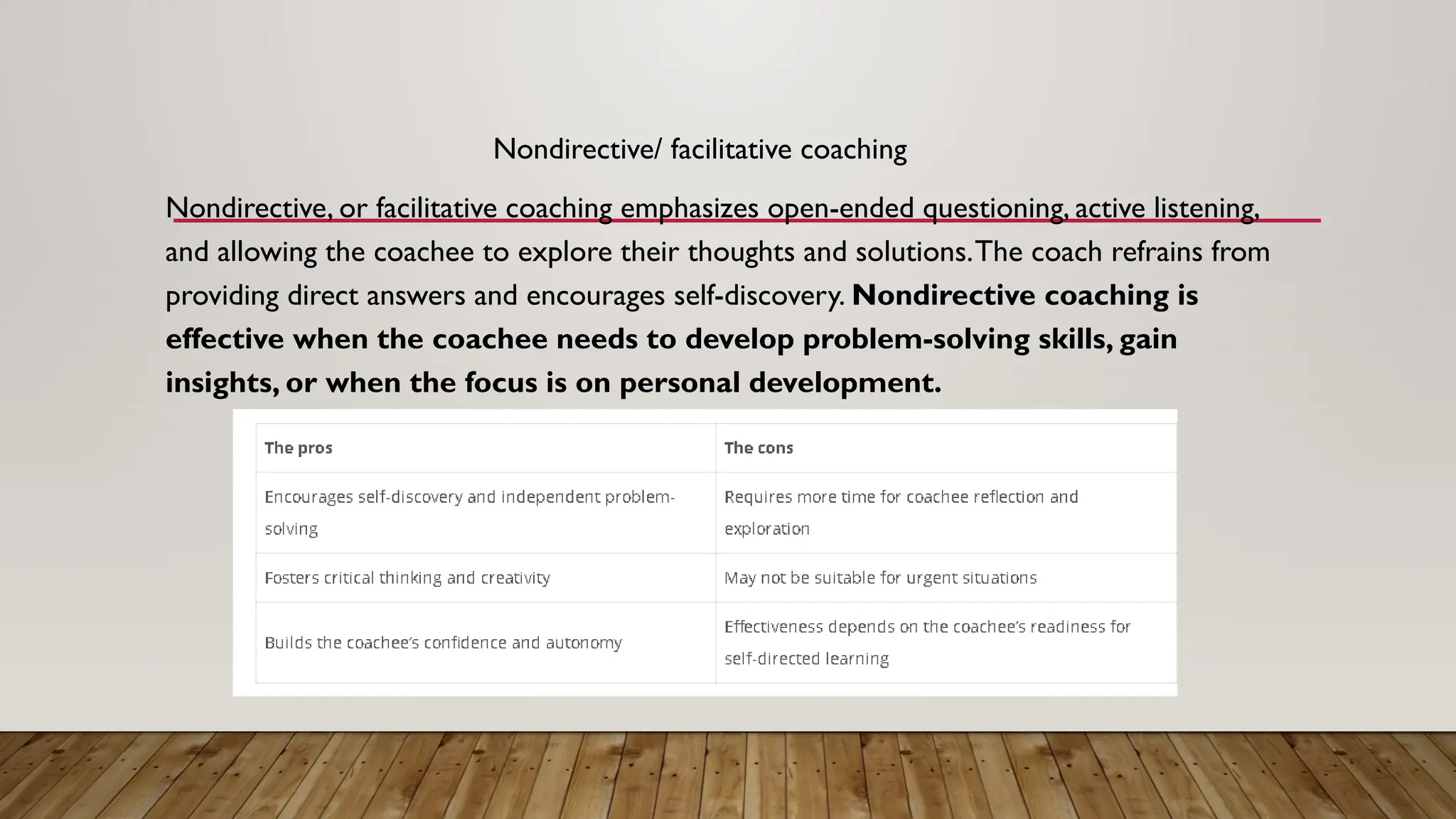
Nondirective/ facilitative coaching
Nondirective, or facilitative coaching emphasizes open-ended questioning, active listening,
and allowing the coachee to explore their thoughts and solutions.The coach refrains from
providing direct answers and encourages self-discovery. Nondirective coaching is
effective when the coachee needs to develop problem-solving skills, gain
insights, or when the focus is on personal development.
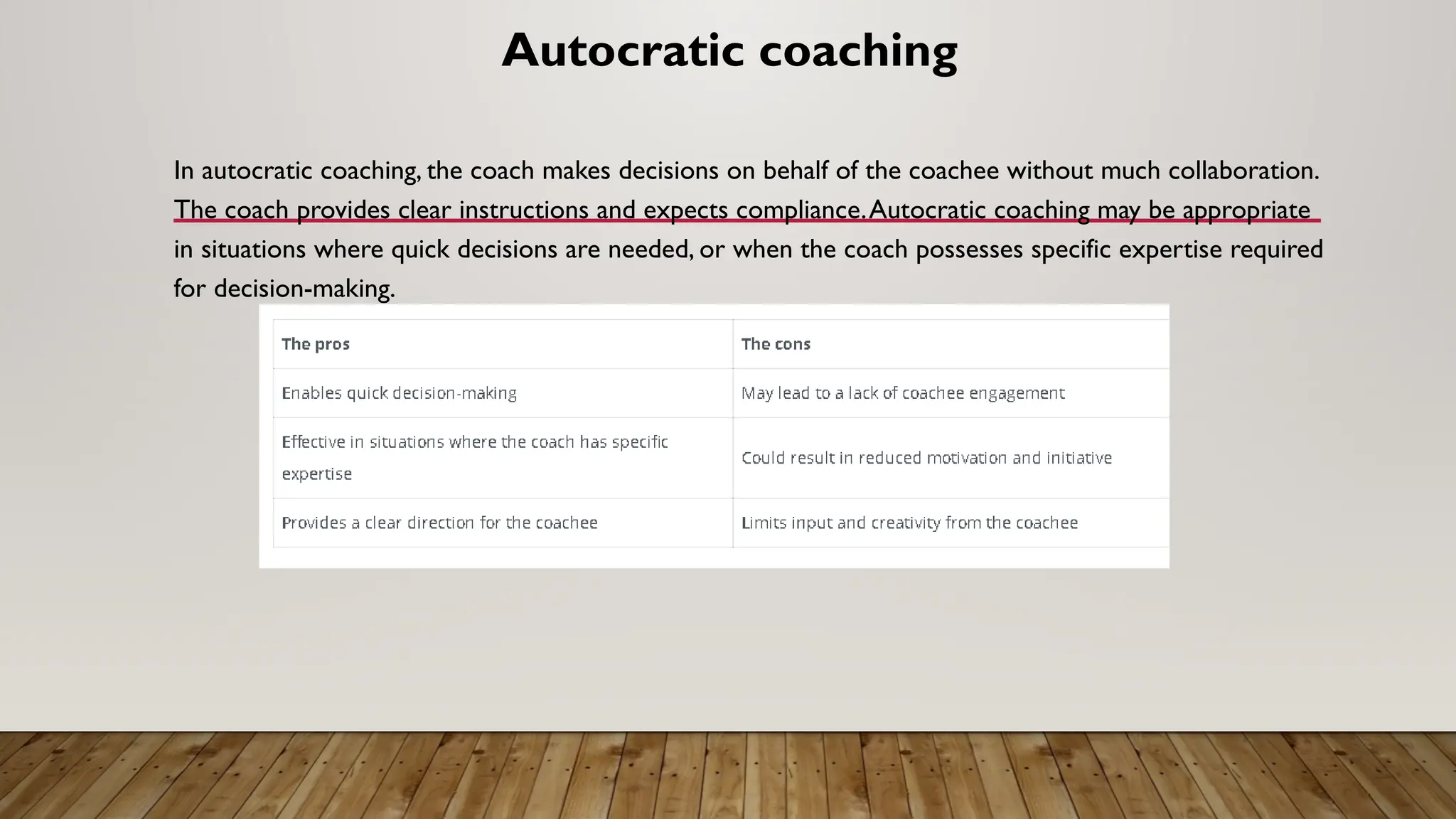
Autocratic coaching
In autocratic coaching, the coach makes decisions on behalf of the coachee without much collaboration.
The coach provides clear instructions and expects compliance.Autocratic coaching may be appropriate
in situations where quick decisions are needed, or when the coach possesses specific expertise required
for decision-making.
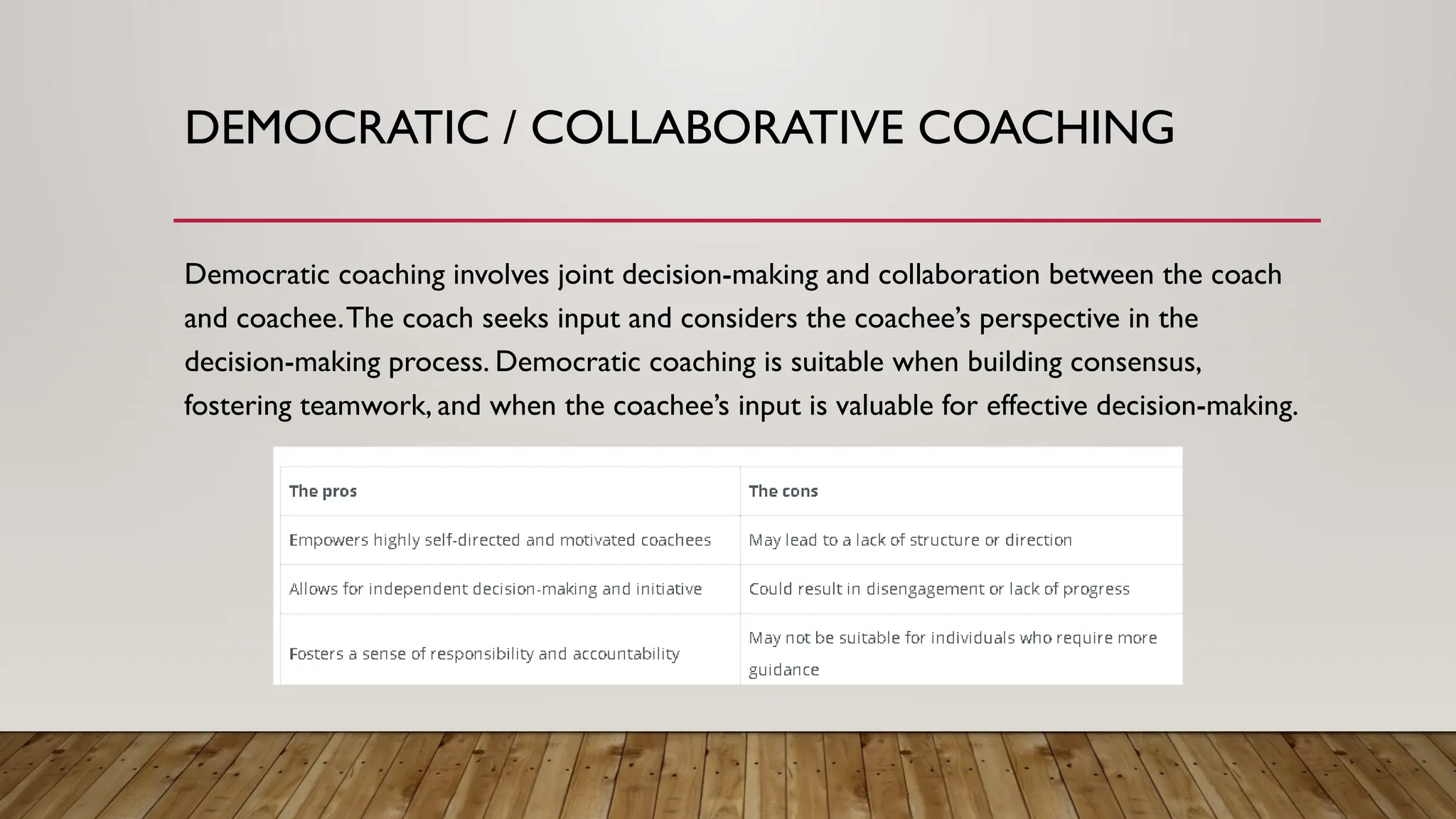
DEMOCRATIC / COLLABORATIVE COACHING
Democratic coaching involves joint decision-making and collaboration between the coach
and coachee.The coach seeks input and considers the coachee’s perspective in the
decision-making process. Democratic coaching is suitable when building consensus,
fostering teamwork, and when the coachee’s input is valuable for effective decision-making.
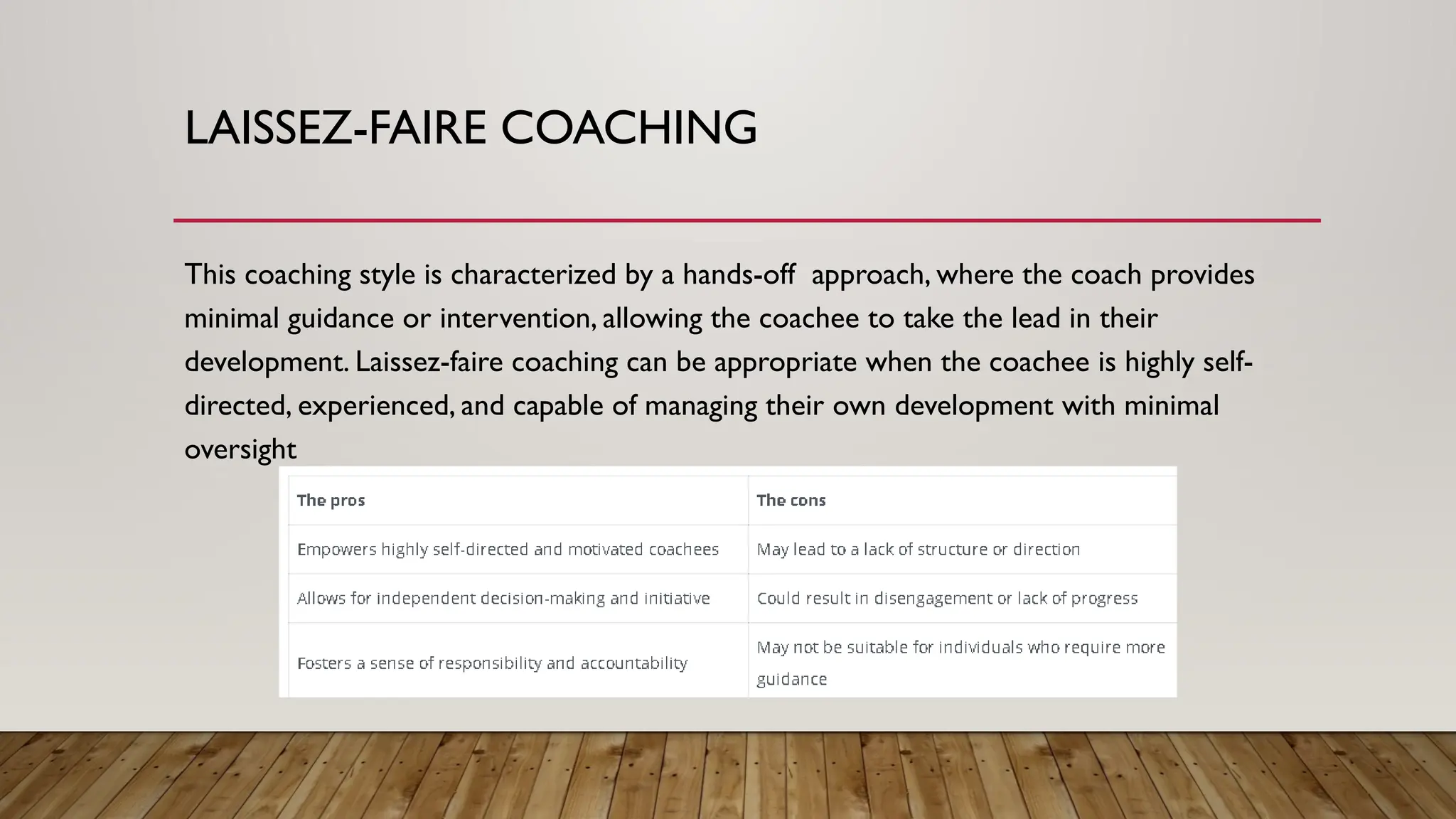
LAISSEZ-FAIRE COACHING
This coaching style is characterized by a hands-off approach, where the coach provides
minimal guidance or intervention, allowing the coachee to take the lead in their
development. Laissez-faire coaching can be appropriate when the coachee is highly self-
directed, experienced, and capable of managing their own development with minimal
oversight
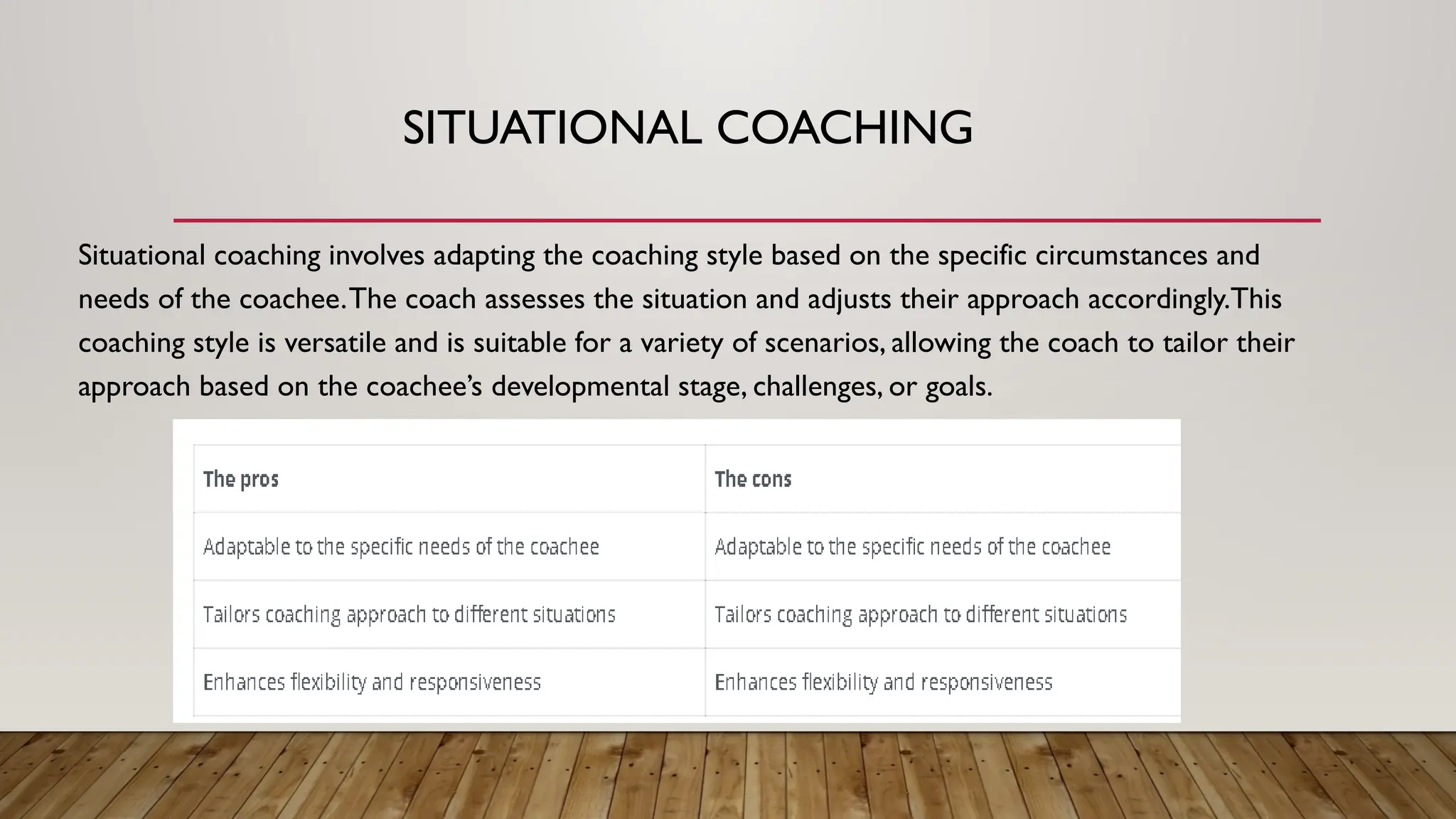
SITUATIONAL COACHING
Situational coaching involves adapting the coaching style based on the specific circumstances and
needs of the coachee.The coach assesses the situation and adjusts their approach accordingly.This
coaching style is versatile and is suitable for a variety of scenarios, allowing the coach to tailor their
approach based on the coachee’s developmental stage, challenges, or goals.

vnd.openxmlformats-officedocument.presentationml.presentationrendition=1 (3).pptx

  • 1.
  • 2.
    Coaching is away to support others in their professional and personal development. It can help them navigate challenges, identify areas for improvement, and achieve their goals. The GROW coaching model can be an effective tool for coaches working with clients in any coaching relationship.The structure is designed to guide you through asking questions that will lead to greater insight on the part of your client and stronger relationships with them as a result. Ultimately, it helps coaches meet their clients where they are and support their growth rather than assuming they know best or expecting them to follow along based on past experiences. The acronym stands for Goals, Reality, Options, andWill.
  • 4.
    THE IMPACT OFTHEGROW COACHING MODEL 1.GROW coaching skills unlock potential and increase performance by increasing self-confidence and motivation.Asking effective questions in a carefully structured way promotes deeper awareness and greater responsibility which leads to practical steps to accomplish goals and overcome obstacles. 2.The GROW Model has been seen to yield higher productivity, improved communication, better interpersonal relationships and a better-quality working environment. 3.The GROW Model is a simple yet powerful framework for structuring your coaching or mentoring conversations. 4.The GROW model can be effective regardless of your leadership style. It provides a realistic and straightforward way of getting things done.
  • 5.
    WEAKNESS OFTHIS APPROACH •1. Goals need to be realistic: the coachee can end up having exaggerated goals that they might think are achievable, despite not being realistic. The limitation of the GROW model in terms of goal setting is that both the coach and coachee need to have realistic goals. • 2. The coach might not be aware of ground realities: many organisations hire coaches for training sessions. If the coach is not aware of the ground realities, the GROW model might not be effective since the information received by them can be misleading. • 3. Uninterested coachee: unless the coachee is motivated enough to participate during the coaching session, GROW will not be effective as a framework. Many employees who attend training and brainstorming sessions can lack attention, motivation and interest in what they are being taught. Hence, making the entire exercise useless. • 4. Lack of will: as the final part of the GROW model is to establish the will to get things done, this can be a part which might be skipped by the coachee. This might particularly be on people who are uninterested and lack the will to act. Some might even do so in an organisation to maintain the status quo to keep a hold on organisational affairs by promoting inefficiency.
  • 6.
    EXAMPLE • Goal: Amarketing manager needs help to meet her sales target. She wants to raise her sales performance by 10% and increase her team’s productivity. • Current reality: The marketing manager’s sales figures plummeted over the past few months, averaging 15% less than the sales quota. She is feeling stressed with the performance. Moreover, her team members are not fully engaged in their work. • Options: The marketing manager has the following options to improve the sales targets: • Develop and implement multiple marketing strategies • Delegate admin tasks to her team members so she can focus on more strategic ones • Train her team members and be more supportive • Implement a new incentive program to reward best performing members. • Will: The marketing manager formulated a comprehensive marketing plan to grow her sales targets: • Use paid ads and social media to boost marketing efforts • Assign tasks to team members like appointment setting and answering after-sales queries so the manager can focus more on important tasks like reviewing sales performance and meeting high-value clients and leads • Conduct training on different sales techniques and customer relationship management • Give cash incentives to sales staff that exceed their sales targets. • The marketing manager and the coach meet regularly to track progress and make adjustments as needed.
  • 7.
    TYPES OF COACHINGMODELS • There are different coaching models to suit other individuals and address other objectives: • Leadership coaching: Tailored for business leaders who want to successfully lead and inspire their teams. Managers learn about reaching team goals, motivating team members, resolving conflicts, and delegating tasks. • Executive coaching: Centers on helping executives and senior managers to be more effective in their roles. It teaches strategic thinking, decision-making, communication, and interpersonal skills. • Team coaching: Helps teams achieve their goals through collaboration, communication, and problem- solving among team members. Team members identify their shared objectives, discuss challenges, and develop strategies. • Sales coaching: Helps salespeople improve their skills and achieve their sales goals. Covers topics like sales assessment, design and planning, and optimization.
  • 8.
    WHAT ELSE BESIDESGROW MODEL? OSKAR model • Outcome:The coach helps the coachee define the desired result by setting SMART goals. SMART goals provide clear direction and remove distractions. • Scaling: The coach and coachee evaluate the scale of the goal, considering its feasibility and potential impact to make sure it is realistic and aligned with the coachee’s bigger plans. • Know-how and resources:The coach and coachee then determine the skills and resources needed to reach the goal, which includes mentoring, training, or access to specific tools or equipment. • Affirm and action:The coach assists the coachee to affirm their strengths and beliefs.They create an action plan, which outlines the steps and the deadlines. • Review:The coach and coachee regularly review progress, identify other obstacles, and adjust to the action plan as required.This guarantees that the coachee stays on track and progresses toward the goal.
  • 9.
    CLEAR MODEL • Contract:The coach and coachee list down the goals, expectations, and limitations of the coaching process • Listening: The coach uses open-ended questions to understand the coachee’s concerns, perspectives, challenges, and aspirations. • Exploring: The coach encourages the coachee to reflect and explore underlying beliefs and patterns influencing their behavior. • Action: The coach and coachee collaboratively develop a plan of action, outlining SMART goals, actionable steps, and necessary resources to achieve the desired outcomes • Review: The coach and coachee meet regularly to evaluate the progress. The coach provides feedback, celebrates achievements, and adjusts the action plan when necessary.
  • 10.
    FUEL MODEL • Framethe Conversation: The coach and coachee agree on the purpose of the coaching relationship, the process, and the result. • Understand the Current State: Next, the coach asks open-ended questions to discover the coachee’s present situation and their values, strengths, and available resources. During this discovery phase, the coach also tries to identify any weaknesses and obstacles that are getting in the way of the coachee achieving their goals. • Explore the Desired Goal: Envisioning their desired future state, the coach helps the coachee set SMART goals. Together, they explore options and methods for achieving the targeted outcome. • Lay Out the Plan: Once the coachee decides on options and goals, they draw an action plan listing specific steps and timelines. KPIs are created to track progress. The coach regularly checks with the coachee for feedback and support.
  • 11.
    PEER COACHING MODEL isa collaborative process where individuals work together to reflect on their practices, set goals, and provide each other with feedback and support.A peer coaching model typically involves peers taking on the roles of both coach and coachee, with the aim of fostering professional growth and development. Integrating peer coaching into the workplace by HR can contribute significantly to employee development, teamwork, and overall organizational success. Provide training for employees who will take on coaching roles.This training should cover effective coaching techniques, active listening, providing constructive feedback, and maintaining confidentiality.
  • 12.
    STYLES OF COACHINGINTHE WORKPLACE 1. Directive coaching the coach takes a more authoritative and instructive role, providing specific guidance, solutions, and instructions to the coachee.The coach takes charge of the conversation and offers clear directives. Use when there is an urgent need for specific actions or decisions, or when the coachee lacks experience and requires explicit guidance.
  • 13.
    Nondirective/ facilitative coaching Nondirective,or facilitative coaching emphasizes open-ended questioning, active listening, and allowing the coachee to explore their thoughts and solutions.The coach refrains from providing direct answers and encourages self-discovery. Nondirective coaching is effective when the coachee needs to develop problem-solving skills, gain insights, or when the focus is on personal development.
  • 14.
    Autocratic coaching In autocraticcoaching, the coach makes decisions on behalf of the coachee without much collaboration. The coach provides clear instructions and expects compliance.Autocratic coaching may be appropriate in situations where quick decisions are needed, or when the coach possesses specific expertise required for decision-making.
  • 15.
    DEMOCRATIC / COLLABORATIVECOACHING Democratic coaching involves joint decision-making and collaboration between the coach and coachee.The coach seeks input and considers the coachee’s perspective in the decision-making process. Democratic coaching is suitable when building consensus, fostering teamwork, and when the coachee’s input is valuable for effective decision-making.
  • 16.
    LAISSEZ-FAIRE COACHING This coachingstyle is characterized by a hands-off approach, where the coach provides minimal guidance or intervention, allowing the coachee to take the lead in their development. Laissez-faire coaching can be appropriate when the coachee is highly self- directed, experienced, and capable of managing their own development with minimal oversight
  • 17.
    SITUATIONAL COACHING Situational coachinginvolves adapting the coaching style based on the specific circumstances and needs of the coachee.The coach assesses the situation and adjusts their approach accordingly.This coaching style is versatile and is suitable for a variety of scenarios, allowing the coach to tailor their approach based on the coachee’s developmental stage, challenges, or goals.