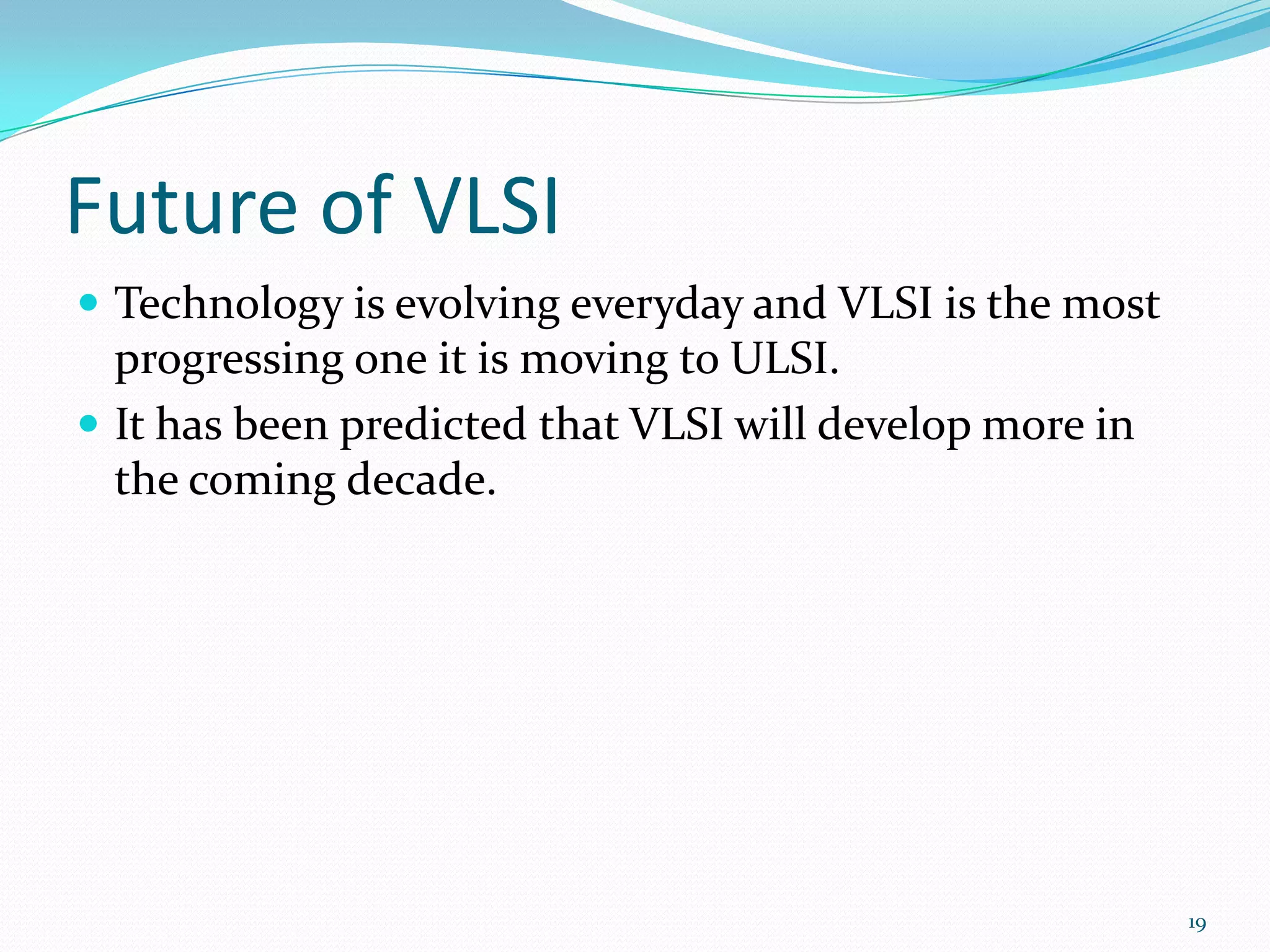
VLSI Techniques


                  1
VLSI Design
 What is VLSI?
   “Very Large Scale Integration”
   Defines integration level
   1980s hold-over from outdated taxonomy for integration levels
          Obviously influenced from frequency bands, i.e. HF, VHF, UHF
      Sources disagree on what is measured (gates or transistors?)


   SSI – Small-Scale Integration (0-102)
   MSI – Medium-Scale Integration (102-103)
   LSI – Large-Scale Integration (103-105)
   VLSI – Very Large-Scale Integration (105-107)
   ULSI – Ultra Large-Scale Integration (>=107)

                                                                          2
Moore’s Law
 In 1960 Gordon Moore predicted “the number of
  components that can be integrated on a single chip
  would increase at such a rapid rate that it will become
  twice in every 18 months”.
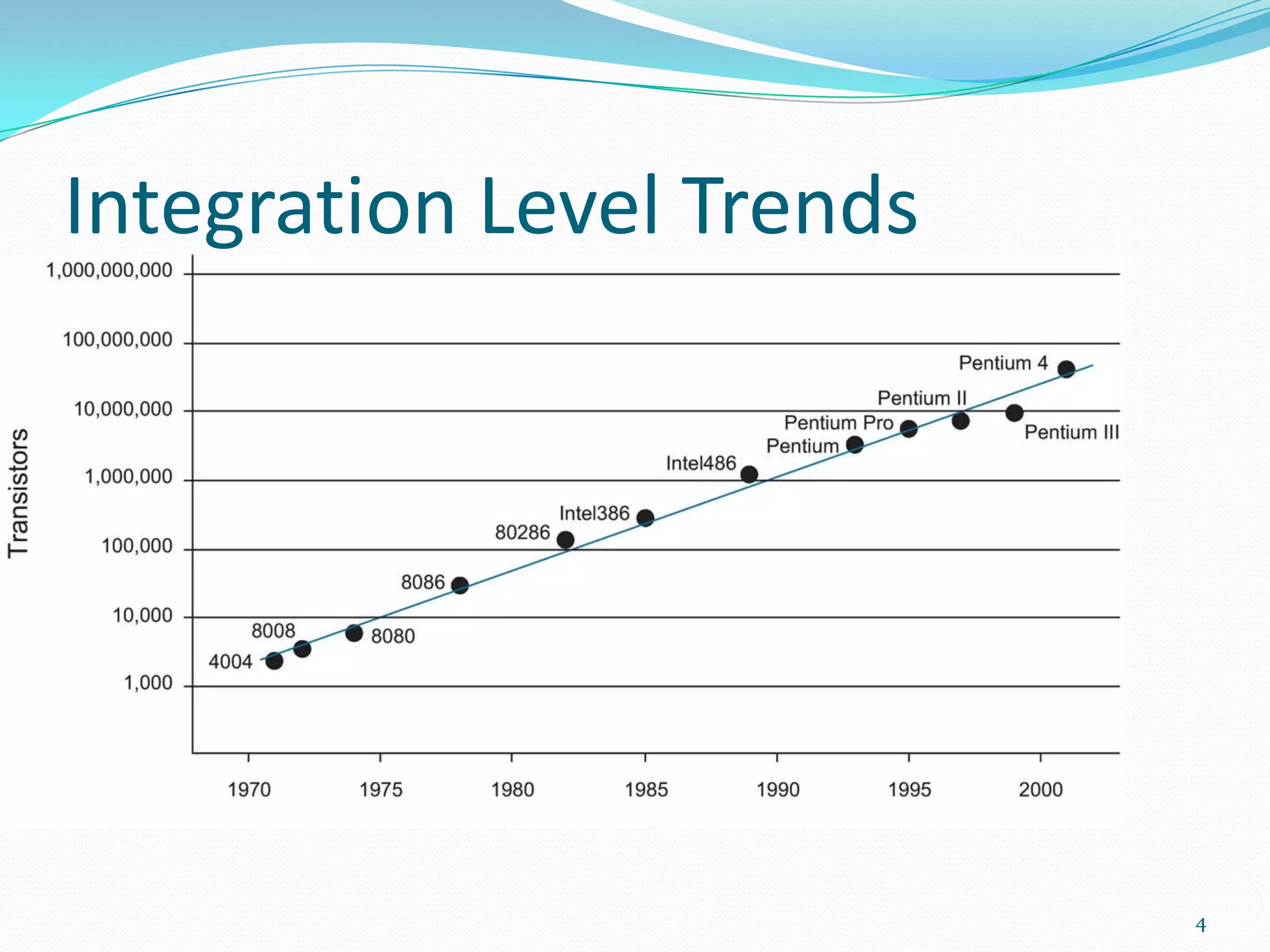
 So by using Moore’s law we get an approximate
  integration level trend at any time.
 But now moore’s law has reached its physical limit.


                                                            3
Integration Level Trends


                           4
Integrated Circuits/MEMs
 Today, VLSI refers to systems implementation with integrated
  circuits
    Integrated circuit refers mostly to general manufacturing technique
        micro/nano-scale devices on a semiconductor (crystalline) substrate
        Formed using chemical/lithography processing

 What kind of devices / structures?
   transistors (bipolar, MOSFET)
   wires (interconnects and passives)
   diodes (junction, LEDs, VCSELs, MSM, photoconductor, PiN)
   MEMs (piezoelectric integration, accelerometers, gyroscopes,
    pressure sensors, micro-mirrors)

 For CMOS digital design, we only use MOSFET transistors (used
  as switches) and wires

                                                                               5
Chips
 Integrated circuits consist of:
    A small square or rectangular “die”, < 1mm thick
        Small die: 1.5 mm x 1.5 mm => 2.25 mm2
        Large die: 15 mm x 15 mm => 225 mm2
    Larger die sizes mean:
        More logic, memory
        Less volume
        Less yield
    Dies are made from silicon (substrate)
        Substrate provides mechanical support and electrical common point


                                                                             6
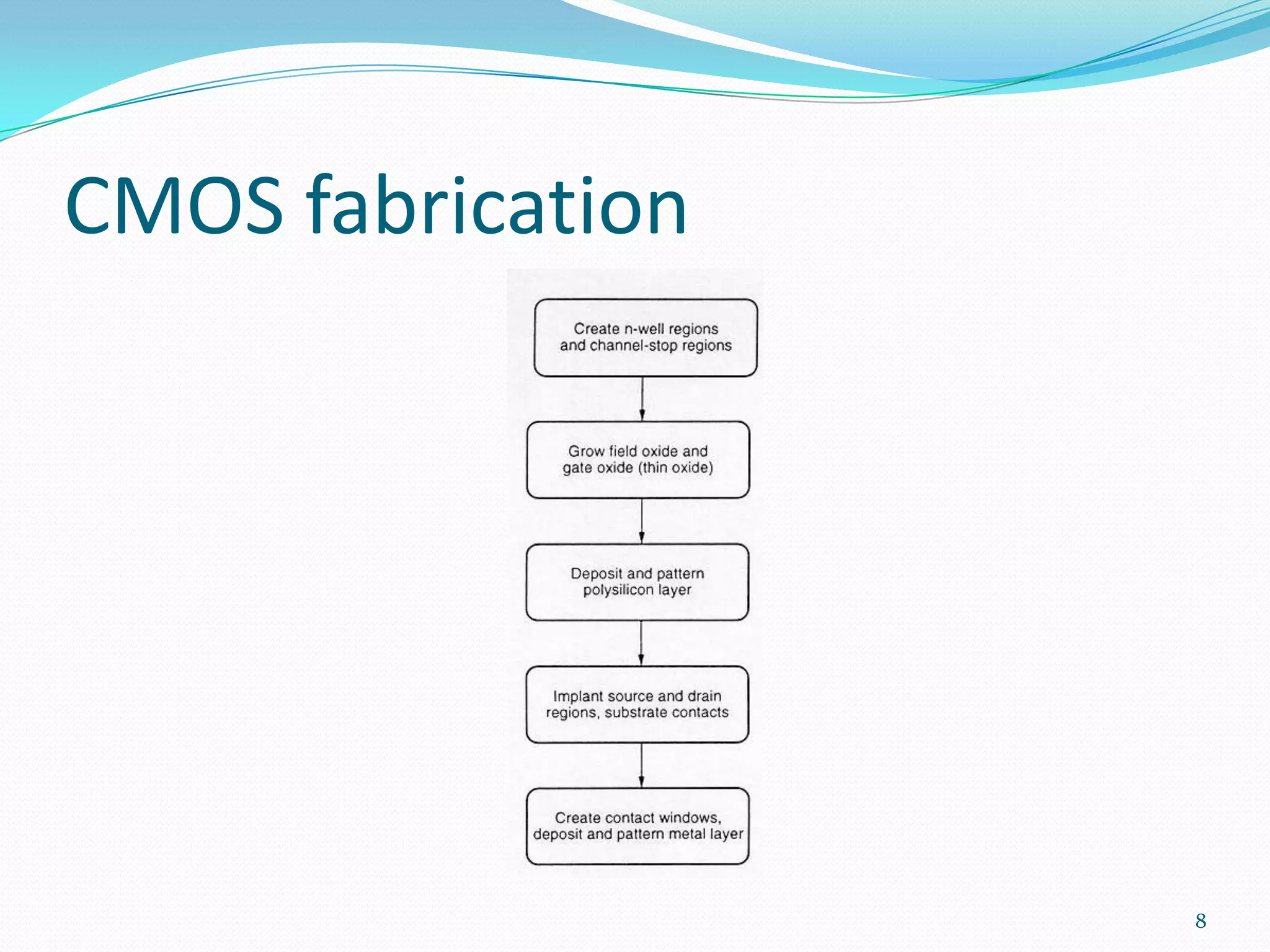
CMOS technique of IC fabrication
 Common metal oxide semiconductor for constructing
  FET on wafer chip
 N-well technique of fabrication on doped silicon, poly
  silicon, metal oxide and silicon oxide layer is
  implemented.
 On this pattern of various layers Optical lithography
  followed by photo resisting and etching is done.


                                                           7
CMOS fabrication


                   8
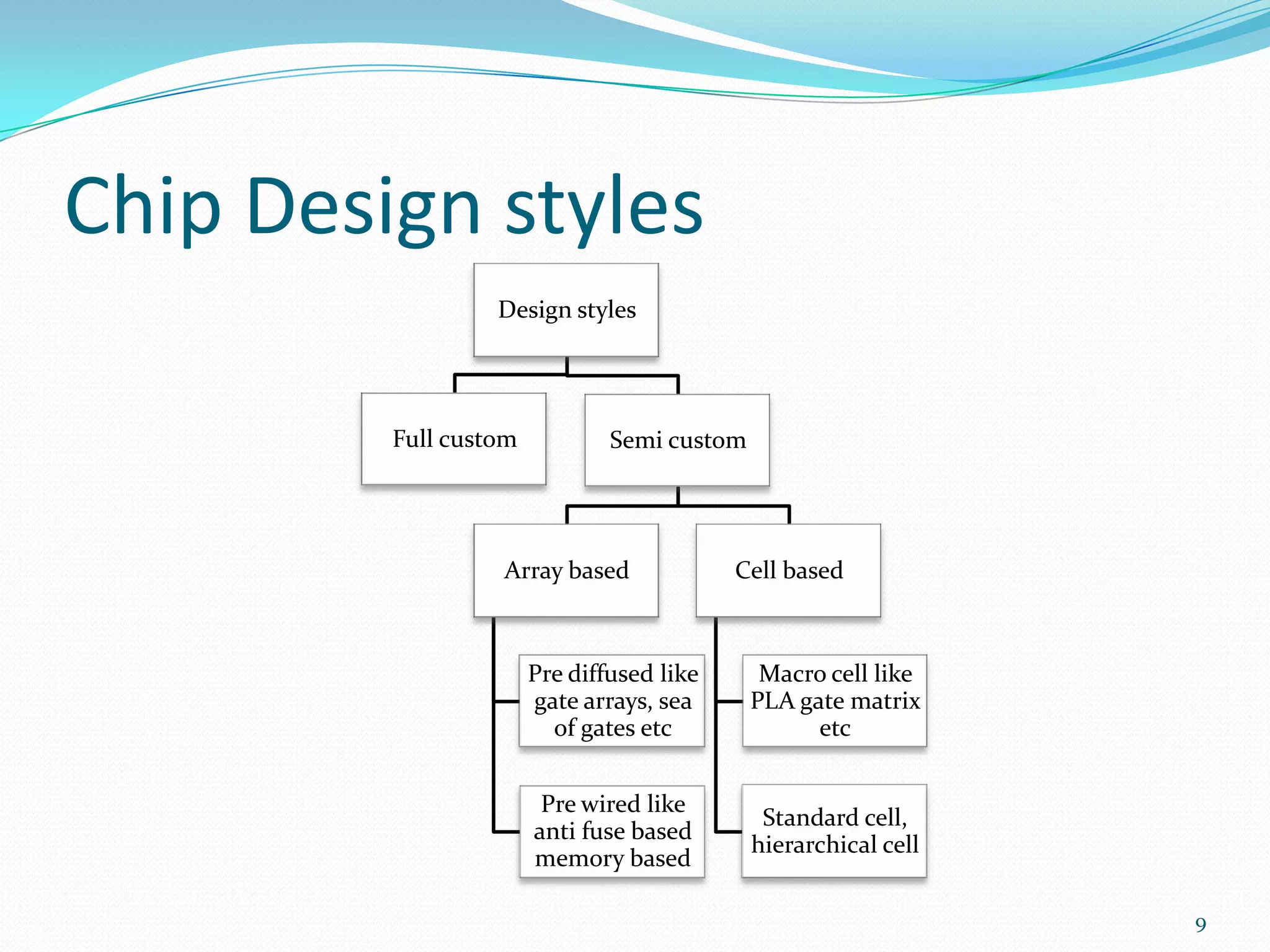
Chip Design styles
                  Design styles


         Full custom           Semi custom


                  Array based              Cell based


                       Pre diffused like      Macro cell like
                       gate arrays, sea      PLA gate matrix
                         of gates etc              etc


                        Pre wired like
                                              Standard cell,
                       anti fuse based
                                             hierarchical cell
                       memory based

                                                                 9
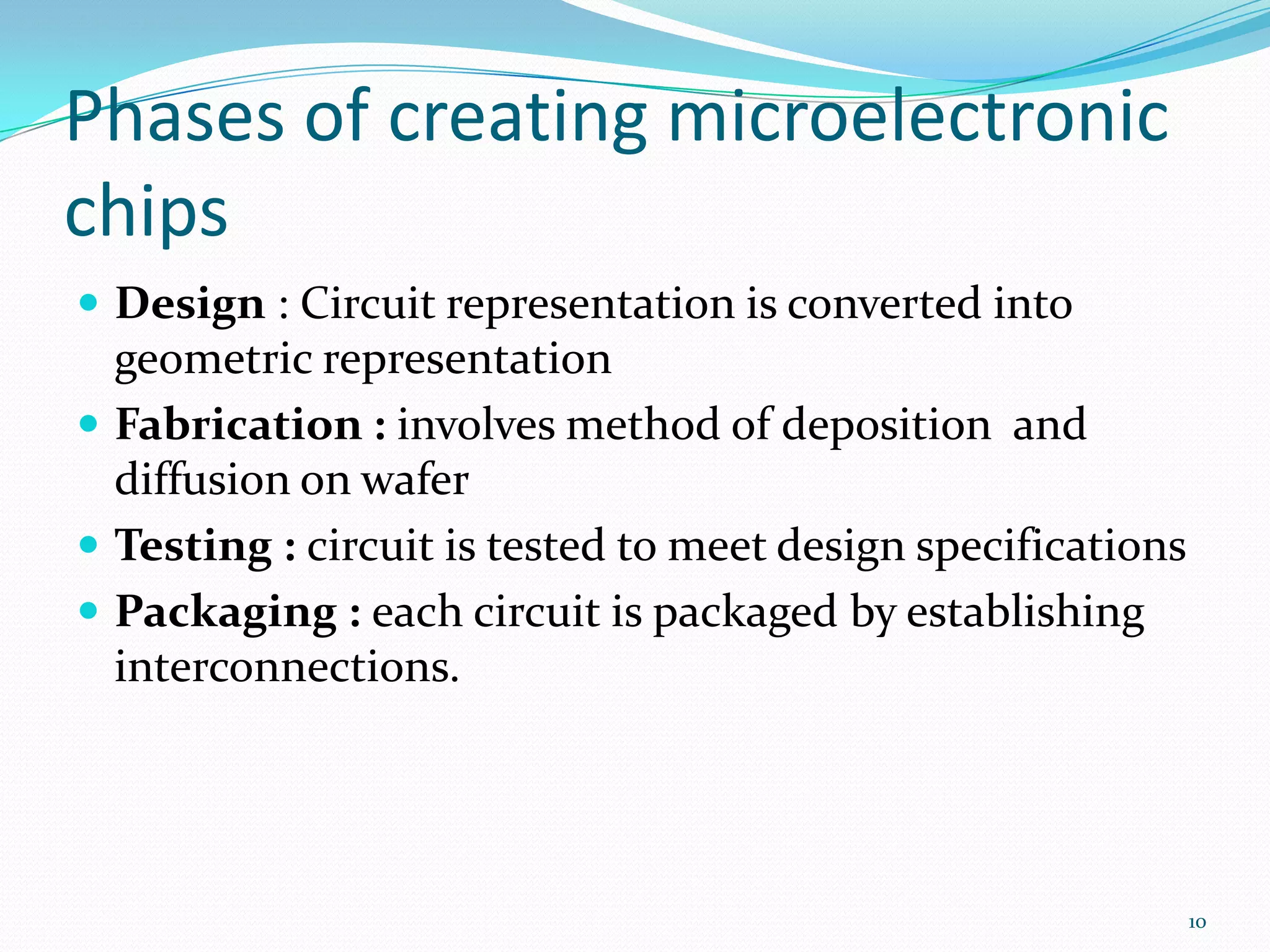
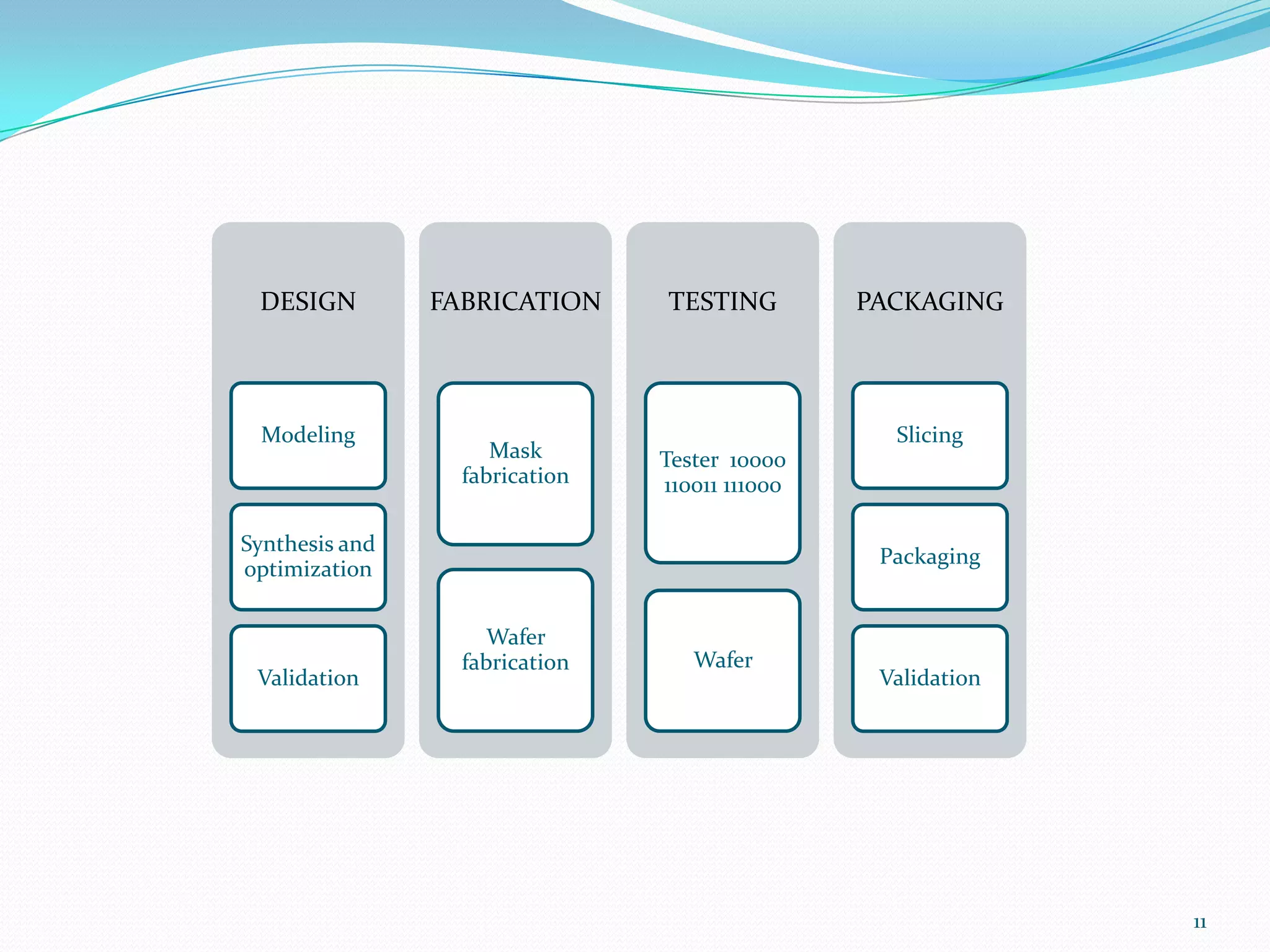
Phases of creating microelectronic
chips
 Design : Circuit representation is converted into
  geometric representation
 Fabrication : involves method of deposition and
  diffusion on wafer
 Testing : circuit is tested to meet design specifications
 Packaging : each circuit is packaged by establishing
  interconnections.


                                                              10
DESIGN         FABRICATION     TESTING         PACKAGING


 Modeling                                         Slicing
                     Mask       Tester 10000
                  fabrication   110011 111000

Synthesis and
                                                 Packaging
optimization

                     Wafer
                  fabrication      Wafer
 Validation                                      Validation


                                                              11
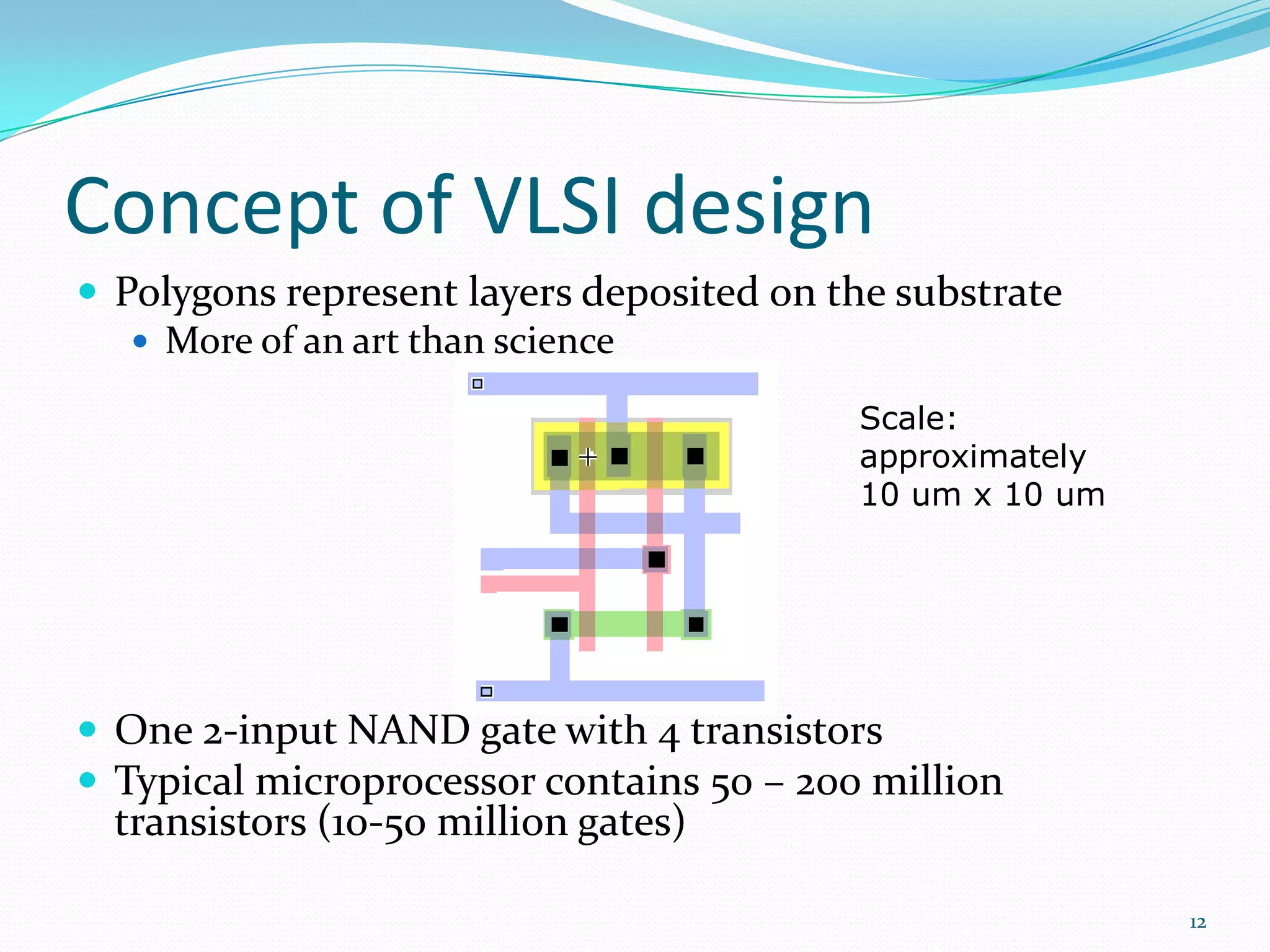
Concept of VLSI design
 Polygons represent layers deposited on the substrate
    More of an art than science

                                          Scale:
                                          approximately
                                          10 um x 10 um


 One 2-input NAND gate with 4 transistors
 Typical microprocessor contains 50 – 200 million
  transistors (10-50 million gates)

                                                          12
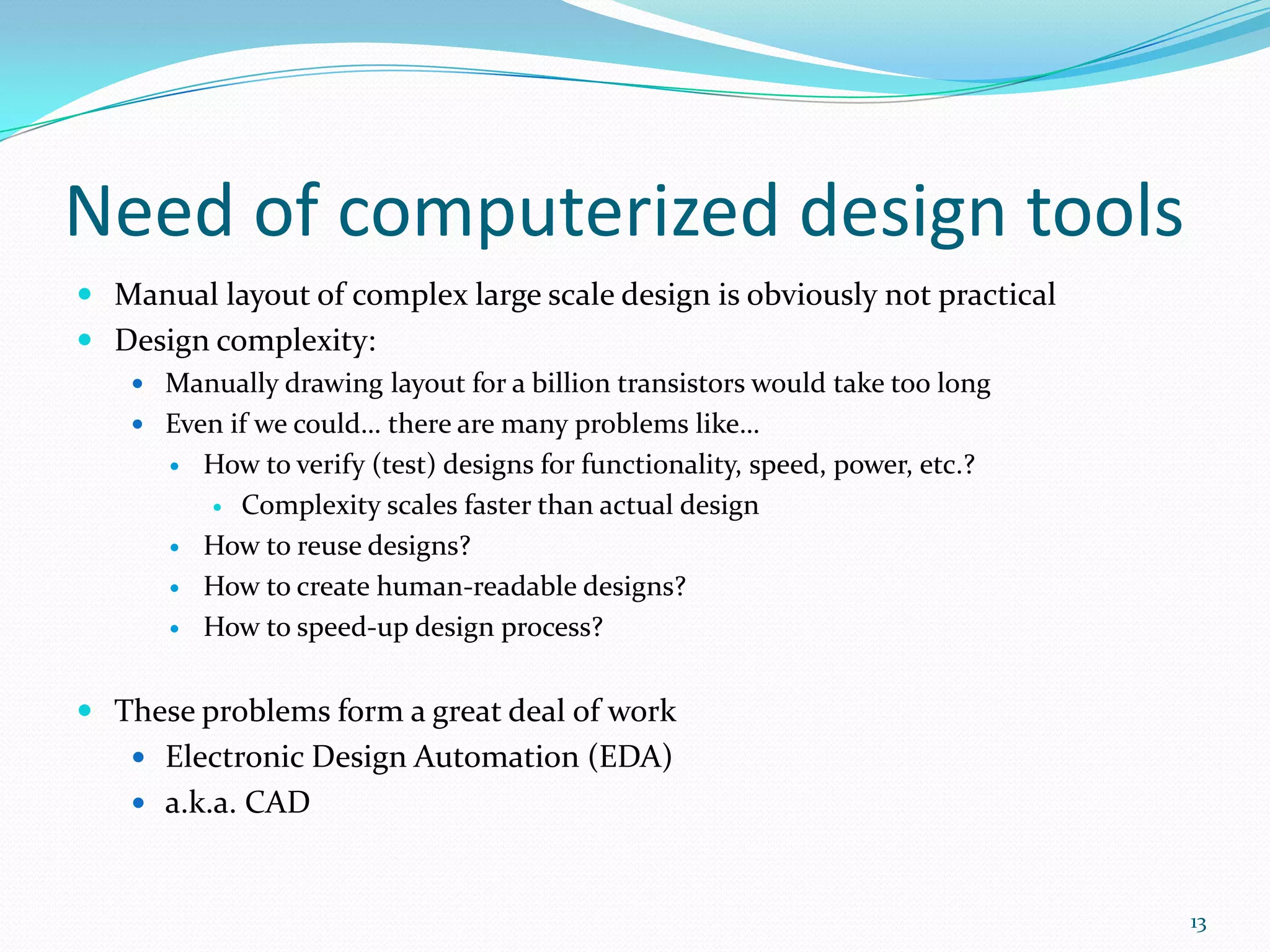
Need of computerized design tools
 Manual layout of complex large scale design is obviously not practical
 Design complexity:
     Manually drawing layout for a billion transistors would take too long
     Even if we could… there are many problems like…
          How to verify (test) designs for functionality, speed, power, etc.?
            Complexity scales faster than actual design

          How to reuse designs?
          How to create human-readable designs?
          How to speed-up design process?


 These problems form a great deal of work
     Electronic Design Automation (EDA)
     a.k.a. CAD


                                                                                 13
VLSI CAD
 Various software like synopsys , cadence etc. are used
  by designers to synthesize highly efficient VLSI chips.
 Hardware description for IC is written in Verilog or
  VHDL.
 It describes the hardware ,interconnection of circuit
  blocks and functionality.
 VHDL(very high speed IC hardware design language)
  is the C of VLSI technology.


                                                            14
VLSI applications
 Basically three areas of application exist today for VLSI
    Analog : Small transistor count precision circuits such
     as Amplifiers, Data converters, filters, Phase Locked
     Loops, Sensors etc.
    ASIC: application specific IC a microchip to perform and
     execute a particular task like digital signal processing,
     image compression etc.
    SoC: systems on a chip are highly complex mixed signal
     processors like a network chip or a wireless radio chip.


                                                             15
Challenges to VLSI technology
 As integration increases VLSI chips somewhat suffer
 from the challenges such as
   Power dissipation due to increasing components
   Noise delays due to capacitive or inductive coupling
   Decrease in clock frequency by skin effect on VLSI chip
   Improper scaling of wires for increasing components.


                                                              16
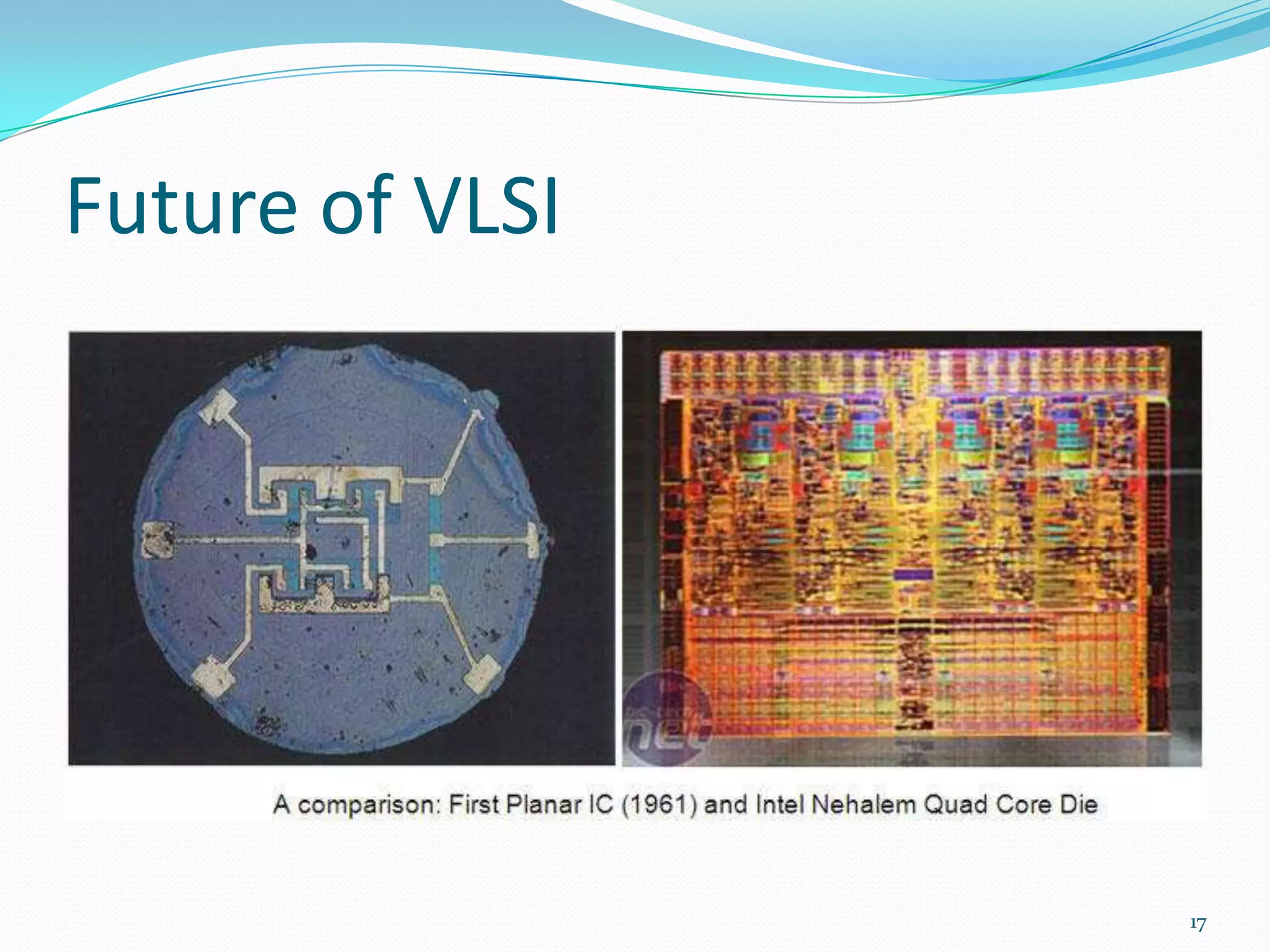
Future of VLSI


                 17
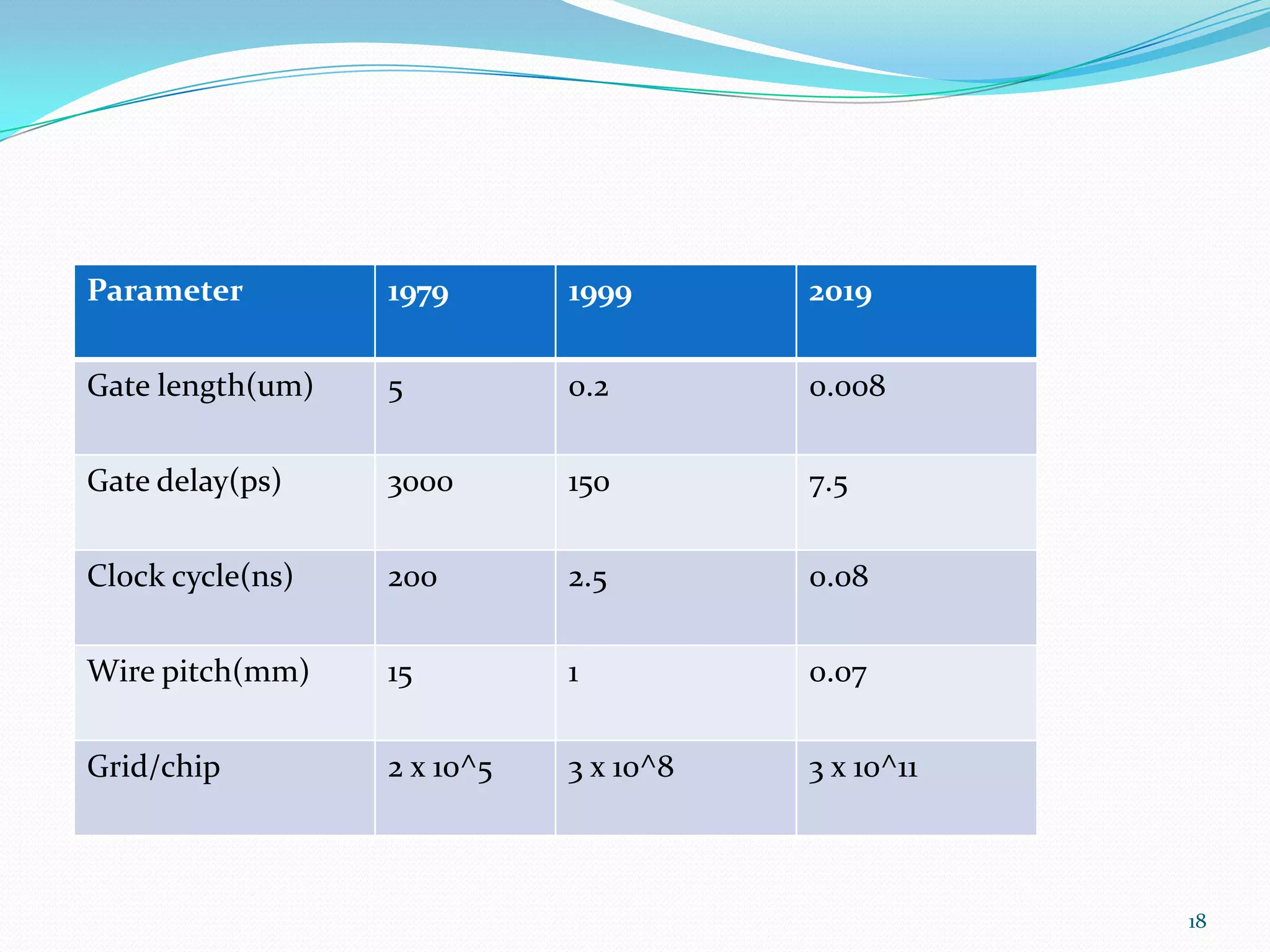
Parameter         1979       1999       2019


Gate length(um)   5          0.2        0.008


Gate delay(ps)    3000       150        7.5


Clock cycle(ns)   200        2.5        0.08


Wire pitch(mm)    15         1          0.07


Grid/chip         2 x 10^5   3 x 10^8   3 x 10^11


                                                    18
Future of VLSI
 Technology is evolving everyday and VLSI is the most
  progressing one it is moving to ULSI.
 It has been predicted that VLSI will develop more in
  the coming decade.


                                                         19
20

Vlsi techniques

  • 1.
  • 2.
    VLSI Design  Whatis VLSI?  “Very Large Scale Integration”  Defines integration level  1980s hold-over from outdated taxonomy for integration levels  Obviously influenced from frequency bands, i.e. HF, VHF, UHF  Sources disagree on what is measured (gates or transistors?)  SSI – Small-Scale Integration (0-102)  MSI – Medium-Scale Integration (102-103)  LSI – Large-Scale Integration (103-105)  VLSI – Very Large-Scale Integration (105-107)  ULSI – Ultra Large-Scale Integration (>=107) 2
  • 3.
    Moore’s Law  In1960 Gordon Moore predicted “the number of components that can be integrated on a single chip would increase at such a rapid rate that it will become twice in every 18 months”.  So by using Moore’s law we get an approximate integration level trend at any time.  But now moore’s law has reached its physical limit. 3
  • 4.
  • 5.
    Integrated Circuits/MEMs  Today,VLSI refers to systems implementation with integrated circuits  Integrated circuit refers mostly to general manufacturing technique  micro/nano-scale devices on a semiconductor (crystalline) substrate  Formed using chemical/lithography processing  What kind of devices / structures?  transistors (bipolar, MOSFET)  wires (interconnects and passives)  diodes (junction, LEDs, VCSELs, MSM, photoconductor, PiN)  MEMs (piezoelectric integration, accelerometers, gyroscopes, pressure sensors, micro-mirrors)  For CMOS digital design, we only use MOSFET transistors (used as switches) and wires 5
  • 6.
    Chips  Integrated circuitsconsist of:  A small square or rectangular “die”, < 1mm thick  Small die: 1.5 mm x 1.5 mm => 2.25 mm2  Large die: 15 mm x 15 mm => 225 mm2  Larger die sizes mean:  More logic, memory  Less volume  Less yield  Dies are made from silicon (substrate)  Substrate provides mechanical support and electrical common point 6
  • 7.
    CMOS technique ofIC fabrication  Common metal oxide semiconductor for constructing FET on wafer chip  N-well technique of fabrication on doped silicon, poly silicon, metal oxide and silicon oxide layer is implemented.  On this pattern of various layers Optical lithography followed by photo resisting and etching is done. 7
  • 8.
  • 9.
    Chip Design styles Design styles Full custom Semi custom Array based Cell based Pre diffused like Macro cell like gate arrays, sea PLA gate matrix of gates etc etc Pre wired like Standard cell, anti fuse based hierarchical cell memory based 9
  • 10.
    Phases of creatingmicroelectronic chips  Design : Circuit representation is converted into geometric representation  Fabrication : involves method of deposition and diffusion on wafer  Testing : circuit is tested to meet design specifications  Packaging : each circuit is packaged by establishing interconnections. 10
  • 11.
    DESIGN FABRICATION TESTING PACKAGING Modeling Slicing Mask Tester 10000 fabrication 110011 111000 Synthesis and Packaging optimization Wafer fabrication Wafer Validation Validation 11
  • 12.
    Concept of VLSIdesign  Polygons represent layers deposited on the substrate  More of an art than science Scale: approximately 10 um x 10 um  One 2-input NAND gate with 4 transistors  Typical microprocessor contains 50 – 200 million transistors (10-50 million gates) 12
  • 13.
    Need of computerizeddesign tools  Manual layout of complex large scale design is obviously not practical  Design complexity:  Manually drawing layout for a billion transistors would take too long  Even if we could… there are many problems like…  How to verify (test) designs for functionality, speed, power, etc.?  Complexity scales faster than actual design  How to reuse designs?  How to create human-readable designs?  How to speed-up design process?  These problems form a great deal of work  Electronic Design Automation (EDA)  a.k.a. CAD 13
  • 14.
    VLSI CAD  Varioussoftware like synopsys , cadence etc. are used by designers to synthesize highly efficient VLSI chips.  Hardware description for IC is written in Verilog or VHDL.  It describes the hardware ,interconnection of circuit blocks and functionality.  VHDL(very high speed IC hardware design language) is the C of VLSI technology. 14
  • 15.
    VLSI applications  Basicallythree areas of application exist today for VLSI  Analog : Small transistor count precision circuits such as Amplifiers, Data converters, filters, Phase Locked Loops, Sensors etc.  ASIC: application specific IC a microchip to perform and execute a particular task like digital signal processing, image compression etc.  SoC: systems on a chip are highly complex mixed signal processors like a network chip or a wireless radio chip. 15
  • 16.
    Challenges to VLSItechnology  As integration increases VLSI chips somewhat suffer from the challenges such as  Power dissipation due to increasing components  Noise delays due to capacitive or inductive coupling  Decrease in clock frequency by skin effect on VLSI chip  Improper scaling of wires for increasing components. 16
  • 17.
  • 18.
    Parameter 1979 1999 2019 Gate length(um) 5 0.2 0.008 Gate delay(ps) 3000 150 7.5 Clock cycle(ns) 200 2.5 0.08 Wire pitch(mm) 15 1 0.07 Grid/chip 2 x 10^5 3 x 10^8 3 x 10^11 18
  • 19.
    Future of VLSI Technology is evolving everyday and VLSI is the most progressing one it is moving to ULSI.  It has been predicted that VLSI will develop more in the coming decade. 19
  • 20.