
• Topline Summary
• Key Insights
• Segmentation Methods
• Target Options
• Recommended Audience
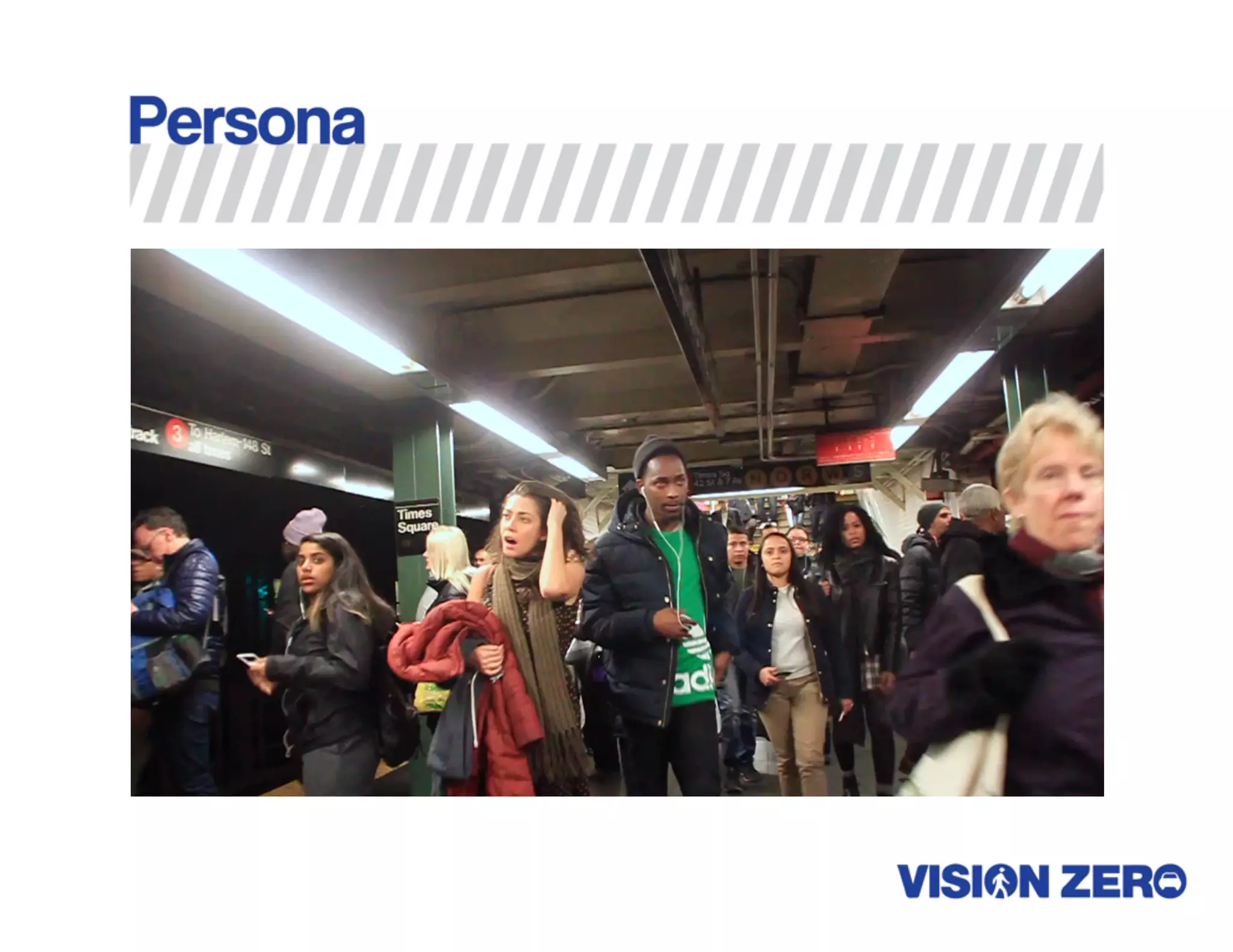
• Persona
• Campaign
• Messaging
• Media Mix (PESO)
• Media Planning
• Anticipated Audience Actions
Vision Zero
Vision Zero is a multi-national road traffic
safety project, enacted locally in New York
by Mayor Bill de Blasio in 2014.
https://www.transalt.org/getinvolved/vision-zero-now/platform#three
Why Vision Zero
Vision Zero was enacted to combat high rates
of those seriously killed or injured (KSI) in road
related accidents.
http://www1.nyc.gov/site/visionzero/index.page
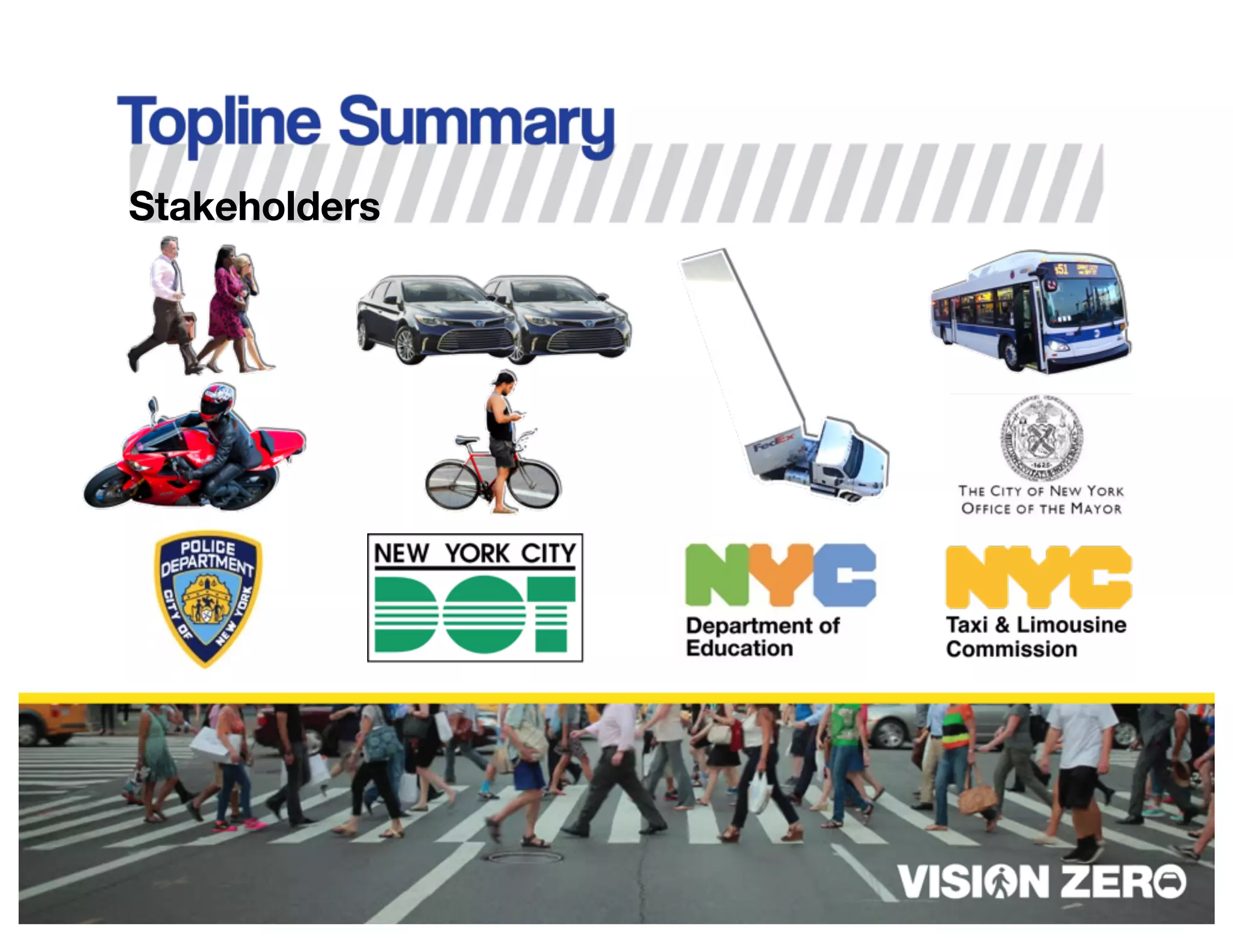
Who is Involved
Office of the Mayor, the NYC Department of
Transportation (DOT), the New York Police
Department, and everyday New Yorkers play a
role in bringing Vision Zero to life.
Stakeholders
How Vision Zero Works
Vision Zero aims to reduce KSI rates through
the redesign of arterial streets, enforcement of
stricter laws, reform of the DMV’s court
system, cooperation with city and state
agencies, and education of road safety.
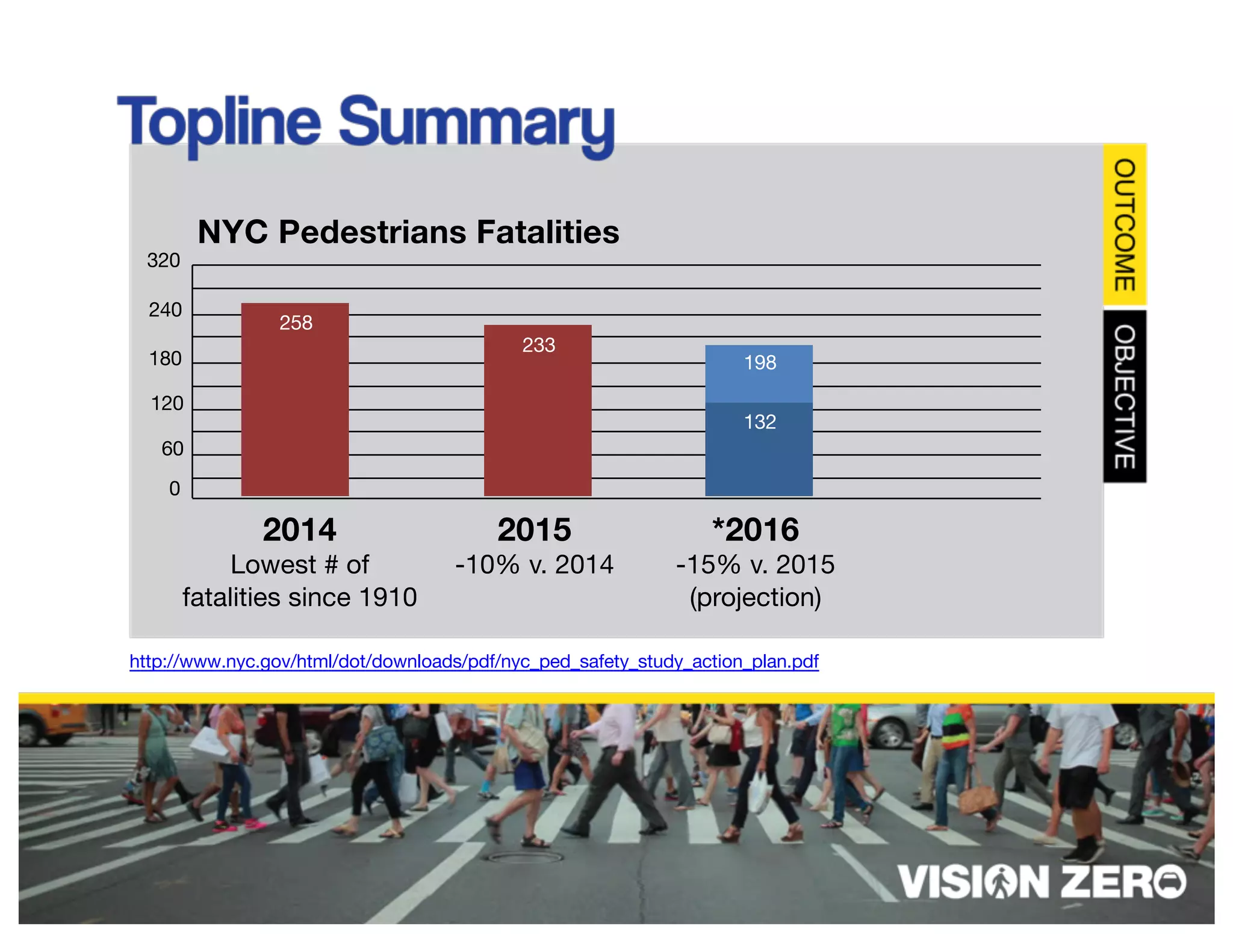
2014
Lowest # of
fatalities since 1910
2015
-10% v. 2014
http://www.nyc.gov/html/dot/downloads/pdf/nyc_ped_safety_study_action_plan.pdf
0
60
120
180
240
258
233
*2016
-15% v. 2015
(projection)
198
132
NYC Pedestrians Fatalities
320
2014
Lowest # of
fatalities since 1910
2015
-10% v. 2014
0
60
120
180
240
320
258
233
*2016
-15% v. 2015
(projection)
*2017
-20% v. 2016
(projection)
158
198
132
http://patch.com/new-york/new-york-city/de-blasio-claims-vision-zero-working-its-not
NYC Pedestrians Fatalities
53%
7%
3x
64%
http://yourchoicesmatter.nyc/sources
http://www1.nyc.gov/assets/visionzero/downloads/pdf/nyc-vision-zero-action-plan.pdf
Pedestrian crashes caused by speeding. 2x the
likelihood of fatality.
Likelihood that a left turn will kill or severely
injure a pedestrian, compared to right turns.
Crashes caused by male drivers.
Pedestrian crashes involving private passenger
cars.
Pedestrian fatalities caused by inattention,
speeding, and failure to yield.
79%
53%
7%
3x
64%
79%
75% Fatalities caused by male drivers.75%
27%
1.4x
Crashes that involved pedestrians.
Fatalities that involved pedestrians.
Pedestrian crashes caused by crossing with
the signal, v. 20% cross against the signal.
74%
Pedestrian fatalities caused by pedestrians.30%
http://www.nyc.gov/html/dot/downloads/pdf/nyc_ped_safety_study_action_plan.pdf
Pedestrian crashes that occur at intersections.
More pedestrian crashes occurred during the
holiday season.
20%
Likelihood that male pedestrians are involved in
a crash.
56%
15%
27%
30%
74%
20%
1.4x
56%
Observation Insights (n=110)
• Pedestrians crossed the street with only
seconds left to spare on the signal.
• Pedestrians crossed streets outside
demarcated boundaries.
• Many pedestrians were multitasking while
crossing streets.
• Apart from risky street-crossing behavior,
some pedestrians waiting for the next
crossing would stand on the roadside
instead of stepping up on a curb.
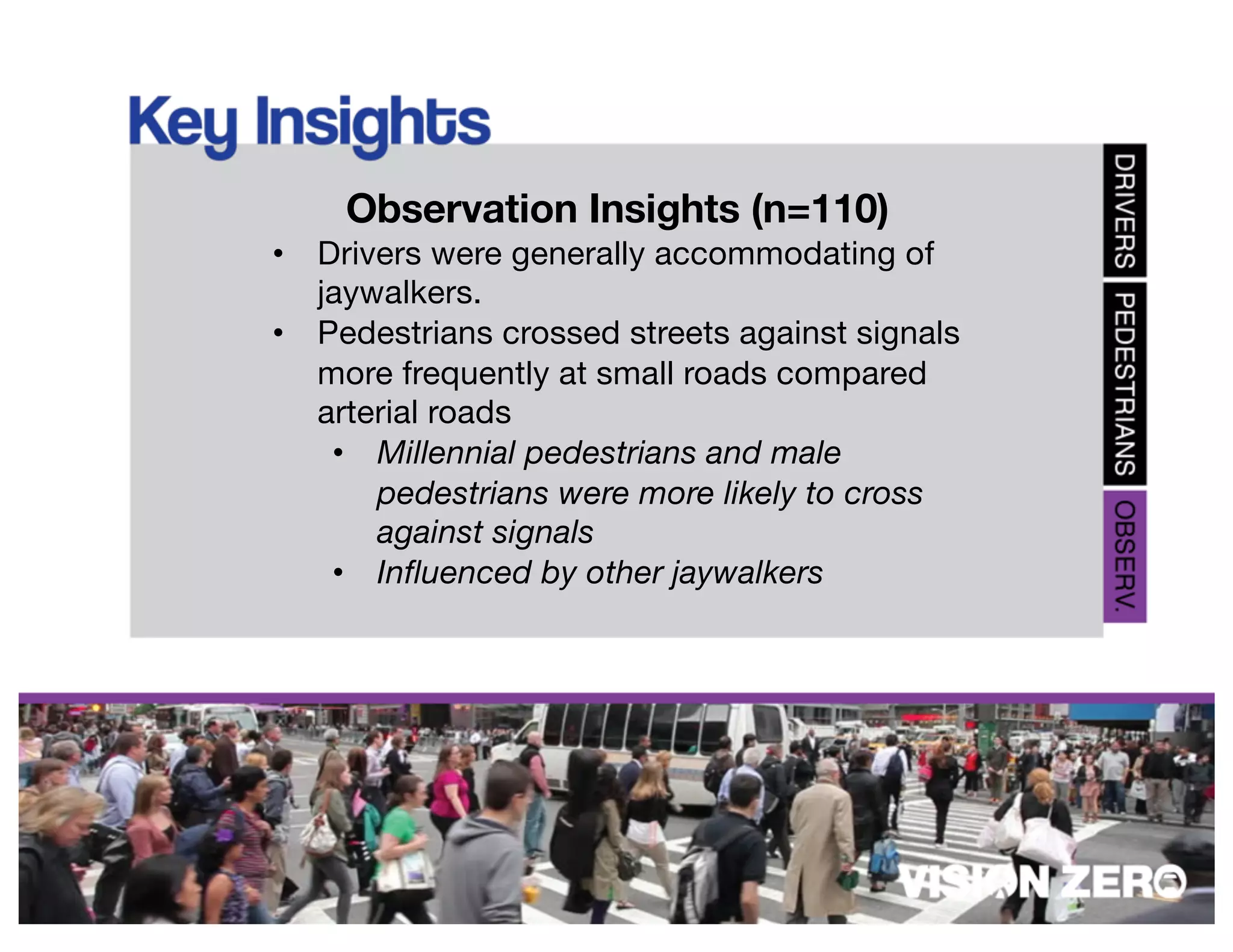
Observation Insights (n=110)
• Drivers were generally accommodating of
jaywalkers.
• Pedestrians crossed streets against signals
more frequently at small roads compared
arterial roads
• Millennial pedestrians and male
pedestrians were more likely to cross
against signals
• Influenced by other jaywalkers
We evaluated our potential
audiences through the following
five methods …
1. Demographics
2. Geographic
3. Behavioral
4. Psychographics
5. Influencers
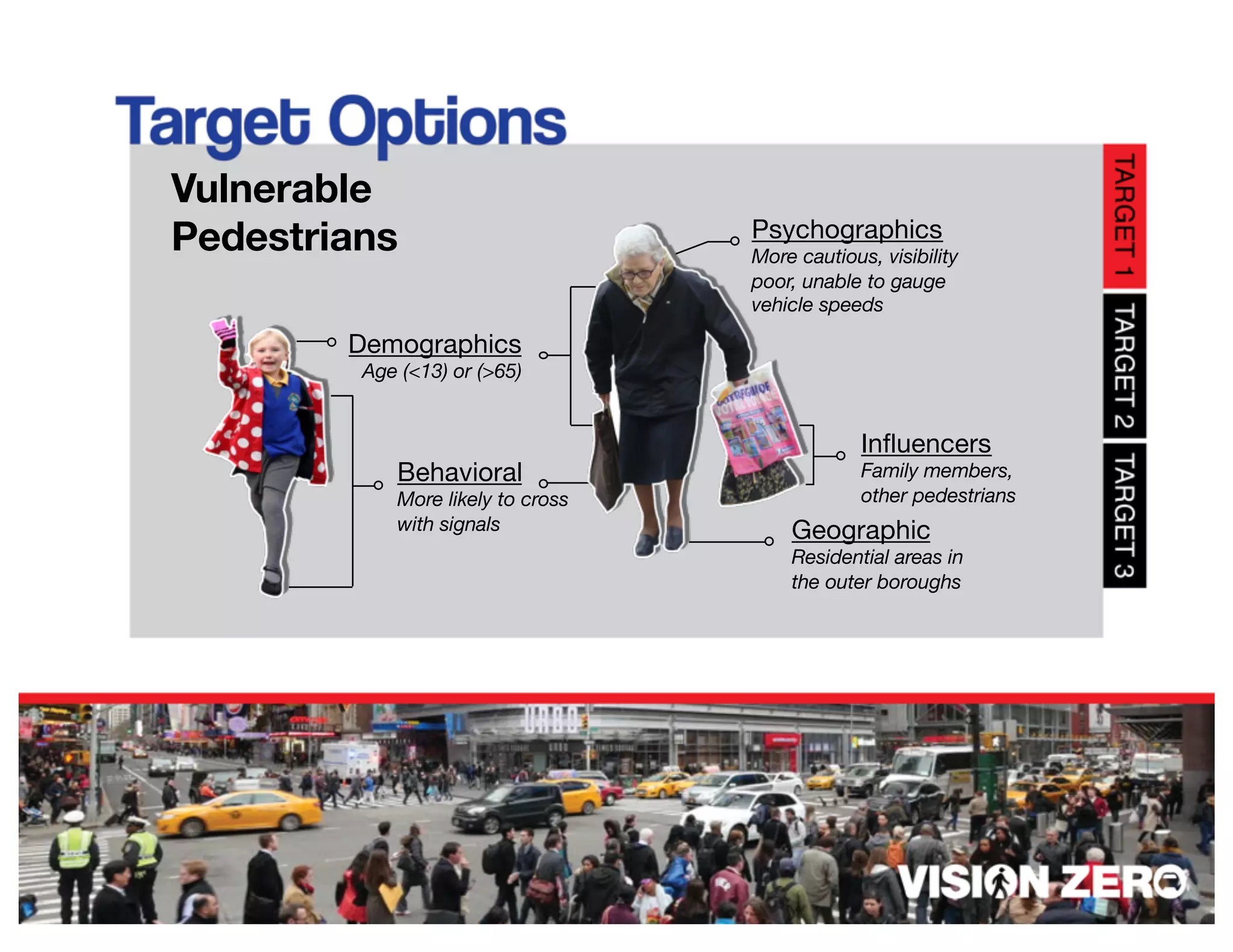
Vulnerable
Pedestrians Psychographics
More cautious, visibility
poor, unable to gauge
vehicle speeds
Demographics
Age (<13) or (>65)
Influencers
Family members,
other pedestrians
Behavioral
More likely to cross
with signals Geographic
Residential areas in
the outer boroughs
Inattentive
Drivers
Psychographics
Highly stressed,
middle class
Demographics
Males, drive private
passenger cars
(25 – 59 y/o)
Geographic
Outer boroughs, *left
turned junctions
Behavioral
May not drive daily, possibly
distracted while driving
Influencers
Passengers, other drivers,
and pedestrians
Risky
Pedestrians
Psychographics
On-the-go, ambitious,
pressed for time,
potentially distracted while
commuting
Demographics
Millennial males
(18 – 39 y/o)
Influencers
Peers, friends,
other pedestrians
Behavioral
Multitasking, on the phone
while crossing the street,
following others onto street
Geographic
Live in the outer boroughs
and work in Manhattan, take
public transport
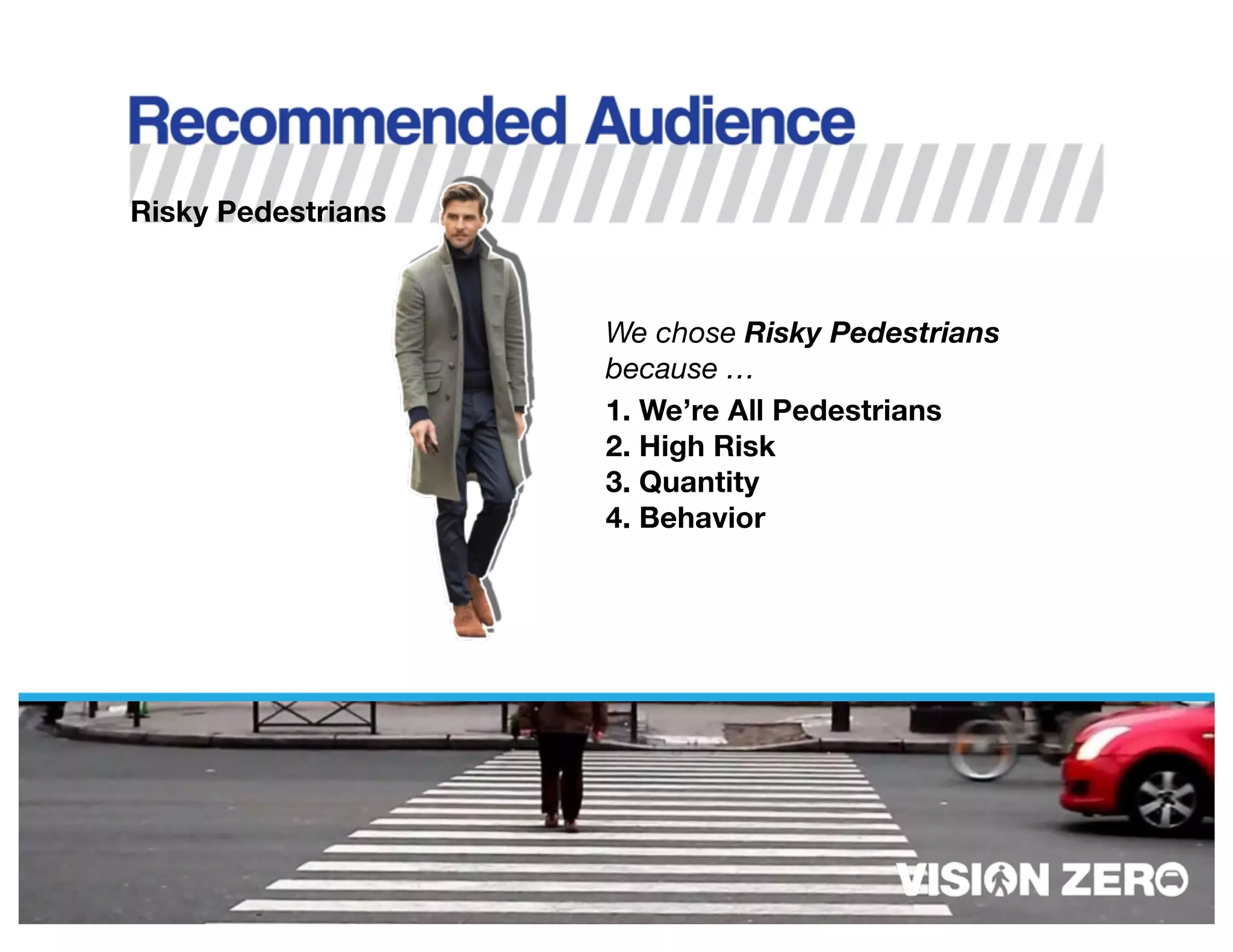
Risky Pedestrians
We chose Risky Pedestrians
because …
1. We’re All Pedestrians
2. High Risk
3. Quantity
4. Behavior
Risky
Pedestrians
We’re All Pedestrians
Because most New Yorkers don’t have a car,
and the ones who do don’t always drive them –
all New Yorkers are, in some way, pedestrians.
http://www.census.gov/programs-surveys/acs/technical-documentation/table-and-geography-changes/2014/5-year.html
31.4% of New
York households
have 1 car
55.4% of New
York households
are carless
10.6% of New
York households
have 2 cards
2.8% of New
York households
have 3+ cards
NYC Car Ownership Statistics (2010 - 2014)
Risky
Pedestrians
Higher Risk
Because of their age, gender, and pedestrian
status, “risky pedestrians” face statistically high
rates of fatality when involved in KSI crashes;
placing them at a higher risk level.
http://www.nyc.gov/html/dot/downloads/pdf/nyc_ped_safety_study_action_plan.pdf
NYC Pedestrian KSI by Age + Gender
0
5
10
15
20
25
30
less than 5 5 - 17 18 - 21 22 - 29 30 - 39 40 - 49 50 - 59 over 60
male female
AnnualPedestrianKSIper100,00Pop.
81 6641 48
Risky
Pedestrians
Quantity
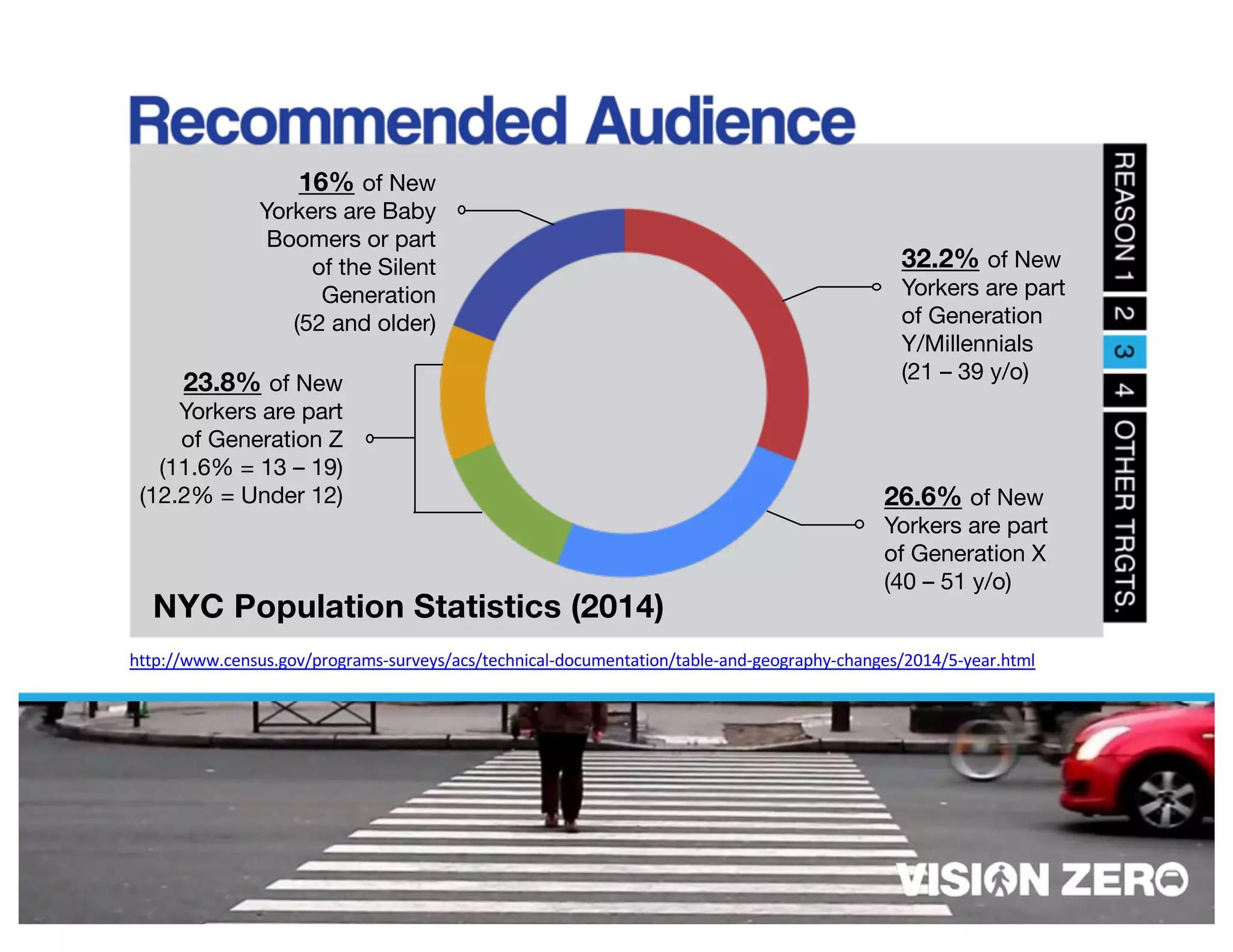
Because “risky pedestrians” are made up of
those in the millennial age group, this segment
represents the age of the average New Yorker
and the most populous generation of New
Yorkers.
23.8% of New
Yorkers are part
of Generation Z
(11.6% = 13 – 19)
(12.2% = Under 12)
32.2% of New
Yorkers are part
of Generation
Y/Millennials
(21 – 39 y/o)
16% of New
Yorkers are Baby
Boomers or part
of the Silent
Generation
(52 and older)
26.6% of New
Yorkers are part
of Generation X
(40 – 51 y/o)
NYC Population Statistics (2014)
http://www.census.gov/programs-surveys/acs/technical-documentation/table-and-geography-changes/2014/5-year.html
Risky
Pedestrians
Easier to Influence
Because pedestrians are abundantly more likely
to be killed or injured in a crash than the driver
involved, they have the greater onus to change
their behavior and will be more easily influenced
to do so.
We didn’t
choose
Vulnerable
Pedestrians
because …
1. Access
They are harder to reach and even
harder to influence.
2. Behavior
Generally already cautious, or
influenced by those who are.
We didn’t
choose
Inattentive
Drivers
because …
1. Hard to Influence
Driver’s don’t believe they are the
problem.
2. Quantity
New Yorkers who drive, don’t drive
regularly enough to justify specific
targeting.
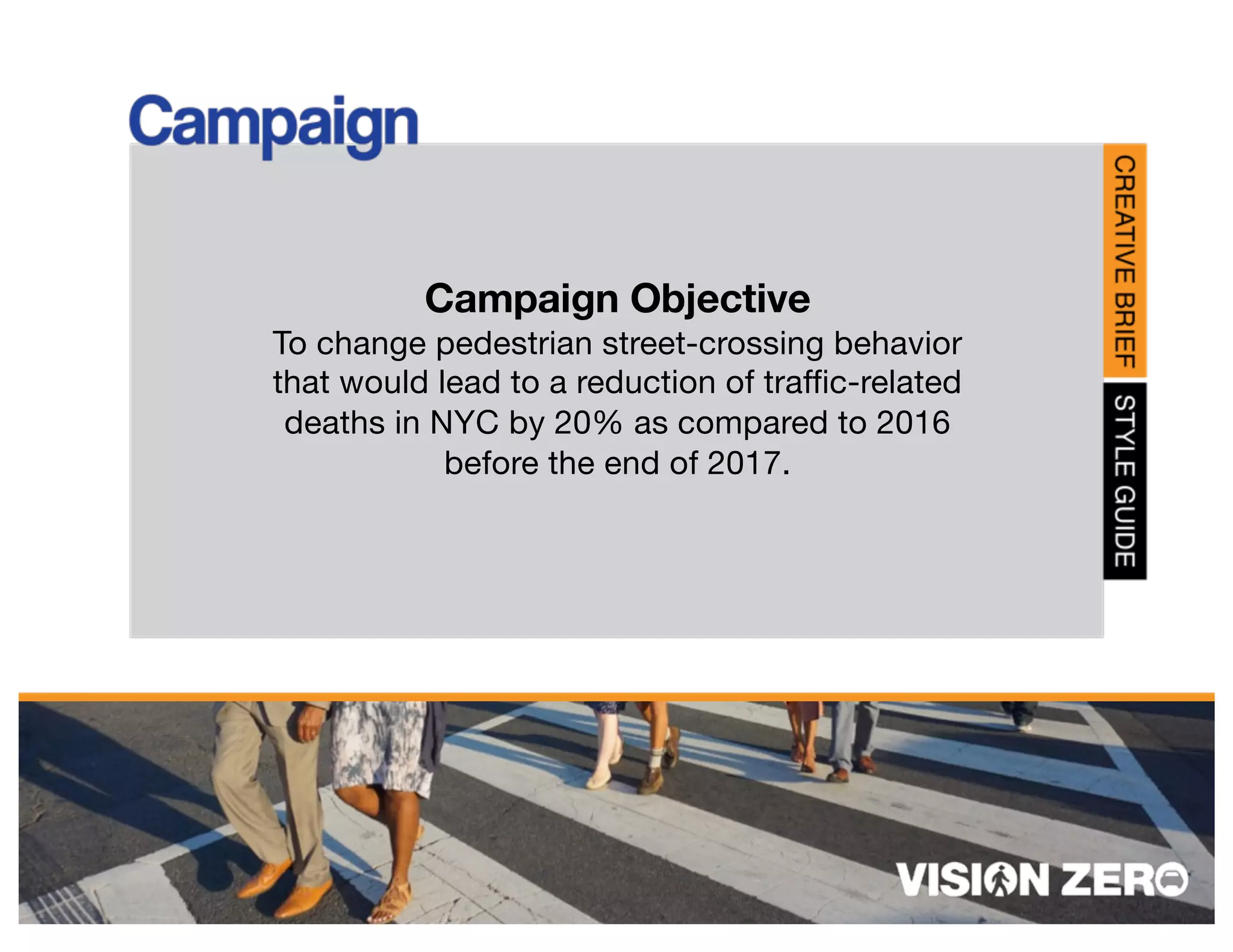
Campaign Objective
To change pedestrian street-crossing behavior
that would lead to a reduction of traffic-related
deaths in NYC by 20% as compared to 2016
before the end of 2017.
Appeal to “masculinity” and “need to
survive” of our target audience.
Blunt, darkly humorous, pragmatic
Role
Rationale
Personality
Core
Message
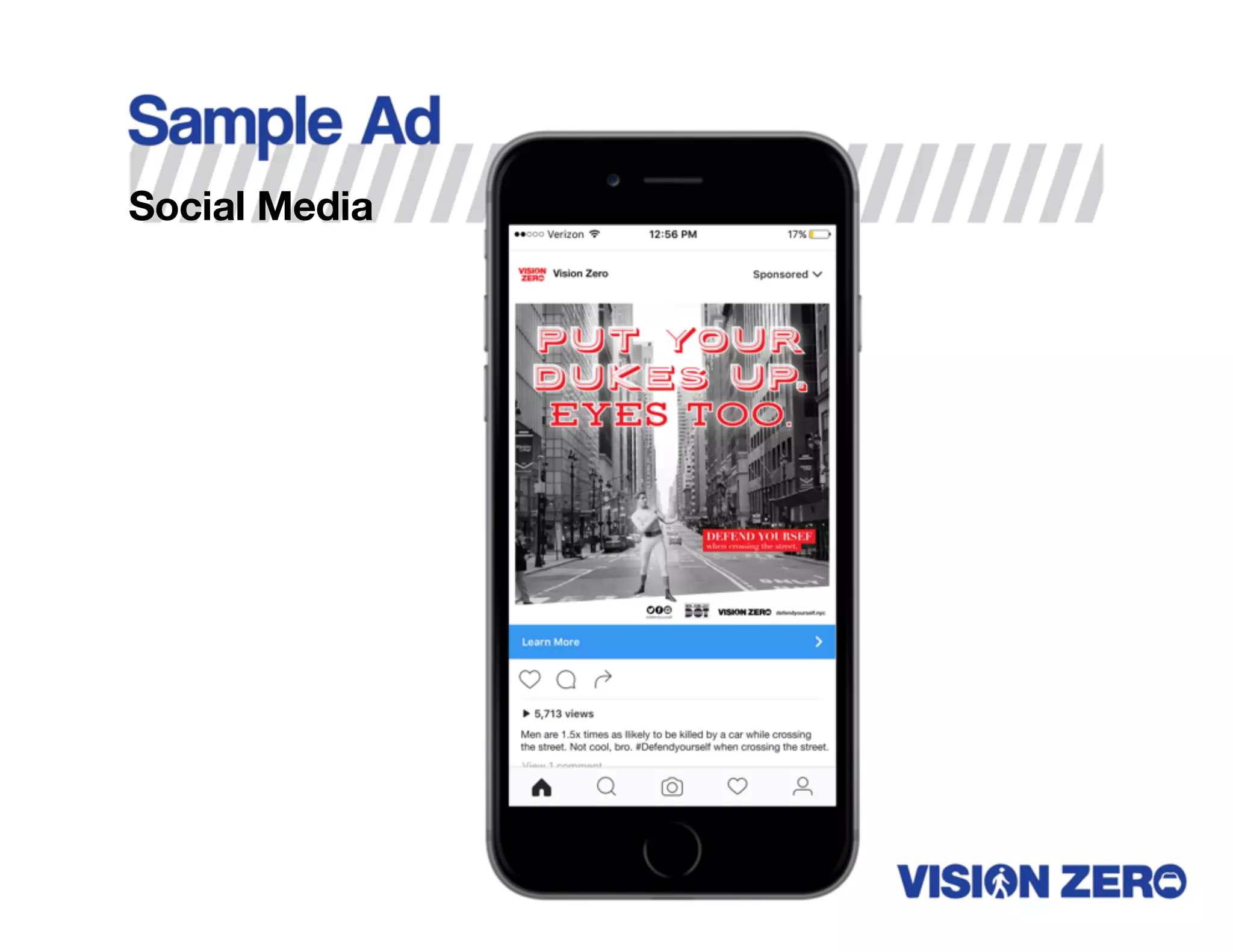
Defend yourself.
Rationale
Personality
Core
Message
Risky pedestrians.
(Male, millennial, etc.)
To encourage our target audience to pay
attention when crossing the street.
Role
Target
http://www.nielsen.com/us/en/insights/news/2014/the-men-the-myths-the-legends-why-millennial-dudes-might-be-
more-receptive-to-marketing.html
Dark Humor
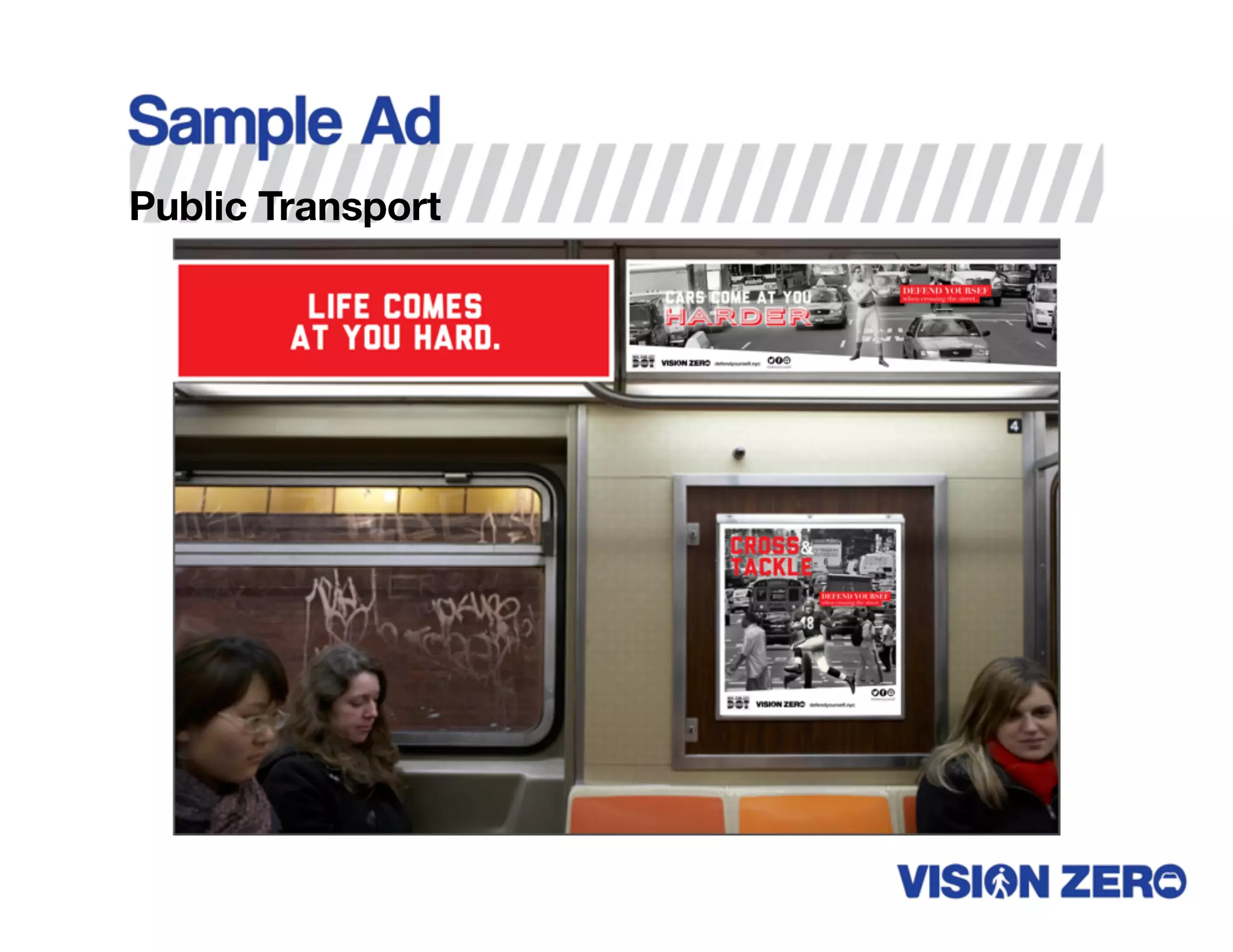
• “Life comes at you
hard, cars come at
you harder.”
• “The light said
walk, but you got
hit by a speeding
car anyway. Talk
about a sucker
punch.”
Nostalgia
• “Cross and tackle.”
• “Bob and weave.”
• “Play it safe.”
Need to
Survive
• “Hit the streets.
Literally.”
• “Put your dukes
up. Eyes too.”
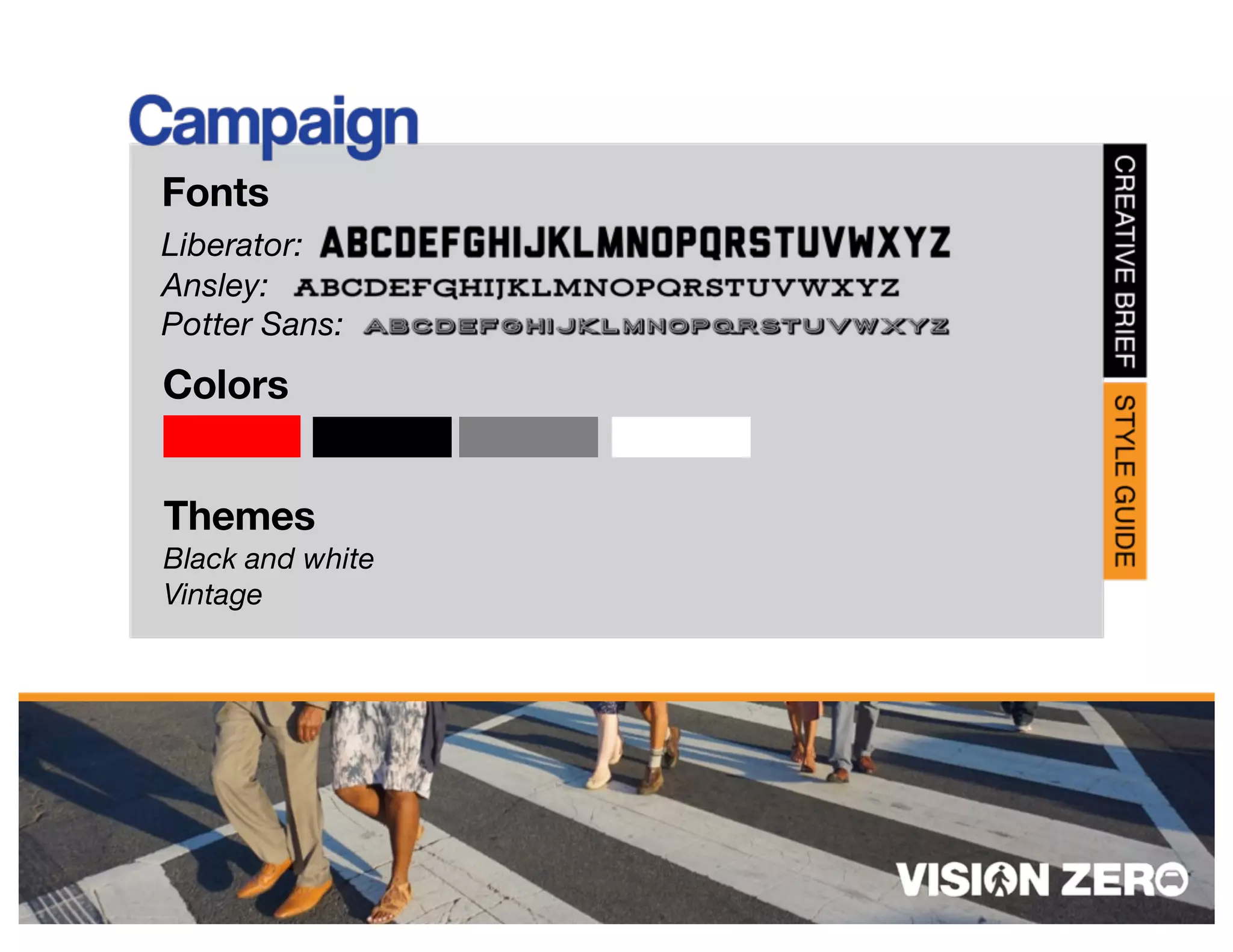
Fonts
Liberator:
Ansley:
Potter Sans:
Colors
Themes
Black and white
Vintage
Stationary
Public Transport
Public Transport
Social Media
PAID
• Out-of-Home
Media
• Mobile Ads
• Social Media
SHARED
• Facebook
• Instagram
• Twitter
• Snapchat
EARNED
• Features
• Endorsements
OWNED
• Website
• YouTube
PESO Model
Paid Media
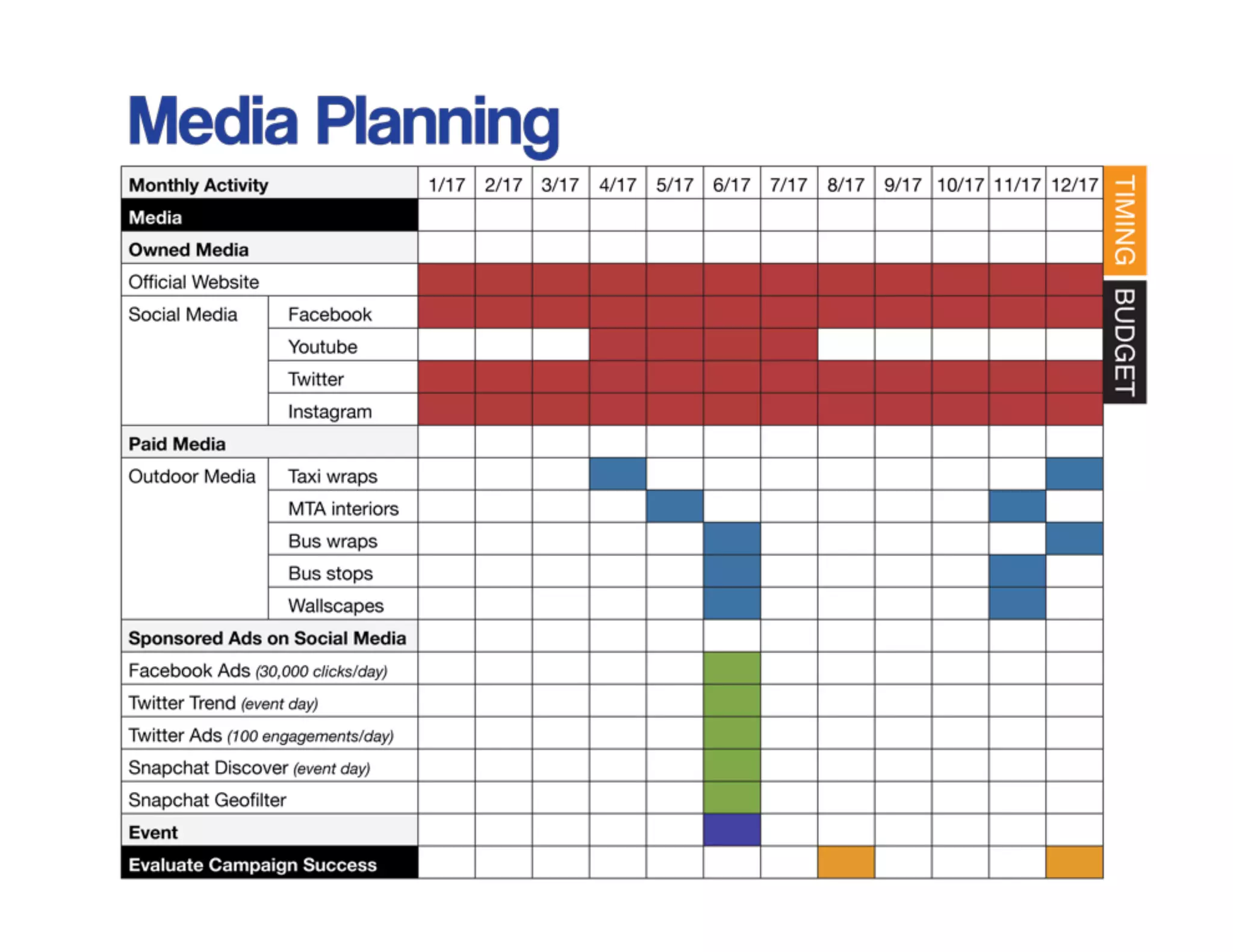
• Out-of-Home Media
• Stationary: Bus stops, wallscapes
• Public Transport: Wrap ads on bus, subway, taxis
• Social Media
• Sponsored Ads (Facebook, Twitter, Snapchat,
Location-based targeting mobile ads)
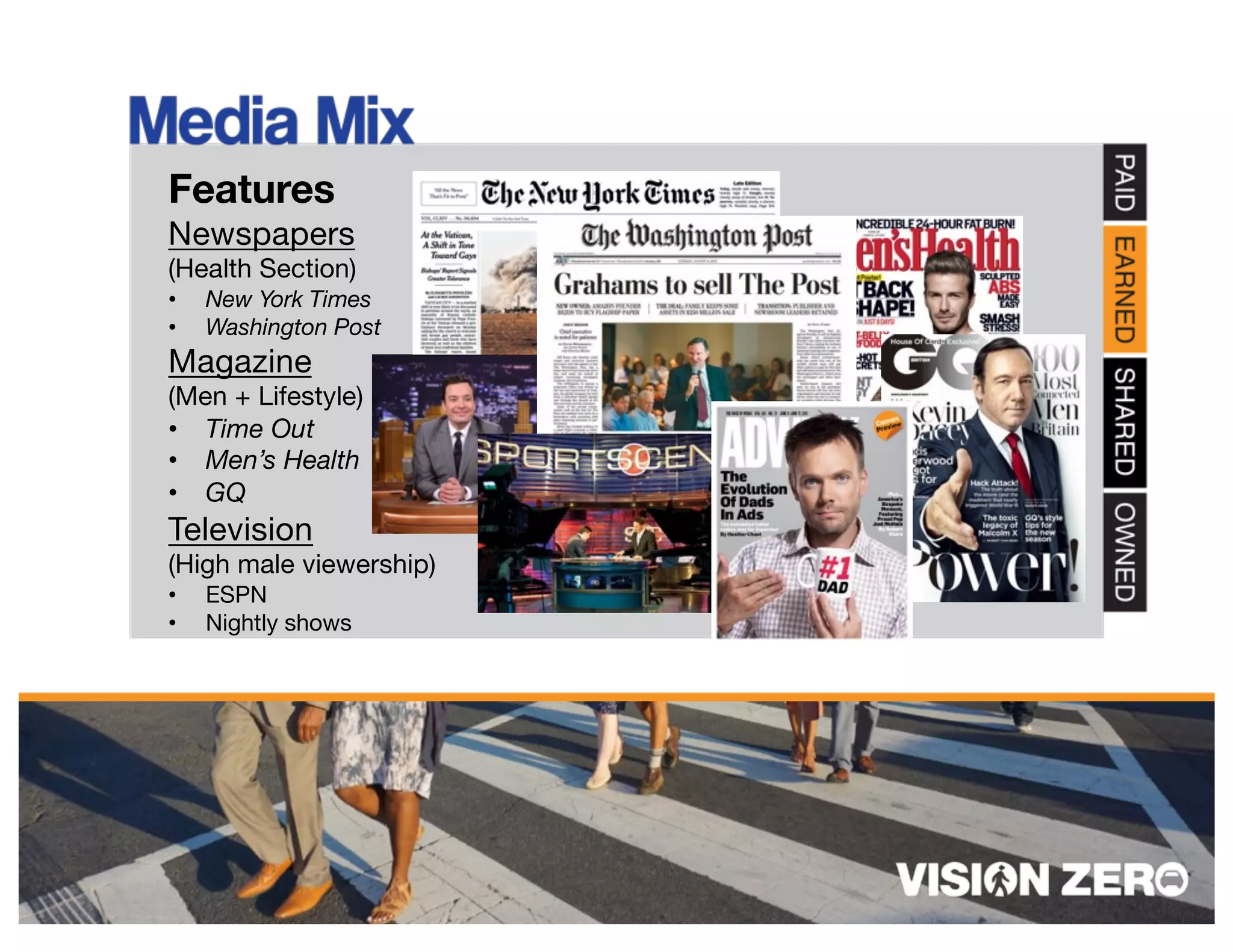
Features
Newspapers
(Health Section)
• New York Times
• Washington Post
Magazine
(Men + Lifestyle)
• Time Out
• Men’s Health
• GQ
Television
(High male viewership)
• ESPN
• Nightly shows
Shared Media
Experience
• Vision Zero Day
• “Beat the Streets”
Challenge
Social Media
• Snapchat
• Twitter
• Instagram
• Facebook
Owned Channels
YouTube
• Video Ads
• Public Service
Announcements
• Endorsements
Website
• Vision Zero Updates +
Reports
• “Beat the Streets”
Registration + Info
$243 K
Sponsored Ads
(social media)
$500 K
“Beat the
Streets” Event
$200 K
Twitter Trend (day)
$50 K
Snapchat Discovery
$9 K
Video Production
$200 K
Bus Wrap Ads
$100 K
Taxi Wrap Ads
$100 K
Subway Interior Ads
$57 K
Wallscapes
$3 K
Twitter Ads
$50
Snapchat
Geofilter
$430 K
Out of Home
Media Event
$3 K
Bus Shelter
Ads
Risky Pedestrians
We hope that Risky Pedestrians
will …
1. Behavior Shift
2. Become Influencers
3. Recognize + Participate
• https://www.transalt.org/getinvolved/vision-zero-
now/platform#three
• http://www1.nyc.gov/site/visionzero/index.page
• http://www.nyc.gov/html/dot/downloads/pdf/nyc_ped_safety_
study_action_plan.pdf
• http://patch.com/new-york/new-york-city/de-blasio-claims-
vision-zero-working-its-not
• http://yourchoicesmatter.nyc/sources
• http://www1.nyc.gov/assets/visionzero/downloads/pdf/nyc-
vision-zero-action-plan.pdf
• http://www.nyc.gov/html/dot/downloads/pdf/nyc_ped_safety_
study_action_plan.pdf
•
• http://www.census.gov/programs-surveys/acs/technical-
documentation/table-and-geography-changes/2014/5-
year.html
• http://www.nyc.gov/html/dot/downloads/pdf/nyc_ped_safety_
study_action_plan.pdf
• http://www.census.gov/programs-surveys/acs/technical-
documentation/table-and-geography-changes/2014/5-
year.html
• http://www.nielsen.com/us/en/insights/news/2014/the-men-
the-myths-the-legends-why-millennial-dudes-might-be-more-
receptive-to-marketing.html

Vision Zero Audience Analysis & Communication Strategy

  • 2.
    • Topline Summary •Key Insights • Segmentation Methods • Target Options • Recommended Audience • Persona • Campaign • Messaging • Media Mix (PESO) • Media Planning • Anticipated Audience Actions
  • 3.
    Vision Zero Vision Zerois a multi-national road traffic safety project, enacted locally in New York by Mayor Bill de Blasio in 2014. https://www.transalt.org/getinvolved/vision-zero-now/platform#three
  • 4.
    Why Vision Zero VisionZero was enacted to combat high rates of those seriously killed or injured (KSI) in road related accidents. http://www1.nyc.gov/site/visionzero/index.page
  • 5.
    Who is Involved Officeof the Mayor, the NYC Department of Transportation (DOT), the New York Police Department, and everyday New Yorkers play a role in bringing Vision Zero to life.
  • 6.
  • 7.
    How Vision ZeroWorks Vision Zero aims to reduce KSI rates through the redesign of arterial streets, enforcement of stricter laws, reform of the DMV’s court system, cooperation with city and state agencies, and education of road safety.
  • 8.
    2014 Lowest # of fatalitiessince 1910 2015 -10% v. 2014 http://www.nyc.gov/html/dot/downloads/pdf/nyc_ped_safety_study_action_plan.pdf 0 60 120 180 240 258 233 *2016 -15% v. 2015 (projection) 198 132 NYC Pedestrians Fatalities 320
  • 9.
    2014 Lowest # of fatalitiessince 1910 2015 -10% v. 2014 0 60 120 180 240 320 258 233 *2016 -15% v. 2015 (projection) *2017 -20% v. 2016 (projection) 158 198 132 http://patch.com/new-york/new-york-city/de-blasio-claims-vision-zero-working-its-not NYC Pedestrians Fatalities
  • 10.
    53% 7% 3x 64% http://yourchoicesmatter.nyc/sources http://www1.nyc.gov/assets/visionzero/downloads/pdf/nyc-vision-zero-action-plan.pdf Pedestrian crashes causedby speeding. 2x the likelihood of fatality. Likelihood that a left turn will kill or severely injure a pedestrian, compared to right turns. Crashes caused by male drivers. Pedestrian crashes involving private passenger cars. Pedestrian fatalities caused by inattention, speeding, and failure to yield. 79% 53% 7% 3x 64% 79% 75% Fatalities caused by male drivers.75%
  • 11.
    27% 1.4x Crashes that involvedpedestrians. Fatalities that involved pedestrians. Pedestrian crashes caused by crossing with the signal, v. 20% cross against the signal. 74% Pedestrian fatalities caused by pedestrians.30% http://www.nyc.gov/html/dot/downloads/pdf/nyc_ped_safety_study_action_plan.pdf Pedestrian crashes that occur at intersections. More pedestrian crashes occurred during the holiday season. 20% Likelihood that male pedestrians are involved in a crash. 56% 15% 27% 30% 74% 20% 1.4x 56%
  • 12.
    Observation Insights (n=110) •Pedestrians crossed the street with only seconds left to spare on the signal. • Pedestrians crossed streets outside demarcated boundaries. • Many pedestrians were multitasking while crossing streets. • Apart from risky street-crossing behavior, some pedestrians waiting for the next crossing would stand on the roadside instead of stepping up on a curb.
  • 13.
    Observation Insights (n=110) •Drivers were generally accommodating of jaywalkers. • Pedestrians crossed streets against signals more frequently at small roads compared arterial roads • Millennial pedestrians and male pedestrians were more likely to cross against signals • Influenced by other jaywalkers
  • 14.
    We evaluated ourpotential audiences through the following five methods … 1. Demographics 2. Geographic 3. Behavioral 4. Psychographics 5. Influencers
  • 15.
    Vulnerable Pedestrians Psychographics More cautious,visibility poor, unable to gauge vehicle speeds Demographics Age (<13) or (>65) Influencers Family members, other pedestrians Behavioral More likely to cross with signals Geographic Residential areas in the outer boroughs
  • 16.
    Inattentive Drivers Psychographics Highly stressed, middle class Demographics Males,drive private passenger cars (25 – 59 y/o) Geographic Outer boroughs, *left turned junctions Behavioral May not drive daily, possibly distracted while driving Influencers Passengers, other drivers, and pedestrians
  • 17.
    Risky Pedestrians Psychographics On-the-go, ambitious, pressed fortime, potentially distracted while commuting Demographics Millennial males (18 – 39 y/o) Influencers Peers, friends, other pedestrians Behavioral Multitasking, on the phone while crossing the street, following others onto street Geographic Live in the outer boroughs and work in Manhattan, take public transport
  • 18.
    Risky Pedestrians We choseRisky Pedestrians because … 1. We’re All Pedestrians 2. High Risk 3. Quantity 4. Behavior
  • 19.
    Risky Pedestrians We’re All Pedestrians Becausemost New Yorkers don’t have a car, and the ones who do don’t always drive them – all New Yorkers are, in some way, pedestrians.
  • 20.
    http://www.census.gov/programs-surveys/acs/technical-documentation/table-and-geography-changes/2014/5-year.html 31.4% of New Yorkhouseholds have 1 car 55.4% of New York households are carless 10.6% of New York households have 2 cards 2.8% of New York households have 3+ cards NYC Car Ownership Statistics (2010 - 2014)
  • 21.
    Risky Pedestrians Higher Risk Because oftheir age, gender, and pedestrian status, “risky pedestrians” face statistically high rates of fatality when involved in KSI crashes; placing them at a higher risk level.
  • 22.
    http://www.nyc.gov/html/dot/downloads/pdf/nyc_ped_safety_study_action_plan.pdf NYC Pedestrian KSIby Age + Gender 0 5 10 15 20 25 30 less than 5 5 - 17 18 - 21 22 - 29 30 - 39 40 - 49 50 - 59 over 60 male female AnnualPedestrianKSIper100,00Pop. 81 6641 48
  • 23.
    Risky Pedestrians Quantity Because “risky pedestrians”are made up of those in the millennial age group, this segment represents the age of the average New Yorker and the most populous generation of New Yorkers.
  • 24.
    23.8% of New Yorkersare part of Generation Z (11.6% = 13 – 19) (12.2% = Under 12) 32.2% of New Yorkers are part of Generation Y/Millennials (21 – 39 y/o) 16% of New Yorkers are Baby Boomers or part of the Silent Generation (52 and older) 26.6% of New Yorkers are part of Generation X (40 – 51 y/o) NYC Population Statistics (2014) http://www.census.gov/programs-surveys/acs/technical-documentation/table-and-geography-changes/2014/5-year.html
  • 25.
    Risky Pedestrians Easier to Influence Becausepedestrians are abundantly more likely to be killed or injured in a crash than the driver involved, they have the greater onus to change their behavior and will be more easily influenced to do so.
  • 26.
    We didn’t choose Vulnerable Pedestrians because … 1.Access They are harder to reach and even harder to influence. 2. Behavior Generally already cautious, or influenced by those who are. We didn’t choose Inattentive Drivers because … 1. Hard to Influence Driver’s don’t believe they are the problem. 2. Quantity New Yorkers who drive, don’t drive regularly enough to justify specific targeting.
  • 28.
    Campaign Objective To changepedestrian street-crossing behavior that would lead to a reduction of traffic-related deaths in NYC by 20% as compared to 2016 before the end of 2017.
  • 29.
    Appeal to “masculinity”and “need to survive” of our target audience. Blunt, darkly humorous, pragmatic Role Rationale Personality Core Message Defend yourself. Rationale Personality Core Message Risky pedestrians. (Male, millennial, etc.) To encourage our target audience to pay attention when crossing the street. Role Target http://www.nielsen.com/us/en/insights/news/2014/the-men-the-myths-the-legends-why-millennial-dudes-might-be- more-receptive-to-marketing.html
  • 30.
    Dark Humor • “Lifecomes at you hard, cars come at you harder.” • “The light said walk, but you got hit by a speeding car anyway. Talk about a sucker punch.” Nostalgia • “Cross and tackle.” • “Bob and weave.” • “Play it safe.” Need to Survive • “Hit the streets. Literally.” • “Put your dukes up. Eyes too.”
  • 31.
  • 32.
  • 33.
  • 34.
  • 35.
  • 36.
    PAID • Out-of-Home Media • MobileAds • Social Media SHARED • Facebook • Instagram • Twitter • Snapchat EARNED • Features • Endorsements OWNED • Website • YouTube PESO Model
  • 37.
    Paid Media • Out-of-HomeMedia • Stationary: Bus stops, wallscapes • Public Transport: Wrap ads on bus, subway, taxis • Social Media • Sponsored Ads (Facebook, Twitter, Snapchat, Location-based targeting mobile ads)
  • 39.
    Features Newspapers (Health Section) • NewYork Times • Washington Post Magazine (Men + Lifestyle) • Time Out • Men’s Health • GQ Television (High male viewership) • ESPN • Nightly shows
  • 40.
    Shared Media Experience • VisionZero Day • “Beat the Streets” Challenge Social Media • Snapchat • Twitter • Instagram • Facebook
  • 41.
    Owned Channels YouTube • VideoAds • Public Service Announcements • Endorsements Website • Vision Zero Updates + Reports • “Beat the Streets” Registration + Info
  • 43.
    $243 K Sponsored Ads (socialmedia) $500 K “Beat the Streets” Event $200 K Twitter Trend (day) $50 K Snapchat Discovery $9 K Video Production $200 K Bus Wrap Ads $100 K Taxi Wrap Ads $100 K Subway Interior Ads $57 K Wallscapes $3 K Twitter Ads $50 Snapchat Geofilter $430 K Out of Home Media Event $3 K Bus Shelter Ads
  • 44.
    Risky Pedestrians We hopethat Risky Pedestrians will … 1. Behavior Shift 2. Become Influencers 3. Recognize + Participate
  • 46.
    • https://www.transalt.org/getinvolved/vision-zero- now/platform#three • http://www1.nyc.gov/site/visionzero/index.page •http://www.nyc.gov/html/dot/downloads/pdf/nyc_ped_safety_ study_action_plan.pdf • http://patch.com/new-york/new-york-city/de-blasio-claims- vision-zero-working-its-not • http://yourchoicesmatter.nyc/sources • http://www1.nyc.gov/assets/visionzero/downloads/pdf/nyc- vision-zero-action-plan.pdf • http://www.nyc.gov/html/dot/downloads/pdf/nyc_ped_safety_ study_action_plan.pdf •
  • 47.
    • http://www.census.gov/programs-surveys/acs/technical- documentation/table-and-geography-changes/2014/5- year.html • http://www.nyc.gov/html/dot/downloads/pdf/nyc_ped_safety_ study_action_plan.pdf •http://www.census.gov/programs-surveys/acs/technical- documentation/table-and-geography-changes/2014/5- year.html • http://www.nielsen.com/us/en/insights/news/2014/the-men- the-myths-the-legends-why-millennial-dudes-might-be-more- receptive-to-marketing.html