Marke&ng	
  &	
  Communica&ons	
  Plan	
  
BRAC Office of Integration &Transition Volume 1, No. 3 FEB 2011
The BRAC VIBE (Vacancy Information Brief Exsum) serves as a regular source of information on key details of importance to staff
members in preparation for the upcoming transition and vacancy of the Walter Reed Army Medical Center campus.
The  New  Logo…
Walter Reed BRAC Office of Integration & Transition
Reference: Chuck Dasey, WRAMC/NRMC PAO, 10 FEB 2011
The new logo is designed for
system wide implementation.
Rather than a single iconic
logo for one facility, the new
brand has been designed to
represent the same state of the
art, next generation military
medical care, delivered at both
Bethesda and Fort Belvoir.
Purple:
World class medical
care regardless of
uniform color
Emerging cross:
Innovation
Capitol:
Heroic; National
Shield:
Strength
System Wide Implementation
Office	
  of	
  Strategic	
  
Outreach	
  	
  
Hi	
  Brian,	


I	
  hope	
  this	
  message	
  finds	
  you	
  well!	


Based	
  on	
  our	
  conversa;ons	
  Tuesday	
  and	
  a	
  look	
  at	
  the	
  VETS	
  website/outreach	
  tools	
  
you	
  have	
  in	
  place,	
  I	
  took	
  a	
  liCle	
  ;me	
  to	
  put	
  together	
  some	
  ideas	
  that	
  I	
  think	
  might	
  be	
  
effec;ve	
  in	
  jumpstar;ng	
  the	
  DOL	
  Outreach	
  program.	


I	
  provided	
  samples	
  of	
  products/ideas	
  implemented	
  during	
  my	
  s;nt	
  at	
  Walter	
  Reed	
  and	
  
thought	
  some	
  of	
  these	
  could	
  be	
  easily	
  used	
  as	
  a	
  baseline/founda;on	
  to	
  expand	
  upon	
  
for	
  VETS.	


Please	
  feel	
  free	
  to	
  take	
  anything	
  you	
  think	
  might	
  be	
  useful	
  under	
  considera;on.	


Regards,	


Dan	
  Henry	
  
COMMUNICATING VETS:
An outline for effectively communicating VETS:
Assumptions for Planning Purposes:
§ VETS is not a universally known entity
§ Clear concise messaging has not been produced to educate stakeholder populations of existing tools to assist veterans
§ The organization has not been effective engaging/partnering with aforementioned stake holder populations to deliver on its
stated mission to provide resources and expertise to assist and prepare veterans to obtain meaningful careers, maximize their
employment opportunities, and protect their employment rights.
§ Strategic plan not currently in place to guide organization/office to achieve stated goals
§ Collaborative environment with VSOs, governmental organizations and corporations not currently maximized
§ Social/New Media platform and web usage as a method of outreach peripheral at best
Communications Goals:
• To develop a comprehensive series of communication tactics and strategies which will effectively deliver timely messaging and
content deemed important to the VETS audience on a national level
• To positively affect DOL policies and the implementation of VETS initiatives in order to achieve the most beneficial results for
our stakeholder populations including Veterans, VSOs, DOL staff, governmental organizations, corporations and small/medium
size businesses.
• Clearly define for stakeholder audiences who/what VETS is, what/how VETS delivers on its mission/vision and how partnering
with VETS is a win for veterans on the home front AND workforce /talent management within organizations
Audiences:
Veterans, Veterans Service Organizations. Human Resource/Hiring officials at businesses, corporations and
government organizations, Non-Profits devoted to workforce development, Active Duty military organizations, media
organizations, radio and print publications, congress
Key Messages:
§ VETS is here!!! Communicating the mission, vision and existence of VETS
§ Hire a Veteran!!!!
§ VETS cares about the well being of veterans
§ VETS is more than just an acronym and will play a significant role not merely in developing partnerships with stakeholder
communities but will facilitate access to tools training and job opportunities to impacted populations
§ Our Most Critical Asset is You! Stakeholders play a key part in achieving message saturation and we cannot accomplish our
mission without public engagement through our critical stakeholder communities
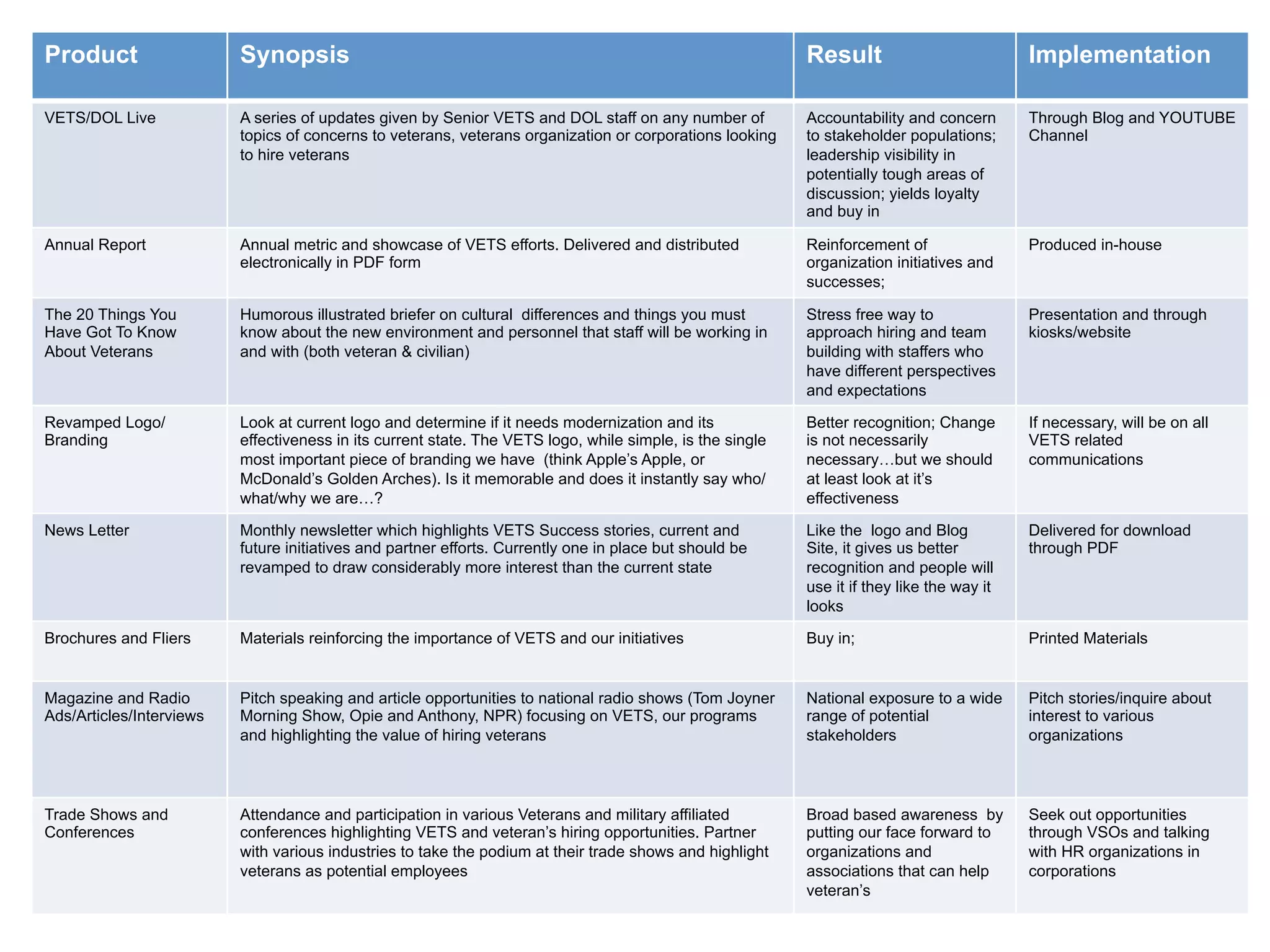
Effort Synopsis Result Implementation
Hire A Vet! Develop a series of 30 x60 Posters starring real veterans highlighting, in an
irreverent manner, the unique capabilities that veterans offer in the workplace
in environment. (Slogan Example: Punctual? If I’m not there 15 minutes early,
I’m already late, or; Leadership experience? Yeah, I think I’ve got that
covered)
Endear sense of pride and
personality to both veteran’s
and the civilian population
they will be transitioning too
alike; Capitalizes on the
patriotic spirit by highlighting
military service and the
intangible traits that come
with it.
Electronic e-mail blasts,
METRO ad-campaign;
partnering with
governmental
organizations and/or GSA
to place within buildings
VETS Success! 3 to 5 Minute film shorts or trailers that follow a veteran who has successfully
transitioned to the civilian workplace. Company executives will talk a bit about
the positive impact of the veteran/veterans on staff, peers highlight traits,
veteran talks about transition and how VETS programs helped
Illustrates in a visceral
manner the successes of
veterans in the workplace.
Inspiring, emotional pieces
that show stakeholders that
what we do is both real and
necessary
Through social media,
websites and YouTube.
Create a VETS channel
that focuses on VETS
success stories and
highlighting resources
available to veterans; live
on kiosks at events
VETS Focused Kiosk
and permanent display
Creation of 10 Foot informational displays and interactive kiosk (speaking)
referencing key initiatives, VETS Success videos and informational
presentations.
Visceral impact on visitors.
Constant ROI of advertising
dollars
Begin with DOL Lobby;
deploy through
partnerships to other
facilities (VA Hospitals,
government Agencies,
VSO facilities, MTFs)
Quarterly Partner
Meetings
Invite engagement partners to quarterly meet & greet/planning sessions where
we look at trends in veteran’s hiring and discuss ways to make our outreach
more effective.
Buy in with VSOs who feel
like they are less being
talked down to than being
made a true partner in
meeting VETS and Veterans
needs. True metric on
effectiveness.
Conducted at DOL or
sponsored by DOL at
various regional locations
VETS Blog Interactive/robust website for delivering messaging critical to VETS initiatives ;
place holder for VETS Success videos and articles; Links to and from social
media and primary VETS website
Dynamic home for VETS
online that makes people
WANT to find out more about
the programs
Several inexpensive
turnkey solutions available
(Zen folio,Word Press,
Joomla) Implementation
contingent upon DOL
Information management
rules
Product Synopsis Result Implementation
VETS/DOL Live A series of updates given by Senior VETS and DOL staff on any number of
topics of concerns to veterans, veterans organization or corporations looking
to hire veterans
Accountability and concern
to stakeholder populations;
leadership visibility in
potentially tough areas of
discussion; yields loyalty
and buy in
Through Blog and YOUTUBE
Channel
Annual Report Annual metric and showcase of VETS efforts. Delivered and distributed
electronically in PDF form
Reinforcement of
organization initiatives and
successes;
Produced in-house
The 20 Things You
Have Got To Know
About Veterans
Humorous illustrated briefer on cultural differences and things you must
know about the new environment and personnel that staff will be working in
and with (both veteran & civilian)
Stress free way to
approach hiring and team
building with staffers who
have different perspectives
and expectations
Presentation and through
kiosks/website
Revamped Logo/
Branding
Look at current logo and determine if it needs modernization and its
effectiveness in its current state. The VETS logo, while simple, is the single
most important piece of branding we have (think Apple’s Apple, or
McDonald’s Golden Arches). Is it memorable and does it instantly say who/
what/why we are…?
Better recognition; Change
is not necessarily
necessary…but we should
at least look at it’s
effectiveness
If necessary, will be on all
VETS related
communications
News Letter Monthly newsletter which highlights VETS Success stories, current and
future initiatives and partner efforts. Currently one in place but should be
revamped to draw considerably more interest than the current state
Like the logo and Blog
Site, it gives us better
recognition and people will
use it if they like the way it
looks
Delivered for download
through PDF
Brochures and Fliers Materials reinforcing the importance of VETS and our initiatives Buy in; Printed Materials
Magazine and Radio
Ads/Articles/Interviews
Pitch speaking and article opportunities to national radio shows (Tom Joyner
Morning Show, Opie and Anthony, NPR) focusing on VETS, our programs
and highlighting the value of hiring veterans
National exposure to a wide
range of potential
stakeholders
Pitch stories/inquire about
interest to various
organizations
Trade Shows and
Conferences
Attendance and participation in various Veterans and military affiliated
conferences highlighting VETS and veteran’s hiring opportunities. Partner
with various industries to take the podium at their trade shows and highlight
veterans as potential employees
Broad based awareness by
putting our face forward to
organizations and
associations that can help
veteran’s
Seek out opportunities
through VSOs and talking
with HR organizations in
corporations
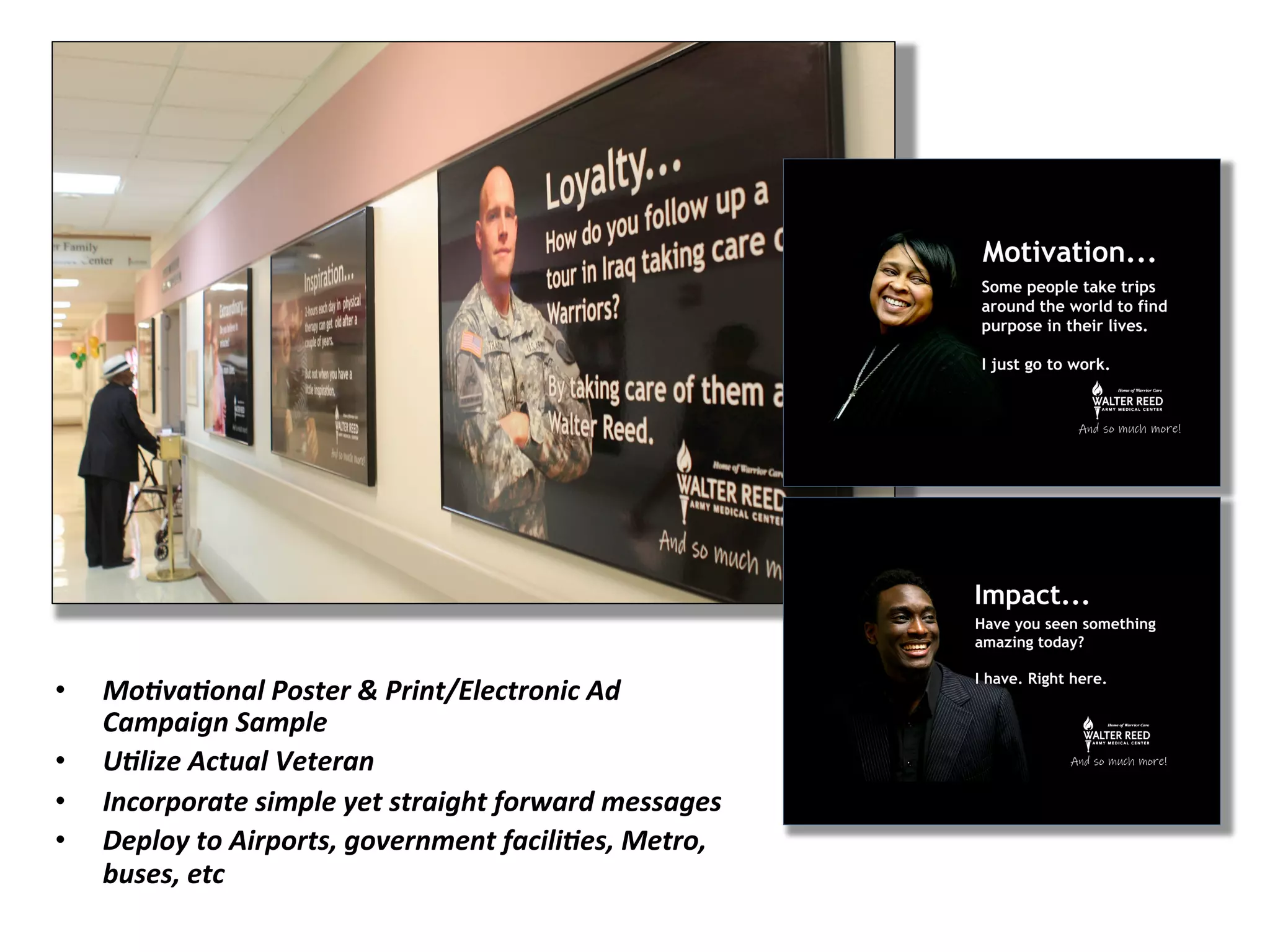
•  Mo&va&onal	
  Poster	
  &	
  Print/Electronic	
  Ad	
  
Campaign	
  Sample	
  
•  U&lize	
  Actual	
  Veteran	
  	
  
•  Incorporate	
  simple	
  yet	
  straight	
  forward	
  messages	
  
•  Deploy	
  to	
  Airports,	
  government	
  facili&es,	
  Metro,	
  
buses,	
  etc	
  
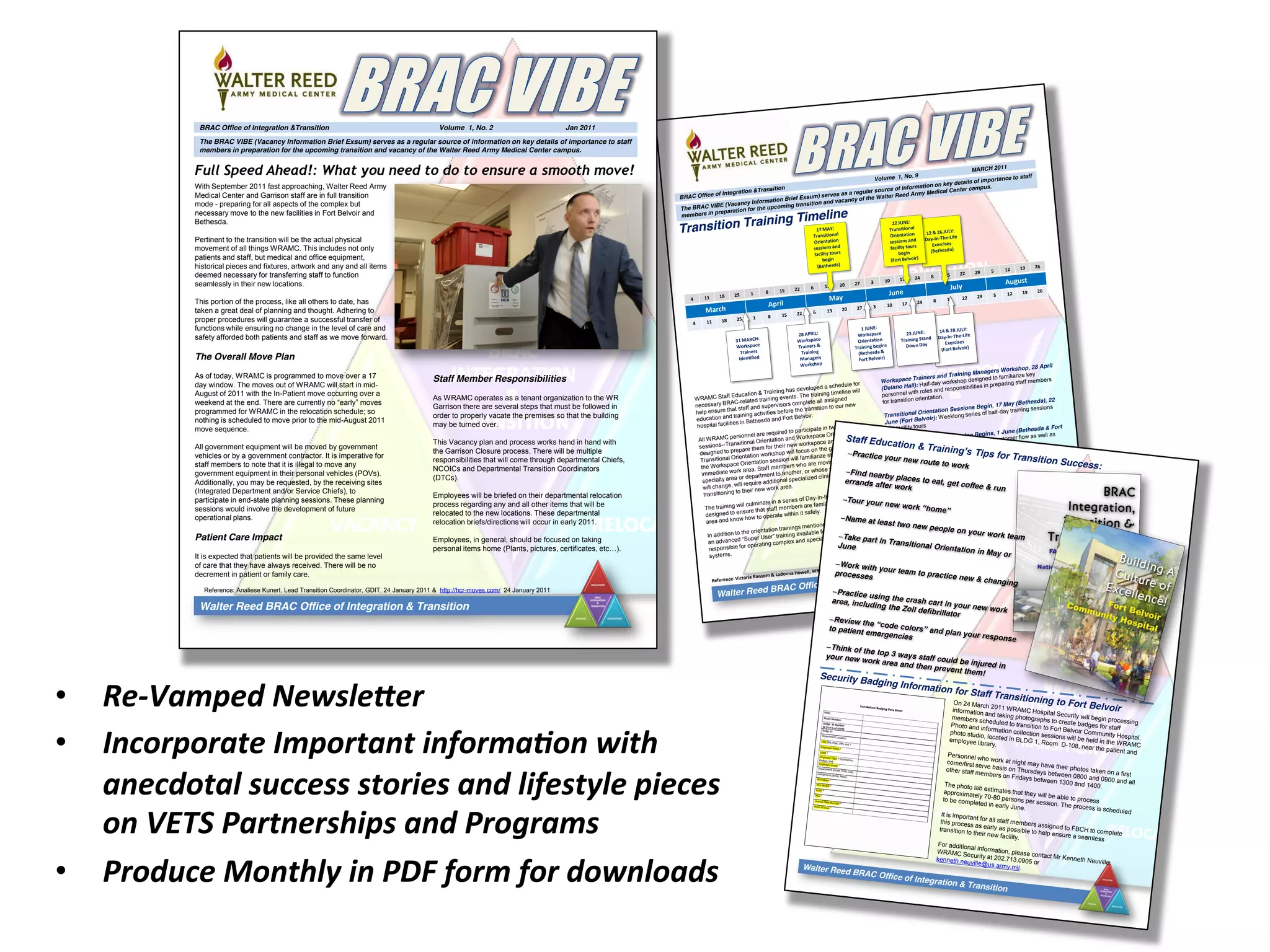
•  Re-­‐Vamped	
  NewsleLer	
  
•  Incorporate	
  Important	
  informa&on	
  with	
  
anecdotal	
  success	
  stories	
  and	
  lifestyle	
  pieces	
  
on	
  VETS	
  Partnerships	
  and	
  Programs	
  
•  Produce	
  Monthly	
  in	
  PDF	
  form	
  for	
  downloads	
  
4 11 18 25 1 8 15 22 6 13 20 27 3 10 17 24 8 15 22 29 5 12 19 26
March
April
May
June
July
August
4 11 18 25 1 8 15 22 6 13 20 27 3 10 17 24 8 15 22 29 5 12 19 26
14 & 28 JULY:
Day-In-The-Life
Exercises
(Fort Belvoir)
BRAC Office of Integration &Transition
Volume 1, No. 9
MARCH 2011
The BRAC VIBE (Vacancy Information Brief Exsum) serves as a regular source of information on key details of importance to staff
members in preparation for the upcoming transition and vacancy of the Walter Reed Army Medical Center campus.
Walter Reed BRAC Office of Integration & Transition
Transition Training Timeline
31 MARCH:
Workspace
Trainers
Identified
17 MAY:
Transitional
Orientation
sessions and
facility tours
begin
(Bethesda)
28 APRIL:
Workspace
Trainers &
Training
Managers
Workshop
12 & 26 JULY:
Day-In-The-Life
Exercises
(Bethesda)
22 JUNE:
Transitional
Orientation
sessions and
facility tours
begin
(Fort Belvoir)
1 JUNE:
Workspace
Orientation
Training begins
(Bethesda &
Fort Belvoir)
23 JUNE:
Training Stand
Down Day
WRAMC Staff Education & Training has developed a schedule for
necessary BRAC-related training events. The training timeline will
help ensure that staff and supervisors complete all assigned
education and training activities before the transition to our new
hospital facilities in Bethesda and Fort Belvoir.
All WRAMC personnel are required to participate in two training
sessions--Transitional Orientation and Workspace Orientation--
designed to prepare them for their new workspace and facility. The
Transitional Orientation workshop will focus on the general facility and
the Workspace Orientation session will familiarize staff with their
immediate work area. Staff members who are moving from one
specialty area or department to another, or whose specific job function
will change, will require additional specialized clinical orientation after
transitioning to their new work area.
The training will culminate in a series of Day-in-the-Life exercises
designed to ensure that staff members are familiar with their new work
area and know how to operate within it safely.
In addition to the orientation trainings mentioned above, there will be
an  advanced  “Super  User”  training  available  for  staff  members    
responsible for operating complex and specialized equipment and
systems.
Workspace Trainers and Training Managers Workshop, 28 April
(Delano Hall): Half-day workshop designed to familiarize key
personnel with roles and responsibilities in preparing staff members
for transition orientation.
Transitional Orientation Sessions Begin, 17 May (Bethesda), 22
June (Fort Belvoir): Weeklong series of half-day training sessions
and facility tours
Workspace Orientation Training Begins, 1 June (Bethesda & Fort
Belvoir): Orientation to space and patient/customer flow as well as
pertinent equipment training
Day-in-the-Life-Training, 12 & 26 July (Bethesda) and 14 & 28
July (Fort Belvoir): Simulation exercise of hospital operations
intended to assure that staff members are trained in new systems,
processes and equipment and know how to safely operate in their
environment.
Super User Training (As Needed): Sessions designed to provide
advanced training to key personnel who operate complex, often high-
value or high-risk equipment and/or systems.
For additional information on training dates and schedules,
please contact Ms. Victoria Ransom at 202.782.4388
or Ms. Ladonna Howell at 202.782.8402.
Reference: Victoria Ransom & Ladonna Howell, WRAMC BRAC Team, Staff Education & Training, 17 MAR 2011
Walter Reed BRAC Office of Integration & Transition
–Practice your new route to work
–Find nearby places to eat, get coffee & run
errands after work
–Tour  your  new  work  “home”
–Name at least two new people on your work team–Take part in Transitional Orientation in May or
June
–Work with your team to practice new & changing
processes
–Practice using the crash cart in your new work
area, including the Zoll defibrillator
–Review  the  “code  colors”  and  plan  your  response  
to patient emergencies
–Think of the top 3 ways staff could be injured in
your new work area and then prevent them!
On 24 March 2011 WRAMC Hospital Security will begin processing
information and taking photographs to create badges for staff
members scheduled to transition to Fort Belvoir Community Hospital.
Photo and information collection sessions will be held in the WRAMC
photo studio, located in BLDG 1, Room D-108, near the patient and
employee library.
Personnel who work at night may have their photos taken on a first
come/first serve basis on Thursdays between 0800 and 0900 and all
other staff members on Fridays between 1300 and 1400.The photo lab estimates that they will be able to process
approximately 70-80 persons per session. The process is scheduled
to be completed in early June.
It is important for all staff members assigned to FBCH to complete
this process as early as possible to help ensure a seamless
transition to their new facility.
For additional information, please contact Mr Kenneth Neuville,
WRAMC Security at 202.713.0905 orkenneth.neuville@us.army.mil.
Security Badging Information for Staff Transitioning to Fort Belvoir
Staff  Education  &  Training’s  Tips for Transition Success:
BRAC Office of Integration &Transition Volume 1, No. 2 Jan 2011
The BRAC VIBE (Vacancy Information Brief Exsum) serves as a regular source of information on key details of importance to staff
members in preparation for the upcoming transition and vacancy of the Walter Reed Army Medical Center campus.
Full Speed Ahead!: What you need to do to ensure a smooth move!
With September 2011 fast approaching, Walter Reed Army
Medical Center and Garrison staff are in full transition
mode - preparing for all aspects of the complex but
necessary move to the new facilities in Fort Belvoir and
Bethesda.
Pertinent to the transition will be the actual physical
movement of all things WRAMC. This includes not only
patients and staff, but medical and office equipment,
historical pieces and fixtures, artwork and any and all items
deemed necessary for transferring staff to function
seamlessly in their new locations.
This portion of the process, like all others to date, has
taken a great deal of planning and thought. Adhering to
proper procedures will guarantee a successful transfer of
functions while ensuring no change in the level of care and
safety afforded both patients and staff as we move forward.
The Overall Move Plan
As of today, WRAMC is programmed to move over a 17
day window. The moves out of WRAMC will start in mid-
August of 2011 with the In-Patient move occurring over a
weekend  at  the  end.  There  are  currently  no  “early”  moves  
programmed for WRAMC in the relocation schedule; so
nothing is scheduled to move prior to the mid-August 2011
move sequence.
All government equipment will be moved by government
vehicles or by a government contractor. It is imperative for
staff members to note that it is illegal to move any
government equipment in their personal vehicles (POVs).
Additionally, you may be requested, by the receiving sites
(Integrated Department and/or Service Chiefs), to
participate in end-state planning sessions. These planning
sessions would involve the development of future
operational plans.
Patient Care Impact
It is expected that patients will be provided the same level
of care that they have always received. There will be no
decrement in patient or family care.
Walter Reed BRAC Office of Integration & Transition
Staff Member Responsibilities
As WRAMC operates as a tenant organization to the WR
Garrison there are several steps that must be followed in
order to properly vacate the premises so that the building
may be turned over.
This Vacancy plan and process works hand in hand with
the Garrison Closure process. There will be multiple
responsibilities that will come through departmental Chiefs,
NCOICs and Departmental Transition Coordinators
(DTCs).
Employees will be briefed on their departmental relocation
process regarding any and all other items that will be
relocated to the new locations. These departmental
relocation briefs/directions will occur in early 2011.
Employees, in general, should be focused on taking
personal  items  home  (Plants,  pictures,  certificates,  etc…).    
Reference: Analiese Kunert, Lead Transition Coordinator, GDIT, 24 January 2011 & http://hcr-moves.com/ 24 January 2011
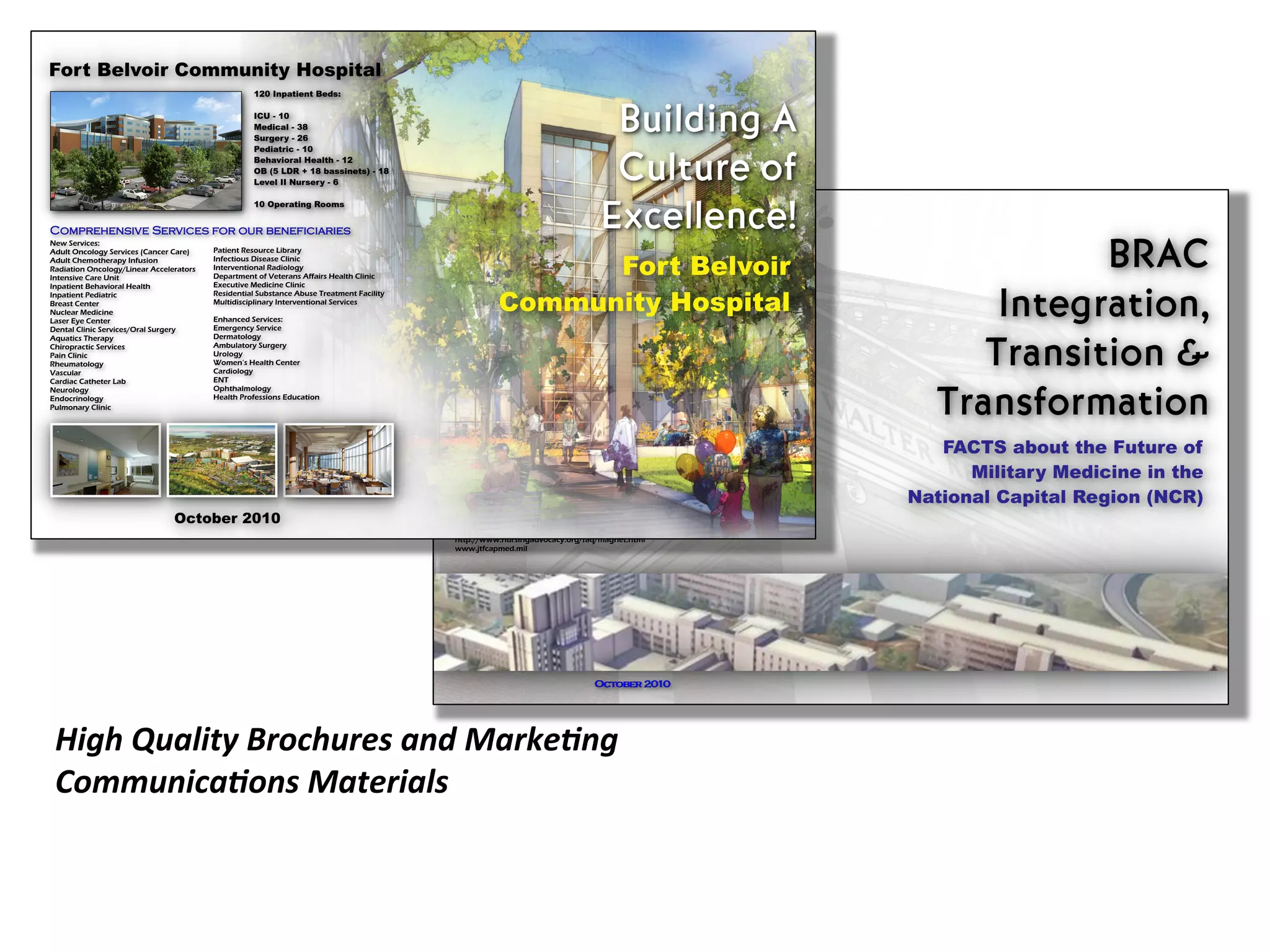
High	
  Quality	
  Brochures	
  and	
  Marke&ng	
  
Communica&ons	
  Materials	
  
Annual	
  Report	
  Sample	
  

VETS Sample Coms Plan

  • 1.
    Marke&ng  &  Communica&ons  Plan   BRAC Office of Integration &Transition Volume 1, No. 3 FEB 2011 The BRAC VIBE (Vacancy Information Brief Exsum) serves as a regular source of information on key details of importance to staff members in preparation for the upcoming transition and vacancy of the Walter Reed Army Medical Center campus. The  New  Logo… Walter Reed BRAC Office of Integration & Transition Reference: Chuck Dasey, WRAMC/NRMC PAO, 10 FEB 2011 The new logo is designed for system wide implementation. Rather than a single iconic logo for one facility, the new brand has been designed to represent the same state of the art, next generation military medical care, delivered at both Bethesda and Fort Belvoir. Purple: World class medical care regardless of uniform color Emerging cross: Innovation Capitol: Heroic; National Shield: Strength System Wide Implementation Office  of  Strategic   Outreach    
  • 2.
    Hi  Brian,     I  hope  this  message  finds  you  well!     Based  on  our  conversa;ons  Tuesday  and  a  look  at  the  VETS  website/outreach  tools   you  have  in  place,  I  took  a  liCle  ;me  to  put  together  some  ideas  that  I  think  might  be   effec;ve  in  jumpstar;ng  the  DOL  Outreach  program.     I  provided  samples  of  products/ideas  implemented  during  my  s;nt  at  Walter  Reed  and   thought  some  of  these  could  be  easily  used  as  a  baseline/founda;on  to  expand  upon   for  VETS.     Please  feel  free  to  take  anything  you  think  might  be  useful  under  considera;on.       Regards,     Dan  Henry  
  • 3.
    COMMUNICATING VETS: An outlinefor effectively communicating VETS: Assumptions for Planning Purposes: § VETS is not a universally known entity § Clear concise messaging has not been produced to educate stakeholder populations of existing tools to assist veterans § The organization has not been effective engaging/partnering with aforementioned stake holder populations to deliver on its stated mission to provide resources and expertise to assist and prepare veterans to obtain meaningful careers, maximize their employment opportunities, and protect their employment rights. § Strategic plan not currently in place to guide organization/office to achieve stated goals § Collaborative environment with VSOs, governmental organizations and corporations not currently maximized § Social/New Media platform and web usage as a method of outreach peripheral at best Communications Goals: • To develop a comprehensive series of communication tactics and strategies which will effectively deliver timely messaging and content deemed important to the VETS audience on a national level • To positively affect DOL policies and the implementation of VETS initiatives in order to achieve the most beneficial results for our stakeholder populations including Veterans, VSOs, DOL staff, governmental organizations, corporations and small/medium size businesses. • Clearly define for stakeholder audiences who/what VETS is, what/how VETS delivers on its mission/vision and how partnering with VETS is a win for veterans on the home front AND workforce /talent management within organizations Audiences: Veterans, Veterans Service Organizations. Human Resource/Hiring officials at businesses, corporations and government organizations, Non-Profits devoted to workforce development, Active Duty military organizations, media organizations, radio and print publications, congress Key Messages: § VETS is here!!! Communicating the mission, vision and existence of VETS § Hire a Veteran!!!! § VETS cares about the well being of veterans § VETS is more than just an acronym and will play a significant role not merely in developing partnerships with stakeholder communities but will facilitate access to tools training and job opportunities to impacted populations § Our Most Critical Asset is You! Stakeholders play a key part in achieving message saturation and we cannot accomplish our mission without public engagement through our critical stakeholder communities
  • 4.
    Effort Synopsis ResultImplementation Hire A Vet! Develop a series of 30 x60 Posters starring real veterans highlighting, in an irreverent manner, the unique capabilities that veterans offer in the workplace in environment. (Slogan Example: Punctual? If I’m not there 15 minutes early, I’m already late, or; Leadership experience? Yeah, I think I’ve got that covered) Endear sense of pride and personality to both veteran’s and the civilian population they will be transitioning too alike; Capitalizes on the patriotic spirit by highlighting military service and the intangible traits that come with it. Electronic e-mail blasts, METRO ad-campaign; partnering with governmental organizations and/or GSA to place within buildings VETS Success! 3 to 5 Minute film shorts or trailers that follow a veteran who has successfully transitioned to the civilian workplace. Company executives will talk a bit about the positive impact of the veteran/veterans on staff, peers highlight traits, veteran talks about transition and how VETS programs helped Illustrates in a visceral manner the successes of veterans in the workplace. Inspiring, emotional pieces that show stakeholders that what we do is both real and necessary Through social media, websites and YouTube. Create a VETS channel that focuses on VETS success stories and highlighting resources available to veterans; live on kiosks at events VETS Focused Kiosk and permanent display Creation of 10 Foot informational displays and interactive kiosk (speaking) referencing key initiatives, VETS Success videos and informational presentations. Visceral impact on visitors. Constant ROI of advertising dollars Begin with DOL Lobby; deploy through partnerships to other facilities (VA Hospitals, government Agencies, VSO facilities, MTFs) Quarterly Partner Meetings Invite engagement partners to quarterly meet & greet/planning sessions where we look at trends in veteran’s hiring and discuss ways to make our outreach more effective. Buy in with VSOs who feel like they are less being talked down to than being made a true partner in meeting VETS and Veterans needs. True metric on effectiveness. Conducted at DOL or sponsored by DOL at various regional locations VETS Blog Interactive/robust website for delivering messaging critical to VETS initiatives ; place holder for VETS Success videos and articles; Links to and from social media and primary VETS website Dynamic home for VETS online that makes people WANT to find out more about the programs Several inexpensive turnkey solutions available (Zen folio,Word Press, Joomla) Implementation contingent upon DOL Information management rules
  • 5.
    Product Synopsis ResultImplementation VETS/DOL Live A series of updates given by Senior VETS and DOL staff on any number of topics of concerns to veterans, veterans organization or corporations looking to hire veterans Accountability and concern to stakeholder populations; leadership visibility in potentially tough areas of discussion; yields loyalty and buy in Through Blog and YOUTUBE Channel Annual Report Annual metric and showcase of VETS efforts. Delivered and distributed electronically in PDF form Reinforcement of organization initiatives and successes; Produced in-house The 20 Things You Have Got To Know About Veterans Humorous illustrated briefer on cultural differences and things you must know about the new environment and personnel that staff will be working in and with (both veteran & civilian) Stress free way to approach hiring and team building with staffers who have different perspectives and expectations Presentation and through kiosks/website Revamped Logo/ Branding Look at current logo and determine if it needs modernization and its effectiveness in its current state. The VETS logo, while simple, is the single most important piece of branding we have (think Apple’s Apple, or McDonald’s Golden Arches). Is it memorable and does it instantly say who/ what/why we are…? Better recognition; Change is not necessarily necessary…but we should at least look at it’s effectiveness If necessary, will be on all VETS related communications News Letter Monthly newsletter which highlights VETS Success stories, current and future initiatives and partner efforts. Currently one in place but should be revamped to draw considerably more interest than the current state Like the logo and Blog Site, it gives us better recognition and people will use it if they like the way it looks Delivered for download through PDF Brochures and Fliers Materials reinforcing the importance of VETS and our initiatives Buy in; Printed Materials Magazine and Radio Ads/Articles/Interviews Pitch speaking and article opportunities to national radio shows (Tom Joyner Morning Show, Opie and Anthony, NPR) focusing on VETS, our programs and highlighting the value of hiring veterans National exposure to a wide range of potential stakeholders Pitch stories/inquire about interest to various organizations Trade Shows and Conferences Attendance and participation in various Veterans and military affiliated conferences highlighting VETS and veteran’s hiring opportunities. Partner with various industries to take the podium at their trade shows and highlight veterans as potential employees Broad based awareness by putting our face forward to organizations and associations that can help veteran’s Seek out opportunities through VSOs and talking with HR organizations in corporations
  • 6.
    •  Mo&va&onal  Poster  &  Print/Electronic  Ad   Campaign  Sample   •  U&lize  Actual  Veteran     •  Incorporate  simple  yet  straight  forward  messages   •  Deploy  to  Airports,  government  facili&es,  Metro,   buses,  etc  
  • 7.
    •  Re-­‐Vamped  NewsleLer   •  Incorporate  Important  informa&on  with   anecdotal  success  stories  and  lifestyle  pieces   on  VETS  Partnerships  and  Programs   •  Produce  Monthly  in  PDF  form  for  downloads   4 11 18 25 1 8 15 22 6 13 20 27 3 10 17 24 8 15 22 29 5 12 19 26 March April May June July August 4 11 18 25 1 8 15 22 6 13 20 27 3 10 17 24 8 15 22 29 5 12 19 26 14 & 28 JULY: Day-In-The-Life Exercises (Fort Belvoir) BRAC Office of Integration &Transition Volume 1, No. 9 MARCH 2011 The BRAC VIBE (Vacancy Information Brief Exsum) serves as a regular source of information on key details of importance to staff members in preparation for the upcoming transition and vacancy of the Walter Reed Army Medical Center campus. Walter Reed BRAC Office of Integration & Transition Transition Training Timeline 31 MARCH: Workspace Trainers Identified 17 MAY: Transitional Orientation sessions and facility tours begin (Bethesda) 28 APRIL: Workspace Trainers & Training Managers Workshop 12 & 26 JULY: Day-In-The-Life Exercises (Bethesda) 22 JUNE: Transitional Orientation sessions and facility tours begin (Fort Belvoir) 1 JUNE: Workspace Orientation Training begins (Bethesda & Fort Belvoir) 23 JUNE: Training Stand Down Day WRAMC Staff Education & Training has developed a schedule for necessary BRAC-related training events. The training timeline will help ensure that staff and supervisors complete all assigned education and training activities before the transition to our new hospital facilities in Bethesda and Fort Belvoir. All WRAMC personnel are required to participate in two training sessions--Transitional Orientation and Workspace Orientation-- designed to prepare them for their new workspace and facility. The Transitional Orientation workshop will focus on the general facility and the Workspace Orientation session will familiarize staff with their immediate work area. Staff members who are moving from one specialty area or department to another, or whose specific job function will change, will require additional specialized clinical orientation after transitioning to their new work area. The training will culminate in a series of Day-in-the-Life exercises designed to ensure that staff members are familiar with their new work area and know how to operate within it safely. In addition to the orientation trainings mentioned above, there will be an  advanced  “Super  User”  training  available  for  staff  members     responsible for operating complex and specialized equipment and systems. Workspace Trainers and Training Managers Workshop, 28 April (Delano Hall): Half-day workshop designed to familiarize key personnel with roles and responsibilities in preparing staff members for transition orientation. Transitional Orientation Sessions Begin, 17 May (Bethesda), 22 June (Fort Belvoir): Weeklong series of half-day training sessions and facility tours Workspace Orientation Training Begins, 1 June (Bethesda & Fort Belvoir): Orientation to space and patient/customer flow as well as pertinent equipment training Day-in-the-Life-Training, 12 & 26 July (Bethesda) and 14 & 28 July (Fort Belvoir): Simulation exercise of hospital operations intended to assure that staff members are trained in new systems, processes and equipment and know how to safely operate in their environment. Super User Training (As Needed): Sessions designed to provide advanced training to key personnel who operate complex, often high- value or high-risk equipment and/or systems. For additional information on training dates and schedules, please contact Ms. Victoria Ransom at 202.782.4388 or Ms. Ladonna Howell at 202.782.8402. Reference: Victoria Ransom & Ladonna Howell, WRAMC BRAC Team, Staff Education & Training, 17 MAR 2011 Walter Reed BRAC Office of Integration & Transition –Practice your new route to work –Find nearby places to eat, get coffee & run errands after work –Tour  your  new  work  “home” –Name at least two new people on your work team–Take part in Transitional Orientation in May or June –Work with your team to practice new & changing processes –Practice using the crash cart in your new work area, including the Zoll defibrillator –Review  the  “code  colors”  and  plan  your  response   to patient emergencies –Think of the top 3 ways staff could be injured in your new work area and then prevent them! On 24 March 2011 WRAMC Hospital Security will begin processing information and taking photographs to create badges for staff members scheduled to transition to Fort Belvoir Community Hospital. Photo and information collection sessions will be held in the WRAMC photo studio, located in BLDG 1, Room D-108, near the patient and employee library. Personnel who work at night may have their photos taken on a first come/first serve basis on Thursdays between 0800 and 0900 and all other staff members on Fridays between 1300 and 1400.The photo lab estimates that they will be able to process approximately 70-80 persons per session. The process is scheduled to be completed in early June. It is important for all staff members assigned to FBCH to complete this process as early as possible to help ensure a seamless transition to their new facility. For additional information, please contact Mr Kenneth Neuville, WRAMC Security at 202.713.0905 orkenneth.neuville@us.army.mil. Security Badging Information for Staff Transitioning to Fort Belvoir Staff  Education  &  Training’s  Tips for Transition Success: BRAC Office of Integration &Transition Volume 1, No. 2 Jan 2011 The BRAC VIBE (Vacancy Information Brief Exsum) serves as a regular source of information on key details of importance to staff members in preparation for the upcoming transition and vacancy of the Walter Reed Army Medical Center campus. Full Speed Ahead!: What you need to do to ensure a smooth move! With September 2011 fast approaching, Walter Reed Army Medical Center and Garrison staff are in full transition mode - preparing for all aspects of the complex but necessary move to the new facilities in Fort Belvoir and Bethesda. Pertinent to the transition will be the actual physical movement of all things WRAMC. This includes not only patients and staff, but medical and office equipment, historical pieces and fixtures, artwork and any and all items deemed necessary for transferring staff to function seamlessly in their new locations. This portion of the process, like all others to date, has taken a great deal of planning and thought. Adhering to proper procedures will guarantee a successful transfer of functions while ensuring no change in the level of care and safety afforded both patients and staff as we move forward. The Overall Move Plan As of today, WRAMC is programmed to move over a 17 day window. The moves out of WRAMC will start in mid- August of 2011 with the In-Patient move occurring over a weekend  at  the  end.  There  are  currently  no  “early”  moves   programmed for WRAMC in the relocation schedule; so nothing is scheduled to move prior to the mid-August 2011 move sequence. All government equipment will be moved by government vehicles or by a government contractor. It is imperative for staff members to note that it is illegal to move any government equipment in their personal vehicles (POVs). Additionally, you may be requested, by the receiving sites (Integrated Department and/or Service Chiefs), to participate in end-state planning sessions. These planning sessions would involve the development of future operational plans. Patient Care Impact It is expected that patients will be provided the same level of care that they have always received. There will be no decrement in patient or family care. Walter Reed BRAC Office of Integration & Transition Staff Member Responsibilities As WRAMC operates as a tenant organization to the WR Garrison there are several steps that must be followed in order to properly vacate the premises so that the building may be turned over. This Vacancy plan and process works hand in hand with the Garrison Closure process. There will be multiple responsibilities that will come through departmental Chiefs, NCOICs and Departmental Transition Coordinators (DTCs). Employees will be briefed on their departmental relocation process regarding any and all other items that will be relocated to the new locations. These departmental relocation briefs/directions will occur in early 2011. Employees, in general, should be focused on taking personal  items  home  (Plants,  pictures,  certificates,  etc…).     Reference: Analiese Kunert, Lead Transition Coordinator, GDIT, 24 January 2011 & http://hcr-moves.com/ 24 January 2011
  • 8.
    High  Quality  Brochures  and  Marke&ng   Communica&ons  Materials  
  • 9.