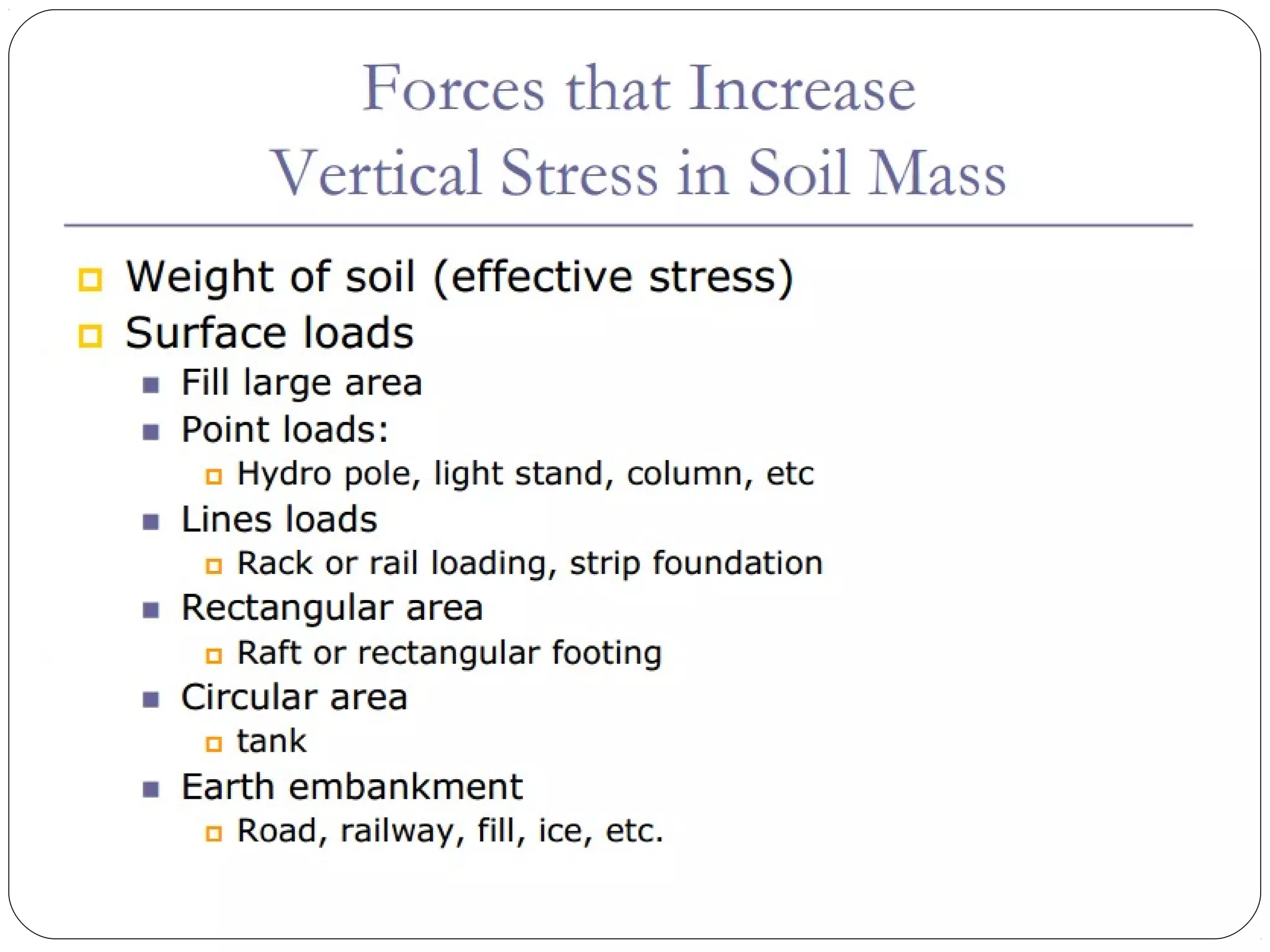
Importance of stresses in soil due to
external loads.
Prediction of settlements of
buildings,
bridges,
Embankments
Bearing capacity of soils
Lateral Pressure.
2
Prof. B V S Viswanadham, Department of Civil Engineering, IIT Bombay
dx
dy
y
xy +
x
z
Equations of static equilibrium
dz
Prof. B V S Viswanadham, Department of Civil Engineering, IIT Bombay
Normal and shear stresses in
Cartesian coordinate system
An elemental soil mass with sides dy
measuring dx, dy, and dz: 


zx
zz
dx
x
zy
dz
 Parameters xx
yy, and zz
yx
yy
are the normal stresses
acting on the planes normal y
to the x, y, and z axes
yz
xy
xz
xx
 (Considered positive when they
are directed onto the surface)
(If ij is a shear stress, it means the
stress is acting on a plane normal to the z
i axis, and its direction is parallel to the
j axis.)
For equilibrium:


BOUSSINESCTS FORMULA FOR POINT LOADS
8
BOUSSINESCTS FORMULA FOR
POINT LOADS
A semi-infinite solid is the one bounded on one horizontal
surface, here the surface in all the other directions. The
problem of determining stresses at any point P at a depth z as a
result of a surface point load was solved by Boussinesq (1885)
on the following assumptions.
1. The soil mass is elastic, isotropic (having identical properties in
all direction throughout), homogeneous (identical elastic
properties) and semi-infinite.
2. The soil is weightless.
BOUSSINESCTS FORMULA FOR
POINT LOADS
1. The load is a point load acting on the surface. vertical
stress бz, at point P under point load Q is given as
where, r = the horizontal distance between an arbitrary point P
below the surface and the vertical axis through the point load
Q. z = the vertical depth of the point P from the surface. IB -
Boussinesq stress coefficient =
The values of the Boussinesq coefficient IB can be determined
for a number of values of r/z.
BOUSSINESCTS FORMULA FOR
POINT LOADS
Prof. B V S Viswanadham, Department of Civil Engineering, IIT Bombay



Vertical stress distribution along a vertical line
Q z, max =
r
z
 = 391350
0.0888Q
As z increases, r/z  for a constant
value of r
As z2 is involved in the denominator of the
expression for z, first it increases with
depth and attains a maximum value and
then decreases with further increase in
depth.
Prof. B V S Viswanadham, Department of Civil Engineering, IIT Bombay
Westergard stress distribution under a point load
 Boussinesq assumed that the soil is elastic, isotropic
and homogeneous; However, the soil is neither
isotropic nor homogeneous. The most common type
of soils that are met in nature are the water deposited
sedimentary soils
 The soils of this type can be assumed as laterally
reinforced by numerous, closely spaced, horizontal
sheets of negligible thickness but of infinite rigidity,
which prevent the mass as a whole from undergoing
lateral movement of soil grains (For this case  or  = 0)
WESTERGAARD'S FORMULA FOR
POINT LOADS
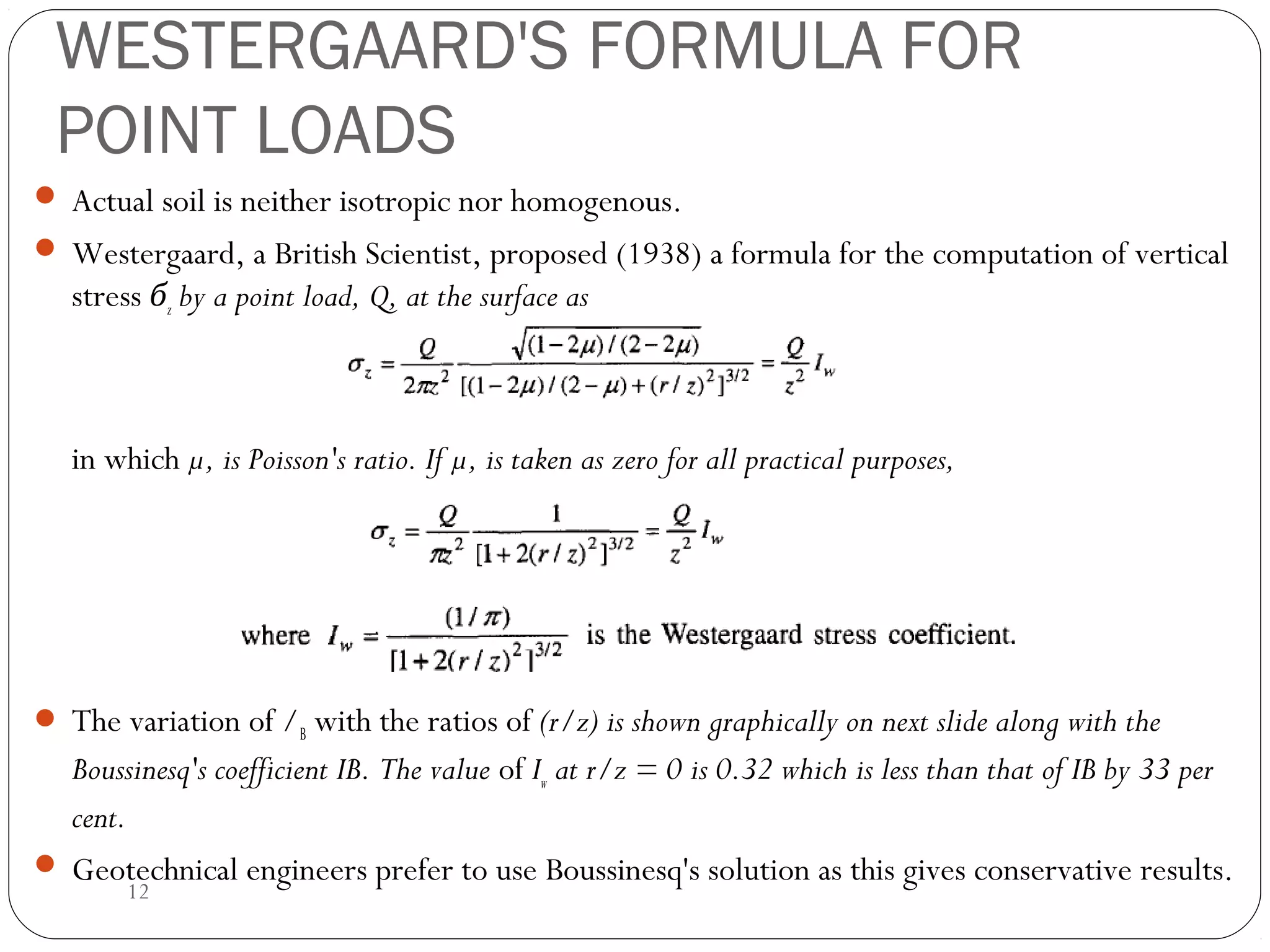
 Actual soil is neither isotropic nor homogenous.
 Westergaard, a British Scientist, proposed (1938) a formula for the computation of vertical
stress бz by a point load, Q, at the surface as
in which µ, is Poisson's ratio. If µ, is taken as zero for all practical purposes,
 The variation of /B with the ratios of (r/z) is shown graphically on next slide along with the
Boussinesq's coefficient IB. The value of Iw at r/z = 0 is 0.32 which is less than that of IB by 33 per
cent.
 Geotechnical engineers prefer to use Boussinesq's solution as this gives conservative results.
12
Prof. B V S Viswanadham, Department of Civil Engineering, IIT Bombay
Vertical stress due to a line load
e.g, long brick wall or railroad track
Series of point loads (~qdy)
- (From Boussinesq’s solution)
y  x
z
PRESSURE ISOBARS-Pressure Bulb
An isobar is a line which connects all points of equal stress below the
ground surface. In other words, an isobar is a stress contour. We
may draw any number of isobars as shown in Fig. for any given
load system.
Each isobar represents a fraction of the load applied at the
surface. Since these isobars form closed figures and resemble
the form of a bulb, they are also termed bulb of pressure or simply
the pressure bulb.
Normally isobars are drawn for vertical, horizontal and shear stresses.
The one that is most important in the calculation of settlements
of footings is the vertical pressure isobar.
31
we may draw any number of isobars for any given load system, but
the one that is of practical significance is the one which encloses a
soil mass which is responsible for the settlement of the structure.
The depth of this stressed zone may be termed as the significant
depth Ds which is responsible for the settlement of the structure.
Terzaghi recommended that for all practical purposes one can take
a stress contour which represents 20 per cent of the foundation
contact pressure q, i.e, equal to 0.2q.
Terzaghi's recommendation was based on his observation that
direct stresses are considered of negligible magnitude when they
are smaller than 20 per cent of the intensity of the applied stress
from structural loading, and that most of the settlement,
approximately 80 per cent of the total, takes place at a depth less
than Ds.
The depth Ds is approximately equal to 1.5 times the width of square or
32
Significant depths:
35
Pressure Isobars for Footings
36
Prof. B V S Viswanadham, Department of Civil Engineering, IIT Bombay
Stress Isobar (or Pressure bulb)
 Stress contour or a line which connects all points
below the ground surface at which the vertical
pressure is the same.
 Pressure at points inside the bulb are greater than
that at a point on the surface of the bulb; and
pressures at points outside the bulb are smaller than
that value.
 Any number of stress isobars can be drawn for any
applied load.
 A system of isobars indicates the decrease in stress
intensity from the inner to outer ones.
 Isobars are Leminscate curves
Prof. B V S Viswanadham, Department of Civil Engineering, IIT Bombay
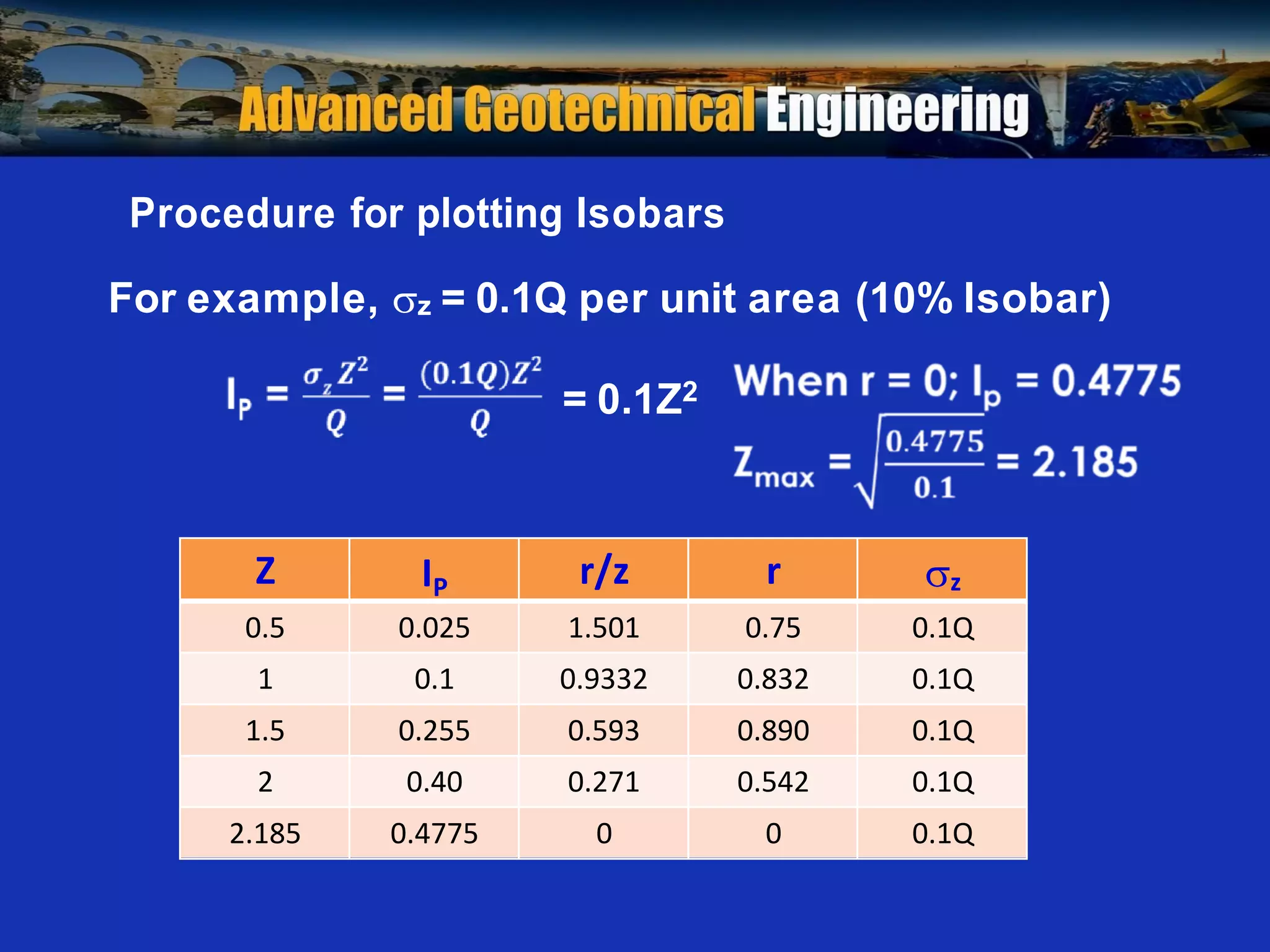
= 0.1Z2
Procedure for plotting Isobars
For example, z = 0.1Q per unit area (10% Isobar)
Z IP r/z r z
0.5 0.025 1.501 0.75 0.1Q
1 0.1 0.9332 0.832 0.1Q
1.5 0.255 0.593 0.890 0.1Q
2 0.40 0.271 0.542 0.1Q
2.185 0.4775 0 0 0.1Q
Prof. B V S Viswanadham, Department of Civil Engineering, IIT Bombay
Example Problem
A single concentrated load of 1000 kN acts at the
ground surface. Construct an isobar for z = 40 kN/ m2
by making use of the Boussinesq equation.
Now for Q = 1000 kN, z, = 40 kN/ m2 , we obtain the
values of r1 r2, r3 etc. for different depths z1,, z2, z3 etc.
The values so obtained are:
Prof. B V S Viswanadham, Department of Civil Engineering, IIT Bombay
Example Problem
Prof. B V S Viswanadham, Department of Civil Engineering, IIT Bombay
r1
o
c
Vertical stress due to an irregular shaped area
loaded with uniform load intensity
Newmark (1942) developed influence charts to
compute the vertical stress (and also the horizontal and
shear stresses) due to a loaded area of any shape,
irregular shape, below any point either inside or outside
of the loaded area.
Let a circular area of radius r1
loaded with uniform load intensity q
b
be divided into 20 sectors.
Prof. B V S Viswanadham, Department of Civil Engineering, IIT Bombay
Vertical stress due to an irregular shaped area
loaded with uniform load intensity
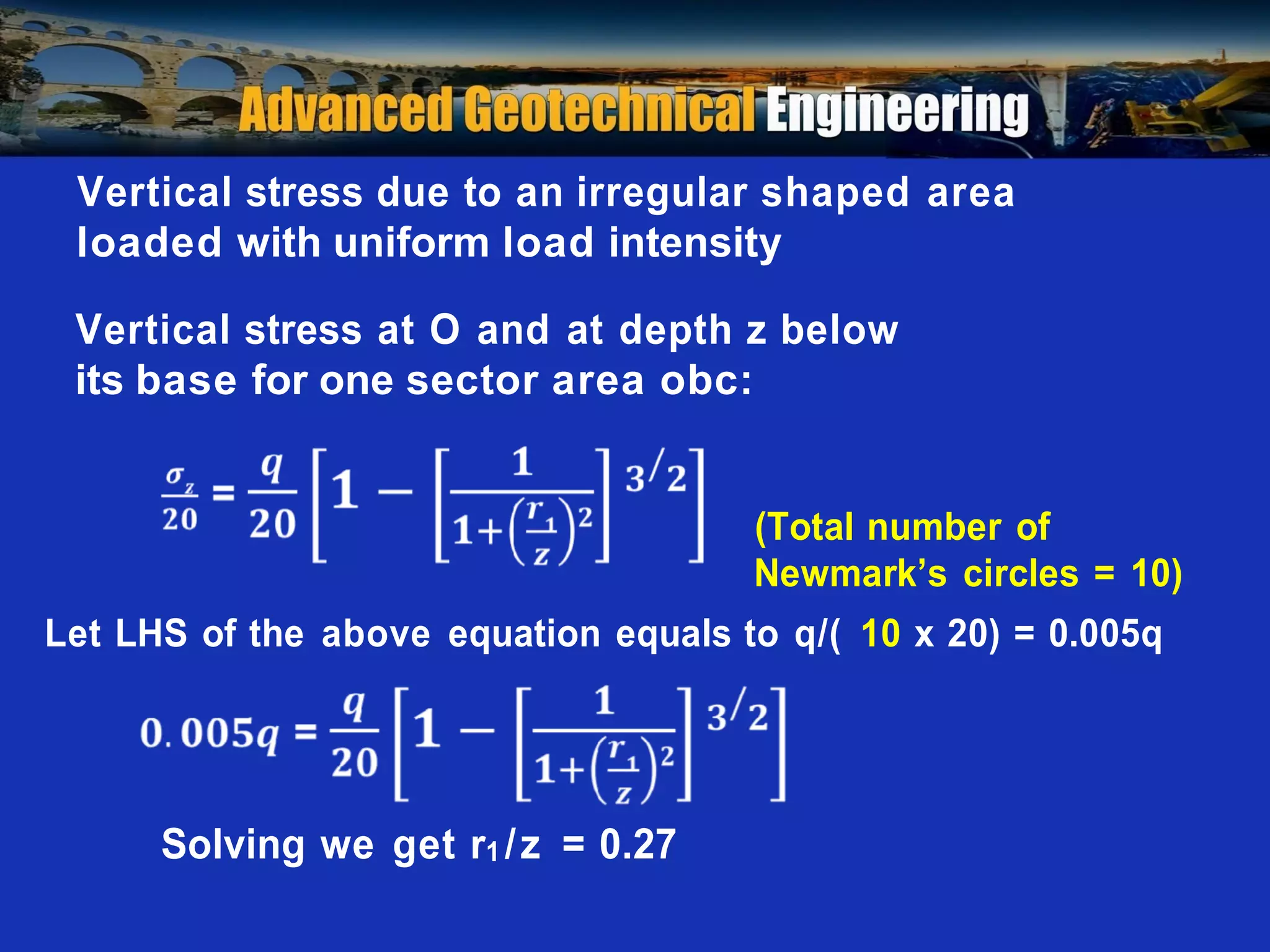
Vertical stress at O and at depth z below
its base for one sector area obc:
(Total number of
Newmark’s circles = 10)
Let LHS of the above equation equals to q/( 10 x 20) = 0.005q
Solving we get r1 /z = 0.27
Vertical stress due to an irregular shaped area
loaded with uniform load intensity
If a circle is drawn with radius r1 equal to 0.27z and the
area divided into 20 area units, each area unit will
produce a vertical stress equal to 0.005 q at a depth z
below the centre.
Let a second concentric circle of radius r2 be
drawn and divide into 20 area units,
Total stress due to area units obc
and bbcc at depth z below the
centre is 0.005q x 2
r2
b b o
c
c
r1
Prof. B V S Viswanadham, Department of Civil Engineering, IIT Bombay
Vertical stress due to an irregular shaped area
loaded with uniform load intensity
Solving we get r2 /z = 0.40
In the same way, 3rd, 4th, -------9 th concentric circles
are calculated.
The equation for the radius of 10th circle is given by:
Solving we get
r10 /z = 

10th circle lies at infinity
Prof. B V S Viswanadham, Department of Civil Engineering, IIT Bombay
Vertical stress due to an irregular shaped area
loaded with uniform load intensity
Circle
No.
1 2 3 4 5 6 7 8 9 10
r/z 0.27 0.4 0.52 0.64 0.77 0.92 1.11 1.39 1.91 
Newmark’s influence
chart for vertical stress.
Influence value per unit
pressure = 0.005.
N = number of influence
areas covered by the area
under consideration
 The loaded area is drawn
on tracing paper to a
scale such that the length
of the scale line on the
chart represents the
depth z at which the
vertical stress is required.
z = 0.005q N

Vertical Stresses Below Applied Load.pdf

  • 1.
    Importance of stressesin soil due to external loads. Prediction of settlements of buildings, bridges, Embankments Bearing capacity of soils Lateral Pressure. 2
  • 3.
    Prof. B VS Viswanadham, Department of Civil Engineering, IIT Bombay dx dy y xy + x z Equations of static equilibrium dz
  • 4.
    Prof. B VS Viswanadham, Department of Civil Engineering, IIT Bombay Normal and shear stresses in Cartesian coordinate system An elemental soil mass with sides dy measuring dx, dy, and dz:    zx zz dx x zy dz  Parameters xx yy, and zz yx yy are the normal stresses acting on the planes normal y to the x, y, and z axes yz xy xz xx  (Considered positive when they are directed onto the surface) (If ij is a shear stress, it means the stress is acting on a plane normal to the z i axis, and its direction is parallel to the j axis.) For equilibrium:  
  • 6.
  • 7.
    BOUSSINESCTS FORMULA FOR POINTLOADS A semi-infinite solid is the one bounded on one horizontal surface, here the surface in all the other directions. The problem of determining stresses at any point P at a depth z as a result of a surface point load was solved by Boussinesq (1885) on the following assumptions. 1. The soil mass is elastic, isotropic (having identical properties in all direction throughout), homogeneous (identical elastic properties) and semi-infinite. 2. The soil is weightless.
  • 8.
    BOUSSINESCTS FORMULA FOR POINTLOADS 1. The load is a point load acting on the surface. vertical stress бz, at point P under point load Q is given as where, r = the horizontal distance between an arbitrary point P below the surface and the vertical axis through the point load Q. z = the vertical depth of the point P from the surface. IB - Boussinesq stress coefficient = The values of the Boussinesq coefficient IB can be determined for a number of values of r/z.
  • 9.
  • 10.
    Prof. B VS Viswanadham, Department of Civil Engineering, IIT Bombay    Vertical stress distribution along a vertical line Q z, max = r z  = 391350 0.0888Q As z increases, r/z  for a constant value of r As z2 is involved in the denominator of the expression for z, first it increases with depth and attains a maximum value and then decreases with further increase in depth.
  • 11.
    Prof. B VS Viswanadham, Department of Civil Engineering, IIT Bombay Westergard stress distribution under a point load  Boussinesq assumed that the soil is elastic, isotropic and homogeneous; However, the soil is neither isotropic nor homogeneous. The most common type of soils that are met in nature are the water deposited sedimentary soils  The soils of this type can be assumed as laterally reinforced by numerous, closely spaced, horizontal sheets of negligible thickness but of infinite rigidity, which prevent the mass as a whole from undergoing lateral movement of soil grains (For this case  or  = 0)
  • 12.
    WESTERGAARD'S FORMULA FOR POINTLOADS  Actual soil is neither isotropic nor homogenous.  Westergaard, a British Scientist, proposed (1938) a formula for the computation of vertical stress бz by a point load, Q, at the surface as in which µ, is Poisson's ratio. If µ, is taken as zero for all practical purposes,  The variation of /B with the ratios of (r/z) is shown graphically on next slide along with the Boussinesq's coefficient IB. The value of Iw at r/z = 0 is 0.32 which is less than that of IB by 33 per cent.  Geotechnical engineers prefer to use Boussinesq's solution as this gives conservative results. 12
  • 16.
    Prof. B VS Viswanadham, Department of Civil Engineering, IIT Bombay Vertical stress due to a line load e.g, long brick wall or railroad track Series of point loads (~qdy) - (From Boussinesq’s solution) y  x z
  • 32.
    PRESSURE ISOBARS-Pressure Bulb Anisobar is a line which connects all points of equal stress below the ground surface. In other words, an isobar is a stress contour. We may draw any number of isobars as shown in Fig. for any given load system. Each isobar represents a fraction of the load applied at the surface. Since these isobars form closed figures and resemble the form of a bulb, they are also termed bulb of pressure or simply the pressure bulb. Normally isobars are drawn for vertical, horizontal and shear stresses. The one that is most important in the calculation of settlements of footings is the vertical pressure isobar. 31
  • 33.
    we may drawany number of isobars for any given load system, but the one that is of practical significance is the one which encloses a soil mass which is responsible for the settlement of the structure. The depth of this stressed zone may be termed as the significant depth Ds which is responsible for the settlement of the structure. Terzaghi recommended that for all practical purposes one can take a stress contour which represents 20 per cent of the foundation contact pressure q, i.e, equal to 0.2q. Terzaghi's recommendation was based on his observation that direct stresses are considered of negligible magnitude when they are smaller than 20 per cent of the intensity of the applied stress from structural loading, and that most of the settlement, approximately 80 per cent of the total, takes place at a depth less than Ds. The depth Ds is approximately equal to 1.5 times the width of square or 32
  • 36.
  • 37.
  • 38.
    Prof. B VS Viswanadham, Department of Civil Engineering, IIT Bombay Stress Isobar (or Pressure bulb)  Stress contour or a line which connects all points below the ground surface at which the vertical pressure is the same.  Pressure at points inside the bulb are greater than that at a point on the surface of the bulb; and pressures at points outside the bulb are smaller than that value.  Any number of stress isobars can be drawn for any applied load.  A system of isobars indicates the decrease in stress intensity from the inner to outer ones.  Isobars are Leminscate curves
  • 39.
    Prof. B VS Viswanadham, Department of Civil Engineering, IIT Bombay = 0.1Z2 Procedure for plotting Isobars For example, z = 0.1Q per unit area (10% Isobar) Z IP r/z r z 0.5 0.025 1.501 0.75 0.1Q 1 0.1 0.9332 0.832 0.1Q 1.5 0.255 0.593 0.890 0.1Q 2 0.40 0.271 0.542 0.1Q 2.185 0.4775 0 0 0.1Q
  • 40.
    Prof. B VS Viswanadham, Department of Civil Engineering, IIT Bombay Example Problem A single concentrated load of 1000 kN acts at the ground surface. Construct an isobar for z = 40 kN/ m2 by making use of the Boussinesq equation. Now for Q = 1000 kN, z, = 40 kN/ m2 , we obtain the values of r1 r2, r3 etc. for different depths z1,, z2, z3 etc. The values so obtained are:
  • 41.
    Prof. B VS Viswanadham, Department of Civil Engineering, IIT Bombay Example Problem
  • 42.
    Prof. B VS Viswanadham, Department of Civil Engineering, IIT Bombay r1 o c Vertical stress due to an irregular shaped area loaded with uniform load intensity Newmark (1942) developed influence charts to compute the vertical stress (and also the horizontal and shear stresses) due to a loaded area of any shape, irregular shape, below any point either inside or outside of the loaded area. Let a circular area of radius r1 loaded with uniform load intensity q b be divided into 20 sectors.
  • 43.
    Prof. B VS Viswanadham, Department of Civil Engineering, IIT Bombay Vertical stress due to an irregular shaped area loaded with uniform load intensity Vertical stress at O and at depth z below its base for one sector area obc: (Total number of Newmark’s circles = 10) Let LHS of the above equation equals to q/( 10 x 20) = 0.005q Solving we get r1 /z = 0.27
  • 44.
    Vertical stress dueto an irregular shaped area loaded with uniform load intensity If a circle is drawn with radius r1 equal to 0.27z and the area divided into 20 area units, each area unit will produce a vertical stress equal to 0.005 q at a depth z below the centre. Let a second concentric circle of radius r2 be drawn and divide into 20 area units, Total stress due to area units obc and bbcc at depth z below the centre is 0.005q x 2 r2 b b o c c r1
  • 45.
    Prof. B VS Viswanadham, Department of Civil Engineering, IIT Bombay Vertical stress due to an irregular shaped area loaded with uniform load intensity Solving we get r2 /z = 0.40 In the same way, 3rd, 4th, -------9 th concentric circles are calculated. The equation for the radius of 10th circle is given by: Solving we get r10 /z =   10th circle lies at infinity
  • 46.
    Prof. B VS Viswanadham, Department of Civil Engineering, IIT Bombay Vertical stress due to an irregular shaped area loaded with uniform load intensity Circle No. 1 2 3 4 5 6 7 8 9 10 r/z 0.27 0.4 0.52 0.64 0.77 0.92 1.11 1.39 1.91 
  • 47.
    Newmark’s influence chart forvertical stress. Influence value per unit pressure = 0.005. N = number of influence areas covered by the area under consideration  The loaded area is drawn on tracing paper to a scale such that the length of the scale line on the chart represents the depth z at which the vertical stress is required. z = 0.005q N