






1 VictorRentea.ro
a training by
Hi, I'm Victor Rentea
Java Champion, enjoying since 2006
Trainer – 5000+ developers in 100+ companies / 20+ countries
Clean Code✨
Unit Testing 🙌
Architecture 📐
Spring & JPA 🛠
Java Performance 🔥
Reactive Programming 😱
Secure Coding 🔐
Speaker at Conferences & Meetups
Join at victorrentea.ro/community
and enjoy 1h/month of free workshop/talk
Software Crafters Community
@victorrentea
VictorRentea.ro
YouTube Channel
- in-house
- mixed groups
- video classes
3 VictorRentea.ro
a training by
🫵
About You!
Zoom Poll: your experience and language
4 VictorRentea.ro
a training by
Chapter 1. Concentric Architectures
= Onion, Clean, Hexagonal, Ports-and-Adapters
5 VictorRentea.ro
a training by
IAdapter
Adapter
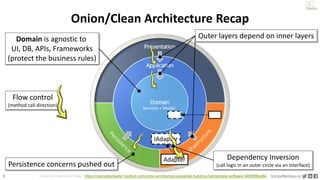
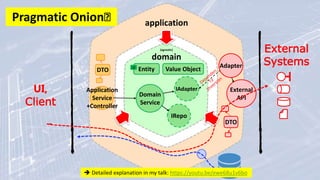
Onion/Clean Architecture Recap
Outer layers depend on inner layers
Persistence concerns pushed out
Dependency Inversion
(call logic in an outer circle via an interface)
Services + Model
Flow control
(method call direction)
Domain is agnostic to
UI, DB, APIs, Frameworks
(protect the business rules)
Onion Architecture Primer: https://marcoatschaefer.medium.com/onion-architecture-explained-building-maintainable-software-54996ff8e464
Application
Service
+Controller
DTO Value Object
Entity
id
Domain
Service
IRepo
application
IAdapter
Adapter
External
API
DTO
(agnostic)
domain
UI,
Client
External
Systems
Pragmatic Onion🧅
 Detailed explanation in my talk: https://youtu.be/ewe68u1v6bo
7 VictorRentea.ro
a training by
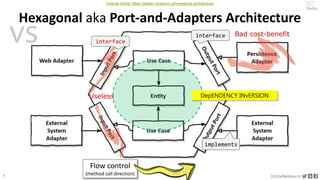
vs interface
Hexagonal aka Port-and-Adapters Architecture
Original Article: https://alistair.cockburn.us/hexagonal-architecture/
Bad cost-benefit
Useless
interface
implements
DepENDENCY INvERSION
Flow control
(method call direction)
9 VictorRentea.ro
a training by
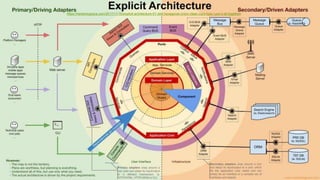
https://herbertograca.com/2017/11/16/explicit-architecture-01-ddd-hexagonal-onion-clean-cqrs-how-i-put-it-all-together/
10 VictorRentea.ro
a training by
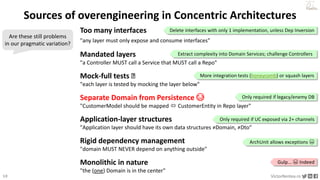
Sources of overengineering in Concentric Architectures
Too many interfaces
"any layer must only expose and consume interfaces"
Mandated layers
"a Controller MUST call a Service that MUST call a Repo"
Mock-full tests 🧅
"each layer is tested by mocking the layer below"
Separate Domain from Persistence 😭
"CustomerModel should be mapped  CustomerEntity in Repo layer"
Application-layer structures
"Application layer should have its own data structures ≠Domain, ≠Dto"
Rigid dependency management
"domain MUST NEVER depend on anything outside"
Monolithic in nature
"the (one) Domain is in the center"
Are these still problems
in our pragmatic variation?
Delete interfaces with only 1 implementation, unless Dep Inversion
Extract complexity into Domain Services; challenge Controllers
More integration tests (honeycomb) or squash layers
ArchUnit allows exceptions 😬
Only required if UC exposed via 2+ channels
Gulp... 😬 Indeed
Only required if legacy/enemy DB
11 VictorRentea.ro
a training by
Chapter 2. Vertical Slicing
with a taste of CQRS
12 VictorRentea.ro
a training by
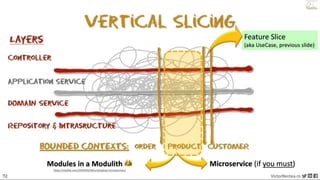
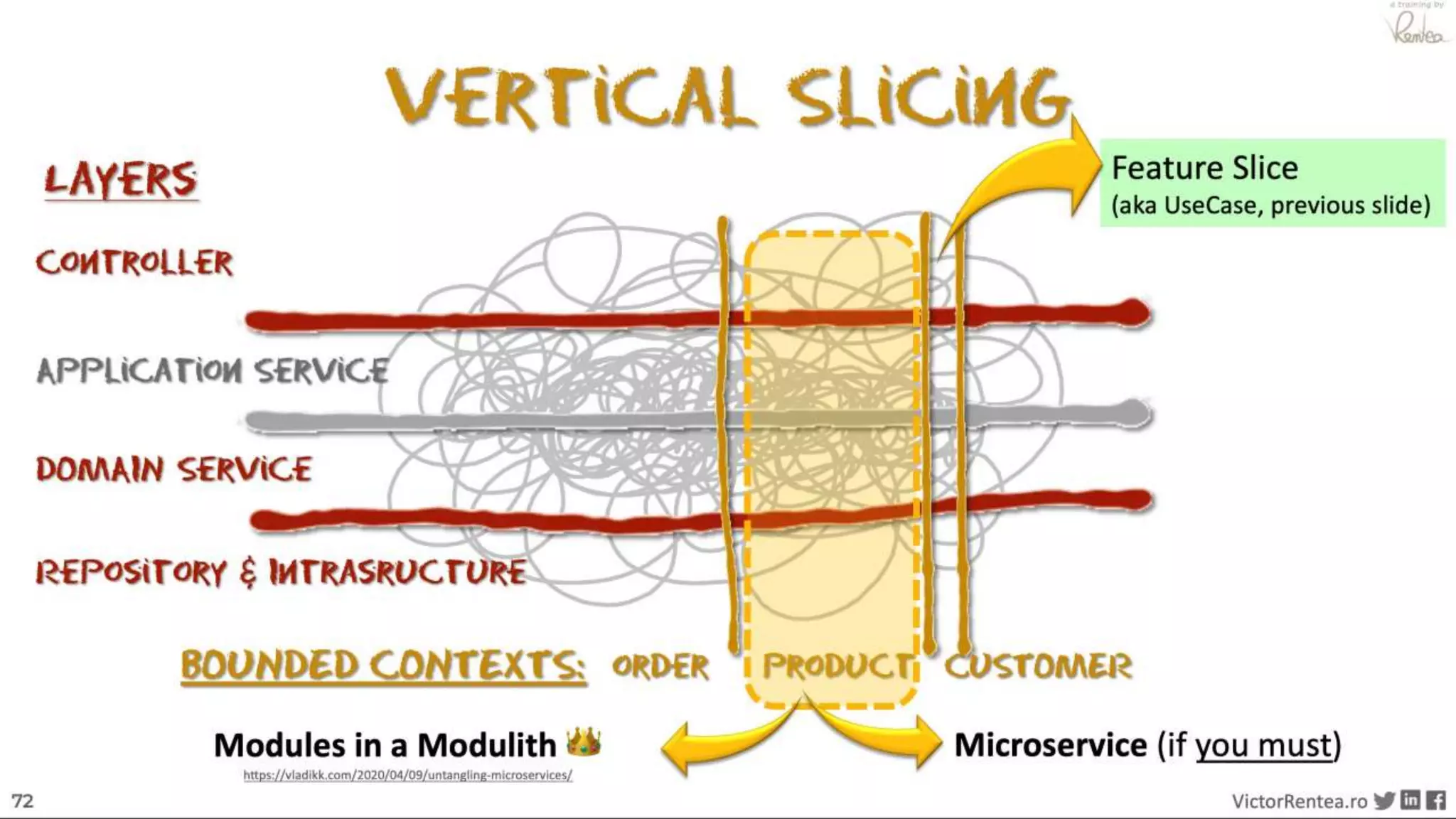
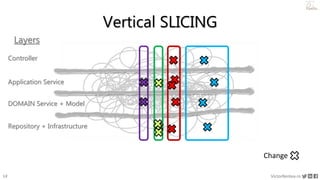
Layers
Controller
Repository + Infrastructure
Application Service
Vertical SLICING
DOMAIN Service + Model
Change
13 VictorRentea.ro
a training by
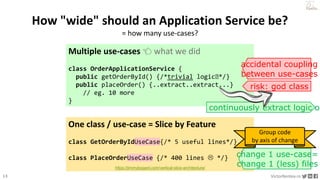
How "wide" should an Application Service be?
= how many use-cases?
Multiple use-cases 👈 what we did
class OrderApplicationService {
public getOrderById() {/*trivial logic🥱*/}
public placeOrder() {..extract..extract...}
// eg. 10 more
}
One class / use-case = Slice by Feature
class GetOrderByIdUseCase{/* 5 useful lines*/}
class PlaceOrderUseCase {/* 400 lines  */}
risk: god class
https://jimmybogard.com/vertical-slice-architecture/
continuously extract logic ou
accidental coupling
between use-cases
change 1 use-case=
change 1 (less) files
Group code
by axis of change
14 VictorRentea.ro
a training by
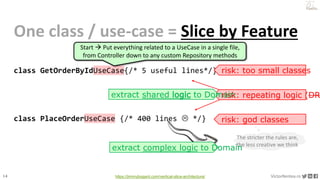
One class / use-case = Slice by Feature
class GetOrderByIdUseCase{/* 5 useful lines*/}
class PlaceOrderUseCase {/* 400 lines  */} risk: god classes
https://jimmybogard.com/vertical-slice-architecture/
The stricter the rules are,
the less creative we think
risk: too small classes
risk: repeating logic (DR
extract shared logic to Domain
extract complex logic to Domain
Start  Put everything related to a UseCase in a single file,
from Controller down to any custom Repository methods
15 VictorRentea.ro
a training by
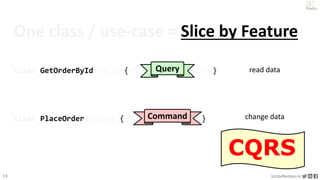
One class / use-case = Slice by Feature
class GetOrderByIdUseCase{/* 5 useful lines*/}
class PlaceOrderUseCase {/* 400 lines  */}
Query
Command
read data
change data
CQRS
16 VictorRentea.ro
a training by
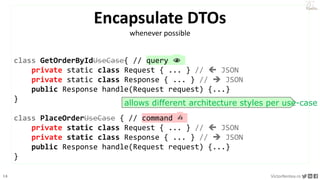
Encapsulate DTOs
whenever possible
class GetOrderByIdUseCase{ // query 👁
private static class Request { ... } //  JSON
private static class Response { ... } //  JSON
public Response handle(Request request) {...}
}
class PlaceOrderUseCase { // command ✍️
private static class Request { ... } //  JSON
private static class Response { ... } //  JSON
public Response handle(Request request) {...}
}
allows different architecture styles per use-case
17 VictorRentea.ro
a training by
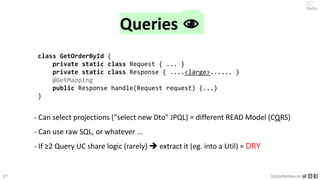
Queries 👁
class GetOrderById {
private static class Request { ... }
private static class Response { ....<large>...... }
@GetMapping
public Response handle(Request request) {...}
}
- Can select projections ("select new Dto" JPQL) = different READ Model (CQRS)
- Can use raw SQL, or whatever ...
- If ≥2 Query UC share logic (rarely)  extract it (eg. into a Util) = DRY
18 VictorRentea.ro
a training by
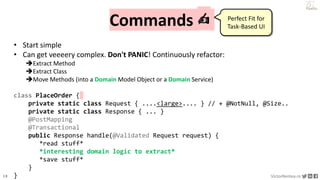
Commands ✍️
• Start simple
• Can get veeeery complex. Don't PANIC! Continuously refactor:
Extract Method
Extract Class
Move Methods (into a Domain Model Object or a Domain Service)
class PlaceOrder {
private static class Request { ....<large>.... } // + @NotNull, @Size..
private static class Response { ... }
@PostMapping
@Transactional
public Response handle(@Validated Request request) {
*read stuff*
*interesting domain logic to extract*
*save stuff*
}
}
Perfect Fit for
Task-Based UI
19 VictorRentea.ro
a training by
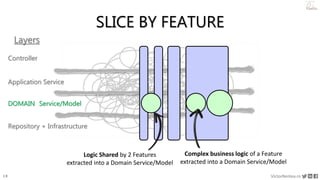
Layers
Controller
Repository + Infrastructure
Application Service
SLICE BY FEATURE
DOMAIN Service/Model
Logic Shared by 2 Features
extracted into a Domain Service/Model
Complex business logic of a Feature
extracted into a Domain Service/Model
20 VictorRentea.ro
a training by
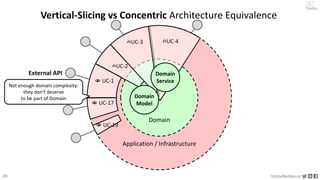
Application / Infrastructure
Domain
👁 UC-1
External API
✍️UC-3 ✍️UC-4
Domain
Service
Vertical-Slicing vs Concentric Architecture Equivalence
✍️UC-2
Domain
Model
👁 UC-19
👁 UC-17
Not enough domain complexity:
they don't deserve
to be part of Domain
21 VictorRentea.ro
a training by
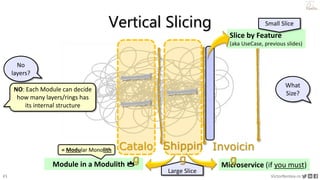
Microservice (if you must)
Module in a Modulith 👑
Large Slice
Shippin
g
Invoicin
g
Catalo
g
NO: Each Module can decide
how many layers/rings has
its internal structure
Slice by Feature
(aka UseCase, previous slides)
Vertical Slicing Small Slice
What
Size?
No
layers?
= Modular Monolith
22 VictorRentea.ro
a training by
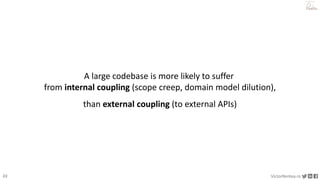
A large codebase is more likely to suffer
from internal coupling (scope creep, domain model dilution),
than external coupling (to external APIs)
23 VictorRentea.ro
a training by
Chapter 3. Finding Module Boundaries
one of the toughest problems in architecture
24 VictorRentea.ro
a training by
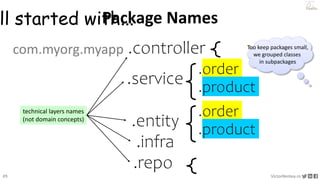
It all started with...
25 VictorRentea.ro
a training by
.controller
.service
.repo
.infra
com.myorg.myapp
.order
.product
Too keep packages small,
we grouped classes
in subpackages
Package Names
.entity
.order
.product
ll started with...
technical layers names
(not domain concepts)
26 VictorRentea.ro
a training by
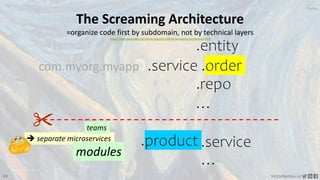
.service
com.myorg.myapp .order
.product .service
The Screaming Architecture
=organize code first by subdomain, not by technical layers
https://blog.cleancoder.com/uncle-bob/2011/09/30/Screaming-Architecture.html
.entity
.repo
…
…
 separate microservices
teams
modules
27 VictorRentea.ro
a training by
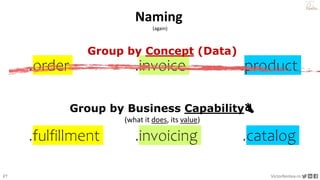
Naming
(again)
.order .product
.fulfillment .catalog
.invoice
.invoicing
Group by Business Capability👌
(what it does, its value)
Group by Concept (Data)
28 VictorRentea.ro
a training by
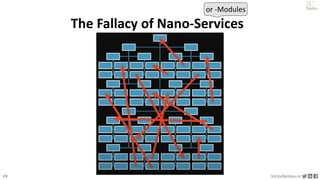
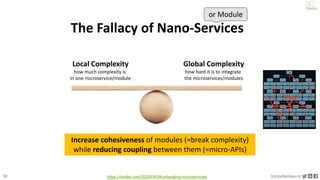
The Fallacy of Nano-Services
or -Modules
29 VictorRentea.ro
a training by
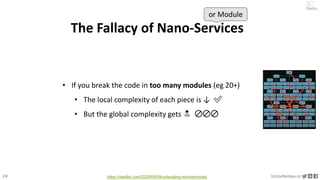
The Fallacy of Nano-Services
• If you break the code in too many modules (eg 20+)
• The local complexity of each piece is ↓ ✅
• But the global complexity gets 🔝 🚫🚫🚫
or Module
https://vladikk.com/2020/04/09/untangling-microservices/
30 VictorRentea.ro
a training by
The Fallacy of Nano-Services
or Module
Local Complexity
how much complexity is
in one microservice/module
Global Complexity
how hard it is to integrate
the microservices/modules
Increase cohesiveness of modules (=break complexity)
while reducing coupling between them (=micro-APIs)
https://vladikk.com/2020/04/09/untangling-microservices/
31 VictorRentea.ro
a training by
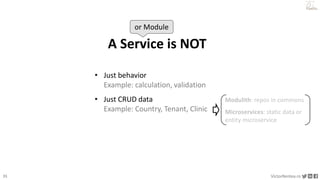
A Service is NOT
• Just behavior
Example: calculation, validation
• Just CRUD data
Example: Country, Tenant, Clinic
or Module
Modulith: repos in commons
Microservices: static data or
entity microservice
32 VictorRentea.ro
a training by
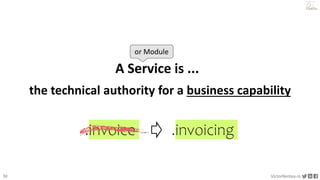
A Service is ...
the technical authority for a business capability
or Module
.invoice .invoicing
33 VictorRentea.ro
a training by
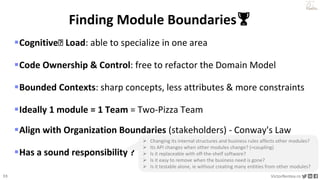
Cognitive🧅 Load: able to specialize in one area
Code Ownership & Control: free to refactor the Domain Model
Bounded Contexts: sharp concepts, less attributes & more constraints
Ideally 1 module = 1 Team = Two-Pizza Team
Align with Organization Boundaries (stakeholders) - Conway's Law
Has a sound responsibility ?
Finding Module Boundaries🏆
 Changing its internal structures and business rules affects other modules?
 Its API changes when other modules change? (=coupling)
 Is it replaceable with off-the-shelf software?
 Is it easy to remove when the business need is gone?
 Is it testable alone, ie without creating many entities from other modules?
37 VictorRentea.ro
a training by
Chapter 4. Decoupling Modules
code tactics
38 VictorRentea.ro
a training by
Modularizing the Monolith
39 VictorRentea.ro
a training by
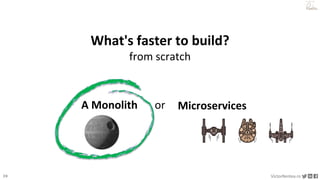
What's faster to build?
from scratch
Microservices
A Monolith or
40 VictorRentea.ro
a training by
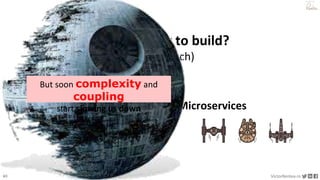
What's faster to build?
(from scratch)
Microservices
A Monolith or
But soon complexity and
coupling
start slowing us down
41 VictorRentea.ro
a training by
41
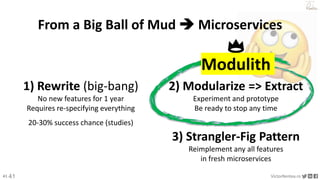
From a Big Ball of Mud  Microservices
1) Rewrite (big-bang)
No new features for 1 year
Requires re-specifying everything
20-30% success chance (studies)
2) Modularize => Extract
Experiment and prototype
Be ready to stop any time
3) Strangler-Fig Pattern
Reimplement any all features
in fresh microservices
👑
Modulith
42 VictorRentea.ro
a training by
A new greenfield project
Proxy
The Strangler Fig Pattern
😁
When a feature is
reimplemented,
route the requests for it
to the new project
Prerequisite: clear requirements
43 VictorRentea.ro
a training by
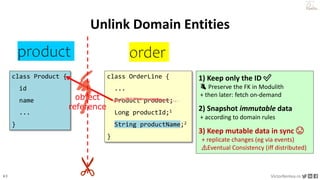
order
product
Unlink Domain Entities
class OrderLine {
...
Product product;
Long productId;1
String productName;2
}
class Product {
id
name
...
}
1) Keep only the ID ✅
👌 Preserve the FK in Modulith
+ then later: fetch on-demand
2) Snapshot immutable data
+ according to domain rules
3) Keep mutable data in sync 😨
+ replicate changes (eg via events)
⚠️Eventual Consistency (iff distributed)
object
reference
44 VictorRentea.ro
a training by
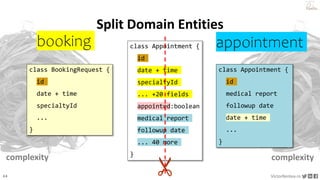
complexity
complexity
booking appointment
Split Domain Entities
class BookingRequest {
id
date + time
specialtyId
...
}
class Appointment {
id
medical report
followup date
date + time
...
}
class Appointment {
id
date + time
specialtyId
... +20 fields
appointed:boolean
medical report
followup date
... 40 more
}
45 VictorRentea.ro
a training by
👌
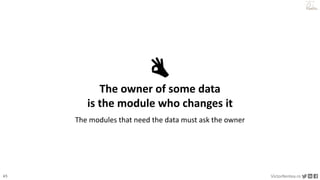
The owner of some data
is the module who changes it
The modules that need the data must ask the owner
46 VictorRentea.ro
a training by
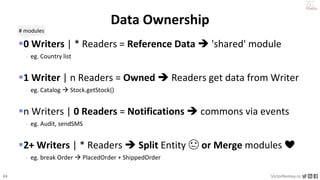
0 Writers | * Readers = Reference Data  'shared' module
- eg. Country list
1 Writer | n Readers = Owned  Readers get data from Writer
- eg. Catalog  Stock.getStock()
n Writers | 0 Readers = Notifications  commons via events
- eg. Audit, sendSMS
2+ Writers | * Readers  Split Entity 😩 or Merge modules ❤️
- eg. break Order  PlacedOrder + ShippedOrder
Data Ownership
# modules
48 VictorRentea.ro
a training by
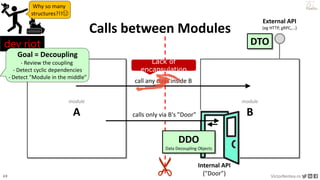
Calls between Modules
module
A
module
B
call any class inside B
Lack of
encapsulation
External API
(eg HTTP, gRPC,...)
dev riot
Why so many
structures?!!😡
Goal = Decoupling
- Review the coupling
- Detect cyclic dependencies
- Detect "Module in the middle"
DTO
Internal API
("Door")
DDO
Data Decoupling Objects
calls only via B's "Door"
49 VictorRentea.ro
a training by
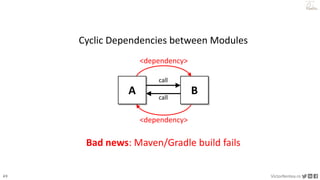
Cyclic Dependencies between Modules
A B
call
call
Bad news: Maven/Gradle build fails
<dependency>
<dependency>
50 VictorRentea.ro
a training by
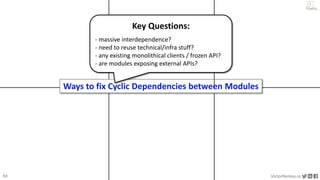
Ways to fix Cyclic Dependencies between Modules
Key Questions:
- massive interdependence?
- need to reuse technical/infra stuff?
- any existing monolithical clients / frozen API?
- are modules exposing external APIs?
51 VictorRentea.ro
a training by
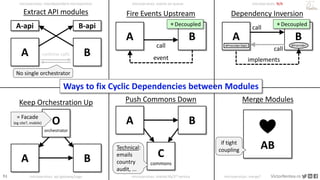
A B
A-api B-api
Extract API modules
No single orchestrator
runtime calls
A B
O
orchestrator
Keep Orchestration Up
= Facade
(eg site?, mobile)
Ways to fix Cyclic Dependencies between Modules
A B
event
call
Fire Events Upstream
⭐️Decoupled
A B
implements
call
Dependency Inversion
⭐️Decoupled
AProvider
AProviderImpl
call
microservices: N/A
microservices: events on queue
microservices: interdependent microservices
microservices: api gateway/saga microservices: shared lib/3rd service microservices: merge?
A B
C
commons
Push Commons Down
Technical:
emails
country
audit, ...
❤️
AB
Merge Modules
if tight
coupling
52 VictorRentea.ro
a training by
B
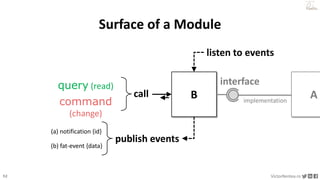
Surface of a Module
publish events
call
interface
implementation
A
command
(change)
query (read)
(a) notification {id}
(b) fat-event {data}
listen to events
53 VictorRentea.ro
a training by
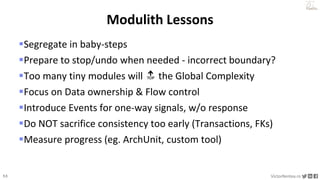
Segregate in baby-steps
Prepare to stop/undo when needed - incorrect boundary?
Too many tiny modules will 🔝 the Global Complexity
Focus on Data ownership & Flow control
Introduce Events for one-way signals, w/o response
Do NOT sacrifice consistency too early (Transactions, FKs)
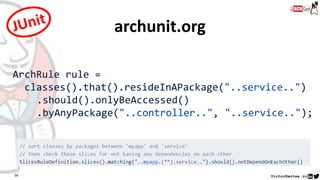
Measure progress (eg. ArchUnit, custom tool)
Modulith Lessons
VictorRentea.ro
54
archunit.org
ArchRule rule =
classes().that().resideInAPackage("..service..")
.should().onlyBeAccessed()
.byAnyPackage("..controller..", "..service..");
55 VictorRentea.ro
a training by
Chapter 5. Towards Microservices
as a painful decision
56 VictorRentea.ro
a training by
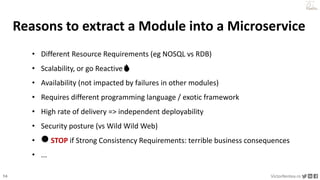
Reasons to extract a Module into a Microservice
• Different Resource Requirements (eg NOSQL vs RDB)
• Scalability, or go Reactive🔥
• Availability (not impacted by failures in other modules)
• Requires different programming language / exotic framework
• High rate of delivery => independent deployability
• Security posture (vs Wild Wild Web)
• 🛑 STOP if Strong Consistency Requirements: terrible business consequences
• ...
57 VictorRentea.ro
a training by
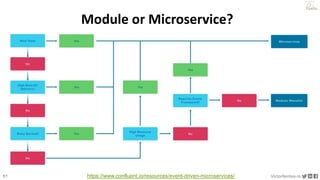
Module or Microservice?
https://www.confluent.io/resources/event-driven-microservices/
59 VictorRentea.ro
a training by
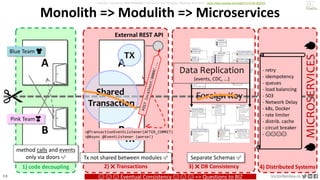
4) Distributed Systems
1) code decoupling 3) ❌ DB Consistency
2) ❌ Transactions
A
B
A
B
Shared
Transaction
TX
method calls and events
only via doors ✅
External REST API
Foreign Key
Data Replication
(events, CDC, ...)
🔥
MICROSERVICES
🔥
- retry
- idempotency
- queues
- load balancing
- 503
- Network Delay
- k8s, Docker
- rate limiter
- distrib. cache
- circuit breaker
- 😱😱😱😱
TX
>@TransactionEventListener(AFTER_COMMIT)
>@Async @EventListener (worse!)
Tx not shared between modules ✅ Separate Schemas ✅
😱 😱 😱 Eventual Consistency 😱 😱 😱 => Questions to BIZ
Monolith => Modulith => Microservices
Blue Team 👕
Pink Team👚
Partially inspired by Axel Fontaine's talk about the "Majestic Modular Monolith": https://www.youtube.com/watch?v=vV34-3NZkh4
VictorRentea.ro
60
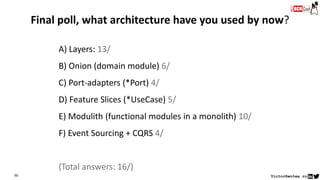
Final poll, what architecture have you used by now?
A) Layers: 13/
B) Onion (domain module) 6/
C) Port-adapters (*Port) 4/
D) Feature Slices (*UseCase) 5/
E) Modulith (functional modules in a monolith) 10/
F) Event Sourcing + CQRS 4/
(Total answers: 16/)
61 VictorRentea.ro
a training by
📚
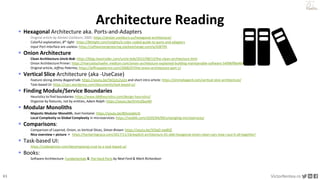
 Hexagonal Architecture aka. Ports-and-Adapters
- Original article by Alistair Cockburn, 2005: https://alistair.cockburn.us/hexagonal-architecture/
- Colorful explanation, 8th light: https://8thlight.com/insights/a-color-coded-guide-to-ports-and-adapters
- Input Port Interface are useless: https://softwareengineering.stackexchange.com/q/438705
 Onion Architecture
- Clean Architecture Uncle Bob: https://blog.cleancoder.com/uncle-bob/2012/08/13/the-clean-architecture.html
- Onion Architecture Primer: https://marcoatschaefer.medium.com/onion-architecture-explained-building-maintainable-software-54996ff8e464
- Original article, Jeffrey Palermo, https://jeffreypalermo.com/2008/07/the-onion-architecture-part-1/
 Vertical Slice Architecture (aka -UseCase)
- Feature slicing Jimmy Bogard talk: https://youtu.be/5kOzZz2vj2o and short intro article: https://jimmybogard.com/vertical-slice-architecture/
- Task-based UI: https://cqrs.wordpress.com/documents/task-based-ui/
 Finding Module/Service Boundaries
- Heuristics to find boundaries: https://www.dddheuristics.com/design-heuristics/
- Organize by features, not by entities, Adam Ralph: https://youtu.be/tVnIUZbsxWI
 Modular Monoliths
- Majestic Modular Monolith, Axel Fontaine: https://youtu.be/BOvxJaklcr0
- Local Complexity vs Global Complexity in microservices: https://vladikk.com/2020/04/09/untangling-microservices/
 Comparisons:
- Comparison of Layered, Onion, vs Vertical Slices, Simon Brown: https://youtu.be/5OjqD-ow8GE
- Nice overview + picture ⭐️ https://herbertograca.com/2017/11/16/explicit-architecture-01-ddd-hexagonal-onion-clean-cqrs-how-i-put-it-all-together/
 Task-based UI:
- https://codeopinion.com/decomposing-crud-to-a-task-based-ui/
 Books:
- Software Architecture: Fundamentals & The Hard Parts by Neal Ford & Mark Richardson
Architecture Reading

Vertical Slicing Architectures

  • 1.
  • 2.
    Hi, I'm VictorRentea Java Champion, enjoying since 2006 Trainer – 5000+ developers in 100+ companies / 20+ countries Clean Code✨ Unit Testing 🙌 Architecture 📐 Spring & JPA 🛠 Java Performance 🔥 Reactive Programming 😱 Secure Coding 🔐 Speaker at Conferences & Meetups Join at victorrentea.ro/community and enjoy 1h/month of free workshop/talk Software Crafters Community @victorrentea VictorRentea.ro YouTube Channel - in-house - mixed groups - video classes
  • 3.
    3 VictorRentea.ro a trainingby 🫵 About You! Zoom Poll: your experience and language
  • 4.
    4 VictorRentea.ro a trainingby Chapter 1. Concentric Architectures = Onion, Clean, Hexagonal, Ports-and-Adapters
  • 5.
    5 VictorRentea.ro a trainingby IAdapter Adapter Onion/Clean Architecture Recap Outer layers depend on inner layers Persistence concerns pushed out Dependency Inversion (call logic in an outer circle via an interface) Services + Model Flow control (method call direction) Domain is agnostic to UI, DB, APIs, Frameworks (protect the business rules) Onion Architecture Primer: https://marcoatschaefer.medium.com/onion-architecture-explained-building-maintainable-software-54996ff8e464
  • 6.
  • 7.
    7 VictorRentea.ro a trainingby vs interface Hexagonal aka Port-and-Adapters Architecture Original Article: https://alistair.cockburn.us/hexagonal-architecture/ Bad cost-benefit Useless interface implements DepENDENCY INvERSION Flow control (method call direction)
  • 8.
    9 VictorRentea.ro a trainingby https://herbertograca.com/2017/11/16/explicit-architecture-01-ddd-hexagonal-onion-clean-cqrs-how-i-put-it-all-together/
  • 9.
    10 VictorRentea.ro a trainingby Sources of overengineering in Concentric Architectures Too many interfaces "any layer must only expose and consume interfaces" Mandated layers "a Controller MUST call a Service that MUST call a Repo" Mock-full tests 🧅 "each layer is tested by mocking the layer below" Separate Domain from Persistence 😭 "CustomerModel should be mapped  CustomerEntity in Repo layer" Application-layer structures "Application layer should have its own data structures ≠Domain, ≠Dto" Rigid dependency management "domain MUST NEVER depend on anything outside" Monolithic in nature "the (one) Domain is in the center" Are these still problems in our pragmatic variation? Delete interfaces with only 1 implementation, unless Dep Inversion Extract complexity into Domain Services; challenge Controllers More integration tests (honeycomb) or squash layers ArchUnit allows exceptions 😬 Only required if UC exposed via 2+ channels Gulp... 😬 Indeed Only required if legacy/enemy DB
  • 10.
    11 VictorRentea.ro a trainingby Chapter 2. Vertical Slicing with a taste of CQRS
  • 11.
    12 VictorRentea.ro a trainingby Layers Controller Repository + Infrastructure Application Service Vertical SLICING DOMAIN Service + Model Change
  • 12.
    13 VictorRentea.ro a trainingby How "wide" should an Application Service be? = how many use-cases? Multiple use-cases 👈 what we did class OrderApplicationService { public getOrderById() {/*trivial logic🥱*/} public placeOrder() {..extract..extract...} // eg. 10 more } One class / use-case = Slice by Feature class GetOrderByIdUseCase{/* 5 useful lines*/} class PlaceOrderUseCase {/* 400 lines  */} risk: god class https://jimmybogard.com/vertical-slice-architecture/ continuously extract logic ou accidental coupling between use-cases change 1 use-case= change 1 (less) files Group code by axis of change
  • 13.
    14 VictorRentea.ro a trainingby One class / use-case = Slice by Feature class GetOrderByIdUseCase{/* 5 useful lines*/} class PlaceOrderUseCase {/* 400 lines  */} risk: god classes https://jimmybogard.com/vertical-slice-architecture/ The stricter the rules are, the less creative we think risk: too small classes risk: repeating logic (DR extract shared logic to Domain extract complex logic to Domain Start  Put everything related to a UseCase in a single file, from Controller down to any custom Repository methods
  • 14.
    15 VictorRentea.ro a trainingby One class / use-case = Slice by Feature class GetOrderByIdUseCase{/* 5 useful lines*/} class PlaceOrderUseCase {/* 400 lines  */} Query Command read data change data CQRS
  • 15.
    16 VictorRentea.ro a trainingby Encapsulate DTOs whenever possible class GetOrderByIdUseCase{ // query 👁 private static class Request { ... } //  JSON private static class Response { ... } //  JSON public Response handle(Request request) {...} } class PlaceOrderUseCase { // command ✍️ private static class Request { ... } //  JSON private static class Response { ... } //  JSON public Response handle(Request request) {...} } allows different architecture styles per use-case
  • 16.
    17 VictorRentea.ro a trainingby Queries 👁 class GetOrderById { private static class Request { ... } private static class Response { ....<large>...... } @GetMapping public Response handle(Request request) {...} } - Can select projections ("select new Dto" JPQL) = different READ Model (CQRS) - Can use raw SQL, or whatever ... - If ≥2 Query UC share logic (rarely)  extract it (eg. into a Util) = DRY
  • 17.
    18 VictorRentea.ro a trainingby Commands ✍️ • Start simple • Can get veeeery complex. Don't PANIC! Continuously refactor: Extract Method Extract Class Move Methods (into a Domain Model Object or a Domain Service) class PlaceOrder { private static class Request { ....<large>.... } // + @NotNull, @Size.. private static class Response { ... } @PostMapping @Transactional public Response handle(@Validated Request request) { *read stuff* *interesting domain logic to extract* *save stuff* } } Perfect Fit for Task-Based UI
  • 18.
    19 VictorRentea.ro a trainingby Layers Controller Repository + Infrastructure Application Service SLICE BY FEATURE DOMAIN Service/Model Logic Shared by 2 Features extracted into a Domain Service/Model Complex business logic of a Feature extracted into a Domain Service/Model
  • 19.
    20 VictorRentea.ro a trainingby Application / Infrastructure Domain 👁 UC-1 External API ✍️UC-3 ✍️UC-4 Domain Service Vertical-Slicing vs Concentric Architecture Equivalence ✍️UC-2 Domain Model 👁 UC-19 👁 UC-17 Not enough domain complexity: they don't deserve to be part of Domain
  • 20.
    21 VictorRentea.ro a trainingby Microservice (if you must) Module in a Modulith 👑 Large Slice Shippin g Invoicin g Catalo g NO: Each Module can decide how many layers/rings has its internal structure Slice by Feature (aka UseCase, previous slides) Vertical Slicing Small Slice What Size? No layers? = Modular Monolith
  • 21.
    22 VictorRentea.ro a trainingby A large codebase is more likely to suffer from internal coupling (scope creep, domain model dilution), than external coupling (to external APIs)
  • 22.
    23 VictorRentea.ro a trainingby Chapter 3. Finding Module Boundaries one of the toughest problems in architecture
  • 23.
    24 VictorRentea.ro a trainingby It all started with...
  • 24.
    25 VictorRentea.ro a trainingby .controller .service .repo .infra com.myorg.myapp .order .product Too keep packages small, we grouped classes in subpackages Package Names .entity .order .product ll started with... technical layers names (not domain concepts)
  • 25.
    26 VictorRentea.ro a trainingby .service com.myorg.myapp .order .product .service The Screaming Architecture =organize code first by subdomain, not by technical layers https://blog.cleancoder.com/uncle-bob/2011/09/30/Screaming-Architecture.html .entity .repo … …  separate microservices teams modules
  • 26.
    27 VictorRentea.ro a trainingby Naming (again) .order .product .fulfillment .catalog .invoice .invoicing Group by Business Capability👌 (what it does, its value) Group by Concept (Data)
  • 27.
    28 VictorRentea.ro a trainingby The Fallacy of Nano-Services or -Modules
  • 28.
    29 VictorRentea.ro a trainingby The Fallacy of Nano-Services • If you break the code in too many modules (eg 20+) • The local complexity of each piece is ↓ ✅ • But the global complexity gets 🔝 🚫🚫🚫 or Module https://vladikk.com/2020/04/09/untangling-microservices/
  • 29.
    30 VictorRentea.ro a trainingby The Fallacy of Nano-Services or Module Local Complexity how much complexity is in one microservice/module Global Complexity how hard it is to integrate the microservices/modules Increase cohesiveness of modules (=break complexity) while reducing coupling between them (=micro-APIs) https://vladikk.com/2020/04/09/untangling-microservices/
  • 30.
    31 VictorRentea.ro a trainingby A Service is NOT • Just behavior Example: calculation, validation • Just CRUD data Example: Country, Tenant, Clinic or Module Modulith: repos in commons Microservices: static data or entity microservice
  • 31.
    32 VictorRentea.ro a trainingby A Service is ... the technical authority for a business capability or Module .invoice .invoicing
  • 32.
    33 VictorRentea.ro a trainingby Cognitive🧅 Load: able to specialize in one area Code Ownership & Control: free to refactor the Domain Model Bounded Contexts: sharp concepts, less attributes & more constraints Ideally 1 module = 1 Team = Two-Pizza Team Align with Organization Boundaries (stakeholders) - Conway's Law Has a sound responsibility ? Finding Module Boundaries🏆  Changing its internal structures and business rules affects other modules?  Its API changes when other modules change? (=coupling)  Is it replaceable with off-the-shelf software?  Is it easy to remove when the business need is gone?  Is it testable alone, ie without creating many entities from other modules?
  • 33.
    37 VictorRentea.ro a trainingby Chapter 4. Decoupling Modules code tactics
  • 34.
    38 VictorRentea.ro a trainingby Modularizing the Monolith
  • 35.
    39 VictorRentea.ro a trainingby What's faster to build? from scratch Microservices A Monolith or
  • 36.
    40 VictorRentea.ro a trainingby What's faster to build? (from scratch) Microservices A Monolith or But soon complexity and coupling start slowing us down
  • 37.
    41 VictorRentea.ro a trainingby 41 From a Big Ball of Mud  Microservices 1) Rewrite (big-bang) No new features for 1 year Requires re-specifying everything 20-30% success chance (studies) 2) Modularize => Extract Experiment and prototype Be ready to stop any time 3) Strangler-Fig Pattern Reimplement any all features in fresh microservices 👑 Modulith
  • 38.
    42 VictorRentea.ro a trainingby A new greenfield project Proxy The Strangler Fig Pattern 😁 When a feature is reimplemented, route the requests for it to the new project Prerequisite: clear requirements
  • 39.
    43 VictorRentea.ro a trainingby order product Unlink Domain Entities class OrderLine { ... Product product; Long productId;1 String productName;2 } class Product { id name ... } 1) Keep only the ID ✅ 👌 Preserve the FK in Modulith + then later: fetch on-demand 2) Snapshot immutable data + according to domain rules 3) Keep mutable data in sync 😨 + replicate changes (eg via events) ⚠️Eventual Consistency (iff distributed) object reference
  • 40.
    44 VictorRentea.ro a trainingby complexity complexity booking appointment Split Domain Entities class BookingRequest { id date + time specialtyId ... } class Appointment { id medical report followup date date + time ... } class Appointment { id date + time specialtyId ... +20 fields appointed:boolean medical report followup date ... 40 more }
  • 41.
    45 VictorRentea.ro a trainingby 👌 The owner of some data is the module who changes it The modules that need the data must ask the owner
  • 42.
    46 VictorRentea.ro a trainingby 0 Writers | * Readers = Reference Data  'shared' module - eg. Country list 1 Writer | n Readers = Owned  Readers get data from Writer - eg. Catalog  Stock.getStock() n Writers | 0 Readers = Notifications  commons via events - eg. Audit, sendSMS 2+ Writers | * Readers  Split Entity 😩 or Merge modules ❤️ - eg. break Order  PlacedOrder + ShippedOrder Data Ownership # modules
  • 43.
    48 VictorRentea.ro a trainingby Calls between Modules module A module B call any class inside B Lack of encapsulation External API (eg HTTP, gRPC,...) dev riot Why so many structures?!!😡 Goal = Decoupling - Review the coupling - Detect cyclic dependencies - Detect "Module in the middle" DTO Internal API ("Door") DDO Data Decoupling Objects calls only via B's "Door"
  • 44.
    49 VictorRentea.ro a trainingby Cyclic Dependencies between Modules A B call call Bad news: Maven/Gradle build fails <dependency> <dependency>
  • 45.
    50 VictorRentea.ro a trainingby Ways to fix Cyclic Dependencies between Modules Key Questions: - massive interdependence? - need to reuse technical/infra stuff? - any existing monolithical clients / frozen API? - are modules exposing external APIs?
  • 46.
    51 VictorRentea.ro a trainingby A B A-api B-api Extract API modules No single orchestrator runtime calls A B O orchestrator Keep Orchestration Up = Facade (eg site?, mobile) Ways to fix Cyclic Dependencies between Modules A B event call Fire Events Upstream ⭐️Decoupled A B implements call Dependency Inversion ⭐️Decoupled AProvider AProviderImpl call microservices: N/A microservices: events on queue microservices: interdependent microservices microservices: api gateway/saga microservices: shared lib/3rd service microservices: merge? A B C commons Push Commons Down Technical: emails country audit, ... ❤️ AB Merge Modules if tight coupling
  • 47.
    52 VictorRentea.ro a trainingby B Surface of a Module publish events call interface implementation A command (change) query (read) (a) notification {id} (b) fat-event {data} listen to events
  • 48.
    53 VictorRentea.ro a trainingby Segregate in baby-steps Prepare to stop/undo when needed - incorrect boundary? Too many tiny modules will 🔝 the Global Complexity Focus on Data ownership & Flow control Introduce Events for one-way signals, w/o response Do NOT sacrifice consistency too early (Transactions, FKs) Measure progress (eg. ArchUnit, custom tool) Modulith Lessons
  • 49.
  • 50.
    55 VictorRentea.ro a trainingby Chapter 5. Towards Microservices as a painful decision
  • 51.
    56 VictorRentea.ro a trainingby Reasons to extract a Module into a Microservice • Different Resource Requirements (eg NOSQL vs RDB) • Scalability, or go Reactive🔥 • Availability (not impacted by failures in other modules) • Requires different programming language / exotic framework • High rate of delivery => independent deployability • Security posture (vs Wild Wild Web) • 🛑 STOP if Strong Consistency Requirements: terrible business consequences • ...
  • 52.
    57 VictorRentea.ro a trainingby Module or Microservice? https://www.confluent.io/resources/event-driven-microservices/
  • 53.
    59 VictorRentea.ro a trainingby 4) Distributed Systems 1) code decoupling 3) ❌ DB Consistency 2) ❌ Transactions A B A B Shared Transaction TX method calls and events only via doors ✅ External REST API Foreign Key Data Replication (events, CDC, ...) 🔥 MICROSERVICES 🔥 - retry - idempotency - queues - load balancing - 503 - Network Delay - k8s, Docker - rate limiter - distrib. cache - circuit breaker - 😱😱😱😱 TX >@TransactionEventListener(AFTER_COMMIT) >@Async @EventListener (worse!) Tx not shared between modules ✅ Separate Schemas ✅ 😱 😱 😱 Eventual Consistency 😱 😱 😱 => Questions to BIZ Monolith => Modulith => Microservices Blue Team 👕 Pink Team👚 Partially inspired by Axel Fontaine's talk about the "Majestic Modular Monolith": https://www.youtube.com/watch?v=vV34-3NZkh4
  • 54.
    VictorRentea.ro 60 Final poll, whatarchitecture have you used by now? A) Layers: 13/ B) Onion (domain module) 6/ C) Port-adapters (*Port) 4/ D) Feature Slices (*UseCase) 5/ E) Modulith (functional modules in a monolith) 10/ F) Event Sourcing + CQRS 4/ (Total answers: 16/)
  • 55.
    61 VictorRentea.ro a trainingby 📚  Hexagonal Architecture aka. Ports-and-Adapters - Original article by Alistair Cockburn, 2005: https://alistair.cockburn.us/hexagonal-architecture/ - Colorful explanation, 8th light: https://8thlight.com/insights/a-color-coded-guide-to-ports-and-adapters - Input Port Interface are useless: https://softwareengineering.stackexchange.com/q/438705  Onion Architecture - Clean Architecture Uncle Bob: https://blog.cleancoder.com/uncle-bob/2012/08/13/the-clean-architecture.html - Onion Architecture Primer: https://marcoatschaefer.medium.com/onion-architecture-explained-building-maintainable-software-54996ff8e464 - Original article, Jeffrey Palermo, https://jeffreypalermo.com/2008/07/the-onion-architecture-part-1/  Vertical Slice Architecture (aka -UseCase) - Feature slicing Jimmy Bogard talk: https://youtu.be/5kOzZz2vj2o and short intro article: https://jimmybogard.com/vertical-slice-architecture/ - Task-based UI: https://cqrs.wordpress.com/documents/task-based-ui/  Finding Module/Service Boundaries - Heuristics to find boundaries: https://www.dddheuristics.com/design-heuristics/ - Organize by features, not by entities, Adam Ralph: https://youtu.be/tVnIUZbsxWI  Modular Monoliths - Majestic Modular Monolith, Axel Fontaine: https://youtu.be/BOvxJaklcr0 - Local Complexity vs Global Complexity in microservices: https://vladikk.com/2020/04/09/untangling-microservices/  Comparisons: - Comparison of Layered, Onion, vs Vertical Slices, Simon Brown: https://youtu.be/5OjqD-ow8GE - Nice overview + picture ⭐️ https://herbertograca.com/2017/11/16/explicit-architecture-01-ddd-hexagonal-onion-clean-cqrs-how-i-put-it-all-together/  Task-based UI: - https://codeopinion.com/decomposing-crud-to-a-task-based-ui/  Books: - Software Architecture: Fundamentals & The Hard Parts by Neal Ford & Mark Richardson Architecture Reading

Editor's Notes

  • #3 Salut! Eu sunt Victor si am 14 ani… de lucru cu Java, desi in ultimii ani am fost impins sa invat si PHP, Scala si C#. Lucrez la IBM ca Lead Archirect, in Bucuresti. Stiati voi ca aveti un IBM chiar aici in Cluj, intr-un sediu nou-nout. In…. De fapt, cu ajorul IBM sunt astazi aici cu voi. Stiu deja ce ganditi… aa.. E architect. Sta undeva langa un ficus si deseneaza pe pereti diagrame UML.. -NU . Eu bag la cod. Lucrez pe cele mai dificile proiecte pe care le avem. La sfarsh:Sala mare -