Open scalable generic Zero
learning: Polygames @ FB.
Tristan Cazenave, Univ. Dauphine
Yen-Chi Chen, National Taiwan Normal University
Guan-Wei Chen, National Dong Hwa University
Shi-Yu Chen, National Dong Hwa University
Xian-Dong Chiu, National Dong Hwa University
Julien Dehos, Univ. Littoral Cote d’Opale
Maria Elsa, National Dong Hwa University
Qucheng Gong, Facebook AI Research
Hengyuan Hu, Facebook AI Research
Vasil Khalidov, Facebook AI Research
Chen-Ling Li, National Dong Hwa University
Hsin-I Lin, National Dong Hwa University
Yu-Jin Lin, National Dong Hwa University
. 2019
Contact: oteytaud@fb.com
Xavier Martinet, Facebook AI Research
Vegard Mella, Facebook AI Research
Jeremy Rapin, Facebook AI Research
Baptiste Roziere, Facebook AI Research
Gabriel Synnaeve, Facebook AI Research
Fabien Teytaud, Univ. Littoral Cote d’Opale
Olivier Teytaud, Facebook AI Research
Shi-Cheng Ye, National Dong Hwa University
Yi-Jun Ye, National Dong Hwa University
Shi-Jim Yen, National Dong Hwa University
Sergey Zagoruyko, Facebook AI Research
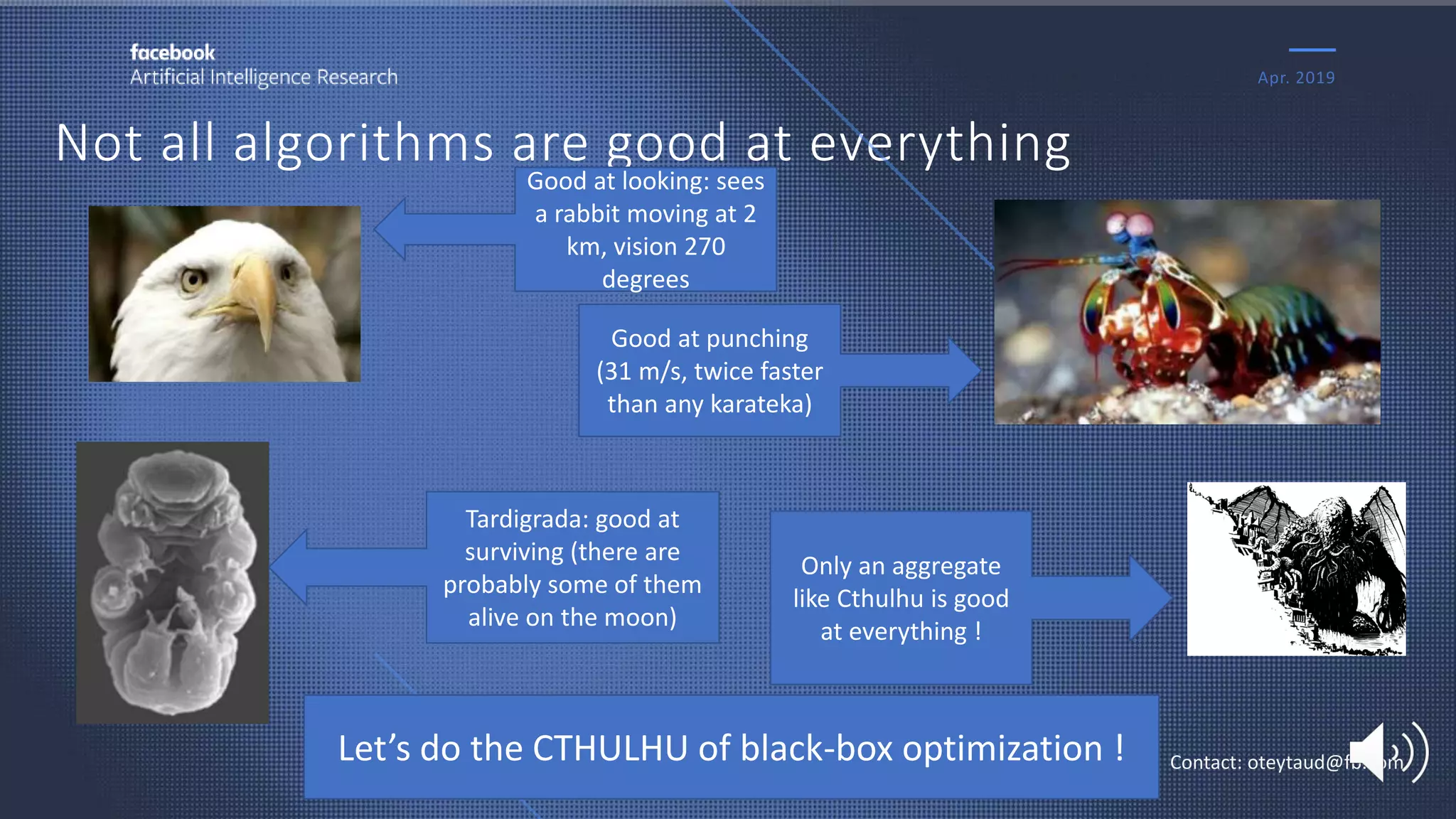
Not all algorithms are good at everything
Apr. 2019
Contact: oteytaud@fb.com
Good at punching
(31 m/s, twice faster
than any karateka)
Good at looking: sees
a rabbit moving at 2
km, vision 270
degrees
Tardigrada: good at
surviving (there are
probably some of them
alive on the moon)
Only an aggregate
like Cthulhu is good
at everything !
Let’s do the CTHULHU of black-box optimization !
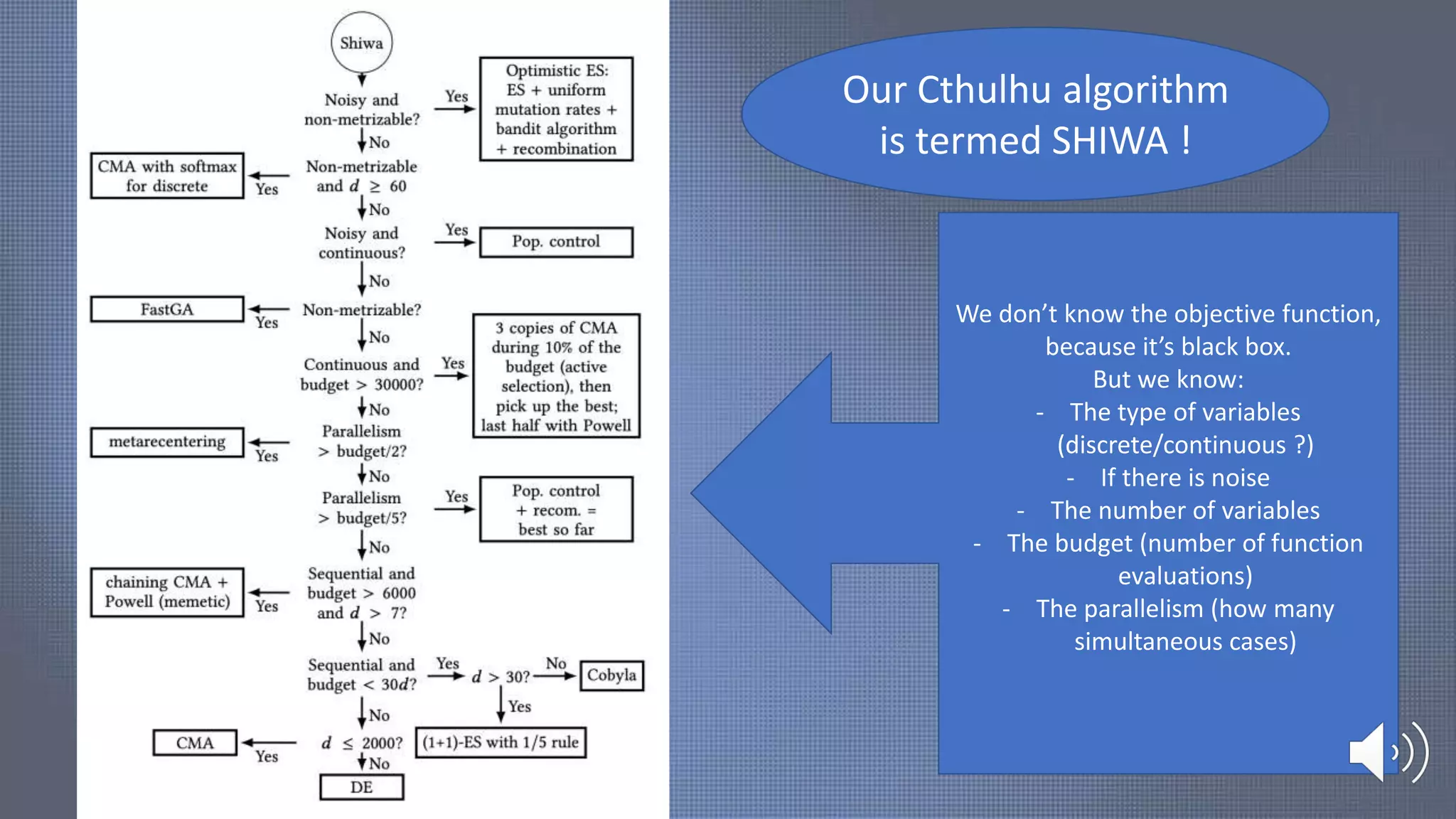
We don’t know the objective function,
because it’s black box.
But we know:
- The type of variables
(discrete/continuous ?)
- If there is noise
- The number of variables
- The budget (number of function
evaluations)
- The parallelism (how many
simultaneous cases)
Our Cthulhu algorithm
is termed SHIWA !
You helped us so
much! A very
collective Cthulhu.
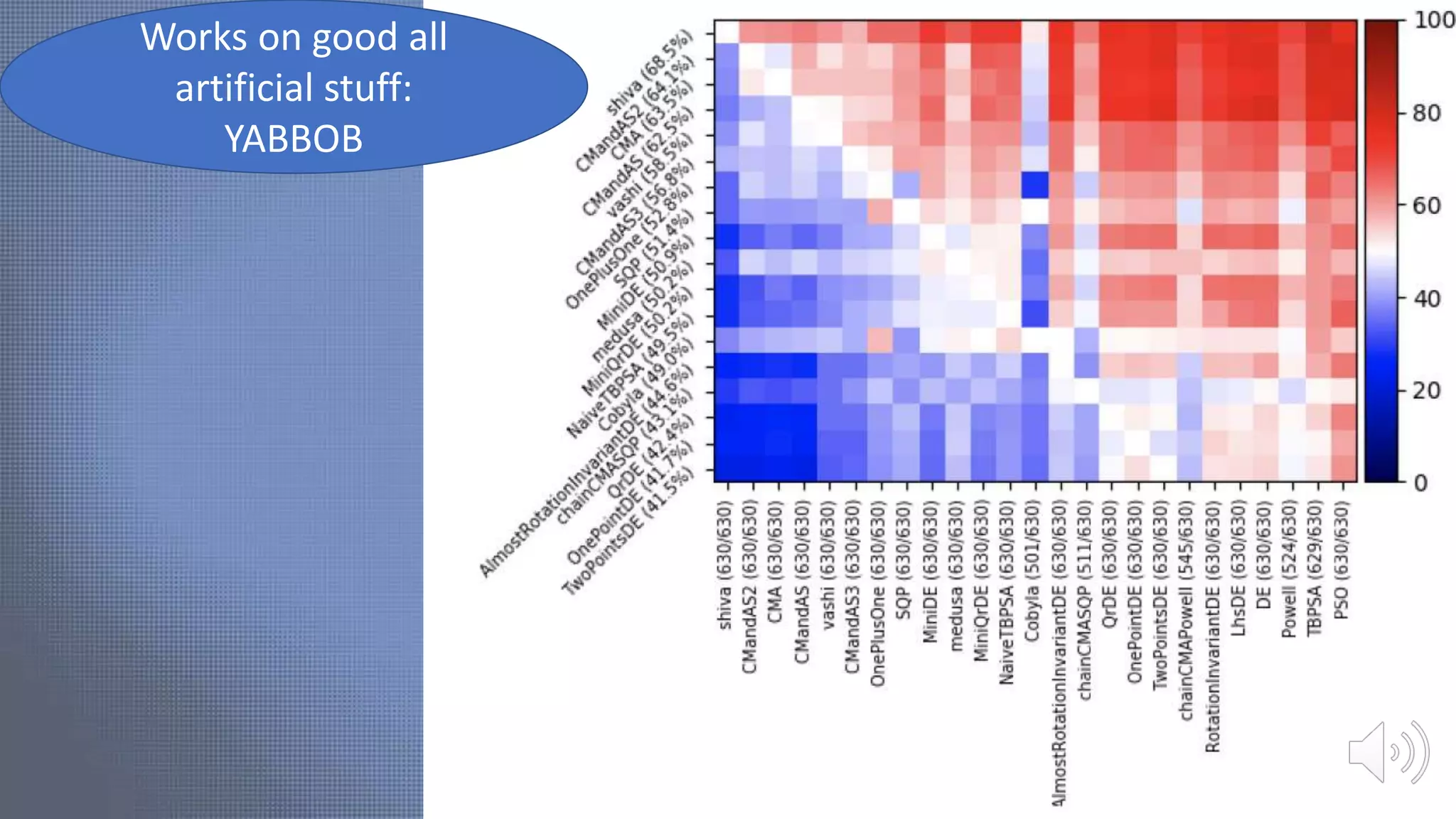
Works on good all
artificial stuff:
YABBOB
Works on Real World
stuff: Nevergrad’s
various benchmarks
A very simple idea: automatize and
systematize the work of a scientist
deciding which method should be
applied on which test case.
Works on noisy-free or noisy cases.
Works on continuous or discrete.
Sequential or parallel.
A unified test on a stable, generic, big
platform (dozens of experiments, see paper):
NEVERGRAD (python, open source on
github, maintained, readable!)
Join us: Facebook group
”Nevergrad Users”  I’m pretty
sure your algorithm can help
Shiwa.
Join us: Facebook
group ”Nevergrad
Users”  I’m pretty
sure your algorithm
can help Shiwa.
He is quite gentle
actually, don’t be
scared!
Cthulhu,
illustration de Sofyan Syarief, Wikipedia
I can help you,
my friend

Versatile Black-box Optimization

  • 1.
    Open scalable genericZero learning: Polygames @ FB. Tristan Cazenave, Univ. Dauphine Yen-Chi Chen, National Taiwan Normal University Guan-Wei Chen, National Dong Hwa University Shi-Yu Chen, National Dong Hwa University Xian-Dong Chiu, National Dong Hwa University Julien Dehos, Univ. Littoral Cote d’Opale Maria Elsa, National Dong Hwa University Qucheng Gong, Facebook AI Research Hengyuan Hu, Facebook AI Research Vasil Khalidov, Facebook AI Research Chen-Ling Li, National Dong Hwa University Hsin-I Lin, National Dong Hwa University Yu-Jin Lin, National Dong Hwa University . 2019 Contact: oteytaud@fb.com Xavier Martinet, Facebook AI Research Vegard Mella, Facebook AI Research Jeremy Rapin, Facebook AI Research Baptiste Roziere, Facebook AI Research Gabriel Synnaeve, Facebook AI Research Fabien Teytaud, Univ. Littoral Cote d’Opale Olivier Teytaud, Facebook AI Research Shi-Cheng Ye, National Dong Hwa University Yi-Jun Ye, National Dong Hwa University Shi-Jim Yen, National Dong Hwa University Sergey Zagoruyko, Facebook AI Research
  • 2.
    Not all algorithmsare good at everything Apr. 2019 Contact: oteytaud@fb.com Good at punching (31 m/s, twice faster than any karateka) Good at looking: sees a rabbit moving at 2 km, vision 270 degrees Tardigrada: good at surviving (there are probably some of them alive on the moon) Only an aggregate like Cthulhu is good at everything ! Let’s do the CTHULHU of black-box optimization !
  • 3.
    We don’t knowthe objective function, because it’s black box. But we know: - The type of variables (discrete/continuous ?) - If there is noise - The number of variables - The budget (number of function evaluations) - The parallelism (how many simultaneous cases) Our Cthulhu algorithm is termed SHIWA !
  • 4.
    You helped usso much! A very collective Cthulhu.
  • 5.
    Works on goodall artificial stuff: YABBOB
  • 6.
    Works on RealWorld stuff: Nevergrad’s various benchmarks
  • 7.
    A very simpleidea: automatize and systematize the work of a scientist deciding which method should be applied on which test case. Works on noisy-free or noisy cases. Works on continuous or discrete. Sequential or parallel. A unified test on a stable, generic, big platform (dozens of experiments, see paper): NEVERGRAD (python, open source on github, maintained, readable!) Join us: Facebook group ”Nevergrad Users”  I’m pretty sure your algorithm can help Shiwa.
  • 8.
    Join us: Facebook group”Nevergrad Users”  I’m pretty sure your algorithm can help Shiwa. He is quite gentle actually, don’t be scared! Cthulhu, illustration de Sofyan Syarief, Wikipedia I can help you, my friend