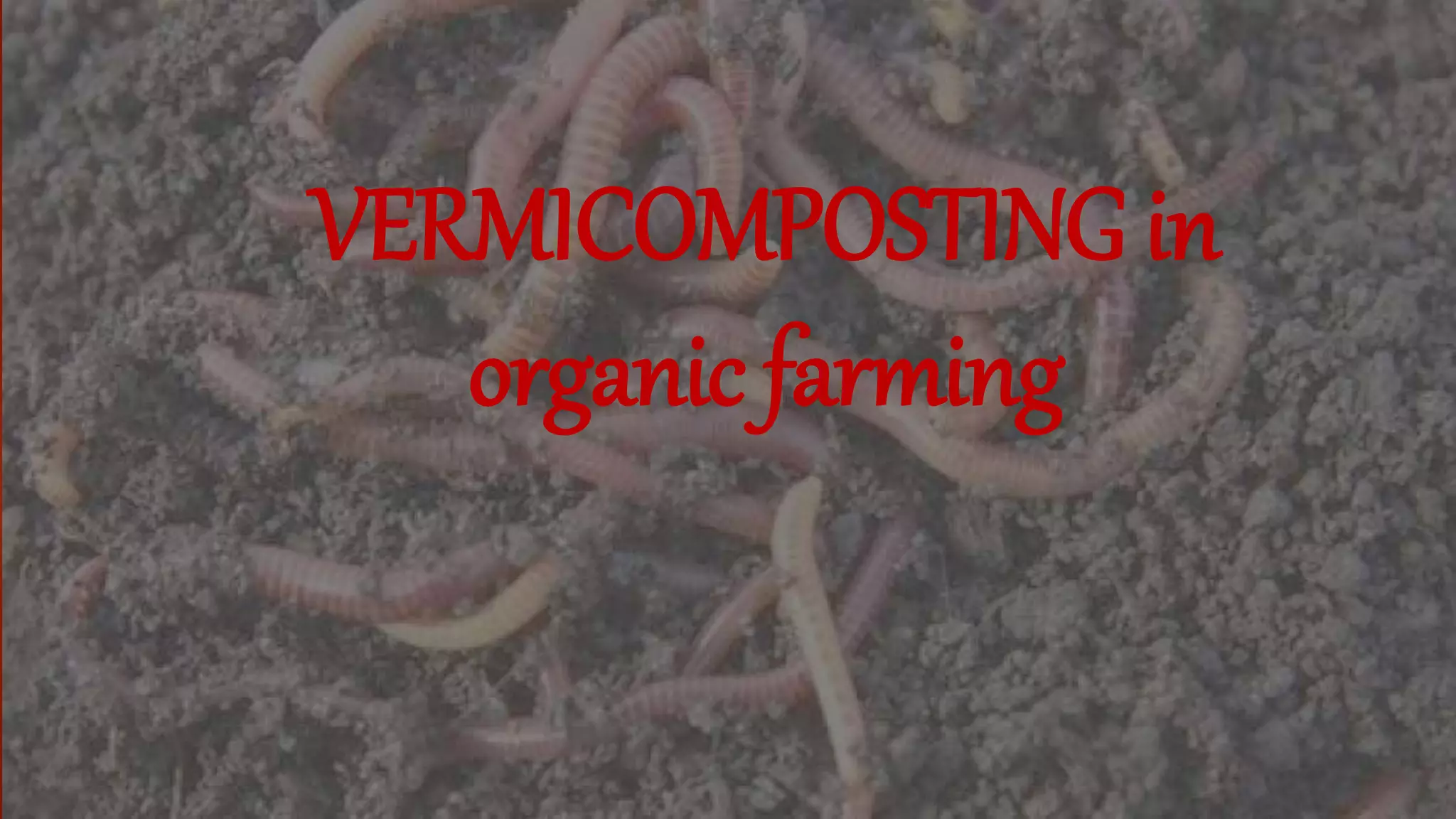
VERMICOMPOSTING in
organic farming
Submitted by- Tushar Kumbhani
Roll no.- 44
Reg. no.- 5010518005
Subject- Agron 6.9
Submitted to- Dr. T C Poonia
(Assistant Professor)
Department of Agronomy
College of Agriculture,
Junagadh Agricultural University,
Mota-bhandariya (Amreli)
Definition
 Vermicomposting is a simple biotechnological process of composting, in
which certain species of earthworms are used to enhance the process of waste
conversion and produce a better product.
 Vermicomposting is a method of preparing enriched compost with the
use of earthworms. It is one of the easiest methods to recycle
agricultural wastes and to produce quality compost.
INTRODUCTION
Vermis = worm, cultura = growth
Vermicomposting is a method of making compost with the use of
earthworms, which generally live in soil, eat biomass and excrete it in
digested form.
The end product of vermicomposting is vermicompost.
It contains N (1.2-1.6%), P₂O₅(1.8-2.0%) & K₂O (0.50.75%) • Earthworm
consume large quantities of organic matter and excrete soil as cast.
VERMICULTURE: A Scientific method of breeding and raising
earthworms in controlled condition.
EARTHWORMS
 Species of earth worms used for
vermicomposting in India:
 Eisenia foetida
 Erudrilus evegeniae
 Earthworm is physically an aerator, crusher, mixer, chemically
a degrader and biologically a stimulator in the decomposer
system.
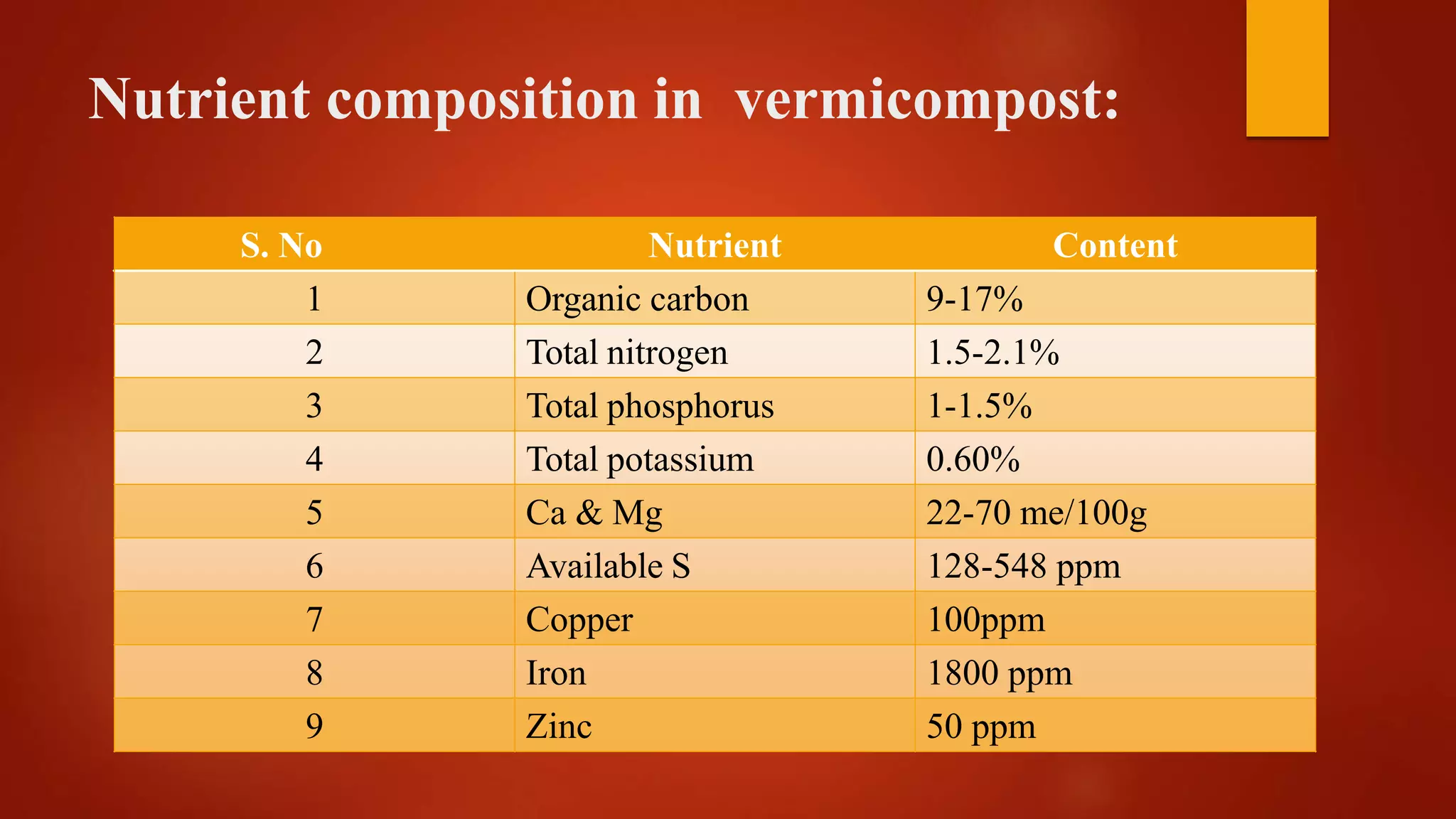
Nutrient composition in vermicompost:
S. No Nutrient Content
1 Organic carbon 9-17%
2 Total nitrogen 1.5-2.1%
3 Total phosphorus 1-1.5%
4 Total potassium 0.60%
5 Ca & Mg 22-70 me/100g
6 Available S 128-548 ppm
7 Copper 100ppm
8 Iron 1800 ppm
9 Zinc 50 ppm
Favourable conditions of Earthworms in
the composting materials
 pH range between 6.5-7.5 (Neutral)
 Moisture- 60-70%
 Aeration- 50%
 Temperature- 18°C-35°C
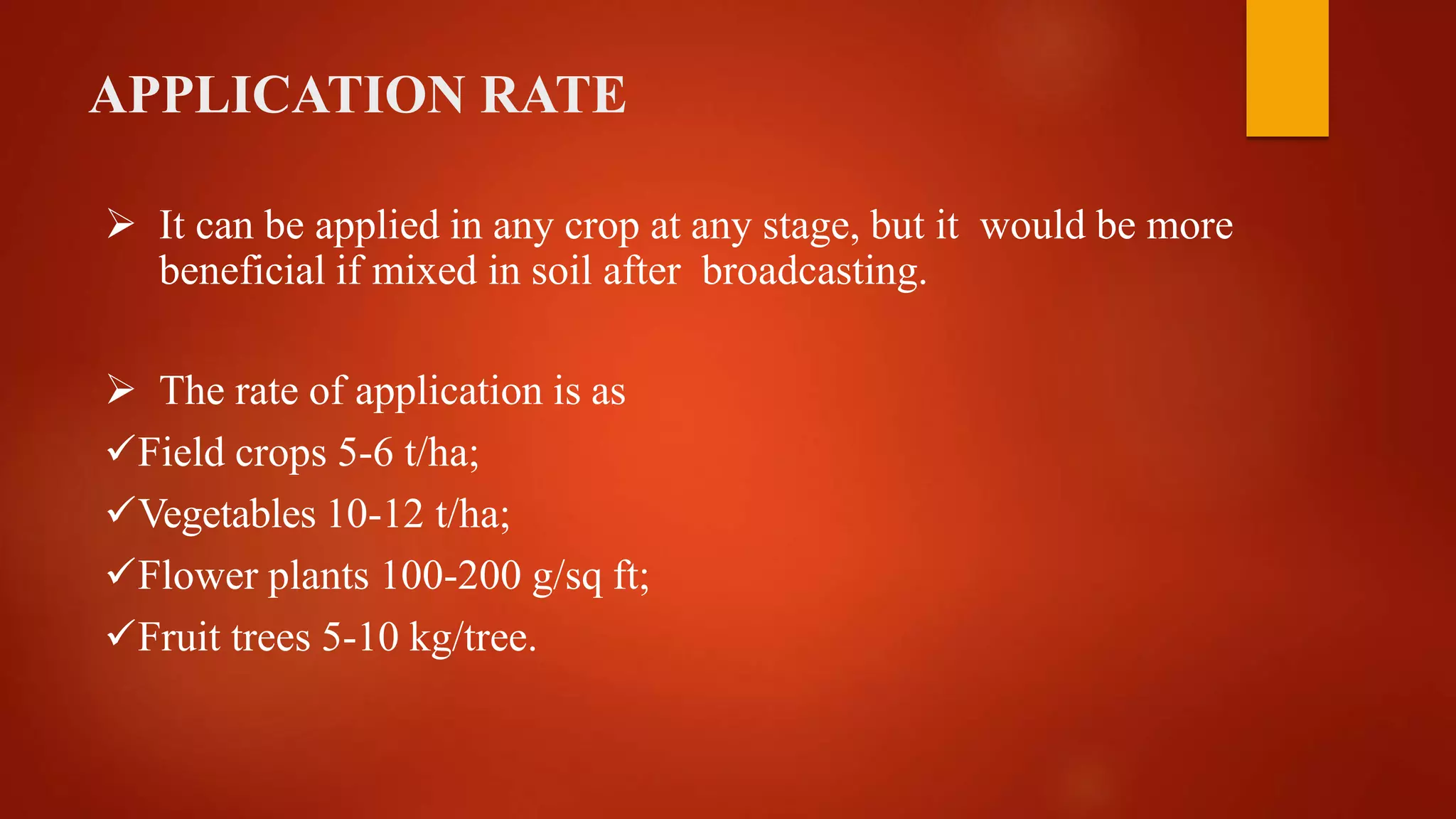
APPLICATION RATE
 It can be applied in any crop at any stage, but it would be more
beneficial if mixed in soil after broadcasting.
 The rate of application is as
Field crops 5-6 t/ha;
Vegetables 10-12 t/ha;
Flower plants 100-200 g/sq ft;
Fruit trees 5-10 kg/tree.
ADVANTAGES
 Vermicompost is a rich source of nutrients, vitamins, enzymes, antibiotics and
growth hormones. So it gives disease resistance to plants.
 Nutrient content of vermicompost is higher than traditional composts.
 It is a valuable soil amendment.
 Vermicompost harbors certain microbial populations that help in N fixation
and Psolubilization.
 Its application enhances nodulation in legumes and symbiotic mycorrhizal
associations with the roots.
Cont.…
 Superiority of vermicompost over other synthetic growth media is
more pronounced in plant nurseries.
 It can be used as rooting medium and for establishment of saplings in
nurseries.
 It improves taste, lusture and keeping quality of the produce.
 It has immobilized enzymes like protease, lipase, amylase, cellulose and
chitinese which keep on their function of biodegradation of agricultural
residues in the soil so that further microbial attack is speeded up.
 It does not have foul odour as is associated with manures and
decaying organic wastes.
Vermicomposting

Vermicomposting

  • 2.
  • 3.
    Submitted by- TusharKumbhani Roll no.- 44 Reg. no.- 5010518005 Subject- Agron 6.9 Submitted to- Dr. T C Poonia (Assistant Professor) Department of Agronomy College of Agriculture, Junagadh Agricultural University, Mota-bhandariya (Amreli)
  • 4.
    Definition  Vermicomposting isa simple biotechnological process of composting, in which certain species of earthworms are used to enhance the process of waste conversion and produce a better product.  Vermicomposting is a method of preparing enriched compost with the use of earthworms. It is one of the easiest methods to recycle agricultural wastes and to produce quality compost.
  • 5.
    INTRODUCTION Vermis = worm,cultura = growth Vermicomposting is a method of making compost with the use of earthworms, which generally live in soil, eat biomass and excrete it in digested form. The end product of vermicomposting is vermicompost. It contains N (1.2-1.6%), P₂O₅(1.8-2.0%) & K₂O (0.50.75%) • Earthworm consume large quantities of organic matter and excrete soil as cast. VERMICULTURE: A Scientific method of breeding and raising earthworms in controlled condition.
  • 6.
    EARTHWORMS  Species ofearth worms used for vermicomposting in India:  Eisenia foetida  Erudrilus evegeniae
  • 7.
     Earthworm isphysically an aerator, crusher, mixer, chemically a degrader and biologically a stimulator in the decomposer system.
  • 8.
    Nutrient composition invermicompost: S. No Nutrient Content 1 Organic carbon 9-17% 2 Total nitrogen 1.5-2.1% 3 Total phosphorus 1-1.5% 4 Total potassium 0.60% 5 Ca & Mg 22-70 me/100g 6 Available S 128-548 ppm 7 Copper 100ppm 8 Iron 1800 ppm 9 Zinc 50 ppm
  • 9.
    Favourable conditions ofEarthworms in the composting materials  pH range between 6.5-7.5 (Neutral)  Moisture- 60-70%  Aeration- 50%  Temperature- 18°C-35°C
  • 10.
    APPLICATION RATE  Itcan be applied in any crop at any stage, but it would be more beneficial if mixed in soil after broadcasting.  The rate of application is as Field crops 5-6 t/ha; Vegetables 10-12 t/ha; Flower plants 100-200 g/sq ft; Fruit trees 5-10 kg/tree.
  • 11.
    ADVANTAGES  Vermicompost isa rich source of nutrients, vitamins, enzymes, antibiotics and growth hormones. So it gives disease resistance to plants.  Nutrient content of vermicompost is higher than traditional composts.  It is a valuable soil amendment.  Vermicompost harbors certain microbial populations that help in N fixation and Psolubilization.  Its application enhances nodulation in legumes and symbiotic mycorrhizal associations with the roots.
  • 12.
    Cont.…  Superiority ofvermicompost over other synthetic growth media is more pronounced in plant nurseries.  It can be used as rooting medium and for establishment of saplings in nurseries.  It improves taste, lusture and keeping quality of the produce.  It has immobilized enzymes like protease, lipase, amylase, cellulose and chitinese which keep on their function of biodegradation of agricultural residues in the soil so that further microbial attack is speeded up.  It does not have foul odour as is associated with manures and decaying organic wastes.