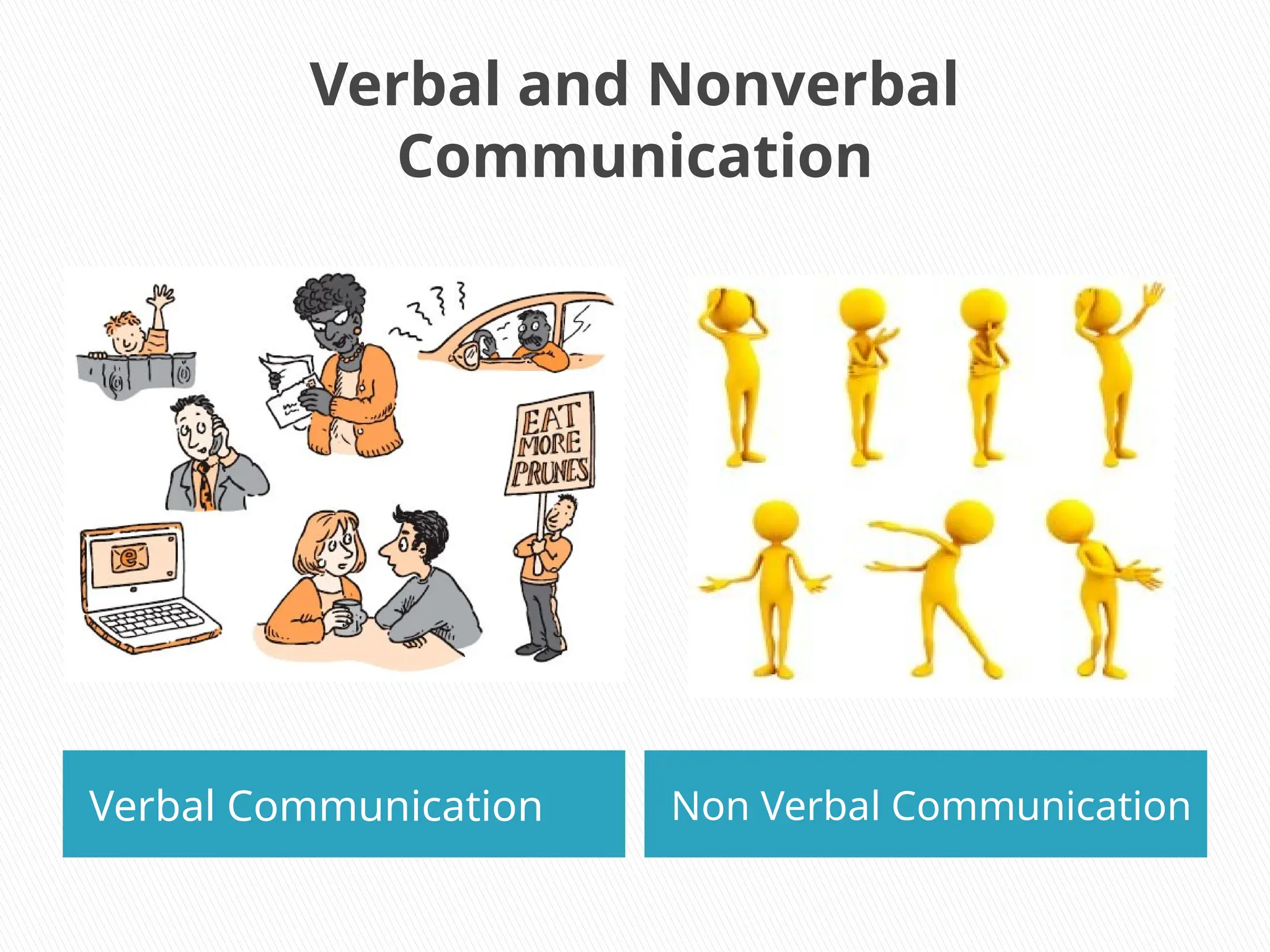
Two Essential Tools
🞂Verbal Communication – How you use
words and language
🞂 Nonverbal Communication – Message
components other than words that
generate meaning
5.
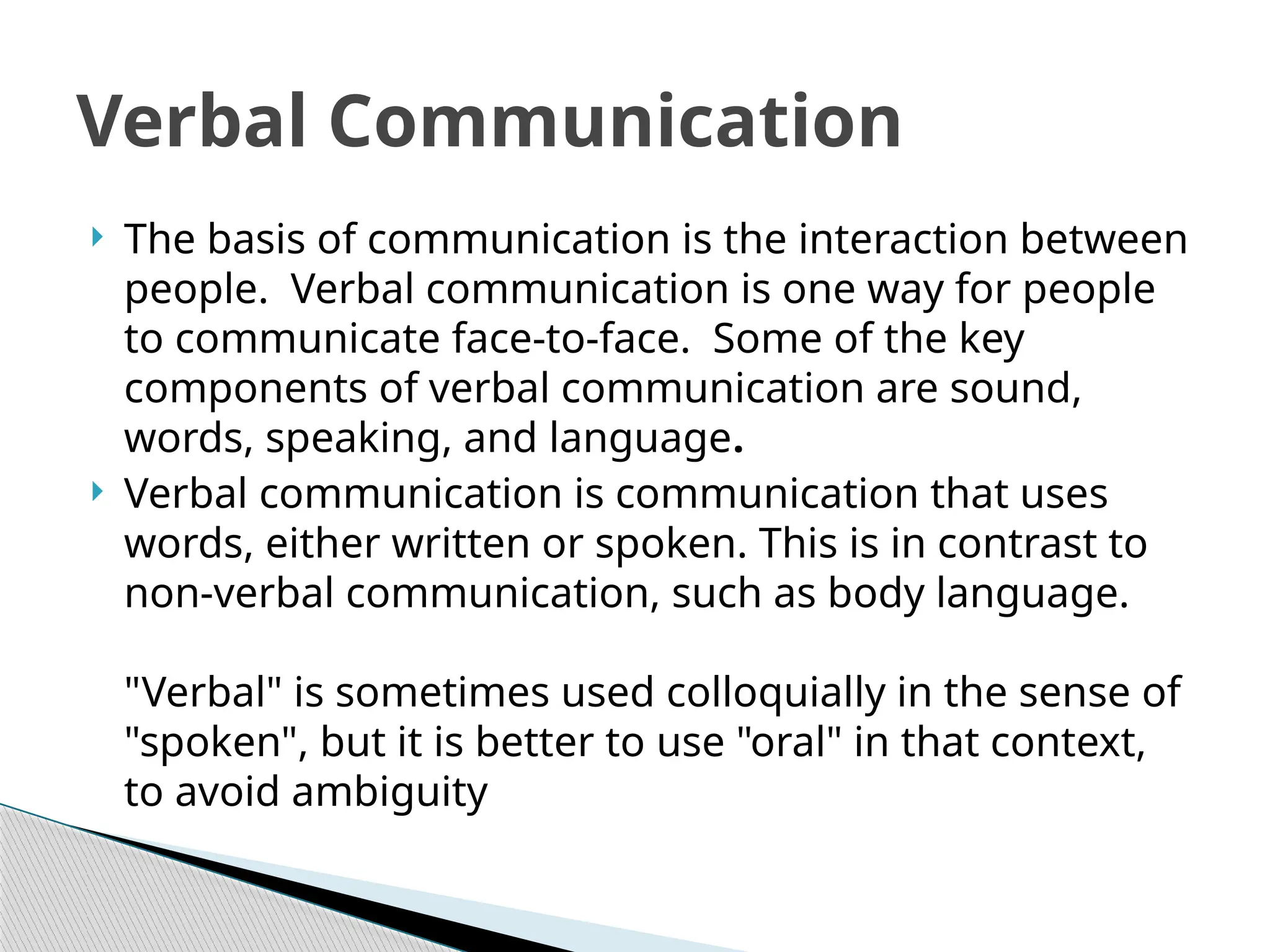
The basisof communication is the interaction between
people. Verbal communication is one way for people
to communicate face-to-face. Some of the key
components of verbal communication are sound,
words, speaking, and language.
Verbal communication is communication that uses
words, either written or spoken. This is in contrast to
non-verbal communication, such as body language.
"Verbal" is sometimes used colloquially in the sense of
"spoken", but it is better to use "oral" in that context,
to avoid ambiguity
Verbal Communication
6.
Verbal communicationis an act of conveying
messages, information, ideas or feelings
through the use of words spoken or written
It consists of
Speaking
Listening
Writing
Reading
1. Verbal Communication
7.
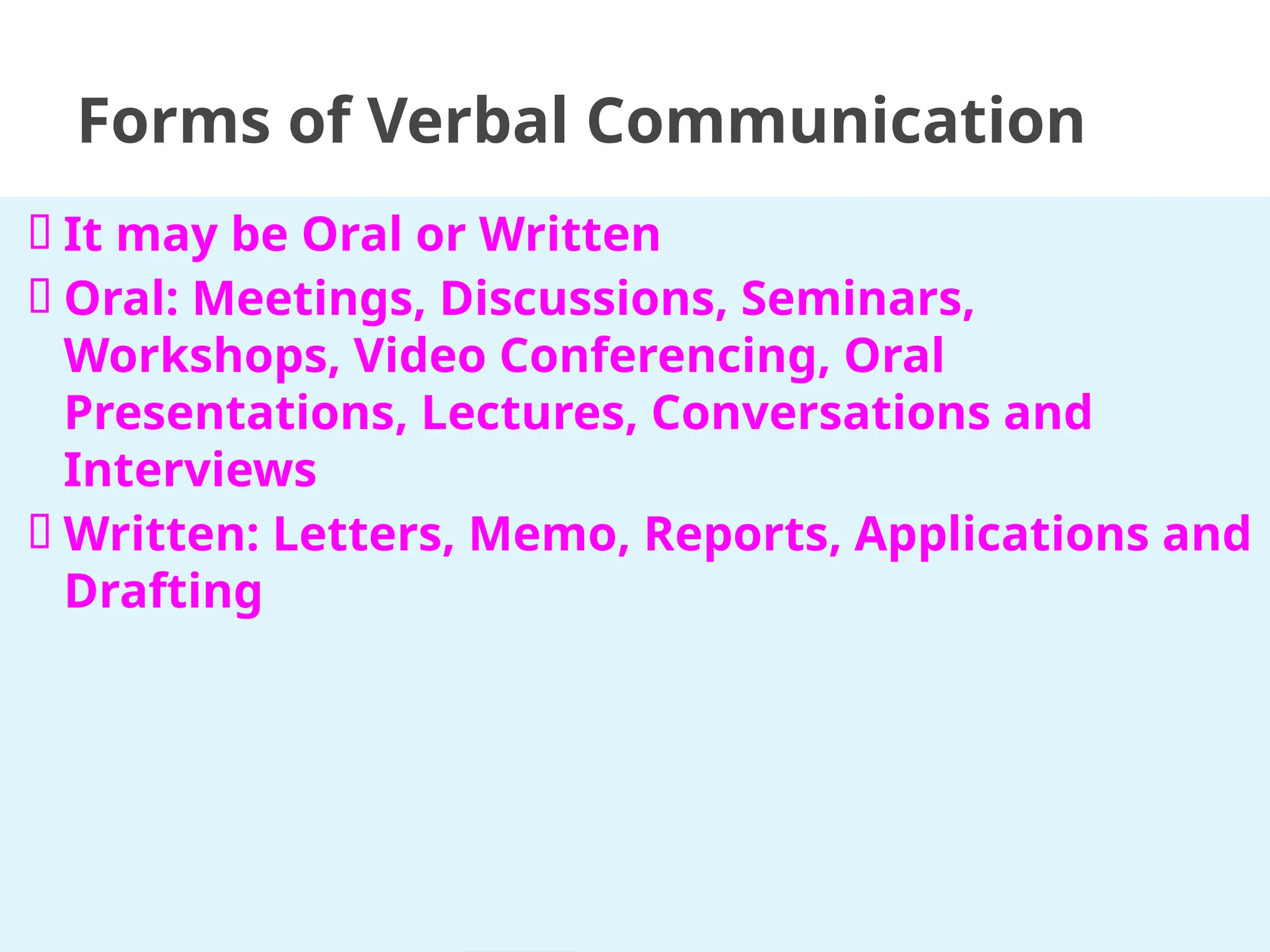
🞂 It maybe Oral or Written
🞂 Oral: Meetings, Discussions, Seminars,
Workshops, Video Conferencing, Oral
Presentations, Lectures, Conversations and
Interviews
🞂 Written: Letters, Memo, Reports, Applications and
Drafting
Forms of Verbal Communication
8.
Consider theobjective
Be sincere
Use simple language, familiar words
Be brief and precise
Assume nothing
Use polite words and tone
Say something interesting and pleasing
Characteristics of Effective Verbal
Communication
9.
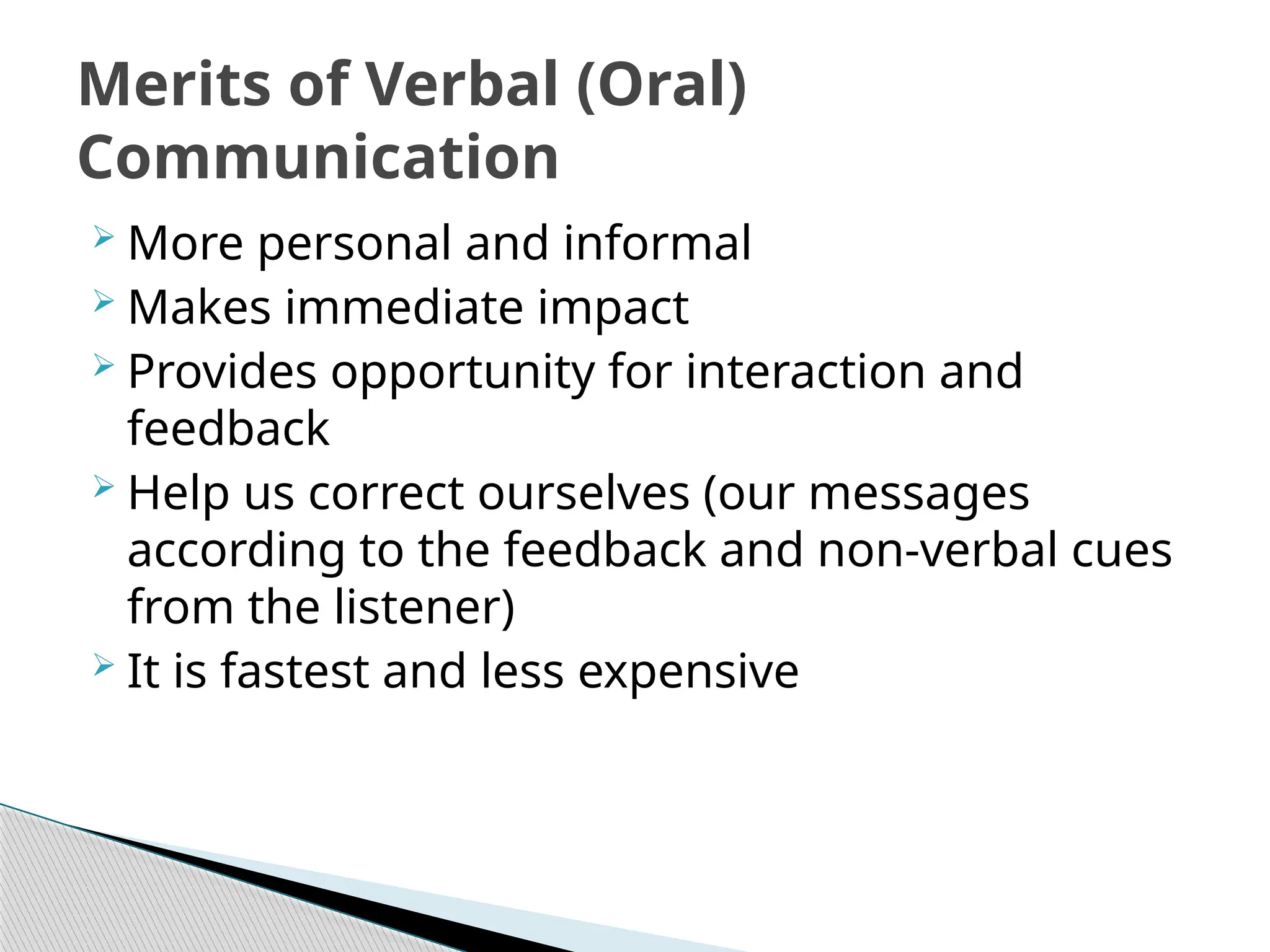
More personaland informal
Makes immediate impact
Provides opportunity for interaction and
feedback
Help us correct ourselves (our messages
according to the feedback and non-verbal cues
from the listener)
It is fastest and less expensive
Merits of Verbal (Oral)
Communication
10.
It canbe quickly forgotten
A word once uttered cannot be taken back
There is no legal evidence of oral
communication
Impact may be short lived
Very difficult to be conscious of our body
language
Demerits of Verbal Communication
11.
Nonverbal communicationis the process of
communication through sending and
receiving wordless (mostly visual) cues between
people
Transmission of messages by a medium other
than speech or writing
2. Nonverbal Communication
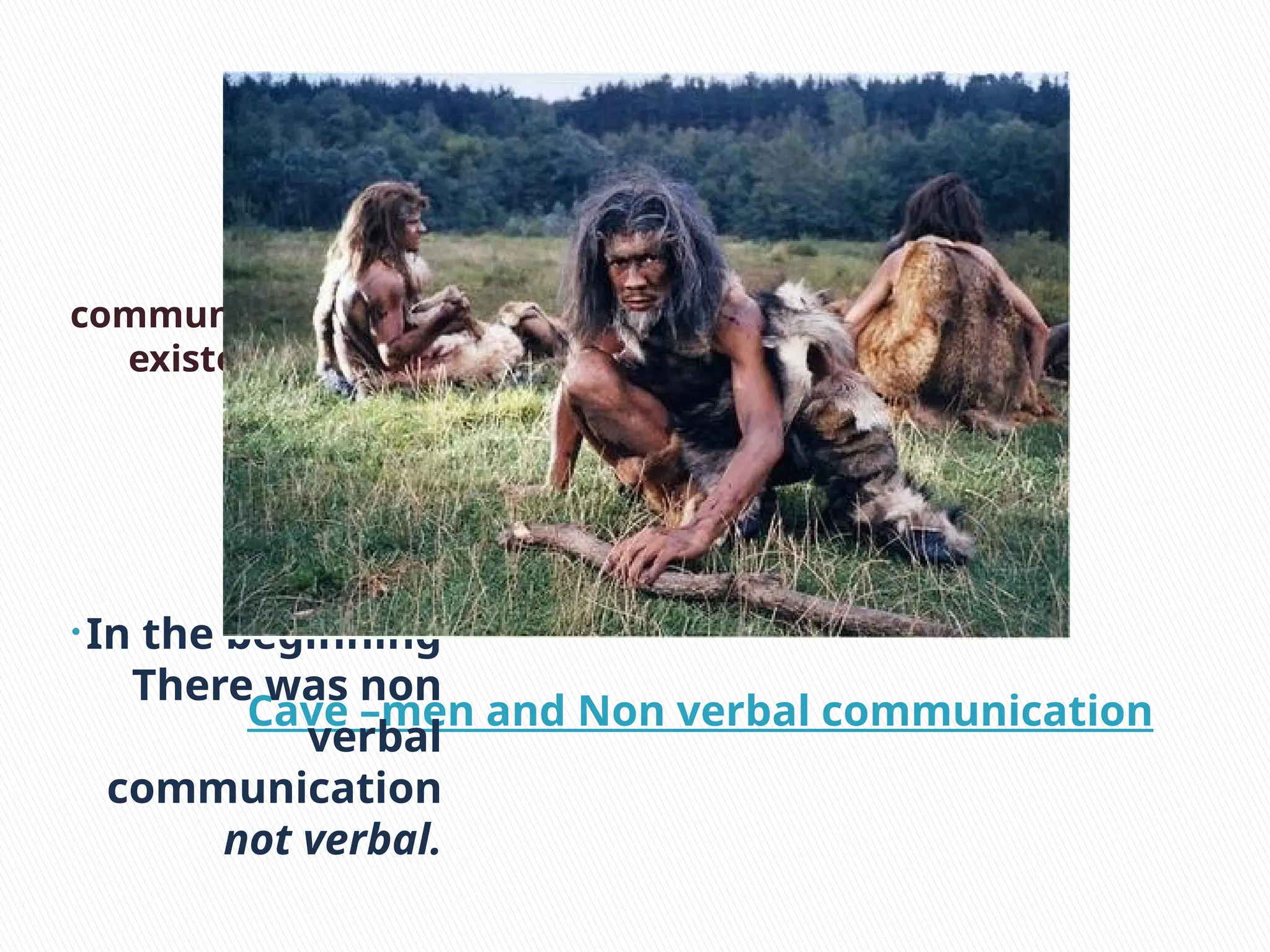
Cave –men andNon verbal communication
• Humans
communication has
existed for about
30,000 BC .
• In the beginning
There was non
verbal
communication
not verbal.
Nonverbal communicationinvolves those
nonverbal stimuli in a communication setting
that are generated by both the source [speaker]
and his or her use of the environment and that
have potential message value for the source or
receiver [listener]
Basically it is sending and receiving message in a
variety of ways without the use of verbal codes
(words). It is both intentional and unintentional.
Most speakers / listeners are not conscious of
this.
2. Nonverbal Communication
16.
A verygood example is: A man comes home late, hears
from the kitchen the slamming of pots and pans and
cupboard doors. He enters the kitchen, asks his wife
"What's wrong, honey?" She answers, "Nothing!" as she
slams another cupboard door and rolls her eyes toward
the ceiling.
She has spoken the word "Nothing", but it is her
unspoken communication that tells him that "nothing"
is not the real answer. It is clearly communicated by her
actions.
A truly effective communicator will train him or herself
in nonverbal communication as well as verbal and oral.
Example
17.
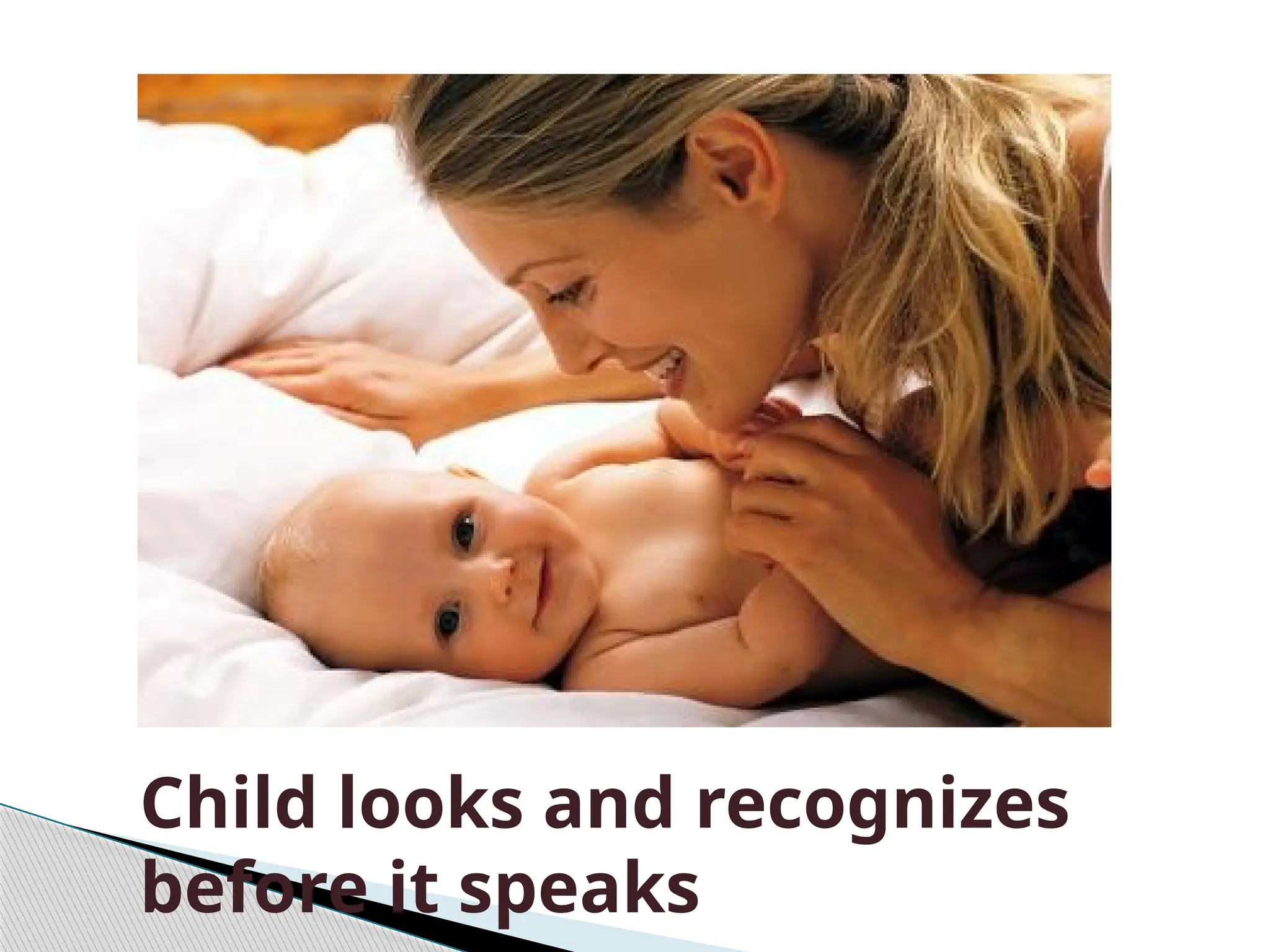
You cancommunicate with someone who is hard of
hearing of deaf
You can communicate at place where you are supposed
to maintain silence
You can communicate something which you don't want
others to hear or listen to
You can communicate if you are far away from a person.
The person can see but not hear you
Non-verbal communication makes conversation short
and brief
You can save on time and use it as a tool to communicate
with people who don't understand your language
Merits of Nonverbal Communication
18.
You cannot have long conversation
Can not discuss the particulars of your message
Difficult to understand and requires a lot of
repetitions.
Less influential and can not be used everywhere.
Not everybody prefers to communicate through
non-verbal communication.
Can not create an impression upon
people/listeners
Demerits of Nonverbal
Communication
19.
Sometimes nonverbalmessages contradict
verbal; Often express feelings more accurately
than the words spoken or written
Studies suggest that from 60-90% of a
message’s effect comes from nonverbal cues
Importance of Nonverbal
Communication
20.
Nonverbal Communicationconsists the
following three components
1. Appearance
2. Body Language
3. Silence, Time and Space
Components of Nonverbal
Communication
21.
Appearance conveysnonverbal impressions
that affect receiver's attitudes towards the
verbal messages
Appearance as a Nonverbal Communication
concept effects in following two ways
i. Effect on Written Messages
ii. Effect on Oral Messages
1. Appearance
22.
i. Effect onWritten Messages:
An envelope's appearance (Size, color, weight, postage)
may impress the receiver as important, routine or junk
mail
Mailgrams, Express mail and Pvt. Courier mail also have
distinctive envelopes that shows urgency and
importance
Letter, Report or Title Page communicates nonverbally
by the kind of paper used, its length, format and paper
used before its contents are read by the reader
Language itself communicates nonverbally and it must
be carefully worded and generally correct in mechanics
as spelling, grammar and punctuations
1. Appearance
23.
ii. Effect onOral Messages:
When you communicate face to face or to
a group in a meeting personal appearance
and appearance of your surroundings
convey nonverbal stimuli that affects
attitude towards your spoken words
It consists of the following two
appearances
1. Personal Appearance
2. Appearance by Surroundings
1. Appearance
24.
• Personal Appearance
Clothing, hairstyles, neatness, jewelry,
cosmetics, posture, stature are part of
personal appearance
They convey impressions regarding
occupation, age, nationality, social and
economic level, job status and good or
poor judgment, depending on
circumstances
1. Appearance
25.
• Appearance bySurroundings
Aspects of surroundings including room
size, location, furnishings, machines,
architecture, wall decorations, floor,
lightening, windows, views and other
related features wherever people
communicate orally
Surroundings will vary according to status
and according to country and culture
1. Appearance
Definition:
“The conscious andunconscious movements and
postures by which attitudes and feelings are communicated, is
called body language”.
Body language can also vary depending on the culture.
There are a set of universally recognized gestures but
many are influenced by our social settings
Body language may provide clues as to the attitude or
state of mind of a person. For example, it may indicate
aggression, attentiveness, boredom, a relaxed
state, pleasure, amusement, and intoxication
2. Body Language
28.
Body Languageconsists of the following four
components
i. Facial Expressions
ii. Gestures, Postures and Movement
iii. Smell and Touch
iv. Voice and Sounds
2. Body Language
29.
i. Facial Expressions:
It is said that face is the index of mind
Eyes and face are especially means of
communicating nonverbally and they can reveal
hidden emotions including anger, confusion,
fear, joy, surprise, uncertainty and others
Conventions of eye contact are specific to each
culture (e.g. In USA direct eye contact is
encouraged and eye drop or shift away from
listener is thought to be either shy, dishonest
and untrustworthy)
2. Body Language
30.
ii. Gestures, BodyPostures and Movement:
Gesture and Body Movements: A movement of part of
the body, especially a hand or the head, to express an
idea or meaning, is called Gestures
Gestures and body movements of a person reflects his
state of mind
One can be easily judged from the gestures and
movements either he is confident or nervous
Handshakes reveal attitude
Gestures may be warm or cold
2. Body Language
31.
Postures:
Postureis the position of a body while standing or sitting
The way a person stands, sits, leans or shift expresses his
interest in the matter under discussion
The posture of a person expresses his personality
An unbecoming and bad posture sends a bad signal
An interested listener may lean towards the speaker, and
one who is bored may lean away, slump or glances
towards the clock
2. Body Language
32.
iii. Smell andTouch:
If receiver is sensitive to scents then various
odors and fragrances convey the emotions of
the sender and affect the reactions of receiver
Touching people can communicate friendship,
love, approval, hatred, anger or other feelings
A mother’s kiss on cheek of her son, pat on a
shoulder or slap on the back is prompted by
various actions
2. Body Language
33.
iv. Voice andSounds:
Paralanguage: While speaking the extra sounds you make
and voice quality also a part of nonverbal communication
Paralanguage includes voice, volume, rate, articulation,
pitch and other sounds you make such as clearing and
sighing
Examples: A loud voice shows urgency and soft one is
something calming
Lack of pitch variation becomes monotone and too much
variation becomes artificial and dramatic
Throat clearing may distract from the words spoken
Emphasis on certain words in a sentence indicate the
importance of message
2. Body Language
34.
i. Silence:
Howsilence communicates?
Consider how do you feel when you make an
oral request that is met with silence
Think about the confusion you feel when your
written message generates no response
Example:
Please see the book (Page No. 26)
3. Time, Silence and Space
35.
ii. Time:
Inthe preceding example should you ask again?
How do you feel when you are kept waiting two hours
after the scheduled time for an interview?
In US culture being on time is to be considered
communicating nonverbally favorable
Concept of time varies across cultures
For Example: Americans and Germans are quite punctual
Middle eastern people think little to be on time in office
on agreed time, which shows that tasks will be
completed regardless of time
In Portugal, if you reach on time for a meeting then your
host will be wondered that why you came so early
3. Time, Silence and Space
36.
iii. Space:
Ifyou step into an empty elevator, where do you stand?
If elevator fills up with the people, where do you move?
Where do you stand when you communicate with your
boss, teacher, parents and friends?
The need for personal space decreases as the number of
people increases
In the USA, the need for the personal space between two
people is about 18 inches
The need for space is less in many middle eastern
countries and more in most Scandinavian countries
Example: See Book-Page No 26
3. Time, Silence and Space
Editor's Notes
#13 Human communication was revolutionized with speech approximately 200,000 years ago
hThe oldest known symbols created with the purpose of communication through time are the cave paintinge oldest known cave painting is that of the Chauvet Cave 30,000 BC. The oldest known symbols created with the purpose of communication through time are the cave painting







![ Nonverbal communication involves those
nonverbal stimuli in a communication setting
that are generated by both the source [speaker]
and his or her use of the environment and that
have potential message value for the source or
receiver [listener]
Basically it is sending and receiving message in a
variety of ways without the use of verbal codes
(words). It is both intentional and unintentional.
Most speakers / listeners are not conscious of
this.
2. Nonverbal Communication](https://image.slidesharecdn.com/1588538022-verbal-and-nonverbal-communication-250311073221-ab333275/75/Verbal-and-Non-verbal-communication-ppt-share-15-2048.jpg)