What Is a Verb? |
Definition, Types &
Examples
A verb is a word that describes what the subject of a sentence is
doing. Verbs can indicate (physical or mental) actions,
occurrences, and states of being.
• Examples: Verbs in a sentenceJeffrey builds a house.
• Anita is thinking about horses.
• True love exists.
Every sentence must have at least one verb. At the most basic
level, a sentence can consist solely of a single verb in the
imperative form (e.g., “Run.”). In this example, the implied subject
is “you.”
Verb conjugation
Verbs can change form depending on subject, tense, mood,
and voice. This is called conjugation.
Subject
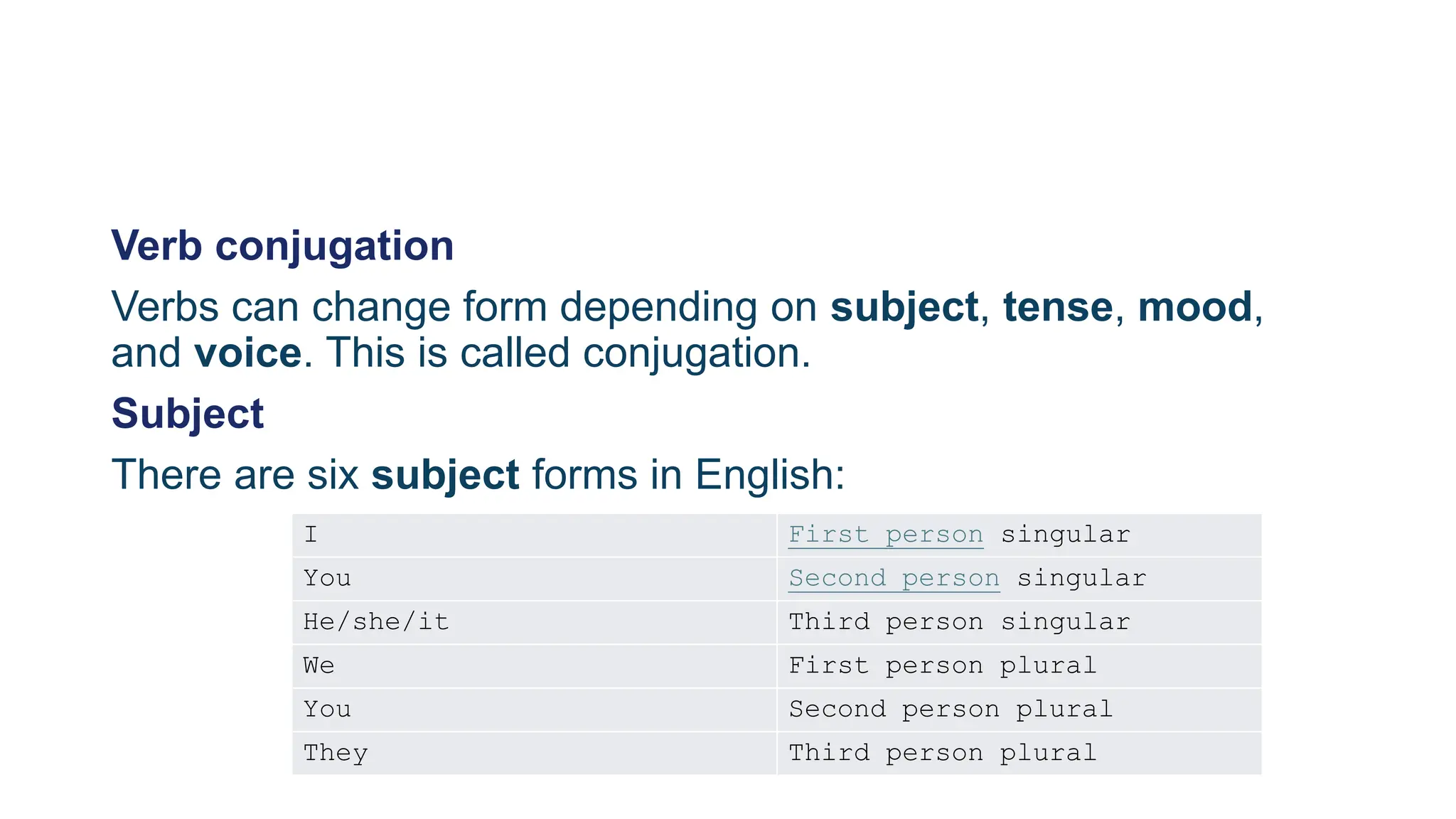
There are six subject forms in English:
I First person singular
You Second person singular
He/she/it Third person singular
We First person plural
You Second person plural
They Third person plural
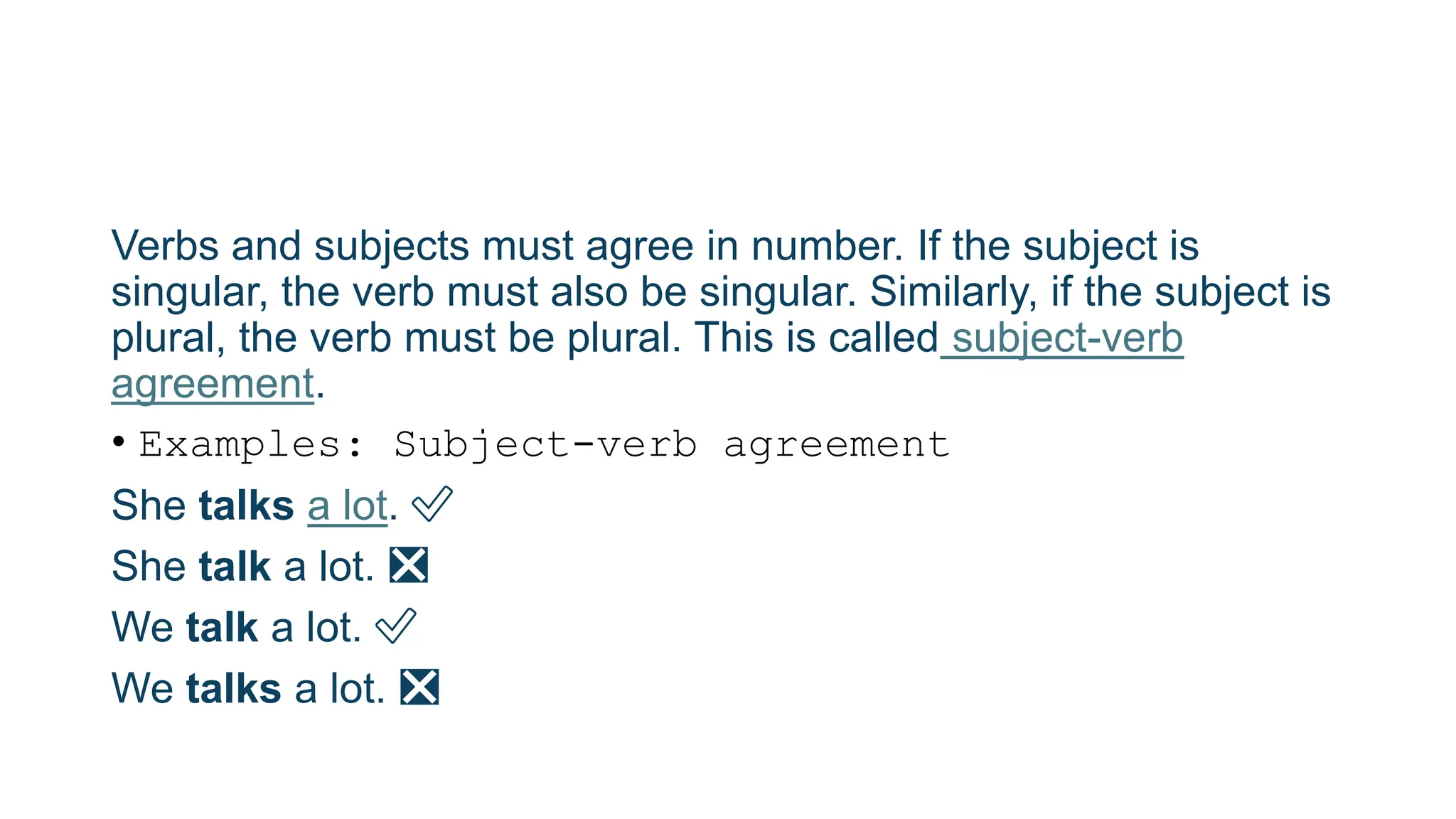
Verbs and subjects must agree in number. If the subject is
singular, the verb must also be singular. Similarly, if the subject is
plural, the verb must be plural. This is called subject-verb
agreement.
• Examples: Subject-verb agreement
She talks a lot. ✅
She talk a lot. ❎
We talk a lot. ✅
We talks a lot. ❎
Tense
Verbs are also conjugated based on tense. There are three main
tenses in English:
Past (an action has taken place)
Present (an action is taking place)
Future (an action will take place)
Each tense has a simple, progressive, perfect, and perfect
progressive aspect with its own rules for conjugation.
The forms a verb takes in each aspect depend on the subject and on
whether the verb is regular or irregular. Below is a table illustrating the
various forms the regular verb “look” takes in the first person singular
when conjugated.
• Active and passive voice
• Most sentences can use either the active or the passive voice.
An active sentence is one in which the subject performs the
action.
• Example: Active sentenceLucas broke a chair.
• A passive sentence is one in which the subject is acted upon.
Passive sentences are constructed using a form of the auxiliary
verb “be” (e.g., “was,” “is,” “were”) followed by the past participle
of the main verb (e.g., “eaten,” “taken”).
• Passive sentences are useful for emphasizing the outcome of
an action rather than the action itself.
• Example: Passive sentenceA chair was broken (by
Lucas).
• Participles
• Participles are formed from verbs. There are two types of
participles:
• Past participles are typically used in combination with an
auxiliary verb (e.g., “has,” “have,” “had”) for perfect tenses
(connecting a past action or event to a later time). Past
participles are typically formed by adding the suffix “-ed” (e.g.,
“worked”).
• Present participles are used for continuous tenses (describing
an action that is ongoing). They are formed by adding the suffix
“-ing” (e.g., “reading”).
• Participles are often used as adjectives (e.g., “running shoes”).
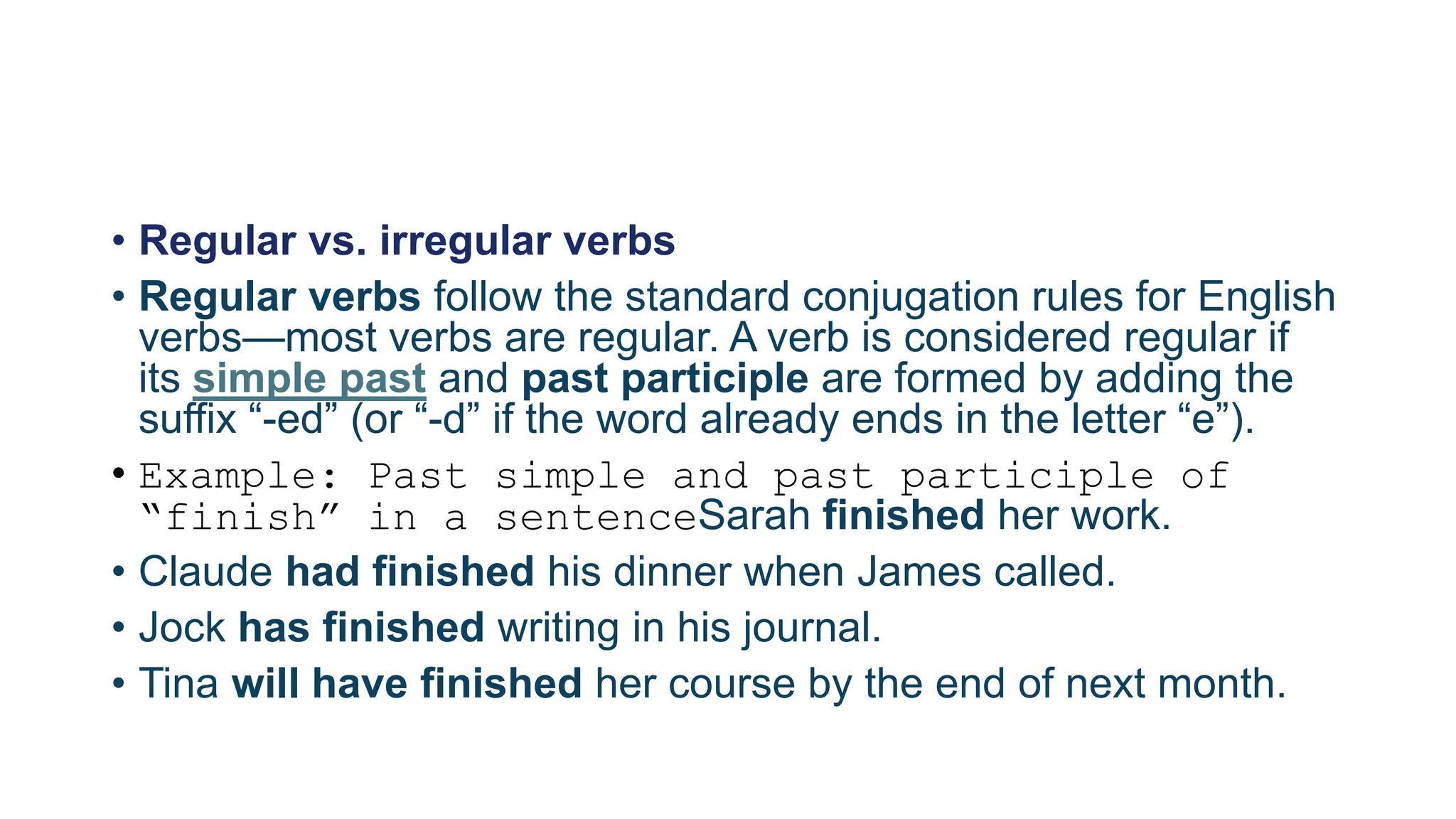
• Regular vs. irregular verbs
• Regular verbs follow the standard conjugation rules for English
verbs—most verbs are regular. A verb is considered regular if
its simple past and past participle are formed by adding the
suffix “-ed” (or “-d” if the word already ends in the letter “e”).
• Example: Past simple and past participle of
“finish” in a sentenceSarah finished her work.
• Claude had finished his dinner when James called.
• Jock has finished writing in his journal.
• Tina will have finished her course by the end of next month.
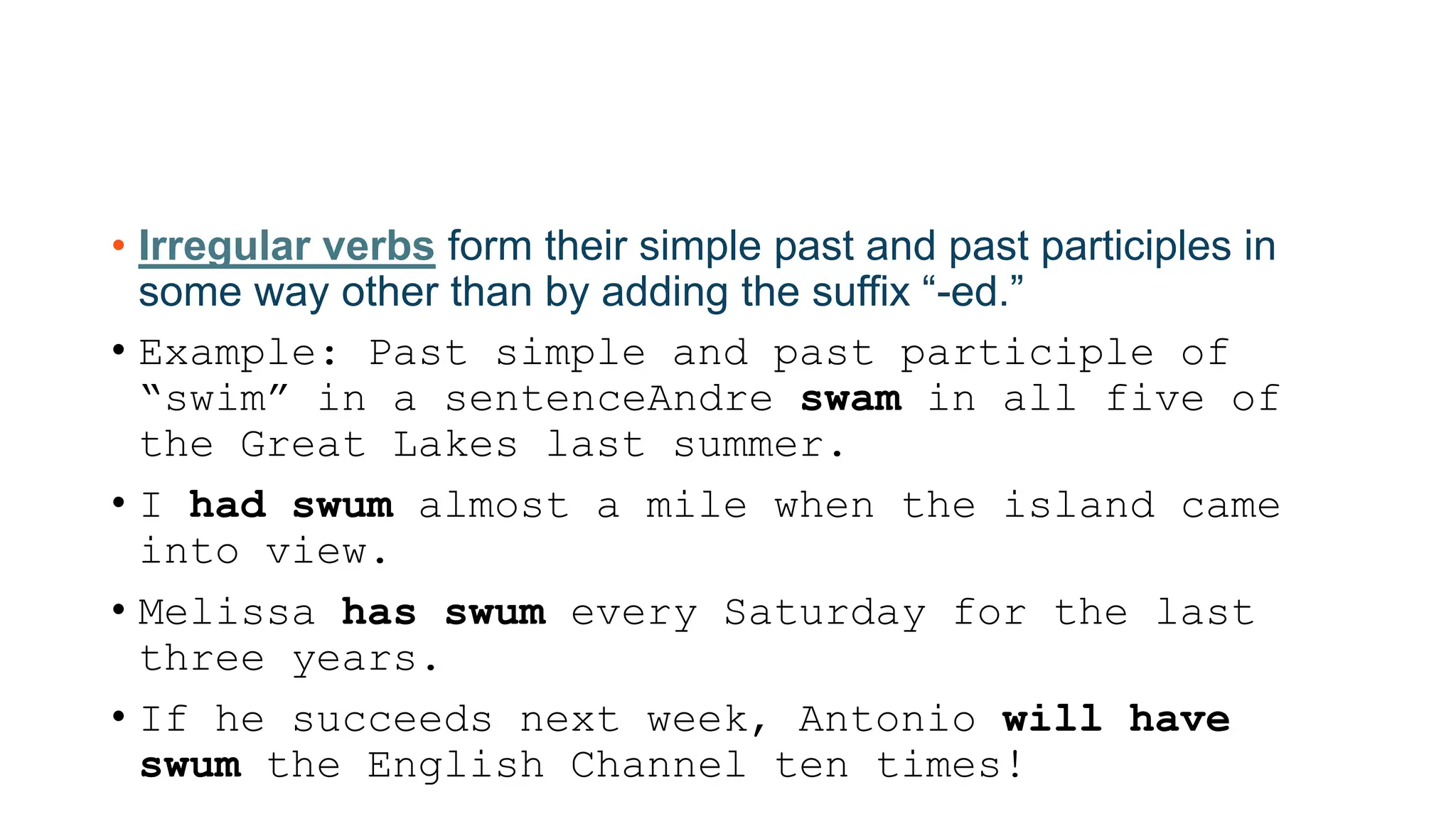
• Irregular verbs form their simple past and past participles in
some way other than by adding the suffix “-ed.”
• Example: Past simple and past participle of
“swim” in a sentenceAndre swam in all five of
the Great Lakes last summer.
• I had swum almost a mile when the island came
into view.
• Melissa has swum every Saturday for the last
three years.
• If he succeeds next week, Antonio will have
swum the English Channel ten times!
Verb- Definition, examples, types, sentences

Verb- Definition, examples, types, sentences

  • 1.
    What Is aVerb? | Definition, Types & Examples
  • 2.
    A verb isa word that describes what the subject of a sentence is doing. Verbs can indicate (physical or mental) actions, occurrences, and states of being. • Examples: Verbs in a sentenceJeffrey builds a house. • Anita is thinking about horses. • True love exists. Every sentence must have at least one verb. At the most basic level, a sentence can consist solely of a single verb in the imperative form (e.g., “Run.”). In this example, the implied subject is “you.”
  • 3.
    Verb conjugation Verbs canchange form depending on subject, tense, mood, and voice. This is called conjugation. Subject There are six subject forms in English: I First person singular You Second person singular He/she/it Third person singular We First person plural You Second person plural They Third person plural
  • 4.
    Verbs and subjectsmust agree in number. If the subject is singular, the verb must also be singular. Similarly, if the subject is plural, the verb must be plural. This is called subject-verb agreement. • Examples: Subject-verb agreement She talks a lot. ✅ She talk a lot. ❎ We talk a lot. ✅ We talks a lot. ❎
  • 5.
    Tense Verbs are alsoconjugated based on tense. There are three main tenses in English: Past (an action has taken place) Present (an action is taking place) Future (an action will take place) Each tense has a simple, progressive, perfect, and perfect progressive aspect with its own rules for conjugation. The forms a verb takes in each aspect depend on the subject and on whether the verb is regular or irregular. Below is a table illustrating the various forms the regular verb “look” takes in the first person singular when conjugated.
  • 6.
    • Active andpassive voice • Most sentences can use either the active or the passive voice. An active sentence is one in which the subject performs the action. • Example: Active sentenceLucas broke a chair.
  • 7.
    • A passivesentence is one in which the subject is acted upon. Passive sentences are constructed using a form of the auxiliary verb “be” (e.g., “was,” “is,” “were”) followed by the past participle of the main verb (e.g., “eaten,” “taken”). • Passive sentences are useful for emphasizing the outcome of an action rather than the action itself. • Example: Passive sentenceA chair was broken (by Lucas).
  • 8.
    • Participles • Participlesare formed from verbs. There are two types of participles: • Past participles are typically used in combination with an auxiliary verb (e.g., “has,” “have,” “had”) for perfect tenses (connecting a past action or event to a later time). Past participles are typically formed by adding the suffix “-ed” (e.g., “worked”). • Present participles are used for continuous tenses (describing an action that is ongoing). They are formed by adding the suffix “-ing” (e.g., “reading”). • Participles are often used as adjectives (e.g., “running shoes”).
  • 9.
    • Regular vs.irregular verbs • Regular verbs follow the standard conjugation rules for English verbs—most verbs are regular. A verb is considered regular if its simple past and past participle are formed by adding the suffix “-ed” (or “-d” if the word already ends in the letter “e”). • Example: Past simple and past participle of “finish” in a sentenceSarah finished her work. • Claude had finished his dinner when James called. • Jock has finished writing in his journal. • Tina will have finished her course by the end of next month.
  • 10.
    • Irregular verbsform their simple past and past participles in some way other than by adding the suffix “-ed.” • Example: Past simple and past participle of “swim” in a sentenceAndre swam in all five of the Great Lakes last summer. • I had swum almost a mile when the island came into view. • Melissa has swum every Saturday for the last three years. • If he succeeds next week, Antonio will have swum the English Channel ten times!