Entrepreneurship
 
Game

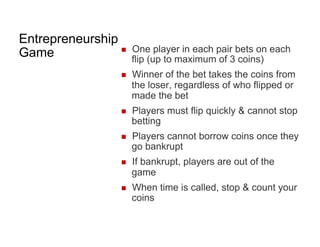
One player in each pair bets on each
flip (up to maximum of 3 coins)

 

Winner of the bet takes the coins from
the loser, regardless of who flipped or
made the bet

 

Players must flip quickly & cannot stop
betting

 

Players cannot borrow coins once they
go bankrupt

 

If bankrupt, players are out of the
game

 

When time is called, stop & count your
coins
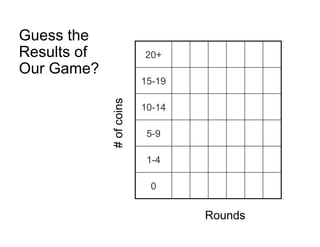
Guess the
Results of
Our Game?

20+

# of coins

15-19
10-14
5-9
1-4
0

Rounds
Why Did “X”
Do So
Well?
Why This
Outcome?

Given the structure of the game
and the equally high skill level,
human capital, and wealth of all
the players, a skewed distribution
was inevitable.
Why This
Outcome?

Given the structure of the game
and the equally high skill level,
human capital, and wealth of all
the players, a skewed distribution
was inevitable.

Winner
Take All!
Distribution of Firm Size (U.S.)

Number	
  of	
  F irms	
  (0 0 0 s)

3,000
2,500
2,000
1,500
1,000
500
0
2

7

15

60

300

Number	
  of	
  E mployees

500
Distribution of Corporate Assets (U.S.)

Assets (log scale)

10,000
1,000
100
10
1

0

100,000

200,000

300,000

0
Number of Firms

400,000

500,000
Things Would
Have Been
Different If
Players…

 

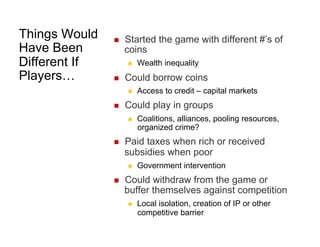
Started the game with different #’s of
coins
 

 

Could borrow coins
 

 

Coalitions, alliances, pooling resources,
organized crime?

Paid taxes when rich or received
subsidies when poor
 

 

Access to credit – capital markets

Could play in groups
 

 

Wealth inequality

Government intervention

Could withdraw from the game or
buffer themselves against competition
 

Local isolation, creation of IP or other
competitive barrier
Lessons

 

Baseline against which to judge
population level outcomes…
 

…In other words, don’t be too
arrogant or too judgmental!

 

There ARE “rules of the game”

 

Challenge: How to define,
manage or limit the scope of
competition?

Entrepreneurship Game at Venture Out Moldova, Fall 2013

  • 1.
    Entrepreneurship   Game One player ineach pair bets on each flip (up to maximum of 3 coins)   Winner of the bet takes the coins from the loser, regardless of who flipped or made the bet   Players must flip quickly & cannot stop betting   Players cannot borrow coins once they go bankrupt   If bankrupt, players are out of the game   When time is called, stop & count your coins
  • 2.
    Guess the Results of OurGame? 20+ # of coins 15-19 10-14 5-9 1-4 0 Rounds
  • 3.
  • 4.
    Why This Outcome? Given thestructure of the game and the equally high skill level, human capital, and wealth of all the players, a skewed distribution was inevitable.
  • 5.
    Why This Outcome? Given thestructure of the game and the equally high skill level, human capital, and wealth of all the players, a skewed distribution was inevitable. Winner Take All!
  • 6.
    Distribution of FirmSize (U.S.) Number  of  F irms  (0 0 0 s) 3,000 2,500 2,000 1,500 1,000 500 0 2 7 15 60 300 Number  of  E mployees 500
  • 7.
    Distribution of CorporateAssets (U.S.) Assets (log scale) 10,000 1,000 100 10 1 0 100,000 200,000 300,000 0 Number of Firms 400,000 500,000
  • 8.
    Things Would Have Been DifferentIf Players…   Started the game with different #’s of coins     Could borrow coins     Coalitions, alliances, pooling resources, organized crime? Paid taxes when rich or received subsidies when poor     Access to credit – capital markets Could play in groups     Wealth inequality Government intervention Could withdraw from the game or buffer themselves against competition   Local isolation, creation of IP or other competitive barrier
  • 9.
    Lessons   Baseline against whichto judge population level outcomes…   …In other words, don’t be too arrogant or too judgmental!   There ARE “rules of the game”   Challenge: How to define, manage or limit the scope of competition?