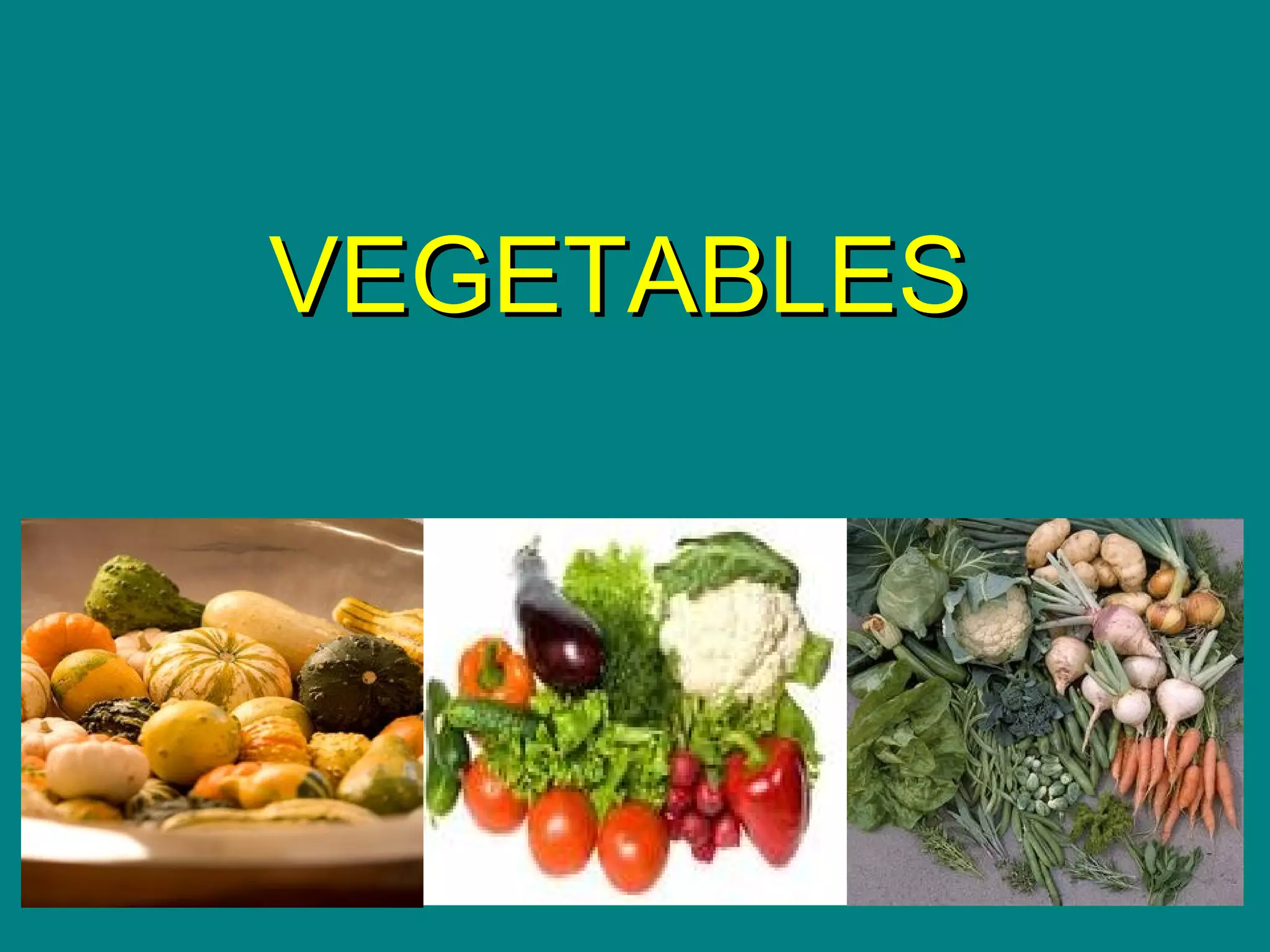
VEGETABLESVEGETABLES
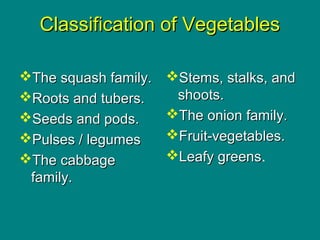
Classification of VegetablesClassification of Vegetables
The squash family.The squash family.
Roots and tubers.Roots and tubers.
Seeds and pods.Seeds and pods.
Pulses / legumesPulses / legumes
The cabbageThe cabbage
family.family.
Stems, stalks, andStems, stalks, and
shoots.shoots.
The onion family.The onion family.
Fruit-vegetables.Fruit-vegetables.
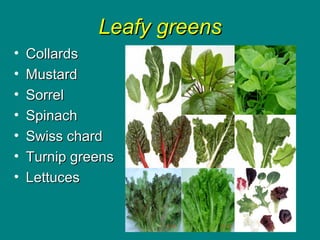
Leafy greensLeafy greens.
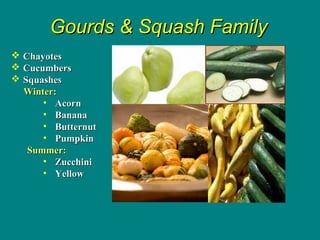
Gourds &Gourds & Squash FamilySquash Family
 ChayotesChayotes
 CucumbersCucumbers
 SquashesSquashes
Winter:Winter:
• AcornAcorn
• BananaBanana
• ButternutButternut
• PumpkinPumpkin
Summer:Summer:
• ZucchiniZucchini
• YellowYellow
ROOTS
Are those grown underground.Are those grown underground.
They are directly connected to the plant viaThey are directly connected to the plant via
leaves or leaf stem.leaves or leaf stem.
TUBERS
Are connected to the root system. However,Are connected to the root system. However,
they are not directly connected to the stemthey are not directly connected to the stem
and leaf system of plant.and leaf system of plant.
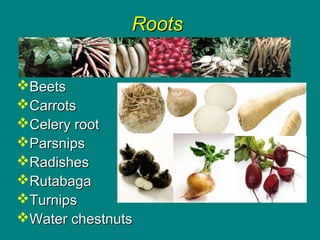
RootsRoots
BeetsBeets
CarrotsCarrots
Celery rootCelery root
ParsnipsParsnips
RadishesRadishes
RutabagaRutabaga
TurnipsTurnips
Water chestnutsWater chestnuts
Culinary Essentials
Copyright © Glencoe/McGraw-Hill,
a division of The McGraw-Hill Companies, Inc.
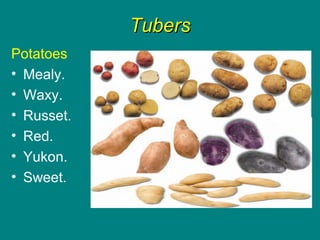
TubersTubers
Potatoes
• Mealy.
• Waxy.
• Russet.
• Red.
• Yukon.
• Sweet.
Culinary Essentials
Copyright © Glencoe/McGraw-Hill,
a division of The McGraw-Hill Companies, Inc.
Quality Characteristics
of Potatoes
All varieties of potatoes should be heavyAll varieties of potatoes should be heavy
and firm, without soft spots, green color, orand firm, without soft spots, green color, or
sprouting eyes.sprouting eyes.
Sweet potatoes should have dry-looking,Sweet potatoes should have dry-looking,
orange and golden-orange skins. Avoidorange and golden-orange skins. Avoid
sweet potatoes with softened ends. Thissweet potatoes with softened ends. This
marks the beginning of spoilage.marks the beginning of spoilage.
Other potatoes should have dry, tightOther potatoes should have dry, tight
skins, without wrinkles.skins, without wrinkles.
Culinary Essentials
Copyright © Glencoe/McGraw-Hill,
a division of The McGraw-Hill Companies, Inc.
Market Forms of Potatoes
Fresh.Fresh.
Canned.Canned.
Frozen.Frozen.
Dehydrated.Dehydrated.
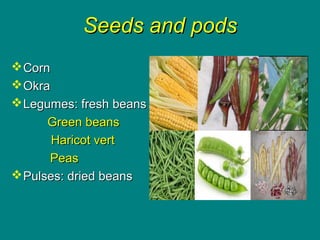
Seeds and podsSeeds and pods
CornCorn
OkraOkra
Legumes: fresh beansLegumes: fresh beans
Green beansGreen beans
Haricot vertHaricot vert
PeasPeas
Pulses: dried beansPulses: dried beans
Culinary Essentials
Copyright © Glencoe/McGraw-Hill,
a division of The McGraw-Hill Companies, Inc.
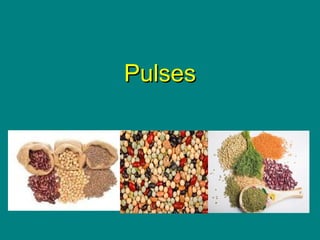
PulsesPulses
Culinary Essentials
Copyright © Glencoe/McGraw-Hill,
a division of The McGraw-Hill Companies, Inc.
Types of LegumesTypes of Legumes
Legumes: are a group of plants thatare a group of plants that
have double-seamed pods containinghave double-seamed pods containing
a single row of seeds.a single row of seeds.
Pulses:Pulses: Dried seeds of legumes.Dried seeds of legumes.
NutrientsNutrients: Excellent source ofExcellent source of
complex carbohydrates, protein, andcomplex carbohydrates, protein, and
soluble fiber.soluble fiber.
Culinary Essentials
Copyright © Glencoe/McGraw-Hill,
a division of The McGraw-Hill Companies, Inc.
PULSESPULSES
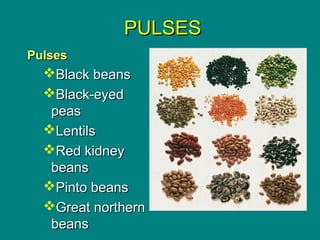
PulsesPulses
Black beansBlack beans
Black-eyedBlack-eyed
peaspeas
LentilsLentils
Red kidneyRed kidney
beansbeans
Pinto beansPinto beans
Great northernGreat northern
beansbeans
Culinary Essentials
Copyright © Glencoe/McGraw-Hill,
a division of The McGraw-Hill Companies, Inc.
Quality Characteristics ofQuality Characteristics of
LegumesLegumes
Should be brightly-colored andShould be brightly-colored and
uniformly sized.uniformly sized.
Should not be marked, shriveled,Should not be marked, shriveled,
damaged, or broken.damaged, or broken.
Culinary Essentials
Copyright © Glencoe/McGraw-Hill,
a division of The McGraw-Hill Companies, Inc.
Storing LegumesStoring Legumes
• Store in a cool, dark, dry place with good
ventilation.
• Keep opened packages in air-tight,
moisture-proof containers.
Culinary Essentials
Copyright © Glencoe/McGraw-Hill,
a division of The McGraw-Hill Companies, Inc.
Checking & Soaking LegumesChecking & Soaking Legumes
Remove any shriveled andRemove any shriveled and
discolored legumes, stems,discolored legumes, stems,
and pebbles.and pebbles.
Rinse legumes in cold waterRinse legumes in cold water
until water is clear.until water is clear.
Soak legumes according toSoak legumes according to
directions, removing floaters.directions, removing floaters.
Culinary Essentials
Copyright © Glencoe/McGraw-Hill,
a division of The McGraw-Hill Companies, Inc.
Cooking LegumesCooking Legumes
Soak legumes overnight in three
times their volume of water in the
refrigerator. Or soak legumes for 1
hour in 212ºF water.
Bring the legumes and cooking
liquid to a simmer. Cooking times
range from 30 minutes to 3 hours.
Test for doneness.
Culinary Essentials
Copyright © Glencoe/McGraw-Hill,
a division of The McGraw-Hill Companies, Inc.
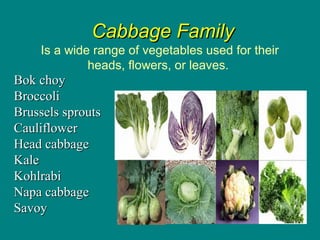
Cabbage FamilyCabbage Family
Is a wide range of vegetables used for their
heads, flowers, or leaves.
Bok choyBok choy
BroccoliBroccoli
Brussels sproutsBrussels sprouts
CauliflowerCauliflower
Head cabbageHead cabbage
KaleKale
KohlrabiKohlrabi
Napa cabbageNapa cabbage
SavoySavoy
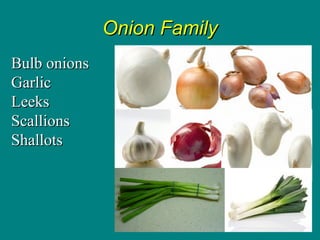
Onion FamilyOnion Family
Bulb onionsBulb onions
GarlicGarlic
LeeksLeeks
ScallionsScallions
ShallotsShallots
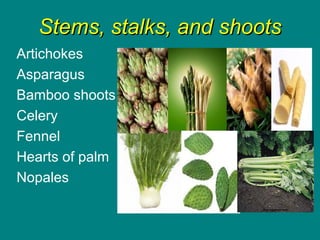
Stems, stalks, and shootsStems, stalks, and shoots
Artichokes
Asparagus
Bamboo shoots
Celery
Fennel
Hearts of palm
Nopales
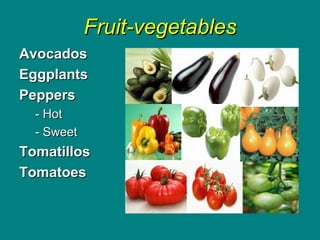
Fruit-vegetablesFruit-vegetables
AvocadosAvocados
EggplantsEggplants
PeppersPeppers
- Hot- Hot
- Sweet- Sweet
TomatillosTomatillos
TomatoesTomatoes
Leafy greensLeafy greens
• CollardsCollards
• MustardMustard
• SorrelSorrel
• SpinachSpinach
• Swiss chardSwiss chard
• Turnip greensTurnip greens
• LettucesLettuces
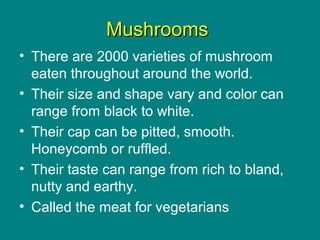
MushroomsMushrooms
• There are 2000 varieties of mushroom
eaten throughout around the world.
• Their size and shape vary and color can
range from black to white.
• Their cap can be pitted, smooth.
Honeycomb or ruffled.
• Their taste can range from rich to bland,
nutty and earthy.
• Called the meat for vegetarians
Culinary Essentials
Copyright © Glencoe/McGraw-Hill,
a division of The McGraw-Hill Companies, Inc.
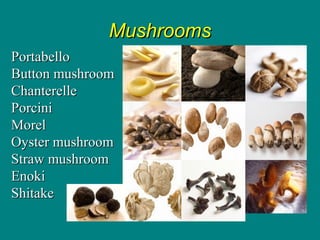
MushroomsMushrooms
PortabelloPortabello
Button mushroomButton mushroom
ChanterelleChanterelle
PorciniPorcini
MorelMorel
Oyster mushroomOyster mushroom
Straw mushroomStraw mushroom
EnokiEnoki
ShitakeShitake
Mushrooms & TrufflesMushrooms & Truffles
 Though, mushrooms are often grouped with vegetablesThough, mushrooms are often grouped with vegetables
and fruits, they are actually fungi. For that reason, theyand fruits, they are actually fungi. For that reason, they
are in a class of their own, nutritionally speaking.are in a class of their own, nutritionally speaking.
Mushrooms do share some of the benefits of fruits andMushrooms do share some of the benefits of fruits and
vegetables.vegetables.
 They are low in calories, have no cholesterol and areThey are low in calories, have no cholesterol and are
virtually free of fat and sodium.virtually free of fat and sodium.
 Mushrooms stand alone when it comes to some of theMushrooms stand alone when it comes to some of the
essential minerals and B-complex vitamins not easilyessential minerals and B-complex vitamins not easily
found in produce.found in produce.
 In addition, some contain substances that might prove toIn addition, some contain substances that might prove to
be useful in the treatment and prevention of seriousbe useful in the treatment and prevention of serious
diseases.diseases.
Culinary Essentials
Copyright © Glencoe/McGraw-Hill,
a division of The McGraw-Hill Companies, Inc.
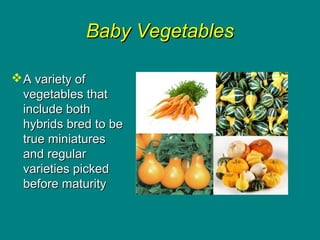
Baby VegetablesBaby Vegetables
A variety ofA variety of
vegetables thatvegetables that
include bothinclude both
hybrids bred to behybrids bred to be
true miniaturestrue miniatures
and regularand regular
varieties pickedvarieties picked
before maturitybefore maturity
Culinary Essentials
Copyright © Glencoe/McGraw-Hill,
a division of The McGraw-Hill Companies, Inc.
Purchasing VegetablesPurchasing Vegetables
Sold by weight and count
–Packed in:
• Lugs
• Bushels
• Flats
• Crates
Some common vegetables can be
purchased preprocessed
• Trimmed
• Cleaned
• Cut to specification
Culinary Essentials
Copyright © Glencoe/McGraw-Hill,
a division of The McGraw-Hill Companies, Inc.
Storing VegetablesStoring Vegetables
Starchy Vegetables: Store in a dry location
between 60ºF-70ºF.
Other Vegetables: Store at refrigerator
temperatures of 41ºF or below. Store vegetables
away from fruits that emit ethylene gas. The gas
will cause continued ripening and possible decay.
Hearty vegetables are best stored at cool
temperatures 40°F to 60°F
More delicate vegetables are best stored at 34°F to
40°F
A separate produce cooler is best
Culinary Essentials
Copyright © Glencoe/McGraw-Hill,
a division of The McGraw-Hill Companies, Inc.
Irradiated VegetablesIrradiated Vegetables
Process uses ionizing
radiation to sterilize
food
Destroys bacteria,
parasites and insects
Does not affect the
taste and texture of
foods
Culinary Essentials
Copyright © Glencoe/McGraw-Hill,
a division of The McGraw-Hill Companies, Inc.
Preserving VegetablesPreserving Vegetables
Canned.
Frozen.
Dried.
Culinary Essentials
Copyright © Glencoe/McGraw-Hill,
a division of The McGraw-Hill Companies, Inc.
Canned VegetablesCanned Vegetables
Raw vegetables are cleaned and placedRaw vegetables are cleaned and placed
in sealed containers, then subjected toin sealed containers, then subjected to
high heathigh heat
GradingGrading
• U.S. Grade A or FancyU.S. Grade A or Fancy
• U.S. Grade B or Extra-SelectU.S. Grade B or Extra-Select
• U.S. Grade C or StandardU.S. Grade C or Standard
Canned vegetables are purchased inCanned vegetables are purchased in
cases of standard size canscases of standard size cans
Culinary Essentials
Copyright © Glencoe/McGraw-Hill,
a division of The McGraw-Hill Companies, Inc.
Frozen VegetablesFrozen Vegetables
Almost as convenient as cannedAlmost as convenient as canned
Severely inhibits the growth ofSeverely inhibits the growth of
microorganisms that causemicroorganisms that cause
spoilagespoilage
Grading the same as cannedGrading the same as canned
IQF (individually quick-frozen)IQF (individually quick-frozen)
Culinary Essentials
Copyright © Glencoe/McGraw-Hill,
a division of The McGraw-Hill Companies, Inc.
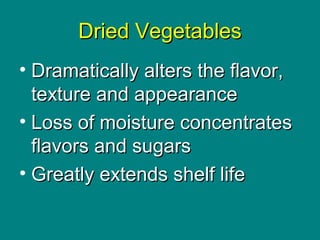
Dried VegetablesDried Vegetables
• Dramatically alters the flavor,Dramatically alters the flavor,
texture and appearancetexture and appearance
• Loss of moisture concentratesLoss of moisture concentrates
flavors and sugarsflavors and sugars
• Greatly extends shelf lifeGreatly extends shelf life
Culinary Essentials
Copyright © Glencoe/McGraw-Hill,
a division of The McGraw-Hill Companies, Inc.
Cooking VegetablesCooking Vegetables
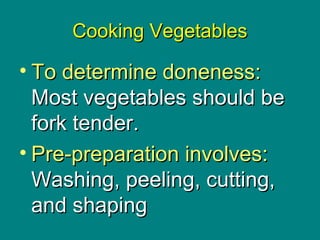
• To determine doneness:To determine doneness:
Most vegetables should beMost vegetables should be
fork tender.fork tender.
• Pre-preparation involves:Pre-preparation involves:
Washing, peeling, cutting,Washing, peeling, cutting,
and shapingand shaping
Culinary Essentials
Copyright © Glencoe/McGraw-Hill,
a division of The McGraw-Hill Companies, Inc.
Cooking VegetablesCooking Vegetables
• Cooking with dry heat:Cooking with dry heat: PreservesPreserves
flavors and nutrients.flavors and nutrients. MethodsMethods
includeinclude broiling and grilling, baking,broiling and grilling, baking,
sautéing, deep-frying, and fondue.sautéing, deep-frying, and fondue.
• Cooking with dry heat:Cooking with dry heat: PreservesPreserves
flavors and nutrients.flavors and nutrients. MethodsMethods
includeinclude broiling and grilling, baking,broiling and grilling, baking,
sautéing, deep-frying, and fondue.sautéing, deep-frying, and fondue.
Culinary Essentials
Copyright © Glencoe/McGraw-Hill,
a division of The McGraw-Hill Companies, Inc.
Cooking VegetablesCooking Vegetables
COOKING AND ITS EFFECTS ON VEGETABLESCOOKING AND ITS EFFECTS ON VEGETABLES
•FLAVOURFLAVOUR:: may turn vegetables bitter when overcooked.may turn vegetables bitter when overcooked.
Strong and pungent vegetables will mellow as well as sweeten.Strong and pungent vegetables will mellow as well as sweeten.
•TEXTURETEXTURE:: softens vegetables (to make it easier to eat andsoftens vegetables (to make it easier to eat and
digest in most cases)digest in most cases)
• ODORODOR:: gives-off a distinctive aroma and at times angives-off a distinctive aroma and at times an
undesirable smell. (e.g. cabbage – sulfur)undesirable smell. (e.g. cabbage – sulfur)
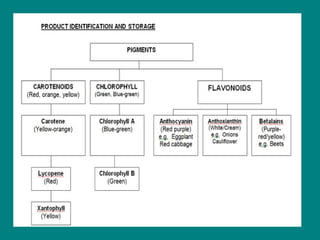
•COLORCOLOR:: changes will occur depending on the type of pigmentschanges will occur depending on the type of pigments
they have. Some vegetables willthey have. Some vegetables will oxidizeoxidize therefore discolor ortherefore discolor or
heat and other chemicals will change the color.heat and other chemicals will change the color.
•NUTRIENTSNUTRIENTS:: vegetables are a good source of nutrients that thevegetables are a good source of nutrients that the
body needs for nourishment.body needs for nourishment.
Cooking VegetablesCooking Vegetables
Standards of Quality in Cooked VegetablesStandards of Quality in Cooked Vegetables
Color. Bright, natural colors.Color. Bright, natural colors.
Appearance on plate. Cut neatly and uniformly.Appearance on plate. Cut neatly and uniformly.
Flavor. Full, natural flavor and sweetness, sometimes called “garden-Flavor. Full, natural flavor and sweetness, sometimes called “garden-
fresh” flavor.fresh” flavor.
Seasoning. Lightly and appropriately seasoned.Seasoning. Lightly and appropriately seasoned.
Texture. Cook to the right degree of doneness. Most vegetableTexture. Cook to the right degree of doneness. Most vegetable
should be crisp-tender not overcooked and mushy, but not tough orshould be crisp-tender not overcooked and mushy, but not tough or
woody either.woody either.
 Sauces. Butter and seasoned butters should be fresh and notSauces. Butter and seasoned butters should be fresh and not
used heavily; vegetables should not be greasy. Cream saucesused heavily; vegetables should not be greasy. Cream sauces
and other sauces should not be too thick or too heavilyand other sauces should not be too thick or too heavily
seasoned.seasoned.
Vegetables combinations. Interesting combinations attract customers.Vegetables combinations. Interesting combinations attract customers.
Flavors, colors, and shapes should be pleasing in combinations.Flavors, colors, and shapes should be pleasing in combinations.
Cooking VegetablesCooking Vegetables
Guidelines in Achieving ProperGuidelines in Achieving Proper
Doneness in Vegetables:Doneness in Vegetables:
Do not overcook.Do not overcook.
Cook as close to service as possible.Cook as close to service as possible.
If vegetables must be cooked in advance,If vegetables must be cooked in advance,
slightly undercook them.slightly undercook them.
For uniform doneness, cut into uniformFor uniform doneness, cut into uniform
sizes before cooking.sizes before cooking.
Do not mix batches of cooked vegetables.Do not mix batches of cooked vegetables.
Cooking VegetablesCooking Vegetables
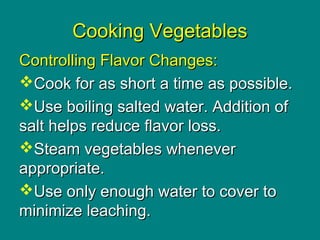
Controlling Flavor Changes:Controlling Flavor Changes:
Cook for as short a time as possible.Cook for as short a time as possible.
Use boiling salted water. Addition ofUse boiling salted water. Addition of
salt helps reduce flavor loss.salt helps reduce flavor loss.
Steam vegetables wheneverSteam vegetables whenever
appropriate.appropriate.
Use only enough water to cover toUse only enough water to cover to
minimize leaching.minimize leaching.
• Disclaimer: I do not own the rights nor
property of this powerpoint presentation.
All rights reserved to the owner.
• Don't forget to follow me on twitter
@joviinthecity
• Thank You!

Vegetables

  • 1.
  • 2.
    Classification of VegetablesClassificationof Vegetables The squash family.The squash family. Roots and tubers.Roots and tubers. Seeds and pods.Seeds and pods. Pulses / legumesPulses / legumes The cabbageThe cabbage family.family. Stems, stalks, andStems, stalks, and shoots.shoots. The onion family.The onion family. Fruit-vegetables.Fruit-vegetables. Leafy greensLeafy greens.
  • 3.
    Gourds &Gourds &Squash FamilySquash Family  ChayotesChayotes  CucumbersCucumbers  SquashesSquashes Winter:Winter: • AcornAcorn • BananaBanana • ButternutButternut • PumpkinPumpkin Summer:Summer: • ZucchiniZucchini • YellowYellow
  • 4.
    ROOTS Are those grownunderground.Are those grown underground. They are directly connected to the plant viaThey are directly connected to the plant via leaves or leaf stem.leaves or leaf stem. TUBERS Are connected to the root system. However,Are connected to the root system. However, they are not directly connected to the stemthey are not directly connected to the stem and leaf system of plant.and leaf system of plant.
  • 5.
  • 6.
    Culinary Essentials Copyright ©Glencoe/McGraw-Hill, a division of The McGraw-Hill Companies, Inc. TubersTubers Potatoes • Mealy. • Waxy. • Russet. • Red. • Yukon. • Sweet.
  • 7.
    Culinary Essentials Copyright ©Glencoe/McGraw-Hill, a division of The McGraw-Hill Companies, Inc. Quality Characteristics of Potatoes All varieties of potatoes should be heavyAll varieties of potatoes should be heavy and firm, without soft spots, green color, orand firm, without soft spots, green color, or sprouting eyes.sprouting eyes. Sweet potatoes should have dry-looking,Sweet potatoes should have dry-looking, orange and golden-orange skins. Avoidorange and golden-orange skins. Avoid sweet potatoes with softened ends. Thissweet potatoes with softened ends. This marks the beginning of spoilage.marks the beginning of spoilage. Other potatoes should have dry, tightOther potatoes should have dry, tight skins, without wrinkles.skins, without wrinkles.
  • 8.
    Culinary Essentials Copyright ©Glencoe/McGraw-Hill, a division of The McGraw-Hill Companies, Inc. Market Forms of Potatoes Fresh.Fresh. Canned.Canned. Frozen.Frozen. Dehydrated.Dehydrated.
  • 9.
    Seeds and podsSeedsand pods CornCorn OkraOkra Legumes: fresh beansLegumes: fresh beans Green beansGreen beans Haricot vertHaricot vert PeasPeas Pulses: dried beansPulses: dried beans
  • 10.
    Culinary Essentials Copyright ©Glencoe/McGraw-Hill, a division of The McGraw-Hill Companies, Inc. PulsesPulses
  • 11.
    Culinary Essentials Copyright ©Glencoe/McGraw-Hill, a division of The McGraw-Hill Companies, Inc. Types of LegumesTypes of Legumes Legumes: are a group of plants thatare a group of plants that have double-seamed pods containinghave double-seamed pods containing a single row of seeds.a single row of seeds. Pulses:Pulses: Dried seeds of legumes.Dried seeds of legumes. NutrientsNutrients: Excellent source ofExcellent source of complex carbohydrates, protein, andcomplex carbohydrates, protein, and soluble fiber.soluble fiber.
  • 12.
    Culinary Essentials Copyright ©Glencoe/McGraw-Hill, a division of The McGraw-Hill Companies, Inc. PULSESPULSES PulsesPulses Black beansBlack beans Black-eyedBlack-eyed peaspeas LentilsLentils Red kidneyRed kidney beansbeans Pinto beansPinto beans Great northernGreat northern beansbeans
  • 13.
    Culinary Essentials Copyright ©Glencoe/McGraw-Hill, a division of The McGraw-Hill Companies, Inc. Quality Characteristics ofQuality Characteristics of LegumesLegumes Should be brightly-colored andShould be brightly-colored and uniformly sized.uniformly sized. Should not be marked, shriveled,Should not be marked, shriveled, damaged, or broken.damaged, or broken.
  • 14.
    Culinary Essentials Copyright ©Glencoe/McGraw-Hill, a division of The McGraw-Hill Companies, Inc. Storing LegumesStoring Legumes • Store in a cool, dark, dry place with good ventilation. • Keep opened packages in air-tight, moisture-proof containers.
  • 15.
    Culinary Essentials Copyright ©Glencoe/McGraw-Hill, a division of The McGraw-Hill Companies, Inc. Checking & Soaking LegumesChecking & Soaking Legumes Remove any shriveled andRemove any shriveled and discolored legumes, stems,discolored legumes, stems, and pebbles.and pebbles. Rinse legumes in cold waterRinse legumes in cold water until water is clear.until water is clear. Soak legumes according toSoak legumes according to directions, removing floaters.directions, removing floaters.
  • 16.
    Culinary Essentials Copyright ©Glencoe/McGraw-Hill, a division of The McGraw-Hill Companies, Inc. Cooking LegumesCooking Legumes Soak legumes overnight in three times their volume of water in the refrigerator. Or soak legumes for 1 hour in 212ºF water. Bring the legumes and cooking liquid to a simmer. Cooking times range from 30 minutes to 3 hours. Test for doneness.
  • 17.
    Culinary Essentials Copyright ©Glencoe/McGraw-Hill, a division of The McGraw-Hill Companies, Inc. Cabbage FamilyCabbage Family Is a wide range of vegetables used for their heads, flowers, or leaves. Bok choyBok choy BroccoliBroccoli Brussels sproutsBrussels sprouts CauliflowerCauliflower Head cabbageHead cabbage KaleKale KohlrabiKohlrabi Napa cabbageNapa cabbage SavoySavoy
  • 18.
    Onion FamilyOnion Family BulbonionsBulb onions GarlicGarlic LeeksLeeks ScallionsScallions ShallotsShallots
  • 19.
    Stems, stalks, andshootsStems, stalks, and shoots Artichokes Asparagus Bamboo shoots Celery Fennel Hearts of palm Nopales
  • 20.
  • 21.
    Leafy greensLeafy greens •CollardsCollards • MustardMustard • SorrelSorrel • SpinachSpinach • Swiss chardSwiss chard • Turnip greensTurnip greens • LettucesLettuces
  • 22.
    MushroomsMushrooms • There are2000 varieties of mushroom eaten throughout around the world. • Their size and shape vary and color can range from black to white. • Their cap can be pitted, smooth. Honeycomb or ruffled. • Their taste can range from rich to bland, nutty and earthy. • Called the meat for vegetarians
  • 23.
    Culinary Essentials Copyright ©Glencoe/McGraw-Hill, a division of The McGraw-Hill Companies, Inc. MushroomsMushrooms PortabelloPortabello Button mushroomButton mushroom ChanterelleChanterelle PorciniPorcini MorelMorel Oyster mushroomOyster mushroom Straw mushroomStraw mushroom EnokiEnoki ShitakeShitake
  • 24.
    Mushrooms & TrufflesMushrooms& Truffles  Though, mushrooms are often grouped with vegetablesThough, mushrooms are often grouped with vegetables and fruits, they are actually fungi. For that reason, theyand fruits, they are actually fungi. For that reason, they are in a class of their own, nutritionally speaking.are in a class of their own, nutritionally speaking. Mushrooms do share some of the benefits of fruits andMushrooms do share some of the benefits of fruits and vegetables.vegetables.  They are low in calories, have no cholesterol and areThey are low in calories, have no cholesterol and are virtually free of fat and sodium.virtually free of fat and sodium.  Mushrooms stand alone when it comes to some of theMushrooms stand alone when it comes to some of the essential minerals and B-complex vitamins not easilyessential minerals and B-complex vitamins not easily found in produce.found in produce.  In addition, some contain substances that might prove toIn addition, some contain substances that might prove to be useful in the treatment and prevention of seriousbe useful in the treatment and prevention of serious diseases.diseases.
  • 25.
    Culinary Essentials Copyright ©Glencoe/McGraw-Hill, a division of The McGraw-Hill Companies, Inc. Baby VegetablesBaby Vegetables A variety ofA variety of vegetables thatvegetables that include bothinclude both hybrids bred to behybrids bred to be true miniaturestrue miniatures and regularand regular varieties pickedvarieties picked before maturitybefore maturity
  • 27.
    Culinary Essentials Copyright ©Glencoe/McGraw-Hill, a division of The McGraw-Hill Companies, Inc. Purchasing VegetablesPurchasing Vegetables Sold by weight and count –Packed in: • Lugs • Bushels • Flats • Crates Some common vegetables can be purchased preprocessed • Trimmed • Cleaned • Cut to specification
  • 28.
    Culinary Essentials Copyright ©Glencoe/McGraw-Hill, a division of The McGraw-Hill Companies, Inc. Storing VegetablesStoring Vegetables Starchy Vegetables: Store in a dry location between 60ºF-70ºF. Other Vegetables: Store at refrigerator temperatures of 41ºF or below. Store vegetables away from fruits that emit ethylene gas. The gas will cause continued ripening and possible decay. Hearty vegetables are best stored at cool temperatures 40°F to 60°F More delicate vegetables are best stored at 34°F to 40°F A separate produce cooler is best
  • 29.
    Culinary Essentials Copyright ©Glencoe/McGraw-Hill, a division of The McGraw-Hill Companies, Inc. Irradiated VegetablesIrradiated Vegetables Process uses ionizing radiation to sterilize food Destroys bacteria, parasites and insects Does not affect the taste and texture of foods
  • 30.
    Culinary Essentials Copyright ©Glencoe/McGraw-Hill, a division of The McGraw-Hill Companies, Inc. Preserving VegetablesPreserving Vegetables Canned. Frozen. Dried.
  • 31.
    Culinary Essentials Copyright ©Glencoe/McGraw-Hill, a division of The McGraw-Hill Companies, Inc. Canned VegetablesCanned Vegetables Raw vegetables are cleaned and placedRaw vegetables are cleaned and placed in sealed containers, then subjected toin sealed containers, then subjected to high heathigh heat GradingGrading • U.S. Grade A or FancyU.S. Grade A or Fancy • U.S. Grade B or Extra-SelectU.S. Grade B or Extra-Select • U.S. Grade C or StandardU.S. Grade C or Standard Canned vegetables are purchased inCanned vegetables are purchased in cases of standard size canscases of standard size cans
  • 32.
    Culinary Essentials Copyright ©Glencoe/McGraw-Hill, a division of The McGraw-Hill Companies, Inc. Frozen VegetablesFrozen Vegetables Almost as convenient as cannedAlmost as convenient as canned Severely inhibits the growth ofSeverely inhibits the growth of microorganisms that causemicroorganisms that cause spoilagespoilage Grading the same as cannedGrading the same as canned IQF (individually quick-frozen)IQF (individually quick-frozen)
  • 33.
    Culinary Essentials Copyright ©Glencoe/McGraw-Hill, a division of The McGraw-Hill Companies, Inc. Dried VegetablesDried Vegetables • Dramatically alters the flavor,Dramatically alters the flavor, texture and appearancetexture and appearance • Loss of moisture concentratesLoss of moisture concentrates flavors and sugarsflavors and sugars • Greatly extends shelf lifeGreatly extends shelf life
  • 34.
    Culinary Essentials Copyright ©Glencoe/McGraw-Hill, a division of The McGraw-Hill Companies, Inc. Cooking VegetablesCooking Vegetables • To determine doneness:To determine doneness: Most vegetables should beMost vegetables should be fork tender.fork tender. • Pre-preparation involves:Pre-preparation involves: Washing, peeling, cutting,Washing, peeling, cutting, and shapingand shaping
  • 35.
    Culinary Essentials Copyright ©Glencoe/McGraw-Hill, a division of The McGraw-Hill Companies, Inc. Cooking VegetablesCooking Vegetables • Cooking with dry heat:Cooking with dry heat: PreservesPreserves flavors and nutrients.flavors and nutrients. MethodsMethods includeinclude broiling and grilling, baking,broiling and grilling, baking, sautéing, deep-frying, and fondue.sautéing, deep-frying, and fondue. • Cooking with dry heat:Cooking with dry heat: PreservesPreserves flavors and nutrients.flavors and nutrients. MethodsMethods includeinclude broiling and grilling, baking,broiling and grilling, baking, sautéing, deep-frying, and fondue.sautéing, deep-frying, and fondue.
  • 36.
    Culinary Essentials Copyright ©Glencoe/McGraw-Hill, a division of The McGraw-Hill Companies, Inc. Cooking VegetablesCooking Vegetables COOKING AND ITS EFFECTS ON VEGETABLESCOOKING AND ITS EFFECTS ON VEGETABLES •FLAVOURFLAVOUR:: may turn vegetables bitter when overcooked.may turn vegetables bitter when overcooked. Strong and pungent vegetables will mellow as well as sweeten.Strong and pungent vegetables will mellow as well as sweeten. •TEXTURETEXTURE:: softens vegetables (to make it easier to eat andsoftens vegetables (to make it easier to eat and digest in most cases)digest in most cases) • ODORODOR:: gives-off a distinctive aroma and at times angives-off a distinctive aroma and at times an undesirable smell. (e.g. cabbage – sulfur)undesirable smell. (e.g. cabbage – sulfur) •COLORCOLOR:: changes will occur depending on the type of pigmentschanges will occur depending on the type of pigments they have. Some vegetables willthey have. Some vegetables will oxidizeoxidize therefore discolor ortherefore discolor or heat and other chemicals will change the color.heat and other chemicals will change the color. •NUTRIENTSNUTRIENTS:: vegetables are a good source of nutrients that thevegetables are a good source of nutrients that the body needs for nourishment.body needs for nourishment.
  • 37.
    Cooking VegetablesCooking Vegetables Standardsof Quality in Cooked VegetablesStandards of Quality in Cooked Vegetables Color. Bright, natural colors.Color. Bright, natural colors. Appearance on plate. Cut neatly and uniformly.Appearance on plate. Cut neatly and uniformly. Flavor. Full, natural flavor and sweetness, sometimes called “garden-Flavor. Full, natural flavor and sweetness, sometimes called “garden- fresh” flavor.fresh” flavor. Seasoning. Lightly and appropriately seasoned.Seasoning. Lightly and appropriately seasoned. Texture. Cook to the right degree of doneness. Most vegetableTexture. Cook to the right degree of doneness. Most vegetable should be crisp-tender not overcooked and mushy, but not tough orshould be crisp-tender not overcooked and mushy, but not tough or woody either.woody either.  Sauces. Butter and seasoned butters should be fresh and notSauces. Butter and seasoned butters should be fresh and not used heavily; vegetables should not be greasy. Cream saucesused heavily; vegetables should not be greasy. Cream sauces and other sauces should not be too thick or too heavilyand other sauces should not be too thick or too heavily seasoned.seasoned. Vegetables combinations. Interesting combinations attract customers.Vegetables combinations. Interesting combinations attract customers. Flavors, colors, and shapes should be pleasing in combinations.Flavors, colors, and shapes should be pleasing in combinations.
  • 38.
    Cooking VegetablesCooking Vegetables Guidelinesin Achieving ProperGuidelines in Achieving Proper Doneness in Vegetables:Doneness in Vegetables: Do not overcook.Do not overcook. Cook as close to service as possible.Cook as close to service as possible. If vegetables must be cooked in advance,If vegetables must be cooked in advance, slightly undercook them.slightly undercook them. For uniform doneness, cut into uniformFor uniform doneness, cut into uniform sizes before cooking.sizes before cooking. Do not mix batches of cooked vegetables.Do not mix batches of cooked vegetables.
  • 39.
    Cooking VegetablesCooking Vegetables ControllingFlavor Changes:Controlling Flavor Changes: Cook for as short a time as possible.Cook for as short a time as possible. Use boiling salted water. Addition ofUse boiling salted water. Addition of salt helps reduce flavor loss.salt helps reduce flavor loss. Steam vegetables wheneverSteam vegetables whenever appropriate.appropriate. Use only enough water to cover toUse only enough water to cover to minimize leaching.minimize leaching.
  • 41.
    • Disclaimer: Ido not own the rights nor property of this powerpoint presentation. All rights reserved to the owner. • Don't forget to follow me on twitter @joviinthecity • Thank You!