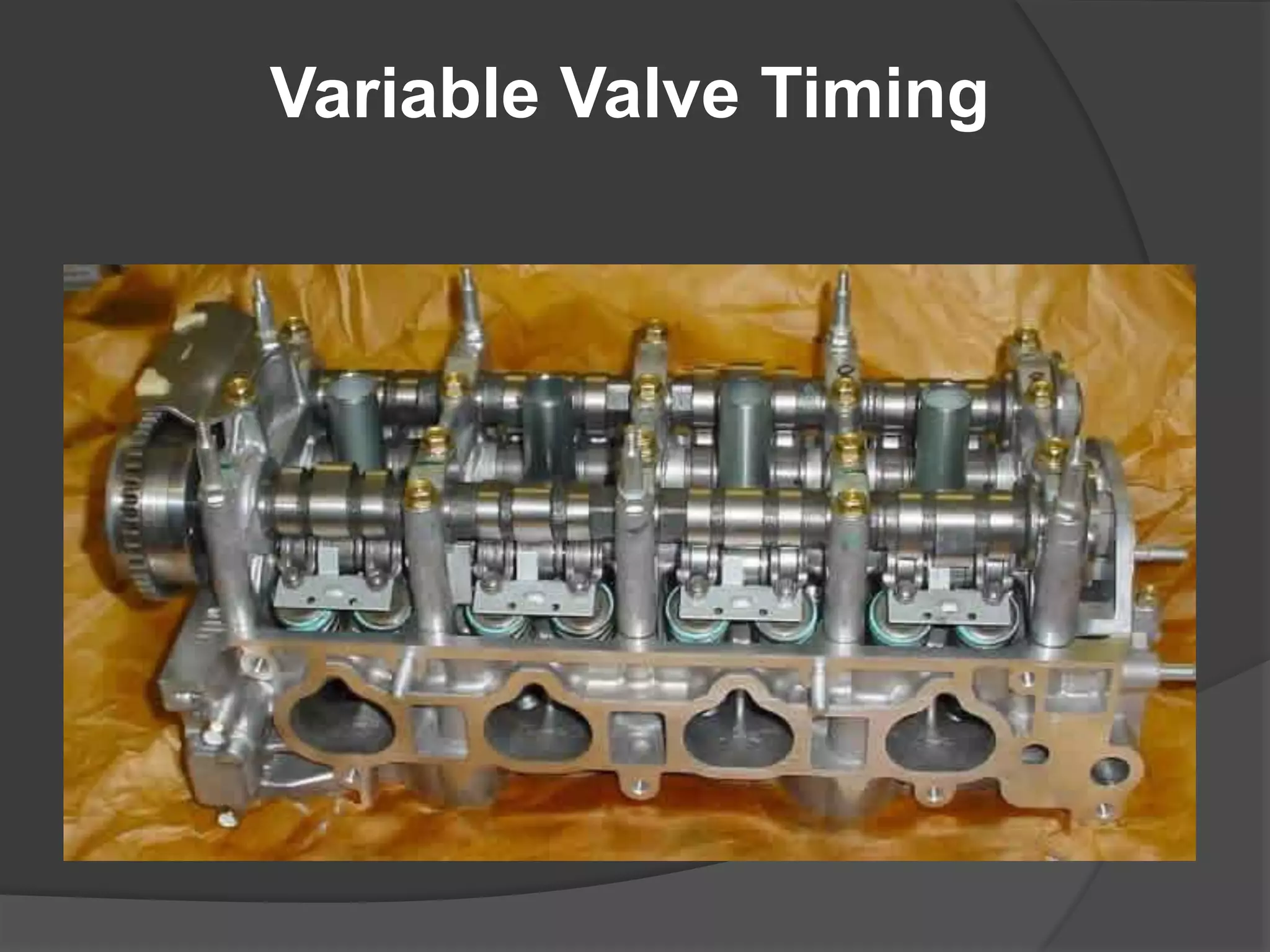
Variable Valve Timing
 How the valves are opened
and closed?
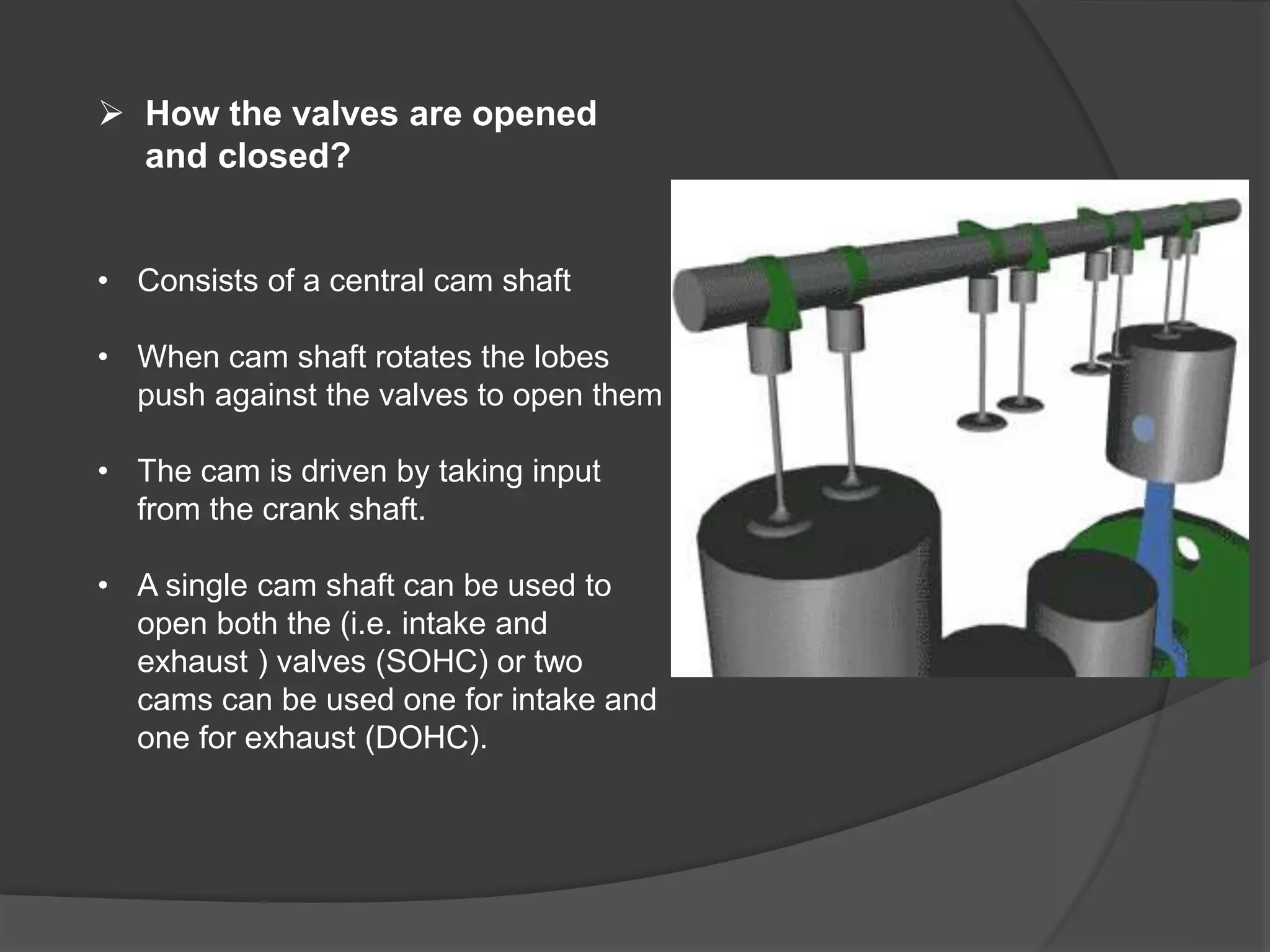
• Consists of a central cam shaft
• When cam shaft rotates the lobes
push against the valves to open them
• The cam is driven by taking input
from the crank shaft.
• A single cam shaft can be used to
open both the (i.e. intake and
exhaust ) valves (SOHC) or two
cams can be used one for intake and
one for exhaust (DOHC).
 What is variable valve timing?
• As the rpm of the engine changes the “ideal” valve
opening and closing points change
• Without variable valve timing , the valve timing must be
the same for all engine speeds and conditions which
decreases the engine performance and fuel economy
• Variable valve timing (VVT) allows valve opening
and/or closing points to be changed at specific engine
speeds
 How variable valve timing is achived?
Advance/Retard Systems
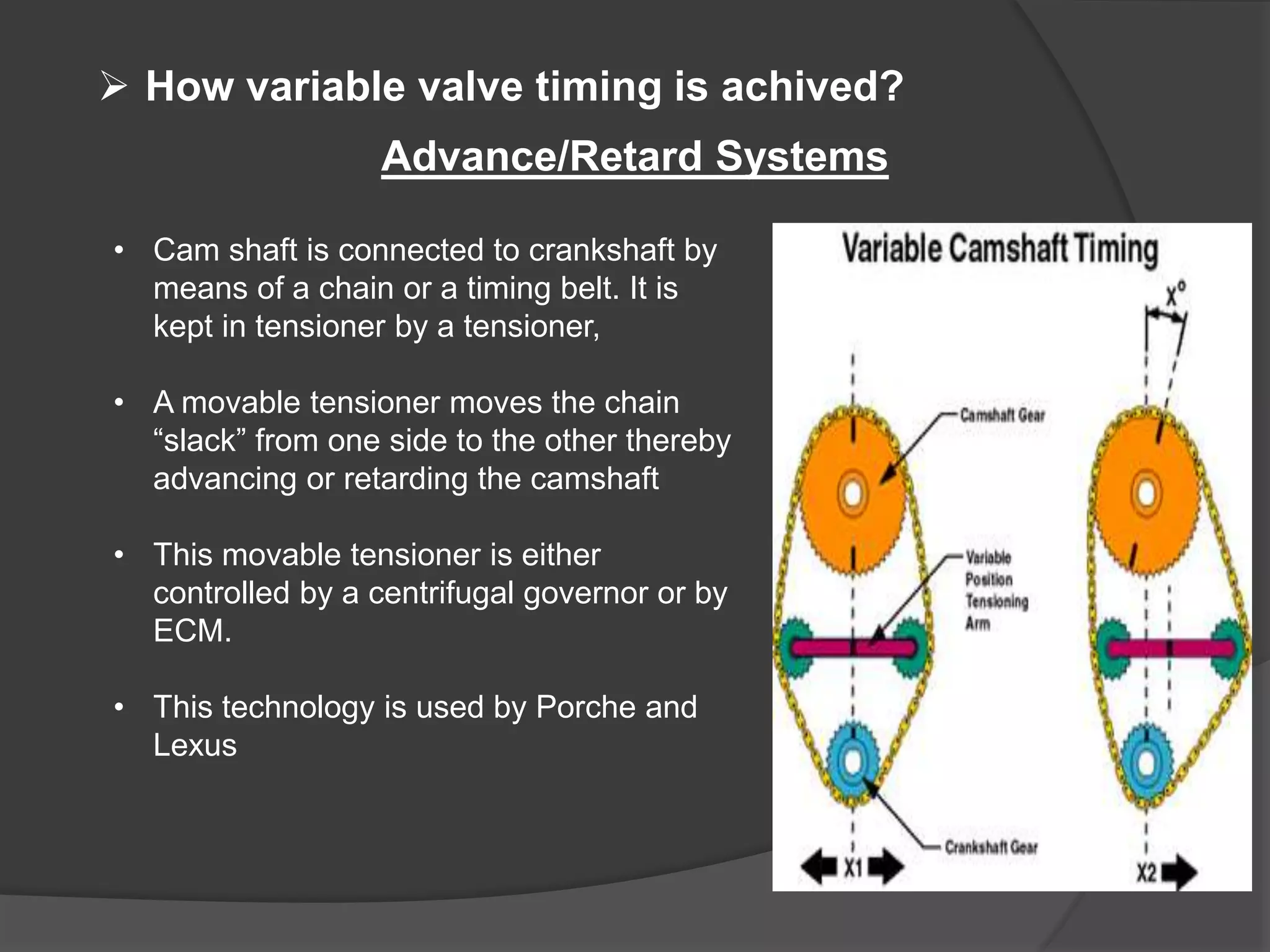
• Cam shaft is connected to crankshaft by
means of a chain or a timing belt. It is
kept in tensioner by a tensioner,
• A movable tensioner moves the chain
“slack” from one side to the other thereby
advancing or retarding the camshaft
• This movable tensioner is either
controlled by a centrifugal governor or by
ECM.
• This technology is used by Porche and
Lexus
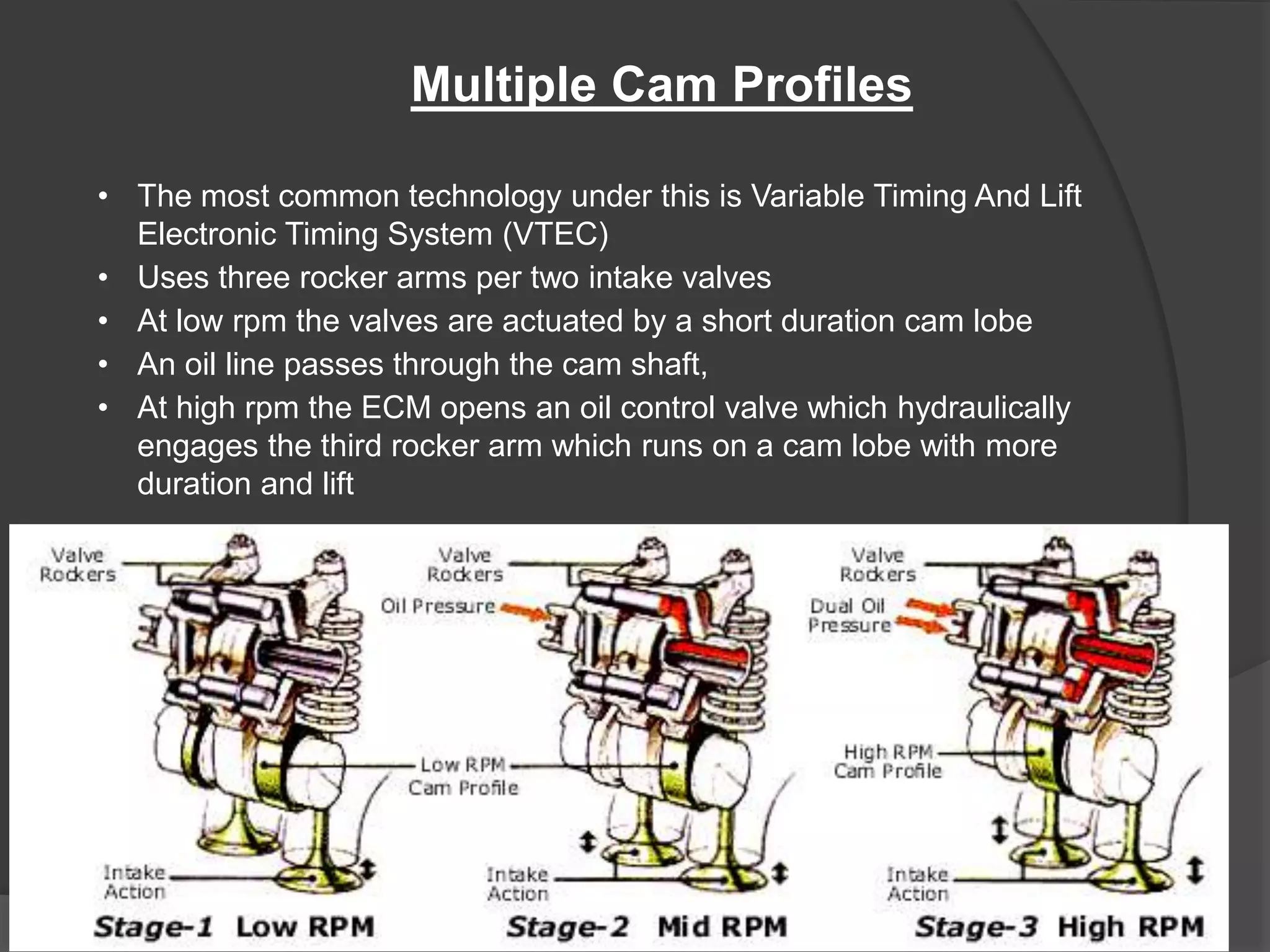
Multiple Cam Profiles
• The most common technology under this is Variable Timing And Lift
Electronic Timing System (VTEC)
• Uses three rocker arms per two intake valves
• At low rpm the valves are actuated by a short duration cam lobe
• An oil line passes through the cam shaft,
• At high rpm the ECM opens an oil control valve which hydraulically
engages the third rocker arm which runs on a cam lobe with more
duration and lift
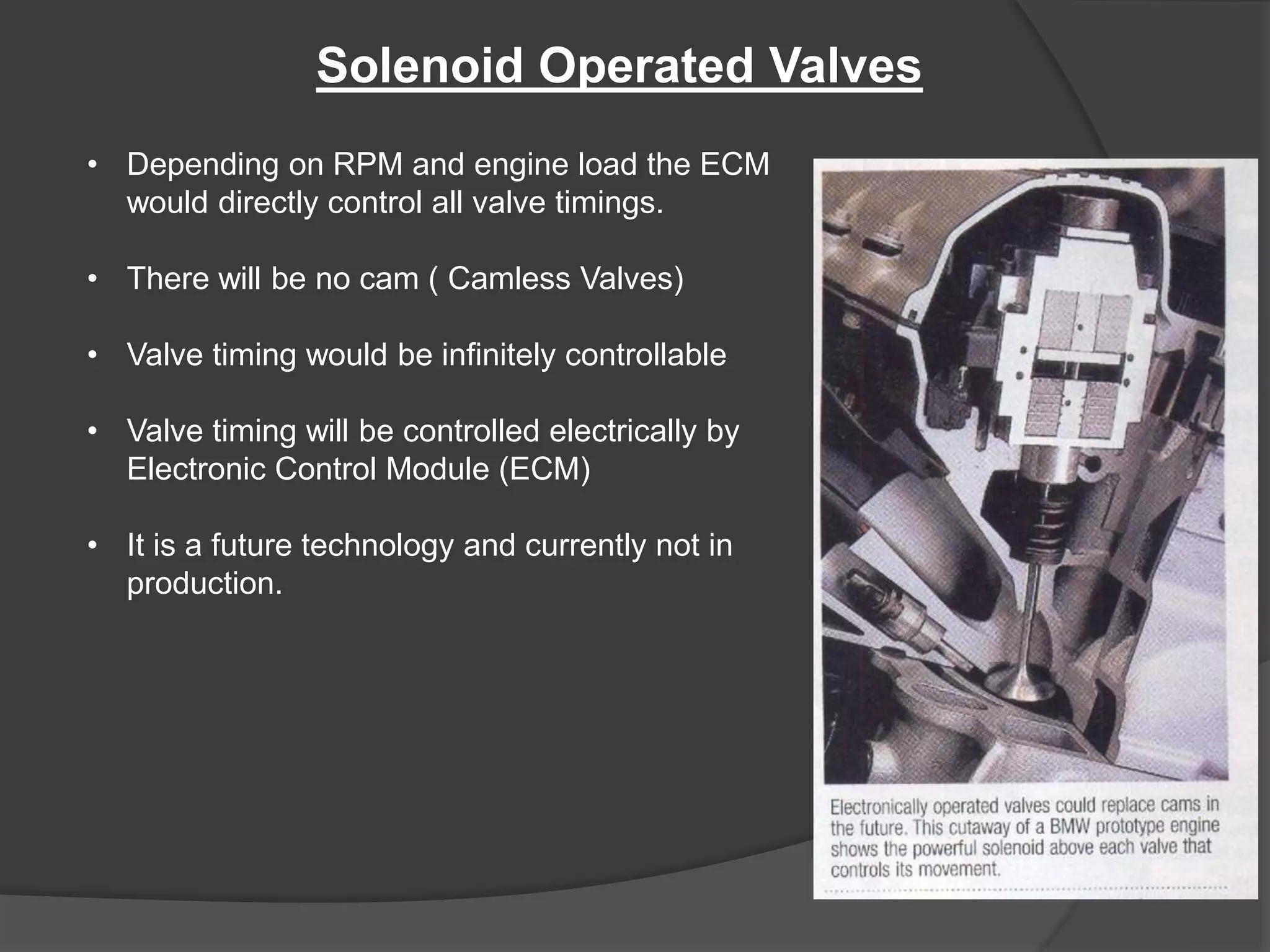
Solenoid Operated Valves
• Depending on RPM and engine load the ECM
would directly control all valve timings.
• There will be no cam ( Camless Valves)
• Valve timing would be infinitely controllable
• Valve timing will be controlled electrically by
Electronic Control Module (ECM)
• It is a future technology and currently not in
production.
Advantages:
• Better fuel efficiency
• High initial torque
• Lover emission
• Better performance
Disadvantages:
• Higher cost of engine
• More complex mechanisms
• Lower overall engine life because of increased wear.

Variable Valve Timing (VVT)

  • 1.
  • 2.
     How thevalves are opened and closed? • Consists of a central cam shaft • When cam shaft rotates the lobes push against the valves to open them • The cam is driven by taking input from the crank shaft. • A single cam shaft can be used to open both the (i.e. intake and exhaust ) valves (SOHC) or two cams can be used one for intake and one for exhaust (DOHC).
  • 3.
     What isvariable valve timing? • As the rpm of the engine changes the “ideal” valve opening and closing points change • Without variable valve timing , the valve timing must be the same for all engine speeds and conditions which decreases the engine performance and fuel economy • Variable valve timing (VVT) allows valve opening and/or closing points to be changed at specific engine speeds
  • 4.
     How variablevalve timing is achived? Advance/Retard Systems • Cam shaft is connected to crankshaft by means of a chain or a timing belt. It is kept in tensioner by a tensioner, • A movable tensioner moves the chain “slack” from one side to the other thereby advancing or retarding the camshaft • This movable tensioner is either controlled by a centrifugal governor or by ECM. • This technology is used by Porche and Lexus
  • 5.
    Multiple Cam Profiles •The most common technology under this is Variable Timing And Lift Electronic Timing System (VTEC) • Uses three rocker arms per two intake valves • At low rpm the valves are actuated by a short duration cam lobe • An oil line passes through the cam shaft, • At high rpm the ECM opens an oil control valve which hydraulically engages the third rocker arm which runs on a cam lobe with more duration and lift
  • 6.
    Solenoid Operated Valves •Depending on RPM and engine load the ECM would directly control all valve timings. • There will be no cam ( Camless Valves) • Valve timing would be infinitely controllable • Valve timing will be controlled electrically by Electronic Control Module (ECM) • It is a future technology and currently not in production.
  • 7.
    Advantages: • Better fuelefficiency • High initial torque • Lover emission • Better performance Disadvantages: • Higher cost of engine • More complex mechanisms • Lower overall engine life because of increased wear.