Study of variability in F2 population
Di-hybrid (9:3:3:1) or Mono-hybrid (3:1)
Characterizing Genetic Diversity:
Quantitative Variation
Quantitative (metric or polygenic) characters of
Most concern to conservation biology are those
related to reproductive fitness such as:
Number of fertile offspring contributed by an
Individual that survive to reproductive age.
For endangered species, quantitative variation for
reproductive fitness is involved in the major
genetic concerns in conservation biology, namely:
Reduction in reproductive fitness due to inbreeding
(inbreeding depression)
Loss of evolutionary potential due to small
population sizes.
Impact of crossing between different populations
on fitness, whether beneficial (heterosis) or
deleterious (outbreeding depression).
Effects of translocating individuals from one
environment to another.
Correlations between molecular and quantitative
measures of genetic diversity are low. Therefore,
molecular measures of genetic variation provide,
at best, only a very imprecise indication of
evolutionary potential.
A major challenge in the study of quantitative
genetics is to determine how much of the observe
variation is due to genetics and how much is due
to environment.
One of the central concepts of quantitative genetic
is heritability.
Heritability is the proportion of the total
phenotypic variance in a population due to geneti
differences among individuals.
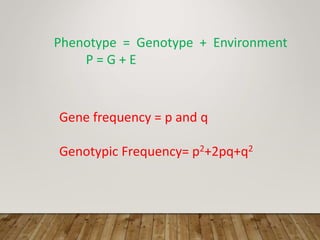
Phenotype = Genotype + Environment
P = G + E
Gene frequency = p and q
Genotypic Frequency= p2+2pq+q2
Genotype may produce different Phenotypes
due to Penetrance. The proportion of
individuals with a given genotype express the
phenotype determines penetrance. (100%
penetrance = all individuals show phenotype;
50% penetrance = half the individuals show
phenotype).
Penetrance in genetics is the proportion of
individuals carrying a particular variant of
a gene (allele or genotype) that also expresses
an associated trait (phenotype).
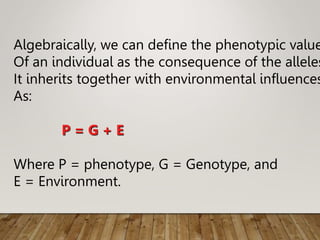
Algebraically, we can define the phenotypic value
Of an individual as the consequence of the alleles
It inherits together with environmental influences
As:
P = G + E
Where P = phenotype, G = Genotype, and
E = Environment.
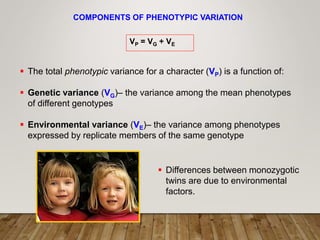
COMPONENTS OF PHENOTYPIC VARIATION
 The total phenotypic variance for a character (VP) is a function of:
 Genetic variance (VG)– the variance among the mean phenotypes
of different genotypes
 Environmental variance (VE)– the variance among phenotypes
expressed by replicate members of the same genotype
VP = VG + VE
 Differences between monozygotic
twins are due to environmental
factors.
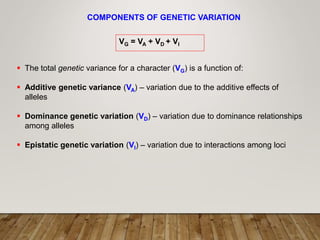
COMPONENTS OF GENETIC VARIATION
VG = VA + VD + VI
 The total genetic variance for a character (VG) is a function of:
 Additive genetic variance (VA) – variation due to the additive effects of
alleles
 Dominance genetic variation (VD) – variation due to dominance relationships
among alleles
 Epistatic genetic variation (VI) – variation due to interactions among loci
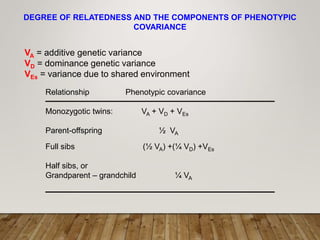
DEGREE OF RELATEDNESS AND THE COMPONENTS OF PHENOTYPIC
COVARIANCE
VA = additive genetic variance
VD = dominance genetic variance
VEs = variance due to shared environment
Relationship Phenotypic covariance
Monozygotic twins: VA + VD + VEs
Parent-offspring ½ VA
Full sibs (½ VA) +(¼ VD) +VEs
Half sibs, or
Grandparent – grandchild ¼ VA
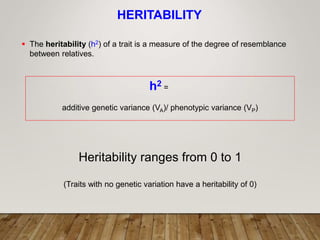
HERITABILITY
 The heritability (h2) of a trait is a measure of the degree of resemblance
between relatives.
h2 =
additive genetic variance (VA)/ phenotypic variance (VP)
Heritability ranges from 0 to 1
(Traits with no genetic variation have a heritability of 0)
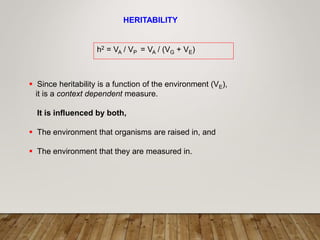
HERITABILITY
h2 = VA / VP = VA / (VG + VE)
 Since heritability is a function of the environment (VE),
it is a context dependent measure.
It is influenced by both,
 The environment that organisms are raised in, and
 The environment that they are measured in.
Heritabilities range from 0 to 1.
Heritabilities of 0 are found in highly inbred
populations with no genetic variation.
Heritabilities of 1 are expected for characters with
no environmental variance in an outbred population
if all genetic variance is additive.
Heritabilities are specific to particular populations
living under specific environmental conditions.
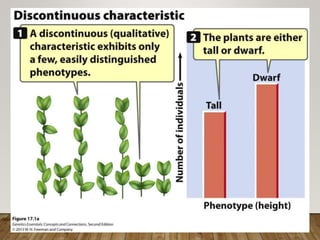
• Discontinuous (qualitative) traits possess only a
few phenotypes.
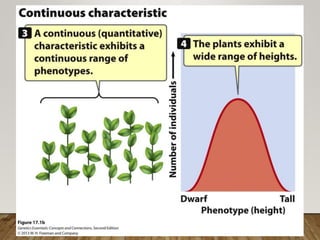
• Continuous (quantitative) characteristics vary
along a scale of measurement with many
overlapping phenotypes.
• The Relationship Between Genotype and
Phenotype
• Types of Quantitative Characteristics
• Polygenic Inheritance
• Kernel Color in Wheat
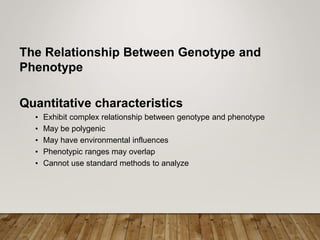
The Relationship Between Genotype and
Phenotype
Quantitative characteristics
• Exhibit complex relationship between genotype and phenotype
• May be polygenic
• May have environmental influences
• Phenotypic ranges may overlap
• Cannot use standard methods to analyze
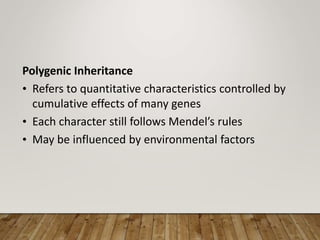
Polygenic Inheritance
• Refers to quantitative characteristics controlled by
cumulative effects of many genes
• Each character still follows Mendel’s rules
• May be influenced by environmental factors
STATISTICAL METHODS ARE REQUIRED FOR
ANALYZING QUANTITATIVE
CHARACTERISTICS
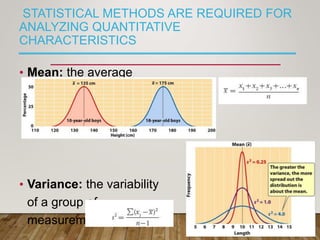
• Mean: the average
• Variance: the variability
of a group of
measurements
HERITABILITY IS USED TO ESTIMATE THE
PROPORTION OF VARIATION IN A TRAIT THAT
IS GENETIC
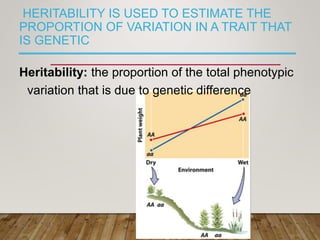
Heritability: the proportion of the total phenotypic
variation that is due to genetic difference
HERITABILITY IS USED TO ESTIMATE THE
PROPORTION OF VARIATION IN A TRAIT THAT IS
GENETIC
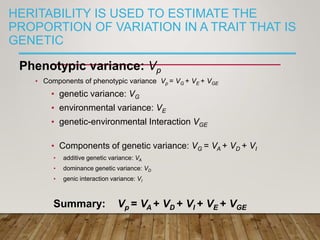
Phenotypic variance: Vp
• Components of phenotypic variance Vp = VG + VE + VGE
• genetic variance: VG
• environmental variance: VE
• genetic-environmental Interaction VGE
• Components of genetic variance: VG = VA + VD + VI
• additive genetic variance: VA
• dominance genetic variance: VD
• genic interaction variance: VI
Summary: Vp = VA + VD + VI + VE + VGE
HERITABILITY IS USED TO ESTIMATE THE
PROPORTION OF VARIATION IN A TRAIT THAT IS
GENETIC
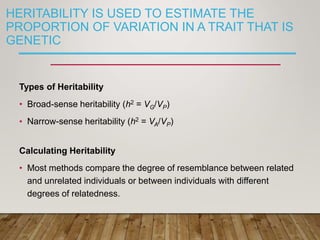
Types of Heritability
• Broad-sense heritability (h2 = VG/VP)
• Narrow-sense heritability (h2 = VA/VP)
Calculating Heritability
• Most methods compare the degree of resemblance between related
and unrelated individuals or between individuals with different
degrees of relatedness.

variability in population.ppt

  • 1.
    Study of variabilityin F2 population Di-hybrid (9:3:3:1) or Mono-hybrid (3:1)
  • 2.
    Characterizing Genetic Diversity: QuantitativeVariation Quantitative (metric or polygenic) characters of Most concern to conservation biology are those related to reproductive fitness such as: Number of fertile offspring contributed by an Individual that survive to reproductive age.
  • 3.
    For endangered species,quantitative variation for reproductive fitness is involved in the major genetic concerns in conservation biology, namely: Reduction in reproductive fitness due to inbreeding (inbreeding depression) Loss of evolutionary potential due to small population sizes.
  • 4.
    Impact of crossingbetween different populations on fitness, whether beneficial (heterosis) or deleterious (outbreeding depression). Effects of translocating individuals from one environment to another. Correlations between molecular and quantitative measures of genetic diversity are low. Therefore, molecular measures of genetic variation provide, at best, only a very imprecise indication of evolutionary potential.
  • 5.
    A major challengein the study of quantitative genetics is to determine how much of the observe variation is due to genetics and how much is due to environment. One of the central concepts of quantitative genetic is heritability. Heritability is the proportion of the total phenotypic variance in a population due to geneti differences among individuals.
  • 6.
    Phenotype = Genotype+ Environment P = G + E Gene frequency = p and q Genotypic Frequency= p2+2pq+q2
  • 7.
    Genotype may producedifferent Phenotypes due to Penetrance. The proportion of individuals with a given genotype express the phenotype determines penetrance. (100% penetrance = all individuals show phenotype; 50% penetrance = half the individuals show phenotype). Penetrance in genetics is the proportion of individuals carrying a particular variant of a gene (allele or genotype) that also expresses an associated trait (phenotype).
  • 8.
    Algebraically, we candefine the phenotypic value Of an individual as the consequence of the alleles It inherits together with environmental influences As: P = G + E Where P = phenotype, G = Genotype, and E = Environment.
  • 9.
    COMPONENTS OF PHENOTYPICVARIATION  The total phenotypic variance for a character (VP) is a function of:  Genetic variance (VG)– the variance among the mean phenotypes of different genotypes  Environmental variance (VE)– the variance among phenotypes expressed by replicate members of the same genotype VP = VG + VE  Differences between monozygotic twins are due to environmental factors.
  • 10.
    COMPONENTS OF GENETICVARIATION VG = VA + VD + VI  The total genetic variance for a character (VG) is a function of:  Additive genetic variance (VA) – variation due to the additive effects of alleles  Dominance genetic variation (VD) – variation due to dominance relationships among alleles  Epistatic genetic variation (VI) – variation due to interactions among loci
  • 11.
    DEGREE OF RELATEDNESSAND THE COMPONENTS OF PHENOTYPIC COVARIANCE VA = additive genetic variance VD = dominance genetic variance VEs = variance due to shared environment Relationship Phenotypic covariance Monozygotic twins: VA + VD + VEs Parent-offspring ½ VA Full sibs (½ VA) +(¼ VD) +VEs Half sibs, or Grandparent – grandchild ¼ VA
  • 12.
    HERITABILITY  The heritability(h2) of a trait is a measure of the degree of resemblance between relatives. h2 = additive genetic variance (VA)/ phenotypic variance (VP) Heritability ranges from 0 to 1 (Traits with no genetic variation have a heritability of 0)
  • 13.
    HERITABILITY h2 = VA/ VP = VA / (VG + VE)  Since heritability is a function of the environment (VE), it is a context dependent measure. It is influenced by both,  The environment that organisms are raised in, and  The environment that they are measured in.
  • 14.
    Heritabilities range from0 to 1. Heritabilities of 0 are found in highly inbred populations with no genetic variation. Heritabilities of 1 are expected for characters with no environmental variance in an outbred population if all genetic variance is additive. Heritabilities are specific to particular populations living under specific environmental conditions.
  • 15.
    • Discontinuous (qualitative)traits possess only a few phenotypes. • Continuous (quantitative) characteristics vary along a scale of measurement with many overlapping phenotypes. • The Relationship Between Genotype and Phenotype • Types of Quantitative Characteristics • Polygenic Inheritance • Kernel Color in Wheat
  • 18.
    The Relationship BetweenGenotype and Phenotype Quantitative characteristics • Exhibit complex relationship between genotype and phenotype • May be polygenic • May have environmental influences • Phenotypic ranges may overlap • Cannot use standard methods to analyze
  • 19.
    Polygenic Inheritance • Refersto quantitative characteristics controlled by cumulative effects of many genes • Each character still follows Mendel’s rules • May be influenced by environmental factors
  • 20.
    STATISTICAL METHODS AREREQUIRED FOR ANALYZING QUANTITATIVE CHARACTERISTICS • Mean: the average • Variance: the variability of a group of measurements
  • 21.
    HERITABILITY IS USEDTO ESTIMATE THE PROPORTION OF VARIATION IN A TRAIT THAT IS GENETIC Heritability: the proportion of the total phenotypic variation that is due to genetic difference
  • 22.
    HERITABILITY IS USEDTO ESTIMATE THE PROPORTION OF VARIATION IN A TRAIT THAT IS GENETIC Phenotypic variance: Vp • Components of phenotypic variance Vp = VG + VE + VGE • genetic variance: VG • environmental variance: VE • genetic-environmental Interaction VGE • Components of genetic variance: VG = VA + VD + VI • additive genetic variance: VA • dominance genetic variance: VD • genic interaction variance: VI Summary: Vp = VA + VD + VI + VE + VGE
  • 23.
    HERITABILITY IS USEDTO ESTIMATE THE PROPORTION OF VARIATION IN A TRAIT THAT IS GENETIC Types of Heritability • Broad-sense heritability (h2 = VG/VP) • Narrow-sense heritability (h2 = VA/VP) Calculating Heritability • Most methods compare the degree of resemblance between related and unrelated individuals or between individuals with different degrees of relatedness.