Perspectives and Visions of Strategic Urban Development
VARANASI
Introduction
The Background to the City Personality
Varanasi, known as the Cultural Capital of India, records a settlement history since 800BCE.
However, the present city has grown during the early 18th century.
The main city spreads over an area of 84.55 km2, and is inhabited by 1.21 million people.
The impact of intense development pressures is harder in the old city centre where population densi
ty reaches to 500 to 700 persons/ha.
Till mid 19th century the urban landscape was dominated by tracts of garden-groves and
linking water bodies and drains that helped to maintain ecological order and escape from water
logging.
Under the 'Master Plan 2011' the expanded area proposed for the Greater Varanasi is
179.27 km2. The major changes since 1991 as in the Plan, indicate a catastrophic increase of
land under government and semi-government uses (+390.50%), and public and community
facilities (+190.63%). This catastrophic change spoils the ecological system of land use; the most
crucial group is park and open ground that records decrease of over 60% in comparison to 1999.
800-500 BCE
The archaeological findings at Rajghat (northern part of Banaras city)
confirm the existence of urban settlements.
272-242 BCE
Ashoka the great Mauryan king, had declared Buddhism a state religion and
visited Sarnath. Under his patronage there developed a Buddhist township wi
th many monasteries, stupas and shrines.
Buddhist literature mention the structure, condition and some plans of the
city of Varanasi.
The city was dominated by mud houses planned in a rectangular design, but
by the turn of 2nd century BCE burnt bricks became common in
making buildings.
4th to 6th century CE
By the Gupta period , the city expanded, following a rough rectangular plan.
The main roads were running parallel to the
Ganga river, north-south.
The Basis: Growth of Urban Fabric in the Past
Evidences support that the city was divided by many wide roads and lanes, ho
wever there was no well-planned design. Even today north-south main axial ro
ads and similar structure are marked.
606-648 CE
A great Chinese pilgrim Hsüan-tsang paid visit to Varanasi and described
the city as conglomerate of congested houses separated by narrow lanes, gard
en and groves, and water pools with lotus flowers.
8th and 12th
The major expansion and transformation of landscape took place.
The first settlements were in the north to the confluence of the Varana to the
Ganga, and later by the mid 10th century city expanded in the southern side.
11th century
The city came under the Gahadvalas .The city reached to its zenith. Three zone
s surrounding Omkareshvara, Vishveshvara and Kedareshvara temples came ou
t in full bloom associated with sacredness and settlements, inhabited by trade
s and migrants belonging to various linguo-cultural groups from different part
s of India.
1351-1388
Temples were destroyed in 1300s under Firoz Shah Tughlaq.
The Basis: Growth of Urban Fabric in the Past
Spatial characteristic of
traditional core
The city’s topography consist ot three
mounds resembling the lord shiva’s
TRISHULA.This are recognised as three
scared cores.
Areas located in the proximity of river
assume greater social significance
Evolution of ghats
There are presently 84 Ghats along the edge of the river,but ther
e are five ghat (panchtirth) which are considered most sacred am
ong all the Ghats.
These include:
1. Assi Ghat
2. Dasashwamedh ghat
3. Manikarnika ghat
4. Panchganga ghat
5. Adikeshav ghat Aarti at Assi ghat
•There is a continuous semi circular stretch ghats along the river
form the Assi in the south to the rajghat in the north.
• Extends almost 6 kms along the left bank of the ganga.
• These ghats are the interface between the building edge along
side the river and the river,permitting an access to the ganga.
• The ghat may be pakka that is constructed with stone steps or
kaccha that a natural bank.
• The ghats are therefore important factors for the purpose of
orientation.
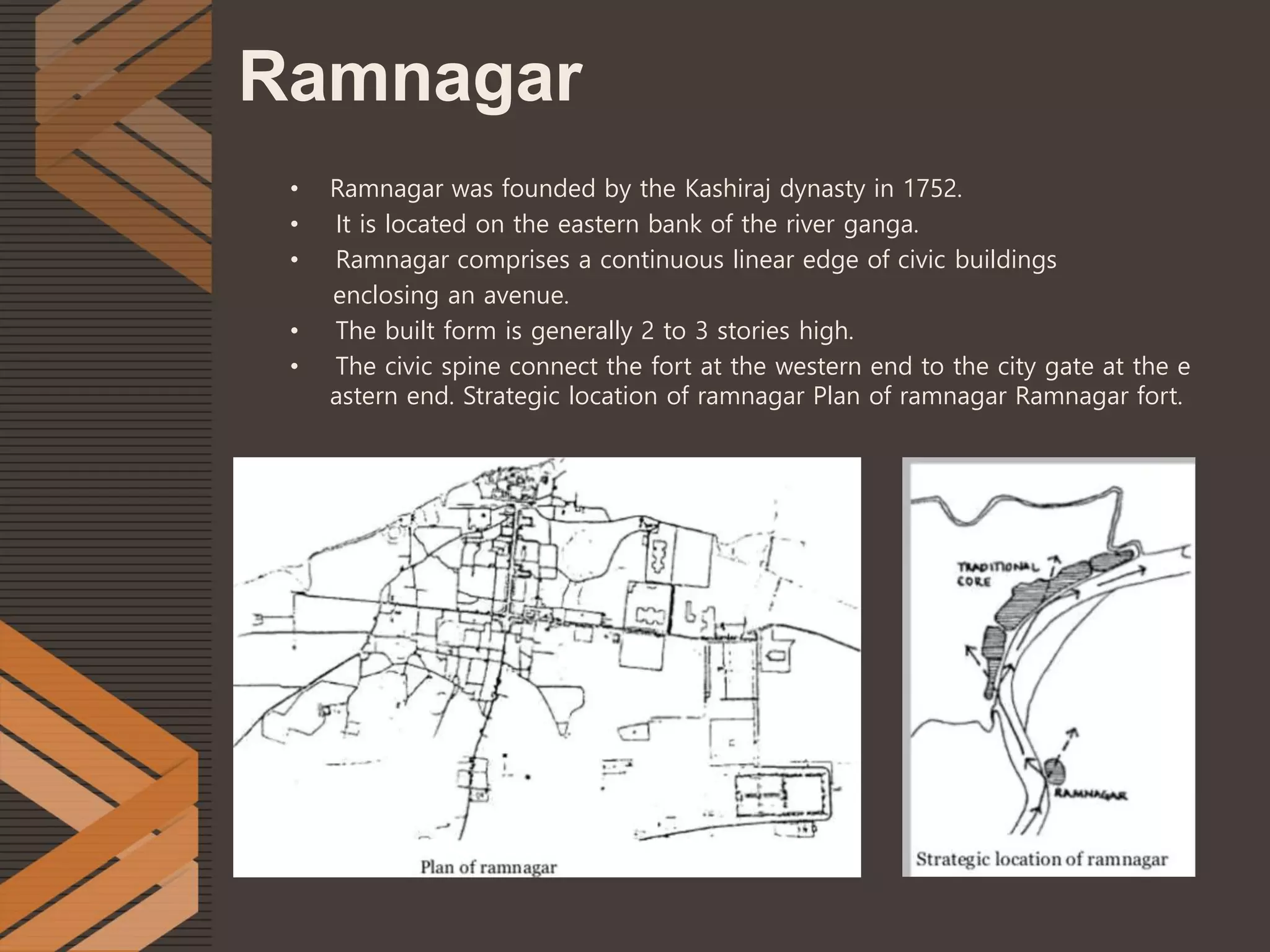
Ramnagar
• Ramnagar was founded by the Kashiraj dynasty in 1752.
• It is located on the eastern bank of the river ganga.
• Ramnagar comprises a continuous linear edge of civic buildings
enclosing an avenue.
• The built form is generally 2 to 3 stories high.
• The civic spine connect the fort at the western end to the city gate at the e
astern end. Strategic location of ramnagar Plan of ramnagar Ramnagar fort.
Master Plan
It is one of the oldest living cities of
the world, records a continuous settle
ment history since around 1000 BCE.
The main city of Varanasi spreads over
an area of 84.55 km2.
As the city has grown in area, populati
on, business, and administrative functi
ons, its influence extends beyond the
municipal limits.
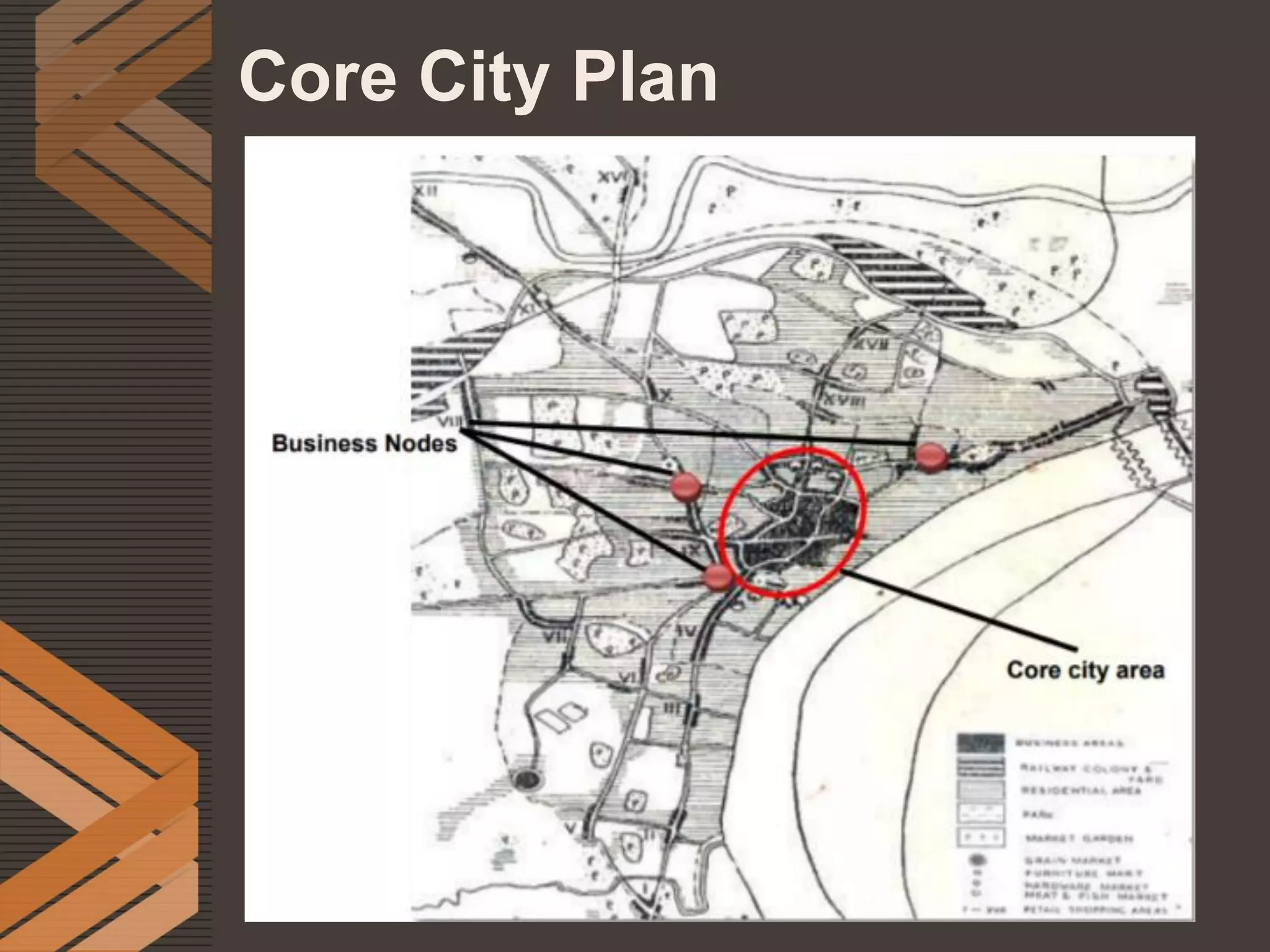
From a city with a single core (CBD,i.e.,
Chowk), it has now acquired the chara
cter of an urban agglomeration (UA) s
pread over an area of 119.52 km2.
Core City Plan
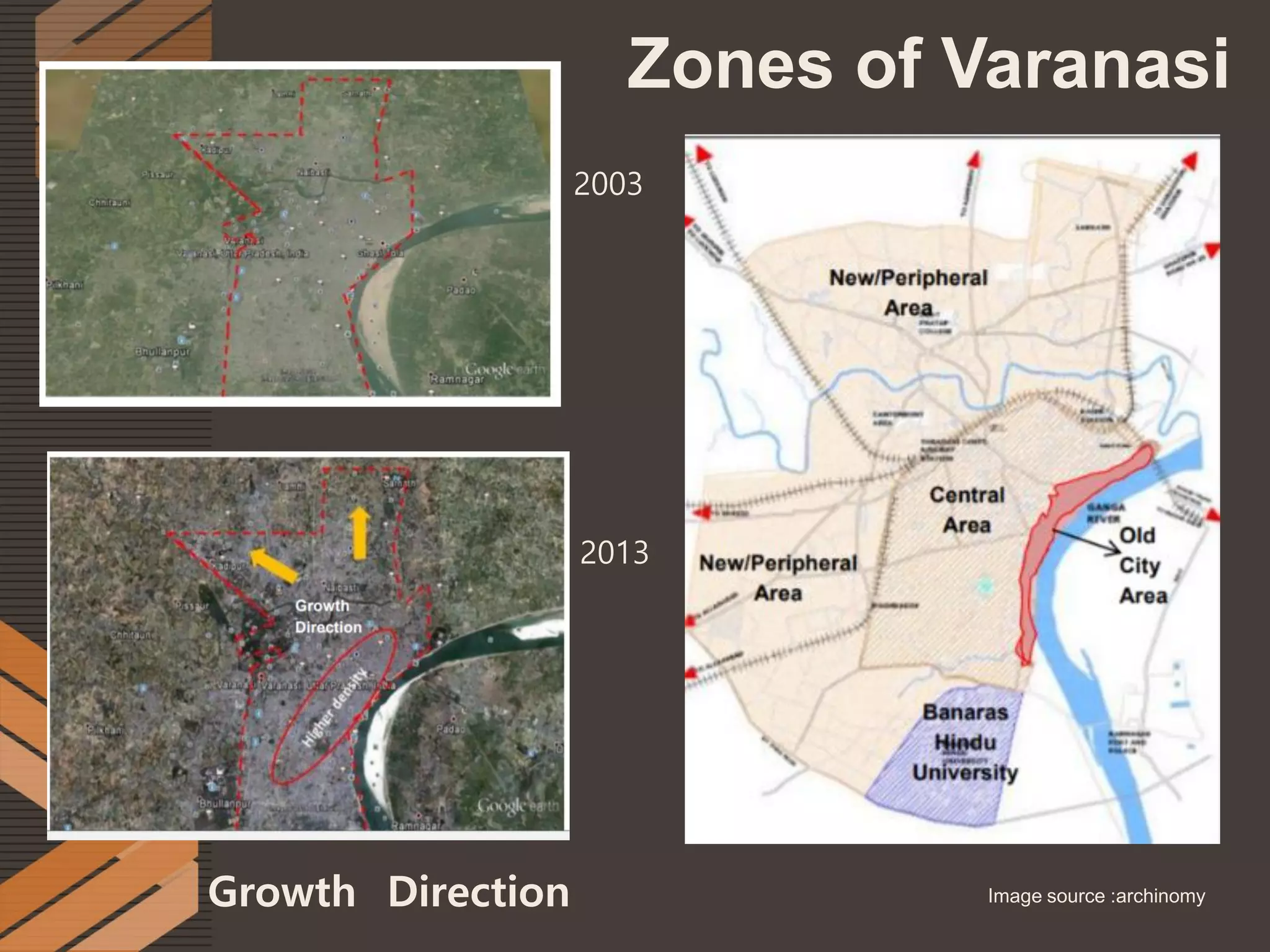
Zones of Varanasi
Image source :archinomy
2003
2013
Growth Direction
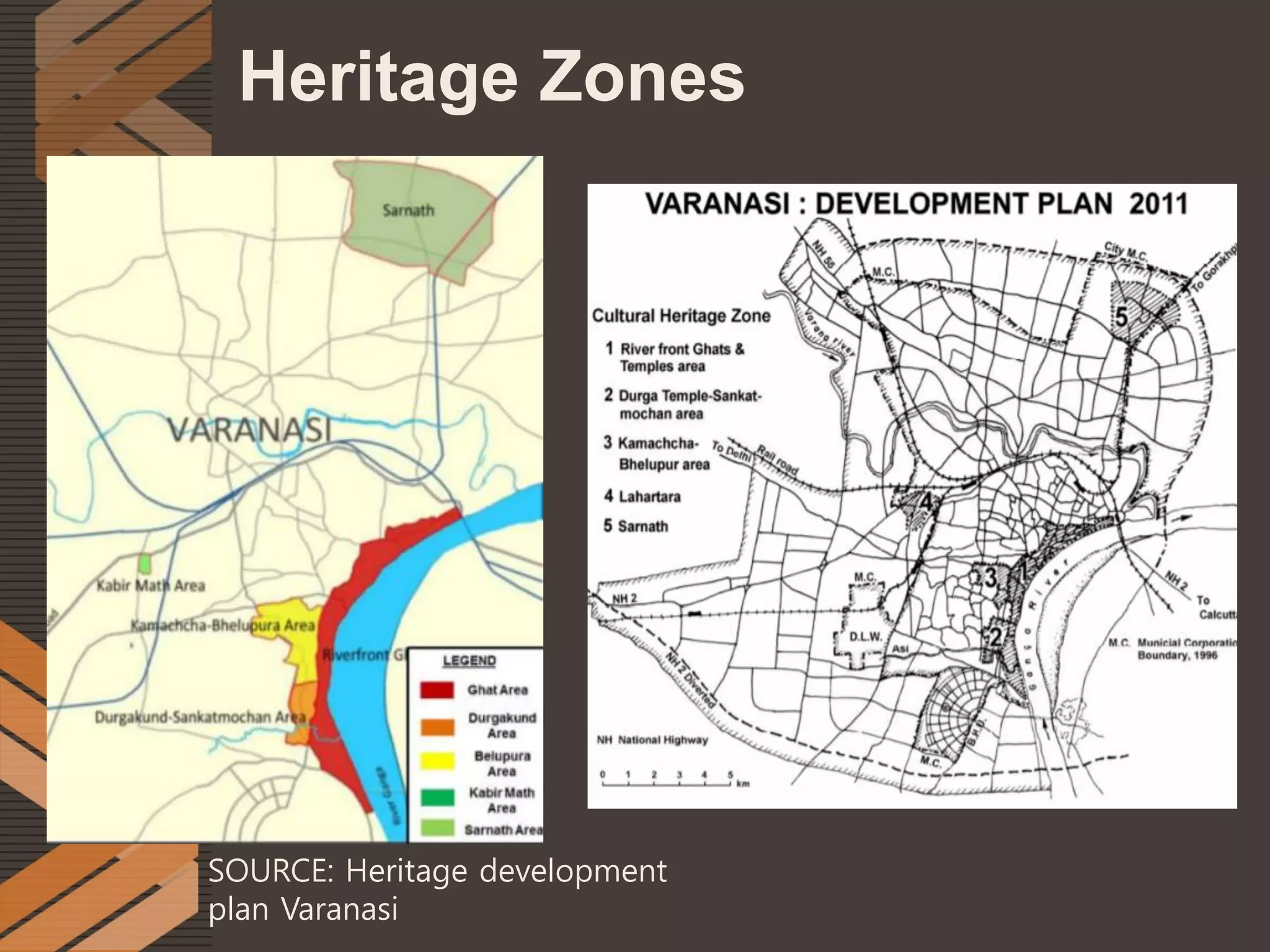
Heritage Zones
SOURCE: Heritage development
plan Varanasi
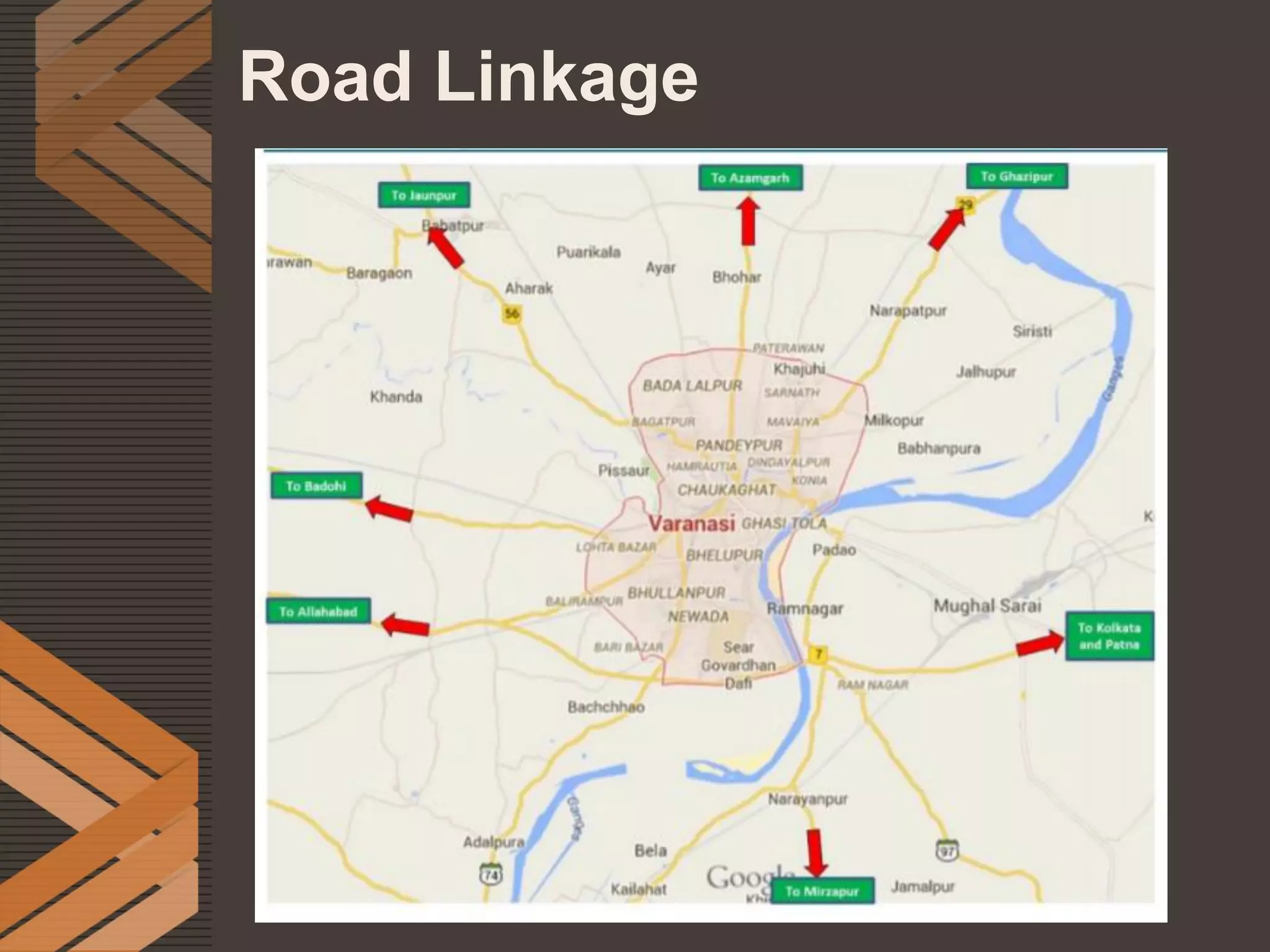
Road Linkage
City Character according to
road structure
Junction in the city managed
by traffic police in peak hours
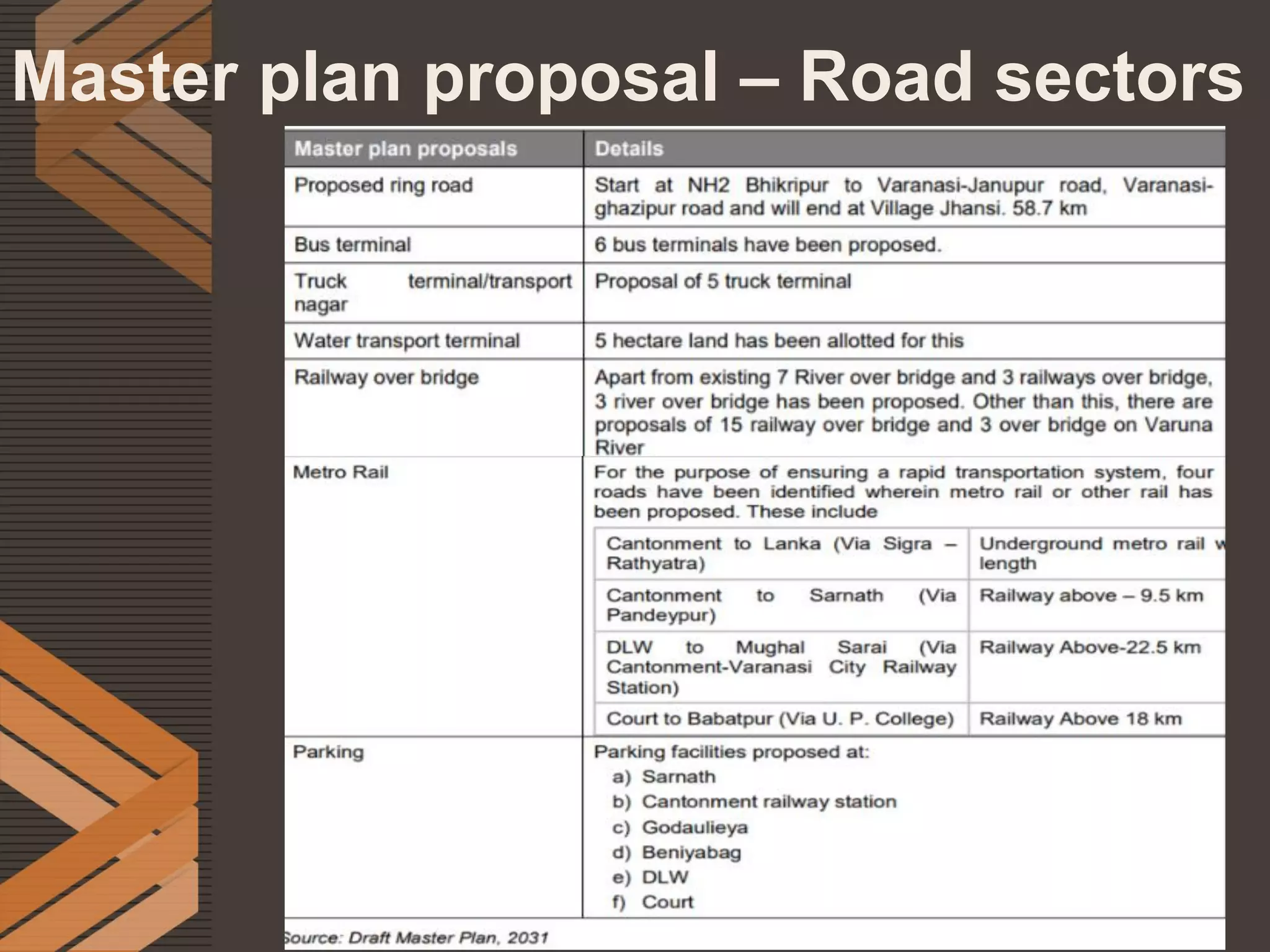
Master plan proposal – Road sectors
Rail linkage
Regional setting and adminis-
tration boundaries of Varanasi
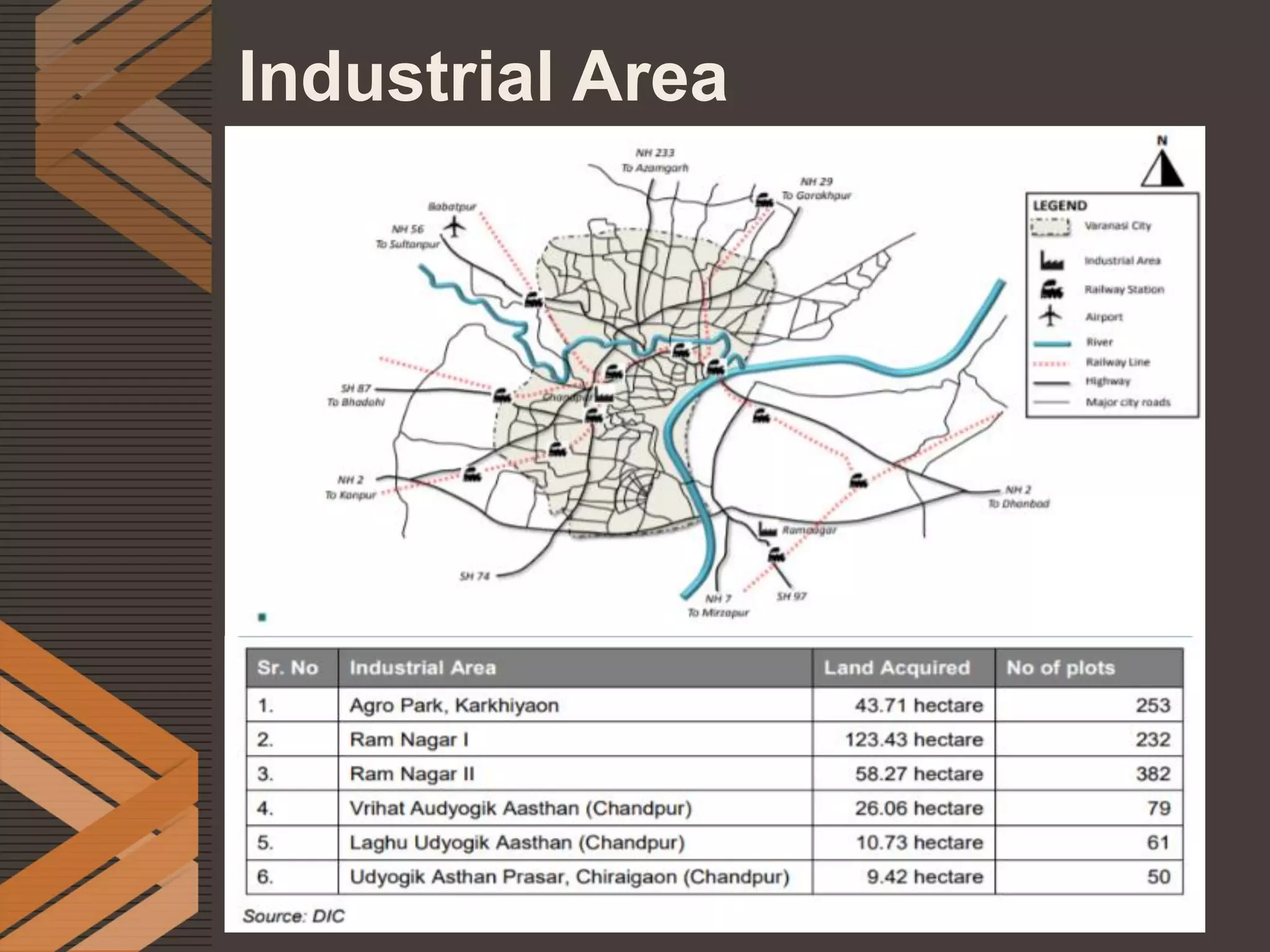
Industrial Area
Waste water generation
Water supply
Solid Waste Generation
Solid Waste Sites
Envisioning the future and livable city
The following five general principles should guide the development of a li
vable city on the lines of ecological sustainability; these should be given m
ore attention in the Varanasi Master Plan 2031:
• Be better places to live, for everyone.
• Underpin growth and jobs.
• Leave a sound legacy for future generations
• Offer better linkages to regions and other major cities
• Integrate within and between transport and land use, urban form, and new
technologies.
The following principles that are more specific should guide mobility withi
n an accessible city:
• Take a system approach for whole network.
• Limit the need for travel and if it is not possible distance to be traveled.
• Separate major flow of freight and passengers by separate network.
• Relieve people of the need to ‘drive’ vehicles, thus freeing their travel time
for more personal or productive tasks, for example, using non-crowded ‘pu
blic’ transport and intelligent transport systems to permit automatic operat
ion of road vehicles
https://www.nnvns.org/data/Final%20CDP%20Varanasi.pdf
https://issuu.com/amitasinha/docs/ghats_of_varanasi_repo
rt_small
https://city-origin-and-growth-banarasvaranasi?from_actio
n=save
REFERENCE

Varanasi -town planning pdf

  • 1.
    Perspectives and Visionsof Strategic Urban Development VARANASI
  • 2.
    Introduction The Background tothe City Personality Varanasi, known as the Cultural Capital of India, records a settlement history since 800BCE. However, the present city has grown during the early 18th century. The main city spreads over an area of 84.55 km2, and is inhabited by 1.21 million people. The impact of intense development pressures is harder in the old city centre where population densi ty reaches to 500 to 700 persons/ha. Till mid 19th century the urban landscape was dominated by tracts of garden-groves and linking water bodies and drains that helped to maintain ecological order and escape from water logging. Under the 'Master Plan 2011' the expanded area proposed for the Greater Varanasi is 179.27 km2. The major changes since 1991 as in the Plan, indicate a catastrophic increase of land under government and semi-government uses (+390.50%), and public and community facilities (+190.63%). This catastrophic change spoils the ecological system of land use; the most crucial group is park and open ground that records decrease of over 60% in comparison to 1999.
  • 3.
    800-500 BCE The archaeologicalfindings at Rajghat (northern part of Banaras city) confirm the existence of urban settlements. 272-242 BCE Ashoka the great Mauryan king, had declared Buddhism a state religion and visited Sarnath. Under his patronage there developed a Buddhist township wi th many monasteries, stupas and shrines. Buddhist literature mention the structure, condition and some plans of the city of Varanasi. The city was dominated by mud houses planned in a rectangular design, but by the turn of 2nd century BCE burnt bricks became common in making buildings. 4th to 6th century CE By the Gupta period , the city expanded, following a rough rectangular plan. The main roads were running parallel to the Ganga river, north-south. The Basis: Growth of Urban Fabric in the Past
  • 4.
    Evidences support thatthe city was divided by many wide roads and lanes, ho wever there was no well-planned design. Even today north-south main axial ro ads and similar structure are marked. 606-648 CE A great Chinese pilgrim Hsüan-tsang paid visit to Varanasi and described the city as conglomerate of congested houses separated by narrow lanes, gard en and groves, and water pools with lotus flowers. 8th and 12th The major expansion and transformation of landscape took place. The first settlements were in the north to the confluence of the Varana to the Ganga, and later by the mid 10th century city expanded in the southern side. 11th century The city came under the Gahadvalas .The city reached to its zenith. Three zone s surrounding Omkareshvara, Vishveshvara and Kedareshvara temples came ou t in full bloom associated with sacredness and settlements, inhabited by trade s and migrants belonging to various linguo-cultural groups from different part s of India. 1351-1388 Temples were destroyed in 1300s under Firoz Shah Tughlaq. The Basis: Growth of Urban Fabric in the Past
  • 5.
    Spatial characteristic of traditionalcore The city’s topography consist ot three mounds resembling the lord shiva’s TRISHULA.This are recognised as three scared cores. Areas located in the proximity of river assume greater social significance
  • 6.
    Evolution of ghats Thereare presently 84 Ghats along the edge of the river,but ther e are five ghat (panchtirth) which are considered most sacred am ong all the Ghats. These include: 1. Assi Ghat 2. Dasashwamedh ghat 3. Manikarnika ghat 4. Panchganga ghat 5. Adikeshav ghat Aarti at Assi ghat •There is a continuous semi circular stretch ghats along the river form the Assi in the south to the rajghat in the north. • Extends almost 6 kms along the left bank of the ganga. • These ghats are the interface between the building edge along side the river and the river,permitting an access to the ganga. • The ghat may be pakka that is constructed with stone steps or kaccha that a natural bank. • The ghats are therefore important factors for the purpose of orientation.
  • 7.
    Ramnagar • Ramnagar wasfounded by the Kashiraj dynasty in 1752. • It is located on the eastern bank of the river ganga. • Ramnagar comprises a continuous linear edge of civic buildings enclosing an avenue. • The built form is generally 2 to 3 stories high. • The civic spine connect the fort at the western end to the city gate at the e astern end. Strategic location of ramnagar Plan of ramnagar Ramnagar fort.
  • 8.
    Master Plan It isone of the oldest living cities of the world, records a continuous settle ment history since around 1000 BCE. The main city of Varanasi spreads over an area of 84.55 km2. As the city has grown in area, populati on, business, and administrative functi ons, its influence extends beyond the municipal limits. From a city with a single core (CBD,i.e., Chowk), it has now acquired the chara cter of an urban agglomeration (UA) s pread over an area of 119.52 km2.
  • 9.
  • 10.
    Zones of Varanasi Imagesource :archinomy 2003 2013 Growth Direction
  • 11.
    Heritage Zones SOURCE: Heritagedevelopment plan Varanasi
  • 12.
  • 13.
    City Character accordingto road structure
  • 14.
    Junction in thecity managed by traffic police in peak hours
  • 15.
    Master plan proposal– Road sectors
  • 16.
  • 17.
    Regional setting andadminis- tration boundaries of Varanasi
  • 18.
  • 19.
  • 20.
  • 21.
    Envisioning the futureand livable city The following five general principles should guide the development of a li vable city on the lines of ecological sustainability; these should be given m ore attention in the Varanasi Master Plan 2031: • Be better places to live, for everyone. • Underpin growth and jobs. • Leave a sound legacy for future generations • Offer better linkages to regions and other major cities • Integrate within and between transport and land use, urban form, and new technologies. The following principles that are more specific should guide mobility withi n an accessible city: • Take a system approach for whole network. • Limit the need for travel and if it is not possible distance to be traveled. • Separate major flow of freight and passengers by separate network. • Relieve people of the need to ‘drive’ vehicles, thus freeing their travel time for more personal or productive tasks, for example, using non-crowded ‘pu blic’ transport and intelligent transport systems to permit automatic operat ion of road vehicles
  • 22.