Copyright 2016 Innermetrix Incorporated • All rights reserved
Susan Yen
January 28, 2016
This Innermetrix Values Index is a combination of the research of Dr. Eduard Spranger
and Gordon Allport into what drives and motivates an individual. The seven
dimensions of value discovered between these two researchers help understand the
reasons that drive an individual to utilize their talents in the unique way they do. This
Values Index will help you understand your motivators and drivers and how to
maximize your performance by achieving better alignment and passion for what you
do.
Anthony Robbins Coaching
www.tonyrobbins.com
The Values Index Introduction
SusanYen
Copyright 2016 Innermetrix Incorporated • All rights reserved 2
About This Report
Research conducted by Innermetrix shows that the most successful people share the common trait of
self-awareness. They recognize the situations that will make them successful, and this makes it easy
for them to find ways of achieving objectives that resonate with their motivations. They also understand
their limitations and where they are not effective and this helps them understand what does not inspire
them or what will not motivate them to succeed. Those who understand their natural motivators better
arefarmorelikelytopursuetherightopportunities,fortherightreasons,andgettheresultstheydesire.
This report measures seven dimensions of motivation. They are:
• Aesthetic - a drive for balance, harmony and form.
• Economic - a drive for economic or practical returns.
• Individualistic - a drive to stand out as independent and unique.
• Political - a drive to be in control or have influence.
• Altruist - a drive for humanitarian efforts or to help others altruistically.
• Regulatory - a drive to establish order, routine and structure.
• Theoretical - a drive for knowledge, learning and understanding.
The Values Index Seven Dimensions of Value and Motivation
SusanYen
Copyright 2016 Innermetrix Incorporated • All rights reserved 3
The Elements of the Values Index
This Values Index is unique in the marketplace in that it examines seven independent and unique
aspects of value or motivation. Most other values instruments only examine six dimensions of value
by combining the Individualistic and Political into one dimension. The Values Index remains true to
the original works and models of two of the most significant researchers in this field, thus delivering
to you a profile that truly helps you understand your own unique motivations and drivers.
Also, the Values Index is the first to use a click & drag approach to rank the various statements in the
instrument, which makes taking the instrument more intuitive, natural and in the end you can actually
create the order you see in your mind on the screen.
Finally, the Values Index instrument contains the most contemporary list of statements to make your
choices more relevant to your life today, which helps ensure the most accurate results possible.
The Values Index Seven Dimensions of Value and Motivation
SusanYen
Copyright 2016 Innermetrix Incorporated • All rights reserved 4
A closer look at the seven dimensions
Values help influence behavior and action and can be considered somewhat of a
hidden motivation because they are not readily observable. Understanding your
values helps to tell you why you prefer to do what you do.
It is vital for superior performance to ensure that your motivations are satisfied
by what you do. This drives your passion, reduces fatigue, inspires you and
increases drive.
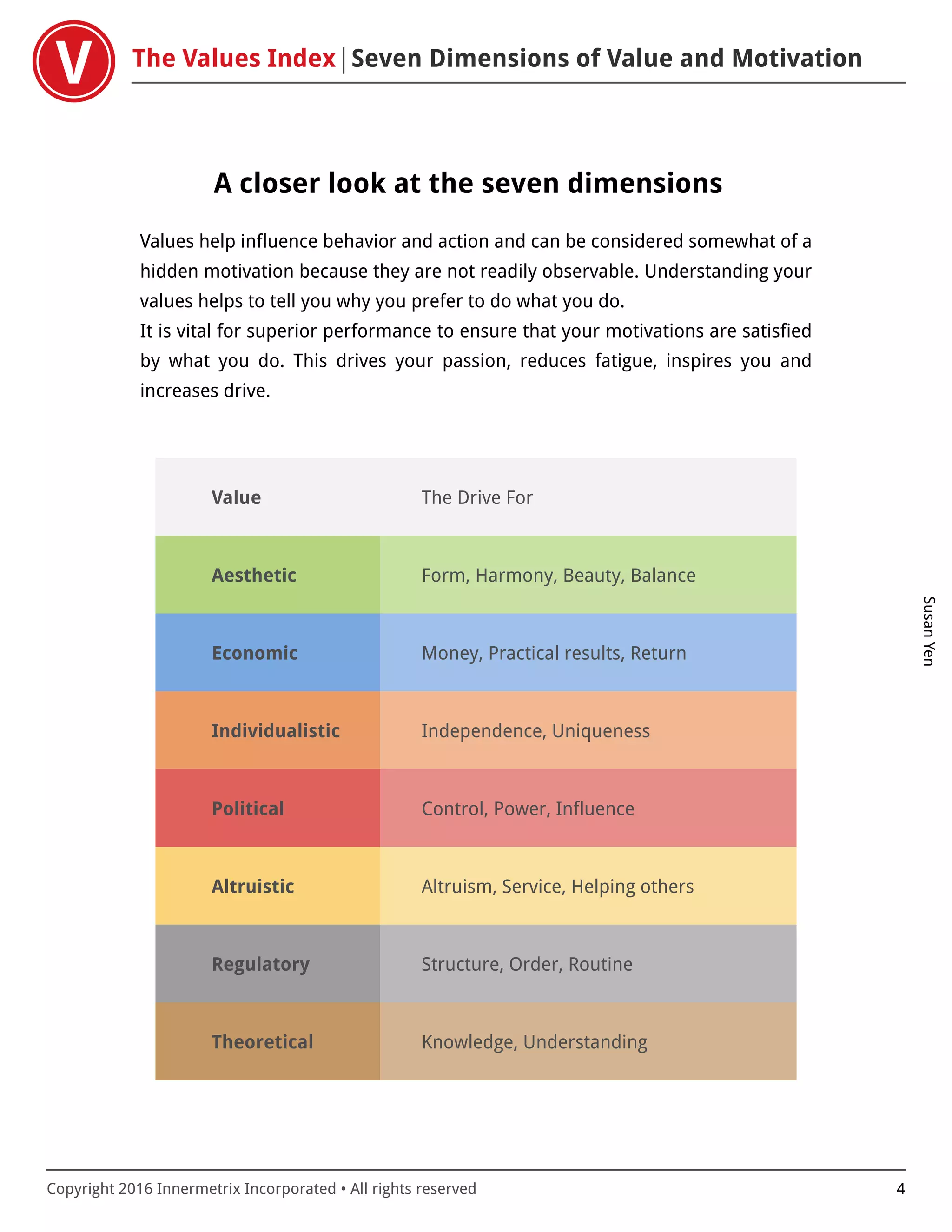
Value The Drive For
Aesthetic Form, Harmony, Beauty, Balance
Economic Money, Practical results, Return
Individualistic Independence, Uniqueness
Political Control, Power, Influence
Altruistic Altruism, Service, Helping others
Regulatory Structure, Order, Routine
Theoretical Knowledge, Understanding
The Values Index Seven Dimensions of Value and Motivation
SusanYen
Copyright 2016 Innermetrix Incorporated • All rights reserved 5
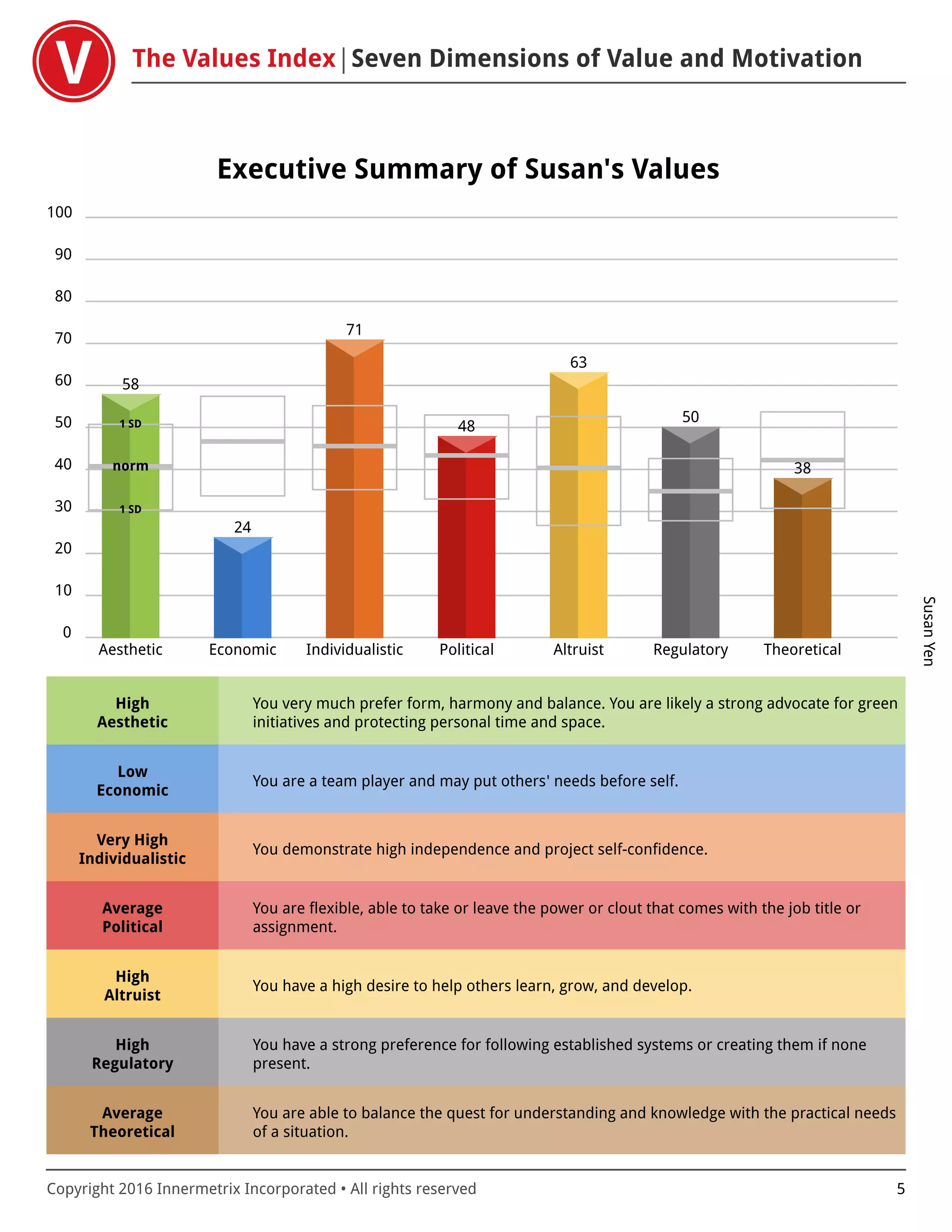
Executive Summary of Susan's Values
0
10
20
30
40
50
60
70
80
90
100
Aesthetic Economic Individualistic Political Altruist Regulatory Theoretical
norm
1 SD
1 SD
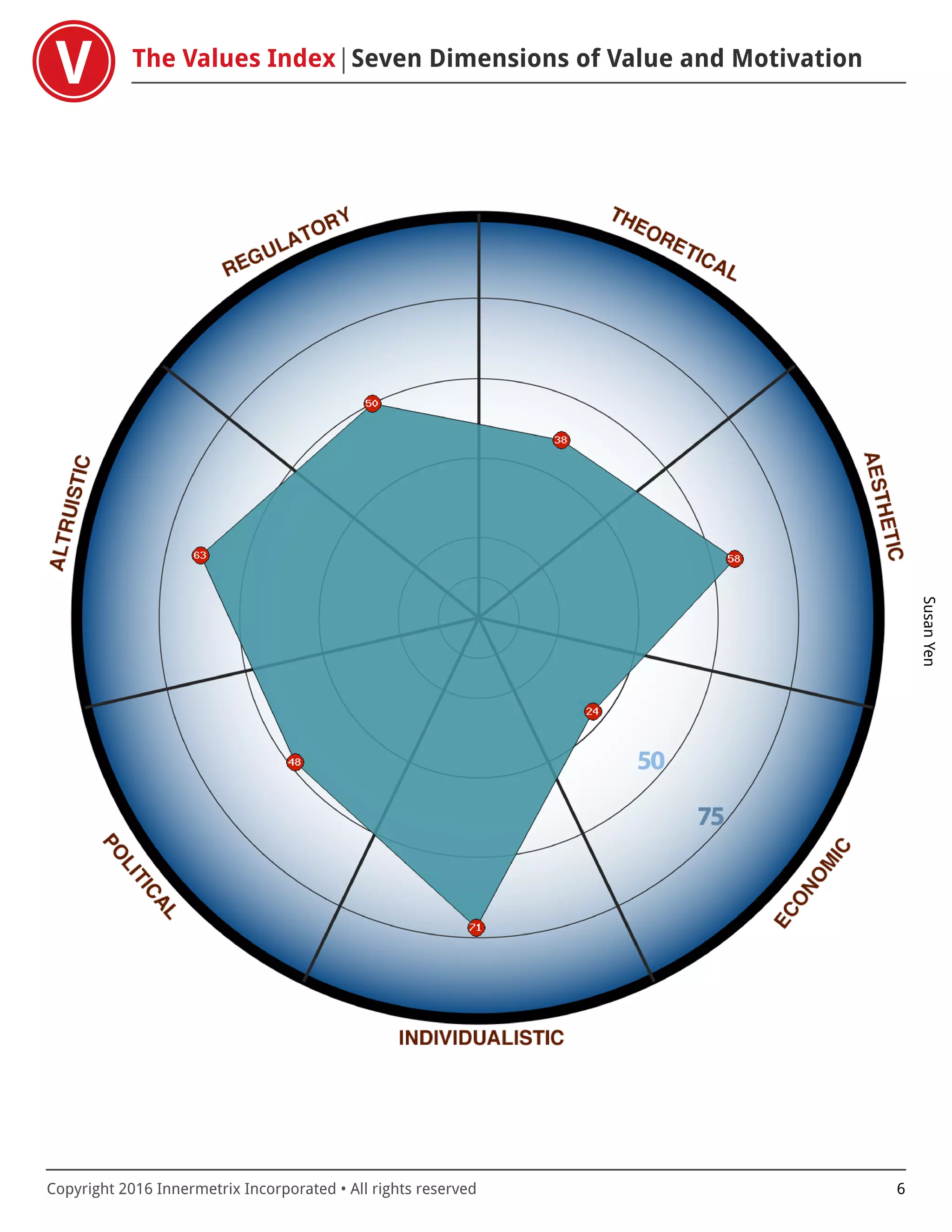
58
24
71
48
63
50
38
High
Aesthetic
You very much prefer form, harmony and balance. You are likely a strong advocate for green
initiatives and protecting personal time and space.
Low
Economic
You are a team player and may put others' needs before self.
Very High
Individualistic
You demonstrate high independence and project self-confidence.
Average
Political
You are flexible, able to take or leave the power or clout that comes with the job title or
assignment.
High
Altruist
You have a high desire to help others learn, grow, and develop.
High
Regulatory
You have a strong preference for following established systems or creating them if none
present.
Average
Theoretical
You are able to balance the quest for understanding and knowledge with the practical needs
of a situation.
The Values Index Seven Dimensions of Value and Motivation
SusanYen
Copyright 2016 Innermetrix Incorporated • All rights reserved 6
The Values Index Your Aesthetic Drive
SusanYen
Copyright 2016 Innermetrix Incorporated • All rights reserved 7
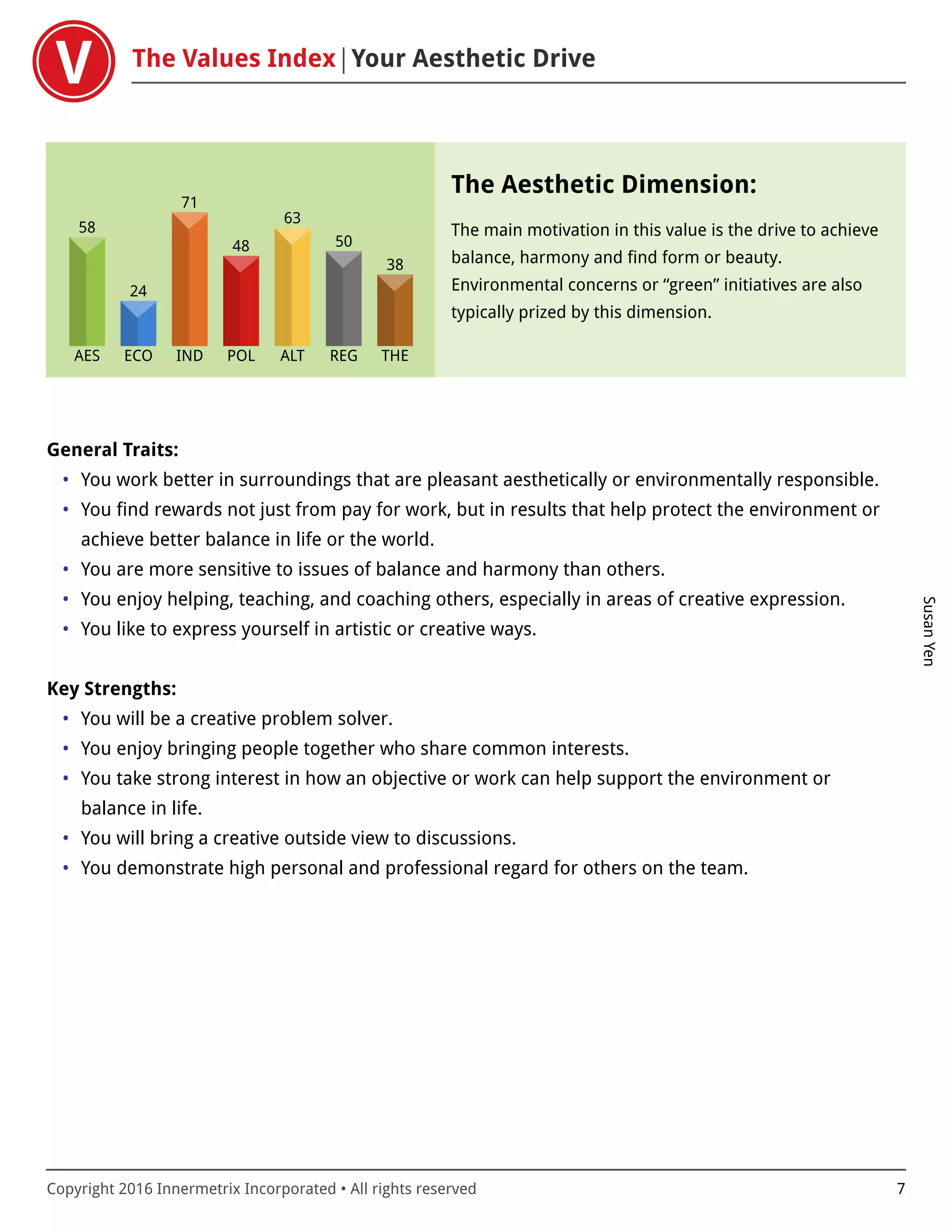
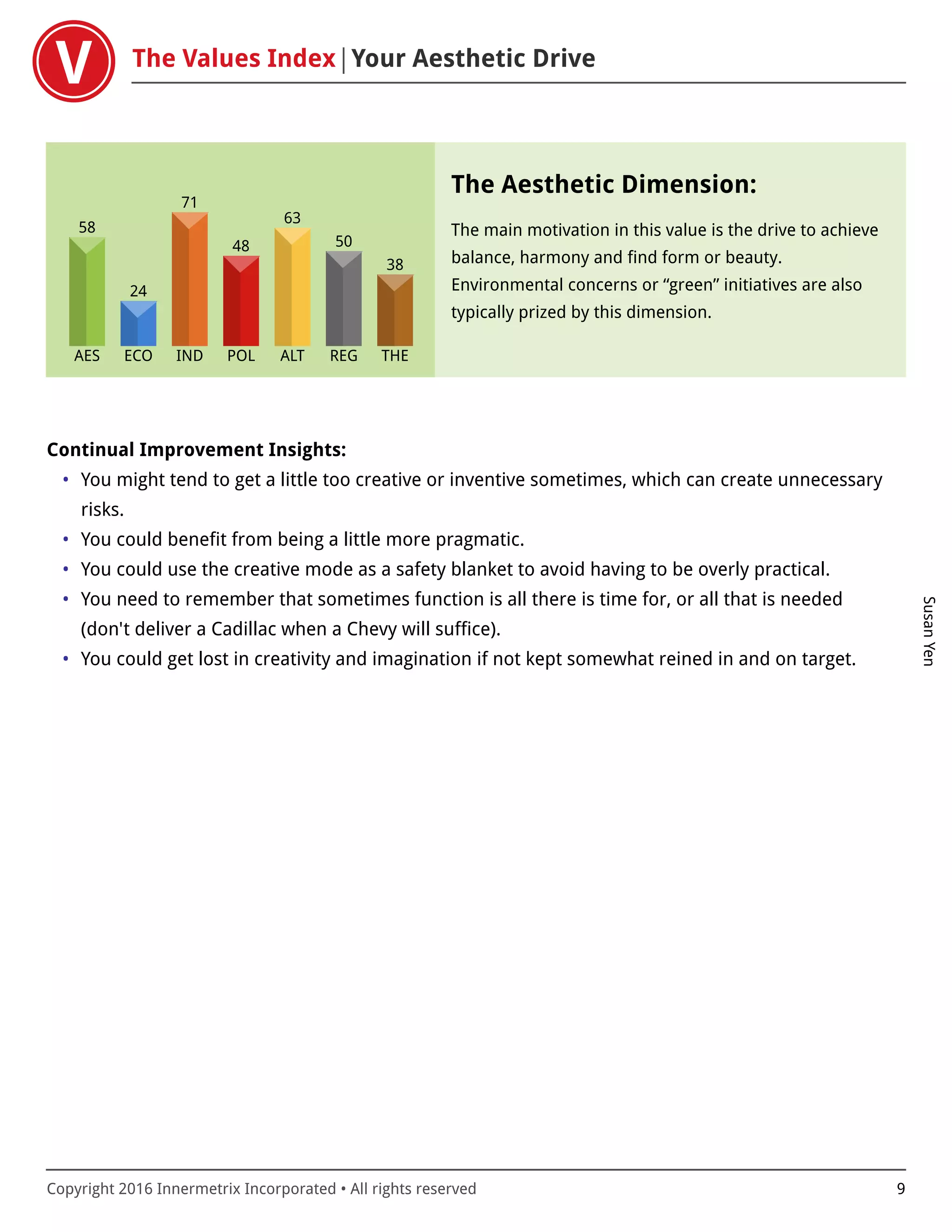
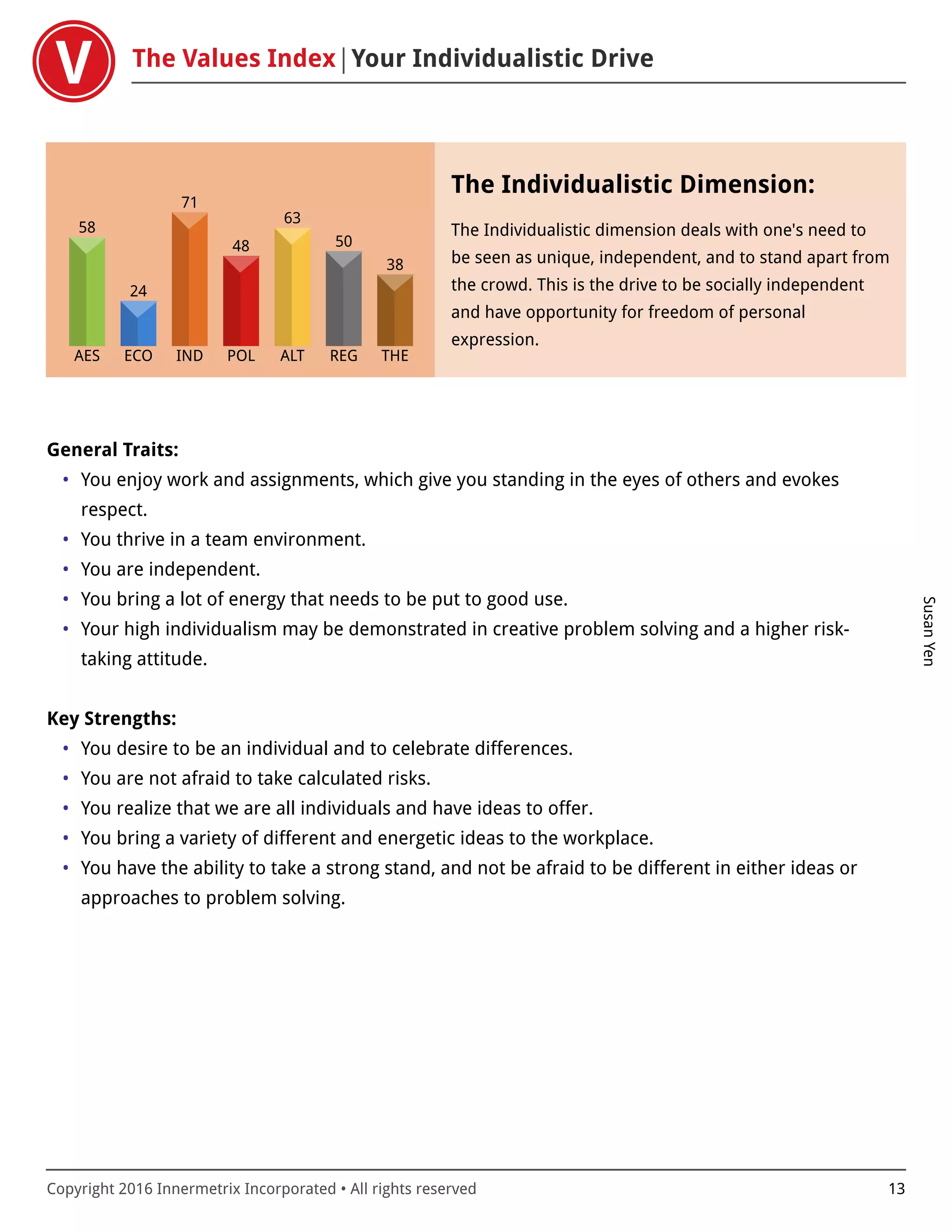
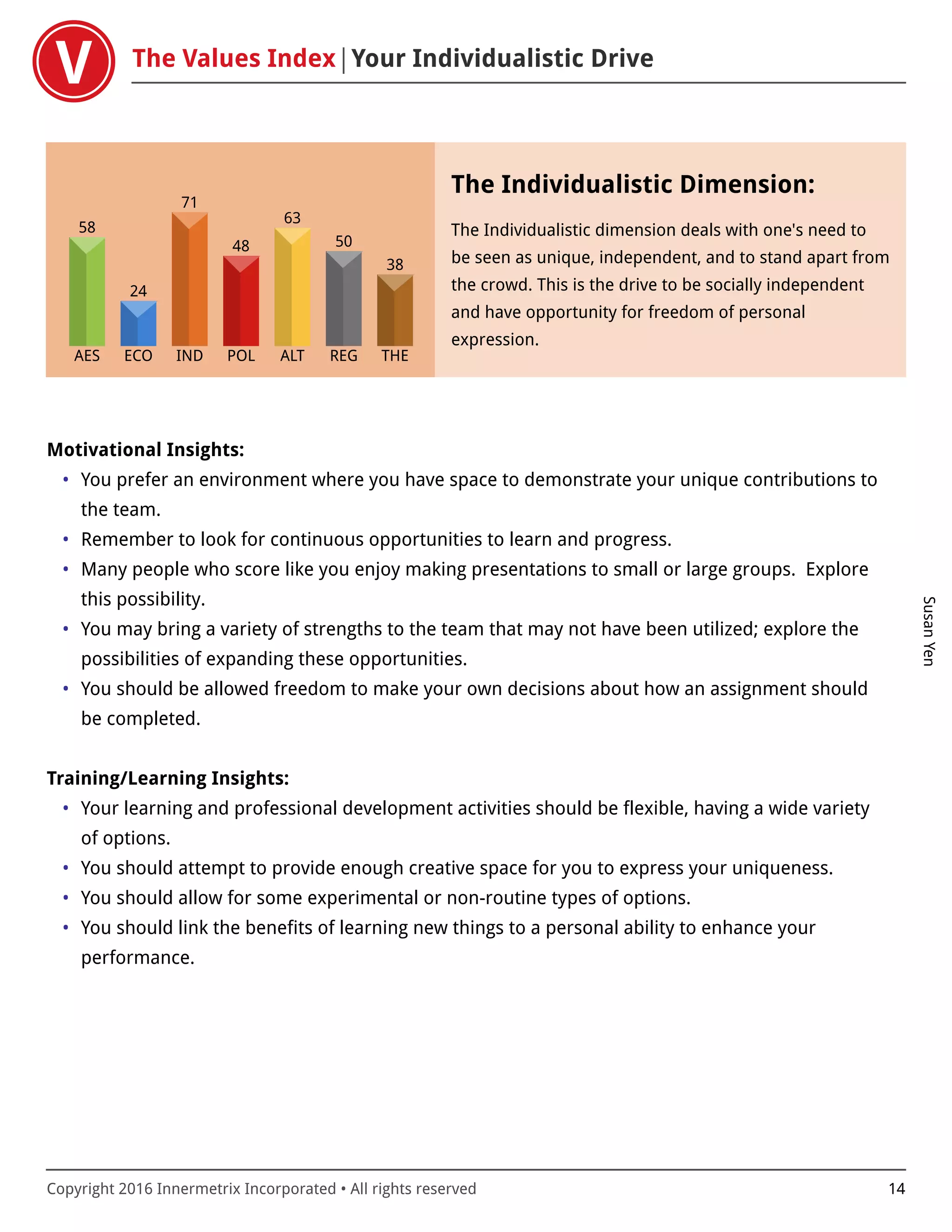
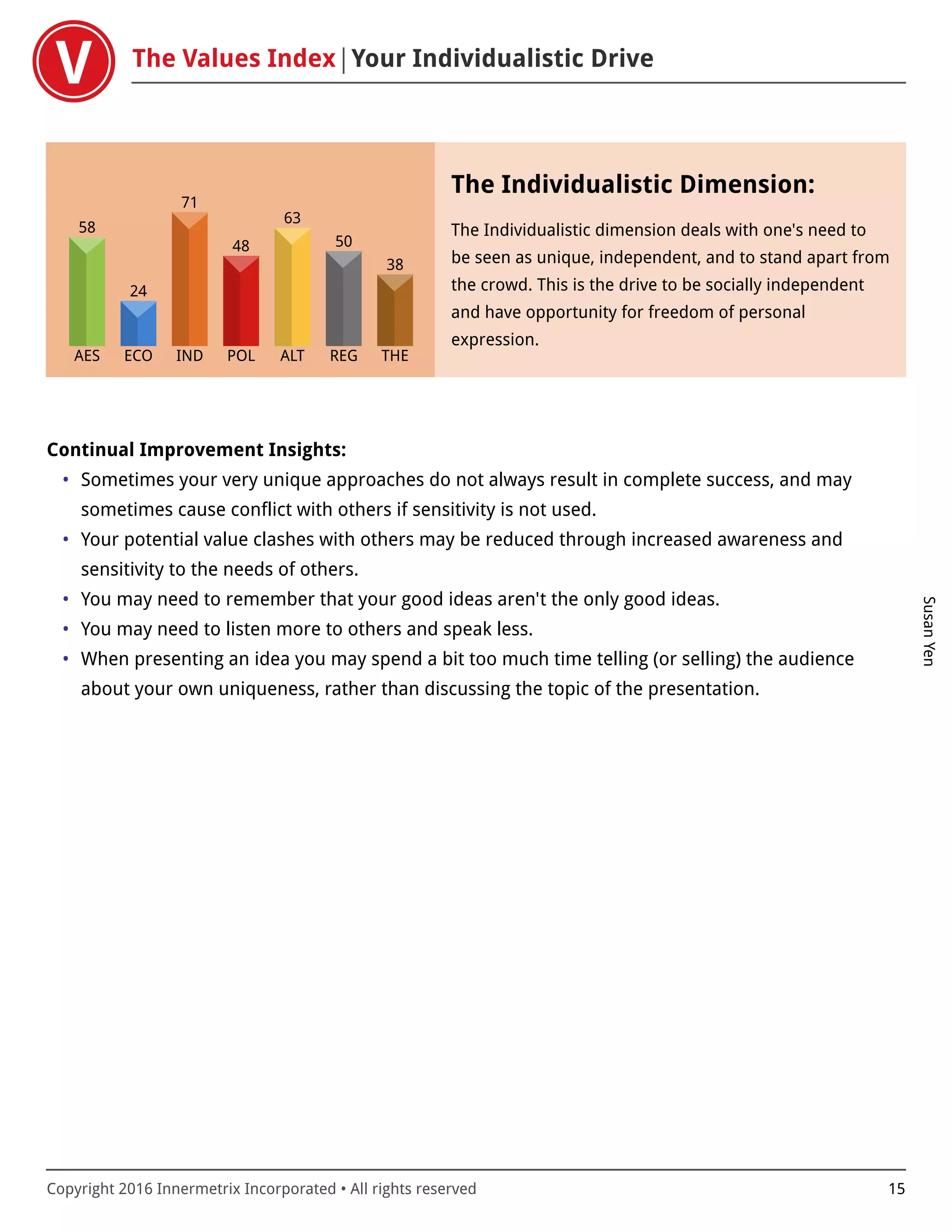
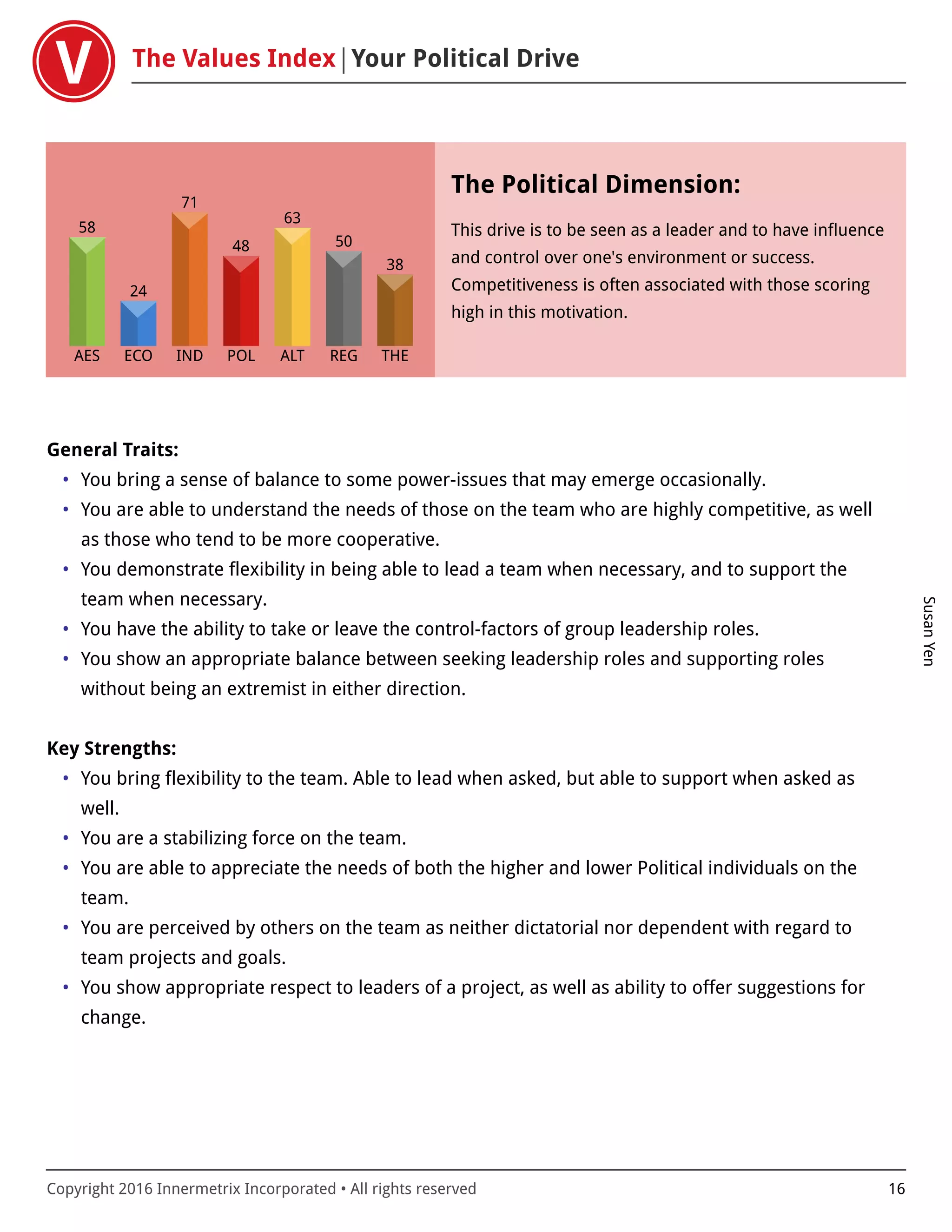
AES
58
ECO
24
IND
71
POL
48
ALT
63
REG
50
THE
38
The Aesthetic Dimension:
The main motivation in this value is the drive to achieve
balance, harmony and find form or beauty.
Environmental concerns or “green” initiatives are also
typically prized by this dimension.
General Traits:
• You work better in surroundings that are pleasant aesthetically or environmentally responsible.
• You find rewards not just from pay for work, but in results that help protect the environment or
achieve better balance in life or the world.
• You are more sensitive to issues of balance and harmony than others.
• You enjoy helping, teaching, and coaching others, especially in areas of creative expression.
• You like to express yourself in artistic or creative ways.
Key Strengths:
• You will be a creative problem solver.
• You enjoy bringing people together who share common interests.
• You take strong interest in how an objective or work can help support the environment or
balance in life.
• You will bring a creative outside view to discussions.
• You demonstrate high personal and professional regard for others on the team.
The Values Index Your Aesthetic Drive
SusanYen
Copyright 2016 Innermetrix Incorporated • All rights reserved 8
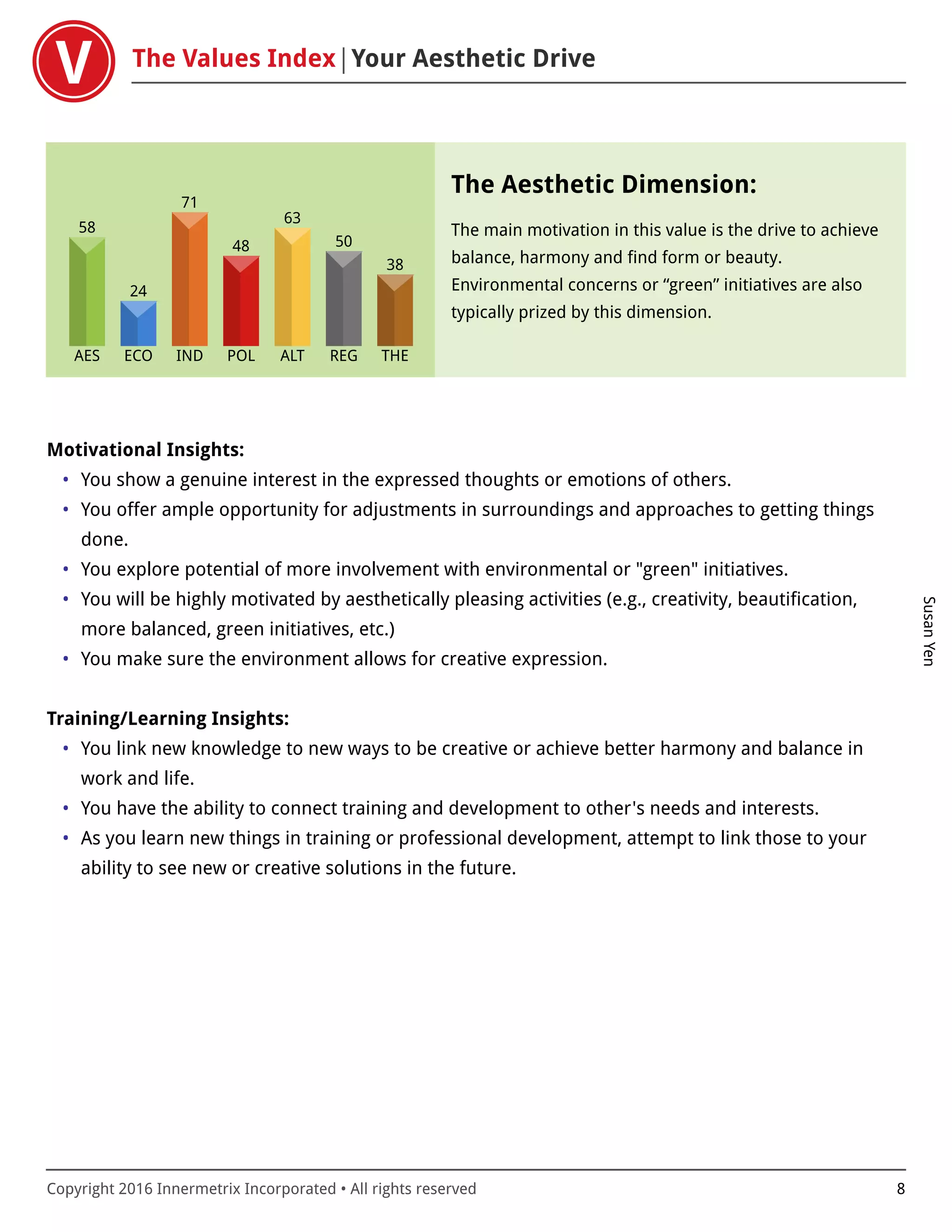
AES
58
ECO
24
IND
71
POL
48
ALT
63
REG
50
THE
38
The Aesthetic Dimension:
The main motivation in this value is the drive to achieve
balance, harmony and find form or beauty.
Environmental concerns or “green” initiatives are also
typically prized by this dimension.
Motivational Insights:
• You show a genuine interest in the expressed thoughts or emotions of others.
• You offer ample opportunity for adjustments in surroundings and approaches to getting things
done.
• You explore potential of more involvement with environmental or "green" initiatives.
• You will be highly motivated by aesthetically pleasing activities (e.g., creativity, beautification,
more balanced, green initiatives, etc.)
• You make sure the environment allows for creative expression.
Training/Learning Insights:
• You link new knowledge to new ways to be creative or achieve better harmony and balance in
work and life.
• You have the ability to connect training and development to other's needs and interests.
• As you learn new things in training or professional development, attempt to link those to your
ability to see new or creative solutions in the future.
The Values Index Your Aesthetic Drive
SusanYen
Copyright 2016 Innermetrix Incorporated • All rights reserved 9
AES
58
ECO
24
IND
71
POL
48
ALT
63
REG
50
THE
38
The Aesthetic Dimension:
The main motivation in this value is the drive to achieve
balance, harmony and find form or beauty.
Environmental concerns or “green” initiatives are also
typically prized by this dimension.
Continual Improvement Insights:
• You might tend to get a little too creative or inventive sometimes, which can create unnecessary
risks.
• You could benefit from being a little more pragmatic.
• You could use the creative mode as a safety blanket to avoid having to be overly practical.
• You need to remember that sometimes function is all there is time for, or all that is needed
(don't deliver a Cadillac when a Chevy will suffice).
• You could get lost in creativity and imagination if not kept somewhat reined in and on target.
The Values Index Your Economic Drive
SusanYen
Copyright 2016 Innermetrix Incorporated • All rights reserved 10
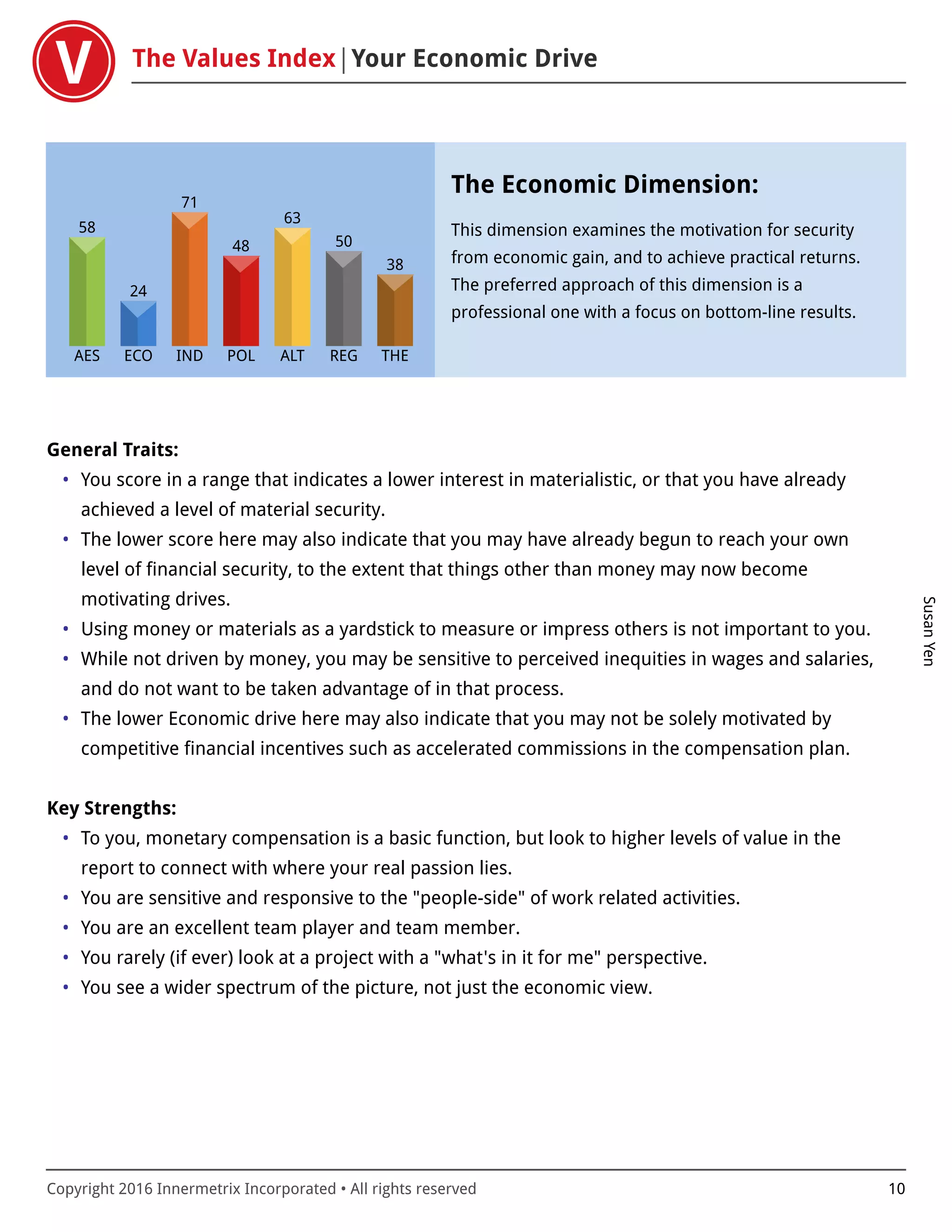
AES
58
ECO
24
IND
71
POL
48
ALT
63
REG
50
THE
38
The Economic Dimension:
This dimension examines the motivation for security
from economic gain, and to achieve practical returns.
The preferred approach of this dimension is a
professional one with a focus on bottom-line results.
General Traits:
• You score in a range that indicates a lower interest in materialistic, or that you have already
achieved a level of material security.
• The lower score here may also indicate that you may have already begun to reach your own
level of financial security, to the extent that things other than money may now become
motivating drives.
• Using money or materials as a yardstick to measure or impress others is not important to you.
• While not driven by money, you may be sensitive to perceived inequities in wages and salaries,
and do not want to be taken advantage of in that process.
• The lower Economic drive here may also indicate that you may not be solely motivated by
competitive financial incentives such as accelerated commissions in the compensation plan.
Key Strengths:
• To you, monetary compensation is a basic function, but look to higher levels of value in the
report to connect with where your real passion lies.
• You are sensitive and responsive to the "people-side" of work related activities.
• You are an excellent team player and team member.
• You rarely (if ever) look at a project with a "what's in it for me" perspective.
• You see a wider spectrum of the picture, not just the economic view.
The Values Index Your Economic Drive
SusanYen
Copyright 2016 Innermetrix Incorporated • All rights reserved 11
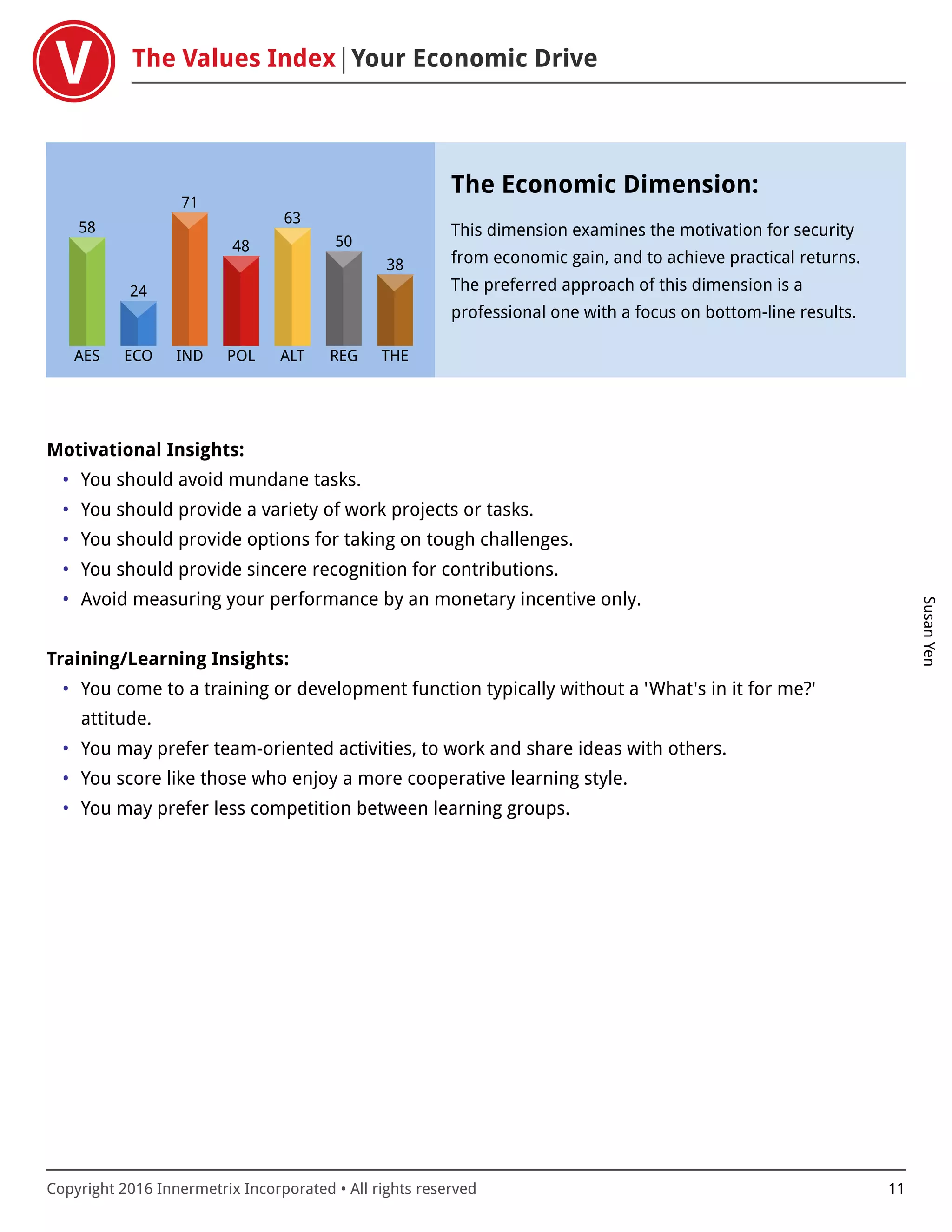
AES
58
ECO
24
IND
71
POL
48
ALT
63
REG
50
THE
38
The Economic Dimension:
This dimension examines the motivation for security
from economic gain, and to achieve practical returns.
The preferred approach of this dimension is a
professional one with a focus on bottom-line results.
Motivational Insights:
• You should avoid mundane tasks.
• You should provide a variety of work projects or tasks.
• You should provide options for taking on tough challenges.
• You should provide sincere recognition for contributions.
• Avoid measuring your performance by an monetary incentive only.
Training/Learning Insights:
• You come to a training or development function typically without a 'What's in it for me?'
attitude.
• You may prefer team-oriented activities, to work and share ideas with others.
• You score like those who enjoy a more cooperative learning style.
• You may prefer less competition between learning groups.
The Values Index Your Economic Drive
SusanYen
Copyright 2016 Innermetrix Incorporated • All rights reserved 12
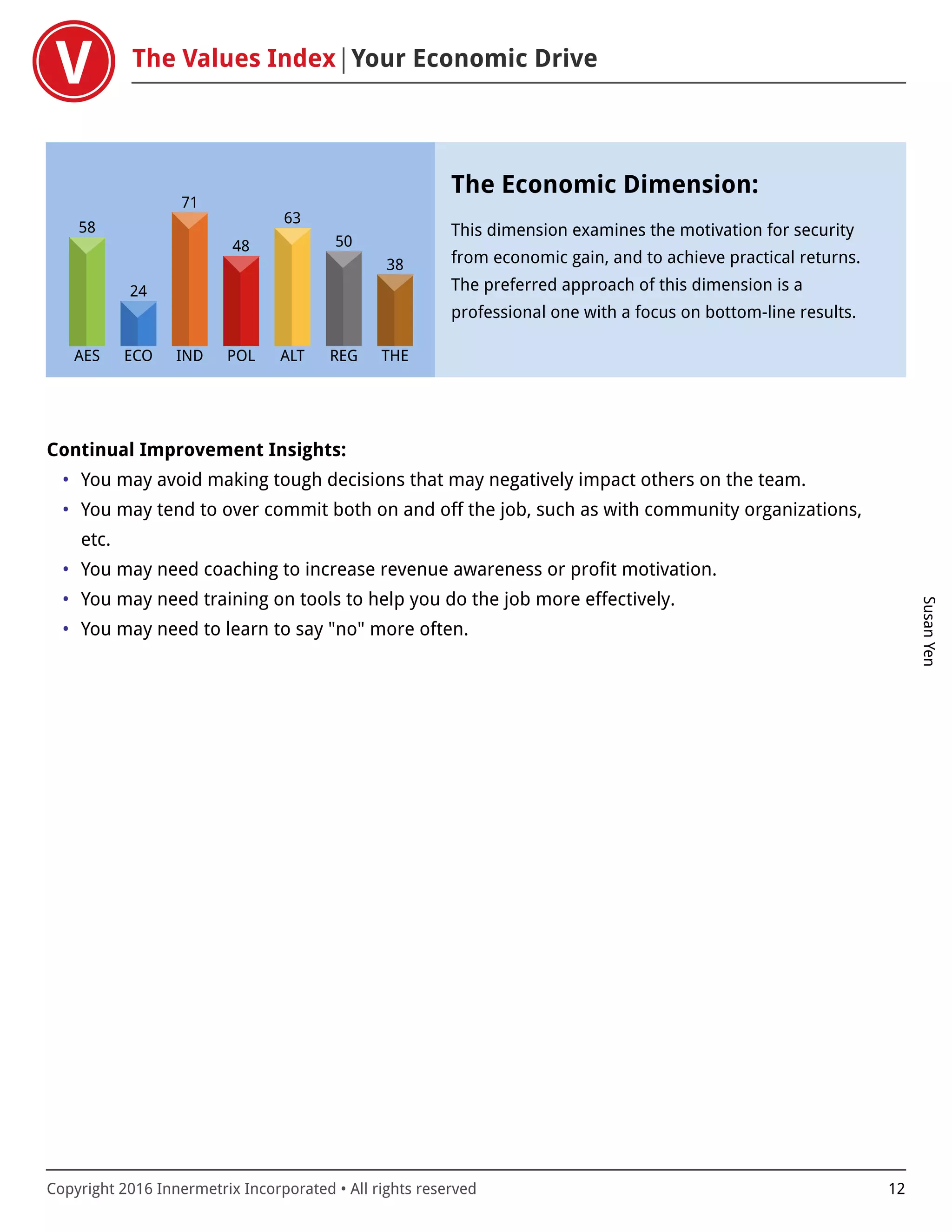
AES
58
ECO
24
IND
71
POL
48
ALT
63
REG
50
THE
38
The Economic Dimension:
This dimension examines the motivation for security
from economic gain, and to achieve practical returns.
The preferred approach of this dimension is a
professional one with a focus on bottom-line results.
Continual Improvement Insights:
• You may avoid making tough decisions that may negatively impact others on the team.
• You may tend to over commit both on and off the job, such as with community organizations,
etc.
• You may need coaching to increase revenue awareness or profit motivation.
• You may need training on tools to help you do the job more effectively.
• You may need to learn to say "no" more often.
The Values Index Your Individualistic Drive
SusanYen
Copyright 2016 Innermetrix Incorporated • All rights reserved 13
AES
58
ECO
24
IND
71
POL
48
ALT
63
REG
50
THE
38
The Individualistic Dimension:
The Individualistic dimension deals with one's need to
be seen as unique, independent, and to stand apart from
the crowd. This is the drive to be socially independent
and have opportunity for freedom of personal
expression.
General Traits:
• You enjoy work and assignments, which give you standing in the eyes of others and evokes
respect.
• You thrive in a team environment.
• You are independent.
• You bring a lot of energy that needs to be put to good use.
• Your high individualism may be demonstrated in creative problem solving and a higher risk-
taking attitude.
Key Strengths:
• You desire to be an individual and to celebrate differences.
• You are not afraid to take calculated risks.
• You realize that we are all individuals and have ideas to offer.
• You bring a variety of different and energetic ideas to the workplace.
• You have the ability to take a strong stand, and not be afraid to be different in either ideas or
approaches to problem solving.
The Values Index Your Individualistic Drive
SusanYen
Copyright 2016 Innermetrix Incorporated • All rights reserved 14
AES
58
ECO
24
IND
71
POL
48
ALT
63
REG
50
THE
38
The Individualistic Dimension:
The Individualistic dimension deals with one's need to
be seen as unique, independent, and to stand apart from
the crowd. This is the drive to be socially independent
and have opportunity for freedom of personal
expression.
Motivational Insights:
• You prefer an environment where you have space to demonstrate your unique contributions to
the team.
• Remember to look for continuous opportunities to learn and progress.
• Many people who score like you enjoy making presentations to small or large groups. Explore
this possibility.
• You may bring a variety of strengths to the team that may not have been utilized; explore the
possibilities of expanding these opportunities.
• You should be allowed freedom to make your own decisions about how an assignment should
be completed.
Training/Learning Insights:
• Your learning and professional development activities should be flexible, having a wide variety
of options.
• You should attempt to provide enough creative space for you to express your uniqueness.
• You should allow for some experimental or non-routine types of options.
• You should link the benefits of learning new things to a personal ability to enhance your
performance.
The Values Index Your Individualistic Drive
SusanYen
Copyright 2016 Innermetrix Incorporated • All rights reserved 15
AES
58
ECO
24
IND
71
POL
48
ALT
63
REG
50
THE
38
The Individualistic Dimension:
The Individualistic dimension deals with one's need to
be seen as unique, independent, and to stand apart from
the crowd. This is the drive to be socially independent
and have opportunity for freedom of personal
expression.
Continual Improvement Insights:
• Sometimes your very unique approaches do not always result in complete success, and may
sometimes cause conflict with others if sensitivity is not used.
• Your potential value clashes with others may be reduced through increased awareness and
sensitivity to the needs of others.
• You may need to remember that your good ideas aren't the only good ideas.
• You may need to listen more to others and speak less.
• When presenting an idea you may spend a bit too much time telling (or selling) the audience
about your own uniqueness, rather than discussing the topic of the presentation.
The Values Index Your Political Drive
SusanYen
Copyright 2016 Innermetrix Incorporated • All rights reserved 16
AES
58
ECO
24
IND
71
POL
48
ALT
63
REG
50
THE
38
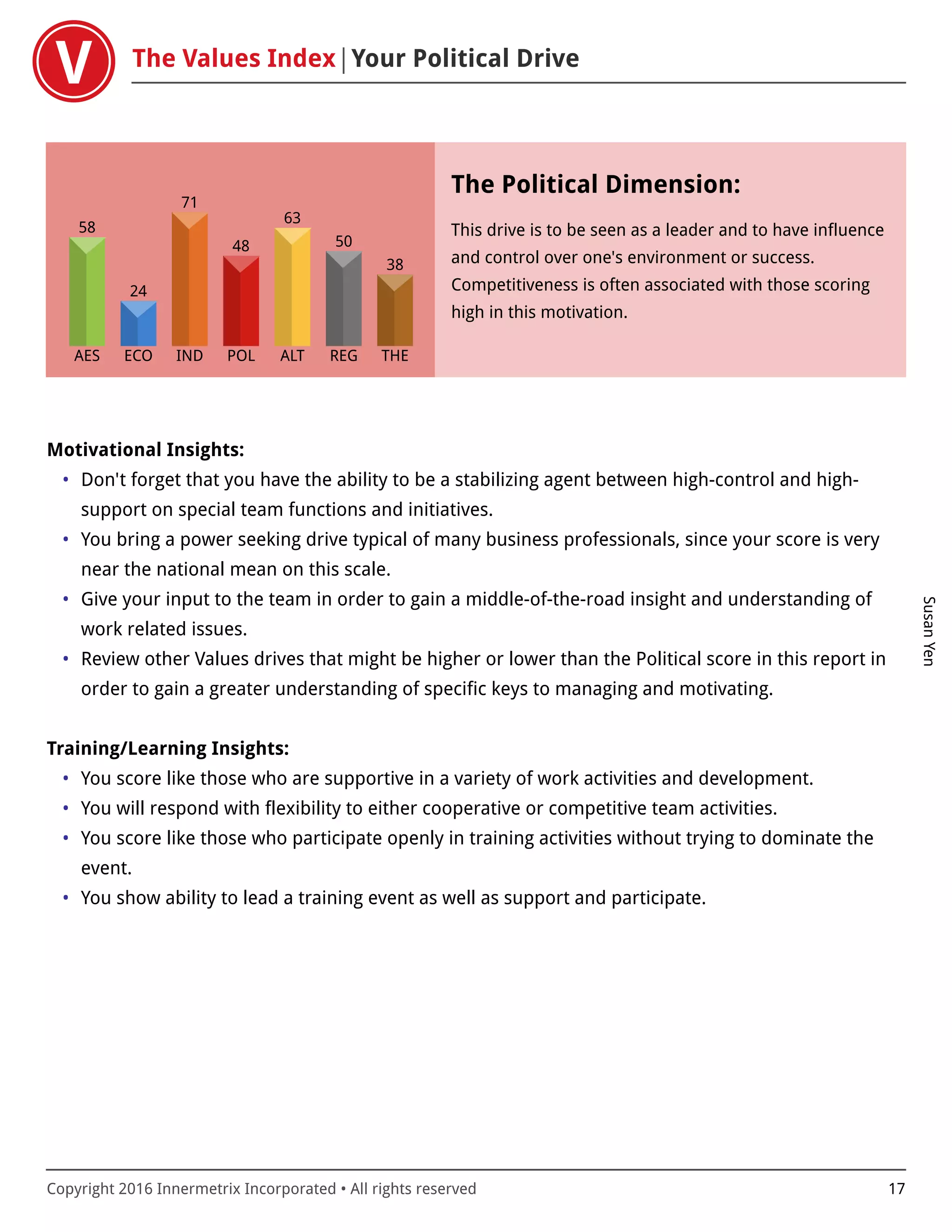
The Political Dimension:
This drive is to be seen as a leader and to have influence
and control over one's environment or success.
Competitiveness is often associated with those scoring
high in this motivation.
General Traits:
• You bring a sense of balance to some power-issues that may emerge occasionally.
• You are able to understand the needs of those on the team who are highly competitive, as well
as those who tend to be more cooperative.
• You demonstrate flexibility in being able to lead a team when necessary, and to support the
team when necessary.
• You have the ability to take or leave the control-factors of group leadership roles.
• You show an appropriate balance between seeking leadership roles and supporting roles
without being an extremist in either direction.
Key Strengths:
• You bring flexibility to the team. Able to lead when asked, but able to support when asked as
well.
• You are a stabilizing force on the team.
• You are able to appreciate the needs of both the higher and lower Political individuals on the
team.
• You are perceived by others on the team as neither dictatorial nor dependent with regard to
team projects and goals.
• You show appropriate respect to leaders of a project, as well as ability to offer suggestions for
change.
The Values Index Your Political Drive
SusanYen
Copyright 2016 Innermetrix Incorporated • All rights reserved 17
AES
58
ECO
24
IND
71
POL
48
ALT
63
REG
50
THE
38
The Political Dimension:
This drive is to be seen as a leader and to have influence
and control over one's environment or success.
Competitiveness is often associated with those scoring
high in this motivation.
Motivational Insights:
• Don't forget that you have the ability to be a stabilizing agent between high-control and high-
support on special team functions and initiatives.
• You bring a power seeking drive typical of many business professionals, since your score is very
near the national mean on this scale.
• Give your input to the team in order to gain a middle-of-the-road insight and understanding of
work related issues.
• Review other Values drives that might be higher or lower than the Political score in this report in
order to gain a greater understanding of specific keys to managing and motivating.
Training/Learning Insights:
• You score like those who are supportive in a variety of work activities and development.
• You will respond with flexibility to either cooperative or competitive team activities.
• You score like those who participate openly in training activities without trying to dominate the
event.
• You show ability to lead a training event as well as support and participate.
The Values Index Your Political Drive
SusanYen
Copyright 2016 Innermetrix Incorporated • All rights reserved 18
AES
58
ECO
24
IND
71
POL
48
ALT
63
REG
50
THE
38
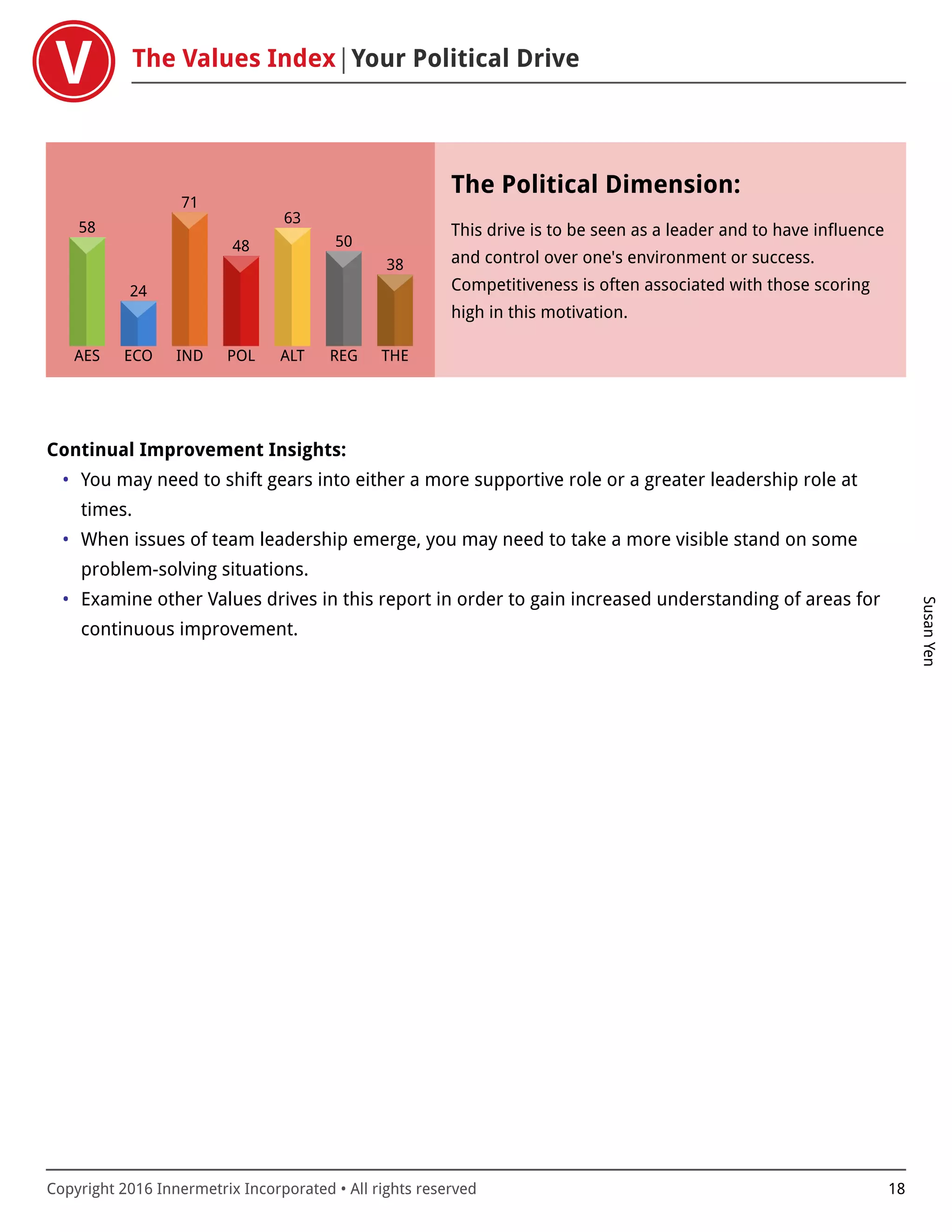
The Political Dimension:
This drive is to be seen as a leader and to have influence
and control over one's environment or success.
Competitiveness is often associated with those scoring
high in this motivation.
Continual Improvement Insights:
• You may need to shift gears into either a more supportive role or a greater leadership role at
times.
• When issues of team leadership emerge, you may need to take a more visible stand on some
problem-solving situations.
• Examine other Values drives in this report in order to gain increased understanding of areas for
continuous improvement.
The Values Index Your Altruist Drive
SusanYen
Copyright 2016 Innermetrix Incorporated • All rights reserved 19
AES
58
ECO
24
IND
71
POL
48
ALT
63
REG
50
THE
38
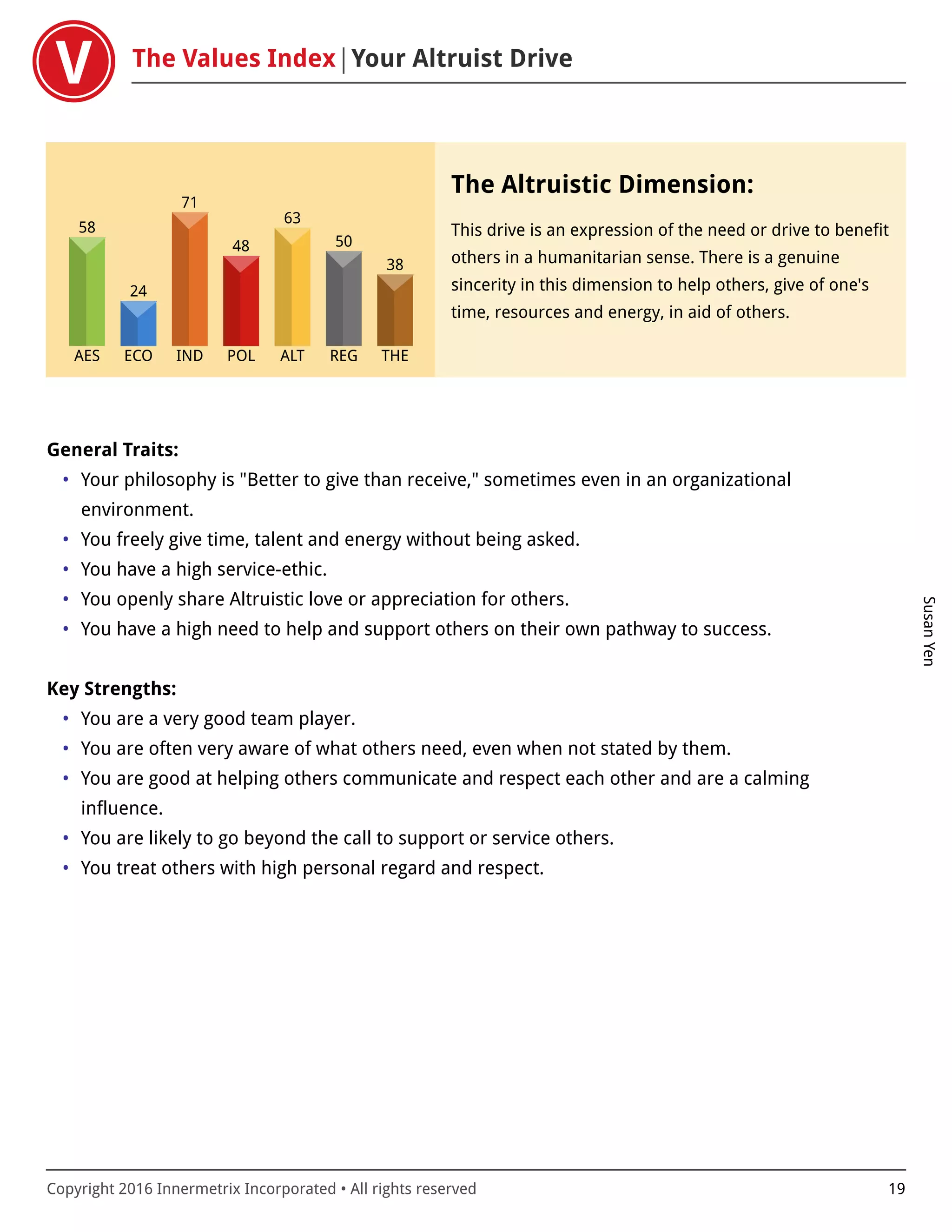
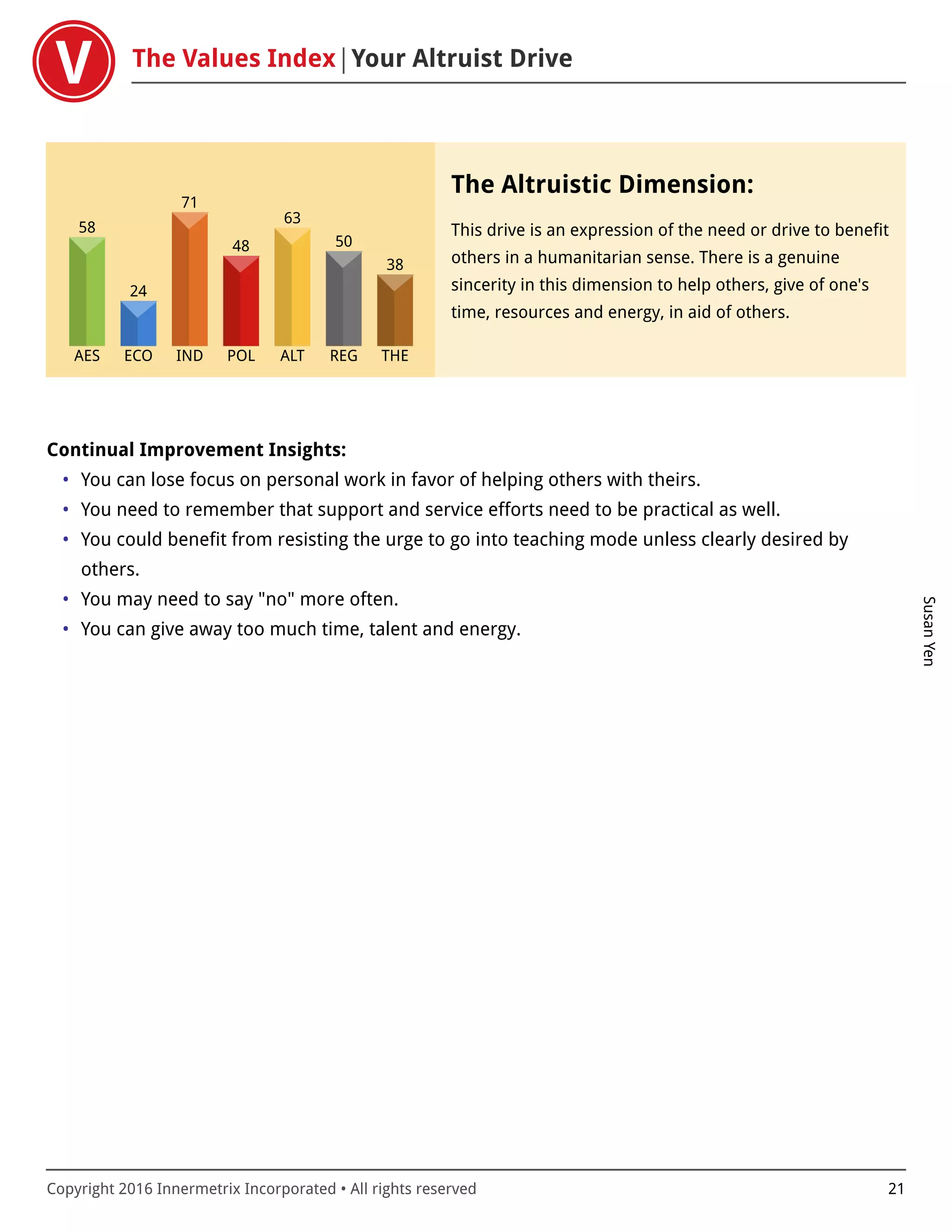
The Altruistic Dimension:
This drive is an expression of the need or drive to benefit
others in a humanitarian sense. There is a genuine
sincerity in this dimension to help others, give of one's
time, resources and energy, in aid of others.
General Traits:
• Your philosophy is "Better to give than receive," sometimes even in an organizational
environment.
• You freely give time, talent and energy without being asked.
• You have a high service-ethic.
• You openly share Altruistic love or appreciation for others.
• You have a high need to help and support others on their own pathway to success.
Key Strengths:
• You are a very good team player.
• You are often very aware of what others need, even when not stated by them.
• You are good at helping others communicate and respect each other and are a calming
influence.
• You are likely to go beyond the call to support or service others.
• You treat others with high personal regard and respect.
The Values Index Your Altruist Drive
SusanYen
Copyright 2016 Innermetrix Incorporated • All rights reserved 20
AES
58
ECO
24
IND
71
POL
48
ALT
63
REG
50
THE
38
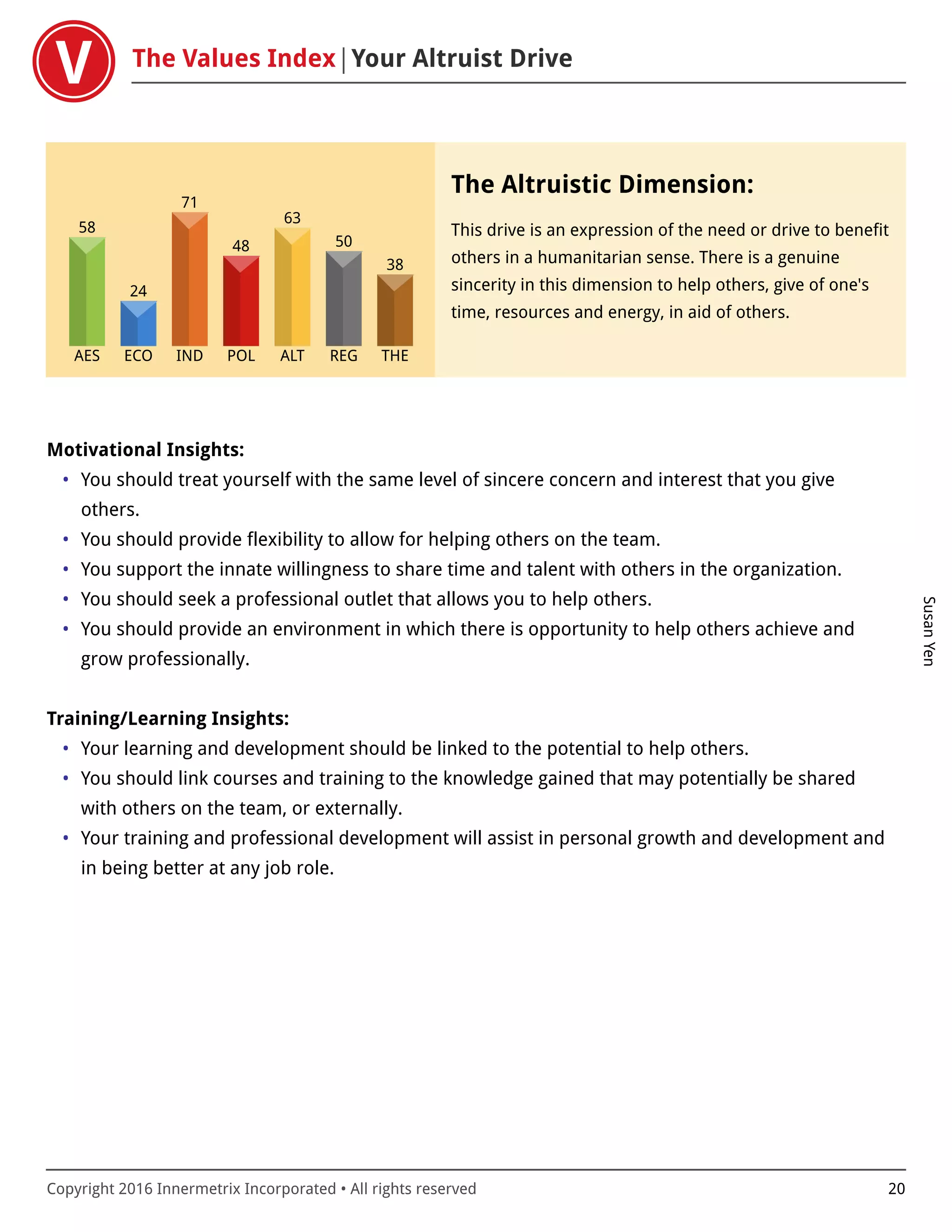
The Altruistic Dimension:
This drive is an expression of the need or drive to benefit
others in a humanitarian sense. There is a genuine
sincerity in this dimension to help others, give of one's
time, resources and energy, in aid of others.
Motivational Insights:
• You should treat yourself with the same level of sincere concern and interest that you give
others.
• You should provide flexibility to allow for helping others on the team.
• You support the innate willingness to share time and talent with others in the organization.
• You should seek a professional outlet that allows you to help others.
• You should provide an environment in which there is opportunity to help others achieve and
grow professionally.
Training/Learning Insights:
• Your learning and development should be linked to the potential to help others.
• You should link courses and training to the knowledge gained that may potentially be shared
with others on the team, or externally.
• Your training and professional development will assist in personal growth and development and
in being better at any job role.
The Values Index Your Altruist Drive
SusanYen
Copyright 2016 Innermetrix Incorporated • All rights reserved 21
AES
58
ECO
24
IND
71
POL
48
ALT
63
REG
50
THE
38
The Altruistic Dimension:
This drive is an expression of the need or drive to benefit
others in a humanitarian sense. There is a genuine
sincerity in this dimension to help others, give of one's
time, resources and energy, in aid of others.
Continual Improvement Insights:
• You can lose focus on personal work in favor of helping others with theirs.
• You need to remember that support and service efforts need to be practical as well.
• You could benefit from resisting the urge to go into teaching mode unless clearly desired by
others.
• You may need to say "no" more often.
• You can give away too much time, talent and energy.
The Values Index Your Regulatory Drive
SusanYen
Copyright 2016 Innermetrix Incorporated • All rights reserved 22
AES
58
ECO
24
IND
71
POL
48
ALT
63
REG
50
THE
38
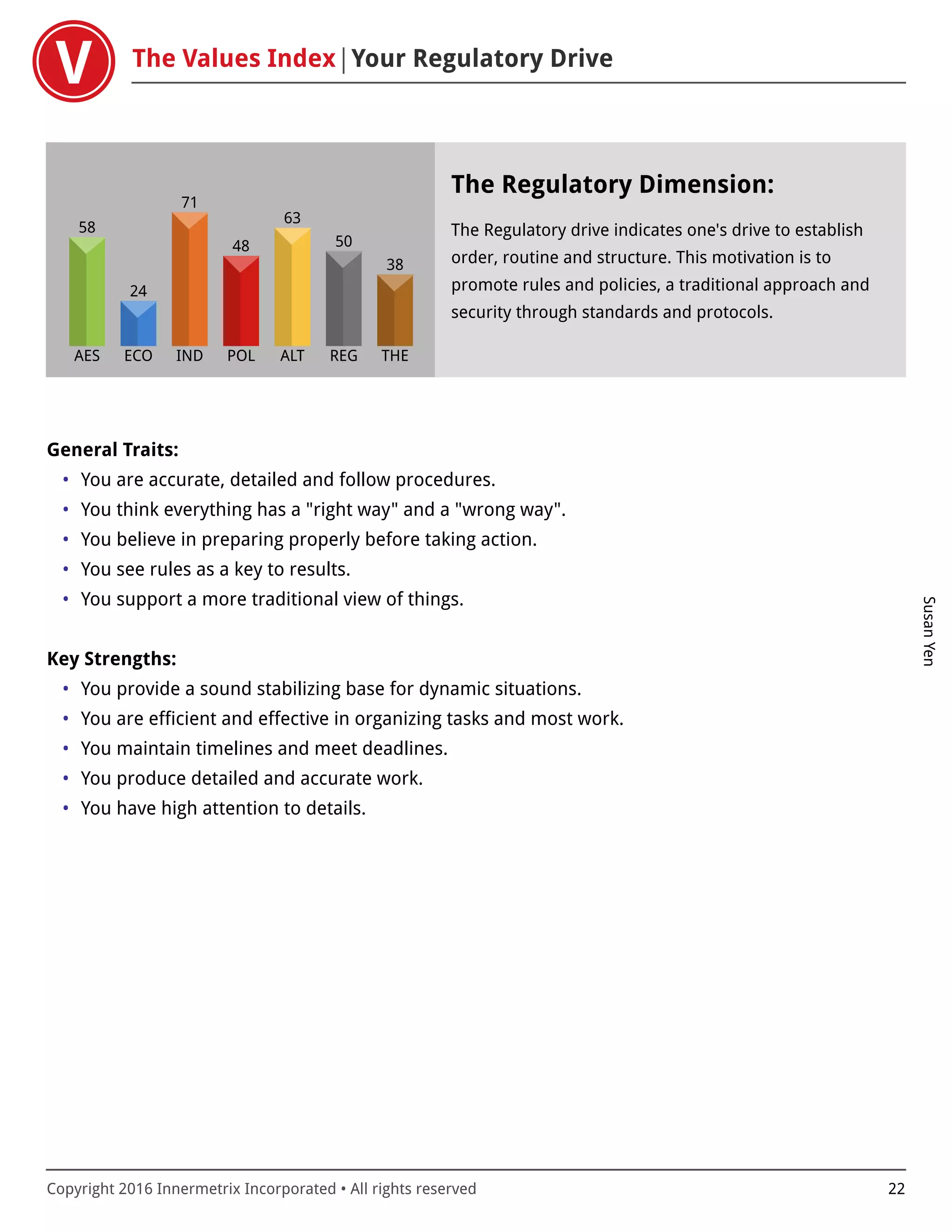
The Regulatory Dimension:
The Regulatory drive indicates one's drive to establish
order, routine and structure. This motivation is to
promote rules and policies, a traditional approach and
security through standards and protocols.
General Traits:
• You are accurate, detailed and follow procedures.
• You think everything has a "right way" and a "wrong way".
• You believe in preparing properly before taking action.
• You see rules as a key to results.
• You support a more traditional view of things.
Key Strengths:
• You provide a sound stabilizing base for dynamic situations.
• You are efficient and effective in organizing tasks and most work.
• You maintain timelines and meet deadlines.
• You produce detailed and accurate work.
• You have high attention to details.
The Values Index Your Regulatory Drive
SusanYen
Copyright 2016 Innermetrix Incorporated • All rights reserved 23
AES
58
ECO
24
IND
71
POL
48
ALT
63
REG
50
THE
38
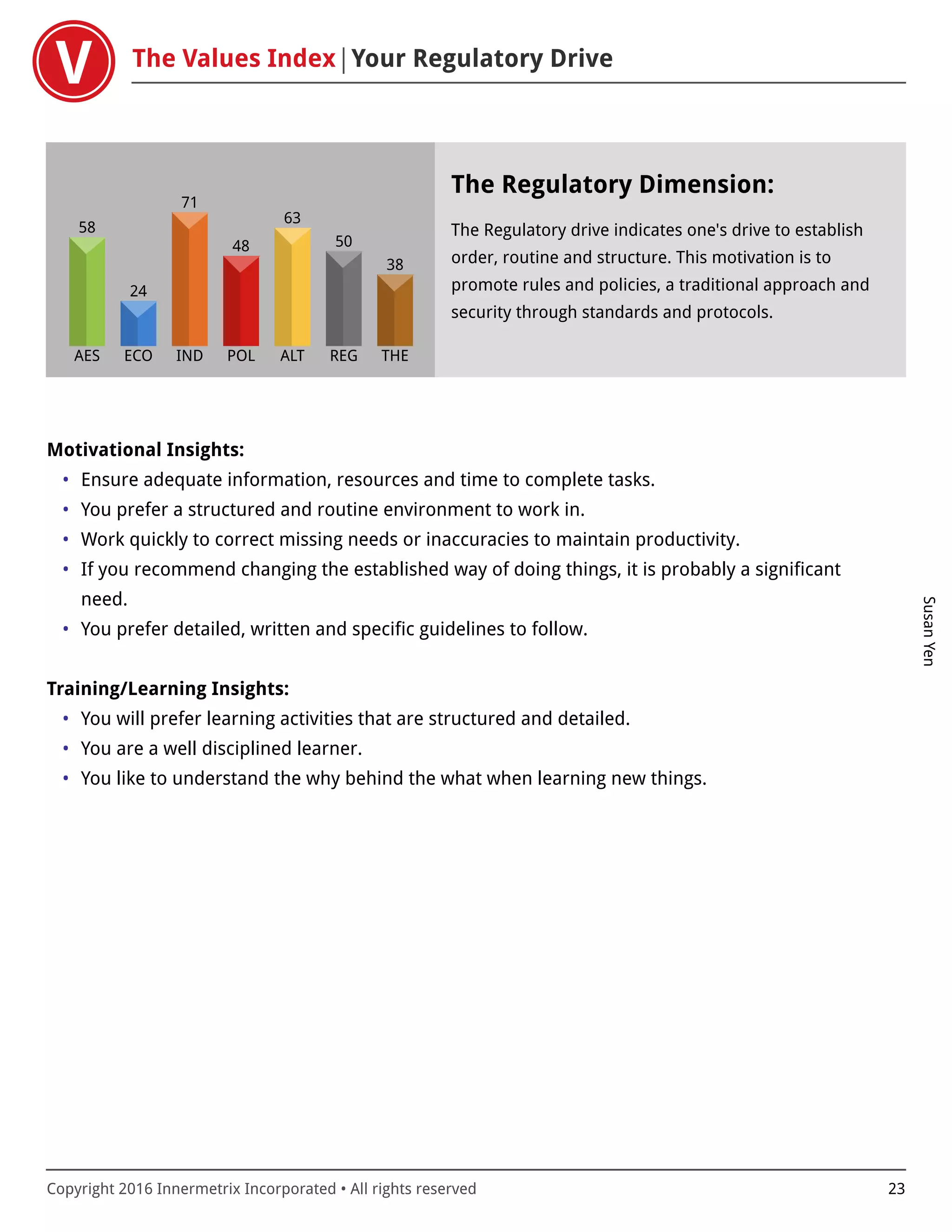
The Regulatory Dimension:
The Regulatory drive indicates one's drive to establish
order, routine and structure. This motivation is to
promote rules and policies, a traditional approach and
security through standards and protocols.
Motivational Insights:
• Ensure adequate information, resources and time to complete tasks.
• You prefer a structured and routine environment to work in.
• Work quickly to correct missing needs or inaccuracies to maintain productivity.
• If you recommend changing the established way of doing things, it is probably a significant
need.
• You prefer detailed, written and specific guidelines to follow.
Training/Learning Insights:
• You will prefer learning activities that are structured and detailed.
• You are a well disciplined learner.
• You like to understand the why behind the what when learning new things.
The Values Index Your Regulatory Drive
SusanYen
Copyright 2016 Innermetrix Incorporated • All rights reserved 24
AES
58
ECO
24
IND
71
POL
48
ALT
63
REG
50
THE
38
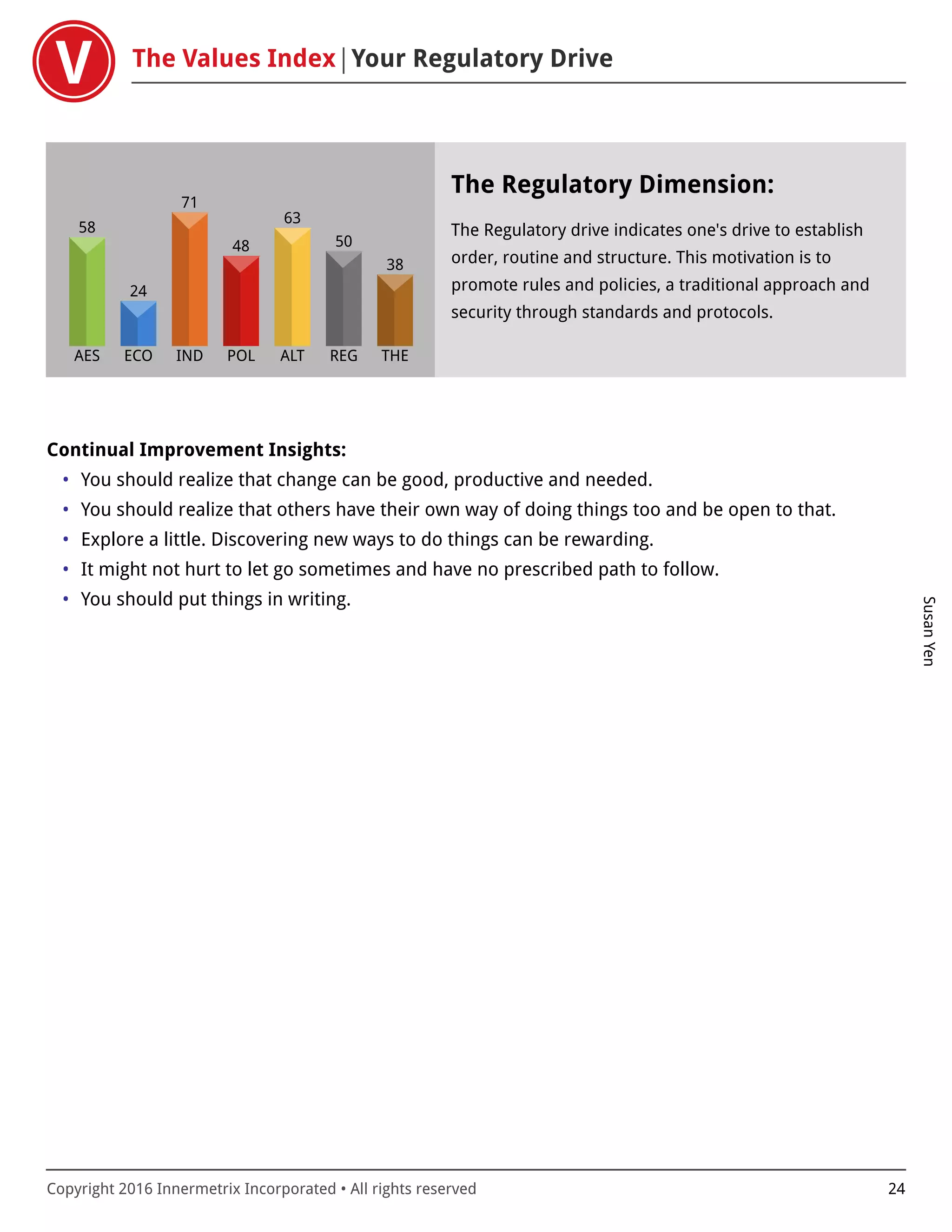
The Regulatory Dimension:
The Regulatory drive indicates one's drive to establish
order, routine and structure. This motivation is to
promote rules and policies, a traditional approach and
security through standards and protocols.
Continual Improvement Insights:
• You should realize that change can be good, productive and needed.
• You should realize that others have their own way of doing things too and be open to that.
• Explore a little. Discovering new ways to do things can be rewarding.
• It might not hurt to let go sometimes and have no prescribed path to follow.
• You should put things in writing.
The Values Index Your Theoretical Drive
SusanYen
Copyright 2016 Innermetrix Incorporated • All rights reserved 25
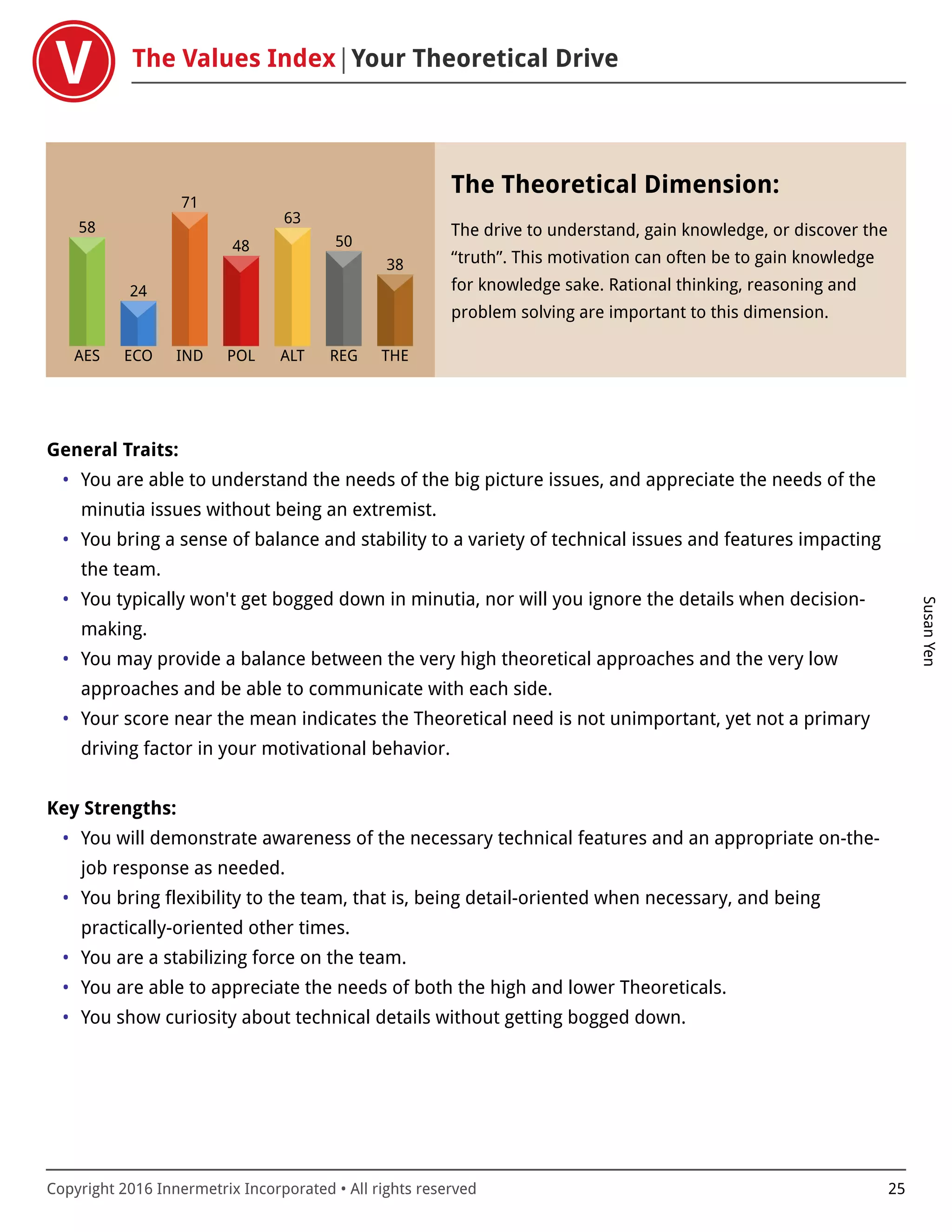
AES
58
ECO
24
IND
71
POL
48
ALT
63
REG
50
THE
38
The Theoretical Dimension:
The drive to understand, gain knowledge, or discover the
“truth”. This motivation can often be to gain knowledge
for knowledge sake. Rational thinking, reasoning and
problem solving are important to this dimension.
General Traits:
• You are able to understand the needs of the big picture issues, and appreciate the needs of the
minutia issues without being an extremist.
• You bring a sense of balance and stability to a variety of technical issues and features impacting
the team.
• You typically won't get bogged down in minutia, nor will you ignore the details when decision-
making.
• You may provide a balance between the very high theoretical approaches and the very low
approaches and be able to communicate with each side.
• Your score near the mean indicates the Theoretical need is not unimportant, yet not a primary
driving factor in your motivational behavior.
Key Strengths:
• You will demonstrate awareness of the necessary technical features and an appropriate on-the-
job response as needed.
• You bring flexibility to the team, that is, being detail-oriented when necessary, and being
practically-oriented other times.
• You are a stabilizing force on the team.
• You are able to appreciate the needs of both the high and lower Theoreticals.
• You show curiosity about technical details without getting bogged down.
The Values Index Your Theoretical Drive
SusanYen
Copyright 2016 Innermetrix Incorporated • All rights reserved 26
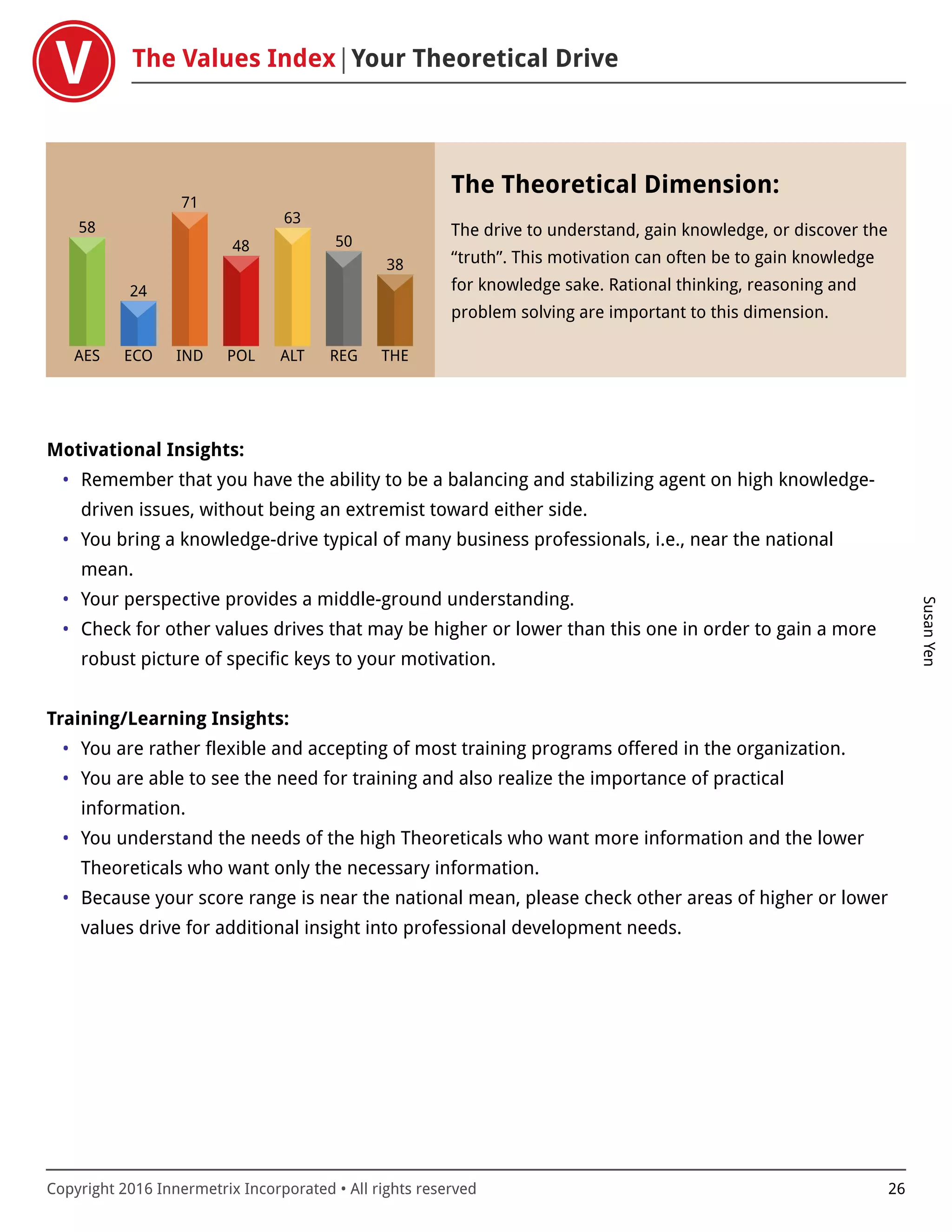
AES
58
ECO
24
IND
71
POL
48
ALT
63
REG
50
THE
38
The Theoretical Dimension:
The drive to understand, gain knowledge, or discover the
“truth”. This motivation can often be to gain knowledge
for knowledge sake. Rational thinking, reasoning and
problem solving are important to this dimension.
Motivational Insights:
• Remember that you have the ability to be a balancing and stabilizing agent on high knowledge-
driven issues, without being an extremist toward either side.
• You bring a knowledge-drive typical of many business professionals, i.e., near the national
mean.
• Your perspective provides a middle-ground understanding.
• Check for other values drives that may be higher or lower than this one in order to gain a more
robust picture of specific keys to your motivation.
Training/Learning Insights:
• You are rather flexible and accepting of most training programs offered in the organization.
• You are able to see the need for training and also realize the importance of practical
information.
• You understand the needs of the high Theoreticals who want more information and the lower
Theoreticals who want only the necessary information.
• Because your score range is near the national mean, please check other areas of higher or lower
values drive for additional insight into professional development needs.
The Values Index Your Theoretical Drive
SusanYen
Copyright 2016 Innermetrix Incorporated • All rights reserved 27
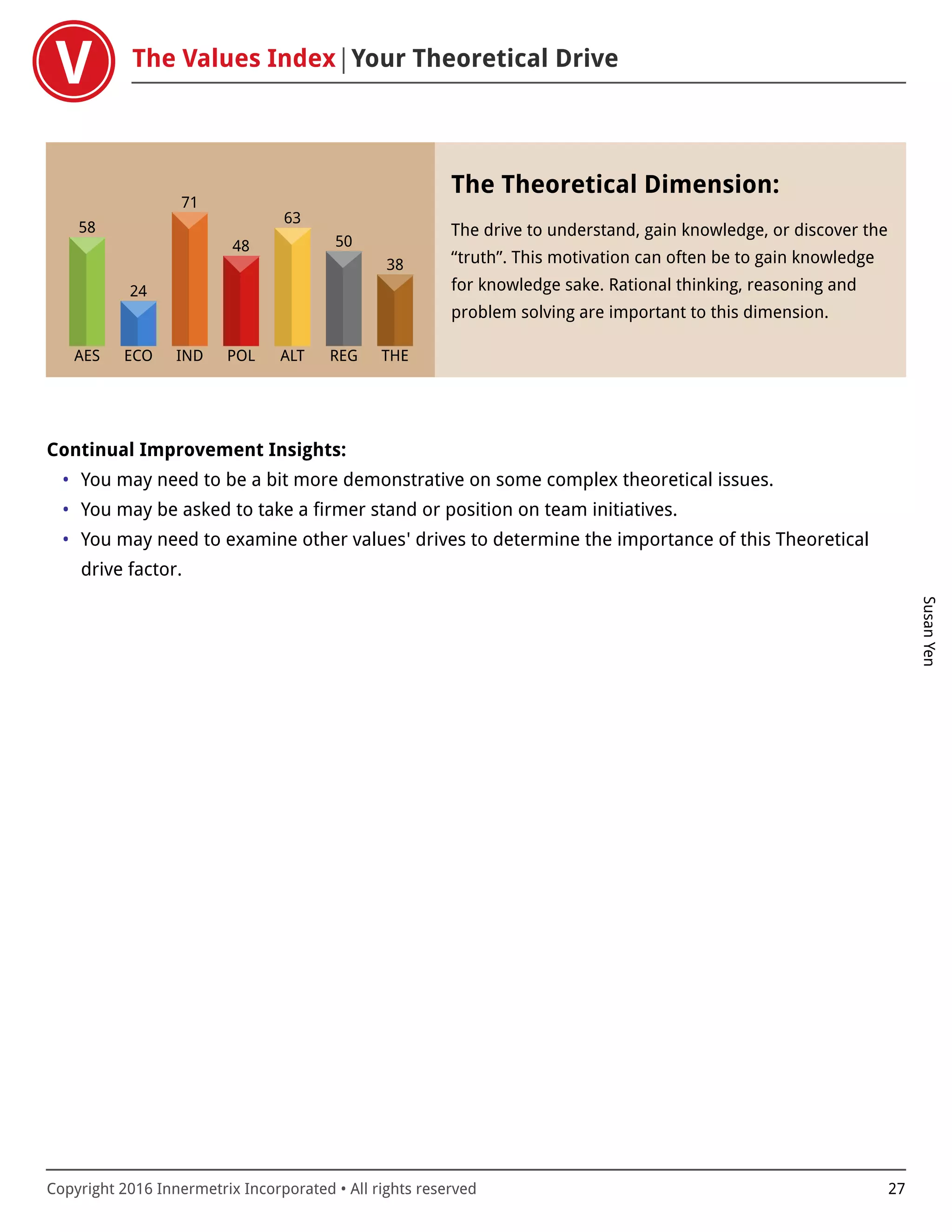
AES
58
ECO
24
IND
71
POL
48
ALT
63
REG
50
THE
38
The Theoretical Dimension:
The drive to understand, gain knowledge, or discover the
“truth”. This motivation can often be to gain knowledge
for knowledge sake. Rational thinking, reasoning and
problem solving are important to this dimension.
Continual Improvement Insights:
• You may need to be a bit more demonstrative on some complex theoretical issues.
• You may be asked to take a firmer stand or position on team initiatives.
• You may need to examine other values' drives to determine the importance of this Theoretical
drive factor.
The Values Index Relevance Section
SusanYen
Copyright 2016 Innermetrix Incorporated • All rights reserved 28
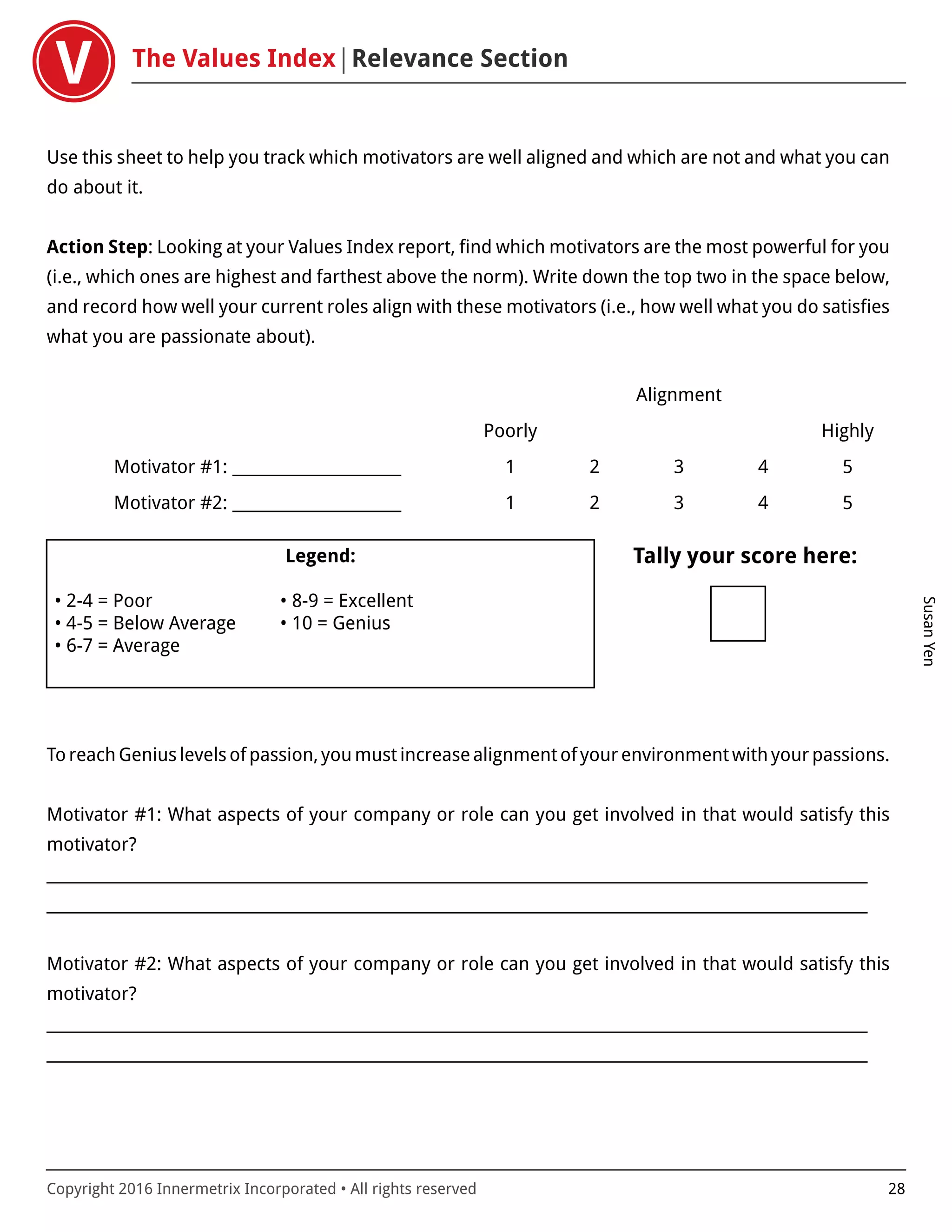
Use this sheet to help you track which motivators are well aligned and which are not and what you can
do about it.
Action Step: Looking at your Values Index report, find which motivators are the most powerful for you
(i.e., which ones are highest and farthest above the norm). Write down the top two in the space below,
and record how well your current roles align with these motivators (i.e., how well what you do satisfies
what you are passionate about).
To reach Genius levels of passion, you must increase alignment of your environment with your passions.
Motivator #1: What aspects of your company or role can you get involved in that would satisfy this
motivator?
___________________________________________________________________________________________________________
___________________________________________________________________________________________________________
Motivator #2: What aspects of your company or role can you get involved in that would satisfy this
motivator?
___________________________________________________________________________________________________________
___________________________________________________________________________________________________________
Alignment
Poorly Highly
Motivator #1: ______________________ 1 2 3 4 5
Motivator #2: ______________________ 1 2 3 4 5
Legend:
• 2-4 = Poor • 8-9 = Excellent
• 4-5 = Below Average • 10 = Genius
• 6-7 = Average
Tally your score here:
The Values Index Success Connection
SusanYen
Copyright 2016 Innermetrix Incorporated • All rights reserved 29
Your final step to making sure you really benefit from the information in this report is to understand
how your values style contributes to, and perhaps hinders, your overall success.
Supporting Success: Overall, how well do your motivators and drivers help support your success? (cite
specific examples):
___________________________________________________________________________________________________________
___________________________________________________________________________________________________________
___________________________________________________________________________________________________________
___________________________________________________________________________________________________________
___________________________________________________________________________________________________________
___________________________________________________________________________________________________________
___________________________________________________________________________________________________________
___________________________________________________________________________________________________________
___________________________________________________________________________________________________________
Limiting Success: Overall, how do your natural drivers or motivators not support your success? (cite
specific examples):
___________________________________________________________________________________________________________
___________________________________________________________________________________________________________
___________________________________________________________________________________________________________
___________________________________________________________________________________________________________
___________________________________________________________________________________________________________
___________________________________________________________________________________________________________
___________________________________________________________________________________________________________
___________________________________________________________________________________________________________

VALUES-Susan_Yen

  • 1.
    Copyright 2016 InnermetrixIncorporated • All rights reserved Susan Yen January 28, 2016 This Innermetrix Values Index is a combination of the research of Dr. Eduard Spranger and Gordon Allport into what drives and motivates an individual. The seven dimensions of value discovered between these two researchers help understand the reasons that drive an individual to utilize their talents in the unique way they do. This Values Index will help you understand your motivators and drivers and how to maximize your performance by achieving better alignment and passion for what you do. Anthony Robbins Coaching www.tonyrobbins.com
  • 2.
    The Values IndexIntroduction SusanYen Copyright 2016 Innermetrix Incorporated • All rights reserved 2 About This Report Research conducted by Innermetrix shows that the most successful people share the common trait of self-awareness. They recognize the situations that will make them successful, and this makes it easy for them to find ways of achieving objectives that resonate with their motivations. They also understand their limitations and where they are not effective and this helps them understand what does not inspire them or what will not motivate them to succeed. Those who understand their natural motivators better arefarmorelikelytopursuetherightopportunities,fortherightreasons,andgettheresultstheydesire. This report measures seven dimensions of motivation. They are: • Aesthetic - a drive for balance, harmony and form. • Economic - a drive for economic or practical returns. • Individualistic - a drive to stand out as independent and unique. • Political - a drive to be in control or have influence. • Altruist - a drive for humanitarian efforts or to help others altruistically. • Regulatory - a drive to establish order, routine and structure. • Theoretical - a drive for knowledge, learning and understanding.
  • 3.
    The Values IndexSeven Dimensions of Value and Motivation SusanYen Copyright 2016 Innermetrix Incorporated • All rights reserved 3 The Elements of the Values Index This Values Index is unique in the marketplace in that it examines seven independent and unique aspects of value or motivation. Most other values instruments only examine six dimensions of value by combining the Individualistic and Political into one dimension. The Values Index remains true to the original works and models of two of the most significant researchers in this field, thus delivering to you a profile that truly helps you understand your own unique motivations and drivers. Also, the Values Index is the first to use a click & drag approach to rank the various statements in the instrument, which makes taking the instrument more intuitive, natural and in the end you can actually create the order you see in your mind on the screen. Finally, the Values Index instrument contains the most contemporary list of statements to make your choices more relevant to your life today, which helps ensure the most accurate results possible.
  • 4.
    The Values IndexSeven Dimensions of Value and Motivation SusanYen Copyright 2016 Innermetrix Incorporated • All rights reserved 4 A closer look at the seven dimensions Values help influence behavior and action and can be considered somewhat of a hidden motivation because they are not readily observable. Understanding your values helps to tell you why you prefer to do what you do. It is vital for superior performance to ensure that your motivations are satisfied by what you do. This drives your passion, reduces fatigue, inspires you and increases drive. Value The Drive For Aesthetic Form, Harmony, Beauty, Balance Economic Money, Practical results, Return Individualistic Independence, Uniqueness Political Control, Power, Influence Altruistic Altruism, Service, Helping others Regulatory Structure, Order, Routine Theoretical Knowledge, Understanding
  • 5.
    The Values IndexSeven Dimensions of Value and Motivation SusanYen Copyright 2016 Innermetrix Incorporated • All rights reserved 5 Executive Summary of Susan's Values 0 10 20 30 40 50 60 70 80 90 100 Aesthetic Economic Individualistic Political Altruist Regulatory Theoretical norm 1 SD 1 SD 58 24 71 48 63 50 38 High Aesthetic You very much prefer form, harmony and balance. You are likely a strong advocate for green initiatives and protecting personal time and space. Low Economic You are a team player and may put others' needs before self. Very High Individualistic You demonstrate high independence and project self-confidence. Average Political You are flexible, able to take or leave the power or clout that comes with the job title or assignment. High Altruist You have a high desire to help others learn, grow, and develop. High Regulatory You have a strong preference for following established systems or creating them if none present. Average Theoretical You are able to balance the quest for understanding and knowledge with the practical needs of a situation.
  • 6.
    The Values IndexSeven Dimensions of Value and Motivation SusanYen Copyright 2016 Innermetrix Incorporated • All rights reserved 6
  • 7.
    The Values IndexYour Aesthetic Drive SusanYen Copyright 2016 Innermetrix Incorporated • All rights reserved 7 AES 58 ECO 24 IND 71 POL 48 ALT 63 REG 50 THE 38 The Aesthetic Dimension: The main motivation in this value is the drive to achieve balance, harmony and find form or beauty. Environmental concerns or “green” initiatives are also typically prized by this dimension. General Traits: • You work better in surroundings that are pleasant aesthetically or environmentally responsible. • You find rewards not just from pay for work, but in results that help protect the environment or achieve better balance in life or the world. • You are more sensitive to issues of balance and harmony than others. • You enjoy helping, teaching, and coaching others, especially in areas of creative expression. • You like to express yourself in artistic or creative ways. Key Strengths: • You will be a creative problem solver. • You enjoy bringing people together who share common interests. • You take strong interest in how an objective or work can help support the environment or balance in life. • You will bring a creative outside view to discussions. • You demonstrate high personal and professional regard for others on the team.
  • 8.
    The Values IndexYour Aesthetic Drive SusanYen Copyright 2016 Innermetrix Incorporated • All rights reserved 8 AES 58 ECO 24 IND 71 POL 48 ALT 63 REG 50 THE 38 The Aesthetic Dimension: The main motivation in this value is the drive to achieve balance, harmony and find form or beauty. Environmental concerns or “green” initiatives are also typically prized by this dimension. Motivational Insights: • You show a genuine interest in the expressed thoughts or emotions of others. • You offer ample opportunity for adjustments in surroundings and approaches to getting things done. • You explore potential of more involvement with environmental or "green" initiatives. • You will be highly motivated by aesthetically pleasing activities (e.g., creativity, beautification, more balanced, green initiatives, etc.) • You make sure the environment allows for creative expression. Training/Learning Insights: • You link new knowledge to new ways to be creative or achieve better harmony and balance in work and life. • You have the ability to connect training and development to other's needs and interests. • As you learn new things in training or professional development, attempt to link those to your ability to see new or creative solutions in the future.
  • 9.
    The Values IndexYour Aesthetic Drive SusanYen Copyright 2016 Innermetrix Incorporated • All rights reserved 9 AES 58 ECO 24 IND 71 POL 48 ALT 63 REG 50 THE 38 The Aesthetic Dimension: The main motivation in this value is the drive to achieve balance, harmony and find form or beauty. Environmental concerns or “green” initiatives are also typically prized by this dimension. Continual Improvement Insights: • You might tend to get a little too creative or inventive sometimes, which can create unnecessary risks. • You could benefit from being a little more pragmatic. • You could use the creative mode as a safety blanket to avoid having to be overly practical. • You need to remember that sometimes function is all there is time for, or all that is needed (don't deliver a Cadillac when a Chevy will suffice). • You could get lost in creativity and imagination if not kept somewhat reined in and on target.
  • 10.
    The Values IndexYour Economic Drive SusanYen Copyright 2016 Innermetrix Incorporated • All rights reserved 10 AES 58 ECO 24 IND 71 POL 48 ALT 63 REG 50 THE 38 The Economic Dimension: This dimension examines the motivation for security from economic gain, and to achieve practical returns. The preferred approach of this dimension is a professional one with a focus on bottom-line results. General Traits: • You score in a range that indicates a lower interest in materialistic, or that you have already achieved a level of material security. • The lower score here may also indicate that you may have already begun to reach your own level of financial security, to the extent that things other than money may now become motivating drives. • Using money or materials as a yardstick to measure or impress others is not important to you. • While not driven by money, you may be sensitive to perceived inequities in wages and salaries, and do not want to be taken advantage of in that process. • The lower Economic drive here may also indicate that you may not be solely motivated by competitive financial incentives such as accelerated commissions in the compensation plan. Key Strengths: • To you, monetary compensation is a basic function, but look to higher levels of value in the report to connect with where your real passion lies. • You are sensitive and responsive to the "people-side" of work related activities. • You are an excellent team player and team member. • You rarely (if ever) look at a project with a "what's in it for me" perspective. • You see a wider spectrum of the picture, not just the economic view.
  • 11.
    The Values IndexYour Economic Drive SusanYen Copyright 2016 Innermetrix Incorporated • All rights reserved 11 AES 58 ECO 24 IND 71 POL 48 ALT 63 REG 50 THE 38 The Economic Dimension: This dimension examines the motivation for security from economic gain, and to achieve practical returns. The preferred approach of this dimension is a professional one with a focus on bottom-line results. Motivational Insights: • You should avoid mundane tasks. • You should provide a variety of work projects or tasks. • You should provide options for taking on tough challenges. • You should provide sincere recognition for contributions. • Avoid measuring your performance by an monetary incentive only. Training/Learning Insights: • You come to a training or development function typically without a 'What's in it for me?' attitude. • You may prefer team-oriented activities, to work and share ideas with others. • You score like those who enjoy a more cooperative learning style. • You may prefer less competition between learning groups.
  • 12.
    The Values IndexYour Economic Drive SusanYen Copyright 2016 Innermetrix Incorporated • All rights reserved 12 AES 58 ECO 24 IND 71 POL 48 ALT 63 REG 50 THE 38 The Economic Dimension: This dimension examines the motivation for security from economic gain, and to achieve practical returns. The preferred approach of this dimension is a professional one with a focus on bottom-line results. Continual Improvement Insights: • You may avoid making tough decisions that may negatively impact others on the team. • You may tend to over commit both on and off the job, such as with community organizations, etc. • You may need coaching to increase revenue awareness or profit motivation. • You may need training on tools to help you do the job more effectively. • You may need to learn to say "no" more often.
  • 13.
    The Values IndexYour Individualistic Drive SusanYen Copyright 2016 Innermetrix Incorporated • All rights reserved 13 AES 58 ECO 24 IND 71 POL 48 ALT 63 REG 50 THE 38 The Individualistic Dimension: The Individualistic dimension deals with one's need to be seen as unique, independent, and to stand apart from the crowd. This is the drive to be socially independent and have opportunity for freedom of personal expression. General Traits: • You enjoy work and assignments, which give you standing in the eyes of others and evokes respect. • You thrive in a team environment. • You are independent. • You bring a lot of energy that needs to be put to good use. • Your high individualism may be demonstrated in creative problem solving and a higher risk- taking attitude. Key Strengths: • You desire to be an individual and to celebrate differences. • You are not afraid to take calculated risks. • You realize that we are all individuals and have ideas to offer. • You bring a variety of different and energetic ideas to the workplace. • You have the ability to take a strong stand, and not be afraid to be different in either ideas or approaches to problem solving.
  • 14.
    The Values IndexYour Individualistic Drive SusanYen Copyright 2016 Innermetrix Incorporated • All rights reserved 14 AES 58 ECO 24 IND 71 POL 48 ALT 63 REG 50 THE 38 The Individualistic Dimension: The Individualistic dimension deals with one's need to be seen as unique, independent, and to stand apart from the crowd. This is the drive to be socially independent and have opportunity for freedom of personal expression. Motivational Insights: • You prefer an environment where you have space to demonstrate your unique contributions to the team. • Remember to look for continuous opportunities to learn and progress. • Many people who score like you enjoy making presentations to small or large groups. Explore this possibility. • You may bring a variety of strengths to the team that may not have been utilized; explore the possibilities of expanding these opportunities. • You should be allowed freedom to make your own decisions about how an assignment should be completed. Training/Learning Insights: • Your learning and professional development activities should be flexible, having a wide variety of options. • You should attempt to provide enough creative space for you to express your uniqueness. • You should allow for some experimental or non-routine types of options. • You should link the benefits of learning new things to a personal ability to enhance your performance.
  • 15.
    The Values IndexYour Individualistic Drive SusanYen Copyright 2016 Innermetrix Incorporated • All rights reserved 15 AES 58 ECO 24 IND 71 POL 48 ALT 63 REG 50 THE 38 The Individualistic Dimension: The Individualistic dimension deals with one's need to be seen as unique, independent, and to stand apart from the crowd. This is the drive to be socially independent and have opportunity for freedom of personal expression. Continual Improvement Insights: • Sometimes your very unique approaches do not always result in complete success, and may sometimes cause conflict with others if sensitivity is not used. • Your potential value clashes with others may be reduced through increased awareness and sensitivity to the needs of others. • You may need to remember that your good ideas aren't the only good ideas. • You may need to listen more to others and speak less. • When presenting an idea you may spend a bit too much time telling (or selling) the audience about your own uniqueness, rather than discussing the topic of the presentation.
  • 16.
    The Values IndexYour Political Drive SusanYen Copyright 2016 Innermetrix Incorporated • All rights reserved 16 AES 58 ECO 24 IND 71 POL 48 ALT 63 REG 50 THE 38 The Political Dimension: This drive is to be seen as a leader and to have influence and control over one's environment or success. Competitiveness is often associated with those scoring high in this motivation. General Traits: • You bring a sense of balance to some power-issues that may emerge occasionally. • You are able to understand the needs of those on the team who are highly competitive, as well as those who tend to be more cooperative. • You demonstrate flexibility in being able to lead a team when necessary, and to support the team when necessary. • You have the ability to take or leave the control-factors of group leadership roles. • You show an appropriate balance between seeking leadership roles and supporting roles without being an extremist in either direction. Key Strengths: • You bring flexibility to the team. Able to lead when asked, but able to support when asked as well. • You are a stabilizing force on the team. • You are able to appreciate the needs of both the higher and lower Political individuals on the team. • You are perceived by others on the team as neither dictatorial nor dependent with regard to team projects and goals. • You show appropriate respect to leaders of a project, as well as ability to offer suggestions for change.
  • 17.
    The Values IndexYour Political Drive SusanYen Copyright 2016 Innermetrix Incorporated • All rights reserved 17 AES 58 ECO 24 IND 71 POL 48 ALT 63 REG 50 THE 38 The Political Dimension: This drive is to be seen as a leader and to have influence and control over one's environment or success. Competitiveness is often associated with those scoring high in this motivation. Motivational Insights: • Don't forget that you have the ability to be a stabilizing agent between high-control and high- support on special team functions and initiatives. • You bring a power seeking drive typical of many business professionals, since your score is very near the national mean on this scale. • Give your input to the team in order to gain a middle-of-the-road insight and understanding of work related issues. • Review other Values drives that might be higher or lower than the Political score in this report in order to gain a greater understanding of specific keys to managing and motivating. Training/Learning Insights: • You score like those who are supportive in a variety of work activities and development. • You will respond with flexibility to either cooperative or competitive team activities. • You score like those who participate openly in training activities without trying to dominate the event. • You show ability to lead a training event as well as support and participate.
  • 18.
    The Values IndexYour Political Drive SusanYen Copyright 2016 Innermetrix Incorporated • All rights reserved 18 AES 58 ECO 24 IND 71 POL 48 ALT 63 REG 50 THE 38 The Political Dimension: This drive is to be seen as a leader and to have influence and control over one's environment or success. Competitiveness is often associated with those scoring high in this motivation. Continual Improvement Insights: • You may need to shift gears into either a more supportive role or a greater leadership role at times. • When issues of team leadership emerge, you may need to take a more visible stand on some problem-solving situations. • Examine other Values drives in this report in order to gain increased understanding of areas for continuous improvement.
  • 19.
    The Values IndexYour Altruist Drive SusanYen Copyright 2016 Innermetrix Incorporated • All rights reserved 19 AES 58 ECO 24 IND 71 POL 48 ALT 63 REG 50 THE 38 The Altruistic Dimension: This drive is an expression of the need or drive to benefit others in a humanitarian sense. There is a genuine sincerity in this dimension to help others, give of one's time, resources and energy, in aid of others. General Traits: • Your philosophy is "Better to give than receive," sometimes even in an organizational environment. • You freely give time, talent and energy without being asked. • You have a high service-ethic. • You openly share Altruistic love or appreciation for others. • You have a high need to help and support others on their own pathway to success. Key Strengths: • You are a very good team player. • You are often very aware of what others need, even when not stated by them. • You are good at helping others communicate and respect each other and are a calming influence. • You are likely to go beyond the call to support or service others. • You treat others with high personal regard and respect.
  • 20.
    The Values IndexYour Altruist Drive SusanYen Copyright 2016 Innermetrix Incorporated • All rights reserved 20 AES 58 ECO 24 IND 71 POL 48 ALT 63 REG 50 THE 38 The Altruistic Dimension: This drive is an expression of the need or drive to benefit others in a humanitarian sense. There is a genuine sincerity in this dimension to help others, give of one's time, resources and energy, in aid of others. Motivational Insights: • You should treat yourself with the same level of sincere concern and interest that you give others. • You should provide flexibility to allow for helping others on the team. • You support the innate willingness to share time and talent with others in the organization. • You should seek a professional outlet that allows you to help others. • You should provide an environment in which there is opportunity to help others achieve and grow professionally. Training/Learning Insights: • Your learning and development should be linked to the potential to help others. • You should link courses and training to the knowledge gained that may potentially be shared with others on the team, or externally. • Your training and professional development will assist in personal growth and development and in being better at any job role.
  • 21.
    The Values IndexYour Altruist Drive SusanYen Copyright 2016 Innermetrix Incorporated • All rights reserved 21 AES 58 ECO 24 IND 71 POL 48 ALT 63 REG 50 THE 38 The Altruistic Dimension: This drive is an expression of the need or drive to benefit others in a humanitarian sense. There is a genuine sincerity in this dimension to help others, give of one's time, resources and energy, in aid of others. Continual Improvement Insights: • You can lose focus on personal work in favor of helping others with theirs. • You need to remember that support and service efforts need to be practical as well. • You could benefit from resisting the urge to go into teaching mode unless clearly desired by others. • You may need to say "no" more often. • You can give away too much time, talent and energy.
  • 22.
    The Values IndexYour Regulatory Drive SusanYen Copyright 2016 Innermetrix Incorporated • All rights reserved 22 AES 58 ECO 24 IND 71 POL 48 ALT 63 REG 50 THE 38 The Regulatory Dimension: The Regulatory drive indicates one's drive to establish order, routine and structure. This motivation is to promote rules and policies, a traditional approach and security through standards and protocols. General Traits: • You are accurate, detailed and follow procedures. • You think everything has a "right way" and a "wrong way". • You believe in preparing properly before taking action. • You see rules as a key to results. • You support a more traditional view of things. Key Strengths: • You provide a sound stabilizing base for dynamic situations. • You are efficient and effective in organizing tasks and most work. • You maintain timelines and meet deadlines. • You produce detailed and accurate work. • You have high attention to details.
  • 23.
    The Values IndexYour Regulatory Drive SusanYen Copyright 2016 Innermetrix Incorporated • All rights reserved 23 AES 58 ECO 24 IND 71 POL 48 ALT 63 REG 50 THE 38 The Regulatory Dimension: The Regulatory drive indicates one's drive to establish order, routine and structure. This motivation is to promote rules and policies, a traditional approach and security through standards and protocols. Motivational Insights: • Ensure adequate information, resources and time to complete tasks. • You prefer a structured and routine environment to work in. • Work quickly to correct missing needs or inaccuracies to maintain productivity. • If you recommend changing the established way of doing things, it is probably a significant need. • You prefer detailed, written and specific guidelines to follow. Training/Learning Insights: • You will prefer learning activities that are structured and detailed. • You are a well disciplined learner. • You like to understand the why behind the what when learning new things.
  • 24.
    The Values IndexYour Regulatory Drive SusanYen Copyright 2016 Innermetrix Incorporated • All rights reserved 24 AES 58 ECO 24 IND 71 POL 48 ALT 63 REG 50 THE 38 The Regulatory Dimension: The Regulatory drive indicates one's drive to establish order, routine and structure. This motivation is to promote rules and policies, a traditional approach and security through standards and protocols. Continual Improvement Insights: • You should realize that change can be good, productive and needed. • You should realize that others have their own way of doing things too and be open to that. • Explore a little. Discovering new ways to do things can be rewarding. • It might not hurt to let go sometimes and have no prescribed path to follow. • You should put things in writing.
  • 25.
    The Values IndexYour Theoretical Drive SusanYen Copyright 2016 Innermetrix Incorporated • All rights reserved 25 AES 58 ECO 24 IND 71 POL 48 ALT 63 REG 50 THE 38 The Theoretical Dimension: The drive to understand, gain knowledge, or discover the “truth”. This motivation can often be to gain knowledge for knowledge sake. Rational thinking, reasoning and problem solving are important to this dimension. General Traits: • You are able to understand the needs of the big picture issues, and appreciate the needs of the minutia issues without being an extremist. • You bring a sense of balance and stability to a variety of technical issues and features impacting the team. • You typically won't get bogged down in minutia, nor will you ignore the details when decision- making. • You may provide a balance between the very high theoretical approaches and the very low approaches and be able to communicate with each side. • Your score near the mean indicates the Theoretical need is not unimportant, yet not a primary driving factor in your motivational behavior. Key Strengths: • You will demonstrate awareness of the necessary technical features and an appropriate on-the- job response as needed. • You bring flexibility to the team, that is, being detail-oriented when necessary, and being practically-oriented other times. • You are a stabilizing force on the team. • You are able to appreciate the needs of both the high and lower Theoreticals. • You show curiosity about technical details without getting bogged down.
  • 26.
    The Values IndexYour Theoretical Drive SusanYen Copyright 2016 Innermetrix Incorporated • All rights reserved 26 AES 58 ECO 24 IND 71 POL 48 ALT 63 REG 50 THE 38 The Theoretical Dimension: The drive to understand, gain knowledge, or discover the “truth”. This motivation can often be to gain knowledge for knowledge sake. Rational thinking, reasoning and problem solving are important to this dimension. Motivational Insights: • Remember that you have the ability to be a balancing and stabilizing agent on high knowledge- driven issues, without being an extremist toward either side. • You bring a knowledge-drive typical of many business professionals, i.e., near the national mean. • Your perspective provides a middle-ground understanding. • Check for other values drives that may be higher or lower than this one in order to gain a more robust picture of specific keys to your motivation. Training/Learning Insights: • You are rather flexible and accepting of most training programs offered in the organization. • You are able to see the need for training and also realize the importance of practical information. • You understand the needs of the high Theoreticals who want more information and the lower Theoreticals who want only the necessary information. • Because your score range is near the national mean, please check other areas of higher or lower values drive for additional insight into professional development needs.
  • 27.
    The Values IndexYour Theoretical Drive SusanYen Copyright 2016 Innermetrix Incorporated • All rights reserved 27 AES 58 ECO 24 IND 71 POL 48 ALT 63 REG 50 THE 38 The Theoretical Dimension: The drive to understand, gain knowledge, or discover the “truth”. This motivation can often be to gain knowledge for knowledge sake. Rational thinking, reasoning and problem solving are important to this dimension. Continual Improvement Insights: • You may need to be a bit more demonstrative on some complex theoretical issues. • You may be asked to take a firmer stand or position on team initiatives. • You may need to examine other values' drives to determine the importance of this Theoretical drive factor.
  • 28.
    The Values IndexRelevance Section SusanYen Copyright 2016 Innermetrix Incorporated • All rights reserved 28 Use this sheet to help you track which motivators are well aligned and which are not and what you can do about it. Action Step: Looking at your Values Index report, find which motivators are the most powerful for you (i.e., which ones are highest and farthest above the norm). Write down the top two in the space below, and record how well your current roles align with these motivators (i.e., how well what you do satisfies what you are passionate about). To reach Genius levels of passion, you must increase alignment of your environment with your passions. Motivator #1: What aspects of your company or role can you get involved in that would satisfy this motivator? ___________________________________________________________________________________________________________ ___________________________________________________________________________________________________________ Motivator #2: What aspects of your company or role can you get involved in that would satisfy this motivator? ___________________________________________________________________________________________________________ ___________________________________________________________________________________________________________ Alignment Poorly Highly Motivator #1: ______________________ 1 2 3 4 5 Motivator #2: ______________________ 1 2 3 4 5 Legend: • 2-4 = Poor • 8-9 = Excellent • 4-5 = Below Average • 10 = Genius • 6-7 = Average Tally your score here:
  • 29.
    The Values IndexSuccess Connection SusanYen Copyright 2016 Innermetrix Incorporated • All rights reserved 29 Your final step to making sure you really benefit from the information in this report is to understand how your values style contributes to, and perhaps hinders, your overall success. Supporting Success: Overall, how well do your motivators and drivers help support your success? (cite specific examples): ___________________________________________________________________________________________________________ ___________________________________________________________________________________________________________ ___________________________________________________________________________________________________________ ___________________________________________________________________________________________________________ ___________________________________________________________________________________________________________ ___________________________________________________________________________________________________________ ___________________________________________________________________________________________________________ ___________________________________________________________________________________________________________ ___________________________________________________________________________________________________________ Limiting Success: Overall, how do your natural drivers or motivators not support your success? (cite specific examples): ___________________________________________________________________________________________________________ ___________________________________________________________________________________________________________ ___________________________________________________________________________________________________________ ___________________________________________________________________________________________________________ ___________________________________________________________________________________________________________ ___________________________________________________________________________________________________________ ___________________________________________________________________________________________________________ ___________________________________________________________________________________________________________