Poverty
Problems of Indian Economy
Indian Economic Development
Pover
ty
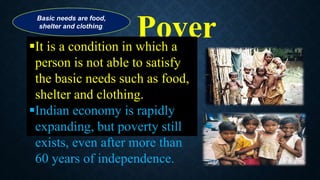
It is a condition in which a
person is not able to satisfy
the basic needs such as food,
shelter and clothing.
Indian economy is rapidly
expanding, but poverty still
exists, even after more than
60 years of independence.
Basic needs are food,
shelter and clothing.
Pover
ty
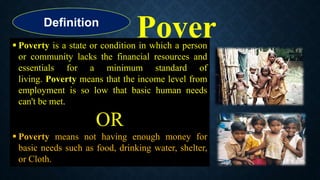
 Poverty is a state or condition in which a person
or community lacks the financial resources and
essentials for a minimum standard of
living. Poverty means that the income level from
employment is so low that basic human needs
can't be met.
OR
 Poverty means not having enough money for
basic needs such as food, drinking water, shelter,
or Cloth.
Definition
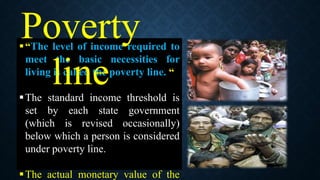
“The level of income required to
meet the basic necessities for
living is called the poverty line. “
The standard income threshold is
set by each state government
(which is revised occasionally)
below which a person is considered
under poverty line.
The actual monetary value of the
Poverty
line
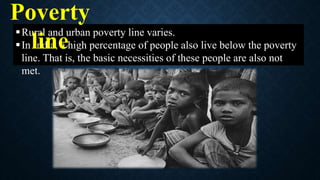
Rural and urban poverty line varies.
In India, a high percentage of people also live below the poverty
line. That is, the basic necessities of these people are also not
met.
Poverty
line
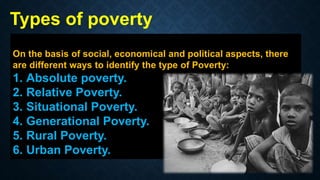
On the basis of social, economical and political aspects, there
are different ways to identify the type of Poverty:
1. Absolute poverty.
2. Relative Poverty.
3. Situational Poverty.
4. Generational Poverty.
5. Rural Poverty.
6. Urban Poverty.
Types of poverty
Absolute
poverty
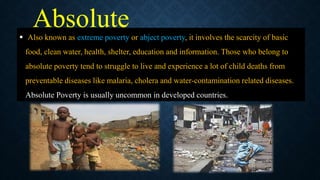
 Also known as extreme poverty or abject poverty, it involves the scarcity of basic
food, clean water, health, shelter, education and information. Those who belong to
absolute poverty tend to struggle to live and experience a lot of child deaths from
preventable diseases like malaria, cholera and water-contamination related diseases.
Absolute Poverty is usually uncommon in developed countries.
Relative
poverty
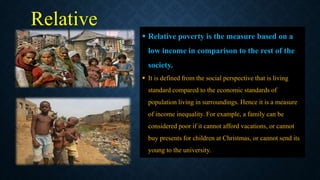
 Relative poverty is the measure based on a
low income in comparison to the rest of the
society.
 It is defined from the social perspective that is living
standard compared to the economic standards of
population living in surroundings. Hence it is a measure
of income inequality. For example, a family can be
considered poor if it cannot afford vacations, or cannot
buy presents for children at Christmas, or cannot send its
young to the university.
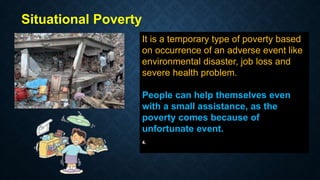
It is a temporary type of poverty based
on occurrence of an adverse event like
environmental disaster, job loss and
severe health problem.
People can help themselves even
with a small assistance, as the
poverty comes because of
unfortunate event.
4.
Situational Poverty
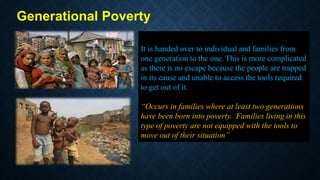
It is handed over to individual and families from
one generation to the one. This is more complicated
as there is no escape because the people are trapped
in its cause and unable to access the tools required
to get out of it.
“Occurs in families where at least two generations
have been born into poverty. Families living in this
type of poverty are not equipped with the tools to
move out of their situation”
Generational Poverty
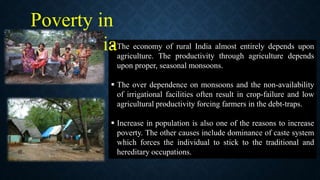
 The economy of rural India almost entirely depends upon
agriculture. The productivity through agriculture depends
upon proper, seasonal monsoons.
 The over dependence on monsoons and the non-availability
of irrigational facilities often result in crop-failure and low
agricultural productivity forcing farmers in the debt-traps.
 Increase in population is also one of the reasons to increase
poverty. The other causes include dominance of caste system
which forces the individual to stick to the traditional and
hereditary occupations.
Poverty in
Rural India
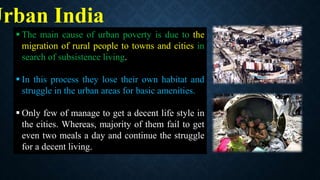
 The main cause of urban poverty is due to the
migration of rural people to towns and cities in
search of subsistence living.
 In this process they lose their own habitat and
struggle in the urban areas for basic amenities.
 Only few of manage to get a decent life style in
the cities. Whereas, majority of them fail to get
even two meals a day and continue the struggle
for a decent living.
Urban India
Main Causes
of
poverty
Main causes of poverty
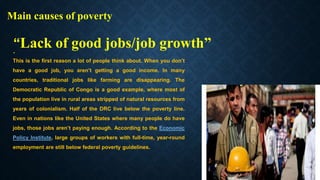
.
This is the first reason a lot of people think about. When you don’t
have a good job, you aren’t getting a good income. In many
countries, traditional jobs like farming are disappearing. The
Democratic Republic of Congo is a good example, where most of
the population live in rural areas stripped of natural resources from
years of colonialism. Half of the DRC live below the poverty line.
Even in nations like the United States where many people do have
jobs, those jobs aren’t paying enough. According to the Economic
Policy Institute, large groups of workers with full-time, year-round
employment are still below federal poverty guidelines.
“Lack of good jobs/job growth”
Main causes of poverty
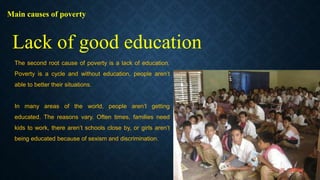
The second root cause of poverty is a lack of education.
Poverty is a cycle and without education, people aren’t
able to better their situations.
In many areas of the world, people aren’t getting
educated. The reasons vary. Often times, families need
kids to work, there aren’t schools close by, or girls aren’t
being educated because of sexism and discrimination.
Lack of good education
Main causes of poverty
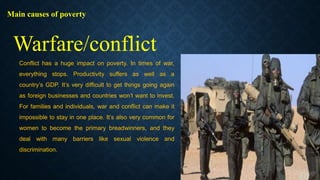
Conflict has a huge impact on poverty. In times of war,
everything stops. Productivity suffers as well as a
country’s GDP. It’s very difficult to get things going again
as foreign businesses and countries won’t want to invest.
For families and individuals, war and conflict can make it
impossible to stay in one place. It’s also very common for
women to become the primary breadwinners, and they
deal with many barriers like sexual violence and
discrimination.
Warfare/conflict
Main causes of poverty
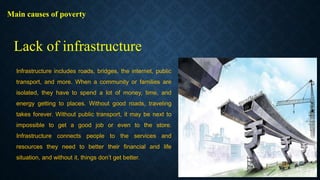
Infrastructure includes roads, bridges, the internet, public
transport, and more. When a community or families are
isolated, they have to spend a lot of money, time, and
energy getting to places. Without good roads, traveling
takes forever. Without public transport, it may be next to
impossible to get a good job or even to the store.
Infrastructure connects people to the services and
resources they need to better their financial and life
situation, and without it, things don’t get better.
Lack of infrastructure
Main causes of poverty
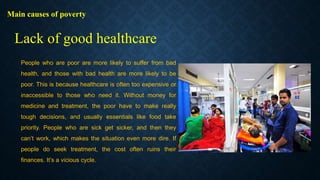
People who are poor are more likely to suffer from bad
health, and those with bad health are more likely to be
poor. This is because healthcare is often too expensive or
inaccessible to those who need it. Without money for
medicine and treatment, the poor have to make really
tough decisions, and usually essentials like food take
priority. People who are sick get sicker, and then they
can’t work, which makes the situation even more dire. If
people do seek treatment, the cost often ruins their
finances. It’s a vicious cycle.
Lack of good healthcare
Main causes of poverty
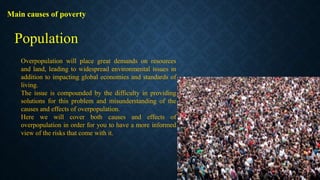
Overpopulation will place great demands on resources
and land, leading to widespread environmental issues in
addition to impacting global economies and standards of
living.
The issue is compounded by the difficulty in providing
solutions for this problem and misunderstanding of the
causes and effects of overpopulation.
Here we will cover both causes and effects of
overpopulation in order for you to have a more informed
view of the risks that come with it.
Population
Remove
the
Poverty
Develop and implement rapid and sustained
economic growth policies and programs, in areas such as
health, education, nutrition and sanitation, allowing the poor to participate and
contribute to the growth. Studies show that a 10 percent increase in a country’s
average income reduces poverty by as much as 20-30 percent.
Improve management of water and other natural
resources. Most of the rural poor depend on agriculture or other natural resources
for their livelihood. Consequently, it is necessary that they have more equitable
access to those resources so they are better able to manage their resources.
Reduce Poverty in the World
Remove barriers to equal access to resources and services.
Provide access to technology and innovation including internet
access and affordable energy. In Bangladesh, only 40 percent of the rural poor have access to
grid electricity. Those that do have access endure frequent power outages. The Second Rural
Electrification and Renewable Energy Development Project plans to increase access to
electricity in rural areas via renewable energy sources.
Create and improve access to jobs and income and develop entrepreneurial
talent.
Providing all people with access to basic social services including education, health
care, adequate food, sanitation, shelter and clean water.
Anti-Poverty and Employment Generation
Programs
Swarnajayanti Gram Swarozgar Yojana
(SGSY)
Pradhan Mantri Gramodaya Yojana
(PMGY)
Pradhan Mantri Gram Sadak Yojana
(PMGSY)
Pradhan Mantri Gramodaya Yojana
Anti-poverty programs
in India
Bharat Nirman Yojana
Swarnajayanti Shahari Rozgar Yojana (SJSRY)
Antyodaya Anna Yojana
Annapurna Yojana
Prime Minister’s Rozgar Yojana (PMRY)
Sarva Shiksha Abhiyan
Anti-poverty
programs in India
Anti-poverty
programmes in India
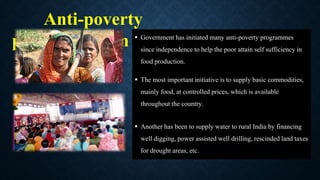
 Government has initiated many anti-poverty programmes
since independence to help the poor attain self sufficiency in
food production.
 The most important initiative is to supply basic commodities,
mainly food, at controlled prices, which is available
throughout the country.
 Another has been to supply water to rural India by financing
well digging, power assisted well drilling, rescinded land taxes
for drought areas, etc.
Extent of poverty in
India
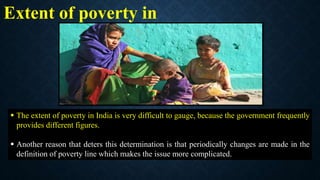
 The extent of poverty in India is very difficult to gauge, because the government frequently
provides different figures.
 Another reason that deters this determination is that periodically changes are made in the
definition of poverty line which makes the issue more complicated.
National Rural Employment Guarantee Act 2005
(i) National Rural Employment Guarantee Act (NREGA) 2005 was passed in September 2005.
(ii) The Act assures 100 days employment every year to every household.
(iii)Initially covering 200 districts, the Act would be extended later on to cover 600 districts.
(iv) One-third of the jobs are reserved for women.
(v) The central government will also establish National Employment Guarantee Funds.
Similarly state governments will establish State Employment Guarantee Funds for
implementation of the scheme. Under the programme if an applicant is not provided employment
within fifteen days she/he will be entitled to a daily unemployment
allowance.
Anti-poverty programmes
in India
National Food for Work Programme (NFWP)
(i) It was launched in 2004 in 150 most backward districts of the country.
(ii) It was started for the poor who were in need of wage employment and desire to do
manual unskilled work.
(iii) Food grains are provided free of cost to the states.
Anti-poverty programmes
in India
Prime Minister Rozgar Yozana (PMRY)
(i) It was started in 1993.
(ii) The aim of the programme was to create self-employment opportunities for
educated unemployed youth in rural areas and small towns.
(iii) It also helped in setting up small businesses and industries.
Anti-poverty programmes
in India
Rural Employment Generation Programme (REGP)
(i) It was launched in 1995.
(ii) The aim of the programme is to create self employment opportunities in rural
areas and small towns.
(iii) A target for creating 25 lakh new jobs has been set for the programme under
the Tenth Five Year plan.
Anti-poverty programmes
in India
Pradhan Mantri Gramodaya Yozana (PMGY)
(i) It was launched in 2000.
(ii) It aims at providing basic services such as primary health, primary education,
rural shelter, rural drinking water and rural electrification.
Anti-poverty programmes
in India
Swarnajayanti Gram Swarozgar Yojana (SGSY)
(i) It was launched in 1999.
(ii) The programme aims at bringing the assisted poor families above the poverty
line by organizing them into self-help groups through a mix of bank credit and
government subsidy.
Anti-poverty programmes
in India

V1 povery

  • 1.
    Poverty Problems of IndianEconomy Indian Economic Development
  • 2.
    Pover ty It is acondition in which a person is not able to satisfy the basic needs such as food, shelter and clothing. Indian economy is rapidly expanding, but poverty still exists, even after more than 60 years of independence. Basic needs are food, shelter and clothing.
  • 3.
    Pover ty  Poverty isa state or condition in which a person or community lacks the financial resources and essentials for a minimum standard of living. Poverty means that the income level from employment is so low that basic human needs can't be met. OR  Poverty means not having enough money for basic needs such as food, drinking water, shelter, or Cloth. Definition
  • 4.
    “The level ofincome required to meet the basic necessities for living is called the poverty line. “ The standard income threshold is set by each state government (which is revised occasionally) below which a person is considered under poverty line. The actual monetary value of the Poverty line
  • 5.
    Rural and urbanpoverty line varies. In India, a high percentage of people also live below the poverty line. That is, the basic necessities of these people are also not met. Poverty line
  • 6.
    On the basisof social, economical and political aspects, there are different ways to identify the type of Poverty: 1. Absolute poverty. 2. Relative Poverty. 3. Situational Poverty. 4. Generational Poverty. 5. Rural Poverty. 6. Urban Poverty. Types of poverty
  • 7.
    Absolute poverty  Also knownas extreme poverty or abject poverty, it involves the scarcity of basic food, clean water, health, shelter, education and information. Those who belong to absolute poverty tend to struggle to live and experience a lot of child deaths from preventable diseases like malaria, cholera and water-contamination related diseases. Absolute Poverty is usually uncommon in developed countries.
  • 8.
    Relative poverty  Relative povertyis the measure based on a low income in comparison to the rest of the society.  It is defined from the social perspective that is living standard compared to the economic standards of population living in surroundings. Hence it is a measure of income inequality. For example, a family can be considered poor if it cannot afford vacations, or cannot buy presents for children at Christmas, or cannot send its young to the university.
  • 9.
    It is atemporary type of poverty based on occurrence of an adverse event like environmental disaster, job loss and severe health problem. People can help themselves even with a small assistance, as the poverty comes because of unfortunate event. 4. Situational Poverty
  • 10.
    It is handedover to individual and families from one generation to the one. This is more complicated as there is no escape because the people are trapped in its cause and unable to access the tools required to get out of it. “Occurs in families where at least two generations have been born into poverty. Families living in this type of poverty are not equipped with the tools to move out of their situation” Generational Poverty
  • 11.
     The economyof rural India almost entirely depends upon agriculture. The productivity through agriculture depends upon proper, seasonal monsoons.  The over dependence on monsoons and the non-availability of irrigational facilities often result in crop-failure and low agricultural productivity forcing farmers in the debt-traps.  Increase in population is also one of the reasons to increase poverty. The other causes include dominance of caste system which forces the individual to stick to the traditional and hereditary occupations. Poverty in Rural India
  • 12.
     The maincause of urban poverty is due to the migration of rural people to towns and cities in search of subsistence living.  In this process they lose their own habitat and struggle in the urban areas for basic amenities.  Only few of manage to get a decent life style in the cities. Whereas, majority of them fail to get even two meals a day and continue the struggle for a decent living. Urban India
  • 13.
  • 14.
    Main causes ofpoverty . This is the first reason a lot of people think about. When you don’t have a good job, you aren’t getting a good income. In many countries, traditional jobs like farming are disappearing. The Democratic Republic of Congo is a good example, where most of the population live in rural areas stripped of natural resources from years of colonialism. Half of the DRC live below the poverty line. Even in nations like the United States where many people do have jobs, those jobs aren’t paying enough. According to the Economic Policy Institute, large groups of workers with full-time, year-round employment are still below federal poverty guidelines. “Lack of good jobs/job growth”
  • 15.
    Main causes ofpoverty The second root cause of poverty is a lack of education. Poverty is a cycle and without education, people aren’t able to better their situations. In many areas of the world, people aren’t getting educated. The reasons vary. Often times, families need kids to work, there aren’t schools close by, or girls aren’t being educated because of sexism and discrimination. Lack of good education
  • 16.
    Main causes ofpoverty Conflict has a huge impact on poverty. In times of war, everything stops. Productivity suffers as well as a country’s GDP. It’s very difficult to get things going again as foreign businesses and countries won’t want to invest. For families and individuals, war and conflict can make it impossible to stay in one place. It’s also very common for women to become the primary breadwinners, and they deal with many barriers like sexual violence and discrimination. Warfare/conflict
  • 17.
    Main causes ofpoverty Infrastructure includes roads, bridges, the internet, public transport, and more. When a community or families are isolated, they have to spend a lot of money, time, and energy getting to places. Without good roads, traveling takes forever. Without public transport, it may be next to impossible to get a good job or even to the store. Infrastructure connects people to the services and resources they need to better their financial and life situation, and without it, things don’t get better. Lack of infrastructure
  • 18.
    Main causes ofpoverty People who are poor are more likely to suffer from bad health, and those with bad health are more likely to be poor. This is because healthcare is often too expensive or inaccessible to those who need it. Without money for medicine and treatment, the poor have to make really tough decisions, and usually essentials like food take priority. People who are sick get sicker, and then they can’t work, which makes the situation even more dire. If people do seek treatment, the cost often ruins their finances. It’s a vicious cycle. Lack of good healthcare
  • 19.
    Main causes ofpoverty Overpopulation will place great demands on resources and land, leading to widespread environmental issues in addition to impacting global economies and standards of living. The issue is compounded by the difficulty in providing solutions for this problem and misunderstanding of the causes and effects of overpopulation. Here we will cover both causes and effects of overpopulation in order for you to have a more informed view of the risks that come with it. Population
  • 20.
  • 21.
    Develop and implementrapid and sustained economic growth policies and programs, in areas such as health, education, nutrition and sanitation, allowing the poor to participate and contribute to the growth. Studies show that a 10 percent increase in a country’s average income reduces poverty by as much as 20-30 percent. Improve management of water and other natural resources. Most of the rural poor depend on agriculture or other natural resources for their livelihood. Consequently, it is necessary that they have more equitable access to those resources so they are better able to manage their resources. Reduce Poverty in the World
  • 22.
    Remove barriers toequal access to resources and services. Provide access to technology and innovation including internet access and affordable energy. In Bangladesh, only 40 percent of the rural poor have access to grid electricity. Those that do have access endure frequent power outages. The Second Rural Electrification and Renewable Energy Development Project plans to increase access to electricity in rural areas via renewable energy sources. Create and improve access to jobs and income and develop entrepreneurial talent. Providing all people with access to basic social services including education, health care, adequate food, sanitation, shelter and clean water.
  • 23.
    Anti-Poverty and EmploymentGeneration Programs Swarnajayanti Gram Swarozgar Yojana (SGSY) Pradhan Mantri Gramodaya Yojana (PMGY) Pradhan Mantri Gram Sadak Yojana (PMGSY) Pradhan Mantri Gramodaya Yojana Anti-poverty programs in India
  • 24.
    Bharat Nirman Yojana SwarnajayantiShahari Rozgar Yojana (SJSRY) Antyodaya Anna Yojana Annapurna Yojana Prime Minister’s Rozgar Yojana (PMRY) Sarva Shiksha Abhiyan Anti-poverty programs in India
  • 25.
    Anti-poverty programmes in India Government has initiated many anti-poverty programmes since independence to help the poor attain self sufficiency in food production.  The most important initiative is to supply basic commodities, mainly food, at controlled prices, which is available throughout the country.  Another has been to supply water to rural India by financing well digging, power assisted well drilling, rescinded land taxes for drought areas, etc.
  • 26.
    Extent of povertyin India  The extent of poverty in India is very difficult to gauge, because the government frequently provides different figures.  Another reason that deters this determination is that periodically changes are made in the definition of poverty line which makes the issue more complicated.
  • 27.
    National Rural EmploymentGuarantee Act 2005 (i) National Rural Employment Guarantee Act (NREGA) 2005 was passed in September 2005. (ii) The Act assures 100 days employment every year to every household. (iii)Initially covering 200 districts, the Act would be extended later on to cover 600 districts. (iv) One-third of the jobs are reserved for women. (v) The central government will also establish National Employment Guarantee Funds. Similarly state governments will establish State Employment Guarantee Funds for implementation of the scheme. Under the programme if an applicant is not provided employment within fifteen days she/he will be entitled to a daily unemployment allowance. Anti-poverty programmes in India
  • 28.
    National Food forWork Programme (NFWP) (i) It was launched in 2004 in 150 most backward districts of the country. (ii) It was started for the poor who were in need of wage employment and desire to do manual unskilled work. (iii) Food grains are provided free of cost to the states. Anti-poverty programmes in India
  • 29.
    Prime Minister RozgarYozana (PMRY) (i) It was started in 1993. (ii) The aim of the programme was to create self-employment opportunities for educated unemployed youth in rural areas and small towns. (iii) It also helped in setting up small businesses and industries. Anti-poverty programmes in India
  • 30.
    Rural Employment GenerationProgramme (REGP) (i) It was launched in 1995. (ii) The aim of the programme is to create self employment opportunities in rural areas and small towns. (iii) A target for creating 25 lakh new jobs has been set for the programme under the Tenth Five Year plan. Anti-poverty programmes in India
  • 31.
    Pradhan Mantri GramodayaYozana (PMGY) (i) It was launched in 2000. (ii) It aims at providing basic services such as primary health, primary education, rural shelter, rural drinking water and rural electrification. Anti-poverty programmes in India
  • 32.
    Swarnajayanti Gram SwarozgarYojana (SGSY) (i) It was launched in 1999. (ii) The programme aims at bringing the assisted poor families above the poverty line by organizing them into self-help groups through a mix of bank credit and government subsidy. Anti-poverty programmes in India