Using Device Abstraction Layers in
OSGi based Embedded Systems
Dr. Dimitar Valtchev

ProSyst Software

21 September 2011


                                                           OSGi Alliance Marketing © 2008-2010 . 1
                                                                                           Page
COPYRIGHT © 2008-2011 OSGi Alliance. All Rights Reserved
                                                           All Rights Reserved
Content

• Introduction
• Known approaches for the realization of home device
  access applicable for an OSGi environment
• Definition of Device Abstraction Layer
• Reference architecture for the realization of Device
  Abstraction Layer
• Conclusions


   Page 2   OSGi Alliance Community Event 2011© 2008-2011. All Rights Reserved
Introduction

• OSGi already established as a key technology in residential
  area. Why?
• Technical benefits of using Java, modular layer, dynamic
  services, etc
• Maturity of the technology, availability of development tools,
  reference materials, trainings, etc.
• Several comparatively well coordinated standardization
  efforts building on OSGi (OSGiA, HGI, UPnP, BBF)
• OSGi fits perfectly to the new business models in residential
  areas (e.g. the concept of service gateway)
    Page 3   OSGi Alliance Community Event 2011© 2008-2011. All Rights Reserved
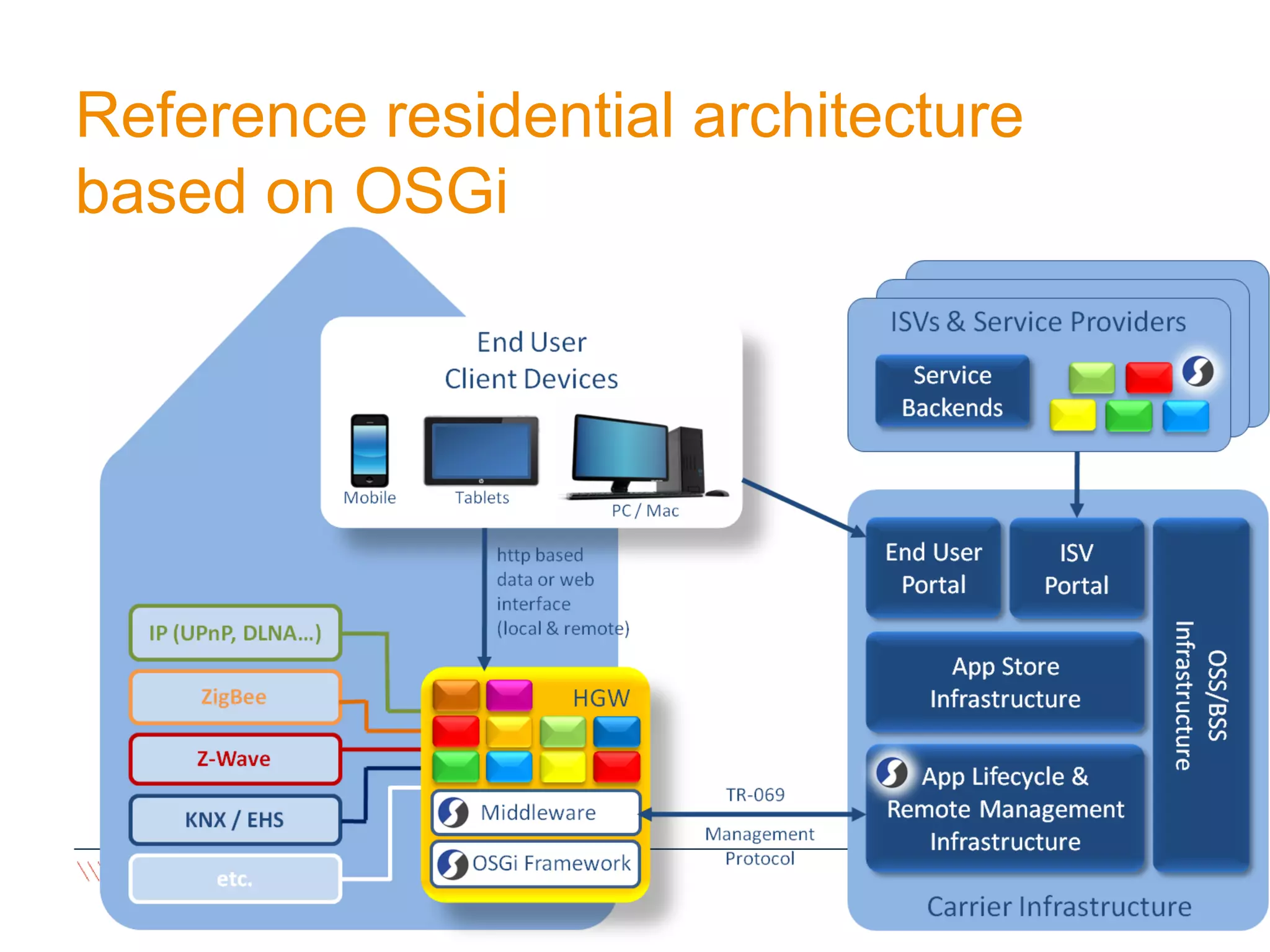
Reference residential architecture
based on OSGi


  Page 4   OSGi Alliance Marketing © 2008-2011 . All Rights Reserved
Home device access

• The home device access is an essential part of any
  residential software architecture
• It is necessary in order to realize meaningful applications
  for Energy Management, Comfort and Security
• There is a significant number of relevant home protocols
  which differ depending on the used media (wires, radio,
  plc), topology, communication, power consumption, data
  rates
• Examples for home protocols: KNX, ZigBee, Z-Wave,
  DigitalStrom, EnOcean, Homematic, Crestron, etc
   Page 5   OSGi Alliance Marketing © 2008-2011 . All Rights Reserved
Possible approaches to access home
devices
  There is a general OSGi mechanism for working with devices and
  drivers for them - OSGi Device access specification (R4.2
  Compendium Spec)
• Specifying OSGi services for each home protocol
   •    There is already a UPnP Device Service Specification in OSGi R4.2
   •    Possible to be done for other protocols (for ZigBee or Z-Wave there are already
        such plans for the next REG release)

• Defining an additional Device Abstraction Layer which
  unifies the work with different types of protocols


   Page 6    OSGi Alliance Marketing © 2008-2011 . All Rights Reserved
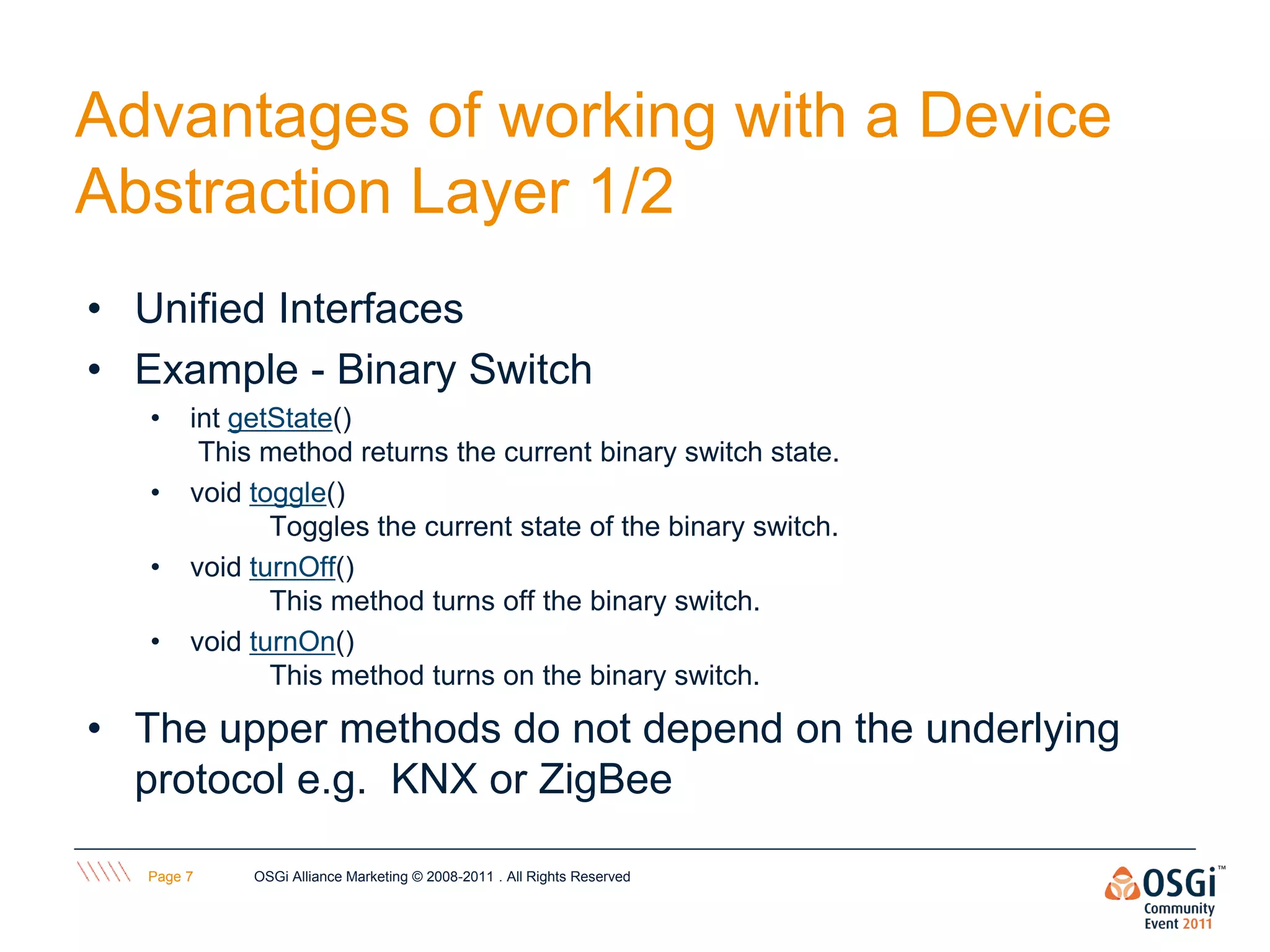
Advantages of working with a Device
Abstraction Layer 1/2
• Unified Interfaces
• Example - Binary Switch
   •    int getState()
         This method returns the current binary switch state.
   •    void toggle()
               Toggles the current state of the binary switch.
   •    void turnOff()
               This method turns off the binary switch.
   •    void turnOn()
               This method turns on the binary switch.

• The upper methods do not depend on the underlying
  protocol e.g. KNX or ZigBee

   Page 7    OSGi Alliance Marketing © 2008-2011 . All Rights Reserved
Advantages of working with a Device
Abstraction Layer 2/2
• Possible to switch easily between different protocols
  without changing the upper layers (e.g. the UI)
• Facilitate the realization of home automation layers
• Allows mapping to management systems (e.g. for BBF
  PD-174)
• A devices abstraction layer is not only an element of the
  runtime but also of an SDK
   •    The developers do not to learn many different interfaces and protocols
   •    Much easier to realize simulators


   Page 8    OSGi Alliance Marketing © 2008-2011 . All Rights Reserved
Existing approaches to the device
abstraction layer
• To choose an existing protocol and to map all others to it
   •    One comparatively suitable protocol is UPnP (e.g. project OSAmI uses UPnP in
        combination with OSGi Wire Admin to work with devices related to Ambient
        Intelligence)

• To define from scratch a new abstraction layer. Some
  examples:
   •    OpenHAB - http://code.google.com/p/openhab/
   •    DOG/DogOnt/DogSim - http://elite.polito.it/dog-tools-72
   •    EEBus - http://www.eebus.de/
   •    Home Device Manager (HDM) - http://dz.prosyst.com/devzone/SmartHome


   Page 9   OSGi Alliance Marketing © 2008-2011 . All Rights Reserved
What does a device abstraction layer
include?
 • Device ontology (device classes)
 • APIs (and/or protocols) for accessing the devices
       •    For accessing the device classes
       •    For administrative purposes (list all devices, discover/add device, etc)
       •    For providing additional convenience to the programmer (zones, friendly
            names, etc)
             ------
       •    Local (e.g. Java API) or remote (e.g. JSON-RCP, UPnP, TR-69, messaging)
             ------
       •    Synchronous or asynchronous


  Page 10    OSGi Alliance Marketing © 2008-2011 . All Rights Reserved
ProSyst’s Home Device Manager
(HDM) – design goals
• Providing local OSGi based APIs for unified access to
  heterogeneous devices (Java)
• Ensuring compatibility and good interoperability with
  existing IP or non-IP home protocols
• Providing convenient access, control and notification
  mechanisms suitable for the OSGi environment
• Support for device plug and play (depending on the
  corresponding home protocol)‫‏‬
• Support for JSON/Restful interface, other RPC interfaces
  (non-Java) and management protocols
    Page 11   OSGi Alliance Marketing © 2008-2011 . All Rights Reserved
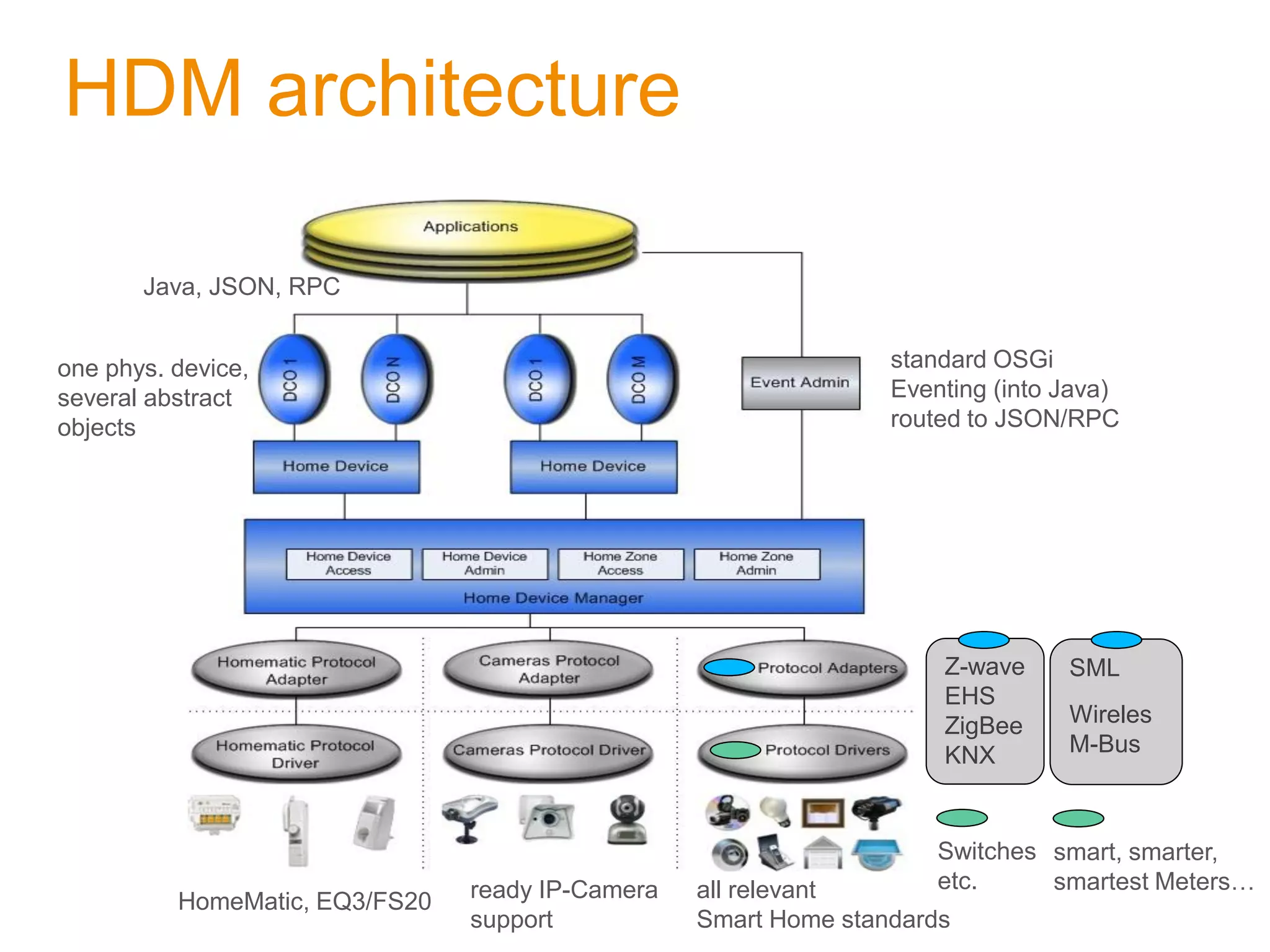
HDM architecture

       Java, JSON, RPC


one phys. device,                                                standard OSGi
several abstract                                                 Eventing (into Java)
objects                                                          routed to JSON/RPC


                                                                     Z-wave     SML
                                                                     EHS
                                                                     ZigBee     Wireles
                                                                     KNX        M-Bus


                                                                     Switches smart, smarter,
                                ready IP-Camera   all relevant       etc.     smartest Meters…
          HomeMatic, EQ3/FS20
                                support           Smart Home standards
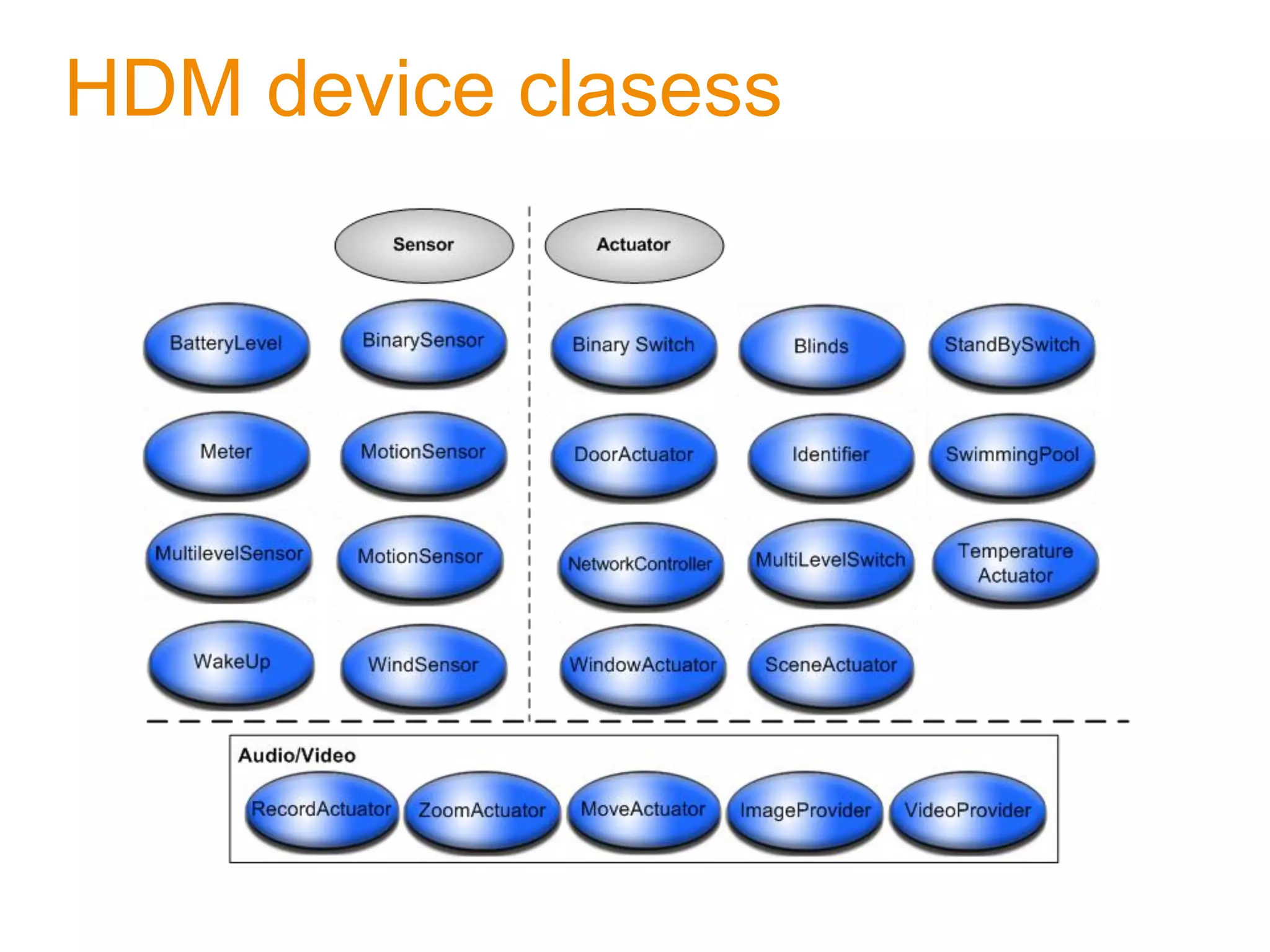
HDM device clasess
Conclusion

• Having a well defined device abstraction layer is a must
  for any service gateway product for the mass market
• It would be extremely useful also across products from
  different vendors and is an important standardization topic
  for organizations like OSGiA and HGI
• There are some challenges regarding the scope of a
  possible specification work (APIs vs device ontology)
• ProSyst has invested significant resources in this area
  and is actively pushing the corresponding standardization
  activities
   Page 14   OSGi Alliance Marketing © 2008-2011 . All Rights Reserved

Using Device Abstraction Layers in OSGi based Embedded Systems - Dimitar Valtchev

  • 1.
    Using Device AbstractionLayers in OSGi based Embedded Systems Dr. Dimitar Valtchev ProSyst Software 21 September 2011 OSGi Alliance Marketing © 2008-2010 . 1 Page COPYRIGHT © 2008-2011 OSGi Alliance. All Rights Reserved All Rights Reserved
  • 2.
    Content • Introduction • Knownapproaches for the realization of home device access applicable for an OSGi environment • Definition of Device Abstraction Layer • Reference architecture for the realization of Device Abstraction Layer • Conclusions Page 2 OSGi Alliance Community Event 2011© 2008-2011. All Rights Reserved
  • 3.
    Introduction • OSGi alreadyestablished as a key technology in residential area. Why? • Technical benefits of using Java, modular layer, dynamic services, etc • Maturity of the technology, availability of development tools, reference materials, trainings, etc. • Several comparatively well coordinated standardization efforts building on OSGi (OSGiA, HGI, UPnP, BBF) • OSGi fits perfectly to the new business models in residential areas (e.g. the concept of service gateway) Page 3 OSGi Alliance Community Event 2011© 2008-2011. All Rights Reserved
  • 4.
    Reference residential architecture basedon OSGi Page 4 OSGi Alliance Marketing © 2008-2011 . All Rights Reserved
  • 5.
    Home device access •The home device access is an essential part of any residential software architecture • It is necessary in order to realize meaningful applications for Energy Management, Comfort and Security • There is a significant number of relevant home protocols which differ depending on the used media (wires, radio, plc), topology, communication, power consumption, data rates • Examples for home protocols: KNX, ZigBee, Z-Wave, DigitalStrom, EnOcean, Homematic, Crestron, etc Page 5 OSGi Alliance Marketing © 2008-2011 . All Rights Reserved
  • 6.
    Possible approaches toaccess home devices There is a general OSGi mechanism for working with devices and drivers for them - OSGi Device access specification (R4.2 Compendium Spec) • Specifying OSGi services for each home protocol • There is already a UPnP Device Service Specification in OSGi R4.2 • Possible to be done for other protocols (for ZigBee or Z-Wave there are already such plans for the next REG release) • Defining an additional Device Abstraction Layer which unifies the work with different types of protocols Page 6 OSGi Alliance Marketing © 2008-2011 . All Rights Reserved
  • 7.
    Advantages of workingwith a Device Abstraction Layer 1/2 • Unified Interfaces • Example - Binary Switch • int getState() This method returns the current binary switch state. • void toggle() Toggles the current state of the binary switch. • void turnOff() This method turns off the binary switch. • void turnOn() This method turns on the binary switch. • The upper methods do not depend on the underlying protocol e.g. KNX or ZigBee Page 7 OSGi Alliance Marketing © 2008-2011 . All Rights Reserved
  • 8.
    Advantages of workingwith a Device Abstraction Layer 2/2 • Possible to switch easily between different protocols without changing the upper layers (e.g. the UI) • Facilitate the realization of home automation layers • Allows mapping to management systems (e.g. for BBF PD-174) • A devices abstraction layer is not only an element of the runtime but also of an SDK • The developers do not to learn many different interfaces and protocols • Much easier to realize simulators Page 8 OSGi Alliance Marketing © 2008-2011 . All Rights Reserved
  • 9.
    Existing approaches tothe device abstraction layer • To choose an existing protocol and to map all others to it • One comparatively suitable protocol is UPnP (e.g. project OSAmI uses UPnP in combination with OSGi Wire Admin to work with devices related to Ambient Intelligence) • To define from scratch a new abstraction layer. Some examples: • OpenHAB - http://code.google.com/p/openhab/ • DOG/DogOnt/DogSim - http://elite.polito.it/dog-tools-72 • EEBus - http://www.eebus.de/ • Home Device Manager (HDM) - http://dz.prosyst.com/devzone/SmartHome Page 9 OSGi Alliance Marketing © 2008-2011 . All Rights Reserved
  • 10.
    What does adevice abstraction layer include? • Device ontology (device classes) • APIs (and/or protocols) for accessing the devices • For accessing the device classes • For administrative purposes (list all devices, discover/add device, etc) • For providing additional convenience to the programmer (zones, friendly names, etc) ------ • Local (e.g. Java API) or remote (e.g. JSON-RCP, UPnP, TR-69, messaging) ------ • Synchronous or asynchronous Page 10 OSGi Alliance Marketing © 2008-2011 . All Rights Reserved
  • 11.
    ProSyst’s Home DeviceManager (HDM) – design goals • Providing local OSGi based APIs for unified access to heterogeneous devices (Java) • Ensuring compatibility and good interoperability with existing IP or non-IP home protocols • Providing convenient access, control and notification mechanisms suitable for the OSGi environment • Support for device plug and play (depending on the corresponding home protocol)‫‏‬ • Support for JSON/Restful interface, other RPC interfaces (non-Java) and management protocols Page 11 OSGi Alliance Marketing © 2008-2011 . All Rights Reserved
  • 12.
    HDM architecture Java, JSON, RPC one phys. device, standard OSGi several abstract Eventing (into Java) objects routed to JSON/RPC Z-wave SML EHS ZigBee Wireles KNX M-Bus Switches smart, smarter, ready IP-Camera all relevant etc. smartest Meters… HomeMatic, EQ3/FS20 support Smart Home standards
  • 13.
  • 14.
    Conclusion • Having awell defined device abstraction layer is a must for any service gateway product for the mass market • It would be extremely useful also across products from different vendors and is an important standardization topic for organizations like OSGiA and HGI • There are some challenges regarding the scope of a possible specification work (APIs vs device ontology) • ProSyst has invested significant resources in this area and is actively pushing the corresponding standardization activities Page 14 OSGi Alliance Marketing © 2008-2011 . All Rights Reserved