Sage survey of U. S. SMB company usage of mobile technology Page 1 of 7
Sage U.S. SMB Survey on Mobile
Devices 2014
Summary report
Sage survey of U. S. SMB company usage of mobile technology Page 2 of 7
Introduction
The shift of small and medium-size businesses from using computing technology on site only to
using mobile technology has been of increasing interest to business managers, who are looking
for ways to make their businesses more efficient. This is a survey of SMB managers and
employees in the United States about their opinions on mobile technology in the workplace and
how this technology is actually implemented.
The survey first explores how company leadership feels about the use of mobile technology in
the business environment, whether or not they personally use laptops, smartphones, tablets, or
desktops away from the office. Of the 1,090 respondents who began the survey, 45% of these
were from business management (owners, CEOs, presidents, controllers, or CFOs). Some of
their responses are compared to the 2013 Sage SMB Survey on Mobile Devices.
How executives view mobile technology within their business
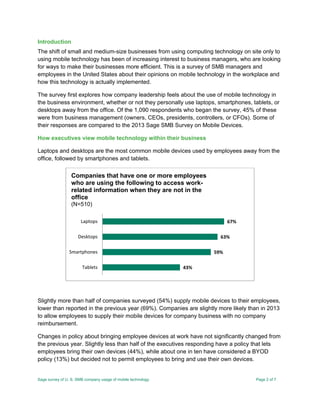
Laptops and desktops are the most common mobile devices used by employees away from the
office, followed by smartphones and tablets.
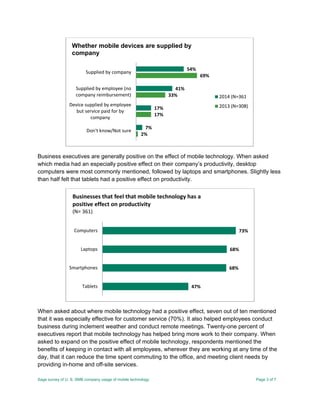
Slightly more than half of companies surveyed (54%) supply mobile devices to their employees,
lower than reported in the previous year (69%). Companies are slightly more likely than in 2013
to allow employees to supply their mobile devices for company business with no company
reimbursement.
Changes in policy about bringing employee devices at work have not significantly changed from
the previous year. Slightly less than half of the executives responding have a policy that lets
employees bring their own devices (44%), while about one in ten have considered a BYOD
policy (13%) but decided not to permit employees to bring and use their own devices.
43%
59%
63%
67%
Tablets
Smartphones
Desktops
Laptops
Companies that have one or more employees
who are using the following to access work-
related information when they are not in the
office
(N=510)
Sage survey of U. S. SMB company usage of mobile technology Page 3 of 7
Business executives are generally positive on the effect of mobile technology. When asked
which media had an especially positive effect on their company’s productivity, desktop
computers were most commonly mentioned, followed by laptops and smartphones. Slightly less
than half felt that tablets had a positive effect on productivity.
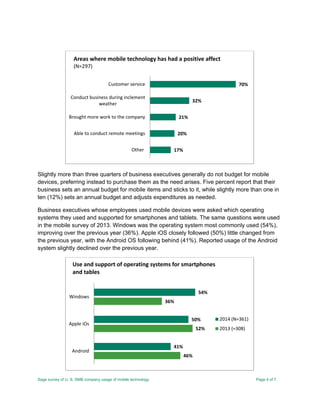
When asked about where mobile technology had a positive effect, seven out of ten mentioned
that it was especially effective for customer service (70%). It also helped employees conduct
business during inclement weather and conduct remote meetings. Twenty-one percent of
executives report that mobile technology has helped bring more work to their company. When
asked to expand on the positive effect of mobile technology, respondents mentioned the
benefits of keeping in contact with all employees, wherever they are working at any time of the
day, that it can reduce the time spent commuting to the office, and meeting client needs by
providing in-home and off-site services.
2%
17%
33%
69%
7%
17%
41%
54%
Don't know/Not sure
Device supplied by employee
but service paid for by
company
Supplied by employee (no
company reimbursement)
Supplied by company
Whether mobile devices are supplied by
company
2014 (N=361
2013 (N=308)
47%
68%
68%
73%
Tablets
Smartphones
Laptops
Computers
Businesses that feel that mobile technology has a
positive effect on productivity
(N= 361)
Sage survey of U. S. SMB company usage of mobile technology Page 4 of 7
Slightly more than three quarters of business executives generally do not budget for mobile
devices, preferring instead to purchase them as the need arises. Five percent report that their
business sets an annual budget for mobile items and sticks to it, while slightly more than one in
ten (12%) sets an annual budget and adjusts expenditures as needed.
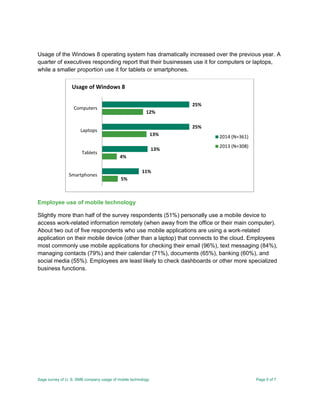
Business executives whose employees used mobile devices were asked which operating
systems they used and supported for smartphones and tablets. The same questions were used
in the mobile survey of 2013. Windows was the operating system most commonly used (54%),
improving over the previous year (36%). Apple iOS closely followed (50%) little changed from
the previous year, with the Android OS following behind (41%). Reported usage of the Android
system slightly declined over the previous year.
17%
20%
21%
32%
70%
Other
Able to conduct remote meetings
Brought more work to the company
Conduct business during inclement
weather
Customer service
Areas where mobile technology has had a positive affect
(N=297)
46%
52%
36%
41%
50%
54%
Android
Apple iOs
Windows
Use and support of operating systems for smartphones
and tables
2014 (N=361)
2013 (=308)
Sage survey of U. S. SMB company usage of mobile technology Page 5 of 7
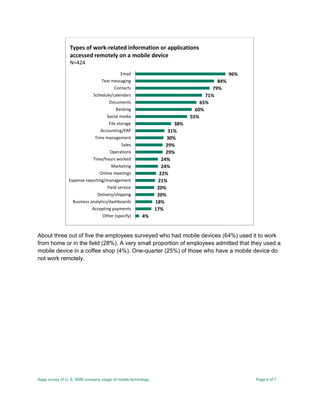
Usage of the Windows 8 operating system has dramatically increased over the previous year. A
quarter of executives responding report that their businesses use it for computers or laptops,
while a smaller proportion use it for tablets or smartphones.
Employee use of mobile technology
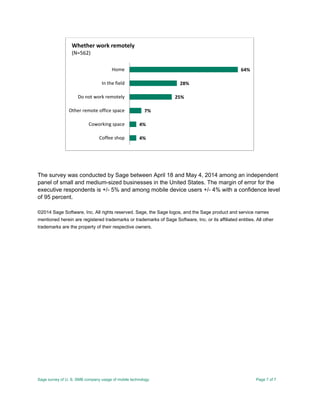
Slightly more than half of the survey respondents (51%) personally use a mobile device to
access work-related information remotely (when away from the office or their main computer).
About two out of five respondents who use mobile applications are using a work-related
application on their mobile device (other than a laptop) that connects to the cloud. Employees
most commonly use mobile applications for checking their email (96%), text messaging (84%),
managing contacts (79%) and their calendar (71%), documents (65%), banking (60%), and
social media (55%). Employees are least likely to check dashboards or other more specialized
business functions.
5%
4%
13%
12%
11%
13%
25%
25%
Smartphones
Tablets
Laptops
Computers
Usage of Windows 8
2014 (N=361)
2013 (N=308)
Sage survey of U. S. SMB company usage of mobile technology Page 6 of 7
About three out of five the employees surveyed who had mobile devices (64%) used it to work
from home or in the field (28%). A very small proportion of employees admitted that they used a
mobile device in a coffee shop (4%). One-quarter (25%) of those who have a mobile device do
not work remotely.
4%
17%
18%
20%
20%
21%
22%
24%
24%
29%
29%
30%
31%
38%
55%
60%
65%
71%
79%
84%
96%
Other (specify)
Accepting payments
Business analytics/dashboards
Delivery/shipping
Field service
Expense reporting/management
Online meetings
Marketing
Time/hours worked
Operations
Sales
Time management
Accounting/ERP
File storage
Social media
Banking
Documents
Schedule/calendars
Contacts
Text messaging
Email
Types of work-related information or applications
accessed remotely on a mobile device
N=424
Sage survey of U. S. SMB company usage of mobile technology Page 7 of 7
The survey was conducted by Sage between April 18 and May 4, 2014 among an independent
panel of small and medium-sized businesses in the United States. The margin of error for the
executive respondents is +/- 5% and among mobile device users +/- 4% with a confidence level
of 95 percent.
©2014 Sage Software, Inc. All rights reserved. Sage, the Sage logos, and the Sage product and service names
mentioned herein are registered trademarks or trademarks of Sage Software, Inc. or its affiliated entities. All other
trademarks are the property of their respective owners.
4%
4%
7%
25%
28%
64%
Coffee shop
Coworking space
Other remote office space
Do not work remotely
In the field
Home
Whether work remotely
(N=562)

Mobile Business Budgeting Survey from Sage

  • 1.
    Sage survey ofU. S. SMB company usage of mobile technology Page 1 of 7 Sage U.S. SMB Survey on Mobile Devices 2014 Summary report
  • 2.
    Sage survey ofU. S. SMB company usage of mobile technology Page 2 of 7 Introduction The shift of small and medium-size businesses from using computing technology on site only to using mobile technology has been of increasing interest to business managers, who are looking for ways to make their businesses more efficient. This is a survey of SMB managers and employees in the United States about their opinions on mobile technology in the workplace and how this technology is actually implemented. The survey first explores how company leadership feels about the use of mobile technology in the business environment, whether or not they personally use laptops, smartphones, tablets, or desktops away from the office. Of the 1,090 respondents who began the survey, 45% of these were from business management (owners, CEOs, presidents, controllers, or CFOs). Some of their responses are compared to the 2013 Sage SMB Survey on Mobile Devices. How executives view mobile technology within their business Laptops and desktops are the most common mobile devices used by employees away from the office, followed by smartphones and tablets. Slightly more than half of companies surveyed (54%) supply mobile devices to their employees, lower than reported in the previous year (69%). Companies are slightly more likely than in 2013 to allow employees to supply their mobile devices for company business with no company reimbursement. Changes in policy about bringing employee devices at work have not significantly changed from the previous year. Slightly less than half of the executives responding have a policy that lets employees bring their own devices (44%), while about one in ten have considered a BYOD policy (13%) but decided not to permit employees to bring and use their own devices. 43% 59% 63% 67% Tablets Smartphones Desktops Laptops Companies that have one or more employees who are using the following to access work- related information when they are not in the office (N=510)
  • 3.
    Sage survey ofU. S. SMB company usage of mobile technology Page 3 of 7 Business executives are generally positive on the effect of mobile technology. When asked which media had an especially positive effect on their company’s productivity, desktop computers were most commonly mentioned, followed by laptops and smartphones. Slightly less than half felt that tablets had a positive effect on productivity. When asked about where mobile technology had a positive effect, seven out of ten mentioned that it was especially effective for customer service (70%). It also helped employees conduct business during inclement weather and conduct remote meetings. Twenty-one percent of executives report that mobile technology has helped bring more work to their company. When asked to expand on the positive effect of mobile technology, respondents mentioned the benefits of keeping in contact with all employees, wherever they are working at any time of the day, that it can reduce the time spent commuting to the office, and meeting client needs by providing in-home and off-site services. 2% 17% 33% 69% 7% 17% 41% 54% Don't know/Not sure Device supplied by employee but service paid for by company Supplied by employee (no company reimbursement) Supplied by company Whether mobile devices are supplied by company 2014 (N=361 2013 (N=308) 47% 68% 68% 73% Tablets Smartphones Laptops Computers Businesses that feel that mobile technology has a positive effect on productivity (N= 361)
  • 4.
    Sage survey ofU. S. SMB company usage of mobile technology Page 4 of 7 Slightly more than three quarters of business executives generally do not budget for mobile devices, preferring instead to purchase them as the need arises. Five percent report that their business sets an annual budget for mobile items and sticks to it, while slightly more than one in ten (12%) sets an annual budget and adjusts expenditures as needed. Business executives whose employees used mobile devices were asked which operating systems they used and supported for smartphones and tablets. The same questions were used in the mobile survey of 2013. Windows was the operating system most commonly used (54%), improving over the previous year (36%). Apple iOS closely followed (50%) little changed from the previous year, with the Android OS following behind (41%). Reported usage of the Android system slightly declined over the previous year. 17% 20% 21% 32% 70% Other Able to conduct remote meetings Brought more work to the company Conduct business during inclement weather Customer service Areas where mobile technology has had a positive affect (N=297) 46% 52% 36% 41% 50% 54% Android Apple iOs Windows Use and support of operating systems for smartphones and tables 2014 (N=361) 2013 (=308)
  • 5.
    Sage survey ofU. S. SMB company usage of mobile technology Page 5 of 7 Usage of the Windows 8 operating system has dramatically increased over the previous year. A quarter of executives responding report that their businesses use it for computers or laptops, while a smaller proportion use it for tablets or smartphones. Employee use of mobile technology Slightly more than half of the survey respondents (51%) personally use a mobile device to access work-related information remotely (when away from the office or their main computer). About two out of five respondents who use mobile applications are using a work-related application on their mobile device (other than a laptop) that connects to the cloud. Employees most commonly use mobile applications for checking their email (96%), text messaging (84%), managing contacts (79%) and their calendar (71%), documents (65%), banking (60%), and social media (55%). Employees are least likely to check dashboards or other more specialized business functions. 5% 4% 13% 12% 11% 13% 25% 25% Smartphones Tablets Laptops Computers Usage of Windows 8 2014 (N=361) 2013 (N=308)
  • 6.
    Sage survey ofU. S. SMB company usage of mobile technology Page 6 of 7 About three out of five the employees surveyed who had mobile devices (64%) used it to work from home or in the field (28%). A very small proportion of employees admitted that they used a mobile device in a coffee shop (4%). One-quarter (25%) of those who have a mobile device do not work remotely. 4% 17% 18% 20% 20% 21% 22% 24% 24% 29% 29% 30% 31% 38% 55% 60% 65% 71% 79% 84% 96% Other (specify) Accepting payments Business analytics/dashboards Delivery/shipping Field service Expense reporting/management Online meetings Marketing Time/hours worked Operations Sales Time management Accounting/ERP File storage Social media Banking Documents Schedule/calendars Contacts Text messaging Email Types of work-related information or applications accessed remotely on a mobile device N=424
  • 7.
    Sage survey ofU. S. SMB company usage of mobile technology Page 7 of 7 The survey was conducted by Sage between April 18 and May 4, 2014 among an independent panel of small and medium-sized businesses in the United States. The margin of error for the executive respondents is +/- 5% and among mobile device users +/- 4% with a confidence level of 95 percent. ©2014 Sage Software, Inc. All rights reserved. Sage, the Sage logos, and the Sage product and service names mentioned herein are registered trademarks or trademarks of Sage Software, Inc. or its affiliated entities. All other trademarks are the property of their respective owners. 4% 4% 7% 25% 28% 64% Coffee shop Coworking space Other remote office space Do not work remotely In the field Home Whether work remotely (N=562)