Non traumatic Urological
Emergency
Prepared by: Under supervision of:
Zana Hossam Dr.Kamiran J. Sadeeq
Urological Emergency
A urology emergency refers to any urologic condition that
requires urgent medical attention from a urologist or an
emergency room and immediate treatment
Compared to other surgical fields there are relatively few
emergencies in urology
Urological Emergency
Non traumatic
1. Hematuria
2. Ureteric Colic
3. Acute Scrotum
4. Priapism
5. Urinary Retention
6. Paraphimosis
7. Anuria
8. Pyonephrosis
9. Fournier’s Gangrene
Traumatic
1. Renal Injury
2. Ureteral Injury
3. Bladder Injury
4. Urethral Injury
5. Testicular Injury
Hematuria
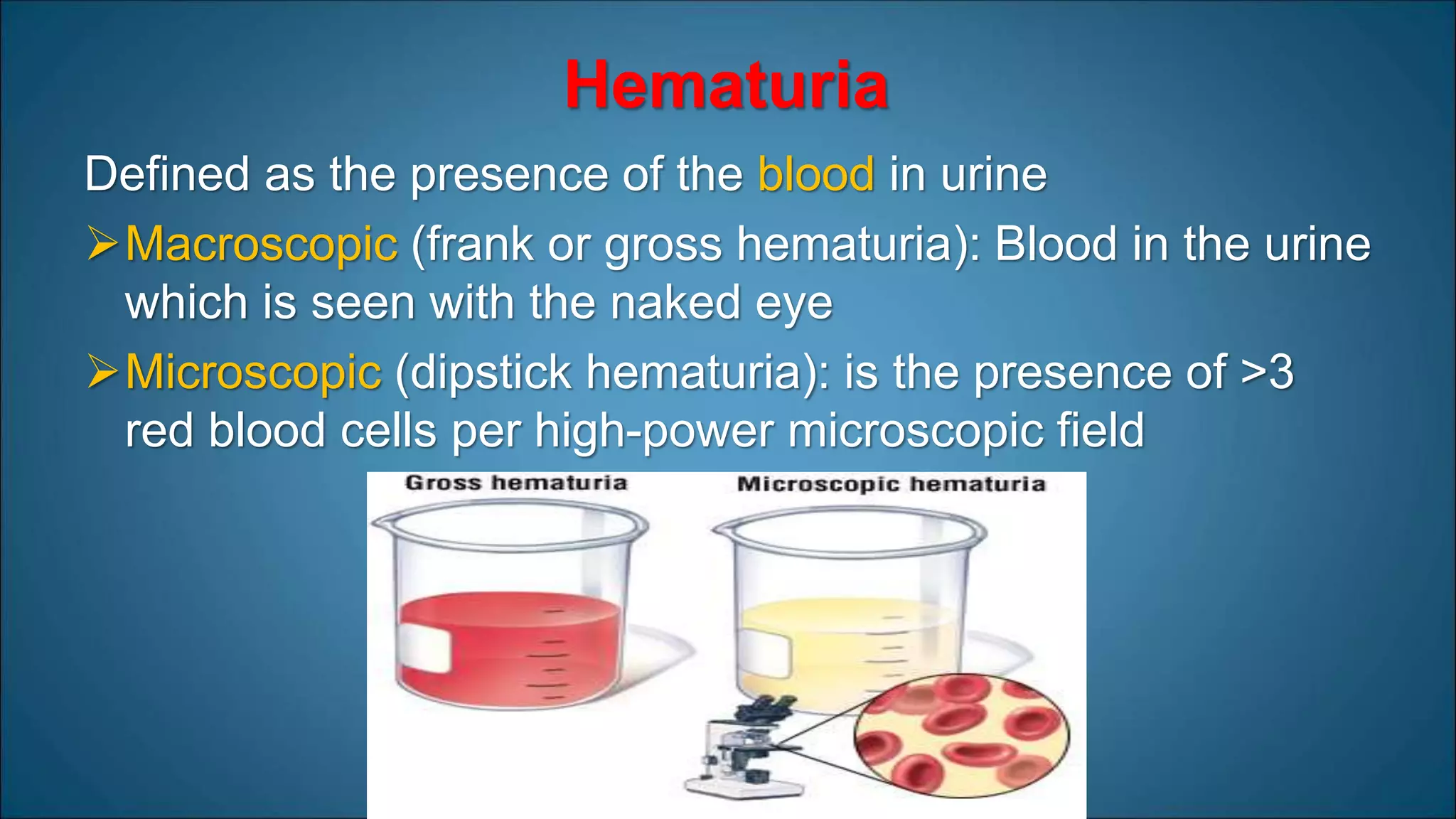
Defined as the presence of the blood in urine
Macroscopic (frank or gross hematuria): Blood in the urine
which is seen with the naked eye
Microscopic (dipstick hematuria): is the presence of >3
red blood cells per high-power microscopic field
Causes of hematuria:
Surgical/urological
• Stones
• UTI
• Instrumentation
• Trauma
• tumors
• BPH
• Prostatic cancer
Medical
• Glomerular causes
• Non glomerular causes
• Interstitial nephritis
• Renovascular hypertension
• Blood disorders
Drugs
• blood thinners(heprin,warfarin)
• sulfa-containing drug
others
Workup..
History
• Onset & duration & amount(clots)
• Mesturation in female
• Hx of ingestion of substance that may cause red discoloration of urine
• Painful or painless
• Intial , Terminal , Total
• Fever, abdominal pain, dysuria, frequency, urgency
• Hx of drug intake
• Hx of travel to endemic area of malaria or schistosoma
• Hx of TB of any part of body
• Hx of instrumentaion or biopsy
• Hx of bleeding disorder
• Hx of heavy exercise
Examination
• General
• Abdominal
Investigations
• CBC
• Urinalysis
• Urine culture and cytology
• Blood urea and creatinine
• KUB
• US
• Flexible cystoscopy
• IVU and CT in selected group
Treatment of hematuria is according to the cause
Urological Emergency
Non traumatic
1. Hematuria
2. Ureteric Colic
3. Acute Scrotum
4. Priapism
5. Urinary Retention
6. Paraphimosis
7. Anuria
8. Pyonephrosis
9. Fournier’s Gangrene
ACUTE FLANK PAIN
URETERIC COLIC
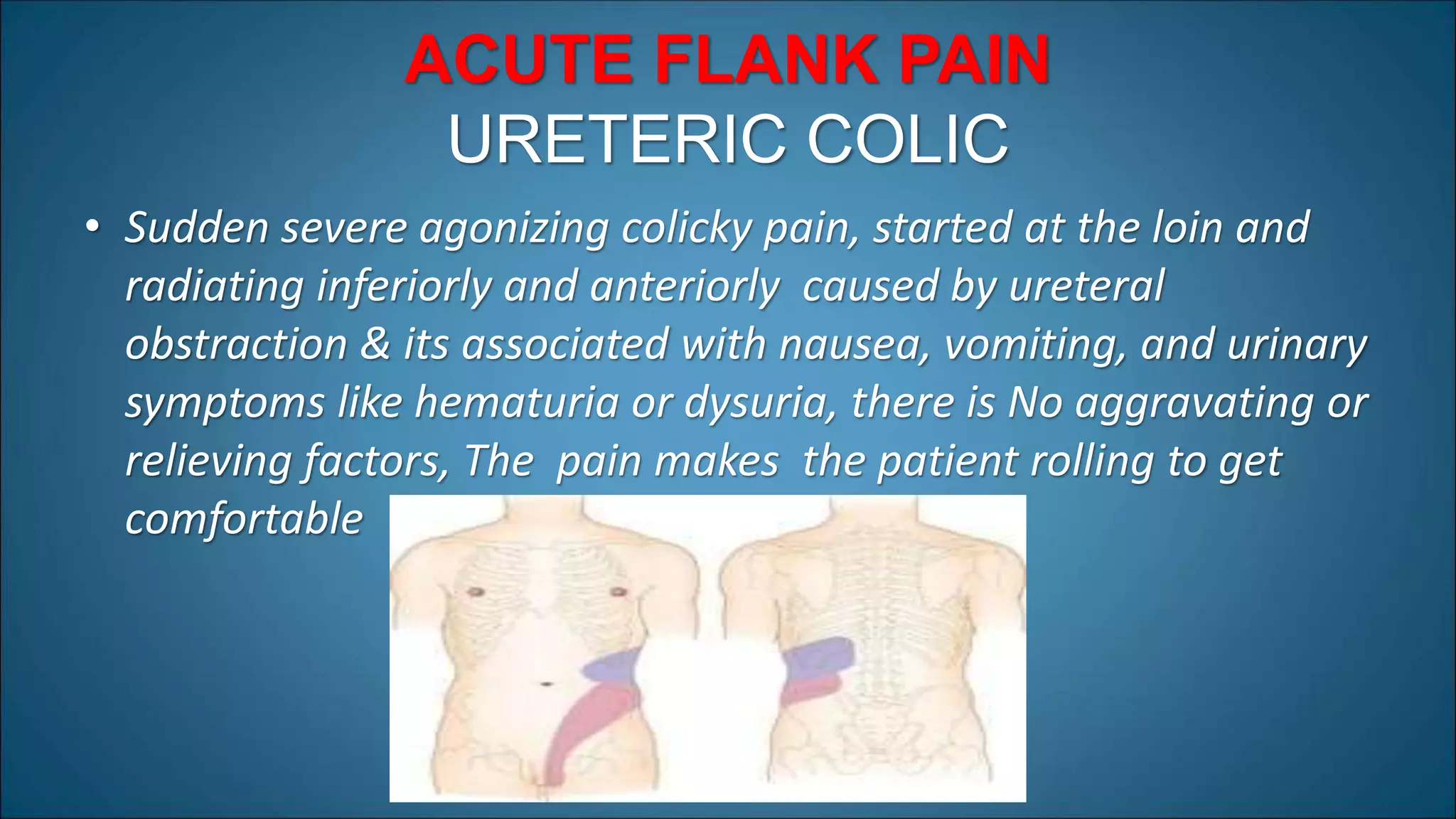
• Sudden severe agonizing colicky pain, started at the loin and
radiating inferiorly and anteriorly caused by ureteral
obstraction & its associated with nausea, vomiting, and urinary
symptoms like hematuria or dysuria, there is No aggravating or
relieving factors, The pain makes the patient rolling to get
comfortable
ureteric colic cont…
• One of the commonest urological emergencies
• Most often due to the passage of a stone formed in the
kidney, down through the ureter
• One of the commonest cause of acute abdomen
Causes of ureteric colic
Intraluminal obstruction
• Impacted stone
• Blood clot
• Mucosal edema
• Sloughed papilla
• Fungus ball in debilitated or
diabetic patients
Intramural obstruction
• Stricture
• Malignancy
Extramural obstruction
• Ureteral ligation in gynecologic &
pelvic surgery
• Local extension of Ca. prostate or
cervix causing pressure on one or
both ureteric orifices.
• Compression from an abscess or
inflammatory mass
• Pelvic hematoma following trauma
• Retroperitoneal fibrosis.
• pregnancy.
Presentation
• The classic presentation for a patient with ureteric colic is
the sudden onset of severe pain originating in the flank
and radiating inferiorly and anteriorly
• Stones obstructing ureteropelvic junction: Mild to severe
deep flank pain without radiation to the groin
• Upper ureteral stones: Radiate to flank or lumbar areas
• Midureteral calculi: Radiate anteriorly and caudally
Presentation cont…
• Distal ureteral stones: Radiate into groin or testicle (men)
or labia majora (women)
• (the location of the pain does not provide accurate information
about the position of the stone)
• The patient cannot get comfortable, and may roll around in agony.
• Associated with nausea / Vomiting
• Usually afebrile
• Ureteric colic is one of worst pain that the pt suffer from
Differential diagnosis
 Acute appendicitis
 UTI (Pyelonephritis)
 Acute Cholecysititis
 Testicular torsion
 Diveticulitis
 Acute pancreatitis
 Inflamtory bowel disease
 Bowel obstraction
 Ectopic pregnancy
 Complicated ovarian cyst
Work up
• History
• Examination
• Investigation
a) FBC
b) Urinanalysis
c) Preganacy test
d) Urea and electrolyte
e) KUB
f) US
g) IVP
h) Helical CT
Acute mangment of ureteric colic:
• Pain relief
– NSAIDs
– Narcotic analgesics.
– Calcium channel blockers
– α1 blockers
– Corticosteroids.
• IV access & Adequate hydration
• Anti emetic if there is sever vomiting
• Antibiotics if there is fever or you suspect an infection
Mangment cont..
• watchful waiting with analgesic & hydration supplements
− 95% of stones measuring 5mm or less pass spontaneously
• Indications for Intervention to Relieve Obstruction :
1. Pain unrelieved by analgesia.
2. Signs & symptoms of sepsis.
3. Persistent nausea & vomiting.
4. High grade obstruction.
5. Bilateral ureteral obstruction
6. Solitary kidney
7. Obstraction unrelieved > 4 weeks
• Temporary relief of the obstruction:
– Insertion of a JJ stent or percutaneous nephrostomy tube.
• Definitive treatment of a ureteric stone:
– Observation
– ESWL.
– Ureteroscope
– PCNL
– Open Surgery: very limited
Urological Emergency
Non traumatic
1. Hematuria
2. Ureteric Colic
3. Acute Scrotum
4. Priapism
5. Urinary Retention
6. Paraphimosis
7. Anuria
8. Pyonephrosis
9. Fournier’s Gangrene
Acute scrotum
• Is an Emergency situation requiring prompt evaluation,
differential diagnosis, and sometimes immediate surgical
exploration
Differential diagnosis of acute scrotum
• Testicular torsion
• Epididymo-orchitis
• Epididymitis
• Orchitis
• Torsion of testicular appendages
• Tosrion of epididymal appendages
• Strangulated inguinal hernia
• Abcess
• Traumatic rupture
• Traumatic hematoma
Testicular torsion
• refers to the torsion of the spermatic cord structures and
subsequent loss of the blood supply to the ipsilateral
testicle. This is a true urological emergency; early
diagnosis and treatment are vital to saving the testicle and
preserving future fertility
• Testicular torsion is common in pt between 10-20 years
• Irreversible ischemic injury to the testicular parenchyma
may begin as soon as after 6 hours
• Testicular salvage decrease as duration of torsion increase
Testicular torsion: (A) extravaginal; (B) intravaginal
Possible causes of testicular torsion
• Bell clapper deformity
• Rapid growth during puberty
• after injury to the groin
• vigorous physical activiry & sport injury
• Cold climate (winter syndrome)
Presentation
• Sudden onset of sever scrotal pain
• Pain is referred to ipsilateral lower quadrant of abdomen
• Nausea & vomiting
• Mild pyrexia
• Dysuria but other bladder symptoms are usually absent.
• There is quite often a history of previous, brief episodes
of similar pain.
Physical examination
• Scrotal swelling & erythema on The affected side
• Acute hydrocele & massive scrotal edema
• The affected testis is high riding with Transverse orientation
• Cremasteric reflex is -ve.
• Prehns sign -ve
• Often, doctors diagnose testicular torsion with just a history
& physical examination,Sometimes investigations are
necessary to confirm a diagnosis or to help identify another
cause for the symptoms these investigation include :
• Urinanalysis
• Blood studies
• Doppler examination of cord and testis
• Color doppler US
• Radionuclide imaging
Torsion of the Spermatic Cord…
Surgical exploration:
• A median raphe scrotal incision or a transverse incision.
• The affected side should be examined first
• The cord should be detorsed.
• Testes with marginal viability should be placed in warm
sponges and re-examined after several minutes.
• A necrotic testis should be removed
• If the testis is to be preserved, it should be placed into the
dartos pouch (suture fixation)
• The contralateral testis must be fixed to prevent subsequent
torsion.
Torsion of the Spermatic Cord…
Manual detorsion
• Manual detorsion of the torsed testis may be attempted but is
usually difficult because of acute pain during manipulation.
• Nonoperative detorsion is not a substitute for surgical exploration
• it can protect testicular viability in cases of surgical delay, and also
provides significant pain relief.
• If manual detorsion is successful (ie, confirmed by color Doppler
sonogram in a patient with complete resolution of symptoms), the
patient must undergo definitive surgical fixation of the testes before
leaving the hospital
Epididymo-orchitis
• Refer to inflamation of the testis & epididymis
• It is common in men aged 15-30 and in men aged over 60. It does
not common before puberty..
• risk of getting epididymo-orchitis is increased if the pt have a
catheter or other instruments inserted into the urethra.
Causes
• UTI or mumps virus infection that spreads to the
epididymis
• Brucellosis
• Trauma or injury of the testes
• Sexually transmitted infections such as gonorrhea or
Chlamydia
• Urine that flows backward from urethra to the epididymis
• Medications such as amiodarone
Signs and Symptoms
• Gradual onset
• Pain or tenderness in the scrotum, abdomen, or groin
• Redness or swelling of the scrotum
• Discharge from the penis or blood in urine or semen
• Dysuria & Fever are more common than testicular torsion
• Cremastric reflex is +ve
• Prehns sign is +ve
Managment
– Bed rest for 1 to 3 days then relative restriction .
– Scrotal elevation, the use of an athletic supporter
– Do not lift heavy objects
– NSAIDs , such as ibuprofen, help decrease swelling,pain & fever.
– antibiotic therapy should be instituted when UTI or STD is
documented or suspected
– Urethral instrumentation should be avoided
– Surgery may be needed if the condition gets worse. Surgery to
drain an abscess may be needed. Surgery to remove part or all
of epididymis or testicle may be requirred
Complications
• Abcess formation
• Reduced fertility in the affected testis, especially in cases
caused by the mumps virus.
• An ongoing (chronic) inflammation occasionally develops.
• Rarely, serious damage to the testis may occur and result
in dead tissue (gangrene) in the testis that needs to be
removed surgically
Urological Emergency
Non traumatic
1. Hematuria
2. Ureteric Colic
3. Acute Scrotum
4. Priapism
5. Urinary Retention
6. Paraphimosis
7. Anuria
8. Pyonephrosis
9. Fournier’s Gangrene
Priapism
Priapism is an involuntary, prolonged,persistant erection of
penis lasting for more than 4 hours unrelated to sexual
stimulation and unrelieved by ejaculation.
It occur at any age & the
2 main age groupes are:-
5-10 years old
20-50 years old
Types of Priapism
Ischemic (Veno-occlusive,low-flow) Priapism
• This condition is generally painful
• Due to haematological disease, malignant infiltration of the corpora cavernosa
with malignant disease, or drugs.
Non Ischaemic (arterial, high flow) Priapism
• This type of priapism is generally not painful and may manifest in an episodic
manner
• Due to perineal trauma, which creates an arteriovenous fistula
Causes of priapism
• Primary (Idiopathic) : 30%- 50%
• Secondary:
• Drugs
• Trauma
• Prolonged sexual activity
• Neurological
• Hematological disease
• Tumors
• Carbon monoxide poisoning
• widow spider bite
Diagnosis
– Usually obvious from the history
• Duration of erection >4 hours?
• Is it painful or not?.
• Previous history and treatment of priapism ?
• Identify any predisposing factors and underlying cause
– Examination
• Erect, tender penis (in low-flow priapism).
• Characteristically the corpora cavernosa are rigid and the glans is
flaccid.
• Abdomen for evidence of malignant disease
• DRE: to examine the prostate and check anal tone.
Investigations:
– CBC (white cell count and differential, reticulocyte count)
– Hemoglobin electrophoresis for sickle cell test
– Urinalysis including urine toxicology
– Blood gases taken from either corpora,
• low-flow (dark blood; PH <7.25 (acidosis); PO2 <30mmHg (hypoxia);
PCO2 >60mmHg (hypercapnia))
• high-flow (bright red blood similar to arterial blood at room
temperature; pH = 7.4; PO2 >90mmHg; PCO2 <40mmHg)
– Colour flow duplex ultrasonography in cavernosal arteries
– Penile pudendal arteriography
Managment
Depened on the type of priapism:-
Low flow priapism
• Supportive care
• Intracavernosal phenylephrine is the drug of choice and first-line treatment
for low-flow priapism
• aspiration of the corpora cavernosa followed by saline irrigation and, if
necessary, injection of an alpha-adrenergic agonist
• If the above interventions are unsuccessful, a diluted solution of
phenylephrine may be used for irrigation
• If medical treatment fails, the condition warrants surgical intervention.
Mangment cont…
High-Flow Priapism
• Conservative
• Blood aspiration is not helpful for the treatment of arterial priapism
• Selective arterial embolisation
• Surgical management
– Selective ligation of the fistula through a transcorporeal approach under the guidance of
colour duplex US is possible
It is important to warn all patients with priapism of the
possibility of impotence.
Follow-up
after successful treatment follow up should include modification of risk
factors in order to avoid a new event and assessment of erectile
function, Penile fibrosis is usually easily identified with clinical
examination of the penis & to identify signs of recurrence especially
after embolisation.
Prognosis
The prognosis is good for both types of priapism when the
condition is resolved quickly. When treatment is delayed,
penile scarring and permanent impotence can result.
Urological emergency

Urological emergency

  • 1.
    Non traumatic Urological Emergency Preparedby: Under supervision of: Zana Hossam Dr.Kamiran J. Sadeeq
  • 2.
    Urological Emergency A urologyemergency refers to any urologic condition that requires urgent medical attention from a urologist or an emergency room and immediate treatment Compared to other surgical fields there are relatively few emergencies in urology
  • 3.
    Urological Emergency Non traumatic 1.Hematuria 2. Ureteric Colic 3. Acute Scrotum 4. Priapism 5. Urinary Retention 6. Paraphimosis 7. Anuria 8. Pyonephrosis 9. Fournier’s Gangrene Traumatic 1. Renal Injury 2. Ureteral Injury 3. Bladder Injury 4. Urethral Injury 5. Testicular Injury
  • 4.
    Hematuria Defined as thepresence of the blood in urine Macroscopic (frank or gross hematuria): Blood in the urine which is seen with the naked eye Microscopic (dipstick hematuria): is the presence of >3 red blood cells per high-power microscopic field
  • 5.
    Causes of hematuria: Surgical/urological •Stones • UTI • Instrumentation • Trauma • tumors • BPH • Prostatic cancer Medical • Glomerular causes • Non glomerular causes • Interstitial nephritis • Renovascular hypertension • Blood disorders Drugs • blood thinners(heprin,warfarin) • sulfa-containing drug others
  • 6.
    Workup.. History • Onset &duration & amount(clots) • Mesturation in female • Hx of ingestion of substance that may cause red discoloration of urine • Painful or painless • Intial , Terminal , Total • Fever, abdominal pain, dysuria, frequency, urgency • Hx of drug intake • Hx of travel to endemic area of malaria or schistosoma • Hx of TB of any part of body • Hx of instrumentaion or biopsy • Hx of bleeding disorder • Hx of heavy exercise
  • 7.
    Examination • General • Abdominal Investigations •CBC • Urinalysis • Urine culture and cytology • Blood urea and creatinine • KUB • US • Flexible cystoscopy • IVU and CT in selected group Treatment of hematuria is according to the cause
  • 8.
    Urological Emergency Non traumatic 1.Hematuria 2. Ureteric Colic 3. Acute Scrotum 4. Priapism 5. Urinary Retention 6. Paraphimosis 7. Anuria 8. Pyonephrosis 9. Fournier’s Gangrene
  • 9.
    ACUTE FLANK PAIN URETERICCOLIC • Sudden severe agonizing colicky pain, started at the loin and radiating inferiorly and anteriorly caused by ureteral obstraction & its associated with nausea, vomiting, and urinary symptoms like hematuria or dysuria, there is No aggravating or relieving factors, The pain makes the patient rolling to get comfortable
  • 10.
    ureteric colic cont… •One of the commonest urological emergencies • Most often due to the passage of a stone formed in the kidney, down through the ureter • One of the commonest cause of acute abdomen
  • 11.
    Causes of uretericcolic Intraluminal obstruction • Impacted stone • Blood clot • Mucosal edema • Sloughed papilla • Fungus ball in debilitated or diabetic patients Intramural obstruction • Stricture • Malignancy Extramural obstruction • Ureteral ligation in gynecologic & pelvic surgery • Local extension of Ca. prostate or cervix causing pressure on one or both ureteric orifices. • Compression from an abscess or inflammatory mass • Pelvic hematoma following trauma • Retroperitoneal fibrosis. • pregnancy.
  • 12.
    Presentation • The classicpresentation for a patient with ureteric colic is the sudden onset of severe pain originating in the flank and radiating inferiorly and anteriorly • Stones obstructing ureteropelvic junction: Mild to severe deep flank pain without radiation to the groin • Upper ureteral stones: Radiate to flank or lumbar areas • Midureteral calculi: Radiate anteriorly and caudally
  • 13.
    Presentation cont… • Distalureteral stones: Radiate into groin or testicle (men) or labia majora (women) • (the location of the pain does not provide accurate information about the position of the stone) • The patient cannot get comfortable, and may roll around in agony. • Associated with nausea / Vomiting • Usually afebrile • Ureteric colic is one of worst pain that the pt suffer from
  • 14.
    Differential diagnosis  Acuteappendicitis  UTI (Pyelonephritis)  Acute Cholecysititis  Testicular torsion  Diveticulitis  Acute pancreatitis  Inflamtory bowel disease  Bowel obstraction  Ectopic pregnancy  Complicated ovarian cyst
  • 15.
    Work up • History •Examination • Investigation a) FBC b) Urinanalysis c) Preganacy test d) Urea and electrolyte e) KUB f) US g) IVP h) Helical CT
  • 16.
    Acute mangment ofureteric colic: • Pain relief – NSAIDs – Narcotic analgesics. – Calcium channel blockers – α1 blockers – Corticosteroids. • IV access & Adequate hydration • Anti emetic if there is sever vomiting • Antibiotics if there is fever or you suspect an infection
  • 17.
    Mangment cont.. • watchfulwaiting with analgesic & hydration supplements − 95% of stones measuring 5mm or less pass spontaneously • Indications for Intervention to Relieve Obstruction : 1. Pain unrelieved by analgesia. 2. Signs & symptoms of sepsis. 3. Persistent nausea & vomiting. 4. High grade obstruction. 5. Bilateral ureteral obstruction 6. Solitary kidney 7. Obstraction unrelieved > 4 weeks
  • 18.
    • Temporary reliefof the obstruction: – Insertion of a JJ stent or percutaneous nephrostomy tube. • Definitive treatment of a ureteric stone: – Observation – ESWL. – Ureteroscope – PCNL – Open Surgery: very limited
  • 20.
    Urological Emergency Non traumatic 1.Hematuria 2. Ureteric Colic 3. Acute Scrotum 4. Priapism 5. Urinary Retention 6. Paraphimosis 7. Anuria 8. Pyonephrosis 9. Fournier’s Gangrene
  • 21.
    Acute scrotum • Isan Emergency situation requiring prompt evaluation, differential diagnosis, and sometimes immediate surgical exploration
  • 22.
    Differential diagnosis ofacute scrotum • Testicular torsion • Epididymo-orchitis • Epididymitis • Orchitis • Torsion of testicular appendages • Tosrion of epididymal appendages • Strangulated inguinal hernia • Abcess • Traumatic rupture • Traumatic hematoma
  • 23.
    Testicular torsion • refersto the torsion of the spermatic cord structures and subsequent loss of the blood supply to the ipsilateral testicle. This is a true urological emergency; early diagnosis and treatment are vital to saving the testicle and preserving future fertility
  • 24.
    • Testicular torsionis common in pt between 10-20 years • Irreversible ischemic injury to the testicular parenchyma may begin as soon as after 6 hours • Testicular salvage decrease as duration of torsion increase Testicular torsion: (A) extravaginal; (B) intravaginal
  • 25.
    Possible causes oftesticular torsion • Bell clapper deformity • Rapid growth during puberty • after injury to the groin • vigorous physical activiry & sport injury • Cold climate (winter syndrome)
  • 26.
    Presentation • Sudden onsetof sever scrotal pain • Pain is referred to ipsilateral lower quadrant of abdomen • Nausea & vomiting • Mild pyrexia • Dysuria but other bladder symptoms are usually absent. • There is quite often a history of previous, brief episodes of similar pain.
  • 27.
    Physical examination • Scrotalswelling & erythema on The affected side • Acute hydrocele & massive scrotal edema • The affected testis is high riding with Transverse orientation • Cremasteric reflex is -ve. • Prehns sign -ve
  • 28.
    • Often, doctorsdiagnose testicular torsion with just a history & physical examination,Sometimes investigations are necessary to confirm a diagnosis or to help identify another cause for the symptoms these investigation include : • Urinanalysis • Blood studies • Doppler examination of cord and testis • Color doppler US • Radionuclide imaging
  • 30.
    Torsion of theSpermatic Cord… Surgical exploration: • A median raphe scrotal incision or a transverse incision. • The affected side should be examined first • The cord should be detorsed. • Testes with marginal viability should be placed in warm sponges and re-examined after several minutes. • A necrotic testis should be removed • If the testis is to be preserved, it should be placed into the dartos pouch (suture fixation) • The contralateral testis must be fixed to prevent subsequent torsion.
  • 31.
    Torsion of theSpermatic Cord… Manual detorsion • Manual detorsion of the torsed testis may be attempted but is usually difficult because of acute pain during manipulation. • Nonoperative detorsion is not a substitute for surgical exploration • it can protect testicular viability in cases of surgical delay, and also provides significant pain relief. • If manual detorsion is successful (ie, confirmed by color Doppler sonogram in a patient with complete resolution of symptoms), the patient must undergo definitive surgical fixation of the testes before leaving the hospital
  • 32.
    Epididymo-orchitis • Refer toinflamation of the testis & epididymis • It is common in men aged 15-30 and in men aged over 60. It does not common before puberty.. • risk of getting epididymo-orchitis is increased if the pt have a catheter or other instruments inserted into the urethra.
  • 33.
    Causes • UTI ormumps virus infection that spreads to the epididymis • Brucellosis • Trauma or injury of the testes • Sexually transmitted infections such as gonorrhea or Chlamydia • Urine that flows backward from urethra to the epididymis • Medications such as amiodarone
  • 34.
    Signs and Symptoms •Gradual onset • Pain or tenderness in the scrotum, abdomen, or groin • Redness or swelling of the scrotum • Discharge from the penis or blood in urine or semen • Dysuria & Fever are more common than testicular torsion • Cremastric reflex is +ve • Prehns sign is +ve
  • 35.
    Managment – Bed restfor 1 to 3 days then relative restriction . – Scrotal elevation, the use of an athletic supporter – Do not lift heavy objects – NSAIDs , such as ibuprofen, help decrease swelling,pain & fever. – antibiotic therapy should be instituted when UTI or STD is documented or suspected – Urethral instrumentation should be avoided – Surgery may be needed if the condition gets worse. Surgery to drain an abscess may be needed. Surgery to remove part or all of epididymis or testicle may be requirred
  • 36.
    Complications • Abcess formation •Reduced fertility in the affected testis, especially in cases caused by the mumps virus. • An ongoing (chronic) inflammation occasionally develops. • Rarely, serious damage to the testis may occur and result in dead tissue (gangrene) in the testis that needs to be removed surgically
  • 37.
    Urological Emergency Non traumatic 1.Hematuria 2. Ureteric Colic 3. Acute Scrotum 4. Priapism 5. Urinary Retention 6. Paraphimosis 7. Anuria 8. Pyonephrosis 9. Fournier’s Gangrene
  • 38.
    Priapism Priapism is aninvoluntary, prolonged,persistant erection of penis lasting for more than 4 hours unrelated to sexual stimulation and unrelieved by ejaculation. It occur at any age & the 2 main age groupes are:- 5-10 years old 20-50 years old
  • 39.
    Types of Priapism Ischemic(Veno-occlusive,low-flow) Priapism • This condition is generally painful • Due to haematological disease, malignant infiltration of the corpora cavernosa with malignant disease, or drugs. Non Ischaemic (arterial, high flow) Priapism • This type of priapism is generally not painful and may manifest in an episodic manner • Due to perineal trauma, which creates an arteriovenous fistula
  • 40.
    Causes of priapism •Primary (Idiopathic) : 30%- 50% • Secondary: • Drugs • Trauma • Prolonged sexual activity • Neurological • Hematological disease • Tumors • Carbon monoxide poisoning • widow spider bite
  • 41.
    Diagnosis – Usually obviousfrom the history • Duration of erection >4 hours? • Is it painful or not?. • Previous history and treatment of priapism ? • Identify any predisposing factors and underlying cause – Examination • Erect, tender penis (in low-flow priapism). • Characteristically the corpora cavernosa are rigid and the glans is flaccid. • Abdomen for evidence of malignant disease • DRE: to examine the prostate and check anal tone.
  • 42.
    Investigations: – CBC (whitecell count and differential, reticulocyte count) – Hemoglobin electrophoresis for sickle cell test – Urinalysis including urine toxicology – Blood gases taken from either corpora, • low-flow (dark blood; PH <7.25 (acidosis); PO2 <30mmHg (hypoxia); PCO2 >60mmHg (hypercapnia)) • high-flow (bright red blood similar to arterial blood at room temperature; pH = 7.4; PO2 >90mmHg; PCO2 <40mmHg) – Colour flow duplex ultrasonography in cavernosal arteries – Penile pudendal arteriography
  • 43.
    Managment Depened on thetype of priapism:- Low flow priapism • Supportive care • Intracavernosal phenylephrine is the drug of choice and first-line treatment for low-flow priapism • aspiration of the corpora cavernosa followed by saline irrigation and, if necessary, injection of an alpha-adrenergic agonist • If the above interventions are unsuccessful, a diluted solution of phenylephrine may be used for irrigation • If medical treatment fails, the condition warrants surgical intervention.
  • 44.
    Mangment cont… High-Flow Priapism •Conservative • Blood aspiration is not helpful for the treatment of arterial priapism • Selective arterial embolisation • Surgical management – Selective ligation of the fistula through a transcorporeal approach under the guidance of colour duplex US is possible It is important to warn all patients with priapism of the possibility of impotence.
  • 45.
    Follow-up after successful treatmentfollow up should include modification of risk factors in order to avoid a new event and assessment of erectile function, Penile fibrosis is usually easily identified with clinical examination of the penis & to identify signs of recurrence especially after embolisation. Prognosis The prognosis is good for both types of priapism when the condition is resolved quickly. When treatment is delayed, penile scarring and permanent impotence can result.

Editor's Notes

  • #3 so the list is limited to only a handful of conditions. These conditions, when left untreated, are potentially life-threatening or may result in serious long-term complications or consequences.
  • #6 IgA nephropathy (Berger's disease) Thin glomerular basement membrane disease Hereditary nephritis (Alport's syndrome) dysmorphic erythrocytes (distorted during their passagethrough the glomerulus), red blood cell casts, and proteinuria ,while non-glomerular hematuria (bleeding from a site in thenephron distal to the glomerulus) results in circular erythro-cytes, the absence of erythrocyte casts, and the absence ofproteinuria. Hemophilia SCA Vonwillebrand https://www.drugs.com/health-guide/hematuria.html https://www.auanet.org/education/hematuria.cfm Strenuous exercise ("marathon runner's hematuria") Spurious hematuria (e.g. menses)
  • #7 Associatedrenal angle pain suggests a renal or ureteric source for thehematuria, whereas suprapubic pain suggests a bladdersource. Painless frank hematuria is not infrequently due tobladder cancer and glomerular disease Presentation: Hematuria Anemia: bleeding is so heavy (this is rare) Urine retention or ureteric colic (Clot retention) Timing of blood in the urine stream: the timing of haematuria during micturition (initial, terminal, total) is an important clue in localising the source of bleeding. Blood that appears at the onset of a void, then clears, is called initial haematuria. Terminal haematuria occurs at the end of a void. Initial and terminal haematuria represent bleeding from the urethra, prostate, seminal vesicles, or bladder neck. Total haematuria, which is present throughout the void, indicates bleeding of bladder or upper tract (kidney or ureteral) origin.
  • #8 Anemia evaluate for the presence of periorbital puffiness or peripheral edema vital signs , purpura and echymoses An abdominal examination is indicated to look for palpable kidneys careful examination of the genitalia is also important.
  • #12 Pregnancy secondary to passage of a stone or following instrumentation or trauma to the ureter,
  • #14 Common innervation by vagus Irritation of parietal peritoneum Biochemical change retained waste product such as urea Close relationship bt lt & descening rt and ascending and second part of DU
  • #16 http://patient.info/doctor/loin-pain Hx Us hydronephrosis & exclusion of other ddx Sign of chronic obstruction: parenchymal thinnig Extreme calycal blunting Uretral tortusity
  • #17 NSAIDs are first-line drugs for the management of renal colic presenting to the emergency department, with narcotics being reserved as second-line drugs. Narcotics have a rapid onset of analgesia but may promote nausea and emesis, cause excessive sedation, and have a potential for abuse
  • #18 with (elevated BUN & creatinine, signs & symptoms of Uremia, Hyperkalemia).
  • #23 Testicular torsion is primarily a disease of adolescents and neonates. It is the most common cause of testicular loss in these age groups
  • #25 Due to long attachment of TV to testis which itself is also rotated The axis of rotation is with in the tunica vaginalis neonates more often have extravaginal torsion. This occurs because the tunica vaginalis is not yet secured to the gubernaculum and, therefore, the spermatic cord, as well as the tunica vaginalis, undergo torsion as a unit. Extravaginal torsion is not associated with bell clapper deformity. This can occur up to months prior to birth and, therefore, is managed differently depending on presentation.[2] Of course, neonates can have intravaginal torsion and this should be managed in the same manner as adolescents. a fetal ligament that passes through the anterior abdominal wall and connects the inferior pole of each gonad withprimordia of the scrotum in men intravaginal torsion most commonly occurs in adolescents. It is thought that the increased weight of the testicle after puberty, as well as sudden contraction of the cremasteric muscles (which inserts in a spiral fashion into the spermatic cord), is the impetus for acute torsion
  • #26  Normally, the testicles can’t move freely inside the scrotum. The surrounding tissue is strong and supportive. Men and boys who experience torsion sometimes have weaker connective tissue in the scrotum. This is called a “bell clapper” deformity.
  • #27 This is presumably torsion that corrected itself.
  • #29 Testicular torsion is a clinical diagnosis. If the history and physical examination strongly suggest testicular torsion, the patient should go directly to surgery without delaying to perform imaging studies. Absent or decreased blood flow in the affected testicle Decreased flow velocity in the intratesticular arteries Increased resistive indices in the intratesticular arteries Hypervascularity with a low resistance flow pattern (after partial torsion-detorsion) Transverse power Doppler image of both testes illustrates an enlarged, avascular left testicle
  • #32 successful detorsion is suggested by [18]: Relief of pain Resolution of the transverse lie of the testis to a longitudinal orientation Lower position of the testis in the scrotum Return of normal arterial pulsations detected with a color Doppler study
  • #36 http://emedicine.medscape.com/article/2018356-overview
  • #39 a failure of blood to drain from the penis after it flows there during the erection’s onset An erection normally occurs in response to physical or psychological stimulation. This stimulation causes certain blood vessels and smooth muscles to relax and/or expand, increasing blood flow to spongy tissues in the penis. Consequently, the blood-filled penis becomes erect. After stimulation ends, the blood flows out and the penis returns to its nonrigid (flaccid) stateThis condition is a true urologic emergency, and early intervention allows the best chance for functional recovery.
  • #40 Rigid erection Ischemic corpora: As indicated by dark blood upon corporeal aspiration No evidence of trauma Adequate arterial flow Well-oxygenated corpora Evidence of trauma: Blunt or penetrating injury to the penis or perineum (straddle injury is usually the initiating event)
  • #43 Ischaemic (inflow low or nonexistent) Nonischaemic (inflow normal to high).
  • #44 because it has almost pure alpha-agonist effects and minimal beta activity.
  • #45 The management of high-flow priapism is not an emergency because the penis is not ischaemic. Definitive management can therefore be considered and should be discussed with the patient so that they understand the risks and complications of treatment observation alone may be sufficient for high-flow priapism, because many cases resolve spontaneously, and even with prolonged priapism these patients are unlikely to experience significant pathological damage or impaired erectile function. applying ice to the perineum or site-specific perineal compression  http://uroweb.org/wp-content/uploads/15-_Priapism_LR.pdf