Copyright © 2014, 2011, 2007 by Saunders, an imprint of Elsevier Inc. 1
Urinary System (Ch. 7)
Chapter Goals
• Name essential organs of the urinary system and describe
their locations and functions.
• Identify common pathological conditions.
• Recognize how urinalysis is used and interpreted as a
diagnostic test.
• Define urinary-system-related combining forms, prefixes, and
suffixes.
• List and explain clinical procedures, laboratory tests, and
abbreviations that pertain to the urinary system.
• Understand medical terms in their proper contexts, such as
medical reports and records.
Copyright © 2014, 2011, 2007 by Saunders, an imprint of Elsevier Inc. 2
Introduction
• Functions of the kidney
Filter nitrogenous wastes to form urine; about 200 quarts of
blood are filtered every day to form 2 quarts of urine
Maintain proper balance of water, electrolytes (sodium,
potassium), and acids
Release hormones:
• Renin: enzymatic hormone important in adjusting blood pressure
• Erythropoietin (EPO): hormone that stimulates red blood cell
production in the bone marrow
• Calciferol: active form of vitamin D necessary for the absorption of
calcium from the intestine
Degrade and eliminate hormones from the bloodstream
Copyright © 2014, 2011, 2007 by Saunders, an imprint of Elsevier Inc. 3
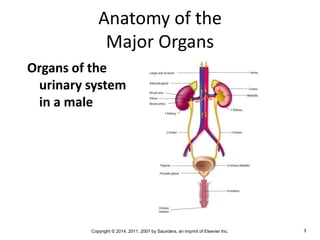
Anatomy of the
Major Organs
Organs of the
urinary system
in a male
Copyright © 2014, 2011, 2007 by Saunders, an imprint of Elsevier Inc. 4
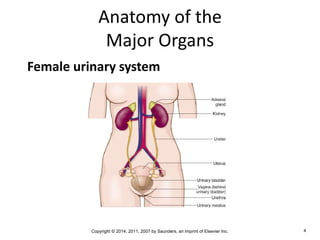
Anatomy of the
Major Organs
Female urinary system
Copyright © 2014, 2011, 2007 by Saunders, an imprint of Elsevier Inc. 5
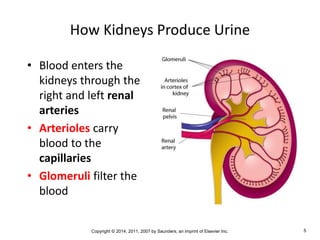
How Kidneys Produce Urine
• Blood enters the
kidneys through the
right and left renal
arteries
• Arterioles carry
blood to the
capillaries
• Glomeruli filter the
blood
Copyright © 2014, 2011, 2007 by Saunders, an imprint of Elsevier Inc. 6
Video Clip of the Urinary System
• Clip
Copyright © 2014, 2011, 2007 by Saunders, an imprint of Elsevier Inc. 7
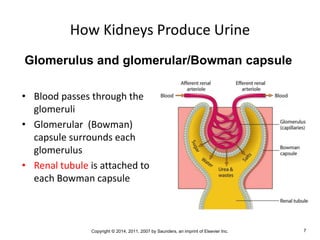
How Kidneys Produce Urine
• Blood passes through the
glomeruli
• Glomerular (Bowman)
capsule surrounds each
glomerulus
• Renal tubule is attached to
each Bowman capsule
Glomerulus and glomerular/Bowman capsule
Copyright © 2014, 2011, 2007 by Saunders, an imprint of Elsevier Inc. 8
How Kidneys Produce Urine
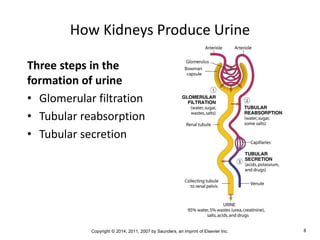
Three steps in the
formation of urine
• Glomerular filtration
• Tubular reabsorption
• Tubular secretion
Copyright © 2014, 2011, 2007 by Saunders, an imprint of Elsevier Inc. 9
How Kidneys Produce Urine
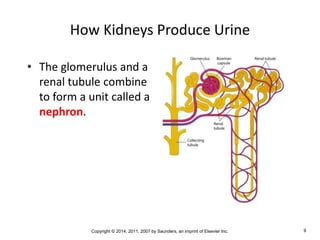
• The glomerulus and a
renal tubule combine
to form a unit called a
nephron.
Copyright © 2014, 2011, 2007 by Saunders, an imprint of Elsevier Inc. 10
How Kidneys Produce Urine
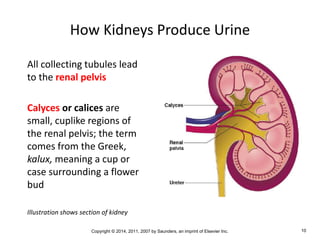
All collecting tubules lead
to the renal pelvis
Calyces or calices are
small, cuplike regions of
the renal pelvis; the term
comes from the Greek,
kalux, meaning a cup or
case surrounding a flower
bud
Illustration shows section of kidney
Copyright © 2014, 2011, 2007 by Saunders, an imprint of Elsevier Inc. 11
How Kidneys Produce Urine
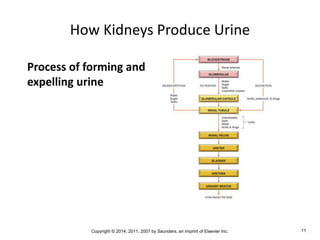
Process of forming and
expelling urine
Copyright © 2014, 2011, 2007 by Saunders, an imprint of Elsevier Inc. 12
STRUCTURES
cyst/o cystitis inflammation of the urinary bladder
Combining Form Terminology Meaning
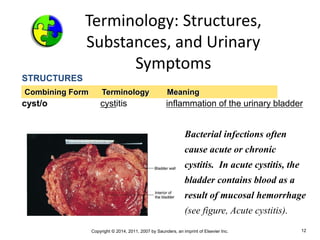
Bacterial infections often
cause acute or chronic
cystitis. In acute cystitis, the
bladder contains blood as a
result of mucosal hemorrhage
(see figure, Acute cystitis).
Terminology: Structures,
Substances, and Urinary
Symptoms
Copyright © 2014, 2011, 2007 by Saunders, an imprint of Elsevier Inc. 13
Terminology: Structures,
Substances, and Urinary
Symptoms
STRUCTURES
nephr/o hydronephrosis Condition of excess fluid
(water) in the kidney
Combining Form Terminology Meaning
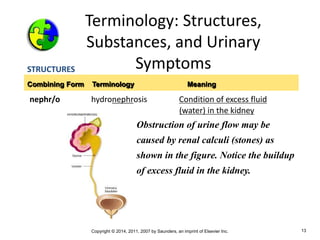
Obstruction of urine flow may be
caused by renal calculi (stones) as
shown in the figure. Notice the buildup
of excess fluid in the kidney.
Copyright © 2014, 2011, 2007 by Saunders, an imprint of Elsevier Inc. 14
Pathologic Conditions-Kidney
• Glomerulonephritis (Inflammation of the glomeruli
within the kidney)
• Interstitial nephritis(Inflammation of the connective
tissue that lies between the renal tubules)
• Nephrolithiasis (Kidney Stones)
• Nephrotic syndrome (excessive protein in urine)
• Polycystic kidneys (PKD) (fluid sacs in kidney)
Copyright © 2014, 2011, 2007 by Saunders, an imprint of Elsevier Inc. 15
Pathologic Conditions
Kidney
• Polycystic
kidney
disease (PKD)
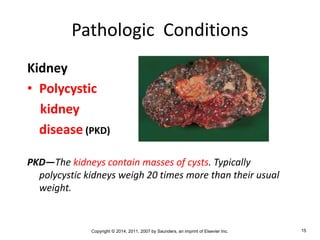
PKD—The kidneys contain masses of cysts. Typically
polycystic kidneys weigh 20 times more than their usual
weight.
Copyright © 2014, 2011, 2007 by Saunders, an imprint of Elsevier Inc. 16
Laboratory Tests and
Clinical Procedures
Other clinical procedures
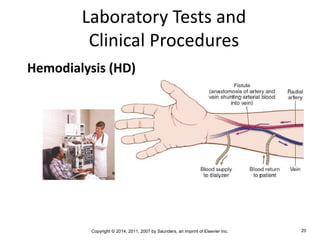
• Dialysis- artificial kidney machine, filters waste from
bloodstream, returns dialyzed blood to the patient’s
body.
• Lithotripsy- urinary tract stones are crushed. The
extracorporeal method uses shock waves directed
toward the stone from the outside of the body
(extra=outside, corpor/o= body). Patient recevies
sedation or an anesthetic. Stones pass from body in
urine after procedure. Abbreviation is ESWL
(Extracorporeal Shock Wave Lithotripsy)
Copyright © 2014, 2011, 2007 by Saunders, an imprint of Elsevier Inc. 17
Laboratory Tests and
Clinical Procedures
Other clinical procedures
• Renal angioplasty- Dilation of narrowed areas in renal
arteries. Balloon inserted into artery, then inflated to enlarge
vessel. Stent inserted to keep vessel open. Used to treat renal
hypertension and preserve kidney function.
• Renal biopsy-Removal of tissue for examination. Performed
2 ways.
– 1. performed during surgery (open)
– 2. or through the skin (closed). Patient lies PRONE, receives local
anesthesia, and physician inserts needle into kidney. Tissue viewed.
Copyright © 2014, 2011, 2007 by Saunders, an imprint of Elsevier Inc. 18
Laboratory Tests and
Clinical Procedures
Other clinical procedures
• Renal transplantation- surgical transfer of kidney from a
donor to a recipient.
• Urinary catheterization- used for both short and long
term drainage of urine (with tube). A “foley catheter” has a
balloon on the end to hold it in place and can deliver solutions
into the bladder as well as drain it.
Copyright © 2014, 2011, 2007 by Saunders, an imprint of Elsevier Inc. 19
Laboratory Tests and
Clinical Procedures
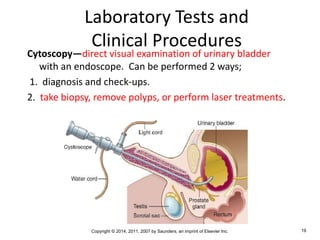
Cytoscopy—direct visual examination of urinary bladder
with an endoscope. Can be performed 2 ways;
1. diagnosis and check-ups.
2. take biopsy, remove polyps, or perform laser treatments.
Copyright © 2014, 2011, 2007 by Saunders, an imprint of Elsevier Inc. 20
Laboratory Tests and
Clinical Procedures
Hemodialysis (HD)

urinary ppt. TEACHER

  • 1.
    Copyright © 2014,2011, 2007 by Saunders, an imprint of Elsevier Inc. 1 Urinary System (Ch. 7) Chapter Goals • Name essential organs of the urinary system and describe their locations and functions. • Identify common pathological conditions. • Recognize how urinalysis is used and interpreted as a diagnostic test. • Define urinary-system-related combining forms, prefixes, and suffixes. • List and explain clinical procedures, laboratory tests, and abbreviations that pertain to the urinary system. • Understand medical terms in their proper contexts, such as medical reports and records.
  • 2.
    Copyright © 2014,2011, 2007 by Saunders, an imprint of Elsevier Inc. 2 Introduction • Functions of the kidney Filter nitrogenous wastes to form urine; about 200 quarts of blood are filtered every day to form 2 quarts of urine Maintain proper balance of water, electrolytes (sodium, potassium), and acids Release hormones: • Renin: enzymatic hormone important in adjusting blood pressure • Erythropoietin (EPO): hormone that stimulates red blood cell production in the bone marrow • Calciferol: active form of vitamin D necessary for the absorption of calcium from the intestine Degrade and eliminate hormones from the bloodstream
  • 3.
    Copyright © 2014,2011, 2007 by Saunders, an imprint of Elsevier Inc. 3 Anatomy of the Major Organs Organs of the urinary system in a male
  • 4.
    Copyright © 2014,2011, 2007 by Saunders, an imprint of Elsevier Inc. 4 Anatomy of the Major Organs Female urinary system
  • 5.
    Copyright © 2014,2011, 2007 by Saunders, an imprint of Elsevier Inc. 5 How Kidneys Produce Urine • Blood enters the kidneys through the right and left renal arteries • Arterioles carry blood to the capillaries • Glomeruli filter the blood
  • 6.
    Copyright © 2014,2011, 2007 by Saunders, an imprint of Elsevier Inc. 6 Video Clip of the Urinary System • Clip
  • 7.
    Copyright © 2014,2011, 2007 by Saunders, an imprint of Elsevier Inc. 7 How Kidneys Produce Urine • Blood passes through the glomeruli • Glomerular (Bowman) capsule surrounds each glomerulus • Renal tubule is attached to each Bowman capsule Glomerulus and glomerular/Bowman capsule
  • 8.
    Copyright © 2014,2011, 2007 by Saunders, an imprint of Elsevier Inc. 8 How Kidneys Produce Urine Three steps in the formation of urine • Glomerular filtration • Tubular reabsorption • Tubular secretion
  • 9.
    Copyright © 2014,2011, 2007 by Saunders, an imprint of Elsevier Inc. 9 How Kidneys Produce Urine • The glomerulus and a renal tubule combine to form a unit called a nephron.
  • 10.
    Copyright © 2014,2011, 2007 by Saunders, an imprint of Elsevier Inc. 10 How Kidneys Produce Urine All collecting tubules lead to the renal pelvis Calyces or calices are small, cuplike regions of the renal pelvis; the term comes from the Greek, kalux, meaning a cup or case surrounding a flower bud Illustration shows section of kidney
  • 11.
    Copyright © 2014,2011, 2007 by Saunders, an imprint of Elsevier Inc. 11 How Kidneys Produce Urine Process of forming and expelling urine
  • 12.
    Copyright © 2014,2011, 2007 by Saunders, an imprint of Elsevier Inc. 12 STRUCTURES cyst/o cystitis inflammation of the urinary bladder Combining Form Terminology Meaning Bacterial infections often cause acute or chronic cystitis. In acute cystitis, the bladder contains blood as a result of mucosal hemorrhage (see figure, Acute cystitis). Terminology: Structures, Substances, and Urinary Symptoms
  • 13.
    Copyright © 2014,2011, 2007 by Saunders, an imprint of Elsevier Inc. 13 Terminology: Structures, Substances, and Urinary Symptoms STRUCTURES nephr/o hydronephrosis Condition of excess fluid (water) in the kidney Combining Form Terminology Meaning Obstruction of urine flow may be caused by renal calculi (stones) as shown in the figure. Notice the buildup of excess fluid in the kidney.
  • 14.
    Copyright © 2014,2011, 2007 by Saunders, an imprint of Elsevier Inc. 14 Pathologic Conditions-Kidney • Glomerulonephritis (Inflammation of the glomeruli within the kidney) • Interstitial nephritis(Inflammation of the connective tissue that lies between the renal tubules) • Nephrolithiasis (Kidney Stones) • Nephrotic syndrome (excessive protein in urine) • Polycystic kidneys (PKD) (fluid sacs in kidney)
  • 15.
    Copyright © 2014,2011, 2007 by Saunders, an imprint of Elsevier Inc. 15 Pathologic Conditions Kidney • Polycystic kidney disease (PKD) PKD—The kidneys contain masses of cysts. Typically polycystic kidneys weigh 20 times more than their usual weight.
  • 16.
    Copyright © 2014,2011, 2007 by Saunders, an imprint of Elsevier Inc. 16 Laboratory Tests and Clinical Procedures Other clinical procedures • Dialysis- artificial kidney machine, filters waste from bloodstream, returns dialyzed blood to the patient’s body. • Lithotripsy- urinary tract stones are crushed. The extracorporeal method uses shock waves directed toward the stone from the outside of the body (extra=outside, corpor/o= body). Patient recevies sedation or an anesthetic. Stones pass from body in urine after procedure. Abbreviation is ESWL (Extracorporeal Shock Wave Lithotripsy)
  • 17.
    Copyright © 2014,2011, 2007 by Saunders, an imprint of Elsevier Inc. 17 Laboratory Tests and Clinical Procedures Other clinical procedures • Renal angioplasty- Dilation of narrowed areas in renal arteries. Balloon inserted into artery, then inflated to enlarge vessel. Stent inserted to keep vessel open. Used to treat renal hypertension and preserve kidney function. • Renal biopsy-Removal of tissue for examination. Performed 2 ways. – 1. performed during surgery (open) – 2. or through the skin (closed). Patient lies PRONE, receives local anesthesia, and physician inserts needle into kidney. Tissue viewed.
  • 18.
    Copyright © 2014,2011, 2007 by Saunders, an imprint of Elsevier Inc. 18 Laboratory Tests and Clinical Procedures Other clinical procedures • Renal transplantation- surgical transfer of kidney from a donor to a recipient. • Urinary catheterization- used for both short and long term drainage of urine (with tube). A “foley catheter” has a balloon on the end to hold it in place and can deliver solutions into the bladder as well as drain it.
  • 19.
    Copyright © 2014,2011, 2007 by Saunders, an imprint of Elsevier Inc. 19 Laboratory Tests and Clinical Procedures Cytoscopy—direct visual examination of urinary bladder with an endoscope. Can be performed 2 ways; 1. diagnosis and check-ups. 2. take biopsy, remove polyps, or perform laser treatments.
  • 20.
    Copyright © 2014,2011, 2007 by Saunders, an imprint of Elsevier Inc. 20 Laboratory Tests and Clinical Procedures Hemodialysis (HD)