T R A C K : C U LT U R A L T R A N S F O R M AT I O N
O C T O B E R 2 6 , 2 0 2 3
Tom Halpin - Distinguished Engineer
Unlocking Organizational
Potential By the Power of
Inner Sourcing
T R A C K : C U LT U R A L T R A N S F O R M AT I O N
Introduction
T R A C K : C U LT U R A L T R A N S F O R M AT I O N
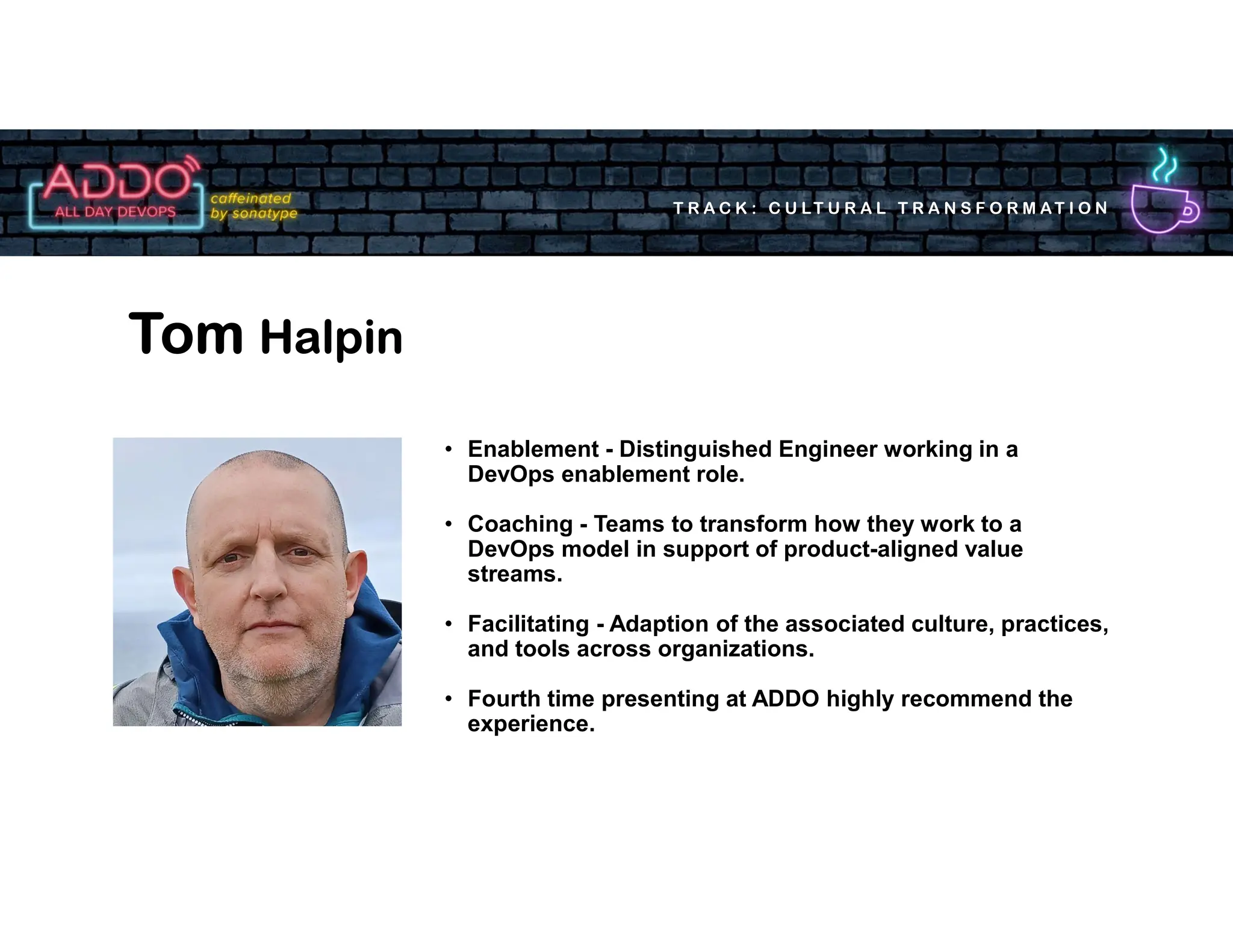
Tom Halpin
• Enablement - Distinguished Engineer working in a
DevOps enablement role.
• Coaching - Teams to transform how they work to a
DevOps model in support of product-aligned value
streams.
• Facilitating - Adaption of the associated culture, practices,
and tools across organizations.
• Fourth time presenting at ADDO highly recommend the
experience.
T R A C K : C U LT U R A L T R A N S F O R M AT I O N
Agenda
• Tools, Technologies, Team Topologies, Platforms
and Processes
• Scaling Inner Sourcing
• Open Sourcing Internal Tools
• What is Open Source?
• What is Inner Source?
• Benefits of Inner Source
• Inner Source Goals
• Establishing an Inner Sourcing Culture
• Importance of an 'Everything as Code'
Mindset
This session will cover how establishing an inner sourcing culture within an organization can help
unlock the intellectual property within:
T R A C K : C U LT U R A L T R A N S F O R M AT I O N
Open Source
T R A C K : C U LT U R A L T R A N S F O R M AT I O N
• Collaborative approach to software development.
• Code and resulting software made public for review, use, modification,
and distribution.
• Code is available for anyone to access and contribute.
• Governance by open-source licenses which define the terms and
conditions for use and sharing.
What is Open Source?
T R A C K : C U LT U R A L T R A N S F O R M AT I O N
• Open source has revolutionized software development.
• Applications across various sectors rely on reusable code
from a global developer community.
• Over 90% of IT enterprises worldwide use open-source
software for mission–critical workloads (Gartner). - Source
– Pimcore – Why Open Source?
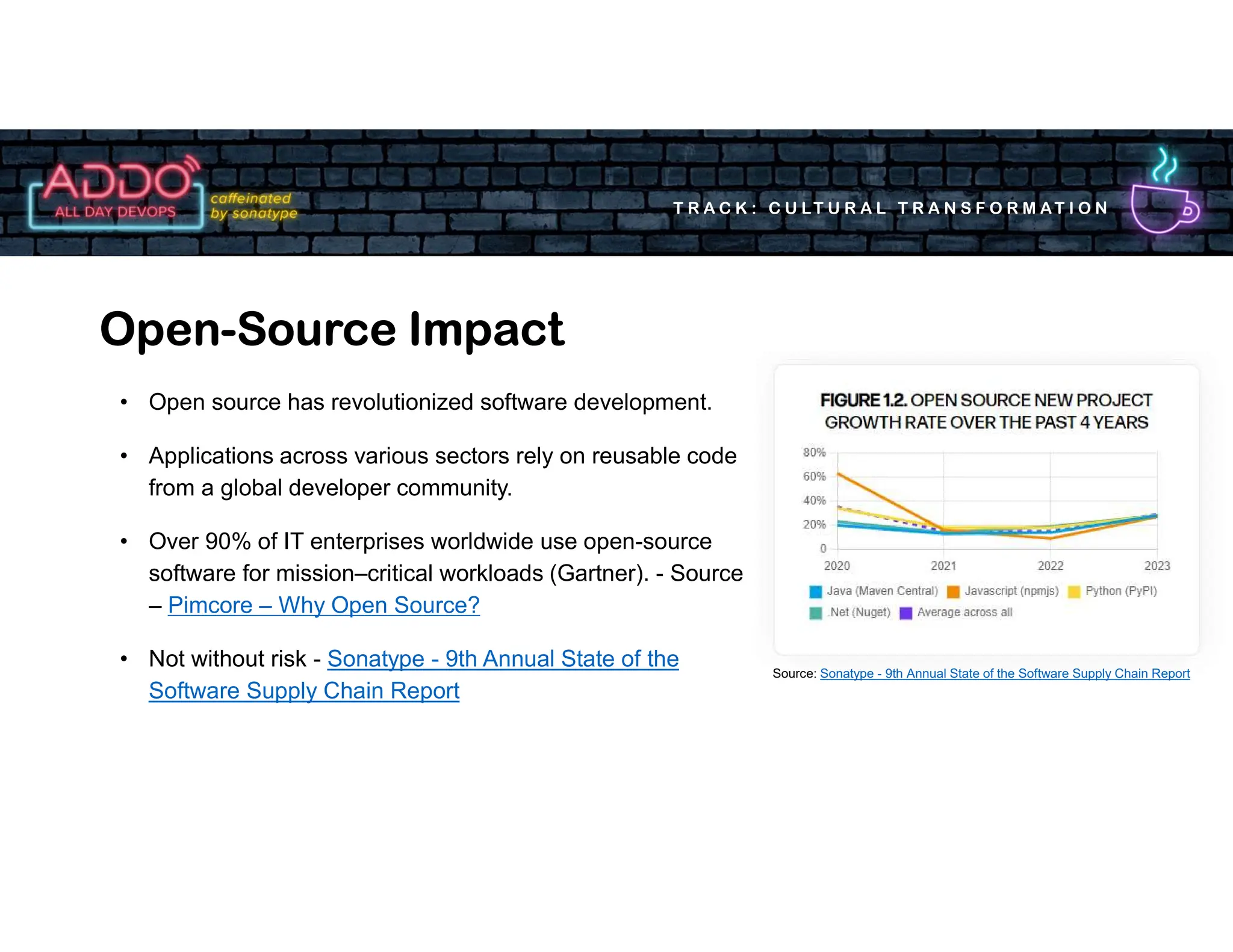
• Not without risk - Sonatype - 9th Annual State of the
Software Supply Chain Report
Open-Source Impact
Source: Sonatype - 9th Annual State of the Software Supply Chain Report
T R A C K : C U LT U R A L T R A N S F O R M AT I O N
On World:
• Many successful projects due to the
contributions and support of a global
community of developers, including:
• Linux Operating System
• Python
• Kubernetes
• Terraform / OpenTF
Examples
Off World:
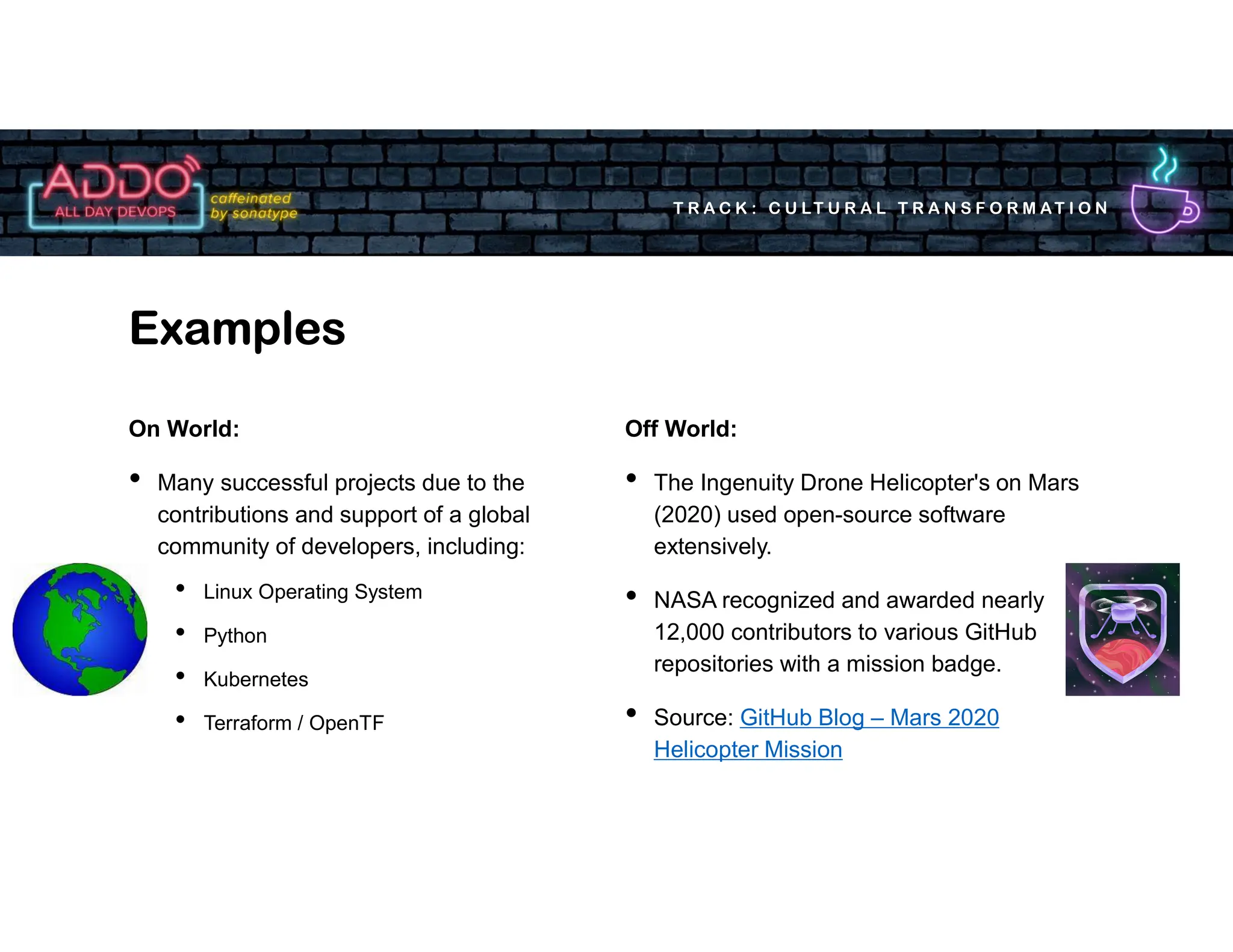
• The Ingenuity Drone Helicopter's on Mars
(2020) used open-source software
extensively.
• NASA recognized and awarded nearly
12,000 contributors to various GitHub
repositories with a mission badge.
• Source: GitHub Blog – Mars 2020
Helicopter Mission
T R A C K : C U LT U R A L T R A N S F O R M AT I O N
• Code is developed and maintained at scale by globally
distributed communities.
• Open-source communities have established very effective
global collaboration processes.
• Distributed version control systems and associated tooling
developed / used have become industry standards.
• Culture, Tools, Technologies, Team Topologies, Platforms and
Processes used are foundational to the DevOps movement.
Open-Source Collaboration
T R A C K : C U LT U R A L T R A N S F O R M AT I O N
Inner Source
T R A C K : C U LT U R A L T R A N S F O R M AT I O N
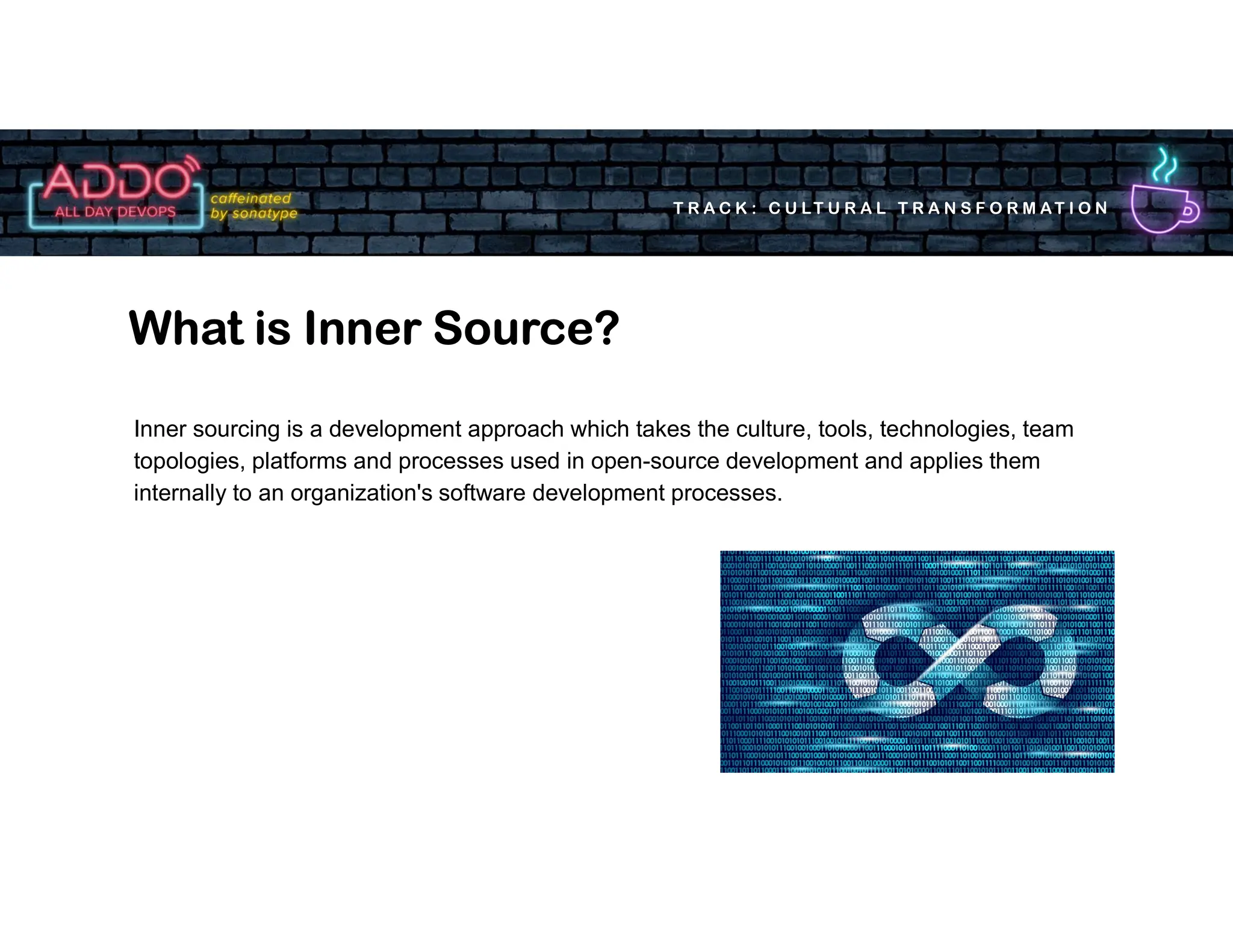
Inner sourcing is a development approach which takes the culture, tools, technologies, team
topologies, platforms and processes used in open-source development and applies them
internally to an organization's software development processes.
What is Inner Source?
T R A C K : C U LT U R A L T R A N S F O R M AT I O N
• Requires more than tool and technology selection.
• Demands a significant cultural shift.
• Requires:
• Changes to organizational responsibilities and team topologies.
• Investment in people, platforms, processes, tools and technologies.
Establishing an Inner Source Program
T R A C K : C U LT U R A L T R A N S F O R M AT I O N
• Continuous improvement
• Improvements in work practices
• Reuse of code & resources
• Co-ownership across teams
• Transparency & knowledge
sharing
• Cost reduction & efficiency gains
Benefits of Inner Source
• Streamlined development, testing
and deployment processes
• Faster flow
• Enhanced security
• Better adherence to regulatory
requirements
• Enhanced innovation & improved
collaboration
T R A C K : C U LT U R A L T R A N S F O R M AT I O N
Inner Sourcing Program Goals
T R A C K : C U LT U R A L T R A N S F O R M AT I O N
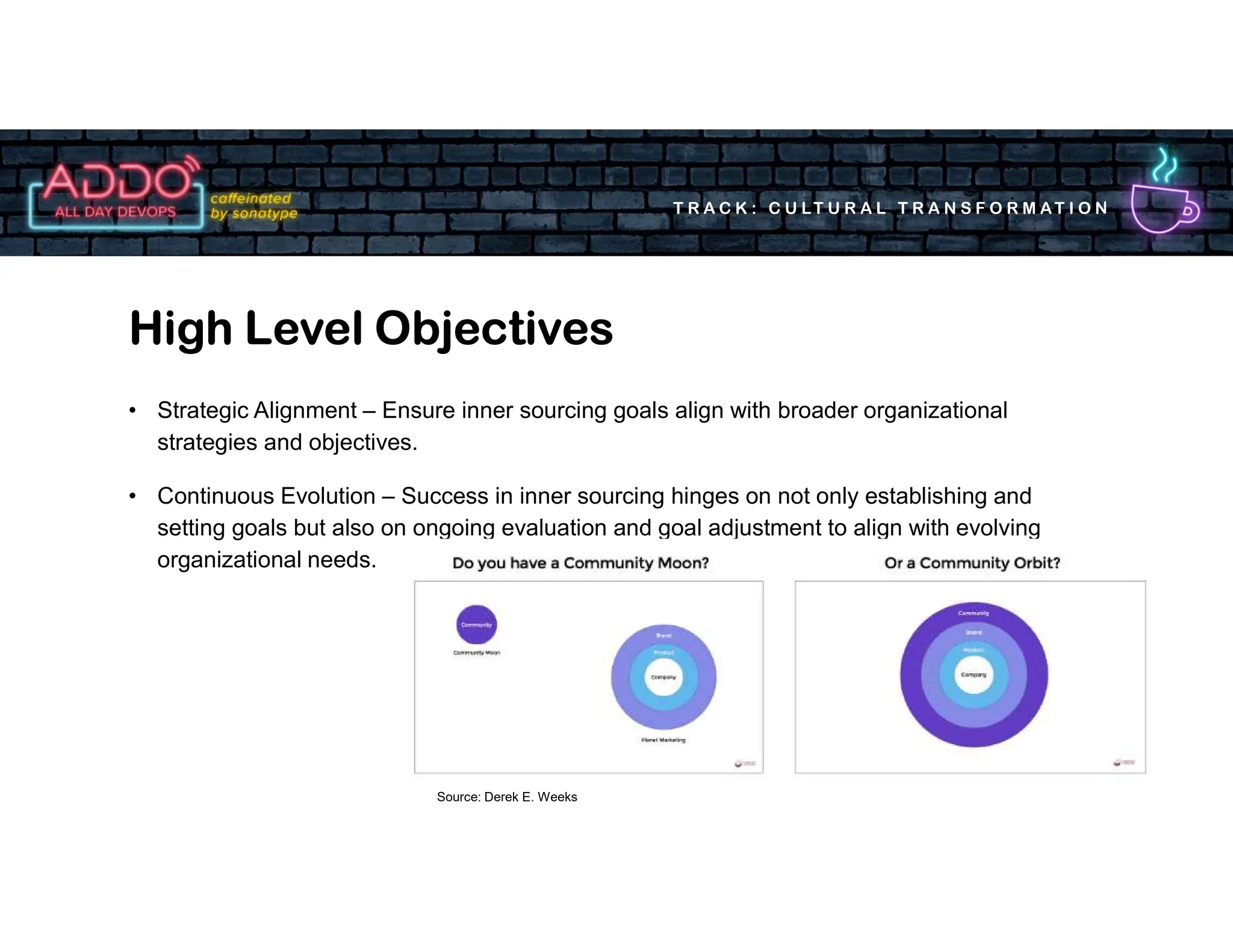
• Strategic Alignment – Ensure inner sourcing goals align with broader organizational
strategies and objectives.
• Continuous Evolution – Success in inner sourcing hinges on not only establishing and
setting goals but also on ongoing evaluation and goal adjustment to align with evolving
organizational needs.
High Level Objectives
Source: Derek E. Weeks
T R A C K : C U LT U R A L T R A N S F O R M AT I O N
• Enhance Collaboration – Foster collaboration and knowledge sharing among business units,
teams and individuals.
• Improve Efficiency – Streamline development, test and deployment processes, reduce
redundancy, and free up people for more productive tasks.
• Cultivate Innovation – Encourage innovation by leveraging collective expertise and varying
perspectives.
• Increase Quality – Elevate the quality and reliability of internal software, platforms and tools.
• Develop Talent – Provide opportunities for skill development and cross–functional learning.
Goals of Inner Source Program
T R A C K : C U LT U R A L T R A N S F O R M AT I O N
• Program Charter – Drive cultural change, enhance efficiency, and achieve better business
outcomes.
• Business Impact – Measure, in so far as possible, the impact of inner sourcing on key
business metrics such as cost reduction, time–to–market, and customer satisfaction.
• Cultural Improvement – Promote a culture of openness, collaboration, and continuous
improvement in line with the open-source world and aligned with the organization's cultural
values.
• Risk Mitigation – Mitigate risks associated with siloed development efforts, automate where
possible, reduce security vulnerabilities, and eliminate resource inefficiencies.
Align Goals with Organizational Strategy
T R A C K : C U LT U R A L T R A N S F O R M AT I O N
Establishing an Inner Sourcing
Culture
T R A C K : C U LT U R A L T R A N S F O R M AT I O N
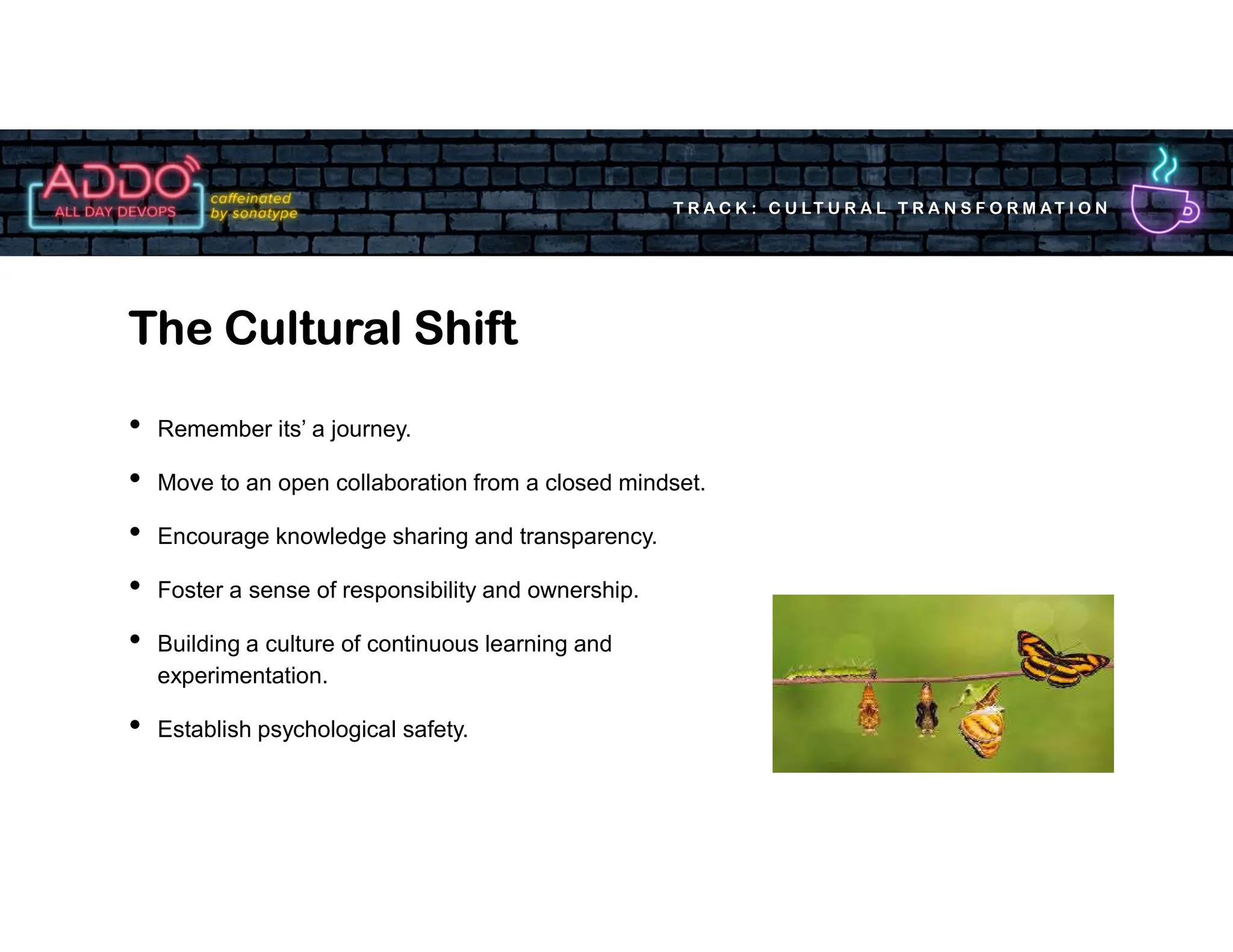
• Remember its’ a journey.
• Move to an open collaboration from a closed mindset.
• Encourage knowledge sharing and transparency.
• Foster a sense of responsibility and ownership.
• Building a culture of continuous learning and
experimentation.
• Establish psychological safety.
The Cultural Shift
T R A C K : C U LT U R A L T R A N S F O R M AT I O N
• Values: Collaboration, trust and open communication.
• Mindset: From "not invented here" to "collaborate and improve".
• Mindset: From "we have always done it this way" to "collaborate and improve".
Emphasize Values and Mindset Change
T R A C K : C U LT U R A L T R A N S F O R M AT I O N
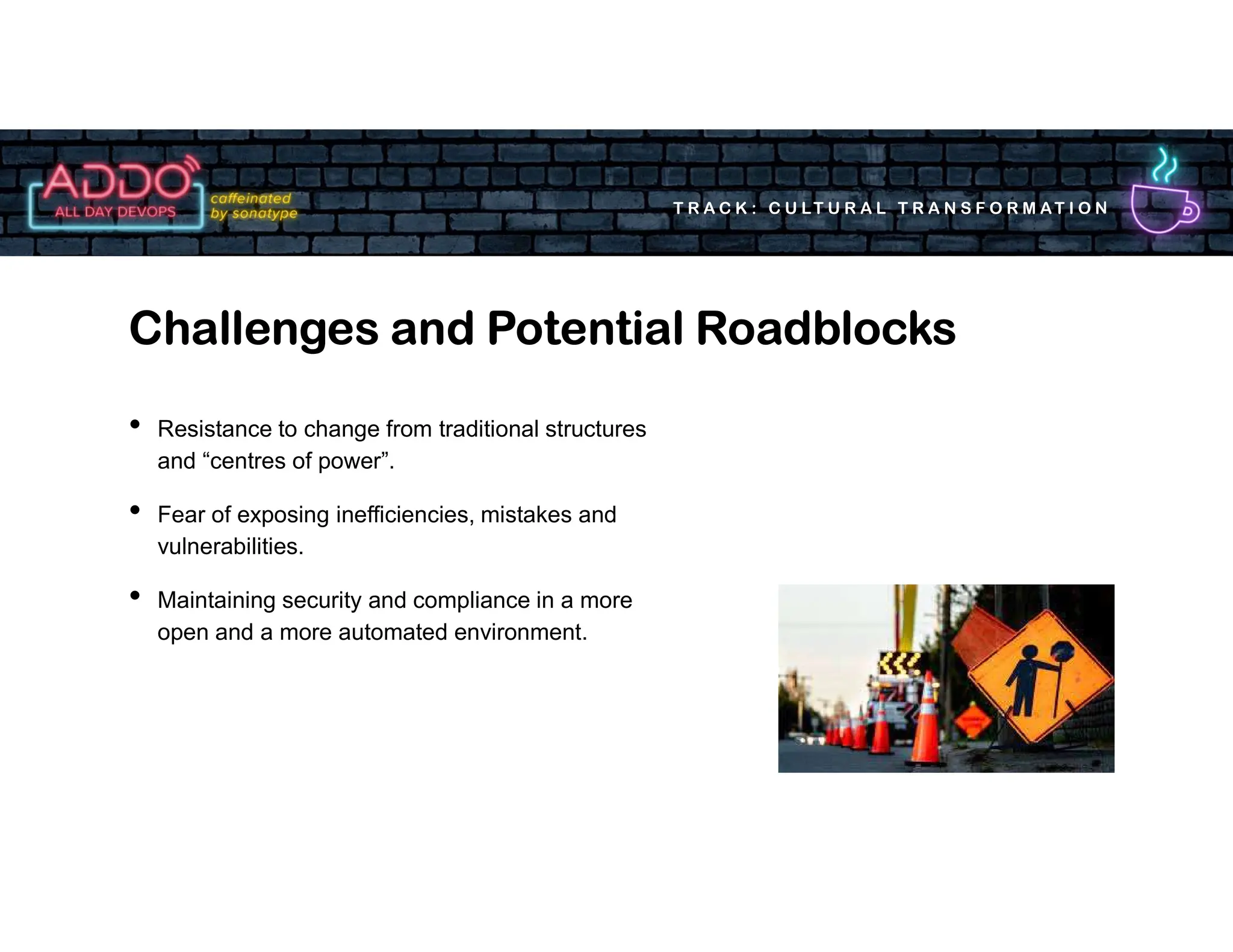
• Resistance to change from traditional structures
and “centres of power”.
• Fear of exposing inefficiencies, mistakes and
vulnerabilities.
• Maintaining security and compliance in a more
open and a more automated environment.
Challenges and Potential Roadblocks
T R A C K : C U LT U R A L T R A N S F O R M AT I O N
• Leadership advocacy and support.
• Investment in tooling, platforms and people via education and training programs.
• Gradual adoption via pilot projects and selected value streams.
• Measuring and communicating success stories.
Strategies to Overcome Challenges
T R A C K : C U LT U R A L T R A N S F O R M AT I O N
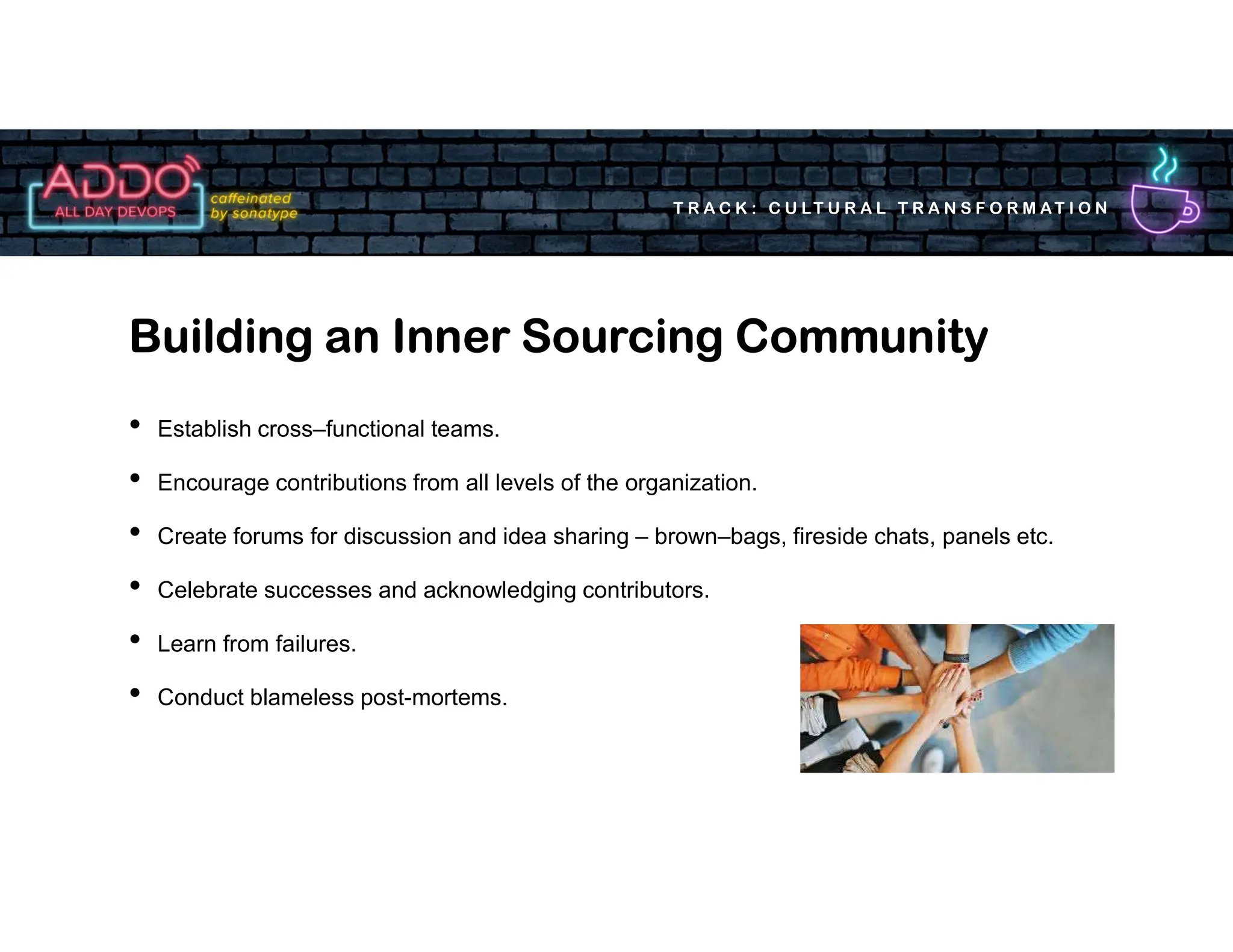
• Establish cross–functional teams.
• Encourage contributions from all levels of the organization.
• Create forums for discussion and idea sharing – brown–bags, fireside chats, panels etc.
• Celebrate successes and acknowledging contributors.
• Learn from failures.
• Conduct blameless post-mortems.
Building an Inner Sourcing Community
T R A C K : C U LT U R A L T R A N S F O R M AT I O N
Identify key performance indicators (KPIs) aligned with organizational strategic objectives
• Inner sourcing metrics
• Community Engagement – engagement level within the inner sourcing community: the number of
active contributors, number of code reviews, repositories watched, repositories starred, number of
issues logged, and number of discussions on project–related topics.
• Code Reuse – % of code that is reused across different projects via libraries or APIs. Increased
code reuse can lead to resource savings and improved consistency.
• Security and Compliance – Monitor compliance issues and security vulnerabilities in inner sourcing
projects. Ensure that security practices are maintained or improved.
Measuring Progress
T R A C K : C U LT U R A L T R A N S F O R M AT I O N
• DevOps metrics
▪ Lead time for changes – time between a code change committed to main/trunk branch and is deployable –
hours rather than days or weeks)
▪ Change failure rate – % of code changes that require hot fixes or remediation after code has been deployed –
High performing teams 0 to 15%
▪ Deployment frequency – frequency that new code is deployed to production – on demand / many times a day
rather than days or weeks)
▪ Mean time to recovery – how long it takes to recover from a partial service interruption or a total failure – high
performing teams < 1 hr rather than days or weeks
• Take regular feedback feed it into improvement cycles adjust strategy accordingly.
Measuring Progress
T R A C K : C U LT U R A L T R A N S F O R M AT I O N
Everything as Code (EaC)
Mindset
T R A C K : C U LT U R A L T R A N S F O R M AT I O N
• An EaC mindset allows organizations to establish, sustain & enhance an Inner Sourcing culture.
• EaC is the practice of treating all aspects of software development and infrastructure
management as code artifacts – CI/CD pipelines, configurations, policies, infrastructure, tests,
documentation, and more – all defined and managed as code.
Everything as Code (EaC)
T R A C K : C U LT U R A L T R A N S F O R M AT I O N
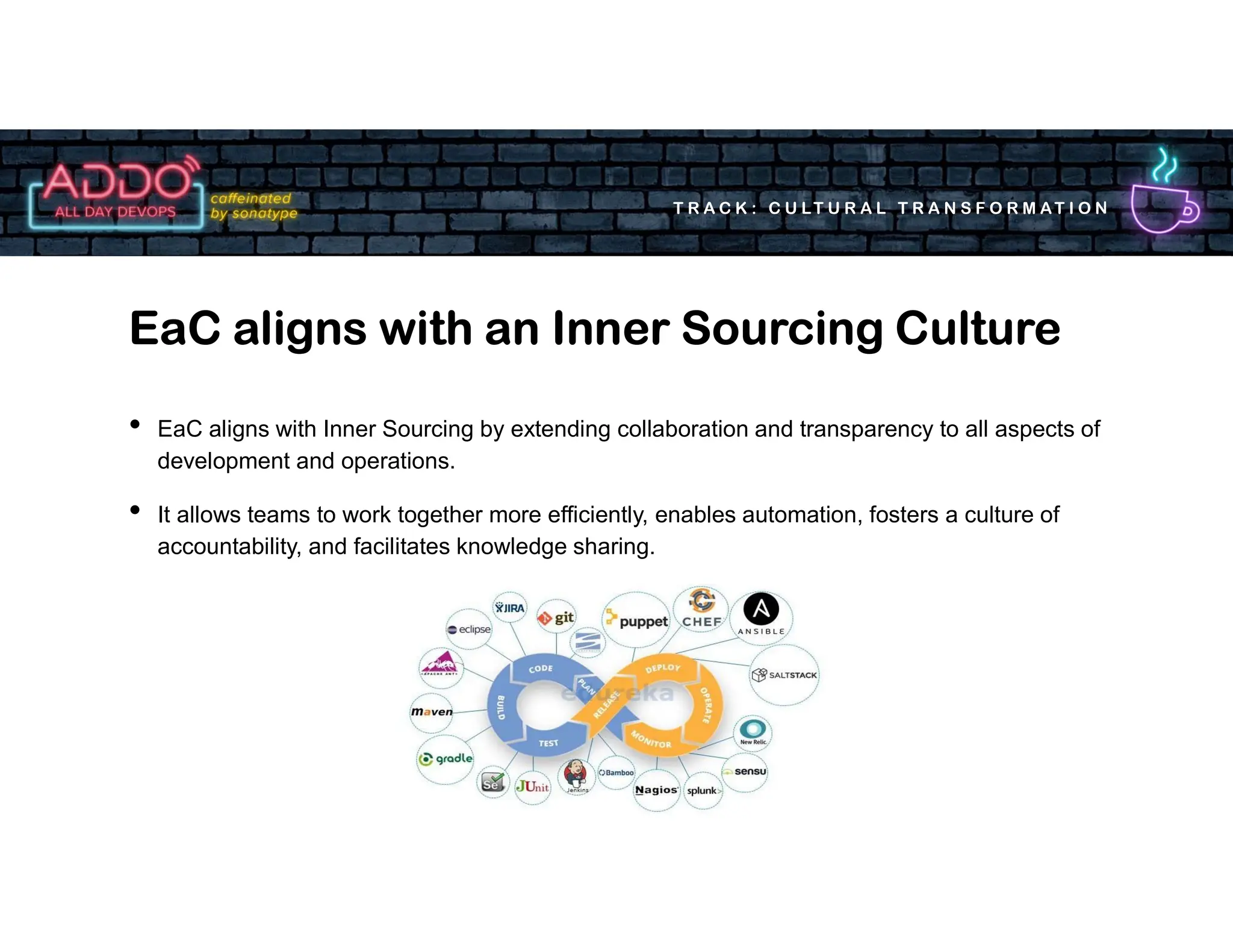
• EaC aligns with Inner Sourcing by extending collaboration and transparency to all aspects of
development and operations.
• It allows teams to work together more efficiently, enables automation, fosters a culture of
accountability, and facilitates knowledge sharing.
EaC aligns with an Inner Sourcing Culture
T R A C K : C U LT U R A L T R A N S F O R M AT I O N
• Configuration as Code (CaC) – Store application
configurations in version–controlled files, making it easier to
track changes and maintain consistency across environments.
• Data as Code (DaC) – Version and manage data pipelines
and transformations, enhancing data–driven decision–making.
• Deployment as Code (DaC) – Automate deployment
processes, enabling rapid, consistent, and repeatable
deployments through code–driven pipelines.
• Documentation as Code (DaC) – Write and manage
documentation in markdown or other text–based formats,
allowing collaborative editing, versioning, and automated
documentation generation.
EaC - Examples
• Infrastructure as Code (IaC) – Define and manage infrastructure
resources in code using tools like Terraform or Ansible, enabling
consistent, reproducible deployments.
• Monitoring as Code (MaC) – Manage monitoring and alerting
configurations in code, ensuring that teams can collaborate on
monitoring strategies.
• Policy as Code (PaC) – Define security and compliance policies in
code, ensuring that they are consistently applied.
• Testing as Code (TaC) – Automate testing processes and
configurations, integrating them into development pipelines, making
testing more efficient, more repeatable and thus more reliable.
T R A C K : C U LT U R A L T R A N S F O R M AT I O N
Scaling Inner Sourcing
T R A C K : C U LT U R A L T R A N S F O R M AT I O N
• Recommend an incremental approach with an initial focus on pilot projects and selected
value streams.
• Need to recognize and address challenges whilst implementing best practices to achieve
a successful and sustainable scaling process.
• It is not just about expanding the size of the effort but also about increasing the cultural
and organizational adoption to enhance collaboration and innovation.
Approach
T R A C K : C U LT U R A L T R A N S F O R M AT I O N
Incremental Approach to Scaling
 Gradual Rollout – Scaling should be approached incrementally rather than attempting a full–scale
transformation from the outset.
 Adapt, Learn and Adapt – Learn from experiences, and adapt strategies as the effort expands.
 Iterate– continuous improvement of the process based on feedback and outcomes.
T R A C K : C U LT U R A L T R A N S F O R M AT I O N
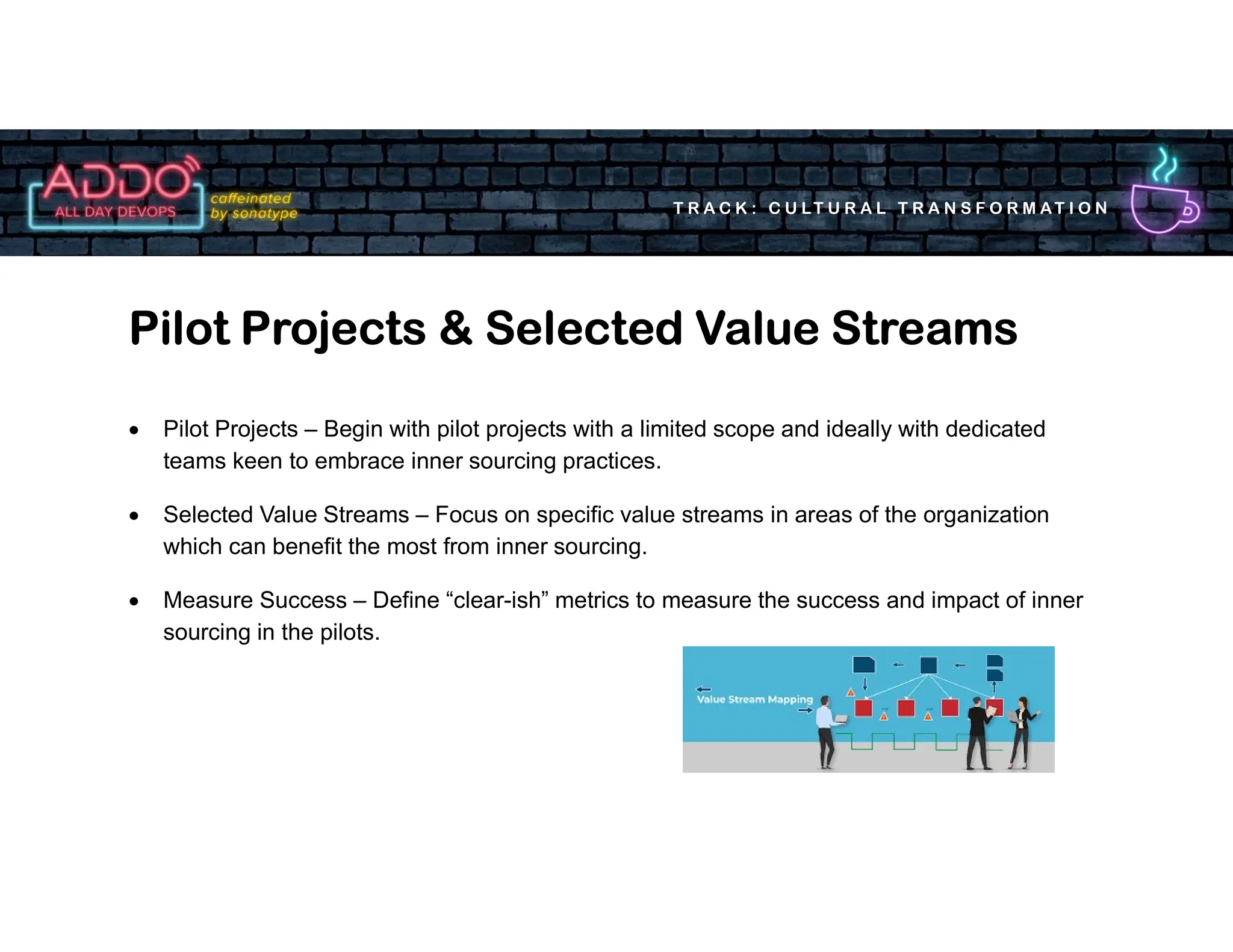
 Pilot Projects – Begin with pilot projects with a limited scope and ideally with dedicated
teams keen to embrace inner sourcing practices.
 Selected Value Streams – Focus on specific value streams in areas of the organization
which can benefit the most from inner sourcing.
 Measure Success – Define “clear-ish” metrics to measure the success and impact of inner
sourcing in the pilots.
Pilot Projects & Selected Value Streams
T R A C K : C U LT U R A L T R A N S F O R M AT I O N
Challenges & Best Practices in Scaling
Best Practices:
• Sponsorship – Secure support and commitment from
leadership to support the cultural change.
• Documentation and Training – Provide “living”
documentation and training to facilitate adoption.
• Community Building – Foster a sense of community
among contributors to promote engagement.
Challenges:
• Cultural Resistance – Overcoming resistance to
change and ensuring teams embrace collaborative
practices.
• Governance – Establishing governance models for
code contributions, access control, security and
compliance.
• Scalability – Ensuring that inner sourcing practices
can scale to accommodate growing project sizes
and teams.
T R A C K : C U LT U R A L T R A N S F O R M AT I O N
Tools, Technologies, Team
Topologies, Platforms &
Processes
T R A C K : C U LT U R A L T R A N S F O R M AT I O N
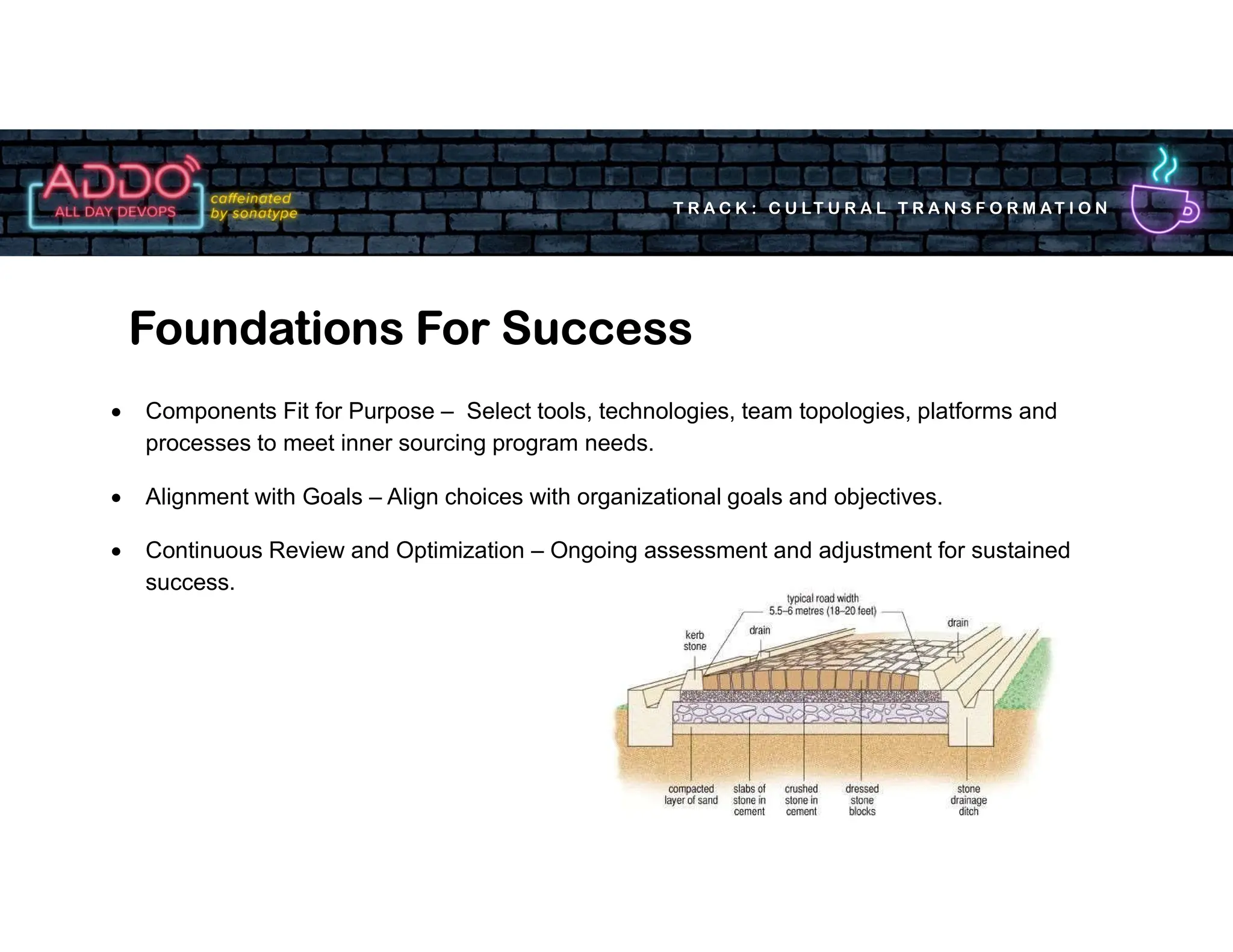
 Components Fit for Purpose – Select tools, technologies, team topologies, platforms and
processes to meet inner sourcing program needs.
 Alignment with Goals – Align choices with organizational goals and objectives.
 Continuous Review and Optimization – Ongoing assessment and adjustment for sustained
success.
Foundations For Success
T R A C K : C U LT U R A L T R A N S F O R M AT I O N
 Tools – Collaboration and version control tools, code review platforms, documentation
systems, and communication channels.
 Technologies – Development frameworks, programming languages, test frameworks and
security tooling etc.
 Team Topologies – Organizing and optimizing the efforts of contributors and teams,
ultimately leading to more efficient, collaborative, and successful projects.
 Platforms – Hosting Infrastructure, source code repository & version control system (e.g.
GitHub), binary repository manager (e.g. Artifactory) & CI/CD orchestration tool (e.g. Jenkins).
 Processes – Defined workflows, code contribution guidelines, code review procedures, and
release management controls.
Overview of Foundational Components
T R A C K : C U LT U R A L T R A N S F O R M AT I O N
 Efficiency – Clear processes reduce bottlenecks, streamline development, facilitate flow and
improve resource allocation.
 Quality – Well–defined processes ensure code quality, security, and compliance with
standards.
 Collaboration – Robust processes promote collaboration and knowledge sharing among
teams.
 Automation – Automated processes streamline repetitive tasks, such as code integration,
testing and deployment thus enhancing efficiency and reducing the potential for human
error.
Importance of Good Processes
T R A C K : C U LT U R A L T R A N S F O R M AT I O N
 Select Value Streams – Select the areas of the organization to focus on.
 Define Workflows – Map the process workflows from code contribution to deployment.
 Contribution Guidelines – Create guidelines for code contributions, including coding
standards and testing requirements.
 Code Reviews – Establish clear code review procedures and criteria for acceptance.
 Release Management – Define release processes, versioning, and deployment strategies.
 Documentation – Maintain “living” process documentation at the project level.
Establish & Maintain Processes
T R A C K : C U LT U R A L T R A N S F O R M AT I O N
 Continuous Improvement – Regularly review and refine processes based on feedback and
performance metrics.
 Automation – Automate repetitive tasks, such as testing and deployment, to increase
efficiency.
 Feedback Loops – Encourage feedback from contributors to identify areas for improvement.
 Training and Education – Provide training and resources to enable people and thus teams
succeed.
Process Optimization for Inner Sourcing
T R A C K : C U LT U R A L T R A N S F O R M AT I O N
Open Sourcing Internal Tools
T R A C K : C U LT U R A L T R A N S F O R M AT I O N
Open sourcing of any internal code is a significant step that should be approached thoughtfully, ensuring
alignment with organizational goals and compliance with relevant organizational policies and any applicable
regulations.
Disclaimer
T R A C K : C U LT U R A L T R A N S F O R M AT I O N
Importance of Open Sourcing Internal Tools:
• Enhanced Collaboration – Open sourcing internal
tools promotes collaboration and knowledge sharing
internally across teams and departments.
• Innovation Catalyst – It fosters innovation by allowing
external contributions and insights.
• Enhanced Public Profile – Successful projects can
raise the public profile and reputation of an
organization helping with talent attraction, acquisition
and retention.
Why Open Source?
How it Contributes to Inner Sourcing Success:
• Streamlines Processes – Open sourcing internal tools
helps streamlines inner sourcing processes through the
provision of standardized, reusable components.
• Knowledge Transfer – External contributors bring fresh
perspectives and knowledge to improve internal practices.
• Community Building – It builds a culture of collaboration,
transparency, and accountability within the organization.
T R A C K : C U LT U R A L T R A N S F O R M AT I O N
• Evaluate Suitability – Determine which internal tools are suitable for open sourcing based on their value and
potential external interest.
• Select License – Choose appropriate open-source license to govern usage & contributions.
• Clean and Document – Ensure the code is clean, well–documented, and doesn’t include any commercially
sensitive information.
• Create a Public Repository – Create a public repository on a platform like GitHub for the project.
• Promote Internally – Encourage internal teams to use and contribute to the open-source tool.
• Community Engagement – Actively engage with external contributors, create and maintain a responsive
feedback loop.
Steps to Open-source Internal Tools
T R A C K : C U LT U R A L T R A N S F O R M AT I O N
Conclusions
T R A C K : C U LT U R A L T R A N S F O R M AT I O N
• Commit to change.
• Align with organizational goals.
• Major cultural pivot required.
• Embrace 'Everything as Code'
principles.
• Investment is required.
Conclusions
• Start with pilot projects and selected value streams.
• Measure impact – use KPIs aligned with organizational
goals.
• Plan to scale the effort.
• Security first – SAST & DAST.
• Look to avail of open-source synergies.
T R A C K : C U LT U R A L T R A N S F O R M AT I O N
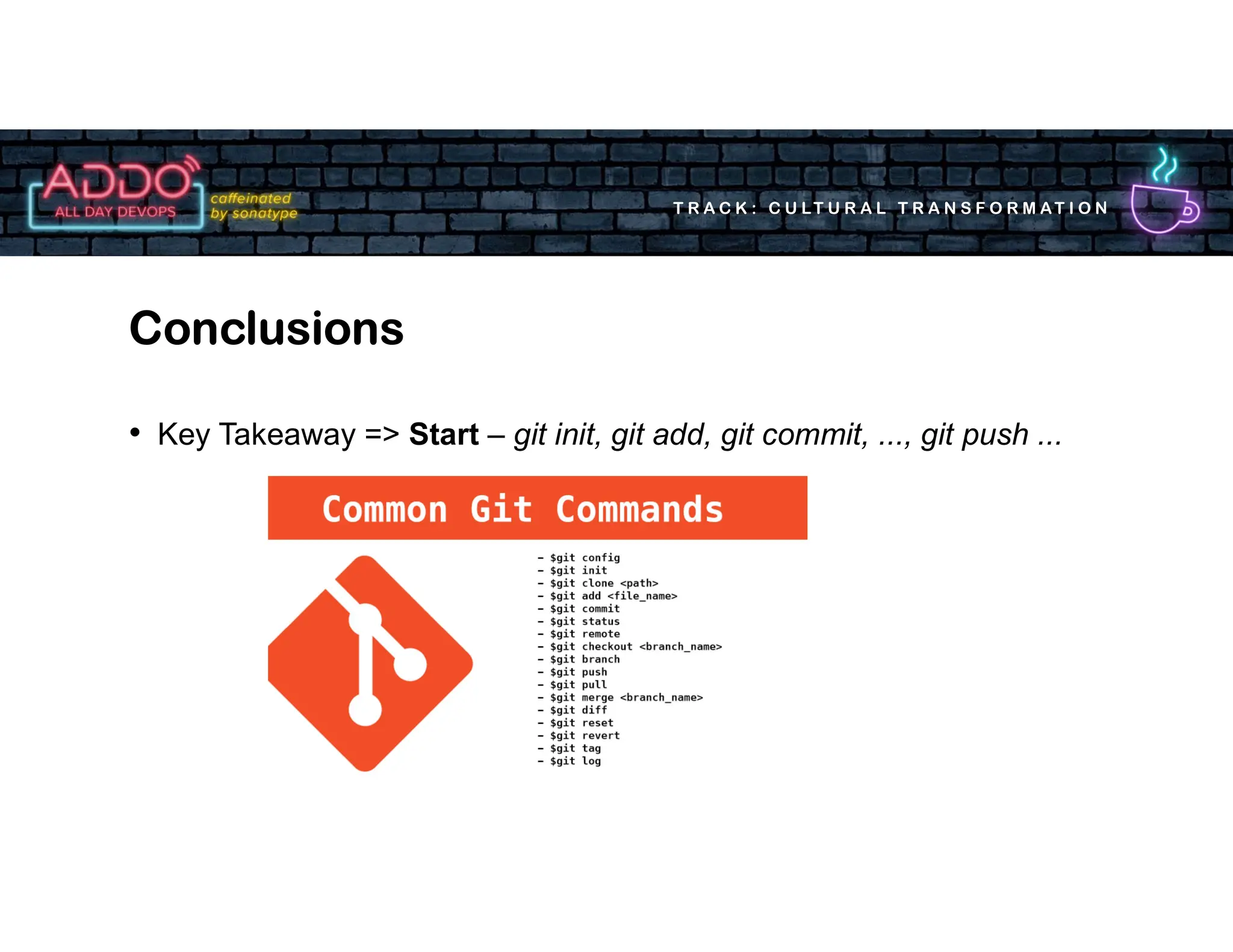
• Key Takeaway => Start – git init, git add, git commit, ..., git push ...
Conclusions
T R A C K : C U LT U R A L T R A N S F O R M AT I O N
Q&A
T R A C K : C U LT U R A L T R A N S F O R M AT I O N

Unlocking Organizational Potential By the Power of Inner Sourcing.pdf

  • 1.
    T R AC K : C U LT U R A L T R A N S F O R M AT I O N O C T O B E R 2 6 , 2 0 2 3 Tom Halpin - Distinguished Engineer Unlocking Organizational Potential By the Power of Inner Sourcing
  • 2.
    T R AC K : C U LT U R A L T R A N S F O R M AT I O N Introduction
  • 3.
    T R AC K : C U LT U R A L T R A N S F O R M AT I O N Tom Halpin • Enablement - Distinguished Engineer working in a DevOps enablement role. • Coaching - Teams to transform how they work to a DevOps model in support of product-aligned value streams. • Facilitating - Adaption of the associated culture, practices, and tools across organizations. • Fourth time presenting at ADDO highly recommend the experience.
  • 4.
    T R AC K : C U LT U R A L T R A N S F O R M AT I O N Agenda • Tools, Technologies, Team Topologies, Platforms and Processes • Scaling Inner Sourcing • Open Sourcing Internal Tools • What is Open Source? • What is Inner Source? • Benefits of Inner Source • Inner Source Goals • Establishing an Inner Sourcing Culture • Importance of an 'Everything as Code' Mindset This session will cover how establishing an inner sourcing culture within an organization can help unlock the intellectual property within:
  • 5.
    T R AC K : C U LT U R A L T R A N S F O R M AT I O N Open Source
  • 6.
    T R AC K : C U LT U R A L T R A N S F O R M AT I O N • Collaborative approach to software development. • Code and resulting software made public for review, use, modification, and distribution. • Code is available for anyone to access and contribute. • Governance by open-source licenses which define the terms and conditions for use and sharing. What is Open Source?
  • 7.
    T R AC K : C U LT U R A L T R A N S F O R M AT I O N • Open source has revolutionized software development. • Applications across various sectors rely on reusable code from a global developer community. • Over 90% of IT enterprises worldwide use open-source software for mission–critical workloads (Gartner). - Source – Pimcore – Why Open Source? • Not without risk - Sonatype - 9th Annual State of the Software Supply Chain Report Open-Source Impact Source: Sonatype - 9th Annual State of the Software Supply Chain Report
  • 8.
    T R AC K : C U LT U R A L T R A N S F O R M AT I O N On World: • Many successful projects due to the contributions and support of a global community of developers, including: • Linux Operating System • Python • Kubernetes • Terraform / OpenTF Examples Off World: • The Ingenuity Drone Helicopter's on Mars (2020) used open-source software extensively. • NASA recognized and awarded nearly 12,000 contributors to various GitHub repositories with a mission badge. • Source: GitHub Blog – Mars 2020 Helicopter Mission
  • 9.
    T R AC K : C U LT U R A L T R A N S F O R M AT I O N • Code is developed and maintained at scale by globally distributed communities. • Open-source communities have established very effective global collaboration processes. • Distributed version control systems and associated tooling developed / used have become industry standards. • Culture, Tools, Technologies, Team Topologies, Platforms and Processes used are foundational to the DevOps movement. Open-Source Collaboration
  • 10.
    T R AC K : C U LT U R A L T R A N S F O R M AT I O N Inner Source
  • 11.
    T R AC K : C U LT U R A L T R A N S F O R M AT I O N Inner sourcing is a development approach which takes the culture, tools, technologies, team topologies, platforms and processes used in open-source development and applies them internally to an organization's software development processes. What is Inner Source?
  • 12.
    T R AC K : C U LT U R A L T R A N S F O R M AT I O N • Requires more than tool and technology selection. • Demands a significant cultural shift. • Requires: • Changes to organizational responsibilities and team topologies. • Investment in people, platforms, processes, tools and technologies. Establishing an Inner Source Program
  • 13.
    T R AC K : C U LT U R A L T R A N S F O R M AT I O N • Continuous improvement • Improvements in work practices • Reuse of code & resources • Co-ownership across teams • Transparency & knowledge sharing • Cost reduction & efficiency gains Benefits of Inner Source • Streamlined development, testing and deployment processes • Faster flow • Enhanced security • Better adherence to regulatory requirements • Enhanced innovation & improved collaboration
  • 14.
    T R AC K : C U LT U R A L T R A N S F O R M AT I O N Inner Sourcing Program Goals
  • 15.
    T R AC K : C U LT U R A L T R A N S F O R M AT I O N • Strategic Alignment – Ensure inner sourcing goals align with broader organizational strategies and objectives. • Continuous Evolution – Success in inner sourcing hinges on not only establishing and setting goals but also on ongoing evaluation and goal adjustment to align with evolving organizational needs. High Level Objectives Source: Derek E. Weeks
  • 16.
    T R AC K : C U LT U R A L T R A N S F O R M AT I O N • Enhance Collaboration – Foster collaboration and knowledge sharing among business units, teams and individuals. • Improve Efficiency – Streamline development, test and deployment processes, reduce redundancy, and free up people for more productive tasks. • Cultivate Innovation – Encourage innovation by leveraging collective expertise and varying perspectives. • Increase Quality – Elevate the quality and reliability of internal software, platforms and tools. • Develop Talent – Provide opportunities for skill development and cross–functional learning. Goals of Inner Source Program
  • 17.
    T R AC K : C U LT U R A L T R A N S F O R M AT I O N • Program Charter – Drive cultural change, enhance efficiency, and achieve better business outcomes. • Business Impact – Measure, in so far as possible, the impact of inner sourcing on key business metrics such as cost reduction, time–to–market, and customer satisfaction. • Cultural Improvement – Promote a culture of openness, collaboration, and continuous improvement in line with the open-source world and aligned with the organization's cultural values. • Risk Mitigation – Mitigate risks associated with siloed development efforts, automate where possible, reduce security vulnerabilities, and eliminate resource inefficiencies. Align Goals with Organizational Strategy
  • 18.
    T R AC K : C U LT U R A L T R A N S F O R M AT I O N Establishing an Inner Sourcing Culture
  • 19.
    T R AC K : C U LT U R A L T R A N S F O R M AT I O N • Remember its’ a journey. • Move to an open collaboration from a closed mindset. • Encourage knowledge sharing and transparency. • Foster a sense of responsibility and ownership. • Building a culture of continuous learning and experimentation. • Establish psychological safety. The Cultural Shift
  • 20.
    T R AC K : C U LT U R A L T R A N S F O R M AT I O N • Values: Collaboration, trust and open communication. • Mindset: From "not invented here" to "collaborate and improve". • Mindset: From "we have always done it this way" to "collaborate and improve". Emphasize Values and Mindset Change
  • 21.
    T R AC K : C U LT U R A L T R A N S F O R M AT I O N • Resistance to change from traditional structures and “centres of power”. • Fear of exposing inefficiencies, mistakes and vulnerabilities. • Maintaining security and compliance in a more open and a more automated environment. Challenges and Potential Roadblocks
  • 22.
    T R AC K : C U LT U R A L T R A N S F O R M AT I O N • Leadership advocacy and support. • Investment in tooling, platforms and people via education and training programs. • Gradual adoption via pilot projects and selected value streams. • Measuring and communicating success stories. Strategies to Overcome Challenges
  • 23.
    T R AC K : C U LT U R A L T R A N S F O R M AT I O N • Establish cross–functional teams. • Encourage contributions from all levels of the organization. • Create forums for discussion and idea sharing – brown–bags, fireside chats, panels etc. • Celebrate successes and acknowledging contributors. • Learn from failures. • Conduct blameless post-mortems. Building an Inner Sourcing Community
  • 24.
    T R AC K : C U LT U R A L T R A N S F O R M AT I O N Identify key performance indicators (KPIs) aligned with organizational strategic objectives • Inner sourcing metrics • Community Engagement – engagement level within the inner sourcing community: the number of active contributors, number of code reviews, repositories watched, repositories starred, number of issues logged, and number of discussions on project–related topics. • Code Reuse – % of code that is reused across different projects via libraries or APIs. Increased code reuse can lead to resource savings and improved consistency. • Security and Compliance – Monitor compliance issues and security vulnerabilities in inner sourcing projects. Ensure that security practices are maintained or improved. Measuring Progress
  • 25.
    T R AC K : C U LT U R A L T R A N S F O R M AT I O N • DevOps metrics ▪ Lead time for changes – time between a code change committed to main/trunk branch and is deployable – hours rather than days or weeks) ▪ Change failure rate – % of code changes that require hot fixes or remediation after code has been deployed – High performing teams 0 to 15% ▪ Deployment frequency – frequency that new code is deployed to production – on demand / many times a day rather than days or weeks) ▪ Mean time to recovery – how long it takes to recover from a partial service interruption or a total failure – high performing teams < 1 hr rather than days or weeks • Take regular feedback feed it into improvement cycles adjust strategy accordingly. Measuring Progress
  • 26.
    T R AC K : C U LT U R A L T R A N S F O R M AT I O N Everything as Code (EaC) Mindset
  • 27.
    T R AC K : C U LT U R A L T R A N S F O R M AT I O N • An EaC mindset allows organizations to establish, sustain & enhance an Inner Sourcing culture. • EaC is the practice of treating all aspects of software development and infrastructure management as code artifacts – CI/CD pipelines, configurations, policies, infrastructure, tests, documentation, and more – all defined and managed as code. Everything as Code (EaC)
  • 28.
    T R AC K : C U LT U R A L T R A N S F O R M AT I O N • EaC aligns with Inner Sourcing by extending collaboration and transparency to all aspects of development and operations. • It allows teams to work together more efficiently, enables automation, fosters a culture of accountability, and facilitates knowledge sharing. EaC aligns with an Inner Sourcing Culture
  • 29.
    T R AC K : C U LT U R A L T R A N S F O R M AT I O N • Configuration as Code (CaC) – Store application configurations in version–controlled files, making it easier to track changes and maintain consistency across environments. • Data as Code (DaC) – Version and manage data pipelines and transformations, enhancing data–driven decision–making. • Deployment as Code (DaC) – Automate deployment processes, enabling rapid, consistent, and repeatable deployments through code–driven pipelines. • Documentation as Code (DaC) – Write and manage documentation in markdown or other text–based formats, allowing collaborative editing, versioning, and automated documentation generation. EaC - Examples • Infrastructure as Code (IaC) – Define and manage infrastructure resources in code using tools like Terraform or Ansible, enabling consistent, reproducible deployments. • Monitoring as Code (MaC) – Manage monitoring and alerting configurations in code, ensuring that teams can collaborate on monitoring strategies. • Policy as Code (PaC) – Define security and compliance policies in code, ensuring that they are consistently applied. • Testing as Code (TaC) – Automate testing processes and configurations, integrating them into development pipelines, making testing more efficient, more repeatable and thus more reliable.
  • 30.
    T R AC K : C U LT U R A L T R A N S F O R M AT I O N Scaling Inner Sourcing
  • 31.
    T R AC K : C U LT U R A L T R A N S F O R M AT I O N • Recommend an incremental approach with an initial focus on pilot projects and selected value streams. • Need to recognize and address challenges whilst implementing best practices to achieve a successful and sustainable scaling process. • It is not just about expanding the size of the effort but also about increasing the cultural and organizational adoption to enhance collaboration and innovation. Approach
  • 32.
    T R AC K : C U LT U R A L T R A N S F O R M AT I O N Incremental Approach to Scaling  Gradual Rollout – Scaling should be approached incrementally rather than attempting a full–scale transformation from the outset.  Adapt, Learn and Adapt – Learn from experiences, and adapt strategies as the effort expands.  Iterate– continuous improvement of the process based on feedback and outcomes.
  • 33.
    T R AC K : C U LT U R A L T R A N S F O R M AT I O N  Pilot Projects – Begin with pilot projects with a limited scope and ideally with dedicated teams keen to embrace inner sourcing practices.  Selected Value Streams – Focus on specific value streams in areas of the organization which can benefit the most from inner sourcing.  Measure Success – Define “clear-ish” metrics to measure the success and impact of inner sourcing in the pilots. Pilot Projects & Selected Value Streams
  • 34.
    T R AC K : C U LT U R A L T R A N S F O R M AT I O N Challenges & Best Practices in Scaling Best Practices: • Sponsorship – Secure support and commitment from leadership to support the cultural change. • Documentation and Training – Provide “living” documentation and training to facilitate adoption. • Community Building – Foster a sense of community among contributors to promote engagement. Challenges: • Cultural Resistance – Overcoming resistance to change and ensuring teams embrace collaborative practices. • Governance – Establishing governance models for code contributions, access control, security and compliance. • Scalability – Ensuring that inner sourcing practices can scale to accommodate growing project sizes and teams.
  • 35.
    T R AC K : C U LT U R A L T R A N S F O R M AT I O N Tools, Technologies, Team Topologies, Platforms & Processes
  • 36.
    T R AC K : C U LT U R A L T R A N S F O R M AT I O N  Components Fit for Purpose – Select tools, technologies, team topologies, platforms and processes to meet inner sourcing program needs.  Alignment with Goals – Align choices with organizational goals and objectives.  Continuous Review and Optimization – Ongoing assessment and adjustment for sustained success. Foundations For Success
  • 37.
    T R AC K : C U LT U R A L T R A N S F O R M AT I O N  Tools – Collaboration and version control tools, code review platforms, documentation systems, and communication channels.  Technologies – Development frameworks, programming languages, test frameworks and security tooling etc.  Team Topologies – Organizing and optimizing the efforts of contributors and teams, ultimately leading to more efficient, collaborative, and successful projects.  Platforms – Hosting Infrastructure, source code repository & version control system (e.g. GitHub), binary repository manager (e.g. Artifactory) & CI/CD orchestration tool (e.g. Jenkins).  Processes – Defined workflows, code contribution guidelines, code review procedures, and release management controls. Overview of Foundational Components
  • 38.
    T R AC K : C U LT U R A L T R A N S F O R M AT I O N  Efficiency – Clear processes reduce bottlenecks, streamline development, facilitate flow and improve resource allocation.  Quality – Well–defined processes ensure code quality, security, and compliance with standards.  Collaboration – Robust processes promote collaboration and knowledge sharing among teams.  Automation – Automated processes streamline repetitive tasks, such as code integration, testing and deployment thus enhancing efficiency and reducing the potential for human error. Importance of Good Processes
  • 39.
    T R AC K : C U LT U R A L T R A N S F O R M AT I O N  Select Value Streams – Select the areas of the organization to focus on.  Define Workflows – Map the process workflows from code contribution to deployment.  Contribution Guidelines – Create guidelines for code contributions, including coding standards and testing requirements.  Code Reviews – Establish clear code review procedures and criteria for acceptance.  Release Management – Define release processes, versioning, and deployment strategies.  Documentation – Maintain “living” process documentation at the project level. Establish & Maintain Processes
  • 40.
    T R AC K : C U LT U R A L T R A N S F O R M AT I O N  Continuous Improvement – Regularly review and refine processes based on feedback and performance metrics.  Automation – Automate repetitive tasks, such as testing and deployment, to increase efficiency.  Feedback Loops – Encourage feedback from contributors to identify areas for improvement.  Training and Education – Provide training and resources to enable people and thus teams succeed. Process Optimization for Inner Sourcing
  • 41.
    T R AC K : C U LT U R A L T R A N S F O R M AT I O N Open Sourcing Internal Tools
  • 42.
    T R AC K : C U LT U R A L T R A N S F O R M AT I O N Open sourcing of any internal code is a significant step that should be approached thoughtfully, ensuring alignment with organizational goals and compliance with relevant organizational policies and any applicable regulations. Disclaimer
  • 43.
    T R AC K : C U LT U R A L T R A N S F O R M AT I O N Importance of Open Sourcing Internal Tools: • Enhanced Collaboration – Open sourcing internal tools promotes collaboration and knowledge sharing internally across teams and departments. • Innovation Catalyst – It fosters innovation by allowing external contributions and insights. • Enhanced Public Profile – Successful projects can raise the public profile and reputation of an organization helping with talent attraction, acquisition and retention. Why Open Source? How it Contributes to Inner Sourcing Success: • Streamlines Processes – Open sourcing internal tools helps streamlines inner sourcing processes through the provision of standardized, reusable components. • Knowledge Transfer – External contributors bring fresh perspectives and knowledge to improve internal practices. • Community Building – It builds a culture of collaboration, transparency, and accountability within the organization.
  • 44.
    T R AC K : C U LT U R A L T R A N S F O R M AT I O N • Evaluate Suitability – Determine which internal tools are suitable for open sourcing based on their value and potential external interest. • Select License – Choose appropriate open-source license to govern usage & contributions. • Clean and Document – Ensure the code is clean, well–documented, and doesn’t include any commercially sensitive information. • Create a Public Repository – Create a public repository on a platform like GitHub for the project. • Promote Internally – Encourage internal teams to use and contribute to the open-source tool. • Community Engagement – Actively engage with external contributors, create and maintain a responsive feedback loop. Steps to Open-source Internal Tools
  • 45.
    T R AC K : C U LT U R A L T R A N S F O R M AT I O N Conclusions
  • 46.
    T R AC K : C U LT U R A L T R A N S F O R M AT I O N • Commit to change. • Align with organizational goals. • Major cultural pivot required. • Embrace 'Everything as Code' principles. • Investment is required. Conclusions • Start with pilot projects and selected value streams. • Measure impact – use KPIs aligned with organizational goals. • Plan to scale the effort. • Security first – SAST & DAST. • Look to avail of open-source synergies.
  • 47.
    T R AC K : C U LT U R A L T R A N S F O R M AT I O N • Key Takeaway => Start – git init, git add, git commit, ..., git push ... Conclusions
  • 48.
    T R AC K : C U LT U R A L T R A N S F O R M AT I O N Q&A
  • 49.
    T R AC K : C U LT U R A L T R A N S F O R M AT I O N