UNIT-9 NURSING MANAGEMENT OF
PATIENT IN CRITICAL CARE UNITS
PREPARED BY:
Mr. Nirmal Vaghela,
Nursing Tutor,
DPCN, Nadiad
NURSING ASSESSMENT
 Nursing assessment is the gathering of information about a patient`s
physiological,psychological,sociological and spiritual status.
 Assessment is the first stage of the nursing process in which the nurse
should carry out a complete and holistic nursing assessment of every
patient`s needs, regardless of the reason for the encounter.
 The purpose of this stage is to identify the patient`s nursing problems.
 These problems are expressed as either actual or potential.
COMPONENTS OF NURSING ASSESSMENT:
1. Nursing History
2. Physical examination
CLASSIFICATION OF CRITICAL CARE UNITS
 Critical care units may be classified into three levels depending on the
staffing and support facilities of the hospital.
 A three level classification consist of-
 Level 1: This can be referred as high dependency is where close
monitoring ,resuscitation and short term ventilation<24hrs has to be
performed.
 Level 2: This can be located in general hospital, undertake more
prolonged ventilation. Must have, resident doctors,nurses,access
to pathology, radiology,etc.
 Level 3: located in a major tertiary hospital, which is a referral
hospital. It should provide all aspects of intensive care required.
PRINCIPLES OF CRITICAL CARE
NURSING
 There are following principles of critical care nursing:
1. Anticipation:
 The first principle in critical care is anticipation.
 One has to recognize the high risk patients and anticipate the requirement,
complication and prepared to meet any emergency.
 Unit properly organized which all necessary equipment and supplies are
mendatory for smooth running of the unit.
2.Early Detection and Prompt Action:
 The prognosis of the patient depends on the early detection of
variation,promote and appropriate action to prevent complications.
3.Collaborative Practice:
 Collaborative practice between physician and nurses working in the
critical care unit fosters a partnerships for decision making and
provide quality care.
 Collaborative practice is more and more important principle in critical
care unit.
4.Communication:
 Intraprofessional,interdepartmental and interpersonal communication
has significant importance in the smooth running of unit.
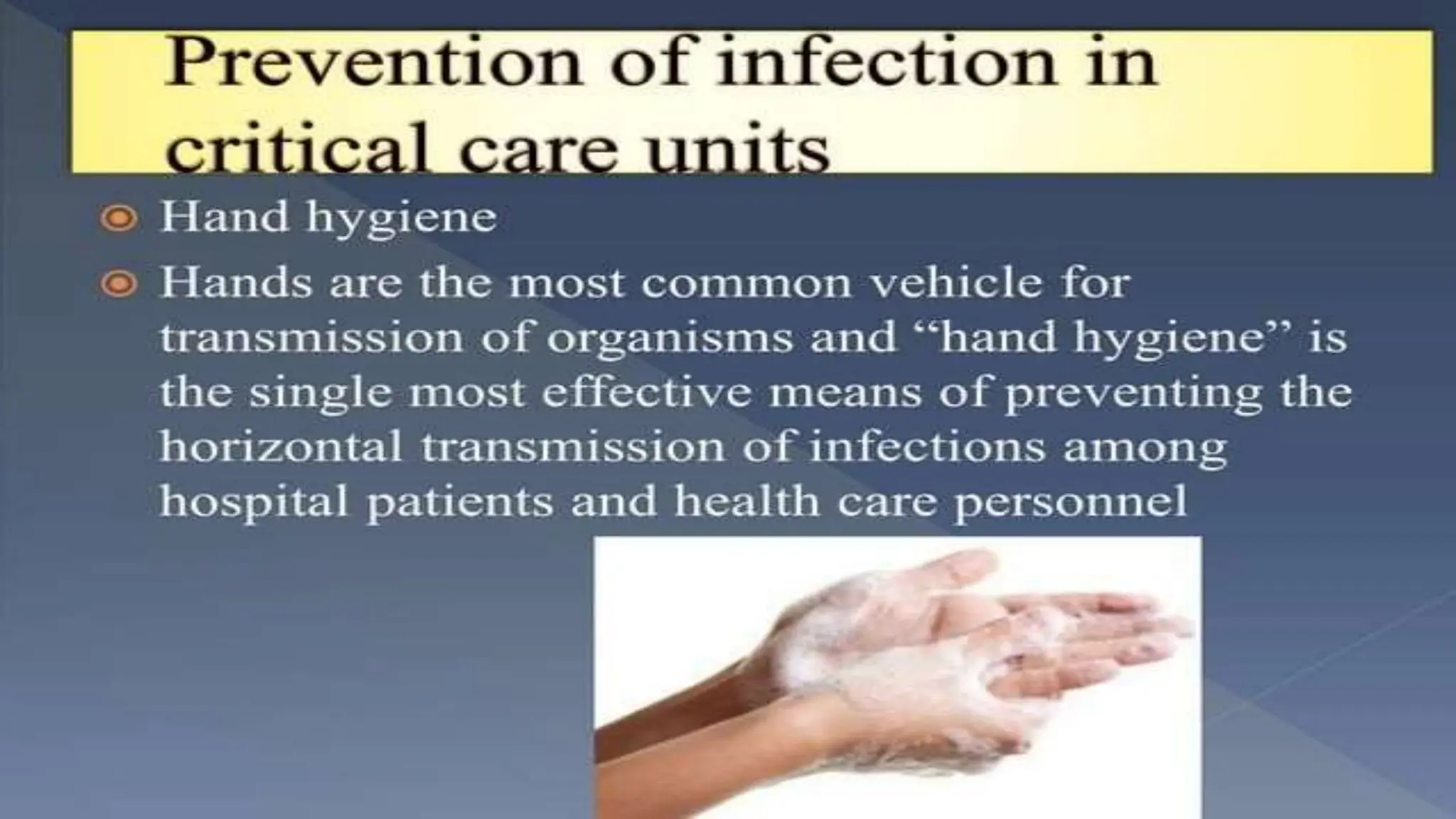
5.Prevention of Infection:
 Critically ill patients requiring intensive care are greater risk than other
patients due to the low immunity,stress,mechanical ventilator,
prolonged stay and severity of illness and environment of critical care
unit.
6.Crisis Intervention and Stress Reduction:
 Bonds between nurses, patients and families are stronger during
hospitalization is very helpful in crisis intervention.
 As patient advocates nurses assist the patient fear and identify
patients and family problem and reduce the stress of patient and
family members.
ORGANIZATION AND PHYSICAL SET
UP OF CCU
1.DESIGN CONSIDERATION:
 Critical care unit is vital area in the hospital and organization of a critical care
unit is a strategically planned process.
 The bed strength , the types of patients and services intended to decide the ICU
needs in terms of floor space,equipment,monitors,manpower etc.
2.BED STRENGTH:
 In order to provide effective care the ICU should have 6 to 14 beds.
 The ICU with large number of beds has to be divided into 10-15 beds with
sufficient staffs, devoted medical register and intensive care specialist.
3.LOCATION:
 The CCU has to be ideally located in a separate area with easy accessibility to the
emergency department,operation room , radiology department , catheterization
lab and blood bank.
 The unit must have sufficient big lift, ramps and a wide corridor that can be
facilitate smooth transfer in and out of the patients.
 The ICU should have a single entry and exit.
 There should be provision for emergency exits in case of disaster.
4.FLOOR SPACE:
 125 to 150 sq ft per patient is recommended. It may vary up to 250 per sq ft.
 The floor space for a separate room should be much higher at least 300 ft per
patient.
 The bed space between two beds should be 4-4.5 sq ft.
 The beds are separated with a removable partition.
 The head end should have enough space for easy patient access for intubation or
resuscitation.
 Two bigger rooms or two separate rooms should be available for patients
requiring isolation precaution or for the immune compromised patients.
 Extra space is recommended for other than patient care area for nurses station,
storage space and free patient movement.
5.OTHER FACILITIS:
 An ICU should have storage space for ventilators , monitors , infusion pumps ,
room for doctor office , nurse office ,toilets.
 Facility should be provided for medical storage (gloves , medicines , airways ,
suction tips , catheters , etc)
 Other facility to be provided are: medicine preparation area , equipment
storage area , clean linen storage
 An ideal ICU should have a clear cut zoning with patient care areas , dirty utility
and toilet in other areas.
 For movement of dirty utility there should be a separate pathway.
 There may be provision of RO purified water access within ICU.
 There should be a minimum of two to three oxygen outlets , two to three
vacuum outlets and on etc three compressed air outlets.
 There should be sufficient natural lighting available.
 Hand washing facility should be easily accessible. isolation ICU should have
separate hand washing facility.
6.NURSING STATION:
 There should be a central nurses station with tele monitoring devices.
 This will enable monitoring of patients placed ideally in “C” or “L” shape.
7.ENVIRONMENTAL CRITERIA:
 The ICU should be fully air conditioned with control of humidity and moisture.
 12 air exchanges and 55% to 60% humidity are recommended.
POLICIES FOR ICU
What is policy?
 A policy is a statement verbal , written or implied of those
principles and rules that are set by Board of Directors as
guidelines on organizations actions.
 There should be written polices for the intensive care units or
critical care units which will guide the personnel working
there.
 The policies making body, there should be representation
from administrative team , medical team and the nursing
team.
Types of policies in ICU:
1. Admission policies
2. Discharge policies
3. Transfer of patients from ICU to other units
4. Medical consultation
5. Policy for protocols for administration of drugs , equipments and procedures
6. Policy for managing the emergency situation
7. Infection control policies
8. Maintains of records policies
9. Payments policies
10. Visiting policies
STAFFING NORMS OF ICU
 Large hospital requires bigger team.
Medical staff
 Carrier intensivists are the best senior medical Staff to be appointed to
the ICU.
 He/she will be the director.
 Less preferred are other specialists viz. From Anaesthesia, medicine
and chest who have clinical Commitment elsewhere.
 Junior staff are intensive care trainees and trainees on deputation
from other disciplines.
NURSING STAFF
 The major teaching tertiary care ICU will require trained nurses in critical
care.
 It may be ideal to have an in house training programme for critical Care
nursing.
 The number of nurses ideally required for such units is 1:1 ratio.
 In complex situations they may require two nurses per patient.
 The number of trained nurses should be also worked out by the type of
ICU, the workload and work statistics and type of patient load.
UNIT DIRECTOR
Specific requirements for the unit director include the following:
 Training, interest, and time availability to give clinical, administrative,
and educational direction to the ICU.
 Board certification in critical care medicine.
 Time and commitment to maintain active and regular involvement in
the care of patients in the unit.
 Availability to the unit 24 hrs a day, 7 days a week for both clinical and
administrative matters.
 Active involvement in local and/or national critical care societies.
 Participation in continuing education programs in the field of critical
care medicine.
 Active involvement as an advisor and participant in organizing care of
the critically ill patient in the community as a whole.
 Active participation in the education of unit staff.
 Active participation in the review of the appropriate use of ICU
resources in the hospital.
NURSE MANAGER
 An RN (registered nurse) with a BSN (bachelor of science in nursing) or
preferably an MSN (master of science in nursing) degree
 Certification in critical care or equivalent graduate education
 At least 2 yrs experience working in a critical care unit.
 Experience with health information systems, quality improvement/risk
management activities, and healthcare economics.
 Ability to ensure that critical care nursing practice meets appropriate
standards .
 Preparation to participate in the on-site education of critical care unit
nursing staff
 Ability to foster a cooperative atmosphere with regard to the training
of nurses, physicians, pharmacists, respiratory therapists, and other
personnel involved in the care of critical care unit patients
 Regular participation in ongoing continuing nursing education
 Knowledge about current advances in the field of critical care nursing
 Participation in strategic planning and bed side efforts of patients
PROTOCOLS OF ICU
1. Each nurse will be responsible for the entire care of his/her patient and acts to
coordinate care with other health team professionals.
2. The staff nurse will report any changes in his/her patient’s condition directly to
the physician.
3. All critical care patients will have continual ECG monitoring.
4. All critical care patients will have mouth care done every four hours with
inspection for oral skin sores.
5. The critical care nurse may restrain the patients at that time documentation
done according to hospital policies and procedures.
6. All dressings unless otherwise indicated will be changed daily.
7. The environment will be maintained in a mechanically safe
condition through: dry floors, good repair of furniture, proper
placement of machines and equipment , cleanliness, freedom
from clutter and good repair of equipment.
8. Isolation technique will be followed as per infection control
manual.
9. Any containers of body fluids must be disposed in the appropriate
biohazard bag or box.
10. Respiratory orders may only be carried out when written by the
patient’s physician. ventilator changes will only be done upon
receipt of written order.
EQUIPMENT AND SUPPLIES
 Equipment numbers ,types and supplies are decided based on the standards of
the country and the type of services provided.
 There should be functional systems in place to ensure the safe and accurate
functioning of the machines and equipments.
 BASIC EQUIPMENT REQUIREMENT:
 The basic requirement needed to organize a ICU is as follows:
1. Ventilator
2. Multichannel monitor
3. Defibrillators and pace makers
4. Infusion pumps/syringe pumps (4-8 per bed)
5. Fluid & bed warmers
6. Portable transfer monitor
7. Specialized beds
8. Bedside trolleys, drug cart and emergency cart
9. Patient lifting devices
10. Portable X ray machine
SPECIAL EQUIPMENTS
1.VENTILATOR:
 The ventilator has different settings and it is
adjusted according to the needs of a patient.
 Sometimes the patient is taking their own
breaths and we support these or sometimes
we need to set the ventilator to give them
each breath.
 If the patient has respiratory muscle weakness
and damage their lungs from an infection or
trauma that time need to ventilator.
2.CARDIAC MONITOR:
 This machine is at the head of the bed and looks like a TV with all
different colors and it is connected to the patient using wires and
stickers.
 This shows the nurses and doctors constant information about
many things such as heart rate, blood pressure and breathing.
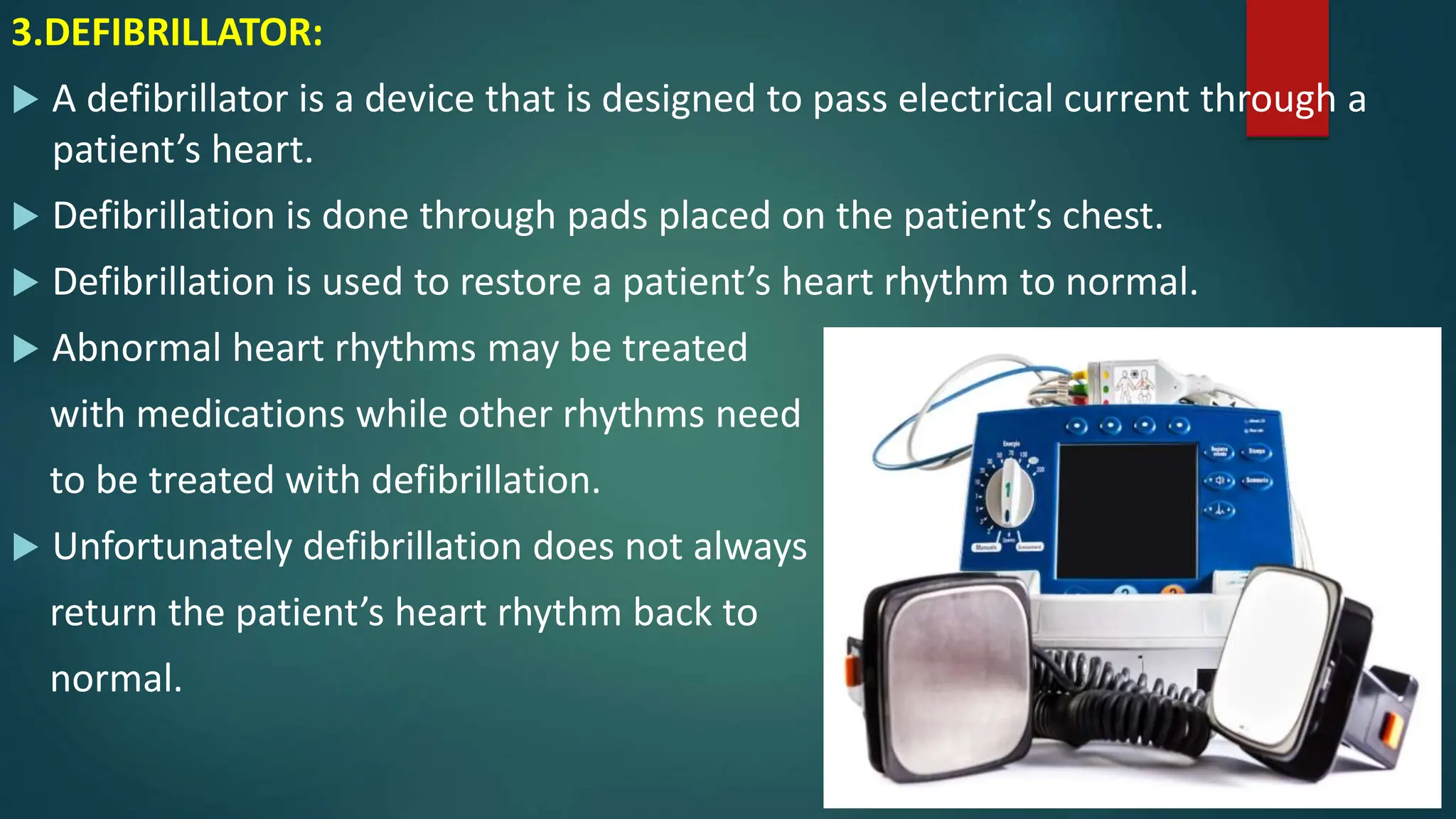
3.DEFIBRILLATOR:
 A defibrillator is a device that is designed to pass electrical current through a
patient’s heart.
 Defibrillation is done through pads placed on the patient’s chest.
 Defibrillation is used to restore a patient’s heart rhythm to normal.
 Abnormal heart rhythms may be treated
with medications while other rhythms need
to be treated with defibrillation.
 Unfortunately defibrillation does not always
return the patient’s heart rhythm back to
normal.
4.RESUSCITATION EQUIPMENTS:
 Following are the resuscitation equipments:
1. AMBU Bag
2. Laryngoscope
3. Tracheostomy tubes
4. Endotracheal tube
5. Ventilator
6. Defibrillator
7. Oxygen delivery devices
INFECTION CONTROL
PROTOCOLS
MONITORING OF CRITICALLY ILL
PATIENT
1. TEMPERATURE MONITORING
2. CARDIOVASCULAR SYSTEM MONITORING
 Heart rate monitoring
 Heart rhythm
 Electrocardiographic monitoring (ECG)
 Capillary refill time
 Pulse oximetry
 Central venous pressure monitoring
 Arterial blood pressure monitoring
3. RESPIRATORY SYSTEM MONITORING
 Breathing rate
 Auscultation
 Mucous membrane color
 Blood Gas Analysis
4. CENTRAL NERVOUS SYSTEM MONITORING
 Consciousness level
 Posture
 Pupil size
 Breathing Patterns
 Intracranial Pressure Monitoring
 Electroencephalogram(EEG)
5. RENAL SYSTEM MONITORING
 Urine output
 Plasma and Urine Electrolytes, Urea and Creatinine
6. LIVER FUNCTION MONITORING
7. HAEMATOLOGICAL MONITORING
 Blood Test
 Hemoglobin concentration monitoring
TREATMENTS AND PROCEDURES
APPLIED IN ICU
 Following treatments are applied in ICU:
1. Taking regular vital signs and blood test.
2. Changing the patient’s treatment in line with the test results.
3. Giving the patient drugs and fluids that doctor have prescribed.
4. Recording the patient’s BP,Pulse rate and Oxygen level.
5. Clearing fluid and mucus from the patient’s chest using a suction
tube.
6. Turning the patient in his or her bed every few hours to prevent sore
on the skin.
7. Cleaning the patient’s teeth and moistening the mouth with a wet
sponge.
8. Changing the bed sheets.
9. Changing a patient’s surgical stockings, which help circulation when
he or she is inactive for a long time.
10.Putting drops in the patient’s eyes to make it easier to blink.
 Following procedures are applied in ICU:
1. Endotracheal Intubation
2. Gastrointestinal Intubation
3. Peripheral Venous Catheterization
4. Central Venous Catheterization
5. Urinary Catheterization
6. Lumber puncture
7. Mechanical Ventilator
8. Defibrillator
9. Electrocardiography
10.tracheostomy
TRANSITIONAL CARE
 Transitional care is a broad term that encompasses a variety of
intermediate care services, including sub acute, skilled and
rehabilitative care services.
 Transitional care bridges the gap between hospital and home for
patients with complex or multiple problems.
 The term refers to the movement patients make between health care
practitioners and settings as their condition and care needs change
during the course of chronic or acute illness.
 According to American Geriatrics Society Transitional Care is defined
as a set of actions designed to ensure the coordination and continuity
of health care as patients transfer between different locations or
different levels of care within the same location. Representative
locations include hospitals, sub-acute and post-acute nursing facilities
,the patient’s home, primary and specialty care officers and long term
care facilities.
Transitional Care Model
 Elements of Transitional Care Model:
1. The transitional care nurse (TCN) is a master’s prepared nurse with advance
knowledge and skills in the care of this population as the primary coordinator of
care to assure continuity throughout acute episodes of care.
2. In hospital assessment ,collaboration with team members to reduce adverse
events and prevent functional decline and preparation and development of a
streamlined evidence based plan of care.
3. Regular home visits by the TCN with available ongoing telephone support
through an average of two months post discharge.
4. Continuity of medical care between hospital and primary care providers
facilitated by the TCN to the patients to first follow up visit.
5. Active engagement of patients and family caregivers with focus on meeting
their goals.
6. Multidisciplinary approach.
ETHICAL AND LEGAL ASPECTS
 Ethics is the branch of philosophy that examines the difference
between right and wrong.
 It is a study of good character, conduct, motives.
 Ethics in critical care is based on four fundamental principles:
1. The Physician’s obligation to provide treatment for the patients
2. The duty to avoid harm
3. Respect for patient’s right to self determination
4. Justifiable allocation of health care resources
 Ethical Principles:
 Autonomy :- Respect for individual’s right to self determination
 Non maleficence :- obligation to do or cause no harm to another
 Beneficence :- Duty to do good to others and to maintain balance
between benefits and harms
 Justice :- Equitable distribution of potential benefits and risks
 Veracity :- Truthfulness, Obligation to tell the truth
 Fidelity :- Faithfulness, Duty to do what one has promised
 Ethical and legal issues in intensive care:
1. Informed Consent: A process in which patient and their family members are
given important information and take consult including possible risks and
benefits about a medical procedure or treatment .
2. Decision –Making Capability: Capability describes a person’s ability to make a
decision. The person who are capable for any type of decision making.
3. Advance Directives: Advance Directives are legal documents that extend a
person’s control over health care decisions in the event that the person
becomes incapacitated.
 Living Will: Is a document prescribing a person’s wishes regarding the medical
treatment the person would want if he/she was unable to share his/her wishes
with the health care provider.
 Durable Power of Attorney: A type of power of attorney is a legal document that
gives one person (such as a relatives, lawyer or friend) the authority to make
legal, medical or financial decisions for another person.
4. Good Samaritan Acts: This act allows a person without expectation of payment
or reward and without any duty of care or special relationship, voluntarily come
forward to administer immediate assistance or emergency care to a person
injured in an accident or crash or emergency medical condition.
5. Do-Not-Resuscitate Orders: Is a medical order written by a doctor. It instructs
health care providers not to do cardiopulmonary resuscitation(CPR) if a
patient’s breathing stops or if the patient’s heart stops beating.
6. Withholding or Withdrawing Life –Sustaining Medical Treatment: Is an
accepted and common part of medical practice. It will be lawful provided any
necessary consents are obtained. When life –sustaining treatment is withheld
or withdrawn the person is considered to have died naturally from their medical
condition or disease.
7. Active Euthanasia: Killing a patient by active means for example, injecting a
patient with a lethal dose of a drug.
8. Restraints: Restraints in a medical setting are devices that limit a patient’s
movement. Restraints can help keep a person from getting hurt or doing harm
to others , including their caregivers.
9. Abuse of Older Adult: elder abuse is a single or repeated act or lack of
appropriate action, occurring within any relationship where there is an
expectation of trust which causes harm or distress to an older person. This type
of violation includes physical , sexual , psychological and emotional abuse ,
financial and material abuse , neglect and serious loss of dignity and respect.
10. Preventing Harm: During a hospital stay that could have been potentially
prevented by implementing known evidence based practices.
COMMUNICATION WITH PATIENT AND
FAMILY
 To speak in a calm and clear manner
 Do not ask the patient questions that cannot be answered.
 To give a pointer to the patient when the not speak.
 Provide a small board for the patient to write on.
 To provide support and reassurance.
 Simple hand gestures may work as well such as a thumbs up= “good”
and thumbs down=“pain or need somethings”
 Remind the patient that this is just temporary and they are making
good progress.
 Orient the patient’s surroundings for example , date , time , day.
 To help the family member to take any type of decision making for
patient.
 To communicate with family members in proper manner and to
provide all information to the family members.
INTENSIVE CARE RECORDS
 Following records are maintain in intensive care unit:
1. Admission Records
2. Discharge Records
3. Patient’s Records
4. Daily Case Note Register
5. Emergency Drug Records
6. Inventory Records
7. Stock Register
8. Staff Duty Register
9. Record of Duty Register
10.Record of Emergency Equipment's
CRISIS INTERVENTION
 Crisis is an acute, time limited state of disequilibrium resulting from
situational, developmental or societal sources of stress.
 Crisis intervention is a short term helping process of assisting clients to
work through a crisis to its resolution and restore their precrisis level
of functioning.
 Goals:
 Relieve the acute symptoms of stress.
 Restore family members and clients to optimal precrisis level of
functioning.
 Establish connection between the family’s current stressful situation
and past experience.
 Initiate family’s development of new ways of perceiving, thinking,
feeling and adaptive coping responses for future use.
 This process includes the client and other members in the client’s
support group.
 Many professionals are included in crisis intervention: fields of
nursing, medicine, psychology, social work, etc.
 Person experiencing a crisis alone is more vulnerable to unsuccessful
negotiation than a person working through a crisis with help.
 Seven - stage of crisis intervention:
Stage 1: psychosocial and lethality assessment:
 The Crisis workers must conduct a swift but through bio psychological
assessment. This assessment should cover the client's environment
support and stressor , medical need and medication, current use of
drugs and alcohol and internal and external coping method and
resources. Assessing lethality, such as ingestion a poison or over dose
of medication. If no suicide attempt crisis worker should inquired
about client.
Stage 2 : Rapidly Establish Rapport
 Rapport is facilitated by the presence of counselor offered condition
such as genuineness, respect, and acceptance of the client. This is also
the stage in which the behavior of character. Most prominent include
good eye contact, flexibility, positive mental attitude.
Stage 3: Identify the major problems or crisis precipitants-
 It focus on the client's current problem, which are often the ones that
precipitated the crisis.
Stage 4: Deal with felling and emotions-
 The crisis worker strive to allow the client to express felling, to vent
and heal, and to explain her or his story about the crisis situation. The
crisis workers must eventually work challenging response into the
crisis.
Stage 5: Generate and explore alternatives-
 This stage can often be the most difficult to accomplish in Crisis
intervention. The client in crisis has probably worked enough felling to
re-established some emotional balance.
Stage 6: Implement an action plan
 An action plan can involve several element removing the means,
negotiating safety, future linkage, decrease anxiety & sleep loss
Stage 7: Follow - up
 Crisis workers should plan for a follow- up contact with the client after
initial intervention to ensure that the crisis is on its way to being
resolve post crisis. this post crisis evaluation of the client can include
spiritual, satisfaction & progress
DEATH & DYING- COPING WITH SUCH A
PATIENT
Criteria for death:
 The World medical assembly adopted the following guidelines to declare a
person to be dead:
 Total lack of response to external stimuli
 No muscular movement, especially breathing
 No reflexes
 Flat encephalogram (brain waves).
 In case of artificial support, absence of brain waves for at least 24 hours is an
indication of death.
Signs of dying:
 Denial
 Guilt
 Anger
 Despair
 Feeling of worthlessness
 Crying
 Inability to concentrate
 Thoughts of suicide, delusions and hallucinations
 Increased pulse and respirations
 Anorexia
 Dry mouth
 Insomnia
 Nightmares
 Apathy
NURSING MANAGEMENT:
 Assessment: The state of awareness shared by the dying person and family
members affects the nurse’s ability to communicate freely with the client.
 Closed awareness: The client is not made aware of impending death.
 Mutual Pretense: The client, family and health personnel know that the
prognosis is terminal but avoid talking about that.
 Open awareness: The client and other members know about the impending
death and feel comfortable discussing it.
 Nursing Diagnosis:
 Diagnosis related to fear, hopelessness and powerlessness are usually associated
with dying.
 Planning:
 Major goals:
 Maintaining physiologic and psychologic comfort.
 Achieving a dignified and peaceful death.
 Implementation
 Helping clients to die with dignity
 Hospice and palliative care
 Meeting physiologic needs of the client
 Providing spiritual support
 Supporting the family
 Postmortem Care
DRUGS USED IN CRITICAL CARE UNIT
CARDIOVASCULAR DRUGS
1. Inotropes Agents:
 Noradrenaline
 Adrenaline
 Dobutamine
 Dopamine
2. Vasopressor Agents:
 Vasopressin
 Ephedrine
3. Antihypertensive Agents:
 Glyceryl trinitrate (GTN)
 Sodium nitroprusside
 Amlodipine
 Mgso4
4. Antiarrhythmics Agents:
 Digoxin
 Metoprolol
5. Thrombolytics Agents:
 Streptokinase
 Alteplase
 Reteplase
6. Antiplatelet Agents:
 Aspirin
 Plavix
RESPIRATORY DRUGS
Bronchodilators:
 Salbutamol(nebulized)
 Salbutamol (IV)
 Hydrocortisone
 Theophylline
SEDATIVE AND ANALGESIC DRUGS
 Propofol
 Morphine
 Diazepam
 Haloperidol
MUSCLE RELAXANTS AGENTS
 Methocarbamol
 Benzodiazepines
 Baclofen
ANTICOAGULANT DRUGS
 Heparin ( infusion)
 Heparin (sub cutaneous)
 Warfarin
DIURETICS AGENTS
 Furosemide
 Spironolactone
 Mannitol
GASTROINTESTINAL DRUGS
 Ondansetron
 Pantoprazole
 Ranitidine
 Erythromycin
ANTIBIOTICS
 Penicillin
 Amoxicillin
 Azithromycin
 Ciprofloxacin
 Levofloxacin
 Gentamycin
UNIT-9 NURSING MANAGEMENT OF PATIENT IN CRITICAL CARE.pptx

UNIT-9 NURSING MANAGEMENT OF PATIENT IN CRITICAL CARE.pptx

  • 1.
    UNIT-9 NURSING MANAGEMENTOF PATIENT IN CRITICAL CARE UNITS PREPARED BY: Mr. Nirmal Vaghela, Nursing Tutor, DPCN, Nadiad
  • 2.
    NURSING ASSESSMENT  Nursingassessment is the gathering of information about a patient`s physiological,psychological,sociological and spiritual status.  Assessment is the first stage of the nursing process in which the nurse should carry out a complete and holistic nursing assessment of every patient`s needs, regardless of the reason for the encounter.  The purpose of this stage is to identify the patient`s nursing problems.  These problems are expressed as either actual or potential. COMPONENTS OF NURSING ASSESSMENT: 1. Nursing History 2. Physical examination
  • 3.
    CLASSIFICATION OF CRITICALCARE UNITS  Critical care units may be classified into three levels depending on the staffing and support facilities of the hospital.  A three level classification consist of-  Level 1: This can be referred as high dependency is where close monitoring ,resuscitation and short term ventilation<24hrs has to be performed.
  • 4.
     Level 2:This can be located in general hospital, undertake more prolonged ventilation. Must have, resident doctors,nurses,access to pathology, radiology,etc.  Level 3: located in a major tertiary hospital, which is a referral hospital. It should provide all aspects of intensive care required.
  • 5.
    PRINCIPLES OF CRITICALCARE NURSING  There are following principles of critical care nursing: 1. Anticipation:  The first principle in critical care is anticipation.  One has to recognize the high risk patients and anticipate the requirement, complication and prepared to meet any emergency.  Unit properly organized which all necessary equipment and supplies are mendatory for smooth running of the unit. 2.Early Detection and Prompt Action:  The prognosis of the patient depends on the early detection of variation,promote and appropriate action to prevent complications.
  • 6.
    3.Collaborative Practice:  Collaborativepractice between physician and nurses working in the critical care unit fosters a partnerships for decision making and provide quality care.  Collaborative practice is more and more important principle in critical care unit. 4.Communication:  Intraprofessional,interdepartmental and interpersonal communication has significant importance in the smooth running of unit.
  • 7.
    5.Prevention of Infection: Critically ill patients requiring intensive care are greater risk than other patients due to the low immunity,stress,mechanical ventilator, prolonged stay and severity of illness and environment of critical care unit. 6.Crisis Intervention and Stress Reduction:  Bonds between nurses, patients and families are stronger during hospitalization is very helpful in crisis intervention.  As patient advocates nurses assist the patient fear and identify patients and family problem and reduce the stress of patient and family members.
  • 8.
    ORGANIZATION AND PHYSICALSET UP OF CCU 1.DESIGN CONSIDERATION:  Critical care unit is vital area in the hospital and organization of a critical care unit is a strategically planned process.  The bed strength , the types of patients and services intended to decide the ICU needs in terms of floor space,equipment,monitors,manpower etc. 2.BED STRENGTH:  In order to provide effective care the ICU should have 6 to 14 beds.  The ICU with large number of beds has to be divided into 10-15 beds with sufficient staffs, devoted medical register and intensive care specialist.
  • 9.
    3.LOCATION:  The CCUhas to be ideally located in a separate area with easy accessibility to the emergency department,operation room , radiology department , catheterization lab and blood bank.  The unit must have sufficient big lift, ramps and a wide corridor that can be facilitate smooth transfer in and out of the patients.  The ICU should have a single entry and exit.  There should be provision for emergency exits in case of disaster. 4.FLOOR SPACE:  125 to 150 sq ft per patient is recommended. It may vary up to 250 per sq ft.  The floor space for a separate room should be much higher at least 300 ft per patient.  The bed space between two beds should be 4-4.5 sq ft.
  • 10.
     The bedsare separated with a removable partition.  The head end should have enough space for easy patient access for intubation or resuscitation.  Two bigger rooms or two separate rooms should be available for patients requiring isolation precaution or for the immune compromised patients.  Extra space is recommended for other than patient care area for nurses station, storage space and free patient movement. 5.OTHER FACILITIS:  An ICU should have storage space for ventilators , monitors , infusion pumps , room for doctor office , nurse office ,toilets.  Facility should be provided for medical storage (gloves , medicines , airways , suction tips , catheters , etc)
  • 11.
     Other facilityto be provided are: medicine preparation area , equipment storage area , clean linen storage  An ideal ICU should have a clear cut zoning with patient care areas , dirty utility and toilet in other areas.  For movement of dirty utility there should be a separate pathway.  There may be provision of RO purified water access within ICU.  There should be a minimum of two to three oxygen outlets , two to three vacuum outlets and on etc three compressed air outlets.  There should be sufficient natural lighting available.  Hand washing facility should be easily accessible. isolation ICU should have separate hand washing facility.
  • 12.
    6.NURSING STATION:  Thereshould be a central nurses station with tele monitoring devices.  This will enable monitoring of patients placed ideally in “C” or “L” shape. 7.ENVIRONMENTAL CRITERIA:  The ICU should be fully air conditioned with control of humidity and moisture.  12 air exchanges and 55% to 60% humidity are recommended.
  • 13.
    POLICIES FOR ICU Whatis policy?  A policy is a statement verbal , written or implied of those principles and rules that are set by Board of Directors as guidelines on organizations actions.  There should be written polices for the intensive care units or critical care units which will guide the personnel working there.  The policies making body, there should be representation from administrative team , medical team and the nursing team.
  • 14.
    Types of policiesin ICU: 1. Admission policies 2. Discharge policies 3. Transfer of patients from ICU to other units 4. Medical consultation 5. Policy for protocols for administration of drugs , equipments and procedures 6. Policy for managing the emergency situation 7. Infection control policies 8. Maintains of records policies 9. Payments policies 10. Visiting policies
  • 15.
    STAFFING NORMS OFICU  Large hospital requires bigger team. Medical staff  Carrier intensivists are the best senior medical Staff to be appointed to the ICU.  He/she will be the director.  Less preferred are other specialists viz. From Anaesthesia, medicine and chest who have clinical Commitment elsewhere.  Junior staff are intensive care trainees and trainees on deputation from other disciplines.
  • 16.
    NURSING STAFF  Themajor teaching tertiary care ICU will require trained nurses in critical care.  It may be ideal to have an in house training programme for critical Care nursing.  The number of nurses ideally required for such units is 1:1 ratio.  In complex situations they may require two nurses per patient.  The number of trained nurses should be also worked out by the type of ICU, the workload and work statistics and type of patient load.
  • 17.
    UNIT DIRECTOR Specific requirementsfor the unit director include the following:  Training, interest, and time availability to give clinical, administrative, and educational direction to the ICU.  Board certification in critical care medicine.  Time and commitment to maintain active and regular involvement in the care of patients in the unit.  Availability to the unit 24 hrs a day, 7 days a week for both clinical and administrative matters.
  • 18.
     Active involvementin local and/or national critical care societies.  Participation in continuing education programs in the field of critical care medicine.  Active involvement as an advisor and participant in organizing care of the critically ill patient in the community as a whole.  Active participation in the education of unit staff.  Active participation in the review of the appropriate use of ICU resources in the hospital.
  • 19.
    NURSE MANAGER  AnRN (registered nurse) with a BSN (bachelor of science in nursing) or preferably an MSN (master of science in nursing) degree  Certification in critical care or equivalent graduate education  At least 2 yrs experience working in a critical care unit.  Experience with health information systems, quality improvement/risk management activities, and healthcare economics.  Ability to ensure that critical care nursing practice meets appropriate standards .  Preparation to participate in the on-site education of critical care unit nursing staff
  • 20.
     Ability tofoster a cooperative atmosphere with regard to the training of nurses, physicians, pharmacists, respiratory therapists, and other personnel involved in the care of critical care unit patients  Regular participation in ongoing continuing nursing education  Knowledge about current advances in the field of critical care nursing  Participation in strategic planning and bed side efforts of patients
  • 21.
    PROTOCOLS OF ICU 1.Each nurse will be responsible for the entire care of his/her patient and acts to coordinate care with other health team professionals. 2. The staff nurse will report any changes in his/her patient’s condition directly to the physician. 3. All critical care patients will have continual ECG monitoring. 4. All critical care patients will have mouth care done every four hours with inspection for oral skin sores. 5. The critical care nurse may restrain the patients at that time documentation done according to hospital policies and procedures. 6. All dressings unless otherwise indicated will be changed daily.
  • 22.
    7. The environmentwill be maintained in a mechanically safe condition through: dry floors, good repair of furniture, proper placement of machines and equipment , cleanliness, freedom from clutter and good repair of equipment. 8. Isolation technique will be followed as per infection control manual. 9. Any containers of body fluids must be disposed in the appropriate biohazard bag or box. 10. Respiratory orders may only be carried out when written by the patient’s physician. ventilator changes will only be done upon receipt of written order.
  • 23.
    EQUIPMENT AND SUPPLIES Equipment numbers ,types and supplies are decided based on the standards of the country and the type of services provided.  There should be functional systems in place to ensure the safe and accurate functioning of the machines and equipments.  BASIC EQUIPMENT REQUIREMENT:  The basic requirement needed to organize a ICU is as follows: 1. Ventilator 2. Multichannel monitor 3. Defibrillators and pace makers 4. Infusion pumps/syringe pumps (4-8 per bed)
  • 24.
    5. Fluid &bed warmers 6. Portable transfer monitor 7. Specialized beds 8. Bedside trolleys, drug cart and emergency cart 9. Patient lifting devices 10. Portable X ray machine
  • 25.
    SPECIAL EQUIPMENTS 1.VENTILATOR:  Theventilator has different settings and it is adjusted according to the needs of a patient.  Sometimes the patient is taking their own breaths and we support these or sometimes we need to set the ventilator to give them each breath.  If the patient has respiratory muscle weakness and damage their lungs from an infection or trauma that time need to ventilator.
  • 26.
    2.CARDIAC MONITOR:  Thismachine is at the head of the bed and looks like a TV with all different colors and it is connected to the patient using wires and stickers.  This shows the nurses and doctors constant information about many things such as heart rate, blood pressure and breathing.
  • 27.
    3.DEFIBRILLATOR:  A defibrillatoris a device that is designed to pass electrical current through a patient’s heart.  Defibrillation is done through pads placed on the patient’s chest.  Defibrillation is used to restore a patient’s heart rhythm to normal.  Abnormal heart rhythms may be treated with medications while other rhythms need to be treated with defibrillation.  Unfortunately defibrillation does not always return the patient’s heart rhythm back to normal.
  • 28.
    4.RESUSCITATION EQUIPMENTS:  Followingare the resuscitation equipments: 1. AMBU Bag 2. Laryngoscope 3. Tracheostomy tubes 4. Endotracheal tube 5. Ventilator 6. Defibrillator 7. Oxygen delivery devices
  • 29.
  • 49.
    MONITORING OF CRITICALLYILL PATIENT 1. TEMPERATURE MONITORING 2. CARDIOVASCULAR SYSTEM MONITORING  Heart rate monitoring  Heart rhythm  Electrocardiographic monitoring (ECG)  Capillary refill time  Pulse oximetry  Central venous pressure monitoring  Arterial blood pressure monitoring
  • 50.
    3. RESPIRATORY SYSTEMMONITORING  Breathing rate  Auscultation  Mucous membrane color  Blood Gas Analysis 4. CENTRAL NERVOUS SYSTEM MONITORING  Consciousness level  Posture  Pupil size  Breathing Patterns  Intracranial Pressure Monitoring  Electroencephalogram(EEG)
  • 51.
    5. RENAL SYSTEMMONITORING  Urine output  Plasma and Urine Electrolytes, Urea and Creatinine 6. LIVER FUNCTION MONITORING 7. HAEMATOLOGICAL MONITORING  Blood Test  Hemoglobin concentration monitoring
  • 52.
    TREATMENTS AND PROCEDURES APPLIEDIN ICU  Following treatments are applied in ICU: 1. Taking regular vital signs and blood test. 2. Changing the patient’s treatment in line with the test results. 3. Giving the patient drugs and fluids that doctor have prescribed. 4. Recording the patient’s BP,Pulse rate and Oxygen level. 5. Clearing fluid and mucus from the patient’s chest using a suction tube.
  • 53.
    6. Turning thepatient in his or her bed every few hours to prevent sore on the skin. 7. Cleaning the patient’s teeth and moistening the mouth with a wet sponge. 8. Changing the bed sheets. 9. Changing a patient’s surgical stockings, which help circulation when he or she is inactive for a long time. 10.Putting drops in the patient’s eyes to make it easier to blink.
  • 54.
     Following proceduresare applied in ICU: 1. Endotracheal Intubation 2. Gastrointestinal Intubation 3. Peripheral Venous Catheterization 4. Central Venous Catheterization 5. Urinary Catheterization 6. Lumber puncture 7. Mechanical Ventilator 8. Defibrillator 9. Electrocardiography 10.tracheostomy
  • 55.
    TRANSITIONAL CARE  Transitionalcare is a broad term that encompasses a variety of intermediate care services, including sub acute, skilled and rehabilitative care services.  Transitional care bridges the gap between hospital and home for patients with complex or multiple problems.  The term refers to the movement patients make between health care practitioners and settings as their condition and care needs change during the course of chronic or acute illness.
  • 56.
     According toAmerican Geriatrics Society Transitional Care is defined as a set of actions designed to ensure the coordination and continuity of health care as patients transfer between different locations or different levels of care within the same location. Representative locations include hospitals, sub-acute and post-acute nursing facilities ,the patient’s home, primary and specialty care officers and long term care facilities.
  • 57.
  • 58.
     Elements ofTransitional Care Model: 1. The transitional care nurse (TCN) is a master’s prepared nurse with advance knowledge and skills in the care of this population as the primary coordinator of care to assure continuity throughout acute episodes of care. 2. In hospital assessment ,collaboration with team members to reduce adverse events and prevent functional decline and preparation and development of a streamlined evidence based plan of care. 3. Regular home visits by the TCN with available ongoing telephone support through an average of two months post discharge. 4. Continuity of medical care between hospital and primary care providers facilitated by the TCN to the patients to first follow up visit. 5. Active engagement of patients and family caregivers with focus on meeting their goals. 6. Multidisciplinary approach.
  • 59.
    ETHICAL AND LEGALASPECTS  Ethics is the branch of philosophy that examines the difference between right and wrong.  It is a study of good character, conduct, motives.  Ethics in critical care is based on four fundamental principles: 1. The Physician’s obligation to provide treatment for the patients 2. The duty to avoid harm 3. Respect for patient’s right to self determination 4. Justifiable allocation of health care resources
  • 60.
     Ethical Principles: Autonomy :- Respect for individual’s right to self determination  Non maleficence :- obligation to do or cause no harm to another  Beneficence :- Duty to do good to others and to maintain balance between benefits and harms  Justice :- Equitable distribution of potential benefits and risks  Veracity :- Truthfulness, Obligation to tell the truth  Fidelity :- Faithfulness, Duty to do what one has promised
  • 61.
     Ethical andlegal issues in intensive care: 1. Informed Consent: A process in which patient and their family members are given important information and take consult including possible risks and benefits about a medical procedure or treatment . 2. Decision –Making Capability: Capability describes a person’s ability to make a decision. The person who are capable for any type of decision making. 3. Advance Directives: Advance Directives are legal documents that extend a person’s control over health care decisions in the event that the person becomes incapacitated.  Living Will: Is a document prescribing a person’s wishes regarding the medical treatment the person would want if he/she was unable to share his/her wishes with the health care provider.
  • 62.
     Durable Powerof Attorney: A type of power of attorney is a legal document that gives one person (such as a relatives, lawyer or friend) the authority to make legal, medical or financial decisions for another person. 4. Good Samaritan Acts: This act allows a person without expectation of payment or reward and without any duty of care or special relationship, voluntarily come forward to administer immediate assistance or emergency care to a person injured in an accident or crash or emergency medical condition. 5. Do-Not-Resuscitate Orders: Is a medical order written by a doctor. It instructs health care providers not to do cardiopulmonary resuscitation(CPR) if a patient’s breathing stops or if the patient’s heart stops beating. 6. Withholding or Withdrawing Life –Sustaining Medical Treatment: Is an accepted and common part of medical practice. It will be lawful provided any necessary consents are obtained. When life –sustaining treatment is withheld or withdrawn the person is considered to have died naturally from their medical condition or disease.
  • 63.
    7. Active Euthanasia:Killing a patient by active means for example, injecting a patient with a lethal dose of a drug. 8. Restraints: Restraints in a medical setting are devices that limit a patient’s movement. Restraints can help keep a person from getting hurt or doing harm to others , including their caregivers. 9. Abuse of Older Adult: elder abuse is a single or repeated act or lack of appropriate action, occurring within any relationship where there is an expectation of trust which causes harm or distress to an older person. This type of violation includes physical , sexual , psychological and emotional abuse , financial and material abuse , neglect and serious loss of dignity and respect. 10. Preventing Harm: During a hospital stay that could have been potentially prevented by implementing known evidence based practices.
  • 64.
    COMMUNICATION WITH PATIENTAND FAMILY  To speak in a calm and clear manner  Do not ask the patient questions that cannot be answered.  To give a pointer to the patient when the not speak.  Provide a small board for the patient to write on.  To provide support and reassurance.
  • 65.
     Simple handgestures may work as well such as a thumbs up= “good” and thumbs down=“pain or need somethings”  Remind the patient that this is just temporary and they are making good progress.  Orient the patient’s surroundings for example , date , time , day.  To help the family member to take any type of decision making for patient.  To communicate with family members in proper manner and to provide all information to the family members.
  • 66.
    INTENSIVE CARE RECORDS Following records are maintain in intensive care unit: 1. Admission Records 2. Discharge Records 3. Patient’s Records 4. Daily Case Note Register
  • 67.
    5. Emergency DrugRecords 6. Inventory Records 7. Stock Register 8. Staff Duty Register 9. Record of Duty Register 10.Record of Emergency Equipment's
  • 68.
    CRISIS INTERVENTION  Crisisis an acute, time limited state of disequilibrium resulting from situational, developmental or societal sources of stress.  Crisis intervention is a short term helping process of assisting clients to work through a crisis to its resolution and restore their precrisis level of functioning.  Goals:  Relieve the acute symptoms of stress.  Restore family members and clients to optimal precrisis level of functioning.
  • 69.
     Establish connectionbetween the family’s current stressful situation and past experience.  Initiate family’s development of new ways of perceiving, thinking, feeling and adaptive coping responses for future use.  This process includes the client and other members in the client’s support group.  Many professionals are included in crisis intervention: fields of nursing, medicine, psychology, social work, etc.  Person experiencing a crisis alone is more vulnerable to unsuccessful negotiation than a person working through a crisis with help.
  • 70.
     Seven -stage of crisis intervention: Stage 1: psychosocial and lethality assessment:  The Crisis workers must conduct a swift but through bio psychological assessment. This assessment should cover the client's environment support and stressor , medical need and medication, current use of drugs and alcohol and internal and external coping method and resources. Assessing lethality, such as ingestion a poison or over dose of medication. If no suicide attempt crisis worker should inquired about client.
  • 71.
    Stage 2 :Rapidly Establish Rapport  Rapport is facilitated by the presence of counselor offered condition such as genuineness, respect, and acceptance of the client. This is also the stage in which the behavior of character. Most prominent include good eye contact, flexibility, positive mental attitude. Stage 3: Identify the major problems or crisis precipitants-  It focus on the client's current problem, which are often the ones that precipitated the crisis.
  • 72.
    Stage 4: Dealwith felling and emotions-  The crisis worker strive to allow the client to express felling, to vent and heal, and to explain her or his story about the crisis situation. The crisis workers must eventually work challenging response into the crisis. Stage 5: Generate and explore alternatives-  This stage can often be the most difficult to accomplish in Crisis intervention. The client in crisis has probably worked enough felling to re-established some emotional balance.
  • 73.
    Stage 6: Implementan action plan  An action plan can involve several element removing the means, negotiating safety, future linkage, decrease anxiety & sleep loss Stage 7: Follow - up  Crisis workers should plan for a follow- up contact with the client after initial intervention to ensure that the crisis is on its way to being resolve post crisis. this post crisis evaluation of the client can include spiritual, satisfaction & progress
  • 74.
    DEATH & DYING-COPING WITH SUCH A PATIENT Criteria for death:  The World medical assembly adopted the following guidelines to declare a person to be dead:  Total lack of response to external stimuli  No muscular movement, especially breathing  No reflexes  Flat encephalogram (brain waves).  In case of artificial support, absence of brain waves for at least 24 hours is an indication of death.
  • 75.
    Signs of dying: Denial  Guilt  Anger  Despair  Feeling of worthlessness  Crying  Inability to concentrate  Thoughts of suicide, delusions and hallucinations
  • 76.
     Increased pulseand respirations  Anorexia  Dry mouth  Insomnia  Nightmares  Apathy
  • 77.
    NURSING MANAGEMENT:  Assessment:The state of awareness shared by the dying person and family members affects the nurse’s ability to communicate freely with the client.  Closed awareness: The client is not made aware of impending death.  Mutual Pretense: The client, family and health personnel know that the prognosis is terminal but avoid talking about that.  Open awareness: The client and other members know about the impending death and feel comfortable discussing it.  Nursing Diagnosis:  Diagnosis related to fear, hopelessness and powerlessness are usually associated with dying.
  • 78.
     Planning:  Majorgoals:  Maintaining physiologic and psychologic comfort.  Achieving a dignified and peaceful death.  Implementation  Helping clients to die with dignity  Hospice and palliative care  Meeting physiologic needs of the client  Providing spiritual support  Supporting the family  Postmortem Care
  • 79.
    DRUGS USED INCRITICAL CARE UNIT CARDIOVASCULAR DRUGS 1. Inotropes Agents:  Noradrenaline  Adrenaline  Dobutamine  Dopamine 2. Vasopressor Agents:  Vasopressin  Ephedrine
  • 80.
    3. Antihypertensive Agents: Glyceryl trinitrate (GTN)  Sodium nitroprusside  Amlodipine  Mgso4 4. Antiarrhythmics Agents:  Digoxin  Metoprolol
  • 81.
    5. Thrombolytics Agents: Streptokinase  Alteplase  Reteplase 6. Antiplatelet Agents:  Aspirin  Plavix
  • 82.
    RESPIRATORY DRUGS Bronchodilators:  Salbutamol(nebulized) Salbutamol (IV)  Hydrocortisone  Theophylline SEDATIVE AND ANALGESIC DRUGS  Propofol  Morphine  Diazepam  Haloperidol
  • 83.
    MUSCLE RELAXANTS AGENTS Methocarbamol  Benzodiazepines  Baclofen ANTICOAGULANT DRUGS  Heparin ( infusion)  Heparin (sub cutaneous)  Warfarin DIURETICS AGENTS  Furosemide  Spironolactone  Mannitol
  • 84.
    GASTROINTESTINAL DRUGS  Ondansetron Pantoprazole  Ranitidine  Erythromycin ANTIBIOTICS  Penicillin  Amoxicillin  Azithromycin  Ciprofloxacin  Levofloxacin  Gentamycin