Searching techniques
Searching :
     It is a process to find whether a particular value with specified properties is present or not
among a collection of items.
       If the value is present in the collection, then searching is said to be successful, and it
returns the location of the value in the array.
      Otherwise, if the value is not present in the array, the searching process displays the
appropriate message and in this case searching is said to be unsuccessful.
            1) Linear or Sequential Searching        2) Binary Searching

int main( ) {                                               Linear_Search (A[ ], N, val , pos )
   int arr [ 50 ] , num , i , n , pos = -1;                 Step 1 : Set pos = -1 and k = 0
   printf ("How many elements to sort : ");                 Step 2 : Repeat while k < N
   scanf ("%d", &n);                                                 Begin
   printf ("n Enter the elements : nn");                 Step 3 : if A[ k ] = val
   for( i = 0; i < n; i++ ) {                                             Set pos = k
      printf (“arr [%d ] : “ , i );                                       print pos
      scanf( "%d", &arr[ i ] );                                           Goto step 5
   }                                                                 End while
   printf(“nEnter the number to be searched : “);          Step 4 : print “Value is not present”
   scanf(“%d”,&num);                                        Step 5 : Exit
   for(i=0;i<n;i++)
      if( arr [ i ] == num ) {                              Searches
        pos = i ; break;                                    -- for each item one by one in the list from
    }                                                       the first, until the match is found.
   if ( pos == -1 ) printf(“ %d does not exist ”,num);      Efficiency of Linear search :
   else                                                     -- Executes in O ( n ) times where n is the
      printf(“ %d is found at location : %d”, num , pos);   number of elements in the list.
Binary Searching
  Algorithm:
  • Before searching, the list of items should be sorted in ascending order.
  • We first compare the key value with the item in the position of the array. If there is a match, we
  can return immediately the position.
  • if the value is less than the element in middle location of the array, the required value is lie in
  the lower half of the array.
  • if the value is greater than the element in middle location of the array, the required value is lie
  in the upper half of the array.
  • We repeat the above procedure on the lower half or upper half of the array.

Binary_Search (A [ ], U_bound, VAL)
Step 1 : set BEG = 0 , END = U_bound , POS = -1
Step 2 : Repeat while (BEG <= END )                    void binary_serch ( int a [], int n, int val ) {
Step 3 :     set MID = ( BEG + END ) / 2                  int end = n - 1, beg = 0, pos = -1;
Step 4 :     if A [ MID ] == VAL then                     while( beg <= end ) {
                POS = MID                                       mid = ( beg + end ) / 2;
                print VAL “ is available at “, POS              if ( val == a [ mid ] ) {
                GoTo Step 6                                        pos = mid;
              End if                                               printf(“%d is available at %d”,val, pos );
              if A [ MID ] > VAL then                              break;
                 set END = MID – 1                              }
               Else                                             if ( a [ mid ] > val ) end = mid – 1;
                 set BEG = MID + 1                              else beg = mid + 1;
               End if                                      }
          End while                                        if ( pos = - 1)
Step 5 : if POS = -1 then                                      printf( “%d does not exist “, val );
              print VAL “ is not present “             }
          End if
Step 6 : EXIT
Sorting
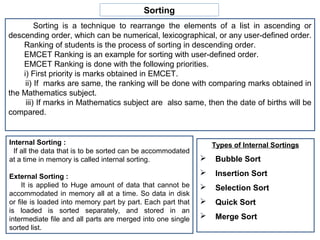
         Sorting is a technique to rearrange the elements of a list in ascending or
descending order, which can be numerical, lexicographical, or any user-defined order.
    Ranking of students is the process of sorting in descending order.
    EMCET Ranking is an example for sorting with user-defined order.
    EMCET Ranking is done with the following priorities.
    i) First priority is marks obtained in EMCET.
     ii) If marks are same, the ranking will be done with comparing marks obtained in
the Mathematics subject.
     iii) If marks in Mathematics subject are also same, then the date of births will be
compared.


Internal Sorting :                                               Types of Internal Sortings
  If all the data that is to be sorted can be accommodated
at a time in memory is called internal sorting.                  Bubble Sort

External Sorting :
                                                                 Insertion Sort
     It is applied to Huge amount of data that cannot be         Selection Sort
accommodated in memory all at a time. So data in disk
or file is loaded into memory part by part. Each part that       Quick Sort
is loaded is sorted separately, and stored in an
intermediate file and all parts are merged into one single       Merge Sort
sorted list.
Bubble Sort
                     Bubbles up the highest


                           Unsorted                               Sorted

                                                       Bubble_Sort ( A [ ] , N )
                                                       Step 1 : Repeat For P = 1 to N – 1
  10      54       54       54        54       54               Begin
                                                       Step 2 :    Repeat For J = 1 to N – P
  47      10       47       47        47       47                  Begin
                                                       Step 3 :      If ( A [ J ] < A [ J – 1 ] )
  12      47       10       23        23       23                        Swap ( A [ J ] , A [ J – 1 ] )
                                                                   End For
  54      12       23       10        19       19               End For
                                                       Step 4 : Exit
  19      23       12       19        10       12
                                                                Complexity of Bubble_Sort
  23      19       19       12        12       10        The complexity of sorting algorithm is
                                                       depends upon the number of comparisons
Original After    After     After    After     After   that are made.
  List   Pass 1   Pass 2   Pass 3   Pass 4    Pass 5   Total comparisons in Bubble sort is
                                                             n ( n – 1) / 2 ≈ n 2 – n
                                                           Complexity = O ( n 2 )
void print_array (int a[ ], int n) {
  int i;
  for (i=0;I < n ; i++) printf("%5d",a[ i ]);
                                                                  Bubble Sort
}
void bubble_sort ( int arr [ ], int n) {
   int pass, current, temp;
                                                              For pass = 1 to N - 1
   for ( pass=1;(pass < n) ;pass++) {
      for ( current=1;current <= n – pass ; current++) {
         if ( arr[ current - 1 ] > arr[ current ] ) {
                temp = arr[ current - 1 ];                    For J = 1 to N - pass
                arr[ current - 1 ] = arr[ current ];
                arr[ current ] = temp;
         }                                                                             T
                                                                A[J–1]>A[J]
      }
   }
}                                                                    F
int main() {                                                                  Temp = A [ J – 1 ]
   int count,num[50],i ;                                                      A[J–1]=A[J]
   printf ("How many elements to be sorted : ");                               A [ J ] = Temp
   scanf ("%d", &count);
   printf("n Enter the elements : nn");
   for ( i = 0; i < count; i++) {
      printf ("num [%d] : ", i ); scanf( "%d", &num[ i ] );
   }
   printf("n Array Before Sorting : nnn");
   print_array ( num, count );
                                                                     Return
   bubble_sort ( num, count);
   printf("nnn Array After Sorting : nnn");
   print_array ( num, count );
}
TEMP                                    Insertion Sort
                                                 Insertion_Sort ( A [ ] , N )
            78    23 45       8        32   36   Step 1 : Repeat For K = 1 to N – 1
23                                                        Begin
                                                 Step 2 :    Set Temp = A [ K ]
                                                 Step 3 :    Set J = K – 1
           23     78    45    8        32   36   Step 4 :    Repeat while Temp < A [ J ] AND J >= 0
45                                                           Begin
                                                                 Set A [ J + 1 ] = A [ J ]
                                                                 Set J = J - 1
            23    45    78    8        32   36               End While
                                                 Step 5 :    Set A [ J + 1 ] = Temp
 8
                                                          End For
                                                 Step 4 : Exit
            8     23    45    78       32   36
32                                               insertion_sort ( int A[ ] , int n ) {
                                                   int k , j , temp ;
            8     23    32    45       78   36     for ( k = 1 ; k < n ; k++ ) {
                                                       temp = A [ k ] ;
36                                                     j = k - 1;
                                                       while ( ( temp < A [ j ] ) && ( j >= 0 ) ) {
            8     23    32    36       45   78            A[j+1] =A[j];
                                                          j--;
        Complexity of Insertion Sort                   }
Best Case : O ( n )                                    A [ j + 1 ] = temp ;
Average Case : O ( n2 )                            }
Worst Case : O ( n2 )                            }
Smallest        Selection Sort ( Select the smallest and Exchange )
                                            Selection_Sort ( A [ ] , N )
  8        23   78 45       8     32   56   Step 1 : Repeat For K = 0 to N – 2
                                                     Begin
                                            Step 2 :   Set POS = K
                                            Step 3 :   Repeat for J = K + 1 to N – 1
 23        8    78    45    23    32   56              Begin
                                                           If A[ J ] < A [ POS ]
                                                                       Set POS = J

 32        8    23    45    78    32   56               End For
                                            Step 5 :    Swap A [ K ] with A [ POS ]
                                                     End For
                                            Step 6 : Exit
 45        8    23    32    78    45   56
                                            selection_sort ( int A[ ] , int n ) {
                                               int k , j , pos , temp ;
                                               for ( k = 0 ; k < n - 1 ; k++ ) {
 56        8    23    32    45    78   56         pos = k ;
                                                  for ( j = k + 1 ; j <= n ; j ++ ) {
                                                     if ( A [ j ] < A [ pos ] )
           8    23    32    45    56   78                   pos = j ;
                                                  }
                                                  temp = A [ k ] ;
        Complexity of Selection Sort              A [ k ] = A [ pos ] ;
Best Case : O ( n2 )
                                                  A [ pos ] = temp ;
Average Case : O ( n2 )                       }
Worst Case : O ( n2 )                       }
Selection sort
      Insertion sort


                           k = 0; k < n - 1 ; k++
   k = 1; k < n ; k++

                                pos = k
    temp = a [ k ]
       j=k-1
                           j = k + 1 ; j < n ; j++


temp < a [ j ] && j >= 0
                            a[ j ] < a[ pos ]

  a[j+1]=a[j]                                        pos = j
     j=j-1


  a [ j + 1 ] = temp         temp = a[ k ]
                           a [ k ] = a [ pos ]
                           a [ pos ] = temp
         return

                                  return
Bubble sort – Insertion sort – Selection sort

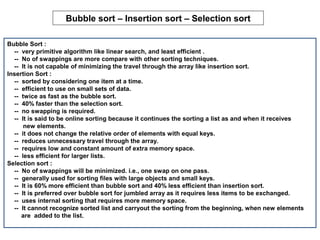
Bubble Sort :
  -- very primitive algorithm like linear search, and least efficient .
  -- No of swappings are more compare with other sorting techniques.
  -- It is not capable of minimizing the travel through the array like insertion sort.
Insertion Sort :
  -- sorted by considering one item at a time.
  -- efficient to use on small sets of data.
  -- twice as fast as the bubble sort.
  -- 40% faster than the selection sort.
  -- no swapping is required.
  -- It is said to be online sorting because it continues the sorting a list as and when it receives
      new elements.
  -- it does not change the relative order of elements with equal keys.
  -- reduces unnecessary travel through the array.
  -- requires low and constant amount of extra memory space.
  -- less efficient for larger lists.
Selection sort :
  -- No of swappings will be minimized. i.e., one swap on one pass.
  -- generally used for sorting files with large objects and small keys.
  -- It is 60% more efficient than bubble sort and 40% less efficient than insertion sort.
  -- It is preferred over bubble sort for jumbled array as it requires less items to be exchanged.
  -- uses internal sorting that requires more memory space.
  -- It cannot recognize sorted list and carryout the sorting from the beginning, when new elements
     are added to the list.
Quick Sort – A recursive process of sorting

Original-list of 11 elements :

    8       3       2       11 5       14 0     2   9   4   20   Algorithm for Quick_Sort :

Set list [ 0 ] as pivot :                                        -- set the element A [ start_index ] as pivot.
                                                                 -- rearrange the array so that :
 pivot
                                                                      -- all elements which are less than the pivot
                                                                         come left ( before ) to the pivot.
    8       3       2       11 5       14 0     2   9   4   20        -- all elements which are greater than the pivot
                                                                         come right ( after ) to the pivot.
Rearrange ( partition ) the elements                             -- recursively apply quick-sort on the sub-list of
into two sub lists :                                                 lesser elements.
                        pivot                                    -- recursively apply quick-sort on the sub-list of
                                                                     greater elements.
4       3       2       2    5     0     8      11 9    14 20    -- the base case of the recursion is lists of size
                                                                     zero or one, which are always sorted.


           Sub-list of                           Sub-list of
        lesser elements                       greater elements
                                                                               Complexity of Quick Sort

                                                                    Best Case : O ( n log n )
    Apply Quick-sort                          Apply Quick-sort      Average Case : O ( n log n )
      recursively                               recursively         Worst Case : O ( n2 )
      on sub-list                               on sub-list
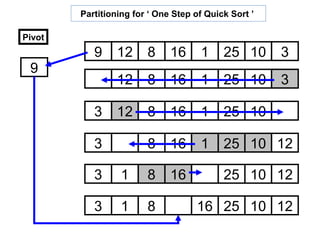
Partitioning for ‘ One Step of Quick Sort ’

Pivot
           9     12     8     16     1     25 10      3
 9
                 12     8     16     1     25 10      3

           3     12     8     16     1     25 10

           3            8     16     1     25 10 12

           3      1     8     16           25 10 12

           3      1     8           16 25 10 12
Quick Sort – Program

int partition ( int a [ ], int beg, int end ) {            void quick_sort(int a[ ] , int beg , int end ) {
  int left , right , loc , flag = 0, pivot ;                    int loc;
  loc = left = beg;                                             if ( beg < end ) {
  right = end;                                                      loc = partition( a , beg , end );
  pivot = a [ loc ] ;                                               quick_sort ( a , beg , loc – 1 );
  while ( flag == 0 )                                               quick_sort ( a , loc + 1 , end );
  {                                                             }
     while( (pivot <= a [ right ] )&&( loc != right ) )    }
              right - - ;                                  void print_array (int a [ ],int n) {
     if( loc == right ) flag = 1;                            int i;
     else {                                                  for ( i = 0 ; I < n ; i++ ) printf( "%5d“ ,a [ i ] ) ;
       a [ loc ] = a [ right ] ;                           }
       left = loc + 1 ;                                    int main () {
       loc = right;                                           int count , num[ 50 ] , i ;
     }                                                        printf ("How many elements to sort : ");
     while ( (pivot >= a [ left ] ) && ( loc != left ) )      scanf ("%d", &count );
            left++;                                           printf ("n Enter the elements : nn");
     if( loc == left ) flag = 1;                              for( i = 0; i < count; i++ ) {
     else {                                                       printf ("num [%d ] : “ , i );
        a [ loc ] = a [ left ] ;                                  scanf( "%d", &num[ i ] );
        right = loc - 1;                                      }
        loc = left;                                           printf (“ n Array Before Sorting : nnn“ );
     }                                                        print_array ( num , count ) ;
   }                                                          quick_sort ( num ,0 , count-1) ;
   a [ loc ] = pivot;                                         printf ( "nnn Array After Sorting : nnn“ );
   return loc;                                                print_array ( num , count );
}                                                          }
partition ( int a [ ], int beg, int end )   A                            B

                  loc = left = beg                               F                            T
                                                                          loc == left
                flag = 0, right = end
                   pivot = a [ loc ]
                                                          a [ loc ] = a [ left ]          flag = 1
                      Flag == 0                             right = loc - 1 ;
                                                               loc = left;
                pivot <= a [ right ]
                  && loc != right
                                                                       a[ loc ] = pivot
                right = right - 1

                                                                          return loc

           F                            T
                   loc == right                       quick_sort ( int a [ ], int beg, int end )

    a [ loc ] = a [ right ]            flag = 1                F                          T
        left = loc + 1 ;                                                loc == left
         loc = right;
                                                            loc = partition( a , beg , end )
                pivot >= a [ left ]
                  &&loc != left                               quick_sort ( a , beg , end )

                 left = left + 1                              quick_sort ( a , beg , end )


                                                                          return
A                        B
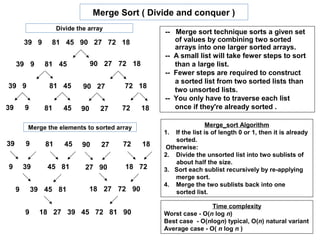
Merge Sort ( Divide and conquer )
                     Divide the array
                                                     -- Merge sort technique sorts a given set
         39 9    81 45 90 27 72 18                      of values by combining two sorted
                                                        arrays into one larger sorted arrays.
                                                     -- A small list will take fewer steps to sort
     39 9       81 45             90 27 72 18           than a large list.
                                                     -- Fewer steps are required to construct
                                                        a sorted list from two sorted lists than
39 9             81 45        90 27      72 18
                                                        two unsorted lists.
                                                     -- You only have to traverse each list
39       9      81     45    90     27   72     18      once if they're already sorted .

          Merge the elements to sorted array                         Merge_sort Algorithm
                                                     1. If the list is of length 0 or 1, then it is already
                                                         sorted.
39       9      81     45    90     27   72     18    Otherwise:
                                                     2. Divide the unsorted list into two sublists of
                                                         about half the size.
9        39     45 81          27 90     18 72       3. Sort each sublist recursively by re-applying
                                                         merge sort.
                                                     4. Merge the two sublists back into one
     9       39 45 81             18 27 72 90            sorted list.

                                                                     Time complexity
         9     18 27 39 45 72 81 90                  Worst case - O(n log n)
                                                     Best case - O(nlogn) typical, O(n) natural variant
                                                     Average case - O( n log n )
Merge Sort - Program

void merge(int a[ ],int low,int high,int mid){
   int i, j, k, c[50];
   i=low; j=mid+1; k=low;
   while( ( i<=mid )&&( j <= high ) ) {          void print_array (int a [ ],int n) {
                                                   int i;
       if( a[ i ]<a[ j ] ){                        for ( i = 0 ; I < n ; i++ ) printf( "%5d“ ,a [ i ] ) ;
          c[ k ]=a[ i ]; k++; i++;               }
       }else {                                   int main () {
          c[ k ]=a[ j ]; k++; j++;                  int count , num[ 50 ] , i ;
       }                                            printf ("How many elements to sort : ");
   }                                                scanf ("%d", &count );
   while( i<=mid ) { c[k]=a[ i ]; k++; i++; }       printf ("n Enter the elements : nn");
                                                    for( i = 0; i < count; i++ ) {
   while(j<=high) { c[k]=a[ j ]; k++; j++; }           printf ("num [%d ] : “ , i );
   for(i=low;i<k;i++) a[ i ]=c[ i ];                   scanf( "%d", &num[ i ] );
 }                                                  }
                                                    printf (“ n Array Before Sorting : nnn“ );
void merge_sort(int a[ ], int low, int high){
                                                    print_array ( num , count ) ;
  int mid;
                                                    merge_sort ( num ,0 , count-1) ;
  if( low < high) {
                                                    printf ( "nnn Array After Sorting : nnn“ );
      mid=(low+high)/2;                             print_array ( num , count );
      merge_sort (a, low, mid);                  }
      merge_sort (a, mid+1 ,high);
      merge (a, low, high, mid);
  }
}
merge

      i =low ; j = mid+1;k = low
                                                              Merge_Sort
           i <= mid && j <= high


                                        T              F                      T
       F                                                      low < high
                 a[ i ] < a[ j ]

c[ k ] =a [ i ] ;                  c[ k ] =a [ j ] ;          mid = ( low + high ) / 2
   k++ ; i++                          k++ ; j++

                                                           merge_sort (a, low, mid)

                    i <= mid
                                                           merge_sort (a, mid, high )
           c[ k ] =a [ i ] ; k++ ; i++

                                                           Merge (a, low,high , mid)
                    j <= high

        c[ k ] =a [ j ] ; k++ ; j++


            i = low ; i < k ; i ++
                                                               Return
                a[ i ] = c [ i ]


                     return
www.jntuworld.com
• For More Materials, Text Books, Previous
  Papers & Mobile updates of B.TECH,
  B.PHARMACY, MBA, MCA of JNTU-HYD,JNTU-
  KAKINADA & JNTU-ANANTAPUR visit
  www.jntuworld.com

Unit6 jwfiles

  • 1.
    Searching techniques Searching : It is a process to find whether a particular value with specified properties is present or not among a collection of items. If the value is present in the collection, then searching is said to be successful, and it returns the location of the value in the array. Otherwise, if the value is not present in the array, the searching process displays the appropriate message and in this case searching is said to be unsuccessful. 1) Linear or Sequential Searching 2) Binary Searching int main( ) { Linear_Search (A[ ], N, val , pos ) int arr [ 50 ] , num , i , n , pos = -1; Step 1 : Set pos = -1 and k = 0 printf ("How many elements to sort : "); Step 2 : Repeat while k < N scanf ("%d", &n); Begin printf ("n Enter the elements : nn"); Step 3 : if A[ k ] = val for( i = 0; i < n; i++ ) { Set pos = k printf (“arr [%d ] : “ , i ); print pos scanf( "%d", &arr[ i ] ); Goto step 5 } End while printf(“nEnter the number to be searched : “); Step 4 : print “Value is not present” scanf(“%d”,&num); Step 5 : Exit for(i=0;i<n;i++) if( arr [ i ] == num ) { Searches pos = i ; break; -- for each item one by one in the list from } the first, until the match is found. if ( pos == -1 ) printf(“ %d does not exist ”,num); Efficiency of Linear search : else -- Executes in O ( n ) times where n is the printf(“ %d is found at location : %d”, num , pos); number of elements in the list.
  • 2.
    Binary Searching Algorithm: • Before searching, the list of items should be sorted in ascending order. • We first compare the key value with the item in the position of the array. If there is a match, we can return immediately the position. • if the value is less than the element in middle location of the array, the required value is lie in the lower half of the array. • if the value is greater than the element in middle location of the array, the required value is lie in the upper half of the array. • We repeat the above procedure on the lower half or upper half of the array. Binary_Search (A [ ], U_bound, VAL) Step 1 : set BEG = 0 , END = U_bound , POS = -1 Step 2 : Repeat while (BEG <= END ) void binary_serch ( int a [], int n, int val ) { Step 3 : set MID = ( BEG + END ) / 2 int end = n - 1, beg = 0, pos = -1; Step 4 : if A [ MID ] == VAL then while( beg <= end ) { POS = MID mid = ( beg + end ) / 2; print VAL “ is available at “, POS if ( val == a [ mid ] ) { GoTo Step 6 pos = mid; End if printf(“%d is available at %d”,val, pos ); if A [ MID ] > VAL then break; set END = MID – 1 } Else if ( a [ mid ] > val ) end = mid – 1; set BEG = MID + 1 else beg = mid + 1; End if } End while if ( pos = - 1) Step 5 : if POS = -1 then printf( “%d does not exist “, val ); print VAL “ is not present “ } End if Step 6 : EXIT
  • 3.
    Sorting Sorting is a technique to rearrange the elements of a list in ascending or descending order, which can be numerical, lexicographical, or any user-defined order. Ranking of students is the process of sorting in descending order. EMCET Ranking is an example for sorting with user-defined order. EMCET Ranking is done with the following priorities. i) First priority is marks obtained in EMCET. ii) If marks are same, the ranking will be done with comparing marks obtained in the Mathematics subject. iii) If marks in Mathematics subject are also same, then the date of births will be compared. Internal Sorting : Types of Internal Sortings If all the data that is to be sorted can be accommodated at a time in memory is called internal sorting.  Bubble Sort External Sorting :  Insertion Sort It is applied to Huge amount of data that cannot be  Selection Sort accommodated in memory all at a time. So data in disk or file is loaded into memory part by part. Each part that  Quick Sort is loaded is sorted separately, and stored in an intermediate file and all parts are merged into one single  Merge Sort sorted list.
  • 4.
    Bubble Sort Bubbles up the highest Unsorted Sorted Bubble_Sort ( A [ ] , N ) Step 1 : Repeat For P = 1 to N – 1 10 54 54 54 54 54 Begin Step 2 : Repeat For J = 1 to N – P 47 10 47 47 47 47 Begin Step 3 : If ( A [ J ] < A [ J – 1 ] ) 12 47 10 23 23 23 Swap ( A [ J ] , A [ J – 1 ] ) End For 54 12 23 10 19 19 End For Step 4 : Exit 19 23 12 19 10 12 Complexity of Bubble_Sort 23 19 19 12 12 10 The complexity of sorting algorithm is depends upon the number of comparisons Original After After After After After that are made. List Pass 1 Pass 2 Pass 3 Pass 4 Pass 5 Total comparisons in Bubble sort is n ( n – 1) / 2 ≈ n 2 – n Complexity = O ( n 2 )
  • 5.
    void print_array (inta[ ], int n) { int i; for (i=0;I < n ; i++) printf("%5d",a[ i ]); Bubble Sort } void bubble_sort ( int arr [ ], int n) { int pass, current, temp; For pass = 1 to N - 1 for ( pass=1;(pass < n) ;pass++) { for ( current=1;current <= n – pass ; current++) { if ( arr[ current - 1 ] > arr[ current ] ) { temp = arr[ current - 1 ]; For J = 1 to N - pass arr[ current - 1 ] = arr[ current ]; arr[ current ] = temp; } T A[J–1]>A[J] } } } F int main() { Temp = A [ J – 1 ] int count,num[50],i ; A[J–1]=A[J] printf ("How many elements to be sorted : "); A [ J ] = Temp scanf ("%d", &count); printf("n Enter the elements : nn"); for ( i = 0; i < count; i++) { printf ("num [%d] : ", i ); scanf( "%d", &num[ i ] ); } printf("n Array Before Sorting : nnn"); print_array ( num, count ); Return bubble_sort ( num, count); printf("nnn Array After Sorting : nnn"); print_array ( num, count ); }
  • 6.
    TEMP Insertion Sort Insertion_Sort ( A [ ] , N ) 78 23 45 8 32 36 Step 1 : Repeat For K = 1 to N – 1 23 Begin Step 2 : Set Temp = A [ K ] Step 3 : Set J = K – 1 23 78 45 8 32 36 Step 4 : Repeat while Temp < A [ J ] AND J >= 0 45 Begin Set A [ J + 1 ] = A [ J ] Set J = J - 1 23 45 78 8 32 36 End While Step 5 : Set A [ J + 1 ] = Temp 8 End For Step 4 : Exit 8 23 45 78 32 36 32 insertion_sort ( int A[ ] , int n ) { int k , j , temp ; 8 23 32 45 78 36 for ( k = 1 ; k < n ; k++ ) { temp = A [ k ] ; 36 j = k - 1; while ( ( temp < A [ j ] ) && ( j >= 0 ) ) { 8 23 32 36 45 78 A[j+1] =A[j]; j--; Complexity of Insertion Sort } Best Case : O ( n ) A [ j + 1 ] = temp ; Average Case : O ( n2 ) } Worst Case : O ( n2 ) }
  • 7.
    Smallest Selection Sort ( Select the smallest and Exchange ) Selection_Sort ( A [ ] , N ) 8 23 78 45 8 32 56 Step 1 : Repeat For K = 0 to N – 2 Begin Step 2 : Set POS = K Step 3 : Repeat for J = K + 1 to N – 1 23 8 78 45 23 32 56 Begin If A[ J ] < A [ POS ] Set POS = J 32 8 23 45 78 32 56 End For Step 5 : Swap A [ K ] with A [ POS ] End For Step 6 : Exit 45 8 23 32 78 45 56 selection_sort ( int A[ ] , int n ) { int k , j , pos , temp ; for ( k = 0 ; k < n - 1 ; k++ ) { 56 8 23 32 45 78 56 pos = k ; for ( j = k + 1 ; j <= n ; j ++ ) { if ( A [ j ] < A [ pos ] ) 8 23 32 45 56 78 pos = j ; } temp = A [ k ] ; Complexity of Selection Sort A [ k ] = A [ pos ] ; Best Case : O ( n2 ) A [ pos ] = temp ; Average Case : O ( n2 ) } Worst Case : O ( n2 ) }
  • 8.
    Selection sort Insertion sort k = 0; k < n - 1 ; k++ k = 1; k < n ; k++ pos = k temp = a [ k ] j=k-1 j = k + 1 ; j < n ; j++ temp < a [ j ] && j >= 0 a[ j ] < a[ pos ] a[j+1]=a[j] pos = j j=j-1 a [ j + 1 ] = temp temp = a[ k ] a [ k ] = a [ pos ] a [ pos ] = temp return return
  • 9.
    Bubble sort –Insertion sort – Selection sort Bubble Sort : -- very primitive algorithm like linear search, and least efficient . -- No of swappings are more compare with other sorting techniques. -- It is not capable of minimizing the travel through the array like insertion sort. Insertion Sort : -- sorted by considering one item at a time. -- efficient to use on small sets of data. -- twice as fast as the bubble sort. -- 40% faster than the selection sort. -- no swapping is required. -- It is said to be online sorting because it continues the sorting a list as and when it receives new elements. -- it does not change the relative order of elements with equal keys. -- reduces unnecessary travel through the array. -- requires low and constant amount of extra memory space. -- less efficient for larger lists. Selection sort : -- No of swappings will be minimized. i.e., one swap on one pass. -- generally used for sorting files with large objects and small keys. -- It is 60% more efficient than bubble sort and 40% less efficient than insertion sort. -- It is preferred over bubble sort for jumbled array as it requires less items to be exchanged. -- uses internal sorting that requires more memory space. -- It cannot recognize sorted list and carryout the sorting from the beginning, when new elements are added to the list.
  • 10.
    Quick Sort –A recursive process of sorting Original-list of 11 elements : 8 3 2 11 5 14 0 2 9 4 20 Algorithm for Quick_Sort : Set list [ 0 ] as pivot : -- set the element A [ start_index ] as pivot. -- rearrange the array so that : pivot -- all elements which are less than the pivot come left ( before ) to the pivot. 8 3 2 11 5 14 0 2 9 4 20 -- all elements which are greater than the pivot come right ( after ) to the pivot. Rearrange ( partition ) the elements -- recursively apply quick-sort on the sub-list of into two sub lists : lesser elements. pivot -- recursively apply quick-sort on the sub-list of greater elements. 4 3 2 2 5 0 8 11 9 14 20 -- the base case of the recursion is lists of size zero or one, which are always sorted. Sub-list of Sub-list of lesser elements greater elements Complexity of Quick Sort Best Case : O ( n log n ) Apply Quick-sort Apply Quick-sort Average Case : O ( n log n ) recursively recursively Worst Case : O ( n2 ) on sub-list on sub-list
  • 11.
    Partitioning for ‘One Step of Quick Sort ’ Pivot 9 12 8 16 1 25 10 3 9 12 8 16 1 25 10 3 3 12 8 16 1 25 10 3 8 16 1 25 10 12 3 1 8 16 25 10 12 3 1 8 16 25 10 12
  • 12.
    Quick Sort –Program int partition ( int a [ ], int beg, int end ) { void quick_sort(int a[ ] , int beg , int end ) { int left , right , loc , flag = 0, pivot ; int loc; loc = left = beg; if ( beg < end ) { right = end; loc = partition( a , beg , end ); pivot = a [ loc ] ; quick_sort ( a , beg , loc – 1 ); while ( flag == 0 ) quick_sort ( a , loc + 1 , end ); { } while( (pivot <= a [ right ] )&&( loc != right ) ) } right - - ; void print_array (int a [ ],int n) { if( loc == right ) flag = 1; int i; else { for ( i = 0 ; I < n ; i++ ) printf( "%5d“ ,a [ i ] ) ; a [ loc ] = a [ right ] ; } left = loc + 1 ; int main () { loc = right; int count , num[ 50 ] , i ; } printf ("How many elements to sort : "); while ( (pivot >= a [ left ] ) && ( loc != left ) ) scanf ("%d", &count ); left++; printf ("n Enter the elements : nn"); if( loc == left ) flag = 1; for( i = 0; i < count; i++ ) { else { printf ("num [%d ] : “ , i ); a [ loc ] = a [ left ] ; scanf( "%d", &num[ i ] ); right = loc - 1; } loc = left; printf (“ n Array Before Sorting : nnn“ ); } print_array ( num , count ) ; } quick_sort ( num ,0 , count-1) ; a [ loc ] = pivot; printf ( "nnn Array After Sorting : nnn“ ); return loc; print_array ( num , count ); } }
  • 13.
    partition ( inta [ ], int beg, int end ) A B loc = left = beg F T loc == left flag = 0, right = end pivot = a [ loc ] a [ loc ] = a [ left ] flag = 1 Flag == 0 right = loc - 1 ; loc = left; pivot <= a [ right ] && loc != right a[ loc ] = pivot right = right - 1 return loc F T loc == right quick_sort ( int a [ ], int beg, int end ) a [ loc ] = a [ right ] flag = 1 F T left = loc + 1 ; loc == left loc = right; loc = partition( a , beg , end ) pivot >= a [ left ] &&loc != left quick_sort ( a , beg , end ) left = left + 1 quick_sort ( a , beg , end ) return A B
  • 14.
    Merge Sort (Divide and conquer ) Divide the array -- Merge sort technique sorts a given set 39 9 81 45 90 27 72 18 of values by combining two sorted arrays into one larger sorted arrays. -- A small list will take fewer steps to sort 39 9 81 45 90 27 72 18 than a large list. -- Fewer steps are required to construct a sorted list from two sorted lists than 39 9 81 45 90 27 72 18 two unsorted lists. -- You only have to traverse each list 39 9 81 45 90 27 72 18 once if they're already sorted . Merge the elements to sorted array Merge_sort Algorithm 1. If the list is of length 0 or 1, then it is already sorted. 39 9 81 45 90 27 72 18 Otherwise: 2. Divide the unsorted list into two sublists of about half the size. 9 39 45 81 27 90 18 72 3. Sort each sublist recursively by re-applying merge sort. 4. Merge the two sublists back into one 9 39 45 81 18 27 72 90 sorted list. Time complexity 9 18 27 39 45 72 81 90 Worst case - O(n log n) Best case - O(nlogn) typical, O(n) natural variant Average case - O( n log n )
  • 15.
    Merge Sort -Program void merge(int a[ ],int low,int high,int mid){ int i, j, k, c[50]; i=low; j=mid+1; k=low; while( ( i<=mid )&&( j <= high ) ) { void print_array (int a [ ],int n) { int i; if( a[ i ]<a[ j ] ){ for ( i = 0 ; I < n ; i++ ) printf( "%5d“ ,a [ i ] ) ; c[ k ]=a[ i ]; k++; i++; } }else { int main () { c[ k ]=a[ j ]; k++; j++; int count , num[ 50 ] , i ; } printf ("How many elements to sort : "); } scanf ("%d", &count ); while( i<=mid ) { c[k]=a[ i ]; k++; i++; } printf ("n Enter the elements : nn"); for( i = 0; i < count; i++ ) { while(j<=high) { c[k]=a[ j ]; k++; j++; } printf ("num [%d ] : “ , i ); for(i=low;i<k;i++) a[ i ]=c[ i ]; scanf( "%d", &num[ i ] ); } } printf (“ n Array Before Sorting : nnn“ ); void merge_sort(int a[ ], int low, int high){ print_array ( num , count ) ; int mid; merge_sort ( num ,0 , count-1) ; if( low < high) { printf ( "nnn Array After Sorting : nnn“ ); mid=(low+high)/2; print_array ( num , count ); merge_sort (a, low, mid); } merge_sort (a, mid+1 ,high); merge (a, low, high, mid); } }
  • 16.
    merge i =low ; j = mid+1;k = low Merge_Sort i <= mid && j <= high T F T F low < high a[ i ] < a[ j ] c[ k ] =a [ i ] ; c[ k ] =a [ j ] ; mid = ( low + high ) / 2 k++ ; i++ k++ ; j++ merge_sort (a, low, mid) i <= mid merge_sort (a, mid, high ) c[ k ] =a [ i ] ; k++ ; i++ Merge (a, low,high , mid) j <= high c[ k ] =a [ j ] ; k++ ; j++ i = low ; i < k ; i ++ Return a[ i ] = c [ i ] return
  • 17.
    www.jntuworld.com • For MoreMaterials, Text Books, Previous Papers & Mobile updates of B.TECH, B.PHARMACY, MBA, MCA of JNTU-HYD,JNTU- KAKINADA & JNTU-ANANTAPUR visit www.jntuworld.com

Editor's Notes

  • #2 ADITYA ENGINEERING COLLEGES