Unit 3 Quantum Theory And  Periodicity
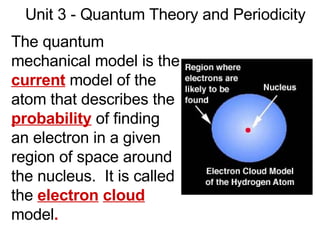
Unit 3 - Quantum Theory and Periodicity The quantum mechanical model is the  current   model of the atom that describes the  probability   of finding an electron in a given region of space around the nucleus.  It is called the  electron   cloud   model .
 
Quantum   numbers  are the  4  numbers that  specify  the properties of atomic orbitals and the electrons that reside in them.
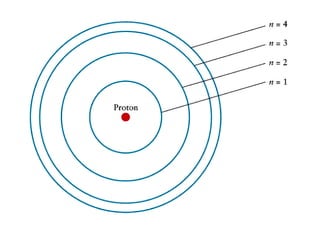
The energy level, also called the  principal quantum number   or shell, is the first quantum number.  Electrons can occupy  only   specific  energy levels.  These levels are numbered 1 –  7 .  The higher energy levels indicate a  higher  energy state for that electron and a location  further   away  from the nucleus. In other words, electrons near the nucleus are low energy electrons.
 
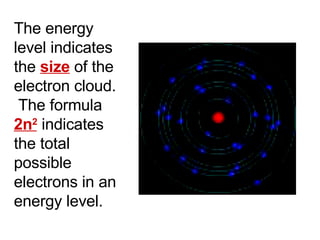
The energy level indicates the  size  of the electron cloud.  The formula  2n 2  indicates the total possible electrons in an energy level.
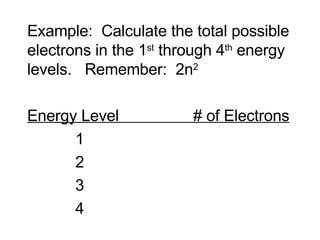
Example:  Calculate the total possible electrons in the 1 st  through 4 th  energy levels.  Remember:  2n 2 Energy Level  # of Electrons 1 2 3 4
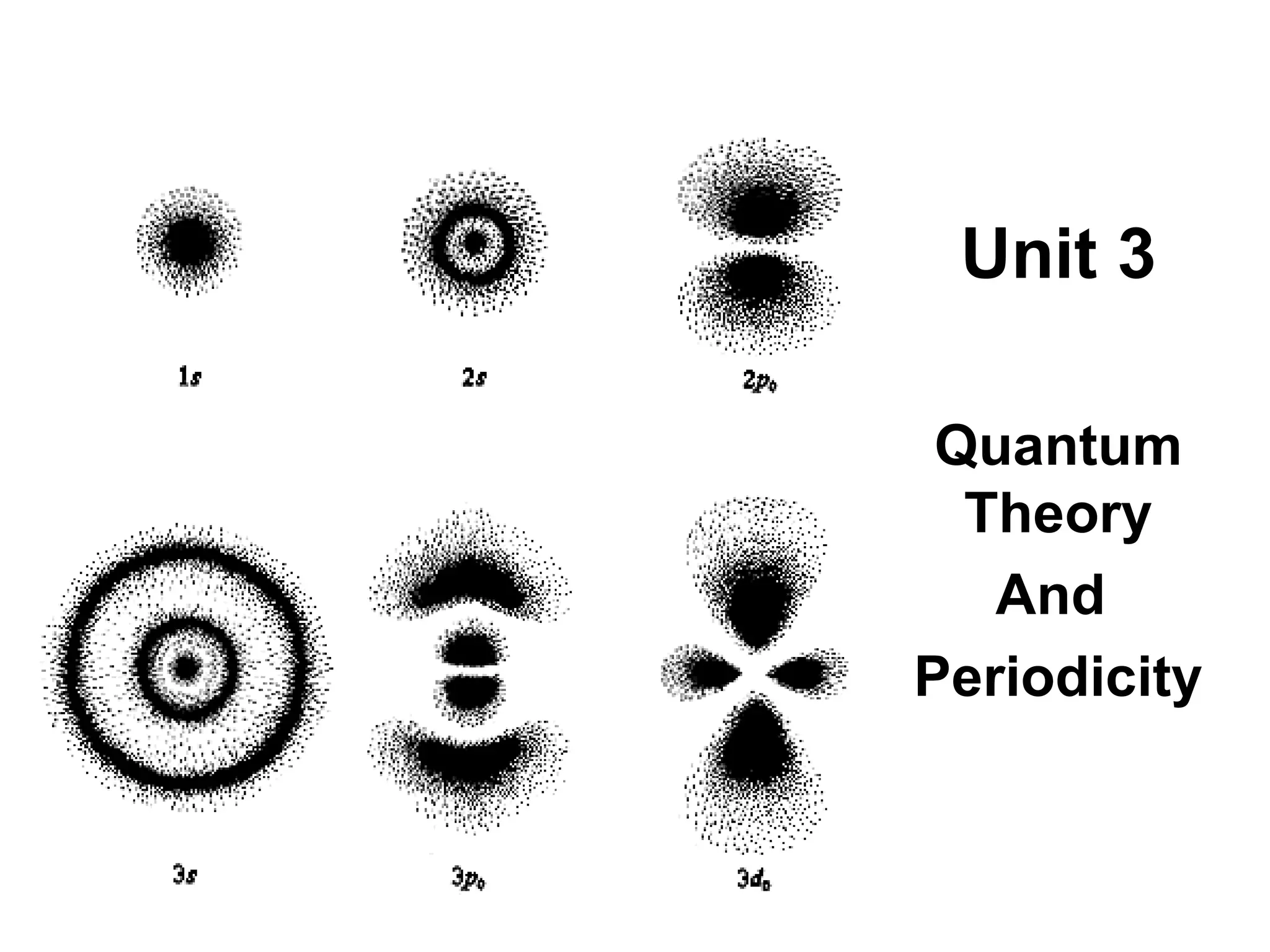
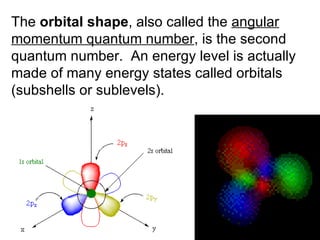
The  orbital shape , also called the  angular momentum quantum number , is the second quantum number.  An energy level is actually made of many energy states called orbitals (subshells or sublevels).
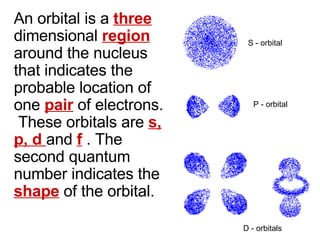
An orbital is a  three  dimensional  region  around the nucleus that indicates the probable location of one  pair  of electrons.  These orbitals are  s, p, d  and   f   . The second quantum number indicates the  shape  of the orbital. S - orbital P - orbital D - orbitals
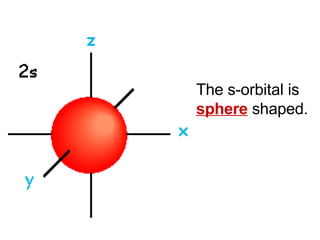
The s-orbital is  sphere  shaped.
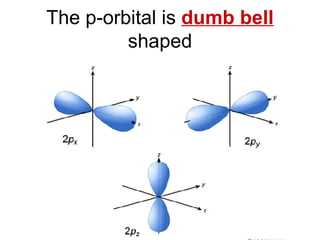
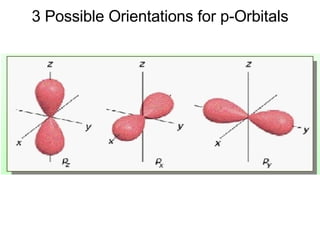
The p-orbital is  dumb bell  shaped
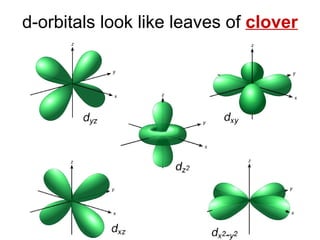
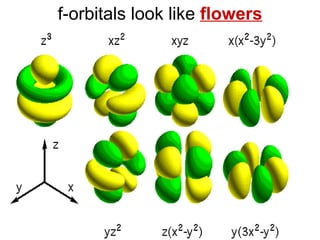
d-orbitals look like leaves of  clover
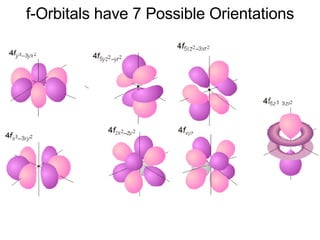
f-orbitals look like  flowers
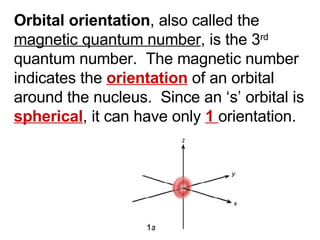
Orbital orientation , also called the  magnetic quantum number , is the 3 rd  quantum number.  The magnetic number indicates the  orientation  of an orbital around the nucleus.  Since an ‘s’ orbital is  spherical , it can have only  1  orientation.
3 Possible Orientations for p-Orbitals
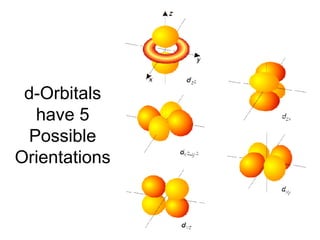
d-Orbitals have 5 Possible Orientations
f-Orbitals have 7 Possible Orientations
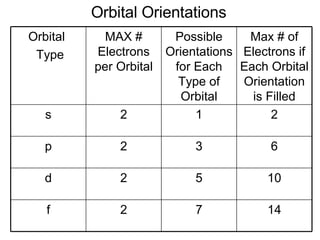
Orbital Orientations 14 7 2 f 10 5 2 d 6 3 2 p 2 1 2 s Max # of Electrons if Each Orbital Orientation is Filled Possible Orientations for Each Type of Orbital MAX # Electrons per Orbital Orbital  Type
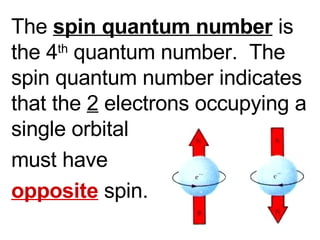
The  spin quantum number  is the 4 th  quantum number.  The spin quantum number indicates that the  2  electrons occupying a single orbital  must have  opposite  spin.
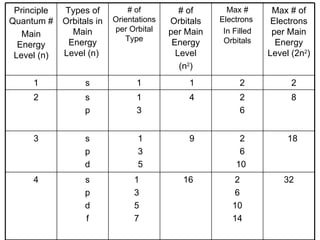
32 2 6 10 14 16 1 3 5 7 s p d f 4 18 2 6 10 9 1 3 5 s p d 3 8 2 6 4 1 3 s p 2 2 2 1 1 s 1 Max # of Electrons per Main Energy Level (2n 2 ) Max # Electrons  In Filled Orbitals # of Orbitals per Main Energy Level (n 2 ) # of Orientations per Orbital Type Types of Orbitals in Main Energy Level (n)  Principle Quantum # Main Energy Level (n)
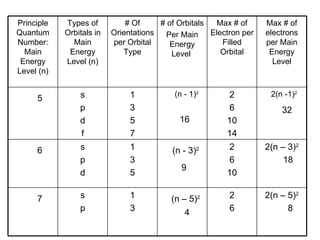
2(n – 5) 2 8 2 6 (n – 5) 2 4 1 3 s p 7 2(n – 3) 2 18 2 6 10 (n - 3) 2 9 1 3 5 s p d 6 2(n -1) 2 32 2 6 10 14 (n - 1) 2 16 1 3 5 7 s p d f 5 Max # of electrons per Main Energy Level Max # of Electron per Filled Orbital # of Orbitals Per Main Energy Level  # Of Orientations per Orbital Type Types of Orbitals in Main Energy Level (n) Principle Quantum Number: Main Energy Level (n)
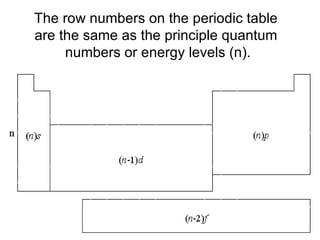
The row numbers on the periodic table  are the same as the principle quantum  numbers or energy levels (n).
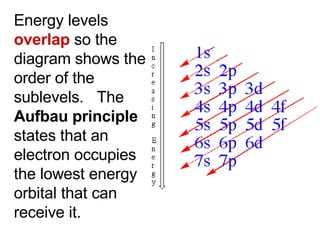
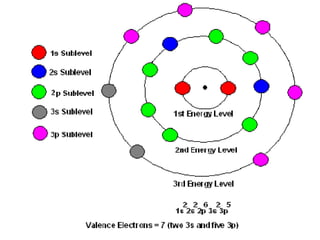
Energy levels  overlap  so the diagram shows the order of the sublevels.  The  Aufbau principle   states that an electron occupies the lowest energy orbital that can receive it.
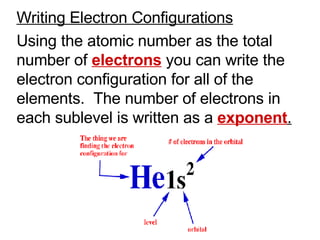
Writing Electron Configurations Using the atomic number as the total number of  electrons  you can write the electron configuration for all of the elements.  The number of electrons in each sublevel is written as a  exponent .
Write the electron configuration for  magnesium #12 gallium #31,  element #35.
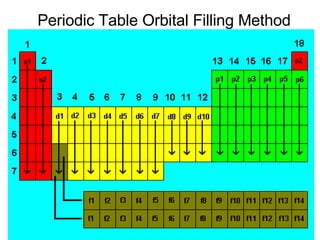
Periodic Table Orbital Filling Method
Use the periodic table to write the electron configurations for the following atoms. Example 1:  Nitrogen, 7 electrons Example 2:  Phosphorus, 15 electrons Example 3:  Cerium, 58 electrons
Noble – Gas Notation The Group VIII elements, helium, argon, krypton, xenon, and radon are called the noble gases.  The configurations of the noble gases are often used as a shorthand method for writing longer electron configurations. For Example:  Sodium – Na has 11 electrons Electron Configuration 1s 2 2s 2 2p 6 3s 1 Noble – Gas Configuration [Ne]1s 2
Example 2:  Arsenic, As, 33 electrons Electron Configuration 1s 2 2s 2 2p 6 3s 2 3p 6 4s 2 3d 10 4p 3 Noble – Gas Configuration [Ar]4s 2 3d 10 4p 3 Example 3:  Barium, Ba, 56 electrons Example 4:  Rubidium, Rb
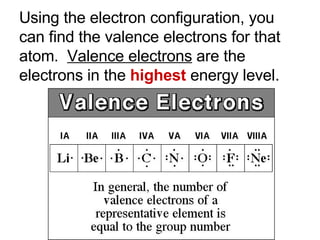
Using the electron configuration, you can find the valence electrons for that atom.  Valence electrons  are the electrons in the  highest  energy level.
 
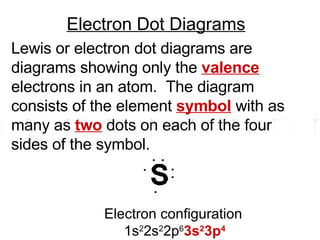
Electron Dot Diagrams Lewis or electron dot diagrams are diagrams showing only the  valence   electrons in an atom.  The diagram consists of the element  symbol  with as many as  two  dots on each of the four sides of the symbol. Electron configuration  1s 2 2s 2 2p 6 3s 2 3p 4
What is the electron configuration for Silicon? Write the electron dot diagram for silicon.
Write the electron configuration and electron dot diagram for phosphorus – atomic  # = 15 and for Arsenic – atomic # = 33.
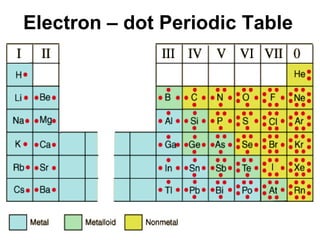
Electron – dot Periodic Table
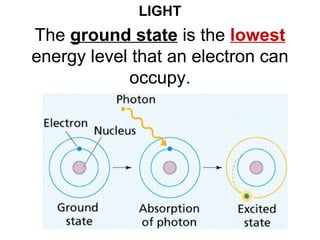
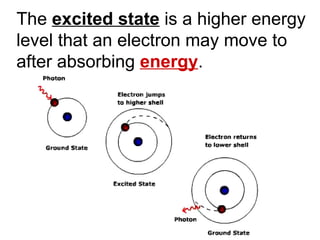
LIGHT The  ground state  is the  lowest  energy level that an electron can occupy.
The  excited state  is a higher energy level that an electron may move to after absorbing  energy .
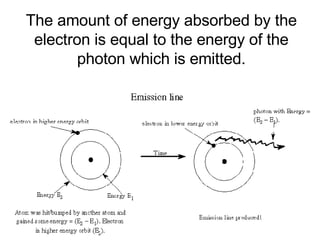
The amount of energy absorbed by the electron is equal to the energy of the photon which is emitted.
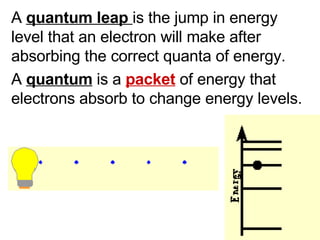
A  quantum leap  is the jump in energy level that an electron will make after absorbing the correct quanta of energy. A  quantum  is a  packet  of energy that electrons absorb to change energy levels.
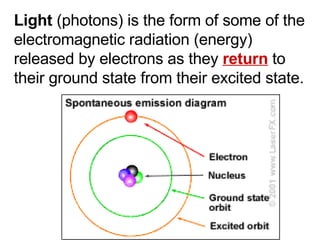
Light  (photons) is the form of some of the electromagnetic radiation (energy) released by electrons as they  return  to their ground state from their excited state.
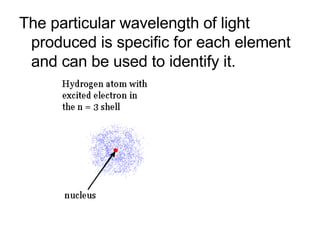
The particular wavelength of light produced is specific for each element and can be used to identify it.
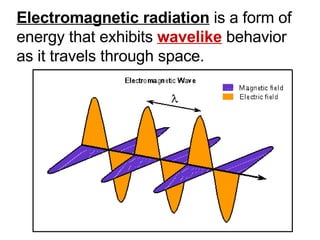
Electromagnetic radiation  is a form of energy that exhibits  wavelike  behavior as it travels through space.
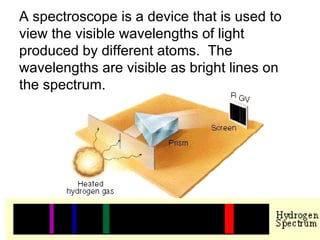
A spectroscope is a device that is used to view the visible wavelengths of light produced by different atoms.  The wavelengths are visible as bright lines on the spectrum.
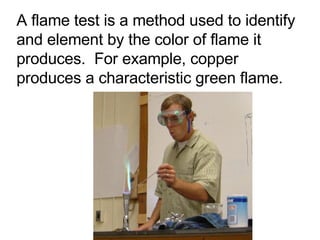
A flame test is a method used to identify and element by the color of flame it produces.  For example, copper produces a characteristic green flame.
 
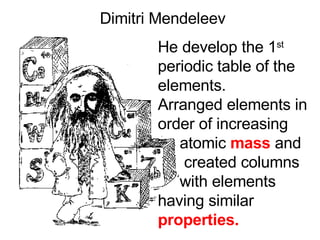
Dimitri Mendeleev He develop the 1 st periodic table of the  elements. Arranged elements in order of increasing  atomic   mass  and  created columns with elements  having similar  properties.
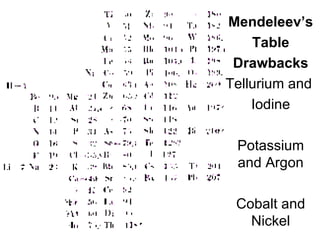
Mendeleev’s Table Drawbacks Tellurium and  Iodine Potassium and Argon Cobalt and Nickel
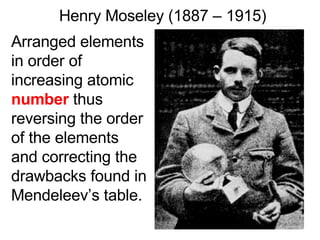
Henry Moseley (1887 – 1915) Arranged elements in order of increasing atomic  number  thus reversing the order of the elements and correcting the drawbacks found in Mendeleev’s table.
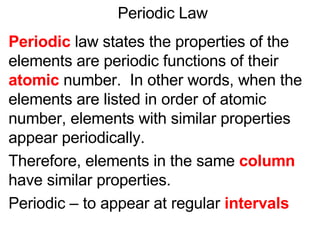
Periodic Law Periodic  law states the properties of the elements are periodic functions of their  atomic  number.   In other words, when the elements are listed in order of atomic number, elements with similar properties appear periodically.  Therefore, elements in the same  column  have similar properties.  Periodic – to appear at regular  intervals
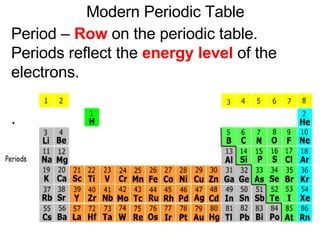
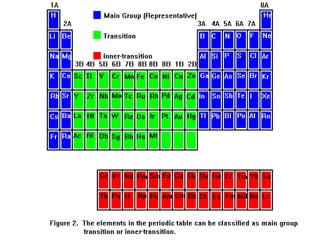
Modern Periodic Table Period –  Row  on the periodic table.  Periods reflect the  energy level  of the electrons. .
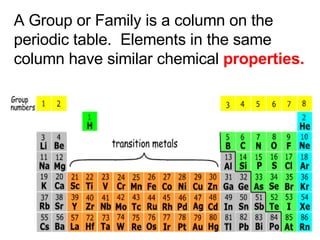
A Group or Family is a column on the periodic table.  Elements in the same column have similar chemical  properties.
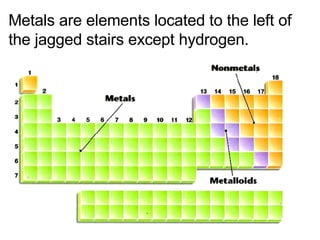
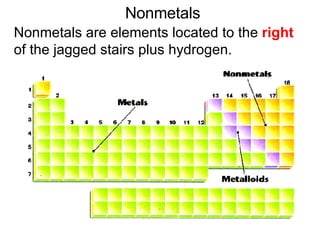
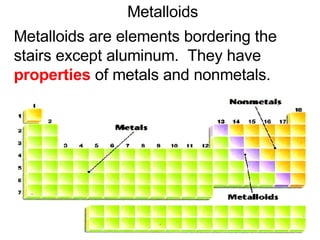
Metals are elements located to the left of the jagged stairs except hydrogen.
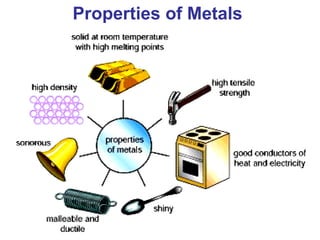
Properties of Metals Metals are  solids  except mercury, which is a  liquid .  Metals have  luster , are  malleable ,  ductile , and have high  tensile strength .  Metals are good  conductors  of  heat and electricity.
Properties of Metals
Nonmetals Nonmetals are elements located to the  right  of the jagged stairs plus hydrogen.
Properties of Nonmetals Nonmetals are  solids  or  gases  except bromine, which is a  liquid .  Nonmetals are  dull , and lack other metallic properties.  Nonmetals are generally  poor  conductors of heat and electricity.
Metalloids Metalloids are elements bordering the stairs except aluminum.  They have  properties  of metals and nonmetals.
Metalloids are generally  semiconductors  which means  that they conduct to varying degrees making them useful in  the computer industry.
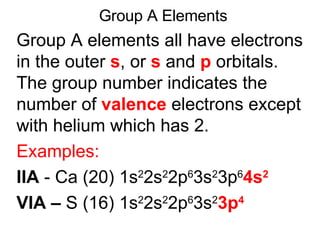
Group A Elements  Group A elements all have electrons in the outer  s , or  s  and  p  orbitals.  The group number indicates the number of  valence  electrons except with helium which has 2. Examples:   IIA  - Ca (20) 1s 2 2s 2 2p 6 3s 2 3p 6 4s 2 VIA –  S (16) 1s 2 2s 2 2p 6 3s 2 3p 4
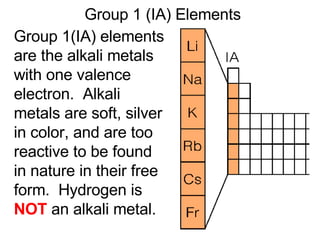
Group 1 (IA) Elements Group 1(IA) elements are the alkali metals with one valence electron.  Alkali metals are soft, silver in color, and are too reactive to be found in nature in their free form.  Hydrogen is  NOT  an alkali metal.
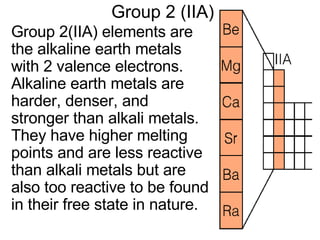
Group 2 (IIA) Group 2(IIA) elements are the alkaline earth metals with 2 valence electrons.  Alkaline earth metals are harder, denser, and stronger than alkali metals.  They have higher melting points and are less reactive than alkali metals but are also too reactive to be found in their free state in nature.
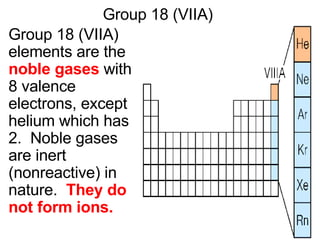
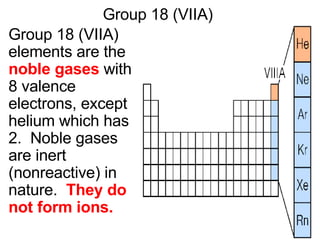
Group 18 (VIIA)  Group 18 (VIIA) elements are the  noble gases  with 8 valence electrons, except helium which has 2.  Noble gases are inert (nonreactive) in nature.  They do not form ions.
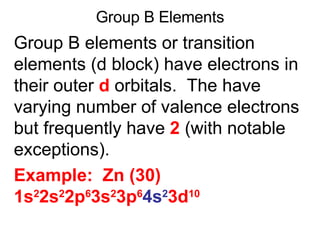
Group B Elements Group B elements or transition elements (d block) have electrons in their outer  d  orbitals.  The have varying number of valence electrons but frequently have  2  (with notable exceptions). Example:  Zn (30) 1s 2 2s 2 2p 6 3s 2 3p 6 4s 2 3d 10
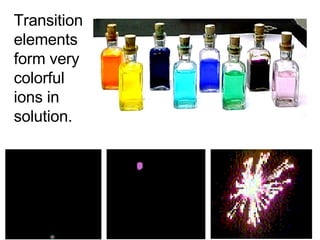
Transition elements form very colorful ions in solution.
Lanthanoid and Actinoid Series or Inner Transition Elements Lanthanoid and Actinoid elements  (f-block) have electrons in their outer  f  orbitals.  These elements have varying numbers of valence electrons but frequently have  2  (with notable exceptions).  Inner transitions metals generally form +3 ions. Example: Nd (60) 1s 2 2s 2 2p 6 3s 2 3p 6 4s 2 3d 10 4p 6 5s 2 4d 10 5p 6 6s 2 5d 1 4f 3
 
Stability of Electron Configurations Octet Rule – Atoms having all their outer  s  and  p  orbitals  filled  are more stable (less reactive) than partially filled orbitals.  Therefore, atoms will gain or lose electrons in order to achieve a stable configuration. Stable configurations resemble those of  noble gases  which have 8 valence electrons.
Example 1 Li has 3 electrons and it has an electron configuration of 1s 2 2s 1 .  Lithium will lose its 2s 1  valence electron to leave a configuration of 1s 2 , the same configuration has helium. By losing this electron, lithium will then have one more proton than electron so the lithium atom will have a + 1 charge.
Example 2 Oxygen (8) has an electron  configuration of 1s 2 2s 2 2p 4 .  The oxygen atom will gain two valence electrons to obtain the more stable configuration of  1s 2 2s 2 2p 6 .  This is the same configuration as the noble gas, neon. The oxygen atom will have 2 more electrons than protons and will carry a  -2 charge.
Ions An  ion  is an atom that has gained or lost  electrons .  Cations are atoms that have  lost  electrons and therefore have a  positive  charge.  Metals  lose  electrons to form  positive  ions, cations.  Metals  lose  all their valence electrons.  Therefore, their ions are positive by the number they lose.
Anions An  anion  is an atom that has  gained  electrons and therefore, has a  negative  charge.  Anion named end in –ide.  S -2  is called the sulfide ion.  Nonmetals  gain  electrons to from  negative  ion, anions.  They gain electrons to have a stable octet (8) of electrons.  Therefore, nonmetal ions are negative by the number of electrons they gain.
 
 
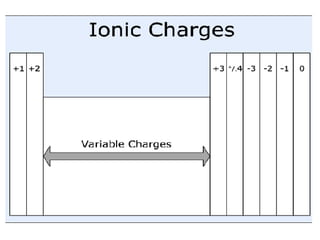
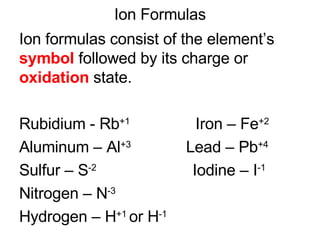
Ion Formulas Ion formulas consist of the element’s  symbol  followed by its charge or  oxidation  state. Rubidium - Rb +1   Iron – Fe +2  Aluminum – Al +3  Lead – Pb +4 Sulfur – S -2   Iodine – I -1 Nitrogen – N -3   Hydrogen – H +1  or H -1
Exceptions to Predicted Electron Configurations According to the octet rule, filled and half-filled sublevels are more stable (less reactive).  Therefore, in some cases, actual configuration varies from predicted configurations
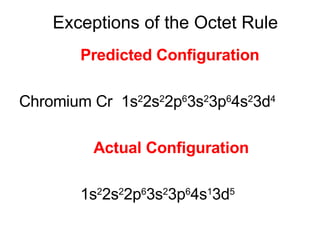
Exceptions of the Octet Rule Predicted Configuration Chromium Cr  1s 2 2s 2 2p 6 3s 2 3p 6 4s 2 3d 4 Actual Configuration 1s 2 2s 2 2p 6 3s 2 3p 6 4s 1 3d 5
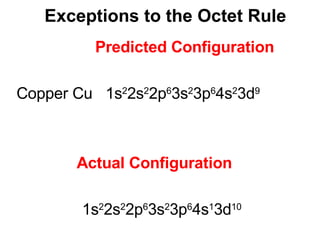
Exceptions to the Octet Rule Predicted Configuration Copper Cu  1s 2 2s 2 2p 6 3s 2 3p 6 4s 2 3d 9 Actual Configuration 1s 2 2s 2 2p 6 3s 2 3p 6 4s 1 3d 10
Periodic Properties As you have seen, elements in the  same row are similar in their outer  electron configurations.  This results in these elements having relatively the same physical properties such as density, melting point, and boiling.  These physical properties are then said to be  periodic  properties.
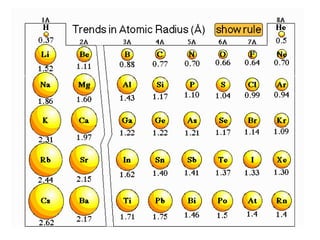
Periodic Trends A periodic trend is a general tendency that occurs  across  periods or  within  groups in the periodic table.  Exceptions are always present in trends.
 
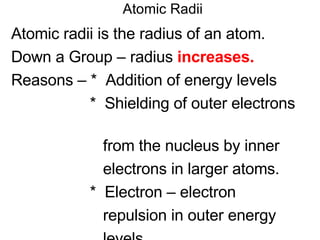
Atomic Radii Atomic radii is the radius of an atom. Down a Group – radius  increases. Reasons – *  Addition of energy levels *  Shielding of outer electrons  from the nucleus by inner  electrons in larger atoms. *  Electron – electron  repulsion in outer energy levels
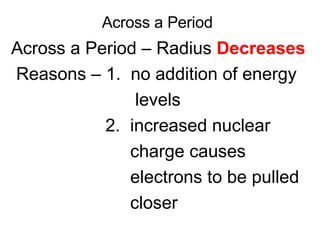
Across a Period Across a Period – Radius  Decreases Reasons – 1.  no addition of energy  levels 2.  increased nuclear  charge causes  electrons to be pulled  closer
 
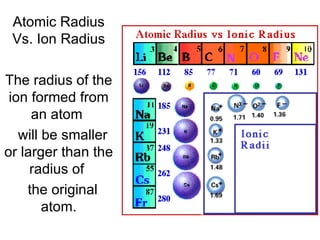
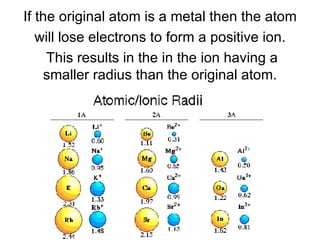
Atomic Radius Vs. Ion Radius The radius of the ion formed from an atom  will be smaller or larger than the radius of  the original atom.
If the original atom is a metal then the atom  will lose electrons to form a positive ion.  This results in the in the ion having a smaller radius than the original atom.
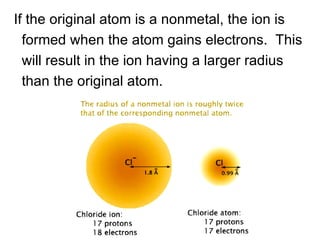
If the original atom is a nonmetal, the ion is  formed when the atom gains electrons.  This will result in the ion having a larger radius  than the original atom.
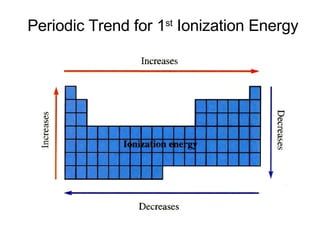
First Ionization Energy 1 st  Ionization Energy is the energy required to remove an electron from an atom. Down a Group – Ionization Energy  Decreases Reason  – Outer electrons in larger  atoms are held more loosely  by the nucleus.
1 st  Ionization Energy Across a Period – Ionization Energy Increases Reasons –  1.  Outer electrons in  smaller atoms are  held more tightly by  the nucleus. 2.  An octet of electrons  is approached.
Periodic Trend for 1 st  Ionization Energy

Unit3presentation

  • 1.
    Unit 3 QuantumTheory And Periodicity
  • 2.
    Unit 3 -Quantum Theory and Periodicity The quantum mechanical model is the current model of the atom that describes the probability of finding an electron in a given region of space around the nucleus. It is called the electron cloud model .
  • 3.
  • 4.
    Quantum numbers are the 4 numbers that specify the properties of atomic orbitals and the electrons that reside in them.
  • 5.
    The energy level,also called the principal quantum number or shell, is the first quantum number. Electrons can occupy only specific energy levels. These levels are numbered 1 – 7 . The higher energy levels indicate a higher energy state for that electron and a location further away from the nucleus. In other words, electrons near the nucleus are low energy electrons.
  • 6.
  • 7.
    The energy levelindicates the size of the electron cloud. The formula 2n 2 indicates the total possible electrons in an energy level.
  • 8.
    Example: Calculatethe total possible electrons in the 1 st through 4 th energy levels. Remember: 2n 2 Energy Level # of Electrons 1 2 3 4
  • 9.
    The orbitalshape , also called the angular momentum quantum number , is the second quantum number. An energy level is actually made of many energy states called orbitals (subshells or sublevels).
  • 10.
    An orbital isa three dimensional region around the nucleus that indicates the probable location of one pair of electrons. These orbitals are s, p, d and f . The second quantum number indicates the shape of the orbital. S - orbital P - orbital D - orbitals
  • 11.
    The s-orbital is sphere shaped.
  • 12.
    The p-orbital is dumb bell shaped
  • 13.
    d-orbitals look likeleaves of clover
  • 14.
  • 15.
    Orbital orientation ,also called the magnetic quantum number , is the 3 rd quantum number. The magnetic number indicates the orientation of an orbital around the nucleus. Since an ‘s’ orbital is spherical , it can have only 1 orientation.
  • 16.
  • 17.
    d-Orbitals have 5Possible Orientations
  • 18.
    f-Orbitals have 7Possible Orientations
  • 19.
    Orbital Orientations 147 2 f 10 5 2 d 6 3 2 p 2 1 2 s Max # of Electrons if Each Orbital Orientation is Filled Possible Orientations for Each Type of Orbital MAX # Electrons per Orbital Orbital Type
  • 20.
    The spinquantum number is the 4 th quantum number. The spin quantum number indicates that the 2 electrons occupying a single orbital must have opposite spin.
  • 21.
    32 2 610 14 16 1 3 5 7 s p d f 4 18 2 6 10 9 1 3 5 s p d 3 8 2 6 4 1 3 s p 2 2 2 1 1 s 1 Max # of Electrons per Main Energy Level (2n 2 ) Max # Electrons In Filled Orbitals # of Orbitals per Main Energy Level (n 2 ) # of Orientations per Orbital Type Types of Orbitals in Main Energy Level (n) Principle Quantum # Main Energy Level (n)
  • 22.
    2(n – 5)2 8 2 6 (n – 5) 2 4 1 3 s p 7 2(n – 3) 2 18 2 6 10 (n - 3) 2 9 1 3 5 s p d 6 2(n -1) 2 32 2 6 10 14 (n - 1) 2 16 1 3 5 7 s p d f 5 Max # of electrons per Main Energy Level Max # of Electron per Filled Orbital # of Orbitals Per Main Energy Level # Of Orientations per Orbital Type Types of Orbitals in Main Energy Level (n) Principle Quantum Number: Main Energy Level (n)
  • 23.
    The row numberson the periodic table are the same as the principle quantum numbers or energy levels (n).
  • 24.
    Energy levels overlap so the diagram shows the order of the sublevels. The Aufbau principle states that an electron occupies the lowest energy orbital that can receive it.
  • 25.
    Writing Electron ConfigurationsUsing the atomic number as the total number of electrons you can write the electron configuration for all of the elements. The number of electrons in each sublevel is written as a exponent .
  • 26.
    Write the electronconfiguration for magnesium #12 gallium #31, element #35.
  • 27.
    Periodic Table OrbitalFilling Method
  • 28.
    Use the periodictable to write the electron configurations for the following atoms. Example 1: Nitrogen, 7 electrons Example 2: Phosphorus, 15 electrons Example 3: Cerium, 58 electrons
  • 29.
    Noble – GasNotation The Group VIII elements, helium, argon, krypton, xenon, and radon are called the noble gases. The configurations of the noble gases are often used as a shorthand method for writing longer electron configurations. For Example: Sodium – Na has 11 electrons Electron Configuration 1s 2 2s 2 2p 6 3s 1 Noble – Gas Configuration [Ne]1s 2
  • 30.
    Example 2: Arsenic, As, 33 electrons Electron Configuration 1s 2 2s 2 2p 6 3s 2 3p 6 4s 2 3d 10 4p 3 Noble – Gas Configuration [Ar]4s 2 3d 10 4p 3 Example 3: Barium, Ba, 56 electrons Example 4: Rubidium, Rb
  • 31.
    Using the electronconfiguration, you can find the valence electrons for that atom. Valence electrons are the electrons in the highest energy level.
  • 32.
  • 33.
    Electron Dot DiagramsLewis or electron dot diagrams are diagrams showing only the valence electrons in an atom. The diagram consists of the element symbol with as many as two dots on each of the four sides of the symbol. Electron configuration 1s 2 2s 2 2p 6 3s 2 3p 4
  • 34.
    What is theelectron configuration for Silicon? Write the electron dot diagram for silicon.
  • 35.
    Write the electronconfiguration and electron dot diagram for phosphorus – atomic # = 15 and for Arsenic – atomic # = 33.
  • 36.
    Electron – dotPeriodic Table
  • 37.
    LIGHT The ground state is the lowest energy level that an electron can occupy.
  • 38.
    The excitedstate is a higher energy level that an electron may move to after absorbing energy .
  • 39.
    The amount ofenergy absorbed by the electron is equal to the energy of the photon which is emitted.
  • 40.
    A quantumleap is the jump in energy level that an electron will make after absorbing the correct quanta of energy. A quantum is a packet of energy that electrons absorb to change energy levels.
  • 41.
    Light (photons)is the form of some of the electromagnetic radiation (energy) released by electrons as they return to their ground state from their excited state.
  • 42.
    The particular wavelengthof light produced is specific for each element and can be used to identify it.
  • 43.
    Electromagnetic radiation is a form of energy that exhibits wavelike behavior as it travels through space.
  • 44.
    A spectroscope isa device that is used to view the visible wavelengths of light produced by different atoms. The wavelengths are visible as bright lines on the spectrum.
  • 45.
    A flame testis a method used to identify and element by the color of flame it produces. For example, copper produces a characteristic green flame.
  • 46.
  • 47.
    Dimitri Mendeleev Hedevelop the 1 st periodic table of the elements. Arranged elements in order of increasing atomic mass and created columns with elements having similar properties.
  • 48.
    Mendeleev’s Table DrawbacksTellurium and Iodine Potassium and Argon Cobalt and Nickel
  • 49.
    Henry Moseley (1887– 1915) Arranged elements in order of increasing atomic number thus reversing the order of the elements and correcting the drawbacks found in Mendeleev’s table.
  • 50.
    Periodic Law Periodic law states the properties of the elements are periodic functions of their atomic number. In other words, when the elements are listed in order of atomic number, elements with similar properties appear periodically. Therefore, elements in the same column have similar properties. Periodic – to appear at regular intervals
  • 51.
    Modern Periodic TablePeriod – Row on the periodic table. Periods reflect the energy level of the electrons. .
  • 52.
    A Group orFamily is a column on the periodic table. Elements in the same column have similar chemical properties.
  • 53.
    Metals are elementslocated to the left of the jagged stairs except hydrogen.
  • 54.
    Properties of MetalsMetals are solids except mercury, which is a liquid . Metals have luster , are malleable , ductile , and have high tensile strength . Metals are good conductors of heat and electricity.
  • 55.
  • 56.
    Nonmetals Nonmetals areelements located to the right of the jagged stairs plus hydrogen.
  • 57.
    Properties of NonmetalsNonmetals are solids or gases except bromine, which is a liquid . Nonmetals are dull , and lack other metallic properties. Nonmetals are generally poor conductors of heat and electricity.
  • 58.
    Metalloids Metalloids areelements bordering the stairs except aluminum. They have properties of metals and nonmetals.
  • 59.
    Metalloids are generally semiconductors which means that they conduct to varying degrees making them useful in the computer industry.
  • 60.
    Group A Elements Group A elements all have electrons in the outer s , or s and p orbitals. The group number indicates the number of valence electrons except with helium which has 2. Examples: IIA - Ca (20) 1s 2 2s 2 2p 6 3s 2 3p 6 4s 2 VIA – S (16) 1s 2 2s 2 2p 6 3s 2 3p 4
  • 61.
    Group 1 (IA)Elements Group 1(IA) elements are the alkali metals with one valence electron. Alkali metals are soft, silver in color, and are too reactive to be found in nature in their free form. Hydrogen is NOT an alkali metal.
  • 62.
    Group 2 (IIA)Group 2(IIA) elements are the alkaline earth metals with 2 valence electrons. Alkaline earth metals are harder, denser, and stronger than alkali metals. They have higher melting points and are less reactive than alkali metals but are also too reactive to be found in their free state in nature.
  • 63.
    Group 18 (VIIA) Group 18 (VIIA) elements are the noble gases with 8 valence electrons, except helium which has 2. Noble gases are inert (nonreactive) in nature. They do not form ions.
  • 64.
    Group 18 (VIIA) Group 18 (VIIA) elements are the noble gases with 8 valence electrons, except helium which has 2. Noble gases are inert (nonreactive) in nature. They do not form ions.
  • 65.
    Group B ElementsGroup B elements or transition elements (d block) have electrons in their outer d orbitals. The have varying number of valence electrons but frequently have 2 (with notable exceptions). Example: Zn (30) 1s 2 2s 2 2p 6 3s 2 3p 6 4s 2 3d 10
  • 66.
    Transition elements formvery colorful ions in solution.
  • 67.
    Lanthanoid and ActinoidSeries or Inner Transition Elements Lanthanoid and Actinoid elements (f-block) have electrons in their outer f orbitals. These elements have varying numbers of valence electrons but frequently have 2 (with notable exceptions). Inner transitions metals generally form +3 ions. Example: Nd (60) 1s 2 2s 2 2p 6 3s 2 3p 6 4s 2 3d 10 4p 6 5s 2 4d 10 5p 6 6s 2 5d 1 4f 3
  • 68.
  • 69.
    Stability of ElectronConfigurations Octet Rule – Atoms having all their outer s and p orbitals filled are more stable (less reactive) than partially filled orbitals. Therefore, atoms will gain or lose electrons in order to achieve a stable configuration. Stable configurations resemble those of noble gases which have 8 valence electrons.
  • 70.
    Example 1 Lihas 3 electrons and it has an electron configuration of 1s 2 2s 1 . Lithium will lose its 2s 1 valence electron to leave a configuration of 1s 2 , the same configuration has helium. By losing this electron, lithium will then have one more proton than electron so the lithium atom will have a + 1 charge.
  • 71.
    Example 2 Oxygen(8) has an electron configuration of 1s 2 2s 2 2p 4 . The oxygen atom will gain two valence electrons to obtain the more stable configuration of 1s 2 2s 2 2p 6 . This is the same configuration as the noble gas, neon. The oxygen atom will have 2 more electrons than protons and will carry a -2 charge.
  • 72.
    Ions An ion is an atom that has gained or lost electrons . Cations are atoms that have lost electrons and therefore have a positive charge. Metals lose electrons to form positive ions, cations. Metals lose all their valence electrons. Therefore, their ions are positive by the number they lose.
  • 73.
    Anions An anion is an atom that has gained electrons and therefore, has a negative charge. Anion named end in –ide. S -2 is called the sulfide ion. Nonmetals gain electrons to from negative ion, anions. They gain electrons to have a stable octet (8) of electrons. Therefore, nonmetal ions are negative by the number of electrons they gain.
  • 74.
  • 75.
  • 76.
    Ion Formulas Ionformulas consist of the element’s symbol followed by its charge or oxidation state. Rubidium - Rb +1 Iron – Fe +2 Aluminum – Al +3 Lead – Pb +4 Sulfur – S -2 Iodine – I -1 Nitrogen – N -3 Hydrogen – H +1 or H -1
  • 77.
    Exceptions to PredictedElectron Configurations According to the octet rule, filled and half-filled sublevels are more stable (less reactive). Therefore, in some cases, actual configuration varies from predicted configurations
  • 78.
    Exceptions of theOctet Rule Predicted Configuration Chromium Cr 1s 2 2s 2 2p 6 3s 2 3p 6 4s 2 3d 4 Actual Configuration 1s 2 2s 2 2p 6 3s 2 3p 6 4s 1 3d 5
  • 79.
    Exceptions to theOctet Rule Predicted Configuration Copper Cu 1s 2 2s 2 2p 6 3s 2 3p 6 4s 2 3d 9 Actual Configuration 1s 2 2s 2 2p 6 3s 2 3p 6 4s 1 3d 10
  • 80.
    Periodic Properties Asyou have seen, elements in the same row are similar in their outer electron configurations. This results in these elements having relatively the same physical properties such as density, melting point, and boiling. These physical properties are then said to be periodic properties.
  • 81.
    Periodic Trends Aperiodic trend is a general tendency that occurs across periods or within groups in the periodic table. Exceptions are always present in trends.
  • 82.
  • 83.
    Atomic Radii Atomicradii is the radius of an atom. Down a Group – radius increases. Reasons – * Addition of energy levels * Shielding of outer electrons from the nucleus by inner electrons in larger atoms. * Electron – electron repulsion in outer energy levels
  • 84.
    Across a PeriodAcross a Period – Radius Decreases Reasons – 1. no addition of energy levels 2. increased nuclear charge causes electrons to be pulled closer
  • 85.
  • 86.
    Atomic Radius Vs.Ion Radius The radius of the ion formed from an atom will be smaller or larger than the radius of the original atom.
  • 87.
    If the originalatom is a metal then the atom will lose electrons to form a positive ion. This results in the in the ion having a smaller radius than the original atom.
  • 88.
    If the originalatom is a nonmetal, the ion is formed when the atom gains electrons. This will result in the ion having a larger radius than the original atom.
  • 89.
    First Ionization Energy1 st Ionization Energy is the energy required to remove an electron from an atom. Down a Group – Ionization Energy Decreases Reason – Outer electrons in larger atoms are held more loosely by the nucleus.
  • 90.
    1 st Ionization Energy Across a Period – Ionization Energy Increases Reasons – 1. Outer electrons in smaller atoms are held more tightly by the nucleus. 2. An octet of electrons is approached.
  • 91.
    Periodic Trend for1 st Ionization Energy