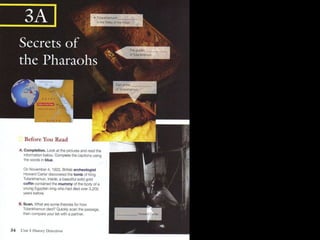
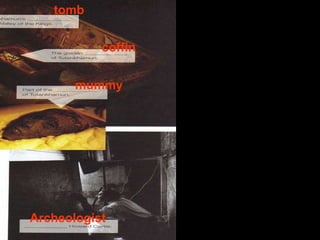


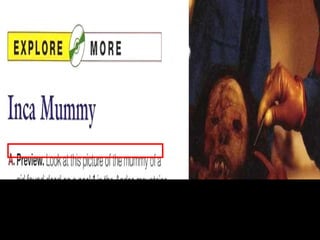


tomb coffin mummy Archeologist
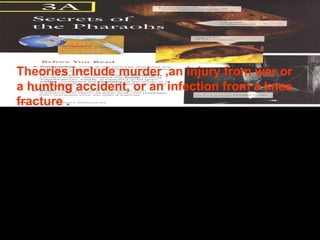
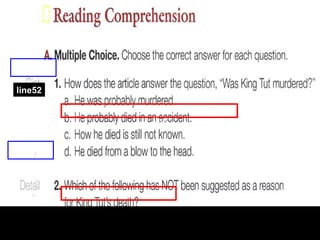
Theories include murder ,an injury from war or a hunting accident, or an infection from a knee fracture .
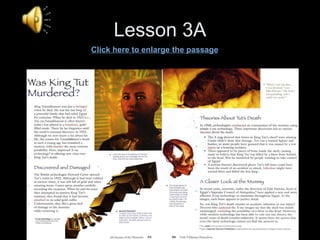
Lesson 3A Click here to enlarge the passage
Vocabulary Lesson 3A
teenager   ( n. ) a young person between the ages of thirteen and nineteen
luxurious   ( adj. ) very comfortable and expensive
murder   ( v. ) to kill someone
attach   ( to ) ( v. ) to join or fasten something to something else
conduct   ( v. ) to organize and carry out an
theory   ( n. ) a possible explanation for something that has yet to be confirmed
injury   ( n. ) damage done to a person or animal’s body
infection   ( n. ) a disease or sickness
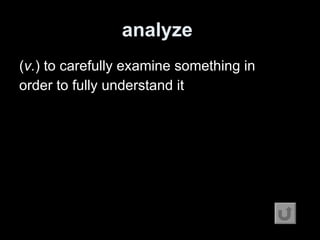
analyze   ( v. ) to carefully examine something in order to fully understand it
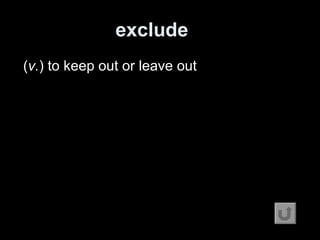
exclude   ( v. ) to keep out or leave out
line line52
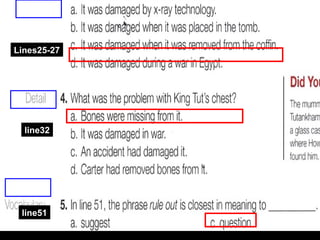
Lines25-27 line32 line51
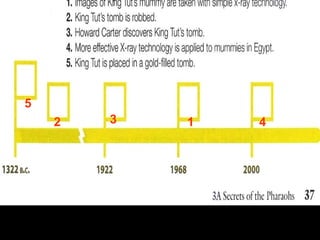
5 2 3 1 4
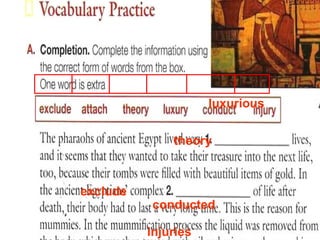
luxurious theory exclude conducted injuries
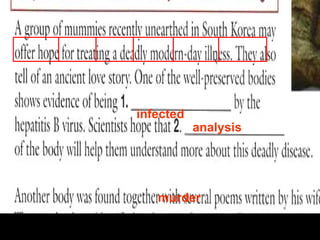
infected analysis murder
teenagers attachment


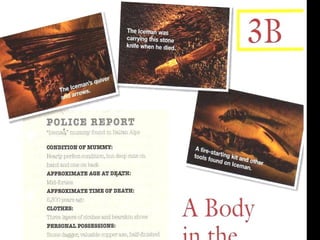
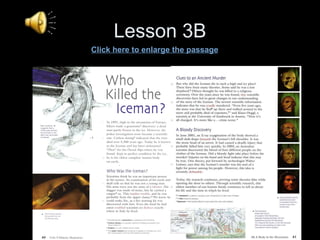
Lesson 3B Click here to enlarge the passage
Vocabulary Lesson 3B
freeze   ( v. ) to change a liquid into a solid state due to low temperature
labor   ( n. ) hard, physical work
imply   ( v. ) to indicate or suggest indirectly
wealth   ( n. ) possession of a large amount of money or valuable things
enable   ( v. ) to make something possible
deduce   ( v. ) to reach a conclusion because of other things you know to be true, to reason from general to specific
tiny   ( adj. ) extremely small
cruel   ( adj. ) mean, deliberately causing pain or distress
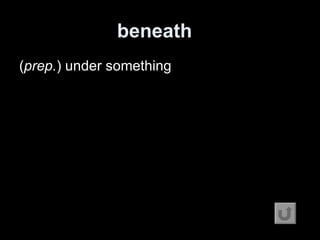
beneath   ( prep. ) under something
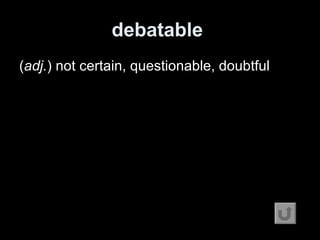
debatable   ( adj. ) not certain, questionable, doubtful
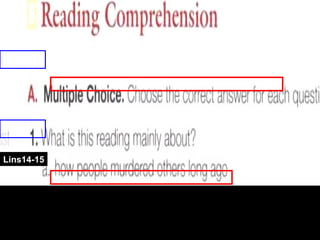
Lins14-15
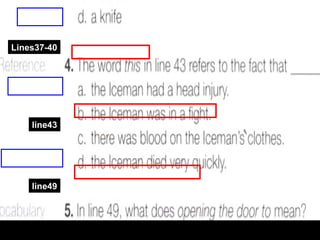
Lines37-40 line43 line49
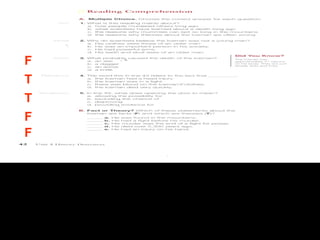
F T T F F
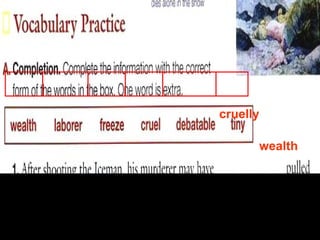
cruelly wealth
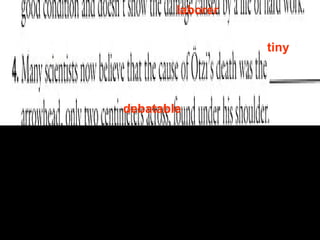
laborer tiny debatable
 
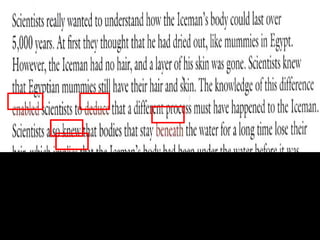
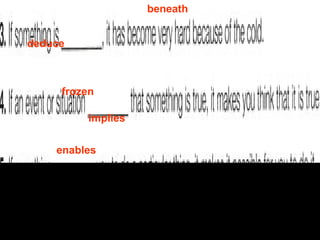
beneath deduce frozen implies enables


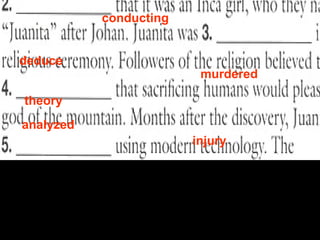
conducting deduce murdered theory analyzed injury
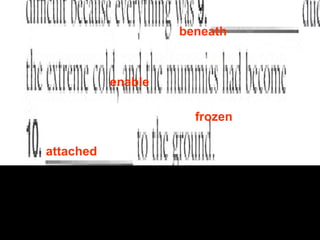
beneath enable frozen attached
For More Information http://ngm.nationalgeographic.com/ngm/0506/feature1/ http://ngm.nationalgeographic.com/2007/07/iceman/hall-text
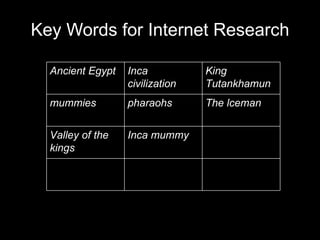
Key Words for Internet Research Ancient Egypt Inca civilization King Tutankhamun mummies  pharaohs The lceman Valley of the kings Inca mummy
Reading Skills
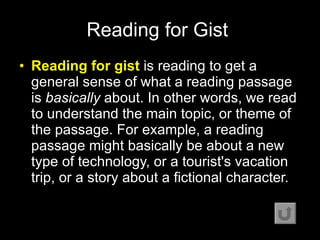
Reading for Gist   Reading for gist  is reading to get a general sense of what a reading passage is  basically  about. In other words, we read to understand the main topic, or theme of the passage. For example, a reading passage might basically be about a new type of technology, or a tourist's vacation trip, or a story about a fictional character.
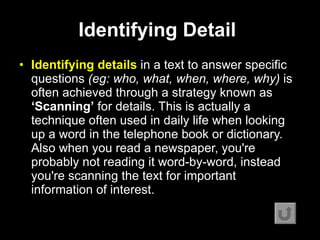
Identifying Detail   Identifying details  in a text to answer specific questions  (eg: who, what, when, where, why)  is often achieved through a strategy known as  ‘Scanning’  for details. This is actually a technique often used in daily life when looking up a word in the telephone book or dictionary. Also when you read a newspaper, you're probably not reading it word-by-word, instead you're scanning the text for important information of interest.
Defining Vocabulary   Often a reading passage contains definitions or explanations of new words related to the topic. The definitions in the text may be given through different clues to help you identify how the author has explained its meaning. It is important to understand synonyms or parallel expressions are often used to  define target vocabulary items .
Understanding  R eference Understanding  R eference  in a text is an important reading skill which involves focusing on specific meaning of ‘pronoun references’ used throughout a passage ( eg: this, those, their, it ). This is an important skill to help develop full comprehension of significant details of a section of a passage which refer back to previous statements made.

Unit3

  • 1.
  • 2.
  • 3.
  • 4.
    tomb coffin mummyArcheologist
  • 5.
    Theories include murder,an injury from war or a hunting accident, or an infection from a knee fracture .
  • 6.
    Lesson 3A Clickhere to enlarge the passage
  • 7.
  • 8.
    teenager ( n. ) a young person between the ages of thirteen and nineteen
  • 9.
    luxurious ( adj. ) very comfortable and expensive
  • 10.
    murder ( v. ) to kill someone
  • 11.
    attach ( to ) ( v. ) to join or fasten something to something else
  • 12.
    conduct ( v. ) to organize and carry out an
  • 13.
    theory ( n. ) a possible explanation for something that has yet to be confirmed
  • 14.
    injury ( n. ) damage done to a person or animal’s body
  • 15.
    infection ( n. ) a disease or sickness
  • 16.
    analyze ( v. ) to carefully examine something in order to fully understand it
  • 17.
    exclude ( v. ) to keep out or leave out
  • 18.
  • 19.
  • 20.
    5 2 31 4
  • 21.
    luxurious theory excludeconducted injuries
  • 22.
  • 23.
  • 24.
  • 25.
  • 26.
  • 27.
    Lesson 3B Clickhere to enlarge the passage
  • 28.
  • 29.
    freeze ( v. ) to change a liquid into a solid state due to low temperature
  • 30.
    labor ( n. ) hard, physical work
  • 31.
    imply ( v. ) to indicate or suggest indirectly
  • 32.
    wealth ( n. ) possession of a large amount of money or valuable things
  • 33.
    enable ( v. ) to make something possible
  • 34.
    deduce ( v. ) to reach a conclusion because of other things you know to be true, to reason from general to specific
  • 35.
    tiny ( adj. ) extremely small
  • 36.
    cruel ( adj. ) mean, deliberately causing pain or distress
  • 37.
    beneath ( prep. ) under something
  • 38.
    debatable ( adj. ) not certain, questionable, doubtful
  • 39.
  • 40.
  • 41.
    F T TF F
  • 42.
  • 43.
  • 44.
  • 45.
    beneath deduce frozenimplies enables
  • 46.
  • 47.
  • 48.
  • 49.
    conducting deduce murderedtheory analyzed injury
  • 50.
  • 51.
    For More Informationhttp://ngm.nationalgeographic.com/ngm/0506/feature1/ http://ngm.nationalgeographic.com/2007/07/iceman/hall-text
  • 52.
    Key Words forInternet Research Ancient Egypt Inca civilization King Tutankhamun mummies pharaohs The lceman Valley of the kings Inca mummy
  • 53.
  • 54.
    Reading for Gist Reading for gist is reading to get a general sense of what a reading passage is basically about. In other words, we read to understand the main topic, or theme of the passage. For example, a reading passage might basically be about a new type of technology, or a tourist's vacation trip, or a story about a fictional character.
  • 55.
    Identifying Detail Identifying details in a text to answer specific questions (eg: who, what, when, where, why) is often achieved through a strategy known as ‘Scanning’ for details. This is actually a technique often used in daily life when looking up a word in the telephone book or dictionary. Also when you read a newspaper, you're probably not reading it word-by-word, instead you're scanning the text for important information of interest.
  • 56.
    Defining Vocabulary Often a reading passage contains definitions or explanations of new words related to the topic. The definitions in the text may be given through different clues to help you identify how the author has explained its meaning. It is important to understand synonyms or parallel expressions are often used to define target vocabulary items .
  • 57.
    Understanding Reference Understanding R eference in a text is an important reading skill which involves focusing on specific meaning of ‘pronoun references’ used throughout a passage ( eg: this, those, their, it ). This is an important skill to help develop full comprehension of significant details of a section of a passage which refer back to previous statements made.