Chapter - 1
Foundation of Green Skilling,
Sustainability and AI
Contributions
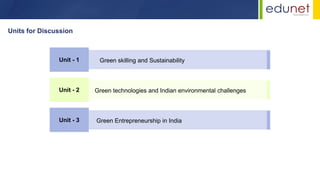
Units for Discussion
Unit - 1 Green skilling and Sustainability
Unit - 2 Green technologies and Indian environmental challenges
Unit - 3 Green Entrepreneurship in India
Green skilling and
Sustainability
Unit
1
DISCLAIMER
The content is curated from online/offline resources and
used for educational purpose only.
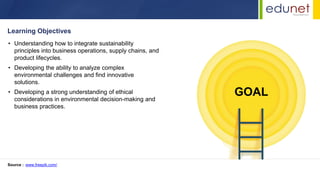
Learning Objectives
• Understanding how to integrate sustainability
principles into business operations, supply chains, and
product lifecycles.
• Developing the ability to analyze complex
environmental challenges and find innovative
solutions.
• Developing a strong understanding of ethical
considerations in environmental decision-making and
business practices.
Source : www.freepik.com/
GOAL
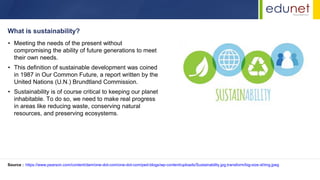
• Meeting the needs of the present without
compromising the ability of future generations to meet
their own needs.
• This definition of sustainable development was coined
in 1987 in Our Common Future, a report written by the
United Nations (U.N.) Brundtland Commission.
• Sustainability is of course critical to keeping our planet
inhabitable. To do so, we need to make real progress
in areas like reducing waste, conserving natural
resources, and preserving ecosystems.
What is sustainability?
Source : https://www.pearson.com/content/dam/one-dot-com/one-dot-com/ped-blogs/wp-content/uploads/Sustainability.jpg.transform/big-size-xl/img.jpeg
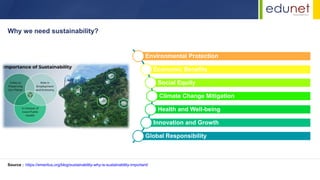
Environmental Protection
Economic Benefits
Social Equity
Climate Change Mitigation
Health and Well-being
Innovation and Growth
Global Responsibility
Why we need sustainability?
Source : https://emeritus.org/blog/sustainability-why-is-sustainability-important/
Classroom Activity
Co2 emission calculator to check personal contribution
https://e-amrit.niti.gov.in/co2-calculator
Hands On
Activity 1
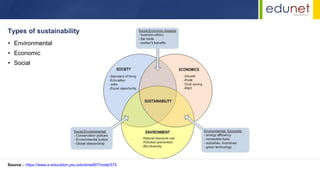
Types of sustainability
Source : https://www.e-education.psu.edu/eme807/node/575
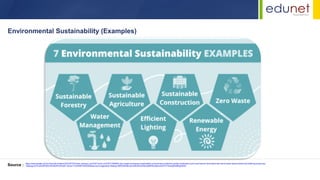
• Environmental
• Economic
• Social
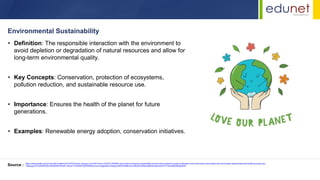
• Definition: The responsible interaction with the environment to
avoid depletion or degradation of natural resources and allow for
long-term environmental quality.
• Key Concepts: Conservation, protection of ecosystems,
pollution reduction, and sustainable resource use.
• Importance: Ensures the health of the planet for future
generations.
• Examples: Renewable energy adoption, conservation initiatives.
Environmental Sustainability
Source : https://www.google.com/url?sa=i&url=https%3A%2F%2Fwww.vecteezy.com%2Fvector-art%2F21509465-zero-waste-ecological-sustainability-environment-protection-poster-sublimation-print-card-banner-decorated-with-hand-drawn-kawaii-planet-and-lettering-quote-eps-
10&psig=AOvVaw38F8DIC4EsNDAPdPwx0f11&ust=1722405973830000&source=images&cd=vfe&opi=89978449&ved=2ahUKEwiMlo2zjM6HAxX8amwGHYiTNwsQjRx6BAgAEBU
Environmental Sustainability (Examples)
Source : https://www.google.com/url?sa=i&url=https%3A%2F%2Fwww.vecteezy.com%2Fvector-art%2F21509465-zero-waste-ecological-sustainability-environment-protection-poster-sublimation-print-card-banner-decorated-with-hand-drawn-kawaii-planet-and-lettering-quote-eps-
10&psig=AOvVaw38F8DIC4EsNDAPdPwx0f11&ust=1722405973830000&source=images&cd=vfe&opi=89978449&ved=2ahUKEwiMlo2zjM6HAxX8amwGHYiTNwsQjRx6BAgAEBU
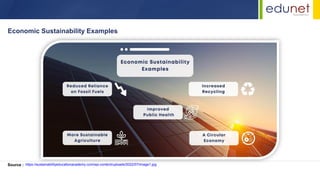
• Definition: The practice of supporting long-term economic
growth without negatively impacting social, environmental,
and cultural aspects of the community.
• Key Concepts: Economic growth, resource efficiency,
sustainable business practices.
• Importance: Balances economic development with
environmental and social well-being.
• Examples: Ethical sourcing, fair trade, economic equity.
Economic Sustainability
Source : https://future-business.org/how-does-sustainability-affect-the-economy/
Economic Sustainability Examples
Source : https://sustainabilityeducationacademy.com/wp-content/uploads/2022/07/image1.jpg
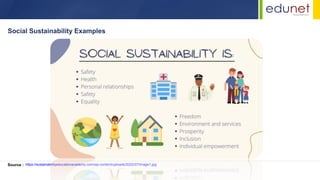
• Definition: Ensuring that social well-being and quality of life
are maintained or improved, now and in the future.
• Key Concepts: Social equity, community well-being, fair
distribution of resources.
• Importance: Promotes a stable and healthy society.
• Examples: Human rights advocacy, access to education,
healthcare services.
Social Sustainability
Source : https://katelyns-sustainability.weebly.com/social-sustainability.html
Social Sustainability Examples
Source : https://sustainabilityeducationacademy.com/wp-content/uploads/2022/07/image1.jpg
Classroom Activity
Activity: Sustainability Brainstorming Session
Hands On
Activity 2
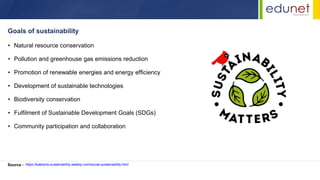
• Natural resource conservation
• Pollution and greenhouse gas emissions reduction
• Promotion of renewable energies and energy efficiency
• Development of sustainable technologies
• Biodiversity conservation
• Fulfilment of Sustainable Development Goals (SDGs)
• Community participation and collaboration
Goals of sustainability
Source : https://katelyns-sustainability.weebly.com/social-sustainability.html
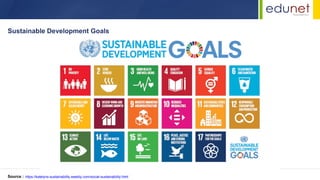
• The Sustainable Development Goals are the blueprint to achieve a better and more sustainable
future for all.
• They address the global challenges we face, including those related to poverty, inequality, climate
change, environmental degradation, peace and justice.
• The 17 Goals are all interconnected, and in order to leave no one behind, it is important that we
achieve them all by 2030.
• The 2030 Agenda for Sustainable Development, adopted by all United Nations Member States in
2015, provides a shared blueprint for peace and prosperity for people and the planet, now and into
the future.
Sustainable development goals
Source : https://katelyns-sustainability.weebly.com/social-sustainability.html
Sustainable Development Goals
Source : https://katelyns-sustainability.weebly.com/social-sustainability.html
• Access to Affordable, Reliable, Sustainable, and Modern Energy: By 2030, ensure universal access to
affordable, reliable, and modern energy services.
• Increase Renewable Energy: By 2030, substantially increase the share of renewable energy in the global
energy mix.
• Improve Energy Efficiency: By 2030, double the global rate of improvement in energy efficiency.
Goal 7: Affordable and clean energy
Source : https://katelyns-sustainability.weebly.com/social-sustainability.html
• Make Cities Inclusive, Safe, Resilient, and Sustainable: By 2030, ensure access for all to adequate,
safe, and affordable housing and basic services and upgrade slums.
• Reduce the Adverse Environmental Impact: By 2030, reduce the adverse per capita environmental
impact of cities, including by paying special attention to air quality and municipal and other waste
management.
• Provide Access to Safe and Inclusive Green and Public Spaces: By 2030, provide universal access to
safe, inclusive, and accessible, green, and public spaces, particularly for women and children, older
persons, and persons with disabilities.
Goal 11: Sustainable cities and communities
Source : https://katelyns-sustainability.weebly.com/social-sustainability.html
• Combat Climate Change and Its Impacts: Strengthen resilience and adaptive capacity to climate-related
hazards and natural disasters in all countries.
• Integrate Climate Change Measures into Policies and Planning: Integrate climate change measures into
national policies, strategies, and planning.
• Improve Education, Awareness, and Human and Institutional Capacity: Improve education, awareness,
and human and institutional capacity on climate change mitigation, adaptation, impact reduction, and early
warning.
Goal 13: Climate action
Source : https://katelyns-sustainability.weebly.com/social-sustainability.html
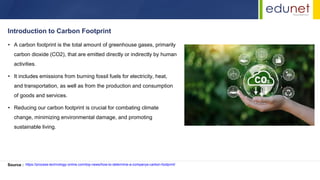
• A carbon footprint is the total amount of greenhouse gases, primarily
carbon dioxide (CO2), that are emitted directly or indirectly by human
activities.
• It includes emissions from burning fossil fuels for electricity, heat,
and transportation, as well as from the production and consumption
of goods and services.
• Reducing our carbon footprint is crucial for combating climate
change, minimizing environmental damage, and promoting
sustainable living.
Introduction to Carbon Footprint
Source : https://process-technology-online.com/top-news/how-to-determine-a-companys-carbon-footprint/
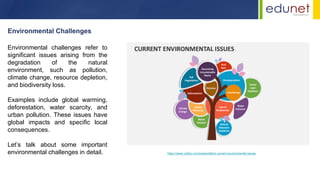
Environmental challenges refer to
significant issues arising from the
degradation of the natural
environment, such as pollution,
climate change, resource depletion,
and biodiversity loss.
Examples include global warming,
deforestation, water scarcity, and
urban pollution. These issues have
global impacts and specific local
consequences.
Let’s talk about some important
environmental challenges in detail.
Environmental Challenges
https://www.collidu.com/presentation-current-environmental-issues
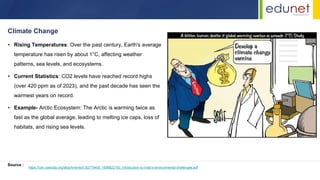
• Rising Temperatures: Over the past century, Earth's average
temperature has risen by about 1°C, affecting weather
patterns, sea levels, and ecosystems.
• Current Statistics: CO2 levels have reached record highs
(over 420 ppm as of 2023), and the past decade has seen the
warmest years on record.
• Example- Arctic Ecosystem: The Arctic is warming twice as
fast as the global average, leading to melting ice caps, loss of
habitats, and rising sea levels.
Climate Change
Source :
https://cdn.cseindia.org/attachments/0.82779400_1698822150_introduction-to-india's-environmental-challenges.pdf
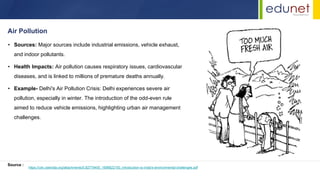
• Sources: Major sources include industrial emissions, vehicle exhaust,
and indoor pollutants.
• Health Impacts: Air pollution causes respiratory issues, cardiovascular
diseases, and is linked to millions of premature deaths annually.
• Example- Delhi's Air Pollution Crisis: Delhi experiences severe air
pollution, especially in winter. The introduction of the odd-even rule
aimed to reduce vehicle emissions, highlighting urban air management
challenges.
Air Pollution
Source :
https://cdn.cseindia.org/attachments/0.82779400_1698822150_introduction-to-india's-environmental-challenges.pdf
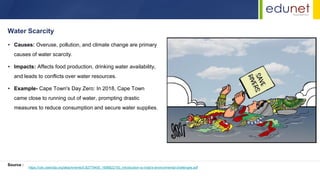
• Causes: Overuse, pollution, and climate change are primary
causes of water scarcity.
• Impacts: Affects food production, drinking water availability,
and leads to conflicts over water resources.
• Example- Cape Town's Day Zero: In 2018, Cape Town
came close to running out of water, prompting drastic
measures to reduce consumption and secure water supplies.
Water Scarcity
Source :
https://cdn.cseindia.org/attachments/0.82779400_1698822150_introduction-to-india's-environmental-challenges.pdf
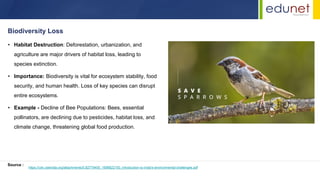
• Habitat Destruction: Deforestation, urbanization, and
agriculture are major drivers of habitat loss, leading to
species extinction.
• Importance: Biodiversity is vital for ecosystem stability, food
security, and human health. Loss of key species can disrupt
entire ecosystems.
• Example - Decline of Bee Populations: Bees, essential
pollinators, are declining due to pesticides, habitat loss, and
climate change, threatening global food production.
Biodiversity Loss
Source :
https://cdn.cseindia.org/attachments/0.82779400_1698822150_introduction-to-india's-environmental-challenges.pdf
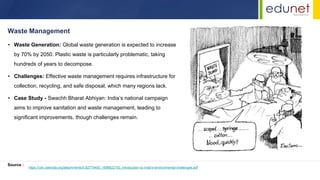
• Waste Generation: Global waste generation is expected to increase
by 70% by 2050. Plastic waste is particularly problematic, taking
hundreds of years to decompose.
• Challenges: Effective waste management requires infrastructure for
collection, recycling, and safe disposal, which many regions lack.
• Case Study - Swachh Bharat Abhiyan: India’s national campaign
aims to improve sanitation and waste management, leading to
significant improvements, though challenges remain.
Waste Management
Source :
https://cdn.cseindia.org/attachments/0.82779400_1698822150_introduction-to-india's-environmental-challenges.pdf
Climate Change: The last decade was the warmest on record, with 2023 seeing multiple extreme
weather events.
Air Pollution: WHO estimates that 9 out of 10 people breathe air containing high levels of pollutants.
Global Agreements: COP28, held in 2023, focused on accelerating the transition to net-zero emissions
and addressing climate finance gaps.
Current Facts and Statistics
Case Studies
Microsoft's Carbon Negative Commitment: Microsoft aims to be carbon negative by 2030, investing in
renewable energy, carbon capture technologies, and reforestation.
Shell's Shift Towards Renewable Energy: Shell is transitioning to a broader energy company, investing in
renewables like wind and solar, aiming to become net-zero by 2050.
Indian Initiatives:
NAPCC: India’s strategy for climate change mitigation, focusing on renewable energy and sustainable
agriculture.
Green Startups: Companies like Phool.co (flower waste recycling) and Mitticool (eco-friendly clay products) are
pioneering sustainable business models.
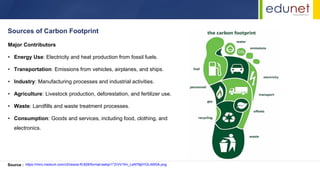
Major Contributors
• Energy Use: Electricity and heat production from fossil fuels.
• Transportation: Emissions from vehicles, airplanes, and ships.
• Industry: Manufacturing processes and industrial activities.
• Agriculture: Livestock production, deforestation, and fertilizer use.
• Waste: Landfills and waste treatment processes.
• Consumption: Goods and services, including food, clothing, and
electronics.
Sources of Carbon Footprint
Source : https://miro.medium.com/v2/resize:fit:828/format:webp/1*ZrVV1fm_LeN76jbYOLAW0A.png
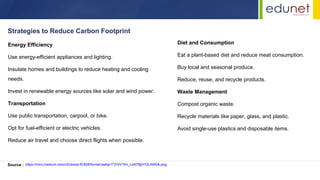
Energy Efficiency
Use energy-efficient appliances and lighting.
Insulate homes and buildings to reduce heating and cooling
needs.
Invest in renewable energy sources like solar and wind power.
Transportation
Use public transportation, carpool, or bike.
Opt for fuel-efficient or electric vehicles.
Reduce air travel and choose direct flights when possible.
Strategies to Reduce Carbon Footprint
Source : https://miro.medium.com/v2/resize:fit:828/format:webp/1*ZrVV1fm_LeN76jbYOLAW0A.png
Diet and Consumption
Eat a plant-based diet and reduce meat consumption.
Buy local and seasonal produce.
Reduce, reuse, and recycle products.
Waste Management
Compost organic waste.
Recycle materials like paper, glass, and plastic.
Avoid single-use plastics and disposable items.
Classroom Activity
https://ccd.gujarat.gov.in/carbon-footprint-calculator.htm
Hands On
Activity 3 Calculate the carbon footprint
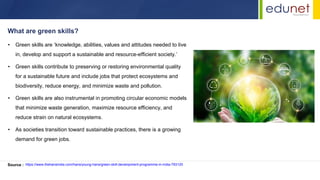
• Green skills are ‘knowledge, abilities, values and attitudes needed to live
in, develop and support a sustainable and resource-efficient society.’
• Green skills contribute to preserving or restoring environmental quality
for a sustainable future and include jobs that protect ecosystems and
biodiversity, reduce energy, and minimize waste and pollution.
• Green skills are also instrumental in promoting circular economic models
that minimize waste generation, maximize resource efficiency, and
reduce strain on natural ecosystems.
• As societies transition toward sustainable practices, there is a growing
demand for green jobs.
What are green skills?
Source : https://www.thehansindia.com/hans/young-hans/green-skill-development-programme-in-india-793120
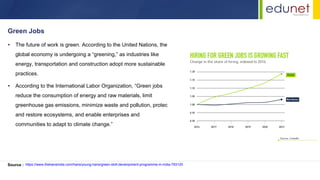
• The future of work is green. According to the United Nations, the
global economy is undergoing a “greening,” as industries like
energy, transportation and construction adopt more sustainable
practices.
• According to the International Labor Organization, “Green jobs
reduce the consumption of energy and raw materials, limit
greenhouse gas emissions, minimize waste and pollution, protect
and restore ecosystems, and enable enterprises and
communities to adapt to climate change.”
Green Jobs
Source : https://www.thehansindia.com/hans/young-hans/green-skill-development-programme-in-india-793120
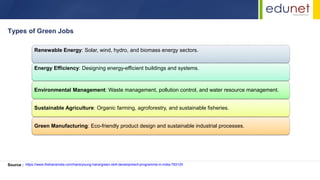
Renewable Energy: Solar, wind, hydro, and biomass energy sectors.
Energy Efficiency: Designing energy-efficient buildings and systems.
Environmental Management: Waste management, pollution control, and water resource management.
Sustainable Agriculture: Organic farming, agroforestry, and sustainable fisheries.
Green Manufacturing: Eco-friendly product design and sustainable industrial processes.
Types of Green Jobs
Source : https://www.thehansindia.com/hans/young-hans/green-skill-development-programme-in-india-793120
Top 25 countries with the higher
number of sectors with green skills
(2021)
Source : https://economicgraph.linkedin.com/content/dam/me/economicgraph/en-
us/global-green-skills-report/global-green-skills-report-pdf/li-green-economy-
report-2022.pdf
The Skill Council for Green Jobs (SCGJ) is an initiative under the National Skill Development Corporation (NSDC) in India. It
aims to identify, create, and promote green job opportunities in various sectors to support sustainable development.
Objectives
• Promote Green Jobs: Identify and create job opportunities in the green sector.
• Develop Standards: Establish competency standards and qualifications for green jobs.
• Training and Certification: Provide training and certification to individuals in green job roles.
• Industry Collaboration: Collaborate with industries, government agencies, and educational institutions to promote green
skills.
• Awareness and Advocacy: Raise awareness about the importance of green jobs and advocate for sustainable practices.
Skill Council for Green Jobs (SCGJ)
Conclusion
• Embrace and promote sustainability in daily life and
professional practices.
• Pursue education and training in green skills to be part
of the growing green economy.
• Seek and support green job opportunities to contribute
to a sustainable future.
• Take proactive steps to reduce your carbon footprint
and advocate for environmental policies.
Source : www.freepik.com/
References
1. http://www.oreilly.com/data/free/the-new-artificial-intelligence-market.csp
2. https://www.brightest.io/three-pillars-sustainability
3. https://worldgbc.org/
4. https://www.ibm.com/products/environmental-intelligence-suite/geospatial-ai
5. https://www.gevernova.com/
6. https://acore.org/
Let’s Start
Quiz
Answer: B
1. Which of the following is a key principle of
sustainability?
a) Economic growth at all costs
b) Minimizing environmental impact
c) Maximizing resource consumption
d) Focusing solely on technological advancements
Quiz
Answer: A
2. What does the term "sustainable development" mean?
a) Development that meets present needs without
compromising future generations' ability to meet their own
needs
b) Rapid industrialization and economic growth
c) Exploitation of natural resources for immediate gains
d) Development focused exclusively on urban areas
Quiz
Answer: C
3. What is the primary goal of green jobs?
a) To increase industrial production
b) To generate economic profit regardless of environmental
impact
c) To protect and restore the environment while providing
employment
d) To promote urbanization and infrastructure development
Quiz
Answer: B
4. Which of the following is considered a green job?
a) Coal mining
b) Solar panel installation
c) Plastic manufacturing
d) Oil drilling
Thank You

Unit1 - AIML Chapter 1 concept and ethics

  • 1.
    Chapter - 1 Foundationof Green Skilling, Sustainability and AI Contributions
  • 2.
    Units for Discussion Unit- 1 Green skilling and Sustainability Unit - 2 Green technologies and Indian environmental challenges Unit - 3 Green Entrepreneurship in India
  • 3.
  • 4.
    DISCLAIMER The content iscurated from online/offline resources and used for educational purpose only.
  • 5.
    Learning Objectives • Understandinghow to integrate sustainability principles into business operations, supply chains, and product lifecycles. • Developing the ability to analyze complex environmental challenges and find innovative solutions. • Developing a strong understanding of ethical considerations in environmental decision-making and business practices. Source : www.freepik.com/ GOAL
  • 7.
    • Meeting theneeds of the present without compromising the ability of future generations to meet their own needs. • This definition of sustainable development was coined in 1987 in Our Common Future, a report written by the United Nations (U.N.) Brundtland Commission. • Sustainability is of course critical to keeping our planet inhabitable. To do so, we need to make real progress in areas like reducing waste, conserving natural resources, and preserving ecosystems. What is sustainability? Source : https://www.pearson.com/content/dam/one-dot-com/one-dot-com/ped-blogs/wp-content/uploads/Sustainability.jpg.transform/big-size-xl/img.jpeg
  • 8.
    Environmental Protection Economic Benefits SocialEquity Climate Change Mitigation Health and Well-being Innovation and Growth Global Responsibility Why we need sustainability? Source : https://emeritus.org/blog/sustainability-why-is-sustainability-important/
  • 9.
    Classroom Activity Co2 emissioncalculator to check personal contribution https://e-amrit.niti.gov.in/co2-calculator Hands On Activity 1
  • 10.
    Types of sustainability Source: https://www.e-education.psu.edu/eme807/node/575 • Environmental • Economic • Social
  • 11.
    • Definition: Theresponsible interaction with the environment to avoid depletion or degradation of natural resources and allow for long-term environmental quality. • Key Concepts: Conservation, protection of ecosystems, pollution reduction, and sustainable resource use. • Importance: Ensures the health of the planet for future generations. • Examples: Renewable energy adoption, conservation initiatives. Environmental Sustainability Source : https://www.google.com/url?sa=i&url=https%3A%2F%2Fwww.vecteezy.com%2Fvector-art%2F21509465-zero-waste-ecological-sustainability-environment-protection-poster-sublimation-print-card-banner-decorated-with-hand-drawn-kawaii-planet-and-lettering-quote-eps- 10&psig=AOvVaw38F8DIC4EsNDAPdPwx0f11&ust=1722405973830000&source=images&cd=vfe&opi=89978449&ved=2ahUKEwiMlo2zjM6HAxX8amwGHYiTNwsQjRx6BAgAEBU
  • 12.
    Environmental Sustainability (Examples) Source: https://www.google.com/url?sa=i&url=https%3A%2F%2Fwww.vecteezy.com%2Fvector-art%2F21509465-zero-waste-ecological-sustainability-environment-protection-poster-sublimation-print-card-banner-decorated-with-hand-drawn-kawaii-planet-and-lettering-quote-eps- 10&psig=AOvVaw38F8DIC4EsNDAPdPwx0f11&ust=1722405973830000&source=images&cd=vfe&opi=89978449&ved=2ahUKEwiMlo2zjM6HAxX8amwGHYiTNwsQjRx6BAgAEBU
  • 13.
    • Definition: Thepractice of supporting long-term economic growth without negatively impacting social, environmental, and cultural aspects of the community. • Key Concepts: Economic growth, resource efficiency, sustainable business practices. • Importance: Balances economic development with environmental and social well-being. • Examples: Ethical sourcing, fair trade, economic equity. Economic Sustainability Source : https://future-business.org/how-does-sustainability-affect-the-economy/
  • 14.
    Economic Sustainability Examples Source: https://sustainabilityeducationacademy.com/wp-content/uploads/2022/07/image1.jpg
  • 15.
    • Definition: Ensuringthat social well-being and quality of life are maintained or improved, now and in the future. • Key Concepts: Social equity, community well-being, fair distribution of resources. • Importance: Promotes a stable and healthy society. • Examples: Human rights advocacy, access to education, healthcare services. Social Sustainability Source : https://katelyns-sustainability.weebly.com/social-sustainability.html
  • 16.
    Social Sustainability Examples Source: https://sustainabilityeducationacademy.com/wp-content/uploads/2022/07/image1.jpg
  • 17.
    Classroom Activity Activity: SustainabilityBrainstorming Session Hands On Activity 2
  • 18.
    • Natural resourceconservation • Pollution and greenhouse gas emissions reduction • Promotion of renewable energies and energy efficiency • Development of sustainable technologies • Biodiversity conservation • Fulfilment of Sustainable Development Goals (SDGs) • Community participation and collaboration Goals of sustainability Source : https://katelyns-sustainability.weebly.com/social-sustainability.html
  • 19.
    • The SustainableDevelopment Goals are the blueprint to achieve a better and more sustainable future for all. • They address the global challenges we face, including those related to poverty, inequality, climate change, environmental degradation, peace and justice. • The 17 Goals are all interconnected, and in order to leave no one behind, it is important that we achieve them all by 2030. • The 2030 Agenda for Sustainable Development, adopted by all United Nations Member States in 2015, provides a shared blueprint for peace and prosperity for people and the planet, now and into the future. Sustainable development goals Source : https://katelyns-sustainability.weebly.com/social-sustainability.html
  • 20.
    Sustainable Development Goals Source: https://katelyns-sustainability.weebly.com/social-sustainability.html
  • 21.
    • Access toAffordable, Reliable, Sustainable, and Modern Energy: By 2030, ensure universal access to affordable, reliable, and modern energy services. • Increase Renewable Energy: By 2030, substantially increase the share of renewable energy in the global energy mix. • Improve Energy Efficiency: By 2030, double the global rate of improvement in energy efficiency. Goal 7: Affordable and clean energy Source : https://katelyns-sustainability.weebly.com/social-sustainability.html
  • 22.
    • Make CitiesInclusive, Safe, Resilient, and Sustainable: By 2030, ensure access for all to adequate, safe, and affordable housing and basic services and upgrade slums. • Reduce the Adverse Environmental Impact: By 2030, reduce the adverse per capita environmental impact of cities, including by paying special attention to air quality and municipal and other waste management. • Provide Access to Safe and Inclusive Green and Public Spaces: By 2030, provide universal access to safe, inclusive, and accessible, green, and public spaces, particularly for women and children, older persons, and persons with disabilities. Goal 11: Sustainable cities and communities Source : https://katelyns-sustainability.weebly.com/social-sustainability.html
  • 23.
    • Combat ClimateChange and Its Impacts: Strengthen resilience and adaptive capacity to climate-related hazards and natural disasters in all countries. • Integrate Climate Change Measures into Policies and Planning: Integrate climate change measures into national policies, strategies, and planning. • Improve Education, Awareness, and Human and Institutional Capacity: Improve education, awareness, and human and institutional capacity on climate change mitigation, adaptation, impact reduction, and early warning. Goal 13: Climate action Source : https://katelyns-sustainability.weebly.com/social-sustainability.html
  • 24.
    • A carbonfootprint is the total amount of greenhouse gases, primarily carbon dioxide (CO2), that are emitted directly or indirectly by human activities. • It includes emissions from burning fossil fuels for electricity, heat, and transportation, as well as from the production and consumption of goods and services. • Reducing our carbon footprint is crucial for combating climate change, minimizing environmental damage, and promoting sustainable living. Introduction to Carbon Footprint Source : https://process-technology-online.com/top-news/how-to-determine-a-companys-carbon-footprint/
  • 25.
    Environmental challenges referto significant issues arising from the degradation of the natural environment, such as pollution, climate change, resource depletion, and biodiversity loss. Examples include global warming, deforestation, water scarcity, and urban pollution. These issues have global impacts and specific local consequences. Let’s talk about some important environmental challenges in detail. Environmental Challenges https://www.collidu.com/presentation-current-environmental-issues
  • 26.
    • Rising Temperatures:Over the past century, Earth's average temperature has risen by about 1°C, affecting weather patterns, sea levels, and ecosystems. • Current Statistics: CO2 levels have reached record highs (over 420 ppm as of 2023), and the past decade has seen the warmest years on record. • Example- Arctic Ecosystem: The Arctic is warming twice as fast as the global average, leading to melting ice caps, loss of habitats, and rising sea levels. Climate Change Source : https://cdn.cseindia.org/attachments/0.82779400_1698822150_introduction-to-india's-environmental-challenges.pdf
  • 27.
    • Sources: Majorsources include industrial emissions, vehicle exhaust, and indoor pollutants. • Health Impacts: Air pollution causes respiratory issues, cardiovascular diseases, and is linked to millions of premature deaths annually. • Example- Delhi's Air Pollution Crisis: Delhi experiences severe air pollution, especially in winter. The introduction of the odd-even rule aimed to reduce vehicle emissions, highlighting urban air management challenges. Air Pollution Source : https://cdn.cseindia.org/attachments/0.82779400_1698822150_introduction-to-india's-environmental-challenges.pdf
  • 28.
    • Causes: Overuse,pollution, and climate change are primary causes of water scarcity. • Impacts: Affects food production, drinking water availability, and leads to conflicts over water resources. • Example- Cape Town's Day Zero: In 2018, Cape Town came close to running out of water, prompting drastic measures to reduce consumption and secure water supplies. Water Scarcity Source : https://cdn.cseindia.org/attachments/0.82779400_1698822150_introduction-to-india's-environmental-challenges.pdf
  • 29.
    • Habitat Destruction:Deforestation, urbanization, and agriculture are major drivers of habitat loss, leading to species extinction. • Importance: Biodiversity is vital for ecosystem stability, food security, and human health. Loss of key species can disrupt entire ecosystems. • Example - Decline of Bee Populations: Bees, essential pollinators, are declining due to pesticides, habitat loss, and climate change, threatening global food production. Biodiversity Loss Source : https://cdn.cseindia.org/attachments/0.82779400_1698822150_introduction-to-india's-environmental-challenges.pdf
  • 30.
    • Waste Generation:Global waste generation is expected to increase by 70% by 2050. Plastic waste is particularly problematic, taking hundreds of years to decompose. • Challenges: Effective waste management requires infrastructure for collection, recycling, and safe disposal, which many regions lack. • Case Study - Swachh Bharat Abhiyan: India’s national campaign aims to improve sanitation and waste management, leading to significant improvements, though challenges remain. Waste Management Source : https://cdn.cseindia.org/attachments/0.82779400_1698822150_introduction-to-india's-environmental-challenges.pdf
  • 31.
    Climate Change: Thelast decade was the warmest on record, with 2023 seeing multiple extreme weather events. Air Pollution: WHO estimates that 9 out of 10 people breathe air containing high levels of pollutants. Global Agreements: COP28, held in 2023, focused on accelerating the transition to net-zero emissions and addressing climate finance gaps. Current Facts and Statistics
  • 32.
    Case Studies Microsoft's CarbonNegative Commitment: Microsoft aims to be carbon negative by 2030, investing in renewable energy, carbon capture technologies, and reforestation. Shell's Shift Towards Renewable Energy: Shell is transitioning to a broader energy company, investing in renewables like wind and solar, aiming to become net-zero by 2050. Indian Initiatives: NAPCC: India’s strategy for climate change mitigation, focusing on renewable energy and sustainable agriculture. Green Startups: Companies like Phool.co (flower waste recycling) and Mitticool (eco-friendly clay products) are pioneering sustainable business models.
  • 33.
    Major Contributors • EnergyUse: Electricity and heat production from fossil fuels. • Transportation: Emissions from vehicles, airplanes, and ships. • Industry: Manufacturing processes and industrial activities. • Agriculture: Livestock production, deforestation, and fertilizer use. • Waste: Landfills and waste treatment processes. • Consumption: Goods and services, including food, clothing, and electronics. Sources of Carbon Footprint Source : https://miro.medium.com/v2/resize:fit:828/format:webp/1*ZrVV1fm_LeN76jbYOLAW0A.png
  • 34.
    Energy Efficiency Use energy-efficientappliances and lighting. Insulate homes and buildings to reduce heating and cooling needs. Invest in renewable energy sources like solar and wind power. Transportation Use public transportation, carpool, or bike. Opt for fuel-efficient or electric vehicles. Reduce air travel and choose direct flights when possible. Strategies to Reduce Carbon Footprint Source : https://miro.medium.com/v2/resize:fit:828/format:webp/1*ZrVV1fm_LeN76jbYOLAW0A.png Diet and Consumption Eat a plant-based diet and reduce meat consumption. Buy local and seasonal produce. Reduce, reuse, and recycle products. Waste Management Compost organic waste. Recycle materials like paper, glass, and plastic. Avoid single-use plastics and disposable items.
  • 35.
  • 36.
    • Green skillsare ‘knowledge, abilities, values and attitudes needed to live in, develop and support a sustainable and resource-efficient society.’ • Green skills contribute to preserving or restoring environmental quality for a sustainable future and include jobs that protect ecosystems and biodiversity, reduce energy, and minimize waste and pollution. • Green skills are also instrumental in promoting circular economic models that minimize waste generation, maximize resource efficiency, and reduce strain on natural ecosystems. • As societies transition toward sustainable practices, there is a growing demand for green jobs. What are green skills? Source : https://www.thehansindia.com/hans/young-hans/green-skill-development-programme-in-india-793120
  • 37.
    • The futureof work is green. According to the United Nations, the global economy is undergoing a “greening,” as industries like energy, transportation and construction adopt more sustainable practices. • According to the International Labor Organization, “Green jobs reduce the consumption of energy and raw materials, limit greenhouse gas emissions, minimize waste and pollution, protect and restore ecosystems, and enable enterprises and communities to adapt to climate change.” Green Jobs Source : https://www.thehansindia.com/hans/young-hans/green-skill-development-programme-in-india-793120
  • 38.
    Renewable Energy: Solar,wind, hydro, and biomass energy sectors. Energy Efficiency: Designing energy-efficient buildings and systems. Environmental Management: Waste management, pollution control, and water resource management. Sustainable Agriculture: Organic farming, agroforestry, and sustainable fisheries. Green Manufacturing: Eco-friendly product design and sustainable industrial processes. Types of Green Jobs Source : https://www.thehansindia.com/hans/young-hans/green-skill-development-programme-in-india-793120
  • 39.
    Top 25 countrieswith the higher number of sectors with green skills (2021) Source : https://economicgraph.linkedin.com/content/dam/me/economicgraph/en- us/global-green-skills-report/global-green-skills-report-pdf/li-green-economy- report-2022.pdf
  • 40.
    The Skill Councilfor Green Jobs (SCGJ) is an initiative under the National Skill Development Corporation (NSDC) in India. It aims to identify, create, and promote green job opportunities in various sectors to support sustainable development. Objectives • Promote Green Jobs: Identify and create job opportunities in the green sector. • Develop Standards: Establish competency standards and qualifications for green jobs. • Training and Certification: Provide training and certification to individuals in green job roles. • Industry Collaboration: Collaborate with industries, government agencies, and educational institutions to promote green skills. • Awareness and Advocacy: Raise awareness about the importance of green jobs and advocate for sustainable practices. Skill Council for Green Jobs (SCGJ)
  • 41.
    Conclusion • Embrace andpromote sustainability in daily life and professional practices. • Pursue education and training in green skills to be part of the growing green economy. • Seek and support green job opportunities to contribute to a sustainable future. • Take proactive steps to reduce your carbon footprint and advocate for environmental policies. Source : www.freepik.com/
  • 42.
    References 1. http://www.oreilly.com/data/free/the-new-artificial-intelligence-market.csp 2. https://www.brightest.io/three-pillars-sustainability 3.https://worldgbc.org/ 4. https://www.ibm.com/products/environmental-intelligence-suite/geospatial-ai 5. https://www.gevernova.com/ 6. https://acore.org/
  • 43.
  • 44.
    Quiz Answer: B 1. Whichof the following is a key principle of sustainability? a) Economic growth at all costs b) Minimizing environmental impact c) Maximizing resource consumption d) Focusing solely on technological advancements
  • 45.
    Quiz Answer: A 2. Whatdoes the term "sustainable development" mean? a) Development that meets present needs without compromising future generations' ability to meet their own needs b) Rapid industrialization and economic growth c) Exploitation of natural resources for immediate gains d) Development focused exclusively on urban areas
  • 46.
    Quiz Answer: C 3. Whatis the primary goal of green jobs? a) To increase industrial production b) To generate economic profit regardless of environmental impact c) To protect and restore the environment while providing employment d) To promote urbanization and infrastructure development
  • 47.
    Quiz Answer: B 4. Whichof the following is considered a green job? a) Coal mining b) Solar panel installation c) Plastic manufacturing d) Oil drilling

  • 48.