Theories on Rights and
Duties and Fundamental
Rights and Duties under
Indian Constitution
LEGAL RIGHTS
• By being a citizen of the country, the people are given the legal right and law
protects these legal rights.
• The concept of legal right is a fundamental significance of modern legal theory
because we cannot live without it.
• Rights are those important conditions of social life without which no person can
generally realize his best self. These are the essential conditions for health of both
the individual and his society.
• It is only when people get and enjoy rights that they can develop their personalities
and contributes their best services to the society.
• Every legal right has a corresponding duty and the interest which the law
protects by imposing corresponding duties on others.
• It is the duty of every individual to protect the rights of each individual.
Meaning of Right
• Right in the ordinary sense mean the standard of permitted action within a certain sphere.
• As a legal term, it means the standard of permitted action by law. Such permitted action of a
person is known as his legal right.
• According to Salmond: A legal right is an “interest which is protected and recognized by the rule of
law. It is an interest which has its duty and disregard of which is wrong”.
• According to Gray: A legal right is “that power which the man has, to make a person or persons to do
or restrains from doing a certain act or acts so far as the power arises from society imposing a legal
duty upon the person or persons. He states that the “right is not the interest itself, it is the means to
enjoy the interest secured”.
• In the case of State of Rajasthan v. Union of India 1978 SCR (1)1 the Supreme Court stated that
“Legal rights in the strict sense are correlatives of legal duties and legal rights are defined as the
interests which the law protects by imposing duties on other persons.”
Rights can be classified into moral and legal
A legal right must be distinguished from a moral or natural right.
• A legal right is an interest recognized and protected by a rule of legal justice, an interest the
violation of which would be a legal wrong done to him whose interest it is, and respect for
which is a legal duty.
• Moral or natural right means an interest recognized and protected by a rule of natural justice,
an interest the violation of which would be a moral wrong, and respect for which is a moral
duty.
• A moral right cannot be the basis for seeking relief through the legal system. There must be a law
creating a right before that right can be enforced through the legal system.
• For example, an employee has a moral right to be treated with appreciation and respect by an
employer. Employment and discrimination laws provide the legal framework defining an
employee's rights to freedom from being disadvantaged by an employer's discriminatory intent
based on certain grounds, such as age or religion.
Elements of legal right
According to Salmond, there are five essential conditions that need to be
fulfilled:
1. The person of inherence/ Subject of right
2. The subject of duty/ the person of incidence
3. Contents or Subject Matter of legal right
4. Object of right
5. Title of the legal right
1. The person of inherence/ Subject of right: He shall be the person who
is the owner of the right. Such a person is called a person of inherence.
Example: Y purchase a van for Rs 20,000. Here Y is the subject of the
right.
2. The subject of duty/ the person of incidence: It is the duty of another
person or persons to respect and recognize the right of the person. Such a
person who has a legal duty is called a person of incidence.
3. Contents or Subject Matter of legal right: It is related to do something or
to refrain from doing certain acts or forbearance. It obligates the person to
forbear or act in favour of the person possessing a legal right. Example: Y
purchase a van for Rs 20,000. Here Y is the subject of the right. The subject
matter ( Y) has a legal right and he can exclude others.
4. The object of the legal right: The object of the legal rights is a thing or
object over which the legal right is exercised. Example- Y purchases the car for
Rs 20,000. Here the car is the object.
5. Title of the legal right: - The title is the process by which the right is
vested or conferred on the person. It is certain events by which right is
acquired from its previous owner. Example- By purchase or gift or will etc.
1. Will theory
• Supported by: Kant, Hegel, Hume
• According to this theory “rights is an inherent attribute of the human will”. The subject
matter of right is derived from the human will.
• It is through a right that a man expresses his will over an object.
• According to Puchta - the legal rights gives power to the person over the object which by
means of right can be subjected to the will of the person who is enjoying the right.
• Criticized by: Duguit - According to him the basis of the law is not a subjective will but it is
an objective will. The purpose of the law is to protect only those acts which further support
social solidarity. He further stated that the theory of subjective right is a metaphysical
abstraction.
Theories Related To The Legal Right
2. Interest Theory
- developed by Rudolf Von Ihering
- Rudolf Von Ihering stated that Legal right is the legally protected interest.
- He gave importance to the ‘interest’ of the people rather than the ‘will’ of the people.
- The main objective of law is to protect the interests of the people and to avoid the conflict
between the individual interest.
- Salmond criticism: He criticized the interest theory on the ground that it is incomplete, as it
overlooks state recognition. In order to confer a legal right, it is essential that interest should
be protected and recognized by the state.
- Ex Animal Protection
3. Protection Theory
Denies the existence of legal rights.
State being omnipotent – individual has no separate existence
All rights belong to the state and individuals do not have any independent legal
right
Not relevant in modern democratic state.
Kinds of Rights
I. Perfect & Imperfect Rights
• The perfect right has the following features:
• It is recognized by law.
• It is enforceable by law. So, in the case of breach of this right, a person may go to court for enforcing this
right.
• Thus, all fundamental rights, viz. Right to equality, right to religion, etc. are perfect rights as these are
enforceable by law
• The imperfect right has the following features:
• It is recognized by law.
• It is not enforceable by law. This means that a person cannot go to court for the breach of imperfect right.
• All the time-bound claims or debts come under the category of imperfect rights.
II. Positive & Negative Rights
• The basis of distinguishing right as positive or negative is the nature of
correlative duty it carries with it.
• Under Positive rights, the person has to perform some positive duty to fulfill
this right. Ex right to damages and compensation.
• Negative rights prevent a person to do some act, that is it corresponds to a
negative duty. Example: Right to life under article 21 of the Indian
constitution is a negative right because it prevents a person to kill another
person, right to ownership.
III. Real & Personal Rights
• Real right or right in- rem corresponds to the duty imposed upon the people
in general. It is available against the whole world in general. Example: Tort or
crime is a real right, peaceful enjoyment of land
• Personal right or right in-persona is available against a particular person & it
corresponds to the duty imposed upon a particular person. Therefore, the
personal right generally arises out of contractual obligation. Example: breach
of contract is a personal right, rent from tenant.
IV. Proprietary & Personal Rights
• A proprietary right is available with respect to a property, that is it relates to
the owner & his assets. The assets must have some monetary value. Example:
the right to ownership of property, Right to patent, Right to goodwill, etc.
• A personal right is related to a person’s life i.e. his reputation or standing in
the society. These rights promote a person’s well being in society & have no
economic value. Example: Right to life.
V. Public & Private Rights
• The rights which are vested in a person by state or govt. or constitution is called
public rights. Example: Right to vote, Right to use public parks, etc.
• Private rights are connected with private individuals or persons. Example: A
contract entered into by two people gives rise to private rights to them.
VI. Inheritable & Uninheritable Rights
• Inheritable rights can be passed from one generation to another, i.e. this right
survives even after the death of its owner. Example: A son is a legal heir to the
property of his father after his death.
• Uninheritable rights die with the death of its owner. Example: All personal rights
are uninheritable rights.
VII. Right in re propria & Right in re aliena
A person possesses Right in re propria with respect to his own property. He can use, dispose of, destroy,
modify or exclude others from his property. Thus, this right gives a person, absolute ownership over the
property.
Right in re aliena is the right in the property of another person. Example: Right of way over the
neighbor’s field. So, it is not an absolute right.
VIII. Principal and Accessory rights -
The principal right is a basic or main right. They are vital and important Rights.
While accessory right is incidental or consequential right. They are not essential but are ancillary to
principal rights and have a beneficial effect on principal right.
Owner of land – ownership is principal right and right of way on adjoining land is accessory right.
IX. Vested and Contingent Right -
Vested right means which is already vested in person, the person already
has such right through it depends upon the happening of certain events, that
event is going to happen. Ex transfer of property by valid deed
Whereas is in Contingent interest the right is dependent upon happening
or non-happening of certain events which may or may not happen. Ex transfer
of property upon condition that possession only after 21 years of age.
Concept of Duties
• As citizens, there exists a wide range of duties that bind us in everyday life. These
duties are owed both to the state and to individuals.
• There is a legal duty to pay taxes, to refrain from committing violence against
fellow-citizens, and to follow other laws that Parliament has enacted.
• Breach of these legal duties triggers financial consequences (fines), or punitive
measures like imprisonment.
• Duties follow a simple logic that, peaceful co-existence requires a degree of
self-sacrifice, and that if necessary, this must be enforced through the set of
sanctions.
1.Keaton – A duty is an act which should be enforced by the state in
preserving the rights given to the people and also in order to protect the
interest of the people.
2.Salmond – A duty is an act which every citizen have obliged to perform, in
furtherance of protecting the rights of the other people.
Duty - 1. Moral and 2. Legal
Classification of Legal Duties
• Primary and Secondary Duties – A primary duty which is independent of any other duty and does not have to
depend upon other duties. Ex forbear from causing injury to other. On the other hand secondary duty which is also
known as a remedial duty has no independent existence but exists only for enforcement of other duties. Ex Duty to
pay damages.
• Positive and Negative Duties – Duties which is prescribed by Law (obliges person to do an act) is Positive Duty and
which is prohibited (obliges person to refrain from doing an act) by the Law is called the Negative duty.
• Absolute and Relative Duties – Absolute duties are owed to the state, breach of this is a crime. Relative duties are
that duty which is owed to any person, breach of this is civil injury. Austin also given classify absolute duties –
A. Self-regarding duties such as a duty not to commit suicide or not to consume drugs or liquor, etc.
B. Duties towards society e.g. a duty not to commit a nuisance.
C. Duties towards other than human beings such as duty towards God or animals, birds, etc.
D. Duty towards the sovereign or the state.
Rights and Duties are correlative
• Rights and duties are co-existent. In the words of Salmond, it can be said that no
right exists without the corresponding duty.
• Rights are inseparably related with duties. There is a close relationship between
them “No Duties No Rights.” “If I have rights it is my duty to respect the rights of
others in society”.
• Every duty of the person must be the duty towards some person, in whom the right
is vested and conversely every right must be against some persons upon whom a
duty is imposed.
• In a constitutional democracy, the State provides rights and lays down duties for
the citizenry, so that society can peacefully co-exist.
Mahatma Gandhi in Hind Swaraj observed that “Real rights are a result
of the performance of duty”.
According to Harold Laski, one man’s right is also his duty.
• For example, if the State gives the right to life to a citizen, it also imposes an obligation
on him to not to expose his life to dangers, as well as to respect the life of others.
1. Rights and Duties always go together:
Rights and duties are closely related and cannot be separated from one another. Both go side
by side. These are the two sides of the same coin. If the state gives the right to life to a citizen,
it also imposes an obligation on him to not to expose his life to dangers, as well as to respect
the life of others. If I have a right to work and earn, it is also my duty to recognize the same
right of others.
2. Right of One is the Duty of Others:
Rights can be enjoyed only in the world of duties. For every right there is corresponding duty.
When the people fail to discharge their duties properly, the rights all become meaningless. “I
can enjoy my rights only if the others allow me to do the same. I have” the right to life and it is
the duty of others to respect my life and not to cause any harm to me.”
3. Rights of a Citizen also implies Duties for him:
Rights are not the monopoly of a single individual. Everybody gets these equally. This
means that “others also have the same rights which I have, and it is my duty to see that
others also enjoy their rights.” Laski has rightly said that one man’s right is also his
duty. It is my duty to respect the rights of others as well as the duty to use my rights in
the interest of society.
4. Rights are to be used for Social Good:
Rights originate in society. Therefore, while enjoying rights, we must always try to
promote social interest. It is the duty of every one of us to use our rights for
promoting the welfare of the society as a whole.
5. Duty towards the State:
Since state protects and enforces rights, it also becomes the duty of all citizens
to be loyal to the state. It is their duty to obey the laws of the state and to pay
taxes honestly. Citizens should always be ready to defend the state. Thus a
citizen has both Rights and Duties. He enjoys rights and performs his duties.
Rights and Duties are the two sides of the same coin.
Indian Constitution
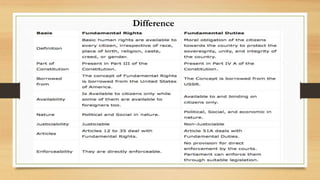
• Indian Constitution provides its citizens with the Fundamental Rights and
lists the Fundamental Duties to be followed by them.
• The Constitution covers a broad spectrum of domains to protect the rights
of the common man by introducing six rights as Fundamental Rights (Part
III of the constitution).
• Similarly, the Fundamental Duties are also emphasized upon by the
Constitution (Part IVA of the constitution).
Rights guaranteed by the Indian Constitution
• The Constitution of India has guaranteed certain rights to the citizens of India which are known as
Fundamental Right which is considered to be the most important rights. If these rights get violated
then the person has the right to move to the Supreme Court of India or The High Court for enforcing
rights.
1. Right to Equality (Article 14, 15,16,17,18)
2. Right to Freedom (Article 19,20,21,22)
3. Right against Exploitation (Article 23 and 24)
4. Right to Freedom of Religion (Article 25, 26, 27, 28)
5. Cultural and Educational Rights (Article 29, 30)
6. Right to Constitutional Remedies (Article 32)
Duties under Indian Constitution
Article 51-A of the constitution of India guarantees certain duties to every citizen of India. Article 51-A of the Indian
constitution states that it shall be the duty of every citizen of India.
1. To respect the provisions of Constitution and respect the National Flag and National Anthem:
2. To safeguard the sovereignty and integrity of India
3. To follow the noble ideals of national struggle
4. To defend the country and contribute to national service when called
5. To preserve the national heritage of the country;
6. To promote and maintain the harmony of brotherhood amongst people of India.
7. To protect the dignity of women
8. To protect the natural habitat and including forests, lakes, rivers, and wildlife;
9. To protect public property and to avoid violence;
10. To contribute to the development of the nation in all spheres.
11. Provide opportunities for education to his child or ward between the age of six and fourteen years. This duty was
added by the 86th Constitutional Amendment Act, 2002
Difference
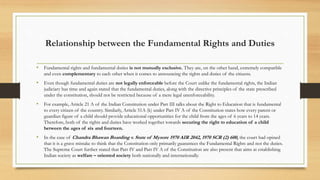
Relationship between the Fundamental Rights and Duties
• Fundamental rights and fundamental duties is not mutually exclusive. They are, on the other hand, extremely compatible
and even complementary to each other when it comes to announcing the rights and duties of the citizens.
• Even though fundamental duties are not legally enforceable before the Court unlike the fundamental rights, the Indian
judiciary has time and again stated that the fundamental duties, along with the directive principles of the state prescribed
under the constitution, should not be restricted because of a mere legal unenforceability.
• For example, Article 21 A of the Indian Constitution under Part III talks about the Right to Education that is fundamental
to every citizen of the country. Similarly, Article 51A (k) under Part IV A of the Constitution states how every parent or
guardian figure of a child should provide educational opportunities for the child from the ages of 6 years to 14 years.
Therefore, both of the rights and duties have worked together towards securing the right to education of a child
between the ages of six and fourteen.
• In the case of Chandra Bhawan Boarding v. State of Mysore 1970 AIR 2042, 1970 SCR (2) 600, the court had opined
that it is a grave mistake to think that the Constitution only primarily guarantees the Fundamental Rights and not the duties.
The Supreme Court further stated that Part IV and Part IV A of the Constitution are also present that aims at establishing
Indian society as welfare – oriented society both nationally and internationally.

Unit Rights.pptx

  • 1.
    Theories on Rightsand Duties and Fundamental Rights and Duties under Indian Constitution
  • 2.
    LEGAL RIGHTS • Bybeing a citizen of the country, the people are given the legal right and law protects these legal rights. • The concept of legal right is a fundamental significance of modern legal theory because we cannot live without it. • Rights are those important conditions of social life without which no person can generally realize his best self. These are the essential conditions for health of both the individual and his society. • It is only when people get and enjoy rights that they can develop their personalities and contributes their best services to the society.
  • 3.
    • Every legalright has a corresponding duty and the interest which the law protects by imposing corresponding duties on others. • It is the duty of every individual to protect the rights of each individual.
  • 4.
    Meaning of Right •Right in the ordinary sense mean the standard of permitted action within a certain sphere. • As a legal term, it means the standard of permitted action by law. Such permitted action of a person is known as his legal right. • According to Salmond: A legal right is an “interest which is protected and recognized by the rule of law. It is an interest which has its duty and disregard of which is wrong”. • According to Gray: A legal right is “that power which the man has, to make a person or persons to do or restrains from doing a certain act or acts so far as the power arises from society imposing a legal duty upon the person or persons. He states that the “right is not the interest itself, it is the means to enjoy the interest secured”. • In the case of State of Rajasthan v. Union of India 1978 SCR (1)1 the Supreme Court stated that “Legal rights in the strict sense are correlatives of legal duties and legal rights are defined as the interests which the law protects by imposing duties on other persons.”
  • 5.
    Rights can beclassified into moral and legal A legal right must be distinguished from a moral or natural right. • A legal right is an interest recognized and protected by a rule of legal justice, an interest the violation of which would be a legal wrong done to him whose interest it is, and respect for which is a legal duty. • Moral or natural right means an interest recognized and protected by a rule of natural justice, an interest the violation of which would be a moral wrong, and respect for which is a moral duty. • A moral right cannot be the basis for seeking relief through the legal system. There must be a law creating a right before that right can be enforced through the legal system. • For example, an employee has a moral right to be treated with appreciation and respect by an employer. Employment and discrimination laws provide the legal framework defining an employee's rights to freedom from being disadvantaged by an employer's discriminatory intent based on certain grounds, such as age or religion.
  • 6.
    Elements of legalright According to Salmond, there are five essential conditions that need to be fulfilled: 1. The person of inherence/ Subject of right 2. The subject of duty/ the person of incidence 3. Contents or Subject Matter of legal right 4. Object of right 5. Title of the legal right
  • 7.
    1. The personof inherence/ Subject of right: He shall be the person who is the owner of the right. Such a person is called a person of inherence. Example: Y purchase a van for Rs 20,000. Here Y is the subject of the right. 2. The subject of duty/ the person of incidence: It is the duty of another person or persons to respect and recognize the right of the person. Such a person who has a legal duty is called a person of incidence.
  • 8.
    3. Contents orSubject Matter of legal right: It is related to do something or to refrain from doing certain acts or forbearance. It obligates the person to forbear or act in favour of the person possessing a legal right. Example: Y purchase a van for Rs 20,000. Here Y is the subject of the right. The subject matter ( Y) has a legal right and he can exclude others. 4. The object of the legal right: The object of the legal rights is a thing or object over which the legal right is exercised. Example- Y purchases the car for Rs 20,000. Here the car is the object.
  • 9.
    5. Title ofthe legal right: - The title is the process by which the right is vested or conferred on the person. It is certain events by which right is acquired from its previous owner. Example- By purchase or gift or will etc.
  • 10.
    1. Will theory •Supported by: Kant, Hegel, Hume • According to this theory “rights is an inherent attribute of the human will”. The subject matter of right is derived from the human will. • It is through a right that a man expresses his will over an object. • According to Puchta - the legal rights gives power to the person over the object which by means of right can be subjected to the will of the person who is enjoying the right. • Criticized by: Duguit - According to him the basis of the law is not a subjective will but it is an objective will. The purpose of the law is to protect only those acts which further support social solidarity. He further stated that the theory of subjective right is a metaphysical abstraction. Theories Related To The Legal Right
  • 11.
    2. Interest Theory -developed by Rudolf Von Ihering - Rudolf Von Ihering stated that Legal right is the legally protected interest. - He gave importance to the ‘interest’ of the people rather than the ‘will’ of the people. - The main objective of law is to protect the interests of the people and to avoid the conflict between the individual interest. - Salmond criticism: He criticized the interest theory on the ground that it is incomplete, as it overlooks state recognition. In order to confer a legal right, it is essential that interest should be protected and recognized by the state. - Ex Animal Protection
  • 12.
    3. Protection Theory Deniesthe existence of legal rights. State being omnipotent – individual has no separate existence All rights belong to the state and individuals do not have any independent legal right Not relevant in modern democratic state.

  • 13.
    Kinds of Rights I.Perfect & Imperfect Rights • The perfect right has the following features: • It is recognized by law. • It is enforceable by law. So, in the case of breach of this right, a person may go to court for enforcing this right. • Thus, all fundamental rights, viz. Right to equality, right to religion, etc. are perfect rights as these are enforceable by law • The imperfect right has the following features: • It is recognized by law. • It is not enforceable by law. This means that a person cannot go to court for the breach of imperfect right. • All the time-bound claims or debts come under the category of imperfect rights.
  • 14.
    II. Positive &Negative Rights • The basis of distinguishing right as positive or negative is the nature of correlative duty it carries with it. • Under Positive rights, the person has to perform some positive duty to fulfill this right. Ex right to damages and compensation. • Negative rights prevent a person to do some act, that is it corresponds to a negative duty. Example: Right to life under article 21 of the Indian constitution is a negative right because it prevents a person to kill another person, right to ownership.
  • 15.
    III. Real &Personal Rights • Real right or right in- rem corresponds to the duty imposed upon the people in general. It is available against the whole world in general. Example: Tort or crime is a real right, peaceful enjoyment of land • Personal right or right in-persona is available against a particular person & it corresponds to the duty imposed upon a particular person. Therefore, the personal right generally arises out of contractual obligation. Example: breach of contract is a personal right, rent from tenant.
  • 16.
    IV. Proprietary &Personal Rights • A proprietary right is available with respect to a property, that is it relates to the owner & his assets. The assets must have some monetary value. Example: the right to ownership of property, Right to patent, Right to goodwill, etc. • A personal right is related to a person’s life i.e. his reputation or standing in the society. These rights promote a person’s well being in society & have no economic value. Example: Right to life.
  • 17.
    V. Public &Private Rights • The rights which are vested in a person by state or govt. or constitution is called public rights. Example: Right to vote, Right to use public parks, etc. • Private rights are connected with private individuals or persons. Example: A contract entered into by two people gives rise to private rights to them. VI. Inheritable & Uninheritable Rights • Inheritable rights can be passed from one generation to another, i.e. this right survives even after the death of its owner. Example: A son is a legal heir to the property of his father after his death. • Uninheritable rights die with the death of its owner. Example: All personal rights are uninheritable rights.
  • 18.
    VII. Right inre propria & Right in re aliena A person possesses Right in re propria with respect to his own property. He can use, dispose of, destroy, modify or exclude others from his property. Thus, this right gives a person, absolute ownership over the property. Right in re aliena is the right in the property of another person. Example: Right of way over the neighbor’s field. So, it is not an absolute right. VIII. Principal and Accessory rights - The principal right is a basic or main right. They are vital and important Rights. While accessory right is incidental or consequential right. They are not essential but are ancillary to principal rights and have a beneficial effect on principal right. Owner of land – ownership is principal right and right of way on adjoining land is accessory right.
  • 19.
    IX. Vested andContingent Right - Vested right means which is already vested in person, the person already has such right through it depends upon the happening of certain events, that event is going to happen. Ex transfer of property by valid deed Whereas is in Contingent interest the right is dependent upon happening or non-happening of certain events which may or may not happen. Ex transfer of property upon condition that possession only after 21 years of age.
  • 20.
    Concept of Duties •As citizens, there exists a wide range of duties that bind us in everyday life. These duties are owed both to the state and to individuals. • There is a legal duty to pay taxes, to refrain from committing violence against fellow-citizens, and to follow other laws that Parliament has enacted. • Breach of these legal duties triggers financial consequences (fines), or punitive measures like imprisonment. • Duties follow a simple logic that, peaceful co-existence requires a degree of self-sacrifice, and that if necessary, this must be enforced through the set of sanctions.
  • 21.
    1.Keaton – Aduty is an act which should be enforced by the state in preserving the rights given to the people and also in order to protect the interest of the people. 2.Salmond – A duty is an act which every citizen have obliged to perform, in furtherance of protecting the rights of the other people. Duty - 1. Moral and 2. Legal
  • 22.
    Classification of LegalDuties • Primary and Secondary Duties – A primary duty which is independent of any other duty and does not have to depend upon other duties. Ex forbear from causing injury to other. On the other hand secondary duty which is also known as a remedial duty has no independent existence but exists only for enforcement of other duties. Ex Duty to pay damages. • Positive and Negative Duties – Duties which is prescribed by Law (obliges person to do an act) is Positive Duty and which is prohibited (obliges person to refrain from doing an act) by the Law is called the Negative duty. • Absolute and Relative Duties – Absolute duties are owed to the state, breach of this is a crime. Relative duties are that duty which is owed to any person, breach of this is civil injury. Austin also given classify absolute duties – A. Self-regarding duties such as a duty not to commit suicide or not to consume drugs or liquor, etc. B. Duties towards society e.g. a duty not to commit a nuisance. C. Duties towards other than human beings such as duty towards God or animals, birds, etc. D. Duty towards the sovereign or the state.
  • 23.
    Rights and Dutiesare correlative • Rights and duties are co-existent. In the words of Salmond, it can be said that no right exists without the corresponding duty. • Rights are inseparably related with duties. There is a close relationship between them “No Duties No Rights.” “If I have rights it is my duty to respect the rights of others in society”. • Every duty of the person must be the duty towards some person, in whom the right is vested and conversely every right must be against some persons upon whom a duty is imposed. • In a constitutional democracy, the State provides rights and lays down duties for the citizenry, so that society can peacefully co-exist.
  • 24.
    Mahatma Gandhi inHind Swaraj observed that “Real rights are a result of the performance of duty”. According to Harold Laski, one man’s right is also his duty. • For example, if the State gives the right to life to a citizen, it also imposes an obligation on him to not to expose his life to dangers, as well as to respect the life of others.
  • 25.
    1. Rights andDuties always go together: Rights and duties are closely related and cannot be separated from one another. Both go side by side. These are the two sides of the same coin. If the state gives the right to life to a citizen, it also imposes an obligation on him to not to expose his life to dangers, as well as to respect the life of others. If I have a right to work and earn, it is also my duty to recognize the same right of others. 2. Right of One is the Duty of Others: Rights can be enjoyed only in the world of duties. For every right there is corresponding duty. When the people fail to discharge their duties properly, the rights all become meaningless. “I can enjoy my rights only if the others allow me to do the same. I have” the right to life and it is the duty of others to respect my life and not to cause any harm to me.”
  • 26.
    3. Rights ofa Citizen also implies Duties for him: Rights are not the monopoly of a single individual. Everybody gets these equally. This means that “others also have the same rights which I have, and it is my duty to see that others also enjoy their rights.” Laski has rightly said that one man’s right is also his duty. It is my duty to respect the rights of others as well as the duty to use my rights in the interest of society. 4. Rights are to be used for Social Good: Rights originate in society. Therefore, while enjoying rights, we must always try to promote social interest. It is the duty of every one of us to use our rights for promoting the welfare of the society as a whole.
  • 27.
    5. Duty towardsthe State: Since state protects and enforces rights, it also becomes the duty of all citizens to be loyal to the state. It is their duty to obey the laws of the state and to pay taxes honestly. Citizens should always be ready to defend the state. Thus a citizen has both Rights and Duties. He enjoys rights and performs his duties. Rights and Duties are the two sides of the same coin.
  • 28.
    Indian Constitution • IndianConstitution provides its citizens with the Fundamental Rights and lists the Fundamental Duties to be followed by them. • The Constitution covers a broad spectrum of domains to protect the rights of the common man by introducing six rights as Fundamental Rights (Part III of the constitution). • Similarly, the Fundamental Duties are also emphasized upon by the Constitution (Part IVA of the constitution).
  • 29.
    Rights guaranteed bythe Indian Constitution • The Constitution of India has guaranteed certain rights to the citizens of India which are known as Fundamental Right which is considered to be the most important rights. If these rights get violated then the person has the right to move to the Supreme Court of India or The High Court for enforcing rights. 1. Right to Equality (Article 14, 15,16,17,18) 2. Right to Freedom (Article 19,20,21,22) 3. Right against Exploitation (Article 23 and 24) 4. Right to Freedom of Religion (Article 25, 26, 27, 28) 5. Cultural and Educational Rights (Article 29, 30) 6. Right to Constitutional Remedies (Article 32)
  • 30.
    Duties under IndianConstitution Article 51-A of the constitution of India guarantees certain duties to every citizen of India. Article 51-A of the Indian constitution states that it shall be the duty of every citizen of India. 1. To respect the provisions of Constitution and respect the National Flag and National Anthem: 2. To safeguard the sovereignty and integrity of India 3. To follow the noble ideals of national struggle 4. To defend the country and contribute to national service when called 5. To preserve the national heritage of the country; 6. To promote and maintain the harmony of brotherhood amongst people of India. 7. To protect the dignity of women 8. To protect the natural habitat and including forests, lakes, rivers, and wildlife; 9. To protect public property and to avoid violence; 10. To contribute to the development of the nation in all spheres. 11. Provide opportunities for education to his child or ward between the age of six and fourteen years. This duty was added by the 86th Constitutional Amendment Act, 2002
  • 31.
  • 32.
    Relationship between theFundamental Rights and Duties • Fundamental rights and fundamental duties is not mutually exclusive. They are, on the other hand, extremely compatible and even complementary to each other when it comes to announcing the rights and duties of the citizens. • Even though fundamental duties are not legally enforceable before the Court unlike the fundamental rights, the Indian judiciary has time and again stated that the fundamental duties, along with the directive principles of the state prescribed under the constitution, should not be restricted because of a mere legal unenforceability. • For example, Article 21 A of the Indian Constitution under Part III talks about the Right to Education that is fundamental to every citizen of the country. Similarly, Article 51A (k) under Part IV A of the Constitution states how every parent or guardian figure of a child should provide educational opportunities for the child from the ages of 6 years to 14 years. Therefore, both of the rights and duties have worked together towards securing the right to education of a child between the ages of six and fourteen. • In the case of Chandra Bhawan Boarding v. State of Mysore 1970 AIR 2042, 1970 SCR (2) 600, the court had opined that it is a grave mistake to think that the Constitution only primarily guarantees the Fundamental Rights and not the duties. The Supreme Court further stated that Part IV and Part IV A of the Constitution are also present that aims at establishing Indian society as welfare – oriented society both nationally and internationally.