Operations Research
MBA-024
QUEUING (WAITING LINE) THEORY
UNIT IV
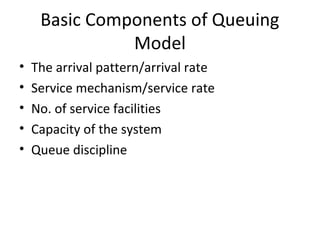
Basic Components of Queuing
Model
• The arrival pattern/arrival rate
• Service mechanism/service rate
• No. of service facilities
• Capacity of the system
• Queue discipline
The Input (or arrival) Pattern
• It represents the pattern in which customers arrive at the system.
• Arrivals may also be represented by the inter-arrival time, which is the
time period between two successive arrivals.
• Arrivals may be separated by equal intervals of time, or unequal but
definitely known intervals of time, or by unequal intervals of time whose
probabilities are known; these are called random arrivals.
• The rate at which customers arrive at the service station, that is, the
number of customers arriving per unit of time is called arrival rate.
• The assumption regarding the distribution of arrival rate has a great
impact on the mathematical model.
• If the number of customers is very large, the probability of an arrival in
the next interval of time does not depend upon the customers already in
the system.
• Hence, the arrival is completely random and it follows the Poisson process
with mean equals the average number of arrivals per unit time,
represented by λ.
The Service Mechanism (or service
pattern)
• The service pattern is similar to the arrival pattern but
there are some important differences.
• Service time may be a constant or an random variable.
• Distributions of service time which we are following are
‘negative exponential distribution’, which is characterised
by a single parameter, the mean rate µ or its mean service
time 1/µ.
• The servicing system in which the customers may be served
in batches of fixed size or of variable size by the same
server is termed as bulk service system.
• The system in which service depends on the number of
waiting customers is termed as state-dependent system.
Capacity of the System
• Some of the queuing processes admit physical
limitations to the amount of waiting room, so
that when the waiting line exceeds a fixed
length, no further customers are allowed to
enter until space becomes available by a
service completion.
• This type of situation is termed as finite source
queues.
Service Arrangements
• For providing service to the incoming customers, one or
more service points are established.
• The number depends in the number of customers, rate of
arrivals, time taken for providing service to a single
customer, and so on.
• Depending on these variables, a service channel is single or
multiple.
• When there are several service channels available to
provide service, much depends upon their arrangement.
They may be arranged in parallel or in series or a more
complex combination of both, depending on the design of
the system’s service mechanism.
Service Channels
Service Time
Queue Discipline
Customer Behaviour
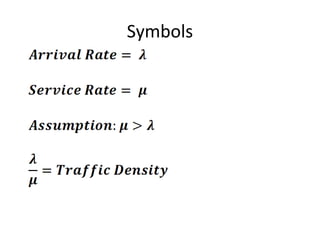
Symbols
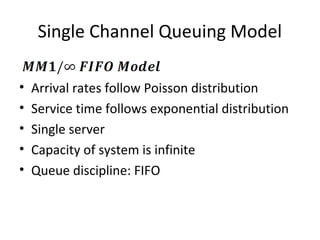
Single Channel Queuing Model
• Arrival rates follow Poisson distribution
• Service time follows exponential distribution
• Single server
• Capacity of system is infinite
• Queue discipline: FIFO
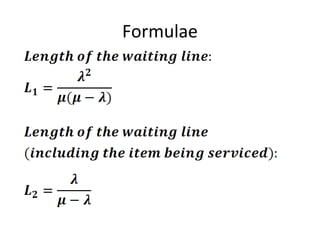
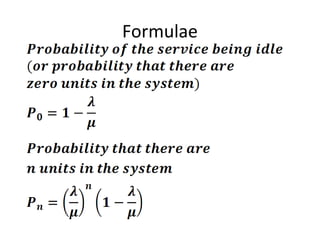
Formulae
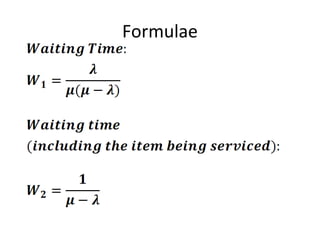
Formulae
Formulae
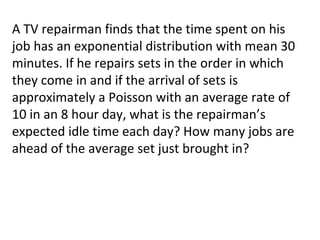
A TV repairman finds that the time spent on his
job has an exponential distribution with mean 30
minutes. If he repairs sets in the order in which
they come in and if the arrival of sets is
approximately a Poisson with an average rate of
10 in an 8 hour day, what is the repairman’s
expected idle time each day? How many jobs are
ahead of the average set just brought in?
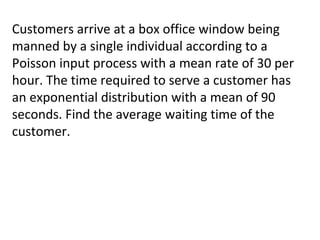
Customers arrive at a box office window being
manned by a single individual according to a
Poisson input process with a mean rate of 30 per
hour. The time required to serve a customer has
an exponential distribution with a mean of 90
seconds. Find the average waiting time of the
customer.
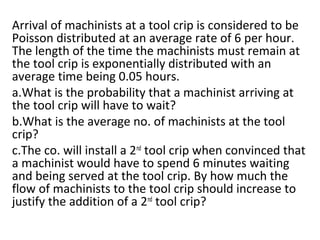
Arrival of machinists at a tool crip is considered to be
Poisson distributed at an average rate of 6 per hour.
The length of the time the machinists must remain at
the tool crip is exponentially distributed with an
average time being 0.05 hours.
a.What is the probability that a machinist arriving at
the tool crip will have to wait?
b.What is the average no. of machinists at the tool
crip?
c.The co. will install a 2nd
tool crip when convinced that
a machinist would have to spend 6 minutes waiting
and being served at the tool crip. By how much the
flow of machinists to the tool crip should increase to
justify the addition of a 2nd
tool crip?
Customers arrive at a window drive in a bank
according to Poisson distribution with mean 10 per
hour. Service time per customer is exponential with
mean 5 minutes. The space in front of the window,
including that for the serviced car can accommodate a
maximum of 3 cars. Other cars can wait outside this
space.
a.What is the probability that an arriving customer car
drives directly to the space in front of the window?
b.What is the probability that an arriving customer car
will have to wait outside the indicated space?
A repairman is to be hired to repair machines
which break down at an average rate of 3 per
hour. The breakdown follows a Poisson
distribution. Non productive time of a machine is
considered to cost Rs. 10 per hour. Two repairmen
have been interviewed – one is slow but cheap
while the other is fast but expensive. The slow
repairman charges Rs. 5 per hour and he services
broken down machines at the rate of 4 per hour.
The fast repairman demands Rs. 7 per hour and he
services at an average rate of 6 per hour. Which
repairman should be hired?
Applications of Queue Model
• Scheduling of aircraft at landing and takeoff
from busy airports.
• Scheduling of issue and return of tools by
workmen from tool cribs in factories.
• Scheduling of mechanical transport fleets.
• Scheduling distribution of scarce war material.
• Scheduling of work and jobs in production
control.
Applications of Queue Model
• Minimisation of congestion due to traffic delay at
tool booths.
• Scheduling of parts and components to assembly
lines.
• Decisions regarding replacement of capital assets
taking into consideration mortality curves,
technological improvement and cost equations.
• Routing and scheduling of salesmen and sales
efforts.
Other Benefits of Queuing Theory
• Attempts to formulate, interpret and predict
for purposes of better understanding the
queues and for the scope to introduce
remedies such as adequate service with
tolerable waiting time.
• Provides models that are capable of
influencing arrival pattern of customers.
Other Benefits of Queuing Theory
• Determines the most appropriate amount of
service or number of service stations.
• Studies behaviours of waiting lines via
mathematical techniques utilising concept of
stochastic process.

Unit iv-1-qt

  • 1.
  • 2.
    QUEUING (WAITING LINE)THEORY UNIT IV
  • 3.
    Basic Components ofQueuing Model • The arrival pattern/arrival rate • Service mechanism/service rate • No. of service facilities • Capacity of the system • Queue discipline
  • 4.
    The Input (orarrival) Pattern • It represents the pattern in which customers arrive at the system. • Arrivals may also be represented by the inter-arrival time, which is the time period between two successive arrivals. • Arrivals may be separated by equal intervals of time, or unequal but definitely known intervals of time, or by unequal intervals of time whose probabilities are known; these are called random arrivals. • The rate at which customers arrive at the service station, that is, the number of customers arriving per unit of time is called arrival rate. • The assumption regarding the distribution of arrival rate has a great impact on the mathematical model. • If the number of customers is very large, the probability of an arrival in the next interval of time does not depend upon the customers already in the system. • Hence, the arrival is completely random and it follows the Poisson process with mean equals the average number of arrivals per unit time, represented by λ.
  • 5.
    The Service Mechanism(or service pattern) • The service pattern is similar to the arrival pattern but there are some important differences. • Service time may be a constant or an random variable. • Distributions of service time which we are following are ‘negative exponential distribution’, which is characterised by a single parameter, the mean rate µ or its mean service time 1/µ. • The servicing system in which the customers may be served in batches of fixed size or of variable size by the same server is termed as bulk service system. • The system in which service depends on the number of waiting customers is termed as state-dependent system.
  • 6.
    Capacity of theSystem • Some of the queuing processes admit physical limitations to the amount of waiting room, so that when the waiting line exceeds a fixed length, no further customers are allowed to enter until space becomes available by a service completion. • This type of situation is termed as finite source queues.
  • 7.
    Service Arrangements • Forproviding service to the incoming customers, one or more service points are established. • The number depends in the number of customers, rate of arrivals, time taken for providing service to a single customer, and so on. • Depending on these variables, a service channel is single or multiple. • When there are several service channels available to provide service, much depends upon their arrangement. They may be arranged in parallel or in series or a more complex combination of both, depending on the design of the system’s service mechanism.
  • 8.
  • 9.
  • 10.
  • 11.
  • 12.
  • 13.
    Single Channel QueuingModel • Arrival rates follow Poisson distribution • Service time follows exponential distribution • Single server • Capacity of system is infinite • Queue discipline: FIFO
  • 14.
  • 15.
  • 16.
  • 17.
    A TV repairmanfinds that the time spent on his job has an exponential distribution with mean 30 minutes. If he repairs sets in the order in which they come in and if the arrival of sets is approximately a Poisson with an average rate of 10 in an 8 hour day, what is the repairman’s expected idle time each day? How many jobs are ahead of the average set just brought in?
  • 18.
    Customers arrive ata box office window being manned by a single individual according to a Poisson input process with a mean rate of 30 per hour. The time required to serve a customer has an exponential distribution with a mean of 90 seconds. Find the average waiting time of the customer.
  • 19.
    Arrival of machinistsat a tool crip is considered to be Poisson distributed at an average rate of 6 per hour. The length of the time the machinists must remain at the tool crip is exponentially distributed with an average time being 0.05 hours. a.What is the probability that a machinist arriving at the tool crip will have to wait? b.What is the average no. of machinists at the tool crip? c.The co. will install a 2nd tool crip when convinced that a machinist would have to spend 6 minutes waiting and being served at the tool crip. By how much the flow of machinists to the tool crip should increase to justify the addition of a 2nd tool crip?
  • 20.
    Customers arrive ata window drive in a bank according to Poisson distribution with mean 10 per hour. Service time per customer is exponential with mean 5 minutes. The space in front of the window, including that for the serviced car can accommodate a maximum of 3 cars. Other cars can wait outside this space. a.What is the probability that an arriving customer car drives directly to the space in front of the window? b.What is the probability that an arriving customer car will have to wait outside the indicated space?
  • 21.
    A repairman isto be hired to repair machines which break down at an average rate of 3 per hour. The breakdown follows a Poisson distribution. Non productive time of a machine is considered to cost Rs. 10 per hour. Two repairmen have been interviewed – one is slow but cheap while the other is fast but expensive. The slow repairman charges Rs. 5 per hour and he services broken down machines at the rate of 4 per hour. The fast repairman demands Rs. 7 per hour and he services at an average rate of 6 per hour. Which repairman should be hired?
  • 22.
    Applications of QueueModel • Scheduling of aircraft at landing and takeoff from busy airports. • Scheduling of issue and return of tools by workmen from tool cribs in factories. • Scheduling of mechanical transport fleets. • Scheduling distribution of scarce war material. • Scheduling of work and jobs in production control.
  • 23.
    Applications of QueueModel • Minimisation of congestion due to traffic delay at tool booths. • Scheduling of parts and components to assembly lines. • Decisions regarding replacement of capital assets taking into consideration mortality curves, technological improvement and cost equations. • Routing and scheduling of salesmen and sales efforts.
  • 24.
    Other Benefits ofQueuing Theory • Attempts to formulate, interpret and predict for purposes of better understanding the queues and for the scope to introduce remedies such as adequate service with tolerable waiting time. • Provides models that are capable of influencing arrival pattern of customers.
  • 25.
    Other Benefits ofQueuing Theory • Determines the most appropriate amount of service or number of service stations. • Studies behaviours of waiting lines via mathematical techniques utilising concept of stochastic process.