1
G. S. MANDAL’S
(an Autonomous Institute)
Class: Third Year (All)
Academic Year 2023-24, Semester: 5th
Course(HSM301): Engineering Economics, Finance and Costing
Unit 1: Introduction to Engineering Economics
Course Teacher:Prof. Prashant T Borlepwar
Department of MechanicalEngineering
Engineering Economics,
Finance and Costing 2
3
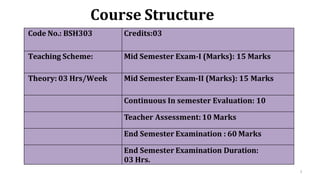
Course Structure
Code No.: BSH303 Credits:03
Teaching Scheme: Mid Semester Exam-I (Marks): 15 Marks
Theory: 03 Hrs/Week Mid Semester Exam-II (Marks): 15 Marks
Continuous In semester Evaluation: 10
Teacher Assessment:10 Marks
End Semester Examination : 60 Marks
End Semester Examination Duration:
03 Hrs.
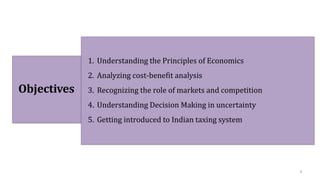
Objectives
1. Understanding the Principles of Economics
2. Analyzing cost-benefit analysis
3. Recognizing the role of markets and competition
4. Understanding Decision Making in uncertainty
5. Getting introduced to Indian taxing system
4
Unit I
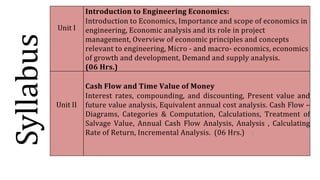
Introduction to Engineering Economics:
Introduction to Economics, Importance and scope of economics in
engineering, Economic analysis and its role in project
management, Overview of economic principles and concepts
relevant to engineering, Micro - and macro- economics, economics
of growth and development, Demand and supply analysis.
(06 Hrs.)
Unit II
Cash Flow and Time Value of Money
Interest rates, compounding, and discounting, Present value and
future value analysis, Equivalent annual cost analysis. Cash Flow –
Diagrams, Categories & Computation, Calculations, Treatment of
Salvage Value, Annual Cash Flow Analysis, Analysis , Calculating
Rate of Return, Incremental Analysis. (06 Hrs.) 5
Syllabus
Syllabus
Unit III
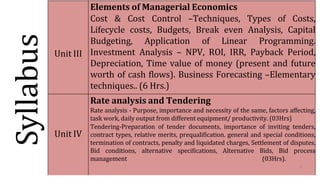
Elements of Managerial Economics
Cost & Cost Control –Techniques, Types of Costs,
Lifecycle costs, Budgets, Break even Analysis, Capital
Budgeting, Application of Linear Programming.
Investment Analysis – NPV, ROI, IRR, Payback Period,
Depreciation, Time value of money (present and future
worth of cash flows). Business Forecasting –Elementary
techniques.. (6 Hrs.)
Unit IV
Rate analysis and Tendering
Rate analysis - Purpose, importance and necessity of the same, factors affecting,
task work, daily output from different equipment/ productivity. (03Hrs)
Tendering-Preparation of tender documents, importance of inviting tenders,
contract types, relative merits, prequalification. general and special conditions,
termination of contracts, penalty and liquidated charges, Settlement of disputes.
Bid conditions, alternative specifications, Alternative Bids, Bid process
management (03Hrs).
6
Syllabus
Unit V
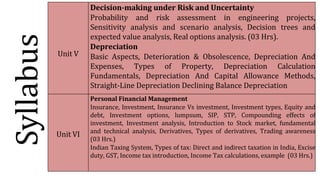
Decision-making under Risk and Uncertainty
Probability and risk assessment in engineering projects,
Sensitivity analysis and scenario analysis, Decision trees and
expected value analysis, Real options analysis. (03 Hrs).
Depreciation
Basic Aspects, Deterioration & Obsolescence, Depreciation And
Expenses, Types of Property, Depreciation Calculation
Fundamentals, Depreciation And Capital Allowance Methods,
Straight-Line Depreciation Declining Balance Depreciation
Unit VI
Personal Financial Management
Insurance, Investment, Insurance Vs investment, Investment types, Equity and
debt, Investment options, lumpsum, SIP, STP, Compounding effects of
investment, Investment analysis, Introduction to Stock market, fundamental
and technical analysis, Derivatives, Types of derivatives, Trading awareness
(03 Hrs.)
Indian Taxing System, Types of tax: Direct and indirect taxation in India, Excise
duty, GST, Income tax introduction, Income Tax calculations, example (03 Hrs.)
Textbook/ Reference Books
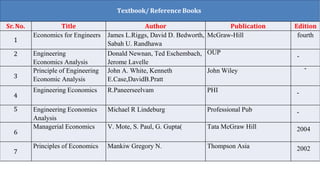
Sr. No. Title Author Publication Edition
1
Economics for Engineers James L.Riggs, David D. Bedworth,
Sabah U. Randhawa
McGraw-Hill fourth
2 Engineering
Economics Analysis
Donald Newnan, Ted Eschembach,
Jerome Lavelle
OUP
-
3
Principle of Engineering
Economic Analysis
John A. White, Kenneth
E.Case,DavidB.Pratt
John Wiley -
4
Engineering Economics R.Paneerseelvam PHI -
5 Engineering Economics
Analysis
Michael R Lindeburg Professional Pub -
6
Managerial Economics V. Mote, S. Paul, G. Gupta( Tata McGraw Hill 2004
7
Principles of Economics Mankiw Gregory N. Thompson Asia 2002
UNIT-I: Introduction to
Engineering Economics 9
Content
• Introduction- Economics
• basic concepts –
–Utility
–Wealth
–Welfare
–Price
–Markets
–Opportunity cost.
• Micro- economics and macro- economics
• Economics of growth and development. 10
Introduction
• Economics is a popular, useful and significant social science.
• Economic activities are those activities, which are concerned with
the efficient use of money and other such scarce means. These
means are used to satisfy our needs.
• In short, Economics is the study of those activities of human
beings, which are concerned, with the satisfaction of our needs by
utilizing the usually limited resources.
Satisfying Unlimited needs in a world limited resources.
11
12
History of Economics
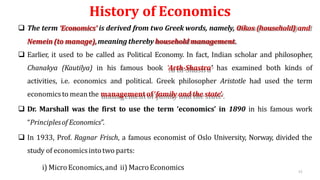
 The term ‘Economics’ is derived from two Greek words, namely, Oikos (household) and
Nemein(to manage),meaning therebyhousehold management.
 Earlier, it used to be called as Political Economy. In fact, Indian scholar and philosopher,
Chanakya (Kautilya) in his famous book ‘Arth-Shastra’ has examined both kinds of
activities, i.e. economics and political. Greek philosopher Aristotle had used the term
economicsto meanthe managementof‘family and the state’.
 Dr. Marshall was the first to use the term ‘economics’ in 1890 in his famous work
“Principlesof Economics”.
 In 1933, Prof. Ragnar Frisch, a famous economist of Oslo University, Norway, divided the
study of economicsintotwo parts:
i) MicroEconomics,and ii) MacroEconomics 13
14
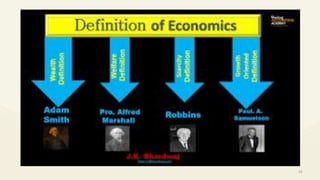
Definition of Economics
• Economics Studies the choices people make while trying to
satisfy their unlimited wants in a world of limited resources.
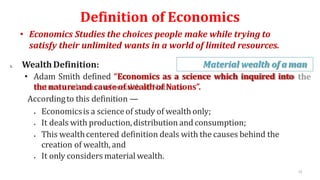
1. WealthDefinition: Material wealth of a man
• Adam Smith defined “Economics as a science which inquired into
the natureand cause of wealth of Nations”.
Accordingto this definition —
 Economicsis a scienceof study of wealthonly;
 It deals with production,distribution and consumption;
 This wealthcentered definition deals with the causes behind the
creation of wealth, and
 It only considers material wealth.
15
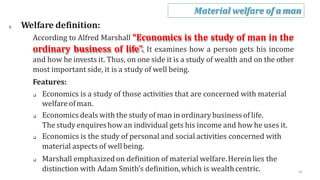
2. Welfare definition:
According to Alfred Marshall “Economics is the study of man in the
ordinary business of life”. It examines how a person gets his income
and how he invests it. Thus, on one side it is a study of wealth and on the other
most important side, it is a study of well being.
Features:
 Economics is a study of those activities that are concerned with material
welfare ofman.
 Economics deals with the study of man in ordinarybusinessof life.
The study enquireshow an individual gets his income and how he uses it.
 Economics is the study of personal and social activities concerned with
material aspects of well being.
 Marshall emphasized on definition of material welfare.Herein lies the
distinction with Adam Smith’s definition,which is wealthcentric.
Material welfare of a man
16
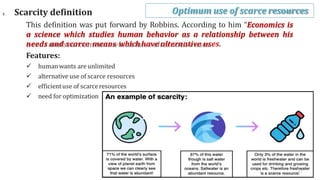
3. Scarcity definition
This definition was put forward by Robbins. According to him “Economics is
a science which studies human behavior as a relationship between his
needs and scarce means whichhave alternative uses.
Features:
 humanwants are unlimited
 alternative use of scarce resources
 efficientuse of scarceresources
 need for optimization
Optimum use of scarce resources
17
We have
unlimited
wants
18
And live in a
world with
resources
Limited
19
4. Growth Orienteddefinition
 This definition was introduced by Paul. A. Samuelson.
 According to the definition “Economics is the study of how man and
society choose with or without the use of money to employ the
scarce productive resources, which have alternative uses, to
produce various commodities over time and distributing them for
consumption, how or in the future among various person or
groups in society.”
 It analyses costs and benefits of improving patters of resource
allocation.
Growth via production & efficient
distribution of scarce resources
20
21
How do we get the things we want?
We produce them!
Using the FOUR FACTORS OF PRODUCTION!!!
What do we need to begin production?
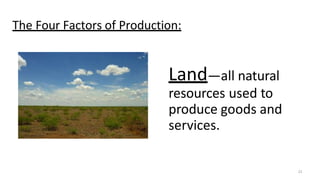
The Four Factors of Production:
Land—all natural
resources used to
produce goods and
services.
22
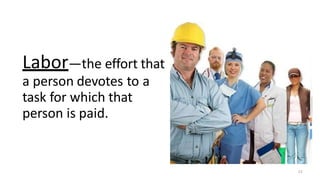
Labor—the effort that
a person devotes to a
task for which that
person is paid.
23
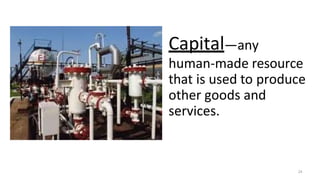
Capital—any
human-made resource
that is used to produce
other goods and
services.
24
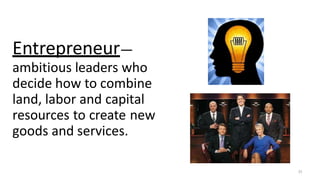
Entrepreneur—
ambitious leaders who
decide how to combine
land, labor and capital
resources to create new
goods and services.
25
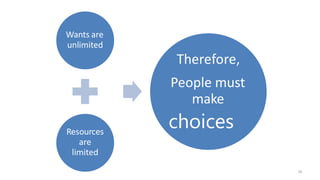
Wants are
unlimited
Resources
are
limited
Therefore,
26
People must
make
choices
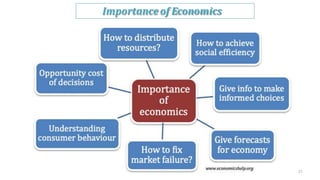
Importanceof Economics
27
28
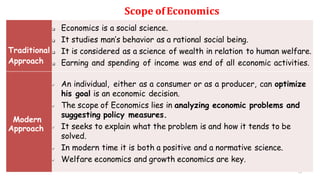
Traditional
Approach
 Economics is a social science.
 It studies man’s behavior as a rational social being.
 It is considered as a science of wealth in relation to human welfare.
 Earning and spending of income was end of all economic activities.
Modern
Approach
 An individual, either as a consumer or as a producer, can optimize
his goal is an economic decision.
 The scope of Economics lies in analyzing economic problems and
suggesting policy measures.
 It seeks to explain what the problem is and how it tends to be
solved.
 In modern time it is both a positive and a normative science.
 Welfare economics and growth economics are key.
Scope ofEconomics
35
Basic Concepts of Economics
Utility
Wealth
Welfare
Price
Markets
Opportunity Costs
Utility
3
6
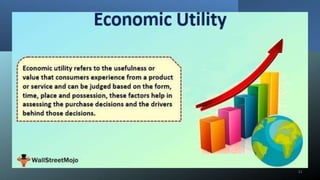
 The simple meaning of ‘utility’ is ‘usefulness’.
 Utility,or usefulness, is the ability of something to satisfy needs orwants.
 Utility is an important concept in economics because it represents satisfaction
experienced by the consumer of a good.
 Utility is the quality in goods to satisfy human wants.
Thus, it is said that “Wantssatisfying capacityof goods or services is called Utility.”
 According to Prof. Waugh: “Utility is the power of commodity to satisfy human wants.”
 Utility is a representation of preferences over some set of goods and services.
 One cannot directly measure benefit, satisfaction or happiness from a good or
service, so instead economists have devised ways of representing and measuring utility
in terms of economic choices that can be counted.
Needs or wants satisfying capacity of goods or services
31
32
Contd.
 Economists consider utility to be revealed in people’s willingness to pay
different amounts for a same good.
 Total utility is the aggregate sum of satisfaction or benefit that an individual gains
fromconsuminga given amount of goods or servicesin an economy.
 The amount of a person’s total utility corresponds to the person’s level of
consumption. Usually, the more the person consumes, the larger his or her
totalutilitywillbe.
 In modern time utility has been called as ‘expected satisfaction.’ Expected
satisfactionmaybe less or equalto or morethan the real satisfaction.
33
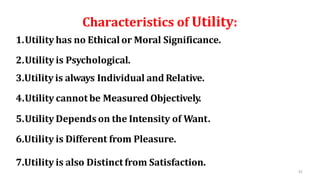
Characteristics of Utility:
1.Utility has no Ethical or Moral Significance.
2.Utility is Psychological.
3.Utility is always Individual and Relative.
4.Utility cannot be Measured Objectively.
5.Utility Dependson the Intensity of Want.
6.Utility is Different from Pleasure.
7.Utility is also Distinct from Satisfaction.
34
Different Types of Utility
Form Utility
Place Utility
Time Utility
Service Utility
Wealth
• Wealth measures the value of all the assets of worth owned by a person,
community, company, or country.
• Wealth is determined by taking the total market value of all physical and intangible
assets owned, then subtracting all debts.
• Essentially, wealth is the accumulation of scarce resources. Specific people,
organizations, and nations are said to be wealthy when they can accumulate many
valuable resources or goods.
• By wealth we mean the stock of goods under the ownership of a person or a nation.
Wealth = Market value of Assets - Debts 35
36
(i) Personal
wealth
• It means the stock of all goods like houses and buildings, furniture, land, money in
cash, money kept in banks, clothes, company shares, stocks of other commodities,
etc. owned by aperson.
• Health, goodwill, etc.,can also be parts of an individual’s wealth.
• In Economics, they are transferable goods (whose ownership can be transferred to
another person).
• These are components of wealth.
(ii)National
wealth
• It includes the wealth of all the citizens of the country.
There arepublic propertieswhose benefits areenjoyed by the citizens of the country
but no citizen personally owns these goods.
• Natural resources (mineral resources, forest resources, etc), roads, bridges, parks,
hospitals, public educational institutions and public sector projects of various types
(public sector industries, public irrigation projects, etc.) are example of public
properties.
• There is some personal wealth which is to be deducted from national wealth.
• Example, if a citizen of the country holds a Government bond, it is personal wealth.
But from the point of view of the Government, it is a liability and, hence, it should
not be considered as a part of the nation’s wealth. 43
Welfare
 Welfare economics is the study of how the allocation of resources and goods
affects social welfare.
 This relates directly to the study of economic efficiency and income distribution.
 Welfare means the satisfaction, or the well-being enjoyed by society.
 Social welfare depends on the wealth of the nation.
 In general, wealth gives rise to welfare.
If wealth of society increases, but the distribution among the citizens of the country
is very unequal, this inequality may create social jealousy and tension.
Economists, however, assume that when wealth increases, welfare increases too.
Similarly, when wealth decreases, welfare is assumed to decrease.
Welfare= Well-being of the Society 38
39
Price
4
6
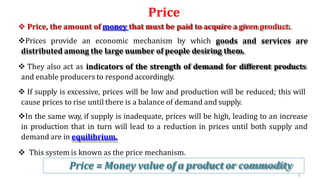
 Price, the amount of money that must be paid to acquire a given product.
Prices provide an economic mechanism by which goods and services are
distributed among the large number of people desiring them.
 They also act as indicators of the strength of demand for different products
and enable producers to respond accordingly.
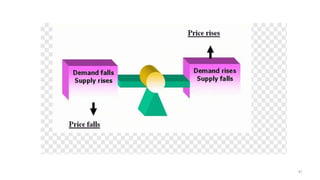
 If supply is excessive, prices will be low and production will be reduced; this will
cause prices to rise until there is a balance of demand and supply.
In the same way, if supply is inadequate, prices will be high, leading to an increase
in production that in turn will lead to a reduction in prices until both supply and
demand are in equilibrium.
 This system is known as the price mechanism.
Price = Money value of a product or commodity
47
Price Systems
 Prices may be analyzed into three separate functions:
1. What goods are to be produced and in what quantities????????
2. How the goods are to be produced????????
3. Who will get the goods????????
 The goods so produced and distributed may be consumer items, services, labor, or other
salablecommodities.
In each case, an increase in demand will lead to the price being bid up, which will induce
producersto supply more;a decreasein demandwill have the reverseeffect.
 The price system provides a simple scale by which competing demands may be weighed by
everyconsumeror producer. 48
Contd.
 A totally freeand unfetteredprice mechanismdoesnot existin practice.
Even in the relatively free market economies of the developed Western world there are all
kinds of distortions—arising out of monopolies, government interference, and other
conditions—the effect of which reduces the efficiency of price as a determinant of supply
and demand.
In centrally planned economies, the price mechanism may be governed by centralized
governmentalcontrol forpolitical and socialreasons.
Attempts to operate an economy without a price mechanism usually result in surpluses of
unwanted goods, shortages of desired products, black markets, and slow, erratic, or no
economicgrowth.
43
Money
 Anything which is widely accepted in exchange for goods, or in settling debts.
 In Barter System, goods were used as medium of exchange.
When general acceptability of any medium of exchange is enforced by law, that
medium of exchangein called the legal tender, (example,the rupee notes and coins).
When some commodity is used as a medium of exchange by custom, it is called
customary money.
 Constituents of money supply
 In any economy, the constituents of money supply are as follows:
Rupee notes and coins with the public,
Credit/Debit cards,
Cheques, etc.
44
Market
A market is a place where parties can gather to facilitate the exchange of goods and
services.
 The partiesinvolved are usually buyersandsellers.
The market may be physical like a retail outlet, where people meet face-to-face, or virtual
like an online market,wherethere is no directphysical contact betweenbuyers & sellers.
 A market is a place where buyers and sellers can meet to facilitate the exchange or transaction
of goodsand services.
 Marketscanbe physical like a retail outlet, or virtuallike an e-retailer.
 Other examplesinclude theblack market, auctionmarkets, and financialmarkets.
 Marketsestablishthe pricesof goods and servicesthat are determinedby supplyand demand.
45
46
Market
 For instance, the term may also be used to describe a collection of people who wish to buy
a specific product or service in a specific place. Or it could refer to an industry or
business sector, such as the global diamond market. The market establishes the prices for
goods and other services.
 The market rates are determined by supply and demand. Supply is created by the
sellers, while demand is generated by buyers. Markets try to find some balance in price
whensupply and demand are themselvesin balance.
 But that balance can be disrupted by factors other than price including incomes,
expectations, technology, the cost of production, and the number of buyers and sellers
participating.
47
Functions of Market
1. To determine the price for the commodity.
2. To determine the quantity of the commodity that will be bought and sold.
3. Both the price and the quantity are determined by the interactions between
the buyers and the sellers of the commodity.
Opportunity Costs
• “Nothing in life is free” and “tradeoff.”
• Opportunity costs represent the potential benefits an individual, investor, or business misses
out on when choosing one alternative over another.
• Opportunity cost is the forgone benefit that would have been obtained by an option not
chosen.
• It can guide individuals and organizations to more profitable decision-making.
• For example, every time that you skip class to sleep in, results in, sinking up the costs you directly paid in
tuition fee for that class. However, you could have used that time that you spent in bed to go to work, go to
the gym and get your homework done.
Opportunity Cost = benefits one misses out when one choose an
option over another
49
50
51
Formula and Calculationof OpportunityCost
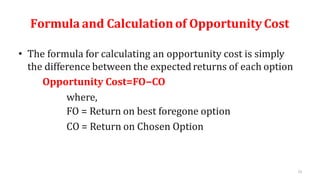
• The formula for calculating an opportunity cost is simply
the difference between the expectedreturns of each option
Opportunity Cost=FO−CO
where,
FO = Return on best foregone option
CO = Return on Chosen Option
• The concept of opportunity cost implies three things:
1.The calculation of opportunity cost involves the measurement of
sacrifices.
2. Sacrifices may be monetary or real.
3. The opportunity cost is termed as the cost of sacrificed alternatives.
52
Economic System
An economic system is the network that forms the economic relationships
betweenindividuals in society.
An economic system is a mean by which societies or governments organize and
distribute available resources, services, and goods across a geographic region
or country.
Economic systems regulate the factors of production, including land,
capital, labor & physicalresources.
53
54
55
56
57
58
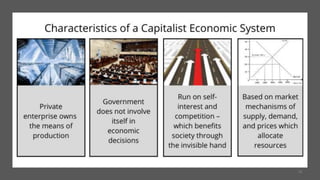
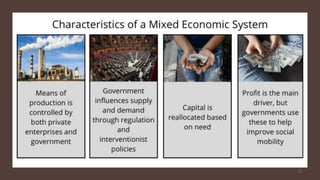
Key Points
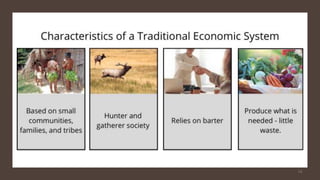
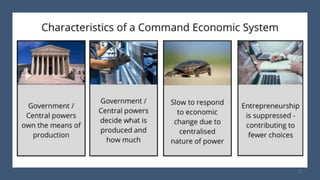
 Economic systems are grouped into traditional, command, market, and
mixed systems.
 Traditional systems focus on the basics of goods, services, and work, and
they are influencedby traditions and beliefs.
 A centralized authority influences command systems, while a market
(Capitalistic)system is under the control of forcesof demand and supply.
 Lastly, mixed economies are a combination of command and market
(Capitalistic)systems.
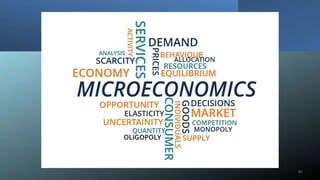
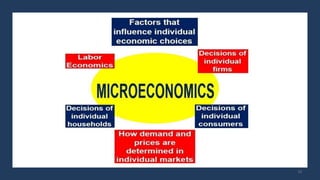
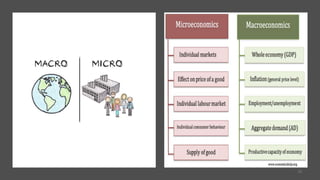
Micro-economics:
• The branch of economics which today is concerned with the behavior of
individual entities such as Industries, firms and households.
• The study of economic behavior of the households, firms and industries form the
subject-matter of micro-economics.
• For example, micro-economics is concerned with how the individual consumer
distributes his income among various products and services to maximize utility.
• Thus, micro-economics is concerned with the theories of product pricing and
economic welfare.
Economic behavior of individual entities
59
60
61
Micro-economics
• In the wealth of nations (1776), Smith considered how individual prices are
set.
• Studied the determination of prices of land, labor and capital.
• He identified and explained how the self-interest of individuals working
through the competitive market can produced a social economic benefit.
• Microeconomics has moved beyond the early concerns to include the study of
monopoly, the role of international trade, finance.
62
Macro-economics
6
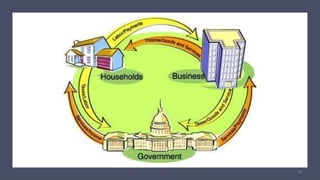
9
• The branch of economics which is concerned with the overall performance of the
economy. i.e. deals with the functioning of the economy.
• Macroeconomics didn’t even exist in modern form until 1936, when John Maynard
Keynes published his revolutionary General theory of Employment, Interest & Money.
• Macroeconomics examines a wide variety of areas, such as how total investment and
consumption are determined.
• For example, macro economics seeks to explain how the economy’s total output of
goods and services and total employment of resources are determined and what
explains the fluctuation in the level of output and employment.
Economic behavior of complete economy (Individual + State
Economy)
64
65
66
Economics of
Growth and
Development
Economic Growth
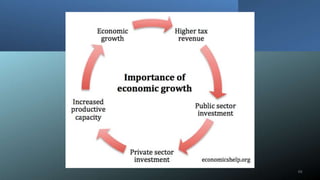
• The term economic growth is defined as the process whereby the country’s
real national and per capital income increases over a long period of time.
• This definition of economic growth consists of the following features of economic
growth:
1. Economic Growth implies a process of increase in National Income and Per-
Capital Income. The increase in Per-Capital income is the better measure of
Economic Growth since it reflects increase in the improvement of living
standards of masses.
2. Economic Growth is measured by increase in real National Income and not
just the increase in money income or the nominal national income.
In other words, the increase should be in terms of increase of output of goods
and services, and not due to a mere increase in the market prices of existing
goods.
67
68
Economic Growth
3.Increase in Real Income should be Over a Long Period: The increase of real
national income and per-capita income should be sustained over a long period of
time. The short-run seasonal or temporary increases in income should not be
confused with economic growth.
4.Increase in income should be based on Increase in Productive Capacity:
Increase in Income can be sustained only when this increase results from some
durable increase in productive capacity of the economy like modernization or use of
new technology in production, strengthening of infrastructure like transport
network, improved electricity generation etc.
69
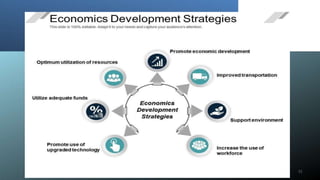
Economic Development
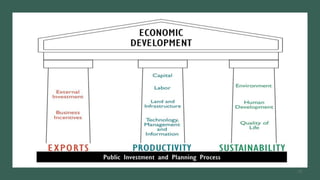
• Economic development is defined as a sustained improvement in material
well being of a society.
• Economic development is a wider concept than economic growth.
• Apart from growth of national income, it includes changes – social, cultural,
political as well as economic which contribute to material progress.
• In short, economic development is a process consisting of a long chain of
interrelated changes in fundamental factors of supply and demand, leading to a
rise in the net national product of a country in the long run.
• The economic growth involves increase in output in quantitative terms, but
economic development includes changes in qualitative terms such as social
attitudes and customs along with quantitative growth of output or national
income.
70
71
72
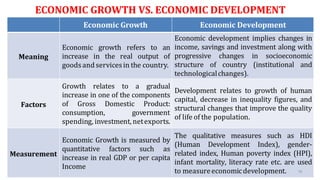
ECONOMIC GROWTH VS. ECONOMIC DEVELOPMENT
Economic Growth Economic Development
Meaning
Economic growth refers to an
increase in the real output of
goodsand servicesin the country.
Economic development implies changes in
income, savings and investment along with
progressive changes in socioeconomic
structure of country (institutional and
technologicalchanges).
Factors
Growth relates to a gradual
increase in one of the components
of Gross Domestic Product:
consumption, government
spending, investment, netexports.
Development relates to growth of human
capital, decrease in inequality figures, and
structural changes that improve the quality
of life of the population.
Measurement
Economic Growth is measured by
quantitative factors such as
increase in real GDP or per capita
Income
The qualitative measures such as HDI
(Human Development Index), gender-
related index, Human poverty index (HPI),
infant mortality, literacy rate etc. are used
to measureeconomicdevelopment. 79
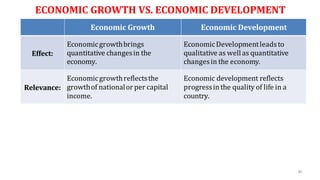
ECONOMIC GROWTH VS. ECONOMIC DEVELOPMENT
Economic Growth Economic Development
Effect:
Economicgrowthbrings
quantitative changesin the
economy.
EconomicDevelopmentleadsto
qualitative as wellas quantitative
changesin the economy.
Relevance:
Economicgrowthreflectsthe
growthof nationalor per capital
income.
Economic development reflects
progressin the quality of life in a
country.
80

Unit I- Engineering Economics Part-I.pptx

  • 1.
    1 G. S. MANDAL’S (anAutonomous Institute) Class: Third Year (All) Academic Year 2023-24, Semester: 5th Course(HSM301): Engineering Economics, Finance and Costing Unit 1: Introduction to Engineering Economics Course Teacher:Prof. Prashant T Borlepwar Department of MechanicalEngineering
  • 2.
  • 3.
    3 Course Structure Code No.:BSH303 Credits:03 Teaching Scheme: Mid Semester Exam-I (Marks): 15 Marks Theory: 03 Hrs/Week Mid Semester Exam-II (Marks): 15 Marks Continuous In semester Evaluation: 10 Teacher Assessment:10 Marks End Semester Examination : 60 Marks End Semester Examination Duration: 03 Hrs.
  • 4.
    Objectives 1. Understanding thePrinciples of Economics 2. Analyzing cost-benefit analysis 3. Recognizing the role of markets and competition 4. Understanding Decision Making in uncertainty 5. Getting introduced to Indian taxing system 4
  • 5.
    Unit I Introduction toEngineering Economics: Introduction to Economics, Importance and scope of economics in engineering, Economic analysis and its role in project management, Overview of economic principles and concepts relevant to engineering, Micro - and macro- economics, economics of growth and development, Demand and supply analysis. (06 Hrs.) Unit II Cash Flow and Time Value of Money Interest rates, compounding, and discounting, Present value and future value analysis, Equivalent annual cost analysis. Cash Flow – Diagrams, Categories & Computation, Calculations, Treatment of Salvage Value, Annual Cash Flow Analysis, Analysis , Calculating Rate of Return, Incremental Analysis. (06 Hrs.) 5 Syllabus
  • 6.
    Syllabus Unit III Elements ofManagerial Economics Cost & Cost Control –Techniques, Types of Costs, Lifecycle costs, Budgets, Break even Analysis, Capital Budgeting, Application of Linear Programming. Investment Analysis – NPV, ROI, IRR, Payback Period, Depreciation, Time value of money (present and future worth of cash flows). Business Forecasting –Elementary techniques.. (6 Hrs.) Unit IV Rate analysis and Tendering Rate analysis - Purpose, importance and necessity of the same, factors affecting, task work, daily output from different equipment/ productivity. (03Hrs) Tendering-Preparation of tender documents, importance of inviting tenders, contract types, relative merits, prequalification. general and special conditions, termination of contracts, penalty and liquidated charges, Settlement of disputes. Bid conditions, alternative specifications, Alternative Bids, Bid process management (03Hrs). 6

  • 7.
    Syllabus Unit V Decision-making underRisk and Uncertainty Probability and risk assessment in engineering projects, Sensitivity analysis and scenario analysis, Decision trees and expected value analysis, Real options analysis. (03 Hrs). Depreciation Basic Aspects, Deterioration & Obsolescence, Depreciation And Expenses, Types of Property, Depreciation Calculation Fundamentals, Depreciation And Capital Allowance Methods, Straight-Line Depreciation Declining Balance Depreciation Unit VI Personal Financial Management Insurance, Investment, Insurance Vs investment, Investment types, Equity and debt, Investment options, lumpsum, SIP, STP, Compounding effects of investment, Investment analysis, Introduction to Stock market, fundamental and technical analysis, Derivatives, Types of derivatives, Trading awareness (03 Hrs.) Indian Taxing System, Types of tax: Direct and indirect taxation in India, Excise duty, GST, Income tax introduction, Income Tax calculations, example (03 Hrs.)
  • 8.
    Textbook/ Reference Books Sr.No. Title Author Publication Edition 1 Economics for Engineers James L.Riggs, David D. Bedworth, Sabah U. Randhawa McGraw-Hill fourth 2 Engineering Economics Analysis Donald Newnan, Ted Eschembach, Jerome Lavelle OUP - 3 Principle of Engineering Economic Analysis John A. White, Kenneth E.Case,DavidB.Pratt John Wiley - 4 Engineering Economics R.Paneerseelvam PHI - 5 Engineering Economics Analysis Michael R Lindeburg Professional Pub - 6 Managerial Economics V. Mote, S. Paul, G. Gupta( Tata McGraw Hill 2004 7 Principles of Economics Mankiw Gregory N. Thompson Asia 2002
  • 9.
  • 10.
    Content • Introduction- Economics •basic concepts – –Utility –Wealth –Welfare –Price –Markets –Opportunity cost. • Micro- economics and macro- economics • Economics of growth and development. 10
  • 11.
    Introduction • Economics isa popular, useful and significant social science. • Economic activities are those activities, which are concerned with the efficient use of money and other such scarce means. These means are used to satisfy our needs. • In short, Economics is the study of those activities of human beings, which are concerned, with the satisfaction of our needs by utilizing the usually limited resources. Satisfying Unlimited needs in a world limited resources. 11
  • 12.
  • 13.
    History of Economics The term ‘Economics’ is derived from two Greek words, namely, Oikos (household) and Nemein(to manage),meaning therebyhousehold management.  Earlier, it used to be called as Political Economy. In fact, Indian scholar and philosopher, Chanakya (Kautilya) in his famous book ‘Arth-Shastra’ has examined both kinds of activities, i.e. economics and political. Greek philosopher Aristotle had used the term economicsto meanthe managementof‘family and the state’.  Dr. Marshall was the first to use the term ‘economics’ in 1890 in his famous work “Principlesof Economics”.  In 1933, Prof. Ragnar Frisch, a famous economist of Oslo University, Norway, divided the study of economicsintotwo parts: i) MicroEconomics,and ii) MacroEconomics 13
  • 14.
  • 15.
    Definition of Economics •Economics Studies the choices people make while trying to satisfy their unlimited wants in a world of limited resources. 1. WealthDefinition: Material wealth of a man • Adam Smith defined “Economics as a science which inquired into the natureand cause of wealth of Nations”. Accordingto this definition —  Economicsis a scienceof study of wealthonly;  It deals with production,distribution and consumption;  This wealthcentered definition deals with the causes behind the creation of wealth, and  It only considers material wealth. 15
  • 16.
    2. Welfare definition: Accordingto Alfred Marshall “Economics is the study of man in the ordinary business of life”. It examines how a person gets his income and how he invests it. Thus, on one side it is a study of wealth and on the other most important side, it is a study of well being. Features:  Economics is a study of those activities that are concerned with material welfare ofman.  Economics deals with the study of man in ordinarybusinessof life. The study enquireshow an individual gets his income and how he uses it.  Economics is the study of personal and social activities concerned with material aspects of well being.  Marshall emphasized on definition of material welfare.Herein lies the distinction with Adam Smith’s definition,which is wealthcentric. Material welfare of a man 16
  • 17.
    3. Scarcity definition Thisdefinition was put forward by Robbins. According to him “Economics is a science which studies human behavior as a relationship between his needs and scarce means whichhave alternative uses. Features:  humanwants are unlimited  alternative use of scarce resources  efficientuse of scarceresources  need for optimization Optimum use of scarce resources 17
  • 18.
  • 19.
    And live ina world with resources Limited 19
  • 20.
    4. Growth Orienteddefinition This definition was introduced by Paul. A. Samuelson.  According to the definition “Economics is the study of how man and society choose with or without the use of money to employ the scarce productive resources, which have alternative uses, to produce various commodities over time and distributing them for consumption, how or in the future among various person or groups in society.”  It analyses costs and benefits of improving patters of resource allocation. Growth via production & efficient distribution of scarce resources 20
  • 21.

    21 How do weget the things we want? We produce them! Using the FOUR FACTORS OF PRODUCTION!!! What do we need to begin production?
  • 22.
    The Four Factorsof Production: Land—all natural resources used to produce goods and services. 22
  • 23.
    Labor—the effort that aperson devotes to a task for which that person is paid. 23
  • 24.
    Capital—any human-made resource that isused to produce other goods and services. 24
  • 25.
    Entrepreneur— ambitious leaders who decidehow to combine land, labor and capital resources to create new goods and services. 25
  • 26.
  • 27.
  • 28.
    28 Traditional Approach  Economics isa social science.  It studies man’s behavior as a rational social being.  It is considered as a science of wealth in relation to human welfare.  Earning and spending of income was end of all economic activities. Modern Approach  An individual, either as a consumer or as a producer, can optimize his goal is an economic decision.  The scope of Economics lies in analyzing economic problems and suggesting policy measures.  It seeks to explain what the problem is and how it tends to be solved.  In modern time it is both a positive and a normative science.  Welfare economics and growth economics are key. Scope ofEconomics
  • 29.
    35 Basic Concepts ofEconomics Utility Wealth Welfare Price Markets Opportunity Costs
  • 30.
    Utility 3 6  The simplemeaning of ‘utility’ is ‘usefulness’.  Utility,or usefulness, is the ability of something to satisfy needs orwants.  Utility is an important concept in economics because it represents satisfaction experienced by the consumer of a good.  Utility is the quality in goods to satisfy human wants. Thus, it is said that “Wantssatisfying capacityof goods or services is called Utility.”  According to Prof. Waugh: “Utility is the power of commodity to satisfy human wants.”  Utility is a representation of preferences over some set of goods and services.  One cannot directly measure benefit, satisfaction or happiness from a good or service, so instead economists have devised ways of representing and measuring utility in terms of economic choices that can be counted. Needs or wants satisfying capacity of goods or services
  • 31.
  • 32.
    32 Contd.  Economists considerutility to be revealed in people’s willingness to pay different amounts for a same good.  Total utility is the aggregate sum of satisfaction or benefit that an individual gains fromconsuminga given amount of goods or servicesin an economy.  The amount of a person’s total utility corresponds to the person’s level of consumption. Usually, the more the person consumes, the larger his or her totalutilitywillbe.  In modern time utility has been called as ‘expected satisfaction.’ Expected satisfactionmaybe less or equalto or morethan the real satisfaction.
  • 33.
    33 Characteristics of Utility: 1.Utilityhas no Ethical or Moral Significance. 2.Utility is Psychological. 3.Utility is always Individual and Relative. 4.Utility cannot be Measured Objectively. 5.Utility Dependson the Intensity of Want. 6.Utility is Different from Pleasure. 7.Utility is also Distinct from Satisfaction.
  • 34.
    34 Different Types ofUtility Form Utility Place Utility Time Utility Service Utility
  • 35.
    Wealth • Wealth measuresthe value of all the assets of worth owned by a person, community, company, or country. • Wealth is determined by taking the total market value of all physical and intangible assets owned, then subtracting all debts. • Essentially, wealth is the accumulation of scarce resources. Specific people, organizations, and nations are said to be wealthy when they can accumulate many valuable resources or goods. • By wealth we mean the stock of goods under the ownership of a person or a nation. Wealth = Market value of Assets - Debts 35
  • 36.
  • 37.
    (i) Personal wealth • Itmeans the stock of all goods like houses and buildings, furniture, land, money in cash, money kept in banks, clothes, company shares, stocks of other commodities, etc. owned by aperson. • Health, goodwill, etc.,can also be parts of an individual’s wealth. • In Economics, they are transferable goods (whose ownership can be transferred to another person). • These are components of wealth. (ii)National wealth • It includes the wealth of all the citizens of the country. There arepublic propertieswhose benefits areenjoyed by the citizens of the country but no citizen personally owns these goods. • Natural resources (mineral resources, forest resources, etc), roads, bridges, parks, hospitals, public educational institutions and public sector projects of various types (public sector industries, public irrigation projects, etc.) are example of public properties. • There is some personal wealth which is to be deducted from national wealth. • Example, if a citizen of the country holds a Government bond, it is personal wealth. But from the point of view of the Government, it is a liability and, hence, it should not be considered as a part of the nation’s wealth. 43
  • 38.
    Welfare  Welfare economicsis the study of how the allocation of resources and goods affects social welfare.  This relates directly to the study of economic efficiency and income distribution.  Welfare means the satisfaction, or the well-being enjoyed by society.  Social welfare depends on the wealth of the nation.  In general, wealth gives rise to welfare. If wealth of society increases, but the distribution among the citizens of the country is very unequal, this inequality may create social jealousy and tension. Economists, however, assume that when wealth increases, welfare increases too. Similarly, when wealth decreases, welfare is assumed to decrease. Welfare= Well-being of the Society 38
  • 39.
  • 40.
    Price 4 6  Price, theamount of money that must be paid to acquire a given product. Prices provide an economic mechanism by which goods and services are distributed among the large number of people desiring them.  They also act as indicators of the strength of demand for different products and enable producers to respond accordingly.  If supply is excessive, prices will be low and production will be reduced; this will cause prices to rise until there is a balance of demand and supply. In the same way, if supply is inadequate, prices will be high, leading to an increase in production that in turn will lead to a reduction in prices until both supply and demand are in equilibrium.  This system is known as the price mechanism. Price = Money value of a product or commodity
  • 41.
  • 42.
    Price Systems  Pricesmay be analyzed into three separate functions: 1. What goods are to be produced and in what quantities???????? 2. How the goods are to be produced???????? 3. Who will get the goods????????  The goods so produced and distributed may be consumer items, services, labor, or other salablecommodities. In each case, an increase in demand will lead to the price being bid up, which will induce producersto supply more;a decreasein demandwill have the reverseeffect.  The price system provides a simple scale by which competing demands may be weighed by everyconsumeror producer. 48
  • 43.
    Contd.  A totallyfreeand unfetteredprice mechanismdoesnot existin practice. Even in the relatively free market economies of the developed Western world there are all kinds of distortions—arising out of monopolies, government interference, and other conditions—the effect of which reduces the efficiency of price as a determinant of supply and demand. In centrally planned economies, the price mechanism may be governed by centralized governmentalcontrol forpolitical and socialreasons. Attempts to operate an economy without a price mechanism usually result in surpluses of unwanted goods, shortages of desired products, black markets, and slow, erratic, or no economicgrowth. 43
  • 44.
    Money  Anything whichis widely accepted in exchange for goods, or in settling debts.  In Barter System, goods were used as medium of exchange. When general acceptability of any medium of exchange is enforced by law, that medium of exchangein called the legal tender, (example,the rupee notes and coins). When some commodity is used as a medium of exchange by custom, it is called customary money.  Constituents of money supply  In any economy, the constituents of money supply are as follows: Rupee notes and coins with the public, Credit/Debit cards, Cheques, etc. 44
  • 45.
    Market A market isa place where parties can gather to facilitate the exchange of goods and services.  The partiesinvolved are usually buyersandsellers. The market may be physical like a retail outlet, where people meet face-to-face, or virtual like an online market,wherethere is no directphysical contact betweenbuyers & sellers.  A market is a place where buyers and sellers can meet to facilitate the exchange or transaction of goodsand services.  Marketscanbe physical like a retail outlet, or virtuallike an e-retailer.  Other examplesinclude theblack market, auctionmarkets, and financialmarkets.  Marketsestablishthe pricesof goods and servicesthat are determinedby supplyand demand. 45
  • 46.
  • 47.
    Market  For instance,the term may also be used to describe a collection of people who wish to buy a specific product or service in a specific place. Or it could refer to an industry or business sector, such as the global diamond market. The market establishes the prices for goods and other services.  The market rates are determined by supply and demand. Supply is created by the sellers, while demand is generated by buyers. Markets try to find some balance in price whensupply and demand are themselvesin balance.  But that balance can be disrupted by factors other than price including incomes, expectations, technology, the cost of production, and the number of buyers and sellers participating. 47
  • 48.
    Functions of Market 1.To determine the price for the commodity. 2. To determine the quantity of the commodity that will be bought and sold. 3. Both the price and the quantity are determined by the interactions between the buyers and the sellers of the commodity.
  • 49.
    Opportunity Costs • “Nothingin life is free” and “tradeoff.” • Opportunity costs represent the potential benefits an individual, investor, or business misses out on when choosing one alternative over another. • Opportunity cost is the forgone benefit that would have been obtained by an option not chosen. • It can guide individuals and organizations to more profitable decision-making. • For example, every time that you skip class to sleep in, results in, sinking up the costs you directly paid in tuition fee for that class. However, you could have used that time that you spent in bed to go to work, go to the gym and get your homework done. Opportunity Cost = benefits one misses out when one choose an option over another 49
  • 50.
  • 51.
    51 Formula and CalculationofOpportunityCost • The formula for calculating an opportunity cost is simply the difference between the expectedreturns of each option Opportunity Cost=FO−CO where, FO = Return on best foregone option CO = Return on Chosen Option
  • 52.
    • The conceptof opportunity cost implies three things: 1.The calculation of opportunity cost involves the measurement of sacrifices. 2. Sacrifices may be monetary or real. 3. The opportunity cost is termed as the cost of sacrificed alternatives. 52
  • 53.
    Economic System An economicsystem is the network that forms the economic relationships betweenindividuals in society. An economic system is a mean by which societies or governments organize and distribute available resources, services, and goods across a geographic region or country. Economic systems regulate the factors of production, including land, capital, labor & physicalresources. 53
  • 54.
  • 55.
  • 56.
  • 57.
  • 58.
    58 Key Points  Economicsystems are grouped into traditional, command, market, and mixed systems.  Traditional systems focus on the basics of goods, services, and work, and they are influencedby traditions and beliefs.  A centralized authority influences command systems, while a market (Capitalistic)system is under the control of forcesof demand and supply.  Lastly, mixed economies are a combination of command and market (Capitalistic)systems.
  • 59.
    Micro-economics: • The branchof economics which today is concerned with the behavior of individual entities such as Industries, firms and households. • The study of economic behavior of the households, firms and industries form the subject-matter of micro-economics. • For example, micro-economics is concerned with how the individual consumer distributes his income among various products and services to maximize utility. • Thus, micro-economics is concerned with the theories of product pricing and economic welfare. Economic behavior of individual entities 59
  • 60.
  • 61.
    61 Micro-economics • In thewealth of nations (1776), Smith considered how individual prices are set. • Studied the determination of prices of land, labor and capital. • He identified and explained how the self-interest of individuals working through the competitive market can produced a social economic benefit. • Microeconomics has moved beyond the early concerns to include the study of monopoly, the role of international trade, finance.
  • 62.
  • 63.
    Macro-economics 6 9 • The branchof economics which is concerned with the overall performance of the economy. i.e. deals with the functioning of the economy. • Macroeconomics didn’t even exist in modern form until 1936, when John Maynard Keynes published his revolutionary General theory of Employment, Interest & Money. • Macroeconomics examines a wide variety of areas, such as how total investment and consumption are determined. • For example, macro economics seeks to explain how the economy’s total output of goods and services and total employment of resources are determined and what explains the fluctuation in the level of output and employment. Economic behavior of complete economy (Individual + State Economy)
  • 64.
  • 65.
  • 66.
  • 67.
    Economic Growth • Theterm economic growth is defined as the process whereby the country’s real national and per capital income increases over a long period of time. • This definition of economic growth consists of the following features of economic growth: 1. Economic Growth implies a process of increase in National Income and Per- Capital Income. The increase in Per-Capital income is the better measure of Economic Growth since it reflects increase in the improvement of living standards of masses. 2. Economic Growth is measured by increase in real National Income and not just the increase in money income or the nominal national income. In other words, the increase should be in terms of increase of output of goods and services, and not due to a mere increase in the market prices of existing goods. 67
  • 68.
    68 Economic Growth 3.Increase inReal Income should be Over a Long Period: The increase of real national income and per-capita income should be sustained over a long period of time. The short-run seasonal or temporary increases in income should not be confused with economic growth. 4.Increase in income should be based on Increase in Productive Capacity: Increase in Income can be sustained only when this increase results from some durable increase in productive capacity of the economy like modernization or use of new technology in production, strengthening of infrastructure like transport network, improved electricity generation etc.
  • 69.
  • 70.
    Economic Development • Economicdevelopment is defined as a sustained improvement in material well being of a society. • Economic development is a wider concept than economic growth. • Apart from growth of national income, it includes changes – social, cultural, political as well as economic which contribute to material progress. • In short, economic development is a process consisting of a long chain of interrelated changes in fundamental factors of supply and demand, leading to a rise in the net national product of a country in the long run. • The economic growth involves increase in output in quantitative terms, but economic development includes changes in qualitative terms such as social attitudes and customs along with quantitative growth of output or national income. 70
  • 71.
  • 72.
  • 73.
    ECONOMIC GROWTH VS.ECONOMIC DEVELOPMENT Economic Growth Economic Development Meaning Economic growth refers to an increase in the real output of goodsand servicesin the country. Economic development implies changes in income, savings and investment along with progressive changes in socioeconomic structure of country (institutional and technologicalchanges). Factors Growth relates to a gradual increase in one of the components of Gross Domestic Product: consumption, government spending, investment, netexports. Development relates to growth of human capital, decrease in inequality figures, and structural changes that improve the quality of life of the population. Measurement Economic Growth is measured by quantitative factors such as increase in real GDP or per capita Income The qualitative measures such as HDI (Human Development Index), gender- related index, Human poverty index (HPI), infant mortality, literacy rate etc. are used to measureeconomicdevelopment. 79
  • 74.
    ECONOMIC GROWTH VS.ECONOMIC DEVELOPMENT Economic Growth Economic Development Effect: Economicgrowthbrings quantitative changesin the economy. EconomicDevelopmentleadsto qualitative as wellas quantitative changesin the economy. Relevance: Economicgrowthreflectsthe growthof nationalor per capital income. Economic development reflects progressin the quality of life in a country. 80