Software Engineering
                  B.Tech IT/II Sem-II

                     Term: 2008-2009
                    Unit-8 PPT SLIDES

Text Books:1.Software Engineering, A practitioner’s approach
                   Roger s. Pressman 6th edition McGraw-
  Hill
           2.Software Engineering Somerville 7th edition
Unit 8 Syllabus
• Quality Management : Quality concepts,
  Software quality assurance, Software
  Reviews, Formal technical reviews,
  Statistical Software quality Assurance,
  Software reliability, The ISO 9000quality
  standards.


                                              2
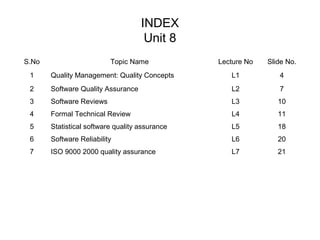
INDEX
                                     Unit 8
S.No                      Topic Name            Lecture No   Slide No.
 1     Quality Management: Quality Concepts        L1           4
 2     Software Quality Assurance                  L2           7
 3     Software Reviews                            L3           10
 4     Formal Technical Review                     L4           11
 5     Statistical software quality assurance      L5           18
 6     Software Reliability                        L6           20
 7     ISO 9000 2000 quality assurance             L7           21
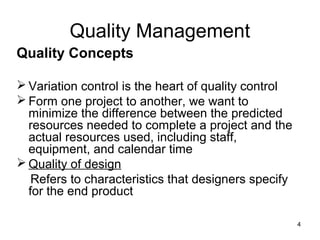
Quality Management
Quality Concepts

 Variation control is the heart of quality control
 Form one project to another, we want to
  minimize the difference between the predicted
  resources needed to complete a project and the
  actual resources used, including staff,
  equipment, and calendar time
 Quality of design
   Refers to characteristics that designers specify
  for the end product

                                                      4
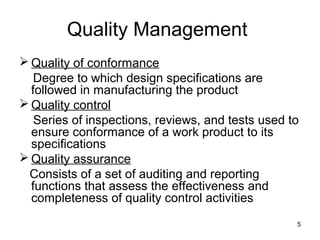
Quality Management
 Quality of conformance
   Degree to which design specifications are
  followed in manufacturing the product
 Quality control
   Series of inspections, reviews, and tests used to
  ensure conformance of a work product to its
  specifications
 Quality assurance
 Consists of a set of auditing and reporting
  functions that assess the effectiveness and
  completeness of quality control activities
                                                   5
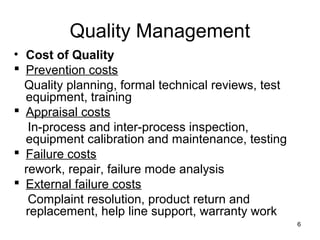
Quality Management
• Cost of Quality
 Prevention costs
  Quality planning, formal technical reviews, test
  equipment, training
 Appraisal costs
   In-process and inter-process inspection,
  equipment calibration and maintenance, testing
 Failure costs
  rework, repair, failure mode analysis
 External failure costs
   Complaint resolution, product return and
  replacement, help line support, warranty work
                                                     6
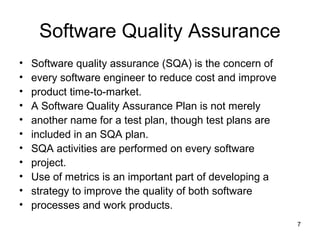
Software Quality Assurance
•   Software quality assurance (SQA) is the concern of
•   every software engineer to reduce cost and improve
•   product time-to-market.
•   A Software Quality Assurance Plan is not merely
•   another name for a test plan, though test plans are
•   included in an SQA plan.
•   SQA activities are performed on every software
•   project.
•   Use of metrics is an important part of developing a
•   strategy to improve the quality of both software
•   processes and work products.
                                                          7
Software Quality Assurance
• Definition of Software Quality serves to emphasize:
1.Conformance to software requirements is the foundation
  from which software quality is measured.
2. Specified standards are used to define the development
   criteria that are used to guide the manner in which
   software is engineered.
3.Software must conform to implicit requirements (ease of
  use, maintainability, reliability, etc.) as well as its explicit
  requirements.


                                                                     8
SQA Activities
•   Prepare SQA plan for the project.
•   Participate in the development of the project's software
•   process description.
•   Review software engineering activities to verify compliance
•   with the defined software process.
•   Audit designated software work products to verify compliance
•   with those defined as part of the software process.
•   Ensure that any deviations in software or work products are
•   documented and handled according to a documented
•   procedure.
•   Record any evidence of noncompliance and reports them to
•   management.


                                                                   9
Software Reviews
•   Purpose is to find errors before they are
•   passed on to another software engineering
•   activity or released to the customer.
•   Software engineers (and others) conduct
•   formal technical reviews (FTRs) for software
•   quality assurance.
•   Using formal technical reviews (walkthroughs
•   or inspections) is an effective means for
•   improving software quality.

                                                   10
Formal Technical Review
• A FTR is a software quality control activity performed by
   software engineers and others.The objectives are:
1. To uncover errors in function, logic or implementation for
   any representation of the software.
2. To verify that the software under review meets its
   requirements.
3. To ensure that the software has been represented
   according to predefined standards.
4. To achieve software that is developed in a uniform
   manner and
5. To make projects more manageable.

                                                            11
Formal Technical Review
Review meeting in FTR
• The Review meeting in a FTR should abide to
   the following constraints
1. Review meeting members should be between
   three and five.
2. Every person should prepare for the meeting
   and should not require more than two hours of
   work for each person.
3. The duration of the review meeting should be
   less than two hours.
                                                   12
Formal Technical Review
•   The focus of FTR is on a work product that is requirement specification, a
    detailed component design, a source code listing for a component.

•   The individual who has developed the work product i.e, the producer informs
    the project leader that the work product is complete and that a review is
    required.

•   The project leader contacts a review leader, who evaluates the product for
    readiness, generates copy of product material and distributes them to two or
    three review members for advance preparation .

•   Each reviewer is expected to spend between one and two hours reviewing
    the product, making notes


                                                                                 13
Formal Technical Review
•   The review leader also reviews the product and establish an agenda for the
    review meeting

•   The review meeting is attended by review leader, all reviewers and the
    producer.

•   One of the reviewer act as a recorder,who notes down all important points
    discussed in the meeting.

•   The meeting(FTR) is started by introducing the agenda of meeting and then
    the producer introduces his product. Then the producer “walkthrough” the
    product, the reviewers raise issues which they have prepared in advance.

•   If errors are found the recorder notes down


                                                                                14
Review reporting and Record
               keeping
• During the FTR, a reviewer( recorder) records all issues
   that have been raised
• A review summary report answers three questions
1. What was reviewed?
2. Who reviewed it?
3. What were the findings and conclusions?
• Review summary report is a single page form with
   possible attachments
• The review issues list serves two purposes
1. To identify problem areas in the product
2. To serve as an action item checklist that guides the
   producer as corrections are made

                                                         15
Review Guidelines
•   Review the product, not the producer
•   Set an agenda and maintain it
•   Limit debate and rebuttal
•   Enunciate problem areas, but don’t attempt to solve every problem
    noted
•   Take return notes
•   Limit the number of participants and insist upon advance
    preparation.
•   Develop a checklist for each product i.e likely to be reviewed
•   Allocate resources and schedule time for FTRS
•   Conduct meaningful training for all reviewer
•   Review your early reviews


                                                                        16
Software Defects
•   Industry studies suggest that design activities
•   introduce 50-65% of all defects or errors
•   during the software process
•   Review techniques have been shown to be up
•   to 75% effective in uncovering design flaws
•   which ultimately reduces the cost of
•   subsequent activities in the software process


                                                      17
Statistical Quality Assurance
•   Information about software defects is collected
•   and categorized
•   Each defect is traced back to its cause
•   Using the Pareto principle (80% of the defects
•   can be traced to 20% of the causes) isolate
•   the "vital few" defect causes
•   Move to correct the problems that caused the
•   defects in the "vital few”

                                                      18
Six Sigma for Software Engineering
•   The most widely used strategy for statistical quality assurance
•   Three core steps:
•   1. Define customer requirements, deliverables, and project goals via well-defined
•   methods of customer communication.
•   2. Measure each existing process and its output to determine current quality
•   performance (e.g., compute defect metrics)
•   3. Analyze defect metrics and determine vital few causes.
•   For an existing process that needs improvement
•   1. Improve process by eliminating the root causes for defects
•   2. Control future work to ensure that future work does not reintroduce causes of
•   defects
•   If new processes are being developed
•   1. Design each new process to avoid root causes of defects and to meet
•   customer requirements
•   2. Verify that the process model will avoid defects and meet customer
•   requirements


                                                                                        19
Software Reliability
•   Defined as the probability of failure free operation of a
•   computer program in a specified environment for a specified
•   time period
•   Can be measured directly and estimated using historical and
•   developmental data
•   Software reliability problems can usually be traced back to
•   errors in design or implementation.
•   Measures of Reliability
•    􀂄 Mean time between failure (MTBF) = MTTF + MTTR
•    􀂄 MTTF = mean time to failure
•    􀂄 MTTR = mean time to repair
•    􀂄 Availability = [MTTF / (MTTF + MTTR)] x 100%


                                                                  20
ISO 9000 Quality Standards
•   Quality assurance systems are defined as the
•   organizational structure, responsibilities, procedures,
•   processes, and resources for implementing quality
•   management.
•   ISO 9000 describes the quality elements that must
•   be present for a quality assurance system to be
•   compliant with the standard, but it does not describe
•   how an organization should implement these
•   elements.
•   ISO 9001:2000 is the quality standard that contains
•   20 requirements that must be present in an effective
•   software quality assurance system.
                                                              21

Unit 8

  • 1.
    Software Engineering B.Tech IT/II Sem-II Term: 2008-2009 Unit-8 PPT SLIDES Text Books:1.Software Engineering, A practitioner’s approach Roger s. Pressman 6th edition McGraw- Hill 2.Software Engineering Somerville 7th edition
  • 2.
    Unit 8 Syllabus •Quality Management : Quality concepts, Software quality assurance, Software Reviews, Formal technical reviews, Statistical Software quality Assurance, Software reliability, The ISO 9000quality standards. 2
  • 3.
    INDEX Unit 8 S.No Topic Name Lecture No Slide No. 1 Quality Management: Quality Concepts L1 4 2 Software Quality Assurance L2 7 3 Software Reviews L3 10 4 Formal Technical Review L4 11 5 Statistical software quality assurance L5 18 6 Software Reliability L6 20 7 ISO 9000 2000 quality assurance L7 21
  • 4.
    Quality Management Quality Concepts Variation control is the heart of quality control  Form one project to another, we want to minimize the difference between the predicted resources needed to complete a project and the actual resources used, including staff, equipment, and calendar time  Quality of design Refers to characteristics that designers specify for the end product 4
  • 5.
    Quality Management  Qualityof conformance Degree to which design specifications are followed in manufacturing the product  Quality control Series of inspections, reviews, and tests used to ensure conformance of a work product to its specifications  Quality assurance Consists of a set of auditing and reporting functions that assess the effectiveness and completeness of quality control activities 5
  • 6.
    Quality Management • Costof Quality  Prevention costs Quality planning, formal technical reviews, test equipment, training  Appraisal costs In-process and inter-process inspection, equipment calibration and maintenance, testing  Failure costs rework, repair, failure mode analysis  External failure costs Complaint resolution, product return and replacement, help line support, warranty work 6
  • 7.
    Software Quality Assurance • Software quality assurance (SQA) is the concern of • every software engineer to reduce cost and improve • product time-to-market. • A Software Quality Assurance Plan is not merely • another name for a test plan, though test plans are • included in an SQA plan. • SQA activities are performed on every software • project. • Use of metrics is an important part of developing a • strategy to improve the quality of both software • processes and work products. 7
  • 8.
    Software Quality Assurance •Definition of Software Quality serves to emphasize: 1.Conformance to software requirements is the foundation from which software quality is measured. 2. Specified standards are used to define the development criteria that are used to guide the manner in which software is engineered. 3.Software must conform to implicit requirements (ease of use, maintainability, reliability, etc.) as well as its explicit requirements. 8
  • 9.
    SQA Activities • Prepare SQA plan for the project. • Participate in the development of the project's software • process description. • Review software engineering activities to verify compliance • with the defined software process. • Audit designated software work products to verify compliance • with those defined as part of the software process. • Ensure that any deviations in software or work products are • documented and handled according to a documented • procedure. • Record any evidence of noncompliance and reports them to • management. 9
  • 10.
    Software Reviews • Purpose is to find errors before they are • passed on to another software engineering • activity or released to the customer. • Software engineers (and others) conduct • formal technical reviews (FTRs) for software • quality assurance. • Using formal technical reviews (walkthroughs • or inspections) is an effective means for • improving software quality. 10
  • 11.
    Formal Technical Review •A FTR is a software quality control activity performed by software engineers and others.The objectives are: 1. To uncover errors in function, logic or implementation for any representation of the software. 2. To verify that the software under review meets its requirements. 3. To ensure that the software has been represented according to predefined standards. 4. To achieve software that is developed in a uniform manner and 5. To make projects more manageable. 11
  • 12.
    Formal Technical Review Reviewmeeting in FTR • The Review meeting in a FTR should abide to the following constraints 1. Review meeting members should be between three and five. 2. Every person should prepare for the meeting and should not require more than two hours of work for each person. 3. The duration of the review meeting should be less than two hours. 12
  • 13.
    Formal Technical Review • The focus of FTR is on a work product that is requirement specification, a detailed component design, a source code listing for a component. • The individual who has developed the work product i.e, the producer informs the project leader that the work product is complete and that a review is required. • The project leader contacts a review leader, who evaluates the product for readiness, generates copy of product material and distributes them to two or three review members for advance preparation . • Each reviewer is expected to spend between one and two hours reviewing the product, making notes 13
  • 14.
    Formal Technical Review • The review leader also reviews the product and establish an agenda for the review meeting • The review meeting is attended by review leader, all reviewers and the producer. • One of the reviewer act as a recorder,who notes down all important points discussed in the meeting. • The meeting(FTR) is started by introducing the agenda of meeting and then the producer introduces his product. Then the producer “walkthrough” the product, the reviewers raise issues which they have prepared in advance. • If errors are found the recorder notes down 14
  • 15.
    Review reporting andRecord keeping • During the FTR, a reviewer( recorder) records all issues that have been raised • A review summary report answers three questions 1. What was reviewed? 2. Who reviewed it? 3. What were the findings and conclusions? • Review summary report is a single page form with possible attachments • The review issues list serves two purposes 1. To identify problem areas in the product 2. To serve as an action item checklist that guides the producer as corrections are made 15
  • 16.
    Review Guidelines • Review the product, not the producer • Set an agenda and maintain it • Limit debate and rebuttal • Enunciate problem areas, but don’t attempt to solve every problem noted • Take return notes • Limit the number of participants and insist upon advance preparation. • Develop a checklist for each product i.e likely to be reviewed • Allocate resources and schedule time for FTRS • Conduct meaningful training for all reviewer • Review your early reviews 16
  • 17.
    Software Defects • Industry studies suggest that design activities • introduce 50-65% of all defects or errors • during the software process • Review techniques have been shown to be up • to 75% effective in uncovering design flaws • which ultimately reduces the cost of • subsequent activities in the software process 17
  • 18.
    Statistical Quality Assurance • Information about software defects is collected • and categorized • Each defect is traced back to its cause • Using the Pareto principle (80% of the defects • can be traced to 20% of the causes) isolate • the "vital few" defect causes • Move to correct the problems that caused the • defects in the "vital few” 18
  • 19.
    Six Sigma forSoftware Engineering • The most widely used strategy for statistical quality assurance • Three core steps: • 1. Define customer requirements, deliverables, and project goals via well-defined • methods of customer communication. • 2. Measure each existing process and its output to determine current quality • performance (e.g., compute defect metrics) • 3. Analyze defect metrics and determine vital few causes. • For an existing process that needs improvement • 1. Improve process by eliminating the root causes for defects • 2. Control future work to ensure that future work does not reintroduce causes of • defects • If new processes are being developed • 1. Design each new process to avoid root causes of defects and to meet • customer requirements • 2. Verify that the process model will avoid defects and meet customer • requirements 19
  • 20.
    Software Reliability • Defined as the probability of failure free operation of a • computer program in a specified environment for a specified • time period • Can be measured directly and estimated using historical and • developmental data • Software reliability problems can usually be traced back to • errors in design or implementation. • Measures of Reliability • 􀂄 Mean time between failure (MTBF) = MTTF + MTTR • 􀂄 MTTF = mean time to failure • 􀂄 MTTR = mean time to repair • 􀂄 Availability = [MTTF / (MTTF + MTTR)] x 100% 20
  • 21.
    ISO 9000 QualityStandards • Quality assurance systems are defined as the • organizational structure, responsibilities, procedures, • processes, and resources for implementing quality • management. • ISO 9000 describes the quality elements that must • be present for a quality assurance system to be • compliant with the standard, but it does not describe • how an organization should implement these • elements. • ISO 9001:2000 is the quality standard that contains • 20 requirements that must be present in an effective • software quality assurance system. 21