

UNIT: 6
HUMAN
EVOLUTION
CAMPBELL & REECE, 2010
CHAPTER 34 P.728-733
EDUDINK
NOTES
• Human evolution: refers to the evolutionary
process leading up to the appearance of
modern humans.
• The study of human evolution involves many
scientific disciplines, including physical
anthropology, primatology, archaeology,
linguistics, embryology and genetics.
INTRODUCTION
• The species Homo sapiens is about 200,000
years old, which is very young, considering
that life has existed on Earth for at least 3.5
billion years.
• Derived from early Homonins (Homonids)
INTRODUCTION
• Human evolution is characterized by a number
of morphological, developmental,
physiological, and behavioural changes .
• The most significant of these adaptations
are
• 1. bipedalism (1.9 million years ago),
• 2. increased brain size,
• 3. lengthened ontogeny (gestation and
infancy),
• 4. decreased sexual dimorphism.
Characters that distinguish humans
from other apes:
• Upright posture and bipedal locomotion
• Larger brains
• Language capabilities and symbolic
thought
• The manufacture and use of complex
tools
• Shortened jaw
• Shorter digestive tract
The Earliest Hominins
• The study of human origins is known as
palaeoanthropology
• Hominins (formerly called hominids) are more
closely related to humans than to
chimpanzees
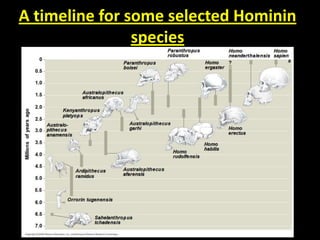
• Paleoanthropologists have discovered fossils
of about 20 species of extinct hominins
A timeline for some selected Hominin
species
• Hominins originated in Africa about 6–7
million years ago.
• Early hominins had a small brain but probably
walked upright.
• Two common misconceptions about early
hominins:
–Thinking of them as chimpanzees
–Imagining human evolution as a ladder
leading directly to Homo sapiens
• We are taking a closer look to the Hominins
called Australopiths and Homo
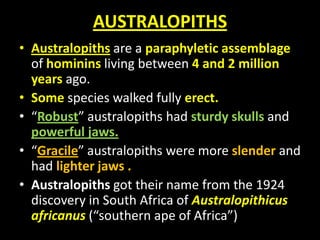
AUSTRALOPITHS
• Australopiths are a paraphyletic assemblage
of hominins living between 4 and 2 million
years ago.
• Some species walked fully erect.
• “Robust” australopiths had sturdy skulls and
powerful jaws.
• “Gracile” australopiths were more slender and
had lighter jaws .
• Australopiths got their name from the 1924
discovery in South Africa of Australopithicus
africanus (“southern ape of Africa”)
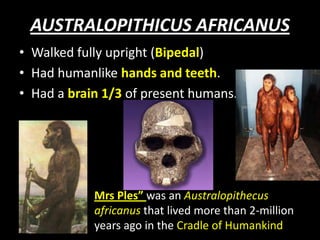
AUSTRALOPITHICUS AFRICANUS
• Walked fully upright (Bipedal)
• Had humanlike hands and teeth.
• Had a brain 1/3 of present humans.
Mrs Ples” was an Australopithecus
africanus that lived more than 2-million
years ago in the Cradle of Humankind
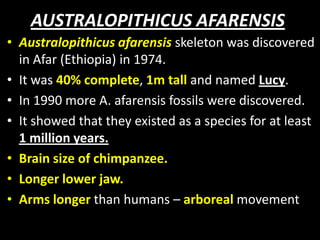
AUSTRALOPITHICUS AFARENSIS
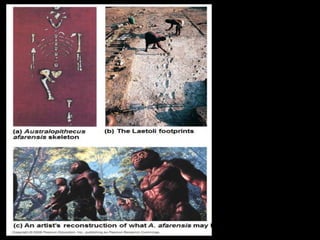
• Australopithicus afarensis skeleton was discovered
in Afar (Ethiopia) in 1974.
• It was 40% complete, 1m tall and named Lucy.
• In 1990 more A. afarensis fossils were discovered.
• It showed that they existed as a species for at least
1 million years.
• Brain size of chimpanzee.
• Longer lower jaw.
• Arms longer than humans – arboreal movement
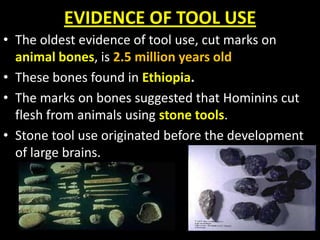
EVIDENCE OF TOOL USE
• The oldest evidence of tool use, cut marks on
animal bones, is 2.5 million years old
• These bones found in Ethiopia.
• The marks on bones suggested that Hominins cut
flesh from animals using stone tools.
• Stone tool use originated before the development
of large brains.
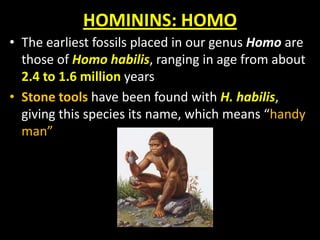
HOMININS: HOMO
• The earliest fossils placed in our genus Homo are
those of Homo habilis, ranging in age from about
2.4 to 1.6 million years
• Stone tools have been found with H. habilis,
giving this species its name, which means “handy
man”
• Homo ergaster was the first fully bipedal, large-
brained hominid
• The species existed between 1.9 and 1.5 million
years ago
• Homo ergaster shows a significant decrease in
sexual dimorphism (a size difference between
sexes) compared with its ancestors.
• Homo ergaster fossils were previously assigned to
Homo erectus; most paleoanthropologists now
recognize these as separate species.
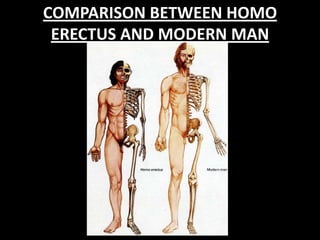
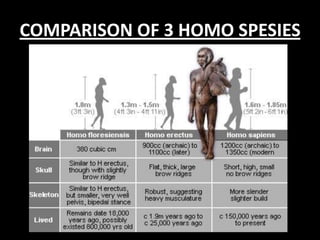
• Homo erectus originated in Africa by 1.8 million
years ago
• It was the first hominin to leave Africa
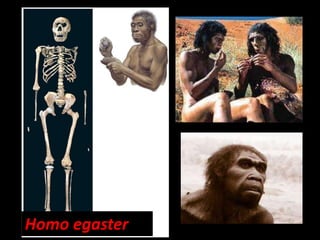
Homo egaster
COMPARISON BETWEEN HOMO
ERECTUS AND MODERN MAN
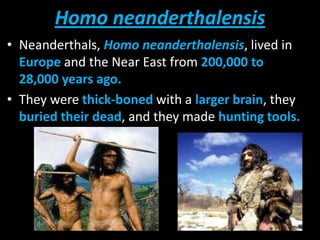
Homo neanderthalensis
• Neanderthals, Homo neanderthalensis, lived in
Europe and the Near East from 200,000 to
28,000 years ago.
• They were thick-boned with a larger brain, they
buried their dead, and they made hunting tools.
HOMO SAPIENS
• Homo sapiens appeared in Africa by 195,000
years ago.
• All living humans are descended from these
African ancestors.
• The oldest fossils of Homo sapiens outside Africa
date back about 115,000 years and are from the
Middle East.
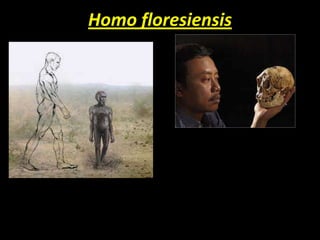
• In 2004, 18,000 year old fossils were found in
Indonesia, and a new small hominin was named:
Homo floresiensis
Homo floresiensis
• Rapid expansion of our species may have been
preceded by changes to the brain that made
cognitive innovations possible.
• For example, the FOXP2 gene is essential for
human language, and underwent intense natural
selection during the last 200,000 years
• Homo sapiens were the first group to show
evidence of symbolic and sophisticated thought.
Art, a human
hallmark
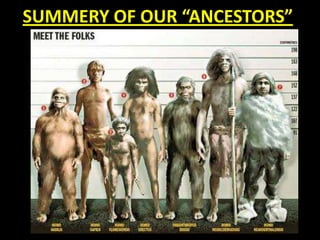
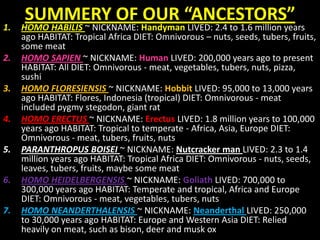
SUMMERY OF OUR “ANCESTORS”
1. HOMO HABILIS ~ NICKNAME: Handyman LIVED: 2.4 to 1.6 million years
ago HABITAT: Tropical Africa DIET: Omnivorous – nuts, seeds, tubers, fruits,
some meat
2. HOMO SAPIEN ~ NICKNAME: Human LIVED: 200,000 years ago to present
HABITAT: All DIET: Omnivorous - meat, vegetables, tubers, nuts, pizza,
sushi
3. HOMO FLORESIENSIS ~ NICKNAME: Hobbit LIVED: 95,000 to 13,000 years
ago HABITAT: Flores, Indonesia (tropical) DIET: Omnivorous - meat
included pygmy stegodon, giant rat
4. HOMO ERECTUS ~ NICKNAME: Erectus LIVED: 1.8 million years to 100,000
years ago HABITAT: Tropical to temperate - Africa, Asia, Europe DIET:
Omnivorous - meat, tubers, fruits, nuts
5. PARANTHROPUS BOISEI ~ NICKNAME: Nutcracker man LIVED: 2.3 to 1.4
million years ago HABITAT: Tropical Africa DIET: Omnivorous - nuts, seeds,
leaves, tubers, fruits, maybe some meat
6. HOMO HEIDELBERGENSIS ~ NICKNAME: Goliath LIVED: 700,000 to
300,000 years ago HABITAT: Temperate and tropical, Africa and Europe
DIET: Omnivorous - meat, vegetables, tubers, nuts
7. HOMO NEANDERTHALENSIS ~ NICKNAME: Neanderthal LIVED: 250,000
to 30,000 years ago HABITAT: Europe and Western Asia DIET: Relied
heavily on meat, such as bison, deer and musk ox
COMPARISON OF 3 HOMO SPESIES
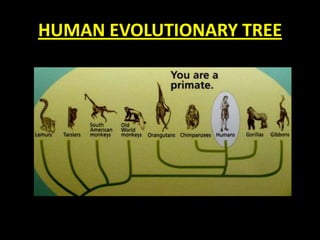
HUMAN EVOLUTIONARY TREE
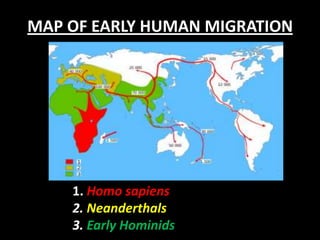
MAP OF EARLY HUMAN MIGRATION
1. Homo sapiens
2. Neanderthals
3. Early Hominids
Unit 6 human evolution a

Unit 6 human evolution a

  • 1.
    UNIT: 6 HUMAN EVOLUTION CAMPBELL &REECE, 2010 CHAPTER 34 P.728-733 EDUDINK NOTES
  • 2.
    • Human evolution:refers to the evolutionary process leading up to the appearance of modern humans. • The study of human evolution involves many scientific disciplines, including physical anthropology, primatology, archaeology, linguistics, embryology and genetics. INTRODUCTION
  • 3.
    • The speciesHomo sapiens is about 200,000 years old, which is very young, considering that life has existed on Earth for at least 3.5 billion years. • Derived from early Homonins (Homonids) INTRODUCTION
  • 4.
    • Human evolutionis characterized by a number of morphological, developmental, physiological, and behavioural changes . • The most significant of these adaptations are • 1. bipedalism (1.9 million years ago), • 2. increased brain size, • 3. lengthened ontogeny (gestation and infancy), • 4. decreased sexual dimorphism.
  • 5.
    Characters that distinguishhumans from other apes: • Upright posture and bipedal locomotion • Larger brains • Language capabilities and symbolic thought • The manufacture and use of complex tools • Shortened jaw • Shorter digestive tract
  • 6.
    The Earliest Hominins •The study of human origins is known as palaeoanthropology • Hominins (formerly called hominids) are more closely related to humans than to chimpanzees • Paleoanthropologists have discovered fossils of about 20 species of extinct hominins
  • 7.
    A timeline forsome selected Hominin species
  • 8.
    • Hominins originatedin Africa about 6–7 million years ago. • Early hominins had a small brain but probably walked upright. • Two common misconceptions about early hominins: –Thinking of them as chimpanzees –Imagining human evolution as a ladder leading directly to Homo sapiens • We are taking a closer look to the Hominins called Australopiths and Homo
  • 9.
    AUSTRALOPITHS • Australopiths area paraphyletic assemblage of hominins living between 4 and 2 million years ago. • Some species walked fully erect. • “Robust” australopiths had sturdy skulls and powerful jaws. • “Gracile” australopiths were more slender and had lighter jaws . • Australopiths got their name from the 1924 discovery in South Africa of Australopithicus africanus (“southern ape of Africa”)
  • 10.
    AUSTRALOPITHICUS AFRICANUS • Walkedfully upright (Bipedal) • Had humanlike hands and teeth. • Had a brain 1/3 of present humans. Mrs Ples” was an Australopithecus africanus that lived more than 2-million years ago in the Cradle of Humankind
  • 11.
    AUSTRALOPITHICUS AFARENSIS • Australopithicusafarensis skeleton was discovered in Afar (Ethiopia) in 1974. • It was 40% complete, 1m tall and named Lucy. • In 1990 more A. afarensis fossils were discovered. • It showed that they existed as a species for at least 1 million years. • Brain size of chimpanzee. • Longer lower jaw. • Arms longer than humans – arboreal movement
  • 13.
    EVIDENCE OF TOOLUSE • The oldest evidence of tool use, cut marks on animal bones, is 2.5 million years old • These bones found in Ethiopia. • The marks on bones suggested that Hominins cut flesh from animals using stone tools. • Stone tool use originated before the development of large brains.
  • 14.
    HOMININS: HOMO • Theearliest fossils placed in our genus Homo are those of Homo habilis, ranging in age from about 2.4 to 1.6 million years • Stone tools have been found with H. habilis, giving this species its name, which means “handy man”
  • 15.
    • Homo ergasterwas the first fully bipedal, large- brained hominid • The species existed between 1.9 and 1.5 million years ago • Homo ergaster shows a significant decrease in sexual dimorphism (a size difference between sexes) compared with its ancestors. • Homo ergaster fossils were previously assigned to Homo erectus; most paleoanthropologists now recognize these as separate species. • Homo erectus originated in Africa by 1.8 million years ago • It was the first hominin to leave Africa
  • 16.
  • 17.
  • 18.
    Homo neanderthalensis • Neanderthals,Homo neanderthalensis, lived in Europe and the Near East from 200,000 to 28,000 years ago. • They were thick-boned with a larger brain, they buried their dead, and they made hunting tools.
  • 19.
    HOMO SAPIENS • Homosapiens appeared in Africa by 195,000 years ago. • All living humans are descended from these African ancestors. • The oldest fossils of Homo sapiens outside Africa date back about 115,000 years and are from the Middle East. • In 2004, 18,000 year old fossils were found in Indonesia, and a new small hominin was named: Homo floresiensis
  • 20.
  • 21.
    • Rapid expansionof our species may have been preceded by changes to the brain that made cognitive innovations possible. • For example, the FOXP2 gene is essential for human language, and underwent intense natural selection during the last 200,000 years • Homo sapiens were the first group to show evidence of symbolic and sophisticated thought. Art, a human hallmark
  • 22.
    SUMMERY OF OUR“ANCESTORS”
  • 23.
    SUMMERY OF OUR“ANCESTORS” 1. HOMO HABILIS ~ NICKNAME: Handyman LIVED: 2.4 to 1.6 million years ago HABITAT: Tropical Africa DIET: Omnivorous – nuts, seeds, tubers, fruits, some meat 2. HOMO SAPIEN ~ NICKNAME: Human LIVED: 200,000 years ago to present HABITAT: All DIET: Omnivorous - meat, vegetables, tubers, nuts, pizza, sushi 3. HOMO FLORESIENSIS ~ NICKNAME: Hobbit LIVED: 95,000 to 13,000 years ago HABITAT: Flores, Indonesia (tropical) DIET: Omnivorous - meat included pygmy stegodon, giant rat 4. HOMO ERECTUS ~ NICKNAME: Erectus LIVED: 1.8 million years to 100,000 years ago HABITAT: Tropical to temperate - Africa, Asia, Europe DIET: Omnivorous - meat, tubers, fruits, nuts 5. PARANTHROPUS BOISEI ~ NICKNAME: Nutcracker man LIVED: 2.3 to 1.4 million years ago HABITAT: Tropical Africa DIET: Omnivorous - nuts, seeds, leaves, tubers, fruits, maybe some meat 6. HOMO HEIDELBERGENSIS ~ NICKNAME: Goliath LIVED: 700,000 to 300,000 years ago HABITAT: Temperate and tropical, Africa and Europe DIET: Omnivorous - meat, vegetables, tubers, nuts 7. HOMO NEANDERTHALENSIS ~ NICKNAME: Neanderthal LIVED: 250,000 to 30,000 years ago HABITAT: Europe and Western Asia DIET: Relied heavily on meat, such as bison, deer and musk ox
  • 24.
    COMPARISON OF 3HOMO SPESIES
  • 25.
  • 26.
    MAP OF EARLYHUMAN MIGRATION 1. Homo sapiens 2. Neanderthals 3. Early Hominids