STORAGE AND DISPLAY
DEVICES
Kongunadu College of Engineering and Technology
Contents:
Magnetic disk and tape
Recorders
digital plotters
Printers
CRT display
 digital CRO
 LED
 LCD
dot matrix display.
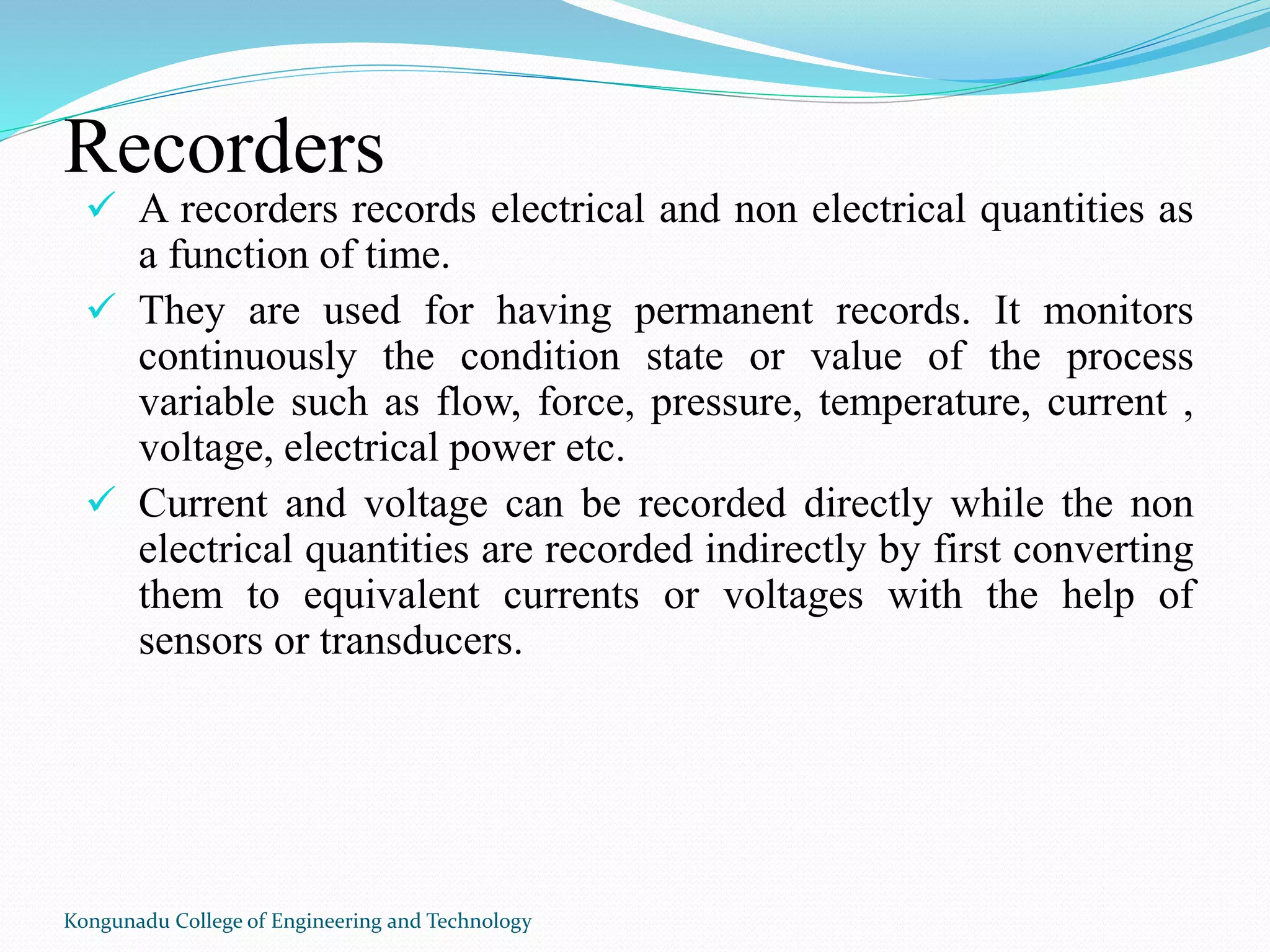
Recorders
 A recorders records electrical and non electrical quantities as
a function of time.
 They are used for having permanent records. It monitors
continuously the condition state or value of the process
variable such as flow, force, pressure, temperature, current ,
voltage, electrical power etc.
 Current and voltage can be recorded directly while the non
electrical quantities are recorded indirectly by first converting
them to equivalent currents or voltages with the help of
sensors or transducers.
Kongunadu College of Engineering and Technology
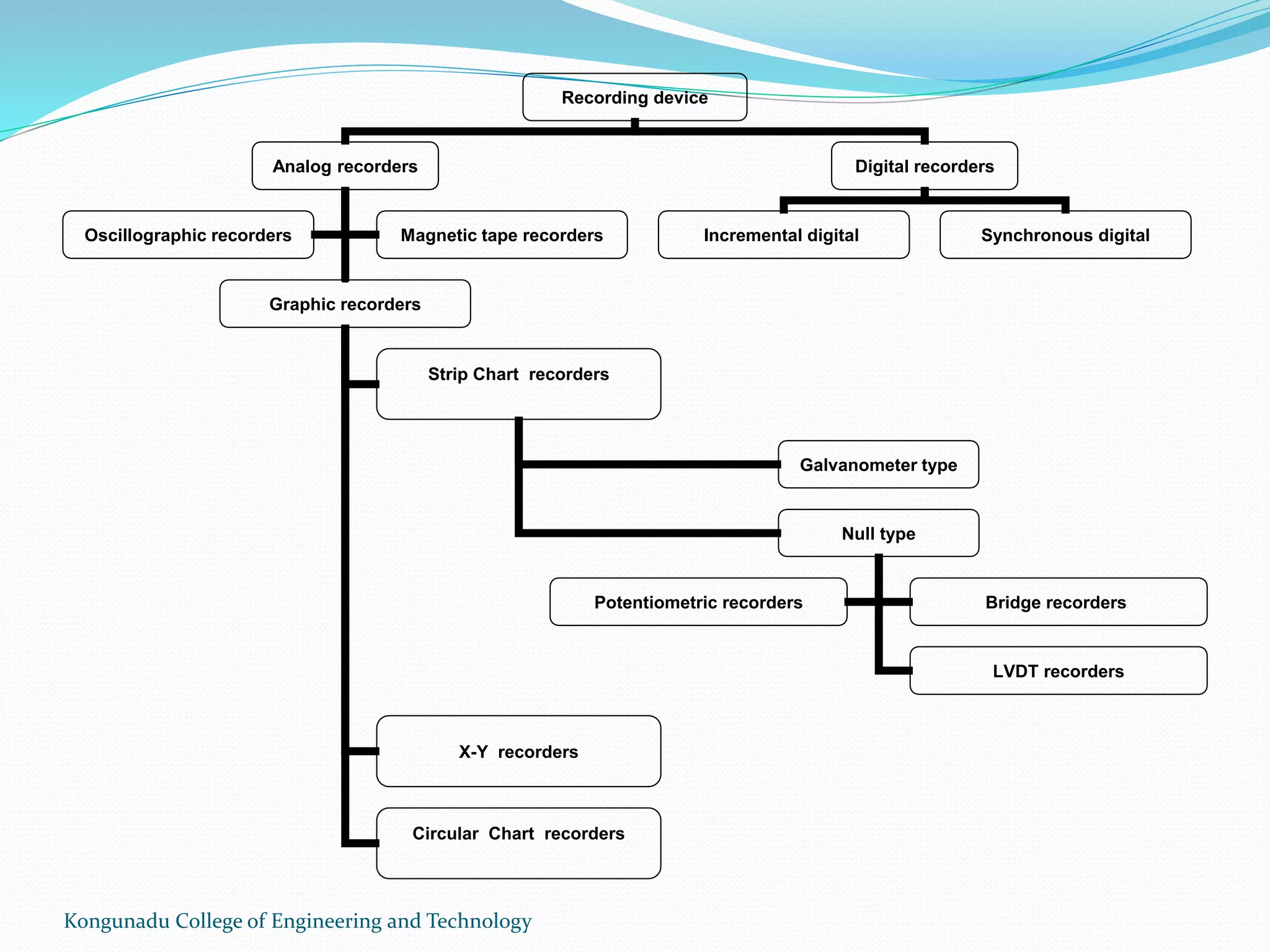
Recording device
Analog recorders Digital recorders
Incremental digital Synchronous digitalOscillographic recorders Magnetic tape recorders
Graphic recorders
Strip Chart recorders
X-Y recorders
Circular Chart recorders
Galvanometer type
Null type
LVDT recorders
Potentiometric recorders Bridge recorders
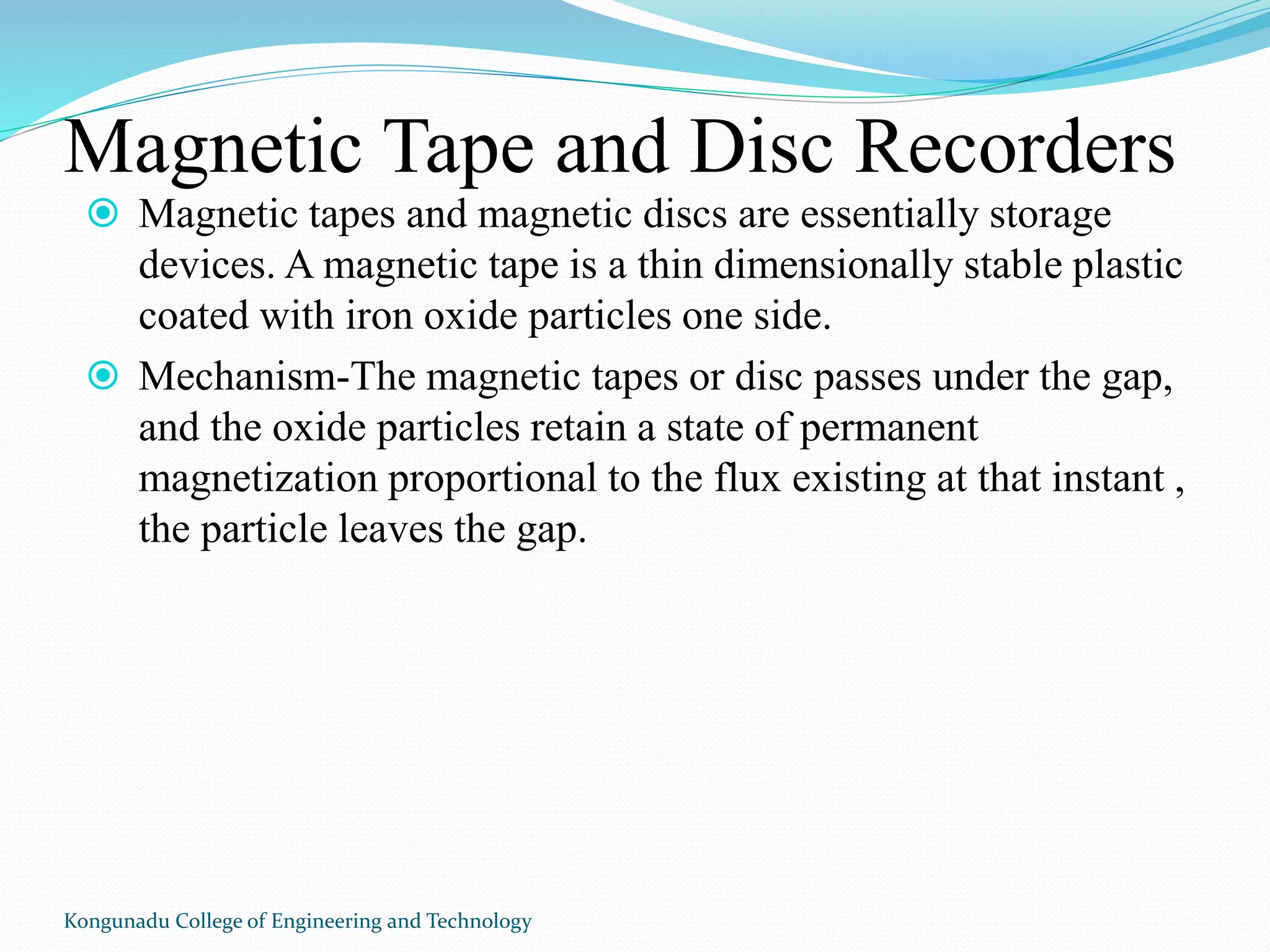
Magnetic Tape and Disc Recorders
 Magnetic tapes and magnetic discs are essentially storage
devices. A magnetic tape is a thin dimensionally stable plastic
coated with iron oxide particles one side.
 Mechanism-The magnetic tapes or disc passes under the gap,
and the oxide particles retain a state of permanent
magnetization proportional to the flux existing at that instant ,
the particle leaves the gap.
Kongunadu College of Engineering and Technology
Basic Components of Tape recorder
 Recording Head
 Magnetic Head
 Reproducing Head
 Tape transport mechanism
 Conditioning device.
Kongunadu College of Engineering and Technology
Methods Of Magnetic Tape
recording
 Direct Recording
 FM recording
 Pulse Duration Modulation Recording
Kongunadu College of Engineering and Technology
Printers
Classification
Impact printers
Non Impact Printers.
Kongunadu College of Engineering and Technology
Impact printers
1. Line Printer
2. Drum Printer.
3. Chain Printer.
4. Dot Matrix Printer
Kongunadu College of Engineering and Technology
Non Impact Printers.
 Ink jet Printer
 Laser Printer
 Thermal Transfer Printer
Kongunadu College of Engineering and Technology
Cathode Ray Oscilloscope (CRO)
 The cathode ray oscilloscope is a versatile laboratory
instrument used for display, measurement and analysis of
waveform.
 CRO are very fast X-Y plotter displaying an input signal
versus another signal or versus time.
 The Stylus of this plotter is a luminous spot which moves
over the display area in response to an input voltage.
Kongunadu College of Engineering and Technology
Cont…
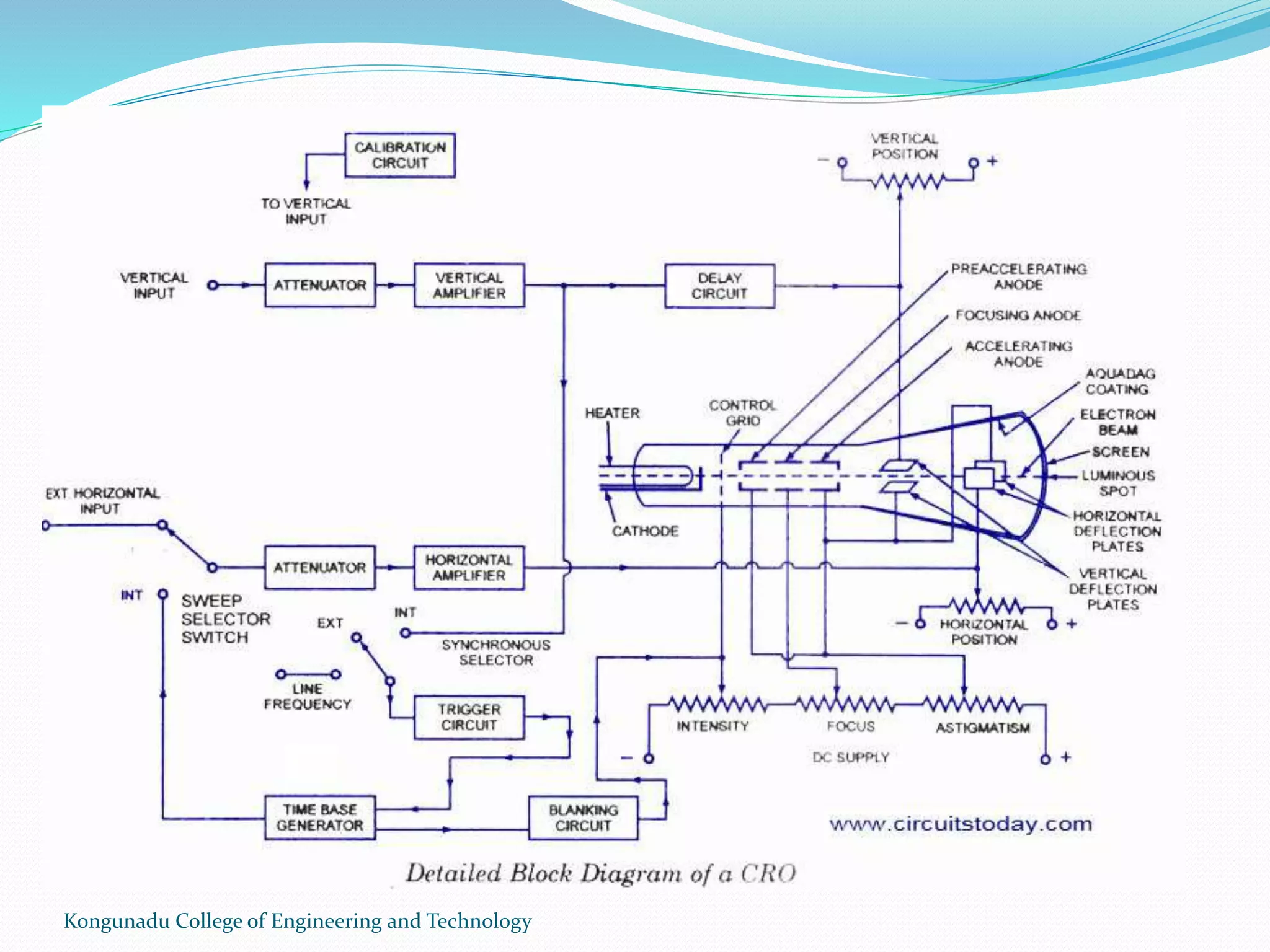
 The luminous spot is produced by a beam of electrons striking
a fluorescent screen.
 Applications of CRO
 Sampling oscilloscopes.
 Storage oscilloscopes.
 An analog oscilloscope.
 Cathode ray tube (CRT)
 Electron gun assembly.
 Deflection plate assembly.
 Fluorescent screen.
 Glass envelope.
 Base through which connection are made to various parts.
Kongunadu College of Engineering and Technology
LED
 It is perhaps the most important of the display device for use in
instrumentation systems.
 It is a PN junction device that emits light when a current passes
through it in the forward direction.
 Charge carrier recombination occurs at PN junction as
electrons from N side recombines with holes on P side.
Kongunadu College of Engineering and Technology
Cont…
 When this happens ,charge carrier give up energy in the form
of heat and light.
 If the semiconductor material is translucent the light is
emitted and junction is source of light.
 Charge carrier recombination takes place in the P type
material. For maximum light emission a metal film anode is
deposited around edge of P Type material.
Kongunadu College of Engineering and Technology
LCD
 Used in application of display of numeric and alpha numeric
characters in dot matrix and segmental displays.
 Types
 Dynamic scattering type
 Field effect type.
Kongunadu College of Engineering and Technology
Dot Matrices
 3x5 dot matrix
 Dot matrix utilizing 27 Dots
 5x7 dot matrix
Kongunadu College of Engineering and Technology

Unit 4

  • 1.
    STORAGE AND DISPLAY DEVICES KongunaduCollege of Engineering and Technology Contents: Magnetic disk and tape Recorders digital plotters Printers CRT display  digital CRO  LED  LCD dot matrix display.
  • 2.
    Recorders  A recordersrecords electrical and non electrical quantities as a function of time.  They are used for having permanent records. It monitors continuously the condition state or value of the process variable such as flow, force, pressure, temperature, current , voltage, electrical power etc.  Current and voltage can be recorded directly while the non electrical quantities are recorded indirectly by first converting them to equivalent currents or voltages with the help of sensors or transducers. Kongunadu College of Engineering and Technology
  • 3.
    Kongunadu College ofEngineering and Technology Recording device Analog recorders Digital recorders Incremental digital Synchronous digitalOscillographic recorders Magnetic tape recorders Graphic recorders Strip Chart recorders X-Y recorders Circular Chart recorders Galvanometer type Null type LVDT recorders Potentiometric recorders Bridge recorders
  • 4.
    Magnetic Tape andDisc Recorders  Magnetic tapes and magnetic discs are essentially storage devices. A magnetic tape is a thin dimensionally stable plastic coated with iron oxide particles one side.  Mechanism-The magnetic tapes or disc passes under the gap, and the oxide particles retain a state of permanent magnetization proportional to the flux existing at that instant , the particle leaves the gap. Kongunadu College of Engineering and Technology
  • 5.
    Basic Components ofTape recorder  Recording Head  Magnetic Head  Reproducing Head  Tape transport mechanism  Conditioning device. Kongunadu College of Engineering and Technology
  • 6.
    Methods Of MagneticTape recording  Direct Recording  FM recording  Pulse Duration Modulation Recording Kongunadu College of Engineering and Technology
  • 7.
    Printers Classification Impact printers Non ImpactPrinters. Kongunadu College of Engineering and Technology
  • 8.
    Impact printers 1. LinePrinter 2. Drum Printer. 3. Chain Printer. 4. Dot Matrix Printer Kongunadu College of Engineering and Technology
  • 9.
    Kongunadu College ofEngineering and Technology
  • 10.
    Non Impact Printers. Ink jet Printer  Laser Printer  Thermal Transfer Printer Kongunadu College of Engineering and Technology
  • 11.
    Cathode Ray Oscilloscope(CRO)  The cathode ray oscilloscope is a versatile laboratory instrument used for display, measurement and analysis of waveform.  CRO are very fast X-Y plotter displaying an input signal versus another signal or versus time.  The Stylus of this plotter is a luminous spot which moves over the display area in response to an input voltage. Kongunadu College of Engineering and Technology
  • 12.
    Kongunadu College ofEngineering and Technology
  • 13.
    Kongunadu College ofEngineering and Technology
  • 14.
    Cont…  The luminousspot is produced by a beam of electrons striking a fluorescent screen.  Applications of CRO  Sampling oscilloscopes.  Storage oscilloscopes.  An analog oscilloscope.  Cathode ray tube (CRT)  Electron gun assembly.  Deflection plate assembly.  Fluorescent screen.  Glass envelope.  Base through which connection are made to various parts. Kongunadu College of Engineering and Technology
  • 15.
    LED  It isperhaps the most important of the display device for use in instrumentation systems.  It is a PN junction device that emits light when a current passes through it in the forward direction.  Charge carrier recombination occurs at PN junction as electrons from N side recombines with holes on P side. Kongunadu College of Engineering and Technology
  • 16.
    Cont…  When thishappens ,charge carrier give up energy in the form of heat and light.  If the semiconductor material is translucent the light is emitted and junction is source of light.  Charge carrier recombination takes place in the P type material. For maximum light emission a metal film anode is deposited around edge of P Type material. Kongunadu College of Engineering and Technology
  • 17.
    LCD  Used inapplication of display of numeric and alpha numeric characters in dot matrix and segmental displays.  Types  Dynamic scattering type  Field effect type. Kongunadu College of Engineering and Technology
  • 18.
    Dot Matrices  3x5dot matrix  Dot matrix utilizing 27 Dots  5x7 dot matrix Kongunadu College of Engineering and Technology
  • 19.
    Kongunadu College ofEngineering and Technology