STEM CELL
HISTORY
1998 - Researchers first extract stem cells from human embryos
1999 - First Successful human transplant of insulin-making cells from cadavers
2001 - President Bush restricts federal funding for embryonic stem-cell research
2002 - Juvenile Diabetes Research Foundation International creates $20 million
fund-raising effort to support stem-cell research
2002 - California started stem cell research
2004 - Harvard researchers grow stem cells from embryos using private funding
2004 - Ballot measure for $3 Billion bond for stem cells
INTRODUCTION TO STEM CELL
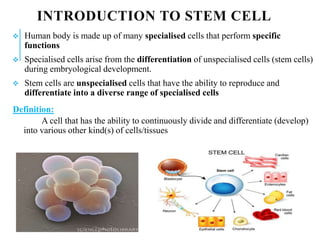
 Human body is made up of many specialised cells that perform specific
functions
 Specialised cells arise from the differentiation of unspecialised cells (stem cells)
during embryological development.
 Stem cells are unspecialised cells that have the ability to reproduce and
differentiate into a diverse range of specialised cells
Definition:
A cell that has the ability to continuously divide and differentiate (develop)
into various other kind(s) of cells/tissues
CHARACTERISTICS OF STEM CELL
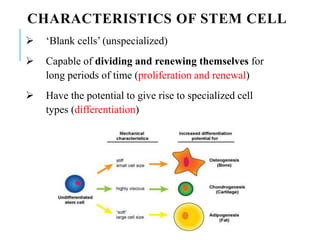
 ‘Blank cells’ (unspecialized)
 Capable of dividing and renewing themselves for
long periods of time (proliferation and renewal)
 Have the potential to give rise to specialized cell
types (differentiation)
FEATURES OF STEM CELLS
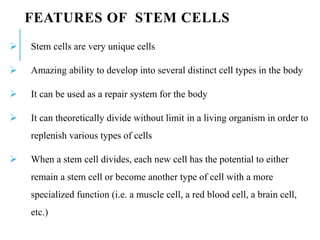
 Stem cells are very unique cells
 Amazing ability to develop into several distinct cell types in the body
 It can be used as a repair system for the body
 It can theoretically divide without limit in a living organism in order to
replenish various types of cells
 When a stem cell divides, each new cell has the potential to either
remain a stem cell or become another type of cell with a more
specialized function (i.e. a muscle cell, a red blood cell, a brain cell,
etc.)
TYPES OF STEM CELLS
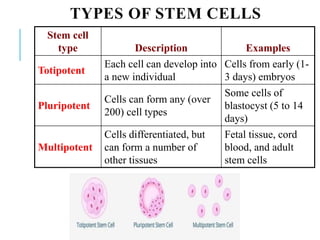
Stem cell
type Description Examples
Totipotent
Each cell can develop into
a new individual
Cells from early (1-
3 days) embryos
Pluripotent
Cells can form any (over
200) cell types
Some cells of
blastocyst (5 to 14
days)
Multipotent
Cells differentiated, but
can form a number of
other tissues
Fetal tissue, cord
blood, and adult
stem cells
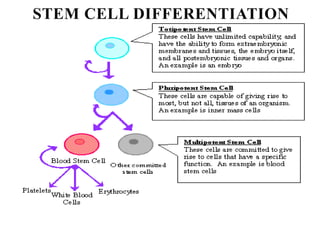
STEM CELL DIFFERENTIATION
TYPES OF STEM CELLS
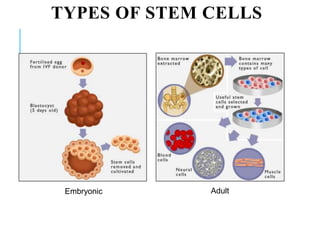
Embryonic stem cells come from a five to six-day-old embryo. They have the
ability to form virtually any type of cell found in the human body.
Embryonic germ cells are derived from the part of a human embryo or foetus that
will ultimately produce eggs or sperm (gametes).
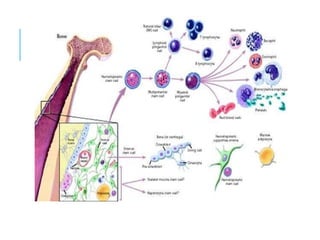
Adult stem cells are undifferentiated cells found among specialized or
differentiated cells in a tissue or organ after birth. Based on current research they
appear to have a more restricted ability to produce different cell types and they self-
renew.
TYPES OF STEM CELLS
Embryonic Adult
EMBRYONIC STEM CELLS
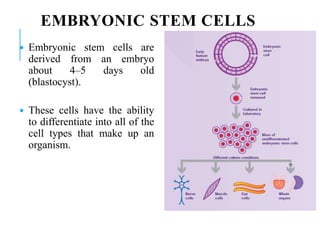
 Embryonic stem cells are
derived from an embryo
about 4–5 days old
(blastocyst).
 These cells have the ability
to differentiate into all of the
cell types that make up an
organism.
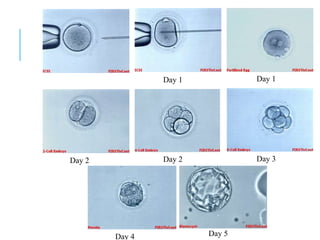
Day 1 Day 1
Day 2 Day 2 Day 3
Day 4 Day 5
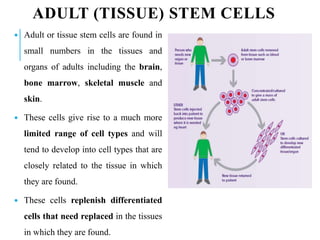
ADULT (TISSUE) STEM CELLS
 Adult or tissue stem cells are found in
small numbers in the tissues and
organs of adults including the brain,
bone marrow, skeletal muscle and
skin.
 These cells give rise to a much more
limited range of cell types and will
tend to develop into cell types that are
closely related to the tissue in which
they are found.
 These cells replenish differentiated
cells that need replaced in the tissues
in which they are found.
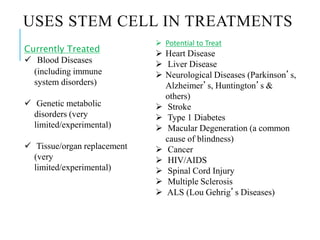
USES STEM CELL IN TREATMENTS
Currently Treated
 Blood Diseases
(including immune
system disorders)
 Genetic metabolic
disorders (very
limited/experimental)
 Tissue/organ replacement
(very
limited/experimental)
 Potential to Treat
 Heart Disease
 Liver Disease
 Neurological Diseases (Parkinson’s,
Alzheimer’s, Huntington’s &
others)
 Stroke
 Type 1 Diabetes
 Macular Degeneration (a common
cause of blindness)
 Cancer
 HIV/AIDS
 Spinal Cord Injury
 Multiple Sclerosis
 ALS (Lou Gehrig’s Diseases)
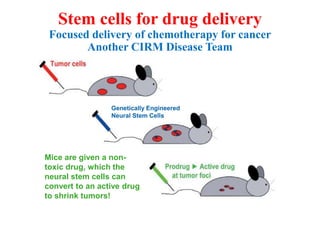
Stem cells for drug delivery
Focused delivery of chemotherapy for cancer
Another CIRM Disease Team
Genetically Engineered
Neural Stem Cells
Mice are given a non-
toxic drug, which the
neural stem cells can
convert to an active drug
to shrink tumors!
THANK YOU

unit 2- Stem cell.pptx

  • 1.
  • 2.
    HISTORY 1998 - Researchersfirst extract stem cells from human embryos 1999 - First Successful human transplant of insulin-making cells from cadavers 2001 - President Bush restricts federal funding for embryonic stem-cell research 2002 - Juvenile Diabetes Research Foundation International creates $20 million fund-raising effort to support stem-cell research 2002 - California started stem cell research 2004 - Harvard researchers grow stem cells from embryos using private funding 2004 - Ballot measure for $3 Billion bond for stem cells
  • 3.
    INTRODUCTION TO STEMCELL  Human body is made up of many specialised cells that perform specific functions  Specialised cells arise from the differentiation of unspecialised cells (stem cells) during embryological development.  Stem cells are unspecialised cells that have the ability to reproduce and differentiate into a diverse range of specialised cells Definition: A cell that has the ability to continuously divide and differentiate (develop) into various other kind(s) of cells/tissues
  • 4.
    CHARACTERISTICS OF STEMCELL  ‘Blank cells’ (unspecialized)  Capable of dividing and renewing themselves for long periods of time (proliferation and renewal)  Have the potential to give rise to specialized cell types (differentiation)
  • 5.
    FEATURES OF STEMCELLS  Stem cells are very unique cells  Amazing ability to develop into several distinct cell types in the body  It can be used as a repair system for the body  It can theoretically divide without limit in a living organism in order to replenish various types of cells  When a stem cell divides, each new cell has the potential to either remain a stem cell or become another type of cell with a more specialized function (i.e. a muscle cell, a red blood cell, a brain cell, etc.)
  • 6.
    TYPES OF STEMCELLS Stem cell type Description Examples Totipotent Each cell can develop into a new individual Cells from early (1- 3 days) embryos Pluripotent Cells can form any (over 200) cell types Some cells of blastocyst (5 to 14 days) Multipotent Cells differentiated, but can form a number of other tissues Fetal tissue, cord blood, and adult stem cells
  • 7.
  • 8.
    TYPES OF STEMCELLS Embryonic stem cells come from a five to six-day-old embryo. They have the ability to form virtually any type of cell found in the human body. Embryonic germ cells are derived from the part of a human embryo or foetus that will ultimately produce eggs or sperm (gametes). Adult stem cells are undifferentiated cells found among specialized or differentiated cells in a tissue or organ after birth. Based on current research they appear to have a more restricted ability to produce different cell types and they self- renew.
  • 9.
    TYPES OF STEMCELLS Embryonic Adult
  • 10.
    EMBRYONIC STEM CELLS Embryonic stem cells are derived from an embryo about 4–5 days old (blastocyst).  These cells have the ability to differentiate into all of the cell types that make up an organism.
  • 11.
    Day 1 Day1 Day 2 Day 2 Day 3 Day 4 Day 5
  • 12.
    ADULT (TISSUE) STEMCELLS  Adult or tissue stem cells are found in small numbers in the tissues and organs of adults including the brain, bone marrow, skeletal muscle and skin.  These cells give rise to a much more limited range of cell types and will tend to develop into cell types that are closely related to the tissue in which they are found.  These cells replenish differentiated cells that need replaced in the tissues in which they are found.
  • 14.
    USES STEM CELLIN TREATMENTS Currently Treated  Blood Diseases (including immune system disorders)  Genetic metabolic disorders (very limited/experimental)  Tissue/organ replacement (very limited/experimental)  Potential to Treat  Heart Disease  Liver Disease  Neurological Diseases (Parkinson’s, Alzheimer’s, Huntington’s & others)  Stroke  Type 1 Diabetes  Macular Degeneration (a common cause of blindness)  Cancer  HIV/AIDS  Spinal Cord Injury  Multiple Sclerosis  ALS (Lou Gehrig’s Diseases)
  • 15.
    Stem cells fordrug delivery Focused delivery of chemotherapy for cancer Another CIRM Disease Team Genetically Engineered Neural Stem Cells Mice are given a non- toxic drug, which the neural stem cells can convert to an active drug to shrink tumors!
  • 16.