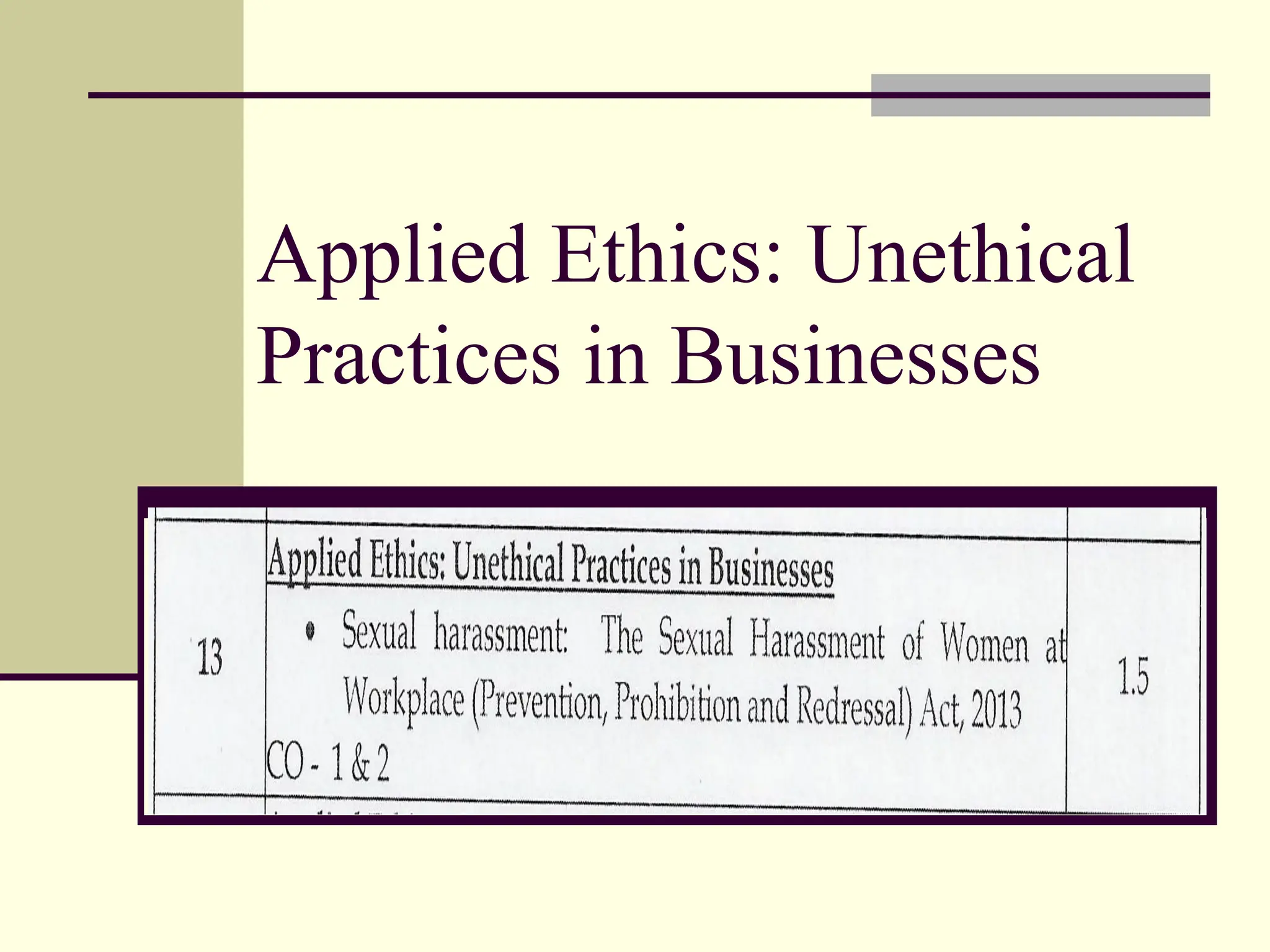
Applied Ethics: Unethical
Practices in Businesses
Sexual Harrassment
Sexual harassment is bullying or coercian of a
sexual nature, or the unwelcome or
inappropriate promise of rewards in exchange
for sexual favors.
Sexual harassment is gross violation of
women’s right to equality and dignity
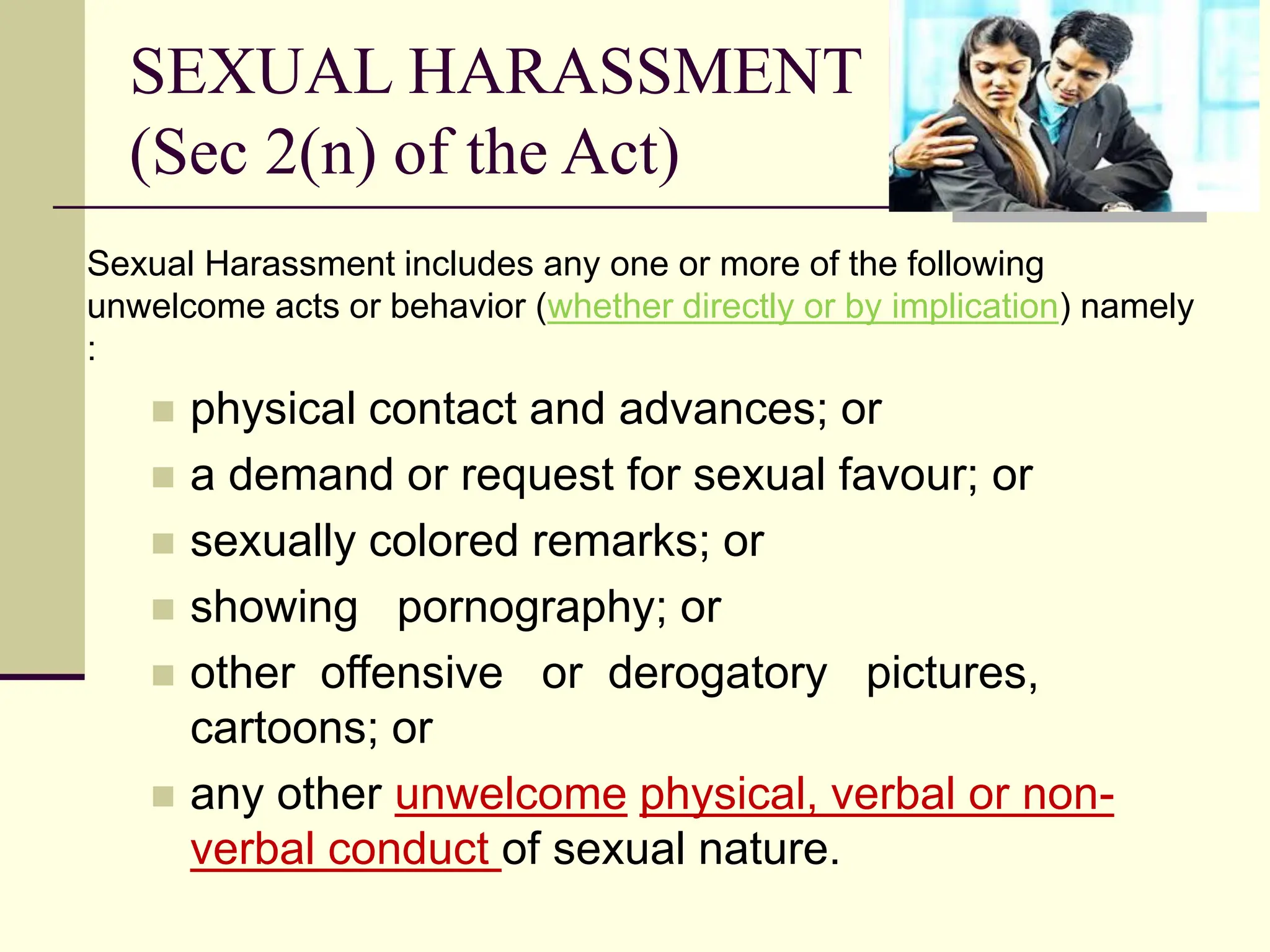
SEXUAL HARASSMENT
(Sec 2(n) of the Act)
Sexual Harassment includes any one or more of the following
unwelcome acts or behavior (whether directly or by implication) namely
:
 physical contact and advances; or
 a demand or request for sexual favour; or
 sexually colored remarks; or
 showing pornography; or
 other offensive or derogatory pictures,
cartoons; or
 any other unwelcome physical, verbal or non-
verbal conduct of sexual nature.
Following acts when in relation to behaviour of Sexual Harassment
may amount to sexual harassment
(i) implied or explicit promise of preferential treatment in her
employment; or
(ii) implied or explicit threat of detrimental treatment in her
employment: or
(iii) implied or explicit threat about her present or future employment
status; or
(iv) interference with her work or creating an intimidating or
offensive or hostile work environment for her; or
(v) Humiliating treatment likely to affect her health or safety.
Sec 3(2) of the Act
Sexual Harassment includes
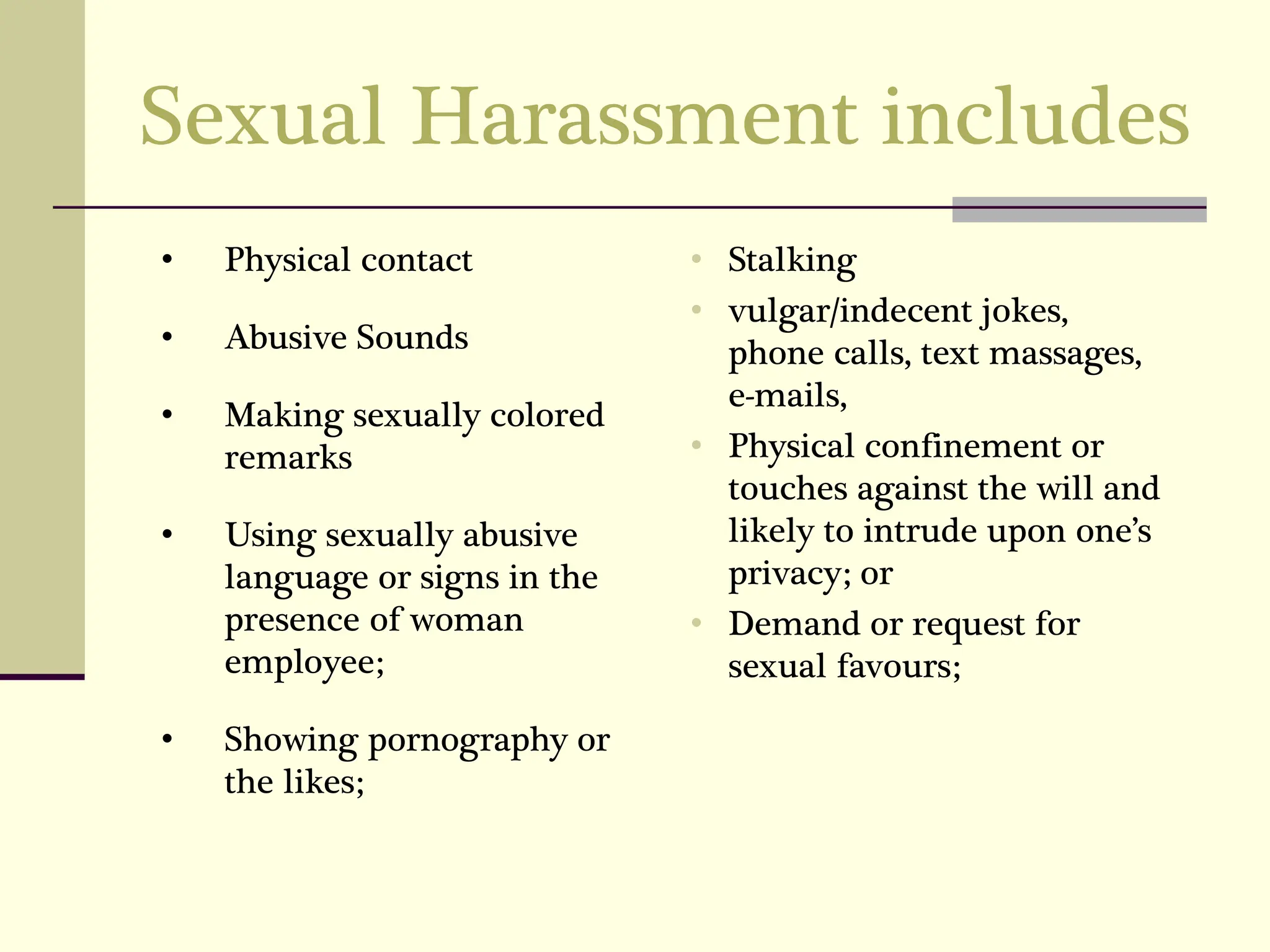
• Physical contact
• Abusive Sounds
• Making sexually colored
remarks
• Using sexually abusive
language or signs in the
presence of woman
employee;
• Showing pornography or
the likes;
• Stalking
• vulgar/indecent jokes,
phone calls, text massages,
e-mails,
• Physical confinement or
touches against the will and
likely to intrude upon one’s
privacy; or
• Demand or request for
sexual favours;
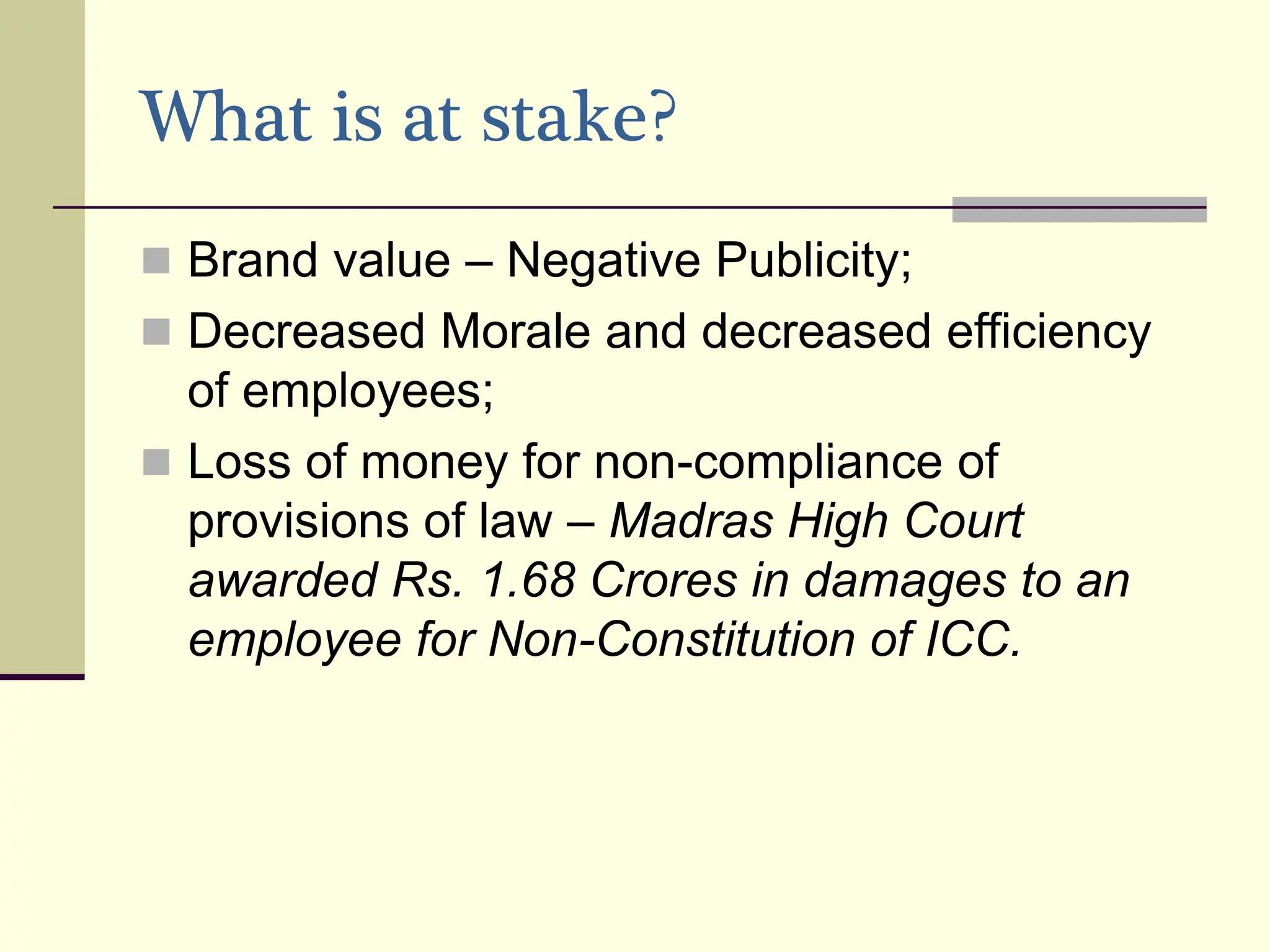
What is at stake?
 Brand value – Negative Publicity;
 Decreased Morale and decreased efficiency
of employees;
 Loss of money for non-compliance of
provisions of law – Madras High Court
awarded Rs. 1.68 Crores in damages to an
employee for Non-Constitution of ICC.
No women employee shall be subjected
to sexual harassment at workplace
Section 3(1) of the Act
Prevent Sexual Harassment
Employees Responsibility
Understand
Observe
Examine
Confront
Resolve
Support
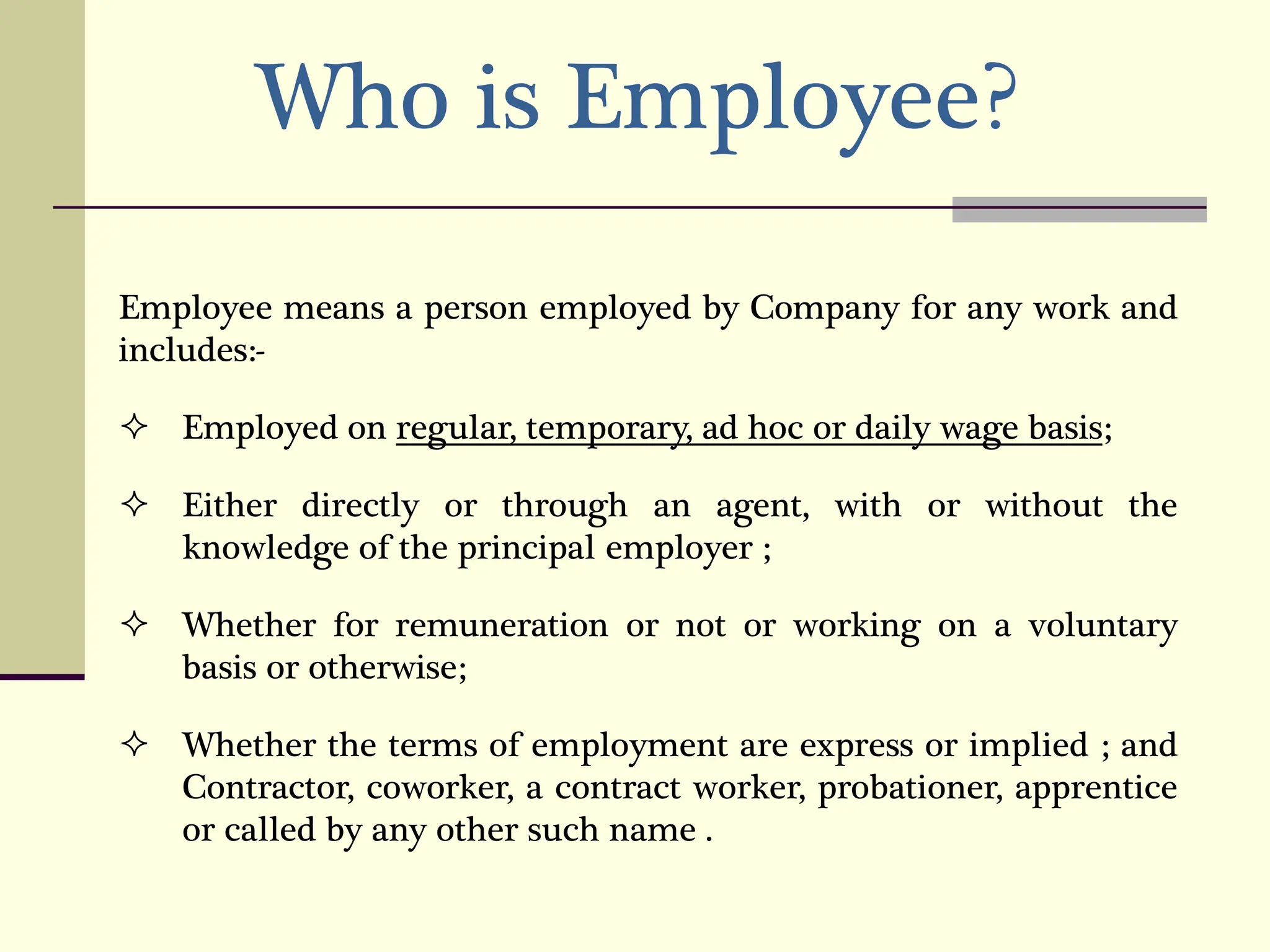
Who is Employee?
Employee means a person employed by Company for any work and
includes:-
 Employed on regular, temporary, ad hoc or daily wage basis;
 Either directly or through an agent, with or without the
knowledge of the principal employer ;
 Whether for remuneration or not or working on a voluntary
basis or otherwise;
 Whether the terms of employment are express or implied ; and
Contractor, coworker, a contract worker, probationer, apprentice
or called by any other such name .
What is Workplace?
Workplace includes:-
 All premises including Corporate Office, head office, branch
offices and all other premises, locations, establishments,
institutions, units, sites controlled directly or indirectly but he
Company and/or where from business of the Company is
conducted;
 All other premises where employees of the Company visit arising
out of or during the course of their employment including
official events; and
 Includes the transportation and accommodation, if any, provided
by the Company for employees arising out of or during the
course of employment for commutation or residence purposes.
How to prevent?
Following are the responsibilities of the employer under the Act:-
 Constitution of Internal Complaint Committee (ICC) to handle
the complaints of sexual harassment;
 Display on the notice board of the premises giving full details of
members of ICC;
 Display at conspicuous places at workplace, penalties &
consequences of sexual harassment ;
 Providing training to sensitize the employees on the issues and
implications of sexual harassment at workplace and organizing
orientation programme(s) for members of ICC.
Internal Complaint Committee
Every Employer needs to constitute ICC as per the provisions of the
Act to take care of following matters:-
To conduct enquiry into the complaints of sexual harassment;
To make recommendations to the Board of Directors of your
Company in the matters of sexual harassment after conclusion of
enquiry;
To file annual report as per the provisions of the Act
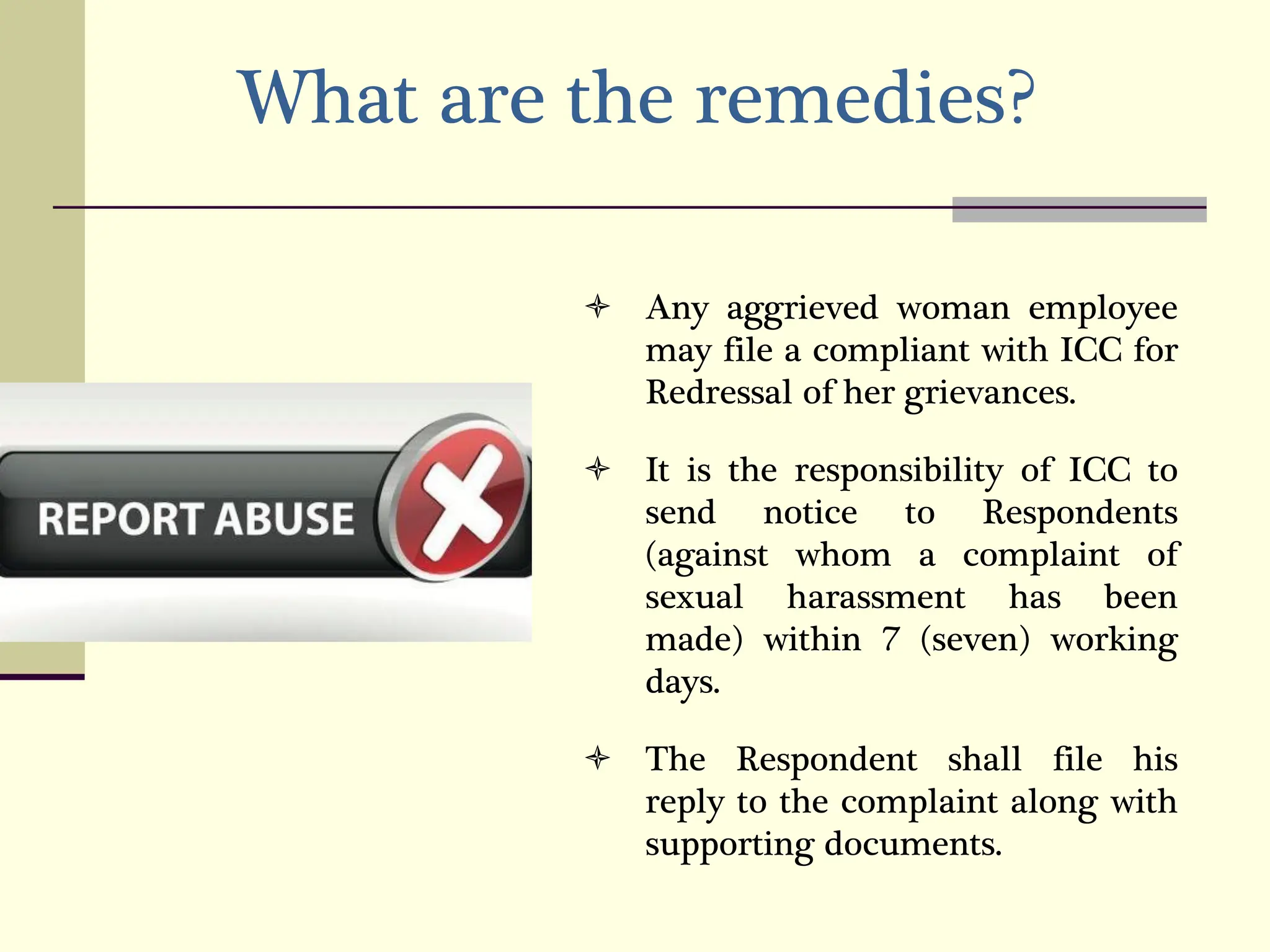
What are the remedies?
 Any aggrieved woman employee
may file a compliant with ICC for
Redressal of her grievances.
 It is the responsibility of ICC to
send notice to Respondents
(against whom a complaint of
sexual harassment has been
made) within 7 (seven) working
days.
 The Respondent shall file his
reply to the complaint along with
supporting documents.
Procedure of filing Complaint
Any aggrieved woman may make a complaint in writing with any
member of ICC
 at the prescribed contact details,
 preferable within a period of 3 months of the date of incident of
sexual harassment or in case of series of incidents, with in a
period of 3 months from the date of last incident.
 The Complainant shall file minimum six copies of the complaint.
 The complaint shall consists of name of the Respondent(s), date
and details of incident of sexual harassment, name and details
of witness, if any, along with the supporting documents.
Who is eligible to file a complaint?
 Aggrieved woman herself;
 Where the Aggrieved Woman is unable to make a Complaint
on account of her physical or mental incapacity , a Complaint
may be filed by any prescribed person, on her behalf;
 Where the Aggrieved Woman for any other reason is unable
to make a Complaint, a Complaint may be filed by a person
who has knowledge of the incident, with her written consent;
 Where the Aggrieved Woman is dead, a Complaint may be
filed by any person who has knowledge of the incident, with
the written consent of her legal heir(s).
Procedure of Enquiry
CONCILIATION –
 The ICC may, before initiating an inquiry, at the request of the
Aggrieved Woman, take steps to settle the matter between her
and the Respondent.
 No monetary settlement shall be made as a basis of conciliation.
 The settlement terms shall be recorded in writing and
forwarded to the Board of Directors of the Company. Copies of
the same shall be provided to the Aggrieved Woman and the
Respondent.
 Where a settlement has been arrived at, no further inquiry shall
be conducted by the ICC.
Procedure of Enquiry
 In case, conciliation is not possible, ICC shall investigate the complaint
and provide its report, as promptly as possible, but not later than 90
working days from the date of the Complaint.
 The ICC shall follow principles of natural justice in all its proceedings.
 Complete confidentiality shall be maintained, unless required by law.
 A copy of the Complaint as recorded by ICC shall be given to the
Respondent as well as the Complainant.
 The Respondent shall submit his response to the Complaint as well as to
indicate whether the Respondent wishes the ICC to examine any witnesses
or furnish any evidence.
 The Complainant shall also indicate in writing whether the Complainant
wishes the ICC to examine any witnesses or furnish any additional
evidence.
Procedure of Enquiry
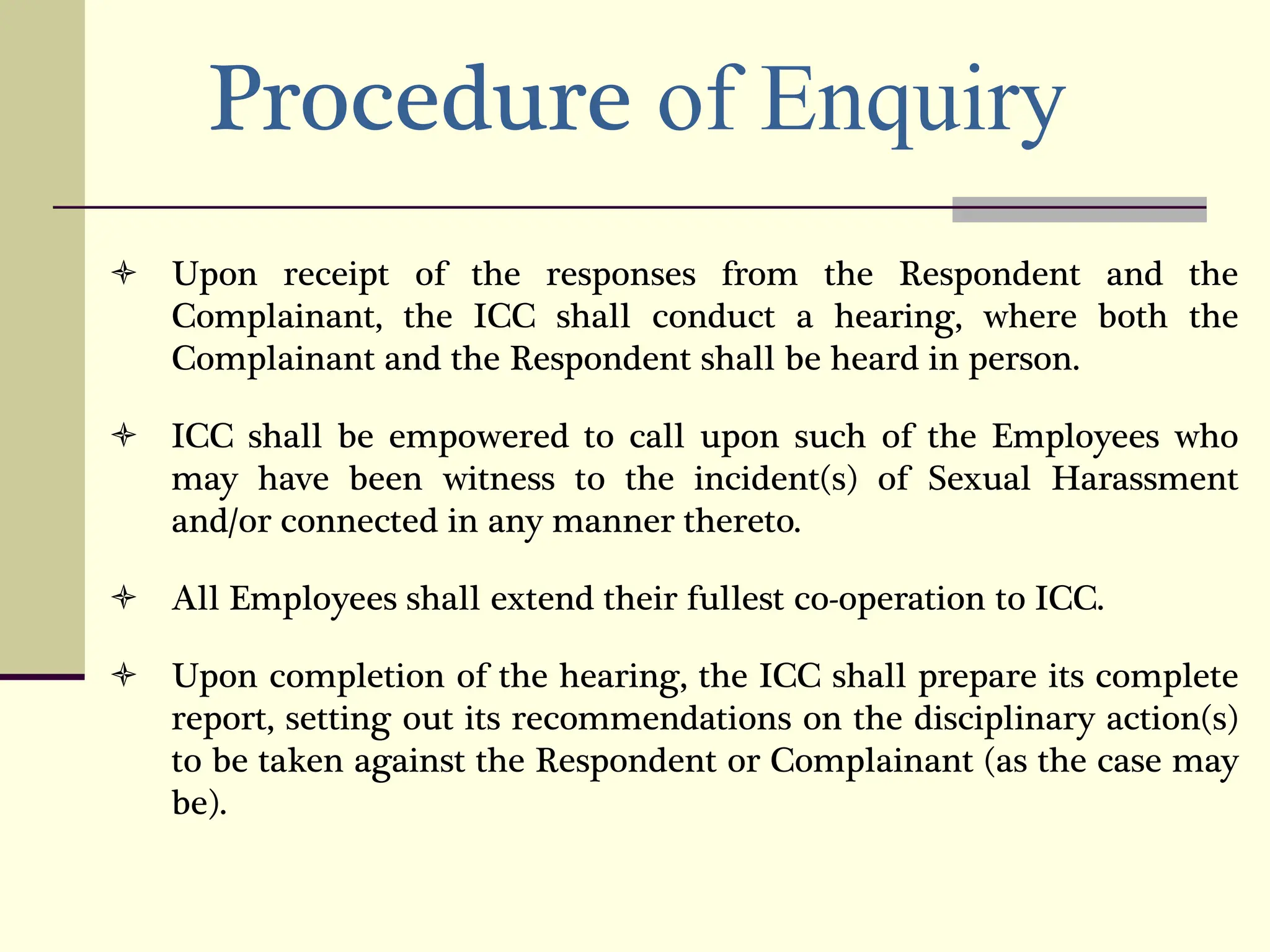
 Upon receipt of the responses from the Respondent and the
Complainant, the ICC shall conduct a hearing, where both the
Complainant and the Respondent shall be heard in person.
 ICC shall be empowered to call upon such of the Employees who
may have been witness to the incident(s) of Sexual Harassment
and/or connected in any manner thereto.
 All Employees shall extend their fullest co-operation to ICC.
 Upon completion of the hearing, the ICC shall prepare its complete
report, setting out its recommendations on the disciplinary action(s)
to be taken against the Respondent or Complainant (as the case may
be).
Punishment for Sexual
Harassment
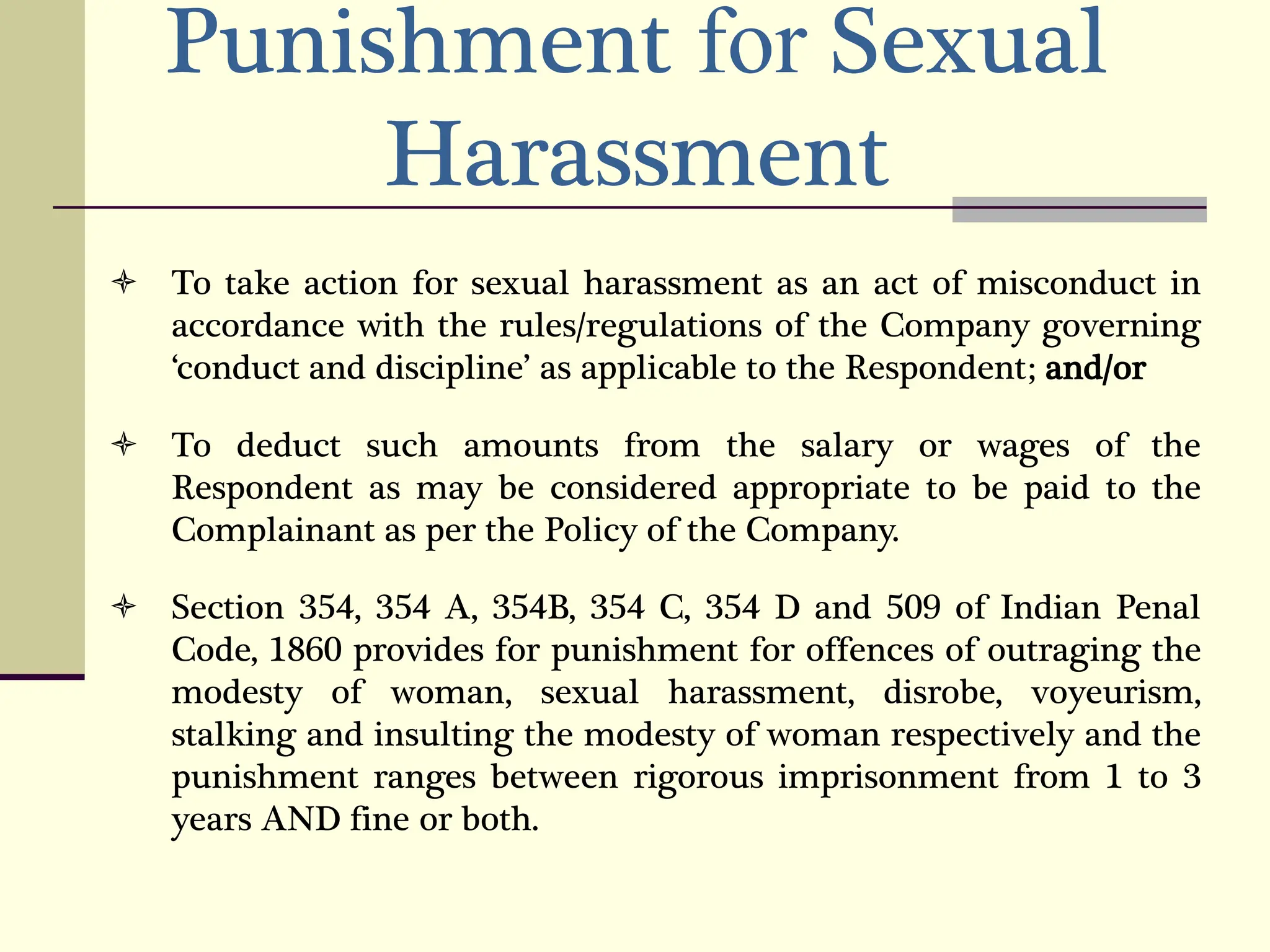
 To take action for sexual harassment as an act of misconduct in
accordance with the rules/regulations of the Company governing
‘conduct and discipline’ as applicable to the Respondent; and/or
 To deduct such amounts from the salary or wages of the
Respondent as may be considered appropriate to be paid to the
Complainant as per the Policy of the Company.
 Section 354, 354 A, 354B, 354 C, 354 D and 509 of Indian Penal
Code, 1860 provides for punishment for offences of outraging the
modesty of woman, sexual harassment, disrobe, voyeurism,
stalking and insulting the modesty of woman respectively and the
punishment ranges between rigorous imprisonment from 1 to 3
years AND fine or both.
Punishment for Malicious
Compliant or False Evidence
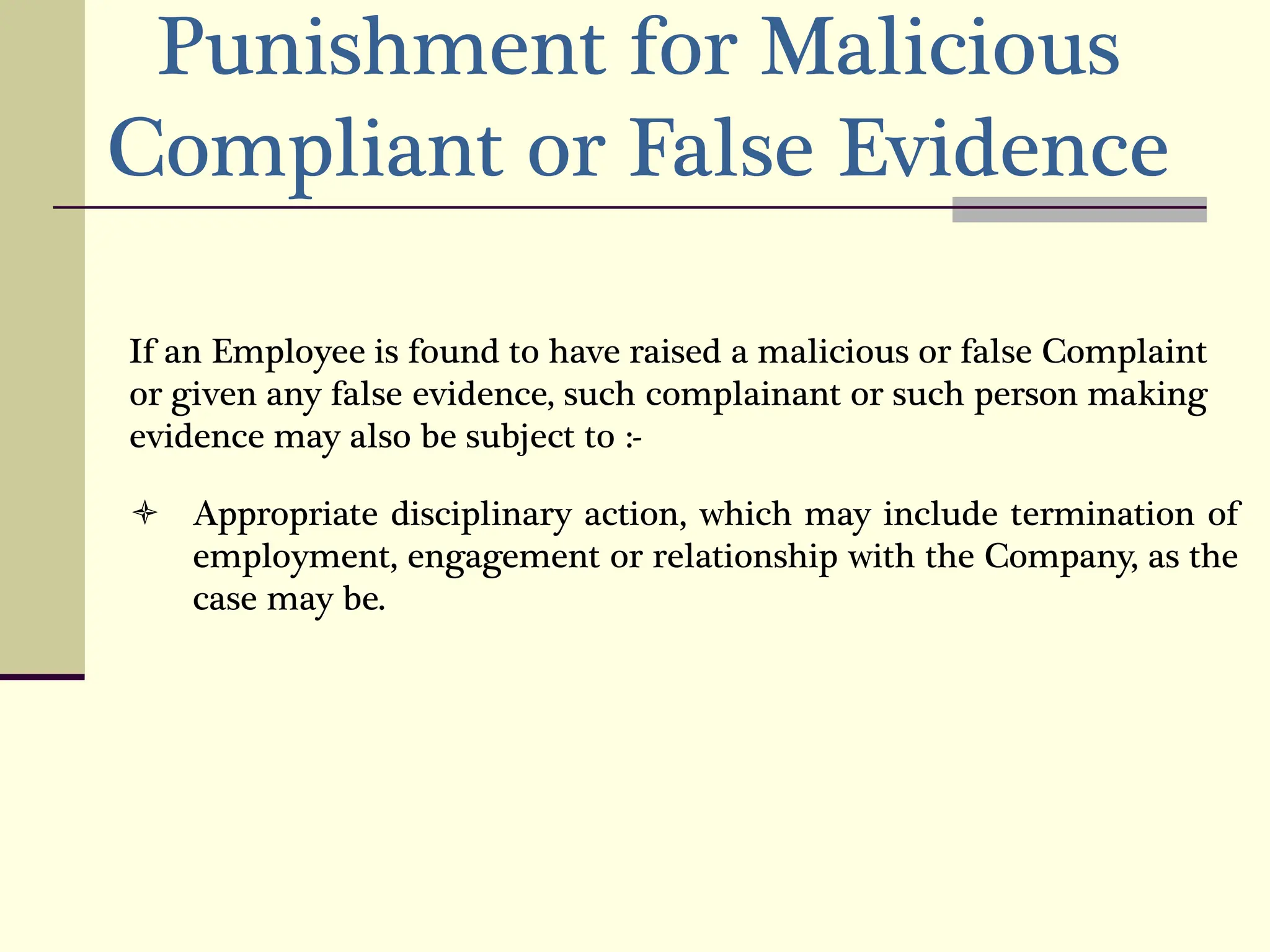
If an Employee is found to have raised a malicious or false Complaint
or given any false evidence, such complainant or such person making
evidence may also be subject to :-
 Appropriate disciplinary action, which may include termination of
employment, engagement or relationship with the Company, as the
case may be.
Absence of complaints of sexual
harassment doesn’t necessarily means
absence of sexual harassment….....
Sexual Harassment can negatively
affect the professional work
 Emotional and Physical issues
 Professional and Financial Problems
 Decreased Company Productivity
 Lawsuits and Reputation: A company’s failure
to adequately prevent and handle sexual
harassment can result in expensive lawsuits.
A highly publicized case of sexual
harassment can also damage a company’s
reputation, resulting in lost business.
Strategies for Prevention of sexual
harassment
 Adopt a clear sexual harassment policy
 Train employees
 Monitor your workplace
 Incorporate training on harassment and
discriminatory treatment in your workplace
 Have clear harassment reporting procedures
in place
 Deal with any allegations and concerns
immediately
 Have a dedicated person in place to review
any allegations
 Zero tolerance policy
 Report any concerns immediately
UNIT- 13_Applied Ethics_Unethical Practices in Business .pdf

  • 1.
  • 2.
    Sexual Harrassment Sexual harassmentis bullying or coercian of a sexual nature, or the unwelcome or inappropriate promise of rewards in exchange for sexual favors. Sexual harassment is gross violation of women’s right to equality and dignity
  • 3.
    SEXUAL HARASSMENT (Sec 2(n)of the Act) Sexual Harassment includes any one or more of the following unwelcome acts or behavior (whether directly or by implication) namely :  physical contact and advances; or  a demand or request for sexual favour; or  sexually colored remarks; or  showing pornography; or  other offensive or derogatory pictures, cartoons; or  any other unwelcome physical, verbal or non- verbal conduct of sexual nature.
  • 4.
    Following acts whenin relation to behaviour of Sexual Harassment may amount to sexual harassment (i) implied or explicit promise of preferential treatment in her employment; or (ii) implied or explicit threat of detrimental treatment in her employment: or (iii) implied or explicit threat about her present or future employment status; or (iv) interference with her work or creating an intimidating or offensive or hostile work environment for her; or (v) Humiliating treatment likely to affect her health or safety. Sec 3(2) of the Act
  • 5.
    Sexual Harassment includes •Physical contact • Abusive Sounds • Making sexually colored remarks • Using sexually abusive language or signs in the presence of woman employee; • Showing pornography or the likes; • Stalking • vulgar/indecent jokes, phone calls, text massages, e-mails, • Physical confinement or touches against the will and likely to intrude upon one’s privacy; or • Demand or request for sexual favours;
  • 6.
    What is atstake?  Brand value – Negative Publicity;  Decreased Morale and decreased efficiency of employees;  Loss of money for non-compliance of provisions of law – Madras High Court awarded Rs. 1.68 Crores in damages to an employee for Non-Constitution of ICC.
  • 7.
    No women employeeshall be subjected to sexual harassment at workplace Section 3(1) of the Act Prevent Sexual Harassment
  • 8.
  • 9.
    Who is Employee? Employeemeans a person employed by Company for any work and includes:-  Employed on regular, temporary, ad hoc or daily wage basis;  Either directly or through an agent, with or without the knowledge of the principal employer ;  Whether for remuneration or not or working on a voluntary basis or otherwise;  Whether the terms of employment are express or implied ; and Contractor, coworker, a contract worker, probationer, apprentice or called by any other such name .
  • 10.
    What is Workplace? Workplaceincludes:-  All premises including Corporate Office, head office, branch offices and all other premises, locations, establishments, institutions, units, sites controlled directly or indirectly but he Company and/or where from business of the Company is conducted;  All other premises where employees of the Company visit arising out of or during the course of their employment including official events; and  Includes the transportation and accommodation, if any, provided by the Company for employees arising out of or during the course of employment for commutation or residence purposes.
  • 11.
    How to prevent? Followingare the responsibilities of the employer under the Act:-  Constitution of Internal Complaint Committee (ICC) to handle the complaints of sexual harassment;  Display on the notice board of the premises giving full details of members of ICC;  Display at conspicuous places at workplace, penalties & consequences of sexual harassment ;  Providing training to sensitize the employees on the issues and implications of sexual harassment at workplace and organizing orientation programme(s) for members of ICC.
  • 12.
    Internal Complaint Committee EveryEmployer needs to constitute ICC as per the provisions of the Act to take care of following matters:- To conduct enquiry into the complaints of sexual harassment; To make recommendations to the Board of Directors of your Company in the matters of sexual harassment after conclusion of enquiry; To file annual report as per the provisions of the Act
  • 13.
    What are theremedies?  Any aggrieved woman employee may file a compliant with ICC for Redressal of her grievances.  It is the responsibility of ICC to send notice to Respondents (against whom a complaint of sexual harassment has been made) within 7 (seven) working days.  The Respondent shall file his reply to the complaint along with supporting documents.
  • 14.
    Procedure of filingComplaint Any aggrieved woman may make a complaint in writing with any member of ICC  at the prescribed contact details,  preferable within a period of 3 months of the date of incident of sexual harassment or in case of series of incidents, with in a period of 3 months from the date of last incident.  The Complainant shall file minimum six copies of the complaint.  The complaint shall consists of name of the Respondent(s), date and details of incident of sexual harassment, name and details of witness, if any, along with the supporting documents.
  • 15.
    Who is eligibleto file a complaint?  Aggrieved woman herself;  Where the Aggrieved Woman is unable to make a Complaint on account of her physical or mental incapacity , a Complaint may be filed by any prescribed person, on her behalf;  Where the Aggrieved Woman for any other reason is unable to make a Complaint, a Complaint may be filed by a person who has knowledge of the incident, with her written consent;  Where the Aggrieved Woman is dead, a Complaint may be filed by any person who has knowledge of the incident, with the written consent of her legal heir(s).
  • 16.
    Procedure of Enquiry CONCILIATION–  The ICC may, before initiating an inquiry, at the request of the Aggrieved Woman, take steps to settle the matter between her and the Respondent.  No monetary settlement shall be made as a basis of conciliation.  The settlement terms shall be recorded in writing and forwarded to the Board of Directors of the Company. Copies of the same shall be provided to the Aggrieved Woman and the Respondent.  Where a settlement has been arrived at, no further inquiry shall be conducted by the ICC.
  • 17.
    Procedure of Enquiry In case, conciliation is not possible, ICC shall investigate the complaint and provide its report, as promptly as possible, but not later than 90 working days from the date of the Complaint.  The ICC shall follow principles of natural justice in all its proceedings.  Complete confidentiality shall be maintained, unless required by law.  A copy of the Complaint as recorded by ICC shall be given to the Respondent as well as the Complainant.  The Respondent shall submit his response to the Complaint as well as to indicate whether the Respondent wishes the ICC to examine any witnesses or furnish any evidence.  The Complainant shall also indicate in writing whether the Complainant wishes the ICC to examine any witnesses or furnish any additional evidence.
  • 18.
    Procedure of Enquiry Upon receipt of the responses from the Respondent and the Complainant, the ICC shall conduct a hearing, where both the Complainant and the Respondent shall be heard in person.  ICC shall be empowered to call upon such of the Employees who may have been witness to the incident(s) of Sexual Harassment and/or connected in any manner thereto.  All Employees shall extend their fullest co-operation to ICC.  Upon completion of the hearing, the ICC shall prepare its complete report, setting out its recommendations on the disciplinary action(s) to be taken against the Respondent or Complainant (as the case may be).
  • 19.
    Punishment for Sexual Harassment To take action for sexual harassment as an act of misconduct in accordance with the rules/regulations of the Company governing ‘conduct and discipline’ as applicable to the Respondent; and/or  To deduct such amounts from the salary or wages of the Respondent as may be considered appropriate to be paid to the Complainant as per the Policy of the Company.  Section 354, 354 A, 354B, 354 C, 354 D and 509 of Indian Penal Code, 1860 provides for punishment for offences of outraging the modesty of woman, sexual harassment, disrobe, voyeurism, stalking and insulting the modesty of woman respectively and the punishment ranges between rigorous imprisonment from 1 to 3 years AND fine or both.
  • 20.
    Punishment for Malicious Compliantor False Evidence If an Employee is found to have raised a malicious or false Complaint or given any false evidence, such complainant or such person making evidence may also be subject to :-  Appropriate disciplinary action, which may include termination of employment, engagement or relationship with the Company, as the case may be.
  • 21.
    Absence of complaintsof sexual harassment doesn’t necessarily means absence of sexual harassment….....
  • 22.
    Sexual Harassment cannegatively affect the professional work  Emotional and Physical issues  Professional and Financial Problems  Decreased Company Productivity  Lawsuits and Reputation: A company’s failure to adequately prevent and handle sexual harassment can result in expensive lawsuits. A highly publicized case of sexual harassment can also damage a company’s reputation, resulting in lost business.
  • 23.
    Strategies for Preventionof sexual harassment  Adopt a clear sexual harassment policy  Train employees  Monitor your workplace  Incorporate training on harassment and discriminatory treatment in your workplace  Have clear harassment reporting procedures in place
  • 24.
     Deal withany allegations and concerns immediately  Have a dedicated person in place to review any allegations  Zero tolerance policy  Report any concerns immediately