Ecommerce and
Dropshipping
Ecommerce is a booming industry, with businesses selling products online to
customers worldwide. Dropshipping is a popular ecommerce fulfillment
model that allows businesses to sell products without holding any inventory.
With dropshipping, a third-party supplier handles the storage, packaging, and
shipping of products to customers. The dropshipper essentially acts as a
middleman, connecting the customer with the supplier. This model has
become increasingly popular because it offers numerous benefits to
entrepreneurs and businesses.
by Larry Kearney
LK
Understanding the Dropshipping Business Model: Pros and Cons
Click here
What is Ecommerce?
Online Commerce
Ecommerce refers to the buying
and selling of goods and
services over the internet. It
enables businesses to reach a
global audience and operate
24/7. Ecommerce platforms
provide a virtual storefront for
businesses to showcase their
products and services.
Digital Transactions
Ecommerce transactions involve
digital payments through online
payment gateways. Customers
can make purchases securely
through credit cards, debit cards,
and digital wallets. Ecommerce
simplifies the buying process by
providing a seamless online
experience.
Variety of Models
Ecommerce encompasses various models, including Business-to-
Consumer (B2C), Business-to-Business (B2B), and Consumer-to-
Consumer (C2C). Each model caters to different customer segments and
business needs.
Advantages of Ecommerce
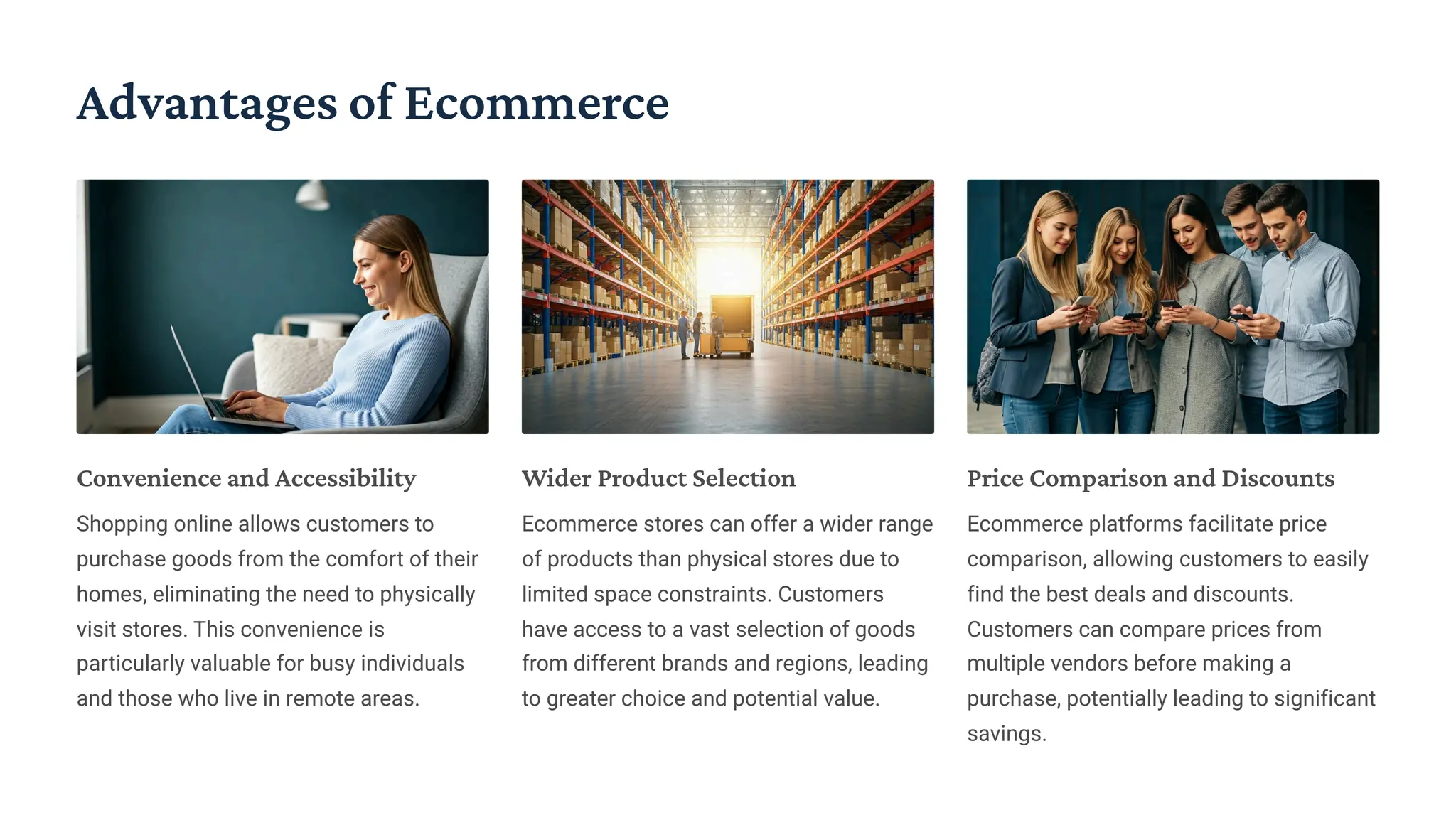
Convenience and Accessibility
Shopping online allows customers to
purchase goods from the comfort of their
homes, eliminating the need to physically
visit stores. This convenience is
particularly valuable for busy individuals
and those who live in remote areas.
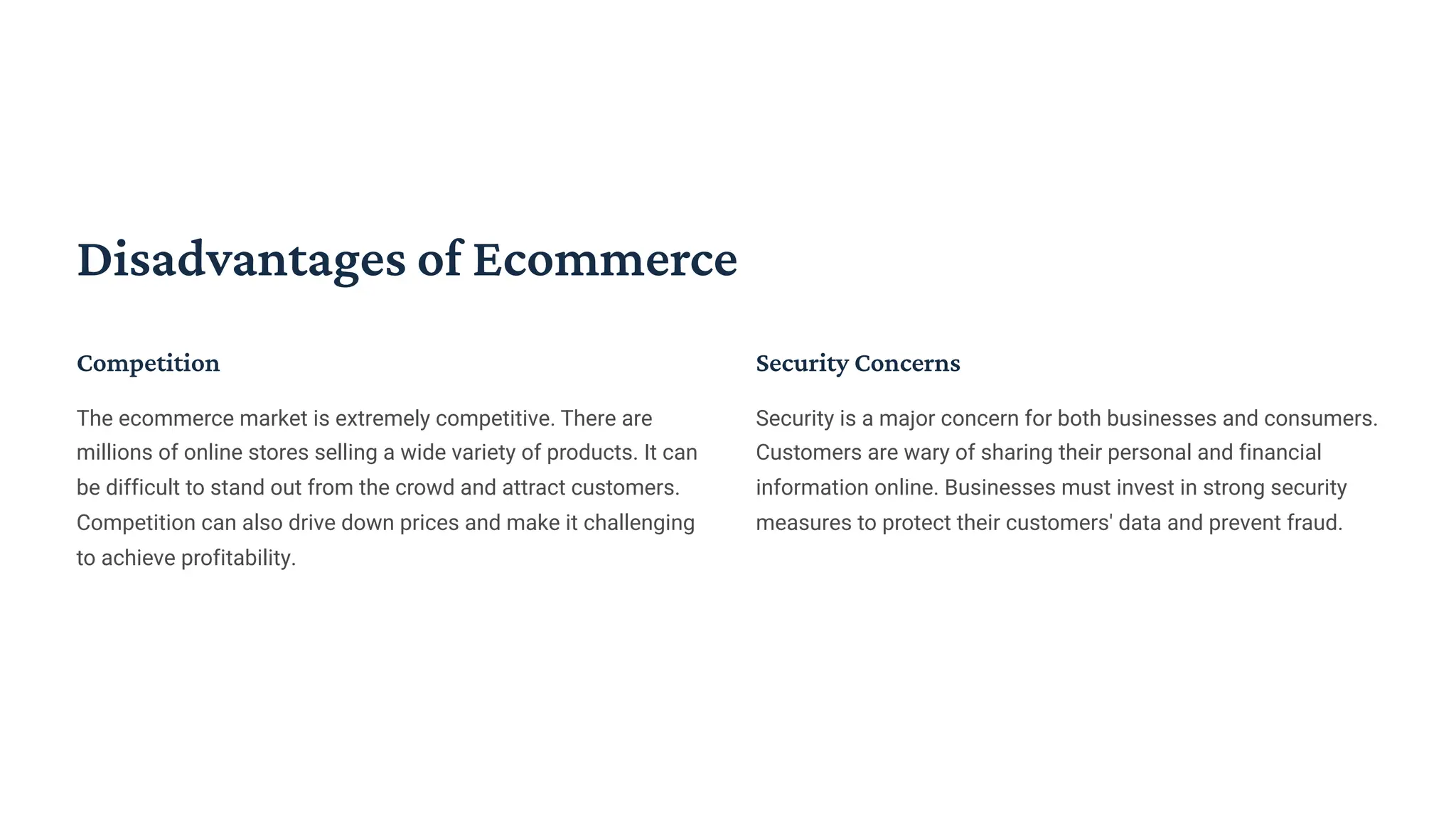
Wider Product Selection
Ecommerce stores can offer a wider range
of products than physical stores due to
limited space constraints. Customers
have access to a vast selection of goods
from different brands and regions, leading
to greater choice and potential value.
Price Comparison and Discounts
Ecommerce platforms facilitate price
comparison, allowing customers to easily
find the best deals and discounts.
Customers can compare prices from
multiple vendors before making a
purchase, potentially leading to significant
savings.
Disadvantages of Ecommerce
Competition
The ecommerce market is extremely competitive. There are
millions of online stores selling a wide variety of products. It can
be difficult to stand out from the crowd and attract customers.
Competition can also drive down prices and make it challenging
to achieve profitability.
Security Concerns
Security is a major concern for both businesses and consumers.
Customers are wary of sharing their personal and financial
information online. Businesses must invest in strong security
measures to protect their customers' data and prevent fraud.
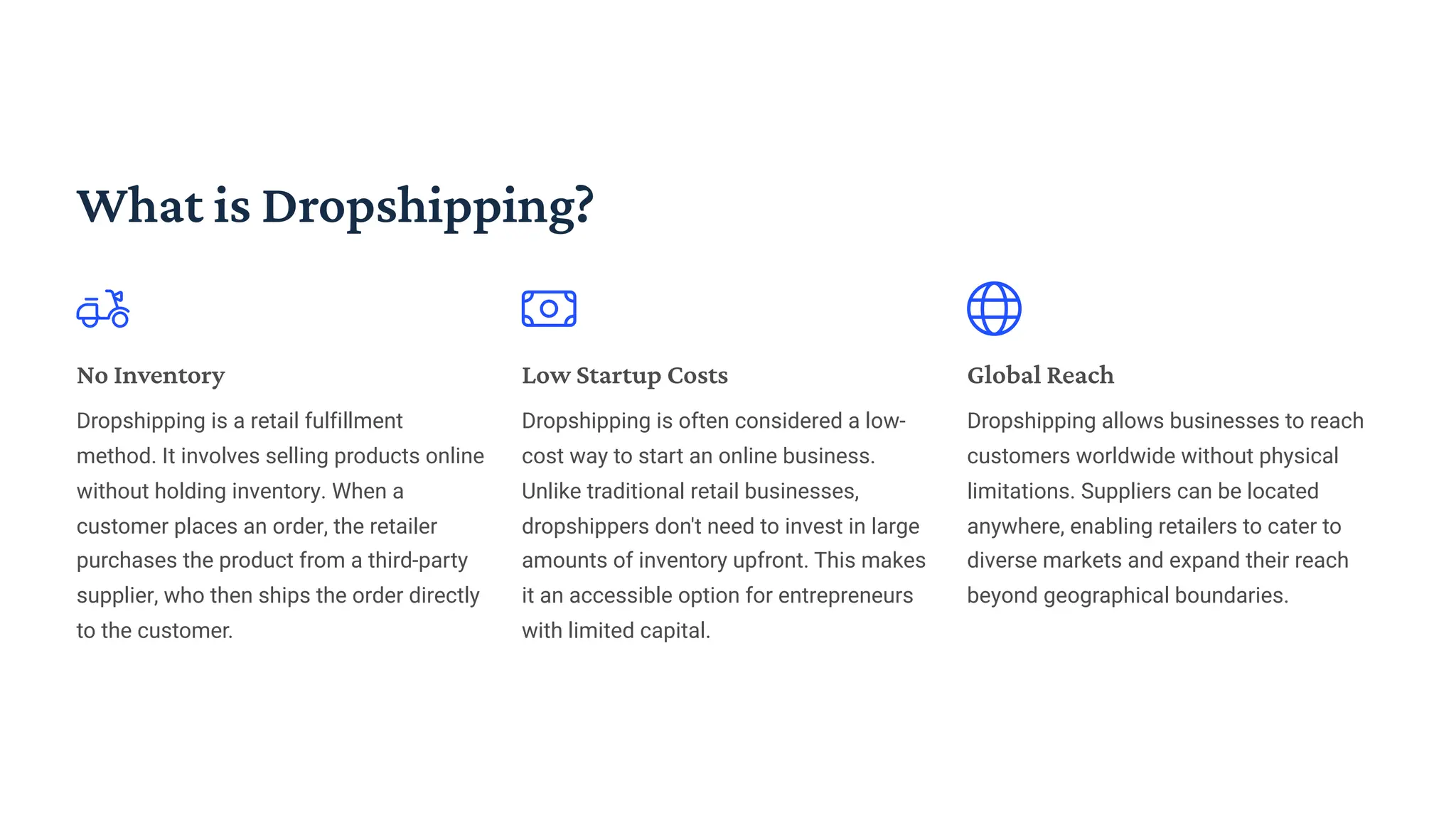
What is Dropshipping?
No Inventory
Dropshipping is a retail fulfillment
method. It involves selling products online
without holding inventory. When a
customer places an order, the retailer
purchases the product from a third-party
supplier, who then ships the order directly
to the customer.
Low Startup Costs
Dropshipping is often considered a low-
cost way to start an online business.
Unlike traditional retail businesses,
dropshippers don't need to invest in large
amounts of inventory upfront. This makes
it an accessible option for entrepreneurs
with limited capital.
Global Reach
Dropshipping allows businesses to reach
customers worldwide without physical
limitations. Suppliers can be located
anywhere, enabling retailers to cater to
diverse markets and expand their reach
beyond geographical boundaries.
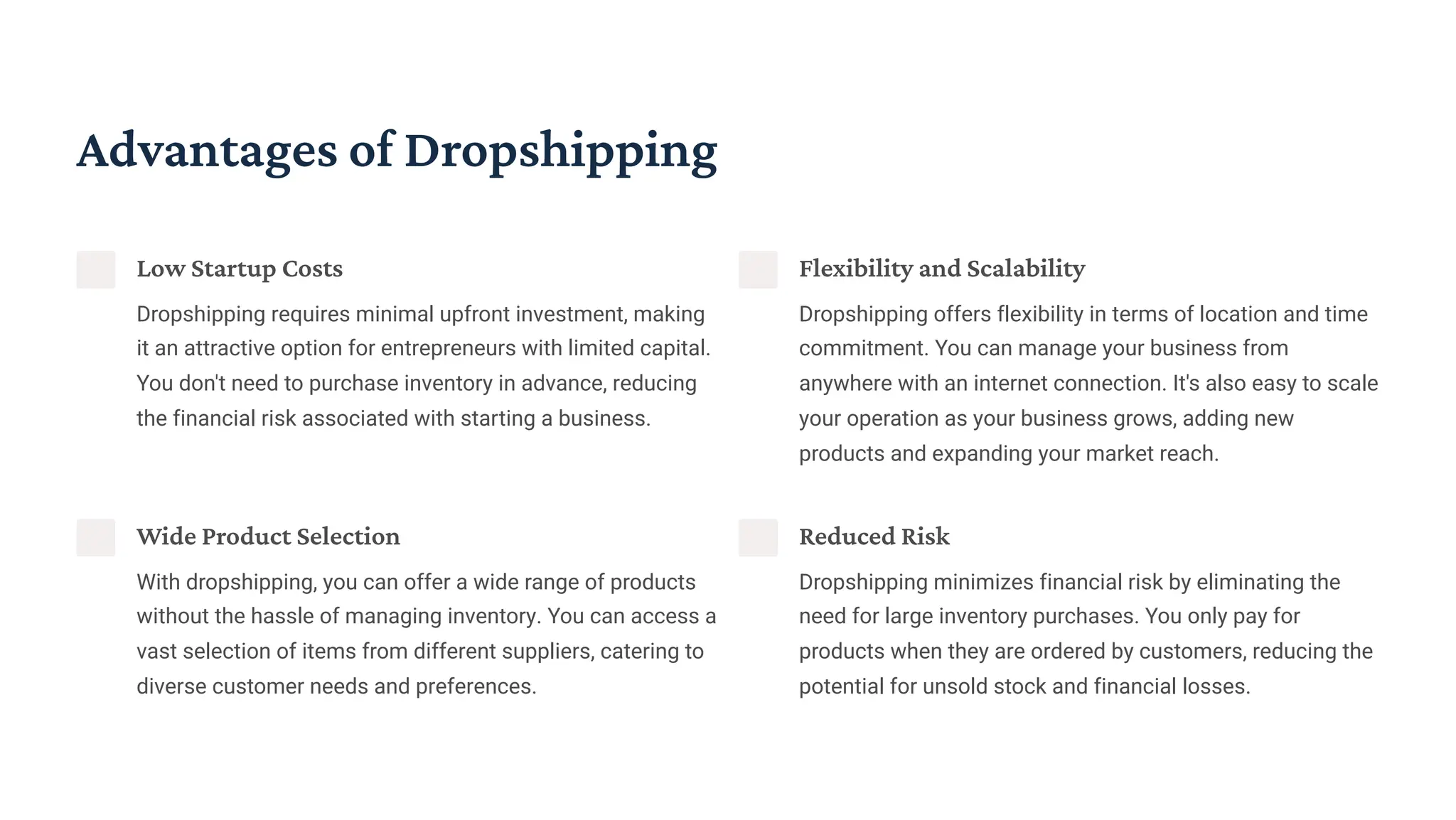
Advantages of Dropshipping
Low Startup Costs
Dropshipping requires minimal upfront investment, making
it an attractive option for entrepreneurs with limited capital.
You don't need to purchase inventory in advance, reducing
the financial risk associated with starting a business.
Flexibility and Scalability
Dropshipping offers flexibility in terms of location and time
commitment. You can manage your business from
anywhere with an internet connection. It's also easy to scale
your operation as your business grows, adding new
products and expanding your market reach.
Wide Product Selection
With dropshipping, you can offer a wide range of products
without the hassle of managing inventory. You can access a
vast selection of items from different suppliers, catering to
diverse customer needs and preferences.
Reduced Risk
Dropshipping minimizes financial risk by eliminating the
need for large inventory purchases. You only pay for
products when they are ordered by customers, reducing the
potential for unsold stock and financial losses.
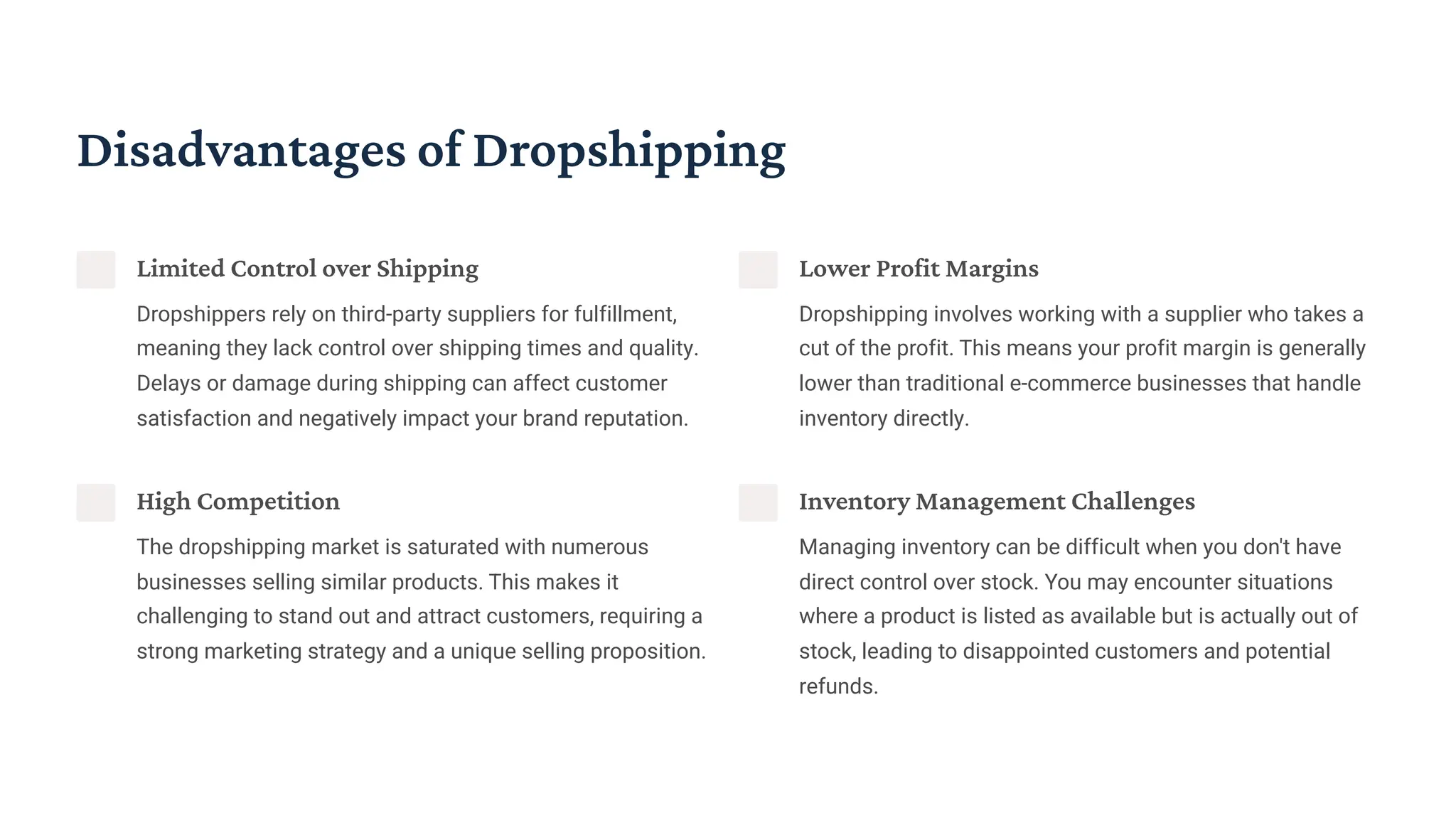
Disadvantages of Dropshipping
Limited Control over Shipping
Dropshippers rely on third-party suppliers for fulfillment,
meaning they lack control over shipping times and quality.
Delays or damage during shipping can affect customer
satisfaction and negatively impact your brand reputation.
Lower Profit Margins
Dropshipping involves working with a supplier who takes a
cut of the profit. This means your profit margin is generally
lower than traditional e-commerce businesses that handle
inventory directly.
High Competition
The dropshipping market is saturated with numerous
businesses selling similar products. This makes it
challenging to stand out and attract customers, requiring a
strong marketing strategy and a unique selling proposition.
Inventory Management Challenges
Managing inventory can be difficult when you don't have
direct control over stock. You may encounter situations
where a product is listed as available but is actually out of
stock, leading to disappointed customers and potential
refunds.
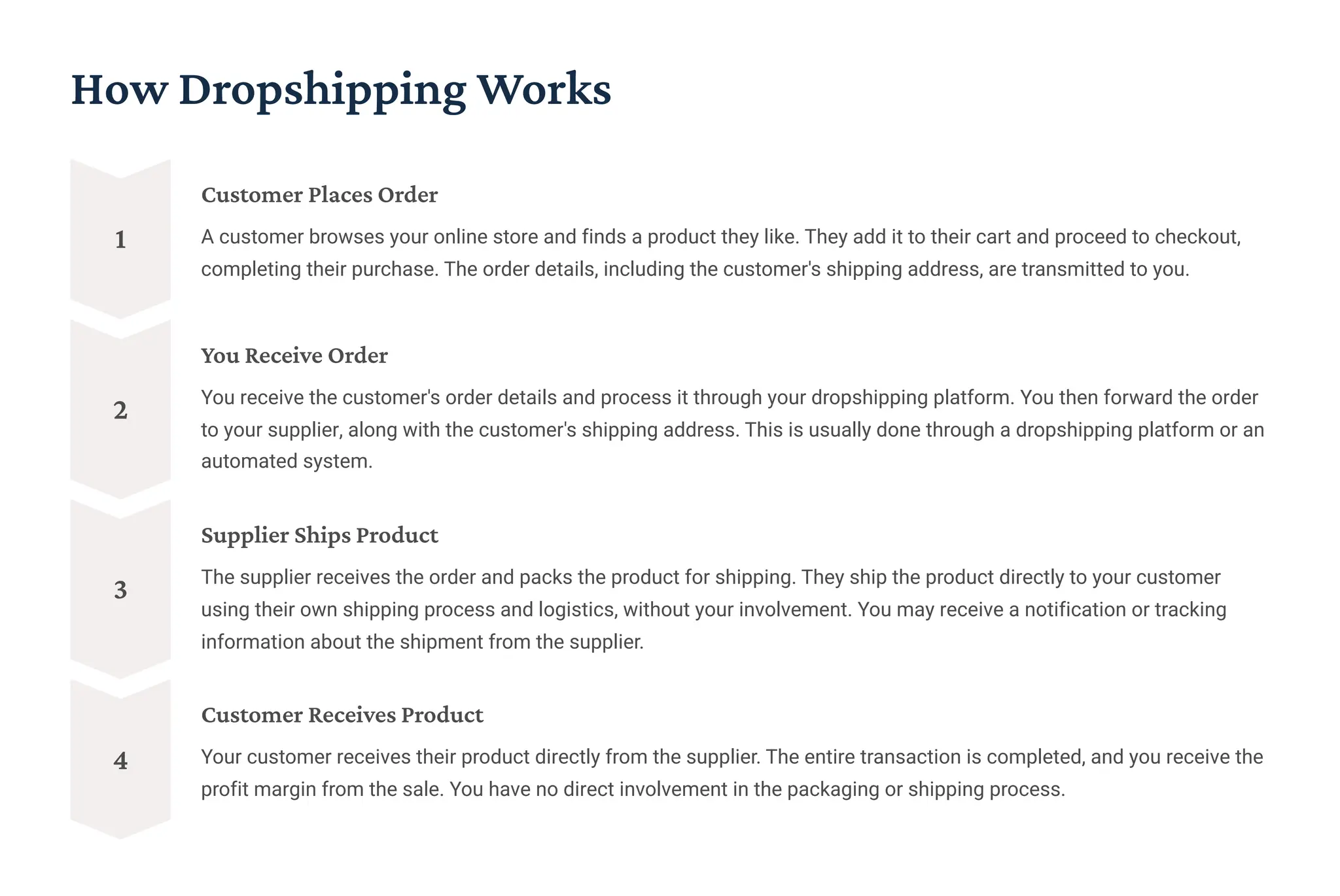
How Dropshipping Works
1
Customer Places Order
A customer browses your online store and finds a product they like. They add it to their cart and proceed to checkout,
completing their purchase. The order details, including the customer's shipping address, are transmitted to you.
2
You Receive Order
You receive the customer's order details and process it through your dropshipping platform. You then forward the order
to your supplier, along with the customer's shipping address. This is usually done through a dropshipping platform or an
automated system.
3
Supplier Ships Product
The supplier receives the order and packs the product for shipping. They ship the product directly to your customer
using their own shipping process and logistics, without your involvement. You may receive a notification or tracking
information about the shipment from the supplier.
4
Customer Receives Product
Your customer receives their product directly from the supplier. The entire transaction is completed, and you receive the
profit margin from the sale. You have no direct involvement in the packaging or shipping process.
Finding Suppliers for Dropshipping
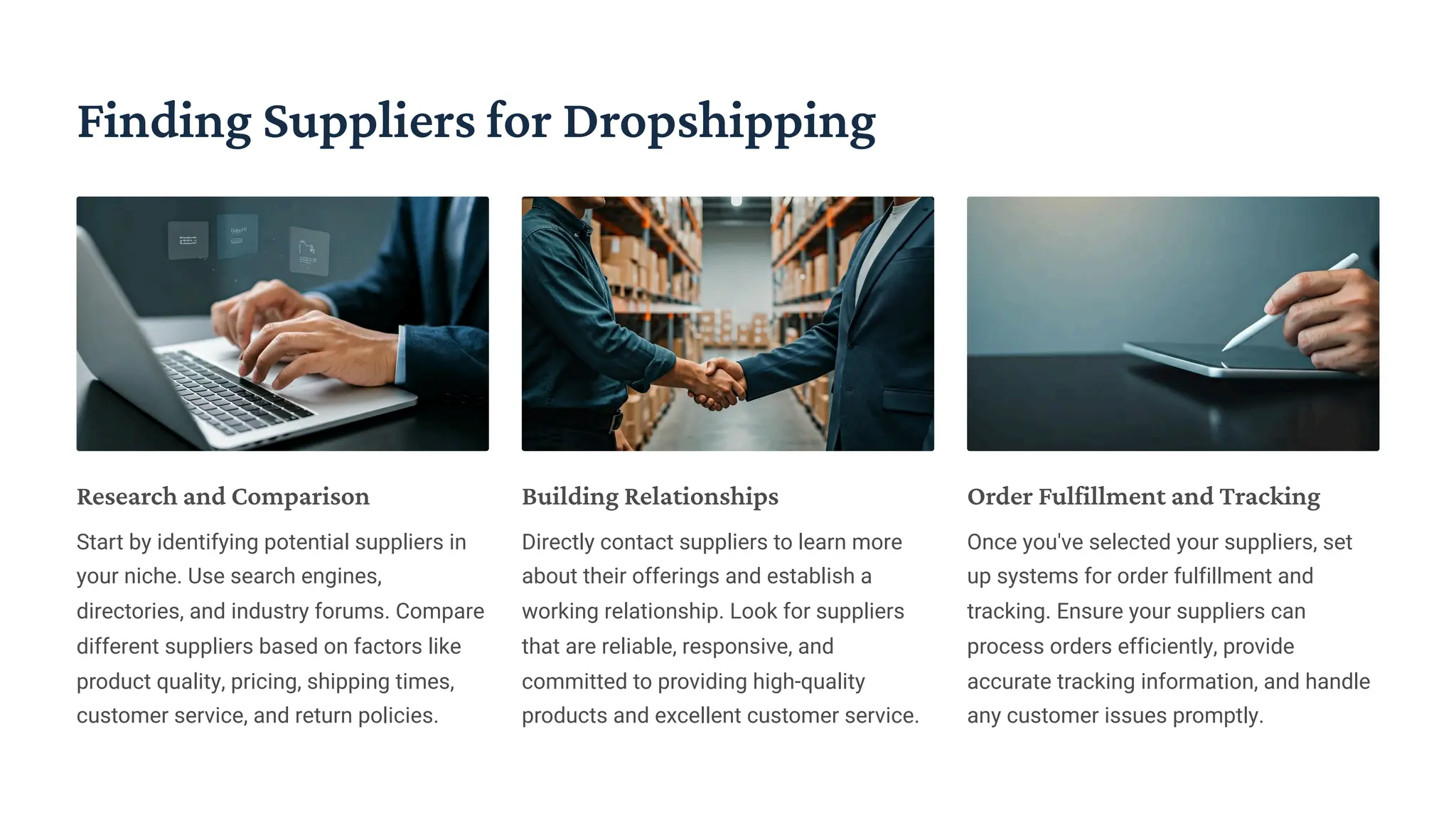
Research and Comparison
Start by identifying potential suppliers in
your niche. Use search engines,
directories, and industry forums. Compare
different suppliers based on factors like
product quality, pricing, shipping times,
customer service, and return policies.
Building Relationships
Directly contact suppliers to learn more
about their offerings and establish a
working relationship. Look for suppliers
that are reliable, responsive, and
committed to providing high-quality
products and excellent customer service.
Order Fulfillment and Tracking
Once you've selected your suppliers, set
up systems for order fulfillment and
tracking. Ensure your suppliers can
process orders efficiently, provide
accurate tracking information, and handle
any customer issues promptly.
Choosing Products for Dropshipping
Market Research
Thorough market research is
crucial. Identify trending
products with high demand.
Analyze competitor pricing and
offerings. Consider niche
markets and potential
profitability.
Product Uniqueness
Select products that stand out
from the crowd. Offer unique
features or benefits. Consider
customization options or
personalized experiences.
Product Viability
Assess product viability for
dropshipping. Analyze profit
margins, shipping costs, and
return rates. Choose products
with a low risk of damage or
returns.
Budget Considerations
Determine your budget for
initial inventory and marketing.
Consider the cost of product
sourcing, storage, and
shipping. Factor in potential
marketing expenses.
Building an Ecommerce Store
Creating an appealing and functional ecommerce store is crucial for success in the online marketplace. There are several popular
platforms and tools available to help you build your store, each offering a unique set of features and benefits.
1
Choosing a Platform
Popular options include Shopify, Wix, and Squarespace. Consider your budget, technical expertise, and desired
features.
2
Designing Your Store
Create a visually appealing and user-friendly design that aligns with your brand and target
audience.
3
Product Listing and Descriptions
Showcase your products effectively with high-quality images and detailed
descriptions.
4
Setting Up Payment and Shipping
Integrate secure payment gateways and reliable shipping
options.
Ensure you optimize your store for mobile devices and incorporate search engine optimization (SEO) techniques to improve visibility.
Marketing Your Ecommerce Store
Content Marketing
Creating valuable content can attract potential customers.
Blogs, articles, and videos can educate shoppers about your
products and build trust. Share on social media platforms
and optimize for search engines to reach a wider audience.
Email Marketing
Collect email addresses from visitors and nurture
relationships. Send newsletters, promotions, and product
updates. Segment your audience to deliver personalized
messages and improve conversion rates.
Paid Advertising
Invest in targeted ads on platforms like Google, Facebook,
and Instagram. Reach a specific audience based on
demographics, interests, and behaviors. Track your results
and optimize your campaigns for better performance.
Social Media Marketing
Engage with your customers on platforms where they are.
Share your products, run contests, and respond to comments.
Build a community around your brand to increase brand
awareness and loyalty.
Driving Traffic to Your Ecommerce Store
1 Paid Advertising
Paid advertising platforms like Google Ads and Facebook Ads allow you to target specific audiences based on
demographics, interests, and behavior. This can be an effective way to reach potential customers who are actively
searching for products like yours.
2 Content Marketing
Content marketing involves creating and sharing valuable, relevant, and consistent content to attract and retain a
clearly defined audience. This could include blog posts, articles, infographics, videos, and social media updates.
3 Social Media Marketing
Social media platforms like Facebook, Instagram, and Twitter provide opportunities to connect with potential
customers, build brand awareness, and drive traffic to your store. Share engaging content, run contests, and engage
with your followers.
Optimizing Your Ecommerce Store
Website Speed
A fast website is crucial for a great customer experience.
Visitors are more likely to stay and make a purchase on a site
that loads quickly. Optimize images, minimize code, and use a
content delivery network (CDN) to enhance your site's
performance.
Mobile Optimization
Most online shopping is done on mobile devices. Ensure your
website is mobile-friendly and easy to navigate on all screen
sizes. Use a responsive design that adjusts to different devices
and optimize for touch interactions.
Conclusion and Next
Steps
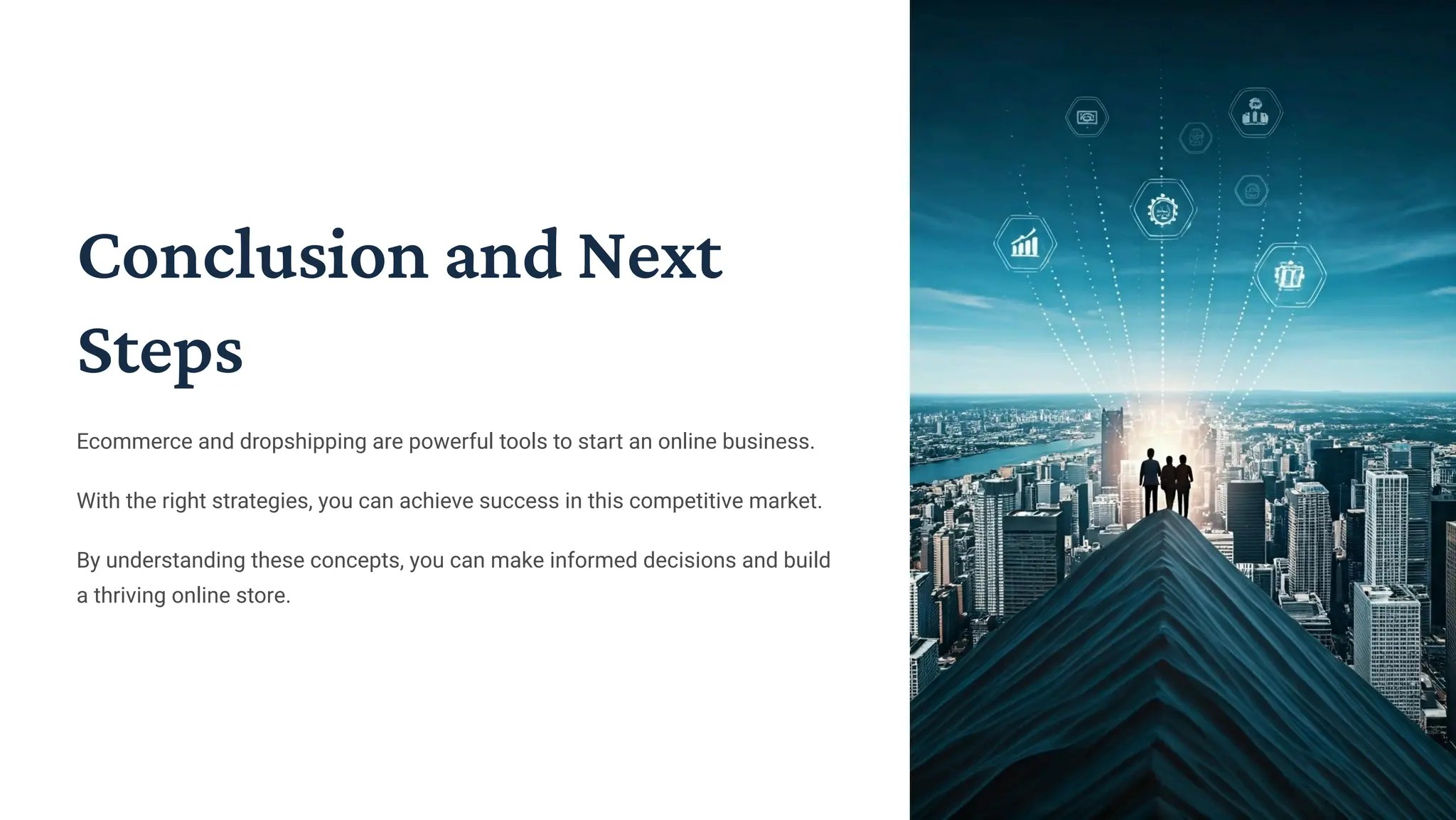
Ecommerce and dropshipping are powerful tools to start an online business.
With the right strategies, you can achieve success in this competitive market.
By understanding these concepts, you can make informed decisions and build
a thriving online store.

Understanding the Dropshipping Business Model: Pros and Cons

  • 1.
    Ecommerce and Dropshipping Ecommerce isa booming industry, with businesses selling products online to customers worldwide. Dropshipping is a popular ecommerce fulfillment model that allows businesses to sell products without holding any inventory. With dropshipping, a third-party supplier handles the storage, packaging, and shipping of products to customers. The dropshipper essentially acts as a middleman, connecting the customer with the supplier. This model has become increasingly popular because it offers numerous benefits to entrepreneurs and businesses. by Larry Kearney LK Understanding the Dropshipping Business Model: Pros and Cons Click here
  • 2.
    What is Ecommerce? OnlineCommerce Ecommerce refers to the buying and selling of goods and services over the internet. It enables businesses to reach a global audience and operate 24/7. Ecommerce platforms provide a virtual storefront for businesses to showcase their products and services. Digital Transactions Ecommerce transactions involve digital payments through online payment gateways. Customers can make purchases securely through credit cards, debit cards, and digital wallets. Ecommerce simplifies the buying process by providing a seamless online experience. Variety of Models Ecommerce encompasses various models, including Business-to- Consumer (B2C), Business-to-Business (B2B), and Consumer-to- Consumer (C2C). Each model caters to different customer segments and business needs.
  • 3.
    Advantages of Ecommerce Convenienceand Accessibility Shopping online allows customers to purchase goods from the comfort of their homes, eliminating the need to physically visit stores. This convenience is particularly valuable for busy individuals and those who live in remote areas. Wider Product Selection Ecommerce stores can offer a wider range of products than physical stores due to limited space constraints. Customers have access to a vast selection of goods from different brands and regions, leading to greater choice and potential value. Price Comparison and Discounts Ecommerce platforms facilitate price comparison, allowing customers to easily find the best deals and discounts. Customers can compare prices from multiple vendors before making a purchase, potentially leading to significant savings.
  • 4.
    Disadvantages of Ecommerce Competition Theecommerce market is extremely competitive. There are millions of online stores selling a wide variety of products. It can be difficult to stand out from the crowd and attract customers. Competition can also drive down prices and make it challenging to achieve profitability. Security Concerns Security is a major concern for both businesses and consumers. Customers are wary of sharing their personal and financial information online. Businesses must invest in strong security measures to protect their customers' data and prevent fraud.
  • 5.
    What is Dropshipping? NoInventory Dropshipping is a retail fulfillment method. It involves selling products online without holding inventory. When a customer places an order, the retailer purchases the product from a third-party supplier, who then ships the order directly to the customer. Low Startup Costs Dropshipping is often considered a low- cost way to start an online business. Unlike traditional retail businesses, dropshippers don't need to invest in large amounts of inventory upfront. This makes it an accessible option for entrepreneurs with limited capital. Global Reach Dropshipping allows businesses to reach customers worldwide without physical limitations. Suppliers can be located anywhere, enabling retailers to cater to diverse markets and expand their reach beyond geographical boundaries.
  • 6.
    Advantages of Dropshipping LowStartup Costs Dropshipping requires minimal upfront investment, making it an attractive option for entrepreneurs with limited capital. You don't need to purchase inventory in advance, reducing the financial risk associated with starting a business. Flexibility and Scalability Dropshipping offers flexibility in terms of location and time commitment. You can manage your business from anywhere with an internet connection. It's also easy to scale your operation as your business grows, adding new products and expanding your market reach. Wide Product Selection With dropshipping, you can offer a wide range of products without the hassle of managing inventory. You can access a vast selection of items from different suppliers, catering to diverse customer needs and preferences. Reduced Risk Dropshipping minimizes financial risk by eliminating the need for large inventory purchases. You only pay for products when they are ordered by customers, reducing the potential for unsold stock and financial losses.
  • 7.
    Disadvantages of Dropshipping LimitedControl over Shipping Dropshippers rely on third-party suppliers for fulfillment, meaning they lack control over shipping times and quality. Delays or damage during shipping can affect customer satisfaction and negatively impact your brand reputation. Lower Profit Margins Dropshipping involves working with a supplier who takes a cut of the profit. This means your profit margin is generally lower than traditional e-commerce businesses that handle inventory directly. High Competition The dropshipping market is saturated with numerous businesses selling similar products. This makes it challenging to stand out and attract customers, requiring a strong marketing strategy and a unique selling proposition. Inventory Management Challenges Managing inventory can be difficult when you don't have direct control over stock. You may encounter situations where a product is listed as available but is actually out of stock, leading to disappointed customers and potential refunds.
  • 8.
    How Dropshipping Works 1 CustomerPlaces Order A customer browses your online store and finds a product they like. They add it to their cart and proceed to checkout, completing their purchase. The order details, including the customer's shipping address, are transmitted to you. 2 You Receive Order You receive the customer's order details and process it through your dropshipping platform. You then forward the order to your supplier, along with the customer's shipping address. This is usually done through a dropshipping platform or an automated system. 3 Supplier Ships Product The supplier receives the order and packs the product for shipping. They ship the product directly to your customer using their own shipping process and logistics, without your involvement. You may receive a notification or tracking information about the shipment from the supplier. 4 Customer Receives Product Your customer receives their product directly from the supplier. The entire transaction is completed, and you receive the profit margin from the sale. You have no direct involvement in the packaging or shipping process.
  • 9.
    Finding Suppliers forDropshipping Research and Comparison Start by identifying potential suppliers in your niche. Use search engines, directories, and industry forums. Compare different suppliers based on factors like product quality, pricing, shipping times, customer service, and return policies. Building Relationships Directly contact suppliers to learn more about their offerings and establish a working relationship. Look for suppliers that are reliable, responsive, and committed to providing high-quality products and excellent customer service. Order Fulfillment and Tracking Once you've selected your suppliers, set up systems for order fulfillment and tracking. Ensure your suppliers can process orders efficiently, provide accurate tracking information, and handle any customer issues promptly.
  • 10.
    Choosing Products forDropshipping Market Research Thorough market research is crucial. Identify trending products with high demand. Analyze competitor pricing and offerings. Consider niche markets and potential profitability. Product Uniqueness Select products that stand out from the crowd. Offer unique features or benefits. Consider customization options or personalized experiences. Product Viability Assess product viability for dropshipping. Analyze profit margins, shipping costs, and return rates. Choose products with a low risk of damage or returns. Budget Considerations Determine your budget for initial inventory and marketing. Consider the cost of product sourcing, storage, and shipping. Factor in potential marketing expenses.
  • 11.
    Building an EcommerceStore Creating an appealing and functional ecommerce store is crucial for success in the online marketplace. There are several popular platforms and tools available to help you build your store, each offering a unique set of features and benefits. 1 Choosing a Platform Popular options include Shopify, Wix, and Squarespace. Consider your budget, technical expertise, and desired features. 2 Designing Your Store Create a visually appealing and user-friendly design that aligns with your brand and target audience. 3 Product Listing and Descriptions Showcase your products effectively with high-quality images and detailed descriptions. 4 Setting Up Payment and Shipping Integrate secure payment gateways and reliable shipping options. Ensure you optimize your store for mobile devices and incorporate search engine optimization (SEO) techniques to improve visibility.
  • 12.
    Marketing Your EcommerceStore Content Marketing Creating valuable content can attract potential customers. Blogs, articles, and videos can educate shoppers about your products and build trust. Share on social media platforms and optimize for search engines to reach a wider audience. Email Marketing Collect email addresses from visitors and nurture relationships. Send newsletters, promotions, and product updates. Segment your audience to deliver personalized messages and improve conversion rates. Paid Advertising Invest in targeted ads on platforms like Google, Facebook, and Instagram. Reach a specific audience based on demographics, interests, and behaviors. Track your results and optimize your campaigns for better performance. Social Media Marketing Engage with your customers on platforms where they are. Share your products, run contests, and respond to comments. Build a community around your brand to increase brand awareness and loyalty.
  • 13.
    Driving Traffic toYour Ecommerce Store 1 Paid Advertising Paid advertising platforms like Google Ads and Facebook Ads allow you to target specific audiences based on demographics, interests, and behavior. This can be an effective way to reach potential customers who are actively searching for products like yours. 2 Content Marketing Content marketing involves creating and sharing valuable, relevant, and consistent content to attract and retain a clearly defined audience. This could include blog posts, articles, infographics, videos, and social media updates. 3 Social Media Marketing Social media platforms like Facebook, Instagram, and Twitter provide opportunities to connect with potential customers, build brand awareness, and drive traffic to your store. Share engaging content, run contests, and engage with your followers.
  • 14.
    Optimizing Your EcommerceStore Website Speed A fast website is crucial for a great customer experience. Visitors are more likely to stay and make a purchase on a site that loads quickly. Optimize images, minimize code, and use a content delivery network (CDN) to enhance your site's performance. Mobile Optimization Most online shopping is done on mobile devices. Ensure your website is mobile-friendly and easy to navigate on all screen sizes. Use a responsive design that adjusts to different devices and optimize for touch interactions.
  • 15.
    Conclusion and Next Steps Ecommerceand dropshipping are powerful tools to start an online business. With the right strategies, you can achieve success in this competitive market. By understanding these concepts, you can make informed decisions and build a thriving online store.