Global Marketing
Madison Butler -
MRK.2100
What is Global Marketing?
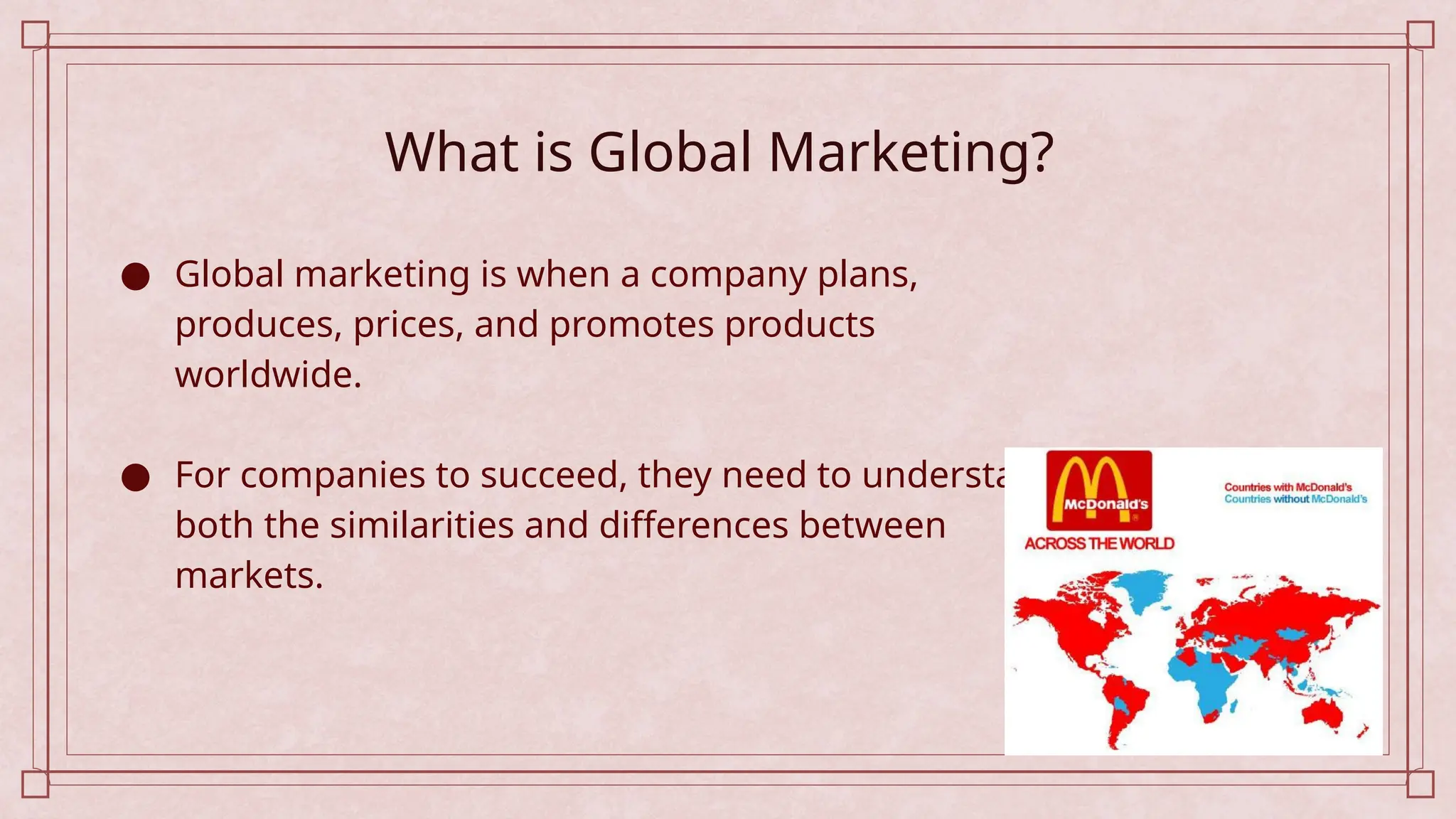
● Global marketing is when a company plans,
produces, prices, and promotes products
worldwide.
● For companies to succeed, they need to understand
both the similarities and differences between
markets.
Why Companies Expand Globally
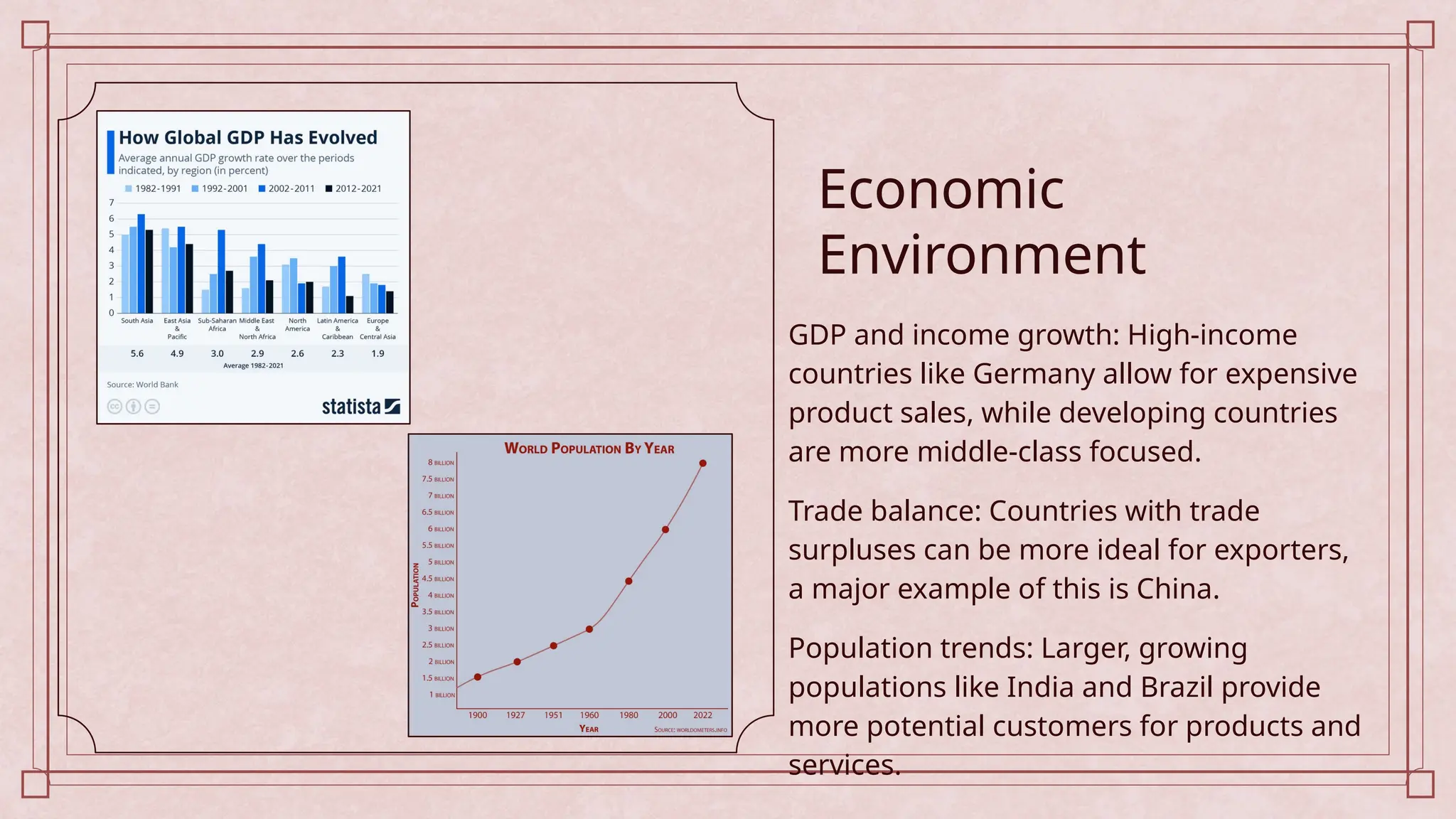
Technology:
Coordination with supply
chains can be achieved
worldwide because of instant
communication.
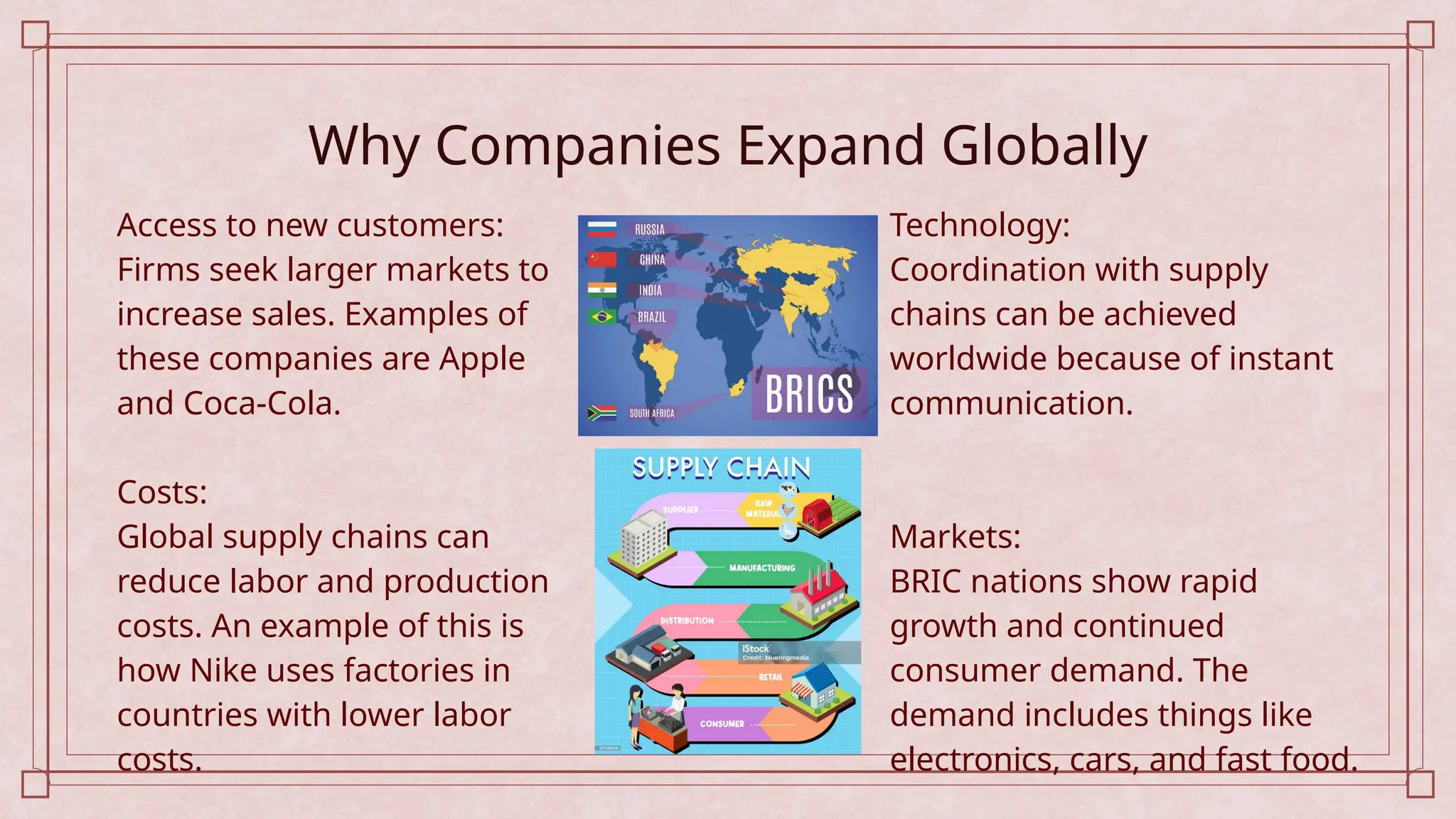
Markets:
BRIC nations show rapid
growth and continued
consumer demand. The
demand includes things like
electronics, cars, and fast food.
Access to new customers:
Firms seek larger markets to
increase sales. Examples of
these companies are Apple
and Coca-Cola.
Costs:
Global supply chains can
reduce labor and production
costs. An example of this is
how Nike uses factories in
countries with lower labor
costs.
Economic
Environment
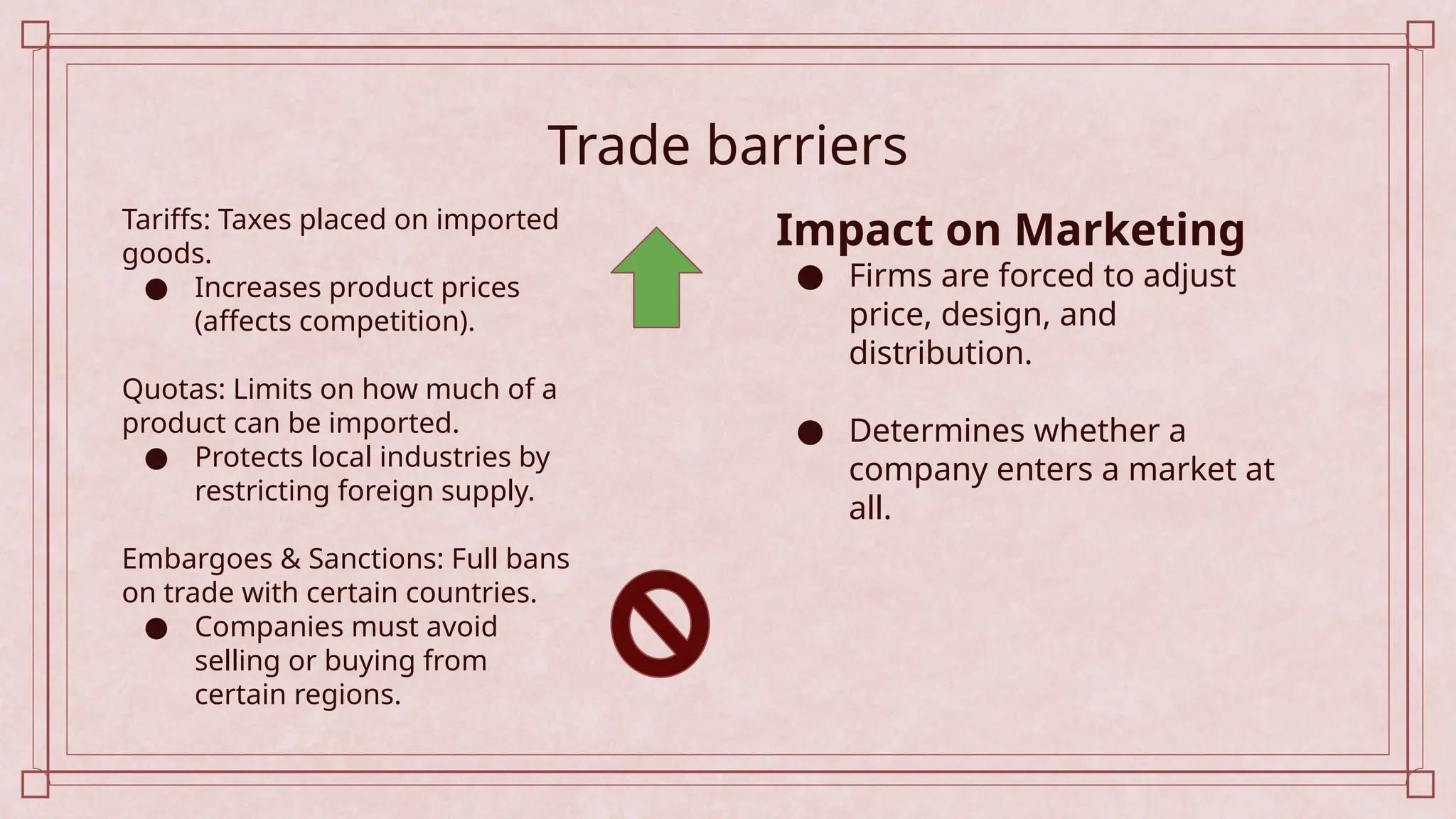
GDP and income growth: High-income
countries like Germany allow for expensive
product sales, while developing countries
are more middle-class focused.
Trade balance: Countries with trade
surpluses can be more ideal for exporters,
a major example of this is China.
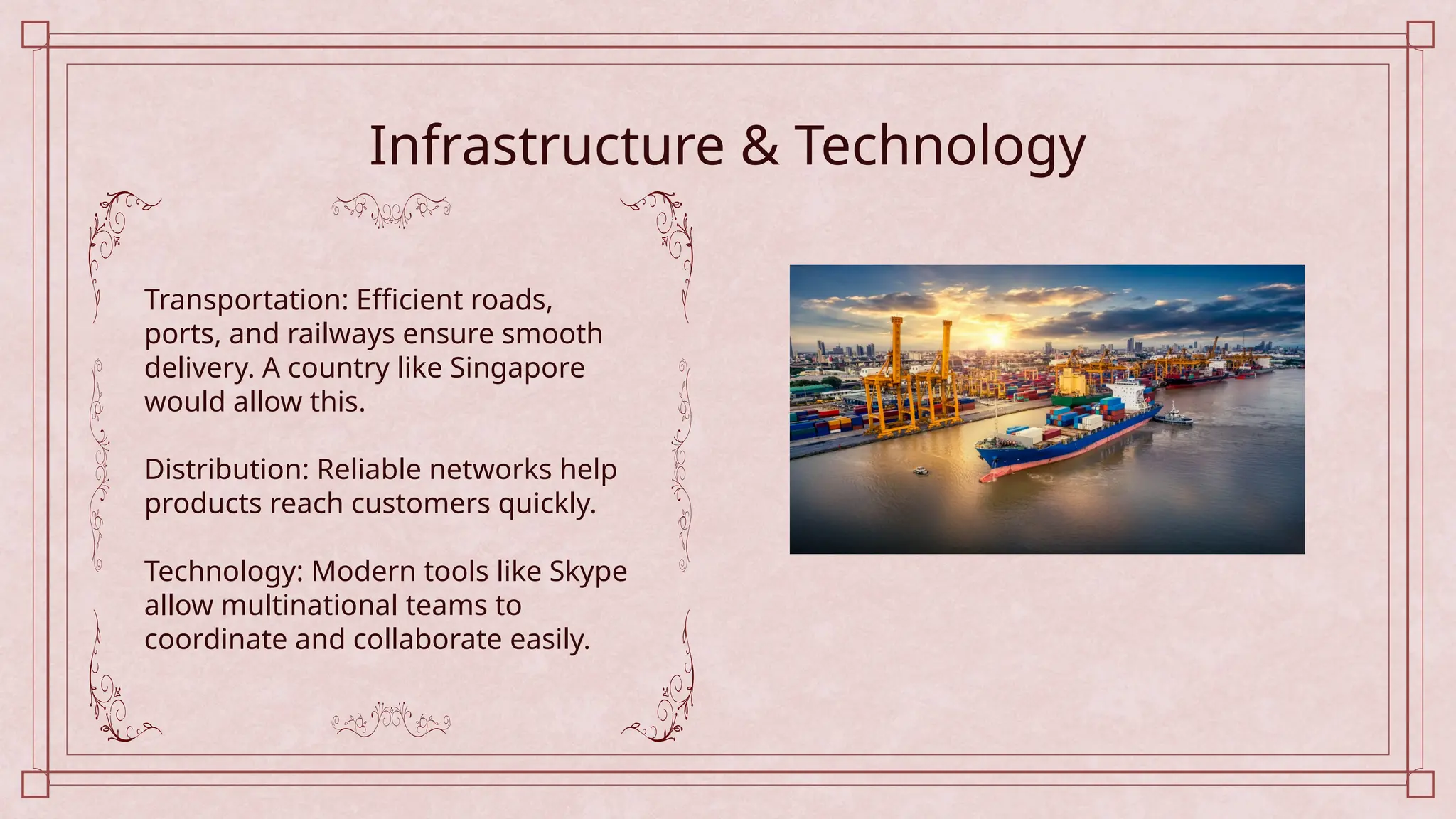
Population trends: Larger, growing
populations like India and Brazil provide
more potential customers for products and
services.
Trade barriers
Tariffs: Taxes placed on imported
goods.
● Increases product prices
(affects competition).
Quotas: Limits on how much of a
product can be imported.
● Protects local industries by
restricting foreign supply.
Embargoes & Sanctions: Full bans
on trade with certain countries.
● Companies must avoid
selling or buying from
certain regions.
Impact on Marketing
● Firms are forced to adjust
price, design, and
distribution.
● Determines whether a
company enters a market at
all.
Infrastructure & Technology
Transportation: Efficient roads,
ports, and railways ensure smooth
delivery. A country like Singapore
would allow this.
Distribution: Reliable networks help
products reach customers quickly.
Technology: Modern tools like Skype
allow multinational teams to
coordinate and collaborate easily.
Political & Legal Factors
Government stability: In countries
like Canada or the U.S. policies are
predictable so it reduces risk.
Regulations: Trade laws, labor
rules, and intellectual property
protections control how
companies operate
internationally. Clear rules on
these
are easier on businesses.
Impact on Marketing
● Legal factors determine whether
entering a market is safe and
profitable for a company.
Cultural & Social Factors
Values and customs: Products and
ads must fit cultural norms and
languages. Though some brands
just keep the same message
worldwide (Nike “Just Do It”)
Consumer behavior: Preferences
and buying habits differ by country.
An example of this is how Japan
prefers small packaging and the U.S
prefers larger packaging.
Global Trade Agreements
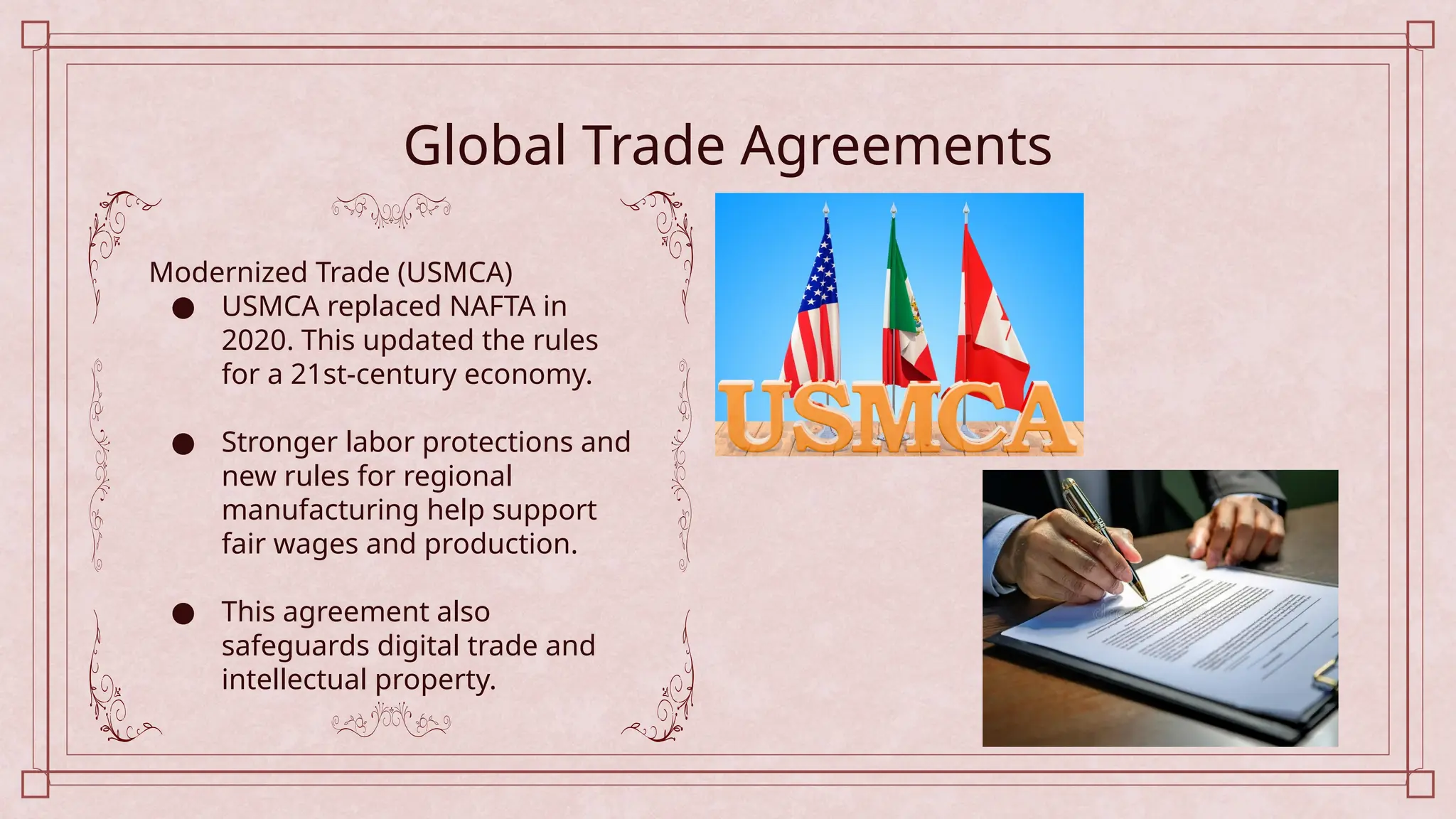
Modernized Trade (USMCA)
● USMCA replaced NAFTA in
2020. This updated the rules
for a 21st-century economy.
● Stronger labor protections and
new rules for regional
manufacturing help support
fair wages and production.
● This agreement also
safeguards digital trade and
intellectual property.
Entry Strategy
Exporting: Low risk, low
investment, limited profit
Licensing/Franchising: Medium
risk, intellectual property use,
higher profit potential
Joint Ventures: Companies partner
with local firms, this allows for a
share of risk, costs, and expertise.
Direct Investment: Firm owns
facilities abroad. This involves the
highest risk but also highest
potential profit. An example of this
is U.S. firms in Cuba before 1959.
Works Cited
Dobbs, Richard, et al. “Urban World: The Global Consumers to Watch.” McKinsey &
Company, McKinsey & Company, 30 Mar. 2016,
www.mckinsey.com/global-themes/urbanization/urban-world-the-global-consumers-to-watch.
Richford, Megan. “NAFTA TO USMCA: Key Trade Shifts Manufacturers Should Know.”
NAPS Inc., 14 Apr. 2025, napsintl.com/mexico-manufacturing-news/what-changed-from-
nafta-to-usmca/.
Understanding Key Concepts and Strategies in Global Marketing

  • 1.
  • 2.
    What is GlobalMarketing? ● Global marketing is when a company plans, produces, prices, and promotes products worldwide. ● For companies to succeed, they need to understand both the similarities and differences between markets.
  • 3.
    Why Companies ExpandGlobally Technology: Coordination with supply chains can be achieved worldwide because of instant communication. Markets: BRIC nations show rapid growth and continued consumer demand. The demand includes things like electronics, cars, and fast food. Access to new customers: Firms seek larger markets to increase sales. Examples of these companies are Apple and Coca-Cola. Costs: Global supply chains can reduce labor and production costs. An example of this is how Nike uses factories in countries with lower labor costs.
  • 4.
    Economic Environment GDP and incomegrowth: High-income countries like Germany allow for expensive product sales, while developing countries are more middle-class focused. Trade balance: Countries with trade surpluses can be more ideal for exporters, a major example of this is China. Population trends: Larger, growing populations like India and Brazil provide more potential customers for products and services.
  • 5.
    Trade barriers Tariffs: Taxesplaced on imported goods. ● Increases product prices (affects competition). Quotas: Limits on how much of a product can be imported. ● Protects local industries by restricting foreign supply. Embargoes & Sanctions: Full bans on trade with certain countries. ● Companies must avoid selling or buying from certain regions. Impact on Marketing ● Firms are forced to adjust price, design, and distribution. ● Determines whether a company enters a market at all.
  • 6.
    Infrastructure & Technology Transportation:Efficient roads, ports, and railways ensure smooth delivery. A country like Singapore would allow this. Distribution: Reliable networks help products reach customers quickly. Technology: Modern tools like Skype allow multinational teams to coordinate and collaborate easily.
  • 7.
    Political & LegalFactors Government stability: In countries like Canada or the U.S. policies are predictable so it reduces risk. Regulations: Trade laws, labor rules, and intellectual property protections control how companies operate internationally. Clear rules on these are easier on businesses. Impact on Marketing ● Legal factors determine whether entering a market is safe and profitable for a company.
  • 8.
    Cultural & SocialFactors Values and customs: Products and ads must fit cultural norms and languages. Though some brands just keep the same message worldwide (Nike “Just Do It”) Consumer behavior: Preferences and buying habits differ by country. An example of this is how Japan prefers small packaging and the U.S prefers larger packaging.
  • 9.
    Global Trade Agreements ModernizedTrade (USMCA) ● USMCA replaced NAFTA in 2020. This updated the rules for a 21st-century economy. ● Stronger labor protections and new rules for regional manufacturing help support fair wages and production. ● This agreement also safeguards digital trade and intellectual property.
  • 10.
    Entry Strategy Exporting: Lowrisk, low investment, limited profit Licensing/Franchising: Medium risk, intellectual property use, higher profit potential Joint Ventures: Companies partner with local firms, this allows for a share of risk, costs, and expertise. Direct Investment: Firm owns facilities abroad. This involves the highest risk but also highest potential profit. An example of this is U.S. firms in Cuba before 1959.
  • 11.
    Works Cited Dobbs, Richard,et al. “Urban World: The Global Consumers to Watch.” McKinsey & Company, McKinsey & Company, 30 Mar. 2016, www.mckinsey.com/global-themes/urbanization/urban-world-the-global-consumers-to-watch. Richford, Megan. “NAFTA TO USMCA: Key Trade Shifts Manufacturers Should Know.” NAPS Inc., 14 Apr. 2025, napsintl.com/mexico-manufacturing-news/what-changed-from- nafta-to-usmca/.