38 THE GAZETTEOF INDIA : EXTRAORDINARY [PART II—SEC. 3(ii)]
65 9 '& ! ) * 8 0 " # =
65 5 9
65 5 5 M K E7 2 .( 9 ! ) * 8 0 "
# = " 65 ) ( # C
" 65 3 9 ! * 8 0
2 EF' M K E7 2 .(
=7 8 0 P=
1()" = U
M KE "
2
"
9 -
9 Q!
IE E ("
(
2
# M K E7 M E7 0
M KE
M E7
.(
(i) M K E7 ! * 51 58275 V 7X 9 M KE ! 8 ) "
; E 9 # (2!H & D G :H A" " K H# J 1 H" 7 * !
I" " 7 ) K J 2 I * ! 8585 .(H ) !:
J & (2! C
(ii) )0 8 ; ! " .( * 9 -
65 5 5 W IE E2F $ $ 3 M E7 2 .( 9 ! ) *
65 5 5 ) 8 0 " # = " W IE E2F $ $ / )
( # 3
ii 1()" 8 0 R ! # A" 9 ! * * I") H 9 !" ) T ;
) (" 2 T " & '" ! 8 *!# ( !1! " I<
G " I" 8 2 & ) < '& $I")" 1 '& $I")" # C
I H I") H 9 !" 9 '& I< !I A" (" (2 "
* T I") H 9 !" , 1 # 9 '& & ) 2 - G " I" 8 !
< !1! " I< $I")" ( # 2 I< ! -
9 E $ # C
iii = 8 0 R ! # A" 9 ! * 9 '& * T I") ,
"2 ( # 2 9 '& & ) 2 - G " I" 8 ! (" !1! " I<
39.
¹Hkkx IIµ[k.M 3(ii)º Hkkjr dk jkti=k % vlk/kj.k 39
$I")" ( # C I< ! - 9 E $
# C
iv) U 8 0 R ! # A" 9 ! * 9 '& * T I") ,
"2 ( # 2 9 '& & ) 2 - G " I" 8 ! < !1! "
I< $I")" ( # C I< 6 ! - 9 E $
# C
2# # :3 . .E 9 '> 8 98 .
65 5 5 IE 8 9 H9 !7 # H# R ! # 8 9 ! )
* 8 0 " # = " 65 ) ( # C
40.
40 THE GAZETTEOF INDIA : EXTRAORDINARY [PART II—SEC. 3(ii)]
2# 4 :3 . .E .'9 '> 8 .'98 . .' . E . B J 3VS
=7 8 0 P=
1()" = U
9 " !
7
G :W H "
G :
"
2
"
"
9 Q!
< # ()
7X
27X
- . " - . " - . " - . "
#$ IE 8
$ ! T
XIII 0 !
P= a b P= a b P= a0 b [
Q! ;
P= a0 b [
Q! ; U
= $ E * ! * ! E DEF 9 = ! (" )
65 5 5 HI * 1! $I")" # ( !1! " I< .
) " $ M" * 1 #$ IE 8 ) " E "" ( ! # C
65 5 56 W IE ;EF2 $ $ ; IE 8 9 !H 9 !7 # !H# ! ) *
W IE;EF !# * $= / ) ( # 3;
i A60 E . B R ! # A" 9 ! * * I") H 9 !" T " * !
8" ) T ;I ) ( !1! " I< G " I" 8 2
h ) < 'i $I")" 1 9 E 8 h '" ( # C
I H I") H 9 !" I< , 9 'i !I A" (" (2 "
( I< K # 2 I< ! 9
E $ # C
ii E . B R ! # A" 9 ! * 9 'i ! * T
I") H 9 !" , "2 ( 2 9 'i ! h ) 2 G " I" 8 !
< !1! " I< $I")" ( # C I< ! !
9 E $ # C
iii E . B R ! # A" 9 ! * 9 'i ! * T
I") H 9 !" , "2 ( 2 9 'i ! h ) 2 G " I" 8 !
41.
¹Hkkx IIµ[k.M 3(ii)º Hkkjr dk jkti=k % vlk/kj.k 41
< !1! " I< $I")" ( # C I< ! !
9 E $ # C
iv __ E . B R ! # A" 9 ! * 9 'i ! * T
I") H 9 !" , "2 ( 2 9 'i ! h ) 2 G " I" 8 !
< !1! " I< $I")" ( # C I< 6 ! !
9 E $ # C
65 56 S* .' ': . X!
9 'i ! !I A " * * $ 4 8 *# 8
! T ! * #* i !5 7 H> H 5* 5H* 57 5* 5 5H 1 7!#
(27' E H ! 65 5 2 i !5 7 H >H* 5 5 1 5 * 5' .5H !
?5 >5 ! * #* ) ( # C "< 9 'i " $ 4 9
!I A " 8 " (2 C
65 S* .' ': . ! ! * .'
65 5 # E #5 5 1 ) " G :W 1 5 .5*5 9
'& ! * A< R = ) " G " ( ! (2 1& " 8( ! =
& " c * = ! 0 " ()* A< = ) " " ) "
= - * ! 8 ) " , ) " * ! . " # ( C
65 5 ; # 5 ; # 5 2 ; # 5 "
G :W 8 ! '" " 9 '& ! * = !1! " I !
( * 9 ) " & " c ! = & " c 9 - E * =
8 ( (2C
65 56 = * ! 8 ) "
; 65 5 ! 9 ) = * ! 8 ) " .
1 !I A" 9 '& ! $ A" !1! " I< 9 '&
!I A " $ " ( ) & " # " 656 # 5 Q * !
# 5 " " G :W * " 65> # 5 Q * !
# 5 " " G :W * * ! " 65 # 5 Q
# 5 " " G :W * 82 9 ( ) #
(2C
42.
42 THE GAZETTEOF INDIA : EXTRAORDINARY [PART II—SEC. 3(ii)]
2#2 4 Y 8# # . C J 8 # . ( ./F %A #
!# # . * .'
45 !5 = h "!
5 $ A " $ A " $= E 2 E E 1! .
0 8 *# 1 1( ) i "
* 2 M" ( (* C
5 8 ! G = ; D
8 !#$(= 2
9 .;8 ) 9 =
* D !#$(= 8 78 & "
(2 8 ! ) 9 = V $ !H1 # E " G :
* 8 *# C D !#$( " 8
Y . c ! ) 3 # * E2! ! E+L
(*C ( 1 * A< E! 2
O I< , 8 *# " ( 8 . "
8 ! C " '" !#$( " ()*
1 " 8 W O I< 1
, ! E+ .112 1 8 7X
(*C
0 7!8 G : 0 ) I< $ "i " <
( # C
65 L i jE
$1!
i jE A< ' = * 9 . #; # #
2 .0 1- N * 8 (* C
>5 Q8 8 I< ! * 5 57 H 2 E! # 8
(* C
5 ) #)= %"
* ! h
= 2 . )! 2 .7 E <
! 82 I4 1! # 8 *# ! I<
" 2 #$ EF ! * M IE H "
! # 8 (* C
7 58 5 2E # # ( 9
5 . ( C ( 5
. (2 " 9 6 5
L 8 (* C
5 ( " $ " ? #5 5 9 . * 7 #
8 *# 2 0 9 8 *# C + i
* Z 7X ! 9 8 *# C 7X ! I<
$8 " ! # " 8 (* C
8( ! 7 ! E i " ( " 36 ) "
7 E 6 7X # 1! <
$ " . 7X # * 8 *!# * 7X ! 0 0
8 *# C
43.
¹Hkkx IIµ[k.M 3(ii)º Hkkjr dk jkti=k % vlk/kj.k 43
^ 2#54 8 # . J Y 8 # ( ./ .
` .'
X# '# O ! ! ! ` .'
5 $ A " $ A " $= E 2 E E
1! . 0 8 *# 1 1(
) i " * 2 M"
( (* C
5 8 ! G = ;1 " 8
!#$(= 2 9 .8
) 9 =
( ! 1 " 8 !#$(= 8 1
i " (2 8( ! 8 1 - . " > #5
5 9 . * ! N ( # C 8( ! 9 !9 (
1 " 8 8 1 8 7X 8 *
2 8 ( " I<
1 1! ) 8 7X 8 * $ A " 8
! Z ( < h ( 1 "
8 8 7X 8 * C
5 0 7!8 G : 0 ) I< $ "i "
< ( # C
65 L i jE $1! i jE A< ' = * 9 . #; #
# 2 .0 1- N * 8 (* C
> Q8 8 I< ! * 5 57 H 2 E! #
8 (* C
>5 = Q8 I: " 82 $ i E
< !7 < ( 1$7 % - ()
18 8 7X #* $ )'" 9 - . " $ "i "
N 8 * C
> 0 * ! = Q8 !: $ !
) > O '" ! * E - . "
G " KE ( E # * 8 (* C
> # ] *i 1$' #3 "/1
. 2 < !i "
$ ! ) ] *i = !
9 #$ RM ! # 8 (*C
5 ) #)= %" * ! h = 2 . )! 2 .7 E
< ! 82 I4 1! #
8 *# ! I< " 2 #$ EF !
* M IE H " ! #
8 (* C
44.
44 THE GAZETTEOF INDIA : EXTRAORDINARY [PART II—SEC. 3(ii)]
2#Y4 Y 8 # . J Y 8 # ( ./ .
` .'
X# '# ! ! ! ` .'
5 $ A " $ A " $= E 2 E E
1! . 0 8 *# 1 1(
) i " * 2 M"
( (* C
5 8 ! G = ;1 " 8
!#$(= 2 9 .8
) 9 =
( ! 1 " 8 !#$(= 8 1
i " (2 8( ! 8 1 - . " > #5
5 9 . * ! N ( # C 8( ! 9 !9 (
1 " 8 8 1 8 7X 8 *
2 8 ( " I<
1 1! ) 8 7X 8 * $ A "
8 ! Z ( < h (
1 " 8 8 7X 8 * C
5 0 7!8 G : 0 ) I< $ "i "
< ( # C
5 0 G $ ) 1 9 .8 ( !
8 *# C
5 # = ! 8 #
8 * C
5 Y 8 !#$(= 1[X * ]
W' 2 2- # 8 * C
5 75 ( M /1!# IE # #$ 2 N 2
KE # * 8 *! C
65 L i jE $1! i jE A< ' = * 9 .
#; # # 2 .0 1- N *
8 (* C
65 9 K ;1 K 7#$71 i jE $ A"
) 3 4= ) ) 8 * 8
* $ A" ) 3 4= < 0 "
E ; 8 * C
65 0 - . " 56 HE !EH G "
# IE / IE H E # *
8 (* 81 * E 7X I 8
0 ! 1 * # 8 * 8
# I 8 * < $ A"
) 3 4= ) ) 8 * C 8
* $ A" ) 3 4= < 0 "
E ; 8 * C
45.
¹Hkkx IIµ[k.M 3(ii)º Hkkjr dk jkti=k % vlk/kj.k 45
>5 Q8 8 I< ! * 5 57 H 2 E! #
8 (* C
>5 = Q8 I: " 82 $ i E
< !7 < ( 1$7 % - ()
18 8 7X #* $ )'" 9 - . " $ "i "
N 8 * C
>5 0 * ! = Q8 !: $ !
) > O '" ! * E - . "
G " KE ( E # * 8 (* C
>5 # ] *i 1$' #3 "/1
. 2 < !i "
$ ! ) ] *i = !
9 #$ RM ! # 8 (*C
>5 Y 9 ! G 2 78 8 ! I") %
78 # (2 = , * A"
/ #" 48 ; G = ! 82
2 'EF / + !0 E!# W' 2
- = 8 ! G 78 "% 82
9 *!Ei 9 .i ! G 9 =
0 7X ! )'" O I 78 ,
$ i ! 1[X " 2 < K #
48 0 " ! ( # C
>5 75 48 G " N . 9 " 48 ! G =
9 = ! (" 1 ! <
!I")" ) =7 ! 9 $
9 ! * " ()* 9 !
% i " ! * ! ! )'"
O I< 8 * 8 Q8 $= "
# ( 8 * i jE -7 =
1 " (2 C
5 ) #)= %" * ! h = 2 . )! 2 .7 E
< ! 82 I4 1! #
8 *# ! I< " 2 #$ EF !
* M IE H " ! #
8 (* C
5 7 58 5 2E # # (
9 5 . ( C
( 5 . (2 "
9 6 5 L 8 (* C
5 ( " $ " ? #5 5 9 . * 7
# 8 *# 2 0 9 8 *# C
+ i * Z 7X ! 9
46.
46 THE GAZETTEOF INDIA : EXTRAORDINARY [PART II—SEC. 3(ii)]
8 *# C 7X ! I< $8 " ! #
" 8 (* C
5 8( ! 7 ! E i " ( " 36
) " 7 E 6 7X #
1! < $ " . 7X # * 8 *!# *
7X ! 0 0 8 *# C
5 8 !i M !E $ "i " i jE 8 !i G "
8 EF E !E M !E # 8 *# ! !i "
8 1# ! ! 2 ] i !# *
) 3 4" 8 * C
?5 = $1! 8 = ! 82 8 EF E !E
M !E 9 . Ai ! 1 " 8 !#$(= =
(") 12 ; ! = #
L i`jE $1! 2 2 * ! Q8 ! G =
9 j " ! 8/ =
# " , 8 0 8 *! C
47.
¹Hkkx IIµ[k.M 3(ii)º Hkkjr dk jkti=k % vlk/kj.k 47
! ! 5
= .3. ! ) P3 .' . , , ! .E X! ' .B
>5 ( * 51 58275 ! V E M KE ! V 7X # E
" 9 V E M KE 8 ) " ; EH i j
G : !H A" " K H#$ = 1 H 7 H I" " 7
) K ! 2 I * ! 8585 .( !H ) !: K ! ! "
(2! #. ( # C
>5 3) 4 M KE ! M KE G :W ! " % V.E
) " ( # C
>56 * M KE ! 9 S H " H * = UV) 9 M KE M KE
I ! 0 " $ 4 ( # C
5 M KE I !" ! * #* $ : ) =
$ !9 . * 1! ( # C
0 5 " G : $ = H !1! " I< ! ! T ! * !
9 E h ) < 1! $I")" i "+ M KE I "%
= $ !9 " (2 C
#5 = 78 ! # - 9 = G ! ) 2
$ 0 0 @ VI !:= ! ) ( # C Q# .B .'
48.
48 THE GAZETTEOF INDIA : EXTRAORDINARY [PART II—SEC. 3(ii)]
Y 5 I") H 9 !" * 9 78 1 *# C
3) 4 I") H 9 !" * T " * ! (" * ) T I 0 !C
75 = J j ! . ( # C = J j ! . ( ! ( "
(2 " ) 2 " (") ) 3 ) = h ) 9 )#" ( # C
5 HI 9 = H9 ! 0 7X ( ! % ) G
( ) * ! - G " !1! " $ = H !1! " I<
G " . " # C
V5 = . ( I I") H 9 !" * , "+ (I" G "
7F !# !H 'i ! < !" ! * #*
$ : ! = . ( . 1 ! " G :
$ = H !1! " I< . " ( # C i "+ HI
9 H9 " H9 # 9 # $ !9 " (2 C
85 I" 8 $I")" " G = H8 J ( ! 8 *# C
B5 " ) j 8 !#$(= i (2 C
e5 "3 7X 27X M KE $9 " ( I< " ! 9 )9 # I<
G = # C
49.
¹Hkkx IIµ[k.M 3(ii)º Hkkjr dk jkti=k % vlk/kj.k 49
/
A'
' .
2!H( 55555555555555555555555555555555555555555555 ):H ): 5555555555555555555555555555555555555555555555555555555555555555555555
*" +, % jL . / ) $ "` " H" (.JH" (2! 2 " H" (.JH" (2!
3
!E :H !8 A" 4 0 Hi i " E+E 0 H 1 H 9 8
0 H - . I" 8 ) 2!H( M KE !0 5555555555555555555555555555555
" 5555555555555555555555555555555555555555555555555555555555555555555 H . I (.JH(2! C I ) $ = "
$ " ! T !
0 ( M KE )0 8 G : 8 $ ! !"#" 9
$I" "H ) " 8 < 8 $9 " ( ! (2 2 5 5G 5
) " " ) H ) " ; E M )R (2 C
# ! 9 M KE (2 2 G : 8 H ) " ; E M )
8 H !8 % 9 . # 9 # ( ! (2 C
Y ( M KE G : 8 H ) " ; E M ) 7X 27X
$9 " ( ! (2 C
75 ( M KE ) ) !H ! % (") " I< $9 " ( ! (2 C
( M KE 9 = $ ! ) . %" !
) U E" ! . (2 C
V 2!H( #. 9 = $ ! ) *
= (" H" (.JH" (2! C 9 = ! # 9 j
) = * $I" " 9 " ! 'i H (I H -
I") H 9 " * , "+ (I" G " ! T (2 ; I") H 9 !" *
T " * ! (" * ) T ;I 0 !C
8 ( $I" " 9 'i 9 = $ ! )
) ! G ! "+ . " (2 C
B 2 H( E M KE " G :W *
K ! / 0 " P = ! * 9 E h ) ! T (2 3;
5 * * ! 1 P= ! K ! M E *3 H;_5 $ " # 5
5 * ! 7 P= ! K ! M E *3 H;_5 $ " # 5*
65 *W 8 2 * P= ! K ! M E *3 H;_5 $ " # 5
*
* $9 $ = H !1! " I< , " P V 7X (2!C
e 2!H( 8 " (.JH" (2! '" h ) J j * - (2 C
50.
50 THE GAZETTEOF INDIA : EXTRAORDINARY [PART II—SEC. 3(ii)]
E ! % 9 ! : 78 H !7 ! ) i " * 9
= G = ! 8 *# C
L 2!H( ! j = . ( ! " H" (.JH" (2! 2 = . (
. ( ! " H" (.JH" (2! " 1[X *H # * = *
!1! " $ = H !1! " I< , < i * 1 ) 3 9 )#"
RJ# H# H !# C
7 2!H( ) T ; I ! 0 " T i ! *! " ()* = #)= %"
* ! = ! % I< % . 8/ " H" (.JH" (2!C
[5 2!H( = . ( aa < "aa 'i ! (I ! - ! 2 I<
W E #$ W < = . ( . # # .!# H# H !# C
! T 3 )'" ) ! 3 555555555555555555555555
I I ! (I" G # ( ! (I" G
2 " H " 2 " H "
'B! '
/
6 . .
2!H( 555555555555555555555555555555555555555555555555 ):H ): 55555555555555555555555555555555555555555555555555555555555555555555555
555555555555555555555555555555555555555555555555555555555555 *" +, . " " H" (.JH" (2! * #*
= ) 1 9 = . ( ) (2C
M KE G :W 3 55555555555555555555555555555555555555555555555
" 3 555555555555555555555555555555555555555555555555
0 2! *" +, 'i !H7F !# ! E W E #$ W ?aax >aa
;? !0 ! $I")"
( H ( (.J 8 $ " ! ) I ! 2 I") H 9 !" *
, "+ (I" G " (2 C 82 ! ) T ; I ! 9 j " (2 C
# " '" ! % 9 !" , "+ (I" G " ! %
I< % $ = : A W *;> 0 ! ! T (2 C
Y 2 9 = !Y 9 9 9 # = ( !
(2 C $ = H !1! " I< 9 A" = 2
)0 8 $ ! ! " " (2 " 8) # 8 " (2 C
# 8 " (2 2 2! $ = H !1! " I< = .!# H#
C
! 3 555555555555555555555555555555
I ! (I" G H * ! "
5 55555555555555555555555555555555555555555555
5 55555555555555555555555555555555555555555555
52 THE GAZETTEOF INDIA : EXTRAORDINARY [PART II—SEC. 3(ii)]
! !
L "! !
5 $ = , . " 3
! $ . )
$ # " ()* $ = ! . " "
(2 C
5 i j G : A" " K ! 2 # ! ! * 9 = 3
5 5 !0 *W56 ? ?H* 5 5H E , . " i j G : A"
" K ! 2 # J ! * 9 =
http://dda.org.in/tendernoticesdocs/april11/gazette%20of%20india1%20april%2
0201197.pdf
56 ) * * ! i i 3
5 5 ?6 !0 *W5 H* 5 5 ! $2 , . "
Z 8" 2Z # G : ! ) (") * ! i i C
http://dda.org.in/tendernotices_docs/april11/gazette%20of%20india1%20april%
202011683.pdf
5> W ( ! 3
5 5 [ !0 *W56 6 H* 5 5] ! 6 '".1 , . "
! W ( ! 3
http://dda.org.in/tendernotices_docs/nov12/2/502622_30102012farmhouse.pdf
5 12!' E ( K ! ) " 3
5 5 ! "/1 , . " 3
http://dda.org.in/tendernotices_docs/oct12//banquet%20hall-291012.pdf
EM = 3 9 " H 5 5 $ 5 , . " ; !i h "
(2 C !i "H = H ! $ . ! 9 C
)'% " '" * 9 ; . " * 8 " (2! C
9 ! C
53.
¹Hkkx IIµ[k.M 3(ii)º Hkkjr dk jkti=k % vlk/kj.k 53
! ! Q
"! .( '9
5 9 # ! 9 9 - (I ! 9 $ 9 ; HQJ 9 *
I< i " = # (2 C
5 " ! D D! .' . ! .' . " 8 .' .
:; *!
5 5 )0 9 3 M !< 9 9 # E( $ I< " (
I" EH 7X I" 2 ; 7X 1 QJ
9 # ( " E M" O I< ( C
5 5 !" E 7 7 !# I< * ! #2 8 3 < jL R " 9
! : ! 1 ( !# C
5 56 HQJ 9 9 - Y E ! - . " 27X
* ! QJ " !0 5 ! * #* (2! C
'B! Q# 4 :; *!
X# '# . H 3 Y 8 3 ( ./F
!
D D . "!
*!
Y 8 3 ( ./F .
! D D
. "! *!
5 ( T G :W 3 5 #5 5
QJ 3 5 5
27X 3 5 5
G :W 3 5 #5 5*
* (2! " .
5 #5 5
( # C
QJ 3 5> 5
27X 3 5 5
5 Y G :W 3 656 #5 5
QJ 3 5? 5
27X 3 5 5
G :W 3 >5 #5 5
QJ 3 5> 5
27X 3 5 5
65 9 !7
2-EF 5555555555555555555555555555555
G :W 3 65 #5 5
QJ 3 5> 5
27X 3 5 5
>5 I Y G :W 3 5 #5 5
QJ 3 5 5
27X 3 5 5
G :W 3 5? #5 5
QJ 3 5 5
27X 3 5 5
5 h 2 G :W 3 5 #5 5
QJ 3 5 5
G :W 3 5 #5 5
QJ 3 5 5
54.
54 THE GAZETTEOF INDIA : EXTRAORDINARY [PART II—SEC. 3(ii)]
27X 3 5 5 27X 3 5 5
5 I #A( * !
h 2 !
* <
G :W 3 5? #5 5
QJ 3 5 5
27X 3 5 5
G :W 3 5? #5 5
QJ 3 5 5
27X 3 5 5
5 9 =7 = G 9 =7 = G :W (
T 5 #5 5
2 - . "
QJ 5 5
( (* C
9 =7 = G G :W (
T 5 #5 5
2 - . " QJ 5 5
( (* C
?5 [X () V8
i 7H 1 7
M KE 9 " 5 5 " 27X ) "
8 *# C M KE 1 ( 9 $
V8 ) " ( ! ( # C
5 #2 8 ) ( (") #2 8 3
1x2 5
G :W 3 >5 #5 5
QJ 3 5 5
27X 3 5> 5
5 QJ
9 ! *
# H
K 7
27X 3 5 5 27X 3 5 * 5
5 8 (
T !
Y
I Y
h 2
27X 3 5 5
QJ 3 5 5
27X 3 5 5
QJ 3 5 5
27X 3 5 5
QJ 3 5 5
27X 3 5 5
QJ 3 5 5
5 [X !H
QJ 9
*
27X 3 5 5 27X 3 5 * 5
65 1 5> 5 #( "
EM = ! 3
5 1i " 9 1 - . " I jE h j !" (27 5> E ( ! ( #
C
5 Q " ! 0 " 9 9 $ Y E ! " " I" V"
"( " ) " QJ >? E ( C "<
I") H 9 !" * 8 ! 9 Y E QJ >5? E
0 (" (2 " 9 H ! ) ) QJ " h "
) " 8 " (2 C
65 .( ! 9 0 ) I< ( ! ( 1 ( $
= ( ! 8 *# 2 Q 0 ) ( !# '" 0 ) I<
55.
¹Hkkx IIµ[k.M 3(ii)º Hkkjr dk jkti=k % vlk/kj.k 55
V < 7X 5 5 27X ( ! V 7X (2!#
< $ 8'E ( ! ( # 8 G " - . " 27X ( C Ai " "
I" 5 5 QJ * $ 8'i ) " ( ! ( # C
>5 I") % i j " *! *! 9 . Ai ! 3 Q# Q# J Q# Q# .B .'
* QJ 9 ! * [X ! 2 K 7 I" 0 !7 ?5>56 2 ?5>5? ! 1" *
) ( # C
** QJ 9 ! ! 28. " ! " '" Q 1 ! [X !
27X 9 = ?6 ) 5 5 0 8 *# Q " ! *
9 [X ! 27X 5 5 ( 0 8 *# C
5 "! "! *! '
Q# # .DH 4 $% 8 $ # Y R ! ( # ! d
5 2-EF # ( Y 1" W I< 8 *# 8
< ! 8 #$!E7 EF2 'i 8)7X ( # C
0 5 ' Wi
#5 * 0 7X 8 5 #5 5 ( ] * ! 9 #
8 9 ( ( (* 2 9 " 1 (+ 0 ) I< 0 ) (*d
!") h ]E i ) ! ( ! ( ! 0 ) (* C
Y 5 E QJ 9 ! ! : ] .8 h .E
5 5 : H ' ` J ! 4 $% I Y <
5 h 2 $ 1 ( # * 1 ( h ]E i , ) !
( 0 ) " ( 2 ! 0 7X i R ! 56 #5 5 " *
0 ) I< ( (* C
0 5 E 12L I< 8 #$ 1 ( C
#5 $9 " ( Wi 8 8 * " W " R [
( 2 ( 1 . " W [X ( ! ( # C
Y 5 h 2 W 0 * ( $ # 8 *# C
75 $% h 2 H .: ! ! M" G " $G E! ( (* C
5 V" * h 2 8 " QJ 5 5 ( # 2 G :W > #5 5
( # h " ) ( # 2 9 QJ 2 *W5*5 5 ! ( ! #
8 *# C
V5 9 8 # $= 8)7X ( !# C 8( ! $
O I< ( ! (2 ( J M KE i " )R ME E2! 2 E ( #
C
85 " $ A " H i , ) ! * ! W h " 9
IE E 2 "(0 ! * h 2 ) " ( # 1i " > #5
5 ( 2 *W5*5 5 ! ( ! # 8 *# C
56.
56 THE GAZETTEOF INDIA : EXTRAORDINARY [PART II—SEC. 3(ii)]
5 56 .E
8( J 8 " ( # *W5*5 5 ! # 8 *# 2 - . " QJ 5
E " E+E "( 1 ( # C
5 5> A J J . % !
5 5>5 A 4
i. M K E7 (") 3 M KE ! " 5 5 27X
1 ( # C *W5*5 5 ! ( ! # 8 *# C ) 0 ) G : > $ "i "
( [X 1 ) " ( # C
ii. .( (") 3 Y (" 9 ! * " 5 5 27X 1
#H[X () ) " ( # ' ! 1i " ! #
1 " ( 2 ( M KE ! ( C *W5*5 5 ! ( ! # 8 *# C 5
E 27X 1 1[X ()* 9 # *W5*5 5 # ( # C
iii. " 65 E QJ 5 # E " G :W - . " #) QJ
0 ) E ) " ( # C *W5*5 5 # ( # C
5 5>5 0'>. 4 % ! ) P 3> 6. 0
* ! 8 9 ! ! $% # # N K ! * $ )!7
) " ( # C * ! 8 9 ! 9 ." HQ "
$ i , )!7 ) " ( # C 2E12 H 2E12 ! ! )!7 (
5 k!E 2E12 6 5 (2 " " #( 5> 5 ( # C
0 5 k!E 2E12 5 (2 " " #( 6 5 ( # C
i- 7 2E12 6 5 (2 " " #( 5> 5 ( # C
ii- 7 2E12 5 (2 " " #( 6 5 ( # C
EM = 3 !1! " 2E12 - . " 6 % G : 0 ) 0 8 *# C
5 5>5 0'>. 9 . 4 - 9 # 9 ! ! ; 5>5 0 ! C
8( J * < )!7 !H G :W ) " *W5*5 5 6%
( ! ( # 2 $% )!7 H " = ?5 5 x 5 ( # C (
)!7 H T i ) h " ( # C )!7 H
G :W *W5*5 5 2 " 8 ! ( ! # 8 *# C
5 5 3 % PK3
9 ! * ! ) ! ! E ) " ( # C * E G :W
!1! " " 7 * % " ( # C E 2 V" 1 "
QJ 5 5 ( # 2 E 8#( QJ 9 = !
E QJ * < " QJ ( # C
5 5 C7 D 4
57.
¹Hkkx IIµ[k.M 3(ii)º Hkkjr dk jkti=k % vlk/kj.k 57
G $ i j ) " V 7X / 0 " !7 #. ( !# C
Q# # # ! ) P 3> . 6. 0
5 . 3 ( I< H8 I" E " 7X I" "
5 5 QJ ( # 2 81." %< H !EH ( # 2 5 5 QJ ( #
C ! IE 8 H ( #$ !H 2 V ( # " I jE 0 8 C
0 5 J =. 3 8 I" " 5> 5 QJ
2 81." %< H !EH 1 C
5 5 "! .8 .'. 6. 0 4 #5#QY .B .' 8 I" " 5> 5 QJ
C
5 5 56 "< 5 5 5 2 5 5 5 $ !I< 9 ! 82 8 1 ) #A(
T I " ! 2Z # 9 ! 82 i K W2 'EF ! 2 h 2G =
9 ! 82 Z ( Z V : * ! ) G !I< #. ( ! ( !# C
EM = 3 )'" $ 9 !HG : ! #. ( ! ( !# 8( J (2
< $ = HI< i " QJ )i ! (2 <
; E M H O 8 HG : 8 H )0 8 !
) )i ! (2 C
5 5 5> H ^ . ! ) P3 % #> # # # 6. 0
Y % M KE 8 ) G = ! * 7X (2 ( J ) G
= ! " QJ ( # C Q# #2#Y J 0 @ xv .B .'
56 M! ! J 1! 4
G H ) HW)E O I< R ! $ # * 8
- I< - . " G :W 5 # E 2 - . " 27X 5> #5 5
( # C * ! - . " QJ 5 5 2 " QJ >5? 5 ( # C
" G : (") I - . " G :W > # 5 ( # C
5> 6B 4
$ = H !1! " I< )0 8 HG : 8 !
jE 9 . # 2 - $ ! ) "(0 = ) "
# C "(0 ! / 0 " O I< *! ( !# 3;
5>5 $% "(0 $% 9 # ! " E+E "( " QJ
5> 5 2 27X 5> 5 ( # C
5>5 "(0 ! ) ! )'" O I< ( # C ) ! * 9
= 5 > 2 ?5>5 ) ( !# 82 i j 9 # *
G " (2 C
5>56 "(0 Q 9 ." W i 5 E " ( # E "
9 .;I" H0 ) H 2E12 I" 8 *# C
5>5> "( 1( "(0 ! 8 * * )'" O I< 8 *# C
58.
58 THE GAZETTEOF INDIA : EXTRAORDINARY [PART II—SEC. 3(ii)]
5>5 "(0 ! 2 Wi 8 ( !# "< $ 1 * " =
2 $9 7 2 2 (2 " 'i 1 "
! 0 8 * "< (" 0 * M" * 8 *! C
5>5 "(0 ! 8 I" 9 ! 8 )0 2 2 [X ! #
( # C 9 ! 9 (" ! ]E # 8 " (2 " "(0
! 8 * 9 # 8 " (2 C Q#5# .B .'
5>5 8 M KE ! I , $ = H !1! " I< I< ! %"
( G " !1! ! * G " . " 1! h " "(0 ) "
( # C
5>5? $ = H !1! " I< , "(0 9 '" ) "
8 " (2 " 9 =7 ! 3 # 5 ( ! ( # C 9 =7
# )R " '" - $ # * 9 8 5 # 5
( ! ( (* C * ! $% 9 = ,
" ) ! O I< ( # C
5>5 "(0 $ # !# Y . 9 =7 * ! ! ! * 8 " (2 "
*W5*5 5 ! ( ! # 8 (* C
5>5 "(0 ]E 9 !# ) " 8 " (2 C
9 ! .( V 7X d 2/ ( ! (2 C "<
9 ! " " 6 # 5 M KE ! * 2/ (2 C
5>5 5 )5 5 ) "(0 $ # Y . - I") ! 9 =7 =
i #$ 7 R IEF !# R 12! " G )I" IEF2 R
)I" ! [ 0 G " ) . = ! 2 9 * #
I")*! * 8 " (2 C
Q#Y 6. 0 .( ' 4
/ 0 " - G *! #. ( !# 3;
5 5 )j ( * 1 ! $% 9 ! # - " !
! ) G " * M" O I< ( # C
5 5 8 9 - 8 " $ # * ( ! (2 V 7X $% 9
! ! 9 # - . " G ! 8 *# C
5 56 9 # 1 ( !# C
5 5> 9 9 ! " ( ! 8 *# 8 G " ! !0 27X
9 # ! ( C
5 5 " ()J I" I jE 0 "< !1! " ! 8 # ! *
I jE R -(+" ( !# 2 i IE # * 8 *!# C
5 5 9 ! M" i O I< ( # C
59.
¹Hkkx IIµ[k.M 3(ii)º Hkkjr dk jkti=k % vlk/kj.k 59
5 5 8( ! T i = ! O I< # (2 ( ! !: " I< ( !# 2
I jE R -(+" ( !# !") ! 1 ( ! ( !# "< # ! !
" W I< I jE ! " ( # C
5 5? 8( ! G " ( ( ! 8 = # 8 *!# 8 !1! " 9 #
# C
5 5 9 # # 8 1 ( 0 ) I< ! 9 1 ( 9 # ! 8
* # " I" R ! 1 ( !# C
5 5 $ 1 ( !# " ()! * . ! (
8 7X C
5 5 '8 .' . 4
5 5 # !" [X ! 1 ( [X ! 8 8 1
8 I" ( " (2! 2 H - 9 V" # ! 8 [X
1 2 E2 ( " (2! C # ! QJ 9 !
8 G 2 "8 9 ( # C
5 5 ]E !H*I E ! 2 4, ! !# 7 # ! R ! ( !
8 *# C
5 8 .' 'B! J
9 - # ! !0 2 $% 2 " ! ( !
!0 G " I< . "< 9 ! QJ
( !# C
5?5 8 .' M! :; 4
5?5 1 8 V7X O I< 9 ! ! # ! = * I<
( # 8 " ()J . " ?5 ! # . ( ! ( # C
5?5 # K 7 ! " [# .B .' " . Q
0 " . ( ! ( # C !I< 2 * !1 9 #
V 7X 8 ! ( . 5 5 ( ! ( # C
5?56 9 I< < " * *
i " (2 " 8( ! " !9 ( , * ; . .
( (* 2 G :W 9 # i ! ! ()! * ( !#
C
5 (
5 5 27 O '" ! ) G " * [X ! 2/
8 G " i !0 " 5 ! # (2 C
60.
60 THE GAZETTEOF INDIA : EXTRAORDINARY [PART II—SEC. 3(ii)]
'B! Q#
$% 27X ! 9 # ! !0
X
'B!
.8
6
. 8! .' 'B!
I?! ' JO E.
5
5 h 2G =
65 !I<
>5 * /1 >
5 O
5 =
5 2Z #
?5 9 =7 =
5 0 " 6 >
" 56 9 # ! !0
X
'B!
.8 6 . 8! .' 'B! M! S
8 3 ( ./F
5 5
5 h 2G = >
65 !I< EM = 0 !
>5 * /1
5 W' 0 ) E 2
7 ! ] ("
0 5 9 8 G (" 12L
(" ) *!
5 EM = 0 !
5 EM = 0 !
5 =
5 IEF E ] * ! 4
"(0
0 5 4 "
6
5 O * ! 2Z #
5 9 =7 = 6
?5 0 "
EM = 3
5 AS P ! < ! # 0 % ! 8( ! I< O I< ( " (2 ( !
9 # ! G " #= $ " O '" 5 # E G :W ( !
8 *# C
61.
¹Hkkx IIµ[k.M 3(ii)º Hkkjr dk jkti=k % vlk/kj.k 61
5 ) " G :W ! )0 * /1 G I< " '" ! 8 <
Q ! 8 ! 8 7X G I< 8( ! * G !
I< ! ! 8 $ i , ( * ! * /1 I< ( #
" ( ! 9 h ( !# C # ! ! < 9 8 ! (") ) G :W !
E 2" ( ! 8 *# C G :W ! * /1 (") # ( G :
G :W h ( # C
5 I?! .' *!
5 5 9 ! [X ! !0 = 9 # ! !0 . ! "
( # C 9 = 5? !"#" -(+" 9 ! !1! !
[X ! h " ( # 1i " * [X . " * ! - i "
* $ # 8 * 2 . [X $ # # 1 * ( C
5 5 * #* 9 9 ! ! [X ! ( !# 3
5 5 < QJ 9 2
0 5 9 " # 5 " G :W 9 O
h 2G = 9 # !I< 2Z # 9 =7 = 0 " 9 # 2 P"
9 # R ! $ # * 8 ( 9 ( QJ " 9 ( C
5 56 (27 E2! G = * 9 $ 0 ) I< [X 27
N (2 C
5 I? . a ! .' :
5 !" [X ! . " ( ( i #$ 1 8 *# C
0 5 !" [X ! ! .= R ! 1 8 *# 2 ! T (2
" QJ 9 ! i ! ) ! O I< ( # C
#5 [X ]E h ]E ! ( ! 1 8 *!# C
Y 5 0 0 ( = ) " ( ! ( # C
75 !" [X - . " 27X 9 = !0 5 5 ) ( # C
5 QJ 9 ! !" [X * 1 8!# EF7+ - . " 27X 5
5 ( # C ## )!1 (" - 9 ! ! - . " EF7 6 5 5
( # C EF7 $ 1 8 *!# 2 0 ; 0 8 *# W
C 9 ! ! !7 ) " ( # C 1i " 8 [X
Q ( C
V5 QJ 9 ! ! 8 " QJ !E E ## )!1 ("
- 9 ! ! 8 " QJ !E E ( # 2 $ " [X
8 ! " !0 $ " [X ( # C
85 27 1 5 5 - . " (2!7 ( # 2 ( h " ( #
8!# V7!H !# [X ! 27X ( C
B5 [X ! " I" 2 [X (7R - . " 5 5 ( # C
62.
62 THE GAZETTEOF INDIA : EXTRAORDINARY [PART II—SEC. 3(ii)]
e5 5 < QJ 9 ! ! )0 [X ! I" Y =E " T
$ " T 8 ( 8 *# C 9 !
( E H " ( E ! V 7X * 8 ( $ " G " * Y !E (
" (2 C
E5 .( ! ( I< 9 =7 # # 8 0 G
[X [X ! ! ( ! 0 ) !# C
L5 9 .;I" ! T [X ! 1 ( , 0 ) I< " W 0 ) #
# K1 * # * #* 8 V 7X - 8 (
1 0 ) I< " ()! 8 C
75 )0 [X ! 2 # ) G " [X ! 9 ." E "
# " ( (* C
[5 [X ! 1 9 18 h ]E H*5 5 7'EH #2 ( !
8 *# C "< 7 'E!# Y !E T $ " G " (2 " [X ! 7 'E!#
) " ( # C
= 5 [X ! 2! 7!# ]E ( ! # 5 " QJ M E7
7 !E V 7X 0 ) # C M" ]E K1 9 ( # C %B > [#5#5 J
0 @ VIII .B .'
"5 [X ! 8 E *H K 2 !# * 9 ( #$ $ # ( !
8 *# C
< 5 1 H K - 9 i j " ! [X (7R H [X 27X ( !
( # C
5 1 # 1" " -(+ Wi " "
QJ # * 8 *!# 2 K 7 E 8)7X () 18 i H
H] !E $ i " ( !# C 9 # -(+ ! (*
2 $ 1 ( (* W . 9 = ! 8
= ! ! : ) ( C " '" 9 " !
) " ! !0 i 1 7 !0 ! " ( # C " ! " 1 7
[X * " I< 1 8#(
# ( # C ( 5 x 5 5 ( ! ( # C
5 O '"#" ! 8 ! [X ! I jE" ! " ( # C
5 * : [X ( I< " ! ( 9 ." M" ( # "< "(0 ! 8
* . [X 1 8 *# C "< . [X "(0 " 8 *# 1i " (
9 .;" ) ! " K1 8 7I 8 1! ) ( !# #; #
( # C
5 *W5*5 5 2 #$ =7 8 I" * 5 0 ! C
63.
¹Hkkx IIµ[k.M 3(ii)º Hkkjr dk jkti=k % vlk/kj.k 63
0 I?! ' %F ! : .
i Y ) [X ! $ # 9 # 9 2 5 QJ 9 "
" ( # C
ii Y ) W *I 5 5 O ( ! ( # 2 78 $
( (* M" (7R ( C
5 5 [X ! * - . " 27X $
$% [X ! * / 0 " - . " 27X $ 8 *# 3;
5 - 9 82 ] 2E ! V : ! .( " < #A( ! *
- " 56 E = * 0 ! C
0 5 * /1 9 ! 2 !I< 9 ; 5 *
#5 ( E ! * ! & 2G = 9 (" - 9 ! * 5 5
Y 5 ## !)1 9 ! * " !0 ?5 0 ! C
5 5 I"H# * - . " 27X $ (!7 2 8!# V 7X
I DE 27X
K 7 H I"H $ DL 27X 82 9 ( = $ ( #
" . 8 !0 * O I< ( C 9 # P= & " - . " 27X
( # 8 / 0 " (2
5 9 ! 9 * 9 (") 2
( 9 (") 5
0 5 9 ! 82 V : .( ! * 9 * 56 2
( 9 * 5?
#5 * /1 9 82 K 8E < E 2 * 5
Y 5 9 - 9 82 O !I< 2 ( E ! ! * 9 * 5
2 ( 9 * 5?
75 I " !# ( ! * ( 9 * 5>
5 2/ ; 9 - $ 9 ! ? 0 0 !7 ?5 5 #.
V5 8( ! K 7 2 I" [X " ( ( ! I" 2 K 7 ! 5>
( ! ( # C
85 [X ! ]E K1 2 K 7 (" 9 ! ! $ A " H ! :" R
) ! ( # C
B5 "H ) " K 7 *W * ! ( ! # 8 *# C
5 8
5 5 $% 8 ! T [l ! G 2 "8 K 7 I" " W 0 ) # 2
! -" 2 ) G " ( C
5 5 8 - " 27X [X 27X ( (* 82
! M K E7 * " 5 ! " # (2 2 - !
* " !0 ?5 ! " # (2 C
64.
64 THE GAZETTEOF INDIA : EXTRAORDINARY [PART II—SEC. 3(ii)]
5 56 , 8 1 ( 0 ) !# 8 . ( -") - 1 1
% - ( ! ! C 9 8 0 ) [X G " 27X ( ! # 82
! M K E7 * " !0 5 ! " # (2 2
- # ! * " !0 ?5 ! " # (2 C (7 I 7!#
8 ( ! # * 8 *!#! C
3) 4 * 9 ! ! 8( ! K 7 (2 ( ! 8 - 0 ) !#
" K 7 ! # )# ( C
5 5> , [X ! * ( ! 0 ) !# $% 8 [X ! ! 8
27X 1 1 I< V 7X 8 # C I< J W& I" 8" ( # C
5 5 , " W 0 ) #! 8 " W 1 1 0 ) " (2! C
5 5 Y 8 # # I< " ! * $ # ( ! ( !# C
5 5 # 8 & & ( ! # 8 *#! 8 & !1! ! 9 $
1 C
5 6 9 1 ( 0 ) I< 2 ! $ C
5 65 0 ) I< H E 12 7 0 :W * 5*5 5 5 )5 5 !:= ! 9
= ) T ; G ! ) )0 8 HG :
8 ) ( !# C
5 65 $% 8 * 0 (2 ( !" 1 ( 0 ) I< 0 )
1 ! # () ( (* 1 ( 0 ) I< ! " ) ! ( (* C
5 656 ## !)1 9 ! 9 = !0 5 65 ) 9
( " * ! L "( 0 ) I< ( # 8 > E 8 9 (
C
5 65> Y 2 & 2 ! Y 2 & 2 !" 1 ( 0 )
E () ( ! (2 " ) ! O I< ( # C
5 65 ) ! 2 "(0 " ()! * ) E 12 * > $ "& " 9 #
& 8 " (2 1& "! $ 1 " ( C
5 > & 2 ) ! (") !" 0 ) I<
5 >5 * * . < * 9 # 8 V
7 0 ) I< E ( ! (2 ( !" 0 ) I< E ( # 8 9 & !
65.
¹Hkkx IIµ[k.M 3(ii)º Hkkjr dk jkti=k % vlk/kj.k 65
- . " 27X 9 ! ! 8 J ( ! 2 8 ! & ! )
! O I< ( ! (2 65 E ( (* C
5 >5 !# E 7
"(0 ! $ & ) ! * 9 - bb $ & I< E 2 bb R !
!# ) " ( # C
5 >56 & 3 !" 0 ) I< E 7 ! & ) " & " 8
" (2 ( 9 .;" 8 I ( ! # 2 !:=
) T ) " H- . " " 8 ( ! ! C
5 IE E 7 2 9 . A& ! ! !# $
5 5 8 M KE ! IE E ] (" 9 1 ! ! I< * 1
"( " ! 5> 2 I 21 "( 5 J
) " M KE ! IE E " 8 " * ()! 8 <
I< * 1 "( " 5> E J 2 I 21 "(
" 5 E J 7 1 8 " (2 -") ( 0 !7 65 2 ?5
) (!) # G ! " ( ! ( (* C 7 E $ # 2
= " = " 9 . A& ! - !1! " ! ! 2 !#H $ & * ! R !
8 " (2 C
5 5 5 ## )!1 9 ! IE E ("); 5 )5 5 0 !7 ? 0 ! C
5 56 E 12 2 0 ) G : , !# & " ! . 8 " (2 " IE E
!# I I = ( # C !# ) & " 0 ) G : 2 E 12
, . ( ! ( " " & D !# I< & " ! & IE E . 8 *
2 & D G : 9 # R ! 9 $ # 8 " (2 8 *W * !
9 # 8 *# C 1& "! " 5 ! < 0 " ! 2 I<
G . " ( C
EM = IE E G : ! K]E IE $9 * * ? 6
9 #; 5* 6 * >6 ) E.E H1$ !#H -
! % $ 8 " (2 C
66.
66 THE GAZETTEOF INDIA : EXTRAORDINARY [PART II—SEC. 3(ii)]
5 ! )'" 0 ) I<
$% !" < 1 (+ I< 81 " 1 (+ I< # ( & DE R
$ 9 # * 0 8 *1 "< . " ( I I !
! ( # C
5 5 $ !" < 1 (+ 0 ) I< * ( I *
9 ! # * (2 " $ 0 ) I< 27X 9 =
! < " 1 !1! 9 * " 0 ) I< ) ( # C
5 0 ) I< H 7 G : ! 8 $ 8'& 0 ) I< * / 0 " V.E
) " ( #
5 5 0 ) I< ! ! $ 8'& 3 $% !" 0 ) I< 9 $ = ( ! ( #
"< & 0 ) ( # C '" 0 ) I< Q G < 2 1
* & 7 5 E 27X ( ! )V 9 [. " () < $G " ( !
( (* 8 - . " G " 27X ( C
EM = !3
5 $ $G = A& " " G : 5 E QJ
) " ( # C
0 5 # M KE ! < E2E ! 1 ( 0 ) I< ! " ( "
) " ( # * # " 8 $ "& " ( ! ( # # > $ "& "
0 I< < * # - . " I DE QJ 5 E ( # C
5 5 *W5*5 2 7 G : 9 ." 8 #= ! / 0 " & ( !
8 *# C
5 Q " ]E * & G 82 ]E & # * & (2 C
0 5 ( " ]EH ]E *I 2E HE2+ E 2 "< 2 ! 2
8 !)7 " = " I" " = " E ( 7 ;
M EW E2! WN 12! 0 ) V" "< H < ! < ( ! #"
1." 0 ) 2! 8)7 () #E I 7 I !# 8 # # I< " !
# [X T E K E ] .8 G : T !:= G 9 0 ) & ]E
Q (7 E E2! T !H ) . !# E 8 ( 1
( # C
#5 Q " [X ! E 8 " QJ ( C
67.
¹Hkkx IIµ[k.M 3(ii)º Hkkjr dk jkti=k % vlk/kj.k 67
5 # # 8 )
75 ! " ! $% $ & 2 , ( * ! # G
8 ) G :W >5 # "< 5 # E ( * ! 8 & 2
- . " # E "< M E ! ! M KE ! # 7 G
* E 1 ! ) " (2 C
5 $ & 7 7 "< 1
V5 9 " I" 9 # " 8 $ "& " ( ! ( #! C
85 9 . A& G : ## )1 ! 9 ! (" R ! 7 I 18 < !"
" ## !)1 9 ! ! " 8 K 8!# E2' " = " "< - 8 I< ( 9 !
" 9 ( QJ * 1 *W5*5 5 ! ( ! # 8 *# "< ( !
9 ." 8 ! # 8 *# C
B5 !I A " $ " $ = H # # "< T &
, < ) ) V" (" 9 ." < 9 " I") &
C
5 "% 82 B " 8" *=7 K # - & 7 "%
0 !7 5 0 ! *W5*5 5 "< " 8 ! ( ! # 8 *# C
E5 !I A " $ " $ = H # # * ! T &
8( ! 9 #. ( , < ) " 9 9 .; A& ! 8 " G : ( C
L5 2 & $ 8'& ) " ( # = "< 9 !
V 7X 9 $ 9 ! ! 7 G : O ! ( ! # 8 *# C *
$G = #( T * $ 8'& 5 E ( ! ( # "< # !
1 % - ( ! ( # C
75 M -< [X J IEM
[X5 ( & M K E7 9 QJ H## )!1 9 ! 9 [X ! T &
E *W5*5 5 "< " 8 ! ( ! # 8 *!# C
= 5 * * H* E E 2 E G 7 8 " ) . ! !:
G !:= G T & !:= G "< * ( A& ! *W
) ) " ( # * ! *W * ! " 8 ! ( ! # 8 *!# C
"5 E2 I" E 5 E QJ -E+ 2 2 * *
) " " QJ & " ( #! C
68.
68 THE GAZETTEOF INDIA : EXTRAORDINARY [PART II—SEC. 3(ii)]
< 5 1() ! 8 9 ! ! *! & ]E 82 Z)" & ]E ! & ]E T & & ]E *
"< * * *W * ! " 1 8 ! ( ! # 8 *!# C
5 $ & K1 G : * ?5 B 0 ! C $ & K1 H K1 G : ( & M KE7
! ) " ( ! ( # C
5 8 K 7 ! 8 )RD 2 ( & 2 *W * ! ( ! #
8 *#! " 8 ! # 8 *!# C
5 56 = 2 I< E ) " ( # 8 9 9 #
9 !I A " 2 " 8 9 ( ( ( (E 8 *# C
Q# [ C7 D
) T ; ):= ! * #* *W * $ ! "<
0 ) I< $ ) ( # C
5 QJ ! V.E
9 = ! ! 9 QJ ! / 0 " & ( ! * 8 *!#
C
i RW E2! 2 5? 5 ( C
ii ]E % %" i jE" ! 2 = ! i " )
" = * !7 i !# = 2 ]E i R C
iii E [X [X ! 8 QJ 65 5 ( C
iv 2 )!7 QJ 5 5 ( C
v 2 I4 K QJ 5? 5 " C
5 ! .@! .' .' .* ' ! M! :;
5 5 9 T ! ! . H $ A " i * ! ) * * V $
82 0 7X 8 2 !0 ! E 1 ( 0 ) ( ! 0 ) "
( 8 1 5> 5 27X ( C 5 QJ
9 ! ! ( T I< ! i 2 " O I< !" !#
( " (2 " - . " I" 65 x 65 5 ( (* C * (
! : " O I< ( (* C
5 5 8( ! i 2 " i " i 2 $ A " " .
( ! ( " " 9 ! *! 0 =7;I E !# *=7 ! E i KW 1 7!# 7 KW
=7 ) $ A " i 2 ! : " O I< ( (* C
i 1 7!# 7 KW =7 " $ " 9 = $ "
0 8 *# C '" 1 8. 8 ! V 7X ( T !
69.
¹Hkkx IIµ[k.M 3(ii)º Hkkjr dk jkti=k % vlk/kj.k 69
0 I< Y Wi G :W H ( ! ( (* C
9 9 # $ i )'" ( ! 8 *# 9 # ! $ i " ( 9 # 5
5 ( C
5 ! * PK3
h 2 2 I Y * " I< " h ]E " W 0 ) # 2
* #* 2 ( ! ( # C
Q#5 ! * PK3
.' C7 D
# .'
$#
! * PK3
8 # .'
* PK3 "!
3 .'
5 2 5 65 5
W 9 8( ! ! : " O I< # (2 9 ! !
( ! (2 C
Q# 0'>.
E2 d 1 V" ! 1 )!7 2 ( < !# QJ
! * 5 2 5 5 ( ! ( # C RW E2 " ()! [X !
( #. ( ! ( # C "< E2 ] 8( ! 7 58 5 2E E E2! 2 - )
= 28. (2! = ! V * ( 8 I4 =
8 " (2 C > 5 2 QJ )!7 1 * T i
9 # ) " i (2 C
Q# 2 .89 . * .+ *!
Q# 5# JZ . 8 %FJ S3V! ' * P ; "!
5 2Z # >? ! (" $ 2Z # 9 ! = ! #. ( !# C
9 = ! * #* R - . " !" QJ 6 E 9 ." - . "
QJ 65 h " WE I" ! I jE QJ 9 =7 = # 2 *
82 ! * #. ( ! ( # C !") = + i 8 . ! , $ # (
! * ( # C
0 5 " !0 5 5 2 5 > ) 8 . " 2 W I !
i " ) I< " 8 *# !") 9 ! * h 2 2 * .:
) " ( ! ( # C
#5 i " ! $ ! 1 8. # ( $% !
M" O I< ( # C
70.
70 THE GAZETTEOF INDIA : EXTRAORDINARY [PART II—SEC. 3(ii)]
Y 5 9 5 5 27X 5 5 QJ ( (* 2 *
8 ! O I< $ ( (* ! 0 ) C
75 9 [X # 2 K 7 27X 5 5 ( ! ( (* C
" '" 6 ! (" $ ! 8 *# C
5 W2'EF 9 ! )'" O '" i ! (" . " ( - . " 65
#5 5 ] I 2 1$ < !# I * - . " 5 5 O I< ( (* C
; !i " $ 8 E E VIII !'i E !# *=7 ! E i KW
i 1 7!# 7 KW =7 #. 8 *# C
V5 W2 'EF ! #! H 2Z # 2 82 $ A " ! !
# # ! ! 1( . h $ = H !1! " I<
!") jE !7 ( # C
5 65 ` J( %: 9 P .E
5 "(0 R ) # # < ) i ! *
8 ( (2 " 78 = !i < " T i ) G !
) ( (* C
0 5 ) i * R ) # G G * # ! *
8 ! - . " 5 5 x >5 5 ( # 2 G #
, G " 0 I< ! T 5 5 . ( ! ( #
C $% ! " " * " G :W H 9 # ( # C
#5 $% V : * # 5 " G :W O I< 7X# C
! G ) Y ) i 7F !# ` ! $ ( K h ( !
( # 2 ( ) !7F d 2 ) !IEF'i ( h ( !# C * 9 ! ! V : !
!0 = 0 !7 + i * " 8 *# C
Y 5 # 7 V 7X $% 9 # O i L ;L 65 5 QJ
( # 8 # 7 2 G " V" QJ 5 5 # ( # C 1
# 7 !" QJ 65 E ( ! ( # C $ I . 2 2 =7
I . 2 - !I< ! QJ 65 E (7 R QJ 6 5
( ! ( # C
75 ! 0 " i " ) ( (*C 9
, 5 5 27X 2 5 5 QJ ( ! ( !#C! 9 # H K 7E 9
8 5 27X 2 5 5 QJ ( ! ( # C
5 8 . " 8 2 W i " " 5 5 )R ( #
C
V5 0 2 ! )0 8 !H E+E h " !H ; E )
N 8 *# C
71.
¹Hkkx IIµ[k.M 3(ii)º Hkkjr dk jkti=k % vlk/kj.k 71
5 656 .OA A >'8 % . ; !.3 3 ) .S P >3 . ! O! E! *
6 E . E! :3. >! .:3 . .'3 S A U .OA A >?'8
a #A # # Y . 0 E 8
5 E #$ W H H ! (" !#" $ 2 )0 8
!#" $ 8 78 2 = (") #. ( !#C
0 5 !# I< 8( J i jE R ( ! * #* (2! I" 8 ! T VI * !
0 =7 5> ! < 0 " $ ! )R ( !# C
#5 8 . " 8 2 Ei G *! I" 8 " 5 5 5
2 5 $ ! )R ( !# C
Y 5 /1 1 7!# (") 78 i i 1 51 5* 5; 2 #.
)0 8 ! N ( ! (2! " * 51 5 5 i i < 9 " #=
9 - $ 8 *# C
75 '" 0 " i i ! ! 9 N ( ! (2 " $% :
-" jEF i i #. ( !# C
Q# 2#5 08 F % 0B! ! .E . 0 E6 7 0 6 .
5 )# W * 8 2 E12 )0 8 ) ) "
( # C
B # :; ! .E
i- W ! h 7 1 - . " 5 E . ( (* C
ii- W 1 7!# $ E - . " . >5 E ( (* C
iii- W h 7 < W 1 7!# - . " . 5
E ( (* C
8# F ` .>
i- h 7 = ! ( (* 8 !1 !
8 5 E QJ ( ! ( (* C
ii- /1 7 ! !1! ! W h 7+ h j QJ 8 <
- " ( #$ 8 " (2 C
iii- W h 7 V" " QJ 5 E ( ! ( (*C
Q# 2#Y #> # # # .' .( ' "! 3 J>. .>? . 6 .'
5 - . " 5 E 27 7X 8 * * 57 5 5 5 9 - - (")
$ i 2 ! T xV ! O 0 ; ) ( !# C
0 5 1 ( G : I "3 9 " ( 8 *# 2 8 7X 9 #
1 8 *# C
#5 9 M ! !I A" " M KE I "3 9 " 9 # ) M KE G :W
! # 8 *# C #$ !7 8 2 *W5*5 5 #= I "3 9 " G : ("
) M KE G :W 8 *# C
Y 5 - - ! T xV ! # O 0 ! ; ! ( ! ( " "
W E!7 . !E S !" #. ( !# C
72.
72 THE GAZETTEOF INDIA : EXTRAORDINARY [PART II—SEC. 3(ii)]
Q# 5 "! A >'8 .' E . 0B! ! .E J & . ' 8
6 ' 6 . . . a .+
I " ! ( E ! * ! 12!' E ( ! IE 7 ! 8 ! - ! Y !
!#$( ! W !# IEi ! 1 E !H 7 ! 1() ! 8 !# 0 ! 2
- * / 0 " I" 8 ! $ #. ( !# 3
5 )0 8 !:= C
0 5 jEF 9 ! (" C
#5 9 " #= - ! $ C
Y 5 $% ; : !" jEF i i C
Q# Y M! '8 M! S ! .' 6. 0 E A >'8 .' .'
O !# O '" ! (") 78 8 1 7!# ! i j 0 ; 0
i " (2 2 I< 8 9 G ! (") $ ! !& ! * #*
(2! C
Q# A >'8 .' 6 .' J a +3 . ( ./ 6
:; .' . ' ( 6. 0
'" * 9 ' @ &II ! ! * #* (2! C
Q# Q . 6. 0 !
$ = , "2 )0 8 HG : 8 $ 2
M KE ! 0 ) G : ! 7X ! ! * ! 8 ) ! (") I< ! R ! i
9 .9 # 9 8 !1! ! #. ( !# C
Q# [ K3 J : . .3
]E $ ! T ;VIII ! 3 E 2
QJ 9 1 7!# ! (") 1 8 *# C
3) ! 7 4
5 E 1 7!# ! ! 1)8)# O '" ! 8 ( )# 1
* ]E $ I (2 C
0 5 1 !E (" 9 " ]E ()! ! ( (* C 1 7!# ! N
# ]E ! " ! 1 R ! ( !
8 *# C
Q# [# ! A >'8 .' .' K3
66>5 # 5 " 2 5 QJ 9 M KE !
* ]E 0 ) [X ! " ! ) " ( # 1i " ( - 2
" ! 8 ( 1 " C
3) 4 - 9 1 7!# ! ! $ " * ? ! 0 =7
?5>5>
73.
¹Hkkx IIµ[k.M 3(ii)º Hkkjr dk jkti=k % vlk/kj.k 73
Q# [# : . .3 93VJ 3
G " ]E ! " '" *I E HEF2 ) " ( !# C h !# H N
1 7!# ! $ !#= G : ! * *I E ) " ( !# 2 -(! *W5*5 5 2 #$ !7
8 #= " ( ! # 8 *# C
Q# [#2 J . K3 J ^ . %6 PD:3
* 5 ! (" !H jEF 9 = ! (" H " jE ! !#"
$ ! )R ( !# C
Q# $ A >'8 .' .' P )3 F DA D"b :3VS
9 O -E !I< #" 2 2Z # 1 7#!! 1 7!# !
! ! 2 M KE ! . K ME W 1 * ( $
!# C
Q#2 * "! * +3 ! 4
9 9 ! ! .0 i jE M IE ") h i 2 # i jE
# 8 9 #. ( E+L * # !# .7 N *
8 *!# C ) 4= H E * 9 8 . * :" i jE 0 *
* ! $ A" ) (") " I< " 8 * C ! $ A" ) ! 8 9 #. (
0 " i jE 12E ; 2/ 7 i jE ) G " E (")
# .7 N *! 8 *!C 8 ! = 2 !: * 5 5 5*W5
9 " , < jE 0 " i jE $1! i i ! 8 *
C % ! ! # #5 ' ' @ X#5 .B .'
74.
74 THE GAZETTEOF INDIA : EXTRAORDINARY [PART II—SEC. 3(ii)]
! ! [
^!' C7 . 6. 0
[# C7 .
E 2 QJ 9 9 % !" QJ 9 R !
8 *# C % !" QJ = ! P= A" 9 ! * T i
' ! (2 C $ 9 'i !I A " $ 4 (") I" 8
! # - 9 G *! HQJ 2 ! # ! %
) G " '" ( !# C
[# ) 3 ( ./
% !" QJ = (") $ # * 8 M KE G $ , 9 " <
5 5G 5 " ) "2 * #* 2 ) " *#* ; E
M O 8 < 1; 7 8 M ! ! I< " ( (* C
[# 607 .
9 = ! a ()! 0 =7 5 a < [X 8 * 3
5 9 IEF E < ( 7 W * $ 7 , IEF E 8)7X ()* 0 I<
( (*d * $ 7X 27X ?5 E # (2 )
G :H ) G :H i j G :H# ! [ 7 H W ]H I" " 7 *
5 E #
0 5 9 ! ( 7 W * $ 7 > 5 E QJ 9 * >
E 8 " W !8 9 2 8 5 E 27X ( !
5 E Y ) Y (" 8 ! G ( (* 2 > E
QJ 9 ! ! 5 E 27X ! 5 E
Y ) Y (" N 8 (* 2 * ; E M
T i i "2 8 (*C '" 0 I< 1
)'" ( (* 2 E T ( (* C
#5 W E!7 ()! * )0 , M" 27X (
(* 2 9 ! ( 5 E ( ! ( (* C $ i ,
/ =7 K V )7 W 7 12 (* $
T i ( 8 ( * M KE 9 " 1 ( ()! I" 0 (
8 " (2 )0 , V%" 8 " (2 " V%" QJ 5 E QJ
( ! ( (* C
[#2 '8 :;
5 !# I< $ " )0 8 < G : 8 $ !
) N * 8 (* C
0 5 % !" QJ 9 ! ! !# / 0 " ! < 9
) " ( # C
i. 0 ) I< 3 6 # E $ " 5 5* 5
ii. "(0 3 6 # E $ " 5 5* 5
75.
¹Hkkx IIµ[k.M 3(ii)º Hkkjr dk jkti=k % vlk/kj.k 75
iii. IE E 3 ? # E $ " 5 5* 5
iv. 7 3 ? # E $ " 5 5* 5
v. RW E K 3 ? # E $ " 5 5* 5
#5 IE2'7 !#3 # 5 $ " E 2/ (" 36 # 5 $ " E
KE E7 !#3 # 5 $ " 5 5* 5 9 ) " (2 C
[#5 H 3
[#5# > . .E
5 $% 7 < ( [X ! " "" 2 ) G "
$ K 7 < 2 8 0 ) (* C
0 5 9 7 0 =7 5 5 !"#" < G " ( ! ( (* C
#5 7 8 1 ( 0 ) (* 8 G . ( !") 9
I" 1 " C 9 8 81 9 0 ) " [X <
2! 7!# 5 E G " 27X ( ! ( (* (27
< I 7!# 8 ( ! # * 8 (*C
Y 5 7 8 ] E < [X ! L ( ! 0 ) (* C
8 7X 2! 7!# $% 7 [X ! ! N 8
(* C 2! 7!# I" ] 8 * "2 8 ( (2
( (* C
75 7 8 1 a a $ # * " W 8 * "2
* #* (2! 0 ) (* C
5 h i 8 < 7 ( ! # 8 (* "
i !1! ! 9 $ 2 ( C
[#5# . '8 > .
!# 7 G " (") 7 R ! N ( ! 8
(* C
[#5#2 I?! 7
5 [X ]E ! O I< " ( ! 8 (* C
0 5 [X $% 2! 7!# " = * ( ( (*d 2 E K
( (*d 1 ( ! 2 E K !# 5 # 5
( (* C I< " < - = [X J ( ( !
( " ( ! " - 5*5 * % $i 1 8 (* C
[X ! $i 1 (") "!: W < I "3 $ " ( (*
C h 2]E V" ; V" E Q ( (* C [X !
! T 8!# < T 1$ $ # ( " (2 " ! - . " Y !E
T E!# ( (* C
#5 [X - . " 27X # " ) ( (* 3;
[# " . .' 6. 0 I? "! J>? D (2!7 2 8!# !
V 7X ' 27X
"! J>? D
9 .( 56 E
( E 9 5 E
/1 1 7!# 82 K 7E < E 5 E
76.
76 THE GAZETTEOF INDIA : EXTRAORDINARY [PART II—SEC. 3(ii)]
h 2 G 9 6 5 QJ "
6 5
5 E
5 E
!I< % 9 82 I " 5 E
O (" 9 - 9 5 E
2Z # 9 5 E
Y 5 1 8!# EF7+ - . " 27X 56 E ( (* C EF7+ =
2 0 ; 0 W ) ( (* C - 9 ! !
8 " QJ 5 5 ( (* 2 $ " ] E 8 "
" ( (* C
75 (2!7 EF27 5 5 - . " QJ < N 8 (*
C
5 [X 2! 7!# 2 [X I" ! - . " (27R 5 5 ( (*C
V5 )0 [X " ()! M" T E!# ( (* * 51 5 5
E;> T 2 8 ) G " !5 ? 0 ! C I " ' 8!# 7
[X ! 8)7X ! ( C ( 1 i ! 0 ) I !# E
7 ( (* C
85 9 12L I< 9 =7 < - T 8 0 I< [X <
[X ! ( ! 0 ) (* C
B5 9 . I" [X Y 1 ( 7 ( 0 ) I< 0 )
(* < ( J * ( K1 "2 * N * #* 8
9 8 ( #)8 1 ()J ( C
e5 # i " ()* -( " i 9 . I" 5
5 QJ N 8 * 2 K 7 E ! 8)7X
2 'EF E $ i " 8 * C ! i 9 -(
< E ( * 2 78 * 8 *! " W < - 9 =
"; ; " ! : ( ( C " '" " ! 9 2! 7!T
" !0 i " ! " 1 7 ( (* C " ! " 1 7 (
[X ] E 2 2! 7!# # * 8 (* C
5 x 5 5 ( ! ( (* 2 $ )0 R [X
# * 8 (*C
E5 * : [X ! ( 9 . " I" M" ( (* 2 "(0 "
()J * * # [X ( (* C "< . [X "(0 " 8
" (2 1i " ( " 9 - ! 1! ) ! (" ( K1
T E!# 7 * 51 5 5 E > T 2 8 ) G " !5 ?
0 ! (" Y ! T ) G " K 7 9 . I"
# ( 8 " ( C
[#5#5# K3G
]E+ - G *! / ) ( !# 3
5 9 " ! ! > Y =E ]E ) ( # C 9 ! $ # ]E+
" ! 1 R ! ( ! 8 *# C (
O I< * ; . ]E+ ! K1 * #( 5 #)=
77.
¹Hkkx IIµ[k.M 3(ii)º Hkkjr dk jkti=k % vlk/kj.k 77
5 #)= ( " (2 C !# O I< ! K1
i j R '" W i ! ( (* C
0 5 8 I 9 . " I" $ * 8 (* " T ]E
C
#5 ]E i G # ( (* 2 ! - i I< " ( !
(* C
Y 5 ]E Y 2 ]E K1 ! Y =E W E!# ( (* * 5
1 5 5 E > T 2 8 ) G " !0 ? 0 ! C ]E+ ! G :
E ( (* 8 5 # 5 ( ! ( (* C
75 ]E 7 ! Y =E T E!# ( (* C
5 ]E ( " ! ]E K1 7 T ( (* * 51 5 5 E > T 2
8 ) G " !0 ? 0 ! C
V5 ]E * E 8 ) " ( ! ( !# 2 * Y =E
T 81." 8 ( (* C
85 ]E h K]E 2 K1 9 ! $ ! (2 " K1 ! 2 6 5*5
* % $i 1 8 * 2 ]E h K]E ! 5*5 % $i
1 8 * C $i (") "!: W < I "3 " ( (* C
! : R $ " 9 !9 ( (* C
B5 ]E "(0 8)7 (2 " "(0 ]E K1 T E!# * 51 5 5
E > T 2 8 ) G " !0 ? 0 ! (" I "3 1! (
8 ! < 0 =7 ?5 5> 2 ?5 5> 8 ! * #* )B ! ) $i 7
( (* C E W < - ! ) *! ]E ! N 8 *
2 9 T !:= G 8 7X 8 * C
e5 ]E 9 ! $ ! I< " (2 " ( Y =E T G "
(" I "3 1! ( 8 ( (* C
E5 ]E h K]E+ ! $ i " 9 2! 7!# T 1 2
* ]E K1 " [X ( (* C
L5 ]E E $% " * ! " # 8 * 2
0 ; 0 8 * 8 ! i # ( T Y E !
9 # 81 " - ) i ( [X ! $ # ! C ! " !
$% " * * 8 9 h ( (* 8 ! [X ! I< "
i # ( C 2- ) $ " !8 I 9 ]E ! *
2 18 . " $ " 9 N 8 (* C
75 9 - 9 Y E ! $i 8i i ! (") * 51 5 5 > T 2
8 ) G 0 =7 >5 0 ! [X ! $i 8i ; ! G " 1 # C
[#5#Y 6B .
5 "(0 2E12 - 9 " ( ) " ( !# 1i " $ = H !1! " I<
H - !1! " 9 # 2 T i !8. $ M" 8 * C
8( J 2E12 ( ( J 5 5 V 7X i "+ "(0 ) " ( # 2 8( J
5 2 2E12 ( ( J M KE G " 5 5
V 7X i "+ ( (* )0 8 !: !
$ ! ) C
78.
78 THE GAZETTEOF INDIA : EXTRAORDINARY [PART II—SEC. 3(ii)]
0 5 $% "(0 A< R ( ( (* C 4 K 'i G : 2 " ("
!E+ 8 "(0 ! R W2 " G :W 5
$ "i " ( ( #$ < 1$ 1 IE K 1 7 E+ < !E
E+ < h K]E+ R ! $ * 8 (* C 2 R "(0
" I" * - E+ 2 "(0 !# I" I - E+ IE
N 8 (* C IE K 1 7 < !E E+ (" 9 . I"
- E+ 2 *'I EF2'E M" ( (* 82 ( ( " < !") "(0
" I" I UV ) (") 7'E+ $ * 8 (* C IE K 1 7 2
!E E+ * I< " ! ( (* W 1$#7 ()J ! (
2 $ i < E G : i " ()* I jE R aI QE
Ea < a* - Ea -(+" ( C
#5 "(0 [X *-' 8+7 $ ( (* "< T E!# (
(* C * 51 5 5 E > T 2 8 ) G " !5 ? 0 ! C [X
"(0 I< " ( (* 8 ! 1 ( 0 ) ( 9 . I" (
$ i C I [X '" 0 " !#" * 1 ! (" ) T
E!# (" I "3 1! ( 8 ! < K1 , "(0 8)7X
(* C
Y 5 : . (") # " ?5 8 * C : .
# " ( " (2 " " '" [X J $ 8 (*C
[# & . 8 6. 0 ! / J
X
'B!
. 8 6 ! / % #
#A # # .B .'
$ * ! $ 6 * ! >
i 6 5 5
ii h 2 G 0 6 5 5
iii !I< # 6 5 5
iv /1 Y 6 5 6 5
v O 75 6 5 6 5
vi !E 6 5 6 5
vii 2Z # V > 5 = $ 6 * ! >
) " ( ! (2 C
viii 9 =7 = 8 6 5 = $ 6 * ! >
) " ( ! (2 C
ix 0 " B 5 = $ 6 * ! >
) " ( ! (2 C
3) ! 7 4
5 .= "3 I $! 7 9 ! (") : . '" " ! jE . ! $ "i " " 1[X
" (2 C
5 8( J 9 jEF 9 = ! (" ! ) " ( 2/ 1 R ! #
8 *# C
79.
¹Hkkx IIµ[k.M 3(ii)º Hkkjr dk jkti=k % vlk/kj.k 79
75 1() ! 8 "(0 ! ! -E 7'E+ 9 "(0 I" ! ) $ !# !")
$% "(0 I" 2 "(0 ! E !E ! A< I QE E 7'E+ <
7'E+ ( (* C 7'E+ ! 2 ( T E!# ( (* 82
! E !E ! (2 C W E!# ) ! 7'E+ * < G " ) !
R ! 9 8 " (2 C
5 "(0 I" ) ! $= (") : 9 $ * 8
(* C $= 78 * ( (* 8 # )*! ! i 7E'E
< I $!' . ( $ " ( # 8 " (2 " (
! ") ! = R % AjE $ i ( # C !
2 ) R h )R ( O I< 9 ( (* C
V5 ! : ! !" K !# O I< ( (* " j *IEF2'E+
8 ( C * 5 5*5 5 * !0 . " T 7E'E . (
< I "3 1! ( 8 (* C
85 T < ! E I< " ! ! : j 6 * !8 $ " Y =E )
78 * 8 *! C "< - $ (") * !8 4 jEF 9
= ! (" E ? 9 *! 9 # 6 " ) . ( E!# 2 2
! E i ) ( # C
B5 ! : j ! . " 2 $ " ( (* C
e5 ( 7'E+ ! < * A" ( (* 2 !E %< < 81."
!E !4 E 1 ( (* 2 7'E+ EF ! W K G : < 2 'EF
I 1 7 " (2 " W 72/ N * 8 (*C
E5 * "(0 $ # ( #2 ! $ # "1 " ) " ( !
( # 81 " ( " ) . " ( C I " H !# ( 7 N K
"(0 "1 " ) " ( ! ( # 81 " ( .= "3 I $! 7 ( C "(0
! 9 *! 82 3; 2 'EF 1;IEi 1 G 9 " Z)"
$ ! ) ! ( (* C 1 G < ; <
T E!# (" * 51 5 5 E > T 2 8 ) G " !5 ?
0 ! ( "(0 $ 8 * < N IE A< 8 * C
L5 "(0 " ! < *E W E QE+ $ * 8 " (2! "
"(0 ! ! 9 E QE !# " I< I $! (7 ,
) G " ( (* " T I< " ! 8 = " 8 C
75 9 " ! $ 8 * $ 1 i (2! "
Y E ! 8 G " 8 < 8 C 9 " !
* 1 ( ! 7F N * 8 *! C i G :
" ! * i (2! 8 6 5 !" ( (* C (
) i " * i " (2 7F ! = *
" . " ! T H ) ! W2 C
[#5# E % O 3 .'3.*
9 " R 9 8" 8 * " T H )*! G : " " 0
8 8( J ( Y E Y E" () (2 2 ( 9 h j 9 # ! W2 C 9 " !
; < !i " * 51 5 5 ) 9 8" 8 * C
[#5#Q JO
80.
80 THE GAZETTEOF INDIA : EXTRAORDINARY [PART II—SEC. 3(ii)]
5 "(0 2 !# " ! * 2/ " W " " * 5 5 27X
2 * " W " " * >5 5 27X ( 1i " *
3 ) " 2 9 ( ! * 3 ) " ( (* C 2/ Y )
9 # < A%" 2/ * I 3 ( ! ( (*C
0 5 2/ 2E12 G : ! 9 N * 8 " (2! 8 W !8 1 "
8 ( * I $ 8 " (2 2 9 ! ) " 3
( ! ( (* C
#5 Z" 1 5 5* 5 ! (" ! * ! * 1 ) 9 ! % 78 H ) G
( . W !8 9 * ! 2i ! 0 " ()* )
8 * C
Y 5 I " ! ! 2/ - . " 27X IEF2 * 5> 5 ( (* 2 ( (
8 ( * ( ( C ! 2/ ! (2!7 N
8 (* C
75 2/ ( 9 . I" 0 ) I< < E 7 < ) G " I< 1 ( "
8 (* C
5 "(0 ! $% "(0 * #5 5 " G :W * * $ i
2 ( (* 2 "(0 G :W $ " "(0 #5 5
(2 " * 2 $ i * ! 2/ N 8 (*C
V5 6 #5 5 M KE ! * 2/ I< T 9 # )
h " ]E $ 8 " (2 C
[#5#[ P > .
5 K 7 2 2 8 1 ( 8 i ! 8
7 8 ) G " 27X 27X ( ! ( (*C
0 5 9 ! K 7 - . " 27X !# 77 * 56 5 2
7N 77 * 5? 5 ( (* 2 - 9 9 ! ! !# 77
* 5 5 2 71 77 * 5 5 ( (* C /1 9 ! 5 65
0 ! * K 7 - . " 27X 5 ( # C jEH G "
" K 7 *W5*5 5 ! ( ! # 8 *# C
#5 8( J [X I" K 7 2 2 8 8 " (2 ( ! K 7 2
2 8 8 " (2 ( J K 7 2 2 8 8 I jE QJ 5> 5
( ! ( (* C
Y 5 [ ! ]E K 18 2 K 7 (" 9 $ A " H ! :
R ( ( (* C
75 I " 2 !# ( 5> 5 !# 2 71 77 ! * C
[#5#$ @ FJ .>9 >S3G 9* PK3G 9 K!E ( ./9 .'3G
5 - . " 5 E 27X 2 5 E QJ T W2 7 !#
R 0 ) I< < ; < 7X " I" 5 5 I"
$% " $ 8 *# C ( = 8 G 2 "8 A< ' = W E!#
) ! (2 2 * #2 ; i #$ < !" ! O I< " (2
8 T 2 )*! RS ( 1 < I" 2 ! %
8 ( # C
81.
¹Hkkx IIµ[k.M 3(ii)º Hkkjr dk jkti=k % vlk/kj.k 81
0 5 !# "!: 3 1 T 2 " 1 *! ( *! 2 < ( ! !
2 1 ( ! 2 ) !# "!: 9 ( (* C * 1 2 !
I jE R -(+" 8 * " 1 2 1 ( (
8 C
#5 1 ( T 8!# 2 9 ! 1 $% I" W N
8 * C
Y 5 W2 7 * $ # # T 8!# 5* 5 6 ) 81." E2/ 7 ) G
( (* C
75 " Q " T I" 1 * * ""+ T
W2 7 * I 7F , !" R A< 8 * (3;
i- QJ ! 5 5 ( ! ( (*d 2
ii- " " Q W Q 5 5 I" " ( d 2
5 1 ( T H !E 2 T W2 7 1 . 56 5 ( !
( (* ( 9 0 9 " ( ( (* C
V5 * " . " T I" 1 * * ""+ T
W2 7 )*!H T , !" R A< 8 (* 8 *
#2 ; i #$ (2 2 8 T E!# =E ( ! (2 C
85 7'E+ 2 h K]E+ d T E!# (" * 51 5 5 0 ! ! 2 8 !
( ! C * 9 7'E+ Hi K]E+ " R 8 * 2
9 " I" ! T $ i 1 ( # C
B5 h K]E G :W * 2< 2 1 G :W h 2]E
E K !E !# N 8 (* C
e5 " G :W - . " 5 $ "i " 1 !E $ 8 (* C (
1 !E K QE E < 1 KE (!T7 $ ( " (2 8
] . 81 ! !# "!: < $ # (2 2 KE E I
7E'i IE < * A" 9 8 * C <
• W2 7 2 T 2 )*! 1 ( * '" 0 "
"!: < 1 $ ( (* C
• T W2 7 ] .8 G : ! 9 2 ! < ; < 1 ( !
. "3 1 " 1 *! *! (!T7 ( (* C
E5 T #)= %" # " ?56 ! 5* 5 7 ) ( (*C
[#2
6 E 3 ) G T (") i jE 3 E - + i "
!i
?6 3 ? ] 2E EF ! 2 !E h E T (") i jE " !i
>6?3 > - + i (") T (") i jE .
!i
>6 3 > W#7 7 2 7 T (") i jE $< !i
> 3 EF ! !E ] T (") i jE
[#Y . 7
82.
82 THE GAZETTEOF INDIA : EXTRAORDINARY [PART II—SEC. 3(ii)]
[#Y# I?! 7 ; P > . D3
5 [X J "< K 7 E I "!: R 8)7 ( (* " 9 ." # *
( I $ # ! 8 C ( 9 T i !
()! ! ( "< ( E M !E (2 A< !:= I< "
# ( (* C
0 5 [X ! "< K 7 E ( E!i M < IE2=7;1 8 E
2 . " 8)7X ( (* C
#5 [X ! 2 K 7 H 2 8 G 2 "8 ] .8 G : ! " E
N 8 (* 2 " E (") $ # * 8 9
" 2 - T i j " ( (* C
[#Y# Z0 .
5 18 1 H !# # 7'E ! 1V 8 (* 8 7'E
T #2 ; i #$ < $% " ( (*
C h K]E 2 W K !# ! / 2 K E8 !# # -7+ .E ! (
(* C
0 5 E ! E W - -E K - #2 < -
Z)" 1 (") 7'E ! ( ! 1V 8 (* C 1 I< 1
7'E+ H K 7 8!# - $ # - ( (* C
#5 $i 8i IE (") / ]E [X J 2 K 7 E !# 2
N (") A< E I # 2 ( $ * 8 (*C
I"A" i ! * * 51 5 5 i 0 ! C
[#Y#2 AE J .
- 18 . " W ( ! [X ! "< K 7 E!#
E W ]E IE2=71 W / $i !0 ! "< N I
*' EF'i 2 7/ IE * * IE2=7;1 18 8 E O I<
( (* C 8 E ! * ( ! '" 9 i ! 2 E !E
G " ( (* C IE2=7;1 / 7 8 !8 " 8 E
. " IE2=7;1 / 8)7X i " ( ! (2 C
[#Y#5 0
" ) . / 0 " )R ( (*3
5 1 # 82 3; [X J K K 7 ]E K1 E * 2 8
R ! $ # ( ! 8 *# C
0 5 1(" S " )R L ") 7 'E!# = 8 *# C
#5 8( J 9 7'E+ T ! < " ! ( #)8 # 7'E+ !
!# / E !E T E!# (" ( (* C
Y 5 8( J 9 7'E+ W E7 / E !E ( #)8 " (2 " 7'E+ / E !E
W E!# E7 8 * C " '" 7'E ! #)8
8 T " 1[X ! $9 " ( " (2
7'E # 8 (*C
75 E 7'E+ W K !# Q I< 18 )
* 9 $ # 8 " (2 C
83.
¹Hkkx IIµ[k.M 3(ii)º Hkkjr dk jkti=k % vlk/kj.k 83
5 8( J M $ # ) R ! 8 " (2 ( J !#
W' #2 ; i < 1 ( (* C
V5 7'E IE - 2 1 ( = [X * $ # # #$
#2 ; i #$ ( (* T . i $ A " #$
E < ) G " 8 * C
85 )0 "" G : K 7 * 7'E+ [X !
( ( ! #)8 (* C
B5 ) (2!7 . E! $% " * # ( (* 2 $% "
* * 7'E # ( (* 2 9 I< " ! - "
7 'E!# !E ; 'E7 ( ! ( (* C
e5 "< * ;(2!7 !# . E * " * " (2 "
# h " ! " '" # W i ! ) ( (* 3
i- 8 $% " 9 7 'E!# # * I
7E'E < ] . 81 ! !1! KE E W 72/ " $1!
8 (* C
ii- 81 KE E W $ " ( " (2 " " ) . IE
* ;(2!7 !# . E 1! ( 8 (* C
iii- h " " 8 ( (") E h K]E L = ( (*C
iv- * ;(2!7 !# . E * W E #2 ; i #$ < W
E7 ( (* C * 51 5 5 0 !
v- * ;(2!7 !# . E G 9 $ i #$ 9 =7 =
* ( ! ( (* C
vi- EF ! !# ! * :" ) 7'E+ W )# 1 2 W
72/ 0 ; 0 (") ()! 1 * G = 2 N 8 *
C
vii- 9 7'E E 5 5 " 9 i #$ W'
8 * 81 " $ 7'E 65 * 5* 5 E 2
#2 ; i < 2 8 ") !" j 2 * . i E!#
Y ()* E $ W !# (" T . < I T " R
! Y 8 * 2 ! G " 8 * C
[#Y#Y 3V ' F P
5 EF ! W K 9 ! 9 . " (2 " ( i R (
"(0 ! # Y =E E!# T G ( (* C EF ! W K
h )j $ A %" ( (* Y =E T E!# 7 (
(* C G i R "(0 ! 1 8 (* 8 !
T 1 [X 9 ." 0 ) G : # 2 ()! ( C
$ i 8 IE ( (* 8 ! Y =E T E!# ( C $ i
, * M" QJ ) G I< 1 8 (* 8 "(0 -
9 # ! ! EF ! W K " W2 8 C I #
T , EF ! W K G # G ! I< " 8 (* 8 !
8 T G " Y =E ( C
84.
84 THE GAZETTEOF INDIA : EXTRAORDINARY [PART II—SEC. 3(ii)]
0 5 EF ! W K KE E ( $i E I $ < * W I $! IE ! G "
( (* C 9 ." 1 () (2 " ( - 9 #
# ( (* 8 ! ! Y =E " T G " ( (*
" ! ( ! 1 8 (* C
#5 " I< " ! 2 E " E+L * )'" G "
5 5 5 E2! "(0 I" N ( (* C 2 E E2!
8 7X #2 ; i = ( (* 2 ( ] ; IE
< ( (* C
[#Y# 8J
5 E Q #2 H* 5 5 #2 . " ;8( J #2 9 ! # * #* (2! ( J -(!
i jE R A< h K]E ! # 8 (* 2 [X ! . 1 ( !
( (* C h K]E 1 " ! !E ; 'i ( ! ( (* C
0 5 * 5 58 5 7IEF N .i ( i W K !# ( (* C !
) /1 8" ( V E ( (* C ) !# !8 G : !
) !# !8 " ()* (.7 N " '" * 8 IE IE
(.7 ! G " G : $ " # 5 6 5 .5* 5 $ " E ) ) G "
* 78 8 (* C ! ] . (.7 K 8
7X * E #$ $ # " ()* #$ W E ( (*C
3) 4 #2 !IE i !1! I"A" . * * 51 5 5 0 ! C
#5 17HO (") ] . (.7 9 !# W 1 T $
( (* C % !" Q! 9 ! ! I< " ( E ! I " ! 2 G : ! *
17 ] . (.7+ ! < 7E'E # * 8 (* C T !
*'8 KIE W2 KE E EF !# * O I< 8 (* C * 5 58 5
$ # 8 " (2 " # ( (* C 1 ( 2'E W (" >
< 7 5 5 E8 ( (* C K (2!7 ; E $ ( (*
2 ( ) !# !8 A< G : ! I< " ( (* C " ()!
( (* C # < 1 7 K' 7 #2 !8'i * (.7 ! 2 )
) ( (* 8 7+ .E !7 i " ( d 2 #2 E !
0 " ()* * 5 58 5 ) 9 ( " (2 2 E Q #2 ) ( ( " (2
* ( I< " R " E 1 7 ! # 8 (* C
[#Y#Q A ! (
" " 1 K H1 K G I< " ! 0 " ()* / 0 "
" '" ( ) ! ! 0 8 * 3
5 "(0 ! 1 K ) " ( ! ( # !") 1 # . (
"(0 ! ) " ( # C
0 5 1 K T G ! I< " 8 * 8 T E!#
Y =E ( d 2 ( G "(0 ! I< " ( (* C 2 E /-
I" N 8 (* C G ! $ i * Y =E T
E!# / 8E 8 N 8 (* C
#5 1 K G ki * E+ 2 *' E I *'8 IE+ <
N 8 (* C
85.
¹Hkkx IIµ[k.M 3(ii)º Hkkjr dk jkti=k % vlk/kj.k 85
Y 5 T I< " ! W $ # * T ! )# 1 (")
9 ." 9 1 ( W E+ N 8 (* C
75 1 K (") W K E2! I< G ! I< " (2 " ( Y =E
T E!# , A< 8 (* C $ i ,
Y =E T G " / 8E 8 ( (* C E2! E.E
I< " ! 1 K G ! " $ ( (") $ i , * )'" QJ
* ) G I< N 8 (* C
[# 6J J>
QJ ! 5 5 % !" QJ 9 ! (") (2 27 N * 8
(* C
[#Q ' ^ 0 (
0 =7 5 ! ! % ) G (") 1 * #* $ ) C
[#[ A' J @ 0 (
I" 8 aa ! % ) G $ A " T 2 9 *! (")
$ aa !5 0 ! C
[#$ ! ' ( J ( ! .E
I" 8 a( " 9 ! (") $ a h j 0 ! C
[# "! * .+ ' & F# # # 8 . 0S
5 I A " " $ H # # 2 T i , <
) " RW E K (" 9 ." < - " I") % A " C
0 5 I") % "% 82 . * * " $ 8'E7 *=7 =7 -
h 7 "% 0 =7 5 ! 0 ! *W5*5 2 #$ !7 8
)'" ( (* C
#5 9 I") % RW E K ! 9 *W5*5 5 )'" ( ) "
8 *# $ # < O + i ! * ( ! ( " (2 C
Y 5 9 "% 82 I 1$8 2 2!7I E2 8 ) + i ! *
(2! *W5*5 5 )'" ( ) " ( # C
75 RW M" I4 !# < ! ) " ( # C
5 " H" ! *W5*5 5 ! ( ! # 8 *# 8 ! 1 WE I"
" 5 5 QJ 2 I 2N WE I" 5 5 QJ ) " (2
C
V5 T " ! G : 82 3; * 5 5*5 5 * 5 5 5 !IE i !
82 E R *5* 5 .5 R 2 'EF R * 5E 5 R 5 5E 5 5 R < *
- *W5*5 5 )'" G 8 *# C
85 9 " $ !#= H 2 5>5 0 ! 9 % !" QJ 9 ! 2 O
9 ! QJ = (" ! ) " ( !# C $ !#= )0 8 ! *
#* !: !7 ! ) E R W!# < 5 5 5 , Y !
8 * C
B5 QJ 9 H9 ! ! - . " 71 ( E ' . 1 !E2!E (" $ i K1 H K1 G :
9 " ! ! *W5*5 5 )'" ( (") ) " ( # 2 #$ !7 8 2 *W5*5
5 #= ! * 1 # 8 *# C * $ i K1 H 2 G : " *W5
*5 5 6 $ "i " ( ! ( (* C Q# Q# % # .B .'C
86.
86 THE GAZETTEOF INDIA : EXTRAORDINARY [PART II—SEC. 3(ii)]
e5 8 [X ) " ( !# 1i " : . 2 T =7 ! )
8 * C
E5 ]E (" 1()I" !# " T ) G < ) " ( # C
L5 ! % ) G " 5 5 27X 8 < 5 5 27X
!" [X ! 2 1 E " '" ]E 2 i G , ( G 2 "8
< R E 57N .5* 5 ! V 7X <
! * = ) " (2C
75 E 7 H1() ! 8 ! 7 ! 2E12 ! ! ( 1
) " ( # C ( # * ! !# 7 H 7 ! ! ( !# 2 *W5
*5 5 2 #$ !7 8 #= ! )'" ( # C 7 H1() ! 8 7 !
) " 9 T i ) G i " ! ( # C Q# Y .B .'
87.
¹Hkkx IIµ[k.M 3(ii)º Hkkjr dk jkti=k % vlk/kj.k 87
! ! $
' ^ 0 ( @ J . .'
$# ' ^ 0 (
! E/1 M !4 E 81." !4 E $ ;IEF2I7 !4 E 2 ! % IE
! % 78 $ # - ! % ) G 4 "H ) ! G = 9 . ! ! G =
* 5* 5 7 ! * #* ! 6 ; 6 >6 ; 6 6? ?; 6
6? ; 6 6 6 ; 6 > 3 ? ; ?> ? ; ? E 3 ? ?
E 6 3 ? ? E > 3 ? ? E ? ??6 3 > 3 ? 3 ?
E 9 # I 3 ? 6; (" 9 " N . ! , " 9 !#"
! " ()* jEF 9 = ! (" E; VI ! % 78
9 #; I 7+ 9 #; W Q!7i 9 #;6 7X 9 #;> 9 #; !4 E 2 9 #;
IE ) = ! 8 *# C
3) ! ' 4
5 jEF 9 = ! (" ! 0 " ! (" 9 " Z"
!i 8 * ! (" I< '" 0 " i jE
=7 ( V 7X C
0 5 / #" ! % G *! 3 / #" (")
! % ) G 2 ! * ! 1 " ( " ()* 9 #. 5* 5
! (" !#" $ $ A%" ( !# C
#5 1();8 0 ) G 2 EF W E!# 3 8 9 82 3; I " h 2 G
!I< IEi ! " 8 ! # ! i 9 7X
!9 ( " (2 78 2 EF W E!# * -(! ) G " I<
I< " ( (* C "< * 9 !H ! ! 78 " '"
0 " !#" 9 " 2 9 " N . ! ! (" )
8 * C
Y 5 ! % $ A " T ) G 2 9 ) G 2 $ # #
#$ #)= %" 2 = ) ) i " I I !
< ; < 78 H = H G = * I , )'" i ! "O (2
82 ' @ &I ! # (2 C
2 T ) G ) i " * * #* $ ! ! )'"" !
0 =7 5 5 5 5 56 ?5 56 ?5 5> ?5 5 2 ?5 5 $ ! [X 8 * C
$# # .8 .>
0 =7 5 " !5 56 ! * #* 9 # 7 ! ! 8 !0 " !
G :W #= 8 *# C
$# A'
$# # ' ! EA 9 3V . F 3'8
2 . ! 9 . ! 81." H EF W E!# . jE )H
8 0 G : ! ! % 9 Z" !1! ! 2 . ! . ! ! 9 !"
* , 8 *# C ! 9 !" . ! ) # EM =
) 9 . ! G " jE - . " 9 . ! " 8 " (2 "
88.
88 THE GAZETTEOF INDIA : EXTRAORDINARY [PART II—SEC. 3(ii)]
#. i ; i ! ) 9 9 . ! G " - (")
h )R 8 *# C
3) 4 9 ! EF W E!# * . ! 2 9 . ! 81." =
* !#" 9 " 2 9 " N . ! (" ) 8 * C
$# # ' ( ./ .' .' ' ( ^ !
9 . # G : ! !"#" -(+" $ A " 8 0 !9 " G : ! ! ! U %
9 2 !IE i 8 G ( ! 8 " * = H (") ! G %
! * ' @ -VII ! * #* )B ! " ) G * 8
i " (2 C
$# #2 . 3 !'/
! 8 9 ! ! 9 ! 8 9 ! 2 i j ! ! * 9
= 9 . ! 8 -IV * ! V ! E 0 G ' .* !"#" "2 2 - "
E G = 4 "(" ( (* C
EM = 3 E 0 G ' .* G " * ! T I 0 ! C
$# #5 8 . 3 J !& Ja
9 #$ 2 2i - "3 - $ = 9 # ! 2 9 #-V
9 = #$ 2 9 #-VII = S " ! 2 9 " jEF 9 ) G ! (" !
< / " 9 " i 2 ! (" )R ( (* C
5 2 #$ ! 78 2 = " 2 G = 3 !
$ ! + i 9 #$ < 78 < = ( !
(2 C 9 ! ! * i j $ ( ! (2 1i " * )
8 " (2 C 9 " N . < 9 . , ) " 9
#$ ! ; * 9 # R ! ) " 9 #$ 2 $ Z # !
i 8 *# C
$# #Y 3. F . 3 .' 6 ' . .' %6 . >'@ J A 6 >:) . ' .'
!'/
. ! ! (") / 0 " $ ! ) 8 *# 3
5 9 ! < 9 . ` ! " ( 7!T (" $ = H !1! "
I< . ) 1 $ i " ( ! 8 *# C ;
< !i " 9 " jEF 9 = ! (" 9 # x ! " 2 1 ( 7IM
! ! jE #. ( !# C
0 5 9 ! ! i H . ! E 2 ` N ( !
8 *# C
$#2 @ 0 (
T i !"#" 9
T i 66 !"#" T G 2 T
) G (") - . " !1! ! 9 " jEF 9 = ! ("
) T 2 8 ) G ! )R ( (* C
89.
¹Hkkx IIµ[k.M 3(ii)º Hkkjr dk jkti=k % vlk/kj.k 89
$#2# @ A I?
5 T * " '" 1 ( [X ( # 2 * i jE " ! 9 #
* ! ( ! 0 8 *# C ( G "8 > °
= B) () ( ! ( (* C
0 5 9 T 1 # 9 . " E2 " 8 (* C
#5 T 1 # $ i A< ( (* 2 !" [X ) . ( (*
C
Y 5 T 1 # I" 2 Y ( 1 )'" ( (* T
1 # " 8 7 8 G " T G " ( (* C
* 51 5 5 E > " ; ? 0 !
75 T 1 # G " T G " #2 ; i #$ " (
(* * 51 5 5 E > 0 ! C ! G " IE [ ! [X T 1 #
R ! I A" ( ! 8 *# C
5 (2!7 QJ 5 E 2 5 5 ( ! ( (*C
V5 8 [X 9 T 1 # R ! $ # 8 " (2 1i "
8 [X $ i , 5 5 . ( ! ( (*C
85 * [X (") $ ! 9 ." I" A< 8 * 8 ()!
"(0 (2 " " ( C
B5 [X Y 9 1 ( (2 " $% 2! 7!# " =
) ( ( (* < ( 9 ! $ ! (2 " ! KE E
2 2 ) $ ) *! * ! W IE ! (" * 51 5 5 E IV
T 2 8 ) G ! < 0 " % $i 1 * 0 8 (*
C
e5 T 1 [X IEF2E ] E 5 EF7+ (" 5 5 27X M K E7
I 9 ! 5 5 ( ! ( (* 2 8
5 ( ! ( (* C 8 !0 $ " ] E " " (
(* C
E5 Y ) [X ! $ # 8 " (2 1i " Y ) [X $ #
/ 9 # 7 2 5 5 Q! 9 " " ( C " '" *
Y ) T 1 # 5 5 O ( ! ( (* 2 * )'"
(27R * 78 8 (* C
$#2# I?! .' .* DE.* % ' ( A :
9 - 9 Y E ! $i 8i i ! (") * 51 5 5 > T 2
8 ) G 0 ! C
$#2#2 K3G
5 ]E h K]E+ ! $ i " 9 2! 7!# T 1 2
! * ]E K1 " [X ( (* C
0 5 ]E E $% " * ! " # 8 * 2
0 ; 0 8 * 8 ! i # ( T Y E !
9 # 81 " - ) i ( [X ! $ # ! C ! " !
$% " * * 8 9 h ( (* 8 ! [X ! I< "
90.
90 THE GAZETTEOF INDIA : EXTRAORDINARY [PART II—SEC. 3(ii)]
i # ( C 2 ) $ " !8 I 9 ]E ! *
2 18 . " $ " 9 N 8 (* C
8# F ! K3 4& * W ]E * / 0 " = #. ( !#C
i- T i ! Q " ! " ()! *
( " (") " G :W $ " #5 5 * * W ]E
N 8 (* 2 " I< " ! i j R T i
$ # (") N 8 (* C
ii- ! - . " 5? 5 27X I "3 1! ( 8 ! (" 9 (
G " > 5#$ 5 ? O '" ]E ( ! ( (* C
iii- 9 ! )0 Z)" . " A< Z)" . " (
(* 2 T ) G " # ! 8 ]E h K]E+ 9 "
( ( (* C 7X 2 !# < h E IE =
* E ! E! 2 !0 > E . " $ " ( (* !
iv- " I< " ! $ # (") !# (2 (" W W E !# ]E
N 8 (* " 81 ]E E 8 * 8
0 8 C
v- - Z)" . " 1! ( I< " ! ! KE E R
2 . " h )R ( 8 (* C E !E ! * . "
( !8 2 ) R $ " !8 I 9 8
" (2 C R ! ]E " " 1! ( (*
Z)" 1! ( I< " ! ( 9 ." 8 * 2 0 ) 8 !
(" I< ( C
vi-W ]E $ $ i I" ]E E T k!E 1 K' !
I< " = I < 1E I ( " (2 C 81 I .
( " (2 " 2! 7!# K M !E $ " ( 8 *# 2 ]E
!EF < $ E !:= 7 ( # C 81 I 1! ( " (2 "
]E - R ## C ]E $ # - !
9 # ! , 8 " (2 C
vii- aW ]E a h N $% " ]E 2! 7!# 7 $ " M"
] 2!E !E ! I jE R i 8 (* C
viii- W ]E I 7 " ( (* ( 9 ." Q "
E ! ()! C
$#2#5 6B
"(0 = (") 0 =7 ?5>5 0 ! C
$#2#Y K!E ` 3
5 ] .8 h .E * ( * UV ( 8#( ! I< " ( (* 2 (
( 4 ! ( (* 2 ! + i RW 5
5 !# ( (* 2 Y 9 ( (* C
0 5 #2 ; i #$ ! T G " ; ; Y !E (
(* C [X Y < E h K]E < " ) . h K]E G = 2
91.
¹Hkkx IIµ[k.M 3(ii)º Hkkjr dk jkti=k % vlk/kj.k 91
9 " I< " ( ! ( (* 2 8 * Y !E T G " <
81." W E!# ( (*d h .E+ < !9 . ( (* C
#5 ] .8 2/1 ! ! 2 V" " #2 ; i` 2 9 + #$ "
( (* 2 ! ; ; Y =E T G " ( (*C
# ! ) G " . I< " ( (* C
$#2# K!E ( ./
5 >5 5 QJ 9 ! * 4 #" " ! 9 # ! 8"
* $ " O '" 5 #5 5 ] .8 G : < 56 #5 5 ")
G : 8 9 ( / ) N 8 (* 3;
i- >5 2 6 5 5 " " ! *; >5 5 L "
* ] .8 G : C
ii- 6 5 5 " ! * 6 5 5 L " 2 #
$% 5 5 * * ] .8 G : C
0 5 ] .8 G : -E I< " ! " 2 )'" !T ("
; ; * " W ! G " 0 ) I< N 8 (* C
#5 8( J ! E * * I< " !9 ( ( J 5*W5 5 $ ) 9
9 " ( ] .8 G : N 8 " (2 2 ( *W5*5 )'" (
(* C
Y 5 ] .8 G : $ # 3
i- ] .8 G : I< P I< R ! 9 # ! $ # (") 2
T i $ # (") 2 9 ! ( T < - "
I< " ! *8! $ # (") 2 < ( T i
, 9 H 7F 8" 8 " (2 " * 9 i j R
-(+" 8 *# C
ii- - + i * ] .8 G : $ # ) " ( ! 8 *# 2 (
I H 9 # %" % ( # ( 9 W 2 1 ! 2
"4 = ! )'" 0 C
iii- ] .8 G : ! $ 8 ) *! 3 M" " E!#
) $ 8 (* C
3) 4 1() ! 8 9 ! ! 1 (" ] 2E ! ! ] .8 G : N
i " ( ! (2 C "< 1 1 < " 1 ] 2E !
] .8 G : < N 8 * 82 Q # (2 C 9 ] .8 G :
EI< [X " $ ()! ( (* 9 # 9 ! ) 3 $ i * 1
[X " ()! 8 * C ] .8 G : *W5*5 5 )'" ( (* C
$#2#Q K!E ( ./ .
5 ] .8 G : $ I< " ( ( $ < R ()! # # !
( < - < )0 ()! # " 9 !1 27X 0 ) I<
( C
0 5 ] .8 G : i R 5 5 5 $ ( (* C
#5 >5 5 QJ " ] .8 G : 5 5 QJ !#H )!7 2 >5 5
QJ 5 5 < N 8 (* C
92.
92 THE GAZETTEOF INDIA : EXTRAORDINARY [PART II—SEC. 3(ii)]
Y 5 Y =E T E!# 8 ] .8 G : " ()! (
(* 8 . !E !E 8 (* 2 a ] .8 G :a
0 " ( (* C
75 W E K 8( J 9 " ( ]E ( ! 0 ) ) " 8 *# C
5 7F2! ] .8 G : ! 5 5 QJ Q N 8 *# C
V5 ] .8 G : EI< [X " $ ()! ( (* 9 #
9 ! ) 3 $ i * 1 [X " ()! 8 * d ( G : *W5*5 5 )'" ( # C
$#2#[ F ! J 9F ! 3 PF
5 5 QJ % !" QJ 9 ! " I" L 5
5 Q W 2 " ! .= " N 8 (* C
0 5 W 2 ] $ # - + i * ( ! 8 *# 2
I H 9 # H !8 A" E ( %" % ( # ( (
W 0 2 1 2 "4 = ! )'" 0 ! C 8 ) 2 E E )
$ 8 (* C
#5 W 2 1! ( ! ( (* C
Y 5 W 7F! $% W 2 " 1 ( R N 8
(* C
75 W 2 " HW " E KW *W5*5 5 )'" ( # C
$#2#$ F:3 > FS:> F ! D':3 .c J @ ` .' .
QJ 2 9 #" P= !1! ! #. 9 " jEF 9 = ! (" 9 # >
T 2 8 ) G " 6 W W E !# = ! (") - . " G *!
) "(0 9 # E2 ]E R (" 9 " ! W W E !#
N * 8 *!# C
565 @ !'/ (
6 E Q! 1 7!# * 1 7!# $ i " 9 " ! *
! "!: )'" 8 !1 $= 2 #; # " ! ! i $ M"
) < * !:= G ( # C I" " 'i ! = 2 < (
T i = * ! !IE i = T !:= G ! O I< "
8 *# C T !:= G ! 9 " ! !7 E 1 7 'i W 7E'i * !
IE 9 " # # " # ) *! 9 ( !# C
T !:= G T i IE W $9 1 7!# ) G 22 'EF * !
IE W ( # 9 - ! * ! T i = ! "< !IE i $1!
* @ ( # C
565 @ 'A' '
T !1! " . !H i ! # # "< - )Y E ! I< " ! 1 7!#
8R " ! . 2 T i (") "2 8 *# C # !
" I< " ! I< " 1 * T !1! " . ! ) . 1! ) !
$ i " " ()* ! .= 8 N 8 *# C $ . !
i j RM 17X G ! !! $ i " 8 (*C
93.
¹Hkkx IIµ[k.M 3(ii)º Hkkjr dk jkti=k % vlk/kj.k 93
565 F ! >JO
5 " ) . " ) ( * 7'E ! I< " ( !# 2 ) ( E *
7'E H # ! / 0 " 1! ) ! ( !#C
(i) W i
(ii) 8( ! ( H # - $ h ]E ! $ i " (
(iii) 8( ! ( " ( #)8 " (
(iv) $% " $% 0 !7 M * 7'E 2 E * 7'E - E C
0 5 72/ I " RM K E ( !# 2 < ( * (2!7 !# W2 9 I ; KW ( !#C
2- ) ! ) *! 9 N 8 *!# C .3;N * 8( !
*' EF'Ei IE 2 7'E *' . 2E # 8 " (2 ( ! 72/ N
* 8 *!# C
#5 > E Q! Q! 1 7!T * T HI 72/ ) !
h ]E+ *
(i) ] . 81 ! HI 7E'E , 2 2- ) !:= , ! "
K ; -E E7 K1 H 7 E !E Y ! *C
(ii) I 7E'i IE ! * ! 2- ) !:= < - 9 ! *C
Y I " W 72/ $ O I< " ( !# " ( # " i !
#)R% j = = 1! ( 8 * 2 ] . 81 ! HI 7E'E ! ! 81."
1! (C
.3 3 7E'E $ # T i !") jE ( # C
$#2# 2 @ * 3 P %F ! 3
T i E K 1() ! 8 9 ! * # ! !1! " (2! 2 1
1 ) G " RM ! 8 *# C !0 I< 2
!1! " 1 7!# 2 !1S # ! " ( # C T i E K ! W
]E !E ( 7F2!E ( 8 % ) " ( # C
0 ? IE >5 E Q! Q! 1 7!# ! * G "
# $ < " < W E K _ ! ( (*C
# W E K " 8 *# 8 ! T E!#
M EW K 2! 7!# 2 1 < , , 0 1
Y !E ! T ; E!# ( # C
Y K1 G :W - . " 5 # E G :W ( # 2 $ K1
9 9 # 5 E ( ! ( # C
565 > @ * 0 ( .
9 ! ! / 0 " # ! $% I 2 9 # * I ! * !
9 # ! !Y * T i ) G )'" # 8 I" T
< 2 T ) G !7 ! ) 2 T i ; !
$ @ $9 ! "< ! 1 * #* ! ) i " # 8 /
$ (2 3;
( 8 ! O '" ! 12L I< ( 2 8( ! # E
" G :W = ( 2 ( 9 8 ! O '" !
O '" ! 12L I< E ( ( =
K/ ' ( ( !
94.
94 THE GAZETTEOF INDIA : EXTRAORDINARY [PART II—SEC. 3(ii)]
0 ! 2 ! ( E
# !7 #$ !7 h K !# K/ ' 7 IEF !E 1; -EF 18 7 IEF #
E " G :W 1 !E ("
Y 5 E Q! 1(); ! 8 #2 ; 1 7!#
m 17X I" " 2 $ A " #2 !IE i 82 W * 5 58 1 KE !#
M !E "< - ) *!
IE 7 8 ! # ! 12L O I< ( "< -7
IE 7 8 ! # ! 12L O I< ( C
V 17 I " * ! !# (
8 8 * ! S; 8 9 82 8 W "< 1 W IEi
!" 1 E * E !8 % 2 - 1 7!T 3
1i "! 8 : ! . , ; -
h # 8 * T i ) G ) '" i
(2C
5> . '
5>5 "!
]E 2 *I E Z)" !IE i " ) . " !IE i M !# 78 "<
!IE i 9 " jEF 9 = ! (" 9 #;VIII 9 *! ;
Z)" I< ;6 " ) . "< ( E!# ; ]E+ * ! *I E !IE i
) 8 (*C Z jEF 9 = ! (" PjL
!8 !# 9 ) 8 *# C
5>5 K3G
#; # 9 ! ! # 8 ]E !0 2 $ )1! VIII ! * #*
= ) ( # C
5>56 Z0 . '
Z)" ;IEi G ! )1! ;IX ! # (2C Z)" ;IEi *
!1! " 9 #H*8! ) 9 i ( # C
5>5> E %) OA'8 . '
8 ; . " 7F 8 2 W; W 2 Ei "< #2 M IE O I<
78 = 2 !IE i 9 " jEF 9 = ! (" 9 #;IX
M /1!# 8 9 #; 8 . " 9 # ; 7F2 8 * ! 2 Ei "< 9 # ;6 #2 M
) ( # C
.3 3 9 M /1!# ! ! % I ! !"#" ! !8 78
2 $ = : ) N 8 *# C
0 9 ! 9 - $ 8 ; . " i " *! " 5 56 ! * #*
= ) ( !# C
.3 3 ) 4= h " < !I< * ! = Z ! !1! ! 9 :
! 8 ; . " I !8. * ! #" # ( 5851 5
K .i !5 ? H7 5851 5 ! H H C
# 9 # #= (") 9 ! 9 - $ 9 # ! * 2 E W E!# * !
!IE i i " " 5> 5 ! * #* = ) ( # C
95.
¹Hkkx IIµ[k.M 3(ii)º Hkkjr dk jkti=k % vlk/kj.k 95
$# 4 9 #H # * $ ";O '" 8 i " *!
45
!5
9 # $ 0 " E !
5
i 57N .H* 5 58 5 !
* 7 H
ii * 5 58 5 2 U P=
] 2EHY H] * 5 5 57 5H !
iii * ( E 8 ! L( O I< (
$ " 1I"
6
?
5 h 2G =
I . $ " $ " O '"
0 1 7!# I . $ " $ " O '"
>
6
65 !I< #" %I I "
1I" ! !0 ( !
0 1I" ! !0
# % ' E 2 ( E
6>
>
6
>5 9 ; < *E 9 9
$ " E I<
5 2 S O >
5 O O
I" $ " E
0 - O 9 >
5 2Z #
0 8 ! I Y N ( !#C
0 0 8 ! I Y ( N ( !#
>
6
?5 9 =7 = # (" 6
5 8 0 6
5 " IEi 2 *' $ IE V 7X > *
5 8!'i IEi > *
5 E IEi >
65 -" jEF 2 Y . ( 7+7
*! jE ! 0 " . IEi ! (2 8( ! I !1! ) *! $ @
( ! (2C
.3 3; 4 !0 6 * O '" ! !0 IEi $ " : !
2 " !0 , i " 8 *# C ! 2 IE W ) *! #
(% 8 *C
96.
96 THE GAZETTEOF INDIA : EXTRAORDINARY [PART II—SEC. 3(ii)]
$# 4 ( %K * '8 :3 . .E (
( %K * '8 > (
45
!5
9 ! # = IE 8 G "
5 ! ) $ " IE h 2 7N .
E E
5 ) ! " '" ( i
! *
* IE h 2 E *
) E 2 ] 2E !
$% " '" E * ?
E
65 0 ! 2 i ! * $ " 7N .5 5 E E
2 $ " . ? E
>5 Y ! 8 9 9 ! * $ " 7N .5 5 E E
2 $ " . 6 E
$#2 4 H . > (
45
!5
" ! ! 8 !
!0
9 =7 = G " EM =
) ! < N8 ! *
5 9 .;" h .- 1i "! 7 E W E!#
!IE (
5 6 > ! 8 2
Q
! 8
$ " E
;
K J3 .' ; W P .' . U) .' WE. . .' .
5 9 .;" h .- 1i " 7 E $! E!#
!IE (
5 6 > 2 Q
!! 8
$ " E ;
.3 4
5 * I< I< " ( 8 7X I" Q!
(2 "1 9 . I" IE 8 " ( $ 8 *# 82I ] *
8 " (2C
5 '" IE 8 !IE ) " "1 8 *# 1i " * #*
/ 0 " 2 ) '" " ) Y . IE 8
7 E W E!# !0 " IE 8 ( 3
(i) 7 ;E E2 $ " E
(ii) WO i K $ " 6 E
(iii) 1 < E1 $ " E
" 5> 3 ) ! 2 O ! O 9 ! W; W 2 Ei
!1! i " *!
97.
¹Hkkx IIµ[k.M 3(ii)º Hkkjr dk jkti=k % vlk/kj.k 97
!# ) " 3 )Rj 3 (
45
!5
2 E . EH W E!T ! *
5 h 2 E ' E $% O '" ! 9 # RM ! O '" !
! 2 #$ ( ! (" * *
h 2 C ( ! * $% ( !
(") h 2
5 8 W !E $% !! 8 * (" $%
O '" ! * *
65 i 1 $% O '" ! 9 # * *
>5 .: . " 5 4 !0 6
5 ' ! $% ! 8 * )0 RM 2 E
G ! 9 " 2 <
5 *1 ))i E2M $% 7N .5 5 ! *
.3 4 '" #= $ 8 < #$ ( ! !0 O I" 2 * Y !E !"
! ! O '" ! 2 " !0 ( # C )Rj ; ( #= * 3
) " 8 *# C
$#Y 4 6 .3 F& F D 'A' c! '
45
!5
2 E . E ( i 8
IE W *
#2 ; ( i IE W *
)Rj * ( *
5 h 2
7N .5 5
O '" ! *
* < !
h 2
9 T !
V 7
( *! 2 )_j
! (2! " - . "
; O '" !
*
;6 O '" !
*
6 ; O '" !
* 6
; O '" !
* >
; O '" !
*
6; O '" !
*
;> O '" !
* 6
> ; O '" !
* >
?; O '" !
*
?; O '" !
*
5 *N .i $% h 2 !
*
$% h 2 !
*
$% h 2 ! *
65 .: h .- O '" ! "
h .-
; O '" !
*
;> O '" !
*
> ; O '" !
h .-
98.
98 THE GAZETTEOF INDIA : EXTRAORDINARY [PART II—SEC. 3(ii)]
* 6
; O '" !
* >
>5 i 1 H . E ! #
$% i ;1
V 7X $ "
O '" ! *
*
O '" !
*
;6 O '" !
*
6 ; O '" !
* 6
; O '" !
* >
; *
6; *
;> * 6
> ; * >
?; *
?; *
5 I Y ) E ! I Y
(" !
9 # !
V 7X $ "
O '" I Y
h .- h .-
5 IE K ! $ " 6 17R *
$ " ! 8
; ; *
h .- h .-
! $% ! * $% ! * $% ! *
$#Y %E 4 E .' .
45
!5
2 E . E )Rj * ( *
5 h 2 7N .5 5 O '" ! >
O '" ! " *
> $ "
O '" 9 #
* 8 7!
; O '" ! "
*
$% O '" !
9 # * *
8 7!
5 *N .i . E $% 7N .5 5 ! * $% 7N .5 5 ! *
65 .: O '" ! " h .-
; O '" ! *
;> O '" ! *
> ; O '" ! *
6
; O '" ! *
>
h .-
>5 i 1 N $% h 2
* ! .: *
N $% h 2
* *
99.
¹Hkkx IIµ[k.M 3(ii)º Hkkjr dk jkti=k % vlk/kj.k 99
5
I Y ; ;
IE K ! ; ;
! $% ! * $% ! *
.3 4
(i) )Rj ; ( #= * 3 ) " 8 *# C
(ii) h 2 ! 2 .: ! $% O '" ! 9 # * 7 8
O I< < * N 8 *# C
(iii) O '" ! " $ "i " 8 7!! O '" ! 6
$ "i " 8 7!C
$# ` J ( .8 . F& F D % J 3.* 'A' *! '
1 7!# !I< - h 2 G !I<
45
!5
2 E . E 7X ! * 7X !
*
7X !
*
7X !
*
5 h 2
7N .5 5
$% ?
O '" !
9 #
* *
$%
O '" !
9 #
* *
$%
O '" !
9 #
* *
$%
O '" !
9 #
* *
5 *N .i E2 $%
h 2
! *
$%
h 2
! *
$%
h 2
! *
$%
h 2
! *
65 .: $%
O '" !
9 #
* *
;
$%
O '" !
9 #
* *
;
>5 i ;1 $% ?
O '" !
9 #
* *
$%
O '" !
9 #
* *
$% >
O '" !
9 #
* *
$% >
O '" !
9 #
* *
5 I ;Y $% ?
O '" !
9 #
* *
$%
O '" !
9 #
* *
; ;
5 8
W !E
$%
O '" !
9 #
* *
$%
O '" !
9 #
* *
$%
O '" !
9 #
* *
$%
O '" !
9 #
* *
100.
100 THE GAZETTEOF INDIA : EXTRAORDINARY [PART II—SEC. 3(ii)]
5 ' ! $% ! 8
*
$% ! 8
*
$% ! 8
*
$%
! 8
*
$# %E #### 4 : .' . J 3.* *! '
45 !5 2 E . E i " *!
h 2 $% O '" *
5 *N .i E2 $% h 2 ! *
65 .: ;
>5 i 1 $% O '" 9 # *
5 I ;Y $% > O '" ! * 1 < !
5 8 W !E $% O '" ! 9 #
5 ' ! ;
(i) h 2 ! 2 .: ! $% O '" ! 9 # * 7F2 8
O I< < * N 8 *# C
(ii) E !# IE W * N 8 2 E . E+ h 7+ .
9 " 5 ( # C
$#Q 4 ':; 8 % ^ .8 & : . J 3.* 'A'
*! '
45
!5
2 E . E
7 #
7 I " E 7 # 7
I "
)Rj ! * !
( ! *
)Rj ! * ( ! *
5 h 2 $% 17
9 # *
$%
O '" !
9 #
*
$%
O '" !
9 #
* 6
5 *N .i E2 $% h 2
! *
$% h 2
! *
$% h 2
! *
101.
¹Hkkx IIµ[k.M 3(ii)º Hkkjr dk jkti=k % vlk/kj.k 101
65 i ;1 6 17 "
i ;1 $%
" '" 6
17 9 #
* 8 7!
$%
O '"
9 # *
$%
O '"
9 # *
>5 h K <
I ;Y
$% ? 17
9 # *
h K <
I Y
; ;
5 17 2 K i !#
!
$% 7
* *
; ;
5 ' ! $% 7
* *
$% ! 8 !
*
$% ! 8 !
*
5 ! * !
7i i 8( !
N
(
$% O 7
* *
; ;
?5 .:
;
$%
O '"
9 # *
;
$#Q %E ### 4 *
45
!5
2 E . E )Rj ! * ( ! *
5 h 2 7N .5 5 $% O '" !
9 # *
$% O '" !
9 # *
5 *N .i E2 $% 7N .5 5
i 2 ! *
$% 7N .5 5
i 2 ! *
65 i 1 $% O '" !
9 # * *
$% O '" !
9 # * *
102.
102 THE GAZETTEOF INDIA : EXTRAORDINARY [PART II—SEC. 3(ii)]
>5 h K I Y $% ! 8
*
$% ! 8
*
5 17 2 K i !# ! ; ;
5 ' ! $% ! 8 $% ! 8
5 ! * !
7i ; i 8( !
N (
$% ! 8 * $% ! 8 *
?5 .: O '" ! " h .-
; O '" ! *
;> O '" !
*
> ; O '" !
* 6
; O '" !
* >
O '" !
" 6 $ "i "
" '" 8 7!
O '" !
* 5 $ "i "
" '" 8 7!
;
&$#[ 4
':; % ^ .8 F D 'A' c! &
:3 F S 3 J = /
45 !5 2 E . E
7 K'E ! h i
( IE
)Rj IE W
*
( IE W
*
5 h 2 O '" !
* *
O '" !
* *
O '" !
9 # *
*
5 *N .i E2 $% h 2
! *
$% h 2
! *
$% h 2 !
*
103.
¹Hkkx IIµ[k.M 3(ii)º Hkkjr dk jkti=k % vlk/kj.k 103
65 i ;1 $% ?
O '" !
9 #
* *
$% ?
O '" !
9 #
* *
$% ? O '" !
9 # *
*
>5 I i < O '" !
9 #
* *
O '" !
9 #
* *
O '" !
9 # *
*
5 ' ; ! $ " ! 8
*
*
$ " ! 8
*
$ " ! 8 *
*
&$#$
; E M! ! .8 J ! ! .' F D 'A'
*!
45 !5 2 E )Rj U ! * ( ! *
5 h 2 7N .5 5 $% !
9 # * *
O '" ! 9 #
* *
5 *N .i E2 $% h 2 ! * $% h 2 ! *
65 .: O '" ! " )V ( !
; O '" ! *
;> O '" ! *
> ; O '" ! *
"
; O '" ! *
; O '" ! *
5 $ "i "
" '" 8 7!
;
>5 i 1 $% O '" !
9 # * *
;
5 8 W !E $% O '" !
* $ " ! 8
*
;
5 I Y _ $%
! 8 * ( (
;
5 ' ! $% ! 8 - . "
* i j 2 E G
9 " < < !
;
104.
104 THE GAZETTEOF INDIA : EXTRAORDINARY [PART II—SEC. 3(ii)]
E 3 h 2 ! 2 .: ! $% O '" ! 9 # * 7F2 8
O I< (" * N ( # C
&$# 4
F D 'A' *!
45 !5 2 E . E O '"#" $
) !
O '"#" $ ) !
("
5 I Y 8 ; O I<
<
$% ! E !E
* *
5 h 2 7N .5 5 $% ! E !E
* *
65 " ! ( ;
>5 $% ! 8
O I< ("
*
8 I Y "<
8 h 2 ! !
*
E 3 8( ! ! * ( h 2 O I< # ( ( !
I Y "< h 2 #; # ( !#C
$# 4 F D 'A' *! ' % . ; !.3
P >3 . ! D^!
'8 0 Y 0d+ 4 Y 6
45
!5
2 E
. E
8 IE W *
)Rj ( )Rj (
5 h 2 * !
.:
h 2 n
.: H
h 2 n 6
.: H ;6
h 2U n >
.: H6 ;>
6 h 2 n
.: H> ;
6 h 2 n
6 h 2 H
h 2 H ;6
h 2 H 6 ;>
h 2 H> ;
>h 2 H ;
1 $%
O '" ! *
h 2
O '" !
*
h 2 C
;6
O '" !
*
h 2
.: 3
O '" ! "
;
O '" !
* *
h 2 C
6;
O '" !
*
h 2
105.
¹Hkkx IIµ[k.M 3(ii)º Hkkjr dk jkti=k % vlk/kj.k 105
.: H ;
1
$%
O '" ! *
h 2 n
.:
h .-
;
O '" ! "
;>
O '" ! "
*
5 *N .i E2 $% h 2
! *
$% h 2
! *
$%
h 2
! *
$%
h 2
! *
65 i 1 $%
O '" !
9 # * * C
> O '" !
*
$ "
O '" !
9 #
" '" 8 27!
$%
O '" !
9 # * * C
O '" !
* $ "
O '" !
9 #
" '" 8 27!
;
O '" !
* * C
;6
O '" !
* * C
;
O '" !
* * C
6;
O '" !
* C
>5 ' ! $% ! 8 * C
5 8
W !E
$% O '" ! 9 # * *
.3 3 )Rj ; ( #= * 3 ) " 8 *# C
&$# 4
& F D 'A' *!
% 3 8J 0: ! J '86 !
8 * ! *
45
!5
2 E . E )Rj ( *! )Rj ( *!
5 h 2 $% $% O '" ! ;
106.
106 THE GAZETTEOF INDIA : EXTRAORDINARY [PART II—SEC. 3(ii)]
> O '" !
"
* * C
Q
O '" ! *
$ "
O '" !
9 #
* *
" '"
8 27!
O '" !
"
* * C
O '" !
Q $ "
O '" !
9 #
* *
" '" 8 27!
* * C
;6
O '" !
* C
O '" !
* *
6;
O '" !
*
5 $G *N .i
E2
$% h 2
! *
$%
h 2
! *
$%
h 2
! *
$%
h 2
! *
65 .: O '" !
9 #
* *
; O '" !
" )V ( !
; O '" !
* *
;>
O '" !
*
;
>5 i 1 $%
O '" !
9 #
* * C
> O '" !
Q $%
O '" !
9 #
* *
" '"
$%
O '" !
9 #
* * C
O '" !
Q $ "
O '" !
9 #
* *
" '"
; O '" !
* *
;6
O '" !
*
;
O '" !
* *
6;
O '" !
*
5 ' ; ! $% " *
&$# 2 4
.: ' F D 'A' *!
8 ! *
45 !5 2 E . E )Rj ( *! )Rj ( *!
107.
¹Hkkx IIµ[k.M 3(ii)º Hkkjr dk jkti=k % vlk/kj.k 107
5 h 2
7N .5 5
E !
"
* * C
E !
Q $%
E
9 # * *
" '" 8 27!
E ! *
h 2 C
1
$%
*
" '"
h 2 C
O '" !
* * C
;6
O '" !
* C
6 ;
O '" !
* " C
;
O '" !
* C
;
O '" !
* * C
6;
O '" !
* C
;>
O '" !
* " C
> ;
O '" !
* C
?;
O '" !
* ! C
?;
O '" !
* V(C
5 *N .i E2 $% h 2
! *
$%
h 2
! *
$%
h 2
! *
$%
h 2
! *
65 .: O '" !
9 #
* *
; O '" !
" )V ( !
;
O '" !
* * C
;>
O '" !
* C
> ;
O '" !
* " C
;
O '" !
* C
;
>5 i 1 $% h 2 * *
5 !
2 7i
i
$% ! *
5 ! + I" ! ! *
108.
108 THE GAZETTEOF INDIA : EXTRAORDINARY [PART II—SEC. 3(ii)]
&$# 5 4
B .' F D 'A' *!
45 !5 2 E . E )Rj ! * ( ! *
5 h 2 ; O '" ! *
* C
;6 O '" ! *
C
6 ; O '" ! *
" C
; O '" ! *
C
; O '" ! *
6 $ "i "
" '"C
O '" ! Q 5
$ "i "
" '"C
; O '" ! *
* C
6; O '" ! *
C
;> O '" ! *
" C
> ; O '" ! *
C
?; O '" ! *
! C
?; O '" ! *
V(C
; O '" ! *
$ "i "
" '"C
O '" ! Q >
$ "i "
" '"C
5 *N .i E2 $% h 2 ! * $% h 2 ! *
65 .: O '" ! " )V 9
( !C
; O '" ! *
* C
;> O '" ! *
C
> ; O '" ! *
" C
; O '" ! *
C
; O '" ! *
6 $ "i "
" '"C
O '" ! Q 5
$ "i "
" '"C
;
>5 8 O I<
(" )
$% O '" !
9 # * *
109.
¹Hkkx IIµ[k.M 3(ii)º Hkkjr dk jkti=k % vlk/kj.k 109
5 8 W !E $% ! 8
(" $%
O '" ! *
5 I Y 8 ! h ( i j O O
* 82 G " (
E 3 #! "< 0 " I 1()" O ! * O O I<
i " (2C
&$# Y 4
A>?. :3.* .' J 6 D >G> .' F D *!
45
!5
I< )Rj ! *
h 2
( !
* h 2
W )Rj !
* .:
5 8!'i IEi !
" IEi ! 2
1;IEi
(
O '" ! *
" 2
1 $%
O '" !
9 # * * C
( O '" !
* 2
1 $%
O '" !
9 # *
* C
(
O '" ! *
2
1 $%
O '" !
9 #
* * C
5 E IEi 2
1 E
(
O '" ! *
2 1
$%
O '" !
9 # * * C
$%
O '" ! *
! 2 1
$% O '" !
9 #
* * C
$<
O '" ! *
V( 2
1 $%
O '" !
9 #
* * C
65 Y . ( 7+7
- . "
O '" !
*
> O '" !
*
O '" !
*
? O '" !
*
O '" !
*
*
?
>*
?
*
>5 -" jEF (
7+7
O '" ! ?
110.
110 THE GAZETTEOF INDIA : EXTRAORDINARY [PART II—SEC. 3(ii)]
*
O '" !
*
O '" !
*
?
.3 4 h IE (" i 1 I Y * $ 9 " jEF 9 =
! (" 0 =7 IX, ; 2 W "< ; ( ! !
) ( !#C
* $% h 2 ! * 9 " , $ # * 8 I h 2
O I< 7X# C G : ! $ "i " )_j 2 $ "i " ( *! C
$#5#Y# E & M! :; % "! * & .*
! @ ! 9 - " ! 8 . " M M" / !# O I< ! < 8 2
T 8 !#$(= (") 9 . #" E E2! * $ 1 * 8 *!#C 8
!#$(= * 9 . #" 8 E2! G " 8 #" 9 # < "+ 8 1 7
!7 ! ) ) " 8 i " $ "i " ( # C a T 8 b
!#$(= * 9 . #" 8 E2! !#$(= G " 8 #" 9 # < "+ 8
1 7 !7 ! ) 2 ! @ ! Z i " ! . ) " a
T 8 b !# $ "i " ( # C Z ; E 8 !I A "
) $ = H !1! " I< * i j I A " !# 8 ! 1.IE / !#
IEi ! < M M" G " 9 . #" 8 i ! = * I< $ ( !#C
0 * = * 3 * 9 = * 8 !8. "1 8 " (2
$ 8 1 7 ) " ( C M M" / !# O I< ! <
- . " E HO '" $ " >5 O '" G " < 8
!#$(= (") 9 . #" E2! * $ 1 * 8 (*C W E7 E 'i !
) " 8 # 2 ( ; i " ! * 8 *# C
8 1 7 : * 'i ) " " (2
! @ ! !0 (2C
# )'" " 5 ! # O I< #$) ( !# E 8 ! 9 N
8 *# C
Y * = ! 7+ . !# IE HM /1!# O I< $ "2
8 * " 8 T # 0 1 ( 2 -
8 E1 + i ! * "< T K ; E1 #
Z + i ! * ! - T + i ! * 8 C
m ! -i 5 E G " E! 18 * 71 2 G " IE E!
N 8 (*C
* = ! M /1!# O I< $ "2 8 * " 8
# 0 1 2 ( ; * 8 * "< h j # !
* 7+ . !# IE < 9 . #" 8 * $ 1 * 8 " (2!C
V - 5 E G " E! I< G " IE E! N
8 (*C
3) 4&
111.
¹Hkkx IIµ[k.M 3(ii)º Hkkjr dk jkti=k % vlk/kj.k 111
( i ! ! 8 !# #= * 9 #"
O '"H RM ! 8 " (2 2 ( E ( IE I " %
! 9 #" 17 !0 ) 8 *# C
0 8 !# . ! * * 0 !7 5 8 . " .
i " ! (" 72F 8 * ! 2 Ei ! 9 8 *# C
# 9 P = ! ! 8 . " I !8. * 8 !# #= / )
8 *# 3;
(i) 8 . " * ! 8 ;i * 5 5* 5 5 5 5 2- )
(ii) 8 . " 7F2 8 2 2 Ei . i " 5* 5 ! ("
(iii) !I< * ! = Z !1! ! ) 4= h " ! <
: ! . " !8. * ! # ( !
5 5 8 1 7 ! !5 ? H 5851 5
(iv) ( i 9 !H ! ; 9 # , = " !7 2
8( ! )'" ! 9 " ( ! 2- ) H ! (" H : ! $ Y N ( (2!C
112.
112 THE GAZETTEOF INDIA : EXTRAORDINARY [PART II—SEC. 3(ii)]
! ! &
6 .' .
# 6 & ' @ & X .B .'
9 - M KE ! 9 9 ! , ( " !7 ! ) 8 (* 2
! 0 " ) !I A " * i " ! ) i "
8 (*C
9 E!# IE * i jE ( ! (2 2 ( ! .= 9 j !#
2 EF ! " N * 9 $" (2C $ $2 'Ei ) " "
(2! " 9 ) ) I< " . S -" ! !# = * !
I") jL RM #. " ()* $ % " * ! G " ) I"
< !8 !# 9 !C
# ' 0 ! .1!
( " 9 ! * $ # E 9 M KE ! #. ( "
(2!C 9 - M KE ! ( " 9 $ ! # " ! i # (2
3;
" 5 ; 9 - M KE ! 9 # ! * $ * ! ) $ "
M KE #
E P=
;P= $ M KE G :W
# 5
( " 9 *
$ 0 !7 5
)
i " h .-
Ii
; 0 >
0 ; #
0 >
# ;6 #
Y 0 6 Y
>
Iii 6 0
# Y
0 6 6
0 > > 0
)'" 0 " $ ! ) = ) " ; E M H K
M H " G : 9 # 1 ( i M KE W K !# 9 # !
8 (*C
.3 4
)0 8 HG : 8 ! $ @ $ ! "2 #
8 !H 8 ! * I A " i ( # 82 i # (23
113.
¹Hkkx IIµ[k.M 3(ii)º Hkkjr dk jkti=k % vlk/kj.k 113
5 5*5H 5 5 5 * 5 5 5*W ) * 51 5 5 " 5 51 5 5
" 1 5 5 IE E!#H 58 51 5 5 * 5 5 57 5HE 5 5 5 5 $ = 8 5 5
5* 5*5C
D# D# # ; M = $9 . ! E
D# # # ; M = ' ! $ = :
# .#D# F# ; M = * ! !:
#A # # ; jEF 9 = ! ("
D A D ; 8 ! G = 9 = ! ("
A #D#D# ; Q8 $9 " N .
#D#D#> # ; Q8 * ! M = 78 ! 7 i
D#E #A # # ; ! 7 #$ 1 7!# !
E # # D# # # ; * A" . ! * #$ E!#
3 #D# # D# ; Q8 * ! ! !I< C
)'" 8 $ #. ( !#C Z ! !i ( " (2 "
!i " $ I "3 ( #. ( 8 *!#C
# 'E . 4
! T ;X )
5 8 ! G = * ! $1!
j 8 ! ) 9 = ,
0 / 8 0 " M /1!# W'
# i jE 8 ) 4= * ! ) 3 #
Y ( 7I
5 2 Q8 #"
W E E 2 I< !IE i
0 !1S E ( E!# IE I<
65 Q8 G "
/ Q8 0 " E !# W' Z)" = ; 1 5 5 5 IE "<
Q8 ;G =
0 * 51 5*5 5 IE ! Q8 G "
>5 i jE $1! 3
i jE A< ' =
0 82 i jE $1!
56 ! ! @ I * E!# ! ( " 9 #$
1 7!# E!# $ M" UV 0 " ( " )'" RM - $
i ( 2 h " (2! $ " )0 8 )
" '" ! E $ M" # (2C
! ! &
i '" 8 1)8)# 2 1U ! * O 78 . 78 (") $
5 0 ! .1!
8 " , # ! 9 9 ! 2 ) !! #. ( " (2!C 82
h 2 G !I< #" 9 = O O 9 2 #$) ( !# % C
8 #. ( ! ( !#C
114.
114 THE GAZETTEOF INDIA : EXTRAORDINARY [PART II—SEC. 3(ii)]
( i M K E7 C
# . .'% OA J'3 * S E . E . .
U " Z K-k! ( 7 ! ( ) - $ 0 - $ IM E 2
1 E ' 1 ( !' 1 !# -E I !# . ) IEi - E
( I E IE 7 < E K- E ( K 7E V E "
M -< *! > # E I 2 1 2W 2 12! ' E!# R/ # !
" G " * C
.3 4
I E IE 7 ! K */1. !E i ! V E O( * $ 1 * 8 *!C
0 i ! " 3 2 i ! Q 3 C
# < E K- E ( 2 K 7E ! K */1. !E i ! V E O(
* i ! " H 2 Q i ! * H
$ 1 * 8 *!#C
# P OA .'3 * S E .' . !. E . .
) T VI; !7; )0 8 ; ! 0 " ) i '"
8 ! * I . h i 2 9 1 E # 7 9 1)8)# ! * ' 1
#$ ( K 7; -E jL $ i G = - $ IE K W 12! 7I ! ! IEi
) ! ) E 2 7M E !E IE C
.3 4 17X O( !1! !7 / 0 " 9 IE K W 12! 7I !
IEi ) ! ) E 2 7M E -E IE #$ !7 ] #. ( !#C
#2 P & OA .'3 * S E %= .3 M6 .! ! .8 .
!. E . .
M E I< ! ! 8 h 2 ' 1 E O * ! 2` !I< !#$(
E #2 8 )I" 21 E i Z # i G (") ( Z
$ i G = K 8 " K 8 $ i ( K -" h % I " !
$i 9 # IEi ; !# 1 7!# * E E 1 E 12L
! 7-E ' * i '" 8 ! 8# $ 0
17X > # E M -< *! < E
!i 2 P 2W 12!' E!# R 2 I 2 ;1 # !
" G " * C
5> I<
7X ! I" 9 # < *' < 2 !# G : ! #$ i <
8 ! = " 8 *# C
5>5 9 # < *' < H 2 # K ; M KE $ i 9 # < 2
1 7!# $ i , " !# 27X "( 1 [X ! - . " 5? E 27X
( (*C [ ( " #$ 7*-E $ "i " ( ! ( # C "
#$ A jE1 " O '" ! j " 2 # i *
" RM 8 (* !# " #$ " " 8 !# 2
" #$ )I jE RM # ( " (2 < * #$ 8 A jE1 "
O '" ! # i * # 8 % - " ( 8 1 !
aa # i " #$ bb RM ! jE 8 " (2C O( , ! #/ "
115.
¹Hkkx IIµ[k.M 3(ii)º Hkkjr dk jkti=k % vlk/kj.k 115
< W i !# W "( ( (*C W)E < 8( ! N ( ! *
- I" < ( (*C
#5# '8
i '" 8 ! ( ! !# * / 0 " $ * 8 *!# 3
I * "( !# 1 7!# $ i , 6 E " :
. < i '" 8 ! * $ i E N 8 *# C
0 !# # - . " 27X 65 E ( # C
# 8 ( O '" ( " (2 O( * G " I )I jE RM
$ i " 8 *# C
Y # i " #$ N 8 *# < * * 7 8 A jE1 "
O '" ! PO ! " ! , # i " ( - 7 8 + i
. " ( ! N * 8 *!#C
#Y *! '
i '" 8 ! * 9 jE ) *! / ) ( !# 3
#Y# 0 : % ) '; . . 60'
$% 1 7!# ! * $ i , * ( (* 8 i '" 8 ! * )#/
( 2 8-(! " i ! " ! , -(" # ( C $ i ;, [X
$ i < ; < 2/ [X )# 1 8 *# C
JO > 60' 3 9 ! $ i * 2/ W K ; I #$
< "2 8 *# C " 3 #$ 7*-E < 2/ - . " 27X 5?
E ( # C !# IEF ! 2/ !1 5 E ( ! ( # 8 ! 2/ Q
2 (I 6 * * I" < ! " W 5? E ( (2!7 2
( # C E () (2!7 2 - . " . * * ( (*C
0 I? . 60' %:3.)> . 3 [X ()! * EF7 6 * *
2 5 E ( ! ( (*C [X (!) ! 5? E (
(2!7 2 $ 2/ 7 ()! ( # C
# 9 .* L 3 $ i , - . " 2 . 0 ) * * ( #
2 ! [X ( ! ( (* 8 O( # " .8 # ! 1
% - " ( C ( 8 * * L () ( ! ( (*C
Y .* J' >'8 4 $ i 2! 7!# 5? 5 x 5 5 - . " O < 2/
- E N 8 *# C $ i 2! 7!# 8 I Q !" 8)7X" ( "
#$ < N 8 *# 8 ( A jE1 " O '" ! j "
!# " #$ " " 8 !# 2 " #$
)I jE RM # ( " (2 < * #$ 8 A jE1 " O '" ! # i
* # 8 % - " ( C O( , ! #/ " <
W i !# W K ; I "( ( (*C W)E < 1 8( ! N
( * I" < ( (*C
#Y# * S E . .* 9 . E0>? 60 . > .
i '" 8 * $ i H 8)7X" () 7 ( I<
8 " (2 8( ! jE 9 ! .= # !1! " 8 " O '"
, ! " o ! , A jE1 " O '" ! / 0 " RM N 8
" (2 3
116.
116 THE GAZETTEOF INDIA : EXTRAORDINARY [PART II—SEC. 3(ii)]
a # i " #$ b N 8 * * 7 8 A jE1 " O '" !
# i * 8 % - " ( N 8 *C
0 - . " 27X 5 5 ( # C
# I" ! !" ( " 3 ) " ! [ I < [
# O I< 8 *C
Y 2/ HI 1 * (2!7 O I< 8 *C
# I? & 8 %:3.! & .
i '" 8 * $ i H E * [X # * / 0 " $
( !# 3
- . " 27X 56 E ( (*C
0 [X Q! 5 E 2 EF7 27X 6 * * ( ! ( # C
[X ! ) ( # 8# ( ! ( (*C
# * ] E ! [X ! " !0 " " ( # C
Y [X ! ! " W (2!7 O I< 8 *# 2 [X $% ] E Q
2 56 E 1[X 8 *# C
#Q K3
; ) 8( ! 9 ]E i " ( ( ! 9 " N . 6
O '" ! G " 2 !8 ]E * ]E / 0 " [ ! <
O( )i ! " # " * * ]E $ 1 * 8 *!#C
" !5 5 ; !V ]E
I jE !" 27X
' !E <
5 5
I jE !" #(
' !E <
5 5
$ i ;, 27X 5 5
" I" Q 5 E 5 E !1 (2!7 !EF 2
# 8 *# C
0 ]E K1 5? 5 x 5? 5 !" ( # C
# 8 I "3 RM 0 ) - . " 2 !7 ( (* 2 8 1!
( # " 5 5H 2 !7 ( (*C
Y ]E ! !E ! * 7O O I< ( # 8 $% " 1 !
PO RM . " " ( C ]E ! U7 ! " ( ]E $ i H
, " 0 ) (2 1! (2C
#[ * J !
i '" 8 # * h 2 ! ! * i j E ' 8E 7N .5 5 O I<
8 *# 8 ! i '" 8 * $ i , E i ;1 i $
( C
- . " 5 5 x 5 5 ( # C
117.
¹Hkkx IIµ[k.M 3(ii)º Hkkjr dk jkti=k % vlk/kj.k 117
0 8 - . " ' !# 5 E ( # 2 8
I !#; E ( # C
#[# A K3 A >'8 .' * J ! .' %>W !# #
*/1. !E i '" 8 ! * "2 * #* 9 ! * 9 " ! i j h 2
7N .5 5 $ 8 *# C K ;*/1. !E i '" 8 ! * "2 * #* 9 !
* 9 .;" i j h 2 ! 7N .5 5 O I< 8 *# C h 2 7N .5 5
i '" 8 , # 8 O( $ 9 # C
#[# K3 A >'8 .' >W !# #
9 " ! i j h 2 ! $ 8 *# C h 2 i '" 8
P= 9 # 8 * O I< # ( C
#[#2 * J ! 4 OA .'3 * S E . * J ! .
h 2 7N .5 5 - . " 5 x 5 5 ( # 8 5 5 $ i
, 5> 5 - . " #( ( # C
0 (2!7 I jE 27X < h 2 7N .5 5 7 ' 8 !1
(2!7 5 E ( # 2 " I" (2!7 Q! 5? 5 ( # C
# . " ( 8 0 ) - . " 5 ? E ( # C
#[#5 = .3 M6 .! ! .8 6. P & .OA .'3 * S E .
8 * J ! .' .
h 2 ! 7N .5 5 - . " $ i , 5 5 - . " #( < 56
x 5 5 ( # C h 2 7 ' 8 5 5 !1 (2!7 O I< 8 *# C
O( * . !E I O I< (") 7N .5 5 E " - E
* W' 8 *# C - E h 2 !E -
>> * * 2 - . " 5 5 ( # C 8 . 0 ) - . " 5
? 5 ( # C
#[#Y A>? M6 .! ! .8 . . P .OA .'3 * S E .
8 * J ! 4
h 2 ! - . " $ i , * 5 5 - . " #( < 5 x 5
5 ( # C h 2 E 7 5 5 !1 (2!7 O I<
8 *# C O( * . !E I O I< (") 7N .5 5 E . " W
* " W W' 8 *# C - E h 2
!E - 5> 5 2 - . " 5 5 ( # C 8 . 0 ) - . "
5? 5 ( # C
#$ A_ .' . >E D '8
* 9 ! ! 8 $ )0 RM 1U ! # * ( ( ! (2!7 2 - W E!T
* ! W' % Q! " RM 8 i ( # C
.3 3 # i H " ] 2 E 3 " #$ 8 !# " #$ $
2 h j " #$ ! !" < A jE1 " O '" !
# i " ( -(! " " ( C # $ < ( 2 E ! i
" (" PO ! " $ " (2 81 O '" K !# IE <
"( " ( C # i H " ] 2 E # i #" $9 $
118.
118 THE GAZETTEOF INDIA : EXTRAORDINARY [PART II—SEC. 3(ii)]
" (2 2 8 E I< ! O '" " " (2C / 0 " G : ! !
O I< 8 (* 3
1 7!# 2 !# G : * *' <
0 . E+E I #"; G Mi ]E [X ! 2 h 2 ! * 2! 7!# K1 C
# 2 < K ; !9 H !" ") !" 1 8( ! O( ) EF2 W ( C
Y I< 8( ! I" ! " " ( < 2/ !9 H !"
C
m $ i H "< 2! 7!# * C
# .!E
i '" 8 ! * $ 8 < 1 * #* i j h 2 ! E 8
) " $ 8 (*C
# R! % K!E
1 7!# 9 " ) G " I< * i '" 8 ! . !E (") [X ! 2 ]E
1 7!# ") -" * C !9 ( "
I< T ! :" " "< # 1)B " < T i , 1 (
I< " " ( " (2!C
P G : $ ( # ( " (2 " $% " T ! G "
IE 2! 7!# 8( ! * O( ) G " RM ( 7 8 " (2C
0 5 5 ' !# < 2 >5 ) " ()* (2!7 7 "<
# " I" 5 5 2 5 5 I< " I C
# ' . & e % @ .E
i '" 8 ! * 1 7!# 9 " i j ) ! )'" (
" ! " ! < i 8 (*C
0 ! " o ! "2 8 2 # 8 (* " " G
* * U ( ! # " ()* -(! [X 8 C
# A jE1 " O '" ! * )'" Q! G : ! . E+E #
8 (* 2 . E+E " " ()! !9 ( (*C
Y ) G " ) i " * 1 ( 9 () ! " ( ! (
(* 8 ! O % - " ( C
m O I" 8 G : ! ! 8 . $= 9 O I< 8 (*C
! "H8 9 !# ! 2 " RM $ i " * ! $ i " * 8 (*
' ! " A jE O '" $ < !# ! !" ! < ( " (2!C
V O( * !" jEF ! " o ]E h 2 [X ! !# G : !
% ! # 8 * 8 O I< i '" 8 ! * # (2C
119.
¹Hkkx IIµ[k.M 3(ii)º Hkkjr dk jkti=k % vlk/kj.k 119
! !&
,,: _= --&
E Pa U .' .
5 ( ) i " * h ( 9 - 9 # ! ! 8 h 2 H Ki R
1 ()* ( ! M KE 8 6 # 5 < G :W (2
RM M KE ! ! 8 Ki R ! = !#C 2 E
i " ! " '" (2!C
5 9 ! 8 h 2 H Ki R *5E 5* 5 # 7 R/ M KE ! )0
RM 2E12 G : ! ( 1 8 (* 1i " T i # ! 1
()! C
56 9 " V" " 5? 5 5 Q! * ! E E2! ! 8-(! 2 E
K H8 8 " Q! E ( [ # ( < *
! 8 9 ! ( (*C
5> 9 ! ! M M" Z)" 8 * ! 8 ) *! 8 $ "
! (" ( < )Rj ! * ! ( ! * #; # R
* Ki 1 .: 2 7N .5 5 ( (*C
5 * ! ! 8 " # * *5E 5* 5 KE E7 E2 i G
# 7 R < 8 " G :W # E ( 9 h
8 *C
5 8 h 2 * ! *5E 5* 5 ! ( M KE 1 ( < "+ 7
# ! ()! * $% G RM )# ( (* 8 8 "
# ) ( C
5 * *W5*5 5 * ! #$ !7 8 )'" ( !# 2 H I") ,
) * "2 # . 8 ! (I RM ! ( !#C 8
# # , 8 ) ( # C
5? * ! ! 1 ( ! " o ` ! 2 8 * 8#(
$ !1! " *8! !HI< $ ! ) " ( # C
5 ! = * ! 0 0 M KE , < = M KE
, 2 0 0 * $ " , < = * ! 0 0 ! ( * $ "
, 8 (*C
5 * ! ! '" jE # ! # - $ # ) " ( ! (2C
5 28. H !! ! * ! ! ! * T i 9 # 2
!1! " I< $ ! , ) " E 'i ! i ) "
i " ( # C * ! ! # # ) i ( ! (2C
120.
120 THE GAZETTEOF INDIA : EXTRAORDINARY [PART II—SEC. 3(ii)]
! ! 2
. 6. 0
65 * 9 $ 9 H9 ! 8 ! # # )
i " ( ! !1! O I< 8 (*C
65 ! E7 . " E7 -IE i 9 %" * ! 9 %" 2
' i * ! 8 8 " (I" I" 2 i 7 . " K
-E!T 7 - E i "< M !1! " - RM h (2C
656 9 #$ 1 ( " (2 2 9 !# * ! RM (
" (2C
65> #" ! 5 5 5 5 $ " ! )
! = #" $ "i " ( (*C
65 " M KE 1 !7F - < 9 ! I< " ( (*C
65 M KE 1 !7F ! O I< # (2 "
9 # 8 G : !H0 ) I< !H 2E12 G : ! ! $ I< " 8 *
T i ( 8 ( ! 1 I< " ( C
65 9 ! O I< 8 " (2 " < 9 (I
!9 "3 K1 G : ! 8( ! ( 8 " 0 ! N 8 *C
65? 9 O I< 8 " (2 " 8 ; " <
9 (I !9 "3 K1 G : ! 8( ! ( 8 " 0 ! N
8 *C
65 9 (I 9 ! I< " (2 " E Q! 2 9
1 ( I< " (2 " E Q! ( ! (*C
65 # # , 8 ! * 9 !I A" 'i !
! h 8 *# C
65 # # ; !1! ! i ; i 8
" (2 2 8 *# C
' 4 ' @ XI
W !5 h j (I" G "
*; 78 * ! jE ! ) *
9 ! = ) =
= # < #$ "
* :
I
*; i ! ) '" $ = :
I") H 9 !" *H !
9 !" H G
i I") 9 !" *
ii ! 9 !"
iii M G
iv
*;6 i j M KE (")
1(); 9 G = ) *
:
I
*;> ! % ) G $ = : i ! 9 !"
121.
¹Hkkx IIµ[k.M 3(ii)º Hkkjr dk jkti=k % vlk/kj.k 121
ii IO
*; ( " 9 i j " ! i *
$ = :
i I") H 9 !"
ii IO
*; M G = 9 $ ( ! 2 1
(E * $ = :
i I
ii M G
*; 1 !E * G " . " 1! I
1 ; !I A " H $ = H !1! " I<
1 ; ) 2 = H $ = H !1! " I<
; M -< " . I") H 9 !" H G
; G $ , M -<
" G = E
$ = H !1! " I<
7 ; 9 . 5 I
5 ! 9 !"
65 I") H 9 !"
>5 G
7 ; 8 *
$ = :
9 !" H G
7 ;6 * ! 9 #" $ = : $ = H !1! " I<
7 ;> 9 # $ = : !1! ! )
+ (
$ = H !1! " I<
7 ; " = $ = : $ = H !1! " I<
122.
122 THE GAZETTEOF INDIA : EXTRAORDINARY [PART II—SEC. 3(ii)]
F & &
% ! ! #
>E D ' a3! .' . 0 .' 0 8 .
; 8 . . & /
%: L E ! E
!
555555555555555555555555555555555555555555555555555555
555555555555555555555555555555555555555555555555555555
(
2!H( ( ! , . " (.!H " (2! 2!H ( 9 =
; ) 9 !5 5555555555555555555555555555555 M E !5 555555555555555 N K !5 555555555555555555
!5 555555555555 8 55555555555555555555555555 I< 5555555555555555555555 ! = H ) = H "
(" (.! H (" (2! 2 , "+ (I" G " 'i 2 jE ! "< -
= H I" 8 ! 82 #. ( / 0 " $ " 9 < 9 8 ( (.! 2 55555555
5555555555555555 I") H 2 9 !" * I") !8 = !H 9 !" *
*/ 2 2-E !5 5555555555555555 8-( ! 'i 78 "2 * C
5 )0 M 5
5 E M 5>
65 9 . Ai M 5>5
>5 I< 'i 56
5 9 'i 5
5 Q! = * 9 'i 5?
5 M 5
?5 * i 5 56
5 - jE ! W ! ! T
5 I % 5
5 h ) 9 )#" * !G ! " $ " C
5 - I" 8 G " ( ! "
= !I A" 9 M ) ( # C * = ! !1! ! I
H G = = G = " W () 9 . * I ! 8 1 (
( !# C
: 9 : ! .' (I" G 555555555555555555555555555555
: 9 : ! .' 555555555555555555555555555555
: 9 : ! .' " 555555555555555555555555555555
! 55555555555555555555555555555555555555
: 0 9 !' * L 6: ( >E D ' a3! ' ' @ 6J
292 THE GAZETTEOF INDIA : EXTRAORDINARY [PART II—SEC. 3(ii)]
[ W 5 !5 *W H ;* ]
7 5 )'" * !
293.
¹Hkkx IIµ[k.M 3(ii)º Hkkjr dk jkti=k % vlk/kj.k 293
GH .+
* A" 9 ; = ; !#$8 (- ) ! " (2C
!9 (2 ) I DE ( C
( " (2 L 2 #$ W' (" )V "< ! ) () ( C Z
* A" 9 ; = ; ) ! D ; I") I DE"
) & " 9 $ * #* (2!C W 9 . + & *
) ( 8 *C
9 $ !# " ! * A" 9 ; =
!#$8 L ( - ( # C
294.
294 THE GAZETTEOF INDIA : EXTRAORDINARY [PART II—SEC. 3(ii)]
DELHI DEVELOPMENT AUTHORITY
NOTIFICATION
New Delhi, the 22nd
March, 2016
(Unified Building Bye Laws for Delhi 2016)
Chapter 1
S.O. 1191(E).— In exercise of the powers conferred under sub-section (1) of Section 57 of
Delhi Development Act, 1957 the Delhi Development Authority, with the previous approval of the
Central Government hereby make the following regulations.
The regulations earlier notified under these clauses vide Notifications No. S.O. 513, dated 26-2-1959
Gazette of India, Part-II, Section 3 (ii) dated 7-3-1959, as adopted by the Delhi Development
Authority, vide Resolution No. 229 dated 1-5-1965 and the Building Bye Laws 1983, published in
Extra Ordinary Part IV of Delhi Gazette, published by Government of India(Delhi Administration)
vide S. O. No. 104, dated23.06.1983, in force and subsequent resolutions and amendments in Building
Bye Laws 1983 shall stand superseded from the date these Unified Building Bye-Laws for Delhi
2016, shall come into force.
1.0 Short Title, Extent and Commencement
These bye laws shall be called “UNIFIED BUILDING BYE LAWS FOR DELHI
2016”.These shall be applicable to the National Capital Territory of Delhi. It shall come into
force on such date as the appropriate Government / Authority / Body, by notification in the
Official Gazette, appoint.
1.1 Jurisdiction
These Unified Building Bye-Laws shall be applicable to the area under jurisdiction of the
Delhi Development Authority and concerned local bodies.
1.2 Applicability
These building byelaws shall be applicable to all building activities and read in conjunction
with specific notifications in respect of urban villages/rural villages, unauthorized
regularized colonies and for special areas with regard to regularized resettlement colonies
(as mentioned in Chapter 6- Regulations Notified by Delhi Development Authorities).These
Bye-laws shall be reviewed at the end of every five years. The system of implementation of
these building byelaws shall be uniform in the Delhi Development Authority and all the
concerned local bodies.
295.
¹Hkkx IIµ[k.M 3(ii)º Hkkjr dk jkti=k % vlk/kj.k 295
1.3 Information
1.3.1 In these bye-laws, unless the context otherwise requires the definition given below,
under clause 1.4 shall have the meaning indicated against each term.
1.3.2 The words and expressions not defined in these bye-laws shall have the same meaning
or sense as in Delhi Development Act, 1957 and Master Plan for Delhi.
1.3.3 All mandatory Master Plan/ Development Control Regulations regarding use, coverage,
FAR, set-backs, open spaces, height, number of stories, number of dwelling units,
parking standards etc., for various categories of buildings, including modifications
therein, made from time to time, shall be applicable mutatis-mutandis in the building
Regulations under this clause. All amendments/ modifications made in these
Regulations will automatically be included as part of these Unified Building Bye-Laws.
Note: - Extract relating to Development Control Regulations/provisions are reproduced from
Master Plan for Delhi.(Chapter 5 and Annexure VI of this document).
1.3.4 All documents such as Acts, Notifications, Rules & Regulations including BIS Codes,
National Building Codes, Delhi Fire Service Rules, Indian Electricity Rules, etc.
referred in these Building Bye-Laws shall be applicable as amended from time to time.
Thus for the current status for any legal, official purpose, the amended provisions
issued by the concerned Ministry/departments(s) shall be followed.
1.4 Definitions
1.4.1 Act: Delhi Development Act, 1957 and Act of other local bodies.
1.4.2 Air Conditioning: The process of treating air so as to control simultaneously its
temperature, humidity, cleanliness and distribution to meet requirement of
conditioned space.
1.4.3 Alteration: A structural change, such as an addition to the area or height, or the
removal of a part of a building, or any change to the structure, such as the
construction of cutting into for removal of any wall, partition, column, beam, joist
floor or other support, or a change to or closing of any required means of ingress or
egress or a change to the fixture or equipment.
1.4.4 Approved: Approved by the Delhi Development Authority/ concerned local body.
1.4.5 Access: Approach to a plot or a building from a road/ street.
1.4.6 Accessory Building: A building separate from the main building on a plot and
containing one or more rooms for accessory use such as servant quarters, garage,
store rooms or as shall be classified by the building plan sanctioning authority/
concerned local body.
1.4.7 Accessory / Ancillary Use: Any use of the premises subordinate to the principal
use and incidental to the principle/main use.
1.4.8 Amenity Space: A statutory space kept in a layout for amenities such as garbage
bin, water supply installation, electricity supply installation, sewage treatment plant
and includes other utilities, services and conveniences, as provided according to
planning norms in layout plan.
1.4.9 Atrium/ Atria: It is a partly/ fully enclosed space with a minimum double height
which is partly/ fully covered with light roofing/ R.C.C and could be constructed
296.
296 THE GAZETTEOF INDIA : EXTRAORDINARY [PART II—SEC. 3(ii)]
upon. In a building, there may be more than one atrium at ground or at any other
level. Ground coverage and F.A.R to be as per MPD.
1.4.10 Authority having Jurisdiction: The Delhi Development Authority, New Delhi
Municipal Council, South Delhi Municipal Corporation, North Delhi Municipal
Corporation, East Delhi Municipal Corporation, Delhi Cantonment Board
hereinafter called the 'Authority'/ concerned local body.
1.4.11 Automatic Sprinkler System: A system of water pipes fitted with sprinklers heads
at suitable intervals and heights and designed to actuate automatically, control and
extinguish a fire by discharge of water.
1.4.12 Automatic Fire Detection and Alarm System: Fire alarm system comprising
of components for automatically detecting a fire, initiating an alarm of fire and
other actions as appropriate.
Note: The system shall also include manual fire alarm call points.
1.4.13 Balcony: A horizontal cantilevered/non-cantilevered/projected slab including
parapet and handrail balustrade, at any floor level including terrace to serve as a
passage or sit out place with at least one side fully open, except being provided with
railing or parapet wall for safety.
1.4.14 Basement or Cellar: The lower story of a building below or partly below ground
level.
1.4.15 Building: Any structure for whatsoever purpose and whatsoever material
constructed and every part thereof whether used as human habitation or not and
includes foundation, plinth walls, floors, roofs, chimneys, and building services,
fixed platforms, verandahs, balcony, or projection part of a building anything
affixed thereto or any wall enclosing or intended to enclose any land or space and
signs and outdoor display structures, monuments, memorials or any contrivance of
permanent nature/stability built under or over ground .
1.4.16 Building Height:
a. The vertical distance in the case of flat roofs is measured from the highest
surrounding road level/ ground level up to the top of structural slab, excluding
machine room, irrespective of location of entry level.
b. In the case of pitched roofs, up to the point where the external surface of the
outer wall intersect the finished surface of the sloping roof, and in case of gable
facing the road, the mid-point between the eaves level and the ridge.
c. Architectural features serving no other function except that of decoration and
other building components mentioned in clause no 7.19 shall be excluded for
the purpose of taking height.
d. If the building does not abut on a street, the height shall be measured from the
highest level of the ground immediately adjacent to the building.
1.4.17 Building Line: The line up to which the plinth of a building adjoining a street or an
extension of a street or on a future street may lawfully extend. It includes the lines
prescribed in the MPD or specifically indicated in any Scheme or Layout Plan, or in
297.
¹Hkkx IIµ[k.M 3(ii)º Hkkjr dk jkti=k % vlk/kj.k 297
these Bye-Laws.
1.4.18 Built up Area: The area covered by a building on all floors including cantilevered
portion, mezzanine floors, if any, but except the areas excluded specifically under
these Regulations.
1.4.19 Cabin / Guard Hut: A room constructed with non-load bearing partition/partitions
with minimum width of 2.0 m, provided light and ventilation standards prescribed
in these bye-laws are met with or the provision of light and ventilation is to the
satisfaction of the Authority/ concerned local body.
1.4.20 Canopy: A cantilevered projection over an entrance.
1.4.21 Chhajja: A continuous sloping or horizontal overhang.
1.4.22 Chimney: The construction by means of which a flue is formed for the purpose of
carrying the products of combustion from a heat producing appliance to the open
air. Chimney includes chimney stack and the flue pipe.
1.4.23 Combustible Material: A material, if it burns or adds heat to a fire when tested for
combustibility in accordance with good practice.
1.4.24 Conversion: The change in nature of occupancy to another occupancy or part
thereof resulting into change of use.
1.4.25 Courtyard: A space permanently opens to the sky, enclosed fully or partially by
buildings within the building envelope.
1.4.26 Curtain Wall: Curtain wall is a system in the form of structural glazing or any
other energy efficient material to improve the energy efficiency of the building
which does not form the part of the structural system of the parent building.
1.4.27 Covered Area: Ground area covered immediately above the plinth level covered
by the building but does not include the spaces; defined in clause 7.17.
1.4.28 Damp Proof Course: A course consisting of some appropriate waterproofing
material provided to prevent penetration of dampness or moisture.
1.4.29 Detached Building: A building whose walls and roofs are independent of any
other building with open spaces on all sides as specified.
1.4.30 Drain: A line of pipes including all fittings and equipment such as manholes,
inspection chambers, traps, gullies and floor traps used for the drainage of a
building, or a number of buildings or yards appurtenant to the buildings, within
the same curtilage. Drain shall also include open channels used for conveying
surface water.
1.4.31 Drainage: The removal of any liquid by a system constructed for this purpose.
1.4.32 Dwelling Unit / Tenement: An independent housing unit with separate facilities
for living, cooking (maximum one kitchen)and sanitary requirement
1.4.33 Enclosed Staircase: A staircase separated by fire resistant walls from the
rest of the building.
1.4.34 Entrance: A doorway or a passage way used as a means of accessing a building
298.
298 THE GAZETTEOF INDIA : EXTRAORDINARY [PART II—SEC. 3(ii)]
or a site.
1.4.35 Existing Building or Use: A building, structure or its use as
sanctioned/approved/ regularized by the Competent Authority/ concerned local
body, existing before the commencement of the bye-laws.
1.4.36 Exit: An exit may be a doorway; corridor; passageway(s) to an internal
staircase, or external staircase, or to a verandah or terrace(s), which have access
to the street, or to the roof of a building or a refuge area. An exit may also
include a horizontal exit leading to an adjoining building at the same level.
a. Vertical Exit: A Vertical exit is a means of exit used for ascension or
descension between two or more levels including stairways, fire towers, ramps,
and fire escapes.
b. Horizontal Exit: A horizontal exit is a protected opening, through or around a
fire wall a bridge connecting two buildings.
1.4.37 Outside Exit: An outside exit is an exit from the building to a public way, to an
open area leading to public way or to an enclosed fire resistive passage leading
to a public way.
1.4.38 Escalator: A power driven, inclined, continuous stairway used for raising or
lowering passengers or goods.
1.4.39 External Wall: An outer wall of a building not being a party wall even though
adjoining a wall of another building and also means a wall abutting on an
interior open space of any building.
1.4.40 Fire Lift: One of the lifts specially designed for use by fire service personnel in
the event of fire.
1.4.41 Fire Door: A fire-resistive door approved for openings for fire separation.
1.4.42 Fire Resisting Material: The materials or elements of construction having
property to withstand the standard fire exposure.
1.4.43 Fire Resistance: The time during which it fulfils its function of contributing to
the fire safety of a building when subjected to prescribed conditions of heat and
load or restrain. The fire resistance test of structures shall be done in accordance
with good practice.
1.4.44 Fire Separation: The distance in meters measured from other building on the
site, or from other site, or from the opposite of a street or other public space to
the building.
1.4.45 Fire Service Inlets: A connection provided at the base of a building for
pumping up water through inbuilt firefighting arrangements by fire service
pumps in accordance with the recommendation of the Delhi Fire Service.
1.4.46 Fire Tower: An enclosed staircase which can only be approached from the
various floors through landings or lobbies separated from both the floor areas
and the staircase by fire resisting doors and open to the outer air.
299.
¹Hkkx IIµ[k.M 3(ii)º Hkkjr dk jkti=k % vlk/kj.k 299
1.4.47 Floor: The lower surface in a storey on which one normally walks in a building.
The general term, floor, unless otherwise specifically mentioned, shall not refer
to a mezzanine floor.
Note: The sequential numbering of floor shall be determined by its relation to the determin-
ing entrance level. For floors at or wholly above ground level the lowest floor in the
building with direct entrance from the road/street shall be termed as Ground floor, the other
floors above ground Floor shall be numbered in sequence as Floor 1, Floor 2, etc. with
number increasing upwards.
1.4.48 Floor Area Ratio (F AR): The quotient obtained by dividing the total covered
area (plinth area) on all floors multiplied by 100 by the area of the plot.
Total covered area of all floors x 100
FAR=
Plot Area
1.4.49 Footing: A foundation unit constructed in brick work, masonry or concrete
under the base of a wall or column for the purpose of distributing the load over a
large area.
1.4.50 Foundation: That part of the structure which is in direct contact with and
transmitting loads to the ground.
1.4.51 Fountain: An artificially created jet or stream of water with or without structural
form
1.4.52 Gallery: An intermediate floor or platform projecting from a wall of an
auditorium or a hall providing extra floor area, additional seating
accommodation etc.
1.4.53 Garage, Private: A building or out-house designed or used for the storage of
private owned motor driven or other vehicles.
1.4.54 Garage, Public: A building or portion thereof designed other than a private
garage, operated for gain, designed or used for repairing, servicing, hiring,
selling or storing motor driven or other driven vehicle.
1.4.55 Gazebo: A freestanding or attached to garden wall, roofed, usually open-
sided structure providing a shady resting place and ornamental features for
gardens. Some gazebos in public parks are large enough to serve
as bandstands or rain shelters.
1.4.56 Grievance Redressal Committee: A committee for addressing
complaints/difficulties/ appeals and providing appropriate redressal in a time
bound manner.
1.4.57 Ground Coverage: The portion of the building within the outer surface of the
structural wall/column/slab measured at ground level excluding the
projection/balcony/canopy/porch/void/shaft/ permitted free from FAR and
cladding/curtain wall upto 150mm shall be considered as ground coverage.
1.4.58 Habitable Room: A room occupied or designed for occupancy by one or more
persons for study, living, sleeping, eating and kitchen if it is used as living room,
300.
300 THE GAZETTEOF INDIA : EXTRAORDINARY [PART II—SEC. 3(ii)]
but not including bathrooms, water closet compartments, laundries serving and
storage pantries, corridors, cellars, attics and spaces that are not used frequently
or during extended periods.
1.4.59 Helipad:A prepared area designated and used for takeoff and landing of helic-
opter.
1.4.60 High Rise: Any buildings of 15m and above height shall be considered as high
rise building.
1.4.61 Jhamp: A downward, vertical or sloping projection hanging below any
horizontal projection like balcony, canopy, verandahs, passage etc., to provide
protection from direct sun and rain.
1.4.62 Jhot: Strip of land permanently left open for drainage purposes not to be used as
an access way and is not a street or be included as a part of setbacks.
1.4.63 Kiosk: A booth operating for selling small consumables such as newspapers,
magazines, street maps, confectionary, tea, coffee etc.
1.4.64 Ledge or Tand: A shelf-like projection supported in any manner whatsoever
except by means of vertical supports within a room itself but not having
projection wider than 0.75 m and at a minimum clear height of 2.2 meters from
the floor level.
1.4.65 Lift: An appliance designed to transport persons or materials or vehicle between
two or more levels in vertical or substantially vertical directions, by means of a
guided car platform
1.4.66 Lift Machine: Part of the lift equipment comprising the motor(s) and the control
gear there with, reduction gear (if any), brakes and winding drum or sheave, by
which the lift car is raised or lowered.
1.4.67 Lift Well: Unobstructed space within an enclosure provided for the vertical
movement of the lift car(s) and any counter weights, including the lift pit and the
space for top clearance.
1.4.68 Loft: An intermediary space created by introduction of a slab between floor and
ceiling of a room, passage or wherever it is provided with maximum clear height
of 1.5 m for storage purposes only.
1.4.69 Mumty or Stair Cover: A structure with a covering roof over a staircase and its
landing built to enclose only the stairs for providing protection from weather and
not used for human habitation.
1.4.70 Masonry: An assemblage of masonry units properly bonded together with
mortar.
1.4.71 Masonry Unit: A unit whose net cross-sectional area in every plane parallel to
the baring surface is 75% or more of its gross cross-sectional area measured in
the same plane. It may be either clay brick, stone, concrete block or sand-lime
brick.
1.4.72 Master Plan: The Master Plan for Delhi approved by the Central Government
301.
¹Hkkx IIµ[k.M 3(ii)º Hkkjr dk jkti=k % vlk/kj.k 301
under the Delhi Development Act. 1957 and the amendments made from time to
time.
1.4.73 Mezzanine Floor: An intermediate floor between two floor levels above ground
floor and at least one side of it form an integral part of space/ floor below.
1.4.74 Non-Combustible: A material which does not burn nor add heat to a fire when
tested for combustibility in accordance with good practice.
1.4.75 Occupancy Or Use Group: The principal occupancy for which a building or a
part of a building is used or intended to be used, for the purposes of
classification of a building according to the occupancy, an occupancy shall be
deemed to include subsidiary occupancies which are contingent upon it. The
occupancy classification shall have the meaning given below unless otherwise
spelt out in MPD.
a. Residential Buildings: These shall include any building in which sleeping
accommodation is provided for normal residential purposes with or without
cooking or dining or both facilities. It includes one or two or multi-family
dwellings, lodging or rooming houses, dormitories/hostels, apartment houses
and flats and hotels.
b. Educational Buildings: These shall include any building used for school,
college or day-care purposes for more than 8 hours per week involving
assembly for instruction, education or recreation.
c. Institutional Buildings: These shall include any building or part thereof which
is used for purposes such as medical or other treatment or care of persons
suffering from physical or mental illness, disease or infirmity, care of infants,
convalescents or aged persons and for penal or correctional detention in which
the liberty of the inmates is restricted. Institutional buildings ordinarily provide
sleeping accommodation for the occupants. It includes nursing homes, hospi-
tals, sanatoria, custodial institutions and penal institutions like jails, prisons,
mental hospitals, reformatories.
d. Assembly Buildings: These shall include any building or part of a building
where group of people not less than 50 congregate or gather for amusement,
recreation social, religious, patriotic civil, travel and similar purposes; for
example theatres, banquet hall, motion picture houses, assembly halls,
auditoria, exhibition halls, museums, skating rinks, gymnasium, restaurants,
places of worship, dance halls, club rooms, passenger stations, and terminals of
air surface and other public transportation services, recreation piers and stadia.
e. Business Buildings: These shall include any building or part of a building
which is used for transaction of business for the keeping of accounts and
records for similar purposes, doctors' service facilities, barber shops, city halls,
town halls, court houses, libraries shall be classified in this group, so far as
principal function of these is transaction of public business and the keeping of
books and records.
f. Mercantile Buildings: These shall include any building or part of a building
which is used as shops, stores, market, for display and sale of merchandise
either wholesale or retail. Office, storage and service facilities incidental to the
sale of merchandise and located in the same building shall be included under
302.
302 THE GAZETTEOF INDIA : EXTRAORDINARY [PART II—SEC. 3(ii)]
this group.
g. Industrial Buildings: These shall include any building or part of a building or
structure, in which products or materials of all kinds and properties are
fabricated, assembled or processed, refineries, gas plants, mills, dairies,
factories, etc.
h. Storage Buildings: These shall include any building or part of a building used
primarily for the storage or sheltering of goods, wares or merchandise, like
warehouses, cold storages, freight depot, transit sheds, store houses/garages,
hangars, truck terminals, grain elevators, barns and stables.
i. Hazardous Building: These shall include any building or part of building
which is used for the storage, handling, manufacture or processing of highly
combustible or explosive materials or products which are liable to burn with
extreme rapidity and/ or which may produce poisonous fumes or explosions for
storage, handling, manufacturing or processing which involve highly corrosive,
toxic or noxious alkalis, acid or other liquids or chemicals producing flame,
fumes, and explosive, mixtures of dust or which result in the division of matter
into fine particles subject to spontaneous ignition.
1.4.76 Mechanical Ventilation: The mechanical system(s) or equipment(s) used to
circulate air or to replace stale air with fresh air.
1.4.77 Open Space: An area, forming an integral part of the site, left open to the sky.
1.4.78 Owner: The owner is a person, group of persons, a Company, Trust, Institute,
Registered Body, State or Central Government & its attached/ subordinate
Departments, Undertaking and like in whose name the property stands registered
in the revenue records/ government records/ any other legal documents up to the
satisfaction of Authority/ concerned local body.
1.4.79 Parapet: A low wall or railing built along the edge of a roof or a floor;
maximum 1.5m for low-rise or maximum 1.8m for high-rise.
1.4.80 Parking Space: An area enclosed or unenclosed, covered or open, sufficient in
size to park vehicles, together with a driveway connecting the parking space
with a street or alley and permitting ingress and egress of the vehicles.
1.4.81 Partition: An interior non-load bearing wall, one storey or part storey in height.
1.4.82 Party Wall: It includes
a. A wall forming part of a building, and being used or constructed to be used in
any part of the height or length of such wall for separation or adorning
buildings belonging to different owners or occupied or constructed or adapted
to be occupied by different persons; or
b. A wall forming part of a building and standing in any part of the length of such
wall, to a greater extent than the projection of the footing on one side on
grounds of different owners.
1.4.83 Pantry: A room where food, provisions, dishes or linens are stored and served
in an ancillary capacity to the kitchen.
303.
¹Hkkx IIµ[k.M 3(ii)º Hkkjr dk jkti=k % vlk/kj.k 303
1.4.84 Pergola :An arbor or a passageway of columns supporting a roof of trelliswork
on which climbing plants are trained to grow
1.4.85 Pedestal :An architectural support or base, as for a column or statue
1.4.86 Permit: A permission or authorization in writing by the Authority/ Concerned
local Body to carry out the work regulated by the Bye-laws.
1.4.87 Plinth: The portion of a structure between the surface of the surrounding ground
and surface of the floor, immediately above the ground.
1.4.88 Plinth Area: The built up covered area measured at the floor level of the
basement or of any storey.
1.4.89 Plot / Site: A parcel or piece of land enclosed by definite boundaries and
approved by an Authority/ concerned local body as a building site, as part of
approved layout plan or special areas/ unauthorized regularized colony/ village
abadis/ lal dora/ extended lal dora/ resettlement colonies and slum & JJ cluster/
Rehabilitation Colonies.
1.4.90 Podium: A raised platform constructed as top most level of any single/
multilevel parking which can be used for landscaping, plantation, tot-lot,
swimming pool, deck, assembly space, movement, building tower/s etc.
1.4.91 Porch: A covered surface supported on pillars or otherwise for the purpose of
pedestrian or vehicular approach to a building.
1.4.92 Portico:A porch or walkway with a roof supported by columns, often leading to
the entrance of a building
1.4.93 Pre-Code Building Permit: Validity of building permit granted before the
enforcement of these building bye laws.
1.4.94 Ramp: A sloping surface joining two different levels, as at the entrance or
between floors of a building.
1.4.95 Refuge Area: A location in a building designed to hold occupants during
a fire or other emergency, when evacuation may not be safe or possible.
Occupants can wait there until rescued or relieved by firefighters.
1.4.96 Road/Street: Any highway, street, lane, pathway, alley, stairway, passageway,
carriageway, footway, square, place or bridge, whether a thoroughfare or not,
over which the public have a right of passage or access or have passed and had
access uninterruptedly for a specified period, whether existing or proposed in
any scheme, and includes all bunds, channels, ditches, storm-water drains,
culverts, sidewalks, traffic islands, roadside trees and hedges, retaining walls,
fences, barriers and railings within the street lines.
1.4.97 Road/Street Level or Grade: The officially established elevation or grade of
the central line of the street upon which plot fronts and if there is no officially
established grade, the existing grade of the street at its mid-point.
304.
304 THE GAZETTEOF INDIA : EXTRAORDINARY [PART II—SEC. 3(ii)]
1.4.98 Road/Street Line: The line defining the side limits of a street.
1.4.99 Room Height: The vertical distance measured from the finished floor surface to
the finished ceiling surface.
1.4.100 Row Housing: A row of houses with only front, rear and interior open spaces.
1.4.101 Semi-Detached Building: A building detached on three sides with open spaces.
1.4.102 Service Road: A road/lane provided at the rear or side of a plot for service
purposes.
1.4.103 Set back area: An area between the plot boundary and the setback line, size of
which is defined as per the provisions of MPD.
1.4.104 Set Back Line: A line usually parallel to the plot boundaries or center line of a
road and laid down in each case by the Authority or as per recommendations of
Master/Zonal Plan, beyond which nothing can be constructed towards the plot
boundaries, excepting with the permission of the Authority.
1.4.105 Site Corner: A site at the junctions of and fronting on two or more intersecting
streets.
1.4.106 Site, Depth of: The mean horizontal distance between the front and rear site
boundaries.
1.4.107 Site, Double Frontage: A site, having a frontage on two streets other than a
corner plot.
1.4.108 Site, Interior or Tandem: A site, access to which is by a passage from a street
whether such passage forms part of the site or not.
1.4.109 Soffit: The lowest underside of a structural member such as a beam, coffer slab
or flat slab.
1.4.110 Stack parking: For parking cars in which a hydraulic lift/ platform is used to
place cars in spaces on top of each other.
1.4.111 Stilt: Stilt or stilt floor means non habitable portion of a building above ground
level consisting of structural columns supporting the super structure with at least
two sides open for the purpose of parking cars, scooters, cycles and landscaping.
See 7.15.1.
1.4.112 Storage: A space where goods of any kind or nature are stored.
1.4.113 Store Room: A room used as storage space.
1.4.114 Storey: The portion of a building included between the surface of any floor and
the surface of the floor next above it, or if there be no floor above it, then the
space between any floor and the ceiling next above it.
1.4.115 Skywalk: An elevated, usually enclosed walkway between two buildings.
305.
¹Hkkx IIµ[k.M 3(ii)º Hkkjr dk jkti=k % vlk/kj.k 305
1.4.116 Terrace: A flat open to sky roof of a building or a part of a building having
parapet, not being a cantilever structure.
1.4.117 To Abut: To be positioned juxtaposed to a road, lane, open space, park, building
etc.
1.4.118 To Erect: To erect a building means: To erect a new building on any site
whether previously built upon or not; To re-erect any building of which portions
above the plinth level have been pulled down, burnt or destroyed; and
conversion from one occupancy to another.
1.4.119 Sunken Courtyard: An open sunken space within the plot to provide natural
light and ventilation subject to set back restriction with clear fire tender
movement passage.
1.4.120 Travel Distance: Horizontal distance to be travelled from any point in a
building to a protected escape route, external escape route or final exit.
1.4.121 Travellator: A power driven moving path used for transporting people and
goods within the same level.
1.4.122 Trellis: A structure of open latticework, especially one used as a support for vin
es and other creeping plants.
1.4.123 Unsafe Building: Unsafe buildings are those which are structurally unsafe,
insanitary or not provided with adequate means of egress or which constitute a
fire hazard or are otherwise dangerous to human life or which in relation to
existing use constitute a hazard to safety or health or public welfare, by reason of
inadequate maintenance, dilapidation or abandonment and are a danger to human
life.
1.4.124 Verandah: A covered area, 2.4M deep with at least one side open to the outside
with the exception of 1.0 m high parapet/ railing on the upper floors to be
provided on the open side.
1.4.125 Ventilator: An opening in a wall for ventilating the space inside.
1.4.126 Water Closet (WC): A privy with arrangement for flushing the pan with water.
It does not include a bathroom.
1.4.127 Width of Road: The whole extent of space within the boundaries of road when
applied to a new road, as laid down in the surveys of the city or development
plans and measured at right angles to the course or intended course of direction
of such road.
1.4.128 Window: An opening to the outside other than a door which provides all or part
of the required natural light or ventilation or both to an interior space and not
used as a means of egress/ingress.
1.4.129 Non-Ambulatory disabilities: Impairment that, regardless of cause or
manifestation, for all practical purposes, confined individuals to wheel chair.
1.4.130 Semi-Ambulatory disabilities: Impairment that cause individuals to walk with
difficulty or insecurity. Individuals using braces or crutches, amputees, arthritis,
306.
306 THE GAZETTEOF INDIA : EXTRAORDINARY [PART II—SEC. 3(ii)]
spastics and those, with pulmonary and cardiac ills shall be semi-ambulatory.
1.4.131 Hearing Disabilities: Deafness or hearing handicaps that might make an
individual insecure in public areas because he is unable to communicate or hear
warning signals.
1.4.132 Sight Disabilities: Total blindness or impairment affecting sight to the extent
that the individual functions in public areas is insecure or exposed to danger.
1.4.133 Wheel chair: Chair used by disabled people for mobility. The sizes of wheel
chairs are mentioned below:
Small wheel chair: 0.75 x 1.05 m
Large wheel chair: 0.80 x 1.50 m
1.5 Interpretation
1.5.1 Part Construction: Where the part of an approved/ regularized building is
demolished/ added/ altered or reconstructed, except where otherwise specifically
stipulated, these Building Bye-Laws shall apply to the extent of the new work
involved.
1.5.2 Change of use / Occupancy: Where use of a building is changed, except where
otherwise specifically stipulated, these Building Bye-Laws shall apply to all
parts of the building affected by the change; with prior permission from the
Delhi Fire Services.
1.5.3 Existing approved building: Nothing in these Bye-Laws shall require the
removal, alteration or abandonment, nor prevent continuance of the lawfully
established use or occupancy of an existing approved building unless, in the
opinion of the Authority / concerned local body such a building is unsafe or
constitutes a hazard to the safety of adjacent property or to the occupants of the
building itself.
1.5.4 In case of any provision of these building bye-laws require further
interpretation/clarification, the matter shall be referred to the Grievance
Redressal Committee as constituted under clause 1.8.
1.5.5 In the bye-laws, the use of present tense includes the future tense, the masculine
gender includes the feminine and the neuter, the singular number includes the
plural and the plural includes the singular. The word 'person' includes a
Corporation as an individual, writing includes printing and typing and 'signature'
includes thumb impression made by a person who cannot write if his name is
written near to such thumb impression.
1.6 Pre-Code Building Permit
Where any building permit which has been issued by the Authority/ concerned local body
before the commencement of these Building Bye-Laws and where construction is in
progress and has not been completed within the specified period from the date of such
permit, the said permission shall be deemed to be sanctioned under these Bye-Laws and
shall only be eligible for revalidation thereunder. Accordingly, where the validity of
sanction has expired and construction has not commenced, construction shall be governed
by the provisions of these Building Bye-Laws.
307.
¹Hkkx IIµ[k.M 3(ii)º Hkkjr dk jkti=k % vlk/kj.k 307
1.7 Development and Construction
1.7.0 Except hereinafter or otherwise provided, these Bye-Laws shall apply to all
development, redevelopment, erection and/or re-erection of a building etc. as well as to
the design, construction of, or reconstruction and additions and alterations to a building.
1.7.1 Development permission: No person shall carry out any development or redevelopment
including sub-division on any plot or land (not forming part of any approved layout plan
or scheme) or cause to be done without obtaining approval from the
Authority/concerned local body for the Layout Plan.
1.7.2 Building Permit: No person shall erect, re-erect or make addition/ alterations in any
building or cause the same to be done without, first obtaining a separate building permit
for each such building from the Authority/ concerned local body.
1.7.3 Reconstruction: The reconstruction in whole or part of a building which has ceased to
exist due to fire, natural collapse or demolition having been declared unsafe, or which is
likely to be demolished by or under an order of the Authority/ concerned local body as
the case may be and for which the necessary certificate has been given by the authority/
concerned local body shall be allowed subject to these Bye-Laws.
1.8 Grievance Redressal Committee for Building Bye-laws
In DDA and all the concerned local bodies who implement these building bye-laws, there
shall be a Grievance Redressal Committee for building bye laws which shall be headed by a
senior officer of the Authority / concerned local body who shall receive complaints/
difficulties/ appeals and provide appropriate redressal in a time bound manner. The above
committee shall comprise of:
a. An officer of the concerned local body not below the level of Director /
Sr. Architect/Superintendent Engineer or equivalent.
b. A senior officer of DDA not below the level of Director/Sr. Architect or
equivalent.
c. Three representatives from the profession, one each from architecture,
engineering and town planning, to be nominated by Lieutenant Governor
of Delhi.
d. Any other official/ professional may be co-opted if required.
This committee shall be constituted by the chief executive/ head of the authority/ concerned
local body and shall have a term of 3 years after which, it shall be reconstituted with a change
of members. If the authority/ local body so desires, some or all the members may continue.
This committee shall meet regularly, at least once a month and consider the grievances/
appeals/ queries regarding sanction, completion, interpretation etc. of these bye laws and
codes, etc. The decision of this committee shall be final and binding in all matters related to
interpretation of these building bye-laws. All decisions taken by this committee shall be
recorded in minutes of the meeting and place on the website of the concerned Authority /
local body. All grievances/ appeals shall be in the form of an application. Fees if any shall be
decided by the authority/ concerned local body.
1.9 Miscellaneous:
No person shall be entertain for pursuing their cases other than the owner, dully appointed
Architect/ Engineer, supervisor or an authorized person having a letter in writing from the
owner.so, the owners/applicants are advice to refrain from deputing unauthorized persons to
unnecessarily remain on visiting the DDA/ Local bodies offices which serve little
constructive purpose.
308.
308 THE GAZETTEOF INDIA : EXTRAORDINARY [PART II—SEC. 3(ii)]
Chapter 2
2.0 Procedure
Every person who intends to erect, re-erect or make alterations in any place in a building or
demolish any building shall give notice in writing to the Authority / concerned local body of
his said intention in the prescribed form and such notice shall be accompanied by plans and
statements in sufficient copies as prescribed below. The plans may be ordinary prints on white
paper or any other type. One of them shall be laminated. Please refer Form A-1
After Online Building Permit System becomes fully operational, the proponent shall submit only
one copy of building plan, duly signed by all the professionals and the owner, as shall be
prescribed by the sanctioning Authority/local body for records.
Note: All buildings shall be designed/ supervised by competent professionals, as applicable, as
described in Annexure I. Also see Form A-2.
2.1 Copies of Plans and Statements
Normally four copies of plans and statements shall be made available along with the notice. In
case of building schemes, where clearance is required from Delhi Fire Service, the number of
copies of the plans and statements accompanying the notice shall be six. Where
approval/NOC is also required from Delhi Urban Art Commission, the number of copies of
the plans and statements accompanying the notice shall be eight.
2.1.1 Information Accompanying Notice: The notice shall be accompanied by the site
plan, building plan services plans, specifications and certificate of supervision and
ownership title and other documents prescribed by the authority/ concerned local
body.
2.1.2 Size of Drawing Sheets: Size of drawing sheets shall be any of those specified in
table 2.1 below:
Table 2.1: Standard Sizes of Drawings
S. No Designation Trimmed size, mm
1 A0 841x1189
2 A1 594x841
3 A2 420x594
4 A3 297x420
5 A4 210x297
6 A5 148x210
All dimensions in drawings shall be indicated in metric unit.
2.1.3 Recommended notation for colouring of plans: The site and building plans shall be
coloured as specified in the table 3.2 given below. Where items of work are not
identified, the colouring notation used shall be indexed:
Table 2.2: Colouring of Plans
S. No. Item Site Plan Building Plan
309.
¹Hkkx IIµ[k.M 3(ii)º Hkkjr dk jkti=k % vlk/kj.k 309
1. Plot lines Thick green Thick green
2. Existing street Green ……..
3. Permissible building line Thick dotted green ……..
4. Existing work (Outline) Green Green
5. Work proposed to be demolished Yellow hatched Yellow hatched
6 Proposed--
Additions/ Alterations.
b) Entirely new work
Red Not to be coloured Red
Not to be coloured
7. Drainage Red dotted Red dotted
8. Water Supply Blue dotted thin Blue dotted thin
2.2 Key Plan of Building Proposal:
A key plan drawn to a scale of not less than 1: 10,000 shall be submitted along with notice,
showing boundary, location of the site with respect to neighborhood landmarks.
2.3 Site Plan of Building Proposal
2.3.1 Site Plan shall be drawn to a scale as follow:
Site area Scale (Preferable or readable scale)
Up to 1000sq.m Not less than 1:200
Up to 1000sq.m-10000 sq.m Not less than 1:500
More than 10000 sq.m Not less than 1:1000
2.3.2 The site should be a part of an approved Layout/Subdivision Plan. The site plan
is a detailed Plan showing the proposed placement of structure/building, parking
area, open area, landscaping, and other development features as required by the
specific sections of the Development Control Regulations of Master Plan Delhi,
including the amendments time to time. Further also to indicate boundaries,
means of access, position of the site in relation to neighboring street and name of
the street, width of the street in front of the site.
2.3.3 Further, on the site plan the direction of North point, existing physical features,
such as wells, drains, trees etc., ground area of the site and the breakup of
covered area(existing and proposed) on each floor with the percentage of total
plot area required under these bye – laws governing the coverage of the area,
number of floors, height, basement area, setback lines should be shown.
2.4 Layout/ Site Plan or Sub-division Plans:
2.4.1 Layout/ Site Plan or Sub-division Plans are prepared by the Authority/
concerned local body or by the Developers and are sanctioned/ approved by the
competent authority. However, the layout plan/ revised layout plan more than
one hectare in area of an individual plot seeking approval shall be submitted
along with the building plan, indicating the locations of different buildings of the
same or different use zone/ use premises.
2.4.2 Landscape Plan: It shall be prepared for all the group housing proposals of site
plan /subdivision plans. For all the remaining use premises, landscape plan shall
be submitted for public proposed buildings, which require Delhi Urban Art
Commission approval (irrespective of plot size) as per their guidelines.
Landscape Plan shall be preferably be on a scale of 1:500 or subject to
readability indicating, the circulation, parking spaces, pathways, lawns, trees,
shrubs, ground cover and climbers.
310.
310 THE GAZETTEOF INDIA : EXTRAORDINARY [PART II—SEC. 3(ii)]
2.4.3 For Institutional, Commercial, Industrial, Transportation, Government and
Group Housing schemes, number of trees in the respective premises shall be @
one tree per 100 sq.m of open space in the plot.
2.5 Requirement of Site
2.5.1 Damp Site: Wherever the dampness of a site or the nature of the soil renders
such precautions necessary, the ground surface of the site between the walls of
any building erected thereon shall be rendered damp-proof to the satisfaction of
the Authority/ concerned local body.
2.5.2 Corner Site: Where the site abuts two streets, the frontage would be on the
street having the larger width. In cases, where the two streets are of same width,
then the larger depth of the site will decide the frontage and open spaces. In such
case the location of a garage (on a corner plot) if provided within the open spaces
shall be located diagonally opposite the point of intersection. However the
details of the frontage of the building should be as per the approved layout plan.
2.5.3 Minimum Size of Site: The minimum size of sites for the construction of
different types of building or different use groups shall be mainly in accordance
with provisions of the MPD and any land development Rules and Regulations of
the Authority/ concerned local body.
2.5.4 Distance from Electric Lines: No verandah, balcony, or the like shall be
allowed to be erected or any additions or alterations made to a building within
the space between the building and overhead electric supply line in accordance
with the Indian Electricity Rules (National Electric Code 2011, Clause 3.2) and
its amendments from time to time The distances provided in NBC (Part III) are
indicated in the table below:
Vertically (m) Horizontally (m)
a) Low and medium voltage lines
and service lines.
2.5 1.2
b)High voltage lines up to and
including 11 KV
3.7 1.2
c)High voltage lines above 11 KV
to and including 33KV
3.7 2.0
d) Extra high voltage lines beyond
33KV.
3.7(add 0.3 m for every extra
33KV or part thereof)
2.0(add 0.3 m for every extra
33KVor part thereof).
2.6 Building Plan
The plans, elevations and sections of the buildings, accompanying the notice shall be drawn to
a readable scale or preferably to the scale of 1:50 for plots measuring up to 250sq.m. For plots
measuring above 250 sqm. to 500 sqm. these shall be drawn at the scale of 1:100 and for
above 500 sqm. these shall be drawn at the scale of 1:200.
2.6.1 Details to be shown on Building Plans: The plans shall include floor plans of
all floors together with the covered area, clearly indicating the location and sizes
of all components, like rooms, staircases, ramps, exit ways, lift wells etc. and
indicating the use or occupancy of all parts of the building.
2.6.2 Details to be shown in Sections: The section shall indicate the total height of
buildings, rooms and also the height of the parapet; At least one section should
be taken through the staircase, kitchen, toilet, bath and W.C. and lift.
311.
¹Hkkx IIµ[k.M 3(ii)º Hkkjr dk jkti=k % vlk/kj.k 311
2.6.3 Details to be shown for all Elevations: Façade with total height of buildings,
permissible projections beyond the permissible building line, location of doors,
windows and other openings including ventilators with size in a schedule form.
2.6.4 Barrier Free Environment for Differently Abled Persons: Provision of barrier
free environment in public and in all other buildings wherever felt necessary, for
differently abled. Please refer – Chapter 11
2.6.5 Provision for Energy Efficient Buildings – Please refer Chapter 10 (Green
Building Norms)
2.7 Means of Access
Every building/plot shall abut on a public/private means of access like streets/roads duly formed.
In case of approved layout plan, the means of access shall be in accordance with provision of
MPD.
2.8 Plans for Building Requiring Clearance from Delhi Fire Service
The building plans for buildings covered under Rule 27 of Delhi Fire Service Rules shall be
marked fire and life safety measures as per the National Building Code of India concerning
minimum standards for fire prevention and fire protection as covered under Rule 33 of the Delhi
Fire Service Rules as amended from time to time; unless otherwise specified in these bye –laws.
2.9 Service Plan
Service plans for water supply, sewage disposal system and details of building services, as per
norms and standards (Part IX Plumbing Services- Section 1- Water Supply, Section – 2- Drainage
and Sanitation and Section 3- Gas Supply of National Building Code of India, with amendments
from time to time) these are to be shown on a scale as per the scale of building plan requirements
stated before.
2.10 Specifications
Design and general specifications of proposed construction, giving types and grades of material to
be used in buildings. Please refer Form A-1
2.11 Supervision
Notice shall be further accompanied by a Certificate of Supervision. Please refer Form A-6
2.12 Documents
In addition to above, application for building permit shall be accompanied by the following
documents:-
2.12.1 Ownership Document /Sale deed /Lease deed/ Perpetual lease deed/ Conveyance
deed/ Relinquishment deed/ Gift deed or any other legal document up to the
satisfaction of authority/ concerned local body along with site plan. However, if
lease deed is not executed, NOC from the lessor is required.
2.12.2 Certificate for Incorporation of Green Building Features Please refer Form A-5
2.12.3 Certificate of Structural Safety - the certificate of structural engineer that he has
to / shall follow structural safety requirement in accordance to National Building
Code, Part – IV Please refer Form A-4
2.12.4 Certificate for Supervision, No Nuisance and Debris Removal - a certificate is to
be submitted for supervision and removal of mulba and debris on a regular basis.
Please refer Form A-6
2.12.5 Latest receipt of Property Tax payment from House Tax department of the
Municipal Corporation.
312.
312 THE GAZETTEOF INDIA : EXTRAORDINARY [PART II—SEC. 3(ii)]
Undertakings/Self attestation and Indemnity Bond are to be submitted as per details
given in following forms:
2.12.6 Undertaking/ Self-Attested certificate on plain paper to be given by an Architect/
Engineer that he has been appointed by the Owner and countersigned by the
owner. Please refer Form A-2
2.12.7 Undertaking/ Self-Attested certificate on plain paper to be given by the
Structural Engineer that he has been appointed by the Owner and countersigned
by the owner. Please refer Form A-2
2.12.8 Undertaking/ Self-Attested certificate on plain paper to be given by the
Supervisor that he has been appointed by the Owner and countersigned by
owner Please refer Form A-2
2.12.9 Indemnity Bond by the Owner(s), in case basement is to be constructed.
Please refer Form A-7
2.12.10 In case of a Low Density Residential Area, NOC from the Competent authority
from land acquisition point of view to these bye-law clause no 6.4
(Regularization of Farm Houses).
2.12.11 Approval of the Chief Inspector of Factories in case of industrial buildings; and
also from the Pollution Control Board, wherever required.
2.12.12 Approval from Chief Controller of Explosives, Nagpur and Delhi Fire Service, in
case of hazardous buildings wherever permitted.
2.12.13 Land use / use / premise clarification from the Delhi Development Authority
regarding land use as per Master/Zonal Plan, if required.
2.12.14 In case of high rise buildings a technical report from Geo-Technical Engineer
shall be incorporated in the structural design submitted.
2.12.15 Any other document/proforma required by the Authority / concerned local body
or department/ organization, as deem fit.
2.13 Signing of Plans for Submission to Authority/ Concerned Local Body
2.13.1 Signing of Building Plans: All building plans / drawings, before submission to
the Authority / concerned local body, shall be signed by the Owner(s), Structural
Engineer AND either of the following:
a. Architect (in case of any plot size)
b. Engineer (in case of plots up to 500 sq. m)
c. Supervisor (in case of plot upto 200sqm)
2.13.2 Signing Development Permit/ Sub – Division Plan/ Layout Plans: All
Development permits/ Sub – Division Plans/ Layout Plans, before submission to
the Authority/ concerned local body, shall be signed by the Owner(s) and either
of the following:
a. Town Planner (in case of any plot size)
Or
b. Architect (in case of plots up to one hectare in size)
Note: Definition of Town Planner, Architect, Engineer and Supervisor shall be as per
Annexure I, Qualifications and Competence of Professionals.
313.
¹Hkkx IIµ[k.M 3(ii)º Hkkjr dk jkti=k % vlk/kj.k 313
2.14 Building permit not required
No notice and building permit is required for addition/alterations which do not otherwise
violate any provisions regarding building requirements, structural stability, fire safety
requirements and involves no change to the cubic contents or to the Built up area of the
building as defined in bye laws, (at the risk and cost of the
Owner/Architect/Engineer/Structural Engineer) for the following:
a. Plastering/cladding and patch repairs, except for the Heritage Buildings where
Heritage Conservation Committee’s permission is required
b. Re-roofing or renewal of roof including roof of intermediate floor at the same
height;
c. Flooring and re- flooring;
d. Opening and closing windows, ventilators and doors opening within the owners
plot. No opening towards other’s property/ public property will be permitted.
e. Rehabilitation/repair of fallen bricks, stones, pillars, beams etc.
f. Construction or re- construction of sunshade not more than 75cm. in width
within one’s own land and not overhanging over a public street;
g. Construction or re-construction of parapet and also construction or re-
construction of boundary walls as permissible under Bye Laws;
h. White washing, painting etc. including erection of false ceiling in any floor at
the permissible clear height provided the false ceiling in no way can be put to
use as a loft /mezzanine etc.
i. Reconstruction of portions of buildings damaged by storm, rains, fire,
earthquake or any other natural calamity to the same extent as existed prior to
the damage as per sanctioned plan, provided the use conforms to provisions of
MPD.
j. Erection or re-erection of internal partitions provided the same are within the
preview of the Bye-laws.
k. For erection of Lifts in existing buildings in residential plotted development
(low –rise). Change/Installation/ re-arranging/relocating of fixture/s or
equipment/s without hindering other’s property/public property shall be
permitted.
l. Landscaping
m. Public Art
n. Public Washroom, Security Room, Bank ATM, up to a maximum area of 9.0
sq. m only (permitted in setback area, provided it does not obstruct fire vehicles
movement) in plot more than 3000sqm. See Chapter 12.
o. Placing a porta cabin upto 4.5sqm within the plot line subject to free fire tender
movement.
2.15 Fees and Charges
2.15.1 All fees and charges related to building permit and sanction shall be as per
Annexure- III and the charges related to compoundable deviations shall be as per Annexure
IV.
314.
314 THE GAZETTEOF INDIA : EXTRAORDINARY [PART II—SEC. 3(ii)]
2.15.2 No building plan submitted to the Authority/concerned local body, either for
obtaining sanction or for intimation, shall be deemed valid unless and until the requisite
building permit fee has been deposited.
2.15.3 The local bodies shall prepare an automated calculator for building permit fee
including betterment levy, additional FAR and other charges, and place it on their website in
public domain for calculating the fee. The calculator shall be integrated with online system of
submission of building plans.
2.16 Bulk characteristics for Development on specific plot (Planning requirement with
respect to provision of MPD)
2.16.1 The owner shall approach the Authority/ concerned local body to verify the bulk
characteristic for development on his plot with respect to coverage, basement, FAR, setback
(margin lines), height, parking , density (no. of dwelling units) and on any other aspect.
2.16.2 Procedure: The Owner shall submit a Proforma (please refer Form A-3) along with
a fee as decided by the Authority/concerned local body. After the receipt, the
Authority/concerned local body shall provide the details according to applicable
planning requirements and communicate it within a period of 30 days. The details
provided by the Authority/concerned local body shall be used by the competent
professionals for planning /designing the project on the said plot.
2.17 Qualification and Competence of Professionals
Qualification and Competence of various professionals shall be as per Annexure – I
2.18 Sanction
2.18.1 Sanction of Building Plans by Authority/ Concerned Local body
2.18.1.1 All building plans, as per the provisions of these Building Bye-Laws,
shall be submitted to the building sanctioning Authority/concerned local body.
The building sanctioning Authority/concerned local body shall issue the sanction
after receiving all requisite documents, within the time limit stipulated in
Chapters 2 & 3 for various categories of buildings specified therein or within 30
days, whichever is less. Refer Form B-1
2.18.1.2 If certain deficiency arises, the authority / concerned local body shall
intimate the owner/ architect/ engineer to rectify the deficiencies within the time
limit stipulated in Chapters 2 & 3 for various categories of buildings specified
therein or within 30 days, whichever is less.
2.18.2 Approval/ NOC from external agencies
2.18.2.1 In cases, where the building plan requires approval/NOC from agencies
outside the local bodies such as ASI/NMA, DFS, AAI, MoEF&CC, DUAC,
HCC, DMRC, etc. or any other approval/ NOC required by the concerned local
bodies as per policy, then the concerned local body shall issue the building
permit only after getting such approval/ NOC/ from the concerned agency. The
approval/NOC/refusal shall be issued by the outside agency within 15days or
within the time stipulated in Chapter 3,whichever is less; failing which the
approval/NOC of the outside agency on the building plan shall be deem to be
issued; the same shall be released by the Authority/concerned local body, unless
informed otherwise.
2.18.2.2 All such external agencies shall prepare maps with information on the
specific area where their approval/ NOC is required. The maps shall be colour-
coded to clearly differentiate these areas based on the different requirements to
be met by the buildings in those areas. These agencies shall place these maps on
their website and also on the websites of local bodies directly or through a link.
315.
¹Hkkx IIµ[k.M 3(ii)º Hkkjr dk jkti=k % vlk/kj.k 315
Example: DMRC grants NOC only to such buildings which fall within 11 m from
the boundary of their operational area. DMRC shall make a colour-coded map of
their regulated area available on their website directly and through a link on the
websites of all local bodies, i.e. MCDs, NDMC, Delhi Cantonment Board, AAI
and DDA.
2.18.2.3 These external bodies shall prepare a Standard Operating Procedure (SOP)
explaining all the details regarding the areas for which their approval/ NOC is
required, the requirements to be met for such approval/ NOC, the procedure to be
followed by the person(s) applying for the sanction of the building plan and how
such person(s) can find whether a building lies within the agency’s area of
regulations or not. These agencies shall place the SOP on their website and also
on the websites of local bodies directly or through a link. The SOP shall be
simple and clear with illustration(s).
2.19 Grant, Refusal and ‘Deemed to be Sanctioned’
If within the time limit stipulated in Chapters 2 & 3 for various categories of buildings
specified therein or within 30 days, whichever is less the receipt of the notice under 2.0 of the
Bye Law, the sanctioning Authority/local body fails to intimate in writing to the person, who
has given the notice of its refusal or sanction or any intimation, the notice with its plans and
statements shall be deemed to have been sanction provided the fact is immediately brought to
the notice of the sanctioning Authority/local body in writing by the person who has given and
having not received any intimation from the sanctioning Authority/local body within the time
limit stipulated in Chapters 2 & 3 for various categories of buildings specified therein or
within 30 days, whichever is less. Subject to conditions mentioned in this bye-laws, nothing
shall be constructed to authorize any person to do anything in contravention or against the
terms of lease or titles of the land or against any other regulations, bye-laws or ordinance
operating on the site of the work.
In case the sanctioning Authority/ concerned local body reject the application due to any
reasons, the applicant can resubmit the building permit along with the building permit fees
and with compliances.
2.20 Validity Period of Building Permit
The sanction once accepted through building permit shall remain valid for five years from the
date of issue of sanction and shall be revalidated before the expiry of this period.
Revalidation shall be subject to the Master Plan for Delhi/ Zonal Plan Regulations and
Building Bye-laws applicable at the time of original sanction.
Notes:
1. No building activity can be carried out after the expiry of validity of such Building Permit.
Owner should apply for completion/occupancy certificate within five working days of the
expiry of the validity period.
2. No completion/occupancy shall be entertained after the expiry of valid extension of time for
construction.
2.21 Procedure for Obtaining Revalidation of Building Permit
2.21.1 The Building Permit can be revalidated for a period of one year at a time from
the date of expiry of the validity of the original permit on payment of the
required revalidation fees (See Annexure III). Application for such revalidation
shall be submitted on plain paper along with the following documents: -
a. Original sanctioned plan;
b. Revalidation fee that shall be equal to fee of the original permit.
316.
316 THE GAZETTEOF INDIA : EXTRAORDINARY [PART II—SEC. 3(ii)]
c. Latest House Tax Receipt.
d. Valid Extension of Time for granting Revalidation, in case the property is
leasehold.
e. Documents in support of construction, if any, having been done within valid
period of sanction;
f. Certificate of supervision from Supervisor that the construction is being
carried out under his supervision according to the plans sanctioned by the
authority/ concerned local body.
g. Ownership documents for updated ownership title after previous sanction if
applicable.
2.21.2 The application for revalidation shall be processed and revalidation or objection,
if any, shall be communicated within period stipulated in Chapter 2 & 3 from the
date of the application.
2.22 Revocation of Building Permit
The Authority/concerned local body shall revoke any Building Permit so issued under the
provisions of these bye-laws if there has been any false statement or any mis-representation of
material facts in the application on which the building permit was based.
2.23 Procedure During Construction
2.23.1 Availability of information at site to the authority/ concerned local body:
a. The owner has to make available a copy of sanctioned plan at site during the
construction of the building.
2.23.2 Intimation at completion of the work up to plinth level:- At this stage, the owner
through his Architect/ Engineer/ Supervisor, in the proforma, shall inform the
sanctioning authority/ concerned local body to enable the authority/ concerned
local body to ensure that work conforms to the sanctioned Building plans and
Building Bye-laws. The following documents are also to be submitted along with
the notice: Please refer Form C-1
a. Copy of valid Certificate of registered Architect/ Engineer/ Supervisor.
b. Building plans, indicating the plinth constructed at site in relation to the plot
dimensions, area and setbacks, duly signed by the Owner/Architect/ Engineer/
Supervisor.
2.24 Inspection
Authority/ concerned local body shall inspect the site on receipt of Form C-1 and intimate the
objection, if any, to the Owner/Architect/ Engineer/ Supervisor who is supervising the work.
It will be obligatory on the part of the Authority/ concerned local body to inspect the work
and inform the objection, if any, to the Owner/Architect/ Engineer/ Supervisor within 10 days
from the receipt of such notice. In case, no objection/ communication are received from the
Authority/ concerned local body within 10 days, the same shall be deemed as accepted. It will
be the responsibility of the Owner/Architect/ Engineer/ Supervisor to ensure construction of
the building in accordance with the sanctioned building plan, under the provisions of MPD
and these Building Bye Laws. Please refer Form C-2
2.25 Procedure for Obtaining Completion-cum-Occupancy Certificate
2.25.1 No person shall occupy or allow any other person to occupy any building or part
thereof for any purpose until such building or part of a building has been granted
the occupancy certificate. The following items need to be mandatory for issue of
completion certificate.
317.
¹Hkkx IIµ[k.M 3(ii)º Hkkjr dk jkti=k % vlk/kj.k 317
a. Flooring of any type of specification
b. Electrical wiring whereas electrical fitting shall not be mandatory
c. Plumbing and fitting in at least one toilet and kitchen
d. Name and number plate.
e. For internal and external finishing of walls plastering, shall not be
mandatory.
f. Building shall be lockable i.e. all external door and windows have to
be provided. In case grill is provided in the windows then fixing of
glass in the window panes shall not be mandatory.
2.25.2 Part Occupancy Certificate shall be issued for any structure which meets the
minimum requirement of habitation. However, the validity of the sanction shall
remain as per the original sanction. After expiry of validity period, the plan shall
further be revalidated.
2.25.3 In cases, where the building scheme requires approval/ NOCs from statutory
bodies such as Delhi Urban Art Commission/ HCC/ DFS and bodies responsible
for water & sewerage scheme/ESS-Transformer cum cable installation/Lift
installation etc., then the Authority/ concerned local body shall issue the
completion cum occupancy certificate only after getting the approval/ NOCs
from these statutory bodies.
2.25.4 Notice for Occupancy-cum-Completion: The Owner shall submit the notice of
occupancy/ completion along with the required documents and plans as listed
below:
a. Copy of ownership documents.
b. Extension of time up to the date of applying for completion certificate (for
lease hold property) is to be submitted.
c. One set of structural drawings of the building as executed at site along with
Structural Safety Certificate. Please refer Form A-4
d. Clearance/ Approval by Delhi Urban Art Commission, Heritage Conservation
Committee or ASI and Delhi Fire Service shall be submitted, if required.
e. Three copies of completion plan as built, (in case of online submission one
copy of the Completion Plan).
f. Minimum Three photographs of the building taken from different angles so
as to show the overall view of the building;
g. A copy of valid registration/ qualification certificate of the professional(s).
h. Certification, that the erection/ re-erection or material alteration, the
workmanship and all the materials (type and grade) are strictly in accordance
with general and detailed specification and the work has been completed to
our satisfaction. Please refer Form D-1
i. Final assessment order of labour cess from GNCTD. ( not required in case of
residential building of construction cost less than Rs.10 lacs)
2.26 Communication for Occupancy/ Completion Certificate:
2.26.1The Authority/ concerned local body on receipt of the notice of completion along with
mandatory documents, shall inspect the building/work after communicating the schedule
of inspection to the Owner.
318.
318 THE GAZETTEOF INDIA : EXTRAORDINARY [PART II—SEC. 3(ii)]
2.26.2After inspection, Objections, if any, and compounding fee, to be calculated for
compoundable items given in Annexure IV, shall be intimated to the Owner.
2.26.3On compliance of all requirements, the Occupancy/ Completion Certificate shall be
issued within a period of 30 days.
a. Communication regarding issuing of completion is communication by
Authority/ concerned local body. Please refer Form D-2
b. Communication in case of rejection, giving full reasons and objections
raised are Communication by Authority/ concerned local body.
Please refer Form D-3
2.27 Regularisation
Any building or part thereof constructed unauthorisedly with or without obtaining the
Sanction/Completion Certificate communicated thereof by a written intimation/undertaking
can be regularised, if the same is within the ambit of BBL and MPD provisions by paying
requisite fees and charges as per Annexure IV. Please refer Form D-4
2.28 Unauthorized Construction
In case of unauthorised development, beyond the permissible/ compoundable limits of
Building Bye Laws and provisions of MPD, the Authority/ concerned local body shall take
suitable action, which may include demolition of unauthorized works, sealing of premises,
prosecution and criminal proceeding against the offender in pursuance of relevant laws in
force. The demolition shall be at the risk and cost of the Owner.
2.29 Penal Action
2.29.1 Violation of provision of Master Plan Regulations and Building Bye - Laws,
a. Compoundable items: Certain violations are to be regularized only to a
limited extent after levying the compoundable charges, only such
violations which do not affect the covered area/FAR, except within the
compounding limits. Various violations Compounding Charges are
leviable. Refer Annexure-
IV
b. In case, it is found that Completion/ Occupancy Certificate was obtained
on mis- representation, the same shall be revoked and action taken as per
law.
2.29.2 Action against the Owner/ Professional:
a. If the Authority/ concerned local bodies notice that any owner/
professional(s) has made false statements or concealed material facts and
mis-represented for obtaining building permit in contravention of the
respective laws/bye-laws/rules & regulations, the professional(s) shall be
delisted from all the Authority and concerned local bodies in Delhi, by the
Authority/concerned local bodies for a specified time period; the building
permit shall be revoked and details of all the delisted professional(s) and
the time frame for which they have been delisted shall be prominently
displayed on the website of all the Authority/concerned local bodies in
addition to the action to be taken against the owner/allottee/occupier by
the Authority/concerned local body in accordance with the extant
laws/bye-laws/rules & regulations.
319.
¹Hkkx IIµ[k.M 3(ii)º Hkkjr dk jkti=k % vlk/kj.k 319
b. In case of Architect(s), the Council of Architecture (COA) shall also be
informed regarding the act of the defaulting Architects for taking suitable
action for professional misconduct.
2.29.3 Construction to be in conformity with Building Bye-Law
Owners’ liability: Neither granting of permission nor approval of the buildings
and specifications, nor the inspection by the Authority/ concerned local body
during erection of the building, shall in any way relieve the owner of such
building from full responsibility for carrying out the work in accordance with the
Building Bye-Laws and in case of any violation shall be liable for action under
the Law.
2.30 Unsafe Buildings
All unsafe buildings shall be deemed to constitute a danger to public safety shall be
demolished/ restored by repairs or dealt with as otherwise directed. The owner(s) shall abide
by such directions.
320.
320 THE GAZETTEOF INDIA : EXTRAORDINARY [PART II—SEC. 3(ii)]
Chapter 3
Background
In order to attract investments into the country, efforts are being made to improve ‘Ease of
Doing Business’. In this direction, the limit of Built-up Area (BUA) for Foreign Direct
Investment (FDI) has been reduced from 50,000 sqm to 20,000 sqm. The local bodies have been
directed to get the entire building approval process made online so that the building plan
applications are submitted online, building fees and other charges are deposited online, and after
due scrutiny, the approvals are conveyed online. Further, certain external bodies like Delhi
Urban Art Commission (DUAC), National Monuments Authority (NMA), Airports Authority of
India (AAI), Delhi Fire Services (DFS), Delhi Metro Rail Corporation (DMRC), Heritage
Conservation Committee (HCC), etc. grant No Objection Certificate (NOC)/ approvals on the
proposed building plans to the local bodies. Such external bodies have been directed to prepare
online NOC system which is compatible and integrated with that of the local bodies and the
desired information is sent to the concerned external bodies and their comments/ NOC/ approval
are received online so that there is no need for building proponents to pursue matter with local
bodies or external agencies. The specific requirements of the external bodies are to be added in
the Common Application Form (CAF) of the local body so that building proponent has to file all
information at one go only. The objective is to make the whole process simplified and
streamlined to ensure ease in getting the approvals for building permit within stipulated time.
Ministry of Urban Development has constituted a High Power Review and Monitoring
Committee to fast-track the approval of building plans as per the order No. K-12016/03/2014-
DD.I dated 12.03.2015 (Annexure-XIV). This Committee under the chairmanship of Vice
Chairman, DDA has to meet on regular interval to coordinate with all the external agencies to
ensure that building plans are sanctioned in a time bound manner. This arrangement shall
continue till the online sanctioning system becomes fully operational to the best satisfaction of
building proponents.
Risk Based Classification of Buildings for Fast Tracking the Approval Process
Further, a procedure has been laid down in Chapter-4 of the Building Bye-Laws for sanction of
building plans of small residential plots measuring up to 105 sqm named as SARAL Scheme.
The idea is to facilitate building proponents of such small sized plots to get their building plans
prepared by an architect/ engineer (qualification and competence as per Annexure I), and
submit to the concerned local bodies along with fees, other charges, drawings and documents
before commencement of the construction and the submission itself shall be deemed sanction.
Hence, such persons may not have to wait for processes in the local bodies to initiate
construction.
321.
¹Hkkx IIµ[k.M 3(ii)º Hkkjr dk jkti=k % vlk/kj.k 321
However, there is a need to make provisions for fast-tracking the building permission procedure
for bigger plots as well. Therefore, in the spirit of ‘Ease of Doing Business’, the buildings have
been classified further on the basis of risk parameters/ risk based classification to clear the
building permits on fast track system. This kind of classification is used for fast tracking the
sanction of building plans, which facilitates ease of doing business environment for construction
permits, that will improve the rating of the country in World Bank’s assessment in ‘Ease of
Doing Business’. The matter was discussed with all MCDs, DDA, NDMC, DUAC, Delhi Fire
Services and TCPO in different meetings. Considering all aspects related to the approvals and
the objective of ‘Ease of Doing Business’, the bye-laws on risk-based classification and fast-
tracking the sanctioning procedure have been framed based on the consensus that emerged in
these meetings for certain residential buildings, storage buildings/ warehouses/ godowns and
government buildings
Further, in the spirit of ‘Ease of Doing Business’, DDA in consultation with local bodies shall
identify risk based classification for the approval of industrial, commercial and institutional
buildings and prepare risk based matrix, as has been done for residential and storage buildings/
warehouses/ godowns and accordingly prescribe the fast tracking approval system. This exercise
shall be done within a period of 3 months from the date of publication of these Building Bye-
laws.
Requirement of Climate Resilient Construction: Integration of Environmental Clearance
conditions with Building Permission.
Land, Air, Noise, Water, Energy, Biological/ Socio-Economic factors, Solid/ other waste
management are the main facets considered in relation to Pre, During and Post Building
Construction for Sustainable Environment Management. Therefore, it is necessary for the
building construction process to ensure compliance to various conditions laid down by the
Ministry of Environment, Forest & Climate Change (MoEF&CC).
The building construction sector is one of the major contributors towards carbon footprints
which affect climate change. India is committed towards mitigating the effects of climate change
and moving towards internationally accepted norms for environment friendly building
construction. Currently, this objective of environmental safeguard is achieved through obtaining
Environment Clearance (EC) for any construction project having built up area (BUA) more than
20,000 sqm from the State Environment Impact Assessment Authority (SEIAA) designated by
MoEF&CC for the States/UTs. This is administered under notification of MoEF&CC.
With rapid urbanisation and growth of Indian economy, it is anticipated that the construction
activities will experience a rapid growth. Government is committed towards streamlining the
clearances for buildings and real estate sector and empowering the urban local bodies with an
objective of ‘Ease of Doing Business’.
MoEF&CC has now decided to integrate the environmental safeguards into building plan
approval process and to empower the concerned local body to examine, stipulate and ensure
compliance of the environmental requirements in their respective areas. The environmental
conditions required to be met by the buildings have been classified in the following 3 categories
based on the total BUA of the building:
i. Category ‘A’ buildings: BUA above 5,000 sqm and up to 20,000 sqm
ii. Category ‘B’ buildings: BUA above 20,000 sqm and up to 50,000 sqm
iii. Category ‘C’ buildings: BUA above 50,000 sqm and up to 1,50,000 sqm
The local body or any other body authorized to sanction building plans, shall approve the
building plans by ensuring that stipulated conditions for the respective categories of buildings
are met. No separate Environment Clearance (EC) will be required in these cases.
322.
322 THE GAZETTEOF INDIA : EXTRAORDINARY [PART II—SEC. 3(ii)]
Before notification of all these building bye-laws, a copy of this chapter was sent to MoEF&CC
for seeking their concurrence at the draft stage itself so as to ensure compliance with the
necessary requirements for environment clearance. After getting the concurrence, this chapter
has been included in the bye-laws. After notification of these bye-laws as per due process of law,
a copy of this chapter shall be sent again to MoEF&CC to get notification issued by that
Ministry empowering local bodies of Delhi, which sanction building plans, to approve building
plans after ensuring that the required environmental safeguards are met, and there will be no
need for seeking Environment Clearance (EC) for buildings with BUA greater than 20,000 sqm
and upto 1,50,000 sqm, as was the practice earlier. It will be the responsibility of the concerned
local bodies, i.e. building sanctioning authorities, to ensure compliance of the stipulated
conditions to address environmental concerns in case of such buildings. For the buildings with
BUA more than 1,50,000 sqm, EC shall be obtained as prescribed by MoEF&CC under their
notification.
3.1 Risk Based Classification for Approval of Building Plans
3.1.1 Residential Buildings
3.1.1.1 For approval of the residential plotted and group housing buildings, risk
based classification shall be as per Table 3.1.
Table 3.1: Risk Matrix for Residential buildings (Residential Plotted i
and Group
Housing)
Parameter Risk Category
Very Low Low Moderate High
Size of the Plot Up to 105 m2
Above 105 m2
and
up to 500 m2
Above 500 m2
Different sizesii
Height of building
(including stilt, if any)
Below 15 m Below 15 m Below 15 m 15 m and above
Use of the premise Residential
Plotted
Residential Plotted
(vacant plot)
Residential
Plotted
Group Housing
i
Residential plotted includes all residential plots forming a part of approved layout/ special areas/
unauthorized regularized colony/ village abadis/ lal dora & extended lal dora resettlement colonies and
slum & JJ cluster/ Rehabilitation colonies; excluding those within LBZ.
ii
Different sizes for Group Housing prescribed in MPD-2021.
3.1.1.2 Fast Track Procedure: The fast track procedure for approval of the
residential plotted and group housing buildings, based on their risk based classification as
per bye-law 3.1.1.1, shall be as follows:
i. For the buildings categorized as Very Low Risk, the process prescribed in Chapter 4
shall be followed.
ii. For the buildings categorized as Low Risk, an architect/ engineer (qualification and
competence as per Annexure-I) shall be empowered to issue the building permit, but
only after submitting the plan along with requisite documents and fees to the
concerned local body. If the owner/ architect/ engineer desires to get the building plan
sanctioned by the local body, building plans prepared by a qualified architect/
engineer will have to be submitted to the concerned local body along with the fees
and other requisite documents and the local body shall grant the building permit
within 10 days.
323.
¹Hkkx IIµ[k.M 3(ii)º Hkkjr dk jkti=k % vlk/kj.k 323
iii. For the buildings categorized as Moderate Risk, building plans will have to be
prepared by a qualified architect and the building plans will have to be submitted to
the concerned local body along with the fees and other requisite documents. The local
body shall grant the building permit within 20 days.
iv. For the buildings categorized as High Risk, clearance from Delhi Fire Service shall
be mandatory. Building plans will have to be prepared by a qualified architect and the
building plans will have to be submitted to the concerned local body along with the
fees and other requisite documents. The local body shall grant the building permit
within 30 days.
3.1.2 Storage Buildings/ Warehouses/ Godowns
3.1.2.1 For approval of the buildings meant for use as storage buildings/ warehouses/
godowns, risk based classification shall be as per Table 3.2.
Table 3.2: Risk Matrix for Storage Buildings/ Warehouses/ Godowns
Parameter Risk Category
Very Low Low Moderate High
Covered area on all floors/
Built-Up Area
Up to 250 m2
Above 250 m2
and
up to 2000 m2
Up to 2000 m2
Above 2000 m2
Height of building Below 15 m Below 15 m Below 15 m Below 15 m
Abutting Road width Min. 12 m Min. 12 m Min. 12 m Min. 12 m
Type of Material storage
(refer Annexure XIII)
Category A Category A Category B
(Stacking height
- Medium)
Category B
(Stacking height -
High)
Type of Construction Type 1 & Type 2 only (as per National Building Code)
3.1.2.2 The applicant/ owner shall submit an undertaking that he shall not change the
approved type of material storage without prior permission from concerned local body.
3.1.2.3 Fast Track Procedure - For fast-tracking the approval of storage buildings/
warehouses/ godowns, the system shall be as follows:
i. For buildings categorized as Very Low Risk, an architect/ engineer (qualification and
competence as per Annexure-I) shall be empowered to issue the building permit, but
only after submitting the plan along with requisite documents and fees to the
concerned local body. If the owner/ architect/ engineer desires to get the building plan
sanctioned by the local body, he shall apply online to the local body and the local
body shall grant the building permit within 10 days.
ii. For the Buildings classified as Low Risk, building plans will have to be prepared by
a qualified architect/ engineer and the building plans will have to be submitted to the
concerned local body along with the fees and other requisite documents. The local
body shall grant the building permit within 20 days.
iii. For the buildings classified as Moderate Risk, building plans will have to be
prepared by a qualified architect/ engineer and the building plans will have to be
submitted to the concerned local body along with the fees and other requisite
documents. The local body shall grant the building permit within 20 days.
324.
324 THE GAZETTEOF INDIA : EXTRAORDINARY [PART II—SEC. 3(ii)]
iv. For the buildings classified as High Risk, building plans will have to be prepared by
a qualified architect and the building plans will have to be submitted to the concerned
local body along with the fees and other requisite documents. The local body shall
grant the building permit within 30 days.
3.1.3 Simplified Procedure for Sanction of Government Building Plan
A simplified procedure for sanction of government building plans will be followed, which
will be on the same lines as given in the office order no: D/49/Cm./SDMC/Bldg. HQ/2012
dated 13/09/2012 and order no: D/04/SE (B) HQ/12 dated 18/04/2012 given at
Annexure XII. However, the Building Plans may also be sanctioned through regular
procedure.
3.2 Environmental conditions for sanctioning Building Plans
3.2.1 For building plans with a total built-up area (BUA) between 5,000 sqm and 1,50,000 sqm,
no separate environment clearance will be required provided that the integration of
environmental conditions, and thus considering exemption from the requirement of
separate environment clearance has been approved and notified by MoEFF&CC.
3.2.2 For building plans under three categories of projects with built up area between 5,000 -
20,000 sqm, 20,000 - 50,000 sqm and 50,000 - 1,50,000 sqm, different set of
environmental conditions are being integrated in the building permission conditions to
address environmental concerns.
3.2.3 After the MoEF&CC Notification, as referred to in bye-law 3.2.1, the concerned local
body, which is authorized to sanction building plans, shall ensure at the time of
sanctioning a building plan that the environmental requirements stipulated in Table 3.3 (for
BUA above 5,000 sqm and up to 20,000 sqm), Table 3.4 (for BUA above 20,000 sqm and
up to 50,000 sqm) and Table 3.5 (for BUA above 50,000 sqm and up to 1,50,000 sqm), as
the case may be, are complied with.
Table 3.3: Conditions for Built-Up Area above 5000 sqm and upto 20,000 sqm
Sl. No. Medium Environmental conditions
1 Natural Drainage The inlet and outlet point of natural drain system should be maintained
with adequate size of channel for ensuring unrestricted flow of water.
2 Water
conservations –
Rain Water
Harvesting and
Ground Water
Recharge
A rain water harvesting plan needs to be designed where the recharge
bores (minimum one per 5,000 sqm of built-up area) shall be provided.
The rain water harvested should be stored in tank for reuse in household
through a provision of separate water tank and pipeline to avoid mixing
with potable municipal water supply. The excess rainwater harvested
should be linked to the tube well bore in the premise through a pipeline
after filtering arrangement of the rain water.
2(a) The unpaved area shall be more than or equal to 20% of the recreational
open spaces.
3 Solid Waste
Management
Separate wet and dry bins must be provided at the ground level for
facilitating segregation of waste.
4 Energy In common areas, LED/ solar lights must be provided.
5 Air Quality and Dust, smoke and debris prevention measures such as screens, barricading
shall be installed at the site during construction. Plastic/ tarpaulin sheet
325.
¹Hkkx IIµ[k.M 3(ii)º Hkkjr dk jkti=k % vlk/kj.k 325
Noise covers must be used for trucks bringing in sand and material at the site.
5 (a) The exhaust pipe of the DG set, if installed, must be minimum 10m away
from the building. In case it is less than 10m away, the exhaust pipe shall
be taken up to 3m above the building.
6 Green cover A minimum of 1 tree for every 80 sqm of land shall be planted and
maintained. The existing trees will be counted for this purpose.
Preference should be given to planting native species.
6(a) Where the trees need to be cut, compensatory plantation in the ratio of
1:3 (i.e. planting of 3 trees for every 1 tree that is cut) shall be done with
the obligation to provide continued maintenance for such plantations.
Table 3.4: Conditions for Built-Up Area above 20,000 sqm and upto 50,000 sqm
Sl.
No.
Medium Environmental conditions
1 Natural Drainage The inlet and outlet point of natural drain system should be maintained with
adequate size of channel for ensuring unrestricted flow of water.
2 Water
conservations –
Rain Water
Harvesting and
Ground Water
Recharge
A rain water harvesting plan needs to be designed where the recharge bores
(minimum one per 5,000 sqm of built-up area) shall be provided. The rain
water harvested should be stored in tank for reuse in household through a
provision of separate water tank and pipeline to avoid mixing with potable
municipal water supply. The excess rainwater harvested should be linked to
the tube well bore in the premise through a pipeline after filtering
arrangement of the rain water.
2(a) The unpaved area shall be more than or equal to 20% of the recreational
open spaces.
3 Solid Waste
Management
Separate wet and dry bins must be provided at the ground level for
facilitating segregation of waste.
4 Energy In common areas, LED/ solar lights must be provided.
4(a) At least 1% of connected applied load generated from renewable energy
source such as photovoltaic cells or wind mills or hybrid should be
provided.
4(b) As per the provisions of the Ministry of New and Renewable energy solar
water heater of minimum capacity 10 litres/4 persons (2.5 litres per capita)
shall be installed.
4(c) Use of flyash bricks: Fly ash should be used as building material in the
construction as per the provisions of Fly Ash Notification of September,
1999 and as amended from time to time.
5 Air Quality and
Noise
Dust, smoke and debris prevention measures such as screens, barricading
shall be installed at the site during construction. Plastic/ tarpaulin sheet
covers must be used for trucks bringing in sand and material at the site.
5
(a)
The exhaust pipe of the DG set, if installed, must be minimum 10m away
from the building. In case it is less than 10m away, the exhaust pipe shall be
326.
326 THE GAZETTEOF INDIA : EXTRAORDINARY [PART II—SEC. 3(ii)]
Sl.
No.
Medium Environmental conditions
taken up to 3m above the building.
6 Green cover A minimum of 1 tree for every 80 sqm of land shall be planted and
maintained. The existing trees will be counted for this purpose. Preference
should be given to planting native species.
6
(a)
Where the trees need to be cut, compensatory plantation in the ratio of 1:3
(i.e. planting of 3 trees for every 1 tree that is cut) shall be done with the
obligation to provide continued maintenance for such plantations.
Table 3.5: Conditions for Built-Up Area above 50,000 sqm and upto 1,50,000 sqm
Sl. No. Medium Environmental conditions
1 Natural Drainage The inlet and outlet point of natural drain system should be maintained
with adequate size of channel for ensuring unrestricted flow of water.
2 Water
conservations –
Rain Water
Harvesting and
Ground Water
Recharge
A rain water harvesting plan needs to be designed where the recharge bores
(minimum one per 5,000 sqm of built-up area) shall be provided. The rain
water harvested should be stored in tank for reuse in household through a
provision of separate water tank and pipeline to avoid mixing with potable
municipal water supply. The excess rainwater harvested should be linked to
the tube well bore in the premise through a pipeline after filtering
arrangement of the rain water.
2(a) The unpaved area shall be more than or equal to 20% of the recreational
open spaces.
2(b) The ground water shall not be withdrawn without approval from the
competent authority
2(c) Use of potable water in construction should be minimized.
2(d) Low flow fixtures and sensors must be used to promote water conservation.
2(e) Separation of grey and black water should be done by the use of dual
plumbing system.
3 Solid Waste
Management
Separate wet and dry bins must be provided at the ground level for
facilitating segregation of waste.
3(a) All non-biodegradable waste shall be handed over to authorized recyclers
for which a written tie-up must be done with the authorized recyclers.
3(b) Organic waste composter/ vermiculture pit with a minimum capacity of 0.3
Kg/tenement/day must be installed wherein the STP sludge may be used to
be converted to manure which could be used at the site or handed over to
authorized recyclers for which a written tie-up must be done with the
authorized recyclers.
4 Energy In common areas, LED/ solar lights must be provided.
327.
¹Hkkx IIµ[k.M 3(ii)º Hkkjr dk jkti=k % vlk/kj.k 327
Sl. No. Medium Environmental conditions
4(a) At least 1% of connected applied load generated from renewable energy
source such as photovoltaic cells or wind mills or hybrid should be
provided.
4(b) As per the provisions of the Ministry of New and Renewable energy solar
water heater of minimum capacity 10 litres/4 persons (2.5 litres per capita)
shall be installed.
4( c) Use of flyash bricks: Fly ash should be used as building material in the
construction as per the provisions of Fly Ash Notification of September,
1999 and as amended from time to time.
4(d) Use of concept of passive solar design of buildings using architectural
design approaches that minimize energy consumption in buildings by
integrating conventional energy-efficient devices, such as mechanical and
electric pumps, fans, lighting fixtures and other equipment, with the passive
design elements, such as building orientation, landscaping, efficient
building envelope, appropriate fenestration, increased day lighting design
and thermal mass.
4(e) Optimize use of energy systems in buildings that should maintain a specific
indoor environment conducive to the functional requirements of the
building by following mandatory compliance measures (for all applicable
buildings) as recommended in the Energy Conservation Building Code
(ECBC) 2007 of the Bureau of Energy Efficiency, Government of India.
5 Air Quality and
Noise
Dust, smoke and debris prevention measures such as screens, barricading
shall be installed at the site during construction. Plastic/ tarpaulin sheet
covers must be used for trucks bringing in sand and material at the site.
5 (a) The exhaust pipe of the DG set, if installed, must be minimum 10m away
from the building. In case it is less than 10m away, the exhaust pipe shall
be taken up to 3m above the building.
6 Green cover A minimum of 1 tree for every 80 sqm of land shall be planted and
maintained. The existing trees will be counted for this purpose. Preference
should be given to planting native species.
6 (a) Where the trees need to be cut, compensatory plantation in the ratio of 1:3
(i.e. planting of 3 trees for every 1 tree that is cut) shall be done with the
obligation to provide continued maintenance for such plantations.
7 Sewage
Treatment Plant
Sewage treatment plant with capacity of treating 100% waste water shall be
installed. Treated water must be recycled for gardening and flushing.
8 Environment
Management
Plan
The environment infrastructure like Sewage Treatment Plant, Landscaping,
Rain Water Harvesting, Power backup for environment, Infrastructure,
Environment Monitoring, Solid Waste Management and Solar and Energy
conservation, should be kept operational through Environment Monitoring
Committee with defined functions and responsibility.
328.
328 THE GAZETTEOF INDIA : EXTRAORDINARY [PART II—SEC. 3(ii)]
Chapter 4
4.1 This chapter is applicable to all small residential plots up to 105 sq.m in size forming a part of
approved layout/ special areas/ unauthorized regularized colony/ village abadis/ lal dora
/extended lal dora resettlement colonies and slum & JJ cluster/ Rehabilitation Colonies,
excluding those within LBZ.
4.2 In case of corner plots, a maximum relaxation of 10% of the plot area shall be permitted.
4.3 All plot owners desirous of making any additions/alterations/new construction on such plots
have to follow the procedure mentioned hereunder :
a. The plot owner has to give an UNDERTAKING for INTIMATION OF
CONSTRUCTION START as given at Saral Form 1 at the end of this chapter.
b. After submitting this UNDERTAKING at the office of the Authority / concerned
local body of appropriate jurisdiction, along with enclosures and building permit fee,
the plot owner can start the construction immediately.
c. Construction design shall be as per General Building Requirements given in Chapter
7 and as per Development Control Regulations as per Annexure VI of this document.
See 7.1
d. The building shall be designed by an Architect/ Engineer/ Supervisor.
Note: For qualification and competency of Architect/ Engineer/Supervisor refer Annexure I.
e. The construction has to be completed within a period of five years. If the construction
is not completed within five years, the Revalidation fee has to be paid once again to
revalidate.
f. The applicant/ Owner will indemnify the concerned Authority / concerned local body
from structural safety and any other damages caused by constructions/ erecting of the
building,
g. On completion of construction, the owner has to intimate the Authority / concerned
local body having appropriate jurisdiction that the construction is complete in an
INTIMATION OF COMPLETION OF CONSTRUCTION format as given at Saral
Form 2 at the end of this chapter, alongwith drawings/ plans duly signed by an
Architect/ Engineer*. Thereafter applicant/ Owner can start occupancy of the
building/ floor/ portion of the building.
h. Inspection/ Scrutiny shall not be carried out at the time of submission.
i. Rain water harvesting is required as per policy.
329.
¹Hkkx IIµ[k.M 3(ii)º Hkkjr dk jkti=k % vlk/kj.k 329
j. In case of plot affected by mandatory road widening the site inspection shall be
carried out by the Authority/ concerned local bodies.
Saral Form 1
UNDERTAKING
INTIMATION OF CONSTRUCTION START
I/we ……………………………son / daughter of R/o………………do hereby solemnly affirm and
undertake to state as follows :
a) That I /we are the lawful owner/s of the plot bearing plot no. …………,
address………………………………… as per allotment letter / registered Sale Deed /
perpetual lease deed / Will / Deed of Partition / any other legal document (Self-attested
photocopy enclosed),
b) That the plot is not affected in any of the proposed / approved scheme or project under
provisions of Master Plan for Delhi/ Zonal plan and is in conformity of the approved layout
plan/ as per approved policy of Government of NCT Delhi
c) That the plot under reference is residential and not part of any district park / recreational land
use as per the zonal plan / approved layout plan.
d) That the plot is not affected by the road widening as per the zonal plan / approved layout plan.
e) That the plot is not affected in any site earmarked for community facilities / parks etc.
f) That the plot is away from high tension line as per the mandatory distance clearances as per
the Building Bye-Laws provisions.
g) That I / we propose to construct a house as per the provisions of the prevailing building bye
laws at the time of application (plans/sections/elevations of all floors proposed to be
constructed duly signed by an Architect/ Engineer/Supervisor as defined in these building
bye-laws are enclosed )- for qualification and competency of Architect/ Engineer/ Supervisor.
(refer Annexure I)
h) That the building plan proposed duly meets the mandatory ventilation requirements as per the
Building Bye-Laws provisions.
i) That I/we have enclosed herewith a building permit fees as per following categorization of
colonies on the basis of plot area:
1. For plots in Colonies under A & B category: Rs. 5000 per sq.m. *
2. For plots in Colonies under C & D category: Rs. 2500 per sq.m. *
3. For plots in Colonies under E, F, G & H category: Rs.1500 per sq.m. *
*These charges are exclusive of labour cess as prescribed by the Authority/ concerned local body.
j) That I/we understand that the above fee is valid only for a period of five years,
k) That the building shall be constructed under due supervision, ensuring structural engineering
design/ norms.
l) That if I/we do not complete the construction within five years and do not submit the
INTIMATION OF CONSTRUCTION COMPLETION, an amount as decided by concerned
Authority / concerned local body shall have to be paid once again for getting an extension of
time/for further new construction,
m) That I/we take full responsibility for the quality of construction and structural stability of the
construction using the services of a qualified professionals as referred in Annexure 1
n) That I/we shall submit an INTIMATION OF CONSTRUCTION COMPLETION to the
Municipal Corporation as and when the construction is complete, along with “as built” plans,
sections and elevations and site photographs.
Enclosed: as mentioned above Date: …………………
Signature/s, Name/s and Address/s of Owner(s):
No. 1 & 2
Signature, Name and Address of Witnesses:
No.1 & 2
330.
330 THE GAZETTEOF INDIA : EXTRAORDINARY [PART II—SEC. 3(ii)]
Saral Form 2
INTIMATION OF CONSTRUCTION COMPLETION
a) I/we ………………………………………………………………………………..son / daughter
of …………………………………R/o………………………do hereby intimate that the
construction of the building as per details given below is now complete :
Plot Area:……………….
Address: ………………..
b). I am hereby submitting the plans / drawings, site photographs (8” x 10”- 3 in nos.) which are
in compliance with the prevailing bye-laws duly signed by the Owner(s) and Architect/ Engineer
as defined in these bye-laws Annexure I.
c). Further the Structural Stability Certificate (Please refer Form A-4) duly signed by a structural
engineer is enclosed:
d). I have not constructed any part of the building in violation of the building bye-laws. In case
the Authority / concerned local body at any time identify unauthorized construction and violation
of MPD provisions, the same is liable for penalties/demolition and I shall abide by the decisions
of Authority / concerned local body.
Date: …………………
Signature/, Name and Address of Owner(s):
1)
2)
331.
¹Hkkx IIµ[k.M 3(ii)º Hkkjr dk jkti=k % vlk/kj.k 331
Chapter 5
!
!
!
!"#"$%
"#"$%
"#"$%
"#"$%
& '
& '
& '
& '
This Chapter pertains to the Master Plan for Delhi Provisions (MPD) and Development
Control Regulations (DCRs) prepared by the Delhi Development Authority (herein referred as
Authority ). As these do not essentially form a part of the Building Bye-laws, the provisions
of this chapter has been placed as Annexures VI of these Unified Building Bye Laws.
Note: Regulations notified by the Government of India/ Delhi Development Authority, with respect to
Master Plan for Delhi from time to time, shall be part of this document and shall be enforced accordingly.
332.
332 THE GAZETTEOF INDIA : EXTRAORDINARY [PART II—SEC. 3(ii)]
Chapter 6
(
(
(
( ) *+
) *+
) *+
) *+
+
+
+
+
6.1 Regulations notified by Delhi Development Authority
Regulations notified by Delhi Development Authority in exercise of power conformed by sub
section (1) of section 57, of Delhi Development Act , 1957 the Delhi Development Authority,
with the previous approval of the Central Government.
6.2 Building regulations for Special area, Unauthorized Regularized Colonies and Villages:
Building regulations for Special area, Unauthorized Regularized Colonies and Villages,
Notified vide S.O. 97 (E), F.No.F.3 (28)2008/MP/Part], Dated 17th January 2011.
http://dda.org.in/tendernotices_docs/april11/gazette%20of%20India_1%20april%202011_97.p
df
6.3 Regularizations and Guidelines for Redevelopment:
Regularizations and guidelines for redevelopment of existing planned industrial areas, Notified
vide S.O. 683(E), [F.No .F. 17(5)2007/MP], Dated 1st
April, 2011.
http://dda.org.in/tendernotices_docs/april11/gazette%20of%20india%201%20april%202011_6
83.pdf
6.4 Regularization of Farm Houses:
Regularization of Farm Houses in Delhi, Notified vide S.O.2622 (E), [F.No.F.3 (103)96/MP],
Dated 30th October, 2012.
http://dda.org.in/tendernotices_docs/nov12/SO2622_30102012_farmhouse.pdf
6.5 The (Permission of Banquet Halls) Regulations, 2012:
Notified vide S.O.2272 (E), Dated 21st
September, 2012
http://dda.org.in/tendernotices_docs/oct12/banquet%20hall-291012.pdf
Note: Regulations notified by GoI/DDA are subject to modification from time to time and modified version/
Central Government notifications to be referred. In addition to above, the new regulations are also notified from
time to time. These may also be referred.
333.
¹Hkkx IIµ[k.M 3(ii)º Hkkjr dk jkti=k % vlk/kj.k 333
Chapter 7
,
,
,
,
7.0 This part sets out the standard space requirements of various parts of a building (for all types
of buildings – low/ high rise).
7.1 Space Requirement for Different Parts of Residential Building of Different Size of
Dwelling Units
7.1.1 Main Building: The plinth or any part of a building or outhouse shall be so
located with respect to highest surrounding road level from site / ground level
irrespective of location of the entry level so that adequate drainage of the site is
assured.
7.1.2 Interior Courtyards, Covered Parking Spaces and Garages: These shall be
satisfactorily drained either by gravity or by mechanical means.
7.1.3 Minimum Size, Width and height of different components of residential
premises, low/high rise as given below in Table 7.1
Table 7.1: Space requirement
S.No.
Components of
Building
Min. Requirement for a dwelling unit
up to 50 sq.m area
Min. Requirement for a dwelling
unit above 50 sq.m area
1.
Habitable
Rooms
Area 7.5sq.m
Width 2.1 m
Height 2.75 m
Area 9.5sq.m *
*If there are two rooms the Second
room shall be min. 7.5sqm.
Width 2.4m
Height 2.75m
2. Kitchen
Area 3.3sq.m
Width 1.8 m
Height 2.75 m
Area 4.5 sq.m
Width 2.4 m
Height 2.75m
3 Pantry -------------
Area 3.0 sq.m
Width 1.4mt
Height 2.2m
4. Bathroom
Area 1.20sq.m
Width 1.0m
Height 2.2mt
Area 1.8 sq.m
Width 1.2 m
Height 2.2m
5. W.C.
Area 1.0sq.m
Width 0.9m
Height 2.20m
Area 1.2 Sq.m
Width 0.9 m
Height 2.20m
6.
Combined Bath
and W.C.
Area 1.80sq.m Area 2.80sq.m
334.
334 THE GAZETTEOF INDIA : EXTRAORDINARY [PART II—SEC. 3(ii)]
Width 1.0m
Height 2.20m
Width 1.20m
Height 2.20m
7. Store room
The area of the store has to be less than
habitable room (less than 7.5 sq.m and
minimum height of 2.2 m)
The area of the store has to be less
than habitable room (less than 9.5
sq. m and minimum height of 2.2
m)
8.
Covered
Projections
(Sunshades/
Cupboards)
Permitted within the plot boundary, up to 0.75 m width. No portions of any
projection whatsoever shall project outside the plot boundary.
9. Garage Two-wheeler garage: 1 x 2 m
Area 14.50sq.m
Width 2.70 m
Height 2.40m
10.
Passage way/
Corridor for low
rise
Width 0.9 m Width 1.0* m
11.
Door Ways
(habitable
rooms)
(Kitchen, bath,
W.C.)
Width 0.90 m
Height 2.1m
Height 2.00m
Width 0.75m
Width 0.9 m
Height 2.1 m
Height 2.00m
Width 0.75m
12.
Staircases(low
rise)
Width 0.9m Width 1.0* m
13. Veranda 2.4m depth (max.)
Notes:
1. Provided that the minimum clear head way under any beam shall not be less than 2.4m.
2. Maximum permissible height for all types of building components mentioned in the above table is
4.8 m finished from floor level to soffit level of ceiling. However, if the Architect/ Engineer desires
more than 4.8 m height of any building component in the project, the same may be permitted
subject to the overall permissible height of building/structure.
3. In case of group housing all open spaces provided either in interior or exterior shall be kept free
from any erections thereon and shall open to the sky. Nothing except cornice, chhajja or weather
shade (not more than 0.75 m wide) shall overhang or project over the said open space so as to
reduce the width to less than minimum required. Such projections shall not be allowed at height
less than 2.2 m from the corresponding finished floor level.
4. Architectural features and landscape: See 7.17.1 &7.17.2
* For high-rise buildings, the dimensions of Stairways and Corridors shall be as provided in clause
8.4.3 and 8.4.8. and in case of addition of upper floors on existing floors in low-rise buildings where
width of staircase is kept 900mm as per 1983 BBL, same maybe adopted for upper floors.
7.2 Other General Requirements
7.2.1 Kitchen: Every room to be used as a kitchen shall have
a. Unless separately provided in a pantry, means for washing of kitchen
utensils, which shall lead directly or through a sink to a grated and trapped
connection to the waste pipe.
335.
¹Hkkx IIµ[k.M 3(ii)º Hkkjr dk jkti=k % vlk/kj.k 335
b. An impermeable floor;
c. At least a window not less than 1.0 sq.m or one tenth of the floor area
whichever is more, in area opening directly to an interior or exterior open
space, but not into a shaft (unless mechanically ventilated).
d. Refuge chutes in residential building 15m and above in height.
7.2.2 Bathroom and W. C: Every bathroom or water closet shall
a. Be so situated that at least one of its walls shall open to external /shaft wall
and shall have a minimum opening in the form of window or ventilation to
the extent of 0.37 sq.m unless mechanically ventilated.
b. Have the platform or seat made of watertight non-absorbent material.
c. Be provided with an impervious floor covering, sloping towards the drain
with a suitable grade and not towards veranda or any other room.
d. No room containing water closets shall be used for any purpose except as a
lavatory.
e. Every water closet and/or a set of urinals shall have flushing cistern of
adequate capacity attached to it
f. One toilet on terrace having a maximum of 2.2 m height shall be permitted
subject to condition that the area of toilet is maximum 4 sq. m and not to be
counted in FAR and towards height of buildings.
g. All the sewage outlets shall be connected to the Municipal Sewerage system.
Where no such system exists, a septic tank and soak pit shall be provided
within the plot conforming to the requirements.
h. One Toilet is permitted within the building envelope in stilts area and
basement with subject to appropriate natural/ mechanical ventilation,
drainage and sanitation, provided that the maximum size does not exceed 4
sq.m which shall not be counted towards F.A.R.
7.2.3 Mezzanine Floor
Mezzanine floor where provided is to be counted in FAR, with a minimum clear
height of 2.75m (between floor to soffit of slab).
7.2.4 Balcony and Canopy (Residential):
7.2.4.1 Balcony:
i. For Residential Plotted development: Balcony to be provided within
the plot line to the max width of 1.5 m free from FAR. Wrap around
continuous balconies will be allowed as long as their area does not
exceed 40% of the total open area.
ii. For group housing: Balcony (isolated/wrap-around) max width of
2.0m will be permitted free from F.A.R, with the all rooms including
kitchen provided it doesn’t hinder fire tender movement and within
the plot line. Balcony constructed more than 2.0m width, the
extended part of the balcony shall be counted towards FAR.
iii. Minimum double height open terrace shall be permitted measuring @
10.0 sq.m maximum area with a maximum depth of 3.0m free from
FAR.
7.2.4.2 Canopy: (for residential plotted development)
In one storied residential buildings, only such canopy shall be
permitted for each individual detached blocks. In more than one
336.
336 THE GAZETTEOF INDIA : EXTRAORDINARY [PART II—SEC. 3(ii)]
storied residential buildings, two canopy shall be permitted over
ground floor/higher floor entrances.
Canopy to be provided in setback/s:
A) Front Setback
i) 2.4 m (maximum) deep in case the front setback is 3m
deep.
ii) 3 m (maximum) deep in case the front setback is 6 m or
more.
B) Side setbacks
i) 2.4 m (maximum) deep in case the side setback is 3 m
deep.
ii) 3 m (maximum) deep in case the side setback is 6 m. or
more.
Note: Minimum 30% of the area of respective setback is to be
maintained as open to sky.
7.2.4.3 Canopy/Porch: buildings of other than residential plotted
occupancies - See 1.4.75
Canopy/Porch of max. extent of 8.5 m x 20 m each whereas area of
one or more canopies/porches not exceeding 3% of permitted FAR,
subject to the approval of Delhi Fire Service shall be permissible.
The area of the canopies/porches shall not be counted in FAR and
Ground Coverage.
7.2.5 Loft
Lofts shall be permitted in residential building and shops only. Area of such loft
shall be restricted to 25% of the covered area of respective floor. Maximum
height between loft and ceiling shall be 1.75 m and the clear height below the
loft shall be as stipulated in these Building Bye-Laws for the space below it.
7.2.6 Boundary Wall Height:
Except with the special permission of the competent authority, the following
norms shall apply
7.2.6.1 For residential plotted development
a. Front wall: Maximum 1.5m from highest adjacent road level at site/
ground level to be solid (stone/ brick/ masonry etc.) and above 1.5m, it
should be perforated (stone jail/iron grills/vegetation) to maintain visual
continuity.
b. Side walls and back wall: Maximum 2.4 m from ground level to be solid
(stone/brick/ masonry etc.)
7.2.6.2 In buildings of other occupancies- See 1.4.75: Maximum 2.4 m from
ground level.
7.2.6.3 However, the provisions of 7.2.6.1.and 7.2.6.2 are not applicable to
boundary walls of institutional buildings like jails, juvenile homes,
sanatoria, hospitals, industrial buildings like workshops, factories and
educational buildings like schools, colleges, including hostels and
security establishments.
337.
¹Hkkx IIµ[k.M 3(ii)º Hkkjr dk jkti=k % vlk/kj.k 337
Note: the above provisions shall not apply to the building/areas where
boundary walls are forbidden or specific height has been recommended by the
Authority/local body or as per layout plan/ comprehensive plan/zonal
plan/master plan regulations.
7.2.6.4 Boundary wall for LDRP (Low Density Residential Plot):
For LDRP the boundary wall height shall be maximum 3.0m height for
plot size 1 Acre and above for security/safety reasons. See 7.23.5 and
Annexure XV
7.3 Business Building/s and Mercantile Building/s:
• The minimum area for office room/shop/retail or any other space to be used as
workspace shall not be less than 9 sq.m. with a minimum width of 2.4 m and
minimum height to be 2.75 m and maximum height to be 4.8 m.
• Minimum area for kiosk should be 4 sq.m. for informal sector.
7.4 Basement
The construction of the basement shall be allowed by authority/ concerned local body in
accordance with the land use and other provisions specified under the Master Plan for Delhi/
Zonal Development Plan. The basement shall have the following requirement:
7.4.1 Every basement shall be in every part be at least 2.4 m in height from the floor
to the soffit of the beam and 2.4 m minimum width.
7.4.2 Adequate ventilation shall be provided for the basement. The standard of
ventilation shall be the same as required for the particular occupancy according
to Building Bye-Laws 7.14 and 8.4.5.
7.4.3 The maximum finish level of the ground floor above basement shall be up to 1.5
m and shall be measured with respect to average surrounding ground level/open
/setback level.
7.4.4 Adequate arrangement shall be made such that surface drainage does not enter
the basement.
7.4.5 The walls and floors of the basement shall be watertight and be so designed that
the effect of the surrounding soil and moisture, if any, are taken into account in
design and adequate damp proofing treatment is given.
7.4.6 The access to the basement shall be either from the main or alternate staircase
providing access to the building. In case a lift is provided in a building (including
residential buildings) the same shall also serve the basement area. (see provision
7.4.10).
7.4.7 Basement in an individual plot shall be allowed subject to the owner submitting
an indemnity bond to the Authority/ concerned local body against any damage
caused to the adjacent property. (refer Form A-7)
7.4.8 If partitions in the basements are allowed by the Authority / concerned local
body, no compartment shall be less than 50 sq.m in case of storage. For any
other use, other than storage (in conformity with use premises) the partition
should not be less than 9.5sq.m in area. In such cases, each compartment shall
have ventilation standards as laid down in these building bye-laws.
7.4.9 Basement is not to be counted in FAR if used for parking, household storage and
services.
338.
338 THE GAZETTEOF INDIA : EXTRAORDINARY [PART II—SEC. 3(ii)]
7.4.10 Parking in basement can also be permitted by means of a car lift. In case of
residential buildings (except group housing), ramps are not mandatory. However
for other than residential buildings, ramps are mandatory for plot size above
3000 sq. m.
7.4.11 The basement can be used for storage of households, for other goods, for non-
flammable material, dark rooms, strong rooms, bank cellars, stack rooms of
libraries, air conditioning equipment/s and other machines used for services and
utilities of the buildings etc. as per MPD.
7.5 Exit requirements
The following general requirement shall apply to exits:
7.5.1 Every building meant for human occupancy shall be provided with exits
sufficient to permit safe escape of occupants in case of fire or other emergency.
7.5.2 In every building exit shall comply with the minimum requirement of this clause,
except those not accessible for general public use.
7.5.3 All exists shall be free of obstructions.
7.5.4 No buildings shall be altered so as to reduce the number, width or portion of
exits to less than required.
7.5.5 Exits shall be clearly visible and the routes to reach exits shall be clearly marked
and signs posted to guide the occupants of floor concerned.
7.5.6 All exit ways shall be properly illuminated.
7.5.7 Firefighting equipment where provided along exits shall be suitably located and
clearly marked, but must not obstruct the exit way and there should be clear
indication about its location from either side of the exit way.
7.5.8 Alarm devices shall be installed to ensure prompt evacuation of the occupants
concerned, through the exits, wherever required.
7.5.9 All exits shall provide continuous means of egress to the exterior of a building or
to an exterior open space or leading to a street.
7.5.10 Exits shall be so arranged that they may be reached without passing through
another unit.
7.6 Types of Exits
7.6.1 An exit may be doorway, corridor/passage to an internal staircase or an external
staircase, or a fire tower or a fire escape staircase or to a verandah and/or terraces
that have access to the street. An exit may also include horizontal exit leading to
an adjoining building at the same level.
7.6.2 Lifts/escalators and revolving doors shall not be considered as exits.
7.7 Number and Size of Exits
The requisite number and size of various exits shall be provided, based on the occupants in
each room and floor based on the occupant load, capacity of exits, travel distance and height
of buildings.
7.8 Arrangement of Exits
7.8.1 Exits in non-sprinkled buildings shall be so located so that the travel distance on
the floor shall not exceed the distances as given in Table 8.2.
339.
¹Hkkx IIµ[k.M 3(ii)º Hkkjr dk jkti=k % vlk/kj.k 339
7.8.2 The travel distance to an exit (refer in table 8.2) from the dead end of the
corridor shall not exceed half the distance as stated above except in the case of
institutional and assembly occupancy in which case it shall not exceed 6.0 m.
7.8.3 Whenever more than one exit is required for any room space or floor of a
building, exits shall be placed as remote from each other as possible and shall be
arranged to provide direct access in separate directions from any point in the area
served.
7.9 Capacity of Exits:
The capacity of exits (staircase, ramps and doorways) indicating the number of which
persons could be safety evacuated through a unit exit width of 0.5 m shall be as given below
in table 7.2
Table 7.2 Number of Occupants per unit Exit width
S.No Group of Occupancy
Number of occupants
Stairways Ramps Doors
1 Residential 25 50 75
2 Educational 25 50 75
3 Institutional 25 50 75
4 Assembly 40 50 60
5 Business 50 60 75
6 Mercantile 50 60 75
7 Industrial 50 60 75
8 Storage 50 60 75
9 Hazardous 25 30 40
Table 7.3 Occupant Load
S.No Group of Occupancy Occupancy Load, Floor Area in m2
/ Person
1 Residential 12.5
2 Educational 4
3 Institutional 15 (See note 1)
4 Assembly
a. With fixed or loose seat and dance
floors
b. Without seating facilities including
dining rooms
0.6 (See note 2)
1.5 (See note 2)
5 Mercantile
a.) Street floors and sales
basements
b.) Upper sales Floor
3
6
6 Business and Industrial 10
7 Storage 30
8 Hazardous 10
Notes:
1. Occupant load in dormitory portions of homes for the aged, orphanages, insane asylums, etc. where
sleeping accommodation provided, shall be calculated not less than7.5 m2
gross floor area/person.
340.
340 THE GAZETTEOF INDIA : EXTRAORDINARY [PART II—SEC. 3(ii)]
2. The gross floor area shall include, in addition to the main assembly room or space, any occupied
connecting room or space in the same storey or in the storeys above or below, where entrance is common to
such rooms and spaces and they are available for use by the occupant so of the assembly place. No
deductions shall be made in the gross area for corridors, closets or other sub-divisions the area shall
include all space serving the particular assembly occupancy.
7.10 Staircase Requirements
7.10.1 The number of staircases in the buildings shall be determined based on the occupant
load, travel distance, dead end restriction subject to minimum two staircases in respect of
buildings identified under bye-law No. 2.8; provided that where the travel distance and
other requirements are complied with one staircase and the second shall be a Fire Escape.
7.10.2 All buildings, as follows, shall have a minimum of two staircases:
a) Buildings of 15m in height or above, and
b) Irrespective of height of the building (s), the buildings used as business,
educational, assembly, institutional, industrial, storage and hazardous
occupancies and mixed occupancies having floor area more than 500 sqm. on
any floor.
7.10.3 It is mandatory to provide a ladder or any other form of open access to the overhead tank
for inspection.
7.11 Staircase Details
a. Interior stairs shall be constructed of non-combustible material throughout.
b. Interior stairs shall be constructed as a self-contained unit and shall be
mechanically ventilated if completely enclosed in low rise residential
buildings.
c. A staircase shall not be arranged round a lift shaft.
d. Hollow combustible construction shall not be permitted.
e. The minimum width of internal staircase shall be as given in bye-law No.
7.11.2.
f. The minimum width of treads without nosing shall be 25 cm for an internal
staircase for low rise residential buildings. In the case of other buildings
including high rise residential, the minimum tread shall be 30 cm. The treads
shall be constructed and maintained in a manner to prevent slipping. Winders
shall be allowed in low rise residential buildings provided they are not at the
head of a downward flight.
g. The maximum height of riser shall be 19 cm in the case of low rise residential
buildings and 15 cm in the case of other buildings including high rise
residential building and maximum number of risers per flight shall be limited
to 15 per flight.
h. Handrails shall be provided with a minimum height of 1.0 m from the centre
of the tread subject to condition that balusters/ railing do not reduce the width
of staircase.
i. The minimum headroom in a passage under the landing of a staircase and
under the staircase shall be 2.2 m.
j. For building 15m in height or more, access to main staircase shall be through
a fire check door having minimum two hours fire resistance rating, which
341.
¹Hkkx IIµ[k.M 3(ii)º Hkkjr dk jkti=k % vlk/kj.k 341
may be reduced to one hour for residential buildings (except hotel/ starred
hotels).
k. No living space, store or other fire risk shall open directly into the common
staircase or staircases, in case of group housing.
l. External exit door of staircase enclosure at ground level shall open directly to
the open spaces or can be reached without passing through any door other
than a door provided to form a draught lobby.
m. The main staircase and fire escape staircase shall be continuous from ground
floor to the terrace level.
n. No electrical shafts/ AC ducts or gas pipe etc. shall pass through the staircase.
However, ducting in staircase may be permitted if it is of 1 hour fire
resistance rating.
o. Lift shall not open in staircase landing. Adequate Lift Lobby shall be
provided. (Refer Clause 8.4.4 and Annexure VIII). (except for low rise
residential plotted development upto 500 sqm.)
p. No combustible material shall be used for decoration/wall panelling in the
staircase.
q. Beams/columns and other building features shall not reduce the head
room/width of the staircase.
r. The exit sign with arrow indicating the way to the escape route shall be
provided at a suitable height from the floor level on the wall and shall be
illuminated by electric light or glow sign or florescent, connected to corridor
circuits. All exit way marking sign should be flush with the wall and so
designed that no mechanical damage shall occur to them due to moving of
furniture or other heavy equipment’s. Further all landings of floor shall have
floor-indicating boards indicating the number of floor as per these bye-laws.
The floor indication board shall be placed on the wall immediately facing the
flight of stairs and nearest to the landing. It shall be of size not less than 0.5
m x 0.5 m.
s. Individual floors shall be prominently indicated on the wall facing the
staircase.
t. In case of single staircase, it shall terminate at the ground floor level and the
access to the basement shall be by a separate staircase. However, the second
staircase may lead to basement levels provided the same is separated at
ground level either by ventilated lobby with discharge points at two different
ends through enclosures.
u. For details of FAR and Ground Coverage refer 7.17.2.n.
v. Spiral Stairs (fire escape) –
i. The use of spiral staircase shall be limited to low occupant load
and to a building of height 9 m.
ii. A spiral fire escape shall be not less than 1.5 m in diameter and
shall be designed to give adequate head room.
7.11.1 Minimum Width Provisions for Stairways
The following minimum width provisions shall be made for each stairway:
a. Other residential building e.g. flats, hostels, group housing, guest houses etc.
minimum 1.35 m. For details refer chapter 11.
342.
342 THE GAZETTEOF INDIA : EXTRAORDINARY [PART II—SEC. 3(ii)]
b. Assembly buildings and Institutional building -2.0 m.
c. All other buildings including hotels and Educational building 1.5 m.
d. For high rise buildings refer table no. 8.1
7.11.2 Minimum Width Provisions for Passageway/Corridors (clear width excluding
handrail and balustrade)
The width of corridor/passageway/foyer as the case may be, shall be determined
such that it shall accommodate the entire population of the floor subject to
minimum width depending upon the class of occupancy as under:-
a. Residential buildings (low rise), dwelling unit type 1 m for single loaded and
1.5 m for double loaded.
b. Residential buildings, e.g., hostels, group housing etc. 1.35m for single
loaded and 1.8m for double loaded.
c. Assembly buildings like auditorium theatres and cinemas 2.0 m.
d. All other buildings like commercial, institutional and hotels 1.5 m for single
loaded and 1.8m for double loaded.
e. Hospital, Nursing Homes, etc. 2.4 m for both single and double loaded.
f. Ramps- for applicability in all other building types refer Chapter 8 (Clause
8.4.7)
g. Where staircase discharges through corridors and passageways, the height of
corridors and passageways shall be not less than 2.4 m.
h. All means of exit including staircases lifts lobbies and corridors shall be
naturally/mechanically ventilated.
i. Passageway/ corridor constructed more than the prescribed /permissible limit
should not be counted towards FAR calculations.
7.12 Doorways
7.12.1 Every doorway shall open into an enclosed stairway, a horizontal exit, on a
corridor or passageway providing continuous and protected means of egress.
7.12.2 The minimum width of the exit doorways shall be equivalent to the width of the
staircase as prescribed in the table no 7.1 for low-rise residential plotted
development and table no 8.1 for other use premises.
7.12.3 Exit doorways shall open outwards, that is away from the room but shall not
obstruct the travel along any exit. No door when opened shall reduce the
required width of stairway or landing as prescribed in the table no 7.1 for low-
rise residential plotted development and table No 8.1 for other use premises.
Overhead or sliding door shall not be installed.
Note: In the case of buildings where there is a central corridor, the doors of rooms shall
open inwards to permit smooth flow of traffic in the corridor
7.12.4 Exit door shall not open immediately upon a flight of stairs. A landing equal to at
least, the width of the door shall be provided in the stairway at each doorway.
Level of landings shall be the same as that of the floor, which it serves.
7.12.5 Exit doorways shall be openable from the side, which they serve without the use
of a key.
7.12.6 Revolving doors shall not to be provided as means of fire exit.
343.
¹Hkkx IIµ[k.M 3(ii)º Hkkjr dk jkti=k % vlk/kj.k 343
7.12.7 Mirrors shall not be placed in exit ways or exit doors to avoid confusion
regarding the direction of exit.
7.13 Provision of Exterior Open Spaces and Height Limitation Around the Building
7.13.1 The open spaces / setbacks, covered area, FAR shall be as per Master Plan for
Delhi/ Zonal Development Plan requirements as given in the development
controls of Master Plan for Delhi (Building Bye Laws-Annexure VI).
7.13.2 Every room that is intended for human habitation shall abut on an interior or
exterior open space or on to a verandah open to such interior or exterior open
space unless mechanically ventilated.
7.13.3 In case of High rise building, the exterior open spaces around a building as in
Building Bye Laws No. 7.13.1 shall be of green or hard surface capable to taking
load of fire engine weighing up to 45tonnes.
7.13.4 Mechanical ventilation shall be provided in case, kitchen and toilets do not abut
either interior or exterior open spaces.
7.13.5 Up to 40% of the total setback area can be sunk for light, ventilation and access
to basement, provided fire tender movement is not hindered.
7.14 Interior Open Space for Light and Ventilation
7.14.1 The whole or part of one side of one or more rooms intended for human
habitation and not abutting on either the front, rear or side open spaces shall abut
on an interior open space whose minimum width in all directions shall be 3.0 m
in case of buildings not more than 15 m in height unless mechanically ventilated.
7.14.2 Sunken Courtyard: Sunken courtyard as ‘light well’ within building envelop
shall be permitted for light and ventilation for basement area.
7.14.3 Skylight: Skylight in interior open space(courtyard) may be permitted subject to
it may not act as a coverage space on the ground floor and not violate the
maximum/ minimum ground coverage as per Development Control Regulations
(Annexure VI).
7.15 Provision of parking in Stilts, Podium and Landscaping
7.15.1 In case a building is to be constructed on individual plot with stilt floor, a
maximum 2.4m height at soffit level of beam and 2.7m height at soffit level of
slab for providing parking space is permitted. In podium(s), maximum 2.4m
height at soffit level of beam and 2.7m height at soffit level of slab for providing
parking space can be constructed in continuation of the stilt floor having access
for the parking without conflicting with the access requirement as per clause 3.7
and 8.2 from the plot line. The terrace of podium may be used for plantation,
swimming pool, landscaping, other related structures and parking/entrance and
exits as required.
7.15.2 In case of provision of stack-parking in stilt floor, minimum height of 2.4 m. for
stilt floor may be relaxed. However, in case of stack parking the height shall be
as per design and structural safety requirement.
7.15.3 In case, parking requirements are met by setbacks and open area, then stilt
parking may be at owners’ discretion. In case, the total parking requirement are
not met in the open area and setbacks, the remaining parking should be
accommodated in partial stilt with balance area can be used as part of dwelling
unit, which shall be counted for FAR calculations, provided it meets the height
and space requirement for dwelling units as mentioned in table 7.1.
Notes:
344.
344 THE GAZETTEOF INDIA : EXTRAORDINARY [PART II—SEC. 3(ii)]
1. Shear wall/ bracing/ any other structural provision as per IS 1893 (Part 1), IS
13920, IS 4326 may be provided to reduce impact of soft storey in the stilt area.
7.16 Joint Open Air Space
7.16.1 Every interior or exterior space, unless the latter is a street, shall be maintained
for the benefit of such building exclusively and shall be entirely within the
owner's own premises.
7.16.2 If such interior or exterior open air space is intended to be used for the benefit of
more than one building belonging to the same owner; then the width of such
open space shall be the one specified for the tallest building as specified in
building byelaw, abutting such open space.
7.17 Exemption to Projections in Open Spaces/Covered area
The following exemption to open space shall be permitted.
7.17.1 Projections into open spaces: Every interior open space shall be kept, free from
any erection thereon and shall be open to the sky. Nothing except cornice,
chajjas or weather shade (not more than 0.75 m wide) shall overhang or project
over the said open spaces so as to reduce the width to less than the minimum
required.
Notes:
a. Such projections shall be allowed at a height more than 2.20 m from the
corresponding finished floor level.
b. Pergola shall be permitted if constructed in the exterior open spaces within plot
line or terrace. Such pergola shall not exceed 20% of ground coverage. Such
pergolas shall have a minimum clear height of 2.2 m with 40% void.
7.17.2 The following shall not be included in covered area for FAR and Ground
Coverage calculations.
a. Machine room for lift on top floor as required for the lift machine
installation.
b. Rockery, lift/ lift well, escalator/travellator well and well structures,
plant nursery, water pool, swimming pool at any level (if uncovered),
platform around a tree, tank, fountain, bench, chabutara with open top
and / or unenclosed sides by walls, open ramps, compound wall, gate,
slide swing door, fire staircase, fire towers, refuse area, fire control
room, overhead water tank on top of building/open shafts, cooling
towers as per fire norms. Fire tender movement shall be unhindered.
c. Mumty over staircase on top floor maximum 3m height.
d. Culvert on Municipal drains.
e. Watch and ward cabins of total area not more than 4.5 sqm and 6sqm
with W.C each at entry and exit only, within the property line. Porta
cabins for guard room is permitted within the plot line in residential plots
of size minimum 200 sqm and above.
f. Entrance porch, canopies and balconies.
g. All pergolas at any floor level not exceeding 20% of Ground Coverage.
h. Covered sky bridges or intermittent floors as relief in high rise buildings
having landscape areas, service floors in high-rise buildings, jogging
tracks, swimming pools and other public spaces shall not be counted in
345.
¹Hkkx IIµ[k.M 3(ii)º Hkkjr dk jkti=k % vlk/kj.k 345
FAR irrespective of height and not to be counted towards ground
coverage.
i. Architectural feature on ground or any other floor including rooftops as
approved by sanctioning authority/ Delhi Urban Art Commission and
Delhi Fire Service.
j. Architectural elements such as louvers, end wall projected upto 900mm,
pergolas, other sunshade elements (referred in clause 7.1 of these bye
laws) should be free from FAR and Ground Coverage.
k. Any landscape element which has built up area as approved by
sanctioning authority/ Delhi Urban Art Commission and Delhi Fire
Service wherever applicable.
l. The projections (cantilever) of cupboards and shelves shall be permitted
and are exempted from covered area calculations in all type of buildings
except Mercantile and Business buildings. Such projection shall not
exceed 0.75 m in depth and not hindered the fire tender movement.
m. Plinth steps.
n. Area of all staircase/s, Fire Tower/s in high rise/low rise buildings,
excluding residential plotted development, shall not be counted in FAR
and Ground coverage.
o. ESS/ Meter Room with HT/LT panel, DG Room, AC Plant room, CC
TV room/Control room, Fire Control room and similar services are
permitted in the setback subject to approval of DFS and shall not be
counted in ground coverage in FAR.
p. Solar Panels on mounts at a clear height of 2m maximum from the
terrace level to the springing point and subject to the max. height
permitted by AAI.
q. In multistory building service shafts like electrical shafts,
communication shafts, fire shafts MEP and HVAC shall not be counted
in ground coverage in FAR.
r. For entrance lobby/lobby area, See 8.10(i). Entrance Lobby/Lobby Area
is not permitted in residential plotted development.
s. Male and Female common toilets served by a public corridor shall be
free from FAR, but shall be counted in Ground Coverage.
7.17.3 Only temporary site office shall be allowed during construction, which shall be
removed before occupancy of building or validity of building sanction whichever
is earlier.
7.18 Height Limit
The height shall be related to provisions of FAR as given in Annexure VI-
(Development Control Norms) and the provisions of open spaces.
346.
346 THE GAZETTEOF INDIA : EXTRAORDINARY [PART II—SEC. 3(ii)]
7.19 Height Exemptions
The following structures shall not be included in the height of building covered under
Building Bye-Laws.
i. Roof tanks and their supports not exceeding 1.8 m.
ii. Ventilating apparatus, air conditioning equipments and lift machine room(s) if
required as per the specification of lift manufacturer and similar service
equipments,
iii. Stair covered with mumty not exceeding 3.0 m in height.
iv. Chimneys and parapet wall not exceeding 1.5 m in height
v. Screen wall upto the height of 1.8 m.
vi. Solar panel fixed on terrace as per 7.17.2 (p).
7.20 Lighting and Ventilation of Habitable Rooms
7.20.1 All habitable rooms shall have for the admission of sun/natural light and air, one
or more apertures, such as window, glazed door and fan lights, opening directly
to the external air or into an open verandah not more than 2.40 m in width. In
case light and ventilation to habitable space area are through an internal
courtyard, the minimum dimensions of such courtyard shall not be less than 3.0
m x 3.0 m for buildings below 15m in height unless mechanically ventilated.
7.20.2 Where the lighting and ventilation requirements are not fully met through day
lighting and natural ventilation, the same shall be further ensured through
artificial lighting and mechanical ventilation as given in part-VII building
services ( Section-1 lighting and Ventilation of National Building
Code of India). The latest version of the National Building Code of India shall be
taken into account at the time of enforcement of these Building Bye-Laws.
Notwithstanding the above, the minimum aggregate area of openings of
habitable rooms and kitchens excluding doors shall not be less than 1/10 of the
floor area. No portion of a room shall be assumed to be lighted if it is more than
7.50 m from the opening assumed for lighting that portion.
7.21 Ventilation Shaft
For ventilating the spaces for water closets and bathrooms, if not opening on the front side,
rear and interior open spaces, shall open on the ventilation shaft, the size, of which shall
not be less than the values given below:
Table 7.4 Size of Ventilation Shaft
Height of Building in m Size of ventilation shaft in sq.m Minimum size of shaft in m
Upton 9.0 1.5 1.0
Above 9.0 and below 15m 3.0 1.2
However, it is not mandatory in case of buildings where mechanical ventilation is
provided.
7.22 Parapet
Parapet walls and handrails provided on the edges of roof terrace, balcony etc. should not
be less than 1.0 m. and more than 1.5 m. in height (shall not apply where roof terrace is not
accessible by a staircase). However on terrace floor in the portion where DG Set, Water
Tank and other services equipments are installed, light weight screen shall be constructed to
hide such equipment’s etc. For buildings of height 24m and above, the parapet wall/railing
shall be 1.8 m subject to approval of Fire Department.
347.
¹Hkkx IIµ[k.M 3(ii)º Hkkjr dk jkti=k % vlk/kj.k 347
7.23 Special Requirements for Occupancy/ Land Development
7.23.1 Industrial buildings (Factories, Workshops or any other )
a. The relevant provisions contained in the Factory Act. 1948 shall apply for the
construction of factory buildings. The minimum internal height of workrooms
shall not be less than 3 m with subject to height of the ground floor being not
less than 3.66 m (both being clear height at soffit level) provided in these bye-
law shall not apply to room intended for storage, godowns and the like
purposes but only in rooms occupied by workers for purposes of
manufacturing.
b. Requirements of water supply, drainage and sanitary installation shall be as per
table 9.1, 9.2 and 9.14, but in no case less than one W.C. and one urinal shall be
permitted.
c. Notwithstanding the provision of exits requirements, each working room shall
be provided with adequate number of exits not less than two in number.
d. No exit shall be less than 1.5 m in width and 2.2 m in height and doors of such
exit shall be so arranged that it can be opened easily from inside.
e. No staircase, lobby corridors or passage shall be less than 1.5 m in width. In
addition to the requirement in this part, provisions contained in chapter-3 will
be followed.
f. There shall be provided at all time for each person employed in any room of
factory at least 3.5 sq.m of floor space exclusive to that occupied by the
machinery and a breathing space of at least 15 cum. (Further the provision of
Part VIII Section 1 Lighting and Ventilation of National Building code of India
with amendments time to time) shall be followed.
g. The effluent from industries (industrial and biological in nature) shall be treated
and shall be of quality to the satisfaction of the Authority/ concerned local body
before letting out the same into a watercourse or municipal drain.
7.23.2 Educational Buildings (School/ Colleges)
a. Basement or cellar room may be designed, constructed, altered, converted or
used for the purpose of study or instruction provided it meets fire safety
requirements.
b. The minimum size of a cellar room, study room or room used for purposes of
instruction shall be 5.5 m x 4.5 m and no part of such room shall be distant
more than 7.5 m from an external wall abutting on the requisite open space.
Every such room shall have minimum ventilation to the extent of 1/5th of its
floor area.
c. A minimum of 1.0 sq.m of net floor space per student shall be provided. A
central hall will not be counted in the accommodation, nor will a class room for
cookery, laundry, manual instruction, drawing or science. The number of
students in such building shall be calculated on this basis for the purpose of this
clause.
d. Every assembly room, Fitness Centre/Multi-Gym shall have a clear height of
3.6 m except under a girder which may project 0.6 m below the required ceiling
height. A clear internal height under balcony or a girder shall not be less than
3.0 m. A minimum room height for classroom in all schools and other
348.
348 THE GAZETTEOF INDIA : EXTRAORDINARY [PART II—SEC. 3(ii)]
institutions shall not be less than 3.6 m. The minimum head room under beams
shall be 3 m.
e. Exit requirements shall conform to as mentioned in this chapter. No door shall
be less than 1.2 m in width and 2.20 m in height. For Assembly room/
Auditorium no door shall be less than 2m in width and 2.2m in height.
f. Requirement of water supply, drainage and sanitary installation shall conform
to table 9.1 to 9.6.
g. Playground shall be provided as per MPD norms/ lease conditions/ layout.
7.23.3 Assembly Buildings (Cinema, Theatres, Multiplex, Auditorium, Museum,
Exhibition hall, Gymnasium, Stadia, Restaurant, Club room etc. ) Definition
of Assembly Buildings as per NBC shall be followed.
a. The relevant provision of the Cinematographic Act/Rules/Code and relevant
provisions of MPD shall apply for planning, design and construction.
b. Parking spaces wherever not specifically given shall conform to provisions as
mentioned in Annexure VI & Chapter 8 (Clause 8.3) of this document.
c. Requirements of water supply, drainage and sanitation shall conform to
provisions of Table 9.1, 9.2, 9.11, and 9.12 of this document.
d. Design Guidelines for Assembly Buildings, if not provided in these bye -laws
and MPD then in-force, the NBC guidelines or any other statutory provisions of
Republic of India shall be followed.
e. If not available in any of the referred Guidelines, then International Guidelines
of credential shall be applicable.
7.23.4 Poultry Farms (wherever allowed as per MPD)
a. The coverage and setbacks for poultry farms shall be as allowed as per MPD.
b. Space Planning
i. There should be a minimum distance of 6.0 m between sheds in the farm.
ii. The minimum distance of any farm building from the property line should
be 4.5 m.
iii. The minimum distance of any farm shed or farm building from the dwelling
unit should be 7.5 m.
c. Farm Shed
i. Shed should be constructed on pillars with walls on two longer sides not
higher than 1.2 m.
ii. The remaining height of the farm sheds in respect of two longer sidewalls
can be covered with netting or other similar material.
iii. The maximum height of the roof of the farm shed shall not exceed 6.0 m.
7.23.5 Exit requirement in LDRP leading to min 6m of road width.
a. Means of entry and exit for various configurations of LDRP to and from
the road width of min 6.0m wide shall be as per the illustrations (1-12) given
in Annexure XV.
b. The area outside the boundary wall shall stand automatically surrendered
and become the part of the public road.
c. while sanctioning the building plans the automatically surrendered part of
the plot shall be counted towards the total plot area. Ground coverage and
349.
¹Hkkx IIµ[k.M 3(ii)º Hkkjr dk jkti=k % vlk/kj.k 349
FAR shall be calculated on the total plot area including automatically
surrendered area.
d. In case any other configurations not covered in the Illustrations (1-12)
given in Annexure XV the same principles of clear fire tender movement
shall apply.
7.24 Special Provisions for Other Buildings which are not covered under MPD and Building
Bye Laws:
For Hospitals, Hotels & Banquets Halls, Stadiums, Jails, Court Complexes, Art Galleries,
Museums, Filling Stations, Bus Terminals/ Depot, Multi-storey Parking, Sports Complexes
and any other, the provisions in the following documents shall apply:
a. Development Control Regulations of MPD.
b. National Building Code.
c. Any other statutory provisions of Republic of India.
d. International Guidelines of credential.
7.25 Provisions in the Public Buildings for Differently Abled Persons
The buildings to be designed for differently abled persons need special treatment and the
provisions for site planning, building requirements etc. are given in Chapter – 11.
7.26 Provision for Conservation of Heritage Sites including Heritage Buildings, Heritage
Precincts and Natural Feature Areas.
Provision for Conservation of Heritage Sites including Heritage Buildings, Heritage
Precincts and Natural Feature Areas shall be as per Annexure –II.
7.27 Rules for Development of Land
The provisions of Master Plan/Zonal Development Plan and norms formulated by Authority
shall apply regarding sub-division of a large parcel of land into plots, open areas, roads,
spaces for services and community facilities.
7.28 Lifts and Escalators
Provision of Lifts (Refer Annexure VIII): It shall be made for all buildings more than 15m
and above in height
Notes:
a. For buildings below 15m the provision of lift is on the discretion of the owners in order
to facilitate movement of elderly people.
b. All the floors including basement shall be accessible by the lifts. The lifts provided in the
buildings shall not be considered as a means of escape in case of emergency.
7.28.1 Lifts in Residential Buildings
For all residential plots size measuring upto 500 sqm and height below 15 m,
opening of lift shall be allowed in the staircase landing, provided it does not
obstruct movement in general and in emergency.
Note: For applicability in all other buildings, refer Chapter 8 (Clause 8.4.4)
7.28.2 Escalators/Travellator
Escalators/Travellator shall be permitted in addition to required lifts. Such
escalators may be permitted in atrium area in shopping malls / public buildings
and not counted towards FAR and ground coverage calculations.
350.
350 THE GAZETTEOF INDIA : EXTRAORDINARY [PART II—SEC. 3(ii)]
7.28.3 Mechanical Car Lift and Hoist
Shall be as per relevant provisions of IS codes/ National Building code/
manufacturer specifications.
7.29 Optical fibre Infrastructure in Buildings
All new Residential, Business, Mercantile, Institutional and Industrial Buildings
shall provide duct for running Optical fibre in the premises of the Building and to
the plot line thereof.
7.30 Zero Waste measures:
All buildings to provide separate coloured bins to collect dry waste (paper,
plastic, metals, glass etc,) and wet waste organic), as applicable. Allocate
dedicated space for a centralized facility to divert the collected waste, before
transferring for recycling / disposal. Provide separate bins for safe disposal of
hazardous waste batteries, E-waste, Lamps, medical waste etc.) as applicable at
the centralized facility. The project has to follow the hazardous Waste
Management Guidelines as prescribed by the MoEF & CC, Government of
India.( See Clause 10.2.4 & Annexure X .4)
351.
¹Hkkx IIµ[k.M 3(ii)º Hkkjr dk jkti=k % vlk/kj.k 351
Chapter 8
-
-
-
-
8.0 High Rise
Any buildings of 15m and above height shall be considered as high rise building. For the
buildings categorized as High Rise, clearance from Delhi Fire Service shall be mandatory.
These provisions shall be in addition to the general building requirements (low/ high) given in Chapter 7
of this document and structural safety given in Chapter 9.
8.1 Plot Area
Plots to be used for high rise development should be located in a Layout plan, Comprehensive
plans or sub division plans as prepared and approved by competent authorities/ as per policy of
Government of INDIA or Government of NCT Delhi.
8.2 Means of Access
To be read along with ‘Means of Access, clause 2.7’ of these building bye laws.
a. A building shall abut on a street or upon spaces directly connected from the street by a
hard surface approach road; width of the approach road is 18.0 m ROW (7.5 m ROW for
the Redevelopment Areas/ Rehabilitation Colonies/ Special Area/ Village [Lal Dora/
Firni]/ Extended Lal Dora).
b. The hard surface approach road to the building all around shall be capable of taking the
weight of fire engine, weighing upto 45 ton having 6.0 m width (with 9.0 m turning
circle at the corners) for building upto 40.0 m in height and 9.0 m width (with 12.0 m
turning circle at the corners) in case of buildings more than 40.0 m in height shall be
provided and the layout for the same shall be done in consultation with Delhi Fire
Service. The said open space shall be kept free of obstructions and shall be motorable.
c. Main entrance to the premise shall be of adequate width to allow easy access to the fire
tender and in no case it shall measure less than 6.0 m. The entrance gate shall fold back
against the compound wall of the premises, thus leaving the exterior access way within
the plot free for the movement of the fire service vehicle. If archway is provided over the
main entrance the height of the archway shall not be of less than 5.0 m in height.
8.3 Parking Spaces
a. The parking spaces shall be provided as per the provisions of MPD or Zonal Plan as
prevalent. The location of parking spaces shall be well ventilated.
b. In case of high-rise buildings parking would be permitted at any or all of the
following:
i. Open Area : 23 sq.m per E.C.S
ii. Basements : 32 sq.m per E.C.S
iii. Stilts: 28 sq.m per E.C.S
iv. Podium: 28 sq.m per E.C.S
v. Roof top:28 sq.m per E.C.S
c. Stacked Parking: 16 sq.m / Multi-level (with ramp): 30 sq.m/ Multi level- Automated
parking: 16 sq.m per E.C.S is also permitted.
352.
352 THE GAZETTEOF INDIA : EXTRAORDINARY [PART II—SEC. 3(ii)]
8.4 Building Components
8.4.1 Doorways
a. Every doorway shall open into an enclosed stairway, a horizontal exit, on a corridor
or passageway providing continuous and protected means of egress.
b. No exit doorway shall be less than as required under clause 7.12.2.
c. Exit doorways shall open outwards, that is, away from the room but shall not obstruct
the travel along any exit. No door, when opened, shall reduce the required width of
stairway or landing to less than 0.9 m, overhead or sliding doors shall not be installed.
d. Exit door shall not open immediately upon a flight or stairs. A landing equal to at
least the width of the door shall be provided in the stairway at each doorway. Level of
landing shall be the same as that of the floor which it serves.
e. Exit doorways shall be openable from the side which they serve without the use of a
key.
f. Mirrors shall not be placed in exit ways or exit doors to avoid confusion regarding the
direction of exit.
8.4.2 Revolving Doors
Revolving door shall not be provided as exit doors for required exits.
8.4.3 Stairways
a. A staircase shall not be arranged around a lift shaft.
b. The staircase shall be ventilated to the atmosphere at each landing and a vent at the
top; the vent openings shall be of 0.5 sq.m in the external wall and the top. If the
staircase cannot be ventilated, because of location or other reasons, a positive pressure
50 Pa shall be maintained inside. The mechanism for pressurizing the staircase shall
operate automatically with the fire alarm. The roof of the shaft shall be 1 m above the
surrounding roof. Glazing or glass bricks if used in staircase, shall have fire resistance
rating of minimum two hour.
c. The minimum width of staircase shall be as table given below:
Table 8.1 Minimum width of staircase for different types of buildings (clear width excluding
handrail and balustrade)
Type of Building Minimum
Width
Residential buildings (Group Housing) 1.35m
Hotel buildings 1.5m
Assembly buildings like auditorium, theatres, cinemas etc. 2.0m
Educational buildings up to 30 m in height
Above 30 m
1.5m
2.0 m
Institutional buildings like hospitals etc. 2.0m
All other buildings including commercial 1.5m
Industrial building 1.5m
d. The minimum width of treads without nosing shall be 0.3m. The treads shall be
constructed and maintained in a manner to prevent slipping. The maximum height of
353.
¹Hkkx IIµ[k.M 3(ii)º Hkkjr dk jkti=k % vlk/kj.k 353
riser shall be 0.15 m in the case of other buildings and shall be limited to 15 risers per
flight.
e. Handrails shall be provided with a minimum height of 1.0 m from the center of the
tread.
f. The minimum headroom in a passage under the landing of a staircase and under the
staircase shall be 2.2 m.
g. Access to main staircase shall be gained through adequate fire resistance rating (Refer
NBC Part 4, Fire and Life safety Table no1 to 18) Automatic closing doors placed in
the enclosing walls of the staircases. It shall be a swing type door opening in the
direction of the escape.
h. No living space, store or other fire risk, shall open directly into the staircase or
staircases.
i. External exit door of staircase enclosure at ground level shall open directly to the
open spaces or can be reached without passing through any door other than a door
provided to form a draught lobby.
j. The exit sign with arrow indicating the way to the escape route shall be provided at a
suitable height from the floor level on the wall and shall be illuminated by electric
light connected to corridor circuits. All exit way marking signs should be flushed with
the wall and so designed that no mechanical damage shall occur to them due to
moving of furniture or other heavy equipment’s. Further all landings of floor shall
have floor indication boards indicating the number of floor. The floor indication board
shall be placed on the wall immediately facing the flight of stairs and nearest to the
landing. It shall be of size not less than 0.5x0.5m and it shall be prominently placed
on the wall facing the staircase.
k. In case of single staircase it shall terminate at the ground floor level and the access to
the basement shall be by a separate staircase. However, the second staircase shall lead
to basement levels provided the same is separated at ground level by either a
ventilated lobby with discharge points at two different ends or through enclosures
with fire resistance rating door (Refer NBC Part 4, Fire and Life safety) or through a
fire protected corridor.
8.4.4 Lifts
General requirements of lifts shall be as follows:
a. All the floors shall be accessible for 24 hours by the lifts. The lifts provided in the
buildings shall not be considered as a means of escape in case of emergency. In a
dual line arrangement (lifts opposite to each other) the lobby shall be between 1.5
times to 2.5 times the depth of one car. For in-line (single line) arrangements the
lobby shall be typically half of the above recommendations.
b. Grounding switch shall be provided at ground floor level; to enable the fire service
to ground the lift shall also be provided.
c. The lift machine room shall be separate and no other machinery shall be installed
therein.
d. Walls of lift enclosures and lift lobby shall have fire rating of two hour; (Refer NBC
Part 4, Fire and Life safety). Lifts shall have a vent at the top of area not less than
0.2 sq.m
e. Lift car door shall have a fire resistance rating of half an hour.
f. Lift lobby doors in lift enclosures shall have fire resistance (Refer NBC Part 4, Fire
and Life safety).
354.
354 THE GAZETTEOF INDIA : EXTRAORDINARY [PART II—SEC. 3(ii)]
g. Collapsible gates shall not be permitted for lifts and shall have solid doors with fire
resistance of at least one hour.
h. If the lift shaft and lobby is in the core of the building, a positive pressure between
25 and 30 Pa shall be maintained in the lobby and a positive pressure of 50 Pa shall
be maintained in the lift shaft. The mechanism for pressurization shall act
automatically with the fire alarm. It shall be possible to operate this mechanically
also.
i. Lifts if communicating with the basement, the lift lobby of the basements shall be
pressurized as suggested in clause 8.5.4(f) and 8.5.4(h) with self-closing door with
fire resistance rating (Refer NBC Part 4, Fire and Life safety). Telephone or other
communication facilities shall be provided in lift cars and to be connected to fire
control room for the building.
j. Exit from the lift lobby, if located in the core of the building, shall be through a self-
closing fire door of half an hour fire resistance.
k. Slope shall be provided on the floor of lift lobby, to prevent water used during
firefighting, etc., at any landing from entering the lift shafts.
l. A sign shall be posted and maintained on every floor at or near the lift indicating
that in case of fire, occupants shall use the stairs unless instructed otherwise. The
sign shall also contain a plan for each floor showing the locations of the stairways.
Alternate source of power supply shall be provided for all the lifts through a
manually operated changeover switch.
m. For Pressurization Specifications of various building components refer NBC
Chapter 4 Fire and Life Safety Clause 4.10 (Pressurization of Staircases- Protected
Escape Routes).
8.4.5 Basements
a. Basement will be permitted within the setback lines subject to clearance from
Authority/ concerned local body/any other departments concerned, and Delhi Fire
Service. Where there are no setbacks, basement should be permitted after leaving
2.0 m and where there is setback of 6m and above, it should be after leaving
required 6.0 m from plot boundary ( as per provisions of development control norms
of MPD).
b. Each basement shall be separately ventilated. Vents with cross-sectional area
(aggregate) not less than 2.5 percent of the floor area spread evenly round the
perimeter of the basement shall be provided in the form of grills or breakable stall
board lights or pavement lights or by way of shafts. Alternatively, a system of air
inlets shall be provided at basement floor level and smoke outlets at basement
ceiling level. Inlets and extracts shall be terminated at ground level with stall board
or pavement lights as before, but ducts to convey fresh air to the basement floor
level have to be laid. Stall board and pavement lights should be in positions easily
accessible to the fire brigade and clearly marked ‘SMOKE OUTLET’ or ‘AIR
INLET’ with an indication of area served at or near the opening.
c. The staircase of basements shall be of enclosed type having fire resistance rating
(Refer NBC Part 4, Fire and Life safety). The staircase shall be situated at the
periphery of the basement to be entered at ground level only, from outside open air.
The staircase shall communicate with basement through a lobby with self-closing
doors with fire resistance rating as per relevant NBC code mentioned above.
d. For travel distance table 8.2 given below should be followed. If travel distance
exceeds that given in the table below, additional staircases shall be provided.
355.
¹Hkkx IIµ[k.M 3(ii)º Hkkjr dk jkti=k % vlk/kj.k 355
Table 8.2- Travel Distance for Occupancy and Type of Construction
S No Group of Occupancy Maximum Travel Distance Construction (m)
See NBC.
Type 1 & 2 Type 3 & 4
i. Residential (A) 30.0 22.5
ii. Educational (B) 30.0 22.5
iii. Institutional (C) 30.0 22.5
iv. Assembly (D) 30.0 30.0
v. Business (E) 30.0 30.0
vi. Mercantile (F) 30.0 30.0
vii. Industrial (G) 45.0 Construction type 3 and 4 not
permitted.
viii. Storage (H) 30.0 Construction type 3 and 4 not
permitted.
ix. Hazardous (J) 22.5 Construction type 3 and 4 not
permitted.
Notes:
1. For fully sprinkled building, the travel distance may be increased by 50% of the values specified in above
table
2. Ramps shall be counted as one of the means of escape wherever permitted in National Building Code.
e. In multi-story basements, intake ducts may serve all basement levels, but each
basement level and basement compartment shall have separate smoke outlet duct or
ducts. Ducts so provided shall have the same fire resistance rating as the
compartment itself. Fire rating may be taken as the required smoke extraction time
for smoke extraction ducts.
f. Mechanical extractors for smoke venting system from lower basement levels shall
also be provided. The system shall be of such design as to operate on actuation of
heat / smoke sensitive detectors or sprinklers, if installed, and shall have a
considerably superior performance compared to the standard units. It shall also have
an arrangement to start it manually.
g. Mechanical extractors shall have an internal locking arrangement, so that extractors
shall continue to operate. Supply fans for HVAC shall stop automatically with the
actuation of fire detectors.
h. Mechanical extractors shall be designated to permit 30 air changes per hour in case
of fire or distress call. However, for normal operation, air changes schedule shall be
as given in Part 8, Building Services, Section 3, Air-conditioning, Heating and
Mechanical Ventilation of National Building Code.
i. Mechanical extractors shall have an alternative source of supply.
j. Ventilating ducts shall be integrated with the structure and made out of brick
masonry or reinforced cement concrete and in case, duct crosses the transformer
area or electrical switchboard, fire dampers shall be provided.
356.
356 THE GAZETTEOF INDIA : EXTRAORDINARY [PART II—SEC. 3(ii)]
k. Use of basements for kitchens working on gas fuel shall not be permitted, unless air
conditioned. The basement shall not be permitted below the ward block of a
hospital/nursing home unless it is fully sprinkled. Building services such as
electrical sub-stations, boiler rooms in basements shall comply with the provisions
of the Indian Electricity Rules 1956. Boiler room shall be provided at the first
basement along the periphery wall with fire resistance rating (Refer NBC Part 4,
Fire and Life safety) or shall be separated with the blast wall.
l. If cutouts are provided from basements to the upper floors or to the atmospheres, all
side cutout openings in the basements shall be protected by sprinkler head at close
spacing so as to form a water curtain in the event of a fire.
m. It is essential to make provisions for drainage of any such water on all floors to
prevent or minimize water damage of the contents. The drain pipes should be
provided on the external wall for drainage of water from all floors. On large area
floors, several such pipes may be necessary which should be spaced 30 m apart.
Care shall be taken to ensure that the construction of the drain pipe does not allow
spread fire / smoke from floor to floor.
8.4.6 Compartmentation
The building shall be suitably compartmentalized so that fire/smoke remains confined to the
area where fire incident has occurred and does not spread to the remaining part of the
building. All floors shall be compartmented as per NBC (Part 4, Fire and Life safety) as
amended from time to time.
8.4.7 Ramps
a. The ramp to basement and parking floors shall not be less than 7.2 m wide for two
way traffic and 4.0 m wide for one way traffic, provided with gradient of 1:10 for
cars and 1:15 for heavy vehicles. At curved portions of the ramp or for circular
ramps the slope should not be more than 1:12.
b. Ramp may also be provided in setback area which can be sloped considering
unhindered movement of fire Engine and in no case the gradient shall be less than
1: 10.
c. All structural design/safety aspects as per latest BIS Codes & NBC, shall be
complied along with consideration of weight of Fire Engine & its maneuverings.
d. The minimum width of the ramps in hospitals shall be 2.4 m for stretcher and not
for vehicular movement In this case, handrails shall be provided on both sides of
the ramp.
e. Ramps shall lead directly to outside open space at ground level or courtyards or
safe place.
f. In basement one entry and exit shall be provided for the floor area of 10,000sqm
for each basement and if the basement area is more than 10,000sqm in each
basement, one more entry & exit ramp should be provided.
g. For plots less than 3000sqm car lift/s can be provided in place of ramp/s subject to
the approval of the Fire Department.
8.4.8 Corridors
a. Exit corridors and passageways shall be of width not less than the aggregate
required width of exit doorways leading from them in the direction of travel to the
exterior.
357.
¹Hkkx IIµ[k.M 3(ii)º Hkkjr dk jkti=k % vlk/kj.k 357
b. The minimum width of a corridor in a residential building shall be 1.35m for
single loaded and 1.8 m for double loaded and in all other buildings shall be 1.5m
for single loaded and 2m for double loaded. For Assembly Buildings (refer 7.23.3)
the minimum width of the Corridor shall be 2m. Corridor constructed more than
the prescribed / required limit should not be counted towards FAR.
c. Where stairways discharge through corridors and passageways, the clear height of
corridors and passageways shall be not less than 2.4 m.
d. All means of exit including staircases lifts lobbies and corridors shall be
naturally/mechanically ventilated.
e. Hospital and nursing home: 2.4 m for both single and double loaded
8.4.9 Glass Façade/ Service Ducts/Shafts/ Refuge Area/ Vents
a. An opening to the glass façade of minimum width 1.5 m and height 1.5 m shall be
provided at every floor at a level of 1.2 m from the flooring facing compulsory
open space as well as on road side. Construction that complies with the fire rating
of the horizontal segregation and has any gap packed with a non-combustible
material that will withstand thermal expansion and structural movement of the
walling without the loss of seal against fire and smoke.
b. Mechanism of Opening: The openable glass panel shall be either left or right shall
have manual opening mechanism from inside as well as outside. Such openable
panels shall be marked conspicuously so as to easily identify the openable panel
from outside.
c. Fire seal to be provided at every floor level between the external glazing and
building structure.
d. The glazing used for the façade shall be of toughened (tempered) safety glass as
per I.S.2553.
e. To avoid fire propagation vertically from lower floor to upper floor, a continuous
glass facade must be separated internally by a spandrel which:
i. is not less than 0.9 m in height; and
ii. Extends to not less than 0.6 m above the upper surface of the intervening
floor; and
f. Distance between the external wall (glass/brick) and glass façade shall not be more
than 0.3 m., which will be within the Building Line.
g. To avoid fire propagation vertically from one floor to another floor, a continuous
glass facade must be separated internally by a smoke/ fire seal which is of non-
combustible material having a fire resistance rating of not less than two hours.
h. Service ducts and shafts shall be enclosed by walls and doors with fire resistance
rating (Refer NBC). All such ducts/shafts shall be properly sealed and stopped fire
ingress at all floor levels.
i. A vent opening at the top of the service shaft shall be provided having an area
between one- fourth and one-half of the area of the shaft.
j. The openable vent of minimum 2.5% of the floor area shall be provided. The
openable vent can be pop out type or bottom hinged provided with fusible link
opening mechanism and shall also be integrated with automatic Smoke Detection
System.
OR
358.
358 THE GAZETTEOF INDIA : EXTRAORDINARY [PART II—SEC. 3(ii)]
• Alternate vertical glass panels of the façade shall be openable type with the
mechanism mentioned above in order to ventilate the smoke.
• Refuge areas covered with the glass façade shall have all the panels fully
openable (either left or right hinged) both from inside as well as outside.
k. Glass quality shall be as per IS Codes given below in Table 8.3:
Table 8.3
2553 (Part 1):1990 Specification for safety glass: Part 1 General purpose (third revision)
2835:1987 Specification for flat transparent sheet glass (third revision)
438:1994 Specification for silvered glass mirrors for general purposes (second
revision)
5437:1994 Specification for figured rolled and wired glass (first revision).
14900:2000 Specification for transparent float glass.
8.5 Building Services
8.5.1 Staircase and Corridor Lighting
a. The staircase and corridor lighting shall be independently connected, so as it could
be operated by one switch installation on the ground floor, easily accessible to
firefighting staff at any time irrespective of the position of the individual control of
the light points, if any.
b. Staircase and corridor lighting shall also be connected to alternate supply from
parallel high-tension supply or to the supply from the stand-by generator.
c. Emergency lights shall be provided in staircase and corridor/ passageway,
horizontal exits, refuge area; and all wires and other accessories used for
emergency light shall have fire retardant property.
8.5.2 Electrical Services
a. The electric distribution cables/wiring shall be laid in separate duct which shall be
sealed at every floor with non-combustible materials having the same fire
resistance as that of the duct. Low and medium voltage wiring running in shaft and
in false ceiling shall run in separate conduits.
b. Water mains, telephone lines, intercom lines, gas pipes or any other service line
shall not be laid in the duct for electric cables. Use of bus ducts/solid rising mains
instead of cables is preferred.
c. Separate circuits for water pumps, lifts, staircases and corridor lighting and
blowers for pressurizing system shall be provided directly from the main
switchgear panel (for detailed specifications refer NBC).
8.5.3 Alternate Source of Electric Supply
A stand-by electric generator shall be installed to supply power to staircase and corridor
lighting circuits, fire lifts, the stand-by fire pumps, pressurization fans and blowers, smoke
extraction and damper system in case of failure of normal electric supply. The generator
shall be capable of taking starting current of all the machines and circuits stated above
simultaneously. If the stand-by pump is driven by diesel engine, the generator supply need
not be connected to the stand-by pump.
359.
¹Hkkx IIµ[k.M 3(ii)º Hkkjr dk jkti=k % vlk/kj.k 359
8.5.4 Air-conditioning
Air-conditioning shall conform to the following:
a. Escape routes like staircases, common corridors, lift lobbies, etc. shall not be used as
return air passage.
b. The ducting shall be constructed of substantial gauge metal in accordance with good
practice.
c. Wherever the ducts pass through fire walls or floors, the opening around the ducts
shall be sealed with materials having fire resistance rating of the compartment.
d. Wherever the duct crosses a fire rated compartment, the ducts shall be rated for same
fire rating as the compartment. Further depending on services passing around the
duct, which may get affected in case of fire temperature rising, the ducts shall be
insulated.
e. Metallic ducts shall be used even for the return air instead of space above the false
ceiling.
f. Where plenum is used for return air passage, ceiling and its fixtures shall be of non-
combustible material.
g. The materials used for insulating the duct system (inside or outside) shall be of non-
combustible material; glass wool shall not be wrapped or secured by any material of
combustible nature.
h. Air ducts serving main floor areas, corridors, etc. shall not pass through the staircase
enclosure.
i. The air-handling units shall be separate for each floor and air ducts for every floor
shall be separated and in no way inter-connected with the ducting of any other floor.
j. However, if the air-handling unit serves more than one floor, the recommendations
given above shall be compiled with in addition to the conditions given below:
i. Proper arrangements by way of automatic fire dampers working on smoke
detector / or fusible link for isolating all ducting at every floor from the main
riser shall be made.
ii. When the automatic fire alarm operates, the respective air-handling units of
the air-conditioning system shall automatically be switched off.
iii. The vertical shaft for treated fresh air shall be of masonry construction.
iv. The air filters of the air-handling units shall be of non-combustible materials
or fire rated (Refer NBC)
v. The air-handling unit room shall not be used for storage of any combustible
materials.
vi. Inspection panels shall be provided in the main trunking to facilitate the
cleaning of ducts of accumulated dust and to obtain access for maintenance
of fire dampers.
vii. No combustible material shall be fixed nearer than 0.15 m to any duct unless
such duct is properly enclosed and protected with non-combustible material
(glass wool or spyglass with neoprene facing enclosed and wrapped with
aluminum sheeting) at least 3.2 mm thick and which would not readily
conduct heat.
360.
360 THE GAZETTEOF INDIA : EXTRAORDINARY [PART II—SEC. 3(ii)]
8.5.5 Transformers
a. If transformers are housed in the building below the ground level it shall be
necessarily in the first basement in separate fire resistance room of four hours rating.
Transformer shall be dry type and shall be walls doors cut-out having fire resistance
rating of four hour. The room shall necessarily be at the periphery of the basement
having separate and direct access from open area at ground floor through a fire escape
staircase. The entrance to the room shall be provided with a steel door of two hours
fire rating. A curb of a suitable height shall be provided at the entrance in order to
prevent the flow of oil from ruptured transformer into other parts of the basement.
The switchgears shall be housed in a separate room separated from the transformer
bays by a fire-resisting wall with fire resistance not less than four hours.
b. The transformer shall be protected by an automatic high-pressure water spray or a
foam sprinkler system. When housed at ground floor level it/they shall be cut-off
from the other portion of premises by Fire Resisting Walls of four hours fire
resistance. They shall not be housed on upper floors.
c. A tank of RCC construction of adequate capacity shall be provided at lower basement
level, to collect the oil from the catch pit in case of emergency. The pipe connecting
the catch-pit to the tank shall be of non-combustible construction and shall be
provided with a flame-arrester.
8.5.6 Gas supply
a. Town Gas / L.P.Gas Supply Pipes – Where gas pipes are run in buildings, the same
shall be run in separate shafts exclusively for this purpose and these shall be on
external walls, away from the staircases. There shall be no interconnection of this
shaft with the rest of the floors.
b. LPG distribution pipes shall always be below the false ceiling. The length of these
pipes shall be as short as possible. In the case of kitchen cooking range area, apart
from providing hood, covering the entire cooking range, the exhaust system should be
designed to take care of 30 cu.m per minute per sq.m of hood protected area. It should
have grease filters using metallic grill to trap oil vapors escaping into the fume hood.
Note: For detailed information on gas pipe installations, refer NBC..
c. For large/ commercial kitchens, all wiring in fume hoods shall be of fiber glass
insulation. Thermal detectors shall be installed into fume hoods of large kitchens for
hotels, hospitals, and similar areas located in high rise buildings. Arrangements shall
be made for automatic tripping of the exhaust fan in case of fire. If LPG is used, the
same shall be shut off. The voltage shall be of 24 V or 100 V dc operated with the
external rectifier. The valve shall be of the hand re-set type and shall be located in an
area segregated from cooking ranges. Valves shall be easily accessible. The hood
shall have manual facility for steam or carbon dioxide gas injection, depending on
duty condition; and Gas meters shall be housed in a suitably constructed metal
cupboard located at a well-ventilated space, keeping in view the fact that LPG is
heavier than air and town gas is lighter than air.
8.5.7 Boiler Room
Further, the following additional aspects may be taken into account in the location of
Boiler/Boiler Room:
a. The boiler shall not be allowed in sub-basement but be allowed only in the first
basements away from the escape routes.
361.
¹Hkkx IIµ[k.M 3(ii)º Hkkjr dk jkti=k % vlk/kj.k 361
b. The boilers shall be installed in a fire resisting room of four hours fire resistance
rating, and this room shall be situated on the periphery of the basement. Catch pit
shall be provided at the low level. Entry to this room may be provided with a
composite door of two hour fire resistance.
c. The boiler room shall be provided with fresh air inlets and smoke exhausts directly to
the exterior.
d. Foam inlets shall be provided on the external walls of the building at the ground floor
level to enable the fire services to use foam in case of fire.
e. The furnace oil tank for the boiler, if located in the adjoining room shall be separated
by fire resisting wall of four hour rating. Entry to this room shall be provided with a
composite door of two hour fire resistance. A curb of suitable height shall be provided
at the entrance in order to prevent the flow of oil into the boiler room in case of tank
rupture.
8.6 Helipad
For high-rise buildings above 200.0 m in height, helipad shall be provided.
8.7 Structural Safety
As per provision made for structural safety in Chapter 9, Clause 9.1
8.8 Disaster Management And Fire Safety
Refer Chapter no 9 of this document titled ‘Provisions for Structural Safety, Natural Disaster,
Fire and Building Services’.
8.9 Environment Protection and Preservation Plan
Refer Chapter no 10 of this document titled ‘Provisions for Green Buildings’.
8.10 General features – free from FAR calculations
a. Architectural feature on ground or any other floor including rooftops as approved by
sanctioning Authority /concerned local body, Delhi Urban Art Commission and Delhi Fire
Service.
b. Architectural elements such as louvers, end wall projected upto 900mm, pergolas, other
sunshade elements (referred in clause 7.1 of these bye laws) should be free from FAR and
Ground Coverage.
c. Any architectural roof top structures would also be permitted free of FAR, if not used for
habitable or commercial purposes.
d. Building elements such as sky bridges and landscape terraces which are meant for
community purposes only shall be permitted free of FAR
e. Services can be permitted on roofs/terraces with adequate screening for the same.
f. Service floor/s shall not be counted in FAR where maximum 2.2m height at soffit level of
beam and 2.7m height at soffit level of slab is permitted.
g. Service area on habitable floors – like HVAC,MEP installations, Janitor Rooms, AHU
Room, Electric room, LT Room, CCTV room or any other similar services shall be
considered free from FAR.
h. Atrium/ Atria at any floor (refer 1.4.9) shall be permitted in all high –rise buildings and
commercial buildings (including low-rise). Atrium may be enclosed by light roofing or
R.C.C as per development control norms provided in the MPD.
362.
362 THE GAZETTEOF INDIA : EXTRAORDINARY [PART II—SEC. 3(ii)]
i. Entrance Lobby/Lobby area with minimum double height cubic content in high-rise
building/s shall be permitted free from FAR in all the floors and shall be counted only once
in the Ground Coverage and FAR calculation. Such entrance lobby/lobby area shall not
exceed 3% of maximum permissible FAR. See 7.17.2 (r).
j. Scissor staircase would be permitted provided all travel distance and fire norms are adhered
to.
k. Multilevel car parking with car lifts would be permitted with adequate fire safety.
l. Two or more number of dwelling units, except EWS Housing, adjoining horizontally or
vertically shall be allowed to integrate by way of providing a door of 1.5m max. width or
with an internal staircase of 0.9m.width and additional Lift without pit and machine room,
subject to structural safety.
m. Podium(s)/Multistorey Podium with tower above shall be permitted within setback lines.
The vehicular movement and parking shall be within the podium(s) and shall be free from
FAR and Ground coverage calculations. The podium(s)/Multistorey podium shall be
permitted subject to fire safety requirements of these bye laws. See 7.15.
363.
¹Hkkx IIµ[k.M 3(ii)º Hkkjr dk jkti=k % vlk/kj.k 363
Chapter 9
+% )
+% )
+% )
+% )
% .
% .
% .
% .
9.1 Structural Safety
The structural design of foundation, masonry, timber, plain concrete, reinforced concrete, pre-stressed
concrete and structural steel shall be carried out in accordance with Part-VI structural design, section-
1 loads, section-2 foundation, section-3 wood, section-4 masonry, section-5 concrete and section-6
steel of National Building Code of India taking into consideration all relevant standards prescribed by
Bureau of Indian Standards including the standard given in IS-Code 13920-1993, 4326-1993, 13828-
1993, 13827-1993, 13935-1993, 456:2000, 800-1984, 801-1975, 875 (Part 2):1987, 875 (Part
3):1987, 875 (Part 4):1987, 875 (Part 5):1987, 883:1966, 1904:1987, 1905:1987, 2911 (Part 1):
Section 1: 1979, 1893-2002 for general structural safety, cyclone/ wind protection, Earthquake
protection.
Notes:
a. Whenever an Indian Standard including those referred in the National Building Code, the
latest revision of the same shall be followed except specific criteria, if any, mentioned above
against that code.
b. Structural Requirements of Low Cost Housing: Notwithstanding anything contained herein, for
the structural safety and services for development of low cost housing, the relevant provisions
of applicable IS Codes shall be enforced.
c. Multi-hazard safety and retrofitting: For design and retrofitting of public buildings such as
hospitals, educational, institutional, power stations, infrastructure, heritage which are likely to
attract large congregation of people should be located in safe areas. However, while designing
such buildings/structures relevant Indian Standards and Bureau of Indian Standards codes
mentioned above should be followed.
d. Ensuring compliance of structural, natural disaster, fire safety and building services safety and
quality of materials used and construction shall rest with the owner (s) as well as professionals
engaged by the owners for design/ construction/ supervision as provided in -Annexure I
Provisions in clauses 7.9, 7.10, 7.11, 7.15.3, 8.5.3, 8.5.4, 8.5.5, and 8.5.6 are to be read in conjunction with
provisions made below for ensuring safety from disaster and fire.
9.1.1 Occupant Load
The population in rooms, area of floors shall be calculated based on the occupant load
given in clause 7.9, Table no 7.3.
9.2 Disaster Management
9.2.1 Seismic Strengthening/Retrofitting
Prior to seismic strengthening/ retrofitting of any existing structure, evaluation of the
existing structure in regard to structural vulnerability in the specified wind/ seismic hazard
zone shall be carried out by a Structural Engineer. If as per the evaluation of the Structural
Engineer, the seismic resistance is assessed to be less than the specified minimum seismic
364.
364 THE GAZETTEOF INDIA : EXTRAORDINARY [PART II—SEC. 3(ii)]
resistance as given in the note below, action will be initiated to carry out the upgrading of
the seismic resistance of the building as per applicable standard guidelines.
Note: For evaluation and seismic strengthening for retrofitting of RCC buildings relevant Indian
Standards and Bureau of Indian Standards codes should be followed.
9.2.2 Protective Measures in Natural Hazard Prone Areas
In natural hazard prone areas identified under the land use zoning regulations, structures
buildings and installations which cannot be avoided, protective measures for such
construction/ development need to be properly safeguarded based on the suggestion given
in Annexure VII
9.2.3 Quality Control
All the construction for high-rise buildings higher than seven stories, public buildings and
special structures shall be carried out under quality inspection program prepared and
implemented under the Quality Auditor in seismic zones IV & V.
Note: For competency of Quality Auditor refer Annexure I
9.2.4 Quality of Materials and Workmanship
All material and workmanship shall be of good quality conforming generally to accepted
standards of Central Public Works Department and Indian Standard Specification and
Codes as included in Part-V Building Materials and Part-VII Construction Practices and
Safety of National Building Code of India.
a. Alternative materials, methods of design and construction and tests: The provisions of
these Bye-Laws are not intended to prevent the use of any material or method of
design or construction not specifically prescribed by these bye-law provided any such
alternative has been approved. The building materials approved by B.I.S or any
statutory body will form part of the approved building material and technology as part
of the Bye-Laws.
9.2.5 Control of Signs (Hoardings) and Outdoor Display Structures including Telephone
Towers.
Following provisions shall apply for telecommunication infrastructure:
a.No advertising signs (including hoarding) on buildings or on land shall be displayed
without the prior approval of the Authority / concerned local body. The standards
specified in part X Signs and outdoor display structures of National Building Code of
India as amendments time to time shall be applicable.
b.No signage/communication tower and advertisement is to be provided in residential
buildings.
9.3 Fire Safety
The building plans for buildings covered under Rule 27 of Delhi Fire Service Rules shall be
marked fire and life safety measures as per the National Building Code of India concerning
minimum standards for fire prevention and fire protection as covered under Rule 33 of the Delhi
Fire Service Rules as amended from time to time; unless otherwise specified in these bye –laws.
9.3.1. Fire Escape Staircase
a. Fire Escape will be an additional external stair case and shall not to be taken in to
account for calculating the evacuation of the occupants of a specific floor. It shall not
be inclined at an angle greater than 450
from the horizontal.
365.
¹Hkkx IIµ[k.M 3(ii)º Hkkjr dk jkti=k % vlk/kj.k 365
b. All fire escapes shall be continuous from ground to terrace.
c. Entrance to fire escape shall be separate and remote from the internal staircase.
d. The route and enclosure to fire escape shall be free of obstructions at all times, except
a doorway leading to the fire escape which shall have the required fire resistance.
(refer NBC Part 4)
e. Fire escape shall be constructed of non-combustible materials of required fire
resistance (refer NBC Part 4). Unprotected steel frame staircase will not be accepted as
fire escape.
f. Handrails shall be of a height not less than 1.0 m and not exceeding 1.2 m.
g. Scissors staircase can also be used as fire escape subject to the condition that the two
entrances to the scissors staircase are not less than 9.0 m apart.
h. In case the provision is for a single staircase, the same shall be separated at the ground
floor level to have an access to the basement (if provided).
i. The staircase enclosure if on external wall of the building shall be ventilated to
atmosphere at each landing or in case it is in the core of the building it shall be
maintained at a positive pressure as mentioned in NBC part IV, Fire and Life Safety,
with both automatic and manual operation facilities and fire alarm systems.
j. Fire escape staircases shall have straight flight not less than 1.35 m wide with 25 cm
treads and risers not more than 19 cm. The number of risers shall be limited to 15 per
flight.
k. Spiral stairs can be used subject to, the use of spiral staircase shall be limited to low
occupant load and to a building of height 9.0 m. further a spiral fire escape shall not be
less than 1.5 m in diameter and shall be designed to adequate head room.
9.3.2. Pressurization of Staircases (Protected Escape Routes)
For pressurization specifications of various building components refer NBC Chapter 4 Fire
and Life Safety.
9.3.3. Lifts
a. Slope in the floor of lift lobby shall be made to prevent water, used during firefighting,
etc., at any landing, from entering the lift shafts.
b. A sign shall be posted and maintained on every floor at or near the lift indicating that
in case of fire, occupants shall use the stairs unless instructed otherwise. The sign shall
also contain a plan for each floor showing the locations of the stairways. Alternate
source of power supply shall be provided for all the lifts through a manually operated
changeover switch.
c. Fire Lifts – Following details shall apply for a fire lift:
i. To enable fire services personnel to reach the upper floors with the minimum
delay, one fire lift per 1200 sq.m of floor area shall be provided and shall be
available for the exclusive use of the firemen in an emergency.
ii. It shall have loading capacity of not less than 545 kg (8 persons lift) with
automatic closing doors of minimum 0.8 m width.
iii. The electric supply shall be on a separate service from electric supply mains in
a building and the cables run in a route safe from fire, that is, within the lift
shaft. Lights and fans in the elevators having wooden paneling or sheet steel
construction shall be operated on 24 V supply.
366.
366 THE GAZETTEOF INDIA : EXTRAORDINARY [PART II—SEC. 3(ii)]
iv. Firefighting lift should be provided with a ceiling hatch for use in case of
emergency, so that when the lift car gets stuck up, it shall be easily openable.
v. In case of failure of normal electric supply, it shall automatically trip over to
alternate supply. For apartment houses, this changeover of supply could be
done through manually operated change over switch also. Alternatively, the lift
shall be so wired that in case of power failure, it comes down at the ground
level and comes to stand-still with door open.
vi. The operation of a fire lift is by a simple toggle or two-button switch situated in
a glass fronted box adjacent to the lift at the entrance level. When the switch is
on, landing call points will become inoperative and the lift will be on car
control only or on a priority control device. When the switch is off, the lift will
return to normal working. This lift can be used by the occupants in normal
times.
vii. The words ‘Fire Lift’ shall be conspicuously displayed in fluorescent paint on
the lift landing doors at each floor level.
viii. The speed of the fire lift shall be such that it can reach the top floor from
ground level within1 minute.
9.3.4. Basement
Refer clause 8.4.5 for details of basement.
9.3.5. Refuge Chutes
a. Hoppers to refuse chutes shall be situated in well ventilated positions and the same
shall be continued upwards shall have opening at least 1.0 m above roof level for
venting purpose and they shall have an enclosure
b. Wall of non-combustible material with fire resistance of not less than two hour. They
shall not be located within the staircase enclosure or service shafts, or air-
conditioning shafts inspection panel and doors shall be tight fitting with one hour fire
resistance; the chutes should be as far away as possible from exit.
c. Refuge chambers shall have walls and floors of roofs constructed of non-combustible
and impervious material and shall have a fire resistance of not less than two hours.
They shall be located at a safe distance from exit routes.
9.3.6. Refuge Area
a. For buildings more than 24.0 m in height, refuge area of 15.0 sq.m or an area
equivalent to 0.3 sq.m per person to accommodate the occupants of two consecutive
floors whichever is higher shall be provided as under:
i. For floors above 24.0 m and up to 39.0 m – One refuge area on the floor
immediately above 24.0 m.
ii. For floors above 39.0 m – One refuge area on the floor immediately above
39.0 m and so on after every 15.0 m.
b. The refuge area shall be provided on the periphery of the floor on a cantilever
projection and open to air at least on one side protected with suitable railings.
c. Where if it is not possible to cantilever, a refuge area can be provided within the
building as per DFS provision and it should be free from FAR.
d. Use of Refuge area :
367.
¹Hkkx IIµ[k.M 3(ii)º Hkkjr dk jkti=k % vlk/kj.k 367
i. The refuge area shall be earmarked exclusively for the use of occupants as
temporary shelter and for the use of Delhi Fire Service or any other agency
dealing with fire or other emergencies when occur in the building and also for
exercises/ drills if conducted by the Delhi Fire Service.
ii. The refuge areas shall not be allowed to be used for any other purpose and it
shall be the responsibility of the owner/occupier to maintain the same clean and
free of encumbrances and encroachments at all times.
iii. Facilities to be provided at refuge area: Adequate emergency lighting facility
shall be provided.
Note: Residential flats on multistoried buildings with balcony need not be provided with refuge
area. However, flats without balcony or with enclosed balconies shall be provided with refuge area,
as given above.
9.3.7. Manner of Providing Refuge Area
a. The refuge area shall be so located that it shall preferably face the access road(s) or
otherwise face the wider open space on the side of the building perpendicular to the
main access road.
b. The refuge area shall necessarily be of RCC Type.
c. The refuge area up to 54.0 m height shall be provided with railing / parapet of 1.10 m
height and 1.50 m above height of 54.0 m.
d. The refuge area shall have access through a two hour rated fire door which shall be
painted with a sign in luminous paint mentioning ‘Refuge Area’.
e. The lifts shall only be permitted to open into Fire Tower wherever constructed.
f. Drenchers shall be provided in refuge areas above 70.0 m height
All refuge areas shall have direct access to the nearest staircase in such a way that
occupant can reach the staircase without reentering the building. The refuge area shall be free
from F.A.R.
9.3.8. Fire Check Floor/ Fire Cut off Floor
a. A high rise building having height more than 70 m shall be provided with fire check
floor (entire floor) above 70 m at immediate habitable floor level.
b. The fire check floor shall not be used for any purpose and it shall be the responsibility
of the owner/occupier/ registered society to maintain the same clean and free of
encumbrances and encroachments at all times. Drinking water facility and toilet
facility shall be provided.
c. Periphery of the Fire Check floor shall not be enclosed.
d. Fire Drenchers shall be provided at the periphery of the each fire check floor
externally.
e. Fire Check Floor/ Fire Cut off Floor shall be free of FAR.
9.3.9. Provision of First Aid, Fixed Fire Installation and Fire Fighting Appliances
The firefighting measures shall be provided on all floor including basements, occupied
terrace, lift rooms etc. as per the National Building Code of India, Part 4, Fire and Life
Safety, (Minimum requirement for firefighting appliances) as applicable with reference
to the height and class of occupancy.
368.
368 THE GAZETTEOF INDIA : EXTRAORDINARY [PART II—SEC. 3(ii)]
9.3.10. Fire Control Room
For all buildings with a height of 15 m and above and Group Housing with a height of
30m and above, there shall be a control room on the entrance floor of the building with
communication system (suitable public address system) to all floors and facilities for
receiving the message from different floors. Details of all floor plans along with the
details of firefighting equipment and installations shall be maintained in the fire control
room. The fire control room shall also have facilities to detect the fire on any floor
through indicator board connections; fire detection and alarm systems on all floors.
The fire staff in-charge of the fire control room shall be responsible for the maintenance
of the various services and firefighting equipment and installations in co-ordination with
security, electrical and civil staff of the building.
9.3.11. Fire Notices
Fire notices/orders shall be prepared to fulfill the requirements of the firefighting and
evacuation from the building in the event of fire and other incidents. The occupants shall
be made thoroughly conversant with their action in the event of the emergency, by
displaying fire notices at vantage points. Such notices should be displayed prominently in
broad lettering.
9.3.12. Fire Dampers
a. These shall be located in conditioned air ducts and return air ducts/ passages at the
following points:
i. At the fire separation wall.
ii. Where ducts/passages enter the central vertical shaft.
iii. Where the ducts pass though floors.
iv. At the inlet of supply air duct and the return air duct of each compartment on
every floor.
b. The dampers shall operate automatically and shall simultaneously switch off the air-
handling fans. Manual operation facilities shall also be provided. (Note: For blowers,
where extraction system and duct accumulators are used, dampers shall be provided).
c. Fire/smoke dampers (for smoke extraction shafts) for buildings more than 24 m in
height.
i. For apartment houses in non-ventilated lobbies / corridors operated by fusible
link / smoke detectors and with manual control.
ii. For other buildings on operation of smoke detection system and with manual
control.
d. Automatic fire dampers shall be so arranged as to close by gravity in the direction of
air movement and to remain tightly closed on operation of a fusible link / smoke
detector.
Note: The use of type of detectors shall be to the satisfaction of Delhi Fire Service.
9.3.13. Fire Tower
a. Fire towers are escape routes for multistoried buildings and these shall be considered
as the safest route for escape. Their number, location and size shall depend on the
building concerned, and its associated escape routes. A fire lift, internal hydrant, hose
reel etc. shall be permitted in the fire tower.
b. In high rise buildings with over 8 stories or 24.0 m in height, at least one required
means of egress shall preferably be a fire tower.
369.
¹Hkkx IIµ[k.M 3(ii)º Hkkjr dk jkti=k % vlk/kj.k 369
c. The fire towers shall be constructed of walls with a two hour fire resistance rating
without openings other than the exit doorways, with platforms, landings and
balconies having the same fire-resistance rating.
d. The area of the lobby shall be subject to a minimum of 6.0 sq.m area and such that no
side of the lobby is less than 2.0 m.
9.3.14. Provision for Fire Safety officer
Every owner and occupier or an association of such owners and occupiers of the
following classes of buildings or premises shall appoint a fire safety officer who shall
ensure the compliance of all fire prevention and fire safety measures and effective
operation thereof as provided in Delhi Fire Service Act and the rules made there under,
namely:-
a. Cinema houses with seating capacity of more than 1000 persons and having
commercial complex with built-up area more than 10000 sq. m and building
having multiple cinema with seating capacity, taken together, of 1000 persons, or
more, whether, having commercial complexes or not;
b. Hotels with 100 rooms and above;
c. Underground shopping complexes, district centres, sub-central business districts,
including the basement with build-up area more than 25000 sq.m
d. Multistoried non-residential buildings above 50.0 meters in height;
e. Large oil and natural gas installations such as refineries, LPG bottling plants and
similar other facilities;
f. Open stadia with seating capacity more than 50,000 persons and indoor stadia
with seating capacity more than 25,000 persons;
g. Hospital and nursing homes with more than 500 beds;
h. Public and semi-public buildings like large surface and sub-surface railway
stations, interstate bus terminus, airports, amusements parks and other similar
buildings:
Provided that Government may, by notification in the official Gazette, from time to time,
include any other premises which, in its opinion, require appointment of fire safety
officers
9.4 Building Services
9.4.1. General
The Planning design and installation of electrical installations, air conditioning
installation of lifts and escalators should be carried out in accordance with Part-VIII
Building Services, Section–2 Electrical Installation, Section–3 Air conditioning and
heating, Section-5 installation of Lifts and Escalators of National Building Code of India.
However deviations from National Building Code may be done as per good Engineering
Practices.
9.4.2. Lifts
The number and type of lifts to be provided in different buildings shall be as given in
Annexure VIII.
9.4.3. Electrical Services
The requirements of electric sub-station are given in Annexure-IX. The provision of
electric sub-station shall also require approval from concerned department/ agencies.
370.
370 THE GAZETTEOF INDIA : EXTRAORDINARY [PART II—SEC. 3(ii)]
9.4.4. Plumbing Services
a. The planning, design, construction and installation of water supply, drainage and
sanitation and gas supply system shall be in accordance with Part-IX Plumbing
Services, section-l water supply; Section-2 Drainage and Sanitation and Section-3
Gas Supply of National Building Code of India.
Note: All plumbing services shall be provided as per design and certification of structural
engineer within structural members.
b. Requirement of water supply for various occupancies in buildings shall be as given in
Table 9.1 to 9.3.
Note: DJB resolution No. 1816/DJB dated 20.06.2009 on levy of infrastructure fund for
sanctioning bulk water supply scheme in respect of institution and commercial enterprises
with mandatory conditions of recycling.
c. Requirement of sanitary fittings and installations for different occupancies in
buildings shall be as given in Table 9.4 to 9.15 for calculation of occupancy.
Table 9.1: Per capita water requirement for various Occupancies/ Uses
S.No Type of occupancy Consumption
(in lt.)
1. Residential
i. EWS/LIG dwelling units(LPCD/ dwelling unit)
ii. MIG and above category flats/houses/floors (LPCD/ dwelling unit)
iii. Hotels with lodging accommodation (per bed)
135
225
180
2. Educational
a) Day schools( per head per day)
b) Boarding schools( per head per day)
45
135
3. Institutional(medical hospitals)
a)no. of beds not exceeding 100
b)no. of beds exceeding 100
c) medical quarters and hotels
340
450
135
4. Assembly – cinema theatres, auditoria, etc.
(per seat accommodation)
15
5. Government or semi-public business 45
6. Mercantile(commercial)
a) Restaurants(per seat)
b) Other business building
70
45
7. Industrial
a. Factories where bath- rooms are to be provided.
b. Factories where bath-rooms are not to be provided
45
30
8. Storage(including warehouses) 30
9. Hazardous 30
10. Intermediate stations (excluding mail and express stops. 45(25)*
11. Junction stations 70(45)*
12. Terminal stations 45
13. International and domestic Airports 70
*The values in parenthesis are for such stations, where bathing facilities are not provided.
Note:
The number of persons for Sl. No. 10 to 13 shall be determined by the average number of passenger handled by
the station daily with due consideration given to the staff and workers likely to use the facilities.
Table 9.2: Flushing Storage Capacities
S.No Classification of building Storage capacity
1. For tenements having common 900lt. per W.C. seat
371.
¹Hkkx IIµ[k.M 3(ii)º Hkkjr dk jkti=k % vlk/kj.k 371
convenience
2. For residential premises other than
tenement having common conveniences.
270lt. net for one W.C. seat each and 180lt.
for each additional seat in the same flat.
3. For factories and workshops 900lt. per W.C. seat and 180 lt. per urinal.
4. For cinemas, public assembly hall, etc. 900lt. per W.C. seat and 350 lt. per urinal.
Table 9.3: Domestic Storage Capacities
S.No No. of floors Storage capacity Remarks
For premise occupied tenements with common conveniences:
1 Ground floor Nil Provide down take fittings
are installed
2. Floors 2, 3, 4, 5 and upper
floors
500 litres per tenement ____
For premises occupied as flats or blocks
1 Ground floor Nil Provide down take fittings
are installed
2. Floors 2, 3, 4, 5 and upper
floors
500 litres per tenement ____
Notes:
1.If the premises are situated at a place higher than the road level in front of the premises, storage at ground
level shall be provided on the same lines as on floors.
2.The above storage shall be permitted to be installed provided that the total domestic storage calculated on
the above basis is not less than the storage calculated on the number of down take fittings according to scale
given below:
i. Down take taps 70 l. each
ii. Showers 135 l. each
iii. Bathtubs 200 l. each
Table 9.4: Sanitation requirements for Shops and Commercial Offices (Mercantile Buildings)
Gender Ratio 50 Male: 50 Female
S.No Sanitary Unit/Fittings For Personnel
1. Water closet One for every 25 persons or part thereof exceeding
15(including employees and customers).For female personnel 1
for every 10 persons.
2. Drinking water
fountain
One for every 100 person with a minimum on one on each
floor.
3. Wash basin One for every 25 persons or part thereof.
4. Urinals Same as S.No. 3 of table 9.5
5. Cleaners’ sink One per floor minimum, preferably in or adjacent to sanitary
rooms.
6. Ablution taps One in each W.C
Note: Number of customers for the purpose of the above calculation shall be the average number of persons in
the premises for a time interval of one hour during the peak period. For male-female calculation a ratio of 1: 1
shall be assumed.
372.
372 THE GAZETTEOF INDIA : EXTRAORDINARY [PART II—SEC. 3(ii)]
Table-9.5: Sanitary Requirements for Hotels
S.No
Sanitary
unit
For Residential Public
Staff
For non-Residential staff
For Male For Female
1
Water
closet
(W.C)
One per 8 persons
omitting occupants of
the attached water
closet minimum of 2 if
both sexes are lodged.
1for 1-15 persons
2 for 16-35 persons
3 for 36-66 persons
4 for 66- 100 persons
1 for 1- 12 persons
2 for 13-25 persons
3 for 26-40 persons
4 for 41-57 persons
5 for 58-77persons
6 for 78-100 persons
2
Ablution
taps
One in each W.C One in each W.C One in each W.C
3 Urinals Nil
Nil up to 6 persons
1 for 7- 20persons
2 for 21-45 persons
3for 46-70 persons
4 for 71- 100 persons
Nil
4 Wash
basins
One per 10 persons
omitting each basin
installed in the
room/suite
1 for 15 persons
2 for 16-35 persons
3for 36-65 persons
4for 66-100 persons
1for 1-12
2for 13-25
3for 26-40
4for 41-57
5for 58-77
6for 78-100
5 Baths
One per 10 persons
omitting occupants of
rooms with bath in
suite
Nil Nil
6
Stop
sinks
One per 30 beds
rooms (one floor per
floor minimum)
Nil Nil
Kitchen
sink
One in each kitchen One in each kitchen One in each kitchen
Table 9.5 (contd.): For Public Rooms
S. No Sanitary Unit For Male For Female
1.
Water
closet(W.C)
1 per 100 persons up to 400
persons; for over 400add at the
rate of 1 per 250 persons or part
thereof.
2 for 10 persons up to
200persons; over 200 add at the
rate of one per 100 persons or
part thereof.
2 Ablution taps One in each W.C. One in each W.C.
3.
Urinals
Nil up to 6 persons
1 for 7-20 persons
2 for 21-45 persons
3 for 46-70 persons
4 for 71-100 persons
Nil
4. Wash basins
One per W.C. and urinal
Provided
One per W.C. provided
5.
Baths ------------ ------------
Stop sinks ------------ ------------
Kitchen sink One in each Kitchen One in each Kitchen
373.
¹Hkkx IIµ[k.M 3(ii)º Hkkjr dk jkti=k % vlk/kj.k 373
Notes:
i. For male-female calculation a ratio of 1: 1 shall be assumed.
ii. One water tap with drainage arrangements shall be provided for every 50 persons or part thereof in
the vicinity of water closet and urinals.
iii. From 101 to 200 persons add @5%, from over 200 persons add @3%.
Table 9.6: Sanitation Requirements for Educational Occupancy
S.No Sanitary Unit Boarding Institution Other Educational Institution
For Boys For Girls For Boys For Girls
1. Water Closet
(W.C.)
One for every 8
pupils or
part thereof
One for every 6
pupils or
part thereof
One for every
25 pupils or
part thereof
One for every
15 pupils or
part thereof
2. Ablution Taps One in each
W.C.
One in each
W.C.
One in each
W.C.
One in each
W.C.
3. Urinals One per every
25 pupils or
part thereof
-- One per every
20 pupils or
part thereof
--
4. Wash Basins One for every 8
pupils or
part thereof
One for every 6
pupils or
part thereof
One for every
40 pupils or
part thereof
One for
every40 pupils
or
part thereof
5. Baths One for every 8
pupils or
part thereof
One for every 6
pupils or
part thereof
-- --
6. Drinking
Water
Fountains
One for every
50 pupils or
part thereof
One for every
50 pupils or
part thereof
One for every
50 pupils or
part thereof
One for every
50 pupils or
part thereof
7. Cleaner’s
Sink
One per Floor
minimum
One per Floor
minimum
One per Floor
minimum
One per Floor
minimum
Table 9.6 (contd.): Sanitation Requirements Nursery Schools
Notes:
i. One water tap with draining arrangements shall be provided for every 50 persons or part thereof, in the
vicinity of water closets and urinal.
ii. For teaching staff, the schedule of sanitary units to be provided shall be the same as in case of office
buildings (Table 9.9).
Table 9.7: Sanitation Requirements for Institutional (Medical) Occupancy- Hospital
S.No Sanitary Unit Hospitals With indoor
Patient Ward
Hospitals With outdoor Patient Wards
For Males & females For Males For Females
S.No Sanitary unit Requirement
1 Water Closet one per 10 pupils
2 Ablution Taps One in each W.C.
3 Urinals --
4 Wash Basins One for every 15 pupils or part thereof
5 Baths One bath sink per 40 pupils
6 Drinking Water Fountains One for every 50 pupils or part thereof
7 Cleaner’s Sink --
374.
374 THE GAZETTEOF INDIA : EXTRAORDINARY [PART II—SEC. 3(ii)]
1 Water Closet One for every 6 beds or part
thereof
Two for every 100
persons or
Part thereof
Three for every 100
persons or part
thereof
2 Ablution Taps One in each W.C. One in each
W.C.
One in each W.C.
3 Wash Basins 2for up to 30 beds;
add one for every additional
30 beds; or part thereof
One for every
100 persons or
part thereof
One for every 100
Persons or part
thereof.
4 Baths with
Shower
One bath with shower for
every 8 beds or part thereof.
-- --
5 Bed pan washing
sink
One for each ward
6 Cleaner’ Sinks One for each ward One per floor
minimum
One per floor
minimum
7 Kitchen sinks &
dish Washers
(where Kitchen is
provided)
One for each ward -- --
8 Urinals -- One for every 50
persons or part
thereof
--
Table 9.7 (contd.): Administrative Buildings
S.No Sanitary Unit For Males For Females
1 Water Closet (W.C.) One for every 25 persons or
part thereof
One for every 15 persons or part
thereof
2 Ablution Taps One in each W.C. One in each W.C.
3 Wash Basins One for every 25 persons or
part thereof
One for every 25 persons or
part thereof
4 Baths with Shower One on each floor One on each floor
5 Bed pan washing sink -- --
6 Cleaner’s Sink One per floor minimum One per floor minimum
7 Kitchen sinks & dish
Washers
(where Kitchen is
provided)
One for each floor One for each floor
8 Urinals
Nil up to 6 persons
1 for 7-20 persons
2 for 21-45 persons
3 for 46-70 persons
4 for 71-100 persons
From 101 to 200 persons add at
the rate of 3%; for over 200
persons add at the rate of 2.5%.
--
Table-9.8: Sanitation Requirements for Institutional (Medical) Occupancy- (staff quarters and
Hostels)
S.No Sanitary Unit Doctor’s Dormitories Nurses Hostel
For Male Staff For Female Staff
1 Water Closet One for 4 persons One for 4 persons One for 4 persons or
part thereof
2 Ablution Taps One in each W.C. One in each W.C. One in each W.C.
3 Wash Basins One for every 8 persons
or part thereof
One for every 8 persons or
part thereof
One for every 8
persons or part
thereof
4 Bath (with One for every 4 persons One for every 4 persons or One for every 4
375.
¹Hkkx IIµ[k.M 3(ii)º Hkkjr dk jkti=k % vlk/kj.k 375
shower) or part thereof part
thereof
persons or part
thereof
5 Cleaner’s Sink One per floor minimum One per floor minimum One per floor
minimum
Table 9.9: Sanitation Requirements for Governmental and Public Business Occupancy and Offices
S.No. Sanitary Unit For Male Personnel For female Personnel
1 Water Closet (WC) One for 25 persons or part
thereof
One for 15 persons or part
thereof
2 Ablution taps One in each WC One in each WC
3 Urinals Nil up to 6 persons
1 for 7-20 persons
2 for 21-45 persons
3 for 46-70 persons
4 for 71-100 persons
From 101 to 200 add @ 2.5 %
----
4 Wash Basins One for every 25 persons or part
thereof.
-----
5 Drinking Water fountains One for every 100 persons with a
minimum of one on each floor -----
6 Baths Preferably one on each floor -----
7 Cleaner’s Sinks One per floor minimum;
preferably in or adjacent to
sanitary rooms.
------
Note:
One water tap with drainage arrangements shall be provided for every 50 persons or part thereof in the vicinity
of water closet and urinals.
Table 9.10: Sanitation Requirements for residences
S.No. Sanitary Unit Dwelling with individual
conveniences
Dwelling without individual
conveniences.
1 Bath Room One provided with water
tap
One for every two tenement
2 Water Closet (WC) One One for every two tenement
3 Sink (or Nahani) in the
Floor
One -------
Water Tap One One with drainage arrangement in each
tenement.
One in common bath rooms and common
water closet.
Note:
Where only one water closet is provided in a dwelling, the bath and water closet shall be separately
accommodated.
Table 9.11: Sanitation Requirements for Assembly Occupancy Buildings (Cinema, Theatres,
Auditoria, etc.) Gender Ratio 50 Male:50 Female
Sl. No. Sanitary Unit For Public For Staff
Male Female Male Female
1. Water Closet
And Urinal
1WC+2 Urinals/150
2WC’s+3Urinals/150-
300
2WCs+4Urinals/301-
450
3WCs+5Urinals/451-
600
3WCs+7Urinals/601-
900
3WCs/150
6WC’s/151-300
9WCs/301-450
12WCs/451-600
14WCs/601-900
1WC every 100
thereafter
One WC for 15
persons.
Two WCs for 16-
35 persons.
Urinal: Nil up to
One WC
for 1-12
persons.
Two WCs
for 13-25
persons.
376.
376 THE GAZETTEOF INDIA : EXTRAORDINARY [PART II—SEC. 3(ii)]
1WC+1 Urinal for
every 150 thereafter
6 persons
1 for 7-20
persons
2 for 21-45
persons.
2. Ablution Taps One in each WC One in each WC One in each WC One in each
WC
3. Wash Basins One for every 200
persons or part
thereof. For over 400
persons, add @ 1 per
250 persons or part
thereof.
One for every 200
persons or part
thereof. For over
200 persons, add
@ 1 per 150
persons or part
thereof.
One for 1-15
persons.
Two for 16-35
One for 1-
12 persons
Two for 13-
25 persons.
4. Cleaner’s Sink One per floor, minimum.
5. Drinking Water
Fountain
One per 100 persons or part thereof.
Note: For male-female calculation a ratio of 1: 1 shall be assumed.
Table:-9.12: Sanitation Requirements for Assembly Occupancy Buildings (Art, Galleries,
Libraries and Museums)
Sl.
No.
Sanitary Unit For Public For Staff
Male Female Male Female
1 Water Closet
(WC)
One for 200 persons
up to 400 persons.
For over 200
persons, add @ 1 per
250 persons or part
thereof.
One per 100
persons up to 200
persons. For over
200 persons add @
1 per 150 persons
or part thereof.
One for 15 persons.
Two for 16-35
persons.
One for 1-12
persons.
Two for 13-
25 persons.
2 Ablution Taps One in each WC One in each WC One in each WC One in each
WC
3 Urinals One for 50 persons
or part thereof ------
Nil up to 6 persons
1 for 7-20 persons
2 for 21-45 persons. -----
4 Wash Basins One for every 200
persons or part
thereof. For over
400 persons, add @
1 per 250 persons or
part thereof.
One for every 200
persons or part
thereof. For over
200 persons, add @
1 per 150 persons
or part thereof.
One for 1-15
persons.
Two for 16-35
One for 1-
12 persons
Two for 13-
25 persons.
5 Cleaner’s Sink One per floor, minimum.
Table 9.13: Sanitation Requirements for Restaurant.
Sl.
No.
Sanitary Unit For Public For Staff
Male Female Male Female
1. Water
Closet(WC)
One for 50 seats
upto 200 seats
For over 200
seats, add @ 1
per 100 seats or
part thereof.
2WCs per
50seats upto 200.
Add 1per 100
thereafter.
1 for 15 persons.
2for 16-35 persons.
3 for 36-35
persons.
4 for 66-100
persons.
1 for 1-12 persons.
2 for 13-25
persons.
3 for 26-40
persons.
4 for 41 -57
persons.
5 for 58-77
persons.
377.
¹Hkkx IIµ[k.M 3(ii)º Hkkjr dk jkti=k % vlk/kj.k 377
6 for 78 -100
persons.
2. Ablution Taps One in each WC One in each WC One in each WC One in each WC
3. Urinals One for 50
persons or part
thereof
------
Nil up to 6 persons
1 for 7-20 persons
2for 21-45 persons.
3 for 46-70
persons.
4 for 71 -100
persons.
-----
4. Wash Basins One for every water closet.
5. Kitchen Sinks
& Dish
Washer
One for each Kitchen
6. Service Sink One in the restaurant.
Table:-9.14: Sanitation Requirements for Factories.
Sl. No. Sanitary Unit For Male Personnel For female personnel
1. Water closets 1 for 15 persons.
2 for 16-35 persons.
3 for 36-35 persons.
4 for 66-100 persons.
For 101 to 200 persons add @ of 3%
From over 200 persons, add @ 2.5%
1 for 1-12 persons.
2 for 13-25 persons.
3 for 26-40 persons.
4 for 41 -57 persons.
5 for 58-77 persons.
6 for 78 -100 persons.
For 101 to 200 persons add @ of
5%. From over 200 persons, add
@ 4%.
2. Ablution Taps One in each WC One in each WC
3. Urinals Nil up to 6 persons
1 for 7-20 persons
2for 21-45 persons.
3 for 46-70 persons.
4 for 71 -100 persons.
For 101 to 200 persons add @ of 3%.
From over 200 persons, add @ 2.5%.
4. Washing Taps
with draining
arrangement
One for every 25 persons or part thereof.
5. Drinking Water
Fountains
One for every 100 persons with a minimum of one on each floor.
6. Baths preferably
Showers.
As required for particular trade or occupation.
Note: For many trades of a dirty or dangerous character, more extensive provisions are required.
Table 9.15: Sanitary Requirements for Large Stations and Airports.
Sl.
No.
Place W.C for Males W.C for Females Urinals for Males only
1. Junction Stations,
intermediate Stations
and Substations
3 for first 1000 persons
and 1 for subsequent
1000 persons or part
thereof.
4 for first 100 persons
and 1 for every
additional 1000
persons or part
thereof.
4 for every 1000
person and 1 for every
additional 1000
persons or part thereof.
2. Terminal Stations
and Bus Terminals
4 for first 1000 persons
and 1 for every
additional 1000
persons or part thereof.
5 for every 1000
person and 1 for
every additional 200
persons or part
thereof.
6 for every 1000
person and 1 for every
additional 1000
persons or part thereof.
3. Domestic Airports
Minimum
For 200 persons
2*
5
4*
8
2*
6
378.
378 THE GAZETTEOF INDIA : EXTRAORDINARY [PART II—SEC. 3(ii)]
For 400 persons
For 600 persons
For 800 persons
For 1000 persons
9
12
16
18
15
20
26
29
12
16
20
22
4. Internal Airports
For 200 persons
For 600 persons
For 1000 persons
6
12
18
10
20
29
8
16
22
Note: Provision for wash basins, baths including shower stalls, shall be in accordance with Part ix Section 2-
Drainage and Sanitation of National Building Code of India and amendments time to time.
* At least one Indian style water closet shall be provided in each toilet. Assume 50 % males and 50
% females in any area.
9.4.5. Water Supply arrangements (General Guidelines)
a. Provision shall be made for two underground water tanks for the storage of potable
and non- potable water with adequate pumping arrangements to supply water to
various floors in the property. Capacity of the underground water tank for storing
potable water shall be 50% of the potable water requirement estimated as per the
norms of the water utility department i.e. Delhi Jal Board. For storing non- potable
water the underground water tank storage capacity shall be 50% of the non- potable
water demand estimated as per the norms of water utility department i.e. Delhi Jal
Board and to meet horticulture requirement in the property. While according to
sanction to layout plan the authority/ concerned local body shall make a special
sanction that provisions for space shall be kept for construction of underground
reservoirs of adequate capacities along with booster pumping stations.
b. For new construction: the clearance of plan for the construction of new building
only is given if the provisions are Delhi Jal Board regulation compliant. Provision
should be made for an underground tank for storage of water with a capacity at
minimum 150 lts / Person (4.5 persons per dwelling unit) with adequate pumping
arrangements. Filtered water connections will be allowed only for use of drinking
and bathing needs. Delhi Jal Board regulations permit only single bulk water
connection if dwelling unit in a property exceeds 6 nos.
c. Arrangements as given in table 9.1 above shall also be provided in Group Housing
Societies.
d. Dual piping Systems/ Plumbing arrangement in case of new construction shall be
made in a way that portable water is used for drinking cooking bathing and other
portable purposes and non-potable water is used for flushing horticulture and other
non-potable purposes.
e. Double Valve Low Capacity Cistern should be provided instead of conventional
12.5 litres capacity
f. The plumbing arrangement in case of new constructions shall be made in a way that
the potable water shall be used for drinking, cooking & bathing only and for rest of
the uses, provision for ground water can be made with dual piping system.
g. Low capacity cistern should preferably be provided instead of normal 12.5 lts
capacity.
Notes:
a. For water demand calculations in the residential dwelling units, occupancy is consider as 5
persons/D.U. and occupancy in case of hotels, hostels, hospitals etc. is to be considered as per the
number of beds.
379.
¹Hkkx IIµ[k.M 3(ii)º Hkkjr dk jkti=k % vlk/kj.k 379
b. For Assessment of water demand (Clause 1.2 of IS 1172, Code of Basic Requirement for Water Supply,
Drainage and Sanitation shall be referred).
c. Water demand for sanction of water supply scheme across all categories shall be calculated as per
i. CPHEEO Manual for water Supply and Treatment,
ii. IS 1172 Code of Basic Requirement for Water Supply, Drainage and Sanitation,
iii. DJB resolution No. 1816/DJB dated 20.06.2009 on levy of infrastructure fund for sanctioning
bulk water supply scheme in respect of institution and commercial enterprises with mandatory
conditions of recycling,
iv. Norms decided by Department from time to time in case of residential buildings/developments
and where provisions are not available in the above referred manual/code/circular.
380.
380 THE GAZETTEOF INDIA : EXTRAORDINARY [PART II—SEC. 3(ii)]
Chapter 10
10.0 Green Buildings - See Annexure X
All buildings on various plot sizes should comply with the green norms and conform to the
requirements mandatory for sanction as mentioned in this chapter.
These are not specific to any rating system and are not intended to provide a single metric indication
of overall building performance. These provisions allows the practitioners to easily exercise their
engineering judgment in holistically and objectively applying the underlying principles of
sustainability to a development or building facility, considering its functionality and required comfort
level.
10.1 Provisions and Applicability
These provisions for green buildings are applicable on all plots more than 105 sq. m in size
The green building provisions on various plot sizes are indicated in the table below:
Table 10.1-Provisions and applicability for various plot sizes (all use premises)
Category of
Plot Sizes
(sq.m.)
Sub-
category
Applicable plot area
(sq. m)
Provisions for Green Building
(as per Clause 10.2)
I up to105 Nil
II A 105 to 500 1(a), 2(b), 4(a)
B 500 to 1,000 1(a), 1(c), 2(b), 4(a)
C 1,000 to 3,000 1(a), 1(c), 1(d), 2(b), 3(b), 4(a)
III A Above 3,000 1(a), 1(b), 1(c), 1(d), 2(a), 2(b), 3(a),
3(b), 4(a), 4(b)
The above mentioned provisions should be followed in case of residential plots forming part of
approved layout plan/ colony plan/ developed area*.
Notes:
*The schemes/ projects formulated on the basis of provisions given in Master plan/ Zonal Development Plan
will require approval as indicated:
EIA/ ECC (as per MoEF), NBC (latest), ECBC 2007 or latest, BEE Star rating/ LEED of IGBC/ GRIHA of TERI
Certification
EIA- Environmental Impact Assessment Study Report, ECC- Environmental Clearance Certificate, MoEF –
Ministry of Environment and Forest,NBC – National Building Code, ECBC – Energy Conservation Building
Code, BEE – Bureau of Energy Efficiency, LEED– Leadership in Energy and Environment Design, IGBC –
Indian Green Building Council, GRIHA– Green Rating for Integrated Habitat Assessment, TERI – The Energy
and Resources Institute.
The prevailing provisions of the above shall be applicable. However if there are any modification in
the same, the modified provisions shall become automatically applicable.
381.
¹Hkkx IIµ[k.M 3(ii)º Hkkjr dk jkti=k % vlk/kj.k 381
10.2 Provisions for Sanction:
(As per Annexure – X)
1. Water Conservation and Management
a. Rain Water Harvesting (by Recharge)
b. Low Water Consumption Plumbing Fixtures
c. Waste Water Recycle and Reuse
d. Reduction of hardscape
2. Solar Energy Utilization
a. Installation of Solar Photovoltaic Panels
b. Installation of Solar Assisted Water Heating Systems
3. Energy Efficiency
a. Low Energy Consumption Lighting Fixtures (Electrical Appliances – BEE Star and
Energy Efficient Appliances)
b. Energy Efficiency in HVAC systems
4. Waste Management
a. Segregation of Waste
b. Organic Waste Management
10.3 In case Owner(s) of properties desire to procure green building ratings from one or more rating
bodies, they may suitably incorporate any other provisions if required and additional incentive
FAR as per prevalent MPD may be availed.
382.
382 THE GAZETTEOF INDIA : EXTRAORDINARY [PART II—SEC. 3(ii)]
Chapter 11
/
/
/
/
+ * % +
+ * % +
+ * % +
+ * % +
11.0 Applicability
These regulations are applicable to all buildings and facilities used by the public such as
educational, institutional, assembly, commercial, business, mercantile buildings and group
housing etc. It shall not apply to private residences (residential plotted development).
11.1 Building to be Designed for Ambulant Disabled People
Higher Secondary School, Conference Hall, Dance Halls, Youth Centers, Youth Clubs, Sport
Centers, Sport Pavilions, Boat Club Houses, Ice Rinks, Bowling Centers, Swimming Pools,
Police Stations, Law Courts, Courts Houses, Sport Stadiums, Theaters, Concert Halls, Cinemas,
Auditoria, Small Offices (the maximum plinth area 1400 sq.mt) Snack Bars, Cafes and
banqueting rooms (for capacity above 50 dinners).
Notes:
a. In sport stadiums provisions shall be made for non-ambulant spectators (small wheel chair)
b. @ 1:1000 up to 10,000 spectators and @ 1:2000 for spectators above 10,000.
c. In Theaters, Concert Halls, Cinemas and Auditoria provisions shall be made for non-ambulant
spectators (Small Wheel Chairs) @ 1/250 up to 1000 spectators and 1/500 for spectators above 1000.
11.2 Building to be Designed for Non-Ambulant Disabled People
Schools for differently abled, cremation and buildings as mentioned in (Annexure VI-
Development Norms – MPD), Botanical Gardens, Religious Buildings, Old People Clubs,
Village Halls, Day Centers, Junior Training Centers, Post Offices, Banks, Dispensaries, Railway
Stations, Shops, Super Markets, and Departmental Stores.
Note: Large wheel chair criteria shall be applicable on ground floors of the following building, post
offices, banks, dispensaries, railway station, shops, supermarkets, and departmental stores.
11.3 Building to be Designed for Non-Ambulant Disabled People (using small wheel chairs)
Public lavatories in Tourist Sports, Clubs Motels, Professional and Scientific Institution,
Museum, Art Galleries, Public Libraries, Laborites, Universities, Collage for further Education,
Teachers Training Colleges, Technical College, Exhibition Halls Dentist Surgeries,
Administrative Department of the Hospitals, Service Stations, Car Parking, Buildings Airports
Terminals, Bus Terminals, Factories Employing differently abled for Sedentary Works, Large
Offices, (with plinth area abode 1400 sq.mt.), Tax Offices, Passport Offices, Pension Offices,
and Labour Offices, Cafes, Banqueting Rooms and Snack Bars (For capacity above 100 dinners).
11.4 Site Development
Level of the roads, access paths and parking areas shall be described in the plan along with
specification of the materials.
383.
¹Hkkx IIµ[k.M 3(ii)º Hkkjr dk jkti=k % vlk/kj.k 383
11.4.1 Access Path / Walk Way
Access path from plot entry and surface parking to building entrance shall be
minimum of 1.8 m wide having even surface without any steps. Slope, if any,
shall not have gradient greater than 5%. Selection of floor material shall be made
suitably to attract or to guide visually impaired persons (limited to coloured floor
material whose colour and brightness is conspicuously different from that of the
surrounding floor material or the material that emits different sound to guide
visually impaired persons; hereinafter referred to as "guiding floor material".
Finishes shall have a non- slip surface with a texture traversable by a wheel chair.
Curbs wherever provided should blend to a common level.
11.4.2 Parking
For parking of vehicles of differently abled people, the following provisions shall
be made:
a. Surface parking for two car spaces shall be provided near entrance for the
differently abled persons with maximum travel distance of 30.0 m from building
entrance.
b. The width of parking bay shall be minimum 3.6 m.
c. The information stating that the space is reserved for wheel chair users shall
be conspicuously displayed.
d. Guiding floor materials shall be provided or a device, which guides visually
impaired persons with audible signals, or other devices, which serves the
same purpose, shall be provided.
11.5 Building Requirements
The specified facilities for the buildings for differently abled persons shall be as follows:
11.5.1 Approach to Plinth Level
Every building should have at least one entrance accessible to the differently abled
and shall be indicated by proper signage. This entrance shall be approached through a
ramp together with the stepped entry.
a. Ramped Approach: Ramp shall be finished with non-slip material to enter the
building. Minimum width of ramp shall be 1.8 m with maximum gradient 1:12.
Length of ramp in a single stretch shall not exceed 9.0 meter having 0. 8 m high hand
rail on both sides extending 300mm beyond top and bottom of the ramp. Minimum
gap from the adjacent wall to the hand rail shall be 50mm.
b. Stepped Approach: For stepped approach size of tread shall not be less than
300mm and maximum riser shall be 0.15 m. Provision of 0.8 m high hand rail on
both sides of the stepped approach similar to the ramped approach.
c. Exit/Entrance Door: Minimum& clear opening of the entrance door shall be
900mm and it shall not be provided with a step that obstructs the passage of a wheel
chair user. Threshold shall not be raised more than 12 mm.
d. Entrance Landing: Entrance landing shall be provided adjacent to ramp with the
minimum dimension 1.8 m x 2.0 m. The entrance landing that adjoins the top end of
a slope shall be provided with floor materials to attract the attention of visually
impaired person's (limited to coloured floor material whose colour and brightness is
conspicuously different from that of the surrounding floor material or the material
that emits different sound to guide visually impaired persons. Finishes shall have a
non-slip surface with a texture traversable by a wheel chair. Curbs wherever
provided should blend to a common level.
384.
384 THE GAZETTEOF INDIA : EXTRAORDINARY [PART II—SEC. 3(ii)]
11.5.2 Corridor Connecting the Entrance/ Exit for the Differently Abled
The corridor connecting the entrance / exit for differently abled leading directly
outdoors to a place where information concerning the overall use of the specified
building can be provided to visually impaired persons either by a person or by
signs, shall be provided as follows:
a. Guiding floor materials' shall be provided or device that emits sound to guide
visually impaired persons.
b. The minimum width shall be 1.5 m.
c. In case there is a difference of level, slope ways shall be provided with a slope of
1:12.
d. Handrails shall be provided for ramps/slope ways.
11.6 Stair-ways
One of the stair-ways - near the entrance / exit for the differently abled shall have the following
provisions:
a. The minimum width shall be 1.35 m.
b. Height of the riser shall not be more than 0.15 m and width of the tread 300mm.
The steps shall not have abrupt (square) nosing.
c. Maximum number of risers on a flight shall be limited to 12.
d. Handrails shall be provided on both sides and shall extend 0.3 m on the top and
bottom of each flight of steps.
11.7 Lifts
Wherever lift is required as per bye-laws, provision of at least one lift shall be made for the
wheel chair user with the following cage dimensions of lift recommended for passenger lift of 13
person’s capacity of Bureau of Indian Standards.
Table no 10.1- Desirable Lift size
Clear internal width 1.1 m
Clear internal depth 2.0 m
Entrance door width 0. 9 m
a. A hand rail not less than 0. 6 m long at 1.0 m above floor level shall be fixed
adjacent to the control panel.
b. The lift lobby shall be of an inside measurement of 1.8 m x 1.8 m or more.
c. The time of an automatically closing door should be minimum 5 seconds and the
closing speed should not exceed 0.25 m/ sec.
d. The interior of the cage shall be provided with a device that audibly indicates the
floor, the cage has reached indicates that the door of the cage of entrance/exit is
either open or closed.
11.8 Toilets
One special W.C. in a set of toilets shall be provided for the use of differently abled with
essential provision of washbasin near the entrance for the differently abled.
a. The minimum size shall be 1.5 m x 1.75 m.
385.
¹Hkkx IIµ[k.M 3(ii)º Hkkjr dk jkti=k % vlk/kj.k 385
b. Minimum clear opening of the door shall be 0.9 m and the door shall swing out.
c. Suitable arrangement of vertical/horizontal handrails with 50 mm clearance from
wall shall be made in the toilet.
d. The W.C. seat shall be 0.5 m from the floor.
11.8.1 Provision of W.Cs in buildings Without Lift
Provision of special W.C. shall be made on all floors for buildings designed for
ambulant disabled persons. For buildings designed for non-ambulant disabled
special W.C. shall be provided at Ground Floor. Size of W.C. shall depend on the
type of wheel chair used by the disabled.
11.8.2 Provisions of W.Cs in buildings With Lift
Provision of Special W.C. shall be made on all floors. Size will depend on the
category of disabled for whom it has been provided.
11.8.3 Toilet Details: For Toilets Designed for Ambulant Disabled
a. The minimum size of W.C. shall be 1.075 x 1.65 m with a minimum depth of
1.45 m from entry door 0.9 m.
b. Long handrail on the side closer to W.C. with a clear width between the handrails
shall be 0.9 m and height of handrails shall be 0.8 m from floor level.
c. Minimum size of the clear door opening shall be 0.78 m.
11.8.4 For Toilets Designed for Non-Ambulant Disabled Small Wheel Chair
The minimum size of W.C. shall be 1.35 x 1.5 m with a minimum depth of 1.5 m
from entry door. 0. 9 m long handrail on the side closer to W.C. shall be provided.
To provide movement space for wheel chair, W.C. seat shall be fixed towards one
side to the opposite adjacent wall. The centerline of W.C. from the adjacent wall
shall be 400 mm and minimum 0.95 m from the other wall. Minimum size of the
clear door opening shall be 0.78 m.
11.8.5 For Toilets Designed for Non-Ambulant Disabled Using Large Wheel Chair:
The minimum size of W.C. shall be 1.5 x 1.75 m with a minimum depth of 1.75 m
for entry door. 0.9 m long handrail on the side wall closer to W.C. shall be
provided. To provide movement space for wheel chair, W.C. seat shall be fixed
towards one side of the opposite wall. The centerline of the W.C. from the adjacent
wall shall be 0.4 m and a minimum of 1.1 m from the other wall. Min. size of clear
door opening shall be 0.86 m
11.9 Designing for Children
In buildings meant for pre-dominant use of children, it will be necessary to suitably alter the
height of the handrail and other fittings & fixtures, etc.
Note: Guiding / Warning Floor Material: The floor material to guide or to warn the visually impaired
persons with a change of colour or material texture and easily distinguishable from the rest of the
surrounding floor materials. The material with different texture gives audible signals with sensory warning
when a person moves on this surface with walking stick. The guiding/warning floor material is meant to
give the directional effect or warn a person at critical places. It should be provided in the following areas:
a. The access path to the building and to the parking area.
b. The landing lobby towards the information board, reception, lifts, staircases and toilets
c. Immediately at the beginning/end of walkway where there is a vehicular traffic.
d. At the location abruptly changing in level or beginning/end of a ramp.
e. Immediately in front of an entrance/exit and the landing.
386.
386 THE GAZETTEOF INDIA : EXTRAORDINARY [PART II—SEC. 3(ii)]
11.10 Drinking Water:
Suitable provision of drinking water shall be made for the differently abled near the special
toilet provided for them.
11.11 Refuge
An alternative to immediate evacuation of a building via staircases and/ or lifts for the
movement of differently abled persons to areas of safety within a building. If possible, they
could remain there until the fire is controlled and extinguished or until rescued by the fire
fighters.
a. It is useful to have the provisions of a refuge area, usually at the fire protected
stair landing on each floor that can safely hold one or two wheelchairs.
b. Hand Doorways with clear opening width of 0.9 m and complying with section
4.6 and
c. Have an alarm switch installed between 0.9 m and 1.2 m from floor level.
11.12 Signage
a. Appropriate identification of specific facilities within a building for the
differently abled persons should be done with proper signals.
b. Signs should be designed and located so that they are easily legible by using
suitable letter size (not less than 20 mm high).
c. For visually impaired persons, information board in brail should be installed on
the wall at a suitable height and it should be possible to approach them closely.
d. To ensure safe walking, there should not be any protruding sign which creates
obstruction in walking.
e. Public Address System shall also be provided in busy public areas.
f. The symbols/information should be in contrasting colour and properly
illuminated because people with limited vision shall be able to differentiate
amongst primary colours.
g. International Symbol Mark for wheel chair be installed in a lift, toilet, staircase,
parking areas, etc., that have been provided for the differently abled.
387.
¹Hkkx IIµ[k.M 3(ii)º Hkkjr dk jkti=k % vlk/kj.k 387
Chapter 12
0
0
0
0 1 - 2-3
1 - 2-3
1 - 2-3
1 - 2-34
4
4
4!
!
!
! *
*
*
*
1 5
1 5
1 5
1 5
12.1 In order to ensure that public toilets/ wash rooms are built in various parts of the city, plot
owners of the plots having an area of 3000 sq. m or more shall compulsorily construct public
washroom complexes within their plots. This is in addition to the mandatory sanitary
requirements.
12.2 All complexes (public toilets/ wash rooms, ATM, Guard Room) should be constructed mainly in
the setback area within the plots, provided they do not obstruct the firefighting path.
12.3 All complexes should have single storey, with a maximum floor to ceiling height of 2.8 m and
water tanks concealed with a parapet wall / jali not exceeding 1 m. in height.
12.4 All complexes should at least have 1 wash basin, 2 urinals and 1 WC each, for men and women
separately, with adequate electricity, drainage, water and sewerage facilities and connected to
the prevalent infrastructure network. The complex shall be well ventilated with adequate
provisions for lighting. Provision of Solar power shall be made for utilization in lighting of the
complex.
12.5 In such complexes, an ATM (Automated Teller Machine) room (including guard room) with a
maximum floor area of not exceeding 9.0 sq.m shall also be included for usage of general public.
12.6 Both the Public Washroom Complex and the ATM should have direct access from outside the
plot i.e. direct access from the road, so as to permit usage by the general public.
12.7 Such complexes will be free of FAR and Ground Coverage and will form part of full schemes
prepared by owner/ architect for approval. The complex plan will be same as adopted by Delhi
Urban Art Commission.
12.8 Such complexes shall have provisions for outdoor signage, advertisements and space for public
art with permission from the concerned agencies/local authorities.
12.9 Complexes shall be either be constructed and maintained by the plot owner or constructed by the
plot owner and maintained by a service provider or constructed as well as maintained by a
service provider.
12.10 Such complexes are not permitted to be used for purposes other than specified above.
12.11 In case of addition of such complexes in existing premise/s, shall require fire clearances and
incorporation of the same in the approved layout plan by the concerned local authorities. In such
cases, the approval of DUAC is not required.
388.
388 THE GAZETTEOF INDIA : EXTRAORDINARY [PART II—SEC. 3(ii)]
Chapter 13
*
*
*
*
13.1 In all types of building/s which require approval of Delhi Urban Art Commission, works of art
shall be provided.
13.2 Public art constitutes outdoor sculptures, outdoor installations, murals and frescos, mobiles and
bas-relief, folk and tribal art, artisan craft, indoor sculptures, wall paintings, indoor installations
and other art forms relevant to the habitat.
13.3 Public art can be made of any material and have any color and texture.
13.4 The extent of public art (measured in terms of cost) should be at least 1 percent of the cost of
construction of the structure as per prevailing CPWD rates.
13.5 Public art can be located either within the plot boundary or within the building.
13.6 If provided within the plot boundary, the public art piece or pieces should be so located in the
public areas/ open spaces / setback areas so as not to interfere with the movement of the fire
tender.
13.7 If provided within the building, the public art piece or pieces may be provided preferably in the
lobby areas where it is visible to the public.
13.8 If provided on the building, public art may be in the form of murals, frescos etc. on either inner
or outer walls.
13.9 No piece of public art shall be more than 2 m in height, if located within the building and 5 m in
height if located outside the building.
13.10 Public art work shall be incorporated in the building sanction plans for scrutiny by Delhi
Urban Art Commission.
13.11 Delhi Urban Art Commission can issue guidelines on public art from time to time and the
same shall be followed.
See Annexure XI
389.
¹Hkkx IIµ[k.M 3(ii)º Hkkjr dk jkti=k % vlk/kj.k 389
Form No. Title Signatory
A-1 Application To Erect, Re-Erect, Demolish, or To
Make Material Alteration in a Building as per
Design and Specifications
Owner
A-2 Certificate of Appointment of Professionals
(Architect/ Engineer*/ Structural Engineer/
Supervisor)
(i) Architect/Engineer*
(ii) Structural Engineer
(iii) Supervisor
(iv) Owner
A-3 Application for Request of Bulk Characteristics
For Development on Specific Plot
Owner
A-4 Certificate of Structural Safety (i) Structural Engineer
(ii) Owner
A-5 Certificate for Incorporation of
Green Building Features
(i) Architect/ Engineer
(ii) Owner
A-6 Certificate for Supervision, No Nuisance and
Debris Removal
(i) Owner
(ii) Supervisor
A-7 Indemnity Bond for Basement Owner
B-1 Grant/ Refusal of Sanction Authority/Concerned Local Body
B-2 Grant/ Refusal of Revalidation Authority/Concerned Local Body
C-1 Intimation of Completion Of Work Up To Plinth
Level
Architect/Engineer/Supervisor
C-2 Inspection Report Up To Plinth Level By The
Office of The Competent Authority
Authority/Concerned Local Body
D-1 Intimation Of Building Completion (i) Owner
(ii) Structural Engineer
(iii) Architect/Engineer
(iv) Supervisor
D-2 Certificate for Completion of Drainage Work Engineer/Supervisor
D-3 Completion Cum Occupancy Certificate Authority/Concerned Local Body
D-4 Rejection Of Compliance In Respect of
Occupancy Certificate
Authority/Concerned Local Body
D-5 Regulersation Certificate Authority/Concerned Local Body
390.
390 THE GAZETTEOF INDIA : EXTRAORDINARY [PART II—SEC. 3(ii)]
FORM- A–1
(Chapter 2, 2.0)
APPLICATION TO ERECT, RE-ERECT, DEMOLISH, OR TO MAKE
MATERIAL ALTERATION IN A BUILDING AS PER
DESIGN AND SPECIFICATIONS
(To Be Submitted By the Owner)
To
The ____________________
New Delhi.
Madam/ Sir,
I/ We hereby give notice that I/ We intend to erect/re-erect/ alter the Building
No___________ on/in plot No__________Block No__________ House
No________________situated
at_________________________Scheme____________________and in accordance with the
building Bye-laws of Delhi, and I forward herewith the following plans and specifications duly
signed by me and___________________________ (name in block letters of Architect/ Empaneled
Engineer), Architect’s Registration /Engineer Empanelment No__________________who has
prepared the plans, designs etc. and a copy of other statements/documents (as applicable).
Encl:
1. Key Plan.(Chapter 2, 2.2)
2. Layout Plan (Chapter 2, 2.4)
3. Landscape Plan(Chapter 2, 2.4.2)
4. Site plan(Chapter 2, 2.3)
5. Building Plan. (Chapter 2, 2.6)
6. Building Plan for High Rise. (Chapter 2, 2.8)
7. Services Plan (Chapter 2, 2.9)
8. Elevation (Chapter 2, 2.6.3)
9. General Specifications (in attached form).
10. Ownership Title. (Chapter 2, 2.12)
11. Attested copy of Receipt for payment of application fee.
12. Other documents, if any required.
The construction shall be carried out in accordance with the sanctioned building plan. The Owner/
Supervisor (supervising the construction) shall be responsible for any lapse on their part for such
construction.
Signature of Owner(s) ______________
Name of Owner(s) _________________
Address of Owner(s) _______________
Date ________________________
Design and specifications duly signed by Architect/ Engineer/Supervisor enclosed herewith.
391.
¹Hkkx IIµ[k.M 3(ii)º Hkkjr dk jkti=k % vlk/kj.k 391
DESIGN AND SPECIFICATIONS OF
PROPOSED BUILDING(S)
(Chapter 2, Para 2.10)
1) I/ We hereby state that the building has been designed as per Building Bye Laws and
Development Control Regulations.
2) Details of Coverage on respective floors are given below:
Floors
Existing (Sq.mt.) Proposed (Sq.mt.) Total (Sq. Mt.)
1) Basement Floor
2) Ground floor
3) Mezzanine floor
4) First floor
5) Second floor
6) Third floor
3) Approximate number of inhabitants proposed to be accommodated: ___________
4) The number of Latrines, urinals, kitchens, baths to be provided: ___________
5) The source of water to be used in the construction: ___________
6) Distance from the public sewer: ___________
7) Material to be used in construction of wall/ columns/ foundation: ___________
8) Roof Floor Specifications: ___________
Signature of Architect/ Engineer/Supervisor______________
Name of Architect/ Engineer/ Supervisor ______________
Address of Architect/ Engineer/ Supervisor ______________
Date ________________________
Signature of Structural Engineer______________
Name of Structural Engineer ______________
Address of Structural Engineer ______________
Date ________________________
COUNTER SIGNED BY
Signature of Owner(s) ______________
Name of Owner(s) _________________
Address of Owner(s) _______________
Date ________________________
392.
392 THE GAZETTEOF INDIA : EXTRAORDINARY [PART II—SEC. 3(ii)]
FORM- A-2
CERTIFICATE OF APPOINTMENT OF PROFESSIONALS
(Architect/ Engineer/ Structural Engineer/ Supervisor)
ARCHITECT/ ENGINEER/SUPERVISOR
(To be submitted by Architect/ Engineer/Supervisor)
(Chapter 2, Para 2.12.6)
Self-attested Certification-cum-Undertaking on a plain paper
I/ We, ---------------------------------------, S/o, W/o, D/o Shri ---------------------------------occupation
Architect/ Engineer, office at ----------------------------------------- do hereby solemnly affirm and
declare as under:
1) That I am an Architect by profession and duly registered with Council of Architecture vide
registration no______________.
Or
That I am an Engineer by profession and duly as per competency under these bye-laws, in the
Authority / concerned local body.
Or
That I am a Supervisor by profession and duly as per competency under these bye-laws, in the
Authority / concerned local body.
2) That I have been appointed as an Architect/ Engineer/Supervisor for preparing the architectural
design of building on Plot No. -------------------------------------Block No. ---------------------------
------- situated at -------------------------------------------------------------------------------------- as per
sanctioned building plans by the owner.
3) That in case the owner dispenses with my services at any stage whatsoever; I shall inform the
Authority / concerned local body within 7 days along with the photograph of the building
showing the level/status of the building.
4) That in case I (Architect/ Engineer/Supervisor) decide not to continue further with project, then
I shall inform the same to the authority/ concerned local body within 7 days with copy to the
owner.
Signature of Architect/ Engineer/Supervisor______________
Name of Architect/ Engineer/ Supervisor ______________
Address of Architect/ Engineer/ Supervisor ______________
Date ________________________
COUNTER SIGNED BY
Signature of Owner(s) ______________
Name of Owner(s) _________________
Address of Owner(s) _______________
Date ________________________
393.
¹Hkkx IIµ[k.M 3(ii)º Hkkjr dk jkti=k % vlk/kj.k 393
(Chapter2, Para 2.12.7)
STRUCTURAL ENGINEER
(To be submitted by Structural Engineer)
Self-attested certification –cum- undertaking on a plain paper
I/ We, ---------------------------------------, S/o, W/o, D/o Shri ---------------------------------occupation
Structural Engineer, office at ----------------------------------------- do hereby solemnly affirm and
declare as under:
1) That I am a Structural Engineer by profession as per competency under these bye-laws..
2) That I have been appointed as a Structural Engineer for preparing the structural design of
building on Plot No. -------------------------------------Block No. ----------------------------------
situated at -------------------------------------------------------------------------------------- as per
sanctioned building plans by the owner.
3) That in case the owner dispenses with my services at any stage whatsoever; I shall inform the
Authority / concerned local body within 7 days along with the photograph of the building
showing the level/status of the building.
4) That in case I (Structural Engineer) decide not to continue further with project, then I shall
inform the same to the Authority / concerned local body within 7 days with copy to the owner.
Signature of Structural Engineer______________
Name of Structural Engineer______________
Address of Structural Engineer______________
Date ________________________
COUNTER SIGNED BY
Signature of Owner(s) ______________
Name of Owner(s) _________________
Address of Owner(s) _______________
Date ________________________
394.
394 THE GAZETTEOF INDIA : EXTRAORDINARY [PART II—SEC. 3(ii)]
(Chapter 2, Para 2.12.8)
SUPERVISOR
(To be submitted by Architect/Engineer/Supervisor)
Self-attested certification –cum- undertaking on a plain paper
I/ We, ---------------------------------------, S/o, W/o, D/o Shri ---------------------------------occupation
Supervisor, office at ----------------------------------------- do hereby solemnly affirm and declare as
under:
1) That I am an Architect/Engineer/Supervisor by profession as per competency under these bye-
laws.
2) That I have been appointed as an Architect/Engineer/Supervisor for supervising the
construction of building on Plot No. -------------------------------------Block No. --------------------
-------------- situated at --------------------------------------------------------------------------------------
as per sanctioned building plans by the owner.
3) That in case the owner dispenses with my services at any stage whatsoever; I shall inform the
Authority / concerned local body within 7 days along with the photograph of the building
showing the level/status of the building.
4) That in case I (Architect/Engineer/Supervisor) decide not to continue further with project, then
I shall inform the same to the Authority / concerned local body within 7 days with copy to the
owner.
Signature of Architect/Engineer/Supervisor ______________
Name of Architect/Engineer/Supervisor ______________
Address of Architect/Engineer/Supervisor ______________
Date ________________________
COUNTER SIGNED BY
Signature of Owner(s) ______________
Name of Owner(s) _________________
Address of Owner(s) _______________
Date ________________________
395.
¹Hkkx IIµ[k.M 3(ii)º Hkkjr dk jkti=k % vlk/kj.k 395
FORM- A-3
(Chapter 2, Para 2.16)
APPLICATION FOR REQUEST OF BULK CHARACTERISTICS
FOR DEVELOPMENT ON SPECIFIC PLOT
(To be submitted by Owner for obtaining Planning/Designing information)
A. DETAILS OF THE PLOT
1. Location
2. Boundaries
3. Area in sq. m with dimensions (Net plot area)
4. Width of the roads
5. Nature of Tenure (Freehold/ Leasehold)
B. INFORMATION REQUIRED
1. What is the Land Use under Master Plan?
2. What is the Land Use under Zonal Development Plan?
3. Is the Layout Plan Approved? (Name of the Colony/Layout Plan.)
4. What is permitted for the following:
i. Land Use/Use Premises: _______________
ii. Coverage on each floor with proposed use of the floor space:
iii. Basement Area/Use: _______________
iv. FAR: _______________
v. Height: _______________
vi. No. of floors: _______________
vii. Envelope Control/Setbacks: _______________
viii. Parking norms (no of E.C.S): _______________
ix. No of Dwelling Units: _______________
Encl:-
1.Ownership Title
2.Copy of Lease Deed (if any), or NOC from Lessor
3.Site/Location plan
Signature of Owner(s) ______________
Name of Owner(s) ______________
Address of Owner(s) ______________
Date ________________________
396.
396 THE GAZETTEOF INDIA : EXTRAORDINARY [PART II—SEC. 3(ii)]
FORM- A-4
(Chapter 2, Para 2.12.3)
CERTIFICATE OF STRUCTURAL SAFETY
(To be submitted by Structural Engineer and Owner)
The following certificate is to be submitted along with the building plans drawing while submitting
the plans for obtaining sanction of building permission for Building No. ____________________
on Plot no. ____________________ situated at ___________________________ Scheme
______________________________.
1) Certified that the building plans submitted to the Authority / concerned local body shall be
designed for safety requirements.
2) It is also certified that the structural design shall be based on National Building Code,
including safety from natural hazards, based on soil conditions (as per Soil Investigation
Report no….. dated …. prepared by ………………………………………..) will be taken into
consideration and would be duly incorporated in structural drawings of the building to be
constructed.
Signature of Structural Engineer______________
Name of Structural Engineer______________
Address of Structural Engineer______________
Date ________________________
COUNTER SIGNED BY
Signature of Owner(s) ______________
Name of Owner(s) _________________
Address of Owner(s) _______________
Date ________________________
397.
¹Hkkx IIµ[k.M 3(ii)º Hkkjr dk jkti=k % vlk/kj.k 397
FORM- A-5
(Chapter 2, Para 2.12.2)
CERTIFICATE FOR INCORPORATION OF
GREEN BUILDING FEATURES
(To be submitted by Architect/ Engineer)
In respect of plot no. _____________________ block no. _______________________ situated at
____________________________.
I/ We certify that the building plans submitted for approval satisfy the Green Building provisions
given in CHAPTER 10, and the information given therein is factually correct to the best of my
knowledge and understanding.
Signature of Architect/ Engineer______________
Name of Architect/ Engineer______________
Address of Architect/ Engineer______________
Date ________________________
COUNTER SIGNED BY
Signature of Owner(s) ______________
Name of Owner(s) _________________
Address of Owner(s) _______________
Date ________________________
398.
398 THE GAZETTEOF INDIA : EXTRAORDINARY [PART II—SEC. 3(ii)]
FORM- A-6
(Chapter 2, Para 2.11, 2.12.4)
CERTIFICATE FOR SUPERVISION,
NO NUISANCE AND DEBRIS REMOVAL
(To be submitted by Owner / Supervisor)
To,
The __________________________
______________________________
New Delhi.
Madam/ Sir,
1. Certified that erection / re-erection, demolition or material alternation in and the drainage /
sanitary work shall be carried out/ executed by me under my supervision / of Building No.
____________________________on /in Plot and I/ We certify that all the materials (type and
grade) and workmanship of the work shall be in accordance with the specifications submitted
along with the work, and shall be carried out according to structural design approved in
sanctioned plans and which also includes the services like drainage, sanitary, water supply,
electrical and fire safety no non-Compounding deviations shall be carried out during the
course of construction.
2. Certified that the Debris during the construction will be removed on weekly basis. If the same
is not done, in that case local body shall remove the mulba/Debris and the cost with penalty be
recovered from me/us.
3. Certified that during construction I/we shall properly screen the construction site off the main
road by means of erecting a screen wall not less than 8 feet, in height from the ground level
which shall be painted to avoid unpleasant look from the road side. In addition to this, a net or
some other protective material shall be hoisted at the façade of the building to ensure that any
falling material remains within this protected area.
4. Certified that noise related activities would not be taken up for construction at night during 10
P.M to 6 A.M.
Signature of
Architect/Engineer/Project Manager/Structural Engineer/ Supervisor______________
Name ______________
Address ______________
Date ________________________
COUNTER SIGNED BY
Signature of Owner(s) ______________
Name of Owner(s) _________________
Address of Owner(s) _______________
Date ________________________
399.
¹Hkkx IIµ[k.M 3(ii)º Hkkjr dk jkti=k % vlk/kj.k 399
FORM- A-7
(Chapter 2, Para 2.12.9)
INDEMNITY BOND FOR BASEMENT
(To be submitted by Owner)
To be submitted on non-judicial e- stamp paper of Rs. 100/- duly attested by the Oath
Commissioner/ Notary Public.
INDEMINITY BOND
This Indemnity Bond, executed by Smt/ Shri ____________________________ D/o, S/o
Shri____________________________ Resident of _____________________________
______________________ hereinafter called the OWNER(S) of Plot No. ________________
_______________________in_________________________ Delhi/New Delhi in favour of the authority/
concerned local body, its successors or assigns
HEREBY WITNESSEETH AS FOLLOWS:
WHEREAS the OWNER(S) have submitted the plan of basement & whereas the owners have represented to
the authority/ concerned local body and if sanction is granted for the construction of the said basement the
owners shall indemnify the Authority/ concerned local body of any loss at the time of digging of foundation
of the said basement or in the course of construction of the basement or even thereafter, AND
WHEREAS the OWNER(S) have further agreed to indemnify the Authority/ concerned local body for any
claims put up against the Authority/ concerned local body either by way of damage, compensation or in any
other way in case the Authority/ concerned local body is required to pay any such amount to any person or
the owner or owners of the adjoining properties. The owners hereby agree and undertake to indemnify the
Authority/ concerned local body to pay the full extent of the amount the Authority/ concerned local body
may require to pay to the extent hereinabove mentioned, AND
WHEREAS the OWNER(S) further undertake and agreed to indemnity the Authority/ concerned local body
for any such amount Authority/ concerned local body may require to pay either by way compensation or
damage or any other amount and further undertake to indemnity the Authority/ concerned local body of all
cost and expenses that the Authority/ concerned local body may require to defend such action in any court of
law. The owners undertaking that no excavation shall be carried out beyond permissible boundaries of plot.
Any damage occurring during or due to excavation made at site to public sewer, water drains shall have to
be made good by the OWNER(S).
THEREFORE, WHEREBY, in consideration of the above, an undertaking and indemnity is hereby given by
the OWNER(S) to the authority/ concerned local body and the Authority/ concerned local body in this behalf
grant sanction of the building alongwith basement to the said OWNER(S).
In witness hereof, the OWNER(S) above mentioned put their hands and seal to the said indemnity bond on
this ___________day of, month of_____________, year___________.
Signature of Owner(s) ______________
Name of Owner(s) _________________
Address of Owner(s) _______________
Date ________________________
Signature of Witness______________ Signature of Witness______________
Name of Witness_________________ Name of Witness_________________
Address of Witness_______________ Address of Witness_______________
Date ________________________ Date ________________________
400.
400 THE GAZETTEOF INDIA : EXTRAORDINARY [PART II—SEC. 3(ii)]
FORM- B-1
(Chapter 2, Para 2.18.1, 2.19)
GRANT/ REFUSAL OF SANCTION
NAME OF THE AUTHORITY ____________________
File No. _________ Dated__________
To,
--------------------------------------
GRANT OF SANCTION
Dear Sir/Madam,
Sub: Sanction U/S 12 of the Delhi Development Act 1957
Dear Sir/Madam
With reference to your application dated …………………… for the grant of sanction to erect/ re-
erect/add to/alteration in the building to carry out the development specified in the said application
relating to Plot No. ………………. Pocket No. ……………. Block No. …………… Sector No.
………………. Situated in/at …………………. I have to state that the same has been sanctioned on
……………………… by the DDA subject to the following conditions and corrections made on the
plans:-
1. The plans are valid up to ……………………… day of month …………………… year
…………………….
2. The construction will be undertaken as per sanctioned plan only and no deviation from the
bye-laws will be permitted without prior sanction. Any deviation done against the bye-laws is
liable to be demolished and the supervising Architect, engaged on the job will run the risk of
having his license cancelled.
3. Violation of building bye-laws will not be compounded.
4. It will be duty of the owner of the plot and the Architect preparing the plan to ensure that the
sanctioned plans are as per prevalent building bye-laws. If any infringement of the bye-laws
remain unnoticed the DDA reserves the right to amend the plans as and when the
infringement comes to its notice and DDA will stand indemnified against any claim on this
account.
5. A notice in writing shall be sent to DDA before commencement of the erection of the
building as per bye-laws similar notice will be sent to DDA when the building has reached up
to plinth level.
6. The party shall not occupy or permit it to occupy the building or use permit the building or
part there of affected by any such work until occupancy certificate is issued by the Authority.
401.
¹Hkkx IIµ[k.M 3(ii)º Hkkjr dk jkti=k % vlk/kj.k 401
7. DDA will stand indemnified and kept harmless from all proceedings in courts and before
other authorities of all expenses/losses/claims which the DDA may incur or become liable to
pay as a result or in consequences of the sanction accorded by it to these building plans.
8. The door and window leaves shall be fixed in such a way that they shall not when open
project on any street.
9. The party will convert the house into dwelling units of each floor as per the approved
parameters of the project and shall use the premises only for residential purpose.
10. The building shall not be constructed within minimum mandatory distance as specified in
Indian Electricity Rules and as per the requirement of Delhi Vidut Board from the voltage
lines running on any side of the site.
11. The land left open on consequences of their enforcement of the set back rule shall form part
of the public street.
12. The thickness of outer walls will be maintained at least 0.23 mt. (9”).
13. The basic levels should be got ascertained from the concerned at the site of the construction.
14. The owner will display boards of minimum size of 3 ft. X 4ft. indicating the following
i. Plot No. and location
………………………………………………………………………………………………
…..
ii. Name of lesse/owner
………………………………………………………………………………………………
….
iii. Use of the property as per lease deed
…………………………………………………………………………
iv. Date of sanction of Building Plan with No.
…………………………………………………………………
v. Sanction valid up to
………………………………………………………………………………………………
…….
vi. Use of different floors and areas sanctioned
………………………………………………………………
vii. Name of the Architect & his address
…………………………………………………………………………
viii. Name of the contractor and his address
……………………………………………………………………
15. The provision of the display board on the construction site is a mandatory requirement and
non-compliance of the same will invite a penalty of Rs. 5000/-.
16. It will be ensured that the construction / demolition work shall be carried out in such a manner
that no disturbance/nuisance is caused to residents of the neighbourhood.
402.
402 THE GAZETTEOF INDIA : EXTRAORDINARY [PART II—SEC. 3(ii)]
17. It will be ensured by the owner and the Architect that during the construction the building
plans sanctioned shall satisfy the water harvesting requirement as well as waste water
recycling system for building with minimum anticipated discharge of 10,000 liters and above
per day of waste water as stipulated under these bye-laws (as notified in Gazette of India
dated 31.7.2001) and the information given there in (applicable on plots of 100 sqm. and
above.)
18. As per Notification No. 11011/9/98/-DDIV/(pt)/DDIB dated 21.11.01 of MOUD & PA, G.O.I
Form ‘C’ (Building Bye-Laws 7.2.2) and Form ‘D’ (Building Bye-Laws 7.2.3) will not be
applicable. However as per this Notification the owner through his Architect/Engineer/
Supervisor shall give notice to the DDA in the performa as per Form C-1 on completion of
work upto plinth level to enable DDA to ensure that work conform to the sanctioned building
plans and Building Bye-Laws. Further completion-cum-occupancy certificate will be applied
and obtained as per above Notification dated 21.11.2001.
19. The building shall be constructed strictly in accordance with the sanction plan as well as in
accordance with the certificate submitted jointly by the owner/Architect/Structural Engineer
for safety requirement as stipulated in Chapter 9 of these Building Bye-Laws, and the
structural Design including safety from any natural hazards duly incorporated in the design of
the building as per the Government Of India Notification bearing No SO-248 (E) dated
21.03.2001 and clause 9.1, 9.2.1, 9.2.2 and Annexure VII of this Bye Laws.
20. The mulba during the construction will be removed on weekly basis. If the same is not done,
in that case the local body shall remove the mulba and the cost shall be borne by the owner of
the plot.
21. During construction, it is mandatory on the part of the owner to properly screen the
construction site of the main road by means of erecting a screen wall not less than 8 ft. in
height from ground level which is to be painted to avoid unpleasant look from the road side.
In addition to this a net or some other protective material shall be hoisted at the facades or the
building to ensure that any falling material remains within the protected area.
22. Noise related activities will not be taken up for construction at night after 10.00 PM.
23.
(i) Every builder or owner shall put tarpaulin on scaffolding around the area of construction
and the building. No person including builder, owner can be permitted to store any
construction material particularly sand on any part of the street, roads in any colony.
(ii)The construction material of any kind that is stored in the site will be fully covered in all
respects so that it does not disperse in the air in any form.
(iii) The construction material and debris shall be carried in the trucks or other vehicles which
are fully covered and protected so as to ensure that the construction debris or the construction
material does not get dispersed into the air or atmosphere, in any form whatsoever.
(iv)The dust emissions from the construction site should be completely controlled and all
precautions taken in that behalf.
(v) The vehicles carrying construction material and construction debris of any kind should be
cleared before it is permitted to ply on the road after unloading of such material.
(vi) Every worker working on the construction site and involved in loading, unloading and
carriage of construction material and construction debris shall be provided with mask to
prevent inhalation of dust particles.
403.
¹Hkkx IIµ[k.M 3(ii)º Hkkjr dk jkti=k % vlk/kj.k 403
(vii)Every owner and or builder shall be under obligation to provide all medical help,
investigation and treatment to the workers involved in the construction of building and carry
of construction material and construction debris relatable to dust emission.
(viii) It shall be the responsibility of every builder to transport construction material and
debris waste to construction site, dumping site or any other place in accordance with rules and
in terms of this order.
(ix) All to take appropriate measures and to ensure that the terms and conditions of the earlier
order and these orders should strictly comply with by fixing sprinklers, creations of green air
barriers.
(x) Compulsory use of wet jet in grinding and stone cutting.
(xi) Wind breaking walls around construction site.
(xii) All efforts to be made to increase the ‘tree cover’ area by planting large number of trees
of various species depending upon the quality content of soil and other natural attendant
circumstances.
(xiii) All the builders who are building commercial, residential complexes which are covered
under the EIA Notification of 2006 shall provide green belt around the building that they
construct.
24. The approving authority approves Architectural Drawings/Development Control norms with
respect to the Building Bye Laws and Master Plan provisions only. The technical
drawings/documents submitted by the owner/consultant/Architect/Engineer/Structural
Engineer/Landscape Architect /Urban Designer/Engineer for Utility Services are considered
as part of the records/information supporting the building permit only. The responsibility of
the correctness of information/application of technical provisions fully vests with the
owner/consultant/ Architect/Engineer/Structural Engineer/Landscape Architect /Urban
Designer/Engineer for Utility Services and shall be liable as per laws.
25. No puncture, perforation, cutting, chiseling, trimming of any kind for any purpose are
permitted in the structural members (beams / columns) submitted by the structural engineer as
structural drawing for building permit in accordance with the relevant structural codes.
26. The sanction will be void ab initio if any material fact has been suppressed or mis-represented
of if auxiliary conditions mentioned above are not complied.
Plot No……………………Pkt. No…………………..
Block No………………….Sector No………………
Delhi.
Encl: One set of sanctioned plan.
404.
404 THE GAZETTEOF INDIA : EXTRAORDINARY [PART II—SEC. 3(ii)]
REFUSAL OF SANCTION
With reference to your application No _______________ dated ______________ for the grant of
sanction for the erection of building/execution of work in House
No.___________ Plot No______________ Block
No____________________Scheme_________________ Situated at ____________________ I am
directed to inform you that the sanction has been refused on ------------ ____________ (date) on the
following grounds.
1
2
3
4
Yours Faithfully
For Authority / concerned local body _________________
405.
¹Hkkx IIµ[k.M 3(ii)º Hkkjr dk jkti=k % vlk/kj.k 405
FORM- B-2
(Chapter 2, Para 2.21)
GRANT / REFUSAL OF REVALIDATION
To,
_______________________
_______________________
_______________________
New Delhi.
File No____________________ Dated: _______________
Sir,
With reference to your application No _______________ dated ______________ for the grant of
sanction for the erection of building/execution of work in House No.___________ Plot
No______________ Block No____________________Scheme_________________ Situated at
____________________ I am directed to inform you that the sanction has been revalidated/
refused on _________________(date) on the following grounds:
1
2
3
Yours Faithfully
For Authority/ concerned local body _________________
406.
406 THE GAZETTEOF INDIA : EXTRAORDINARY [PART II—SEC. 3(ii)]
FORM- C-1
(Chapter 2, Para 2.23.2)
INTIMATION OF COMPLETION OF WORK UP TO
PLINTH LEVEL
To,
_______________________
_______________________
_______________________
New Delhi.
This is to intimate that the Construction up to plinth/column up to plinth level has been completed
in Building No. _________________________________on/in Plot No.
______________________SchemeNo.___________________________Road/Street___________
___________Ward_________in accordance with permission/Letter
No._____________________dated______________ under my supervision and in accordance with
the sanction.
Yours faithfully,
Signature of Architect/Engineer/Supervisor______________________
Name (in Block Letters) _____________________
Address __________________________________
Dated ___________
Signature of the Owner
Name in Block Letters_______________________
Address: __________________________________
Date: _____________________________________
407.
¹Hkkx IIµ[k.M 3(ii)º Hkkjr dk jkti=k % vlk/kj.k 407
FORM- C-2
(Chapter 2, Para 2.24)
INSPECTION REPORT UPTO PLINTH LEVEL
BY THE OFFICE OF THE COMPETENT AUTHORITY
I ----------------------------------- working as a --------------------------- with -------------------------------
------------ have carried out the inspection of Building No. ----------------------- on/in Plot No. -------
-------------- Scheme No ---------------- Road/Street --------------Ward -------------------in accordance
with your permission no. -------------- dated --------------------.
a. No deviation has been noticed.
b. The following deviation from the sanctioned plans have been noticed which are against the
provisions of Master Plan for Delhi/ Bye-Laws and are of non-compoundable nature.
Description of deviations noticed -------------------------------------------------------------
----------------------------------------------------------------------------------------------------
You are requested to stop further work till such time the above deviations are rectified and
construction is brought in conformity to the Sanctioned Plans.
Yours faithfully,
-------------------------------------
-------------------------------------
Office No -------------------
Office Stamp -------------
408.
408 THE GAZETTEOF INDIA : EXTRAORDINARY [PART II—SEC. 3(ii)]
FORM- D-1
(Chapter 2, Para 2.25.4[h])
INTIMATION OF BUILDING COMPLETION
To,
________________
New Delhi.
Sir,
We hereby certify that the erection / re-erection or material alternation in / at building no.
_______ on / in ________________Plot No. _____________ Block
No.__________________________ situated at _____________________scheme has been supervised
and has been completed on ________________ according to the plans sanctioned, vided office
communication no. _______________ date ________. The work has been completed to our
satisfaction, the workmanship and all the materials (type and grade) have been strictly in accordance
with general and detailed specifications.
2. Certificates:
i. Certified that the building(s) has been constructed according to the sanctioned plan and
structural design (one set of structural drawings as executed is enclosed) which
incorporate the provisions of structural safety as specified in relevant prevailing IS Codes
/ Standards / Guidelines.
ii. Further certified that detailed drawings and specifications of all services prepared by
engineer for utility services.
iii. It is also certified that construction has been done under supervision of Supervisor and
adheres to the drawings submitted and the records of supervision have been maintained.
3. Permission to occupy or use the building may be granted.
4. Any subsequent change from completion drawings will be the responsibility of the owners.
A) Signature of the Owner
Name in Block Letters_______________________
Address: __________________________________
Date: _____________________________________
B) Signature of Structural Engineer (Responsible for Structural Design)
Name in Block Letters _______________________
Address: __________________________________
Date: _____________________________________
C) Signature of Architect/ Engineer/ Supervisor (Responsible for Architectural Design)
Name in Block Letters _______________________
Address: __________________________________
Date: _____________________________________
D) Signature of the Supervisor (Responsible for supervision of the construction)
Name in Block Letters _______________________
Address: __________________________________
Date: _____________________________________
409.
¹Hkkx IIµ[k.M 3(ii)º Hkkjr dk jkti=k % vlk/kj.k 409
FORM- D-2
(Chapter 2, Para 2.26.3[a])
COMPLETION CUM OCCUPANCY CERTIFICATE
Name of the Authority_________________________________
File No.__________________________ Dated: ____________
Plan No.________________________
To,
Shri/ Miss/Smt.___________________ (OWNER[S])
________________________________
With reference to your notice of completion dated _____________, I hereby certify that the
building as per description below and certified plans of _____________________________
whose LOP & Bldg. plans were sanctioned vide letter No.
____________________________________dated ___________ and completion certificate
as approved by DUAC/DFS and other statutory bodies, the NOC has been approved on
_______________. The site has been inspected with reference to Building Bye-Laws, MPD
provisions, hygienic and sanitary conditions inside and in the surroundings and is declared
fit for occupation.
The approving Authority approves Architectural Drawings/Development Control
norms with respect to the Building Bye Laws and MPD provisions only. The technical
drawings/documents submitted by the owner/consultant/Architect/Engineer/Structural
Engineer/Landscape Architect /Urban Designer/Engineer for Utility Services are considered
as part of the records/information supporting the building permit only. The responsibility of
the correctness of information/application of technical provisions fully vests with the
owner/consultant/ Architect/Engineer/Structural Engineer/Landscape Architect /Urban
Designer/Engineer for Utility Services and shall be liable as per laws.
The structural stability of the building is based on the certificate given jointly by the
Owner/Architect/Structural Engineer along with one set of Structural Drawings,
incorporating therein the provisions of Structural Safety as specified in the relevant
prevailing IS Codes/Standards/Guidelines stated in the Government of India Notification
bearing No.SO-248(E) dated 21.3.2001 and clause 9.1, 9.2.1, 9.2.2 and Annexure VII of this
Bye Laws.. For the fire-safety the same has been based on the clearance given by the Chief
Fire Officer, Government of NCT of Delhi. The Authority/Local Body shall not have any
responsibility for any loss caused to the building from any natural hazard / calamity.
Completion Certificate is issued for Plot No.________________________________as
per enclosed drawings.
Yours Faithfully
Name of the authority/ concerned local body_________________
410.
410 THE GAZETTEOF INDIA : EXTRAORDINARY [PART II—SEC. 3(ii)]
FORM- D-3
(Chapter 2, Para 2.26.3[b])
REJECTION OR COMPLIANCE IN RESPECT OF
OCCUPANCY CERTIFICATE
File No._________________________ Dated: _____________________
Sh./Smt.____________________________
_____________________________
Subject: Occupancy Certificate in respect of Plot No_______________ Block No.
________________ Scheme _____________________.
Dear Sir / Madam,
1) With reference to your letter dated ___________________
2) With reference to your notice of completion dated __________________
3) In continuation of this office letter of even no. _________________ dated on the subject noted
above, I am directed to inform you that your case has been examined and occupancy certificate is
rejected for the reasons as given below:-
I am directed to request you to comply with the following: -
(a) SUBMISSION OF THE FOLLOWING DOCUMENTS
(1)
(2)
(b) RECTIFICATION OF THE FOLLOWING DEVIATIONS
(1)
(2)
(c) The following item can be regularized on payment of compounding fee noted against each
Sl.
No
Item Rate of compounding Fee
(in Rs.)
Amount of
Compounding Fee
(in Rs.)
1.
2.
3.
Total Compounding Fee Rs. -------------------------------------
a. Cheque/ Demand Draft/ Online Payment/ Cash payment will be accepted on all working days.
b. You are, therefore requested to do the needful by ---------------------- failing which your
request for the issue of Occupancy Certificate will be rejected without any further reference to
you and necessary action under the law will be initiated.
c. Please quote your file number while sending the reply of the letters
Yours Faithfully
411.
¹Hkkx IIµ[k.M 3(ii)º Hkkjr dk jkti=k % vlk/kj.k 411
Yours Faithfully
Name of the authority/ concerned local body_________________
Name of the Authority / concerned local body________________
FORM- D-4
(Chapter 2, Para 2.27)
REGULERISATION CERTIFICATE
Name of the Authority_________________________________
File No.__________________________ Dated: ____________
Plan No.________________________
To,
Shri/ Miss/Smt.___________________ (OWNER[S])
________________________________
With reference to your notice of regularization dated-----------------I hereby certify that
building, as per description below and enclosed certified plan/s at Plot No---------------Block No ---
---------- Scheme -------------------------------------------------------------- has been inspected with
reference to Building Bye-law and MPD provisions is declared regularized (building/ or part
thereof).
The approving authority approves Regularization Plan/s with respect to the Building Bye
Laws and MPD provisions only. The technical drawings/documents submitted by the
owner/consultant/Architect/Engineer/Structural Engineer/Landscape Architect /Urban
Designer/Engineer for Utility Services for regularization are considered as part of the
records/information supporting the building permit only. The responsibility of the correctness of
information/application of technical provisions fully vests with the owner/consultant/
Architect/Engineer/Structural Engineer/Landscape Architect /Urban Designer/Engineer for Utility
Services and shall be liable as per laws.
The structural stability of the building is based on the certificate given jointly by the
Owner/Architect/Structural Engineer along with one set of Structural Drawings, incorporating
therein the provisions of Structural Safety as specified in the relevant prevailing IS
Codes/Standards/Guidelines stated in the Government of India Notification bearing No.SO-248(E)
dated 21.3.2001 and clause 9.1, 9.2.1, 9.2.2 and Annexure VII of this Bye Laws.. For the fire-
safety the same has been based on the clearance given by the Chief Fire Officer, Government of
NCT of Delhi. The Authority/Local Body shall not have any responsibility for any loss caused to
the building from any natural hazard / calamity. The description of the construction work
regulerised is given as under:
DESCRIPTION OF CONSTRUCTION WORK BLOCK WISE/BUILDING WISE
1. Block/Building No.
2. Details of regularised work floor wise.
412.
412 THE GAZETTEOF INDIA : EXTRAORDINARY [PART II—SEC. 3(ii)]
ANNEXURE - I
1.0 QUALIFICATION AND COMPETENCE OF PROFESSIONALS (Please refer clause 2.13 of
this document)
1.1 Essential requirements:-Every building/development work for which permission is sought
shall be planned, designed and supervised by registered professionals. The registered
professionals for carrying out the various activities shall be (a) Architect, (b) Engineer, (C)
Structural engineer, (d) Supervisor, (e) Town Planner, (f) Landscape Architect, (g) Urban
Designer, and Utility Service Engineer. Requirements of registration for various
professionals by the authority / concerned local body / the Body governing such profession
constituted under a statute, if any, applicable to practice within the authority / local body
jurisdiction, to carry out various activities, is given below:-
1.2 Requirements for Registration and Competence of Professionals:
a. Architect: The minimum qualification for an architect shall be the qualifications as provided
in the Architects Act, 1972, for registration with Council of Architecture
Competence: - The registered architect shall be competent to carry out the work related to the
building/development permit as given below:
1. All plans and information connected with building permit
2. Issuing certificate of supervision and completion pertaining to architectural aspects.
3. Preparation of sub- division plans and related information connected with
development permit of area up to 1 hectare.
4. Issuing certificate of supervision for development of land of area up to 1 hectare.
b. Engineer: The minimum qualifications for an engineer shall be graduate in civil engineering/
architectural engineering of recognized Indian or foreign university, or the Member of Civil
Engineering Division/ Architectural Engineering or recognized Indian or foreign university, of the
Institution of Engineers (India) or the statutory body governing such profession, if any.
Competence: The engineer shall be competent to carry out the work related to the
building/development permit as given below:
1. All plans and information connected with building permit on plots upto 500 sq.m.
2. Structural details and calculations of buildings on plot up to 500sq.m and 15 m in
height.
3. Issuing certificate of supervision and completion of all buildings.
4. Preparation of all service plans and related information connected with development
permit; and
5. Issuing certificate of supervision for development of land of all areas
c. Structural Engineer: The minimum qualifications for a structural engineer shall be graduate
in civil engineering of recognized Indian or foreign university, or Corporate Member of Civil
Engineering Division of Institution of Engineers (India), and with minimum 3 years’ experience in
structural engineering practice with designing and field work.
Note: The 3 years experience shall be relaxed to 2 years in the case of post-graduate degree of
recognized Indian or foreign university in the branch of structural engineering. In case of
doctorate in structural engineering, the experience required would be one year.
Competence: The structural engineer shall be competent to prepare the structural design,
calculations and details for all buildings and its supervision. In case of buildings having special
structural features, as decided by the Authority / concerned local body, which are within the
horizontal areas and vertical limits specified in competence of Engineer (2) and competence of
Supervisor (1) shall be designed only by Structural Engineers.
413.
¹Hkkx IIµ[k.M 3(ii)º Hkkjr dk jkti=k % vlk/kj.k 413
d. Supervisor: The minimum qualifications for a supervisor shall be diploma in civil engineering
or architectural assistantship, or the qualification in architecture or engineering equivalent to the
minimum qualification prescribed for recruitment to non-gazetted services by the Government of
India plus 5 years’ experience in building design, construction and supervision.
Competence: The supervisor shall be competent to carry out the work related to the building
permit as given below:
1. All plans and related information connected with building permit for residential
buildings on plot up to 200 sq.m ; and
2. Issuing certificate of supervision for buildings per (1) above.
e. Town Planner: The minimum qualification for a town planner shall be the Associate
Membership of the Institute of Town Planners, India or graduate or post-graduate degree in
Town and Country Planning or equivalent.
Competence: The town planner shall be competent to carry out the work related to the
development permit as given below:
1. Preparation of plans for land sub-division/layout land related information connected
with development permit for all areas: and
2. Issuing of certificate of supervision for development of land of all areas.
Note: However, for land layouts for development permit above 5 hectare in area, landscape
architect shall also be associated, and for land development infrastructural services for roads,
water supplies, sewerage/drainage, electrification, etc. the registered engineers for utility services
shall be associated.
f. Landscape Architect: The minimum qualification for a landscape architect shall be the
bachelor or Master’s degree in landscape architecture or equivalent from recognized Indian or
foreign university.
Competence: The landscape architect shall be competent to carry out the work related to
landscape design for building /development permit for land area 5 hectares and above . In case
of metro-cities, this limit of land area shall be 2 hectares and above.
Note: For smaller areas below the limits indicated above, association of landscape architect may
also be considered from the point of view of desired landscape development.
g. Urban Designer: The minimum qualification for an urban designer shall be the master’s
degree in urban design or equivalent from recognized Indian or foreign university.
Competence: The urban designer shall be competent to carry out the work related to the
building permit for urban design for land areas more than 5 hectares. She/he shall also be
competent to carry out the work of urban renewal for all areas.
Note: For smaller areas below the limits indicated above, association of urban designer may be
considered from the point of view of desired urban design.
h. Engineers for Utility Services:
1. Plumbing Engineer: The minimum qualification for Plumbing Engineer shall be
graduate in Civil Engineering from recognized Indian or foreign university, or the
Member of Civil Engineering Division of recognized Indian or foreign university, of the
Institution of Engineers (India) or the statutory body governing such profession, if any
with three years experience in Plumbing Engineering practices with designing and field
work.
Competence: The Plumbing Engineer shall be competent to plan and design the scheme,
prepare estimate, execute and supervise the various Water Supply, Drainage and
Sanitation (including Solid Waste Management), Gas Supply schemes for buildings.
414.
414 THE GAZETTEOF INDIA : EXTRAORDINARY [PART II—SEC. 3(ii)]
2. HVAC (Heating, Ventilation and Air Conditioning) Engineer: The minimum
qualification for a HVAC (Heating, Ventilation and Air Conditioning) Engineer shall be
graduate in Mechanical Engineering of recognized Indian or foreign university, or the
Member of Mechanical Engineering Division of recognized Indian or foreign university,
of the Institution of Engineers (India) or the statutory body governing such profession, if
any with three years’ experience in Mechanical Engineering practices with designing
(HVAC) and field work.
Competence: The HVAC Engineer shall be competent to plan and design the scheme,
prepare estimate, install and monitor the various Heating, Ventilation and Air
Conditioning Services for buildings.
3. Electrical Engineer: The minimum qualification for an Electrical Engineer shall be
graduate in Electrical Engineering of recognized Indian or foreign university, or the
Member of Electrical Engineering Division of recognized Indian or foreign university, of
the Institution of Engineers (India) or the statutory body governing such profession, if
any with three years experience in Electrical Engineering practices with designing and
field work.
Competence: The Electrical services engineer shall be competent to plan and design the
scheme, install and monitor the various Electrical and allied installations, installation of
lifts, escalators etc. for buildings.
i. Quality Auditor: The minimum qualification for quality auditor shall be a bachelor degree in
Civil Engineering or equivalent with five years’ experience in testing of building materials
including concrete and/or experience in quality control work with a reputed construction agency
or Master degree in Civil Engineering or equivalent with two years’ experience as above or
Architect or equivalent with a degree or diploma in Construction Management and five years of
experience in quality control aspects of construction.
The experience as stated above shall be under one or more registered quality inspector/s of in
quality work under one or more reputed construction agencies of minimum ten years of standing
from within or outside the area of jurisdiction of the Competent authority/ concerned local body.
Competence: The empanelled quality auditor shall be competent to carry out the construction
work of a high-rise building, under an independent quality inspection programme and prepare all
reports and other submissions only be signed by Quality Auditor.
j. Geo- Technical Engineer: The minimum qualification for Geo- Technical Engineer shall be
M.E. (or equivalent) in Geo-technical engineering from recognized Indian or foreign university
with minimum 10 years of experience. The experience as stated shall be under one or more Geo-
technical Agency. Such agencies shall be of minimum ten years of standing.
Competence: The Geo- Technical engineer shall be competent to carry out the work related to
the building permit as given below:
1. To carry out soil investigation at proposed locations as per specifications of
Structural Engineer.
2. To recommend various types of foundation for proposed structure and loading with
supporting calculations.
3. To enable Structural Engineer to take site decision in case soil strata is different
than soil investigation report.
4. To list out precautionary measures so that there is no damage to adjacent property.
k. Group or Agency: When an agency or group comprising of qualified architect/engineer is
practicing, then the qualifications and competence of work will be combination of the individual
qualification and competence, given under 1.2 (a) of this annexure – for Architects and 1.2 (b) –
for Engineers respectively and the agency shall be duly empaneled by the Authority / concerned
local body.
Note: All the above professionals (except Architects) need to empanel themselves with Authority
/ concerned local body as the case may be.
415.
¹Hkkx IIµ[k.M 3(ii)º Hkkjr dk jkti=k % vlk/kj.k 415
ANNEXURE -II
1. Conservation of Heritage Sites including Heritage Building, Heritage/ Precincts and
Natural Feature Areas (Please refer clause 2.18.2 and 7.26 of this document)
Conservation of Heritage sites shall include buildings, artifacts, structures, areas and precincts of
historic, aesthetic, architectural, cultural or environmentally significant (heritage buildings and
heritage precincts), natural feature areas of environmental significance or sites of scenic beauty.
1.1. Applicability: This regulation shall apply to heritage sites which shall include those
buildings, artifacts, structures, streets, areas and precincts of historic, architectural, aesthetic, cultural
or environmental value ( hereinafter referred to as Listed Heritage Buildings/Listed Heritage
Precincts) and those natural feature areas of environmental significance or of scenic beauty including
but not restricted to, sacred groves, hills, hillocks, water bodies ( and the areas adjoining the same),
open areas, wooded areas, points, walks, rides, bridle paths (hereinafter referred to as ‘listed natural
feature areas’) which shall be listed in notification(s) to be issued by Government/identified in MPD.
1.1.1 Definitions:
(a) “Heritage building” means and includes any building of one or more premises or any
part thereof and/or structure and/or artifact which requires conservation and/or
preservation for historical and/or environmental and/or architectural and/or artisanary
and/or aesthetic and/or cultural and /or environmental and /or ecological purpose and
includes such portion of land adjoining such building or part thereof as may be required
for fencing or covering or in any manner preserving the historical and/or architectural
and/or aesthetic and/or cultural value of such building.
(b) “Heritage precincts” means and includes any space that requires conservation and/or
preservation for historical and/or architectural and/or aesthetic and/or cultural and/or
environmental and/or ecological purpose. Such space may be enclosed by walls or other
boundaries of a particular area or place or building or by an imaginary line drawn around
it.
(c) “Conservation” means all the processes of looking after a place so as to retain its
historical and/or architectural and/or aesthetic and/or cultural significance and includes
maintenance, preservation, restoration, reconstruction and adoption or a combination of
more than one of these.
(d) “Preservation” means and includes maintaining the fabric of a place in its existing
state and retarding deterioration.
(e) “Restoration” means and includes returning the existing fabric of a place to a
known earlier state by removing accretions or by reassembling existing components
without introducing new materials.
(f) “Reconstruction” means and includes returning a place as nearly as possible to a known
earlier state and distinguished by the introduction of materials (new or old) into the
fabric. This shall not include either recreation or conjectural reconstruction.
1.2 Responsibility of the Owners of Heritage Buildings: It shall be the duty of the owners of
heritage buildings and buildings in heritage precincts or in heritage streets to carry out regular
repairs and maintenance of the buildings. The Government, the Municipal Corporation of
Delhi or the Local Bodies and Authorities concerned shall not be responsible for such repair
and maintenance except for the buildings owned by the Government, the Municipal
Corporation of Delhi or the other local bodies.
416.
416 THE GAZETTEOF INDIA : EXTRAORDINARY [PART II—SEC. 3(ii)]
1.3 Restrictions on Development /Re-development / Repairs etc.
(i) No development or redevelopment or engineering operation or additions/ alterations, repairs,
renovations including painting of the building, replacement of special features or plastering
or demolition of any part thereof of the said listed buildings or listed precincts or listed
natural feature areas shall be allowed except with the prior permission of Commissioner,
MCD, Vice Chairman DDA/Chairman NDMC. Before granting such permission, the agency
concerned shall consult the Heritage Conservation Committee to be appointed by the
Government and shall act in accordance with the advice of the Heritage Conservation
Committee.
(ii) Provided that, before granting any permission for demolition or major alterations / additions
to listed buildings (or buildings within listed streets or precincts, or construction at any listed
natural features, or alternation of boundaries of any listed natural feature areas, objections
and suggestions from the public shall be invited and shall be considered by the Heritage
Conservation Committee.
(iii) Provided that, only in exceptional cases, for reasons to be recorded in writing, the
Commissioner, MCD/Vice Chairman DDA /Chairman NDMC may refer the matter back to
the Heritage Conservation Committee for reconsideration.
However, the decision of the Heritage Conservation Committee after such reconsideration
shall be final and binding.
1.4 Penalties: Violation of the regulations shall be punishable under the provisions
regarding unauthorized development. In case of proved deliberate neglect of and/ or damage to
Heritage Buildings and Heritage precincts, or if the building is allowed to be damaged or destroyed
due to neglect or any other reason, in addition to penal action provided under the concerned Act, no
permission to construct any new building shall be granted on the site if a Heritage Building or
Building in a Heritage Precinct is damaged or pulled down without appropriate permission from
Commissioner, MCD/Vice Chairman DDA/Chairman NDMC.
It shall be open to the Heritage Conservation Committee to consider a request for re-
building/reconstruction of a Heritage Building that was unauthorized demolished or damaged,
provided that the total built-up area in all floors put together in such new construction is not in excess
of the total built up area in all floors put together in the original Heritage Building in the same form
and style in addition to other controls that may be specified.
1.5 Preparation of List of Heritage Sites including Heritage Buildings, Heritage Precincts and
Listed Natural Features Areas: Preparation of List of Heritage Sites including Heritage Buildings,
Heritage Precincts and Listed Natural Features Areas is to be prepared and supplemented by the
Commissioner MCD/ Vice-Chairman DDA/Chairman NDMC on the advice of the Heritage
Conservation Committee. Before being finalized, objections and suggestions of the public are to be
invited and considered. The said list to which the regulation applies shall not form part of this
regulation for the purpose of Building Bye-laws. The list may be supplemented from time to time by
Government on receipt of proposal from the agency concerned or by Government suo moto provided
that before the list is supplemented, objections and suggestions from the public be invited and duly
considered by the Commissioner, MCD/ Vice-Chairman DDA/Chairman NDMC and/or Government
and/or Heritage Conservation Committee.
When a building or group of building or natural feature areas are listed it would automatically
mean (unless otherwise indicated) that the entire property including its entire compound/plot
boundary along with all the subsidiary structures and artifacts, etc. within the compound/plot
boundary, etc. shall form part of list.
1.6 Alteration/Modification/Relaxation in Development Norms: On the advice of the said
Heritage Conservation Committee to be appointed by the Government and for reasons to be recorded
in writing, the Commissioner, MCD/ Vice-Chairman DDA/Chairman NDMC shall follow the
procedure as per DDA Act, 1957 to alter, modify or relax the Development Control Norms prescribed
417.
¹Hkkx IIµ[k.M 3(ii)º Hkkjr dk jkti=k % vlk/kj.k 417
in the MPD, or Building Bye-laws of Delhi if required, for the conservation or preservation or
retention of historic or aesthetic or cultural or architectural or environmental quality of any heritage
site.
1.7 Heritage Precincts/ Natural Feature Areas: In case of streets, precincts, areas and,
(where deemed necessary by the Heritage Conservation Committee) natural feature areas notified as
per the provisions of this Building Bye-Laws No. 1.5 above, development permissions shall be
granted in accordance with the special separate regulation prescribed for respective streets,
precincts/natural feature areas which shall be framed by the Commissioner, MCD/ Vice-Chairman
DDA/Chairman NDMC on the advice of the Heritage Conservation Committee.
Before finalizing the special separate regulations for precincts, streets, natural features, areas,
the draft of the same shall be published in the official gazette and in leading l newspapers for the
purpose of inviting objections and suggestions from the public. All objection and suggestions
received within a period of 30 days from the date of publication in the official gazette shall be
considered by the Commissioner, MCD/ Vice-Chairman DDA/Chairman NDMC/Heritage
Conservation Committee.
After consideration of the above suggestions and objections, the agency concerned acting on
the advice of the Heritage Conservation Committee shall modify ( if necessary) the aforesaid draft
separate regulations for streets, precincts, areas and natural features and forward the same to
Government for notification.
1.8 Road Widening: Widening of the existing roads under the Master Plan for Delhi/
Zonal Development Plan or in the Layout Plan shall be carried out considering the existing heritage
buildings (even if they are not included in a Heritage Precinct) or which may affect listed natural
features areas.
1.9 Incentive Uses for Heritage Buildings: In cases of buildings located in non-commercial use
Zones included in the Heritage Conservation List, if the owner /owners agree to maintain the listed
heritage building as it is in the existing state and to preserve its heritage state with due repairs and the
owner /owners/ lessees give a written undertaking to the effect, the owner/owners/lessees may be
allowed with the approval of the Heritage Conservation Committee within permissible use zone to
convert part or whole thereof of the non-commercial area within such a heritage building to
commercial /office use/hotel. Provided that if the heritage building is not maintained suitably or if the
heritage value of the building is spoiled in any manner, the commercial /office /hotel use shall be
disallowed.
1.10 Maintaining Skyline and Architectural Harmony: After guidelines are framed,
building within heritage precincts or in the vicinity of heritage sites shall maintain the skyline in the
precinct and follow the architectural style (without any high-rise or multistoried development) as may
be existing in the surrounding area, so as not to diminish or destroy the value and beauty of or the
view from the said heritage sites. The development within the precinct or in the vicinity of heritage
sites shall be in accordance with the guidelines framed by the Commissioner, MCD/ Vice-Chairman
DDA/Chairman NDMC on the advice of the Heritage Conservation Committee or separate
regulations/ guidelines: if any, prescribed for respective zones by DDA/NDMC/MCD.
1.11 Restrictive Covenants: Restrictions existing as on date of this Notification imposed under
covenants, terms and conditions on the leasehold plots either by Government or by Municipal
Corporation of Delhi or by Delhi Development Authority or by New Delhi Municipal Council shall
continue to be imposed in addition to Development Control Regulations. However, in case of any
conflict with the heritage preservation interest/environmental conservation, this Heritage Regulation
shall prevail.
1.12: Grading of the Listed Buildings/Listed Precincts: Listed Heritage Buildings/ Listed
Heritage Precincts may be graded into three categories. The definition of these and basic guidelines
for development, permissions are as follows:-
418.
418 THE GAZETTEOF INDIA : EXTRAORDINARY [PART II—SEC. 3(ii)]
Listing does not prevent change of ownership or usage. However, change of use of such Listed
Heritage Building/Listed Precincts is not permitted without the prior approval of the Heritage
Conservation Committee. Use should be in harmony with the said listed heritage site.
Grade I Grade-II Grade-III
(A) Definition
Heritage Grade-I comprises
buildings and precincts of
national or historic
importance, embodying
excellence in architectural
style, design, technology and
material usage and/ or
aesthetics; they may be
associated with a great
historic event, personality,
movement or institution.
They have been and are the
prime landmarks of the
region. All natural sites shall
fall within Grade-I.
(B) Objective: Heritage
Grade-I richly deserves
careful preservation.
(C ) Scope for Changes:
No interventions be
permitted either on exterior
or interior of the heritage
building or natural features
unless it is necessary in the
interest of strengthening and
prolonging, the life of the
buildings/or precincts or any
part or features thereof. For
this purpose, absolutely
essential and minimum
changes would be allowed
and they must be in
conformity with the original.
(D)Procedure: Development
permission for the changes
would be given on the advice
of the Heritage Conservation
Committee.
(E) Vistas/ Surrounding
Development:
All development in areas
surrounding Heritage Grade-
I shall be regulated and
controlled, ensuring l that it
does not mar the grandeur of,
or view from Heritage
Grade-I
Heritage Grade-II (A&B)
comprises of buildings and
precincts of regional or local
importance possessing special
architectural or aesthetic merit, or
cultural or historical significance
though of a lower scale in
Heritage Grade-I. They are local
landmarks, which contribute to
the image and identify of the
region. They may be the work of
master craftsmen or may be
models of proportion and
ornamentation or designed to suit
a particular climate.
Heritage Grade-II deserves
intelligent conservation.
(Grade-II (A) Internal changes
and adaptive re-use may by and
large be allowed but subject to
strict scrutiny. Care would be
taken to ensure the conservation
of all special aspects for which it
is included in Heritage Grade-II
Grade-II (B) In addition to the
above, extension or additional
building in the same plot or
compound could in certain
circumstances, be allowed
provided that the extension/
additional building is in harmony
with ( and does not detract from)
the existing heritage building(s)
or precincts especially in terms of
height and façade.
Development permission for the
changes would be given on the
advice of the Heritage
Conservation Committee.
All development in areas
surrounding Heritage Grade-II
shall be regulated and controlled,
ensuring l that it does not mar the
grandeur of, or view from
Heritage Grade-II
Heritage Grade-III comprises building and
precincts of importance for townscape; that
evoke architectural, aesthetic or sociological
interest though not as much as in Heritage
Grade-II. These contribute to determine the
character of the locality and can be
representative of lifestyle of la particular
community or region and may also be
distinguished by setting, or special character
of the façade and uniformity of height, width
and scale.
Heritage Grade-III deserves intelligent
conservation (though on a lesser scale than
Grade-II and special protection to unique
features and attributes)
Heritage Grade-III deserves intelligent
conservation (though on a lesser scale than
Grade-II and special protection to unique
features and attributes).
Internal changes and adaptive re-use may by
and large be allowed. Changes an include
extensions and additional buildings in the
same plot or compound. However, any
changes should be such that they are in
harmony with and should be such that they
do not detract from the existing heritage
building/precinct.
Development permission for the changes
would be given on the advice of the Heritage
Conservation Committee.
All development in areas surrounding
Heritage Grade-III shall be regulated and
controlled, ensuring l that it does not mar the
grandeur of, or view from Heritage Grade-III
419.
¹Hkkx IIµ[k.M 3(ii)º Hkkjr dk jkti=k % vlk/kj.k 419
Nothing mentioned above should be deemed to confer a right on the owner /occupier of the plot to
demolish or reconstruct or make alterations top his heritage building/buildings in a heritage precinct
or on a natural heritage site if in the opinion of the Heritage Conservation Committee, such
demolition/reconstruction/alteration is undesirable.
The Heritage Conservation Committee shall have the power to direct, especially in areas designated
by them, that the exterior design and height of buildings should have their approval to preserve the
beauty of the area.
1.13 Signs and Outdoor Display Structures Including Street Furniture on Heritage Sites:
Commissioner, MCD/Vice-Chairman DDA/Chairman NDMC on the advice of the Heritage
Conservation Committee shall frame regulations or guidelines to regulate signs, outdoor display
structures and street furniture on heritage sites.
1.14 Composition of Heritage Conservation Committee:- The Heritage Conservation
Committee shall be appointed by the Government comprising of:
i. Special Secretary/Additional Secretary, Chairman
(Ministry of Urban Development)
ii. Additional Director General (Architecture), CPWD Member
iii. Structural Engineer having experience of ten years Member
In the field and membership of the Institution of
Engineers, India Architect having 10 years experience
a. Urban Designer
b. Conservation Architect
iv. Environmentalist having in-depth knowledge Member
and Experience of 10 years of the subject.
v. Historian having knowledge of the region & having Member
10 years experience in the field.
vi. Natural historian having 10 years experience in the field. Member
vii. Chief Planner, Town & Country Planning Organization Member
viii. Chief Town Planner, MCD Member
ix. Commissioner (Plg.), DDA Member
x. Chief Architect, NDMC Member
xi. Representative of DG, Archeological Survey of India Member
xii. Secretary, Delhi Urban Art Commission Member Secretary
xiii. The Committee shall have the power to co-opt up to three additional members who may have
related experience.
xiv. The tenure of the Chairman and Members of other than Government Department/Local Bodies
shall be three years.
1.15 The terms of reference of the Committee shall inter alia be:
(i) To advice the Commissioner, MCD/Vice Chairman DDA/Chairman NDMC whether
development permission to be granted under the bye-law 7.26 and the conditions of
permission.
(i) to prepare a supplementary list of heritage sites, which include buildings artifacts,
structures, streets, areas, precincts of historic aesthetic, architectural, cultural, or
environmental significance and a supplementary list of natural feature areas of
environmental significance, scenic beauty including but not restricted to sacred groves,
hills, hillocks, water bodies ( and the areas adjoining the same), open areas, wooded
areas, points, walks, rides, bridle paths etc. to which this Building Bye-law would apply.
(ii) To advise whether any relaxation, modification, alteration, or variance of any of the
Building Bye-laws is called for;
420.
420 THE GAZETTEOF INDIA : EXTRAORDINARY [PART II—SEC. 3(ii)]
(iii) To frame special regulations/ guidelines for precincts and if necessary for natural feature
areas to advise the Commissioner, MCD/ Vice-Chairman DDA/Chairman, NDMC
regarding the same;
(iv) To advise whether to allow commercial / office/hotel use in the (name the areas) and
when to terminate the same;
(v) To advise the Commissioner, MCD/ Vice-Chairman DDA/Chairman, NDMC in the
operation of this Building Bye-law to regulate or eliminate/erection of outside
advertisements/ bill boards/street furniture;
(vi) To recommend to the Commissioner, MCD/ Vice-Chairman DDA/Chairman, NDMC
guidelines to be adopted by those private parties or public/ government agencies who
sponsor beautification schemes at heritage sites;
(vii) To prepare special designs and guidelines/ publications for listed buildings, control of
height and essential façade characteristics such as maintenance of special types of
balconies and other heritage items of the buildings and to suggest suitable designs
adopting appropriate materials for replacement keeping the old form intact to the extent
possible;
(viii) To appear guidelines relating to design elements and conservation principles to be
adhered to and to prepare other guidelines for the purposes of this Regulation;
(ix) To advise the Commissioner, MCD/ Vice-Chairman DDA/Chairman, NDMC on any
other issues as may be required from time to time during the course of scrutiny of
development permissions and in overall interest of heritage/conservation;
(x) To appear before the Government either independently or through or on behalf of the
Commissioner, MCD/ Vice-Chairman DDA/Chairman, NDMC in cases of Appeals under
DDA/MCD/NDMC Act in cases of listed buildings / heritage buildings and listed
precincts/ heritage precincts and listed natural feature areas.
1.16 Implications of Listing as Heritage Buildings: The Regulations do not amount to
any blanket prevention of demolition or of changes to Heritage Buildings. The only requirement
is to obtain clearance from Commissioner, MCD/ Vice-Chairman DDA/Chairman, NDMC and
Heritage Conservation Committee from heritage point of view.
1.17 Ownership not affected: Sale and purchase of Heritage Buildings does not require any
permission from Municipal Corporation of Delhi / Delhi Development Authority/ New Delhi
Municipal Council or Heritage Conservation Committee. The Regulations do not affect the
ownership or usage. However, such usage should be in harmony with the said listed precincts/
buildings.
421.
¹Hkkx IIµ[k.M 3(ii)º Hkkjr dk jkti=k % vlk/kj.k 421
ANNEXURE –III
All fees and charges to be decided by concerned Authority / concerned local body as notified from
time to time
1. Fees and Charges (Please refer clause 2.15 of this document)
a. Building Permit Fee: No building application shall be deemed valid unless and until the
owner giving notice has paid the building plan fees on building application as per
schedule given below:
i. Building Permit fee for Sanction/Revised
Sanction/Completion/Regulerisation all buildings shall be calculated at
the rate of Rs.10/- per sq.m of covered area(including basement floor,
stilt floor)
ii. Fee for additional/alteration/ revalidation shall be same as (i) above.
iii. Revalidation of plans: - Fee shall be same as (i) above.
iv. Fee for layout/land sub-division/approval shall be calculated @ Rs.10,
000/- per acre and same for the part thereof.
v. In case an application of building permit is rejected, then no refund shall
be made
b. Stacking Charges
i) Rs. 20/- per sq.m of proposed covered
area including basement and stilts.
plots size up to 100 sq.m
ii) Rs. 50/- per sq.m of proposed covered area
including basement and stilts.
Plots size above 100-2000 sq.m
iii) For plots above 2000 sq.m the material will be stacked inside the plot area, However
for the usage of public roads the charges be taken as equivalent to the 2000 sq.m i.e.
Rs. 50 per sq.m.
2. Fees and charges for Group Housing schemes
a. Fee for approval: Fee for approval of Layout Plan/ Site Plan or Sub-division
Plan@ Rs. 10,000/- per acre
b. Betterment levy/additional FAR charges and penalty/compounding
charges/special compounding charges:
The gazette notification of 23.07.98 regarding enhanced FAR, number of Dwelling
Units shall be charged @ Rs. 450/- sq.m over and above the FAR of group housing
given in Master Plan for Delhi- 2001 -
Notification Max. FAR Net Housing Density Max. height
Dated 1.8.90 133 140 26m
Dated 23.7.98 167 175 33m
Difference 35
c. Surcharge: In cases where the additional construction has already been
carried out without getting sanction as per notification 23.07.1998 norms
but which are within the norms as revised vide notification dated 23.7.1998,
the construction will be regularized on payment of the levy plus a surcharge
of 10%. This will be addition to the existing compounding fee, etc.
422.
422 THE GAZETTEOF INDIA : EXTRAORDINARY [PART II—SEC. 3(ii)]
2.1.1 Fees for Inspection and completion
a. Notice for inspection of completion work up to plinth level shall be
accompanied with fee of Rs.500/- Please refer Form C-1
b. Application for completion certificate shall be accompanied with fee of Rs.
10/- per sq.m of covered area.
c. Pre-occupancy charges: - Pre-occupancy charge @ Rs. 25,000/- per
dwelling unit in case of group housing.
For Commercial building @ Rs. 2000/- per sq.m
For Institutional/Govt./Others@ Rs. 500/- per sq.m
Note:
a. Fees & Charges are to be determined by the Authority / concerned local body from time to time and
shall be payable by applicant/Owner.
b. Charges for compoundable deviations shall be as per Annexure IV.
c. Charges applicable for compoundable construction shall be as per Development Code clause 3(12) of
MASTER PLAN for DELHI 2021 (Chapter-17) [Building Bye laws- Annexure IV, Clause 3(12)].
2.1.2 Peripheral charges:- Peripheral charges are to be paid by plot owner of Co-operative
House Building Society Group IV for laying of such services by the DDA @ Rs. 70/-(in
view of Hon’ble Court orders and consequent office order No. 80 dated. 12.06.03) per
sq.m of net plot area at the time of sanction of building plans. Also, individual plot owner
will submit an undertaking in the prescribed format for deposition of peripheral charges, at
the time of submission of Building Plans. Please refer
Form A-11
3. Betterment charges for additional construction at Terrace: - As per Notification No.K-
12016/10/82-DD IIA dt.10.08.83, the permission of construction at terrace as a dwelling
unit was permitted, provided the intending builders deposit betterment charges@150/-per
sq.m of built up area either at the time of sanction of building plans or regularization of
structure at the time of issue of completion/occupancy certificate. The betterment charges
are levied for coverage beyond 25% and in case of provision of regular dwelling unit
proposed even with 25% and in case of provision of regular dwelling unit proposed even
with 25% coverage, full betterment charges are levied.
4. Additional FAR charges: - Means levy payable on the additional FAR allowed @ Rs.
450/- per sq.m to be calculated for additional FAR, applicable on individual residential
plot vide Notification No. K-12016/5/79-DD IIA/VA/IB dated. 23.07.98 over and above
the FAR applicable vide Notification No. K-12016/5/79-DD IIA/IB dated. 15.05.95 which
is shown in Table 1 below:
Table 1: The details of additional FAR applicable on individual residential plots are given in the following table
S.
No.
Area of the Plot
(Sq. m)
FAR as per
Notification dated
23.07.98
FAR as per
Notification dated
15.05.95
Difference
(FAR to be charged)
1 Below 32 225 150 75
2. Above 32 to 50 225 150 75
3. Above 50 to 100 225 180 45
4. Above 100 to 250 200 160 40
5.(a) Above 250 to 500 150 140 10
(b) Above 500 to 750 120 100 20
6. Above 750 to 1000 100 83 17
7. Above 1000 to 1500 100 83 17
8. Above 1500 to 2250 100 83 17
9. Above 2250 to 3000 100 83 17
423.
¹Hkkx IIµ[k.M 3(ii)º Hkkjr dk jkti=k % vlk/kj.k 423
5. Surcharge: In cases where the additional construction has already been carried out without
getting sanction as per notification 23.07.1998 norms but which are within the
norms as revised vide notification dated 23.7.1998, the construction will be
regularized on payment of the levy plus a surcharge of 10%. This will be
addition to the existing compounding fee, etc.
Note: The building plans shall be sanctioned subject to certification by the Chief Town Planner, Local Body
that up gradation of infrastructure and services has been done or are inexistence and layout/services plans
revised in consonance with July 23,1998 Notification.
6. Betterment levy/additional FAR charges and penalty/compounding charges: Betterment levy
or additional FAR charges in respect of additional construction shall be chargeable as follows:-
i. The plot owners/allottees seeking extra coverage, additional FAR or part thereof, over and above
the original FAR, as has been provided in Notification dated 23.07.1998, Notification dated
22.09.2006 and Notification dated 26.11.14 shall be applicable, as per the FAR differences given
in Table 3.1 & Table 3.2. and for charges refer Table 2 S. No.1.
ii. Plot owners/allottees seeking regularization of construction over the coverage allowed as per
notification dated 23.07.1998 in terms of the additional coverage allowed under the Notification
dated 26.11. 14, shall have to pay penalty/levy/betterment levy charges / compounding charges as
mentioned in Table 2, S.No. 2 (a) & 2 (b).
iii. Plot owners/allottees seeking regularization of additional height in terms of notification dated
22.09.2006, shall have to pay penalty and special compounding as given in Table 2 S.No. 2(c)
below:-
Table 2: Charges applicable for various colonies
S.
No.
Purpose A & B
Colonies
C & D
Colonies
E, F & G
Colonies:
in plots
more than
50 sq.m
E, F & G
Colonies:
in plots
up to 50
sq.m
1 New Construction 3500 /- 1400 /- 700 /- 490 /-
2 Regularization of
unauthorized construction
(a) Additional Coverage
within sanctioned height
4020 /- 1750 /- 805 /- 564 /-
(b) Additional Coverage above
sanctioned but within
permissible height (as per
23.07.1998)
4375 /- 1750 /- 875 /- 613 /-
(c) Additional Coverage
beyond permissible height
as per 23.07.1998 but
within 15 m
4900 /- 1960 /-* 980 /- 686 /-
Rates in Rs. Per sq.m
Height permissible as per notification dated. 23.07.98 is 12.5m
Note: The orders of Hon’ble Supreme Court, dated 14th
March 2008, with regard to permissibility in
respect of ground coverage, FAR and height according to building norms as per MASTER PLAN for
DELHI – 2021 shall be applicable subject to the terms laid down in the above order (in the matter of M.C
Mehta v/s UOI and others in IA nos.212-2212 in W.P (Civil) No. 4777 of 1985).
These charges shall be levied on difference in maximum ground coverage (%), FAR, number of dwelling
units and height between notification dated 23.07.1998 and notification dated 26.11.14 are as given below:-
10. Above 3000 to 3750 100 83 17
11. Above 3750 100 83 17
424.
424 THE GAZETTEOF INDIA : EXTRAORDINARY [PART II—SEC. 3(ii)]
Table 3.1: Difference of FAR for various plot sizes (between Notification dt 23.07.98 and Notification dt.
22.09.06)
Table 3.2: Difference of FAR for various plot sizes (between Notification dt 22.09.06 and Notification dt.
26.11.14)
Note: All fees and charges to be decided by concerned Authority / concerned local body as notified
from time to time. Notwithstanding anything contained in this Annexure, in case of any repugnancy
between the provisions of this Annexure and provisions of concerned authority/ local body, the
provisions of concerned authority/ local body shall prevail over this Annexure.
S. No. Area of the Plot
(Sq. m.)
FAR as per
Notification dt
23.07.98
FAR as per
Notification dt.
22.09.06
Difference
(FAR to be
charged)
1 Below 32 225 350 125
2. Above 32 to 50 225 350 125
3. Above 50 to 100 225 350 125
4. Above 100 to 250 200 300 100
5. Above 250 to 500 150 225 75
6. Above 500 to 1000 120 150 30
7. Above 1000 to 1500 100 120 20
8. Above 1500 to 2250 100 120 20
9. Above 2250 to 3000 100 120 20
10. Above 3000 to 3750 100 120 20
11. Above 3750 100 120 20
S. No. Area of the Plot
(Sq. m.)
FAR as per
Notification dt.
22.09.06
FAR as per
Notification dt.
26.11.14
Difference
(FAR to be
charged)
1 Below 32 350 350 NIL
2. Above 32 to 50 350 350 NIL
3. Above 50 to 100 350 350 NIL
4. Above 100 to 250 300 300 NIL
5(a) Above 250 to 500 225 225 NIL
5(b) Above 500 to 750 150 225 75
6. Above 750 to 1000 150 200 50
7. Above 1000 to 1500 120 200 80
8. Above 1500 to 2250 120 200 80
9. Above 2250 to 3000 120 200 80
10. Above 3000 to 3750 120 200 80
11. Above 3750 120 200 80
425.
¹Hkkx IIµ[k.M 3(ii)º Hkkjr dk jkti=k % vlk/kj.k 425
ANNEXURE -IV
PENAL ACTION FOR VIOLATION OF PROVISIONS OF MASTER PLAN/ZONAL PLAN
REGULATIONS/ BYE-LAWS (Please refer clause 2.29.1 of this document)
All fees and charges to be decided by Authority / concerned local body as notified from time to time
(A) Non Compoundable Items: Any deviations from the maximum, minimum prescribed limits
regarding:-
1. No. of floors
2. No. of DUs &density
3. Parking norms
4. Light and ventilation provisions
5. Use premises
6. All other provision of these bye-laws except items given in para 'B' below shall not be
compounded/ regularized and shall have to be rectified by altering/demolition at the risk and
cost of owner. Besides this any other action as per terms &conditions of lease and provisions
of Delhi Development Act, 1957 shall proceed.
7. Staircase.
(B) Compoundable Items
Authority/concerned local body shall be empowered after levying penalty to compound deviations
from limits of coverage/FAR to the extent of 5% of the permissible coverage and FAR, a subject
to maximum of 13.5 sq.m in building(s)/ premises at the time of considering the
completion/occupancy certificate. In group Housing schemes and Public & semi-public facilities,
5% FAR beyond permissible FAR can be compounded by the authority /concerned Local Body at
the time of considering the completion/occupancy certificate. The charges for compounding the
deviation shall be as follows:
6.1 Up to 0.5% - same charges* as for permissible additional FAR
6.2 Above 0.5 to 2.5% - 5 times the charges* as for permissible additional
FAR
6.3 Above 2.5% to 5% - 10 times the charges* as for permissible additional
FAR
* Charges as notified from time to time by the authority/ concerned local body
i. Deviations in terms of covered area- If a building or part thereof has been constructed
unauthorized i.e. without obtaining the requisite building permit from the authority/ concerned local
body as required under clause 2.0 of the building bye-laws, the same shall be compounded at the
following rates provided the building or part thereof so constructed otherwise conforms to the
provisions contained in the Building Bye-Laws and Master/Zonal Plan regulations. For this the owner
shall have to submit the request for building permit in the prescribed procedure.
RATES (Prior to Sanction Charges)
a) Rs. 50 per sq.m of the covered area constructed unauthorized in residential building upto 500
sq.m plot size.
b) Rs. 200 per sq.m of the covered area constructed unauthorized in building categorized below:
(i) All Government Public and Semi-public and Utility buildings
(ii) Religious, Institutional &Educational Buildings
426.
426 THE GAZETTEOF INDIA : EXTRAORDINARY [PART II—SEC. 3(ii)]
c) Rs. 500 per sq. m of the covered area constructed unauthorized
(i) Residential buildings above 500 sq. m plot size, Group Housing & Guest Houses
(ii) Industrial Buildings:
(iii)Storage buildings (underground or above ground)
d) Rs. 2000 per sq. m of the covered area constructed unauthorized:
(i) Commercial & Business Buildings
(ii) Cinema & Theatre Buildings
(iii)Petrol Pumps (filling/Service Stations)
(iv) Hazardous Building
Note: a. The building not covered specifically under the above categories shall be compounded
as decided by the authority/ concerned local body, considering the merit of each individual
case.
b. Item which are exempted from the calculations of the coverage and FAR e.g. cup-
boards, canopy, basement &mezzanine, loft, watchman cabins etc. but constructed
unauthorized without obtaining prior permission from the authority/ concerned local
body, but within the permissible limits shall also be compounded/ regularized at the
rate prescribed above.
c. Compounding at setback infringements
The infringement of the setback maximum to the extent of 0.3 m may be compounded by
the way of levying compounding fees at the following rates:
ii. Deviations of the building bye-laws other than as specified in (A) (Non-
Compoundable).
Deviations up to the maximum extent of 10% from the maximum/minimum prescribed limit
(as prescribed by the building bye-laws) shall be compounded at the following rates:-
a. In case of deviations of areas of various components of the buildings, the rate of
penalty will be @ Rs.100/- per 1 % of deviation.
b. For deviations in terms of height the penalty shall be @ Rs. 100/ -per 1 % of deviation'
for every 10 sq.m or part there of the affected area.
c. Deviations from the prescribed limit of width: length penalty shall be @ Rs. 100/- per
1 % of the deviation for every 10 sq. m or part there of the affected area.
Notes:
1. Notwithstanding the provisions above, no penalty shall be levied for the first
3% of deviation but in case deviation limit exceed 3% penalty shall be levied
at the above rates for the total deviation up to 10%.
2. The penalties at the above rates as given in ii (a), (b) &(c) shall be charged
for each deviation and for every component of the building separately.
d. In case of increase in size of canopy in front open space from the prescribed limits of
bye-laws, the same shall be charged @ Rs. 200/- per sq. m.
Infringements Residential Buildings Non-Residential Buildings
Up to 0.15 m Rs. 1000 per sq. m of the area
infringing the set back
Rs. 2500 per sq. m of the
area infringing the set back
above 0.15 m Rs. 2500 per sq. m of the area
infringing the set back
Rs. 5000 per sq. m of the
area infringing the set back
427.
¹Hkkx IIµ[k.M 3(ii)º Hkkjr dk jkti=k % vlk/kj.k 427
e. End walls up to 0.9 m in terrace type construction constructed purely as an
architectural feature- Rs. 100/ -each.
f. Enclosing of front balcony by Jali wall which is being used as a part of stair-case Rs.
2500/-Sq. m.
g.
i. An open urinal having wall up to 1.7 m height-No penalty.
ii. Water storage tank over open urinal with walls up to 1.70 m in ht.-No penalty, if
sanctioned. If not sanctioned, Rs. 500/-each
h. All roof projections beyond permissible limit of bye-laws as specified shall be counted
towards FAR calculations if otherwise the same do not infringe upon other bye-laws
except the canopy as said in para (d) above.
i. Plinth steps in setback portion-Rs. 250/-each.
j. Extra slab in mumty constructed without sanction shall be compounded at the rate
given in (B) (compoundable item) provided it does not infringe upon the provision of
any other bye-laws.
k. Partition walls provided without sanction at any floor if the same are not infringing
upon the provision of any other bye-laws Rs. 150/- per sq. m of the surface area of the
wall i.e. (length x height).
l. Projection on public land-Not permitted.
428.
428 THE GAZETTEOF INDIA : EXTRAORDINARY [PART II—SEC. 3(ii)]
ANNEXURE-V
DELHI FIRE SERVICE RULES, 2010 UNDER DELHI FIRE SERVICE ACT, 2007
6.3.1.1 Rule 27: Classes of occupancies likely to cause a risk of fire (Please refer clause 2.8 and
9.3 of this document)
(1) The following classes of occupancies for the purposes of sub-section (1) of section 25 of the Act
shall be construed to likely cause a risk of fire, namely:-
a) Pandal having seating capacity more than 50 persons or covered area more than 50 sq.m
b) Residential buildings (other than hotels and guest houses) having height more than 15 meters
or having ground plus four upper stories including mezzanine floor.
c) Hotels and guest houses having height more than 12 meters having ground plus three upper
stories including mezzanine floor.
d) Educational buildings having height more than 9 meters or having ground plus two upper
stories including mezzanine floor.
e) Institutional buildings having height more than 9 meters or having ground plus two upper
stories including mezzanine floor.
f) All Assembly buildings.
g) Business buildings having height more than 15 meters or having ground plus four upper
stories including mezzanine floor.
h) Mercantile buildings having height more than 9 meters or having ground plus two upper
stories including mezzanine floor.
i) Industrial buildings having covered area on all floors more than 250 sq.m
j) Storage buildings having covered area on all floors more than 250 sq.m
k) All Hazardous buildings having covered area on all floors more than 100 sq.m
6.3.1.2 Rule 33: Minimum standards for fire prevention and fire safety for buildings(Bye laws:
2.8, 9.3)
(2) The minimum standards for fire prevention and fire safety for buildings as may be applicable
with reference to the height of the building and class of occupancy for the purposes of
section 32 and section 35 of the Act shall be as are provided in the building bye-laws or
National Building Code of India 2005 relating to the following matters:-
a. Access to building
b. Number, Width, Type and Arrangement of exits.
c. Protection of Exits by means of fire checks door (s) and or pressurization.
d. Compartmentation.
e. Smoke Management System.
f. Fire Extinguishers.
g. First-Aid Hose Reels.
h. Automatic fire detection and alarming system.
i. MOEFA.
j. Public Address System.
k. Automatic Sprinkler System.
l. Internal Hydrants and Yard Hydrants.
m. Pumping Arrangements.
n. Captive Water Storage for firefighting.
o. Exit Signage.
p. Provision of Lifts.
q. Standby power supply
r. Refuge Area.
s. Fire Control Room
t. Special Fire Protection Systems for Protection of special Risks,:
429.
¹Hkkx IIµ[k.M 3(ii)º Hkkjr dk jkti=k % vlk/kj.k 429
Provided that classes of occupancies or buildings or premises for which fire prevention and fire safety
measures are not provided in the building bye-laws or National Building Code of India 2005, the
Director may require owner or occupier of such occupancies or buildings or premises to provide fire
prevention and fire safety measures in accordance with international standards as may be provided by
the Fire Prevention Wing,:
Provided further that where the Government is of the opinion that it is necessary or expedient so to
do, it may, by order, for reasons to be recorded in writing, relax or modify or annul any requirement
concerning fire prevention and fire safety measures under these rules with respect to any class of
occupancy in any building or premises in special areas or in respect of any building or premises in any
area that was constructed or which was under construction prior to the date of enforcement of these
rules.
(3) Where the Director is of the opinion that it is necessary or expedient so to do, it may, for
reasons to be recorded in writing, require the owner or occupier of the buildings or premises
to provide additional fire prevention and fire safety measures.
Note: Notwithstanding anything contained in this Annexure, in case of any repugnancy between the
provisions of this Annexure and provisions of DELHI FIRE SERVICE RULES, 2010 under DELHI
FIRE SERVICE ACT, 2007, the provisions of DELHI FIRE SERVICE RULES, 2010 under DELHI
FIRE SERVICE ACT, 2007 shall prevail over this Annexure, as amended from time to time.
430.
430 THE GAZETTEOF INDIA : EXTRAORDINARY [PART II—SEC. 3(ii)]
ANNEXURE -VI
!
!
!
! "#"$%
"#"$%
"#"$%
"#"$%
& '
& '
& '
& '6
6
6
6
MPD 2021, provides the guide for the preparation of Layout Plans under the various regulations
including norms for facilities and circulation system whereas Service Plans for the provision of
physical infrastructure like, Water supply, Sewage, Drainage etc. have to conform to the Municipal
Bye Laws as provided in the National Building Code. In case of Integrated Plan the Development
Control as applicable to different land uses, are applicable on the total plot and subdivisions are for
development purposes. While applying developmental polices and development controls for
preparation of integrated schemes, MPD-2021 provisions are to be followed.
Where development control are not given for any use premises, the same can be formulated by the
authority.
#
These have been reproduced from MPD 2021 and convenience/ reference only. MPD 2021 is amended by issue of
Notification from Central Government from time to time. Thus, for the current status for any legal, official purpose the
Notification issued by the Central Government to be followed.
Master Plan for Delhi -2021(MPD): –The Development Code applicable for development is
given in Master Plan Delhi (MPD)-2021.The purpose of the code is to promote quality of built
environment by organizing the appropriate development of the land in accordance with the
development policies and land use proposals contained in the Plan. The layout plans are prepared
based on Development Control (DCs)/planning norms given in MPD
Shelter (MPD 2021-Chapter 4)
4.4.3 Control for building/buildings within residential premises
A. Residential plot- plotted housing
Maximum ground coverage, FAR, number of dwelling units for different size of residential plots shall
be as per the following table:
Sl. No. Area of the Plot (sq. m.) Maximum Ground Coverage% FAR Number of DUs
1. Below 32 90* 350 3
2. Above 32 to 50 90* 350 3
3. Above 50 to 100 90* 350 4
4. Above 100 to 250 75** 300** 4
5. Above 250 to 750 75 225 6
6. Above 750 to 1000 50 200 9
7. Above 1000 to 1500 50 200 9
8. Above 1500 to 2250 50 200 12
9. Above 2250 to 3000 50 200 15
10. Above 3000 to 3750 50 200 18
11. Above 3750 50 200 21
Notes:
1. The Local Body concerned shall be competent to disregard variation up to 2% in plot size, arising from
conversion of area from sq. yard to sq.m. and to grant the norms applicable to the lower category of plot
size in accordance to Para (ii) below
2. *100% ground coverage shall be eligible for regularization of construction, already existing as on
22.09.06 on payment of charges as notified.
431.
¹Hkkx IIµ[k.M 3(ii)º Hkkjr dk jkti=k % vlk/kj.k 431
3. Minimum size of the residential plot shall be 32 sq.m. However, in case of Government sponsored
economically weaker section schemes, size could be reduced further.
4. **100% ground coverage and 350 FAR shall be eligible for regularization of construction already
existing as on 22.09.06 on payment of charges as per the notification, in respect plot size between 100 to
175 sq.m.
5. Permissible FAR and dwelling units shall not be less than MPD – 2001 norms.
Terms and conditions:
i. The additional number of dwelling units would be subject to payment of levy for the augmentation of
civic infrastructure.
ii. The total coverage and FAR permissible in any plot in a category, shall not be less than that permissible
and available to the largest plot in the next lower category.
iii. Height: the maximum height for building shall be 15m in plots without stilt parking and 17.5m in plots
with stilt parking. Such residential building shall not be considered as high rise building. For purpose of
fire and life safety requirements, clearance of Fire Department will be obtained by the individual plot
owner.
iv. Subdivision of plots is not permitted. However, if there are more than one buildings in one residential
plot, the sum of the built up area and ground coverage of all such buildings, shall not exceed the built up
area and ground coverage permissible in that plot.
v. The mezzanine floor, and service floor, if constructed, shall be counted in the FAR.
vi. Basement: Basement shall not be counted towards FAR if used for purposes permissible under building
bye laws namely household storage and parking. Basement area shall not extend beyond the coverage on
the ground floor as per permissible and sanctioned built up area, but may extend to the area below the
internal courtyard and shaft. Basement if used in terms of chapter 15.0 Mixed Use Regulations (MPD-
2021) shall count towards FAR and shall be liable to payment of appropriate charges, if it exceeds the
permissible FAR.
vii. Stilts: If the building is constructed with stilt area of non-habitable height(less than 2.4 m), used for
parking, such stilt area shall not be included in FAR but would be counted towards the height of the
building.
viii. Parking: parking space shall be provided for within the residential plot as follows:
a. 2 Equivalent Car Space (ECS) in plots of size 250-300sq.m.
b. 1 ECS for every 100sq.m. built up area, in plots exceeding 300 sq.m, provided that, if the
permissible coverage and FAR is not achieved with the above mentioned parking norms in a
plot, the parking norms of the preceding category shall be allowed.
ix. Density: for the purpose of density calculations, the dwelling unit shall be considered to
accommodate 4.5 persons and the servant quarter to accommodate 2.25 persons.
x. The minimum setbacks shall be as given in the following table:
S.No. Plot size (in sq.m.) Minimum Setbacks ( in meter)
Front Rear Side(1) Side(2)
1 Below 100 0 0 0 0
2 Above 100 and up to 250 3 0 0 0
3 Above 250 and up to 500 3 3 3 0
4 Above 500 and up to 2000 6 3 3 3
5 Above 2000 and up to 10000 9 6 6 6
6 Above 10000 15 9 9 9
a. In case the permissible coverage is not achieved with the above mentioned setbacks in a plot,
the setbacks of the preceding category may be allowed.
b. In the case construction in the future, a minimum 2mx2m open courtyard shall be provided for
in residential plots of area of 50 sq.m to 100 sq.m.
xi. Number of servant quarters shall be provided as per approved layout plan and shall be constructed within
the stipulated height. However, if the garage block space is merged with the main building, no separate
servant quarter block or servant quarter as part of main building shall be allowed. However, provision for
a servant’s room as part of the dwelling unit within the permissible coverage FAR shall be allowed.
432.
432 THE GAZETTEOF INDIA : EXTRAORDINARY [PART II—SEC. 3(ii)]
xii. Each servant quarter shall comprise of one habitable room of area not less than 11 sq.m. Floor area
exclusive of cooking, verandah, bathroom and lavatory. The maximum size of the servant quarter shall be
25 sq.m If larger in size, the servant’s quarter shall be counted in density as a full dwelling unit.
xiii. Plot owners/allottees seeking extra coverage, additional floor or part thereof over above gazette
notification dated 23.07.98 as per above mentioned norms shall be charged betterment levy (or additional
FAR charges) at the rates notified with the approval of the Government from time to time. This is an
addition to the levy payable on the additional FAR allowed vide notification dated 23.07.98 and over the
FAR allowed vide notification dated 15.05.95.
xiv. Plot owners/allottees seeking regularization of construction in terms of the additional coverage allowed
under this notification shall have to pay a penalty and compounding charges notified with the approval of
the Government, over and above the betterment levy referred in Para xiii above.
xv. Plot owners/allottees seeking regularization of additional height in this notification, will have to pay
penalty and special compounding charges notified with the approval of the Government, in addition to
betterment levy referred to in Para (xiv). – UBBL no 2.15
xvi. The amount so collected be deposited in an escrow account by the local body concerned for incurring
expenditure for developing parking sites, augmentation of amenities/infrastructure and environmental
improvement programmers’ and a quarterly statement of the income and expenditure of the account shall
be rendered by the local bodies to the Government.
xvii. Encroachment on public land shall not be regularized and shall be removed before the local body grants
sanction for regularization of additional construction or height except following:
a. Projections/chajjas/covered chajjas built up portion which existed before 7.2.2007 up to 1 m
above 3 m height from the ground level shall be regularized for plot size up to 175 sq. m on
roads below 24 m. ROW on pre 1962 colonies (except for A and B category) already notified
by MCD, in unplanned areas (including special areas, village abadi and unauthorized
regularized colonies) and resettlement colonies. The owner/occupier shall have to obtain
structural safety certificate and fire clearance within a reasonable period of time notified by
Government. Such projections/built-up portion thereon shall be counted in FAR and in case of
excess FAR over and above permissible FAR, such FAR in excess shall be regularized subject
to payment of appropriate charges as approved by the Government.
b. The Local body concerned shall carry out survey within a period of two months from the date
of notification of all such projections eligible to be regularized and put such a list in public
domain for objections from the occupiers/owners and any person of the public against
inclusion /exclusion of such projection in the list and the list thereafter will be finalized within
a period of one month after considering such objections received in writing.
xviii. Every applicant seeking sanction or regularization of additional FAR and /or height shall submit a
certificate of structural safety obtained from a structural engineer. Where such certificate is not submitted
or the Building is otherwise found to be structurally unsafe, formal notice shall be given to the owner by
the local body concerned, to rectify the structural weakness with a reasonable stipulated period, falling
which the building shall be declared unsafe by the local body concerned and shall be demolished by
owner or the local body.
xix. Standard Plan: - There are number of standard building plan design and approved by the authority/
Concerned Local Bodies, such plans would be given relaxation wherever applicable. However, these
may be modified as per the applicable Development Control Regulations.
xx. Amalgamation of the two plots up to 64 sq.m maximum will be permitted with following conditions:
• Local Body will simultaneously modify the Layout Plan.
• The maximum Ground Coverage, setbacks, parking, Dwelling Units etc. shall be for the
amalgamated plot size.
• The maximum FAR permissible shall not be less than the permissible is case of two
individual plots.
B. Residential Plot - Group Housing
Minimum size of plot: 3000 sq. m
Maximum Ground Coverage: 33.3 %
Maximum FAR: 200
Height: - No Restriction (Subjected to clearance from AAI/Fire Department and other statutory
bodies).
433.
¹Hkkx IIµ[k.M 3(ii)º Hkkjr dk jkti=k % vlk/kj.k 433
Parking - 2.0 ECS/100 sq.m built up area and 0.5 ECS/100 sq.m for EWS/Service Personnel housing.
i. The upper limit of density be taken as 200DUs/ha.(900pph) with flexible Dwelling Unit sizes to
achieve optimal of land. The density of Slum & JJ clusters (In-situ up
gradation/Rehabilitation/Redevelopment of slum & JJ clusters, Resettlement Colonies) and EWS
Public Housing Schemes be maximum 900DUs/ha
ii. Plots for group housing should be located on roads facing a minimum width of 18 m ROW (7.5m
ROW for redevelopment areas/Rehabilitation Area/Special Area/Village (Lal Dora/Firni)/Extended Lal
Dora).
iii. Additional floor area minimum 400 sq.m or at rate of 0.6% of permissible FAR shall be
allowed free from FAR to cater to community needs such as community/recreational hall,
crèche, library, reading room, senior citizen recreation room/club and society office.
iv. The Central Government in consultation with the DDA may relax density and other norms for
public housing and projects of national importance.
v. The developer shall ensure that minimum 15% of the proposed FAR to be constructed for
Community-Service Personnel / EWS and lower category. Such flats should have a carpet
area between 4(25 - 40 sq.m.). This 15% of the proposed FAR for Community Service
Personnel / EWS and lower category housing would be over and above 200 Permissible FAR
and density of 200DUs. Employer Housing of Central Government, State Government and
other Government Agencies, are not required to follow the requirement of FAR or Dwelling
Units for Community Service Personnel / EWS and lower income category. 50% of the EWS
Housing Stock shall be retained by Developer Entity (DE) and disposed only to the
Apartment owners, at market rates, to house Community Service Personnel (CSP) working
for the Residents/Owners of the Group Housing. These will be developed by DE at the
respective Group Housing site/premises or contiguous site. Remaining 50% of DUs
developed by DE to be sold to DDA for EWS housing purpose will be sold to DDA/Local
Bodies at base cost of Rs. 2000 per sq. ft. as per CPWD index of 2013 (plus cost of EWS
parking) which shall be enhanced as per CPWD escalation index at the time of actual handing
over and can be developed by DE at an alternate nearby site. Necessary commercial and PSP
facilities shall also be provided by DE for this separate housing pocket. The EWS housing
component created by the DE shall be subject to quality assurance checks, as prescribed in
this regard by Govt./DDA. The final handing/taking over of this component shall be subject
to fulfilling the quality assurance requirements. The DE shall be allowed to undertake actual
transfer/transaction of saleable component under its share/ownership to the prospective
buyers only after the prescribed land and EWS housing component is handed over to the
DDA.
vi. Ground coverage up to 40% may be allowed to achieve low- rise high – density housing
without lifts.
vii. Levy on additional FAR shall be rates notified with the approval of Government from time to
time.
viii.Stilts: if the building is constructed with stilt area of non – habitable height and is proposed to
be used for parking, landscaping etc. the stilt floor need not be included in FAR and shall be
counted towards height.
434.
434 THE GAZETTEOF INDIA : EXTRAORDINARY [PART II—SEC. 3(ii)]
ix. Basement, if constructed, and used only for parking, utilities and services shall not be counted
towards FAR.
x. In case of Redevelopment Areas/Rehabilitation area/Special Area/Village (Lal
Dora/Firni)/Extended Lal Dora, the minimum size of plot for Group Housing shall be 1670
sq.m. (2000 sq. yds.) on roads having a minimum width of 7.5m ROW subject to meeting
parking requirements within the plot and NOC from the Traffic Police Deptt. and the Fire
Deptt. of GNCTD. Such plots shall be incorporated as group housing plots in the
Development/Layout Plans of these areas to be prepared, subsequently, if such, plans are not
already approved.
C. Cluster Court Housing
Minimum size of plot: - 3000Sq.m.
Maximum FAR: - 175
Maximum height: - 15.0m with maximum coverage 100% subject to light and ventilation condition.
i. The net housing density permissible shall be 225 DUs per Ha. With 15% variation on either
side and could be averaged for more than one pocket.
ii. Minimum Street in front of pocket to be 12 m.
iii. No projection outside the building envelope allowed
iv. Each cluster court house is for one dwelling for a single family.
v. Basement:
a) Basement if constructed shall not be included in FAR calculations.
b) Basement shall be below the ground floor. Basement area may, however, be extended
below the internal courtyard and shaft.
vi. Stilts: if the building is constructed with the stilt area of non – habitable height and is
proposed to be used for parking, landscaping etc., the stilt floor need not be included in the
FAR but would be counted towards height(within stipulated height
vii. Parking: parking shall be provided as per group housing norms.
viii.Density: for the purpose of density calculations, the dwelling unit shall be considered to
accommodate 4.5 persons and the servant quarter to accommodate 2.25 persons.
ix. Servant quarter: no separate servant quarter block or servant quarter as part of main building
shall be allowed if the garage block space is merged with the main building. Provision for a
servant’s room as part of the dwelling unit within the permissible coverage and FAR shall be
allowed with maximum size of servant quarter as 25 sq.m and if larger in size would be
counted as a full dwelling unit.
D. Foreign Mission
Maximum Ground coverage 25%
Maximum FAR 75
Maximum Height 15m
Basement up to the building envelope line to the maximum extent of 50% of plot area shall be
allowed and if used for parking and services should not be counted in FAR.
E. Hotel/Guest House/Lodging & Boarding House/ Dharamshala
Min. Plot size 500sqm.
Maximum Ground Coverage 30%
Maximum FAR 120
Maximum Height 15m
435.
¹Hkkx IIµ[k.M 3(ii)º Hkkjr dk jkti=k % vlk/kj.k 435
i. Parking to be provided @ 2ECS per 100sq. m. of built up area.
ii. These norms shall not be applicable for Guest House under Mixed Use Regulation
F. Night shelter
Min. Plot size 1000sqm.
Maximum Ground Coverage 30%
Maximum FAR 120
Maximum Height 26m
G. Low Density Residential Area
i Minimum Plot
Area
0.4 hectare
ii Max. FAR -20 (without any charges)
-above 20 up to 30(with additional charges to be notified by the competent Authority
-For plots more than 1 acre, the portions remaining (if any) after plot subdivision will get
the benefit of FAR only on prorate basis.
iii Max. height 12 meter
iv Min. width of
continuous
road in front
6 meter *
v Min. green
area
50%
vi No. of main
Dwelling units
permitted
-
Two Dwelling Units on LDRA plot of one acre (0.4 ha) may be permitted with
FAR of 20 and for additional 10 FAR i.e. from 20 to 30 one additional Dwelling
Unit is allowed subject to payment of requisite charges as approved and notified
by Government of India ]
-EWS unit is 60sqm per acre in addition to permitted FAR.
Other controls:-
i. Where the property abuts urban road, the dwelling house building should be setback from the Centre line
of that road by 30m. Where the property abuts village road, the building setback from the Centre line of
that road should be 15m in the front side and 5m in the three sides.
ii. For dwelling unit on National Highway, the prescribed norms of NHAI will be applicable.
iii. For infrastructure roads etc. land holders will be required to cede land to enable the building up of
infrastructure after Public notice and hearing by the Authority.
iv. Every part of the building including the basement used for normal habitation will be counted in FAR.
Basement used for recreational purpose, home, office, storage, parking services and utilities installation
will not be counted in FAR.
v. Pool/pond/water bodies are permitted and excluded from FAR setback norms.
vi. The watch & ward unit will be permitted adjacent to boundary or entrance gate as per provision of building
bye laws and it is to be excluded from the FAR and setback norms.
vii. For plots 0.4 to 2 hectare, the use activities such as fitness/wellness Centre’s, Naturopathy clinics may be
allowed subject to the condition that minimum 50% of plot area be left for soft parking and landscaping.
For activities permitted, provision of parking must be ensured within the plot.
viii. Apart from use/activities permitted in (vii) above, for plots more than 2.0ha (5acres) located on roads of
minimum width of 18m. use/activities such as recreational/club may be allowed subject to the conditions
that minimum 50% of plot area be left for soft parking, maximum 25% of plot area for landscaping and
436.
436 THE GAZETTEOF INDIA : EXTRAORDINARY [PART II—SEC. 3(ii)]
maximum 25 % of the plot area for functions/building purposes.
ix. No low density residential premises should be built on lands notified for acquisition, the legality of which
has been upheld by the Hon’ble Supreme Court except it falls within the boundary of an unauthorized
colony listed for regularization as per Union Government’s decision of 8th Feb, 2007 in accordance with
the regulations No. S.O 683 (E) dated 24.03.2008 pertaining to regulation of unauthorized colonies or
unless the acquisition is denotified.
x. Rain water harvesting and waste water recharging shall be mandatory with
provision for storage for surface run-off water to improve the depleting ground water levels.
* In certain cases where access to Farm Houses/Country Homes is only by private road or exceptionally
restricted by the Dead end Road, the Road width will be governed as per the sanctioned layout plan. For
the purpose of subdivision of land which is minimum 2 acres and above, an internal road of minimum
width 6m may be planned as a feeder to the subdivided plots (of minimum 1 acre each). Such plots will
get benefit of FAR and Ground coverage on proportionate land surrendered for planning of such roads.
Necessary provision shall be made by the plot owner for parking of emergency vehicles like Police,
Ambulance, Fire tender etc. Owner is required to submit an undertaking along with proposal and plans
for sanction of Country Home to Local Authority about his willingness to surrender land for road
widening. Reference of this undertaking shall be recorded on plan by Local authority while releasing
the plan.
H. Studio Apartments:
Minimum size of plot 2000 sqm.
Maximum Ground Coverage 33.3%
Maximum FAR 200
Height NR (Subject to clearance from AAI/Fire Department and
Other Statutory bodies)
Parking 2.0 ECS/100 sqm built up area
Other controls for studio apartments:
i. The maximum size of the apartment will be 60 sqm built-up .
ii. The plots should be located on road facing minimum width of 12m
iii. Basement, if constructed, and used only for parking, utilities and services shall not be counted
towards FAR
Trade & Commerce (MPD 2021- Chapter 5)
Table 5.4 Development controls- Commercial Centers
Use / use premises Max.
Cov.
(%)
FAR Height
(mts.)
Parking
Standard
ECS/100
sq.m. of
floor area.
Other controls
a) Commercial Centers
i. Convenience
Shopping
Centre / Local
Shopping
Centre / Local
Level
Commercial
areas.
ii. Service Market
iii. Organized
informal Bazaar
iv. Community
40
40
40
100
100
40
15
15
8
2
2
-
Max. 10% additional Ground
Coverage shall be allowed for
providing atrium only in LSC.
437.
¹Hkkx IIµ[k.M 3(ii)º Hkkjr dk jkti=k % vlk/kj.k 437
Centre/Non
hierarchical
Commercial
Centre
v. District Centre/Sub
Central Business
District/Sub-City
Level Commercial
areas.
25
25
125
150
NR*
NR*
3
3
Maximum 10% additional ground
coverage shall be allowed for
providing atrium.
Maximum 10% additional ground
coverage shall be allowed for
providing atrium.
b) Metropolitan City
Centre/ Central Business
District
i. Commercial
Plot: Retail &
Commerce
Metropolitan
City Centre i.e.
Connaught
Place & its
Extension.
ii. Commercial
Complex at Fire
Brigade Lane
and Janpath
Lane.
25
25
150
150
NR*
NR*
3
3
i. The size of the plot shall be as in
the layout of commercial area and any
sub division of the plot in Connaught
Place and its extension should not be
permitted.
ii. The development controls shall be
in accordance with the comprehensive
plan of the area to be reframed by the
local body.
iii. (a) In case of Connaught Place, the
existing Height shall be maintained
and FAR could be achieved by
increasing proportionate ground
coverage.
(b) No basement hall be permitted in
middle circle of Connaught Place.
(c) Mandatory Architectural Controls
shall be applicable.
i. Ground Coverage and FAR shall be
calculated on the area of presently
available plots.
ii. The area shall be developed on
the basis of comprehensive scheme.
c) Hotel 40 #
Plot
below
30 m
ROW
– 325
(ii)
Plot
30 m
&
above
– 375
NR* 3 i. Maximum 10% additional ground
coverage shall be allowed for
providing atrium. In case, the
permissible additional ground
coverage for atrium is utilized, 25 %
of the utilized ground coverage shall
be counted towards FAR.
ii. Maximum 20 % of the FAR can
be used for the Commercial offices,
Retail & service shops.
iii. The enhanced FAR will be
allowed subject to payment of charges
to be prescribed/ notified by the
Government.
d) Service Apartments 30 *225 NR* *2
e) Any other Commercial
Centre
I. (Including
Commercial
component
along with
Railway/MRTS
Station/ISBT)
II. Asaf Ali Road
25
80
100
200
NR*
20
3
3
Subject to statutory clearances. The
development controls can vary subject
to approved scheme.
Setbacks are not mandatory
In case of rebuilding stilts shall be
438.
438 THE GAZETTEOF INDIA : EXTRAORDINARY [PART II—SEC. 3(ii)]
(the area shown
as commercial
strip in Delhi
Gate –Ajmeri
Gate Scheme).
provided for parking.
f)Motels
(with sanctioned plans as
on 07-02-2007 or whose
proposal of Motel has
been acceded to,
(including all such
proposal of motels which
were in process of
examination or matter
challenged in the court of
law or having approval in
files from DDA or MCD
or not acceded to due to
enforcement of MPD-
2021 on 07.02.2007 are
also eligible for sanction)
which are in Commercial
Areas or Proposed
Facility Corridor in
Zonal Development
Plans and Other use
Zones)
40 175^ NR* 3.0 ECS per
100
sq.metres of
floor area (as
per
Development
Code
Chapter of
MPD –
2021) All
guest
parking must
be catered to
within the
motel
premises
themselves
i. Maximum 175 FAR as
applicable to plot area of one
hectare shall be permissible
on the plot area disclosed in
the sanctioned plan as on 07-
02-2007 in conformity with
Government of India
Notification S.O. 550 (E)
dated 16-06-1995 and motel
guidelines issued by
Government of India, MoUD
on 04-03-2002.
ii. The motels shall face the road
of minimum 30 mts. ROW (if
additional land is required for
road widening, same to be
kept reserved out of the motel
area).
iii. Other norms and permissible
activities shall be the same as
applicable to hotel use
premise.
iv. Water, Electric supply,
Sewerage, drainage, traffic
circulation, provision of
linking road of adequate
ROW and other such
infrastructure shall have to be
provided by the owner at their
own cost till the same is made
available by the service
providing agencies. The
Motel owner will have to pay
the external development
charges including provision
of linking road of adequate
ROW as demanded by the
concerned agencies.
v. All motels should follow
rainwater harvesting and
energy conservation
provision laid down under
Notification and Building
Bye-Laws issued by
MoUD/GOI.
vi. Disposal of waste in Motels
will be responsibility of the
Motel owner and net
pollution discharge from the
Motels should be zero.
vii. Modern techniques shall
have to be adopted in disposal
of waste in motels viz.
segregation of solid waste
439.
¹Hkkx IIµ[k.M 3(ii)º Hkkjr dk jkti=k % vlk/kj.k 439
into compostable and non-
compostable. Compostable
waste should be deposited in
localised compost pits; non-
compostable should be
incinerated in incinerators
maintained by the Motel,
subject to pollution control
norms. The Building shall
have dual piping system.
Mini sewage treatment plant
shall be constructed within
premises for treatment of
sewage and utilising the
treated water for purposes
other than drinking, with dual
piping system.
viii. Revised building plans will
be submitted to the local
bodies i.e., MCD/DDA as the
case may be for sanction
under Building Bye-Laws.
^Note- Additional FAR charges, conversion charges, betterment charges, betterment levy/external development
charges etc. shall be payable as decided by the government from time to time.
*No restriction subject to clearance from Airport Authority of India and Fire Department of GNCTD.
i. NR* - No Restriction, subject to clearance from AAI, Delhi Fire Service and other Statutory bodies.)
ii. FAR# , The norms of 325 FAR below 30m ROW or 375 FAR on 30m ROW or above and 40 % ground
coverage shall be applicable in respect of all (I) hotels including hotel plots in (a) Commercial Centers
((iv), (v) and (b) Metropolitan City Centre/Central Business District except those located in LBZ area,
Civil Lines, Bungalow Area and hotels existing on heritage structures and (II) Hotel-cum-commercial
plots. This shall apply to all categories of hotels Mentioned at para 5.8. The FAR for Commercial Centers
mentioned at Table 5.4 (a) and (b) as well as Hotel-cum-commercial plots where apportionment of FAR
shall be as per original lease conditions and shall stand enhanced automatically to that extent, for this
purpose only if not available.
iii. In case of revision of building plans to avail additional FAR, hotel can avail additional FAR only if
adequate parking provision is made within the plot itself.
@ - In respect of hotels where the building plans stand sanctioned prior to 27.1.2006, parking standard of
3 ECS for 100 sqm of floor area shall be applicable only for the additional FAR which will be availed
consequent upon amendment to MPD-2021. In respect of hotels where the building plans have been
sanctioned on or after 27.1.2006, the parking standard of 3 ECS for 100 sqm of floor area shall be
applicable to the entire plot.
Notes:-
i. The utilities such as, underground water storage tank, roof top water harvesting system, separate dry
and wet dustbins, post-delivery counter etc. are to be provided within the plot. All hotels, restaurants,
auto workshops, hospitals 1
[/tertiary health care centres] etc. will have to make arrangements for
solid waste disposal and primary effluent treatment.
ii. Individual plot with floor area of 5000 sq. mt. or above will provide ESS and generator within the
plot. They have to submit energy consumption / audit at the time of sanction of building plans.
iii. Height subject to clearance from ASI, Airport Authority of India, Delhi Fire Service and concerned
authority.
iv. Wherever parking is provided within the plot / basement and is misused, the same is liable to
municipalisation / taken over by the Authority.
440.
440 THE GAZETTEOF INDIA : EXTRAORDINARY [PART II—SEC. 3(ii)]
v. Wherever redevelopment of existing commercial areas stipulate preparation of a comprehensive
scheme, the same can be initiated jointly by the lessees / owners themselves and submitted to land
owning agency / Planning Authority for approval. Wherever any enhancement in FAR is approved,
the same will be subject to charging appropriate levies from the beneficiaries. For Metropolitan City
Centre and, in Special Area, Development Control is as per approved scheme.
** Ground Coverage up to 50% instead of 40% will be permissible to achieve the enhanced FAR at
site(s), if their exist any height restriction from Airport Authority of India.
Wholesale Trade (MPD 2021 Chapter 6)
Table 6.2: Development Controls – Wholesale Trade
Use/Use
Premises Maximum
Parking Standard
ECS/100 sq. mt.
of Floor area
Definition Activities
Permitted
Ground
Coverage
(%)
FAR Height
(m)
Integrated
Freight
Complex/
Wholesale
Market
30 80 No
Restriction
Subject to (i)
3 Wholesale Market. A
premise from where
goods and
commodities are sold
and delivered to
retailers. The
premises include
storage and godown,
loading and
unloading facilities.
Wholesale
shop,
Godown and
storage and
Commercial
Office
(Restricted
to 25% of
the total
floor area,
Night
Shelter
Notes:
i. Height permitted subject to clearance from Airport Authority of India, Fire Department and other
statutory bodies.
ii. In case of plots up to 300 sq. mt. Common parking is to be provided.
iii. In case of plots of 300 sq. mt. and above, the utilities such as E.S.S. underground water storage tank,
roof top water harvesting system, separate dry and wet dustbins, solar heating /lighting system etc.; are
to be provided within the plot.
iv. (iv)In case of individual plots not forming part of any comprehensive integrated development scheme,
the Development Control Regulations shall be as per already approved scheme/layout plan.
441.
¹Hkkx IIµ[k.M 3(ii)º Hkkjr dk jkti=k % vlk/kj.k 441
Industry (MPD 2021 Chapter 7)
Table 7.3 Development Control Norms
Use Premises Maximum Parking
standard
ECS/100 sqm
of floor area
Gr.
Cov(%)
FAR Ht(m) Activities
permitted
*Definition
Industrial plot
i. 50 sqm
and
below.
ii. 51 sqm to
400 sqm.
iii. 401 sqm
and above
100
60
50
200
180
150
8
15
15
2
2
2
Industrial unit’s sales
outlet and
administrative office
up to maximum 10%
of floor area on
ground floor only;
residential flat up to
the maximum extent
of 5% of the floor
space or 50sqm.
Whichever is less for
watch & ward and
supervision,
incidental storage [-]
related to the industry
activity, commercial
activity as per
footnote (vi).
*A premise for
industrial activity
with non-
hazardous non-
polluting
performance.
Flatted group
industry
(Minimum plot
size – 400 sqm.)
30 150 26 2 Industrial units;
administrative office,
watch and ward,
maximum up to 5%
of floor area or
20sqm. Whichever is
less, storage related
to the manufacturing
activity, commercial
activity as per note
(vi).
*A premises
having a group of
small industrial
units with
common services
and facilities of
non-polluting
nature
Notes:-
i. In case of plots up to 60 sq. mt. common parking shall be provided.
ii. In case of plots of size 500 sq.mt. And above, the utilities such as E.S.S. underground water storage
tank, roof top water harvesting system, separate dry and wet dustbins, solar heating/ lighting system
etc. shall be provided within the plot.
iii. Identified Service Centers shall be planned as per plotted industrial area norms.
iv. Development of IT hardware and software permissible under industrial use.
v. Banquet hall shall be permissible in Industrial premises subject to specifications/ regulations as may be
prescribed, along with conversion charges as prescribed by the Government from time to time
vi. Industrial units/ plots abutting roads of 24 mt. ROW and above shall be eligible for conversion to
commercial use within the existing development control norms, subject to payment of conversion
charges computed on current market value of commercial area and cost of parking as decided by the
Government from time to time The activities permissible in community Centre will be permitted in
such plots]. In addition, multilevel parking shall be permissible activity. However, this shall not be
permitted on non-conforming/regularized industrial cluster. The above provision shall not affect the
Supreme Court orders in any way.
vii. Industrial plots abutting roads of 24m ROW and above shall be eligible for conversion to Hospitals (up
to 100 beds) within the existing development control norms, subject to the condition
a. The number of beds to be accommodated on a plot shall be worked out @ 80sqm of gross
floor area per bed and
442.
442 THE GAZETTEOF INDIA : EXTRAORDINARY [PART II—SEC. 3(ii)]
b. Payment of conversion charges as prescribed by the government from time to time. The
activities permissible in hospital (table 13.20) shall be permitted in such plots. However, this
shall not be permitted on non-conforming/regularized industrial cluster. The above provision
shall not affect the Supreme Court orders in any manner.
viii. In the redevelopment of industrial plots, 1.5 times of permissible FAR has already been notified in
notification S.O.683 (E ) dated 01.04.2011 regarding Regulations and guidelines for existing planned
Industrial area, therefore the incentive of 1.5 times of permissible FAR shall be allowed on all
permissible uses on industrial plot.
ix. Banquet hall, restaurant, recreational club, hostel & old age home, community and recreational hall,
nursing home & health Centre are permitted as part of modification in layout plan of industrial area
where also enhanced FAR 1.5 times of permissible FAR of respective use shall be allowed.
x. As per the notification S.O. 683(E) dated 01.04.2011, minimum plot size eligible for redevelopment is
given 1000sqm. Wherever some of the plots are less than 50-100sqm. From area limit of 1000sqm. In
such redevelopment relaxation in area up to 5% in lower limit of plot size shall be permitted.
xi. The development control norms i.e. Ground Coverage, FAR etc., of respective use premises while
allowing redevelopment/reconstruction on the individual industrial plots shall be adhered to and there
shall be no height restriction. The height shall be as per requirement of AAI/Fire Department. In case
of addition, alteration or change of use within permissible category in existing building to achieve
permissible FAR, already sanctioned ground coverage shall continue, if parking requirement or
sufficient open space around building is made available.
xii. In existing industrial units/plots with an area of 3000sqm. Or above abutting road of 24mtrs. ROW and
above shall be eligible for residential use (group housing) within development control norms of group
housing along with incentive 1.5 times FAR of permissible FAR of group housing subject to payment
of conversion charges as prescribed by the Government from time to time for respective use, required
commercial preferably and PSP activity for residential population, and work space up to 15% of
permissible FAR shall also be allowed. Sub-division of larger industrial plot or amalgamation of
smaller industrial plots will be allowed in existing areas as well as approved schemes/layouts/building
plans on these industrial plots. Rain water harvesting preferably with Rain water storage for re-use &
STP. Dual piping system use of solar electricity shall be provided to minimize the additional burden on
infrastructure services. This shall not affect any Court Orders.
Government Offices (MPD 2021 Chapter 8)
Table 8.2 Development Controls- Govt. offices
Use/Use
Premises
Maximum
Parking
Standard
ECS/100 sq.
mt. of Floor
area
Definiti
on
Activities
permitted
Ground
Coverage
(%)
FAR Height (mt.)
i) Integrated
Office Complex
30 200 NR, Subject to
approval of AAI,
Fire Department
and other statutory
bodies.
1.8 Premise
s used
for the
office of
Central
Govern
ment,
Local
Govern
ment
and
Local
Bodies.
Government
Offices, Watch
and Ward
Residence /
residential
maintenance
staff (maximum
5% of FAR),
Retail shop of
Chemist, Book
and stationery,
Consumer
Store, Canteen,
443.
¹Hkkx IIµ[k.M 3(ii)º Hkkjr dk jkti=k % vlk/kj.k 443
Post office,
Bank Extension
Counter etc.
Public sector
Undertaking /
Commercial
offices
(restricted to
10% of the total
floor area)
ii) District
Court
30 200 NR, Subject to
approval of AAI,
Fire Department
and other statutory
bodies.
1.8 Premise
s used
for the
offices
of
Judiciar
y.
Court,
Residential
maintenance
staff (maximum
5% of FAR),
Canteen,
Restaurant,
Ancillary
services and
Retail shop,
Library,
Dispensary,
Administrative
offices, Banks,
Post offices,
Police post,
Fire post,
Lawyer’s
chamber.
Notes:-
(i) The norms for Local Government Offices/Public Sector Undertakings under Government Land use
shall be as per integrated office complex.
(ii) The norms of Government use (undetermined) shall be as per approved layout/scheme, which
development controls shall be as per respective use premises.
Environment (MPD 2021 Chapter 9)
9.5 Amusement Park
Amusement park up to 10 HA. May be permitted in District Park following development controls shall be
applicable
i. Max. Ground Coverage – 5%
ii. ii) Max. FAR – 7.5
iii. iii) Max. Height – 8 mt
iv. Parking – 3 ECS/100 sqm. of floor area with the stipulation to provide min. parking for 100 cars.
Development of green areas such as city park, district park, community park at sub city level, neighborhood
park, housing area park, tot lot at housing cluster level at neighborhood level and city multipurpose ground,
district multipurpose ground and community multipurpose ground for multipurpose grounds, the norms in terms
of plot area and the population along with control for these Use for soft parking or other activities are given
under table 9.1, 9.2& 9.3 of chapter 9, MPD-2021.
Multi-gyms would be permissible in parks having an area of one ha. and would have built-up area up to 225
sq.m
444.
444 THE GAZETTEOF INDIA : EXTRAORDINARY [PART II—SEC. 3(ii)]
9.7 Bio-diversity Park
The activities and development control norms permitted in Bio-diversity Parks are as under:
Orchards, Specialized Parks like Butterfly Parks, Fernarium etc. Facilities for Flora & Fauna, Water Harvesting
Structures, Open Air-Theatre, Food courts, Scientific Laboratories, Interpretation Centre, Administrative Office,
Camping Site., Amenity Structures – Toilet Block, Pump Room, Electric Room, Guard Room and Equipment
Room.
a. Maximum Permissible Area of built structures shall be 0.5% of Biodiversity Park area or 10000 sqm.,
whichever is less.
b. Building within the Bio-diversity parks would be restricted to 2 storeys with a maximum height of 12 m for
sloping roof structures and should meet “green building” criteria (Griha 4 star rating).
c. Parking may be provided in the lots of 20 to 25 ECS at different locations, as per requirement.
Transportation (MPD 2021 Chapter 12)
12.12.2 Fuel Stations
The regulations for locating the fuel stations –cum-service stations, the development control and
permissibility shall be governed by the policy /decision by competent Authority / Government
Notifications issued from time to time. New fuel stations shall be regulated by the following controls:
i. Fuel stations shall be located on roads of minimum 30m ROW.
ii. The plot size for fuel stations shall be minimum of 30m X 36m and maximum of 33m X 45m (75m X
40m for CNG mother station as per requirement).
iii. The minimum distance of plot from the road intersections shall be as follows:
a. For minor roads having less than 30m ROW- 50m.
b. For roads of ROW 30m or more- 100m
c. Frontage of plots should not be less than 30m.
iv. Maximum Ground Coverage: 20%, Maximum FAR: 40
v. Maximum Height: 6m
vi. Canopy: equivalent to ground coverage within set back.
vii. Maximum 10 FAR permissible for non-inflammable, non-hazardous commercial activities
subject to payment of conversion charges/ levies as may be prescribed by the government
from time to time.
viii. In case of existing petrol pumps the provision of maximum 10 FAR for commercial activity
would be permissible only to those fuel stations / petrol pumps which conform to the controls
given in i, ii, and iii, above subject to payment of appropriate fees/ levies/ misuse, penalty and
other charge
12.13.7 Multi level parking
Multi level parking facility should preferably be developed in the designated parking
spaces or in the residential, public-semi-public facilities, commercial, transport node,
DTC depot, etc. with the following Development Controls:
i. Minimum Plot Size – 1000 sqm.
ii. In order to compensate the cost of Multi-level parking and also to fulfill the growing need of
parking spaces within urban area, a maximum of 25 % of gross floor area may be utilized as
commercial / office space.
iii. In addition to the permissible parking spaces on max. FAR, 3 times additional space for
parking component shall be provided.
iv. Maximum FAR permissible shall be 100 (excluding parking area) or as per the
comprehensive scheme. However, no FAR shall be permissible in plots / existing buildings
445.
¹Hkkx IIµ[k.M 3(ii)º Hkkjr dk jkti=k % vlk/kj.k 445
where 5% addl. ground coverage is permissible (Refer para 8 (4) i) Parking Standards,
Chapter 17.0 Development Code).
v. Maximum ground coverage shall be 66.6%. The maximum height shall be restricted to
permissible height of the land use in which the plot falls. There will be restriction on the
number of levels of basement subject to structural safety.
vi. In case of comprehensive schemes, development controls including height shall
be as per approved scheme.
vii. Number of basements - No Limit, subject to adequate safety measures.
viii.For development of Multilevel Parking, models should be worked out to encourage the
private sector initiative with restricted commercial component, not exceeding 10% limited to
FAR 40 on the plot.
ix. Specific proposals requiring relaxation in above-mentioned norms would be referred to the
Authority.
A number of multilevel parking sites have been identified by the local bodies / agencies.
(List given in the Annexure I).
Table 12.7: Development Controls for Transportation
Sl
.
N
o.
Use Premises Activities Permitted Development Controls (4)
Area
under
Operat
ion
(%)
Area
unde
r
buil
ding
(%)
FA
R*
Floor area
that can be
utilized for
passenger
accommodat
ion
1. Airport All facilities related to
Airport/Aviation Passengers as
decided by Airport authority of India
including watch & ward
- NA-
2. Rail Terminal/
Integrated
Passenger
Terminal
Metropolitan
Passenger
Terminal
All facilities related to Railway,
Passengers, operations, goods
handling, passengers change over
facilities, including watch & ward,
Hotel, Night Shelter.
70 30 100 15%
3. Rail
Circulation
All facilities related to Railway
Tracks, operational areas including
watch & ward.
-
NA-
4. Bus
Terminal/Bus
Depot
All facilities related to Bus &
Passengers, parking including watch
& ward, Soft Drink & Snack Stall,
Administrative Office, Other Offices,
Night Shelter and Hotel.
50 50 100 25%
5. ISBT All facilities related to Bus &
Passengers, parking including watch
& ward, Bus Terminal, Soft Drink &
a. Ground Coverage: 25%
b. FAR: 100, subject to the
following :
446.
446 THE GAZETTEOF INDIA : EXTRAORDINARY [PART II—SEC. 3(ii)]
Snack Stall, Administrative Office,
hotel, Night Shelter.
(i) FAR shall be
available on a
maximum area of
10 ha. Or area of
site whichever is
les
(ii) ISBT, including
operational
structures
Maximum FAR 70
(iii) Hotel/ Passenger
accommodation
and facilities
Maximum FAR
30.
c. Parking: In addition to the
requirement of parking for
ISBT / buses, parking for
Hotel/Passenger
accommodation and
facilities shall be at the rate
of 2 ECS per 100 sq. mt. of
floor area.
d. The development shall be
undertaken in a composite
manner.
6.
Toll Plaza Toll collection booth, utilities,
facilities and required infrastructure.
- NA-
7. Road
Circulation
All types of road, street furniture, bus
shelters, under ground & over ground
services utilities, signals, metro
tracks as part of r/w, sub-ways,
under-passes, ROB & RUB including
watch & ward.
-NA -
8. Metro Yards Idle parking of coaches, washing and
cleaning facilities, maintenance
related facilities, watch & ward and
staff related facilities.
80% 20% 100 15%
* The FAR is to be calculated on the Building plot. Area under Bus Shelter not to be included in FAR
Development Controls for Metro Station:
1. Metro Stations along with property development (composite development) up to a maximum
area of 3.0 ha. Shall be permitted in all Use Zones, except in Recreational and Regional Park/
Ridge Use Zone, Lutyens’ Bungalow Zone and Heritage Zones,
447.
¹Hkkx IIµ[k.M 3(ii)º Hkkjr dk jkti=k % vlk/kj.k 447
2. This enabling provision of property development would have the following broad
development controls:
i. 25% ground coverage and 100 FAR, including area under Metro Station with
no height restrictions and subject to approval of the statutory bodies such as
ASI, Airport Authority, and Delhi Urban Art Commission etc.
ii. In addition to the requirement of parking for Metro Stations, parking for the
commercial component will be @ 2 ECS per 100 sq. m.
iii. The development shall be undertaken in a composite manner and DMRC
shall obtain approval of all the concerned local bodies/ agencies.
3. The following structures shall be treated as operational structures:
i. All Metro Stations and tracks supporting at grade, elevated and underground including entry
structures, ancillary buildings to house DG sets, chilling plants and electric substation, supply
exhaust and tunnel ventilation shafts etc.
ii. Depots and maintenance workshops.
iii. Traction Sub-stations.
iv. Operational Control Centres
v. Police Station.
vi. Recruitment and Training Centers for operational and maintenance staff
vii. Housing for operational staff and Metro security personnel only
viii. Rehabilitation work to be undertaken for the construction of Metro Project
ix. Shops in Metro Stations to cater to the public amenities
x. Structures above platform over the foot print of the Metro Stations]
448.
448 THE GAZETTEOF INDIA : EXTRAORDINARY [PART II—SEC. 3(ii)]
Social Infrastructure (MPD 2021 Chapter 13)
Development controls of the following activities as given in MPD 2021
13.1 Health
Size of hospital plot will be restricted up to 1.5 ha. In residential area, with preference to plot having
three side open and having minimum 18m ROW on one side. Total floor area of the hospital shall be
governed as per the total number of beds allowed in it.
Table 13.2: Development Controls for Health Facilities
Sl
N
o.
Category Maximum Other
Controls
Ground
Coverage
FAR Height
1. Hospital/Tertiary
Health Care
Centre
Ground
coverage to be
decided by
interse building
to building
distances as per
Building Bye
laws and fire
tender
movement
requirements,
subject to a
maximum 40%
excluding 5%
additional
ground
coverage for
multi-level
parking
FAR on plot facing ROW
should be subject to NOC
from all concerned
agencies depending on
locations shall be as under.
1. RoW less
than 24m
250
2. RoW24m
UP TO
30M
300
3. RoW 30M
and above
375
For plots falling under
Influence Zones of
MRTS/Major Transport
Corridors such as Metro
and BRT Corridors, 50%
more FAR should be
available.
No height
restriction
subject to
clearance
from AAI,
DFS, DMA,
NMA to
process the
proposed
revision of
NBC as soon
as possible.
Till the time
the NBC is
revised, Delhi
Fire Service
(DFS) may
allow no
restrictions of
height for
health care
facilities with
commensurate
fire and life
safety
measures,
subject to
clearance
from AAI,
DFS, DMA,
NMA and
other statutory
provisions
1. Upto
25% if the
permitted
FAR can be
utilized for
residential
use of
essential
staff,
dormitory/
hostel for
attendants
of the
patients,
crèche etc.
2. Parking
standard @
2.0
ECS/100
Sqm of
floor area.
3.
Maximum
10%
ground
coverage
shall be
allowed for
providing
atrium* in
case, the
permissible
additional
ground
coverage
for atrium
is utilized
449.
¹Hkkx IIµ[k.M 3(ii)º Hkkjr dk jkti=k % vlk/kj.k 449
25% of the
utilized
ground
coverage
shall be
counted
toward
FAR.
4. Multi-
Level
Podium
parking
shall be
permissible
to the
extent of
building
envelope
lines, free
from FAR
and ground
coverage to
facilitate
ample
parking in
spaces,
subject to
structural
safety.
5. Common
areas such
as waiting
halls,
reception
and fire
stair cases
shall be
allowed
free from
FAR.
6. Service
floor of
height 1.8m
shall not be
counted in
FAR
2. Other Health
facilities
a.
i. Maternity Home
ii. Nursing Home
/Polyclinic/Dispen
30% 150 26 m Parking
Standard @
2.0
ECS/100
Sqm of
floor area.
450.
450 THE GAZETTEOF INDIA : EXTRAORDINARY [PART II—SEC. 3(ii)]
sary
b.
i. Family Welfare
Centre
ii. Paediatric
iii. Geriatric
Centre
iv. Diagnostic
Centre
3. a. Veterinary
Hospital for pet
animals and birds
b. Dispensary for
pet animals and
birds
30%
35%
150
100
26 m
26 m
Parking
standard @
1.33
ECS/100Sq
m of floor
area.
Parking
standard
@1.33
ECS/100
Sqm of
floor area.
4. a. Medical College As per norms of Medical Council of India/Regulatory Body
b. Nursing and
Paramedic
Institute
30% 150 26 m Parking
standard @
2 ECS/100
Sqm of
floor area.
C. Veterinary
Institute
As per the Veterinary Council of India/ Ministry norms
Natural sky light condition is exempted for Atrium and construction over the Atrium may be allowed.
# Height restriction of 30 mts. In Hospital Buildings should be reviewed in consultation with Fire Deptt. Of
GNCTD.
Notes:
1. Plot area for all Hospital/Tertiary Health care Centre would be worked out @ 80 sqm of gross floor
area per bed. However, for other health facilities like Maternity/ Nursing homes, family Welfare and
other centers, the plot area would be worked out @ 60 sqm of gross floor area per bed.
2. Max. up to 300 sqm of floor area shall be allowed to be used for community space/religious shrine/
crèche/ chemist shop/ bank counter on Hospital sites and also Medical college/ Nursing and Paramedic
Institute sites.
Other Controls:
a. In case of super specialty medical facilities/hospitals duly certified as such by the
competent authority, the gross area shall be worked out @ up to 3
[ 80.]sq. mt. Per bed.
b. In case of existing premises/sites, the enhanced FAR shall be permitted, subject to
payment of charges as may be prescribed by the Authority / land owning agency and
other clearances.
c. Basement after utilization for Parking; Services Requirements such as air conditioning
plant and equipment, water storage, boiler, electric sub-station, HT & LT panel rooms,
transformer compartment, control room, pump house, generator room; staff locker room,
451.
¹Hkkx IIµ[k.M 3(ii)º Hkkjr dk jkti=k % vlk/kj.k 451
staff changing room, staff dining facilities without kitchen facility, Central sterile supply
deptt., back end office; Other Mechanical Services; Installation of Electrical and
firefighting equipment’s; and other services like kitchen, laundry and radiology lab and
other essential services required for the maintenance/functioning of the building may be
used for healthcare facilities with prior approval of the concerned agencies.
d. Other controls related to basements etc. are given in the Development code chapter.
e. The bed count of a Health Facility may be allowed as per permissible FAR, needs of the
Community and demand studies.
f. Environment clearances shall be made mandatory considering that bio-wastes are
generated. Environment clearances are mandatory as per the prevailing regulations related
to the environment.
g. Zero discharge for sewerage shall be enforced at the cost of the promoters and post
treatment water can be used by premises for its needs of horticulture, flushing, coolant
tower, washing or disposal to other construction sites. These issues concerned the local
bodies and can be dealt accordingly as per existing regulations as the time of sanctioning
the plan.
h. The additional power requirements shall be met by power supply from grid and till such
time by means of suitable captive generation.
13.2 Education:
Table 13.4 Development Controls for Education Facilities
S.No Category Maximum Other Controls
Gr.Cov. FAR Height
1.
2.
3.
4.
5.
6.
Play School, Coaching
Centre, Computer
Training Institute,
physical Education
Centre etc.
Nursery School
Primary School
Senior Secondary
School/ 4
[*Secondary
School.
School for Mentally
Challenged.
School for 5
[differently
abled persons.
N.A.
33.33 %
30%
35%
50%
50 %
N.A.
100
120
150
120
120
N.A.
15 mt.
18 mt.
18 mt.
18 mt.
18 mt
1. Practice of providing dedicated
Nursery School plots in the
layout plan discontinued as same
is permissible in Mixed use.
Parking standard @ 1.33 ECS
/100 sq. mt. of floor area.
2. In case of schools for mentally /
* 3
[differently abled persons],
20% of the maximum Far can be
utilized for residential use of
essential staff and student
accommodation.
Parking Standard:
Primary School / Middle School
@ 1.33 ECS/100 sq. mt. of floor
area.
Sr. Secondary School @ 2.00
ECS/100 sq. mt. of floor area.
The areas earmarked for parking
if misused, liable to be
municipalized /taken over.
3. Other controls related to
basements etc. are given at end
of this chapter.
452.
452 THE GAZETTEOF INDIA : EXTRAORDINARY [PART II—SEC. 3(ii)]
Notes:
Pre-Primary Schools/Nursery Schools/Montessary Schools/Creche, Play Schools, are permissible in residential
use premises as per Mixed use policy.
Other Controls:
1. In case of new schools, the front boundary wall shall be recessed by 6 mt. to
accommodate visitors parking within setback area.
2. Upto 10% variation in plot size is permitted. Differential norms will be applicable to
Special Area, Regularized Unauthorized Colonies, Urban Villages and Resettlement
Colonies.
3. Playground shall be developed on pool basis in different areas at neighborhood level.
Table 13.6 Development Controls for Education Facilities (Higher Education)
Sl.No Category Maximum
___________________
Gr. FAR Height
Cov.
Other Controls
1.
2.
3.
Vocational Training Centre
(ITI/Polytechnic /Vocational /
Training Institute/Management
Institute / Teacher Training Institute
etc.) Research and Development
Centre.
General College
Professional College (Technical)
35% 225 37mt. 1. Up to 30% of Max
the permissible FAR
can be used for
hostel
accommodation for
the students.]
2. Parking standard @
1.33 ECS / 100 sq.
mt. of floor area.
The areas
earmarked for
parking if misused
liable to be
municipalized/
taken over by the
authority.
3. Other controls
related to basements
etc. are given in the
chapter 17,
Development Code
of MPD- 2021.
4. University Campus including
International Education Centre (IEC)
– Large campus (10 ha. And above)
will be divided into following four
parts:
1. Parking standard @
1.33 ECS/100sq.m
of floor area.
2. Other controls
related to basements
etc. are given in the
chapter 17,
Development Code
of MPD- 2021.
3. Landscape plan to
be prepared.
a) Academic including
Administration ( 45% of total
land area)
30% 225 37 mt.
b) Residential (25% of total land
area
1. Regulations for group
housing shall apply.
2. The land shall be reserved
for facilities as per
453.
¹Hkkx IIµ[k.M 3(ii)º Hkkjr dk jkti=k % vlk/kj.k 453
residential norms.
c) Sports and Cultural
activities 15%
10% 15 26 mt.
d) Parks and Landscape
(15%)
- NA -
5. College
i. In case of old colleges plot will be
divided as follows:
Area per college 4.0Ha
a) College building area: 1.8
ha 45% area
b) Play field area: 1.8 ha.
45% area
c) Residential including
Hostel area: 0.4ha 10%
areas.
ii. In case of variation in area the %
to be followed.
1. Development control norms for academic college
building area & residential will be as S.No.4 above
13.3 Sports
Para 13.3.3 (MPD 2021) Development controls for the various sports facilities will be indicated
below:
Maximum Ground Coverage 20% including amenity structures
Maximum FAR 40
Height NR ( Subject to clearance from AAI, Fire
Department and other statutory bodies)
Parking 2 ECS/100 sq. mt of floor area.
Other Development Controls:
i. To incentives development of sports facilities and swimming pool (up to maximum 100
sq. mt.) Within the group housing areas, schools, clubs, etc. shall not be counted towards
ground coverage and FAR.
ii. All these various sports facilities shall have layout plan, landscape plan, and parking plan,
etc.
13.4 Communication – Post / Telegraph / Telephone Facility
Table 13.9 Development Controls for Communication Facilities
Sl.No Category Maximum
___________________
Gr. FAR Height
Cov.
Other Controls
A POST & TELEGRAPH
1. a. Post Office Counter
(without delivery)
b. Courier Service
Office
No specific site reservation to be kept in the layout plan
since permitted in all use zones/ under mixed use as per
requirement, except in recreational use zone.
2. Telegraph Office (Booking
& Delivery)
3. Head Post Office with
Administrative Office &
30% 120 26 mt. 1. Up to 15% of
maximum
454.
454 THE GAZETTEOF INDIA : EXTRAORDINARY [PART II—SEC. 3(ii)]
with/without delivery office. FAR can be utilized for
residential use of
essential
staff.
2. Parking standard @
1.33 ECS / 100 sq. mt.
of floor
area.
3. Other Controls related
to basements etc. are
given in,Development
Code , MPD - 2021
B TELEPHONE
4. a. Telephone Exchange
b. RSU (Remote
Subscriber Units)
30%
30%
120
100
26 mt.
15 mt.
13.5 Security – Police
Table 13.11 Development Controls for Security (Police) Facilities.
Sl
.N
o
Category Maximum Other Controls
Gr.
Cov.
FAR Height
1. Police Post 35% 150 15 mt. 1. Up to 30% of maximum FAR
can be utilized for residential
use of essential staff (except
Police Station which will as
per of Notes below the table)
2. Parking standard @ 2.00
ECS/ 100 sq. mt. of floor area.
3. Additional space available in
police station due to increased
development controls shall be
used for locating Civil
Defense and Home Guards
etc.
4. Up to 15% of maximum FAR
can be utilized for residential
use/hostel for essential staff
and student accommodation,
in Police Training Institute/
College.
5. Other controls related to
basements etc. are given in
Chapter 17,Development
Code , MPD – 2021
2. Police Station 30% 200 26 mt.
3. District Office &
Battalion
30% 120 26 mt.
4. Police Lines
i). Administration
ii.) Residential
iii). Sports & Facilities
iv). Open Spaces
Land Distribution:
- 20%
- 30%
- 10%
- 40%
5. District Jail 30% 120 26 mt.
6. Police Training
Institute/College*
30% 120 26 mt.
7. Police Firing Range 12.5% 25% 9 mt.
8. Police camp including
Central Police
Organization/Security
Forces*
12.5% 255 9 mt.
9. Traffic and Police
Control Room
1. As per requirement on major road junctions/ stretches etc.
as part of road right of way based on site feasibility.
2. Maximum are – 25 Sq. mt.
455.
¹Hkkx IIµ[k.M 3(ii)º Hkkjr dk jkti=k % vlk/kj.k 455
Notes:
** 60% of the Plot land shall be utilized for the Police Station with 200 FAR and 40% of the plot land shall be
utilized for Police Personnel Housing with 400 FAR. Whereas other Development Control Norms i.e., ground
coverage, set-back and parking requirement, etc. shall be as prescribed in Table 13.11 and para 4.4.3B
Residential Plot-Group Housing, respectively. Existing police station sites shall also be eligible for afore-said
provision.
13.6 Safety
Table 13.13 Development Controls for Safety / Fire Facilities
Sl
.N
o
Category Maximum Other Controls
Gr. Cov. FAR Height
1. Fire Post 30% 120 26 mt. 1. Up to 25% of maximum FAR can
be utilized for residential use of
essential staff in fire station.
2. Parking standard @ 1.33 ECS/100
sq. mt. of floor area.
3. Up to 15% of maximum FAR can
be utilized for residential use/hostel
for essential staff and student
accommodation, in Fire Training
Institute/College.
4. Other controls related to basements
etc. are given in Development Code
, MPD - 2021
2. Fire Station 30% 120 26 mt.
3. Disaster Management
Centre
30% (on
building
area
only)
120 26 mt.
4. Fire Training
Institute/College
30% 120 26 mt.
13.7 Distributive facilities
Table 13.15 Development Control for Distributive Services
SI.No Category Maximum
___________________
Ground FAR Height
Coverage
Other Controls
1.
2.
3.
Milk booth/Milk and fruit &
vegetable booth
LPG godown including booking
office.
SKO/ LDO outlets
Permitted in all zones as per approved layout plan.
i. Plot size- up to 600sqm including booking office and
security hut.
ii. Permitted in all use zones except in residential and
recreational use zones subject to statutory clearances.
i. Permitted in all use zones except in residential and
recreational use zones subject to statutory clearances.
13.8 Socio – cultural facilities
Table 13.17 Development Controls for Socio- Cultural Facilities
Sl.No Category Maximum
___________________
Gr. FAR Height
Cov.
Other Controls
456.
456 THE GAZETTEOF INDIA : EXTRAORDINARY [PART II—SEC. 3(ii)]
1. a. Multipurpose
Community Hall.
b. Banquet hall
30%
30%
120
120
26m
26m
1. Parking standard
@3.0ECS/100sq m of floor
area.
2. Other controls related to
basements etc. are given at
end of this chapter.
2. a. Community Recreational
Club.
b. Recreational Club
1
[30% 120] 26m Parking standard
@2ECS/100sq.m of floor area.
3. Socio- cultural activities such
as auditorium, music, dance &
drama centre/mediation &
spiritual centre etc.
35% 120 26m 1. Parking standard
@2ECS/100sq.m of floor area.
2. A proper scheme for visitors
parking and parking adequacy
statement shall be prepared
taking into consideration large
number of visitors.
4. Exhibition cum Fair Ground 20% 20 - Subject to statutory clearances.
5. Science centre 30% 120 26m Parking standard@2ECS.
6. International Convention
Centre
30% 120 NR. Subject
to approval
of AAI,
Fire
Department
and other
statutory
bodies
Parking standard@2ECS.
Notes:
i. The Recreational Clubs located in LBZ Area, Civil Lines Bungalow Area, Recreational Use Zones and
existing on Heritage Structures will be dealt on case to case basis and Technical Committee of DDA
will approve the Development Controls norms based on the existing status.
ii. In the open area apart from outdoor games/sport facilities, swimming pool would be permissible up to
an area of 300sqm. Free from ground coverage
iii. In case of banquet hall,
a) Basement within the ground envelope shall be allowed for parking, stilt floor for parking
is permissible.
b) 30% of basement area for services, storage shall not be counted in FAR.
iv. In case of International Convention Centre, maximum 10% ground coverage shall be allowed for
providing atrium. In case, the permissible additional ground coverage for atrium is utilized, 25% of the
utilized ground coverage shall be counted towards FAR.
13.9 Other community facilities:
Development Controls for old age homes, religious facilities, etc. are given in table below
*Table 13.19 Development Controls for other community facilities
Sl.No Category Maximum
___________________
Ground FAR Height
Coverage
Other Controls
457.
¹Hkkx IIµ[k.M 3(ii)º Hkkjr dk jkti=k % vlk/kj.k 457
1 Old Age Home/Care Centre for
Differently Abled Persons]
/Mentally Challenged/Working
Women/Men Hostel/ Adult
Education
Centre/Orphanage/Children’s
Centre/Night Shelter.
30% 120 26m. 1. Parking standard@ 1.8
ECS/100 sqm of floor
area.
2. Other controls related to
basement etc. are as
given in Chapter
17,Development Code ,
MPD - 2021
2. Religious
a) At neighbourhood level
b) At sub city level in
urban extension*
35%
25%
70
50
15m.
including
shikhara
26m.
3. Anganwari
a) At Housing area/Cluster
level
30% 60 15m.
4. Service Apartment 30% 225 NR*
(Subject to
approval of
AAI, Fire
Department
and Other
Statutory
Bodies)
Parking @ 2ECS per
100 Sqm. of floor area.
Other controls related to
basements etc. are given
in the Development
Code Chapter.
These facilities should be developed in a composite manner to accommodate a number of religious
institutes/premises with common facilities.
Note: - sites of dhobi Ghats/laundry shall be provided in residential use zone/PSP facilities areas as per the
norms of local body.
13.11 Public & Semi –Public Facilities/Premises (Para No. 13.11 of MPD 2021)
The following norms shall be applicable in case of PSP facilities/premises for which specific
development controls have not been specified.
1. Max. Ground Coverage 30%
2. Max. Floor Area Ratio 120
3. Max. Height 26m
Other controls:-
Parking @2ECS/100sqm. Of floor area other controls as given in Development Code Chapter.
Note:
i. In case of plots allotted to political parties by the government land housing agencies, up to
15% of maximum FAR may be utilized for residential hostel accommodation.
ii. Amalgamation of the smaller PSP plots or sub division of the larger PSP plots for a single or
its multiple use, is allowed with permissible PSP facilities as per the provisions of MPD-
2021.
Development Code (MPD-2021 Chapter -17)
Development Control
Clause 2.0 Definitions
2(4) Layout Plan means a Plan indicating configuration and sizes of all Use Premises. Each Use
Zone may have one or more than one Layout Plan depending upon the extensiveness of the area
458.
458 THE GAZETTEOF INDIA : EXTRAORDINARY [PART II—SEC. 3(ii)]
under the specific Use Zones and vice versa. A layout plan shall have at least two use premises
(apart from Recreational, utilities and transportation) and a minimum area of 1 Ha. Below which
it shall be termed as site plan or sub division plan.
2(5) Site Plan: A detailed Plan showing the proposed placement of structures, parking areas, open
space, landscaping, and other development features, on a parcel of land, as required by specific
sections of the development code.
Clause 3.0 Establishment of Use zones and Use premises
3(4) The layout plans already approved by the Authority or any other local Authority concerned
in accordance with law shall be deemed to have been approved under this code.
3(5) An area in respect of which there is no approved Layout Plan shall be governed by the
provisions of the Master Plan /Zonal Development Plan.
3(6) In case of urban design schemes, redevelopment along MRTS Corridor, Urban renewal
schemes etc. on comprehensive basis the minimum area prescribed for planning and approval:
a. Scheme area for redevelopment – 4 Ha.
b. Plot area for redevelopment – 3000 sqm.
3(7) Accommodation Reservation (AR) and Transfer of Development Control Rights (TDR) are
used as development control tools for implementing plans for redevelopment schemes in urban
areas.
3(8) A landscape Plan shall be prepared in case of the premises of size 3000sqm. and above.
3(9) The natural drainage pattern shall not be disturbed.
3(10) Rainwater harvesting shall form an integral part of the storm water drainage plan, at the
time of sanction of any Layout Plan.
Sanction of Plans:-
3(11) Layout Plana/site plan and building plans shall be approved by the local bodies and
Authority in their areas of jurisdiction.
3(12) Authority/Local Body(s) shall be empowered after levying penalty to compound deviations
from limits of coverage/FAR to the extent of 5% of the permissible coverage and FAR, a subject
to maximum of 13.5 sqm. in building(s)/premises at the time of considering the
completion/occupancy certificate. In group Housing schemes and Public & semi public facilities,
5% FAR beyond permissible FAR can be compounded by the authority /Local Body at the time of
considering the completion/occupancy certificate.
3(13) Wherever required, the Technical Committee of the DDA shall formulate policy guidelines
for the sanctioning of local area plans, layout plans, comprehensive schemes, re-development
schemes, urban renewal schemes and multistoried buildings in all land use categories. The
Technical Committee shall be empowered to call for the plans from the development
organizations/Local Bodies and would give directions/ recommendations wherever necessary.
New Temporary cinemas shall not be permissible, however already existing Temporary Cinemas
shall be allowed to continue on permanent basis as per the conditions given below:
i. Seat Capacity : Minimum 300 seats in one or more cinema halls
ii. Minimum road R/W in front - 18 m.
iii. Parking Requirement - 3 ECS per 100 sq.m of Built up space (with in Plot Area)
iv. Maximum Ground Coverage - 50% (subject to minimum setbacks as per MPD – 2021 to be
adhered)
v. FAR - 100 subject to a maximum built up area of 3000 sq.m.
459.
¹Hkkx IIµ[k.M 3(ii)º Hkkjr dk jkti=k % vlk/kj.k 459
In case, the plot size is more than 4000 sq.m and is located on 24 mt. ROW, maximum FAR
allowed not to exceed 4000 sq.m subject to undertaking traffic impact study, availability of
the road width and the surrounding development so that it may not cause traffic congestion in
the area.
vi. Plot size: Min. 1200 sq.m & max. 4000 sq.m. In case a Cinema hall has more land, the rest of
the area would be kept Green.
vii. Max Permissible height : 15 m
viii. Commercial activity shall be permissible after excluding the space required for capacity of
300 seated cinema hall. The commercial space will be for the activities as permissible for
Local Shopping Centre (LSC) in MPD – 2021.
ix. Cinema would confirm to the Cinematography Act and other statutory provisions.
Multiplexes shall accordingly be permissible.
x. Landuse conversion charges, FAR charges, betterment levies and other charges will be levied
as approved by the Government from time to time.
xi. The local body and licensing Authorities shall ensure that the above conditions are compiled
before renewing the license.
xii. The temporary cinema existing on government land shall not continue.
xiii. The excess land in such cases if required for larger public purposes shall be acquired and
developed as per the local area needs/Master Plan provisions by the concerned local agencies.
Individual cases will be processed as per the above provisions after the enabling provisions are
made in the MPD- 2021 for change of landuse.
It should be ensured that adequate parking facilities are provided within the respective plot areas.
Clause 8.0 sub division of use zones, permission of use premises in use zones and control of
buildings.
General notes
1. Where development controls are not stipulated for any premise, the same can be formulated by
the Authority.
2. The mezzanine floor and service floor wherever provided shall be considered as a part of the total
FAR. In case of the buildings with 26m. and more height in all use-zones, Technical Committee
of DDA may permit the following in special circumstances:
a) In case of provision of stack-parking in stilt floor or basement, minimum height should be
2.5m.
b) Intermittent service floor may be permitted for installation of equipments and services
required for the maintenance of the building with prior approval of the agencies concerned
and are not to be counted in FAR. The height of the service floor is to be decided based on
the depth of structural members, the height requirement for providing water-reservoirs, other
equipment’s, etc. The height of Service floor in the building shall be limited to 1.8m.]
3. If the building is constructed with stilt area of non-habitable height (2.4mts) and is proposed to be
used for parking, landscaping, etc. the stilt floor need not be included in FAR.
4. Wherever the building regulations are given for different categories of plots, the area covered and
the floor area shall in no case be less than the permissible covered area and floor area respectively
for the largest size of plot in the lower category.
5. In case of all the plots of size 1000 sq.m. and above, except ‘Residential Plot – Plotted Housing’,
atrium will be permitted with stipulations – Maximum 10% additional ground coverage shall be
allowed for providing atrium. In case, the permissible additional ground coverage for atrium is
utilized, 25% of the utilized ground coverage shall be counted towards FAR.
460.
460 THE GAZETTEOF INDIA : EXTRAORDINARY [PART II—SEC. 3(ii)]
Table 17.1: Minimum Setbacks (other than Residential Plotted Development)
Sl.No. Plot Size( in sq. mt) Minimum setbacks
Front
(mt.)
Rear (mt.) Side (mt.) 1 Side(mt.) 2
1. Up to 60 0 0 0 0
2. Above 60 & up to 150 3 1.5(avg.) - -
3. Above 150 & up to 300 4 2(avg.) - -
4. Above 300 & up to 500 4 3 3 -
5. Above 500 up to 2,000 6 3 3 3
6. Above 2,000 up to 10,000 9 6 6 6
7. Above 10,000 15 12 12 12
i. In case the permissible coverage is not achieved with the above given setbacks, the
setbacks of the preceding category may be followed.
ii. The setbacks are subjected to requirements of height and ventilation as per building
byelaws.
iii. In case a layout is sanctioned with more than the minimum prescribed setbacks, the same
shall be followed in the sanction of the building plans.
iv. The technical committee of DDA may relax setbacks, ground coverage and height in
special circumstances.
v. ESS wherever required to be provided within the plot, is allowed by shifting of side/rear
setbacks.
8(4) Parking Standards:
Parking standards have been prescribed in each use premises however, where it is not prescribed,
it will be followed as given in the table 17.2
Table 17.2 Parking Standards
S.No Use Premises io Permissible Equivalent Car Spaces (ECS) per 100 sqm.
Of floor area
1 Residential 2.0
2 Commercial 3.0
3 Manufacturing 2.0
4 Government 1.8
5 Public and Semi – Public
Facilities
2.0
i. In existing buildings having plot area of more than 2000sqm; an extra ground coverage of
5% shall be permissible for construction of automated multi-level parking to provide
dedicated parking structures for additional needs.
ii. For the provision of car parking spaces, the spaces standards shall be as given in table
below.
Table 17.3 Space Standards for Car Parking:
iii. In the use premises, parking on the above standards shall be provided within the plot.
Sl. No. Type of Parking Area in Sq. mt. per ECS
1. Open 23
2. Ground floor covered 28
3. Basement 32
4. Multi level with ramps 30
5. Automated multilevel with lifts 16
461.
¹Hkkx IIµ[k.M 3(ii)º Hkkjr dk jkti=k % vlk/kj.k 461
iv. In cases, where the building (except hotel) with sanctioned plan is existing/under
construction and where building plans stand sanctioned as per MPD-2001, the parking is to
be provided for additional FAR availed, shall be as per the parking standards prescribed in
MPD-2021.
8(5) Basements:
a. Basement(s) up to setback line maximum equivalent to parking and services requirement,
such as Air Conditioning Plant and equipment, water storage, Boiler, Electric Sub-station HT
and LT Panel rooms, Transformer Compartment, Control Room, Pump House, Generator
Room and other mechanical services and installation of electrical and firefighting
equipment’s, and other services required for the maintenance of the building with prior
approval of the concerned agencies, could be permitted and not to be counted in FAR.
However, the area provided for services should not exceed 30% of the basement area. In case
of Hotels Laundry, Cold Room for storing Food articles, Linen store, Garbage room,
Housekeeping store and cold storage may be allowed.
b. The basement(s) beyond building line shall be kept flushed with the ground and shall be
ventilated with mechanical means of ventilation; and
c. Basement(s) shall be designed to take full load of the fire tender, wherever required and
subject to adequate safety measures.
d. In case the basement is used for activity in conformity with the use premises, wherever
permitted, the same shall be counted in FAR subject to clearance from the Fire Authorities
and other statutory bodies.
e. Parking area, if misused, is liable to be municipalized / taken over by the Local
Body/Authority.
f. The ESS, firefighting installations and underground water tank shall neither be counted in
ground coverage nor in FAR.
8(6) Services Plan:
The Development Agency should provide for the following in layout plans of plots of size 3000 sqm.
and above:
i. Recycling of treated waste water with separate lines for portable water and recycled water.
Dual piping system to be introduced.
ii. Ground water recharge through rain water harvesting, conserving water bodies and regulating
groundwater abstraction.
iii. Treated sewage effluent should be recycled for non-potable uses like gardening, washing of
vehicles, cooling towers, etc.
iv. Utilities such as, underground water storage tank, roof-up water harvesting system, separate
dry and wet dustbins etc. are to be provided within the plot.
v. All hospitals, commercial, industrial, hotels, restaurants, auto workshops, etc. will have to
make arrangements for primary effluent treatment within the plot.
vi. Provide ESS and generator and to submit energy consumption/audit will be submitted at the
time of sanction of building plans.
vii. Provision of cavity walls, atriums, shading devices in building will be encouraged to make
them energy efficient.
viii. Solar heating system will be provided on all plots with roof area of 300 sqm. and above.
ix. In order to encourage the above, 1% to 4% extra ground coverage and FAR, on each, may be
given as an incentive by the local bodies, depending upon the provisions made. In exceptional
cases 5% incentive may be permitted.
x. These incentives shall be based on the rating criteria prescribed by ‘Green Rating for
Integrated Habitat Assessment’ (GRIHA) for green buildings.
xi. In case of non-compliance of above, after obtaining occupancy certificate, penalty at market
rate shall be levied for incentive FAR by land owning agency.
462.
462 THE GAZETTEOF INDIA : EXTRAORDINARY [PART II—SEC. 3(ii)]
The regulation for enforcement of above shall be prepared by the Director, Local Self Government,
GNCTD in consultation with Environment Department, GNCTD within a period of six months (after
notification of modifications) and notified with the approval of the Authority/Central Government.
8. (6).1 Neighborhood Level
i. The listed water bodies and/or any water body above 1 ha. size are mandatory to be
systematically included in the landscape plan.
ii. Decentralized STP’s with smaller capacities are to be provided at the community level.
Possibility of generating energy/gas as fuel from sewage shall be explored.
iii. Municipal Waste of biodegradable and recyclable waste is to be segregated at source,
decentralized treatment at neighborhood level may be adopted; whereas for non-
biodegradable waste centralized treatment may be followed.]
8 (7) HIGH RISE BUILDINGS
a. Buildings taller than 15M (without stilt) and 17.5M (including stilt) in all use zones will be
considered as a High Rise Building.
b. In case of provision of stack-parking in stilt floor, minimum height of 2.4 m. for stilt floor
may be relaxed. However, in case of stack parking the height shall be as per design and
structural safety requirement.
c. Intermittent service floor may be permitted for installation of equipments and services
required for the maintenance of the building with prior approval of the agencies concerned
and is not to be counted in FAR. The height of the service floor is to be decided based on the
depth of structural members, the height requirement for providing water-reservoirs, other
equipments, etc. Height below bottom of any beam shall not be more than 1.8 m. from the
finished floor level excluding false floor if any.
d. Basement will be permitted within the setback lines subject to clearance from local bodies /
departments concerned, Municipal Corporation and Fire Department. Where there are no
setbacks, basements should be permitted up to 2 meters and where there is setback, it should
be 6 meters from the plot boundary.
e. Podium(s) will be permitted within the setback lines subject to clearance from the fire
department. The movement of vehicles and parking shall be restricted within the podium.
Rooftop to be allowed for uses such as swimming pool, landscaping, and related structures.
f. Other conditions for basement will be as Sub-Clause 8(5).
DCR for Civil line/Bungalow area: For civil line/bungalow area the Draft Zonal
Development Plan for Zone – “C” (Civil lines Zone) approved by Authority ON
30.10.2007 Vide item No.82/2007, Area Planning – II, Delhi Development Authority.
Reference: - http://dda.org.in/planning/docs/Zone-C,Report040108.pdf
*Development Control norms applicable for land assembly & land pooling (chapter- 19,
Para19.6)
i. Development Control Norms under the policy are:-
a. Residential FAR 400 FOR Group Housing to be applicable on net residential land
which is exclusive of the 15% FAR reserved for EWS housing.net residential land to
be a maximum of 55% of gross residential land.
b. FAR for city level commercial and city level PSP to be 250.
c. Maximum ground coverage shall be 40%.
d. Density of FAR 15% for EWS population shall be considered over and above the
permissible gross residential density of 800-1000pph.
463.
¹Hkkx IIµ[k.M 3(ii)º Hkkjr dk jkti=k % vlk/kj.k 463
e. Adequate parking as per norms of 2 ECS/100sqm of built up to be provided for
residential development by the DE, however, in case of the housing for EWS, the
norms of 0.5ECS/100sqm of BUA to be provide.
f. Incentives for green building norms as per MPD 2021 to be applicable to group
housing developed under this policy.
g. Basement below and beyond building line up to setback line may be kept flushed
with the ground in case mechanical ventilation is available. In case not prescribed,
basement up to 2mts from plot line shall be permitted.
ii. Sub-division of gross residential areas and provision of facilities (local and city level) shall be
as per MPD-2021.
iii. Local level facilities to commensurate with the density specified at a 19.6(i) (d) above.
iv. Tradable FAR is allowed for development, however, in case of residential use, tradable FAR
can only be transferred to another DE in the same planning Zones having approval/license of
projects more than 20 Ha.
464.
464 THE GAZETTEOF INDIA : EXTRAORDINARY [PART II—SEC. 3(ii)]
ANNEXURE –VII
Protection against Hazards (Please refer clause 9.2.2 of this document)
1. Protection of areas from earthquakes
a. In those areas where there are no dangers of soil liquefaction or settlements or landslides, all
building structures and infrastructures should be designed using the relevant Indian Standards
as provided in the Building Regulations and the National Building Code
b. Soils subjected to liquefaction potential under earthquake shaking can be improved by
compaction to desired relative densities, so as to prevent the possibility of liquefaction.
c. Buildings and structures could be founded on deep bearing piles going to non-liquefiable
dense layers.
d. Steep slopes can be made more stable by terracing and construction of retaining walls and
breast walls, and by ensuring good drainage of water so that the saturation of the hill-slope is
avoided.
e. Any other appropriate engineering intervention to save the building structures or
infrastructure from the fury of the earthquake.
1.1 For structural design the Seismic Microzonation Thematic Maps prepared by India
Metrological Department shall be referred. Details of Maps are as under:
MAP-1: Average Sheer velocity at 30 m depth(m/s), MAP-2: Peak Frequency Map based on
H/V ratio, MAP-3: Peak Ground acceleration (PGA) at surface for MCE, MAP-4: Peak Ground
Acceleration (PGA) at surface for DBE, MAP-5: Spectral Acceleration at 0.1 Second for DBE,
MAP-6: Spectral Acceleration at 0.3 second DBE, MAP-7: Spectral Acceleration at 0.5 second
DBE, MAP-8: Spectral Acceleration at 1.0 second DBE, MAP-9: Spectral Acceleration at 0.1
second for MCE, MAP-10: Spectral Acceleration at 0.3 second for MCE, MAP-11: Spectral
Acceleration at 0.5 second for MCE, MAP-12: Spectral Acceleration at 1.0 second for MCE,
MAP-13: Liquefaction at 0.9 mbgl, MAP-14: Hazard index
2. Protection from cyclonic wind damage
Buildings, structures and infrastructures in the cyclone prone areas should be designed according
to the Indian Standards and Guidelines as provided in the Regulations and the National Building
Code.
Note: Similar protection methods could be used against flooding caused in cyclone prone areas by high
intensity rains or by the storm surge.
The concept of land zoning should be kept in mind for areas where protection works are taken up to decide
inter-se priority for location of structures considering possibility of failure of protection works during extreme
disaster events.
465.
¹Hkkx IIµ[k.M 3(ii)º Hkkjr dk jkti=k % vlk/kj.k 465
ANNEXURE -VIII
Number and Type of Lifts Required for Different Occupancies and Space for Electrical
Installations (Please refer clause 9.4.2 of this document)
1. The number and type of lifts required depending on the capacity of lift, desired speed nature of
operation are as given in table below.
Table: Number and types of lifts for non-residential Multistoried Building
S.N
o
No.
of
floo
rs
Capac
ity of
lifts in
person
No. of persons that can be carried by a lift
Spe
ed
m/s
In 6 min In 30 mins In 50 mins In 60 mins
Manua
lly
operate
d
Automa
tic
Manua
lly
operate
d
Automa
tic
Manua
lly
operate
d
Automa
tic
Manua
lly
operate
d
Automat
ic
1 2 3 4 5 6 7 8 9 10 11 12
1 7 6 0.6-
0.75
17 - 102 - 170 - 204 -
2 7 8 0.6-
0.75
22 - 132 - 220 - - -
3 7 10 0.6-
0.75
26 - 156 - 260 - 312 -
4 7 10 1.0 30 - 180 - 300 - 360 -
5 7 13 1.0 37 - 122 - 370 - 444 -
6 11 6 0.6-
0.75
11 - 70 - 115 - 140 -
7 11 8 0.6-
0.75
15 - 90 - 150 - 180 -
8 11 10 0.6-
0.75
18 - 108 - 180 - 216 -
9 11 13 0.6-
0.75
22 - 132 - 220 - 264 -
10 11 10 1.0 21 - 126 - 210 - 252 -
11 11 10 1.5 24 - 144 - 240 - 288 -
12 11 13 1.5 28 - 156 - 260 - 312 -
13 11 13 1.5 32 - 180 - 300 - - -
14 16 10 1.0 17 - 100 126 170 210 - 252
15 16 13 1.5 20 24 120 145 200 240 248 290
16 16 13 1.5 23 30 138 180 230 300 - 360
17 16 16 1.5 25 33 150 198 250 330 300 356
18 21 10 1.5 18 32 108 132 180 220 214 264
19 21 13 1.5 21 26 126 156 210 250 250 312
20 21 14 1.5 23 28 138 168 230 280 - -
Note-1:
a) For all non-residential buildings, the traffic cleared in 50 minutes is considered adequate and is approved by
Authority / concerned local body. As such for calculation the number of lifts required, the rate of the
clearance of traffic in column 9 and 10 and the population shall be taken into consideration.
b) In addition to total number of lifts required as above, provision of one lift of the same capacity shall be
considered to serve as stand-by.
Note-2: The population shall be worked out on the basis of useful carpet area which the person occupies
(excluding area of Verandah, Lobbies, Halls, Passages, Lavatory blocks, etc.)
466.
466 THE GAZETTEOF INDIA : EXTRAORDINARY [PART II—SEC. 3(ii)]
Note-3: The population on ground and first floor may not be taken into consideration since these floors are not
generally served by lifts.
Note-4
0.75 meter per sec. Equivalent to 150 ft. per Min.
1.00 meter per sec. Equivalent to 200 ft. per Min.
1.5 meter per sec. Equivalent to 300 ft. per Min.
Note-5 The height of buildings for lift installation i.e. the travel on the lift presumed in the above statements is
as below:
7 floors- 21.0 m
11 floors- 33.0 m
16 floors- 48.0 m
21 floors- 64.0 m
Table: Number and types of lifts for Residential Building
S.no No. of
floors
No Passenger
unit
capacity
Persons
Speed
in m/s
Landing
Gate
Type
Central
System
Service
Lift
No.
Capacity
Persons
Type
of
Gate
Central
System
1 5 to 8 2 6 0.0 to
0.5
- Automatic
push
button
operation
both from
car and
landing
- - - -
2 9 to 11 2 8 1.6 to
1
- -do- 1 8 - Push
button
car
handle
switch
control
3 11 to 13 2
1
8
6
1.6 to
0.74
-
Power
operated
doors
-do- and
without
collection
system
-do-
1 8 - -do-
4 13 to 19 2
2
8
8
1
1
-
Power
operated
doors
-do- 1 8 - -do-
* For buildings more than 15 m in height collapsible gates shall not be permitted.
The dimensions and relevant information for lift installations like lift well, pit depth, machine room, clearance
from top floor landing to machine room flooring is given in table below:
467.
¹Hkkx IIµ[k.M 3(ii)º Hkkjr dk jkti=k % vlk/kj.k 467
Dimensions and required information for Lift Installation in Building.
Carrying
capacity
of lift
(person)
number
Load(
kg)
Lift speed Dimension of
lift well front
depth(in cm.)
(Cm
)
Lead
ing
pit
entra
nce(
cm)
Dimension of
machine room
Clearan
ce from
top
floor
landing
to
machin
e room
floorin
g cm
Imposed load in
tones on top of lift
well due to
installation.it may
be noted that figures
do not include
weight of the
machine from floor
and well etc.
1 2 3 4 5 6 7 8 9 10 11 12
4 272 Up to &
including
1 m/s
175 115 70 140 230 275 245 450 6.5
6 408 Do 195 135 80 140 230 335 275 450 7.0
8 544 Up to &
including
1 m/s
200 170 80 150 245 395 275 450 8.5
10 680 Up to &
including
1.5 m/s
225 170 90 150 245 395 305 475 10.5
13 884 --do-- 235 188 90 150 245 425 335 470 13.0
16 1088 --do-- 235 205 105 150 245 520 335 480 15.0
20 1360 --do-- 235 255 105 150 245 520 335 480 15.0
Notes:
i) All lift well dimensions are minimum clear finished plumb requirements.
ii) Where more than one lift is located in the lift well, extra width of 10 cm. Separator beam should be provided.
iii) 1 m/s = 200 ft./min.
iv) The height of landing entrance should be 210 cm. (about 7 ft.) for all lifts.
468.
468 THE GAZETTEOF INDIA : EXTRAORDINARY [PART II—SEC. 3(ii)]
ANNEXURE -IX
1 Space for Electrical Installations (Please refer clause 9.4.3 of this document)
The spaces required for different electrical installations are given from 1.1 to 1.3
1.1 Electric Sub-station – The norms given in 1.1.1 and 1.1.2 shall be adopted for provision of space
for sub-station.
1.1.1 Area Requirements for Sub-Station for buildings
S.No Total covered area(in sq.m) Transformer capacity(in KVA) Substation Size
required(in sq.m)
1 2500 1 X 400 70
2 4500 1 X 630 70
3 8000 2 X 630 100
4 10,000 2 X 630 130
5 15,000 4 X 630 160
6 20,000 5 X 630 175
7 25,000 6 X 630 200
8 30,000 7 X 630 220
Notes:
1. For additional 1000 sq.mt. Covered area, a load of 90 KVA will come up with 150 KVA TR. Capacity at 60 %
loading.
2. For additional of one transformer as per covered area, a space of additional 16 sq.m is to be provided.
3. In case of any deviation in space size due to unavoidable circumstance, the same shall be considered with the
approval of Electricity Board.
4. The floor of the sub-station shall have cable trenches of 0.6 m depth, the layout for which will be given at the
time of actual construction. For this purpose, a dummy floor of 0.6 m depth shall be provided to facilitate
cutting/digging of floor for installation of equipment’s and making subsequent changes in trenches. This
floor shall be capable to withstand minimum load of 10 tones of each transformer mounted on flour wheels.
The break-up spaces required for different installations in a sub-station are given as below:
a) Supply company’s Switchgear room and or space of meters.
b) Transformer Rooms: The number and size of transformer rooms shall be ascertained from
the total power requirements of the company. To determine the size of transformer and
clearance around a transformer, reference shall be made to good practice (I.S.1887-1967 code
of practice for installation and maintenance of Transformer). A 500 KVA transformer shall be
provided with a minimum space of 4 m x 4 m. If transformer is to be installed outdoor space
shall be provided on similar considerations and adequate provision for safety enclosure is to
be made. Transformer can be installed inside or outside provided movement of fire tender is
unobstructed. For transformer having large oil content (more than 2000 lt.) soak pits are to be
provided in accordance with rule 64 of Indian Electricity Rules, 1956. Only dry type
transformer shall be permitted if installed in 1st
basement.
c) High Voltage Switch Rooms – In case of sub-station having one transformer, the owner is
required to provide only one high voltage switch. In the case of single point supply for two
transformers, the number of switches required is 3 and for ‘n’ transformers the number of
switches is n+1. The floor area required in case of a single switch will be roughly 4 m x 1m
and for every additional switch the length should be increased by 1mt.
469.
¹Hkkx IIµ[k.M 3(ii)º Hkkjr dk jkti=k % vlk/kj.k 469
d) Low Voltage Switch Rooms – The floor area requirement in respect of low voltage
switchgear room cannot be determined by any formula.
e) Room for Stand-by-Generator – A room space not less than 6 m x 9 m shall be provided for
housing a standby Generator set of 50 KW.
1.1.1 A: Location of electric sub-station in basement of multistoried buildings:
The electric sub-station should be provided in the approved/sanctioned covered area of the
buildings not below the first basement level and should be on the periphery of the building
with clear independent round the clock approach having proper ramp with slope.
1.1.2. Other Requirements for Sub-station
a) The sub-station will preferably be located on the ground level failing which it can be in the
basement floor in no case at higher level.
b) Substation can be split at various levels as per space availability.
c) The minimum width of the sub-station space shall not be less than 6 m.
d) The areas given above in respect of the different categories of rooms hold good if they are
provided with windows and independent access doors.
e) All the rooms should be provided with partition up to the Ceilings and shall have proper
ventilation. Special care should be taken to ventilate the transformer rooms and where
necessary, louvers at lower levels and exhaust fans at higher level shall be provided at
suitable locations.
f) In order to prevent storm water entering the transformer and switch rooms through the soak
pits, the floor level of the sub-station shall be at least 15 cm above the highest flood water
level that may be anticipated in the locality.
g) DG & panels to roof : Allowed on roof and setback provided movement of fire tender is
unobstructed
1.2 Cable Trenches Shafts Etc.
1.2.1 Suitable number of vertical shafts, rising mains, distribution boxes, etc. shall also be provided
as per the requirements at suitable location. Cable trenches with suitable handy covers for
entry of the cables up to the substation onwards up to the street adjoining other building shall
also be provided as per the requirements. These vertical shafts, rising mains, distribution
boxes, cable trenches, etc. shall be so constructed as to be accessible only to authorized
personnel. The rising mains and other installations in the vertical shafts, tap off boxes
distribution boxes etc. required at each floor shall be provided, installed and maintained by
the owner at their own cost.
Adequate enclosed space shall also be provided at each floor for installation of equipment’s
for distribution on respective floors such as distribution boxes, cut-out, and meter boxes and
main switches.
1.2.2 Location of Switch Room: In large installations other than where a sub-station is provided, a
separate switch room shall be provided. This shall be located as closely possible to the electrical
load center and suitable ducts shall be laid with minimum number of bends form the point of
entry of the supply to the position of the main switchgear. The switch room shall also be placed
in such a position that rising ducts may readily be provided there from to the upper floors of the
building in one straight vertical run. In larger building, more than one rising duct and horizontal
ducts may also be required for running cables from the switch room to the foot of each rising
main. Such cable ducts shall be reserved for the electrical services only, which may, however,
include medium and low voltage installations, such as call bell systems. Telephone installation
should be suitably segregated.
470.
470 THE GAZETTEOF INDIA : EXTRAORDINARY [PART II—SEC. 3(ii)]
1.2.3 Location and Requirement of Distribution Panels: The electrical gear distribution panels and
other apparatus, which are required on such floor, shall conveniently be mounted adjacent to the
rising mains, and adequate space should be provided at each floor for this purpose.
1.2.4 Location and Requirement of PBX/PABX Room: Information regarding provision and location
of PBX/PABX room, telephone outlets and riser shall be ascertained form the relevant Authority
/ concerned local body. Adequate space should be provided for installation of Sub-Distribution
Board.
1.3. General
1.3.1 The maintenance of the built up space for electric sub-station, distribution equipment,
Vertical shafts and enclosure at each floor shall be done by the owner. The standby
arrangement for electricity supply up to and including the sub-station equipment and
distribution pillars at the sub-station shall be provided compulsorily.
471.
¹Hkkx IIµ[k.M 3(ii)º Hkkjr dk jkti=k % vlk/kj.k 471
ANNEXURE – X
Provisions for Green Building (Please refer Chapter 10 of this document)
1. Water Conservation and Management- Bye laws: 10.2 (1)
Considering an ever increasing demand for water, efforts are needed to substantially reduce water
consumption in buildings. Integrated and sustainable water management focusing on least
anthropogenic water discharge from human activities should be pursued. The use of water conserving
fixtures, landscaping, rain water harvesting, aquifer recharging and waste-water recycling need to be
given due consideration.
a. Rain Water Harvesting from roof and non-roof areas (by Recharge)
Design rainwater harvesting system to capture at least ‘peak-month rainfall’ runoff volume
from roof and non-roof areas.
b. Low Water Consumption Plumbing Fixtures
Use water efficient plumbing fixtures (as applicable) whose flow rates meet the baseline
criteria in aggregate. The total annual water consumption of the building should not exceed
the total base case water consumption computed. The baseline criteria are as below:
Table 8: Baseline Flow Rates / Consumption for Plumbing Fixtures
S.
No.
Fixture Type Maximum Flow Rate /
Consumption
Duration Estimated Daily
Uses per FTE**
1 Water Closet (Full Flush) 6 LPF 1 for male
1 for female
2 Water Closet (Half Flush) 3 LPF 2 for female
3 Urinals 4 LPF 2 for male
4 Faucets / Taps* 6 LPF 4
5 Health Faucet* 6 LPF 1
6 Shower Head / Handheld
Spray*
10 LPF 0.1
Source: Uniform Plumbing Code – India
Notes:
1. LPF: Litre per flush
2. *Reporting pressure for these fixtures shall be at 3 bar.
3. **Full Time Equivalent (FTE) represents a regular building occupant who spends 8 hours per day in
the building. Part-time or overtime occupants have FTE values based on their hours per day divided by
8.
4. Plumbing fixtures certified by IGBC under Green Product Certification Programme can be used by the
project to show compliance, as and when certified fixtures are available
As per MoEF&CC guidelines, water reduction can be achieved up to 36% using water conserving
fittings with sensors, auto valves, pressure reducing device wherever possible which can result in
significant reduction in water consumption.
472.
472 THE GAZETTEOF INDIA : EXTRAORDINARY [PART II—SEC. 3(ii)]
i. Water closets (WCs):
• Conventional toilets use 9 litres of water per flush. Low flush toilets are available
with flow rate of 6.0 litres and 3.0 litres of water per flush.
• Dual flush adapters can be used for standard flushing for solid waste and a modified
small flush for liquid waste
• Flush valves with 20-25 mm inlets can be used for restricting the water flow
ii. WC faucets, wash basin taps, and kitchen taps:
• Faucets and taps can have flow rates upto 25 litre/min. The flow rate can be reduced
without compromising on the water pressure by having restrictors, pressure inhibitors
and aerators. Auto control valves can further help in reducing wastage.
• Pressure reducing device: Use of aerators can result in flow rates as low as 2
litre/min, which is adequate for hand washing purpose.
• Auto control valves: Installation of magic eye solenoid valve (self-operating valve)
can result in water savings. The sensor taps has automatic on and off flow control. It
functions with parameters such as distance and timing.
iii. Urinals:
• The conventional urinals use water at a rate of 7.5-11 litres per flush.
• Low flush urinals use only 2 litre/flush
• Use of electronic flushing system or magic eye sensor can further reduce the flow of
water to 0.4 litres per flush
• Waterless urinals use no water
iv. Shower heads:
• Conventional showerheads can deliver water at flow rates above 25litres/min.
• A perfectly pleasant shower can however, be obtained with flow rates well below 10
litres / min.
• Shower heads fitted with aerators and pressure regulators can reduce flow rates as
low as 4.5litrs/min and their use will show a significant saving.
c. Waste Water Recycle and Reuse
i. Waste Water Treatment: Design an on-site treatment system to handle 100% of waste
water generated in the building, to the quality standards suitable for reuse, as prescribed
by Central (or) State Pollution Control Board, as applicable.
ii. Waste Water Reuse: Use treated waste water for at least 25% of the total water required
for landscaping, flushing, and cooling tower make-up water (if the project uses water-
cooled chillers).The treated waste water could be used for landscaping, flushing and air-
conditioning.
Notes:
1. Waste water here refers to both grey and black water
2. Waste water can be treated in-situ and reused in-situ
3. In case the local authorities insist the project to divert waste water to a centralized/ common waste
water treatment plant, then the project can show compliance, by reusing treated wastewater from the
centralized/ common/ any other waste water treatment plant
4. Treated waste water from other sites/ local authorities through permanent piped connections or other
means can also be considered to show compliance
5. Captured rain water can also be considered to show compliance
473.
¹Hkkx IIµ[k.M 3(ii)º Hkkjr dk jkti=k % vlk/kj.k 473
6. The water requirement and average number of watering days for landscaping shall be considered as 6
liters per sq.m. per day (i.e. 6 liters/ sq.m./ day) for a minimum of 300 days (or) Justify if the water
requirement and the average number of watering days for landscaping is less than the above
requirement.
d. Reduction of hardscape
At least 50% of the total paved area on site should either be soft-paved and/or shaded under
trees/ pergolas/ solar photovoltaics, etc.
Note:
1. Limit use of turf on the site to conserve water and/ or ensure that landscaped area is planted with
drought tolerant / native / adaptive species.
2. Avoid disturbance to the site by retaining natural topography (and/ or) design vegetated spaces on the
ground, for at least 15% of the site area.
3. Restore disturbed site area by designing vegetated spaces over built structures and on the ground, for at
least 30% of the site area (including development footprint).
4. Preserve or transplant at least 75% of existing fully grown trees within the project site / campus.
5. Plant tree saplings that can mature into fully grown up trees within the next 5 years on the project site,
as per the below criteria (including existing and transplanted trees in the project site).
6. The landscape here refers to soft landscaping which includes only pervious vegetation.
7. Areas planted with turf should not exceed a slope of 25 percent (i.e., a 4:1 slope).
8. Landscape areas over built structures such as basements, podium, roofs, etc., can be considered for the
calculation.
9. Retaining ‘Natural Topography’ in its broad sense means preserving the natural features of the terrain
such as exposed natural rocks, water body, etc.,
10. Grass medians, grass pavers, jogging track, open-air theatre, parking areas, driveways, walkways,
playground, swimming pool, etc., are considered as site disturbances.
11. Native / adaptive vegetation shall be retained as much as possible.
12. Potted plants shall not be considered as vegetation.
2. Solar Energy Utilization Bye laws: 10.2 (2)
All efforts need to be made towards optimum and efficient use of energy sources for life sustenance.
The increasing thrust on using non-fossil fuel energy for all needs have to be given priority
consideration. The tapping of renewable sources of energy for lighting, heating, cooling and
ventilation needs, deserve special attention.
Note: For captive solar power generation, a minimum of 15 % of sanctioned load is the requirement.
a. Installation of Solar Photovoltaic Panels
Solar photovoltaic (PV) systems are direct energy conversion systems that convert solar
radiation into electric energy. Roof of buildings as well as other exposed areas such as of
parking shade, can be installed with solar PV system.
b. Installation of Solar Assisted Water Heating Systems
i. Solar water heating systems should be made in the building for hospitals, hotels,
hostels, guest houses, police men/ army barracks, canteens, laboratories and research
institutions, schools and colleges and other institutes.
ii. The solar water heating system should be mandatory in the hospitals and hotels,
where the hot water requirements are of continuous nature. These buildings must be
provided with auxiliary back-up system.
iii. The use of solar water heating system is recommended in the following type of
buildings in Government/ Semi-Government and Institutional buildings where the hot
water requirements may not be continuous/ permanent.
• Guest Houses
474.
474 THE GAZETTEOF INDIA : EXTRAORDINARY [PART II—SEC. 3(ii)]
• Police men/Army barracks
• Canteens
• Laboratory & Research Institutions where hot water is needed.
• Hostels, Schools, Colleges and Other Institutes.
iv. The Installation of the electrical back up in all such water heating system shall be
optional depending on the nature of requirements of the hot water.
v. It is suggested that solar heating systems of the capacity of about 100 liters per day
based on thermos phonic with necessary electrical back-up be installed at residential
buildings like hostels.
vi. In order to facilitate the installation of the solar water heating systems, the new
buildings shall have the following provisions:
vii. All such buildings where solar water heating systems are to be installed will have
open sunny roof area available for installation of solar water heating system.
• The roof loading adopted in the design of such building should be at least 50 kg
per sq. m. for the installation of solar water heating system.
• A solar water heating system can also be integrated with the building design.
These either can be put on the parapet or could be integrated with the south
facing vertical wall of the building. The best inclination of the collector for
regular use throughout the year is equal to the local latitude of the place. The
Collectors should be facing south. However, for only winter use the optimum
inclination of the Collector would be (Latitude + 15 degrees of the south.). Even
if the Collectors are built in south facing vertical wall of building the output
from such Collectors during winter month is expected to be within 32% output
from the optimum inclined Collector.
• All the new buildings to be constructed shall have an installed hot water line
from the rooftop and insulated distribution pipelines to each of the points where
hot water is required in the building.
• The capacity of the solar water heating system to be installed on the building
shall be described on the basis of the average occupancy of the building. The
norms for hospitals, hotels and other functional buildings are given below:
Table 9: Recommended capacity in various types of Buildings
• An Open area of 3 sq.m would be required for installation of a collector which
supplies about 100 liters of water per day. At least 60% of the roof area may be
utilized for installation of the system.
• The specification for the solar water heating system laid down by the Ministry of
Non- Conventional Energy Sources can be followed. Flat plate collector
confirming to Bureau of Indian Standards - latest standard should be used in all
such solar water heating systems.
Sr. No. Type of Buildings Capacity recommended - liters per capita per
day
1 Hospitals 100
2 Hotels 150
3 Hostels & other such Building 25
4 Canteen As required
5 Laboratory & Research Institutions As required
475.
¹Hkkx IIµ[k.M 3(ii)º Hkkjr dk jkti=k % vlk/kj.k 475
3. Energy Efficiency Bye laws: 10.2 (3)
a. Low Energy Consumption Lighting Fixtures
Lamps, luminaries, ballasts and the controlling systems should be monitored for achieving energy
efficiency through artificial lighting.
i. Interior Lighting
• For Residential Buildings
Lamps – Lamps used for general lighting scheme shall conform to the following
- Point Light Source – All the point light sources installed in the building for general
lighting shall be CFL or LEDs or equivalent.
- Linear Light Source – All the linear light sources installed in the building for general
lighting shall be T-5 or at least 4 Star BEE rated TFLs or equivalent
The installed interior lighting power shall not exceed the LPD (lighting power density)
value as recommended by ECBC 2007 (Chapter 7, section 7.3)
• For buildings other than residential
Lamps – Lamps used for general lighting shall conform to the following
- Point Light Source – All the point light sources installed in the building for general
lighting shall be CFL or LEDs or equivalent.
- Linear Light Source – All the linear light sources installed in the building for general
lighting shall be T-5 or at least 4 Star BEE rated TFLs or equivalent
The installed interior lighting power shall not exceed the LPD (lighting power density)
value as recommended by ECBC 2007 (Chapter 7, section 7.3)
Lighting controls shall be installed as recommended by ECBC 2007 (Chapter 7, section
7.2.1) in buildings with connected load of 100 kW or more.
* Exemption to (a) – Spaces in the building where high bay lighting is required
ii. Exterior Lighting
For Commercial, Multi-storey Residential Complexes, Group Housing Societies,
Apartment complexes, etc.
• Lamps – External lighting sources shall have minimum luminous efficacies as per
the table given below
Table 10: Minimum allowable luminous efficacy of various light sources
S No. Light Source
Minimum allowable luminous
efficacy (lm/W)
1 CFLs (compact fluorescent lamps) 50
2 LEDs (light emitting diodes) 50
3 Fluorescent Lamps 75
4 Metal Halide Lamps 75
5 High Pressure Sodium Vapour Lamps 90
• The installed exterior lighting power density for the respective applications shall
be in accordance with ECBC 2007 (Chapter 7, section 7.4)
• Lighting controls shall be installed as recommended by ECBC 2007 for external
lighting (Chapter 7, section 7.2.1.4)
476.
476 THE GAZETTEOF INDIA : EXTRAORDINARY [PART II—SEC. 3(ii)]
b. Energy Efficiency in HVAC systems design (Applicable to all use premises) (mandatory
for commercial and desirable for residential):
Energy efficiency in HVAC system design for buildings
• The inside design conditions of a conditioned space shall conform to National
Building Code 2005 (Part 8, section 3)
• The outside design conditions shall conform to National Building Code 2005 (Part
8, section 3)
• Efficiency of the equipment installed shall comply with ECBC 2007 requirement
(Chapter 5, section 5.2.2)
• The distributed cooling systems (Unitary air conditioners/ Split air conditioners)
shall be at least BEE 3 Star rated products.
• To avoid the conductive heat losses through piping and ductwork insulation shall
be provided as recommended by ECBC 2007 (section 5.2.4)
4. Waste Management Bye laws: 10.2 (4)
Facilitate segregation of waste at source to encourage reuse or recycling of materials, thereby
avoiding waste being sent to landfills.
a. Segregation of Waste
i. Building-level Facility - Provide separate bins to collect dry waste (paper, plastic,
metals, glass, etc.,) and wet waste (organic), at all the floors and common areas of the
building, as applicable. Divert the collected waste to a centralized facility, which is
easily accessible for hauling.
ii. Centralized Facility - In addition to dry and wet waste bins, provide separate bins
for safe disposal of the following hazardous waste, at the centralized facility:
• Batteries
• ‘e’ waste
• Lamps
• Medical waste, if any
Note: The project has to follow the Hazardous Waste Management Guidelines as prescribed by the Ministry of
Environment & Forest (MoEF), Government of India.
b. Organic Waste Management
Ensure effective organic waste management, so as to avoid domestic waste being sent to
landfills and to improve sanitation & health. Install an on-site waste treatment system for
handling at least 50% of the organic and landscape waste generated in the building (including
tenant-occupied areas). The generated manure or biogas shall be utilized as appropriate.
Note:
For calculation, food waste can be considered as 0.1 kg per person per day (i.e. 0.1 kg/ person/ day) or as
prescribed by the local byelaw, whichever is more stringent; landscaped waste can be considered as 0.25 kg per
sq.m per day (i.e. 0.25 kg/ sq.m/ day).
477.
¹Hkkx IIµ[k.M 3(ii)º Hkkjr dk jkti=k % vlk/kj.k 477
ANNEXURE-XI
Guidelines for Integration of Art in Building Projects (Please refer
Chapter 13 of this document)
Art has always been an integral part of man’s living spaces. From ancient times, the most attractive
architecture has invariably provided for adequate expression of artistic forms. The elites built their
buildings with liberal use of the design ideas of local craftsmanship; the common man displayed his
artistic sensibilities often by using his own craftsmanship. Tribal and rural societies were and still are
very conscious about the integral role of art in their design forms. However, scientific and
technological progress, industrialization and specialization have tended to separate art from
architecture. The construction methods of the modern industrial age and the development of mass
housing in stereotyped dull forms have tended to segregate art from the built form and have thereby
left both art and architecture much the poorer for it.
The Delhi Urban Art Commission has from time to time emphasized the need for incorporating works
of art in building projects and in many cases has received encouraging response. There is a growing
feeling among city administrators, artists, art critics and enlightened citizens that greater concerted
efforts need to be made to incorporate art in the design of development projects in the nation’s capital
New Delhi in particular and the country in general.
With a view to creating wider awareness of this issue among concerned persons, and to promote
incorporation of art in the built form the Delhi Urban Art Commission has decided to issue the
specific guidelines given below.
1. Building as an Art Form
While trying to re-establish the relationship of art and built habitat, it has to be recognized that the
prime form of man’s art is the building itself, be it a monument or a modest family home. The
proportion of buildings and their relationship to one another, the scale of public and private open
space, the patterns created by openings and apertures, the materials used and their textures and
finishes, the landscape and the environment should all be perceived as expression of art.
The structure of the building itself can often make a strong statement of aesthetic expression without
the need for ant establishment. A bridge or an overpass, carefully designed, can be as beautiful as the
sculpture of a great artist. There can be no stronger expression of art in a building that the purity of its
structural form and the honesty of its expression.
Inexpensive material, sensitivity used and allowed to reveal their original texture, can create highly
aesthetics patterns and forms. By using local material and adopting simple construction practices,
architects have been able to create inexpensive yet elegant buildings. The tendency, occasionally seen
today, to design and construct buildings under the influence of contemporary architecture and then
clad them with rustic materials to give them a traditional a traditional look divorces appearance from
reality and undermines the basis of architecture as an honest art form. While mixing of materials and
architectural designs might be appropriate in certain situations, the promoters and architects of
buildings should recognize the limitations inherent in such approaches and, wherever feasible, try to
re-establish the purity of form, structure and materials.
2. Building and Craft
Until the earlier part of this century, the expression of art in buildings was largely through crafts.
Craftsmen, such as stone workers, wood carvers, metal workers and potters enhanced the aesthetic
value of buildings through their creative work. The building artisan himself was, to a large extent, a
craftsman who wielded his trowel in a way that gave life to the brick and stone work. Hence art
appeared in buildings not as an appendage but as an integral part of the building activity itself.
It is often difficult to say where craft ends and art begins. Thus, any effort to weave art into the built
form should begin with the revival of crafts as an integral part of the building activity. Such
478.
478 THE GAZETTEOF INDIA : EXTRAORDINARY [PART II—SEC. 3(ii)]
integration can manifest itself in brick and stone work, trellises, patterns of paving, street furniture
and so on. The aesthetic effect of this can be seen not only on monumental buildings but also on
ordinary dwelling; the economic and social impacts include a major boost to the revival of traditional
crafts and ideas and providing employment to local craftsmen.
3. Art as integral to Building
While promoting art in the built form, a mistake often made is to treat it as an appendage, to be
conceived and added on after the building is completed. The policy of earmarking one to two per cent
of the building costs for works of art in one sense relegates art to being a separate activity. As a matter
of fact, affixing murals on blank walls and placing sculptures in vacant spaces in buildings as an
afterthought has not, in many buildings done sufficient justice to either the works of art or to the
building itself. The process of buildings is itself a creative activity and the expression of the human
spirit in material form. Specific provision for works of art as a percentage of the cost of the building
work is made only to ensure that the conception and incorporation of art becomes an integral part of
the design and building process.
4. Scope of Art in Building Projects
There are various art forms which can have relevance to building projects. These can broadly be
classified as follows:
1. Outdoor sculptures
2. Water fountain sculptures
3. Various landscape and street furniture elements such as railings, gates, compound walls,
lighting, tree guards, screens, balustrades, hard and soft surfaces, steps, mosaic or other paved
floors, plazas, courts, etc.
4. Murals and frescos
5. Mobiles and bas-relief
6. Folk and Tribal Art
7. Artisan art made of materials such as brick, concrete, cement blocks, hardware, etc.
8. Indoor sculptures
9. Paintings
10. Tapestry, wall hangings and floor coverings
11. Functional elements, such as screens, notice boards, counters, drinking water fountains, etc.
12. Other art forms relevant to the habitat.
One or more of the art forms mentioned above may be on interest depending upon the nature of a
building project. In individual homes, artisan, folks or tribal arts and crafts may be appropriate. In a
commercial complex or a residential neighborhood, practically all the types of art forms may have
relevance. The cost of the functional elements, however, should be built into the cost of the building
project and not into the funds earmarked for works of art.
5. Role of Local Authorities
The Delhi urban Art Commission urges the Delhi Development Authority (DDA), civic authorities,
central and state government departments, promoters of public and private institutions, private
developers, individual builders and home owners that in all commercial, industrial, institutional,
office and housing projects executed by public authorities or private developers, expenditure up to
two per cent but not less than one per cent of the cost of the building works should be provided for
works of art. Design proposals submitted to the Delhi Urban Art Commission must outline how the
sum of money allocated to art is to be utilized. Local authorities, while giving building approvals,
should see that the scheme for incorporation of art, as approved by the Delhi Urban Art Commission,
is effectively implemented.
479.
¹Hkkx IIµ[k.M 3(ii)º Hkkjr dk jkti=k % vlk/kj.k 479
ANNEXURE-XII
Simplified Procedure for Government Building Plan Sanction
(Please refer Clause 3.1.3 of this document)
A. SCOPE
1. In the existing laid down procedure, further simplification has been made for sanction of
Building Plan to the Government buildings which forms part of approved layout plan of
the colony.
2. “Government Building” means building being constructed on a land having ownership of
Central Government, GNCTD or Local Bodies; and being constructed by the Government
through its consolidated fund/ Urban local Bodies (ULB) Fund; and which are meant for
public use. It does not include buildings/plots of subordinate organizations/ PSUs but
include such buildings where the subordinate organization/ PSU is / are construction
agency on behalf of Government.
3. Building Plan Application shall be prepared by the Architect of the concerned
Department as per the provisions of MPD / these Building Bye Laws. In case, there is no
Architect available with the concerned Department, the services of Architect of any other
Government Department or subordinate agency can be availed. In case of private
architect (registered with the Council of Architecture). The proposal shall be entertained,
if the same is authenticated / endorsed by the Architect of above stated Government
Departments.
The guidelines for approval of sanction of Building Plans for Government buildings shall be
under:-
(i) This procedure is applicable for the plots which forms part of the approved layout plan
with respect to its size, shape and area of plot and its land use as shown in the
approved layout plan.
(ii) Building Plan Application will be prepared by the Architect concerned as per the
provision of MPD / these Building Bye laws.
(iii) The Building Plan proposal shall be within the ambit of Master Plan and other zoning
regulations, such as permissible ground coverage FAR, Height, right of way of road
etc., applicable for the instant proposal. The Architect / Owner/ applicant shall be
responsible to ensure that the application is submitted in accordance with these
Building Bye Laws/ Master Plan for Delhi.
(iv) The concerned department shall obtain the NOC regarding applicability of
Development Control Norms from the Town Planning Department, MCD.
(v)
The Building Plan proposal submitted by the Architect /owner/ applicant of the
concerned government Department shall also fulfill all the statutory requirements
applicable for specific plots such as clearance from Delhi Urban Art Commission,
Delhi Fire Service, Environment Clearance, ASI, DCP(Licensing), AAI, DMRC,
Heritage Conservation Committee(HCC), NOC from lessor in case of leased sites,
NOC from the Chief Controller of Explosives, Nagrpur, Services Deptt. etc.
(wherever required).
(vi) “The statuary clearances as required and mentioned at S.No (v) above shall be
obtained directly by the concerned Department. However, for approval/ NOC from
480.
480 THE GAZETTEOF INDIA : EXTRAORDINARY [PART II—SEC. 3(ii)]
DUAC, the Government Department concerned shall submit a request letter with two
sets of building plans along with profoma dully filled it for referring the proposal to
DUAC- after incorporation of recommendations of Delhi Fire Service in the
proposal”. The application shall accordingly be forwarded to DUAC by the concerned
local body to enable the DUAC to abide by their Act, by affixing a stamp as Under:
“ Proposal Received under simplified procedure for ________________ (name/
category of Government Building) forwarded to Delhi Urban Art Commission for
Approval”.
(vii) After obtaining the requisite clearance/ approval, the applicant shall submit building
plan application along with building tax as applicable under building bye laws and
other applicable regulations along with requisite documents/ affidavits/ undertaking
etc.
(viii) In case, there are number of blocks for a particular Government building/ project,
prior approval of layout plan is required. It would be necessary for the Department to
obtain approval of Layout plan separately under provision of DMC Act (i.e. Clause
No. 312 & 313) from the competent authority. Subsequently, building plan approval
for such blocks can be processed under this Simplified Procedure. However, the
approval of layout in such cases under Section 313/313 of the DMC Act, shall be
required only when new streets within the site are created for connecting with an
existing public or private street.
(ix) Reliance/authenticity & validity with regard to ownership documents, statutory
requirements, affidavits / undertakings for the proposal shall lie upon concerned
owner/ architect / applicant.
(x) The concerned Govt. Deptt. Shall maintain the record of such proposal for sanctioning
of Building Plan for future references.
B. PROCEDURE TO BE ADOPTED FOR ACCEPTANCE OF BUILDING PLANS
FOR GOVERNMENT CASES SHALL BE AS PER FOLLOWED:-
(i) The proposal with all requisite information / details, such as building plans,
documents, affidavits / undertakings, indemnity bond, NOCs and certifications duly
signed by the owner/ architect / applicant shall be submitted to the designated
authority in MCD. It is incumbent upon the receiving officer in MCD to ensure
submission of all documents before receiving the application (i.e. number of
documents required along with requisite clearances / NOCs of concerned Departments
are submitted). The sanction shall be accorded within one week of payment of
requisite fees, levies and charges etc.
(ii) All the plans and documents shall be duly signed & stamped by the owner(s)
applicant, Architect, Structural Engineer (as defined in National Building Code). The
Architect shall indicate his / her name & address and Registration Number on the
plans and the forms as required preferably in the form of stamp.
(iii) Sanction shall be accorded on the basis of documents / affidavits/ undertakings etc.
Submitted by the applicant. The Architect/ applicant shall owe the responsibility of
correctness/ genuiness of all the documents.
(iv) TEST CHECK
After sanction of such cases, a random check of 10% of cases of proceeding month
shall be carried out by the staff of the concerned building department ascertain
veracity of information supplied by the concerned Architect(s) and Owner(s) at the
time of immediate sanction. In case, any discrepancy / misrepresentation surfaced,
necessary action including revocation of the sanction will be initiated togetherwith
referring the lapses to concerned Department for taking disciplinary action against the
defaulting architect and applicant.
481.
¹Hkkx IIµ[k.M 3(ii)º Hkkjr dk jkti=k % vlk/kj.k 481
C. CONDITION OF SANCTION
(i) Building Plans application will be entertained / accepted and sanction will be issued
under Section 336 of the DMC Act, 1957 and under the provisions of these Building
Bye Laws, Master Plan for Delhi & other zonal regulations.
(ii) A stamp shall be affixed on the plans and the sanction letter that the sanction has been
accorded on the basis of documents / affidavit / undertaking submitted by the
Government Architect/ registered architect(s) and the owner(s). In case,
misrepresentation. Discrepancy in respect of provision of MPD, these BBL other
zoning regulation and statutory requirements the sanction shall be deemed revoked
besides other actions as per Law.
The contents of the stamps are as under:-
CONDITION OF IMMEDIATE SANCTION
This immediate sanction has been accorded on the basis of documents, affidavits /
undertakings submitted by the owner(s) and the Government Architect / registered
Architect(s) under the Simplified Procedure. In case any discrepancy /
misrepresentation are found at any stage, MCD shall not be responsible for such
mistake / discrepancy.
(iii) A separate register shall be maintained for such sanctions of Government cases.
The above procedure will come into force with immediate effect.
Additional Commissioner (Engg.)
1. All Deputy Commissioners of the Zones
2. SE (Planning)
3. All Superintending Engineer (Bldg.) HQ/ Zones.
Copy for information to:-
1. Secy. To Commissioner
2. PS To Commissioner
3. All Additional Commissioners
4. Engineer-in-Chief
5. All Chief Engineers
6. Chief Town Planner for necessary action.
7. Chief Architect
8. Council of Architecture.
Copy for kind information to:-
1. Hon’ble mayor, MCD
2. Dy. Mayor, MCD
3. Chairman, Standing Committee
4. Dy. Chairman, Standing Committee
5. Leader of the House
6. Leader of the Opposition.
Additional Commissioner (Engg.)
482.
482 THE GAZETTEOF INDIA : EXTRAORDINARY [PART II—SEC. 3(ii)]
APPLICATION FOR SANCTIONING OF BUILDING PLAN IN RESPECT OF
PROPERTY NO. ________________ SITUATED AT -
________________________________________
BELONGING TO _______________________________________________________
“INDEX OF SUBMITTED DOCUMENTS, AFFIDAVITS, CERTIFICATES ETC.”
S.NO DESCRIPTION PAGE NO.
1.
2.
3.
4.
5.
6.
7.
8.
9.
10.
11.
12.
13.
14.
15.
16.
17.
18.
19.
20.
21.
22.
23.
24.
25.
Signature of Architect Signature of Authorized Authority
(With Official Seal)
Name & Address Name & Address
483.
¹Hkkx IIµ[k.M 3(ii)º Hkkjr dk jkti=k % vlk/kj.k 483
APPLICATION FORM FOR SANCTIONING OF BUILDING PLAN
(For Government Buildings)
1. File No. with date _______________________________________
2. Name of Zone _______________________________________
3. Proposal: ________________________________________
4. Details of property for which approval is sought
a. Plot No.
_________________________________________
b. Block No. _________________________________________
c. Name of Street _________________________________________
d. Locality
_________________________________________
e. City __________________________________________
5. Name of applicant (only owners)
(I) Sh./Smt./Kumari/M/s __________________________________________
Official Address
__________________________________________
6. Name of Architect __________________________________________
Counsel of Architecture No.
___________________________________________
Address:
____________________________________________
7. Name of Engineer
_____________________________________________
Registration No.
_____________________________________________
Address.
_____________________________________________
_____________________________________________
Signature of Architect Signature of Authorized Authority
(With Official Seal)
484.
484 THE GAZETTEOF INDIA : EXTRAORDINARY [PART II—SEC. 3(ii)]
Note for sanction of building plan in respect of plot
No.__________________________________ situated
at___________________________________
New Delhi belonging to M/S
I (Name of architect)________________________________________having Council of
Architecture
Registration No.___________________ valid upto _______________________________ have
been engaged by the authorized signatory of the above mentioned property. I have also been
engaged /directed to prepare Building plans in accordance with these Building Bye Laws (BBL),
Master Plan For Delhi and other concerned regulations applicable as on date in this regard. It will
also supervise the proposed construction to ensure that it has been carried out in accordance with
the provision of these BBL, MPD and regulation applicable.
The salient features of the proposed are as under:-
1. The details of property (for which he sanction ids being sought) Owners, Architect,
Engineer are available in the Profoma at page ___________.
2. Ownership
The owner has given the copy of
(i) Sale Deed
(ii) Lease Deed
(iii)Conveyance Deed
(Iv)NOC from Lessor
(v) Any other document- to be specified
Supported with an affidavit from the owner(s) to the fact that on the strength of submitted
document he/she/they is/ are the owner(s) of the property this is placed at page ________. If
his/her/their claim is found false at any stage FIR shall be lodged by me.
3. Leasehold Plot:
In this case I have examined the lease and extension of time from lessor is required
/not required.
If required the extension of time from lessor has been obtained vide their letter No.
_____________ dated ______________________ which is valid upto
_____________________ and is placed at page ________________.
4. Form-I application to erect, re-erect and to make alteration in any place in a building
as per byelaw No. 6.1 is placed at page __________________.
5. Form-II for specification of proposed building byelaw No. 6.2.6 is placed at
page__________.
485.
¹Hkkx IIµ[k.M 3(ii)º Hkkjr dk jkti=k % vlk/kj.k 485
6. Form of supervision-I from Architect as per bye-law No. 6.2.7 is placed at page
__________.
7. Copy of certificate of Architect is placed at page _________________.
8. Form for supervision No-II from licensed Engineer/Plumber as per bye-law No. 6.2.8
is placed at page ____________.
9. Certificate of structure stability is placed at page __________________.
10. Certificate of malba removal/no nuisance is placed at page ____________________.
11. Certificate of rain water harvesting is placed at page ______________________.
Signature of Architect Signature of Authorized Authority
12. Data to be furnished as required by NBO in triplicate are placed at
page______________
to ____________
13. Estimated cost of construction for calculation of labour cess charges is placed at page
___________.
14. Latest House Tax paid receipt Issued vide No. __________________ dated ______ is
placed at page ______________.
15. Certificate to the fact that Solar Water Harvesting System shall be provided before
obtaining occupancy certificate, in case the plot area is more than 500 sqm. is place at
page__________________.
“AFFIDAVITS AND UNDERTAKINGS”
16. Indemnity Bond in case of proposal for construction of a basement placed at page
_________.
17. An Affidavit for declaration non-collaboration / collaboration agreement is placed at
page _______.
18. An Undertaking for not creating extra dwelling unit is placed at page __________.
19. An Undertaking for IIIrd Floor in view of the orders of Hon’ble Supreme Court of
India in case of M.C Mehta Vs. UOI & Others is placed at page __________.
20. An Affidavit to the fact that there is no Court Case is pending among the Coparceners
in case of HUF hold Properties.
“NOCs”
21. NOC from Delhi Fire Service department is required/ not required and if required and
if required the same has been obtained vide letter No. _______________
dated_________ issued by _______________________and is placed at
page_______.
22. NOC from Delhi Urban Art Commission is required / not required and if required the
same has been obtained vide letter No. __________ dated ____________ issued by
________ and is placed at page_______________.
486.
486 THE GAZETTEOF INDIA : EXTRAORDINARY [PART II—SEC. 3(ii)]
23. NOC from Services Department (DJB, Electricity Deptt., SW Drain etc.) is required
/not required and if required the same has been obtained vide letter No. ________
dated _______issued by ________ and is placed at page __________.
24. NOC from D.C.P (Licensing) is required / not required and if required the same has
been obtained vide letter No. _______________ dated _________ issued by
______________ and is placed at page______________.
25. NOC from the Chief Controller of Nagpur, Explosive Department, Nagpur (In case of
hazardous building) is required/not required and if require the same has been obtained
vide letter No. ___________________dated ________________ Issued By
_______________ ad is placed at page___________________________.
26. NOC from ASI is required/not required and if required the same has been obtained
vide letter No. __________ dated _________ issued by __________ __is placed at
page_____________.
27. NOC from DMRC is required/not required and if required the same has been obtained
vide letter no. _______ _____dated _________ issued by _________ and is placed at
page_______________.
28. NOC from Airports Authority of India is required/not required the same has been
obtained vide letter No. _________ dated _______ issued by ____________ and is
place at page ___________.
29. NOC from the Environment Department is required/not required and if required the
same has been obtained vide letter No. __________dated ______ issued by _______
and is place at page_____________.
30. Clearance from Heritage Conservation Committee is required/not required and if
required the same has been obtained vide letter No. ____ _________dated ____
________Issued by ________ and is placed at page _________.
31. NOC from the C.I.F is required / not required and if required, the same has been
obtained vide letter No. ___________________ dated ____________ issued by
_________ and is place at page__________.
“DETAILS OF EXISTING STRUCTURE”
32. Copy of previous Sanction Plan sanctioned vide file No. _________________ dated
_______________ is placed at page __________.
33. Copy of C, & D from issued vide file No. _______________ dated
_______________ and is placed at page No._________________.
34. Copy of Occupancy Certificate issued vide File No. _______________ dated
____________ and is placed at page No____________________.
“ADDITION / ALTERATION IN EXISTING BUILDING”
35. In case of the existing building, it is certified that the existing structure is
inconformity with the Provisions of these Building Bye Laws, Master Plan for Delhi
and Zoning Regulations and constructed within the validity of sanctioned period and
occupancy certificate has been obtained. There is nothing to be compounded.
487.
¹Hkkx IIµ[k.M 3(ii)º Hkkjr dk jkti=k % vlk/kj.k 487
36. In case, if the existing structure require compounding / regularization, the requisite
NOC required for the same shall also be obtained including NOC for the proposed
construction. Compounding fee as per the provisions Building Bye Laws, Master Plan
& other Zoning Regulations as applicable, has been calculated and calculation sheet
is placed at page _______/c.
37. At site no structure is existing without sanction.
Signature of Architect Signature of Authorized Authority
“SPECIFICATION OF PLANS”
38. The dimension and area of plot exiting at site is as per ownership document(s)
Yes/No
39. Details of coverage
Plot area: ________________________________sq.m
Permissible FAR ___________________________ as per MPD
Sl.No Floor Coverage details in Sq.m.
Permissible
%
Age
Permissible
Covered
area
Existing
covered
area
Proposed
covered
area
Total
covered
area
1. Basement
2. Stilt
3. Ground
4. First
5. …………
6. …………
Certified that the above provisions are as per terms & conditions and provisions of
MPD.
40. Permissible ground coverage = %
41. Proposed ground coverage
(Area at GF/Plot area ×100) = %
42. Permissible FAR = ________
43. Proposed FAR
(GF+FF+SF+TF+…..+Mezz)×100 = ________
Area of Plot
44. Height of Building Maximum Permissible = ______M.
Proposed Height of Building
Sl.
No.
Floor Permissible Height Proposed
Height
1. Basement (a)
Above ground level
1.5 m
2. (b)
Below Ground Level
Minimum 0.9 m
subject to (a) + (b) =
minimum 2.4 m
3. Plinth Minimum 0.45 m
4. Stilt Maximum 2.4 m to the soffit of the beam and
max. 2.70m to the soffit of the slab
488.
488 THE GAZETTEOF INDIA : EXTRAORDINARY [PART II—SEC. 3(ii)]
5. Ground
Floor
Minimum 2.75 m.
Maximum 4.00 m
6. & so on Minimum 2.75 m.
Maximum 4.00 m.
Total Height = __________________________m. which is less than the permissible.
Signature of Architect Signature of Authorized Authority
45. Set Back:
Side Minimum Set back in
meter as per MPD
Proposed/existing set
back
Remarks
Front
Side 1
Side 2
Rear
Certified that the above provisions are as per terms & conditions and provisions of MPD.
46. The other provisions of the Bldg. in these Bye-laws, Master Plan for Delhi, Zoning
regulation and other prevailing laws have been adhered to by me in preparation of
drawing which are placed at page_______ to _________.
47. ECS:
For the total coverage _______ no. of ECS is required which has been
Adjusted as under:
a. In open _________ no. of ECS.
b. In stilt _________no. of ECS.
c. In Basement _______ no. of ECS.
d. In Garage Block_______ no. of ECS.
e. The total no of ECS adjusted is equivalent to or more than required.
48. Land Use:
The permissible use of the land is _____________________ and the proposed use of
the building is ___________________ which is in conformity of the MPD, Zoning
Regulation and other prevailing laws.
49. At site no structure is exists without sanction.
50. It is certified that plot forms part of approved layout plan of the colony.
51. In view of the above facts I ___________________(Architect) fully satisfied and
submitting my proposal for sanction of Building Plans of above mentioned property
before the ______________ SE (Bldg.)HQ/EE(Bldg.) of ______________ Zone
subject to following:-
I) Payment of Bldg. Tax
II) Payment of stacking charges, If required.
III) Payment of Compounding Fee (If required).
IV) Payment of Cess Charges
V) Any other charges.
Signature of Architect Signature of Authorized Authority
(With official seal)
Name & Address Name & Address
489.
¹Hkkx IIµ[k.M 3(ii)º Hkkjr dk jkti=k % vlk/kj.k 489
AFFIDAVIT
Affidavit of Architect on Rs. 10/- Non-judicial stamp paper
to be attested by Notary Public / Metropolitan Magistrate
AFFIDAVIT-CUM-UNDERTAKING
I, ___________________________________________________, occupation Architect,
office at_________________ directed / engaged by the authorized authority do hereby
solemnly affirm and declare as under:
1. That, I _________________ _____________Architect by profession and working at
the
_____________________________________________ OR Architect (registered)
with the Council of Architects vide registration no. ______________.
2. That I have been engaged as an Architect for preparing the building plans and to
supervise construction till its completion in respect of Plot No, _______ Block No.
_______ situated at _____________________________.
3. That I have prepared the building plans in respect of the aforesaid plot.
4. That I have studied the layout plan of the colony and have gone through the
instructions, policy decisions and other relevant documents in respect of the plot and
the colony.
5. That I have personally inspected the site, which forms part of the approved layout
plan with respect to its location, size, shape and area of the plot and is proposed land
use is also in conformity with the approved layout plan. The plot has been demarcated
at site and the site and the size, shape and areas of plot available at site tallies with the
approved layout plan.
6. That the ownership documents are I shape of registered sale-deed/lease deed in favor
of the applicant and have been thoroughly examined and the ownership in favor of
the applicant is in order.
7. That there is no construction in existence at the plot and no construction shall
commenced before sanction of the building plans.
8. That there is no encroachment on the municipal land/road/other property and road
widths as shown in the layout plan are available at site.
9. That the proposals are in conformity with the terms and conditions of lease-deed
which is still operative and period of construction as per lease-deed and the extension
granted by the Lessor is valid upto ____________.
10. That the proposals have been prepared strictly in accordance with these building Bye-
law, rules, regulations and practice of the Department and no mis interpretation or
inference of Provisions of these Building Bye-Laws has been exercised while
preparing the plans. The construction shall be carried out strictly in accordance with
the sanctioned building plans and in case any deviation is carried out, I shall inform
the Municipal Corporation of Delhi immediately.
11. That in case of appointment of other Architect I the Project at any stage whatsoever, I
shall inform the M.C.D within 48 hours.
12. That mandatory setbacks as proposed shall be maintained in accordance with the
provision of MPD/ layout plan.
13. That before submission of proposals, necessary information/clarification have been
obtained from the Town Planning Office and Superintending Engineer (Planning)
490.
490 THE GAZETTEOF INDIA : EXTRAORDINARY [PART II—SEC. 3(ii)]
Office at 8th
Floor, Civic Center, Minto Road, New Delhi-110002. There is no
dispute/affect of any scheme or the roads widths etc. on the plot/site. Building
activities for designated use, i.e. ________________________________________,
are allowed as per MPD.
14. That no development /additional development /deficiency charges are dues against
this plot (in case development/additional development/deficiency charges are due, the
details be given in a separate para.)
15. That nothing has been concealed and no mis representation has been made while
preparing and submitting the building plans.
16. That in case anything contrary to the above id found or established at any stage, the
M.C.D shall be at liberty to take any action as deem fit including revocation of
sanction of building plans and debarring me for submission of building plans with the
M.C.D under the Scheme and also can lodge a complaint with the Council of
Architecture for appropriate action.
17. That the instructions/guidance contained in the Office Order No. D/04/SE(B)HQ/12
dated 18.04.2012 have been carefully gone through, which are acceptable to me and
the proposals have been prepared accordingly.
DEPONENT
Verification:
I, the above named deponent, do hereby verify at Delhi/New Delhi on this ________
day of ________ 20 ______ that contents of the above Affidavit are true and
correct to my knowledge and behalf and nothing is false therein or has been
concealed therefrom.
DEPONENT
491.
¹Hkkx IIµ[k.M 3(ii)º Hkkjr dk jkti=k % vlk/kj.k 491
AFFIDAVIT
Affidavit of applicant/authorized Authority on Rs. 10/- Non-judicial stamp paper
to be attested by Notary Public / Metropolitan Magistrate
AFFIDAVIT-CUM-UNDERTAKING
I/We (Authorized Signatory) __________________________________________________
office address___________________________________________________________do
herby solemnly affirm and declare as under:
1. That, I/we am /are the only /owners/lessee/lessees of Plot No. ______ Block
no._______ situated at ____________________________________ and there are no
other owner/lessees whatsoever in respect thereof.
2. That, I/We have engaged /directed Sh. ______________, Registration No. ________
as an Architect for preparing the building plans and to supervise construction till its
completion in respect of the aforesaid Plot.
3. That in case I/We dispense with the services of the Architect above named at any
stage till actual completion of the construction, I/We shall inform the Municipal
Corporation Of Delhi within 48 hours.
4. That the plot under proposal forms part of the approved layout plan with respect to its
location, size, shape and area of the plot and proposed land use is also in conformity
with the approved layout plan. The plot has been demarcated at site and the size,
shape and areas of plot available at site talles with the approved layout plan.
5. That the ownership documents are in shape of sale-deed/lease-deed and there is no
dispute/discrepancy/from law point of view and the plot is free from all
encumbrances.
6. That there is no construction is existence at the plot and no construction shall be
started before sanction of the building plans.
7. That there is no encroachment on the Municipal land/road/other property and road
widths as shown in the layout plan are available at site.
8 That the proposals are in conformity with the terms and conditions of lease-deed
which is still operative and period of construction as per lease-deed and the extension
granted by the Lessor is valid upto ________________.
9. That the proposals have been prepared strictly in accordance with these Building
Bye-laws, rules, regulations and practice of the Department and no misinterpretation
or inference of Provisions of these Building Bye-Laws, has been exercised while
preparing the plans. The construction shall be carried out strictly in accordance with
the sanctioned building plans and in case any deviation is carried out, I/We shall
inform the Municipal Corporation of Delhi within 48 hours.
492.
492 THE GAZETTEOF INDIA : EXTRAORDINARY [PART II—SEC. 3(ii)]
10. The mandatory setbacks have been proposed and shall be maintained in accordance
with the setbacks marked in the layout plan /MPD.
11. That before submission of proposals, necessary information/clarification have been
obtained from the Town Planning Office and Superintending Engineer (Planning)
Office at 8th
Floor, Civic Centre, Minto Road, New Delhi-110002. The plot safe and
is not affected in any scheme or the roads widths. Building activities are as per
approved layout plan.
12. That no development/additional development /deficiency charges are payable against
this plot. (in case development/additional development/deficiency charges are
payable, then its details be given in a separate para.)
13. That no non-compoundable deviations shall be carried out during the course of
construction or thereafter.
14. That nothing has been concealed and no mis-representation has been made while
preparing and submitting the building plans.
15. That in case anything contrary to the above is found or established at any stage, the
M.C.D shall be at liberty to take any action as it may deem fit including revocation of
building plans and demolition/sealing of the premises.
16. That the instructions/guidance contained in the Office Order No. D/04/SE(B)HQ/12
dated 18.04.2012 have been carefully gone through, which are acceptable to me/us
and the proposals have been prepared accordingly.
17. That after completion of the building, the building shall not put to use before
occupancy certificate from MCD and will be put to use for which it will be
sanctioned.
18. That I/We give solemn undertaking that I/We shall raise the construction exactly in
accordance with the sanctioned building plans and these Building Bye-Laws. In case
any deviation is made, apart from any other action, the total constructions shall be
deemed to be unauthorized and the M.C.D would be at liberty to demolish/seal the
whole or any portion of the construction and I/We shall not claim any compensation,
damage or loss on account thereof from the M.C.D or from any of its office(s). This is
addition to any other action which may be taken by the M.C.D under the provisions
of the D.M.C Act, 1957 (as amended from time to time) and these Building Bye-
Laws.
DEPONENT
Verification:
I/We , the above named deponent(s), do herby verify at Delhi/New Delhi on this
_________day of _________,20______ that contents of the above Affidavit are true
and correct to my/our knowledge and behalf and nothing is false therein or has been
concealed therefrom.
DEPONENT
493.
¹Hkkx IIµ[k.M 3(ii)º Hkkjr dk jkti=k % vlk/kj.k 493
ANNEXURE-XIII
(See clause 3.1.2)
Categories of Materials of storage for Warehouses as per combustion risk
A. Non-combustible materials:
Articles (which are Non-Combustible, Non-Flammable, Non-Corrosive, Non-toxic,
Non-poisonous, Non-Explosive) such as Cement, brick, mortar, hardware items, metals in solid
bar/metal goods (excluding those having melting point below 1000o
C).
B. Combustible materials in following 4 sub-categories
Category Material Specifications Stacking Height
(in m)
Medium High
Category I Articles such as Carpets, Non synthetic/synthetic yarn
and fabrics. Mechanical and electrical goods
(dominantly metal parts), Glassware and crockery,
fiberboards, groceries, metal goods, Papers other than
those listed under categories Moderate and High,
Powdered and canned foods, Plastic/glass bottles
containing non-flammable liquids, etc.
4 6.5
Category II Articles such as Batteries, Baled cotton/synthetic
fibers, Books, Baled cork, Baled waste paper, Cartons
containing alcohols ( in cans/bottles), Cartons of
canned lacquers which dry by solvent evaporation,
Chipboard, Cardboard rolls (horizontally Stored),
Cereals/Grains/Foodstuff/ Flour/Sugar in sacks,
Cellulose/Cellulose pulp, Electrical goods other than
those stated in Category low, Flammable liquids in
non-combustible containers, Leather goods, Palletized
liquor stocks, Plastics (non-foamed, other than
cellulose nitrate), Rolled pulp and paper and asphalted
paper (Horizontal storage), Veneer sheets, Wooden
patterns, Metal/wooden furniture with plastic seats, etc.
3 5.5
Category III Articles such as Bitumen/Wax coated paper, Candles,
Carbon black, Card board rolls (vertically stored),
Charcoal, Coal> cellulose nitrate, Foamed plastic and
foam rubber products, Flammable liquids in
combustible containers, Linoleum products, Matches,
Plastics other than those stated in Category Moderate,
Rolled pulp and paper and asphalted paper (vertical
storage), Rubber goods including tyres and tubes,
Sawn timber, Ventilated wood stacks, Waxed and
2 4.5
494.
494 THE GAZETTEOF INDIA : EXTRAORDINARY [PART II—SEC. 3(ii)]
asphalt coated papers and containers in cartons, Wood
wool, wooden pallets and flats (idle), Ail materials
having wrappings or pre-formed containers of foamed
plastics, etc.
Category IV Offcuts and random pieces of foamed plastic or rubber
rolls of sheets of foamed plastic or foamed rubber,
Foam mattress, Expanded polystyrene packaging,
Foam upholstery, etc
1.25 3.5
Explanations:
# The deflector of the sprinkler fitted in the ceiling shall be at more
than 1.5 m from the goods stored below. However, in case of jute
storage, no jute stock shall reach within 2 m of the deflectors of the
sprinkler heads.
# In case of storage in racks or shelves, if the height of storage is
more than what is specified, intermediate sprinklers shall be
provided for each shelf/rack in addition to the ceiling sprinklers and
overall design density and AMAO shall be maintained as per Table
5 of IS: 15105.
# The aisle width between the storage stacks shall not be less than 2.5
m and the maximum area of each storage stack shall not be more
than 150m2
. If these parameters are exceeded, the design density
applicable shall be loaded by 2.5 L/min/m2
.
# In case of mixed storage (both moderate and high hazard storage)
in buildings, the parameters will be governed by the most
hazardous occupancy
Goods stored not
higher than what is
stated above for the
appropriate category
or not higher than the
eaves height of the
roofs or within 1 m of
a flat ceiling
whichever is the
lowest shall be
regarded as moderate
hazard storage. If the
above conditions are
not met, the risk shall
be regarded as high
hazard storage
Notes:
1. Any new use which increases the number of occupants to a figure comparable with other classes
of occupancy shall change the classification of the building to that of the new use (for example,
Warehouse used for office purposes).
2. Warehouse buildings shall not include any article which is highly combustible or explosive
materials or products which are liable to bum with extreme rapidity and or which may produce
poisonous fumes or explosions for storage, handling and which involve highly corrosive, toxic or
noxious alkalis, acids or other liquids or chemicals producing flame, fumes and explosive, poisonous,
irritant or corrosive gases; and for the storage, handling of any material producing explosive
mixtures of dust which result in the division of matter in to fine particles subject to spontaneous
ignition as such buildings fall in Hazardous Building Category
495.
¹Hkkx IIµ[k.M 3(ii)º Hkkjr dk jkti=k % vlk/kj.k 495
ANNEXURE-XIV
Constitution of High Powered Committee for Single Window
Plan Sanction and Completion
496.
496 THE GAZETTEOF INDIA : EXTRAORDINARY [PART II—SEC. 3(ii)]
502 THE GAZETTEOF INDIA : EXTRAORDINARY [PART II—SEC. 3(ii)]
503.
¹Hkkx IIµ[k.M 3(ii)º Hkkjr dk jkti=k % vlk/kj.k 503
[F. No. F15 (15)/2012-MP]
D. SARKAR, Commissioner-cum-Secy.
Uploaded by Dte. of Printing at Government of India Press, Ring Road, Mayapuri, New Delhi-110064
and Published by the Controller of Publications, Delhi-110054.
![1435GI/2016 (1)
jftLVªh laö Mhö ,yö&33004@99 REGD. NO. D. L.-33004/99
vlk/kj.k
EXTRAORDINARY
Hkkx II—[k.M 3—mi&[k.M (ii)
PART II—Section 3—Sub-section (ii)
izkf/dkj ls izdkf'kr
PUBLISHED BY AUTHORITY
la- 721] ubZ fnYyh] eaxyokj] ekpZ 22] 2016@pS=k 2] 1938
No. 721] NEW DELHI, TUESDAY, MARCH 22, 2016/ CHAITRA 2 , 1938
! !
"!
# # $ % #& !"#"
$ %" & '" ! $ # " ()* *" +, - $ . ) / 0 "
1 " (2 3
4 5 5 6 ! 5 5 . 0 !7 ! !"#" . ! . "
! 8 9 " 8 : 9 #;II 0 !7 6 ii ! ! 565 $ & "
# < 8 $ = ! !0 ! ; ; , !#
* ! 9 " $& , 5 5 !0 > ! 65 5 ?6
, 8 : = 9 # IV ! $ & " * ! 9 = 6> ?6 * !
#. "< @ " ! ! "< 9 = ?6 !& * A"
9 = #. ( " < 4 " B 8 *!#C](https://image.slidesharecdn.com/ubbl2016notified-250923161005-b0550c73/85/UBBL_2016_Notified_DDA-Building-Bye-laws-1-320.jpg)
![2 THE GAZETTE OF INDIA : EXTRAORDINARY [PART II—SEC. 3(ii)]
# ' ( ) * + ' '
,, & -- ( 8 *# C
DEF 8 G : ! #. ( # C ( 9 " H DEF 8 G :
, 8 : ! . " < #. ( # C
# ( ./
* A" 9 = $ = 2 !1! " I< !
G : ! G : ! ! #. ( !# C
# 0 .1!
9 = 9 = !1! # " ! 2 & ( # J !H#$ = # J !
A" " K ! !1! ! & DE . ! < L" # " ! * !
" ) K ! $ = , . " ; ! !
< 0 " !1! ! & D G : ! #. ( !# C ! $% D
M" G 8 *# C $ = 2 9 !1! " I< ! !
9 = ! - $= ( # C
#2
565 81 " ! 9 ! - < G " ( "1 " 0 !7 5> ! # !
! # 9 D ! < ( ( # 8 & N ! DE # (2 C
565 ! ! 8 & N "< 9 O '" 9 D " ( ! # (2
( < " % ( # 8 "< )0 8 ! (2!C
5656 9 ! 9 - P = ! $ # 8 " G : ) " 2E 12 0 ) I<
Q! " ! !0 !0 ( L( I< ! =7
!1! ! ! 9 & )0 8 HG : 8 ! "< ; !
* #* !& < & " (" 0 =7 9 = ! #. ( !#C
! ! # I" !& H ) * A" 9 = ! !
9 # R ! I & ( 8 !# C
3) 4 !:= !H $ ! !1! " S = )0
8 ! ( 8 " (2 2 $ 0 ) T VI](https://image.slidesharecdn.com/ubbl2016notified-250923161005-b0550c73/85/UBBL_2016_Notified_DDA-Building-Bye-laws-2-320.jpg)
![4 THE GAZETTE OF INDIA : EXTRAORDINARY [PART II—SEC. 3(ii)]
5>5 : @ 6 ' 4 # I "3 (
T $= 8 # # 18 * "< < )'" -
! C
3) 4& $= ! 2- ) T K K !E+ 9 & * 8 " (2! C
5>5 6 A & " V8 8 !9 * ! 2-E ;
# ( ! I" 1 ( 12L I< R ! EY
8!# 9 & ( C
5>5 > 86 ! 6B & 9 ! 8 8 9 ." !& "3
( C
5>5 ; 9 ! ( 8 )V 9 $ 8 ( "< ( 9
#$ 1 ( "< $% 9 # ( R ! $ )'" 8 *
"< ! ! 2 ! W& V" "< #A( =
I< 1." ! 1 1 9 )!7 " 9 #
< )V # 8 9 . I< Y ( ( Y *
9 DE ( "< ! "; E+E "< E7 $ & * [ ! I I A " -(
9 . #" 9 . Q 1 I< I = H E Q C
5>5 C7 D4
5 " V" ! I< " . $ & I" I< * 1
& R V 7X U " I< 7X I" H9 . I" ! % I 21
& 0 " 8 *# C
0 5 [ ! V" ! I< " ! 8( J 1( 1 ( " [ ! V"
8" " < ( 1- ) " 2 8 ! #A( & 0 7X
( ! V8 " "< & 0 1 1- )
#5 0 !7 !0 5 ! = " 8 E - + &
I") & D & D " *! Q! $ 8 < & ( !
8 *# C
#5 9 # ! I & ( ! ( " (2 " Q! " " 9
"% " 9 . I" 2 " I" 8 # C
5>5 & 4& ( 8 " # # 1[X
9 # < # 9 M !< "+ 1[X 8 " (2 C !
)0 8 ! " 8 '& ! ! ! & D
R 0 " *! & (2!C
5>5 ? ( ./ 4 2!E )'" 9 # 8 " ( < 9
" ! 9 , # G : -") ! !"#" & DE](https://image.slidesharecdn.com/ubbl2016notified-250923161005-b0550c73/85/UBBL_2016_Notified_DDA-Building-Bye-laws-4-320.jpg)

![6 THE GAZETTE OF INDIA : EXTRAORDINARY [PART II—SEC. 3(ii)]
5>566 ' @ I?! '4& T ! & D 9 ! #
[X ! C
5>56> .* 4& 9 < I< ! $ & * # ( 8
< I" C
5>56 G! ! D ! .84& #. ( .
+ 9 ! $ # 8 G $ ,
-8. H ) "H " ( C
5>56 84& 9 ! 8 ! " G : # - 0 )
) G " I< ! (!) * I" , C
5 4 [X ! W E ! 2/ ! 2 T 1
# (" ( # ( " (2 8 " ! 1 (=
[X < (= " * # 8 " (2 C
0 ( J E 4 G 2 "8 * ) G " 0 ) I" ( " (2 8 T
" ( < ! #" ( 2 ; 9 !
8 7X" ( C
5>56 A 6 8 4 1 ( # 9 8 #
8 # 8 0 ) G : 8 # 8
! T T # ( " (2 C
5>56? : I?! 7 % : . .3 4 : ! < [X < "
* # 8 Z)" " # [X ! (2C
5>56 A 6 4& 9 1 ( ( (2 8 B
( ( ! . 9 < # ( "< &
9 - 0 ) I< < # 9 (2C
5>5> @ * K3 4& # # I< " ! T & !
# * & D R "2 # ]E ! ! * ]EC
5>5> @ L %F ! > . 4& T 1 * 0 * "
* T 8 C
5>5> @ . 8 4& * = #$ 2 "% 8 # #
I< " ! # W2 G " 0 " ( ! C
5>5>6 @ & . 4& ( 81 # # ! " 2 7 2 H <
I< " ! 9 # ) G C ! T
G = $ " O I< ) 8 *# C](https://image.slidesharecdn.com/ubbl2016notified-250923161005-b0550c73/85/UBBL_2016_Notified_DDA-Building-Bye-laws-6-320.jpg)
![¹Hkkx IIµ[k.M 3 (ii)º Hkkjr dk jkti=k % vlk/kj.k 7
5>5>> @ . ; 4&I< - 9 < - I< <
# < - 8 I< 9 " E ! ! # . C
5>5> @ . %F ! D .34& T & )& !
) ! T & / ! , # ()* T 1 = !
[X * 9 1 ! * & ( C
5>5> F ! 3 4& * * E 8 ! [X ( 8 [X ! ,
#; # ! 8 ! ()! 8 " (2 C [X J " G : ! T ;
8 ! , " G : ! "< [X ! # " ( 2 1 ( 0 ) " (2!C
5>5> %K . 3; ! 8 " 8 O '" -
9 ! Y . " ( C 81 " - < & D R 0 " ( "
- "3 < " ( # -") 8 " ( ! ( # C
.34& " ! 8 4 !0 " $ & " 8 *# C 9 ."
I" ( 1 ) Q ( 7X H# 9 ! $ & (
" 9 ." < "+ #$ -7 ] ( 8 *# C #$ -7 ] Q " !
* 4 R ! $< ! 8 ," ! 8 !0 *! 8 *!# 2 #
9 $ !0 ! A S ( # C
5>5>? ( ./F 0 4& I" " ! ) V" G :W 2 G :W
#)= 9 .0 =7 G :W 9 # $ M" 9 #W
" G : ) "^ I" " ! 7 G :W x
9 .0 =7 G :W
5>5> 4& & G : Q 9 9 8" $ 8
K !E !4 E
" ! * C
5>5 ' 4& = ( X9 # 8 9 . < / ( 2 8 9
9 . I< !" " " ( C
5>5 FM %F 3.' 4& ! % R ! 1 A : R 1
# 8E B C
5>5 8J 4& 9 # ( K 1 1 W& 1." 8
" G : 12L I< N " (2C
5>5 6 E 8J .E4& 8 H # 7X ! - ( ! 0 * "2
$ # # 9 E ( Q C
5>5 > E 8J .E4& 8 #2 8 "2 # 9
9 # 8 9 8 " ( E ( !](https://image.slidesharecdn.com/ubbl2016notified-250923161005-b0550c73/85/UBBL_2016_Notified_DDA-Building-Bye-laws-7-320.jpg)
![8 THE GAZETTE OF INDIA : EXTRAORDINARY [PART II—SEC. 3(ii)]
- * 8 ( ! / " 1 8
E < - " ( 0 * # 8 " (2 C
5>5 A0E %8E.?A . 4& 1# A< < ! T V" (" 1#
V P I< 8 1# )! # 8 $ 3 0 ) ( C 8 ! !
)V #8X1 " 17X (2! 8-(! 12!7IE2=7 < D P I< R !
# 8 C
5>5 * ! 4& & "H & H ) 2
1S " E * * " C
5>5 .E 4& 9 .;I #* ! % H K HI 21
8 ! *W5*5 5 )'" ) " V8 H 1 K H 2 H H K 7H& ]E
& ( ! (2 2 5 5 " "H " 1 ( " ! 9
9 # 9 ." 8 8 *# C
5>5 ? 6 . ! % ! .@! 4 * O '" ! ,
( 0 2 Y R ! # * < 78 ()
* C # !# _ ! 8 " (2 !
I Y & 2 !7F 2 9 =7 K 7 "(0 " G E
2 ( I< 8 !" < I" " 2 # 8 " (2
& ( ! (2 C
5>5 6J .> 4& ( " G : 8 ( ME 7X 9 2 " *
DE # (2 2 ++ & * # 8 " (2 C
5>5 88 0'A D 4& 9 * " 8 QJ E 2
(2 C ## ; !)1 " 8 *# C
5>5 N O 4& * G 2 "8 < I !# V8 8 . &
2 D 1 * 1 K 2 !# I" % 82
G 2 "8 V8 E ( C
5>5 E . 4& ++ & * I< R 0 ) V 7X # 9 .
E+E 8 # ()J # * ( ! 8 *# 2 ( ( # (2
< 2E1 9 # R ! & ( # C
5>5 6 ! .: ,& : : *! '& DL KW % 82 V E
9 T < ! 14 ! * * 1.< C
5>5 > JE ; 3 '> 4& ! 1 ( E+E 8
( 9 P" ( -") 5 E 27X
E+E ( 2 ( " I" - . " 5 E QJ ( # C](https://image.slidesharecdn.com/ubbl2016notified-250923161005-b0550c73/85/UBBL_2016_Notified_DDA-Building-Bye-laws-8-320.jpg)
![¹Hkkx IIµ[k.M 3 (ii)º Hkkjr dk jkti=k % vlk/kj.k 9
5>5 K34& * * = 8 & " M EW ,
I" ! 1 < M" R & ! O '" ! #$ !
< ( ! 8 * 78 # (2C
5>5 K3 * 4& ]E = (I E R ! E H E ! 2
!EF # < 7'& # ( 1$ 2 ! 7!# 7F <
Y 8 , ]E Q 2 8 " (2C
5>5 K3 '0 % J 4 ! T < # * 1 I< 8 ]E
H ! 2 !E 9 8 ! ]E E 2 E K ' ! * I<
& (2 8 ( * # # ( C
5>5 ? 3 % PK3 4& # W& 2 V" 1 < ( ! 9
I 21 7 1 # * 1 I< 9 !7 = ++ & * 1
# ( 8 " QJ 5 ( C
5>5 O3 ! : .! 4& 2 1 $ 8 < [X !
[ 1 [ ! "< [ 2 2 [ V"
2 8 # )D ! , ( * 8 " ( C
5>5 D4& # < ! !E %< ! 9 9 ! "
8 7X C
#5#Q D 4& 9 * 8 " -" $%
" ! ) 4 '& G : #* ) 4 '& G :
$ "& " (2C ( E+E !E %< !4 E N " . !E ( "
(2C
5>5 0B! ! .E 4& 2 ; !
# !& ! !"#" - $ , ) " )0 8 C
5>5 6 .E 4& 9 ." Q " I" ! 1 " W& 2
* & I< H" 9 - !# ( C
5>5 > 6 ! 4& * * #$ 8 # ! " A S ( ! " (2 8
$ " O I< ) ( " 8 ! 8 " ( 2 ( !
# ! " 1[X " ( C
5>5 .8 ; ! .8 84& $ 9 # ) 9
# = $ 8 9 9 9 # 8 )0
9 # # # ( # 8 (2C
9 # ! ( 9 # 9 & B 8 !# 8 P" (2!C
9 # # = 9 $ / ( # 81 " - < )0 8 ! 0
( ! C](https://image.slidesharecdn.com/ubbl2016notified-250923161005-b0550c73/85/UBBL_2016_Notified_DDA-Building-Bye-laws-9-320.jpg)
![10 THE GAZETTE OF INDIA : EXTRAORDINARY [PART II—SEC. 3(ii)]
! 4& ! * 9 & (2! 8 ! - $ 8
I< 0 1 0 0 ! ) ! < 1 N ( C
! * 1() Y & & G #$(
"< ] 2E "< ( E ( #! C
0 * J ( 4& ! 9 * 9 ( # 8 Z ( Z
0 9 7; $ 8 < ? Y !E $ " M" ( * $ # 8 * !
) & & G !8 9 & ( #! (2C
# ':; 8 4& ! 9 * 9 9 # 8 &
##$I"" # 1 7X" O '" ! % -
0 9 I I< 9 $ M" AS O '" ! 0 9 2 8 ! !
! ! I "!:" $ "1! ( ! ! =7 ) % $ 8 !
# ! 8 * C !I< #" 9 ! ! 9 # ! * - "3
I< N ( " (2 C ! I " T P 9 G = !I< *! =7 !I< *! 82
8 # # % ) #A( " (2! C
%H 4& ! 9 9 9 # 8( ! # ! .(
!8 8 # & 9 '" : "< * $ 8 ! * * :
E+L ( " (2! ( = " !# ! : #A( 9 #A( & G $ & #A( !#$(
I E!# !# O & I" ! .8 ;I< A% & : IE& "< ( 7+7 ! %"
"< - 8 ( !8 % Y E "< IE 7 C
75 M! 4& ! 9 9 9 9 # 8 O
( 1; " 1 0 "< $ $ 8 ! 9 0 0
I" 8 " (2 C % ) *! ) # 9 E (
- )I" # ! " (2! C 8( ! " ( 8 O 2 2
)I" ! "< 9 0 0 0 $ )0 (2 C
1! 4& ! * 9 9 9 # 8 < 0 )
I") ! $ & "< 14 ) ! 9 =7 ! !7 R ! # 8 * C
# !! 9 =7 "< 14 !1! " ( ) *! " (2! 8
9 ! I< " (2! 9 & ( !#C
V J G! . 8 4& ! 9 9 9 9 # 8 9
$ % #$ "< / %" ! "2 !#$( " $ !I A" 8 " (2! 82
" #2 ! !: ! 72 ! W2'E & ( !#C
%E > 4& ! * 9 9 9 9 # )0 "3 I") !
< ! 9 =7 = ) G $ " (2! 82 9 =7 # & " # #2 8 (2!#
EF E 8 9 !7 - # % < I"1 C](https://image.slidesharecdn.com/ubbl2016notified-250923161005-b0550c73/85/UBBL_2016_Notified_DDA-Building-Bye-laws-10-320.jpg)
![12 THE GAZETTE OF INDIA : EXTRAORDINARY [PART II—SEC. 3(ii)]
5>5?> '> 4& * ) < I"!9 I" 8 8 V" ( ( ( 8
[X 2 1[X * # * ( ! C
5>5? < % ' 4& * I"!9 < 1)" * * I") % ( <
5>5? 0 % 3 4& , " * $ =
H !1! " I< , 0 " R ! ) " < )` M" C
5>5? 0 4& 9 . * Q 9 . " "< W& " 1
[ J 9 # C
5>5?? 0 ( ./F 4& "(0 ! 8 W& " 7 G :
C
5>5? ) P39:; 4& & " , Y () 2 9 I< R !
$ = H !1! " I< , ) " E M 9 # R ! <
& D G : !H A" " K H# J 1 H 7 H I" "
7 H ) 2 I * ! 8585' IE H ) K !: , ) "
* 9 .0 !7 9 . E) 7X C
5>5 ' % . >! 4& * L () ! 8 * H1()I" !# 1 Q
! 8 1 ( 8 9 .; A& ! 2 = E KE E KE " = ;" 7 9 I<
# 1 7!# E K % * # 8 C
5>5 >G! .I? 4& 9 ! < ! ( ()J * 0 !9 ! - <
E V" 7 " C
5>5 > 4& I"!9 ! ( V" < * 7 [X < K 8 $ 3 9 $ &
, 8 " ( C
5>5 6 & ' 6 0 4& 9 = #. ( (
I A" 9 = ) " 2 " C
5>5 > JO 4& $ & , < 9 " ! 1 I< " 9 - I" ! 8 7X
* [ "
5>5 R! :; 4& 9 ! * * I< 8 # # < - "
I< " 81 ) G " 2 !9 ( 2 9 # ! L( *
78 # ( C
5>5 >? 98 4& 8 # # < < # # # (
# #7!7 2 I< ") ( ( 8 I" ( ( 8 8 "
1 E )V DE & " " 8 ()J ( ()J (
8 " #)8 "< ()J ( ( 8 ! Z (2 $I" " ( 2
1 ! 8 # 1 " ) E " " ' 7X AG "<
1 [X "EI< 1 ! )&" 1 [X # 1 12 "< 8!# 9 & (2!C](https://image.slidesharecdn.com/ubbl2016notified-250923161005-b0550c73/85/UBBL_2016_Notified_DDA-Building-Bye-laws-12-320.jpg)
![¹Hkkx IIµ[k.M 3 (ii)º Hkkjr dk jkti=k % vlk/kj.k 13
5>5 >? 98 : ; 8.> 4& 8 # 9 .;0 =7 7X" (
# 0 " 2 & " QJ #$7 2 " 2
9 #$7 I< " ( ! (2 " # 1- ) Z #$7 C
5>5 ? >? 98 4& # & 9 D " C
5>5 . C7 D 4& "2 W& "( "2 V" " /1 C
5>5 ' S AT 4& ! * ! '" 8 ! # V 2 - 0 )
I< ( ! C
5>5 . . 60 4& * * 9 8 " & ! ! 0 )
I< ( ! C
5>5 .>4& * 7X H# 8 9 .0 !7 V < 7 !
++ & ! * 1 # ( C
5>5 6 .3 AJ ( ./4& M KE 2 E 12 0 1 G : 8 #
).0 8 $ ! ) 9 D " (2 C
5>5 > .3 AJ .B 3; 9 .0 =7 0 ! 7X 0 - "3
-" 0 2 $% ! $ = , " < )0 HG : 8
)& ! ) $ = ) " 1 9 .;0 !7 ! # )V 9
= ( 8 " (2 C
5>5 . . :; 4& # ! 2 ( #$9 # 2
! I< 8!'& * I<
5>5 A J 4& I< #$ "< & 9 # 0 ! 1 2 "
" . C
5>5 . . B 0 :; 4& 9 .0 !7 V 7X * I< 8
#$9 # # ! ! ( C
5>5 ? ' ! 3J > :; 4& I< 8 ! # I" ,
()J 8 * ( ( I" I< 9 # ( ( ! C
5>5 6 % % P F3 4& & (" 1 V" E W I 21
< E ] 2E I 1! $ ! !# ! - . " !" (I C
5>5 :3. '8 4 !# * * I< 8 ! QJ I< ! !
( 7F ]EHM E W * I< . I< 0 7X 8 " (2 C
5>5 :3 3 4& IE E 2 IE E ] 9 $ 9 ." Q 9 #2
(I (2 8 ! I .E !# 2 9 . A& ! ++ & (")
! " W 0 ) & ! < . ! [ ! ( ! % I"/9
& (2 5 5 0 !](https://image.slidesharecdn.com/ubbl2016notified-250923161005-b0550c73/85/UBBL_2016_Notified_DDA-Building-Bye-laws-13-320.jpg)
![14 THE GAZETTE OF INDIA : EXTRAORDINARY [PART II—SEC. 3(ii)]
5>5 > 4& * * I< 8( J 9 $ < $ AA " I") !
9 =7 = 8 " (2 C
5>5 6 > ( %:3 . U 4 !#$(= I< R ! # 8
* C
5>5 > ' E 4& 9 ( 9 # 8 ! W& " 1 2 # Q
W& " & (2 < Q " ( ! (2 "1 W& 2
Q # V" 1 I< C
5>5 : D P 4& * * * E7 7 8 $ 3 9 ! 1 ! T K ( C
5>5 B 0 = %3J . 4& 9 < 9 9 # * V" 8 0 )
& ( 2 8 ! )!7 ( $ !E [ ( C
5>5 4& 7X # 0 ) I< 9 % * I< " !
0 C
5>5 ? 4& !4 I< * 9
= ( I< ( = ( ( ! * 9 =
8 ) I" Q 9 # [( # (2 8 # < DE ( # (2
2 * 9 # . ! " # ( C
5>5 '8 4& M KE ! * * 0 ) I< 8 ! # 7X
1 8 ( < E12 $ "1! & " $ A " & 2 ) ! ( C
5>5 4& 9 1- ) ) G " 1 # 1 (+ 1 # <
! " * = 8 . C
5>5 3V. .3 4& * ( I" ! O '" 2 ( * #
8 * Z)" " ;8 I" . !# < C
5>5 E 4& 0 ) 8 * [ ! 8 # " ! 2 - G : ! (
* 8 " (2 C
5>5 6 0 ( 4& ) G " 9 * 9 (2! 8 ! % R ) G " ( !
#! ( 8 ! " # O I< ( < 8 ! # # 0 "
( < - < 8 * 0 " ( < 8 " # !
0 ; 0 1 / " < % # = ) G < I I< < 8
= * 0 " % - 8 = )'" (2 2 8 8
* 0 " ( C
5>5 > A 4 * * 7 * 8 0 ) " W 1 8 Q ! 8 !
5 5 QJ = )!7 H 2 !# < 8 * 7 1 ( " W
0 ) * 5> E #( G : C](https://image.slidesharecdn.com/ubbl2016notified-250923161005-b0550c73/85/UBBL_2016_Notified_DDA-Building-Bye-laws-14-320.jpg)
![¹Hkkx IIµ[k.M 3 (ii)º Hkkjr dk jkti=k % vlk/kj.k 15
5>5 ' 4& !" I< ! ( * ! * 0 I< C
5>5 * J ! %>W ! 4& * * & 2 8 ! & 2 1
1( O I< ( C ! I Y & ( ! (2 C
5>5 >? J>? D4& 81 7X 8)7X () ( "1 7X !
! I< .= I" 82 # '& ! G = ! " (2 2
$ 7X & # 9 DE # = 8 * C
5>5 ? B >? 4& 8 1 ( 0 ) I< 8 ! I<
& $ A " $ & ) ! ! . < 7X ) 9 " (2 2 8
$ & , H # R ! $ # ( 8 " (2 C
5>5 ( S '8 9 OW!0 .3 > . A 3E4& * & '"" 8
O '" 9 4 % ++ & * < 1 2 O( " "
C
5>5 6 T ( S '8 4& * & '"" 8 = O '"
! & < ) G ( C * O '" 8 E ! < 12 0 # " ( !
V- !# ! # L I"D !I"!9 7X" O '" 2 * O '" 8 W)]W) 2 (AA ++
# (2 S G ( #! C
5>5 6 R * S 4& . < P = ' !#" ( (2! 8 8 G : !
O '" ) G " 1 ' ! ( " T 1" < ) !
< (2! C
5>5 6 +3 * S 4& .= AA DE( " < & '"" J0 ! &
" $9 " " (2 8 G : ! ! O '" ) G " < 0 " !
7 " ( ! C
5>5 66 M6 .! 4& * ) 8 # & '" 8 ;8 * " (2! C
O( = " (2 3
V E O( 3 5 X 5 E
17X O( 3 5? X 5 E
5 ;
5 5 ' * 4 8( J ) "H " 9 (I [( 8 "
(2H ! S 8 " (2H " H ) 3 = 8 " (2 V 7X 8( J
- < & D R " (2 8( J 9 = ! 9 = #.
( !# C
5 5 ! .89 .8 .' 4& 8( J 9 # ! " 8 "
(2 V 7X 8( J - < & D R " (2 ( J T & .](https://image.slidesharecdn.com/ubbl2016notified-250923161005-b0550c73/85/UBBL_2016_Notified_DDA-Building-Bye-laws-15-320.jpg)
![16 THE GAZETTE OF INDIA : EXTRAORDINARY [PART II—SEC. 3(ii)]
) " 9 " , $9 " 9 9 # 9 = #.
( !# C
5 56 JE 0 . 4 $ 9 #" 81 " * 9 I<
! @ 9 9 # ! ) G 0 " ( (2 "1 " Z ) "
9 ) (E " % # ( ! ( # "< #
9 # 9 # 8 0 9 & ( ! ( # C
5 5> 9 ; = ! $ ! - < HI DE = & "
( " * I< " ! ( 0 =7 5? !"#" # L" # & " = "
9 8 8 *# C
5 5 ! ! " $ # ! 9 D 9 & (2 ) !# & N
I: !# "< ) ! !# & N ! #. ( !# * ! 1() & (2 C aaO '" & N
! # O '" R ! & (2! 0 E ! ) $= "< E! = & (2! "<
aa(I" G bb ! O '" , # # #.!L & 9 & (2 8 0 ( ! "
(2 $ #.!L & 0 ( C
5 5 9 = E . ! (" 3; 8( J 9 = ) " 8 9
#. ( ( $ = H !1! " I< , ) " # (2
2 8( J = ( (2 "< 8( J ) " " < " !
= . ( ! # ( ( J ) " ! !"#" I AA"
8 *# 2 !"#" ) 3 2 = * - ( # C " ++ ) 8( ! ) " 2 "
M" ( # (2 2 = & )R ( () (2 ( J = 9 = $ !
, & " ( # C
5 J 4&
5 5 1 < 81 " - < O I< ( V 7X ; 9
% 9 ) = 2 H < ) 3 = < < 9
78 = < ) = 2 AA S 2 9 AA S #. ( !# C
5 5 0 4& 9 O '" M KE < 9 . 8 ) "
E M < I 9 # ! ( ! (2 $ = ) 9 8 $ M"
* 1 * 8 = (" < ) ( ! # H *# C
5 5 0 4& 9 O '" 9 ! < $ = H !1! " I<
$ 9 * ( A< 9 ) " $ M" 1 $
= 9 ! = ) 3 = < H " ( ! # C
5 56 0 4 4& 9 8 T $ A " < " 7X;W 7X =
) G " Y D " = 1! # (2 2 8 $ = H !1! "
I< , < ! 82 9 ( [( 8 " (2 2 8 *](https://image.slidesharecdn.com/ubbl2016notified-250923161005-b0550c73/85/UBBL_2016_Notified_DDA-Building-Bye-laws-16-320.jpg)
![18 THE GAZETTE OF INDIA : EXTRAORDINARY [PART II—SEC. 3(ii)]
! !
S* .' ': 9
. X! J .B
# X!
$% O '" 8 9 (I ! = ) 3 = 2 "
< 9 [( UV) (2 " ( UV * $ = H !1! "
I< " W ! 0 " R ! . # 2 . ! /
" 82 M" $ " ! ! '& 2 = 9 ( !#C M W #8
- $!E ( (* 8 ! * E () ( # C
AA W ;*; 0 !
P D A >'8 3 :3 . ! * 0U 6 . E . . A : .
S* . E 6 .8 E .
9 O 2 I , " (I" G " ( # 82 9 I A "
$ = HI< , 7 * DE 8 *# C
.3 4 9 9 G O ! 82 ) T I ! = (2 , 78 H G =
8 *# C W ;* 9 0 !C
# S* .' J .' ! ' 4
- R E < '& ! 2 = ! $ " ! $I")" ( # C
1 7!# I ! 8( ! T & @ G " (2 ( ! E
< '& ! 2 = ! $ " ! !0 V( ( # C 8( ! # #
) "H @ G " (2 ( ! E < '& ! 2 = ! $ " ! !0
L ( # C
# # . 3 6 4 E < I< '& 1 7!# M 8 M -
G = & 2 $ = : "< ( * ! $ = H !1! " I<
, DE - I" 8 ( !#C
# # >V D'8 * 3 .' 4 7F !# & E ! " 5 ! DE
9 ( # 3](https://image.slidesharecdn.com/ubbl2016notified-250923161005-b0550c73/85/UBBL_2016_Notified_DDA-Building-Bye-laws-18-320.jpg)
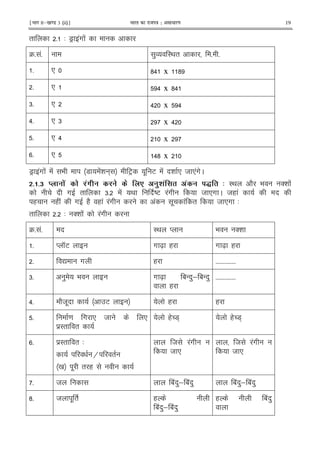
![20 THE GAZETTE OF INDIA : EXTRAORDINARY [PART II—SEC. 3(ii)]
# : 0B! ) 4
E < I< 2=7 !1! ! ! I< " & " ()* * )0
M 9 $I")" 8 *# 8 3 2 "2 # ( C
56 9 $I" I< '&
565 I< '& / = " 2 7F 8 *# 3
I< G :W 2 - < L 2
# E " 3 ( !
# E ; # 5 " 3 ( !
# E 3 ( !
565 I< * ) " ; EH 7 8 M 9 # ( (*C I< M
[X ! H9 !# G : 0 ) G : 9 .; A& $I" " I< 2 ;
!& ! (" )0 8 !: ! & DE ! , <
G " - & D " ! & I"A" M (2C " '" ( *!
()! # I< # !1! ! I< I< " 2 # I< #
27X 9 & *# C
5656 " '" @ 1! ) & I< M ) ! ! 7X !
% 82 28. I" & D " ! I< " G :W 2 G :W 8
& " ! !"#" G " ) M KE G :W $ "& "" ("
$% " 7 * 28. 2 $I" " = " ! !0 Q! 1 !E
* E12 & 8 (*C
#5 . 39:; ) ; A& > E ) 4
#5# . 39:; ) ; A > E ) 4
$ = H !1! " I< < " ! , "2 8 " (2 2
-(! G $ , I A"H ) " 8 " (2C "< ) I A " (")
* O '"#" M KE ! ('E G :W * E M H !& " M
I< 9 - 9 ! < 9 - # 8 !H # ! & 9
'& < 8 8 *C
5>5 & *! ) 4 M I< M H 1 7 8 M 9 .(
$I" ! * "2 8 " (2C 9 & D # ! * 9 .; A& M
8 $I" " 9 ! * $I")" * 8 *!# 8-(! # #
M E V 7X & ; & ! ) ) ( # C 9 .; A& M
)0 R 3 2 ( # < !# I< 2 < K 7X !
B 7X ! #$ =7 2 1 !H " ! & L & " c ( # C
5>56 !I< O 2Z # ( 2 .( I !
!1! " ! AG ! !0 M KE ! * AG $ " # E 0 ) G : ( # C](https://image.slidesharecdn.com/ubbl2016notified-250923161005-b0550c73/85/UBBL_2016_Notified_DDA-Building-Bye-laws-20-320.jpg)
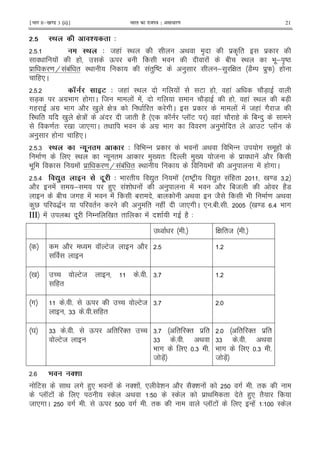
![22 THE GAZETTE OF INDIA : EXTRAORDINARY [PART II—SEC. 3(ii)]
"2 8 *# "< # 5 Q * -(! 3 I "2
8 *# C
# # S* .' * ! E .
'& ! ! 9 Y E ! 82 ! [X ! 2/ ! , ! ]E 2 I< "
2 ! I DE R & " ()* 2 9 9 9 # ! # < 9 #"
& " ()* 7 * < 9 " ! '& ! '& ! ! / " 8 *# C
# # JS* .' .' * ! E .
2'& ! ! 9 ! ! ) Q! 2 2 E Q! 9 & 8 *# C
* 2'& [X ! Y & 2 I Y 2 E ' 8E "< ]E
( (*C
# #2 .'* . * E . . 4
9 ) Q < #$ 9 # ) " 9 0 ) " $ 8'& !
-E E (" 8 ! 0 7X ! 2 - 0 ) Y E ! I< " * !
" R ! ( (*C
# #5 * S E . A 6 4
& '" 8 * 8 I< ! * ! - 9 9 ! ! 8( ! 9 & # 1
(" " = $ C
! !
# #Y CE & ( .' . & ! ! .B .' ( " 9 !7
#Q 60' .
$% 9 HM KE ! ()! * 8 H 8 82 " 1 #
# !H 7X ( (*C
) " E M ! ()! )0 8 $ !
) ( (*C
#[ @ * . . 0 . . ( 6. 0 ! .E '
T & !"#" 9 ! (") 8 !
9 " DEF 9 = ! (" ) T &
66 !"#" T * ! T ) G * - . " !
0 " ()* T * ! 8 ) G ! -(" ( (* 1& " -(! 1 51 5* 5 !
DE # ( C](https://image.slidesharecdn.com/ubbl2016notified-250923161005-b0550c73/85/UBBL_2016_Notified_DDA-Building-Bye-laws-22-320.jpg)
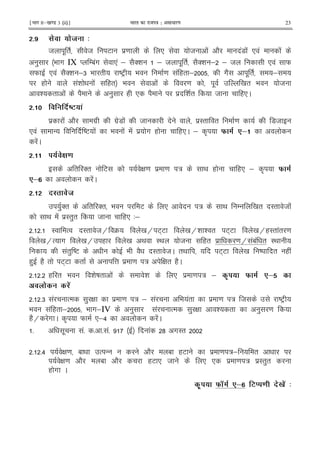
![24 THE GAZETTE OF INDIA : EXTRAORDINARY [PART II—SEC. 3(ii)]
5 5 # # #A( 9 # " ! @ 9 )#" C 1!
:HI ; % 2 G " . " 1! : * #* W K = ! ) $I")" *
8 *! 3
5 5 * I") H 9 !" , #8 1! :HI % " $ = :
8 * I , )'" 8 " (2 2 I ,
$ "(I" G 8 * C
* # " M KE ! 9 !"
! F P & 3) .B .' 4
5 5 ! 9 !" , #8 1! :HI % " $ = : 8 *
I , )'" # (2 2 I , $ "(I" G
8 * C
! F P & .B .' 4
5 5? G , , #8 1! :HI % " $ = : 8 *
I , )'" # (2 2 I , $ "(I" G 8 * C
! F P & .B .' 4
5 5 "(0 1 !E = 8 (2 " I G " . " 1! :
! F P & .B .' 4
5 5 Y " G : ! 0 =7 !0 5> W K
( ! 9 . #$(= A DE G $ @
$ = : C
5 5 2Z # 9 ! ! 8( J G " ( )0 W2'E G 2 $ .D =
!:= 1 7 I A " C
5 5 0 " 9 ! ! 8( J G " ( )0 IW E !: # ) 2
T & I A " C
5 5 6 $ = )0 8 HG : 8 ) 9 . #
!1! " 9 . #H #H I DE = G " ( C
5 5 > . ) M KE ) G : ! " (2 " %"
$ = H # 7+7 9 # @ $ = : 8( J 9 #. ( C
5 5 I I") 2 - & " ! W E ( : C](https://image.slidesharecdn.com/ubbl2016notified-250923161005-b0550c73/85/UBBL_2016_Notified_DDA-Building-Bye-laws-24-320.jpg)
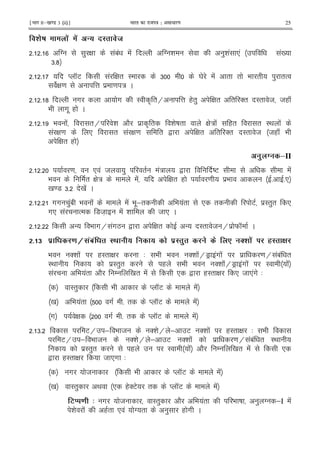
![26 THE GAZETTE OF INDIA : EXTRAORDINARY [PART II—SEC. 3(ii)]
# 5 3 . ( 6 '
9 = G ! ! % I< " T ) G G ! !!1! "
$ !Y ( ! ( " (2 2 ! / 0 " * * ! <
9 D " " G : < 9 !1 27X 2 QJ ! " ( ! ( " (2
" S H " I H I") H 9 !" H ! 9 !" 8 0 2 #"
* . 2 9 = E & " ( ! (2 3
" 9 ! 8 * " ! G = " ) "
& " ( " (2 V 7X M I" H " [X 2 .
/ " C
0 ) 3 V" 7 < V" 7 8 ! " ! 1 "
V" 9 & (2 C
# W& 7 * ! ) 3 W& 7 C
Y I M KE - 0 7X ! !E E 2 8
H0 2 1- C - / @ H 8
/ @ 0 ) " ( ! ( # C
75 # () !E ! %< ! 0 !9 ! 1 ! # H / " C
9 O '" 9 . # ! !5 5 "
27X ;& 27 = < ) = C
V !"#" < ) )!7 = < ) = 2
1 !7F K = < ) = C
8 W !# 8 ! ) QJ! " !
W K !# = 1& " W K !# # 9
$ E H1 V" R ! ( d 2
B ".W 1 " # # 9 . / < - $ A "
= G "#$I" 9 9 # ) = " 8
!I A" '& ) G " . Z < 1& " #
)0 8 $ ! )R ( C
e !" 9 8 = < ) = 1& " ( ;
!"#" " ( C
E M K E7 QJ ! Z 9 ! ]E
# * C 8 ! @ ) ()J * 1 " H $ "
I< H W' ) 3 $1! H ) 3 I< < -
! @ ) " ( # C
L 9 . A& !](https://image.slidesharecdn.com/ubbl2016notified-250923161005-b0550c73/85/UBBL_2016_Notified_DDA-Building-Bye-laws-26-320.jpg)
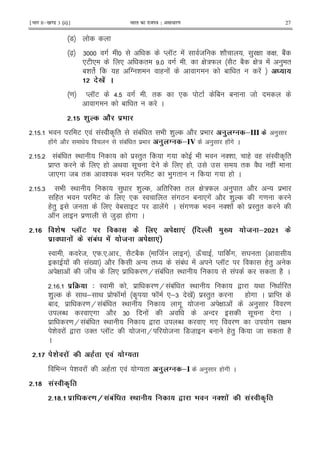
![28 THE GAZETTE OF INDIA : EXTRAORDINARY [PART II—SEC. 3(ii)]
5 ?5 5 9 9 '& 9 = $ ! )
9 = I A " $ = H !1! " I< $I")"
* 8 *!#H9 !I A " $ " $ = H !1! " I< 9
G " I" 8 ! $ M" 1 * ! 6 ! "
- < 6 ! - 8 9 ( ! DE 9 ! 9 -
P = ! * !I A " 8 # C
A W K 1 ; I 0 !
## [# # )V ! 8 " (2! " $ = H !1! " I<
I H I") H DE 9 9 - P = ! * 9 !"
2 6 ! DE 9 9 - P = ! * #
- - < 6 ! - 8 9 ( ! .
* . " # C
# [# A 6 E.' ! .' . : 9 ] /
5 ?5 5 9 '& I< ! " '" *8! ! 82
** H* * * 7 *W* ** = * ! 8 ) "
!: 7 .* * 7 * I A "H @ $ = :
& " (2 < " ) !1! " I< ,
- ) H @ $ = : & " ( " (2 " !1! " I<
!1! " *8! * I A " @ $ = : $ M" & "+
( 9 E $ # C ) H @ $ = : 1 ( *8! ,
! - 8 8 *# * 9 '&
$ = H !1! " I< , I A " 2 8 8 *# 81
" - < . " # ( C
5 ?5 5 * 9 1 ( *8! J & D G : 8( J I A "H @
$ = : G " (2 1 ! 8 < '& "2 !# C
G : ! 9 - " I DE * '& ! !# ; E7 1
8 *# 8 G : ! ! 9 ! , . 8 9 - & " !
" ( # C *8! J '& ! 1 E 2 I<
! 1 E < ! 7 !# C
6 4 EF 5 * 9 ! @ $ " (2
8 ! G : E - " (2!! C EF
5 ! :" G : * !# '& "2 # 8
1 E 2 * ! 9 I< ! < "+
# # ! # D V 1 7 9 " @
$ = 5 5 $ 5 1 E 7 # C
5 ?5 56 1 ( * ! $ 4 * "2 !# 8 !
G : ! !1! " = # ( # 8 * I A "H @](https://image.slidesharecdn.com/ubbl2016notified-250923161005-b0550c73/85/UBBL_2016_Notified_DDA-Building-Bye-laws-28-320.jpg)
![30 THE GAZETTE OF INDIA : EXTRAORDINARY [PART II—SEC. 3(ii)]
# 3 0 JH ) . X!
5 5 9 E G " ) 3 2 " & ) 9 )#" I" E
2 " M" ( " < * D * ) 3 2 " 8
" (2 C 0 @ &III 0 ! * ) 3 2 " $ M" *
/ 0 " I" 8 ! < #8 $I")" 8 *# 3;
. !I A" '& C
0 ) 3 2 " & ) 8 . E & ) 1 1 ( # C
# #A( "
Y / @ 8X ( 7 ( ! ) 3 2 " * 2
I" C
75 !I A " 2 - * #* = * I" 8
(
G G = $ = : = $ = H !1! "
I< , !I A" '& ) G = ! 8 (
(2 C
V . !I A " 1 + " I % ( * I % I" 8
#. ( C
5 5 ) 3 2 " (") ; : ( 8 *# C ) 3 2 " < @
( 1 ! ; : " < * ! 6 ! "
! . " 8 *# C
# 3 '6
$ = H !1! " I< $ ! !"#" 8 *
#* 9 E $ " !( = " (2 : 8
9 ) " " (2 ! % = < I" "< ! - "<
$I")" * #* ( C
# 2 ! . J !
5 65 $ = H !1! " I< * I< . N " 3
9 = 2 I !I A" '& * $ "
N ( # C
5 65 M !< I" " . ( . 3
I" I I") H 9 !" *H G *
$ W K ! !I A " $ " $ H !1! " I< . "](https://image.slidesharecdn.com/ubbl2016notified-250923161005-b0550c73/85/UBBL_2016_Notified_DDA-Building-Bye-laws-30-320.jpg)
![¹Hkkx IIµ[k.M 3 (ii)º Hkkjr dk jkti=k % vlk/kj.k 31
# " $ = H !1! " I< ( ) & "
!I A" 9 = '& ! 2 9 = )R (2 C
. E < ; < / 0 " I" 8 9 $I")" * 8 *! 3
AA W K ; 0 !
!8 A" I") H 9 !" * I % 2 $ = : $ " C
0 M KE G :W 2 2E12 !1! ! " M !< & 9
'& 8 I H I") H 9 !" H G , "+ (I" G " ( C
3) 4 # 5 " M KE ! 9 !" *
# 5 (
$ = H !1! " I< W K ; $ M" ( I< G = !#
2 I H I") H 9 !" H G @ ( 8 G =
( (2 . !# C ( $ = H !1! " I< * 1
( # * E $ M" - G = ! 2 @
( . I H I") H 9 !" H G !# C (
$ = H !1! " I< * 1 ( # * E $ M"
* ! ! G = ! 2 @ ( .
I H I") H 9 !" H G ! C $ = H !1! " I<
- @ H . $ M" ( ! ( " " I A" 8 *
C ( I H I") H 9 !" H G 8/ ( # ( ( ) & "
9 = )0 8 2 9 =
$ ! ) (2
AA W K ; 0 !
# Y ! ' .8 / ) . X!
5 5 9 O '" " 9 < 9 9 # 9 #
( ! # < - O '" 9 # ) " ( ! # 81 "
9 < 9 9 # 9 # ) " # ( C
$ = : 8 * / 0 " ! (2! 3
9 $ & ! ] !# C
0 2 'EF W E!# ( ! 8( J 2 'EF !# ( # C
# * & 2 2 Y ! M /1!# 2 W E!#C
Y * ! /1 M E
75 ! !" 2 1 ( W & !# * I" ( ! ( #
C](https://image.slidesharecdn.com/ubbl2016notified-250923161005-b0550c73/85/UBBL_2016_Notified_DDA-Building-Bye-laws-31-320.jpg)
![32 THE GAZETTE OF INDIA : EXTRAORDINARY [PART II—SEC. 3(ii)]
9 * ( 8 " # 8 < "+ 9 1 ( 8 2 0 7X J
( !# C 0 7X ! ! #$ # 8 " (2 " 0 7X ! ! & & #
( ! ( # C
# Y# 9 ! * 9 # $ = : 8 8 *# 8
- . " & " ! . " ( C "< !I A " 2Z" . !I A "
) ( # C 2Z" M" 1 '& # ) 3 2 ( # C
# Y#2 9 8 ! ! 82 #
#H* H7 *W* H8 * ! 8 H * * ;EF ! W K * ! 1
!IE & H ]E !IE & ) H @ $ = : & " ( "
$ = H !1! " I< ! ! ) H @ $ = :
$ M" ( 1 * ! 9 # $ = : 8 # C
# Y#5 .8 ' ! 4
I / 0 " . 1S G " I" 8 ! 2 '& ! < 9 #H
. $I")" # C
I % I8 8 ! $ "
0 $ = : * " < " ! 8X
( 7 / @ * I" $I")" 8 * C
# ! % ) G $ = : < I< 9 g "
! % 7F !# * 2E
AA W K *;> 0 !
Y # # " ! G = " < 9 " ) "% G = 2
T & , @ H ) $I")" 8 * G " ( C
75 " I< '& " $ " J K
!! '& * $ "
9 - = ! # 9 " W E " 9 . " (
0 8 C
V & ! 2 !8 = H 2 ! ( $ = : * $ " C
8 $ = : = H ) 3 = < 9 2 " " # 2 9 #$
$ * ! #$7 < - 2 I"A" & ! ) (2 2
!") DE (2 C
AA W K *;> 0 !
B 5 5G 5 5 P ! " & * 9
! ! G " ( ! 8 = #" 0 _5 (](https://image.slidesharecdn.com/ubbl2016notified-250923161005-b0550c73/85/UBBL_2016_Notified_DDA-Building-Bye-laws-32-320.jpg)
![34 THE GAZETTE OF INDIA : EXTRAORDINARY [PART II—SEC. 3(ii)]
0 ( 8 " (2 H 9 # $ = : # " "< $I")" $ M"
# (2 " " 8 *# 2 . ) 8 *# C
AA W K 7 ;6 0 !
# $# : 9 .* . . UT D 4
$ = H !1! " I< ( " (2 I H & !1! " . !
!H ! * ! ! !Y 9 ) " $ M" * # "
8 (2 < # " 8 V (2 " $ = H !1! " I< ,
& ! 9 $ = H !1! " I< ! . 1 (
8 *# I H 1! E" H 9 # RS #. . H ; H ! 2
! ) " '" 9 E $ " !( = 8 " (2 C
0 I") ++ ! ! I") D . " I") ++ , * #* A @
* IS " !1! ! . " 8 *# C
# $#2 & . 0U ! 4
: ] !^ 4 " ) " 2 ( 9 ! 2 & ! )
( $ = H !1! " I< , 9 = 2 G = *
9 I 9 = ; ) . 8/ )'"
( 8 *# 2 9 !Y ! . !"#" IS
8 *# C
#2 0 (
9 ) G " 9 8-(! 8 ) G * 0 " 8 *# #
8 *# H / " , ) IS 8 *# < < ( 8 *# 82
& () ( C I ( & I ( !# C
#2 S* ': . X!
9 " ! # # ! ! 9 '& !I A " *
0 @ &XII * #* & !5 7 H> H * 5H* 7 * H 1 -7!# *
' .H ! 65 5 2 & !5 7 H >H* 1 * ' .H ! ?5>5
) * $ 4 ( # C
#2 ! ) P 3> S* .' ': . X! & ! !&2 .B .'](https://image.slidesharecdn.com/ubbl2016notified-250923161005-b0550c73/85/UBBL_2016_Notified_DDA-Building-Bye-laws-34-320.jpg)
![36 THE GAZETTE OF INDIA : EXTRAORDINARY [PART II—SEC. 3(ii)]
) (" * ! T " , 1 2 = & )R ( ( & ) -
$9 ! 7F !# ! 2 I" 8 ! < !1! " I< $I")" 2
8 < ( !I A" 8 *# C "3 * O '" ! = & )R
* I< ! ! $ $ (") $" G ( ! 7X# C
"< < 17X M KE ! * 9 ) " $ $ " $ 1 * $
1 & " (2 C * aaO )# 1 9 bb ! 9 ! 8 0
!H8 0 " # = # A" # (2 " 9 E
$ $ " $ 1 8 C $ # = 9 '& ! !I A "
" $ 1 * # 8 " (2 8 = E * O )# 1 !
( ( " (2 C 8 aO )# 1 b ! & 12! ! & P=
E!# ! ) ( # C 5 5 5 5 5 $ 5 * 57 5* 5 5 7 5 .5*5 5
T & 2 E < #; # 12L ! ! # C
) 2 aO )# 1 + & !1! " 9 "< ! " ()*
8 0 " # = ; 2 !I A " $ $ " $ 1 "
1 # (2 8 )V 9 ! IE 8 9 H9 !7 # !H# ! 2 9 !
* ( 12L ! ! (2C
" '" aO )# 1 b 9 5 5 $ 5 I< !
< & 2 + # O 2 !I< 9 ! ) * 8 0
" # = ( # 2 8 0 " J "2 # 82
2 IE 8 9 !H9 !7 # H# * # (2 2 " + ) " $
) $= " # C ( 9 = ; $ & " < 6
( - 8 *# C
8 ) )%< & = * I< $ = = @"
& '" $% 8 9 . ) 8 Q8 82 H 8 ; <
L H - & DE $1! )0 "< (2! 8 = = $1! * = .
= 2 = 1 !1! ! (2 C * ( 9 =
$ $ * (2 ( = * ! 8 ) " !: , # #
9 - & " ! ) ) & " ! C
9 = G : 1 % 8 * )0 $ " (2 8 8 ) "
$9 " " (2 C 9 " 8 ) " $9 ! $ * $ " (2 2
= ) . 9 = * !" DEF R I A" ! ( (2
C " ! = * ! 8 ) " !: , DE = $9
$ = * 5 5 5*5*5 2 - $ & " $ & ! * # E
" G :W 1 5 .5*5 = 8 * = @" $ M"](https://image.slidesharecdn.com/ubbl2016notified-250923161005-b0550c73/85/UBBL_2016_Notified_DDA-Building-Bye-laws-36-320.jpg)
![38 THE GAZETTE OF INDIA : EXTRAORDINARY [PART II—SEC. 3(ii)]
65 9 '& ! ) * 8 0 " # =
65 5 9
65 5 5 M K E7 2 .( 9 ! ) * 8 0 "
# = " 65 ) ( # C
" 65 3 9 ! * 8 0
2 EF' M K E7 2 .(
=7 8 0 P=
1()" = U
M KE "
2
"
9 -
9 Q!
IE E ("
(
2
# M K E7 M E7 0
M KE
M E7
.(
(i) M K E7 ! * 51 58275 V 7X 9 M KE ! 8 ) "
; E 9 # (2!H & D G :H A" " K H# J 1 H" 7 * !
I" " 7 ) K J 2 I * ! 8585 .(H ) !:
J & (2! C
(ii) )0 8 ; ! " .( * 9 -
65 5 5 W IE E2F $ $ 3 M E7 2 .( 9 ! ) *
65 5 5 ) 8 0 " # = " W IE E2F $ $ / )
( # 3
ii 1()" 8 0 R ! # A" 9 ! * * I") H 9 !" ) T ;
) (" 2 T " & '" ! 8 *!# ( !1! " I<
G " I" 8 2 & ) < '& $I")" 1 '& $I")" # C
I H I") H 9 !" 9 '& I< !I A" (" (2 "
* T I") H 9 !" , 1 # 9 '& & ) 2 - G " I" 8 !
< !1! " I< $I")" ( # 2 I< ! -
9 E $ # C
iii = 8 0 R ! # A" 9 ! * 9 '& * T I") ,
"2 ( # 2 9 '& & ) 2 - G " I" 8 ! (" !1! " I<](https://image.slidesharecdn.com/ubbl2016notified-250923161005-b0550c73/85/UBBL_2016_Notified_DDA-Building-Bye-laws-38-320.jpg)
![40 THE GAZETTE OF INDIA : EXTRAORDINARY [PART II—SEC. 3(ii)]
2# 4 :3 . .E .'9 '> 8 .'98 . .' . E . B J 3VS
=7 8 0 P=
1()" = U
9 " !
7
G :W H "
G :
"
2
"
"
9 Q!
< # ()
7X
27X
- . " - . " - . " - . "
#$ IE 8
$ ! T
XIII 0 !
P= a b P= a b P= a0 b [
Q! ;
P= a0 b [
Q! ; U
= $ E * ! * ! E DEF 9 = ! (" )
65 5 5 HI * 1! $I")" # ( !1! " I< .
) " $ M" * 1 #$ IE 8 ) " E "" ( ! # C
65 5 56 W IE ;EF2 $ $ ; IE 8 9 !H 9 !7 # !H# ! ) *
W IE;EF !# * $= / ) ( # 3;
i A60 E . B R ! # A" 9 ! * * I") H 9 !" T " * !
8" ) T ;I ) ( !1! " I< G " I" 8 2
h ) < 'i $I")" 1 9 E 8 h '" ( # C
I H I") H 9 !" I< , 9 'i !I A" (" (2 "
( I< K # 2 I< ! 9
E $ # C
ii E . B R ! # A" 9 ! * 9 'i ! * T
I") H 9 !" , "2 ( 2 9 'i ! h ) 2 G " I" 8 !
< !1! " I< $I")" ( # C I< ! !
9 E $ # C
iii E . B R ! # A" 9 ! * 9 'i ! * T
I") H 9 !" , "2 ( 2 9 'i ! h ) 2 G " I" 8 !](https://image.slidesharecdn.com/ubbl2016notified-250923161005-b0550c73/85/UBBL_2016_Notified_DDA-Building-Bye-laws-40-320.jpg)
![42 THE GAZETTE OF INDIA : EXTRAORDINARY [PART II—SEC. 3(ii)]
2#2 4 Y 8# # . C J 8 # . ( ./F %A #
!# # . * .'
45 !5 = h "!
5 $ A " $ A " $= E 2 E E 1! .
0 8 *# 1 1( ) i "
* 2 M" ( (* C
5 8 ! G = ; D
8 !#$(= 2
9 .;8 ) 9 =
* D !#$(= 8 78 & "
(2 8 ! ) 9 = V $ !H1 # E " G :
* 8 *# C D !#$( " 8
Y . c ! ) 3 # * E2! ! E+L
(*C ( 1 * A< E! 2
O I< , 8 *# " ( 8 . "
8 ! C " '" !#$( " ()*
1 " 8 W O I< 1
, ! E+ .112 1 8 7X
(*C
0 7!8 G : 0 ) I< $ "i " <
( # C
65 L i jE
$1!
i jE A< ' = * 9 . #; # #
2 .0 1- N * 8 (* C
>5 Q8 8 I< ! * 5 57 H 2 E! # 8
(* C
5 ) #)= %"
* ! h
= 2 . )! 2 .7 E <
! 82 I4 1! # 8 *# ! I<
" 2 #$ EF ! * M IE H "
! # 8 (* C
7 58 5 2E # # ( 9
5 . ( C ( 5
. (2 " 9 6 5
L 8 (* C
5 ( " $ " ? #5 5 9 . * 7 #
8 *# 2 0 9 8 *# C + i
* Z 7X ! 9 8 *# C 7X ! I<
$8 " ! # " 8 (* C
8( ! 7 ! E i " ( " 36 ) "
7 E 6 7X # 1! <
$ " . 7X # * 8 *!# * 7X ! 0 0
8 *# C](https://image.slidesharecdn.com/ubbl2016notified-250923161005-b0550c73/85/UBBL_2016_Notified_DDA-Building-Bye-laws-42-320.jpg)
![¹Hkkx IIµ[k.M 3 (ii)º Hkkjr dk jkti=k % vlk/kj.k 43
^ 2#54 8 # . J Y 8 # ( ./ .
` .'
X# '# O ! ! ! ` .'
5 $ A " $ A " $= E 2 E E
1! . 0 8 *# 1 1(
) i " * 2 M"
( (* C
5 8 ! G = ;1 " 8
!#$(= 2 9 .8
) 9 =
( ! 1 " 8 !#$(= 8 1
i " (2 8( ! 8 1 - . " > #5
5 9 . * ! N ( # C 8( ! 9 !9 (
1 " 8 8 1 8 7X 8 *
2 8 ( " I<
1 1! ) 8 7X 8 * $ A " 8
! Z ( < h ( 1 "
8 8 7X 8 * C
5 0 7!8 G : 0 ) I< $ "i "
< ( # C
65 L i jE $1! i jE A< ' = * 9 . #; #
# 2 .0 1- N * 8 (* C
> Q8 8 I< ! * 5 57 H 2 E! #
8 (* C
>5 = Q8 I: " 82 $ i E
< !7 < ( 1$7 % - ()
18 8 7X #* $ )'" 9 - . " $ "i "
N 8 * C
> 0 * ! = Q8 !: $ !
) > O '" ! * E - . "
G " KE ( E # * 8 (* C
> # ] *i 1$' #3 "/1
. 2 < !i "
$ ! ) ] *i = !
9 #$ RM ! # 8 (*C
5 ) #)= %" * ! h = 2 . )! 2 .7 E
< ! 82 I4 1! #
8 *# ! I< " 2 #$ EF !
* M IE H " ! #
8 (* C](https://image.slidesharecdn.com/ubbl2016notified-250923161005-b0550c73/85/UBBL_2016_Notified_DDA-Building-Bye-laws-43-320.jpg)
![44 THE GAZETTE OF INDIA : EXTRAORDINARY [PART II—SEC. 3(ii)]
2#Y4 Y 8 # . J Y 8 # ( ./ .
` .'
X# '# ! ! ! ` .'
5 $ A " $ A " $= E 2 E E
1! . 0 8 *# 1 1(
) i " * 2 M"
( (* C
5 8 ! G = ;1 " 8
!#$(= 2 9 .8
) 9 =
( ! 1 " 8 !#$(= 8 1
i " (2 8( ! 8 1 - . " > #5
5 9 . * ! N ( # C 8( ! 9 !9 (
1 " 8 8 1 8 7X 8 *
2 8 ( " I<
1 1! ) 8 7X 8 * $ A "
8 ! Z ( < h (
1 " 8 8 7X 8 * C
5 0 7!8 G : 0 ) I< $ "i "
< ( # C
5 0 G $ ) 1 9 .8 ( !
8 *# C
5 # = ! 8 #
8 * C
5 Y 8 !#$(= 1[X * ]
W' 2 2- # 8 * C
5 75 ( M /1!# IE # #$ 2 N 2
KE # * 8 *! C
65 L i jE $1! i jE A< ' = * 9 .
#; # # 2 .0 1- N *
8 (* C
65 9 K ;1 K 7#$71 i jE $ A"
) 3 4= ) ) 8 * 8
* $ A" ) 3 4= < 0 "
E ; 8 * C
65 0 - . " 56 HE !EH G "
# IE / IE H E # *
8 (* 81 * E 7X I 8
0 ! 1 * # 8 * 8
# I 8 * < $ A"
) 3 4= ) ) 8 * C 8
* $ A" ) 3 4= < 0 "
E ; 8 * C](https://image.slidesharecdn.com/ubbl2016notified-250923161005-b0550c73/85/UBBL_2016_Notified_DDA-Building-Bye-laws-44-320.jpg)
![¹Hkkx IIµ[k.M 3 (ii)º Hkkjr dk jkti=k % vlk/kj.k 45
>5 Q8 8 I< ! * 5 57 H 2 E! #
8 (* C
>5 = Q8 I: " 82 $ i E
< !7 < ( 1$7 % - ()
18 8 7X #* $ )'" 9 - . " $ "i "
N 8 * C
>5 0 * ! = Q8 !: $ !
) > O '" ! * E - . "
G " KE ( E # * 8 (* C
>5 # ] *i 1$' #3 "/1
. 2 < !i "
$ ! ) ] *i = !
9 #$ RM ! # 8 (*C
>5 Y 9 ! G 2 78 8 ! I") %
78 # (2 = , * A"
/ #" 48 ; G = ! 82
2 'EF / + !0 E!# W' 2
- = 8 ! G 78 "% 82
9 *!Ei 9 .i ! G 9 =
0 7X ! )'" O I 78 ,
$ i ! 1[X " 2 < K #
48 0 " ! ( # C
>5 75 48 G " N . 9 " 48 ! G =
9 = ! (" 1 ! <
!I")" ) =7 ! 9 $
9 ! * " ()* 9 !
% i " ! * ! ! )'"
O I< 8 * 8 Q8 $= "
# ( 8 * i jE -7 =
1 " (2 C
5 ) #)= %" * ! h = 2 . )! 2 .7 E
< ! 82 I4 1! #
8 *# ! I< " 2 #$ EF !
* M IE H " ! #
8 (* C
5 7 58 5 2E # # (
9 5 . ( C
( 5 . (2 "
9 6 5 L 8 (* C
5 ( " $ " ? #5 5 9 . * 7
# 8 *# 2 0 9 8 *# C
+ i * Z 7X ! 9](https://image.slidesharecdn.com/ubbl2016notified-250923161005-b0550c73/85/UBBL_2016_Notified_DDA-Building-Bye-laws-45-320.jpg)
![46 THE GAZETTE OF INDIA : EXTRAORDINARY [PART II—SEC. 3(ii)]
8 *# C 7X ! I< $8 " ! #
" 8 (* C
5 8( ! 7 ! E i " ( " 36
) " 7 E 6 7X #
1! < $ " . 7X # * 8 *!# *
7X ! 0 0 8 *# C
5 8 !i M !E $ "i " i jE 8 !i G "
8 EF E !E M !E # 8 *# ! !i "
8 1# ! ! 2 ] i !# *
) 3 4" 8 * C
?5 = $1! 8 = ! 82 8 EF E !E
M !E 9 . Ai ! 1 " 8 !#$(= =
(") 12 ; ! = #
L i`jE $1! 2 2 * ! Q8 ! G =
9 j " ! 8/ =
# " , 8 0 8 *! C](https://image.slidesharecdn.com/ubbl2016notified-250923161005-b0550c73/85/UBBL_2016_Notified_DDA-Building-Bye-laws-46-320.jpg)
![48 THE GAZETTE OF INDIA : EXTRAORDINARY [PART II—SEC. 3(ii)]
Y 5 I") H 9 !" * 9 78 1 *# C
3) 4 I") H 9 !" * T " * ! (" * ) T I 0 !C
75 = J j ! . ( # C = J j ! . ( ! ( "
(2 " ) 2 " (") ) 3 ) = h ) 9 )#" ( # C
5 HI 9 = H9 ! 0 7X ( ! % ) G
( ) * ! - G " !1! " $ = H !1! " I<
G " . " # C
V5 = . ( I I") H 9 !" * , "+ (I" G "
7F !# !H 'i ! < !" ! * #*
$ : ! = . ( . 1 ! " G :
$ = H !1! " I< . " ( # C i "+ HI
9 H9 " H9 # 9 # $ !9 " (2 C
85 I" 8 $I")" " G = H8 J ( ! 8 *# C
B5 " ) j 8 !#$(= i (2 C
e5 "3 7X 27X M KE $9 " ( I< " ! 9 )9 # I<
G = # C](https://image.slidesharecdn.com/ubbl2016notified-250923161005-b0550c73/85/UBBL_2016_Notified_DDA-Building-Bye-laws-48-320.jpg)
![50 THE GAZETTE OF INDIA : EXTRAORDINARY [PART II—SEC. 3(ii)]
E ! % 9 ! : 78 H !7 ! ) i " * 9
= G = ! 8 *# C
L 2!H( ! j = . ( ! " H" (.JH" (2! 2 = . (
. ( ! " H" (.JH" (2! " 1[X *H # * = *
!1! " $ = H !1! " I< , < i * 1 ) 3 9 )#"
RJ# H# H !# C
7 2!H( ) T ; I ! 0 " T i ! *! " ()* = #)= %"
* ! = ! % I< % . 8/ " H" (.JH" (2!C
[5 2!H( = . ( aa < "aa 'i ! (I ! - ! 2 I<
W E #$ W < = . ( . # # .!# H# H !# C
! T 3 )'" ) ! 3 555555555555555555555555
I I ! (I" G # ( ! (I" G
2 " H " 2 " H "
'B! '
/
6 . .
2!H( 555555555555555555555555555555555555555555555555 ):H ): 55555555555555555555555555555555555555555555555555555555555555555555555
555555555555555555555555555555555555555555555555555555555555 *" +, . " " H" (.JH" (2! * #*
= ) 1 9 = . ( ) (2C
M KE G :W 3 55555555555555555555555555555555555555555555555
" 3 555555555555555555555555555555555555555555555555
0 2! *" +, 'i !H7F !# ! E W E #$ W ?aax >aa
;? !0 ! $I")"
( H ( (.J 8 $ " ! ) I ! 2 I") H 9 !" *
, "+ (I" G " (2 C 82 ! ) T ; I ! 9 j " (2 C
# " '" ! % 9 !" , "+ (I" G " ! %
I< % $ = : A W *;> 0 ! ! T (2 C
Y 2 9 = !Y 9 9 9 # = ( !
(2 C $ = H !1! " I< 9 A" = 2
)0 8 $ ! ! " " (2 " 8) # 8 " (2 C
# 8 " (2 2 2! $ = H !1! " I< = .!# H#
C
! 3 555555555555555555555555555555
I ! (I" G H * ! "
5 55555555555555555555555555555555555555555555
5 55555555555555555555555555555555555555555555](https://image.slidesharecdn.com/ubbl2016notified-250923161005-b0550c73/85/UBBL_2016_Notified_DDA-Building-Bye-laws-50-320.jpg)
![52 THE GAZETTE OF INDIA : EXTRAORDINARY [PART II—SEC. 3(ii)]
! !
L "! !
5 $ = , . " 3
! $ . )
$ # " ()* $ = ! . " "
(2 C
5 i j G : A" " K ! 2 # ! ! * 9 = 3
5 5 !0 *W56 ? ?H* 5 5H E , . " i j G : A"
" K ! 2 # J ! * 9 =
http://dda.org.in/tendernoticesdocs/april11/gazette%20of%20india1%20april%2
0201197.pdf
56 ) * * ! i i 3
5 5 ?6 !0 *W5 H* 5 5 ! $2 , . "
Z 8" 2Z # G : ! ) (") * ! i i C
http://dda.org.in/tendernotices_docs/april11/gazette%20of%20india1%20april%
202011683.pdf
5> W ( ! 3
5 5 [ !0 *W56 6 H* 5 5] ! 6 '".1 , . "
! W ( ! 3
http://dda.org.in/tendernotices_docs/nov12/2/502622_30102012farmhouse.pdf
5 12!' E ( K ! ) " 3
5 5 ! "/1 , . " 3
http://dda.org.in/tendernotices_docs/oct12//banquet%20hall-291012.pdf
EM = 3 9 " H 5 5 $ 5 , . " ; !i h "
(2 C !i "H = H ! $ . ! 9 C
)'% " '" * 9 ; . " * 8 " (2! C
9 ! C](https://image.slidesharecdn.com/ubbl2016notified-250923161005-b0550c73/85/UBBL_2016_Notified_DDA-Building-Bye-laws-52-320.jpg)
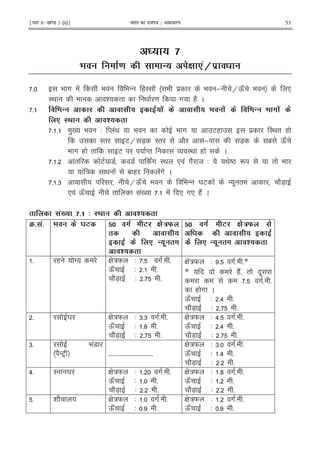
![54 THE GAZETTE OF INDIA : EXTRAORDINARY [PART II—SEC. 3(ii)]
27X 3 5 5 27X 3 5 5
5 I #A( * !
h 2 !
* <
G :W 3 5? #5 5
QJ 3 5 5
27X 3 5 5
G :W 3 5? #5 5
QJ 3 5 5
27X 3 5 5
5 9 =7 = G 9 =7 = G :W (
T 5 #5 5
2 - . "
QJ 5 5
( (* C
9 =7 = G G :W (
T 5 #5 5
2 - . " QJ 5 5
( (* C
?5 [X () V8
i 7H 1 7
M KE 9 " 5 5 " 27X ) "
8 *# C M KE 1 ( 9 $
V8 ) " ( ! ( # C
5 #2 8 ) ( (") #2 8 3
1x2 5
G :W 3 >5 #5 5
QJ 3 5 5
27X 3 5> 5
5 QJ
9 ! *
# H
K 7
27X 3 5 5 27X 3 5 * 5
5 8 (
T !
Y
I Y
h 2
27X 3 5 5
QJ 3 5 5
27X 3 5 5
QJ 3 5 5
27X 3 5 5
QJ 3 5 5
27X 3 5 5
QJ 3 5 5
5 [X !H
QJ 9
*
27X 3 5 5 27X 3 5 * 5
65 1 5> 5 #( "
EM = ! 3
5 1i " 9 1 - . " I jE h j !" (27 5> E ( ! ( #
C
5 Q " ! 0 " 9 9 $ Y E ! " " I" V"
"( " ) " QJ >? E ( C "<
I") H 9 !" * 8 ! 9 Y E QJ >5? E
0 (" (2 " 9 H ! ) ) QJ " h "
) " 8 " (2 C
65 .( ! 9 0 ) I< ( ! ( 1 ( $
= ( ! 8 *# 2 Q 0 ) ( !# '" 0 ) I<](https://image.slidesharecdn.com/ubbl2016notified-250923161005-b0550c73/85/UBBL_2016_Notified_DDA-Building-Bye-laws-54-320.jpg)
![¹Hkkx IIµ[k.M 3 (ii)º Hkkjr dk jkti=k % vlk/kj.k 55
V < 7X 5 5 27X ( ! V 7X (2!#
< $ 8'E ( ! ( # 8 G " - . " 27X ( C Ai " "
I" 5 5 QJ * $ 8'i ) " ( ! ( # C
>5 I") % i j " *! *! 9 . Ai ! 3 Q# Q# J Q# Q# .B .'
* QJ 9 ! * [X ! 2 K 7 I" 0 !7 ?5>56 2 ?5>5? ! 1" *
) ( # C
** QJ 9 ! ! 28. " ! " '" Q 1 ! [X !
27X 9 = ?6 ) 5 5 0 8 *# Q " ! *
9 [X ! 27X 5 5 ( 0 8 *# C
5 "! "! *! '
Q# # .DH 4 $% 8 $ # Y R ! ( # ! d
5 2-EF # ( Y 1" W I< 8 *# 8
< ! 8 #$!E7 EF2 'i 8)7X ( # C
0 5 ' Wi
#5 * 0 7X 8 5 #5 5 ( ] * ! 9 #
8 9 ( ( (* 2 9 " 1 (+ 0 ) I< 0 ) (*d
!") h ]E i ) ! ( ! ( ! 0 ) (* C
Y 5 E QJ 9 ! ! : ] .8 h .E
5 5 : H ' ` J ! 4 $% I Y <
5 h 2 $ 1 ( # * 1 ( h ]E i , ) !
( 0 ) " ( 2 ! 0 7X i R ! 56 #5 5 " *
0 ) I< ( (* C
0 5 E 12L I< 8 #$ 1 ( C
#5 $9 " ( Wi 8 8 * " W " R [
( 2 ( 1 . " W [X ( ! ( # C
Y 5 h 2 W 0 * ( $ # 8 *# C
75 $% h 2 H .: ! ! M" G " $G E! ( (* C
5 V" * h 2 8 " QJ 5 5 ( # 2 G :W > #5 5
( # h " ) ( # 2 9 QJ 2 *W5*5 5 ! ( ! #
8 *# C
V5 9 8 # $= 8)7X ( !# C 8( ! $
O I< ( ! (2 ( J M KE i " )R ME E2! 2 E ( #
C
85 " $ A " H i , ) ! * ! W h " 9
IE E 2 "(0 ! * h 2 ) " ( # 1i " > #5
5 ( 2 *W5*5 5 ! ( ! # 8 *# C](https://image.slidesharecdn.com/ubbl2016notified-250923161005-b0550c73/85/UBBL_2016_Notified_DDA-Building-Bye-laws-55-320.jpg)
![56 THE GAZETTE OF INDIA : EXTRAORDINARY [PART II—SEC. 3(ii)]
5 56 .E
8( J 8 " ( # *W5*5 5 ! # 8 *# 2 - . " QJ 5
E " E+E "( 1 ( # C
5 5> A J J . % !
5 5>5 A 4
i. M K E7 (") 3 M KE ! " 5 5 27X
1 ( # C *W5*5 5 ! ( ! # 8 *# C ) 0 ) G : > $ "i "
( [X 1 ) " ( # C
ii. .( (") 3 Y (" 9 ! * " 5 5 27X 1
#H[X () ) " ( # ' ! 1i " ! #
1 " ( 2 ( M KE ! ( C *W5*5 5 ! ( ! # 8 *# C 5
E 27X 1 1[X ()* 9 # *W5*5 5 # ( # C
iii. " 65 E QJ 5 # E " G :W - . " #) QJ
0 ) E ) " ( # C *W5*5 5 # ( # C
5 5>5 0'>. 4 % ! ) P 3> 6. 0
* ! 8 9 ! ! $% # # N K ! * $ )!7
) " ( # C * ! 8 9 ! 9 ." HQ "
$ i , )!7 ) " ( # C 2E12 H 2E12 ! ! )!7 (
5 k!E 2E12 6 5 (2 " " #( 5> 5 ( # C
0 5 k!E 2E12 5 (2 " " #( 6 5 ( # C
i- 7 2E12 6 5 (2 " " #( 5> 5 ( # C
ii- 7 2E12 5 (2 " " #( 6 5 ( # C
EM = 3 !1! " 2E12 - . " 6 % G : 0 ) 0 8 *# C
5 5>5 0'>. 9 . 4 - 9 # 9 ! ! ; 5>5 0 ! C
8( J * < )!7 !H G :W ) " *W5*5 5 6%
( ! ( # 2 $% )!7 H " = ?5 5 x 5 ( # C (
)!7 H T i ) h " ( # C )!7 H
G :W *W5*5 5 2 " 8 ! ( ! # 8 *# C
5 5 3 % PK3
9 ! * ! ) ! ! E ) " ( # C * E G :W
!1! " " 7 * % " ( # C E 2 V" 1 "
QJ 5 5 ( # 2 E 8#( QJ 9 = !
E QJ * < " QJ ( # C
5 5 C7 D 4](https://image.slidesharecdn.com/ubbl2016notified-250923161005-b0550c73/85/UBBL_2016_Notified_DDA-Building-Bye-laws-56-320.jpg)
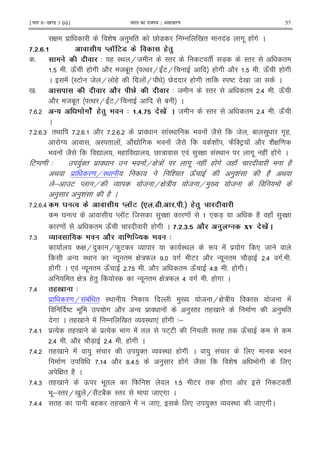
![58 THE GAZETTE OF INDIA : EXTRAORDINARY [PART II—SEC. 3(ii)]
5>5 "(0 ! 2 Wi 8 ( !# "< $ 1 * " =
2 $9 7 2 2 (2 " 'i 1 "
! 0 8 * "< (" 0 * M" * 8 *! C
5>5 "(0 ! 8 I" 9 ! 8 )0 2 2 [X ! #
( # C 9 ! 9 (" ! ]E # 8 " (2 " "(0
! 8 * 9 # 8 " (2 C Q#5# .B .'
5>5 8 M KE ! I , $ = H !1! " I< I< ! %"
( G " !1! ! * G " . " 1! h " "(0 ) "
( # C
5>5? $ = H !1! " I< , "(0 9 '" ) "
8 " (2 " 9 =7 ! 3 # 5 ( ! ( # C 9 =7
# )R " '" - $ # * 9 8 5 # 5
( ! ( (* C * ! $% 9 = ,
" ) ! O I< ( # C
5>5 "(0 $ # !# Y . 9 =7 * ! ! ! * 8 " (2 "
*W5*5 5 ! ( ! # 8 (* C
5>5 "(0 ]E 9 !# ) " 8 " (2 C
9 ! .( V 7X d 2/ ( ! (2 C "<
9 ! " " 6 # 5 M KE ! * 2/ (2 C
5>5 5 )5 5 ) "(0 $ # Y . - I") ! 9 =7 =
i #$ 7 R IEF !# R 12! " G )I" IEF2 R
)I" ! [ 0 G " ) . = ! 2 9 * #
I")*! * 8 " (2 C
Q#Y 6. 0 .( ' 4
/ 0 " - G *! #. ( !# 3;
5 5 )j ( * 1 ! $% 9 ! # - " !
! ) G " * M" O I< ( # C
5 5 8 9 - 8 " $ # * ( ! (2 V 7X $% 9
! ! 9 # - . " G ! 8 *# C
5 56 9 # 1 ( !# C
5 5> 9 9 ! " ( ! 8 *# 8 G " ! !0 27X
9 # ! ( C
5 5 " ()J I" I jE 0 "< !1! " ! 8 # ! *
I jE R -(+" ( !# 2 i IE # * 8 *!# C
5 5 9 ! M" i O I< ( # C](https://image.slidesharecdn.com/ubbl2016notified-250923161005-b0550c73/85/UBBL_2016_Notified_DDA-Building-Bye-laws-58-320.jpg)
![¹Hkkx IIµ[k.M 3 (ii)º Hkkjr dk jkti=k % vlk/kj.k 59
5 5 8( ! T i = ! O I< # (2 ( ! !: " I< ( !# 2
I jE R -(+" ( !# !") ! 1 ( ! ( !# "< # ! !
" W I< I jE ! " ( # C
5 5? 8( ! G " ( ( ! 8 = # 8 *!# 8 !1! " 9 #
# C
5 5 9 # # 8 1 ( 0 ) I< ! 9 1 ( 9 # ! 8
* # " I" R ! 1 ( !# C
5 5 $ 1 ( !# " ()! * . ! (
8 7X C
5 5 '8 .' . 4
5 5 # !" [X ! 1 ( [X ! 8 8 1
8 I" ( " (2! 2 H - 9 V" # ! 8 [X
1 2 E2 ( " (2! C # ! QJ 9 !
8 G 2 "8 9 ( # C
5 5 ]E !H*I E ! 2 4, ! !# 7 # ! R ! ( !
8 *# C
5 8 .' 'B! J
9 - # ! !0 2 $% 2 " ! ( !
!0 G " I< . "< 9 ! QJ
( !# C
5?5 8 .' M! :; 4
5?5 1 8 V7X O I< 9 ! ! # ! = * I<
( # 8 " ()J . " ?5 ! # . ( ! ( # C
5?5 # K 7 ! " [# .B .' " . Q
0 " . ( ! ( # C !I< 2 * !1 9 #
V 7X 8 ! ( . 5 5 ( ! ( # C
5?56 9 I< < " * *
i " (2 " 8( ! " !9 ( , * ; . .
( (* 2 G :W 9 # i ! ! ()! * ( !#
C
5 (
5 5 27 O '" ! ) G " * [X ! 2/
8 G " i !0 " 5 ! # (2 C](https://image.slidesharecdn.com/ubbl2016notified-250923161005-b0550c73/85/UBBL_2016_Notified_DDA-Building-Bye-laws-59-320.jpg)
![60 THE GAZETTE OF INDIA : EXTRAORDINARY [PART II—SEC. 3(ii)]
'B! Q#
$% 27X ! 9 # ! !0
X
'B!
.8
6
. 8! .' 'B!
I?! ' JO E.
5
5 h 2G =
65 !I<
>5 * /1 >
5 O
5 =
5 2Z #
?5 9 =7 =
5 0 " 6 >
" 56 9 # ! !0
X
'B!
.8 6 . 8! .' 'B! M! S
8 3 ( ./F
5 5
5 h 2G = >
65 !I< EM = 0 !
>5 * /1
5 W' 0 ) E 2
7 ! ] ("
0 5 9 8 G (" 12L
(" ) *!
5 EM = 0 !
5 EM = 0 !
5 =
5 IEF E ] * ! 4
"(0
0 5 4 "
6
5 O * ! 2Z #
5 9 =7 = 6
?5 0 "
EM = 3
5 AS P ! < ! # 0 % ! 8( ! I< O I< ( " (2 ( !
9 # ! G " #= $ " O '" 5 # E G :W ( !
8 *# C](https://image.slidesharecdn.com/ubbl2016notified-250923161005-b0550c73/85/UBBL_2016_Notified_DDA-Building-Bye-laws-60-320.jpg)
![¹Hkkx IIµ[k.M 3 (ii)º Hkkjr dk jkti=k % vlk/kj.k 61
5 ) " G :W ! )0 * /1 G I< " '" ! 8 <
Q ! 8 ! 8 7X G I< 8( ! * G !
I< ! ! 8 $ i , ( * ! * /1 I< ( #
" ( ! 9 h ( !# C # ! ! < 9 8 ! (") ) G :W !
E 2" ( ! 8 *# C G :W ! * /1 (") # ( G :
G :W h ( # C
5 I?! .' *!
5 5 9 ! [X ! !0 = 9 # ! !0 . ! "
( # C 9 = 5? !"#" -(+" 9 ! !1! !
[X ! h " ( # 1i " * [X . " * ! - i "
* $ # 8 * 2 . [X $ # # 1 * ( C
5 5 * #* 9 9 ! ! [X ! ( !# 3
5 5 < QJ 9 2
0 5 9 " # 5 " G :W 9 O
h 2G = 9 # !I< 2Z # 9 =7 = 0 " 9 # 2 P"
9 # R ! $ # * 8 ( 9 ( QJ " 9 ( C
5 56 (27 E2! G = * 9 $ 0 ) I< [X 27
N (2 C
5 I? . a ! .' :
5 !" [X ! . " ( ( i #$ 1 8 *# C
0 5 !" [X ! ! .= R ! 1 8 *# 2 ! T (2
" QJ 9 ! i ! ) ! O I< ( # C
#5 [X ]E h ]E ! ( ! 1 8 *!# C
Y 5 0 0 ( = ) " ( ! ( # C
75 !" [X - . " 27X 9 = !0 5 5 ) ( # C
5 QJ 9 ! !" [X * 1 8!# EF7+ - . " 27X 5
5 ( # C ## )!1 (" - 9 ! ! - . " EF7 6 5 5
( # C EF7 $ 1 8 *!# 2 0 ; 0 8 *# W
C 9 ! ! !7 ) " ( # C 1i " 8 [X
Q ( C
V5 QJ 9 ! ! 8 " QJ !E E ## )!1 ("
- 9 ! ! 8 " QJ !E E ( # 2 $ " [X
8 ! " !0 $ " [X ( # C
85 27 1 5 5 - . " (2!7 ( # 2 ( h " ( #
8!# V7!H !# [X ! 27X ( C
B5 [X ! " I" 2 [X (7R - . " 5 5 ( # C](https://image.slidesharecdn.com/ubbl2016notified-250923161005-b0550c73/85/UBBL_2016_Notified_DDA-Building-Bye-laws-61-320.jpg)
![62 THE GAZETTE OF INDIA : EXTRAORDINARY [PART II—SEC. 3(ii)]
e5 5 < QJ 9 ! ! )0 [X ! I" Y =E " T
$ " T 8 ( 8 *# C 9 !
( E H " ( E ! V 7X * 8 ( $ " G " * Y !E (
" (2 C
E5 .( ! ( I< 9 =7 # # 8 0 G
[X [X ! ! ( ! 0 ) !# C
L5 9 .;I" ! T [X ! 1 ( , 0 ) I< " W 0 ) #
# K1 * # * #* 8 V 7X - 8 (
1 0 ) I< " ()! 8 C
75 )0 [X ! 2 # ) G " [X ! 9 ." E "
# " ( (* C
[5 [X ! 1 9 18 h ]E H*5 5 7'EH #2 ( !
8 *# C "< 7 'E!# Y !E T $ " G " (2 " [X ! 7 'E!#
) " ( # C
= 5 [X ! 2! 7!# ]E ( ! # 5 " QJ M E7
7 !E V 7X 0 ) # C M" ]E K1 9 ( # C %B > [#5#5 J
0 @ VIII .B .'
"5 [X ! 8 E *H K 2 !# * 9 ( #$ $ # ( !
8 *# C
< 5 1 H K - 9 i j " ! [X (7R H [X 27X ( !
( # C
5 1 # 1" " -(+ Wi " "
QJ # * 8 *!# 2 K 7 E 8)7X () 18 i H
H] !E $ i " ( !# C 9 # -(+ ! (*
2 $ 1 ( (* W . 9 = ! 8
= ! ! : ) ( C " '" 9 " !
) " ! !0 i 1 7 !0 ! " ( # C " ! " 1 7
[X * " I< 1 8#(
# ( # C ( 5 x 5 5 ( ! ( # C
5 O '"#" ! 8 ! [X ! I jE" ! " ( # C
5 * : [X ( I< " ! ( 9 ." M" ( # "< "(0 ! 8
* . [X 1 8 *# C "< . [X "(0 " 8 *# 1i " (
9 .;" ) ! " K1 8 7I 8 1! ) ( !# #; #
( # C
5 *W5*5 5 2 #$ =7 8 I" * 5 0 ! C](https://image.slidesharecdn.com/ubbl2016notified-250923161005-b0550c73/85/UBBL_2016_Notified_DDA-Building-Bye-laws-62-320.jpg)
![¹Hkkx IIµ[k.M 3 (ii)º Hkkjr dk jkti=k % vlk/kj.k 63
0 I?! ' %F ! : .
i Y ) [X ! $ # 9 # 9 2 5 QJ 9 "
" ( # C
ii Y ) W *I 5 5 O ( ! ( # 2 78 $
( (* M" (7R ( C
5 5 [X ! * - . " 27X $
$% [X ! * / 0 " - . " 27X $ 8 *# 3;
5 - 9 82 ] 2E ! V : ! .( " < #A( ! *
- " 56 E = * 0 ! C
0 5 * /1 9 ! 2 !I< 9 ; 5 *
#5 ( E ! * ! & 2G = 9 (" - 9 ! * 5 5
Y 5 ## !)1 9 ! * " !0 ?5 0 ! C
5 5 I"H# * - . " 27X $ (!7 2 8!# V 7X
I DE 27X
K 7 H I"H $ DL 27X 82 9 ( = $ ( #
" . 8 !0 * O I< ( C 9 # P= & " - . " 27X
( # 8 / 0 " (2
5 9 ! 9 * 9 (") 2
( 9 (") 5
0 5 9 ! 82 V : .( ! * 9 * 56 2
( 9 * 5?
#5 * /1 9 82 K 8E < E 2 * 5
Y 5 9 - 9 82 O !I< 2 ( E ! ! * 9 * 5
2 ( 9 * 5?
75 I " !# ( ! * ( 9 * 5>
5 2/ ; 9 - $ 9 ! ? 0 0 !7 ?5 5 #.
V5 8( ! K 7 2 I" [X " ( ( ! I" 2 K 7 ! 5>
( ! ( # C
85 [X ! ]E K1 2 K 7 (" 9 ! ! $ A " H ! :" R
) ! ( # C
B5 "H ) " K 7 *W * ! ( ! # 8 *# C
5 8
5 5 $% 8 ! T [l ! G 2 "8 K 7 I" " W 0 ) # 2
! -" 2 ) G " ( C
5 5 8 - " 27X [X 27X ( (* 82
! M K E7 * " 5 ! " # (2 2 - !
* " !0 ?5 ! " # (2 C](https://image.slidesharecdn.com/ubbl2016notified-250923161005-b0550c73/85/UBBL_2016_Notified_DDA-Building-Bye-laws-63-320.jpg)
![64 THE GAZETTE OF INDIA : EXTRAORDINARY [PART II—SEC. 3(ii)]
5 56 , 8 1 ( 0 ) !# 8 . ( -") - 1 1
% - ( ! ! C 9 8 0 ) [X G " 27X ( ! # 82
! M K E7 * " !0 5 ! " # (2 2
- # ! * " !0 ?5 ! " # (2 C (7 I 7!#
8 ( ! # * 8 *!#! C
3) 4 * 9 ! ! 8( ! K 7 (2 ( ! 8 - 0 ) !#
" K 7 ! # )# ( C
5 5> , [X ! * ( ! 0 ) !# $% 8 [X ! ! 8
27X 1 1 I< V 7X 8 # C I< J W& I" 8" ( # C
5 5 , " W 0 ) #! 8 " W 1 1 0 ) " (2! C
5 5 Y 8 # # I< " ! * $ # ( ! ( !# C
5 5 # 8 & & ( ! # 8 *#! 8 & !1! ! 9 $
1 C
5 6 9 1 ( 0 ) I< 2 ! $ C
5 65 0 ) I< H E 12 7 0 :W * 5*5 5 5 )5 5 !:= ! 9
= ) T ; G ! ) )0 8 HG :
8 ) ( !# C
5 65 $% 8 * 0 (2 ( !" 1 ( 0 ) I< 0 )
1 ! # () ( (* 1 ( 0 ) I< ! " ) ! ( (* C
5 656 ## !)1 9 ! 9 = !0 5 65 ) 9
( " * ! L "( 0 ) I< ( # 8 > E 8 9 (
C
5 65> Y 2 & 2 ! Y 2 & 2 !" 1 ( 0 )
E () ( ! (2 " ) ! O I< ( # C
5 65 ) ! 2 "(0 " ()! * ) E 12 * > $ "& " 9 #
& 8 " (2 1& "! $ 1 " ( C
5 > & 2 ) ! (") !" 0 ) I<
5 >5 * * . < * 9 # 8 V
7 0 ) I< E ( ! (2 ( !" 0 ) I< E ( # 8 9 & !](https://image.slidesharecdn.com/ubbl2016notified-250923161005-b0550c73/85/UBBL_2016_Notified_DDA-Building-Bye-laws-64-320.jpg)
![¹Hkkx IIµ[k.M 3 (ii)º Hkkjr dk jkti=k % vlk/kj.k 65
- . " 27X 9 ! ! 8 J ( ! 2 8 ! & ! )
! O I< ( ! (2 65 E ( (* C
5 >5 !# E 7
"(0 ! $ & ) ! * 9 - bb $ & I< E 2 bb R !
!# ) " ( # C
5 >56 & 3 !" 0 ) I< E 7 ! & ) " & " 8
" (2 ( 9 .;" 8 I ( ! # 2 !:=
) T ) " H- . " " 8 ( ! ! C
5 IE E 7 2 9 . A& ! ! !# $
5 5 8 M KE ! IE E ] (" 9 1 ! ! I< * 1
"( " ! 5> 2 I 21 "( 5 J
) " M KE ! IE E " 8 " * ()! 8 <
I< * 1 "( " 5> E J 2 I 21 "(
" 5 E J 7 1 8 " (2 -") ( 0 !7 65 2 ?5
) (!) # G ! " ( ! ( (* C 7 E $ # 2
= " = " 9 . A& ! - !1! " ! ! 2 !#H $ & * ! R !
8 " (2 C
5 5 5 ## )!1 9 ! IE E ("); 5 )5 5 0 !7 ? 0 ! C
5 56 E 12 2 0 ) G : , !# & " ! . 8 " (2 " IE E
!# I I = ( # C !# ) & " 0 ) G : 2 E 12
, . ( ! ( " " & D !# I< & " ! & IE E . 8 *
2 & D G : 9 # R ! 9 $ # 8 " (2 8 *W * !
9 # 8 *# C 1& "! " 5 ! < 0 " ! 2 I<
G . " ( C
EM = IE E G : ! K]E IE $9 * * ? 6
9 #; 5* 6 * >6 ) E.E H1$ !#H -
! % $ 8 " (2 C](https://image.slidesharecdn.com/ubbl2016notified-250923161005-b0550c73/85/UBBL_2016_Notified_DDA-Building-Bye-laws-65-320.jpg)
![66 THE GAZETTE OF INDIA : EXTRAORDINARY [PART II—SEC. 3(ii)]
5 ! )'" 0 ) I<
$% !" < 1 (+ I< 81 " 1 (+ I< # ( & DE R
$ 9 # * 0 8 *1 "< . " ( I I !
! ( # C
5 5 $ !" < 1 (+ 0 ) I< * ( I *
9 ! # * (2 " $ 0 ) I< 27X 9 =
! < " 1 !1! 9 * " 0 ) I< ) ( # C
5 0 ) I< H 7 G : ! 8 $ 8'& 0 ) I< * / 0 " V.E
) " ( #
5 5 0 ) I< ! ! $ 8'& 3 $% !" 0 ) I< 9 $ = ( ! ( #
"< & 0 ) ( # C '" 0 ) I< Q G < 2 1
* & 7 5 E 27X ( ! )V 9 [. " () < $G " ( !
( (* 8 - . " G " 27X ( C
EM = !3
5 $ $G = A& " " G : 5 E QJ
) " ( # C
0 5 # M KE ! < E2E ! 1 ( 0 ) I< ! " ( "
) " ( # * # " 8 $ "& " ( ! ( # # > $ "& "
0 I< < * # - . " I DE QJ 5 E ( # C
5 5 *W5*5 2 7 G : 9 ." 8 #= ! / 0 " & ( !
8 *# C
5 Q " ]E * & G 82 ]E & # * & (2 C
0 5 ( " ]EH ]E *I 2E HE2+ E 2 "< 2 ! 2
8 !)7 " = " I" " = " E ( 7 ;
M EW E2! WN 12! 0 ) V" "< H < ! < ( ! #"
1." 0 ) 2! 8)7 () #E I 7 I !# 8 # # I< " !
# [X T E K E ] .8 G : T !:= G 9 0 ) & ]E
Q (7 E E2! T !H ) . !# E 8 ( 1
( # C
#5 Q " [X ! E 8 " QJ ( C](https://image.slidesharecdn.com/ubbl2016notified-250923161005-b0550c73/85/UBBL_2016_Notified_DDA-Building-Bye-laws-66-320.jpg)
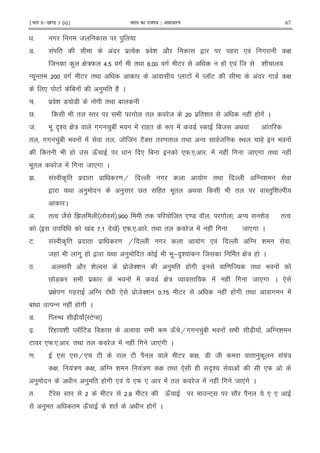
![68 THE GAZETTE OF INDIA : EXTRAORDINARY [PART II—SEC. 3(ii)]
< 5 1() ! 8 9 ! ! *! & ]E 82 Z)" & ]E ! & ]E T & & ]E *
"< * * *W * ! " 1 8 ! ( ! # 8 *!# C
5 $ & K1 G : * ?5 B 0 ! C $ & K1 H K1 G : ( & M KE7
! ) " ( ! ( # C
5 8 K 7 ! 8 )RD 2 ( & 2 *W * ! ( ! #
8 *#! " 8 ! # 8 *!# C
5 56 = 2 I< E ) " ( # 8 9 9 #
9 !I A " 2 " 8 9 ( ( ( (E 8 *# C
Q# [ C7 D
) T ; ):= ! * #* *W * $ ! "<
0 ) I< $ ) ( # C
5 QJ ! V.E
9 = ! ! 9 QJ ! / 0 " & ( ! * 8 *!#
C
i RW E2! 2 5? 5 ( C
ii ]E % %" i jE" ! 2 = ! i " )
" = * !7 i !# = 2 ]E i R C
iii E [X [X ! 8 QJ 65 5 ( C
iv 2 )!7 QJ 5 5 ( C
v 2 I4 K QJ 5? 5 " C
5 ! .@! .' .' .* ' ! M! :;
5 5 9 T ! ! . H $ A " i * ! ) * * V $
82 0 7X 8 2 !0 ! E 1 ( 0 ) ( ! 0 ) "
( 8 1 5> 5 27X ( C 5 QJ
9 ! ! ( T I< ! i 2 " O I< !" !#
( " (2 " - . " I" 65 x 65 5 ( (* C * (
! : " O I< ( (* C
5 5 8( ! i 2 " i " i 2 $ A " " .
( ! ( " " 9 ! *! 0 =7;I E !# *=7 ! E i KW 1 7!# 7 KW
=7 ) $ A " i 2 ! : " O I< ( (* C
i 1 7!# 7 KW =7 " $ " 9 = $ "
0 8 *# C '" 1 8. 8 ! V 7X ( T !](https://image.slidesharecdn.com/ubbl2016notified-250923161005-b0550c73/85/UBBL_2016_Notified_DDA-Building-Bye-laws-68-320.jpg)
![¹Hkkx IIµ[k.M 3 (ii)º Hkkjr dk jkti=k % vlk/kj.k 69
0 I< Y Wi G :W H ( ! ( (* C
9 9 # $ i )'" ( ! 8 *# 9 # ! $ i " ( 9 # 5
5 ( C
5 ! * PK3
h 2 2 I Y * " I< " h ]E " W 0 ) # 2
* #* 2 ( ! ( # C
Q#5 ! * PK3
.' C7 D
# .'
$#
! * PK3
8 # .'
* PK3 "!
3 .'
5 2 5 65 5
W 9 8( ! ! : " O I< # (2 9 ! !
( ! (2 C
Q# 0'>.
E2 d 1 V" ! 1 )!7 2 ( < !# QJ
! * 5 2 5 5 ( ! ( # C RW E2 " ()! [X !
( #. ( ! ( # C "< E2 ] 8( ! 7 58 5 2E E E2! 2 - )
= 28. (2! = ! V * ( 8 I4 =
8 " (2 C > 5 2 QJ )!7 1 * T i
9 # ) " i (2 C
Q# 2 .89 . * .+ *!
Q# 5# JZ . 8 %FJ S3V! ' * P ; "!
5 2Z # >? ! (" $ 2Z # 9 ! = ! #. ( !# C
9 = ! * #* R - . " !" QJ 6 E 9 ." - . "
QJ 65 h " WE I" ! I jE QJ 9 =7 = # 2 *
82 ! * #. ( ! ( # C !") = + i 8 . ! , $ # (
! * ( # C
0 5 " !0 5 5 2 5 > ) 8 . " 2 W I !
i " ) I< " 8 *# !") 9 ! * h 2 2 * .:
) " ( ! ( # C
#5 i " ! $ ! 1 8. # ( $% !
M" O I< ( # C](https://image.slidesharecdn.com/ubbl2016notified-250923161005-b0550c73/85/UBBL_2016_Notified_DDA-Building-Bye-laws-69-320.jpg)
![70 THE GAZETTE OF INDIA : EXTRAORDINARY [PART II—SEC. 3(ii)]
Y 5 9 5 5 27X 5 5 QJ ( (* 2 *
8 ! O I< $ ( (* ! 0 ) C
75 9 [X # 2 K 7 27X 5 5 ( ! ( (* C
" '" 6 ! (" $ ! 8 *# C
5 W2'EF 9 ! )'" O '" i ! (" . " ( - . " 65
#5 5 ] I 2 1$ < !# I * - . " 5 5 O I< ( (* C
; !i " $ 8 E E VIII !'i E !# *=7 ! E i KW
i 1 7!# 7 KW =7 #. 8 *# C
V5 W2 'EF ! #! H 2Z # 2 82 $ A " ! !
# # ! ! 1( . h $ = H !1! " I<
!") jE !7 ( # C
5 65 ` J( %: 9 P .E
5 "(0 R ) # # < ) i ! *
8 ( (2 " 78 = !i < " T i ) G !
) ( (* C
0 5 ) i * R ) # G G * # ! *
8 ! - . " 5 5 x >5 5 ( # 2 G #
, G " 0 I< ! T 5 5 . ( ! ( #
C $% ! " " * " G :W H 9 # ( # C
#5 $% V : * # 5 " G :W O I< 7X# C
! G ) Y ) i 7F !# ` ! $ ( K h ( !
( # 2 ( ) !7F d 2 ) !IEF'i ( h ( !# C * 9 ! ! V : !
!0 = 0 !7 + i * " 8 *# C
Y 5 # 7 V 7X $% 9 # O i L ;L 65 5 QJ
( # 8 # 7 2 G " V" QJ 5 5 # ( # C 1
# 7 !" QJ 65 E ( ! ( # C $ I . 2 2 =7
I . 2 - !I< ! QJ 65 E (7 R QJ 6 5
( ! ( # C
75 ! 0 " i " ) ( (*C 9
, 5 5 27X 2 5 5 QJ ( ! ( !#C! 9 # H K 7E 9
8 5 27X 2 5 5 QJ ( ! ( # C
5 8 . " 8 2 W i " " 5 5 )R ( #
C
V5 0 2 ! )0 8 !H E+E h " !H ; E )
N 8 *# C](https://image.slidesharecdn.com/ubbl2016notified-250923161005-b0550c73/85/UBBL_2016_Notified_DDA-Building-Bye-laws-70-320.jpg)
![72 THE GAZETTE OF INDIA : EXTRAORDINARY [PART II—SEC. 3(ii)]
Q# 5 "! A >'8 .' E . 0B! ! .E J & . ' 8
6 ' 6 . . . a .+
I " ! ( E ! * ! 12!' E ( ! IE 7 ! 8 ! - ! Y !
!#$( ! W !# IEi ! 1 E !H 7 ! 1() ! 8 !# 0 ! 2
- * / 0 " I" 8 ! $ #. ( !# 3
5 )0 8 !:= C
0 5 jEF 9 ! (" C
#5 9 " #= - ! $ C
Y 5 $% ; : !" jEF i i C
Q# Y M! '8 M! S ! .' 6. 0 E A >'8 .' .'
O !# O '" ! (") 78 8 1 7!# ! i j 0 ; 0
i " (2 2 I< 8 9 G ! (") $ ! !& ! * #*
(2! C
Q# A >'8 .' 6 .' J a +3 . ( ./ 6
:; .' . ' ( 6. 0
'" * 9 ' @ &II ! ! * #* (2! C
Q# Q . 6. 0 !
$ = , "2 )0 8 HG : 8 $ 2
M KE ! 0 ) G : ! 7X ! ! * ! 8 ) ! (") I< ! R ! i
9 .9 # 9 8 !1! ! #. ( !# C
Q# [ K3 J : . .3
]E $ ! T ;VIII ! 3 E 2
QJ 9 1 7!# ! (") 1 8 *# C
3) ! 7 4
5 E 1 7!# ! ! 1)8)# O '" ! 8 ( )# 1
* ]E $ I (2 C
0 5 1 !E (" 9 " ]E ()! ! ( (* C 1 7!# ! N
# ]E ! " ! 1 R ! ( !
8 *# C
Q# [# ! A >'8 .' .' K3
66>5 # 5 " 2 5 QJ 9 M KE !
* ]E 0 ) [X ! " ! ) " ( # 1i " ( - 2
" ! 8 ( 1 " C
3) 4 - 9 1 7!# ! ! $ " * ? ! 0 =7
?5>5>](https://image.slidesharecdn.com/ubbl2016notified-250923161005-b0550c73/85/UBBL_2016_Notified_DDA-Building-Bye-laws-72-320.jpg)
![¹Hkkx IIµ[k.M 3 (ii)º Hkkjr dk jkti=k % vlk/kj.k 73
Q# [# : . .3 93VJ 3
G " ]E ! " '" *I E HEF2 ) " ( !# C h !# H N
1 7!# ! $ !#= G : ! * *I E ) " ( !# 2 -(! *W5*5 5 2 #$ !7
8 #= " ( ! # 8 *# C
Q# [#2 J . K3 J ^ . %6 PD:3
* 5 ! (" !H jEF 9 = ! (" H " jE ! !#"
$ ! )R ( !# C
Q# $ A >'8 .' .' P )3 F DA D"b :3VS
9 O -E !I< #" 2 2Z # 1 7#!! 1 7!# !
! ! 2 M KE ! . K ME W 1 * ( $
!# C
Q#2 * "! * +3 ! 4
9 9 ! ! .0 i jE M IE ") h i 2 # i jE
# 8 9 #. ( E+L * # !# .7 N *
8 *!# C ) 4= H E * 9 8 . * :" i jE 0 *
* ! $ A" ) (") " I< " 8 * C ! $ A" ) ! 8 9 #. (
0 " i jE 12E ; 2/ 7 i jE ) G " E (")
# .7 N *! 8 *!C 8 ! = 2 !: * 5 5 5*W5
9 " , < jE 0 " i jE $1! i i ! 8 *
C % ! ! # #5 ' ' @ X#5 .B .'](https://image.slidesharecdn.com/ubbl2016notified-250923161005-b0550c73/85/UBBL_2016_Notified_DDA-Building-Bye-laws-73-320.jpg)
![74 THE GAZETTE OF INDIA : EXTRAORDINARY [PART II—SEC. 3(ii)]
! ! [
^!' C7 . 6. 0
[# C7 .
E 2 QJ 9 9 % !" QJ 9 R !
8 *# C % !" QJ = ! P= A" 9 ! * T i
' ! (2 C $ 9 'i !I A " $ 4 (") I" 8
! # - 9 G *! HQJ 2 ! # ! %
) G " '" ( !# C
[# ) 3 ( ./
% !" QJ = (") $ # * 8 M KE G $ , 9 " <
5 5G 5 " ) "2 * #* 2 ) " *#* ; E
M O 8 < 1; 7 8 M ! ! I< " ( (* C
[# 607 .
9 = ! a ()! 0 =7 5 a < [X 8 * 3
5 9 IEF E < ( 7 W * $ 7 , IEF E 8)7X ()* 0 I<
( (*d * $ 7X 27X ?5 E # (2 )
G :H ) G :H i j G :H# ! [ 7 H W ]H I" " 7 *
5 E #
0 5 9 ! ( 7 W * $ 7 > 5 E QJ 9 * >
E 8 " W !8 9 2 8 5 E 27X ( !
5 E Y ) Y (" 8 ! G ( (* 2 > E
QJ 9 ! ! 5 E 27X ! 5 E
Y ) Y (" N 8 (* 2 * ; E M
T i i "2 8 (*C '" 0 I< 1
)'" ( (* 2 E T ( (* C
#5 W E!7 ()! * )0 , M" 27X (
(* 2 9 ! ( 5 E ( ! ( (* C $ i ,
/ =7 K V )7 W 7 12 (* $
T i ( 8 ( * M KE 9 " 1 ( ()! I" 0 (
8 " (2 )0 , V%" 8 " (2 " V%" QJ 5 E QJ
( ! ( (* C
[#2 '8 :;
5 !# I< $ " )0 8 < G : 8 $ !
) N * 8 (* C
0 5 % !" QJ 9 ! ! !# / 0 " ! < 9
) " ( # C
i. 0 ) I< 3 6 # E $ " 5 5* 5
ii. "(0 3 6 # E $ " 5 5* 5](https://image.slidesharecdn.com/ubbl2016notified-250923161005-b0550c73/85/UBBL_2016_Notified_DDA-Building-Bye-laws-74-320.jpg)
![¹Hkkx IIµ[k.M 3 (ii)º Hkkjr dk jkti=k % vlk/kj.k 75
iii. IE E 3 ? # E $ " 5 5* 5
iv. 7 3 ? # E $ " 5 5* 5
v. RW E K 3 ? # E $ " 5 5* 5
#5 IE2'7 !#3 # 5 $ " E 2/ (" 36 # 5 $ " E
KE E7 !#3 # 5 $ " 5 5* 5 9 ) " (2 C
[#5 H 3
[#5# > . .E
5 $% 7 < ( [X ! " "" 2 ) G "
$ K 7 < 2 8 0 ) (* C
0 5 9 7 0 =7 5 5 !"#" < G " ( ! ( (* C
#5 7 8 1 ( 0 ) (* 8 G . ( !") 9
I" 1 " C 9 8 81 9 0 ) " [X <
2! 7!# 5 E G " 27X ( ! ( (* (27
< I 7!# 8 ( ! # * 8 (*C
Y 5 7 8 ] E < [X ! L ( ! 0 ) (* C
8 7X 2! 7!# $% 7 [X ! ! N 8
(* C 2! 7!# I" ] 8 * "2 8 ( (2
( (* C
75 7 8 1 a a $ # * " W 8 * "2
* #* (2! 0 ) (* C
5 h i 8 < 7 ( ! # 8 (* "
i !1! ! 9 $ 2 ( C
[#5# . '8 > .
!# 7 G " (") 7 R ! N ( ! 8
(* C
[#5#2 I?! 7
5 [X ]E ! O I< " ( ! 8 (* C
0 5 [X $% 2! 7!# " = * ( ( (*d 2 E K
( (*d 1 ( ! 2 E K !# 5 # 5
( (* C I< " < - = [X J ( ( !
( " ( ! " - 5*5 * % $i 1 8 (* C
[X ! $i 1 (") "!: W < I "3 $ " ( (*
C h 2]E V" ; V" E Q ( (* C [X !
! T 8!# < T 1$ $ # ( " (2 " ! - . " Y !E
T E!# ( (* C
#5 [X - . " 27X # " ) ( (* 3;
[# " . .' 6. 0 I? "! J>? D (2!7 2 8!# !
V 7X ' 27X
"! J>? D
9 .( 56 E
( E 9 5 E
/1 1 7!# 82 K 7E < E 5 E](https://image.slidesharecdn.com/ubbl2016notified-250923161005-b0550c73/85/UBBL_2016_Notified_DDA-Building-Bye-laws-75-320.jpg)
![76 THE GAZETTE OF INDIA : EXTRAORDINARY [PART II—SEC. 3(ii)]
h 2 G 9 6 5 QJ "
6 5
5 E
5 E
!I< % 9 82 I " 5 E
O (" 9 - 9 5 E
2Z # 9 5 E
Y 5 1 8!# EF7+ - . " 27X 56 E ( (* C EF7+ =
2 0 ; 0 W ) ( (* C - 9 ! !
8 " QJ 5 5 ( (* 2 $ " ] E 8 "
" ( (* C
75 (2!7 EF27 5 5 - . " QJ < N 8 (*
C
5 [X 2! 7!# 2 [X I" ! - . " (27R 5 5 ( (*C
V5 )0 [X " ()! M" T E!# ( (* * 51 5 5
E;> T 2 8 ) G " !5 ? 0 ! C I " ' 8!# 7
[X ! 8)7X ! ( C ( 1 i ! 0 ) I !# E
7 ( (* C
85 9 12L I< 9 =7 < - T 8 0 I< [X <
[X ! ( ! 0 ) (* C
B5 9 . I" [X Y 1 ( 7 ( 0 ) I< 0 )
(* < ( J * ( K1 "2 * N * #* 8
9 8 ( #)8 1 ()J ( C
e5 # i " ()* -( " i 9 . I" 5
5 QJ N 8 * 2 K 7 E ! 8)7X
2 'EF E $ i " 8 * C ! i 9 -(
< E ( * 2 78 * 8 *! " W < - 9 =
"; ; " ! : ( ( C " '" " ! 9 2! 7!T
" !0 i " ! " 1 7 ( (* C " ! " 1 7 (
[X ] E 2 2! 7!# # * 8 (* C
5 x 5 5 ( ! ( (* 2 $ )0 R [X
# * 8 (*C
E5 * : [X ! ( 9 . " I" M" ( (* 2 "(0 "
()J * * # [X ( (* C "< . [X "(0 " 8
" (2 1i " ( " 9 - ! 1! ) ! (" ( K1
T E!# 7 * 51 5 5 E > T 2 8 ) G " !5 ?
0 ! (" Y ! T ) G " K 7 9 . I"
# ( 8 " ( C
[#5#5# K3G
]E+ - G *! / ) ( !# 3
5 9 " ! ! > Y =E ]E ) ( # C 9 ! $ # ]E+
" ! 1 R ! ( ! 8 *# C (
O I< * ; . ]E+ ! K1 * #( 5 #)=](https://image.slidesharecdn.com/ubbl2016notified-250923161005-b0550c73/85/UBBL_2016_Notified_DDA-Building-Bye-laws-76-320.jpg)
![¹Hkkx IIµ[k.M 3 (ii)º Hkkjr dk jkti=k % vlk/kj.k 77
5 #)= ( " (2 C !# O I< ! K1
i j R '" W i ! ( (* C
0 5 8 I 9 . " I" $ * 8 (* " T ]E
C
#5 ]E i G # ( (* 2 ! - i I< " ( !
(* C
Y 5 ]E Y 2 ]E K1 ! Y =E W E!# ( (* * 5
1 5 5 E > T 2 8 ) G " !0 ? 0 ! C ]E+ ! G :
E ( (* 8 5 # 5 ( ! ( (* C
75 ]E 7 ! Y =E T E!# ( (* C
5 ]E ( " ! ]E K1 7 T ( (* * 51 5 5 E > T 2
8 ) G " !0 ? 0 ! C
V5 ]E * E 8 ) " ( ! ( !# 2 * Y =E
T 81." 8 ( (* C
85 ]E h K]E 2 K1 9 ! $ ! (2 " K1 ! 2 6 5*5
* % $i 1 8 * 2 ]E h K]E ! 5*5 % $i
1 8 * C $i (") "!: W < I "3 " ( (* C
! : R $ " 9 !9 ( (* C
B5 ]E "(0 8)7 (2 " "(0 ]E K1 T E!# * 51 5 5
E > T 2 8 ) G " !0 ? 0 ! (" I "3 1! (
8 ! < 0 =7 ?5 5> 2 ?5 5> 8 ! * #* )B ! ) $i 7
( (* C E W < - ! ) *! ]E ! N 8 *
2 9 T !:= G 8 7X 8 * C
e5 ]E 9 ! $ ! I< " (2 " ( Y =E T G "
(" I "3 1! ( 8 ( (* C
E5 ]E h K]E+ ! $ i " 9 2! 7!# T 1 2
* ]E K1 " [X ( (* C
L5 ]E E $% " * ! " # 8 * 2
0 ; 0 8 * 8 ! i # ( T Y E !
9 # 81 " - ) i ( [X ! $ # ! C ! " !
$% " * * 8 9 h ( (* 8 ! [X ! I< "
i # ( C 2- ) $ " !8 I 9 ]E ! *
2 18 . " $ " 9 N 8 (* C
75 9 - 9 Y E ! $i 8i i ! (") * 51 5 5 > T 2
8 ) G 0 =7 >5 0 ! [X ! $i 8i ; ! G " 1 # C
[#5#Y 6B .
5 "(0 2E12 - 9 " ( ) " ( !# 1i " $ = H !1! " I<
H - !1! " 9 # 2 T i !8. $ M" 8 * C
8( J 2E12 ( ( J 5 5 V 7X i "+ "(0 ) " ( # 2 8( J
5 2 2E12 ( ( J M KE G " 5 5
V 7X i "+ ( (* )0 8 !: !
$ ! ) C](https://image.slidesharecdn.com/ubbl2016notified-250923161005-b0550c73/85/UBBL_2016_Notified_DDA-Building-Bye-laws-77-320.jpg)
![78 THE GAZETTE OF INDIA : EXTRAORDINARY [PART II—SEC. 3(ii)]
0 5 $% "(0 A< R ( ( (* C 4 K 'i G : 2 " ("
!E+ 8 "(0 ! R W2 " G :W 5
$ "i " ( ( #$ < 1$ 1 IE K 1 7 E+ < !E
E+ < h K]E+ R ! $ * 8 (* C 2 R "(0
" I" * - E+ 2 "(0 !# I" I - E+ IE
N 8 (* C IE K 1 7 < !E E+ (" 9 . I"
- E+ 2 *'I EF2'E M" ( (* 82 ( ( " < !") "(0
" I" I UV ) (") 7'E+ $ * 8 (* C IE K 1 7 2
!E E+ * I< " ! ( (* W 1$#7 ()J ! (
2 $ i < E G : i " ()* I jE R aI QE
Ea < a* - Ea -(+" ( C
#5 "(0 [X *-' 8+7 $ ( (* "< T E!# (
(* C * 51 5 5 E > T 2 8 ) G " !5 ? 0 ! C [X
"(0 I< " ( (* 8 ! 1 ( 0 ) ( 9 . I" (
$ i C I [X '" 0 " !#" * 1 ! (" ) T
E!# (" I "3 1! ( 8 ! < K1 , "(0 8)7X
(* C
Y 5 : . (") # " ?5 8 * C : .
# " ( " (2 " " '" [X J $ 8 (*C
[# & . 8 6. 0 ! / J
X
'B!
. 8 6 ! / % #
#A # # .B .'
$ * ! $ 6 * ! >
i 6 5 5
ii h 2 G 0 6 5 5
iii !I< # 6 5 5
iv /1 Y 6 5 6 5
v O 75 6 5 6 5
vi !E 6 5 6 5
vii 2Z # V > 5 = $ 6 * ! >
) " ( ! (2 C
viii 9 =7 = 8 6 5 = $ 6 * ! >
) " ( ! (2 C
ix 0 " B 5 = $ 6 * ! >
) " ( ! (2 C
3) ! 7 4
5 .= "3 I $! 7 9 ! (") : . '" " ! jE . ! $ "i " " 1[X
" (2 C
5 8( J 9 jEF 9 = ! (" ! ) " ( 2/ 1 R ! #
8 *# C](https://image.slidesharecdn.com/ubbl2016notified-250923161005-b0550c73/85/UBBL_2016_Notified_DDA-Building-Bye-laws-78-320.jpg)
![80 THE GAZETTE OF INDIA : EXTRAORDINARY [PART II—SEC. 3(ii)]
5 "(0 2 !# " ! * 2/ " W " " * 5 5 27X
2 * " W " " * >5 5 27X ( 1i " *
3 ) " 2 9 ( ! * 3 ) " ( (* C 2/ Y )
9 # < A%" 2/ * I 3 ( ! ( (*C
0 5 2/ 2E12 G : ! 9 N * 8 " (2! 8 W !8 1 "
8 ( * I $ 8 " (2 2 9 ! ) " 3
( ! ( (* C
#5 Z" 1 5 5* 5 ! (" ! * ! * 1 ) 9 ! % 78 H ) G
( . W !8 9 * ! 2i ! 0 " ()* )
8 * C
Y 5 I " ! ! 2/ - . " 27X IEF2 * 5> 5 ( (* 2 ( (
8 ( * ( ( C ! 2/ ! (2!7 N
8 (* C
75 2/ ( 9 . I" 0 ) I< < E 7 < ) G " I< 1 ( "
8 (* C
5 "(0 ! $% "(0 * #5 5 " G :W * * $ i
2 ( (* 2 "(0 G :W $ " "(0 #5 5
(2 " * 2 $ i * ! 2/ N 8 (*C
V5 6 #5 5 M KE ! * 2/ I< T 9 # )
h " ]E $ 8 " (2 C
[#5#[ P > .
5 K 7 2 2 8 1 ( 8 i ! 8
7 8 ) G " 27X 27X ( ! ( (*C
0 5 9 ! K 7 - . " 27X !# 77 * 56 5 2
7N 77 * 5? 5 ( (* 2 - 9 9 ! ! !# 77
* 5 5 2 71 77 * 5 5 ( (* C /1 9 ! 5 65
0 ! * K 7 - . " 27X 5 ( # C jEH G "
" K 7 *W5*5 5 ! ( ! # 8 *# C
#5 8( J [X I" K 7 2 2 8 8 " (2 ( ! K 7 2
2 8 8 " (2 ( J K 7 2 2 8 8 I jE QJ 5> 5
( ! ( (* C
Y 5 [ ! ]E K 18 2 K 7 (" 9 $ A " H ! :
R ( ( (* C
75 I " 2 !# ( 5> 5 !# 2 71 77 ! * C
[#5#$ @ FJ .>9 >S3G 9* PK3G 9 K!E ( ./9 .'3G
5 - . " 5 E 27X 2 5 E QJ T W2 7 !#
R 0 ) I< < ; < 7X " I" 5 5 I"
$% " $ 8 *# C ( = 8 G 2 "8 A< ' = W E!#
) ! (2 2 * #2 ; i #$ < !" ! O I< " (2
8 T 2 )*! RS ( 1 < I" 2 ! %
8 ( # C](https://image.slidesharecdn.com/ubbl2016notified-250923161005-b0550c73/85/UBBL_2016_Notified_DDA-Building-Bye-laws-80-320.jpg)
![¹Hkkx IIµ[k.M 3 (ii)º Hkkjr dk jkti=k % vlk/kj.k 81
0 5 !# "!: 3 1 T 2 " 1 *! ( *! 2 < ( ! !
2 1 ( ! 2 ) !# "!: 9 ( (* C * 1 2 !
I jE R -(+" 8 * " 1 2 1 ( (
8 C
#5 1 ( T 8!# 2 9 ! 1 $% I" W N
8 * C
Y 5 W2 7 * $ # # T 8!# 5* 5 6 ) 81." E2/ 7 ) G
( (* C
75 " Q " T I" 1 * * ""+ T
W2 7 * I 7F , !" R A< 8 * (3;
i- QJ ! 5 5 ( ! ( (*d 2
ii- " " Q W Q 5 5 I" " ( d 2
5 1 ( T H !E 2 T W2 7 1 . 56 5 ( !
( (* ( 9 0 9 " ( ( (* C
V5 * " . " T I" 1 * * ""+ T
W2 7 )*!H T , !" R A< 8 (* 8 *
#2 ; i #$ (2 2 8 T E!# =E ( ! (2 C
85 7'E+ 2 h K]E+ d T E!# (" * 51 5 5 0 ! ! 2 8 !
( ! C * 9 7'E+ Hi K]E+ " R 8 * 2
9 " I" ! T $ i 1 ( # C
B5 h K]E G :W * 2< 2 1 G :W h 2]E
E K !E !# N 8 (* C
e5 " G :W - . " 5 $ "i " 1 !E $ 8 (* C (
1 !E K QE E < 1 KE (!T7 $ ( " (2 8
] . 81 ! !# "!: < $ # (2 2 KE E I
7E'i IE < * A" 9 8 * C <
• W2 7 2 T 2 )*! 1 ( * '" 0 "
"!: < 1 $ ( (* C
• T W2 7 ] .8 G : ! 9 2 ! < ; < 1 ( !
. "3 1 " 1 *! *! (!T7 ( (* C
E5 T #)= %" # " ?56 ! 5* 5 7 ) ( (*C
[#2
6 E 3 ) G T (") i jE 3 E - + i "
!i
?6 3 ? ] 2E EF ! 2 !E h E T (") i jE " !i
>6?3 > - + i (") T (") i jE .
!i
>6 3 > W#7 7 2 7 T (") i jE $< !i
> 3 EF ! !E ] T (") i jE
[#Y . 7](https://image.slidesharecdn.com/ubbl2016notified-250923161005-b0550c73/85/UBBL_2016_Notified_DDA-Building-Bye-laws-81-320.jpg)
![82 THE GAZETTE OF INDIA : EXTRAORDINARY [PART II—SEC. 3(ii)]
[#Y# I?! 7 ; P > . D3
5 [X J "< K 7 E I "!: R 8)7 ( (* " 9 ." # *
( I $ # ! 8 C ( 9 T i !
()! ! ( "< ( E M !E (2 A< !:= I< "
# ( (* C
0 5 [X ! "< K 7 E ( E!i M < IE2=7;1 8 E
2 . " 8)7X ( (* C
#5 [X ! 2 K 7 H 2 8 G 2 "8 ] .8 G : ! " E
N 8 (* 2 " E (") $ # * 8 9
" 2 - T i j " ( (* C
[#Y# Z0 .
5 18 1 H !# # 7'E ! 1V 8 (* 8 7'E
T #2 ; i #$ < $% " ( (*
C h K]E 2 W K !# ! / 2 K E8 !# # -7+ .E ! (
(* C
0 5 E ! E W - -E K - #2 < -
Z)" 1 (") 7'E ! ( ! 1V 8 (* C 1 I< 1
7'E+ H K 7 8!# - $ # - ( (* C
#5 $i 8i IE (") / ]E [X J 2 K 7 E !# 2
N (") A< E I # 2 ( $ * 8 (*C
I"A" i ! * * 51 5 5 i 0 ! C
[#Y#2 AE J .
- 18 . " W ( ! [X ! "< K 7 E!#
E W ]E IE2=71 W / $i !0 ! "< N I
*' EF'i 2 7/ IE * * IE2=7;1 18 8 E O I<
( (* C 8 E ! * ( ! '" 9 i ! 2 E !E
G " ( (* C IE2=7;1 / 7 8 !8 " 8 E
. " IE2=7;1 / 8)7X i " ( ! (2 C
[#Y#5 0
" ) . / 0 " )R ( (*3
5 1 # 82 3; [X J K K 7 ]E K1 E * 2 8
R ! $ # ( ! 8 *# C
0 5 1(" S " )R L ") 7 'E!# = 8 *# C
#5 8( J 9 7'E+ T ! < " ! ( #)8 # 7'E+ !
!# / E !E T E!# (" ( (* C
Y 5 8( J 9 7'E+ W E7 / E !E ( #)8 " (2 " 7'E+ / E !E
W E!# E7 8 * C " '" 7'E ! #)8
8 T " 1[X ! $9 " ( " (2
7'E # 8 (*C
75 E 7'E+ W K !# Q I< 18 )
* 9 $ # 8 " (2 C](https://image.slidesharecdn.com/ubbl2016notified-250923161005-b0550c73/85/UBBL_2016_Notified_DDA-Building-Bye-laws-82-320.jpg)
![¹Hkkx IIµ[k.M 3 (ii)º Hkkjr dk jkti=k % vlk/kj.k 83
5 8( J M $ # ) R ! 8 " (2 ( J !#
W' #2 ; i < 1 ( (* C
V5 7'E IE - 2 1 ( = [X * $ # # #$
#2 ; i #$ ( (* T . i $ A " #$
E < ) G " 8 * C
85 )0 "" G : K 7 * 7'E+ [X !
( ( ! #)8 (* C
B5 ) (2!7 . E! $% " * # ( (* 2 $% "
* * 7'E # ( (* 2 9 I< " ! - "
7 'E!# !E ; 'E7 ( ! ( (* C
e5 "< * ;(2!7 !# . E * " * " (2 "
# h " ! " '" # W i ! ) ( (* 3
i- 8 $% " 9 7 'E!# # * I
7E'E < ] . 81 ! !1! KE E W 72/ " $1!
8 (* C
ii- 81 KE E W $ " ( " (2 " " ) . IE
* ;(2!7 !# . E 1! ( 8 (* C
iii- h " " 8 ( (") E h K]E L = ( (*C
iv- * ;(2!7 !# . E * W E #2 ; i #$ < W
E7 ( (* C * 51 5 5 0 !
v- * ;(2!7 !# . E G 9 $ i #$ 9 =7 =
* ( ! ( (* C
vi- EF ! !# ! * :" ) 7'E+ W )# 1 2 W
72/ 0 ; 0 (") ()! 1 * G = 2 N 8 *
C
vii- 9 7'E E 5 5 " 9 i #$ W'
8 * 81 " $ 7'E 65 * 5* 5 E 2
#2 ; i < 2 8 ") !" j 2 * . i E!#
Y ()* E $ W !# (" T . < I T " R
! Y 8 * 2 ! G " 8 * C
[#Y#Y 3V ' F P
5 EF ! W K 9 ! 9 . " (2 " ( i R (
"(0 ! # Y =E E!# T G ( (* C EF ! W K
h )j $ A %" ( (* Y =E T E!# 7 (
(* C G i R "(0 ! 1 8 (* 8 !
T 1 [X 9 ." 0 ) G : # 2 ()! ( C
$ i 8 IE ( (* 8 ! Y =E T E!# ( C $ i
, * M" QJ ) G I< 1 8 (* 8 "(0 -
9 # ! ! EF ! W K " W2 8 C I #
T , EF ! W K G # G ! I< " 8 (* 8 !
8 T G " Y =E ( C](https://image.slidesharecdn.com/ubbl2016notified-250923161005-b0550c73/85/UBBL_2016_Notified_DDA-Building-Bye-laws-83-320.jpg)
![84 THE GAZETTE OF INDIA : EXTRAORDINARY [PART II—SEC. 3(ii)]
0 5 EF ! W K KE E ( $i E I $ < * W I $! IE ! G "
( (* C 9 ." 1 () (2 " ( - 9 #
# ( (* 8 ! ! Y =E " T G " ( (*
" ! ( ! 1 8 (* C
#5 " I< " ! 2 E " E+L * )'" G "
5 5 5 E2! "(0 I" N ( (* C 2 E E2!
8 7X #2 ; i = ( (* 2 ( ] ; IE
< ( (* C
[#Y# 8J
5 E Q #2 H* 5 5 #2 . " ;8( J #2 9 ! # * #* (2! ( J -(!
i jE R A< h K]E ! # 8 (* 2 [X ! . 1 ( !
( (* C h K]E 1 " ! !E ; 'i ( ! ( (* C
0 5 * 5 58 5 7IEF N .i ( i W K !# ( (* C !
) /1 8" ( V E ( (* C ) !# !8 G : !
) !# !8 " ()* (.7 N " '" * 8 IE IE
(.7 ! G " G : $ " # 5 6 5 .5* 5 $ " E ) ) G "
* 78 8 (* C ! ] . (.7 K 8
7X * E #$ $ # " ()* #$ W E ( (*C
3) 4 #2 !IE i !1! I"A" . * * 51 5 5 0 ! C
#5 17HO (") ] . (.7 9 !# W 1 T $
( (* C % !" Q! 9 ! ! I< " ( E ! I " ! 2 G : ! *
17 ] . (.7+ ! < 7E'E # * 8 (* C T !
*'8 KIE W2 KE E EF !# * O I< 8 (* C * 5 58 5
$ # 8 " (2 " # ( (* C 1 ( 2'E W (" >
< 7 5 5 E8 ( (* C K (2!7 ; E $ ( (*
2 ( ) !# !8 A< G : ! I< " ( (* C " ()!
( (* C # < 1 7 K' 7 #2 !8'i * (.7 ! 2 )
) ( (* 8 7+ .E !7 i " ( d 2 #2 E !
0 " ()* * 5 58 5 ) 9 ( " (2 2 E Q #2 ) ( ( " (2
* ( I< " R " E 1 7 ! # 8 (* C
[#Y#Q A ! (
" " 1 K H1 K G I< " ! 0 " ()* / 0 "
" '" ( ) ! ! 0 8 * 3
5 "(0 ! 1 K ) " ( ! ( # !") 1 # . (
"(0 ! ) " ( # C
0 5 1 K T G ! I< " 8 * 8 T E!#
Y =E ( d 2 ( G "(0 ! I< " ( (* C 2 E /-
I" N 8 (* C G ! $ i * Y =E T
E!# / 8E 8 N 8 (* C
#5 1 K G ki * E+ 2 *' E I *'8 IE+ <
N 8 (* C](https://image.slidesharecdn.com/ubbl2016notified-250923161005-b0550c73/85/UBBL_2016_Notified_DDA-Building-Bye-laws-84-320.jpg)
![86 THE GAZETTE OF INDIA : EXTRAORDINARY [PART II—SEC. 3(ii)]
e5 8 [X ) " ( !# 1i " : . 2 T =7 ! )
8 * C
E5 ]E (" 1()I" !# " T ) G < ) " ( # C
L5 ! % ) G " 5 5 27X 8 < 5 5 27X
!" [X ! 2 1 E " '" ]E 2 i G , ( G 2 "8
< R E 57N .5* 5 ! V 7X <
! * = ) " (2C
75 E 7 H1() ! 8 ! 7 ! 2E12 ! ! ( 1
) " ( # C ( # * ! !# 7 H 7 ! ! ( !# 2 *W5
*5 5 2 #$ !7 8 #= ! )'" ( # C 7 H1() ! 8 7 !
) " 9 T i ) G i " ! ( # C Q# Y .B .'](https://image.slidesharecdn.com/ubbl2016notified-250923161005-b0550c73/85/UBBL_2016_Notified_DDA-Building-Bye-laws-86-320.jpg)
![88 THE GAZETTE OF INDIA : EXTRAORDINARY [PART II—SEC. 3(ii)]
#. i ; i ! ) 9 9 . ! G " - (")
h )R 8 *# C
3) 4 9 ! EF W E!# * . ! 2 9 . ! 81." =
* !#" 9 " 2 9 " N . ! (" ) 8 * C
$# # ' ( ./ .' .' ' ( ^ !
9 . # G : ! !"#" -(+" $ A " 8 0 !9 " G : ! ! ! U %
9 2 !IE i 8 G ( ! 8 " * = H (") ! G %
! * ' @ -VII ! * #* )B ! " ) G * 8
i " (2 C
$# #2 . 3 !'/
! 8 9 ! ! 9 ! 8 9 ! 2 i j ! ! * 9
= 9 . ! 8 -IV * ! V ! E 0 G ' .* !"#" "2 2 - "
E G = 4 "(" ( (* C
EM = 3 E 0 G ' .* G " * ! T I 0 ! C
$# #5 8 . 3 J !& Ja
9 #$ 2 2i - "3 - $ = 9 # ! 2 9 #-V
9 = #$ 2 9 #-VII = S " ! 2 9 " jEF 9 ) G ! (" !
< / " 9 " i 2 ! (" )R ( (* C
5 2 #$ ! 78 2 = " 2 G = 3 !
$ ! + i 9 #$ < 78 < = ( !
(2 C 9 ! ! * i j $ ( ! (2 1i " * )
8 " (2 C 9 " N . < 9 . , ) " 9
#$ ! ; * 9 # R ! ) " 9 #$ 2 $ Z # !
i 8 *# C
$# #Y 3. F . 3 .' 6 ' . .' %6 . >'@ J A 6 >:) . ' .'
!'/
. ! ! (") / 0 " $ ! ) 8 *# 3
5 9 ! < 9 . ` ! " ( 7!T (" $ = H !1! "
I< . ) 1 $ i " ( ! 8 *# C ;
< !i " 9 " jEF 9 = ! (" 9 # x ! " 2 1 ( 7IM
! ! jE #. ( !# C
0 5 9 ! ! i H . ! E 2 ` N ( !
8 *# C
$#2 @ 0 (
T i !"#" 9
T i 66 !"#" T G 2 T
) G (") - . " !1! ! 9 " jEF 9 = ! ("
) T 2 8 ) G ! )R ( (* C](https://image.slidesharecdn.com/ubbl2016notified-250923161005-b0550c73/85/UBBL_2016_Notified_DDA-Building-Bye-laws-88-320.jpg)
![¹Hkkx IIµ[k.M 3 (ii)º Hkkjr dk jkti=k % vlk/kj.k 89
$#2# @ A I?
5 T * " '" 1 ( [X ( # 2 * i jE " ! 9 #
* ! ( ! 0 8 *# C ( G "8 > °
= B) () ( ! ( (* C
0 5 9 T 1 # 9 . " E2 " 8 (* C
#5 T 1 # $ i A< ( (* 2 !" [X ) . ( (*
C
Y 5 T 1 # I" 2 Y ( 1 )'" ( (* T
1 # " 8 7 8 G " T G " ( (* C
* 51 5 5 E > " ; ? 0 !
75 T 1 # G " T G " #2 ; i #$ " (
(* * 51 5 5 E > 0 ! C ! G " IE [ ! [X T 1 #
R ! I A" ( ! 8 *# C
5 (2!7 QJ 5 E 2 5 5 ( ! ( (*C
V5 8 [X 9 T 1 # R ! $ # 8 " (2 1i "
8 [X $ i , 5 5 . ( ! ( (*C
85 * [X (") $ ! 9 ." I" A< 8 * 8 ()!
"(0 (2 " " ( C
B5 [X Y 9 1 ( (2 " $% 2! 7!# " =
) ( ( (* < ( 9 ! $ ! (2 " ! KE E
2 2 ) $ ) *! * ! W IE ! (" * 51 5 5 E IV
T 2 8 ) G ! < 0 " % $i 1 * 0 8 (*
C
e5 T 1 [X IEF2E ] E 5 EF7+ (" 5 5 27X M K E7
I 9 ! 5 5 ( ! ( (* 2 8
5 ( ! ( (* C 8 !0 $ " ] E " " (
(* C
E5 Y ) [X ! $ # 8 " (2 1i " Y ) [X $ #
/ 9 # 7 2 5 5 Q! 9 " " ( C " '" *
Y ) T 1 # 5 5 O ( ! ( (* 2 * )'"
(27R * 78 8 (* C
$#2# I?! .' .* DE.* % ' ( A :
9 - 9 Y E ! $i 8i i ! (") * 51 5 5 > T 2
8 ) G 0 ! C
$#2#2 K3G
5 ]E h K]E+ ! $ i " 9 2! 7!# T 1 2
! * ]E K1 " [X ( (* C
0 5 ]E E $% " * ! " # 8 * 2
0 ; 0 8 * 8 ! i # ( T Y E !
9 # 81 " - ) i ( [X ! $ # ! C ! " !
$% " * * 8 9 h ( (* 8 ! [X ! I< "](https://image.slidesharecdn.com/ubbl2016notified-250923161005-b0550c73/85/UBBL_2016_Notified_DDA-Building-Bye-laws-89-320.jpg)
![90 THE GAZETTE OF INDIA : EXTRAORDINARY [PART II—SEC. 3(ii)]
i # ( C 2 ) $ " !8 I 9 ]E ! *
2 18 . " $ " 9 N 8 (* C
8# F ! K3 4& * W ]E * / 0 " = #. ( !#C
i- T i ! Q " ! " ()! *
( " (") " G :W $ " #5 5 * * W ]E
N 8 (* 2 " I< " ! i j R T i
$ # (") N 8 (* C
ii- ! - . " 5? 5 27X I "3 1! ( 8 ! (" 9 (
G " > 5#$ 5 ? O '" ]E ( ! ( (* C
iii- 9 ! )0 Z)" . " A< Z)" . " (
(* 2 T ) G " # ! 8 ]E h K]E+ 9 "
( ( (* C 7X 2 !# < h E IE =
* E ! E! 2 !0 > E . " $ " ( (* !
iv- " I< " ! $ # (") !# (2 (" W W E !# ]E
N 8 (* " 81 ]E E 8 * 8
0 8 C
v- - Z)" . " 1! ( I< " ! ! KE E R
2 . " h )R ( 8 (* C E !E ! * . "
( !8 2 ) R $ " !8 I 9 8
" (2 C R ! ]E " " 1! ( (*
Z)" 1! ( I< " ! ( 9 ." 8 * 2 0 ) 8 !
(" I< ( C
vi-W ]E $ $ i I" ]E E T k!E 1 K' !
I< " = I < 1E I ( " (2 C 81 I .
( " (2 " 2! 7!# K M !E $ " ( 8 *# 2 ]E
!EF < $ E !:= 7 ( # C 81 I 1! ( " (2 "
]E - R ## C ]E $ # - !
9 # ! , 8 " (2 C
vii- aW ]E a h N $% " ]E 2! 7!# 7 $ " M"
] 2!E !E ! I jE R i 8 (* C
viii- W ]E I 7 " ( (* ( 9 ." Q "
E ! ()! C
$#2#5 6B
"(0 = (") 0 =7 ?5>5 0 ! C
$#2#Y K!E ` 3
5 ] .8 h .E * ( * UV ( 8#( ! I< " ( (* 2 (
( 4 ! ( (* 2 ! + i RW 5
5 !# ( (* 2 Y 9 ( (* C
0 5 #2 ; i #$ ! T G " ; ; Y !E (
(* C [X Y < E h K]E < " ) . h K]E G = 2](https://image.slidesharecdn.com/ubbl2016notified-250923161005-b0550c73/85/UBBL_2016_Notified_DDA-Building-Bye-laws-90-320.jpg)
![¹Hkkx IIµ[k.M 3 (ii)º Hkkjr dk jkti=k % vlk/kj.k 91
9 " I< " ( ! ( (* 2 8 * Y !E T G " <
81." W E!# ( (*d h .E+ < !9 . ( (* C
#5 ] .8 2/1 ! ! 2 V" " #2 ; i` 2 9 + #$ "
( (* 2 ! ; ; Y =E T G " ( (*C
# ! ) G " . I< " ( (* C
$#2# K!E ( ./
5 >5 5 QJ 9 ! * 4 #" " ! 9 # ! 8"
* $ " O '" 5 #5 5 ] .8 G : < 56 #5 5 ")
G : 8 9 ( / ) N 8 (* 3;
i- >5 2 6 5 5 " " ! *; >5 5 L "
* ] .8 G : C
ii- 6 5 5 " ! * 6 5 5 L " 2 #
$% 5 5 * * ] .8 G : C
0 5 ] .8 G : -E I< " ! " 2 )'" !T ("
; ; * " W ! G " 0 ) I< N 8 (* C
#5 8( J ! E * * I< " !9 ( ( J 5*W5 5 $ ) 9
9 " ( ] .8 G : N 8 " (2 2 ( *W5*5 )'" (
(* C
Y 5 ] .8 G : $ # 3
i- ] .8 G : I< P I< R ! 9 # ! $ # (") 2
T i $ # (") 2 9 ! ( T < - "
I< " ! *8! $ # (") 2 < ( T i
, 9 H 7F 8" 8 " (2 " * 9 i j R
-(+" 8 *# C
ii- - + i * ] .8 G : $ # ) " ( ! 8 *# 2 (
I H 9 # %" % ( # ( 9 W 2 1 ! 2
"4 = ! )'" 0 C
iii- ] .8 G : ! $ 8 ) *! 3 M" " E!#
) $ 8 (* C
3) 4 1() ! 8 9 ! ! 1 (" ] 2E ! ! ] .8 G : N
i " ( ! (2 C "< 1 1 < " 1 ] 2E !
] .8 G : < N 8 * 82 Q # (2 C 9 ] .8 G :
EI< [X " $ ()! ( (* 9 # 9 ! ) 3 $ i * 1
[X " ()! 8 * C ] .8 G : *W5*5 5 )'" ( (* C
$#2#Q K!E ( ./ .
5 ] .8 G : $ I< " ( ( $ < R ()! # # !
( < - < )0 ()! # " 9 !1 27X 0 ) I<
( C
0 5 ] .8 G : i R 5 5 5 $ ( (* C
#5 >5 5 QJ " ] .8 G : 5 5 QJ !#H )!7 2 >5 5
QJ 5 5 < N 8 (* C](https://image.slidesharecdn.com/ubbl2016notified-250923161005-b0550c73/85/UBBL_2016_Notified_DDA-Building-Bye-laws-91-320.jpg)
![92 THE GAZETTE OF INDIA : EXTRAORDINARY [PART II—SEC. 3(ii)]
Y 5 Y =E T E!# 8 ] .8 G : " ()! (
(* 8 . !E !E 8 (* 2 a ] .8 G :a
0 " ( (* C
75 W E K 8( J 9 " ( ]E ( ! 0 ) ) " 8 *# C
5 7F2! ] .8 G : ! 5 5 QJ Q N 8 *# C
V5 ] .8 G : EI< [X " $ ()! ( (* 9 #
9 ! ) 3 $ i * 1 [X " ()! 8 * d ( G : *W5*5 5 )'" ( # C
$#2#[ F ! J 9F ! 3 PF
5 5 QJ % !" QJ 9 ! " I" L 5
5 Q W 2 " ! .= " N 8 (* C
0 5 W 2 ] $ # - + i * ( ! 8 *# 2
I H 9 # H !8 A" E ( %" % ( # ( (
W 0 2 1 2 "4 = ! )'" 0 ! C 8 ) 2 E E )
$ 8 (* C
#5 W 2 1! ( ! ( (* C
Y 5 W 7F! $% W 2 " 1 ( R N 8
(* C
75 W 2 " HW " E KW *W5*5 5 )'" ( # C
$#2#$ F:3 > FS:> F ! D':3 .c J @ ` .' .
QJ 2 9 #" P= !1! ! #. 9 " jEF 9 = ! (" 9 # >
T 2 8 ) G " 6 W W E !# = ! (") - . " G *!
) "(0 9 # E2 ]E R (" 9 " ! W W E !#
N * 8 *!# C
565 @ !'/ (
6 E Q! 1 7!# * 1 7!# $ i " 9 " ! *
! "!: )'" 8 !1 $= 2 #; # " ! ! i $ M"
) < * !:= G ( # C I" " 'i ! = 2 < (
T i = * ! !IE i = T !:= G ! O I< "
8 *# C T !:= G ! 9 " ! !7 E 1 7 'i W 7E'i * !
IE 9 " # # " # ) *! 9 ( !# C
T !:= G T i IE W $9 1 7!# ) G 22 'EF * !
IE W ( # 9 - ! * ! T i = ! "< !IE i $1!
* @ ( # C
565 @ 'A' '
T !1! " . !H i ! # # "< - )Y E ! I< " ! 1 7!#
8R " ! . 2 T i (") "2 8 *# C # !
" I< " ! I< " 1 * T !1! " . ! ) . 1! ) !
$ i " " ()* ! .= 8 N 8 *# C $ . !
i j RM 17X G ! !! $ i " 8 (*C](https://image.slidesharecdn.com/ubbl2016notified-250923161005-b0550c73/85/UBBL_2016_Notified_DDA-Building-Bye-laws-92-320.jpg)
![¹Hkkx IIµ[k.M 3 (ii)º Hkkjr dk jkti=k % vlk/kj.k 93
565 F ! >JO
5 " ) . " ) ( * 7'E ! I< " ( !# 2 ) ( E *
7'E H # ! / 0 " 1! ) ! ( !#C
(i) W i
(ii) 8( ! ( H # - $ h ]E ! $ i " (
(iii) 8( ! ( " ( #)8 " (
(iv) $% " $% 0 !7 M * 7'E 2 E * 7'E - E C
0 5 72/ I " RM K E ( !# 2 < ( * (2!7 !# W2 9 I ; KW ( !#C
2- ) ! ) *! 9 N 8 *!# C .3;N * 8( !
*' EF'Ei IE 2 7'E *' . 2E # 8 " (2 ( ! 72/ N
* 8 *!# C
#5 > E Q! Q! 1 7!T * T HI 72/ ) !
h ]E+ *
(i) ] . 81 ! HI 7E'E , 2 2- ) !:= , ! "
K ; -E E7 K1 H 7 E !E Y ! *C
(ii) I 7E'i IE ! * ! 2- ) !:= < - 9 ! *C
Y I " W 72/ $ O I< " ( !# " ( # " i !
#)R% j = = 1! ( 8 * 2 ] . 81 ! HI 7E'E ! ! 81."
1! (C
.3 3 7E'E $ # T i !") jE ( # C
$#2# 2 @ * 3 P %F ! 3
T i E K 1() ! 8 9 ! * # ! !1! " (2! 2 1
1 ) G " RM ! 8 *# C !0 I< 2
!1! " 1 7!# 2 !1S # ! " ( # C T i E K ! W
]E !E ( 7F2!E ( 8 % ) " ( # C
0 ? IE >5 E Q! Q! 1 7!# ! * G "
# $ < " < W E K _ ! ( (*C
# W E K " 8 *# 8 ! T E!#
M EW K 2! 7!# 2 1 < , , 0 1
Y !E ! T ; E!# ( # C
Y K1 G :W - . " 5 # E G :W ( # 2 $ K1
9 9 # 5 E ( ! ( # C
565 > @ * 0 ( .
9 ! ! / 0 " # ! $% I 2 9 # * I ! * !
9 # ! !Y * T i ) G )'" # 8 I" T
< 2 T ) G !7 ! ) 2 T i ; !
$ @ $9 ! "< ! 1 * #* ! ) i " # 8 /
$ (2 3;
( 8 ! O '" ! 12L I< ( 2 8( ! # E
" G :W = ( 2 ( 9 8 ! O '" !
O '" ! 12L I< E ( ( =
K/ ' ( ( !](https://image.slidesharecdn.com/ubbl2016notified-250923161005-b0550c73/85/UBBL_2016_Notified_DDA-Building-Bye-laws-93-320.jpg)
![94 THE GAZETTE OF INDIA : EXTRAORDINARY [PART II—SEC. 3(ii)]
0 ! 2 ! ( E
# !7 #$ !7 h K !# K/ ' 7 IEF !E 1; -EF 18 7 IEF #
E " G :W 1 !E ("
Y 5 E Q! 1(); ! 8 #2 ; 1 7!#
m 17X I" " 2 $ A " #2 !IE i 82 W * 5 58 1 KE !#
M !E "< - ) *!
IE 7 8 ! # ! 12L O I< ( "< -7
IE 7 8 ! # ! 12L O I< ( C
V 17 I " * ! !# (
8 8 * ! S; 8 9 82 8 W "< 1 W IEi
!" 1 E * E !8 % 2 - 1 7!T 3
1i "! 8 : ! . , ; -
h # 8 * T i ) G ) '" i
(2C
5> . '
5>5 "!
]E 2 *I E Z)" !IE i " ) . " !IE i M !# 78 "<
!IE i 9 " jEF 9 = ! (" 9 #;VIII 9 *! ;
Z)" I< ;6 " ) . "< ( E!# ; ]E+ * ! *I E !IE i
) 8 (*C Z jEF 9 = ! (" PjL
!8 !# 9 ) 8 *# C
5>5 K3G
#; # 9 ! ! # 8 ]E !0 2 $ )1! VIII ! * #*
= ) ( # C
5>56 Z0 . '
Z)" ;IEi G ! )1! ;IX ! # (2C Z)" ;IEi *
!1! " 9 #H*8! ) 9 i ( # C
5>5> E %) OA'8 . '
8 ; . " 7F 8 2 W; W 2 Ei "< #2 M IE O I<
78 = 2 !IE i 9 " jEF 9 = ! (" 9 #;IX
M /1!# 8 9 #; 8 . " 9 # ; 7F2 8 * ! 2 Ei "< 9 # ;6 #2 M
) ( # C
.3 3 9 M /1!# ! ! % I ! !"#" ! !8 78
2 $ = : ) N 8 *# C
0 9 ! 9 - $ 8 ; . " i " *! " 5 56 ! * #*
= ) ( !# C
.3 3 ) 4= h " < !I< * ! = Z ! !1! ! 9 :
! 8 ; . " I !8. * ! #" # ( 5851 5
K .i !5 ? H7 5851 5 ! H H C
# 9 # #= (") 9 ! 9 - $ 9 # ! * 2 E W E!# * !
!IE i i " " 5> 5 ! * #* = ) ( # C](https://image.slidesharecdn.com/ubbl2016notified-250923161005-b0550c73/85/UBBL_2016_Notified_DDA-Building-Bye-laws-94-320.jpg)
![¹Hkkx IIµ[k.M 3 (ii)º Hkkjr dk jkti=k % vlk/kj.k 95
$# 4 9 #H # * $ ";O '" 8 i " *!
45
!5
9 # $ 0 " E !
5
i 57N .H* 5 58 5 !
* 7 H
ii * 5 58 5 2 U P=
] 2EHY H] * 5 5 57 5H !
iii * ( E 8 ! L( O I< (
$ " 1I"
6
?
5 h 2G =
I . $ " $ " O '"
0 1 7!# I . $ " $ " O '"
>
6
65 !I< #" %I I "
1I" ! !0 ( !
0 1I" ! !0
# % ' E 2 ( E
6>
>
6
>5 9 ; < *E 9 9
$ " E I<
5 2 S O >
5 O O
I" $ " E
0 - O 9 >
5 2Z #
0 8 ! I Y N ( !#C
0 0 8 ! I Y ( N ( !#
>
6
?5 9 =7 = # (" 6
5 8 0 6
5 " IEi 2 *' $ IE V 7X > *
5 8!'i IEi > *
5 E IEi >
65 -" jEF 2 Y . ( 7+7
*! jE ! 0 " . IEi ! (2 8( ! I !1! ) *! $ @
( ! (2C
.3 3; 4 !0 6 * O '" ! !0 IEi $ " : !
2 " !0 , i " 8 *# C ! 2 IE W ) *! #
(% 8 *C](https://image.slidesharecdn.com/ubbl2016notified-250923161005-b0550c73/85/UBBL_2016_Notified_DDA-Building-Bye-laws-95-320.jpg)
![96 THE GAZETTE OF INDIA : EXTRAORDINARY [PART II—SEC. 3(ii)]
$# 4 ( %K * '8 :3 . .E (
( %K * '8 > (
45
!5
9 ! # = IE 8 G "
5 ! ) $ " IE h 2 7N .
E E
5 ) ! " '" ( i
! *
* IE h 2 E *
) E 2 ] 2E !
$% " '" E * ?
E
65 0 ! 2 i ! * $ " 7N .5 5 E E
2 $ " . ? E
>5 Y ! 8 9 9 ! * $ " 7N .5 5 E E
2 $ " . 6 E
$#2 4 H . > (
45
!5
" ! ! 8 !
!0
9 =7 = G " EM =
) ! < N8 ! *
5 9 .;" h .- 1i "! 7 E W E!#
!IE (
5 6 > ! 8 2
Q
! 8
$ " E
;
K J3 .' ; W P .' . U) .' WE. . .' .
5 9 .;" h .- 1i " 7 E $! E!#
!IE (
5 6 > 2 Q
!! 8
$ " E ;
.3 4
5 * I< I< " ( 8 7X I" Q!
(2 "1 9 . I" IE 8 " ( $ 8 *# 82I ] *
8 " (2C
5 '" IE 8 !IE ) " "1 8 *# 1i " * #*
/ 0 " 2 ) '" " ) Y . IE 8
7 E W E!# !0 " IE 8 ( 3
(i) 7 ;E E2 $ " E
(ii) WO i K $ " 6 E
(iii) 1 < E1 $ " E
" 5> 3 ) ! 2 O ! O 9 ! W; W 2 Ei
!1! i " *!](https://image.slidesharecdn.com/ubbl2016notified-250923161005-b0550c73/85/UBBL_2016_Notified_DDA-Building-Bye-laws-96-320.jpg)
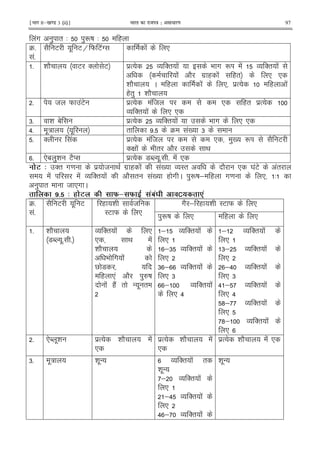
![98 THE GAZETTE OF INDIA : EXTRAORDINARY [PART II—SEC. 3(ii)]
* 6
; O '" !
* >
>5 i 1 H . E ! #
$% i ;1
V 7X $ "
O '" ! *
*
O '" !
*
;6 O '" !
*
6 ; O '" !
* 6
; O '" !
* >
; *
6; *
;> * 6
> ; * >
?; *
?; *
5 I Y ) E ! I Y
(" !
9 # !
V 7X $ "
O '" I Y
h .- h .-
5 IE K ! $ " 6 17R *
$ " ! 8
; ; *
h .- h .-
! $% ! * $% ! * $% ! *
$#Y %E 4 E .' .
45
!5
2 E . E )Rj * ( *
5 h 2 7N .5 5 O '" ! >
O '" ! " *
> $ "
O '" 9 #
* 8 7!
; O '" ! "
*
$% O '" !
9 # * *
8 7!
5 *N .i . E $% 7N .5 5 ! * $% 7N .5 5 ! *
65 .: O '" ! " h .-
; O '" ! *
;> O '" ! *
> ; O '" ! *
6
; O '" ! *
>
h .-
>5 i 1 N $% h 2
* ! .: *
N $% h 2
* *](https://image.slidesharecdn.com/ubbl2016notified-250923161005-b0550c73/85/UBBL_2016_Notified_DDA-Building-Bye-laws-98-320.jpg)
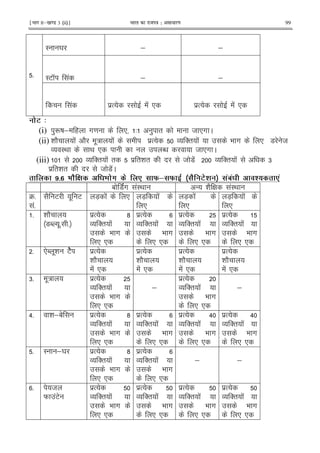
![100 THE GAZETTE OF INDIA : EXTRAORDINARY [PART II—SEC. 3(ii)]
5 ' ! $% ! 8
*
$% ! 8
*
$% ! 8
*
$%
! 8
*
$# %E #### 4 : .' . J 3.* *! '
45 !5 2 E . E i " *!
h 2 $% O '" *
5 *N .i E2 $% h 2 ! *
65 .: ;
>5 i 1 $% O '" 9 # *
5 I ;Y $% > O '" ! * 1 < !
5 8 W !E $% O '" ! 9 #
5 ' ! ;
(i) h 2 ! 2 .: ! $% O '" ! 9 # * 7F2 8
O I< < * N 8 *# C
(ii) E !# IE W * N 8 2 E . E+ h 7+ .
9 " 5 ( # C
$#Q 4 ':; 8 % ^ .8 & : . J 3.* 'A'
*! '
45
!5
2 E . E
7 #
7 I " E 7 # 7
I "
)Rj ! * !
( ! *
)Rj ! * ( ! *
5 h 2 $% 17
9 # *
$%
O '" !
9 #
*
$%
O '" !
9 #
* 6
5 *N .i E2 $% h 2
! *
$% h 2
! *
$% h 2
! *](https://image.slidesharecdn.com/ubbl2016notified-250923161005-b0550c73/85/UBBL_2016_Notified_DDA-Building-Bye-laws-100-320.jpg)
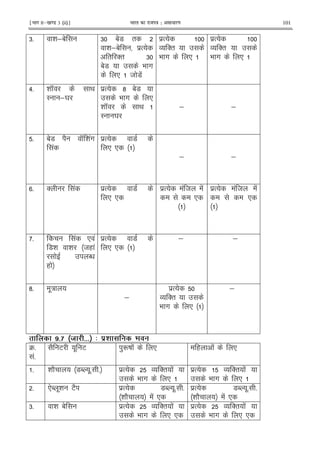
![102 THE GAZETTE OF INDIA : EXTRAORDINARY [PART II—SEC. 3(ii)]
>5 h K I Y $% ! 8
*
$% ! 8
*
5 17 2 K i !# ! ; ;
5 ' ! $% ! 8 $% ! 8
5 ! * !
7i ; i 8( !
N (
$% ! 8 * $% ! 8 *
?5 .: O '" ! " h .-
; O '" ! *
;> O '" !
*
> ; O '" !
* 6
; O '" !
* >
O '" !
" 6 $ "i "
" '" 8 7!
O '" !
* 5 $ "i "
" '" 8 7!
;
&$#[ 4
':; % ^ .8 F D 'A' c! &
:3 F S 3 J = /
45 !5 2 E . E
7 K'E ! h i
( IE
)Rj IE W
*
( IE W
*
5 h 2 O '" !
* *
O '" !
* *
O '" !
9 # *
*
5 *N .i E2 $% h 2
! *
$% h 2
! *
$% h 2 !
*](https://image.slidesharecdn.com/ubbl2016notified-250923161005-b0550c73/85/UBBL_2016_Notified_DDA-Building-Bye-laws-102-320.jpg)
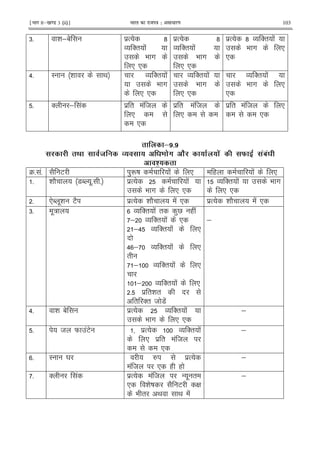
![104 THE GAZETTE OF INDIA : EXTRAORDINARY [PART II—SEC. 3(ii)]
E 3 h 2 ! 2 .: ! $% O '" ! 9 # * 7F2 8
O I< (" * N ( # C
&$# 4
F D 'A' *!
45 !5 2 E . E O '"#" $
) !
O '"#" $ ) !
("
5 I Y 8 ; O I<
<
$% ! E !E
* *
5 h 2 7N .5 5 $% ! E !E
* *
65 " ! ( ;
>5 $% ! 8
O I< ("
*
8 I Y "<
8 h 2 ! !
*
E 3 8( ! ! * ( h 2 O I< # ( ( !
I Y "< h 2 #; # ( !#C
$# 4 F D 'A' *! ' % . ; !.3
P >3 . ! D^!
'8 0 Y 0d+ 4 Y 6
45
!5
2 E
. E
8 IE W *
)Rj ( )Rj (
5 h 2 * !
.:
h 2 n
.: H
h 2 n 6
.: H ;6
h 2U n >
.: H6 ;>
6 h 2 n
.: H> ;
6 h 2 n
6 h 2 H
h 2 H ;6
h 2 H 6 ;>
h 2 H> ;
>h 2 H ;
1 $%
O '" ! *
h 2
O '" !
*
h 2 C
;6
O '" !
*
h 2
.: 3
O '" ! "
;
O '" !
* *
h 2 C
6;
O '" !
*
h 2](https://image.slidesharecdn.com/ubbl2016notified-250923161005-b0550c73/85/UBBL_2016_Notified_DDA-Building-Bye-laws-104-320.jpg)
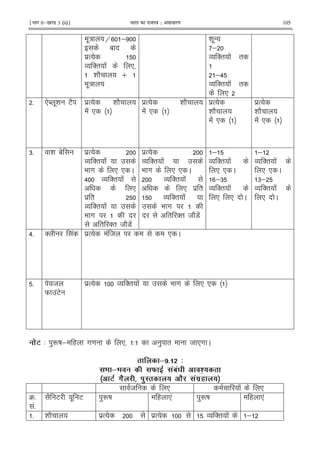
![106 THE GAZETTE OF INDIA : EXTRAORDINARY [PART II—SEC. 3(ii)]
> O '" !
"
* * C
Q
O '" ! *
$ "
O '" !
9 #
* *
" '"
8 27!
O '" !
"
* * C
O '" !
Q $ "
O '" !
9 #
* *
" '" 8 27!
* * C
;6
O '" !
* C
O '" !
* *
6;
O '" !
*
5 $G *N .i
E2
$% h 2
! *
$%
h 2
! *
$%
h 2
! *
$%
h 2
! *
65 .: O '" !
9 #
* *
; O '" !
" )V ( !
; O '" !
* *
;>
O '" !
*
;
>5 i 1 $%
O '" !
9 #
* * C
> O '" !
Q $%
O '" !
9 #
* *
" '"
$%
O '" !
9 #
* * C
O '" !
Q $ "
O '" !
9 #
* *
" '"
; O '" !
* *
;6
O '" !
*
;
O '" !
* *
6;
O '" !
*
5 ' ; ! $% " *
&$# 2 4
.: ' F D 'A' *!
8 ! *
45 !5 2 E . E )Rj ( *! )Rj ( *!](https://image.slidesharecdn.com/ubbl2016notified-250923161005-b0550c73/85/UBBL_2016_Notified_DDA-Building-Bye-laws-106-320.jpg)
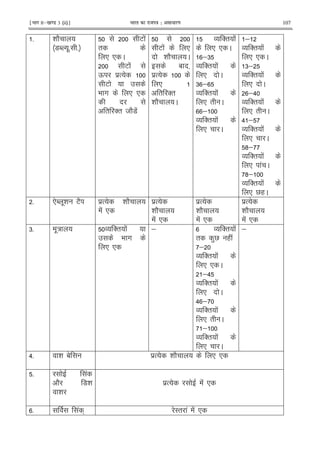
![108 THE GAZETTE OF INDIA : EXTRAORDINARY [PART II—SEC. 3(ii)]
&$# 5 4
B .' F D 'A' *!
45 !5 2 E . E )Rj ! * ( ! *
5 h 2 ; O '" ! *
* C
;6 O '" ! *
C
6 ; O '" ! *
" C
; O '" ! *
C
; O '" ! *
6 $ "i "
" '"C
O '" ! Q 5
$ "i "
" '"C
; O '" ! *
* C
6; O '" ! *
C
;> O '" ! *
" C
> ; O '" ! *
C
?; O '" ! *
! C
?; O '" ! *
V(C
; O '" ! *
$ "i "
" '"C
O '" ! Q >
$ "i "
" '"C
5 *N .i E2 $% h 2 ! * $% h 2 ! *
65 .: O '" ! " )V 9
( !C
; O '" ! *
* C
;> O '" ! *
C
> ; O '" ! *
" C
; O '" ! *
C
; O '" ! *
6 $ "i "
" '"C
O '" ! Q 5
$ "i "
" '"C
;
>5 8 O I<
(" )
$% O '" !
9 # * *](https://image.slidesharecdn.com/ubbl2016notified-250923161005-b0550c73/85/UBBL_2016_Notified_DDA-Building-Bye-laws-108-320.jpg)
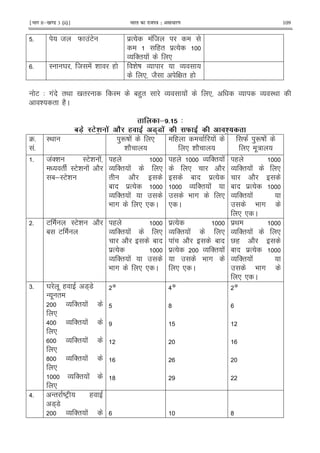
![110 THE GAZETTE OF INDIA : EXTRAORDINARY [PART II—SEC. 3(ii)]
*
O '" !
*
O '" !
*
?
.3 4 h IE (" i 1 I Y * $ 9 " jEF 9 =
! (" 0 =7 IX, ; 2 W "< ; ( ! !
) ( !#C
* $% h 2 ! * 9 " , $ # * 8 I h 2
O I< 7X# C G : ! $ "i " )_j 2 $ "i " ( *! C
$#5#Y# E & M! :; % "! * & .*
! @ ! 9 - " ! 8 . " M M" / !# O I< ! < 8 2
T 8 !#$(= (") 9 . #" E E2! * $ 1 * 8 *!#C 8
!#$(= * 9 . #" 8 E2! G " 8 #" 9 # < "+ 8 1 7
!7 ! ) ) " 8 i " $ "i " ( # C a T 8 b
!#$(= * 9 . #" 8 E2! !#$(= G " 8 #" 9 # < "+ 8
1 7 !7 ! ) 2 ! @ ! Z i " ! . ) " a
T 8 b !# $ "i " ( # C Z ; E 8 !I A "
) $ = H !1! " I< * i j I A " !# 8 ! 1.IE / !#
IEi ! < M M" G " 9 . #" 8 i ! = * I< $ ( !#C
0 * = * 3 * 9 = * 8 !8. "1 8 " (2
$ 8 1 7 ) " ( C M M" / !# O I< ! <
- . " E HO '" $ " >5 O '" G " < 8
!#$(= (") 9 . #" E2! * $ 1 * 8 (*C W E7 E 'i !
) " 8 # 2 ( ; i " ! * 8 *# C
8 1 7 : * 'i ) " " (2
! @ ! !0 (2C
# )'" " 5 ! # O I< #$) ( !# E 8 ! 9 N
8 *# C
Y * = ! 7+ . !# IE HM /1!# O I< $ "2
8 * " 8 T # 0 1 ( 2 -
8 E1 + i ! * "< T K ; E1 #
Z + i ! * ! - T + i ! * 8 C
m ! -i 5 E G " E! 18 * 71 2 G " IE E!
N 8 (*C
* = ! M /1!# O I< $ "2 8 * " 8
# 0 1 2 ( ; * 8 * "< h j # !
* 7+ . !# IE < 9 . #" 8 * $ 1 * 8 " (2!C
V - 5 E G " E! I< G " IE E! N
8 (*C
3) 4&](https://image.slidesharecdn.com/ubbl2016notified-250923161005-b0550c73/85/UBBL_2016_Notified_DDA-Building-Bye-laws-110-320.jpg)
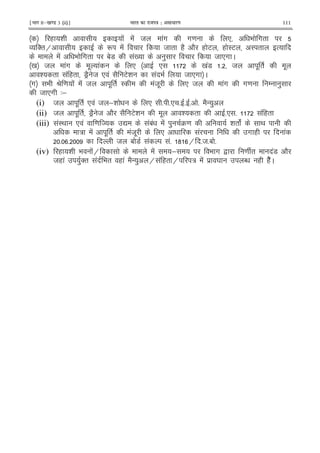
![112 THE GAZETTE OF INDIA : EXTRAORDINARY [PART II—SEC. 3(ii)]
! ! &
6 .' .
# 6 & ' @ & X .B .'
9 - M KE ! 9 9 ! , ( " !7 ! ) 8 (* 2
! 0 " ) !I A " * i " ! ) i "
8 (*C
9 E!# IE * i jE ( ! (2 2 ( ! .= 9 j !#
2 EF ! " N * 9 $" (2C $ $2 'Ei ) " "
(2! " 9 ) ) I< " . S -" ! !# = * !
I") jL RM #. " ()* $ % " * ! G " ) I"
< !8 !# 9 !C
# ' 0 ! .1!
( " 9 ! * $ # E 9 M KE ! #. ( "
(2!C 9 - M KE ! ( " 9 $ ! # " ! i # (2
3;
" 5 ; 9 - M KE ! 9 # ! * $ * ! ) $ "
M KE #
E P=
;P= $ M KE G :W
# 5
( " 9 *
$ 0 !7 5
)
i " h .-
Ii
; 0 >
0 ; #
0 >
# ;6 #
Y 0 6 Y
>
Iii 6 0
# Y
0 6 6
0 > > 0
)'" 0 " $ ! ) = ) " ; E M H K
M H " G : 9 # 1 ( i M KE W K !# 9 # !
8 (*C
.3 4
)0 8 HG : 8 ! $ @ $ ! "2 #
8 !H 8 ! * I A " i ( # 82 i # (23](https://image.slidesharecdn.com/ubbl2016notified-250923161005-b0550c73/85/UBBL_2016_Notified_DDA-Building-Bye-laws-112-320.jpg)
![114 THE GAZETTE OF INDIA : EXTRAORDINARY [PART II—SEC. 3(ii)]
( i M K E7 C
# . .'% OA J'3 * S E . E . .
U " Z K-k! ( 7 ! ( ) - $ 0 - $ IM E 2
1 E ' 1 ( !' 1 !# -E I !# . ) IEi - E
( I E IE 7 < E K- E ( K 7E V E "
M -< *! > # E I 2 1 2W 2 12! ' E!# R/ # !
" G " * C
.3 4
I E IE 7 ! K */1. !E i ! V E O( * $ 1 * 8 *!C
0 i ! " 3 2 i ! Q 3 C
# < E K- E ( 2 K 7E ! K */1. !E i ! V E O(
* i ! " H 2 Q i ! * H
$ 1 * 8 *!#C
# P OA .'3 * S E .' . !. E . .
) T VI; !7; )0 8 ; ! 0 " ) i '"
8 ! * I . h i 2 9 1 E # 7 9 1)8)# ! * ' 1
#$ ( K 7; -E jL $ i G = - $ IE K W 12! 7I ! ! IEi
) ! ) E 2 7M E !E IE C
.3 4 17X O( !1! !7 / 0 " 9 IE K W 12! 7I !
IEi ) ! ) E 2 7M E -E IE #$ !7 ] #. ( !#C
#2 P & OA .'3 * S E %= .3 M6 .! ! .8 .
!. E . .
M E I< ! ! 8 h 2 ' 1 E O * ! 2` !I< !#$(
E #2 8 )I" 21 E i Z # i G (") ( Z
$ i G = K 8 " K 8 $ i ( K -" h % I " !
$i 9 # IEi ; !# 1 7!# * E E 1 E 12L
! 7-E ' * i '" 8 ! 8# $ 0
17X > # E M -< *! < E
!i 2 P 2W 12!' E!# R 2 I 2 ;1 # !
" G " * C
5> I<
7X ! I" 9 # < *' < 2 !# G : ! #$ i <
8 ! = " 8 *# C
5>5 9 # < *' < H 2 # K ; M KE $ i 9 # < 2
1 7!# $ i , " !# 27X "( 1 [X ! - . " 5? E 27X
( (*C [ ( " #$ 7*-E $ "i " ( ! ( # C "
#$ A jE1 " O '" ! j " 2 # i *
" RM 8 (* !# " #$ " " 8 !# 2
" #$ )I jE RM # ( " (2 < * #$ 8 A jE1 "
O '" ! # i * # 8 % - " ( 8 1 !
aa # i " #$ bb RM ! jE 8 " (2C O( , ! #/ "](https://image.slidesharecdn.com/ubbl2016notified-250923161005-b0550c73/85/UBBL_2016_Notified_DDA-Building-Bye-laws-114-320.jpg)
![116 THE GAZETTE OF INDIA : EXTRAORDINARY [PART II—SEC. 3(ii)]
a # i " #$ b N 8 * * 7 8 A jE1 " O '" !
# i * 8 % - " ( N 8 *C
0 - . " 27X 5 5 ( # C
# I" ! !" ( " 3 ) " ! [ I < [
# O I< 8 *C
Y 2/ HI 1 * (2!7 O I< 8 *C
# I? & 8 %:3.! & .
i '" 8 * $ i H E * [X # * / 0 " $
( !# 3
- . " 27X 56 E ( (*C
0 [X Q! 5 E 2 EF7 27X 6 * * ( ! ( # C
[X ! ) ( # 8# ( ! ( (*C
# * ] E ! [X ! " !0 " " ( # C
Y [X ! ! " W (2!7 O I< 8 *# 2 [X $% ] E Q
2 56 E 1[X 8 *# C
#Q K3
; ) 8( ! 9 ]E i " ( ( ! 9 " N . 6
O '" ! G " 2 !8 ]E * ]E / 0 " [ ! <
O( )i ! " # " * * ]E $ 1 * 8 *!#C
" !5 5 ; !V ]E
I jE !" 27X
' !E <
5 5
I jE !" #(
' !E <
5 5
$ i ;, 27X 5 5
" I" Q 5 E 5 E !1 (2!7 !EF 2
# 8 *# C
0 ]E K1 5? 5 x 5? 5 !" ( # C
# 8 I "3 RM 0 ) - . " 2 !7 ( (* 2 8 1!
( # " 5 5H 2 !7 ( (*C
Y ]E ! !E ! * 7O O I< ( # 8 $% " 1 !
PO RM . " " ( C ]E ! U7 ! " ( ]E $ i H
, " 0 ) (2 1! (2C
#[ * J !
i '" 8 # * h 2 ! ! * i j E ' 8E 7N .5 5 O I<
8 *# 8 ! i '" 8 * $ i , E i ;1 i $
( C
- . " 5 5 x 5 5 ( # C](https://image.slidesharecdn.com/ubbl2016notified-250923161005-b0550c73/85/UBBL_2016_Notified_DDA-Building-Bye-laws-116-320.jpg)
![¹Hkkx IIµ[k.M 3 (ii)º Hkkjr dk jkti=k % vlk/kj.k 117
0 8 - . " ' !# 5 E ( # 2 8
I !#; E ( # C
#[# A K3 A >'8 .' * J ! .' %>W !# #
*/1. !E i '" 8 ! * "2 * #* 9 ! * 9 " ! i j h 2
7N .5 5 $ 8 *# C K ;*/1. !E i '" 8 ! * "2 * #* 9 !
* 9 .;" i j h 2 ! 7N .5 5 O I< 8 *# C h 2 7N .5 5
i '" 8 , # 8 O( $ 9 # C
#[# K3 A >'8 .' >W !# #
9 " ! i j h 2 ! $ 8 *# C h 2 i '" 8
P= 9 # 8 * O I< # ( C
#[#2 * J ! 4 OA .'3 * S E . * J ! .
h 2 7N .5 5 - . " 5 x 5 5 ( # 8 5 5 $ i
, 5> 5 - . " #( ( # C
0 (2!7 I jE 27X < h 2 7N .5 5 7 ' 8 !1
(2!7 5 E ( # 2 " I" (2!7 Q! 5? 5 ( # C
# . " ( 8 0 ) - . " 5 ? E ( # C
#[#5 = .3 M6 .! ! .8 6. P & .OA .'3 * S E .
8 * J ! .' .
h 2 ! 7N .5 5 - . " $ i , 5 5 - . " #( < 56
x 5 5 ( # C h 2 7 ' 8 5 5 !1 (2!7 O I< 8 *# C
O( * . !E I O I< (") 7N .5 5 E " - E
* W' 8 *# C - E h 2 !E -
>> * * 2 - . " 5 5 ( # C 8 . 0 ) - . " 5
? 5 ( # C
#[#Y A>? M6 .! ! .8 . . P .OA .'3 * S E .
8 * J ! 4
h 2 ! - . " $ i , * 5 5 - . " #( < 5 x 5
5 ( # C h 2 E 7 5 5 !1 (2!7 O I<
8 *# C O( * . !E I O I< (") 7N .5 5 E . " W
* " W W' 8 *# C - E h 2
!E - 5> 5 2 - . " 5 5 ( # C 8 . 0 ) - . "
5? 5 ( # C
#$ A_ .' . >E D '8
* 9 ! ! 8 $ )0 RM 1U ! # * ( ( ! (2!7 2 - W E!T
* ! W' % Q! " RM 8 i ( # C
.3 3 # i H " ] 2 E 3 " #$ 8 !# " #$ $
2 h j " #$ ! !" < A jE1 " O '" !
# i " ( -(! " " ( C # $ < ( 2 E ! i
" (" PO ! " $ " (2 81 O '" K !# IE <
"( " ( C # i H " ] 2 E # i #" $9 $](https://image.slidesharecdn.com/ubbl2016notified-250923161005-b0550c73/85/UBBL_2016_Notified_DDA-Building-Bye-laws-117-320.jpg)
![118 THE GAZETTE OF INDIA : EXTRAORDINARY [PART II—SEC. 3(ii)]
" (2 2 8 E I< ! O '" " " (2C / 0 " G : ! !
O I< 8 (* 3
1 7!# 2 !# G : * *' <
0 . E+E I #"; G Mi ]E [X ! 2 h 2 ! * 2! 7!# K1 C
# 2 < K ; !9 H !" ") !" 1 8( ! O( ) EF2 W ( C
Y I< 8( ! I" ! " " ( < 2/ !9 H !"
C
m $ i H "< 2! 7!# * C
# .!E
i '" 8 ! * $ 8 < 1 * #* i j h 2 ! E 8
) " $ 8 (*C
# R! % K!E
1 7!# 9 " ) G " I< * i '" 8 ! . !E (") [X ! 2 ]E
1 7!# ") -" * C !9 ( "
I< T ! :" " "< # 1)B " < T i , 1 (
I< " " ( " (2!C
P G : $ ( # ( " (2 " $% " T ! G "
IE 2! 7!# 8( ! * O( ) G " RM ( 7 8 " (2C
0 5 5 ' !# < 2 >5 ) " ()* (2!7 7 "<
# " I" 5 5 2 5 5 I< " I C
# ' . & e % @ .E
i '" 8 ! * 1 7!# 9 " i j ) ! )'" (
" ! " ! < i 8 (*C
0 ! " o ! "2 8 2 # 8 (* " " G
* * U ( ! # " ()* -(! [X 8 C
# A jE1 " O '" ! * )'" Q! G : ! . E+E #
8 (* 2 . E+E " " ()! !9 ( (*C
Y ) G " ) i " * 1 ( 9 () ! " ( ! (
(* 8 ! O % - " ( C
m O I" 8 G : ! ! 8 . $= 9 O I< 8 (*C
! "H8 9 !# ! 2 " RM $ i " * ! $ i " * 8 (*
' ! " A jE O '" $ < !# ! !" ! < ( " (2!C
V O( * !" jEF ! " o ]E h 2 [X ! !# G : !
% ! # 8 * 8 O I< i '" 8 ! * # (2C](https://image.slidesharecdn.com/ubbl2016notified-250923161005-b0550c73/85/UBBL_2016_Notified_DDA-Building-Bye-laws-118-320.jpg)
![120 THE GAZETTE OF INDIA : EXTRAORDINARY [PART II—SEC. 3(ii)]
! ! 2
. 6. 0
65 * 9 $ 9 H9 ! 8 ! # # )
i " ( ! !1! O I< 8 (*C
65 ! E7 . " E7 -IE i 9 %" * ! 9 %" 2
' i * ! 8 8 " (I" I" 2 i 7 . " K
-E!T 7 - E i "< M !1! " - RM h (2C
656 9 #$ 1 ( " (2 2 9 !# * ! RM (
" (2C
65> #" ! 5 5 5 5 $ " ! )
! = #" $ "i " ( (*C
65 " M KE 1 !7F - < 9 ! I< " ( (*C
65 M KE 1 !7F ! O I< # (2 "
9 # 8 G : !H0 ) I< !H 2E12 G : ! ! $ I< " 8 *
T i ( 8 ( ! 1 I< " ( C
65 9 ! O I< 8 " (2 " < 9 (I
!9 "3 K1 G : ! 8( ! ( 8 " 0 ! N 8 *C
65? 9 O I< 8 " (2 " 8 ; " <
9 (I !9 "3 K1 G : ! 8( ! ( 8 " 0 ! N
8 *C
65 9 (I 9 ! I< " (2 " E Q! 2 9
1 ( I< " (2 " E Q! ( ! (*C
65 # # , 8 ! * 9 !I A" 'i !
! h 8 *# C
65 # # ; !1! ! i ; i 8
" (2 2 8 *# C
' 4 ' @ XI
W !5 h j (I" G "
*; 78 * ! jE ! ) *
9 ! = ) =
= # < #$ "
* :
I
*; i ! ) '" $ = :
I") H 9 !" *H !
9 !" H G
i I") 9 !" *
ii ! 9 !"
iii M G
iv
*;6 i j M KE (")
1(); 9 G = ) *
:
I
*;> ! % ) G $ = : i ! 9 !"](https://image.slidesharecdn.com/ubbl2016notified-250923161005-b0550c73/85/UBBL_2016_Notified_DDA-Building-Bye-laws-120-320.jpg)
![122 THE GAZETTE OF INDIA : EXTRAORDINARY [PART II—SEC. 3(ii)]
F & &
% ! ! #
>E D ' a3! .' . 0 .' 0 8 .
; 8 . . & /
%: L E ! E
!
555555555555555555555555555555555555555555555555555555
555555555555555555555555555555555555555555555555555555
(
2!H( ( ! , . " (.!H " (2! 2!H ( 9 =
; ) 9 !5 5555555555555555555555555555555 M E !5 555555555555555 N K !5 555555555555555555
!5 555555555555 8 55555555555555555555555555 I< 5555555555555555555555 ! = H ) = H "
(" (.! H (" (2! 2 , "+ (I" G " 'i 2 jE ! "< -
= H I" 8 ! 82 #. ( / 0 " $ " 9 < 9 8 ( (.! 2 55555555
5555555555555555 I") H 2 9 !" * I") !8 = !H 9 !" *
*/ 2 2-E !5 5555555555555555 8-( ! 'i 78 "2 * C
5 )0 M 5
5 E M 5>
65 9 . Ai M 5>5
>5 I< 'i 56
5 9 'i 5
5 Q! = * 9 'i 5?
5 M 5
?5 * i 5 56
5 - jE ! W ! ! T
5 I % 5
5 h ) 9 )#" * !G ! " $ " C
5 - I" 8 G " ( ! "
= !I A" 9 M ) ( # C * = ! !1! ! I
H G = = G = " W () 9 . * I ! 8 1 (
( !# C
: 9 : ! .' (I" G 555555555555555555555555555555
: 9 : ! .' 555555555555555555555555555555
: 9 : ! .' " 555555555555555555555555555555
! 55555555555555555555555555555555555555
: 0 9 !' * L 6: ( >E D ' a3! ' ' @ 6J](https://image.slidesharecdn.com/ubbl2016notified-250923161005-b0550c73/85/UBBL_2016_Notified_DDA-Building-Bye-laws-122-320.jpg)
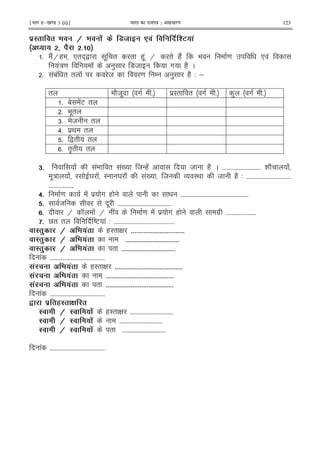
![124 THE GAZETTE OF INDIA : EXTRAORDINARY [PART II—SEC. 3(ii)]
F & &
.* . .' !0 S /
% : 0 9 !' *9 ' !' 9 ! .(
: 0 9 !' *
% : 0 9 !' * L : 0 ! E
% ! ! J # #
* I ! G ! " $ = : * ! 1!
2!H( 555555555555555555555555555555555 ) ):H % H ): P HP " 555555555555555555555555555O
I") H 9 !" 8 5555555555555555555555555555 I< " (2 *" + , / ) % jL
( $ "` 2 Y j = " (.! 3
5 2! O * 9 !" (.! 2 !8 = !555555555555555555555555555555 , I")
j ! !8 A" (.!C <
2! O I * 9 !" (.! 2 $ = H !1! " I< !
*/ 2!E !5 5555555555555555555555555, " 2 1S (.!C
5 )B I , !I A" 9 'i ! ) M KE !5 5555555555555555555555555N K !5 555
555555555555555555555I< 55555555555555555 I< " 9 I") % 78 "2 *
I") H 9 !" RM ! )'" # (2C
65 IO 9 I" *! " (2 " 2! 9 =
I" H I") I< " i " ()* W E #$ W (" ! ! $ = H !1! "
I< . " R!# C
>5 2! I") H 9 !" 8 < # 8 0 =
" (.! " ! ! 2! I $ " $ j " " ()* $ = H !1! "
I< . .!# C
: 0 9 !' * (I" G 5555555555555555555555555
: 0 9 !' 5555555555555555555555555555555555
: 0 9 !' " 5555555555555555555555555555555555
! 555555555555555555555555555555555555555
L 6: (
: 9: ! .' (I" G 555555555555555555555555555
: 9: ! .' 5555555555555555555555555555555555
:M 9: ! .' " 555555555555555555555555555555555
! 5555555555555555555555555555555555555
% ! ! J #Q
' !'
! 9 -" , $I")" 8 *
* I ; G ! " $ = : * ! 1!
2!H( 555555555555555555555555555555555555555 ) ): % ) ): P 555555555555555555555555555555555555555O !
9 -" 55555555555555555555555555 *" + , / ) % jL $ "` 2 Y j =
" (.!H " (2! 3
5 2! O , * ! 9 !" (.! 2 $ = H !1! " I<
! * 2 2!E !0 5555555555555555555, " 2 1S (.!C](https://image.slidesharecdn.com/ubbl2016notified-250923161005-b0550c73/85/UBBL_2016_Notified_DDA-Building-Bye-laws-124-320.jpg)
![126 THE GAZETTE OF INDIA : EXTRAORDINARY [PART II—SEC. 3(ii)]
% ! ! J # #[
! .(
% ! .( L : 0 ! E
. . : & (! ' / ' A'
2!H( 555555555555555555555555555 ) ): % ) ): P 5555555555555555555555555555 O G 5555555
555555555555555555555 *" +, / ) % jL 9 ` 2 Y j = " (2! 3
5 2! O , * G (.! 2 $ = H !1! " I< !
* 2 2!E !0 555555555555555555 , "+ 2 1S (.! C
5 I , !I A" 9 'i ! ) )B M KE !5 555555555555555555555 N K !5 5555
5555555555555 I< 5555555555555555 I< " 9 = G = (") * G
R ! )'" # (2 C
65 I 9 = ! 9 9 *! " (2 " 2!
! ! 9 = I" H I") I< " i " ()* W E #$ W (" $ =
H !1! " I< . .!# C
>5 2! G 8 < # 8 ( ! 0 = " (.!
" ! ! 2! IO $ " $ j " " ()* $ = H !1! " I<
. .!# C
! .( (I" G 555555555555555555555555555555555555555
! .( #######################################
! .( " #######################################
' ###########################
L 6: (
: 9: ! .' (I" G ####################################
:M 9: ! .' ##########################################
:M 9: ! .' " 555555555555555555555555555555555555555555
! 555555555555555555555555555555555555555](https://image.slidesharecdn.com/ubbl2016notified-250923161005-b0550c73/85/UBBL_2016_Notified_DDA-Building-Bye-laws-126-320.jpg)
![¹Hkkx IIµ[k.M 3 (ii)º Hkkjr dk jkti=k % vlk/kj.k 127
F & &2
% ! ! J #
c a3 ) P3 . "! E %A & J .S3 D 3S .
0 . 6. 0 . /
%! .E 9 >E D ) . . : L : 0 ! E
5 M KE =
5 I< "
5 *!
65 ! M KE G :W (" # E ! G :W
>5 7 ! 27X
5 = $ A " k ( 7H 8 ( 7
0 5 G " 8
5 )0 8 !"#" 9 . # ' (2f
5 G : 8 !"#% 9 . # ' (2f
65 ' E M ) " (2 f K H E M
>5 / 0 " * ' ) " (2 3
i. 9 . #H # 35555555555555555555555555555555555555
ii. ] I $I" " # (" $% " 8 3 5555555555555551 !E
G :W H # 3 5555555555555555555555555555555555
iii. *W5*5 5 3 5555555555555
iv. Q! 3 555555555555555555555555
v. " ! !0 3 5555555555555555555555555555
vi. * !:= H 2E12 3 555555555555555555555555
vii. !# !7 5 5* 5 !0 555555555555555555555555555555555555
viii. ! !0 3 55555555555555555555555
! T 3
5 I % (
5 8 ( 7 ( " $ " < E+E " %" $ = :
65 EH i M
: 9: ! .' (I" G ####################################
:M 9: ! .' ##########################################
:M 9: ! .' " ##########################################
' #######################################](https://image.slidesharecdn.com/ubbl2016notified-250923161005-b0550c73/85/UBBL_2016_Notified_DDA-Building-Bye-laws-127-320.jpg)
![128 THE GAZETTE OF INDIA : EXTRAORDINARY [PART II—SEC. 3(ii)]
F & &5
% ! ! J # #2
' ^ 0 ( /
% ' ^ !' J : L : 0 ! E
/ 0 " $ = : M KE !5 55555555555555555555555555555 9 !5 5555555555 I< 55555555555555555
5555555 8 555555555555555555555555555555 (") 9 ) " !I A " $ M" * 'i !
8 " 9 'i 7F ! # ! < $I")" 8 (2C
5 $ = " 8 " (2 $ = H !1! " I< $I")" *
9 'i ! ) G i " ! * 78 8 *# C
5 ( 9 $ = " 8 " (2 ! % 78 E+E I< " ! 555555
55555555555555555555555555555555555 , "2 # ! 555555555555555555555555555 E+E 8 !
E !5 555555555555555555555555555 ) $ A " 8 0 ! ) G
(" jEF 9 7 ( ( # 2 = * 8
9 ! % 7F !# ! ! "+ i 8 *# C
' !' (I" G 5555555555555555555555555555555555555555
' !' ########################################
' !' " ########################################
' #############################
L 6: (
: 9: ! .' (I" G ####################################
:M 9: ! .' ##########################################
:M 9: ! .' " ##########################################
' #######################################](https://image.slidesharecdn.com/ubbl2016notified-250923161005-b0550c73/85/UBBL_2016_Notified_DDA-Building-Bye-laws-128-320.jpg)
![130 THE GAZETTE OF INDIA : EXTRAORDINARY [PART II—SEC. 3(ii)]
F & &
% ! ! J # # # 5
G = 9 ( #$ ( 2 1 (E (") $ = :
I H G , $I")" 8 *
!
5555555555555555555555555555555555555555555
555555555555555555555555555555555555555555
( H (
5 $ = " 8 " (2 M KE 9 !5 55555555555555555555 ! = H ) =
= # < #$ ! " "< 8 H E
G = ! 8 *# H j " 8 *# 2 2! H( $ = " " (2!
* #$ $ * ! #$7 "< ; 2i < $I")"
# jE ! ) ( !# "< !I A" 'i ! ! ) " ! %
78 ) . 8 *# 8 ! 8 E 8 ; . " Z)"
T ) G 82 *! h (2! C = 2 9 K ! ! 7!#
( ! ( # C
5 $ = " 8 " (2 = 2 1 M" ( (E
8 *# C * ( ! 8 " (2 " * ! I< 1 H
(E " (2 "< =7 (" #" )B H ( .
8 * C
65 $ = " 8 " (2 2!H( - . " ? W E I4 K 0 7 )0 7
< = I< * " I4 # *!# 8 7 " W 2-E
8 *# " ( i 9 #C " '" = 2 #
#$ ) G " G : ! 0 * 9 #$9 # * 8 <
)V - ) G " #$ # ( # C
>5 $ = " 8 " (2 : 2 (+ 18 . (+ 18 " h
9 ( ! 8 *# C
: 0 9 !' 9 ! .E A' 9 ' !' 9 ! .( .
6: ( ####################################
####################################
####################################
' ####################################
L 6: (
: 9: ! .' (I" G ####################################
:M 9: ! .' ##########################################
:M 9: ! .' " ##########################################
' #######################################](https://image.slidesharecdn.com/ubbl2016notified-250923161005-b0550c73/85/UBBL_2016_Notified_DDA-Building-Bye-laws-130-320.jpg)
![132 THE GAZETTE OF INDIA : EXTRAORDINARY [PART II—SEC. 3(ii)]
# ( ! )'% 0 " H ! j 5555555555555555555555555555555555
( 5555555555555555555555555555555555555555555 " 0 < " 1! (I" 0 2 ( $I")"
" (2C
: 9: ! .' (I" G ####################################
:M 9: ! .' ##########################################
:M 9: ! .' " ##########################################
' #######################################
8 6 (I" G ####################### 8 6 (I" G #######################
8 6 ####################### 8 6 #######################
8 6 " ####################### 8 6 " #######################](https://image.slidesharecdn.com/ubbl2016notified-250923161005-b0550c73/85/UBBL_2016_Notified_DDA-Building-Bye-laws-132-320.jpg)
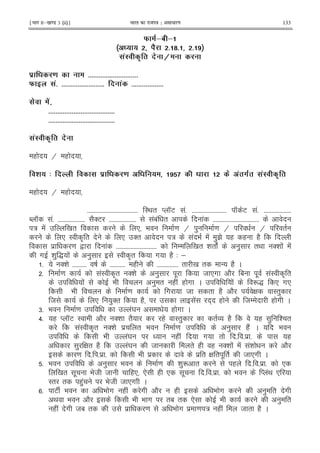
![134 THE GAZETTE OF INDIA : EXTRAORDINARY [PART II—SEC. 3(ii)]
5 $ = G " . " 8 *# 2 - ! ! - $ = !
G ( ! ) ( ! ( # 2 O HG "H !
)'" 0 8 *# 8 5 5 $ 5 O 7X " (2 9 'i !
I A " $ = < = I R 7X " (2 C
?5 8 2 0 7 $ # ( !# 81 0 ) " #
" W 0 ) ! C
5 E 8 ) " !7 ! ) ( Y $% "
! ! "" # 2 ! # ( i + i
* 8 *# C
5 9 = 9 " Z)" ! ! jE 2 Z)" 1 7
i " ! ) I< 9 " W 1V () E8 ! - . "
i . 0 " ()* 8 *# C
5 2E12 $ " = I R 0 ) V 7 # 9 . 8 7X
(II ( # C
5 1 ( ! 27X 5 6 E aa ( # C
65 1! E" * #* M KE ! ! 9 $ !#"" 1 *
)B 8 " (2 $ !9 . 8 i 8
I< ) 3 -(" ! < 0 =7 5 5 1 51 5* 5 ?6
) ) T aaN aaC
>5 . 9 ." I" ! = I< !1! " ) i " ! C
5 I / 0 " 8 - . " 6 W E X > W E 1 7 ! ! $ i "
# C](https://image.slidesharecdn.com/ubbl2016notified-250923161005-b0550c73/85/UBBL_2016_Notified_DDA-Building-Bye-laws-134-320.jpg)
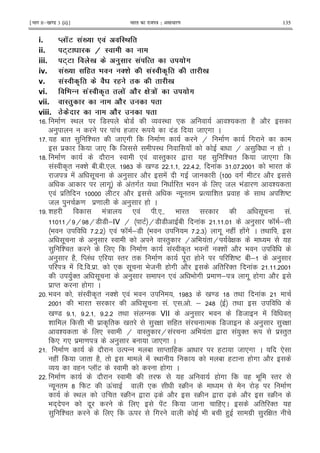
![136 THE GAZETTE OF INDIA : EXTRAORDINARY [PART II—SEC. 3(ii)]
# #$9 # ! < 9 * 8 < 9 ) G #$
# 8 *C
65 = ! # " ! " 5 18 1 ( !
8 *# C
>5 (i) $% 1 7 < I = G : 2 9 ! 1 * #*
" # *# C 1 7 I (" 9 O '" 9 $
= #$ & D R " 9 ! # 2 7X
9 (I !#$( ) " ( ! (2!C
(ii) I< ! !#$( * #* 9 $ = #$ ( " ( [X
0 ( # 8 ( ( 9 R ! ; 10 C
(iii) EF ! < - ( ! , 8 = #$ 2 1 . " (
[X 2 ) G " 0 8 * 8 ( ) & " 8 =
1 < = #$ 9 R ! ( ( < " = ! 10 C
(iv) = I< 7X . . " ( !:= 0 (* 2
* 9 ! 1 " 8 (*C
(v) = #$ 2 = * 9 $ 1 ( !
#$ " 1 ( ! 7X ! " ( #$
( UV " ( W !C
(vi) = I< "< = #$ 2 = * 1
[X " ! & ( 8 . I N 8 * 8 &
$ 4 ! . = - 8 8 !C
(vii) . !1! " = #$ 2 = ! $ # ( 1
; 8 9 = ! & 8 . ! 9 % ) *! 8 ! 2
8/ $% I 2 < 1 7 ( # C
(viii) $% 1 7 ( 8/ ( # ( & ! & " c 2 !
) = #$ 2 = I< & D 1 1 = I< 7! !#
I< < - I< ()! *C
(ix) I $! W' 2 #$ * 1 A8 & ! 2
( & ! ! 0 " 1! * ! & " c 7X ) & "
* 9 " (2!C
(x) #$ ! 7!# "< IE E!# ! E 8E R # C
(xi) = I< ! -7 1$ !# C
(xii) 9 . "% ! E 2 - $ A " ) 9 I< " ) 9 -
8 " ! 17X !0 ! 2 # aa AG UV "bb G : 1[X 9
$ (*C
(xiii) 9 1 7 8 5 5*5 . !"#" O &
! = ( (2!C 9 9 ! ! ( " E+E N
*!# 8 = " (2C
5 ) $ = I") ! % 7F !# !H !:= !7 ! 9 =
; 2 )0 8 ) ( ) " " (2C 8 # !
* I H & " H I") H 9 !" H ! 9 !" H9 .; A&](https://image.slidesharecdn.com/ubbl2016notified-250923161005-b0550c73/85/UBBL_2016_Notified_DDA-Building-Bye-laws-136-320.jpg)
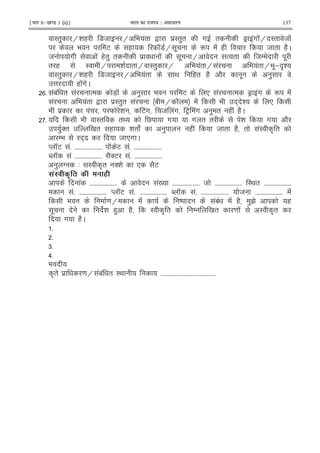
![138 THE GAZETTE OF INDIA : EXTRAORDINARY [PART II—SEC. 3(ii)]
F &A
% ! ! & J & #
0 4 J 9
!
55555555555555555555555555555555555555
55555555555555555555555555555555555555
W !5 55555555555555555555555555555555555555 ! 55555555555555555555555555555555555555
(
! 55555555555555555555555555555555555555 : !0 555555555555555555555555555555555555 8
55555555555555555555555555555555555555 I< " 55555555555555555555555555555555555555 !5 55555555555555555555555555555555555555 M KE
!0 55555555555555555555555555555555555555 N K 55555555555555555555555555555555555555 8 55555555555555555555555555555 ! 9
= H D I A " !1! ! (2
)B . (2 ! 55555555555555555555555555555555555555 / 0 "
! I A " ) 2 = # (2H I A" # (2C
5
5
65
9
A" $ = H !1! " I<](https://image.slidesharecdn.com/ubbl2016notified-250923161005-b0550c73/85/UBBL_2016_Notified_DDA-Building-Bye-laws-138-320.jpg)
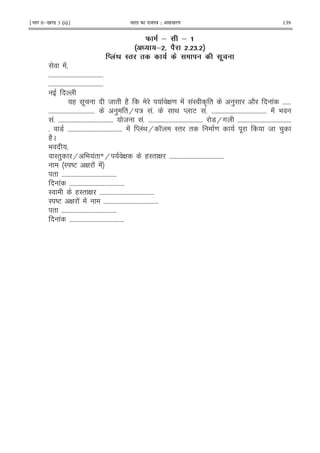
![140 THE GAZETTE OF INDIA : EXTRAORDINARY [PART II—SEC. 3(ii)]
F & &
% ! ! J # 5
( ! ! L ) '; : ( .3
2! 55555555555555555555555555555555555555555555555555 ! 55555555555555555555555555555555555555555555555555 R !
" (. 2 2! ! 55555555555555555555555555555555555555555555555555 ) " ) M KE !5
555555555555555555555555555555555555555555 !H I< " 9 !5 555555555555555555555555555555555555555555 8 !5 555555555555555555555555555
555555555555555 7H# 555555555555555555555555555555555555555555 7 555555555555555555555555555555555555555555 G = (2C
9 ( ! # C
0 !I A" '& ! / 0 " # " )0
8 H9 ; $ ! RS (2 2 $ A " (2C
* #* = 555555555555555555555555555555555555555555555555555555555555555555555555555555555555555555555555555555555555555555555555555555
55555555555555555555555555555555555555555555555555555555555555555555555555555555555555555555555555555555555555555555555555555555555555
) 8 " (2 81 " )'" ! ( ! ( 8 " 81
" # = 1! ! 2 ( ) & " ! = !I A" '& !
) ( C
9
555555555555555555555555555555555555555555
555555555555555555555555555555555555555555
!5 555555555555555555555555555555555555555555
IE / 555555555555555555555555555555555555555555](https://image.slidesharecdn.com/ubbl2016notified-250923161005-b0550c73/85/UBBL_2016_Notified_DDA-Building-Bye-laws-140-320.jpg)
![¹Hkkx IIµ[k.M 3 (ii)º Hkkjr dk jkti=k % vlk/kj.k 141
F &> &
% ! ! J # Y#5 [ ]
!
555555555555555555555555555555555555555555
(
( *" +, $ = " " (2! ( M KE !5 555555555555555555555555555555555555555555 H ! 9
!5 555555555555555555555555555555555555555555 M KE !5 555555555555555555555555555555555555555555 N K !5 555555555555555555555555555555555555555555
8 555555555555555555555555555555555555555555 = H ) = < #$ "
G = (2 : !5 555555555555555555555555555555555555555555 ! , !I A" '&
) ! 555555555555555555555555555555555555555555 . 8 ) (2C . ( )
( !")DE (2! ; )& " 2 #$ $ * ! #$7 ! - * ! I"A" DE !
7X # (2!C
# /
i $ = " 8 " (2 9 H9 ! = !I A" '& 2 ! %
78 D " ! % 7F !# * 2E ! T (2 8 ! !1! " $ " *
7 !H !H & ; & ! ! < DE ! % ) G $ ! &
# (2 ) # (2C
ii " '" ( 9 $ = " ( 9 $ = " 8 " (2 9 ! I"A"
7F !# ! 2 DE ! 8 # ! * 9 !" , "2 # (2C
iii ( 9 $ = " 8 " (2 = G G = ! # (2 2
! $I")" # 9 7F !# ! ) # (2 "< G = K7 c
0 # (2C
65 9 9 # < 9 # ) " 8 " (2C
>5 7F !# ! " !" 9 $ " 8/ I ! (2C
: (I" G
I DE G ! ! 5555555555555555555555555555555555
" 5555555555555555555555555555555555
! 5555555555555555555555555555555555
0 ' !' ! % 78 * @ (I" G 55555555555555555555555555
I DE G ! ! 5555555555555555555555555555555555
" 5555555555555555555555555555555555
! 5555555555555555555555555555555555
# : 0 9 !' *9 ! .( ** (I" G
! % 78 * @
I DE G ! ! 5555555555555555555555555555555555
" 5555555555555555555555555555555555
! 5555555555555555555555555555555555
Y ! .( (I" G
= M G = * @
I DE G ! ! 5555555555555555555555555555555555](https://image.slidesharecdn.com/ubbl2016notified-250923161005-b0550c73/85/UBBL_2016_Notified_DDA-Building-Bye-laws-141-320.jpg)
![142 THE GAZETTE OF INDIA : EXTRAORDINARY [PART II—SEC. 3(ii)]
" 5555555555555555555555555555555555
! 5555555555555555555555555555555555
* 9 !" 8 # 5 " M KE ! ! $ = H !1 " I<
, 2 1S (2!C
** G 8 # 5 " M KE ! ! $ = H !1 " I<
, 2 1S (2!C
F &> &
% ! ! J # #2 [ ]
J .8 /
$ = 5555555555555555555555555555555555555555
W !5 5555555555555555555555555555555555555555 ! 5555555555555555555555555555555555555555
8 !5555555555555555555555555555555555555555555555555555555555555
!
P HP " H )P 5555555555555555555555555555555555555555 I 5555555555555555555555555555555555555555 ! 55555555555555555
55555555555555555555555 . ! 9 ! 2! ( $ = " " (.! / 0 "
= ) 9 2 5555555555555555555555555555555555555555 $ = A" '& 8 * 5 5 5 * !
9 '& ! 5555555555555555555555555555555555555555 : !5 5555555555555555555555555555555555555555 , !I A" *
#* < "< # #H T & < ) "
$ = : ) @ $ = : ) " # (2C 9 = ;
! 9 ! I< G = # (2 ! 2 I I< $ 2 I UV
" = (2 2 9 # * L Y D " # (2C
) $ = 9 = ; 2 )0 8 $ ! ) (
I") ! % 7F !# !H !:= !7 ! ) " " (2C 8 # !
* I H & " H I") H 9 !" H ! 9 !" H9 .; A& I") H& (
78 H 9 !" , $I")" # " 7F !# !H I" 8 ! 9 E
( 7H . R ! ( 8 " (2!C 8 # ! *
" $ ! . H % " 8/
I H & " H I") H 9 !" H ! % 9 !" H9 .; A& I") H& (
78 H 9 !" (" < (2 2 . ) @ ( !#C
9 ! % 81." ! 565 9 " . .
& ! >? 2 0 !7; 5 5 5 5 5 "< 9 ! T ;VII
! 0 " !1! " $ " 5* 5 7 !H !H & ; & ! ! < DE
! % ) G $ ! ! & ! % 7F !# ! * 2E <
I H I") H ! 9 !" , ! )'" R * #* $ = : " (2C
'" !1! ! T & ) G )0 T & 5 5G :
) " " (2C 9 $ $ A " 8 0 H 9 (
) * $ = HI< @ ( ! ( # C
! T 7F !# ! ) M KE !5 5555555555555555555555555555555555555555 * $ = : 8
(2C](https://image.slidesharecdn.com/ubbl2016notified-250923161005-b0550c73/85/UBBL_2016_Notified_DDA-Building-Bye-laws-142-320.jpg)
![¹Hkkx IIµ[k.M 3 (ii)º Hkkjr dk jkti=k % vlk/kj.k 143
F &> &2
% ! ! J # #2 [A ]
.8 / . : . ! 0 . F
W !5 55555555555555555555555555555555555555 ! 55555555555555555555555555555555555555
P HP " 55555555555555555555555555555555555555
555555555555555555555555555555555555555555555555555555555
D 3 M KE !0 55555555555555555555555555555555555555 N K !0 55555555555555555555555555555555555555 I 55555555555555555555555
555555555555555 9 # $ = : !!1! !C
P HP "
5 : !0 ! 55555555555555555555555555555555555555 ! 9 !C
5 . ! 55555555555555555555555555555555555555 ! 9 !C
65 )'" 0 " D ; !0 : !0 55555555555555555555555555555555
555555 ! 55555555555555555555555555555555555555 )4 ! )B ( ( & () (2
8 ! # (2 2 9 # $ = : / 0 " = !
I # (2C
) (2 / 0 " . 8 3;
/ 0 " I" 8 8 *! 8 *! 3;
5
5
0 / 0 " ! ! ) *!
5
5
# $% * #* !Y E & ) 9 )#" / 0 !
" 8 " (2C
45 !5 !Y E & )
_ ! !
!Y E & ) &
_ ! !
5
5
65
) !Y E & ) _ 3 5555555555555555555555555555555555
2 H 7 !7 7F ]EH K 9 )#" H 9 )#" 9 ! !
I (2!C
0 ) 3 ) 8 " (2 ! 5555555555555555555555555555555555 "
& !C * ( 9 # $ = ; : 8
) 1 . I 8 *# 2 RS .
!"#" & 8 *# C
# : @ " W !5 0 !C
9
$ = H !1! " I< 555555555555555555555555555555555555555555555555555](https://image.slidesharecdn.com/ubbl2016notified-250923161005-b0550c73/85/UBBL_2016_Notified_DDA-Building-Bye-laws-143-320.jpg)
![144 THE GAZETTE OF INDIA : EXTRAORDINARY [PART II—SEC. 3(ii)]
F &> &5
% ! ! J # Q
! /
$ = 55555555555555555555555555555555555555
W !5 55555555555555555555555555555555555555 ! 5555555555555555555555555555555555
M !5 5555555555555555555555555555555555
!
P H )P HP " 555555555555555555555555555555555555555555555555555555555555555555555555555555555555555555555555555555 I 555555555555
5555555555555555555555555555 ! 5555555555555555555555555555555555 " = !1! ! 2! *" +, (
$ =" " (.! M KE !5 5555555555555555555555555555555555 N K !5 5555555555555555555555555555555555 I 555555555555555
5555555555555555555 I< " 9 0 " = ) 2 ! T $ =" '&
) "< 9 = 2 )0 8 " = * Y D "
9 H 9 # $ ! ) G = (2C
) $ = 9 = ; 2 )0 8 $ ! ) (
'& ! = " (2C 8 # ! * I H & " H
I") H 9 !" H ! 9 !" H9 .; A& I") H& ( 78X H 9 !" ,
" = * $I")" # " 7F !# !H I" 8 ! 9 E (
7H . R ! ( 8 " (2C 8 # ! * "
$ ! . H % " 8/ I H & " H
I") H ! 9 !" H9 .; A& I") H& ( 78 H& ( 78 H 9 !"
(" < (2 2 . ) 8 1 ( ( !#C 9 ! % 81." !
5 65 9 " . . & !5 >? 2 0 !7 5 5 5
5 5 "< 9 ; ! T ;VII ! 0 " !1! " $ " *
7H !H & ; & ! ! < DE ! % ) G $ ! ! &
! % 7F !# ! * 2E < I H I") H ! 9 !" , ! )'" R
* #* $ = : " (2C '" !1! ! T & ) G )0 T &
5 5 G 5 ) " " (2C 9 $ $ A "
8 0 H 9 ( ) * $ = HI< @
( ! ( # C = 8 " # (2 = / ) (2C
W P 9 !
5 N K H9 !5
5 " ) " * #* =
9
$ = H !1! " I< 5555555555555555555555555555555555
0 @ -I
.F.* 6 J ( % ! D : .E . B > # 2 . .B .'
# ! * .' 4& $% = ; H 8 * ) " !# # (2
8 78 * ! G = !8 A" $ W& , 8 *# C 9 -
; ! * !8 A" $ W& I") 0 9 !" #](https://image.slidesharecdn.com/ubbl2016notified-250923161005-b0550c73/85/UBBL_2016_Notified_DDA-Building-Bye-laws-144-320.jpg)
![146 THE GAZETTE OF INDIA : EXTRAORDINARY [PART II—SEC. 3(ii)]
( 4 2 1S IEF' 9 !" 9 9 ! ! 78 "2
#= *! 2 G = * G ( # C 9 ! !
& D ! % & D " ( " $ = H !1! " I< , *
#* = ) 8 !8 G " 2 M G G "
!"#" G 2 "8 G : ! 2 /1 "+ ! ! DE (2! 78
IEF' !8 ! , 1 8 *# C
H # ) ! .( 4 M G * - . " (" *! !8 ! 7M
< I") ! IE!E & < I") < !8 ! T "
( # 8 9 " , 8 :" ! 9 " (") " - . "
T " G (2 "< " '" 1 7!# 78 = 2
G = ! ! D )9 9 ( # C
( 4 2 1S G = * #* 1 7!# E !1! "
* G ( !#C
5 # E " M KE 9 * 1 7!# E
!1! " 9 '& 2 !1! " 8 2
5 )'" ) 9 (") G = $ = : 8 C
%g 8 ! .E 4 # 8 * - . " (" ! IEE+ .E KW
E M =7 * *E I " < # * ! #$ 8 !
I " < I " @ 7#$ < G (" ( # C
( 4 # 8 * #* E !1! "
* * G ( # 3
5 9 G : ! * E !1! " 9 .; 9 8 ; E !1
8 (") M "2 2
5 9 G : ! 9 . (") G = $ = ; : 8 C
.3 4 ( ! (2'E G :W E (") 9 . E
* 9 A A& I") 9 ( " # 2 7X ! 8 ; . "
8H Z)" = * 9 . 9 ." !
(") # ! * !8 A" 9 !" ( " !#C
% *! : 0 4 9 . A& I") * - . " (" - " $ M"
9 " < & & Z 9 .; A& I") ! I " <
I " @ 7#$ < G ( # C
( 4 I") (2'E 2 9 . G :W
1 7!#H E * 9 . A& 78 !!1! " !
G ( # C 9 . A& ( # ! ! 9 . G :W ( (2'E
2 ( # C
.3 4 '" DE ! V E G : ! * ! V" 9 . A&
A DE 9 . A& I") * *& 9 8 " (2C
%= * 6 >E D 4 & ( 78 * - . " (" - " $ M"
9 " < & & Z & ( 78 ! I " @ 7#$ <
G ( # C](https://image.slidesharecdn.com/ubbl2016notified-250923161005-b0550c73/85/UBBL_2016_Notified_DDA-Building-Bye-laws-146-320.jpg)
![¹Hkkx IIµ[k.M 3 (ii)º Hkkjr dk jkti=k % vlk/kj.k 147
( 4 (25 G :W 9 . * & ( 78 (") 1 7!#
E !1! " ! & ( 78 G ( # C ( 9 G : !
* & ( = ! 9 G ( # H( # C
.3 4 )'" & # ! V E G : ! * ! V" & ( 78
A DE & ( 78 * *& 8 " (2C
%E ! . 8 . .' . !' 4
# ) OA'8 !' 4 M /1!# 9 !" * - . " (" - " $ M"
9 " < & & Z 9 ! : ! I " ( <
9 " < & & Z 9 !" I "
!IE E+ .& KW !8 ! 7 < * O & "
! I ( "< 78 !# 2 W 7 ("
M /1!# 9 !" ! 6 D )9 ( C
( 4 2 1S M /1!# 9 !" 9 ! * I 8 2
78 1 ) "2 9 - 8 . " 2 I UV"
L & DE $1! (" #2 . " I D 2 G =
! G ( !#C
5 # # # # %6 3'8 . "3 .* J ! '> * '8 !' 4 * 5 5*5
5 ( E!# -E & 2 * !7 & !# 9 !" * - . " ("
- " $ M" 9 " < & & Z 2 !8 !#
! I " < 9 " < & & Z 2 !8
$9 # !IE E+ .E KW !8 ! 7 < * O & "
! I ( "< 78 !# * 5 5*5 5 2 W 7
< 2 !8 !# ! 6 D )9 ( C
( 4 2 1S * 5*5 5 5 9 !" 9 ! * I 8 2
78 1 ) "2 ( E!# ! E & 2 * !7 & !
# 2 # ! G ( !#C
65 D J S3V D'E ! 4 2 'EF 9 !" * - . " ("
- " $ M" 9 " < & & Z 2 'EF !8 !# !
I " ( # < 9 " < & & Z 2 'EF
!8 !# $9 # !IE E+ .& KW !8 ! 7 < * O
! I ( "< 78 !# 2 W 7 <
2 'EF !8 !# ! " D )9 ( C
( 4 2 1S 2 'EF 9 !" 9 ! * I 8
2 78 1 9 - 2 'EF 2 /1S !IE & ]E *I E
# # ! G ( !#C
.3 4 Q 0 " aa 2 1Sbb " % $ = H !1! " I<
< 2 1S ( (2C
%N . 3 .B ( 4 E 0 G * - . " ("
9 ! : ! I " 7#$ < G < !4 E (" 1 7!#
2E 8 ! ! ! D )9 2 H < $ " DL" = *8!
< E !:= )9 < I") 9 ! : !
I " @ < G D )9 (" < G = $1! !](https://image.slidesharecdn.com/ubbl2016notified-250923161005-b0550c73/85/UBBL_2016_Notified_DDA-Building-Bye-laws-147-320.jpg)
![148 THE GAZETTE OF INDIA : EXTRAORDINARY [PART II—SEC. 3(ii)]
7#$ < 7M (" 2 = E !:= ( ) ! ! D
)9 ( C
Q 0 " )9 * !8 A" E G ! -"#"
!:= ! ( 8 * < $ " DL" = *8! ! !
D " G $ H !1! " I< G : 1 (
< 9 " ( C
( 4 2 1S E 0 G I "!: E G = 4 !"#"
Q! " ! = ; 2 9 E "2 2 E 0
G , (I" G " - I" 8 ! $I")" ! G ( !#C
%h & % E! .&3.S !' 4 9 .;" 8 ;E'
9 !" * - . " (" D c - . " )9 (" - "
$ M" 9 " < & & Z 8 ;E' !8 !# ! * 5
5 < G ( # C Q 0 " )9 * < 9 .;"
*8! !"#" ( # C * *8! ! D c ( ( !C
( 4 2 1S 9 . " 9 !" 1 7!# E !1! " / 0 "
* G ( !# 3;
IEF' 9 !" , # & DE" ! ) $I" " I< ! A
8 ! C
# $I" " [ ! ( (" 7!# * 9 - $
W !7!& )& ! C
65 IEF' 9 !" A ;I" ! ( = ! < 1
( A 8 ! E 9 - (2C
>5 ! . "2 " 8 / @
G " ( C
%3 6 ; E.' 4 ) T 4 & 3 5 !"#" I") !
* 2 5 0 9 !" ! * # (2 81 * *8! <
.( 8 ! T I") H 9 !" " ( ! " (2 "1 (" *!
2 G " O 2 '" (" 2 G " ! 8 ( # 2 *8!!
$ = H !1! " I< , "+ R 2 1S ( # C
.3 4 )'" 9 $ W& I") ! V 7X $ = H !1! "
I< 8 9 ( 2 1S & " ( # C](https://image.slidesharecdn.com/ubbl2016notified-250923161005-b0550c73/85/UBBL_2016_Notified_DDA-Building-Bye-laws-148-320.jpg)
![150 THE GAZETTE OF INDIA : EXTRAORDINARY [PART II—SEC. 3(ii)]
5 .' . : ! .' !^ 4 " 9 ! " & ! <
" # ! ! I< " 9 ! I ! % ( # * 9 !
" / " * ! 0 0 !C # # - I< !
I % 9 ! V 7X - 9 ! * / " * ! 0 0 *
# # I< < !1! " $ = 8/ ( !
( !#C
#2 9 0 4 9 O A' 4
(i) )'" 5 5 5 G 5 5 $ 5H G 5 5 5 5 D . ) "
* 1 '" . 1S 9 ! . 1S & ! . 1S $ A "
& D " G : ! 9 9 # ) !8
9 ! E!# (" ! H " / " 8 = , & D
& D " ! 1 9 # M IE !# " 7X ) " ( !
( # 5 * ) " . !1! " *8! * ) " (
, )'" 8 " ! G = " & # 2
" ! G = " & ) # C
(ii) !") . 1S 9 ! . 1S # ! & ! ! I< " 9 ! " 7X
! 17X H " . 1S $ A " & D "
! = . 1S $ A " & D " G : ! ! !
" * ) " ( 8 " @ ! * ! )B ! :"
* 8 *!# 2 " ! G = " # C
(iii) !") ( 9 ! ! 0 " ! 8 * 8
= ! )'" 5 5 5H G 5 5 $ 5H G * 57 5* 5 5 !
) 3 < " ! G = " 9 8 " (2C
"< * ) 3 1 " ! G = " = ! "
* ! 1 ( # C
5> > 4 ! !Y A" !1! " $ ! !"#" !7
( # C " 9 ! 2 H " & ! $ = " 8 1.B G 2 H
-(! G " ()! G - = 9 G "#$I"
< I" ) " 8 " (2 " !1! " !"#" 1! "
2 " '" " & ! " 9 <
9 )'" 5 5 5H G 5 5 $ 5H G * 57 5* 5 5 )'"
) " * 1 G " ()! 8 " (2 # 8 " (2 " I< * 9
= ) " ( ! 8 *# C
" ! G = " * " 9 ) 3 1 H ) 3 =
) " * )'" ( # 8 A" R # G "#$I" #
(2 !") * * = * < 1 * #* 9 " ! ) " G :W -
DE G :W - DE * 8 !:= ! " '" . " 9
) R * ! & 2 ! * < 1 * #* ) " G :W ( ! ( # C
5 .' .* .' ; AT * .+ . ( ./ .'
6 &:; .' A 4 " 9 ! " & ! "<
. 1S $ A " & D " G : ! (" " I< ! . " ! G =](https://image.slidesharecdn.com/ubbl2016notified-250923161005-b0550c73/85/UBBL_2016_Notified_DDA-Building-Bye-laws-150-320.jpg)
![152 THE GAZETTE OF INDIA : EXTRAORDINARY [PART II—SEC. 3(ii)]
5 .' . . ! ! .8 4 " ! G = . ! & 2
O # G : ! 8 ! ! I< " 9 ! ! I . 1S
" 9 " I< " ! 1 * 0 * 2 "
I< " )'" / " < G " 0 * ( " (2H(2! 2
I H E+E & * 0 " : " H " (2! "
I HI !H E+E ! ) " 9 # 8 ! " ! G = "
) * " 9 ! #2 ;O G : 9 # . 9 #
O H #H( E ! "" ) " 8 " (2C
!") " 9 )'" R ! ( ! 0 8 " (2 9 "
(% 9 " ( DE 8 " (2 " O H H( E
# 1! 8 *# C
5 U .B ' : 0 ^ J' ! . A B 4 & ; & 1 * 8
1 " & ! "I< ! $ " & ! 9 & ! R 0
1 * 0 # 2 G : ! Z 9 " ( I") % & 2
Q! 1() ! 8 1 ) = # " '" " I< !
(% * ! 2! ( ! Y E A" ( C & ! " I< !
$ " & ! " ! G = " & )'" 5 5 5H G 5
5 $ 5H G * 57 5* 5 5 , 1 * #* & ; & ! ) 5 5 $ 5H* 5
7 5* 5 5H 5 5 5 , !1! " 8 ! * " !H & ; & !
( ) 8 *# C
5 ! ' ' 4 8 ( 7 M KE ! , # # ,
$ = , < # D , $ !
1! ! * ! & " c !"#" # * #* * ! . " 0 Z
$ "1! !:= ! " '" #. (!#C "< " G =
("H = ! G = < )V $ " . ( ! ( "
$ " (# C
5 AT& .'9 AT .* .' 8. >'8 4 . 1S " 9 !H . 1S
" & ! " P = ! ! 0 8 " (2C 9 D 2
) " * . & ; & / ) (2! 3;
. = I % < # " ( ! " (2C "< * . 1S
9 H . 1S & ! # " ) " " ! G = "
. ) 1 ( ! 8 *# C # '" . 1S " I<
!8I ! ( (*C
8.>&I 8.>&II 8.>&III
% +
" #$7;I ! DEF
* "( (%
I") % & 2 78
$ 2Z # * ! #$ #
2 H 2! A DE
% ADE" 9 "< &
" #$7;II * !
0 ! G : I<
(% 9 "<
& & (2! 8
& D ") %
2! #)= !I A "
< * "( (%
" P= ;III ! #
G : (% 9 * !
& & (2! 8
I") % 2! <
8 R B
" (2! 9 ( "
#$7;II ! 0 "](https://image.slidesharecdn.com/ubbl2016notified-250923161005-b0550c73/85/UBBL_2016_Notified_DDA-Building-Bye-laws-152-320.jpg)
![154 THE GAZETTE OF INDIA : EXTRAORDINARY [PART II—SEC. 3(ii)]
" #$7;I
G : ! ! 9 (
) & " " ()* * 8 *!#
" #$7;I
A DE 9 O "
!C
& )R ( !
2 (
" #$7;II
G : ! ! 9
( ) & "
" ()* " * !
! :" * 8 *!#
" #$7;II
A DE 9 O "
!C
'" 0 " 9 9 .0 !7 I H 9 # ( $ M" ( ! ( 8 *#
( " & ! n $ A " " G : ! "
9 H9 ! ! * " 7X;W 7X ) = ! Q ! 8
" ! G = " ! !V (2C
" ! G = " & D R , " G : ! ! ( & & '"
( # 9 ! 1 ( 78 * ! Q! G : 2! G " 0 *
) $ M" ( (*
# 2 :; .' :3V 3 F 6 ' . ' A 6 * ' ' 4
";I< ! ! " 1 ( $ & ! ! * ! IEF E W "
* )'" 5 5 5H G 5 5 $ 5H G * 57 5* 5 5 " ! G =
" & < & ; & 1 *!#C
# 5 ' ( 'H 3 4 " ! G = " ) '"
, 8 *# 8 ! / 0 " ( !# 3;
(i) & D H & ( !: G
(ii) ( & I") 5 5 5 5 I
(iii) G : ! D )9 "< !8 !I< 9 "
I " 0 ! % !8 D )9
0 I")
I
(iv) D O ` * ! D )9 0
M = +
I
(v) G : ` * ! G : ! D )9 0
"( +
I
(vi) $ A " "( + 8 G : ! D )9 0 " (2 I
(vii) )0 8 #$ * ! # 8 !#L I
(viii) )0 E 8 5 5 5 I
(ix) )'" 8 5 5 $ 5 I
(x) )0 I") * 57 5* 5 5
(xi) ( & 9 " ) "% G = $ "
(xii) # #
(xiii) " " * " " '" I ! )](https://image.slidesharecdn.com/ubbl2016notified-250923161005-b0550c73/85/UBBL_2016_Notified_DDA-Building-Bye-laws-154-320.jpg)
![156 THE GAZETTE OF INDIA : EXTRAORDINARY [PART II—SEC. 3(ii)]
" A DE )'" 5 5 5H G 5 $ 5H G * 57 5* 5 5 2
" ! G = " ) " $ M" 8 *C
# Q : ^ 6 ' 4 " 9 ! 4 ; 4 * #
# H $ = H # D " ! G =
" ) " & ( ! (2C I % #
$9 " ( ! "C "< * # . 1S & !H9 ! )R (
(*C ( ) & " 0 8 *# 9 ! !1! "
) " 55555555555555 * # (2C](https://image.slidesharecdn.com/ubbl2016notified-250923161005-b0550c73/85/UBBL_2016_Notified_DDA-Building-Bye-laws-156-320.jpg)
![¹Hkkx IIµ[k.M 3 (ii)º Hkkjr dk jkti=k % vlk/kj.k 157
0 @ -III
; < . " 9 & ) 2 $9 $ = H !1! " I< ,
" * 8 *!#C
5 * 0 ' A I" 8 0 =7 5 0 !C
# A >'8 3 * 0 4 9 1 7!# ; : "1 " 2Z ( !
8 *# 81 " I # ) . ) 1 7!# ; :
1 7!# M & ) 9 )#" ( ! " 3
(i) !I A" !& " 1 7!# E & ) C
9 1 7!# ! !I A "H H 7 G :W 1 !E ] IE E ]
(" _5 $ " # 5 " * 8 *!#C
(ii) H " H ) 3 2 = * & ) )'" i ( # C
(iii) M ) 3 2 = 3 & ) )'" i ( # C
(iv) EH9 . 9 8 H ) (") & ) H; _5 $ " * 7
" 8*# 2 9 # * 9 ( # C
(v) ! 1 !# E : I 8 " (2 "1
& ( ! 8 *# C
B # :3. '8
i 1 !E 2 IE E (" $I" " 7 G :
H; _5 $ " # E
# E "
M KE
ii 1 !E 2 IE E (" $I" " 7 G :
H; _5 $ " # E
; # E
M KE
iii # E M KE * #$ M KE G : 9 "
( E+L 8 *# C ( ! 8 7X ! # *
# E 1 < "+ H; _5 $ " # E $9 * 8 *!#
# 6 : .' . * 0 J
5 ) (") & ) 3 ; E M H E M < ; 9 8 M *
H; _5 $ " * 7X & ) C
0 5 )- " ) $ H " '" *W5*5 5 $9 2 E H / ! 7!#
$9 H & DE / ! 7!# $9 3
1[X ()* *W5*5 5 !1! ! ! 65 5 ? 8 :" . !
!0 $9 5 )5 5 ! * #* .( *W5*5 5 Q 2
> H; ( # ;
. " *W5*5 5
Y %
" Q!
! 5?5 66 > E
! ?5 5 ? 66 E
-" 6> 6
#5 4 * ! ! 8( ! . 65 5 ? !7 ) !I A "
$ M" * 1 ( " '" = ( ( 8 ) (2 -") 8
. ! 65 5 ? , < !& " !7 ! 9 " (2 * =
$ "& " 9 "< . 9 )#" " 8 *# C ( "
/ ! 7!# & ) % " '" ( # C](https://image.slidesharecdn.com/ubbl2016notified-250923161005-b0550c73/85/UBBL_2016_Notified_DDA-Building-Bye-laws-157-320.jpg)
![158 THE GAZETTE OF INDIA : EXTRAORDINARY [PART II—SEC. 3(ii)]
# # # ( J . * 0 4
5 ) I" " = G = E < H;
_ & ) ## C
AM F & 0 !C
0 5 = M" $ = ; : : < 7 G : H; _ $ "
# E & ) ## C
#5 . 9 # $9 3 .( ! . 9 # $9 H; _ $ "
C
O 9 * H; _ $ " # E C
!I< H H - * H; _ $ " # E C
.3 4
5 & ) * ! $9 = ; $ = H !1! " I< ,
8 *# * ! ( HI , ( # C
0 5 ! * $ ) T IV ) ( !#C
#5 = * #. $9 )0 8 ;
! (" 0 !7 6 ) ( !#C [9 = ; ) T ;IV 0 =7 6 ]
5 5 5 $9 3 $9 ! 9 )#" ( 9 = E #$) IV
9 .0 !7 ;I , 5 5 $ 5 , * *! 1V * H; _
- & ! = & !0 ? ! 5 5 6
! 0 " ()* $ " # E M KE G :W * 9 '& !
!I A " 8 *# C A< M KE I 9 '& !
$I")" $9 ! 8 * " $ RM ! *
1! $I")" ( # C
AM F & 0 !C
2# 3. . S 6. 0 0 4
. !0 H H? ;7 7 II * ! # [#[2 ) E
= ) " < 1& " UV) " 9 '& !
!I A " < M"H 9 # $ = : 8 [ !
" G : * H; _ $ " # E )
$9 8 !C ) $9 . $ "& " 8 * 8 "
(2 2 " $ ! 9 $ "& " (2C
5# S F# # # 4 > H; _ $ " # E " '" *W5
*5 5 * " 8 *# 8 A< M KE ! 65 5 ?
. !5 H H ;7 7 II *H V *H 1 , #. ( #
2 " '" ! 5 5 . !5 ; H1 H ;7 57 5 II
*H 51 5 , *W5*5 5 * #. ( # C
4 / 0 " " ! A< M KE ! #. " '" *W5*5 5
N 2 # (2 3;
4
!0
M KE G :W
# E
! 65 5 ?
.
) *W5
! 5 5
.
) *W5
. * 8
*W5*5 5](https://image.slidesharecdn.com/ubbl2016notified-250923161005-b0550c73/85/UBBL_2016_Notified_DDA-Building-Bye-laws-158-320.jpg)
![160 THE GAZETTE OF INDIA : EXTRAORDINARY [PART II—SEC. 3(ii)]
3 .
A>?. ) P3
.'
3
. ) P3 .'
= 6 H; > H; H; > H;
A" =
!I A" Q!
! " '"
8
> H; H; ? H; >H;
0 !I A"
" '" 8
-") ) Q!
9 " 65 5
? )
>6 H; H; ? H; 6H;
# 65 5 ?
) )
Q!
-") E
9 " " '"
8
> H; H;* ? H; ? H;
8 3 d !. .'
! 65 5 ? . ) ) Q! 5 E (2C
.3 4 5 )5 5 ) 9 !7 ! ) #$ !7 8 *W5*5 5 2
Q! !1! ) " !1! ! ! > ? U " -
& Q * #* & 7N .5 5 ? !5 > ! 5*5 !0
; ! * 5 5 (" 1 9 " !Y ! & " c #. ( # C
$9 " #$ !7 8 % *W5*5 5 ! !0 2 Q!
!" 8 ! 65 5 ? . "< ! 5 5 . 1 (2
. * 8 *!# 8 * #* (2! 3
4
!5
M KE G :W
# E !
! 65 ?5 ?
.
) *W5
*5 5
! 5 5
.
) *W5*5
5
! 5 5 >
.
) *W5*5
5
5 6 6 6
5 6 " 6 6
65 " 6 6
>5
"
6 6
5
"
0](https://image.slidesharecdn.com/ubbl2016notified-250923161005-b0550c73/85/UBBL_2016_Notified_DDA-Building-Bye-laws-160-320.jpg)
![162 THE GAZETTE OF INDIA : EXTRAORDINARY [PART II—SEC. 3(ii)]
0 @ -IV
)0 8 HG : 8 H ; ! $ ! !Y (") !7 %
AM I" 8 0 =7 5 0 !
% 8J .! 4 / 0 " !1! ! " - . " " !
3
5 " ! !0
5 ! !0 * ! Y %
65 c# =7
>5 $ & 2 ! " $
5 #
5 / 0 " 2 a0 b ! #* ! " '" 9 ! - 9
$ H " ( !# 2 I 8 0 2 #" ""H
# & " 8 *# C " '" 8 $ * ! & " c "<
$ ! ) - 8 *# C
5 [X ! IE C
%B .!
$ = H !1S I< E # ( & "+ 8H*W5*5
$ "& " " ) " = 2 *W5*5 5 ! " & *
& '" $ M" ( # 8 ; H 9 # $ = : 9 H !
" 65 # E " ( # C .( 8 ! 2 8 * !
; 8 ) ! ! H !1S I< , ; H #$(=
$ = : " ) " *W5*5 5 $ "& " *W5*5 &
" (2C !#$( $9 / ) ( !# 3;
5 5 % " " '" *W5*5 5 * ) " $9 *
0 5 5 2 5
% "
$9 ! #) * 82 " '" *W5*5 5 *
) " (2C
#5 5 % * !
% "
$9 ! #) * 82 " '" *W5*5 5 *
) " (2C
* $ = H /1S I< , ; < . " $9
(i) 7 G : R ! ; " < 9 # 2 R
" # (2 < "+ 9 ! 0 !7 5 !"#" < G "
$ = H !1S I< & 1 7!# E $ M" ( ! (2
" & " < " 9 # * / 0 " !
8 *# !") 9 9 # 9 ! 2 )0 HG : 8
! ! (" 1! ! )DE " ( !C * I " $ 4 !
= E (") ) 8 ( # C
! !I A" $9 ! .
5 5 " 9 .0 !7 ! " ! 2 R 7 G :
* _ $ " # E C
0 # A" " ! A" 7 = * _ $ " # E C](https://image.slidesharecdn.com/ubbl2016notified-250923161005-b0550c73/85/UBBL_2016_Notified_DDA-Building-Bye-laws-162-320.jpg)
![164 THE GAZETTE OF INDIA : EXTRAORDINARY [PART II—SEC. 3(ii)]
5 )'" 1! ! 1 8. $< 6% 2 E # ( ( ! 8 *#
-") 6% ( " (2 " 2 E % " )
* Q # ! # ( 8 *# C
5 ii 0 2 # ! # '" ! 2 E ! $% (") 2 "
$% Y E * A< + R # ( 8 *!# C
Y ! ! " 0 ) 9 # ! V"
1[X" (2 " H; _ $ " # E $9 8 *# C
m .= "3 & D I") R ! " V" 5 E Q! $%
* H; _ C
1 8 R ! $ # 8 * 8 1!
H; _ $ " # E C
5 E Q! 0 ) & 2 2 E ( ! (2C
V ii 5 5 27X ! 0 ) & 2 ! Q 8 ; !#$(= H9 !7 = (")
2 E ( ! (2 !8. # (2C !8. ( ! $% *
H; _ C
8 < DE ! " ) " 17X 9 V" ! *W5*5
5 ! ! 8 7X 8 *# - < - ; ! !Y ( !
" ( ! V" V 7X 82 Q 2 Y ! ( # (2C
B 2E12 9 # ! $% M !< IE2 * H; _ C
e 1 !I A " /E ! " " '" I 21 0 ! # !#$(
8 *# W ( 9 - ; !Y !C
E 9 " 1 !8. 9 8 ! - ;
1! !Y " ( ! " 9 "( G :W < /1 x 27X
* H; _ $ " # E
L 8 9 . = ) " ( ! (2C](https://image.slidesharecdn.com/ubbl2016notified-250923161005-b0550c73/85/UBBL_2016_Notified_DDA-Building-Bye-laws-164-320.jpg)
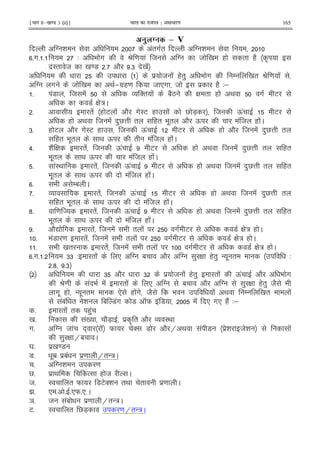
![166 THE GAZETTE OF INDIA : EXTRAORDINARY [PART II—SEC. 3(ii)]
L5 -" 1!1 2 1 7 H ( " 1!1
75 / !# O I< *!C
[X T & (") !#$( " 8 9 =7 C
= 5 ! "; -(C
"5 ]E $ C
< 5 " '" Z)" . "C
5 P I< C
5 T & !:= G C
5 & DE 8 0 ! 1 * & DE T ) G $= !
!") 8( ! 9 < 9 " DEF 9 = ! (" ! 9 # I< !
< " ! < !H # c * T 1 2 T ; ) G ( !
* #* (2 & * 9 # I< ! < " ! < ! I T
1 !# , < N !" DEF ! ) ) G ! N
G " (2! 3
" '" ( 9 8( ! (2 * (2
& ! , 0 " ! 8 * 8 = ! & D G : ! ! 9 " <
! < 9 G : ! * 9 " < !1! ! 8
= # (2 < = (2 ! $ " " 0 . )V
I< " ! ! V.E " (2 !& " (2C
6 8( ! & ( (2 * & (2 " 0 " ! 8
* 8 = ! " ! < G : !H 9 # HI (
" '" T 1 2 T ; ) G ! G " (2C
.3 & ) T ! )V 9 (" ( ) T 1! ! 2 T &
-"#" T & 1 9
9 I< " ! ) T 18 T &
!"#" T 1! - ( !#C](https://image.slidesharecdn.com/ubbl2016notified-250923161005-b0550c73/85/UBBL_2016_Notified_DDA-Building-Bye-laws-166-320.jpg)
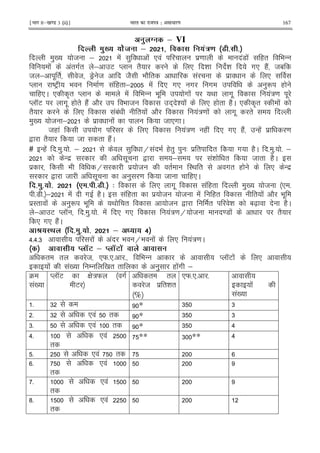
![168 THE GAZETTE OF INDIA : EXTRAORDINARY [PART II—SEC. 3(ii)]
5 * ! 6
"
5 6 * ! 6
"
?
5 6
3) 4
(i) !1! " I< G : ! # #8 # E ! ()* " M KE
! % " ( 2 / 0 " 2 (ii)
) M KE / P= #. =7 ! $
* G (2C
(ii) * ; ; 28. = * < . " $9 !
9 )#" $ "& " #$ -7 8 : ( # C
(iii) M KE - . " 6 # E ( # C "< ,
$ 8" < R 8 # 8 ! 2
8 " (2C
(iv) ** # 5 1 M KE !!1! ! .
) $9 ! 9 )#" ; ; 28. = *
$ "& " #$ -7 8 2 6 *W5*5 5 : ( # C
(v) ) *W5*5 5 2 ! )0 8 ;
=7 ! ( ! ( (*C
A" ' * .f 4
(i) ! " '" !0 # ! A S
* 9 )#" & " ( # C
(ii) P= ! M KE ! ) " A" G :W 2 *W5*5 5
9 ( " ! P= 1 M KE *
) A" G : 2 *W5*5 5 ( ! ( (*C
(iii) Q! 3;
1 c# M KE ! ! 9 " Q! E ( # 2
IE E c# M KE ! ! 5 E ( # C $ 9
Q! " ( ! 8 *# C T 2 8 ) G & " !
* A< M KE I , T & 9 # @ $ M"
( # C
(iv) M KE ! 9 8 ) " ( ! (2C "< * M E
! * 9 ( ! " 9 9 ! " G : 2 #$ -7
8 # M E ! ) " G : 2 #$ -7 8
( ! ( # C](https://image.slidesharecdn.com/ubbl2016notified-250923161005-b0550c73/85/UBBL_2016_Notified_DDA-Building-Bye-laws-168-320.jpg)
![¹Hkkx IIµ[k.M 3 (ii)º Hkkjr dk jkti=k % vlk/kj.k 169
(v) 8 ] 2 ] 1 8 " (2 " ( *W5*5 5 !
# 8 *# C
(vi) "(0 3;
"(0 9 !"#" ) + & ! < "+ Y . IE 8
2 c# * # ( *W5*5 5 ! & ( !
8 *# C ) 2 I A" " G : ) "(0 G :W
#$ !7 8 ( ! ( # "< !" E 7 2 & K]E
" 1[X 8 " (2C 5 P"; # )5
5 !1! ! "(0 # 8 " (2 " *W5*5
5 ! # 8 *# 2 " $9 ! 9 )#" ( # (
) *W5*5 5 ( 8 " (2C
(vii) IE E + 3
1 7!# = ( T Q! 5> 5 IE E +
G : < 8 " (2 2 $ # c# * ( " IE E +
" *W5*5 5 ! & 8 & " ( ! (2 + 9
Q! ! & 8 *# C
(viii) c# 3;
c# I< M KE - / 0 " R ! 8 *# 3;
;6 # E M KE ! * I< 5
* 5 !C
0 6 # E M KE ! $% # E " G :
* 5 5* 5 1& " M KE ! )'" 0 "
c# =7 ! < ) 8 2 *W5*5 5 $ M"
# ( . " P= c# =7 ) " ( !#C
(ix) Y % 3;
Y % ( 1 # * ( 8 *# * !
>5 O '" (!# 2 cE ' E ! 5 O '" (!#C
(x) - . " E12 / 0 " = ! * #* ) ( # 3;
4
!5
M KE
# E !
- . " 2E 12 5 !
k-E 7
(1)
7
(2)
5
5 2 " 6
65 2 " 6 6 6
>5 2 " 6 6 6
5 2](https://image.slidesharecdn.com/ubbl2016notified-250923161005-b0550c73/85/UBBL_2016_Notified_DDA-Building-Bye-laws-169-320.jpg)
![170 THE GAZETTE OF INDIA : EXTRAORDINARY [PART II—SEC. 3(ii)]
"
5
M KE ! )'" 0 " 2E 12 < ) 8 $ M"
( ! ( ! . " P= 2E 12 ) " 8
" (2C
0 9 D ! * 8 = ! # E #
E " G :W M KE ! - . " E x E
0 ) E 7 $ 8 *# C
(xi) cE ' E ! !0 ) " ; E M ) ( # 2
= " Q! - ( # "< #2 8 N K I< )0
1 7!# ! 8 *# " )0 1 7!# 9 # R ! # cE
' E * ) " ( ! 8 *# C ) 8 *W5*5 5
- 9 # R ! cE R O I< ) "
8 *# C
(xii) $% cE ' E ! * ( T ( # 8 G :W #
5 " G :W ( ! ( # 8 ! 0 1 1 !7 1 < R
2 & 2 & ( ! (2C cE ' E " # 5
( # C ! 17X ( # " cE ' E .
R ! Y % ! # 8 *# C
(xiii) )'" 0 " =7 ! ) ! 6; ; ? 8 :
. " '" 8 " '" " < 9 #
( M KE ! 1! E ! ; )
. " ! ) < " '" *W5*5 5 $9 8 *!# C
( ! 6; ; ? . , ) " " '" *W5*5
5 2 ! ; ; . ) " *W5*5 5
* " '" ( # C
(xiv) . !"#" ) " " '" 8 !1! ! =
" UV) !H 1! E " ! )'" 2 (xiii) !
! 9 " ) " '" ) . " 8)
2 !Y E & ) ! 9 )#" ( # C
(xv) . !1! ! " '" Q! " UV)
M E !H 1! E " ! '" 2 (xiv) ! ! 9 " )
" '" ) . " 8) 2 & D !Y E $9 !
9 )#" ( # C ; .51 51 5* 5 !5 5
(xvi) " ( * : # & c# I< ! ) !H
! 2 = ) 4 ! 0 * !1! "](https://image.slidesharecdn.com/ubbl2016notified-250923161005-b0550c73/85/UBBL_2016_Notified_DDA-Building-Bye-laws-170-320.jpg)
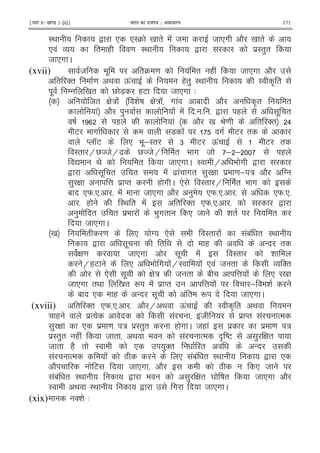
![172 THE GAZETTE OF INDIA : EXTRAORDINARY [PART II—SEC. 3(ii)]
1()" 1 7!# '& (2! 8 $ = H !1! " I< !
, "2 2 ) " * #* (2!C '& ! ! V.E 8 *# 8( ! 9
#. ( # C "< '& #. !:= ! ) !& " *
8 *!#C
(xx) " > # E " M KE ! * = / 0 " & " c
< ) " ( # 3
• I< ; E '& < ; < !& " #
• " #$ -7 8 E12 c# !
* A" M KE ( !# C
• ) " *W5*5 5 #; # M KE ! ! )
*W5*5 5 ( ! ( # C
0 M E; .(
M KE - . " 6 # 5
" #$ !7
8
6656 $ "& "
" *W5*5 5
Q! ( ! (2 *5*5 5H T & 9 #
2 - ! ! @ $ = :
$ M"
c# 5 5* 5H
#5 5 " G :W 2 57N .5* 5H
(") 5 5 5* 5H # E
(i) 9 . " # $ M" * !
(" Y % Q 5 5H('E 5 5* 5
( # C I * ! B)T# ;B ! 7X .( ! I * ! B)T# ;B ! 7X .( ! )
! ! I ;I< ) H ) H ) 2 57N .5* 5 8
8 *! " 5 5H('E ( !# C
(ii) .( ! * M KE 7X ! < ( (* 8 - . "
27X ? E # ( ) G : !H ) G :H & D
G :H# ! 7 H W H 7 I" * 5 5
# C
(iii) ) " *W5*5 5 5 $ "& " < - . " > # E
" '" " G :W *W5*5 5 )'" ) " ( # 2 ( 8
H !8 ( K 42 )I" DL # !8](https://image.slidesharecdn.com/ubbl2016notified-250923161005-b0550c73/85/UBBL_2016_Notified_DDA-Building-Bye-laws-172-320.jpg)
![¹Hkkx IIµ[k.M 3 (ii)º Hkkjr dk jkti=k % vlk/kj.k 173
G H' 1 2 E 82 ) & " ! .
# C
(iv) - $ $ = & 8 2
DEF (% 8 ! * Y % 2 - =7 ! ! V.E
" (2C
(v) " ( ) & " # $I" " *W5*5 5 - . "
$ "& " = ) !H 57N .5* 5 2 / P = !
* 8 *# C $ ] 2E ! E G :W > ;> #
E 1 ( (*C ) !H 57N .5* 5 2 /
P= ! * $I" " *W5*5 5 ( $ "& " 5
Y % 2 ) *W5*5 5 " '" ( # C '" !
* - $ 2 - *8! ! *W5*5 5
) H 57N .5* 5 2 / P=
! & " & " ( ! (2C 57N .5* 5
$ "& " " !I< 7 5 5 (!# 2 8
E !E I ! 1 8 .( !HI !
* ( ) ! 5* 5 5 ( *
8 *# C " !I< 7 5 5 , !1 " .(
I< H < E ()* I< 8 *# C & D $ "& "
! 8 " !I< , " # (2! -(! 5
7N .5* 5 + & * 5 5 $ 5 1 8 *# C -(! 5 5 $ 5
HI< ! D 6 5 57N .57 5 !7' 57N .5* 5
c# #" (" ) $ " # W)E . #"
1 8 *# "< 8 I" R 2! 5 57N .7 5
!7' ) 1[X 8 *# 2 " !I< , -(!
2 E " I< " 8 " (2C A<
K E * & O * ! 5* 5 5 ) !
O I< " !I< , 8 *# C " !I< , A 8"
57N .5* 5 Y E E & 8 ! 8
H 5 5 $ 5 , !1! ! " (2! & " . ( # C
Y E .= R 2! H E & G ! .
& " ( # C Y E ! " R 2! H
E & & " c . & " ( # C " I<
(I HI % !"#" 14 T Y E !9 "
#$ ( ! I" !" = H ; ) " " 9 . 2 57N .5
* 5 Y E 5 5 $ 5 2! 1 8 *# C](https://image.slidesharecdn.com/ubbl2016notified-250923161005-b0550c73/85/UBBL_2016_Notified_DDA-Building-Bye-laws-173-320.jpg)
![174 THE GAZETTE OF INDIA : EXTRAORDINARY [PART II—SEC. 3(ii)]
(vi) 1 ]E ! Q! U Y % ! * > $ "& "
" #$ !7 8 ) " 8 # C
(vii) " '" *W5*5 5 & ) . ; )
. " ! ( # C
(viii) IE E + 3 1 7!# ( T Q! IE E + G : < "
8 " (2 2 c# 9 .; A& ! * # 8
$I" " ( " IE E + ] *W5*5 5 ! & 8
& " ( ! (2 2 Q! ! # 8 *# C
(ix) "(0 1 8 " (2 2 c# #" ! 2 !
* # 8 " (2 " *W5*5 5 ! ( ! # 8 *# C
(x) ) G : !H ) G :H & D G :H# ! 7 H W H
7 I" ! 5 5 # - . " 27X 7X !
.( M KE - . " # 5 # #8
( # 1& " M KE - ( c# & " . ( 2 " "
) 9 # "< 5 5G 5 5 T & 9 # @
$ = ; : $ M" # ( C * M KE ! G : ! * "2 *
8 H ; E '& ! ! .( M KE ! R ! &
8 *# * '& ( ( ) " ( ! (2!C
# IE E
M KE - . " 6 # 5
" *W5*5 5
" Q! $ & 2 ( I< " & " <
$ "& " " 8 (" 5 5
(i) ) ) " Y % 9 " W $ "& " ("
! $ " (2'E5 ( # 2 * E * 2 "
8 " (2C
(ii) K E ; ; 5 # ( # C
(iii) 1 7!# * 1 ( $G = ) " ( ! ( # C
(iv) $% .( E ( * * * * (2C
(v) "(0 3
"(0 1 8 *# " ( *W5*5 5 #= ! & ( !
8 *# C
0 "(0 9 .;" ( # C "< "(0 G : !" $ !#=
2 & K]E " 1[X 8 " (2C](https://image.slidesharecdn.com/ubbl2016notified-250923161005-b0550c73/85/UBBL_2016_Notified_DDA-Building-Bye-laws-174-320.jpg)
![¹Hkkx IIµ[k.M 3 (ii)º Hkkjr dk jkti=k % vlk/kj.k 175
(vi) IE E + 3 1 7!# ( T Q! IE E + G : < "
8 " (2 2 c# 9 .; A& ! * # 8
$I" " (2 " IE E ] *W5*5 5 ! & & "
( ! (2 -") Q! " Q! ! ! # 8 *# C
(vii) c# 3 c# .( =7 ! ) 8 *# C
(viii)Y % 3 Y % #= * >5 O '" ! 1
2 cE ' E ! ! 5 O '" ! 1 * 8 *# C
(ix) cE ' E 3 #2 8 N K I< )0 1 7!# < 8 *#
" )0 1 7!# 9 # R ! # cE ' E N K < cE
' E ) " ( ! 8 *# C ) 8 2 *W5*5 5 -
9 # R ! cE R O I< ) "
8 *# 8 ! cE ' E " # 5 ( # 2
( ! ( # " . R ! #
8 *# C
Y & & 3
" #$ !7
8
$ "& "
" *W5*5 5
" Q! E
1 7!# *- " 2 M KE G :W " $ "& " "
"(0 * ) " 8 *# 2 # c# 2
! * 8 *# " ( *W5*5 5 ! ( ! # 8 *# C
m ( E H#2IE ( H 8!# * ! 1 7c#H & 3
- . " M KE # E
" #$ !7
8
6 $ "& "
" *W*
" Q! E
(i) c# O I< " G : $ " # 5 5 5* 5
8 *# C
(ii) =7 P" # ! !"#" #2IE ( * #. ( !
( !#C
2 1 3
- . " M KE # E
" #$ !7
8
6 $ "& "](https://image.slidesharecdn.com/ubbl2016notified-250923161005-b0550c73/85/UBBL_2016_Notified_DDA-Building-Bye-laws-175-320.jpg)
![176 THE GAZETTE OF INDIA : EXTRAORDINARY [PART II—SEC. 3(ii)]
" *W5*5 5
" Q! E
V Y % G : 3
- . " M KE G :W 5> ('E
" *W5*5 5 1 $9
; 6 " G $ ,
. " " '" $9 ! ("
; * 7X M KE ! * M KE
9 8 1 1 ()* (I (
*W5*5 5 9 < ) "
# C
" Q! E
!"
7X - . "
27X
E *
- . " ( " G : $ "& "
) " )0
!
!0
* * 7X 5> ('E * 57 5 5*5
M KE ! *W5*5
5 (" ) " ( # " '"
*W5*5 5 < "+ 6 " * *
" '" ) " (2 1& "c
9 " , ) " 2 . "
G " $9 ! 9 )#" 8 *C
; 57N .5* 5 ) " *W5*5 5
" '" $ " * 7X # E (2C
- !:= 3
(i) 8( ! / @ & ( 7X E () (2 9 7X
0 6 E E12 ( (*C 8( ! / @ # ! 7X
E () (2 9 7X 0 " W E
E12 2 & D " E E12 (" ( (*C
(ii) DEF 8 # * * 5* 5*5 5 "
!7 #. ( !#C
(iii) ! 7X ! * 9 .;I ! 8 . 2
$ = , ) 1 ! = (") 9 . 2!
( # C](https://image.slidesharecdn.com/ubbl2016notified-250923161005-b0550c73/85/UBBL_2016_Notified_DDA-Building-Bye-laws-176-320.jpg)
![¹Hkkx IIµ[k.M 3 (ii)º Hkkjr dk jkti=k % vlk/kj.k 177
(iv) - * # * 8 ( "(0 (" 9 ( 9 #
#= *W5*5 5 ! 8 *# C !8 + & Y 9 !7 =
c# ! # ! + & * "(0 #
#= *W5*5 5 ! ( ! ( # C
(v) " H" 1H8 & ) " (2! 2 -(! *W5*5 5 E12 !7 ! !
& ( ! # (2C
(vi) 9 = $ ! ) # * ! 0 9
) " < $ & , E ( # 2 *W5*5 5 2
E12 !7 ! ! & ( ! # (2C
(vii) 5> ('E " M KE ! * # # " ! 82
WE H !E < ' ' ) " & "
8 *# M KE G :W $ "& " 9 # K]E c# 2 9 .; A& !
* V 7X 8 *# C ) # " ! * c# O I< M KE
- ( ) & " ( (*C
(viii) '" (vii) ! ) " #H# " ! " '" ? E - . "
27X 7X ! I< " 5 ('E * 7X M KE !
* !8 % H' 1 82 #H# " ! & "
) " 8 *# M KE G : $ "& " K]E c#
* V 7X 8 * 2 M KE G : " $ "& " 9 . A& ! *
"< M KE G : $ "& " ( !H9 + & ! * V 7X 8
(*C
(ix) 9 / % = #$(= *
. " 9 . ( ! 8 (* 8 2Z" U "
- , " L( # ( 81 " ( 9 . A"
! !1! " ! >5 65 ? !5 * 5 5
?6 5 ) ! - $ ? W =
) " = * . 1S A" !
" ( < 81 " ( #$(= . " # ( C
(x) ( 9 .8 I" ) * "( 1( ( 8 9 =7 =
* $ (" D 8 !#$(= 2 & DE 8 8
( # C
* )V ! ! 8( ! W ( H -EF ( " ()! # 8
7X , (2 < I R 1- 7X D S (2 7X
27X !I A" ; E '& ) ( # C 9 . 9 8
+ & * 8 - . " * 7X 2 (2 ( ! - . " 5
* !" 7X 8 8 *# 8 9 8" M KE !
* 7X $% * W 7 7X # C * 7X !](https://image.slidesharecdn.com/ubbl2016notified-250923161005-b0550c73/85/UBBL_2016_Notified_DDA-Building-Bye-laws-177-320.jpg)
![178 THE GAZETTE OF INDIA : EXTRAORDINARY [PART II—SEC. 3(ii)]
8 * 2! # ) " 9 . * M KE ! *W5*5 5 2
#$ -7 8 9 # C ) */1. ! "T & (
82 " ( ! c# * M KE I , &
$ * 8 *!#C I ( G " (2 ( I< $ =
* ;1! : 8 * 8 < -EF ( I A "
* $I" 2 '& ( ! 2 8 ! 7X 27X * ,
9 . 2! UV O '" ( C '& 8 " I<
$ = , '& ;1! : ! 9 8 8 *# C
8 IE. 7 E !E 3
- . " M KE # E
" #$$ -7
8
6656 $ "& "
" *W5*5 5
Q! $ "1! ( ! *5*5 5H T & 9 #
2 - ! ! @ $ M"
& " C
c# 5 5 5* 5H # E " G :
IE. 7 E !E * - !:= 3
(i) E !E " # E " ( # C
(ii) M KE " W E 27X 7X
I< " ( (*C
(iii) "(0 " (2 2 # c# #" ! 2
! * 8 ( (2 " #= *W5*5 5 ! ( !
8 *# C
M! ' 1! % # 0#! .# & ! ! Y
Y#5 !'/ &M! ! ."
#H # "
8
$ "& "
*W5*5 5 Q!
E
c#
5
5* 5H
"
G :W
# E
- !:=
% M! !
."
5 ) 1 8 H
> I<
1 8 ! $ !#=](https://image.slidesharecdn.com/ubbl2016notified-250923161005-b0550c73/85/UBBL_2016_Notified_DDA-Building-Bye-laws-178-320.jpg)
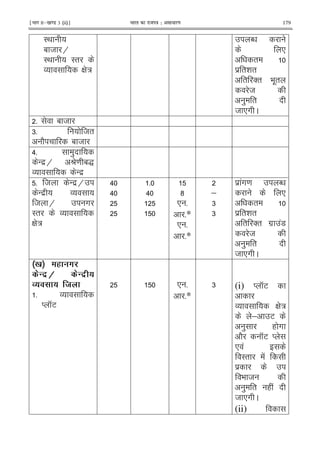
![180 THE GAZETTE OF INDIA : EXTRAORDINARY [PART II—SEC. 3(ii)]
!:= I<
, ) 3
"2 8
G :
O 8
)R ( !#C
(iii) KE
M
! Z
Q! 1
0 8 *# 2
) " "
8 1[X "
()* *W5*5 5
$ M" 8
" (2C
0 KE M
7
! 1 !E
) " ( !
( # C
# =
I") %
!:= #.
( !#C
5 W 1$#7
"< 8 <
O
/ '
* 5
5*
(i) #$ !7
8 * ! *W5
*5 5 "
! N
M KE !
G :W
" *
8 *!#C
(ii) G :
O
8](https://image.slidesharecdn.com/ubbl2016notified-250923161005-b0550c73/85/UBBL_2016_Notified_DDA-Building-Bye-laws-180-320.jpg)
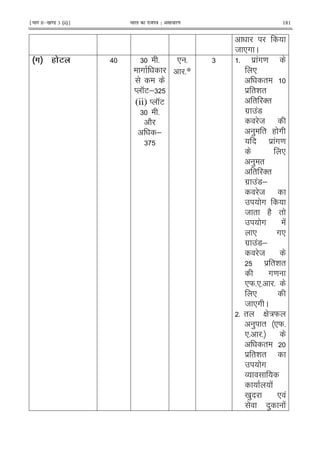
![182 THE GAZETTE OF INDIA : EXTRAORDINARY [PART II—SEC. 3(ii)]
*
8 "
(2C
65= ,
"
. "
* 8
$9 !
9 )#"
& "
1[X * #*
*W5*5 5
) "
8 *# C
%H .
3 .'3G
6 * * 5
5*
*
%g .D "!
M! !
."
(i) H* 5
5E 5* 5
IE& H 5
* 51 5E 5
< ; <
O
Y E ! ("
(ii) W
7
#E; 8
#E 8 !
O
E+E R !
& #
?
* 5
5*
6
6
2
' !
& " C
!:= ! !
) "
8 & "
" (
" (2C
E12
( ! (2C
) 3 =
! c#
* IE E +
N
8 *!# C](https://image.slidesharecdn.com/ubbl2016notified-250923161005-b0550c73/85/UBBL_2016_Notified_DDA-Building-Bye-laws-182-320.jpg)
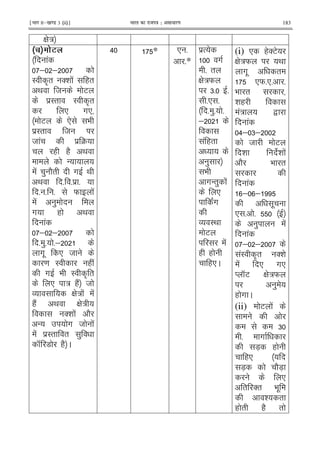
![184 THE GAZETTE OF INDIA : EXTRAORDINARY [PART II—SEC. 3(ii)]
E G :W
!
G " 0
8 *#
(iii) -
2
)
(
( !# 8 ( E
#
#. ( "
(2!C
(iv) 81 "
*! N
*8! ! ,
8 Z)"
M 8
7F 8 " "
M"
#
8 7X
7X
$ 2
- *
! N
( ! 8 " !
"1 "
9 .;I ,
#"
N
( !# C E
I
!1! " *8! !
, !# #
M"](https://image.slidesharecdn.com/ubbl2016notified-250923161005-b0550c73/85/UBBL_2016_Notified_DDA-Building-Bye-laws-184-320.jpg)
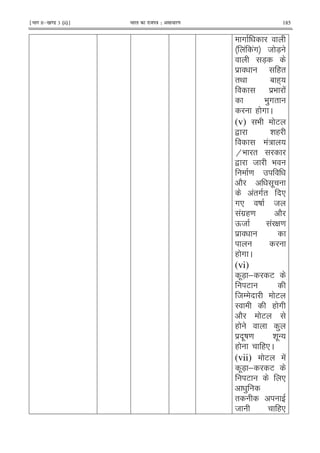
![186 THE GAZETTE OF INDIA : EXTRAORDINARY [PART II—SEC. 3(ii)]
82
.7X ; E
#
/ IE1 2
K ; / IE1
1 C
/ IE1
.7X ; E
I<
/ IE #7+[X !
8 8
(* 3 K
/ IE1
$ .D = !:=
!
) E
, * 8
( 9 I ! !
9 I
8 (*C
9 ! (
$=
( (*C
8
& *
-
( * V E
8 &
! !: 9 1
(* 2 W
* #* 8
" '" -
+ & ! (")
(
$= ,
#](https://image.slidesharecdn.com/ubbl2016notified-250923161005-b0550c73/85/UBBL_2016_Notified_DDA-Building-Bye-laws-186-320.jpg)
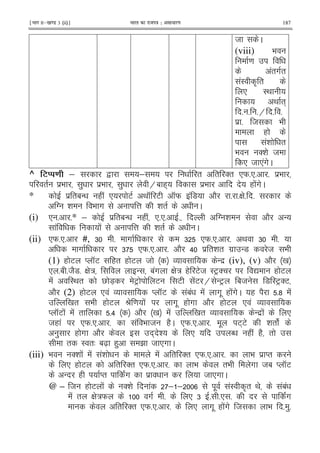
![188 THE GAZETTE OF INDIA : EXTRAORDINARY [PART II—SEC. 3(ii)]
5; ! !& 1 ( L 8 # C ( E !
!1! ! 8 9 '& ! ; ; 1
!I A" ()* (2! " G :W # 5 * 6 5 5* 5
c# ! .= M KE * #. ( # C
3) 4&
(1) 9 . #" 8 & V" 8 !#$(= $= A< 7F * ! E 7IE 1
IE 7 !E 82 #" *! M KE ! ( $
8 *!# C 9 ( E ! I" ! KE & I " ! #A(I< I I<
0 9 - $ .7X E * ! $ ! 9 8 & O I<
( # C
(2) # E " G :W M KE ! ! 5* 5* 5 "<
8 E O I< A< M KE ! ( 8 *# C 9 ; '& !
!I A " -(! Q8 0 "H K 7E $I")" ( # C
(3) Q! *5* 5 5 9 " @ $ = T & 2
!1! " $ = ) " ( # C
(4) 8( ! M KEH"(0 ! c# 8 " (2 2 )R # 8 "
(2 " # # 8 " (2H $ = , N8
8 " (2C
(5) 8( ! ( ! 9 28. O G : ! ) ! O 8
"2 " (2 E+E HI I ! ! )'" R .
" (2! 2 ) * 9 .;I 9 .;I *8! H 8 $ =
$I")" " (2!C 8( ! ( ! " G :W ) " ! A S )
8 " (2 ( 9 9 # ! )'" & ) ( # C
( # - $ * & D G : ! !:= ) " 8
) ( !#C
** I< ! 1[X ()* *W5*5 5 $ M" * > $ "& " I<
$ "& " #$ !7 8 ) ( # * E < K E KW ! 7
Q! $ "1- #. (2C
; . M! % # 0#! .# & ! !
# !'/ &; . M!
#H #
"
c#
*
9 D ) "](https://image.slidesharecdn.com/ubbl2016notified-250923161005-b0550c73/85/UBBL_2016_Notified_DDA-Building-Bye-laws-188-320.jpg)
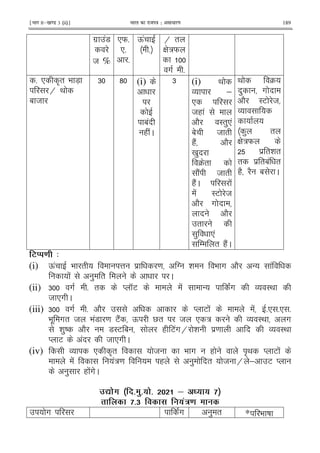
![190 THE GAZETTE OF INDIA : EXTRAORDINARY [PART II—SEC. 3(ii)]
" *
H "
G :W
# 5
#$ !7
8 %
*W5
*5
5
Q!
5
2Z # M E
(i) # E
2
(ii) # E
> # E
"
(iii) > #
E * !
?
? 2Z #
! 3
9 .;"
" G :W
"
% "
14
E E
2
$&
# * !
0 9 2
G = (")
] 2E "
G :W
%
"
"
#
E 8 9
(
2Z #
!
!1! "
)D ! #
9 =7 =
* 2Z #
!
* *
8
8 0 ("
2 $ .D =
("
D
(" ( C](https://image.slidesharecdn.com/ubbl2016notified-250923161005-b0550c73/85/UBBL_2016_Notified_DDA-Building-Bye-laws-190-320.jpg)
![¹Hkkx IIµ[k.M 3 (ii)º Hkkjr dk jkti=k % vlk/kj.k 191
EM =
(vi)
)
O
C
] 2 E7 .(
Z #
- . " M KE
> #
E
6 26 2Z #
!3
$&
# * !
0 9 "
G :W
"
$ "& " "
#
E 8 9
(
=
!1! "
9 !7 =
EM =
(vi)
)
O
C
8 ! Y )
Z #
!
* .( (
8 -
! 2
$ .D = ("
$ A "
) !
(" ( C
3) ! ' 4
(i) # E " M E ! ! c# O I<
8 *# C
(ii) # E 2 M E ! ! 5* 5* 5
9 . #" 8 9 !7 = E2! V" 8 !#$(= $= # 2 .0 .7X
* #; # .7 ( E!#H E!# $= 82 *!
M E - ( N ( !# C
(iii) 9 .0 !7 2Z # G :W !7 ! ) " - $ !
8" 8 *# C
(iv) 2Z # # !"#" ) . $ 2Z # ( 7 2 K]E
C](https://image.slidesharecdn.com/ubbl2016notified-250923161005-b0550c73/85/UBBL_2016_Notified_DDA-Building-Bye-laws-191-320.jpg)
![192 THE GAZETTE OF INDIA : EXTRAORDINARY [PART II—SEC. 3(ii)]
(v) 2Z # ! ! 12!' E ( K ) " ( # 8 ,
; < " " $9 ! (" " * 8
& !H ! & " ( !#C
(vi) 2Z # !HM KE 8 > 5 2 Q #
7X ! < ! T (2! Z !:= !7 ! !"#"
O # ! " * : ( !# 1& " ,
; < " O G : . 1 8 .
" * #* " $9 ! 2 c# #" 9 )#" "
(2!C * M E ! ! ) - $ ! ! ) ! ) " ( # C
" '" 1()I" c# 9 ) " ( # C "<
) " !#"H " * #* 2Z # G : ! ! ( ! 8 *# C
)'" $ 9 $ U " - & ! $9 "
( ! # C
(vii) Z !:= !7 ! !"#" > E # 2
7X ! E ()* 2Z # M KE I " 1I" " !
/ 0 " & " c ) " : ( !# 3;
M KE ! 8" * 8 1I" ! !0
" G :W ? # E $ " 1I"
( # 2
0 " $9 ! 9 )#" ; , " &
) ( # C I " ! ) " 65
* M KE ! ! ) " ( !#C ( ! ) " !#"H "
2Z # .( ( ! ( # C )'" $ 9 $
U " - & ! $9 " ( ! # C
(viii) 2Z # M KE ! ) ! Z 8" 2Z # G : *
* ! & & ! !1! ! 5 #! ) *W5*5 5 ! 5 >5
. !5 * 5 5 ?6 ! ( ( . " 8
) (2C "3 2Z # M KE ! 9 ) # ! 5 #) )
*W5*5 5 9 ) " ( # C
(ix) 12! E ( K I" ! !8 % ' 1 ( IE * ! AS P ) * !
!8 % ( K c# ( * ! I I< - $ 2Z # G : ; E
'& !& 9 # R ! ) " (2! 8( ! !1! " # *
) *W5*5 5 5 #) 1[X ()* *W5*5 5 ) " ( # C
(x) ! ; >; . !5 * 5 5 ?6 5 ) )
* : - . " M KE # 5 # (2C 8( ! ( !
)V M KE ; # 5 (2!C # E G : C *](https://image.slidesharecdn.com/ubbl2016notified-250923161005-b0550c73/85/UBBL_2016_Notified_DDA-Building-Bye-laws-192-320.jpg)
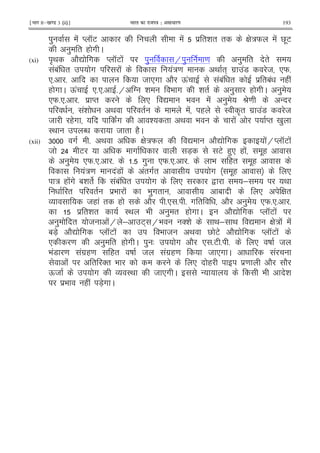
![194 THE GAZETTE OF INDIA : EXTRAORDINARY [PART II—SEC. 3(ii)]
! ! % # 0#! .# ! ! [
[# !'/ & ! !
#H
#
" c#
* H
"
G :W
# 5
9 D ) "
4
#$ !7
8
(%)
*W
*
Q!
5
(i)
* A"
6 *
9 "
@
$ =
T &
9 #
2 -
!
!
)
& "
C
5? - $
I<
2
I<
!
!
*
#
#
# * !
0 9
H
0 0 IE W
*W5*5 5
"
$ "& "
IE
0 ) )
)I" 2
IE&
9 '" IE
2-E
7 Y 12!
I" E
C N
G : 4
HO
)
" G :
$ "& " "
"
(ii) 8
-
6 *
9 "
@
5? -
!
(")
-
0 0 IE W](https://image.slidesharecdn.com/ubbl2016notified-250923161005-b0550c73/85/UBBL_2016_Notified_DDA-Building-Bye-laws-194-320.jpg)
![¹Hkkx IIµ[k.M 3 (ii)º Hkkjr dk jkti=k % vlk/kj.k 195
$ =
T &
9 #
2 -
!
!
)
& "
C
#
#
*W5*5 5
"
$ "& "
2-E I" !
( *!
2 0 )
)
)I"
7I !
$&
12!
7 Y )
IE
W ; IE
; 2/1 C
3) 4
(i) I< !H 9 . # !"#" 8 G :
4 ! * !7 * A" ) ( !#C
(ii) # " !7 ) " ; EHI
) ( !# 8 !:= !1! " # ! ) ( !#C
! % # 0#! .# ! ! $
5 !8
8 ! (2'E5 " !8 ) " 8 " (2C
/ 0 " !:= #. ( !# 3
(i) " #$ !7 8 %
(ii) " *W5*5 5 5
(iii) " Q ? 5
(iv) c#;6 5 5* 5H" G : # E ! - . "
c# $ & " < C
# I" # 8 ) " I"
" G : .( I" E KE; KE 2
1() p& #$ -7 * # 1() p& #$ -7 8 1() + & #$ !7 "<
) 1() + & #$ !7 82 ( " G : ! - ! <
K]E c# * # * !:= < 8 !0 2 M KE G :
!1! ! !7 5 )5 5; " 5 5 * ! 56 ! *
#* (2!C 1();O & * (2'E G :W c ! ) ( !# 2
" G : # 5 " ( # C](https://image.slidesharecdn.com/ubbl2016notified-250923161005-b0550c73/85/UBBL_2016_Notified_DDA-Building-Bye-laws-195-320.jpg)
![196 THE GAZETTE OF INDIA : EXTRAORDINARY [PART II—SEC. 3(ii)]
$#Q EJ J !
82 2 c ! ) " 2 !:= =7
/ ) (2! 3
W Z "" W 82 & D A" I " * !
8 ;8-") ! * ) *! 8 !#$(= [X ! * < E W.7; E+
2` $ #& *! O 0 - $ $& 2 / !# I< ) *!
[ ! ; & 2 N K / R 2 'EF R # 7 R 2 I G C
82 2 " [X ! ! * " ) G : 5 $ "& "
< # E ! 8 9 ( ( # C
0 [ V" [ ! ! * 5 " Q! (" 82 2
c ! 9 " " " ( # 2 aa( " 9 bb =7 !
) ( # #A( > IE E!#
# c# O I< ; 9 - I< ! ! 5 5* 5 M KE !
& " ) 8 (*C
6 % # 0#! .# ! !
# # Df :3.*
c IE& "< IE& * I< * !:=
* ! ) " G $ "H = H ; 8
. ! , & " ( !#C * c IE& / 0 " !:= !
, " ( !# 3;
(i) c IE& 6 E # 7X I< " ( !#C
(ii) c IE& * M E - . " 6 5 x 6 5 2 "
66 5 x > 5 & " ) 5* 58 5 IE& * 5 x
> 5 ( # C
(iii) 7X 2 ( ! M E - . " . / ) ( # 3;
6 5 # V E 7X ! * ; 5
0 6 5 # 7X ! * ; 5
# M E k!E 6 5 ( ! ( (*C
(iv) " #$ !7 8 3 %
" *W5*5 5 3 >
(v) " Q 3 E
(vi) 3 2E 12 ! #$ !7 8 1 1 C
(vii) & ( O ! * ) "
*W5*5 5 (2C 8 ; , " "
$9 !H& ) 9 )#" & " (2C](https://image.slidesharecdn.com/ubbl2016notified-250923161005-b0550c73/85/UBBL_2016_Notified_DDA-Building-Bye-laws-196-320.jpg)
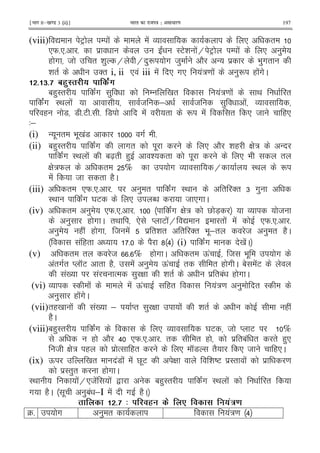
![198 THE GAZETTE OF INDIA : EXTRAORDINARY [PART II—SEC. 3(ii)]
!5 $ ;
G :
(%)
=
G :
(%)
*W
*
*
"
G :W
8
#
:
*
8 "
(2C
5 @ 9 " @
$ = =
)
@ H
: ! !1! " 9
) *! # * !
0 9 O I< ("C
; #. ( ! ;
5
E H
* A"
:
E
EF
K E
:
E
# * ! 0 9
( E 2 1 ("
: ! $ !
! : !
# 7X 1 ) *!
!1! 9 ) *!
6 %
65 EF2' $ %
G : !1! " 9
) *! # * !
0 9 O I< ("C
; #. ( ! ;
>5 1
E H
1 7
1 2 : !1! "
9 ) *! #
* ! 0 9 ("
!# K]E 7F!# * !
I 2 IE K $&
-
2 1 * ! ( E C
%
5 5 515 1 2 : !1! " 5 9 .;" 8 3 %](https://image.slidesharecdn.com/ubbl2016notified-250923161005-b0550c73/85/UBBL_2016_Notified_DDA-Building-Bye-laws-198-320.jpg)
![¹Hkkx IIµ[k.M 3 (ii)º Hkkjr dk jkti=k % vlk/kj.k 199
7+7 9 ) *! #
* ! 0 9 ("
!# 1 E
K]E 7F!# * ! I 2
IE K $&
( E 2
1 C
0 5 *W5*5 5 3 / 0 "
& " 3
(i) *W5*5 5 ('E
" G :W I<
G :W 8 9 (
N ( # C
(ii) 5 51 5 7+7 $ %
[ ! ! (" " *W5*5
5
(iii) ( E H : * !
) *! " *W5*5 5
6
#5 c# 3 5 51 7+7 H1 !
* c# & "
" '" ( E H : * !
) ! * c# "
G :W # E 5
5* 5 $ " ( # C
Y 5 ! )'" R & )R
8 *# C
5 E K
M 8
E K 8 1.<
#" *! ) *! * !
G "
! C
; #. ( ! ;
5 7X
" "
9 $ 7X !
7X # 8
W 1 & 2 E
9 . 2 Q
) *! T
# (I
R ! 2EF EF2' 9 . #"
2 < !7
1 2 .1
# * ! 0 9
("C
; #. ( ! ;
?5 2EF 7 7N1 ! c#
2 W ) *!
? % % %](https://image.slidesharecdn.com/ubbl2016notified-250923161005-b0550c73/85/UBBL_2016_Notified_DDA-Building-Bye-laws-199-320.jpg)
![200 THE GAZETTE OF INDIA : EXTRAORDINARY [PART II—SEC. 3(ii)]
0 0 ) *!
# * ! 0 9
2 IE W !1!
) *!C
* *W* 9 M KE 8 *# C 1 & 2 E G :W
*W5*5 5 ! & ( ! 8 *# C
J3V . :3.* A E . 'A' !'/
5 65 ('E " " G :W / @ ! )'"
< ; < EF ;IE& ! ) " !8 % * ! 8 H 8
# 8 ) E 1!# 8 * ! " 8 ! V 7X 9
# 8 ! ! 8 *# C
5 ! @ ) " O I< ! !1!
/ 0 " $ )0 !:= ( !# 3
(i) 2EF IE& !"#" G : (" *W5*5 5 2 $ "& "
#$ Q!7 8 Q! !1! $ "1! ( ! 1& " **
@ $ = 7 .* 82 !
) $ !C
(ii) 2EF IE& ! * c# & " ! O
Y E * c# * $ " # 5 ( # C
(iii) !# L" [X!# 8 *# 2 2EF #
9 !1S I< !H*8! ! ) $ M" # C
65 / 0 " [X ! ! $ % [X ! B 8 *# 3
(i) 9 EF IE& 2 EF #$7 * E7 * ! !7 #$ !7 I" ( !#
8 ! $ & [X ! ( 7 8 2E ( 9 !# M !E * !
Z)" 1 IE& M *T8 KIE * ! E ! E & & ]E
( !#C
(ii) 7 * ! 0 0 & K C
(iii) EF'& 1 IE& C
(iv) $ % !:= - $C
(v) ) IE& C
(vi) $ % 2 0 0 IE W (") 9 " 2 $ & G = - $C
(vii) $ % IE W 2 EF ) G ! * C
(viii) EF 8 = (") 8 ) C
(ix) 8 )0 ; ) *! N * EF IE& ! ! ) !C
(x) EF IE& ! W)E; $!E Q M EW Q [X ! C](https://image.slidesharecdn.com/ubbl2016notified-250923161005-b0550c73/85/UBBL_2016_Notified_DDA-Building-Bye-laws-200-320.jpg)
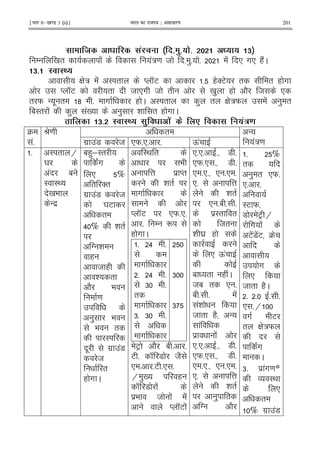
![202 THE GAZETTE OF INDIA : EXTRAORDINARY [PART II—SEC. 3(ii)]
* %
*W5*5 5
N (
(*C
8 ) G
! ("
I I<
0 9
) !
*
T &
Q!
!1! !
$ "1! (
) "
" (2C
8
) "
8 *#
$ !#=
* )
" '"
#$ !7
8
#
8 "
(2 "
#
* #*
#$ !7
8
% *W5*5
5 !
#
8 *# C
>5 1()I"
7
c# 9
*
"
) " ( #
8 *W5*5 5
* ! #$ =7
8
)'" ( #
" I< ! !
M" !#
) (
"< (
! %
) G & "
( # C
5 K G :](https://image.slidesharecdn.com/ubbl2016notified-250923161005-b0550c73/85/UBBL_2016_Notified_DDA-Building-Bye-laws-202-320.jpg)
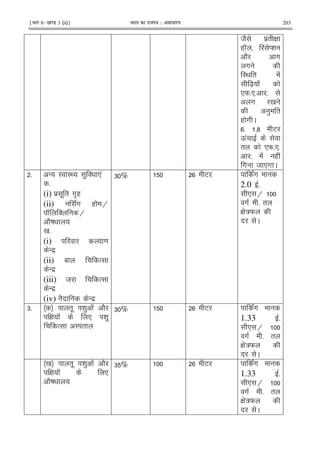
![204 THE GAZETTE OF INDIA : EXTRAORDINARY [PART II—SEC. 3(ii)]
>5 2 7 8 9 " % D +H !7 !
)
0 !# 2
2 7 !I<
6 % E !#
2.0 5
* H
# 5 "
G :W
C
# & ) %
!I<
9 " % D +H !: !7 ! )
$ !#= (") $ A " & $ & I< " V.E (2 2 $ !#= Q = ) "
8 " (2C
# DEF 8 G : T & 9 # < & I "
9 ! ! 6 E Q! G 8 (*C
.3 4
5 9 I " !H"A" I I< 0 9 - $ * M E G : $ " 1I" ) "
G :W ? # 5 8 *# C - I I< ) !
* 82 $ . "H !# ( = - - $ ! !1! ! M E G : $ "
1I" ) " G :W # E 8 *# C
5 I " 2 7 K 8H !# ( * ! 2 2 7 !I< ! I< !
" G : " 6 # 5 " G : ) I< H
1 7H42 H 2 IE ) H12! !E # ) " 8 *# C
"! !'/ 4
5 G $ , " $ = " " & DE % ) !H I " !
! ! ) G :W 3
[80] # E " $ " 1I" 8 *# C
0 5 28. !HI< ! ! $ = H9 .;I *8! , " $9 !
9 )#" 2 - @ ! & " 1[X * #* *W5*5 5 ) " 8 *# C
#5 !# & " ! 82 " ) . ! !: * ! = 8 9 !7 = 1 K
Z)" 1 IE& * 5E 5 *!7 * 5E 5 R EF ! W K ! E !E !:= G
/ ( 8 E G K G ! 8!# G )
1 IE W 9 8 G ) ! - $ IE . " 9 # 12 *!7
- 2 ! Z)" * ! T = ! # * ! - *! 82
K7F "< 7 K8 21 "< 9 0 0 H * &
- ) ! * 1 !E # * 8 1 # !1! "
*8! ! . ) " I I< 0 9 ) ! * 8 " (2C
Y 5 "(0 1 !E !1! " - !:= 7 ! * #* (2!C
m I I< ) ! ! 1I" ! !0 ) *W5*5 5 ) & " !
* ! !# ! ) ) " 8 " (2C
82 ; & DE % 8 ! 0 " ()* = !8. 1
8 *# C = !1! " Z ! ) = @ !
(2!C](https://image.slidesharecdn.com/ubbl2016notified-250923161005-b0550c73/85/UBBL_2016_Notified_DDA-Building-Bye-laws-204-320.jpg)
![¹Hkkx IIµ[k.M 3 (ii)º Hkkjr dk jkti=k % vlk/kj.k 205
V5 $ E ! #" 8 * 8 7I 8 #. 8 *# "< "
8 , 1 # ] & !# . !E E ) < = I< !
- E * # 8 " (2C ) + ! I< !
! "" 2 -(! " )R 28. ! )R '& !I A "
E 8 " (2C
85 " '" Z)" & " ! #$7 Z)" . " , . 8 *# "<
"1 " )'" 2 ME 8 & . 8 *# C
2# * ( 4
2#5 4 * ( 0 .' . !'/
4
!5
P= "
#$ !7
8
*W * Q! - !:=
5 M I . $ & G = - $
!M .E $ & G = !I<
& & G ! $
#. ( ! #. ( ! #.
( !
5 7E M
! Z
9 .0 !7
! 1!
# (2 ' !
P" # !
) " #
(2C !#
566 5 5* 5
H # E
" G :W
C
5
H&
R !#
1U ! *
Z !
! IE W
( *
2 V :
* "
% *W*
# 8
" (2C
'8 4
; $ <
Z H 7
Z 566
* H $ "
# 5 " G :W
5 I . 66566% 5
65 $ < Z 6 % ? 5
>5 U " Z 6 % ? 5
5 R !#
1U ! *
% ? 5
5 & R !#
1U ! * I .
% ? 5](https://image.slidesharecdn.com/ubbl2016notified-250923161005-b0550c73/85/UBBL_2016_Notified_DDA-Building-Bye-laws-205-320.jpg)
![206 THE GAZETTE OF INDIA : EXTRAORDINARY [PART II—SEC. 3(ii)]
C
; U "
Z 5 5 5
* 5H # 5
" G :W
C
!# *
" G : !
)R # ( "
(2 " #
8
" (2H N8
8 " (2C
65 "(0 !
!1! - !:=
!"
! * #* (2!C
3) 4
$ ; $ Z H Z H !E Z H4 M I . P" 9 .
# " ) # ! ! ) " 8 " (2C
"! !'/ 4&
5 * Z ! ! Z # E V 0 8 *#
" E12 G : 9 " #!") ! ( ! !# 8 C
5 9 .0 !7 ! % " ) " # (2C & D G : "
A" K ! & ( # ! ! 2 ) K ! #; # !7 #.
( !#C
65 0 2 9 - G : ! ! " I" . "
8 *# C
2# 4 * ( 0 .' % _ * ( . !'/ '>
4
!5
P= "
#$ !7
8
*W * Q! - !:=
5
5
O $ & G = - $
E H K E H
O H $ & G =
!I< H $1! !I< H
& G $ & G = !I<
H ) ! * !
- $C
- ( Z
6 % 6
E
5 ) *W*
" 6 %
Z < ! *
V : (") $ #
8 "
(2C
5 !# 5
66 * H
# 5 "](https://image.slidesharecdn.com/ubbl2016notified-250923161005-b0550c73/85/UBBL_2016_Notified_DDA-Building-Bye-laws-206-320.jpg)
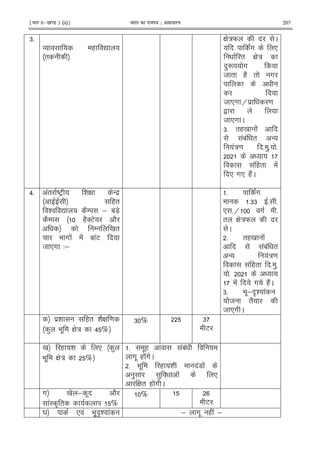
![208 THE GAZETTE OF INDIA : EXTRAORDINARY [PART II—SEC. 3(ii)]
%
5 K 8
1. ) K 8 !
! M KE / ) ( !# 3
G : $ " K 8 >5
('E
K 8 9 G : 3 5?
('E5 > % G :
0 0 2 G : 3 5?
('E5 > % G :
# V : G : ("
3 5> ('E5 %
G :
ii G : ! 9 - "
I< " ! %
8 *# C
5 & 2G = K 8 9 G : * ! (")
!:= !7 )'" 45 !5 >
)R ( !#C
2#2 B .
2 65656 5 )5 5 9 - 0 ; . ) ! * !:= DE (2!
3
" #$ !7 8 % ) ! ! ("
" *W5*5 5 >
Q! $ "1! ( ! *5*5 5 T & 9 # * !
- ! @ & "
!# * H # E " G :W
"! !'/ 4
(i) .( G : Z ! ' 1 ! 9 " 0 ; . ) ! 2 " = ;"
" # E " $ % ( * #$ !7
8 2 *W* ! ( ! 8 *# C
(ii) 9 9 - 0 . ) *! E M 9 .; A& ! M !# M
) ( !# C
2#5 ' &> 9 93. F . 0
2#$ 4 ' 0 .' . !'/
4
!5
P= "
#$ !7
8
*W * Q! - !:=
5 7 * ! "
5 5 7 Y !E 7
7 1
0 5 .
; E '& ! & DE I< G " ( !
8 *# ' ! !8 # 8 V 7X
9 # 8 !H P" # !"#"
& " ) ) " # (2C
5 " Y 1) !#](https://image.slidesharecdn.com/ubbl2016notified-250923161005-b0550c73/85/UBBL_2016_Notified_DDA-Building-Bye-laws-208-320.jpg)
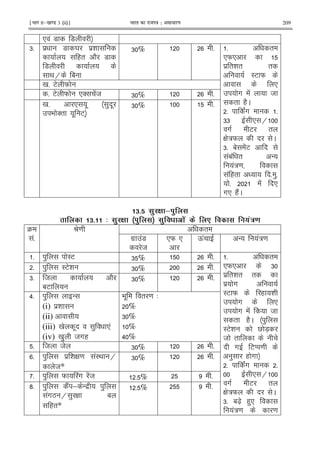
![210 THE GAZETTE OF INDIA : EXTRAORDINARY [PART II—SEC. 3(ii)]
) IE& !
N " '"
I<
7W! 2 (
# 7
I< *
$ # !
8 *# C
>5 )
$ & G =
!I< H 8 !
" *W*
$ "& " "
$ #
IE W 2
Z < !
(") ( IE *
8 " (2C
5 "(0
!1! " -
!:= ;
! (" 5 )5
5 ! *
#* (2!C
5 EF2 W 2 ) !:=
G
5 I< O ( " 7X #
9 # R ! $ )0 7X 8!'& !HIEF !
& " ) C
5 " G :W ; # E
3) ! ' 4&
** M KE 9 . % *W5*5 5 < ) IE& "< M KE 9 . > % >
*W5*5 5 < ) * # 8 *# C 81 -
!:= !7 < "+ #$ !7 8 E 12 "< !# & " 4 & 3 "
65 * ! 2 >5>56 0 M KE; .( ! " $I" ) ( # C
Z ) IE& I< '" $ (") 9 : ( !#C
2# 0 (
2# 2 4 0 ( 9 @ * 0 . !'/
4
!5
P= "
#$ !7
8
*W * Q! - !:=
5 T & 2 6 % 5 5 "
*W*
5 T & - $ 6 % 5](https://image.slidesharecdn.com/ubbl2016notified-250923161005-b0550c73/85/UBBL_2016_Notified_DDA-Building-Bye-laws-210-320.jpg)
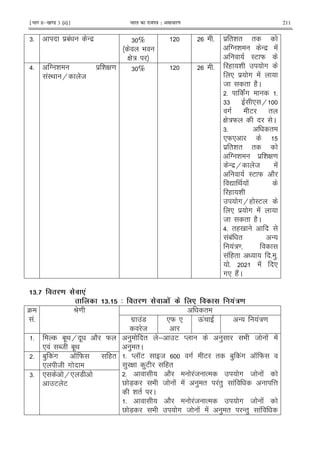
![212 THE GAZETTE OF INDIA : EXTRAORDINARY [PART II—SEC. 3(ii)]
@ & " C
2#[ E & ': 0 '
2# Q 4 E & ': 0 .' . !'/
4
!5
P= "
#$ !7
8
*W * Q! - !:=
5 5 1() $ 8 8
0 5 1! E (
6 %
6 %
5
5
5 !# ;65
* H" G :W
# 5
C
5 1 !E
!1! " - !:=
!" !
* #* (2!C
5 5 )
!8 % ' 1
0 5 !8 % ' 1
6 % 5 !# ;
* H" G :W
#5 5
C
65 8 ; !I A "
82 3;
K 7E !# " A%
7F ! $H
% - $
6 % 5 5 !# ; 5
5* 5H" G :W
#5 5
C
5 #-") ! 9
!0 !
0 " ()* #!") !
( ! !# 2
!# M""
= "2
8 *# C
;;;;;;;;;;;;;
! @
& " C
>5 $ & #$ !7 % ;
5 ` - $ 6 % 5 !# 5 5
* 5 C
5 !" DEF / - $ 6 %
$ "1!
( ! *5*5
5
T &
9 #
!# ^ 5 5
* 5 C](https://image.slidesharecdn.com/ubbl2016notified-250923161005-b0550c73/85/UBBL_2016_Notified_DDA-Building-Bye-laws-212-320.jpg)
![¹Hkkx IIµ[k.M 3 (ii)º Hkkjr dk jkti=k % vlk/kj.k 213
"< -
2
!
)
$ M"
& " C
3) ! ' 4
(i) * 51 5 827 G : - 1!# G : !8 % # 8 ! ! I< " "<
" ! ! Z !8 % ' 1 ! E #; # !
( # "< 5 5 $ 5 " " Z I< "
!:= ! ) " # C
(ii) 0 ) G : ! ! E7 0 H0 ) ! " '" #$ !7 8 )'" 6
# 5 " G : " = " ) " ( # C
(iii) 1! E ( K ! 3
5 !# * #$ !7 = #$ !7 *- 9 " 1 !E ) "
( # C !# * IE E ] ) (2C
0 5 !H9 !7 = * 1 !E G : 6 % *W5*5 5 ! & ( !
8 *# C
(iv) !" DEF / - $ ! $ !#= $ * " % #$ !7
8 ) " ( # C $ !#= * ) " '" #$ !7 8
# 8 " (2 " # * #* #$ !7 8 % *W5*5 5 ! #
8 *# C
2#$ "! 0 ! 0 '
T R 0 .' . !'/ . .' 8 6J'
4
2# $ 4 "! 0 ! 0 .' . !'/
4
!5
P= "
#$ !7
8
*W * Q! - !:=
5 AS P H& H
R !# # !
* 0 9
- $H 8
( !H )_D ! *
( IE H $ 2[X & G - $H
< H1 - $H 2
1
6 % 5 5 !#
^ 5? 5 5
* 5H # 5
" G :W
C
5 1 !E
!1! " -
!:=
! ("
5 )5 5; !
5
5 ; 7X I" 6 % & 0](https://image.slidesharecdn.com/ubbl2016notified-250923161005-b0550c73/85/UBBL_2016_Notified_DDA-Building-Bye-laws-213-320.jpg)
![214 THE GAZETTE OF INDIA : EXTRAORDINARY [PART II—SEC. 3(ii)]
0 5 & ( I" ! !
# I"
%
("
E
E
* #* (2!C
65 !# 7X
G :
H .( I"
6 % 5
>5 E !E 6 %
$ "1!
( !* *5
*5 5
T &
9 #
"< -
!
!
)
& "
!# 5 5
* 5 $ " #
5 " G :W
1 !E
!1! "
- !:=
! ("
!
# (2C
) ! P" " 8 (* " K ) ! ("
!I< !H ! ! 8" 8 C
3) 4 # 8 H 5* 5 5 ) G : ! ! 1 Y E !H K-7F * I<
I< !7 ! ) N * 8 *!#C
2# E ' & E 0 '9
5* 5 5 ) !H ! ! 8 * & DE !:= " ( !
* #* (2! / 0 " !7 #. ( !#C
5 " 9 ." 8 ^ 6
5 " " G :W ) " ^
65 " Q! ^ E
- !:= 3;
!# 5 5* 5H # 5 " G :W - !:= ! ("
! * #* (2!C
EM = 3
(i) 9 . *8! ! , 8 " ! M KE 1! E" * 8
! " *W5*5 5 % " ( KIE * #
8 " (2C
(ii) * < 1()" # * V E 5* 5 5 M KE ! < 17X 5* 5
5 M KE 9 8 5 )5 5; $ ! ) ) 5* 5 5
) ! < ) " (2C
' 6 % # 0#! .# & ! ! Q](https://image.slidesharecdn.com/ubbl2016notified-250923161005-b0550c73/85/UBBL_2016_Notified_DDA-Building-Bye-laws-214-320.jpg)
![216 THE GAZETTE OF INDIA : EXTRAORDINARY [PART II—SEC. 3(ii)]
8 *! !# & '" ( # 2 ( & ( -(!
& ; & H W & ! # C
!. :; ! . H .' * ) " ( ! 8 *# "< ( Z I<
Y ! # & " c ) I< 8 0 ) " ( # 3
(i) E G " 3 * < Y ! ! - . " 6 EC
(ii) " W - . " # 7X ; ? E
(iii) !# & " ; " G : 6 5 5* 5 $ " # E " I<
M KE G : 9 "
(iv) " #$ !7 8 ; % 1& " 5 )5 5 ; ) - . "
E12 8 *# C
(v) *W5*5 5 ; 1& " " " G :W 6 # E ( C
M KE > # E (2 "< > E #
7X I< " (2 " ) " *W5*5 5 > # E ( ! ( # 8
" " $9 7X 27X N " "< ;
( # " G : ! " " 9 7X ( C
(vi) M KE 3 - . " # E * ! " > # E C
Y 9 . ( # " & D G : ( ;9 0 8 *# C
(vii) " ) Q! ; E
(viii) 6 E Y G " * G " I< V 7X & D 8#( !
O ) ( !#C O I< 5 )5 5; ! I<
1 8 * 5* 5 5 * ) ! * ( # C
(ix) Y E #$ W 2 - ! $ ! )R ( # C
E M 2' 9 " ) ) " ( # C
(x) 9 . # " $9 *W5*5 5 $9 ) $9 * ! - $9 ,
; ) " $9 ! ) . * 8 *!#C
(xi) I< "< ! $ = ( ) & " !# !
= ( )'" & " c # (2C
(xii) 9 . 1 ()* 28. I< Y 1! ( !#C
(xiii) * ! ! 17X !0 ! 8 " + & ! * " '" 9 .
& " ( " (2 " #$(= 8 *# 2 !1! " I< *8! !
, I< G : & " !H )0 8 $ ! )
8 *# C
A< ! 9 . # ! " (") 5 )5 5; ! $ * 8
& " )'" $ ! ) 8 *# C
( ) & " 8 (* !1! " M KE G : ! ! M" !# ) *! $
# (2!C
B '> [# ! .8 E . .' E ! .8 E . .' .' ! .8 .'
0 J .' !'/
"! .3](https://image.slidesharecdn.com/ubbl2016notified-250923161005-b0550c73/85/UBBL_2016_Notified_DDA-Building-Bye-laws-216-320.jpg)
![¹Hkkx IIµ[k.M 3 (ii)º Hkkjr dk jkti=k % vlk/kj.k 217
5 8( ! * ; !:= ( ! * #* (2! -(! $ = , 1
8 " (2C
5 8( ! ( ! 8 " 2 " O I< # (2 -(! #$ *W*
9 # 8 *# C 9 # 8 ! ! E < Q! 9 !
! 5 5 $ 5 " " & D I< " ! ! / 0 " ) "
" (2 3
IE E " < 1 !E ! IE !# $ ! - . " Q!
5 E ( (*
0 9 0 0 * G " = # * ! ! (") !1! "
*8! ! . ) < !" " !E E!E ]
) " 8 " (2C 2 *W5*5 5 ! ( ! # 8 *# C
" Q! = ! % #( 8 $ " $ *
Q! & " - = ! 8 *# C 9 !
" Q! 5? E " " 0 8 *# C
65 9 = ( T 5> 5 IE E G : (" 8 " (2 "
G : # !# 9 . A& ! * $I" 8 " (2
" IE E G : *W5*5 ! & & " ( ! ( # C
>5 81 9 - P = ! 9 .0 !7 ! * 9 = * #* ( ! " 7 G :
2 " G : / " P= ! 1 17X 9 .0 !7 ! * 4 & 3 ) 7
G : 2 " G : 9 I< " ! ( ! ( # C
5 # 5 * ! 9 M KE ! ! a M KE;M KE7
b V 7X $ !#= ) " & " (" ( # ; $ !#= $ (")
" $ "& " " '" #$ !7 8 ) " ( # C $ !#= *
) " '" #$ !7 8 # 8 " (2 " # * #* #$ !7
8 $ "& " *W5*5 5 ! # 8 *# C
^ Q# 4 "! .3AJ % ! B > ! .
45 !5 9 .0 =7 # 5 ! - . " E12
#$
9 #
5
&
9 #
5
7
5
7
5
5 5 "
5 5 2 5 " 6 5 25 ; ;
65 5 2 6 5 " > 25 ; ;
>5 6 5 2 5 " > 6 6 ;
5 5 2 5 " 6 6 6
5 5 2 5 "
5 5
(i) Q * #* E12 < ) 8 ( ! 8 " (2 " (
P= E 12 ) 8 " (2C
(ii) E12 9 = ! ) Q! 2 2! E & G !
( !#C](https://image.slidesharecdn.com/ubbl2016notified-250923161005-b0550c73/85/UBBL_2016_Notified_DDA-Building-Bye-laws-217-320.jpg)
![218 THE GAZETTE OF INDIA : EXTRAORDINARY [PART II—SEC. 3(ii)]
(iii) ; E - . " " E12 < I A " 8 " (2 "
9 = 8 ! I A " ! ) 8 *# C
(iv) $ = " " & D I< " ! ! E12 #$ !7 8 2 Q!
! V.E " (2C
(v) 81 9 9 .0 !7 9 " 5* 5* 5 O I< 8 G " ( " 7H
E12 & ]E ) " ( # C
[#(4) '8 4
!# $% # ! " * #* (2! -") 8( ! " ( !
(2!; ( ! / 0 " " 5 ! * #* ! 8 *# 3;
Q# 4 8
45 !5 # ) " ") !# I<
* $ " # 5 " G :W
5 5
5 O 65
65 = 5
>5 5?
5 8 * ! 8
) *!
5
(i) # 5 9 .0 !7 G : 28. 9 ! ! " '" & " !
* M" !# ) *! N * I " 1()I" !#
= * $ "& " " '" #$ !7 8 ) " ( # C
(ii) !# I< ! $ * I< " 56 ! * #* !
) ( # 3;
Q#2 4 8 . :;
45 !5 !# $ G :W $ " * # 5 !
5 0 ) 6
5 7 #$ !7 ] ?
65 1 !E 6
>5 1()I" 2/ (" 6
5 I " 1()I" ]E ("
(iii) # ! ! )'" ! ) !# O I< 9 .0 !7 9 "
8 *# C
(iv) 8 ! ! !I A" '& (" 9 ( E " '" 28. (2!H =
(2 2 8( ! 9 '& 5 )5 5; ) !I A" (2! # * #*
" '" *W5*5 5 * N 8 !# 5 )5 5; !
" !# !7 ! ) ( # C
[ %Y A. .'3 4
!# 2 G ! 82 * -7& !# M !E * ! = 8 !#$(
1 Z)" 1;IE& * 5E 5 2 * 5E 5 2 R EF ! W / E !E
!:= G / ( 8 E R 2 - ! : *! "< Z)" * !](https://image.slidesharecdn.com/ubbl2016notified-250923161005-b0550c73/85/UBBL_2016_Notified_DDA-Building-Bye-laws-218-320.jpg)
![220 THE GAZETTE OF INDIA : EXTRAORDINARY [PART II—SEC. 3(ii)]
(ix) )'" 1 " ! 1[X * "2 * #* $ !
I< ! , $ % ( R ! $% M KE $ "& " >
$ "& " " '" #$ !7 8 "< *W5*5 5 8 " (2C & DE
! ! $ "& " $ % ( ) " 8 " (2C
(x) $ % ( #$ 1 7!# * a " (") ( " E!#b
, " E!# !7 " ( !#C
(xi) 9 # $ = : $ M" 1 )'" ) !
9 .;I % *8! , $ % ( R ! 1[X * #* *W5*5 5 * 1 8
8) . 8 *# C
)'" #. * & I< I 5 5G 5
, = 9 # 5 5G 5 5 5 < & V( ( !
! !& ! . 1 "2 8 *!# 2 -(! $ = H - $
) (" . " 8 *# C
[#% # : 4
(i) . 1S 8 & ! 2 H < (2'E5 8 & !
)O I< " [X!# 9 . A& ! '& ! ! & 8 ( # C
(ii) ) I" G " - $ A" * 5E 5 5 O I< 8 *# C
8 Q8 H#2 % - !9 ! " # 8 *# C
(iii) 82 "< ) 4= & DE # # & DE I< #
8 *# " I" - $ A" EF E !E 8 " (2 81
82 & DE * - $ A" EF E !E 8 " (2C
[#%Q C' .
5 9 # 8 ! ! 5 IE E 1 "< 5 5 IE E ("
Q! 9 ! Q! 9 8 *# C
0 5 IE E " IE2 !# $ ! IE E " * 5>
E - . " Q! V.E 8 " (2C "< IE2 !# !
Q! 78 * ! ! % ) G & " c ) ( # C
#5 9 0 0 * G " = # * ! ! (") !1! "
*8! . ) !" " !E E!E ]
) " 8 " (2 2 *W5*5 5 ! ( ! # 8 *# C "
Q! = ! % #( 8 9 !7 O I< *
Q! & " - = ! 8 *# C 1
Q! W K ] ( W &7 ]
5? E ( ! ( (*C
Y 5 I< !H !1! " 9 # ! # # "< T & 9 # @
& " 1 !E 2E12 ! ) " 8 *# 8( !
E12' + ( ! (2! 1 !E ) " E " ( (* 2 8( ! E12
(2! ) " M KE E ( (*C
m5 T & 9 # @ & " 7 ! E12 !
) " ( ! 8 2 !# 7 - D S ( # C V"](https://image.slidesharecdn.com/ubbl2016notified-250923161005-b0550c73/85/UBBL_2016_Notified_DDA-Building-Bye-laws-220-320.jpg)
![222 THE GAZETTE OF INDIA : EXTRAORDINARY [PART II—SEC. 3(ii)]
0 @ & VII
B .' ?% . 0 ( A I" 8 0 !7 5 0 !C
# ( ./ .' ' . 0 ( 4
5 8 G : ! ! A $ = < 1! 1I" < 9 .;I0 0 " ( ! (2
( ! 9 9 [X ! ! * ! ! ! 9 ; = ! 2
DEF 9 = ! (" ! * #* !1S 9 " ! $ # " ()*
"2 8 (*C
0 5 9 . !! BE ! = $ " ( !9 A G " !1! "
Y % ! !Y , ) 8 " (2 " $ = !9
8 C
#5 9 ! * ! [X ! ! ! #( ! 0 8 " (2 8 ()!
#2 ; $ = & Y " ! " ( C
Y 5 IE [ ! E !# "< E !# K * ! 1$IE K = , "<
8 UV ) & " E Q 1 8 " (2
" ( ;I ) & 1 8 C
m5 9 . ! 7 9 [X ! < ! 1 *
- )'" !8 !# !E !& C
# ' ^ >E D . ! J i 8 L J! 8
' ! ( 8 + ! / .' . ! E / .'
O 0 6J 4&
/& 4 6 E #( X 5H 25 2 " & )S # /& 4 * H
) " " A " 2 /&2 4 * 5 5 5 * "(
" 9 . % = 58 5*5 /&5 4 7 51 5 5 * "( " 9 .
% = 58 5*5 /&Y 4 7 51 5 5 * 5 2 !7 = 4 % = /&
4 56 !7 7 51 5 5 = 4 % = /&Q 4 5 !7 7 51 5 5
= 4 % = /&[ 4 5 !7 7 51 5 5 = 4 % = /&$ 4
* 5 5 5 * 5 !7 = 4 % = /& 4 * 5 5 5 * 56
!7 = 4 % = /& 4 * 5 5 5 * 5 !7 = 4
% = /& 4 * 5 5 5 * 5 !7 = 4 % = /& 2 4
5 * 51 58 5* 5 $ = /& 5 4 K . ! C
# X . 6 . . ( . A
4 " !9 " G : ! ! 9 ! [X ! ! * ! ! ! ! "< DEF
9 = ! (" ! # O I< ) 9 " ! * ! & ; & !
) "2 8 (*C
3) 4 9 D = D < B!B " 1( 4 " !9 " G : ! ! 1 [X
$ ) G ! $ # 8 " (2C
% !" ! E I< " ! 2 = ; c ) G ! W " !9
! 0 " ()* 8 = c ) G 8 ( (2 G : ! ! %
I< " !1! $ < " " " 9 . !7 8 !# !
! 0 8 (*C](https://image.slidesharecdn.com/ubbl2016notified-250923161005-b0550c73/85/UBBL_2016_Notified_DDA-Building-Bye-laws-222-320.jpg)
![¹Hkkx IIµ[k.M 3 (ii)º Hkkjr dk jkti=k % vlk/kj.k 223
0 @ & VIII
" .8 .' . K3 .' 'B! J J Z0 ':; .' . !.
:; % )! D : .E B '> $#5# .B .'
5 ]E G " ! V" # " ! G " ]E ! !0
2 $ " ! # (2C
4 8J & ! A60 ' E D . K3 .' 'B! J
4
!5
! 8 !
!5
]E !
O '" !
G "
]E , 8 * 8 O '" ! !0
# "
* H*
E ! 6 E ! E ! E !
(I"
"
I
"
(I"
"
I
"
(I"
"
I
"
(I"
"
I
"
6 > ?
5 5 ; 5 ; ; ; > ;
5 ? 5 ; 5 ; 6 ; ; ; ;
65 5 ; 5 ; ; ; 6 ;
>5 5 6 ; ? ; 6 ; 6 ;
5 6 5 6 ; ; 6 ; >>> ;
5 5 ; 5 ; ; ; > ;
5 ? 5 ; 5 ; ; ; ? ;
?5 5 ; 5 ? ; ? ; ? ; ;
5 6 5 ; 5 ; 6 ; ; > ;
5 5 ; ; ; ;
5 5 > ; >> ; > ; ?? ;
5 6 5 ? ; ; 6 ;
65 6 5 6 ; ? ; 6 ; ; ;
>5 5 ; ; ;
5 6 5 > > > >?
5 6 5 6 6 6? ? 6 6 ;
5 5 66 ? 66 6 6
?5 5 ? 6 ? 6 ? > 6
5 6 5 >
5 > 5 6 ? 6? ? 6 ? ; 6](https://image.slidesharecdn.com/ubbl2016notified-250923161005-b0550c73/85/UBBL_2016_Notified_DDA-Building-Bye-laws-223-320.jpg)
![224 THE GAZETTE OF INDIA : EXTRAORDINARY [PART II—SEC. 3(ii)]
3) &1
I" #2 ; 9 ! E ! 9 EF2 W E M" B
8 " (2 2 ( $ = H !1! " I< , I A" (2C $
G " ]E ! !0 #= 2 ! E2F W E
"< # ! !0 ! 0 8 " (2C
0 )'" G " ]E ! ) !0 " '" G " * 2 ]E
$ IE2!7 R ! * 8 " (2C
3) &2
O '" , # * 8 E G : # ! !0 #=
8 " (2C
3) &3
9 ." 2 ( ! 8 # ! !0 ( ! 8 " ' !
! 8 ! * - "3 ]E $ # ( ! 8 " (2C
3) &4
5 E $ " 2 !7 W)E $ " E G (2C
5 E $ " 2 !7 W)E $ " E G (2C
5 E $ " 2 !7 6 W)E $ " E G (2C
3) &5
]E # * 9 Q! )'" = ! ]E : * )
# (2 3;
! " 5 E
! " 665 E
6 ! " >?5 E
> ! " >5 E
4 ! . !. K3 'B! J
4
!5
" !
!0
!0 O '" !
G "
# " 5
H 25
!
2! 7!#
#E
E
!EF
IE ]E
!0
O '" !
G "
#E
$
!EF
IE
? 5
5
; 2
2! 7!#
!
I "
)& 1E
!
; ; ; ;
? 5 ; ; ( ; ? ; )&
1E
(2!7
I
!EF](https://image.slidesharecdn.com/ubbl2016notified-250923161005-b0550c73/85/UBBL_2016_Notified_DDA-Building-Bye-laws-224-320.jpg)
![¹Hkkx IIµ[k.M 3 (ii)º Hkkjr dk jkti=k % vlk/kj.k 225
6
6
? 5
5 >
;
Z)"
! "
8
; ( ;
2
'&
IE
1
; ( ;
? ; ; ( ;
> 6 ?
?
;
Z)"
! "
8
; ( ; ? ; ; ( ;
* E Q! 9 ! E 8 ! ) " ( ! 8 *# C
]E # * 7 !& 2 !1S 8 82 ]E 2 E #( &
G 1 Q! " 2! 7!# & G ] !# " ' ! " ! # (2
3;
>5 1()I"
7
c# 9
*
"
) " ( #
8 *W5*5 5
* ! #$ =7
8
)'" ( #
" I< ! !
M" !#
) (
"< (
! %
) G & "
( # C
5 K G :
82 $" G
( K M&
2 #
#
I< " !
[X !
*W5*5 5
# 0
) "](https://image.slidesharecdn.com/ubbl2016notified-250923161005-b0550c73/85/UBBL_2016_Notified_DDA-Building-Bye-laws-225-320.jpg)
![226 THE GAZETTE OF INDIA : EXTRAORDINARY [PART II—SEC. 3(ii)]
( # C
5 5? E
Q!
" *W5*5
5 ! ( !
# 8 *# C
5 - I I< ) *!
5
(i) $ . " #A(
(ii) !# ( H
K ' H
2D
0 5
(i) =
- $
(ii) 1 %
- $
(iii) 8 %
- $
(iv) 2 - $
6 % E !#
2.0 5
* H
# 5 "
G :W
C
65 ". & ) ! 2
G ! * & )
% I "
6 % E !#
1.33 5
* H
# 5 "
G :W
C
0 ". & ) ! 2
G ! *
2D
6 % E !#
1.33 5
* H
# 5 "
G :W
C
>5 2 7 8 9 " % D +H !7 !
)
0 !# 2
2 7 !I<
6 % E !#
2.0 5
* H
# 5 "
G :W
C](https://image.slidesharecdn.com/ubbl2016notified-250923161005-b0550c73/85/UBBL_2016_Notified_DDA-Building-Bye-laws-226-320.jpg)
![¹Hkkx IIµ[k.M 3 (ii)º Hkkjr dk jkti=k % vlk/kj.k 227
# & ) %
!I<
9 " % D +H !: !7 ! )
$ !#= (") $ A " & $ & I< " V.E (2 2 $ !#= Q = ) "
8 " (2C
# DEF 8 G : T & 9 # < & I "
9 ! ! 6 E Q! G 8 (*C
.3 4
5 9 I " !H"A" I I< 0 9 - $ * M E G : $ " 1I" ) "
G :W ? # 5 8 *# C - I I< ) !
* 82 $ . "H !# ( = - - $ ! !1! ! M E G : $ "
1I" ) " G :W # E 8 *# C
5 I " 2 7 K 8H !# ( * ! 2 2 7 !I< ! I< !
" G : " 6 # 5 " G : ) I< H
1 7H42 H 2 IE ) H12! !E # ) " 8 *# C
"! !'/ 4
5 G $ , " $ = " " & DE % ) !H I " !
! ! ) G :W 3
[80] # E " $ " 1I" 8 *# C
0 5 28. !HI< ! ! $ = H9 .;I *8! , " $9 !
9 )#" 2 - @ ! & " 1[X * #* *W5*5 5 ) " 8 *# C
#5 !# & " ! 82 " ) . ! !: * ! = 8 9 !7 = 1 K
Z)" 1 IE& * 5E 5 *!7 * 5E 5 R EF ! W K ! E !E !:= G
/ ( 8 E G K G ! 8!# G )
1 IE W 9 8 G ) ! - $ IE . " 9 # 12 *!7
- 2 ! Z)" * ! T = ! # * ! - *! 82
K7F "< 7 K8 21 "< 9 0 0 H * &
- ) ! * 1 !E # * 8 1 # !1! "
*8! ! . ) " I I< 0 9 ) ! * 8 " (2C
Y 5 "(0 1 !E !1! " - !:= 7 ! * #* (2!C
m I I< ) ! ! 1I" ! !0 ) *W5*5 5 ) & " !
* ! !# ! ) ) " 8 " (2C
82 ; & DE % 8 ! 0 " ()* = !8. 1
8 *# C = !1! " Z ! ) = @ !
(2!C
V5 $ E ! #" 8 * 8 7I 8 #. 8 *# "< "
8 , 1 # ] & !# . !E E ) < = I< !
- E * # 8 " (2C ) + ! I< !
! "" 2 -(! " )R 28. ! )R '& !I A "
E 8 " (2C
85 " '" Z)" & " ! #$7 Z)" . " , . 8 *# "<
"1 " )'" 2 ME 8 & . 8 *# C
2# * ( 4
2#5 4 * ( 0 .' . !'/](https://image.slidesharecdn.com/ubbl2016notified-250923161005-b0550c73/85/UBBL_2016_Notified_DDA-Building-Bye-laws-227-320.jpg)
![228 THE GAZETTE OF INDIA : EXTRAORDINARY [PART II—SEC. 3(ii)]
4
!5
P= "
#$ !7
8
*W * Q! - !:=
5 M I . $ & G = - $
!M .E $ & G = !I<
& & G ! $
#. ( ! #. ( ! #.
( !
5 7E M
! Z
9 .0 !7
! 1!
# (2 ' !
P" # !
) " #
(2C !#
566 5 5* 5
H # E
" G :W
C
5
H&
R !#
1U ! *
Z !
! IE W
( *
2 V :
* "
% *W*
# 8
" (2C
'8 4
; $ <
Z H 7
Z 566
* H $ "
# 5 " G :W
C
; U "
Z 5 5 5
* 5H # 5
" G :W
C
!# *
" G : !
5 I . 66566% 5
65 $ < Z 6 % ? 5
>5 U " Z 6 % ? 5
5 R !#
1U ! *
% ? 5
5 & R !#
1U ! * I .
% ? 5](https://image.slidesharecdn.com/ubbl2016notified-250923161005-b0550c73/85/UBBL_2016_Notified_DDA-Building-Bye-laws-228-320.jpg)
![230 THE GAZETTE OF INDIA : EXTRAORDINARY [PART II—SEC. 3(ii)]
8 *# C
65 "(0 !
!1! " -
!:= 5 )5 5
! (" !
* #* (2!C
>5 !" DEF & G - $
("
& Z 2/ ; 17X
2/ (2'E 2
/ 0 "
9 # ! ! 1 !E
8 *# 3;
5 !#
566 5 5
* 5H # 5
" G :W
C
5 "(0 !
!1! "
- !:=
! (" 5 )5
5
! # (2!C
5 9 .; A& !
8 "2
8 *# C
$& (" & 2G =
) 9 . G : > %
6 % 6
E
0 ( & * )
9 . G : %
5 .( !1!
#. ( !#C
5 9 . ( & !7 !
) ) ! *
G " ( # C
# 0 ; . 2
!I A " %
%
E
Y * ! 9 .A A& !
%
; #. ( ! ;
5 K 8
1. ) K 8 !
! M KE / ) ( !# 3
G : $ " K 8 >5
('E
K 8 9 G : 3 5?
('E5 > % G :
5 & 2G = K 8 9 G : * ! (")
!:= !7 )'" 45 !5 >
)R ( !#C](https://image.slidesharecdn.com/ubbl2016notified-250923161005-b0550c73/85/UBBL_2016_Notified_DDA-Building-Bye-laws-230-320.jpg)
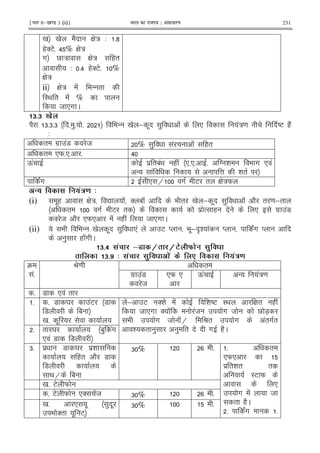
![232 THE GAZETTE OF INDIA : EXTRAORDINARY [PART II—SEC. 3(ii)]
66 * H
# E "
G :W C
65 1 !E
!1! " -
!:=
! (" 5 )5
5 ! *
#* (2!C
2#Y 0 ( & 0
2# 4 0 ( % 0 0 .' . !'/
4
!5
P= "
#$ !7
8
*W * Q! - !:=
5 ) IE 6 % 5 5 "
*W* 6
$ "& " "
$ #
IE W ( &
# *
# ! 8
" (2C )
IE& V 7X
8 "
# EM =
) ( #
5 !# 5
* H
# E "
G :W C
65 1[X ()*
!:= =
) IE& !
N " '"
I<
7W! 2 (
# 7
I< *
$ # !
8 *# C
5 ) IE& 6 % 5
65 8 2
1E
6 % 5
>5 ) -
(i) $&
(ii)
(iii) 0 . ) *!
(iv) 0 ) 8#(
9 . " = 3
%
6 %
%
> %
5 8 8 6 % 5
5 ) $ & G = !I< H
8*
6 % 5
5 ) W !# !8 5 % 5
?5 ) 2! ; - $ )
!#L H ) G 1
("*
5 % 5](https://image.slidesharecdn.com/ubbl2016notified-250923161005-b0550c73/85/UBBL_2016_Notified_DDA-Building-Bye-laws-232-320.jpg)
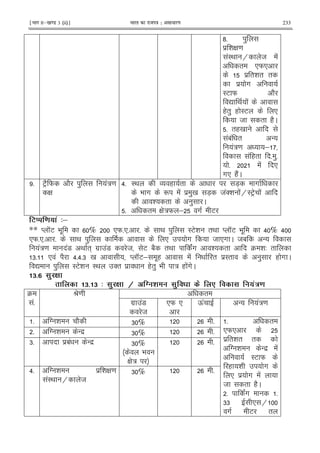
![234 THE GAZETTE OF INDIA : EXTRAORDINARY [PART II—SEC. 3(ii)]
G :W C
65 "
*W*
$ "& " "
T & $ & G =
- $H 8 !
IE W 2
Z < !
( &
#H( IE
* $ # !
8 " (2C
>5 "(0
!1! " -
!:=
! (" 5 )5
5 ! *
#* (2!C
2#Q . '
2# Y 4 . .' . !'/
4
!5
P= "
#$ !7
8
*W * Q! - !:=
5 1.< H . 2 W
* ! N8 1.<
) " ; E M ) 9 8 ! !
) "C
5 M KE 8 # E " 1) !# K W
) G )E ("
5 2 !8 % # 8 !
V 7X 9 8 ! ! ) " !") ! @
& " C
5 2 !8 % # 8 !
V 7X 9 # 8 ! ! ) " -") !
@ & " C
5 1) !# K W ("
* 8 #
65 * H* 7
E E
2#[ E & ': 0 '
2# Q 4 E & ': 0 .' . !'/
4
!5
P= "
#$ !7
8
*W * Q! - !:=
5 5 1() $ 8 8 6 % 5 5 !# ;65](https://image.slidesharecdn.com/ubbl2016notified-250923161005-b0550c73/85/UBBL_2016_Notified_DDA-Building-Bye-laws-234-320.jpg)
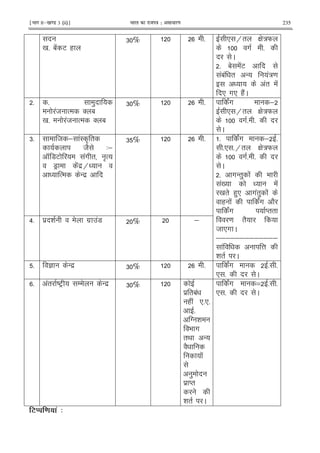
![236 THE GAZETTE OF INDIA : EXTRAORDINARY [PART II—SEC. 3(ii)]
(i) * 51 5 827 G : - 1!# G : !8 % # 8 ! ! I< " "<
" ! ! Z !8 % ' 1 ! E #; # !
( # "< 5 5 $ 5 " " Z I< "
!:= ! ) " # C
(ii) 0 ) G : ! ! E7 0 H0 ) ! " '" #$ !7 8 )'" 6
# 5 " G : " = " ) " ( # C
(iii) 1! E ( K ! 3
5 !# * #$ !7 = #$ !7 *- 9 " 1 !E ) "
( # C !# * IE E ] ) (2C
0 5 !H9 !7 = * 1 !E G : 6 % *W5*5 5 ! & ( !
8 *# C
(iv) !" DEF / - $ ! $ !#= $ * " % #$ !7
8 ) " ( # C $ !#= * ) " '" #$ !7 8
# 8 " (2 " # * #* #$ !7 8 % *W5*5 5 ! #
8 *# C
2#$ "! 0 ! 0 '
T R 0 .' . !'/ . .' 8 6J'
4
2# $ 4 "! 0 ! 0 .' . !'/
4
!5
P= "
#$ !7
8
*W * Q! - !:=
5 AS P H& H
R !# # !
* 0 9
- $H 8
( !H )_D ! *
( IE H $ 2[X & G - $H
< H1 - $H 2
1
6 % 5 5 !#
^ 5? 5 5
* 5H # 5
" G :W
C
5 1 !E
!1! " -
!:=
! ("
5 )5 5; !
* #* (2!C
5
5 ; 7X I"
0 5 & ( I" ! !
# I"
6 %
%
& 0
("
E
E
65 !# 7X
G :
H .( I"
6 % 5
>5 E !E 6 %
$ "1!
!# 5 5
* 5 $ " #
5 " G :W](https://image.slidesharecdn.com/ubbl2016notified-250923161005-b0550c73/85/UBBL_2016_Notified_DDA-Building-Bye-laws-236-320.jpg)
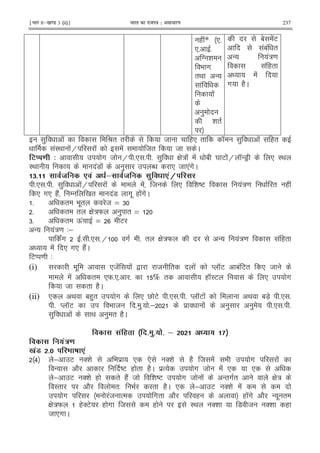
![238 THE GAZETTE OF INDIA : EXTRAORDINARY [PART II—SEC. 3(ii)]
I< '& 3 ! (" & DE 0 !7 ! !"#" < G " 9 .0 !7
$I" " 9 [X ! ! !# G : ! 0 ) I< 9 .; A& ! 2 - & D " !
& I"A" '& C
B '> 2# ! .8 E . .' J ! .8 .' :;
6 > $ = , ) - !1! " I< $ = , (
) " ; E '& ! ! (" !"#" ) " 8 *# C
6 8 G : * ) " ; E '& ( ! ( !# ( G : )0
8 H8 8 1! ! & " ( # C
6 & ( 78 I ! * E * K 7 < ) & ( = I !
! O 8 * ! ) * " - . " G :
! 3
5 ) * I G :W ; > ('E
0 5 ) * 9 .0 !7 G :W ; 6 # 5
6 I< G = * 2 !:= ! !" = E 7 $ #
& ( G : ! ! ) I ! 8 ! 4 - * !:=
! R ! 8 " (2C
6 ? 6 # 5 2 17X ! ! 9 . A& ! 8 "2 8 *# C
6 $ A " 8 S " 1 " ( ! ( # C
6 9 ; E M I A " D 8 !#$(= 1 "
8 * 9 # ( # C
S* .' ': 4
6 ; E '& HI< '& 2 9 '& ; G : ! I< !
* ! $ = , ) " * 8 *!#C
6 $ = HI< ! H 9 # $ = : "
9 !H ! ! 8H*W* ! ! ) 8 $ "& " "
2 " 65 # E " *W* 8) V.E
& '" ( # C .( 8 ! "< 8 ; 8 ) ! !
) *W5*5 5 $ "& " *W5*5 5 V.E $ = HI<
, H 9 # $ = ; : " 8 " (2C
6 6 & ( $ = " " I< G :
8 ! ; E 8 ! O I ! ) I ! & ( = I !
2 9 9 . # P = ! ! 1() ! 8 9 ! I A " * "#"
& ; & " # C " " !#L !HI< !
8 *! !# & '" ( # 2 ( & ( -(!
& ; & H W & ! # C
!. :; ! . H .' * ) " ( ! 8 *# "< ( Z I<
Y ! # & " c ) I< 8 0 ) " ( # 3
(i) E G " 3 * < Y ! ! - . " 6 EC
(ii) " W - . " # 7X ; ? E
(iii) !# & " ; " G : 6 5 5* 5 $ " # E " I<
M KE G : 9 "](https://image.slidesharecdn.com/ubbl2016notified-250923161005-b0550c73/85/UBBL_2016_Notified_DDA-Building-Bye-laws-238-320.jpg)
![¹Hkkx IIµ[k.M 3 (ii)º Hkkjr dk jkti=k % vlk/kj.k 239
(iv) " #$ !7 8 ; % 1& " 5 )5 5 ; ) - . "
E12 8 *# C
(v) *W5*5 5 ; 1& " " " G :W 6 # E ( C
M KE > # E (2 "< > E #
7X I< " (2 " ) " *W5*5 5 > # E ( ! ( # 8
" " $9 7X 27X N " "< ;
( # " G : ! " " 9 7X ( C
(vi) M KE 3 - . " # E * ! " > # E C
Y 9 . ( # " & D G : ( ;9 0 8 *# C
(vii) " ) Q! ; E
(viii) 6 E Y G " * G " I< V 7X & D 8#( !
O ) ( !#C O I< 5 )5 5; ! I<
1 8 * 5* 5 5 * ) ! * ( # C
(ix) Y E #$ W 2 - ! $ ! )R ( # C
E M 2' 9 " ) ) " ( # C
(x) 9 . # " $9 *W5*5 5 $9 ) $9 * ! - $9 ,
; ) " $9 ! ) . * 8 *!#C
(xi) I< "< ! $ = ( ) & " !# !
= ( )'" & " c # (2C
(xii) 9 . 1 ()* 28. I< Y 1! ( !#C
(xiii) * ! ! 17X !0 ! 8 " + & ! * " '" 9 .
& " ( " (2 " #$(= 8 *# 2 !1! " I< *8! !
, I< G : & " !H )0 8 $ ! )
8 *# C
A< ! 9 . # ! " (") 5 )5 5; ! $ * 8
& " )'" $ ! ) 8 *# C
( ) & " 8 (* !1! " M KE G : ! ! M" !# ) *! $
# (2!C
B '> [# ! .8 E . .' E ! .8 E . .' .' ! .8 .'
0 J .' !'/
"! .3
5 8( ! * ; !:= ( ! * #* (2! -(! $ = , 1
8 " (2C
5 8( ! ( ! 8 " 2 " O I< # (2 -(! #$ *W*
9 # 8 *# C 9 # 8 ! ! E < Q! 9 !
! 5 5 $ 5 " " & D I< " ! ! / 0 " ) "
" (2 3
IE E " < 1 !E ! IE !# $ ! - . " Q!
5 E ( (*
0 9 0 0 * G " = # * ! ! (") !1! "
*8! ! . ) < !" " !E E!E ]](https://image.slidesharecdn.com/ubbl2016notified-250923161005-b0550c73/85/UBBL_2016_Notified_DDA-Building-Bye-laws-239-320.jpg)
![240 THE GAZETTE OF INDIA : EXTRAORDINARY [PART II—SEC. 3(ii)]
) " 8 " (2C 2 *W5*5 5 ! ( ! # 8 *# C
" Q! = ! % #( 8 $ " $ *
Q! & " - = ! 8 *# C 9 !
" Q! 5? E " " 0 8 *# C
5 9 = ( T 5> 5 IE E G : (" 8 " (2 "
G : # !# 9 . A& ! * $I" 8 " (2
" IE E G : *W5*5 ! & & " ( ! ( # C
>5 81 9 - P = ! 9 .0 !7 ! * 9 = * #* ( ! " 7 G :
2 " G : / " P= ! 1 17X 9 .0 !7 ! * 4 & 3 ) 7
G : 2 " G : 9 I< " ! ( ! ( # C
5 # 5 * ! 9 M KE ! ! a M KE;M KE7
b V 7X $ !#= ) " & " (" ( # ; $ !#= $ (")
" $ "& " " '" #$ !7 8 ) " ( # C $ !#= *
) " '" #$ !7 8 # 8 " (2 " # * #* #$ !7
8 $ "& " *W5*5 5 ! # 8 *# C
^ Q# 4 "! .3AJ % ! B > ! .
45 !5 9 .0 =7 # 5 ! - . " E12
#$
9 #
5
&
9 #
5
7
5
7
5
5 5 "
5 5 2 5 " 6 5 25 ; ;
65 5 2 6 5 " > 25 ; ;
>5 6 5 2 5 " > 6 6 ;
5 5 2 5 " 6 6 6
5 5 2 5 "
5 5
(i) Q * #* E12 < ) 8 ( ! 8 " (2 " (
P= E 12 ) 8 " (2C
(ii) E12 9 = ! ) Q! 2 2! E & G !
( !#C
(iii) ; E - . " " E12 < I A " 8 " (2 "
9 = 8 ! I A " ! ) 8 *# C
(iv) $ = " " & D I< " ! ! E12 #$ !7 8 2 Q!
! V.E " (2C
(v) 81 9 9 .0 !7 9 " 5* 5* 5 O I< 8 G " ( " 7H
E12 & ]E ) " ( # C
[#(4) '8 4](https://image.slidesharecdn.com/ubbl2016notified-250923161005-b0550c73/85/UBBL_2016_Notified_DDA-Building-Bye-laws-240-320.jpg)
![¹Hkkx IIµ[k.M 3 (ii)º Hkkjr dk jkti=k % vlk/kj.k 241
!# $% # ! " * #* (2! -") 8( ! " ( !
(2!; ( ! / 0 " " 5 ! * #* ! 8 *# 3;
Q# 4 8
45 !5 # ) " ") !# I<
* $ " # 5 " G :W
5 5
5 O 65
65 = 5
>5 5?
5 8 * ! 8
) *!
5
(i) # 5 9 .0 !7 G : 28. 9 ! ! " '" & " !
* M" !# ) *! N * I " 1()I" !#
= * $ "& " " '" #$ !7 8 ) " ( # C
(ii) !# I< ! $ * I< " 56 ! * #* !
) ( # 3;
Q#2 4 8 . :;
45 !5 !# $ G :W $ " * # 5 !
5 0 ) 6
5 7 #$ !7 ] ?
65 1 !E 6
>5 1()I" 2/ (" 6
5 I " 1()I" ]E ("
(iii) # ! ! )'" ! ) !# O I< 9 .0 !7 9 "
8 *# C
(iv) 8 ! ! !I A" '& (" 9 ( E " '" 28. (2!H =
(2 2 8( ! 9 '& 5 )5 5; ) !I A" (2! # * #*
" '" *W5*5 5 * N 8 !# 5 )5 5; !
" !# !7 ! ) ( # C
[ %Y A. .'3 4
!# 2 G ! 82 * -7& !# M !E * ! = 8 !#$(
1 Z)" 1;IE& * 5E 5 2 * 5E 5 2 R EF ! W / E !E
!:= G / ( 8 E R 2 - ! : *! "< Z)" * !
T & I ! !I< "< 9 0 0 * G " -
! ") " E12 " 1 !EH1 !E ! ) "
!1! " *8! ! . ) 8 " (2 2 -(! *W* !
& ( ! 8 *# C "< ! * N I< 1 !E
6 $ "& " G :W ( ! ( (*C ( E ! !
( E !H K=7F 0 Z #$ 9 !7 = (") 7 R IE .7X Y
( !# IE 2 7 IE 8 ) " 8 " (2C](https://image.slidesharecdn.com/ubbl2016notified-250923161005-b0550c73/85/UBBL_2016_Notified_DDA-Building-Bye-laws-241-320.jpg)
![242 THE GAZETTE OF INDIA : EXTRAORDINARY [PART II—SEC. 3(ii)]
0 9 1 !E 8 1 1 " 0 8 *# 2 !
( * & ! E & = O I< 8 *# C
# 1 !E $ 1 ( (* & " 7X T & (
. 9 ( ! 2 ! M" ) G ( (*C
Y 1 !E # # ! )R ! *
8 " (2 81 9 ) " 8 *# " *W5*5 ! &
8 *# T & $ = 2 - ! ! @
: ( # C
m !# I< )R # 8 " (2 " #
8 *# HI< H $ = , !
8 *# C
5* 5* 5 T & = # 2 9 . #" 8 E2! " 9 .
8 ! & 8 *# 2 ( *W5*5 5 ! & 8 *# C
[ % ) 4
*8! 6 # 5 2 M KE ! ; E M !
/ 0 " O I< (* 3
(i) 8 "< ) 3 4" 8 * A< ! < & " . D " 8
) 4= ( !# $= & )R 8 *# C
(ii) D 8 !#$(= 8 $ " ! ! G = "< 9 .8 ) ,
9 .8 ) 9 = C
(iii) & " 8 1 (3 $ ( 1 # ( E L!7 82
. # ! * ) 3 4" 8 (*C
(iv) 9 . #" 8 9 !7 = E2! V" Q 8 !#$(= $= # & )D * !
$ 7IE 1 82 #" ! O I< M KE ! 8
(*C
(v) 9 I " ! O 2Z # ( E I" ! KE & K
$ < 1 (3 $ ( & * O I< M KE ! ( # C
(vi) 5* 5* 5 2 8 E O I< ! 2 Q8 9 '& ! !I A "
Q8 9 #H K 7E 8 !C
(vii) 9 ! 2 E K $ !#= "< & 7!# 7 $ 1[X
8 *# " -(! Q8 $9 1 8 C
(viii) 9 M E ! 6 # E 2 G : ! 2 " $= O I<
8 *# C
(ix) )'" 1 " ! 1[X * "2 * #* $ !
I< ! , $ % ( R ! $% M KE $ "& " >
$ "& " " '" #$ !7 8 "< *W5*5 5 8 " (2C & DE
! ! $ "& " $ % ( ) " 8 " (2C
(x) $ % ( #$ 1 7!# * a " (") ( " E!#b
, " E!# !7 " ( !#C](https://image.slidesharecdn.com/ubbl2016notified-250923161005-b0550c73/85/UBBL_2016_Notified_DDA-Building-Bye-laws-242-320.jpg)
![¹Hkkx IIµ[k.M 3 (ii)º Hkkjr dk jkti=k % vlk/kj.k 243
(xi) 9 # $ = : $ M" 1 )'" ) !
9 .;I % *8! , $ % ( R ! 1[X * #* *W5*5 5 * 1 8
8) . 8 *# C
)'" #. * & I< I 5 5G 5
, = 9 # 5 5G 5 5 5 < & V( ( !
! !& ! . 1 "2 8 *!# 2 -(! $ = H - $
) (" . " 8 *# C
[#% # : 4
(i) . 1S 8 & ! 2 H < (2'E5 8 & !
)O I< " [X!# 9 . A& ! '& ! ! & 8 ( # C
(ii) ) I" G " - $ A" * 5E 5 5 O I< 8 *# C
8 Q8 H#2 % - !9 ! " # 8 *# C
(iii) 82 "< ) 4= & DE # # & DE I< #
8 *# " I" - $ A" EF E !E 8 " (2 81
82 & DE * - $ A" EF E !E 8 " (2C
[#%Q C' .
5 9 # 8 ! ! 5 IE E 1 "< 5 5 IE E ("
Q! 9 ! Q! 9 8 *# C
0 5 IE E " IE2 !# $ ! IE E " * 5>
E - . " Q! V.E 8 " (2C "< IE2 !# !
Q! 78 * ! ! % ) G & " c ) ( # C
#5 9 0 0 * G " = # * ! ! (") !1! "
*8! . ) !" " !E E!E ]
) " 8 " (2 2 *W5*5 5 ! ( ! # 8 *# C "
Q! = ! % #( 8 9 !7 O I< *
Q! & " - = ! 8 *# C 1
Q! W K ] ( W &7 ]
5? E ( ! ( (*C
Y 5 I< !H !1! " 9 # ! # # "< T & 9 # @
& " 1 !E 2E12 ! ) " 8 *# 8( !
E12' + ( ! (2! 1 !E ) " E " ( (* 2 8( ! E12
(2! ) " M KE E ( (*C
m5 T & 9 # @ & " 7 ! E12 !
) " ( ! 8 2 !# 7 - D S ( # C V"
Q I !# . 9 .; .& ! "< !1! " IEF' 82 # *
) " ( # C
5 1 !E * - & "! ;0 !7 ? ) ( # C
D 9A'8 ( ./ . '!/ ! %> # # # 4
H1!# G : * 8 ;aa bb 8 $ R 8
8 (") $ = , ! 6 5 5 !0 ? H G :
8 ;II $ = ) $ # < C
' 4& http://dda.org.in/planning/docs/zone-C, Report 040108.pdf](https://image.slidesharecdn.com/ubbl2016notified-250923161005-b0550c73/85/UBBL_2016_Notified_DDA-Building-Bye-laws-243-320.jpg)
![244 THE GAZETTE OF INDIA : EXTRAORDINARY [PART II—SEC. 3(ii)]
*9 . !#$(= "< 2!7 . !# * !:= !7 2 5 C
(i) " !"#" !: / ) (2! 3;
5 .( * *W5*5 5 > 9 . #.
( # 8 57N .5* 5 * G " $ "& " *W5*5 5
V 7X (2C 9 . 9 . " $ "& "
( # C
0 5 # I" O 2 # I" 5* 5 5 * *W5*5
( # C
#5 " #$ !7 8 > $ "& " ( # C
Y 5 57N .5* 5 8 !0 * $ "& " *W5*5 5 Y % ? ; 5
5* 5 ) Y % B 8 *# C
m5 " !I< , * 5 5* 5H # E
" G : !7 ! ) M" !# O I< 8 *# C "<
57N .5* 5 * ! ! 5 5 5* 5H # E "
G : !7 ! ) O I< 8 *# C
5 5 )5 5 ) ( " 9 !7 ! * $ % ( "
!"#" " .( #. ( # C
V5 2 ! E & N ( ! 1 !E 9 E12
" 2 9 . < " 0 8 *# C ( "
( " M KE E " 1 !E ) " 8 *# C
(ii) G : ! ; 9 8 "< ) ! $ I< * ! #
I" 5 )5 5; ) ( # C
(iii) I< I" ) *! )'" 5 (i)X Y ! DE Y % < ) " ( !# C
(iv) * EF71 *W5*5 5 ) " (2C "< # !
EF71 *W5*5 5 8 8 ! - " !I< "9
I< !" " 8 " (2 81 ('E5 8 !
) H ! ( C](https://image.slidesharecdn.com/ubbl2016notified-250923161005-b0550c73/85/UBBL_2016_Notified_DDA-Building-Bye-laws-244-320.jpg)
![246 THE GAZETTE OF INDIA : EXTRAORDINARY [PART II—SEC. 3(ii)]
0 @ & VIII
" .8 .' . K3 .' 'B! J J Z0 ':; .' . !.
:; % )! D : .E B '> $#5# .B .'
5 ]E G " ! V" # " ! G " ]E ! !0
2 $ " ! # (2C
4 8J & ! A60 ' E D . K3 .' 'B! J
4
!5
! 8 !
!5
]E !
O '" !
G "
]E , 8 * 8 O '" ! !0
# "
* H*
E ! 6 E ! E ! E !
(I"
"
I
"
(I"
"
I
"
(I"
"
I
"
(I"
"
I
"
6 > ?
5 5 ; 5 ; ; ; > ;
5 ? 5 ; 5 ; 6 ; ; ; ;
65 5 ; 5 ; ; ; 6 ;
>5 5 6 ; ? ; 6 ; 6 ;
5 6 5 6 ; ; 6 ; >>> ;
5 5 ; 5 ; ; ; > ;
5 ? 5 ; 5 ; ; ; ? ;
?5 5 ; 5 ? ; ? ; ? ; ;
5 6 5 ; 5 ; 6 ; ; > ;
5 5 ; ; ; ;
5 5 > ; >> ; > ; ?? ;
5 6 5 ? ; ; 6 ;
65 6 5 6 ; ? ; 6 ; ; ;
>5 5 ; ; ;
5 6 5 > > > >?
5 6 5 6 6 6? ? 6 6 ;
5 5 66 ? 66 6 6
?5 5 ? 6 ? 6 ? > 6
5 6 5 >
5 > 5 6 ? 6? ? 6 ? ; 6](https://image.slidesharecdn.com/ubbl2016notified-250923161005-b0550c73/85/UBBL_2016_Notified_DDA-Building-Bye-laws-246-320.jpg)
![¹Hkkx IIµ[k.M 3 (ii)º Hkkjr dk jkti=k % vlk/kj.k 247
3) &1
I" #2 ; 9 ! E ! 9 EF2 W E M" B
8 " (2 2 ( $ = H !1! " I< , I A" (2C $
G " ]E ! !0 #= 2 ! E2F W E
"< # ! !0 ! 0 8 " (2C
0 )'" G " ]E ! ) !0 " '" G " * 2 ]E
$ IE2!7 R ! * 8 " (2C
3) &2
O '" , # * 8 E G : # ! !0 #=
8 " (2C
3) &3
9 ." 2 ( ! 8 # ! !0 ( ! 8 " ' !
! 8 ! * - "3 ]E $ # ( ! 8 " (2C
3) &4
5 E $ " 2 !7 W)E $ " E G (2C
5 E $ " 2 !7 W)E $ " E G (2C
5 E $ " 2 !7 6 W)E $ " E G (2C
3) &5
]E # * 9 Q! )'" = ! ]E : * )
# (2 3;
! " 5 E
! " 665 E
6 ! " >?5 E
> ! " >5 E
4 ! . !. K3 'B! J
4
!5
" !
!0
!0 O '" !
G "
# " 5
H 25
!
2! 7!#
#E
E
!EF
IE ]E
!0
O '" !
G "
#E
$
!EF
IE
? 5
5
; 2
2! 7!#
!
I "
)& 1E
!
; ; ; ;
? 5 ; ; ( ; ? ; )&
1E
(2!7
I
!EF
6
6
? 5
5 >
; ; ( ;
2
? ; ; ( ;](https://image.slidesharecdn.com/ubbl2016notified-250923161005-b0550c73/85/UBBL_2016_Notified_DDA-Building-Bye-laws-247-320.jpg)
![248 THE GAZETTE OF INDIA : EXTRAORDINARY [PART II—SEC. 3(ii)]
Z)"
! "
8
'&
IE
1
; ( ;
> 6 ?
?
;
Z)"
! "
8
; ( ; ? ; ; ( ;
* E Q! 9 ! E 8 ! ) " ( ! 8 *# C
]E # * 7 !& 2 !1S 8 82 ]E 2 E #( &
G 1 Q! " 2! 7!# & G ] !# " ' ! " ! # (2
3;
.' K3 8 . 6. 0 J *!
K3
I0 D
(
%M! S
! .'
'B!
% #
8 #
K3
8
K3 .
b'3 86 D
% .'#
#
% .'#
#
0B!
L
% .'# #
* U C
. *
U .
.
: % .'#
#
K3 8 . .
K3 . * +
.
%3 .' !6 !
! E D
' >? .' .' J
A. . ;
* D .
E .>? E
2 5 Y Q [ $
> m/s
" 2
9 "
> 6 > > 5
> ? ; ( ; ? > 6 66 > 5
? >> m/s
" 2
9 "
? > 6 > ?5
? m/s
" 2
> 6 6 > 5](https://image.slidesharecdn.com/ubbl2016notified-250923161005-b0550c73/85/UBBL_2016_Notified_DDA-Building-Bye-laws-248-320.jpg)
![¹Hkkx IIµ[k.M 3 (ii)º Hkkjr dk jkti=k % vlk/kj.k 249
9 "
6 ??> ; ( ; 6 ?
?
> > 66 > 65
?
?
; ( ; 6 > 66 >? 5
6 ; ( ; 6 > 66 >? 5
3) 4
(i) 9 ]E - . " I DE = #( & " ! )R ( !C
(ii) 8( ! ]E ! * ]E # 8 *! !5 5 27X " '"
9 8 1 # 8 *C
(iii) m/s = W)E $ " EC
(iv) 9 ]E ! * $ & , !5 5 #9 #; W)E ( (*C
0A' & IX
# Z0 8 . . :; A I" 8 0 =7 5>56 0 !
9 - Z)" = ! * " I< = 5 56 ! # (2C
# Z0 & .' & ; ! $ * I< $ (") 5 5 2 5 5 ! *
#* ! 8 *# C
5 5 9 ! * ; ! $ (") & G :W
45 !5 ) 7 *
# 5 !
EF ! W G "
5 E * / !
; ! $ *
& #
5 !
5 x >
5 > x 6
65 ? x 6
>5 x 6 6
5 > x 6](https://image.slidesharecdn.com/ubbl2016notified-250923161005-b0550c73/85/UBBL_2016_Notified_DDA-Building-Bye-laws-249-320.jpg)
![250 THE GAZETTE OF INDIA : EXTRAORDINARY [PART II—SEC. 3(ii)]
5 x 6
5 x 6
?5 6 x 6
3) 4
5 # 5 " '" 7 * * $ "& " 9 ( G " *
E < * 9 A S 8 *# C
5 7 * ) * " '" EF ! W * # " '"
I< N 8 *# C
65 ( I< " ! = I< ! 9 $ 1
I< " ! Z)" # ) 8 " (2C
>5 ; ! $ " ! 0 ! 5 5 #( ( !# * E I"
= N 8 *# C * = # 2 0 ! !
M M" " * " E H0 ) ) (") 5 E #(
$ "R " N 8 *# C ( " W& I< " * #* $%
EF ! W - . " E 9 ( ! G ( # C ! $ ! ! 9 - = !
# * & VE; )E I< ! = # (2 3
. " " / I # G 2 < E ! * I< C
0 3V ' F ( 4 / ) Z)" & " EF ! W
G ! !0 2 ) & " 8 *# C EF ! W 2
* EF ! W ! W; W * %" $1! EF ! W
I< * ! 0 ; 0 (") 9 7 5* 5 ?? ; ! 9
8 " (2C >x> E - . " I< * * EF ! W $
8 " (2C EF ! W * E7 I< N
8 " (2 " ( -( ! I< " ! ! ) G 1 7X M M" $ ! <
N 8 *C EF ! W ! 1 ( I< " 8 " (2
1& " T & ( 8 ( 1 " ( C 17X " !E-E E
EF ! W ! * 9 " Z)" >
!"#" E N * 8 *!C ( 1 !E I< (") & )D
$ EF ! W ( ) " 8 *# C
# _ . 3.E : U 4 ! $ * EF ! W (2 "
: * U E8 I # ( # C EF ! W ! * M !E
. " ! 6 I ! & " ( # 2 (n) EF ! W ! *
I ! !0 n+1 ( # C * I & " G :W
#9 # > x 5 ( # 2 $% " '" I * E /1
1[X 8 *C](https://image.slidesharecdn.com/ubbl2016notified-250923161005-b0550c73/85/UBBL_2016_Notified_DDA-Building-Bye-laws-250-320.jpg)
![¹Hkkx IIµ[k.M 3 (ii)º Hkkjr dk jkti=k % vlk/kj.k 251
Y O . 3.E : U 4 / E8 I # R !1! ! &
" G :W 9 W . " ( ! 8 " (2C
m S %:3J > A D E .3 6. 0 U 4 5 E " '" IE2=7
1 8 E E 0 * x 5 " I< * G
$ 8 *C
# # 4 A60 ' E .' . 6B . '. Z0 & .' :; 4 9
" G : ! ) "HI A" I< 8 $< "(0 I" (
Z)" ; ! $ N 8 (*C - $ [X "
2/ < I DE I "!: 21 Y !E 0 ; 0 < 9 !
( (*C
# # & .' . "! *! '
"3 Z)" ; ! $ 9 .;" N * 8 *!# * ( (
"(0 " ( " (2 9 I< " ! Q " ( !C
0 I< N " ) ; ! $ 9 - I" ! 9 8"
8 " (2C
# ; ! $ I< - . " 27X E ( ! ( (*C
Y 9 - P = ! ! 9 ! Q * #* G :W G ! ! 1("
( # ! 0 7X ! 2 I "!: R 8 ( * 8 N
* 8 *!C
m 9 G V" " 9 8 ( (* 2 ! " " ;O I<
( (*C EF ! W G ! " & D O I< ( (* 2
8( ! & ( I" ! 2 U " I" ! " I< !
*T8 KIE W2 # * 8 (*C
#7+7X ! EF ! W 2 I R ! Y ) D 8
* ; ! $ " I" I< $% & " U " 1 [X 8
I" !5 5 Q ( (*C
V V" * 7 8 2 2 3 V" 2 E12 I A" 1& " T & (
8 ( ! _ E ( C
# .A B D! ' * K3 4
5 5 ) " !0 ! Q & K]E+ 8!# - " = 1 ' 9
& " ) " I< ! N * 8 *!#C ! $ - 9
8 7X # " 1 7 * " ) 8 ['
< & " ) 1 0 ! 9 N 8 *!# C 1 A"
IE W N + & Q & K]E+ 8!# -
" = 1 K' ! 1 0 ! = 9 8 *# C $% "
& " ) 8!# ! "< Q & ]E+ ! - = E2
KW 1' "< " = 1' N I< " * 8 *!# 2
, I ! #" ) G = 8 *# C](https://image.slidesharecdn.com/ubbl2016notified-250923161005-b0550c73/85/UBBL_2016_Notified_DDA-Building-Bye-laws-251-320.jpg)
![252 THE GAZETTE OF INDIA : EXTRAORDINARY [PART II—SEC. 3(ii)]
!1! " " ! " = (") = ! 82 " = 1 K' E; E 2
E 1 K' "< I ! # * $% " M M" !1S I<
9 N 8 *# C
# # : U :; 4 I< ! V 7X 8( ! ; ! $ N
# (2 17X 2 # * #* = ! * * # I R
N 8 *# C < !9 Z)" 7 !E E I< "
8 *# 2 I # I< " ! . " $ & 1! - . " 7X !
< " *! V 8 *!# C I _ ! 9 I< " ! 0
8 *# " ( ! * Q 4 ! Q 8 !
9 Q ! 8 N 8 C 17X 9 ! ! I R
$% Q 1 ! * *
Q ! 7'E+ 2 G 2 8" ! 9 & " ( # C
$ 1 *! 1 Z)" ! * ( G " ( !# "<
! 2 / E8 = ! 82 K 1 $= &
8 " (2C E W )'" $ #; # # * 8
(*C
# #2 J .' :; J *! 4 Z)" # 2 ! 2
" & - = ! 8!# ! )# " 8 7X 8
" (2 2 . * $% " M M" I<
N ( (*C
# #5 A S 9 A S ( :; J *! 4
1 *' H *1 *' G ! E W E E+ 2 $ 2
I< !1! ! . !1! " $ = H !1S I< ,
) & " 8 *# C ; " = 1 7 # * M" I< N
( (*C
#2 "! 4
5 56 $% " ; ! $ " = = ! Q K]E ! 2 ( " (") "
I< 0 0 , 8 *# C Z)" . " (") " '"
O I< ; ! $ = ! (" ; ! $ " = R
N 8 ( # C
0A' & X
8 A >'8 6. 0 % )! D : .E ! ! .B .'
# E ' ( ' A' & ! 4 # %
8 !" 1[X" !# ! 0 " ()* 9 ! ! M M" R 8 0 "
& " (2C ! - . " 8 " 8 1( W
* A" * ! I< 8 $1! G 0 8 (*C 8 ! G = = !
9 .; A& ! D 8 !#$(= 8 9 A" ) 9 = 2 & DE;8 ) = #
< " & " (2C](https://image.slidesharecdn.com/ubbl2016notified-250923161005-b0550c73/85/UBBL_2016_Notified_DDA-Building-Bye-laws-252-320.jpg)
![¹Hkkx IIµ[k.M 3 (ii)º Hkkjr dk jkti=k % vlk/kj.k 253
# = J A &= . ( ./ .' .' + E '86 % 0 L
V" 2 1 ;V" G : ! ! a 1 D ( !b 8
: !#$(= * D 8 !#$(= $= C
B # E B .
8 0 " = ! 8 )'" ( 8 $ ( #$ R !
9 ." !7 ! . " ( $ # !C 9 ) D 0 " )
9 ." 8 0 " #= ( ! ( (*C 9 ." !7 * 8
( (2! 3
[ 4 .' 6. 0 6 .'9B
45 !5 = $ " $ (
H0 "
$ " *WE **
) " 2
#
5 ] & & 2 .= ] & * *W )_D *
( *
5 ] & & 2 ] & 6 * *W ( *
65 .: > * *W ( ! *
>5 HE E * * *W >
5 I I< * * *W
5 & K (27H( < ! 7X
8 I $*
* *W 5
$ " 3 . W M ! 1!# 7 ; =7
3) 4
5 * *W 3 E $ " ] &
5 * = ! * E!# 1 6 1 (bar) ( # C
65** . 1 1 *WE * " 9 9 # ! & " (2 8 9 !
$ " ? Y !E O " " " (2!C !& < " '" ( ! *
*WE . $ " ? 9 8" Y !E ! ( # C
>5 81 9 $ = " = N ( ! ) (" ( " % $ = 4
!"#" 8 1 , $ = " M ! 1!# = ! 8 ! #
8 *C](https://image.slidesharecdn.com/ubbl2016notified-250923161005-b0550c73/85/UBBL_2016_Notified_DDA-Building-Bye-laws-253-320.jpg)
![254 THE GAZETTE OF INDIA : EXTRAORDINARY [PART II—SEC. 3(ii)]
= * ! !: & ; & ! ) 8( ! 9 !9 ( ! )'"
8 ! G = = ! I " ! 1 = ! # 6
$ "& " " 8 0 " 8 " (2 8 = I R 8 0 " ! (% .=
( " (2C
(i) K * * J ! %>W ! 4
• ! & 2 ! ! $ " ] & E # ( " (2C $ " ] & 5
E 2 65 E $ ( ] & & 2 N (2!C
• L & DE ] & !# * ( ] & *7ME ! 2 " & DE
* !& " V E ] & # 8 " (2C
• 8 $ ( " * ; 5 5 - 2E+ ] & !
# 8 " (2C
(ii) K * * J ! * A. 3 .' 3! ' . .D . 4
• ! 2 E ! E ! $ ( 5H E ( " (2C ! ! 1
! "< * E ! # 8 $ ( ! 1 $ (
8 " (2C " '" I "3 !:= ! ( " O
8 " (2C
• 1 = 3 * E ! # $ (
E H E " 8 " (2 8 ( < ! ) * M M"
(2C
• I "3 !:= 3 2 8 K 7 I " #
1 " 8 " (2C ! E E ! ! I " K 2 KW
$ ( !:= ( " (2C ( . 2 82 ! "
(2!C
(iii) / ! 4
• ! .: ! ! 5 ; E $ " ] & # ( " (2C
• ] & .: ! ! E H] & ( # ( " (2C
• " '" 'EF K ] & !# $= < 2 8 ! #
5> E $ " ] & "1 8 $ ( 8 " (2C
• 8 E .: ! ! # ( ! ( " (2C
(iv) * P 6.>G 4
• ! #" & K (7+ 5H 5 9 8 $ ( "
(2!C
• "< 5H 5 UV / $ ( %" )0 & K $ M"
8 " (2C](https://image.slidesharecdn.com/ubbl2016notified-250923161005-b0550c73/85/UBBL_2016_Notified_DDA-Building-Bye-laws-254-320.jpg)
![¹Hkkx IIµ[k.M 3 (ii)º Hkkjr dk jkti=k % vlk/kj.k 255
• * E 2 1 #) E ! & K (7+ $ ( 5H 5
- . " " 8 " (2 2 # 8 (% .=
1 " ( # C
8# * +3 E 0 X ' 0 4 ! .8
i * +3 E * . 4 9 ! % - & DE 8 $ "& " $1!
(") ! $ < $ .D = !:= 1 7 8 9 #. ( , "
#)= @ ! )R I< & $= C
ii * +3 E 0 4 ! .8 4 9 . A& ! ] & !# 2 . !# E K ;
E 8 ! 8 L!7 ( 1$ 8X # 8 " (2
* & ) 8 $ "& " & " .
* & " 8 # 8 *C 9 . A& ! ] & !# 2
" ) . * & " 8 # 8 " (2C
3) 4
5 ( ! & DE 8 & N ) 2 2 ! $ 8 * # #
(2C
5 & DE 8 I 3I< ; E. & " 8 * 2 I<
# 8 " (2C
65 I< 1 " 8 " (2! 8 & DE 8 *
! $ A"H 8 8 & ! !: ! V 7X 8 * "1 ! $ A"H 8 H <
- 8 & ! !: $ M" & " 8 ) 3 # 8 !
) 8 " (2C
>5 ) ) & " * - I< !HI< ! I<
/ < - ! & " & DE 8 $ M" 9
8 " (2C
5 ) ) & " * !#$ (" D 8 9 8 " (2C
5 9 . A& ! (") 8 & " 2 7 * 2 " ! - . " 6
! * E $ " # E $ " < "+ E H # E H "
8 *# < 9 . A& ! * 8 & " 2 8 7 *
2 " Q # & " ") ! (2 " 2 % 1"
!C
H # < . .'
I< ) ' G :W $ "& " " " ; %<
2 H < 7X !H # !H 2 W E E' [X ( (*C
3) 4
5 8 ! G = (") I< 2 # " ! 2 H < (
) & " ! 9 . A& ! " I< .0 ) . "H & 8H ) .
$8 " 7X # * #* (2!C](https://image.slidesharecdn.com/ubbl2016notified-250923161005-b0550c73/85/UBBL_2016_Notified_DDA-Building-Bye-laws-255-320.jpg)
![256 THE GAZETTE OF INDIA : EXTRAORDINARY [PART II—SEC. 3(ii)]
5 I< G :W $ "& " 9 . $ A " I< A " 1 *
0 2 H < 8 E I " $8 " ! # I<
O I< 1 !C
65 " [X ! 2 I< G :W & ! & " ()*
6 $ "& " 9 . I " $8 " ! # I< G :W
) 3 $ A " O I< 1( !C
>5 8 I< H 2/ ! 28. .= " AG ! !
$ "& " ! G " < $% " 8 *C
5 * #* !7 8 I< 28. < $% " AG !
& " ()* )R 8 I< * AG ! 2 # *! 8
# D ! .= " AG 1 8 *!C
5 ( ! 9 .; A& < (2 9 .; A& ! 8 ! ( I " !
( !C
5 2 * AG = # G :W $ "& " < "+ >3 [X [X
( ! ( (*C
?5 " [X ! 82 "(0 7 V" ! 1 * #* 9 A A& ! G : !
#= (") 8 " (2C
5 a $ A " I< A "b 1 * 0 I"A" ! 9 ! < (2 $ A "
9 .9 # 82 9 () $ A " E+E 8 & $ A "
& D " ! ! G = C
5 Y 2 ! #$ 8 K #!# EF2' 0 ) < E !# I< ! 7F ;
K ; 0 2 ! " = " I< 1 *! # (2C
5 8( ! " !9 ( # & 8H ) . " I " ! 1 * 0 8 *# C
5 # ! 2 ! I " ! ( ! 8 *# C
# J CE ! .8 4 # %
8 Q8 $ " ! ) . " 2 )& # (") 9 $
$ * 8 & " (2C 9 $ & " ! * #2 ;8 & !
# 1[X" _B 0 " ()* #!9 " & " (2C
$ & D & " 2 " & " ! (") = Q8 $ " ! (
& D & " (2C
3) 4 2 ME 2 Z)" % (") - . " $ "& " !I A" 9 & "
( " (2C
# J F .3 . . 3 J .' :;
2 W E E $= ! $% G Q8 R !" = $= ! (2! 8 2 =
Z)" Q8 ! "" " (2!C 9 ! V" ! < ; < - 0 ) I< !
82 !# & 7 2 $= I< " 8 " (2C](https://image.slidesharecdn.com/ubbl2016notified-250923161005-b0550c73/85/UBBL_2016_Notified_DDA-Building-Bye-laws-256-320.jpg)
![258 THE GAZETTE OF INDIA : EXTRAORDINARY [PART II—SEC. 3(ii)]
( ! ! $ !#$ ( ! $ M" = ) . " B)
!#$ ( ! $ M" = ! ") ! 6 $ "& " ; (
$% & " (2C
• * " * 8 9 9 ! V" ! 8)7X # 8
# 8 *! "< 9 ! 8( ! 9 # 8 & " (
$% 1! ) " = ! # 8 *!C
• 9 # 8 E ( E!# $= G " 9
2 " 9 # R " 8 *!# C I " ! ( E ! 2
- ; !1! 9 ! !7 * 8 ( (2! 3;
$ 4 " . .' . ': 0 (
45
!5
9 $ !I")" G " ; $ "
$ " O '" E
5 I "
5 ( E
65 V : 2 $ - 9
>5 2!E & " )
5 $ #& 2 - ) ! !I< & " )
• $ " #9 # E . " G " !#$ (
I< * 6 # E 0 ) I< & " ( # C $=
I< (") V" #9 # $ "& " I< # ! 8 *# C
• E ( E $= I< (") #2 ; ! Q8 $ "
!: , " ! 8 " (2C $
9 E ( E!# $= ! ! 9 " N . )R ;
" M E !#$ ( # * 8 *!C
2# CE ( 4 # %2
# CE B . *
A : $ & Q8 G " $ M" * 2! ! $ & #A( ! # E+E !
2 !:= $= ! K E !# 8 *C
(i) ' * M! :;
• 9 ! *
2! ; - $ & O I< (") # * 8 2! ! !
/ 0 " O I< ( (*C](https://image.slidesharecdn.com/ubbl2016notified-250923161005-b0550c73/85/UBBL_2016_Notified_DDA-Building-Bye-laws-258-320.jpg)
![¹Hkkx IIµ[k.M 3 (ii)º Hkkjr dk jkti=k % vlk/kj.k 259
• K !E $ & $ " ; - $ & (") 9 ! # 9 K !E $ &
$ " *W* < * 7 < )R ( (*C
• 0 $ & $ " ; - $ & (") 9 ! # 9 0 $ &
$ " E ; < > IE 1 E E *W* <
)R ( (*C
I< " # !" $ & Z)" 1 ; 0 !7; 5
6 , !I")" * 7 $ & Z)" Y % ( ! ( (*C
• 9 ! " - 9 ! *
2! ; - $ & (") # * 8 2! ! ! / 0 "
O I< ( (*C
• K !E $ & $ " ; - $ & (") 9 ! # 9 K !E $ &
$ " *W* < * 7 < )R ( (*C
• 0 $ & $ " ; - $ & (") 9 ! # 9 0 $ &
$ " E ; < > IE 1 E E *W* <
)R ( (*C
I< " # !" $ & Z)" 1 ; 0 !7; 5
6 , !I")" * 7 $ & Z)" Y % ( ! ( (*C
5 E < !1S 9 9 ! ! 1
; 0 !7 5 5 , !I")" $ & !: # * 8 *!C
* ! V.E ; 9 ! * I< 8( ! $ &
& " ( C
(i) A 6 * M! :;
O 1() ! ! .( E ! E !E
! *C
• 2! ; # " ) 1 ( $ & $ " ! ! - . " $ &
G " ( (*C
4 " * . .' . : ! "! * (
45
!5
$ & $ " I - . " $ & G "
* * H7N .
5 *W* K/ 2'E ] !E
2!M
5 * 7 E E!# 7 7+
65 ] !E 2/](https://image.slidesharecdn.com/ubbl2016notified-250923161005-b0550c73/85/UBBL_2016_Notified_DDA-Building-Bye-laws-259-320.jpg)
![260 THE GAZETTE OF INDIA : EXTRAORDINARY [PART II—SEC. 3(ii)]
>5 E (2 7 2!M
5 U 1 7 2!M
• !1! " = ! * I< " # 1 ( $ & Z)" Y %
1 0 !7 5> )R ( # C
• 1 ( $ & (") 1 ; 0 !7 5 5 5> , !I")"
$ & !: # * 8 *!C
B # >E D '. CE ( % . ! .8 .
.' 8 M! ! . ! J ! .
'= ! 4
* * $= 78 ! 9 ! * Q8 G "
• " ) . " I< !" 78 I< " ! DEF 9 ! ("
9 #;? 0 !7 6 )R ( !# C
• 1 ( 78 I< " ! DEF 9 ! (" 9 #;? 0 !7 6
)R ( !# C
• # * #* = ! G " 1 ; 0 !7 5 5
& " )R ( # C
• " " & " $= ! * " ) . H 9 8" " ) .
1 6 IE % ( !# C
• 2 ( ! $ ( " G " *
1 )UV 5 5> , !I")" ! ) & $
8 *# C
5# * +3 ; S
) 3 # < ) 4= 1[X * $ " I< & DE #
) N 8 * " & DE #7+7X ! ! W!
#C
# ' * M! :;
(i) &: 0 & 9 9 " ! 2 8 G : ! ! .0
& DE #8 M IE ")*! & & 2 # & DE 82
* 82 #. ( #; # .7X N *!C * :" & DE
* * ! $ A" ) I< 7 ! 8( ! .7X [X
8 8 C
(ii) .' 0 & .0 2 # .7X N " '"
/ 0 " 0 " & DE ) G " E (") ! $ A" ) I<
# .7X N *!C](https://image.slidesharecdn.com/ubbl2016notified-250923161005-b0550c73/85/UBBL_2016_Notified_DDA-Building-Bye-laws-260-320.jpg)
![262 THE GAZETTE OF INDIA : EXTRAORDINARY [PART II—SEC. 3(ii)]
0A' & XI
! .E .' .' . " ! 6. 0 * & .*
A I" 8 6 0 !
( & ( I< ! * 9 - !# ( (2C $ (
% R ! M" 9 O '" (") I< R " D I") #
# (2C !9 $ !" O '" I< & 9 O '" # 9
1 " < - O '" I ! & " # $ 3 %
! ! O '" " < C 8 8 " 2 I< ) ( 9 9 8 !
! * A" 9 . $ " 1()" 8# ( (2! 2 8 9 (2!C "< 2` * !
$ 2Z # $# " 2Z # = 2 & D `" I") # ! $ A@
( (2C ) = ! 2 Y ; E R[X; $ R ! ! . (
= ! " ! # ( (2! 2 $ *
2 I") 1()" ")UV B # (2C
# # ; 9 8 ! ! &
& " 8 " ( (2 2 ! ! % (8 = $ M" ()* (2!C #
$& ! ! ! 2 $1)S # ! ! DEF 8 & D R
2 - "3 . & ! 8 ! 78 ! &
9 8 # (2 8 * ! )'" R 7X $ & " (2C
!1! " O '" ! ! ) + O 8 #R " 2 " 8 ! !
- ! 0 " ()* # # * #* & D & ; &
8 = (2C
# . U '.
81 2 " ! ) 3 !1! I< " $ 8 ( (2
9 8 * * I < = Y R ! 9
I ! )0 R ( (2!C 9 ) " 2 - 9 !1!
8 * ! 8 0 ) I< 0 ) I< ! * ! , ! " . ! #
# #$ 2 1 E * ! 8 9 . A& ! "< M = 9 ! 9 O '"
( (*C 8 E 1 & " 9 I ! ( $ 3 2!
$ & 8 9 O '" " (2C . 78 # * ) < *
Q < * ( & ) ( " (2C ! !
& )S" 2 9 O '" $ = " 9 - I") "
8 9 O '" ( ! " C
I" #$ ! & " # 2 2 ! $ E
U E 2! . 2 R "2 * 8 " (2!C I< #$ #
2 = S " ! I") I" )! 9 1 !
1 ( (2!C I") ! $9 " ( 9 ! 78 "2 2
= 2 1 ! -(! I" " # ! R * I< #$
[X * I" R ! I") 8 * 8
$ A @ 8 9 ; 9 0 " (2C #$ 2 I") !1! 78 !](https://image.slidesharecdn.com/ubbl2016notified-250923161005-b0550c73/85/UBBL_2016_Notified_DDA-Building-Bye-laws-262-320.jpg)
![264 THE GAZETTE OF INDIA : EXTRAORDINARY [PART II—SEC. 3(ii)]
5 * ! 8 8 "
5 & , !E ! E !E N K ! ( 7 82 #$ "
A "
?5 !" . "
5 ! E!T
5 E IEF E!# 2 W& 0 8
5 4 & 82 . E+E I4 !E WN1 C
5 !1! " - I R C
9 8 $ A " Q = " * I R ! !
I ( " (2C O '"#" Y ! ! # < 8 8 " 2
& )'" ( " (2C O < ; 7 !
O ( R 9 $ I R $ ! # ( !#C "< 4 & !
#";9 8 #" ! & ( (* & (") "
! ( !C
Y# :; ! .'
# # $ = 7 7 * # $ = !
! $ 2 9 # ! 8 2 8 !I< ! $ " ! 8
" ! 8 " ! 2 #A( ! ( #$( (2 8
$ = ! < 8 " ! , D " 9 O 2Z # I<
2 8 ! ! & * 9 = #"
$ "& " " * $ "& " ( 0 $ 8 *C #
# $I")" * #* 8 78 $I" ! ! ( I DE 8 * !1!
c * ! E" & 2 # 8 *# C 9 ) " I<
$ = ( & 0 ! ' # # , ) " -
8 $9 R - 8 ( (2C](https://image.slidesharecdn.com/ubbl2016notified-250923161005-b0550c73/85/UBBL_2016_Notified_DDA-Building-Bye-laws-264-320.jpg)

![266 THE GAZETTE OF INDIA : EXTRAORDINARY [PART II—SEC. 3(ii)]
E+E " * )0 IW E !: # ) 9 #
* 8 9 & ( 9 . ( # C
(vi) Q # 45 !5 (v) ) & 2 0 " ! ) "
$% G R !1! " 9 # , $ M" 8 *# C "< 7 .* !1! "
9 # * H ) $ M" * $I" !
T & !I") " $ M" 1 7 .* $I" 9 8
* I DE R 9 ()* $ : (" 9 '& E < *
$ < : $I")" 8 *# C * ) 3 aa555555555555555
H 9 P= * A" $ 4 !"#" $ M"
$I" ) (") # # 9 8 8 " (2Cbb E E
# )UV ) , 7 .* & '" $
* !1! " I< , " ) 7 .* 9 8
8 *# C
(vii) G " ) "H ) $ M" 1 9 ; !
!"#" #. 9 2 G " I" 8 !H& < : !H 1! ("
- #. ! < 9 '& $I")" # C
(viii) & D 9 H 8 ! N K (2! ; E M
. ) G " (2C 7 * < "+ 0 !7 !5 6 * ! 6 6
$ !"#" 9 # E M * G $
# & ) $ M" ( # C "% & "+ $ N K !
* 9 8 ) A" $ 4 !"#"
8 *# C "< * ! ! 7 * )9 # 6 H6 6
!"#" E ) & " "1 ( # "1 * 28.
8 < 8 7X / I< " * I< 9 "
* 7X = 8 *C
(ix) $I" (") I % I" 8 ! & " & < :H 1!
!1! " 9 H $ = " 2 2 " * !1! "
I H I") H @ ( # C
(x) 9 D ! 9 (") !1! " 9 # 9 8 !8. !1! "
$ $I" 7 0 # C
B # R. ! .' 6. 0 S* . : . D E . X!
O 6 .8 4
(i) 9 G " . H = 82 9 8 I" 8
& < :H 1! G " . " 1! : * 2 I H I") H
, I DE R (I" G " $ = ; : ! < $I" * 7 "
$ $I")" 8 *# C * 7 $ M" "](https://image.slidesharecdn.com/ubbl2016notified-250923161005-b0550c73/85/UBBL_2016_Notified_DDA-Building-Bye-laws-266-320.jpg)
![268 THE GAZETTE OF INDIA : EXTRAORDINARY [PART II—SEC. 3(ii)]
9 I" :) EH# " N 8 " (2 * 7 $
# " H:) E * @ ( ! ( # C
(iii) ! $ !I A " (") * # 8IE 1
8 *# C
'" $ 4 "% $9 #. ( # C
!0S % ! ' /
5 8 ! 9 )'"C
5 a G = b 9 !" 8 C
65 9 G = 9 !" 9 )0 H 9 8 C
; . + 4&
5 )'" C
5 )'" 8 C
65 9 )'"
>5 $ )0 9 !" !8 ; ; W C
5 9 )0 9 !" C
5 )0 # 8 & (")C
5 )0 I") C
?5 I") D C
; . + 4&
5 ( 2 * 7 C
5 ( 2 * 7 C
65 G I< "C
>5 G I< "C
5 " C
5 " $ " G C
!0S % ! ' /
#################################### . 'A' ################################################ :; O ] '# ##
####################################### . S* . 'E 6. 0 .
,, : 0 8 : .E .' * ; & / .' / .' --
X#
'#
+< 'B!](https://image.slidesharecdn.com/ubbl2016notified-250923161005-b0550c73/85/UBBL_2016_Notified_DDA-Building-Bye-laws-268-320.jpg)
![270 THE GAZETTE OF INDIA : EXTRAORDINARY [PART II—SEC. 3(ii)]
Y
: 0 . 6: ( .
6: (
% .6 6
S* . ': 6. 0 . F
% .' .
5 ! (" W !5 555555555555555555555555555555555555555555555555555555555555555555555555555555555555555555555555
5 8 555555555555555555555555555555555555555555555555555555555555555555555555555555555555555555555555555555555555555555555
65 $I" 5555555555555555555555555555555555555555555555555555555555555555555555555555555555555555555555555555555555555555555555555555555555
>5 / @ = 8 * ) !# # (2 3
5 M KE !5 5555555555555555555555555555555555555555555555555555555555555555555555555555555555555555555555555555555555555555
0 5 N K !5 555555555555555555555555555555555555555555555555555555555555555555555555555555555555555555555555555555555555555
#5 # 55555555555555555555555555555555555555555555555555555555555555555555555555555555555555555555555555555555
Y 5 )( 55555555555555555555555555555555555555555555555555555555555555555555555555555555555555555555555555555555555555555555 m
& ( 555555555555555555555555555555555555555555555555555555555555555555555555555555555555555555555555555555555555555555555555 5
(I) P HP " H ) H 2 5555555555555555555555555555555555555555555555555555555555555555555555
" 5555555555555555555555555555555555555555555555555555555555555555555555555555555555555555555555555555555555555
5 I") 5555555555555555555555555555555555555555555555555555555555555555555555555555555555555555555555555555555555555
I") ! !5 5555555555555555555555555555555555555555555555555555555555555555555555555555555555555555555555555555
" 355555555555555555555555555555555555555555555555555555555555555555555555555555555555555555555555555555555555555555555555555555555555555
5 9 !" 55555555555555555555555555555555555555555555555555555555555555555555555555555555555555555555555555555555555555
!8 = !5 5555555555555555555555555555555555555555555555555555555555555555555555555555555555555555555555555555555555555555555555
" 3 55555555555555555555555555555555555555555555555555555555555555555555555555555555555555555555555555555555555555555555555555555555555
: 0 . 6: ( .
6: (
% ! ! .6 6
2 555555555555555555555555555555555555555555 !1! " 555555555555555555555555555555555555555555 I< " M KE !5 5555555
55555555555555555555555555555555555 * 9 '& !8. (") E](https://image.slidesharecdn.com/ubbl2016notified-250923161005-b0550c73/85/UBBL_2016_Notified_DDA-Building-Bye-laws-270-320.jpg)
![272 THE GAZETTE OF INDIA : EXTRAORDINARY [PART II—SEC. 3(ii)]
?5 !5 5 5? ) ! $ M" 9 !" HM /1 , G = G =
W ;II ADL !5 5555555555555555555555 # (2C
5 = 81." !1! $ = ; : ADL !5 5555555555555555555555 # (2C
5 1 (E H1 . $ = ; : ADL !5 5555555555555555555555 # (2C
5 D 8 !#$(= $ = ; : ADL !5 5555555555555555555555 # (2C
: 0 . 6: ( .
6: (
5 * 1 !# ) 7 E " $ " ! ! ADL !5 5555555555555555555555555 55555555555555555555555
55 $I")" 8 *# C
65 P #= (") = ) " #" ADL !5 5555555555555555555555555555 # (2C
>5 !5 5555555555555555555555555555555555555555 ! 5555555555555555555555555555555555555555 , 8 ; 9 )#"
" ADL !5 5555555555555555555555555555555555555555 # (2C
5 M KE G :W # E (2 "< $ = : Y 9 #
$ = : $ M" ( 2 8 !#$(= $= N 8 *#
$ = : ADL !5 5555555555555555555555555555555555555555 # (2C
,,* ; / ' A' --
5 "(0 = $I" (") G " . " 1! : ADL !5 5555555555555555555555555555555555555555
# (2C
5 #2 ; (9 #" H (9 #" Y D = (") & < ; : ADL !5 555555555555555555555555555555555555
5555 # (2C
?5 " '" ! " & < : ADL !5 5555555555555555555555555555555555555555
# (2C
5 * 5 5 (" 1 . 2 - ! 9 " ! U " -
& ) "A" " (") 1! ADL !5 5555555555555555555555555555555555555555
# (2C
5 / @ * .*W I % (2 "< & < ; : @ !
1 - ! 1" ( ! (2C
,, ] & /--
5 T & 9 # @ $ = ; :H G " H G " ( ! (2 2
G " (2 " ADL !0 5555555555555555555555555555555555555555 * #* 5555555555555555555555555555555555
555555 , 8 ! 5555555555555555555555555555555555555555 : !5 5555555555555555555555555555555555555555
$ M" # (2C
5 # # @ $ = ; : G "H G " ( ! (2 2
G " (2 ( 5555555555555555555555555555555555555555 , 8 ! 5555555555555555555555555555555555555555 :
!5 5555555555555555555555555555555555555555 N (2C](https://image.slidesharecdn.com/ubbl2016notified-250923161005-b0550c73/85/UBBL_2016_Notified_DDA-Building-Bye-laws-272-320.jpg)
![274 THE GAZETTE OF INDIA : EXTRAORDINARY [PART II—SEC. 3(ii)]
6>5 W !5 5555555555555555555555555555555555555555 ! 5555555555555555555555555555555555555555 , 8 9 #
$ = ; : * $ " ADL !5 5555555555555555555555555555555555555555 # (2C
,, Z .' S 9 --
6 5 Z 9 ! ( $ = " 8 " (2 Z 9 9
$ ! )0 8 8 ! )R (2 2 !I A"
2 " " (2 2 9 # $ = ; : $ M" # (2C 9
" '" = ( ! # (2C
6 5 Z ! ! !Y E H & " (2 " $I" " = (")
@ $ = : (" * G " @ $ = : 9 $ M" 8 *# C
< #. 9 = )0 8 2 - 8 ! $ !
) !Y E & ) #= # (2 "< & E ADL 5555555555555
H : $I")" # (2C
6 5 :; ': . A .D ' Z 6 ' 6J
: 0 . 6: ( . 6: (
,, S* . +3! '--
6?5 I< Z M KE I" 2 G :W I % I" 8 8 ! ) (2C
( !H ( !
6 5 .E
M KE G : 3 555555555555555555555555555555555555555 # E
) *W5*5 5 5555555555555555555555555555555555555555 5 )5 5 )
X#
'#
8 3 .' .E
0 .!
*
0 .!
>
( ./F
Z
>
( ./F
:
>
( ./F
0
>
( ./F
5 1 !E
5 IE E
65 9 ."
>5 $<
5 5555555555555
5 5555555555555
$ = " 8 " (2 )'" $ 5 )5 5 1! * ! & " c "< $ !
) (2!C
> 5 ) 9 ." 8 ^ %
> 5 $I" " 9 ." 8 ^ %
9 ." HM KE G : ! G :W x](https://image.slidesharecdn.com/ubbl2016notified-250923161005-b0550c73/85/UBBL_2016_Notified_DDA-Building-Bye-laws-274-320.jpg)
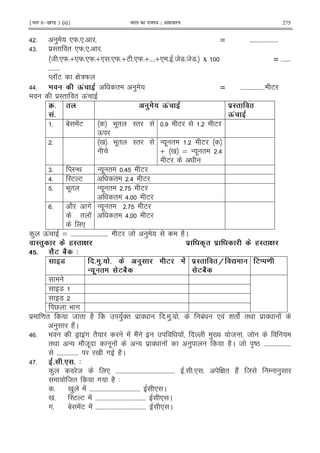
![276 THE GAZETTE OF INDIA : EXTRAORDINARY [PART II—SEC. 3(ii)]
Y 5 #2 8 N K ! 55555555555555555555555555555555555 * C
m 8" * ) !0 & " 1 1 < (2C
>?5 ! .8 4
9 . ) # 5555555555555555555555555555555555 (2 "< 9 $I" " # 5555555555555555555
55555555 (2 8 )0 8 8 "< - Z . !
)R (2C
> 5 :; A 0 . . .D ' Z 6 ' 6J
5 ( $ = " 8 " (2 M KE K ) " ; E M K 9 # (2C
5 )'" "< ! ! 0 " ()* 2! 555555555555555555555555555555555555555 I") .= R
!")DE (.! "< / 0 " & " 3
(i) 9 9 )#"
(ii) [ # IE2 !# $9 G " ( 9 )#"
(iii) !Y E & ) 9 )#" G " ( C
(iv) $9 ! 9 )#"
(v) - $9
555555555555555555555555 8 555555555555555555555555 G = 9 !" 9 )0 H 5 9 5 9 G
)'" 0 " / @ 9 '& !I A " * $I" $I")" (
(.!C
: 0 . 6: ( . 6: (
% ! ! .6 6
J J](https://image.slidesharecdn.com/ubbl2016notified-250923161005-b0550c73/85/UBBL_2016_Notified_DDA-Building-Bye-laws-276-320.jpg)
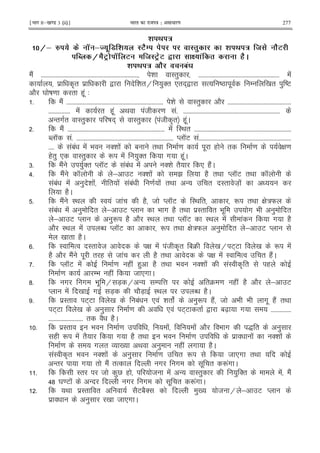
![278 THE GAZETTE OF INDIA : EXTRAORDINARY [PART II—SEC. 3(ii)]
65 $I" ! $I")" = . & 8 HI DE = # 8
"< G = 9 !" 8 ? ! " !E -E 7
; $ M" # (2C M KEHI< 8 < 7X !
27X H $9 ( ! (2C " # * 9
4 ! < "+ 55555555555555555555555555555555555555555555 )0 8 ) ) @ (2C
>5 M KE RS H " '" H $9 1 ( ! (2
H " '" H $9 1 (2! " # * 2 !
= 8 *C
5 9 '& ! 1 * ! 8 " )V 9 V ( ! # (2 # "
O 0 ( ! # (2C
5 )'" ! $ " . # < 9 I" I< "
# " # # I "!:" ( # ( " 8 ! 9
'& ! !I A " $ " !( = "< 8 !"#" # # <
9 '& ! 8 )B & (2 "< " (") I")
D + & " 9 8 " (2C
5 & !5 7 H >H* 1 * ' .H ! ?;>; ! * #*
) & H & & ! . [X # (2 8 )B #. (2! "< " + )
$I" "2 * #* (2!C
(
^! 4
2! )'" " 9 G *" +, H !! 5555555555555555555555555555555555555 5555555
555555555555555555 5555555555555555555555555555555555555555555555 % " " (.! )'" & < : ! *
#* "< 8 2 & ) % * ! ( (2! 2 ! )V 9 V
( ! # (2C
* ; /
9& d !. . P &1! > * ! :3JO . . 9
* ; / E . J3 W 9 J3V . P 3 E:3V.3 L (! ' ! E
* ; / J A'
2!H( $ (I" G 5555555555555555555555555555555555555555555555555555555555555555555 " 5555555555555555555555555555
55555555555555555555555555555555555555555555555555555555555555555555*" +, % DL . / 0 " ) DE 2 Y D =
" H " (2! 3
5 2!H( 5555555555555555555555555555555555555555555555555555555555555555555 ! I< " 5555555555555555555555555555555555555555555555555555555555
555555555 N K M KE !5 5555555555555555555555555555555555555555555555555555555555555555555 H * :
I H E+E " (.!H(2! !1! ! - I H E+E " ( ! (2C
5 2! H( P 5555555555555555555555555555555555555555555555555555555555555555555 !8 = !5 555555555555555555555555555555555555
5555555555555555 9 '& ! "2 * 2 )'" M KE = .
( " = G * )'"H & " (2C
65 2!H( = I" R M" ( . 9 I"
)'" " I") ! M" " (2! " 2!H( >? Y =E ! -
# # . " R!# H !#C
>5 $I" !"#" M KE I< " R 2 M KE G :W ) "
E '& 9 # (2 "< M KE G :W 2 $I" " 9 . # ) "](https://image.slidesharecdn.com/ubbl2016notified-250923161005-b0550c73/85/UBBL_2016_Notified_DDA-Building-Bye-laws-278-320.jpg)
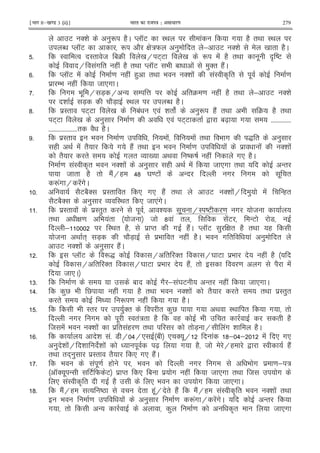
![280 THE GAZETTE OF INDIA : EXTRAORDINARY [PART II—SEC. 3(ii)]
"< # # = . V !& E H
. I "!:" (2 "< 2!H( # # <
$ " . " G " . " < ( ( ! R!# H !#C # #
; < !& " "< 9 = !
$ ! -"#" # # , # - (2C
(
^! 4
2!H( )'" " 9 G *" +, H !! 555555555555555555555555555555555555555555555555
555555555555555555555555 ( % " " (.!H " (2! )'" & < : !
* #* "< ( (2 2 H( 8 & ) ( (2! "< !
)V 9 % ( ! (2 < ! V 9 V ( ! # (2C
(](https://image.slidesharecdn.com/ubbl2016notified-250923161005-b0550c73/85/UBBL_2016_Notified_DDA-Building-Bye-laws-280-320.jpg)
![¹Hkkx IIµ[k.M 3 (ii)º Hkkjr dk jkti=k % vlk/kj.k 281
0 @ & XIII
0 !7 65 5 0 !
6 . B . . 0 8 . . 8 . '86 R.
% 1 * 8 4
8 ( & G D '" D IW E (2 82
-E cE E !:; = ") V7X!H ") I")*! -(! V 7X 8
# ! O
5 ( C
%B O B 5 R. ! .' .' 1 * 8
P= #$ & [X Q!
E !
U
P= I 82 E $ A " H A : # "< W2 1$
! : 2 Z)" I")*! )0 "3 ") 9 # !
1" "< 1" W 1 1 7 !
") I")*! * ! U P= -"#"
. " ! #8 . () 2
7N1 1! 9 8 M IE H ! 1 " ! 8 !
( $ ( C
> 5
P= II I")*! 82 12E # !LH A : W 1
)I" ! K # !L ) )'" #8 [X
* ( 2 H1 " ! 7N1 7N1 1! #
8 D )0 * #* (2! 1 7 7 1 7
G 2 "8 9 !7 " 8H - H 0 Z
< H E H1 ! E 2 . 8H 2 . 8
#) / P= ! 1" # I") ! V 7X
Z)" I")*! & 7N1 ! ! & "
7X 2 E 7 & 1 IE K M IE
1 B # 2 8 EFE 7
#) "< #8 * ! *IW E7 #8 G 2 "8
9 !7 " : 7X 2E M IE
E ")H 7X W C
6 5
P= III I")*! 82 1E) 2 H #8 1 @ ! 1
N 2 7 1 7 Q 9 !7 "
> . 8 EFE W /7 M IE "< W
17X % & 7N1 ! ! & "
% P= ! 1" * #*
M IE 7 #) "< #8 * ! * W E7
#8 Q 9 !7 " E E+ .1 (" 17X
K E/1 ! "" 7X [X 2
*IW E # #8 "< #@ 7N1 ! ! 7N1!
7X Q 7X 2 E "< ] 2E+ $ )'"
E 0 1 #$ ! < W /7 M IE "
>5](https://image.slidesharecdn.com/ubbl2016notified-250923161005-b0550c73/85/UBBL_2016_Notified_DDA-Building-Bye-laws-281-320.jpg)
![282 THE GAZETTE OF INDIA : EXTRAORDINARY [PART II—SEC. 3(ii)]
7N1 C
P=
IV
W /7 M IE 2 17X KW E "< A UV
W /7 M IE W /7 17X & E+ W
# + I"A" K IEF 2 8!# W # +
W C
5 65
M! B! ' 4
# V" ! # V7X $= G 9 !7 " I") !
5 E . ( (*C ( ! E
9 !7 = ! 9 E IE K V7X $=
G ! E ! ( ! ( (*C
# 2 < & W ! 9 !7 = ! 9 !7 Q!
" (2 V" V7X $= "< ! .=
78 Y % " '" $% & WH 2 *
" V7X $= $ 8 (* "<
* 3 " ) *5* 5*5 5 1
0 8 (*C
# 9 !7 = IE2 ! 1 # 27X 5 E
( ! ( (* "< $% 9 !7 = IE2 " G :
( ! ( (*C ( =7 1[X *
8 " (2! #. 78 Y % 5 5H 5H 5 , 9
( (*C
# 9 ! ! P" 9 !7 = * ! U 0 " 9 !7 = !
! =7 " 0 " 9 # , ! "
( # C
)'" P= *
)'" = "
Q! 9 !7 "
I")*! < V"
V () Q!
Q! < ] 2E
V" E
! 8 9 (
0 "
9 !7 = R !
8 *# C
) " I< " ! .
( ! ( " 8 0
U 0 " 9 !7 =
R ! 8
(*C
3) ! ' 4
5 9 * # 8 9 # - P = ! ") ! 9 # !
!0 ! A S ( " (2 " A S * # 9 # = !
" ( # ( = < # R ! # C
5 9 =7 # ! ! * I") ( ! 0 8 *# 8 % ( & < IW E
( < I") % 8 "8 W2 2 < 8 9 =7 = 0 0
D 2 ) ! % - ( " ( < IW E ( 2 8 % G = 8(
< ( G / < - " < < 8 E!
) ! 2 IW E D 2 8 ( % < G = #2 % - " ( !
2 H < * #$ 8 9 =7 = < 0 0 " IW E
P= % - ( 8 .G = ! ! 9 8" ( 8 # # ( ! 0 8 *!#
' ! * 9 0 " 9 ! P= ! " (2!C](https://image.slidesharecdn.com/ubbl2016notified-250923161005-b0550c73/85/UBBL_2016_Notified_DDA-Building-Bye-laws-282-320.jpg)
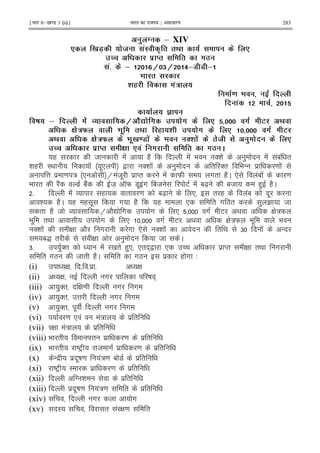
![284 THE GAZETTE OF INDIA : EXTRAORDINARY [PART II—SEC. 3(ii)]
(xvi) )'" 8 5 5 $ 5 ; I
>5 " G - O '" & * $ A" (2! 8-(!
)'" B!C
5 9 I< !H9 '& ) " $ = " G :
! ! ! G M" " $ W ! 8 I , . "
8 *# & Y $ "& Y $ I 9 8!#C 82 ( $I")" * 8 " (2C % ! (
@ $ = :H !8. !1! " !H $ = ! 9 8 8 " (2!C
5 " * ! 9 & "c / 0 " (2! 3;
( ( ! * 1 " 12L ( # C
0 " O H 2Z # # * # E <
G :W 9 . "< ( & # * # E 2
G :W 9 . 9 '& ! ) * 9 ! G
# C
# " -" 9 # ) B *# " ( ) & "
" < 6 ! - 9 - 9 # !H $ = ! @
$ = :H !8. # ( C
Y " 12L ! 1) " (2 ( B *
I DE" *# "< !1! " & D /1" ! ) B !
( " # C
5 " I 5 5 $ 5 1 E " 1 ! ;
"< / !5 < = . " # 8 .* 1 E 9 7
8 (2 " & " ( " ( I
0 " (2! " G (") " 12L ! 8 C
?5 ( & "% $9 #. ( !#C
) )
9 "
. 9 D 3 6 ?
(1) G 5 5 $ 5
(2) G # D +
(3) )'" G = # #
(4) )'" @ # #
(5) )'" . # #
(6) = * ! !:
(7) G !:
(8) 9 " @ $ =
(9) 9 " DEF 8 # $ =
(10) - $ $ .D = !:= 1 7](https://image.slidesharecdn.com/ubbl2016notified-250923161005-b0550c73/85/UBBL_2016_Notified_DDA-Building-Bye-laws-284-320.jpg)
![286 THE GAZETTE OF INDIA : EXTRAORDINARY [PART II—SEC. 3(ii)]
ANNEXURE-XV](https://image.slidesharecdn.com/ubbl2016notified-250923161005-b0550c73/85/UBBL_2016_Notified_DDA-Building-Bye-laws-286-320.jpg)
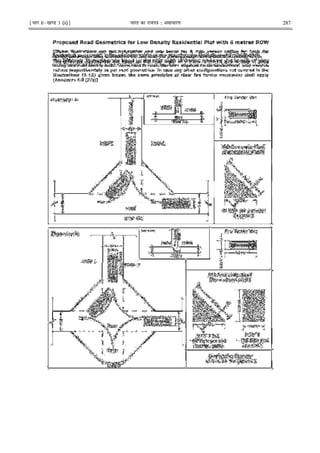
![288 THE GAZETTE OF INDIA : EXTRAORDINARY [PART II—SEC. 3(ii)]](https://image.slidesharecdn.com/ubbl2016notified-250923161005-b0550c73/85/UBBL_2016_Notified_DDA-Building-Bye-laws-288-320.jpg)
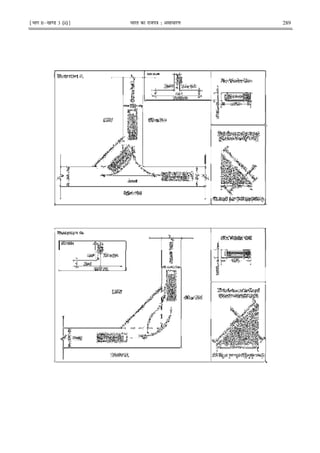
![290 THE GAZETTE OF INDIA : EXTRAORDINARY [PART II—SEC. 3(ii)]](https://image.slidesharecdn.com/ubbl2016notified-250923161005-b0550c73/85/UBBL_2016_Notified_DDA-Building-Bye-laws-290-320.jpg)
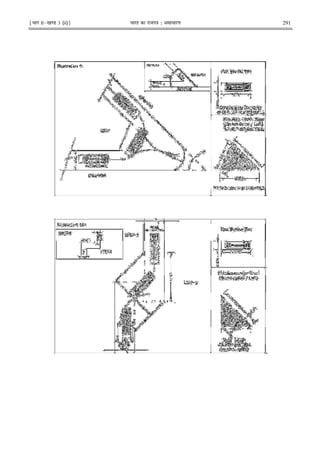
![292 THE GAZETTE OF INDIA : EXTRAORDINARY [PART II—SEC. 3(ii)]
[ W 5 !5 *W H ;* ]
7 5 )'" * !](https://image.slidesharecdn.com/ubbl2016notified-250923161005-b0550c73/85/UBBL_2016_Notified_DDA-Building-Bye-laws-292-320.jpg)
![294 THE GAZETTE OF INDIA : EXTRAORDINARY [PART II—SEC. 3(ii)]
DELHI DEVELOPMENT AUTHORITY
NOTIFICATION
New Delhi, the 22nd
March, 2016
(Unified Building Bye Laws for Delhi 2016)
Chapter 1
S.O. 1191(E).— In exercise of the powers conferred under sub-section (1) of Section 57 of
Delhi Development Act, 1957 the Delhi Development Authority, with the previous approval of the
Central Government hereby make the following regulations.
The regulations earlier notified under these clauses vide Notifications No. S.O. 513, dated 26-2-1959
Gazette of India, Part-II, Section 3 (ii) dated 7-3-1959, as adopted by the Delhi Development
Authority, vide Resolution No. 229 dated 1-5-1965 and the Building Bye Laws 1983, published in
Extra Ordinary Part IV of Delhi Gazette, published by Government of India(Delhi Administration)
vide S. O. No. 104, dated23.06.1983, in force and subsequent resolutions and amendments in Building
Bye Laws 1983 shall stand superseded from the date these Unified Building Bye-Laws for Delhi
2016, shall come into force.
1.0 Short Title, Extent and Commencement
These bye laws shall be called “UNIFIED BUILDING BYE LAWS FOR DELHI
2016”.These shall be applicable to the National Capital Territory of Delhi. It shall come into
force on such date as the appropriate Government / Authority / Body, by notification in the
Official Gazette, appoint.
1.1 Jurisdiction
These Unified Building Bye-Laws shall be applicable to the area under jurisdiction of the
Delhi Development Authority and concerned local bodies.
1.2 Applicability
These building byelaws shall be applicable to all building activities and read in conjunction
with specific notifications in respect of urban villages/rural villages, unauthorized
regularized colonies and for special areas with regard to regularized resettlement colonies
(as mentioned in Chapter 6- Regulations Notified by Delhi Development Authorities).These
Bye-laws shall be reviewed at the end of every five years. The system of implementation of
these building byelaws shall be uniform in the Delhi Development Authority and all the
concerned local bodies.](https://image.slidesharecdn.com/ubbl2016notified-250923161005-b0550c73/85/UBBL_2016_Notified_DDA-Building-Bye-laws-294-320.jpg)
![296 THE GAZETTE OF INDIA : EXTRAORDINARY [PART II—SEC. 3(ii)]
upon. In a building, there may be more than one atrium at ground or at any other
level. Ground coverage and F.A.R to be as per MPD.
1.4.10 Authority having Jurisdiction: The Delhi Development Authority, New Delhi
Municipal Council, South Delhi Municipal Corporation, North Delhi Municipal
Corporation, East Delhi Municipal Corporation, Delhi Cantonment Board
hereinafter called the 'Authority'/ concerned local body.
1.4.11 Automatic Sprinkler System: A system of water pipes fitted with sprinklers heads
at suitable intervals and heights and designed to actuate automatically, control and
extinguish a fire by discharge of water.
1.4.12 Automatic Fire Detection and Alarm System: Fire alarm system comprising
of components for automatically detecting a fire, initiating an alarm of fire and
other actions as appropriate.
Note: The system shall also include manual fire alarm call points.
1.4.13 Balcony: A horizontal cantilevered/non-cantilevered/projected slab including
parapet and handrail balustrade, at any floor level including terrace to serve as a
passage or sit out place with at least one side fully open, except being provided with
railing or parapet wall for safety.
1.4.14 Basement or Cellar: The lower story of a building below or partly below ground
level.
1.4.15 Building: Any structure for whatsoever purpose and whatsoever material
constructed and every part thereof whether used as human habitation or not and
includes foundation, plinth walls, floors, roofs, chimneys, and building services,
fixed platforms, verandahs, balcony, or projection part of a building anything
affixed thereto or any wall enclosing or intended to enclose any land or space and
signs and outdoor display structures, monuments, memorials or any contrivance of
permanent nature/stability built under or over ground .
1.4.16 Building Height:
a. The vertical distance in the case of flat roofs is measured from the highest
surrounding road level/ ground level up to the top of structural slab, excluding
machine room, irrespective of location of entry level.
b. In the case of pitched roofs, up to the point where the external surface of the
outer wall intersect the finished surface of the sloping roof, and in case of gable
facing the road, the mid-point between the eaves level and the ridge.
c. Architectural features serving no other function except that of decoration and
other building components mentioned in clause no 7.19 shall be excluded for
the purpose of taking height.
d. If the building does not abut on a street, the height shall be measured from the
highest level of the ground immediately adjacent to the building.
1.4.17 Building Line: The line up to which the plinth of a building adjoining a street or an
extension of a street or on a future street may lawfully extend. It includes the lines
prescribed in the MPD or specifically indicated in any Scheme or Layout Plan, or in](https://image.slidesharecdn.com/ubbl2016notified-250923161005-b0550c73/85/UBBL_2016_Notified_DDA-Building-Bye-laws-296-320.jpg)
![298 THE GAZETTE OF INDIA : EXTRAORDINARY [PART II—SEC. 3(ii)]
or a site.
1.4.35 Existing Building or Use: A building, structure or its use as
sanctioned/approved/ regularized by the Competent Authority/ concerned local
body, existing before the commencement of the bye-laws.
1.4.36 Exit: An exit may be a doorway; corridor; passageway(s) to an internal
staircase, or external staircase, or to a verandah or terrace(s), which have access
to the street, or to the roof of a building or a refuge area. An exit may also
include a horizontal exit leading to an adjoining building at the same level.
a. Vertical Exit: A Vertical exit is a means of exit used for ascension or
descension between two or more levels including stairways, fire towers, ramps,
and fire escapes.
b. Horizontal Exit: A horizontal exit is a protected opening, through or around a
fire wall a bridge connecting two buildings.
1.4.37 Outside Exit: An outside exit is an exit from the building to a public way, to an
open area leading to public way or to an enclosed fire resistive passage leading
to a public way.
1.4.38 Escalator: A power driven, inclined, continuous stairway used for raising or
lowering passengers or goods.
1.4.39 External Wall: An outer wall of a building not being a party wall even though
adjoining a wall of another building and also means a wall abutting on an
interior open space of any building.
1.4.40 Fire Lift: One of the lifts specially designed for use by fire service personnel in
the event of fire.
1.4.41 Fire Door: A fire-resistive door approved for openings for fire separation.
1.4.42 Fire Resisting Material: The materials or elements of construction having
property to withstand the standard fire exposure.
1.4.43 Fire Resistance: The time during which it fulfils its function of contributing to
the fire safety of a building when subjected to prescribed conditions of heat and
load or restrain. The fire resistance test of structures shall be done in accordance
with good practice.
1.4.44 Fire Separation: The distance in meters measured from other building on the
site, or from other site, or from the opposite of a street or other public space to
the building.
1.4.45 Fire Service Inlets: A connection provided at the base of a building for
pumping up water through inbuilt firefighting arrangements by fire service
pumps in accordance with the recommendation of the Delhi Fire Service.
1.4.46 Fire Tower: An enclosed staircase which can only be approached from the
various floors through landings or lobbies separated from both the floor areas
and the staircase by fire resisting doors and open to the outer air.](https://image.slidesharecdn.com/ubbl2016notified-250923161005-b0550c73/85/UBBL_2016_Notified_DDA-Building-Bye-laws-298-320.jpg)
![300 THE GAZETTE OF INDIA : EXTRAORDINARY [PART II—SEC. 3(ii)]
but not including bathrooms, water closet compartments, laundries serving and
storage pantries, corridors, cellars, attics and spaces that are not used frequently
or during extended periods.
1.4.59 Helipad:A prepared area designated and used for takeoff and landing of helic-
opter.
1.4.60 High Rise: Any buildings of 15m and above height shall be considered as high
rise building.
1.4.61 Jhamp: A downward, vertical or sloping projection hanging below any
horizontal projection like balcony, canopy, verandahs, passage etc., to provide
protection from direct sun and rain.
1.4.62 Jhot: Strip of land permanently left open for drainage purposes not to be used as
an access way and is not a street or be included as a part of setbacks.
1.4.63 Kiosk: A booth operating for selling small consumables such as newspapers,
magazines, street maps, confectionary, tea, coffee etc.
1.4.64 Ledge or Tand: A shelf-like projection supported in any manner whatsoever
except by means of vertical supports within a room itself but not having
projection wider than 0.75 m and at a minimum clear height of 2.2 meters from
the floor level.
1.4.65 Lift: An appliance designed to transport persons or materials or vehicle between
two or more levels in vertical or substantially vertical directions, by means of a
guided car platform
1.4.66 Lift Machine: Part of the lift equipment comprising the motor(s) and the control
gear there with, reduction gear (if any), brakes and winding drum or sheave, by
which the lift car is raised or lowered.
1.4.67 Lift Well: Unobstructed space within an enclosure provided for the vertical
movement of the lift car(s) and any counter weights, including the lift pit and the
space for top clearance.
1.4.68 Loft: An intermediary space created by introduction of a slab between floor and
ceiling of a room, passage or wherever it is provided with maximum clear height
of 1.5 m for storage purposes only.
1.4.69 Mumty or Stair Cover: A structure with a covering roof over a staircase and its
landing built to enclose only the stairs for providing protection from weather and
not used for human habitation.
1.4.70 Masonry: An assemblage of masonry units properly bonded together with
mortar.
1.4.71 Masonry Unit: A unit whose net cross-sectional area in every plane parallel to
the baring surface is 75% or more of its gross cross-sectional area measured in
the same plane. It may be either clay brick, stone, concrete block or sand-lime
brick.
1.4.72 Master Plan: The Master Plan for Delhi approved by the Central Government](https://image.slidesharecdn.com/ubbl2016notified-250923161005-b0550c73/85/UBBL_2016_Notified_DDA-Building-Bye-laws-300-320.jpg)
![302 THE GAZETTE OF INDIA : EXTRAORDINARY [PART II—SEC. 3(ii)]
this group.
g. Industrial Buildings: These shall include any building or part of a building or
structure, in which products or materials of all kinds and properties are
fabricated, assembled or processed, refineries, gas plants, mills, dairies,
factories, etc.
h. Storage Buildings: These shall include any building or part of a building used
primarily for the storage or sheltering of goods, wares or merchandise, like
warehouses, cold storages, freight depot, transit sheds, store houses/garages,
hangars, truck terminals, grain elevators, barns and stables.
i. Hazardous Building: These shall include any building or part of building
which is used for the storage, handling, manufacture or processing of highly
combustible or explosive materials or products which are liable to burn with
extreme rapidity and/ or which may produce poisonous fumes or explosions for
storage, handling, manufacturing or processing which involve highly corrosive,
toxic or noxious alkalis, acid or other liquids or chemicals producing flame,
fumes, and explosive, mixtures of dust or which result in the division of matter
into fine particles subject to spontaneous ignition.
1.4.76 Mechanical Ventilation: The mechanical system(s) or equipment(s) used to
circulate air or to replace stale air with fresh air.
1.4.77 Open Space: An area, forming an integral part of the site, left open to the sky.
1.4.78 Owner: The owner is a person, group of persons, a Company, Trust, Institute,
Registered Body, State or Central Government & its attached/ subordinate
Departments, Undertaking and like in whose name the property stands registered
in the revenue records/ government records/ any other legal documents up to the
satisfaction of Authority/ concerned local body.
1.4.79 Parapet: A low wall or railing built along the edge of a roof or a floor;
maximum 1.5m for low-rise or maximum 1.8m for high-rise.
1.4.80 Parking Space: An area enclosed or unenclosed, covered or open, sufficient in
size to park vehicles, together with a driveway connecting the parking space
with a street or alley and permitting ingress and egress of the vehicles.
1.4.81 Partition: An interior non-load bearing wall, one storey or part storey in height.
1.4.82 Party Wall: It includes
a. A wall forming part of a building, and being used or constructed to be used in
any part of the height or length of such wall for separation or adorning
buildings belonging to different owners or occupied or constructed or adapted
to be occupied by different persons; or
b. A wall forming part of a building and standing in any part of the length of such
wall, to a greater extent than the projection of the footing on one side on
grounds of different owners.
1.4.83 Pantry: A room where food, provisions, dishes or linens are stored and served
in an ancillary capacity to the kitchen.](https://image.slidesharecdn.com/ubbl2016notified-250923161005-b0550c73/85/UBBL_2016_Notified_DDA-Building-Bye-laws-302-320.jpg)
![304 THE GAZETTE OF INDIA : EXTRAORDINARY [PART II—SEC. 3(ii)]
1.4.98 Road/Street Line: The line defining the side limits of a street.
1.4.99 Room Height: The vertical distance measured from the finished floor surface to
the finished ceiling surface.
1.4.100 Row Housing: A row of houses with only front, rear and interior open spaces.
1.4.101 Semi-Detached Building: A building detached on three sides with open spaces.
1.4.102 Service Road: A road/lane provided at the rear or side of a plot for service
purposes.
1.4.103 Set back area: An area between the plot boundary and the setback line, size of
which is defined as per the provisions of MPD.
1.4.104 Set Back Line: A line usually parallel to the plot boundaries or center line of a
road and laid down in each case by the Authority or as per recommendations of
Master/Zonal Plan, beyond which nothing can be constructed towards the plot
boundaries, excepting with the permission of the Authority.
1.4.105 Site Corner: A site at the junctions of and fronting on two or more intersecting
streets.
1.4.106 Site, Depth of: The mean horizontal distance between the front and rear site
boundaries.
1.4.107 Site, Double Frontage: A site, having a frontage on two streets other than a
corner plot.
1.4.108 Site, Interior or Tandem: A site, access to which is by a passage from a street
whether such passage forms part of the site or not.
1.4.109 Soffit: The lowest underside of a structural member such as a beam, coffer slab
or flat slab.
1.4.110 Stack parking: For parking cars in which a hydraulic lift/ platform is used to
place cars in spaces on top of each other.
1.4.111 Stilt: Stilt or stilt floor means non habitable portion of a building above ground
level consisting of structural columns supporting the super structure with at least
two sides open for the purpose of parking cars, scooters, cycles and landscaping.
See 7.15.1.
1.4.112 Storage: A space where goods of any kind or nature are stored.
1.4.113 Store Room: A room used as storage space.
1.4.114 Storey: The portion of a building included between the surface of any floor and
the surface of the floor next above it, or if there be no floor above it, then the
space between any floor and the ceiling next above it.
1.4.115 Skywalk: An elevated, usually enclosed walkway between two buildings.](https://image.slidesharecdn.com/ubbl2016notified-250923161005-b0550c73/85/UBBL_2016_Notified_DDA-Building-Bye-laws-304-320.jpg)
![306 THE GAZETTE OF INDIA : EXTRAORDINARY [PART II—SEC. 3(ii)]
spastics and those, with pulmonary and cardiac ills shall be semi-ambulatory.
1.4.131 Hearing Disabilities: Deafness or hearing handicaps that might make an
individual insecure in public areas because he is unable to communicate or hear
warning signals.
1.4.132 Sight Disabilities: Total blindness or impairment affecting sight to the extent
that the individual functions in public areas is insecure or exposed to danger.
1.4.133 Wheel chair: Chair used by disabled people for mobility. The sizes of wheel
chairs are mentioned below:
Small wheel chair: 0.75 x 1.05 m
Large wheel chair: 0.80 x 1.50 m
1.5 Interpretation
1.5.1 Part Construction: Where the part of an approved/ regularized building is
demolished/ added/ altered or reconstructed, except where otherwise specifically
stipulated, these Building Bye-Laws shall apply to the extent of the new work
involved.
1.5.2 Change of use / Occupancy: Where use of a building is changed, except where
otherwise specifically stipulated, these Building Bye-Laws shall apply to all
parts of the building affected by the change; with prior permission from the
Delhi Fire Services.
1.5.3 Existing approved building: Nothing in these Bye-Laws shall require the
removal, alteration or abandonment, nor prevent continuance of the lawfully
established use or occupancy of an existing approved building unless, in the
opinion of the Authority / concerned local body such a building is unsafe or
constitutes a hazard to the safety of adjacent property or to the occupants of the
building itself.
1.5.4 In case of any provision of these building bye-laws require further
interpretation/clarification, the matter shall be referred to the Grievance
Redressal Committee as constituted under clause 1.8.
1.5.5 In the bye-laws, the use of present tense includes the future tense, the masculine
gender includes the feminine and the neuter, the singular number includes the
plural and the plural includes the singular. The word 'person' includes a
Corporation as an individual, writing includes printing and typing and 'signature'
includes thumb impression made by a person who cannot write if his name is
written near to such thumb impression.
1.6 Pre-Code Building Permit
Where any building permit which has been issued by the Authority/ concerned local body
before the commencement of these Building Bye-Laws and where construction is in
progress and has not been completed within the specified period from the date of such
permit, the said permission shall be deemed to be sanctioned under these Bye-Laws and
shall only be eligible for revalidation thereunder. Accordingly, where the validity of
sanction has expired and construction has not commenced, construction shall be governed
by the provisions of these Building Bye-Laws.](https://image.slidesharecdn.com/ubbl2016notified-250923161005-b0550c73/85/UBBL_2016_Notified_DDA-Building-Bye-laws-306-320.jpg)
![308 THE GAZETTE OF INDIA : EXTRAORDINARY [PART II—SEC. 3(ii)]
Chapter 2
2.0 Procedure
Every person who intends to erect, re-erect or make alterations in any place in a building or
demolish any building shall give notice in writing to the Authority / concerned local body of
his said intention in the prescribed form and such notice shall be accompanied by plans and
statements in sufficient copies as prescribed below. The plans may be ordinary prints on white
paper or any other type. One of them shall be laminated. Please refer Form A-1
After Online Building Permit System becomes fully operational, the proponent shall submit only
one copy of building plan, duly signed by all the professionals and the owner, as shall be
prescribed by the sanctioning Authority/local body for records.
Note: All buildings shall be designed/ supervised by competent professionals, as applicable, as
described in Annexure I. Also see Form A-2.
2.1 Copies of Plans and Statements
Normally four copies of plans and statements shall be made available along with the notice. In
case of building schemes, where clearance is required from Delhi Fire Service, the number of
copies of the plans and statements accompanying the notice shall be six. Where
approval/NOC is also required from Delhi Urban Art Commission, the number of copies of
the plans and statements accompanying the notice shall be eight.
2.1.1 Information Accompanying Notice: The notice shall be accompanied by the site
plan, building plan services plans, specifications and certificate of supervision and
ownership title and other documents prescribed by the authority/ concerned local
body.
2.1.2 Size of Drawing Sheets: Size of drawing sheets shall be any of those specified in
table 2.1 below:
Table 2.1: Standard Sizes of Drawings
S. No Designation Trimmed size, mm
1 A0 841x1189
2 A1 594x841
3 A2 420x594
4 A3 297x420
5 A4 210x297
6 A5 148x210
All dimensions in drawings shall be indicated in metric unit.
2.1.3 Recommended notation for colouring of plans: The site and building plans shall be
coloured as specified in the table 3.2 given below. Where items of work are not
identified, the colouring notation used shall be indexed:
Table 2.2: Colouring of Plans
S. No. Item Site Plan Building Plan](https://image.slidesharecdn.com/ubbl2016notified-250923161005-b0550c73/85/UBBL_2016_Notified_DDA-Building-Bye-laws-308-320.jpg)
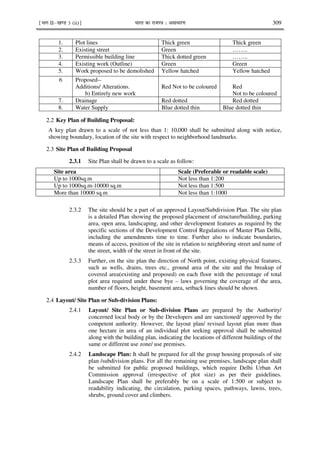
![310 THE GAZETTE OF INDIA : EXTRAORDINARY [PART II—SEC. 3(ii)]
2.4.3 For Institutional, Commercial, Industrial, Transportation, Government and
Group Housing schemes, number of trees in the respective premises shall be @
one tree per 100 sq.m of open space in the plot.
2.5 Requirement of Site
2.5.1 Damp Site: Wherever the dampness of a site or the nature of the soil renders
such precautions necessary, the ground surface of the site between the walls of
any building erected thereon shall be rendered damp-proof to the satisfaction of
the Authority/ concerned local body.
2.5.2 Corner Site: Where the site abuts two streets, the frontage would be on the
street having the larger width. In cases, where the two streets are of same width,
then the larger depth of the site will decide the frontage and open spaces. In such
case the location of a garage (on a corner plot) if provided within the open spaces
shall be located diagonally opposite the point of intersection. However the
details of the frontage of the building should be as per the approved layout plan.
2.5.3 Minimum Size of Site: The minimum size of sites for the construction of
different types of building or different use groups shall be mainly in accordance
with provisions of the MPD and any land development Rules and Regulations of
the Authority/ concerned local body.
2.5.4 Distance from Electric Lines: No verandah, balcony, or the like shall be
allowed to be erected or any additions or alterations made to a building within
the space between the building and overhead electric supply line in accordance
with the Indian Electricity Rules (National Electric Code 2011, Clause 3.2) and
its amendments from time to time The distances provided in NBC (Part III) are
indicated in the table below:
Vertically (m) Horizontally (m)
a) Low and medium voltage lines
and service lines.
2.5 1.2
b)High voltage lines up to and
including 11 KV
3.7 1.2
c)High voltage lines above 11 KV
to and including 33KV
3.7 2.0
d) Extra high voltage lines beyond
33KV.
3.7(add 0.3 m for every extra
33KV or part thereof)
2.0(add 0.3 m for every extra
33KVor part thereof).
2.6 Building Plan
The plans, elevations and sections of the buildings, accompanying the notice shall be drawn to
a readable scale or preferably to the scale of 1:50 for plots measuring up to 250sq.m. For plots
measuring above 250 sqm. to 500 sqm. these shall be drawn at the scale of 1:100 and for
above 500 sqm. these shall be drawn at the scale of 1:200.
2.6.1 Details to be shown on Building Plans: The plans shall include floor plans of
all floors together with the covered area, clearly indicating the location and sizes
of all components, like rooms, staircases, ramps, exit ways, lift wells etc. and
indicating the use or occupancy of all parts of the building.
2.6.2 Details to be shown in Sections: The section shall indicate the total height of
buildings, rooms and also the height of the parapet; At least one section should
be taken through the staircase, kitchen, toilet, bath and W.C. and lift.](https://image.slidesharecdn.com/ubbl2016notified-250923161005-b0550c73/85/UBBL_2016_Notified_DDA-Building-Bye-laws-310-320.jpg)
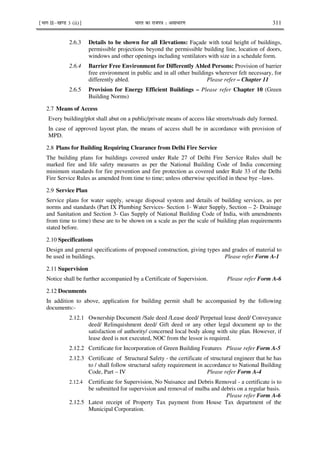
![312 THE GAZETTE OF INDIA : EXTRAORDINARY [PART II—SEC. 3(ii)]
Undertakings/Self attestation and Indemnity Bond are to be submitted as per details
given in following forms:
2.12.6 Undertaking/ Self-Attested certificate on plain paper to be given by an Architect/
Engineer that he has been appointed by the Owner and countersigned by the
owner. Please refer Form A-2
2.12.7 Undertaking/ Self-Attested certificate on plain paper to be given by the
Structural Engineer that he has been appointed by the Owner and countersigned
by the owner. Please refer Form A-2
2.12.8 Undertaking/ Self-Attested certificate on plain paper to be given by the
Supervisor that he has been appointed by the Owner and countersigned by
owner Please refer Form A-2
2.12.9 Indemnity Bond by the Owner(s), in case basement is to be constructed.
Please refer Form A-7
2.12.10 In case of a Low Density Residential Area, NOC from the Competent authority
from land acquisition point of view to these bye-law clause no 6.4
(Regularization of Farm Houses).
2.12.11 Approval of the Chief Inspector of Factories in case of industrial buildings; and
also from the Pollution Control Board, wherever required.
2.12.12 Approval from Chief Controller of Explosives, Nagpur and Delhi Fire Service, in
case of hazardous buildings wherever permitted.
2.12.13 Land use / use / premise clarification from the Delhi Development Authority
regarding land use as per Master/Zonal Plan, if required.
2.12.14 In case of high rise buildings a technical report from Geo-Technical Engineer
shall be incorporated in the structural design submitted.
2.12.15 Any other document/proforma required by the Authority / concerned local body
or department/ organization, as deem fit.
2.13 Signing of Plans for Submission to Authority/ Concerned Local Body
2.13.1 Signing of Building Plans: All building plans / drawings, before submission to
the Authority / concerned local body, shall be signed by the Owner(s), Structural
Engineer AND either of the following:
a. Architect (in case of any plot size)
b. Engineer (in case of plots up to 500 sq. m)
c. Supervisor (in case of plot upto 200sqm)
2.13.2 Signing Development Permit/ Sub – Division Plan/ Layout Plans: All
Development permits/ Sub – Division Plans/ Layout Plans, before submission to
the Authority/ concerned local body, shall be signed by the Owner(s) and either
of the following:
a. Town Planner (in case of any plot size)
Or
b. Architect (in case of plots up to one hectare in size)
Note: Definition of Town Planner, Architect, Engineer and Supervisor shall be as per
Annexure I, Qualifications and Competence of Professionals.](https://image.slidesharecdn.com/ubbl2016notified-250923161005-b0550c73/85/UBBL_2016_Notified_DDA-Building-Bye-laws-312-320.jpg)
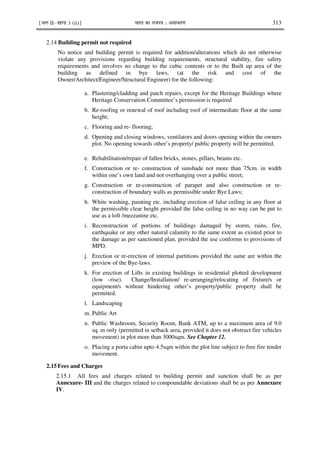
![314 THE GAZETTE OF INDIA : EXTRAORDINARY [PART II—SEC. 3(ii)]
2.15.2 No building plan submitted to the Authority/concerned local body, either for
obtaining sanction or for intimation, shall be deemed valid unless and until the requisite
building permit fee has been deposited.
2.15.3 The local bodies shall prepare an automated calculator for building permit fee
including betterment levy, additional FAR and other charges, and place it on their website in
public domain for calculating the fee. The calculator shall be integrated with online system of
submission of building plans.
2.16 Bulk characteristics for Development on specific plot (Planning requirement with
respect to provision of MPD)
2.16.1 The owner shall approach the Authority/ concerned local body to verify the bulk
characteristic for development on his plot with respect to coverage, basement, FAR, setback
(margin lines), height, parking , density (no. of dwelling units) and on any other aspect.
2.16.2 Procedure: The Owner shall submit a Proforma (please refer Form A-3) along with
a fee as decided by the Authority/concerned local body. After the receipt, the
Authority/concerned local body shall provide the details according to applicable
planning requirements and communicate it within a period of 30 days. The details
provided by the Authority/concerned local body shall be used by the competent
professionals for planning /designing the project on the said plot.
2.17 Qualification and Competence of Professionals
Qualification and Competence of various professionals shall be as per Annexure – I
2.18 Sanction
2.18.1 Sanction of Building Plans by Authority/ Concerned Local body
2.18.1.1 All building plans, as per the provisions of these Building Bye-Laws,
shall be submitted to the building sanctioning Authority/concerned local body.
The building sanctioning Authority/concerned local body shall issue the sanction
after receiving all requisite documents, within the time limit stipulated in
Chapters 2 & 3 for various categories of buildings specified therein or within 30
days, whichever is less. Refer Form B-1
2.18.1.2 If certain deficiency arises, the authority / concerned local body shall
intimate the owner/ architect/ engineer to rectify the deficiencies within the time
limit stipulated in Chapters 2 & 3 for various categories of buildings specified
therein or within 30 days, whichever is less.
2.18.2 Approval/ NOC from external agencies
2.18.2.1 In cases, where the building plan requires approval/NOC from agencies
outside the local bodies such as ASI/NMA, DFS, AAI, MoEF&CC, DUAC,
HCC, DMRC, etc. or any other approval/ NOC required by the concerned local
bodies as per policy, then the concerned local body shall issue the building
permit only after getting such approval/ NOC/ from the concerned agency. The
approval/NOC/refusal shall be issued by the outside agency within 15days or
within the time stipulated in Chapter 3,whichever is less; failing which the
approval/NOC of the outside agency on the building plan shall be deem to be
issued; the same shall be released by the Authority/concerned local body, unless
informed otherwise.
2.18.2.2 All such external agencies shall prepare maps with information on the
specific area where their approval/ NOC is required. The maps shall be colour-
coded to clearly differentiate these areas based on the different requirements to
be met by the buildings in those areas. These agencies shall place these maps on
their website and also on the websites of local bodies directly or through a link.](https://image.slidesharecdn.com/ubbl2016notified-250923161005-b0550c73/85/UBBL_2016_Notified_DDA-Building-Bye-laws-314-320.jpg)
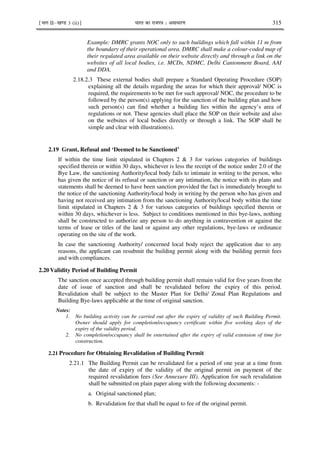
![316 THE GAZETTE OF INDIA : EXTRAORDINARY [PART II—SEC. 3(ii)]
c. Latest House Tax Receipt.
d. Valid Extension of Time for granting Revalidation, in case the property is
leasehold.
e. Documents in support of construction, if any, having been done within valid
period of sanction;
f. Certificate of supervision from Supervisor that the construction is being
carried out under his supervision according to the plans sanctioned by the
authority/ concerned local body.
g. Ownership documents for updated ownership title after previous sanction if
applicable.
2.21.2 The application for revalidation shall be processed and revalidation or objection,
if any, shall be communicated within period stipulated in Chapter 2 & 3 from the
date of the application.
2.22 Revocation of Building Permit
The Authority/concerned local body shall revoke any Building Permit so issued under the
provisions of these bye-laws if there has been any false statement or any mis-representation of
material facts in the application on which the building permit was based.
2.23 Procedure During Construction
2.23.1 Availability of information at site to the authority/ concerned local body:
a. The owner has to make available a copy of sanctioned plan at site during the
construction of the building.
2.23.2 Intimation at completion of the work up to plinth level:- At this stage, the owner
through his Architect/ Engineer/ Supervisor, in the proforma, shall inform the
sanctioning authority/ concerned local body to enable the authority/ concerned
local body to ensure that work conforms to the sanctioned Building plans and
Building Bye-laws. The following documents are also to be submitted along with
the notice: Please refer Form C-1
a. Copy of valid Certificate of registered Architect/ Engineer/ Supervisor.
b. Building plans, indicating the plinth constructed at site in relation to the plot
dimensions, area and setbacks, duly signed by the Owner/Architect/ Engineer/
Supervisor.
2.24 Inspection
Authority/ concerned local body shall inspect the site on receipt of Form C-1 and intimate the
objection, if any, to the Owner/Architect/ Engineer/ Supervisor who is supervising the work.
It will be obligatory on the part of the Authority/ concerned local body to inspect the work
and inform the objection, if any, to the Owner/Architect/ Engineer/ Supervisor within 10 days
from the receipt of such notice. In case, no objection/ communication are received from the
Authority/ concerned local body within 10 days, the same shall be deemed as accepted. It will
be the responsibility of the Owner/Architect/ Engineer/ Supervisor to ensure construction of
the building in accordance with the sanctioned building plan, under the provisions of MPD
and these Building Bye Laws. Please refer Form C-2
2.25 Procedure for Obtaining Completion-cum-Occupancy Certificate
2.25.1 No person shall occupy or allow any other person to occupy any building or part
thereof for any purpose until such building or part of a building has been granted
the occupancy certificate. The following items need to be mandatory for issue of
completion certificate.](https://image.slidesharecdn.com/ubbl2016notified-250923161005-b0550c73/85/UBBL_2016_Notified_DDA-Building-Bye-laws-316-320.jpg)
![318 THE GAZETTE OF INDIA : EXTRAORDINARY [PART II—SEC. 3(ii)]
2.26.2After inspection, Objections, if any, and compounding fee, to be calculated for
compoundable items given in Annexure IV, shall be intimated to the Owner.
2.26.3On compliance of all requirements, the Occupancy/ Completion Certificate shall be
issued within a period of 30 days.
a. Communication regarding issuing of completion is communication by
Authority/ concerned local body. Please refer Form D-2
b. Communication in case of rejection, giving full reasons and objections
raised are Communication by Authority/ concerned local body.
Please refer Form D-3
2.27 Regularisation
Any building or part thereof constructed unauthorisedly with or without obtaining the
Sanction/Completion Certificate communicated thereof by a written intimation/undertaking
can be regularised, if the same is within the ambit of BBL and MPD provisions by paying
requisite fees and charges as per Annexure IV. Please refer Form D-4
2.28 Unauthorized Construction
In case of unauthorised development, beyond the permissible/ compoundable limits of
Building Bye Laws and provisions of MPD, the Authority/ concerned local body shall take
suitable action, which may include demolition of unauthorized works, sealing of premises,
prosecution and criminal proceeding against the offender in pursuance of relevant laws in
force. The demolition shall be at the risk and cost of the Owner.
2.29 Penal Action
2.29.1 Violation of provision of Master Plan Regulations and Building Bye - Laws,
a. Compoundable items: Certain violations are to be regularized only to a
limited extent after levying the compoundable charges, only such
violations which do not affect the covered area/FAR, except within the
compounding limits. Various violations Compounding Charges are
leviable. Refer Annexure-
IV
b. In case, it is found that Completion/ Occupancy Certificate was obtained
on mis- representation, the same shall be revoked and action taken as per
law.
2.29.2 Action against the Owner/ Professional:
a. If the Authority/ concerned local bodies notice that any owner/
professional(s) has made false statements or concealed material facts and
mis-represented for obtaining building permit in contravention of the
respective laws/bye-laws/rules & regulations, the professional(s) shall be
delisted from all the Authority and concerned local bodies in Delhi, by the
Authority/concerned local bodies for a specified time period; the building
permit shall be revoked and details of all the delisted professional(s) and
the time frame for which they have been delisted shall be prominently
displayed on the website of all the Authority/concerned local bodies in
addition to the action to be taken against the owner/allottee/occupier by
the Authority/concerned local body in accordance with the extant
laws/bye-laws/rules & regulations.](https://image.slidesharecdn.com/ubbl2016notified-250923161005-b0550c73/85/UBBL_2016_Notified_DDA-Building-Bye-laws-318-320.jpg)
![320 THE GAZETTE OF INDIA : EXTRAORDINARY [PART II—SEC. 3(ii)]
Chapter 3
Background
In order to attract investments into the country, efforts are being made to improve ‘Ease of
Doing Business’. In this direction, the limit of Built-up Area (BUA) for Foreign Direct
Investment (FDI) has been reduced from 50,000 sqm to 20,000 sqm. The local bodies have been
directed to get the entire building approval process made online so that the building plan
applications are submitted online, building fees and other charges are deposited online, and after
due scrutiny, the approvals are conveyed online. Further, certain external bodies like Delhi
Urban Art Commission (DUAC), National Monuments Authority (NMA), Airports Authority of
India (AAI), Delhi Fire Services (DFS), Delhi Metro Rail Corporation (DMRC), Heritage
Conservation Committee (HCC), etc. grant No Objection Certificate (NOC)/ approvals on the
proposed building plans to the local bodies. Such external bodies have been directed to prepare
online NOC system which is compatible and integrated with that of the local bodies and the
desired information is sent to the concerned external bodies and their comments/ NOC/ approval
are received online so that there is no need for building proponents to pursue matter with local
bodies or external agencies. The specific requirements of the external bodies are to be added in
the Common Application Form (CAF) of the local body so that building proponent has to file all
information at one go only. The objective is to make the whole process simplified and
streamlined to ensure ease in getting the approvals for building permit within stipulated time.
Ministry of Urban Development has constituted a High Power Review and Monitoring
Committee to fast-track the approval of building plans as per the order No. K-12016/03/2014-
DD.I dated 12.03.2015 (Annexure-XIV). This Committee under the chairmanship of Vice
Chairman, DDA has to meet on regular interval to coordinate with all the external agencies to
ensure that building plans are sanctioned in a time bound manner. This arrangement shall
continue till the online sanctioning system becomes fully operational to the best satisfaction of
building proponents.
Risk Based Classification of Buildings for Fast Tracking the Approval Process
Further, a procedure has been laid down in Chapter-4 of the Building Bye-Laws for sanction of
building plans of small residential plots measuring up to 105 sqm named as SARAL Scheme.
The idea is to facilitate building proponents of such small sized plots to get their building plans
prepared by an architect/ engineer (qualification and competence as per Annexure I), and
submit to the concerned local bodies along with fees, other charges, drawings and documents
before commencement of the construction and the submission itself shall be deemed sanction.
Hence, such persons may not have to wait for processes in the local bodies to initiate
construction.](https://image.slidesharecdn.com/ubbl2016notified-250923161005-b0550c73/85/UBBL_2016_Notified_DDA-Building-Bye-laws-320-320.jpg)
![322 THE GAZETTE OF INDIA : EXTRAORDINARY [PART II—SEC. 3(ii)]
Before notification of all these building bye-laws, a copy of this chapter was sent to MoEF&CC
for seeking their concurrence at the draft stage itself so as to ensure compliance with the
necessary requirements for environment clearance. After getting the concurrence, this chapter
has been included in the bye-laws. After notification of these bye-laws as per due process of law,
a copy of this chapter shall be sent again to MoEF&CC to get notification issued by that
Ministry empowering local bodies of Delhi, which sanction building plans, to approve building
plans after ensuring that the required environmental safeguards are met, and there will be no
need for seeking Environment Clearance (EC) for buildings with BUA greater than 20,000 sqm
and upto 1,50,000 sqm, as was the practice earlier. It will be the responsibility of the concerned
local bodies, i.e. building sanctioning authorities, to ensure compliance of the stipulated
conditions to address environmental concerns in case of such buildings. For the buildings with
BUA more than 1,50,000 sqm, EC shall be obtained as prescribed by MoEF&CC under their
notification.
3.1 Risk Based Classification for Approval of Building Plans
3.1.1 Residential Buildings
3.1.1.1 For approval of the residential plotted and group housing buildings, risk
based classification shall be as per Table 3.1.
Table 3.1: Risk Matrix for Residential buildings (Residential Plotted i
and Group
Housing)
Parameter Risk Category
Very Low Low Moderate High
Size of the Plot Up to 105 m2
Above 105 m2
and
up to 500 m2
Above 500 m2
Different sizesii
Height of building
(including stilt, if any)
Below 15 m Below 15 m Below 15 m 15 m and above
Use of the premise Residential
Plotted
Residential Plotted
(vacant plot)
Residential
Plotted
Group Housing
i
Residential plotted includes all residential plots forming a part of approved layout/ special areas/
unauthorized regularized colony/ village abadis/ lal dora & extended lal dora resettlement colonies and
slum & JJ cluster/ Rehabilitation colonies; excluding those within LBZ.
ii
Different sizes for Group Housing prescribed in MPD-2021.
3.1.1.2 Fast Track Procedure: The fast track procedure for approval of the
residential plotted and group housing buildings, based on their risk based classification as
per bye-law 3.1.1.1, shall be as follows:
i. For the buildings categorized as Very Low Risk, the process prescribed in Chapter 4
shall be followed.
ii. For the buildings categorized as Low Risk, an architect/ engineer (qualification and
competence as per Annexure-I) shall be empowered to issue the building permit, but
only after submitting the plan along with requisite documents and fees to the
concerned local body. If the owner/ architect/ engineer desires to get the building plan
sanctioned by the local body, building plans prepared by a qualified architect/
engineer will have to be submitted to the concerned local body along with the fees
and other requisite documents and the local body shall grant the building permit
within 10 days.](https://image.slidesharecdn.com/ubbl2016notified-250923161005-b0550c73/85/UBBL_2016_Notified_DDA-Building-Bye-laws-322-320.jpg)
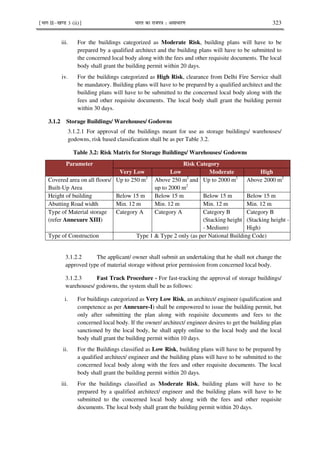
![324 THE GAZETTE OF INDIA : EXTRAORDINARY [PART II—SEC. 3(ii)]
iv. For the buildings classified as High Risk, building plans will have to be prepared by
a qualified architect and the building plans will have to be submitted to the concerned
local body along with the fees and other requisite documents. The local body shall
grant the building permit within 30 days.
3.1.3 Simplified Procedure for Sanction of Government Building Plan
A simplified procedure for sanction of government building plans will be followed, which
will be on the same lines as given in the office order no: D/49/Cm./SDMC/Bldg. HQ/2012
dated 13/09/2012 and order no: D/04/SE (B) HQ/12 dated 18/04/2012 given at
Annexure XII. However, the Building Plans may also be sanctioned through regular
procedure.
3.2 Environmental conditions for sanctioning Building Plans
3.2.1 For building plans with a total built-up area (BUA) between 5,000 sqm and 1,50,000 sqm,
no separate environment clearance will be required provided that the integration of
environmental conditions, and thus considering exemption from the requirement of
separate environment clearance has been approved and notified by MoEFF&CC.
3.2.2 For building plans under three categories of projects with built up area between 5,000 -
20,000 sqm, 20,000 - 50,000 sqm and 50,000 - 1,50,000 sqm, different set of
environmental conditions are being integrated in the building permission conditions to
address environmental concerns.
3.2.3 After the MoEF&CC Notification, as referred to in bye-law 3.2.1, the concerned local
body, which is authorized to sanction building plans, shall ensure at the time of
sanctioning a building plan that the environmental requirements stipulated in Table 3.3 (for
BUA above 5,000 sqm and up to 20,000 sqm), Table 3.4 (for BUA above 20,000 sqm and
up to 50,000 sqm) and Table 3.5 (for BUA above 50,000 sqm and up to 1,50,000 sqm), as
the case may be, are complied with.
Table 3.3: Conditions for Built-Up Area above 5000 sqm and upto 20,000 sqm
Sl. No. Medium Environmental conditions
1 Natural Drainage The inlet and outlet point of natural drain system should be maintained
with adequate size of channel for ensuring unrestricted flow of water.
2 Water
conservations –
Rain Water
Harvesting and
Ground Water
Recharge
A rain water harvesting plan needs to be designed where the recharge
bores (minimum one per 5,000 sqm of built-up area) shall be provided.
The rain water harvested should be stored in tank for reuse in household
through a provision of separate water tank and pipeline to avoid mixing
with potable municipal water supply. The excess rainwater harvested
should be linked to the tube well bore in the premise through a pipeline
after filtering arrangement of the rain water.
2(a) The unpaved area shall be more than or equal to 20% of the recreational
open spaces.
3 Solid Waste
Management
Separate wet and dry bins must be provided at the ground level for
facilitating segregation of waste.
4 Energy In common areas, LED/ solar lights must be provided.
5 Air Quality and Dust, smoke and debris prevention measures such as screens, barricading
shall be installed at the site during construction. Plastic/ tarpaulin sheet](https://image.slidesharecdn.com/ubbl2016notified-250923161005-b0550c73/85/UBBL_2016_Notified_DDA-Building-Bye-laws-324-320.jpg)
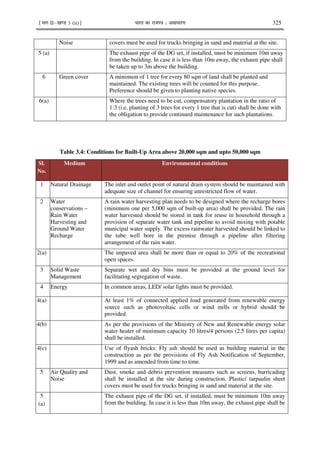
![326 THE GAZETTE OF INDIA : EXTRAORDINARY [PART II—SEC. 3(ii)]
Sl.
No.
Medium Environmental conditions
taken up to 3m above the building.
6 Green cover A minimum of 1 tree for every 80 sqm of land shall be planted and
maintained. The existing trees will be counted for this purpose. Preference
should be given to planting native species.
6
(a)
Where the trees need to be cut, compensatory plantation in the ratio of 1:3
(i.e. planting of 3 trees for every 1 tree that is cut) shall be done with the
obligation to provide continued maintenance for such plantations.
Table 3.5: Conditions for Built-Up Area above 50,000 sqm and upto 1,50,000 sqm
Sl. No. Medium Environmental conditions
1 Natural Drainage The inlet and outlet point of natural drain system should be maintained
with adequate size of channel for ensuring unrestricted flow of water.
2 Water
conservations –
Rain Water
Harvesting and
Ground Water
Recharge
A rain water harvesting plan needs to be designed where the recharge bores
(minimum one per 5,000 sqm of built-up area) shall be provided. The rain
water harvested should be stored in tank for reuse in household through a
provision of separate water tank and pipeline to avoid mixing with potable
municipal water supply. The excess rainwater harvested should be linked to
the tube well bore in the premise through a pipeline after filtering
arrangement of the rain water.
2(a) The unpaved area shall be more than or equal to 20% of the recreational
open spaces.
2(b) The ground water shall not be withdrawn without approval from the
competent authority
2(c) Use of potable water in construction should be minimized.
2(d) Low flow fixtures and sensors must be used to promote water conservation.
2(e) Separation of grey and black water should be done by the use of dual
plumbing system.
3 Solid Waste
Management
Separate wet and dry bins must be provided at the ground level for
facilitating segregation of waste.
3(a) All non-biodegradable waste shall be handed over to authorized recyclers
for which a written tie-up must be done with the authorized recyclers.
3(b) Organic waste composter/ vermiculture pit with a minimum capacity of 0.3
Kg/tenement/day must be installed wherein the STP sludge may be used to
be converted to manure which could be used at the site or handed over to
authorized recyclers for which a written tie-up must be done with the
authorized recyclers.
4 Energy In common areas, LED/ solar lights must be provided.](https://image.slidesharecdn.com/ubbl2016notified-250923161005-b0550c73/85/UBBL_2016_Notified_DDA-Building-Bye-laws-326-320.jpg)
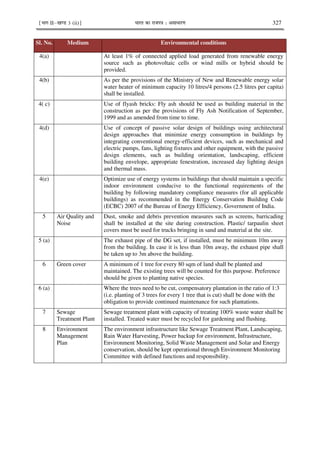
![328 THE GAZETTE OF INDIA : EXTRAORDINARY [PART II—SEC. 3(ii)]
Chapter 4
4.1 This chapter is applicable to all small residential plots up to 105 sq.m in size forming a part of
approved layout/ special areas/ unauthorized regularized colony/ village abadis/ lal dora
/extended lal dora resettlement colonies and slum & JJ cluster/ Rehabilitation Colonies,
excluding those within LBZ.
4.2 In case of corner plots, a maximum relaxation of 10% of the plot area shall be permitted.
4.3 All plot owners desirous of making any additions/alterations/new construction on such plots
have to follow the procedure mentioned hereunder :
a. The plot owner has to give an UNDERTAKING for INTIMATION OF
CONSTRUCTION START as given at Saral Form 1 at the end of this chapter.
b. After submitting this UNDERTAKING at the office of the Authority / concerned
local body of appropriate jurisdiction, along with enclosures and building permit fee,
the plot owner can start the construction immediately.
c. Construction design shall be as per General Building Requirements given in Chapter
7 and as per Development Control Regulations as per Annexure VI of this document.
See 7.1
d. The building shall be designed by an Architect/ Engineer/ Supervisor.
Note: For qualification and competency of Architect/ Engineer/Supervisor refer Annexure I.
e. The construction has to be completed within a period of five years. If the construction
is not completed within five years, the Revalidation fee has to be paid once again to
revalidate.
f. The applicant/ Owner will indemnify the concerned Authority / concerned local body
from structural safety and any other damages caused by constructions/ erecting of the
building,
g. On completion of construction, the owner has to intimate the Authority / concerned
local body having appropriate jurisdiction that the construction is complete in an
INTIMATION OF COMPLETION OF CONSTRUCTION format as given at Saral
Form 2 at the end of this chapter, alongwith drawings/ plans duly signed by an
Architect/ Engineer*. Thereafter applicant/ Owner can start occupancy of the
building/ floor/ portion of the building.
h. Inspection/ Scrutiny shall not be carried out at the time of submission.
i. Rain water harvesting is required as per policy.](https://image.slidesharecdn.com/ubbl2016notified-250923161005-b0550c73/85/UBBL_2016_Notified_DDA-Building-Bye-laws-328-320.jpg)
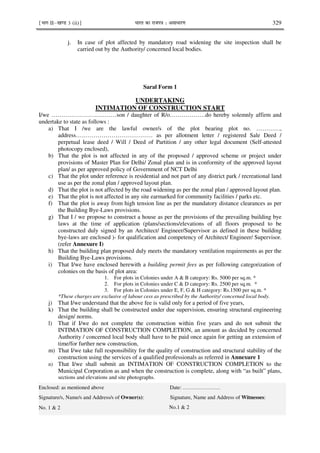
![330 THE GAZETTE OF INDIA : EXTRAORDINARY [PART II—SEC. 3(ii)]
Saral Form 2
INTIMATION OF CONSTRUCTION COMPLETION
a) I/we ………………………………………………………………………………..son / daughter
of …………………………………R/o………………………do hereby intimate that the
construction of the building as per details given below is now complete :
Plot Area:……………….
Address: ………………..
b). I am hereby submitting the plans / drawings, site photographs (8” x 10”- 3 in nos.) which are
in compliance with the prevailing bye-laws duly signed by the Owner(s) and Architect/ Engineer
as defined in these bye-laws Annexure I.
c). Further the Structural Stability Certificate (Please refer Form A-4) duly signed by a structural
engineer is enclosed:
d). I have not constructed any part of the building in violation of the building bye-laws. In case
the Authority / concerned local body at any time identify unauthorized construction and violation
of MPD provisions, the same is liable for penalties/demolition and I shall abide by the decisions
of Authority / concerned local body.
Date: …………………
Signature/, Name and Address of Owner(s):
1)
2)](https://image.slidesharecdn.com/ubbl2016notified-250923161005-b0550c73/85/UBBL_2016_Notified_DDA-Building-Bye-laws-330-320.jpg)
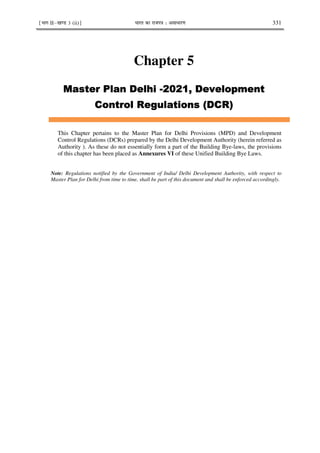
![332 THE GAZETTE OF INDIA : EXTRAORDINARY [PART II—SEC. 3(ii)]
Chapter 6
(
(
(
( ) *+
) *+
) *+
) *+
+
+
+
+
6.1 Regulations notified by Delhi Development Authority
Regulations notified by Delhi Development Authority in exercise of power conformed by sub
section (1) of section 57, of Delhi Development Act , 1957 the Delhi Development Authority,
with the previous approval of the Central Government.
6.2 Building regulations for Special area, Unauthorized Regularized Colonies and Villages:
Building regulations for Special area, Unauthorized Regularized Colonies and Villages,
Notified vide S.O. 97 (E), F.No.F.3 (28)2008/MP/Part], Dated 17th January 2011.
http://dda.org.in/tendernotices_docs/april11/gazette%20of%20India_1%20april%202011_97.p
df
6.3 Regularizations and Guidelines for Redevelopment:
Regularizations and guidelines for redevelopment of existing planned industrial areas, Notified
vide S.O. 683(E), [F.No .F. 17(5)2007/MP], Dated 1st
April, 2011.
http://dda.org.in/tendernotices_docs/april11/gazette%20of%20india%201%20april%202011_6
83.pdf
6.4 Regularization of Farm Houses:
Regularization of Farm Houses in Delhi, Notified vide S.O.2622 (E), [F.No.F.3 (103)96/MP],
Dated 30th October, 2012.
http://dda.org.in/tendernotices_docs/nov12/SO2622_30102012_farmhouse.pdf
6.5 The (Permission of Banquet Halls) Regulations, 2012:
Notified vide S.O.2272 (E), Dated 21st
September, 2012
http://dda.org.in/tendernotices_docs/oct12/banquet%20hall-291012.pdf
Note: Regulations notified by GoI/DDA are subject to modification from time to time and modified version/
Central Government notifications to be referred. In addition to above, the new regulations are also notified from
time to time. These may also be referred.](https://image.slidesharecdn.com/ubbl2016notified-250923161005-b0550c73/85/UBBL_2016_Notified_DDA-Building-Bye-laws-332-320.jpg)
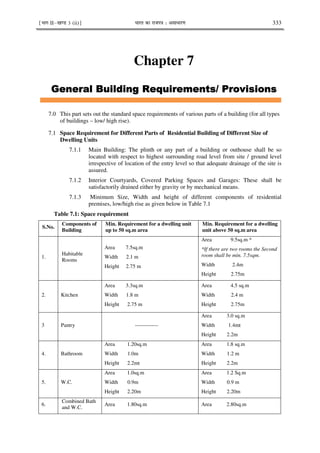
![334 THE GAZETTE OF INDIA : EXTRAORDINARY [PART II—SEC. 3(ii)]
Width 1.0m
Height 2.20m
Width 1.20m
Height 2.20m
7. Store room
The area of the store has to be less than
habitable room (less than 7.5 sq.m and
minimum height of 2.2 m)
The area of the store has to be less
than habitable room (less than 9.5
sq. m and minimum height of 2.2
m)
8.
Covered
Projections
(Sunshades/
Cupboards)
Permitted within the plot boundary, up to 0.75 m width. No portions of any
projection whatsoever shall project outside the plot boundary.
9. Garage Two-wheeler garage: 1 x 2 m
Area 14.50sq.m
Width 2.70 m
Height 2.40m
10.
Passage way/
Corridor for low
rise
Width 0.9 m Width 1.0* m
11.
Door Ways
(habitable
rooms)
(Kitchen, bath,
W.C.)
Width 0.90 m
Height 2.1m
Height 2.00m
Width 0.75m
Width 0.9 m
Height 2.1 m
Height 2.00m
Width 0.75m
12.
Staircases(low
rise)
Width 0.9m Width 1.0* m
13. Veranda 2.4m depth (max.)
Notes:
1. Provided that the minimum clear head way under any beam shall not be less than 2.4m.
2. Maximum permissible height for all types of building components mentioned in the above table is
4.8 m finished from floor level to soffit level of ceiling. However, if the Architect/ Engineer desires
more than 4.8 m height of any building component in the project, the same may be permitted
subject to the overall permissible height of building/structure.
3. In case of group housing all open spaces provided either in interior or exterior shall be kept free
from any erections thereon and shall open to the sky. Nothing except cornice, chhajja or weather
shade (not more than 0.75 m wide) shall overhang or project over the said open space so as to
reduce the width to less than minimum required. Such projections shall not be allowed at height
less than 2.2 m from the corresponding finished floor level.
4. Architectural features and landscape: See 7.17.1 &7.17.2
* For high-rise buildings, the dimensions of Stairways and Corridors shall be as provided in clause
8.4.3 and 8.4.8. and in case of addition of upper floors on existing floors in low-rise buildings where
width of staircase is kept 900mm as per 1983 BBL, same maybe adopted for upper floors.
7.2 Other General Requirements
7.2.1 Kitchen: Every room to be used as a kitchen shall have
a. Unless separately provided in a pantry, means for washing of kitchen
utensils, which shall lead directly or through a sink to a grated and trapped
connection to the waste pipe.](https://image.slidesharecdn.com/ubbl2016notified-250923161005-b0550c73/85/UBBL_2016_Notified_DDA-Building-Bye-laws-334-320.jpg)
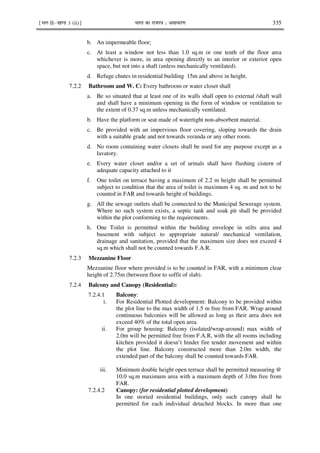
![336 THE GAZETTE OF INDIA : EXTRAORDINARY [PART II—SEC. 3(ii)]
storied residential buildings, two canopy shall be permitted over
ground floor/higher floor entrances.
Canopy to be provided in setback/s:
A) Front Setback
i) 2.4 m (maximum) deep in case the front setback is 3m
deep.
ii) 3 m (maximum) deep in case the front setback is 6 m or
more.
B) Side setbacks
i) 2.4 m (maximum) deep in case the side setback is 3 m
deep.
ii) 3 m (maximum) deep in case the side setback is 6 m. or
more.
Note: Minimum 30% of the area of respective setback is to be
maintained as open to sky.
7.2.4.3 Canopy/Porch: buildings of other than residential plotted
occupancies - See 1.4.75
Canopy/Porch of max. extent of 8.5 m x 20 m each whereas area of
one or more canopies/porches not exceeding 3% of permitted FAR,
subject to the approval of Delhi Fire Service shall be permissible.
The area of the canopies/porches shall not be counted in FAR and
Ground Coverage.
7.2.5 Loft
Lofts shall be permitted in residential building and shops only. Area of such loft
shall be restricted to 25% of the covered area of respective floor. Maximum
height between loft and ceiling shall be 1.75 m and the clear height below the
loft shall be as stipulated in these Building Bye-Laws for the space below it.
7.2.6 Boundary Wall Height:
Except with the special permission of the competent authority, the following
norms shall apply
7.2.6.1 For residential plotted development
a. Front wall: Maximum 1.5m from highest adjacent road level at site/
ground level to be solid (stone/ brick/ masonry etc.) and above 1.5m, it
should be perforated (stone jail/iron grills/vegetation) to maintain visual
continuity.
b. Side walls and back wall: Maximum 2.4 m from ground level to be solid
(stone/brick/ masonry etc.)
7.2.6.2 In buildings of other occupancies- See 1.4.75: Maximum 2.4 m from
ground level.
7.2.6.3 However, the provisions of 7.2.6.1.and 7.2.6.2 are not applicable to
boundary walls of institutional buildings like jails, juvenile homes,
sanatoria, hospitals, industrial buildings like workshops, factories and
educational buildings like schools, colleges, including hostels and
security establishments.](https://image.slidesharecdn.com/ubbl2016notified-250923161005-b0550c73/85/UBBL_2016_Notified_DDA-Building-Bye-laws-336-320.jpg)
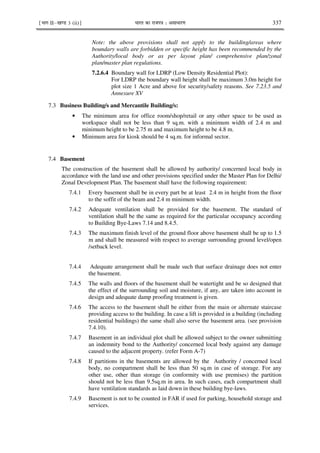
![338 THE GAZETTE OF INDIA : EXTRAORDINARY [PART II—SEC. 3(ii)]
7.4.10 Parking in basement can also be permitted by means of a car lift. In case of
residential buildings (except group housing), ramps are not mandatory. However
for other than residential buildings, ramps are mandatory for plot size above
3000 sq. m.
7.4.11 The basement can be used for storage of households, for other goods, for non-
flammable material, dark rooms, strong rooms, bank cellars, stack rooms of
libraries, air conditioning equipment/s and other machines used for services and
utilities of the buildings etc. as per MPD.
7.5 Exit requirements
The following general requirement shall apply to exits:
7.5.1 Every building meant for human occupancy shall be provided with exits
sufficient to permit safe escape of occupants in case of fire or other emergency.
7.5.2 In every building exit shall comply with the minimum requirement of this clause,
except those not accessible for general public use.
7.5.3 All exists shall be free of obstructions.
7.5.4 No buildings shall be altered so as to reduce the number, width or portion of
exits to less than required.
7.5.5 Exits shall be clearly visible and the routes to reach exits shall be clearly marked
and signs posted to guide the occupants of floor concerned.
7.5.6 All exit ways shall be properly illuminated.
7.5.7 Firefighting equipment where provided along exits shall be suitably located and
clearly marked, but must not obstruct the exit way and there should be clear
indication about its location from either side of the exit way.
7.5.8 Alarm devices shall be installed to ensure prompt evacuation of the occupants
concerned, through the exits, wherever required.
7.5.9 All exits shall provide continuous means of egress to the exterior of a building or
to an exterior open space or leading to a street.
7.5.10 Exits shall be so arranged that they may be reached without passing through
another unit.
7.6 Types of Exits
7.6.1 An exit may be doorway, corridor/passage to an internal staircase or an external
staircase, or a fire tower or a fire escape staircase or to a verandah and/or terraces
that have access to the street. An exit may also include horizontal exit leading to
an adjoining building at the same level.
7.6.2 Lifts/escalators and revolving doors shall not be considered as exits.
7.7 Number and Size of Exits
The requisite number and size of various exits shall be provided, based on the occupants in
each room and floor based on the occupant load, capacity of exits, travel distance and height
of buildings.
7.8 Arrangement of Exits
7.8.1 Exits in non-sprinkled buildings shall be so located so that the travel distance on
the floor shall not exceed the distances as given in Table 8.2.](https://image.slidesharecdn.com/ubbl2016notified-250923161005-b0550c73/85/UBBL_2016_Notified_DDA-Building-Bye-laws-338-320.jpg)
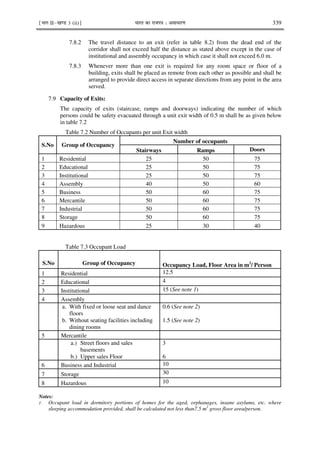
![340 THE GAZETTE OF INDIA : EXTRAORDINARY [PART II—SEC. 3(ii)]
2. The gross floor area shall include, in addition to the main assembly room or space, any occupied
connecting room or space in the same storey or in the storeys above or below, where entrance is common to
such rooms and spaces and they are available for use by the occupant so of the assembly place. No
deductions shall be made in the gross area for corridors, closets or other sub-divisions the area shall
include all space serving the particular assembly occupancy.
7.10 Staircase Requirements
7.10.1 The number of staircases in the buildings shall be determined based on the occupant
load, travel distance, dead end restriction subject to minimum two staircases in respect of
buildings identified under bye-law No. 2.8; provided that where the travel distance and
other requirements are complied with one staircase and the second shall be a Fire Escape.
7.10.2 All buildings, as follows, shall have a minimum of two staircases:
a) Buildings of 15m in height or above, and
b) Irrespective of height of the building (s), the buildings used as business,
educational, assembly, institutional, industrial, storage and hazardous
occupancies and mixed occupancies having floor area more than 500 sqm. on
any floor.
7.10.3 It is mandatory to provide a ladder or any other form of open access to the overhead tank
for inspection.
7.11 Staircase Details
a. Interior stairs shall be constructed of non-combustible material throughout.
b. Interior stairs shall be constructed as a self-contained unit and shall be
mechanically ventilated if completely enclosed in low rise residential
buildings.
c. A staircase shall not be arranged round a lift shaft.
d. Hollow combustible construction shall not be permitted.
e. The minimum width of internal staircase shall be as given in bye-law No.
7.11.2.
f. The minimum width of treads without nosing shall be 25 cm for an internal
staircase for low rise residential buildings. In the case of other buildings
including high rise residential, the minimum tread shall be 30 cm. The treads
shall be constructed and maintained in a manner to prevent slipping. Winders
shall be allowed in low rise residential buildings provided they are not at the
head of a downward flight.
g. The maximum height of riser shall be 19 cm in the case of low rise residential
buildings and 15 cm in the case of other buildings including high rise
residential building and maximum number of risers per flight shall be limited
to 15 per flight.
h. Handrails shall be provided with a minimum height of 1.0 m from the centre
of the tread subject to condition that balusters/ railing do not reduce the width
of staircase.
i. The minimum headroom in a passage under the landing of a staircase and
under the staircase shall be 2.2 m.
j. For building 15m in height or more, access to main staircase shall be through
a fire check door having minimum two hours fire resistance rating, which](https://image.slidesharecdn.com/ubbl2016notified-250923161005-b0550c73/85/UBBL_2016_Notified_DDA-Building-Bye-laws-340-320.jpg)
![342 THE GAZETTE OF INDIA : EXTRAORDINARY [PART II—SEC. 3(ii)]
b. Assembly buildings and Institutional building -2.0 m.
c. All other buildings including hotels and Educational building 1.5 m.
d. For high rise buildings refer table no. 8.1
7.11.2 Minimum Width Provisions for Passageway/Corridors (clear width excluding
handrail and balustrade)
The width of corridor/passageway/foyer as the case may be, shall be determined
such that it shall accommodate the entire population of the floor subject to
minimum width depending upon the class of occupancy as under:-
a. Residential buildings (low rise), dwelling unit type 1 m for single loaded and
1.5 m for double loaded.
b. Residential buildings, e.g., hostels, group housing etc. 1.35m for single
loaded and 1.8m for double loaded.
c. Assembly buildings like auditorium theatres and cinemas 2.0 m.
d. All other buildings like commercial, institutional and hotels 1.5 m for single
loaded and 1.8m for double loaded.
e. Hospital, Nursing Homes, etc. 2.4 m for both single and double loaded.
f. Ramps- for applicability in all other building types refer Chapter 8 (Clause
8.4.7)
g. Where staircase discharges through corridors and passageways, the height of
corridors and passageways shall be not less than 2.4 m.
h. All means of exit including staircases lifts lobbies and corridors shall be
naturally/mechanically ventilated.
i. Passageway/ corridor constructed more than the prescribed /permissible limit
should not be counted towards FAR calculations.
7.12 Doorways
7.12.1 Every doorway shall open into an enclosed stairway, a horizontal exit, on a
corridor or passageway providing continuous and protected means of egress.
7.12.2 The minimum width of the exit doorways shall be equivalent to the width of the
staircase as prescribed in the table no 7.1 for low-rise residential plotted
development and table no 8.1 for other use premises.
7.12.3 Exit doorways shall open outwards, that is away from the room but shall not
obstruct the travel along any exit. No door when opened shall reduce the
required width of stairway or landing as prescribed in the table no 7.1 for low-
rise residential plotted development and table No 8.1 for other use premises.
Overhead or sliding door shall not be installed.
Note: In the case of buildings where there is a central corridor, the doors of rooms shall
open inwards to permit smooth flow of traffic in the corridor
7.12.4 Exit door shall not open immediately upon a flight of stairs. A landing equal to at
least, the width of the door shall be provided in the stairway at each doorway.
Level of landings shall be the same as that of the floor, which it serves.
7.12.5 Exit doorways shall be openable from the side, which they serve without the use
of a key.
7.12.6 Revolving doors shall not to be provided as means of fire exit.](https://image.slidesharecdn.com/ubbl2016notified-250923161005-b0550c73/85/UBBL_2016_Notified_DDA-Building-Bye-laws-342-320.jpg)
![344 THE GAZETTE OF INDIA : EXTRAORDINARY [PART II—SEC. 3(ii)]
1. Shear wall/ bracing/ any other structural provision as per IS 1893 (Part 1), IS
13920, IS 4326 may be provided to reduce impact of soft storey in the stilt area.
7.16 Joint Open Air Space
7.16.1 Every interior or exterior space, unless the latter is a street, shall be maintained
for the benefit of such building exclusively and shall be entirely within the
owner's own premises.
7.16.2 If such interior or exterior open air space is intended to be used for the benefit of
more than one building belonging to the same owner; then the width of such
open space shall be the one specified for the tallest building as specified in
building byelaw, abutting such open space.
7.17 Exemption to Projections in Open Spaces/Covered area
The following exemption to open space shall be permitted.
7.17.1 Projections into open spaces: Every interior open space shall be kept, free from
any erection thereon and shall be open to the sky. Nothing except cornice,
chajjas or weather shade (not more than 0.75 m wide) shall overhang or project
over the said open spaces so as to reduce the width to less than the minimum
required.
Notes:
a. Such projections shall be allowed at a height more than 2.20 m from the
corresponding finished floor level.
b. Pergola shall be permitted if constructed in the exterior open spaces within plot
line or terrace. Such pergola shall not exceed 20% of ground coverage. Such
pergolas shall have a minimum clear height of 2.2 m with 40% void.
7.17.2 The following shall not be included in covered area for FAR and Ground
Coverage calculations.
a. Machine room for lift on top floor as required for the lift machine
installation.
b. Rockery, lift/ lift well, escalator/travellator well and well structures,
plant nursery, water pool, swimming pool at any level (if uncovered),
platform around a tree, tank, fountain, bench, chabutara with open top
and / or unenclosed sides by walls, open ramps, compound wall, gate,
slide swing door, fire staircase, fire towers, refuse area, fire control
room, overhead water tank on top of building/open shafts, cooling
towers as per fire norms. Fire tender movement shall be unhindered.
c. Mumty over staircase on top floor maximum 3m height.
d. Culvert on Municipal drains.
e. Watch and ward cabins of total area not more than 4.5 sqm and 6sqm
with W.C each at entry and exit only, within the property line. Porta
cabins for guard room is permitted within the plot line in residential plots
of size minimum 200 sqm and above.
f. Entrance porch, canopies and balconies.
g. All pergolas at any floor level not exceeding 20% of Ground Coverage.
h. Covered sky bridges or intermittent floors as relief in high rise buildings
having landscape areas, service floors in high-rise buildings, jogging
tracks, swimming pools and other public spaces shall not be counted in](https://image.slidesharecdn.com/ubbl2016notified-250923161005-b0550c73/85/UBBL_2016_Notified_DDA-Building-Bye-laws-344-320.jpg)
![346 THE GAZETTE OF INDIA : EXTRAORDINARY [PART II—SEC. 3(ii)]
7.19 Height Exemptions
The following structures shall not be included in the height of building covered under
Building Bye-Laws.
i. Roof tanks and their supports not exceeding 1.8 m.
ii. Ventilating apparatus, air conditioning equipments and lift machine room(s) if
required as per the specification of lift manufacturer and similar service
equipments,
iii. Stair covered with mumty not exceeding 3.0 m in height.
iv. Chimneys and parapet wall not exceeding 1.5 m in height
v. Screen wall upto the height of 1.8 m.
vi. Solar panel fixed on terrace as per 7.17.2 (p).
7.20 Lighting and Ventilation of Habitable Rooms
7.20.1 All habitable rooms shall have for the admission of sun/natural light and air, one
or more apertures, such as window, glazed door and fan lights, opening directly
to the external air or into an open verandah not more than 2.40 m in width. In
case light and ventilation to habitable space area are through an internal
courtyard, the minimum dimensions of such courtyard shall not be less than 3.0
m x 3.0 m for buildings below 15m in height unless mechanically ventilated.
7.20.2 Where the lighting and ventilation requirements are not fully met through day
lighting and natural ventilation, the same shall be further ensured through
artificial lighting and mechanical ventilation as given in part-VII building
services ( Section-1 lighting and Ventilation of National Building
Code of India). The latest version of the National Building Code of India shall be
taken into account at the time of enforcement of these Building Bye-Laws.
Notwithstanding the above, the minimum aggregate area of openings of
habitable rooms and kitchens excluding doors shall not be less than 1/10 of the
floor area. No portion of a room shall be assumed to be lighted if it is more than
7.50 m from the opening assumed for lighting that portion.
7.21 Ventilation Shaft
For ventilating the spaces for water closets and bathrooms, if not opening on the front side,
rear and interior open spaces, shall open on the ventilation shaft, the size, of which shall
not be less than the values given below:
Table 7.4 Size of Ventilation Shaft
Height of Building in m Size of ventilation shaft in sq.m Minimum size of shaft in m
Upton 9.0 1.5 1.0
Above 9.0 and below 15m 3.0 1.2
However, it is not mandatory in case of buildings where mechanical ventilation is
provided.
7.22 Parapet
Parapet walls and handrails provided on the edges of roof terrace, balcony etc. should not
be less than 1.0 m. and more than 1.5 m. in height (shall not apply where roof terrace is not
accessible by a staircase). However on terrace floor in the portion where DG Set, Water
Tank and other services equipments are installed, light weight screen shall be constructed to
hide such equipment’s etc. For buildings of height 24m and above, the parapet wall/railing
shall be 1.8 m subject to approval of Fire Department.](https://image.slidesharecdn.com/ubbl2016notified-250923161005-b0550c73/85/UBBL_2016_Notified_DDA-Building-Bye-laws-346-320.jpg)
![348 THE GAZETTE OF INDIA : EXTRAORDINARY [PART II—SEC. 3(ii)]
institutions shall not be less than 3.6 m. The minimum head room under beams
shall be 3 m.
e. Exit requirements shall conform to as mentioned in this chapter. No door shall
be less than 1.2 m in width and 2.20 m in height. For Assembly room/
Auditorium no door shall be less than 2m in width and 2.2m in height.
f. Requirement of water supply, drainage and sanitary installation shall conform
to table 9.1 to 9.6.
g. Playground shall be provided as per MPD norms/ lease conditions/ layout.
7.23.3 Assembly Buildings (Cinema, Theatres, Multiplex, Auditorium, Museum,
Exhibition hall, Gymnasium, Stadia, Restaurant, Club room etc. ) Definition
of Assembly Buildings as per NBC shall be followed.
a. The relevant provision of the Cinematographic Act/Rules/Code and relevant
provisions of MPD shall apply for planning, design and construction.
b. Parking spaces wherever not specifically given shall conform to provisions as
mentioned in Annexure VI & Chapter 8 (Clause 8.3) of this document.
c. Requirements of water supply, drainage and sanitation shall conform to
provisions of Table 9.1, 9.2, 9.11, and 9.12 of this document.
d. Design Guidelines for Assembly Buildings, if not provided in these bye -laws
and MPD then in-force, the NBC guidelines or any other statutory provisions of
Republic of India shall be followed.
e. If not available in any of the referred Guidelines, then International Guidelines
of credential shall be applicable.
7.23.4 Poultry Farms (wherever allowed as per MPD)
a. The coverage and setbacks for poultry farms shall be as allowed as per MPD.
b. Space Planning
i. There should be a minimum distance of 6.0 m between sheds in the farm.
ii. The minimum distance of any farm building from the property line should
be 4.5 m.
iii. The minimum distance of any farm shed or farm building from the dwelling
unit should be 7.5 m.
c. Farm Shed
i. Shed should be constructed on pillars with walls on two longer sides not
higher than 1.2 m.
ii. The remaining height of the farm sheds in respect of two longer sidewalls
can be covered with netting or other similar material.
iii. The maximum height of the roof of the farm shed shall not exceed 6.0 m.
7.23.5 Exit requirement in LDRP leading to min 6m of road width.
a. Means of entry and exit for various configurations of LDRP to and from
the road width of min 6.0m wide shall be as per the illustrations (1-12) given
in Annexure XV.
b. The area outside the boundary wall shall stand automatically surrendered
and become the part of the public road.
c. while sanctioning the building plans the automatically surrendered part of
the plot shall be counted towards the total plot area. Ground coverage and](https://image.slidesharecdn.com/ubbl2016notified-250923161005-b0550c73/85/UBBL_2016_Notified_DDA-Building-Bye-laws-348-320.jpg)
![350 THE GAZETTE OF INDIA : EXTRAORDINARY [PART II—SEC. 3(ii)]
7.28.3 Mechanical Car Lift and Hoist
Shall be as per relevant provisions of IS codes/ National Building code/
manufacturer specifications.
7.29 Optical fibre Infrastructure in Buildings
All new Residential, Business, Mercantile, Institutional and Industrial Buildings
shall provide duct for running Optical fibre in the premises of the Building and to
the plot line thereof.
7.30 Zero Waste measures:
All buildings to provide separate coloured bins to collect dry waste (paper,
plastic, metals, glass etc,) and wet waste organic), as applicable. Allocate
dedicated space for a centralized facility to divert the collected waste, before
transferring for recycling / disposal. Provide separate bins for safe disposal of
hazardous waste batteries, E-waste, Lamps, medical waste etc.) as applicable at
the centralized facility. The project has to follow the hazardous Waste
Management Guidelines as prescribed by the MoEF & CC, Government of
India.( See Clause 10.2.4 & Annexure X .4)](https://image.slidesharecdn.com/ubbl2016notified-250923161005-b0550c73/85/UBBL_2016_Notified_DDA-Building-Bye-laws-350-320.jpg)
![¹Hkkx IIµ[k.M 3 (ii)º Hkkjr dk jkti=k % vlk/kj.k 351
Chapter 8
-
-
-
-
8.0 High Rise
Any buildings of 15m and above height shall be considered as high rise building. For the
buildings categorized as High Rise, clearance from Delhi Fire Service shall be mandatory.
These provisions shall be in addition to the general building requirements (low/ high) given in Chapter 7
of this document and structural safety given in Chapter 9.
8.1 Plot Area
Plots to be used for high rise development should be located in a Layout plan, Comprehensive
plans or sub division plans as prepared and approved by competent authorities/ as per policy of
Government of INDIA or Government of NCT Delhi.
8.2 Means of Access
To be read along with ‘Means of Access, clause 2.7’ of these building bye laws.
a. A building shall abut on a street or upon spaces directly connected from the street by a
hard surface approach road; width of the approach road is 18.0 m ROW (7.5 m ROW for
the Redevelopment Areas/ Rehabilitation Colonies/ Special Area/ Village [Lal Dora/
Firni]/ Extended Lal Dora).
b. The hard surface approach road to the building all around shall be capable of taking the
weight of fire engine, weighing upto 45 ton having 6.0 m width (with 9.0 m turning
circle at the corners) for building upto 40.0 m in height and 9.0 m width (with 12.0 m
turning circle at the corners) in case of buildings more than 40.0 m in height shall be
provided and the layout for the same shall be done in consultation with Delhi Fire
Service. The said open space shall be kept free of obstructions and shall be motorable.
c. Main entrance to the premise shall be of adequate width to allow easy access to the fire
tender and in no case it shall measure less than 6.0 m. The entrance gate shall fold back
against the compound wall of the premises, thus leaving the exterior access way within
the plot free for the movement of the fire service vehicle. If archway is provided over the
main entrance the height of the archway shall not be of less than 5.0 m in height.
8.3 Parking Spaces
a. The parking spaces shall be provided as per the provisions of MPD or Zonal Plan as
prevalent. The location of parking spaces shall be well ventilated.
b. In case of high-rise buildings parking would be permitted at any or all of the
following:
i. Open Area : 23 sq.m per E.C.S
ii. Basements : 32 sq.m per E.C.S
iii. Stilts: 28 sq.m per E.C.S
iv. Podium: 28 sq.m per E.C.S
v. Roof top:28 sq.m per E.C.S
c. Stacked Parking: 16 sq.m / Multi-level (with ramp): 30 sq.m/ Multi level- Automated
parking: 16 sq.m per E.C.S is also permitted.](https://image.slidesharecdn.com/ubbl2016notified-250923161005-b0550c73/85/UBBL_2016_Notified_DDA-Building-Bye-laws-351-320.jpg)
![352 THE GAZETTE OF INDIA : EXTRAORDINARY [PART II—SEC. 3(ii)]
8.4 Building Components
8.4.1 Doorways
a. Every doorway shall open into an enclosed stairway, a horizontal exit, on a corridor
or passageway providing continuous and protected means of egress.
b. No exit doorway shall be less than as required under clause 7.12.2.
c. Exit doorways shall open outwards, that is, away from the room but shall not obstruct
the travel along any exit. No door, when opened, shall reduce the required width of
stairway or landing to less than 0.9 m, overhead or sliding doors shall not be installed.
d. Exit door shall not open immediately upon a flight or stairs. A landing equal to at
least the width of the door shall be provided in the stairway at each doorway. Level of
landing shall be the same as that of the floor which it serves.
e. Exit doorways shall be openable from the side which they serve without the use of a
key.
f. Mirrors shall not be placed in exit ways or exit doors to avoid confusion regarding the
direction of exit.
8.4.2 Revolving Doors
Revolving door shall not be provided as exit doors for required exits.
8.4.3 Stairways
a. A staircase shall not be arranged around a lift shaft.
b. The staircase shall be ventilated to the atmosphere at each landing and a vent at the
top; the vent openings shall be of 0.5 sq.m in the external wall and the top. If the
staircase cannot be ventilated, because of location or other reasons, a positive pressure
50 Pa shall be maintained inside. The mechanism for pressurizing the staircase shall
operate automatically with the fire alarm. The roof of the shaft shall be 1 m above the
surrounding roof. Glazing or glass bricks if used in staircase, shall have fire resistance
rating of minimum two hour.
c. The minimum width of staircase shall be as table given below:
Table 8.1 Minimum width of staircase for different types of buildings (clear width excluding
handrail and balustrade)
Type of Building Minimum
Width
Residential buildings (Group Housing) 1.35m
Hotel buildings 1.5m
Assembly buildings like auditorium, theatres, cinemas etc. 2.0m
Educational buildings up to 30 m in height
Above 30 m
1.5m
2.0 m
Institutional buildings like hospitals etc. 2.0m
All other buildings including commercial 1.5m
Industrial building 1.5m
d. The minimum width of treads without nosing shall be 0.3m. The treads shall be
constructed and maintained in a manner to prevent slipping. The maximum height of](https://image.slidesharecdn.com/ubbl2016notified-250923161005-b0550c73/85/UBBL_2016_Notified_DDA-Building-Bye-laws-352-320.jpg)
![354 THE GAZETTE OF INDIA : EXTRAORDINARY [PART II—SEC. 3(ii)]
g. Collapsible gates shall not be permitted for lifts and shall have solid doors with fire
resistance of at least one hour.
h. If the lift shaft and lobby is in the core of the building, a positive pressure between
25 and 30 Pa shall be maintained in the lobby and a positive pressure of 50 Pa shall
be maintained in the lift shaft. The mechanism for pressurization shall act
automatically with the fire alarm. It shall be possible to operate this mechanically
also.
i. Lifts if communicating with the basement, the lift lobby of the basements shall be
pressurized as suggested in clause 8.5.4(f) and 8.5.4(h) with self-closing door with
fire resistance rating (Refer NBC Part 4, Fire and Life safety). Telephone or other
communication facilities shall be provided in lift cars and to be connected to fire
control room for the building.
j. Exit from the lift lobby, if located in the core of the building, shall be through a self-
closing fire door of half an hour fire resistance.
k. Slope shall be provided on the floor of lift lobby, to prevent water used during
firefighting, etc., at any landing from entering the lift shafts.
l. A sign shall be posted and maintained on every floor at or near the lift indicating
that in case of fire, occupants shall use the stairs unless instructed otherwise. The
sign shall also contain a plan for each floor showing the locations of the stairways.
Alternate source of power supply shall be provided for all the lifts through a
manually operated changeover switch.
m. For Pressurization Specifications of various building components refer NBC
Chapter 4 Fire and Life Safety Clause 4.10 (Pressurization of Staircases- Protected
Escape Routes).
8.4.5 Basements
a. Basement will be permitted within the setback lines subject to clearance from
Authority/ concerned local body/any other departments concerned, and Delhi Fire
Service. Where there are no setbacks, basement should be permitted after leaving
2.0 m and where there is setback of 6m and above, it should be after leaving
required 6.0 m from plot boundary ( as per provisions of development control norms
of MPD).
b. Each basement shall be separately ventilated. Vents with cross-sectional area
(aggregate) not less than 2.5 percent of the floor area spread evenly round the
perimeter of the basement shall be provided in the form of grills or breakable stall
board lights or pavement lights or by way of shafts. Alternatively, a system of air
inlets shall be provided at basement floor level and smoke outlets at basement
ceiling level. Inlets and extracts shall be terminated at ground level with stall board
or pavement lights as before, but ducts to convey fresh air to the basement floor
level have to be laid. Stall board and pavement lights should be in positions easily
accessible to the fire brigade and clearly marked ‘SMOKE OUTLET’ or ‘AIR
INLET’ with an indication of area served at or near the opening.
c. The staircase of basements shall be of enclosed type having fire resistance rating
(Refer NBC Part 4, Fire and Life safety). The staircase shall be situated at the
periphery of the basement to be entered at ground level only, from outside open air.
The staircase shall communicate with basement through a lobby with self-closing
doors with fire resistance rating as per relevant NBC code mentioned above.
d. For travel distance table 8.2 given below should be followed. If travel distance
exceeds that given in the table below, additional staircases shall be provided.](https://image.slidesharecdn.com/ubbl2016notified-250923161005-b0550c73/85/UBBL_2016_Notified_DDA-Building-Bye-laws-354-320.jpg)
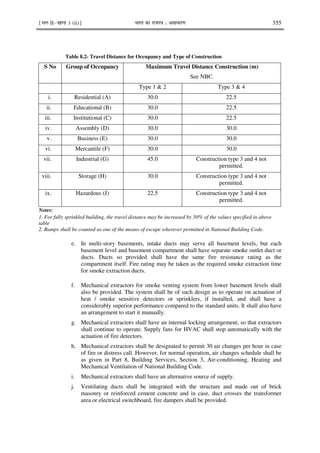
![356 THE GAZETTE OF INDIA : EXTRAORDINARY [PART II—SEC. 3(ii)]
k. Use of basements for kitchens working on gas fuel shall not be permitted, unless air
conditioned. The basement shall not be permitted below the ward block of a
hospital/nursing home unless it is fully sprinkled. Building services such as
electrical sub-stations, boiler rooms in basements shall comply with the provisions
of the Indian Electricity Rules 1956. Boiler room shall be provided at the first
basement along the periphery wall with fire resistance rating (Refer NBC Part 4,
Fire and Life safety) or shall be separated with the blast wall.
l. If cutouts are provided from basements to the upper floors or to the atmospheres, all
side cutout openings in the basements shall be protected by sprinkler head at close
spacing so as to form a water curtain in the event of a fire.
m. It is essential to make provisions for drainage of any such water on all floors to
prevent or minimize water damage of the contents. The drain pipes should be
provided on the external wall for drainage of water from all floors. On large area
floors, several such pipes may be necessary which should be spaced 30 m apart.
Care shall be taken to ensure that the construction of the drain pipe does not allow
spread fire / smoke from floor to floor.
8.4.6 Compartmentation
The building shall be suitably compartmentalized so that fire/smoke remains confined to the
area where fire incident has occurred and does not spread to the remaining part of the
building. All floors shall be compartmented as per NBC (Part 4, Fire and Life safety) as
amended from time to time.
8.4.7 Ramps
a. The ramp to basement and parking floors shall not be less than 7.2 m wide for two
way traffic and 4.0 m wide for one way traffic, provided with gradient of 1:10 for
cars and 1:15 for heavy vehicles. At curved portions of the ramp or for circular
ramps the slope should not be more than 1:12.
b. Ramp may also be provided in setback area which can be sloped considering
unhindered movement of fire Engine and in no case the gradient shall be less than
1: 10.
c. All structural design/safety aspects as per latest BIS Codes & NBC, shall be
complied along with consideration of weight of Fire Engine & its maneuverings.
d. The minimum width of the ramps in hospitals shall be 2.4 m for stretcher and not
for vehicular movement In this case, handrails shall be provided on both sides of
the ramp.
e. Ramps shall lead directly to outside open space at ground level or courtyards or
safe place.
f. In basement one entry and exit shall be provided for the floor area of 10,000sqm
for each basement and if the basement area is more than 10,000sqm in each
basement, one more entry & exit ramp should be provided.
g. For plots less than 3000sqm car lift/s can be provided in place of ramp/s subject to
the approval of the Fire Department.
8.4.8 Corridors
a. Exit corridors and passageways shall be of width not less than the aggregate
required width of exit doorways leading from them in the direction of travel to the
exterior.](https://image.slidesharecdn.com/ubbl2016notified-250923161005-b0550c73/85/UBBL_2016_Notified_DDA-Building-Bye-laws-356-320.jpg)
![358 THE GAZETTE OF INDIA : EXTRAORDINARY [PART II—SEC. 3(ii)]
• Alternate vertical glass panels of the façade shall be openable type with the
mechanism mentioned above in order to ventilate the smoke.
• Refuge areas covered with the glass façade shall have all the panels fully
openable (either left or right hinged) both from inside as well as outside.
k. Glass quality shall be as per IS Codes given below in Table 8.3:
Table 8.3
2553 (Part 1):1990 Specification for safety glass: Part 1 General purpose (third revision)
2835:1987 Specification for flat transparent sheet glass (third revision)
438:1994 Specification for silvered glass mirrors for general purposes (second
revision)
5437:1994 Specification for figured rolled and wired glass (first revision).
14900:2000 Specification for transparent float glass.
8.5 Building Services
8.5.1 Staircase and Corridor Lighting
a. The staircase and corridor lighting shall be independently connected, so as it could
be operated by one switch installation on the ground floor, easily accessible to
firefighting staff at any time irrespective of the position of the individual control of
the light points, if any.
b. Staircase and corridor lighting shall also be connected to alternate supply from
parallel high-tension supply or to the supply from the stand-by generator.
c. Emergency lights shall be provided in staircase and corridor/ passageway,
horizontal exits, refuge area; and all wires and other accessories used for
emergency light shall have fire retardant property.
8.5.2 Electrical Services
a. The electric distribution cables/wiring shall be laid in separate duct which shall be
sealed at every floor with non-combustible materials having the same fire
resistance as that of the duct. Low and medium voltage wiring running in shaft and
in false ceiling shall run in separate conduits.
b. Water mains, telephone lines, intercom lines, gas pipes or any other service line
shall not be laid in the duct for electric cables. Use of bus ducts/solid rising mains
instead of cables is preferred.
c. Separate circuits for water pumps, lifts, staircases and corridor lighting and
blowers for pressurizing system shall be provided directly from the main
switchgear panel (for detailed specifications refer NBC).
8.5.3 Alternate Source of Electric Supply
A stand-by electric generator shall be installed to supply power to staircase and corridor
lighting circuits, fire lifts, the stand-by fire pumps, pressurization fans and blowers, smoke
extraction and damper system in case of failure of normal electric supply. The generator
shall be capable of taking starting current of all the machines and circuits stated above
simultaneously. If the stand-by pump is driven by diesel engine, the generator supply need
not be connected to the stand-by pump.](https://image.slidesharecdn.com/ubbl2016notified-250923161005-b0550c73/85/UBBL_2016_Notified_DDA-Building-Bye-laws-358-320.jpg)
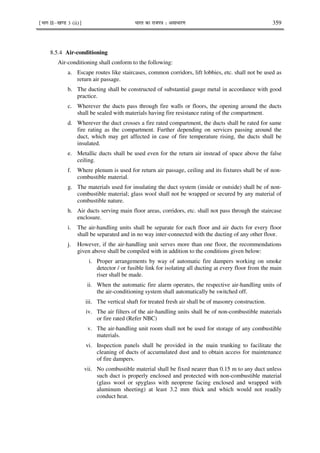
![360 THE GAZETTE OF INDIA : EXTRAORDINARY [PART II—SEC. 3(ii)]
8.5.5 Transformers
a. If transformers are housed in the building below the ground level it shall be
necessarily in the first basement in separate fire resistance room of four hours rating.
Transformer shall be dry type and shall be walls doors cut-out having fire resistance
rating of four hour. The room shall necessarily be at the periphery of the basement
having separate and direct access from open area at ground floor through a fire escape
staircase. The entrance to the room shall be provided with a steel door of two hours
fire rating. A curb of a suitable height shall be provided at the entrance in order to
prevent the flow of oil from ruptured transformer into other parts of the basement.
The switchgears shall be housed in a separate room separated from the transformer
bays by a fire-resisting wall with fire resistance not less than four hours.
b. The transformer shall be protected by an automatic high-pressure water spray or a
foam sprinkler system. When housed at ground floor level it/they shall be cut-off
from the other portion of premises by Fire Resisting Walls of four hours fire
resistance. They shall not be housed on upper floors.
c. A tank of RCC construction of adequate capacity shall be provided at lower basement
level, to collect the oil from the catch pit in case of emergency. The pipe connecting
the catch-pit to the tank shall be of non-combustible construction and shall be
provided with a flame-arrester.
8.5.6 Gas supply
a. Town Gas / L.P.Gas Supply Pipes – Where gas pipes are run in buildings, the same
shall be run in separate shafts exclusively for this purpose and these shall be on
external walls, away from the staircases. There shall be no interconnection of this
shaft with the rest of the floors.
b. LPG distribution pipes shall always be below the false ceiling. The length of these
pipes shall be as short as possible. In the case of kitchen cooking range area, apart
from providing hood, covering the entire cooking range, the exhaust system should be
designed to take care of 30 cu.m per minute per sq.m of hood protected area. It should
have grease filters using metallic grill to trap oil vapors escaping into the fume hood.
Note: For detailed information on gas pipe installations, refer NBC..
c. For large/ commercial kitchens, all wiring in fume hoods shall be of fiber glass
insulation. Thermal detectors shall be installed into fume hoods of large kitchens for
hotels, hospitals, and similar areas located in high rise buildings. Arrangements shall
be made for automatic tripping of the exhaust fan in case of fire. If LPG is used, the
same shall be shut off. The voltage shall be of 24 V or 100 V dc operated with the
external rectifier. The valve shall be of the hand re-set type and shall be located in an
area segregated from cooking ranges. Valves shall be easily accessible. The hood
shall have manual facility for steam or carbon dioxide gas injection, depending on
duty condition; and Gas meters shall be housed in a suitably constructed metal
cupboard located at a well-ventilated space, keeping in view the fact that LPG is
heavier than air and town gas is lighter than air.
8.5.7 Boiler Room
Further, the following additional aspects may be taken into account in the location of
Boiler/Boiler Room:
a. The boiler shall not be allowed in sub-basement but be allowed only in the first
basements away from the escape routes.](https://image.slidesharecdn.com/ubbl2016notified-250923161005-b0550c73/85/UBBL_2016_Notified_DDA-Building-Bye-laws-360-320.jpg)
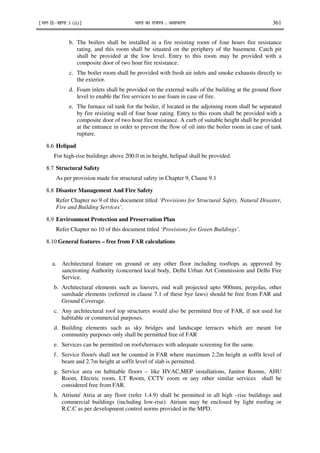
![362 THE GAZETTE OF INDIA : EXTRAORDINARY [PART II—SEC. 3(ii)]
i. Entrance Lobby/Lobby area with minimum double height cubic content in high-rise
building/s shall be permitted free from FAR in all the floors and shall be counted only once
in the Ground Coverage and FAR calculation. Such entrance lobby/lobby area shall not
exceed 3% of maximum permissible FAR. See 7.17.2 (r).
j. Scissor staircase would be permitted provided all travel distance and fire norms are adhered
to.
k. Multilevel car parking with car lifts would be permitted with adequate fire safety.
l. Two or more number of dwelling units, except EWS Housing, adjoining horizontally or
vertically shall be allowed to integrate by way of providing a door of 1.5m max. width or
with an internal staircase of 0.9m.width and additional Lift without pit and machine room,
subject to structural safety.
m. Podium(s)/Multistorey Podium with tower above shall be permitted within setback lines.
The vehicular movement and parking shall be within the podium(s) and shall be free from
FAR and Ground coverage calculations. The podium(s)/Multistorey podium shall be
permitted subject to fire safety requirements of these bye laws. See 7.15.](https://image.slidesharecdn.com/ubbl2016notified-250923161005-b0550c73/85/UBBL_2016_Notified_DDA-Building-Bye-laws-362-320.jpg)
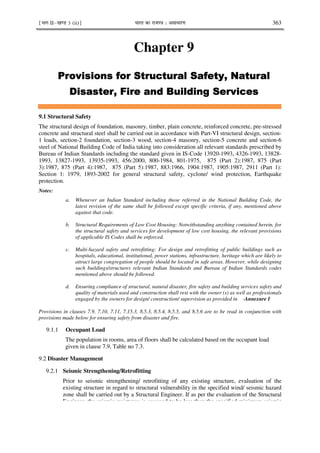
![364 THE GAZETTE OF INDIA : EXTRAORDINARY [PART II—SEC. 3(ii)]
resistance as given in the note below, action will be initiated to carry out the upgrading of
the seismic resistance of the building as per applicable standard guidelines.
Note: For evaluation and seismic strengthening for retrofitting of RCC buildings relevant Indian
Standards and Bureau of Indian Standards codes should be followed.
9.2.2 Protective Measures in Natural Hazard Prone Areas
In natural hazard prone areas identified under the land use zoning regulations, structures
buildings and installations which cannot be avoided, protective measures for such
construction/ development need to be properly safeguarded based on the suggestion given
in Annexure VII
9.2.3 Quality Control
All the construction for high-rise buildings higher than seven stories, public buildings and
special structures shall be carried out under quality inspection program prepared and
implemented under the Quality Auditor in seismic zones IV & V.
Note: For competency of Quality Auditor refer Annexure I
9.2.4 Quality of Materials and Workmanship
All material and workmanship shall be of good quality conforming generally to accepted
standards of Central Public Works Department and Indian Standard Specification and
Codes as included in Part-V Building Materials and Part-VII Construction Practices and
Safety of National Building Code of India.
a. Alternative materials, methods of design and construction and tests: The provisions of
these Bye-Laws are not intended to prevent the use of any material or method of
design or construction not specifically prescribed by these bye-law provided any such
alternative has been approved. The building materials approved by B.I.S or any
statutory body will form part of the approved building material and technology as part
of the Bye-Laws.
9.2.5 Control of Signs (Hoardings) and Outdoor Display Structures including Telephone
Towers.
Following provisions shall apply for telecommunication infrastructure:
a.No advertising signs (including hoarding) on buildings or on land shall be displayed
without the prior approval of the Authority / concerned local body. The standards
specified in part X Signs and outdoor display structures of National Building Code of
India as amendments time to time shall be applicable.
b.No signage/communication tower and advertisement is to be provided in residential
buildings.
9.3 Fire Safety
The building plans for buildings covered under Rule 27 of Delhi Fire Service Rules shall be
marked fire and life safety measures as per the National Building Code of India concerning
minimum standards for fire prevention and fire protection as covered under Rule 33 of the Delhi
Fire Service Rules as amended from time to time; unless otherwise specified in these bye –laws.
9.3.1. Fire Escape Staircase
a. Fire Escape will be an additional external stair case and shall not to be taken in to
account for calculating the evacuation of the occupants of a specific floor. It shall not
be inclined at an angle greater than 450
from the horizontal.](https://image.slidesharecdn.com/ubbl2016notified-250923161005-b0550c73/85/UBBL_2016_Notified_DDA-Building-Bye-laws-364-320.jpg)
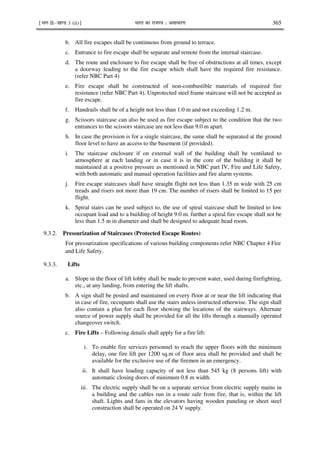
![366 THE GAZETTE OF INDIA : EXTRAORDINARY [PART II—SEC. 3(ii)]
iv. Firefighting lift should be provided with a ceiling hatch for use in case of
emergency, so that when the lift car gets stuck up, it shall be easily openable.
v. In case of failure of normal electric supply, it shall automatically trip over to
alternate supply. For apartment houses, this changeover of supply could be
done through manually operated change over switch also. Alternatively, the lift
shall be so wired that in case of power failure, it comes down at the ground
level and comes to stand-still with door open.
vi. The operation of a fire lift is by a simple toggle or two-button switch situated in
a glass fronted box adjacent to the lift at the entrance level. When the switch is
on, landing call points will become inoperative and the lift will be on car
control only or on a priority control device. When the switch is off, the lift will
return to normal working. This lift can be used by the occupants in normal
times.
vii. The words ‘Fire Lift’ shall be conspicuously displayed in fluorescent paint on
the lift landing doors at each floor level.
viii. The speed of the fire lift shall be such that it can reach the top floor from
ground level within1 minute.
9.3.4. Basement
Refer clause 8.4.5 for details of basement.
9.3.5. Refuge Chutes
a. Hoppers to refuse chutes shall be situated in well ventilated positions and the same
shall be continued upwards shall have opening at least 1.0 m above roof level for
venting purpose and they shall have an enclosure
b. Wall of non-combustible material with fire resistance of not less than two hour. They
shall not be located within the staircase enclosure or service shafts, or air-
conditioning shafts inspection panel and doors shall be tight fitting with one hour fire
resistance; the chutes should be as far away as possible from exit.
c. Refuge chambers shall have walls and floors of roofs constructed of non-combustible
and impervious material and shall have a fire resistance of not less than two hours.
They shall be located at a safe distance from exit routes.
9.3.6. Refuge Area
a. For buildings more than 24.0 m in height, refuge area of 15.0 sq.m or an area
equivalent to 0.3 sq.m per person to accommodate the occupants of two consecutive
floors whichever is higher shall be provided as under:
i. For floors above 24.0 m and up to 39.0 m – One refuge area on the floor
immediately above 24.0 m.
ii. For floors above 39.0 m – One refuge area on the floor immediately above
39.0 m and so on after every 15.0 m.
b. The refuge area shall be provided on the periphery of the floor on a cantilever
projection and open to air at least on one side protected with suitable railings.
c. Where if it is not possible to cantilever, a refuge area can be provided within the
building as per DFS provision and it should be free from FAR.
d. Use of Refuge area :](https://image.slidesharecdn.com/ubbl2016notified-250923161005-b0550c73/85/UBBL_2016_Notified_DDA-Building-Bye-laws-366-320.jpg)
![368 THE GAZETTE OF INDIA : EXTRAORDINARY [PART II—SEC. 3(ii)]
9.3.10. Fire Control Room
For all buildings with a height of 15 m and above and Group Housing with a height of
30m and above, there shall be a control room on the entrance floor of the building with
communication system (suitable public address system) to all floors and facilities for
receiving the message from different floors. Details of all floor plans along with the
details of firefighting equipment and installations shall be maintained in the fire control
room. The fire control room shall also have facilities to detect the fire on any floor
through indicator board connections; fire detection and alarm systems on all floors.
The fire staff in-charge of the fire control room shall be responsible for the maintenance
of the various services and firefighting equipment and installations in co-ordination with
security, electrical and civil staff of the building.
9.3.11. Fire Notices
Fire notices/orders shall be prepared to fulfill the requirements of the firefighting and
evacuation from the building in the event of fire and other incidents. The occupants shall
be made thoroughly conversant with their action in the event of the emergency, by
displaying fire notices at vantage points. Such notices should be displayed prominently in
broad lettering.
9.3.12. Fire Dampers
a. These shall be located in conditioned air ducts and return air ducts/ passages at the
following points:
i. At the fire separation wall.
ii. Where ducts/passages enter the central vertical shaft.
iii. Where the ducts pass though floors.
iv. At the inlet of supply air duct and the return air duct of each compartment on
every floor.
b. The dampers shall operate automatically and shall simultaneously switch off the air-
handling fans. Manual operation facilities shall also be provided. (Note: For blowers,
where extraction system and duct accumulators are used, dampers shall be provided).
c. Fire/smoke dampers (for smoke extraction shafts) for buildings more than 24 m in
height.
i. For apartment houses in non-ventilated lobbies / corridors operated by fusible
link / smoke detectors and with manual control.
ii. For other buildings on operation of smoke detection system and with manual
control.
d. Automatic fire dampers shall be so arranged as to close by gravity in the direction of
air movement and to remain tightly closed on operation of a fusible link / smoke
detector.
Note: The use of type of detectors shall be to the satisfaction of Delhi Fire Service.
9.3.13. Fire Tower
a. Fire towers are escape routes for multistoried buildings and these shall be considered
as the safest route for escape. Their number, location and size shall depend on the
building concerned, and its associated escape routes. A fire lift, internal hydrant, hose
reel etc. shall be permitted in the fire tower.
b. In high rise buildings with over 8 stories or 24.0 m in height, at least one required
means of egress shall preferably be a fire tower.](https://image.slidesharecdn.com/ubbl2016notified-250923161005-b0550c73/85/UBBL_2016_Notified_DDA-Building-Bye-laws-368-320.jpg)
![370 THE GAZETTE OF INDIA : EXTRAORDINARY [PART II—SEC. 3(ii)]
9.4.4. Plumbing Services
a. The planning, design, construction and installation of water supply, drainage and
sanitation and gas supply system shall be in accordance with Part-IX Plumbing
Services, section-l water supply; Section-2 Drainage and Sanitation and Section-3
Gas Supply of National Building Code of India.
Note: All plumbing services shall be provided as per design and certification of structural
engineer within structural members.
b. Requirement of water supply for various occupancies in buildings shall be as given in
Table 9.1 to 9.3.
Note: DJB resolution No. 1816/DJB dated 20.06.2009 on levy of infrastructure fund for
sanctioning bulk water supply scheme in respect of institution and commercial enterprises
with mandatory conditions of recycling.
c. Requirement of sanitary fittings and installations for different occupancies in
buildings shall be as given in Table 9.4 to 9.15 for calculation of occupancy.
Table 9.1: Per capita water requirement for various Occupancies/ Uses
S.No Type of occupancy Consumption
(in lt.)
1. Residential
i. EWS/LIG dwelling units(LPCD/ dwelling unit)
ii. MIG and above category flats/houses/floors (LPCD/ dwelling unit)
iii. Hotels with lodging accommodation (per bed)
135
225
180
2. Educational
a) Day schools( per head per day)
b) Boarding schools( per head per day)
45
135
3. Institutional(medical hospitals)
a)no. of beds not exceeding 100
b)no. of beds exceeding 100
c) medical quarters and hotels
340
450
135
4. Assembly – cinema theatres, auditoria, etc.
(per seat accommodation)
15
5. Government or semi-public business 45
6. Mercantile(commercial)
a) Restaurants(per seat)
b) Other business building
70
45
7. Industrial
a. Factories where bath- rooms are to be provided.
b. Factories where bath-rooms are not to be provided
45
30
8. Storage(including warehouses) 30
9. Hazardous 30
10. Intermediate stations (excluding mail and express stops. 45(25)*
11. Junction stations 70(45)*
12. Terminal stations 45
13. International and domestic Airports 70
*The values in parenthesis are for such stations, where bathing facilities are not provided.
Note:
The number of persons for Sl. No. 10 to 13 shall be determined by the average number of passenger handled by
the station daily with due consideration given to the staff and workers likely to use the facilities.
Table 9.2: Flushing Storage Capacities
S.No Classification of building Storage capacity
1. For tenements having common 900lt. per W.C. seat](https://image.slidesharecdn.com/ubbl2016notified-250923161005-b0550c73/85/UBBL_2016_Notified_DDA-Building-Bye-laws-370-320.jpg)
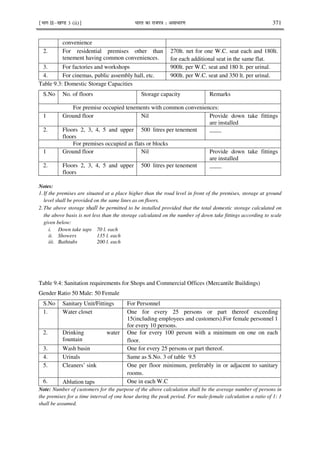
![372 THE GAZETTE OF INDIA : EXTRAORDINARY [PART II—SEC. 3(ii)]
Table-9.5: Sanitary Requirements for Hotels
S.No
Sanitary
unit
For Residential Public
Staff
For non-Residential staff
For Male For Female
1
Water
closet
(W.C)
One per 8 persons
omitting occupants of
the attached water
closet minimum of 2 if
both sexes are lodged.
1for 1-15 persons
2 for 16-35 persons
3 for 36-66 persons
4 for 66- 100 persons
1 for 1- 12 persons
2 for 13-25 persons
3 for 26-40 persons
4 for 41-57 persons
5 for 58-77persons
6 for 78-100 persons
2
Ablution
taps
One in each W.C One in each W.C One in each W.C
3 Urinals Nil
Nil up to 6 persons
1 for 7- 20persons
2 for 21-45 persons
3for 46-70 persons
4 for 71- 100 persons
Nil
4 Wash
basins
One per 10 persons
omitting each basin
installed in the
room/suite
1 for 15 persons
2 for 16-35 persons
3for 36-65 persons
4for 66-100 persons
1for 1-12
2for 13-25
3for 26-40
4for 41-57
5for 58-77
6for 78-100
5 Baths
One per 10 persons
omitting occupants of
rooms with bath in
suite
Nil Nil
6
Stop
sinks
One per 30 beds
rooms (one floor per
floor minimum)
Nil Nil
Kitchen
sink
One in each kitchen One in each kitchen One in each kitchen
Table 9.5 (contd.): For Public Rooms
S. No Sanitary Unit For Male For Female
1.
Water
closet(W.C)
1 per 100 persons up to 400
persons; for over 400add at the
rate of 1 per 250 persons or part
thereof.
2 for 10 persons up to
200persons; over 200 add at the
rate of one per 100 persons or
part thereof.
2 Ablution taps One in each W.C. One in each W.C.
3.
Urinals
Nil up to 6 persons
1 for 7-20 persons
2 for 21-45 persons
3 for 46-70 persons
4 for 71-100 persons
Nil
4. Wash basins
One per W.C. and urinal
Provided
One per W.C. provided
5.
Baths ------------ ------------
Stop sinks ------------ ------------
Kitchen sink One in each Kitchen One in each Kitchen](https://image.slidesharecdn.com/ubbl2016notified-250923161005-b0550c73/85/UBBL_2016_Notified_DDA-Building-Bye-laws-372-320.jpg)
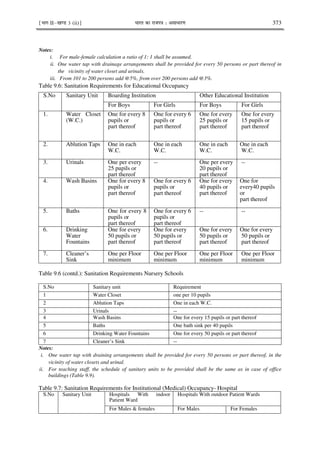
![374 THE GAZETTE OF INDIA : EXTRAORDINARY [PART II—SEC. 3(ii)]
1 Water Closet One for every 6 beds or part
thereof
Two for every 100
persons or
Part thereof
Three for every 100
persons or part
thereof
2 Ablution Taps One in each W.C. One in each
W.C.
One in each W.C.
3 Wash Basins 2for up to 30 beds;
add one for every additional
30 beds; or part thereof
One for every
100 persons or
part thereof
One for every 100
Persons or part
thereof.
4 Baths with
Shower
One bath with shower for
every 8 beds or part thereof.
-- --
5 Bed pan washing
sink
One for each ward
6 Cleaner’ Sinks One for each ward One per floor
minimum
One per floor
minimum
7 Kitchen sinks &
dish Washers
(where Kitchen is
provided)
One for each ward -- --
8 Urinals -- One for every 50
persons or part
thereof
--
Table 9.7 (contd.): Administrative Buildings
S.No Sanitary Unit For Males For Females
1 Water Closet (W.C.) One for every 25 persons or
part thereof
One for every 15 persons or part
thereof
2 Ablution Taps One in each W.C. One in each W.C.
3 Wash Basins One for every 25 persons or
part thereof
One for every 25 persons or
part thereof
4 Baths with Shower One on each floor One on each floor
5 Bed pan washing sink -- --
6 Cleaner’s Sink One per floor minimum One per floor minimum
7 Kitchen sinks & dish
Washers
(where Kitchen is
provided)
One for each floor One for each floor
8 Urinals
Nil up to 6 persons
1 for 7-20 persons
2 for 21-45 persons
3 for 46-70 persons
4 for 71-100 persons
From 101 to 200 persons add at
the rate of 3%; for over 200
persons add at the rate of 2.5%.
--
Table-9.8: Sanitation Requirements for Institutional (Medical) Occupancy- (staff quarters and
Hostels)
S.No Sanitary Unit Doctor’s Dormitories Nurses Hostel
For Male Staff For Female Staff
1 Water Closet One for 4 persons One for 4 persons One for 4 persons or
part thereof
2 Ablution Taps One in each W.C. One in each W.C. One in each W.C.
3 Wash Basins One for every 8 persons
or part thereof
One for every 8 persons or
part thereof
One for every 8
persons or part
thereof
4 Bath (with One for every 4 persons One for every 4 persons or One for every 4](https://image.slidesharecdn.com/ubbl2016notified-250923161005-b0550c73/85/UBBL_2016_Notified_DDA-Building-Bye-laws-374-320.jpg)
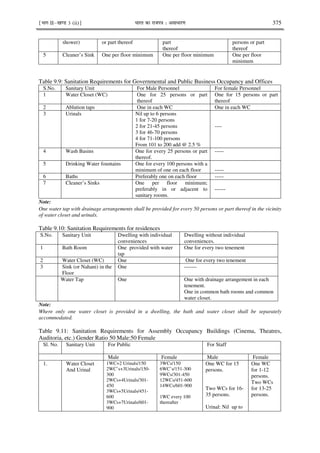
![376 THE GAZETTE OF INDIA : EXTRAORDINARY [PART II—SEC. 3(ii)]
1WC+1 Urinal for
every 150 thereafter
6 persons
1 for 7-20
persons
2 for 21-45
persons.
2. Ablution Taps One in each WC One in each WC One in each WC One in each
WC
3. Wash Basins One for every 200
persons or part
thereof. For over 400
persons, add @ 1 per
250 persons or part
thereof.
One for every 200
persons or part
thereof. For over
200 persons, add
@ 1 per 150
persons or part
thereof.
One for 1-15
persons.
Two for 16-35
One for 1-
12 persons
Two for 13-
25 persons.
4. Cleaner’s Sink One per floor, minimum.
5. Drinking Water
Fountain
One per 100 persons or part thereof.
Note: For male-female calculation a ratio of 1: 1 shall be assumed.
Table:-9.12: Sanitation Requirements for Assembly Occupancy Buildings (Art, Galleries,
Libraries and Museums)
Sl.
No.
Sanitary Unit For Public For Staff
Male Female Male Female
1 Water Closet
(WC)
One for 200 persons
up to 400 persons.
For over 200
persons, add @ 1 per
250 persons or part
thereof.
One per 100
persons up to 200
persons. For over
200 persons add @
1 per 150 persons
or part thereof.
One for 15 persons.
Two for 16-35
persons.
One for 1-12
persons.
Two for 13-
25 persons.
2 Ablution Taps One in each WC One in each WC One in each WC One in each
WC
3 Urinals One for 50 persons
or part thereof ------
Nil up to 6 persons
1 for 7-20 persons
2 for 21-45 persons. -----
4 Wash Basins One for every 200
persons or part
thereof. For over
400 persons, add @
1 per 250 persons or
part thereof.
One for every 200
persons or part
thereof. For over
200 persons, add @
1 per 150 persons
or part thereof.
One for 1-15
persons.
Two for 16-35
One for 1-
12 persons
Two for 13-
25 persons.
5 Cleaner’s Sink One per floor, minimum.
Table 9.13: Sanitation Requirements for Restaurant.
Sl.
No.
Sanitary Unit For Public For Staff
Male Female Male Female
1. Water
Closet(WC)
One for 50 seats
upto 200 seats
For over 200
seats, add @ 1
per 100 seats or
part thereof.
2WCs per
50seats upto 200.
Add 1per 100
thereafter.
1 for 15 persons.
2for 16-35 persons.
3 for 36-35
persons.
4 for 66-100
persons.
1 for 1-12 persons.
2 for 13-25
persons.
3 for 26-40
persons.
4 for 41 -57
persons.
5 for 58-77
persons.](https://image.slidesharecdn.com/ubbl2016notified-250923161005-b0550c73/85/UBBL_2016_Notified_DDA-Building-Bye-laws-376-320.jpg)
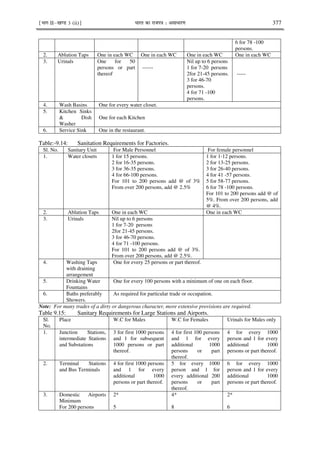
![378 THE GAZETTE OF INDIA : EXTRAORDINARY [PART II—SEC. 3(ii)]
For 400 persons
For 600 persons
For 800 persons
For 1000 persons
9
12
16
18
15
20
26
29
12
16
20
22
4. Internal Airports
For 200 persons
For 600 persons
For 1000 persons
6
12
18
10
20
29
8
16
22
Note: Provision for wash basins, baths including shower stalls, shall be in accordance with Part ix Section 2-
Drainage and Sanitation of National Building Code of India and amendments time to time.
* At least one Indian style water closet shall be provided in each toilet. Assume 50 % males and 50
% females in any area.
9.4.5. Water Supply arrangements (General Guidelines)
a. Provision shall be made for two underground water tanks for the storage of potable
and non- potable water with adequate pumping arrangements to supply water to
various floors in the property. Capacity of the underground water tank for storing
potable water shall be 50% of the potable water requirement estimated as per the
norms of the water utility department i.e. Delhi Jal Board. For storing non- potable
water the underground water tank storage capacity shall be 50% of the non- potable
water demand estimated as per the norms of water utility department i.e. Delhi Jal
Board and to meet horticulture requirement in the property. While according to
sanction to layout plan the authority/ concerned local body shall make a special
sanction that provisions for space shall be kept for construction of underground
reservoirs of adequate capacities along with booster pumping stations.
b. For new construction: the clearance of plan for the construction of new building
only is given if the provisions are Delhi Jal Board regulation compliant. Provision
should be made for an underground tank for storage of water with a capacity at
minimum 150 lts / Person (4.5 persons per dwelling unit) with adequate pumping
arrangements. Filtered water connections will be allowed only for use of drinking
and bathing needs. Delhi Jal Board regulations permit only single bulk water
connection if dwelling unit in a property exceeds 6 nos.
c. Arrangements as given in table 9.1 above shall also be provided in Group Housing
Societies.
d. Dual piping Systems/ Plumbing arrangement in case of new construction shall be
made in a way that portable water is used for drinking cooking bathing and other
portable purposes and non-potable water is used for flushing horticulture and other
non-potable purposes.
e. Double Valve Low Capacity Cistern should be provided instead of conventional
12.5 litres capacity
f. The plumbing arrangement in case of new constructions shall be made in a way that
the potable water shall be used for drinking, cooking & bathing only and for rest of
the uses, provision for ground water can be made with dual piping system.
g. Low capacity cistern should preferably be provided instead of normal 12.5 lts
capacity.
Notes:
a. For water demand calculations in the residential dwelling units, occupancy is consider as 5
persons/D.U. and occupancy in case of hotels, hostels, hospitals etc. is to be considered as per the
number of beds.](https://image.slidesharecdn.com/ubbl2016notified-250923161005-b0550c73/85/UBBL_2016_Notified_DDA-Building-Bye-laws-378-320.jpg)
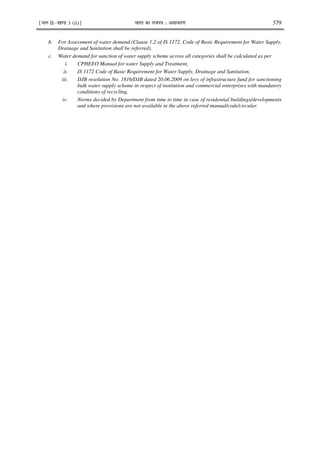
![380 THE GAZETTE OF INDIA : EXTRAORDINARY [PART II—SEC. 3(ii)]
Chapter 10
10.0 Green Buildings - See Annexure X
All buildings on various plot sizes should comply with the green norms and conform to the
requirements mandatory for sanction as mentioned in this chapter.
These are not specific to any rating system and are not intended to provide a single metric indication
of overall building performance. These provisions allows the practitioners to easily exercise their
engineering judgment in holistically and objectively applying the underlying principles of
sustainability to a development or building facility, considering its functionality and required comfort
level.
10.1 Provisions and Applicability
These provisions for green buildings are applicable on all plots more than 105 sq. m in size
The green building provisions on various plot sizes are indicated in the table below:
Table 10.1-Provisions and applicability for various plot sizes (all use premises)
Category of
Plot Sizes
(sq.m.)
Sub-
category
Applicable plot area
(sq. m)
Provisions for Green Building
(as per Clause 10.2)
I up to105 Nil
II A 105 to 500 1(a), 2(b), 4(a)
B 500 to 1,000 1(a), 1(c), 2(b), 4(a)
C 1,000 to 3,000 1(a), 1(c), 1(d), 2(b), 3(b), 4(a)
III A Above 3,000 1(a), 1(b), 1(c), 1(d), 2(a), 2(b), 3(a),
3(b), 4(a), 4(b)
The above mentioned provisions should be followed in case of residential plots forming part of
approved layout plan/ colony plan/ developed area*.
Notes:
*The schemes/ projects formulated on the basis of provisions given in Master plan/ Zonal Development Plan
will require approval as indicated:
EIA/ ECC (as per MoEF), NBC (latest), ECBC 2007 or latest, BEE Star rating/ LEED of IGBC/ GRIHA of TERI
Certification
EIA- Environmental Impact Assessment Study Report, ECC- Environmental Clearance Certificate, MoEF –
Ministry of Environment and Forest,NBC – National Building Code, ECBC – Energy Conservation Building
Code, BEE – Bureau of Energy Efficiency, LEED– Leadership in Energy and Environment Design, IGBC –
Indian Green Building Council, GRIHA– Green Rating for Integrated Habitat Assessment, TERI – The Energy
and Resources Institute.
The prevailing provisions of the above shall be applicable. However if there are any modification in
the same, the modified provisions shall become automatically applicable.](https://image.slidesharecdn.com/ubbl2016notified-250923161005-b0550c73/85/UBBL_2016_Notified_DDA-Building-Bye-laws-380-320.jpg)
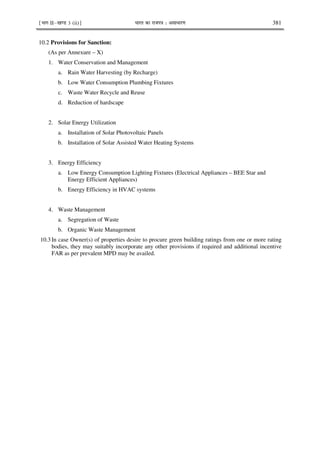
![382 THE GAZETTE OF INDIA : EXTRAORDINARY [PART II—SEC. 3(ii)]
Chapter 11
/
/
/
/
+ * % +
+ * % +
+ * % +
+ * % +
11.0 Applicability
These regulations are applicable to all buildings and facilities used by the public such as
educational, institutional, assembly, commercial, business, mercantile buildings and group
housing etc. It shall not apply to private residences (residential plotted development).
11.1 Building to be Designed for Ambulant Disabled People
Higher Secondary School, Conference Hall, Dance Halls, Youth Centers, Youth Clubs, Sport
Centers, Sport Pavilions, Boat Club Houses, Ice Rinks, Bowling Centers, Swimming Pools,
Police Stations, Law Courts, Courts Houses, Sport Stadiums, Theaters, Concert Halls, Cinemas,
Auditoria, Small Offices (the maximum plinth area 1400 sq.mt) Snack Bars, Cafes and
banqueting rooms (for capacity above 50 dinners).
Notes:
a. In sport stadiums provisions shall be made for non-ambulant spectators (small wheel chair)
b. @ 1:1000 up to 10,000 spectators and @ 1:2000 for spectators above 10,000.
c. In Theaters, Concert Halls, Cinemas and Auditoria provisions shall be made for non-ambulant
spectators (Small Wheel Chairs) @ 1/250 up to 1000 spectators and 1/500 for spectators above 1000.
11.2 Building to be Designed for Non-Ambulant Disabled People
Schools for differently abled, cremation and buildings as mentioned in (Annexure VI-
Development Norms – MPD), Botanical Gardens, Religious Buildings, Old People Clubs,
Village Halls, Day Centers, Junior Training Centers, Post Offices, Banks, Dispensaries, Railway
Stations, Shops, Super Markets, and Departmental Stores.
Note: Large wheel chair criteria shall be applicable on ground floors of the following building, post
offices, banks, dispensaries, railway station, shops, supermarkets, and departmental stores.
11.3 Building to be Designed for Non-Ambulant Disabled People (using small wheel chairs)
Public lavatories in Tourist Sports, Clubs Motels, Professional and Scientific Institution,
Museum, Art Galleries, Public Libraries, Laborites, Universities, Collage for further Education,
Teachers Training Colleges, Technical College, Exhibition Halls Dentist Surgeries,
Administrative Department of the Hospitals, Service Stations, Car Parking, Buildings Airports
Terminals, Bus Terminals, Factories Employing differently abled for Sedentary Works, Large
Offices, (with plinth area abode 1400 sq.mt.), Tax Offices, Passport Offices, Pension Offices,
and Labour Offices, Cafes, Banqueting Rooms and Snack Bars (For capacity above 100 dinners).
11.4 Site Development
Level of the roads, access paths and parking areas shall be described in the plan along with
specification of the materials.](https://image.slidesharecdn.com/ubbl2016notified-250923161005-b0550c73/85/UBBL_2016_Notified_DDA-Building-Bye-laws-382-320.jpg)
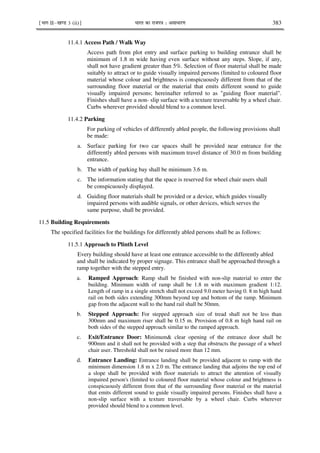
![384 THE GAZETTE OF INDIA : EXTRAORDINARY [PART II—SEC. 3(ii)]
11.5.2 Corridor Connecting the Entrance/ Exit for the Differently Abled
The corridor connecting the entrance / exit for differently abled leading directly
outdoors to a place where information concerning the overall use of the specified
building can be provided to visually impaired persons either by a person or by
signs, shall be provided as follows:
a. Guiding floor materials' shall be provided or device that emits sound to guide
visually impaired persons.
b. The minimum width shall be 1.5 m.
c. In case there is a difference of level, slope ways shall be provided with a slope of
1:12.
d. Handrails shall be provided for ramps/slope ways.
11.6 Stair-ways
One of the stair-ways - near the entrance / exit for the differently abled shall have the following
provisions:
a. The minimum width shall be 1.35 m.
b. Height of the riser shall not be more than 0.15 m and width of the tread 300mm.
The steps shall not have abrupt (square) nosing.
c. Maximum number of risers on a flight shall be limited to 12.
d. Handrails shall be provided on both sides and shall extend 0.3 m on the top and
bottom of each flight of steps.
11.7 Lifts
Wherever lift is required as per bye-laws, provision of at least one lift shall be made for the
wheel chair user with the following cage dimensions of lift recommended for passenger lift of 13
person’s capacity of Bureau of Indian Standards.
Table no 10.1- Desirable Lift size
Clear internal width 1.1 m
Clear internal depth 2.0 m
Entrance door width 0. 9 m
a. A hand rail not less than 0. 6 m long at 1.0 m above floor level shall be fixed
adjacent to the control panel.
b. The lift lobby shall be of an inside measurement of 1.8 m x 1.8 m or more.
c. The time of an automatically closing door should be minimum 5 seconds and the
closing speed should not exceed 0.25 m/ sec.
d. The interior of the cage shall be provided with a device that audibly indicates the
floor, the cage has reached indicates that the door of the cage of entrance/exit is
either open or closed.
11.8 Toilets
One special W.C. in a set of toilets shall be provided for the use of differently abled with
essential provision of washbasin near the entrance for the differently abled.
a. The minimum size shall be 1.5 m x 1.75 m.](https://image.slidesharecdn.com/ubbl2016notified-250923161005-b0550c73/85/UBBL_2016_Notified_DDA-Building-Bye-laws-384-320.jpg)
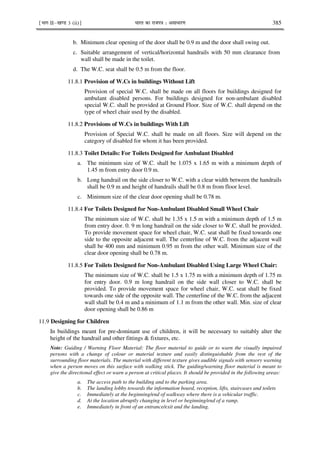
![386 THE GAZETTE OF INDIA : EXTRAORDINARY [PART II—SEC. 3(ii)]
11.10 Drinking Water:
Suitable provision of drinking water shall be made for the differently abled near the special
toilet provided for them.
11.11 Refuge
An alternative to immediate evacuation of a building via staircases and/ or lifts for the
movement of differently abled persons to areas of safety within a building. If possible, they
could remain there until the fire is controlled and extinguished or until rescued by the fire
fighters.
a. It is useful to have the provisions of a refuge area, usually at the fire protected
stair landing on each floor that can safely hold one or two wheelchairs.
b. Hand Doorways with clear opening width of 0.9 m and complying with section
4.6 and
c. Have an alarm switch installed between 0.9 m and 1.2 m from floor level.
11.12 Signage
a. Appropriate identification of specific facilities within a building for the
differently abled persons should be done with proper signals.
b. Signs should be designed and located so that they are easily legible by using
suitable letter size (not less than 20 mm high).
c. For visually impaired persons, information board in brail should be installed on
the wall at a suitable height and it should be possible to approach them closely.
d. To ensure safe walking, there should not be any protruding sign which creates
obstruction in walking.
e. Public Address System shall also be provided in busy public areas.
f. The symbols/information should be in contrasting colour and properly
illuminated because people with limited vision shall be able to differentiate
amongst primary colours.
g. International Symbol Mark for wheel chair be installed in a lift, toilet, staircase,
parking areas, etc., that have been provided for the differently abled.](https://image.slidesharecdn.com/ubbl2016notified-250923161005-b0550c73/85/UBBL_2016_Notified_DDA-Building-Bye-laws-386-320.jpg)
![388 THE GAZETTE OF INDIA : EXTRAORDINARY [PART II—SEC. 3(ii)]
Chapter 13
*
*
*
*
13.1 In all types of building/s which require approval of Delhi Urban Art Commission, works of art
shall be provided.
13.2 Public art constitutes outdoor sculptures, outdoor installations, murals and frescos, mobiles and
bas-relief, folk and tribal art, artisan craft, indoor sculptures, wall paintings, indoor installations
and other art forms relevant to the habitat.
13.3 Public art can be made of any material and have any color and texture.
13.4 The extent of public art (measured in terms of cost) should be at least 1 percent of the cost of
construction of the structure as per prevailing CPWD rates.
13.5 Public art can be located either within the plot boundary or within the building.
13.6 If provided within the plot boundary, the public art piece or pieces should be so located in the
public areas/ open spaces / setback areas so as not to interfere with the movement of the fire
tender.
13.7 If provided within the building, the public art piece or pieces may be provided preferably in the
lobby areas where it is visible to the public.
13.8 If provided on the building, public art may be in the form of murals, frescos etc. on either inner
or outer walls.
13.9 No piece of public art shall be more than 2 m in height, if located within the building and 5 m in
height if located outside the building.
13.10 Public art work shall be incorporated in the building sanction plans for scrutiny by Delhi
Urban Art Commission.
13.11 Delhi Urban Art Commission can issue guidelines on public art from time to time and the
same shall be followed.
See Annexure XI](https://image.slidesharecdn.com/ubbl2016notified-250923161005-b0550c73/85/UBBL_2016_Notified_DDA-Building-Bye-laws-388-320.jpg)
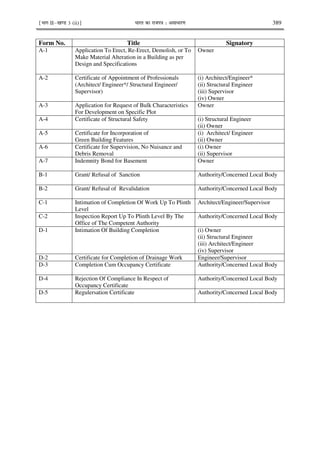
![390 THE GAZETTE OF INDIA : EXTRAORDINARY [PART II—SEC. 3(ii)]
FORM- A–1
(Chapter 2, 2.0)
APPLICATION TO ERECT, RE-ERECT, DEMOLISH, OR TO MAKE
MATERIAL ALTERATION IN A BUILDING AS PER
DESIGN AND SPECIFICATIONS
(To Be Submitted By the Owner)
To
The ____________________
New Delhi.
Madam/ Sir,
I/ We hereby give notice that I/ We intend to erect/re-erect/ alter the Building
No___________ on/in plot No__________Block No__________ House
No________________situated
at_________________________Scheme____________________and in accordance with the
building Bye-laws of Delhi, and I forward herewith the following plans and specifications duly
signed by me and___________________________ (name in block letters of Architect/ Empaneled
Engineer), Architect’s Registration /Engineer Empanelment No__________________who has
prepared the plans, designs etc. and a copy of other statements/documents (as applicable).
Encl:
1. Key Plan.(Chapter 2, 2.2)
2. Layout Plan (Chapter 2, 2.4)
3. Landscape Plan(Chapter 2, 2.4.2)
4. Site plan(Chapter 2, 2.3)
5. Building Plan. (Chapter 2, 2.6)
6. Building Plan for High Rise. (Chapter 2, 2.8)
7. Services Plan (Chapter 2, 2.9)
8. Elevation (Chapter 2, 2.6.3)
9. General Specifications (in attached form).
10. Ownership Title. (Chapter 2, 2.12)
11. Attested copy of Receipt for payment of application fee.
12. Other documents, if any required.
The construction shall be carried out in accordance with the sanctioned building plan. The Owner/
Supervisor (supervising the construction) shall be responsible for any lapse on their part for such
construction.
Signature of Owner(s) ______________
Name of Owner(s) _________________
Address of Owner(s) _______________
Date ________________________
Design and specifications duly signed by Architect/ Engineer/Supervisor enclosed herewith.](https://image.slidesharecdn.com/ubbl2016notified-250923161005-b0550c73/85/UBBL_2016_Notified_DDA-Building-Bye-laws-390-320.jpg)
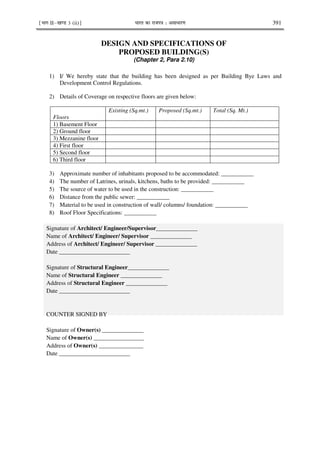
![392 THE GAZETTE OF INDIA : EXTRAORDINARY [PART II—SEC. 3(ii)]
FORM- A-2
CERTIFICATE OF APPOINTMENT OF PROFESSIONALS
(Architect/ Engineer/ Structural Engineer/ Supervisor)
ARCHITECT/ ENGINEER/SUPERVISOR
(To be submitted by Architect/ Engineer/Supervisor)
(Chapter 2, Para 2.12.6)
Self-attested Certification-cum-Undertaking on a plain paper
I/ We, ---------------------------------------, S/o, W/o, D/o Shri ---------------------------------occupation
Architect/ Engineer, office at ----------------------------------------- do hereby solemnly affirm and
declare as under:
1) That I am an Architect by profession and duly registered with Council of Architecture vide
registration no______________.
Or
That I am an Engineer by profession and duly as per competency under these bye-laws, in the
Authority / concerned local body.
Or
That I am a Supervisor by profession and duly as per competency under these bye-laws, in the
Authority / concerned local body.
2) That I have been appointed as an Architect/ Engineer/Supervisor for preparing the architectural
design of building on Plot No. -------------------------------------Block No. ---------------------------
------- situated at -------------------------------------------------------------------------------------- as per
sanctioned building plans by the owner.
3) That in case the owner dispenses with my services at any stage whatsoever; I shall inform the
Authority / concerned local body within 7 days along with the photograph of the building
showing the level/status of the building.
4) That in case I (Architect/ Engineer/Supervisor) decide not to continue further with project, then
I shall inform the same to the authority/ concerned local body within 7 days with copy to the
owner.
Signature of Architect/ Engineer/Supervisor______________
Name of Architect/ Engineer/ Supervisor ______________
Address of Architect/ Engineer/ Supervisor ______________
Date ________________________
COUNTER SIGNED BY
Signature of Owner(s) ______________
Name of Owner(s) _________________
Address of Owner(s) _______________
Date ________________________](https://image.slidesharecdn.com/ubbl2016notified-250923161005-b0550c73/85/UBBL_2016_Notified_DDA-Building-Bye-laws-392-320.jpg)
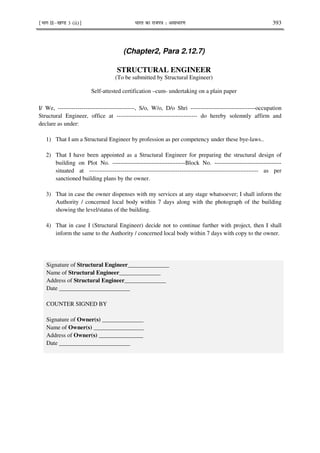
![394 THE GAZETTE OF INDIA : EXTRAORDINARY [PART II—SEC. 3(ii)]
(Chapter 2, Para 2.12.8)
SUPERVISOR
(To be submitted by Architect/Engineer/Supervisor)
Self-attested certification –cum- undertaking on a plain paper
I/ We, ---------------------------------------, S/o, W/o, D/o Shri ---------------------------------occupation
Supervisor, office at ----------------------------------------- do hereby solemnly affirm and declare as
under:
1) That I am an Architect/Engineer/Supervisor by profession as per competency under these bye-
laws.
2) That I have been appointed as an Architect/Engineer/Supervisor for supervising the
construction of building on Plot No. -------------------------------------Block No. --------------------
-------------- situated at --------------------------------------------------------------------------------------
as per sanctioned building plans by the owner.
3) That in case the owner dispenses with my services at any stage whatsoever; I shall inform the
Authority / concerned local body within 7 days along with the photograph of the building
showing the level/status of the building.
4) That in case I (Architect/Engineer/Supervisor) decide not to continue further with project, then
I shall inform the same to the Authority / concerned local body within 7 days with copy to the
owner.
Signature of Architect/Engineer/Supervisor ______________
Name of Architect/Engineer/Supervisor ______________
Address of Architect/Engineer/Supervisor ______________
Date ________________________
COUNTER SIGNED BY
Signature of Owner(s) ______________
Name of Owner(s) _________________
Address of Owner(s) _______________
Date ________________________](https://image.slidesharecdn.com/ubbl2016notified-250923161005-b0550c73/85/UBBL_2016_Notified_DDA-Building-Bye-laws-394-320.jpg)
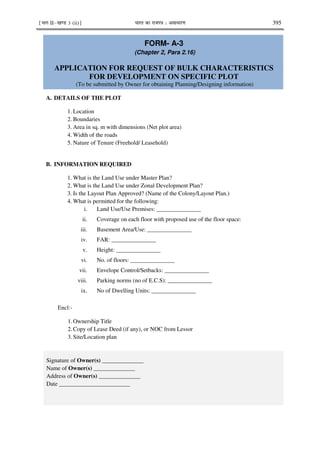
![396 THE GAZETTE OF INDIA : EXTRAORDINARY [PART II—SEC. 3(ii)]
FORM- A-4
(Chapter 2, Para 2.12.3)
CERTIFICATE OF STRUCTURAL SAFETY
(To be submitted by Structural Engineer and Owner)
The following certificate is to be submitted along with the building plans drawing while submitting
the plans for obtaining sanction of building permission for Building No. ____________________
on Plot no. ____________________ situated at ___________________________ Scheme
______________________________.
1) Certified that the building plans submitted to the Authority / concerned local body shall be
designed for safety requirements.
2) It is also certified that the structural design shall be based on National Building Code,
including safety from natural hazards, based on soil conditions (as per Soil Investigation
Report no….. dated …. prepared by ………………………………………..) will be taken into
consideration and would be duly incorporated in structural drawings of the building to be
constructed.
Signature of Structural Engineer______________
Name of Structural Engineer______________
Address of Structural Engineer______________
Date ________________________
COUNTER SIGNED BY
Signature of Owner(s) ______________
Name of Owner(s) _________________
Address of Owner(s) _______________
Date ________________________](https://image.slidesharecdn.com/ubbl2016notified-250923161005-b0550c73/85/UBBL_2016_Notified_DDA-Building-Bye-laws-396-320.jpg)
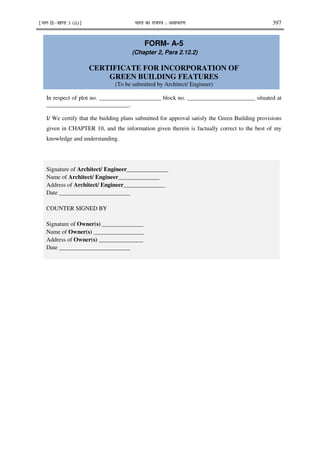
![398 THE GAZETTE OF INDIA : EXTRAORDINARY [PART II—SEC. 3(ii)]
FORM- A-6
(Chapter 2, Para 2.11, 2.12.4)
CERTIFICATE FOR SUPERVISION,
NO NUISANCE AND DEBRIS REMOVAL
(To be submitted by Owner / Supervisor)
To,
The __________________________
______________________________
New Delhi.
Madam/ Sir,
1. Certified that erection / re-erection, demolition or material alternation in and the drainage /
sanitary work shall be carried out/ executed by me under my supervision / of Building No.
____________________________on /in Plot and I/ We certify that all the materials (type and
grade) and workmanship of the work shall be in accordance with the specifications submitted
along with the work, and shall be carried out according to structural design approved in
sanctioned plans and which also includes the services like drainage, sanitary, water supply,
electrical and fire safety no non-Compounding deviations shall be carried out during the
course of construction.
2. Certified that the Debris during the construction will be removed on weekly basis. If the same
is not done, in that case local body shall remove the mulba/Debris and the cost with penalty be
recovered from me/us.
3. Certified that during construction I/we shall properly screen the construction site off the main
road by means of erecting a screen wall not less than 8 feet, in height from the ground level
which shall be painted to avoid unpleasant look from the road side. In addition to this, a net or
some other protective material shall be hoisted at the façade of the building to ensure that any
falling material remains within this protected area.
4. Certified that noise related activities would not be taken up for construction at night during 10
P.M to 6 A.M.
Signature of
Architect/Engineer/Project Manager/Structural Engineer/ Supervisor______________
Name ______________
Address ______________
Date ________________________
COUNTER SIGNED BY
Signature of Owner(s) ______________
Name of Owner(s) _________________
Address of Owner(s) _______________
Date ________________________](https://image.slidesharecdn.com/ubbl2016notified-250923161005-b0550c73/85/UBBL_2016_Notified_DDA-Building-Bye-laws-398-320.jpg)
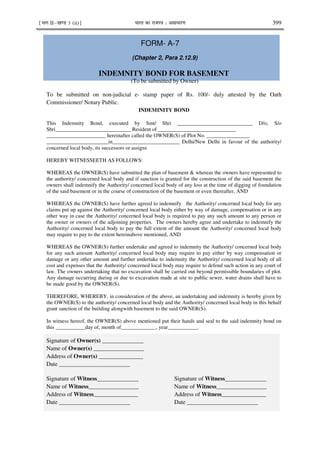
![400 THE GAZETTE OF INDIA : EXTRAORDINARY [PART II—SEC. 3(ii)]
FORM- B-1
(Chapter 2, Para 2.18.1, 2.19)
GRANT/ REFUSAL OF SANCTION
NAME OF THE AUTHORITY ____________________
File No. _________ Dated__________
To,
--------------------------------------
GRANT OF SANCTION
Dear Sir/Madam,
Sub: Sanction U/S 12 of the Delhi Development Act 1957
Dear Sir/Madam
With reference to your application dated …………………… for the grant of sanction to erect/ re-
erect/add to/alteration in the building to carry out the development specified in the said application
relating to Plot No. ………………. Pocket No. ……………. Block No. …………… Sector No.
………………. Situated in/at …………………. I have to state that the same has been sanctioned on
……………………… by the DDA subject to the following conditions and corrections made on the
plans:-
1. The plans are valid up to ……………………… day of month …………………… year
…………………….
2. The construction will be undertaken as per sanctioned plan only and no deviation from the
bye-laws will be permitted without prior sanction. Any deviation done against the bye-laws is
liable to be demolished and the supervising Architect, engaged on the job will run the risk of
having his license cancelled.
3. Violation of building bye-laws will not be compounded.
4. It will be duty of the owner of the plot and the Architect preparing the plan to ensure that the
sanctioned plans are as per prevalent building bye-laws. If any infringement of the bye-laws
remain unnoticed the DDA reserves the right to amend the plans as and when the
infringement comes to its notice and DDA will stand indemnified against any claim on this
account.
5. A notice in writing shall be sent to DDA before commencement of the erection of the
building as per bye-laws similar notice will be sent to DDA when the building has reached up
to plinth level.
6. The party shall not occupy or permit it to occupy the building or use permit the building or
part there of affected by any such work until occupancy certificate is issued by the Authority.](https://image.slidesharecdn.com/ubbl2016notified-250923161005-b0550c73/85/UBBL_2016_Notified_DDA-Building-Bye-laws-400-320.jpg)
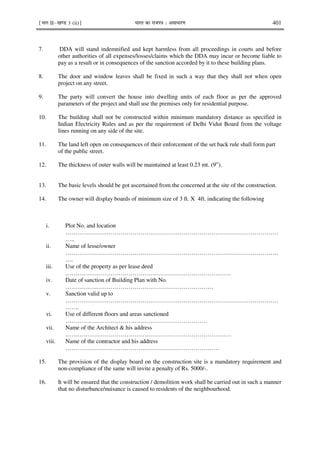
![402 THE GAZETTE OF INDIA : EXTRAORDINARY [PART II—SEC. 3(ii)]
17. It will be ensured by the owner and the Architect that during the construction the building
plans sanctioned shall satisfy the water harvesting requirement as well as waste water
recycling system for building with minimum anticipated discharge of 10,000 liters and above
per day of waste water as stipulated under these bye-laws (as notified in Gazette of India
dated 31.7.2001) and the information given there in (applicable on plots of 100 sqm. and
above.)
18. As per Notification No. 11011/9/98/-DDIV/(pt)/DDIB dated 21.11.01 of MOUD & PA, G.O.I
Form ‘C’ (Building Bye-Laws 7.2.2) and Form ‘D’ (Building Bye-Laws 7.2.3) will not be
applicable. However as per this Notification the owner through his Architect/Engineer/
Supervisor shall give notice to the DDA in the performa as per Form C-1 on completion of
work upto plinth level to enable DDA to ensure that work conform to the sanctioned building
plans and Building Bye-Laws. Further completion-cum-occupancy certificate will be applied
and obtained as per above Notification dated 21.11.2001.
19. The building shall be constructed strictly in accordance with the sanction plan as well as in
accordance with the certificate submitted jointly by the owner/Architect/Structural Engineer
for safety requirement as stipulated in Chapter 9 of these Building Bye-Laws, and the
structural Design including safety from any natural hazards duly incorporated in the design of
the building as per the Government Of India Notification bearing No SO-248 (E) dated
21.03.2001 and clause 9.1, 9.2.1, 9.2.2 and Annexure VII of this Bye Laws.
20. The mulba during the construction will be removed on weekly basis. If the same is not done,
in that case the local body shall remove the mulba and the cost shall be borne by the owner of
the plot.
21. During construction, it is mandatory on the part of the owner to properly screen the
construction site of the main road by means of erecting a screen wall not less than 8 ft. in
height from ground level which is to be painted to avoid unpleasant look from the road side.
In addition to this a net or some other protective material shall be hoisted at the facades or the
building to ensure that any falling material remains within the protected area.
22. Noise related activities will not be taken up for construction at night after 10.00 PM.
23.
(i) Every builder or owner shall put tarpaulin on scaffolding around the area of construction
and the building. No person including builder, owner can be permitted to store any
construction material particularly sand on any part of the street, roads in any colony.
(ii)The construction material of any kind that is stored in the site will be fully covered in all
respects so that it does not disperse in the air in any form.
(iii) The construction material and debris shall be carried in the trucks or other vehicles which
are fully covered and protected so as to ensure that the construction debris or the construction
material does not get dispersed into the air or atmosphere, in any form whatsoever.
(iv)The dust emissions from the construction site should be completely controlled and all
precautions taken in that behalf.
(v) The vehicles carrying construction material and construction debris of any kind should be
cleared before it is permitted to ply on the road after unloading of such material.
(vi) Every worker working on the construction site and involved in loading, unloading and
carriage of construction material and construction debris shall be provided with mask to
prevent inhalation of dust particles.](https://image.slidesharecdn.com/ubbl2016notified-250923161005-b0550c73/85/UBBL_2016_Notified_DDA-Building-Bye-laws-402-320.jpg)
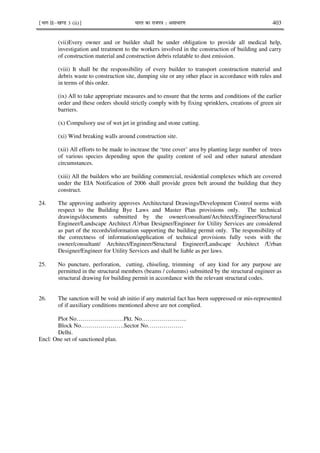
![404 THE GAZETTE OF INDIA : EXTRAORDINARY [PART II—SEC. 3(ii)]
REFUSAL OF SANCTION
With reference to your application No _______________ dated ______________ for the grant of
sanction for the erection of building/execution of work in House
No.___________ Plot No______________ Block
No____________________Scheme_________________ Situated at ____________________ I am
directed to inform you that the sanction has been refused on ------------ ____________ (date) on the
following grounds.
1
2
3
4
Yours Faithfully
For Authority / concerned local body _________________](https://image.slidesharecdn.com/ubbl2016notified-250923161005-b0550c73/85/UBBL_2016_Notified_DDA-Building-Bye-laws-404-320.jpg)

![406 THE GAZETTE OF INDIA : EXTRAORDINARY [PART II—SEC. 3(ii)]
FORM- C-1
(Chapter 2, Para 2.23.2)
INTIMATION OF COMPLETION OF WORK UP TO
PLINTH LEVEL
To,
_______________________
_______________________
_______________________
New Delhi.
This is to intimate that the Construction up to plinth/column up to plinth level has been completed
in Building No. _________________________________on/in Plot No.
______________________SchemeNo.___________________________Road/Street___________
___________Ward_________in accordance with permission/Letter
No._____________________dated______________ under my supervision and in accordance with
the sanction.
Yours faithfully,
Signature of Architect/Engineer/Supervisor______________________
Name (in Block Letters) _____________________
Address __________________________________
Dated ___________
Signature of the Owner
Name in Block Letters_______________________
Address: __________________________________
Date: _____________________________________](https://image.slidesharecdn.com/ubbl2016notified-250923161005-b0550c73/85/UBBL_2016_Notified_DDA-Building-Bye-laws-406-320.jpg)
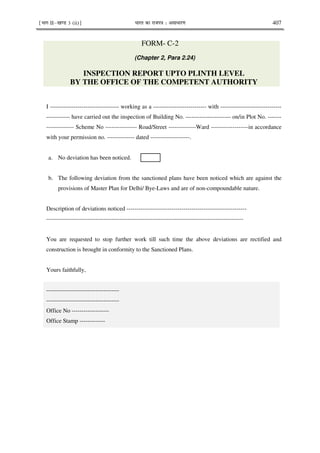
![408 THE GAZETTE OF INDIA : EXTRAORDINARY [PART II—SEC. 3(ii)]
FORM- D-1
(Chapter 2, Para 2.25.4[h])
INTIMATION OF BUILDING COMPLETION
To,
________________
New Delhi.
Sir,
We hereby certify that the erection / re-erection or material alternation in / at building no.
_______ on / in ________________Plot No. _____________ Block
No.__________________________ situated at _____________________scheme has been supervised
and has been completed on ________________ according to the plans sanctioned, vided office
communication no. _______________ date ________. The work has been completed to our
satisfaction, the workmanship and all the materials (type and grade) have been strictly in accordance
with general and detailed specifications.
2. Certificates:
i. Certified that the building(s) has been constructed according to the sanctioned plan and
structural design (one set of structural drawings as executed is enclosed) which
incorporate the provisions of structural safety as specified in relevant prevailing IS Codes
/ Standards / Guidelines.
ii. Further certified that detailed drawings and specifications of all services prepared by
engineer for utility services.
iii. It is also certified that construction has been done under supervision of Supervisor and
adheres to the drawings submitted and the records of supervision have been maintained.
3. Permission to occupy or use the building may be granted.
4. Any subsequent change from completion drawings will be the responsibility of the owners.
A) Signature of the Owner
Name in Block Letters_______________________
Address: __________________________________
Date: _____________________________________
B) Signature of Structural Engineer (Responsible for Structural Design)
Name in Block Letters _______________________
Address: __________________________________
Date: _____________________________________
C) Signature of Architect/ Engineer/ Supervisor (Responsible for Architectural Design)
Name in Block Letters _______________________
Address: __________________________________
Date: _____________________________________
D) Signature of the Supervisor (Responsible for supervision of the construction)
Name in Block Letters _______________________
Address: __________________________________
Date: _____________________________________](https://image.slidesharecdn.com/ubbl2016notified-250923161005-b0550c73/85/UBBL_2016_Notified_DDA-Building-Bye-laws-408-320.jpg)
![¹Hkkx IIµ[k.M 3 (ii)º Hkkjr dk jkti=k % vlk/kj.k 409
FORM- D-2
(Chapter 2, Para 2.26.3[a])
COMPLETION CUM OCCUPANCY CERTIFICATE
Name of the Authority_________________________________
File No.__________________________ Dated: ____________
Plan No.________________________
To,
Shri/ Miss/Smt.___________________ (OWNER[S])
________________________________
With reference to your notice of completion dated _____________, I hereby certify that the
building as per description below and certified plans of _____________________________
whose LOP & Bldg. plans were sanctioned vide letter No.
____________________________________dated ___________ and completion certificate
as approved by DUAC/DFS and other statutory bodies, the NOC has been approved on
_______________. The site has been inspected with reference to Building Bye-Laws, MPD
provisions, hygienic and sanitary conditions inside and in the surroundings and is declared
fit for occupation.
The approving Authority approves Architectural Drawings/Development Control
norms with respect to the Building Bye Laws and MPD provisions only. The technical
drawings/documents submitted by the owner/consultant/Architect/Engineer/Structural
Engineer/Landscape Architect /Urban Designer/Engineer for Utility Services are considered
as part of the records/information supporting the building permit only. The responsibility of
the correctness of information/application of technical provisions fully vests with the
owner/consultant/ Architect/Engineer/Structural Engineer/Landscape Architect /Urban
Designer/Engineer for Utility Services and shall be liable as per laws.
The structural stability of the building is based on the certificate given jointly by the
Owner/Architect/Structural Engineer along with one set of Structural Drawings,
incorporating therein the provisions of Structural Safety as specified in the relevant
prevailing IS Codes/Standards/Guidelines stated in the Government of India Notification
bearing No.SO-248(E) dated 21.3.2001 and clause 9.1, 9.2.1, 9.2.2 and Annexure VII of this
Bye Laws.. For the fire-safety the same has been based on the clearance given by the Chief
Fire Officer, Government of NCT of Delhi. The Authority/Local Body shall not have any
responsibility for any loss caused to the building from any natural hazard / calamity.
Completion Certificate is issued for Plot No.________________________________as
per enclosed drawings.
Yours Faithfully
Name of the authority/ concerned local body_________________](https://image.slidesharecdn.com/ubbl2016notified-250923161005-b0550c73/85/UBBL_2016_Notified_DDA-Building-Bye-laws-409-320.jpg)
![410 THE GAZETTE OF INDIA : EXTRAORDINARY [PART II—SEC. 3(ii)]
FORM- D-3
(Chapter 2, Para 2.26.3[b])
REJECTION OR COMPLIANCE IN RESPECT OF
OCCUPANCY CERTIFICATE
File No._________________________ Dated: _____________________
Sh./Smt.____________________________
_____________________________
Subject: Occupancy Certificate in respect of Plot No_______________ Block No.
________________ Scheme _____________________.
Dear Sir / Madam,
1) With reference to your letter dated ___________________
2) With reference to your notice of completion dated __________________
3) In continuation of this office letter of even no. _________________ dated on the subject noted
above, I am directed to inform you that your case has been examined and occupancy certificate is
rejected for the reasons as given below:-
I am directed to request you to comply with the following: -
(a) SUBMISSION OF THE FOLLOWING DOCUMENTS
(1)
(2)
(b) RECTIFICATION OF THE FOLLOWING DEVIATIONS
(1)
(2)
(c) The following item can be regularized on payment of compounding fee noted against each
Sl.
No
Item Rate of compounding Fee
(in Rs.)
Amount of
Compounding Fee
(in Rs.)
1.
2.
3.
Total Compounding Fee Rs. -------------------------------------
a. Cheque/ Demand Draft/ Online Payment/ Cash payment will be accepted on all working days.
b. You are, therefore requested to do the needful by ---------------------- failing which your
request for the issue of Occupancy Certificate will be rejected without any further reference to
you and necessary action under the law will be initiated.
c. Please quote your file number while sending the reply of the letters
Yours Faithfully](https://image.slidesharecdn.com/ubbl2016notified-250923161005-b0550c73/85/UBBL_2016_Notified_DDA-Building-Bye-laws-410-320.jpg)
![¹Hkkx IIµ[k.M 3 (ii)º Hkkjr dk jkti=k % vlk/kj.k 411
Yours Faithfully
Name of the authority/ concerned local body_________________
Name of the Authority / concerned local body________________
FORM- D-4
(Chapter 2, Para 2.27)
REGULERISATION CERTIFICATE
Name of the Authority_________________________________
File No.__________________________ Dated: ____________
Plan No.________________________
To,
Shri/ Miss/Smt.___________________ (OWNER[S])
________________________________
With reference to your notice of regularization dated-----------------I hereby certify that
building, as per description below and enclosed certified plan/s at Plot No---------------Block No ---
---------- Scheme -------------------------------------------------------------- has been inspected with
reference to Building Bye-law and MPD provisions is declared regularized (building/ or part
thereof).
The approving authority approves Regularization Plan/s with respect to the Building Bye
Laws and MPD provisions only. The technical drawings/documents submitted by the
owner/consultant/Architect/Engineer/Structural Engineer/Landscape Architect /Urban
Designer/Engineer for Utility Services for regularization are considered as part of the
records/information supporting the building permit only. The responsibility of the correctness of
information/application of technical provisions fully vests with the owner/consultant/
Architect/Engineer/Structural Engineer/Landscape Architect /Urban Designer/Engineer for Utility
Services and shall be liable as per laws.
The structural stability of the building is based on the certificate given jointly by the
Owner/Architect/Structural Engineer along with one set of Structural Drawings, incorporating
therein the provisions of Structural Safety as specified in the relevant prevailing IS
Codes/Standards/Guidelines stated in the Government of India Notification bearing No.SO-248(E)
dated 21.3.2001 and clause 9.1, 9.2.1, 9.2.2 and Annexure VII of this Bye Laws.. For the fire-
safety the same has been based on the clearance given by the Chief Fire Officer, Government of
NCT of Delhi. The Authority/Local Body shall not have any responsibility for any loss caused to
the building from any natural hazard / calamity. The description of the construction work
regulerised is given as under:
DESCRIPTION OF CONSTRUCTION WORK BLOCK WISE/BUILDING WISE
1. Block/Building No.
2. Details of regularised work floor wise.](https://image.slidesharecdn.com/ubbl2016notified-250923161005-b0550c73/85/UBBL_2016_Notified_DDA-Building-Bye-laws-411-320.jpg)
![412 THE GAZETTE OF INDIA : EXTRAORDINARY [PART II—SEC. 3(ii)]
ANNEXURE - I
1.0 QUALIFICATION AND COMPETENCE OF PROFESSIONALS (Please refer clause 2.13 of
this document)
1.1 Essential requirements:-Every building/development work for which permission is sought
shall be planned, designed and supervised by registered professionals. The registered
professionals for carrying out the various activities shall be (a) Architect, (b) Engineer, (C)
Structural engineer, (d) Supervisor, (e) Town Planner, (f) Landscape Architect, (g) Urban
Designer, and Utility Service Engineer. Requirements of registration for various
professionals by the authority / concerned local body / the Body governing such profession
constituted under a statute, if any, applicable to practice within the authority / local body
jurisdiction, to carry out various activities, is given below:-
1.2 Requirements for Registration and Competence of Professionals:
a. Architect: The minimum qualification for an architect shall be the qualifications as provided
in the Architects Act, 1972, for registration with Council of Architecture
Competence: - The registered architect shall be competent to carry out the work related to the
building/development permit as given below:
1. All plans and information connected with building permit
2. Issuing certificate of supervision and completion pertaining to architectural aspects.
3. Preparation of sub- division plans and related information connected with
development permit of area up to 1 hectare.
4. Issuing certificate of supervision for development of land of area up to 1 hectare.
b. Engineer: The minimum qualifications for an engineer shall be graduate in civil engineering/
architectural engineering of recognized Indian or foreign university, or the Member of Civil
Engineering Division/ Architectural Engineering or recognized Indian or foreign university, of the
Institution of Engineers (India) or the statutory body governing such profession, if any.
Competence: The engineer shall be competent to carry out the work related to the
building/development permit as given below:
1. All plans and information connected with building permit on plots upto 500 sq.m.
2. Structural details and calculations of buildings on plot up to 500sq.m and 15 m in
height.
3. Issuing certificate of supervision and completion of all buildings.
4. Preparation of all service plans and related information connected with development
permit; and
5. Issuing certificate of supervision for development of land of all areas
c. Structural Engineer: The minimum qualifications for a structural engineer shall be graduate
in civil engineering of recognized Indian or foreign university, or Corporate Member of Civil
Engineering Division of Institution of Engineers (India), and with minimum 3 years’ experience in
structural engineering practice with designing and field work.
Note: The 3 years experience shall be relaxed to 2 years in the case of post-graduate degree of
recognized Indian or foreign university in the branch of structural engineering. In case of
doctorate in structural engineering, the experience required would be one year.
Competence: The structural engineer shall be competent to prepare the structural design,
calculations and details for all buildings and its supervision. In case of buildings having special
structural features, as decided by the Authority / concerned local body, which are within the
horizontal areas and vertical limits specified in competence of Engineer (2) and competence of
Supervisor (1) shall be designed only by Structural Engineers.](https://image.slidesharecdn.com/ubbl2016notified-250923161005-b0550c73/85/UBBL_2016_Notified_DDA-Building-Bye-laws-412-320.jpg)
![414 THE GAZETTE OF INDIA : EXTRAORDINARY [PART II—SEC. 3(ii)]
2. HVAC (Heating, Ventilation and Air Conditioning) Engineer: The minimum
qualification for a HVAC (Heating, Ventilation and Air Conditioning) Engineer shall be
graduate in Mechanical Engineering of recognized Indian or foreign university, or the
Member of Mechanical Engineering Division of recognized Indian or foreign university,
of the Institution of Engineers (India) or the statutory body governing such profession, if
any with three years’ experience in Mechanical Engineering practices with designing
(HVAC) and field work.
Competence: The HVAC Engineer shall be competent to plan and design the scheme,
prepare estimate, install and monitor the various Heating, Ventilation and Air
Conditioning Services for buildings.
3. Electrical Engineer: The minimum qualification for an Electrical Engineer shall be
graduate in Electrical Engineering of recognized Indian or foreign university, or the
Member of Electrical Engineering Division of recognized Indian or foreign university, of
the Institution of Engineers (India) or the statutory body governing such profession, if
any with three years experience in Electrical Engineering practices with designing and
field work.
Competence: The Electrical services engineer shall be competent to plan and design the
scheme, install and monitor the various Electrical and allied installations, installation of
lifts, escalators etc. for buildings.
i. Quality Auditor: The minimum qualification for quality auditor shall be a bachelor degree in
Civil Engineering or equivalent with five years’ experience in testing of building materials
including concrete and/or experience in quality control work with a reputed construction agency
or Master degree in Civil Engineering or equivalent with two years’ experience as above or
Architect or equivalent with a degree or diploma in Construction Management and five years of
experience in quality control aspects of construction.
The experience as stated above shall be under one or more registered quality inspector/s of in
quality work under one or more reputed construction agencies of minimum ten years of standing
from within or outside the area of jurisdiction of the Competent authority/ concerned local body.
Competence: The empanelled quality auditor shall be competent to carry out the construction
work of a high-rise building, under an independent quality inspection programme and prepare all
reports and other submissions only be signed by Quality Auditor.
j. Geo- Technical Engineer: The minimum qualification for Geo- Technical Engineer shall be
M.E. (or equivalent) in Geo-technical engineering from recognized Indian or foreign university
with minimum 10 years of experience. The experience as stated shall be under one or more Geo-
technical Agency. Such agencies shall be of minimum ten years of standing.
Competence: The Geo- Technical engineer shall be competent to carry out the work related to
the building permit as given below:
1. To carry out soil investigation at proposed locations as per specifications of
Structural Engineer.
2. To recommend various types of foundation for proposed structure and loading with
supporting calculations.
3. To enable Structural Engineer to take site decision in case soil strata is different
than soil investigation report.
4. To list out precautionary measures so that there is no damage to adjacent property.
k. Group or Agency: When an agency or group comprising of qualified architect/engineer is
practicing, then the qualifications and competence of work will be combination of the individual
qualification and competence, given under 1.2 (a) of this annexure – for Architects and 1.2 (b) –
for Engineers respectively and the agency shall be duly empaneled by the Authority / concerned
local body.
Note: All the above professionals (except Architects) need to empanel themselves with Authority
/ concerned local body as the case may be.](https://image.slidesharecdn.com/ubbl2016notified-250923161005-b0550c73/85/UBBL_2016_Notified_DDA-Building-Bye-laws-414-320.jpg)
![416 THE GAZETTE OF INDIA : EXTRAORDINARY [PART II—SEC. 3(ii)]
1.3 Restrictions on Development /Re-development / Repairs etc.
(i) No development or redevelopment or engineering operation or additions/ alterations, repairs,
renovations including painting of the building, replacement of special features or plastering
or demolition of any part thereof of the said listed buildings or listed precincts or listed
natural feature areas shall be allowed except with the prior permission of Commissioner,
MCD, Vice Chairman DDA/Chairman NDMC. Before granting such permission, the agency
concerned shall consult the Heritage Conservation Committee to be appointed by the
Government and shall act in accordance with the advice of the Heritage Conservation
Committee.
(ii) Provided that, before granting any permission for demolition or major alterations / additions
to listed buildings (or buildings within listed streets or precincts, or construction at any listed
natural features, or alternation of boundaries of any listed natural feature areas, objections
and suggestions from the public shall be invited and shall be considered by the Heritage
Conservation Committee.
(iii) Provided that, only in exceptional cases, for reasons to be recorded in writing, the
Commissioner, MCD/Vice Chairman DDA /Chairman NDMC may refer the matter back to
the Heritage Conservation Committee for reconsideration.
However, the decision of the Heritage Conservation Committee after such reconsideration
shall be final and binding.
1.4 Penalties: Violation of the regulations shall be punishable under the provisions
regarding unauthorized development. In case of proved deliberate neglect of and/ or damage to
Heritage Buildings and Heritage precincts, or if the building is allowed to be damaged or destroyed
due to neglect or any other reason, in addition to penal action provided under the concerned Act, no
permission to construct any new building shall be granted on the site if a Heritage Building or
Building in a Heritage Precinct is damaged or pulled down without appropriate permission from
Commissioner, MCD/Vice Chairman DDA/Chairman NDMC.
It shall be open to the Heritage Conservation Committee to consider a request for re-
building/reconstruction of a Heritage Building that was unauthorized demolished or damaged,
provided that the total built-up area in all floors put together in such new construction is not in excess
of the total built up area in all floors put together in the original Heritage Building in the same form
and style in addition to other controls that may be specified.
1.5 Preparation of List of Heritage Sites including Heritage Buildings, Heritage Precincts and
Listed Natural Features Areas: Preparation of List of Heritage Sites including Heritage Buildings,
Heritage Precincts and Listed Natural Features Areas is to be prepared and supplemented by the
Commissioner MCD/ Vice-Chairman DDA/Chairman NDMC on the advice of the Heritage
Conservation Committee. Before being finalized, objections and suggestions of the public are to be
invited and considered. The said list to which the regulation applies shall not form part of this
regulation for the purpose of Building Bye-laws. The list may be supplemented from time to time by
Government on receipt of proposal from the agency concerned or by Government suo moto provided
that before the list is supplemented, objections and suggestions from the public be invited and duly
considered by the Commissioner, MCD/ Vice-Chairman DDA/Chairman NDMC and/or Government
and/or Heritage Conservation Committee.
When a building or group of building or natural feature areas are listed it would automatically
mean (unless otherwise indicated) that the entire property including its entire compound/plot
boundary along with all the subsidiary structures and artifacts, etc. within the compound/plot
boundary, etc. shall form part of list.
1.6 Alteration/Modification/Relaxation in Development Norms: On the advice of the said
Heritage Conservation Committee to be appointed by the Government and for reasons to be recorded
in writing, the Commissioner, MCD/ Vice-Chairman DDA/Chairman NDMC shall follow the
procedure as per DDA Act, 1957 to alter, modify or relax the Development Control Norms prescribed](https://image.slidesharecdn.com/ubbl2016notified-250923161005-b0550c73/85/UBBL_2016_Notified_DDA-Building-Bye-laws-416-320.jpg)
![418 THE GAZETTE OF INDIA : EXTRAORDINARY [PART II—SEC. 3(ii)]
Listing does not prevent change of ownership or usage. However, change of use of such Listed
Heritage Building/Listed Precincts is not permitted without the prior approval of the Heritage
Conservation Committee. Use should be in harmony with the said listed heritage site.
Grade I Grade-II Grade-III
(A) Definition
Heritage Grade-I comprises
buildings and precincts of
national or historic
importance, embodying
excellence in architectural
style, design, technology and
material usage and/ or
aesthetics; they may be
associated with a great
historic event, personality,
movement or institution.
They have been and are the
prime landmarks of the
region. All natural sites shall
fall within Grade-I.
(B) Objective: Heritage
Grade-I richly deserves
careful preservation.
(C ) Scope for Changes:
No interventions be
permitted either on exterior
or interior of the heritage
building or natural features
unless it is necessary in the
interest of strengthening and
prolonging, the life of the
buildings/or precincts or any
part or features thereof. For
this purpose, absolutely
essential and minimum
changes would be allowed
and they must be in
conformity with the original.
(D)Procedure: Development
permission for the changes
would be given on the advice
of the Heritage Conservation
Committee.
(E) Vistas/ Surrounding
Development:
All development in areas
surrounding Heritage Grade-
I shall be regulated and
controlled, ensuring l that it
does not mar the grandeur of,
or view from Heritage
Grade-I
Heritage Grade-II (A&B)
comprises of buildings and
precincts of regional or local
importance possessing special
architectural or aesthetic merit, or
cultural or historical significance
though of a lower scale in
Heritage Grade-I. They are local
landmarks, which contribute to
the image and identify of the
region. They may be the work of
master craftsmen or may be
models of proportion and
ornamentation or designed to suit
a particular climate.
Heritage Grade-II deserves
intelligent conservation.
(Grade-II (A) Internal changes
and adaptive re-use may by and
large be allowed but subject to
strict scrutiny. Care would be
taken to ensure the conservation
of all special aspects for which it
is included in Heritage Grade-II
Grade-II (B) In addition to the
above, extension or additional
building in the same plot or
compound could in certain
circumstances, be allowed
provided that the extension/
additional building is in harmony
with ( and does not detract from)
the existing heritage building(s)
or precincts especially in terms of
height and façade.
Development permission for the
changes would be given on the
advice of the Heritage
Conservation Committee.
All development in areas
surrounding Heritage Grade-II
shall be regulated and controlled,
ensuring l that it does not mar the
grandeur of, or view from
Heritage Grade-II
Heritage Grade-III comprises building and
precincts of importance for townscape; that
evoke architectural, aesthetic or sociological
interest though not as much as in Heritage
Grade-II. These contribute to determine the
character of the locality and can be
representative of lifestyle of la particular
community or region and may also be
distinguished by setting, or special character
of the façade and uniformity of height, width
and scale.
Heritage Grade-III deserves intelligent
conservation (though on a lesser scale than
Grade-II and special protection to unique
features and attributes)
Heritage Grade-III deserves intelligent
conservation (though on a lesser scale than
Grade-II and special protection to unique
features and attributes).
Internal changes and adaptive re-use may by
and large be allowed. Changes an include
extensions and additional buildings in the
same plot or compound. However, any
changes should be such that they are in
harmony with and should be such that they
do not detract from the existing heritage
building/precinct.
Development permission for the changes
would be given on the advice of the Heritage
Conservation Committee.
All development in areas surrounding
Heritage Grade-III shall be regulated and
controlled, ensuring l that it does not mar the
grandeur of, or view from Heritage Grade-III](https://image.slidesharecdn.com/ubbl2016notified-250923161005-b0550c73/85/UBBL_2016_Notified_DDA-Building-Bye-laws-418-320.jpg)
![420 THE GAZETTE OF INDIA : EXTRAORDINARY [PART II—SEC. 3(ii)]
(iii) To frame special regulations/ guidelines for precincts and if necessary for natural feature
areas to advise the Commissioner, MCD/ Vice-Chairman DDA/Chairman, NDMC
regarding the same;
(iv) To advise whether to allow commercial / office/hotel use in the (name the areas) and
when to terminate the same;
(v) To advise the Commissioner, MCD/ Vice-Chairman DDA/Chairman, NDMC in the
operation of this Building Bye-law to regulate or eliminate/erection of outside
advertisements/ bill boards/street furniture;
(vi) To recommend to the Commissioner, MCD/ Vice-Chairman DDA/Chairman, NDMC
guidelines to be adopted by those private parties or public/ government agencies who
sponsor beautification schemes at heritage sites;
(vii) To prepare special designs and guidelines/ publications for listed buildings, control of
height and essential façade characteristics such as maintenance of special types of
balconies and other heritage items of the buildings and to suggest suitable designs
adopting appropriate materials for replacement keeping the old form intact to the extent
possible;
(viii) To appear guidelines relating to design elements and conservation principles to be
adhered to and to prepare other guidelines for the purposes of this Regulation;
(ix) To advise the Commissioner, MCD/ Vice-Chairman DDA/Chairman, NDMC on any
other issues as may be required from time to time during the course of scrutiny of
development permissions and in overall interest of heritage/conservation;
(x) To appear before the Government either independently or through or on behalf of the
Commissioner, MCD/ Vice-Chairman DDA/Chairman, NDMC in cases of Appeals under
DDA/MCD/NDMC Act in cases of listed buildings / heritage buildings and listed
precincts/ heritage precincts and listed natural feature areas.
1.16 Implications of Listing as Heritage Buildings: The Regulations do not amount to
any blanket prevention of demolition or of changes to Heritage Buildings. The only requirement
is to obtain clearance from Commissioner, MCD/ Vice-Chairman DDA/Chairman, NDMC and
Heritage Conservation Committee from heritage point of view.
1.17 Ownership not affected: Sale and purchase of Heritage Buildings does not require any
permission from Municipal Corporation of Delhi / Delhi Development Authority/ New Delhi
Municipal Council or Heritage Conservation Committee. The Regulations do not affect the
ownership or usage. However, such usage should be in harmony with the said listed precincts/
buildings.](https://image.slidesharecdn.com/ubbl2016notified-250923161005-b0550c73/85/UBBL_2016_Notified_DDA-Building-Bye-laws-420-320.jpg)
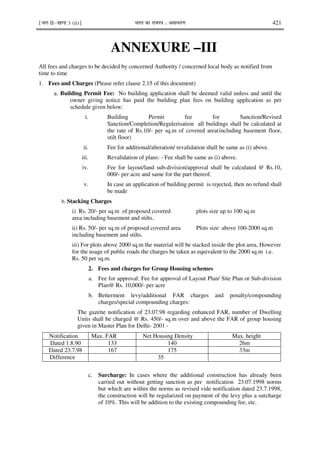
![422 THE GAZETTE OF INDIA : EXTRAORDINARY [PART II—SEC. 3(ii)]
2.1.1 Fees for Inspection and completion
a. Notice for inspection of completion work up to plinth level shall be
accompanied with fee of Rs.500/- Please refer Form C-1
b. Application for completion certificate shall be accompanied with fee of Rs.
10/- per sq.m of covered area.
c. Pre-occupancy charges: - Pre-occupancy charge @ Rs. 25,000/- per
dwelling unit in case of group housing.
For Commercial building @ Rs. 2000/- per sq.m
For Institutional/Govt./Others@ Rs. 500/- per sq.m
Note:
a. Fees & Charges are to be determined by the Authority / concerned local body from time to time and
shall be payable by applicant/Owner.
b. Charges for compoundable deviations shall be as per Annexure IV.
c. Charges applicable for compoundable construction shall be as per Development Code clause 3(12) of
MASTER PLAN for DELHI 2021 (Chapter-17) [Building Bye laws- Annexure IV, Clause 3(12)].
2.1.2 Peripheral charges:- Peripheral charges are to be paid by plot owner of Co-operative
House Building Society Group IV for laying of such services by the DDA @ Rs. 70/-(in
view of Hon’ble Court orders and consequent office order No. 80 dated. 12.06.03) per
sq.m of net plot area at the time of sanction of building plans. Also, individual plot owner
will submit an undertaking in the prescribed format for deposition of peripheral charges, at
the time of submission of Building Plans. Please refer
Form A-11
3. Betterment charges for additional construction at Terrace: - As per Notification No.K-
12016/10/82-DD IIA dt.10.08.83, the permission of construction at terrace as a dwelling
unit was permitted, provided the intending builders deposit betterment charges@150/-per
sq.m of built up area either at the time of sanction of building plans or regularization of
structure at the time of issue of completion/occupancy certificate. The betterment charges
are levied for coverage beyond 25% and in case of provision of regular dwelling unit
proposed even with 25% and in case of provision of regular dwelling unit proposed even
with 25% coverage, full betterment charges are levied.
4. Additional FAR charges: - Means levy payable on the additional FAR allowed @ Rs.
450/- per sq.m to be calculated for additional FAR, applicable on individual residential
plot vide Notification No. K-12016/5/79-DD IIA/VA/IB dated. 23.07.98 over and above
the FAR applicable vide Notification No. K-12016/5/79-DD IIA/IB dated. 15.05.95 which
is shown in Table 1 below:
Table 1: The details of additional FAR applicable on individual residential plots are given in the following table
S.
No.
Area of the Plot
(Sq. m)
FAR as per
Notification dated
23.07.98
FAR as per
Notification dated
15.05.95
Difference
(FAR to be charged)
1 Below 32 225 150 75
2. Above 32 to 50 225 150 75
3. Above 50 to 100 225 180 45
4. Above 100 to 250 200 160 40
5.(a) Above 250 to 500 150 140 10
(b) Above 500 to 750 120 100 20
6. Above 750 to 1000 100 83 17
7. Above 1000 to 1500 100 83 17
8. Above 1500 to 2250 100 83 17
9. Above 2250 to 3000 100 83 17](https://image.slidesharecdn.com/ubbl2016notified-250923161005-b0550c73/85/UBBL_2016_Notified_DDA-Building-Bye-laws-422-320.jpg)
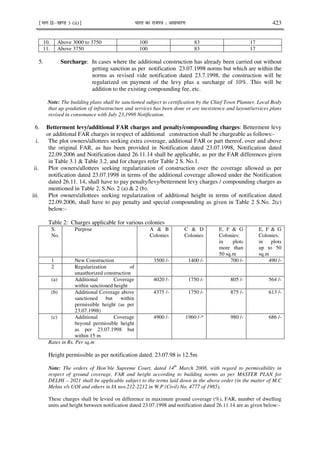
![424 THE GAZETTE OF INDIA : EXTRAORDINARY [PART II—SEC. 3(ii)]
Table 3.1: Difference of FAR for various plot sizes (between Notification dt 23.07.98 and Notification dt.
22.09.06)
Table 3.2: Difference of FAR for various plot sizes (between Notification dt 22.09.06 and Notification dt.
26.11.14)
Note: All fees and charges to be decided by concerned Authority / concerned local body as notified
from time to time. Notwithstanding anything contained in this Annexure, in case of any repugnancy
between the provisions of this Annexure and provisions of concerned authority/ local body, the
provisions of concerned authority/ local body shall prevail over this Annexure.
S. No. Area of the Plot
(Sq. m.)
FAR as per
Notification dt
23.07.98
FAR as per
Notification dt.
22.09.06
Difference
(FAR to be
charged)
1 Below 32 225 350 125
2. Above 32 to 50 225 350 125
3. Above 50 to 100 225 350 125
4. Above 100 to 250 200 300 100
5. Above 250 to 500 150 225 75
6. Above 500 to 1000 120 150 30
7. Above 1000 to 1500 100 120 20
8. Above 1500 to 2250 100 120 20
9. Above 2250 to 3000 100 120 20
10. Above 3000 to 3750 100 120 20
11. Above 3750 100 120 20
S. No. Area of the Plot
(Sq. m.)
FAR as per
Notification dt.
22.09.06
FAR as per
Notification dt.
26.11.14
Difference
(FAR to be
charged)
1 Below 32 350 350 NIL
2. Above 32 to 50 350 350 NIL
3. Above 50 to 100 350 350 NIL
4. Above 100 to 250 300 300 NIL
5(a) Above 250 to 500 225 225 NIL
5(b) Above 500 to 750 150 225 75
6. Above 750 to 1000 150 200 50
7. Above 1000 to 1500 120 200 80
8. Above 1500 to 2250 120 200 80
9. Above 2250 to 3000 120 200 80
10. Above 3000 to 3750 120 200 80
11. Above 3750 120 200 80](https://image.slidesharecdn.com/ubbl2016notified-250923161005-b0550c73/85/UBBL_2016_Notified_DDA-Building-Bye-laws-424-320.jpg)
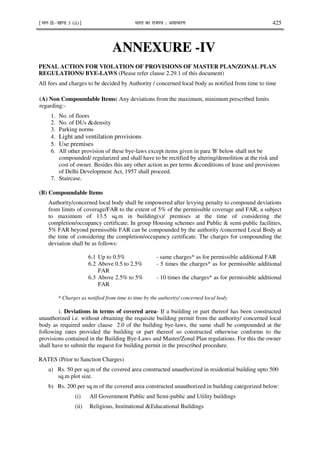
![426 THE GAZETTE OF INDIA : EXTRAORDINARY [PART II—SEC. 3(ii)]
c) Rs. 500 per sq. m of the covered area constructed unauthorized
(i) Residential buildings above 500 sq. m plot size, Group Housing & Guest Houses
(ii) Industrial Buildings:
(iii)Storage buildings (underground or above ground)
d) Rs. 2000 per sq. m of the covered area constructed unauthorized:
(i) Commercial & Business Buildings
(ii) Cinema & Theatre Buildings
(iii)Petrol Pumps (filling/Service Stations)
(iv) Hazardous Building
Note: a. The building not covered specifically under the above categories shall be compounded
as decided by the authority/ concerned local body, considering the merit of each individual
case.
b. Item which are exempted from the calculations of the coverage and FAR e.g. cup-
boards, canopy, basement &mezzanine, loft, watchman cabins etc. but constructed
unauthorized without obtaining prior permission from the authority/ concerned local
body, but within the permissible limits shall also be compounded/ regularized at the
rate prescribed above.
c. Compounding at setback infringements
The infringement of the setback maximum to the extent of 0.3 m may be compounded by
the way of levying compounding fees at the following rates:
ii. Deviations of the building bye-laws other than as specified in (A) (Non-
Compoundable).
Deviations up to the maximum extent of 10% from the maximum/minimum prescribed limit
(as prescribed by the building bye-laws) shall be compounded at the following rates:-
a. In case of deviations of areas of various components of the buildings, the rate of
penalty will be @ Rs.100/- per 1 % of deviation.
b. For deviations in terms of height the penalty shall be @ Rs. 100/ -per 1 % of deviation'
for every 10 sq.m or part there of the affected area.
c. Deviations from the prescribed limit of width: length penalty shall be @ Rs. 100/- per
1 % of the deviation for every 10 sq. m or part there of the affected area.
Notes:
1. Notwithstanding the provisions above, no penalty shall be levied for the first
3% of deviation but in case deviation limit exceed 3% penalty shall be levied
at the above rates for the total deviation up to 10%.
2. The penalties at the above rates as given in ii (a), (b) &(c) shall be charged
for each deviation and for every component of the building separately.
d. In case of increase in size of canopy in front open space from the prescribed limits of
bye-laws, the same shall be charged @ Rs. 200/- per sq. m.
Infringements Residential Buildings Non-Residential Buildings
Up to 0.15 m Rs. 1000 per sq. m of the area
infringing the set back
Rs. 2500 per sq. m of the
area infringing the set back
above 0.15 m Rs. 2500 per sq. m of the area
infringing the set back
Rs. 5000 per sq. m of the
area infringing the set back](https://image.slidesharecdn.com/ubbl2016notified-250923161005-b0550c73/85/UBBL_2016_Notified_DDA-Building-Bye-laws-426-320.jpg)
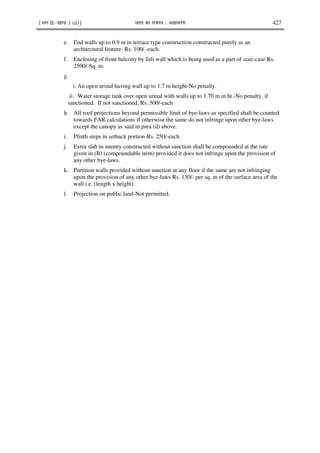
![428 THE GAZETTE OF INDIA : EXTRAORDINARY [PART II—SEC. 3(ii)]
ANNEXURE-V
DELHI FIRE SERVICE RULES, 2010 UNDER DELHI FIRE SERVICE ACT, 2007
6.3.1.1 Rule 27: Classes of occupancies likely to cause a risk of fire (Please refer clause 2.8 and
9.3 of this document)
(1) The following classes of occupancies for the purposes of sub-section (1) of section 25 of the Act
shall be construed to likely cause a risk of fire, namely:-
a) Pandal having seating capacity more than 50 persons or covered area more than 50 sq.m
b) Residential buildings (other than hotels and guest houses) having height more than 15 meters
or having ground plus four upper stories including mezzanine floor.
c) Hotels and guest houses having height more than 12 meters having ground plus three upper
stories including mezzanine floor.
d) Educational buildings having height more than 9 meters or having ground plus two upper
stories including mezzanine floor.
e) Institutional buildings having height more than 9 meters or having ground plus two upper
stories including mezzanine floor.
f) All Assembly buildings.
g) Business buildings having height more than 15 meters or having ground plus four upper
stories including mezzanine floor.
h) Mercantile buildings having height more than 9 meters or having ground plus two upper
stories including mezzanine floor.
i) Industrial buildings having covered area on all floors more than 250 sq.m
j) Storage buildings having covered area on all floors more than 250 sq.m
k) All Hazardous buildings having covered area on all floors more than 100 sq.m
6.3.1.2 Rule 33: Minimum standards for fire prevention and fire safety for buildings(Bye laws:
2.8, 9.3)
(2) The minimum standards for fire prevention and fire safety for buildings as may be applicable
with reference to the height of the building and class of occupancy for the purposes of
section 32 and section 35 of the Act shall be as are provided in the building bye-laws or
National Building Code of India 2005 relating to the following matters:-
a. Access to building
b. Number, Width, Type and Arrangement of exits.
c. Protection of Exits by means of fire checks door (s) and or pressurization.
d. Compartmentation.
e. Smoke Management System.
f. Fire Extinguishers.
g. First-Aid Hose Reels.
h. Automatic fire detection and alarming system.
i. MOEFA.
j. Public Address System.
k. Automatic Sprinkler System.
l. Internal Hydrants and Yard Hydrants.
m. Pumping Arrangements.
n. Captive Water Storage for firefighting.
o. Exit Signage.
p. Provision of Lifts.
q. Standby power supply
r. Refuge Area.
s. Fire Control Room
t. Special Fire Protection Systems for Protection of special Risks,:](https://image.slidesharecdn.com/ubbl2016notified-250923161005-b0550c73/85/UBBL_2016_Notified_DDA-Building-Bye-laws-428-320.jpg)
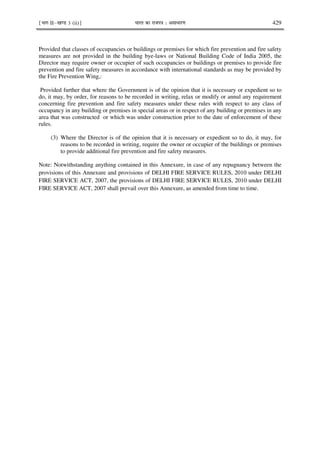
![430 THE GAZETTE OF INDIA : EXTRAORDINARY [PART II—SEC. 3(ii)]
ANNEXURE -VI
!
!
!
! "#"$%
"#"$%
"#"$%
"#"$%
& '
& '
& '
& '6
6
6
6
MPD 2021, provides the guide for the preparation of Layout Plans under the various regulations
including norms for facilities and circulation system whereas Service Plans for the provision of
physical infrastructure like, Water supply, Sewage, Drainage etc. have to conform to the Municipal
Bye Laws as provided in the National Building Code. In case of Integrated Plan the Development
Control as applicable to different land uses, are applicable on the total plot and subdivisions are for
development purposes. While applying developmental polices and development controls for
preparation of integrated schemes, MPD-2021 provisions are to be followed.
Where development control are not given for any use premises, the same can be formulated by the
authority.
#
These have been reproduced from MPD 2021 and convenience/ reference only. MPD 2021 is amended by issue of
Notification from Central Government from time to time. Thus, for the current status for any legal, official purpose the
Notification issued by the Central Government to be followed.
Master Plan for Delhi -2021(MPD): –The Development Code applicable for development is
given in Master Plan Delhi (MPD)-2021.The purpose of the code is to promote quality of built
environment by organizing the appropriate development of the land in accordance with the
development policies and land use proposals contained in the Plan. The layout plans are prepared
based on Development Control (DCs)/planning norms given in MPD
Shelter (MPD 2021-Chapter 4)
4.4.3 Control for building/buildings within residential premises
A. Residential plot- plotted housing
Maximum ground coverage, FAR, number of dwelling units for different size of residential plots shall
be as per the following table:
Sl. No. Area of the Plot (sq. m.) Maximum Ground Coverage% FAR Number of DUs
1. Below 32 90* 350 3
2. Above 32 to 50 90* 350 3
3. Above 50 to 100 90* 350 4
4. Above 100 to 250 75** 300** 4
5. Above 250 to 750 75 225 6
6. Above 750 to 1000 50 200 9
7. Above 1000 to 1500 50 200 9
8. Above 1500 to 2250 50 200 12
9. Above 2250 to 3000 50 200 15
10. Above 3000 to 3750 50 200 18
11. Above 3750 50 200 21
Notes:
1. The Local Body concerned shall be competent to disregard variation up to 2% in plot size, arising from
conversion of area from sq. yard to sq.m. and to grant the norms applicable to the lower category of plot
size in accordance to Para (ii) below
2. *100% ground coverage shall be eligible for regularization of construction, already existing as on
22.09.06 on payment of charges as notified.](https://image.slidesharecdn.com/ubbl2016notified-250923161005-b0550c73/85/UBBL_2016_Notified_DDA-Building-Bye-laws-430-320.jpg)
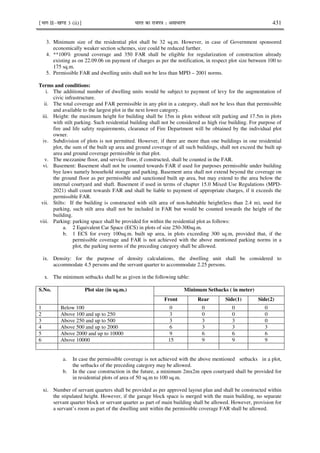
![432 THE GAZETTE OF INDIA : EXTRAORDINARY [PART II—SEC. 3(ii)]
xii. Each servant quarter shall comprise of one habitable room of area not less than 11 sq.m. Floor area
exclusive of cooking, verandah, bathroom and lavatory. The maximum size of the servant quarter shall be
25 sq.m If larger in size, the servant’s quarter shall be counted in density as a full dwelling unit.
xiii. Plot owners/allottees seeking extra coverage, additional floor or part thereof over above gazette
notification dated 23.07.98 as per above mentioned norms shall be charged betterment levy (or additional
FAR charges) at the rates notified with the approval of the Government from time to time. This is an
addition to the levy payable on the additional FAR allowed vide notification dated 23.07.98 and over the
FAR allowed vide notification dated 15.05.95.
xiv. Plot owners/allottees seeking regularization of construction in terms of the additional coverage allowed
under this notification shall have to pay a penalty and compounding charges notified with the approval of
the Government, over and above the betterment levy referred in Para xiii above.
xv. Plot owners/allottees seeking regularization of additional height in this notification, will have to pay
penalty and special compounding charges notified with the approval of the Government, in addition to
betterment levy referred to in Para (xiv). – UBBL no 2.15
xvi. The amount so collected be deposited in an escrow account by the local body concerned for incurring
expenditure for developing parking sites, augmentation of amenities/infrastructure and environmental
improvement programmers’ and a quarterly statement of the income and expenditure of the account shall
be rendered by the local bodies to the Government.
xvii. Encroachment on public land shall not be regularized and shall be removed before the local body grants
sanction for regularization of additional construction or height except following:
a. Projections/chajjas/covered chajjas built up portion which existed before 7.2.2007 up to 1 m
above 3 m height from the ground level shall be regularized for plot size up to 175 sq. m on
roads below 24 m. ROW on pre 1962 colonies (except for A and B category) already notified
by MCD, in unplanned areas (including special areas, village abadi and unauthorized
regularized colonies) and resettlement colonies. The owner/occupier shall have to obtain
structural safety certificate and fire clearance within a reasonable period of time notified by
Government. Such projections/built-up portion thereon shall be counted in FAR and in case of
excess FAR over and above permissible FAR, such FAR in excess shall be regularized subject
to payment of appropriate charges as approved by the Government.
b. The Local body concerned shall carry out survey within a period of two months from the date
of notification of all such projections eligible to be regularized and put such a list in public
domain for objections from the occupiers/owners and any person of the public against
inclusion /exclusion of such projection in the list and the list thereafter will be finalized within
a period of one month after considering such objections received in writing.
xviii. Every applicant seeking sanction or regularization of additional FAR and /or height shall submit a
certificate of structural safety obtained from a structural engineer. Where such certificate is not submitted
or the Building is otherwise found to be structurally unsafe, formal notice shall be given to the owner by
the local body concerned, to rectify the structural weakness with a reasonable stipulated period, falling
which the building shall be declared unsafe by the local body concerned and shall be demolished by
owner or the local body.
xix. Standard Plan: - There are number of standard building plan design and approved by the authority/
Concerned Local Bodies, such plans would be given relaxation wherever applicable. However, these
may be modified as per the applicable Development Control Regulations.
xx. Amalgamation of the two plots up to 64 sq.m maximum will be permitted with following conditions:
• Local Body will simultaneously modify the Layout Plan.
• The maximum Ground Coverage, setbacks, parking, Dwelling Units etc. shall be for the
amalgamated plot size.
• The maximum FAR permissible shall not be less than the permissible is case of two
individual plots.
B. Residential Plot - Group Housing
Minimum size of plot: 3000 sq. m
Maximum Ground Coverage: 33.3 %
Maximum FAR: 200
Height: - No Restriction (Subjected to clearance from AAI/Fire Department and other statutory
bodies).](https://image.slidesharecdn.com/ubbl2016notified-250923161005-b0550c73/85/UBBL_2016_Notified_DDA-Building-Bye-laws-432-320.jpg)
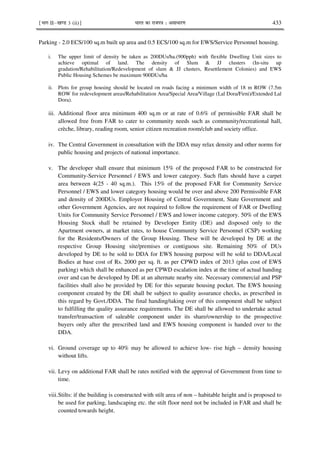
![434 THE GAZETTE OF INDIA : EXTRAORDINARY [PART II—SEC. 3(ii)]
ix. Basement, if constructed, and used only for parking, utilities and services shall not be counted
towards FAR.
x. In case of Redevelopment Areas/Rehabilitation area/Special Area/Village (Lal
Dora/Firni)/Extended Lal Dora, the minimum size of plot for Group Housing shall be 1670
sq.m. (2000 sq. yds.) on roads having a minimum width of 7.5m ROW subject to meeting
parking requirements within the plot and NOC from the Traffic Police Deptt. and the Fire
Deptt. of GNCTD. Such plots shall be incorporated as group housing plots in the
Development/Layout Plans of these areas to be prepared, subsequently, if such, plans are not
already approved.
C. Cluster Court Housing
Minimum size of plot: - 3000Sq.m.
Maximum FAR: - 175
Maximum height: - 15.0m with maximum coverage 100% subject to light and ventilation condition.
i. The net housing density permissible shall be 225 DUs per Ha. With 15% variation on either
side and could be averaged for more than one pocket.
ii. Minimum Street in front of pocket to be 12 m.
iii. No projection outside the building envelope allowed
iv. Each cluster court house is for one dwelling for a single family.
v. Basement:
a) Basement if constructed shall not be included in FAR calculations.
b) Basement shall be below the ground floor. Basement area may, however, be extended
below the internal courtyard and shaft.
vi. Stilts: if the building is constructed with the stilt area of non – habitable height and is
proposed to be used for parking, landscaping etc., the stilt floor need not be included in the
FAR but would be counted towards height(within stipulated height
vii. Parking: parking shall be provided as per group housing norms.
viii.Density: for the purpose of density calculations, the dwelling unit shall be considered to
accommodate 4.5 persons and the servant quarter to accommodate 2.25 persons.
ix. Servant quarter: no separate servant quarter block or servant quarter as part of main building
shall be allowed if the garage block space is merged with the main building. Provision for a
servant’s room as part of the dwelling unit within the permissible coverage and FAR shall be
allowed with maximum size of servant quarter as 25 sq.m and if larger in size would be
counted as a full dwelling unit.
D. Foreign Mission
Maximum Ground coverage 25%
Maximum FAR 75
Maximum Height 15m
Basement up to the building envelope line to the maximum extent of 50% of plot area shall be
allowed and if used for parking and services should not be counted in FAR.
E. Hotel/Guest House/Lodging & Boarding House/ Dharamshala
Min. Plot size 500sqm.
Maximum Ground Coverage 30%
Maximum FAR 120
Maximum Height 15m](https://image.slidesharecdn.com/ubbl2016notified-250923161005-b0550c73/85/UBBL_2016_Notified_DDA-Building-Bye-laws-434-320.jpg)
![¹Hkkx IIµ[k.M 3 (ii)º Hkkjr dk jkti=k % vlk/kj.k 435
i. Parking to be provided @ 2ECS per 100sq. m. of built up area.
ii. These norms shall not be applicable for Guest House under Mixed Use Regulation
F. Night shelter
Min. Plot size 1000sqm.
Maximum Ground Coverage 30%
Maximum FAR 120
Maximum Height 26m
G. Low Density Residential Area
i Minimum Plot
Area
0.4 hectare
ii Max. FAR -20 (without any charges)
-above 20 up to 30(with additional charges to be notified by the competent Authority
-For plots more than 1 acre, the portions remaining (if any) after plot subdivision will get
the benefit of FAR only on prorate basis.
iii Max. height 12 meter
iv Min. width of
continuous
road in front
6 meter *
v Min. green
area
50%
vi No. of main
Dwelling units
permitted
-
Two Dwelling Units on LDRA plot of one acre (0.4 ha) may be permitted with
FAR of 20 and for additional 10 FAR i.e. from 20 to 30 one additional Dwelling
Unit is allowed subject to payment of requisite charges as approved and notified
by Government of India ]
-EWS unit is 60sqm per acre in addition to permitted FAR.
Other controls:-
i. Where the property abuts urban road, the dwelling house building should be setback from the Centre line
of that road by 30m. Where the property abuts village road, the building setback from the Centre line of
that road should be 15m in the front side and 5m in the three sides.
ii. For dwelling unit on National Highway, the prescribed norms of NHAI will be applicable.
iii. For infrastructure roads etc. land holders will be required to cede land to enable the building up of
infrastructure after Public notice and hearing by the Authority.
iv. Every part of the building including the basement used for normal habitation will be counted in FAR.
Basement used for recreational purpose, home, office, storage, parking services and utilities installation
will not be counted in FAR.
v. Pool/pond/water bodies are permitted and excluded from FAR setback norms.
vi. The watch & ward unit will be permitted adjacent to boundary or entrance gate as per provision of building
bye laws and it is to be excluded from the FAR and setback norms.
vii. For plots 0.4 to 2 hectare, the use activities such as fitness/wellness Centre’s, Naturopathy clinics may be
allowed subject to the condition that minimum 50% of plot area be left for soft parking and landscaping.
For activities permitted, provision of parking must be ensured within the plot.
viii. Apart from use/activities permitted in (vii) above, for plots more than 2.0ha (5acres) located on roads of
minimum width of 18m. use/activities such as recreational/club may be allowed subject to the conditions
that minimum 50% of plot area be left for soft parking, maximum 25% of plot area for landscaping and](https://image.slidesharecdn.com/ubbl2016notified-250923161005-b0550c73/85/UBBL_2016_Notified_DDA-Building-Bye-laws-435-320.jpg)
![436 THE GAZETTE OF INDIA : EXTRAORDINARY [PART II—SEC. 3(ii)]
maximum 25 % of the plot area for functions/building purposes.
ix. No low density residential premises should be built on lands notified for acquisition, the legality of which
has been upheld by the Hon’ble Supreme Court except it falls within the boundary of an unauthorized
colony listed for regularization as per Union Government’s decision of 8th Feb, 2007 in accordance with
the regulations No. S.O 683 (E) dated 24.03.2008 pertaining to regulation of unauthorized colonies or
unless the acquisition is denotified.
x. Rain water harvesting and waste water recharging shall be mandatory with
provision for storage for surface run-off water to improve the depleting ground water levels.
* In certain cases where access to Farm Houses/Country Homes is only by private road or exceptionally
restricted by the Dead end Road, the Road width will be governed as per the sanctioned layout plan. For
the purpose of subdivision of land which is minimum 2 acres and above, an internal road of minimum
width 6m may be planned as a feeder to the subdivided plots (of minimum 1 acre each). Such plots will
get benefit of FAR and Ground coverage on proportionate land surrendered for planning of such roads.
Necessary provision shall be made by the plot owner for parking of emergency vehicles like Police,
Ambulance, Fire tender etc. Owner is required to submit an undertaking along with proposal and plans
for sanction of Country Home to Local Authority about his willingness to surrender land for road
widening. Reference of this undertaking shall be recorded on plan by Local authority while releasing
the plan.
H. Studio Apartments:
Minimum size of plot 2000 sqm.
Maximum Ground Coverage 33.3%
Maximum FAR 200
Height NR (Subject to clearance from AAI/Fire Department and
Other Statutory bodies)
Parking 2.0 ECS/100 sqm built up area
Other controls for studio apartments:
i. The maximum size of the apartment will be 60 sqm built-up .
ii. The plots should be located on road facing minimum width of 12m
iii. Basement, if constructed, and used only for parking, utilities and services shall not be counted
towards FAR
Trade & Commerce (MPD 2021- Chapter 5)
Table 5.4 Development controls- Commercial Centers
Use / use premises Max.
Cov.
(%)
FAR Height
(mts.)
Parking
Standard
ECS/100
sq.m. of
floor area.
Other controls
a) Commercial Centers
i. Convenience
Shopping
Centre / Local
Shopping
Centre / Local
Level
Commercial
areas.
ii. Service Market
iii. Organized
informal Bazaar
iv. Community
40
40
40
100
100
40
15
15
8
2
2
-
Max. 10% additional Ground
Coverage shall be allowed for
providing atrium only in LSC.](https://image.slidesharecdn.com/ubbl2016notified-250923161005-b0550c73/85/UBBL_2016_Notified_DDA-Building-Bye-laws-436-320.jpg)
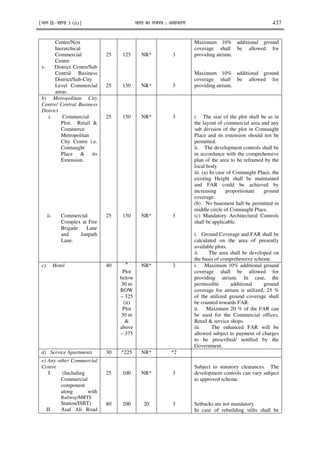
![438 THE GAZETTE OF INDIA : EXTRAORDINARY [PART II—SEC. 3(ii)]
(the area shown
as commercial
strip in Delhi
Gate –Ajmeri
Gate Scheme).
provided for parking.
f)Motels
(with sanctioned plans as
on 07-02-2007 or whose
proposal of Motel has
been acceded to,
(including all such
proposal of motels which
were in process of
examination or matter
challenged in the court of
law or having approval in
files from DDA or MCD
or not acceded to due to
enforcement of MPD-
2021 on 07.02.2007 are
also eligible for sanction)
which are in Commercial
Areas or Proposed
Facility Corridor in
Zonal Development
Plans and Other use
Zones)
40 175^ NR* 3.0 ECS per
100
sq.metres of
floor area (as
per
Development
Code
Chapter of
MPD –
2021) All
guest
parking must
be catered to
within the
motel
premises
themselves
i. Maximum 175 FAR as
applicable to plot area of one
hectare shall be permissible
on the plot area disclosed in
the sanctioned plan as on 07-
02-2007 in conformity with
Government of India
Notification S.O. 550 (E)
dated 16-06-1995 and motel
guidelines issued by
Government of India, MoUD
on 04-03-2002.
ii. The motels shall face the road
of minimum 30 mts. ROW (if
additional land is required for
road widening, same to be
kept reserved out of the motel
area).
iii. Other norms and permissible
activities shall be the same as
applicable to hotel use
premise.
iv. Water, Electric supply,
Sewerage, drainage, traffic
circulation, provision of
linking road of adequate
ROW and other such
infrastructure shall have to be
provided by the owner at their
own cost till the same is made
available by the service
providing agencies. The
Motel owner will have to pay
the external development
charges including provision
of linking road of adequate
ROW as demanded by the
concerned agencies.
v. All motels should follow
rainwater harvesting and
energy conservation
provision laid down under
Notification and Building
Bye-Laws issued by
MoUD/GOI.
vi. Disposal of waste in Motels
will be responsibility of the
Motel owner and net
pollution discharge from the
Motels should be zero.
vii. Modern techniques shall
have to be adopted in disposal
of waste in motels viz.
segregation of solid waste](https://image.slidesharecdn.com/ubbl2016notified-250923161005-b0550c73/85/UBBL_2016_Notified_DDA-Building-Bye-laws-438-320.jpg)
![¹Hkkx IIµ[k.M 3 (ii)º Hkkjr dk jkti=k % vlk/kj.k 439
into compostable and non-
compostable. Compostable
waste should be deposited in
localised compost pits; non-
compostable should be
incinerated in incinerators
maintained by the Motel,
subject to pollution control
norms. The Building shall
have dual piping system.
Mini sewage treatment plant
shall be constructed within
premises for treatment of
sewage and utilising the
treated water for purposes
other than drinking, with dual
piping system.
viii. Revised building plans will
be submitted to the local
bodies i.e., MCD/DDA as the
case may be for sanction
under Building Bye-Laws.
^Note- Additional FAR charges, conversion charges, betterment charges, betterment levy/external development
charges etc. shall be payable as decided by the government from time to time.
*No restriction subject to clearance from Airport Authority of India and Fire Department of GNCTD.
i. NR* - No Restriction, subject to clearance from AAI, Delhi Fire Service and other Statutory bodies.)
ii. FAR# , The norms of 325 FAR below 30m ROW or 375 FAR on 30m ROW or above and 40 % ground
coverage shall be applicable in respect of all (I) hotels including hotel plots in (a) Commercial Centers
((iv), (v) and (b) Metropolitan City Centre/Central Business District except those located in LBZ area,
Civil Lines, Bungalow Area and hotels existing on heritage structures and (II) Hotel-cum-commercial
plots. This shall apply to all categories of hotels Mentioned at para 5.8. The FAR for Commercial Centers
mentioned at Table 5.4 (a) and (b) as well as Hotel-cum-commercial plots where apportionment of FAR
shall be as per original lease conditions and shall stand enhanced automatically to that extent, for this
purpose only if not available.
iii. In case of revision of building plans to avail additional FAR, hotel can avail additional FAR only if
adequate parking provision is made within the plot itself.
@ - In respect of hotels where the building plans stand sanctioned prior to 27.1.2006, parking standard of
3 ECS for 100 sqm of floor area shall be applicable only for the additional FAR which will be availed
consequent upon amendment to MPD-2021. In respect of hotels where the building plans have been
sanctioned on or after 27.1.2006, the parking standard of 3 ECS for 100 sqm of floor area shall be
applicable to the entire plot.
Notes:-
i. The utilities such as, underground water storage tank, roof top water harvesting system, separate dry
and wet dustbins, post-delivery counter etc. are to be provided within the plot. All hotels, restaurants,
auto workshops, hospitals 1
[/tertiary health care centres] etc. will have to make arrangements for
solid waste disposal and primary effluent treatment.
ii. Individual plot with floor area of 5000 sq. mt. or above will provide ESS and generator within the
plot. They have to submit energy consumption / audit at the time of sanction of building plans.
iii. Height subject to clearance from ASI, Airport Authority of India, Delhi Fire Service and concerned
authority.
iv. Wherever parking is provided within the plot / basement and is misused, the same is liable to
municipalisation / taken over by the Authority.](https://image.slidesharecdn.com/ubbl2016notified-250923161005-b0550c73/85/UBBL_2016_Notified_DDA-Building-Bye-laws-439-320.jpg)
![440 THE GAZETTE OF INDIA : EXTRAORDINARY [PART II—SEC. 3(ii)]
v. Wherever redevelopment of existing commercial areas stipulate preparation of a comprehensive
scheme, the same can be initiated jointly by the lessees / owners themselves and submitted to land
owning agency / Planning Authority for approval. Wherever any enhancement in FAR is approved,
the same will be subject to charging appropriate levies from the beneficiaries. For Metropolitan City
Centre and, in Special Area, Development Control is as per approved scheme.
** Ground Coverage up to 50% instead of 40% will be permissible to achieve the enhanced FAR at
site(s), if their exist any height restriction from Airport Authority of India.
Wholesale Trade (MPD 2021 Chapter 6)
Table 6.2: Development Controls – Wholesale Trade
Use/Use
Premises Maximum
Parking Standard
ECS/100 sq. mt.
of Floor area
Definition Activities
Permitted
Ground
Coverage
(%)
FAR Height
(m)
Integrated
Freight
Complex/
Wholesale
Market
30 80 No
Restriction
Subject to (i)
3 Wholesale Market. A
premise from where
goods and
commodities are sold
and delivered to
retailers. The
premises include
storage and godown,
loading and
unloading facilities.
Wholesale
shop,
Godown and
storage and
Commercial
Office
(Restricted
to 25% of
the total
floor area,
Night
Shelter
Notes:
i. Height permitted subject to clearance from Airport Authority of India, Fire Department and other
statutory bodies.
ii. In case of plots up to 300 sq. mt. Common parking is to be provided.
iii. In case of plots of 300 sq. mt. and above, the utilities such as E.S.S. underground water storage tank,
roof top water harvesting system, separate dry and wet dustbins, solar heating /lighting system etc.; are
to be provided within the plot.
iv. (iv)In case of individual plots not forming part of any comprehensive integrated development scheme,
the Development Control Regulations shall be as per already approved scheme/layout plan.](https://image.slidesharecdn.com/ubbl2016notified-250923161005-b0550c73/85/UBBL_2016_Notified_DDA-Building-Bye-laws-440-320.jpg)
![¹Hkkx IIµ[k.M 3 (ii)º Hkkjr dk jkti=k % vlk/kj.k 441
Industry (MPD 2021 Chapter 7)
Table 7.3 Development Control Norms
Use Premises Maximum Parking
standard
ECS/100 sqm
of floor area
Gr.
Cov(%)
FAR Ht(m) Activities
permitted
*Definition
Industrial plot
i. 50 sqm
and
below.
ii. 51 sqm to
400 sqm.
iii. 401 sqm
and above
100
60
50
200
180
150
8
15
15
2
2
2
Industrial unit’s sales
outlet and
administrative office
up to maximum 10%
of floor area on
ground floor only;
residential flat up to
the maximum extent
of 5% of the floor
space or 50sqm.
Whichever is less for
watch & ward and
supervision,
incidental storage [-]
related to the industry
activity, commercial
activity as per
footnote (vi).
*A premise for
industrial activity
with non-
hazardous non-
polluting
performance.
Flatted group
industry
(Minimum plot
size – 400 sqm.)
30 150 26 2 Industrial units;
administrative office,
watch and ward,
maximum up to 5%
of floor area or
20sqm. Whichever is
less, storage related
to the manufacturing
activity, commercial
activity as per note
(vi).
*A premises
having a group of
small industrial
units with
common services
and facilities of
non-polluting
nature
Notes:-
i. In case of plots up to 60 sq. mt. common parking shall be provided.
ii. In case of plots of size 500 sq.mt. And above, the utilities such as E.S.S. underground water storage
tank, roof top water harvesting system, separate dry and wet dustbins, solar heating/ lighting system
etc. shall be provided within the plot.
iii. Identified Service Centers shall be planned as per plotted industrial area norms.
iv. Development of IT hardware and software permissible under industrial use.
v. Banquet hall shall be permissible in Industrial premises subject to specifications/ regulations as may be
prescribed, along with conversion charges as prescribed by the Government from time to time
vi. Industrial units/ plots abutting roads of 24 mt. ROW and above shall be eligible for conversion to
commercial use within the existing development control norms, subject to payment of conversion
charges computed on current market value of commercial area and cost of parking as decided by the
Government from time to time The activities permissible in community Centre will be permitted in
such plots]. In addition, multilevel parking shall be permissible activity. However, this shall not be
permitted on non-conforming/regularized industrial cluster. The above provision shall not affect the
Supreme Court orders in any way.
vii. Industrial plots abutting roads of 24m ROW and above shall be eligible for conversion to Hospitals (up
to 100 beds) within the existing development control norms, subject to the condition
a. The number of beds to be accommodated on a plot shall be worked out @ 80sqm of gross
floor area per bed and](https://image.slidesharecdn.com/ubbl2016notified-250923161005-b0550c73/85/UBBL_2016_Notified_DDA-Building-Bye-laws-441-320.jpg)
![442 THE GAZETTE OF INDIA : EXTRAORDINARY [PART II—SEC. 3(ii)]
b. Payment of conversion charges as prescribed by the government from time to time. The
activities permissible in hospital (table 13.20) shall be permitted in such plots. However, this
shall not be permitted on non-conforming/regularized industrial cluster. The above provision
shall not affect the Supreme Court orders in any manner.
viii. In the redevelopment of industrial plots, 1.5 times of permissible FAR has already been notified in
notification S.O.683 (E ) dated 01.04.2011 regarding Regulations and guidelines for existing planned
Industrial area, therefore the incentive of 1.5 times of permissible FAR shall be allowed on all
permissible uses on industrial plot.
ix. Banquet hall, restaurant, recreational club, hostel & old age home, community and recreational hall,
nursing home & health Centre are permitted as part of modification in layout plan of industrial area
where also enhanced FAR 1.5 times of permissible FAR of respective use shall be allowed.
x. As per the notification S.O. 683(E) dated 01.04.2011, minimum plot size eligible for redevelopment is
given 1000sqm. Wherever some of the plots are less than 50-100sqm. From area limit of 1000sqm. In
such redevelopment relaxation in area up to 5% in lower limit of plot size shall be permitted.
xi. The development control norms i.e. Ground Coverage, FAR etc., of respective use premises while
allowing redevelopment/reconstruction on the individual industrial plots shall be adhered to and there
shall be no height restriction. The height shall be as per requirement of AAI/Fire Department. In case
of addition, alteration or change of use within permissible category in existing building to achieve
permissible FAR, already sanctioned ground coverage shall continue, if parking requirement or
sufficient open space around building is made available.
xii. In existing industrial units/plots with an area of 3000sqm. Or above abutting road of 24mtrs. ROW and
above shall be eligible for residential use (group housing) within development control norms of group
housing along with incentive 1.5 times FAR of permissible FAR of group housing subject to payment
of conversion charges as prescribed by the Government from time to time for respective use, required
commercial preferably and PSP activity for residential population, and work space up to 15% of
permissible FAR shall also be allowed. Sub-division of larger industrial plot or amalgamation of
smaller industrial plots will be allowed in existing areas as well as approved schemes/layouts/building
plans on these industrial plots. Rain water harvesting preferably with Rain water storage for re-use &
STP. Dual piping system use of solar electricity shall be provided to minimize the additional burden on
infrastructure services. This shall not affect any Court Orders.
Government Offices (MPD 2021 Chapter 8)
Table 8.2 Development Controls- Govt. offices
Use/Use
Premises
Maximum
Parking
Standard
ECS/100 sq.
mt. of Floor
area
Definiti
on
Activities
permitted
Ground
Coverage
(%)
FAR Height (mt.)
i) Integrated
Office Complex
30 200 NR, Subject to
approval of AAI,
Fire Department
and other statutory
bodies.
1.8 Premise
s used
for the
office of
Central
Govern
ment,
Local
Govern
ment
and
Local
Bodies.
Government
Offices, Watch
and Ward
Residence /
residential
maintenance
staff (maximum
5% of FAR),
Retail shop of
Chemist, Book
and stationery,
Consumer
Store, Canteen,](https://image.slidesharecdn.com/ubbl2016notified-250923161005-b0550c73/85/UBBL_2016_Notified_DDA-Building-Bye-laws-442-320.jpg)
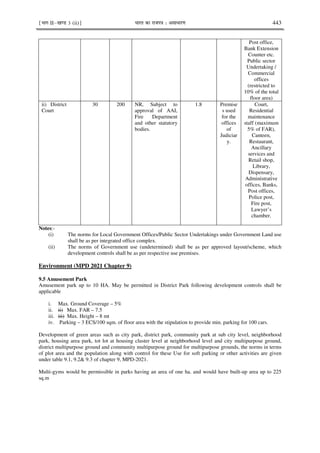
![444 THE GAZETTE OF INDIA : EXTRAORDINARY [PART II—SEC. 3(ii)]
9.7 Bio-diversity Park
The activities and development control norms permitted in Bio-diversity Parks are as under:
Orchards, Specialized Parks like Butterfly Parks, Fernarium etc. Facilities for Flora & Fauna, Water Harvesting
Structures, Open Air-Theatre, Food courts, Scientific Laboratories, Interpretation Centre, Administrative Office,
Camping Site., Amenity Structures – Toilet Block, Pump Room, Electric Room, Guard Room and Equipment
Room.
a. Maximum Permissible Area of built structures shall be 0.5% of Biodiversity Park area or 10000 sqm.,
whichever is less.
b. Building within the Bio-diversity parks would be restricted to 2 storeys with a maximum height of 12 m for
sloping roof structures and should meet “green building” criteria (Griha 4 star rating).
c. Parking may be provided in the lots of 20 to 25 ECS at different locations, as per requirement.
Transportation (MPD 2021 Chapter 12)
12.12.2 Fuel Stations
The regulations for locating the fuel stations –cum-service stations, the development control and
permissibility shall be governed by the policy /decision by competent Authority / Government
Notifications issued from time to time. New fuel stations shall be regulated by the following controls:
i. Fuel stations shall be located on roads of minimum 30m ROW.
ii. The plot size for fuel stations shall be minimum of 30m X 36m and maximum of 33m X 45m (75m X
40m for CNG mother station as per requirement).
iii. The minimum distance of plot from the road intersections shall be as follows:
a. For minor roads having less than 30m ROW- 50m.
b. For roads of ROW 30m or more- 100m
c. Frontage of plots should not be less than 30m.
iv. Maximum Ground Coverage: 20%, Maximum FAR: 40
v. Maximum Height: 6m
vi. Canopy: equivalent to ground coverage within set back.
vii. Maximum 10 FAR permissible for non-inflammable, non-hazardous commercial activities
subject to payment of conversion charges/ levies as may be prescribed by the government
from time to time.
viii. In case of existing petrol pumps the provision of maximum 10 FAR for commercial activity
would be permissible only to those fuel stations / petrol pumps which conform to the controls
given in i, ii, and iii, above subject to payment of appropriate fees/ levies/ misuse, penalty and
other charge
12.13.7 Multi level parking
Multi level parking facility should preferably be developed in the designated parking
spaces or in the residential, public-semi-public facilities, commercial, transport node,
DTC depot, etc. with the following Development Controls:
i. Minimum Plot Size – 1000 sqm.
ii. In order to compensate the cost of Multi-level parking and also to fulfill the growing need of
parking spaces within urban area, a maximum of 25 % of gross floor area may be utilized as
commercial / office space.
iii. In addition to the permissible parking spaces on max. FAR, 3 times additional space for
parking component shall be provided.
iv. Maximum FAR permissible shall be 100 (excluding parking area) or as per the
comprehensive scheme. However, no FAR shall be permissible in plots / existing buildings](https://image.slidesharecdn.com/ubbl2016notified-250923161005-b0550c73/85/UBBL_2016_Notified_DDA-Building-Bye-laws-444-320.jpg)
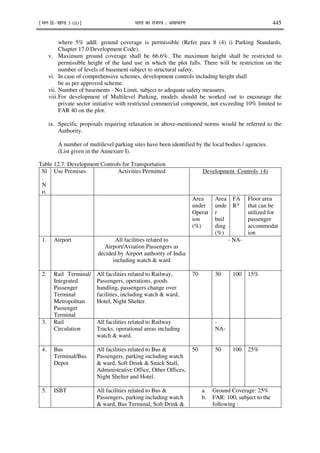
![446 THE GAZETTE OF INDIA : EXTRAORDINARY [PART II—SEC. 3(ii)]
Snack Stall, Administrative Office,
hotel, Night Shelter.
(i) FAR shall be
available on a
maximum area of
10 ha. Or area of
site whichever is
les
(ii) ISBT, including
operational
structures
Maximum FAR 70
(iii) Hotel/ Passenger
accommodation
and facilities
Maximum FAR
30.
c. Parking: In addition to the
requirement of parking for
ISBT / buses, parking for
Hotel/Passenger
accommodation and
facilities shall be at the rate
of 2 ECS per 100 sq. mt. of
floor area.
d. The development shall be
undertaken in a composite
manner.
6.
Toll Plaza Toll collection booth, utilities,
facilities and required infrastructure.
- NA-
7. Road
Circulation
All types of road, street furniture, bus
shelters, under ground & over ground
services utilities, signals, metro
tracks as part of r/w, sub-ways,
under-passes, ROB & RUB including
watch & ward.
-NA -
8. Metro Yards Idle parking of coaches, washing and
cleaning facilities, maintenance
related facilities, watch & ward and
staff related facilities.
80% 20% 100 15%
* The FAR is to be calculated on the Building plot. Area under Bus Shelter not to be included in FAR
Development Controls for Metro Station:
1. Metro Stations along with property development (composite development) up to a maximum
area of 3.0 ha. Shall be permitted in all Use Zones, except in Recreational and Regional Park/
Ridge Use Zone, Lutyens’ Bungalow Zone and Heritage Zones,](https://image.slidesharecdn.com/ubbl2016notified-250923161005-b0550c73/85/UBBL_2016_Notified_DDA-Building-Bye-laws-446-320.jpg)
![¹Hkkx IIµ[k.M 3 (ii)º Hkkjr dk jkti=k % vlk/kj.k 447
2. This enabling provision of property development would have the following broad
development controls:
i. 25% ground coverage and 100 FAR, including area under Metro Station with
no height restrictions and subject to approval of the statutory bodies such as
ASI, Airport Authority, and Delhi Urban Art Commission etc.
ii. In addition to the requirement of parking for Metro Stations, parking for the
commercial component will be @ 2 ECS per 100 sq. m.
iii. The development shall be undertaken in a composite manner and DMRC
shall obtain approval of all the concerned local bodies/ agencies.
3. The following structures shall be treated as operational structures:
i. All Metro Stations and tracks supporting at grade, elevated and underground including entry
structures, ancillary buildings to house DG sets, chilling plants and electric substation, supply
exhaust and tunnel ventilation shafts etc.
ii. Depots and maintenance workshops.
iii. Traction Sub-stations.
iv. Operational Control Centres
v. Police Station.
vi. Recruitment and Training Centers for operational and maintenance staff
vii. Housing for operational staff and Metro security personnel only
viii. Rehabilitation work to be undertaken for the construction of Metro Project
ix. Shops in Metro Stations to cater to the public amenities
x. Structures above platform over the foot print of the Metro Stations]](https://image.slidesharecdn.com/ubbl2016notified-250923161005-b0550c73/85/UBBL_2016_Notified_DDA-Building-Bye-laws-447-320.jpg)
![448 THE GAZETTE OF INDIA : EXTRAORDINARY [PART II—SEC. 3(ii)]
Social Infrastructure (MPD 2021 Chapter 13)
Development controls of the following activities as given in MPD 2021
13.1 Health
Size of hospital plot will be restricted up to 1.5 ha. In residential area, with preference to plot having
three side open and having minimum 18m ROW on one side. Total floor area of the hospital shall be
governed as per the total number of beds allowed in it.
Table 13.2: Development Controls for Health Facilities
Sl
N
o.
Category Maximum Other
Controls
Ground
Coverage
FAR Height
1. Hospital/Tertiary
Health Care
Centre
Ground
coverage to be
decided by
interse building
to building
distances as per
Building Bye
laws and fire
tender
movement
requirements,
subject to a
maximum 40%
excluding 5%
additional
ground
coverage for
multi-level
parking
FAR on plot facing ROW
should be subject to NOC
from all concerned
agencies depending on
locations shall be as under.
1. RoW less
than 24m
250
2. RoW24m
UP TO
30M
300
3. RoW 30M
and above
375
For plots falling under
Influence Zones of
MRTS/Major Transport
Corridors such as Metro
and BRT Corridors, 50%
more FAR should be
available.
No height
restriction
subject to
clearance
from AAI,
DFS, DMA,
NMA to
process the
proposed
revision of
NBC as soon
as possible.
Till the time
the NBC is
revised, Delhi
Fire Service
(DFS) may
allow no
restrictions of
height for
health care
facilities with
commensurate
fire and life
safety
measures,
subject to
clearance
from AAI,
DFS, DMA,
NMA and
other statutory
provisions
1. Upto
25% if the
permitted
FAR can be
utilized for
residential
use of
essential
staff,
dormitory/
hostel for
attendants
of the
patients,
crèche etc.
2. Parking
standard @
2.0
ECS/100
Sqm of
floor area.
3.
Maximum
10%
ground
coverage
shall be
allowed for
providing
atrium* in
case, the
permissible
additional
ground
coverage
for atrium
is utilized](https://image.slidesharecdn.com/ubbl2016notified-250923161005-b0550c73/85/UBBL_2016_Notified_DDA-Building-Bye-laws-448-320.jpg)
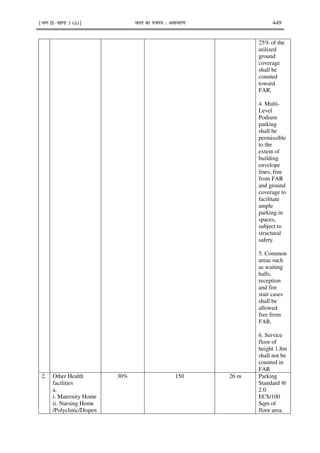
![450 THE GAZETTE OF INDIA : EXTRAORDINARY [PART II—SEC. 3(ii)]
sary
b.
i. Family Welfare
Centre
ii. Paediatric
iii. Geriatric
Centre
iv. Diagnostic
Centre
3. a. Veterinary
Hospital for pet
animals and birds
b. Dispensary for
pet animals and
birds
30%
35%
150
100
26 m
26 m
Parking
standard @
1.33
ECS/100Sq
m of floor
area.
Parking
standard
@1.33
ECS/100
Sqm of
floor area.
4. a. Medical College As per norms of Medical Council of India/Regulatory Body
b. Nursing and
Paramedic
Institute
30% 150 26 m Parking
standard @
2 ECS/100
Sqm of
floor area.
C. Veterinary
Institute
As per the Veterinary Council of India/ Ministry norms
Natural sky light condition is exempted for Atrium and construction over the Atrium may be allowed.
# Height restriction of 30 mts. In Hospital Buildings should be reviewed in consultation with Fire Deptt. Of
GNCTD.
Notes:
1. Plot area for all Hospital/Tertiary Health care Centre would be worked out @ 80 sqm of gross floor
area per bed. However, for other health facilities like Maternity/ Nursing homes, family Welfare and
other centers, the plot area would be worked out @ 60 sqm of gross floor area per bed.
2. Max. up to 300 sqm of floor area shall be allowed to be used for community space/religious shrine/
crèche/ chemist shop/ bank counter on Hospital sites and also Medical college/ Nursing and Paramedic
Institute sites.
Other Controls:
a. In case of super specialty medical facilities/hospitals duly certified as such by the
competent authority, the gross area shall be worked out @ up to 3
[ 80.]sq. mt. Per bed.
b. In case of existing premises/sites, the enhanced FAR shall be permitted, subject to
payment of charges as may be prescribed by the Authority / land owning agency and
other clearances.
c. Basement after utilization for Parking; Services Requirements such as air conditioning
plant and equipment, water storage, boiler, electric sub-station, HT & LT panel rooms,
transformer compartment, control room, pump house, generator room; staff locker room,](https://image.slidesharecdn.com/ubbl2016notified-250923161005-b0550c73/85/UBBL_2016_Notified_DDA-Building-Bye-laws-450-320.jpg)
![¹Hkkx IIµ[k.M 3 (ii)º Hkkjr dk jkti=k % vlk/kj.k 451
staff changing room, staff dining facilities without kitchen facility, Central sterile supply
deptt., back end office; Other Mechanical Services; Installation of Electrical and
firefighting equipment’s; and other services like kitchen, laundry and radiology lab and
other essential services required for the maintenance/functioning of the building may be
used for healthcare facilities with prior approval of the concerned agencies.
d. Other controls related to basements etc. are given in the Development code chapter.
e. The bed count of a Health Facility may be allowed as per permissible FAR, needs of the
Community and demand studies.
f. Environment clearances shall be made mandatory considering that bio-wastes are
generated. Environment clearances are mandatory as per the prevailing regulations related
to the environment.
g. Zero discharge for sewerage shall be enforced at the cost of the promoters and post
treatment water can be used by premises for its needs of horticulture, flushing, coolant
tower, washing or disposal to other construction sites. These issues concerned the local
bodies and can be dealt accordingly as per existing regulations as the time of sanctioning
the plan.
h. The additional power requirements shall be met by power supply from grid and till such
time by means of suitable captive generation.
13.2 Education:
Table 13.4 Development Controls for Education Facilities
S.No Category Maximum Other Controls
Gr.Cov. FAR Height
1.
2.
3.
4.
5.
6.
Play School, Coaching
Centre, Computer
Training Institute,
physical Education
Centre etc.
Nursery School
Primary School
Senior Secondary
School/ 4
[*Secondary
School.
School for Mentally
Challenged.
School for 5
[differently
abled persons.
N.A.
33.33 %
30%
35%
50%
50 %
N.A.
100
120
150
120
120
N.A.
15 mt.
18 mt.
18 mt.
18 mt.
18 mt
1. Practice of providing dedicated
Nursery School plots in the
layout plan discontinued as same
is permissible in Mixed use.
Parking standard @ 1.33 ECS
/100 sq. mt. of floor area.
2. In case of schools for mentally /
* 3
[differently abled persons],
20% of the maximum Far can be
utilized for residential use of
essential staff and student
accommodation.
Parking Standard:
Primary School / Middle School
@ 1.33 ECS/100 sq. mt. of floor
area.
Sr. Secondary School @ 2.00
ECS/100 sq. mt. of floor area.
The areas earmarked for parking
if misused, liable to be
municipalized /taken over.
3. Other controls related to
basements etc. are given at end
of this chapter.](https://image.slidesharecdn.com/ubbl2016notified-250923161005-b0550c73/85/UBBL_2016_Notified_DDA-Building-Bye-laws-451-320.jpg)
![452 THE GAZETTE OF INDIA : EXTRAORDINARY [PART II—SEC. 3(ii)]
Notes:
Pre-Primary Schools/Nursery Schools/Montessary Schools/Creche, Play Schools, are permissible in residential
use premises as per Mixed use policy.
Other Controls:
1. In case of new schools, the front boundary wall shall be recessed by 6 mt. to
accommodate visitors parking within setback area.
2. Upto 10% variation in plot size is permitted. Differential norms will be applicable to
Special Area, Regularized Unauthorized Colonies, Urban Villages and Resettlement
Colonies.
3. Playground shall be developed on pool basis in different areas at neighborhood level.
Table 13.6 Development Controls for Education Facilities (Higher Education)
Sl.No Category Maximum
___________________
Gr. FAR Height
Cov.
Other Controls
1.
2.
3.
Vocational Training Centre
(ITI/Polytechnic /Vocational /
Training Institute/Management
Institute / Teacher Training Institute
etc.) Research and Development
Centre.
General College
Professional College (Technical)
35% 225 37mt. 1. Up to 30% of Max
the permissible FAR
can be used for
hostel
accommodation for
the students.]
2. Parking standard @
1.33 ECS / 100 sq.
mt. of floor area.
The areas
earmarked for
parking if misused
liable to be
municipalized/
taken over by the
authority.
3. Other controls
related to basements
etc. are given in the
chapter 17,
Development Code
of MPD- 2021.
4. University Campus including
International Education Centre (IEC)
– Large campus (10 ha. And above)
will be divided into following four
parts:
1. Parking standard @
1.33 ECS/100sq.m
of floor area.
2. Other controls
related to basements
etc. are given in the
chapter 17,
Development Code
of MPD- 2021.
3. Landscape plan to
be prepared.
a) Academic including
Administration ( 45% of total
land area)
30% 225 37 mt.
b) Residential (25% of total land
area
1. Regulations for group
housing shall apply.
2. The land shall be reserved
for facilities as per](https://image.slidesharecdn.com/ubbl2016notified-250923161005-b0550c73/85/UBBL_2016_Notified_DDA-Building-Bye-laws-452-320.jpg)
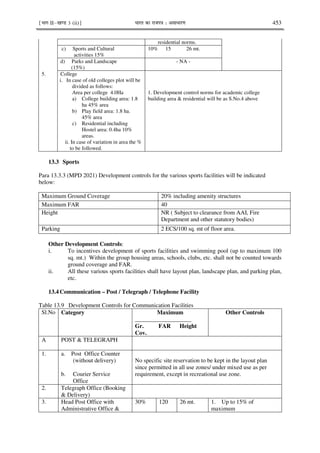
![454 THE GAZETTE OF INDIA : EXTRAORDINARY [PART II—SEC. 3(ii)]
with/without delivery office. FAR can be utilized for
residential use of
essential
staff.
2. Parking standard @
1.33 ECS / 100 sq. mt.
of floor
area.
3. Other Controls related
to basements etc. are
given in,Development
Code , MPD - 2021
B TELEPHONE
4. a. Telephone Exchange
b. RSU (Remote
Subscriber Units)
30%
30%
120
100
26 mt.
15 mt.
13.5 Security – Police
Table 13.11 Development Controls for Security (Police) Facilities.
Sl
.N
o
Category Maximum Other Controls
Gr.
Cov.
FAR Height
1. Police Post 35% 150 15 mt. 1. Up to 30% of maximum FAR
can be utilized for residential
use of essential staff (except
Police Station which will as
per of Notes below the table)
2. Parking standard @ 2.00
ECS/ 100 sq. mt. of floor area.
3. Additional space available in
police station due to increased
development controls shall be
used for locating Civil
Defense and Home Guards
etc.
4. Up to 15% of maximum FAR
can be utilized for residential
use/hostel for essential staff
and student accommodation,
in Police Training Institute/
College.
5. Other controls related to
basements etc. are given in
Chapter 17,Development
Code , MPD – 2021
2. Police Station 30% 200 26 mt.
3. District Office &
Battalion
30% 120 26 mt.
4. Police Lines
i). Administration
ii.) Residential
iii). Sports & Facilities
iv). Open Spaces
Land Distribution:
- 20%
- 30%
- 10%
- 40%
5. District Jail 30% 120 26 mt.
6. Police Training
Institute/College*
30% 120 26 mt.
7. Police Firing Range 12.5% 25% 9 mt.
8. Police camp including
Central Police
Organization/Security
Forces*
12.5% 255 9 mt.
9. Traffic and Police
Control Room
1. As per requirement on major road junctions/ stretches etc.
as part of road right of way based on site feasibility.
2. Maximum are – 25 Sq. mt.](https://image.slidesharecdn.com/ubbl2016notified-250923161005-b0550c73/85/UBBL_2016_Notified_DDA-Building-Bye-laws-454-320.jpg)
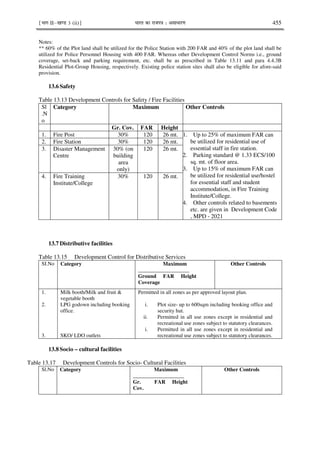
![456 THE GAZETTE OF INDIA : EXTRAORDINARY [PART II—SEC. 3(ii)]
1. a. Multipurpose
Community Hall.
b. Banquet hall
30%
30%
120
120
26m
26m
1. Parking standard
@3.0ECS/100sq m of floor
area.
2. Other controls related to
basements etc. are given at
end of this chapter.
2. a. Community Recreational
Club.
b. Recreational Club
1
[30% 120] 26m Parking standard
@2ECS/100sq.m of floor area.
3. Socio- cultural activities such
as auditorium, music, dance &
drama centre/mediation &
spiritual centre etc.
35% 120 26m 1. Parking standard
@2ECS/100sq.m of floor area.
2. A proper scheme for visitors
parking and parking adequacy
statement shall be prepared
taking into consideration large
number of visitors.
4. Exhibition cum Fair Ground 20% 20 - Subject to statutory clearances.
5. Science centre 30% 120 26m Parking standard@2ECS.
6. International Convention
Centre
30% 120 NR. Subject
to approval
of AAI,
Fire
Department
and other
statutory
bodies
Parking standard@2ECS.
Notes:
i. The Recreational Clubs located in LBZ Area, Civil Lines Bungalow Area, Recreational Use Zones and
existing on Heritage Structures will be dealt on case to case basis and Technical Committee of DDA
will approve the Development Controls norms based on the existing status.
ii. In the open area apart from outdoor games/sport facilities, swimming pool would be permissible up to
an area of 300sqm. Free from ground coverage
iii. In case of banquet hall,
a) Basement within the ground envelope shall be allowed for parking, stilt floor for parking
is permissible.
b) 30% of basement area for services, storage shall not be counted in FAR.
iv. In case of International Convention Centre, maximum 10% ground coverage shall be allowed for
providing atrium. In case, the permissible additional ground coverage for atrium is utilized, 25% of the
utilized ground coverage shall be counted towards FAR.
13.9 Other community facilities:
Development Controls for old age homes, religious facilities, etc. are given in table below
*Table 13.19 Development Controls for other community facilities
Sl.No Category Maximum
___________________
Ground FAR Height
Coverage
Other Controls](https://image.slidesharecdn.com/ubbl2016notified-250923161005-b0550c73/85/UBBL_2016_Notified_DDA-Building-Bye-laws-456-320.jpg)
![¹Hkkx IIµ[k.M 3 (ii)º Hkkjr dk jkti=k % vlk/kj.k 457
1 Old Age Home/Care Centre for
Differently Abled Persons]
/Mentally Challenged/Working
Women/Men Hostel/ Adult
Education
Centre/Orphanage/Children’s
Centre/Night Shelter.
30% 120 26m. 1. Parking standard@ 1.8
ECS/100 sqm of floor
area.
2. Other controls related to
basement etc. are as
given in Chapter
17,Development Code ,
MPD - 2021
2. Religious
a) At neighbourhood level
b) At sub city level in
urban extension*
35%
25%
70
50
15m.
including
shikhara
26m.
3. Anganwari
a) At Housing area/Cluster
level
30% 60 15m.
4. Service Apartment 30% 225 NR*
(Subject to
approval of
AAI, Fire
Department
and Other
Statutory
Bodies)
Parking @ 2ECS per
100 Sqm. of floor area.
Other controls related to
basements etc. are given
in the Development
Code Chapter.
These facilities should be developed in a composite manner to accommodate a number of religious
institutes/premises with common facilities.
Note: - sites of dhobi Ghats/laundry shall be provided in residential use zone/PSP facilities areas as per the
norms of local body.
13.11 Public & Semi –Public Facilities/Premises (Para No. 13.11 of MPD 2021)
The following norms shall be applicable in case of PSP facilities/premises for which specific
development controls have not been specified.
1. Max. Ground Coverage 30%
2. Max. Floor Area Ratio 120
3. Max. Height 26m
Other controls:-
Parking @2ECS/100sqm. Of floor area other controls as given in Development Code Chapter.
Note:
i. In case of plots allotted to political parties by the government land housing agencies, up to
15% of maximum FAR may be utilized for residential hostel accommodation.
ii. Amalgamation of the smaller PSP plots or sub division of the larger PSP plots for a single or
its multiple use, is allowed with permissible PSP facilities as per the provisions of MPD-
2021.
Development Code (MPD-2021 Chapter -17)
Development Control
Clause 2.0 Definitions
2(4) Layout Plan means a Plan indicating configuration and sizes of all Use Premises. Each Use
Zone may have one or more than one Layout Plan depending upon the extensiveness of the area](https://image.slidesharecdn.com/ubbl2016notified-250923161005-b0550c73/85/UBBL_2016_Notified_DDA-Building-Bye-laws-457-320.jpg)
![458 THE GAZETTE OF INDIA : EXTRAORDINARY [PART II—SEC. 3(ii)]
under the specific Use Zones and vice versa. A layout plan shall have at least two use premises
(apart from Recreational, utilities and transportation) and a minimum area of 1 Ha. Below which
it shall be termed as site plan or sub division plan.
2(5) Site Plan: A detailed Plan showing the proposed placement of structures, parking areas, open
space, landscaping, and other development features, on a parcel of land, as required by specific
sections of the development code.
Clause 3.0 Establishment of Use zones and Use premises
3(4) The layout plans already approved by the Authority or any other local Authority concerned
in accordance with law shall be deemed to have been approved under this code.
3(5) An area in respect of which there is no approved Layout Plan shall be governed by the
provisions of the Master Plan /Zonal Development Plan.
3(6) In case of urban design schemes, redevelopment along MRTS Corridor, Urban renewal
schemes etc. on comprehensive basis the minimum area prescribed for planning and approval:
a. Scheme area for redevelopment – 4 Ha.
b. Plot area for redevelopment – 3000 sqm.
3(7) Accommodation Reservation (AR) and Transfer of Development Control Rights (TDR) are
used as development control tools for implementing plans for redevelopment schemes in urban
areas.
3(8) A landscape Plan shall be prepared in case of the premises of size 3000sqm. and above.
3(9) The natural drainage pattern shall not be disturbed.
3(10) Rainwater harvesting shall form an integral part of the storm water drainage plan, at the
time of sanction of any Layout Plan.
Sanction of Plans:-
3(11) Layout Plana/site plan and building plans shall be approved by the local bodies and
Authority in their areas of jurisdiction.
3(12) Authority/Local Body(s) shall be empowered after levying penalty to compound deviations
from limits of coverage/FAR to the extent of 5% of the permissible coverage and FAR, a subject
to maximum of 13.5 sqm. in building(s)/premises at the time of considering the
completion/occupancy certificate. In group Housing schemes and Public & semi public facilities,
5% FAR beyond permissible FAR can be compounded by the authority /Local Body at the time of
considering the completion/occupancy certificate.
3(13) Wherever required, the Technical Committee of the DDA shall formulate policy guidelines
for the sanctioning of local area plans, layout plans, comprehensive schemes, re-development
schemes, urban renewal schemes and multistoried buildings in all land use categories. The
Technical Committee shall be empowered to call for the plans from the development
organizations/Local Bodies and would give directions/ recommendations wherever necessary.
New Temporary cinemas shall not be permissible, however already existing Temporary Cinemas
shall be allowed to continue on permanent basis as per the conditions given below:
i. Seat Capacity : Minimum 300 seats in one or more cinema halls
ii. Minimum road R/W in front - 18 m.
iii. Parking Requirement - 3 ECS per 100 sq.m of Built up space (with in Plot Area)
iv. Maximum Ground Coverage - 50% (subject to minimum setbacks as per MPD – 2021 to be
adhered)
v. FAR - 100 subject to a maximum built up area of 3000 sq.m.](https://image.slidesharecdn.com/ubbl2016notified-250923161005-b0550c73/85/UBBL_2016_Notified_DDA-Building-Bye-laws-458-320.jpg)
![¹Hkkx IIµ[k.M 3 (ii)º Hkkjr dk jkti=k % vlk/kj.k 459
In case, the plot size is more than 4000 sq.m and is located on 24 mt. ROW, maximum FAR
allowed not to exceed 4000 sq.m subject to undertaking traffic impact study, availability of
the road width and the surrounding development so that it may not cause traffic congestion in
the area.
vi. Plot size: Min. 1200 sq.m & max. 4000 sq.m. In case a Cinema hall has more land, the rest of
the area would be kept Green.
vii. Max Permissible height : 15 m
viii. Commercial activity shall be permissible after excluding the space required for capacity of
300 seated cinema hall. The commercial space will be for the activities as permissible for
Local Shopping Centre (LSC) in MPD – 2021.
ix. Cinema would confirm to the Cinematography Act and other statutory provisions.
Multiplexes shall accordingly be permissible.
x. Landuse conversion charges, FAR charges, betterment levies and other charges will be levied
as approved by the Government from time to time.
xi. The local body and licensing Authorities shall ensure that the above conditions are compiled
before renewing the license.
xii. The temporary cinema existing on government land shall not continue.
xiii. The excess land in such cases if required for larger public purposes shall be acquired and
developed as per the local area needs/Master Plan provisions by the concerned local agencies.
Individual cases will be processed as per the above provisions after the enabling provisions are
made in the MPD- 2021 for change of landuse.
It should be ensured that adequate parking facilities are provided within the respective plot areas.
Clause 8.0 sub division of use zones, permission of use premises in use zones and control of
buildings.
General notes
1. Where development controls are not stipulated for any premise, the same can be formulated by
the Authority.
2. The mezzanine floor and service floor wherever provided shall be considered as a part of the total
FAR. In case of the buildings with 26m. and more height in all use-zones, Technical Committee
of DDA may permit the following in special circumstances:
a) In case of provision of stack-parking in stilt floor or basement, minimum height should be
2.5m.
b) Intermittent service floor may be permitted for installation of equipments and services
required for the maintenance of the building with prior approval of the agencies concerned
and are not to be counted in FAR. The height of the service floor is to be decided based on
the depth of structural members, the height requirement for providing water-reservoirs, other
equipment’s, etc. The height of Service floor in the building shall be limited to 1.8m.]
3. If the building is constructed with stilt area of non-habitable height (2.4mts) and is proposed to be
used for parking, landscaping, etc. the stilt floor need not be included in FAR.
4. Wherever the building regulations are given for different categories of plots, the area covered and
the floor area shall in no case be less than the permissible covered area and floor area respectively
for the largest size of plot in the lower category.
5. In case of all the plots of size 1000 sq.m. and above, except ‘Residential Plot – Plotted Housing’,
atrium will be permitted with stipulations – Maximum 10% additional ground coverage shall be
allowed for providing atrium. In case, the permissible additional ground coverage for atrium is
utilized, 25% of the utilized ground coverage shall be counted towards FAR.](https://image.slidesharecdn.com/ubbl2016notified-250923161005-b0550c73/85/UBBL_2016_Notified_DDA-Building-Bye-laws-459-320.jpg)
![460 THE GAZETTE OF INDIA : EXTRAORDINARY [PART II—SEC. 3(ii)]
Table 17.1: Minimum Setbacks (other than Residential Plotted Development)
Sl.No. Plot Size( in sq. mt) Minimum setbacks
Front
(mt.)
Rear (mt.) Side (mt.) 1 Side(mt.) 2
1. Up to 60 0 0 0 0
2. Above 60 & up to 150 3 1.5(avg.) - -
3. Above 150 & up to 300 4 2(avg.) - -
4. Above 300 & up to 500 4 3 3 -
5. Above 500 up to 2,000 6 3 3 3
6. Above 2,000 up to 10,000 9 6 6 6
7. Above 10,000 15 12 12 12
i. In case the permissible coverage is not achieved with the above given setbacks, the
setbacks of the preceding category may be followed.
ii. The setbacks are subjected to requirements of height and ventilation as per building
byelaws.
iii. In case a layout is sanctioned with more than the minimum prescribed setbacks, the same
shall be followed in the sanction of the building plans.
iv. The technical committee of DDA may relax setbacks, ground coverage and height in
special circumstances.
v. ESS wherever required to be provided within the plot, is allowed by shifting of side/rear
setbacks.
8(4) Parking Standards:
Parking standards have been prescribed in each use premises however, where it is not prescribed,
it will be followed as given in the table 17.2
Table 17.2 Parking Standards
S.No Use Premises io Permissible Equivalent Car Spaces (ECS) per 100 sqm.
Of floor area
1 Residential 2.0
2 Commercial 3.0
3 Manufacturing 2.0
4 Government 1.8
5 Public and Semi – Public
Facilities
2.0
i. In existing buildings having plot area of more than 2000sqm; an extra ground coverage of
5% shall be permissible for construction of automated multi-level parking to provide
dedicated parking structures for additional needs.
ii. For the provision of car parking spaces, the spaces standards shall be as given in table
below.
Table 17.3 Space Standards for Car Parking:
iii. In the use premises, parking on the above standards shall be provided within the plot.
Sl. No. Type of Parking Area in Sq. mt. per ECS
1. Open 23
2. Ground floor covered 28
3. Basement 32
4. Multi level with ramps 30
5. Automated multilevel with lifts 16](https://image.slidesharecdn.com/ubbl2016notified-250923161005-b0550c73/85/UBBL_2016_Notified_DDA-Building-Bye-laws-460-320.jpg)
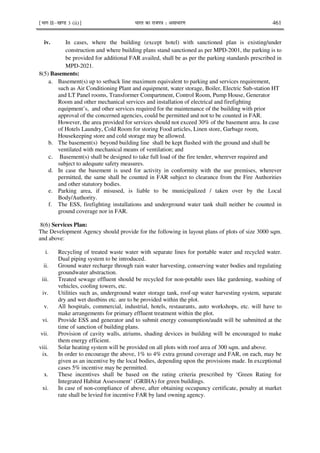
![462 THE GAZETTE OF INDIA : EXTRAORDINARY [PART II—SEC. 3(ii)]
The regulation for enforcement of above shall be prepared by the Director, Local Self Government,
GNCTD in consultation with Environment Department, GNCTD within a period of six months (after
notification of modifications) and notified with the approval of the Authority/Central Government.
8. (6).1 Neighborhood Level
i. The listed water bodies and/or any water body above 1 ha. size are mandatory to be
systematically included in the landscape plan.
ii. Decentralized STP’s with smaller capacities are to be provided at the community level.
Possibility of generating energy/gas as fuel from sewage shall be explored.
iii. Municipal Waste of biodegradable and recyclable waste is to be segregated at source,
decentralized treatment at neighborhood level may be adopted; whereas for non-
biodegradable waste centralized treatment may be followed.]
8 (7) HIGH RISE BUILDINGS
a. Buildings taller than 15M (without stilt) and 17.5M (including stilt) in all use zones will be
considered as a High Rise Building.
b. In case of provision of stack-parking in stilt floor, minimum height of 2.4 m. for stilt floor
may be relaxed. However, in case of stack parking the height shall be as per design and
structural safety requirement.
c. Intermittent service floor may be permitted for installation of equipments and services
required for the maintenance of the building with prior approval of the agencies concerned
and is not to be counted in FAR. The height of the service floor is to be decided based on the
depth of structural members, the height requirement for providing water-reservoirs, other
equipments, etc. Height below bottom of any beam shall not be more than 1.8 m. from the
finished floor level excluding false floor if any.
d. Basement will be permitted within the setback lines subject to clearance from local bodies /
departments concerned, Municipal Corporation and Fire Department. Where there are no
setbacks, basements should be permitted up to 2 meters and where there is setback, it should
be 6 meters from the plot boundary.
e. Podium(s) will be permitted within the setback lines subject to clearance from the fire
department. The movement of vehicles and parking shall be restricted within the podium.
Rooftop to be allowed for uses such as swimming pool, landscaping, and related structures.
f. Other conditions for basement will be as Sub-Clause 8(5).
DCR for Civil line/Bungalow area: For civil line/bungalow area the Draft Zonal
Development Plan for Zone – “C” (Civil lines Zone) approved by Authority ON
30.10.2007 Vide item No.82/2007, Area Planning – II, Delhi Development Authority.
Reference: - http://dda.org.in/planning/docs/Zone-C,Report040108.pdf
*Development Control norms applicable for land assembly & land pooling (chapter- 19,
Para19.6)
i. Development Control Norms under the policy are:-
a. Residential FAR 400 FOR Group Housing to be applicable on net residential land
which is exclusive of the 15% FAR reserved for EWS housing.net residential land to
be a maximum of 55% of gross residential land.
b. FAR for city level commercial and city level PSP to be 250.
c. Maximum ground coverage shall be 40%.
d. Density of FAR 15% for EWS population shall be considered over and above the
permissible gross residential density of 800-1000pph.](https://image.slidesharecdn.com/ubbl2016notified-250923161005-b0550c73/85/UBBL_2016_Notified_DDA-Building-Bye-laws-462-320.jpg)
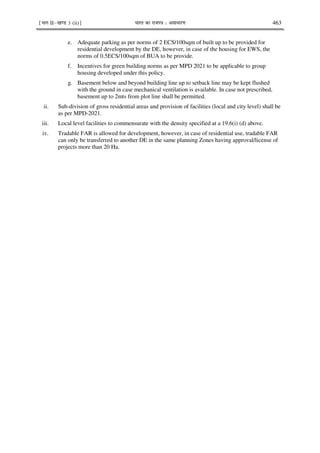
![464 THE GAZETTE OF INDIA : EXTRAORDINARY [PART II—SEC. 3(ii)]
ANNEXURE –VII
Protection against Hazards (Please refer clause 9.2.2 of this document)
1. Protection of areas from earthquakes
a. In those areas where there are no dangers of soil liquefaction or settlements or landslides, all
building structures and infrastructures should be designed using the relevant Indian Standards
as provided in the Building Regulations and the National Building Code
b. Soils subjected to liquefaction potential under earthquake shaking can be improved by
compaction to desired relative densities, so as to prevent the possibility of liquefaction.
c. Buildings and structures could be founded on deep bearing piles going to non-liquefiable
dense layers.
d. Steep slopes can be made more stable by terracing and construction of retaining walls and
breast walls, and by ensuring good drainage of water so that the saturation of the hill-slope is
avoided.
e. Any other appropriate engineering intervention to save the building structures or
infrastructure from the fury of the earthquake.
1.1 For structural design the Seismic Microzonation Thematic Maps prepared by India
Metrological Department shall be referred. Details of Maps are as under:
MAP-1: Average Sheer velocity at 30 m depth(m/s), MAP-2: Peak Frequency Map based on
H/V ratio, MAP-3: Peak Ground acceleration (PGA) at surface for MCE, MAP-4: Peak Ground
Acceleration (PGA) at surface for DBE, MAP-5: Spectral Acceleration at 0.1 Second for DBE,
MAP-6: Spectral Acceleration at 0.3 second DBE, MAP-7: Spectral Acceleration at 0.5 second
DBE, MAP-8: Spectral Acceleration at 1.0 second DBE, MAP-9: Spectral Acceleration at 0.1
second for MCE, MAP-10: Spectral Acceleration at 0.3 second for MCE, MAP-11: Spectral
Acceleration at 0.5 second for MCE, MAP-12: Spectral Acceleration at 1.0 second for MCE,
MAP-13: Liquefaction at 0.9 mbgl, MAP-14: Hazard index
2. Protection from cyclonic wind damage
Buildings, structures and infrastructures in the cyclone prone areas should be designed according
to the Indian Standards and Guidelines as provided in the Regulations and the National Building
Code.
Note: Similar protection methods could be used against flooding caused in cyclone prone areas by high
intensity rains or by the storm surge.
The concept of land zoning should be kept in mind for areas where protection works are taken up to decide
inter-se priority for location of structures considering possibility of failure of protection works during extreme
disaster events.](https://image.slidesharecdn.com/ubbl2016notified-250923161005-b0550c73/85/UBBL_2016_Notified_DDA-Building-Bye-laws-464-320.jpg)
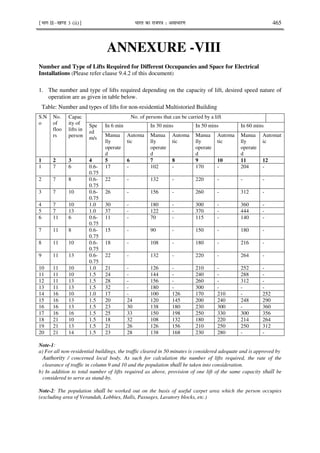
![466 THE GAZETTE OF INDIA : EXTRAORDINARY [PART II—SEC. 3(ii)]
Note-3: The population on ground and first floor may not be taken into consideration since these floors are not
generally served by lifts.
Note-4
0.75 meter per sec. Equivalent to 150 ft. per Min.
1.00 meter per sec. Equivalent to 200 ft. per Min.
1.5 meter per sec. Equivalent to 300 ft. per Min.
Note-5 The height of buildings for lift installation i.e. the travel on the lift presumed in the above statements is
as below:
7 floors- 21.0 m
11 floors- 33.0 m
16 floors- 48.0 m
21 floors- 64.0 m
Table: Number and types of lifts for Residential Building
S.no No. of
floors
No Passenger
unit
capacity
Persons
Speed
in m/s
Landing
Gate
Type
Central
System
Service
Lift
No.
Capacity
Persons
Type
of
Gate
Central
System
1 5 to 8 2 6 0.0 to
0.5
- Automatic
push
button
operation
both from
car and
landing
- - - -
2 9 to 11 2 8 1.6 to
1
- -do- 1 8 - Push
button
car
handle
switch
control
3 11 to 13 2
1
8
6
1.6 to
0.74
-
Power
operated
doors
-do- and
without
collection
system
-do-
1 8 - -do-
4 13 to 19 2
2
8
8
1
1
-
Power
operated
doors
-do- 1 8 - -do-
* For buildings more than 15 m in height collapsible gates shall not be permitted.
The dimensions and relevant information for lift installations like lift well, pit depth, machine room, clearance
from top floor landing to machine room flooring is given in table below:](https://image.slidesharecdn.com/ubbl2016notified-250923161005-b0550c73/85/UBBL_2016_Notified_DDA-Building-Bye-laws-466-320.jpg)
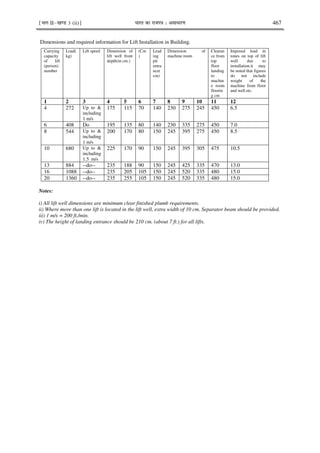
![468 THE GAZETTE OF INDIA : EXTRAORDINARY [PART II—SEC. 3(ii)]
ANNEXURE -IX
1 Space for Electrical Installations (Please refer clause 9.4.3 of this document)
The spaces required for different electrical installations are given from 1.1 to 1.3
1.1 Electric Sub-station – The norms given in 1.1.1 and 1.1.2 shall be adopted for provision of space
for sub-station.
1.1.1 Area Requirements for Sub-Station for buildings
S.No Total covered area(in sq.m) Transformer capacity(in KVA) Substation Size
required(in sq.m)
1 2500 1 X 400 70
2 4500 1 X 630 70
3 8000 2 X 630 100
4 10,000 2 X 630 130
5 15,000 4 X 630 160
6 20,000 5 X 630 175
7 25,000 6 X 630 200
8 30,000 7 X 630 220
Notes:
1. For additional 1000 sq.mt. Covered area, a load of 90 KVA will come up with 150 KVA TR. Capacity at 60 %
loading.
2. For additional of one transformer as per covered area, a space of additional 16 sq.m is to be provided.
3. In case of any deviation in space size due to unavoidable circumstance, the same shall be considered with the
approval of Electricity Board.
4. The floor of the sub-station shall have cable trenches of 0.6 m depth, the layout for which will be given at the
time of actual construction. For this purpose, a dummy floor of 0.6 m depth shall be provided to facilitate
cutting/digging of floor for installation of equipment’s and making subsequent changes in trenches. This
floor shall be capable to withstand minimum load of 10 tones of each transformer mounted on flour wheels.
The break-up spaces required for different installations in a sub-station are given as below:
a) Supply company’s Switchgear room and or space of meters.
b) Transformer Rooms: The number and size of transformer rooms shall be ascertained from
the total power requirements of the company. To determine the size of transformer and
clearance around a transformer, reference shall be made to good practice (I.S.1887-1967 code
of practice for installation and maintenance of Transformer). A 500 KVA transformer shall be
provided with a minimum space of 4 m x 4 m. If transformer is to be installed outdoor space
shall be provided on similar considerations and adequate provision for safety enclosure is to
be made. Transformer can be installed inside or outside provided movement of fire tender is
unobstructed. For transformer having large oil content (more than 2000 lt.) soak pits are to be
provided in accordance with rule 64 of Indian Electricity Rules, 1956. Only dry type
transformer shall be permitted if installed in 1st
basement.
c) High Voltage Switch Rooms – In case of sub-station having one transformer, the owner is
required to provide only one high voltage switch. In the case of single point supply for two
transformers, the number of switches required is 3 and for ‘n’ transformers the number of
switches is n+1. The floor area required in case of a single switch will be roughly 4 m x 1m
and for every additional switch the length should be increased by 1mt.](https://image.slidesharecdn.com/ubbl2016notified-250923161005-b0550c73/85/UBBL_2016_Notified_DDA-Building-Bye-laws-468-320.jpg)
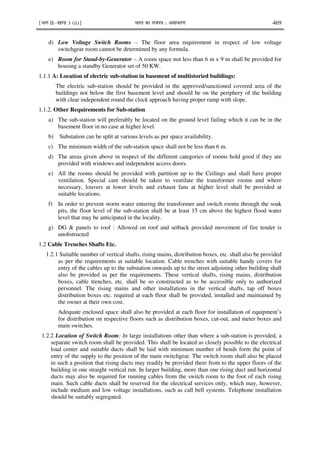
![470 THE GAZETTE OF INDIA : EXTRAORDINARY [PART II—SEC. 3(ii)]
1.2.3 Location and Requirement of Distribution Panels: The electrical gear distribution panels and
other apparatus, which are required on such floor, shall conveniently be mounted adjacent to the
rising mains, and adequate space should be provided at each floor for this purpose.
1.2.4 Location and Requirement of PBX/PABX Room: Information regarding provision and location
of PBX/PABX room, telephone outlets and riser shall be ascertained form the relevant Authority
/ concerned local body. Adequate space should be provided for installation of Sub-Distribution
Board.
1.3. General
1.3.1 The maintenance of the built up space for electric sub-station, distribution equipment,
Vertical shafts and enclosure at each floor shall be done by the owner. The standby
arrangement for electricity supply up to and including the sub-station equipment and
distribution pillars at the sub-station shall be provided compulsorily.](https://image.slidesharecdn.com/ubbl2016notified-250923161005-b0550c73/85/UBBL_2016_Notified_DDA-Building-Bye-laws-470-320.jpg)
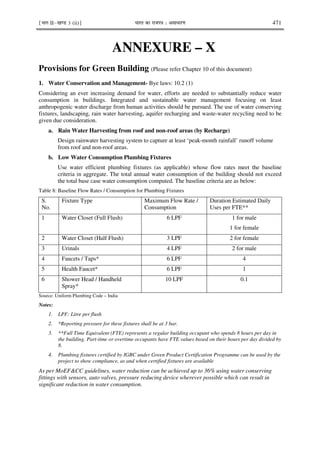
![472 THE GAZETTE OF INDIA : EXTRAORDINARY [PART II—SEC. 3(ii)]
i. Water closets (WCs):
• Conventional toilets use 9 litres of water per flush. Low flush toilets are available
with flow rate of 6.0 litres and 3.0 litres of water per flush.
• Dual flush adapters can be used for standard flushing for solid waste and a modified
small flush for liquid waste
• Flush valves with 20-25 mm inlets can be used for restricting the water flow
ii. WC faucets, wash basin taps, and kitchen taps:
• Faucets and taps can have flow rates upto 25 litre/min. The flow rate can be reduced
without compromising on the water pressure by having restrictors, pressure inhibitors
and aerators. Auto control valves can further help in reducing wastage.
• Pressure reducing device: Use of aerators can result in flow rates as low as 2
litre/min, which is adequate for hand washing purpose.
• Auto control valves: Installation of magic eye solenoid valve (self-operating valve)
can result in water savings. The sensor taps has automatic on and off flow control. It
functions with parameters such as distance and timing.
iii. Urinals:
• The conventional urinals use water at a rate of 7.5-11 litres per flush.
• Low flush urinals use only 2 litre/flush
• Use of electronic flushing system or magic eye sensor can further reduce the flow of
water to 0.4 litres per flush
• Waterless urinals use no water
iv. Shower heads:
• Conventional showerheads can deliver water at flow rates above 25litres/min.
• A perfectly pleasant shower can however, be obtained with flow rates well below 10
litres / min.
• Shower heads fitted with aerators and pressure regulators can reduce flow rates as
low as 4.5litrs/min and their use will show a significant saving.
c. Waste Water Recycle and Reuse
i. Waste Water Treatment: Design an on-site treatment system to handle 100% of waste
water generated in the building, to the quality standards suitable for reuse, as prescribed
by Central (or) State Pollution Control Board, as applicable.
ii. Waste Water Reuse: Use treated waste water for at least 25% of the total water required
for landscaping, flushing, and cooling tower make-up water (if the project uses water-
cooled chillers).The treated waste water could be used for landscaping, flushing and air-
conditioning.
Notes:
1. Waste water here refers to both grey and black water
2. Waste water can be treated in-situ and reused in-situ
3. In case the local authorities insist the project to divert waste water to a centralized/ common waste
water treatment plant, then the project can show compliance, by reusing treated wastewater from the
centralized/ common/ any other waste water treatment plant
4. Treated waste water from other sites/ local authorities through permanent piped connections or other
means can also be considered to show compliance
5. Captured rain water can also be considered to show compliance](https://image.slidesharecdn.com/ubbl2016notified-250923161005-b0550c73/85/UBBL_2016_Notified_DDA-Building-Bye-laws-472-320.jpg)
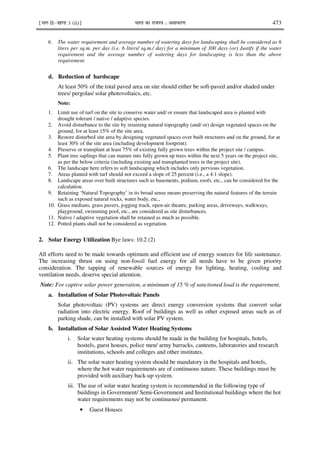
![474 THE GAZETTE OF INDIA : EXTRAORDINARY [PART II—SEC. 3(ii)]
• Police men/Army barracks
• Canteens
• Laboratory & Research Institutions where hot water is needed.
• Hostels, Schools, Colleges and Other Institutes.
iv. The Installation of the electrical back up in all such water heating system shall be
optional depending on the nature of requirements of the hot water.
v. It is suggested that solar heating systems of the capacity of about 100 liters per day
based on thermos phonic with necessary electrical back-up be installed at residential
buildings like hostels.
vi. In order to facilitate the installation of the solar water heating systems, the new
buildings shall have the following provisions:
vii. All such buildings where solar water heating systems are to be installed will have
open sunny roof area available for installation of solar water heating system.
• The roof loading adopted in the design of such building should be at least 50 kg
per sq. m. for the installation of solar water heating system.
• A solar water heating system can also be integrated with the building design.
These either can be put on the parapet or could be integrated with the south
facing vertical wall of the building. The best inclination of the collector for
regular use throughout the year is equal to the local latitude of the place. The
Collectors should be facing south. However, for only winter use the optimum
inclination of the Collector would be (Latitude + 15 degrees of the south.). Even
if the Collectors are built in south facing vertical wall of building the output
from such Collectors during winter month is expected to be within 32% output
from the optimum inclined Collector.
• All the new buildings to be constructed shall have an installed hot water line
from the rooftop and insulated distribution pipelines to each of the points where
hot water is required in the building.
• The capacity of the solar water heating system to be installed on the building
shall be described on the basis of the average occupancy of the building. The
norms for hospitals, hotels and other functional buildings are given below:
Table 9: Recommended capacity in various types of Buildings
• An Open area of 3 sq.m would be required for installation of a collector which
supplies about 100 liters of water per day. At least 60% of the roof area may be
utilized for installation of the system.
• The specification for the solar water heating system laid down by the Ministry of
Non- Conventional Energy Sources can be followed. Flat plate collector
confirming to Bureau of Indian Standards - latest standard should be used in all
such solar water heating systems.
Sr. No. Type of Buildings Capacity recommended - liters per capita per
day
1 Hospitals 100
2 Hotels 150
3 Hostels & other such Building 25
4 Canteen As required
5 Laboratory & Research Institutions As required](https://image.slidesharecdn.com/ubbl2016notified-250923161005-b0550c73/85/UBBL_2016_Notified_DDA-Building-Bye-laws-474-320.jpg)
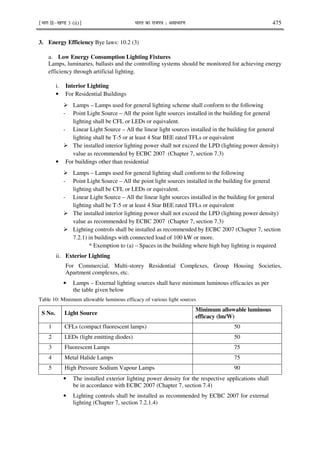
![476 THE GAZETTE OF INDIA : EXTRAORDINARY [PART II—SEC. 3(ii)]
b. Energy Efficiency in HVAC systems design (Applicable to all use premises) (mandatory
for commercial and desirable for residential):
Energy efficiency in HVAC system design for buildings
• The inside design conditions of a conditioned space shall conform to National
Building Code 2005 (Part 8, section 3)
• The outside design conditions shall conform to National Building Code 2005 (Part
8, section 3)
• Efficiency of the equipment installed shall comply with ECBC 2007 requirement
(Chapter 5, section 5.2.2)
• The distributed cooling systems (Unitary air conditioners/ Split air conditioners)
shall be at least BEE 3 Star rated products.
• To avoid the conductive heat losses through piping and ductwork insulation shall
be provided as recommended by ECBC 2007 (section 5.2.4)
4. Waste Management Bye laws: 10.2 (4)
Facilitate segregation of waste at source to encourage reuse or recycling of materials, thereby
avoiding waste being sent to landfills.
a. Segregation of Waste
i. Building-level Facility - Provide separate bins to collect dry waste (paper, plastic,
metals, glass, etc.,) and wet waste (organic), at all the floors and common areas of the
building, as applicable. Divert the collected waste to a centralized facility, which is
easily accessible for hauling.
ii. Centralized Facility - In addition to dry and wet waste bins, provide separate bins
for safe disposal of the following hazardous waste, at the centralized facility:
• Batteries
• ‘e’ waste
• Lamps
• Medical waste, if any
Note: The project has to follow the Hazardous Waste Management Guidelines as prescribed by the Ministry of
Environment & Forest (MoEF), Government of India.
b. Organic Waste Management
Ensure effective organic waste management, so as to avoid domestic waste being sent to
landfills and to improve sanitation & health. Install an on-site waste treatment system for
handling at least 50% of the organic and landscape waste generated in the building (including
tenant-occupied areas). The generated manure or biogas shall be utilized as appropriate.
Note:
For calculation, food waste can be considered as 0.1 kg per person per day (i.e. 0.1 kg/ person/ day) or as
prescribed by the local byelaw, whichever is more stringent; landscaped waste can be considered as 0.25 kg per
sq.m per day (i.e. 0.25 kg/ sq.m/ day).](https://image.slidesharecdn.com/ubbl2016notified-250923161005-b0550c73/85/UBBL_2016_Notified_DDA-Building-Bye-laws-476-320.jpg)
![478 THE GAZETTE OF INDIA : EXTRAORDINARY [PART II—SEC. 3(ii)]
integration can manifest itself in brick and stone work, trellises, patterns of paving, street furniture
and so on. The aesthetic effect of this can be seen not only on monumental buildings but also on
ordinary dwelling; the economic and social impacts include a major boost to the revival of traditional
crafts and ideas and providing employment to local craftsmen.
3. Art as integral to Building
While promoting art in the built form, a mistake often made is to treat it as an appendage, to be
conceived and added on after the building is completed. The policy of earmarking one to two per cent
of the building costs for works of art in one sense relegates art to being a separate activity. As a matter
of fact, affixing murals on blank walls and placing sculptures in vacant spaces in buildings as an
afterthought has not, in many buildings done sufficient justice to either the works of art or to the
building itself. The process of buildings is itself a creative activity and the expression of the human
spirit in material form. Specific provision for works of art as a percentage of the cost of the building
work is made only to ensure that the conception and incorporation of art becomes an integral part of
the design and building process.
4. Scope of Art in Building Projects
There are various art forms which can have relevance to building projects. These can broadly be
classified as follows:
1. Outdoor sculptures
2. Water fountain sculptures
3. Various landscape and street furniture elements such as railings, gates, compound walls,
lighting, tree guards, screens, balustrades, hard and soft surfaces, steps, mosaic or other paved
floors, plazas, courts, etc.
4. Murals and frescos
5. Mobiles and bas-relief
6. Folk and Tribal Art
7. Artisan art made of materials such as brick, concrete, cement blocks, hardware, etc.
8. Indoor sculptures
9. Paintings
10. Tapestry, wall hangings and floor coverings
11. Functional elements, such as screens, notice boards, counters, drinking water fountains, etc.
12. Other art forms relevant to the habitat.
One or more of the art forms mentioned above may be on interest depending upon the nature of a
building project. In individual homes, artisan, folks or tribal arts and crafts may be appropriate. In a
commercial complex or a residential neighborhood, practically all the types of art forms may have
relevance. The cost of the functional elements, however, should be built into the cost of the building
project and not into the funds earmarked for works of art.
5. Role of Local Authorities
The Delhi urban Art Commission urges the Delhi Development Authority (DDA), civic authorities,
central and state government departments, promoters of public and private institutions, private
developers, individual builders and home owners that in all commercial, industrial, institutional,
office and housing projects executed by public authorities or private developers, expenditure up to
two per cent but not less than one per cent of the cost of the building works should be provided for
works of art. Design proposals submitted to the Delhi Urban Art Commission must outline how the
sum of money allocated to art is to be utilized. Local authorities, while giving building approvals,
should see that the scheme for incorporation of art, as approved by the Delhi Urban Art Commission,
is effectively implemented.](https://image.slidesharecdn.com/ubbl2016notified-250923161005-b0550c73/85/UBBL_2016_Notified_DDA-Building-Bye-laws-478-320.jpg)
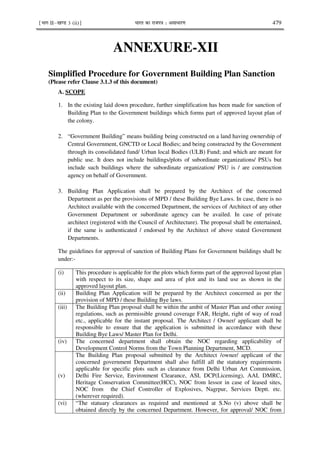
![480 THE GAZETTE OF INDIA : EXTRAORDINARY [PART II—SEC. 3(ii)]
DUAC, the Government Department concerned shall submit a request letter with two
sets of building plans along with profoma dully filled it for referring the proposal to
DUAC- after incorporation of recommendations of Delhi Fire Service in the
proposal”. The application shall accordingly be forwarded to DUAC by the concerned
local body to enable the DUAC to abide by their Act, by affixing a stamp as Under:
“ Proposal Received under simplified procedure for ________________ (name/
category of Government Building) forwarded to Delhi Urban Art Commission for
Approval”.
(vii) After obtaining the requisite clearance/ approval, the applicant shall submit building
plan application along with building tax as applicable under building bye laws and
other applicable regulations along with requisite documents/ affidavits/ undertaking
etc.
(viii) In case, there are number of blocks for a particular Government building/ project,
prior approval of layout plan is required. It would be necessary for the Department to
obtain approval of Layout plan separately under provision of DMC Act (i.e. Clause
No. 312 & 313) from the competent authority. Subsequently, building plan approval
for such blocks can be processed under this Simplified Procedure. However, the
approval of layout in such cases under Section 313/313 of the DMC Act, shall be
required only when new streets within the site are created for connecting with an
existing public or private street.
(ix) Reliance/authenticity & validity with regard to ownership documents, statutory
requirements, affidavits / undertakings for the proposal shall lie upon concerned
owner/ architect / applicant.
(x) The concerned Govt. Deptt. Shall maintain the record of such proposal for sanctioning
of Building Plan for future references.
B. PROCEDURE TO BE ADOPTED FOR ACCEPTANCE OF BUILDING PLANS
FOR GOVERNMENT CASES SHALL BE AS PER FOLLOWED:-
(i) The proposal with all requisite information / details, such as building plans,
documents, affidavits / undertakings, indemnity bond, NOCs and certifications duly
signed by the owner/ architect / applicant shall be submitted to the designated
authority in MCD. It is incumbent upon the receiving officer in MCD to ensure
submission of all documents before receiving the application (i.e. number of
documents required along with requisite clearances / NOCs of concerned Departments
are submitted). The sanction shall be accorded within one week of payment of
requisite fees, levies and charges etc.
(ii) All the plans and documents shall be duly signed & stamped by the owner(s)
applicant, Architect, Structural Engineer (as defined in National Building Code). The
Architect shall indicate his / her name & address and Registration Number on the
plans and the forms as required preferably in the form of stamp.
(iii) Sanction shall be accorded on the basis of documents / affidavits/ undertakings etc.
Submitted by the applicant. The Architect/ applicant shall owe the responsibility of
correctness/ genuiness of all the documents.
(iv) TEST CHECK
After sanction of such cases, a random check of 10% of cases of proceeding month
shall be carried out by the staff of the concerned building department ascertain
veracity of information supplied by the concerned Architect(s) and Owner(s) at the
time of immediate sanction. In case, any discrepancy / misrepresentation surfaced,
necessary action including revocation of the sanction will be initiated togetherwith
referring the lapses to concerned Department for taking disciplinary action against the
defaulting architect and applicant.](https://image.slidesharecdn.com/ubbl2016notified-250923161005-b0550c73/85/UBBL_2016_Notified_DDA-Building-Bye-laws-480-320.jpg)
![482 THE GAZETTE OF INDIA : EXTRAORDINARY [PART II—SEC. 3(ii)]
APPLICATION FOR SANCTIONING OF BUILDING PLAN IN RESPECT OF
PROPERTY NO. ________________ SITUATED AT -
________________________________________
BELONGING TO _______________________________________________________
“INDEX OF SUBMITTED DOCUMENTS, AFFIDAVITS, CERTIFICATES ETC.”
S.NO DESCRIPTION PAGE NO.
1.
2.
3.
4.
5.
6.
7.
8.
9.
10.
11.
12.
13.
14.
15.
16.
17.
18.
19.
20.
21.
22.
23.
24.
25.
Signature of Architect Signature of Authorized Authority
(With Official Seal)
Name & Address Name & Address](https://image.slidesharecdn.com/ubbl2016notified-250923161005-b0550c73/85/UBBL_2016_Notified_DDA-Building-Bye-laws-482-320.jpg)
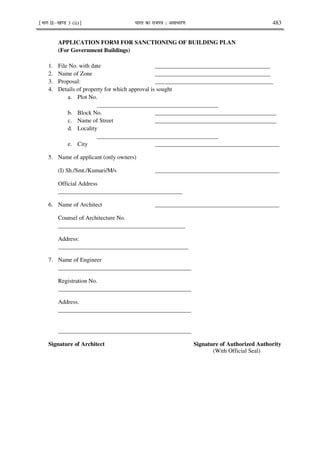
![484 THE GAZETTE OF INDIA : EXTRAORDINARY [PART II—SEC. 3(ii)]
Note for sanction of building plan in respect of plot
No.__________________________________ situated
at___________________________________
New Delhi belonging to M/S
I (Name of architect)________________________________________having Council of
Architecture
Registration No.___________________ valid upto _______________________________ have
been engaged by the authorized signatory of the above mentioned property. I have also been
engaged /directed to prepare Building plans in accordance with these Building Bye Laws (BBL),
Master Plan For Delhi and other concerned regulations applicable as on date in this regard. It will
also supervise the proposed construction to ensure that it has been carried out in accordance with
the provision of these BBL, MPD and regulation applicable.
The salient features of the proposed are as under:-
1. The details of property (for which he sanction ids being sought) Owners, Architect,
Engineer are available in the Profoma at page ___________.
2. Ownership
The owner has given the copy of
(i) Sale Deed
(ii) Lease Deed
(iii)Conveyance Deed
(Iv)NOC from Lessor
(v) Any other document- to be specified
Supported with an affidavit from the owner(s) to the fact that on the strength of submitted
document he/she/they is/ are the owner(s) of the property this is placed at page ________. If
his/her/their claim is found false at any stage FIR shall be lodged by me.
3. Leasehold Plot:
In this case I have examined the lease and extension of time from lessor is required
/not required.
If required the extension of time from lessor has been obtained vide their letter No.
_____________ dated ______________________ which is valid upto
_____________________ and is placed at page ________________.
4. Form-I application to erect, re-erect and to make alteration in any place in a building
as per byelaw No. 6.1 is placed at page __________________.
5. Form-II for specification of proposed building byelaw No. 6.2.6 is placed at
page__________.](https://image.slidesharecdn.com/ubbl2016notified-250923161005-b0550c73/85/UBBL_2016_Notified_DDA-Building-Bye-laws-484-320.jpg)
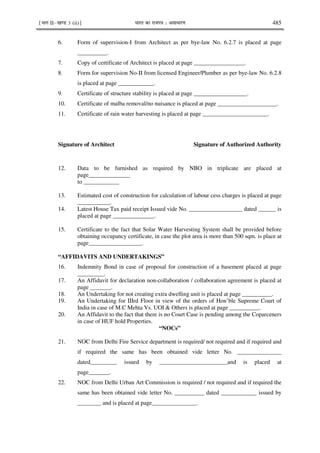
![486 THE GAZETTE OF INDIA : EXTRAORDINARY [PART II—SEC. 3(ii)]
23. NOC from Services Department (DJB, Electricity Deptt., SW Drain etc.) is required
/not required and if required the same has been obtained vide letter No. ________
dated _______issued by ________ and is placed at page __________.
24. NOC from D.C.P (Licensing) is required / not required and if required the same has
been obtained vide letter No. _______________ dated _________ issued by
______________ and is placed at page______________.
25. NOC from the Chief Controller of Nagpur, Explosive Department, Nagpur (In case of
hazardous building) is required/not required and if require the same has been obtained
vide letter No. ___________________dated ________________ Issued By
_______________ ad is placed at page___________________________.
26. NOC from ASI is required/not required and if required the same has been obtained
vide letter No. __________ dated _________ issued by __________ __is placed at
page_____________.
27. NOC from DMRC is required/not required and if required the same has been obtained
vide letter no. _______ _____dated _________ issued by _________ and is placed at
page_______________.
28. NOC from Airports Authority of India is required/not required the same has been
obtained vide letter No. _________ dated _______ issued by ____________ and is
place at page ___________.
29. NOC from the Environment Department is required/not required and if required the
same has been obtained vide letter No. __________dated ______ issued by _______
and is place at page_____________.
30. Clearance from Heritage Conservation Committee is required/not required and if
required the same has been obtained vide letter No. ____ _________dated ____
________Issued by ________ and is placed at page _________.
31. NOC from the C.I.F is required / not required and if required, the same has been
obtained vide letter No. ___________________ dated ____________ issued by
_________ and is place at page__________.
“DETAILS OF EXISTING STRUCTURE”
32. Copy of previous Sanction Plan sanctioned vide file No. _________________ dated
_______________ is placed at page __________.
33. Copy of C, & D from issued vide file No. _______________ dated
_______________ and is placed at page No._________________.
34. Copy of Occupancy Certificate issued vide File No. _______________ dated
____________ and is placed at page No____________________.
“ADDITION / ALTERATION IN EXISTING BUILDING”
35. In case of the existing building, it is certified that the existing structure is
inconformity with the Provisions of these Building Bye Laws, Master Plan for Delhi
and Zoning Regulations and constructed within the validity of sanctioned period and
occupancy certificate has been obtained. There is nothing to be compounded.](https://image.slidesharecdn.com/ubbl2016notified-250923161005-b0550c73/85/UBBL_2016_Notified_DDA-Building-Bye-laws-486-320.jpg)
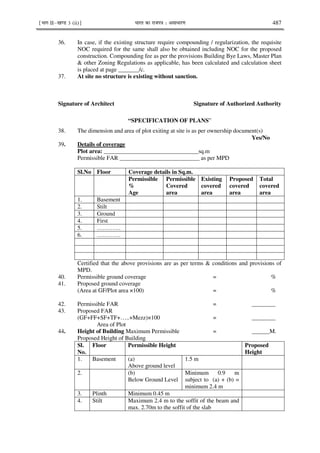
![488 THE GAZETTE OF INDIA : EXTRAORDINARY [PART II—SEC. 3(ii)]
5. Ground
Floor
Minimum 2.75 m.
Maximum 4.00 m
6. & so on Minimum 2.75 m.
Maximum 4.00 m.
Total Height = __________________________m. which is less than the permissible.
Signature of Architect Signature of Authorized Authority
45. Set Back:
Side Minimum Set back in
meter as per MPD
Proposed/existing set
back
Remarks
Front
Side 1
Side 2
Rear
Certified that the above provisions are as per terms & conditions and provisions of MPD.
46. The other provisions of the Bldg. in these Bye-laws, Master Plan for Delhi, Zoning
regulation and other prevailing laws have been adhered to by me in preparation of
drawing which are placed at page_______ to _________.
47. ECS:
For the total coverage _______ no. of ECS is required which has been
Adjusted as under:
a. In open _________ no. of ECS.
b. In stilt _________no. of ECS.
c. In Basement _______ no. of ECS.
d. In Garage Block_______ no. of ECS.
e. The total no of ECS adjusted is equivalent to or more than required.
48. Land Use:
The permissible use of the land is _____________________ and the proposed use of
the building is ___________________ which is in conformity of the MPD, Zoning
Regulation and other prevailing laws.
49. At site no structure is exists without sanction.
50. It is certified that plot forms part of approved layout plan of the colony.
51. In view of the above facts I ___________________(Architect) fully satisfied and
submitting my proposal for sanction of Building Plans of above mentioned property
before the ______________ SE (Bldg.)HQ/EE(Bldg.) of ______________ Zone
subject to following:-
I) Payment of Bldg. Tax
II) Payment of stacking charges, If required.
III) Payment of Compounding Fee (If required).
IV) Payment of Cess Charges
V) Any other charges.
Signature of Architect Signature of Authorized Authority
(With official seal)
Name & Address Name & Address](https://image.slidesharecdn.com/ubbl2016notified-250923161005-b0550c73/85/UBBL_2016_Notified_DDA-Building-Bye-laws-488-320.jpg)
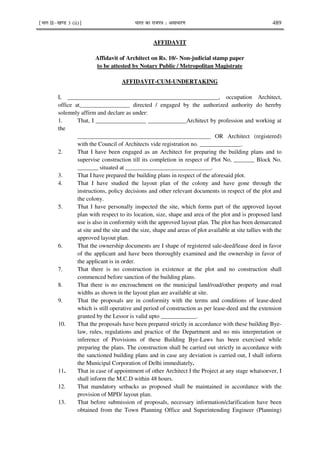
![490 THE GAZETTE OF INDIA : EXTRAORDINARY [PART II—SEC. 3(ii)]
Office at 8th
Floor, Civic Center, Minto Road, New Delhi-110002. There is no
dispute/affect of any scheme or the roads widths etc. on the plot/site. Building
activities for designated use, i.e. ________________________________________,
are allowed as per MPD.
14. That no development /additional development /deficiency charges are dues against
this plot (in case development/additional development/deficiency charges are due, the
details be given in a separate para.)
15. That nothing has been concealed and no mis representation has been made while
preparing and submitting the building plans.
16. That in case anything contrary to the above id found or established at any stage, the
M.C.D shall be at liberty to take any action as deem fit including revocation of
sanction of building plans and debarring me for submission of building plans with the
M.C.D under the Scheme and also can lodge a complaint with the Council of
Architecture for appropriate action.
17. That the instructions/guidance contained in the Office Order No. D/04/SE(B)HQ/12
dated 18.04.2012 have been carefully gone through, which are acceptable to me and
the proposals have been prepared accordingly.
DEPONENT
Verification:
I, the above named deponent, do hereby verify at Delhi/New Delhi on this ________
day of ________ 20 ______ that contents of the above Affidavit are true and
correct to my knowledge and behalf and nothing is false therein or has been
concealed therefrom.
DEPONENT](https://image.slidesharecdn.com/ubbl2016notified-250923161005-b0550c73/85/UBBL_2016_Notified_DDA-Building-Bye-laws-490-320.jpg)
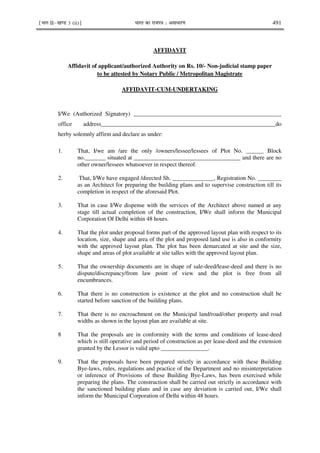
![492 THE GAZETTE OF INDIA : EXTRAORDINARY [PART II—SEC. 3(ii)]
10. The mandatory setbacks have been proposed and shall be maintained in accordance
with the setbacks marked in the layout plan /MPD.
11. That before submission of proposals, necessary information/clarification have been
obtained from the Town Planning Office and Superintending Engineer (Planning)
Office at 8th
Floor, Civic Centre, Minto Road, New Delhi-110002. The plot safe and
is not affected in any scheme or the roads widths. Building activities are as per
approved layout plan.
12. That no development/additional development /deficiency charges are payable against
this plot. (in case development/additional development/deficiency charges are
payable, then its details be given in a separate para.)
13. That no non-compoundable deviations shall be carried out during the course of
construction or thereafter.
14. That nothing has been concealed and no mis-representation has been made while
preparing and submitting the building plans.
15. That in case anything contrary to the above is found or established at any stage, the
M.C.D shall be at liberty to take any action as it may deem fit including revocation of
building plans and demolition/sealing of the premises.
16. That the instructions/guidance contained in the Office Order No. D/04/SE(B)HQ/12
dated 18.04.2012 have been carefully gone through, which are acceptable to me/us
and the proposals have been prepared accordingly.
17. That after completion of the building, the building shall not put to use before
occupancy certificate from MCD and will be put to use for which it will be
sanctioned.
18. That I/We give solemn undertaking that I/We shall raise the construction exactly in
accordance with the sanctioned building plans and these Building Bye-Laws. In case
any deviation is made, apart from any other action, the total constructions shall be
deemed to be unauthorized and the M.C.D would be at liberty to demolish/seal the
whole or any portion of the construction and I/We shall not claim any compensation,
damage or loss on account thereof from the M.C.D or from any of its office(s). This is
addition to any other action which may be taken by the M.C.D under the provisions
of the D.M.C Act, 1957 (as amended from time to time) and these Building Bye-
Laws.
DEPONENT
Verification:
I/We , the above named deponent(s), do herby verify at Delhi/New Delhi on this
_________day of _________,20______ that contents of the above Affidavit are true
and correct to my/our knowledge and behalf and nothing is false therein or has been
concealed therefrom.
DEPONENT](https://image.slidesharecdn.com/ubbl2016notified-250923161005-b0550c73/85/UBBL_2016_Notified_DDA-Building-Bye-laws-492-320.jpg)
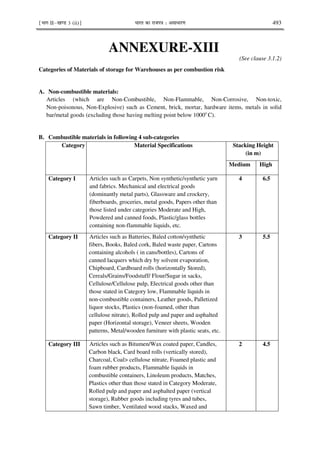
![494 THE GAZETTE OF INDIA : EXTRAORDINARY [PART II—SEC. 3(ii)]
asphalt coated papers and containers in cartons, Wood
wool, wooden pallets and flats (idle), Ail materials
having wrappings or pre-formed containers of foamed
plastics, etc.
Category IV Offcuts and random pieces of foamed plastic or rubber
rolls of sheets of foamed plastic or foamed rubber,
Foam mattress, Expanded polystyrene packaging,
Foam upholstery, etc
1.25 3.5
Explanations:
# The deflector of the sprinkler fitted in the ceiling shall be at more
than 1.5 m from the goods stored below. However, in case of jute
storage, no jute stock shall reach within 2 m of the deflectors of the
sprinkler heads.
# In case of storage in racks or shelves, if the height of storage is
more than what is specified, intermediate sprinklers shall be
provided for each shelf/rack in addition to the ceiling sprinklers and
overall design density and AMAO shall be maintained as per Table
5 of IS: 15105.
# The aisle width between the storage stacks shall not be less than 2.5
m and the maximum area of each storage stack shall not be more
than 150m2
. If these parameters are exceeded, the design density
applicable shall be loaded by 2.5 L/min/m2
.
# In case of mixed storage (both moderate and high hazard storage)
in buildings, the parameters will be governed by the most
hazardous occupancy
Goods stored not
higher than what is
stated above for the
appropriate category
or not higher than the
eaves height of the
roofs or within 1 m of
a flat ceiling
whichever is the
lowest shall be
regarded as moderate
hazard storage. If the
above conditions are
not met, the risk shall
be regarded as high
hazard storage
Notes:
1. Any new use which increases the number of occupants to a figure comparable with other classes
of occupancy shall change the classification of the building to that of the new use (for example,
Warehouse used for office purposes).
2. Warehouse buildings shall not include any article which is highly combustible or explosive
materials or products which are liable to bum with extreme rapidity and or which may produce
poisonous fumes or explosions for storage, handling and which involve highly corrosive, toxic or
noxious alkalis, acids or other liquids or chemicals producing flame, fumes and explosive, poisonous,
irritant or corrosive gases; and for the storage, handling of any material producing explosive
mixtures of dust which result in the division of matter in to fine particles subject to spontaneous
ignition as such buildings fall in Hazardous Building Category](https://image.slidesharecdn.com/ubbl2016notified-250923161005-b0550c73/85/UBBL_2016_Notified_DDA-Building-Bye-laws-494-320.jpg)
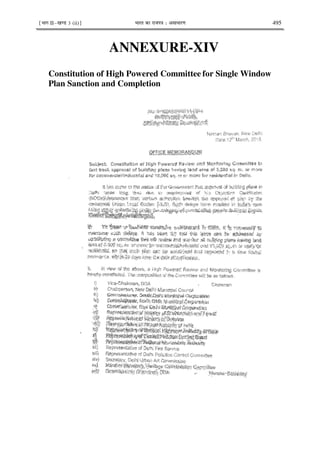
![496 THE GAZETTE OF INDIA : EXTRAORDINARY [PART II—SEC. 3(ii)]](https://image.slidesharecdn.com/ubbl2016notified-250923161005-b0550c73/85/UBBL_2016_Notified_DDA-Building-Bye-laws-496-320.jpg)
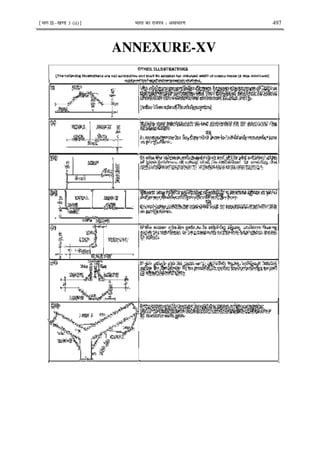
![498 THE GAZETTE OF INDIA : EXTRAORDINARY [PART II—SEC. 3(ii)]](https://image.slidesharecdn.com/ubbl2016notified-250923161005-b0550c73/85/UBBL_2016_Notified_DDA-Building-Bye-laws-498-320.jpg)
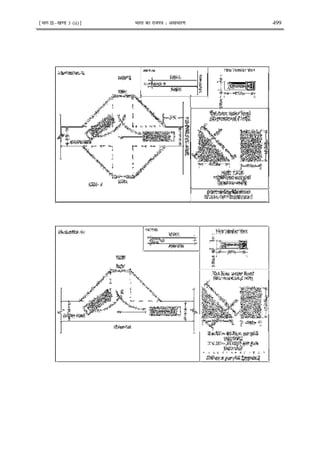
![500 THE GAZETTE OF INDIA : EXTRAORDINARY [PART II—SEC. 3(ii)]](https://image.slidesharecdn.com/ubbl2016notified-250923161005-b0550c73/85/UBBL_2016_Notified_DDA-Building-Bye-laws-500-320.jpg)
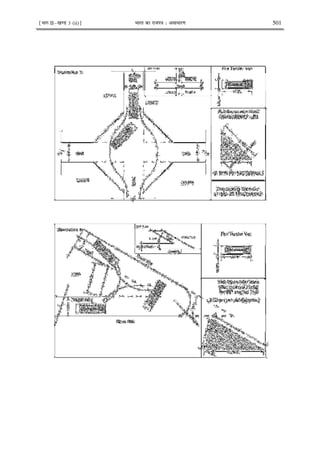
![502 THE GAZETTE OF INDIA : EXTRAORDINARY [PART II—SEC. 3(ii)]](https://image.slidesharecdn.com/ubbl2016notified-250923161005-b0550c73/85/UBBL_2016_Notified_DDA-Building-Bye-laws-502-320.jpg)
![¹Hkkx IIµ[k.M 3 (ii)º Hkkjr dk jkti=k % vlk/kj.k 503
[F. No. F15 (15)/2012-MP]
D. SARKAR, Commissioner-cum-Secy.
Uploaded by Dte. of Printing at Government of India Press, Ring Road, Mayapuri, New Delhi-110064
and Published by the Controller of Publications, Delhi-110054.](https://image.slidesharecdn.com/ubbl2016notified-250923161005-b0550c73/85/UBBL_2016_Notified_DDA-Building-Bye-laws-503-320.jpg)


![Megnadbodh kabya [probondha] - Rabindranath Thakur](https://cdn.slidesharecdn.com/ss_thumbnails/megnadbodhkabyaprobondha-150517191136-lva1-app6892-thumbnail.jpg?width=640&height=640&fit=bounds)


