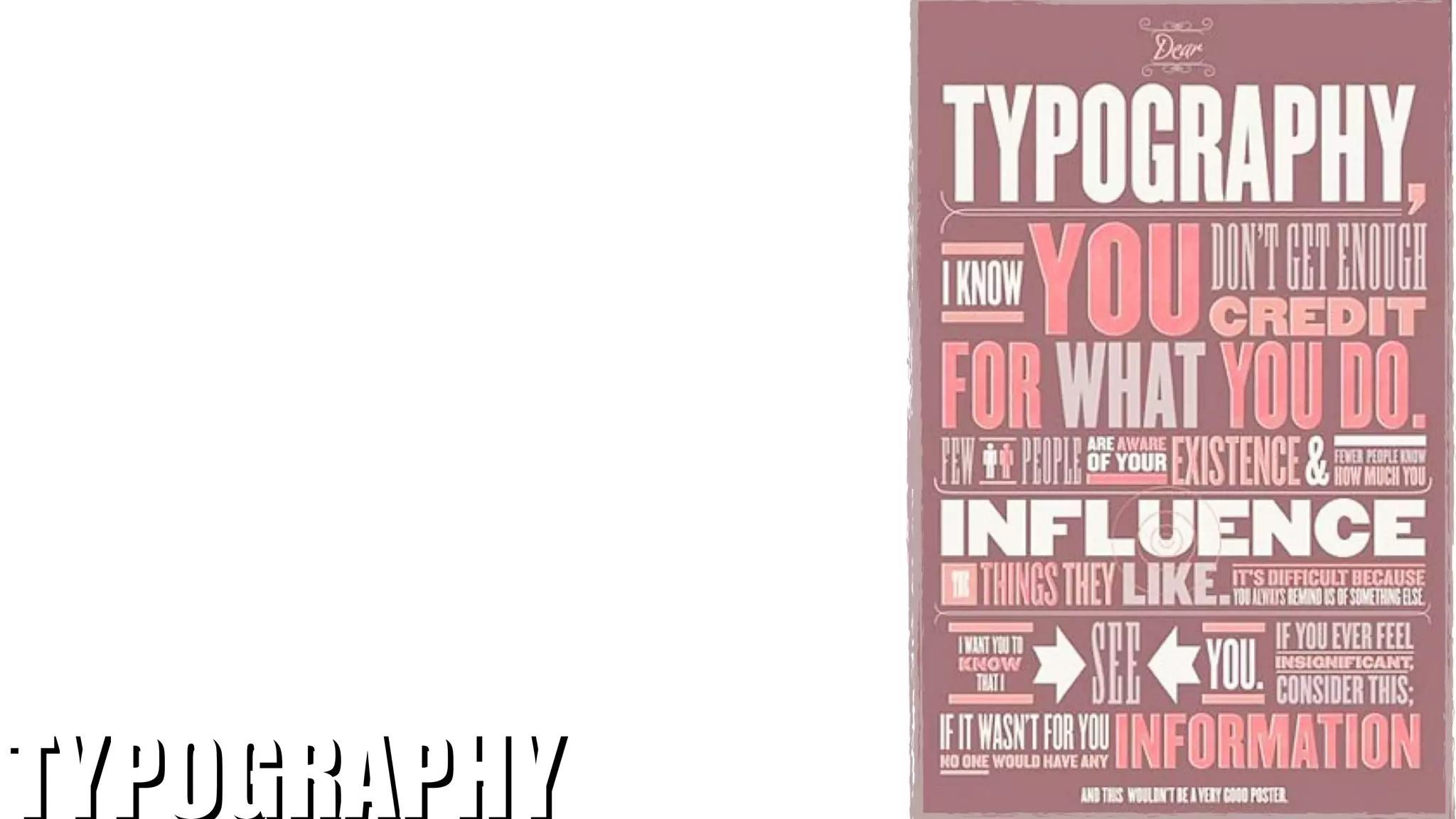
TYPOGRAPHY
What is TYPOGRAPHY ?
It is derived from the Greek words that mean
form and writing. It is the art and technique of
arranging type in order to make a particular
language visible.
TYPOGRAPHY
Arrangement of TYPE involves the selection of
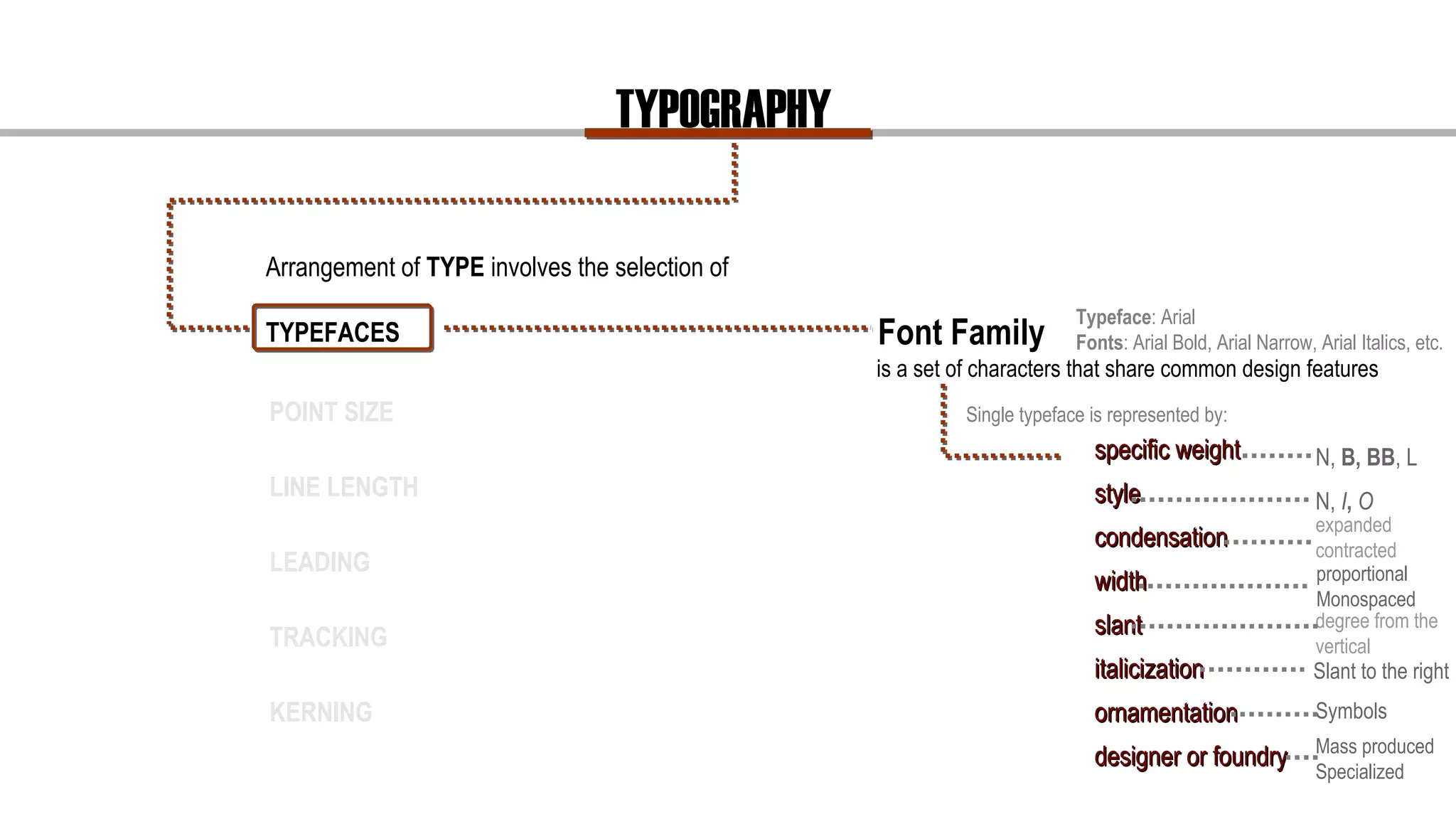
TYPEFACES Font Family
is a set of characters that share common design features
POINT SIZE
LINE LENGTH
LEADING
TRACKING
KERNING
Single typeface is represented by:
specific weightspecific weight
stylestyle
condensationcondensation
widthwidth
slantslant
italicizationitalicization
ornamentationornamentation
designer or foundrydesigner or foundry
N, B, BB, L
N, I, O
Typeface: Arial
Fonts: Arial Bold, Arial Narrow, Arial Italics, etc.
expanded
contracted
degree from the
vertical
Slant to the right
Symbols
Mass produced
Specialized
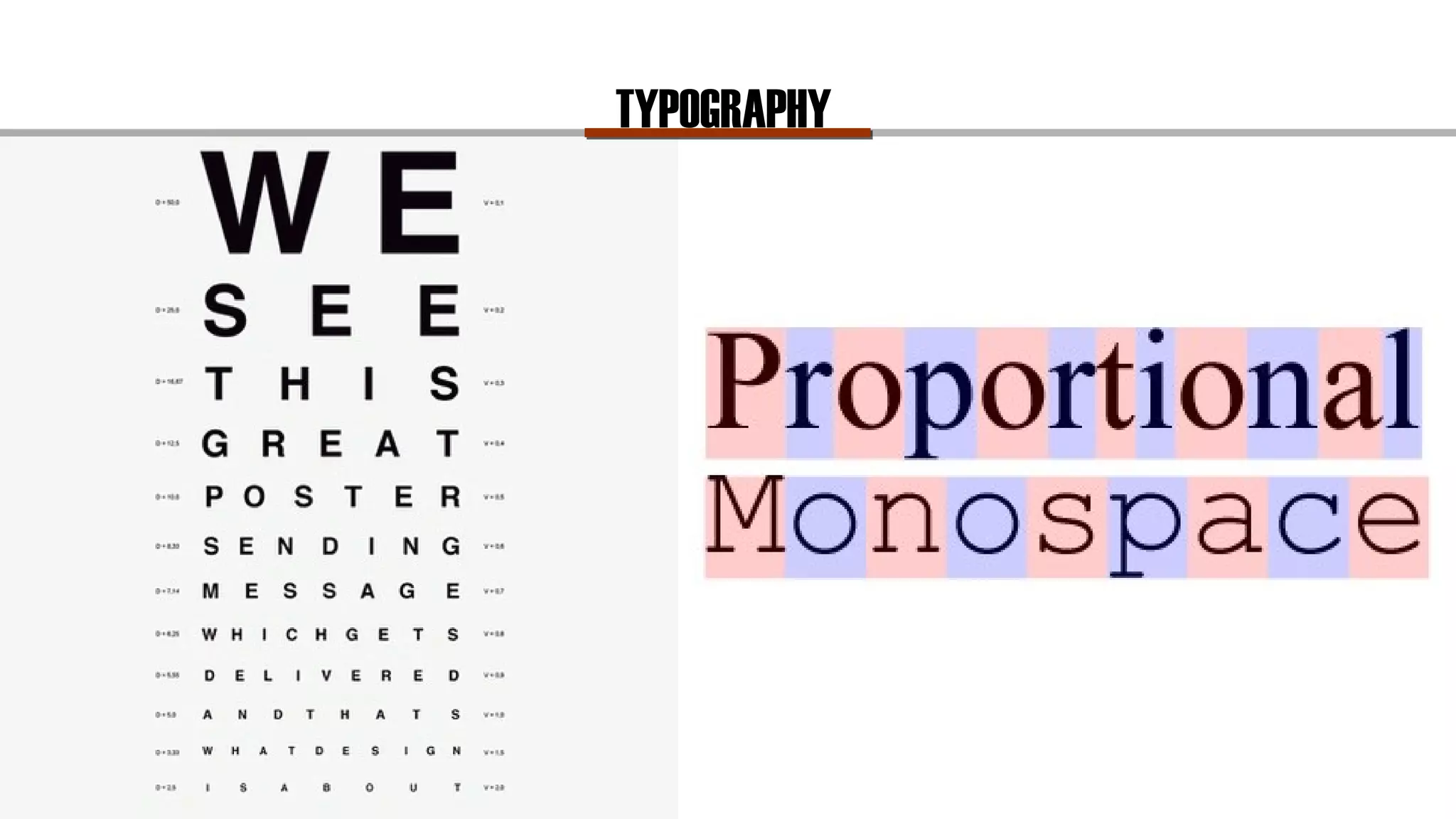
proportional
Monospaced
TYPOGRAPHY
Arrangement of TYPE involves the selection of
TYPEFACES
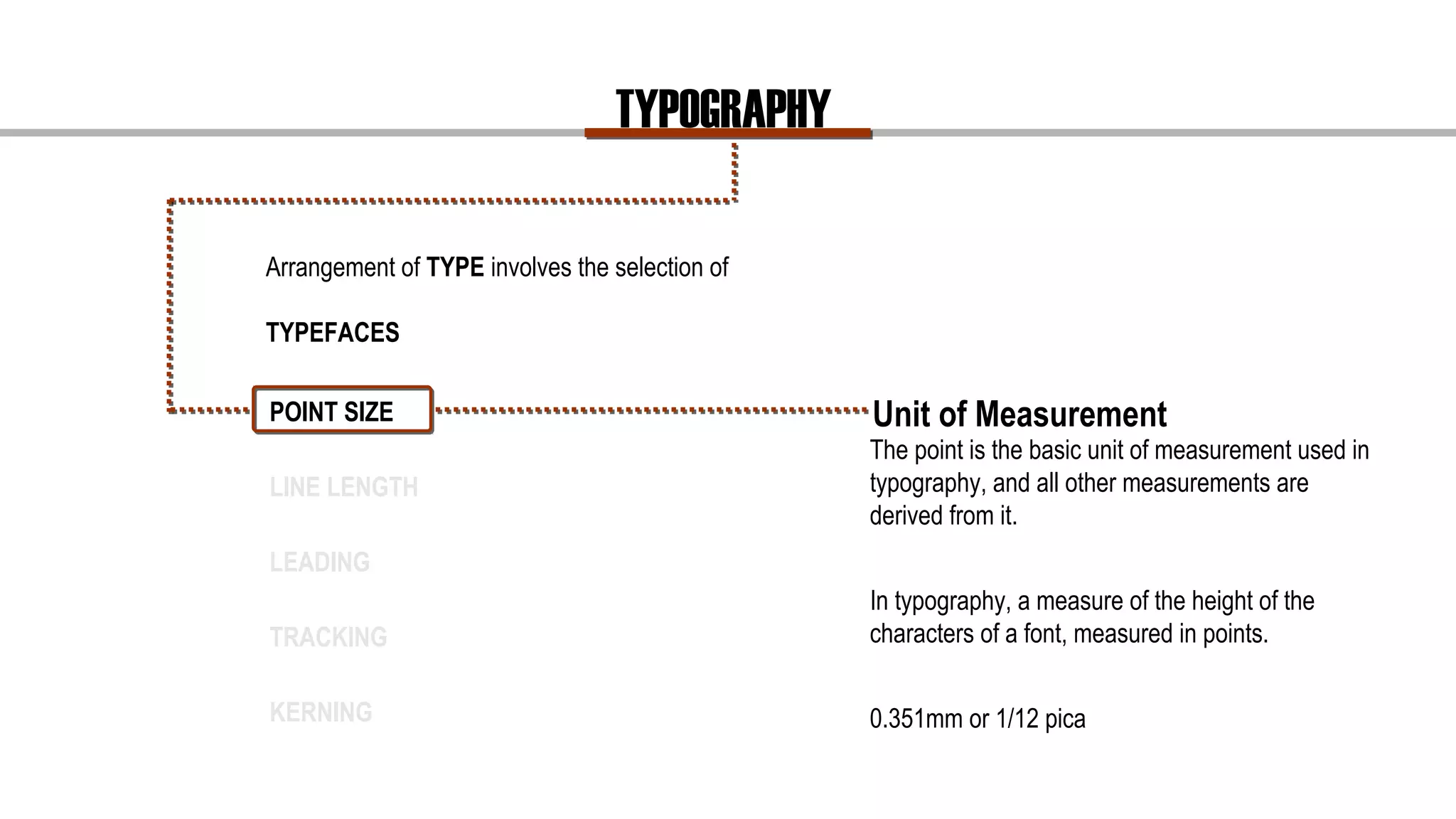
Unit of Measurement
The point is the basic unit of measurement used in
typography, and all other measurements are
derived from it.
In typography, a measure of the height of the
characters of a font, measured in points.
0.351mm or 1/12 pica
POINT SIZE
LINE LENGTH
LEADING
TRACKING
KERNING
TYPOGRAPHY
Arrangement of TYPE involves the selection of
TYPEFACES
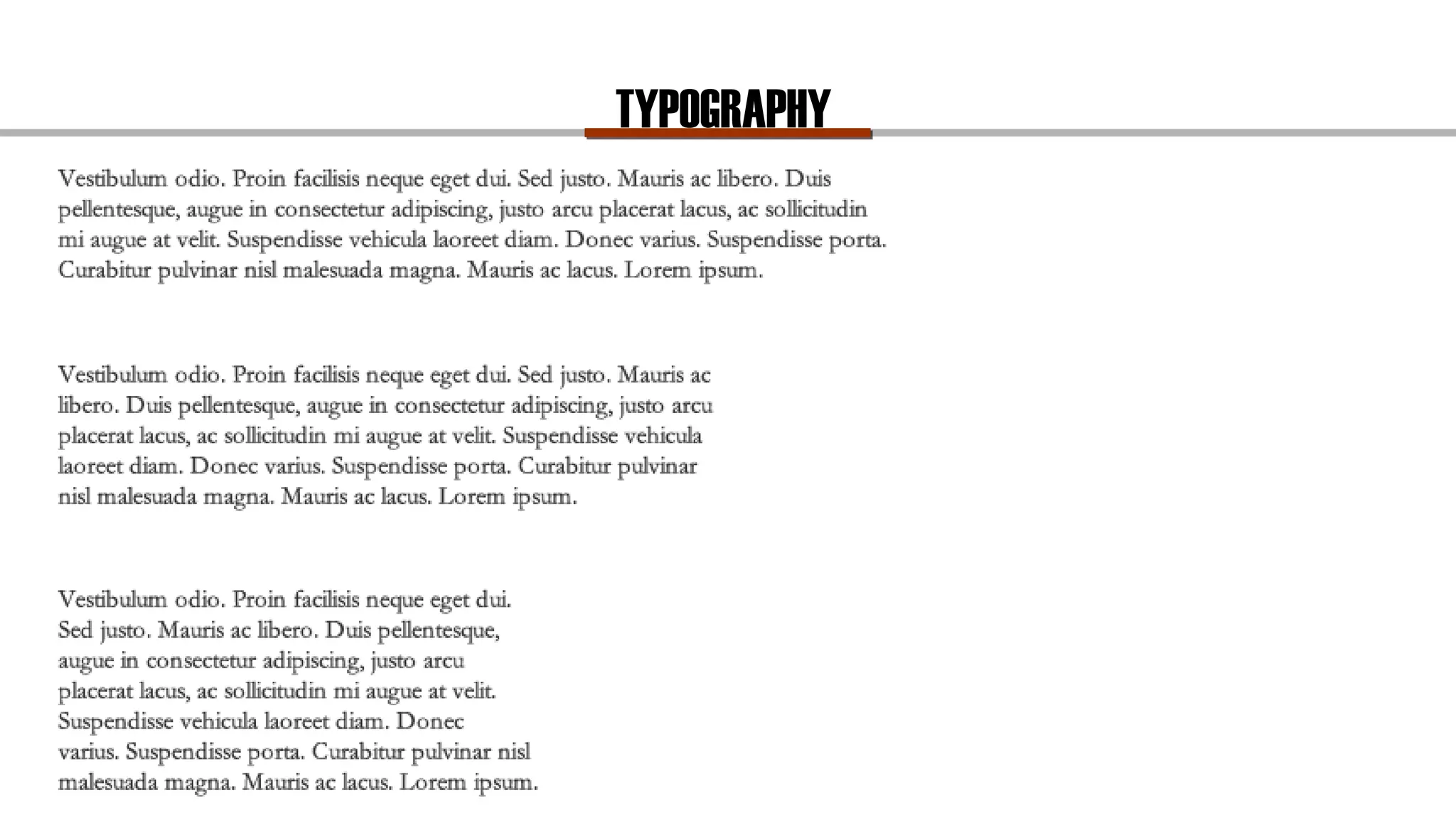
Block of Typeset text
It is the width occupied by a block of typeset text.
A block of text or paragraph has a maximum line
length that fits a determined design.
It is determined by typographic parameters based
on a formal grid and template with several goals in
mind; balance and function for fit and readability
with a sensitivity to aesthetic style in typography.
POINT SIZE
LINE LENGTH
LEADING
TRACKING
KERNING
TYPOGRAPHY
Arrangement of TYPE involves the selection of
TYPEFACES
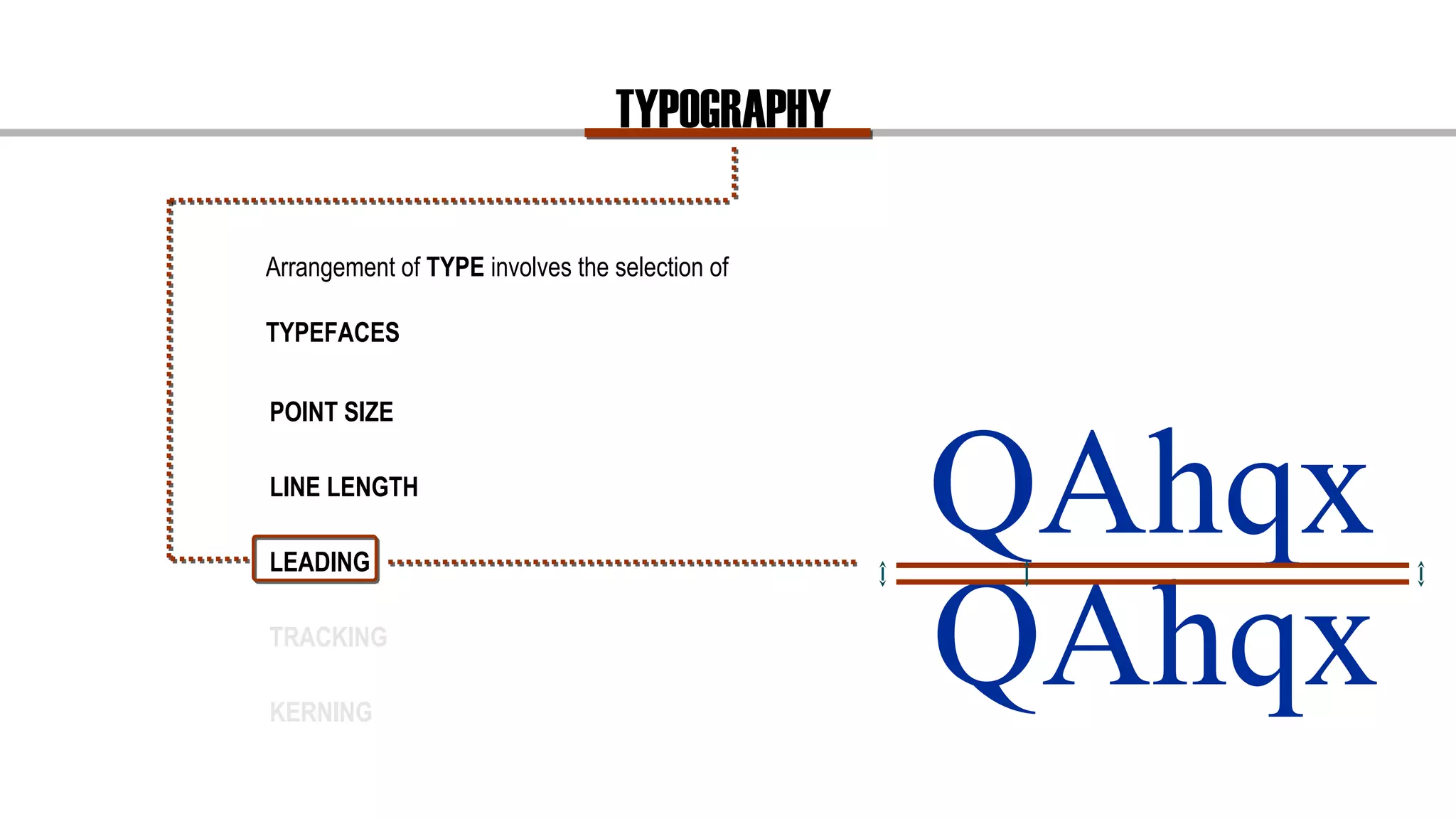
Line Spacing
Refers to the distance between the baselines of
successive lines of type.
POINT SIZE
LINE LENGTH
LEADING
TRACKING
KERNING
QAhqx
QAhqx
TYPOGRAPHY
Arrangement of TYPE involves the selection of
TYPEFACES
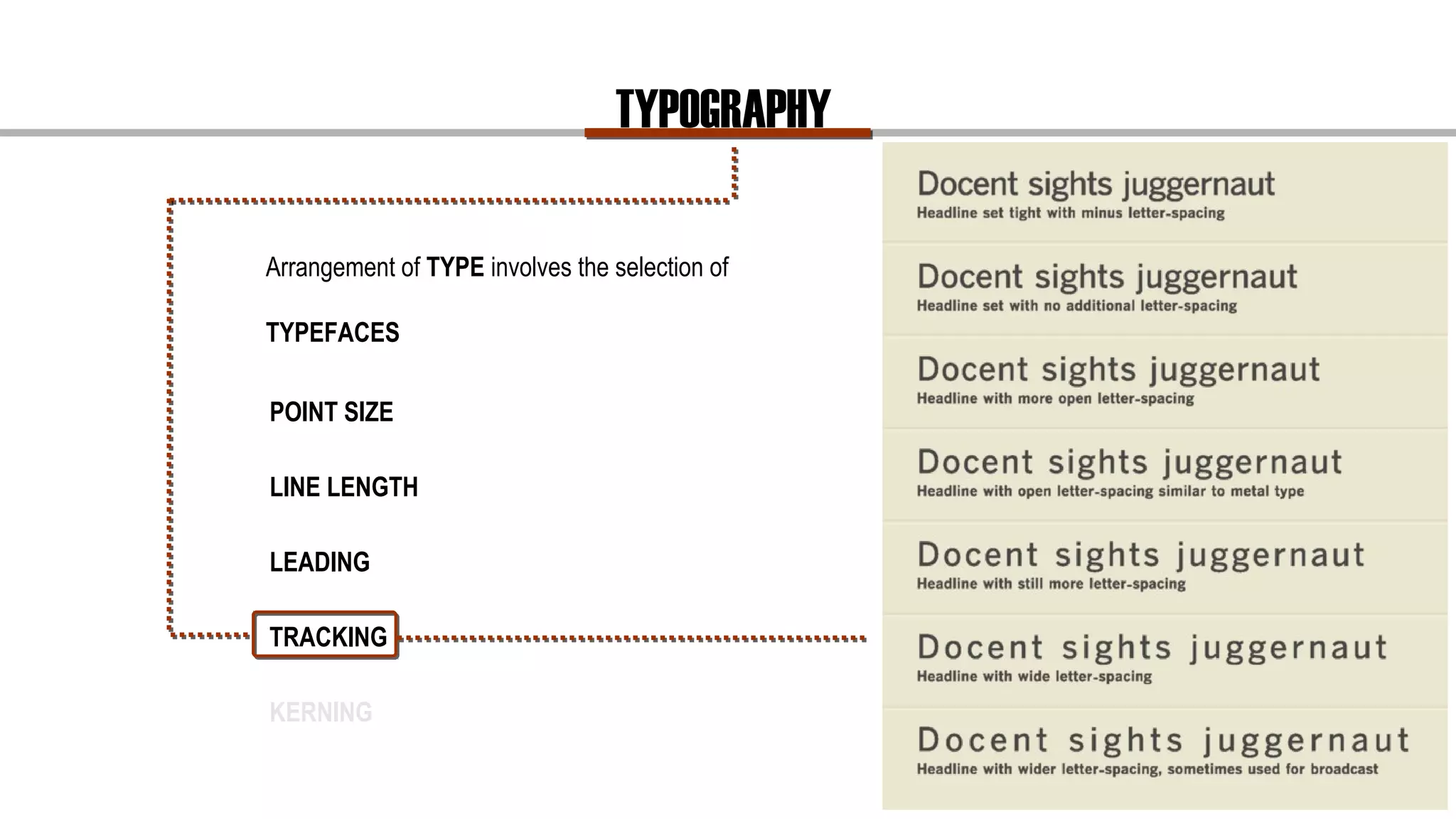
Overall Spacing
Tracking refers to the overall spacing of a word or
block of text affecting its overall density and texture.
POINT SIZE
LINE LENGTH
LEADING
TRACKING
KERNING
TYPOGRAPHY
Arrangement of TYPE involves the selection of
TYPEFACES
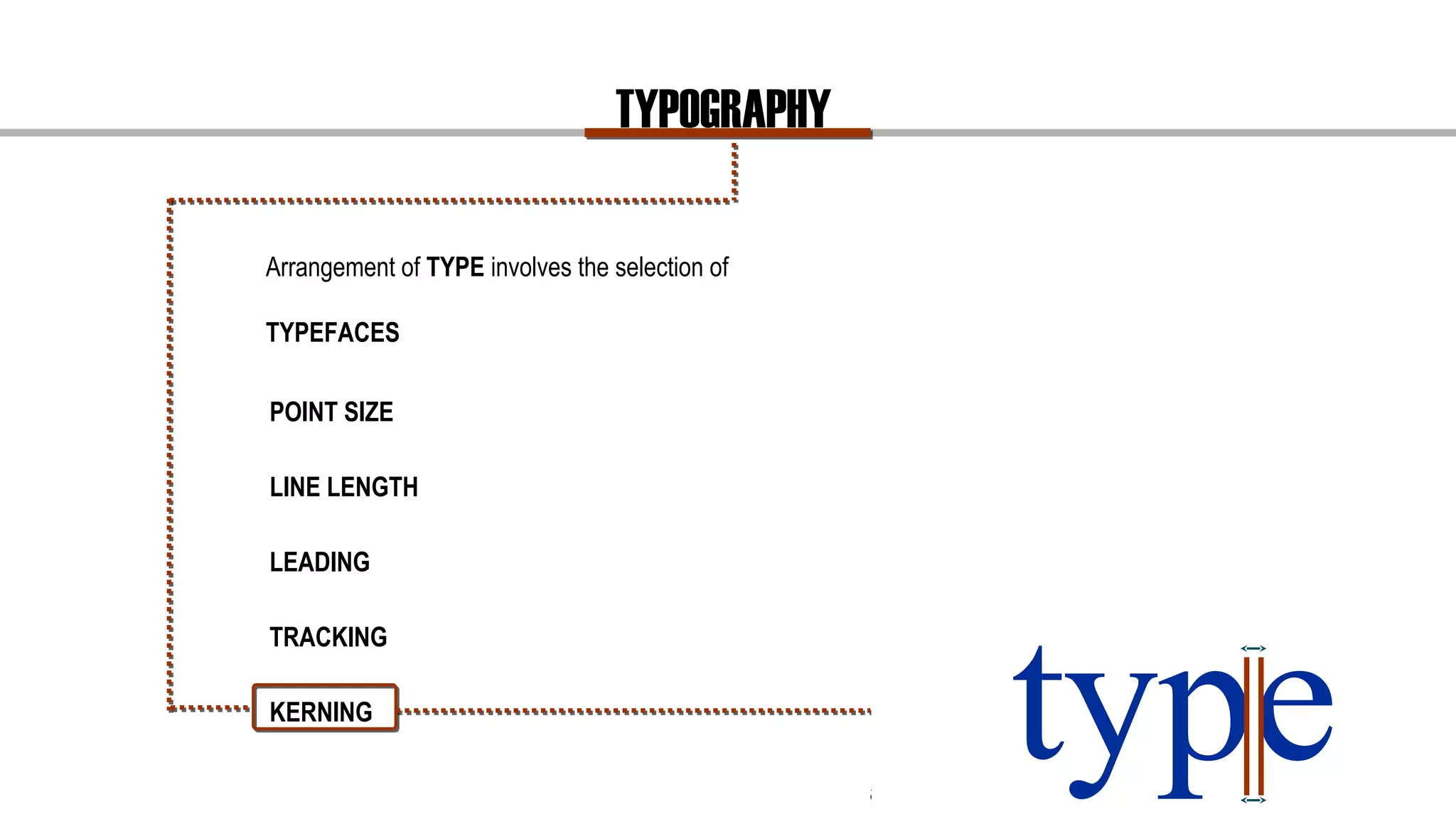
Space between characters
Kerning is a term applied specifically to the spacing
adjustment of two particular characters.
POINT SIZE
LINE LENGTH
LEADING
TRACKING
KERNING
type
TYPOGRAPHY
ANATOMYANATOMY ofof TYPOGRAPHYTYPOGRAPHY
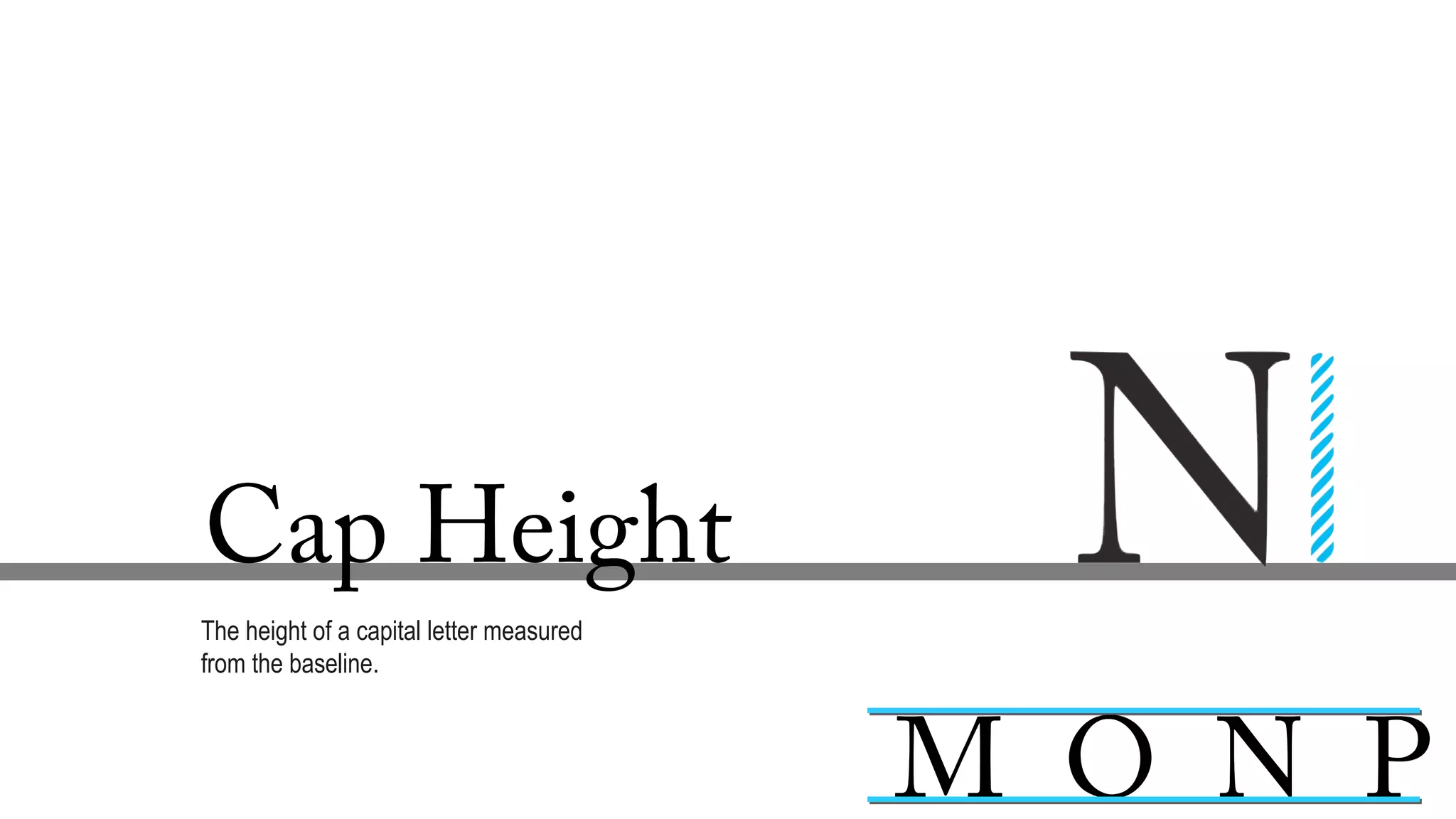
Cap Height
The height of a capital letter measured
from the baseline.
M O N P
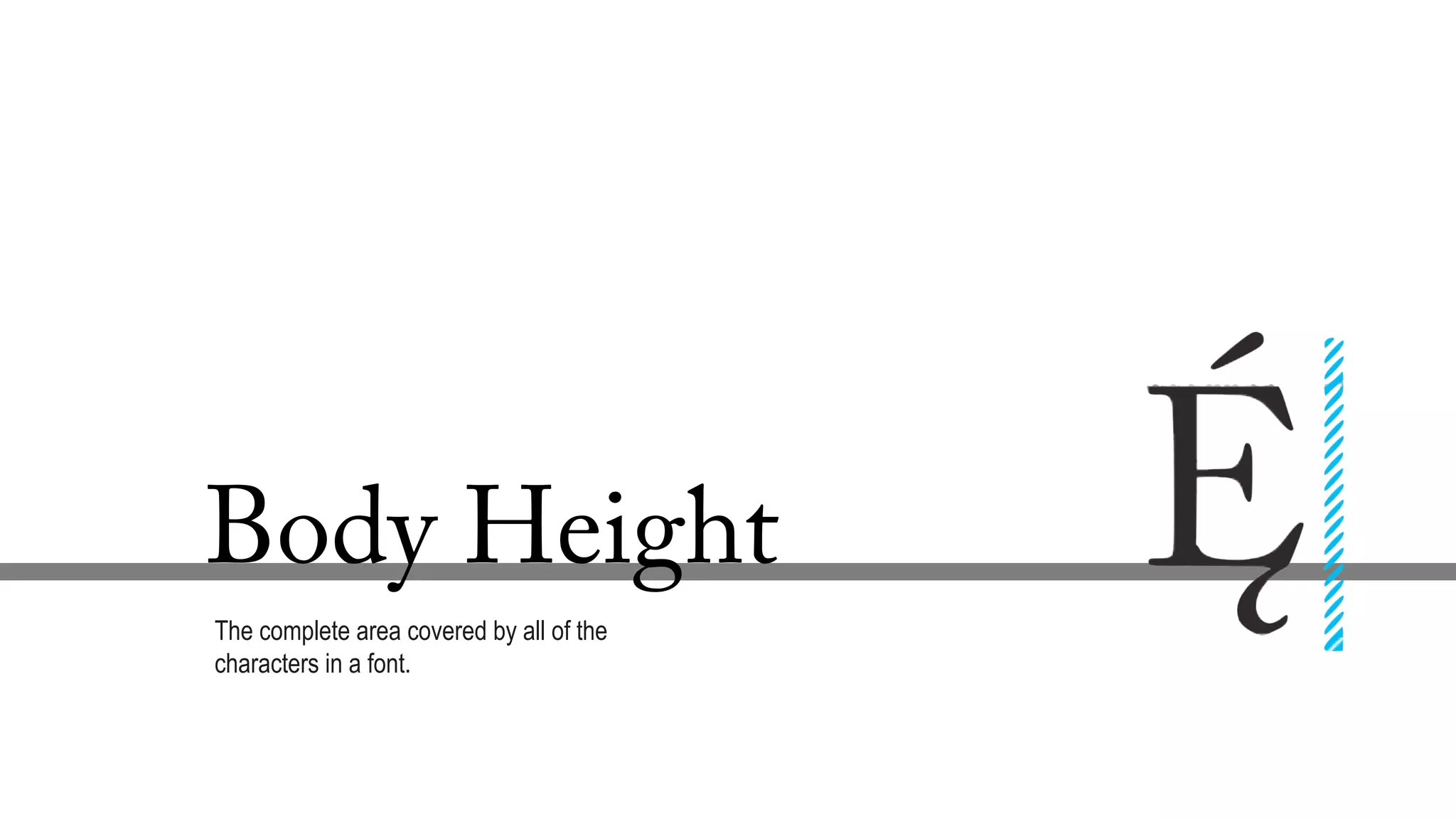
Body Height
The complete area covered by all of the
characters in a font.
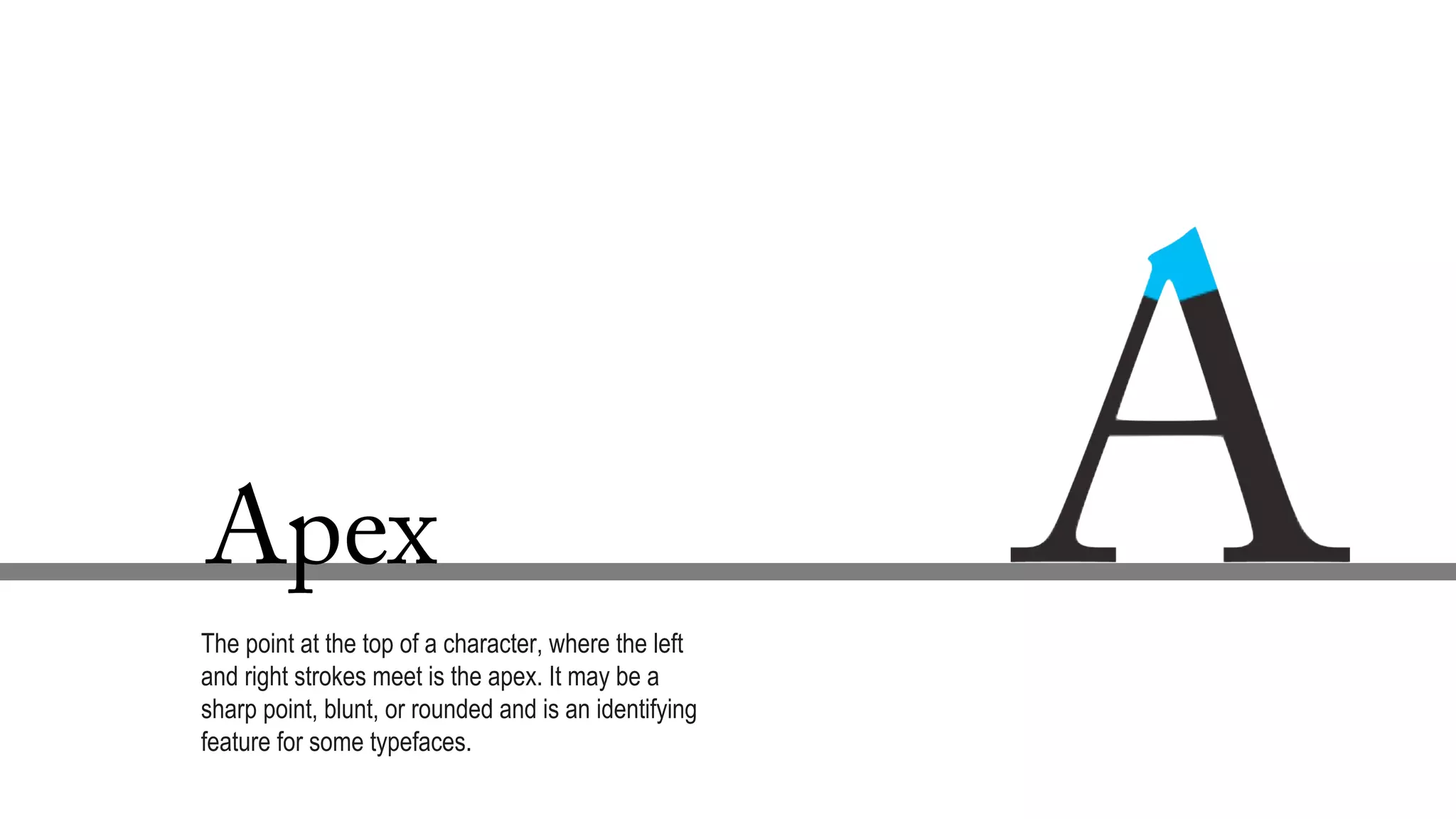
Apex
The point at the top of a character, where the left
and right strokes meet is the apex. It may be a
sharp point, blunt, or rounded and is an identifying
feature for some typefaces.
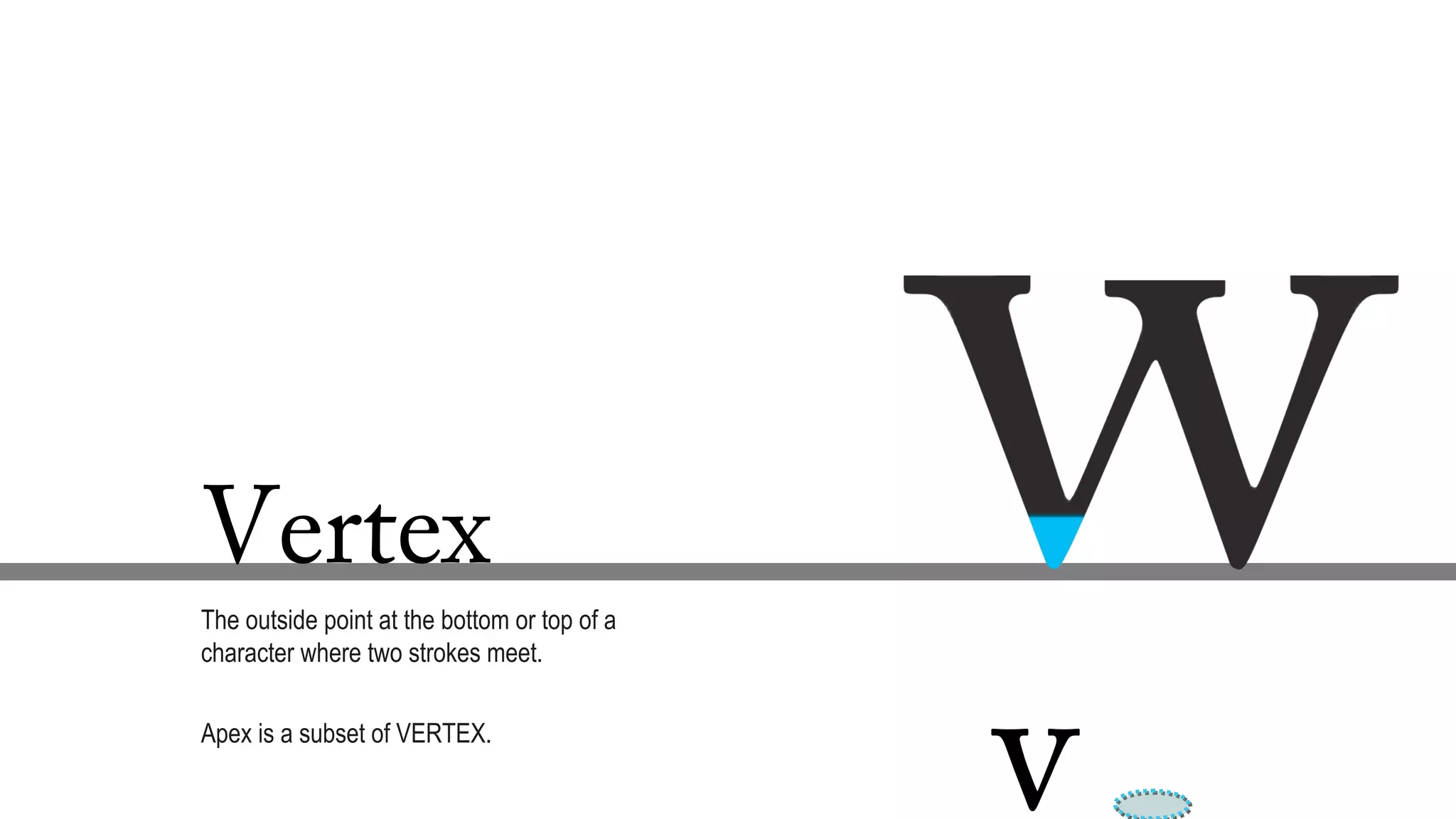
Vertex
The outside point at the bottom or top of a
character where two strokes meet.
Apex is a subset of VERTEX.
v
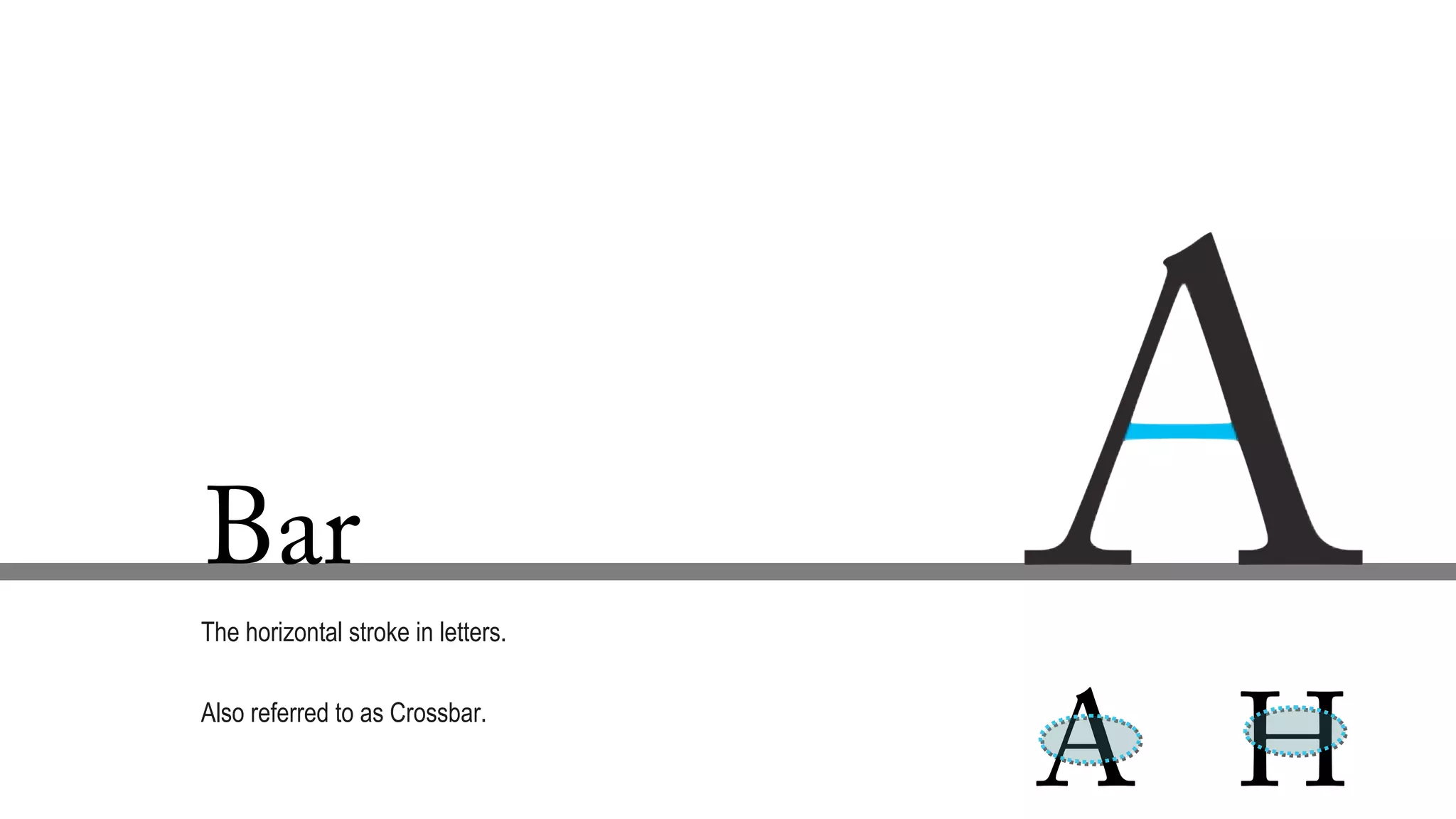
Bar
The horizontal stroke in letters.
Also referred to as Crossbar.
A H
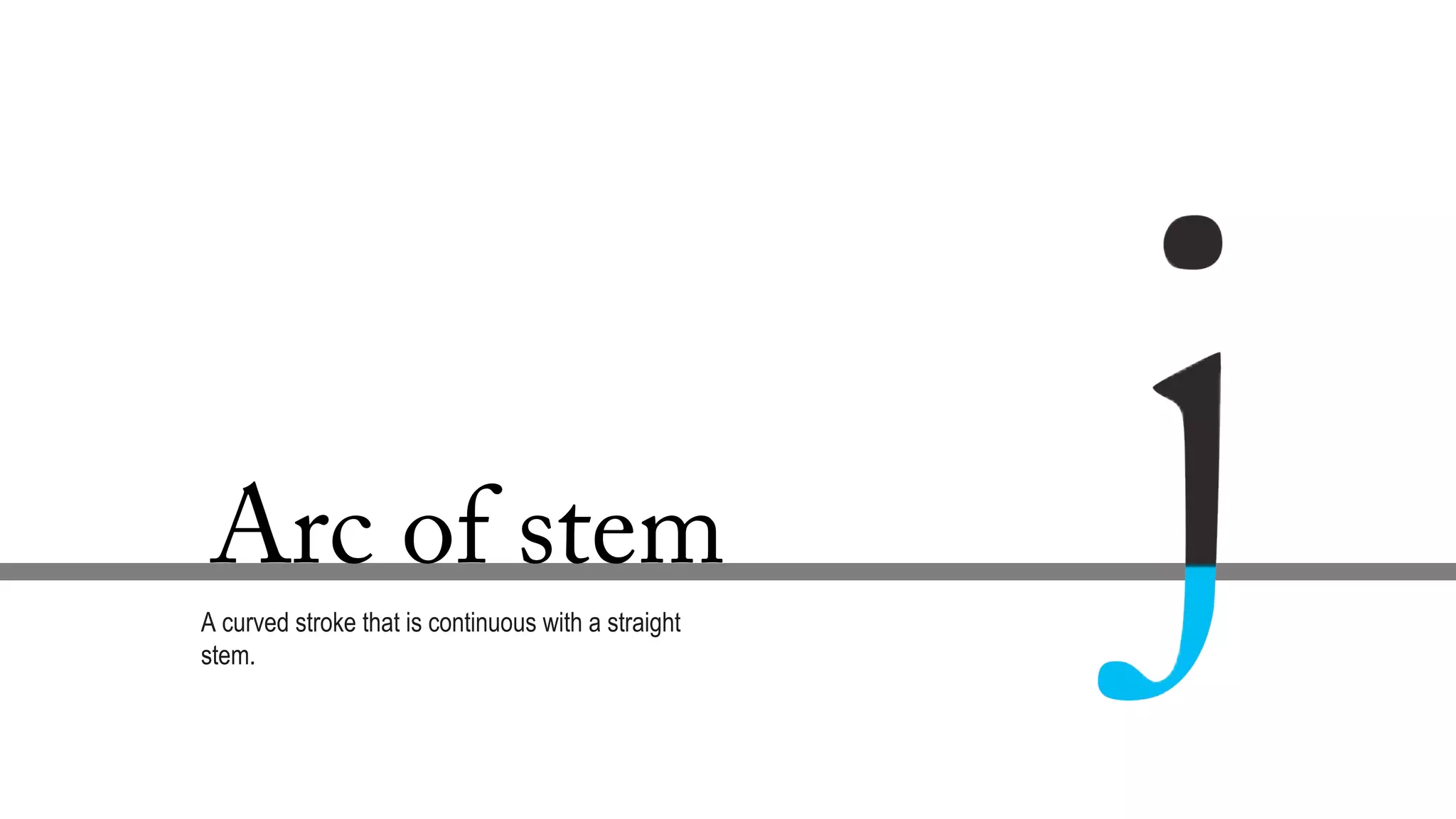
Arc of stem
A curved stroke that is continuous with a straight
stem.
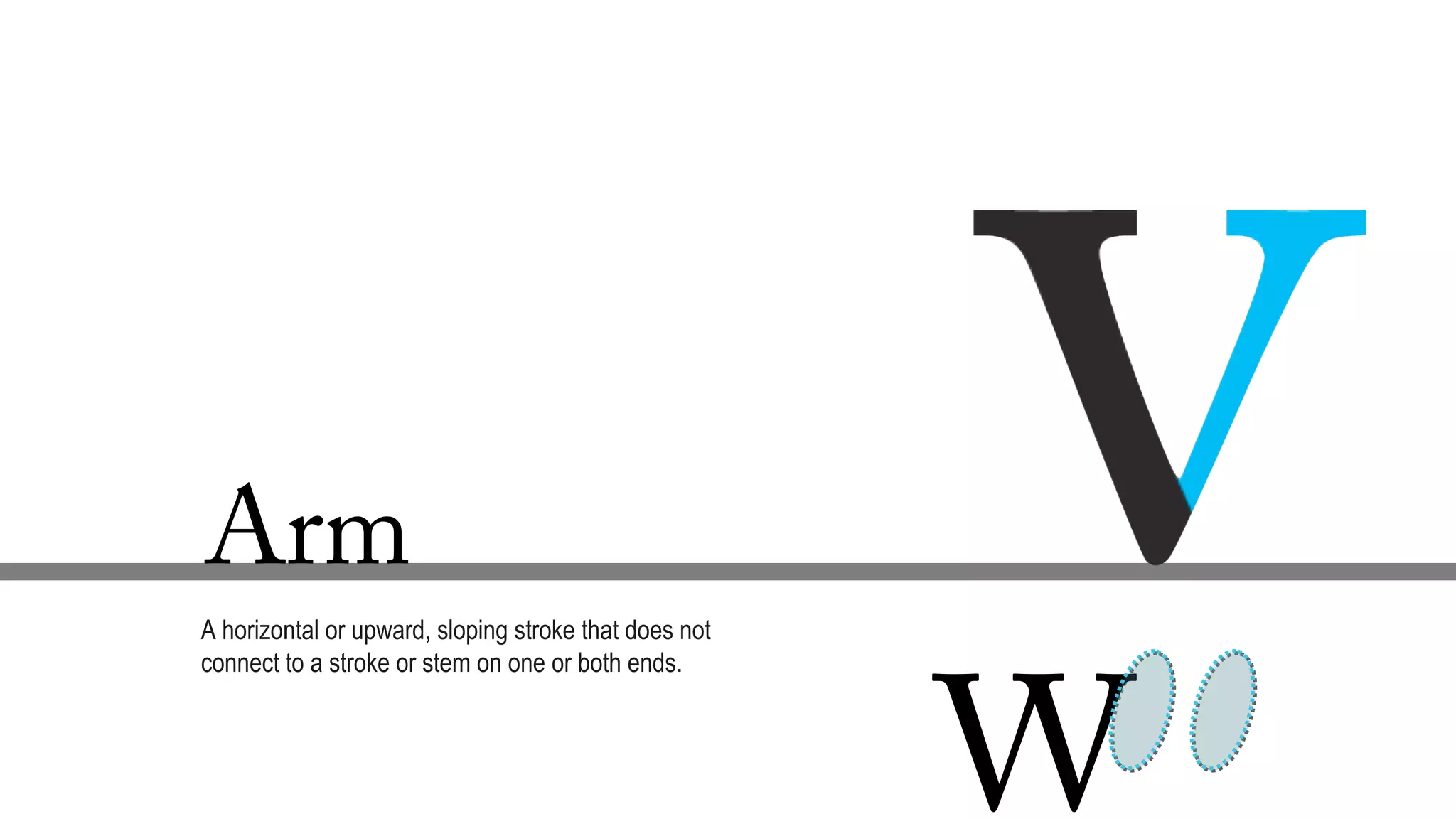
Arm
A horizontal or upward, sloping stroke that does not
connect to a stroke or stem on one or both ends.
W
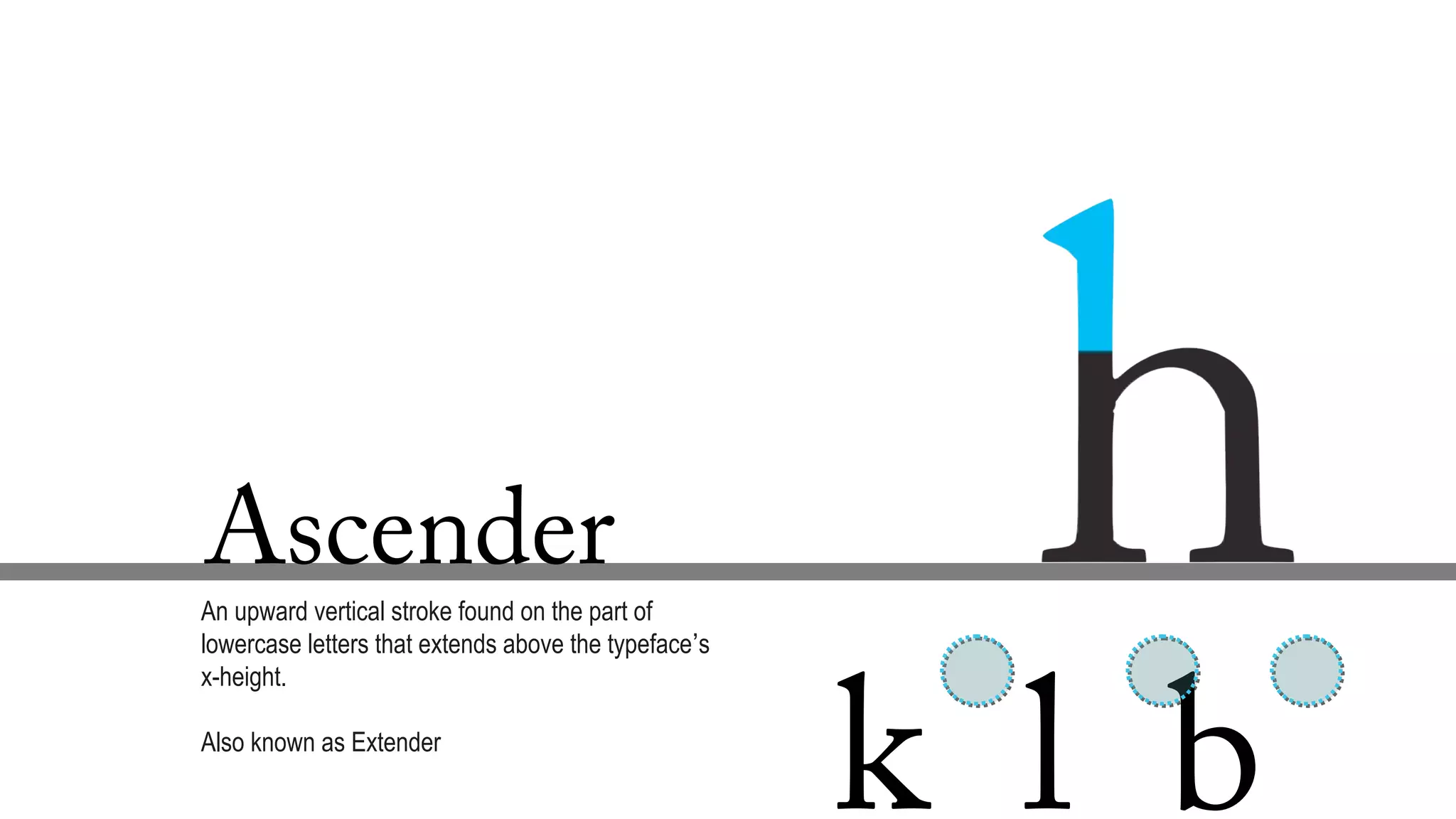
Ascender
An upward vertical stroke found on the part of
lowercase letters that extends above the typeface’s
x-height.
Also known as Extender
k l b
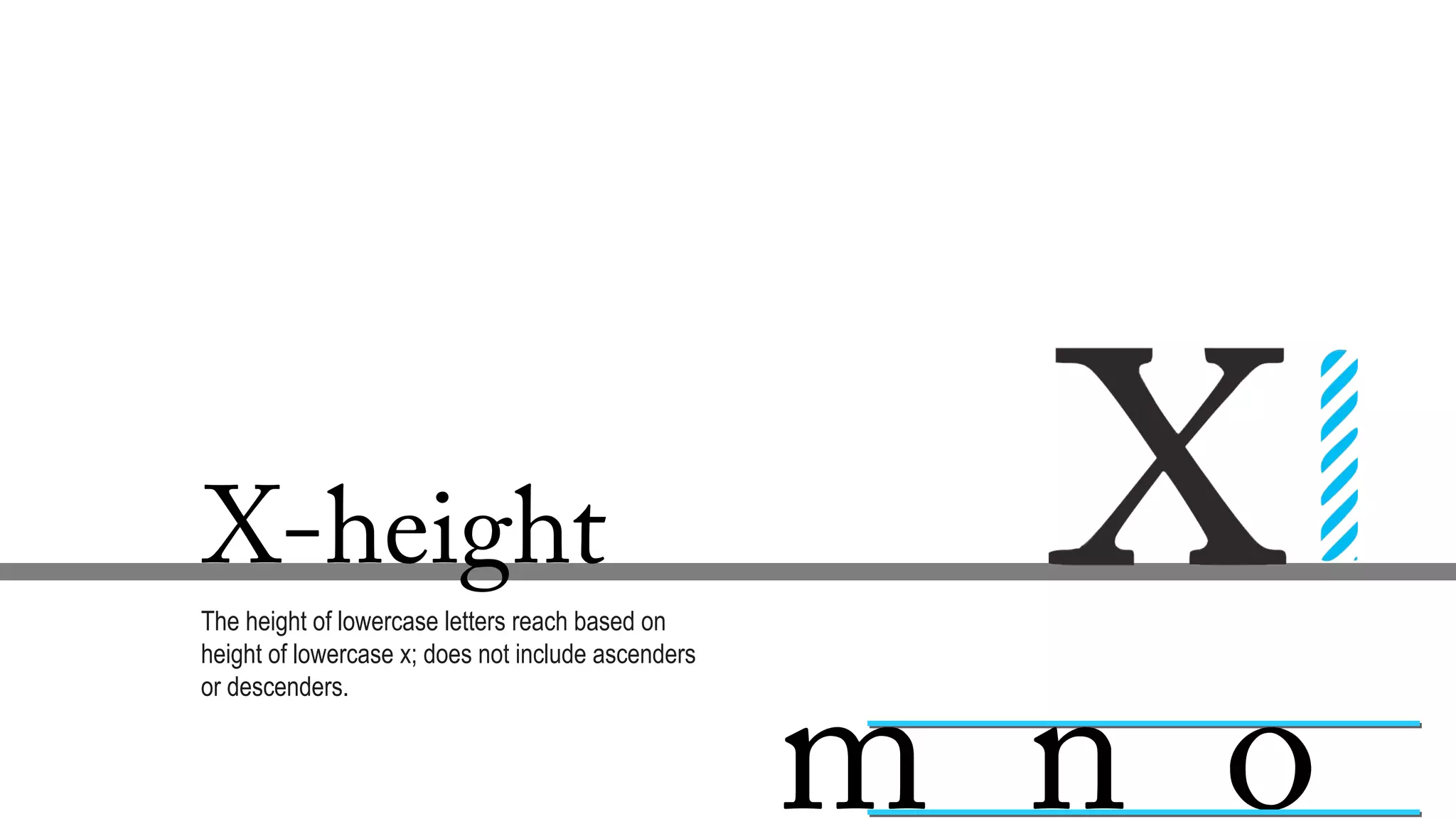
X-height
The height of lowercase letters reach based on
height of lowercase x; does not include ascenders
or descenders.
m n o
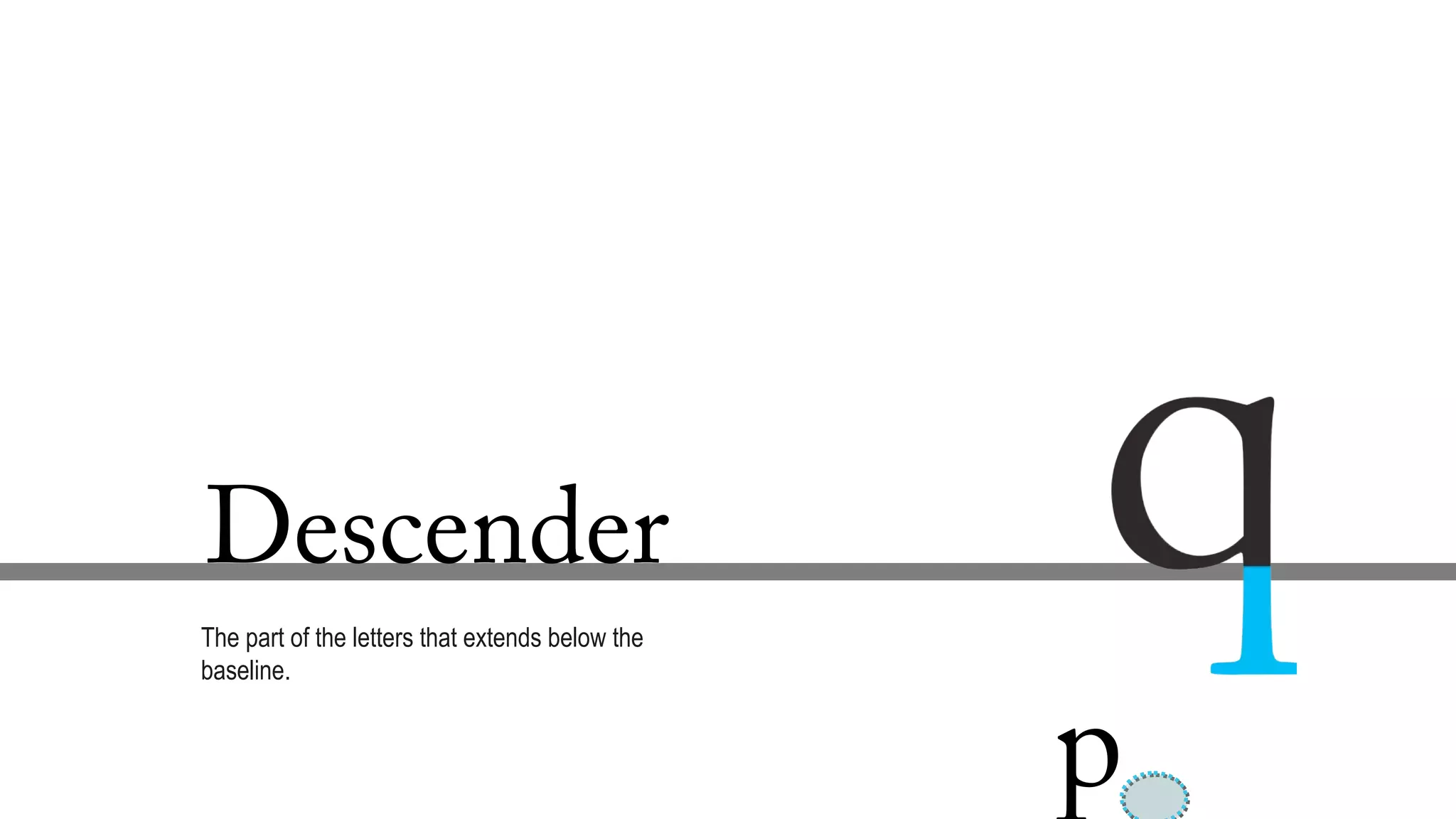
Descender
The part of the letters that extends below the
baseline.
p
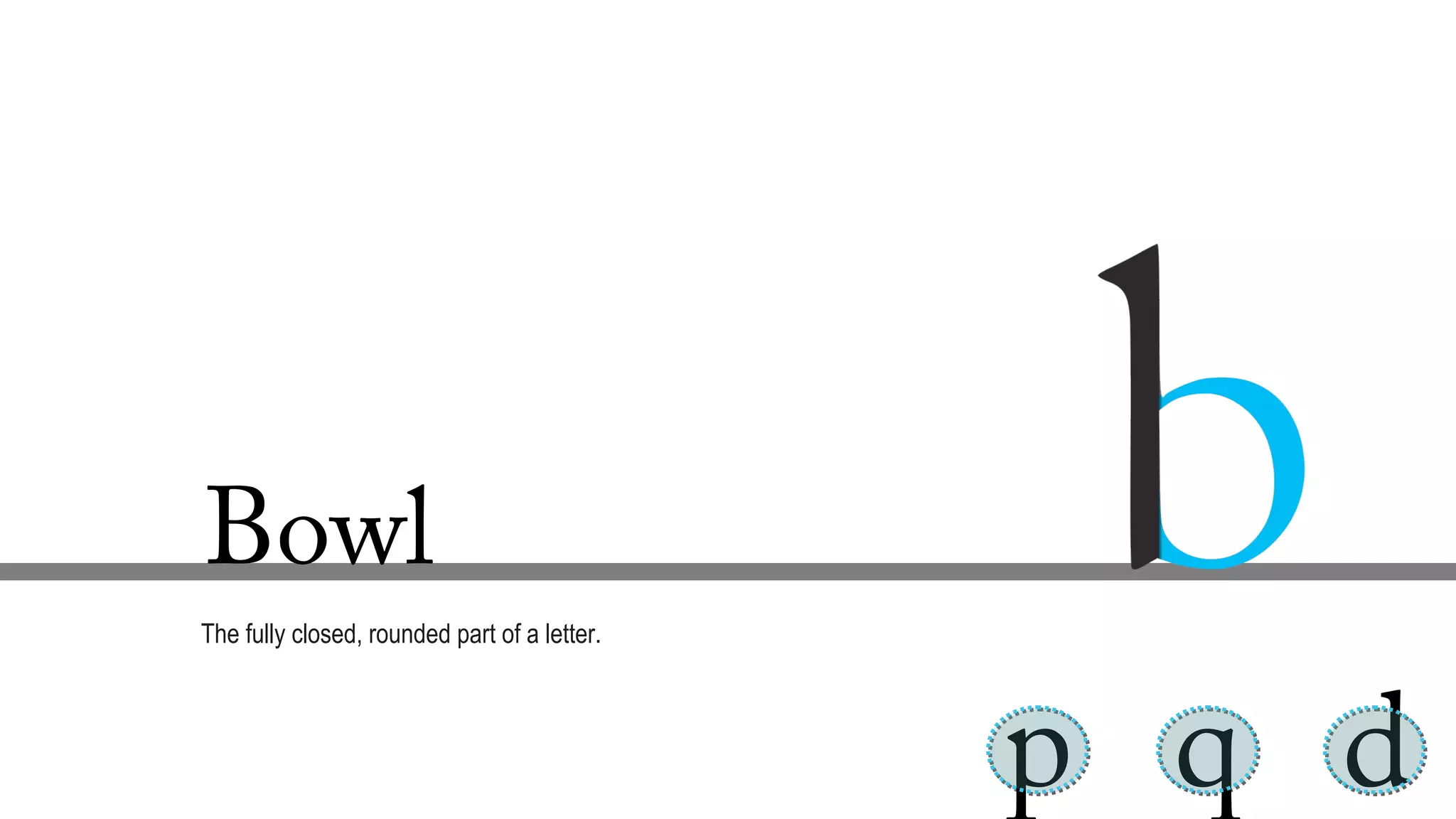
Bowl
The fully closed, rounded part of a letter.
p q d
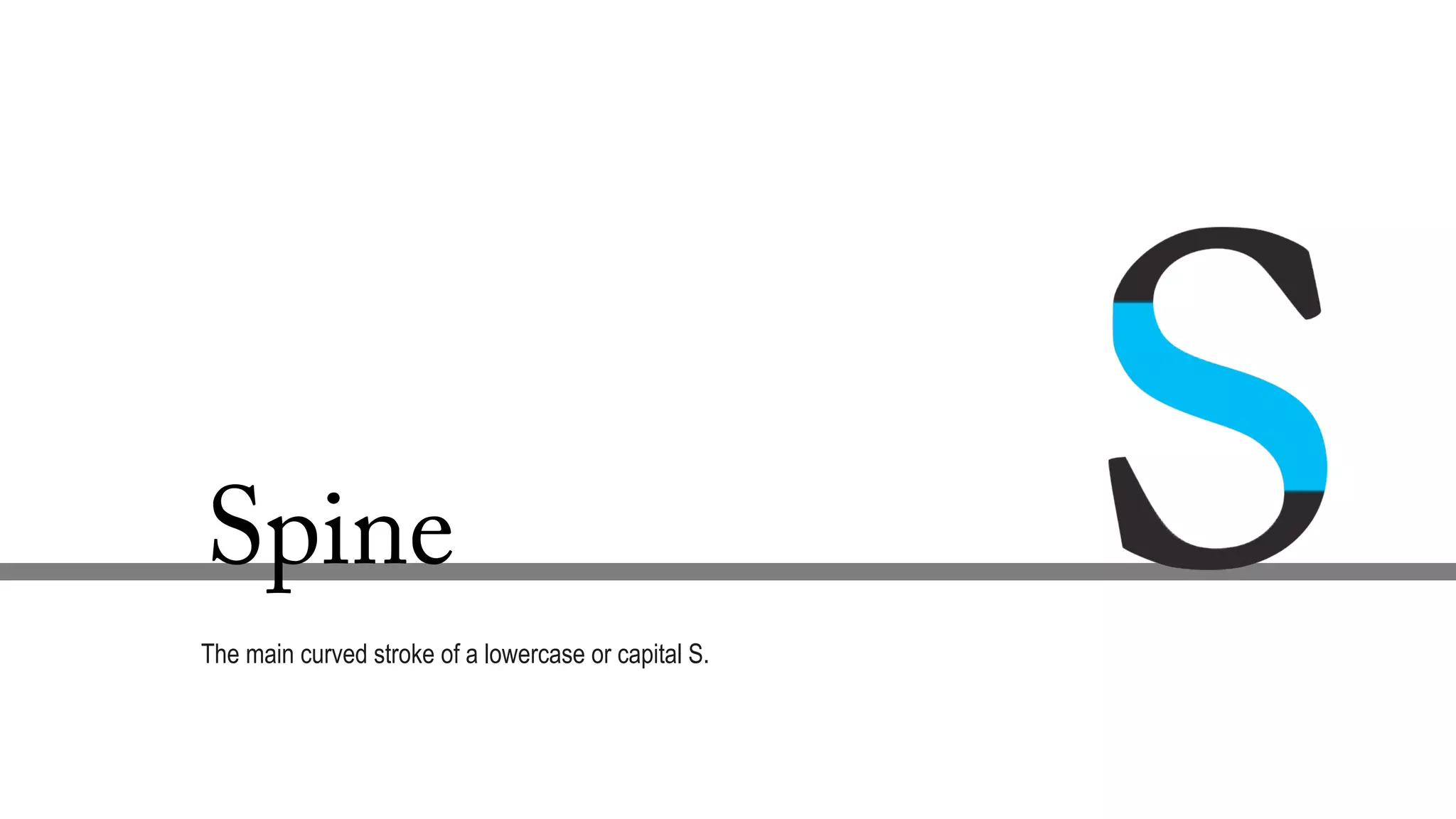
Spine
The main curved stroke of a lowercase or capital S.
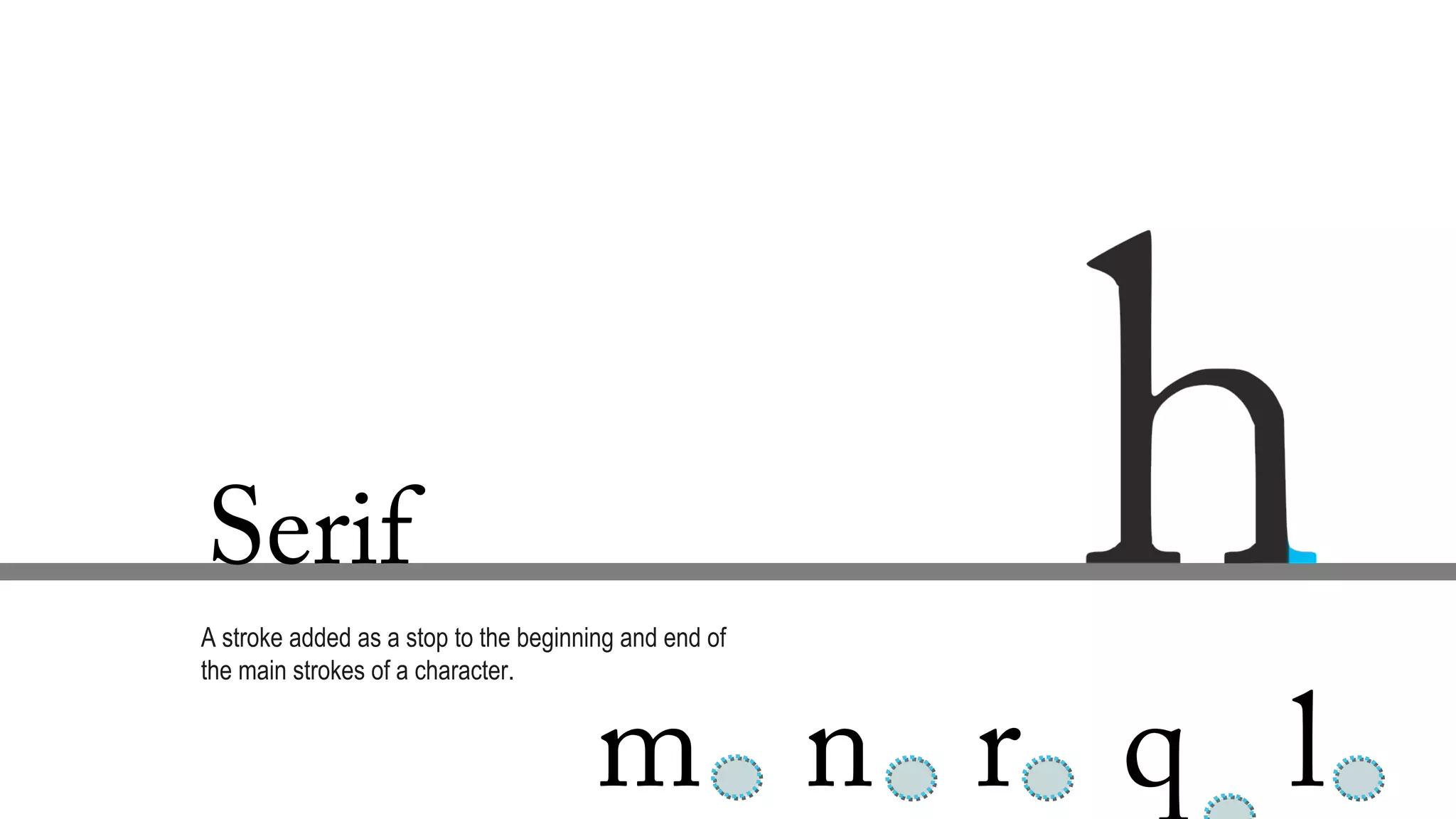
Serif
A stroke added as a stop to the beginning and end of
the main strokes of a character.
m n r q l
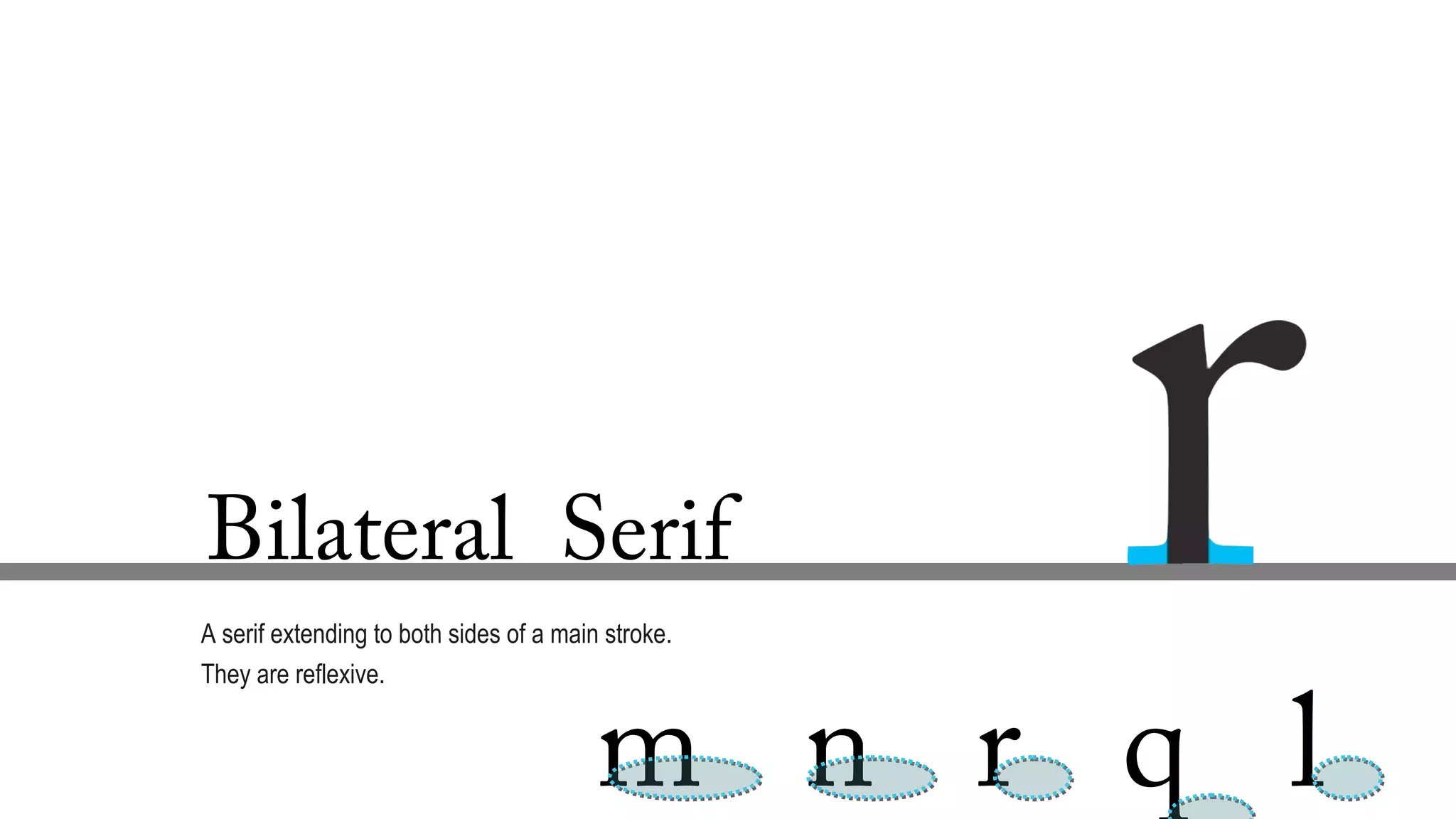
Bilateral Serif
A serif extending to both sides of a main stroke.
They are reflexive.
m n r q l
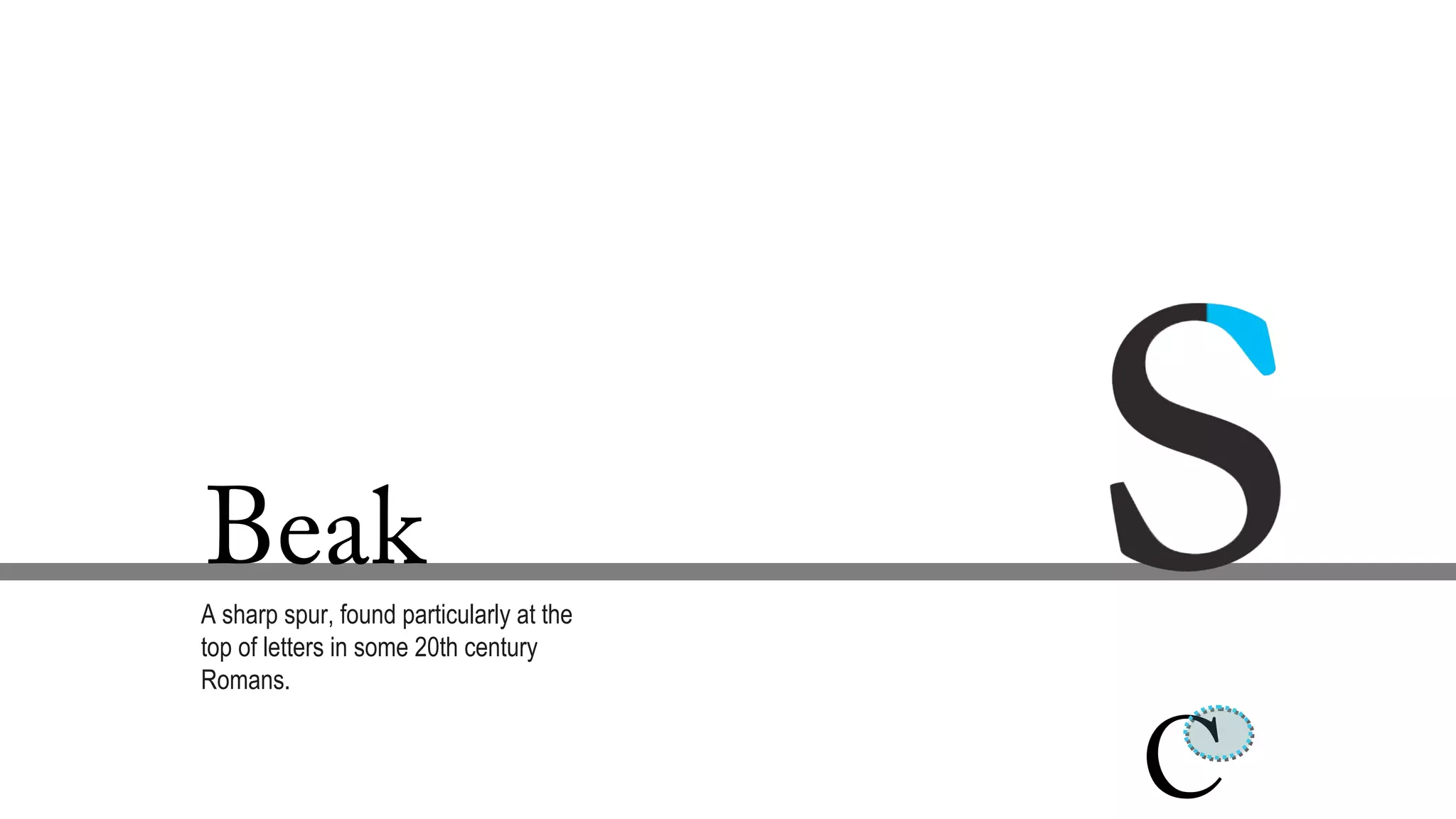
Beak
A sharp spur, found particularly at the
top of letters in some 20th century
Romans.
C
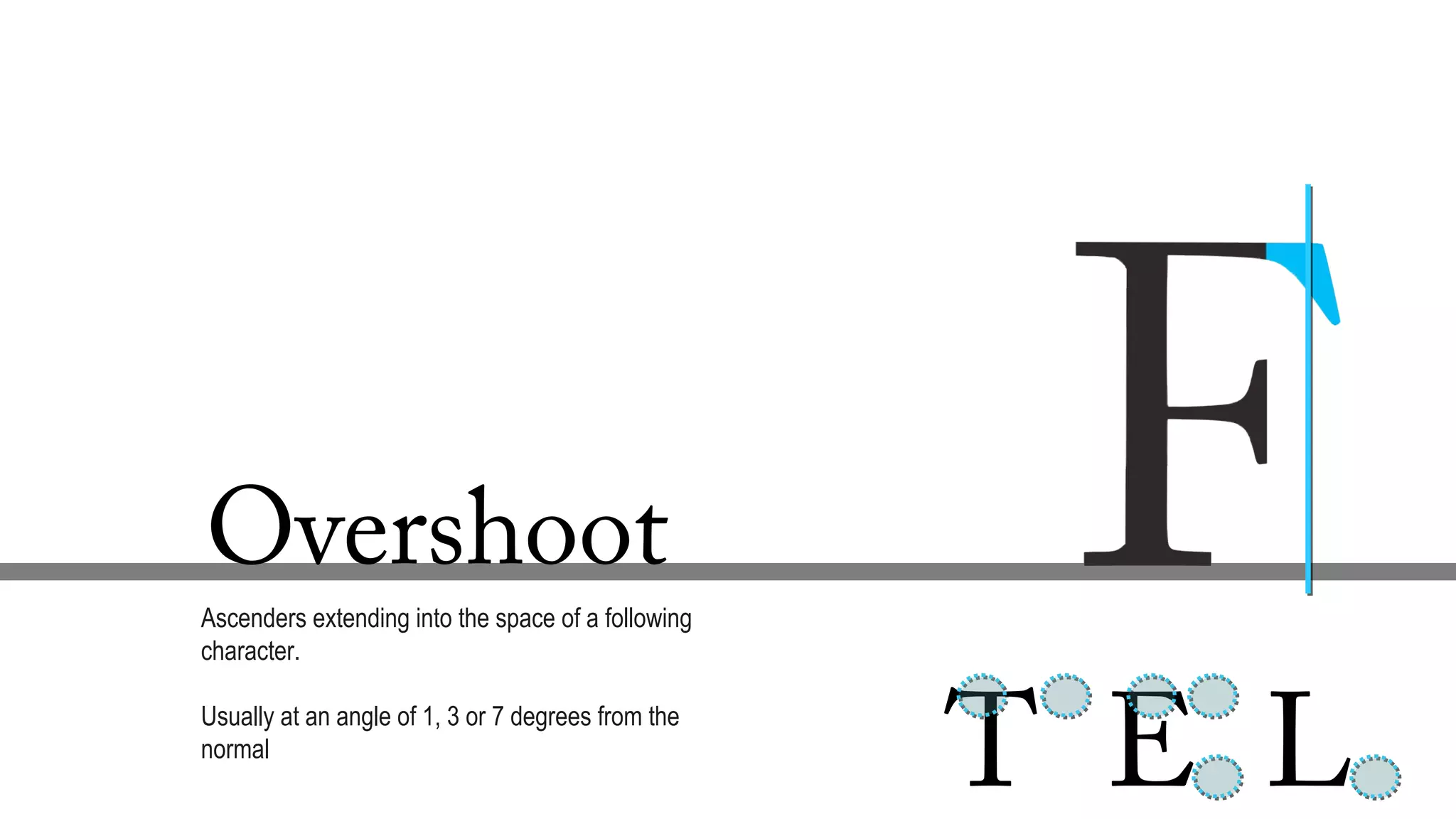
Overshoot
Ascenders extending into the space of a following
character.
Usually at an angle of 1, 3 or 7 degrees from the
normal
T E L
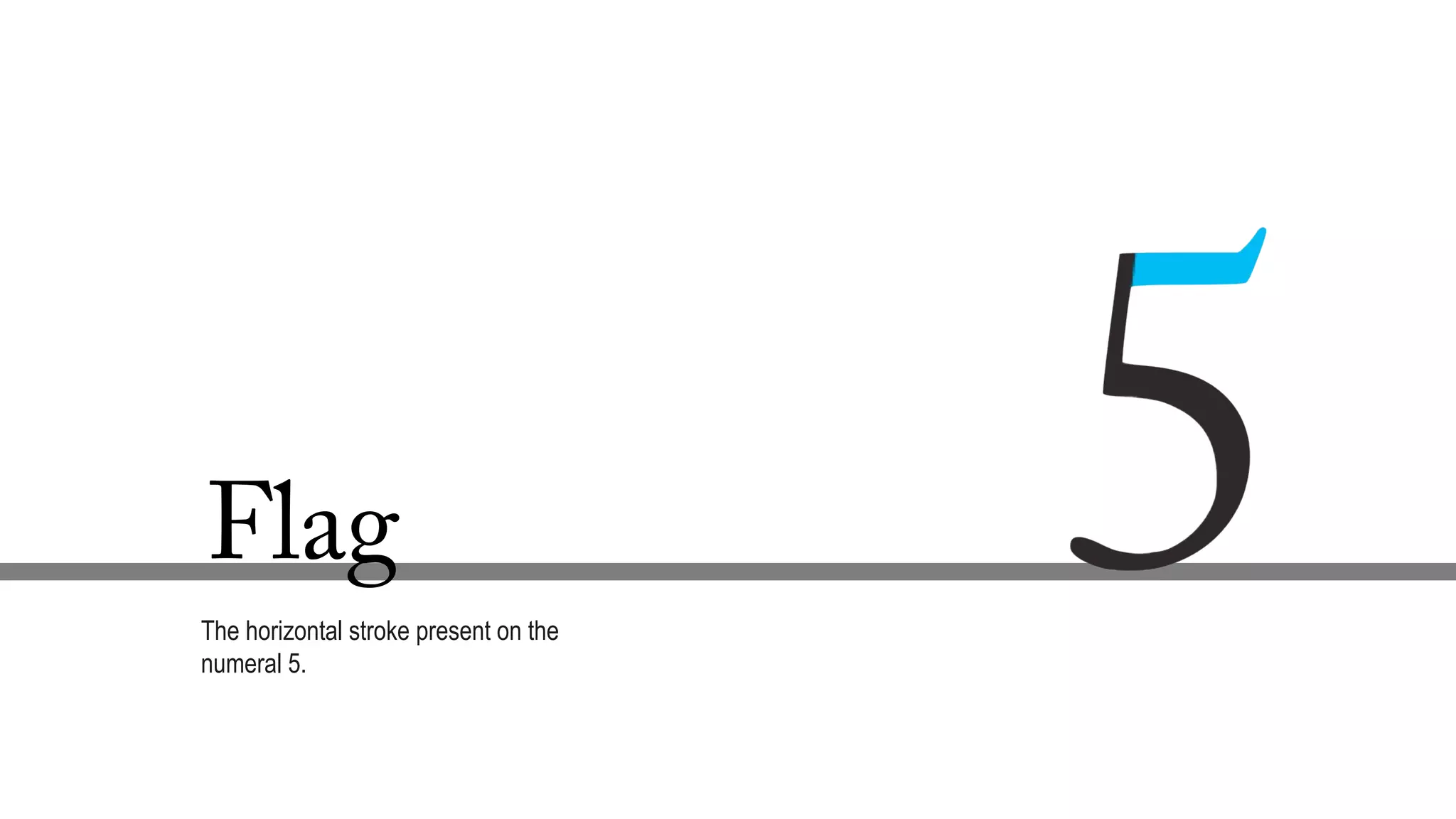
Flag
The horizontal stroke present on the
numeral 5.
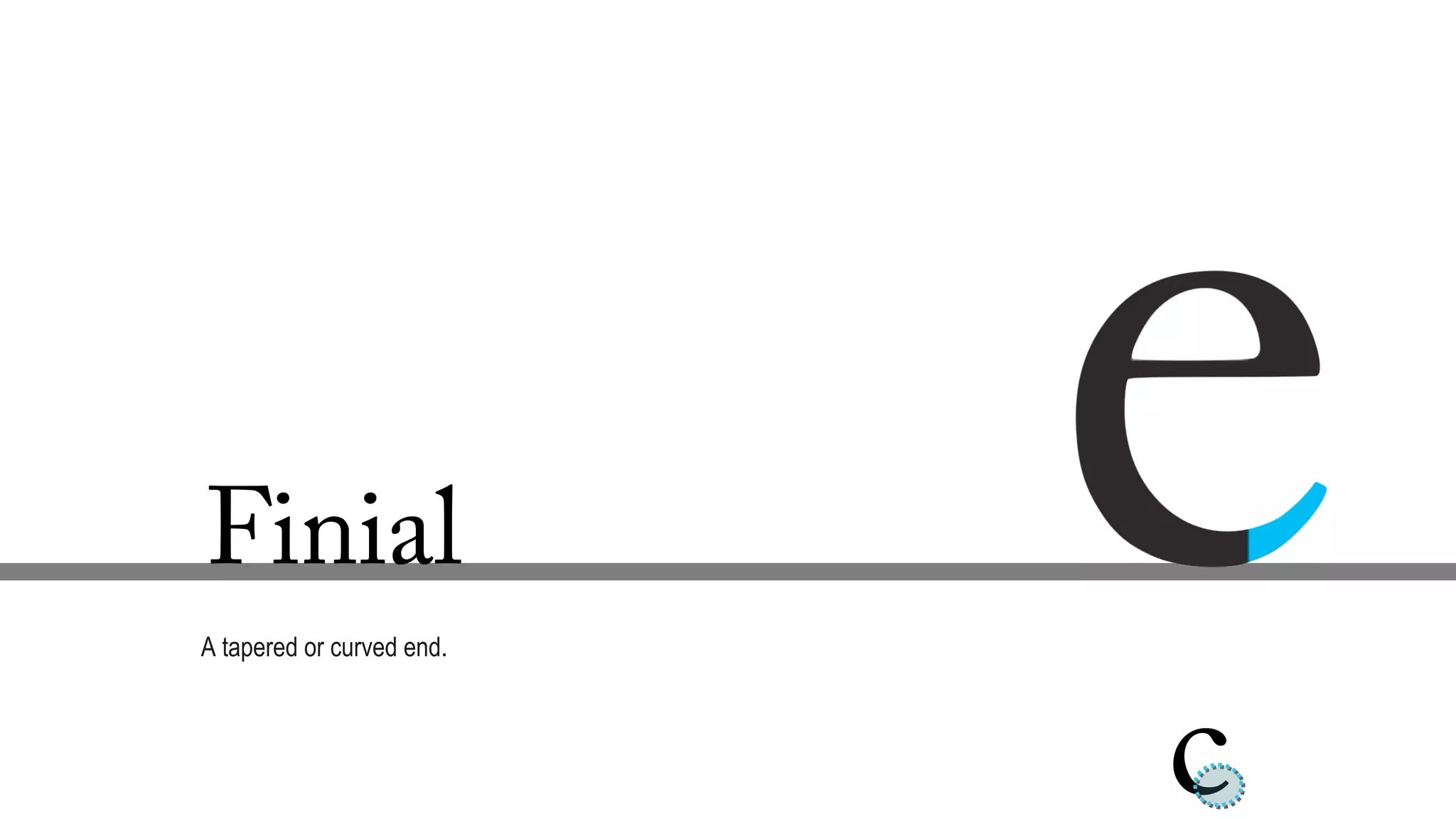
Finial
A tapered or curved end.
c
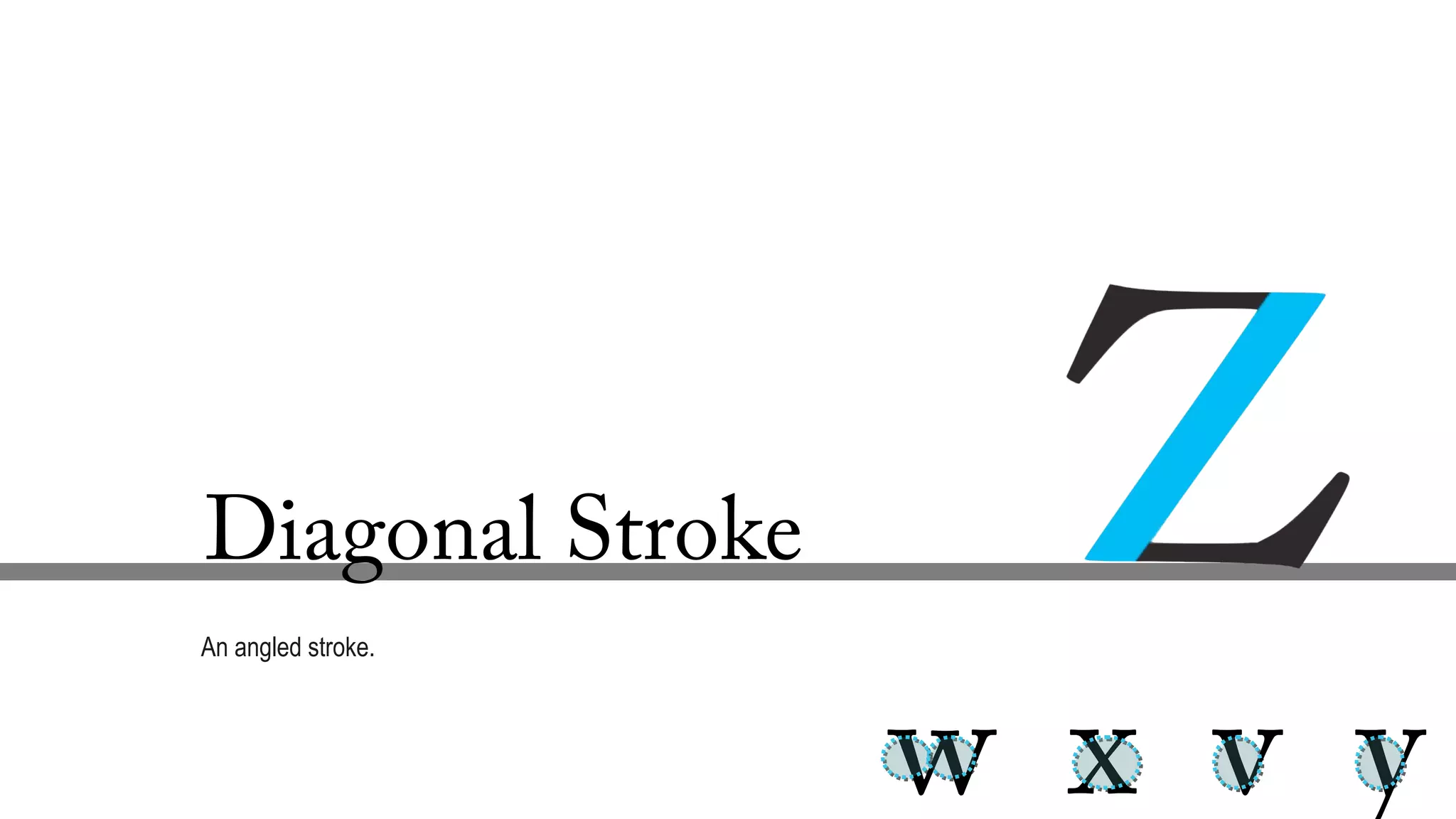
Diagonal Stroke
An angled stroke.
w x v y
Devina Kothari

Typography bod 4 part a

  • 1.
  • 2.
    What is TYPOGRAPHY? It is derived from the Greek words that mean form and writing. It is the art and technique of arranging type in order to make a particular language visible.
  • 3.
    TYPOGRAPHY Arrangement of TYPEinvolves the selection of TYPEFACES Font Family is a set of characters that share common design features POINT SIZE LINE LENGTH LEADING TRACKING KERNING Single typeface is represented by: specific weightspecific weight stylestyle condensationcondensation widthwidth slantslant italicizationitalicization ornamentationornamentation designer or foundrydesigner or foundry N, B, BB, L N, I, O Typeface: Arial Fonts: Arial Bold, Arial Narrow, Arial Italics, etc. expanded contracted degree from the vertical Slant to the right Symbols Mass produced Specialized proportional Monospaced
  • 4.
    TYPOGRAPHY Arrangement of TYPEinvolves the selection of TYPEFACES Unit of Measurement The point is the basic unit of measurement used in typography, and all other measurements are derived from it. In typography, a measure of the height of the characters of a font, measured in points. 0.351mm or 1/12 pica POINT SIZE LINE LENGTH LEADING TRACKING KERNING
  • 5.
    TYPOGRAPHY Arrangement of TYPEinvolves the selection of TYPEFACES Block of Typeset text It is the width occupied by a block of typeset text. A block of text or paragraph has a maximum line length that fits a determined design. It is determined by typographic parameters based on a formal grid and template with several goals in mind; balance and function for fit and readability with a sensitivity to aesthetic style in typography. POINT SIZE LINE LENGTH LEADING TRACKING KERNING
  • 6.
    TYPOGRAPHY Arrangement of TYPEinvolves the selection of TYPEFACES Line Spacing Refers to the distance between the baselines of successive lines of type. POINT SIZE LINE LENGTH LEADING TRACKING KERNING QAhqx QAhqx
  • 7.
    TYPOGRAPHY Arrangement of TYPEinvolves the selection of TYPEFACES Overall Spacing Tracking refers to the overall spacing of a word or block of text affecting its overall density and texture. POINT SIZE LINE LENGTH LEADING TRACKING KERNING
  • 8.
    TYPOGRAPHY Arrangement of TYPEinvolves the selection of TYPEFACES Space between characters Kerning is a term applied specifically to the spacing adjustment of two particular characters. POINT SIZE LINE LENGTH LEADING TRACKING KERNING type
  • 9.
  • 10.
  • 11.
    Cap Height The heightof a capital letter measured from the baseline. M O N P
  • 12.
    Body Height The completearea covered by all of the characters in a font.
  • 13.
    Apex The point atthe top of a character, where the left and right strokes meet is the apex. It may be a sharp point, blunt, or rounded and is an identifying feature for some typefaces.
  • 14.
    Vertex The outside pointat the bottom or top of a character where two strokes meet. Apex is a subset of VERTEX. v
  • 15.
    Bar The horizontal strokein letters. Also referred to as Crossbar. A H
  • 16.
    Arc of stem Acurved stroke that is continuous with a straight stem.
  • 17.
    Arm A horizontal orupward, sloping stroke that does not connect to a stroke or stem on one or both ends. W
  • 18.
    Ascender An upward verticalstroke found on the part of lowercase letters that extends above the typeface’s x-height. Also known as Extender k l b
  • 19.
    X-height The height oflowercase letters reach based on height of lowercase x; does not include ascenders or descenders. m n o
  • 20.
    Descender The part ofthe letters that extends below the baseline. p
  • 21.
    Bowl The fully closed,rounded part of a letter. p q d
  • 22.
    Spine The main curvedstroke of a lowercase or capital S.
  • 23.
    Serif A stroke addedas a stop to the beginning and end of the main strokes of a character. m n r q l
  • 24.
    Bilateral Serif A serifextending to both sides of a main stroke. They are reflexive. m n r q l
  • 25.
    Beak A sharp spur,found particularly at the top of letters in some 20th century Romans. C
  • 26.
    Overshoot Ascenders extending intothe space of a following character. Usually at an angle of 1, 3 or 7 degrees from the normal T E L
  • 27.
    Flag The horizontal strokepresent on the numeral 5.
  • 28.
    Finial A tapered orcurved end. c
  • 29.
  • 30.