Name ___________________________
Chapter 7

Class ___________________

Date _____________

Chemical Reactions

Section 7.2 Types of Reactions
(pages 199–205)
This section discusses how chemical reactions are classified into different types.

Reading Strategy

(page 199)

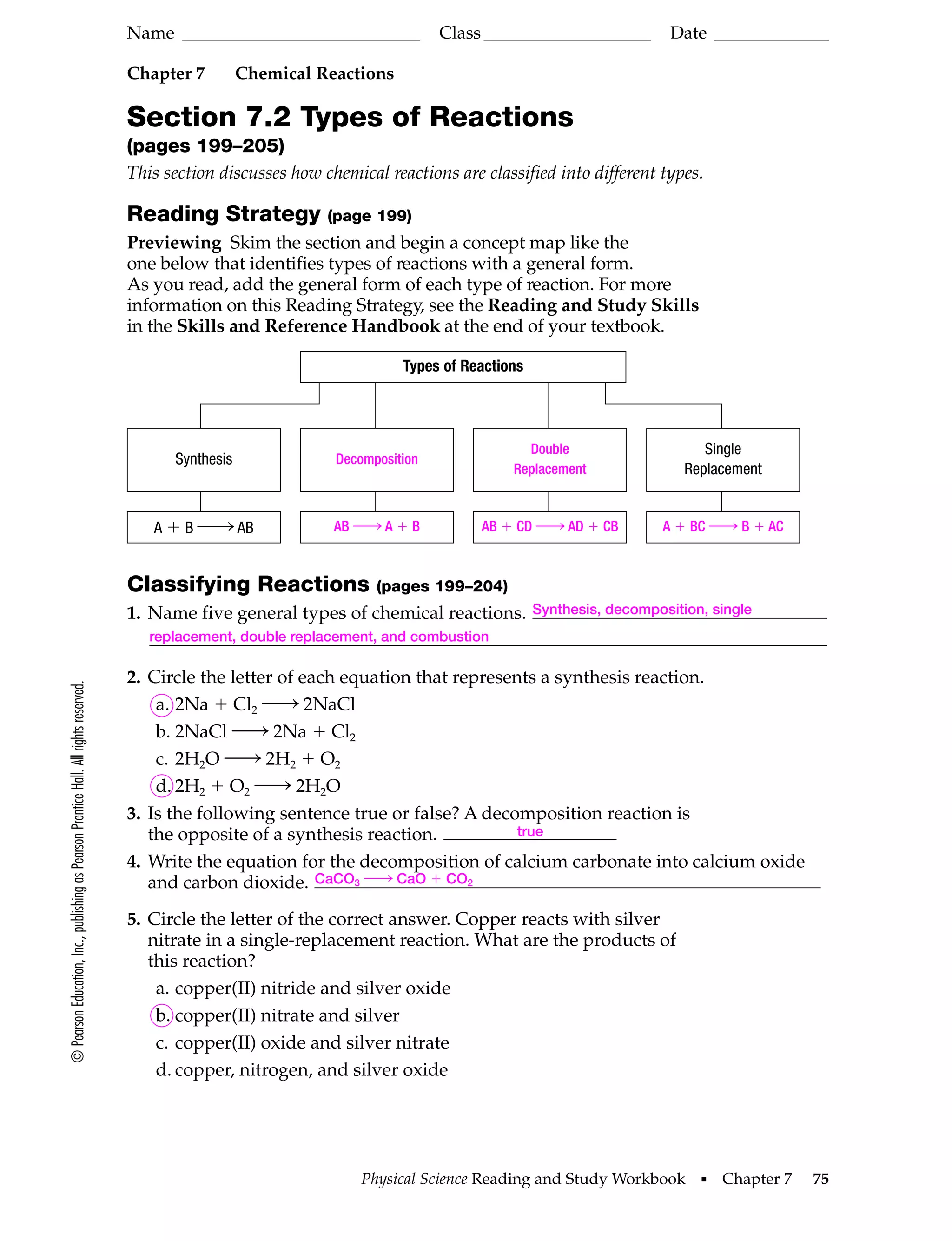
Previewing Skim the section and begin a concept map like the
one below that identifies types of reactions with a general form.
As you read, add the general form of each type of reaction. For more
information on this Reading Strategy, see the Reading and Study Skills
in the Skills and Reference Handbook at the end of your textbook.
Types of Reactions

Synthesis

Decomposition

Double
Replacement

Single
Replacement

A ϩ B h AB

AB h A ϩ B

AB ϩ CD h AD ϩ CB

A ϩ BC h B ϩ AC

Classifying Reactions

(pages 199–204)

1. Name five general types of chemical reactions.

Synthesis, decomposition, single

© Pearson Education, Inc., publishing as Pearson Prentice Hall. All rights reserved.

replacement, double replacement, and combustion

2. Circle the letter of each equation that represents a synthesis reaction.
a. 2Na ϩ Cl2 h 2NaCl
b. 2NaCl h 2Na ϩ Cl2
c. 2H2O h 2H2 ϩ O2
d. 2H2 ϩ O2 h 2H2O
3. Is the following sentence true or false? A decomposition reaction is
true
the opposite of a synthesis reaction.
4. Write the equation for the decomposition of calcium carbonate into calcium oxide
and carbon dioxide. CaCO3 h CaO ϩ CO2
5. Circle the letter of the correct answer. Copper reacts with silver
nitrate in a single-replacement reaction. What are the products of
this reaction?
a. copper(II) nitride and silver oxide
b. copper(II) nitrate and silver
c. copper(II) oxide and silver nitrate
d. copper, nitrogen, and silver oxide

Physical Science Reading and Study Workbook

I

Chapter 7

75
Name ___________________________
Chapter 7

Class ___________________

Date _____________

Chemical Reactions

6. What is a double-replacement reaction?

A double-replacement reaction is a reaction in

which two different compounds exchange positive ions and form two new compounds.

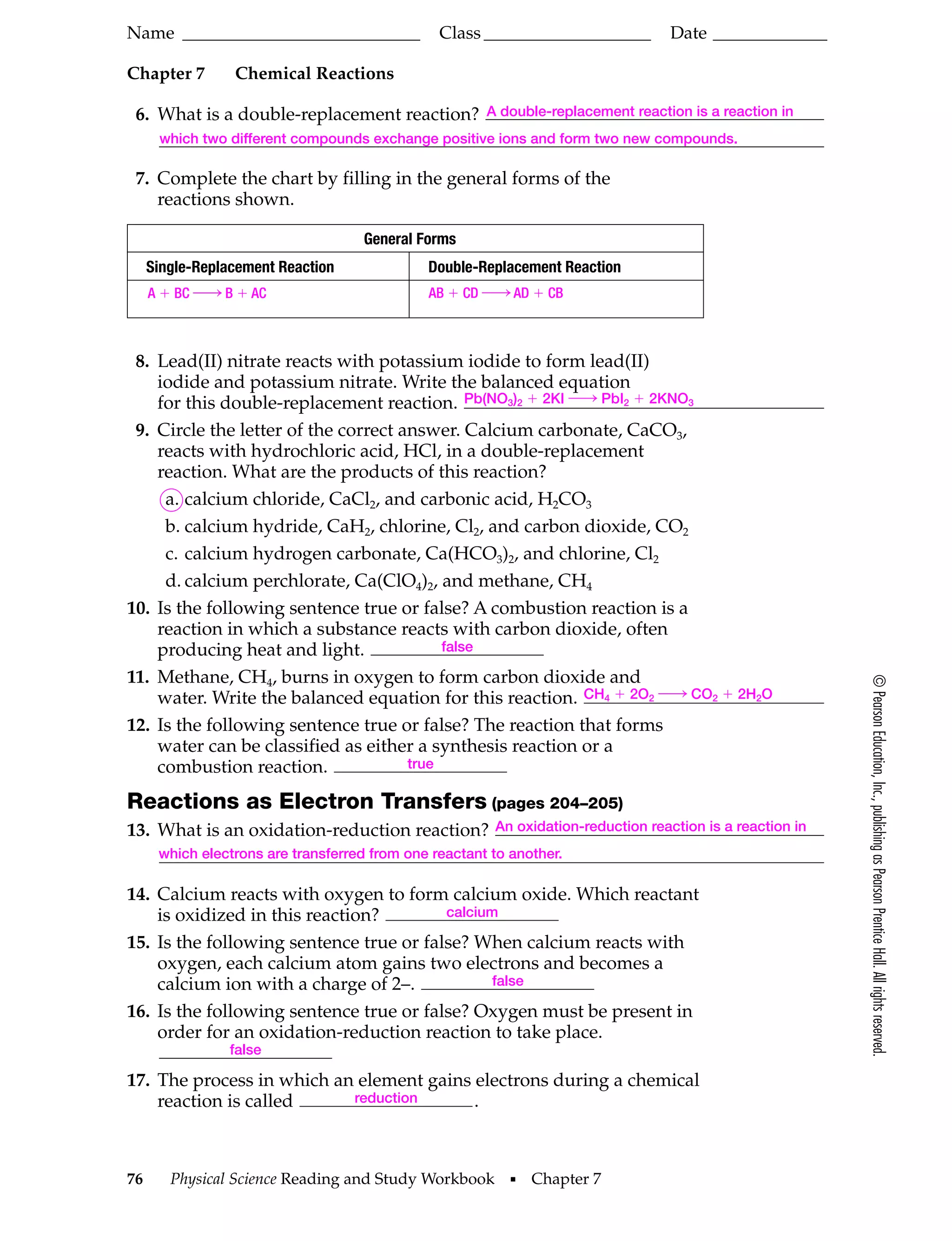
7. Complete the chart by filling in the general forms of the
reactions shown.
General Forms
Single-Replacement Reaction

Double-Replacement Reaction

A ϩ BC h B ϩ AC

AB ϩ CD h AD ϩ CB

Reactions as Electron Transfers (pages 204–205)
13. What is an oxidation-reduction reaction?

An oxidation-reduction reaction is a reaction in

which electrons are transferred from one reactant to another.

14. Calcium reacts with oxygen to form calcium oxide. Which reactant
calcium
is oxidized in this reaction?
15. Is the following sentence true or false? When calcium reacts with
oxygen, each calcium atom gains two electrons and becomes a
false
calcium ion with a charge of 2–.
16. Is the following sentence true or false? Oxygen must be present in
order for an oxidation-reduction reaction to take place.
false

17. The process in which an element gains electrons during a chemical
reduction
reaction is called
.

76

Physical Science Reading and Study Workbook

I

Chapter 7

© Pearson Education, Inc., publishing as Pearson Prentice Hall. All rights reserved.

8. Lead(II) nitrate reacts with potassium iodide to form lead(II)
iodide and potassium nitrate. Write the balanced equation
for this double-replacement reaction. Pb(NO3)2 ϩ 2KI h PbI2 ϩ 2KNO3
9. Circle the letter of the correct answer. Calcium carbonate, CaCO3,
reacts with hydrochloric acid, HCl, in a double-replacement
reaction. What are the products of this reaction?
a. calcium chloride, CaCl2, and carbonic acid, H2CO3
b. calcium hydride, CaH2, chlorine, Cl2, and carbon dioxide, CO2
c. calcium hydrogen carbonate, Ca(HCO3)2, and chlorine, Cl2
d. calcium perchlorate, Ca(ClO4)2, and methane, CH4
10. Is the following sentence true or false? A combustion reaction is a
reaction in which a substance reacts with carbon dioxide, often
false
producing heat and light.
11. Methane, CH4, burns in oxygen to form carbon dioxide and
water. Write the balanced equation for this reaction. CH4 ϩ 2O2 h CO2 ϩ 2H2O
12. Is the following sentence true or false? The reaction that forms
water can be classified as either a synthesis reaction or a
true
combustion reaction.

Types of chemical reactions document

  • 1.
    Name ___________________________ Chapter 7 Class___________________ Date _____________ Chemical Reactions Section 7.2 Types of Reactions (pages 199–205) This section discusses how chemical reactions are classified into different types. Reading Strategy (page 199) Previewing Skim the section and begin a concept map like the one below that identifies types of reactions with a general form. As you read, add the general form of each type of reaction. For more information on this Reading Strategy, see the Reading and Study Skills in the Skills and Reference Handbook at the end of your textbook. Types of Reactions Synthesis Decomposition Double Replacement Single Replacement A ϩ B h AB AB h A ϩ B AB ϩ CD h AD ϩ CB A ϩ BC h B ϩ AC Classifying Reactions (pages 199–204) 1. Name five general types of chemical reactions. Synthesis, decomposition, single © Pearson Education, Inc., publishing as Pearson Prentice Hall. All rights reserved. replacement, double replacement, and combustion 2. Circle the letter of each equation that represents a synthesis reaction. a. 2Na ϩ Cl2 h 2NaCl b. 2NaCl h 2Na ϩ Cl2 c. 2H2O h 2H2 ϩ O2 d. 2H2 ϩ O2 h 2H2O 3. Is the following sentence true or false? A decomposition reaction is true the opposite of a synthesis reaction. 4. Write the equation for the decomposition of calcium carbonate into calcium oxide and carbon dioxide. CaCO3 h CaO ϩ CO2 5. Circle the letter of the correct answer. Copper reacts with silver nitrate in a single-replacement reaction. What are the products of this reaction? a. copper(II) nitride and silver oxide b. copper(II) nitrate and silver c. copper(II) oxide and silver nitrate d. copper, nitrogen, and silver oxide Physical Science Reading and Study Workbook I Chapter 7 75
  • 2.
    Name ___________________________ Chapter 7 Class___________________ Date _____________ Chemical Reactions 6. What is a double-replacement reaction? A double-replacement reaction is a reaction in which two different compounds exchange positive ions and form two new compounds. 7. Complete the chart by filling in the general forms of the reactions shown. General Forms Single-Replacement Reaction Double-Replacement Reaction A ϩ BC h B ϩ AC AB ϩ CD h AD ϩ CB Reactions as Electron Transfers (pages 204–205) 13. What is an oxidation-reduction reaction? An oxidation-reduction reaction is a reaction in which electrons are transferred from one reactant to another. 14. Calcium reacts with oxygen to form calcium oxide. Which reactant calcium is oxidized in this reaction? 15. Is the following sentence true or false? When calcium reacts with oxygen, each calcium atom gains two electrons and becomes a false calcium ion with a charge of 2–. 16. Is the following sentence true or false? Oxygen must be present in order for an oxidation-reduction reaction to take place. false 17. The process in which an element gains electrons during a chemical reduction reaction is called . 76 Physical Science Reading and Study Workbook I Chapter 7 © Pearson Education, Inc., publishing as Pearson Prentice Hall. All rights reserved. 8. Lead(II) nitrate reacts with potassium iodide to form lead(II) iodide and potassium nitrate. Write the balanced equation for this double-replacement reaction. Pb(NO3)2 ϩ 2KI h PbI2 ϩ 2KNO3 9. Circle the letter of the correct answer. Calcium carbonate, CaCO3, reacts with hydrochloric acid, HCl, in a double-replacement reaction. What are the products of this reaction? a. calcium chloride, CaCl2, and carbonic acid, H2CO3 b. calcium hydride, CaH2, chlorine, Cl2, and carbon dioxide, CO2 c. calcium hydrogen carbonate, Ca(HCO3)2, and chlorine, Cl2 d. calcium perchlorate, Ca(ClO4)2, and methane, CH4 10. Is the following sentence true or false? A combustion reaction is a reaction in which a substance reacts with carbon dioxide, often false producing heat and light. 11. Methane, CH4, burns in oxygen to form carbon dioxide and water. Write the balanced equation for this reaction. CH4 ϩ 2O2 h CO2 ϩ 2H2O 12. Is the following sentence true or false? The reaction that forms water can be classified as either a synthesis reaction or a true combustion reaction.