Recommended Guidelines
for the construction, preparation and
 maintenance of cricket pitches and
  outfields at all levels of the game


              www.ecb.co.uk
Foreword


                                The England and Wales Cricket Board is committed
                                to raising standards in all areas of the game and the
                                provision of better pitches and outfields is central to
                                that aim. No matter which level of cricket you play
                                the desire is always to perform on the best possible
                                pitches which offer both the batsmen and bowlers
                                the chance to hone their skills and techniques.

                                  We all recognise that the better techniques the
                                  players have, the better the standard of cricket
                                  they will deliver. For England – at every level in
                                  both the men’s and women’s games – to continue
to prosper we need to produce players with outstanding technical ability. The first
step to delivering those players is taken by the groundsmen and groundstaff,
whose skills are so important to our game, as they strive to produce the best
possible playing conditions.

David Collier
Chief Executive
England and Wales Cricket Board
Foreword                                                                                   Contents


                                  Across the world, all forms of the game of cricket are
                                  evolving and developing with increasing popularity       Section                                      Page   Section                                           Page
                                  and the demand, from village green to Test Arena,
                                                                                            1    Introduction                             5     5    Performance Quality Standards (PQS) 53
                                  requires safe, high quality surfaces in order that
                                                                                                                                                     I. Introduction to PQS
                                  players can perform and improve their talents.
                                                                                            2    Cricket Ground Maintenance                          II. Monitoring
                                                                                                 and Pitch Preparation                    7          III County Pitch Advisors
                                  To meet these demands the knowledge and skills of              I. Spring/Pre-Season & Summer                       IV. Test Methods
                                  the cricket groundsman have to develop alongside               II. Pitch Preparation & Post-Match                  V. Pitch Research
                                  that of the game itself. Never before have today’s                  Renovation
                                  generation of Turf Managers, of all codes of sport,            III. Autumn/Post-Season & Winter               6    The MCC Laws of Cricket,
                                  been better supported by specific educational                                                                      Pitch Markings & ICC/ECB
                                  courses and qualifications and where ongoing              3    Cricket Ground Construction                         Playing Conditions                           59
                                  scientific research and the development of                     and Restoration of Squares              23
innovative machinery facilitate the essential and traditional core methodology.                  I. Funding Compliance, Contracts               7    Premier League Criteria                      67
                                                                                                      & Project Management
Furthermore, the increased availability of funding through grant aid and interest free
                                                                                                 II. Outfield Areas & Drainage                  8    Recommended Minimum Grounds
loan schemes have provided opportunities for the refurbishment or development of
                                                                                                 III. Cricket Squares & Pitches                      Maintenance Equipment                        69
new facilities, resources and prospects for new career paths.
                                                                                                 IV. Restoration                                     I. Club Cricket
                                                                                                 V. After Care                                       II. Centres of Excellence
We are also living in a technological age of computers and communication networks
where information can be swiftly gathered from all over the world. The same                 4    Non-Turf Pitches (NTP)                  49     9    Health and Safety/Environmental
technology is used by the media to highlight sporting events and at the highest levels           I. Types of Pitches & Classification                Issues                                       72
of the game, the work of our stadia groundstaff have come under the spotlight as                 II. Maintenance
never before. In return, it presents the opportunity to raise the profile of cricket             III. ECB Approved Non-Turf Pitches            10 Training Courses & County
groundsmanship as a universally recognised and highly skilled profession, from the                   System Suppliers                                Board Details                                73
enthusiastic volunteer of a village club to the grounds managers of the Test Match
venues. I passionately believe that the persons who prepare the playing surfaces are
as important as the finest players as neither can perform to the best of their abilities
                                                                                                                                               Acknowledgements
without each other.
                                                                                                                                               Chris Wood ECB
                                                                                                                                               Bruce Cruse ECB
I trust that this document encapsulates an awareness and understanding of                                                                      Institute of Groundsmanship
contemporary procedures and methodology and provides the necessary guidelines                                                                  Peter Dury NDT D Uni Essex
                                                                                                                                               Len Smith Glamorgan CCC
for cricket groundsmanship at all levels, to assist in the preparation of the best                                                             Stuart Kerrison Essex CCC
possible surfaces their skills and available resources allow.                                                                                  Laws and Illustrations by kind permission of MCC and ICC

                                                                                                                                               Some images by kind permission of: MCC, Surrey CCC,
Chris Wood                                                                                                                                     STRI, Lloyds & Co Letchworth Ltd, Autoguide Equipment Ltd,
ECB Pitches Consultant                                                                                                                         AT Bone Sports Solutions, Notts Sport Ltd, Gifford.
1     Introduction


The guidelines contained in this document are intended as a general guide to all
aspects of construction, management, maintenance and pitch preparation of
cricket grounds. It is accepted that with the groundsman’s knowledge of the
local conditions, he may find it necessary to vary the recommended treatment to
suit a particular site. Likewise, due to varying weather conditions, the judgement
of the groundsman is necessary to determine exactly when each operation
should be carried out.

Preparation and maintenance of pitches suitable for first and non-first class
matches, premier leagues, clubs and schools

Aim

To achieve the best possible playing surface at all levels of the game – at the top
level a minimum of a two day game.

Objective

First class and matches of three days or more
At the commencement of the match the whole surface should be completely
dry, firm and true, providing even bounce. The surface of the pitch should ideally
wear sufficiently to give spinners some assistance later in the game.

Limited over one-day matches
For the duration of the match, the whole surface of the pitch should be
completely dry, firm and true providing good carry and even bounce throughout,
There should be little or no turn and little or no seam movement.

At the club/school level of the game, the pitch should give a consistent and
safe bounce.


                                                                                  Introduction   5
2        Cricket Ground Maintenance & Pitch Preparation

Guideline Maintenance Schedules
I. SPRING/PRE-SEASON & SUMMER                                      Spring fertilisers may be used at the discretion of the
                                                                   groundsman (according to manufacturer’s instructions).
Pre-season rolling is absolutely crucial to the production of      Nutritional analysis of the soil is a must and will assist
fast pitches, as the cricket square requires a firm, even          decision making.
surface and rolling should commence as soon as
conditions permit. The groundsman is the only person               A summer-based fertiliser contains more nitrogen, which
who can decide when conditions are suitable.                       encourages top growth increasing the need for mowing
                                                                   more often.
The use of rollers to firm the surface over a period of
several weeks will slowly consolidate the square. Use a            Brush or dragmat the square regularly, especially when
light roller at the earliest opportunity in the spring, possibly   dew is on the ground, as this will remove moisture from
at the end of February or the beginning of March,                  the leaves and discourage disease. Maintain observation
gradually increasing the weight, if possible, up to a              of infestation of weeds and worm casts. Take control
2028kg (2 ton) heavy roller.                                       measures using the appropriate products assuring all
                                                                   legislation compliance.
Rolling Weights
Light Roller: up to 254kg (5cwt)                                   Mowing
Medium Roller: up to 508kg (10cwt)
Heavy Roller: 1014kg (1 ton) or more                               Gradually reduce the height of cut on the square
                                                                   approaching the start the season to a height of 12mm
The pitch should be rolled in all directions, but with the         (1/2 inch). This height should be maintained all season over
emphasis on cross rolling in the early stages, but finish on       the square, with it being cut at least once a week if not
the line of the pitches. The aim is to consolidate the             twice during growing conditions. Always ensure blades
square to a depth of 100mm (4 inches) before the                   are kept sharp and set correctly to ensure a good clean
commencement of the season. Light scarification may be             cut with no “ribbing” or tearing.
necessary in the early spring, but this should only be done
in moderation with great care being taken not to destroy
grasses sown in the previous autumn. Heavy
mechanised scarification/verticutting that would cut into
the surface may well lead to cracking of pitches later in
the season, however a scarifying unit with brush
attachment is recommended.


                                                                                 Cricket Ground Maintenance & Pitch Preparation   7
2       Cricket Ground Maintenance & Pitch Preparation                                                                                 2       Cricket Ground Maintenance & Pitch Preparation


    II. PITCH PREPARATION & POST-MATCH                                   and having at least an 8-bladed cylinder set to a
    RENOVATION                                                           height just lower than the rest of the square
                                                                                       1
                                                                         (eg.6mm or /4 inch) Cut along the line of the
    When the fixture list is available it is possible to establish a     pitch and return on the same line you have
    plan to programme pitch allocation for the whole season.             just cut.
    You should aim to produce equal usage of each pitch. It
    will be necessary to place the more important fixtures             • Work your way across the pitch to complete the full
    towards the centre of the square and then work out                   width. Dependant on how much grass is present on the
    accordingly.                                                         surface it may be necessary to repeat this operation.

    Consecutive matches should not follow on adjacent                  • Scarification should be carried out between the
    pitches as this could mean using a strip which may be                popping creases, to reduce the density of grass using
    damaged from the bowlers run-off from a previous                     pedestrian or mechanical brush/rake machinery
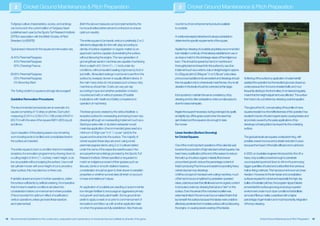
    match. The two outside pitches are often reserved for                (not thatch removal or similar type tines), hand rake or a           all surface water has disappeared. As the pitch dries,        • On the morning of the match, start early and brush,
    junior games or practice/artificial pitches.                         strong broom, care being taken not to disturb the soil               the weight of the roller should increase. The                   close mow and roll (Typically for around 15-20 minutes).
                                                                         surface. The bowling ends should not be scarified as                 groundsman should use the heavy roller at every                 Finally, if not done the previous day, Mark out the
    To facilitate this, the table should be “squared off” prior to       this will assist in reducing the wear and tear, and aid              suitable opportunity prior to a match whilst any moisture       creases on the pitch, clearly, accurately and neatly with
    the playing season, using the “3-4-5 triangle” method to             recovery from the damage caused by players.                          content remains. The heavy roller should not be used            lines not more than 25mm (1 inch) wide nor less than
    establish the corners, stump lines and individual pitches                                                                                 once all the moisture has gone from the pitch. In               12mm (1/2 inch) using string lines or a marking frame if
    set out with white “T” markings. (See Fig 1.1).                      Scarification should continue until the grass sward has              prevailing hot, dry weather conditions it may be                available. (see the paragraphs on marking out for
                                                                         been sufficiently reduced in density. There should be no             necessary for further light irrigation or “flashing” nearer     details). Use a proprietary marking compound or
    Pitch Preparation Prior to a Match                                   mat of grass and the surface soil should be visible                  the match day although such a decision would rely on            whiting powder or combination of both. Finally set the
                                                                         between the blades of grass.                                         the experience and expertise of the Ground Authority as         stumps in the correct positions on the crease with a little
    • For first class pitches, this should ideally commence at                                                                                is the deployment of covers where provided to prevent           water placed in the stump holes prior. This will ensure
      least 14-10 days prior to the match, or in the case of           • Check for small scars or depressions, particularly on a              unwanted wetting of the surface or control the rate of          that the stumps remain firmly in place during the
      clubs, schools etc. a minimum of 5 days before                     length and repair where necessary. (Carefully lever up               drying during the course of preparation.                        duration of the game.
      the match.                                                         depressions. Do not simply fill hollows with loose soil as
                                                                         such would only disintegrate if struck by the ball)                If the square has been consolidated before the season,          At the start of the match the pitch should not be
    • Select the pitch to be used, outlined by “T” marks to a                                                                               pitch preparation is greatly assisted and possible rolling      excessively green in colour to favour sideways, seam
      width of 3.05m (10ft) and preferably using strings and           • If the surface is dry, it is generally considered that water,      times reduced.                                                  movement and be completely dry. This applies not only to
      mow, ideally using a mower with a thin bottom blade                either by rain or applied by irrigation, is essential in the                                                                       the top surface but also progressively to a depth of 75-
                                                                                                  preparation of a pitch in order to        • For the remaining pre-match days during the course of         100mm (3 - 4 inches). Weather conditions may make this
                                                                                                  give it a firmer, solid surface for         preparation, mow every day or at least every other day        difficult, but, if the weather is fine or with the correct use of
                                                                                                  match play. Water copiously if              between the popping creases and in combination with           covers, it should usually be possible to obtain complete
                                                                                                  necessary with the aim to soak the          light scarification/brushing, progressively lowering the      dryness. A pitch which is completely dry at the start of a
                                                                                                  profile to a depth of 75-100mm (3-4         cylinder to the desired height of cut (typically between 3-   game is more likely to assist spin bowlers later in a game.
                                                                                                                                                      1     3
                                                                                                  inches).There is no fixed period for        5mm, ( /8 – /16 inches) or as low as possible, without
                                                                                                  the watering of a pitch, but this           scalping and the surface is not scarred or disturbed          A pitch prepared in the above manner should, given good
                                                                                                  should be done well in advance of a         in any way.                                                   ground and weather conditions, be expected to last for 3-
                                                                                                  match in order to ensure that the                                                                         5 days of first class or 3-4 games of average
                                                                                                  pitch is completely dry at the start of                                                                   club standard.
                                                                                                  play. Ideally this should start no less
                                                                                                  than 10 days prior to the match.
                                                                                                  The rolling of the pitch should
      Fig 1.1                                                                                     commence with a light roller when


8   Recommended Guidelines for the construction, preparation and maintenance of cricket pitches and outfields at all levels of the game                                                                                    Cricket Ground Maintenance & Pitch Preparation       9
2        Cricket Ground Maintenance & Pitch Preparation                                                                               2       Cricket Ground Maintenance & Pitch Preparation


     Surface Stabilisation Agents (SSA)                                Application Guidelines                                              After Match Pitch Repairs and Renovation

     At the commencement of the 2006 season, the                       The best way to apply the mixture is through a knapsack             It is essential to proceed with repairs and renovations as
     ECB sanctioned the application of a surface                       or a “walkover sprayer”. It takes between 10-15 litres to           soon as the pitch becomes available after play and not
     stabilising agent, in particular PVA (Poly Vinyl                  do a strip.                                                         wait, as the whole square will soon be looking very
     Acetate) adhesive solely for county one day                                                                                           sparse. Un-repaired ends on used/worn pitches can be
     matches. The application of Surface Stabilisation                 The rates of glue can vary from anywhere between 5-10               dangerous and are not conducive to a good game of
     Agents during the preparation of pitches for first                litres of glue per pitch but generally 5 litres of adhesive to      cricket. The selection and rotation of fresh pitches, of a
     class matches is not permitted. Any pitch that has                5-10 litres of water are the favoured norm as long as the           good standard, will become increasingly difficult if the
     had the agent applied at any stage during the                     glue is mixed well with water before putting in the                 ends are not repaired promptly and correctly.
     season in question (eg for use in other matches)                  knapsack and it goes through the nozzles.
     may not be used for first class matches. This is                                                                                      Maintenance and Repairs to Foot Holes
     because first class pitches should naturally                      Apply the contents of the knapsack/sprayer evenly over
     deteriorate as the game progresses and the use of                 the entire surface of the pitch or practice area. Do not stop       The umpires shall see that wherever possible and
     an SSA would work against this process. The ICC                   or the mixture will quickly coagulate in the lines. It will look    whenever it is considered necessary, action is taken
     also gave permission for international one day                    white when first applied, but it will dry clear. The spray          during all intervals on play (including designated drinks        d. When infilling a depression ensure that it is done in
     usage where deemed appropriate and always with                    container must be well washed out immediately after use.            intervals) to do whatever is practicable to improve the             one mass, if applied in layers, the soil will not
     the agreement of all interested parties involved.                                                                                     bowlers’ foot holes.                                                bind sufficiently.
                                                                       The optimum time to apply is when all pitch
     The material works by binding the surface to prevent              preparation is complete ie the evening before                       In matches of two days or more, as soon as is possible           e. Start to consolidate from the outside of the foot hole
     excessive deterioration and assist a degree of uniform            match day. Allow approx. 45–60 minutes to cure &                    after the conclusion of each day’s play, bowlers’ foot holes        and tread down with the foot, or with a heavy
     pitch performance. It has proved to be successful on              dry before putting the covers on for the night. On                  will be repaired                                                    panner/thumper/‘elephants foot’, preferably one
     smaller squares where already worn pitches have to be             the morning of the match, a quick cut if necessary                                                                                      made of metal.
     re-used in order to accommodate a heavy schedule of               and light roll will suffice.                                        If the pitch is to be used the following day they will need to
     matches and will also add longevity to outdoor grass net                                                                              be filled in using the following method:                         f. Ensure that the finished filled area is no higher than the
     practice facilities. It can also be useful for the recreational   Whether or not any grass remains on the surface, once                                                                                   rest of the surrounding surface within the crease by
     game to retain a safe playing surface in times of drought         sprayed, then it is possible to re-use the pitches again            a. Use a cricket clay loam that has been prepared a day             means of a suitable straight edge. This will help to
     and subsequent watering restrictions. It should never be          after the game easily enough. Treat the pitch as normal ie             in advance of a game. Make this up in a wheelbarrow.             prevent raised ends or ‘saddles’ from gradually
     applied with the notion of turning a pitch with poor playing      water up, re-roll, mow etc, the glue should not alter                  Screen two shovelfuls of soil into a wheelbarrow and             forming.
     characteristics into a good one, nor a substitute for a           anything in that respect. More can be applied if needed.               sprinkle with water until there is sufficient moisture to
     correct maintenance regime.                                       This procedure can prolong the lifespan of grass practice              have a light covering. Repeat this operation until the        g. Brush some dry soil/dust over the repaired area and
                                                                       facilities especially where confined or restricted by                  barrow is full. Keep under cover until required.                 mark out afresh.
     It should be noted that if there is evidence of moisture in       available space.
     the surface of the pitch then it will effectively be sealed in                                                                        b. Brush with a besom or a yard broom within the                 Renovation and Reinstatement of
     with the resultant likely consequence of excessive seam           When no longer in use, the pitches are easily re-instated              creases and slightly up the pitch (no further than the        Used Pitches
     movement.                                                         and renovated by simply vigorous brushing of the surface,              protected areas) cleaning out any loose material.
                                                                       thorough watering and overseeding under normal                                                                                       As soon as possible after the game is over, start
     Although occasionally used in New Zealand since 1996-             procedures.                                                         c. The footholds need to be thoroughly drenched. Then            reinstatement of the whole pitch.
     97, this is a relatively new concept in England and Wales                                                                                using hands, remove all excess water. This
     and there has been no evidence to date of deterioration of                                                                               dampening has the effect of creating a bond for the           First vigorously brush the pitch with a besom or yard
     growth or soil conditions by residual build-up although                                                                                  new soil to adhere to. By the addition of mixing some         broom to remove any loose soil and debris. Check that
     more research over time will allow for re-evaluation.                                                                                    grass seed with the soil there will often be no need to       no foreign objects such as studs have been left on the
     However, with the contemporary restorative machinery                                                                                     remove the repair once the match has finished.                playing surface, if they are not picked up they could
     available today, this should not be an issue.                                                                                                                                                          seriously damage the mower. Worn bowler’s footholds
                                                                                                                                                                                                            need particular care and attention.


10   Recommended Guidelines for the construction, preparation and maintenance of cricket pitches and outfields at all levels of the game                                                                                   Cricket Ground Maintenance & Pitch Preparation   11
2       Cricket Ground Maintenance & Pitch Preparation                                                                                2       Cricket Ground Maintenance & Pitch Preparation


     Flood the pitch three or four times depending on how              In normal British summer conditions, grass seed will                The net system deployed can have a direct bearing on            sustainability must be taken into account as there is
     much water it will take to become soft enough to take a           germinate with the pitch ready for use in four to five              the lasting quality of the surface in that where a permanent    nothing so worse for a player’s skill progress than a badly
     Sarel spiked roller or studded type overseeding device,           weeks. Use of plastic or mesh sheets (germination                   cage is in situ, the practice lanes have to be used and         maintained net surface especially where a high intake of
     which will produce a good seed bed of many small holes.           sheets) will speed up the germination process.                      renovated in rotation as they wear, whereas a moveable          youth and junior cricket is to be supported.
                                                                                                                                           system like a simple Brodie pole/guide rope assembly
     It is a waste of time and money to merely scatter seed on         Grass Net Practice Facilities                                       can utilise the entire space of a designated “block” and        In this scenario Non Turf Pitch (NTP) outdoor practice
     an unprepared surface. In order to give the seed a better                                                                             allow easy access for managerial procedures like cross          facilities offer the best option in terms of low maintenance,
     chance of germinating it is important that it is well             Where grass net areas are provided it is imperative that            rolling and swift covering with a flat-sheet.For clubs with a   readily available in most weather conditions and safe
     embedded in the soil. The making of a seed bed is                 they are constructed and maintained to exactly the same             healthy financial income, more complex and costly               playing performance rating.
     essential and the seed worked/brushed well into the               criteria as the square, with true and predictable bounce            systems have been developed for designated areas. One
     holes produced by the overseeder.                                 enabling players to practise and perfect their skills, a very       has poles set into sockets. The batting end poles have          Outfield Areas
                                                                       important aspect of today’s modern game.                            fitted boxes containing the side netting that pull out to
     Pay particular attention to the bowling ends and run                                                                                  form the separate lanes whereas the most advanced has           The outfield should provide a fast and true surface for the
     through areas where most of the wear and tear has taken           Ideally these facilities should be allocated off the playing        permanent pylon stanchions to the side supporting wires         ball to run without deviation and should be firm enough to
     place. Do this by raking lightly to form grooves, or use a        area so that practise can take place during match days.             that carry a number of net bays that can be situated            provide a good and safe foot hold for the fielder.
     border fork, or dibber to loosen the base. Evenly sprinkle        However, if not possible, consideration can be given to a           anywhere on the practice pitch area and winched up
     the grass seed into the repaired footholds and cover with         suitable area on the outfield or provision made for use at          quickly to leave a completely clear zone for maintenance        Some outfields perform a dual role and will be utilised for
     a light coating of loam. Always use a straight edge to level      the edge of the square. Such an area should allow for a             and even mini-cricket practice. One of the many benefits        football or other winter sports after the cricket season. In
     off with the surrounding area to prevent raised bowling           minimum of 3.66m (12ft) or maximum 4.75m (15ft) wide                of this system is that there are no metal pole supports that    these circumstances there is a greater opportunity for the
     ends and a saucer shaped square!                                  bay or multiples of, with an adequate allowance as                  the ball can rebound off, a much safer aspect as is full        provision of a wider range of machinery and equipment
                                                                       possible for a full safe bowlers run up. A batting end of a         length side nets that prevent a strongly hit ball from the      for the outfield. Many village/community grounds will have
     Any deep ball or heel marks should be attended to by              minimum of 10.67m (35ft) length would suffice providing             path of a bowler or persons in an adjoining net bay.            an outfield that does not display satisfactory levels and
     raising with a screwdriver and plugging with moulded              the run-ups are on a similar level surface. However, an                                                                             may contain many humps and hollows that may radically
     loam, level to the surface, and consolidated.                     audit survey of international and first class practice              Mobile net cages can allow for many recreational clubs,         prevent a good maintenance programme being
                                                                       facilities, undertaken in 2001, found that players prefer full      cost effective and instant use of a pitch on the square or      implemented. To bring a poor surface to a good standard
     Finally, overseed the rest of the pitch brushing the seed         cut net pitches with firm bowler’s footholds and no                 set aside area, and stored away afterwards thus limiting        may incur huge expense and is not always affordable by
     into the holes made by the overseeding equipment. Apply           discernible line across the middle that detracts from the           unauthorised usage and unnecessary wear.                        small clubs/schools without financial assistance.
     an autumn fertiliser at a rate recommended by the                 judgement of line and length for bowlers and
     manufacturer. If needed give a light dressing of loam, work       batsmen alike.                                                      Because the upkeep of grass net facilities is as high           Drainage is another major problem on the outfield and the
     in and lightly water with a sprinkler.                                                                                                maintenance as the square, it can be a luxury that many         installation of a pipe drainage system may be required.
                                                                                                                                           clubs cannot afford and if considered for development,


12   Recommended Guidelines for the construction, preparation and maintenance of cricket pitches and outfields at all levels of the game                                                                                  Cricket Ground Maintenance & Pitch Preparation   13
2        Cricket Ground Maintenance & Pitch Preparation                                                                               2       Cricket Ground Maintenance & Pitch Preparation


     The outfield should ideally be made up of a good free             For all first class and international competitions, the             Other maintenance operations could include the control
     draining loam with suitable grasses and weed free. It must        outfield shall be mown daily before play begins, upon               of weeds, pests and diseases as required.
     be cleared of any objects that could cause injury to              cessation of the days play or whenever weather permits.
     players or damage to machinery.                                   (Law 10.3(d)).                                                      Where provision is allowed for the irrigation of the outfield
                                                                                                                                           areas, either by self-travelling or pop up systems, these
     The majority of first class county grounds have made              Every opportunity should be taken to enhance the                    should be used at the discretion of the groundsman.
     commitments towards enhancing and improving the                   presentation of the ground, for both spectators and
     quality of their outfields, improving drainage to ensure that     players. This can be achieved easily by the sensible use of
     playing time/television coverage is maximised after               the mower (or trailed equipment, such as the
     cessation of heavy rainfall. Some counties have installed         brush or harrow).
     pop-up irrigation that is computer controlled to precise
     and optimum measures and is often deployed overnight              For the best results the outfield should be cut with a 36
     as we become increasingly mindful of water conservation           inches (90cm) box cylinder mower. The use of a roller
     and the necessity to maintain a uniform visual                    mounted trailed seat with the mower will assist the
     presentation and safe playing performance rating.                 smoothness of the surface. A Triplex type ride-on mowing
                                                                       unit will also produce a similar quality boxed finish, without
     Perimeter Ball Stop Safety Netting                                effecting surface consolidation, whilst allowing increased
                                                                       time efficiency. Where the grass clippings are removed on
     There are many grounds in the UK historically sited or            a regular basis, there will unfortunately be a greater
     newly constructed within residential areas with adjacent          demand on the nutrients and additional fertiliser
     housing or railway lines or public highways in close              applications may be required.
     proximity to the boundary extremities. Over the years
     there have been reported incidences of damage to                  Many village/community clubs will have the outfield cut by
     property and persons with insurance company indemnity             gang mowers towed behind a tractor or other vehicle.
     policies becoming costlier and increasingly reluctant to          These will reduce the cutting time and return the clippings
     cover without the consideration on safety grounds, of             to the surface. The lack of rolling from the gang mowers
     installing protective ball stop netting situated reasonably       will reduce the need to aerate the outfield with
     high enough to prevent the trajectory of a hit cricket ball       spiking equipment.
     encroaching outside the ground perimeters. Where
     installation is contemplated, local planning permission           A light rolling prior to the commencement of the playing
     should be sought although there is on the market a                season will resolve soil disturbance and firm the sward. A
     temporary system that can be erected and dismantled as            larger mower, with the cutting cylinder disengaged, will
     required, without the need for planning approval.                 prove ideal for the purpose and may also be used during
                                                                       the playing season to firm the outfield should the need
     Maintenance and Presentation                                      arise. This latter difficulty often arises when gang units are
                                                                       used as the sole means of cutting the outfield.
     Mowing is the main operation carried out on the cricket
     field, the standard and quality of the facility will determine    Although fertiliser on the outfield is not as important as on
     the height of cut. A good outfield should play true if            the square, one dressing a year, usually in spring is
                                                      3    1
     maintained on a regular basis at 10-12mm ( /8- /2 inch).          sufficient for most grounds. However a supplement at the
     Any unevenness in the surface would prevent close                 end of the season to enhance growth for winter sports
     mowing and a cutting height of up to 25mm (1 inch)                may be useful.
     will be required.


14   Recommended Guidelines for the construction, preparation and maintenance of cricket pitches and outfields at all levels of the game                                                                   Cricket Ground Maintenance & Pitch Preparation   15
2       Cricket Ground Maintenance & Pitch Preparation                                                                               2       Cricket Ground Maintenance & Pitch Preparation


     III. AUTUMN/POST SEASON AND WINTER                                                                                                    Core Sample Testing                                              When dry and using suitable bathroom scales, place the
                                                                                                                                                                                                            motty between 2 firm, flat surfaces and press down to
     End of Season Renovation                                                                                                              This test will determine how good the soil is in your            determine the weight required to break the ball.
                                                                                                                                           square. This analysis must be for both the soil texture on
     It has long been recognised that post season cricket square                                                                           the square and the loam being supplied.                          The clay percentage & soil strength guidance scales
     renovation, undertaken in a correct and professional                                                                                                                                                   provide the required information.
     manner, forms the foundation for quality pitches throughout                                                                           The aim of top dressing is to restore the levels of the pitch
     the forthcoming season. For many clubs this work can often                                                                            to produce a consistent surface while also maintaining the       The clay percentage scale gives the answers.
     be unsubstantial due to lack of resources either in funding or                                                                        quality of the playing surface.
     lack of machinery/materials or plain absence of                                                                                                                                                        Types of Grasses
     knowledgeable trained manpower.                                                                                                       The use of top dressings on a cricket square must follow
                                                                                                                                           two fundamental principles;                                      Pace and evenness of bounce can be influenced by the
     All materials required should be ordered and delivered to site                                                                                                                                         growth habit and performance of the turfgrass cultivar(s)
     well in advance to ensure that all workings are commenced                                                                             1. Must be compatible with the existing soil in terms of         and/or specie(s) used.
     and completed at the earliest opportunity as soon as the                                                                                 particle size distribution.
     playing season is over whilst climatic conditions facilitate                                                                          2. Must be compatible with the existing soil in relation to      Leading turfgrass research centres are continuously
     germination and early growth. There is never a guarantee                                                                                 swell /shrinkage characteristics.                             striving to breed new varieties that meet the unique nature
     that completion of programmes of recommended                                                                                                                                                           and demand of cricket pitches, for example, speed of
     operations will result in distinct improvements in quality                                                                            Top dressing involves the application of sieved/screened         germination, fineness of leaf, tolerance of close mowing,
     playing standards if the correct after care and resources of                                                                          clay loam to the surface of the square to improve the            strong re-growth and regeneration, drought and wind-
     the ground authority are insufficient to maintain facilities.       Under 45kg (100lb) = poor soil                                    surface and ameliorate the underlying soil.                      chill resistance, deep and vigorous rooting, disease
                                                                         55-65kg (120-145lb) = good for club cricket                                                                                        resistance, and in the case of Perennial Ryegrass (Lolium
     Type of Soil and Top Dressing                                       65-90kg (145-200lb) = good for county cricket                     The top dressing should be a heavy clay loam with a              Perenne), less tendency to “crowning”.
                                                                         Above 91kg (200lb) = difficult to manage                          binding strength of between 55-90kg (120-200lbs) and
     The use of the right soil is most important for the production                                                                        approximately 25-35% clay, with a sand and silt fraction         Today all first class county squares use a 100% Perennial
     of pitches of optimum playing performance. The soil must            Soil Strength (ASSB Test)                                         ranging between 25%-50%. The organic matter content              Ryegrass blend although some squares in community/
     have strong binding qualities and this is dependant on the                                                                            should be between 2-8% with the pH above 5.5 and the             recreational cricket still include a few traditional species
     percentage of clay content in conjunction with the other            The results of the                                                soil screened through 4mm (3/16 inches) Mesh.                    such as Chewings Fescue (Festuca rubra communtata)
     constituents of the soil structure.                                 soil strength                                                                                                                      and Brown Top Bent (Agrostis capillaris).
                                                                         tests indicate                                                    As a working estimate the depth of clay loam applied as a
     The soil selection is dictated by the standard of                   the ability of the                                                top dressing should be 2-3kg2m (4-6lb2yd).                       Some cultivars perform better than others according to
     pitch required:                                                     soil to bind                                                                                                                       location, topography, and prevailing climatic conditions.
                                                                         together when                                                     A “Motty” (ASSB) test should be carried out to ascertain         The turf manager should decide on the best grass
     First Class and Premier Leagues:                                    prepared                                                          the soil strength and binding quality. To make motties take      cultivar/blend/mixture for his/her purpose, dependant
     Minimum of 28-35% of clay                                           as a pitch                                                        approximately 150 – 170g (5-6oz) of air dried soil passed        upon the demands of the pitch, club fixtures, and
     Club standard: Minimum of 25-30% of clay                            by rolling.                                                       between a 5mm screen (assuring any organic debris is             management regime. Further information and site-
     School: Minimum of 25-28% of clay                                                                                                     removed), moisten slowly and mould the mixture into a            specific guidance is available from a reputable seed
                                                                         Soils that have a breaking strength of less than 35kg will        plastic state. Then roll into a cylindrical shape of             supplier.
                                                                                                                                                                      3
     If there is any doubt regarding the quality of topsoil loam, then   not hold together when dry under the impact of the ball           approximately 20mm ( /4 inch) diameter. Cut into 25mm
     samples should be sent to an ECB recommended                        and therefore such soils should never be allowed to dry           (1inch) lengths and roll carefully into smooth spherical balls   Only those cultivars on the National and EU Common
     organisation for analysis and report using the appropriate          out. Soils that break between 45kg and 55kg can be                of approximately 25mm diameter. Retain 6 of the most             Catalogue List can be legally sold, supplied and seeded in
     methodology (Sedimentation/ Pipette method). There may              allowed to dry out but preparation must be very good.             evenly shaped and allow to dry at room temperature (not          the UK. All seed produced, in accordance with the above,
     be a cost for this service.                                         Soils with a breaking strength of 56-75kg are ideal for club      in direct sunlight) for a period of 4 days.                      must conform to D.E.F.R.A regulations for seed purity,
                                                                         cricket and provided they are prepared well can be                                                                                 germination, and non-crop species.
     A light sandy soil should never be used as a                        allowed to dry out.
     top dressing.

16   Recommended Guidelines for the construction, preparation and maintenance of cricket pitches and outfields at all levels of the game                                                                                  Cricket Ground Maintenance & Pitch Preparation   17
2       Cricket Ground Maintenance & Pitch Preparation                                                                               2        Cricket Ground Maintenance & Pitch Preparation


     Turfgrass cultivar characteristics, scores, and rankings            (Both the above measures can be implemented by the                now forms of root-enhancement products available
     can be found in the current edition of Turfgrass Seed               home authorities before arrival of contractors to ensure          to consider.
     published each year by the Sports Turf Research Institute           optimum results).
     (STRI) in association with the British Society of Plant                                                                               A nutritional analysis beforehand is always advisable to
     Breeders Ltd (BSPB)                                                 The entire square to be heavily verticut in preferably 2 or 3     determine the specific requirements of the square.
                                                                         directions (diagonally & in line with play) according to
     Typical seed mixtures for the square and renovation are;            density of surface vegetation or organic matter, by an            Applied top-dressing of a suitable proprietary recommended
                                                                         approved machine capable of penetrating the surface               loam ideally in continuity of that already established in use or
     A) 40% Perennial Ryegrass                                           without labouring the engine. The new generation of               as close a match to the shrinkage values of the indigenous
        40% Perennial Ryegrass                                           grooving/linear aerator machines are capable of achieving         loam. This should be spread by hand or machine and
        30% Chewings Fescue                                              this to a depth of 6-12mm (3/4 –1/2 inch) under dry               thoroughly luted and keyed into the surface by use of an
                                                                         conditions, without resultant sealing of grooves by foot or       implement such as a wide tru-lute or straight edge to approx.
     B) 65% Perennial Ryegrass                                           tyre traffic. All resultant arisings must be removed from the     8 x 25kg per pitch (2.85kg per 2m or 5.5lb per 2yds) unless
        20% Perennial Ryegrass                                           surface by sweeper, blower or equally efficient device. In        pronounced saddled ends are evident and dressings should           Softening of the surface by application of water/rainfall
        5% Browntop Bent                                                 the main many clubs do not possess such a heavy-duty              then be applied only to where levels meet the rise. Any small      assisted the operation but the resultant grooves closed up
                                                                         machine so should hire. Costs can vary per day                    deviation in the levels should be corrected at this stage.         under pressure from foot and wheeled traffic and mud
     The Turfing of pitch or square is strongly discouraged!             according to type and whether pedestrian or tractor                                                                                  frequently sticking to the front rollers, if not cleaned regularly,
                                                                         mounted and with or without operator. (Possible                   It is important to maintain the same consistency of top            meant that the height adjustment was affected. The surface
     Guideline Renovation Procedures                                     implications with Health and Safety competence in                 dressing and it is often advisable to order a small surplus to     then had to dry out before top-dressing could be applied.
                                                                         operation of machinery)                                           store for seasonal repairs.
     The recommended procedures are an example of a                                                                                                                                                           Throughout the UK, core sampling of the profile of many
     square comprising of 10 strips or pitches. Each pitch               The linear grooves created by the verticut facilitate a           Irrigate the square if necessary during prolonged dry spells       squares reveals how the ineffectiveness of this operation has
     measuring 22.67m x 3.05m (75 x 10ft) a total of 69.62m              receptive surface for overseeding and keying in loam top-         and lightly top off the grass sward when the seed has              resulted in bands of buried organic layers causing breaks and
     (83.32m) with the area of the square 6962m (833 sq.yd)              dressings although an overseeding implement such as a             germinated and the square is dry enough to take                    air pockets caused by the yearly applications of top-
     as follows:                                                         Sarel type spike roller or studded variseeder would               the mower.                                                         dressings not being able to be keyed into the underlying
                                                                         maximise application of recommended grass seed at a                                                                                  surface.
     Upon cessation of the playing season any remaining                  minimum of 50gm per 2m (1 3/4 oz per 2yard) for the               Linear Aeration (Surface Grooving)
     worn bowling ends to be filled and consolidated level to            square and brushed into the surface. The majority of              for Cricket Squares                                                The gradual results are squares underperforming, with
     the surface and seeded.                                             cricket squares these days are sown using a total                                                                                    possible uneven bounce and a drastic reduction in pace
                                                                         perennial ryegrass blend using 2 or 3 cultivars tabled            One of the most important operations of the calendar year          because the impact of the ball is diffused and cushioned.
     The entire square to be in a condition that is immediately          under the name of the respective seedhouses in the                towards the production of high standard cricket squares, has
     receptive of a renovation programme by shaving down to              annual performance listings provided by the Sports Turf           been heavy scarification at the end of the season to reduce        In 2000, an Australian engineer introduced into the UK a
                               3
     a cutting height of 3mm ( /16 inches), match height, or as          Research Institute. Where specified or requested to               the build-up of surface organic material, lift and sever           heavy-duty scarifier powerful enough to penetrate
     low as possible without scalping the surface. Use a well            match an indigenous sward of finer grasses such as                procumbent growth, reduce the percentage content of                uncompacted sports turf down to 45mm thus removing
     set cylinder mower with a low height of cut to provide a            fescues, bents or smooth-stalked meadow,                          thatch producing Poa Annua and assist incorporating heavy          bigger quantities of buried and surface fibre than previous
     clean surface, this may take two or three cuts.                     consideration should be given to their slower to establish        cricket clay loam top dressings.                                   hollow-tining methods. This has become known as Linear
                                                                         properties or whether survival rates diminish on account          Until the concept of motorised verti-cutting machines, much        Aeration. However, for the far harder and consolidated
     If rainfall is absent and prior to further operations, soften       of wear and relative pH values.                                   of this had to be accomplished by pedestrian operated              surfaces required for cricket and especially the high clay
     the surface sufficiently by artificial watering. It is imperative                                                                     rakes, a laborious task that still allowed some organic content    bullies of Australian pitches, the tungsten-tipped blades
     that imminent weather conditions are taken into                     An application of a suitable pre-seeding or autumn/winter         to be buried under top-dressing that sat as a “skin” on the        proved ideal for surface grooving producing a superior
     consideration before commencement where possible.                   low nitrogen fertiliser to encourage an aggressive primary        surface. Even the arrival of the motorised scarifier was           environment under much dryer conditions that facilitate
     (This is important for optimum effect of scarification/             root growth and hardy plant health. Some groundmen                extremely limited in the removal of accumulated thatch that        removal of fibrous matter, a seedbed with a higher
     verticut operations unless groovers/linear aerators                 prefer to apply a week or so prior to commencement of             lay beneath the surface because the blades were unable to          percentage of germination and most importantly, integration
     are implemented)                                                    renovations and follow up with another application later          effectively penetrate the immediate surface without labouring      of the top-dressing.
                                                                         on when the grasses are fully established. Also there are         the engine or causing severe wearing of the blades.


18   Recommended Guidelines for the construction, preparation and maintenance of cricket pitches and outfields at all levels of the game                                                                                      Cricket Ground Maintenance & Pitch Preparation        19
2        Cricket Ground Maintenance & Pitch Preparation                                                                               2       Cricket Ground Maintenance & Pitch Preparation


                                                                                                                                           smearing/compaction and absence of any heave or pull.            disease, treating with fungicide when the first signs
                                                                                                                                           Follow-up regular operations with standard pedestrian            appear (following any legal requirements) and also enable
                                                                                                                                           machines                                                         the detection of any excessive grass growth. In any mild
                                                                                                                                           have subsequently proved to be more efficient.                   spells it may be necessary to top the grass to ensure that
                                                                                                                                                                                                            the sward growth is not too retarded in the Spring by
                                                                                                                                           Using large drill bits (20mm diameter or 3/4 inch), back         removing too much growth in a short period of time. Any
                                                                                                                                           filling and consolidating with the appropriate cricket loam      growth over 25mm (1 inch) should be lowered to 18-
                                                                                                                                           down the tine holes by hand (only on cricket squares) has        20mm (approx 3/4 inch).
                                                                                                                                           proved to be successful in “nailing” a layered profile
     It is recommended that a depth of no more than 12mm               Taking a profile reading from a core sample is essential            together and has become known as “Drill & Fill”.                 It may be necessary for additional nutrient applications,
      1
     ( /2 inch) is set to lessen the risk of linear cracking during    towards making informed decisions on aeration such                                                                                   especially during mild winters but it is recommended to be
     seasonal pitch preparation. If surface thatch or buried           using the right type of machine in optimum conditions at            Similar deep aeration success has been monitored by              guided by professional analysis.
     fibre deeper than 12mm (1/2 inch) is evident then removal         the right time. Surface thatch and layering lend towards            deployment of Verti-Drain type of aerators, especially the
     by Fraise Mowing/Topping is far more effective followed           shrinkage discontinuities between layers that cause                 modern high-speed cam action versions. However it is             If the presence of moss algae is detected, they should be
     by surface grooving as a tilth medium.                            rootbreaks thus inhibiting the development of healthy               recommended that a recognised professional adviser               treated with a suitable proprietary product at the first
                                                                       rooting and differences in density values. Water                    should oversee the operation with an experienced                 opportunity and the possible cause investigated
     Aeration and the Soil Profile                                     penetration can be impeded also to the detriment of                 operator to ensure that no heave is evident or severe
                                                                       grass health and pitch performance. Even in late autumn             damage to the square could result.                               When the surface conditions allow, regularly walk the
     Aeration has always been considered as one of the most            the top 50mm (2 inches) can appear malleable but                                                                                     square to remove any debris that may have accumulated
     essential requirements of managing a healthy soil profile in      beneath be dry and crumbly lending towards                          The use of soil exchange or hollow core aeration tines pre       to ensure that no damage will be caused to equipment
     particular relieving the dense consolidation, a natural           underestimating the effectiveness of a spiking operation            top-dressing has been traditionally used to remove plugs         and to keep a watchful eye for damage caused by
     feature of all cricket squares,that impedes the pore size         and subsequently exacerbating the problem by the                    of layered and buried fibre and replace with fresh loam or       animal activity.
     and air spaces between soil aggregates and severely               chosen machine’s inability to achieve a full depth of               as a means to introduce a different loam into the profile.
     limits the depth and health of the root system. Traditionally,    penetration and pulling the top layer away. The plant will          There is some debate on the effectiveness as the                 During prolonged wet spells, heavy frost or under
     this operation was done before top-dressing but rarely            choose the favourable option of horizontal rooting instead          operation is seldom achieved efficiently as it is quite          a blanket of snow it is advisable to stay off the
     sufficient depth of penetration was achieved due to the           of vertical.                                                        impossible to fill the void of the tine hole with a sufficient   area completely.
     density of the sub-surface in late autumn. It is now                                                                                  volume of loam. It would now be considered more
     recognised that roller drum type of spikers with a                The paradox is that in a layered profile, deep aeration is          practical to undertake some form of removal of the               Mid-winter is a good time to assess the condition of
     consistent depth of tine can be detrimental to any square         paramount towards development of a root system to                   offending profile by use of modern innovative procedures         equipment and preparing a budget for approval for the
     with underlying layering and rootbreaks due to its pulling        bind the layers together and although the many advances             such as fraise topping restoration which to date has been        forthcoming year. Orders for the forthcoming season can
     action.                                                           in machinery and tine development have produced                     monitored to great success at affordable costs, where            be prepared and submitted well in advance.
                                                                       equipment to achieve this, it is often put beyond the               they met the right criteria.
     It is recommended is to use a cam or vertical punch type          purchase budget of many clubs, although for some the
     of aerator fitted with a solid “pencil” tine to minimise side     initial outlay could be offset by cluster sharing with              Winter Work
     wall compaction at a minimum depth of 100mm                       neighbouring clubs.
     (4 inches) at 50–100mm (2-4 inches) centres avoiding any                                                                              Further operations may include supplementary aeration
     form of “heave” by the addition of finger bars between the        For many grounds, consideration for hiring in may prove             during the winter months. It is generally recognised that all
     tines. Therefore the tendency of timing of the operation is       more favourable, rather than have a capital item sitting in         aeration operations should cease by mid-January.
     later in for example, mid-November when the soil profile is       the workshop for the best part of the working year.                 Maintain ongoing regular inspection and brushing/drag
     more likely to be moist and in a more receptive condition                                                                             matting to minimise the opportunity of any disease
     after early re-establishment of the grasses whilst the soil       One of the most effective aeration equipment available              developing and ensure the dispersal of worm casts, if
     temperatures are favourable and top dressing has been             today for cricket squares in particular is the deep-drill. It is    present.
     weathered in.                                                     costly to hire but can achieve penetration depths up to
                                                                       250mm (10 inches) without sidewall                                  The occasional surveillance of the square will provide the
                                                                                                                                           opportunity of investigating any outbreak of fungal


20   Recommended Guidelines for the construction, preparation and maintenance of cricket pitches and outfields at all levels of the game                                                                                  Cricket Ground Maintenance & Pitch Preparation   21
3      Cricket Ground Construction and Restoration of Squares


I. FUNDING COMPLIANCE, CONTRACTS                        Funding Compliance Points
   & PROJECT MANAGEMENT
                                                        The following guidelines can be used for clubs
Project Development                                     seeking advice for developing and submitting a
                                                        quality bid for funding.
Developments in technological understanding of
sports surfaces, machinery and equipment and
                                                        • Provide details of all parties who have prepared
provision of considerable funding sources via
                                                          technical, financial and programme advice
central government, charitable foundations and
                                                          and scheduling
sponsored organisations assisted and distributed
by sporting governing bodies like the ECB.              • Provide details of the person who will be
                                                          responsible for coordinating and managing the
Programmes such as the ECB interest free loan             on site works
scheme and the ECB Grant Aid Programme, have
                                                        • Provide details of the in-kind contributions the
provided grant/loan opportunities for refurbishment
                                                          club has received or will receive
and improvement of existing facilities or for new
sites to be developed. They are often linked to land    • Provide evidence of tenure
acquisition for urbanisation, increased demand for
                                                        Drawn information
new housing and re-instatement of land-fill sites.
Multi or dual sport areas are considered especially     • Identify the current amount of drawn information
for local community and junior usage.
                                                        • If not available agree the appropriate level of
                                                          information to be obtained
Where once the sole domain of only the wealthy
and professional clubs, funding availability has also   • Identify the specification of materials as
provided opportunities for many recreational clubs        appropriate
and schools to reconstruct or restore old and
                                                        • Ascertain compliance with ECB/Sport England
underperforming pitches and squares in order to
                                                          guidelines
meet the demands for ever increasing safe
standards of player performance and general             • Identify the result of any site investigations or
physical health of future generations.                    exploratory work


                                                              Cricket Ground Construction and Restoration of Squares   23
3       Cricket Ground Construction and Restoration of Squares                                                                        3      Cricket Ground Construction and Restoration of Squares


     Third party approvals                                             Design Consultation & Project Planning                              Fine turf works are subject to a higher risk of            Form of Contract
                                                                                                                                           inclement climatic conditions the further into the
     • Provide the status of planning permission and                   The range of services available to clubs to design                  autumn works are scheduled. To alleviate some of           The contractor shall include in his tender for
       details of the submission (unless none required)                and manage works is increasing dramatically and                     this risk planning and contractual arrangements for        entering into a formal contract with the client in
                                                                       as such clubs should not naturally assume a design                  projects should be completed by April of each year.        accordance with the Article of Agreement and
     • Obtain Building Control Approval
                                                                       and build approach to be the most appropriate.                                                                                 Conditions of Contract drawn up by the designer.
       (unless none required)
                                                                       Clubs should consider carefully the roles of                        Project Management
     • Provide copies of the approvals received                        designers, project managers and contractors to                                                                                 Where additional unforeseen works are required,
                                                                       create the best team to deliver the project. Clearly                Even the most comprehensive specification does             the contractor shall submit to the client/client’s
     • Submit a detailed breakdown of costs
                                                                       an independent signoff of works and a detailed                      not guarantee a satisfactory outcome on completion         representative a written price for the additional
     • Submit a full tender analysis (2 or 3 quotes                    after care package assembled by the designer                        unless the various stages of the project are carefully     works. If these works are deemed necessary, the
       required depending on value)                                    is recommended.                                                     supervised by the consultant or an appointed               client/client’s representative will raise a variation
                                                                                                                                           project manager acting on behalf of the client.            order or a written instruction for the contractor
     • Identify what level of contingency funding is
                                                                       Therefore, it is essential that before undertaking any                                                                         to proceed.
       required and the basis of this calculation
                                                                       new cricket ground project, professional                            This is to ensure that the details in the specification
     • Submit written confirmation of all partnership                  consultation should be sought to ensure that every                  are adhered to, correct materials provided and the         Drawings and Specifications
       funding including in kind contributions                         possible aspect and suitability of the site is taken                progress of each stage of the operation is
                                                                       into account before a specification is drawn up                     monitored, approved and signed off. Also in the            The accompanying drawings and specifications are
     • Provide details of asbestos survey
                                                                       and contractors invited to tender. These factors                    event of unforeseen circumstances occurring, any           intended to convey an accurate description of the
       (unless none required)
                                                                       should include:                                                     variations in the contract, can be approved and            nature, extent and standard of work to be
     • Provide information on existing services                                                                                            acted upon swiftly to avoid costly delays.                 performed by the contractor. The contractor must
                                                                       (1) General proposed layout plan and local survey                                                                              visit the site, and be fully acquainted with what is
     • Identify risk assessments arising from the design
                                                                           maps of site relative to size of area and                       Liaison with the client’s ground authority where           required and quote accordingly. Should the
     • Provide information on access and egress points                     facilities required.                                            employed, is important both during construction,           contractor be in any doubt regarding the true
       on site                                                         (2) Identify any known planning restrictions, ie                    timing of the works and dovetailing into the post-         meaning and intent of any clauses in the conditions
                                                                           existing tree preservation orders machinery                     construction and maintenance period.                       of contract, specifications or details shown in the
     • Identify procedures of welfare facilities for
                                                                           storage buildings etc.                                                                                                     drawings, is to be invited to have these fully
       the workforce
                                                                       (3) Local topography, waterways and levels relative                 Schedule of Works                                          resolved before submitting his tender, as no extras
     • Identify site mobilisation and access
                                                                           to likely implications of drainage requirements.                                                                           will be allowed for, nor any loss or expense involved
     • Provide information on the security of the site
                                                                       (4) Availability of services to the site (water, gas,               An agreed programmed schedule of works will                through any misunderstanding arising from his
     • Provide information with regard to assessing                        electricity, sewerage).                                         outline the projected timescale of each stage of the       failure to comply with this requirement.
       the competency of any party directly involved                   (5) Site access and local road restrictions.                        contract. It is always subject to the vagaries of the
       with designing, coordinating, managing and                      (6) Analysis of site top and sub soil.                              weather and allowances should be made                      The tender must include for carrying out the work
       constructing the project                                                                                                            accordingly so that planning, temperatures, ground         strictly in accordance with the true intent and
                                                                       The Contract                                                        conditions etc, can fall in line with the various stages   meaning of the drawings and specifications. Minor
                                                                                                                                           of the construction period.                                works not specifically mentioned but obviously
                                                                       Once the above measures have been enacted on,                                                                                  necessary and customary in the trade will be
                                                                       the design consultant can draw up a detailed,                       Employers Requirements (an example)                        deemed to be allowed for in the contractor’s price.
                                                                       carefully worded and cost effective specification,
                                                                       inclusive of detailed drawings showing the layout,                  This criteria can be used as an example for guidelines     Sub-contracting
                                                                       levels and drainage etc. Based on a common                          to ensure that strict supervision can be maintained
                                                                       design, tenders can then be put out to invite                       when employing contractors to complete construction        The contractor shall not sub-let any part of the
                                                                       specialist contractors to price up on with the                      work. There are a number of general points to any          works without the written consent of the client’s
                                                                       winning company entering into a contracted                          specification, which can be set out in the form of a       representative. Any intention to sub-contract any part
                                                                       agreement with the client.                                          preamble known as the Employers Requirements.              of the works shall be notified at the time of tendering,


24   Recommended Guidelines for the construction, preparation and maintenance of cricket pitches and outfields at all levels of the game                                                                    Cricket Ground Construction and Restoration of Squares   25
3       Cricket Ground Construction and Restoration of Squares                                                                        3      Cricket Ground Construction and Restoration of Squares


     to the client’s representative when the tender is                 Labour, plant etc.                                                  Insurance                                               Standard of Work
     submitted and full details of the sub-contractor/s
     shall be provided, eg name and address and the                    The contractor shall supply all labour, approved                    The tender and rates shown in the Bill of Quantities    The standard of work is to be completed to the
     phase/s of the work they are to complete.                         tools, plant and equipment fitted with turf/low                     shall be deemed to cover all insurance, in particular   satisfaction of the client’s representative. Drainage
                                                                       ground pressure tyre/track, necessary to the                        the following:                                          works should be carried out to current Land Drainage
     Supervision                                                       efficient execution of the work. He shall comply with                                                                       Contractors Association (LDCA) guidelines.
                                                                                                                                           • Employer’s Liability
                                                                       all statutory regulations and shall provide such
                                                                                                                                           • Fatal Accidents
     The contractor shall ensure adequate managerial                   storage sheds, canteens, latrines and shelters as                                                                           Approval of Work
                                                                                                                                           • National Insurance
     supervision of the site and shall provide in his tender           may be required, maintaining same during the
                                                                                                                                           • Third Party Risks
     for a competent foreman to be continuously                        contract in a thoroughly sanitary and hygienic                                                                              No work shall be proceeded with until any previous
     employed on the site while work is in progress and                manner and clear away on completion to the                          and to indemnify the client against all claims and      operations thereby likely to be concealed have
     for him, as the contractor’s representative, to                   satisfaction of the client’s representative.                        losses. The contractor will not be allowed to take      been inspected and approved
     receive and carry out any instructions given him by                                                                                   possession of the site until the insurance policies
     the client’s representative.                                      Machinery                                                           required under the General Specification have been      Inclement Weather
                                                                                                                                           examined and approved. The contractor is to
     Documents                                                         All traffic shall be confined to approved routes within             forward the insurance policies suitably endorsed to     The works or any part thereof shall be suspended
                                                                       the site. The use or passage of heavy earth moving                  the client as soon as possible after the acceptance     temporarily by the client’s representative when, in
     The contractor shall keep at the site of the works                equipment will not be allowed on site following the                 of the tender and before entering the site.             his opinion, working conditions are unsuitable due
     copies of the contract drawings and specification;                return of the top-soil. Only recognised construction                                                                        to inclement weather. Work must cease when
     these to be available at all times to his foreman and             machinery of an approved type shall then be used                    Water for Working                                       conditions are such that puddling and/or deep
     the client’s representative.                                      to complete the specified works unless otherwise                                                                            rutting of the soil, or any other detriment could result.
                                                                       agreed by the client’s representative.                              The contractor shall be permitted to use the client’s
     Handwork                                                                                                                              water supply free of charge for the purpose of the      Defects Liability Period
                                                                       Provision of Materials                                              works but must supply the necessary hose or
     The contractor shall allow in his pricing for the hand                                                                                temporary piping, etc and exercise due care in the      The contractor shall be responsible for correcting
     working on parts and conditions where the use of                  As soon after the contract has been awarded, the                    use thereof to avoid waste.                             any faults arising from poor work or faulty materials
     machinery will not produce results to the                         contractor shall submit to the client’s representative a                                                                    for 12 months after the completion date.
     satisfaction of the client’s representative even                  list of suppliers from whom he wishes to purchase                   Private and Publicly Owned Services
     though specific reference is not made to such in the              the materials necessary for the execution of the work.                                                                      Maintenance of Public Roads Etc.
     body of this specification.                                                                                                           The information in the contract as to the
                                                                       Storage of Equipment and Materials                                  whereabouts of existing services and mains is           The Contractor shall be responsible for keeping
     Procedure                                                                                                                             believed to be correct but it shall be the              clean all public roads, pavements, verges and other
                                                                       All equipment and materials shall be approved and                   responsibility of the contractor to verify the          areas and for making good at his own expense any
     No variation from the sequence and nature of the                  stored on areas as shown on the drawings or                         completeness and accuracy of the information            damage thereto when carrying out the works.
     works detailed in this specification will be permitted            otherwise as agreed. The Contractor shall be                        prior to the commencement of any works.
     except with the prior written consent of the client’s             responsible for reinstating any such areas at his                                                                           Contingencies
     representative.                                                   cost unless otherwise allowed for in the Bill of                    Any services affected by the works must be
                                                                       Quantities.                                                         temporarily supported or protected by the               In the event of unforeseen difficulties occurring
     Site Meetings                                                                                                                         Contractor who must take all measures required          during the contract period, a percentage of the
                                                                       Health and Safety                                                   by the various bodies to protect their services and     total cost of the specified work providing for such
     The contractor will attend periodic meetings on site                                                                                  property during the progress of the works.              items, to be suitably worded and shown within
     as required.                                                      The contractor shall ensure that all CDM Legislation                                                                        the Bill of Quantities.
                                                                       conditions on site are met and adhered to.


26   Recommended Guidelines for the construction, preparation and maintenance of cricket pitches and outfields at all levels of the game                                                                 Cricket Ground Construction and Restoration of Squares   27
3       Cricket Ground Construction and Restoration of Squares                                                                       3      Cricket Ground Construction and Restoration of Squares


     Payments                                                           The contractor shall pay sub-contractors for                       Spec   Item Description                                                             Quantity     Unit          Cost
                                                                        works completed by them within 21days following                    Item
     Payments can be made at valuation points to the                    payment to the contractor of interim certificates.                        SECTION ONE – OUTFIELD (continued)
     extent of 90% of the estimated value of the work                   The client’s representative must receive a receipt
                                                                                                                                                  Initial cultivations
     completed to date. The balance is to be paid                       from the sub-contractors verifying that payment                           Cultivate site using; plough, harrows or cultivator.
     5% on certified completion of the work and the                     has been made to them before further interim                              Blade grade the whole site as many times as necessary using laser
                                                                                                                                                  controlled equipment.
     remaining 5% at the end of the defects liability                   payments can be made.
                                                                                                                                                  Where possible, use a stone burying machine so that no stones
     period provided all the conditions in respect of                                                                                             above 30 mm are visible on the surface.
     rectification of defects have been complied with.                  Tidiness and clearance
                                                                                                                                                  Seed bed preparation
                                                                                                                                                  Produce a satisfactory seed bed using harrows and roller to form a
     In valuation for interim certificates 80% of the value             At all times the site shall be kept in a tidy condition,                  fine tilth. Just before seeding a pre-seeding fertiliser should be applied
     of any materials delivered on site but not used may                all surplus earth and rubbish being cleared as work                       to the whole site excluding the cricket square. Lightly harrow fertiliser
                                                                                                                                                  into the immediate surface.
     be taken into account.                                             proceeds. The contractor shall clear away all surplus
                                                                        materials on completion and leave the site in a clean
                                                                                                                                                  Seeding
     Interim certificates will not normally be issued where             and tidy condition right to contract boundaries to                        Supply and sow the area with grass seed at a rate of 250 kg / ha.                         25kg
     the total value of the amount of any payment would                 the satisfaction of the client’s representative.
     be less than £20k.                                                                                                                           Maintenance
                                                                                                                                                  Allow a sum for the first cut of the outfield.                                            m2


     Spec     Item Description                                                             Quantity       Unit          Cost
     Item                                                                                                                                  Spec   Item Description                                                             Quantity     Unit          Cost
                                                                                                                                           Item
              SECTION ONE – OUTFIELD
                                                                                                                                                  SECTION TWO – CRICKET SQUARE
              Earthmoving and Grading proposals
              Clearing of site                                                                            m2                                      Excavation
              Removal of all vegetation and debris                                                        m2                                      Excavate original soil down to a depth of 325 mm formation level.                         m2
              Strip off top soil from site.                                                               m2
              Cut and fill sub soil and laser assisted final grading of area.                                                                     Weed control
              Return top-soil to site                                                                     m2                                      Apply suitable herbicide to formation level to prevent weed growth.                       m2
              Sub-soil cultivations
              Use of sub-soiler to break sub surface compaction.                                          m2                                      Drainage
                                                                                                                                                  Excavate trench and provide perimeter drain around the square
              Water supply                                                                                                                        using 100 mm diameter pipe.                                                               m
              Allow a sum for the provision of a water supply to the cricket square                                                               Use 3-10 mm of angular stone to backfill the trench and provide
              and net area.                                                                                                                       100 mm of 3-10 mm angular stone drainage raft.                                            m2
              Hydrant boxes with 22 mm fittings                                                           item                                    Supply and lay 50 mm course sand blinding layer.                                          m2
              m. of 32 mm pipe                                                                            m2
                                                                                                                                                  Rootzone
              Primary Drainage                                                                                                                    Return 75 mm of free draining soil and topped with 125 mm of                              m2
              Excavate trench to an average depth of 600 mm deep to pre-                                                                          cricket loam.                                                                             m2
              determined gradient. Supply and lay 110 mm diameter pipe. Backfill                                                                  Seed bed preparation
              trench using 6-10mm gravel to within 150mm of the finished surface                                                                  Using powered or hand rakes prepare a suitable tilth and firm seed
              level, followed by a 50mm layer of blinding sand and then a sandy free-                                                             bed. Before final raking apply a pre-seeding fertiliser to the square.                    m2
              draining top soil or imported rootzone to the surface                                       m
              As above, but supply and lay 80 mm diameter laterals at 5 / 10 m                                                                    Seeding
              centres, average of 500 mm deep.                                                            m                                       Sow grass seed over the square                                                            kg
              Supply and install purpose-made junctions.                                                                                          and rake in.                                                                              m2
                                             @                                                            item                                    Management & Maintenance
              Supply and install pre-cast concrete silt traps.                                                                                    To achieve desired standard                                                               item
                          x 2.5 m deep       @                                                            item
              Supply and install pre-cast concrete manholes.                                                                                      TOTAL COST
                          x 2.5 m deep       @                                                            item
                          x 1.3 m deep       @                                                            item


28   Recommended Guidelines for the construction, preparation and maintenance of cricket pitches and outfields at all levels of the game                                                                          Cricket Ground Construction and Restoration of Squares   29
3       Cricket Ground Construction and Restoration of Squares                                                                        3      Cricket Ground Construction and Restoration of Squares


     II. OUTFIELD AREAS & DRAINAGE                                     Gradients                                                           Grasses

     The quality playing capability of any newly                       Final gradient levels can facilitate drainage but may               (1) Seed
     constructed facility and the associated financial                 be determined by the local topography of the site.                  The choice of sward is often determined by the demands required. If no winter sports are planned a fine
     income and expenditure is substantially governed                  It is an advantage to have a slight slope, ideally                  quality surface might be desirable where a typical blend might be:
     by the ability of ensuring maximum playability and                running away from the centre of the square where
                                                                                                                                           45% Creeping Red Fescue (Festuca Rubra)
     maintenance conditions within as short a time as                  appropriate but in all cases not exceeding 1:50.
     possible after the cessation of rainfall and to restrict                                                                              25% Chewings Fescue (Festuca Rubra Commutata)
     the effects of localised flooding and high water                  Irrigation and Water Management
                                                                                                                                           25% Smooth-Stalked Meadow Grass (Poa Pratensis)
     tables especially where situated on a flood plane.
     This is especially important where winter sports are              Liaison between a drainage expert and the                           10% Browntop Bent (Agrostis)
     designated on the site plan.                                      consultant designer would facilitate meeting the
                                                                       future requirements for irrigation mindful of                       If the outfield is intended for winter sports, a harder wearing blend would include a 40-50% of a suitable
     To achieve this it is advisable to acquire the services of        increasing demands for water and possible re-                       high performing cultivar of Perennial Ryegrass (Lolium Perenne) or even a total blend of 3-5 Perennial
     an independent drainage expert to survey and design               cycling of rainwater for sports turf. Creating holding              Ryegrass cultivars, eg:
     on a scientific basis, an optimum scheme that would               reservoir areas on site at drain outlets, can allow for
     determine, the materials required and the most cost               carefully controlled water management although                      40% Perennial Ryegrass                       or: 25%
     effective process relative to the site, usually on                legislation for monitoring fertiliser leaching and other
                                                                                                                                           20% Creeping Red Fescue                          25%                Perennial Ryegrass
     calculation of the amount of water to be removed within           undesirable chemical infiltration, possibility by
     a defined period. Major grading of heavily sloped sites           incorporated filter units would have to be                          20% Smooth-stalked Meadow Grass                  20%                - (Lolium Perenne)
     can interfere with the passage of natural underground             investigated along with intended machine wash
                                                                                                                                           15% Chewing Fescue                               15%
     water movements and some indigenous soils may                     down areas at the pre-planning stage as would be
     prove water retentive and impair surface drainage                 the Water authority regulations for the irrigation                  5% Browntop Bent                                 15%
     without the addition of importing free-draining materials.        supply to the cricket squares and any holding tanks.
                                                                       Increasingly where afforded, pop-up sprinkling                      (2) Turf
     Therefore, the financial outlay of an independent                 systems are being considered at the construction                    Turfing of large areas as cricket outfields is a very expensive outlay and would normally only be considered if
     survey could ultimately save a considerable amount                stage to ensure optimum and effective irrigation of                 it is absolutely imperative that play would commence at the earliest opportunity. It is recommended that the
     of money on an unnecessary and over-elaborate or                  outfield areas.                                                     turf should be of high quality and has been cultivated by specialist companies in a suitably compatible root
     under achieving scheme.                                                                                                               zone specifically for the purpose and laid accordingly with no disparity of surface levels between the joints.


30   Recommended Guidelines for the construction, preparation and maintenance of cricket pitches and outfields at all levels of the game                                                                  Cricket Ground Construction and Restoration of Squares   31
3       Cricket Ground Construction and Restoration of Squares                                                                        3       Cricket Ground Construction and Restoration of Squares


     Guideline specification of work for                               Type a                                                              Type c                                                     Water supply to cricket square
     construction of outfield areas
                                                                       Plough to top-soil depth                                            Scrape off all true top-soil to a nominal depth of         Before draining the contractor shall lay a water
     The outline specifications are intended for general                                                                                   *mm and mound conveniently for re-spreading.               supply to the cricket square consisting of 32mm
     guidance only. They must be interpreted and the                   Cultivate by approved implements to break down                      Sub-soil shall be avoided. Top-soil heaps shall be         (11/4 inches) heavy gauge polythene or rigid PVC
     wording adjusted to suit the job in hand and not                  plough furrows.                                                     made as small as reasonably convenient and kept            pipe complete with all necessary fittings and
     applied regardless of local conditions and                                                                                            mounded for as short a time as possible.                   hydrant boxes and connected to the water system
     requirements. Generally, however the type of works                Regulate the entire surface by transference of top-                                                                            at the point indicated by the client’s representative.
     and sequence should be maintained                                 soil as agreed, using a box grader to produce a                     The contractor must carefully select the site of his       The pipes shall be laid at a depth of 750mm
                                                                       surface with smoothly running contours free from                    soil dumps so as not to interfere with the sequence        (2ft 6 inches) below ground level. All hydrant
     Scope of work                                                     marked mounds or depressions. Special care                          of operations and agree them with the client’s             boxes to be fitted with screw connectors for a
                                                                       should be taken to produce a true boned level for                   representative. Any double handling necessary              25 mm (1 inch) diameter hose pipe.
     To prepare and establish the cricket ground                       the cricket square and to marry this in smoothly                    through lack of foresight in this respect will not
     outlined on provided drawings. The work involves                  with the surrounding land.                                          be recognised as an extra.                                 The hydrant box shall be 300mm (12 inch) inside
     site clearance, herbicide application, minor grading,                                                                                                                                            measurements and be constructed of 100mm
     major grading, sub-soil cultivation, drainage,                    Blade grade with an approved laser guided type                      Adjust the sub-soil levels to produce a smooth             (4 inch) thick brick walls. The base to be constructed
     general cultivation, blade grading, seed bed                      blade grader to produce a smooth surface with                       surface with regular gradients as indicated on the         of concrete, using 40mm (11/2 inches) aggregate.
     preparation, seeding.                                             running falls to existing main contours. An absolute                drawing (including cricket square area). The sub-soil      Allowance should be made for an inlet to except the
                                                                       minimum depth of 100mm (4 inches) final firmed                      to be excavated, transported average *metres and           polythene pipework. As an alternative, preformed
     Clearing site                                                     true top-soil should be left throughout on completion.              filled on the cut and fill principle, filling to be        pvc can be installed.
                                                                                                                                           consolidated in consecutive layers of not more than
     a. In this work and throughout preserve carefully                 Type b                                                              225mm (10 inches) deep. Trim to uniform true surface       The box should be covered with a timber top of
        all trees marked on the plan for retention.                                                                                        leaving it free of noticeable ruts and depressions.        50mm (2 inches) timber treated with an approved
                                                                       Strip top-soil from areas indicated on the plan and                                                                            wood preservative and wrapped with an appropriate
     b. Grub out any roots of all trees, shrubs and
                                                                       stack in approved position convenient for re-use.                   Sub-soil cultivate and trim the whole area.                artificial turf carpet with a means of lifting the cover
        hedges shown on the drawings for removal,
                                                                                                                                                                                                      ie a bore hole. The timber top should be finished
        all rubbish to be removed off site at
                                                                       Adjust levels in sub-soil to smooth out irregularities to           On the smoothed out surface spread all top-soil to         slightly lower than the surface surrounds so as not
        contractors expense.
                                                                       produce a final surface marrying in with adjacent land.             form a uniform surface layer which at no point is less     to cause damage to equipment and a trip hazard
     c. Remove all vegetation by the use of                                                                                                than 100 mm (4 inches) firmed depth. Where soiled          for players.
        translocated herbicide.                                        Cultivate and trim sub-soil surface.                                areas are next to kerbs or similar the finished level to
                                                                                                                                           be 25mm (1 inch) above kerbing level. The                  A stop valve shall be fitted at the point where the
     d. Break up any foundations, roadways and similar
                                                                       Replace top-soil carefully using only approved                      replacement and spreading of the top-soil shall be         polythene tubing is connected to the mains water
        obstructions and clear site of all tins, rubbish,
                                                                       equipment, being the lightest convenient to the size                reduced to an absolute minimum by using the lightest       system so that the water supply may be turned off.
        large stones or any material detrimental to the
                                                                       of the project. Top-soil should be replaced to the                  equipment possible and so arranging the operations         A stop non-return valve to the same specification
        establishment of a good turf sward and its use
                                                                       original depth subject to an absolute minimum of                    that heavy loads do not have to be taken across            as the hydrant box shall be constructed. Provision
        thereafter. Cart away to contractor’s tip.
                                                                       100mm (4 inches) consolidated.                                      areas on which top-soil has already been restored.         shall be made for emptying the system before
                                                                                                                                                                                                      frosty weather.
     Grading
                                                                       Sub-soil cultivate the whole area in the direction of               Sub-soil cultivation
                                                                       maximum fall by means of approved sub-soiler to                                                                                Surplus sub-soil shall be disposed of as specified
     Three categories of grading can be identified:
                                                                       a minimum depth of 450mm (1ft 6 inches) and no                      Sub-soil cultivate the whole area, using a low ground      for drainage and care should be taken to preserve
     a. Where surface levels are acceptable after
                                                                       more than 600mm (2ft) centres.                                      pressure tyre tractor-mounted type of sub-soiler fitted    the top-soil.
        small adjustments
                                                                                                                                           with a sub-soil shoe, or other approved sub-soiler
     b. Where minor grading is required
                                                                       Plough whole site to top-soil depth.                                implement. The operation shall be carried out in the       The contractor shall pay all fees necessary for
     c. Where major grading is required
                                                                                                                                           direction of the maximum depth of 450mm (18 inches)        connection to public mains and for the installation
                                                                                                                                           Care must be taken not to bring sub-soil to surface.       of meter.


32   Recommended Guidelines for the construction, preparation and maintenance of cricket pitches and outfields at all levels of the game   * Insert amount/item as required                                 Cricket Ground Construction and Restoration of Squares   33
3       Cricket Ground Construction and Restoration of Squares                                                                        3       Cricket Ground Construction and Restoration of Squares


     Drainage                                                          Lay plastic piping to correct falls, the upper end                  Purpose made precast concrete units are acceptable       Cultivations
                                                                       of each drain being effectively sealed by plugging.                 as an alternative to the traditional brick chambers.
     Working from the outlet, a piped drainage system                                                                                      Where silt pits etc are brought to the surface, heavy    Plough the site to the depth of top-soil. Cultivate
     shall be installed as shown in the design drawings.               Approved junctions shall be carefully laid to form                  duty metal covers (BS 497) Grade A galvanised) may       the site using tine cultivators or heavy disc harrows
     The drainage system shall be laid in a *with lateral              perfect connections so that the free flow of water                  be used as a convenient alternative to concrete.         to break down the furrows. At least four passes
     drains of 80 mm at intervals of *metres and at an                 is not way impeded.                                                                                                          shall be made in transverse directions.
     angle of flow to the main drain (110 mm) of 450                                                                                       Similarly, excavate for and build inspection
     or 600. PVC drain pipes and appropriate angle                     Test all drain runs for line and gradient before filling            chambers as specified for silt traps except that the     When a sufficiently fine tilth has been produced blade
     junctions shall be to BS 4962:1989.                               in. Backfilling shall not commence until the client’s               inside measurements shall be 600mm x 600mm               grade the whole site using an approved laser guided
                                                                       representative has inspected the drains to satisfaction.            (2ft x 2ft) with 225mm (9 inches) thick brick walls.     blade grader as many times as required to produce
     Introduce pipe drains around the perimeter of the                                                                                     The bottom shall be the same depth as the outlet         even falls. At no point must the site finish with less
     square, allowing an extra 3m at either end of the                 Backfill drainage trenches using 6-10mm gravel                      pipe and channelled. Tops shall be 75 mm (3 inches)      than 100mm (4 inches) true top-soil on completion.
     square. Perforated plastic drain pipes with a                     to within 150mm (6 inches) of the finished surface                  thick reinforced concrete in two sections and shall
     diameter of 80mm diameter to be used. All joints in               level, followed by a 50mm layer of blinding sand                    be finished 150mm (6 inches) below ground level.         Before completing the cultivations, sub-soil cultivate
     the line of drains shall be made with purpose made                and then a sandy, free draining top-soil or imported                                                                         the site with an approved sub-soiler. The operation
     connectors by slotting or by other approved                       rootzone to the surface.                                            Excavate for and construct 100mm (4 inch) concrete       will be carried out in the direction of the maximum
     method according to type of pipe. End stops shall                                                                                     using 40mm (11/2 inches) aggregate head wall and         fall. It shall be carried out no more than 600mm
     be provided to seal open ends and all connections                 All backfill shall be carried out carefully to avoid                aprons, as shown on the drawings, in stream, each        (2 ft) centres at a constant depth of 380mm (15 inches).
     shall be formed with purpose made junctions of                    displacement of or damage to pipes or the inclusion                 consisting of head wall 750mm (2ft 6 inches) wide
     appropriate sizes.                                                of sub-soil. Backfilling to be carefully shovelled in or            x 1.07m (3ft 6 inches) high with angled apron walls      Blade grade the whole site using an approved laser
                                                                       introduced with an approved mechanical trench filler.               900mm (3ft) long on 100mm (4 inches) hardcore            guided blade grader to provide an even surface.
     All drains shall be laid to true lines on a firm                                                                                      bed. Cut and pin in end of drain (the last pipe being
     foundation at a depth of 600mm (2ft) at invert level              Catchwater drains should be filled to within 50mm                   salt glazed) and provide and fix 450mm x 600mm           Seed bed preparation
     and with steady falls of not less than 1:200.                     (2 inches) of the finished surface with approved                    (18 x 24 inches) galvanised mild steel grating.
                                                                       permeable filling and topped with a fine grit or                    Allow for all necessary damming and pumping,             Produce a satisfactory seed bed using approved
     Catchwater drains shall be constructed at the top                 other suitable material.                                            form work, planking and strutting, backfilling and       harrows and roller or purpose made seeding
     and bottom of any banks as shown on the drawings.                                                                                     carting away of surplus materials to contractor’s tip.   implement as necessary to form a fine tilth for grass
                                                                       Samples of materials thought suitable for use in                                                                             seeding. The seed bed shall be fine, smooth and
     Any existing drains that are cut through or damaged               backfilling drain trenches shall be submitted for                   All existing ditches to be cleaned out and properly      evenly firm but not compacted.
     at any time should be pointed out to the client’s                 approval before bulk purchase is made. Any                          trimmed to the maximum uniform gradients permitted
     representative. They may be connected to the new                  material used that does not compare favourably                      by the general configuration of the ground, or to the    Shortly before seeding apply evenly to the outfield
     drainage system at an opportune time to the                       with the approved sample will be rejected.                          definite levels indicated. These ditches are to be       (except the square) a fertiliser to be specified. The
     satisfaction of the client’s representative or treated                                                                                piped to the dimensions indicated on the drawings.       fertiliser to be of ratio 10N:15P:10K or approved
     as directed.                                                      Excavate and build silt pits shown on drawing with                                                                           alternative applied at 250-300kg/hectare.
                                                                       inside measurements of 900x600 mm (3ft x 2ft)                                                                                The fertiliser for the cricket square shall be reserved
     Excavate soil to required depth, load via conveyor                and depth of 300mm (1ft) below the outlet pipe. The                                                                          for the appropriate time.
     belt and cart away as work proceeds. Trenches shall               silt pits shall be constructed with 225mm (9 inches)
     be kept as narrow as practicable. Any surplus sub-                thick brick walls with 150 mm (6 inches) thick                                                                               Lightly harrow fertiliser into the immediate surface.
                                                                                                  1
     soil from trench excavation which cannot be used in               concrete using 40mm (1 /2 inches) aggregate
     the general grading of the site shall be carted from              bottoms and with 100mm (4 inches) thick reinforced                                                                           During the above operations all surplus vegetation,
     the site to a tip provided by the contractor at his own           concrete tops mixed with 20mm ( 3/4 inch) aggregate in                                                                       debris and all stones having one dimension of
                                                                                                                                                                                                                   1
     expense. On no account may sub-soil be spread on                  four sections with rebated joints and countersunk                                                                            over 38mm (1 /2 inches) should be removed from
     the surface between the drains or be deposited on                 lifting rings to each section set 150mm (6 inches)                                                                           the outfield area.
     or mixed with the top-soil that is to be                          below ground surface. Allowance must be made for
     used for seeding.                                                 forming inlet and outlet pipes in salt glazed pipes.


34   Recommended Guidelines for the construction, preparation and maintenance of cricket pitches and outfields at all levels of the game   * Insert amount/item as required                               Cricket Ground Construction and Restoration of Squares   35
3       Cricket Ground Construction and Restoration of Squares                                                                        3      Cricket Ground Construction and Restoration of Squares


     Seeding                                                           III. CRICKET SQUARES & PITCHES                                      At club level the clay loam shall have an ASSB              The boundary must be considered when planning the
                                                                                                                                           soil binding strength of no less than 45kg where            site; the boundary should be a minimum of 45.72m
     Provide a seed mixture composed of (typically):                   These guidelines have been produced to assist                       as at higher levels a binding strength of no less           (50 yards) from the centre of the pitch in use although
     25% Smooth stalked meadow grass                                   clubs contemplating square or pitch construction.                   than 60kg is more desirable.                                the ideal planning size should be a minimum of 50
     25% Strong creeping red fescue                                    Outlined below are the planning and resource                                                                                    yards from the centre stump of any designated
     20% Slender creeping red fescue                                   considerations along with example specifications,                   Typical consistent depth of each zone shall be              pitch to be used on each side of the square to
     20% Chewings fescue                                               which will assist when assessing contractors or                     with in the range as indicated below:                       allow for League and Premier legislation ruling.
     10% Brown top bent                                                consultant reports.
                                                                                                                                           Clay loam zone: 50mm to 150mm
                                                                                                                                                                                                       The local indigenous soil must be identified for its
     Sown at 350kg/Ha. The contractor will provide                     Initial Planning                                                    Intermediary Zone: 100mm to 150mm                           texture and compatibility characteristics before any
     a certificate of composition, purity, germination,                                                                                                                                                construction is undertaken. It is recommended that
                                                                                                                                           Drainage Zone: 100mm to 200mm
     year of harvest and country of origin for the above.              Identify the level of cricket to be played and                                                                                  when soil analysis be carried out, a minimum of six
                                                                       therefore the standard of the pitches required.                                                                                 locations in a W formation, on the site are used
                                                                                                                                           Instead of specifying a construction it is advantageous
     Seeding should be carried out during suitable                     Plan on the square having an unspecified life                                                                                   and a professional report gained. Both topsoil
                                                                                                                                           to specify a performance quality requirement to
     weather conditions. The total quantity of seed                    span, dependant on maintenance standards                                                                                        and subsoil should be analysed.
                                                                                                                                           which the facility must conform and use a “design
     required should be divided into half and each half                and financial/human resources available.
                                                                                                                                           and build approach” to procuring the square.
     sown in transverse directions.                                                                                                                                                                    Drainage
                                                                       It is unwise to standardise on a type of construction
                                                                                                                                           A competent Cricket Facility Adviser, professional
     Lightly chain harrow seed into immediate surface,                 for a cricket square as a number of factors are                                                                                 Identify the natural run off and any drainage lines
                                                                                                                                           consultant or expert should be approached with
     care to be taken not to ridge the surface.                        involved and the cost of such provision may be                                                                                  if present. If the site has been previously used, any
                                                                                                                                           a view to designing the square or producing
                                                                       unnecessary bearing in mind the condition of the                                                                                drainage plans must be obtained. If a survey has
                                                                                                                                           a performance specification.
     Maintenance                                                       site and what materials are available.                                                                                          determined the necessity of a ring-drain around
                                                                                                                                                                                                       the square then sufficient distance from the edges
                                                                                                                                           The ECB Development (Facilities) Department
     When the grass reaches a height of 50mm (2 inches)                Existing material on site may be suitable and all that                                                                          should be regarded to allow for future club
                                                                                                                                           (facilities@ecb.co.uk) or the Institute of
     it should be tipped using a rotary or appropriate                 is needed is to grade out an area to the required                                                                               development considerations for extending the square
                                                                                                                                           Groundsmanship will be able to advise
     mowing machine, not more than 1/3 of the leaf                     gradients followed by cultivations and seeding. On                                                                              and to minimise the risk of removal and alterations.
                                                                                                                                           or make recommendations.
     should be removed in any one cutting operation.                   the other hand a total excavation may be required.
                                                                       As a general rule squares are made up of:                                                                                       Drains should not be located below the surface
                                                                                                                                           Initial Site Investigation
     After the first cut the maintenance will be the                                                                                                                                                   area of the square or laid at a fall of less than 1:200.
     responsibility of the client. This does not absolve the           a. A clay-loam surfacing zone laid on an
                                                                                                                                           One pitch area is 75ft x 10ft (22.87m x 3.05m) therefore
     contractor from his liability to make good all defects            b. Intermediary zone, which supports the clay loam,                                                                             Site Access
                                                                                                                                           the size of the square will depend on the likely fixture
     due to faulty materials and/or workmanship for                    c. Supported by a free drainage zone, which may
                                                                                                                                           list (suggested maximum of five matches per pitch
     twelve months from the certified date of completion.                 or may not require a blinding layer to prevent                                                                               When considering a site, confirm reasonable
                                                                                                                                           during the season). The number of teams that will use
                                                                          particles migrating into the free draining layer.                                                                            access for construction vehicles and consider what
                                                                                                                                           the facility (consideration for future club expansion and
                                                                       d. Around the perimeter an interception drain may                                                                               protection will be required for the outfield during
                                                                                                                                           development should be taken into account), boundary
                                                                          be desirable.                                                                                                                construction. Heavy laden vehicles if allowed to
                                                                                                                                           restrictions and time allowance to groundstaff to
                                                                                                                                                                                                       drive to the square, will damage the outfield.
                                                                                                                                           maintain and prepare pitches. Once the size of the
                                                                       The depth of each zone shall be consistent but
                                                                                                                                           square has been determined, the pitch orientation
                                                                       will vary depending on the ground conditions,
                                                                                                                                           must be taken into account when considering the
                                                                       the top soil and subsoil profile in the location
                                                                                                                                           overall layout. A north/south orientation is preferable
                                                                       where the square is to be laid, prevailing climatic
                                                                                                                                           to minimise the effects of the sun on the bowlers and
                                                                       conditions, and the grade of cricket to be
                                                                                                                                           batsman, though a possible east/west variation
                                                                       catered for.
                                                                                                                                           of 55º from the point of north is acceptable.


36   Recommended Guidelines for the construction, preparation and maintenance of cricket pitches and outfields at all levels of the game                                                                     Cricket Ground Construction and Restoration of Squares   37
3       Cricket Ground Construction and Restoration of Squares                                                                        3      Cricket Ground Construction and Restoration of Squares


     Result of initial site investigation                              particular the choice of loams within the profile                   Grasses                                                  4. Consolidation This is the most important
                                                                       and the grass cultivars.                                                                                                        element of construction – Uniform consolidation
     This must provide:                                                Cricket Loam                                                        There are a number of cultivar blends on                    should be undertaken approximately every 50
                                                                                                                                           the market, notably Perennial Ryegrass                      mm (2 inches) by using an appropriate method.
     • Size of the square
                                                                       Choice will be dictated by the standard of                          (Lolium Perenne) and advice should be sought                The best and time-honoured process is by
     • The depth to excavate for square construction
                                                                       pitch required.                                                     for those recommended specifically for cricket              “heeling” but is very time consuming and labour
     • Drainage requirements (when planning, allow for
                                                                                                                                           purposes and considerations for the level of                intensive to be cost effective for most contractors
       future increase of size).
                                                                       • First Class and county standard: minimum of                       play and maintenance resourses.                             who prefer usage of appropriate machinery such
                                                                         28-35% of clay                                                                                                                as the caterpillar tracks or tractor tyres or
     Decision on suitable materials
                                                                       • Club standard: minimum of 25-30% of clay                          Individual cultivars of different species can be            “sheeps foot” rollers. Whatever method is used
                                                                       • School: minimum of 25-28% of clay                                 evaluated from the yearly edition of “Turfgrass             care must be taken to ensure uniformity with no
     Selection of the wrong sort of materials (or taking
                                                                       • Should be compatible with the local                               Seed” published by the Sports Turf Research                 air pockets remaining and each layer to be keyed
     the cheaper option) could be the cause of future
                                                                         indigenous soil                                                   Institute (STRI)                                            in. The projected optimum playing performance
     problems. All materials should be obtained
                                                                       • Initial planning will indicate depth and therefore                                                                            rating will only be achieved if this process is
     from recommended suppliers. A consultant or
                                                                         quantities                                                        The Turfing of a square is strongly discouraged!            completed correctly. The final surface levelling
     professional Advisor would possess knowledge
                                                                       • The use of marl is not recommended                                                                                            should not be done by a heavy roller as it may
     of the appropriate selection of materials, in
                                                                                                                                           Construction Methodology                                    leave isolated and uneven pockets

     Useful Quantity Guide                                                                                                                 1. Excavation and removal of topsoil/subsoil to          5. Levelling can be accomplished by using basic
     (Per Pitch area of 75x10ft (22.87x3.05m) and inclusive of allowances for consolidation & element of wastage)                             an agreed depth and to uniform, graded level.            strings and pegs or rails/shuttering. The most
                                                                                                                                                                                                       modern method used by many contractors is by
        Depth mm (Inches)              Exact Quantity (Cubic metres) Suggested Delivered Quantity (Cubic metres)
                                                                                                                                           2. Drainage laid as planned and inclusive of stone          laser guided grading technology and equipment
              25 (1)                               2.2                                  2.5
                                                                                                                                              layer and course sand blinding layer if site survey      that has proved to be precise and rapid thus
              50 (2)                               4.4                                  4.5
                                                                                                                                              indicates the necessity.                                 minimising the chance of inclement weather
              75 (3)                               6.6                                  7.0
                                                                                                                                                                                                       interfering with the construction schedule. The
             100 (4)                               8.8                                  9.0
                                                                                                                                           3. Sub-Base. If the depth excavated exceeds                 final surface should be level along the direction of
             125 (5)                              11.0                                 11.0
                                                                                                                                              100mm (4 inches) then a loam can be used                 play although a fall of 1:100 is acceptable with a
             150 (6                               13.3                                 14.0
                                                                                                                                              as a sub-base – this should be as compatible             cross fall of 1:60-1:80. In all cases the square
                                                                                                                                              possible with the shrinkage values of the                should blend smoothly into the outfield and be
                                                                                                                                              topsoil and thoroughly keyed in during                   finished proud of the surrounds by 25mm (1 inch)
                                                                                                                                              construction.                                            to allow for water run-off and prevent standing
                                                                                                                                                                                                       winter rainfall to the detriment of grass health
                                                                                                                                                                                                       and build up of associated algae or “squidge”.

                                                                                                                                                                                                    6. Seeding can be achieved by raking the surface
                                                                                                                                                                                                       by powered or hand rake or by using seeding
                                                                                                                                                                                                       equipment specially made for the purpose,
                                                                                                                                                                                                       preferably leaving a “slotted” or “dimple” type
                                                                                                                                                                                                                                           2    3
                                                                                                                                                                                                       finish, sowing at a rate of 50gm m (1 /4 oz per
                                                                                                                                                                                                       2
                                                                                                                                                                                                        yard). Lightly rake the seed into the surface and
                                                                                                                                                                                                       finish with a light hand roller. A pre-seeding
                                                                                                                                                                                                       fertiliser can be applied before seeding or after
                                                                                                                                                                                                       establishment if considered necessary.


38   Recommended Guidelines for the construction, preparation and maintenance of cricket pitches and outfields at all levels of the game                                                                 Cricket Ground Construction and Restoration of Squares   39
3       Cricket Ground Construction and Restoration of Squares                                                                        3       Cricket Ground Construction and Restoration of Squares


     7. Irrigate when necessary to encourage                           8. After-care. Erect a form of protective fencing                   Blinding Layer                                         Seeding
        germination and establishment. Germination                        around the area of the square to prevent
        sheets can be considered to facilitate and                        unwanted encroachments and follow the                            A 50mm (2 inches) layer of coarse sand laid to form    An approved grass seed blend to be sown in two
        prevent the occurrence of damage from wash-off                    appropriate after care maintenance measures.                     a blinding layer and ensuring that the correct level   directions by seeding device at 50gm per 2m. Hand
        cause by severe rain storms.                                                                                                       is formed ready for the clay loam. Rake the blinding   rake in to surface.
                                                                                                                                           layer to form a key for the loam.
     ALLOW 18 MONTHS TO 2 YEARS BEFORE THE SQUARE IS READY FOR USE.                                                                                                                               Establishment
                                                                                                                                           Rootzone Profile
                                                                                                                                                                                                  Attend site as and irrigate area to aid establishment
                                                                                                                                           Lay and grade to level a 75mm (3 inches) depth         for up to *visits if required.
                                                                                                                                           of recommended base loam and consolidate as
     Example Specification for the Construction                        the square as shown in the cross section. The
                                                                                                                                           required. Rake surface to create key for next layer.   Maintenance
     of a New Cricket Square.                                          formation level should be of even consolidation and
                                                                                                 3                                                                                                Carry out initial mowing operations when the sward
                                                                       a tolerance of +/- 19 mm ( /4 inches). Any surplus
                                                                                                                                           Lay and grade to level a 62mm (2 inches) layer         is established to a height of 50mm (2 inches)
     Schedule of Works                                                 sub soil should be disposed of as agreed by the
                                                                                                                                           of recommended cricket loam and consolidate as         primary with a rotary type machine then by a
                                                                       supervising officer.
                                                                                                                                           required. Rake surface to create key for next layer.   cylinder mower (preferably 10 bladed) allowing
     This specification provides a summary of information
                                                                                                                                                                                                  for up to *cutting operations.
     for a comprehensive construction of a cricket square              Weed control
                                                                                                                                           Lay and grade to level a final 62mm (2 inches) layer
     to be constructed for a cricket club. The area being
                                                                                                                                           of recommended cricket loam and consolidate            Further Maintenance Operations
     approximately 46m x 24m to a total depth of 325                   If necessary and in agreement with the client’s
                                                                                                                                           as required. The final level to be 25mm proud          As agreed by client’s representative.
     mm. The work involves excavation, drainage,                       representitive, apply approved total herbicide to
                                                                                                                                           of and trimmed into the surrounding area.
     construction, seed bed preparation and seeding.                   the formation level of the square in the manner
                                                                       recommended by the manufacturer.
                                                                                                                                           Surface and Seed Bed Preparation
     General
                                                                       Drainage
                                                                                                                                           Carry out final grade to a tolerance is +/- 3 mm
     The new cricket square shall be located on the outfield
                                                                                                                                           (1/8 inch). Apply evenly to the whole area an
     at the position shown on Drawing No*                              On completion of the previous items a perimeter
                                                                                                                                           approved pre-seeding fertiliser and power/hand
     and in agreement with the client’s representative                 drainage system is to be introduced. The drainage
                                                                                                                                           rake surface to prepare for seeding.
                                                                       system shall run along the four edges of the square
     Excavations                                                       and link to an existing drain on the outfield.
                                                                       Trenches excavated to a width of 100–150 mm
     Excavations should be carried out when there are                  with all arising carted off site to approved tip. All
     suitable ground conditions so that minimal damage                 drainage pipes to be 100mm of polymer perforated
     is caused to the surrounding area. Top soil should                corrugated pipes, laid to a minimum depth of 600
     be removed from the area of cricket square, if it is to           mm-minimum gradient of 1:100. and level checked
     be re-used it should be stored in an approved place               before backfilling. Backfill all drains with 3-10mm
     on the outfield. No sub soil should be scraped off                of angular stone to the top of the formation.
     with the top soil. Any surplus top soil should be
     disposed of as agreed by the client’s representative.             Stone Drainage Layer
     The exposed sub soil can then be excavated to
     a depth of 325mm (13 inches) from the original                    A drainage layer of a similar filling to the trenches
     surface level, All sub-soil to be disposed of off site            to be laid to a consolidated thickness of 100mm
     at contractor’s tip. The sub-soil should then be                  (4 inches) over the entire construction area.
     accurately graded to allow for build up of the
     drainage layer, blinding layer and cricket loam for


40   Recommended Guidelines for the construction, preparation and maintenance of cricket pitches and outfields at all levels of the game   * Insert amount/item as required                            Cricket Ground Construction and Restoration of Squares   41
3       Cricket Ground Construction and Restoration of Squares                                                                     3   Cricket Ground Construction and Restoration of Squares


     IV. RESTORATION                                                   This is of course an expensive exercise
     (Fraise Topping –Fraise Mowing)                                   implemented over a number of years to complete                      Restoration of Cricket Squares System
                                                                       the whole square with consideration towards
     In the UK, in almost every town and village can                   continuity of materials and sound, consistent
     be found a cricket ground, many having been                       construction techniques, each pitch taking up
     established over the course of a century as they                  to 5 years to fulfil maturity and optimum playing
     have on the playing fields at some of the oldest                  performance ratings. Improving the levels of the
     public schools.                                                   square, especially where slight “saddles” were
                                                                       present were limited due to using adjacent pitches
     Small wonder then that players complain that they                 as a level profile “template” and the associated
     find many pitch playing characteristics notoriously               dangers of leaving an undesirable “step” especially
     low and slow. This can be observed by examination                 at the professional first class level of the game.
     of the makeup of the soil profile. Years of
     applications of top-dressings can be seen forming                 For the recreational game few clubs could even
                                                                                                                                                  1. Planing off the surface to            2. Creating a uniform tilth
     layers often with differing loams that became                     contemplate such a cost prohibitive initiative with
                                                                                                                                                    establish a primary level
     incompatible or separated by bands of buried                      the associated high level of management skills
     fibrous organic matter. Many performance ratings                  required to nurture the young pitches to maturity.
     are also exacerbated by depths of surface thatch                  Not so much a cure but more of a remedial
     acting as a cushion and preventing water and air                  measure, the only cost effective operation was to
     from promoting a healthy sward and vital root                     aerate using hollow tines to remove plugs of at
     establishment. Top-dressings of heavy cricket                     most 75-100mm of the top profile and work fresh
     loam applied to “stiffen” the surface just sit on top             loam into the holes. If done proficiently this
     of the fibrous organic material without truly being               operation did improve some poorly rated squares
     incorporated into the soil below, at best diluting the            but it was more the exception to the rule with no
     fibrous content but susceptible to the ball impact                real estimation of a realistic time span to really
     causing the familiar expression, “going through                   enhance and improve the playing characteristics.
     the top” and associated unpredictable, even
     dangerous bounce. When they occur the square is                   A recent innovation invented in Holland has been
     considered “tired out”. Strictly speaking they are the            introduced into the UK. Originally intended for                     3. Spreading and integrating cricket loam            4. Grading to level
     results of incorrect management procedures over                   general winter Sports Turf like soccer pitches, its
     many years that were unwittingly passed down as                   use has been monitored carefully since 2001 for
     standard practice although of course there were not               restoring cricket squares very cost effectively and
     the resources of equipment available today. In the                swiftly (in most cases 1-2 days given favourable
     majority of cases the original level of the square                weather conditions) generally without
     underneath the build-up of years of top-dressings,                compromising the club’s fixtures the following
     show that the soil is firm and consolidated without               season yet drastically changing the levels, quality
     prohibitive layers or breaks present.                             of grass content and overall playing performance
                                                                       characteristics but only where the correct
     Effecting a cure in the past necessitated excavating              conditions of the profile have been identified by
     the offending profile and replacing with a new                    qualified advisors as being suitable.
     approved cricket loam. Indeed throughout the
     mid 1970s up to the present day, many of the top
     Test and County grounds were systematically
     having individual pitches relayed, some to depths                                                                                          5. Overseeding the final surface         6. Six weeks after completion
     of 300-400mm (12-16 inches).


42   Recommended Guidelines for the construction, preparation and maintenance of cricket pitches and outfields at all levels of the game
                                                                                                                                                                                       Cricket Ground Construction and Restoration of Squares   43
3       Cricket Ground Construction and Restoration of Squares                                                                        3       Cricket Ground Construction and Restoration of Squares


     The machinery is basically a tractor mounted,                                                                                         foundation or levels that dip below that of the               Usually two passes at right angles are sufficient and
     surface planing device similar to a flail mower that              Occasionally, some of the arisings, once devoid of                  surrounding outfield then this method in often                also assist in maintaining smooth levels, leaving the
     can remove the top surface down to a maximum                      organic content, are removed so cleanly and fine                    recommended and deployed.                                     area ready for surface grooving or a dimpled finish
     depth adjustment of 40mm (11/2 inches) in one pass                that it can be re-cycled and blended with the new                                                                                 for the purpose of overseeding and incorporating
     with all arisings deposited on a conveyor belt                    loam to save costs but again this must be                           The top surface is removed with the planing device            top-dressing.
     straight into an accompanying trailer. An average                 determined by expert advice beforehand.                             almost acting as a turf cutter and a suitable
     ten pitch square (100 x 75 feet or 30.48 x 22.86                                                                                      implement is used to cultivate the layers and                 It is envisaged that this can be undertaken every
     meters) can be stripped of years of history in a                  Inexpensive germination sheets will assist                          indigenous soil into a fine tilth. This is essential as air   3 years and therefore build-up of top-dressings,
     couple of hours.                                                  maximising grass uptake and preventing drying out                   pockets trapped between larger aggregates will                saddles and layering will become a feature of the
                                                                       or wash-off in the event of extremely heavy rainfall.               inhibit bounce and may cause subsequent localised             past to the benefit of quality pitches and players’
     Experience has guided experts and contractors                     The result of most operations if not completed too                  fluctuations in surface levels over time.                     performance standards in the UK. County grounds
     who understand the unique dynamics demanded                       late in the year display excellent grass coverage                                                                                 have now had the confidence to embrace this
     of cricket squares into 3 types of restoration                    within 3-4 weeks as the seedlings are in direct                     An approved quantity of cricket loam is blended in            technology with positive results and considerable
     operations according to soil profile make-ups and                 contact with the soil and not inhibited by thatch.                  and graded to level whilst consolidating the tilthed          improvements.
     adviser’s recommendations.                                        Initial rooting is normally very aggressive so in the               profile until the final finish is established as already
                                                                       majority of cases there is no need for aeration until               outlined in the previous Topping method.                      V. AFTER CARE
     These are:                                                        the following autumn. A worm suppressant is useful
                                                                       early on to prevent castings from spoiling the smooth               Again grass uptake is very quick to establish but             A most important aspect towards facilitating
     1. Fraise Topping
                                                                       new levels during late winter and early spring.                     aftercare is quite different and more intense as this         early settlement, maturity and maximising the
     2. Fraise Topping & Cultivation                                                                                                       method effectively will act as a newly constructed            performance ratings of newly laid or restored
                                                                       Careful aftercare should ensure that cricket will                   square does in its first season with possibilities            squares and pitches, is the correct deployment of
     3. Fraise Mowing
                                                                       commence as normal in the new season, the                           of cracking and “rippling” during settlement.                 after care procedures. Many first-rate contractors’
                                                                       principle being that as the square has not been re-                                                                               specifications on completion have been seriously
     The basic principles of each are outlined as follows:
                                                                       laid it does not need to settle and the firmness of                 Experience has shown that the performance ratings             compromised by an absence or lack of post-work
                                                                       the surface will be immediately felt underfoot.                     in the first season are generally low slow with pace          measures to ensure a successful outcome.
     Fraise Topping
                                                                                                                                           and bounce not picking up until the following year.
                                                                       However, if the final surface is level or below that of             There remains a possibility that some fixtures                A contractor will normally agree to undertake
     This is the most popular method of swift
                                                                       the surrounding outfield, an added determined                       might be compromised during the first year of                 the first cut and re-check surface levels after
     restoration whereby the device removes the grass
                                                                       depth of loam may be considered necessary in                        establishment. The costs of this operation are                completion. This can be advantageous to the client
     surface and underlying soil. Experience has shown
                                                                       order to ensure surface water run-off. Under these                  generally higher due to more labour intensive work            as it encompasses the contractor’s desire to advise
     that with a succession of passes with a shallow
                                                                       circumstances, the aftercare management would                       and the price of the extra loam required. However             and ensure that the maximum germination of seed
     setting at apposing angles, gradually shaving off
                                                                       be similar to that of a re-laid square.                             it remains far cheaper than conventional methods              is obtained by irrigation if necessary during very dry
     offending layers with special attention given to
                                                                                                                                           of reconstruction.                                            spells and re-establish if wash-off from severe rain
     raised bowling ends, a basic primary level can be
                                                                       Many clubs have benefited by the addition of extra                                                                                storms are experienced. Cheap germination sheets
     satisfactorily established.
                                                                       pitches on the edges of the square, for youth                       Fraise Mowing                                                 that cover the entire area are an extra expense but
                                                                       matches and practice sessions. These being                                                                                        well worth considering to avoid wash-off and retain
     The next step is to form a shallow tilth of no more
                                                                       created by a single pass at maximum depth with                      This operation is simply the machine being set at an          moisture to prevent seed failure. At their discretion,
     than 25mm in order to incorporate an approved
                                                                       the replacement loam incorporated with ongoing                      adjustment height to remove only the herbage                  some contractors have adopted the practice of
     Cricket loam displaying as near compatibility
                                                                       grading operations on the rest of the table.                        whereby the surface is cleaned out of shallow rooting         lightly rolling the surface (no more than the weight of
     features to the indigenous soil. This is graded out
                                                                                                                                           Poa Annua and any thatch accumulations. Deeper                a 20 inch (50.8cm) fine turf mower approx 110kg/
     with a levelling device before a final top soil is
                                                                       Fraise Topping & Cultivation                                        rooting Rye grass is also removed including old               2.16cwt) when the grasses are just coming
     added, graded, fertilised and overseeded with an
                                                                                                                                           “woody” stems & crowns but the body of the plant              through. This action appears to encourage tillering
     approved cultivar blend. It is essential that the
                                                                       Where the soil profile of the square displays certain               remains intact allowing for regeneration to take place.       and conserve moisture in the surface.
     smooth, final levels should remain proud of the
                                                                       traits such as deep underlying rootbreaks, a bed                    With all arisings removed immediately this effectively
     surrounding outfield to allow for rainfall run-off and
                                                                       soil that is unsuitably too light to sustain a solid                far outweighs the benefits of traditional scarification.
     prevent formation of algae/moss.

44   Recommended Guidelines for the construction, preparation and maintenance of cricket pitches and outfields at all levels of the game                                                                      Cricket Ground Construction and Restoration of Squares   45
3       Cricket Ground Construction and Restoration of Squares                                                                        3      Cricket Ground Construction and Restoration of Squares


     A surround fence will assist to deter wildlife from               there remain for an uncertain period of time products               A feature of newly laid squares or pitches are that        Outfield Areas
     damaging the completed project and indicate                       classified as worm control.                                         during the process of maturing a certain amount
     a restricted area to unauthorised personnel.                                                                                          of settlement can occur, the severity of which             Standard Turf Culture maintenance practices
                                                                       These should be applied by a competent and                          usually depends on how well accomplished the               will apply to outfield areas during the post -
     For those that undertake these tasks themselves,                  certified operator whenever worm activity is present.               construction methods were applied, specifically            construction stages ie observation of any stones
     the first cut can be with the usage of an airborne                                                                                    the condition and quality of rootzone materials            remaining on the surface and picking if necessary,
     (Hover) or rotary mower ensuring sharpened blades                 All chemical control measures should not be                         and consolidation. This may appear as overall              Initial topping of the grasses to encourage tilling
     to avoid tearing or pulling at the delicate new                   undertaken until the grass plant has matured                        slight or deeper sinkage, excessive cracking               and subsequent mowing operations, light rolling,
     grasses. This should occur about four weeks after                 to the three leafed stage of growth.                                and associated movement of “plates”, during                fertiliser applications when required, control of
     germination depending on climatic conditions and                                                                                      the formative years.                                       worm and weed activity, regular brushing/drag-
     growth rate or at least when the sward is around                  Regular brushing or drag-matting of the square will                                                                            matting etc.
     50-75mm (2-3 inches). It is detrimental to allow the              assist to disperse casts when friable. Nutrient levels              To counteract this primary settlement and expedite
     sward to become long and lanky as the soft top                    are generally in more demand in a new construction                  maturity, wide cracks should be methodically filled        Frequently a feature of newly constructed outfields
     growth will obscure worm casting and lend towards                 so these need to be attended to when necessary. It                  with finely screened loam and firmed using an              in the first year of usage, is that they can become
     a thin open surface when eventually cut back.                     is advisable to seek a nutritional analysis at intervals            implement such as a builder’s wide cold chisel             very firm, prohibiting player safety and preventing
     The aim is to cut no more than a third of the grass               to ensure the correct nutrient and Ph levels are                    and seeding in order to knit the cracks together.          water percolation in the event of prolonged periods
     leaf at a time until a maintenance height of cut is               maintained for optimum grass health.                                Just rubbing in top dressing will not facilitate the       of rainfall. Some form of de-compaction may be
     achieved (Approx. 20-25mm, 3/4 -1 inches in winter,                                                                                   procedure. Deep tine aeration to break large plates        required by deep aeration methodology.
     20-15mm in summer).                                               Initial rolling procedures are one of the most important            into smaller cracking patterns is known to improve
                                                                       yet less understood operations that are essential                   irregular bounce characteristics but should only           Some ground authorities deliberately allow thatch
     If the surface is too soft to walk on or take machine             towards achieving the deep seated consolidation                     be undertaken under expert supervision.                    to develop to cushion the surface hardness but
     traffic, then a hover type mower can be deployed                  required of a square/pitches. This is an essential                                                                             could lend towards compromising the future health
     by using two people and pull ropes. (Ensuring that                element towards the requirements of the game of                     The fine cracks that appear during normal pitch            of the sward, especially during periods of drought
     relevant risk assessment and health & safety                      cricket, good pace, carry and consistency of even                   preparation are an accepted feature that can often         and associated problems.
     measures are adhered to).                                         bounce. The timing is not an exact science but recent               be limited by use of covers to prevent the surface
                                                                       rolling trials indicate that the condition of the soil profile      from drying too rapidly.
     Weed infestation can be quite alarming even to                    and optimum moisture content is the key. A 36 inch
     professional groundsmen but indicates that the                    motor mower weighs around 254kg (5cwt) and is ideal                 By use of a 12 foot straight edge or similar device,
     loam is not inert. The broader leaved species                     for initial settlement, especially during winter months             routine checks on surface levels should be made
     normally succumb to closer mowing regimes and                     when the soil is in a “plasticine” condition. The cutters           especially if “rippling” has occurred, so that, where
     once the sward is strong enough, an application                   can be engaged during mild spells to tidy up the sward              considered necessary, carefully applied top
     of selective weed control will account for the                    but again ensuring that the blades are sharpened.                   dressing can be administered to correct levels. It is
     remaining weed content.                                                                                                               important though to thoroughly key the dressing in
                                                                       Sooner or later the decision will have to be made                   and not trap organic matter in low spots as it would
     Cricket loam companies will not normally supply                   to introduce the heavy roller and this will solely                  lend towards a root-break discontinuity in the profile
     sterilised loam unless specifically requested and                 depend on the moisture content of the new                           years later after many seasons of applied clay loam
     this is usually at a higher cost.                                 square. Neither too wet nor too dry. It is advisable                top dressings.
                                                                       though to ere on the side of caution for the initial
     There are around 25 species of earthworm occurring                rolling so as not to cause pushing the surface in                   Aeration (spiking) is generally not necessary within the
     in the UK although only three are responsible for the             a “bow-wave” fashion and capping the surface                        first year of use for newly laid squares. It may however
     majority of worm casting activity, if allowed to go               or induce “rippling” that can lead to very unsafe                   be extremely beneficial for some restored squares
     unchecked can ruin the smooth surface levels with                 playing conditions. The operation should not be                     but in all cases observation and management of the
     resultant unsafe playing conditions and create bare               excessive in the first year and priority to cross                   profile should be undertaken before considering the
     areas ideal for weed establishment. There are no                  and diagonal passes with speeds progressively                       type of machine and timing of the operation.
     chemical worm eradication products available but                  slower as even consolidation is achieved.


46   Recommended Guidelines for the construction, preparation and maintenance of cricket pitches and outfields at all levels of the game                                                                   Cricket Ground Construction and Restoration of Squares   47
4      Non-Turf Pitches (NTP)


Non-turf pitches and facilities are best described         The number and depth of moisture absorbing
as facilities that do not support grass or vegetation.     components in the zone affect the extent to which
They are designed to perform without any form              a pitch performs thereby providing the nearest
of vegetation.                                             comparison to a grass pitch. It is the combination
                                                           of components and the extent to which they
I. TYPES OF PITCHES AND CLASSIFICATION                     are affected by moisture that determine “the
                                                           changeability” in a pitch in the same way a
There two types of structures as indicated below:-         grass pitch is affected.

1. Bound: like concrete or bitmac supporting
                                                           Based on the ability of the structure to absorb
   one or more surfaces.
                                                           moisture and its affect on playing performance
2. Unbound: like water bound or interlocking               pitches are classified as.
   minerals supporting one or more surfaces.
                                                           Totally Dynamic
The pitch systems can be classified into four groups       All the components to a depth of 100mm (4 inches)
based on the way pitches perform. The determining          absorb moisture and therefore provide the nearest
factor is the effect of water on the way pitches play.     performance to a grass pitch.

The playing performance of pitches affected by             Semi Dynamic
water are described as Dynamic and those that              Where one or more components absorb moisture
are not significantly affected, as Static.                 and others don’t, thereby controlling the playing
                                                           performance within defined limits.
ECB Performance Standard
                                                           Totally Static
All pitches shall perform within the limits as specified   None of the components absorb or are affected
in the ECB performance standard specification              by moisture and therefore the pitch plays the same
which indicates the range of performance criteria          at all times.
within which all pitches shall perform in order to
emulate a good natural grass pitch.                        Semi Static
                                                           When one component is affected by moisture
Parameters are set for vertical ball bounce,               and the remainder don’t, providing a little variation
friction, hardness, traction, surface evenness,            in the performance.
(smoothness), gradients plus other performance
criteria applicable to the material component              (Note: No totally static or semi static pitches
used within the structural design of the pitch.            are approved within the ECB approval scheme
                                                           at the time of publication of this document).
Classification
                                                           Further information on Non-Turf Pitches can be
Practical research during the past 25 years has            obtained from the ECB, NTP Guidance Notes and
shown the top 100mm of a non-turf pitch influence          the Codes of Practice and Technical Requirements
the playing performance. The ability of this zone          for the Design and Installation of NTP’s.
to absorb moisture is a major factor in determining
how a pitch plays.


                                                                                              Non-Turf Pitches (NTP)   49
4       Non-Turf Pitches (NTP)                                                                                                        4      Non-Turf Pitches (NTP)


     II. MAINTENANCE                                                   Some dynamic systems require the surface                            The stump holes will need weekly repair by             Where major depressions have formed, it is
                                                                       components to be lifted and the unbound base                        watering and firming with clay loam if required.       important to fork to a greater depth, working
     All non-turf pitches require maintenance and                      renovated once a year or every other year.                                                                                 in sufficient new material in to the holes to build
     need managing if they are to last and fulfil their                                                                                    The pitch surrounds should be mown weekly              up levels. This is then followed by pricking the
     role providing an essential facility to clubs at                  Detailed information on the maintenance should                      to blend in with the rest of the square.               remainder of the unbound mineral material,
     an affordable cost.                                               be obtained from the system supplier.                                                                                      top dressing with new material and working in
                                                                                                                                           Occasionally it may be necessary to apply a            after which the area is screened and consolidated.
     Like grass, NTPs must be maintained or they                       Managing the facility will include:                                 weed/moss control to pitch exercising great            Consolidation can either be with a roller or
     deteriorate. All types need some maintenance                      1. They way the pitch is used and by whom.                          care and being mindful not to leach the materials      preferably, a vibrator plate. The underlay, if used,
     on a regular basis as indicated below:                            2. Planning material requirements to ensure it is                   into the surrounding ground, killing vegetation,       and the surface mat carpet is then re-laid.
                                                                          maintained in a satisfactory condition.                          therefore ‘contact herbicide’ are recommended.
     Static systems                                                                                                                        Calcined sulphate of iron is effective on moss         Potential hours of use per week: 30 plus
                                                                       3. Planning labour requirements, who does what,                     on synthetic pitches.
     Weekly:          Inspection and keeping free of debris               players, the groundsman, contractor etc.                                                                                Maintenance inputs, time allocation.
                      Perhaps marking out                                 Are the personnel adequately trained?                            No vehicles should be allowed on to the surface
                      Cutting the grass around the                                                                                         especially when newly laid.                            • When first laid: 1-2 hours per week
                      perimeter of the pitch                           Maintaining a typical Non-Turf Pitch                                                                                       • After first 3 months: 1hour per week
                                                                                                                                           On some pitches it may be necessary to refill          • Autumn work: 8 to 10 hours
     Monthly:         As above and any repairs
                                                                       Remark the crease areas on a weekly basis,                          the bowlers delivery area with particulate material,   • Spring work: 3 to 4 hours
     Twice a year: Weed, moss, algae control                           particularly during early days of settlement.                       this taking place on a regular basis.
                   Repairs to the ends                                                                                                                                                            The allocation of time and the input of maintenance
                                                                       Remove any debris from the surface of the pitch                     Out of season maintenance                              will ensure the pitch lasts for years. In order to
     Dynamic systems                                                   by brushing, particularly the bowling ends and                                                                             obtain value for money it is essential Non-Turf
                                                                       popping crease. This needs to be carried out                        During the autumn, following the cleaning of the       cricket pitches are regularly maintained and used
     Weekly:          Inspection and keeping free of debris            regularly, twice a week if possible.                                ends, on some pitches, a top dressing should be        intelligently otherwise they will soon deteriorate
                      Perhaps marking out                                                                                                  applied and worked in to the bowler’s delivery area.   and cease to be suitable for the game.
                      Cutting the grass around the                     On unbound pitches occasionally roll, perhaps                       After the pitch has settled down and been used for
                      perimeter of the pitch                           once or twice a week for the first few weeks. Use                   a season, it may be necessary to carry out remedial    Further comprehensive guidance can be obtained
                      Perhaps rolling                                  a 5-6 cwt (254-305 kg) roller in order to settle the                work to the base formation undertaken as follows:      from the ECB TS6 document on Artificial Surfaces,
                                                                       base formation. During such work, wrinkles may                                                                             from the system suppliers or the Institute of
     Monthly:         As above and any repairs
                                                                       appear in the surface at each end of the pitch as a                 • Remove the surface matting.                          Groundsmanship, Specialist consultant and
     Twice a year: Weed, moss, algae control                           result of rolling. The nails at the end of the mat                                                                         advisors on NTP’s obtainable from the ECB.
                                                                                                                                           • Remove the underlay if one is used.
                   Repairs to the ends                                 should be removed and the wrinkles pulled out
                                                                       followed by re-fixing with nails.                                   • Break up the unbound mineral base by lightly
                                                                                                                                             pricking with a fork, particularly in areas with
                                                                                                                                             depressions.

                                                                                                                                           • Incorporate new material in to the disturbed
                                                                                                                                             unbound mineral base.

                                                                                                                                           • Level the base with a straight edge and
                                                                                                                                             appropriate equipment.

                                                                                                                                           • The underlay should then be relaid and tensioned.

                                                                                                                                           • Relay the surface and tension, followed by
                                                                                                                                             filling the stump holes with new clay loam.


50   Recommended Guidelines for the construction, preparation and maintenance of cricket pitches and outfields at all levels of the game                                                                                            Non-Turf Pitches (NTP)   51
4       Non-Turf Pitches (NTP)                                                                                                        5      Performance Quality Standards (PQS)


                                                                                                                                           I. INTRODUCTION T0 PQS                                   II. MONITORING
       ECB Approved NTP System Suppliers

                                                                                                                                           Performance Quality Standards provides a means           An essential part of managing and maintaining
       Notts Sport Ltd                                                 Verde Sports (Cricket) Ltd
                                                                                                                                           of determining the quality of a square or pitch at a     cricket facilities is to monitor the condition of the
       Premier House                                                   Gabbotts Farm Barn
                                                                                                                                           given time. They are best described as ‘a tool’ in the   square, pitches and the outfield throughout the
       18 Mandervell Road                                              Bury Lane
                                                                                                                                           management process and can be used for a range           year particularly during the playing season. Using
       Oadby                                                           Withnell
                                                                                                                                           of applications as well as providing a series of         performance quality standards monitoring forms
       Leicester LE2 5LQ                                               Chorley
                                                                                                                                           ‘Benchmarks’ against which judgements can be             provides a means of monitoring quality which
       Tel 0116 272 0222                                               Lancs PR6 8SW
                                                                                                                                           made following the assessment/measurement                can be used to help in the management and
                                                                       Tel 01254 831666
                                                                                                                                           of a square or pitch.                                    maintenance programme, allocation of resources,
       Approved pitch systems:
                                                                                                                                                                                                    finance, planning etc.
       1. The Nottsbase “D” System                                     Approved pitch systems:
                                                                                                                                           Each Performance Standard has a stated method
       2. The Envelope System                                          1. The Test Match System
                                                                                                                                           of test of which the majority recommended are            Forms for the cricket square and the outfield can
       3. The 3 D System                                               2. The Premier System
                                                                                                                                           British Standards.                                       be modified and the properties adjusted or reduced
                                                                                                                                                                                                    depending on the clubs needs and the extent to
       Exclusive Leisure Ltd                                           Total Turf Solutions Ltd
                                                                                                                                           Within the PQS there are three categories of             which the information will be used, ie renovation
       28 Cannock Street                                               PO BOX 250
                                                                                                                                           measurement that relate to the overall quality           work, construction etc and provide an indication
       Leicester LE4 9HR                                               Northampton NN5 5WZ
                                                                                                                                           of a facility. These are:                                as to the quality of the facility provided.
       Tel 0116 233 2255                                               Tel 01604 750555
                                                                       Fax 01604 750780                                                    1. The physical structure – The profile make-up
                                                                                                                                                                                                    It is suggested that the properties indicated in
       Approved pitch systems:                                         Email enquiry@totalturfsolutions.co.uk                              2. The presentation quality – The visual aspect
                                                                                                                                                                                                    each table on the forms are the minimum required
       1. The Cricketweave System                                                                                                          3. The playing quality – The performance Ratings
                                                                                                                                                                                                    in “building a picture” of the way the facility is
       2. The “T” based System                                         Approved pitch system :
                                                                                                                                                                                                    developing and highlighting areas where action
                                                                       1. The Total Play System                                            Performance Quality Assessment Parameters and
                                                                                                                                                                                                    is required.
       Clubturf Cricket Ltd                                                                                                                Test Method Measurements are used to determine
       Lea House                                                                                                                           the current quality and the information obtained can
                                                                                                                                                                                                    The intervals between assessments can also be
       5 Middlewich Road                                                                                                                   then be used to:
                                                                                                                                                                                                    adjusted to suit the needs of the club. For instance,
       Sandbach
                                                                                                                                           • Determine the current quality of the square/pitches    it may be desirable to monitor the Square four times
       Cheshire CW11 1XR
                                                                                                                                                                                                    a year but individual pitches say three times during
       Tel 01270 753344                                                                                                                    • Compare test results to Identify deterioration
                                                                                                                                                                                                    the period a pitch is in existence in which case
                                                                                                                                             of the square/pitches
                                                                                                                                                                                                    one form for each pitch would be used monitoring
       Approved pitch systems:
                                                                                                                                           • Improve the playing quality of the pitches             during each stage of preparation, during use
       1. The Clubturf Natural Pitch System
                                                                                                                                                                                                    and when under repair.
       2. The Clubturf International System                                                                                                • Determine the purchase of materials and equipment

                                                                                                                                           • Set management objectives                              It is also helpful if clubs develop a programme
                                                                                                                                                                                                    for the activities required to manage and maintain
                                                                                                                                           • Prepare short and long term plans of a
                                                                                                                                                                                                    the square, pitches and outfield.
                                                                                                                                             realistic standard expectation including
                                                                                                                                             future development
                                                                                                                                                                                                    This would include grass cutting, fertilising, rolling,
                                                                                                                                           • Introduce a monitoring system including:               repairs, and all activities required throughout the
                                                                                                                                             testing, assessment, recording and review.             year. This can be used to quantify the resources
                                                                                                                                                                                                    required and the estimated cost.


52   Recommended Guidelines for the construction, preparation and maintenance of cricket pitches and outfields at all levels of the game                                                                                   Performance Quality Standards (PQS)   53
5       Performance Quality Standards (PQS)                                                                                           5      Performance Quality Standards (PQS)


     NTP Quality Performance Standards                                 A total of 45 appointed pitch advisors attended                     The five main items are:
                                                                       comprehensive residential training courses in order
     For Non Turf Cricket Pitches the following                        to attain standardised assessment and advisory                      1 Soil profile sampler & measure…
     classifications for grading are:                                  skills and deployed to fulfil the following roles:                    To assess the profile make-up & depth
                                                                                                                                             of rootzone.
     1. First Class and Centres of Excellence                          • Prioritised detailed assessment and
                                                                         recommendations that may include grant aid                        2 3m straight edge, spirit level, graduated
     2. Club/Recreational
                                                                         schemes, using Performance Quality Standard                         wedge or measure…
     3. Junior (under 12)                                                methodology.                                                        For determining the evenness of the
                                                                                                                                             surface & localised gradients
                                                                       • Create a response system for basic assessment
     III. COUNTY PITCH ADVISERS
                                                                         duties that may include local League criteria.                    3 Square quadrant frame, divided into 100
                                                                                                                                             equal squares…
     Between 2001-03, the ECB with the support of                      • Monitoring the development of facilities where
                                                                                                                                             For identifying percentage values of ground
     Sport England, instigated the Pitch Adviser Scheme                  recommendations have been implemented.
                                                                                                                                             cover composition, pests & diseases
     to improve the standard of recreational pitches
                                                                       • Assist in establishing effective County
     across the UK, in line with the requirements and                                                                                      4 Ball drop device, measuring post and good
                                                                         groundsman’s Associations.
     objectives of the National Facilities Strategy.                                                                                         quality cricket ball…
                                                                                                                                             For testing vertical ball bounce on a pitch.*
                                                                       IV. BASIC METHODS
     The project involved each of the County Cricket
                                                                                                                                           5 Bathroom scales, 2 boards, dishes, knife…
     Boards nominating a candidate recognised to
                                                                       The pitch advisor will use a group of five basic items                For ASSB (Motty) Test (not pictured)
     have had a minimum of:
                                                                       of equipment to make measured assessments
     • 10 years of full time practical experience in cricket           on a square or prepared pitch. Once trained,
                                                                                                                                           *This test is only carried out on prepared pitches,
       groundsmanship of a good quality standard facility.             any competent turf manager can purchase or
                                                                                                                                           pre or post match and indicates: the consistency
                                                                       make their own and use them to monitor their
     • Attained an ECB/IOG level 2 certificate or                                                                                          of bounce (when a ball is dropped vertically) and
                                                                       own facilities. There are other forms of equipment
       other nationally recognised qualifications.                                                                                         when the ball bounce results are combined with
                                                                       that can be used for more serious problems but
                                                                                                                                           friction measurements the true pace of a pitch
     • Possession of good communication skills                         are costly and perhaps preferably hired in or a
                                                                                                                                           can be calculated.
      (Especially report writing).                                     qualified operative employed.


54   Recommended Guidelines for the construction, preparation and maintenance of cricket pitches and outfields at all levels of the game                                                         Performance Quality Standards (PQS)   55
5       Performance Quality Standards (PQS)                                                                                           5         Performance Quality Standards (PQS)
                                                                                                                                           Example Basic PQS Form
     The bounce test results have been used for over 30                A great deal of documentation has been produced and                 Performance Standard               Cricket Club                         Quality Standard
     years to determine the binding qualities (ie clay content)        is encapsulated in a document under the title "Pitch
                                                                                                                                                                                             High                 Standard            Basic
     of a pitch and its potential pace, which is expressed in          Properties and Performance" which is obtainable from
     percentage terms, as a guideline:                                 the ECB. Some of the work can be used within the                    A. Herbage
                                                                       performance quality standards at the senior levels of the
                                                                                                                                           i) Length of herbage:
     Less than 8%              very slow pitches                       game Premier league and above. It has a great deal to                  (a) during the growing season                  (a) 6 to 10mm        (a) 8 to 12mm       (a) 8 to 14mm
     8% to 11%slow                                                     commend it as a source of information for all levels of the            (b) during the non-growing                     (b) 8 to 13mm        (b) 13 to 18mm      (b) 16 to 25mm
     12% to 16%                easy paced                              game including the providers of cricket facilities. It is not              season
     17% to 21%                fast                                    only beneficial for grass provision it provides information         ii) Bare area
     22% to 24%                very fast                               which can be used in NTP provision particularly by the
                                                                       developers of facilities.                                             (a) total area                                  (a) Max. 5%          (a) Max. 10%        (a) Max. 20%

     Pitch Advisers can be contacted through                                                                                                 (b) diameter of any individual                  (b) Max. 25mm        (b) Max. 25mm       (b) Max. 40mm
     the relevant ECB County Board                                     For more comprehensive information on Performance                         bare area
                                                                       Quality Standards, the Institute of Groundsmanship
                                                                                                                                           iii) Total ground cover                           Min. 95%             Min. 90%            Min. 80%
     V. PITCH RESEARCH                                                 publish a document for a range of cricket applications.
                                                                                                                                           iv) Desirable grass species                       Min. 90%             Min. 80%            Min. 60%
     In 1995 the ECB formed the Pitches Research Group                 For further information please contact the Institute of
                                                                                                                                           v) Poa annua                                      Max. 10%             Max. 15%            Max. 30%
     and invited and commissioned experts, test houses and             Groundsmanship (Tel: 01908 312511)
     representatives to participate in the group. The work of          Email iog@iog.org                                                   vi) Other undesirable grass                       Nil                  Nil                 Max. 10%
     the group has been enormous value to the game of                                                                                          species
     cricket dispelling long beheld beliefs about pitches,
                                                                                                                                           vii) Weeds - Large-leaved                         Nil                  Nil                 Nil
     substantiating other’s and introducing scientific
     evidence which will be of major importance to the game                                                                                viii) Weeds - Small-leaved                        Nil                  Max. 2%             Max. 5%
     in the future.
                                                                                                                                           ix) Moss                                          Nil                  Nil                 Nil

                                                                                                                                           x) Algae and Lichen                               Nil                  Nil                 Nil

                                                                                                                                           B. Pests and Diseases
                                                                                                                                           i) Diseases                                       Nil                  Nil                 Nil

                                                                                                                                           ii) Earthworms                                    Nil                  Max. 2%             Max. 6%

                                                                                                                                           iii) Pests                                        Nil                  Nil                 Nil

                                                                                                                                           C. Profile
                                                                                                                                           i) Root depth                                     Min. 150mm           Min. 100mm          Min. 75mm

                                                                                                                                           ii) Thatch depth                                  Nil                  Nil                 Max. 2mm

                                                                                                                                           iii) Rootzone medium                              Min. 150mm           Min. 100mm          Min. 75mm
                                                                                                                                                (of appropriate clay loam)

                                                                                                                                           vi) Evenness:
                                                                                                                                               2m straight edge,                             Max. variation 4mm   Max. variation 8mm Max. variation 10mm
                                                                                                                                               or 0.5m straight edge                         3mm                  4mm                6mm

                                                                                                                                           xi) Gradient:
                                                                                                                                               (a)Length ways                                1:100+               1:100+              1:90+
                                                                                                                                               (b) Across the pitch                          1:70 - 1:90          1:70 - 1:90         1:60 - 1:80


56   Recommended Guidelines for the construction, preparation and maintenance of cricket pitches and outfields at all levels of the game                                                                                Performance Quality Standards (PQS)   57
6      The MCC Laws of Cricket, Pitch Markings & ICC/ECB Playing Conditions


 Pitch Measurements (Law 8)

                       Pitch                    Stumps                                     Bails (length)

 Adult                 20.12m (22 yards)        71.1 x 22.86cm (28 x 9 inches)             10.95cm (4 5/16 inches)

 Junior (Under 13)      19.20m (21yards)        68.58 x 20.32cm (27 x 8 inches)            9.58cm (3 13/16 inches)

 Junior (Under 11)      18.29m (20 yards)       68.58 x 20.32cm (27x8 inches)              9.58cm (3 13/16 inches)

 Junior (Under 9)       16.46m (18 yards)       68.58 x 20.32cm (27.8 inches)              9.58cm (3 13/16 inches)


 ECB Recommendations for Junior Cricket

                       Pitch                    Stumps                                     Bails (length)
                                                                                                         5
 Under 15              20.12m (22 yards)        68.58 x 22.86cm (27x9 inches)              10.95cm (4 /16 inches)

 Under 14              20.12m (22 yards)        68.58 x 22.86cm (27x9 inches)              10.95cm (4 inches)
                                                                                                    13
 Under 13              19.20m (21 yards)        68.58 x 20.32cm (27x8 inches)              9.58cm (3 /16 inches)

 Under 12              19.20m (21 yards)        68.58 x 20.32cm (27x8 inches)              9.58cm (3 13/16 inches)

 Under 11              18.29m (20 yards)        68.58 x 20.32cm (27x8 inches)              9.58cm (3 13/16 inches)

 Under 10              17.37m (19 yards)        68.58 x 20.32cm (27x8 inches)              9.58cm (3 13/16 inches)
                                                                                                    13
 Under 9               16.46m (18 yards)        68.58 x 20.32cm (27x8 inches)              9.58cm (3 /16 inches)


Area of Pitch (Law 7.1)                                  Width and Pitching (Law 8.1)

The pitch is a rectangular area 20.12m (22 yards)        Two sets of wickets, each 22.86cm (9 inches) wide,
in length and 3.05m (10 feet) in width. It is bounded    (junior cricket is 20.32 cm (8 inches) and consisting
at either end by the bowling creases, which shall        of three wooden stumps with two wooden bails
measure 1.52m (5 feet) in width on either side of a      upon the top shall be pitched opposite and parallel
line joining the two middle stumps of the wickets,       to each other and at a distance of 20.12m (22
each parallel to it. (Law 7).                            yards), (junior cricket 19.2m (21yards) between the
                                                         centres of the two middle stumps.


                                                 The MCC Laws of Cricket, Pitch Markings & ICC/ECB Playing Conditions   59
6       The MCC Laws of Cricket, Pitch Markings & ICC/ECB Playing Conditions                                                         6     The MCC Laws of Cricket, Pitch Markings & ICC/ECB Playing Conditions


                                                                                                                                           Appendix B: Law 7 (The Pitch) and 9 (The Bowling, Popping and Return Creases)
       Stumps (Law 8.2)

       Stumps shall be of equal and sufficient size to prevent the ball                                                                                                  Min 2.44m (8’)                                         1.53m (5’)
                                                                                                                     f
       from passing between them. Their tops shall be 71.1cm (28 inches) above                      a      b     c       c   b   a

       the ground, junior cricket 68.58cm (27 inches). The portion                                                                                                                                                                     See note (c) of Law 42
                                                                                                                                                                                                                                       (A mark 1.53m/5’ from
       of a stump above the playing surface shall be cylindrical, apart                                                                                                                                                                popping crease)

       from the domed top, with circular section of a diameter not less
       than 3.49cm (13/8 inches) nor more than 3.81cm (11/2 inches) (Law 8).

       Stumps shall conform to the following specifications:                                       e                 e            e


                                   Senior                           Junior
       Height (d)                  71.1cm (28 inches)               68.58cm (27 inches)
       Width (e) max               3.81cm (11/2 inches)             3.49cm (13/8 inches)                                                                             30cm
                                                                                                                                       d                             (12”)
       Width (e) min               3.49cm (13/8 inches)             3.18cm (11/4 inches)
                                                                                                                                                                                           22.86cm (9”)
       Overall width of Wicket (f) 22.86cm (9 inches)               20.32cm (8 inches)                                                                 2.64m (8’8”                                                                                              Min 3.66m (12’)


       Bails
       The bails, when in position on top of the stumps                                                                                                                                                                  Inside Edge

       (i) shall not project more than 1.27cm (1/2 inch) above them
       (ii) shall fit between the stumps without forcing them out
                                                                                                                                                                                                                        Outside Edge
            of the vertical.

       Bails shall conform to the following specifications:
                                                                                                                                                                                                                                       See note (c) of Law 42
                                      Senior                        Junior                                                                                                                                                             (A mark 1.53m/5’ from
                                                                                                                                                                                                                                       popping crease)
       Overall (a+b+c)                10.95cm (45/16 inches)        9.68cm (313/16 inches)
       Longer Spigot (a)              3.49cm (13/8 inches)          3.18cm (11/14 inches)                                                                                                  1.22m (4’)                           1.53m (5’)
       Length of Barrel (b)           5.40 cm (21/8 inches)         4.60cm (113/16 inches)
       Shorter Spigot ©               2.06cm (13/16 inches)         1.91cm (3/4 inches)

                                                                                                                                           Pitch Markings
     The bowling crease (Law 9.1)                                      a minimum of 1.83m (6 feet) on either side of the line
                                                                       of the wicket. For Test and International Competitions,                                                Popping Crease
     This is the back edge of the crease marking,                      the 6 feet minimum will be replaced by a minimum of
     shall be marked in line with the stumps at each                   15 yards. The popping crease shall be considered
     end and shall be 2.64m (8 feet 8 inches) in length                to unlimited in length.
                                                                                                                                                                                                                                                                     Bowling Crease
     with the stumps in the centre.
                                                                       The return creases (Law 9.3)
     The popping crease (Law 9.2)                                                                                                                                               Return Crease
                                                                       These are the inside edges of the crease markings,
     This is the back edge of the crease marking, shall be             shall be at right angles to the popping crease at a
     in front of, and parallel with, the bowling crease. It shall      distance of 1.32m (4 feet 4 inches) to either side
     have the back edge of the crease marking 1.22m (4                 of the line joining the centres of the two centre
     feet) from the centre of the stumps and shall extend to           stumps. Each return crease shall be marked to a                                                                          22 yds (20.12 metres)


60   Recommended Guidelines for the construction, preparation and maintenance of cricket pitches and outfields at all levels of the game                                                            The MCC Laws of Cricket, Pitch Markings & ICC/ECB Playing Conditions              61
6       The MCC Laws of Cricket, Pitch Markings & ICC/ECB Playing Conditions                                                          6      The MCC Laws of Cricket, Pitch Markings & ICC/ECB Playing Conditions


     ICC One Day International Wides Crease Markings                                                                                       (b) If no rolling is to take place the pitch shall be     4. Watering
                                                                                                                                           cleared of any debris before the start of each day’s      The pitch shall not be watered during the match.
                                                                                                                                           play, between innings and at all intervals for meals.
                                                                                                                                           See Law 15.1 (An interval)                                5. Re-marking creases
                                                                                                                                                                                                     The creases shall be re-marked whenever either
                                     17 inches                                                 17 inches
                                                                                                                                           (c) Notwithstanding the provisions of (a) and (b)         umpire considers it necessary.
                                     (43.18cm)                                                 (43.18cm)
                                                                                                                                           above, the umpires shall not allow sweeping to take
                                                                                                                                           place where they consider it may be detrimental           6. Maintenance of footholes
                                                                                                                                           to the surface of the pitch. (It is considered normal     The umpires shall ensure that the holes made by
                                                                                                                                           practice to sweep back to behind the stumps               the bowlers and batsmen are cleaned out and dried
                                                                                                                                           from the 5ft mark and avoiding the protected area         whenever necessary to facilitate play. In matches of
                                                                                                                                           other than manually removing larger debris)               more than one day’s duration, the umpires shall
                                                                                                                                                                                                     allow, if necessary, the re-turfing of footholes made
                                                                                                                                           3. Mowing                                                 by the bowler in his delivery stride, or the use of
                                                                                                                                           (a) Initial Mowing                                        quick–setting fillings for the same purpose.
                                                                                                                                           All mowings which are carried out before the toss
                                                                                                                                           shall be the responsibility of the Ground Authority.      7. Securing of footholds and maintenance of pitch.
     minimum of 2.44m (8 feet) behind the popping                      (c) Choice of Rollers
                                                                                                                                           The pitch shall be mown before play begins on             During play, the umpires shall allow the players
     crease and shall be considered to be unlimited in                 If there is more than one roller available the captain
                                                                                                                                           the day the match is scheduled to start or, in the        to secure their footholds by the use of sawdust
     length. Wherever possible the creases shall be                    of the batting side shall have the choice.
                                                                                                                                           case of a delayed start, on the day the match is          provided that no damage to the pitch is caused
     remarked during the game. The width of all lines shall
                                                                                                                                           expected to start.                                        and that Law 42 (Fair and unfair play) is not
     be under 25mm (1 inch) and as near to 12.5mm (?”)                 (d) Timing of permitted rolling
                                                                                                                                                                                                     contravened.
     as possible.                                                      The rolling permitted (maximum 7 minutes) before
                                                                                                                                           (b) Subsequent mowings in a match of more than
                                                                       play begins on any day shall be started not more
                                                                                                                                           one day’s duration. All subsequent mowings shall          8. Non-turf pitches
     Preparation and Maintenance of the Playing                        than 30 minutes before the start of play. The captain
                                                                                                                                           be carried out under the supervision of the umpires.      Wherever appropriate, the provisions set out in
     Area (Law 10)                                                     of the batting side may, however, delay the start of
                                                                                                                                           The pitch shall be mown daily. Mowing shall be            1 to 7 above shall apply.
                                                                       such rolling until not less than 10 minutes before
                                                                                                                                           completed at least 30 minutes before the time
     1. Rolling                                                        the time scheduled or rescheduled for play to
                                                                                                                                           scheduled or rescheduled for play to begin. Should        Covering the Pitch Before, During and After
     The pitch shall not be rolled during the match                    begin, should he so desire.
                                                                                                                                           it not be possible to mow the pitch in any day            a Match (Law 11)
     except as permitted in a) and (b) below.
                                                                                                                                           because of weather conditions, rest days or other
                                                                       (e) Insufficient time to complete rolling
                                                                                                                                           reasons, the pitch shall be mown on the first day         Test and International competitions
     (a) Frequency and duration of rolling                             If a captain declares an innings closed, or forfeits
                                                                                                                                           on which the match is due to be resumed.                  The pitch shall be entirely protected against rain up
     During the match the pitch may be rolled at the                   an innings, or enforces the follow-on, and the
                                                                                                                                                                                                     to the commencement of play and for the duration
     request of the captain of the batting side, for a                 other captain is prevented thereby from
                                                                                                                                           (c) Mowing of the outfield in a match of more             of the period of the match. It shall be wholly
     period of not more than 7 minutes, before the start               exercising his option of the rolling permitted
                                                                                                                                           than one day’s duration. In order to ensure that          covered at the termination of each day’s play,
     of each innings, other than the first innings of the              (maximum 7 minutes), or if he is so prevented
                                                                                                                                           conditions are as similar as possible for both            or provided the weather is fine, within a period
     match, and before the start of each day’s play.                   for any other reason, the extra time required
                                                                                                                                           sides, the outfield shall be mown before the              of two hours thereafter.
                                                                       to complete the rolling shall be taken out of the
                                                                                                                                           commencement of play on each day of the match,
     (b) Rolling after a delayed start                                 normal playing time.
                                                                                                                                           if ground and weather conditions allow. If for            The covers shall be removed no earlier than 05.00am
     In addition to the rolling permitted above, if, after the
                                                                                                                                           reasons other than ground and weather conditions          and no later than 07.00am on each morning of the
     toss and before the first innings of the match, the start         2. Sweeping
                                                                                                                                           complete mowing of the outfield is not possible,          match (including the rest day) provided it is not
     is delayed, the captain of the batting side may request           (a) If rolling is to take place the pitch shall first be
                                                                                                                                           the Ground Authority shall notify the captains and        raining at the time, but they will be replaced if it
     to have the pitch rolled for not more than 7 minutes.             swept to avoid any possible damage by rolling in
                                                                                                                                           umpires of the procedure to be adopted for such           rains prior to the commencement of play.
     However, if the umpires together agree that the delay             debris. This sweeping shall be done so that the
                                                                                                                                           mowing during the match.
     has had no significant effect on the state of the pitch,          7 minutes allowed for rolling is not affected.
     they shall refuse the request for the rolling pitch.

62   Recommended Guidelines for the construction, preparation and maintenance of cricket pitches and outfields at all levels of the game                                                     The MCC Laws of Cricket, Pitch Markings & ICC/ECB Playing Conditions   63
6       The MCC Laws of Cricket, Pitch Markings & ICC/ECB Playing Conditions                                                          6     The MCC Laws of Cricket, Pitch Markings & ICC/ECB Playing Conditions


     The following areas shall also be covered unless                  When play is interrupted on account of the weather                  Note: An absorbent roller may be used to remove        Protected Area*
     the umpires decide otherwise:                                     and/or bad light, and raised covers have been the                   water from the covers, including the cover on the      The protected area on a pitch is the area contained
     • The covers must totally protect the pitch.                      normal method of covering the pitch, a flat sheet                   match pitch (when flat sheet covers are used an        by an imaginary line 1.22m (5 feet) from the
     • The pitch surroundings, a minimum of 5 metres                   cover can be used as a temporary measure to                         absorbent hessian type underlay matting should         Popping Crease and parallel to it and within two
       either side of the pitch.                                       cover the pitch if so desired, instead of the wheeled               also be used on the match pitch).                      imaginary lines drawn down the pitch from points on
     • The bowler’s run-ups to a distance of at least                  covers having to be brought on immediately.                                                                                that line 30.48cm (1 ft) on either side of the middle
       10x10 metres.                                                   The flat sheet can remain on the pitch for a                        Boundaries: (Law 19)                                   stump, (Law 42).
     • Any other soft or worn areas in the outfield.                   maximum of 30 minutes, after which time raised
                                                                       wheeled covers must be put on and the sheet                         The boundary is the perimeter of the field of play.    Selection and Preparation
     Championship and other First Class matches                        removed. This should be done earlier if the weather                 For senior matches the Ground Authority shall aim      Before the toss for innings the groundsman and
     In addition or instead of the above:                              appears likely to worsen, or if the interruption looks              to provide the largest playing area, subject to no     Grounds Authority shall be responsible for the
     • The whole pitch shall be covered the night before the           as though it will last longer than 30 minutes. In                   boundary exceeding a distance of 90 yards or less      selection and preparation of the pitch. Thereafter,
       match and if necessary, until the first ball is bowled;         exceptional weather the flat sheet can remain                       than a minimum of 50 yards (45.72m). For Test and      the Umpires shall control its use and maintenance.
       and whenever necessary and possible at any time                 longer than 30 minutes at the umpires’ discretion.                  International matches, the playing area shall be a
       prior to that during the preparation of the pitch.                                                                                  minimum of 140 yards (128.01m) from boundary to        Fitness of the Pitch for Play
     • On each night of the match and if necessary,                    In order to make play possible, the Umpires may                     boundary square of the pitch. The pitch shall be a     The umpires shall be the final judges of the fitness
       throughout any rest days.                                       decide, following consultation with the Captains,                   minimum of 60 yards (54.86m) from one boundary         of the pitch for play.
     • In the event of play being suspended on account                 to have particularly wet or muddy areas covered                     square of the pitch. When this minimum distance        The pitch – ICC rulings
       of bad light or rain during the specified hours                 by mats or blankets whilst play is in progress.                     is used, the pitch has to be a minimum of 80 yards     Covering the pitch – ECB Pitches. Reference Document.
       of play, and at lunch, tea and between innings                                                                                      (73.15m) from the opposite square boundary. The
       on account of rain.                                             A pitch being prepared for a future match may                       straight boundary at both ends of the pitch will be    Changing the Pitch
                                                                       be protected by a porous mat in order to avoid                      a minimum of 60 yards. Distances shall be              The pitch shall not be changed during the match
     The covers shall be removed before 8.00am on                      unnecessary damage. A second porous mat may                         measured from the centre of the pitch to be used.      unless the Umpires decided that it is dangerous
     each morning of the match (including the first                    be put down if an additional pitch which is intended to             For Women’s International matches, the boundary        for play to continue on it and then only with the
     day and rest days) providing it is not raining at                 be used for a future Test match, One Day international              shall be a minimum of 60 metres and a maximum of       consent of the two Captains.
     the time, but they will be replaced if rain falls prior           or an ECB Cup/Trophy Final requires protection.                     65 metres. Distances shall be measured from the
     to the commencement of play.                                                                                                          middle stump at each end of the pitch forming          Non-Turf Pitches
     For one-day matches there is no time stipulated                   Premier Leagues                                                     two semi-circles which shall then be joined by         In the event of a non-turf pitch being used,
     for the removal of covers prior to play. This is at               The covers must protect an area of at least 80 feet                 a straight line to form the complete boundary.         the artificial surface shall conform to the following
     the groundsman’s discretion.                                      by 12 feet and clubs are encouraged to protect a                                                                           measurement (Law 10.8):
                                                                       larger area, including the bowlers’ run-ups,                        Defining the Boundary
     The following other areas shall also be covered                   whenever possible.                                                  On grounds where the boundary is not clearly           Length: a minimum of 17.68m (58 feet)
     unless the umpires decide otherwise.                                                                                                  defined by a perimeter fence or edge of grass          Width: a minimum of 1.83m (6 feet)
     • The bowler’s “run up” to a distance of at least                 Clubs and Schools                                                   area, it must be marked by a rope. For Test and
       10 yards, with a width of 4 yards.                              If covers are possessed then Law 11 may apply.                      International matches, all boundaries must be          ICC/ECB Restrictions on the Placement
     • At least 20 feet either side of the length of                                                                                       designated by a rope or similar object of a minimum    of Fielders
       the pitch.                                                      Drying of Pitch and Ground                                          standard as authorised by the ICC from time to
     • In addition to the above, further areas and in                  Test & International matches                                        time. Where appropriate the rope should be a           Applies to competitions where regulations require
       particular worn patches should, if possible and                 Groundsmen may use any equipment available,                         required distance (3 yards / 2.74m minimum) inside     restriction on the placement of fielders. This may
       practicable, also be covered.                                   including any roller, for the purpose of drying the                 the perimeter fencing or advertising signs. For        vary subject to the playing regulations of the
                                                                       pitch and making it fit for play.                                   grounds with a large playing area the maximum          competition authority.
     If flat sheet covers are to be used on championship                                                                                   length of boundary should be used before applying
     pitches from 48 hours before the start through to                                                                                     the minimum 3 yards (2.74m) between the
     the end of matches, a dry coir mat or equivalent                                                                                      boundary and the fence.
     must be placed under the sheet.


64   Recommended Guidelines for the construction, preparation and maintenance of cricket pitches and outfields at all levels of the game                                                  The MCC Laws of Cricket, Pitch Markings & ICC/ECB Playing Conditions   65
6       The MCC Laws of Cricket, Pitch Markings & ICC/ECB Playing Conditions                                                                 7      Premier League Criteria
                                                                                                                                                  Relevant to Groundsmanship
     Markings                                                                       13.72m (15 yards) Inner Circles                               These guidelines describe the standards of facilities    3. Boundary
                                                                                    Two inner circles shall be drawn on the field of play.        required by Premier League Clubs. Umpires will be
     27.5m (30 yards) Outer Circle                                                                                                                asked to mark the playing facilities after each game     The boundary should be clearly marked by rope or
     Two semicircles shall be drawn on the field of play.                           The circles have as their centres the centre point            and to comment on any deficiencies.                      a white line with markers approximately 20 yards
                                                                                    of the popping crease at either end of the pitch.                                                                      apart. Alternatively where a gutter is used the edge
     The semi-circles have as their centre the middle                               The radius of each of the circles is 13.72m (15 yards).       1. Pitch & Square                                        shall be cleanly cut; if a picket fence or advertising
     stump at either end of the pitch. The radius of each                           The field restriction area should be marked by ‘dots’.                                                                 boards form part of the boundary they shall be
     of the semicircles is 27.5m (30 yards). The ends of                            The segment of the circles reserved for the slip              The square should be well maintained and in good         secure and in good conditions. No boundary shall
     each semicircle are joined to each other by a straight                         positions shall not be demarcated (See marking plan).         condition with the whole of it being cut within 2        be less that 50 yards or more than 90 yards from
     line drawn on the field on the same side of the pitch.                                                                                       days of the start of each match. The pitch should        the nearer middle stump on the match pitch unless
                                                                                    In the first 15 overs there must be a minimum of two          be clearly distinguishable from the remainder of the     explicit dispensation is given by the League
     The field restriction area should be marked by a                               stationary fielders within the 15 yards field restriction     square and shall be marked and rolled before play.       Management Committee.
     continuous painted white line or ‘dots’ at 4.5m (5                             of the striker at the point of delivery. The two stationary   The pitch should be appropriate for matches of at
     yards) intervals, each ‘dot’ to be covered by a white                          fielders may be permitted to stand deeper than 15             least 100 overs duration. The bounce of the pitch        4. Sight scenes
     plastic or rubber (not metal) disc measuring 18cm                              yards (in the demarcated area) provided only that they        should be true and predictable throughout the
     (7 inches) in diameter.                                                        are standing in the slip, leg slip and gully positions.       match, and should not produce excessive spin or          The structure and non-reflective paintwork of the
                                                                                                                                                  movement off the seam. Any holes or ruts on the          sight screens should be in good condition. They
     At the instant of delivery, there may not be more                              Where play is delayed or interrupted affecting the            square caused by previous matches must have              should be of an adequate and appropriate size for
     than five fielders on the leg side.                                            innings of the team batting first, and the total              been levelled, filled and firmed. It shall not have      the ground and should be completely outside the
                                                                                    number of overs available is reduced, the number of           been artificially watered within forty-eight hours of    playing area whenever possible. Screens should
     For the first 15 overs only two fielders are permitted                         overs in regards to field restrictions shall be reduced       the match. The popping crease shall be marked            be properly positioned before the commencement
     to be outside the field restriction marking at the                             proportionately. Fractions are to be ignored.                 for a minimum of twelve feet to conform with Law         of play. Screens are to be provided at both ends
     instant of delivery. For the remaining overs only five                                                                                       9 and the restricted area for the bowlers’ follow-       unless explicit dispensation is given by the League
     fielders are permitted to be outside the field                                 In the event of an infringement, the square leg               through (Law 42 Note C) shall be indicated with          Management Committee. A rope or boards should
     restriction at the instant of delivery.                                        umpire shall call and signal a no ball.                       markings off the playing surface five feet in front of   be provided to define the boundary if the sight
                                                                                                                                                  the popping crease and also on the bowling crease        screen (s) stand within the playing area, and the
                                                                                                                                                  one foot on either side of the middle stump.             roped/boarded area must be of sufficient size to
       ICC/ECB Restrictions
                                                                                                                                                                                                           allow screens to be moved from side to side
       on the Placement
                                                                Marked by dots at regular intervals                                               Stumps, which should be properly matched sets in         without adjusting the ropes/boards.
       of Fielders
                                                                                                                                                  good condition and with matching bails, shall be
                                                                      13.72m (15yds) radius                                                       pitched by the groundsman with holes adequately          5. Covers
                                                                                                                                                  watered to allow easy resetting by the umpires.
                                                                                                                                                  The pitch shall be brushed and re-marked (rolled         Covers must be available to protect the pitch and
                             27.5m (30yds) radius
                                                                                                                                                  if required) during the interval between innings.        the bowler’s run-ups from rain both during the
                                                                                                                  Continuous white line
                                                    45º                                               45º         or dots at 4.5m (6yds)          At least one roller must be available for use during     match and in the preceding days as appropriate.
                                                                                                                  intervals)
                                                                                                                                                  the match.                                               Arrangements should be made for the groundstaff,
                                                                                                                                                                                                           players or other helpers to put the covers in place
                                                          45º                                               45º
                                                                                                                                                  2. Outfield                                              as quickly as possible. Wheeled covers are
                                                                                                                  27.5m (30yds) radius
                                                                                                                                                                                                           recommended, although plastic sheets/tarpaulins
                                         1m line
                                                                                                                                                  The outfield should be well maintained and               can be used provided that they are well maintained
                                                                                                                                                  adequately drained. It should be closely mown with       and are laid over a hessian underlay or coconut
                                                                                        13.72m (15yds) radius
                                                                                                                                                  no noticeable grass cuttings. Balls should be able       matting which covers the pitch area. The covers
                                                                                                                                                  to run true and the outfield should be free of holes,    must protect an area of at least 80 feet by 12 feet
                                                                                                                                                  ruts or other obstructions that might pose a hazard      and clubs are encourage to protect a larger area,
                                                                                                                                                  to fielders.                                             including the bowler’s run-ups, whenever possible.


66   Recommended Guidelines for the construction, preparation and maintenance of cricket pitches and outfields at all levels of the                                                                                                          Premier League Criteria   67
7         Premier League Criteria                                                                                                       8     Recommended Minimum Grounds Maintenance Equipment


                                                                                                                                           I. CLUB CRICKET                                             b.   Pedestrian/self propelled-hydraulic ram
                                                                                                                                                                                                       •    Width 1.0-1.2m
                                                                                                                                           The equipment listed below is the minimum                   •    Tine depth 75-100mm
                                                                                                                                           recommended items required to maintain a cricket            •    Tine spacing 50-100mm
                                                                                                                                           pitch to a safe and consistent condition. Some              •    75-100 holes per sq metre
                                                                                                                                           items may be hired/borrowed at the optimum
                                                                                                                                                                                                       c.   Tractor mounted
                                                                                                                                           operation time as opposed to owned.
                                                                                                                                                                                                       •    Width 1.2-2.5m
                                                                                                                                                                                                       •    Tine depth 230mm
                                                                                                                                           1. Mowers
                                                                                                                                                                                                       •    Tine Spacing 100mm
                                                                                                                                           a. Pitch Mower
                                                                                                                                              Cylinder mower (with no less than 8 blades,              5. Fertiliser distributors
                                                                                                                                              capable of a minimum of 130 cuts per metre,
                                                                                                                                                                                                       a. Belt 61-92cm
                                                                                                                                              no wider than 600mm, variable speed and
                                                                                                                                                                                                       b. Cyclone/disc 1.2-2.4 distribution pattern
                                                                                                                                              collection box), suitable for pitch / square
     Clubs will be required to show that their covering                9. Practice Facilities
                                                                                                                                              preparation, with adjustment tools. (minimum
     arrangements are adequate to protect the pitch, taking                                                                                                                                            6. Pesticide Applicator
                                                                                                                                              of 1 machine per square)
     into account the contours and draining characteristics of         Club should ensure that they have access to good quality
                                                                                                                                                                                                       • Knapsack/walk over sprayer
     the ground.                                                       practice facilities for mid-week practise for senior players        b. Outfield Mower
                                                                                                                                                                                                         (groundsperson must be qualified)
                                                                       and either mid-week or weekend practise for juniors. Net            • Either, trailed or mounted gangs,
     6. Drying Equipment                                               practise facilities should be available for use by both sides          width 1.8-2.1m or,
                                                                                                                                                                                                       7. Setting out Equipment
                                                                       (ideally a minimum of two nets) before matches whenever             • ride-on, width 1.2-1.8m
     An adequate supply of sawdust and cloths should be                possible. Any grass nets must be in good condition with                                                                         a. Tape measures 2x30m, 1x50m, 1x100m
     available to minimise lost playing time due to wet ground         true and predictable bounce. Artificial net pitches should          2. Rollers                                                  b. Lines (Non stretch) 2x50m
     conditions. Additional covering for areas likely to cause a       be regularly maintained and rolled where appropriate to                                                                         c. Pegs 12x150mm (minimum)
                                                                                                                                           a. Hand Roller
     delay in play (eg the ends of previously used pitches)            ensure true and predictable bounce.
                                                                                                                                           • Weight 750-250 kg (light)
     should be provided whenever possible. Coconut matting                                                                                                                                             8. Marking Out Equipment
                                                                                                                                           • Width 0.6-1.0m
     can be used to protect pitches under preparation. Other           10. Umpires
                                                                                                                                                                                                       a.   straight edge 1x3.6m
     drying facilities, including brushes, forks, squeegee,                                                                                b.   Motor Roller
                                                                                                                                                                                                       b.   marking frame/template
     absorbent rollers etc, can also be useful.                        The Umpires will assume responsibility for the pitch and            •    Self propelled
                                                                                                                                                                                                       c.   paint brushes/line marking material
                                                                       ground 30 minutes before the scheduled start of play on             •    Medium up to 500kg, heavy 1,016kg or more
                                                                                                                                                                                                       d.   Boundary marking equipment/material
     7. Rollers                                                        each day. Their responsibility will end at the close of play        •    Width 1.2m
                                                                       on each day or when play has been abandoned for the
                                                                                                                                                                                                       9. Irrigation Equipment
     Light (5-10cwt, 254-508 kg) and heavy (minimum 30cwt,             day. The home ground authority is responsible at all other          3. Scarifiers
     1524 kg) rollers should be available for use on the pitch. At     times.                                                                                                                          • system to get water to the square in sufficient
                                                                                                                                           a.   Hand Width 68cm
     least one roller must be available for use during the match.                                                                                                                                        quantities
                                                                                                                                           b.   Self propelled
                                                                                                                                           •    Width 35-50cm (operating)
     8. Ground Surrounds                                                                                                                                                                               10.Hand Tools
                                                                                                                                           •    Engine 5hp (3.7 kW)
                                                                                                                                           •    Tines; thatch control, thatch prevention,              a.   Springbok rake              i.   Wooden mallet
     The surrounds should be maintained by regular cutting.
                                                                                                                                                brush attachment                                       b.   Wheel barrow                j.   Setting bar
     Fences and walls should be well maintained. The
                                                                                                                                                                                                       c.   Switch/whale bone brush     k.   Shovel
     entrance(s) to the ground should be clearly signed,
                                                                                                                                           4. Aerators                                                 d.   True lute                   l.   Fork
     showing the name of the club. Seating for spectators
                                                                                                                                                                                                       e.   Drag mat/drag brush         m.   Tool kit
     should be in good condition. Suitable measures should                                                                                 a. Sarrel Roller
                                                                                                                                                                                                       f.   Besom broom/stiff brush     n.   Bucket
     be taken to ensure that lost balls do not delay play.                                                                                 • Width 900mm-1.2m
                                                                                                                                                                                                       g.   Stump hole marker           o.   Thumper/heavy panner
                                                                                                                                           • Solid tines 37-50mm deep, set spirally
                                                                                                                                                                                                       h.   Hammer                      p.   Straight edge
                                                                                                                                              along the drum

68   Recommended Guidelines for the construction, preparation and maintenance of cricket pitches and outfields at all levels of the game                                                    Recommended Minimum Grounds Maintenance Equipment for Cricket Clubs   69
8     Recommended Minimum Grounds Maintenance Equipment                                                                               8     Recommended Minimum Grounds Maintenance Equipment


     II. CENTRES 0F EXCELLENCE                                         5. Aerators                                                         10.Irrigation Equipment                                    f.   Besom broom / brushes
                                                                                                                                                                                                      g.   Stump hole markers
                                                                       a. Sarel Roller                                                     • System to irrigate the square in sufficient
     The equipment listed below is the minimum                                                                                                                                                        h.   Hammers
                                                                       • Width 900mm-1.2m                                                    quantities
     recommended items required to maintain a                                                                                                                                                         i.   Wooden mallets
                                                                       • Solid Tines 37-50mm deep, set spirally                            • Underground system (Pop-up), Self-travelling
     cricket pitch to a safe and consistent condition.                                                                                                                                                j.   Setting bars
                                                                           along the drum                                                    system to cover square, outfield & practise
                                                                                                                                                                                                      k.   Shovels & Forks
                                                                                                                                             areas, with sufficient pressure. Standpipe
     1. Tractor                                                        c.   Pedestrian / self propelled                                                                                               l.   Watering cans
                                                                                                                                             of a minimum of 25mm bore.
                                                                       •    Hydraulic ram                                                                                                             m.   Tool Kit
          Tractor unit, 25hp (or equivalent),
                                                                       •    Width 1.0-1.2m                                                                                                            n.   Buckets
          low pressure tyres.                                                                                                              11.Tractor attachments
                                                                       •    Tine depth 75-100mm                                                                                                       o.   Thumper / heavy panner
                                                                       •    Tine spacing 50-100mm                                          •    Drag brush/Mat/Harrow                                 p.   Straight Edge
     2. Mowers
                                                                       •    75 to 100 holes per sq metre.                                  •    Overseeder
     a. Pitch Mower                                                                                                                        •    Trailer                                               13.Covers / Pitch Protection
                                                                       d.   Tractor mounted
        Cylinder mower (with no less than 8 blades,                                                                                        •    Leaf sweeper
                                                                       •    Width 1.2-2.5m                                                                                                            • Mobile wheel-on or flat sheet covers
        capable of a minimum of 130 cuts per metre,                                                                                        •    Top dresser distributor
                                                                       •    Tine depth 230mm                                                                                                          • Sponge water absorbent rollers (ride
        no wider than 600mm, variable speed and                                                                                            •    Pesticide Applicator
                                                                       •    Tine Spacing 100mm                                                                                                          on/pedestrian) drying equipment
        collection box), suitable for pitch/square                                                                                              (qualified operators only
                                                                                                                                                                                                      • Coconut matting
        preparation, with adjustment tools (minimum
                                                                       6. Fertiliser distributors
        of 1 per square).                                                                                                                  12.Hand Tools
                                                                                                                                                                                                      14.Miscellaneous
                                                                       a. Belt 61-92cm
     b. Outfield Mower                                                                                                                     a.   Springbok rakes
                                                                       b. Cyclone/disc 1.2-2.4 distribution pattern                                                                                   • Airline/Power washer
     • 36 in cylinder mower, suitable for outfield                                                                                         b.   Wheel barrow
                                                                       c. Tractor mounted Distributor (also used as
        preparation (ideally 2 required)                                                                                                   c.   Switch/whale bone brushes
                                                                          top dresser)
     • Either triplex ride-on, width 1.2-1.8m or,                                                                                          d.   True lutes
     • Trailed / Mounted gangs, width 1.8-2.1m                                                                                             e.   Drag mat / drag brushes
                                                                       7. Pesticide distributors

     3. Rollers                                                        • Knapsack/walk-over sprayer (groundsman
                                                                         must be qualified)
     a. Hand roller (x 2)
                                                                       • Tractor mounted (used within regulations)
     • Weight 75-250 kg (light)
     • Width 0.6-1.0m
                                                                       8. Setting Out Equipment
     b. Motor roller (x2)
                                                                       a. Tape measures 2x30m, 1x50m, 1x100m
     • Self propelled
                                                                       b. Lines (non-stretch) 2x50m
     • Weight up to 500kg (medium),
                                                                       c. Pegs 12x150mm (minimum)
        Weight 1,524kg or more (heavy)
     • Width 1.2m
                                                                       9. Marking Out Equipment

     4. Scarifiers                                                     a.    Straight edge 1x3.6m
                                                                       b.   Marking frame/template
     a.   Hand Width 68cm
                                                                       c.   Paint brushes/line marking material
     b.   Self propelled
                                                                       d.   Boundary marking equipment/material
     •    Width 35-50cm (operating)
                                                                            (wheeled marker, whitening, paint, rope etc.)
     •    Engine 5hp (3.7kW)
     •    Reels; thatch control/thatch prevention/ brush
     c.   Outfield Tractor drawn (Single or multiple unit)


70   Recommended Guidelines for the construction, preparation and maintenance of cricket pitches and outfields at all levels of the game                                    Recommended Minimum Grounds Maintenance Equipment for Cricket Centres of Excellence   71
9       Health & Safety/Environmental Issues                                                                                         10 Training Courses


     Consideration for the surrounding environment                     Regulations                                                         The England and Wales Cricket Board in                 Level 2
     and welfare/safety of players, spectators and the                                                                                     association with The Institute of Groundsmanship       ‘Understanding the Science’
     general public is an important issue that is often                These are some of the main regulations under                        have developed a structured short course scheme        Pitch Specification
     neglected or ignored. Health and safety is a                      the The Health and Safety at Work Act 1974 that                     to develop the skills and expertise of cricket         Soils Grasses
     misunderstood and feared issue that is designed                   involve general Groundmanship duties                                groundsmen. The scheme consists of three levels        Fertilisers used in Turfculture
     to protect individuals, damage to property and                                                                                        of progressive training offered in four courses.       Pest, Diseases & Weeds of Turf
     appoint responsibility.                                           • The Provision and Use of Work Equipment                           The initial stage is the Spring and Autumn Practical   Synthetic Pitches
                                                                         Regs. 1998                                                        courses, Level 1 Parts A & B, then followed by         Machinery & Equipment
     Health and safety law is made under Acts of                       • The Control of Substances Hazardous to Health                     ‘Understanding The Science’, Level 2 and culminating
     Parliament, the enforcement of being the                            Reg. 2002 (COSHH)                                                 in the ‘Management Practises’, Level 3 course.         Level 3
     responsibility of the Health and Safety Executive                 • The Management of Health and Safety at Work                                                                              ‘Management Practises’
     (HSE).Therefore any proven contravention can be                     Regs. 1999                                                        A Five Day course is run annually that                 Pitch construction
     enforceable by fine or imprisonment so apart from                 • The Provision and Use of Work Equipment Regs.                     encompasses all three levels and specific              Preparing the Ideal Pitch
     the legal requirements to follow regulations, there                 1998                                                              Performance Quality Standards instructional            Pitch Allocation – The Outfield
     is a duty of care for all Sports Turf managers and                • The Personal Protective Equipment Regs. 1992                      day courses are also available.                        Net and Practise Areas
     users of grounds to protect the environment and                   • The Manual Handling Regs. 1998                                                                                           Budgeting – Resources
     surrounds. Pesticides and fertilisers are the most                • The Noise at Work Regs. 1989                                      The outline programme for each course is:              Health & Safety management
     obvious threats but polluting machinery and                       • The Supply of Machinery (Safety) Regs. 1992
     destruction of habitats & waterways also need                       (Includes CE Marking)                                             Level 1, Part A                                        These are two day courses at specific sites
     to be considered and possible cultural method                                                                                         ‘Spring Preparation’                                   in the British Isles
     investigated in their place.                                      For more comprehensive information contact                          Early Spring Maintenance
                                                                       The Institute of Groundsmanship who publish a                       Preparation of the Square                              Five Day Course
     All employers have a general duty of care to ensure               document “Health and Safety Guidance for Sports                     Machinery, Mowing                                      All Levels
     the welfare of all their employees that may be                    Ground Managers, or the Environment and relevant                    Rolling, Watering
     affected by the activities of their business just as              Government Agencies.                                                Scarifying & brushing                                  PQS (Performance Quality Standards)
     all employees, whilst at work must take care of                                                                                       Fertiliser Application
     themselves and others who may be affected                                                                                             Preparation of the Match Pitch                         All courses are certified and accompanied
     by their actions.                                                                                                                     After Match Repairs & Renovation                       by comprehensive handouts
                                                                                                                                           Maintenance of the Non-Turf Pitches
     Risk Assessments                                                                                                                                                                             For further information and application forms
                                                                                                                                           Level 1, Part B                                        contact your County Cricket Development Office,
     To identify significant work place hazards so that all                                                                                ‘Autumn Renovation                                     County Cricket Board or The Institute of
     employees are aware of risks the employers have a                                                                                     Sequence of Operation                                  Groundsmanship on 01908 312511
     duty to ensure that the two formats of assessment                                                                                     End of Season Repairs & renovation                     Email training@iog.org
     of risk (Generic & Local) are carried out by an                                                                                       Scarification, Aeration                                Website www.iog.org
     appointed competent person, evaluated and                                                                                             Overseeding
     logged to the various categories and levels.                                                                                          Top Dressing
                                                                                                                                           Fertiliser Application                                 For County Board contact details please visit
     Policy documents                                                                                                                      Care of the Outfield                                   www.ecb.co.uk
                                                                                                                                           Maintenance of the Non-turf Pitches
     An organisation must have a written copy of a                                                                                         Winter Work
     Health and Safety policy document readily available
     and to the attention of all employees unless five                                                                                     These are one day courses at various sites
     or less are employed.                                                                                                                 around the counties.


72   Recommended Guidelines for the construction, preparation and maintenance of cricket pitches and outfields at all levels of the game                                                                                                Training Courses   73
75
England and Wales Cricket Board
Lord’s Cricket Ground London NW8 8QZ
T: 020 7432 1200 F: 020 7289 5619 E: info@ecb.co.uk
www.ecb.co.uk

From playground to Test arena
October 2011

TS4 ECB Groundsmanship 2011

  • 1.
    Recommended Guidelines for theconstruction, preparation and maintenance of cricket pitches and outfields at all levels of the game www.ecb.co.uk
  • 2.
    Foreword The England and Wales Cricket Board is committed to raising standards in all areas of the game and the provision of better pitches and outfields is central to that aim. No matter which level of cricket you play the desire is always to perform on the best possible pitches which offer both the batsmen and bowlers the chance to hone their skills and techniques. We all recognise that the better techniques the players have, the better the standard of cricket they will deliver. For England – at every level in both the men’s and women’s games – to continue to prosper we need to produce players with outstanding technical ability. The first step to delivering those players is taken by the groundsmen and groundstaff, whose skills are so important to our game, as they strive to produce the best possible playing conditions. David Collier Chief Executive England and Wales Cricket Board
  • 3.
    Foreword Contents Across the world, all forms of the game of cricket are evolving and developing with increasing popularity Section Page Section Page and the demand, from village green to Test Arena, 1 Introduction 5 5 Performance Quality Standards (PQS) 53 requires safe, high quality surfaces in order that I. Introduction to PQS players can perform and improve their talents. 2 Cricket Ground Maintenance II. Monitoring and Pitch Preparation 7 III County Pitch Advisors To meet these demands the knowledge and skills of I. Spring/Pre-Season & Summer IV. Test Methods the cricket groundsman have to develop alongside II. Pitch Preparation & Post-Match V. Pitch Research that of the game itself. Never before have today’s Renovation generation of Turf Managers, of all codes of sport, III. Autumn/Post-Season & Winter 6 The MCC Laws of Cricket, been better supported by specific educational Pitch Markings & ICC/ECB courses and qualifications and where ongoing 3 Cricket Ground Construction Playing Conditions 59 scientific research and the development of and Restoration of Squares 23 innovative machinery facilitate the essential and traditional core methodology. I. Funding Compliance, Contracts 7 Premier League Criteria 67 & Project Management Furthermore, the increased availability of funding through grant aid and interest free II. Outfield Areas & Drainage 8 Recommended Minimum Grounds loan schemes have provided opportunities for the refurbishment or development of III. Cricket Squares & Pitches Maintenance Equipment 69 new facilities, resources and prospects for new career paths. IV. Restoration I. Club Cricket V. After Care II. Centres of Excellence We are also living in a technological age of computers and communication networks where information can be swiftly gathered from all over the world. The same 4 Non-Turf Pitches (NTP) 49 9 Health and Safety/Environmental technology is used by the media to highlight sporting events and at the highest levels I. Types of Pitches & Classification Issues 72 of the game, the work of our stadia groundstaff have come under the spotlight as II. Maintenance never before. In return, it presents the opportunity to raise the profile of cricket III. ECB Approved Non-Turf Pitches 10 Training Courses & County groundsmanship as a universally recognised and highly skilled profession, from the System Suppliers Board Details 73 enthusiastic volunteer of a village club to the grounds managers of the Test Match venues. I passionately believe that the persons who prepare the playing surfaces are as important as the finest players as neither can perform to the best of their abilities Acknowledgements without each other. Chris Wood ECB Bruce Cruse ECB I trust that this document encapsulates an awareness and understanding of Institute of Groundsmanship contemporary procedures and methodology and provides the necessary guidelines Peter Dury NDT D Uni Essex Len Smith Glamorgan CCC for cricket groundsmanship at all levels, to assist in the preparation of the best Stuart Kerrison Essex CCC possible surfaces their skills and available resources allow. Laws and Illustrations by kind permission of MCC and ICC Some images by kind permission of: MCC, Surrey CCC, Chris Wood STRI, Lloyds & Co Letchworth Ltd, Autoguide Equipment Ltd, ECB Pitches Consultant AT Bone Sports Solutions, Notts Sport Ltd, Gifford.
  • 4.
    1 Introduction The guidelines contained in this document are intended as a general guide to all aspects of construction, management, maintenance and pitch preparation of cricket grounds. It is accepted that with the groundsman’s knowledge of the local conditions, he may find it necessary to vary the recommended treatment to suit a particular site. Likewise, due to varying weather conditions, the judgement of the groundsman is necessary to determine exactly when each operation should be carried out. Preparation and maintenance of pitches suitable for first and non-first class matches, premier leagues, clubs and schools Aim To achieve the best possible playing surface at all levels of the game – at the top level a minimum of a two day game. Objective First class and matches of three days or more At the commencement of the match the whole surface should be completely dry, firm and true, providing even bounce. The surface of the pitch should ideally wear sufficiently to give spinners some assistance later in the game. Limited over one-day matches For the duration of the match, the whole surface of the pitch should be completely dry, firm and true providing good carry and even bounce throughout, There should be little or no turn and little or no seam movement. At the club/school level of the game, the pitch should give a consistent and safe bounce. Introduction 5
  • 5.
    2 Cricket Ground Maintenance & Pitch Preparation Guideline Maintenance Schedules I. SPRING/PRE-SEASON & SUMMER Spring fertilisers may be used at the discretion of the groundsman (according to manufacturer’s instructions). Pre-season rolling is absolutely crucial to the production of Nutritional analysis of the soil is a must and will assist fast pitches, as the cricket square requires a firm, even decision making. surface and rolling should commence as soon as conditions permit. The groundsman is the only person A summer-based fertiliser contains more nitrogen, which who can decide when conditions are suitable. encourages top growth increasing the need for mowing more often. The use of rollers to firm the surface over a period of several weeks will slowly consolidate the square. Use a Brush or dragmat the square regularly, especially when light roller at the earliest opportunity in the spring, possibly dew is on the ground, as this will remove moisture from at the end of February or the beginning of March, the leaves and discourage disease. Maintain observation gradually increasing the weight, if possible, up to a of infestation of weeds and worm casts. Take control 2028kg (2 ton) heavy roller. measures using the appropriate products assuring all legislation compliance. Rolling Weights Light Roller: up to 254kg (5cwt) Mowing Medium Roller: up to 508kg (10cwt) Heavy Roller: 1014kg (1 ton) or more Gradually reduce the height of cut on the square approaching the start the season to a height of 12mm The pitch should be rolled in all directions, but with the (1/2 inch). This height should be maintained all season over emphasis on cross rolling in the early stages, but finish on the square, with it being cut at least once a week if not the line of the pitches. The aim is to consolidate the twice during growing conditions. Always ensure blades square to a depth of 100mm (4 inches) before the are kept sharp and set correctly to ensure a good clean commencement of the season. Light scarification may be cut with no “ribbing” or tearing. necessary in the early spring, but this should only be done in moderation with great care being taken not to destroy grasses sown in the previous autumn. Heavy mechanised scarification/verticutting that would cut into the surface may well lead to cracking of pitches later in the season, however a scarifying unit with brush attachment is recommended. Cricket Ground Maintenance & Pitch Preparation 7
  • 6.
    2 Cricket Ground Maintenance & Pitch Preparation 2 Cricket Ground Maintenance & Pitch Preparation II. PITCH PREPARATION & POST-MATCH and having at least an 8-bladed cylinder set to a RENOVATION height just lower than the rest of the square 1 (eg.6mm or /4 inch) Cut along the line of the When the fixture list is available it is possible to establish a pitch and return on the same line you have plan to programme pitch allocation for the whole season. just cut. You should aim to produce equal usage of each pitch. It will be necessary to place the more important fixtures • Work your way across the pitch to complete the full towards the centre of the square and then work out width. Dependant on how much grass is present on the accordingly. surface it may be necessary to repeat this operation. Consecutive matches should not follow on adjacent • Scarification should be carried out between the pitches as this could mean using a strip which may be popping creases, to reduce the density of grass using damaged from the bowlers run-off from a previous pedestrian or mechanical brush/rake machinery match. The two outside pitches are often reserved for (not thatch removal or similar type tines), hand rake or a all surface water has disappeared. As the pitch dries, • On the morning of the match, start early and brush, junior games or practice/artificial pitches. strong broom, care being taken not to disturb the soil the weight of the roller should increase. The close mow and roll (Typically for around 15-20 minutes). surface. The bowling ends should not be scarified as groundsman should use the heavy roller at every Finally, if not done the previous day, Mark out the To facilitate this, the table should be “squared off” prior to this will assist in reducing the wear and tear, and aid suitable opportunity prior to a match whilst any moisture creases on the pitch, clearly, accurately and neatly with the playing season, using the “3-4-5 triangle” method to recovery from the damage caused by players. content remains. The heavy roller should not be used lines not more than 25mm (1 inch) wide nor less than establish the corners, stump lines and individual pitches once all the moisture has gone from the pitch. In 12mm (1/2 inch) using string lines or a marking frame if set out with white “T” markings. (See Fig 1.1). Scarification should continue until the grass sward has prevailing hot, dry weather conditions it may be available. (see the paragraphs on marking out for been sufficiently reduced in density. There should be no necessary for further light irrigation or “flashing” nearer details). Use a proprietary marking compound or Pitch Preparation Prior to a Match mat of grass and the surface soil should be visible the match day although such a decision would rely on whiting powder or combination of both. Finally set the between the blades of grass. the experience and expertise of the Ground Authority as stumps in the correct positions on the crease with a little • For first class pitches, this should ideally commence at is the deployment of covers where provided to prevent water placed in the stump holes prior. This will ensure least 14-10 days prior to the match, or in the case of • Check for small scars or depressions, particularly on a unwanted wetting of the surface or control the rate of that the stumps remain firmly in place during the clubs, schools etc. a minimum of 5 days before length and repair where necessary. (Carefully lever up drying during the course of preparation. duration of the game. the match. depressions. Do not simply fill hollows with loose soil as such would only disintegrate if struck by the ball) If the square has been consolidated before the season, At the start of the match the pitch should not be • Select the pitch to be used, outlined by “T” marks to a pitch preparation is greatly assisted and possible rolling excessively green in colour to favour sideways, seam width of 3.05m (10ft) and preferably using strings and • If the surface is dry, it is generally considered that water, times reduced. movement and be completely dry. This applies not only to mow, ideally using a mower with a thin bottom blade either by rain or applied by irrigation, is essential in the the top surface but also progressively to a depth of 75- preparation of a pitch in order to • For the remaining pre-match days during the course of 100mm (3 - 4 inches). Weather conditions may make this give it a firmer, solid surface for preparation, mow every day or at least every other day difficult, but, if the weather is fine or with the correct use of match play. Water copiously if between the popping creases and in combination with covers, it should usually be possible to obtain complete necessary with the aim to soak the light scarification/brushing, progressively lowering the dryness. A pitch which is completely dry at the start of a profile to a depth of 75-100mm (3-4 cylinder to the desired height of cut (typically between 3- game is more likely to assist spin bowlers later in a game. 1 3 inches).There is no fixed period for 5mm, ( /8 – /16 inches) or as low as possible, without the watering of a pitch, but this scalping and the surface is not scarred or disturbed A pitch prepared in the above manner should, given good should be done well in advance of a in any way. ground and weather conditions, be expected to last for 3- match in order to ensure that the 5 days of first class or 3-4 games of average pitch is completely dry at the start of club standard. play. Ideally this should start no less than 10 days prior to the match. The rolling of the pitch should Fig 1.1 commence with a light roller when 8 Recommended Guidelines for the construction, preparation and maintenance of cricket pitches and outfields at all levels of the game Cricket Ground Maintenance & Pitch Preparation 9
  • 7.
    2 Cricket Ground Maintenance & Pitch Preparation 2 Cricket Ground Maintenance & Pitch Preparation Surface Stabilisation Agents (SSA) Application Guidelines After Match Pitch Repairs and Renovation At the commencement of the 2006 season, the The best way to apply the mixture is through a knapsack It is essential to proceed with repairs and renovations as ECB sanctioned the application of a surface or a “walkover sprayer”. It takes between 10-15 litres to soon as the pitch becomes available after play and not stabilising agent, in particular PVA (Poly Vinyl do a strip. wait, as the whole square will soon be looking very Acetate) adhesive solely for county one day sparse. Un-repaired ends on used/worn pitches can be matches. The application of Surface Stabilisation The rates of glue can vary from anywhere between 5-10 dangerous and are not conducive to a good game of Agents during the preparation of pitches for first litres of glue per pitch but generally 5 litres of adhesive to cricket. The selection and rotation of fresh pitches, of a class matches is not permitted. Any pitch that has 5-10 litres of water are the favoured norm as long as the good standard, will become increasingly difficult if the had the agent applied at any stage during the glue is mixed well with water before putting in the ends are not repaired promptly and correctly. season in question (eg for use in other matches) knapsack and it goes through the nozzles. may not be used for first class matches. This is Maintenance and Repairs to Foot Holes because first class pitches should naturally Apply the contents of the knapsack/sprayer evenly over deteriorate as the game progresses and the use of the entire surface of the pitch or practice area. Do not stop The umpires shall see that wherever possible and an SSA would work against this process. The ICC or the mixture will quickly coagulate in the lines. It will look whenever it is considered necessary, action is taken also gave permission for international one day white when first applied, but it will dry clear. The spray during all intervals on play (including designated drinks d. When infilling a depression ensure that it is done in usage where deemed appropriate and always with container must be well washed out immediately after use. intervals) to do whatever is practicable to improve the one mass, if applied in layers, the soil will not the agreement of all interested parties involved. bowlers’ foot holes. bind sufficiently. The optimum time to apply is when all pitch The material works by binding the surface to prevent preparation is complete ie the evening before In matches of two days or more, as soon as is possible e. Start to consolidate from the outside of the foot hole excessive deterioration and assist a degree of uniform match day. Allow approx. 45–60 minutes to cure & after the conclusion of each day’s play, bowlers’ foot holes and tread down with the foot, or with a heavy pitch performance. It has proved to be successful on dry before putting the covers on for the night. On will be repaired panner/thumper/‘elephants foot’, preferably one smaller squares where already worn pitches have to be the morning of the match, a quick cut if necessary made of metal. re-used in order to accommodate a heavy schedule of and light roll will suffice. If the pitch is to be used the following day they will need to matches and will also add longevity to outdoor grass net be filled in using the following method: f. Ensure that the finished filled area is no higher than the practice facilities. It can also be useful for the recreational Whether or not any grass remains on the surface, once rest of the surrounding surface within the crease by game to retain a safe playing surface in times of drought sprayed, then it is possible to re-use the pitches again a. Use a cricket clay loam that has been prepared a day means of a suitable straight edge. This will help to and subsequent watering restrictions. It should never be after the game easily enough. Treat the pitch as normal ie in advance of a game. Make this up in a wheelbarrow. prevent raised ends or ‘saddles’ from gradually applied with the notion of turning a pitch with poor playing water up, re-roll, mow etc, the glue should not alter Screen two shovelfuls of soil into a wheelbarrow and forming. characteristics into a good one, nor a substitute for a anything in that respect. More can be applied if needed. sprinkle with water until there is sufficient moisture to correct maintenance regime. This procedure can prolong the lifespan of grass practice have a light covering. Repeat this operation until the g. Brush some dry soil/dust over the repaired area and facilities especially where confined or restricted by barrow is full. Keep under cover until required. mark out afresh. It should be noted that if there is evidence of moisture in available space. the surface of the pitch then it will effectively be sealed in b. Brush with a besom or a yard broom within the Renovation and Reinstatement of with the resultant likely consequence of excessive seam When no longer in use, the pitches are easily re-instated creases and slightly up the pitch (no further than the Used Pitches movement. and renovated by simply vigorous brushing of the surface, protected areas) cleaning out any loose material. thorough watering and overseeding under normal As soon as possible after the game is over, start Although occasionally used in New Zealand since 1996- procedures. c. The footholds need to be thoroughly drenched. Then reinstatement of the whole pitch. 97, this is a relatively new concept in England and Wales using hands, remove all excess water. This and there has been no evidence to date of deterioration of dampening has the effect of creating a bond for the First vigorously brush the pitch with a besom or yard growth or soil conditions by residual build-up although new soil to adhere to. By the addition of mixing some broom to remove any loose soil and debris. Check that more research over time will allow for re-evaluation. grass seed with the soil there will often be no need to no foreign objects such as studs have been left on the However, with the contemporary restorative machinery remove the repair once the match has finished. playing surface, if they are not picked up they could available today, this should not be an issue. seriously damage the mower. Worn bowler’s footholds need particular care and attention. 10 Recommended Guidelines for the construction, preparation and maintenance of cricket pitches and outfields at all levels of the game Cricket Ground Maintenance & Pitch Preparation 11
  • 8.
    2 Cricket Ground Maintenance & Pitch Preparation 2 Cricket Ground Maintenance & Pitch Preparation Flood the pitch three or four times depending on how In normal British summer conditions, grass seed will The net system deployed can have a direct bearing on sustainability must be taken into account as there is much water it will take to become soft enough to take a germinate with the pitch ready for use in four to five the lasting quality of the surface in that where a permanent nothing so worse for a player’s skill progress than a badly Sarel spiked roller or studded type overseeding device, weeks. Use of plastic or mesh sheets (germination cage is in situ, the practice lanes have to be used and maintained net surface especially where a high intake of which will produce a good seed bed of many small holes. sheets) will speed up the germination process. renovated in rotation as they wear, whereas a moveable youth and junior cricket is to be supported. system like a simple Brodie pole/guide rope assembly It is a waste of time and money to merely scatter seed on Grass Net Practice Facilities can utilise the entire space of a designated “block” and In this scenario Non Turf Pitch (NTP) outdoor practice an unprepared surface. In order to give the seed a better allow easy access for managerial procedures like cross facilities offer the best option in terms of low maintenance, chance of germinating it is important that it is well Where grass net areas are provided it is imperative that rolling and swift covering with a flat-sheet.For clubs with a readily available in most weather conditions and safe embedded in the soil. The making of a seed bed is they are constructed and maintained to exactly the same healthy financial income, more complex and costly playing performance rating. essential and the seed worked/brushed well into the criteria as the square, with true and predictable bounce systems have been developed for designated areas. One holes produced by the overseeder. enabling players to practise and perfect their skills, a very has poles set into sockets. The batting end poles have Outfield Areas important aspect of today’s modern game. fitted boxes containing the side netting that pull out to Pay particular attention to the bowling ends and run form the separate lanes whereas the most advanced has The outfield should provide a fast and true surface for the through areas where most of the wear and tear has taken Ideally these facilities should be allocated off the playing permanent pylon stanchions to the side supporting wires ball to run without deviation and should be firm enough to place. Do this by raking lightly to form grooves, or use a area so that practise can take place during match days. that carry a number of net bays that can be situated provide a good and safe foot hold for the fielder. border fork, or dibber to loosen the base. Evenly sprinkle However, if not possible, consideration can be given to a anywhere on the practice pitch area and winched up the grass seed into the repaired footholds and cover with suitable area on the outfield or provision made for use at quickly to leave a completely clear zone for maintenance Some outfields perform a dual role and will be utilised for a light coating of loam. Always use a straight edge to level the edge of the square. Such an area should allow for a and even mini-cricket practice. One of the many benefits football or other winter sports after the cricket season. In off with the surrounding area to prevent raised bowling minimum of 3.66m (12ft) or maximum 4.75m (15ft) wide of this system is that there are no metal pole supports that these circumstances there is a greater opportunity for the ends and a saucer shaped square! bay or multiples of, with an adequate allowance as the ball can rebound off, a much safer aspect as is full provision of a wider range of machinery and equipment possible for a full safe bowlers run up. A batting end of a length side nets that prevent a strongly hit ball from the for the outfield. Many village/community grounds will have Any deep ball or heel marks should be attended to by minimum of 10.67m (35ft) length would suffice providing path of a bowler or persons in an adjoining net bay. an outfield that does not display satisfactory levels and raising with a screwdriver and plugging with moulded the run-ups are on a similar level surface. However, an may contain many humps and hollows that may radically loam, level to the surface, and consolidated. audit survey of international and first class practice Mobile net cages can allow for many recreational clubs, prevent a good maintenance programme being facilities, undertaken in 2001, found that players prefer full cost effective and instant use of a pitch on the square or implemented. To bring a poor surface to a good standard Finally, overseed the rest of the pitch brushing the seed cut net pitches with firm bowler’s footholds and no set aside area, and stored away afterwards thus limiting may incur huge expense and is not always affordable by into the holes made by the overseeding equipment. Apply discernible line across the middle that detracts from the unauthorised usage and unnecessary wear. small clubs/schools without financial assistance. an autumn fertiliser at a rate recommended by the judgement of line and length for bowlers and manufacturer. If needed give a light dressing of loam, work batsmen alike. Because the upkeep of grass net facilities is as high Drainage is another major problem on the outfield and the in and lightly water with a sprinkler. maintenance as the square, it can be a luxury that many installation of a pipe drainage system may be required. clubs cannot afford and if considered for development, 12 Recommended Guidelines for the construction, preparation and maintenance of cricket pitches and outfields at all levels of the game Cricket Ground Maintenance & Pitch Preparation 13
  • 9.
    2 Cricket Ground Maintenance & Pitch Preparation 2 Cricket Ground Maintenance & Pitch Preparation The outfield should ideally be made up of a good free For all first class and international competitions, the Other maintenance operations could include the control draining loam with suitable grasses and weed free. It must outfield shall be mown daily before play begins, upon of weeds, pests and diseases as required. be cleared of any objects that could cause injury to cessation of the days play or whenever weather permits. players or damage to machinery. (Law 10.3(d)). Where provision is allowed for the irrigation of the outfield areas, either by self-travelling or pop up systems, these The majority of first class county grounds have made Every opportunity should be taken to enhance the should be used at the discretion of the groundsman. commitments towards enhancing and improving the presentation of the ground, for both spectators and quality of their outfields, improving drainage to ensure that players. This can be achieved easily by the sensible use of playing time/television coverage is maximised after the mower (or trailed equipment, such as the cessation of heavy rainfall. Some counties have installed brush or harrow). pop-up irrigation that is computer controlled to precise and optimum measures and is often deployed overnight For the best results the outfield should be cut with a 36 as we become increasingly mindful of water conservation inches (90cm) box cylinder mower. The use of a roller and the necessity to maintain a uniform visual mounted trailed seat with the mower will assist the presentation and safe playing performance rating. smoothness of the surface. A Triplex type ride-on mowing unit will also produce a similar quality boxed finish, without Perimeter Ball Stop Safety Netting effecting surface consolidation, whilst allowing increased time efficiency. Where the grass clippings are removed on There are many grounds in the UK historically sited or a regular basis, there will unfortunately be a greater newly constructed within residential areas with adjacent demand on the nutrients and additional fertiliser housing or railway lines or public highways in close applications may be required. proximity to the boundary extremities. Over the years there have been reported incidences of damage to Many village/community clubs will have the outfield cut by property and persons with insurance company indemnity gang mowers towed behind a tractor or other vehicle. policies becoming costlier and increasingly reluctant to These will reduce the cutting time and return the clippings cover without the consideration on safety grounds, of to the surface. The lack of rolling from the gang mowers installing protective ball stop netting situated reasonably will reduce the need to aerate the outfield with high enough to prevent the trajectory of a hit cricket ball spiking equipment. encroaching outside the ground perimeters. Where installation is contemplated, local planning permission A light rolling prior to the commencement of the playing should be sought although there is on the market a season will resolve soil disturbance and firm the sward. A temporary system that can be erected and dismantled as larger mower, with the cutting cylinder disengaged, will required, without the need for planning approval. prove ideal for the purpose and may also be used during the playing season to firm the outfield should the need Maintenance and Presentation arise. This latter difficulty often arises when gang units are used as the sole means of cutting the outfield. Mowing is the main operation carried out on the cricket field, the standard and quality of the facility will determine Although fertiliser on the outfield is not as important as on the height of cut. A good outfield should play true if the square, one dressing a year, usually in spring is 3 1 maintained on a regular basis at 10-12mm ( /8- /2 inch). sufficient for most grounds. However a supplement at the Any unevenness in the surface would prevent close end of the season to enhance growth for winter sports mowing and a cutting height of up to 25mm (1 inch) may be useful. will be required. 14 Recommended Guidelines for the construction, preparation and maintenance of cricket pitches and outfields at all levels of the game Cricket Ground Maintenance & Pitch Preparation 15
  • 10.
    2 Cricket Ground Maintenance & Pitch Preparation 2 Cricket Ground Maintenance & Pitch Preparation III. AUTUMN/POST SEASON AND WINTER Core Sample Testing When dry and using suitable bathroom scales, place the motty between 2 firm, flat surfaces and press down to End of Season Renovation This test will determine how good the soil is in your determine the weight required to break the ball. square. This analysis must be for both the soil texture on It has long been recognised that post season cricket square the square and the loam being supplied. The clay percentage & soil strength guidance scales renovation, undertaken in a correct and professional provide the required information. manner, forms the foundation for quality pitches throughout The aim of top dressing is to restore the levels of the pitch the forthcoming season. For many clubs this work can often to produce a consistent surface while also maintaining the The clay percentage scale gives the answers. be unsubstantial due to lack of resources either in funding or quality of the playing surface. lack of machinery/materials or plain absence of Types of Grasses knowledgeable trained manpower. The use of top dressings on a cricket square must follow two fundamental principles; Pace and evenness of bounce can be influenced by the All materials required should be ordered and delivered to site growth habit and performance of the turfgrass cultivar(s) well in advance to ensure that all workings are commenced 1. Must be compatible with the existing soil in terms of and/or specie(s) used. and completed at the earliest opportunity as soon as the particle size distribution. playing season is over whilst climatic conditions facilitate 2. Must be compatible with the existing soil in relation to Leading turfgrass research centres are continuously germination and early growth. There is never a guarantee swell /shrinkage characteristics. striving to breed new varieties that meet the unique nature that completion of programmes of recommended and demand of cricket pitches, for example, speed of operations will result in distinct improvements in quality Top dressing involves the application of sieved/screened germination, fineness of leaf, tolerance of close mowing, playing standards if the correct after care and resources of clay loam to the surface of the square to improve the strong re-growth and regeneration, drought and wind- the ground authority are insufficient to maintain facilities. Under 45kg (100lb) = poor soil surface and ameliorate the underlying soil. chill resistance, deep and vigorous rooting, disease 55-65kg (120-145lb) = good for club cricket resistance, and in the case of Perennial Ryegrass (Lolium Type of Soil and Top Dressing 65-90kg (145-200lb) = good for county cricket The top dressing should be a heavy clay loam with a Perenne), less tendency to “crowning”. Above 91kg (200lb) = difficult to manage binding strength of between 55-90kg (120-200lbs) and The use of the right soil is most important for the production approximately 25-35% clay, with a sand and silt fraction Today all first class county squares use a 100% Perennial of pitches of optimum playing performance. The soil must Soil Strength (ASSB Test) ranging between 25%-50%. The organic matter content Ryegrass blend although some squares in community/ have strong binding qualities and this is dependant on the should be between 2-8% with the pH above 5.5 and the recreational cricket still include a few traditional species percentage of clay content in conjunction with the other The results of the soil screened through 4mm (3/16 inches) Mesh. such as Chewings Fescue (Festuca rubra communtata) constituents of the soil structure. soil strength and Brown Top Bent (Agrostis capillaris). tests indicate As a working estimate the depth of clay loam applied as a The soil selection is dictated by the standard of the ability of the top dressing should be 2-3kg2m (4-6lb2yd). Some cultivars perform better than others according to pitch required: soil to bind location, topography, and prevailing climatic conditions. together when A “Motty” (ASSB) test should be carried out to ascertain The turf manager should decide on the best grass First Class and Premier Leagues: prepared the soil strength and binding quality. To make motties take cultivar/blend/mixture for his/her purpose, dependant Minimum of 28-35% of clay as a pitch approximately 150 – 170g (5-6oz) of air dried soil passed upon the demands of the pitch, club fixtures, and Club standard: Minimum of 25-30% of clay by rolling. between a 5mm screen (assuring any organic debris is management regime. Further information and site- School: Minimum of 25-28% of clay removed), moisten slowly and mould the mixture into a specific guidance is available from a reputable seed Soils that have a breaking strength of less than 35kg will plastic state. Then roll into a cylindrical shape of supplier. 3 If there is any doubt regarding the quality of topsoil loam, then not hold together when dry under the impact of the ball approximately 20mm ( /4 inch) diameter. Cut into 25mm samples should be sent to an ECB recommended and therefore such soils should never be allowed to dry (1inch) lengths and roll carefully into smooth spherical balls Only those cultivars on the National and EU Common organisation for analysis and report using the appropriate out. Soils that break between 45kg and 55kg can be of approximately 25mm diameter. Retain 6 of the most Catalogue List can be legally sold, supplied and seeded in methodology (Sedimentation/ Pipette method). There may allowed to dry out but preparation must be very good. evenly shaped and allow to dry at room temperature (not the UK. All seed produced, in accordance with the above, be a cost for this service. Soils with a breaking strength of 56-75kg are ideal for club in direct sunlight) for a period of 4 days. must conform to D.E.F.R.A regulations for seed purity, cricket and provided they are prepared well can be germination, and non-crop species. A light sandy soil should never be used as a allowed to dry out. top dressing. 16 Recommended Guidelines for the construction, preparation and maintenance of cricket pitches and outfields at all levels of the game Cricket Ground Maintenance & Pitch Preparation 17
  • 11.
    2 Cricket Ground Maintenance & Pitch Preparation 2 Cricket Ground Maintenance & Pitch Preparation Turfgrass cultivar characteristics, scores, and rankings (Both the above measures can be implemented by the now forms of root-enhancement products available can be found in the current edition of Turfgrass Seed home authorities before arrival of contractors to ensure to consider. published each year by the Sports Turf Research Institute optimum results). (STRI) in association with the British Society of Plant A nutritional analysis beforehand is always advisable to Breeders Ltd (BSPB) The entire square to be heavily verticut in preferably 2 or 3 determine the specific requirements of the square. directions (diagonally & in line with play) according to Typical seed mixtures for the square and renovation are; density of surface vegetation or organic matter, by an Applied top-dressing of a suitable proprietary recommended approved machine capable of penetrating the surface loam ideally in continuity of that already established in use or A) 40% Perennial Ryegrass without labouring the engine. The new generation of as close a match to the shrinkage values of the indigenous 40% Perennial Ryegrass grooving/linear aerator machines are capable of achieving loam. This should be spread by hand or machine and 30% Chewings Fescue this to a depth of 6-12mm (3/4 –1/2 inch) under dry thoroughly luted and keyed into the surface by use of an conditions, without resultant sealing of grooves by foot or implement such as a wide tru-lute or straight edge to approx. B) 65% Perennial Ryegrass tyre traffic. All resultant arisings must be removed from the 8 x 25kg per pitch (2.85kg per 2m or 5.5lb per 2yds) unless 20% Perennial Ryegrass surface by sweeper, blower or equally efficient device. In pronounced saddled ends are evident and dressings should Softening of the surface by application of water/rainfall 5% Browntop Bent the main many clubs do not possess such a heavy-duty then be applied only to where levels meet the rise. Any small assisted the operation but the resultant grooves closed up machine so should hire. Costs can vary per day deviation in the levels should be corrected at this stage. under pressure from foot and wheeled traffic and mud The Turfing of pitch or square is strongly discouraged! according to type and whether pedestrian or tractor frequently sticking to the front rollers, if not cleaned regularly, mounted and with or without operator. (Possible It is important to maintain the same consistency of top meant that the height adjustment was affected. The surface Guideline Renovation Procedures implications with Health and Safety competence in dressing and it is often advisable to order a small surplus to then had to dry out before top-dressing could be applied. operation of machinery) store for seasonal repairs. The recommended procedures are an example of a Throughout the UK, core sampling of the profile of many square comprising of 10 strips or pitches. Each pitch The linear grooves created by the verticut facilitate a Irrigate the square if necessary during prolonged dry spells squares reveals how the ineffectiveness of this operation has measuring 22.67m x 3.05m (75 x 10ft) a total of 69.62m receptive surface for overseeding and keying in loam top- and lightly top off the grass sward when the seed has resulted in bands of buried organic layers causing breaks and (83.32m) with the area of the square 6962m (833 sq.yd) dressings although an overseeding implement such as a germinated and the square is dry enough to take air pockets caused by the yearly applications of top- as follows: Sarel type spike roller or studded variseeder would the mower. dressings not being able to be keyed into the underlying maximise application of recommended grass seed at a surface. Upon cessation of the playing season any remaining minimum of 50gm per 2m (1 3/4 oz per 2yard) for the Linear Aeration (Surface Grooving) worn bowling ends to be filled and consolidated level to square and brushed into the surface. The majority of for Cricket Squares The gradual results are squares underperforming, with the surface and seeded. cricket squares these days are sown using a total possible uneven bounce and a drastic reduction in pace perennial ryegrass blend using 2 or 3 cultivars tabled One of the most important operations of the calendar year because the impact of the ball is diffused and cushioned. The entire square to be in a condition that is immediately under the name of the respective seedhouses in the towards the production of high standard cricket squares, has receptive of a renovation programme by shaving down to annual performance listings provided by the Sports Turf been heavy scarification at the end of the season to reduce In 2000, an Australian engineer introduced into the UK a 3 a cutting height of 3mm ( /16 inches), match height, or as Research Institute. Where specified or requested to the build-up of surface organic material, lift and sever heavy-duty scarifier powerful enough to penetrate low as possible without scalping the surface. Use a well match an indigenous sward of finer grasses such as procumbent growth, reduce the percentage content of uncompacted sports turf down to 45mm thus removing set cylinder mower with a low height of cut to provide a fescues, bents or smooth-stalked meadow, thatch producing Poa Annua and assist incorporating heavy bigger quantities of buried and surface fibre than previous clean surface, this may take two or three cuts. consideration should be given to their slower to establish cricket clay loam top dressings. hollow-tining methods. This has become known as Linear properties or whether survival rates diminish on account Until the concept of motorised verti-cutting machines, much Aeration. However, for the far harder and consolidated If rainfall is absent and prior to further operations, soften of wear and relative pH values. of this had to be accomplished by pedestrian operated surfaces required for cricket and especially the high clay the surface sufficiently by artificial watering. It is imperative rakes, a laborious task that still allowed some organic content bullies of Australian pitches, the tungsten-tipped blades that imminent weather conditions are taken into An application of a suitable pre-seeding or autumn/winter to be buried under top-dressing that sat as a “skin” on the proved ideal for surface grooving producing a superior consideration before commencement where possible. low nitrogen fertiliser to encourage an aggressive primary surface. Even the arrival of the motorised scarifier was environment under much dryer conditions that facilitate (This is important for optimum effect of scarification/ root growth and hardy plant health. Some groundmen extremely limited in the removal of accumulated thatch that removal of fibrous matter, a seedbed with a higher verticut operations unless groovers/linear aerators prefer to apply a week or so prior to commencement of lay beneath the surface because the blades were unable to percentage of germination and most importantly, integration are implemented) renovations and follow up with another application later effectively penetrate the immediate surface without labouring of the top-dressing. on when the grasses are fully established. Also there are the engine or causing severe wearing of the blades. 18 Recommended Guidelines for the construction, preparation and maintenance of cricket pitches and outfields at all levels of the game Cricket Ground Maintenance & Pitch Preparation 19
  • 12.
    2 Cricket Ground Maintenance & Pitch Preparation 2 Cricket Ground Maintenance & Pitch Preparation smearing/compaction and absence of any heave or pull. disease, treating with fungicide when the first signs Follow-up regular operations with standard pedestrian appear (following any legal requirements) and also enable machines the detection of any excessive grass growth. In any mild have subsequently proved to be more efficient. spells it may be necessary to top the grass to ensure that the sward growth is not too retarded in the Spring by Using large drill bits (20mm diameter or 3/4 inch), back removing too much growth in a short period of time. Any filling and consolidating with the appropriate cricket loam growth over 25mm (1 inch) should be lowered to 18- down the tine holes by hand (only on cricket squares) has 20mm (approx 3/4 inch). proved to be successful in “nailing” a layered profile It is recommended that a depth of no more than 12mm Taking a profile reading from a core sample is essential together and has become known as “Drill & Fill”. It may be necessary for additional nutrient applications, 1 ( /2 inch) is set to lessen the risk of linear cracking during towards making informed decisions on aeration such especially during mild winters but it is recommended to be seasonal pitch preparation. If surface thatch or buried using the right type of machine in optimum conditions at Similar deep aeration success has been monitored by guided by professional analysis. fibre deeper than 12mm (1/2 inch) is evident then removal the right time. Surface thatch and layering lend towards deployment of Verti-Drain type of aerators, especially the by Fraise Mowing/Topping is far more effective followed shrinkage discontinuities between layers that cause modern high-speed cam action versions. However it is If the presence of moss algae is detected, they should be by surface grooving as a tilth medium. rootbreaks thus inhibiting the development of healthy recommended that a recognised professional adviser treated with a suitable proprietary product at the first rooting and differences in density values. Water should oversee the operation with an experienced opportunity and the possible cause investigated Aeration and the Soil Profile penetration can be impeded also to the detriment of operator to ensure that no heave is evident or severe grass health and pitch performance. Even in late autumn damage to the square could result. When the surface conditions allow, regularly walk the Aeration has always been considered as one of the most the top 50mm (2 inches) can appear malleable but square to remove any debris that may have accumulated essential requirements of managing a healthy soil profile in beneath be dry and crumbly lending towards The use of soil exchange or hollow core aeration tines pre to ensure that no damage will be caused to equipment particular relieving the dense consolidation, a natural underestimating the effectiveness of a spiking operation top-dressing has been traditionally used to remove plugs and to keep a watchful eye for damage caused by feature of all cricket squares,that impedes the pore size and subsequently exacerbating the problem by the of layered and buried fibre and replace with fresh loam or animal activity. and air spaces between soil aggregates and severely chosen machine’s inability to achieve a full depth of as a means to introduce a different loam into the profile. limits the depth and health of the root system. Traditionally, penetration and pulling the top layer away. The plant will There is some debate on the effectiveness as the During prolonged wet spells, heavy frost or under this operation was done before top-dressing but rarely choose the favourable option of horizontal rooting instead operation is seldom achieved efficiently as it is quite a blanket of snow it is advisable to stay off the sufficient depth of penetration was achieved due to the of vertical. impossible to fill the void of the tine hole with a sufficient area completely. density of the sub-surface in late autumn. It is now volume of loam. It would now be considered more recognised that roller drum type of spikers with a The paradox is that in a layered profile, deep aeration is practical to undertake some form of removal of the Mid-winter is a good time to assess the condition of consistent depth of tine can be detrimental to any square paramount towards development of a root system to offending profile by use of modern innovative procedures equipment and preparing a budget for approval for the with underlying layering and rootbreaks due to its pulling bind the layers together and although the many advances such as fraise topping restoration which to date has been forthcoming year. Orders for the forthcoming season can action. in machinery and tine development have produced monitored to great success at affordable costs, where be prepared and submitted well in advance. equipment to achieve this, it is often put beyond the they met the right criteria. It is recommended is to use a cam or vertical punch type purchase budget of many clubs, although for some the of aerator fitted with a solid “pencil” tine to minimise side initial outlay could be offset by cluster sharing with Winter Work wall compaction at a minimum depth of 100mm neighbouring clubs. (4 inches) at 50–100mm (2-4 inches) centres avoiding any Further operations may include supplementary aeration form of “heave” by the addition of finger bars between the For many grounds, consideration for hiring in may prove during the winter months. It is generally recognised that all tines. Therefore the tendency of timing of the operation is more favourable, rather than have a capital item sitting in aeration operations should cease by mid-January. later in for example, mid-November when the soil profile is the workshop for the best part of the working year. Maintain ongoing regular inspection and brushing/drag more likely to be moist and in a more receptive condition matting to minimise the opportunity of any disease after early re-establishment of the grasses whilst the soil One of the most effective aeration equipment available developing and ensure the dispersal of worm casts, if temperatures are favourable and top dressing has been today for cricket squares in particular is the deep-drill. It is present. weathered in. costly to hire but can achieve penetration depths up to 250mm (10 inches) without sidewall The occasional surveillance of the square will provide the opportunity of investigating any outbreak of fungal 20 Recommended Guidelines for the construction, preparation and maintenance of cricket pitches and outfields at all levels of the game Cricket Ground Maintenance & Pitch Preparation 21
  • 13.
    3 Cricket Ground Construction and Restoration of Squares I. FUNDING COMPLIANCE, CONTRACTS Funding Compliance Points & PROJECT MANAGEMENT The following guidelines can be used for clubs Project Development seeking advice for developing and submitting a quality bid for funding. Developments in technological understanding of sports surfaces, machinery and equipment and • Provide details of all parties who have prepared provision of considerable funding sources via technical, financial and programme advice central government, charitable foundations and and scheduling sponsored organisations assisted and distributed by sporting governing bodies like the ECB. • Provide details of the person who will be responsible for coordinating and managing the Programmes such as the ECB interest free loan on site works scheme and the ECB Grant Aid Programme, have • Provide details of the in-kind contributions the provided grant/loan opportunities for refurbishment club has received or will receive and improvement of existing facilities or for new sites to be developed. They are often linked to land • Provide evidence of tenure acquisition for urbanisation, increased demand for Drawn information new housing and re-instatement of land-fill sites. Multi or dual sport areas are considered especially • Identify the current amount of drawn information for local community and junior usage. • If not available agree the appropriate level of information to be obtained Where once the sole domain of only the wealthy and professional clubs, funding availability has also • Identify the specification of materials as provided opportunities for many recreational clubs appropriate and schools to reconstruct or restore old and • Ascertain compliance with ECB/Sport England underperforming pitches and squares in order to guidelines meet the demands for ever increasing safe standards of player performance and general • Identify the result of any site investigations or physical health of future generations. exploratory work Cricket Ground Construction and Restoration of Squares 23
  • 14.
    3 Cricket Ground Construction and Restoration of Squares 3 Cricket Ground Construction and Restoration of Squares Third party approvals Design Consultation & Project Planning Fine turf works are subject to a higher risk of Form of Contract inclement climatic conditions the further into the • Provide the status of planning permission and The range of services available to clubs to design autumn works are scheduled. To alleviate some of The contractor shall include in his tender for details of the submission (unless none required) and manage works is increasing dramatically and this risk planning and contractual arrangements for entering into a formal contract with the client in as such clubs should not naturally assume a design projects should be completed by April of each year. accordance with the Article of Agreement and • Obtain Building Control Approval and build approach to be the most appropriate. Conditions of Contract drawn up by the designer. (unless none required) Clubs should consider carefully the roles of Project Management • Provide copies of the approvals received designers, project managers and contractors to Where additional unforeseen works are required, create the best team to deliver the project. Clearly Even the most comprehensive specification does the contractor shall submit to the client/client’s • Submit a detailed breakdown of costs an independent signoff of works and a detailed not guarantee a satisfactory outcome on completion representative a written price for the additional • Submit a full tender analysis (2 or 3 quotes after care package assembled by the designer unless the various stages of the project are carefully works. If these works are deemed necessary, the required depending on value) is recommended. supervised by the consultant or an appointed client/client’s representative will raise a variation project manager acting on behalf of the client. order or a written instruction for the contractor • Identify what level of contingency funding is Therefore, it is essential that before undertaking any to proceed. required and the basis of this calculation new cricket ground project, professional This is to ensure that the details in the specification • Submit written confirmation of all partnership consultation should be sought to ensure that every are adhered to, correct materials provided and the Drawings and Specifications funding including in kind contributions possible aspect and suitability of the site is taken progress of each stage of the operation is into account before a specification is drawn up monitored, approved and signed off. Also in the The accompanying drawings and specifications are • Provide details of asbestos survey and contractors invited to tender. These factors event of unforeseen circumstances occurring, any intended to convey an accurate description of the (unless none required) should include: variations in the contract, can be approved and nature, extent and standard of work to be • Provide information on existing services acted upon swiftly to avoid costly delays. performed by the contractor. The contractor must (1) General proposed layout plan and local survey visit the site, and be fully acquainted with what is • Identify risk assessments arising from the design maps of site relative to size of area and Liaison with the client’s ground authority where required and quote accordingly. Should the • Provide information on access and egress points facilities required. employed, is important both during construction, contractor be in any doubt regarding the true on site (2) Identify any known planning restrictions, ie timing of the works and dovetailing into the post- meaning and intent of any clauses in the conditions existing tree preservation orders machinery construction and maintenance period. of contract, specifications or details shown in the • Identify procedures of welfare facilities for storage buildings etc. drawings, is to be invited to have these fully the workforce (3) Local topography, waterways and levels relative Schedule of Works resolved before submitting his tender, as no extras • Identify site mobilisation and access to likely implications of drainage requirements. will be allowed for, nor any loss or expense involved • Provide information on the security of the site (4) Availability of services to the site (water, gas, An agreed programmed schedule of works will through any misunderstanding arising from his • Provide information with regard to assessing electricity, sewerage). outline the projected timescale of each stage of the failure to comply with this requirement. the competency of any party directly involved (5) Site access and local road restrictions. contract. It is always subject to the vagaries of the with designing, coordinating, managing and (6) Analysis of site top and sub soil. weather and allowances should be made The tender must include for carrying out the work constructing the project accordingly so that planning, temperatures, ground strictly in accordance with the true intent and The Contract conditions etc, can fall in line with the various stages meaning of the drawings and specifications. Minor of the construction period. works not specifically mentioned but obviously Once the above measures have been enacted on, necessary and customary in the trade will be the design consultant can draw up a detailed, Employers Requirements (an example) deemed to be allowed for in the contractor’s price. carefully worded and cost effective specification, inclusive of detailed drawings showing the layout, This criteria can be used as an example for guidelines Sub-contracting levels and drainage etc. Based on a common to ensure that strict supervision can be maintained design, tenders can then be put out to invite when employing contractors to complete construction The contractor shall not sub-let any part of the specialist contractors to price up on with the work. There are a number of general points to any works without the written consent of the client’s winning company entering into a contracted specification, which can be set out in the form of a representative. Any intention to sub-contract any part agreement with the client. preamble known as the Employers Requirements. of the works shall be notified at the time of tendering, 24 Recommended Guidelines for the construction, preparation and maintenance of cricket pitches and outfields at all levels of the game Cricket Ground Construction and Restoration of Squares 25
  • 15.
    3 Cricket Ground Construction and Restoration of Squares 3 Cricket Ground Construction and Restoration of Squares to the client’s representative when the tender is Labour, plant etc. Insurance Standard of Work submitted and full details of the sub-contractor/s shall be provided, eg name and address and the The contractor shall supply all labour, approved The tender and rates shown in the Bill of Quantities The standard of work is to be completed to the phase/s of the work they are to complete. tools, plant and equipment fitted with turf/low shall be deemed to cover all insurance, in particular satisfaction of the client’s representative. Drainage ground pressure tyre/track, necessary to the the following: works should be carried out to current Land Drainage Supervision efficient execution of the work. He shall comply with Contractors Association (LDCA) guidelines. • Employer’s Liability all statutory regulations and shall provide such • Fatal Accidents The contractor shall ensure adequate managerial storage sheds, canteens, latrines and shelters as Approval of Work • National Insurance supervision of the site and shall provide in his tender may be required, maintaining same during the • Third Party Risks for a competent foreman to be continuously contract in a thoroughly sanitary and hygienic No work shall be proceeded with until any previous employed on the site while work is in progress and manner and clear away on completion to the and to indemnify the client against all claims and operations thereby likely to be concealed have for him, as the contractor’s representative, to satisfaction of the client’s representative. losses. The contractor will not be allowed to take been inspected and approved receive and carry out any instructions given him by possession of the site until the insurance policies the client’s representative. Machinery required under the General Specification have been Inclement Weather examined and approved. The contractor is to Documents All traffic shall be confined to approved routes within forward the insurance policies suitably endorsed to The works or any part thereof shall be suspended the site. The use or passage of heavy earth moving the client as soon as possible after the acceptance temporarily by the client’s representative when, in The contractor shall keep at the site of the works equipment will not be allowed on site following the of the tender and before entering the site. his opinion, working conditions are unsuitable due copies of the contract drawings and specification; return of the top-soil. Only recognised construction to inclement weather. Work must cease when these to be available at all times to his foreman and machinery of an approved type shall then be used Water for Working conditions are such that puddling and/or deep the client’s representative. to complete the specified works unless otherwise rutting of the soil, or any other detriment could result. agreed by the client’s representative. The contractor shall be permitted to use the client’s Handwork water supply free of charge for the purpose of the Defects Liability Period Provision of Materials works but must supply the necessary hose or The contractor shall allow in his pricing for the hand temporary piping, etc and exercise due care in the The contractor shall be responsible for correcting working on parts and conditions where the use of As soon after the contract has been awarded, the use thereof to avoid waste. any faults arising from poor work or faulty materials machinery will not produce results to the contractor shall submit to the client’s representative a for 12 months after the completion date. satisfaction of the client’s representative even list of suppliers from whom he wishes to purchase Private and Publicly Owned Services though specific reference is not made to such in the the materials necessary for the execution of the work. Maintenance of Public Roads Etc. body of this specification. The information in the contract as to the Storage of Equipment and Materials whereabouts of existing services and mains is The Contractor shall be responsible for keeping Procedure believed to be correct but it shall be the clean all public roads, pavements, verges and other All equipment and materials shall be approved and responsibility of the contractor to verify the areas and for making good at his own expense any No variation from the sequence and nature of the stored on areas as shown on the drawings or completeness and accuracy of the information damage thereto when carrying out the works. works detailed in this specification will be permitted otherwise as agreed. The Contractor shall be prior to the commencement of any works. except with the prior written consent of the client’s responsible for reinstating any such areas at his Contingencies representative. cost unless otherwise allowed for in the Bill of Any services affected by the works must be Quantities. temporarily supported or protected by the In the event of unforeseen difficulties occurring Site Meetings Contractor who must take all measures required during the contract period, a percentage of the Health and Safety by the various bodies to protect their services and total cost of the specified work providing for such The contractor will attend periodic meetings on site property during the progress of the works. items, to be suitably worded and shown within as required. The contractor shall ensure that all CDM Legislation the Bill of Quantities. conditions on site are met and adhered to. 26 Recommended Guidelines for the construction, preparation and maintenance of cricket pitches and outfields at all levels of the game Cricket Ground Construction and Restoration of Squares 27
  • 16.
    3 Cricket Ground Construction and Restoration of Squares 3 Cricket Ground Construction and Restoration of Squares Payments The contractor shall pay sub-contractors for Spec Item Description Quantity Unit Cost works completed by them within 21days following Item Payments can be made at valuation points to the payment to the contractor of interim certificates. SECTION ONE – OUTFIELD (continued) extent of 90% of the estimated value of the work The client’s representative must receive a receipt Initial cultivations completed to date. The balance is to be paid from the sub-contractors verifying that payment Cultivate site using; plough, harrows or cultivator. 5% on certified completion of the work and the has been made to them before further interim Blade grade the whole site as many times as necessary using laser controlled equipment. remaining 5% at the end of the defects liability payments can be made. Where possible, use a stone burying machine so that no stones period provided all the conditions in respect of above 30 mm are visible on the surface. rectification of defects have been complied with. Tidiness and clearance Seed bed preparation Produce a satisfactory seed bed using harrows and roller to form a In valuation for interim certificates 80% of the value At all times the site shall be kept in a tidy condition, fine tilth. Just before seeding a pre-seeding fertiliser should be applied of any materials delivered on site but not used may all surplus earth and rubbish being cleared as work to the whole site excluding the cricket square. Lightly harrow fertiliser into the immediate surface. be taken into account. proceeds. The contractor shall clear away all surplus materials on completion and leave the site in a clean Seeding Interim certificates will not normally be issued where and tidy condition right to contract boundaries to Supply and sow the area with grass seed at a rate of 250 kg / ha. 25kg the total value of the amount of any payment would the satisfaction of the client’s representative. be less than £20k. Maintenance Allow a sum for the first cut of the outfield. m2 Spec Item Description Quantity Unit Cost Item Spec Item Description Quantity Unit Cost Item SECTION ONE – OUTFIELD SECTION TWO – CRICKET SQUARE Earthmoving and Grading proposals Clearing of site m2 Excavation Removal of all vegetation and debris m2 Excavate original soil down to a depth of 325 mm formation level. m2 Strip off top soil from site. m2 Cut and fill sub soil and laser assisted final grading of area. Weed control Return top-soil to site m2 Apply suitable herbicide to formation level to prevent weed growth. m2 Sub-soil cultivations Use of sub-soiler to break sub surface compaction. m2 Drainage Excavate trench and provide perimeter drain around the square Water supply using 100 mm diameter pipe. m Allow a sum for the provision of a water supply to the cricket square Use 3-10 mm of angular stone to backfill the trench and provide and net area. 100 mm of 3-10 mm angular stone drainage raft. m2 Hydrant boxes with 22 mm fittings item Supply and lay 50 mm course sand blinding layer. m2 m. of 32 mm pipe m2 Rootzone Primary Drainage Return 75 mm of free draining soil and topped with 125 mm of m2 Excavate trench to an average depth of 600 mm deep to pre- cricket loam. m2 determined gradient. Supply and lay 110 mm diameter pipe. Backfill Seed bed preparation trench using 6-10mm gravel to within 150mm of the finished surface Using powered or hand rakes prepare a suitable tilth and firm seed level, followed by a 50mm layer of blinding sand and then a sandy free- bed. Before final raking apply a pre-seeding fertiliser to the square. m2 draining top soil or imported rootzone to the surface m As above, but supply and lay 80 mm diameter laterals at 5 / 10 m Seeding centres, average of 500 mm deep. m Sow grass seed over the square kg Supply and install purpose-made junctions. and rake in. m2 @ item Management & Maintenance Supply and install pre-cast concrete silt traps. To achieve desired standard item x 2.5 m deep @ item Supply and install pre-cast concrete manholes. TOTAL COST x 2.5 m deep @ item x 1.3 m deep @ item 28 Recommended Guidelines for the construction, preparation and maintenance of cricket pitches and outfields at all levels of the game Cricket Ground Construction and Restoration of Squares 29
  • 17.
    3 Cricket Ground Construction and Restoration of Squares 3 Cricket Ground Construction and Restoration of Squares II. OUTFIELD AREAS & DRAINAGE Gradients Grasses The quality playing capability of any newly Final gradient levels can facilitate drainage but may (1) Seed constructed facility and the associated financial be determined by the local topography of the site. The choice of sward is often determined by the demands required. If no winter sports are planned a fine income and expenditure is substantially governed It is an advantage to have a slight slope, ideally quality surface might be desirable where a typical blend might be: by the ability of ensuring maximum playability and running away from the centre of the square where 45% Creeping Red Fescue (Festuca Rubra) maintenance conditions within as short a time as appropriate but in all cases not exceeding 1:50. possible after the cessation of rainfall and to restrict 25% Chewings Fescue (Festuca Rubra Commutata) the effects of localised flooding and high water Irrigation and Water Management 25% Smooth-Stalked Meadow Grass (Poa Pratensis) tables especially where situated on a flood plane. This is especially important where winter sports are Liaison between a drainage expert and the 10% Browntop Bent (Agrostis) designated on the site plan. consultant designer would facilitate meeting the future requirements for irrigation mindful of If the outfield is intended for winter sports, a harder wearing blend would include a 40-50% of a suitable To achieve this it is advisable to acquire the services of increasing demands for water and possible re- high performing cultivar of Perennial Ryegrass (Lolium Perenne) or even a total blend of 3-5 Perennial an independent drainage expert to survey and design cycling of rainwater for sports turf. Creating holding Ryegrass cultivars, eg: on a scientific basis, an optimum scheme that would reservoir areas on site at drain outlets, can allow for determine, the materials required and the most cost carefully controlled water management although 40% Perennial Ryegrass or: 25% effective process relative to the site, usually on legislation for monitoring fertiliser leaching and other 20% Creeping Red Fescue 25% Perennial Ryegrass calculation of the amount of water to be removed within undesirable chemical infiltration, possibility by a defined period. Major grading of heavily sloped sites incorporated filter units would have to be 20% Smooth-stalked Meadow Grass 20% - (Lolium Perenne) can interfere with the passage of natural underground investigated along with intended machine wash 15% Chewing Fescue 15% water movements and some indigenous soils may down areas at the pre-planning stage as would be prove water retentive and impair surface drainage the Water authority regulations for the irrigation 5% Browntop Bent 15% without the addition of importing free-draining materials. supply to the cricket squares and any holding tanks. Increasingly where afforded, pop-up sprinkling (2) Turf Therefore, the financial outlay of an independent systems are being considered at the construction Turfing of large areas as cricket outfields is a very expensive outlay and would normally only be considered if survey could ultimately save a considerable amount stage to ensure optimum and effective irrigation of it is absolutely imperative that play would commence at the earliest opportunity. It is recommended that the of money on an unnecessary and over-elaborate or outfield areas. turf should be of high quality and has been cultivated by specialist companies in a suitably compatible root under achieving scheme. zone specifically for the purpose and laid accordingly with no disparity of surface levels between the joints. 30 Recommended Guidelines for the construction, preparation and maintenance of cricket pitches and outfields at all levels of the game Cricket Ground Construction and Restoration of Squares 31
  • 18.
    3 Cricket Ground Construction and Restoration of Squares 3 Cricket Ground Construction and Restoration of Squares Guideline specification of work for Type a Type c Water supply to cricket square construction of outfield areas Plough to top-soil depth Scrape off all true top-soil to a nominal depth of Before draining the contractor shall lay a water The outline specifications are intended for general *mm and mound conveniently for re-spreading. supply to the cricket square consisting of 32mm guidance only. They must be interpreted and the Cultivate by approved implements to break down Sub-soil shall be avoided. Top-soil heaps shall be (11/4 inches) heavy gauge polythene or rigid PVC wording adjusted to suit the job in hand and not plough furrows. made as small as reasonably convenient and kept pipe complete with all necessary fittings and applied regardless of local conditions and mounded for as short a time as possible. hydrant boxes and connected to the water system requirements. Generally, however the type of works Regulate the entire surface by transference of top- at the point indicated by the client’s representative. and sequence should be maintained soil as agreed, using a box grader to produce a The contractor must carefully select the site of his The pipes shall be laid at a depth of 750mm surface with smoothly running contours free from soil dumps so as not to interfere with the sequence (2ft 6 inches) below ground level. All hydrant Scope of work marked mounds or depressions. Special care of operations and agree them with the client’s boxes to be fitted with screw connectors for a should be taken to produce a true boned level for representative. Any double handling necessary 25 mm (1 inch) diameter hose pipe. To prepare and establish the cricket ground the cricket square and to marry this in smoothly through lack of foresight in this respect will not outlined on provided drawings. The work involves with the surrounding land. be recognised as an extra. The hydrant box shall be 300mm (12 inch) inside site clearance, herbicide application, minor grading, measurements and be constructed of 100mm major grading, sub-soil cultivation, drainage, Blade grade with an approved laser guided type Adjust the sub-soil levels to produce a smooth (4 inch) thick brick walls. The base to be constructed general cultivation, blade grading, seed bed blade grader to produce a smooth surface with surface with regular gradients as indicated on the of concrete, using 40mm (11/2 inches) aggregate. preparation, seeding. running falls to existing main contours. An absolute drawing (including cricket square area). The sub-soil Allowance should be made for an inlet to except the minimum depth of 100mm (4 inches) final firmed to be excavated, transported average *metres and polythene pipework. As an alternative, preformed Clearing site true top-soil should be left throughout on completion. filled on the cut and fill principle, filling to be pvc can be installed. consolidated in consecutive layers of not more than a. In this work and throughout preserve carefully Type b 225mm (10 inches) deep. Trim to uniform true surface The box should be covered with a timber top of all trees marked on the plan for retention. leaving it free of noticeable ruts and depressions. 50mm (2 inches) timber treated with an approved Strip top-soil from areas indicated on the plan and wood preservative and wrapped with an appropriate b. Grub out any roots of all trees, shrubs and stack in approved position convenient for re-use. Sub-soil cultivate and trim the whole area. artificial turf carpet with a means of lifting the cover hedges shown on the drawings for removal, ie a bore hole. The timber top should be finished all rubbish to be removed off site at Adjust levels in sub-soil to smooth out irregularities to On the smoothed out surface spread all top-soil to slightly lower than the surface surrounds so as not contractors expense. produce a final surface marrying in with adjacent land. form a uniform surface layer which at no point is less to cause damage to equipment and a trip hazard c. Remove all vegetation by the use of than 100 mm (4 inches) firmed depth. Where soiled for players. translocated herbicide. Cultivate and trim sub-soil surface. areas are next to kerbs or similar the finished level to be 25mm (1 inch) above kerbing level. The A stop valve shall be fitted at the point where the d. Break up any foundations, roadways and similar Replace top-soil carefully using only approved replacement and spreading of the top-soil shall be polythene tubing is connected to the mains water obstructions and clear site of all tins, rubbish, equipment, being the lightest convenient to the size reduced to an absolute minimum by using the lightest system so that the water supply may be turned off. large stones or any material detrimental to the of the project. Top-soil should be replaced to the equipment possible and so arranging the operations A stop non-return valve to the same specification establishment of a good turf sward and its use original depth subject to an absolute minimum of that heavy loads do not have to be taken across as the hydrant box shall be constructed. Provision thereafter. Cart away to contractor’s tip. 100mm (4 inches) consolidated. areas on which top-soil has already been restored. shall be made for emptying the system before frosty weather. Grading Sub-soil cultivate the whole area in the direction of Sub-soil cultivation maximum fall by means of approved sub-soiler to Surplus sub-soil shall be disposed of as specified Three categories of grading can be identified: a minimum depth of 450mm (1ft 6 inches) and no Sub-soil cultivate the whole area, using a low ground for drainage and care should be taken to preserve a. Where surface levels are acceptable after more than 600mm (2ft) centres. pressure tyre tractor-mounted type of sub-soiler fitted the top-soil. small adjustments with a sub-soil shoe, or other approved sub-soiler b. Where minor grading is required Plough whole site to top-soil depth. implement. The operation shall be carried out in the The contractor shall pay all fees necessary for c. Where major grading is required direction of the maximum depth of 450mm (18 inches) connection to public mains and for the installation Care must be taken not to bring sub-soil to surface. of meter. 32 Recommended Guidelines for the construction, preparation and maintenance of cricket pitches and outfields at all levels of the game * Insert amount/item as required Cricket Ground Construction and Restoration of Squares 33
  • 19.
    3 Cricket Ground Construction and Restoration of Squares 3 Cricket Ground Construction and Restoration of Squares Drainage Lay plastic piping to correct falls, the upper end Purpose made precast concrete units are acceptable Cultivations of each drain being effectively sealed by plugging. as an alternative to the traditional brick chambers. Working from the outlet, a piped drainage system Where silt pits etc are brought to the surface, heavy Plough the site to the depth of top-soil. Cultivate shall be installed as shown in the design drawings. Approved junctions shall be carefully laid to form duty metal covers (BS 497) Grade A galvanised) may the site using tine cultivators or heavy disc harrows The drainage system shall be laid in a *with lateral perfect connections so that the free flow of water be used as a convenient alternative to concrete. to break down the furrows. At least four passes drains of 80 mm at intervals of *metres and at an is not way impeded. shall be made in transverse directions. angle of flow to the main drain (110 mm) of 450 Similarly, excavate for and build inspection or 600. PVC drain pipes and appropriate angle Test all drain runs for line and gradient before filling chambers as specified for silt traps except that the When a sufficiently fine tilth has been produced blade junctions shall be to BS 4962:1989. in. Backfilling shall not commence until the client’s inside measurements shall be 600mm x 600mm grade the whole site using an approved laser guided representative has inspected the drains to satisfaction. (2ft x 2ft) with 225mm (9 inches) thick brick walls. blade grader as many times as required to produce Introduce pipe drains around the perimeter of the The bottom shall be the same depth as the outlet even falls. At no point must the site finish with less square, allowing an extra 3m at either end of the Backfill drainage trenches using 6-10mm gravel pipe and channelled. Tops shall be 75 mm (3 inches) than 100mm (4 inches) true top-soil on completion. square. Perforated plastic drain pipes with a to within 150mm (6 inches) of the finished surface thick reinforced concrete in two sections and shall diameter of 80mm diameter to be used. All joints in level, followed by a 50mm layer of blinding sand be finished 150mm (6 inches) below ground level. Before completing the cultivations, sub-soil cultivate the line of drains shall be made with purpose made and then a sandy, free draining top-soil or imported the site with an approved sub-soiler. The operation connectors by slotting or by other approved rootzone to the surface. Excavate for and construct 100mm (4 inch) concrete will be carried out in the direction of the maximum method according to type of pipe. End stops shall using 40mm (11/2 inches) aggregate head wall and fall. It shall be carried out no more than 600mm be provided to seal open ends and all connections All backfill shall be carried out carefully to avoid aprons, as shown on the drawings, in stream, each (2 ft) centres at a constant depth of 380mm (15 inches). shall be formed with purpose made junctions of displacement of or damage to pipes or the inclusion consisting of head wall 750mm (2ft 6 inches) wide appropriate sizes. of sub-soil. Backfilling to be carefully shovelled in or x 1.07m (3ft 6 inches) high with angled apron walls Blade grade the whole site using an approved laser introduced with an approved mechanical trench filler. 900mm (3ft) long on 100mm (4 inches) hardcore guided blade grader to provide an even surface. All drains shall be laid to true lines on a firm bed. Cut and pin in end of drain (the last pipe being foundation at a depth of 600mm (2ft) at invert level Catchwater drains should be filled to within 50mm salt glazed) and provide and fix 450mm x 600mm Seed bed preparation and with steady falls of not less than 1:200. (2 inches) of the finished surface with approved (18 x 24 inches) galvanised mild steel grating. permeable filling and topped with a fine grit or Allow for all necessary damming and pumping, Produce a satisfactory seed bed using approved Catchwater drains shall be constructed at the top other suitable material. form work, planking and strutting, backfilling and harrows and roller or purpose made seeding and bottom of any banks as shown on the drawings. carting away of surplus materials to contractor’s tip. implement as necessary to form a fine tilth for grass Samples of materials thought suitable for use in seeding. The seed bed shall be fine, smooth and Any existing drains that are cut through or damaged backfilling drain trenches shall be submitted for All existing ditches to be cleaned out and properly evenly firm but not compacted. at any time should be pointed out to the client’s approval before bulk purchase is made. Any trimmed to the maximum uniform gradients permitted representative. They may be connected to the new material used that does not compare favourably by the general configuration of the ground, or to the Shortly before seeding apply evenly to the outfield drainage system at an opportune time to the with the approved sample will be rejected. definite levels indicated. These ditches are to be (except the square) a fertiliser to be specified. The satisfaction of the client’s representative or treated piped to the dimensions indicated on the drawings. fertiliser to be of ratio 10N:15P:10K or approved as directed. Excavate and build silt pits shown on drawing with alternative applied at 250-300kg/hectare. inside measurements of 900x600 mm (3ft x 2ft) The fertiliser for the cricket square shall be reserved Excavate soil to required depth, load via conveyor and depth of 300mm (1ft) below the outlet pipe. The for the appropriate time. belt and cart away as work proceeds. Trenches shall silt pits shall be constructed with 225mm (9 inches) be kept as narrow as practicable. Any surplus sub- thick brick walls with 150 mm (6 inches) thick Lightly harrow fertiliser into the immediate surface. 1 soil from trench excavation which cannot be used in concrete using 40mm (1 /2 inches) aggregate the general grading of the site shall be carted from bottoms and with 100mm (4 inches) thick reinforced During the above operations all surplus vegetation, the site to a tip provided by the contractor at his own concrete tops mixed with 20mm ( 3/4 inch) aggregate in debris and all stones having one dimension of 1 expense. On no account may sub-soil be spread on four sections with rebated joints and countersunk over 38mm (1 /2 inches) should be removed from the surface between the drains or be deposited on lifting rings to each section set 150mm (6 inches) the outfield area. or mixed with the top-soil that is to be below ground surface. Allowance must be made for used for seeding. forming inlet and outlet pipes in salt glazed pipes. 34 Recommended Guidelines for the construction, preparation and maintenance of cricket pitches and outfields at all levels of the game * Insert amount/item as required Cricket Ground Construction and Restoration of Squares 35
  • 20.
    3 Cricket Ground Construction and Restoration of Squares 3 Cricket Ground Construction and Restoration of Squares Seeding III. CRICKET SQUARES & PITCHES At club level the clay loam shall have an ASSB The boundary must be considered when planning the soil binding strength of no less than 45kg where site; the boundary should be a minimum of 45.72m Provide a seed mixture composed of (typically): These guidelines have been produced to assist as at higher levels a binding strength of no less (50 yards) from the centre of the pitch in use although 25% Smooth stalked meadow grass clubs contemplating square or pitch construction. than 60kg is more desirable. the ideal planning size should be a minimum of 50 25% Strong creeping red fescue Outlined below are the planning and resource yards from the centre stump of any designated 20% Slender creeping red fescue considerations along with example specifications, Typical consistent depth of each zone shall be pitch to be used on each side of the square to 20% Chewings fescue which will assist when assessing contractors or with in the range as indicated below: allow for League and Premier legislation ruling. 10% Brown top bent consultant reports. Clay loam zone: 50mm to 150mm The local indigenous soil must be identified for its Sown at 350kg/Ha. The contractor will provide Initial Planning Intermediary Zone: 100mm to 150mm texture and compatibility characteristics before any a certificate of composition, purity, germination, construction is undertaken. It is recommended that Drainage Zone: 100mm to 200mm year of harvest and country of origin for the above. Identify the level of cricket to be played and when soil analysis be carried out, a minimum of six therefore the standard of the pitches required. locations in a W formation, on the site are used Instead of specifying a construction it is advantageous Seeding should be carried out during suitable Plan on the square having an unspecified life and a professional report gained. Both topsoil to specify a performance quality requirement to weather conditions. The total quantity of seed span, dependant on maintenance standards and subsoil should be analysed. which the facility must conform and use a “design required should be divided into half and each half and financial/human resources available. and build approach” to procuring the square. sown in transverse directions. Drainage It is unwise to standardise on a type of construction A competent Cricket Facility Adviser, professional Lightly chain harrow seed into immediate surface, for a cricket square as a number of factors are Identify the natural run off and any drainage lines consultant or expert should be approached with care to be taken not to ridge the surface. involved and the cost of such provision may be if present. If the site has been previously used, any a view to designing the square or producing unnecessary bearing in mind the condition of the drainage plans must be obtained. If a survey has a performance specification. Maintenance site and what materials are available. determined the necessity of a ring-drain around the square then sufficient distance from the edges The ECB Development (Facilities) Department When the grass reaches a height of 50mm (2 inches) Existing material on site may be suitable and all that should be regarded to allow for future club (facilities@ecb.co.uk) or the Institute of it should be tipped using a rotary or appropriate is needed is to grade out an area to the required development considerations for extending the square Groundsmanship will be able to advise mowing machine, not more than 1/3 of the leaf gradients followed by cultivations and seeding. On and to minimise the risk of removal and alterations. or make recommendations. should be removed in any one cutting operation. the other hand a total excavation may be required. As a general rule squares are made up of: Drains should not be located below the surface Initial Site Investigation After the first cut the maintenance will be the area of the square or laid at a fall of less than 1:200. responsibility of the client. This does not absolve the a. A clay-loam surfacing zone laid on an One pitch area is 75ft x 10ft (22.87m x 3.05m) therefore contractor from his liability to make good all defects b. Intermediary zone, which supports the clay loam, Site Access the size of the square will depend on the likely fixture due to faulty materials and/or workmanship for c. Supported by a free drainage zone, which may list (suggested maximum of five matches per pitch twelve months from the certified date of completion. or may not require a blinding layer to prevent When considering a site, confirm reasonable during the season). The number of teams that will use particles migrating into the free draining layer. access for construction vehicles and consider what the facility (consideration for future club expansion and d. Around the perimeter an interception drain may protection will be required for the outfield during development should be taken into account), boundary be desirable. construction. Heavy laden vehicles if allowed to restrictions and time allowance to groundstaff to drive to the square, will damage the outfield. maintain and prepare pitches. Once the size of the The depth of each zone shall be consistent but square has been determined, the pitch orientation will vary depending on the ground conditions, must be taken into account when considering the the top soil and subsoil profile in the location overall layout. A north/south orientation is preferable where the square is to be laid, prevailing climatic to minimise the effects of the sun on the bowlers and conditions, and the grade of cricket to be batsman, though a possible east/west variation catered for. of 55º from the point of north is acceptable. 36 Recommended Guidelines for the construction, preparation and maintenance of cricket pitches and outfields at all levels of the game Cricket Ground Construction and Restoration of Squares 37
  • 21.
    3 Cricket Ground Construction and Restoration of Squares 3 Cricket Ground Construction and Restoration of Squares Result of initial site investigation particular the choice of loams within the profile Grasses 4. Consolidation This is the most important and the grass cultivars. element of construction – Uniform consolidation This must provide: Cricket Loam There are a number of cultivar blends on should be undertaken approximately every 50 the market, notably Perennial Ryegrass mm (2 inches) by using an appropriate method. • Size of the square Choice will be dictated by the standard of (Lolium Perenne) and advice should be sought The best and time-honoured process is by • The depth to excavate for square construction pitch required. for those recommended specifically for cricket “heeling” but is very time consuming and labour • Drainage requirements (when planning, allow for purposes and considerations for the level of intensive to be cost effective for most contractors future increase of size). • First Class and county standard: minimum of play and maintenance resourses. who prefer usage of appropriate machinery such 28-35% of clay as the caterpillar tracks or tractor tyres or Decision on suitable materials • Club standard: minimum of 25-30% of clay Individual cultivars of different species can be “sheeps foot” rollers. Whatever method is used • School: minimum of 25-28% of clay evaluated from the yearly edition of “Turfgrass care must be taken to ensure uniformity with no Selection of the wrong sort of materials (or taking • Should be compatible with the local Seed” published by the Sports Turf Research air pockets remaining and each layer to be keyed the cheaper option) could be the cause of future indigenous soil Institute (STRI) in. The projected optimum playing performance problems. All materials should be obtained • Initial planning will indicate depth and therefore rating will only be achieved if this process is from recommended suppliers. A consultant or quantities The Turfing of a square is strongly discouraged! completed correctly. The final surface levelling professional Advisor would possess knowledge • The use of marl is not recommended should not be done by a heavy roller as it may of the appropriate selection of materials, in Construction Methodology leave isolated and uneven pockets Useful Quantity Guide 1. Excavation and removal of topsoil/subsoil to 5. Levelling can be accomplished by using basic (Per Pitch area of 75x10ft (22.87x3.05m) and inclusive of allowances for consolidation & element of wastage) an agreed depth and to uniform, graded level. strings and pegs or rails/shuttering. The most modern method used by many contractors is by Depth mm (Inches) Exact Quantity (Cubic metres) Suggested Delivered Quantity (Cubic metres) 2. Drainage laid as planned and inclusive of stone laser guided grading technology and equipment 25 (1) 2.2 2.5 layer and course sand blinding layer if site survey that has proved to be precise and rapid thus 50 (2) 4.4 4.5 indicates the necessity. minimising the chance of inclement weather 75 (3) 6.6 7.0 interfering with the construction schedule. The 100 (4) 8.8 9.0 3. Sub-Base. If the depth excavated exceeds final surface should be level along the direction of 125 (5) 11.0 11.0 100mm (4 inches) then a loam can be used play although a fall of 1:100 is acceptable with a 150 (6 13.3 14.0 as a sub-base – this should be as compatible cross fall of 1:60-1:80. In all cases the square possible with the shrinkage values of the should blend smoothly into the outfield and be topsoil and thoroughly keyed in during finished proud of the surrounds by 25mm (1 inch) construction. to allow for water run-off and prevent standing winter rainfall to the detriment of grass health and build up of associated algae or “squidge”. 6. Seeding can be achieved by raking the surface by powered or hand rake or by using seeding equipment specially made for the purpose, preferably leaving a “slotted” or “dimple” type 2 3 finish, sowing at a rate of 50gm m (1 /4 oz per 2 yard). Lightly rake the seed into the surface and finish with a light hand roller. A pre-seeding fertiliser can be applied before seeding or after establishment if considered necessary. 38 Recommended Guidelines for the construction, preparation and maintenance of cricket pitches and outfields at all levels of the game Cricket Ground Construction and Restoration of Squares 39
  • 22.
    3 Cricket Ground Construction and Restoration of Squares 3 Cricket Ground Construction and Restoration of Squares 7. Irrigate when necessary to encourage 8. After-care. Erect a form of protective fencing Blinding Layer Seeding germination and establishment. Germination around the area of the square to prevent sheets can be considered to facilitate and unwanted encroachments and follow the A 50mm (2 inches) layer of coarse sand laid to form An approved grass seed blend to be sown in two prevent the occurrence of damage from wash-off appropriate after care maintenance measures. a blinding layer and ensuring that the correct level directions by seeding device at 50gm per 2m. Hand cause by severe rain storms. is formed ready for the clay loam. Rake the blinding rake in to surface. layer to form a key for the loam. ALLOW 18 MONTHS TO 2 YEARS BEFORE THE SQUARE IS READY FOR USE. Establishment Rootzone Profile Attend site as and irrigate area to aid establishment Lay and grade to level a 75mm (3 inches) depth for up to *visits if required. of recommended base loam and consolidate as Example Specification for the Construction the square as shown in the cross section. The required. Rake surface to create key for next layer. Maintenance of a New Cricket Square. formation level should be of even consolidation and 3 Carry out initial mowing operations when the sward a tolerance of +/- 19 mm ( /4 inches). Any surplus Lay and grade to level a 62mm (2 inches) layer is established to a height of 50mm (2 inches) Schedule of Works sub soil should be disposed of as agreed by the of recommended cricket loam and consolidate as primary with a rotary type machine then by a supervising officer. required. Rake surface to create key for next layer. cylinder mower (preferably 10 bladed) allowing This specification provides a summary of information for up to *cutting operations. for a comprehensive construction of a cricket square Weed control Lay and grade to level a final 62mm (2 inches) layer to be constructed for a cricket club. The area being of recommended cricket loam and consolidate Further Maintenance Operations approximately 46m x 24m to a total depth of 325 If necessary and in agreement with the client’s as required. The final level to be 25mm proud As agreed by client’s representative. mm. The work involves excavation, drainage, representitive, apply approved total herbicide to of and trimmed into the surrounding area. construction, seed bed preparation and seeding. the formation level of the square in the manner recommended by the manufacturer. Surface and Seed Bed Preparation General Drainage Carry out final grade to a tolerance is +/- 3 mm The new cricket square shall be located on the outfield (1/8 inch). Apply evenly to the whole area an at the position shown on Drawing No* On completion of the previous items a perimeter approved pre-seeding fertiliser and power/hand and in agreement with the client’s representative drainage system is to be introduced. The drainage rake surface to prepare for seeding. system shall run along the four edges of the square Excavations and link to an existing drain on the outfield. Trenches excavated to a width of 100–150 mm Excavations should be carried out when there are with all arising carted off site to approved tip. All suitable ground conditions so that minimal damage drainage pipes to be 100mm of polymer perforated is caused to the surrounding area. Top soil should corrugated pipes, laid to a minimum depth of 600 be removed from the area of cricket square, if it is to mm-minimum gradient of 1:100. and level checked be re-used it should be stored in an approved place before backfilling. Backfill all drains with 3-10mm on the outfield. No sub soil should be scraped off of angular stone to the top of the formation. with the top soil. Any surplus top soil should be disposed of as agreed by the client’s representative. Stone Drainage Layer The exposed sub soil can then be excavated to a depth of 325mm (13 inches) from the original A drainage layer of a similar filling to the trenches surface level, All sub-soil to be disposed of off site to be laid to a consolidated thickness of 100mm at contractor’s tip. The sub-soil should then be (4 inches) over the entire construction area. accurately graded to allow for build up of the drainage layer, blinding layer and cricket loam for 40 Recommended Guidelines for the construction, preparation and maintenance of cricket pitches and outfields at all levels of the game * Insert amount/item as required Cricket Ground Construction and Restoration of Squares 41
  • 23.
    3 Cricket Ground Construction and Restoration of Squares 3 Cricket Ground Construction and Restoration of Squares IV. RESTORATION This is of course an expensive exercise (Fraise Topping –Fraise Mowing) implemented over a number of years to complete Restoration of Cricket Squares System the whole square with consideration towards In the UK, in almost every town and village can continuity of materials and sound, consistent be found a cricket ground, many having been construction techniques, each pitch taking up established over the course of a century as they to 5 years to fulfil maturity and optimum playing have on the playing fields at some of the oldest performance ratings. Improving the levels of the public schools. square, especially where slight “saddles” were present were limited due to using adjacent pitches Small wonder then that players complain that they as a level profile “template” and the associated find many pitch playing characteristics notoriously dangers of leaving an undesirable “step” especially low and slow. This can be observed by examination at the professional first class level of the game. of the makeup of the soil profile. Years of applications of top-dressings can be seen forming For the recreational game few clubs could even 1. Planing off the surface to 2. Creating a uniform tilth layers often with differing loams that became contemplate such a cost prohibitive initiative with establish a primary level incompatible or separated by bands of buried the associated high level of management skills fibrous organic matter. Many performance ratings required to nurture the young pitches to maturity. are also exacerbated by depths of surface thatch Not so much a cure but more of a remedial acting as a cushion and preventing water and air measure, the only cost effective operation was to from promoting a healthy sward and vital root aerate using hollow tines to remove plugs of at establishment. Top-dressings of heavy cricket most 75-100mm of the top profile and work fresh loam applied to “stiffen” the surface just sit on top loam into the holes. If done proficiently this of the fibrous organic material without truly being operation did improve some poorly rated squares incorporated into the soil below, at best diluting the but it was more the exception to the rule with no fibrous content but susceptible to the ball impact real estimation of a realistic time span to really causing the familiar expression, “going through enhance and improve the playing characteristics. the top” and associated unpredictable, even dangerous bounce. When they occur the square is A recent innovation invented in Holland has been considered “tired out”. Strictly speaking they are the introduced into the UK. Originally intended for 3. Spreading and integrating cricket loam 4. Grading to level results of incorrect management procedures over general winter Sports Turf like soccer pitches, its many years that were unwittingly passed down as use has been monitored carefully since 2001 for standard practice although of course there were not restoring cricket squares very cost effectively and the resources of equipment available today. In the swiftly (in most cases 1-2 days given favourable majority of cases the original level of the square weather conditions) generally without underneath the build-up of years of top-dressings, compromising the club’s fixtures the following show that the soil is firm and consolidated without season yet drastically changing the levels, quality prohibitive layers or breaks present. of grass content and overall playing performance characteristics but only where the correct Effecting a cure in the past necessitated excavating conditions of the profile have been identified by the offending profile and replacing with a new qualified advisors as being suitable. approved cricket loam. Indeed throughout the mid 1970s up to the present day, many of the top Test and County grounds were systematically having individual pitches relayed, some to depths 5. Overseeding the final surface 6. Six weeks after completion of 300-400mm (12-16 inches). 42 Recommended Guidelines for the construction, preparation and maintenance of cricket pitches and outfields at all levels of the game Cricket Ground Construction and Restoration of Squares 43
  • 24.
    3 Cricket Ground Construction and Restoration of Squares 3 Cricket Ground Construction and Restoration of Squares The machinery is basically a tractor mounted, foundation or levels that dip below that of the Usually two passes at right angles are sufficient and surface planing device similar to a flail mower that Occasionally, some of the arisings, once devoid of surrounding outfield then this method in often also assist in maintaining smooth levels, leaving the can remove the top surface down to a maximum organic content, are removed so cleanly and fine recommended and deployed. area ready for surface grooving or a dimpled finish depth adjustment of 40mm (11/2 inches) in one pass that it can be re-cycled and blended with the new for the purpose of overseeding and incorporating with all arisings deposited on a conveyor belt loam to save costs but again this must be The top surface is removed with the planing device top-dressing. straight into an accompanying trailer. An average determined by expert advice beforehand. almost acting as a turf cutter and a suitable ten pitch square (100 x 75 feet or 30.48 x 22.86 implement is used to cultivate the layers and It is envisaged that this can be undertaken every meters) can be stripped of years of history in a Inexpensive germination sheets will assist indigenous soil into a fine tilth. This is essential as air 3 years and therefore build-up of top-dressings, couple of hours. maximising grass uptake and preventing drying out pockets trapped between larger aggregates will saddles and layering will become a feature of the or wash-off in the event of extremely heavy rainfall. inhibit bounce and may cause subsequent localised past to the benefit of quality pitches and players’ Experience has guided experts and contractors The result of most operations if not completed too fluctuations in surface levels over time. performance standards in the UK. County grounds who understand the unique dynamics demanded late in the year display excellent grass coverage have now had the confidence to embrace this of cricket squares into 3 types of restoration within 3-4 weeks as the seedlings are in direct An approved quantity of cricket loam is blended in technology with positive results and considerable operations according to soil profile make-ups and contact with the soil and not inhibited by thatch. and graded to level whilst consolidating the tilthed improvements. adviser’s recommendations. Initial rooting is normally very aggressive so in the profile until the final finish is established as already majority of cases there is no need for aeration until outlined in the previous Topping method. V. AFTER CARE These are: the following autumn. A worm suppressant is useful early on to prevent castings from spoiling the smooth Again grass uptake is very quick to establish but A most important aspect towards facilitating 1. Fraise Topping new levels during late winter and early spring. aftercare is quite different and more intense as this early settlement, maturity and maximising the 2. Fraise Topping & Cultivation method effectively will act as a newly constructed performance ratings of newly laid or restored Careful aftercare should ensure that cricket will square does in its first season with possibilities squares and pitches, is the correct deployment of 3. Fraise Mowing commence as normal in the new season, the of cracking and “rippling” during settlement. after care procedures. Many first-rate contractors’ principle being that as the square has not been re- specifications on completion have been seriously The basic principles of each are outlined as follows: laid it does not need to settle and the firmness of Experience has shown that the performance ratings compromised by an absence or lack of post-work the surface will be immediately felt underfoot. in the first season are generally low slow with pace measures to ensure a successful outcome. Fraise Topping and bounce not picking up until the following year. However, if the final surface is level or below that of There remains a possibility that some fixtures A contractor will normally agree to undertake This is the most popular method of swift the surrounding outfield, an added determined might be compromised during the first year of the first cut and re-check surface levels after restoration whereby the device removes the grass depth of loam may be considered necessary in establishment. The costs of this operation are completion. This can be advantageous to the client surface and underlying soil. Experience has shown order to ensure surface water run-off. Under these generally higher due to more labour intensive work as it encompasses the contractor’s desire to advise that with a succession of passes with a shallow circumstances, the aftercare management would and the price of the extra loam required. However and ensure that the maximum germination of seed setting at apposing angles, gradually shaving off be similar to that of a re-laid square. it remains far cheaper than conventional methods is obtained by irrigation if necessary during very dry offending layers with special attention given to of reconstruction. spells and re-establish if wash-off from severe rain raised bowling ends, a basic primary level can be Many clubs have benefited by the addition of extra storms are experienced. Cheap germination sheets satisfactorily established. pitches on the edges of the square, for youth Fraise Mowing that cover the entire area are an extra expense but matches and practice sessions. These being well worth considering to avoid wash-off and retain The next step is to form a shallow tilth of no more created by a single pass at maximum depth with This operation is simply the machine being set at an moisture to prevent seed failure. At their discretion, than 25mm in order to incorporate an approved the replacement loam incorporated with ongoing adjustment height to remove only the herbage some contractors have adopted the practice of Cricket loam displaying as near compatibility grading operations on the rest of the table. whereby the surface is cleaned out of shallow rooting lightly rolling the surface (no more than the weight of features to the indigenous soil. This is graded out Poa Annua and any thatch accumulations. Deeper a 20 inch (50.8cm) fine turf mower approx 110kg/ with a levelling device before a final top soil is Fraise Topping & Cultivation rooting Rye grass is also removed including old 2.16cwt) when the grasses are just coming added, graded, fertilised and overseeded with an “woody” stems & crowns but the body of the plant through. This action appears to encourage tillering approved cultivar blend. It is essential that the Where the soil profile of the square displays certain remains intact allowing for regeneration to take place. and conserve moisture in the surface. smooth, final levels should remain proud of the traits such as deep underlying rootbreaks, a bed With all arisings removed immediately this effectively surrounding outfield to allow for rainfall run-off and soil that is unsuitably too light to sustain a solid far outweighs the benefits of traditional scarification. prevent formation of algae/moss. 44 Recommended Guidelines for the construction, preparation and maintenance of cricket pitches and outfields at all levels of the game Cricket Ground Construction and Restoration of Squares 45
  • 25.
    3 Cricket Ground Construction and Restoration of Squares 3 Cricket Ground Construction and Restoration of Squares A surround fence will assist to deter wildlife from there remain for an uncertain period of time products A feature of newly laid squares or pitches are that Outfield Areas damaging the completed project and indicate classified as worm control. during the process of maturing a certain amount a restricted area to unauthorised personnel. of settlement can occur, the severity of which Standard Turf Culture maintenance practices These should be applied by a competent and usually depends on how well accomplished the will apply to outfield areas during the post - For those that undertake these tasks themselves, certified operator whenever worm activity is present. construction methods were applied, specifically construction stages ie observation of any stones the first cut can be with the usage of an airborne the condition and quality of rootzone materials remaining on the surface and picking if necessary, (Hover) or rotary mower ensuring sharpened blades All chemical control measures should not be and consolidation. This may appear as overall Initial topping of the grasses to encourage tilling to avoid tearing or pulling at the delicate new undertaken until the grass plant has matured slight or deeper sinkage, excessive cracking and subsequent mowing operations, light rolling, grasses. This should occur about four weeks after to the three leafed stage of growth. and associated movement of “plates”, during fertiliser applications when required, control of germination depending on climatic conditions and the formative years. worm and weed activity, regular brushing/drag- growth rate or at least when the sward is around Regular brushing or drag-matting of the square will matting etc. 50-75mm (2-3 inches). It is detrimental to allow the assist to disperse casts when friable. Nutrient levels To counteract this primary settlement and expedite sward to become long and lanky as the soft top are generally in more demand in a new construction maturity, wide cracks should be methodically filled Frequently a feature of newly constructed outfields growth will obscure worm casting and lend towards so these need to be attended to when necessary. It with finely screened loam and firmed using an in the first year of usage, is that they can become a thin open surface when eventually cut back. is advisable to seek a nutritional analysis at intervals implement such as a builder’s wide cold chisel very firm, prohibiting player safety and preventing The aim is to cut no more than a third of the grass to ensure the correct nutrient and Ph levels are and seeding in order to knit the cracks together. water percolation in the event of prolonged periods leaf at a time until a maintenance height of cut is maintained for optimum grass health. Just rubbing in top dressing will not facilitate the of rainfall. Some form of de-compaction may be achieved (Approx. 20-25mm, 3/4 -1 inches in winter, procedure. Deep tine aeration to break large plates required by deep aeration methodology. 20-15mm in summer). Initial rolling procedures are one of the most important into smaller cracking patterns is known to improve yet less understood operations that are essential irregular bounce characteristics but should only Some ground authorities deliberately allow thatch If the surface is too soft to walk on or take machine towards achieving the deep seated consolidation be undertaken under expert supervision. to develop to cushion the surface hardness but traffic, then a hover type mower can be deployed required of a square/pitches. This is an essential could lend towards compromising the future health by using two people and pull ropes. (Ensuring that element towards the requirements of the game of The fine cracks that appear during normal pitch of the sward, especially during periods of drought relevant risk assessment and health & safety cricket, good pace, carry and consistency of even preparation are an accepted feature that can often and associated problems. measures are adhered to). bounce. The timing is not an exact science but recent be limited by use of covers to prevent the surface rolling trials indicate that the condition of the soil profile from drying too rapidly. Weed infestation can be quite alarming even to and optimum moisture content is the key. A 36 inch professional groundsmen but indicates that the motor mower weighs around 254kg (5cwt) and is ideal By use of a 12 foot straight edge or similar device, loam is not inert. The broader leaved species for initial settlement, especially during winter months routine checks on surface levels should be made normally succumb to closer mowing regimes and when the soil is in a “plasticine” condition. The cutters especially if “rippling” has occurred, so that, where once the sward is strong enough, an application can be engaged during mild spells to tidy up the sward considered necessary, carefully applied top of selective weed control will account for the but again ensuring that the blades are sharpened. dressing can be administered to correct levels. It is remaining weed content. important though to thoroughly key the dressing in Sooner or later the decision will have to be made and not trap organic matter in low spots as it would Cricket loam companies will not normally supply to introduce the heavy roller and this will solely lend towards a root-break discontinuity in the profile sterilised loam unless specifically requested and depend on the moisture content of the new years later after many seasons of applied clay loam this is usually at a higher cost. square. Neither too wet nor too dry. It is advisable top dressings. though to ere on the side of caution for the initial There are around 25 species of earthworm occurring rolling so as not to cause pushing the surface in Aeration (spiking) is generally not necessary within the in the UK although only three are responsible for the a “bow-wave” fashion and capping the surface first year of use for newly laid squares. It may however majority of worm casting activity, if allowed to go or induce “rippling” that can lead to very unsafe be extremely beneficial for some restored squares unchecked can ruin the smooth surface levels with playing conditions. The operation should not be but in all cases observation and management of the resultant unsafe playing conditions and create bare excessive in the first year and priority to cross profile should be undertaken before considering the areas ideal for weed establishment. There are no and diagonal passes with speeds progressively type of machine and timing of the operation. chemical worm eradication products available but slower as even consolidation is achieved. 46 Recommended Guidelines for the construction, preparation and maintenance of cricket pitches and outfields at all levels of the game Cricket Ground Construction and Restoration of Squares 47
  • 26.
    4 Non-Turf Pitches (NTP) Non-turf pitches and facilities are best described The number and depth of moisture absorbing as facilities that do not support grass or vegetation. components in the zone affect the extent to which They are designed to perform without any form a pitch performs thereby providing the nearest of vegetation. comparison to a grass pitch. It is the combination of components and the extent to which they I. TYPES OF PITCHES AND CLASSIFICATION are affected by moisture that determine “the changeability” in a pitch in the same way a There two types of structures as indicated below:- grass pitch is affected. 1. Bound: like concrete or bitmac supporting Based on the ability of the structure to absorb one or more surfaces. moisture and its affect on playing performance 2. Unbound: like water bound or interlocking pitches are classified as. minerals supporting one or more surfaces. Totally Dynamic The pitch systems can be classified into four groups All the components to a depth of 100mm (4 inches) based on the way pitches perform. The determining absorb moisture and therefore provide the nearest factor is the effect of water on the way pitches play. performance to a grass pitch. The playing performance of pitches affected by Semi Dynamic water are described as Dynamic and those that Where one or more components absorb moisture are not significantly affected, as Static. and others don’t, thereby controlling the playing performance within defined limits. ECB Performance Standard Totally Static All pitches shall perform within the limits as specified None of the components absorb or are affected in the ECB performance standard specification by moisture and therefore the pitch plays the same which indicates the range of performance criteria at all times. within which all pitches shall perform in order to emulate a good natural grass pitch. Semi Static When one component is affected by moisture Parameters are set for vertical ball bounce, and the remainder don’t, providing a little variation friction, hardness, traction, surface evenness, in the performance. (smoothness), gradients plus other performance criteria applicable to the material component (Note: No totally static or semi static pitches used within the structural design of the pitch. are approved within the ECB approval scheme at the time of publication of this document). Classification Further information on Non-Turf Pitches can be Practical research during the past 25 years has obtained from the ECB, NTP Guidance Notes and shown the top 100mm of a non-turf pitch influence the Codes of Practice and Technical Requirements the playing performance. The ability of this zone for the Design and Installation of NTP’s. to absorb moisture is a major factor in determining how a pitch plays. Non-Turf Pitches (NTP) 49
  • 27.
    4 Non-Turf Pitches (NTP) 4 Non-Turf Pitches (NTP) II. MAINTENANCE Some dynamic systems require the surface The stump holes will need weekly repair by Where major depressions have formed, it is components to be lifted and the unbound base watering and firming with clay loam if required. important to fork to a greater depth, working All non-turf pitches require maintenance and renovated once a year or every other year. in sufficient new material in to the holes to build need managing if they are to last and fulfil their The pitch surrounds should be mown weekly up levels. This is then followed by pricking the role providing an essential facility to clubs at Detailed information on the maintenance should to blend in with the rest of the square. remainder of the unbound mineral material, an affordable cost. be obtained from the system supplier. top dressing with new material and working in Occasionally it may be necessary to apply a after which the area is screened and consolidated. Like grass, NTPs must be maintained or they Managing the facility will include: weed/moss control to pitch exercising great Consolidation can either be with a roller or deteriorate. All types need some maintenance 1. They way the pitch is used and by whom. care and being mindful not to leach the materials preferably, a vibrator plate. The underlay, if used, on a regular basis as indicated below: 2. Planning material requirements to ensure it is into the surrounding ground, killing vegetation, and the surface mat carpet is then re-laid. maintained in a satisfactory condition. therefore ‘contact herbicide’ are recommended. Static systems Calcined sulphate of iron is effective on moss Potential hours of use per week: 30 plus 3. Planning labour requirements, who does what, on synthetic pitches. Weekly: Inspection and keeping free of debris players, the groundsman, contractor etc. Maintenance inputs, time allocation. Perhaps marking out Are the personnel adequately trained? No vehicles should be allowed on to the surface Cutting the grass around the especially when newly laid. • When first laid: 1-2 hours per week perimeter of the pitch Maintaining a typical Non-Turf Pitch • After first 3 months: 1hour per week On some pitches it may be necessary to refill • Autumn work: 8 to 10 hours Monthly: As above and any repairs Remark the crease areas on a weekly basis, the bowlers delivery area with particulate material, • Spring work: 3 to 4 hours Twice a year: Weed, moss, algae control particularly during early days of settlement. this taking place on a regular basis. Repairs to the ends The allocation of time and the input of maintenance Remove any debris from the surface of the pitch Out of season maintenance will ensure the pitch lasts for years. In order to Dynamic systems by brushing, particularly the bowling ends and obtain value for money it is essential Non-Turf popping crease. This needs to be carried out During the autumn, following the cleaning of the cricket pitches are regularly maintained and used Weekly: Inspection and keeping free of debris regularly, twice a week if possible. ends, on some pitches, a top dressing should be intelligently otherwise they will soon deteriorate Perhaps marking out applied and worked in to the bowler’s delivery area. and cease to be suitable for the game. Cutting the grass around the On unbound pitches occasionally roll, perhaps After the pitch has settled down and been used for perimeter of the pitch once or twice a week for the first few weeks. Use a season, it may be necessary to carry out remedial Further comprehensive guidance can be obtained Perhaps rolling a 5-6 cwt (254-305 kg) roller in order to settle the work to the base formation undertaken as follows: from the ECB TS6 document on Artificial Surfaces, base formation. During such work, wrinkles may from the system suppliers or the Institute of Monthly: As above and any repairs appear in the surface at each end of the pitch as a • Remove the surface matting. Groundsmanship, Specialist consultant and Twice a year: Weed, moss, algae control result of rolling. The nails at the end of the mat advisors on NTP’s obtainable from the ECB. • Remove the underlay if one is used. Repairs to the ends should be removed and the wrinkles pulled out followed by re-fixing with nails. • Break up the unbound mineral base by lightly pricking with a fork, particularly in areas with depressions. • Incorporate new material in to the disturbed unbound mineral base. • Level the base with a straight edge and appropriate equipment. • The underlay should then be relaid and tensioned. • Relay the surface and tension, followed by filling the stump holes with new clay loam. 50 Recommended Guidelines for the construction, preparation and maintenance of cricket pitches and outfields at all levels of the game Non-Turf Pitches (NTP) 51
  • 28.
    4 Non-Turf Pitches (NTP) 5 Performance Quality Standards (PQS) I. INTRODUCTION T0 PQS II. MONITORING ECB Approved NTP System Suppliers Performance Quality Standards provides a means An essential part of managing and maintaining Notts Sport Ltd Verde Sports (Cricket) Ltd of determining the quality of a square or pitch at a cricket facilities is to monitor the condition of the Premier House Gabbotts Farm Barn given time. They are best described as ‘a tool’ in the square, pitches and the outfield throughout the 18 Mandervell Road Bury Lane management process and can be used for a range year particularly during the playing season. Using Oadby Withnell of applications as well as providing a series of performance quality standards monitoring forms Leicester LE2 5LQ Chorley ‘Benchmarks’ against which judgements can be provides a means of monitoring quality which Tel 0116 272 0222 Lancs PR6 8SW made following the assessment/measurement can be used to help in the management and Tel 01254 831666 of a square or pitch. maintenance programme, allocation of resources, Approved pitch systems: finance, planning etc. 1. The Nottsbase “D” System Approved pitch systems: Each Performance Standard has a stated method 2. The Envelope System 1. The Test Match System of test of which the majority recommended are Forms for the cricket square and the outfield can 3. The 3 D System 2. The Premier System British Standards. be modified and the properties adjusted or reduced depending on the clubs needs and the extent to Exclusive Leisure Ltd Total Turf Solutions Ltd Within the PQS there are three categories of which the information will be used, ie renovation 28 Cannock Street PO BOX 250 measurement that relate to the overall quality work, construction etc and provide an indication Leicester LE4 9HR Northampton NN5 5WZ of a facility. These are: as to the quality of the facility provided. Tel 0116 233 2255 Tel 01604 750555 Fax 01604 750780 1. The physical structure – The profile make-up It is suggested that the properties indicated in Approved pitch systems: Email enquiry@totalturfsolutions.co.uk 2. The presentation quality – The visual aspect each table on the forms are the minimum required 1. The Cricketweave System 3. The playing quality – The performance Ratings in “building a picture” of the way the facility is 2. The “T” based System Approved pitch system : developing and highlighting areas where action 1. The Total Play System Performance Quality Assessment Parameters and is required. Clubturf Cricket Ltd Test Method Measurements are used to determine Lea House the current quality and the information obtained can The intervals between assessments can also be 5 Middlewich Road then be used to: adjusted to suit the needs of the club. For instance, Sandbach • Determine the current quality of the square/pitches it may be desirable to monitor the Square four times Cheshire CW11 1XR a year but individual pitches say three times during Tel 01270 753344 • Compare test results to Identify deterioration the period a pitch is in existence in which case of the square/pitches one form for each pitch would be used monitoring Approved pitch systems: • Improve the playing quality of the pitches during each stage of preparation, during use 1. The Clubturf Natural Pitch System and when under repair. 2. The Clubturf International System • Determine the purchase of materials and equipment • Set management objectives It is also helpful if clubs develop a programme for the activities required to manage and maintain • Prepare short and long term plans of a the square, pitches and outfield. realistic standard expectation including future development This would include grass cutting, fertilising, rolling, • Introduce a monitoring system including: repairs, and all activities required throughout the testing, assessment, recording and review. year. This can be used to quantify the resources required and the estimated cost. 52 Recommended Guidelines for the construction, preparation and maintenance of cricket pitches and outfields at all levels of the game Performance Quality Standards (PQS) 53
  • 29.
    5 Performance Quality Standards (PQS) 5 Performance Quality Standards (PQS) NTP Quality Performance Standards A total of 45 appointed pitch advisors attended The five main items are: comprehensive residential training courses in order For Non Turf Cricket Pitches the following to attain standardised assessment and advisory 1 Soil profile sampler & measure… classifications for grading are: skills and deployed to fulfil the following roles: To assess the profile make-up & depth of rootzone. 1. First Class and Centres of Excellence • Prioritised detailed assessment and recommendations that may include grant aid 2 3m straight edge, spirit level, graduated 2. Club/Recreational schemes, using Performance Quality Standard wedge or measure… 3. Junior (under 12) methodology. For determining the evenness of the surface & localised gradients • Create a response system for basic assessment III. COUNTY PITCH ADVISERS duties that may include local League criteria. 3 Square quadrant frame, divided into 100 equal squares… Between 2001-03, the ECB with the support of • Monitoring the development of facilities where For identifying percentage values of ground Sport England, instigated the Pitch Adviser Scheme recommendations have been implemented. cover composition, pests & diseases to improve the standard of recreational pitches • Assist in establishing effective County across the UK, in line with the requirements and 4 Ball drop device, measuring post and good groundsman’s Associations. objectives of the National Facilities Strategy. quality cricket ball… For testing vertical ball bounce on a pitch.* IV. BASIC METHODS The project involved each of the County Cricket 5 Bathroom scales, 2 boards, dishes, knife… Boards nominating a candidate recognised to The pitch advisor will use a group of five basic items For ASSB (Motty) Test (not pictured) have had a minimum of: of equipment to make measured assessments • 10 years of full time practical experience in cricket on a square or prepared pitch. Once trained, *This test is only carried out on prepared pitches, groundsmanship of a good quality standard facility. any competent turf manager can purchase or pre or post match and indicates: the consistency make their own and use them to monitor their • Attained an ECB/IOG level 2 certificate or of bounce (when a ball is dropped vertically) and own facilities. There are other forms of equipment other nationally recognised qualifications. when the ball bounce results are combined with that can be used for more serious problems but friction measurements the true pace of a pitch • Possession of good communication skills are costly and perhaps preferably hired in or a can be calculated. (Especially report writing). qualified operative employed. 54 Recommended Guidelines for the construction, preparation and maintenance of cricket pitches and outfields at all levels of the game Performance Quality Standards (PQS) 55
  • 30.
    5 Performance Quality Standards (PQS) 5 Performance Quality Standards (PQS) Example Basic PQS Form The bounce test results have been used for over 30 A great deal of documentation has been produced and Performance Standard Cricket Club Quality Standard years to determine the binding qualities (ie clay content) is encapsulated in a document under the title "Pitch High Standard Basic of a pitch and its potential pace, which is expressed in Properties and Performance" which is obtainable from percentage terms, as a guideline: the ECB. Some of the work can be used within the A. Herbage performance quality standards at the senior levels of the i) Length of herbage: Less than 8% very slow pitches game Premier league and above. It has a great deal to (a) during the growing season (a) 6 to 10mm (a) 8 to 12mm (a) 8 to 14mm 8% to 11%slow commend it as a source of information for all levels of the (b) during the non-growing (b) 8 to 13mm (b) 13 to 18mm (b) 16 to 25mm 12% to 16% easy paced game including the providers of cricket facilities. It is not season 17% to 21% fast only beneficial for grass provision it provides information ii) Bare area 22% to 24% very fast which can be used in NTP provision particularly by the developers of facilities. (a) total area (a) Max. 5% (a) Max. 10% (a) Max. 20% Pitch Advisers can be contacted through (b) diameter of any individual (b) Max. 25mm (b) Max. 25mm (b) Max. 40mm the relevant ECB County Board For more comprehensive information on Performance bare area Quality Standards, the Institute of Groundsmanship iii) Total ground cover Min. 95% Min. 90% Min. 80% V. PITCH RESEARCH publish a document for a range of cricket applications. iv) Desirable grass species Min. 90% Min. 80% Min. 60% In 1995 the ECB formed the Pitches Research Group For further information please contact the Institute of v) Poa annua Max. 10% Max. 15% Max. 30% and invited and commissioned experts, test houses and Groundsmanship (Tel: 01908 312511) representatives to participate in the group. The work of Email iog@iog.org vi) Other undesirable grass Nil Nil Max. 10% the group has been enormous value to the game of species cricket dispelling long beheld beliefs about pitches, vii) Weeds - Large-leaved Nil Nil Nil substantiating other’s and introducing scientific evidence which will be of major importance to the game viii) Weeds - Small-leaved Nil Max. 2% Max. 5% in the future. ix) Moss Nil Nil Nil x) Algae and Lichen Nil Nil Nil B. Pests and Diseases i) Diseases Nil Nil Nil ii) Earthworms Nil Max. 2% Max. 6% iii) Pests Nil Nil Nil C. Profile i) Root depth Min. 150mm Min. 100mm Min. 75mm ii) Thatch depth Nil Nil Max. 2mm iii) Rootzone medium Min. 150mm Min. 100mm Min. 75mm (of appropriate clay loam) vi) Evenness: 2m straight edge, Max. variation 4mm Max. variation 8mm Max. variation 10mm or 0.5m straight edge 3mm 4mm 6mm xi) Gradient: (a)Length ways 1:100+ 1:100+ 1:90+ (b) Across the pitch 1:70 - 1:90 1:70 - 1:90 1:60 - 1:80 56 Recommended Guidelines for the construction, preparation and maintenance of cricket pitches and outfields at all levels of the game Performance Quality Standards (PQS) 57
  • 31.
    6 The MCC Laws of Cricket, Pitch Markings & ICC/ECB Playing Conditions Pitch Measurements (Law 8) Pitch Stumps Bails (length) Adult 20.12m (22 yards) 71.1 x 22.86cm (28 x 9 inches) 10.95cm (4 5/16 inches) Junior (Under 13) 19.20m (21yards) 68.58 x 20.32cm (27 x 8 inches) 9.58cm (3 13/16 inches) Junior (Under 11) 18.29m (20 yards) 68.58 x 20.32cm (27x8 inches) 9.58cm (3 13/16 inches) Junior (Under 9) 16.46m (18 yards) 68.58 x 20.32cm (27.8 inches) 9.58cm (3 13/16 inches) ECB Recommendations for Junior Cricket Pitch Stumps Bails (length) 5 Under 15 20.12m (22 yards) 68.58 x 22.86cm (27x9 inches) 10.95cm (4 /16 inches) Under 14 20.12m (22 yards) 68.58 x 22.86cm (27x9 inches) 10.95cm (4 inches) 13 Under 13 19.20m (21 yards) 68.58 x 20.32cm (27x8 inches) 9.58cm (3 /16 inches) Under 12 19.20m (21 yards) 68.58 x 20.32cm (27x8 inches) 9.58cm (3 13/16 inches) Under 11 18.29m (20 yards) 68.58 x 20.32cm (27x8 inches) 9.58cm (3 13/16 inches) Under 10 17.37m (19 yards) 68.58 x 20.32cm (27x8 inches) 9.58cm (3 13/16 inches) 13 Under 9 16.46m (18 yards) 68.58 x 20.32cm (27x8 inches) 9.58cm (3 /16 inches) Area of Pitch (Law 7.1) Width and Pitching (Law 8.1) The pitch is a rectangular area 20.12m (22 yards) Two sets of wickets, each 22.86cm (9 inches) wide, in length and 3.05m (10 feet) in width. It is bounded (junior cricket is 20.32 cm (8 inches) and consisting at either end by the bowling creases, which shall of three wooden stumps with two wooden bails measure 1.52m (5 feet) in width on either side of a upon the top shall be pitched opposite and parallel line joining the two middle stumps of the wickets, to each other and at a distance of 20.12m (22 each parallel to it. (Law 7). yards), (junior cricket 19.2m (21yards) between the centres of the two middle stumps. The MCC Laws of Cricket, Pitch Markings & ICC/ECB Playing Conditions 59
  • 32.
    6 The MCC Laws of Cricket, Pitch Markings & ICC/ECB Playing Conditions 6 The MCC Laws of Cricket, Pitch Markings & ICC/ECB Playing Conditions Appendix B: Law 7 (The Pitch) and 9 (The Bowling, Popping and Return Creases) Stumps (Law 8.2) Stumps shall be of equal and sufficient size to prevent the ball Min 2.44m (8’) 1.53m (5’) f from passing between them. Their tops shall be 71.1cm (28 inches) above a b c c b a the ground, junior cricket 68.58cm (27 inches). The portion See note (c) of Law 42 (A mark 1.53m/5’ from of a stump above the playing surface shall be cylindrical, apart popping crease) from the domed top, with circular section of a diameter not less than 3.49cm (13/8 inches) nor more than 3.81cm (11/2 inches) (Law 8). Stumps shall conform to the following specifications: e e e Senior Junior Height (d) 71.1cm (28 inches) 68.58cm (27 inches) Width (e) max 3.81cm (11/2 inches) 3.49cm (13/8 inches) 30cm d (12”) Width (e) min 3.49cm (13/8 inches) 3.18cm (11/4 inches) 22.86cm (9”) Overall width of Wicket (f) 22.86cm (9 inches) 20.32cm (8 inches) 2.64m (8’8” Min 3.66m (12’) Bails The bails, when in position on top of the stumps Inside Edge (i) shall not project more than 1.27cm (1/2 inch) above them (ii) shall fit between the stumps without forcing them out Outside Edge of the vertical. Bails shall conform to the following specifications: See note (c) of Law 42 Senior Junior (A mark 1.53m/5’ from popping crease) Overall (a+b+c) 10.95cm (45/16 inches) 9.68cm (313/16 inches) Longer Spigot (a) 3.49cm (13/8 inches) 3.18cm (11/14 inches) 1.22m (4’) 1.53m (5’) Length of Barrel (b) 5.40 cm (21/8 inches) 4.60cm (113/16 inches) Shorter Spigot © 2.06cm (13/16 inches) 1.91cm (3/4 inches) Pitch Markings The bowling crease (Law 9.1) a minimum of 1.83m (6 feet) on either side of the line of the wicket. For Test and International Competitions, Popping Crease This is the back edge of the crease marking, the 6 feet minimum will be replaced by a minimum of shall be marked in line with the stumps at each 15 yards. The popping crease shall be considered end and shall be 2.64m (8 feet 8 inches) in length to unlimited in length. Bowling Crease with the stumps in the centre. The return creases (Law 9.3) The popping crease (Law 9.2) Return Crease These are the inside edges of the crease markings, This is the back edge of the crease marking, shall be shall be at right angles to the popping crease at a in front of, and parallel with, the bowling crease. It shall distance of 1.32m (4 feet 4 inches) to either side have the back edge of the crease marking 1.22m (4 of the line joining the centres of the two centre feet) from the centre of the stumps and shall extend to stumps. Each return crease shall be marked to a 22 yds (20.12 metres) 60 Recommended Guidelines for the construction, preparation and maintenance of cricket pitches and outfields at all levels of the game The MCC Laws of Cricket, Pitch Markings & ICC/ECB Playing Conditions 61
  • 33.
    6 The MCC Laws of Cricket, Pitch Markings & ICC/ECB Playing Conditions 6 The MCC Laws of Cricket, Pitch Markings & ICC/ECB Playing Conditions ICC One Day International Wides Crease Markings (b) If no rolling is to take place the pitch shall be 4. Watering cleared of any debris before the start of each day’s The pitch shall not be watered during the match. play, between innings and at all intervals for meals. See Law 15.1 (An interval) 5. Re-marking creases The creases shall be re-marked whenever either 17 inches 17 inches (c) Notwithstanding the provisions of (a) and (b) umpire considers it necessary. (43.18cm) (43.18cm) above, the umpires shall not allow sweeping to take place where they consider it may be detrimental 6. Maintenance of footholes to the surface of the pitch. (It is considered normal The umpires shall ensure that the holes made by practice to sweep back to behind the stumps the bowlers and batsmen are cleaned out and dried from the 5ft mark and avoiding the protected area whenever necessary to facilitate play. In matches of other than manually removing larger debris) more than one day’s duration, the umpires shall allow, if necessary, the re-turfing of footholes made 3. Mowing by the bowler in his delivery stride, or the use of (a) Initial Mowing quick–setting fillings for the same purpose. All mowings which are carried out before the toss shall be the responsibility of the Ground Authority. 7. Securing of footholds and maintenance of pitch. minimum of 2.44m (8 feet) behind the popping (c) Choice of Rollers The pitch shall be mown before play begins on During play, the umpires shall allow the players crease and shall be considered to be unlimited in If there is more than one roller available the captain the day the match is scheduled to start or, in the to secure their footholds by the use of sawdust length. Wherever possible the creases shall be of the batting side shall have the choice. case of a delayed start, on the day the match is provided that no damage to the pitch is caused remarked during the game. The width of all lines shall expected to start. and that Law 42 (Fair and unfair play) is not be under 25mm (1 inch) and as near to 12.5mm (?”) (d) Timing of permitted rolling contravened. as possible. The rolling permitted (maximum 7 minutes) before (b) Subsequent mowings in a match of more than play begins on any day shall be started not more one day’s duration. All subsequent mowings shall 8. Non-turf pitches Preparation and Maintenance of the Playing than 30 minutes before the start of play. The captain be carried out under the supervision of the umpires. Wherever appropriate, the provisions set out in Area (Law 10) of the batting side may, however, delay the start of The pitch shall be mown daily. Mowing shall be 1 to 7 above shall apply. such rolling until not less than 10 minutes before completed at least 30 minutes before the time 1. Rolling the time scheduled or rescheduled for play to scheduled or rescheduled for play to begin. Should Covering the Pitch Before, During and After The pitch shall not be rolled during the match begin, should he so desire. it not be possible to mow the pitch in any day a Match (Law 11) except as permitted in a) and (b) below. because of weather conditions, rest days or other (e) Insufficient time to complete rolling reasons, the pitch shall be mown on the first day Test and International competitions (a) Frequency and duration of rolling If a captain declares an innings closed, or forfeits on which the match is due to be resumed. The pitch shall be entirely protected against rain up During the match the pitch may be rolled at the an innings, or enforces the follow-on, and the to the commencement of play and for the duration request of the captain of the batting side, for a other captain is prevented thereby from (c) Mowing of the outfield in a match of more of the period of the match. It shall be wholly period of not more than 7 minutes, before the start exercising his option of the rolling permitted than one day’s duration. In order to ensure that covered at the termination of each day’s play, of each innings, other than the first innings of the (maximum 7 minutes), or if he is so prevented conditions are as similar as possible for both or provided the weather is fine, within a period match, and before the start of each day’s play. for any other reason, the extra time required sides, the outfield shall be mown before the of two hours thereafter. to complete the rolling shall be taken out of the commencement of play on each day of the match, (b) Rolling after a delayed start normal playing time. if ground and weather conditions allow. If for The covers shall be removed no earlier than 05.00am In addition to the rolling permitted above, if, after the reasons other than ground and weather conditions and no later than 07.00am on each morning of the toss and before the first innings of the match, the start 2. Sweeping complete mowing of the outfield is not possible, match (including the rest day) provided it is not is delayed, the captain of the batting side may request (a) If rolling is to take place the pitch shall first be the Ground Authority shall notify the captains and raining at the time, but they will be replaced if it to have the pitch rolled for not more than 7 minutes. swept to avoid any possible damage by rolling in umpires of the procedure to be adopted for such rains prior to the commencement of play. However, if the umpires together agree that the delay debris. This sweeping shall be done so that the mowing during the match. has had no significant effect on the state of the pitch, 7 minutes allowed for rolling is not affected. they shall refuse the request for the rolling pitch. 62 Recommended Guidelines for the construction, preparation and maintenance of cricket pitches and outfields at all levels of the game The MCC Laws of Cricket, Pitch Markings & ICC/ECB Playing Conditions 63
  • 34.
    6 The MCC Laws of Cricket, Pitch Markings & ICC/ECB Playing Conditions 6 The MCC Laws of Cricket, Pitch Markings & ICC/ECB Playing Conditions The following areas shall also be covered unless When play is interrupted on account of the weather Note: An absorbent roller may be used to remove Protected Area* the umpires decide otherwise: and/or bad light, and raised covers have been the water from the covers, including the cover on the The protected area on a pitch is the area contained • The covers must totally protect the pitch. normal method of covering the pitch, a flat sheet match pitch (when flat sheet covers are used an by an imaginary line 1.22m (5 feet) from the • The pitch surroundings, a minimum of 5 metres cover can be used as a temporary measure to absorbent hessian type underlay matting should Popping Crease and parallel to it and within two either side of the pitch. cover the pitch if so desired, instead of the wheeled also be used on the match pitch). imaginary lines drawn down the pitch from points on • The bowler’s run-ups to a distance of at least covers having to be brought on immediately. that line 30.48cm (1 ft) on either side of the middle 10x10 metres. The flat sheet can remain on the pitch for a Boundaries: (Law 19) stump, (Law 42). • Any other soft or worn areas in the outfield. maximum of 30 minutes, after which time raised wheeled covers must be put on and the sheet The boundary is the perimeter of the field of play. Selection and Preparation Championship and other First Class matches removed. This should be done earlier if the weather For senior matches the Ground Authority shall aim Before the toss for innings the groundsman and In addition or instead of the above: appears likely to worsen, or if the interruption looks to provide the largest playing area, subject to no Grounds Authority shall be responsible for the • The whole pitch shall be covered the night before the as though it will last longer than 30 minutes. In boundary exceeding a distance of 90 yards or less selection and preparation of the pitch. Thereafter, match and if necessary, until the first ball is bowled; exceptional weather the flat sheet can remain than a minimum of 50 yards (45.72m). For Test and the Umpires shall control its use and maintenance. and whenever necessary and possible at any time longer than 30 minutes at the umpires’ discretion. International matches, the playing area shall be a prior to that during the preparation of the pitch. minimum of 140 yards (128.01m) from boundary to Fitness of the Pitch for Play • On each night of the match and if necessary, In order to make play possible, the Umpires may boundary square of the pitch. The pitch shall be a The umpires shall be the final judges of the fitness throughout any rest days. decide, following consultation with the Captains, minimum of 60 yards (54.86m) from one boundary of the pitch for play. • In the event of play being suspended on account to have particularly wet or muddy areas covered square of the pitch. When this minimum distance The pitch – ICC rulings of bad light or rain during the specified hours by mats or blankets whilst play is in progress. is used, the pitch has to be a minimum of 80 yards Covering the pitch – ECB Pitches. Reference Document. of play, and at lunch, tea and between innings (73.15m) from the opposite square boundary. The on account of rain. A pitch being prepared for a future match may straight boundary at both ends of the pitch will be Changing the Pitch be protected by a porous mat in order to avoid a minimum of 60 yards. Distances shall be The pitch shall not be changed during the match The covers shall be removed before 8.00am on unnecessary damage. A second porous mat may measured from the centre of the pitch to be used. unless the Umpires decided that it is dangerous each morning of the match (including the first be put down if an additional pitch which is intended to For Women’s International matches, the boundary for play to continue on it and then only with the day and rest days) providing it is not raining at be used for a future Test match, One Day international shall be a minimum of 60 metres and a maximum of consent of the two Captains. the time, but they will be replaced if rain falls prior or an ECB Cup/Trophy Final requires protection. 65 metres. Distances shall be measured from the to the commencement of play. middle stump at each end of the pitch forming Non-Turf Pitches For one-day matches there is no time stipulated Premier Leagues two semi-circles which shall then be joined by In the event of a non-turf pitch being used, for the removal of covers prior to play. This is at The covers must protect an area of at least 80 feet a straight line to form the complete boundary. the artificial surface shall conform to the following the groundsman’s discretion. by 12 feet and clubs are encouraged to protect a measurement (Law 10.8): larger area, including the bowlers’ run-ups, Defining the Boundary The following other areas shall also be covered whenever possible. On grounds where the boundary is not clearly Length: a minimum of 17.68m (58 feet) unless the umpires decide otherwise. defined by a perimeter fence or edge of grass Width: a minimum of 1.83m (6 feet) • The bowler’s “run up” to a distance of at least Clubs and Schools area, it must be marked by a rope. For Test and 10 yards, with a width of 4 yards. If covers are possessed then Law 11 may apply. International matches, all boundaries must be ICC/ECB Restrictions on the Placement • At least 20 feet either side of the length of designated by a rope or similar object of a minimum of Fielders the pitch. Drying of Pitch and Ground standard as authorised by the ICC from time to • In addition to the above, further areas and in Test & International matches time. Where appropriate the rope should be a Applies to competitions where regulations require particular worn patches should, if possible and Groundsmen may use any equipment available, required distance (3 yards / 2.74m minimum) inside restriction on the placement of fielders. This may practicable, also be covered. including any roller, for the purpose of drying the the perimeter fencing or advertising signs. For vary subject to the playing regulations of the pitch and making it fit for play. grounds with a large playing area the maximum competition authority. If flat sheet covers are to be used on championship length of boundary should be used before applying pitches from 48 hours before the start through to the minimum 3 yards (2.74m) between the the end of matches, a dry coir mat or equivalent boundary and the fence. must be placed under the sheet. 64 Recommended Guidelines for the construction, preparation and maintenance of cricket pitches and outfields at all levels of the game The MCC Laws of Cricket, Pitch Markings & ICC/ECB Playing Conditions 65
  • 35.
    6 The MCC Laws of Cricket, Pitch Markings & ICC/ECB Playing Conditions 7 Premier League Criteria Relevant to Groundsmanship Markings 13.72m (15 yards) Inner Circles These guidelines describe the standards of facilities 3. Boundary Two inner circles shall be drawn on the field of play. required by Premier League Clubs. Umpires will be 27.5m (30 yards) Outer Circle asked to mark the playing facilities after each game The boundary should be clearly marked by rope or Two semicircles shall be drawn on the field of play. The circles have as their centres the centre point and to comment on any deficiencies. a white line with markers approximately 20 yards of the popping crease at either end of the pitch. apart. Alternatively where a gutter is used the edge The semi-circles have as their centre the middle The radius of each of the circles is 13.72m (15 yards). 1. Pitch & Square shall be cleanly cut; if a picket fence or advertising stump at either end of the pitch. The radius of each The field restriction area should be marked by ‘dots’. boards form part of the boundary they shall be of the semicircles is 27.5m (30 yards). The ends of The segment of the circles reserved for the slip The square should be well maintained and in good secure and in good conditions. No boundary shall each semicircle are joined to each other by a straight positions shall not be demarcated (See marking plan). condition with the whole of it being cut within 2 be less that 50 yards or more than 90 yards from line drawn on the field on the same side of the pitch. days of the start of each match. The pitch should the nearer middle stump on the match pitch unless In the first 15 overs there must be a minimum of two be clearly distinguishable from the remainder of the explicit dispensation is given by the League The field restriction area should be marked by a stationary fielders within the 15 yards field restriction square and shall be marked and rolled before play. Management Committee. continuous painted white line or ‘dots’ at 4.5m (5 of the striker at the point of delivery. The two stationary The pitch should be appropriate for matches of at yards) intervals, each ‘dot’ to be covered by a white fielders may be permitted to stand deeper than 15 least 100 overs duration. The bounce of the pitch 4. Sight scenes plastic or rubber (not metal) disc measuring 18cm yards (in the demarcated area) provided only that they should be true and predictable throughout the (7 inches) in diameter. are standing in the slip, leg slip and gully positions. match, and should not produce excessive spin or The structure and non-reflective paintwork of the movement off the seam. Any holes or ruts on the sight screens should be in good condition. They At the instant of delivery, there may not be more Where play is delayed or interrupted affecting the square caused by previous matches must have should be of an adequate and appropriate size for than five fielders on the leg side. innings of the team batting first, and the total been levelled, filled and firmed. It shall not have the ground and should be completely outside the number of overs available is reduced, the number of been artificially watered within forty-eight hours of playing area whenever possible. Screens should For the first 15 overs only two fielders are permitted overs in regards to field restrictions shall be reduced the match. The popping crease shall be marked be properly positioned before the commencement to be outside the field restriction marking at the proportionately. Fractions are to be ignored. for a minimum of twelve feet to conform with Law of play. Screens are to be provided at both ends instant of delivery. For the remaining overs only five 9 and the restricted area for the bowlers’ follow- unless explicit dispensation is given by the League fielders are permitted to be outside the field In the event of an infringement, the square leg through (Law 42 Note C) shall be indicated with Management Committee. A rope or boards should restriction at the instant of delivery. umpire shall call and signal a no ball. markings off the playing surface five feet in front of be provided to define the boundary if the sight the popping crease and also on the bowling crease screen (s) stand within the playing area, and the one foot on either side of the middle stump. roped/boarded area must be of sufficient size to ICC/ECB Restrictions allow screens to be moved from side to side on the Placement Marked by dots at regular intervals Stumps, which should be properly matched sets in without adjusting the ropes/boards. of Fielders good condition and with matching bails, shall be 13.72m (15yds) radius pitched by the groundsman with holes adequately 5. Covers watered to allow easy resetting by the umpires. The pitch shall be brushed and re-marked (rolled Covers must be available to protect the pitch and 27.5m (30yds) radius if required) during the interval between innings. the bowler’s run-ups from rain both during the Continuous white line 45º 45º or dots at 4.5m (6yds) At least one roller must be available for use during match and in the preceding days as appropriate. intervals) the match. Arrangements should be made for the groundstaff, players or other helpers to put the covers in place 45º 45º 2. Outfield as quickly as possible. Wheeled covers are 27.5m (30yds) radius recommended, although plastic sheets/tarpaulins 1m line The outfield should be well maintained and can be used provided that they are well maintained adequately drained. It should be closely mown with and are laid over a hessian underlay or coconut 13.72m (15yds) radius no noticeable grass cuttings. Balls should be able matting which covers the pitch area. The covers to run true and the outfield should be free of holes, must protect an area of at least 80 feet by 12 feet ruts or other obstructions that might pose a hazard and clubs are encourage to protect a larger area, to fielders. including the bowler’s run-ups, whenever possible. 66 Recommended Guidelines for the construction, preparation and maintenance of cricket pitches and outfields at all levels of the Premier League Criteria 67
  • 36.
    7 Premier League Criteria 8 Recommended Minimum Grounds Maintenance Equipment I. CLUB CRICKET b. Pedestrian/self propelled-hydraulic ram • Width 1.0-1.2m The equipment listed below is the minimum • Tine depth 75-100mm recommended items required to maintain a cricket • Tine spacing 50-100mm pitch to a safe and consistent condition. Some • 75-100 holes per sq metre items may be hired/borrowed at the optimum c. Tractor mounted operation time as opposed to owned. • Width 1.2-2.5m • Tine depth 230mm 1. Mowers • Tine Spacing 100mm a. Pitch Mower Cylinder mower (with no less than 8 blades, 5. Fertiliser distributors capable of a minimum of 130 cuts per metre, a. Belt 61-92cm no wider than 600mm, variable speed and b. Cyclone/disc 1.2-2.4 distribution pattern collection box), suitable for pitch / square Clubs will be required to show that their covering 9. Practice Facilities preparation, with adjustment tools. (minimum arrangements are adequate to protect the pitch, taking 6. Pesticide Applicator of 1 machine per square) into account the contours and draining characteristics of Club should ensure that they have access to good quality • Knapsack/walk over sprayer the ground. practice facilities for mid-week practise for senior players b. Outfield Mower (groundsperson must be qualified) and either mid-week or weekend practise for juniors. Net • Either, trailed or mounted gangs, 6. Drying Equipment practise facilities should be available for use by both sides width 1.8-2.1m or, 7. Setting out Equipment (ideally a minimum of two nets) before matches whenever • ride-on, width 1.2-1.8m An adequate supply of sawdust and cloths should be possible. Any grass nets must be in good condition with a. Tape measures 2x30m, 1x50m, 1x100m available to minimise lost playing time due to wet ground true and predictable bounce. Artificial net pitches should 2. Rollers b. Lines (Non stretch) 2x50m conditions. Additional covering for areas likely to cause a be regularly maintained and rolled where appropriate to c. Pegs 12x150mm (minimum) a. Hand Roller delay in play (eg the ends of previously used pitches) ensure true and predictable bounce. • Weight 750-250 kg (light) should be provided whenever possible. Coconut matting 8. Marking Out Equipment • Width 0.6-1.0m can be used to protect pitches under preparation. Other 10. Umpires a. straight edge 1x3.6m drying facilities, including brushes, forks, squeegee, b. Motor Roller b. marking frame/template absorbent rollers etc, can also be useful. The Umpires will assume responsibility for the pitch and • Self propelled c. paint brushes/line marking material ground 30 minutes before the scheduled start of play on • Medium up to 500kg, heavy 1,016kg or more d. Boundary marking equipment/material 7. Rollers each day. Their responsibility will end at the close of play • Width 1.2m on each day or when play has been abandoned for the 9. Irrigation Equipment Light (5-10cwt, 254-508 kg) and heavy (minimum 30cwt, day. The home ground authority is responsible at all other 3. Scarifiers 1524 kg) rollers should be available for use on the pitch. At times. • system to get water to the square in sufficient a. Hand Width 68cm least one roller must be available for use during the match. quantities b. Self propelled • Width 35-50cm (operating) 8. Ground Surrounds 10.Hand Tools • Engine 5hp (3.7 kW) • Tines; thatch control, thatch prevention, a. Springbok rake i. Wooden mallet The surrounds should be maintained by regular cutting. brush attachment b. Wheel barrow j. Setting bar Fences and walls should be well maintained. The c. Switch/whale bone brush k. Shovel entrance(s) to the ground should be clearly signed, 4. Aerators d. True lute l. Fork showing the name of the club. Seating for spectators e. Drag mat/drag brush m. Tool kit should be in good condition. Suitable measures should a. Sarrel Roller f. Besom broom/stiff brush n. Bucket be taken to ensure that lost balls do not delay play. • Width 900mm-1.2m g. Stump hole marker o. Thumper/heavy panner • Solid tines 37-50mm deep, set spirally h. Hammer p. Straight edge along the drum 68 Recommended Guidelines for the construction, preparation and maintenance of cricket pitches and outfields at all levels of the game Recommended Minimum Grounds Maintenance Equipment for Cricket Clubs 69
  • 37.
    8 Recommended Minimum Grounds Maintenance Equipment 8 Recommended Minimum Grounds Maintenance Equipment II. CENTRES 0F EXCELLENCE 5. Aerators 10.Irrigation Equipment f. Besom broom / brushes g. Stump hole markers a. Sarel Roller • System to irrigate the square in sufficient The equipment listed below is the minimum h. Hammers • Width 900mm-1.2m quantities recommended items required to maintain a i. Wooden mallets • Solid Tines 37-50mm deep, set spirally • Underground system (Pop-up), Self-travelling cricket pitch to a safe and consistent condition. j. Setting bars along the drum system to cover square, outfield & practise k. Shovels & Forks areas, with sufficient pressure. Standpipe 1. Tractor c. Pedestrian / self propelled l. Watering cans of a minimum of 25mm bore. • Hydraulic ram m. Tool Kit Tractor unit, 25hp (or equivalent), • Width 1.0-1.2m n. Buckets low pressure tyres. 11.Tractor attachments • Tine depth 75-100mm o. Thumper / heavy panner • Tine spacing 50-100mm • Drag brush/Mat/Harrow p. Straight Edge 2. Mowers • 75 to 100 holes per sq metre. • Overseeder a. Pitch Mower • Trailer 13.Covers / Pitch Protection d. Tractor mounted Cylinder mower (with no less than 8 blades, • Leaf sweeper • Width 1.2-2.5m • Mobile wheel-on or flat sheet covers capable of a minimum of 130 cuts per metre, • Top dresser distributor • Tine depth 230mm • Sponge water absorbent rollers (ride no wider than 600mm, variable speed and • Pesticide Applicator • Tine Spacing 100mm on/pedestrian) drying equipment collection box), suitable for pitch/square (qualified operators only • Coconut matting preparation, with adjustment tools (minimum 6. Fertiliser distributors of 1 per square). 12.Hand Tools 14.Miscellaneous a. Belt 61-92cm b. Outfield Mower a. Springbok rakes b. Cyclone/disc 1.2-2.4 distribution pattern • Airline/Power washer • 36 in cylinder mower, suitable for outfield b. Wheel barrow c. Tractor mounted Distributor (also used as preparation (ideally 2 required) c. Switch/whale bone brushes top dresser) • Either triplex ride-on, width 1.2-1.8m or, d. True lutes • Trailed / Mounted gangs, width 1.8-2.1m e. Drag mat / drag brushes 7. Pesticide distributors 3. Rollers • Knapsack/walk-over sprayer (groundsman must be qualified) a. Hand roller (x 2) • Tractor mounted (used within regulations) • Weight 75-250 kg (light) • Width 0.6-1.0m 8. Setting Out Equipment b. Motor roller (x2) a. Tape measures 2x30m, 1x50m, 1x100m • Self propelled b. Lines (non-stretch) 2x50m • Weight up to 500kg (medium), c. Pegs 12x150mm (minimum) Weight 1,524kg or more (heavy) • Width 1.2m 9. Marking Out Equipment 4. Scarifiers a. Straight edge 1x3.6m b. Marking frame/template a. Hand Width 68cm c. Paint brushes/line marking material b. Self propelled d. Boundary marking equipment/material • Width 35-50cm (operating) (wheeled marker, whitening, paint, rope etc.) • Engine 5hp (3.7kW) • Reels; thatch control/thatch prevention/ brush c. Outfield Tractor drawn (Single or multiple unit) 70 Recommended Guidelines for the construction, preparation and maintenance of cricket pitches and outfields at all levels of the game Recommended Minimum Grounds Maintenance Equipment for Cricket Centres of Excellence 71
  • 38.
    9 Health & Safety/Environmental Issues 10 Training Courses Consideration for the surrounding environment Regulations The England and Wales Cricket Board in Level 2 and welfare/safety of players, spectators and the association with The Institute of Groundsmanship ‘Understanding the Science’ general public is an important issue that is often These are some of the main regulations under have developed a structured short course scheme Pitch Specification neglected or ignored. Health and safety is a the The Health and Safety at Work Act 1974 that to develop the skills and expertise of cricket Soils Grasses misunderstood and feared issue that is designed involve general Groundmanship duties groundsmen. The scheme consists of three levels Fertilisers used in Turfculture to protect individuals, damage to property and of progressive training offered in four courses. Pest, Diseases & Weeds of Turf appoint responsibility. • The Provision and Use of Work Equipment The initial stage is the Spring and Autumn Practical Synthetic Pitches Regs. 1998 courses, Level 1 Parts A & B, then followed by Machinery & Equipment Health and safety law is made under Acts of • The Control of Substances Hazardous to Health ‘Understanding The Science’, Level 2 and culminating Parliament, the enforcement of being the Reg. 2002 (COSHH) in the ‘Management Practises’, Level 3 course. Level 3 responsibility of the Health and Safety Executive • The Management of Health and Safety at Work ‘Management Practises’ (HSE).Therefore any proven contravention can be Regs. 1999 A Five Day course is run annually that Pitch construction enforceable by fine or imprisonment so apart from • The Provision and Use of Work Equipment Regs. encompasses all three levels and specific Preparing the Ideal Pitch the legal requirements to follow regulations, there 1998 Performance Quality Standards instructional Pitch Allocation – The Outfield is a duty of care for all Sports Turf managers and • The Personal Protective Equipment Regs. 1992 day courses are also available. Net and Practise Areas users of grounds to protect the environment and • The Manual Handling Regs. 1998 Budgeting – Resources surrounds. Pesticides and fertilisers are the most • The Noise at Work Regs. 1989 The outline programme for each course is: Health & Safety management obvious threats but polluting machinery and • The Supply of Machinery (Safety) Regs. 1992 destruction of habitats & waterways also need (Includes CE Marking) Level 1, Part A These are two day courses at specific sites to be considered and possible cultural method ‘Spring Preparation’ in the British Isles investigated in their place. For more comprehensive information contact Early Spring Maintenance The Institute of Groundsmanship who publish a Preparation of the Square Five Day Course All employers have a general duty of care to ensure document “Health and Safety Guidance for Sports Machinery, Mowing All Levels the welfare of all their employees that may be Ground Managers, or the Environment and relevant Rolling, Watering affected by the activities of their business just as Government Agencies. Scarifying & brushing PQS (Performance Quality Standards) all employees, whilst at work must take care of Fertiliser Application themselves and others who may be affected Preparation of the Match Pitch All courses are certified and accompanied by their actions. After Match Repairs & Renovation by comprehensive handouts Maintenance of the Non-Turf Pitches Risk Assessments For further information and application forms Level 1, Part B contact your County Cricket Development Office, To identify significant work place hazards so that all ‘Autumn Renovation County Cricket Board or The Institute of employees are aware of risks the employers have a Sequence of Operation Groundsmanship on 01908 312511 duty to ensure that the two formats of assessment End of Season Repairs & renovation Email training@iog.org of risk (Generic & Local) are carried out by an Scarification, Aeration Website www.iog.org appointed competent person, evaluated and Overseeding logged to the various categories and levels. Top Dressing Fertiliser Application For County Board contact details please visit Policy documents Care of the Outfield www.ecb.co.uk Maintenance of the Non-turf Pitches An organisation must have a written copy of a Winter Work Health and Safety policy document readily available and to the attention of all employees unless five These are one day courses at various sites or less are employed. around the counties. 72 Recommended Guidelines for the construction, preparation and maintenance of cricket pitches and outfields at all levels of the game Training Courses 73
  • 39.
  • 41.
    England and WalesCricket Board Lord’s Cricket Ground London NW8 8QZ T: 020 7432 1200 F: 020 7289 5619 E: info@ecb.co.uk www.ecb.co.uk From playground to Test arena October 2011