I
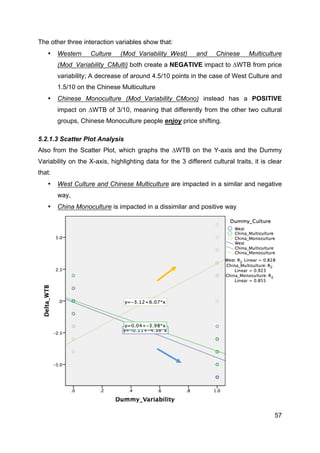
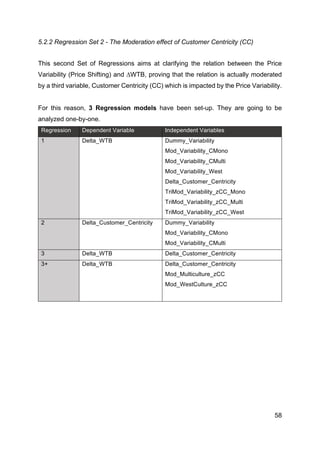
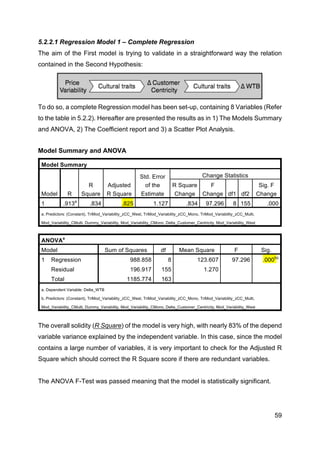
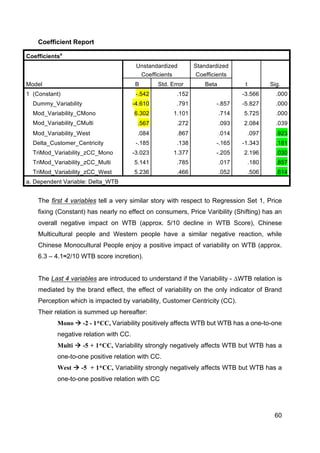
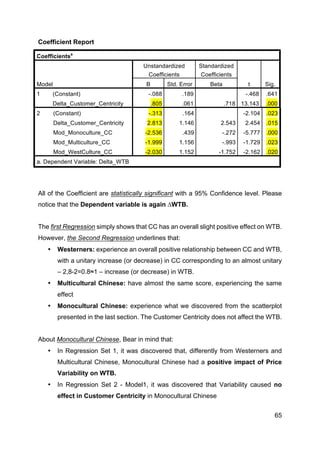
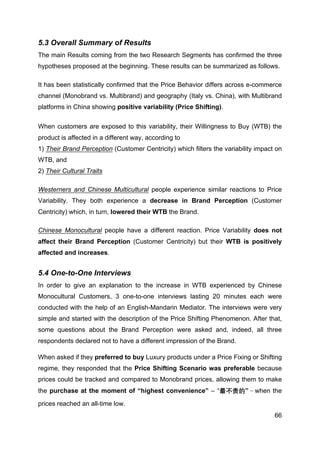
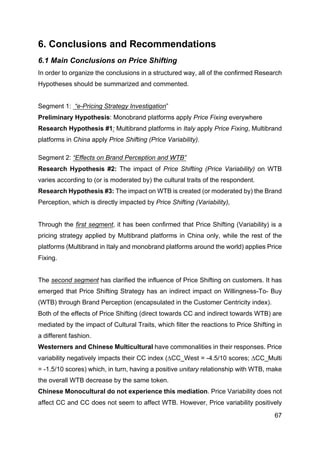
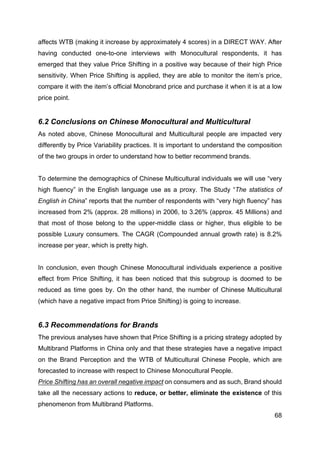
East and West Luxury e-pricing Strategy
An empirical study on the implications of a Global Mandate
Roberto Leumann
Double Degree In International Management
Bocconi University – Fudan School of Management - 复旦管理学院
Empirical Thesis
Tutor: Ferdinando Pennarola
Discussant: Paola Cillo
II
III
Acknowledgements
I dedicate this paper first and foremost to my parents, who gave me the opportunity to pave
my own path through life, supporting me whenever I needed.
I wish to express my deep gratitude for Professors Ferdinando Pennarola and Paola
Cillo for the indispensable assistance provided during the execution and actual analyses of
this empirical research.
I also want to sincerely thank Carlo Moltrasio, who helped me a great deal, especially
during the origination of the idea behind this paper.
In conclusion, I want to thank all of my friends, old ones and new ones, for the
enormous support they gave me during these years and remarkably Veronica Hong, with
whom I share a strong passion for linguistics.
IV
V
Table of Contents
Acknowledgements.................................................................................................. III	
  
Abstract...................................................................................................................... 1	
  
中文摘要 ...................................................................................................................... 2	
  
1. Introduction and Research Objectives................................................................ 7	
  
1.1 Introduction ................................................................................................................................ 7	
  
1.2 Research Objectives.................................................................................................................. 8	
  
1.2.1 Assumptions and Hypotheses .............................................................................................. 9	
  
2. Literary Review.................................................................................................... 10	
  
3. The Luxury e-Commerce Industry - a Background......................................... 12	
  
3.1 The Luxury Market and e-Pricing strategies ......................................................................... 12	
  
3.1.1 The Luxury Market – fundamentals, channels and online opportunities............................. 12	
  
3.1.2 e-Pricing strategies in the Luxury Market: differentials, variability and harmonization ....... 14	
  
3.2 The Luxury Customer and Brand Dynamics ......................................................................... 15	
  
3.2.1 The Luxury equation: the paramount importance of Pricing ............................................... 15	
  
3.2.2 China: Generational Research and Cultural Traits ............................................................. 17	
  
4. Methodology ........................................................................................................ 18	
  
4.1 e-Pricing Strategy Investigation ............................................................................................. 19	
  
4.1.1 Price Extractor Macro (PEM) – Preliminary Design............................................................ 20	
  
4.1.2 Hypothesis Testing and Other Data Analyses .................................................................... 27	
  
4.1.3 Validation: Exchange Rate Correlation............................................................................... 32	
  
4.2 Effects on Brand and Willingness to Buy (WTB) .................................................................. 33	
  
4.2.1 Brand Impact Survey .......................................................................................................... 34	
  
4.2.2 Moderated Regression Analysis ......................................................................................... 39	
  
5. Results ................................................................................................................. 45	
  
5.1 e-Pricing Strategy Investigation ............................................................................................. 45	
  
5.1.1 ANOVA Analyses................................................................................................................ 45	
  
5.1.2 Pivot Analysis ..................................................................................................................... 49	
  
5.1.3 Validation: Exchange Rate (ER) Correlation ...................................................................... 53	
  
5.2 Moderated Regressions - Effects on Brand and WTB......................................................... 54	
  
5.2.1 Regression Set 1 - The effect of Variability on WTB .......................................................... 54	
  
5.2.2 Regression Set 2 - The Moderation effect of Customer Centricity (CC)............................. 58	
  
5.3 Overall Summary of Results ................................................................................................... 66	
  
5.4 One-to-One Interviews............................................................................................................. 66	
  
6. Conclusions and Recommendations ................................................................ 67	
  
6.1 Main Conclusions on Price Shifting....................................................................................... 67	
  
6.2 Conclusions on Chinese Monocultural and Multicultural.................................................... 68	
  
6.3 Recommendations for Brands................................................................................................ 68	
  
Appendix 1 – Brand selection within Clusters ..................................................... 70	
  
Appendix 2 – Final Panel Selection ....................................................................... 71	
  
Appendix 3 – PEM Coding...................................................................................... 74	
  
Appendix 4 – Currency Conversion ...................................................................... 77	
  
Appendix 5 – Survey Design .................................................................................. 79	
  
References ............................................................................................................... 83	
  
1
Abstract
Technological breakthroughs completely transformed most of the existent markets,
and those markets that entailed retail operations have been shaken in a profound way
more often than not.
The luxury market, given its intrinsic characteristics, has been one of those markets
whose transition to e-commerce has come with greater delay but the deep changes
are now becoming more and more visible.
Pricing strategies, being at the heart of the so-called luxury equation, had to adapt as
well, with consequences not always straight-forward to determine.
In this paper, luxury e-pricing strategies of different e-commerce platforms are studied
in order to understand them in depth and clarify the alterations that distinguish them
across nations or, more broadly, across continents.
The effects of different strategies on final customers is also of paramount importance
and it is therefore researched in a second moment.
The whole analysis sheds a light on the unstable equilibrium and the threats. which
characterize luxury companies when they decided to sell their goods all over the world
and thus taking a global mandate.
2
中文摘要
緒論及研究目標
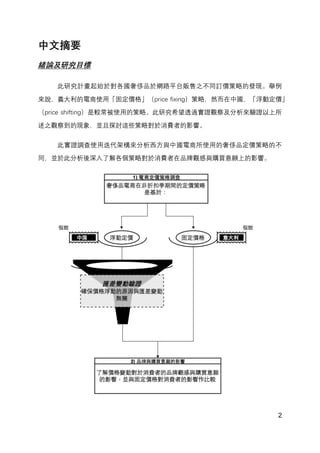
此研究計畫起始於對各國奢侈品於網路平台販售之不同訂價策略的發現。舉例
來說,義大利的電商使用「固定價格」(price fixing)策略,然而在中國,「浮動定價」
(price shifting)是較常被使用的策略。此研究希望透過實證觀察及分析來驗證以上所
述之觀察到的現象,並且探討這些策略對於消費者的影響。
此實證調查使用迭代架構來分析西方與中國電商所使用的奢侈品定價策略的不
同,並於此分析後深入了解各個策略對於消費者在品牌觀感與購買意願上的影響。
3
此研究分為兩部分:
1. 電商定價策略調查:旨在探討中國與義大利不同電商平台所制訂的定價策略
並觀察其價格的變動模式。最主要的研究假說是,義大利電商採用「固定價
格」(price fixing)策略,即維持奢侈品的定價不變直到折扣季;中國的電
商則採用「浮動定價」(price shifting)策略,同樣商品的價格幾乎每一天都
在改變。
• 匯率的變動在此研究中是被納入考量的,以利評估價格的變動是受
到匯差或是受到市場價格競爭的影響。
2. 消費者品牌觀感與購買意願調查:對於中國及意大利定價策略的假說驗證為
真後,接下來最重要的課題就在於探討不停變動的價格對奢侈品市場的消費
者的影響,探討同時也將消費者不同的文化背景與消費行為模式納入考量。
這部分的假說是浮動的價格對各個消費者的影響不同,而當中的不同與其文
化背景息息相關。
研究假設
電商定價策略調查是設計來測試:
假設 #1(assumption): 商品價格變動與匯率變動無關
假說 (hypothesis)
0. 初步假說:所有單一品牌的電商平台都採用「固定價格」(price fixing)策略。
1. 研究假說#1: 意大利的多品牌電商採用「固定價格」(price fixing)策略,中國的多
品牌電商採用「浮動定價」(price shifting)策略。
4
消費者品牌認知與購買意願調查的部分將基於一個基本假設測試兩個假說。
假設 #2(assumption): 浮動定價對於品牌觀感與購買意願有統計上顯著的影響。
此部分的假說(hypothesis)則為:
2. 研究假說#2:浮動定價對購買意願的影響取決於受試者的文化特性。
3. 研究假說 #3:消費者的購買意願取決於其對品牌的觀感,而其對品牌的觀感身受價
格浮動與否影響。
研究方法
1. 電商定價策略調查
此第一部分的研究期望能盡可能蒐集到所有電商的定價模式。
主要目的在於追蹤和比較不同電商的針對特定奢侈品品牌商品在義大利與中國
的定價。此處所指的電商包括單一品牌(品牌直營)及多品牌(獨立經營)的電商。
為了能取得每一天的價格變化這樣龐大的資訊,一個“Price Extractor Macro”
(PEM) 程式被應用於下載各個電商平台的價格資訊,且這些資訊被儲存於一個資料庫。
PEM 集結了 55 天1
的資訊。這 55 天正好能觀察到兩個不同階段的價格變動資訊:非折
扣季(截至五月底)與折扣季(六月的第一週)。
PEM 資料庫所取得的資料能透過敘述統計來分析各個不同電商與地理位置的變
異。ANOVA 分析則用來驗證統計的顯著性。樞軸分析也用來更深入的分析不同商品的
價格變異。
1
⾃自 2016 年 4 ⽉月 14 ⽇日⾄至 2016 年 6 ⽉月 7 ⽇日⽌止。
5
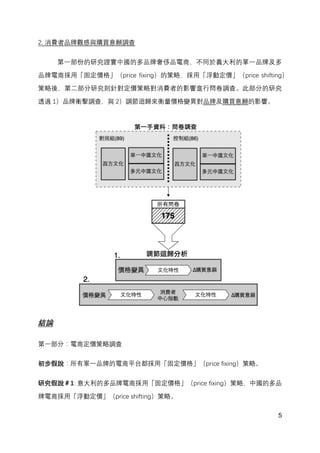
2. 消費者品牌觀感與購買意願調查
第一部份的研究證實中國的多品牌奢侈品電商,不同於義大利的單一品牌及多
品牌電商採用「固定價格」(price fixing)的策略,採用「浮動定價」(price shifting)
策略後,第二部分研究則針對定價策略對消費者的影響進行問卷調查。此部分的研究
透過 1)品牌衝擊調查,與 2)調節迴歸來衡量價格變異對品牌及購買意願的影響。
結論
第一部分:電商定價策略調查
初步假說:所有單一品牌的電商平台都採用「固定價格」(price fixing)策略。
研究假說#1: 意大利的多品牌電商採用「固定價格」(price fixing)策略,中國的多品
牌電商採用「浮動定價」(price shifting)策略。
6
第二部分:消費者品牌觀感與購買意願調查
研究假說#2:浮動定價對購買意願的影響取決於受試者的文化特性。
研究假說 #3:消費者的購買意願取決於其對品牌的觀感,而其對品牌的觀感身受價格
浮動與否影響。
第一部分的研究證實「浮動定價」(price shifting)策略只被中國的多品牌奢侈
品電商採用,所有其他電商平台則採用「固定價格」(price fixing)策略。
第二部分的研究顯示「浮動定價」(price shifting)策略影響消費的對品牌的觀
感,更間接影響了消費者的購買意願(消費者中心指數(Customer Centricity Index)
可詮釋此發現)。
「浮動定價」(price shifting)策略的對消費者中心指數(CC)形成直接效應,
並對購買意願(WTB)造成間接效應。這兩個效應都經過文化特質的調節已過濾掉消
費者對價格浮動及其細微的反應。
西方人與受多元文化影響的中國人有許多相同之處。價格變異對他們的消費者
中心指數有負的影響(∆CC_West = -‐4.5/10 scores; ∆CC_Multi = -‐1.5/10 scores),此情形
同時一致的與購買意願有正向相關,出於同樣的原因使整體的購買意願下降。
單一文化下的中國人不受此影響。價格變異不影響消費者中心指數,且消費者
中心指數似乎不影響購買意願。然而,價格變動正向且直接的影響了購買意願(提升
了約莫 4 個級分)。在進行與單一文化下的中國人的一對一訪談後發現,由於此類受
訪者的價格敏感度高,他們對價格變動評價是正面的。這樣正面的評價出自於他們能
夠追蹤商品的價格、與單一品牌電商的價格做比較、並於多品牌電商的商品價格達到
最低點時購買商品。
7
1. Introduction and Research Objectives
1.1 Introduction
The idea behind the entire empirical study comes from the preliminary realization that
Luxury pricing dynamics of online e-commerce platforms seem to be different across
continents.
After having noticed this phenomenon, the researcher had the primary intent to find
evidence for this preliminary realization, through a structured analysis of online pricing.
The Luxury Market has been one of those markets in which e-commerce penetration
has come with largest delay. This mainly because this market was originally believed
to be one were the physical in-shop experience was paramount for the consumption
itself. However, the rapid growth experienced by luxury e-tailers in 2016 is a sufficient
proof that that e-commerce revolution is already happening also in this market.
Given the complex distribution structure of the luxury market (retail – wholesale), it was
fundamental to study and highlight commonalities and dissimilarities between the
pricing strategies of different channels and understand if other than the channel, also
geography was an important determinant of pricing.
Other than the Distribution structure complexity, the fashion luxury market has other
peculiarities to keep in mind. The paramount importance of pricing (together with
quality and scarcityscarsity) as one of the main components of the luxury experience
is one of them. So to say, it was not enough to validate the initial intuition that pricing
was different across continents and channels, it was also crucial to establish the
psychological relation between price and customers and assess what consequences
that different pricing strategies could have on the final customers.
The research objectives of the study are presented, together with assumptions and
hypotheses, in the next paragraph.
8
1.2 Research Objectives
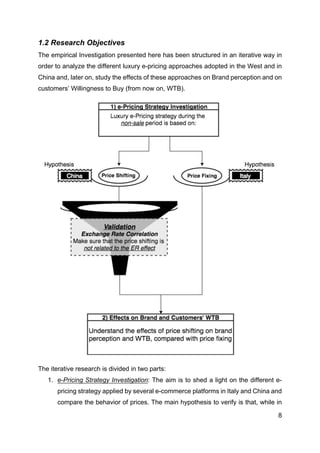
The empirical Investigation presented here has been structured in an iterative way in
order to analyze the different luxury e-pricing approaches adopted in the West and in
China and, later on, study the effects of these approaches on Brand perception and on
customers’ Willingness to Buy (from now on, WTB).
The iterative research is divided in two parts:
1. e-Pricing Strategy Investigation: The aim is to shed a light on the different e-
pricing strategy applied by several e-commerce platforms in Italy and China and
compare the behavior of prices. The main hypothesis to verify is that, while in
9
Italy a fix-pricing strategy is applied, keeping the prices of luxury good fixed until
the sale season, in China, prices shifts constantly (almost on a daily basis).
• At this point and Exchange Rate Validation is performed, in order to
assess if the price shift is related to ER fluctuations or simply to
competitive pressures on the market.
2. Effects on Brand Perception and Consumers’ WTB: Once the characteristics of
the two different strategies are empirically verified, it is of major importance to
assess the effect that a constant price shifting in the Luxury Market has on
Consumers with different cultural background and consumption behaviors. The
main hypothesis presented here is that Price shifting have a different consumer
impact depending on the cultural background of the consumer.
1.2.1 Assumptions and Hypotheses
Overall, the research is based on 2 main assumption and 3 hypotheses, which are
summarized in a structured way hereafter:
The “e-Pricing Strategy Investigation” part is designed to test a:
Assumption #1: The Price variability does not depend on currency fluctuation
Hypotheses:
0. Preliminary Hypothesis: Monobrand platforms apply Price Fixing everywhere
1. Research Hypothesis #1: Multibrand platforms in Italy apply Price Fixing,
Multibrand platforms in China apply Price Shifting (Price Variability).
The “Effects on Brand Perception and WTB” part is designed to test 2 Hypothesis
under a Fundamental Assumption:
Assumption #2: Price Shifting (Price Variability) has a statistically significant impact
on both WTB and Brand Perception.
Hypotheses were instead that:
2. Research Hypothesis #2: The impact of Price Shifting (Price Variability) on
WTB varies according to (or is moderated by) the cultural traits of the
respondent.
3. Research Hypothesis #3: The impact on WTB is created (or moderated by)
the Brand Perception, which is directly impacted by Price Shifting (Variability),
10
2. Literary Review
Taking into consideration that the afore-mentioned research objectives range over two
main areas, this paper will try to enrich the academic inquiry regarding those two,
namely 1) luxury e-commerce evolution and pricing and 2) Brand effect of Pricing on
customers with different cultural backgrounds.
Even though existing literature is often tangent to most of the subjects analyzed in this
paper, empirical analyses on price behaviors are mostly done by Think Tanks and
Consulting companies; their reports are also used as guidelines for the current analysis.
The first area has mostly been tackled by Academia in terms of the relationship
between Luxury players and e-commerce or, more broadly, with the digital
environment and the internet.
Uchè Okonkwo, a world-wide known pioneer of luxury business strategy and
industry expert has produced countless articles on this topic. in Sustaining the luxury
brand on the Internet (2009)2
has summed up the three main waves of thought of
Academics regarding the relationship between the Luxury market and the internet: a
threat, a channel and a huge opportunity. Moreover, the paper describes the cautious
steps of Luxury Players towards the establishment of a digital brand interface and
seven challenges that Luxury players are doomed to face in order to succeed in this
venture. The 6th
challenge refers to the smart use of e-commerce and articulates the
problem of stock, global demand, universal transparency (regarding product quality)
and product selection.
The aim of this paper is to elaborate on the possible challenges and threats that Global
Luxury companies encounter when dealing with e-commerce pricing strategies. More
specifically it is important to explain the threat of online price setting, especially when
prices become globally transparent and customers’ information asymmetry starts to
fade away.
In his book Luxury Online (2010)3
, Okonkwo describes the new paradigm of Luxury.
The outdated “top-down” approach in which the Luxury brands “talk AT consumers”3
,
2
Brand Management 2009, 16(5/6), pp.302–310.
3
Okonkwo, U. (2010). Luxury online. Basingstoke: Palgrave Macmillan.
11
should be replaced with more conversational approaches, where brands “talk WITH
consumers” 3
. The author emphasizes the importance of customer centricity, price
harmonization and transparency, underlining that “advertising dressed as something
else [trying to make customers believe something not factually verified] can only result
in backlash”3
.
Regarding this issues, the aim of this paper is to bring to the surface a price tactic
applied by Multibrand Platforms4
in one region (Price shifting in China) that might
become a threat to the brand perception of consumers everywhere.
Exane Paribas and Contactlab have published in October 2015 their annual
Digital Luxury: Online Pricing Landscape5
. The report analyzes in depth the item
selection and price range of the ENTIRE collection presented online by many Luxury
brands. The report underlines many of strategies and decisions embarked by Luxury
companies online but does not take into account the possible Inter-period price
variability which is the main research objective of this paper.
Regarding the second area, the existing literature mainly focuses on Generational
Researches that try to explain consumption decisions of luxury consumers towards
luxury goods.
Xu, Y. and Giovannini, S. in Luxury fashion consumption and Generation Y
consumers6
investigates the consumption dynamics of American Generation Yers with
a strong focus on Luxury consumption.
Liu, Q. in An Empirical Research On Online Luxury Goods Buying intention of
Generation Y in China 7
evaluates the same fundamentals, focusing on Chinese
Generation Yers.
This research paper starts from the Generational Research made by existing literature,
namely the distinction between Generation X and Y. Later on, it tries to understand the
impact of pricing on the Brand perception of consumers introducing Cultural Traits and,
more specifically, Cultural Homogeneity and Heterogeneity. Cultural traits are
additional with respect to Generational Traits.
4
For more info about “Multibrand”, check the Section 3.1.1 below.
5
Exane Paribas - ContactLab, (2015). Digital Luxury: Online Pricing Landscape SS15.
Luxury Goods. Milano: Exane Paribas, ContactLab.
6
Journal of Fashion Marketing and Management, 19(1), pp.22-40.
7
Master of Science Dissertation. Bocconi University.
12
In addition, the next Section (3. The Luxury e-Commerce Industry - a Background)
contains data from other Industry experts, Consulting companies and Think Tanks,
namely Bain, Altagamma, McKinsey and Exane Paribas.
3. The Luxury e-Commerce Industry - a Background
The following two sections contain some background information to help the reader
going through the two segments of the empirical research. The first one concentrates
on the generalities of the luxury market and on the main characteristics of pricing in
this market. The second one focuses instead on the luxury equation and the
psychological components of luxury products which defines them as such; of course,
pricing is one important component for the research purposes and will receive close
attention.
3.1 The Luxury Market and e-Pricing strategies
An overview of the Market’s generalities, features and latest characteristics, is
definitely useful to clarify the set-up of the first segment of the empirical analysis.
3.1.1 The Luxury Market – fundamentals, channels and online opportunities
The Fashion Luxury market, which is the focus of study in this research, lies within the
Personal Luxury Goods market. This industry is very dynamic and fluid and it has been
experiencing major changes during the latest years.
In 2015, the Personal Luxury market accounted for €253 billion8
in size (Revenues)
and was growing at a real rate9
of 1-2% from 2014. Regarding geographies and key
locations, Europe and Americas remain the largest selling regions, the ones able to
attract luxury consumers the most. Even though the key selling locations are Western,
consumers mainly come from China (31%) where a big percentage of the world’s high
net-worth individuals is concentrated and where a large middle class is developing.
8
Altagamma-Bain Report on Luxury 2015 and McKinsey.
9
The growth rate is adjusted considering the exchange rate fluctuations.
13
It is clear that the whole industry is highly dependent on China and on Chinese
consumers, this explains why it is interesting to study this region and its differences
with more traditional Luxury geographies.
The channels available to luxury market incumbents are various. The market is mainly
dependent on wholesale, while there are several types of retail options possible for
brands. Monobrand retailers are those stores which are managed by the luxury brand
and sell only the brand’s product. In the last 10 years, the opening of proprietary
retailers, especially in double-digit growing markets like China, has been one of the
main sources of growth for luxury brands. Opposite to Monobrand stores, there are
Multibrand stores which sell different types of brands within a certain category.
This same structure (Monobrand versus Multibrand) can be found both in the brick-
and-mortar environment and in the online one.
During the latest years the Luxury Market has experienced a tremendous increase in
the e-commerce penetration, with revenues online totaling €16.8 billions8
in 2015, with
a 30% CAGR with respect to 2012.
Overall, 7% of the whole Personal Luxury Revenues are obtained through e-commerce
channels. As mentioned before, e-commerce has reached the luxury market with a
greater delay with respect to other markets and it is widely believed that luxury e-
commerce is nearing its tipping point in 2016. The tipping point is the time-point that
precedes a remarkable scaling up of operations, the moment in which the investments
starts adding up at a faster pace. Indeed, it is forecasted that by 2025 luxury e-
commerce will make around 20-25% of Personal Luxury Revenues, thus nearly tripling
its current penetration and totaling €70 billion8
(Revenues).
Digital investments are becoming the real arena on which luxury brands are competing
against each other and it is already possible to profile winners and losers on this
battlefield. Burberry, for instance, already being one of the established luxury e-
commerce leaders, has committed to invest £10 million10
in 2016 and £25 million each
year after in “retail, digital and enhancing critical capabilities”.
10
Business of Fashion.
14
3.1.2 e-Pricing strategies in the Luxury Market: differentials, variability and
harmonization
As mentioned by Bain & Company, 2015 and 2016 will be the years in which “The main
challenge facing most luxury brands [will be] establishing the right pricing model”11
.
This because of two different elements of the market which are emerging and lately
coming into collision:
• Cross-country price differentials
• Digital and e-commerce transparency
Cross-country Price Differential is an element that has strongly possessed the luxury
strategy only in the latest decades. These differentials, which could be as high as
40%12
higher prices exclude tax effect, have become popular when Brands started
adapting their pricing model to emerging countries, especially China. The initial aim of
these differentials was to extract the highest possible Willingness To Pay (WTP) from
consumers assuming the high demand of new riches for Luxury products. This system
was sustainable since the regions where differentials were applied were also
characterized by a high degree of information asymmetry. As time went by, China (and
other emerging markets were differentials were applied) underwent a digital revolution
and a progressive development of the middle class, together with a higher and higher
openness to trade and travel. All these elements gave to the market an unprecedented
level of Transparency which made possible for shoppers to compare before and after-
tax prices worldwide and make consumption decisions differently. Phenomena like
“Shopping Travelling” in European Capitals and 代购 (“Daigou”, Chinese shopping
agents purchasing luxury items in Europe and reselling them in China making a profit
out of the price differential) quickly started to spread.
In order to invert this trend, major Brands are fine-tuning their price models with the
aim of harmonizing world-wide price lists13
. This approach is definitely good in the
long run to avoid value confusion in consumers coming from different regions; however,
11
Bain & Company. (2016). LUXURY GOODS WORLDWIDE MARKET STUDY - FW 2015.
12
Dilen Schneider. (2016). Luxury Consumer Trends Report Q12015
13
Luxury Daily (2016). Chanel aligns prices to prepare for future.
15
the short run effect is a sharp price increase in some areas where prices were lower
and decrease in others, with possible momentary demand shifts. The pioneer in this
“alignment experiment” has been Chanel which in June 2015 started normalizing the
price of three signature models, causing a 20% downshift in China and a 20% upshift
in Europe for these three.
Given the enormous pressure and attention that revolves around pricing and price lists,
Brands normally follow a “Standard Period – Sale Period” timing, which is also reflected
in the contractual agreements they have with wholesalers. Prices are decided before
putting the products on the market, left “fixed” during the standard period and rebated
during the sale period.
To prevent the incurrence of “luxury value confusion” or “brand dilution”, price shifting
and variability during Standard periods in normally avoided. This is why the study of
possible “price shifting” strategies is an element of interest of the research.
3.2 The Luxury Customer and Brand Dynamics
A deeper understanding of the psychological impact of pricing as an ingredient of the
Luxury Formula and the evolution of the Luxury Customer Culture will be fundamental
to better understand the second segment of the empirical analysis.
3.2.1 The Luxury equation: the paramount importance of Pricing
In order to understand the psychological importance of luxury pricing, it is essential to
start from the definition of luxury goods and understand the ingredients that come
together to make a product a “Luxury product”.
A Luxury Product “is a good for which demand increases more than proportionally as
income rises”14
. Price, together with product scarcity (exclusivity coupled with strict
timing) and superior quality is one of the main dimensions of the so-called Luxury
equation, which is lately said to be in crisis because of the profound changes that the
industry is experiencing15
.
14
From Heine, Klaus: (2011) The Concept of Luxury Brands. Luxury Brand Management, No.
1, ISSN 2193-1208
15
From Business of Fashion, Italian Industry Debates Luxury Equation in Crisis.
16
The price applied on Luxury goods is defined as “Premium”, meaning that it is kept
artificially high in order to give favorable perceptions to consumers, increase exclusivity
and communicate the higher intangible value that the product conveys (value
encapsulated in heritage, handcraft techniques, design, first-class materials, and so
forth).
This psychological role of price predisposes and accompanies the customer along the
journey which will lead to the final acquisition of ownership. Pricing is an important, yet
also collateral feature when the Luxury deal is completed in a brick-and-mortar
environment, but it becomes supremely important when the deal is concluded online,
because it turns out to be one of the major “luxury value conveyors”.
This is the reason why Luxury brand normally strategize very carefully the price model
they apply on their Monobrand stores and the price lists that they pass on to Multibrand
stores.
17
3.2.2 China: Generational Research and Cultural Traits
Especially in countries like China, which went through a process of rapid development
where the consumption behavior of individuals has been abruptly revolutionized,
Generational Research has attempted to capture the characteristics of a specific group
of people extrapolating generalizations useful to describe an entire Generation.
The classic Generational segmentation highlights the differences between generations
X and Y, meaning those who were born before and after the Digital revolution (before
and after the late 90s).
In China, this demarcation comes with an even greater intensity since generation Yers
are the first generation born under the One-Child Policy and bearing an even more
distinctive set of characteristics: “higher personal value, higher level of attention from
parents, higher internet dependency on both daily and leisure decisions”16
. In 2015,
Generation Yers were approximately 18% of the total Chinese population16
.
These labels however are not absolutely self-sufficient and, especially in China, they
fail to account for the members of generation Y that were largely exposed, since their
early childhood to Western Values and Culture This exposure has been possible due
to the higher openness of China, to the greater penetration of the internet and to the
rising middle class which has given the possibility to gain experience and education
abroad to a higher percentage of the young population.
These subsets of the Generation Y should be regarded as “Monocultural Yers”,
Mandarin Chinese speakers only and mainly exposed to Chinese and pan-Asian
values, and “Multicultural Yers”, fluent in English and exposed over long periods of
time to Western Culture and Values.
16
Lu (2005), pg. 7-10.
18
4. Methodology
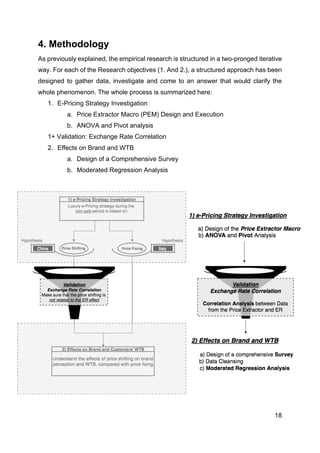
As previously explained, the empirical research is structured in a two-pronged iterative
way. For each of the Research objectives (1. And 2.), a structured approach has been
designed to gather data, investigate and come to an answer that would clarify the
whole phenomenon. The whole process is summarized here:
1. E-Pricing Strategy Investigation
a. Price Extractor Macro (PEM) Design and Execution
b. ANOVA and Pivot analysis
1+ Validation: Exchange Rate Correlation
2. Effects on Brand and WTB
a. Design of a Comprehensive Survey
b. Moderated Regression Analysis
19
4.1 e-Pricing Strategy Investigation
The first step of the research process had the aim to gather as much data as possible
about the pricing schemes applied by different e-commerce platforms.
The main objective is to define a panel of comparable items of some luxury brand and
monitor the prices applied in Italy and China by different e-commerce channels – both
proprietary ones (mono-brands) and independent ones (Multibrand).
In order to gather data on a DAILY BASIS, it was important to automate the process
of “price extraction” or “price pulling”, that is the process by which the prices are
downloaded from different e-commerce platform and collected into a database.
For this reason, a “Price Extractor Macro” (PEM) has been designed and
programmed. The Macro has been ran for 55 days17
in order to be able to monitor the
price pattern of different platforms during two different periods: standard period (until
the end of May) and sale period (The first week of June).
After the data from the PEM has been collected, Descriptive statistics have been
calculated to analyze the variability of different e-commerce platforms and across
geographies.
An ANOVA analysis has been run in order to verify the statistical significance of
results.
The overall results were also aggregated through a Pivot Analysis in order to analyze
the price variability more in depth.
17
From April 14th 2016 to June 7th 2016
20
4.1.1 Price Extractor Macro (PEM) – Preliminary Design
4.1.1.1 PEM – Panel Design
The initial step for the creation of the PEM has been to select a panel of items to
monitor in order to have a complete panorama of the pricing scheme applied in the two
geographical Areas Selected, namely Italy and China.
The most important factors that had to be defined in order to select the panel were:
1. Which Brand to monitor,
2. How many and which e-commerce platforms to monitor
3. How Many and which Items to monitor
1. Brand Panel Selection
The Brand selection has been done according to 2 criteria:
• Mirror the Luxury Pyramid (Altagamma Bain 2015)
• Select Brands 1) with strong and efficient proprietary e-commerce in order to
compare them with multi-brand, 2) offering many different Items (Apparel,
Shoes, Bags etc.).
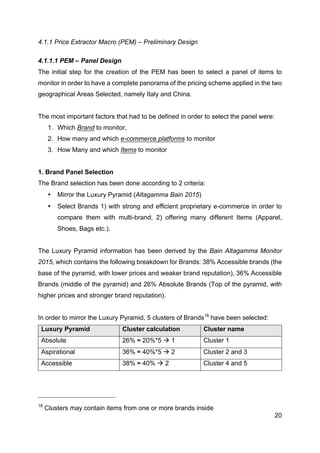
The Luxury Pyramid information has been derived by the Bain Altagamma Monitor
2015, which contains the following breakdown for Brands: 38% Accessible brands (the
base of the pyramid, with lower prices and weaker brand reputation), 36% Accessible
Brands (middle of the pyramid) and 26% Absolute Brands (Top of the pyramid, with
higher prices and stronger brand reputation).
In order to mirror the Luxury Pyramid, 5 clusters of Brands18
have been selected:
Luxury Pyramid Cluster calculation Cluster name
Absolute 26% ≈ 20%*5 à 1 Cluster 1
Aspirational 36% ≈ 40%*5 à 2 Cluster 2 and 3
Accessible 38% ≈ 40% à 2 Cluster 4 and 5
18
Clusters may contain items from one or more brands inside
21
In order to select which brands would populate each cluster, the criteria presented
above (e-commerce efficiency and completeness of the product offer) have been used.
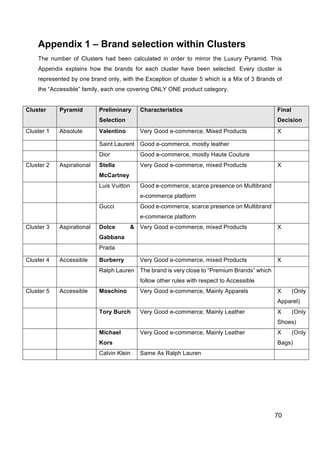
For further details about the Brand selection within the clusters, please take
Appendix 1 – Brand selection within Clusters as reference.
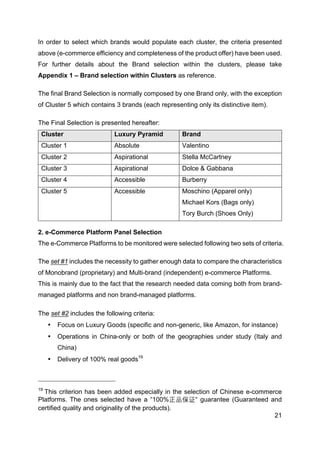
The final Brand Selection is normally composed by one Brand only, with the exception
of Cluster 5 which contains 3 brands (each representing only its distinctive item).
The Final Selection is presented hereafter:
Cluster Luxury Pyramid Brand
Cluster 1 Absolute Valentino
Cluster 2 Aspirational Stella McCartney
Cluster 3 Aspirational Dolce & Gabbana
Cluster 4 Accessible Burberry
Cluster 5 Accessible Moschino (Apparel only)
Michael Kors (Bags only)
Tory Burch (Shoes Only)
2. e-Commerce Platform Panel Selection
The e-Commerce Platforms to be monitored were selected following two sets of criteria.
The set #1 includes the necessity to gather enough data to compare the characteristics
of Monobrand (proprietary) and Multi-brand (independent) e-commerce Platforms.
This is mainly due to the fact that the research needed data coming both from brand-
managed platforms and non brand-managed platforms.
The set #2 includes the following criteria:
• Focus on Luxury Goods (specific and non-generic, like Amazon, for instance)
• Operations in China-only or both of the geographies under study (Italy and
China)
• Delivery of 100% real goods19
19
This criterion has been added especially in the selection of Chinese e-commerce
Platforms. The ones selected have a “100%正品保证“ guarantee (Guaranteed and
certified quality and originality of the products).
22
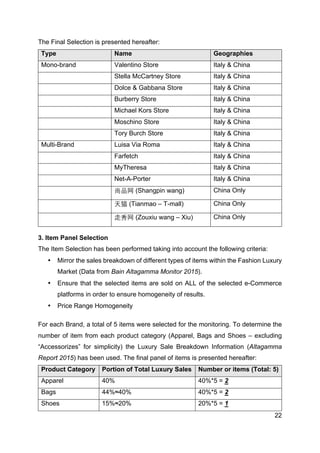
The Final Selection is presented hereafter:
Type Name Geographies
Mono-brand Valentino Store Italy & China
Stella McCartney Store Italy & China
Dolce & Gabbana Store Italy & China
Burberry Store Italy & China
Michael Kors Store Italy & China
Moschino Store Italy & China
Tory Burch Store Italy & China
Multi-Brand Luisa Via Roma Italy & China
Farfetch Italy & China
MyTheresa Italy & China
Net-A-Porter Italy & China
尚品网 (Shangpin wang) China Only
天猫 (Tianmao – T-mall) China Only
走秀网 (Zouxiu wang – Xiu) China Only
3. Item Panel Selection
The Item Selection has been performed taking into account the following criteria:
• Mirror the sales breakdown of different types of items within the Fashion Luxury
Market (Data from Bain Altagamma Monitor 2015).
• Ensure that the selected items are sold on ALL of the selected e-Commerce
platforms in order to ensure homogeneity of results.
• Price Range Homogeneity
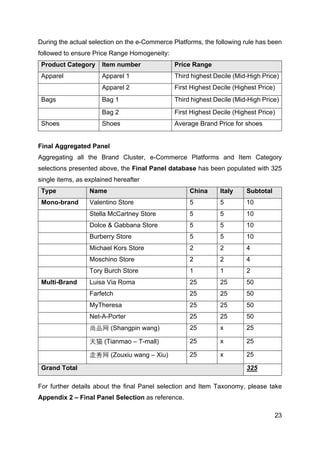
For each Brand, a total of 5 items were selected for the monitoring. To determine the
number of item from each product category (Apparel, Bags and Shoes – excluding
“Accessorizes” for simplicity) the Luxury Sale Breakdown Information (Altagamma
Report 2015) has been used. The final panel of items is presented hereafter:
Product Category Portion of Total Luxury Sales Number or items (Total: 5)
Apparel 40% 40%*5 = 2
Bags 44%≈40% 40%*5 = 2
Shoes 15%≈20% 20%*5 = 1
23
During the actual selection on the e-Commerce Platforms, the following rule has been
followed to ensure Price Range Homogeneity:
Product Category Item number Price Range
Apparel Apparel 1 Third highest Decile (Mid-High Price)
Apparel 2 First Highest Decile (Highest Price)
Bags Bag 1 Third highest Decile (Mid-High Price)
Bag 2 First Highest Decile (Highest Price)
Shoes Shoes Average Brand Price for shoes
Final Aggregated Panel
Aggregating all the Brand Cluster, e-Commerce Platforms and Item Category
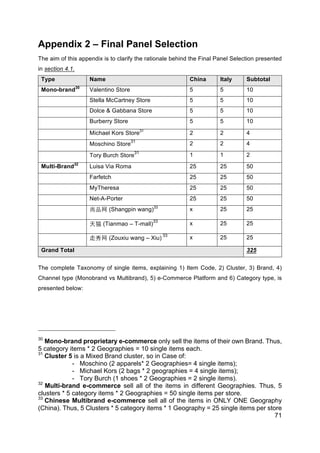
selections presented above, the Final Panel database has been populated with 325
single items, as explained hereafter
Type Name China Italy Subtotal
Mono-brand Valentino Store 5 5 10
Stella McCartney Store 5 5 10
Dolce & Gabbana Store 5 5 10
Burberry Store 5 5 10
Michael Kors Store 2 2 4
Moschino Store 2 2 4
Tory Burch Store 1 1 2
Multi-Brand Luisa Via Roma 25 25 50
Farfetch 25 25 50
MyTheresa 25 25 50
Net-A-Porter 25 25 50
尚品网 (Shangpin wang) 25 x 25
天猫 (Tianmao – T-mall) 25 x 25
走秀网 (Zouxiu wang – Xiu) 25 x 25
Grand Total 325
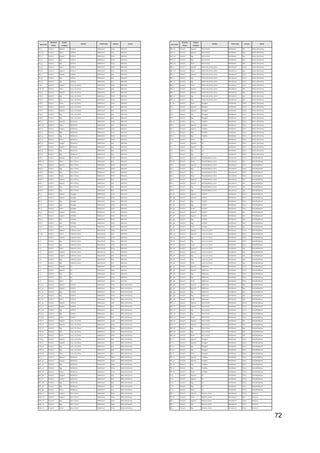
For further details about the final Panel selection and Item Taxonomy, please take
Appendix 2 – Final Panel Selection as reference.
24
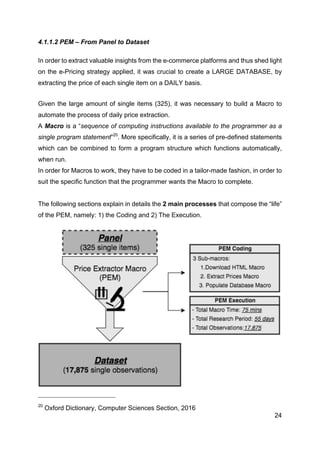
4.1.1.2 PEM – From Panel to Dataset
In order to extract valuable insights from the e-commerce platforms and thus shed light
on the e-Pricing strategy applied, it was crucial to create a LARGE DATABASE, by
extracting the price of each single item on a DAILY basis.
Given the large amount of single items (325), it was necessary to build a Macro to
automate the process of daily price extraction.
A Macro is a “sequence of computing instructions available to the programmer as a
single program statement”20
. More specifically, it is a series of pre-defined statements
which can be combined to form a program structure which functions automatically,
when run.
In order for Macros to work, they have to be coded in a tailor-made fashion, in order to
suit the specific function that the programmer wants the Macro to complete.
The following sections explain in details the 2 main processes that compose the “life”
of the PEM, namely: 1) the Coding and 2) The Execution.
20
Oxford Dictionary, Computer Sciences Section, 2016
,
25
4.1.1.3 PEM – Coding
The PEM is fundamentally an aggregation of three different Macros which are operated
simultaneously. The three different Macros were named: 1) Download HTML, 2)
Extract and 3) Populate.
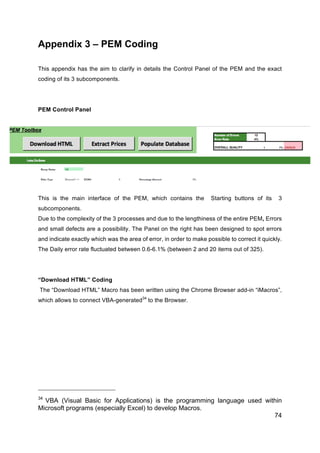
For further information on the overall PEM’s Control Panel and the exact coding of the
three sub-macros, take Appendix 3 – PEM Coding as reference.
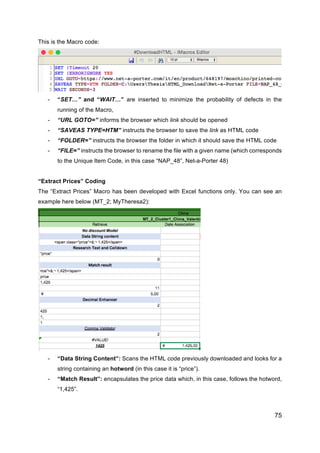
1. Download HTML
Each one of the 325 single observations, were coupled with an unique link21
. The
“Download” Macro opens each single link and downloads the HTML code connected
to it. The HTML code is a “standard systematic code” used to write World Wide Web
Pages.
Once the HTML code of the single item’s page has been downloaded, it is saved on
the Device’s Hard Disk with a single unique name, which correspond to the Item code22
.
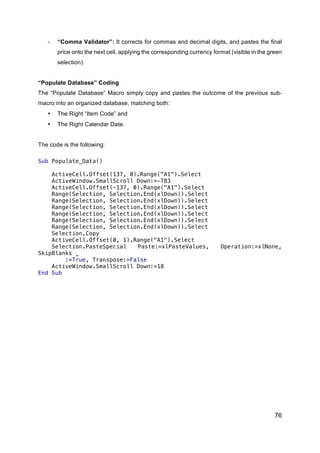
2. Extract Prices
Once the “Download” Macro has terminated, the “Extract Prices” Macro starts. After
having uploaded on an Excel Sheet the entire content of the HTML code file which
resides in the Device’s Hard Disk, this Macro scans it to find the Price information
which is contained within the code.
This Macro had to be customized for every different e-Commerce platform because
the way the price information is coded within the page’s HTML differs depending on
the website design.
All in all, The macro looks for the hotwords23
which precedes the Price information and
extracts the price.
21
Example: http://www.toryburch.it/sandalo-­‐cecile/51158723.html?cgid=shoes-­‐
heels&start=11&dwvar_51158723_color=001	
  	
  
22
The Item code is the unique code assigned to each item of the Database. For further
information, take Section 4.1 and Appendix 2 (Taxonomy) as reference.
23
Examples of hotwords are “price”, “dailyprice”, “prodprice”, “itemprice” etc.
26
3. Populate Database
Once the “Extract Prices” Macro has terminated, the last part of the PEM, namely the
“Populate Database” Macro starts.
This Macro simply collects the data extracted during the second sub-process and
arranges it in a database tidily and in an organized way.
4.1.1.4 PEM – Execution
The PEM was operated for 55 days 24
at the same hour 25
in order to ensure
homogeneity of results.
Even though the PEM process is automated, that does not mean that it is
instantaneous. Indeed, it took approximately 75 minutes every day to successfully run
the macros and collect the data, plus an extra 10 minutes a day to solve minor errors
in the Macros.
The 75 minutes were spread unevenly between the Sub-Macros: The “Download
HTML” was by far the longest of the three, lasting approximately 98% (73 minutes) of
the overall PEM functioning.
Overall, the PEM has successfully extracted and collected 17,875 single
observations (325 single items * 55 days of research).
24
From April 14th 2016 to June 7th 2016
25
Approximately at 11:00AM, Rome Time (GMT+2)
equivalent to 5PM, Shanghai Time (GMT+8)
27
4.1.2 Hypothesis Testing and Other Data Analyses
The overall data collection obtained with the PEM was instrumental for the hypotheses
testing that triggered the overall research. These hypotheses are summed up hereafter:
• Preliminary Hypothesis: Monobrand platforms apply Price Fixing everywhere
• Research Hypothesis #1: Multibrand platforms in Italy apply Price Fixing,
Multibrand platforms in China apply Price Shifting (Price Variability).
After the successful collection of the 17,875 daily prices, the bulk of data was in
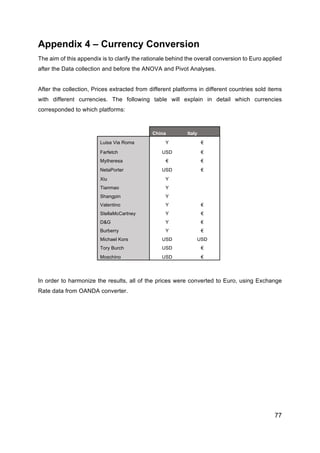
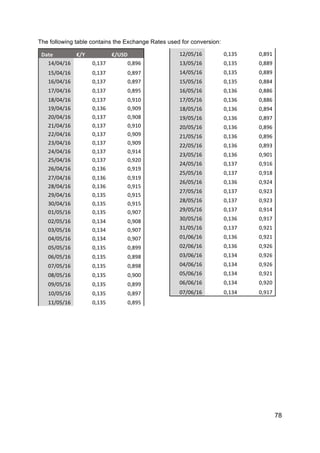
different currencies (USD, Euro and Chinese RMB). Therefore, before running any
type of analysis on them, they were all converted to Euro to ensure homogeneity. For
Further information about the Currencies and the Exchange rates used for conversion,
take Appendix 4 – Currency Conversion, as reference.
After the conversion, for each of the 325 single items, the following metrics have been
calculated:
• Mean
• Variance
• Standard Deviation
• Coefficient of Variation
• Minimum Price
• Maximum Price
• Number of Price Changes: How many times the price has changed during the
research period
These metrics will be used to perform 2 types of analyses:
1. ANOVA: where the two hypotheses are tested and some additional information
about multibrand platforms in China are gathered.
2. Pivot Analysis: where more detailed information about the price decisions are
highlighted.
28
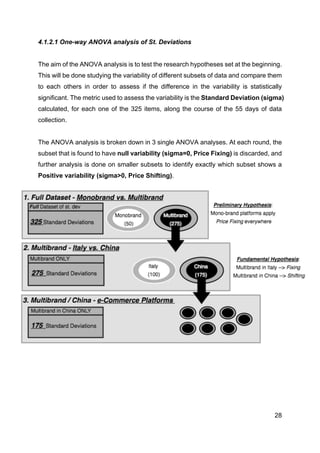
4.1.2.1 One-way ANOVA analysis of St. Deviations
The aim of the ANOVA analysis is to test the research hypotheses set at the beginning.
This will be done studying the variability of different subsets of data and compare them
to each others in order to assess if the difference in the variability is statistically
significant. The metric used to assess the variability is the Standard Deviation (sigma)
calculated, for each one of the 325 items, along the course of the 55 days of data
collection.
The ANOVA analysis is broken down in 3 single ANOVA analyses. At each round, the
subset that is found to have null variability (sigma=0, Price Fixing) is discarded, and
further analysis is done on smaller subsets to identify exactly which subset shows a
Positive variability (sigma>0, Price Shifting).
29
1. Full Dataset - Monobrand vs. Multibrand (Preliminary Hypothesis)
The very first round of ANOVA contains the whole bulk of data collected. All the 325
single items are used to validate the Preliminary Hypothesis that Monobrand platforms,
everywhere in the world apply Price Fixing (sigma=0).
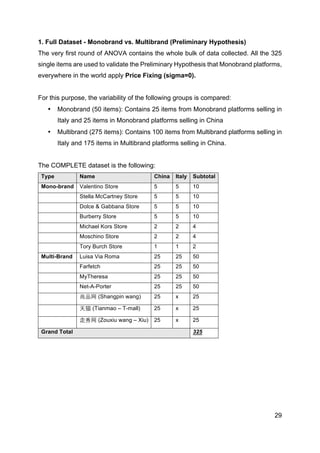
For this purpose, the variability of the following groups is compared:
• Monobrand (50 items): Contains 25 items from Monobrand platforms selling in
Italy and 25 items in Monobrand platforms selling in China
• Multibrand (275 items): Contains 100 items from Multibrand platforms selling in
Italy and 175 items in Multibrand platforms selling in China.
The COMPLETE dataset is the following:
Type Name China Italy Subtotal
Mono-brand Valentino Store 5 5 10
Stella McCartney Store 5 5 10
Dolce & Gabbana Store 5 5 10
Burberry Store 5 5 10
Michael Kors Store 2 2 4
Moschino Store 2 2 4
Tory Burch Store 1 1 2
Multi-Brand Luisa Via Roma 25 25 50
Farfetch 25 25 50
MyTheresa 25 25 50
Net-A-Porter 25 25 50
尚品网 (Shangpin wang) 25 x 25
天猫 (Tianmao – T-mall) 25 x 25
走秀网 (Zouxiu wang – Xiu) 25 x 25
Grand Total 325
30
2. Multibrand – Italy vs. China (Research Hypothesis #1)
After the first round is completed, the Preliminary hypothesis has been confirmed,
Monobrand platforms shows null variability (sigma=0, Price Fixing) when compared
to Multibrand platforms.
The second round analyses Multibrand-platforms data only, testing the Research
Hypothesis #1 that Multibrand platforms in Italy show null variability (sigma=0, Price
Fixing), while Multibrand platforms in China show Positive variability (sigma>0,
Price Shifting).
The MULTIBRAND dataset is the following:
Type Name China Italy Subtotal
Mono-brand Valentino Store 0 0 0
Stella McCartney Store 0 0 0
Dolce & Gabbana Store 0 0 0
Burberry Store 0 0 0
Michael Kors Store 0 0 0
Moschino Store 0 0 0
Tory Burch Store 0 0 0
Multi-Brand Luisa Via Roma 25 25 50
Farfetch 25 25 50
MyTheresa 25 25 50
Net-A-Porter 25 25 50
尚品网 (Shangpin wang) 25 x 25
天猫 (Tianmao – T-mall) 25 x 25
走秀网 (Zouxiu wang – Xiu) 25 x 25
Grand Total 275
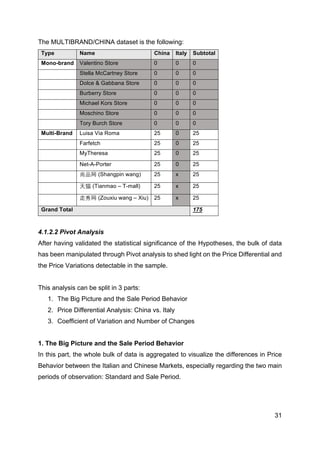
3. Multibrand in China – e-Commerce Platform Variability
After the second round is completed, the Research hypothesis #1 has been confirmed,
Multibrand platforms in Italy show null variability (sigma=0, Price Fixing) when
compared to Multibrand platforms in China.
The third round is analyses data coming from Multibrand platforms in China only,
testing the possible differences among different platforms.
31
The MULTIBRAND/CHINA dataset is the following:
Type Name China Italy Subtotal
Mono-brand Valentino Store 0 0 0
Stella McCartney Store 0 0 0
Dolce & Gabbana Store 0 0 0
Burberry Store 0 0 0
Michael Kors Store 0 0 0
Moschino Store 0 0 0
Tory Burch Store 0 0 0
Multi-Brand Luisa Via Roma 25 0 25
Farfetch 25 0 25
MyTheresa 25 0 25
Net-A-Porter 25 0 25
尚品网 (Shangpin wang) 25 x 25
天猫 (Tianmao – T-mall) 25 x 25
走秀网 (Zouxiu wang – Xiu) 25 x 25
Grand Total 175
4.1.2.2 Pivot Analysis
After having validated the statistical significance of the Hypotheses, the bulk of data
has been manipulated through Pivot analysis to shed light on the Price Differential and
the Price Variations detectable in the sample.
This analysis can be split in 3 parts:
1. The Big Picture and the Sale Period Behavior
2. Price Differential Analysis: China vs. Italy
3. Coefficient of Variation and Number of Changes
1. The Big Picture and the Sale Period Behavior
In this part, the whole bulk of data is aggregated to visualize the differences in Price
Behavior between the Italian and Chinese Markets, especially regarding the two main
periods of observation: Standard and Sale Period.
32
2. Price Differential Analysis: China vs. Italy
This analysis focuses on the average price differentials between the two markets under
analysis (Italy and China). The data breakdown is structured in two ways:
• Retailer Type Breakdown (Monobrand vs. Multibrand)
3. Coefficient of Variation and Number of Changes
The analysis focuses on the Coefficient of Variation and on the number of changes.
The Data analyzed in this section does not include the Monobrand data, since we
already found that it has Null Variability.
Data breakdown is presented in 2 ways:
• Luxury Pyramid Breakdown (Absolute, Aspirational, Accessible)
• Product Category Breakdown (Apparel, Bags, Shoes)
4.1.3 Validation: Exchange Rate Correlation
After having proved the hypotheses true, it is important to validate Assumption #1:
“The Price variability does not depend on currency fluctuation”.
This additional validation is crucial to understand if the price behavior is strictly
decisional of the e-commerce platforms or if it is instead mandated by the need to curb
the Exchange Rate effect between Euro, Dollar and Yuan.
Most probably, only some minor portion of price variations in China will depend on the
Exchange Rate variability, while the majority of it will probably depend on the e-
commerce platform decisions.
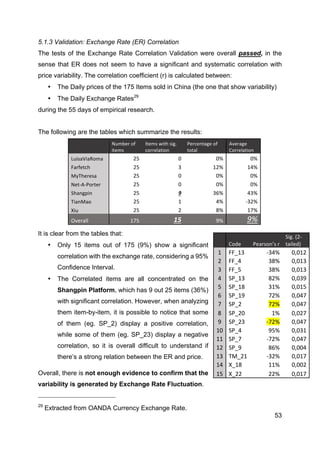
The Validation process is simple in its form. The 55 daily prices for all of the China-
based items will be inserted in a Correlation Matrix (containing Pearson’s r or
Correlation coefficients) against the 55 daily Exchange Rates (Euro/Yuan, Dollar/Yuan)
for the period.
33
4.2 Effects on Brand and Willingness to Buy (WTB)
After having statistically proved that Multibrand Platforms operating in China, unlike
Multibrand platforms operating in Italy and Monobrand platforms, adopt a Price Shifting
Strategy on Luxury goods, it is important to determine the effect of these practices on
final consumers.
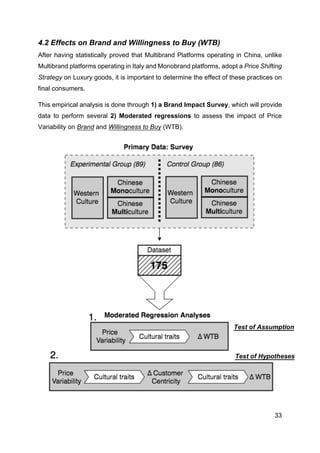
This empirical analysis is done through 1) a Brand Impact Survey, which will provide
data to perform several 2) Moderated regressions to assess the impact of Price
Variability on Brand and Willingness to Buy (WTB).
Test of Hypotheses
Test of Assumption
34
4.2.1 Brand Impact Survey
The Survey has been active for a period of 15 days26
and has been directed to a
selected pool of respondent which could meet the desired target characteristics.
4.2.1.1 Survey’s Objectives, Main Assumption and Hypotheses
The survey has been conceived keeping in mind two sets of objectives:
1. Make sure that Price Shifting (Price Variability) has a statistically significant
impact on customers,
2. Elucidate on the effect Price Shifting (Price Variability) practices may have on:
• Brand Perception and Recognition
• Willingness to Buy (WTB)
The design of the survey and the selection of target respondents was articulated
around Assumption #2, which states that: “Price Shifting has an impact on both WTB
and Brand Perception”.
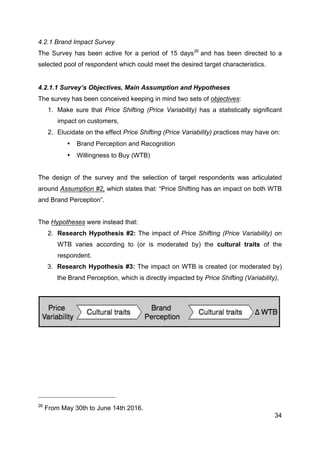
The Hypotheses were instead that:
2. Research Hypothesis #2: The impact of Price Shifting (Price Variability) on
WTB varies according to (or is moderated by) the cultural traits of the
respondent.
3. Research Hypothesis #3: The impact on WTB is created (or moderated by)
the Brand Perception, which is directly impacted by Price Shifting (Variability),
26
From May 30th to June 14th 2016.
35
4.2.1.2 Survey Target Selection and Design
Regarding the Target selection, the main indexes used where:
1. Potential Luxury Customer Traits
• Age - Above 20 years old, to ensure potentiality to buy and/or possess
• Propensity to possess and/or consume Fashion Luxury Product
2. Desired Cultural Traits, either:
• Western Culture: People selected were born and raised in Central
Europe, Eastern Europe and main Anglophone Countries (US, UK,
Australia)
• Chinese Multi-culture: People selected were born and raised in China but
had a long term foreign experience and spoke more than one language
fluently
• Chinese Mono-culture: People selected were born and raised in China,
only had few experiences abroad and could only speak Mandarin
Chinese fluently.
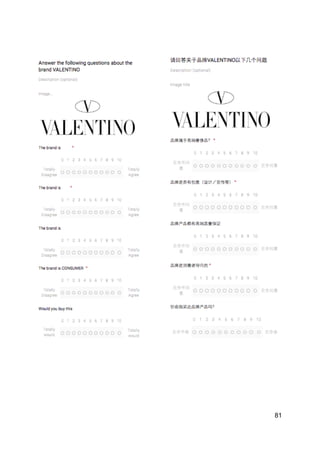
In order to assess the Brand Effects of Price Shifting (Price Variability) in an accurate
way and avoid respondent confusion the survey has been designed in a simple and
straight-forward way.
For further information about the Survey Design, take Appendix 5 – Survey Design
as Reference.
Selection of the Brand to be surveyed
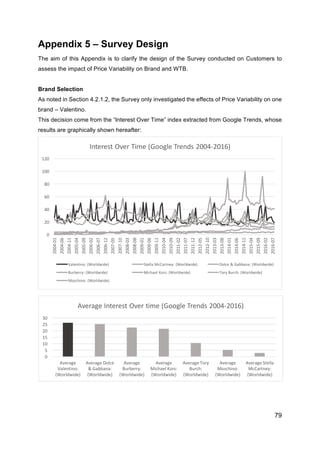
In order to avoid complexity, out of the 7 brands analyzed in the Price Extractor Macro
(PEM) part, only one has been selected. The selection has been done from data about
the “Interest Over Time” 27
.The metric used was the “Average Interest over time” which
made “Valentino” stand out as the one attracting most interest on average.
27
Data coming from the comparison of the Brand Names on “Google Trends” (2004-
2016)
36
Survey Questions
Regarding the actual survey questions, the Occam Razor technique has prevailed,
resulting in the compilation only 5 questions, other than the ordinary profiling questions
(regarding age, sex, luxury consumption propensity and cultural background).
These 5 questions were designed to assess 5 Dimensions to study:
1. Willingness to buy (WTB)
2. Brand Perception – Exclusivity
3. Brand Perception – Authenticity
4. Brand Perception – Creativity
5. Brand Perception – Customer Centricity
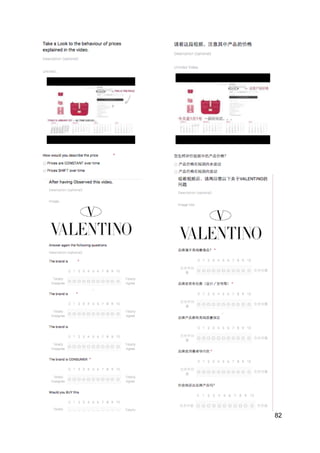
The 5 Questions have been asked BEFORE and AFTER a short video of 30s
explaining the behavior of prices, in order to obtain 2 scores:
• “before-video” score
• “after-video” score
to be used for comparison.
Survey Versions and Languages
In order to control for the effective impact of price variability, two additional precautions
have been taken:
• The survey has been realized in two version: 1) a control version, which
displayed a video where prices were constant (Price Fixing), and
2) an experiment version, which displayed a video where prices were shifting
(Price Shifting).
• The survey has been realized in two different languages: 1) English (For
westeners) and 2) Mandarin Chinese (for Chinese people).
A total of 4 Versions of the survey have thus been dispatched:
• Chinese-Experiment,
• Chinese-Control,
• English-Experiment
• English Control.
37
4.2.1.2 Sample Demographics and Validation
This section presents the fundamentals (total number of respondents, sex and age) of
the Survey’s data and checks for the validity of age distribution.
Respondents – an Outlook
The table below shows the overall number of respondents broken down by type of
survey and cultural background. Given the preciseness of the targeting, the data
distribution is quite even among the categories.
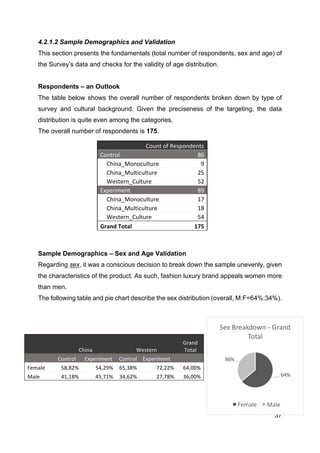
The overall number of respondents is 175.
Sample Demographics – Sex and Age Validation
Regarding sex, it was a conscious decision to break down the sample unevenly, given
the characteristics of the product. As such, fashion luxury brand appeals women more
than men.
The following table and pie chart describe the sex distribution (overall, M:F=64%:34%).
	
   Count	
  of	
  Respondents	
  
Control	
   86	
  
China_Monoculture	
   9	
  
China_Multiculture	
   25	
  
Western_Culture	
   52	
  
Experiment	
   89	
  
China_Monoculture	
   17	
  
China_Multiculture	
   18	
  
Western_Culture	
   54	
  
Grand	
  Total	
   175	
  
	
   China	
   Western	
  
Grand	
  
Total	
  
	
   Control	
   Experiment	
   Control	
   Experiment	
   	
  
Female	
   58,82%	
   54,29%	
   65,38%	
   72,22%	
   64,00%	
  
Male	
   41,18%	
   45,71%	
   34,62%	
   27,78%	
   36,00%	
   64%
36%
Sex	
  Breakdown	
  -­‐ Grand	
  
Total
Female Male
38
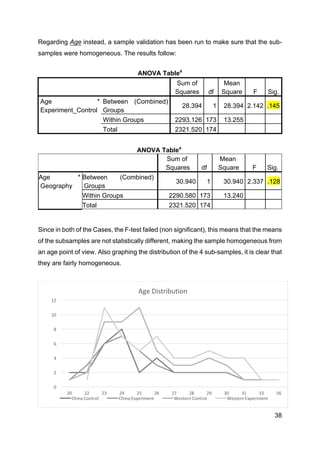
Regarding Age instead, a sample validation has been run to make sure that the sub-
samples were homogeneous. The results follow:
ANOVA Tablea
Sum of
Squares df
Mean
Square F Sig.
Age *
Experiment_Control
Between
Groups
(Combined)
28.394 1 28.394 2.142 .145
Within Groups 2293.126 173 13.255
Total 2321.520 174
ANOVA Tablea
Sum of
Squares df
Mean
Square F Sig.
Age *
Geography
Between
Groups
(Combined)
30.940 1 30.940 2.337 .128
Within Groups 2290.580 173 13.240
Total 2321.520 174
Since in both of the Cases, the F-test failed (non significant), this means that the means
of the subsamples are not statistically different, making the sample homogeneous from
an age point of view. Also graphing the distribution of the 4 sub-samples, it is clear that
they are fairly homogeneous.
0
2
4
6
8
10
12
20 22 23 24 25 26 27 28 29 30 31 33 56
Age	
  Distribution
China	
  Control China	
  Experiment Western	
  Control Western	
  Experiment
39
4.2.1.3 Data Cleansing – Attention Test
Since the compilation of the survey, an Attention test has been designed as a
necessary condition for usability of the respondent’s data. Right after the explanatory
video – where the behavior of price, either fixing or shifting, was described – a question
regarding the price behavior was presented to make sure that the respondent was
aware of the phenomenon described.
Out of 175 respondents, 11 (10 Western and 1 Chinese) got the answer wrong, leaving
the sample with 164 responses.
An additional response was excluded because of the fact that most of the responses
were far different from those of the others (outlier test).
Therefore, the final sample used for the regression analysis was composed by 163
usable responses.
40
4.2.2 Moderated Regression Analysis
4.2.2.1 Intro – Assumption and Hypotheses
Before starting with the Regression description, it is important to recap the Assumption
#2 and Hypotheses behind Regression analysis.
The Research Assumption #2: “Price Shifting has a statistically significant impact on
both Brand Perception and WTB”.
The Hypotheses were instead that:
2. Research Hypothesis #2: The impact of Price Shifting (Price Variability) on
WTB varies according to (or is moderated by) the cultural traits of the
respondent.
3. Research Hypothesis #3: The impact on WTB is created (or moderated by)
the Brand Perception, which is directly impacted by Price Shifting (Variability),
The Regression Analysis that follow will disentangle the intricate relationship that exists
between the variables obtained through the survey.
This process will be done in three steps:
1. Mean Comparison: To verify the Assumption #2 and select the variables
2. Regression Set 1: To test the Hypothesis #1
3. Regression Set 2: To test the Hypothesis #2
41
4.2.2.2 Mean Comparison – Assumption #2 Validation and Variable Exclusion
In order to verify if the price Variability had an impact on all of the 5 dimensions28
extrapolated through the survey, the delta of each of the dimensions has been
calculated in this way:
∆Dimension = After-video score – Before-video score
Subsequently, a Descriptive statistics and a t-Test were run to verify if there was a
statistically significant difference between the Experiment Group (which witnessed the
Price Shifting) and the Control Group (which did not).
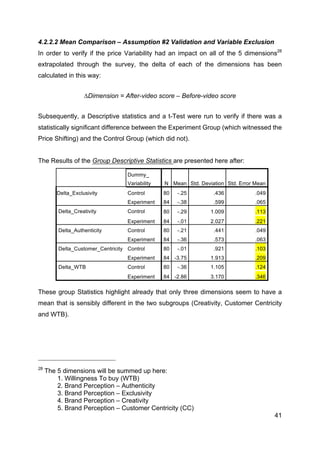
The Results of the Group Descriptive Statistics are presented here after:
Dummy_
Variability N Mean Std. Deviation Std. Error Mean
Delta_Exclusivity Control 80 -.25 .436 .049
Experiment 84 -.38 .599 .065
Delta_Creativity Control 80 -.29 1.009 .113
Experiment 84 -.01 2.027 .221
Delta_Authenticity Control 80 -.21 .441 .049
Experiment 84 -.36 .573 .063
Delta_Customer_Centricity Control 80 -.01 .921 .103
Experiment 84 -3.75 1.913 .209
Delta_WTB Control 80 -.36 1.105 .124
Experiment 84 -2.86 3.170 .346
These group Statistics highlight already that only three dimensions seem to have a
mean that is sensibly different in the two subgroups (Creativity, Customer Centricity
and WTB).
28
The 5 dimensions will be summed up here:
1. Willingness To buy (WTB)
2. Brand Perception – Authenticity
3. Brand Perception – Exclusivity
4. Brand Perception – Creativity
5. Brand Perception – Customer Centricity (CC)
42
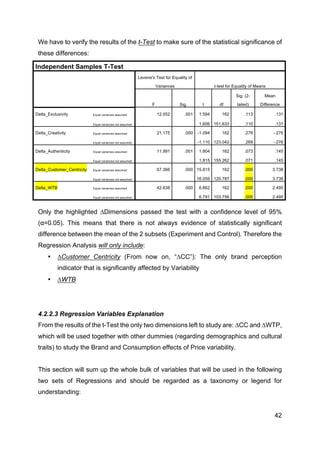
We have to verify the results of the t-Test to make sure of the statistical significance of
these differences:
Independent Samples T-Test
Levene's Test for Equality of
Variances t-test for Equality of Means
F Sig. t df
Sig. (2-
tailed)
Mean
Difference
Delta_Exclusivity Equal variances assumed 12.052 .001 1.594 162 .113 .131
Equal variances not assumed 1.606 151.633 .110 .131
Delta_Creativity Equal variances assumed 21.175 .000 -1.094 162 .276 -.276
Equal variances not assumed -1.110 123.042 .269 -.276
Delta_Authenticity Equal variances assumed 11.991 .001 1.804 162 .073 .145
Equal variances not assumed 1.815 155.262 .071 .145
Delta_Customer_Centricity Equal variances assumed 67.366 .000 15.815 162 .000 3.738
Equal variances not assumed 16.059 120.787 .000 3.738
Delta_WTB Equal variances assumed 42.638 .000 6.662 162 .000 2.495
Equal variances not assumed 6.791 103.756 .000 2.495
Only the highlighted ∆Dimensions passed the test with a confidence level of 95%
(α=0.05). This means that there is not always evidence of statistically significant
difference between the mean of the 2 subsets (Experiment and Control). Therefore the
Regression Analysis will only include:
• ∆Customer Centricity (From now on, “∆CC”): The only brand perception
indicator that is significantly affected by Variability
• ∆WTB
4.2.2.3 Regression Variables Explanation
From the results of the t-Test the only two dimensions left to study are: ∆CC and ∆WTP,
which will be used together with other dummies (regarding demographics and cultural
traits) to study the Brand and Consumption effects of Price variability.
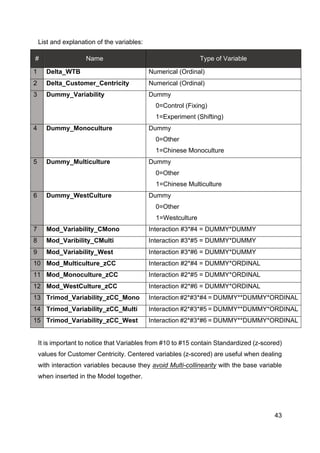
This section will sum up the whole bulk of variables that will be used in the following
two sets of Regressions and should be regarded as a taxonomy or legend for
understanding:
43
List and explanation of the variables:
# Name Type of Variable
1 Delta_WTB Numerical (Ordinal)
2 Delta_Customer_Centricity Numerical (Ordinal)
3 Dummy_Variability Dummy
0=Control (Fixing)
1=Experiment (Shifting)
4 Dummy_Monoculture Dummy
0=Other
1=Chinese Monoculture
5 Dummy_Multiculture Dummy
0=Other
1=Chinese Multiculture
6 Dummy_WestCulture Dummy
0=Other
1=Westculture
7 Mod_Variability_CMono Interaction #3*#4 = DUMMY*DUMMY
8 Mod_Varibility_CMulti Interaction #3*#5 = DUMMY*DUMMY
9 Mod_Variability_West Interaction #3*#6 = DUMMY*DUMMY
10 Mod_Multiculture_zCC Interaction #2*#4 = DUMMY*ORDINAL
11 Mod_Monoculture_zCC Interaction #2*#5 = DUMMY*ORDINAL
12 Mod_WestCulture_zCC Interaction #2*#6 = DUMMY*ORDINAL
13 Trimod_Variability_zCC_Mono Interaction #2*#3*#4 = DUMMY**DUMMY*ORDINAL
14 Trimod_Variability_zCC_Multi Interaction #2*#3*#5 = DUMMY**DUMMY*ORDINAL
15 Trimod_Variability_zCC_West Interaction #2*#3*#6 = DUMMY**DUMMY*ORDINAL
It is important to notice that Variables from #10 to #15 contain Standardized (z-scored)
values for Customer Centricity. Centered variables (z-scored) are useful when dealing
with interaction variables because they avoid Multi-collinearity with the base variable
when inserted in the Model together.
44
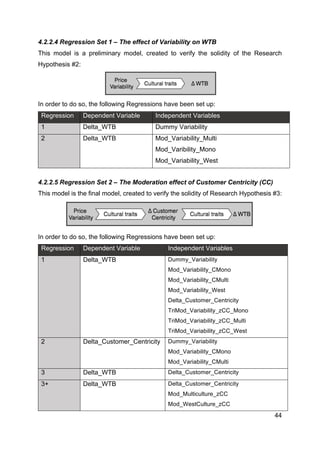
4.2.2.4 Regression Set 1 – The effect of Variability on WTB
This model is a preliminary model, created to verify the solidity of the Research
Hypothesis #2:
In order to do so, the following Regressions have been set up:
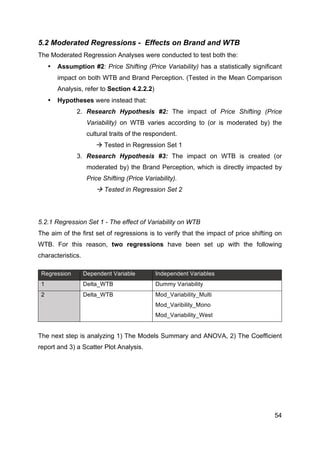
Regression Dependent Variable Independent Variables
1 Delta_WTB Dummy Variability
2 Delta_WTB Mod_Variability_Multi
Mod_Varibility_Mono
Mod_Variability_West
4.2.2.5 Regression Set 2 – The Moderation effect of Customer Centricity (CC)
This model is the final model, created to verify the solidity of Research Hypothesis #3:
In order to do so, the following Regressions have been set up:
Regression Dependent Variable Independent Variables
1 Delta_WTB Dummy_Variability
Mod_Variability_CMono
Mod_Variability_CMulti
Mod_Variability_West
Delta_Customer_Centricity
TriMod_Variability_zCC_Mono
TriMod_Variability_zCC_Multi
TriMod_Variability_zCC_West
2 Delta_Customer_Centricity Dummy_Variability
Mod_Variability_CMono
Mod_Variability_CMulti
3 Delta_WTB Delta_Customer_Centricity
3+ Delta_WTB Delta_Customer_Centricity
Mod_Multiculture_zCC
Mod_WestCulture_zCC
45
5. Results
5.1 e-Pricing Strategy Investigation
5.1.1 ANOVA Analyses
The ANOVA Analyses were designed to test both the:
• Preliminary Hypothesis: Monobrand platforms apply Price Fixing everywhere
• Research Hypothesis #1: Multibrand platforms in Italy apply Price Fixing,
Multibrand platforms in China apply Price Shifting (Price Variability).
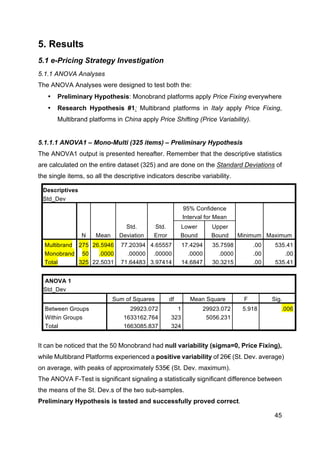
5.1.1.1 ANOVA1 – Mono-Multi (325 items) – Preliminary Hypothesis
The ANOVA1 output is presented hereafter. Remember that the descriptive statistics
are calculated on the entire dataset (325) and are done on the Standard Deviations of
the single items, so all the descriptive indicators describe variability.
Descriptives
Std_Dev
N Mean
Std.
Deviation
Std.
Error
95% Confidence
Interval for Mean
Minimum Maximum
Lower
Bound
Upper
Bound
Multibrand 275 26.5946 77.20394 4.65557 17.4294 35.7598 .00 535.41
Monobrand 50 .0000 .00000 .00000 .0000 .0000 .00 .00
Total 325 22.5031 71.64483 3.97414 14.6847 30.3215 .00 535.41
ANOVA 1
Std_Dev
Sum of Squares df Mean Square F Sig.
Between Groups 29923.072 1 29923.072 5.918 .006
Within Groups 1633162.764 323 5056.231
Total 1663085.837 324
It can be noticed that the 50 Monobrand had null variability (sigma=0, Price Fixing),
while Multibrand Platforms experienced a positive variability of 26€ (St. Dev. average)
on average, with peaks of approximately 535€ (St. Dev. maximum).
The ANOVA F-Test is significant signaling a statistically significant difference between
the means of the St. Dev.s of the two sub-samples.
Preliminary Hypothesis is tested and successfully proved correct.
46
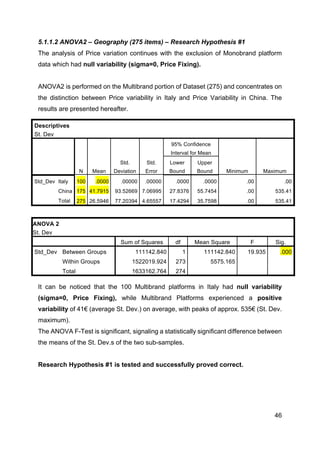
5.1.1.2 ANOVA2 – Geography (275 items) – Research Hypothesis #1
The analysis of Price variation continues with the exclusion of Monobrand platform
data which had null variability (sigma=0, Price Fixing).
ANOVA2 is performed on the Multibrand portion of Dataset (275) and concentrates on
the distinction between Price variability in Italy and Price Variability in China. The
results are presented hereafter.
It can be noticed that the 100 Multibrand platforms in Italy had null variability
(sigma=0, Price Fixing), while Multibrand Platforms experienced a positive
variability of 41€ (average St. Dev.) on average, with peaks of approx. 535€ (St. Dev.
maximum).
The ANOVA F-Test is significant, signaling a statistically significant difference between
the means of the St. Dev.s of the two sub-samples.
Research Hypothesis #1 is tested and successfully proved correct.
Descriptives
St. Dev
N Mean
Std.
Deviation
Std.
Error
95% Confidence
Interval for Mean
Minimum Maximum
Lower
Bound
Upper
Bound
Std_Dev Italy 100 .0000 .00000 .00000 .0000 .0000 .00 .00
China 175 41.7915 93.52669 7.06995 27.8376 55.7454 .00 535.41
Total 275 26.5946 77.20394 4.65557 17.4294 35.7598 .00 535.41
ANOVA 2
St. Dev
Sum of Squares df Mean Square F Sig.
Std_Dev Between Groups 111142.840 1 111142.840 19.935 .000
Within Groups 1522019.924 273 5575.165
Total 1633162.764 274
47
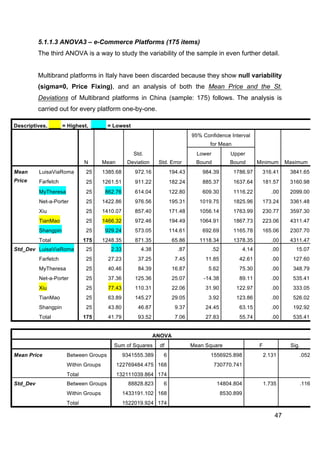
5.1.1.3 ANOVA3 – e-Commerce Platforms (175 items)
The third ANOVA is a way to study the variability of the sample in even further detail.
Multibrand platforms in Italy have been discarded because they show null variability
(sigma=0, Price Fixing), and an analysis of both the Mean Price and the St.
Deviations of Multibrand platforms in China (sample: 175) follows. The analysis is
carried out for every platform one-by-one.
ANOVA
Sum of Squares df Mean Square F Sig.
Mean Price Between Groups 9341555.389 6 1556925.898 2.131 .052
Within Groups 122769484.475 168 730770.741
Total 132111039.864 174
Std_Dev Between Groups 88828.823 6 14804.804 1.735 .116
Within Groups 1433191.102 168 8530.899
Total 1522019.924 174
Descriptives, ____ = Highest, _____ = Lowest
N Mean
Std.
Deviation Std. Error
95% Confidence Interval
for Mean
Minimum Maximum
Lower
Bound
Upper
Bound
Mean
Price
LuisaViaRoma 25 1385.68 972.16 194.43 984.39 1786.97 316.41 3841.65
Farfetch 25 1261.51 911.22 182.24 885.37 1637.64 181.57 3160.98
MyTheresa 25 862.76 614.04 122.80 609.30 1116.22 .00 2099.00
Net-a-Porter 25 1422.86 976.56 195.31 1019.75 1825.96 173.24 3361.48
Xiu 25 1410.07 857.40 171.48 1056.14 1763.99 230.77 3597.30
TianMao 25 1466.32 972.46 194.49 1064.91 1867.73 223.06 4311.47
Shangpin 25 929.24 573.05 114.61 692.69 1165.78 165.06 2307.70
Total 175 1248.35 871.35 65.86 1118.34 1378.35 .00 4311.47
Std_Dev LuisaViaRoma 25 2.33 4.38 .87 .52 4.14 .00 15.07
Farfetch 25 27.23 37.25 7.45 11.85 42.61 .00 127.60
MyTheresa 25 40.46 84.39 16.87 5.62 75.30 .00 348.79
Net-a-Porter 25 37.36 125.36 25.07 -14.38 89.11 .00 535.41
Xiu 25 77.43 110.31 22.06 31.90 122.97 .00 333.05
TianMao 25 63.89 145.27 29.05 3.92 123.86 .00 526.02
Shangpin 25 43.80 46.87 9.37 24.45 63.15 .00 192.92
Total 175 41.79 93.52 7.06 27.83 55.74 .00 535.41
48
Aggregating the data from the tables and the graphs, we can make conclusions on average
prices and variability.
Regarding Average Price it can be seen that MyTheresa and Shangpin have the lowest
average prices for homogeneous products, while TianMao has the highest.
Regarding Price Variability (St. Dev), LuisaViaRoma is the one which more closely
resembles null variability (lowest variability), while Xiu is the one with highest variability.
49
5.1.2 Pivot Analysis
This analysis has been carried out to extrapolate as much insights as possible from
the data available. The analysis can be split in 3 parts which are presented here after.
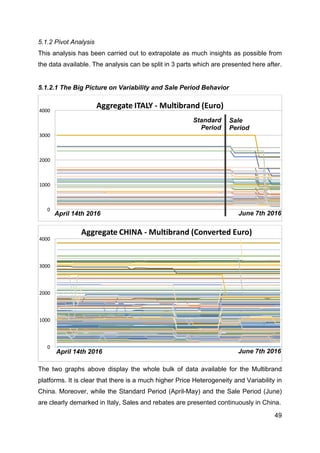
5.1.2.1 The Big Picture on Variability and Sale Period Behavior
The two graphs above display the whole bulk of data available for the Multibrand
platforms. It is clear that there is a much higher Price Heterogeneity and Variability in
China. Moreover, while the Standard Period (April-May) and the Sale Period (June)
are clearly demarked in Italy, Sales and rebates are presented continuously in China.
0
1000
2000
3000
4000
Aggregate	
  ITALY	
  -­‐ Multibrand	
  (Euro)
0
1000
2000
3000
4000
Aggregate	
  CHINA	
  -­‐ Multibrand	
  (Converted	
  Euro)
April 14th 2016 June 7th 2016
Standard
Period
Sale
Period
50
5.1.2.2 Price Differential Analysis: China vs. Italy
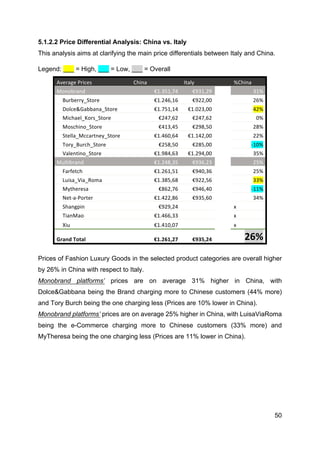
This analysis aims at clarifying the main price differentials between Italy and China.
Legend: ___ = High, ___ = Low, ___ = Overall
Average	
  Prices	
   China	
   Italy	
   	
   %China	
  
Monobrand	
   	
  €1.351,74	
  	
   	
  €931,29	
  	
   	
   31%	
  
Burberry_Store	
   	
  €1.246,16	
  	
   	
  €922,00	
  	
   	
   26%	
  
Dolce&Gabbana_Store	
   	
  €1.751,14	
  	
   	
  €1.023,00	
  	
   	
   42%	
  
Michael_Kors_Store	
   	
  €247,62	
  	
   	
  €247,62	
  	
   	
   0%	
  
Moschino_Store	
   	
  €413,45	
  	
   	
  €298,50	
  	
   	
   28%	
  
Stella_Mccartney_Store	
   	
  €1.460,64	
  	
   	
  €1.142,00	
  	
   	
   22%	
  
Tory_Burch_Store	
   	
  €258,50	
  	
   	
  €285,00	
  	
   	
   -­‐10%	
  
Valentino_Store	
   	
  €1.984,63	
  	
   	
  €1.294,00	
  	
   	
   35%	
  
Multibrand	
   	
  €1.248,35	
  	
   	
  €936,23	
  	
   	
   25%	
  
Farfetch	
   	
  €1.261,51	
  	
   	
  €940,36	
  	
   	
   25%	
  
Luisa_Via_Roma	
   	
  €1.385,68	
  	
   	
  €922,56	
  	
   	
   33%	
  
Mytheresa	
   	
  €862,76	
  	
   	
  €946,40	
  	
   	
   -­‐11%	
  
Net-­‐a-­‐Porter	
   	
  €1.422,86	
  	
   	
  €935,60	
  	
   	
   34%	
  
Shangpin	
   	
  €929,24	
  	
   	
   x	
  
TianMao	
   	
  €1.466,33	
  	
   	
   x	
  
Xiu	
   	
  €1.410,07	
  	
   	
   x	
  
Grand	
  Total	
   	
  €1.261,27	
  	
   	
  €935,24	
  	
   	
   26%	
  
Prices of Fashion Luxury Goods in the selected product categories are overall higher
by 26% in China with respect to Italy.
Monobrand platforms’ prices are on average 31% higher in China, with
Dolce&Gabbana being the Brand charging more to Chinese customers (44% more)
and Tory Burch being the one charging less (Prices are 10% lower in China).
Monobrand platforms’ prices are on average 25% higher in China, with LuisaViaRoma
being the e-Commerce charging more to Chinese customers (33% more) and
MyTheresa being the one charging less (Prices are 11% lower in China).
51
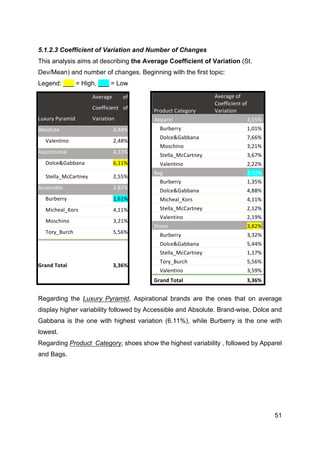
5.1.2.3 Coefficient of Variation and Number of Changes
This analysis aims at describing the Average Coefficient of Variation (St.
Dev/Mean) and number of changes. Beginning with the first topic:
Legend: ___ = High, ___ = Low
Regarding the Luxury Pyramid, Aspirational brands are the ones that on average
display higher variability followed by Accessible and Absolute. Brand-wise, Dolce and
Gabbana is the one with highest variation (6.11%), while Burberry is the one with
lowest.
Regarding Product Category, shoes show the highest variability , followed by Apparel
and Bags.
Luxury	
  Pyramid	
  
Average	
   of	
  
Coefficient	
   of	
  
Variation	
  
Absolute	
   2,48%	
  
Valentino	
   2,48%	
  
Aspirational	
   4,33%	
  
Dolce&Gabbana	
   6,11%	
  
Stella_McCartney	
   2,55%	
  
Accessible	
   2,82%	
  
Burberry	
   1,61%	
  
Micheal_Kors	
   4,11%	
  
Moschino	
   3,21%	
  
Tory_Burch	
   5,56%	
  
Grand	
  Total	


3,36%	


Product	
  Category	
  
Average	
  of	
  
Coefficient	
  of	
  
Variation	
  
Apparel	
   3,55%	
  
Burberry	
   1,01%	
  
Dolce&Gabbana	
   7,66%	
  
Moschino	
   3,21%	
  
Stella_McCartney	
   3,67%	
  
Valentino	
   2,22%	
  
Bag	
   2,93%	
  
Burberry	
   1,35%	
  
Dolce&Gabbana	
   4,88%	
  
Micheal_Kors	
   4,11%	
  
Stella_McCartney	
   2,12%	
  
Valentino	
   2,19%	
  
Shoes	
   3,82%	
  
Burberry	
   3,32%	
  
Dolce&Gabbana	
   5,44%	
  
Stella_McCartney	
   1,17%	
  
Tory_Burch	
   5,56%	
  
Valentino	
   3,59%	
  
Grand	
  Total	
   3,36%	
  
52
With respect to the average amount of times that the price has changed during the
55-day period of research. The tables only contain data from Multibrand Platforms in
China.
Legend: ___ = High, ___ = Low
Regarding the Luxury Pyramid breakdown, Dolce&Gabbana is the brand that has
overall changed more frequently, with 79 total price changes, with an average of almost
2 price changes per day.
On the other hand, Product Category breakdown shows that “Bags” experienced more
changes, followed by Apparel and Shoes. Within Bags, Michael Kors is the one that
has varied more frequently (41 times) and Valentino the one that has varied less
frequently (15 times). Within Apparels, Dolce&Gabbana has varied the most (36 times)
and Valentino the least (8 times). At last, within Shoes, Tory Burch is the most varying
(21 times) and Valentino and Dolce&Gabbana the least (10 times each).
China	


Product	
  Category	
   Sum	
  of	
  Number	
  of	
  Changes	
  
Apparel	
   114	
  
Burberry	
   24	
  
Dolce&Gabbana	
   36	
  
Moschino	
   29	
  
Stella_McCartney	
   17	
  
Valentino	
   8	
  
Bag	
   138	
  
Burberry	
   21	
  
Dolce&Gabbana	
   33	
  
Micheal_Kors	
   41	
  
Stella_McCartney	
   28	
  
Valentino	
   15	
  
Shoes	
   74	
  
Burberry	
   19	
  
Dolce&Gabbana	
   10	
  
Stella_McCartney	
   14	
  
Tory_Burch	
   21	
  
Valentino	
   10	
  
Grand	
  Total	
   326	
  
China	


Luxury	
  Pyramid	
  
Sum	
  of	
  Number	
  
of	
  Changes	
  
Absolute	
   33	
  
Valentino	
   33	
  
Aspirational	
   138	
  
Dolce&Gabbana	
   79	
  
Stella_McCartney	
   59	
  
Accessible	
   155	
  
Burberry	
   64	
  
Micheal_Kors	
   41	
  
Moschino	
   29	
  
Tory_Burch	
   21	
  
Grand	
  Total	


326	


53
5.1.3 Validation: Exchange Rate (ER) Correlation
The tests of the Exchange Rate Correlation Validation were overall passed, in the
sense that ER does not seem to have a significant and systematic correlation with
price variability. The correlation coefficient (r) is calculated between:
• The Daily prices of the 175 Items sold in China (the one that show variability)
• The Daily Exchange Rates29
during the 55 days of empirical research.
The following are the tables which summarize the results:
It is clear from the tables that:
• Only 15 items out of 175 (9%) show a significant
correlation with the exchange rate, considering a 95%
Confidence Interval.
• The Correlated items are all concentrated on the
Shangpin Platform, which has 9 out 25 items (36%)
with significant correlation. However, when analyzing
them item-by-item, it is possible to notice that some
of them (eg. SP_2) display a positive correlation,
while some of them (eg. SP_23) display a negative
correlation, so it is overall difficult to understand if
there’s a strong relation between the ER and price.
Overall, there is not enough evidence to confirm that the
variability is generated by Exchange Rate Fluctuation.
29
Extracted from OANDA Currency Exchange Rate.


Number	
  of	
  
items	
  
Items	
  with	
  sig.	
  
correlation	
  
Percentage	
  of	
  
total	
  
Average	
  
Correlation	
  
LuisaViaRoma	
   25	
   0	
   0%	
   0%	
  
Farfetch	
   25	
   3	
   12%	
   14%	
  
MyTheresa	
   25	
   0	
   0%	
   0%	
  
Net-­‐A-­‐Porter	
   25	
   0	
   0%	
   0%	
  
Shangpin	
   25	
   9	
   36%	
   43%	
  
TianMao	
   25	
   1	
   4%	
   -­‐32%	
  
Xiu	
   25	
   2	
   8%	
   17%	
  
Overall	
   175	
   15	
   9%	
   9%	


   Code	
   Pearson’s	
  r	
  	
  
Sig.	
  (2-­‐
tailed)	
  
1	
   FF_13	
   -­‐34%	
   0,012	
  
2	
   FF_4	
   38%	
   0,013	
  
3	
   FF_5	
   38%	
   0,013	
  
4	
   SP_13	
   82%	
   0,039	
  
5	
   SP_18	
   31%	
   0,015	
  
6	
   SP_19	
   72%	
   0,047	
  
7	
   SP_2	
   72%	
   0,047	
  
8	
   SP_20	
   1%	
   0,027	
  
9	
   SP_23	
   -­‐72%	
   0,047	
  
10	
   SP_4	
   95%	
   0,031	
  
11	
   SP_7	
   -­‐72%	
   0,047	
  
12	
   SP_9	
   86%	
   0,004	
  
13	
   TM_21	
   -­‐32%	
   0,017	
  
14	
   X_18	
   11%	
   0,002	
  
15	
   X_22	
   22%	
   0,017	
  
54
5.2 Moderated Regressions - Effects on Brand and WTB
The Moderated Regression Analyses were conducted to test both the:
• Assumption #2: Price Shifting (Price Variability) has a statistically significant
impact on both WTB and Brand Perception. (Tested in the Mean Comparison
Analysis, refer to Section 4.2.2.2)
• Hypotheses were instead that:
2. Research Hypothesis #2: The impact of Price Shifting (Price
Variability) on WTB varies according to (or is moderated by) the
cultural traits of the respondent.
à Tested in Regression Set 1
3. Research Hypothesis #3: The impact on WTB is created (or
moderated by) the Brand Perception, which is directly impacted by
Price Shifting (Price Variability).
à Tested in Regression Set 2
5.2.1 Regression Set 1 - The effect of Variability on WTB
The aim of the first set of regressions is to verify that the impact of price shifting on
WTB. For this reason, two regressions have been set up with the following
characteristics.
Regression Dependent Variable Independent Variables
1 Delta_WTB Dummy Variability
2 Delta_WTB Mod_Variability_Multi
Mod_Varibility_Mono
Mod_Variability_West
The next step is analyzing 1) The Models Summary and ANOVA, 2) The Coefficient
report and 3) a Scatter Plot Analysis.
55
5.2.1.1 Models Summary and ANOVA
Model Summary
Model R
R
Square
Adjusted
R Square
Std. Error
of the
Estimate
Change Statistics
R Square
Change
F
Change df1 df2
Sig. F
Change
1 .464b
.215 .210 2.397 .215 44.383 1 162 .000
2 .829c
.687 .681 1.522 .687 117.207 3 160 .000
a. Dependent Variable: Delta_WTB
b. Predictors: (Constant), Mod_Variability_CMulti, Dummy_Variability,
Mod_Variability_CMono
c. Predictors: (Constant), Mod_Variability_CMono, Mod_Variability_CMulti,
Mod_Variability_West
ANOVAa,
Model Sum of Squares df Mean Square F Sig.
1 Regression 255.001 1 255.001 44.383 .000b
Residual 930.773 162 5.746
Total
1185.774 163
2 Regression 814.946 3 271.649 117.207 .000c
Residual 370.828 160 2.318
Total 1185.774 163
a. Dependent Variable: Delta_WTB
b. Predictors: (Constant), Dummy_Variability
d. Predictors: (Constant), Mod_Variability_CMono, Mod_Variability_CMulti,
Mod_Variability_West
Analyzing the Coefficient of Determination in its adjusted version (Adjusted R
Square), it is clear that the second model is way more solid than the first one. Indeed,
while in the First Regression approximately 20% of the variation in the dependent
variable is explained by a variation in the independent variables, in the Second one
this score dramatically rose to approximately 70%.
The ANOVA table shows that both of the Models have passed the F-Test. Therefore,
their results are overall statistically Significant.
56
5.2.1.2 Coefficient Report
Analyzing the Coefficient Report, the first thing to notice is that both the constant and
the variables added are statically significant with a 95% confidence level.
Model 1 shows the relation between the ∆WTB and the general Dummy for Variability
shedding light on the general impact of Price Variability (Price Shifting) on the
willingness to pay of customers.
The Constant represents the reaction of the Control group and, so to say, the effects
of Price Fixing on WTB. The constant is slightly negative but very close to 0 and we
can definitely conclude that Price Fixing has no effect on WTB.
As captured by Dummy_Variability, Price shifting has an overall strong negative effect
on WTB, making its score decline by approximately 2.5/10 points.
Model 2 shows that the relation between Price Variability and ∆WTB is indeed
moderated by (or comes from the interaction between Price Volatility and) Cultural
Traits.
The Constant (Price Fixing) is still quite close to 0.
Coefficientsa
Model
Unstandardized
Coefficients
Standardized
Coefficients
t Sig.B Std. Error Beta
1 (Constant) -.363 .268 -1.353 .008
Dummy_Variability -2.495 .374 -.464 -6.662 .000
2 (Constant) -.545 .205 -2.657 .009
Mod_Variability_CMulti -1.082 .310 -.177 -3.493 .001
Mod_Variability_West
-3.924 .299 -.668
-
13.121
.000
Mod_Variability_CMono 3.487 .422 .395 8.253 .000
a. Dependent Variable: Delta_WTB
57
The other three interaction variables show that:
• Western Culture (Mod_Variability_West) and Chinese Multiculture
(Mod_Variability_CMulti) both create a NEGATIVE impact to ∆WTB from price
variability; A decrease of around 4.5/10 points in the case of West Culture and
1.5/10 on the Chinese Multiculture
• Chinese Monoculture (Mod_Variability_CMono) instead has a POSITIVE
impact on ∆WTB of 3/10, meaning that differently from the other two cultural
groups, Chinese Monoculture people enjoy price shifting.
5.2.1.3 Scatter Plot Analysis
Also from the Scatter Plot, which graphs the ∆WTB on the Y-axis and the Dummy
Variability on the X-axis, highlighting data for the 3 different cultural traits, it is clear
that:
• West Culture and Chinese Multiculture are impacted in a similar and negative
way,
• China Monoculture is impacted in a dissimilar and positive way
58
5.2.2 Regression Set 2 - The Moderation effect of Customer Centricity (CC)
This second Set of Regressions aims at clarifying the relation between the Price
Variability (Price Shifting) and ∆WTB, proving that the relation is actually moderated
by a third variable, Customer Centricity (CC) which is impacted by the Price Variability.
For this reason, 3 Regression models have been set-up. They are going to be
analyzed one-by-one.
Regression Dependent Variable Independent Variables
1 Delta_WTB Dummy_Variability
Mod_Variability_CMono
Mod_Variability_CMulti
Mod_Variability_West
Delta_Customer_Centricity
TriMod_Variability_zCC_Mono
TriMod_Variability_zCC_Multi
TriMod_Variability_zCC_West
2 Delta_Customer_Centricity Dummy_Variability
Mod_Variability_CMono
Mod_Variability_CMulti
3 Delta_WTB Delta_Customer_Centricity
3+ Delta_WTB Delta_Customer_Centricity
Mod_Multiculture_zCC
Mod_WestCulture_zCC
59
5.2.2.1 Regression Model 1 – Complete Regression
The aim of the First model is trying to validate in a straightforward way the relation
contained in the Second Hypothesis:
To do so, a complete Regression model has been set-up, containing 8 Variables (Refer
to the table in 5.2.2). Hereafter are presented the results as in 1) The Models Summary
and ANOVA, 2) The Coefficient report and 3) a Scatter Plot Analysis.
Model Summary and ANOVA
Model Summary
Model R
R
Square
Adjusted
R Square
Std. Error
of the
Estimate
Change Statistics
R Square
Change
F
Change df1 df2
Sig. F
Change
1 .913a
.834 .825 1.127 .834 97.296 8 155 .000
a. Predictors: (Constant), TriMod_Variability_zCC_West, TriMod_Variability_zCC_Mono, TriMod_Variability_zCC_Multi,
Mod_Variability_CMulti, Dummy_Variability, Mod_Variability_CMono, Delta_Customer_Centricity, Mod_Variability_West
ANOVAa
Model Sum of Squares df Mean Square F Sig.
1 Regression 988.858 8 123.607 97.296 .000bù
Residual 196.917 155 1.270
Total 1185.774 163
a. Dependent Variable: Delta_WTB
b. Predictors: (Constant), TriMod_Variability_zCC_West, TriMod_Variability_zCC_Mono, TriMod_Variability_zCC_Multi,
Mod_Variability_CMulti, Dummy_Variability, Mod_Variability_CMono, Delta_Customer_Centricity, Mod_Variability_West
The overall solidity (R Square) of the model is very high, with nearly 83% of the depend
variable variance explained by the independent variable. In this case, since the model
contains a large number of variables, it is very important to check for the Adjusted R
Square which should correct the R Square score if there are redundant variables.
The ANOVA F-Test was passed meaning that the model is statistically significant.
60
Coefficient Report
Coefficientsa
Model
Unstandardized
Coefficients
Standardized
Coefficients
t Sig.B Std. Error Beta
1 (Constant) -.542 .152 -3.566 .000
Dummy_Variability -4.610 .791 -.857 -5.827 .000
Mod_Variability_CMono 6.302 1.101 .714 5.725 .000
Mod_Variability_CMulti .567 .272 .093 2.084 .039
Mod_Variability_West .084 .867 .014 .097 .923
Delta_Customer_Centricity -.185 .138 -.165 -1.343 .181
TriMod_Variability_zCC_Mono -3.023 1.377 -.205 2.196 .030
TriMod_Variability_zCC_Multi 5.141 .785 .017 .180 .857
TriMod_Variability_zCC_West 5.236 .466 .052 .506 .614
a. Dependent Variable: Delta_WTB
The first 4 variables tell a very similar story with respect to Regression Set 1, Price
fixing (Constant) has nearly no effect on consumers, Price Varibility (Shifting) has an
overall negative impact on WTB (approx. 5/10 decline in WTB Score), Chinese
Multicultural people and Western people have a similar negative reaction, while
Chinese Monocultural People enjoy a positive impact of variability on WTB (approx.
6.3 – 4.1≈2/10 WTB score incretion).
The Last 4 variables are introduced to understand if the Variability - ∆WTB relation is
mediated by the brand effect, the effect of variability on the only indicator of Brand
Perception which is impacted by variability, Customer Centricity (CC).
Their relation is summed up hereafter:
Mono à -2 - 1*CC, Variability positively affects WTB but WTB has a one-to-one
negative relation with CC.
Multi à -5 + 1*CC, Variability strongly negatively affects WTB but WTB has a
one-to-one positive relation with CC.
West à -5 + 1*CC, Variability strongly negatively affects WTB but WTB has a
one-to-one positive relation with CC
61
However, all of them are strongly non-significant, so their result might be misleading.
In order to capture the relation we can picture it through a Scatter Plot (next Section)
and try to disentangle the effect using other two distinct Regressions.
Scatter Plot Analysis
It is clear that that while:
• Western and Multicultural Chinese experience positive relation between
Variability on WTB, moderated by Customer Centricity. This means that when
the price varies, an increase In CC is coupled with an increase in WTB and a
decrease in CC by a decrease in WTB (Positive correlation).
• Monocultural Chinese look to be totally disentangled by this kind of influence.
CC does not moderate the effect of Variability on WTB.
To grasp this moderation effect, it is necessary to disentangle the Regression in steps:
• Regression 2: shows the effect of Price Variability on ∆CC
• Regression 3-4: shows the effect of ∆CC on ∆WTB
62
5.2.2.2 Regression Model 2 – The Effect of Price Variability in Customer
Centricity (CC)
From the Scatter Plot showed in the previous section, it was clear that the impact of
Variability on WTV is moderated by Customer Centricity only for Multicultural Chinese
and Westerners, while Monocultural Chinese do not experience this moderation effect.
However, Regression 1 was non-significant so 2 more regressions are set up.
Regression2 will cover the first segment of the relation.
Model Summary and ANOVA
Model Summary
Model R
R
Square
Adjusted
R Square
Std. Error of
the
Estimate
Change Statistics
R Square
Change
F
Change df1 df2
Sig. F
Change
1 .913a
.834 .831 .990 .834 267.532 3 160 .000
a. Predictors: (Constant), Mod_Variability_CMulti, Dummy_Variability,
Mod_Variability_CMono
ANOVAa
Model
Sum of
Squares df Mean Square F Sig.
1 Regression 786.359 3 262.120 267.532 .000b
Residual 156.763 160 .980
Total 943.122 163
a. Dependent Variable: Delta_Customer_Centricity
b. Predictors: (Constant), Mod_Variability_CMulti, Dummy_Variability,
Mod_Variability_CMono
Again, the model is pretty solid with an R Square of 83% and it has successfully passed
the ANOVA F-Test for significance.
63
Coefficient Report
Coefficientsa
Model
Unstandardized
Coefficients
Standardized
Coefficients
t Sig.B Std. Error Beta
1 (Constant) -.067 .124 -.537 .042
Dummy_Variability -4.132 .164 -.945 -27.616 .000
Mod_Variability_CMono 4.210 .273 .510 14.685 .000
Mod_Variability_CMulti .173 .180 .032 3.456 .000
a. Dependent Variable: Delta_Customer_Centricity
An important preliminary caution to bear in mind when analyzing the Coefficient table
is that this model is the only one in which the Dependent Variable is
∆CustomerCentricity (∆CC).
As in previous cases, the dependent variables are Price Varibility Dummy, broken
down by cultural traits.
Analyzing the Coefficients one by one:
• Dummy_Variability: Since the Western Culture is the Baseline of the Cultural
Trait Dummy, the Dummy Variable will shed light on the impact of Price
Variability on ∆CC for Westerners. It is a strong negative Relation, signaling that
when Price Shifting appears, There is a decrease of ≈4/10 scores in CC.
• Mod_Variability_CMulti: Given the size of the coefficient (really small), the
Impact on Multicultural Chinese people is the same as the one experienced by
Westerners.
• Mod_Variability_CMono: Customer Centricity is not impacted by Price
Variability, as the 2 coefficients cancel out.
64
5.2.2.3 Regression Model 3-4 – The Effect of Customer Centricity (CC) on ∆WTB
Regression 3-4 will cover the second segment of the relation.
Model Summary and ANOVA
Model Summary
Model R
R
Square
Adjusted
R Square
Std.
Error of
the
Estimate
Change Statistics
R
Square
Change
F
Change df1 df2
Sig. F
Change
1 .718a
.516 .513 1.882 .516 172.748 1 162 .000
2 .809b
.655 .646 1.630 .126 28.054 2 160 .000
a. Predictors: (Constant), Delta_Customer_Centricity
b. Predictors: (Constant), Delta_Customer_Centricity, Mod_Multiculture_CC,
Mod_WestCulture_CC, Mod_Monoculture_CC
ANOVAa
Model Sum of Squares df Mean Square F Sig.
1 Regression 611.923 1 611.923 172.748 .000b
Residual 573.851 162 3.542
Total 1185.774 163
2 Regression 776.414 4 194.103 75.392 .000c
Residual 409.360 159 2.575
Total 1185.774 163
a. Dependent Variable: Delta_WTB
b. Predictors: (Constant), Delta_Customer_Centricity
c. Predictors: (Constant), Delta_Customer_Centricity, Mod_Multiculture_CC,
Mod_WestCulture_CC
Both of the regression are fairly solid and they both passed the ANOVA F-test for
significance. The second one have a slightly higher strength with a 63% R Square.
65
Coefficient Report
Coefficientsa
Model
Unstandardized
Coefficients
Standardized
Coefficients
t Sig.B Std. Error Beta
1 (Constant) -.088 .189 -.468 .641
Delta_Customer_Centricity .805 .061 .718 13.143 .000
2 (Constant) -.313 .164 -2.104 .023
Delta_Customer_Centricity 2.813 1.146 2.543 2.454 .015
Mod_Monoculture_CC -2.536 .439 -.272 -5.777 .000
Mod_Multiculture_CC -1.999 1.156 -.993 -1.729 .023
Mod_WestCulture_CC -2.030 1.152 -1.752 -2.162 .020
a. Dependent Variable: Delta_WTB
All of the Coefficient are statistically significant with a 95% Confidence level. Please
notice that the Dependent variable is again ∆WTB.
The first Regression simply shows that CC has an overall slight positive effect on WTB.
However, the Second Regression underlines that:
• Westerners: experience an overall positive relationship between CC and WTB,
with a unitary increase (or decrease) in CC corresponding to an almost unitary
– 2,8-2=0.8≈1 – increase (or decrease) in WTB.
• Multicultural Chinese: have almost the same score, experiencing the same
effect
• Monocultural Chinese: experience what we discovered from the scatterplot
presented in the last section. The Customer Centricity does not affect the WTB.
About Monocultural Chinese, Bear in mind that:
• In Regression Set 1, it was discovered that, differently from Westerners and
Multicultural Chinese, Monocultural Chinese had a positive impact of Price
Variability on WTB.
• In Regression Set 2 - Model1, it was discovered that Variability caused no
effect in Customer Centricity in Monocultural Chinese
66
5.3 Overall Summary of Results
The main Results coming from the two Research Segments has confirmed the three
hypotheses proposed at the beginning. These results can be summarized as follows.
It has been statistically confirmed that the Price Behavior differs across e-commerce
channel (Monobrand vs. Multibrand) and geography (Italy vs. China), with Multibrand
platforms in China showing positive variability (Price Shifting).
When customers are exposed to this variability, their Willingness to Buy (WTB) the
product is affected in a different way, according to
1) Their Brand Perception (Customer Centricity) which filters the variability impact on
WTB, and
2) Their Cultural Traits
Westerners and Chinese Multicultural people experience similar reactions to Price
Variability. They both experience a decrease in Brand Perception (Customer
Centricity) which, in turn, lowered their WTB the Brand.
Chinese Monocultural people have a different reaction. Price Variability does not
affect their Brand Perception (Customer Centricity) but their WTB is positively
affected and increases.
5.4 One-to-One Interviews
In order to give an explanation to the increase in WTB experienced by Chinese
Monocultural Customers, 3 one-to-one interviews lasting 20 minutes each were
conducted with the help of an English-Mandarin Mediator. The interviews were very
simple and started with the description of the Price Shifting Phenomenon. After that,
some questions about the Brand Perception were asked and, indeed, all three
respondents declared not to have a different impression of the Brand.
When asked if they preferred to buy Luxury products under a Price Fixing or Shifting
regime, they responded that the Price Shifting Scenario was preferable because
prices could be tracked and compared to Monobrand prices, allowing them to make
the purchase at the moment of “highest convenience” – “最不贵的”-when the
prices reached an all-time low.
67
6. Conclusions and Recommendations
6.1 Main Conclusions on Price Shifting
In order to organize the conclusions in a structured way, all of the confirmed Research
Hypotheses should be summarized and commented.
Segment 1: “e-Pricing Strategy Investigation”
Preliminary Hypothesis: Monobrand platforms apply Price Fixing everywhere
Research Hypothesis #1: Multibrand platforms in Italy apply Price Fixing, Multibrand
platforms in China apply Price Shifting (Price Variability).
Segment 2: “Effects on Brand Perception and WTB”
Research Hypothesis #2: The impact of Price Shifting (Price Variability) on WTB
varies according to (or is moderated by) the cultural traits of the respondent.
Research Hypothesis #3: The impact on WTB is created (or moderated by) the Brand
Perception, which is directly impacted by Price Shifting (Variability),
Through the first segment, it has been confirmed that Price Shifting (Variability) is a
pricing strategy applied by Multibrand platforms in China only, while the rest of the
platforms (Multibrand in Italy and monobrand platforms around the world) applies Price
Fixing.
The second segment has clarified the influence of Price Shifting on customers. It has
emerged that Price Shifting Strategy has an indirect impact on Willingness-To- Buy
(WTB) through Brand Perception (encapsulated in the Customer Centricity index).
Both of the effects of Price Shifting (direct towards CC and indirect towards WTB) are
mediated by the impact of Cultural Traits, which filter the reactions to Price Shifting in
a different fashion.
Westerners and Chinese Multicultural have commonalities in their responses. Price
variability negatively impacts their CC index (∆CC_West = -4.5/10 scores; ∆CC_Multi
= -1.5/10 scores) which, in turn, having a positive unitary relationship with WTB, make
the overall WTB decrease by the same token.
Chinese Monocultural do not experience this mediation. Price Variability does not
affect CC and CC does not seem to affect WTB. However, Price variability positively
68
affects WTB (making it increase by approximately 4 scores) in a DIRECT WAY. After
having conducted one-to-one interviews with Monocultural respondents, it has
emerged that they value Price Shifting in a positive way because of their high Price
sensitivity. When Price Shifting is applied, they are able to monitor the item’s price,
compare it with the item’s official Monobrand price and purchase it when it is at a low
price point.
6.2 Conclusions on Chinese Monocultural and Multicultural
As noted above, Chinese Monocultural and Multicultural people are impacted very
differently by Price Variability practices. It is important to understand the composition
of the two groups in order to understand how to better recommend brands.
To determine the demographics of Chinese Multicultural individuals we will use “very
high fluency” in the English language use as a proxy. The Study “The statistics of
English in China” reports that the number of respondents with “very high fluency” has
increased from 2% (approx. 28 millions) in 2006, to 3.26% (approx. 45 Millions) and
that most of those belong to the upper-middle class or higher, thus eligible to be
possible Luxury consumers. The CAGR (Compounded annual growth rate) is 8.2%
increase per year, which is pretty high.
In conclusion, even though Chinese Monocultural individuals experience a positive
effect from Price Shifting, it has been noticed that this subgroup is doomed to be
reduced as time goes by. On the other hand, the number of Chinese Multicultural
(which have a negative impact from Price Shifting) is going to increase.
6.3 Recommendations for Brands
The previous analyses have shown that Price Shifting is a pricing strategy adopted by
Multibrand Platforms in China only and that these strategies have a negative impact
on the Brand Perception and the WTB of Multicultural Chinese People, which are
forecasted to increase with respect to Chinese Monocultural People.
Price Shifting has an overall negative impact on consumers and as such, Brand should
take all the necessary actions to reduce, or better, eliminate the existence of this
phenomenon from Multibrand Platforms.
69
The following is a possible multi-step roadmap strategy that Brands should take into
consideration in order to meet the aforementioned target.
During the short-run Brands should try to tighten up their existing contractual
relationship with Multibrand Platforms, highlighting the forbidden nature of Price
Shifting Practices. This step should be coupled with the set-up of a professional figure
hired by the brand that should monitor and control the behavior of Multibrand Platforms.
This first step is not excessively heavy in terms of investment, so it is feasible for both
small Luxury business and big corporations.
If the first step has not succeeded in eliminating the problem, in the medium run
brands should push a process of customer acquisition in order to divert customers’
purchases on the brand’s Monobrand platform, where Price shifting strategies are
obviously not allowed. Brands should target the customers that tend to buy their
product using Multibrand Platforms and make them migrate to their proprietary e-
commerce platform through an advertising/promotion strategy to incentivize this
migration. This second step requires a higher investment in terms of marketing and it
is only possible for those brands which already have a functioning proprietary e-
commerce platform in China (medium-large companies).
If the second step has succeeded in making customers migrate from Multibrand
Platforms to Monobrand Platforms, in the long run Brands should make sure to sustain
the higher traffic which will be present on their Monobrand Platform. The Brand should
make investments to enlarge/strengthen their operations in China (in terms of
warehouses, inventory and logistics) and accommodate the higher flux of purchase
that will go through their internal e-commerce. This can be done either through internal
growth or JV. It is advisable to use a JV for what concerns logistics and shipping, which
are very expensive and tough to realize in China, especially at the level of service
excellence required by the Luxury industry. This last step requires very high
investments in terms of operations, inventory management and logistics and it is only
possible to large Luxury players.
A complementary strategy which could support the aforementioned ones is to implement a
total and pervasive world-wide price harmonization (explained in Section 3.1.2) which will
level up the price levels around the world. The higher level of price transparency will lower the
existence of parallel market phenomena (daigou) and will, at the same time, highlight the
existence of Price shifting strategies, which will become easier to spot and fight.
70
Appendix 1 – Brand selection within Clusters
The number of Clusters had been calculated in order to mirror the Luxury Pyramid. This
Appendix explains how the brands for each cluster have been selected. Every cluster is
represented by one brand only, with the Exception of cluster 5 which is a Mix of 3 Brands of
the “Accessible” family, each one covering ONLY ONE product category.
Cluster Pyramid Preliminary
Selection
Characteristics Final
Decision
Cluster 1 Absolute Valentino Very Good e-commerce, Mixed Products X
Saint Laurent Good e-commerce, mostly leather
Dior Good e-commerce, mostly Haute Couture
Cluster 2 Aspirational Stella
McCartney
Very Good e-commerce, mixed Products X
Luis Vuitton Good e-commerce, scarce presence on Multibrand
e-commerce platform
Gucci Good e-commerce, scarce presence on Multibrand
e-commerce platform
Cluster 3 Aspirational Dolce &
Gabbana
Very Good e-commerce, mixed Products X
Prada
Cluster 4 Accessible Burberry Very Good e-commerce, mixed Products X
Ralph Lauren The brand is very close to “Premium Brands” which
follow other rules with respect to Accessible
Cluster 5 Accessible Moschino Very Good e-commerce, Mainly Apparels X (Only
Apparel)
Tory Burch Very Good e-commerce, Mainly Leather X (Only
Shoes)
Michael
Kors
Very Good e-commerce, Mainly Leather X (Only
Bags)
Calvin Klein Same As Ralph Lauren
71
Appendix 2 – Final Panel Selection
The aim of this appendix is to clarify the rationale behind the Final Panel Selection presented
in section 4.1.
Type Name China Italy Subtotal
Mono-brand30
Valentino Store 5 5 10
Stella McCartney Store 5 5 10
Dolce & Gabbana Store 5 5 10
Burberry Store 5 5 10
Michael Kors Store31
2 2 4
Moschino Store
31
2 2 4
Tory Burch Store
31
1 1 2
Multi-Brand32
Luisa Via Roma 25 25 50
Farfetch 25 25 50
MyTheresa 25 25 50
Net-A-Porter 25 25 50
尚品网 (Shangpin wang)33
x 25 25
天猫 (Tianmao – T-mall)
33
x 25 25
走秀网 (Zouxiu wang – Xiu)
33
x 25 25
Grand Total 325
The complete Taxonomy of single items, explaining 1) Item Code, 2) Cluster, 3) Brand, 4)
Channel type (Monobrand vs Multibrand), 5) e-Commerce Platform and 6) Category type, is
presented below:


30
Mono-brand proprietary e-commerce only sell the items of their own Brand. Thus,
5 category items * 2 Geographies = 10 single items each.
31
Cluster 5 is a Mixed Brand cluster, so in Case of:
- Moschino (2 apparels* 2 Geographies= 4 single items);
- Michael Kors (2 bags * 2 geographies = 4 single items);
- Tory Burch (1 shoes * 2 Geographies = 2 single items).
32
Multi-brand e-commerce sell all of the items in different Geographies. Thus, 5
clusters * 5 category items * 2 Geographies = 50 single items per store.
33
Chinese Multibrand e-commerce sell all of the items in ONLY ONE Geography
(China). Thus, 5 Clusters * 5 category items * 1 Geography = 25 single items per store
72
Item	
  Code	
  
Research	
  
Cluster	
  
Product	
  
Category	
  
Retailer	
   Retail	
  Type	
   Country	
   Brand	
  
FF_1 Cluster1	
   Apparel	
   Farfetch	
   Multibrand	
   China	
   Valentino	
  
FF_10 Cluster1	
   Shoes	
   Farfetch	
   Multibrand	
   Italy	
   Valentino	
  
FF_2 Cluster1	
   Apparel	
   Farfetch	
   Multibrand	
   China	
   Valentino	
  
FF_3 Cluster1	
   Bag	
   Farfetch	
   Multibrand	
   China	
   Valentino	
  
FF_4 Cluster1	
   Bag	
   Farfetch	
   Multibrand	
   China	
   Valentino	
  
FF_5 Cluster1	
   Shoes	
   Farfetch	
   Multibrand	
   China	
   Valentino	
  
FF_6 Cluster1	
   Apparel	
   Farfetch	
   Multibrand	
   Italy	
   Valentino	
  
FF_7 Cluster1	
   Apparel	
   Farfetch	
   Multibrand	
   Italy	
   Valentino	
  
FF_8 Cluster1	
   Bag	
   Farfetch	
   Multibrand	
   Italy	
   Valentino	
  
FF_9 Cluster1	
   Bag	
   Farfetch	
   Multibrand	
   Italy	
   Valentino	
  
LVR_1	
   Cluster1	
   Apparel	
   Luisa_Via_Roma	
   Multibrand	
   China	
   Valentino	
  
LVR_10	
   Cluster1	
   Shoes	
   Luisa_Via_Roma	
   Multibrand	
   Italy	
   Valentino	
  
LVR_2	
   Cluster1	
   Apparel	
   Luisa_Via_Roma	
   Multibrand	
   China	
   Valentino	
  
LVR_3	
   Cluster1	
   Bag	
   Luisa_Via_Roma	
   Multibrand	
   China	
   Valentino	
  
LVR_4	
   Cluster1	
   Bag	
   Luisa_Via_Roma	
   Multibrand	
   China	
   Valentino	
  
LVR_5	
   Cluster1	
   Shoes	
   Luisa_Via_Roma	
   Multibrand	
   China	
   Valentino	
  
LVR_6	
   Cluster1	
   Apparel	
   Luisa_Via_Roma	
   Multibrand	
   Italy	
   Valentino	
  
LVR_7	
   Cluster1	
   Apparel	
   Luisa_Via_Roma	
   Multibrand	
   Italy	
   Valentino	
  
LVR_8	
   Cluster1	
   Bag	
   Luisa_Via_Roma	
   Multibrand	
   Italy	
   Valentino	
  
LVR_9	
   Cluster1	
   Bag	
   Luisa_Via_Roma	
   Multibrand	
   Italy	
   Valentino	
  
MT_1 Cluster1	
   Apparel	
   Mytheresa	
   Multibrand	
   China	
   Valentino	
  
MT_10 Cluster1	
   Shoes	
   Mytheresa	
   Multibrand	
   Italy	
   Valentino	
  
MT_2 Cluster1	
   Apparel	
   Mytheresa	
   Multibrand	
   China	
   Valentino	
  
MT_3 Cluster1	
   Bag	
   Mytheresa	
   Multibrand	
   China	
   Valentino	
  
MT_4 Cluster1	
   Bag	
   Mytheresa	
   Multibrand	
   China	
   Valentino	
  
MT_5 Cluster1	
   Shoes	
   Mytheresa	
   Multibrand	
   China	
   Valentino	
  
MT_6 Cluster1	
   Apparel	
   Mytheresa	
   Multibrand	
   Italy	
   Valentino	
  
MT_7 Cluster1	
   Apparel	
   Mytheresa	
   Multibrand	
   Italy	
   Valentino	
  
MT_8 Cluster1	
   Bag	
   Mytheresa	
   Multibrand	
   Italy	
   Valentino	
  
MT_9 Cluster1	
   Bag	
   Mytheresa	
   Multibrand	
   Italy	
   Valentino	
  
NAP_1	
   Cluster1	
   Apparel	
   Net-­‐a-­‐Porter	
   Multibrand	
   China	
   Valentino	
  
NAP_10	
   Cluster1	
   Shoes	
   Net-­‐a-­‐Porter	
   Multibrand	
   Italy	
   Valentino	
  
NAP_2	
   Cluster1	
   Apparel	
   Net-­‐a-­‐Porter	
   Multibrand	
   China	
   Valentino	
  
NAP_3	
   Cluster1	
   Bag	
   Net-­‐a-­‐Porter	
   Multibrand	
   China	
   Valentino	
  
NAP_4	
   Cluster1	
   Bag	
   Net-­‐a-­‐Porter	
   Multibrand	
   China	
   Valentino	
  
NAP_5	
   Cluster1	
   Shoes	
   Net-­‐a-­‐Porter	
   Multibrand	
   China	
   Valentino	
  
NAP_6	
   Cluster1	
   Apparel	
   Net-­‐a-­‐Porter	
   Multibrand	
   Italy	
   Valentino	
  
NAP_7	
   Cluster1	
   Apparel	
   Net-­‐a-­‐Porter	
   Multibrand	
   Italy	
   Valentino	
  
NAP_8	
   Cluster1	
   Bag	
   Net-­‐a-­‐Porter	
   Multibrand	
   Italy	
   Valentino	
  
NAP_9	
   Cluster1	
   Bag	
   Net-­‐a-­‐Porter	
   Multibrand	
   Italy	
   Valentino	
  
SP_1	
   Cluster1	
   Apparel	
   Shangpin	
   Multibrand	
   China	
   Valentino	
  
SP_2	
   Cluster1	
   Apparel	
   Shangpin	
   Multibrand	
   China	
   Valentino	
  
SP_3	
   Cluster1	
   Bag	
   Shangpin	
   Multibrand	
   China	
   Valentino	
  
SP_4	
   Cluster1	
   Bag	
   Shangpin	
   Multibrand	
   China	
   Valentino	
  
SP_5	
   Cluster1	
   Shoes	
   Shangpin	
   Multibrand	
   China	
   Valentino	
  
TM_1	
   Cluster1	
   Apparel	
   TianMao	
   Multibrand	
   China	
   Valentino	
  
TM_2	
   Cluster1	
   Apparel	
   TianMao	
   Multibrand	
   China	
   Valentino	
  
TM_3	
   Cluster1	
   Bag	
   TianMao	
   Multibrand	
   China	
   Valentino	
  
TM_4	
   Cluster1	
   Bag	
   TianMao	
   Multibrand	
   China	
   Valentino	
  
TM_5	
   Cluster1	
   Shoes	
   TianMao	
   Multibrand	
   China	
   Valentino	
  
V_1	
   Cluster1	
   Apparel	
   Valentino_Store	
   Monobrand	
   China	
   Valentino	
  
V_10	
   Cluster1	
   Shoes	
   Valentino_Store	
   Monobrand	
   Italy	
   Valentino	
  
V_2	
   Cluster1	
   Apparel	
   Valentino_Store	
   Monobrand	
   China	
   Valentino	
  
V_3	
   Cluster1	
   Bag	
   Valentino_Store	
   Monobrand	
   China	
   Valentino	
  
V_4	
   Cluster1	
   Bag	
   Valentino_Store	
   Monobrand	
   China	
   Valentino	
  
V_5	
   Cluster1	
   Shoes	
   Valentino_Store	
   Monobrand	
   China	
   Valentino	
  
V_6	
   Cluster1	
   Apparel	
   Valentino_Store	
   Monobrand	
   Italy	
   Valentino	
  
V_7	
   Cluster1	
   Apparel	
   Valentino_Store	
   Monobrand	
   Italy	
   Valentino	
  
V_8	
   Cluster1	
   Bag	
   Valentino_Store	
   Monobrand	
   Italy	
   Valentino	
  
V_9	
   Cluster1	
   Bag	
   Valentino_Store	
   Monobrand	
   Italy	
   Valentino	
  
X_1	
   Cluster1	
   Apparel	
   Xiu	
   Multibrand	
   China	
   Valentino	
  
X_2	
   Cluster1	
   Apparel	
   Xiu	
   Multibrand	
   China	
   Valentino	
  
X_3	
   Cluster1	
   Bag	
   Xiu	
   Multibrand	
   China	
   Valentino	
  
X_4	
   Cluster1	
   Bag	
   Xiu	
   Multibrand	
   China	
   Valentino	
  
X_5	
   Cluster1	
   Shoes	
   Xiu	
   Multibrand	
   China	
   Valentino	
  
FF_11 Cluster2	
   Apparel	
   Farfetch	
   Multibrand	
   China	
   Stella_McCartney	
  
FF_12 Cluster2	
   Apparel	
   Farfetch	
   Multibrand	
   China	
   Stella_McCartney	
  
FF_13 Cluster2	
   Bag	
   Farfetch	
   Multibrand	
   China	
   Stella_McCartney	
  
FF_14 Cluster2	
   Bag	
   Farfetch	
   Multibrand	
   China	
   Stella_McCartney	
  
FF_15 Cluster2	
   Shoes	
   Farfetch	
   Multibrand	
   China	
   Stella_McCartney	
  
FF_16 Cluster2	
   Apparel	
   Farfetch	
   Multibrand	
   Italy	
   Stella_McCartney	
  
FF_17 Cluster2	
   Apparel	
   Farfetch	
   Multibrand	
   Italy	
   Stella_McCartney	
  
FF_18 Cluster2	
   Bag	
   Farfetch	
   Multibrand	
   Italy	
   Stella_McCartney	
  
FF_19 Cluster2	
   Bag	
   Farfetch	
   Multibrand	
   Italy	
   Stella_McCartney	
  
FF_20 Cluster2	
   Shoes	
   Farfetch	
   Multibrand	
   Italy	
   Stella_McCartney	
  
LVR_11	
   Cluster2	
   Apparel	
   Luisa_Via_Roma	
   Multibrand	
   China	
   Stella_McCartney	
  
LVR_12	
   Cluster2	
   Apparel	
   Luisa_Via_Roma	
   Multibrand	
   China	
   Stella_McCartney	
  
LVR_13	
   Cluster2	
   Bag	
   Luisa_Via_Roma	
   Multibrand	
   China	
   Stella_McCartney	
  
LVR_14	
   Cluster2	
   Bag	
   Luisa_Via_Roma	
   Multibrand	
   China	
   Stella_McCartney	
  
LVR_15	
   Cluster2	
   Shoes	
   Luisa_Via_Roma	
   Multibrand	
   China	
   Stella_McCartney	
  
LVR_16	
   Cluster2	
   Apparel	
   Luisa_Via_Roma	
   Multibrand	
   Italy	
   Stella_McCartney	
  
LVR_17	
   Cluster2	
   Apparel	
   Luisa_Via_Roma	
   Multibrand	
   Italy	
   Stella_McCartney	
  
LVR_18	
   Cluster2	
   Bag	
   Luisa_Via_Roma	
   Multibrand	
   Italy	
   Stella_McCartney	
  
LVR_19	
   Cluster2	
   Bag	
   Luisa_Via_Roma	
   Multibrand	
   Italy	
   Stella_McCartney	
  
LVR_20	
   Cluster2	
   Shoes	
   Luisa_Via_Roma	
   Multibrand	
   Italy	
   Stella_McCartney	
  
MT_11 Cluster2	
   Apparel	
   Mytheresa	
   Multibrand	
   China	
   Stella_McCartney	
  
MT_12 Cluster2	
   Apparel	
   Mytheresa	
   Multibrand	
   China	
   Stella_McCartney	
  
MT_13 Cluster2	
   Bag	
   Mytheresa	
   Multibrand	
   China	
   Stella_McCartney	
  
MT_14 Cluster2	
   Bag	
   Mytheresa	
   Multibrand	
   China	
   Stella_McCartney	
  
MT_15 Cluster2	
   Shoes	
   Mytheresa	
   Multibrand	
   China	
   Stella_McCartney	
  
MT_16 Cluster2	
   Apparel	
   Mytheresa	
   Multibrand	
   Italy	
   Stella_McCartney	
  
MT_17 Cluster2	
   Apparel	
   Mytheresa	
   Multibrand	
   Italy	
   Stella_McCartney	
  
MT_18 Cluster2	
   Bag	
   Mytheresa	
   Multibrand	
   Italy	
   Stella_McCartney	
  
MT_19 Cluster2	
   Bag	
   Mytheresa	
   Multibrand	
   Italy	
   Stella_McCartney	
  
MT_20 Cluster2	
   Shoes	
   Mytheresa	
   Multibrand	
   Italy	
   Stella_McCartney	
  
NAP_11	
   Cluster2	
   Apparel	
   Net-­‐a-­‐Porter	
   Multibrand	
   China	
   Stella_McCartney	
  
NAP_12	
   Cluster2	
   Apparel	
   Net-­‐a-­‐Porter	
   Multibrand	
   China	
   Stella_McCartney	
  
NAP_13	
   Cluster2	
   Bag	
   Net-­‐a-­‐Porter	
   Multibrand	
   China	
   Stella_McCartney	
  
NAP_14	
   Cluster2	
   Bag	
   Net-­‐a-­‐Porter	
   Multibrand	
   China	
   Stella_McCartney	
  
NAP_15	
   Cluster2	
   Shoes	
   Net-­‐a-­‐Porter	
   Multibrand	
   China	
   Stella_McCartney	
  
Item	
  Code	
  
Research	
  
Cluster	
  
Product	
  
Category	
  
Retailer	
   Retail	
  Type	
   Country	
   Brand	
  
NAP_16	
   Cluster2	
   Apparel	
   Net-­‐a-­‐Porter	
   Multibrand	
   Italy	
   Stella_McCartney	
  
NAP_17	
   Cluster2	
   Apparel	
   Net-­‐a-­‐Porter	
   Multibrand	
   Italy	
   Stella_McCartney	
  
NAP_18	
   Cluster2	
   Bag	
   Net-­‐a-­‐Porter	
   Multibrand	
   Italy	
   Stella_McCartney	
  
NAP_19	
   Cluster2	
   Bag	
   Net-­‐a-­‐Porter	
   Multibrand	
   Italy	
   Stella_McCartney	
  
NAP_20	
   Cluster2	
   Shoes	
   Net-­‐a-­‐Porter	
   Multibrand	
   Italy	
   Stella_McCartney	
  
SMC_1	
   Cluster2	
   Apparel	
   Stella_Mccartney_Store	
   Monobrand	
   China	
   Stella_McCartney	
  
SMC_10	
   Cluster2	
   Shoes	
   Stella_Mccartney_Store	
   Monobrand	
   Italy	
   Stella_McCartney	
  
SMC_2	
   Cluster2	
   Apparel	
   Stella_Mccartney_Store	
   Monobrand	
   China	
   Stella_McCartney	
  
SMC_3	
   Cluster2	
   Bag	
   Stella_Mccartney_Store	
   Monobrand	
   China	
   Stella_McCartney	
  
SMC_4	
   Cluster2	
   Bag	
   Stella_Mccartney_Store	
   Monobrand	
   China	
   Stella_McCartney	
  
SMC_5	
   Cluster2	
   Shoes	
   Stella_Mccartney_Store	
   Monobrand	
   China	
   Stella_McCartney	
  
SMC_6	
   Cluster2	
   Apparel	
   Stella_Mccartney_Store	
   Monobrand	
   Italy	
   Stella_McCartney	
  
SMC_7	
   Cluster2	
   Apparel	
   Stella_Mccartney_Store	
   Monobrand	
   Italy	
   Stella_McCartney	
  
SMC_8	
   Cluster2	
   Bag	
   Stella_Mccartney_Store	
   Monobrand	
   Italy	
   Stella_McCartney	
  
SMC_9	
   Cluster2	
   Bag	
   Stella_Mccartney_Store	
   Monobrand	
   Italy	
   Stella_McCartney	
  
SP_10	
   Cluster2	
   Shoes	
   Shangpin	
   Multibrand	
   China	
   Stella_McCartney	
  
SP_6	
   Cluster2	
   Apparel	
   Shangpin	
   Multibrand	
   China	
   Stella_McCartney	
  
SP_7	
   Cluster2	
   Apparel	
   Shangpin	
   Multibrand	
   China	
   Stella_McCartney	
  
SP_8	
   Cluster2	
   Bag	
   Shangpin	
   Multibrand	
   China	
   Stella_McCartney	
  
SP_9	
   Cluster2	
   Bag	
   Shangpin	
   Multibrand	
   China	
   Stella_McCartney	
  
TM_10	
   Cluster2	
   Shoes	
   TianMao	
   Multibrand	
   China	
   Stella_McCartney	
  
TM_6	
   Cluster2	
   Apparel	
   TianMao	
   Multibrand	
   China	
   Stella_McCartney	
  
TM_7	
   Cluster2	
   Apparel	
   TianMao	
   Multibrand	
   China	
   Stella_McCartney	
  
TM_8	
   Cluster2	
   Bag	
   TianMao	
   Multibrand	
   China	
   Stella_McCartney	
  
TM_9	
   Cluster2	
   Bag	
   TianMao	
   Multibrand	
   China	
   Stella_McCartney	
  
X_10	
   Cluster2	
   Shoes	
   Xiu	
   Multibrand	
   China	
   Stella_McCartney	
  
X_6	
   Cluster2	
   Apparel	
   Xiu	
   Multibrand	
   China	
   Stella_McCartney	
  
X_7	
   Cluster2	
   Apparel	
   Xiu	
   Multibrand	
   China	
   Stella_McCartney	
  
X_8	
   Cluster2	
   Bag	
   Xiu	
   Multibrand	
   China	
   Stella_McCartney	
  
X_9	
   Cluster2	
   Bag	
   Xiu	
   Multibrand	
   China	
   Stella_McCartney	
  
DG_1	
   Cluster3	
   Apparel	
   Dolce&Gabbana_Store	
   Monobrand	
   China	
   Dolce&Gabbana	
  
DG_10	
   Cluster3	
   Shoes	
   Dolce&Gabbana_Store	
   Monobrand	
   Italy	
   Dolce&Gabbana	
  
DG_2	
   Cluster3	
   Apparel	
   Dolce&Gabbana_Store	
   Monobrand	
   China	
   Dolce&Gabbana	
  
DG_3	
   Cluster3	
   Bag	
   Dolce&Gabbana_Store	
   Monobrand	
   China	
   Dolce&Gabbana	
  
DG_4	
   Cluster3	
   Bag	
   Dolce&Gabbana_Store	
   Monobrand	
   China	
   Dolce&Gabbana	
  
DG_5	
   Cluster3	
   Shoes	
   Dolce&Gabbana_Store	
   Monobrand	
   China	
   Dolce&Gabbana	
  
DG_6	
   Cluster3	
   Apparel	
   Dolce&Gabbana_Store	
   Monobrand	
   Italy	
   Dolce&Gabbana	
  
DG_7	
   Cluster3	
   Apparel	
   Dolce&Gabbana_Store	
   Monobrand	
   Italy	
   Dolce&Gabbana	
  
DG_8	
   Cluster3	
   Bag	
   Dolce&Gabbana_Store	
   Monobrand	
   Italy	
   Dolce&Gabbana	
  
DG_9	
   Cluster3	
   Bag	
   Dolce&Gabbana_Store	
   Monobrand	
   Italy	
   Dolce&Gabbana	
  
FF_21 Cluster3	
   Apparel	
   Farfetch	
   Multibrand	
   China	
   Dolce&Gabbana	
  
FF_22 Cluster3	
   Apparel	
   Farfetch	
   Multibrand	
   China	
   Dolce&Gabbana	
  
FF_23 Cluster3	
   Bag	
   Farfetch	
   Multibrand	
   China	
   Dolce&Gabbana	
  
FF_24 Cluster3	
   Bag	
   Farfetch	
   Multibrand	
   China	
   Dolce&Gabbana	
  
FF_25 Cluster3	
   Shoes	
   Farfetch	
   Multibrand	
   China	
   Dolce&Gabbana	
  
FF_26 Cluster3	
   Apparel	
   Farfetch	
   Multibrand	
   Italy	
   Dolce&Gabbana	
  
FF_27 Cluster3	
   Apparel	
   Farfetch	
   Multibrand	
   Italy	
   Dolce&Gabbana	
  
FF_28 Cluster3	
   Bag	
   Farfetch	
   Multibrand	
   Italy	
   Dolce&Gabbana	
  
FF_29 Cluster3	
   Bag	
   Farfetch	
   Multibrand	
   Italy	
   Dolce&Gabbana	
  
FF_30 Cluster3	
   Shoes	
   Farfetch	
   Multibrand	
   Italy	
   Dolce&Gabbana	
  
LVR_21	
   Cluster3	
   Apparel	
   Luisa_Via_Roma	
   Multibrand	
   China	
   Dolce&Gabbana	
  
LVR_22	
   Cluster3	
   Apparel	
   Luisa_Via_Roma	
   Multibrand	
   China	
   Dolce&Gabbana	
  
LVR_23	
   Cluster3	
   Bag	
   Luisa_Via_Roma	
   Multibrand	
   China	
   Dolce&Gabbana	
  
LVR_24	
   Cluster3	
   Bag	
   Luisa_Via_Roma	
   Multibrand	
   China	
   Dolce&Gabbana	
  
LVR_25	
   Cluster3	
   Shoes	
   Luisa_Via_Roma	
   Multibrand	
   China	
   Dolce&Gabbana	
  
LVR_26	
   Cluster3	
   Apparel	
   Luisa_Via_Roma	
   Multibrand	
   Italy	
   Dolce&Gabbana	
  
LVR_27	
   Cluster3	
   Apparel	
   Luisa_Via_Roma	
   Multibrand	
   Italy	
   Dolce&Gabbana	
  
LVR_28	
   Cluster3	
   Bag	
   Luisa_Via_Roma	
   Multibrand	
   Italy	
   Dolce&Gabbana	
  
LVR_29	
   Cluster3	
   Bag	
   Luisa_Via_Roma	
   Multibrand	
   Italy	
   Dolce&Gabbana	
  
LVR_30	
   Cluster3	
   Shoes	
   Luisa_Via_Roma	
   Multibrand	
   Italy	
   Dolce&Gabbana	
  
MT_21 Cluster3	
   Apparel	
   Mytheresa	
   Multibrand	
   China	
   Dolce&Gabbana	
  
MT_22 Cluster3	
   Apparel	
   Mytheresa	
   Multibrand	
   China	
   Dolce&Gabbana	
  
MT_23 Cluster3	
   Bag	
   Mytheresa	
   Multibrand	
   China	
   Dolce&Gabbana	
  
MT_24 Cluster3	
   Bag	
   Mytheresa	
   Multibrand	
   China	
   Dolce&Gabbana	
  
MT_25 Cluster3	
   Shoes	
   Mytheresa	
   Multibrand	
   China	
   Dolce&Gabbana	
  
MT_26 Cluster3	
   Apparel	
   Mytheresa	
   Multibrand	
   Italy	
   Dolce&Gabbana	
  
MT_27 Cluster3	
   Apparel	
   Mytheresa	
   Multibrand	
   Italy	
   Dolce&Gabbana	
  
MT_28 Cluster3	
   Bag	
   Mytheresa	
   Multibrand	
   Italy	
   Dolce&Gabbana	
  
MT_29 Cluster3	
   Bag	
   Mytheresa	
   Multibrand	
   Italy	
   Dolce&Gabbana	
  
MT_30 Cluster3	
   Shoes	
   Mytheresa	
   Multibrand	
   Italy	
   Dolce&Gabbana	
  
NAP_21	
   Cluster3	
   Apparel	
   Net-­‐a-­‐Porter	
   Multibrand	
   China	
   Dolce&Gabbana	
  
NAP_22	
   Cluster3	
   Apparel	
   Net-­‐a-­‐Porter	
   Multibrand	
   China	
   Dolce&Gabbana	
  
NAP_23	
   Cluster3	
   Bag	
   Net-­‐a-­‐Porter	
   Multibrand	
   China	
   Dolce&Gabbana	
  
NAP_24	
   Cluster3	
   Bag	
   Net-­‐a-­‐Porter	
   Multibrand	
   China	
   Dolce&Gabbana	
  
NAP_25	
   Cluster3	
   Shoes	
   Net-­‐a-­‐Porter	
   Multibrand	
   China	
   Dolce&Gabbana	
  
NAP_26	
   Cluster3	
   Apparel	
   Net-­‐a-­‐Porter	
   Multibrand	
   Italy	
   Dolce&Gabbana	
  
NAP_27	
   Cluster3	
   Apparel	
   Net-­‐a-­‐Porter	
   Multibrand	
   Italy	
   Dolce&Gabbana	
  
NAP_28	
   Cluster3	
   Bag	
   Net-­‐a-­‐Porter	
   Multibrand	
   Italy	
   Dolce&Gabbana	
  
NAP_29	
   Cluster3	
   Bag	
   Net-­‐a-­‐Porter	
   Multibrand	
   Italy	
   Dolce&Gabbana	
  
NAP_30	
   Cluster3	
   Shoes	
   Net-­‐a-­‐Porter	
   Multibrand	
   Italy	
   Dolce&Gabbana	
  
SP_11	
   Cluster3	
   Apparel	
   Shangpin	
   Multibrand	
   China	
   Dolce&Gabbana	
  
SP_12	
   Cluster3	
   Apparel	
   Shangpin	
   Multibrand	
   China	
   Dolce&Gabbana	
  
SP_13	
   Cluster3	
   Bag	
   Shangpin	
   Multibrand	
   China	
   Dolce&Gabbana	
  
SP_14	
   Cluster3	
   Bag	
   Shangpin	
   Multibrand	
   China	
   Dolce&Gabbana	
  
SP_15	
   Cluster3	
   Shoes	
   Shangpin	
   Multibrand	
   China	
   Dolce&Gabbana	
  
TM_11	
   Cluster3	
   Apparel	
   TianMao	
   Multibrand	
   China	
   Dolce&Gabbana	
  
TM_12	
   Cluster3	
   Apparel	
   TianMao	
   Multibrand	
   China	
   Dolce&Gabbana	
  
TM_13	
   Cluster3	
   Bag	
   TianMao	
   Multibrand	
   China	
   Dolce&Gabbana	
  
TM_14	
   Cluster3	
   Bag	
   TianMao	
   Multibrand	
   China	
   Dolce&Gabbana	
  
TM_15	
   Cluster3	
   Shoes	
   TianMao	
   Multibrand	
   China	
   Dolce&Gabbana	
  
X_11	
   Cluster3	
   Apparel	
   Xiu	
   Multibrand	
   China	
   Dolce&Gabbana	
  
X_12	
   Cluster3	
   Apparel	
   Xiu	
   Multibrand	
   China	
   Dolce&Gabbana	
  
X_13	
   Cluster3	
   Bag	
   Xiu	
   Multibrand	
   China	
   Dolce&Gabbana	
  
X_14	
   Cluster3	
   Bag	
   Xiu	
   Multibrand	
   China	
   Dolce&Gabbana	
  
X_15	
   Cluster3	
   Shoes	
   Xiu	
   Multibrand	
   China	
   Dolce&Gabbana	
  
BB_1	
   Cluster4	
   Apparel	
   Burberry_Store	
   Monobrand	
   China	
   Burberry	
  
BB_10	
   Cluster4	
   Shoes	
   Burberry_Store	
   Monobrand	
   Italy	
   Burberry	
  
BB_2	
   Cluster4	
   Apparel	
   Burberry_Store	
   Monobrand	
   China	
   Burberry	
  
BB_3	
   Cluster4	
   Bag	
   Burberry_Store	
   Monobrand	
   China	
   Burberry	
  
BB_4	
   Cluster4	
   Bag	
   Burberry_Store	
   Monobrand	
   China	
   Burberry	
  
73
Item	
  Code	
  
Research	
  
Cluster	
  
Product	
  
Category	
  
Retailer	
   Retail	
  Type	
   Country	
   Brand	
  
BB_5	
   Cluster4	
   Shoes	
   Burberry_Store	
   Monobrand	
   China	
   Burberry	
  
BB_6	
   Cluster4	
   Apparel	
   Burberry_Store	
   Monobrand	
   Italy	
   Burberry	
  
BB_7	
   Cluster4	
   Apparel	
   Burberry_Store	
   Monobrand	
   Italy	
   Burberry	
  
BB_8	
   Cluster4	
   Bag	
   Burberry_Store	
   Monobrand	
   Italy	
   Burberry	
  
BB_9	
   Cluster4	
   Bag	
   Burberry_Store	
   Monobrand	
   Italy	
   Burberry	
  
FF_31 Cluster4	
   Apparel	
   Farfetch	
   Multibrand	
   China	
   Burberry	
  
FF_32 Cluster4	
   Apparel	
   Farfetch	
   Multibrand	
   China	
   Burberry	
  
FF_33 Cluster4	
   Bag	
   Farfetch	
   Multibrand	
   China	
   Burberry	
  
FF_34 Cluster4	
   Bag	
   Farfetch	
   Multibrand	
   China	
   Burberry	
  
FF_35 Cluster4	
   Shoes	
   Farfetch	
   Multibrand	
   China	
   Burberry	
  
FF_36 Cluster4	
   Apparel	
   Farfetch	
   Multibrand	
   Italy	
   Burberry	
  
FF_37 Cluster4	
   Apparel	
   Farfetch	
   Multibrand	
   Italy	
   Burberry	
  
FF_38 Cluster4	
   Bag	
   Farfetch	
   Multibrand	
   Italy	
   Burberry	
  
FF_39 Cluster4	
   Bag	
   Farfetch	
   Multibrand	
   Italy	
   Burberry	
  
FF_40 Cluster4	
   Shoes	
   Farfetch	
   Multibrand	
   Italy	
   Burberry	
  
LVR_31	
   Cluster4	
   Apparel	
   Luisa_Via_Roma	
   Multibrand	
   China	
   Burberry	
  
LVR_32	
   Cluster4	
   Apparel	
   Luisa_Via_Roma	
   Multibrand	
   China	
   Burberry	
  
LVR_33	
   Cluster4	
   Bag	
   Luisa_Via_Roma	
   Multibrand	
   China	
   Burberry	
  
LVR_34	
   Cluster4	
   Bag	
   Luisa_Via_Roma	
   Multibrand	
   China	
   Burberry	
  
LVR_35	
   Cluster4	
   Shoes	
   Luisa_Via_Roma	
   Multibrand	
   China	
   Burberry	
  
LVR_36	
   Cluster4	
   Apparel	
   Luisa_Via_Roma	
   Multibrand	
   Italy	
   Burberry	
  
LVR_37	
   Cluster4	
   Apparel	
   Luisa_Via_Roma	
   Multibrand	
   Italy	
   Burberry	
  
LVR_38	
   Cluster4	
   Bag	
   Luisa_Via_Roma	
   Multibrand	
   Italy	
   Burberry	
  
LVR_39	
   Cluster4	
   Bag	
   Luisa_Via_Roma	
   Multibrand	
   Italy	
   Burberry	
  
LVR_40	
   Cluster4	
   Shoes	
   Luisa_Via_Roma	
   Multibrand	
   Italy	
   Burberry	
  
MT_31 Cluster4	
   Apparel	
   Mytheresa	
   Multibrand	
   China	
   Burberry	
  
MT_32 Cluster4	
   Apparel	
   Mytheresa	
   Multibrand	
   China	
   Burberry	
  
MT_33 Cluster4	
   Bag	
   Mytheresa	
   Multibrand	
   China	
   Burberry	
  
MT_34 Cluster4	
   Bag	
   Mytheresa	
   Multibrand	
   China	
   Burberry	
  
MT_35 Cluster4	
   Shoes	
   Mytheresa	
   Multibrand	
   China	
   Burberry	
  
MT_36 Cluster4	
   Apparel	
   Mytheresa	
   Multibrand	
   Italy	
   Burberry	
  
MT_37 Cluster4	
   Apparel	
   Mytheresa	
   Multibrand	
   Italy	
   Burberry	
  
MT_38 Cluster4	
   Bag	
   Mytheresa	
   Multibrand	
   Italy	
   Burberry	
  
MT_39 Cluster4	
   Bag	
   Mytheresa	
   Multibrand	
   Italy	
   Burberry	
  
MT_40 Cluster4	
   Shoes	
   Mytheresa	
   Multibrand	
   Italy	
   Burberry	
  
NAP_31	
   Cluster4	
   Apparel	
   Net-­‐a-­‐Porter	
   Multibrand	
   China	
   Burberry	
  
NAP_32	
   Cluster4	
   Apparel	
   Net-­‐a-­‐Porter	
   Multibrand	
   China	
   Burberry	
  
NAP_33	
   Cluster4	
   Bag	
   Net-­‐a-­‐Porter	
   Multibrand	
   China	
   Burberry	
  
NAP_34	
   Cluster4	
   Bag	
   Net-­‐a-­‐Porter	
   Multibrand	
   China	
   Burberry	
  
NAP_35	
   Cluster4	
   Shoes	
   Net-­‐a-­‐Porter	
   Multibrand	
   China	
   Burberry	
  
NAP_36	
   Cluster4	
   Apparel	
   Net-­‐a-­‐Porter	
   Multibrand	
   Italy	
   Burberry	
  
NAP_37	
   Cluster4	
   Apparel	
   Net-­‐a-­‐Porter	
   Multibrand	
   Italy	
   Burberry	
  
NAP_38	
   Cluster4	
   Bag	
   Net-­‐a-­‐Porter	
   Multibrand	
   Italy	
   Burberry	
  
NAP_39	
   Cluster4	
   Bag	
   Net-­‐a-­‐Porter	
   Multibrand	
   Italy	
   Burberry	
  
NAP_40	
   Cluster4	
   Shoes	
   Net-­‐a-­‐Porter	
   Multibrand	
   Italy	
   Burberry	
  
SP_16	
   Cluster4	
   Apparel	
   Shangpin	
   Multibrand	
   China	
   Burberry	
  
SP_17	
   Cluster4	
   Apparel	
   Shangpin	
   Multibrand	
   China	
   Burberry	
  
SP_18	
   Cluster4	
   Bag	
   Shangpin	
   Multibrand	
   China	
   Burberry	
  
SP_19	
   Cluster4	
   Bag	
   Shangpin	
   Multibrand	
   China	
   Burberry	
  
SP_20	
   Cluster4	
   Shoes	
   Shangpin	
   Multibrand	
   China	
   Burberry	
  
TM_16	
   Cluster4	
   Apparel	
   TianMao	
   Multibrand	
   China	
   Burberry	
  
TM_17	
   Cluster4	
   Apparel	
   TianMao	
   Multibrand	
   China	
   Burberry	
  
TM_18	
   Cluster4	
   Bag	
   TianMao	
   Multibrand	
   China	
   Burberry	
  
TM_19	
   Cluster4	
   Bag	
   TianMao	
   Multibrand	
   China	
   Burberry	
  
TM_20	
   Cluster4	
   Shoes	
   TianMao	
   Multibrand	
   China	
   Burberry	
  
X_16	
   Cluster4	
   Apparel	
   Xiu	
   Multibrand	
   China	
   Burberry	
  
X_17	
   Cluster4	
   Apparel	
   Xiu	
   Multibrand	
   China	
   Burberry	
  
X_18	
   Cluster4	
   Bag	
   Xiu	
   Multibrand	
   China	
   Burberry	
  
X_19	
   Cluster4	
   Bag	
   Xiu	
   Multibrand	
   China	
   Burberry	
  
X_20	
   Cluster4	
   Shoes	
   Xiu	
   Multibrand	
   China	
   Burberry	
  
FF_41 Cluster5	
   Bag	
   Farfetch	
   Multibrand	
   China	
   Micheal_Kors	
  
FF_42 Cluster5	
   Bag	
   Farfetch	
   Multibrand	
   China	
   Micheal_Kors	
  
FF_43 Cluster5	
   Apparel	
   Farfetch	
   Multibrand	
   China	
   Moschino	
  
Item	
  Code	
  
Research	
  
Cluster	
  
Product	
  
Category	
  
Retailer	
   Retail	
  Type	
   Country	
   Brand	
  
FF_44 Cluster5	
   Apparel	
   Farfetch	
   Multibrand	
   China	
   Moschino	
  
FF_45 Cluster5	
   Shoes	
   Farfetch	
   Multibrand	
   China	
   Tory_Burch	
  
FF_46 Cluster5	
   Bag	
   Farfetch	
   Multibrand	
   Italy	
   Micheal_Kors	
  
FF_47 Cluster5	
   Bag	
   Farfetch	
   Multibrand	
   Italy	
   Micheal_Kors	
  
FF_48 Cluster5	
   Apparel	
   Farfetch	
   Multibrand	
   Italy	
   Moschino	
  
FF_49 Cluster5	
   Apparel	
   Farfetch	
   Multibrand	
   Italy	
   Moschino	
  
FF_50 Cluster5	
   Shoes	
   Farfetch	
   Multibrand	
   Italy	
   Tory_Burch	
  
LVR_41	
   Cluster5	
   Bag	
   Luisa_Via_Roma	
   Multibrand	
   China	
   Micheal_Kors	
  
LVR_42	
   Cluster5	
   Bag	
   Luisa_Via_Roma	
   Multibrand	
   China	
   Micheal_Kors	
  
LVR_43	
   Cluster5	
   Apparel	
   Luisa_Via_Roma	
   Multibrand	
   China	
   Moschino	
  
LVR_44	
   Cluster5	
   Apparel	
   Luisa_Via_Roma	
   Multibrand	
   China	
   Moschino	
  
LVR_45	
   Cluster5	
   Shoes	
   Luisa_Via_Roma	
   Multibrand	
   China	
   Tory_Burch	
  
LVR_46	
   Cluster5	
   Bag	
   Luisa_Via_Roma	
   Multibrand	
   Italy	
   Micheal_Kors	
  
LVR_47	
   Cluster5	
   Bag	
   Luisa_Via_Roma	
   Multibrand	
   Italy	
   Micheal_Kors	
  
LVR_48	
   Cluster5	
   Apparel	
   Luisa_Via_Roma	
   Multibrand	
   Italy	
   Moschino	
  
LVR_49	
   Cluster5	
   Apparel	
   Luisa_Via_Roma	
   Multibrand	
   Italy	
   Moschino	
  
LVR_50	
   Cluster5	
   Shoes	
   Luisa_Via_Roma	
   Multibrand	
   Italy	
   Tory_Burch	
  
M_1	
   Cluster5	
   Apparel	
   Moschino_Store	
   Monobrand	
   China	
   Moschino	
  
M_2	
   Cluster5	
   Apparel	
   Moschino_Store	
   Monobrand	
   China	
   Moschino	
  
M_3	
   Cluster5	
   Apparel	
   Moschino_Store	
   Monobrand	
   Italy	
   Moschino	
  
M_4	
   Cluster5	
   Apparel	
   Moschino_Store	
   Monobrand	
   Italy	
   Moschino	
  
MK_1	
   Cluster5	
   Bag	
   Michael_Kors_Store	
   Monobrand	
   China	
   Micheal_Kors	
  
MK_2	
   Cluster5	
   Bag	
   Michael_Kors_Store	
   Monobrand	
   China	
   Micheal_Kors	
  
MK_3	
   Cluster5	
   Bag	
   Michael_Kors_Store	
   Monobrand	
   Italy	
   Micheal_Kors	
  
MK_4	
   Cluster5	
   Bag	
   Michael_Kors_Store	
   Monobrand	
   Italy	
   Micheal_Kors	
  
MT_41 Cluster5	
   Bag	
   Mytheresa	
   Multibrand	
   China	
   Micheal_Kors	
  
MT_42 Cluster5	
   Bag	
   Mytheresa	
   Multibrand	
   China	
   Micheal_Kors	
  
MT_43 Cluster5	
   Apparel	
   Mytheresa	
   Multibrand	
   China	
   Moschino	
  
MT_44 Cluster5	
   Apparel	
   Mytheresa	
   Multibrand	
   China	
   Moschino	
  
MT_45 Cluster5	
   Shoes	
   Mytheresa	
   Multibrand	
   China	
   Tory_Burch	
  
MT_46 Cluster5	
   Bag	
   Mytheresa	
   Multibrand	
   Italy	
   Micheal_Kors	
  
MT_47 Cluster5	
   Bag	
   Mytheresa	
   Multibrand	
   Italy	
   Micheal_Kors	
  
MT_48 Cluster5	
   Apparel	
   Mytheresa	
   Multibrand	
   Italy	
   Moschino	
  
MT_49 Cluster5	
   Apparel	
   Mytheresa	
   Multibrand	
   Italy	
   Moschino	
  
MT_50 Cluster5	
   Shoes	
   Mytheresa	
   Multibrand	
   Italy	
   Tory_Burch	
  
NAP_41	
   Cluster5	
   Bag	
   Net-­‐a-­‐Porter	
   Multibrand	
   China	
   Micheal_Kors	
  
NAP_42	
   Cluster5	
   Bag	
   Net-­‐a-­‐Porter	
   Multibrand	
   China	
   Micheal_Kors	
  
NAP_43	
   Cluster5	
   Apparel	
   Net-­‐a-­‐Porter	
   Multibrand	
   China	
   Moschino	
  
NAP_44	
   Cluster5	
   Apparel	
   Net-­‐a-­‐Porter	
   Multibrand	
   China	
   Moschino	
  
NAP_45	
   Cluster5	
   Shoes	
   Net-­‐a-­‐Porter	
   Multibrand	
   China	
   Tory_Burch	
  
NAP_46	
   Cluster5	
   Bag	
   Net-­‐a-­‐Porter	
   Multibrand	
   Italy	
   Micheal_Kors	
  
NAP_47	
   Cluster5	
   Bag	
   Net-­‐a-­‐Porter	
   Multibrand	
   Italy	
   Micheal_Kors	
  
NAP_48	
   Cluster5	
   Apparel	
   Net-­‐a-­‐Porter	
   Multibrand	
   Italy	
   Moschino	
  
NAP_49	
   Cluster5	
   Apparel	
   Net-­‐a-­‐Porter	
   Multibrand	
   Italy	
   Moschino	
  
NAP_50	
   Cluster5	
   Shoes	
   Net-­‐a-­‐Porter	
   Multibrand	
   Italy	
   Tory_Burch	
  
SP_21	
   Cluster5	
   Bag	
   Shangpin	
   Multibrand	
   China	
   Micheal_Kors	
  
SP_22	
   Cluster5	
   Bag	
   Shangpin	
   Multibrand	
   China	
   Micheal_Kors	
  
SP_23	
   Cluster5	
   Apparel	
   Shangpin	
   Multibrand	
   China	
   Moschino	
  
SP_24	
   Cluster5	
   Apparel	
   Shangpin	
   Multibrand	
   China	
   Moschino	
  
SP_25	
   Cluster5	
   Shoes	
   Shangpin	
   Multibrand	
   China	
   Tory_Burch	
  
TB_1	
   Cluster5	
   Shoes	
   Tory_Burch_Store	
   Monobrand	
   China	
   Tory_Burch	
  
TB_2	
   Cluster5	
   Shoes	
   Tory_Burch_Store	
   Monobrand	
   Italy	
   Tory_Burch	
  
TM_21	
   Cluster5	
   Bag	
   TianMao	
   Multibrand	
   China	
   Micheal_Kors	
  
TM_22	
   Cluster5	
   Bag	
   TianMao	
   Multibrand	
   China	
   Micheal_Kors	
  
TM_23	
   Cluster5	
   Apparel	
   TianMao	
   Multibrand	
   China	
   Moschino	
  
TM_24	
   Cluster5	
   Apparel	
   TianMao	
   Multibrand	
   China	
   Moschino	
  
TM_25	
   Cluster5	
   Shoes	
   TianMao	
   Multibrand	
   China	
   Tory_Burch	
  
X_21	
   Cluster5	
   Bag	
   Xiu	
   Multibrand	
   China	
   Micheal_Kors	
  
X_22	
   Cluster5	
   Bag	
   Xiu	
   Multibrand	
   China	
   Micheal_Kors	
  
X_23	
   Cluster5	
   Apparel	
   Xiu	
   Multibrand	
   China	
   Moschino	
  
X_24	
   Cluster5	
   Apparel	
   Xiu	
   Multibrand	
   China	
   Moschino	
  
X_25	
   Cluster5	
   Shoes	
   Xiu	
   Multibrand	
   China	
   Tory_Burch	
  
74
Appendix 3 – PEM Coding
This appendix has the aim to clarify in details the Control Panel of the PEM and the exact
coding of its 3 subcomponents.
PEM Control Panel
This is the main interface of the PEM, which contains the Starting buttons of its 3
subcomponents.
Due to the complexity of the 3 processes and due to the lengthiness of the entire PEM, Errors
and small defects are a possibility. The Panel on the right has been designed to spot errors
and indicate exactly which was the area of error, in order to make possible to correct it quickly.
The Daily error rate fluctuated between 0.6-6.1% (between 2 and 20 items out of 325).
“Download HTML” Coding
The “Download HTML” Macro has been written using the Chrome Browser add-in “iMacros”,
which allows to connect VBA-generated34
to the Browser.
34
VBA (Visual Basic for Applications) is the programming language used within
Microsoft programs (especially Excel) to develop Macros.
75
This is the Macro code:
- “SET…” and “WAIT…” are inserted to minimize the probability of defects in the
running of the Macro,
- “URL GOTO=” informs the browser which link should be opened
- “SAVEAS TYPE=HTM” instructs the browser to save the link as HTML code
- “FOLDER=” instructs the browser the folder in which it should save the HTML code
- “FILE=” instructs the browser to rename the file with a given name (which corresponds
to the Unique Item Code, in this case “NAP_48”, Net-a-Porter 48)
“Extract Prices” Coding
The “Extract Prices” Macro has been developed with Excel functions only. You can see an
example here below (MT_2; MyTheresa2):
- “Data String Content”: Scans the HTML code previously downloaded and looks for a
string containing an hotword (in this case it is “price”).
- “Match Result”: encapsulates the price data which, in this case, follows the hotword,
“1,425”.
76
- “Comma Validator”: It corrects for commas and decimal digits, and pastes the final
price onto the next cell, applying the corresponding currency format (visible in the green
selection).
“Populate Database” Coding
The “Populate Database” Macro simply copy and pastes the outcome of the previous sub-
macro into an organized database, matching both:
• The Right “Item Code” and
• The Right Calendar Date.
The code is the following:
Sub Populate_Data()
ActiveCell.Offset(137, 0).Range("A1").Select
ActiveWindow.SmallScroll Down:=-783
ActiveCell.Offset(-137, 0).Range("A1").Select
Range(Selection, Selection.End(xlDown)).Select
Selection.Copy
ActiveCell.Offset(0, 1).Range("A1").Select
Selection.PasteSpecial Paste:=xlPasteValues, Operation:=xlNone,
SkipBlanks _
:=True, Transpose:=False
ActiveWindow.SmallScroll Down:=18
End Sub
77
Appendix 4 – Currency Conversion
The aim of this appendix is to clarify the rationale behind the overall conversion to Euro applied
after the Data collection and before the ANOVA and Pivot Analyses.
After the collection, Prices extracted from different platforms in different countries sold items
with different currencies. The following table will explain in detail which currencies
corresponded to which platforms:
	
   China Italy
Luisa Via Roma Y €
Farfetch USD €
Mytheresa € €
NetaPorter USD €
Xiu Y
Tianmao Y
Shangpin Y
Valentino Y €
StellaMcCartney Y €
D&G Y €
Burberry Y €
Michael Kors USD USD
Tory Burch USD €
Moschino USD €
In order to harmonize the results, all of the prices were converted to Euro, using Exchange
Rate data from OANDA converter.
78
The following table contains the Exchange Rates used for conversion:
Date	
   €/Y	
   €/USD	
  
14/04/16	
   0,137	
   0,896	
  
15/04/16	
   0,137	
   0,897	
  
16/04/16	
   0,137	
   0,897	
  
17/04/16	
   0,137	
   0,895	
  
18/04/16	
   0,137	
   0,910	
  
19/04/16	
   0,136	
   0,909	
  
20/04/16	
   0,137	
   0,908	
  
21/04/16	
   0,137	
   0,910	
  
22/04/16	
   0,137	
   0,909	
  
23/04/16	
   0,137	
   0,909	
  
24/04/16	
   0,137	
   0,914	
  
25/04/16	
   0,137	
   0,920	
  
26/04/16	
   0,136	
   0,919	
  
27/04/16	
   0,136	
   0,919	
  
28/04/16	
   0,136	
   0,915	
  
29/04/16	
   0,135	
   0,915	
  
30/04/16	
   0,135	
   0,915	
  
01/05/16	
   0,135	
   0,907	
  
02/05/16	
   0,134	
   0,908	
  
03/05/16	
   0,134	
   0,907	
  
04/05/16	
   0,134	
   0,907	
  
05/05/16	
   0,135	
   0,899	
  
06/05/16	
   0,135	
   0,898	
  
07/05/16	
   0,135	
   0,898	
  
08/05/16	
   0,135	
   0,900	
  
09/05/16	
   0,135	
   0,899	
  
10/05/16	
   0,135	
   0,897	
  
11/05/16	
   0,135	
   0,895	
  
12/05/16	
   0,135	
   0,891	
  
13/05/16	
   0,135	
   0,889	
  
14/05/16	
   0,135	
   0,889	
  
15/05/16	
   0,135	
   0,884	
  
16/05/16	
   0,136	
   0,886	
  
17/05/16	
   0,136	
   0,886	
  
18/05/16	
   0,136	
   0,894	
  
19/05/16	
   0,136	
   0,897	
  
20/05/16	
   0,136	
   0,896	
  
21/05/16	
   0,136	
   0,896	
  
22/05/16	
   0,136	
   0,893	
  
23/05/16	
   0,136	
   0,901	
  
24/05/16	
   0,137	
   0,916	
  
25/05/16	
   0,137	
   0,918	
  
26/05/16	
   0,136	
   0,924	
  
27/05/16	
   0,137	
   0,923	
  
28/05/16	
   0,137	
   0,923	
  
29/05/16	
   0,137	
   0,914	
  
30/05/16	
   0,136	
   0,917	
  
31/05/16	
   0,137	
   0,921	
  
01/06/16	
   0,136	
   0,921	
  
02/06/16	
   0,136	
   0,926	
  
03/06/16	
   0,134	
   0,926	
  
04/06/16	
   0,134	
   0,926	
  
05/06/16	
   0,134	
   0,921	
  
06/06/16	
   0,134	
   0,920	
  
07/06/16	
   0,134	
   0,917	
  
79
Appendix 5 – Survey Design
The aim of this Appendix is to clarify the design of the Survey conducted on Customers to
assess the impact of Price Variability on Brand and WTB.
Brand Selection
As noted in Section 4.2.1.2, the Survey only investigated the effects of Price Variability on one
brand – Valentino.
This decision come from the “Interest Over Time” index extracted from Google Trends, whose
results are graphically shown hereafter:
0
20
40
60
80
100
120
2004-­‐01
2004-­‐06
2004-­‐11
2005-­‐04
2005-­‐09
2006-­‐02
2006-­‐07
2006-­‐12
2007-­‐05
2007-­‐10
2008-­‐03
2008-­‐08
2009-­‐01
2009-­‐06
2009-­‐11
2010-­‐04
2010-­‐09
2011-­‐02
2011-­‐07
2011-­‐12
2012-­‐05
2012-­‐10
2013-­‐03
2013-­‐08
2014-­‐01
2014-­‐06
2014-­‐11
2015-­‐04
2015-­‐09
2016-­‐02
2016-­‐07
Interest	
  Over	
  Time	
  (Google	
  Trends	
  2004-­‐2016)
Valentino:	
  (Worldwide) Stella	
  McCartney:	
  (Worldwide) Dolce	
  &	
  Gabbana:	
  (Worldwide)
Burberry:	
  (Worldwide) Michael	
  Kors:	
  (Worldwide) Tory	
  Burch:	
  (Worldwide)
Moschino:	
  (Worldwide)
0
5
10
15
20
25
30
Average	
  
Valentino:	
  
(Worldwide)
Average	
  Dolce	
  
&	
  Gabbana:	
  
(Worldwide)
Average	
  
Burberry:	
  
(Worldwide)
Average	
  
Michael	
  Kors:	
  
(Worldwide)
Average	
  Tory	
  
Burch:	
  
(Worldwide)
Average	
  
Moschino:	
  
(Worldwide)
Average	
  Stella	
  
McCartney:	
  
(Worldwide)
Average	
  Interest	
  Over	
  time	
  (Google	
  Trends	
  2004-­‐2016)
80
As explained on Google Trends, [the index] “represents search interest relative to the highest
point on the chart for the given region and time. A value of 100 is the peak popularity for the
term”, so the index is done in a comparative way.
Survey Questions
Hereafter are presented the Texts of the surveys, which are totally identical in their “Control”
and “Experiment” versions. The links to the different videos are contained in this endnote35
35
English Experiment: https://www.youtube.com/watch?v=YHzydfN0pqg
English Control: https://www.youtube.com/watch?v=N8hl14bBtVM
Chinese Experiment: https://www.youtube.com/watch?v=RK1Bbo7VyVc
Chinese Control:
81
82
83
References
Bain & Company Italy. (2015). Altagamma 2015 Worldwide Market Monitor
Bain & Company. (2016). LUXURY GOODS WORLDWIDE MARKET STUDY
Fall−Winter 2015. [online] Available at:
http://www.bain.com/Images/BAIN_REPORT_Global_Luxury_2015.pdf [Accessed 30
Aug. 2016].
Dilen Schneider. (2016). Luxury Consumer Trends Report Q12015. [online]
Available at:
http://www.dilenschneider.com/files/march_2015/Luxury_Consumer_Trend_Report_1
st_Quarter_2015.pdf [Accessed 30 Aug. 2016].
Exane Paribas - ContactLab, (2015). Digital Luxury: Online Pricing Landscape
SS15. Luxury Goods. Milano: Exane Paribas, ContactLab.
Erica Corbellini, Stefania Saviolo. (2009). Managing Fashion and Luxury
Companies, ETAS
Google Trends, Available at: https://www.google.it/trends (Accessed: June 2016)
Heine, Klaus: (2011) The Concept of Luxury Brands. Luxury Brand Management,
No. 1, ISSN 2193-1208
Isaac, T. (2009). Online Luxury Rx: Power To The People. WWD: Women's Wear
Daily, 198(100).
Liu, Q. (2009). An Empirical Research On Online Luxury Goods Buying intention of
Generation Y in China. Master of Science Dissertation. Bocconi University.
Luxury Daily (2016). Chanel aligns prices to prepare for future. [online] Available at:
https://www.luxurydaily.com/chanel-aligns-prices-to-prepare-for-future/ [Accessed 30
Aug. 2016].
Luxury Daily (2016). Chanel’s handbag pricing outpaces rising inflation rates.
[online] Available at: https://www.luxurydaily.com/chanel-aligns-prices-to-prepare-for-
future/ [Accessed 30 Aug. 2016].
McKinsey & Company. (2016). Is luxury e-commerce nearing its tipping point?.
[online] Available at: http://www.mckinsey.com/industries/consumer-packaged-
goods/our-insights/is-luxury-ecommerce-nearing-its-tipping-point [Accessed 30 Aug.
2016].
84
OANDA Historical currency converter - solutions for business (no date) Available
at: https://www.oanda.com/solutions-for-business/historical-rates/main.html
(Accessed: April 2016).
Okonkwo, U. (2009). Sustaining the luxury brand on the Internet. Brand
Management, 16(5/6,), pp.302–310.
Okonkwo, U. (2010). Luxury online. Basingstoke: Palgrave Macmillan.
Oxford Dictionary. (2016). Computer Science Section
The Business of Fashion. (2016). Italian Industry Debates Luxury Equation in
Crisis. [online] Available at: https://www.businessoffashion.com/articles/news-
analysis/italy-fashion-industry-camera-nazionale-della-moda [Accessed 29 Aug.
2016].
UK Business Insider. (2016). Burberry just laid bare how awful the luxury market is
right now [online] Available at: http://uk.businessinsider.com/burberry-2016-results-
cost-cutting-missing-targets-china-2016-5?r=DE&IR=T [Accessed 30 Aug. 2016].
Wei R., Su J. (2012), The statistics of English in China, English Today (28/03), pp 10
-14
Xu, Y. and Giovannini, S. (2015). Luxury fashion consumption and Generation Y
consumers. Journal of Fashion Marketing and Management, 19(1), pp.22-40.
卢泰宏. (2005). 中国消费者行为报告,中国社会科学出版社出版,2005 年 2 月, p.7-10


TS1566306_Finale_Titolo

  • 1.
    I East and WestLuxury e-pricing Strategy An empirical study on the implications of a Global Mandate Roberto Leumann Double Degree In International Management Bocconi University – Fudan School of Management - 复旦管理学院 Empirical Thesis Tutor: Ferdinando Pennarola Discussant: Paola Cillo
  • 2.
  • 3.
    III Acknowledgements I dedicate thispaper first and foremost to my parents, who gave me the opportunity to pave my own path through life, supporting me whenever I needed. I wish to express my deep gratitude for Professors Ferdinando Pennarola and Paola Cillo for the indispensable assistance provided during the execution and actual analyses of this empirical research. I also want to sincerely thank Carlo Moltrasio, who helped me a great deal, especially during the origination of the idea behind this paper. In conclusion, I want to thank all of my friends, old ones and new ones, for the enormous support they gave me during these years and remarkably Veronica Hong, with whom I share a strong passion for linguistics.
  • 4.
  • 5.
    V Table of Contents Acknowledgements..................................................................................................III   Abstract...................................................................................................................... 1   中文摘要 ...................................................................................................................... 2   1. Introduction and Research Objectives................................................................ 7   1.1 Introduction ................................................................................................................................ 7   1.2 Research Objectives.................................................................................................................. 8   1.2.1 Assumptions and Hypotheses .............................................................................................. 9   2. Literary Review.................................................................................................... 10   3. The Luxury e-Commerce Industry - a Background......................................... 12   3.1 The Luxury Market and e-Pricing strategies ......................................................................... 12   3.1.1 The Luxury Market – fundamentals, channels and online opportunities............................. 12   3.1.2 e-Pricing strategies in the Luxury Market: differentials, variability and harmonization ....... 14   3.2 The Luxury Customer and Brand Dynamics ......................................................................... 15   3.2.1 The Luxury equation: the paramount importance of Pricing ............................................... 15   3.2.2 China: Generational Research and Cultural Traits ............................................................. 17   4. Methodology ........................................................................................................ 18   4.1 e-Pricing Strategy Investigation ............................................................................................. 19   4.1.1 Price Extractor Macro (PEM) – Preliminary Design............................................................ 20   4.1.2 Hypothesis Testing and Other Data Analyses .................................................................... 27   4.1.3 Validation: Exchange Rate Correlation............................................................................... 32   4.2 Effects on Brand and Willingness to Buy (WTB) .................................................................. 33   4.2.1 Brand Impact Survey .......................................................................................................... 34   4.2.2 Moderated Regression Analysis ......................................................................................... 39   5. Results ................................................................................................................. 45   5.1 e-Pricing Strategy Investigation ............................................................................................. 45   5.1.1 ANOVA Analyses................................................................................................................ 45   5.1.2 Pivot Analysis ..................................................................................................................... 49   5.1.3 Validation: Exchange Rate (ER) Correlation ...................................................................... 53   5.2 Moderated Regressions - Effects on Brand and WTB......................................................... 54   5.2.1 Regression Set 1 - The effect of Variability on WTB .......................................................... 54   5.2.2 Regression Set 2 - The Moderation effect of Customer Centricity (CC)............................. 58   5.3 Overall Summary of Results ................................................................................................... 66   5.4 One-to-One Interviews............................................................................................................. 66   6. Conclusions and Recommendations ................................................................ 67   6.1 Main Conclusions on Price Shifting....................................................................................... 67   6.2 Conclusions on Chinese Monocultural and Multicultural.................................................... 68   6.3 Recommendations for Brands................................................................................................ 68   Appendix 1 – Brand selection within Clusters ..................................................... 70   Appendix 2 – Final Panel Selection ....................................................................... 71   Appendix 3 – PEM Coding...................................................................................... 74   Appendix 4 – Currency Conversion ...................................................................... 77   Appendix 5 – Survey Design .................................................................................. 79   References ............................................................................................................... 83  
  • 6.
    1 Abstract Technological breakthroughs completelytransformed most of the existent markets, and those markets that entailed retail operations have been shaken in a profound way more often than not. The luxury market, given its intrinsic characteristics, has been one of those markets whose transition to e-commerce has come with greater delay but the deep changes are now becoming more and more visible. Pricing strategies, being at the heart of the so-called luxury equation, had to adapt as well, with consequences not always straight-forward to determine. In this paper, luxury e-pricing strategies of different e-commerce platforms are studied in order to understand them in depth and clarify the alterations that distinguish them across nations or, more broadly, across continents. The effects of different strategies on final customers is also of paramount importance and it is therefore researched in a second moment. The whole analysis sheds a light on the unstable equilibrium and the threats. which characterize luxury companies when they decided to sell their goods all over the world and thus taking a global mandate.
  • 7.
  • 8.
    3 此研究分為兩部分: 1. 電商定價策略調查:旨在探討中國與義大利不同電商平台所制訂的定價策略 並觀察其價格的變動模式。最主要的研究假說是,義大利電商採用「固定價 格」(price fixing)策略,即維持奢侈品的定價不變直到折扣季;中國的電 商則採用「浮動定價」(priceshifting)策略,同樣商品的價格幾乎每一天都 在改變。 • 匯率的變動在此研究中是被納入考量的,以利評估價格的變動是受 到匯差或是受到市場價格競爭的影響。 2. 消費者品牌觀感與購買意願調查:對於中國及意大利定價策略的假說驗證為 真後,接下來最重要的課題就在於探討不停變動的價格對奢侈品市場的消費 者的影響,探討同時也將消費者不同的文化背景與消費行為模式納入考量。 這部分的假說是浮動的價格對各個消費者的影響不同,而當中的不同與其文 化背景息息相關。 研究假設 電商定價策略調查是設計來測試: 假設 #1(assumption): 商品價格變動與匯率變動無關 假說 (hypothesis) 0. 初步假說:所有單一品牌的電商平台都採用「固定價格」(price fixing)策略。 1. 研究假說#1: 意大利的多品牌電商採用「固定價格」(price fixing)策略,中國的多 品牌電商採用「浮動定價」(price shifting)策略。
  • 9.
    4 消費者品牌認知與購買意願調查的部分將基於一個基本假設測試兩個假說。 假設 #2(assumption): 浮動定價對於品牌觀感與購買意願有統計上顯著的影響。 此部分的假說(hypothesis)則為: 2.研究假說#2:浮動定價對購買意願的影響取決於受試者的文化特性。 3. 研究假說 #3:消費者的購買意願取決於其對品牌的觀感,而其對品牌的觀感身受價 格浮動與否影響。 研究方法 1. 電商定價策略調查 此第一部分的研究期望能盡可能蒐集到所有電商的定價模式。 主要目的在於追蹤和比較不同電商的針對特定奢侈品品牌商品在義大利與中國 的定價。此處所指的電商包括單一品牌(品牌直營)及多品牌(獨立經營)的電商。 為了能取得每一天的價格變化這樣龐大的資訊,一個“Price Extractor Macro” (PEM) 程式被應用於下載各個電商平台的價格資訊,且這些資訊被儲存於一個資料庫。 PEM 集結了 55 天1 的資訊。這 55 天正好能觀察到兩個不同階段的價格變動資訊:非折 扣季(截至五月底)與折扣季(六月的第一週)。 PEM 資料庫所取得的資料能透過敘述統計來分析各個不同電商與地理位置的變 異。ANOVA 分析則用來驗證統計的顯著性。樞軸分析也用來更深入的分析不同商品的 價格變異。 1 ⾃自 2016 年 4 ⽉月 14 ⽇日⾄至 2016 年 6 ⽉月 7 ⽇日⽌止。
  • 10.
    5 2. 消費者品牌觀感與購買意願調查 第一部份的研究證實中國的多品牌奢侈品電商,不同於義大利的單一品牌及多 品牌電商採用「固定價格」(price fixing)的策略,採用「浮動定價」(priceshifting) 策略後,第二部分研究則針對定價策略對消費者的影響進行問卷調查。此部分的研究 透過 1)品牌衝擊調查,與 2)調節迴歸來衡量價格變異對品牌及購買意願的影響。 結論 第一部分:電商定價策略調查 初步假說:所有單一品牌的電商平台都採用「固定價格」(price fixing)策略。 研究假說#1: 意大利的多品牌電商採用「固定價格」(price fixing)策略,中國的多品 牌電商採用「浮動定價」(price shifting)策略。
  • 11.
    6 第二部分:消費者品牌觀感與購買意願調查 研究假說#2:浮動定價對購買意願的影響取決於受試者的文化特性。 研究假說 #3:消費者的購買意願取決於其對品牌的觀感,而其對品牌的觀感身受價格 浮動與否影響。 第一部分的研究證實「浮動定價」(price shifting)策略只被中國的多品牌奢侈 品電商採用,所有其他電商平台則採用「固定價格」(pricefixing)策略。 第二部分的研究顯示「浮動定價」(price shifting)策略影響消費的對品牌的觀 感,更間接影響了消費者的購買意願(消費者中心指數(Customer Centricity Index) 可詮釋此發現)。 「浮動定價」(price shifting)策略的對消費者中心指數(CC)形成直接效應, 並對購買意願(WTB)造成間接效應。這兩個效應都經過文化特質的調節已過濾掉消 費者對價格浮動及其細微的反應。 西方人與受多元文化影響的中國人有許多相同之處。價格變異對他們的消費者 中心指數有負的影響(∆CC_West = -‐4.5/10 scores; ∆CC_Multi = -‐1.5/10 scores),此情形 同時一致的與購買意願有正向相關,出於同樣的原因使整體的購買意願下降。 單一文化下的中國人不受此影響。價格變異不影響消費者中心指數,且消費者 中心指數似乎不影響購買意願。然而,價格變動正向且直接的影響了購買意願(提升 了約莫 4 個級分)。在進行與單一文化下的中國人的一對一訪談後發現,由於此類受 訪者的價格敏感度高,他們對價格變動評價是正面的。這樣正面的評價出自於他們能 夠追蹤商品的價格、與單一品牌電商的價格做比較、並於多品牌電商的商品價格達到 最低點時購買商品。
  • 12.
    7 1. Introduction andResearch Objectives 1.1 Introduction The idea behind the entire empirical study comes from the preliminary realization that Luxury pricing dynamics of online e-commerce platforms seem to be different across continents. After having noticed this phenomenon, the researcher had the primary intent to find evidence for this preliminary realization, through a structured analysis of online pricing. The Luxury Market has been one of those markets in which e-commerce penetration has come with largest delay. This mainly because this market was originally believed to be one were the physical in-shop experience was paramount for the consumption itself. However, the rapid growth experienced by luxury e-tailers in 2016 is a sufficient proof that that e-commerce revolution is already happening also in this market. Given the complex distribution structure of the luxury market (retail – wholesale), it was fundamental to study and highlight commonalities and dissimilarities between the pricing strategies of different channels and understand if other than the channel, also geography was an important determinant of pricing. Other than the Distribution structure complexity, the fashion luxury market has other peculiarities to keep in mind. The paramount importance of pricing (together with quality and scarcityscarsity) as one of the main components of the luxury experience is one of them. So to say, it was not enough to validate the initial intuition that pricing was different across continents and channels, it was also crucial to establish the psychological relation between price and customers and assess what consequences that different pricing strategies could have on the final customers. The research objectives of the study are presented, together with assumptions and hypotheses, in the next paragraph.
  • 13.
    8 1.2 Research Objectives Theempirical Investigation presented here has been structured in an iterative way in order to analyze the different luxury e-pricing approaches adopted in the West and in China and, later on, study the effects of these approaches on Brand perception and on customers’ Willingness to Buy (from now on, WTB). The iterative research is divided in two parts: 1. e-Pricing Strategy Investigation: The aim is to shed a light on the different e- pricing strategy applied by several e-commerce platforms in Italy and China and compare the behavior of prices. The main hypothesis to verify is that, while in
  • 14.
    9 Italy a fix-pricingstrategy is applied, keeping the prices of luxury good fixed until the sale season, in China, prices shifts constantly (almost on a daily basis). • At this point and Exchange Rate Validation is performed, in order to assess if the price shift is related to ER fluctuations or simply to competitive pressures on the market. 2. Effects on Brand Perception and Consumers’ WTB: Once the characteristics of the two different strategies are empirically verified, it is of major importance to assess the effect that a constant price shifting in the Luxury Market has on Consumers with different cultural background and consumption behaviors. The main hypothesis presented here is that Price shifting have a different consumer impact depending on the cultural background of the consumer. 1.2.1 Assumptions and Hypotheses Overall, the research is based on 2 main assumption and 3 hypotheses, which are summarized in a structured way hereafter: The “e-Pricing Strategy Investigation” part is designed to test a: Assumption #1: The Price variability does not depend on currency fluctuation Hypotheses: 0. Preliminary Hypothesis: Monobrand platforms apply Price Fixing everywhere 1. Research Hypothesis #1: Multibrand platforms in Italy apply Price Fixing, Multibrand platforms in China apply Price Shifting (Price Variability). The “Effects on Brand Perception and WTB” part is designed to test 2 Hypothesis under a Fundamental Assumption: Assumption #2: Price Shifting (Price Variability) has a statistically significant impact on both WTB and Brand Perception. Hypotheses were instead that: 2. Research Hypothesis #2: The impact of Price Shifting (Price Variability) on WTB varies according to (or is moderated by) the cultural traits of the respondent. 3. Research Hypothesis #3: The impact on WTB is created (or moderated by) the Brand Perception, which is directly impacted by Price Shifting (Variability),
  • 15.
    10 2. Literary Review Takinginto consideration that the afore-mentioned research objectives range over two main areas, this paper will try to enrich the academic inquiry regarding those two, namely 1) luxury e-commerce evolution and pricing and 2) Brand effect of Pricing on customers with different cultural backgrounds. Even though existing literature is often tangent to most of the subjects analyzed in this paper, empirical analyses on price behaviors are mostly done by Think Tanks and Consulting companies; their reports are also used as guidelines for the current analysis. The first area has mostly been tackled by Academia in terms of the relationship between Luxury players and e-commerce or, more broadly, with the digital environment and the internet. Uchè Okonkwo, a world-wide known pioneer of luxury business strategy and industry expert has produced countless articles on this topic. in Sustaining the luxury brand on the Internet (2009)2 has summed up the three main waves of thought of Academics regarding the relationship between the Luxury market and the internet: a threat, a channel and a huge opportunity. Moreover, the paper describes the cautious steps of Luxury Players towards the establishment of a digital brand interface and seven challenges that Luxury players are doomed to face in order to succeed in this venture. The 6th challenge refers to the smart use of e-commerce and articulates the problem of stock, global demand, universal transparency (regarding product quality) and product selection. The aim of this paper is to elaborate on the possible challenges and threats that Global Luxury companies encounter when dealing with e-commerce pricing strategies. More specifically it is important to explain the threat of online price setting, especially when prices become globally transparent and customers’ information asymmetry starts to fade away. In his book Luxury Online (2010)3 , Okonkwo describes the new paradigm of Luxury. The outdated “top-down” approach in which the Luxury brands “talk AT consumers”3 , 2 Brand Management 2009, 16(5/6), pp.302–310. 3 Okonkwo, U. (2010). Luxury online. Basingstoke: Palgrave Macmillan.
  • 16.
    11 should be replacedwith more conversational approaches, where brands “talk WITH consumers” 3 . The author emphasizes the importance of customer centricity, price harmonization and transparency, underlining that “advertising dressed as something else [trying to make customers believe something not factually verified] can only result in backlash”3 . Regarding this issues, the aim of this paper is to bring to the surface a price tactic applied by Multibrand Platforms4 in one region (Price shifting in China) that might become a threat to the brand perception of consumers everywhere. Exane Paribas and Contactlab have published in October 2015 their annual Digital Luxury: Online Pricing Landscape5 . The report analyzes in depth the item selection and price range of the ENTIRE collection presented online by many Luxury brands. The report underlines many of strategies and decisions embarked by Luxury companies online but does not take into account the possible Inter-period price variability which is the main research objective of this paper. Regarding the second area, the existing literature mainly focuses on Generational Researches that try to explain consumption decisions of luxury consumers towards luxury goods. Xu, Y. and Giovannini, S. in Luxury fashion consumption and Generation Y consumers6 investigates the consumption dynamics of American Generation Yers with a strong focus on Luxury consumption. Liu, Q. in An Empirical Research On Online Luxury Goods Buying intention of Generation Y in China 7 evaluates the same fundamentals, focusing on Chinese Generation Yers. This research paper starts from the Generational Research made by existing literature, namely the distinction between Generation X and Y. Later on, it tries to understand the impact of pricing on the Brand perception of consumers introducing Cultural Traits and, more specifically, Cultural Homogeneity and Heterogeneity. Cultural traits are additional with respect to Generational Traits. 4 For more info about “Multibrand”, check the Section 3.1.1 below. 5 Exane Paribas - ContactLab, (2015). Digital Luxury: Online Pricing Landscape SS15. Luxury Goods. Milano: Exane Paribas, ContactLab. 6 Journal of Fashion Marketing and Management, 19(1), pp.22-40. 7 Master of Science Dissertation. Bocconi University.
  • 17.
    12 In addition, thenext Section (3. The Luxury e-Commerce Industry - a Background) contains data from other Industry experts, Consulting companies and Think Tanks, namely Bain, Altagamma, McKinsey and Exane Paribas. 3. The Luxury e-Commerce Industry - a Background The following two sections contain some background information to help the reader going through the two segments of the empirical research. The first one concentrates on the generalities of the luxury market and on the main characteristics of pricing in this market. The second one focuses instead on the luxury equation and the psychological components of luxury products which defines them as such; of course, pricing is one important component for the research purposes and will receive close attention. 3.1 The Luxury Market and e-Pricing strategies An overview of the Market’s generalities, features and latest characteristics, is definitely useful to clarify the set-up of the first segment of the empirical analysis. 3.1.1 The Luxury Market – fundamentals, channels and online opportunities The Fashion Luxury market, which is the focus of study in this research, lies within the Personal Luxury Goods market. This industry is very dynamic and fluid and it has been experiencing major changes during the latest years. In 2015, the Personal Luxury market accounted for €253 billion8 in size (Revenues) and was growing at a real rate9 of 1-2% from 2014. Regarding geographies and key locations, Europe and Americas remain the largest selling regions, the ones able to attract luxury consumers the most. Even though the key selling locations are Western, consumers mainly come from China (31%) where a big percentage of the world’s high net-worth individuals is concentrated and where a large middle class is developing. 8 Altagamma-Bain Report on Luxury 2015 and McKinsey. 9 The growth rate is adjusted considering the exchange rate fluctuations.
  • 18.
    13 It is clearthat the whole industry is highly dependent on China and on Chinese consumers, this explains why it is interesting to study this region and its differences with more traditional Luxury geographies. The channels available to luxury market incumbents are various. The market is mainly dependent on wholesale, while there are several types of retail options possible for brands. Monobrand retailers are those stores which are managed by the luxury brand and sell only the brand’s product. In the last 10 years, the opening of proprietary retailers, especially in double-digit growing markets like China, has been one of the main sources of growth for luxury brands. Opposite to Monobrand stores, there are Multibrand stores which sell different types of brands within a certain category. This same structure (Monobrand versus Multibrand) can be found both in the brick- and-mortar environment and in the online one. During the latest years the Luxury Market has experienced a tremendous increase in the e-commerce penetration, with revenues online totaling €16.8 billions8 in 2015, with a 30% CAGR with respect to 2012. Overall, 7% of the whole Personal Luxury Revenues are obtained through e-commerce channels. As mentioned before, e-commerce has reached the luxury market with a greater delay with respect to other markets and it is widely believed that luxury e- commerce is nearing its tipping point in 2016. The tipping point is the time-point that precedes a remarkable scaling up of operations, the moment in which the investments starts adding up at a faster pace. Indeed, it is forecasted that by 2025 luxury e- commerce will make around 20-25% of Personal Luxury Revenues, thus nearly tripling its current penetration and totaling €70 billion8 (Revenues). Digital investments are becoming the real arena on which luxury brands are competing against each other and it is already possible to profile winners and losers on this battlefield. Burberry, for instance, already being one of the established luxury e- commerce leaders, has committed to invest £10 million10 in 2016 and £25 million each year after in “retail, digital and enhancing critical capabilities”. 10 Business of Fashion.
  • 19.
    14 3.1.2 e-Pricing strategiesin the Luxury Market: differentials, variability and harmonization As mentioned by Bain & Company, 2015 and 2016 will be the years in which “The main challenge facing most luxury brands [will be] establishing the right pricing model”11 . This because of two different elements of the market which are emerging and lately coming into collision: • Cross-country price differentials • Digital and e-commerce transparency Cross-country Price Differential is an element that has strongly possessed the luxury strategy only in the latest decades. These differentials, which could be as high as 40%12 higher prices exclude tax effect, have become popular when Brands started adapting their pricing model to emerging countries, especially China. The initial aim of these differentials was to extract the highest possible Willingness To Pay (WTP) from consumers assuming the high demand of new riches for Luxury products. This system was sustainable since the regions where differentials were applied were also characterized by a high degree of information asymmetry. As time went by, China (and other emerging markets were differentials were applied) underwent a digital revolution and a progressive development of the middle class, together with a higher and higher openness to trade and travel. All these elements gave to the market an unprecedented level of Transparency which made possible for shoppers to compare before and after- tax prices worldwide and make consumption decisions differently. Phenomena like “Shopping Travelling” in European Capitals and 代购 (“Daigou”, Chinese shopping agents purchasing luxury items in Europe and reselling them in China making a profit out of the price differential) quickly started to spread. In order to invert this trend, major Brands are fine-tuning their price models with the aim of harmonizing world-wide price lists13 . This approach is definitely good in the long run to avoid value confusion in consumers coming from different regions; however, 11 Bain & Company. (2016). LUXURY GOODS WORLDWIDE MARKET STUDY - FW 2015. 12 Dilen Schneider. (2016). Luxury Consumer Trends Report Q12015 13 Luxury Daily (2016). Chanel aligns prices to prepare for future.
  • 20.
    15 the short runeffect is a sharp price increase in some areas where prices were lower and decrease in others, with possible momentary demand shifts. The pioneer in this “alignment experiment” has been Chanel which in June 2015 started normalizing the price of three signature models, causing a 20% downshift in China and a 20% upshift in Europe for these three. Given the enormous pressure and attention that revolves around pricing and price lists, Brands normally follow a “Standard Period – Sale Period” timing, which is also reflected in the contractual agreements they have with wholesalers. Prices are decided before putting the products on the market, left “fixed” during the standard period and rebated during the sale period. To prevent the incurrence of “luxury value confusion” or “brand dilution”, price shifting and variability during Standard periods in normally avoided. This is why the study of possible “price shifting” strategies is an element of interest of the research. 3.2 The Luxury Customer and Brand Dynamics A deeper understanding of the psychological impact of pricing as an ingredient of the Luxury Formula and the evolution of the Luxury Customer Culture will be fundamental to better understand the second segment of the empirical analysis. 3.2.1 The Luxury equation: the paramount importance of Pricing In order to understand the psychological importance of luxury pricing, it is essential to start from the definition of luxury goods and understand the ingredients that come together to make a product a “Luxury product”. A Luxury Product “is a good for which demand increases more than proportionally as income rises”14 . Price, together with product scarcity (exclusivity coupled with strict timing) and superior quality is one of the main dimensions of the so-called Luxury equation, which is lately said to be in crisis because of the profound changes that the industry is experiencing15 . 14 From Heine, Klaus: (2011) The Concept of Luxury Brands. Luxury Brand Management, No. 1, ISSN 2193-1208 15 From Business of Fashion, Italian Industry Debates Luxury Equation in Crisis.
  • 21.
    16 The price appliedon Luxury goods is defined as “Premium”, meaning that it is kept artificially high in order to give favorable perceptions to consumers, increase exclusivity and communicate the higher intangible value that the product conveys (value encapsulated in heritage, handcraft techniques, design, first-class materials, and so forth). This psychological role of price predisposes and accompanies the customer along the journey which will lead to the final acquisition of ownership. Pricing is an important, yet also collateral feature when the Luxury deal is completed in a brick-and-mortar environment, but it becomes supremely important when the deal is concluded online, because it turns out to be one of the major “luxury value conveyors”. This is the reason why Luxury brand normally strategize very carefully the price model they apply on their Monobrand stores and the price lists that they pass on to Multibrand stores.
  • 22.
    17 3.2.2 China: GenerationalResearch and Cultural Traits Especially in countries like China, which went through a process of rapid development where the consumption behavior of individuals has been abruptly revolutionized, Generational Research has attempted to capture the characteristics of a specific group of people extrapolating generalizations useful to describe an entire Generation. The classic Generational segmentation highlights the differences between generations X and Y, meaning those who were born before and after the Digital revolution (before and after the late 90s). In China, this demarcation comes with an even greater intensity since generation Yers are the first generation born under the One-Child Policy and bearing an even more distinctive set of characteristics: “higher personal value, higher level of attention from parents, higher internet dependency on both daily and leisure decisions”16 . In 2015, Generation Yers were approximately 18% of the total Chinese population16 . These labels however are not absolutely self-sufficient and, especially in China, they fail to account for the members of generation Y that were largely exposed, since their early childhood to Western Values and Culture This exposure has been possible due to the higher openness of China, to the greater penetration of the internet and to the rising middle class which has given the possibility to gain experience and education abroad to a higher percentage of the young population. These subsets of the Generation Y should be regarded as “Monocultural Yers”, Mandarin Chinese speakers only and mainly exposed to Chinese and pan-Asian values, and “Multicultural Yers”, fluent in English and exposed over long periods of time to Western Culture and Values. 16 Lu (2005), pg. 7-10.
  • 23.
    18 4. Methodology As previouslyexplained, the empirical research is structured in a two-pronged iterative way. For each of the Research objectives (1. And 2.), a structured approach has been designed to gather data, investigate and come to an answer that would clarify the whole phenomenon. The whole process is summarized here: 1. E-Pricing Strategy Investigation a. Price Extractor Macro (PEM) Design and Execution b. ANOVA and Pivot analysis 1+ Validation: Exchange Rate Correlation 2. Effects on Brand and WTB a. Design of a Comprehensive Survey b. Moderated Regression Analysis
  • 24.
    19 4.1 e-Pricing StrategyInvestigation The first step of the research process had the aim to gather as much data as possible about the pricing schemes applied by different e-commerce platforms. The main objective is to define a panel of comparable items of some luxury brand and monitor the prices applied in Italy and China by different e-commerce channels – both proprietary ones (mono-brands) and independent ones (Multibrand). In order to gather data on a DAILY BASIS, it was important to automate the process of “price extraction” or “price pulling”, that is the process by which the prices are downloaded from different e-commerce platform and collected into a database. For this reason, a “Price Extractor Macro” (PEM) has been designed and programmed. The Macro has been ran for 55 days17 in order to be able to monitor the price pattern of different platforms during two different periods: standard period (until the end of May) and sale period (The first week of June). After the data from the PEM has been collected, Descriptive statistics have been calculated to analyze the variability of different e-commerce platforms and across geographies. An ANOVA analysis has been run in order to verify the statistical significance of results. The overall results were also aggregated through a Pivot Analysis in order to analyze the price variability more in depth. 17 From April 14th 2016 to June 7th 2016
  • 25.
    20 4.1.1 Price ExtractorMacro (PEM) – Preliminary Design 4.1.1.1 PEM – Panel Design The initial step for the creation of the PEM has been to select a panel of items to monitor in order to have a complete panorama of the pricing scheme applied in the two geographical Areas Selected, namely Italy and China. The most important factors that had to be defined in order to select the panel were: 1. Which Brand to monitor, 2. How many and which e-commerce platforms to monitor 3. How Many and which Items to monitor 1. Brand Panel Selection The Brand selection has been done according to 2 criteria: • Mirror the Luxury Pyramid (Altagamma Bain 2015) • Select Brands 1) with strong and efficient proprietary e-commerce in order to compare them with multi-brand, 2) offering many different Items (Apparel, Shoes, Bags etc.). The Luxury Pyramid information has been derived by the Bain Altagamma Monitor 2015, which contains the following breakdown for Brands: 38% Accessible brands (the base of the pyramid, with lower prices and weaker brand reputation), 36% Accessible Brands (middle of the pyramid) and 26% Absolute Brands (Top of the pyramid, with higher prices and stronger brand reputation). In order to mirror the Luxury Pyramid, 5 clusters of Brands18 have been selected: Luxury Pyramid Cluster calculation Cluster name Absolute 26% ≈ 20%*5 à 1 Cluster 1 Aspirational 36% ≈ 40%*5 à 2 Cluster 2 and 3 Accessible 38% ≈ 40% à 2 Cluster 4 and 5 18 Clusters may contain items from one or more brands inside
  • 26.
    21 In order toselect which brands would populate each cluster, the criteria presented above (e-commerce efficiency and completeness of the product offer) have been used. For further details about the Brand selection within the clusters, please take Appendix 1 – Brand selection within Clusters as reference. The final Brand Selection is normally composed by one Brand only, with the exception of Cluster 5 which contains 3 brands (each representing only its distinctive item). The Final Selection is presented hereafter: Cluster Luxury Pyramid Brand Cluster 1 Absolute Valentino Cluster 2 Aspirational Stella McCartney Cluster 3 Aspirational Dolce & Gabbana Cluster 4 Accessible Burberry Cluster 5 Accessible Moschino (Apparel only) Michael Kors (Bags only) Tory Burch (Shoes Only) 2. e-Commerce Platform Panel Selection The e-Commerce Platforms to be monitored were selected following two sets of criteria. The set #1 includes the necessity to gather enough data to compare the characteristics of Monobrand (proprietary) and Multi-brand (independent) e-commerce Platforms. This is mainly due to the fact that the research needed data coming both from brand- managed platforms and non brand-managed platforms. The set #2 includes the following criteria: • Focus on Luxury Goods (specific and non-generic, like Amazon, for instance) • Operations in China-only or both of the geographies under study (Italy and China) • Delivery of 100% real goods19 19 This criterion has been added especially in the selection of Chinese e-commerce Platforms. The ones selected have a “100%正品保证“ guarantee (Guaranteed and certified quality and originality of the products).
  • 27.
    22 The Final Selectionis presented hereafter: Type Name Geographies Mono-brand Valentino Store Italy & China Stella McCartney Store Italy & China Dolce & Gabbana Store Italy & China Burberry Store Italy & China Michael Kors Store Italy & China Moschino Store Italy & China Tory Burch Store Italy & China Multi-Brand Luisa Via Roma Italy & China Farfetch Italy & China MyTheresa Italy & China Net-A-Porter Italy & China 尚品网 (Shangpin wang) China Only 天猫 (Tianmao – T-mall) China Only 走秀网 (Zouxiu wang – Xiu) China Only 3. Item Panel Selection The Item Selection has been performed taking into account the following criteria: • Mirror the sales breakdown of different types of items within the Fashion Luxury Market (Data from Bain Altagamma Monitor 2015). • Ensure that the selected items are sold on ALL of the selected e-Commerce platforms in order to ensure homogeneity of results. • Price Range Homogeneity For each Brand, a total of 5 items were selected for the monitoring. To determine the number of item from each product category (Apparel, Bags and Shoes – excluding “Accessorizes” for simplicity) the Luxury Sale Breakdown Information (Altagamma Report 2015) has been used. The final panel of items is presented hereafter: Product Category Portion of Total Luxury Sales Number or items (Total: 5) Apparel 40% 40%*5 = 2 Bags 44%≈40% 40%*5 = 2 Shoes 15%≈20% 20%*5 = 1
  • 28.
    23 During the actualselection on the e-Commerce Platforms, the following rule has been followed to ensure Price Range Homogeneity: Product Category Item number Price Range Apparel Apparel 1 Third highest Decile (Mid-High Price) Apparel 2 First Highest Decile (Highest Price) Bags Bag 1 Third highest Decile (Mid-High Price) Bag 2 First Highest Decile (Highest Price) Shoes Shoes Average Brand Price for shoes Final Aggregated Panel Aggregating all the Brand Cluster, e-Commerce Platforms and Item Category selections presented above, the Final Panel database has been populated with 325 single items, as explained hereafter Type Name China Italy Subtotal Mono-brand Valentino Store 5 5 10 Stella McCartney Store 5 5 10 Dolce & Gabbana Store 5 5 10 Burberry Store 5 5 10 Michael Kors Store 2 2 4 Moschino Store 2 2 4 Tory Burch Store 1 1 2 Multi-Brand Luisa Via Roma 25 25 50 Farfetch 25 25 50 MyTheresa 25 25 50 Net-A-Porter 25 25 50 尚品网 (Shangpin wang) 25 x 25 天猫 (Tianmao – T-mall) 25 x 25 走秀网 (Zouxiu wang – Xiu) 25 x 25 Grand Total 325 For further details about the final Panel selection and Item Taxonomy, please take Appendix 2 – Final Panel Selection as reference.
  • 29.
    24 4.1.1.2 PEM –From Panel to Dataset In order to extract valuable insights from the e-commerce platforms and thus shed light on the e-Pricing strategy applied, it was crucial to create a LARGE DATABASE, by extracting the price of each single item on a DAILY basis. Given the large amount of single items (325), it was necessary to build a Macro to automate the process of daily price extraction. A Macro is a “sequence of computing instructions available to the programmer as a single program statement”20 . More specifically, it is a series of pre-defined statements which can be combined to form a program structure which functions automatically, when run. In order for Macros to work, they have to be coded in a tailor-made fashion, in order to suit the specific function that the programmer wants the Macro to complete. The following sections explain in details the 2 main processes that compose the “life” of the PEM, namely: 1) the Coding and 2) The Execution. 20 Oxford Dictionary, Computer Sciences Section, 2016 ,
  • 30.
    25 4.1.1.3 PEM –Coding The PEM is fundamentally an aggregation of three different Macros which are operated simultaneously. The three different Macros were named: 1) Download HTML, 2) Extract and 3) Populate. For further information on the overall PEM’s Control Panel and the exact coding of the three sub-macros, take Appendix 3 – PEM Coding as reference. 1. Download HTML Each one of the 325 single observations, were coupled with an unique link21 . The “Download” Macro opens each single link and downloads the HTML code connected to it. The HTML code is a “standard systematic code” used to write World Wide Web Pages. Once the HTML code of the single item’s page has been downloaded, it is saved on the Device’s Hard Disk with a single unique name, which correspond to the Item code22 . 2. Extract Prices Once the “Download” Macro has terminated, the “Extract Prices” Macro starts. After having uploaded on an Excel Sheet the entire content of the HTML code file which resides in the Device’s Hard Disk, this Macro scans it to find the Price information which is contained within the code. This Macro had to be customized for every different e-Commerce platform because the way the price information is coded within the page’s HTML differs depending on the website design. All in all, The macro looks for the hotwords23 which precedes the Price information and extracts the price. 21 Example: http://www.toryburch.it/sandalo-­‐cecile/51158723.html?cgid=shoes-­‐ heels&start=11&dwvar_51158723_color=001     22 The Item code is the unique code assigned to each item of the Database. For further information, take Section 4.1 and Appendix 2 (Taxonomy) as reference. 23 Examples of hotwords are “price”, “dailyprice”, “prodprice”, “itemprice” etc.
  • 31.
    26 3. Populate Database Oncethe “Extract Prices” Macro has terminated, the last part of the PEM, namely the “Populate Database” Macro starts. This Macro simply collects the data extracted during the second sub-process and arranges it in a database tidily and in an organized way. 4.1.1.4 PEM – Execution The PEM was operated for 55 days 24 at the same hour 25 in order to ensure homogeneity of results. Even though the PEM process is automated, that does not mean that it is instantaneous. Indeed, it took approximately 75 minutes every day to successfully run the macros and collect the data, plus an extra 10 minutes a day to solve minor errors in the Macros. The 75 minutes were spread unevenly between the Sub-Macros: The “Download HTML” was by far the longest of the three, lasting approximately 98% (73 minutes) of the overall PEM functioning. Overall, the PEM has successfully extracted and collected 17,875 single observations (325 single items * 55 days of research). 24 From April 14th 2016 to June 7th 2016 25 Approximately at 11:00AM, Rome Time (GMT+2) equivalent to 5PM, Shanghai Time (GMT+8)
  • 32.
    27 4.1.2 Hypothesis Testingand Other Data Analyses The overall data collection obtained with the PEM was instrumental for the hypotheses testing that triggered the overall research. These hypotheses are summed up hereafter: • Preliminary Hypothesis: Monobrand platforms apply Price Fixing everywhere • Research Hypothesis #1: Multibrand platforms in Italy apply Price Fixing, Multibrand platforms in China apply Price Shifting (Price Variability). After the successful collection of the 17,875 daily prices, the bulk of data was in different currencies (USD, Euro and Chinese RMB). Therefore, before running any type of analysis on them, they were all converted to Euro to ensure homogeneity. For Further information about the Currencies and the Exchange rates used for conversion, take Appendix 4 – Currency Conversion, as reference. After the conversion, for each of the 325 single items, the following metrics have been calculated: • Mean • Variance • Standard Deviation • Coefficient of Variation • Minimum Price • Maximum Price • Number of Price Changes: How many times the price has changed during the research period These metrics will be used to perform 2 types of analyses: 1. ANOVA: where the two hypotheses are tested and some additional information about multibrand platforms in China are gathered. 2. Pivot Analysis: where more detailed information about the price decisions are highlighted.
  • 33.
    28 4.1.2.1 One-way ANOVAanalysis of St. Deviations The aim of the ANOVA analysis is to test the research hypotheses set at the beginning. This will be done studying the variability of different subsets of data and compare them to each others in order to assess if the difference in the variability is statistically significant. The metric used to assess the variability is the Standard Deviation (sigma) calculated, for each one of the 325 items, along the course of the 55 days of data collection. The ANOVA analysis is broken down in 3 single ANOVA analyses. At each round, the subset that is found to have null variability (sigma=0, Price Fixing) is discarded, and further analysis is done on smaller subsets to identify exactly which subset shows a Positive variability (sigma>0, Price Shifting).
  • 34.
    29 1. Full Dataset- Monobrand vs. Multibrand (Preliminary Hypothesis) The very first round of ANOVA contains the whole bulk of data collected. All the 325 single items are used to validate the Preliminary Hypothesis that Monobrand platforms, everywhere in the world apply Price Fixing (sigma=0). For this purpose, the variability of the following groups is compared: • Monobrand (50 items): Contains 25 items from Monobrand platforms selling in Italy and 25 items in Monobrand platforms selling in China • Multibrand (275 items): Contains 100 items from Multibrand platforms selling in Italy and 175 items in Multibrand platforms selling in China. The COMPLETE dataset is the following: Type Name China Italy Subtotal Mono-brand Valentino Store 5 5 10 Stella McCartney Store 5 5 10 Dolce & Gabbana Store 5 5 10 Burberry Store 5 5 10 Michael Kors Store 2 2 4 Moschino Store 2 2 4 Tory Burch Store 1 1 2 Multi-Brand Luisa Via Roma 25 25 50 Farfetch 25 25 50 MyTheresa 25 25 50 Net-A-Porter 25 25 50 尚品网 (Shangpin wang) 25 x 25 天猫 (Tianmao – T-mall) 25 x 25 走秀网 (Zouxiu wang – Xiu) 25 x 25 Grand Total 325
  • 35.
    30 2. Multibrand –Italy vs. China (Research Hypothesis #1) After the first round is completed, the Preliminary hypothesis has been confirmed, Monobrand platforms shows null variability (sigma=0, Price Fixing) when compared to Multibrand platforms. The second round analyses Multibrand-platforms data only, testing the Research Hypothesis #1 that Multibrand platforms in Italy show null variability (sigma=0, Price Fixing), while Multibrand platforms in China show Positive variability (sigma>0, Price Shifting). The MULTIBRAND dataset is the following: Type Name China Italy Subtotal Mono-brand Valentino Store 0 0 0 Stella McCartney Store 0 0 0 Dolce & Gabbana Store 0 0 0 Burberry Store 0 0 0 Michael Kors Store 0 0 0 Moschino Store 0 0 0 Tory Burch Store 0 0 0 Multi-Brand Luisa Via Roma 25 25 50 Farfetch 25 25 50 MyTheresa 25 25 50 Net-A-Porter 25 25 50 尚品网 (Shangpin wang) 25 x 25 天猫 (Tianmao – T-mall) 25 x 25 走秀网 (Zouxiu wang – Xiu) 25 x 25 Grand Total 275 3. Multibrand in China – e-Commerce Platform Variability After the second round is completed, the Research hypothesis #1 has been confirmed, Multibrand platforms in Italy show null variability (sigma=0, Price Fixing) when compared to Multibrand platforms in China. The third round is analyses data coming from Multibrand platforms in China only, testing the possible differences among different platforms.
  • 36.
    31 The MULTIBRAND/CHINA datasetis the following: Type Name China Italy Subtotal Mono-brand Valentino Store 0 0 0 Stella McCartney Store 0 0 0 Dolce & Gabbana Store 0 0 0 Burberry Store 0 0 0 Michael Kors Store 0 0 0 Moschino Store 0 0 0 Tory Burch Store 0 0 0 Multi-Brand Luisa Via Roma 25 0 25 Farfetch 25 0 25 MyTheresa 25 0 25 Net-A-Porter 25 0 25 尚品网 (Shangpin wang) 25 x 25 天猫 (Tianmao – T-mall) 25 x 25 走秀网 (Zouxiu wang – Xiu) 25 x 25 Grand Total 175 4.1.2.2 Pivot Analysis After having validated the statistical significance of the Hypotheses, the bulk of data has been manipulated through Pivot analysis to shed light on the Price Differential and the Price Variations detectable in the sample. This analysis can be split in 3 parts: 1. The Big Picture and the Sale Period Behavior 2. Price Differential Analysis: China vs. Italy 3. Coefficient of Variation and Number of Changes 1. The Big Picture and the Sale Period Behavior In this part, the whole bulk of data is aggregated to visualize the differences in Price Behavior between the Italian and Chinese Markets, especially regarding the two main periods of observation: Standard and Sale Period.
  • 37.
    32 2. Price DifferentialAnalysis: China vs. Italy This analysis focuses on the average price differentials between the two markets under analysis (Italy and China). The data breakdown is structured in two ways: • Retailer Type Breakdown (Monobrand vs. Multibrand) 3. Coefficient of Variation and Number of Changes The analysis focuses on the Coefficient of Variation and on the number of changes. The Data analyzed in this section does not include the Monobrand data, since we already found that it has Null Variability. Data breakdown is presented in 2 ways: • Luxury Pyramid Breakdown (Absolute, Aspirational, Accessible) • Product Category Breakdown (Apparel, Bags, Shoes) 4.1.3 Validation: Exchange Rate Correlation After having proved the hypotheses true, it is important to validate Assumption #1: “The Price variability does not depend on currency fluctuation”. This additional validation is crucial to understand if the price behavior is strictly decisional of the e-commerce platforms or if it is instead mandated by the need to curb the Exchange Rate effect between Euro, Dollar and Yuan. Most probably, only some minor portion of price variations in China will depend on the Exchange Rate variability, while the majority of it will probably depend on the e- commerce platform decisions. The Validation process is simple in its form. The 55 daily prices for all of the China- based items will be inserted in a Correlation Matrix (containing Pearson’s r or Correlation coefficients) against the 55 daily Exchange Rates (Euro/Yuan, Dollar/Yuan) for the period.
  • 38.
    33 4.2 Effects onBrand and Willingness to Buy (WTB) After having statistically proved that Multibrand Platforms operating in China, unlike Multibrand platforms operating in Italy and Monobrand platforms, adopt a Price Shifting Strategy on Luxury goods, it is important to determine the effect of these practices on final consumers. This empirical analysis is done through 1) a Brand Impact Survey, which will provide data to perform several 2) Moderated regressions to assess the impact of Price Variability on Brand and Willingness to Buy (WTB). Test of Hypotheses Test of Assumption
  • 39.
    34 4.2.1 Brand ImpactSurvey The Survey has been active for a period of 15 days26 and has been directed to a selected pool of respondent which could meet the desired target characteristics. 4.2.1.1 Survey’s Objectives, Main Assumption and Hypotheses The survey has been conceived keeping in mind two sets of objectives: 1. Make sure that Price Shifting (Price Variability) has a statistically significant impact on customers, 2. Elucidate on the effect Price Shifting (Price Variability) practices may have on: • Brand Perception and Recognition • Willingness to Buy (WTB) The design of the survey and the selection of target respondents was articulated around Assumption #2, which states that: “Price Shifting has an impact on both WTB and Brand Perception”. The Hypotheses were instead that: 2. Research Hypothesis #2: The impact of Price Shifting (Price Variability) on WTB varies according to (or is moderated by) the cultural traits of the respondent. 3. Research Hypothesis #3: The impact on WTB is created (or moderated by) the Brand Perception, which is directly impacted by Price Shifting (Variability), 26 From May 30th to June 14th 2016.
  • 40.
    35 4.2.1.2 Survey TargetSelection and Design Regarding the Target selection, the main indexes used where: 1. Potential Luxury Customer Traits • Age - Above 20 years old, to ensure potentiality to buy and/or possess • Propensity to possess and/or consume Fashion Luxury Product 2. Desired Cultural Traits, either: • Western Culture: People selected were born and raised in Central Europe, Eastern Europe and main Anglophone Countries (US, UK, Australia) • Chinese Multi-culture: People selected were born and raised in China but had a long term foreign experience and spoke more than one language fluently • Chinese Mono-culture: People selected were born and raised in China, only had few experiences abroad and could only speak Mandarin Chinese fluently. In order to assess the Brand Effects of Price Shifting (Price Variability) in an accurate way and avoid respondent confusion the survey has been designed in a simple and straight-forward way. For further information about the Survey Design, take Appendix 5 – Survey Design as Reference. Selection of the Brand to be surveyed In order to avoid complexity, out of the 7 brands analyzed in the Price Extractor Macro (PEM) part, only one has been selected. The selection has been done from data about the “Interest Over Time” 27 .The metric used was the “Average Interest over time” which made “Valentino” stand out as the one attracting most interest on average. 27 Data coming from the comparison of the Brand Names on “Google Trends” (2004- 2016)
  • 41.
    36 Survey Questions Regarding theactual survey questions, the Occam Razor technique has prevailed, resulting in the compilation only 5 questions, other than the ordinary profiling questions (regarding age, sex, luxury consumption propensity and cultural background). These 5 questions were designed to assess 5 Dimensions to study: 1. Willingness to buy (WTB) 2. Brand Perception – Exclusivity 3. Brand Perception – Authenticity 4. Brand Perception – Creativity 5. Brand Perception – Customer Centricity The 5 Questions have been asked BEFORE and AFTER a short video of 30s explaining the behavior of prices, in order to obtain 2 scores: • “before-video” score • “after-video” score to be used for comparison. Survey Versions and Languages In order to control for the effective impact of price variability, two additional precautions have been taken: • The survey has been realized in two version: 1) a control version, which displayed a video where prices were constant (Price Fixing), and 2) an experiment version, which displayed a video where prices were shifting (Price Shifting). • The survey has been realized in two different languages: 1) English (For westeners) and 2) Mandarin Chinese (for Chinese people). A total of 4 Versions of the survey have thus been dispatched: • Chinese-Experiment, • Chinese-Control, • English-Experiment • English Control.
  • 42.
    37 4.2.1.2 Sample Demographicsand Validation This section presents the fundamentals (total number of respondents, sex and age) of the Survey’s data and checks for the validity of age distribution. Respondents – an Outlook The table below shows the overall number of respondents broken down by type of survey and cultural background. Given the preciseness of the targeting, the data distribution is quite even among the categories. The overall number of respondents is 175. Sample Demographics – Sex and Age Validation Regarding sex, it was a conscious decision to break down the sample unevenly, given the characteristics of the product. As such, fashion luxury brand appeals women more than men. The following table and pie chart describe the sex distribution (overall, M:F=64%:34%).   Count  of  Respondents   Control   86   China_Monoculture   9   China_Multiculture   25   Western_Culture   52   Experiment   89   China_Monoculture   17   China_Multiculture   18   Western_Culture   54   Grand  Total   175     China   Western   Grand   Total     Control   Experiment   Control   Experiment     Female   58,82%   54,29%   65,38%   72,22%   64,00%   Male   41,18%   45,71%   34,62%   27,78%   36,00%   64% 36% Sex  Breakdown  -­‐ Grand   Total Female Male
  • 43.
    38 Regarding Age instead,a sample validation has been run to make sure that the sub- samples were homogeneous. The results follow: ANOVA Tablea Sum of Squares df Mean Square F Sig. Age * Experiment_Control Between Groups (Combined) 28.394 1 28.394 2.142 .145 Within Groups 2293.126 173 13.255 Total 2321.520 174 ANOVA Tablea Sum of Squares df Mean Square F Sig. Age * Geography Between Groups (Combined) 30.940 1 30.940 2.337 .128 Within Groups 2290.580 173 13.240 Total 2321.520 174 Since in both of the Cases, the F-test failed (non significant), this means that the means of the subsamples are not statistically different, making the sample homogeneous from an age point of view. Also graphing the distribution of the 4 sub-samples, it is clear that they are fairly homogeneous. 0 2 4 6 8 10 12 20 22 23 24 25 26 27 28 29 30 31 33 56 Age  Distribution China  Control China  Experiment Western  Control Western  Experiment
  • 44.
    39 4.2.1.3 Data Cleansing– Attention Test Since the compilation of the survey, an Attention test has been designed as a necessary condition for usability of the respondent’s data. Right after the explanatory video – where the behavior of price, either fixing or shifting, was described – a question regarding the price behavior was presented to make sure that the respondent was aware of the phenomenon described. Out of 175 respondents, 11 (10 Western and 1 Chinese) got the answer wrong, leaving the sample with 164 responses. An additional response was excluded because of the fact that most of the responses were far different from those of the others (outlier test). Therefore, the final sample used for the regression analysis was composed by 163 usable responses.
  • 45.
    40 4.2.2 Moderated RegressionAnalysis 4.2.2.1 Intro – Assumption and Hypotheses Before starting with the Regression description, it is important to recap the Assumption #2 and Hypotheses behind Regression analysis. The Research Assumption #2: “Price Shifting has a statistically significant impact on both Brand Perception and WTB”. The Hypotheses were instead that: 2. Research Hypothesis #2: The impact of Price Shifting (Price Variability) on WTB varies according to (or is moderated by) the cultural traits of the respondent. 3. Research Hypothesis #3: The impact on WTB is created (or moderated by) the Brand Perception, which is directly impacted by Price Shifting (Variability), The Regression Analysis that follow will disentangle the intricate relationship that exists between the variables obtained through the survey. This process will be done in three steps: 1. Mean Comparison: To verify the Assumption #2 and select the variables 2. Regression Set 1: To test the Hypothesis #1 3. Regression Set 2: To test the Hypothesis #2
  • 46.
    41 4.2.2.2 Mean Comparison– Assumption #2 Validation and Variable Exclusion In order to verify if the price Variability had an impact on all of the 5 dimensions28 extrapolated through the survey, the delta of each of the dimensions has been calculated in this way: ∆Dimension = After-video score – Before-video score Subsequently, a Descriptive statistics and a t-Test were run to verify if there was a statistically significant difference between the Experiment Group (which witnessed the Price Shifting) and the Control Group (which did not). The Results of the Group Descriptive Statistics are presented here after: Dummy_ Variability N Mean Std. Deviation Std. Error Mean Delta_Exclusivity Control 80 -.25 .436 .049 Experiment 84 -.38 .599 .065 Delta_Creativity Control 80 -.29 1.009 .113 Experiment 84 -.01 2.027 .221 Delta_Authenticity Control 80 -.21 .441 .049 Experiment 84 -.36 .573 .063 Delta_Customer_Centricity Control 80 -.01 .921 .103 Experiment 84 -3.75 1.913 .209 Delta_WTB Control 80 -.36 1.105 .124 Experiment 84 -2.86 3.170 .346 These group Statistics highlight already that only three dimensions seem to have a mean that is sensibly different in the two subgroups (Creativity, Customer Centricity and WTB). 28 The 5 dimensions will be summed up here: 1. Willingness To buy (WTB) 2. Brand Perception – Authenticity 3. Brand Perception – Exclusivity 4. Brand Perception – Creativity 5. Brand Perception – Customer Centricity (CC)
  • 47.
    42 We have toverify the results of the t-Test to make sure of the statistical significance of these differences: Independent Samples T-Test Levene's Test for Equality of Variances t-test for Equality of Means F Sig. t df Sig. (2- tailed) Mean Difference Delta_Exclusivity Equal variances assumed 12.052 .001 1.594 162 .113 .131 Equal variances not assumed 1.606 151.633 .110 .131 Delta_Creativity Equal variances assumed 21.175 .000 -1.094 162 .276 -.276 Equal variances not assumed -1.110 123.042 .269 -.276 Delta_Authenticity Equal variances assumed 11.991 .001 1.804 162 .073 .145 Equal variances not assumed 1.815 155.262 .071 .145 Delta_Customer_Centricity Equal variances assumed 67.366 .000 15.815 162 .000 3.738 Equal variances not assumed 16.059 120.787 .000 3.738 Delta_WTB Equal variances assumed 42.638 .000 6.662 162 .000 2.495 Equal variances not assumed 6.791 103.756 .000 2.495 Only the highlighted ∆Dimensions passed the test with a confidence level of 95% (α=0.05). This means that there is not always evidence of statistically significant difference between the mean of the 2 subsets (Experiment and Control). Therefore the Regression Analysis will only include: • ∆Customer Centricity (From now on, “∆CC”): The only brand perception indicator that is significantly affected by Variability • ∆WTB 4.2.2.3 Regression Variables Explanation From the results of the t-Test the only two dimensions left to study are: ∆CC and ∆WTP, which will be used together with other dummies (regarding demographics and cultural traits) to study the Brand and Consumption effects of Price variability. This section will sum up the whole bulk of variables that will be used in the following two sets of Regressions and should be regarded as a taxonomy or legend for understanding:
  • 48.
    43 List and explanationof the variables: # Name Type of Variable 1 Delta_WTB Numerical (Ordinal) 2 Delta_Customer_Centricity Numerical (Ordinal) 3 Dummy_Variability Dummy 0=Control (Fixing) 1=Experiment (Shifting) 4 Dummy_Monoculture Dummy 0=Other 1=Chinese Monoculture 5 Dummy_Multiculture Dummy 0=Other 1=Chinese Multiculture 6 Dummy_WestCulture Dummy 0=Other 1=Westculture 7 Mod_Variability_CMono Interaction #3*#4 = DUMMY*DUMMY 8 Mod_Varibility_CMulti Interaction #3*#5 = DUMMY*DUMMY 9 Mod_Variability_West Interaction #3*#6 = DUMMY*DUMMY 10 Mod_Multiculture_zCC Interaction #2*#4 = DUMMY*ORDINAL 11 Mod_Monoculture_zCC Interaction #2*#5 = DUMMY*ORDINAL 12 Mod_WestCulture_zCC Interaction #2*#6 = DUMMY*ORDINAL 13 Trimod_Variability_zCC_Mono Interaction #2*#3*#4 = DUMMY**DUMMY*ORDINAL 14 Trimod_Variability_zCC_Multi Interaction #2*#3*#5 = DUMMY**DUMMY*ORDINAL 15 Trimod_Variability_zCC_West Interaction #2*#3*#6 = DUMMY**DUMMY*ORDINAL It is important to notice that Variables from #10 to #15 contain Standardized (z-scored) values for Customer Centricity. Centered variables (z-scored) are useful when dealing with interaction variables because they avoid Multi-collinearity with the base variable when inserted in the Model together.
  • 49.
    44 4.2.2.4 Regression Set1 – The effect of Variability on WTB This model is a preliminary model, created to verify the solidity of the Research Hypothesis #2: In order to do so, the following Regressions have been set up: Regression Dependent Variable Independent Variables 1 Delta_WTB Dummy Variability 2 Delta_WTB Mod_Variability_Multi Mod_Varibility_Mono Mod_Variability_West 4.2.2.5 Regression Set 2 – The Moderation effect of Customer Centricity (CC) This model is the final model, created to verify the solidity of Research Hypothesis #3: In order to do so, the following Regressions have been set up: Regression Dependent Variable Independent Variables 1 Delta_WTB Dummy_Variability Mod_Variability_CMono Mod_Variability_CMulti Mod_Variability_West Delta_Customer_Centricity TriMod_Variability_zCC_Mono TriMod_Variability_zCC_Multi TriMod_Variability_zCC_West 2 Delta_Customer_Centricity Dummy_Variability Mod_Variability_CMono Mod_Variability_CMulti 3 Delta_WTB Delta_Customer_Centricity 3+ Delta_WTB Delta_Customer_Centricity Mod_Multiculture_zCC Mod_WestCulture_zCC
  • 50.
    45 5. Results 5.1 e-PricingStrategy Investigation 5.1.1 ANOVA Analyses The ANOVA Analyses were designed to test both the: • Preliminary Hypothesis: Monobrand platforms apply Price Fixing everywhere • Research Hypothesis #1: Multibrand platforms in Italy apply Price Fixing, Multibrand platforms in China apply Price Shifting (Price Variability). 5.1.1.1 ANOVA1 – Mono-Multi (325 items) – Preliminary Hypothesis The ANOVA1 output is presented hereafter. Remember that the descriptive statistics are calculated on the entire dataset (325) and are done on the Standard Deviations of the single items, so all the descriptive indicators describe variability. Descriptives Std_Dev N Mean Std. Deviation Std. Error 95% Confidence Interval for Mean Minimum Maximum Lower Bound Upper Bound Multibrand 275 26.5946 77.20394 4.65557 17.4294 35.7598 .00 535.41 Monobrand 50 .0000 .00000 .00000 .0000 .0000 .00 .00 Total 325 22.5031 71.64483 3.97414 14.6847 30.3215 .00 535.41 ANOVA 1 Std_Dev Sum of Squares df Mean Square F Sig. Between Groups 29923.072 1 29923.072 5.918 .006 Within Groups 1633162.764 323 5056.231 Total 1663085.837 324 It can be noticed that the 50 Monobrand had null variability (sigma=0, Price Fixing), while Multibrand Platforms experienced a positive variability of 26€ (St. Dev. average) on average, with peaks of approximately 535€ (St. Dev. maximum). The ANOVA F-Test is significant signaling a statistically significant difference between the means of the St. Dev.s of the two sub-samples. Preliminary Hypothesis is tested and successfully proved correct.
  • 51.
    46 5.1.1.2 ANOVA2 –Geography (275 items) – Research Hypothesis #1 The analysis of Price variation continues with the exclusion of Monobrand platform data which had null variability (sigma=0, Price Fixing). ANOVA2 is performed on the Multibrand portion of Dataset (275) and concentrates on the distinction between Price variability in Italy and Price Variability in China. The results are presented hereafter. It can be noticed that the 100 Multibrand platforms in Italy had null variability (sigma=0, Price Fixing), while Multibrand Platforms experienced a positive variability of 41€ (average St. Dev.) on average, with peaks of approx. 535€ (St. Dev. maximum). The ANOVA F-Test is significant, signaling a statistically significant difference between the means of the St. Dev.s of the two sub-samples. Research Hypothesis #1 is tested and successfully proved correct. Descriptives St. Dev N Mean Std. Deviation Std. Error 95% Confidence Interval for Mean Minimum Maximum Lower Bound Upper Bound Std_Dev Italy 100 .0000 .00000 .00000 .0000 .0000 .00 .00 China 175 41.7915 93.52669 7.06995 27.8376 55.7454 .00 535.41 Total 275 26.5946 77.20394 4.65557 17.4294 35.7598 .00 535.41 ANOVA 2 St. Dev Sum of Squares df Mean Square F Sig. Std_Dev Between Groups 111142.840 1 111142.840 19.935 .000 Within Groups 1522019.924 273 5575.165 Total 1633162.764 274
  • 52.
    47 5.1.1.3 ANOVA3 –e-Commerce Platforms (175 items) The third ANOVA is a way to study the variability of the sample in even further detail. Multibrand platforms in Italy have been discarded because they show null variability (sigma=0, Price Fixing), and an analysis of both the Mean Price and the St. Deviations of Multibrand platforms in China (sample: 175) follows. The analysis is carried out for every platform one-by-one. ANOVA Sum of Squares df Mean Square F Sig. Mean Price Between Groups 9341555.389 6 1556925.898 2.131 .052 Within Groups 122769484.475 168 730770.741 Total 132111039.864 174 Std_Dev Between Groups 88828.823 6 14804.804 1.735 .116 Within Groups 1433191.102 168 8530.899 Total 1522019.924 174 Descriptives, ____ = Highest, _____ = Lowest N Mean Std. Deviation Std. Error 95% Confidence Interval for Mean Minimum Maximum Lower Bound Upper Bound Mean Price LuisaViaRoma 25 1385.68 972.16 194.43 984.39 1786.97 316.41 3841.65 Farfetch 25 1261.51 911.22 182.24 885.37 1637.64 181.57 3160.98 MyTheresa 25 862.76 614.04 122.80 609.30 1116.22 .00 2099.00 Net-a-Porter 25 1422.86 976.56 195.31 1019.75 1825.96 173.24 3361.48 Xiu 25 1410.07 857.40 171.48 1056.14 1763.99 230.77 3597.30 TianMao 25 1466.32 972.46 194.49 1064.91 1867.73 223.06 4311.47 Shangpin 25 929.24 573.05 114.61 692.69 1165.78 165.06 2307.70 Total 175 1248.35 871.35 65.86 1118.34 1378.35 .00 4311.47 Std_Dev LuisaViaRoma 25 2.33 4.38 .87 .52 4.14 .00 15.07 Farfetch 25 27.23 37.25 7.45 11.85 42.61 .00 127.60 MyTheresa 25 40.46 84.39 16.87 5.62 75.30 .00 348.79 Net-a-Porter 25 37.36 125.36 25.07 -14.38 89.11 .00 535.41 Xiu 25 77.43 110.31 22.06 31.90 122.97 .00 333.05 TianMao 25 63.89 145.27 29.05 3.92 123.86 .00 526.02 Shangpin 25 43.80 46.87 9.37 24.45 63.15 .00 192.92 Total 175 41.79 93.52 7.06 27.83 55.74 .00 535.41
  • 53.
    48 Aggregating the datafrom the tables and the graphs, we can make conclusions on average prices and variability. Regarding Average Price it can be seen that MyTheresa and Shangpin have the lowest average prices for homogeneous products, while TianMao has the highest. Regarding Price Variability (St. Dev), LuisaViaRoma is the one which more closely resembles null variability (lowest variability), while Xiu is the one with highest variability.
  • 54.
    49 5.1.2 Pivot Analysis Thisanalysis has been carried out to extrapolate as much insights as possible from the data available. The analysis can be split in 3 parts which are presented here after. 5.1.2.1 The Big Picture on Variability and Sale Period Behavior The two graphs above display the whole bulk of data available for the Multibrand platforms. It is clear that there is a much higher Price Heterogeneity and Variability in China. Moreover, while the Standard Period (April-May) and the Sale Period (June) are clearly demarked in Italy, Sales and rebates are presented continuously in China. 0 1000 2000 3000 4000 Aggregate  ITALY  -­‐ Multibrand  (Euro) 0 1000 2000 3000 4000 Aggregate  CHINA  -­‐ Multibrand  (Converted  Euro) April 14th 2016 June 7th 2016 April 14th 2016 June 7th 2016 Standard Period Sale Period
  • 55.
    50 5.1.2.2 Price DifferentialAnalysis: China vs. Italy This analysis aims at clarifying the main price differentials between Italy and China. Legend: ___ = High, ___ = Low, ___ = Overall Average  Prices   China   Italy     %China   Monobrand    €1.351,74      €931,29       31%   Burberry_Store    €1.246,16      €922,00       26%   Dolce&Gabbana_Store    €1.751,14      €1.023,00       42%   Michael_Kors_Store    €247,62      €247,62       0%   Moschino_Store    €413,45      €298,50       28%   Stella_Mccartney_Store    €1.460,64      €1.142,00       22%   Tory_Burch_Store    €258,50      €285,00       -­‐10%   Valentino_Store    €1.984,63      €1.294,00       35%   Multibrand    €1.248,35      €936,23       25%   Farfetch    €1.261,51      €940,36       25%   Luisa_Via_Roma    €1.385,68      €922,56       33%   Mytheresa    €862,76      €946,40       -­‐11%   Net-­‐a-­‐Porter    €1.422,86      €935,60       34%   Shangpin    €929,24       x   TianMao    €1.466,33       x   Xiu    €1.410,07       x   Grand  Total    €1.261,27      €935,24       26%   Prices of Fashion Luxury Goods in the selected product categories are overall higher by 26% in China with respect to Italy. Monobrand platforms’ prices are on average 31% higher in China, with Dolce&Gabbana being the Brand charging more to Chinese customers (44% more) and Tory Burch being the one charging less (Prices are 10% lower in China). Monobrand platforms’ prices are on average 25% higher in China, with LuisaViaRoma being the e-Commerce charging more to Chinese customers (33% more) and MyTheresa being the one charging less (Prices are 11% lower in China).
  • 56.
    51 5.1.2.3 Coefficient ofVariation and Number of Changes This analysis aims at describing the Average Coefficient of Variation (St. Dev/Mean) and number of changes. Beginning with the first topic: Legend: ___ = High, ___ = Low Regarding the Luxury Pyramid, Aspirational brands are the ones that on average display higher variability followed by Accessible and Absolute. Brand-wise, Dolce and Gabbana is the one with highest variation (6.11%), while Burberry is the one with lowest. Regarding Product Category, shoes show the highest variability , followed by Apparel and Bags. Luxury  Pyramid   Average   of   Coefficient   of   Variation   Absolute   2,48%   Valentino   2,48%   Aspirational   4,33%   Dolce&Gabbana   6,11%   Stella_McCartney   2,55%   Accessible   2,82%   Burberry   1,61%   Micheal_Kors   4,11%   Moschino   3,21%   Tory_Burch   5,56%   Grand  Total     3,36%     Product  Category   Average  of   Coefficient  of   Variation   Apparel   3,55%   Burberry   1,01%   Dolce&Gabbana   7,66%   Moschino   3,21%   Stella_McCartney   3,67%   Valentino   2,22%   Bag   2,93%   Burberry   1,35%   Dolce&Gabbana   4,88%   Micheal_Kors   4,11%   Stella_McCartney   2,12%   Valentino   2,19%   Shoes   3,82%   Burberry   3,32%   Dolce&Gabbana   5,44%   Stella_McCartney   1,17%   Tory_Burch   5,56%   Valentino   3,59%   Grand  Total   3,36%  
  • 57.
    52 With respect tothe average amount of times that the price has changed during the 55-day period of research. The tables only contain data from Multibrand Platforms in China. Legend: ___ = High, ___ = Low Regarding the Luxury Pyramid breakdown, Dolce&Gabbana is the brand that has overall changed more frequently, with 79 total price changes, with an average of almost 2 price changes per day. On the other hand, Product Category breakdown shows that “Bags” experienced more changes, followed by Apparel and Shoes. Within Bags, Michael Kors is the one that has varied more frequently (41 times) and Valentino the one that has varied less frequently (15 times). Within Apparels, Dolce&Gabbana has varied the most (36 times) and Valentino the least (8 times). At last, within Shoes, Tory Burch is the most varying (21 times) and Valentino and Dolce&Gabbana the least (10 times each). China       Product  Category   Sum  of  Number  of  Changes   Apparel   114   Burberry   24   Dolce&Gabbana   36   Moschino   29   Stella_McCartney   17   Valentino   8   Bag   138   Burberry   21   Dolce&Gabbana   33   Micheal_Kors   41   Stella_McCartney   28   Valentino   15   Shoes   74   Burberry   19   Dolce&Gabbana   10   Stella_McCartney   14   Tory_Burch   21   Valentino   10   Grand  Total   326   China       Luxury  Pyramid   Sum  of  Number   of  Changes   Absolute   33   Valentino   33   Aspirational   138   Dolce&Gabbana   79   Stella_McCartney   59   Accessible   155   Burberry   64   Micheal_Kors   41   Moschino   29   Tory_Burch   21   Grand  Total     326    
  • 58.
    53 5.1.3 Validation: ExchangeRate (ER) Correlation The tests of the Exchange Rate Correlation Validation were overall passed, in the sense that ER does not seem to have a significant and systematic correlation with price variability. The correlation coefficient (r) is calculated between: • The Daily prices of the 175 Items sold in China (the one that show variability) • The Daily Exchange Rates29 during the 55 days of empirical research. The following are the tables which summarize the results: It is clear from the tables that: • Only 15 items out of 175 (9%) show a significant correlation with the exchange rate, considering a 95% Confidence Interval. • The Correlated items are all concentrated on the Shangpin Platform, which has 9 out 25 items (36%) with significant correlation. However, when analyzing them item-by-item, it is possible to notice that some of them (eg. SP_2) display a positive correlation, while some of them (eg. SP_23) display a negative correlation, so it is overall difficult to understand if there’s a strong relation between the ER and price. Overall, there is not enough evidence to confirm that the variability is generated by Exchange Rate Fluctuation. 29 Extracted from OANDA Currency Exchange Rate.     Number  of   items   Items  with  sig.   correlation   Percentage  of   total   Average   Correlation   LuisaViaRoma   25   0   0%   0%   Farfetch   25   3   12%   14%   MyTheresa   25   0   0%   0%   Net-­‐A-­‐Porter   25   0   0%   0%   Shangpin   25   9   36%   43%   TianMao   25   1   4%   -­‐32%   Xiu   25   2   8%   17%   Overall   175   15   9%   9%       Code   Pearson’s  r     Sig.  (2-­‐ tailed)   1   FF_13   -­‐34%   0,012   2   FF_4   38%   0,013   3   FF_5   38%   0,013   4   SP_13   82%   0,039   5   SP_18   31%   0,015   6   SP_19   72%   0,047   7   SP_2   72%   0,047   8   SP_20   1%   0,027   9   SP_23   -­‐72%   0,047   10   SP_4   95%   0,031   11   SP_7   -­‐72%   0,047   12   SP_9   86%   0,004   13   TM_21   -­‐32%   0,017   14   X_18   11%   0,002   15   X_22   22%   0,017  
  • 59.
    54 5.2 Moderated Regressions- Effects on Brand and WTB The Moderated Regression Analyses were conducted to test both the: • Assumption #2: Price Shifting (Price Variability) has a statistically significant impact on both WTB and Brand Perception. (Tested in the Mean Comparison Analysis, refer to Section 4.2.2.2) • Hypotheses were instead that: 2. Research Hypothesis #2: The impact of Price Shifting (Price Variability) on WTB varies according to (or is moderated by) the cultural traits of the respondent. à Tested in Regression Set 1 3. Research Hypothesis #3: The impact on WTB is created (or moderated by) the Brand Perception, which is directly impacted by Price Shifting (Price Variability). à Tested in Regression Set 2 5.2.1 Regression Set 1 - The effect of Variability on WTB The aim of the first set of regressions is to verify that the impact of price shifting on WTB. For this reason, two regressions have been set up with the following characteristics. Regression Dependent Variable Independent Variables 1 Delta_WTB Dummy Variability 2 Delta_WTB Mod_Variability_Multi Mod_Varibility_Mono Mod_Variability_West The next step is analyzing 1) The Models Summary and ANOVA, 2) The Coefficient report and 3) a Scatter Plot Analysis.
  • 60.
    55 5.2.1.1 Models Summaryand ANOVA Model Summary Model R R Square Adjusted R Square Std. Error of the Estimate Change Statistics R Square Change F Change df1 df2 Sig. F Change 1 .464b .215 .210 2.397 .215 44.383 1 162 .000 2 .829c .687 .681 1.522 .687 117.207 3 160 .000 a. Dependent Variable: Delta_WTB b. Predictors: (Constant), Mod_Variability_CMulti, Dummy_Variability, Mod_Variability_CMono c. Predictors: (Constant), Mod_Variability_CMono, Mod_Variability_CMulti, Mod_Variability_West ANOVAa, Model Sum of Squares df Mean Square F Sig. 1 Regression 255.001 1 255.001 44.383 .000b Residual 930.773 162 5.746 Total 1185.774 163 2 Regression 814.946 3 271.649 117.207 .000c Residual 370.828 160 2.318 Total 1185.774 163 a. Dependent Variable: Delta_WTB b. Predictors: (Constant), Dummy_Variability d. Predictors: (Constant), Mod_Variability_CMono, Mod_Variability_CMulti, Mod_Variability_West Analyzing the Coefficient of Determination in its adjusted version (Adjusted R Square), it is clear that the second model is way more solid than the first one. Indeed, while in the First Regression approximately 20% of the variation in the dependent variable is explained by a variation in the independent variables, in the Second one this score dramatically rose to approximately 70%. The ANOVA table shows that both of the Models have passed the F-Test. Therefore, their results are overall statistically Significant.
  • 61.
    56 5.2.1.2 Coefficient Report Analyzingthe Coefficient Report, the first thing to notice is that both the constant and the variables added are statically significant with a 95% confidence level. Model 1 shows the relation between the ∆WTB and the general Dummy for Variability shedding light on the general impact of Price Variability (Price Shifting) on the willingness to pay of customers. The Constant represents the reaction of the Control group and, so to say, the effects of Price Fixing on WTB. The constant is slightly negative but very close to 0 and we can definitely conclude that Price Fixing has no effect on WTB. As captured by Dummy_Variability, Price shifting has an overall strong negative effect on WTB, making its score decline by approximately 2.5/10 points. Model 2 shows that the relation between Price Variability and ∆WTB is indeed moderated by (or comes from the interaction between Price Volatility and) Cultural Traits. The Constant (Price Fixing) is still quite close to 0. Coefficientsa Model Unstandardized Coefficients Standardized Coefficients t Sig.B Std. Error Beta 1 (Constant) -.363 .268 -1.353 .008 Dummy_Variability -2.495 .374 -.464 -6.662 .000 2 (Constant) -.545 .205 -2.657 .009 Mod_Variability_CMulti -1.082 .310 -.177 -3.493 .001 Mod_Variability_West -3.924 .299 -.668 - 13.121 .000 Mod_Variability_CMono 3.487 .422 .395 8.253 .000 a. Dependent Variable: Delta_WTB
  • 62.
    57 The other threeinteraction variables show that: • Western Culture (Mod_Variability_West) and Chinese Multiculture (Mod_Variability_CMulti) both create a NEGATIVE impact to ∆WTB from price variability; A decrease of around 4.5/10 points in the case of West Culture and 1.5/10 on the Chinese Multiculture • Chinese Monoculture (Mod_Variability_CMono) instead has a POSITIVE impact on ∆WTB of 3/10, meaning that differently from the other two cultural groups, Chinese Monoculture people enjoy price shifting. 5.2.1.3 Scatter Plot Analysis Also from the Scatter Plot, which graphs the ∆WTB on the Y-axis and the Dummy Variability on the X-axis, highlighting data for the 3 different cultural traits, it is clear that: • West Culture and Chinese Multiculture are impacted in a similar and negative way, • China Monoculture is impacted in a dissimilar and positive way
  • 63.
    58 5.2.2 Regression Set2 - The Moderation effect of Customer Centricity (CC) This second Set of Regressions aims at clarifying the relation between the Price Variability (Price Shifting) and ∆WTB, proving that the relation is actually moderated by a third variable, Customer Centricity (CC) which is impacted by the Price Variability. For this reason, 3 Regression models have been set-up. They are going to be analyzed one-by-one. Regression Dependent Variable Independent Variables 1 Delta_WTB Dummy_Variability Mod_Variability_CMono Mod_Variability_CMulti Mod_Variability_West Delta_Customer_Centricity TriMod_Variability_zCC_Mono TriMod_Variability_zCC_Multi TriMod_Variability_zCC_West 2 Delta_Customer_Centricity Dummy_Variability Mod_Variability_CMono Mod_Variability_CMulti 3 Delta_WTB Delta_Customer_Centricity 3+ Delta_WTB Delta_Customer_Centricity Mod_Multiculture_zCC Mod_WestCulture_zCC
  • 64.
    59 5.2.2.1 Regression Model1 – Complete Regression The aim of the First model is trying to validate in a straightforward way the relation contained in the Second Hypothesis: To do so, a complete Regression model has been set-up, containing 8 Variables (Refer to the table in 5.2.2). Hereafter are presented the results as in 1) The Models Summary and ANOVA, 2) The Coefficient report and 3) a Scatter Plot Analysis. Model Summary and ANOVA Model Summary Model R R Square Adjusted R Square Std. Error of the Estimate Change Statistics R Square Change F Change df1 df2 Sig. F Change 1 .913a .834 .825 1.127 .834 97.296 8 155 .000 a. Predictors: (Constant), TriMod_Variability_zCC_West, TriMod_Variability_zCC_Mono, TriMod_Variability_zCC_Multi, Mod_Variability_CMulti, Dummy_Variability, Mod_Variability_CMono, Delta_Customer_Centricity, Mod_Variability_West ANOVAa Model Sum of Squares df Mean Square F Sig. 1 Regression 988.858 8 123.607 97.296 .000bù Residual 196.917 155 1.270 Total 1185.774 163 a. Dependent Variable: Delta_WTB b. Predictors: (Constant), TriMod_Variability_zCC_West, TriMod_Variability_zCC_Mono, TriMod_Variability_zCC_Multi, Mod_Variability_CMulti, Dummy_Variability, Mod_Variability_CMono, Delta_Customer_Centricity, Mod_Variability_West The overall solidity (R Square) of the model is very high, with nearly 83% of the depend variable variance explained by the independent variable. In this case, since the model contains a large number of variables, it is very important to check for the Adjusted R Square which should correct the R Square score if there are redundant variables. The ANOVA F-Test was passed meaning that the model is statistically significant.
  • 65.
    60 Coefficient Report Coefficientsa Model Unstandardized Coefficients Standardized Coefficients t Sig.BStd. Error Beta 1 (Constant) -.542 .152 -3.566 .000 Dummy_Variability -4.610 .791 -.857 -5.827 .000 Mod_Variability_CMono 6.302 1.101 .714 5.725 .000 Mod_Variability_CMulti .567 .272 .093 2.084 .039 Mod_Variability_West .084 .867 .014 .097 .923 Delta_Customer_Centricity -.185 .138 -.165 -1.343 .181 TriMod_Variability_zCC_Mono -3.023 1.377 -.205 2.196 .030 TriMod_Variability_zCC_Multi 5.141 .785 .017 .180 .857 TriMod_Variability_zCC_West 5.236 .466 .052 .506 .614 a. Dependent Variable: Delta_WTB The first 4 variables tell a very similar story with respect to Regression Set 1, Price fixing (Constant) has nearly no effect on consumers, Price Varibility (Shifting) has an overall negative impact on WTB (approx. 5/10 decline in WTB Score), Chinese Multicultural people and Western people have a similar negative reaction, while Chinese Monocultural People enjoy a positive impact of variability on WTB (approx. 6.3 – 4.1≈2/10 WTB score incretion). The Last 4 variables are introduced to understand if the Variability - ∆WTB relation is mediated by the brand effect, the effect of variability on the only indicator of Brand Perception which is impacted by variability, Customer Centricity (CC). Their relation is summed up hereafter: Mono à -2 - 1*CC, Variability positively affects WTB but WTB has a one-to-one negative relation with CC. Multi à -5 + 1*CC, Variability strongly negatively affects WTB but WTB has a one-to-one positive relation with CC. West à -5 + 1*CC, Variability strongly negatively affects WTB but WTB has a one-to-one positive relation with CC
  • 66.
    61 However, all ofthem are strongly non-significant, so their result might be misleading. In order to capture the relation we can picture it through a Scatter Plot (next Section) and try to disentangle the effect using other two distinct Regressions. Scatter Plot Analysis It is clear that that while: • Western and Multicultural Chinese experience positive relation between Variability on WTB, moderated by Customer Centricity. This means that when the price varies, an increase In CC is coupled with an increase in WTB and a decrease in CC by a decrease in WTB (Positive correlation). • Monocultural Chinese look to be totally disentangled by this kind of influence. CC does not moderate the effect of Variability on WTB. To grasp this moderation effect, it is necessary to disentangle the Regression in steps: • Regression 2: shows the effect of Price Variability on ∆CC • Regression 3-4: shows the effect of ∆CC on ∆WTB
  • 67.
    62 5.2.2.2 Regression Model2 – The Effect of Price Variability in Customer Centricity (CC) From the Scatter Plot showed in the previous section, it was clear that the impact of Variability on WTV is moderated by Customer Centricity only for Multicultural Chinese and Westerners, while Monocultural Chinese do not experience this moderation effect. However, Regression 1 was non-significant so 2 more regressions are set up. Regression2 will cover the first segment of the relation. Model Summary and ANOVA Model Summary Model R R Square Adjusted R Square Std. Error of the Estimate Change Statistics R Square Change F Change df1 df2 Sig. F Change 1 .913a .834 .831 .990 .834 267.532 3 160 .000 a. Predictors: (Constant), Mod_Variability_CMulti, Dummy_Variability, Mod_Variability_CMono ANOVAa Model Sum of Squares df Mean Square F Sig. 1 Regression 786.359 3 262.120 267.532 .000b Residual 156.763 160 .980 Total 943.122 163 a. Dependent Variable: Delta_Customer_Centricity b. Predictors: (Constant), Mod_Variability_CMulti, Dummy_Variability, Mod_Variability_CMono Again, the model is pretty solid with an R Square of 83% and it has successfully passed the ANOVA F-Test for significance.
  • 68.
    63 Coefficient Report Coefficientsa Model Unstandardized Coefficients Standardized Coefficients t Sig.BStd. Error Beta 1 (Constant) -.067 .124 -.537 .042 Dummy_Variability -4.132 .164 -.945 -27.616 .000 Mod_Variability_CMono 4.210 .273 .510 14.685 .000 Mod_Variability_CMulti .173 .180 .032 3.456 .000 a. Dependent Variable: Delta_Customer_Centricity An important preliminary caution to bear in mind when analyzing the Coefficient table is that this model is the only one in which the Dependent Variable is ∆CustomerCentricity (∆CC). As in previous cases, the dependent variables are Price Varibility Dummy, broken down by cultural traits. Analyzing the Coefficients one by one: • Dummy_Variability: Since the Western Culture is the Baseline of the Cultural Trait Dummy, the Dummy Variable will shed light on the impact of Price Variability on ∆CC for Westerners. It is a strong negative Relation, signaling that when Price Shifting appears, There is a decrease of ≈4/10 scores in CC. • Mod_Variability_CMulti: Given the size of the coefficient (really small), the Impact on Multicultural Chinese people is the same as the one experienced by Westerners. • Mod_Variability_CMono: Customer Centricity is not impacted by Price Variability, as the 2 coefficients cancel out.
  • 69.
    64 5.2.2.3 Regression Model3-4 – The Effect of Customer Centricity (CC) on ∆WTB Regression 3-4 will cover the second segment of the relation. Model Summary and ANOVA Model Summary Model R R Square Adjusted R Square Std. Error of the Estimate Change Statistics R Square Change F Change df1 df2 Sig. F Change 1 .718a .516 .513 1.882 .516 172.748 1 162 .000 2 .809b .655 .646 1.630 .126 28.054 2 160 .000 a. Predictors: (Constant), Delta_Customer_Centricity b. Predictors: (Constant), Delta_Customer_Centricity, Mod_Multiculture_CC, Mod_WestCulture_CC, Mod_Monoculture_CC ANOVAa Model Sum of Squares df Mean Square F Sig. 1 Regression 611.923 1 611.923 172.748 .000b Residual 573.851 162 3.542 Total 1185.774 163 2 Regression 776.414 4 194.103 75.392 .000c Residual 409.360 159 2.575 Total 1185.774 163 a. Dependent Variable: Delta_WTB b. Predictors: (Constant), Delta_Customer_Centricity c. Predictors: (Constant), Delta_Customer_Centricity, Mod_Multiculture_CC, Mod_WestCulture_CC Both of the regression are fairly solid and they both passed the ANOVA F-test for significance. The second one have a slightly higher strength with a 63% R Square.
  • 70.
    65 Coefficient Report Coefficientsa Model Unstandardized Coefficients Standardized Coefficients t Sig.BStd. Error Beta 1 (Constant) -.088 .189 -.468 .641 Delta_Customer_Centricity .805 .061 .718 13.143 .000 2 (Constant) -.313 .164 -2.104 .023 Delta_Customer_Centricity 2.813 1.146 2.543 2.454 .015 Mod_Monoculture_CC -2.536 .439 -.272 -5.777 .000 Mod_Multiculture_CC -1.999 1.156 -.993 -1.729 .023 Mod_WestCulture_CC -2.030 1.152 -1.752 -2.162 .020 a. Dependent Variable: Delta_WTB All of the Coefficient are statistically significant with a 95% Confidence level. Please notice that the Dependent variable is again ∆WTB. The first Regression simply shows that CC has an overall slight positive effect on WTB. However, the Second Regression underlines that: • Westerners: experience an overall positive relationship between CC and WTB, with a unitary increase (or decrease) in CC corresponding to an almost unitary – 2,8-2=0.8≈1 – increase (or decrease) in WTB. • Multicultural Chinese: have almost the same score, experiencing the same effect • Monocultural Chinese: experience what we discovered from the scatterplot presented in the last section. The Customer Centricity does not affect the WTB. About Monocultural Chinese, Bear in mind that: • In Regression Set 1, it was discovered that, differently from Westerners and Multicultural Chinese, Monocultural Chinese had a positive impact of Price Variability on WTB. • In Regression Set 2 - Model1, it was discovered that Variability caused no effect in Customer Centricity in Monocultural Chinese
  • 71.
    66 5.3 Overall Summaryof Results The main Results coming from the two Research Segments has confirmed the three hypotheses proposed at the beginning. These results can be summarized as follows. It has been statistically confirmed that the Price Behavior differs across e-commerce channel (Monobrand vs. Multibrand) and geography (Italy vs. China), with Multibrand platforms in China showing positive variability (Price Shifting). When customers are exposed to this variability, their Willingness to Buy (WTB) the product is affected in a different way, according to 1) Their Brand Perception (Customer Centricity) which filters the variability impact on WTB, and 2) Their Cultural Traits Westerners and Chinese Multicultural people experience similar reactions to Price Variability. They both experience a decrease in Brand Perception (Customer Centricity) which, in turn, lowered their WTB the Brand. Chinese Monocultural people have a different reaction. Price Variability does not affect their Brand Perception (Customer Centricity) but their WTB is positively affected and increases. 5.4 One-to-One Interviews In order to give an explanation to the increase in WTB experienced by Chinese Monocultural Customers, 3 one-to-one interviews lasting 20 minutes each were conducted with the help of an English-Mandarin Mediator. The interviews were very simple and started with the description of the Price Shifting Phenomenon. After that, some questions about the Brand Perception were asked and, indeed, all three respondents declared not to have a different impression of the Brand. When asked if they preferred to buy Luxury products under a Price Fixing or Shifting regime, they responded that the Price Shifting Scenario was preferable because prices could be tracked and compared to Monobrand prices, allowing them to make the purchase at the moment of “highest convenience” – “最不贵的”-when the prices reached an all-time low.
  • 72.
    67 6. Conclusions andRecommendations 6.1 Main Conclusions on Price Shifting In order to organize the conclusions in a structured way, all of the confirmed Research Hypotheses should be summarized and commented. Segment 1: “e-Pricing Strategy Investigation” Preliminary Hypothesis: Monobrand platforms apply Price Fixing everywhere Research Hypothesis #1: Multibrand platforms in Italy apply Price Fixing, Multibrand platforms in China apply Price Shifting (Price Variability). Segment 2: “Effects on Brand Perception and WTB” Research Hypothesis #2: The impact of Price Shifting (Price Variability) on WTB varies according to (or is moderated by) the cultural traits of the respondent. Research Hypothesis #3: The impact on WTB is created (or moderated by) the Brand Perception, which is directly impacted by Price Shifting (Variability), Through the first segment, it has been confirmed that Price Shifting (Variability) is a pricing strategy applied by Multibrand platforms in China only, while the rest of the platforms (Multibrand in Italy and monobrand platforms around the world) applies Price Fixing. The second segment has clarified the influence of Price Shifting on customers. It has emerged that Price Shifting Strategy has an indirect impact on Willingness-To- Buy (WTB) through Brand Perception (encapsulated in the Customer Centricity index). Both of the effects of Price Shifting (direct towards CC and indirect towards WTB) are mediated by the impact of Cultural Traits, which filter the reactions to Price Shifting in a different fashion. Westerners and Chinese Multicultural have commonalities in their responses. Price variability negatively impacts their CC index (∆CC_West = -4.5/10 scores; ∆CC_Multi = -1.5/10 scores) which, in turn, having a positive unitary relationship with WTB, make the overall WTB decrease by the same token. Chinese Monocultural do not experience this mediation. Price Variability does not affect CC and CC does not seem to affect WTB. However, Price variability positively
  • 73.
    68 affects WTB (makingit increase by approximately 4 scores) in a DIRECT WAY. After having conducted one-to-one interviews with Monocultural respondents, it has emerged that they value Price Shifting in a positive way because of their high Price sensitivity. When Price Shifting is applied, they are able to monitor the item’s price, compare it with the item’s official Monobrand price and purchase it when it is at a low price point. 6.2 Conclusions on Chinese Monocultural and Multicultural As noted above, Chinese Monocultural and Multicultural people are impacted very differently by Price Variability practices. It is important to understand the composition of the two groups in order to understand how to better recommend brands. To determine the demographics of Chinese Multicultural individuals we will use “very high fluency” in the English language use as a proxy. The Study “The statistics of English in China” reports that the number of respondents with “very high fluency” has increased from 2% (approx. 28 millions) in 2006, to 3.26% (approx. 45 Millions) and that most of those belong to the upper-middle class or higher, thus eligible to be possible Luxury consumers. The CAGR (Compounded annual growth rate) is 8.2% increase per year, which is pretty high. In conclusion, even though Chinese Monocultural individuals experience a positive effect from Price Shifting, it has been noticed that this subgroup is doomed to be reduced as time goes by. On the other hand, the number of Chinese Multicultural (which have a negative impact from Price Shifting) is going to increase. 6.3 Recommendations for Brands The previous analyses have shown that Price Shifting is a pricing strategy adopted by Multibrand Platforms in China only and that these strategies have a negative impact on the Brand Perception and the WTB of Multicultural Chinese People, which are forecasted to increase with respect to Chinese Monocultural People. Price Shifting has an overall negative impact on consumers and as such, Brand should take all the necessary actions to reduce, or better, eliminate the existence of this phenomenon from Multibrand Platforms.
  • 74.
    69 The following isa possible multi-step roadmap strategy that Brands should take into consideration in order to meet the aforementioned target. During the short-run Brands should try to tighten up their existing contractual relationship with Multibrand Platforms, highlighting the forbidden nature of Price Shifting Practices. This step should be coupled with the set-up of a professional figure hired by the brand that should monitor and control the behavior of Multibrand Platforms. This first step is not excessively heavy in terms of investment, so it is feasible for both small Luxury business and big corporations. If the first step has not succeeded in eliminating the problem, in the medium run brands should push a process of customer acquisition in order to divert customers’ purchases on the brand’s Monobrand platform, where Price shifting strategies are obviously not allowed. Brands should target the customers that tend to buy their product using Multibrand Platforms and make them migrate to their proprietary e- commerce platform through an advertising/promotion strategy to incentivize this migration. This second step requires a higher investment in terms of marketing and it is only possible for those brands which already have a functioning proprietary e- commerce platform in China (medium-large companies). If the second step has succeeded in making customers migrate from Multibrand Platforms to Monobrand Platforms, in the long run Brands should make sure to sustain the higher traffic which will be present on their Monobrand Platform. The Brand should make investments to enlarge/strengthen their operations in China (in terms of warehouses, inventory and logistics) and accommodate the higher flux of purchase that will go through their internal e-commerce. This can be done either through internal growth or JV. It is advisable to use a JV for what concerns logistics and shipping, which are very expensive and tough to realize in China, especially at the level of service excellence required by the Luxury industry. This last step requires very high investments in terms of operations, inventory management and logistics and it is only possible to large Luxury players. A complementary strategy which could support the aforementioned ones is to implement a total and pervasive world-wide price harmonization (explained in Section 3.1.2) which will level up the price levels around the world. The higher level of price transparency will lower the existence of parallel market phenomena (daigou) and will, at the same time, highlight the existence of Price shifting strategies, which will become easier to spot and fight.
  • 75.
    70 Appendix 1 –Brand selection within Clusters The number of Clusters had been calculated in order to mirror the Luxury Pyramid. This Appendix explains how the brands for each cluster have been selected. Every cluster is represented by one brand only, with the Exception of cluster 5 which is a Mix of 3 Brands of the “Accessible” family, each one covering ONLY ONE product category. Cluster Pyramid Preliminary Selection Characteristics Final Decision Cluster 1 Absolute Valentino Very Good e-commerce, Mixed Products X Saint Laurent Good e-commerce, mostly leather Dior Good e-commerce, mostly Haute Couture Cluster 2 Aspirational Stella McCartney Very Good e-commerce, mixed Products X Luis Vuitton Good e-commerce, scarce presence on Multibrand e-commerce platform Gucci Good e-commerce, scarce presence on Multibrand e-commerce platform Cluster 3 Aspirational Dolce & Gabbana Very Good e-commerce, mixed Products X Prada Cluster 4 Accessible Burberry Very Good e-commerce, mixed Products X Ralph Lauren The brand is very close to “Premium Brands” which follow other rules with respect to Accessible Cluster 5 Accessible Moschino Very Good e-commerce, Mainly Apparels X (Only Apparel) Tory Burch Very Good e-commerce, Mainly Leather X (Only Shoes) Michael Kors Very Good e-commerce, Mainly Leather X (Only Bags) Calvin Klein Same As Ralph Lauren
  • 76.
    71 Appendix 2 –Final Panel Selection The aim of this appendix is to clarify the rationale behind the Final Panel Selection presented in section 4.1. Type Name China Italy Subtotal Mono-brand30 Valentino Store 5 5 10 Stella McCartney Store 5 5 10 Dolce & Gabbana Store 5 5 10 Burberry Store 5 5 10 Michael Kors Store31 2 2 4 Moschino Store 31 2 2 4 Tory Burch Store 31 1 1 2 Multi-Brand32 Luisa Via Roma 25 25 50 Farfetch 25 25 50 MyTheresa 25 25 50 Net-A-Porter 25 25 50 尚品网 (Shangpin wang)33 x 25 25 天猫 (Tianmao – T-mall) 33 x 25 25 走秀网 (Zouxiu wang – Xiu) 33 x 25 25 Grand Total 325 The complete Taxonomy of single items, explaining 1) Item Code, 2) Cluster, 3) Brand, 4) Channel type (Monobrand vs Multibrand), 5) e-Commerce Platform and 6) Category type, is presented below:       30 Mono-brand proprietary e-commerce only sell the items of their own Brand. Thus, 5 category items * 2 Geographies = 10 single items each. 31 Cluster 5 is a Mixed Brand cluster, so in Case of: - Moschino (2 apparels* 2 Geographies= 4 single items); - Michael Kors (2 bags * 2 geographies = 4 single items); - Tory Burch (1 shoes * 2 Geographies = 2 single items). 32 Multi-brand e-commerce sell all of the items in different Geographies. Thus, 5 clusters * 5 category items * 2 Geographies = 50 single items per store. 33 Chinese Multibrand e-commerce sell all of the items in ONLY ONE Geography (China). Thus, 5 Clusters * 5 category items * 1 Geography = 25 single items per store
  • 77.
    72 Item  Code   Research   Cluster   Product   Category   Retailer   Retail  Type   Country   Brand   FF_1 Cluster1   Apparel   Farfetch   Multibrand   China   Valentino   FF_10 Cluster1   Shoes   Farfetch   Multibrand   Italy   Valentino   FF_2 Cluster1   Apparel   Farfetch   Multibrand   China   Valentino   FF_3 Cluster1   Bag   Farfetch   Multibrand   China   Valentino   FF_4 Cluster1   Bag   Farfetch   Multibrand   China   Valentino   FF_5 Cluster1   Shoes   Farfetch   Multibrand   China   Valentino   FF_6 Cluster1   Apparel   Farfetch   Multibrand   Italy   Valentino   FF_7 Cluster1   Apparel   Farfetch   Multibrand   Italy   Valentino   FF_8 Cluster1   Bag   Farfetch   Multibrand   Italy   Valentino   FF_9 Cluster1   Bag   Farfetch   Multibrand   Italy   Valentino   LVR_1   Cluster1   Apparel   Luisa_Via_Roma   Multibrand   China   Valentino   LVR_10   Cluster1   Shoes   Luisa_Via_Roma   Multibrand   Italy   Valentino   LVR_2   Cluster1   Apparel   Luisa_Via_Roma   Multibrand   China   Valentino   LVR_3   Cluster1   Bag   Luisa_Via_Roma   Multibrand   China   Valentino   LVR_4   Cluster1   Bag   Luisa_Via_Roma   Multibrand   China   Valentino   LVR_5   Cluster1   Shoes   Luisa_Via_Roma   Multibrand   China   Valentino   LVR_6   Cluster1   Apparel   Luisa_Via_Roma   Multibrand   Italy   Valentino   LVR_7   Cluster1   Apparel   Luisa_Via_Roma   Multibrand   Italy   Valentino   LVR_8   Cluster1   Bag   Luisa_Via_Roma   Multibrand   Italy   Valentino   LVR_9   Cluster1   Bag   Luisa_Via_Roma   Multibrand   Italy   Valentino   MT_1 Cluster1   Apparel   Mytheresa   Multibrand   China   Valentino   MT_10 Cluster1   Shoes   Mytheresa   Multibrand   Italy   Valentino   MT_2 Cluster1   Apparel   Mytheresa   Multibrand   China   Valentino   MT_3 Cluster1   Bag   Mytheresa   Multibrand   China   Valentino   MT_4 Cluster1   Bag   Mytheresa   Multibrand   China   Valentino   MT_5 Cluster1   Shoes   Mytheresa   Multibrand   China   Valentino   MT_6 Cluster1   Apparel   Mytheresa   Multibrand   Italy   Valentino   MT_7 Cluster1   Apparel   Mytheresa   Multibrand   Italy   Valentino   MT_8 Cluster1   Bag   Mytheresa   Multibrand   Italy   Valentino   MT_9 Cluster1   Bag   Mytheresa   Multibrand   Italy   Valentino   NAP_1   Cluster1   Apparel   Net-­‐a-­‐Porter   Multibrand   China   Valentino   NAP_10   Cluster1   Shoes   Net-­‐a-­‐Porter   Multibrand   Italy   Valentino   NAP_2   Cluster1   Apparel   Net-­‐a-­‐Porter   Multibrand   China   Valentino   NAP_3   Cluster1   Bag   Net-­‐a-­‐Porter   Multibrand   China   Valentino   NAP_4   Cluster1   Bag   Net-­‐a-­‐Porter   Multibrand   China   Valentino   NAP_5   Cluster1   Shoes   Net-­‐a-­‐Porter   Multibrand   China   Valentino   NAP_6   Cluster1   Apparel   Net-­‐a-­‐Porter   Multibrand   Italy   Valentino   NAP_7   Cluster1   Apparel   Net-­‐a-­‐Porter   Multibrand   Italy   Valentino   NAP_8   Cluster1   Bag   Net-­‐a-­‐Porter   Multibrand   Italy   Valentino   NAP_9   Cluster1   Bag   Net-­‐a-­‐Porter   Multibrand   Italy   Valentino   SP_1   Cluster1   Apparel   Shangpin   Multibrand   China   Valentino   SP_2   Cluster1   Apparel   Shangpin   Multibrand   China   Valentino   SP_3   Cluster1   Bag   Shangpin   Multibrand   China   Valentino   SP_4   Cluster1   Bag   Shangpin   Multibrand   China   Valentino   SP_5   Cluster1   Shoes   Shangpin   Multibrand   China   Valentino   TM_1   Cluster1   Apparel   TianMao   Multibrand   China   Valentino   TM_2   Cluster1   Apparel   TianMao   Multibrand   China   Valentino   TM_3   Cluster1   Bag   TianMao   Multibrand   China   Valentino   TM_4   Cluster1   Bag   TianMao   Multibrand   China   Valentino   TM_5   Cluster1   Shoes   TianMao   Multibrand   China   Valentino   V_1   Cluster1   Apparel   Valentino_Store   Monobrand   China   Valentino   V_10   Cluster1   Shoes   Valentino_Store   Monobrand   Italy   Valentino   V_2   Cluster1   Apparel   Valentino_Store   Monobrand   China   Valentino   V_3   Cluster1   Bag   Valentino_Store   Monobrand   China   Valentino   V_4   Cluster1   Bag   Valentino_Store   Monobrand   China   Valentino   V_5   Cluster1   Shoes   Valentino_Store   Monobrand   China   Valentino   V_6   Cluster1   Apparel   Valentino_Store   Monobrand   Italy   Valentino   V_7   Cluster1   Apparel   Valentino_Store   Monobrand   Italy   Valentino   V_8   Cluster1   Bag   Valentino_Store   Monobrand   Italy   Valentino   V_9   Cluster1   Bag   Valentino_Store   Monobrand   Italy   Valentino   X_1   Cluster1   Apparel   Xiu   Multibrand   China   Valentino   X_2   Cluster1   Apparel   Xiu   Multibrand   China   Valentino   X_3   Cluster1   Bag   Xiu   Multibrand   China   Valentino   X_4   Cluster1   Bag   Xiu   Multibrand   China   Valentino   X_5   Cluster1   Shoes   Xiu   Multibrand   China   Valentino   FF_11 Cluster2   Apparel   Farfetch   Multibrand   China   Stella_McCartney   FF_12 Cluster2   Apparel   Farfetch   Multibrand   China   Stella_McCartney   FF_13 Cluster2   Bag   Farfetch   Multibrand   China   Stella_McCartney   FF_14 Cluster2   Bag   Farfetch   Multibrand   China   Stella_McCartney   FF_15 Cluster2   Shoes   Farfetch   Multibrand   China   Stella_McCartney   FF_16 Cluster2   Apparel   Farfetch   Multibrand   Italy   Stella_McCartney   FF_17 Cluster2   Apparel   Farfetch   Multibrand   Italy   Stella_McCartney   FF_18 Cluster2   Bag   Farfetch   Multibrand   Italy   Stella_McCartney   FF_19 Cluster2   Bag   Farfetch   Multibrand   Italy   Stella_McCartney   FF_20 Cluster2   Shoes   Farfetch   Multibrand   Italy   Stella_McCartney   LVR_11   Cluster2   Apparel   Luisa_Via_Roma   Multibrand   China   Stella_McCartney   LVR_12   Cluster2   Apparel   Luisa_Via_Roma   Multibrand   China   Stella_McCartney   LVR_13   Cluster2   Bag   Luisa_Via_Roma   Multibrand   China   Stella_McCartney   LVR_14   Cluster2   Bag   Luisa_Via_Roma   Multibrand   China   Stella_McCartney   LVR_15   Cluster2   Shoes   Luisa_Via_Roma   Multibrand   China   Stella_McCartney   LVR_16   Cluster2   Apparel   Luisa_Via_Roma   Multibrand   Italy   Stella_McCartney   LVR_17   Cluster2   Apparel   Luisa_Via_Roma   Multibrand   Italy   Stella_McCartney   LVR_18   Cluster2   Bag   Luisa_Via_Roma   Multibrand   Italy   Stella_McCartney   LVR_19   Cluster2   Bag   Luisa_Via_Roma   Multibrand   Italy   Stella_McCartney   LVR_20   Cluster2   Shoes   Luisa_Via_Roma   Multibrand   Italy   Stella_McCartney   MT_11 Cluster2   Apparel   Mytheresa   Multibrand   China   Stella_McCartney   MT_12 Cluster2   Apparel   Mytheresa   Multibrand   China   Stella_McCartney   MT_13 Cluster2   Bag   Mytheresa   Multibrand   China   Stella_McCartney   MT_14 Cluster2   Bag   Mytheresa   Multibrand   China   Stella_McCartney   MT_15 Cluster2   Shoes   Mytheresa   Multibrand   China   Stella_McCartney   MT_16 Cluster2   Apparel   Mytheresa   Multibrand   Italy   Stella_McCartney   MT_17 Cluster2   Apparel   Mytheresa   Multibrand   Italy   Stella_McCartney   MT_18 Cluster2   Bag   Mytheresa   Multibrand   Italy   Stella_McCartney   MT_19 Cluster2   Bag   Mytheresa   Multibrand   Italy   Stella_McCartney   MT_20 Cluster2   Shoes   Mytheresa   Multibrand   Italy   Stella_McCartney   NAP_11   Cluster2   Apparel   Net-­‐a-­‐Porter   Multibrand   China   Stella_McCartney   NAP_12   Cluster2   Apparel   Net-­‐a-­‐Porter   Multibrand   China   Stella_McCartney   NAP_13   Cluster2   Bag   Net-­‐a-­‐Porter   Multibrand   China   Stella_McCartney   NAP_14   Cluster2   Bag   Net-­‐a-­‐Porter   Multibrand   China   Stella_McCartney   NAP_15   Cluster2   Shoes   Net-­‐a-­‐Porter   Multibrand   China   Stella_McCartney   Item  Code   Research   Cluster   Product   Category   Retailer   Retail  Type   Country   Brand   NAP_16   Cluster2   Apparel   Net-­‐a-­‐Porter   Multibrand   Italy   Stella_McCartney   NAP_17   Cluster2   Apparel   Net-­‐a-­‐Porter   Multibrand   Italy   Stella_McCartney   NAP_18   Cluster2   Bag   Net-­‐a-­‐Porter   Multibrand   Italy   Stella_McCartney   NAP_19   Cluster2   Bag   Net-­‐a-­‐Porter   Multibrand   Italy   Stella_McCartney   NAP_20   Cluster2   Shoes   Net-­‐a-­‐Porter   Multibrand   Italy   Stella_McCartney   SMC_1   Cluster2   Apparel   Stella_Mccartney_Store   Monobrand   China   Stella_McCartney   SMC_10   Cluster2   Shoes   Stella_Mccartney_Store   Monobrand   Italy   Stella_McCartney   SMC_2   Cluster2   Apparel   Stella_Mccartney_Store   Monobrand   China   Stella_McCartney   SMC_3   Cluster2   Bag   Stella_Mccartney_Store   Monobrand   China   Stella_McCartney   SMC_4   Cluster2   Bag   Stella_Mccartney_Store   Monobrand   China   Stella_McCartney   SMC_5   Cluster2   Shoes   Stella_Mccartney_Store   Monobrand   China   Stella_McCartney   SMC_6   Cluster2   Apparel   Stella_Mccartney_Store   Monobrand   Italy   Stella_McCartney   SMC_7   Cluster2   Apparel   Stella_Mccartney_Store   Monobrand   Italy   Stella_McCartney   SMC_8   Cluster2   Bag   Stella_Mccartney_Store   Monobrand   Italy   Stella_McCartney   SMC_9   Cluster2   Bag   Stella_Mccartney_Store   Monobrand   Italy   Stella_McCartney   SP_10   Cluster2   Shoes   Shangpin   Multibrand   China   Stella_McCartney   SP_6   Cluster2   Apparel   Shangpin   Multibrand   China   Stella_McCartney   SP_7   Cluster2   Apparel   Shangpin   Multibrand   China   Stella_McCartney   SP_8   Cluster2   Bag   Shangpin   Multibrand   China   Stella_McCartney   SP_9   Cluster2   Bag   Shangpin   Multibrand   China   Stella_McCartney   TM_10   Cluster2   Shoes   TianMao   Multibrand   China   Stella_McCartney   TM_6   Cluster2   Apparel   TianMao   Multibrand   China   Stella_McCartney   TM_7   Cluster2   Apparel   TianMao   Multibrand   China   Stella_McCartney   TM_8   Cluster2   Bag   TianMao   Multibrand   China   Stella_McCartney   TM_9   Cluster2   Bag   TianMao   Multibrand   China   Stella_McCartney   X_10   Cluster2   Shoes   Xiu   Multibrand   China   Stella_McCartney   X_6   Cluster2   Apparel   Xiu   Multibrand   China   Stella_McCartney   X_7   Cluster2   Apparel   Xiu   Multibrand   China   Stella_McCartney   X_8   Cluster2   Bag   Xiu   Multibrand   China   Stella_McCartney   X_9   Cluster2   Bag   Xiu   Multibrand   China   Stella_McCartney   DG_1   Cluster3   Apparel   Dolce&Gabbana_Store   Monobrand   China   Dolce&Gabbana   DG_10   Cluster3   Shoes   Dolce&Gabbana_Store   Monobrand   Italy   Dolce&Gabbana   DG_2   Cluster3   Apparel   Dolce&Gabbana_Store   Monobrand   China   Dolce&Gabbana   DG_3   Cluster3   Bag   Dolce&Gabbana_Store   Monobrand   China   Dolce&Gabbana   DG_4   Cluster3   Bag   Dolce&Gabbana_Store   Monobrand   China   Dolce&Gabbana   DG_5   Cluster3   Shoes   Dolce&Gabbana_Store   Monobrand   China   Dolce&Gabbana   DG_6   Cluster3   Apparel   Dolce&Gabbana_Store   Monobrand   Italy   Dolce&Gabbana   DG_7   Cluster3   Apparel   Dolce&Gabbana_Store   Monobrand   Italy   Dolce&Gabbana   DG_8   Cluster3   Bag   Dolce&Gabbana_Store   Monobrand   Italy   Dolce&Gabbana   DG_9   Cluster3   Bag   Dolce&Gabbana_Store   Monobrand   Italy   Dolce&Gabbana   FF_21 Cluster3   Apparel   Farfetch   Multibrand   China   Dolce&Gabbana   FF_22 Cluster3   Apparel   Farfetch   Multibrand   China   Dolce&Gabbana   FF_23 Cluster3   Bag   Farfetch   Multibrand   China   Dolce&Gabbana   FF_24 Cluster3   Bag   Farfetch   Multibrand   China   Dolce&Gabbana   FF_25 Cluster3   Shoes   Farfetch   Multibrand   China   Dolce&Gabbana   FF_26 Cluster3   Apparel   Farfetch   Multibrand   Italy   Dolce&Gabbana   FF_27 Cluster3   Apparel   Farfetch   Multibrand   Italy   Dolce&Gabbana   FF_28 Cluster3   Bag   Farfetch   Multibrand   Italy   Dolce&Gabbana   FF_29 Cluster3   Bag   Farfetch   Multibrand   Italy   Dolce&Gabbana   FF_30 Cluster3   Shoes   Farfetch   Multibrand   Italy   Dolce&Gabbana   LVR_21   Cluster3   Apparel   Luisa_Via_Roma   Multibrand   China   Dolce&Gabbana   LVR_22   Cluster3   Apparel   Luisa_Via_Roma   Multibrand   China   Dolce&Gabbana   LVR_23   Cluster3   Bag   Luisa_Via_Roma   Multibrand   China   Dolce&Gabbana   LVR_24   Cluster3   Bag   Luisa_Via_Roma   Multibrand   China   Dolce&Gabbana   LVR_25   Cluster3   Shoes   Luisa_Via_Roma   Multibrand   China   Dolce&Gabbana   LVR_26   Cluster3   Apparel   Luisa_Via_Roma   Multibrand   Italy   Dolce&Gabbana   LVR_27   Cluster3   Apparel   Luisa_Via_Roma   Multibrand   Italy   Dolce&Gabbana   LVR_28   Cluster3   Bag   Luisa_Via_Roma   Multibrand   Italy   Dolce&Gabbana   LVR_29   Cluster3   Bag   Luisa_Via_Roma   Multibrand   Italy   Dolce&Gabbana   LVR_30   Cluster3   Shoes   Luisa_Via_Roma   Multibrand   Italy   Dolce&Gabbana   MT_21 Cluster3   Apparel   Mytheresa   Multibrand   China   Dolce&Gabbana   MT_22 Cluster3   Apparel   Mytheresa   Multibrand   China   Dolce&Gabbana   MT_23 Cluster3   Bag   Mytheresa   Multibrand   China   Dolce&Gabbana   MT_24 Cluster3   Bag   Mytheresa   Multibrand   China   Dolce&Gabbana   MT_25 Cluster3   Shoes   Mytheresa   Multibrand   China   Dolce&Gabbana   MT_26 Cluster3   Apparel   Mytheresa   Multibrand   Italy   Dolce&Gabbana   MT_27 Cluster3   Apparel   Mytheresa   Multibrand   Italy   Dolce&Gabbana   MT_28 Cluster3   Bag   Mytheresa   Multibrand   Italy   Dolce&Gabbana   MT_29 Cluster3   Bag   Mytheresa   Multibrand   Italy   Dolce&Gabbana   MT_30 Cluster3   Shoes   Mytheresa   Multibrand   Italy   Dolce&Gabbana   NAP_21   Cluster3   Apparel   Net-­‐a-­‐Porter   Multibrand   China   Dolce&Gabbana   NAP_22   Cluster3   Apparel   Net-­‐a-­‐Porter   Multibrand   China   Dolce&Gabbana   NAP_23   Cluster3   Bag   Net-­‐a-­‐Porter   Multibrand   China   Dolce&Gabbana   NAP_24   Cluster3   Bag   Net-­‐a-­‐Porter   Multibrand   China   Dolce&Gabbana   NAP_25   Cluster3   Shoes   Net-­‐a-­‐Porter   Multibrand   China   Dolce&Gabbana   NAP_26   Cluster3   Apparel   Net-­‐a-­‐Porter   Multibrand   Italy   Dolce&Gabbana   NAP_27   Cluster3   Apparel   Net-­‐a-­‐Porter   Multibrand   Italy   Dolce&Gabbana   NAP_28   Cluster3   Bag   Net-­‐a-­‐Porter   Multibrand   Italy   Dolce&Gabbana   NAP_29   Cluster3   Bag   Net-­‐a-­‐Porter   Multibrand   Italy   Dolce&Gabbana   NAP_30   Cluster3   Shoes   Net-­‐a-­‐Porter   Multibrand   Italy   Dolce&Gabbana   SP_11   Cluster3   Apparel   Shangpin   Multibrand   China   Dolce&Gabbana   SP_12   Cluster3   Apparel   Shangpin   Multibrand   China   Dolce&Gabbana   SP_13   Cluster3   Bag   Shangpin   Multibrand   China   Dolce&Gabbana   SP_14   Cluster3   Bag   Shangpin   Multibrand   China   Dolce&Gabbana   SP_15   Cluster3   Shoes   Shangpin   Multibrand   China   Dolce&Gabbana   TM_11   Cluster3   Apparel   TianMao   Multibrand   China   Dolce&Gabbana   TM_12   Cluster3   Apparel   TianMao   Multibrand   China   Dolce&Gabbana   TM_13   Cluster3   Bag   TianMao   Multibrand   China   Dolce&Gabbana   TM_14   Cluster3   Bag   TianMao   Multibrand   China   Dolce&Gabbana   TM_15   Cluster3   Shoes   TianMao   Multibrand   China   Dolce&Gabbana   X_11   Cluster3   Apparel   Xiu   Multibrand   China   Dolce&Gabbana   X_12   Cluster3   Apparel   Xiu   Multibrand   China   Dolce&Gabbana   X_13   Cluster3   Bag   Xiu   Multibrand   China   Dolce&Gabbana   X_14   Cluster3   Bag   Xiu   Multibrand   China   Dolce&Gabbana   X_15   Cluster3   Shoes   Xiu   Multibrand   China   Dolce&Gabbana   BB_1   Cluster4   Apparel   Burberry_Store   Monobrand   China   Burberry   BB_10   Cluster4   Shoes   Burberry_Store   Monobrand   Italy   Burberry   BB_2   Cluster4   Apparel   Burberry_Store   Monobrand   China   Burberry   BB_3   Cluster4   Bag   Burberry_Store   Monobrand   China   Burberry   BB_4   Cluster4   Bag   Burberry_Store   Monobrand   China   Burberry  
  • 78.
    73 Item  Code   Research   Cluster   Product   Category   Retailer   Retail  Type   Country   Brand   BB_5   Cluster4   Shoes   Burberry_Store   Monobrand   China   Burberry   BB_6   Cluster4   Apparel   Burberry_Store   Monobrand   Italy   Burberry   BB_7   Cluster4   Apparel   Burberry_Store   Monobrand   Italy   Burberry   BB_8   Cluster4   Bag   Burberry_Store   Monobrand   Italy   Burberry   BB_9   Cluster4   Bag   Burberry_Store   Monobrand   Italy   Burberry   FF_31 Cluster4   Apparel   Farfetch   Multibrand   China   Burberry   FF_32 Cluster4   Apparel   Farfetch   Multibrand   China   Burberry   FF_33 Cluster4   Bag   Farfetch   Multibrand   China   Burberry   FF_34 Cluster4   Bag   Farfetch   Multibrand   China   Burberry   FF_35 Cluster4   Shoes   Farfetch   Multibrand   China   Burberry   FF_36 Cluster4   Apparel   Farfetch   Multibrand   Italy   Burberry   FF_37 Cluster4   Apparel   Farfetch   Multibrand   Italy   Burberry   FF_38 Cluster4   Bag   Farfetch   Multibrand   Italy   Burberry   FF_39 Cluster4   Bag   Farfetch   Multibrand   Italy   Burberry   FF_40 Cluster4   Shoes   Farfetch   Multibrand   Italy   Burberry   LVR_31   Cluster4   Apparel   Luisa_Via_Roma   Multibrand   China   Burberry   LVR_32   Cluster4   Apparel   Luisa_Via_Roma   Multibrand   China   Burberry   LVR_33   Cluster4   Bag   Luisa_Via_Roma   Multibrand   China   Burberry   LVR_34   Cluster4   Bag   Luisa_Via_Roma   Multibrand   China   Burberry   LVR_35   Cluster4   Shoes   Luisa_Via_Roma   Multibrand   China   Burberry   LVR_36   Cluster4   Apparel   Luisa_Via_Roma   Multibrand   Italy   Burberry   LVR_37   Cluster4   Apparel   Luisa_Via_Roma   Multibrand   Italy   Burberry   LVR_38   Cluster4   Bag   Luisa_Via_Roma   Multibrand   Italy   Burberry   LVR_39   Cluster4   Bag   Luisa_Via_Roma   Multibrand   Italy   Burberry   LVR_40   Cluster4   Shoes   Luisa_Via_Roma   Multibrand   Italy   Burberry   MT_31 Cluster4   Apparel   Mytheresa   Multibrand   China   Burberry   MT_32 Cluster4   Apparel   Mytheresa   Multibrand   China   Burberry   MT_33 Cluster4   Bag   Mytheresa   Multibrand   China   Burberry   MT_34 Cluster4   Bag   Mytheresa   Multibrand   China   Burberry   MT_35 Cluster4   Shoes   Mytheresa   Multibrand   China   Burberry   MT_36 Cluster4   Apparel   Mytheresa   Multibrand   Italy   Burberry   MT_37 Cluster4   Apparel   Mytheresa   Multibrand   Italy   Burberry   MT_38 Cluster4   Bag   Mytheresa   Multibrand   Italy   Burberry   MT_39 Cluster4   Bag   Mytheresa   Multibrand   Italy   Burberry   MT_40 Cluster4   Shoes   Mytheresa   Multibrand   Italy   Burberry   NAP_31   Cluster4   Apparel   Net-­‐a-­‐Porter   Multibrand   China   Burberry   NAP_32   Cluster4   Apparel   Net-­‐a-­‐Porter   Multibrand   China   Burberry   NAP_33   Cluster4   Bag   Net-­‐a-­‐Porter   Multibrand   China   Burberry   NAP_34   Cluster4   Bag   Net-­‐a-­‐Porter   Multibrand   China   Burberry   NAP_35   Cluster4   Shoes   Net-­‐a-­‐Porter   Multibrand   China   Burberry   NAP_36   Cluster4   Apparel   Net-­‐a-­‐Porter   Multibrand   Italy   Burberry   NAP_37   Cluster4   Apparel   Net-­‐a-­‐Porter   Multibrand   Italy   Burberry   NAP_38   Cluster4   Bag   Net-­‐a-­‐Porter   Multibrand   Italy   Burberry   NAP_39   Cluster4   Bag   Net-­‐a-­‐Porter   Multibrand   Italy   Burberry   NAP_40   Cluster4   Shoes   Net-­‐a-­‐Porter   Multibrand   Italy   Burberry   SP_16   Cluster4   Apparel   Shangpin   Multibrand   China   Burberry   SP_17   Cluster4   Apparel   Shangpin   Multibrand   China   Burberry   SP_18   Cluster4   Bag   Shangpin   Multibrand   China   Burberry   SP_19   Cluster4   Bag   Shangpin   Multibrand   China   Burberry   SP_20   Cluster4   Shoes   Shangpin   Multibrand   China   Burberry   TM_16   Cluster4   Apparel   TianMao   Multibrand   China   Burberry   TM_17   Cluster4   Apparel   TianMao   Multibrand   China   Burberry   TM_18   Cluster4   Bag   TianMao   Multibrand   China   Burberry   TM_19   Cluster4   Bag   TianMao   Multibrand   China   Burberry   TM_20   Cluster4   Shoes   TianMao   Multibrand   China   Burberry   X_16   Cluster4   Apparel   Xiu   Multibrand   China   Burberry   X_17   Cluster4   Apparel   Xiu   Multibrand   China   Burberry   X_18   Cluster4   Bag   Xiu   Multibrand   China   Burberry   X_19   Cluster4   Bag   Xiu   Multibrand   China   Burberry   X_20   Cluster4   Shoes   Xiu   Multibrand   China   Burberry   FF_41 Cluster5   Bag   Farfetch   Multibrand   China   Micheal_Kors   FF_42 Cluster5   Bag   Farfetch   Multibrand   China   Micheal_Kors   FF_43 Cluster5   Apparel   Farfetch   Multibrand   China   Moschino   Item  Code   Research   Cluster   Product   Category   Retailer   Retail  Type   Country   Brand   FF_44 Cluster5   Apparel   Farfetch   Multibrand   China   Moschino   FF_45 Cluster5   Shoes   Farfetch   Multibrand   China   Tory_Burch   FF_46 Cluster5   Bag   Farfetch   Multibrand   Italy   Micheal_Kors   FF_47 Cluster5   Bag   Farfetch   Multibrand   Italy   Micheal_Kors   FF_48 Cluster5   Apparel   Farfetch   Multibrand   Italy   Moschino   FF_49 Cluster5   Apparel   Farfetch   Multibrand   Italy   Moschino   FF_50 Cluster5   Shoes   Farfetch   Multibrand   Italy   Tory_Burch   LVR_41   Cluster5   Bag   Luisa_Via_Roma   Multibrand   China   Micheal_Kors   LVR_42   Cluster5   Bag   Luisa_Via_Roma   Multibrand   China   Micheal_Kors   LVR_43   Cluster5   Apparel   Luisa_Via_Roma   Multibrand   China   Moschino   LVR_44   Cluster5   Apparel   Luisa_Via_Roma   Multibrand   China   Moschino   LVR_45   Cluster5   Shoes   Luisa_Via_Roma   Multibrand   China   Tory_Burch   LVR_46   Cluster5   Bag   Luisa_Via_Roma   Multibrand   Italy   Micheal_Kors   LVR_47   Cluster5   Bag   Luisa_Via_Roma   Multibrand   Italy   Micheal_Kors   LVR_48   Cluster5   Apparel   Luisa_Via_Roma   Multibrand   Italy   Moschino   LVR_49   Cluster5   Apparel   Luisa_Via_Roma   Multibrand   Italy   Moschino   LVR_50   Cluster5   Shoes   Luisa_Via_Roma   Multibrand   Italy   Tory_Burch   M_1   Cluster5   Apparel   Moschino_Store   Monobrand   China   Moschino   M_2   Cluster5   Apparel   Moschino_Store   Monobrand   China   Moschino   M_3   Cluster5   Apparel   Moschino_Store   Monobrand   Italy   Moschino   M_4   Cluster5   Apparel   Moschino_Store   Monobrand   Italy   Moschino   MK_1   Cluster5   Bag   Michael_Kors_Store   Monobrand   China   Micheal_Kors   MK_2   Cluster5   Bag   Michael_Kors_Store   Monobrand   China   Micheal_Kors   MK_3   Cluster5   Bag   Michael_Kors_Store   Monobrand   Italy   Micheal_Kors   MK_4   Cluster5   Bag   Michael_Kors_Store   Monobrand   Italy   Micheal_Kors   MT_41 Cluster5   Bag   Mytheresa   Multibrand   China   Micheal_Kors   MT_42 Cluster5   Bag   Mytheresa   Multibrand   China   Micheal_Kors   MT_43 Cluster5   Apparel   Mytheresa   Multibrand   China   Moschino   MT_44 Cluster5   Apparel   Mytheresa   Multibrand   China   Moschino   MT_45 Cluster5   Shoes   Mytheresa   Multibrand   China   Tory_Burch   MT_46 Cluster5   Bag   Mytheresa   Multibrand   Italy   Micheal_Kors   MT_47 Cluster5   Bag   Mytheresa   Multibrand   Italy   Micheal_Kors   MT_48 Cluster5   Apparel   Mytheresa   Multibrand   Italy   Moschino   MT_49 Cluster5   Apparel   Mytheresa   Multibrand   Italy   Moschino   MT_50 Cluster5   Shoes   Mytheresa   Multibrand   Italy   Tory_Burch   NAP_41   Cluster5   Bag   Net-­‐a-­‐Porter   Multibrand   China   Micheal_Kors   NAP_42   Cluster5   Bag   Net-­‐a-­‐Porter   Multibrand   China   Micheal_Kors   NAP_43   Cluster5   Apparel   Net-­‐a-­‐Porter   Multibrand   China   Moschino   NAP_44   Cluster5   Apparel   Net-­‐a-­‐Porter   Multibrand   China   Moschino   NAP_45   Cluster5   Shoes   Net-­‐a-­‐Porter   Multibrand   China   Tory_Burch   NAP_46   Cluster5   Bag   Net-­‐a-­‐Porter   Multibrand   Italy   Micheal_Kors   NAP_47   Cluster5   Bag   Net-­‐a-­‐Porter   Multibrand   Italy   Micheal_Kors   NAP_48   Cluster5   Apparel   Net-­‐a-­‐Porter   Multibrand   Italy   Moschino   NAP_49   Cluster5   Apparel   Net-­‐a-­‐Porter   Multibrand   Italy   Moschino   NAP_50   Cluster5   Shoes   Net-­‐a-­‐Porter   Multibrand   Italy   Tory_Burch   SP_21   Cluster5   Bag   Shangpin   Multibrand   China   Micheal_Kors   SP_22   Cluster5   Bag   Shangpin   Multibrand   China   Micheal_Kors   SP_23   Cluster5   Apparel   Shangpin   Multibrand   China   Moschino   SP_24   Cluster5   Apparel   Shangpin   Multibrand   China   Moschino   SP_25   Cluster5   Shoes   Shangpin   Multibrand   China   Tory_Burch   TB_1   Cluster5   Shoes   Tory_Burch_Store   Monobrand   China   Tory_Burch   TB_2   Cluster5   Shoes   Tory_Burch_Store   Monobrand   Italy   Tory_Burch   TM_21   Cluster5   Bag   TianMao   Multibrand   China   Micheal_Kors   TM_22   Cluster5   Bag   TianMao   Multibrand   China   Micheal_Kors   TM_23   Cluster5   Apparel   TianMao   Multibrand   China   Moschino   TM_24   Cluster5   Apparel   TianMao   Multibrand   China   Moschino   TM_25   Cluster5   Shoes   TianMao   Multibrand   China   Tory_Burch   X_21   Cluster5   Bag   Xiu   Multibrand   China   Micheal_Kors   X_22   Cluster5   Bag   Xiu   Multibrand   China   Micheal_Kors   X_23   Cluster5   Apparel   Xiu   Multibrand   China   Moschino   X_24   Cluster5   Apparel   Xiu   Multibrand   China   Moschino   X_25   Cluster5   Shoes   Xiu   Multibrand   China   Tory_Burch  
  • 79.
    74 Appendix 3 –PEM Coding This appendix has the aim to clarify in details the Control Panel of the PEM and the exact coding of its 3 subcomponents. PEM Control Panel This is the main interface of the PEM, which contains the Starting buttons of its 3 subcomponents. Due to the complexity of the 3 processes and due to the lengthiness of the entire PEM, Errors and small defects are a possibility. The Panel on the right has been designed to spot errors and indicate exactly which was the area of error, in order to make possible to correct it quickly. The Daily error rate fluctuated between 0.6-6.1% (between 2 and 20 items out of 325). “Download HTML” Coding The “Download HTML” Macro has been written using the Chrome Browser add-in “iMacros”, which allows to connect VBA-generated34 to the Browser. 34 VBA (Visual Basic for Applications) is the programming language used within Microsoft programs (especially Excel) to develop Macros.
  • 80.
    75 This is theMacro code: - “SET…” and “WAIT…” are inserted to minimize the probability of defects in the running of the Macro, - “URL GOTO=” informs the browser which link should be opened - “SAVEAS TYPE=HTM” instructs the browser to save the link as HTML code - “FOLDER=” instructs the browser the folder in which it should save the HTML code - “FILE=” instructs the browser to rename the file with a given name (which corresponds to the Unique Item Code, in this case “NAP_48”, Net-a-Porter 48) “Extract Prices” Coding The “Extract Prices” Macro has been developed with Excel functions only. You can see an example here below (MT_2; MyTheresa2): - “Data String Content”: Scans the HTML code previously downloaded and looks for a string containing an hotword (in this case it is “price”). - “Match Result”: encapsulates the price data which, in this case, follows the hotword, “1,425”.
  • 81.
    76 - “Comma Validator”:It corrects for commas and decimal digits, and pastes the final price onto the next cell, applying the corresponding currency format (visible in the green selection). “Populate Database” Coding The “Populate Database” Macro simply copy and pastes the outcome of the previous sub- macro into an organized database, matching both: • The Right “Item Code” and • The Right Calendar Date. The code is the following: Sub Populate_Data() ActiveCell.Offset(137, 0).Range("A1").Select ActiveWindow.SmallScroll Down:=-783 ActiveCell.Offset(-137, 0).Range("A1").Select Range(Selection, Selection.End(xlDown)).Select Range(Selection, Selection.End(xlDown)).Select Range(Selection, Selection.End(xlDown)).Select Range(Selection, Selection.End(xlDown)).Select Range(Selection, Selection.End(xlDown)).Select Range(Selection, Selection.End(xlDown)).Select Selection.Copy ActiveCell.Offset(0, 1).Range("A1").Select Selection.PasteSpecial Paste:=xlPasteValues, Operation:=xlNone, SkipBlanks _ :=True, Transpose:=False ActiveWindow.SmallScroll Down:=18 End Sub
  • 82.
    77 Appendix 4 –Currency Conversion The aim of this appendix is to clarify the rationale behind the overall conversion to Euro applied after the Data collection and before the ANOVA and Pivot Analyses. After the collection, Prices extracted from different platforms in different countries sold items with different currencies. The following table will explain in detail which currencies corresponded to which platforms:   China Italy Luisa Via Roma Y € Farfetch USD € Mytheresa € € NetaPorter USD € Xiu Y Tianmao Y Shangpin Y Valentino Y € StellaMcCartney Y € D&G Y € Burberry Y € Michael Kors USD USD Tory Burch USD € Moschino USD € In order to harmonize the results, all of the prices were converted to Euro, using Exchange Rate data from OANDA converter.
  • 83.
    78 The following tablecontains the Exchange Rates used for conversion: Date   €/Y   €/USD   14/04/16   0,137   0,896   15/04/16   0,137   0,897   16/04/16   0,137   0,897   17/04/16   0,137   0,895   18/04/16   0,137   0,910   19/04/16   0,136   0,909   20/04/16   0,137   0,908   21/04/16   0,137   0,910   22/04/16   0,137   0,909   23/04/16   0,137   0,909   24/04/16   0,137   0,914   25/04/16   0,137   0,920   26/04/16   0,136   0,919   27/04/16   0,136   0,919   28/04/16   0,136   0,915   29/04/16   0,135   0,915   30/04/16   0,135   0,915   01/05/16   0,135   0,907   02/05/16   0,134   0,908   03/05/16   0,134   0,907   04/05/16   0,134   0,907   05/05/16   0,135   0,899   06/05/16   0,135   0,898   07/05/16   0,135   0,898   08/05/16   0,135   0,900   09/05/16   0,135   0,899   10/05/16   0,135   0,897   11/05/16   0,135   0,895   12/05/16   0,135   0,891   13/05/16   0,135   0,889   14/05/16   0,135   0,889   15/05/16   0,135   0,884   16/05/16   0,136   0,886   17/05/16   0,136   0,886   18/05/16   0,136   0,894   19/05/16   0,136   0,897   20/05/16   0,136   0,896   21/05/16   0,136   0,896   22/05/16   0,136   0,893   23/05/16   0,136   0,901   24/05/16   0,137   0,916   25/05/16   0,137   0,918   26/05/16   0,136   0,924   27/05/16   0,137   0,923   28/05/16   0,137   0,923   29/05/16   0,137   0,914   30/05/16   0,136   0,917   31/05/16   0,137   0,921   01/06/16   0,136   0,921   02/06/16   0,136   0,926   03/06/16   0,134   0,926   04/06/16   0,134   0,926   05/06/16   0,134   0,921   06/06/16   0,134   0,920   07/06/16   0,134   0,917  
  • 84.
    79 Appendix 5 –Survey Design The aim of this Appendix is to clarify the design of the Survey conducted on Customers to assess the impact of Price Variability on Brand and WTB. Brand Selection As noted in Section 4.2.1.2, the Survey only investigated the effects of Price Variability on one brand – Valentino. This decision come from the “Interest Over Time” index extracted from Google Trends, whose results are graphically shown hereafter: 0 20 40 60 80 100 120 2004-­‐01 2004-­‐06 2004-­‐11 2005-­‐04 2005-­‐09 2006-­‐02 2006-­‐07 2006-­‐12 2007-­‐05 2007-­‐10 2008-­‐03 2008-­‐08 2009-­‐01 2009-­‐06 2009-­‐11 2010-­‐04 2010-­‐09 2011-­‐02 2011-­‐07 2011-­‐12 2012-­‐05 2012-­‐10 2013-­‐03 2013-­‐08 2014-­‐01 2014-­‐06 2014-­‐11 2015-­‐04 2015-­‐09 2016-­‐02 2016-­‐07 Interest  Over  Time  (Google  Trends  2004-­‐2016) Valentino:  (Worldwide) Stella  McCartney:  (Worldwide) Dolce  &  Gabbana:  (Worldwide) Burberry:  (Worldwide) Michael  Kors:  (Worldwide) Tory  Burch:  (Worldwide) Moschino:  (Worldwide) 0 5 10 15 20 25 30 Average   Valentino:   (Worldwide) Average  Dolce   &  Gabbana:   (Worldwide) Average   Burberry:   (Worldwide) Average   Michael  Kors:   (Worldwide) Average  Tory   Burch:   (Worldwide) Average   Moschino:   (Worldwide) Average  Stella   McCartney:   (Worldwide) Average  Interest  Over  time  (Google  Trends  2004-­‐2016)
  • 85.
    80 As explained onGoogle Trends, [the index] “represents search interest relative to the highest point on the chart for the given region and time. A value of 100 is the peak popularity for the term”, so the index is done in a comparative way. Survey Questions Hereafter are presented the Texts of the surveys, which are totally identical in their “Control” and “Experiment” versions. The links to the different videos are contained in this endnote35 35 English Experiment: https://www.youtube.com/watch?v=YHzydfN0pqg English Control: https://www.youtube.com/watch?v=N8hl14bBtVM Chinese Experiment: https://www.youtube.com/watch?v=RK1Bbo7VyVc Chinese Control:
  • 86.
  • 87.
  • 88.
    83 References Bain & CompanyItaly. (2015). Altagamma 2015 Worldwide Market Monitor Bain & Company. (2016). LUXURY GOODS WORLDWIDE MARKET STUDY Fall−Winter 2015. [online] Available at: http://www.bain.com/Images/BAIN_REPORT_Global_Luxury_2015.pdf [Accessed 30 Aug. 2016]. Dilen Schneider. (2016). Luxury Consumer Trends Report Q12015. [online] Available at: http://www.dilenschneider.com/files/march_2015/Luxury_Consumer_Trend_Report_1 st_Quarter_2015.pdf [Accessed 30 Aug. 2016]. Exane Paribas - ContactLab, (2015). Digital Luxury: Online Pricing Landscape SS15. Luxury Goods. Milano: Exane Paribas, ContactLab. Erica Corbellini, Stefania Saviolo. (2009). Managing Fashion and Luxury Companies, ETAS Google Trends, Available at: https://www.google.it/trends (Accessed: June 2016) Heine, Klaus: (2011) The Concept of Luxury Brands. Luxury Brand Management, No. 1, ISSN 2193-1208 Isaac, T. (2009). Online Luxury Rx: Power To The People. WWD: Women's Wear Daily, 198(100). Liu, Q. (2009). An Empirical Research On Online Luxury Goods Buying intention of Generation Y in China. Master of Science Dissertation. Bocconi University. Luxury Daily (2016). Chanel aligns prices to prepare for future. [online] Available at: https://www.luxurydaily.com/chanel-aligns-prices-to-prepare-for-future/ [Accessed 30 Aug. 2016]. Luxury Daily (2016). Chanel’s handbag pricing outpaces rising inflation rates. [online] Available at: https://www.luxurydaily.com/chanel-aligns-prices-to-prepare-for- future/ [Accessed 30 Aug. 2016]. McKinsey & Company. (2016). Is luxury e-commerce nearing its tipping point?. [online] Available at: http://www.mckinsey.com/industries/consumer-packaged- goods/our-insights/is-luxury-ecommerce-nearing-its-tipping-point [Accessed 30 Aug. 2016].
  • 89.
    84 OANDA Historical currencyconverter - solutions for business (no date) Available at: https://www.oanda.com/solutions-for-business/historical-rates/main.html (Accessed: April 2016). Okonkwo, U. (2009). Sustaining the luxury brand on the Internet. Brand Management, 16(5/6,), pp.302–310. Okonkwo, U. (2010). Luxury online. Basingstoke: Palgrave Macmillan. Oxford Dictionary. (2016). Computer Science Section The Business of Fashion. (2016). Italian Industry Debates Luxury Equation in Crisis. [online] Available at: https://www.businessoffashion.com/articles/news- analysis/italy-fashion-industry-camera-nazionale-della-moda [Accessed 29 Aug. 2016]. UK Business Insider. (2016). Burberry just laid bare how awful the luxury market is right now [online] Available at: http://uk.businessinsider.com/burberry-2016-results- cost-cutting-missing-targets-china-2016-5?r=DE&IR=T [Accessed 30 Aug. 2016]. Wei R., Su J. (2012), The statistics of English in China, English Today (28/03), pp 10 -14 Xu, Y. and Giovannini, S. (2015). Luxury fashion consumption and Generation Y consumers. Journal of Fashion Marketing and Management, 19(1), pp.22-40. 卢泰宏. (2005). 中国消费者行为报告,中国社会科学出版社出版,2005 年 2 月, p.7-10