COMPSAC 2006 Chicago, IL, September 17-21, 2OO6
30th Annual International Computer Software & Applications Conference
COMPSAC 2006 Chicago, IL, September 17-21, 2OO6
30th Annual International Computer Software & Applications Conference
Trustworthy Transparency
& Lean Traceability
20 September 2006
Brad Appleton
Software CM/ALM Solution Architect
Arlington Heights, IL
brad@bradapp.net
COMPSAC 2006 Chicago, IL, September 17-21, 2OO6
30th Annual International Computer Software & Applications Conference
2
Traceability: The Agile CM Perspective
• 7 “Wastes” of Software Development
• 6 Facets of Traceability (4+2 SCM/ALM Views)
• Software as Knowledge
• 5 Orders of Ignorance & Traceability
• 4 Values of Agility & Rings of Visibility
• 3 Driving Forces for Traceability
• 2 Overarching Objectives of Traceability
• 1 Ultimate Goal: Trust-ability
• Trustworthy Transparency & Lean Traceability
Trustworthy Transparency & Lean TraceabilityBrad Appleton
COMPSAC 2006 Chicago, IL, September 17-21, 2OO6
30th Annual International Computer Software & Applications Conference
3
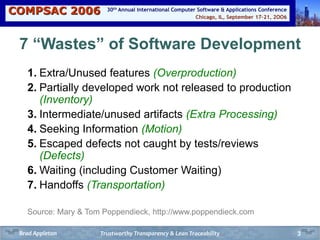
7 “Wastes” of Software Development
1. Extra/Unused features (Overproduction)
2. Partially developed work not released to production
(Inventory)
3. Intermediate/unused artifacts (Extra Processing)
4. Seeking Information (Motion)
5. Escaped defects not caught by tests/reviews
(Defects)
6. Waiting (including Customer Waiting)
7. Handoffs (Transportation)
Source: Mary & Tom Poppendieck, http://www.poppendieck.com
Trustworthy Transparency & Lean TraceabilityBrad Appleton
COMPSAC 2006 Chicago, IL, September 17-21, 2OO6
30th Annual International Computer Software & Applications Conference
4
6 Facets of Traceability
1. Change Impact/Dependency Analysis
2. Product Conformance
3. Process Compliance
4. Project Accountability
– safeguard against unauthorized change and “gold plating”
5. Baseline Reproducibility
– so "all the king's horses and all the king's men" can put your
fallen "humpty-dumpty" build back together again
6. Organizational Learning
– "know-why" you did what you did when you did it
Trustworthy Transparency & Lean TraceabilityBrad Appleton
COMPSAC 2006 Chicago, IL, September 17-21, 2OO6
30th Annual International Computer Software & Applications Conference
5
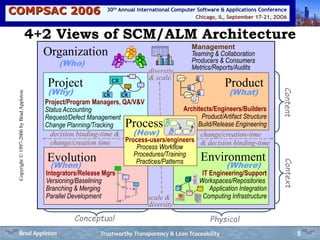
4+2 Views of SCM/ALM Architecture
Organization Management
Teaming & Collaboration
Producers & Consumers
Metrics/Reports/Audits
PhysicalConceptual
ContentContext
decision binding-time &
change/creation time
diversity
& scale
Project
Project/Program Managers, QA/V&V
Status Accounting
Request/Defect Management
Change Planning/Tracking
CR
CR
CR
Environment
IT Engineering/Support
Workspaces/Repositories
Application Integration
Computing Infrastructure
Evolution
Integrators/Release Mgrs
Versioning/Baselining
Branching & Merging
Parallel Development
Product
Architects/Engineers/Builders
Product/Artifact Structure
Build/Release Engineering
change/creation-time
& decision binding-time
scale &
diversity
Copyright©1997-2006byBradAppleton
Process
Process-users/engineers
Process Workflow
Procedures/Training
Practices/Patterns
(Who)
(What)
(When) (Where)
(Why)
(How)
Trustworthy Transparency & Lean TraceabilityBrad Appleton
COMPSAC 2006 Chicago, IL, September 17-21, 2OO6
30th Annual International Computer Software & Applications Conference
6
Software as Knowledge (Armour)
• “Software is not a product! It is a medium
for storing executable knowledge.”
• Therefore, software development is a
knowledge creating activity. …
• Or equivalently, software development is
an ignorance reduction activity
-- Phil Armour, The Laws of Software Process
Trustworthy Transparency & Lean TraceabilityBrad Appleton
COMPSAC 2006 Chicago, IL, September 17-21, 2OO6
30th Annual International Computer Software & Applications Conference
7
5 Orders of Ignorance (Armour)
0th Order Ignorance (0OI) – Lack of Ignorance: I know
something
1st Order Ignorance (1OI) – Lack of Knowledge: I don’t
know something
2nd Order Ignorance (2OI) – Lack of Awareness: I don’t
know that I don’t know something
3rd Order Ignorance (30I) – Lack of Process: I don’t know
of a suitably efficient or systematic way to find out that I
don’t know that I don’t know something
4th Order Ignorance (40I) – Meta Ignorance: I don’t know
about the Five Orders of Ignorance
Trustworthy Transparency & Lean TraceabilityBrad Appleton
COMPSAC 2006 Chicago, IL, September 17-21, 2OO6
30th Annual International Computer Software & Applications Conference
8
5 Orders of Traceability (Appleton)
0th Order Traceability – Existence:
– Tracking Knowledge Content
1st Order Traceability – Structure:
– Tracking Knowledge Composition
2nd Order Traceability – History:
– Tracking Knowledge Context
3rd Order Traceability – Transformation:
– Tracking Knowledge Creation (“rich traceability” &
causal connections)
4th Order Traceability – Meta-Traceability
Trustworthy Transparency & Lean TraceabilityBrad Appleton
COMPSAC 2006 Chicago, IL, September 17-21, 2OO6
30th Annual International Computer Software & Applications Conference
9
4 Fundamental Values of Agility
1. Individuals and interactions over processes and
tools
2. Working software over comprehensive
documentation
3. Customer collaboration over contract negotiation
4. Responding to change over following a plan
There is value in the items on the right
• but value the items on the left more!
• (“over” != “instead of”)
Source: The Agile Manifesto, http://www.agilemanifesto.org
Trustworthy Transparency & Lean TraceabilityBrad Appleton
COMPSAC 2006 Chicago, IL, September 17-21, 2OO6
30th Annual International Computer Software & Applications Conference
10
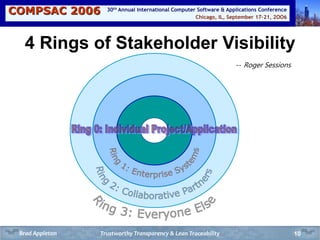
4 Rings of Stakeholder Visibility
-- Roger Sessions
Trustworthy Transparency & Lean TraceabilityBrad Appleton
COMPSAC 2006 Chicago, IL, September 17-21, 2OO6
30th Annual International Computer Software & Applications Conference
11
3 Driving Forces for Traceability
1. Organizational Boundaries
– More layers of organizational hierarchy means less
direct visibility to governing decision-makers
– Less visibility into a project decreases trust (people
often distrust what they cannot see).
2. Feedback Cycle-time
– Trust decreases as more time passes between the
request/start of work, and evidence of its progress
3. Knowledge Complexity
– The more complex something is, the less
confidence I have that it does what I expect.
Trustworthy Transparency & Lean TraceabilityBrad Appleton
COMPSAC 2006 Chicago, IL, September 17-21, 2OO6
30th Annual International Computer Software & Applications Conference
12
2 Overarching Objectives for Traceability
1. Transparency:
– the ability to readily view all the information we are
concerned with, and then …
2. Identification:
– the ability to identify our concerns so we can
separate independent sets of concerns and
cohesively associate the related ones.
 Transparency resolves the issue of visibility.
 Information structure organizes and identifies
the set of concerns to track and navigate.
Trustworthy Transparency & Lean TraceabilityBrad Appleton
COMPSAC 2006 Chicago, IL, September 17-21, 2OO6
30th Annual International Computer Software & Applications Conference
13
Trustworthy Transparency
“The age of trustworthy transparency in software engineering
is upon us. Trustworthy transparency changes the culture
in an organization and enables change that unleashes
significant gains in productivity and initial quality.”
“However, transparency and managing based on objective
study of reality strains existing software engineering
culture as all the old rules, obfuscation, economies of
truth, wishful thinking and subjective decision making
must be cast aside. What can you expect, how will you
cope and how can you harness the power of trustworthy
transparency in your organization?”
-- David J. Anderson
Trustworthy Transparency & Lean TraceabilityBrad Appleton
COMPSAC 2006 Chicago, IL, September 17-21, 2OO6
30th Annual International Computer Software & Applications Conference
14
Achieving Agility
Responding quickly & effectively to change
requires minimizing:
• The cost of knowledge-transfer
• The cost of knowledge capture (documents!)
• The time between making a decision, and exploring its
results to learn the consequences of implementing it
Close collaboration & frequent iteration -- critical for success!
Trustworthy Transparency & Lean TraceabilityBrad Appleton
COMPSAC 2006 Chicago, IL, September 17-21, 2OO6
30th Annual International Computer Software & Applications Conference
15
Principles of Lean Development
• Eliminate Waste (Minimize Artifacts & Add Nothing but
Value)
• Build Quality In (Satisfy All Stakeholders & Deploy
Comprehensive Testing)
• Amplify Learning (Learn by Experimentation)
• Defer Commitment (Decide as Late as Possible)
• Deliver Fast (Deliver as Fast as Possible)
• Respect People (Decide as Low as Possible)
• Optimize the “Whole” (Measure Business Impact &
Optimize Across Organizations)
Source: Mary & Tom Poppendieck, http://www.poppendieck.com/
Trustworthy Transparency & Lean TraceabilityBrad Appleton
COMPSAC 2006 Chicago, IL, September 17-21, 2OO6
30th Annual International Computer Software & Applications Conference
16
Lean Traceability
• Flow
– Fine-grained tasks, TDD, feedback-loops
• Minimizing Intermediate Artifacts
• Colocating Both People & Artifacts (locality)
• Coarse Granularity & Modularity/Factoring
• Transparent, Frictionless Automation
Trustworthy Transparency & Lean TraceabilityBrad Appleton
COMPSAC 2006 Chicago, IL, September 17-21, 2OO6
30th Annual International Computer Software & Applications Conference
17
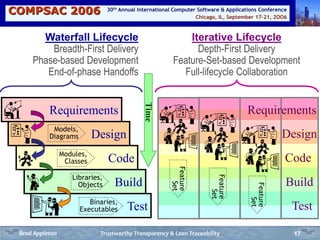
Waterfall Lifecycle
Breadth-First Delivery
Phase-based Development
End-of-phase Handoffs
Iterative Lifecycle
Depth-First Delivery
Feature-Set-based Development
Full-lifecycle Collaboration
Feature
Set
Feature
Set
Feature
Set
Requirements
Design
Models,
Diagrams
CodeModules,
Classes
Build
Libraries,
Objects
TestBinaries,
Executables
Time
Design
Code
Build
Test
Requirements
Trustworthy Transparency & Lean TraceabilityBrad Appleton
COMPSAC 2006 Chicago, IL, September 17-21, 2OO6
30th Annual International Computer Software & Applications Conference
18
“Lean” Documentation & Traceability
• Minimize Traceability and Eliminate Redundancy by using Fewer
Artifacts and Separation of Concerns
• Track features/use-cases and classes/modules (instead of their
individual requirements/routines)
– Increases encapsulation + modularity of code and reqt’s
– Reduces number of items to track (by an order of magnitude!)
• Fewer items, means fewer items to track/trace
– Detailed requirements/use-cases may serve double-duty as
acceptance test-cases
– Hi-level requirements/features may be simple feature/change
requests and/or release notes (automatically generated)
– Some end-user documents may even be used as use-cases or
functional requirements documentation
Trustworthy Transparency & Lean TraceabilityBrad Appleton
COMPSAC 2006 Chicago, IL, September 17-21, 2OO6
30th Annual International Computer Software & Applications Conference
19
Thank You!
Mahalo
XiexieYumboticSalamat
Arigato
Trustworthy Transparency & Lean TraceabilityBrad Appleton

Trustworthy Transparency and Lean Traceability

  • 1.
    COMPSAC 2006 Chicago,IL, September 17-21, 2OO6 30th Annual International Computer Software & Applications Conference COMPSAC 2006 Chicago, IL, September 17-21, 2OO6 30th Annual International Computer Software & Applications Conference Trustworthy Transparency & Lean Traceability 20 September 2006 Brad Appleton Software CM/ALM Solution Architect Arlington Heights, IL brad@bradapp.net
  • 2.
    COMPSAC 2006 Chicago,IL, September 17-21, 2OO6 30th Annual International Computer Software & Applications Conference 2 Traceability: The Agile CM Perspective • 7 “Wastes” of Software Development • 6 Facets of Traceability (4+2 SCM/ALM Views) • Software as Knowledge • 5 Orders of Ignorance & Traceability • 4 Values of Agility & Rings of Visibility • 3 Driving Forces for Traceability • 2 Overarching Objectives of Traceability • 1 Ultimate Goal: Trust-ability • Trustworthy Transparency & Lean Traceability Trustworthy Transparency & Lean TraceabilityBrad Appleton
  • 3.
    COMPSAC 2006 Chicago,IL, September 17-21, 2OO6 30th Annual International Computer Software & Applications Conference 3 7 “Wastes” of Software Development 1. Extra/Unused features (Overproduction) 2. Partially developed work not released to production (Inventory) 3. Intermediate/unused artifacts (Extra Processing) 4. Seeking Information (Motion) 5. Escaped defects not caught by tests/reviews (Defects) 6. Waiting (including Customer Waiting) 7. Handoffs (Transportation) Source: Mary & Tom Poppendieck, http://www.poppendieck.com Trustworthy Transparency & Lean TraceabilityBrad Appleton
  • 4.
    COMPSAC 2006 Chicago,IL, September 17-21, 2OO6 30th Annual International Computer Software & Applications Conference 4 6 Facets of Traceability 1. Change Impact/Dependency Analysis 2. Product Conformance 3. Process Compliance 4. Project Accountability – safeguard against unauthorized change and “gold plating” 5. Baseline Reproducibility – so "all the king's horses and all the king's men" can put your fallen "humpty-dumpty" build back together again 6. Organizational Learning – "know-why" you did what you did when you did it Trustworthy Transparency & Lean TraceabilityBrad Appleton
  • 5.
    COMPSAC 2006 Chicago,IL, September 17-21, 2OO6 30th Annual International Computer Software & Applications Conference 5 4+2 Views of SCM/ALM Architecture Organization Management Teaming & Collaboration Producers & Consumers Metrics/Reports/Audits PhysicalConceptual ContentContext decision binding-time & change/creation time diversity & scale Project Project/Program Managers, QA/V&V Status Accounting Request/Defect Management Change Planning/Tracking CR CR CR Environment IT Engineering/Support Workspaces/Repositories Application Integration Computing Infrastructure Evolution Integrators/Release Mgrs Versioning/Baselining Branching & Merging Parallel Development Product Architects/Engineers/Builders Product/Artifact Structure Build/Release Engineering change/creation-time & decision binding-time scale & diversity Copyright©1997-2006byBradAppleton Process Process-users/engineers Process Workflow Procedures/Training Practices/Patterns (Who) (What) (When) (Where) (Why) (How) Trustworthy Transparency & Lean TraceabilityBrad Appleton
  • 6.
    COMPSAC 2006 Chicago,IL, September 17-21, 2OO6 30th Annual International Computer Software & Applications Conference 6 Software as Knowledge (Armour) • “Software is not a product! It is a medium for storing executable knowledge.” • Therefore, software development is a knowledge creating activity. … • Or equivalently, software development is an ignorance reduction activity -- Phil Armour, The Laws of Software Process Trustworthy Transparency & Lean TraceabilityBrad Appleton
  • 7.
    COMPSAC 2006 Chicago,IL, September 17-21, 2OO6 30th Annual International Computer Software & Applications Conference 7 5 Orders of Ignorance (Armour) 0th Order Ignorance (0OI) – Lack of Ignorance: I know something 1st Order Ignorance (1OI) – Lack of Knowledge: I don’t know something 2nd Order Ignorance (2OI) – Lack of Awareness: I don’t know that I don’t know something 3rd Order Ignorance (30I) – Lack of Process: I don’t know of a suitably efficient or systematic way to find out that I don’t know that I don’t know something 4th Order Ignorance (40I) – Meta Ignorance: I don’t know about the Five Orders of Ignorance Trustworthy Transparency & Lean TraceabilityBrad Appleton
  • 8.
    COMPSAC 2006 Chicago,IL, September 17-21, 2OO6 30th Annual International Computer Software & Applications Conference 8 5 Orders of Traceability (Appleton) 0th Order Traceability – Existence: – Tracking Knowledge Content 1st Order Traceability – Structure: – Tracking Knowledge Composition 2nd Order Traceability – History: – Tracking Knowledge Context 3rd Order Traceability – Transformation: – Tracking Knowledge Creation (“rich traceability” & causal connections) 4th Order Traceability – Meta-Traceability Trustworthy Transparency & Lean TraceabilityBrad Appleton
  • 9.
    COMPSAC 2006 Chicago,IL, September 17-21, 2OO6 30th Annual International Computer Software & Applications Conference 9 4 Fundamental Values of Agility 1. Individuals and interactions over processes and tools 2. Working software over comprehensive documentation 3. Customer collaboration over contract negotiation 4. Responding to change over following a plan There is value in the items on the right • but value the items on the left more! • (“over” != “instead of”) Source: The Agile Manifesto, http://www.agilemanifesto.org Trustworthy Transparency & Lean TraceabilityBrad Appleton
  • 10.
    COMPSAC 2006 Chicago,IL, September 17-21, 2OO6 30th Annual International Computer Software & Applications Conference 10 4 Rings of Stakeholder Visibility -- Roger Sessions Trustworthy Transparency & Lean TraceabilityBrad Appleton
  • 11.
    COMPSAC 2006 Chicago,IL, September 17-21, 2OO6 30th Annual International Computer Software & Applications Conference 11 3 Driving Forces for Traceability 1. Organizational Boundaries – More layers of organizational hierarchy means less direct visibility to governing decision-makers – Less visibility into a project decreases trust (people often distrust what they cannot see). 2. Feedback Cycle-time – Trust decreases as more time passes between the request/start of work, and evidence of its progress 3. Knowledge Complexity – The more complex something is, the less confidence I have that it does what I expect. Trustworthy Transparency & Lean TraceabilityBrad Appleton
  • 12.
    COMPSAC 2006 Chicago,IL, September 17-21, 2OO6 30th Annual International Computer Software & Applications Conference 12 2 Overarching Objectives for Traceability 1. Transparency: – the ability to readily view all the information we are concerned with, and then … 2. Identification: – the ability to identify our concerns so we can separate independent sets of concerns and cohesively associate the related ones.  Transparency resolves the issue of visibility.  Information structure organizes and identifies the set of concerns to track and navigate. Trustworthy Transparency & Lean TraceabilityBrad Appleton
  • 13.
    COMPSAC 2006 Chicago,IL, September 17-21, 2OO6 30th Annual International Computer Software & Applications Conference 13 Trustworthy Transparency “The age of trustworthy transparency in software engineering is upon us. Trustworthy transparency changes the culture in an organization and enables change that unleashes significant gains in productivity and initial quality.” “However, transparency and managing based on objective study of reality strains existing software engineering culture as all the old rules, obfuscation, economies of truth, wishful thinking and subjective decision making must be cast aside. What can you expect, how will you cope and how can you harness the power of trustworthy transparency in your organization?” -- David J. Anderson Trustworthy Transparency & Lean TraceabilityBrad Appleton
  • 14.
    COMPSAC 2006 Chicago,IL, September 17-21, 2OO6 30th Annual International Computer Software & Applications Conference 14 Achieving Agility Responding quickly & effectively to change requires minimizing: • The cost of knowledge-transfer • The cost of knowledge capture (documents!) • The time between making a decision, and exploring its results to learn the consequences of implementing it Close collaboration & frequent iteration -- critical for success! Trustworthy Transparency & Lean TraceabilityBrad Appleton
  • 15.
    COMPSAC 2006 Chicago,IL, September 17-21, 2OO6 30th Annual International Computer Software & Applications Conference 15 Principles of Lean Development • Eliminate Waste (Minimize Artifacts & Add Nothing but Value) • Build Quality In (Satisfy All Stakeholders & Deploy Comprehensive Testing) • Amplify Learning (Learn by Experimentation) • Defer Commitment (Decide as Late as Possible) • Deliver Fast (Deliver as Fast as Possible) • Respect People (Decide as Low as Possible) • Optimize the “Whole” (Measure Business Impact & Optimize Across Organizations) Source: Mary & Tom Poppendieck, http://www.poppendieck.com/ Trustworthy Transparency & Lean TraceabilityBrad Appleton
  • 16.
    COMPSAC 2006 Chicago,IL, September 17-21, 2OO6 30th Annual International Computer Software & Applications Conference 16 Lean Traceability • Flow – Fine-grained tasks, TDD, feedback-loops • Minimizing Intermediate Artifacts • Colocating Both People & Artifacts (locality) • Coarse Granularity & Modularity/Factoring • Transparent, Frictionless Automation Trustworthy Transparency & Lean TraceabilityBrad Appleton
  • 17.
    COMPSAC 2006 Chicago,IL, September 17-21, 2OO6 30th Annual International Computer Software & Applications Conference 17 Waterfall Lifecycle Breadth-First Delivery Phase-based Development End-of-phase Handoffs Iterative Lifecycle Depth-First Delivery Feature-Set-based Development Full-lifecycle Collaboration Feature Set Feature Set Feature Set Requirements Design Models, Diagrams CodeModules, Classes Build Libraries, Objects TestBinaries, Executables Time Design Code Build Test Requirements Trustworthy Transparency & Lean TraceabilityBrad Appleton
  • 18.
    COMPSAC 2006 Chicago,IL, September 17-21, 2OO6 30th Annual International Computer Software & Applications Conference 18 “Lean” Documentation & Traceability • Minimize Traceability and Eliminate Redundancy by using Fewer Artifacts and Separation of Concerns • Track features/use-cases and classes/modules (instead of their individual requirements/routines) – Increases encapsulation + modularity of code and reqt’s – Reduces number of items to track (by an order of magnitude!) • Fewer items, means fewer items to track/trace – Detailed requirements/use-cases may serve double-duty as acceptance test-cases – Hi-level requirements/features may be simple feature/change requests and/or release notes (automatically generated) – Some end-user documents may even be used as use-cases or functional requirements documentation Trustworthy Transparency & Lean TraceabilityBrad Appleton
  • 19.
    COMPSAC 2006 Chicago,IL, September 17-21, 2OO6 30th Annual International Computer Software & Applications Conference 19 Thank You! Mahalo XiexieYumboticSalamat Arigato Trustworthy Transparency & Lean TraceabilityBrad Appleton