Trust No One
The New Security Model for Web APIs

Greg Kliewer
Principal Consultant, Solutions Architect
Layer 7, a CA Technologies company
October 8, 2013

© 2013 CA. All rights reserved.
What are Web APIs?
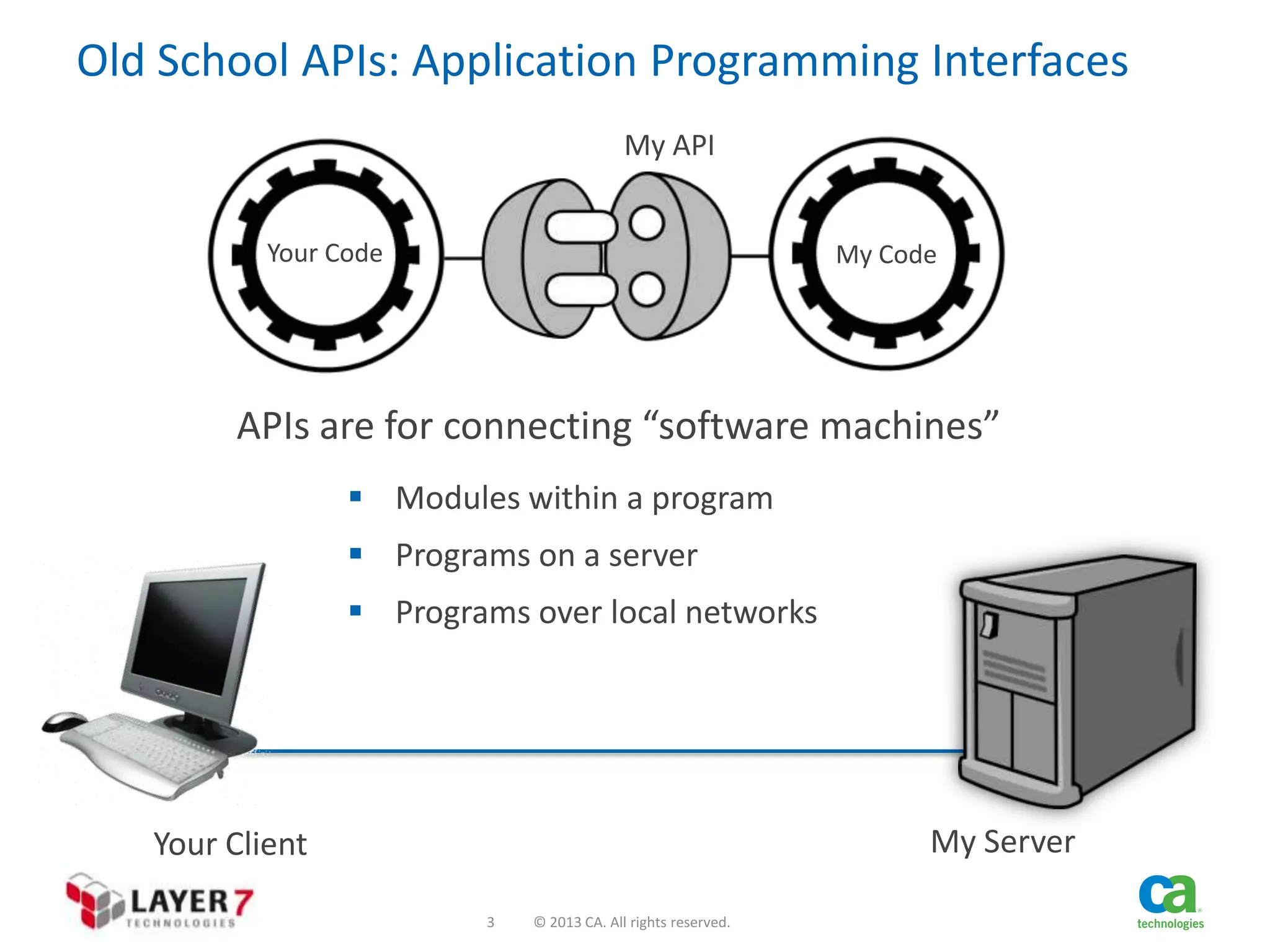
Old School APIs: Application Programming Interfaces
My API
Your Code

My Code

APIs are for connecting “software machines”
 Modules within a program

 Programs on a server
 Programs over local networks

My Server

Your Client
3

© 2013 CA. All rights reserved.
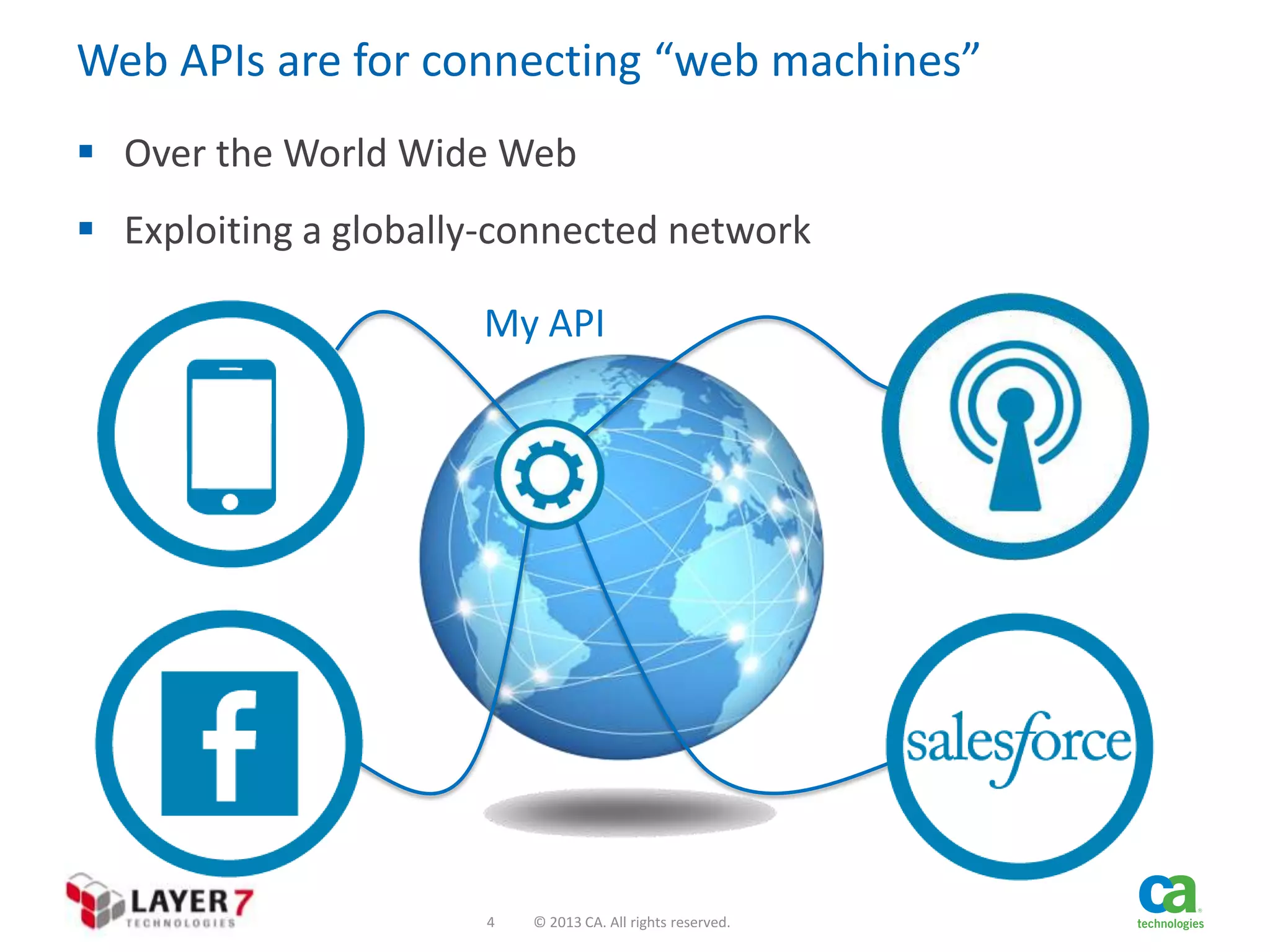
Web APIs are for connecting “web machines”
 Over the World Wide Web
 Exploiting a globally-connected network

My API

4

© 2013 CA. All rights reserved.
How Web APIs Evolved
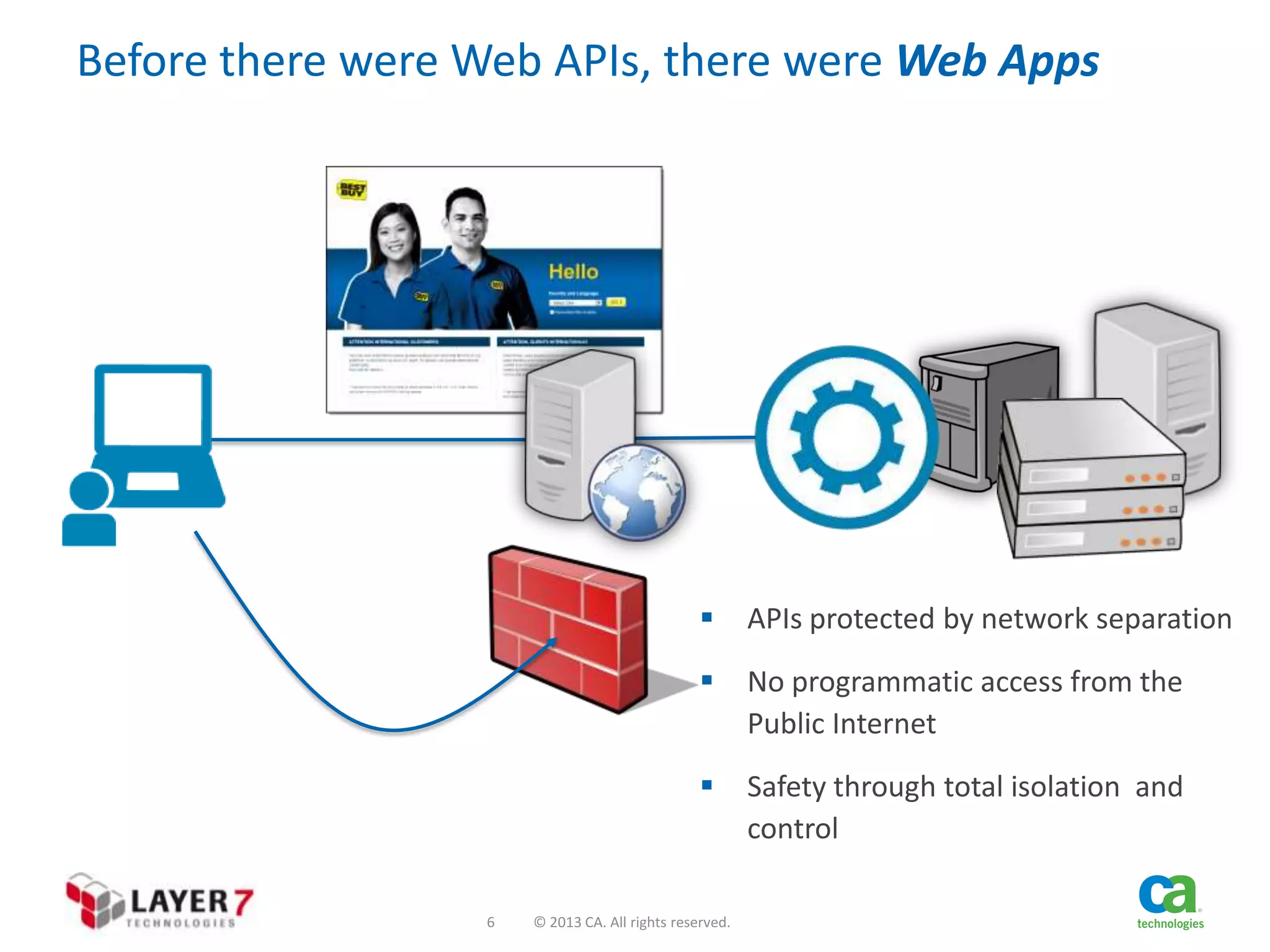
Before there were Web APIs, there were Web Apps





No programmatic access from the
Public Internet



6

APIs protected by network separation

Safety through total isolation and
control

© 2013 CA. All rights reserved.
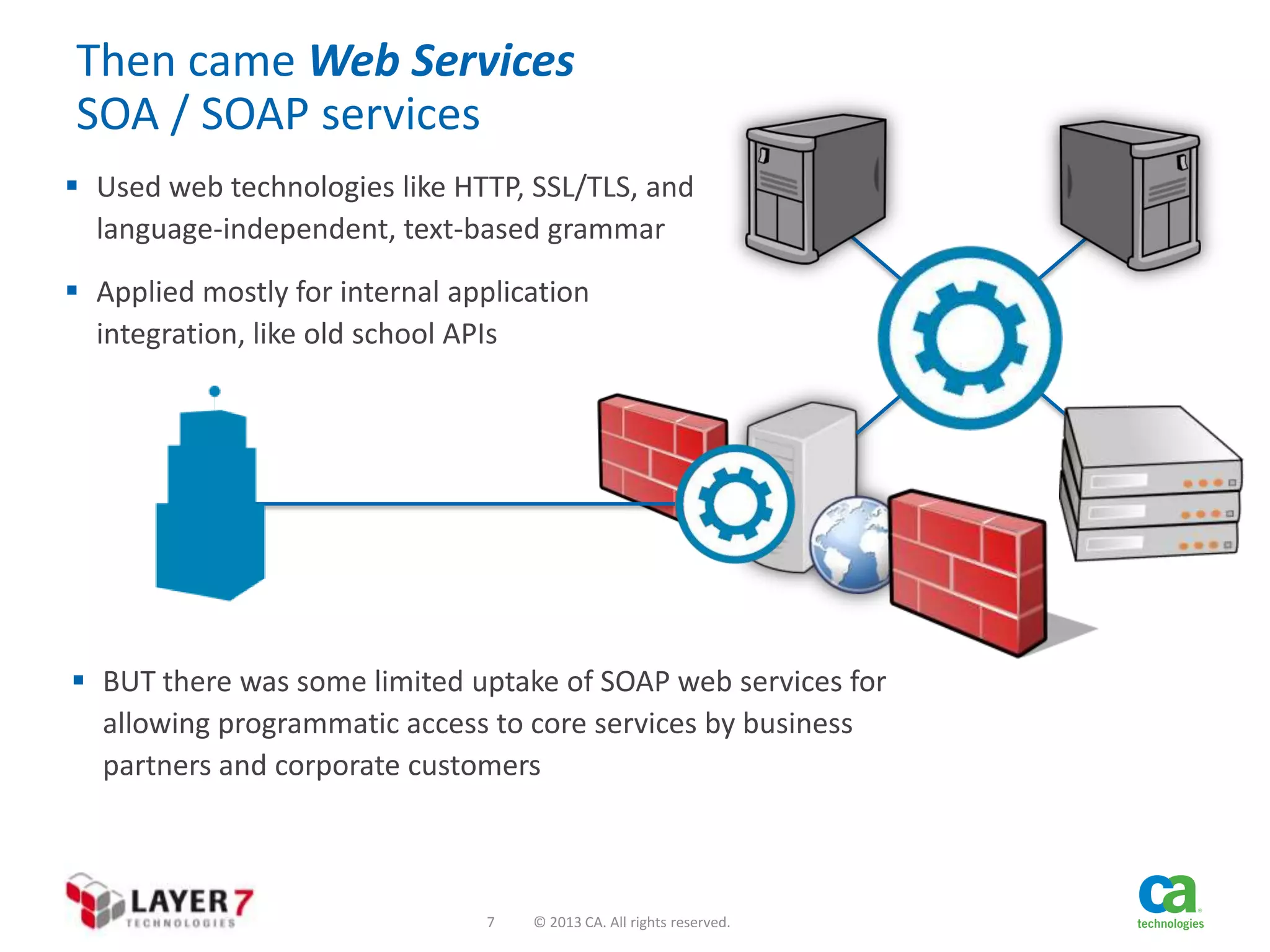
Then came Web Services
SOA / SOAP services
 Used web technologies like HTTP, SSL/TLS, and
language-independent, text-based grammar
 Applied mostly for internal application
integration, like old school APIs

 BUT there was some limited uptake of SOAP web services for
allowing programmatic access to core services by business
partners and corporate customers

7

© 2013 CA. All rights reserved.
Security for Web Services
The model most of us are familiar with


CA

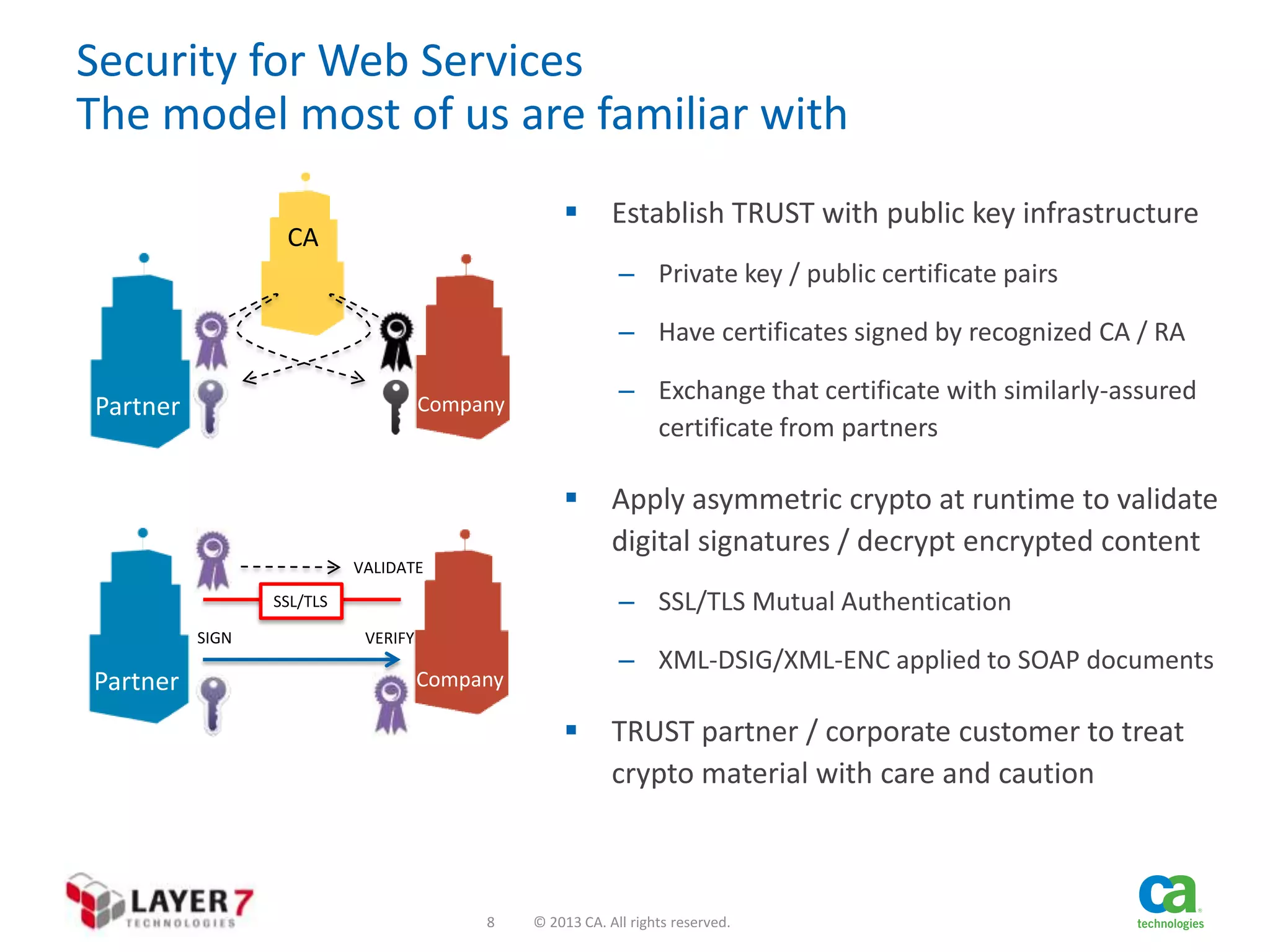
Establish TRUST with public key infrastructure
– Private key / public certificate pairs
– Have certificates signed by recognized CA / RA

Partner

– Exchange that certificate with similarly-assured
certificate from partners

Company



Apply asymmetric crypto at runtime to validate
digital signatures / decrypt encrypted content

VALIDATE

– SSL/TLS Mutual Authentication

SSL/TLS
SIGN

Partner

VERIFY

– XML-DSIG/XML-ENC applied to SOAP documents

Company



8

TRUST partner / corporate customer to treat
crypto material with care and caution

© 2013 CA. All rights reserved.
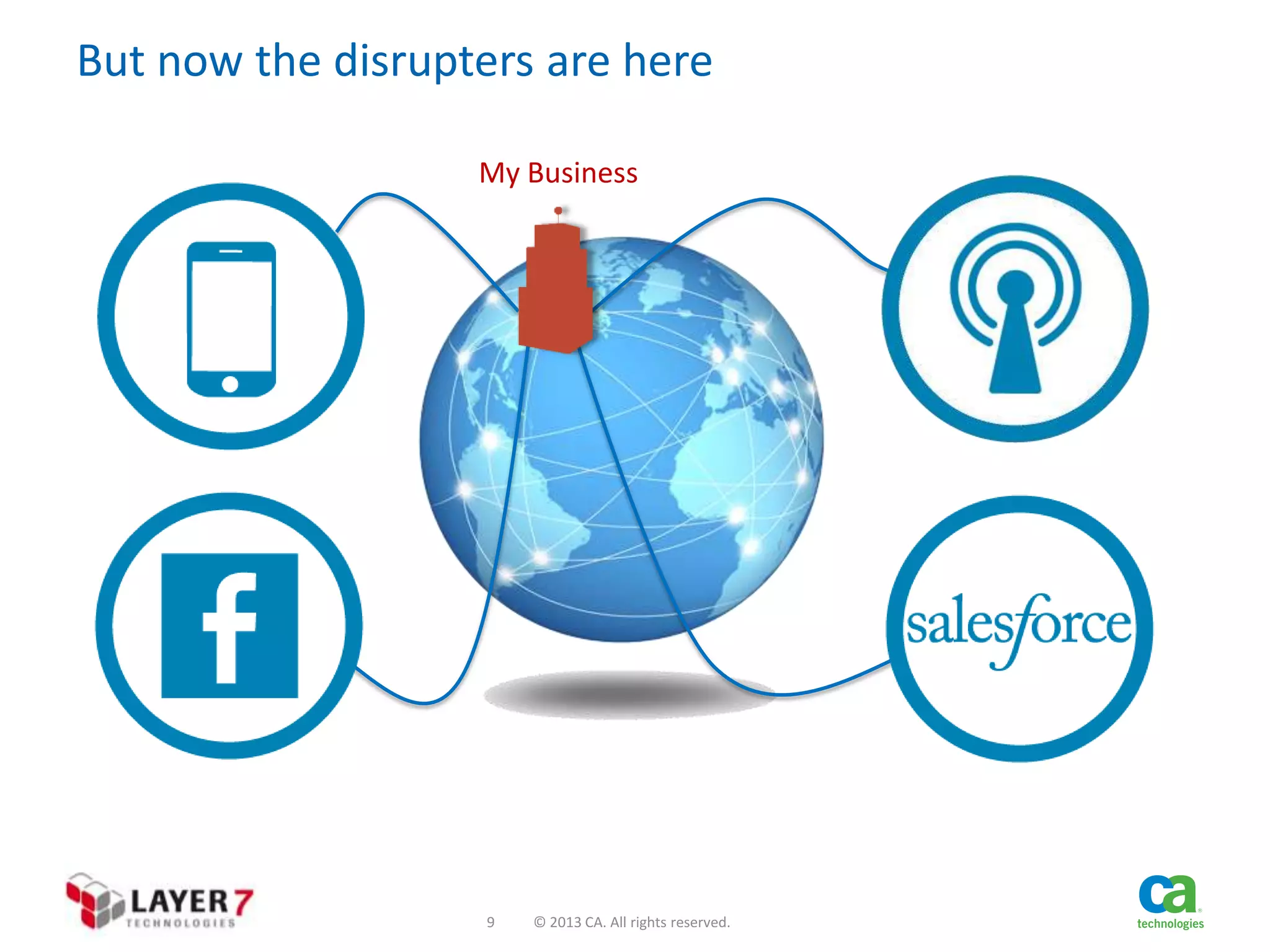
But now the disrupters are here
My Business

9

© 2013 CA. All rights reserved.
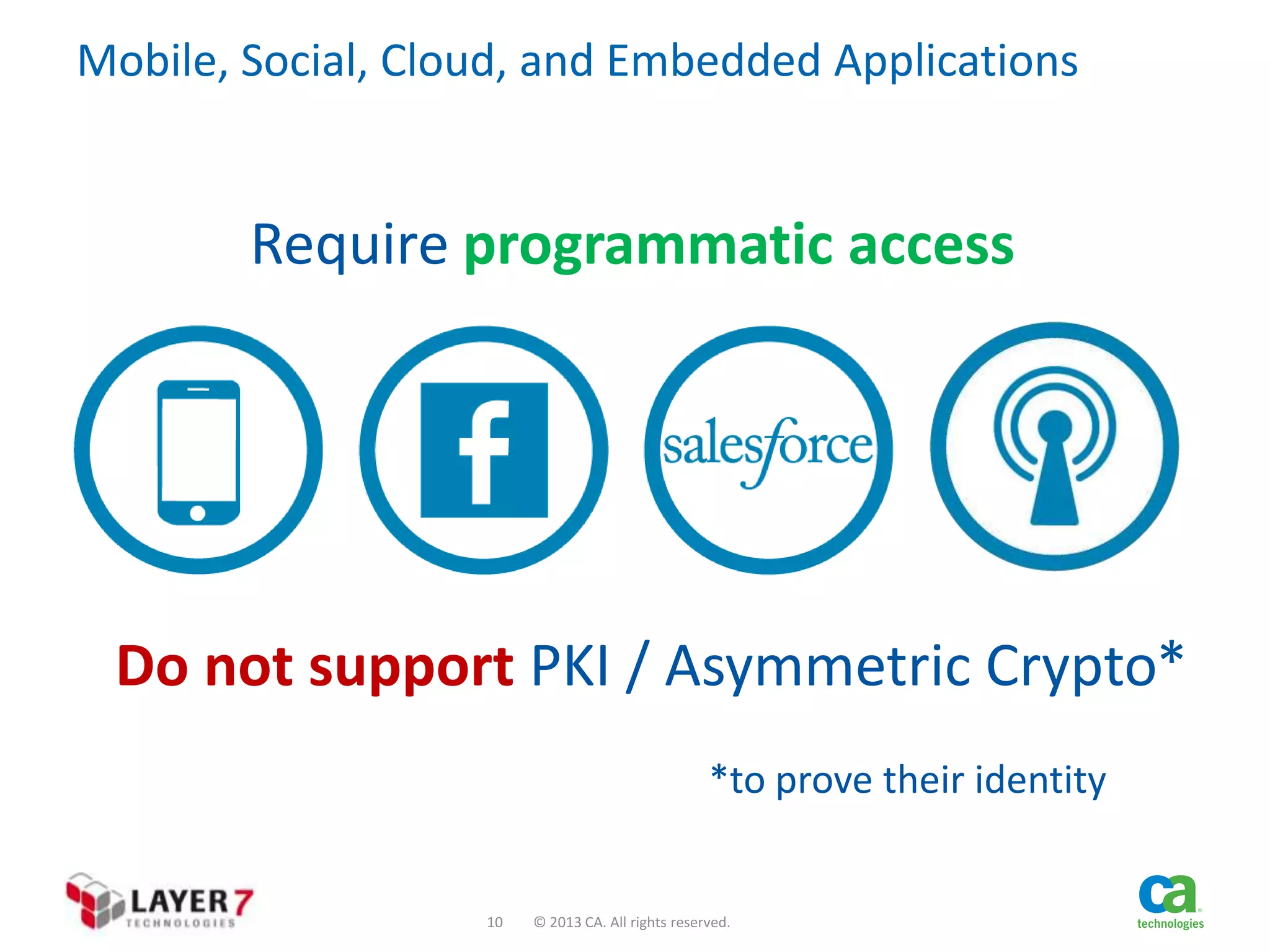
Mobile, Social, Cloud, and Embedded Applications

Require programmatic access

Do not support PKI / Asymmetric Crypto*
*to prove their identity

10

© 2013 CA. All rights reserved.
How can we safely
expose Web APIs?

11

© 2013 CA. All rights reserved.
The new security model for Web APIs
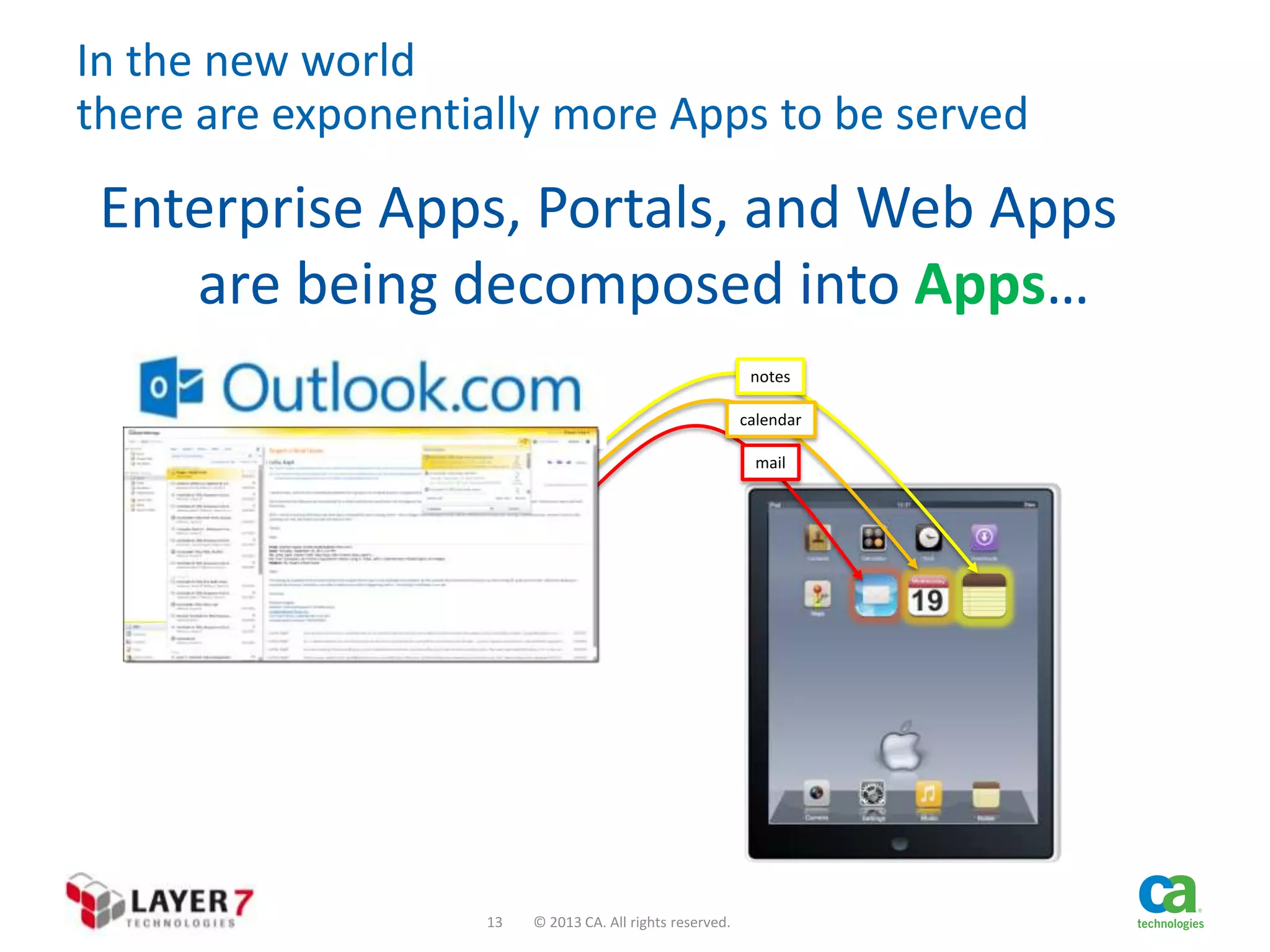
In the new world
there are exponentially more Apps to be served

Enterprise Apps, Portals, and Web Apps
are being decomposed into Apps…
notes
calendar
mail

13

© 2013 CA. All rights reserved.
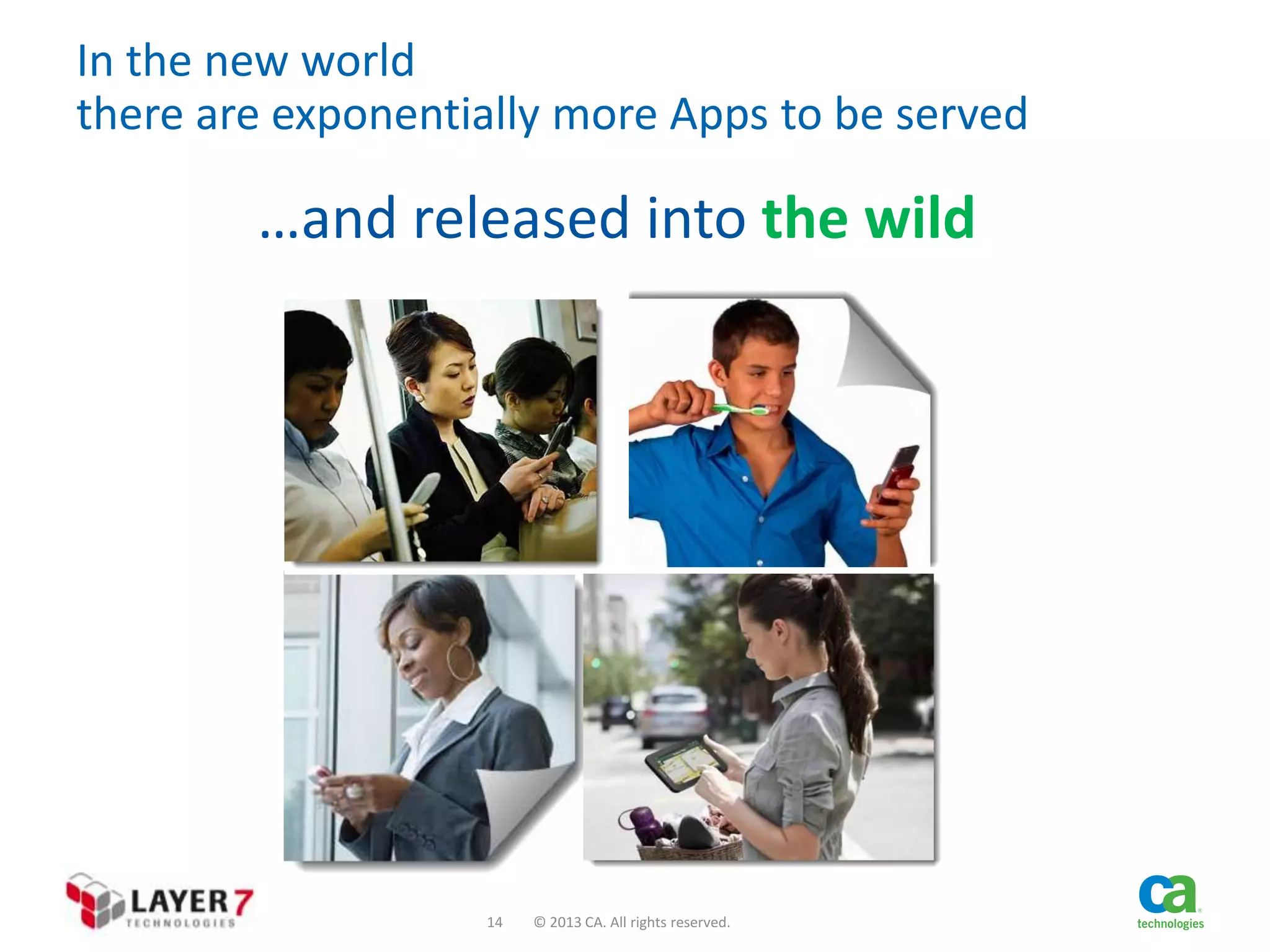
In the new world
there are exponentially more Apps to be served

…and released into the wild

14

© 2013 CA. All rights reserved.
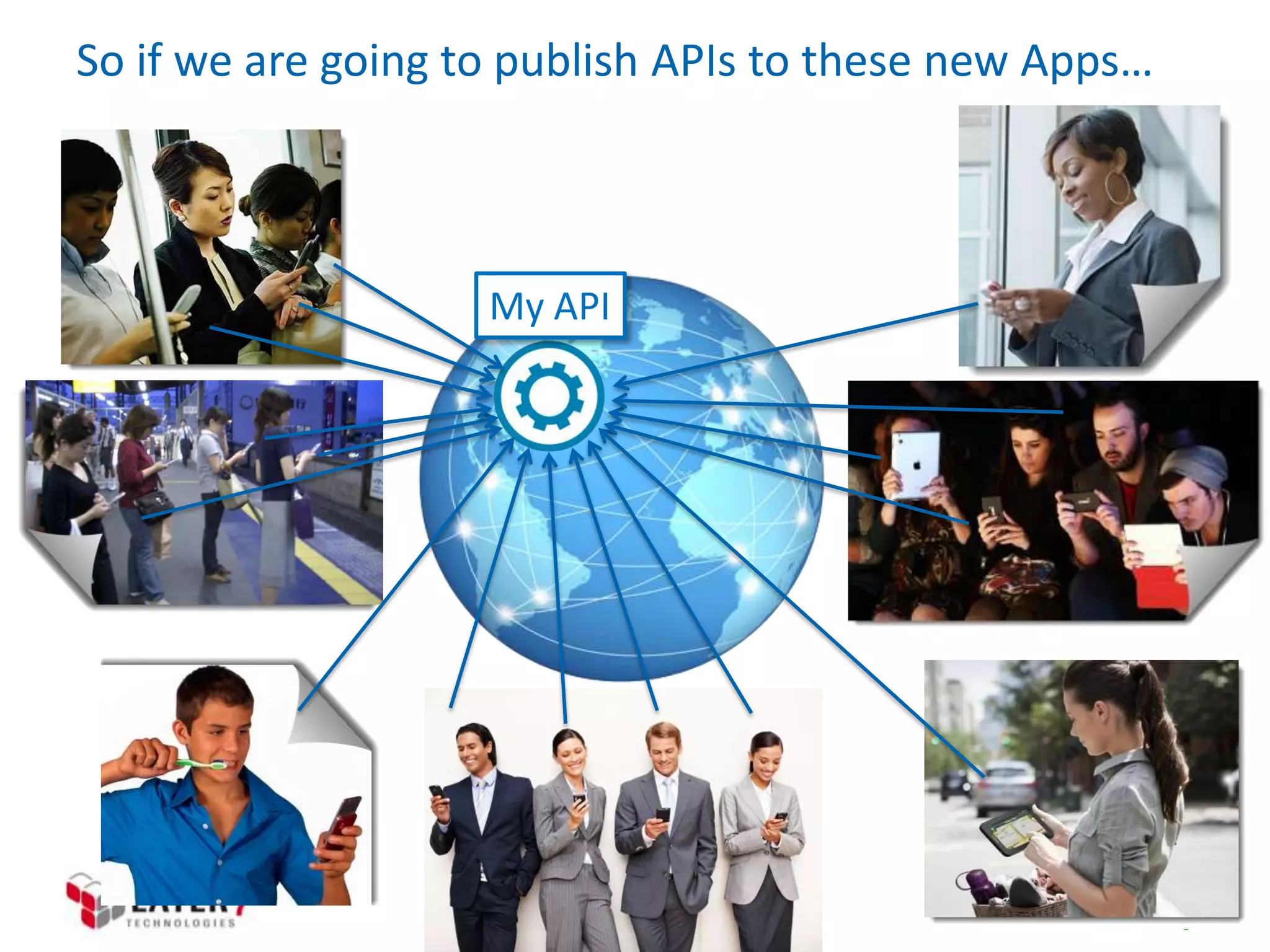
So if we are going to publish APIs to these new Apps…

My API

15

© 2013 CA. All rights reserved.
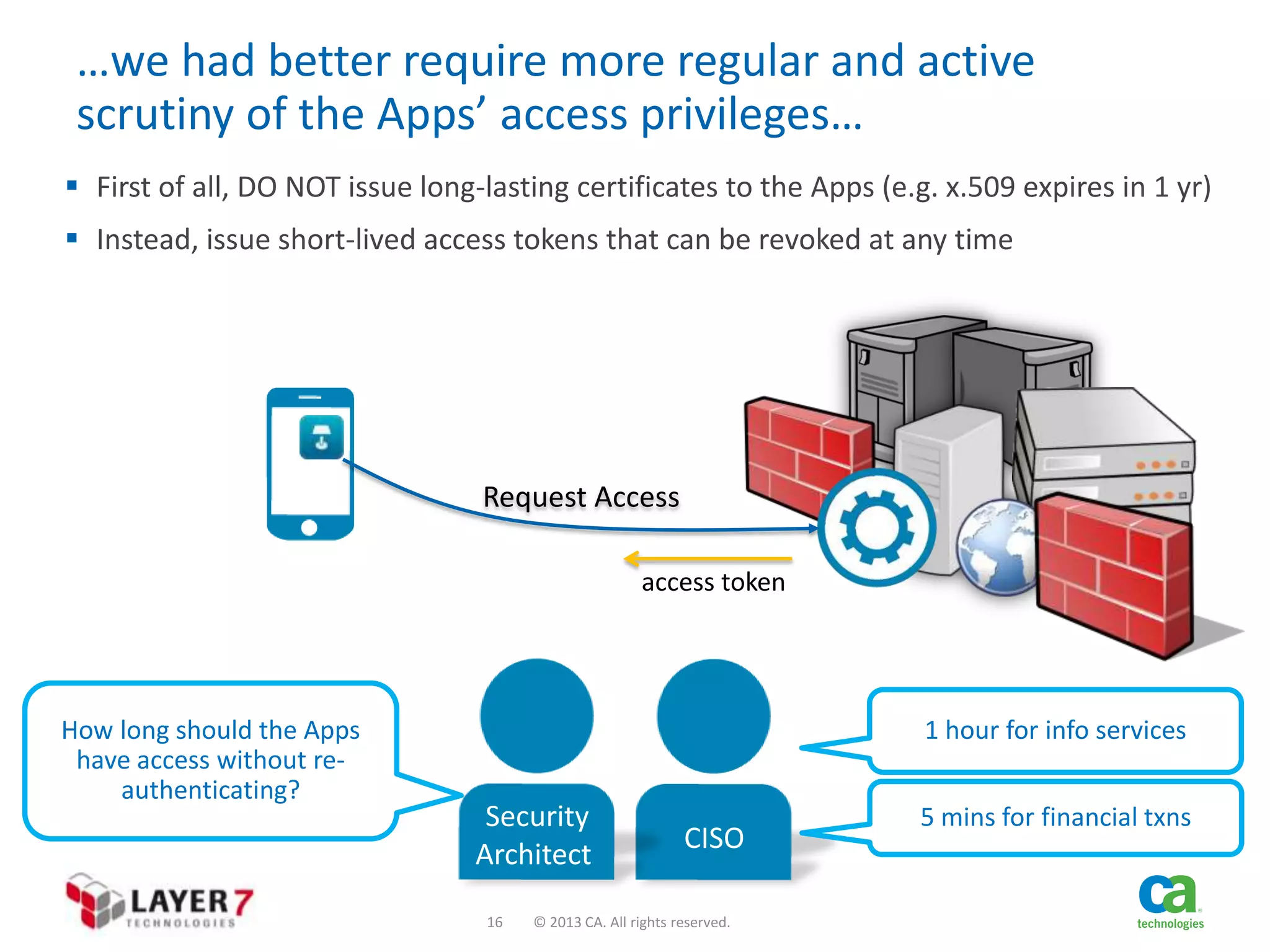
…we had better require more regular and active
scrutiny of the Apps’ access privileges…
 First of all, DO NOT issue long-lasting certificates to the Apps (e.g. x.509 expires in 1 yr)

 Instead, issue short-lived access tokens that can be revoked at any time

Request Access
access token

How long should the Apps
have access without reauthenticating?

1 hour for info services

Security
Architect
16

CISO

© 2013 CA. All rights reserved.

5 mins for financial txns
…we had better require more regular and active
scrutiny of the Apps’ access privileges…
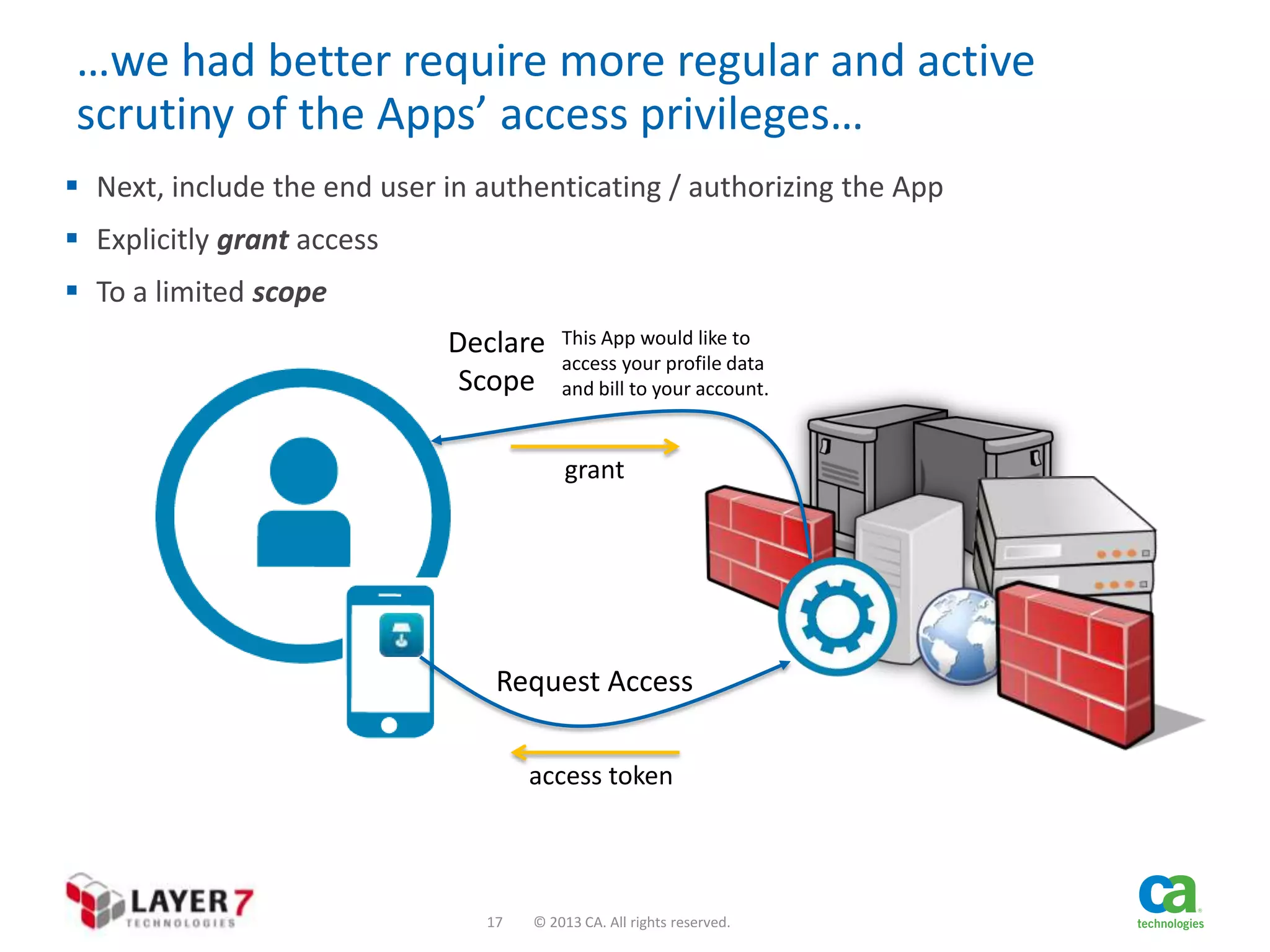
 Next, include the end user in authenticating / authorizing the App

 Explicitly grant access
 To a limited scope
Declare
Scope

This App would like to
access your profile data
and bill to your account.

grant

Request Access
access token

17

© 2013 CA. All rights reserved.
Introducing OAuth
The new security model for Web APIs


“

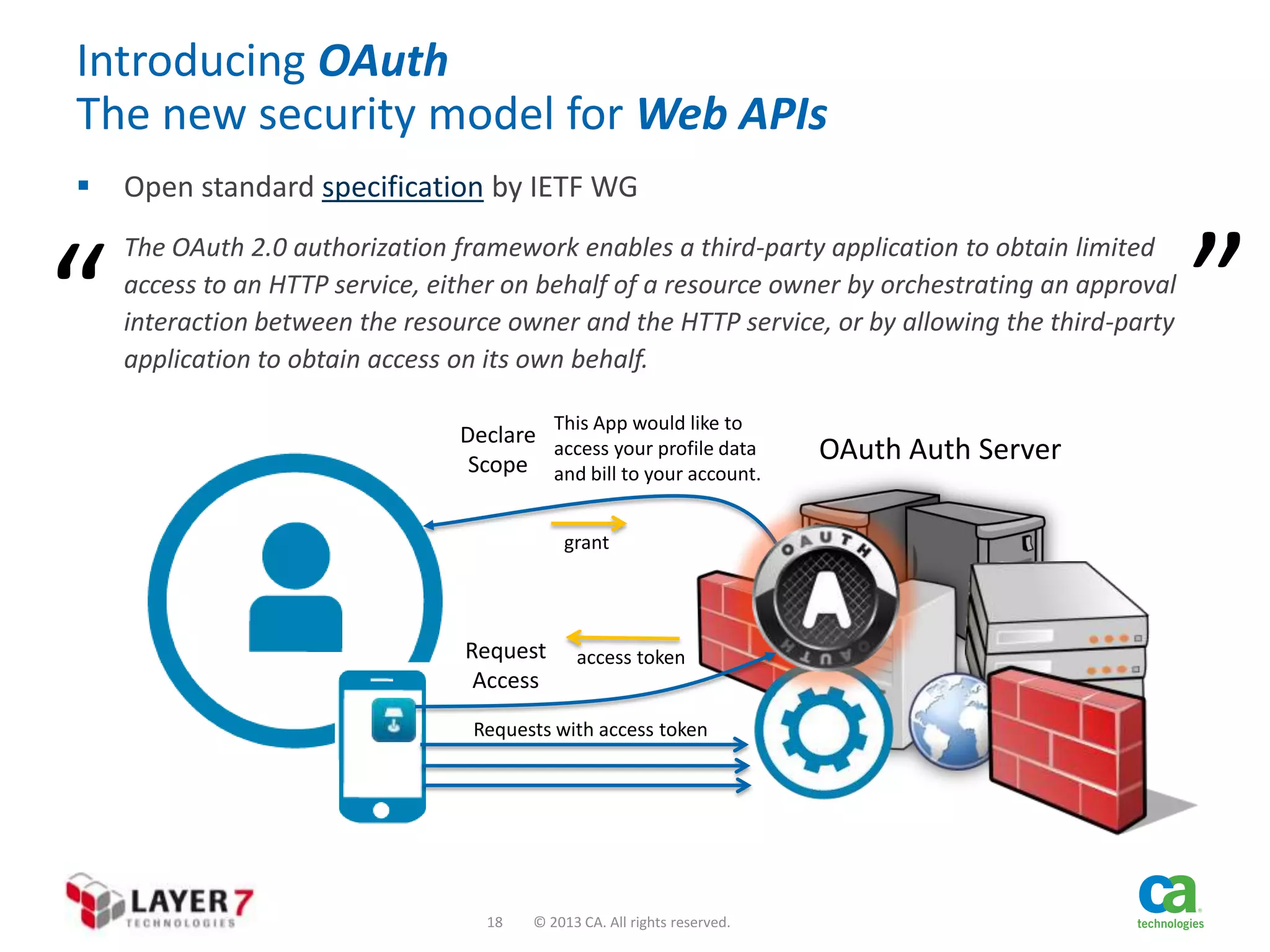
Open standard specification by IETF WG
The OAuth 2.0 authorization framework enables a third-party application to obtain limited
access to an HTTP service, either on behalf of a resource owner by orchestrating an approval
interaction between the resource owner and the HTTP service, or by allowing the third-party
application to obtain access on its own behalf.
This App would like to

Declare
access your profile data
Scope and bill to your account.
grant

Request
Access

access token

Requests with access token

18

© 2013 CA. All rights reserved.

OAuth Auth Server

”
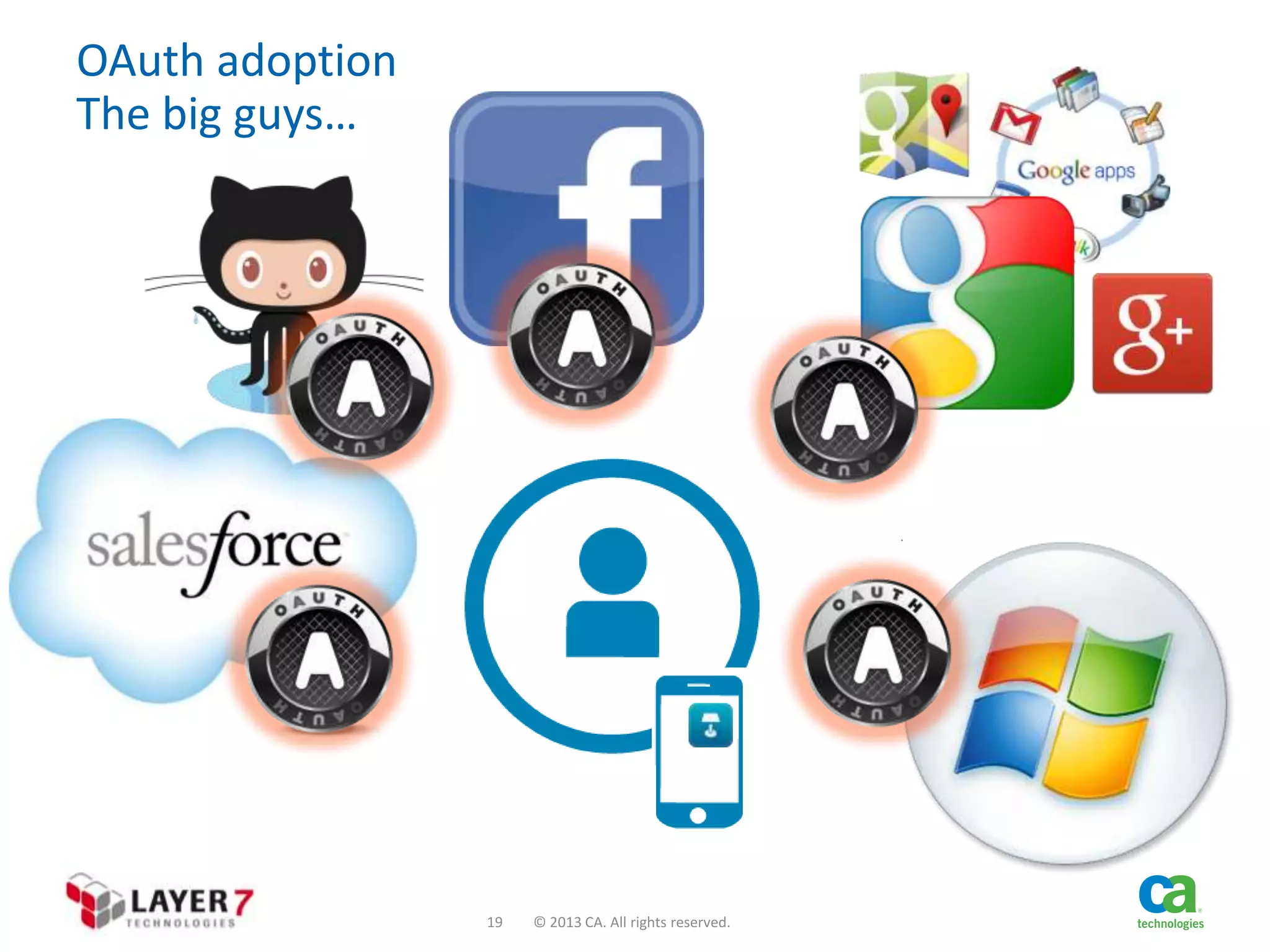
OAuth adoption
The big guys…

19

© 2013 CA. All rights reserved.
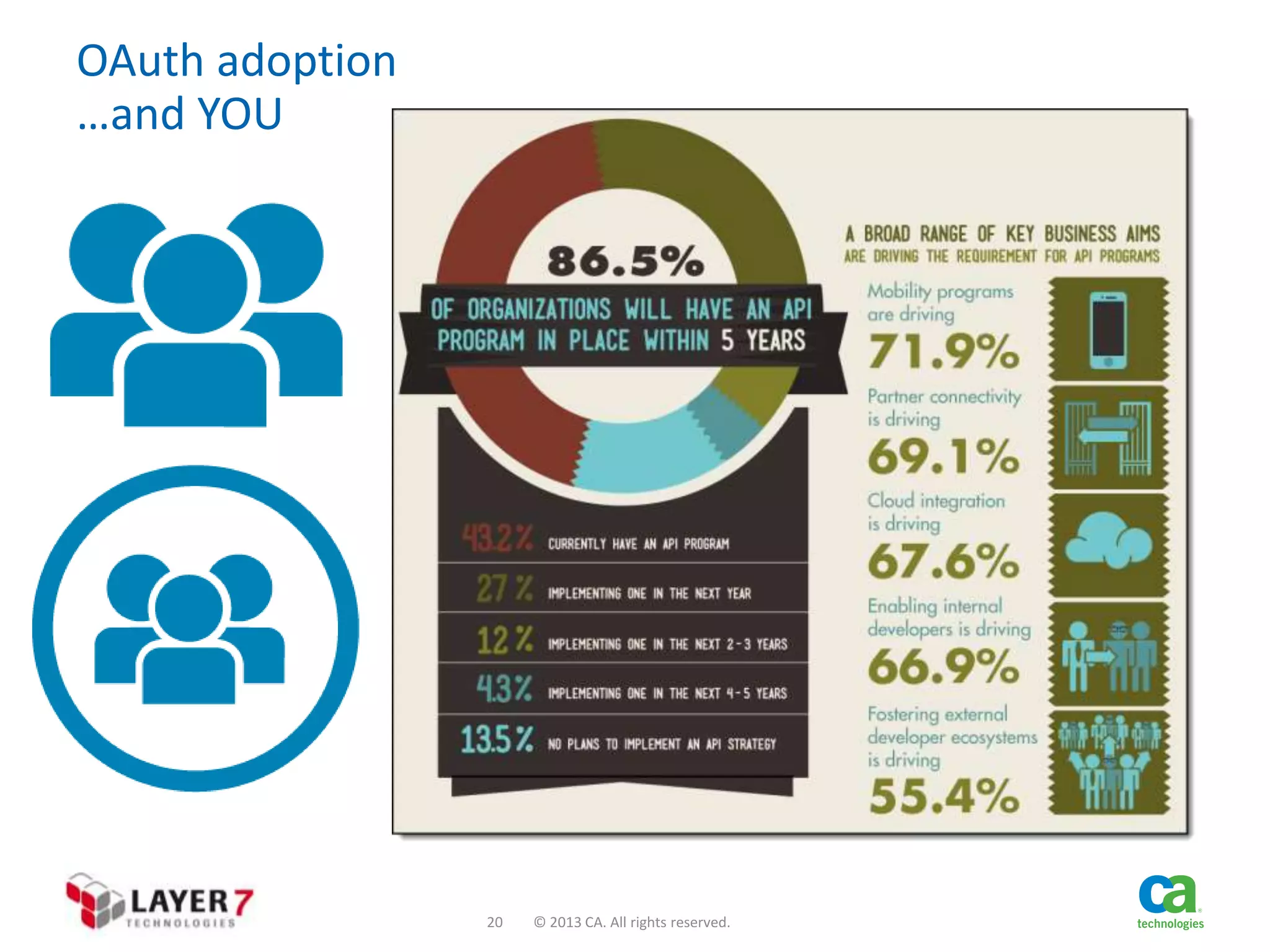
OAuth adoption
…and YOU

20

© 2013 CA. All rights reserved.
How to learn more
Where to learn more




Come talk to us!

Primers

– Booth #505
– We’re here today and tomorrow



– By Aaron Parecki

– By Jakob Jenkov



API Academy
– Online resources

– The 5 OAuth essentials

– Workshops



Publications



OAuth Online

Blogs
– By Francois Lascelles

– http://oauth.net/
– https://www.ietf.org/mailman/listinfo/oauth

22

© 2013 CA. All rights reserved.
Greg Kliewer
Principal Consultant, Systems Architect
greg.kliewer@ca.com
@cainc
slideshare.net/CAinc
linkedin.com/company/ca-technologies

ca.com

Trust No One: The New Security Model for Web APIs - SecTor talk by Greg Kliewer Principal Consultant/Solutions Architect, CA Technologies

  • 1.
    Trust No One TheNew Security Model for Web APIs Greg Kliewer Principal Consultant, Solutions Architect Layer 7, a CA Technologies company October 8, 2013 © 2013 CA. All rights reserved.
  • 2.
  • 3.
    Old School APIs:Application Programming Interfaces My API Your Code My Code APIs are for connecting “software machines”  Modules within a program  Programs on a server  Programs over local networks My Server Your Client 3 © 2013 CA. All rights reserved.
  • 4.
    Web APIs arefor connecting “web machines”  Over the World Wide Web  Exploiting a globally-connected network My API 4 © 2013 CA. All rights reserved.
  • 5.
    How Web APIsEvolved
  • 6.
    Before there wereWeb APIs, there were Web Apps   No programmatic access from the Public Internet  6 APIs protected by network separation Safety through total isolation and control © 2013 CA. All rights reserved.
  • 7.
    Then came WebServices SOA / SOAP services  Used web technologies like HTTP, SSL/TLS, and language-independent, text-based grammar  Applied mostly for internal application integration, like old school APIs  BUT there was some limited uptake of SOAP web services for allowing programmatic access to core services by business partners and corporate customers 7 © 2013 CA. All rights reserved.
  • 8.
    Security for WebServices The model most of us are familiar with  CA Establish TRUST with public key infrastructure – Private key / public certificate pairs – Have certificates signed by recognized CA / RA Partner – Exchange that certificate with similarly-assured certificate from partners Company  Apply asymmetric crypto at runtime to validate digital signatures / decrypt encrypted content VALIDATE – SSL/TLS Mutual Authentication SSL/TLS SIGN Partner VERIFY – XML-DSIG/XML-ENC applied to SOAP documents Company  8 TRUST partner / corporate customer to treat crypto material with care and caution © 2013 CA. All rights reserved.
  • 9.
    But now thedisrupters are here My Business 9 © 2013 CA. All rights reserved.
  • 10.
    Mobile, Social, Cloud,and Embedded Applications Require programmatic access Do not support PKI / Asymmetric Crypto* *to prove their identity 10 © 2013 CA. All rights reserved.
  • 11.
    How can wesafely expose Web APIs? 11 © 2013 CA. All rights reserved.
  • 12.
    The new securitymodel for Web APIs
  • 13.
    In the newworld there are exponentially more Apps to be served Enterprise Apps, Portals, and Web Apps are being decomposed into Apps… notes calendar mail 13 © 2013 CA. All rights reserved.
  • 14.
    In the newworld there are exponentially more Apps to be served …and released into the wild 14 © 2013 CA. All rights reserved.
  • 15.
    So if weare going to publish APIs to these new Apps… My API 15 © 2013 CA. All rights reserved.
  • 16.
    …we had betterrequire more regular and active scrutiny of the Apps’ access privileges…  First of all, DO NOT issue long-lasting certificates to the Apps (e.g. x.509 expires in 1 yr)  Instead, issue short-lived access tokens that can be revoked at any time Request Access access token How long should the Apps have access without reauthenticating? 1 hour for info services Security Architect 16 CISO © 2013 CA. All rights reserved. 5 mins for financial txns
  • 17.
    …we had betterrequire more regular and active scrutiny of the Apps’ access privileges…  Next, include the end user in authenticating / authorizing the App  Explicitly grant access  To a limited scope Declare Scope This App would like to access your profile data and bill to your account. grant Request Access access token 17 © 2013 CA. All rights reserved.
  • 18.
    Introducing OAuth The newsecurity model for Web APIs  “ Open standard specification by IETF WG The OAuth 2.0 authorization framework enables a third-party application to obtain limited access to an HTTP service, either on behalf of a resource owner by orchestrating an approval interaction between the resource owner and the HTTP service, or by allowing the third-party application to obtain access on its own behalf. This App would like to Declare access your profile data Scope and bill to your account. grant Request Access access token Requests with access token 18 © 2013 CA. All rights reserved. OAuth Auth Server ”
  • 19.
    OAuth adoption The bigguys… 19 © 2013 CA. All rights reserved.
  • 20.
    OAuth adoption …and YOU 20 ©2013 CA. All rights reserved.
  • 21.
  • 22.
    Where to learnmore   Come talk to us! Primers – Booth #505 – We’re here today and tomorrow  – By Aaron Parecki – By Jakob Jenkov  API Academy – Online resources – The 5 OAuth essentials – Workshops  Publications  OAuth Online Blogs – By Francois Lascelles – http://oauth.net/ – https://www.ietf.org/mailman/listinfo/oauth 22 © 2013 CA. All rights reserved.
  • 23.
    Greg Kliewer Principal Consultant,Systems Architect greg.kliewer@ca.com @cainc slideshare.net/CAinc linkedin.com/company/ca-technologies ca.com

Editor's Notes

  • #7 Web sitesPortalsCustomers accessed them via browsers on their desktop and laptop computersNo programmatic access from the WWWAPIs were exposed “behind the firewall” for web sites and portals to access, but there was no access from the WWWAPIs were protected by network separation
  • #8 Used Web API technologies like HTTP, SSL/TLS, and language-independent, text-based grammarWere mostly adopted for old-school API purposes: to connect applications “on the corporate network”; to “service orient” the enterprise and delivery apps – often new web apps – quickly and less expensivelyHOWEVER, there was some limited uptake of SOAP services access to enterprise services and assets from the WWW by business partners and corporate customersEnterprise to Enterprise integration
  • #11 REQUIRE programmatic access from the WWWDID NOT EMBARACE use PKI-based securityWhy? Because the market for these apps are not corporations with whom we can contract and run technology projects. These apps are consumed by capital-C Consumers who demand impeccable user experience, including simple and easy installationShow picture of PKI (CA/RA and WoT) As a publisher of Web APIs, do not expect to identify who is calling by verifying digital signatures with asymmetric crypo operations