TRIGGER POINTS
ELECTROTHERAPY
ADITYA JOHAN .R,M.FIS
DEFINITION
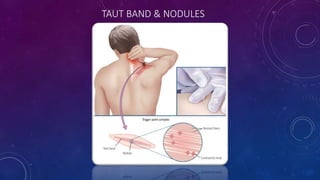
• A Trigger Point (TrPt) is a hyperirritable spot associated
within a taut band of a skeletal muscle
• Painful on compression or muscle contraction
• Usually responds with a referred pain pattern distant from
the spot
• Very often there are nodules palpable within the muscle
often at the size of 2-10 mm
ETIOLOGY & EPIDEMIOLOGY
• Mainly due to overload
• An injury sustained by a fall
• Lack of exercise or a bad posture can lead to trigger points
• Most common in sedentary persons between 27,5-55 years
• 45% of the patients are men
• Trigger points may be at different places in both skeletal
muscles in the hip, neck, shoulder
• usually in places where nerves connected the muscle fibers
TAUT BAND & NODULES
PATHOPHYSIOLOGICAL PROCESSES
• Sensitization of peripheral muscle nociceptors
• Sensitization of second-order neurons in the dorsal
horn
• Dysregulation of the descending endogenous pain
control system
CHARACTERISTICS/CLINICAL PRESENTATION
• Active TrPts
Active TrPts produce pain symptoms at rest
often with referred pain which may be described as radiating
or spreading, usually not associated with a nerve or
dermatome
• Latent TrPts
Latent TrPts do not provoke spontaneous pain
The TrPt may refer pain with direct mechanical stimulation or
muscle contraction
ELECTROTHERAPY FOR ENDOGENOUS OPIATE
LIBERATION
• Endogenous refers to something from within or that is
developed from internal systems
• Opiates are drugs containing opium or its derivatives
and are used in medicine for inducing sleep and relieving
pain
• Endogenous Opiate : the ability of the body to produce
and release strong pain-relieving substances
• Endorphins include enkephalins, dynorphin, and β-
endorphin
• The transmission of nociceptive information can be inhibited by
pain matrix activity
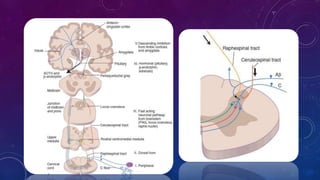
• Brainstem areas that provide intrinsic antinociception form a
neuronal descending system
 Rostral ventromedial medulla
 Periaqueductal gray (PAG) in the midbrain
 Locus coeruleus in the pons
ELECTROTHERAPY FOR ENDOGENOUS OPIATE LIBERATION
• Theoretically, stimulation of the endogenous opiate system can
also lead to pain relief
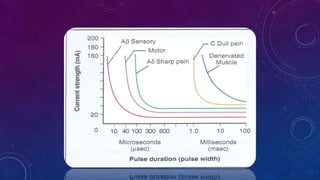
• Lower frequency stimulation (less than 10 Hz) with longer
pulsedurations producing longer lasting relief
• Electrical stimulators capable of rates of 1 to 5 pps, a pulse
duration greater than 200 microseconds
• An intensity to create a muscle twitch may generate pain relief
through this mechanism
• Electrode placement sites may include motor points that may
also be acupuncture points or trigger points.
Trigger points

Trigger points

  • 1.
  • 2.
    DEFINITION • A TriggerPoint (TrPt) is a hyperirritable spot associated within a taut band of a skeletal muscle • Painful on compression or muscle contraction • Usually responds with a referred pain pattern distant from the spot • Very often there are nodules palpable within the muscle often at the size of 2-10 mm
  • 3.
    ETIOLOGY & EPIDEMIOLOGY •Mainly due to overload • An injury sustained by a fall • Lack of exercise or a bad posture can lead to trigger points • Most common in sedentary persons between 27,5-55 years • 45% of the patients are men • Trigger points may be at different places in both skeletal muscles in the hip, neck, shoulder • usually in places where nerves connected the muscle fibers
  • 4.
    TAUT BAND &NODULES
  • 5.
    PATHOPHYSIOLOGICAL PROCESSES • Sensitizationof peripheral muscle nociceptors • Sensitization of second-order neurons in the dorsal horn • Dysregulation of the descending endogenous pain control system
  • 6.
    CHARACTERISTICS/CLINICAL PRESENTATION • ActiveTrPts Active TrPts produce pain symptoms at rest often with referred pain which may be described as radiating or spreading, usually not associated with a nerve or dermatome • Latent TrPts Latent TrPts do not provoke spontaneous pain The TrPt may refer pain with direct mechanical stimulation or muscle contraction
  • 7.
    ELECTROTHERAPY FOR ENDOGENOUSOPIATE LIBERATION • Endogenous refers to something from within or that is developed from internal systems • Opiates are drugs containing opium or its derivatives and are used in medicine for inducing sleep and relieving pain • Endogenous Opiate : the ability of the body to produce and release strong pain-relieving substances
  • 8.
    • Endorphins includeenkephalins, dynorphin, and β- endorphin • The transmission of nociceptive information can be inhibited by pain matrix activity • Brainstem areas that provide intrinsic antinociception form a neuronal descending system  Rostral ventromedial medulla  Periaqueductal gray (PAG) in the midbrain  Locus coeruleus in the pons
  • 10.
    ELECTROTHERAPY FOR ENDOGENOUSOPIATE LIBERATION • Theoretically, stimulation of the endogenous opiate system can also lead to pain relief • Lower frequency stimulation (less than 10 Hz) with longer pulsedurations producing longer lasting relief • Electrical stimulators capable of rates of 1 to 5 pps, a pulse duration greater than 200 microseconds • An intensity to create a muscle twitch may generate pain relief through this mechanism • Electrode placement sites may include motor points that may also be acupuncture points or trigger points.